EP3878838A1 - Polyisocyanate composition, coating composition and coating base material - Google Patents
Polyisocyanate composition, coating composition and coating base material Download PDFInfo
- Publication number
- EP3878838A1 EP3878838A1 EP19882335.3A EP19882335A EP3878838A1 EP 3878838 A1 EP3878838 A1 EP 3878838A1 EP 19882335 A EP19882335 A EP 19882335A EP 3878838 A1 EP3878838 A1 EP 3878838A1
- Authority
- EP
- European Patent Office
- Prior art keywords
- polyisocyanate
- group
- mass
- polyisocyanate composition
- acid
- Prior art date
- Legal status (The legal status is an assumption and is not a legal conclusion. Google has not performed a legal analysis and makes no representation as to the accuracy of the status listed.)
- Granted
Links
Classifications
-
- C—CHEMISTRY; METALLURGY
- C08—ORGANIC MACROMOLECULAR COMPOUNDS; THEIR PREPARATION OR CHEMICAL WORKING-UP; COMPOSITIONS BASED THEREON
- C08G—MACROMOLECULAR COMPOUNDS OBTAINED OTHERWISE THAN BY REACTIONS ONLY INVOLVING UNSATURATED CARBON-TO-CARBON BONDS
- C08G18/00—Polymeric products of isocyanates or isothiocyanates
- C08G18/06—Polymeric products of isocyanates or isothiocyanates with compounds having active hydrogen
- C08G18/70—Polymeric products of isocyanates or isothiocyanates with compounds having active hydrogen characterised by the isocyanates or isothiocyanates used
- C08G18/72—Polyisocyanates or polyisothiocyanates
- C08G18/77—Polyisocyanates or polyisothiocyanates having heteroatoms in addition to the isocyanate or isothiocyanate nitrogen and oxygen or sulfur
- C08G18/775—Polyisocyanates or polyisothiocyanates having heteroatoms in addition to the isocyanate or isothiocyanate nitrogen and oxygen or sulfur sulfur
-
- C—CHEMISTRY; METALLURGY
- C08—ORGANIC MACROMOLECULAR COMPOUNDS; THEIR PREPARATION OR CHEMICAL WORKING-UP; COMPOSITIONS BASED THEREON
- C08G—MACROMOLECULAR COMPOUNDS OBTAINED OTHERWISE THAN BY REACTIONS ONLY INVOLVING UNSATURATED CARBON-TO-CARBON BONDS
- C08G18/00—Polymeric products of isocyanates or isothiocyanates
- C08G18/06—Polymeric products of isocyanates or isothiocyanates with compounds having active hydrogen
- C08G18/08—Processes
- C08G18/0804—Manufacture of polymers containing ionic or ionogenic groups
- C08G18/0819—Manufacture of polymers containing ionic or ionogenic groups containing anionic or anionogenic groups
- C08G18/0828—Manufacture of polymers containing ionic or ionogenic groups containing anionic or anionogenic groups containing sulfonate groups or groups forming them
-
- C—CHEMISTRY; METALLURGY
- C08—ORGANIC MACROMOLECULAR COMPOUNDS; THEIR PREPARATION OR CHEMICAL WORKING-UP; COMPOSITIONS BASED THEREON
- C08G—MACROMOLECULAR COMPOUNDS OBTAINED OTHERWISE THAN BY REACTIONS ONLY INVOLVING UNSATURATED CARBON-TO-CARBON BONDS
- C08G18/00—Polymeric products of isocyanates or isothiocyanates
- C08G18/06—Polymeric products of isocyanates or isothiocyanates with compounds having active hydrogen
- C08G18/28—Polymeric products of isocyanates or isothiocyanates with compounds having active hydrogen characterised by the compounds used containing active hydrogen
- C08G18/2805—Compounds having only one group containing active hydrogen
- C08G18/288—Compounds containing at least one heteroatom other than oxygen or nitrogen
-
- C—CHEMISTRY; METALLURGY
- C08—ORGANIC MACROMOLECULAR COMPOUNDS; THEIR PREPARATION OR CHEMICAL WORKING-UP; COMPOSITIONS BASED THEREON
- C08G—MACROMOLECULAR COMPOUNDS OBTAINED OTHERWISE THAN BY REACTIONS ONLY INVOLVING UNSATURATED CARBON-TO-CARBON BONDS
- C08G18/00—Polymeric products of isocyanates or isothiocyanates
- C08G18/06—Polymeric products of isocyanates or isothiocyanates with compounds having active hydrogen
- C08G18/28—Polymeric products of isocyanates or isothiocyanates with compounds having active hydrogen characterised by the compounds used containing active hydrogen
- C08G18/40—High-molecular-weight compounds
- C08G18/62—Polymers of compounds having carbon-to-carbon double bonds
-
- C—CHEMISTRY; METALLURGY
- C08—ORGANIC MACROMOLECULAR COMPOUNDS; THEIR PREPARATION OR CHEMICAL WORKING-UP; COMPOSITIONS BASED THEREON
- C08G—MACROMOLECULAR COMPOUNDS OBTAINED OTHERWISE THAN BY REACTIONS ONLY INVOLVING UNSATURATED CARBON-TO-CARBON BONDS
- C08G18/00—Polymeric products of isocyanates or isothiocyanates
- C08G18/06—Polymeric products of isocyanates or isothiocyanates with compounds having active hydrogen
- C08G18/70—Polymeric products of isocyanates or isothiocyanates with compounds having active hydrogen characterised by the isocyanates or isothiocyanates used
- C08G18/703—Isocyanates or isothiocyanates transformed in a latent form by physical means
- C08G18/705—Dispersions of isocyanates or isothiocyanates in a liquid medium
- C08G18/706—Dispersions of isocyanates or isothiocyanates in a liquid medium the liquid medium being water
-
- C—CHEMISTRY; METALLURGY
- C08—ORGANIC MACROMOLECULAR COMPOUNDS; THEIR PREPARATION OR CHEMICAL WORKING-UP; COMPOSITIONS BASED THEREON
- C08G—MACROMOLECULAR COMPOUNDS OBTAINED OTHERWISE THAN BY REACTIONS ONLY INVOLVING UNSATURATED CARBON-TO-CARBON BONDS
- C08G18/00—Polymeric products of isocyanates or isothiocyanates
- C08G18/06—Polymeric products of isocyanates or isothiocyanates with compounds having active hydrogen
- C08G18/70—Polymeric products of isocyanates or isothiocyanates with compounds having active hydrogen characterised by the isocyanates or isothiocyanates used
- C08G18/72—Polyisocyanates or polyisothiocyanates
- C08G18/77—Polyisocyanates or polyisothiocyanates having heteroatoms in addition to the isocyanate or isothiocyanate nitrogen and oxygen or sulfur
- C08G18/78—Nitrogen
- C08G18/79—Nitrogen characterised by the polyisocyanates used, these having groups formed by oligomerisation of isocyanates or isothiocyanates
- C08G18/791—Nitrogen characterised by the polyisocyanates used, these having groups formed by oligomerisation of isocyanates or isothiocyanates containing isocyanurate groups
- C08G18/792—Nitrogen characterised by the polyisocyanates used, these having groups formed by oligomerisation of isocyanates or isothiocyanates containing isocyanurate groups formed by oligomerisation of aliphatic and/or cycloaliphatic isocyanates or isothiocyanates
-
- C—CHEMISTRY; METALLURGY
- C09—DYES; PAINTS; POLISHES; NATURAL RESINS; ADHESIVES; COMPOSITIONS NOT OTHERWISE PROVIDED FOR; APPLICATIONS OF MATERIALS NOT OTHERWISE PROVIDED FOR
- C09D—COATING COMPOSITIONS, e.g. PAINTS, VARNISHES OR LACQUERS; FILLING PASTES; CHEMICAL PAINT OR INK REMOVERS; INKS; CORRECTING FLUIDS; WOODSTAINS; PASTES OR SOLIDS FOR COLOURING OR PRINTING; USE OF MATERIALS THEREFOR
- C09D175/00—Coating compositions based on polyureas or polyurethanes; Coating compositions based on derivatives of such polymers
- C09D175/04—Polyurethanes
Definitions
- the present invention relates to a polyisocyanate composition, a coating composition and a coated substrate.
- PTL1 discloses a reaction product of a polyisocyanate compound with a compound having at least one sulfonic acid group and an isocyanate group.
- PTL2 and PTL3 disclose a polyisocyanate composition containing a modified polyisocyanate obtained by reacting an amine salt of a sulfonic acid having a hydroxyl group with a polyisocyanate.
- PTL4 and PTL5 disclose a modified polyisocyanate obtained by reacting an aminosulfonic acid having a specific structure with a polyisocyanate.
- Aqueous two-liquid type urethane coating compositions are used for painting furniture and building materials, residential wood products, wooden floors of houses and school facilities, trains and construction machines, agricultural cars, and the like.
- polyisocyanate compositions capable of providing a coating film having excellent appearance, hardness, water resistance and stain resistance.
- PTL2 to 3 disclose that the dispersibility in water can be improved by using a polyisocyanate having a sulfonic acid group.
- a polyisocyanate having a sulfonic acid group since the compatibility between the sulfonic acid group and the polyisocyanate is poor, there is a problem in that the synthesized product becomes turbid. If a highly organic sulfonic acid or an amine salt thereof is used for improving the turbidity, there is a problem in that the appearance of the coated film will be deteriorated, it is necessary to modify a large number of the sulfonic acid or amine salt thereof, and the hardness of the coating film decreases.
- PTL 4 to 5 disclose that the hardness of a coating film and the solvent resistance of a coating film are improved by using a modified polyisocyanate obtained by reacting with an aminosulfonic acid having a specific structure.
- the aminosulfonic acid having a specific structure has a relatively high hydrophobicity, there is a problem in that the appearance of the coating film is deteriorated. Further, although the hydrophobicity of aminosulfonic acid is relatively high, there is also a problem in that water resistance and stain resistance are poor.
- the present invention has been made in view of the above circumstances, and provides a polyisocyanate composition having excellent pot life and dispersibility when dispersed in water or a main agent containing water, and having excellent appearance, hardness and water resistance when formed into a coating film.
- the present invention also provides a coating composition and a coated substrate using the polyisocyanate composition.
- the present invention includes the following aspects.
- a polyisocyanate composition having excellent pot life and dispersibility when dispersed in water or a main agent containing water, and having excellent appearance, hardness and water resistance when formed into a coating film can be provided.
- the coating composition of the above aspect contains the polyisocyanate composition and has excellent appearance, hardness and water resistance when formed into a coating film.
- the coated substrate of the above aspect contains the coating composition, and the coating film provided in the coated substrate has excellent appearance, hardness and water resistance.
- a polyisocyanate composition having excellent pot life when dispersed in water or a main agent containing water, and having excellent appearance and water resistance when formed into a coating film can be provided.
- the coating composition of the above aspect contains the polyisocyanate composition and has excellent appearance and water resistance when formed into a coating film.
- the coating substrate of the above aspect is coated with the coating composition and has excellent appearance and water resistance.
- the present embodiment is not limited to the following embodiments and can be appropriately modified and implemented within the scope of the invention.
- the polyisocyanate composition of the present embodiment contains a polyisocyanate having a sulfonic acid anion group in its molecule and a tertiary ammonium cation of an amine compound, wherein the tertiary ammonium cation of an amine compound includes a tertiary ammonium cation of at least one amine compound selected from an amine compound represented by the following general formula (1) (hereinafter, may be referred to as "amine compound (1)”) and an amine compound represented by the following general formula (2) (hereinafter, may be referred to as "amine compound (2)”), and an amount of the tertiary ammonium cation of the selected amine compound is 70 mol% or more with respect to a total molar amount of the tertiary ammonium cation of all amine compounds in the composition.
- amine compound (1) an amine compound represented by the following general formula (1)
- amine compound (2) an amine compound represented by the following general formula (2)
- R 1 and R 2 are each independently a hydrocarbon group having 1 to 8 carbon atoms which may contain an ether bond, at least one selected from the group consisting of R 1 and R 2 may contain a ring structure, and R 1 and R 2 may be bonded to each other to form a ring structure, the ring structure being an aromatic ring, a cycloalkyl group having 5 to 6 carbon atoms, and a 5- or 6-membered ring in which R 1 and R 2 are bonded to each other.
- n11 is an integer of 0 or more and 5 or less
- R 11 is a hydrocarbon group having 1 to 8 carbon atoms which may contain an ether bond, and when n11 is 2 or more, a plurality of R 11 may be the same as or different from each other.
- the polyisocyanate composition of the present embodiment achieves excellent pot life and dispersibility when dispersed in water or a main agent containing water, and a coating film having excellent hardness and water resistance can be obtained as shown in Examples described later.
- the polyisocyanate composition of the present embodiment achieves excellent pot life when dispersed in water or a main agent containing water, and a coating film having excellent appearance and water resistance can be obtained.
- pot life means a time period after mixing a main agent and a curing agent to prepare a composition and before curing it, in which performance as a coating composition, adhesive or the like is secured. It is also called “usable time”. As shown in the Examples described later, the “pot life” can be evaluated by measuring the time during which 80% or more of the isocyanate groups are retained in the coating composition prepared by mixing the polyisocyanate composition (curing agent) of the present embodiment with the main agent.
- the polyisocyanate composition of the present embodiment usually contains an unreacted polyisocyanate as an isocyanate component, that is, a polyisocyanate having no sulfonic acid anion group in its molecule.
- an unreacted polyisocyanate as an isocyanate component that is, a polyisocyanate having no sulfonic acid anion group in its molecule.
- various properties of the polyisocyanate composition of the present embodiment which will be described later, are properties in a state of containing a polyisocyanate having a sulfonic acid anion group in its molecule and an unreacted polyisocyanate (polyisocyanate having no sulfonic acid anion group in its molecule).
- the ratio of the unreacted polyisocyanate to the polyisocyanate having a sulfonic acid anionic group in its molecule can be calculated from the ratio of isocyanate group having a sulfonic acid anion group in its molecule to 100 mol of isocyanate groups of the raw material polyisocyanate.
- the polyisocyanate having a sulfonic acid anionic group in its molecule contained in the polyisocyanate composition of the present embodiment is a reaction product obtained by reacting a sulfonic acid having an active hydrogen group or an amine salt thereof with a polyisocyanate.
- the polyisocyanate used for the polyisocyanate having a sulfonic acid anionic group in its molecule is not particularly limited, and examples thereof include polyisocyanates derived from at least one diisocyanate selected from aliphatic diisocyanates, alicyclic diisocyanates and aromatic diisocyanates.
- the polyisocyanate used for the polyisocyanate having a sulfonic acid anion group in its molecule is preferably at least one selected from the group consisting of an aliphatic polyisocyanate, an alicyclic polyisocyanate and an aromatic polyisocyanate from the viewpoint of being easily available industrially.
- the aliphatic diisocyanate is not particularly limited, and examples thereof include a 1,4-diisocyanatobutane, 1,5-diisocyanatopentane, ethyl (2,6-diisocyanato) hexanoate, 1,6-diisocyanatohexane (hereinafter, may be referred to as "HDI"), 1,9-diisocyanatononan, 1,12-diisocyanatododecane, 2,2,4- or 2,4,4-trimethyl-1,6-diisocyanatohexane and the like.
- HDI 1,4-diisocyanatobutane
- 1,5-diisocyanatopentane 1,5-diisocyanatopentane
- ethyl (2,6-diisocyanato) hexanoate 1,6-diisocyanatohexane (hereinafter, may be referred to as
- the alicyclic diisocyanate is not particularly limited, and examples thereof include a 1,3- or 1,4-bis (isocyanatomethyl) cyclohexane (hereinafter, may be referred to as "hydrogenated XDI”), 1,3- or 1,4-diisocyanatocyclohexane, 3,5,5-trimethyl1-isocyanato-3-(isocyanatomethyl) cyclohexane (hereinafter, may be referred to as "IPDI”), 4-4'-diisocyanato-dicyclohexylmethane (hereinafter, may be referred to as "hydrogenated MDI”), 2,5- or 2,6-diisocyanatomethylnorbornane and the like.
- hydroXDI 1,3- or 1,4-bis (isocyanatomethyl) cyclohexane
- IPDI 1,3- or 1,4-diisocyanatocyclohexane
- the aromatic diisocyanate is not particularly limited, and examples thereof include a xylylene diisocyanate, tolylene diisocyanate, diphenylmethane diisocyanate and the like.
- the diisocyanate is preferably an HDI, IPDI, hydrogenated XDI or hydrogenated MDI.
- the polyisocyanate derived from a diisocyanate is not particularly limited, and examples thereof include the polyisocyanates shown in the following (a) to (h).
- the polyisocyanate used for the polyisocyanate having a sulfonic acid anion group in its molecule is preferably a polyisocyanate (b) described above, and more preferably a polyisocyanate having an isocyanurate group.
- the polyisocyanate used for the polyisocyanate having a sulfonic acid anion group in its molecule may contain an aliphatic triisocyanate.
- the aliphatic triisocyanate include 1,3,6-triisocyanatohexane, 1,8-diisocyanato-4-isocyanatomethyloctane, 2-isocyanatoethyl-2,6-diisocyanato-hexanoate and the like.
- these polyisocyanates may be modified with a nonionic hydrophilic group such as an alkoxypolyalkylene glycol or the like, or a vinyl polymer having a hydroxyl group and a nonionic hydrophilic group.
- a nonionic hydrophilic group such as an alkoxypolyalkylene glycol or the like, or a vinyl polymer having a hydroxyl group and a nonionic hydrophilic group.
- polyisocyanates can be used alone or in combination of two or more.
- the method for producing a polyisocyanate having an isocyanurate group is not particularly limited, and examples thereof include a method in which a diisocyanate is converted to an isocyanurate using a catalyst or the like, the reaction is stopped when a predetermined conversion rate is reached, and unreacted diisocyanate is removed, or the like.
- the catalyst used in the above-mentioned isocyanurate-forming reaction is not particularly limited, a catalyst exhibiting basicity is preferable, and specific examples thereof include hydrooxides and organic weak acids of tetraalkylammonium, hydroxides and organic weak acid salts of hydroxyalkylammonium, alkali metal salts of alkylcarboxylic acids, metal alcolates, aminosilyl group-containing compounds, Mannich bases, combination of tertiary amines and epoxy compounds, phosphorus compounds and the like.
- tetraalkylammonium examples include tetramethylammonium and tetraethylammonium.
- Examples of the organic weak acid include acetic acid and capric acid.
- Examples of the hydroxyalkylammonium include trimethylhydroxypropylammonium, trimethylhydroxyethylammonium, triethylhydroxypropylammonium, triethylhydroxyethylammonium and the like.
- alkylcarboxylic acid examples include acetic acid, caproic acid, octyl acid, myristic acid and the like.
- Examples of the metal constituting the alkali metal salt include tin, zinc, lead and the like.
- Examples of the metal alcoholate include sodium alcoholate and potassium alcoholate.
- aminosilyl group-containing compound examples include hexamethyldisilazane and the like.
- Examples of the phosphorus compound include tributylphosphine and the like.
- the amount of these catalysts used is preferably 10 ppm or more and 1.0% or less with respect to the total mass of the raw material diisocyanate (and, if necessary, alcohol).
- the catalyst may be inactivated by addition of an acidic substance that neutralizes the catalyst, thermal decomposition, chemical decomposition or the like.
- the acidic substance that neutralizes the catalyst include phosphoric acid, acidic phosphoric acid ester and the like.
- the yield of the polyisocyanate generally tends to be 10% by mass or more and 70% by mass or less, and is preferably 35% by mass or more and 60% by mass or less. Polyisocyanates obtained in a higher yield tend to be more viscous. The yield can be calculated from the ratio of the mass of the obtained polyisocyanate to the total mass of the raw material components.
- reaction temperature of the isocyanurate-forming reaction is not particularly limited, it is preferably 50°C or higher and 200°C or lower, and more preferably 50°C or higher and 150°C or lower.
- reaction temperature is equal to or higher than the above lower limit, the reaction tends to proceed more easily, and when the reaction temperature is equal to or lower than the above upper limit, side reactions that cause coloring tend to be more suppressed.
- the diisocyanate content is preferably 3.0% by mass or less, more preferably 1.0% by mass or less, and even more preferably 0.5% by mass or less, with respect to the total mass of the polyisocyanate.
- the curability tends to be further improved.
- the active hydrogen group an amino group, a carboxyl group, a hydroxyl group and the like can be mentioned.
- the active hydrogen group is preferably at least one selected from the group consisting of an amino group and a hydroxyl group.
- examples of the sulfonic acid having a hydroxyl group include a compound represented by the following general formula (4) (hereinafter, abbreviated as "sulfonic acid (4)”) and the like.
- R 4 is a hydrocarbon group having 1 to 10 carbon atoms which may contain at least one selected from the group consisting of a hydroxyl group, an ether bond, an ester bond, a carbonyl group, and an imino group.
- R 4 may include a ring structure.
- the ring structure is an aromatic ring, a 5-membered ring or a 6-membered ring containing two nitrogen atoms, or a 5-membered ring or a 6-membered ring containing a nitrogen atom and an oxygen atom.
- the hydrocarbon group having 1 to 10 carbon atoms may be a divalent aliphatic hydrocarbon group having 1 to 10 carbon atoms, and a divalent aromatic hydrocarbon group having 6 to 10 carbon atoms.
- the divalent aliphatic hydrocarbon group having 1 to 10 carbon atoms is preferably a chain alkylene group having 1 to 6 carbon atoms. When it is a chain alkylene group having 1 to 6 carbon atoms, it may be a group containing a ring structure as a part of the chain alkylene group.
- the alkylene group having 1 to 6 carbon atoms may be linear or branched.
- R 4 is preferably a chain alkylene group having 1 to 6 carbon atoms, a divalent aromatic hydrocarbon group (arylene group) having 6 to 10 carbon atoms, a divalent alkylene group containing an aromatic ring and having 1 to 10 carbon atoms, a divalent alkylene group having 1 to 6 carbon atoms and containing a 5-membered ring or a 6-membered ring containing two nitrogen atoms or a divalent alkylene group having 1 to 6 carbon atoms and containing a 5- or 6-membered ring containing a nitrogen atom and an oxygen atom.
- the sulfonic acid (4) include 2-hydroxyethanesulfonic acid, 3-hydroxypropane sulfonic acid, 4-hydroxybutane sulfonic acid, 5-hydroxypentane sulfonic acid, 6-hydroxyhexane sulfonic acid, hydroxybenzene sulfonic acid, hydroxy (methyl) benzenesulfonic acid, 4-(2-hydroxyethyl)-1-piperazine ethanesulfonic acid, 4-(2-hydroxyethyl)-1-piperazin propanesulfonic acid, 2-hydroxy-3-morpholinopropanesulfonic acid and the like.
- these compounds are only some of the preferred sulfonic acids (4), and the preferred sulfonic acid (4) is not limited thereto.
- sulfonic acids (4) may be used alone, or in combination of two or more.
- the sulfonic acid having a hydroxyl group is preferably at least one selected from the group consisting of a 2-hydroxyethanesulfonic acid, a 3-hydroxypropanesulfonic acid, a hydroxybenzenesulfonic acid, and a hydroxy (methyl) benzenesulfonic acid.
- the sulfonic acids (4) may be the same as or different from each other.
- the sulfonic acid used for the polyisocyanate having a sulfonic acid anionic group in its molecule may form a salt with an amine compound described later.
- examples of the sulfonic acid having an amino group include a compound represented by the following general formula (5) (hereinafter, abbreviated as " sulfonic acid (5) ”) and the like.
- R 5 and R 6 are each independently a hydrogen atom or a hydrocarbon group having 1 to 12 carbon atoms which may contain a hydroxyl group.
- R 5 and R 6 may be the same as or different from each other.
- At least one of R 5 and R 6 is a hydrogen atom.
- R7 is a hydrocarbon group having 1 to 12 carbon atoms which may contain a hydroxyl group.
- R 5 and R 6 are each independently a hydrogen atom, or a hydrocarbon group having 1 to 12 carbon atoms which may contain a hydroxyl group.
- R 5 and R 6 may be the same as or different from each other.
- At least one of R 5 and R 6 is a hydrogen atom. That is, when R 5 is a hydrocarbon group having 1 to 12 carbon atoms which may contain a hydroxyl group, R 6 is a hydrogen atom. Further, when R 6 is a hydrocarbon group having 1 to 12 carbon atoms which may contain a hydroxyl group, R 5 is a hydrogen atom. Further, both R 5 and R 6 may be hydrogen atoms.
- the hydrocarbon group having 1 to 12 carbon atoms may be a monovalent aliphatic hydrocarbon group having 1 to 12 carbon atoms, or a monovalent aromatic hydrocarbon group having 6 to 12 carbon atoms.
- the monovalent aliphatic hydrocarbon group having 1 to 12 carbon atoms is preferably a chain alkyl group having 1 to 6 carbon atoms or a cyclic alkyl group having 3 to 6 carbon atoms.
- the chain alkyl group having 1 to 6 carbon atoms may be linear or branched.
- R 5 and R 6 are each preferably a hydrogen atom, a chain alkyl group having 1 to 6 carbon atoms, or a cyclic alkyl group having 3 to 6 carbon atoms.
- R 7 is a hydrocarbon group having 1 to 12 carbon atoms which may contain a hydroxyl group.
- the hydrocarbon group having 1 to 12 carbon atoms may be a divalent aliphatic hydrocarbon group having 1 to 12 carbon atoms, or a divalent aromatic hydrocarbon group having 6 to 12 carbon atoms.
- the divalent aliphatic hydrocarbon group having 1 to 12 carbon atoms is preferably a chain alkylene group having 1 to 12 carbon atoms.
- the chain alkylene group having 1 to 12 carbon atoms may be linear or branched.
- R 7 is preferably a divalent chain alkylene group having 1 to 6 carbon atoms, or a divalent aromatic hydrocarbon group (arylene group) having 6 to 10 carbon atoms.
- the sulfonic acid (5) include 2-aminoethane sulfonic acid, 3-aminopropane sulfonic acid, 2-methylaminoethanesulfonic acid, 3-methylaminopropanesulfonic acid, 2-cyclohexylaminoethanesulfonic acid, 3-cyclohexylaminopropanesulfonic acid, 3-cyclohexylaminoisobutylsulfonic acid, 4-cyclohexylaminobutane sulfonic acid, 2-cyclohexylmethylaminoethanesulfonic acid, 3-cyclohexylmethylaminopropanesulfonic acid, 3-cyclohexylmethylaminoisobutylsulfonic acid, 4-cyclohexylmethylaminobutane sulfonic acid, 2-methylcyclohexylaminoethanesulfonic acid, 3-methylcyclohexylaminopropanesulf
- these compounds are only some of the preferred sulfonic acids (5), and the preferred sulfonic acid (5) is not limited thereto.
- the sulfonic acid (5) may be used alone, or in combination of two or more.
- the sulfonic acid having an amino group is preferably at least one selected from the group consisting of 2-cyclohexylaminoethanesulfonic acid, 3-cyclohexylaminopropanesulfonic acid, 4-cyclohexylaminobutane sulfonic acid, 3-cyclohexylmethylaminopropanesulfonic acid, 3-(p-methylcyclohexylamino) propanesulfonic acid, 3-(3,3,5-trimethylcyclohexylamino) propanesulfonic acid, 4-(p-methylcyclohexylamino) butane sulfonic acid, 2-aminobenzene sulfonic acid, 2-amino-5-methylbenzenesulfonic acid, 2-amino-3,5-dimethylbenzenesulfonic acid, 5-amino-2-methylbenzenesulfonic acid (4-aminotoluene-2-sulfonic acid), 4-a
- the sulfonic acids (5) may be the same as or different from each other.
- the polyisocyanate composition of the present embodiment contains a tertiary ammonium cation of at least one amine compound selected from the amine compounds (1) and (2).
- the polyisocyanate composition of the present embodiment may contain one of the amine compounds (1) and (2) alone, or contain two or more in combination.
- the "tertiary ammonium cation of the amine compounds (1) and (2)” means a cation protonated by coordinating a proton (H + ) to "N" (nitrogen atom) in the amine compounds (1) and (2).
- R 1 and R 2 are each independently a hydrocarbon group having 1 to 8 carbon atoms which may contain an ether bond. At least one selected from the group consisting of R 1 and R 2 may contain a ring structure, and R 1 and R 2 may be bonded to each other to form a ring structure.
- the ring structure is an aromatic ring, a cycloalkyl group having 5 to 6 carbon atoms, or a 5- or 6-membered ring in which R 1 and R 2 are bonded to each other.
- n11 is an integer of 0 to 5.
- R 11 is a hydrocarbon group having 1 to 8 carbon atoms which may contain an ether bond. When n11 is 2 or more, a plurality of R 11 may be the same as or different from each other.
- the amine compounds (1) and (2) may form a salt with the above-described sulfonic acid.
- R 1 and R 2 are each independently a hydrocarbon group having 1 to 8 carbon atoms which may contain an ether bond, and at least one selected from the group consisting of R 1 and R 2 may contain an aromatic ring or a cycloalkyl group having 5 to 6 carbon atoms, and R 1 and R 2 may be bonded to each other to form a 5- to 6-membered ring.
- the hydrocarbon group having 1 to 8 carbon atoms may be a monovalent aliphatic hydrocarbon group having 1 to 8 carbon atoms or a monovalent aromatic hydrocarbon group having 6 carbon atoms.
- the monovalent aliphatic hydrocarbon group having 1 to 8 carbon atoms is preferably a chain alkyl group having 1 to 8 carbon atoms or a cyclic alkyl group having 3 to 8 carbon atoms.
- the chain alkyl group having 1 to 8 carbon atoms may be linear or branched.
- amine compounds (1) include N, N-diethylpropylamine, N, N-dibutylpropylamine, dimethylpropylamine, N-propylpyrrolidine, N-propyl piperidine, N-propylmorpholin, amine compound represented by the following general formula (3) (hereinafter, may be referred to as "amine compound (3)") and the like. These compounds are only some of the preferred amine compounds (1), and the preferred amine compound (1) is not limited thereto. Further, the amine compound (1) may be used alone, or in combination of two or more.
- the amine compound (1) is preferably the amine compound (3).
- R 3 is an aromatic ring or a hydrocarbon group having 1 to 8 carbon atoms which may contain a cycloalkyl group having 5 or 6 carbon atoms.
- R 3 is a hydrocarbon group having 1 to 8 carbon atoms which may contain a ring structure.
- Examples of the hydrocarbon group having 1 to 8 carbon atoms include the same hydrocarbon groups as those exemplified in the above-described "R 1 and R 2 ".
- Preferred examples of the amine compound (1-1) include a N, N-dipropyloctylamine, tripropylamine and the like. In addition, these compounds are only some of the preferred amine compounds (1-1), and the preferred amine compound (1-1) is not limited thereto. Further, the amine compound (1-1) may be used alone, or in combination of two or more.
- n11 is an integer of 0 to 5.
- R 11 is a hydrocarbon group having 1 to 8 carbon atoms which may contain an ether bond. When n11 is 2 or more, a plurality of R 11 may be the same as or different from each other.
- the amine compound (2) may form a salt with the above-described sulfonic acid.
- the pyridine ring may be unsubstituted or may be substituted with a substituent R 11 .
- n11 represents the number of substituents R 11 , and is an integer of 0 to 5, and preferably an integer of 1 to 3. When n11 is 0, the pyridine ring is unsubstituted.
- R 11 is a hydrocarbon group having 1 to 8 carbon atoms which may contain an ether bond (-O-).
- n11 is 2 or more, a plurality of R 11 may be the same as or different from each other.
- the hydrocarbon group having 1 to 8 carbon atoms may be a monovalent aliphatic hydrocarbon group having 1 to 8 carbon atoms, or a monovalent aromatic hydrocarbon group having 6 to 12 carbon atoms.
- the monovalent aliphatic hydrocarbon group having 1 to 8 carbon atoms is preferably a chain alkyl group having 1 to 6 carbon atoms or a cyclic alkyl group having 3 to 6 carbon atoms.
- the chain alkyl group having 1 to 6 carbon atoms may be linear or branched.
- R 11 is preferably a chain alkyl group having 1 to 6 carbon atoms, more preferably a chain alkyl group having 1 to 4 carbon atoms, and even more preferably a linear alkyl group having 1 to 4 carbon atoms.
- Preferred examples of the amine compound (2) include pyridine, 2-picoline, 3-picoline, 4-picoline, 2-ethylpyridine, 3-ethylpyridine, 4-ethylpyridine, 2-propylpyridine, 3-propylpyridine, 4-propylpyridine, 4-sec-propylpyridine, 4-tert-propylpyridine, 2-butyl pyridine, 3-butyl pyridine, 4-butyl pyridine, 4-sec-butyl pyridine, 4-tert-butyl pyridine, 2,6-lutidine, 2,3-lutidine, 2,4-lutidine, 2,5-lutidine, 3,4-lutidine, 3,5-lutidine, 2,4,6-trimethylpyridine, 2,3,5-trimethylpyridine, 5-ethyl-2-picoline, 3,5-diethylpyridine, 2-(3-pentyl) pyridine, 4-(3-pentyl) pyridine and the like.
- these compounds are only some of the preferred amine compounds (2), and the preferred amine compound (2) is not limited thereto.
- the amine compound may be used alone, or in combination of two or more.
- the amine compound (2) is preferably at least one selected from the group consisting of 4-picoline, 4-ethylpyridine, 3-propylpyridine, 4-propylpyridine, 3-butyl pyridine, 4-butyl pyridine, 2,4,6-trimethylpyridine, 2,3,5-trimethylpyridine, 5-ethyl-2-picoline and 3,5-diethylpyridine.
- the amine compounds (2) may be the same as or different from each other.
- the polyisocyanate composition of the present embodiment may contain a tertiary ammonium cation of other amine compounds in addition to the tertiary ammonium cation of the amine compounds (1) and (2).
- Said other amine compounds are not particularly limited as long as they are other than the above-described amine compounds (1) and (2). Specific examples of said other amine compounds include those shown in the following (a) to (d). Further, these other amine compounds may be used alone or in combination of two or more.
- the amount of the tertiary ammonium cations of the amine compounds (1) and/or (2) is 70 mol% or more, preferably 80 mol% or more, more preferably 90 mol% or more, even more preferably 91 mol% or more, still even more preferably 99 mol% or more, and particularly preferably 100 mol%, with respect to the total molar amount of the tertiary ammonium cations of all amine compounds in the composition.
- the amount of the tertiary ammonium cation of the amine compounds (1) and/or (2) is equal to or higher than the lower limit, as shown in Examples described later, excellent pot life and dispersibility when dispersed in water or a main agent containing water can be achieved, and a coating film having excellent appearance, hardness and water resistance can be obtained.
- excellent pot life when dispersed in water or a main agent containing water can be achieved, and a coating film having excellent appearance and water resistance can be obtained.
- the amine salt of the sulfonic acid can be obtained by mixing a sulfonic acid having an active hydrogen group and an amine compound to cause a neutralization reaction.
- the neutralization reaction may be carried out in advance before the reaction with the polyisocyanate. Alternatively, it may be carried out at the same time as the reaction with the polyisocyanate. Alternatively, the amine compound may be added after reacting the polyisocyanate with a sulfonic acid having an active hydrogen group.
- the neutralization reaction is preferably carried out in advance before the reaction with the polyisocyanate.
- the neutralization reaction is preferably carried out at the same time as the reaction with the polyisocyanate, or carried out by adding the amine compound after reacting the polyisocyanate with the sulfonic acid having an active hydrogen group.
- the mixing ratio of the sulfonic acid having a hydroxyl group and the amine compound is 0.5 or more and 2 or less, and preferably 0.8 or more and 1.5 or less.
- the temperature and time can be appropriately determined according to the progress of the reaction, and the temperature is usually preferably about 0°C or higher and 100°C or lower, and the mixing time is usually preferably about 10 minutes or longer and about 24 hours or less.
- the solvent used in the preparation of the amine salt of the sulfonic acid having an active hydrogen group is preferably water or a hydrophilic solvent.
- the hydrophilic solvent is not particularly limited, and examples thereof include alcohols, ether alcohols, ketones, amide-based solvents and the like. These solvents can be used alone or in combination.
- alcohols examples include methanol, ethanol, propanol, butanol, isopropanol and the like.
- ether alcohols examples include ethylene glycol monomethyl ether, ethylene glycol monoethyl ether, ethylene glycol monobutyl ether, diethylene glycol monoethyl ether, diethylene glycol monobutyl ether, propylene glycol monomethyl ether, propylene glycol monoethyl ether, dipropylene glycol monomethyl ether and the like.
- ketones examples include acetone, methyl ethyl ketone, methyl isobutyl ketone and the like.
- amide-based solvents examples include N, N-dimethylformamide, N, N-dimethylacetamide and the like.
- the isocyanate group be modified at a ratio of 0.25 mol or more and 50 mol or less with the sulfonic acid having an active hydrogen group, preferably at a ratio of 0.5 mol or more and 20 mol or less, more preferably at a ratio of 1 mol or more and 10 mol or less, with respect to 100 mol of the isocyanate group of the raw material polyisocyanate.
- the amount of the isocyanate group of the polyisocyanate composition of the present embodiment is preferably 10% by mass or more and 25% by mass or less, and more preferably 15% by mass or more and 24% by mass or less, when the non-volatile content is 100% by mass.
- the method for controlling the isocyanate group content within the above range is not particularly limited, and examples thereof include a method for adjusting the blending ratio of the sulfonic acid and polyisocyanate.
- the number-average molecular weight of the polyisocyanate (including the polyisocyanate having a sulfonic acid anionic group in its molecule and the unreacted polyisocyanate) used in the polyisocyanate composition of the present embodiment is preferably 450 or more and 2,000 or less, more preferably 500 or more and 1,800 or less, and even more preferably 550 or more and 1,550 or less from the viewpoint of solvent resistance of the coating film.
- the method for controlling the number-average molecular weight within the above range is not particularly limited, and examples thereof include a method for adjusting the blending ratio of the sulfonic acid, the amine compound, and the polyisocyanate.
- the number-average molecular weight can be measured using, for example, gel permeation chromatography (GPC).
- the average number of functional groups of the isocyanate groups of the polyisocyanate (including modified polyisocyanate and unreacted polyisocyanate) used in the polyisocyanate composition of the present embodiment is preferably 1.8 or more and 6.2 or less, more preferably 2.0 or more and 5.6 or less, and even more preferably 2.5 or more and 4.6 or less from the viewpoint of solvent resistance of the coating film and the isocyanate group retention rate.
- the method for controlling the average number of the functional groups within the above range is not particularly limited, and examples thereof include a method for adjusting the blending ratio of the sulfonic acid, the amine compound, and the polyisocyanate.
- the isocyanate group content, the non-volatile content, and the average number of functional groups of the isocyanate groups can be measured by the methods described in the Examples later.
- the polyisocyanate composition of the present embodiment is a composition containing the above-mentioned polyisocyanate having a sulfonic acid anion group in its molecule, an unreacted polyisocyanate, and a tertiary ammonium cation of the amine compound (1) and/or (2).
- the polyisocyanate composition of the present embodiment may contain other components in addition to the above-mentioned polyisocyanate having a sulfonic acid anion group in its molecule, unreacted polyisocyanate, and the tertiary ammonium cation of the amine compounds (1) and/or (2).
- Said other components are not particularly limited, and examples thereof include solvents, antioxidants, light stabilizers, polymerization inhibitors, surfactants, and the like.
- the solvent used in the polyisocyanate composition of the present embodiment may be a hydrophilic solvent or a hydrophobic solvent. These solvents can be used alone or in combination.
- the hydrophobic solvent is not particularly limited, and examples thereof include a mineral spirit, solvent naphtha, LAWS (Low Aromatic White Spirit), HAWS (High Aromatic White Spirit), toluene, xylene, cyclohexane, esters, ketones, and amides.
- esters examples include ethyl acetate, butyl acetate and the like.
- ketones examples include acetone, methyl ethyl ketone, methyl isobutyl ketone, cyclohexanone and the like.
- amides examples include N, N-dimethylformamide, N, N-dimethylacetamide and the like.
- the hydrophilic solvent is not particularly limited, and examples thereof include alcohols, ethers, and esters of ether alcohols.
- alcohols examples include methanol, ethanol, propanol, isopropanol, 2-ethylhexanol and the like.
- ethers examples include diethylene glycol dimethyl ether, diethylene glycol diethyl ether, diethylene glycol dibutyl ether, dipropylene glycol dimethyl ether and the like.
- esters of ether alcohols include ethylene glycol monomethyl ether acetate, ethylene glycol monoethyl ether acetate, ethylene glycol monobutyl ether acetate, diethylene glycol monoethyl ether acetate, diethylene glycol monobutyl ether acetate, propylene glycol monoethyl ether acetate, propylene glycol monomethyl ether acetate, dipropylene glycol monomethyl ether acetate and the like.
- the amount of the solvent is preferably 0% by mass or more and 90% by mass or less, more preferably 0% by mass or more and 50% by mass or more, even more preferably 0% by mass or more and 30% by mass or less with respect to the total mass of the polyisocyanate composition of the present embodiment.
- antioxidant and the light stabilizer examples include those shown in the following (a) to (e). These may be contained alone or in combination of two or more.
- polymerization inhibitor examples include hydroquinones, phenols, cresols, catechols, benzoquinones and the like.
- specific examples of the polymerization inhibitor include benzoquinone, p-benzoquinone, p-toluquinone, p-xyloquinone, naphthoquinone, 2,6-dichloroquinone, hydroquinone, trimethylhydroquinone, catechol, p-t-butyl catechol, 2,5-di-t-butylhydroquinone, monomethylhydroquinone, p-methoxyphenol, 2,6-di-t-butyl-p-cresol, hydroquinone monomethyl ether and the like. These examples may be contained alone or in combination of two or more.
- surfactant examples include known anionic surfactants, cationic surfactants, amphoteric surfactants and the like.
- the total content of the antioxidant, light stabilizer, polymerization inhibitor and the surfactant is preferably 0 to 10% by mass, more preferably 0 to 5% by mass, and even more preferably 0 to 2% by mass with respect to the total amount of the polyisocyanate composition of the present embodiment.
- the method for producing the polyisocyanate composition of the present embodiment preferably includes, for example, a step of (A) mixing and reacting an amine salt of a sulfonic acid having an active hydrogen group with a polyisocyanate.
- the method for producing the polyisocyanate composition of the present embodiment preferably includes, for example, a step (B) of mixing and reacting a sulfonic acid having an active hydrogen group, a polyisocyanate, and the above-described compound (1) and or (2).
- step (A) it is preferable that the amine salt of the sulfonic acid be added to the polyisocyanate after being adjusted in advance.
- step (B) the sulfonic acid having an active hydrogen group and the amine compounds may be simultaneously added to the polyisocyanate, or may be added in order.
- step (A) is preferable, and it is more preferable that the amine salt of the sulfonic acid be added to the polyisocyanate after being adjusted in advance.
- step (B) is preferable.
- the mixing ratio of the sulfonic acid having an active hydrogen group or amine salt thereof to the polyisocyanate is preferably such that the molar ratio of isocyanate group/active hydrogen group is 2 to 400, more preferably 5 to 200, and even more preferably 10 to 100 from the viewpoint of the emulsifiability and the coating film physical properties.
- the reaction temperature and the reaction time can be appropriately determined according to the progress of the reaction, the reaction temperature is preferably 0°C to 150°C, and the reaction time is preferably 30 minutes to 48 hours.
- catalysts in the reaction step, ordinary and known catalysts may be used in some cases.
- the catalyst is not particularly limited, examples thereof include those shown in the following (a) to (f), and the like. These examples may be used alone or in combination.
- a solvent may be used or may not be used.
- the solvent used in the method for producing the polyisocyanate composition of the present embodiment may be a hydrophilic solvent or a hydrophobic solvent.
- hydrophilic solvent and the hydrophobic solvent the same as those exemplified above for the other components can be mentioned.
- At least one selected from the group consisting of an antioxidant, a light stabilizer, a polymerization inhibitor and a surfactant may be used in addition to the sulfonic acid having an active hydrogen group, the polyisocyanate and the amine compound.
- an antioxidant e.g., a light stabilizer, a polymerization inhibitor and a surfactant
- the antioxidant, light stabilizer, polymerization inhibitor and surfactant the same as those exemplified for the other components above can be mentioned.
- the coating composition of the present embodiment includes the polyisocyanate composition described above.
- the coating composition of the present embodiment may be used as an organic solvent-based coating composition, it is preferable to be used as an aqueous coating composition in which resins as coating film-forming components are dissolved or dispersed in a medium mainly containing water.
- the coating composition of the present embodiment may also be used for coating materials for buildings, coating materials for automobiles, coating materials for automobile repair, coating materials for plastic, pressure-sensitive adhesives, adhesives, building materials, household aqueous coating materials, other coating agents, sealing agents, ink, casting materials, elastomers, forms, plastic raw materials, and fiber treatment agents.
- the resins as the main component are not particularly limited, examples thereof include acrylic resins, polyester resins, polyether resins, epoxy resins, fluorine resins, polyurethane resins, polyvinylidene chloride copolymer, polyvinyl chloride copolymer, vinyl acetate copolymer, acrylonitrile butadiene copolymer, polybutadiene copolymer, styrene butadiene copolymer and the like.
- acrylic resins or polyester resins are preferable as the resins.
- acrylic resins are not particularly limited, examples thereof include acrylic resins obtained by polymerizing a single polymerizable monomer or a mixture of polymerizable monomers selected from the monomers shown in the following (a) to (e) and the like. These acrylic resins may be used alone or in combination.
- emulsion polymerization As a polymerization method thereof, although the emulsion polymerization is generally used, suspension polymerization, dispersion polymerization, solution polymerization may also be used. In the emulsion polymerization, it is also possible to perform stepwise polymerization.
- polyester resins are not particularly limited, examples thereof include polyester resins obtained by performing a condensation reaction of a single carboxylic acid or a mixture of carboxylic acids with a single polyhydric alcohol or a mixture of polyhydric alcohols.
- carboxylic acid for example, succinic acid, adipic acid, sebacic acid, dimer acid, maleic anhydride, phthalic anhydride, isophthalic acid, terephthalic acid, trimellitic acid, pyromellitic acid or the like can be mentioned.
- polyhydric alcohol for example, diols, triols, tetraols or the like can be mentioned.
- diols ethylene glycol, diethylene glycol, triethylene glycol, propylene glycol, dipropylene glycol, tripropylene glycol, 1,2-propanediol, 1,3-propanediol, 1,2-butanediol, 1,3-butanediol, 1,4-butanediol, 2,3-butanediol, 2-methyl-1,2-propanediol, 1,5-pentanediol, 2-methyl-2,3-butanediol, 1,6-hexanediol, 1,2-hexanediol, 2,5-hexanediol, 2-methyl-2,4-pentanediol, 2,3-dimethyl-2,3-butanediol, 2-ethyl-hexanediol, 1,2-octanediol, 1,2-decanediol, 2,2,4-trimethyl
- triols for example, glycerin, trimethylol propane or the like can be mentioned.
- tetraols for example, diglycerin, dimethylol propane, pentaerythritol or the like can be mentioned.
- polycaprolactones obtained by performing a ring-opening polymerization of ⁇ -caprolactone onto a hydroxyl group of a low-molecular-weight polyol, and the like can also be used as the polyester resins.
- polyether resins examples include those shown in the following (a) to (d).
- Examples of the polyvalent hydroxy compound in the above-described (b) include those shown in the following (i) to (vi).
- Examples of the strong basic catalyst in (a) include hydroxides of alkali metals, alcoholates, alkylamines and the like.
- Examples of alkali metals include lithium, sodium, potassium and the like.
- alkylene oxide in the above-described (a) examples include ethylene oxide, propylene oxide, butylene oxide, cyclohexene oxide, styrene oxide and the like.
- Examples of the polyamine compound in the above-described (b) include ethylenediamines and the like.
- Examples of the cyclic ether in the above-described (c) include tetrahydrofuran and the like.
- these resins may be used in combination with resins such as a melamine-based curing agent, a urethane dispersion, a urethane acrylic emulsion or the like according to need.
- these resins be emulsified, dispersed or dissolved in water. For this reason, it is possible to neutralize the carboxyl group, sulfonic group and the like contained in the resin.
- the neutralizing agent for neutralizing the carboxyl group, sulfonic group and the like is not particularly limited, examples thereof include ammonia, a water-soluble amino compound and the like.
- water-soluble amino compound for example, monoethanolamine, ethylamine, dimethylamine, diethylamine, triethylamine, propyl amine, dipropylamine, isopropylamine, diisopropylamine, triethanolamine, butylamine, dibutylamine, 2-ethylhexylamine, ethylenediamine, propylene diamine, methylethanolamine, dimethylethanolamine, diethylethanolamine, morpholine or the like can be mentioned. These examples may be used alone or in combination of two or more.
- the neutralizing agent is preferably a tertiary amine, more preferably triethylamine or dimethylethanolamine.
- the coating composition of the present embodiment may further include additives that are generally added to coating materials.
- the additives include inorganic pigments, organic pigments, extender pigments, silane coupling agents, titanium coupling agents, organophosphates, organic phosphites, thickeners, leveling agents, thixotroping agents, antifoaming agents, freezing stabilizers, matting agents, crosslinking reaction catalysts (a catalyst for curing promotion), skinning-preventing agents, dispersants, wetting agents, fillers, plasticizers, lubricants, reducing agents, preservatives, mildewproofing agents, deodorants, anti-yellowing agents, ultraviolet absorbers, antistatic agents or charge control agents, sedimentation-preventing agents and the like. These additives may be added alone, or in combination of two or more.
- crosslinking reaction catalyst examples include those shown in the following (a) or (b), but are not limited to them.
- the coating composition of the present embodiment may further include a surfactant in addition to the above-described polyisocyanate composition and resins in order to improve the dispersibility in the coating material.
- the coating composition of the present embodiment may further include an antioxidant, a light stabilizer, or a polymerization inhibitor in addition to the above-described polyisocyanate composition and resins in order to improve the storage stability of the paint.
- the coated substrate of the present embodiment is a coated substrate coated with the above-described coating composition.
- the coated substrate of the present embodiment preferably has a coating layer containing the above-described coating composition.
- the coated substrate of the present embodiment may include a desired substrate and optionally a conventional primer prior to the coating.
- Examples of the substrate include metals, wood, glass, stones, ceramic materials, concrete, rigid and flexible plastics, fiber products, leather products, paper and the like.
- the viscosity was measured at 25°C with an E-type viscometer (manufactured by Tokimec Co., Ltd.). A standard rotor (1° 34' ⁇ R24) was used. The number of rotations was as follows.
- the polyisocyanate compositions obtained in the Examples and Comparative Examples were used as samples, and the measurement of the isocyanate group content was carried out according to the method described in JIS K7301-1995 (Torylene isocyanate type prepolymer test method for thermosetting urethane elastomer). A more specific method for measuring the isocyanate group content (NCO%) is shown below.
- the isocyanate group content (NCO%) was calculated from the sample titration amount and the blank titration amount obtained above using the calculation equation (A) shown below.
- Isocyanate group content % by mass V 0 ⁇ V 1 ⁇ 42 / W 1 g ⁇ 1000 ⁇ 100
- each of the polyisocyanate compositions obtained in Examples and Comparative Examples was used as a sample.
- the nonvolatile content was calculated by the following method. First, a mass of an aluminum cup (W0 g) was accurately weighed, and approximately 1 g of the sample was collected therein to accurately weigh the cup prior to heat drying (W1 g). Then, the cup containing the sample was heated in a dryer at 105°C for 3 hours. After that, the cup subjected to heat drying was cooled to room temperature, and the mass of the cup was accurately weighed again (W2 g).
- Non-volatile content % by mass W 2 ⁇ W 0 / W 1 ⁇ W 0 ⁇ 100
- the number-average molecular weight of the polyisocyanate composition was obtained by measuring the polystyrene-equivalent number-average molecular weight by GPC measurement under the measurement conditions shown below.
- the average number of functional groups of the isocyanate group is the number of isocyanate functional groups statistically possessed in one molecule of the polyisocyanate, and can be calculated from the number-average molecular weight (Mn) of the polyisocyanate obtained in "Physical property 4" and the isocyanate group content (NCO%) obtained in "Physical property 2" using the following calculation equation (C).
- Average number of functional groups Mn ⁇ NCO % / 4200
- the change in the concentration of isocyanate groups in the coating composition was calculated from the intensity ratio of the absorption peak of isocyanate (around 2,217 cm -1 wave number) to the absorption peak of isocyanurate (around 1686 cm -1 wave number) in infrared absorption spectrum measurement (detector: TGS, number of integrations: 16 times, decomposition: 4 cm -1 ) using FT/IR4200 type A (trade name) manufactured by JASCO Corporation.
- coating films having a thickness of 40 ⁇ m were coated on a mild steel sheet. Then, they were dried in an atmosphere of 23°C and 50% humidity, and after 7 days, the pencil hardness of the obtained coating films was measured by a method according to JIS K 5600-5-4. The hardness increases in the following order. A pencil having a hardness of HB or higher was evaluated as having a good hardness.
- Each of the coating compositions obtained by the above method was coated on glass plates with an applicator so that the thickness was 40 ⁇ m. Then, they were dried in an atmosphere of 23°C and 50% humidity for 7 days to obtain coating films. Next, a silicon O-ring having a diameter of 20 mm was placed on the obtained coating films, and 0.5 g of water was poured into the O-ring. Then, they were left at 23°C for 24 hours, and the state of the coating films after removing the water remaining on the surface was observed.
- the water resistance of the coating film was evaluated according to the following evaluation criteria. However, when the appearance of the coating film in "Evaluation 4" was " ⁇ ", it could not be measured because visual evaluation was impossible. Regarding the evaluation criteria, "blister" means blisters or swelling generated on the surface of the coating film.
- HES 2-hydroxyethanesulfonic acid
- DPOA N, N-dipropyloctylamine
- HES/DPOA 2-hydroxyethanesulfonic acid dimethylpropylamine salt
- a 2-hydroxyethanesulfonic acid N, N-dipropyloctylamine salt (hereinafter, may be abbreviated as "HES/DMPA”) having a solid content of 99.8% by mass was obtained in the same manner as in Synthesis Example 1-1, except that dimethylpropylamine (hereinafter, may be abbreviated as "DMPA”) was used instead of DPOA.
- HES/DMPA 2-hydroxyethanesulfonic acid N, N-dipropyloctylamine salt
- HBS/DMPA 4-hydroxybenzenesulfonic acid N, N-dipropyloctylamine/dimethylcyclohexylamine
- HBS/DMCHA 4-hydroxybenzenesulfonic acid N, N-dipropyloctylamine/dimethylcyclohexylamine
- a tripropylamine 2-hydroxyethanesulfonic acid salt (hereinafter, may be abbreviated as "HES/TnPA”) having a solid content of 99.9% by mass was obtained in the same manner as in Synthesis Example 1-1, except that tripropylamine (hereinafter, may be abbreviated as "TnPA”) was used instead of DPOA.
- HSS/TnPA tripropylamine 2-hydroxyethanesulfonic acid salt
- HPS 3-hydroxypropanesulfonic acid
- TAA tributylamine
- HPS/TnPA 3-hydroxypropanesulfonic acid tributylamine/tripropylamine amine salt
- HPS/TBA 3-hydroxypropanesulfonic acid tributylamine/tripropylamine amine salt
- HBS 4-hydroxybenzenesulfonic acid
- TAA triethylamine
- HBS/TnPA 4-hydroxybenzenesulfonic acid tripropylamine/triethylamine salt
- HBS/TEA 4-hydroxybenzenesulfonic acid tripropylamine/triethylamine salt
- a 2-hydroxyethanesulfonic acid tripropylamine salt (hereinafter, may be abbreviated as "HES/4-picoline”) having a solid content of 99.9% by mass was obtained in the same manner as in Synthesis Example 1-1 except that 4-picoline was used instead of DPOA.
- a 2-hydroxyethanesulfonic acid tripropylamine salt (hereinafter, may be abbreviated as "HES/4-ethylpyridine”) having a solid content of 99.9% by mass was obtained in the same manner as in Synthesis Example 1-1 except that 4-ethylpyridine was used instead of DPOA.
- HES/4-propylpyridine HES/TBA
- HBS/DMCHA 4-hydroxybenzenesulfonic acid dimethylcyclohexylamine/tripropylamine salt
- HBS/TnPA 4-hydroxybenzenesulfonic acid dimethylcyclohexylamine/tripropylamine salt
- a 2-hydroxyethanesulfonic acid dimethylcyclohexylamine salt (hereinafter, may be abbreviated as "HES/DMCHA”) having a solid content of 99.8% by mass was obtained in the same manner as in Synthesis Example 1-1, except that dimethylcyclohexylamine (hereinafter, may be abbreviated as "DMCHA”) was used instead of DPOA.
- HES/DMCHA 2-hydroxyethanesulfonic acid dimethylcyclohexylamine salt having a solid content of 99.8% by mass
- a 2-hydroxyethane sulfonic acid tributylamine salt (hereinafter, may be abbreviated as "HES/TBA”) having a solid content of 99.8% by mass was obtained in the same manner as in Synthesis Example 1-1 except that tributylamine (hereinafter, may be abbreviated as "TBA”) was used instead of DPOA.
- HES/TBA 2-hydroxyethane sulfonic acid tributylamine salt having a solid content of 99.8% by mass
- TEA triethylamine
- HES/TEA 2-hydroxyethanesulfonic acid triethylamine/dimethylcyclohexylamine
- a polyisocyanate 1-P-2 was obtained in the same manner as in Synthesis Example 1-9 except that the reaction was terminated at the time when the yield reached 55% by adding phosphoric acid.
- the viscosity of the obtained polyisocyanate 1-P-2 at 25°C was 1,200 mPa ⁇ s, and the isocyanate group content was 22.6%.
- a polyisocyanate 1-P-3 was obtained in the same manner as in Synthesis Example 1-9 except that the reaction was terminated at the time when the yield reached 35% by adding phosphoric acid.
- the viscosity of the obtained polyisocyanate 1-P-3 at 25°C was 830 mPa ⁇ s, and the isocyanate group content was 22.9%.
- HPS/TnPA 3-hydroxypropanesulfonic acid tripropylamine amine salt
- HBS 4-hydroxybenzenesulfonic acid
- TnPA was weighed so that the molar equivalent ratio to HBS was 1, and diluted with the same parts by mass of 1-propanol. The obtained liquid was added dropwise to the above-obtained solution while stirring.
- HBS/TnPA 4-hydroxybenzenesulfonic acid tripropylamine salt
- a solution was obtained by adding 10 parts by mass of 1-propanol to 20 parts by mass of a 70% by mass aqueous solution of 2-hydroxyethanesulfonic acid (hereinafter, may be abbreviated as "HES"). Further, 4-picoline was weighed so that the molar equivalent ratio to HES was 1, diluted with the same parts by mass of 1-propanol. The obtained liquid was added dropwise to the above-obtained solution while stirring.
- HES 2-hydroxyethanesulfonic acid
- a 2-hydroxyethanesulfonic acid 4-ethylpyridine salt (hereinafter, may be abbreviated as "HES/4-ethylpyridine") having a solid content of 99.8% by mass was obtained in the same manner as in Synthesis Example 2-1 except that 4-ethylpyridine was used instead of 4-picoline.
- HPS 3-hydroxypropanesulfonic acid
- HPS/4-propylpyridine 3-hydroxypropanesulfonic acid 4-propylpyridine salt
- HPS/3-butylpyridine A 3-hydroxypropanesulfonic acid 3-butylpyridine salt (hereinafter, may be abbreviated as "HPS/3-butylpyridine") having a solid content of 99.8% by mass was obtained in the same manner as in Synthesis Example 2-3 except that 3-butylpyridine was used instead of 4-propylpyridine.
- a 2-hydroxyethanesulfonic acid 2,4,6-trimethylpyridine salt (hereinafter, may be abbreviated as "HES/2,4,6-trimethylpyridine") having a solid content of 99.8% by mass was obtained in the same manner as in Synthesis Example 2-1 except that 2,4,6-trimethylpyridine was used instead of 4-picoline.
- a 3-hydroxypropanesulfonic acid 5-ethyl-2-picoline salt (hereinafter, may be abbreviated as "HES/5-ethyl-2-picoline") having a solid content of 99.8% by mass was obtained in the same manner as in Synthesis Example 2-3 except that 5-ethyl-2-picoline was used instead of 4-propylpyridine.
- HES/4-propyl pyridine HES/TBA
- DMCHA dimethylcyclohexylamine
- HES/DMCHA dimethylcyclohexylamine 2-hydroxyethanesulfonic acid salt
- a 2-hydroxyethanesulfonic acid tributylamine salt (hereinafter, may be abbreviated as "HES/TBA") having a solid content of 99.8% by mass was obtained in the same manner as in Synthesis Example 2-1 except that TBA was used instead of 4-picoline.
- TEA triethylamine
- HES/TEA 2-hydroxyethanesulfonic acid triethylamine /dimethylcyclohexylamine
- a polyisocyanate 2-P-2 was obtained in the same manner as in Synthesis Example 2-11, except that the reaction was terminated at the time when the yield reached 55% by adding phosphoric acid.
- the viscosity of the obtained polyisocyanate 2-P-2 at 25°C was 1,200 mPa ⁇ s, and the isocyanate group content was 22.6%.
- a polyisocyanate composition 1-PA-2a was produced in the same manner as in Example 1-1, except that 100 parts by mass of the polyisocyanate 1-P-2 obtained in Synthesis Example 1-15 and 5.2 parts by mass of HES/DPOA were used instead of the polyisocyanate 1-P-1 obtained in Synthesis Example 1-14.
- the physical properties of the obtained polyisocyanate composition were measured using the method described above. The results are shown in Table 1-1.
- the obtained polyisocyanate composition was evaluated by the method described above. The results are shown in Table 1-1.
- a polyisocyanate composition 1-PA-3a was produced in the same manner as in Example 1-1, except that 5.0 parts by mass of 2-hydroxyethanesulfonic acid dimethylpropylamine salt (HES/DMPA) obtained in Synthesis Example 1-2 was used instead of HES/DPOA.
- the physical properties of the obtained polyisocyanate composition were measured using the method described above. The results are shown in Table 1-1.
- the obtained polyisocyanate composition was evaluated by the method described above. The results are shown in Table 1-1.
- a polyisocyanate composition 1-PA-4a was produced in the same manner as in Example 1-1, except that 6.0 parts by mass of the mixed salt of 4-hydroxybenzenesulfonic acid N, N-dipropyloctylamine/dimethylcyclohexylamine (HBS/DMPA, HBS/DMCHA) obtained in Synthesis Example 1-3 was used instead of HESDPOA.
- the physical properties of the obtained polyisocyanate composition were measured using the method described above. The results are shown in Table 1-1.
- the obtained polyisocyanate composition was evaluated by the method described above. The results are shown in Table 1-1.
- a polyisocyanate composition 1-PA-5a was produced in the same manner as in Example 1-1, except that 5.0 parts by mass of 2-hydroxyethanesulfonic acid tripropylamine salt (HESTnPA) obtained in Synthesis Example 1-3 was used instead of HES/DPOA.
- the physical properties of the obtained polyisocyanate composition were measured using the method described above. The results are shown in Table 1-1.
- the obtained polyisocyanate composition was evaluated by the method described above. The results are shown in Table 1-1.
- a polyisocyanate composition 1-PA-6a was produced in the same manner as in Example 1-1, except that 100 parts by mass of the polyisocyanate 1-P-2 obtained in Synthesis Example 1-15 and 6.0 parts by mass of the 3-hydroxypropanesulfonic acid tributylamine/tripropylamine amine salt (HPS/TnPA, HPS/TBA) obtained in Synthesis Example 1-5 were used instead of HES/DPOA.
- the physical properties of the obtained polyisocyanate composition were measured using the method described above. The results are shown in Table 1-1.
- the obtained polyisocyanate composition was evaluated by the method described above. The results are shown in Table 1-1.
- a polyisocyanate composition 1-PA-7a was produced in the same manner as in Example 1-1, except that 100 parts by mass of the polyisocyanate 1-P-3 obtained in Synthesis Example 1-16 and 5.2 parts by mass of 4-hydroxybenzenesulfonic acid tripropylamine/triethylamine salt (HBS/TnPA, HBS/TEA) obtained in Synthesis Example 1-6 were used instead of HES/DPOA.
- the physical properties of the obtained polyisocyanate composition were measured using the method described above. The results are shown in Table 1-1.
- the obtained polyisocyanate composition was evaluated by the method described above. The results are shown in Table 1-1.
- a polyisocyanate composition 1-PA-8a was produced in the same manner as in Example 1-6, except that 6.2 parts by mass of 4-cyclohexylaminobutanesulfonic acid (hereinafter, may be abbreviated as "CABS") was used instead of CAPS, and 3.5 parts by mass of TnPA was added instead of DMPA.
- CABS 4-cyclohexylaminobutanesulfonic acid
- TnPA 4-cyclohexylaminobutanesulfonic acid
- a polyisocyanate composition 1-PA-13a was produced in the same manner as in Example 1-1, except that 100 parts by mass of the polyisocyanate 1-P-2 obtained in Synthesis Example 1-15 and 5.8 parts by mass of the 3-hydroxypropanesulfonic acid tripropylamineamine salt (HPS/TnPA) obtained in Synthesis Example 1-18 were used.
- the physical properties of the obtained polyisocyanate composition were measured using the method described above. The results are shown in Table 1-2.
- the obtained polyisocyanate composition was evaluated by the method described above. The results are shown in Table 1-2.
- a polyisocyanate composition 1-PA-14a was produced in the same manner as in Example 1-1, except that 100 parts by mass of the polyisocyanate 1-P-3 obtained in Synthesis Example 1-16 and 6.0 parts by mass of the 4-hydroxybenzenesulfonic acid tripropylamine salt (HBS/TnPA) obtained in Synthesis Example 1-19 were used.
- the physical properties of the obtained polyisocyanate composition were measured using the method described above. The results are shown in Table 1-2.
- the obtained polyisocyanate composition was evaluated by the method described above. The results are shown in Table 1-2.
- polyisocyanate compositions 1-PA-1a, 1-PA-2a, 1-PA-5a to 1-PA-7a, 1-PA-13a to 1-PA-14a (Examples 1-1 to 1-2, 1-5 to 1-7, 1-13 to 1-14), using HES/DPOA, HES/TnPA, HPS/TnPA or HBS/TnPA as the sulfonic acid amine salt, water dispersibility and hardness when formed into a coating film were particularly good.
- a polyisocyanate composition 2-PA-2a was produced in the same manner as in Example 2-1, except that 100 parts by mass of the polyisocyanate 2-P-2 obtained in Synthesis Example 2-12 was used instead of the polyisocyanate 2-P-1 obtained in Synthesis Example 2-11, and 4.2 parts by mass of the 2-hydroxyethanesulfonic acid 4-ethylpyridine salt (HES/4-ethylpyridine) obtained in Synthesis Example 2-2 was used instead of HES/4-picoline obtained in Synthesis Example 2-1.
- HES/4-ethylpyridine 2-hydroxyethanesulfonic acid 4-ethylpyridine salt
- a polyisocyanate composition 2-PA-3a was produced in the same manner as in Example 2-1, except that 4.8 parts by mass of 3-hydroxypropanesulfonic acid 4-propylpyridine salt (HPS/4-propylpyridine) obtained in Synthesis Example 2-3 was used instead of HES/4-picoline obtained in Synthesis Example 2-1.
- a polyisocyanate composition 2-PA-4a was produced in the same manner as in Example 2-1, except that 5.0 parts by mass of 3-butylpropanesulfonic acid 3-butylpyridine salt (HPS/3-butylpyridine) obtained in Synthesis Example 2-4 was used instead of HES/4-picoline obtained in Synthesis Example 2-1.
- a polyisocyanate composition 2-PA-6a was produced in the same manner as in Example 2-5, except that 6.2 parts by mass of 4-cyclohexylaminobutanesulfonic acid (hereinafter, may be abbreviated as "CABS”) was used instead of CAPS, and 2.5 parts by mass of 3-butylpyridine was used instead of 4-propylpyridine.
- CABS 4-cyclohexylaminobutanesulfonic acid
- a polyisocyanate composition 2-PA-7a was produced in the same manner as in Example 2-1, except that 100 parts by mass of the polyisocyanate 2-P-3 obtained in Synthesis Example 2-13 was used instead of the polyisocyanate 2-P-1 obtained in Synthesis Example 2-11, and 5.6 parts by mass of the 2-hydroxyethanesulfonic acid 2,4,6-trimethylpyridine salt (hereinafter, referred to as "HES/2,4,6-trimethylpyridine”) obtained in Synthesis Example 2-5 was used instead of HES/4-picoline obtained in Synthesis Example 2-1.
- HES/2,4,6-trimethylpyridine 2-hydroxyethanesulfonic acid 2,4,6-trimethylpyridine
- a polyisocyanate composition 2-PA-8a was produced in the same manner as in Example 2-1, except that 5.3 parts by mass of 2-hydroxyethanesulfonic acid 5-ethyl-2-picoline salt (HES/5-ethyl-2-picoline) obtained in Synthesis Example 2-6 was used instead of HES/4-picoline obtained in Synthesis Example 2-1.
- HES/5-ethyl-2-picoline 2-hydroxyethanesulfonic acid 5-ethyl-2-picoline salt
- a polyisocyanate composition 2-PA-1b was produced in the same manner as in Example 2-1, except that 5.6 parts by mass of the 2-hydroxyethanesulfonic acid dimethylcyclohexylamine salt (HES/DMCHA) obtained in Synthesis Example 2-8 was used instead of HES/4-picoline obtained in Synthesis Example 2-1.
- HES/DMCHA 2-hydroxyethanesulfonic acid dimethylcyclohexylamine salt
- a polyisocyanate composition 2-PA-2b was produced in the same manner as in Example 2-1, except that 6.2 parts by mass of the 2-hydroxyethanesulfonic acid tributylamine salt (HES / TBA) obtained in Synthesis Example 2-9 was used instead of HES/4-picoline obtained in Synthesis Example 2-1.
- HES / TBA 2-hydroxyethanesulfonic acid tributylamine salt
- a polyisocyanate composition 2-PA-3b was produced in the same manner as in Example 2-1, except that 6.0 parts by mass of the mixed salt of 2-hydroxybenzene sulfonic acid triethylamine/dimethylcyclohexylamine (HES/TEA, HES/DMCHA) obtained in Synthesis Example 2-10 was used instead of HES/4-picoline obtained in Synthesis Example 2-1.
- HES/TEA 2-hydroxybenzene sulfonic acid triethylamine/dimethylcyclohexylamine
- a polyisocyanate composition 2-PA-4b was produced in the same manner as in Example 2-1, except that 100 parts by mass of the polyisocyanate 2-P-3 obtained in Synthesis Example 2-7 was used instead of the polyisocyanate 2-P-1 obtained in Synthesis Example 2-12, and 5.5 parts by mass of the mixed salt of 2-hydroxyethanesulfonic acid 4-propylpyridine/tributylamine (HES/4-propylpyridine, HES/TBA) obtained in Synthesis Example 2-7 was used instead of HES/4-picoline obtained in Synthesis Example 2-1.
- HES/4-propylpyridine HES/4-propylpyridine
- polyisocyanate compositions 2-PA-a1 to 2-PA-a2 using HES/4-picoline or HES/4-ethylpyrimidine demonstrated particularly excellent water resistance when formed into a coating film.
- the polyisocyanate compositions 2-PA-b1 to 2-PA-b3 containing a polyisocyanate having a sulfonic acid anion group in its molecule and a tertiary ammonium cation of an amine compound other than the amine compound (2), but containing no tertiary ammonium cation of the amine compound (2), did not simultaneously demonstrate good pot life when formed into a coating composition, and good appearance and water resistance when formed into a coating film.
- a polyisocyanate composition having excellent pot life and dispersibility when dispersed in water or a main agent containing water, and having excellent appearance, hardness and water resistance when formed into a coating film can be obtained.
- the coating composition of the present embodiment may be suitably used for coating materials for buildings, coating materials for automobiles, coating materials for automobile repair, coating materials for plastic, pressure-sensitive adhesives, adhesives, building materials, household aqueous coating materials, other coating agents, sealing agents, ink, casting materials, elastomers, forms, plastic raw materials, and fiber treatment agents.
- a polyisocyanate composition having excellent pot life and dispersibility when dispersed in water or a main agent containing water, and having excellent appearance, hardness and water resistance when formed into a coating film can be provided.
- the coating composition of the present embodiment may be used for coating materials for buildings, coating materials for automobiles, coating materials for automobile repair, coating materials for plastic, pressure-sensitive adhesives, adhesives, building materials, household aqueous coating materials, other coating agents, sealing agents, ink, casting materials, elastomers, forms, plastic raw materials, and fiber treatment agents.
Landscapes
- Chemical & Material Sciences (AREA)
- Organic Chemistry (AREA)
- Chemical Kinetics & Catalysis (AREA)
- Medicinal Chemistry (AREA)
- Polymers & Plastics (AREA)
- Health & Medical Sciences (AREA)
- Engineering & Computer Science (AREA)
- Materials Engineering (AREA)
- Life Sciences & Earth Sciences (AREA)
- Wood Science & Technology (AREA)
- Manufacturing & Machinery (AREA)
- Dispersion Chemistry (AREA)
- Polyurethanes Or Polyureas (AREA)
- Paints Or Removers (AREA)
- Pyridine Compounds (AREA)
- Organic Low-Molecular-Weight Compounds And Preparation Thereof (AREA)
Abstract

Description
- The present invention relates to a polyisocyanate composition, a coating composition and a coated substrate.
- In recent years, from the viewpoint of environmental protection, a shift from a two-liquid type urethane coating composition conventionally used as a solvent type paint to an aqueous paint has been desired. However, there is a problem in the two-liquid type urethane coating composition in that the polyisocyanate used as a curing agent is not easily dispersed in water, but easily generate carbon dioxide. Therefore, development of a polyisocyanate having emulsifiability and capable of suppressing a reaction between isocyanate groups and water even in a water-dispersed state is desirable.
- PTL1 discloses a reaction product of a polyisocyanate compound with a compound having at least one sulfonic acid group and an isocyanate group.
- PTL2 and PTL3 disclose a polyisocyanate composition containing a modified polyisocyanate obtained by reacting an amine salt of a sulfonic acid having a hydroxyl group with a polyisocyanate.
- PTL4 and PTL5 disclose a modified polyisocyanate obtained by reacting an aminosulfonic acid having a specific structure with a polyisocyanate.
-
- PTL1:
Japanese Unexamined Patent Application, First Publication No. H8-176267 - PTL2:
Japanese Unexamined Patent Application, First Publication No. 2015-205957 - PTL3:
Japanese Unexamined Patent Application, First Publication No. 2016-017157 - PTL4:
Japanese Patent No. 4806511 - PTL5:
PCT International Publication No. WO2015/035673 - Aqueous two-liquid type urethane coating compositions are used for painting furniture and building materials, residential wood products, wooden floors of houses and school facilities, trains and construction machines, agricultural cars, and the like. There is a demand for polyisocyanate compositions capable of providing a coating film having excellent appearance, hardness, water resistance and stain resistance.
- With the polyisocyanate composition described in PTL1, it is difficult to achieve both excellent pot life and dispersibility when dispersed in water or in a water-containing main agent.
- PTL2 to 3 disclose that the dispersibility in water can be improved by using a polyisocyanate having a sulfonic acid group. However, since the compatibility between the sulfonic acid group and the polyisocyanate is poor, there is a problem in that the synthesized product becomes turbid. If a highly organic sulfonic acid or an amine salt thereof is used for improving the turbidity, there is a problem in that the appearance of the coated film will be deteriorated, it is necessary to modify a large number of the sulfonic acid or amine salt thereof, and the hardness of the coating film decreases.
- PTL 4 to 5 disclose that the hardness of a coating film and the solvent resistance of a coating film are improved by using a modified polyisocyanate obtained by reacting with an aminosulfonic acid having a specific structure. On the other hand, since the aminosulfonic acid having a specific structure has a relatively high hydrophobicity, there is a problem in that the appearance of the coating film is deteriorated. Further, although the hydrophobicity of aminosulfonic acid is relatively high, there is also a problem in that water resistance and stain resistance are poor.
- The present invention has been made in view of the above circumstances, and provides a polyisocyanate composition having excellent pot life and dispersibility when dispersed in water or a main agent containing water, and having excellent appearance, hardness and water resistance when formed into a coating film. The present invention also provides a coating composition and a coated substrate using the polyisocyanate composition.
- That is, the present invention includes the following aspects.
- [1] A polyisocyanate composition, comprising
- a polyisocyanate having a sulfonic acid anion group in its molecule and
- a tertiary ammonium cation of an amine compound, wherein
- the tertiary ammonium cation of an amine compound includes a tertiary ammonium cation of at least one amine compound selected from amine compounds represented by the following general formulas (1) and (2), and
- an amount of the tertiary ammonium cation of the selected amine compound is 70 mol% or more with respect to a total molar amount of the tertiary ammonium cation of all amine compounds in the composition,


- [2] The polyisocyanate composition according to [1], wherein the amount of the tertiary ammonium cation of the selected amine compound is 91 mol% or more with respect to the total molar amount of all amine compounds in the composition.
- [3] The polyisocyanate composition according to [1] or [2], wherein the amine compound represented by the general formula (1) is an amine compound represented by the following general formula (3),

- [4] The polyisocyanate composition according to any one of [1] to [3], wherein the sulfonic acid anion group is a salt of a sulfonic acid having an active hydrogen group and at least one amine compound selected from the amine compounds represented by the general formulas (1) and (2).
- [5] The polyisocyanate composition according to [4], wherein the active hydrogen group is a hydroxyl group.
- [6] The polyisocyanate composition according to [5], wherein the sulfonic acid having an active hydrogen group is a compound represented by the following general formula (4),
[Chemical Formula 4]
HO-R4-SO3H (4)
(in the general formula (4), R4 is a hydrocarbon group having 1 to 10 carbon atoms which may contain at least one selected from the group consisting of a hydroxyl group, an ether bond, an ester bond, a carbonyl group, and an imino group, R4 may include a ring structure, the ring structure being an aromatic ring, a 5- or 6-membered ring containing two nitrogen atoms, or a 5- or 6-membered ring containing a nitrogen atom and an oxygen atom). - [7] The polyisocyanate composition according to any one of [1] to [3], wherein the polyisocyanate having a sulfonic acid anion group in its molecule is obtained by reacting a sulfonic acid having an active hydrogen group with a polyisocyanate.
- [8] The polyisocyanate composition according to [7], wherein the active hydrogen group is an amino group.
- [9] The polyisocyanate composition according to [8], wherein the sulfonic acid having an active hydrogen group is a compound represented by the following general formula (5),

- [10] The polyisocyanate composition according to any one of [1] to [7], wherein the polyisocyanate is at least one selected from the group consisting of an aliphatic polyisocyanate, an alicyclic polyisocyanate, and an aromatic aliphatic polyisocyanate.
- [11] A coating composition comprising the polyisocyanate composition defined in any one of [1] to [10].
- [12] A coating substrate coated with the coating composition defined in [11].
- According to the polyisocyanate composition of the above aspect, a polyisocyanate composition having excellent pot life and dispersibility when dispersed in water or a main agent containing water, and having excellent appearance, hardness and water resistance when formed into a coating film can be provided. The coating composition of the above aspect contains the polyisocyanate composition and has excellent appearance, hardness and water resistance when formed into a coating film. The coated substrate of the above aspect contains the coating composition, and the coating film provided in the coated substrate has excellent appearance, hardness and water resistance.
- Alternatively, according to the polyisocyanate composition of the above aspect, a polyisocyanate composition having excellent pot life when dispersed in water or a main agent containing water, and having excellent appearance and water resistance when formed into a coating film can be provided. The coating composition of the above aspect contains the polyisocyanate composition and has excellent appearance and water resistance when formed into a coating film. The coating substrate of the above aspect is coated with the coating composition and has excellent appearance and water resistance.
- Hereinafter, embodiments for carrying out the present invention (hereinafter, referred to as "the present embodiment") will be described in detail. The present invention is not limited to the following embodiments and can be appropriately modified and implemented within the scope of the invention.
- The polyisocyanate composition of the present embodiment contains a polyisocyanate having a sulfonic acid anion group in its molecule and a tertiary ammonium cation of an amine compound, wherein the tertiary ammonium cation of an amine compound includes a tertiary ammonium cation of at least one amine compound selected from an amine compound represented by the following general formula (1) (hereinafter, may be referred to as "amine compound (1)") and an amine compound represented by the following general formula (2) (hereinafter, may be referred to as "amine compound (2)"), and an amount of the tertiary ammonium cation of the selected amine compound is 70 mol% or more with respect to a total molar amount of the tertiary ammonium cation of all amine compounds in the composition.

- (In the general formula (1), R1 and R2 are each independently a hydrocarbon group having 1 to 8 carbon atoms which may contain an ether bond, at least one selected from the group consisting of R1 and R2 may contain a ring structure, and R1 and R2 may be bonded to each other to form a ring structure, the ring structure being an aromatic ring, a cycloalkyl group having 5 to 6 carbon atoms, and a 5- or 6-membered ring in which R1 and R2 are bonded to each other.)

- (In the general formula (2), n11 is an integer of 0 or more and 5 or less, R11 is a hydrocarbon group having 1 to 8 carbon atoms which may contain an ether bond, and when n11 is 2 or more, a plurality of R11 may be the same as or different from each other.)
- By having the above-mentioned constitution, the polyisocyanate composition of the present embodiment achieves excellent pot life and dispersibility when dispersed in water or a main agent containing water, and a coating film having excellent hardness and water resistance can be obtained as shown in Examples described later. Alternatively, the polyisocyanate composition of the present embodiment achieves excellent pot life when dispersed in water or a main agent containing water, and a coating film having excellent appearance and water resistance can be obtained.
- The term "pot life" as used herein means a time period after mixing a main agent and a curing agent to prepare a composition and before curing it, in which performance as a coating composition, adhesive or the like is secured. It is also called "usable time". As shown in the Examples described later, the "pot life" can be evaluated by measuring the time during which 80% or more of the isocyanate groups are retained in the coating composition prepared by mixing the polyisocyanate composition (curing agent) of the present embodiment with the main agent.
- The constituent components of the polyisocyanate composition of the present embodiment will be described in detail.
- The polyisocyanate composition of the present embodiment usually contains an unreacted polyisocyanate as an isocyanate component, that is, a polyisocyanate having no sulfonic acid anion group in its molecule. Further, unless otherwise specified, various properties of the polyisocyanate composition of the present embodiment, which will be described later, are properties in a state of containing a polyisocyanate having a sulfonic acid anion group in its molecule and an unreacted polyisocyanate (polyisocyanate having no sulfonic acid anion group in its molecule).
- Further, in the polyisocyanate composition of the present embodiment, the ratio of the unreacted polyisocyanate to the polyisocyanate having a sulfonic acid anionic group in its molecule, for example, can be calculated from the ratio of isocyanate group having a sulfonic acid anion group in its molecule to 100 mol of isocyanate groups of the raw material polyisocyanate.
- The polyisocyanate having a sulfonic acid anionic group in its molecule contained in the polyisocyanate composition of the present embodiment is a reaction product obtained by reacting a sulfonic acid having an active hydrogen group or an amine salt thereof with a polyisocyanate.
- The polyisocyanate used for the polyisocyanate having a sulfonic acid anionic group in its molecule is not particularly limited, and examples thereof include polyisocyanates derived from at least one diisocyanate selected from aliphatic diisocyanates, alicyclic diisocyanates and aromatic diisocyanates. The polyisocyanate used for the polyisocyanate having a sulfonic acid anion group in its molecule is preferably at least one selected from the group consisting of an aliphatic polyisocyanate, an alicyclic polyisocyanate and an aromatic polyisocyanate from the viewpoint of being easily available industrially.
- The aliphatic diisocyanate is not particularly limited, and examples thereof include a 1,4-diisocyanatobutane, 1,5-diisocyanatopentane, ethyl (2,6-diisocyanato) hexanoate, 1,6-diisocyanatohexane (hereinafter, may be referred to as "HDI"), 1,9-diisocyanatononan, 1,12-diisocyanatododecane, 2,2,4- or 2,4,4-trimethyl-1,6-diisocyanatohexane and the like.
- The alicyclic diisocyanate is not particularly limited, and examples thereof include a 1,3- or 1,4-bis (isocyanatomethyl) cyclohexane (hereinafter, may be referred to as "hydrogenated XDI"), 1,3- or 1,4-diisocyanatocyclohexane, 3,5,5-trimethyl1-isocyanato-3-(isocyanatomethyl) cyclohexane (hereinafter, may be referred to as "IPDI"), 4-4'-diisocyanato-dicyclohexylmethane (hereinafter, may be referred to as "hydrogenated MDI"), 2,5- or 2,6-diisocyanatomethylnorbornane and the like.
- The aromatic diisocyanate is not particularly limited, and examples thereof include a xylylene diisocyanate, tolylene diisocyanate, diphenylmethane diisocyanate and the like.
- Among the examples, the diisocyanate is preferably an HDI, IPDI, hydrogenated XDI or hydrogenated MDI.
- The polyisocyanate derived from a diisocyanate is not particularly limited, and examples thereof include the polyisocyanates shown in the following (a) to (h).
- (a) Polyisocyanate having a uretdione group obtained by cyclizing and dimerizing two isocyanate groups;
- (b) Polyisocyanate having an isocyanurate group or an iminooxadiazidinedione group obtained by cyclizing and trimerizing three isocyanate groups;
- (c) Polyisocyanate having a biuret group obtained by reacting three isocyanate groups with one water molecule;
- (d) Polyisocyanate having an oxadiazine trione group obtained by reacting two isocyanate groups with one molecule of carbon dioxide;
- (e) Polyisocyanate having a plurality of urethane groups obtained by reacting one isocyanate group with one hydroxyl group;
- (f) Polyisocyanate having an allophanate group obtained by reacting two isocyanate groups with one hydroxyl group;
- (g) Polyisocyanate having an acylurea group obtained by reacting one isocyanate group with one carboxyl group;
- (h) Polyisocyanate having a urea group obtained by reacting one isocyanate group with one primary or secondary amine.
- Among the examples, the polyisocyanate used for the polyisocyanate having a sulfonic acid anion group in its molecule is preferably a polyisocyanate (b) described above, and more preferably a polyisocyanate having an isocyanurate group.
- Further, the polyisocyanate used for the polyisocyanate having a sulfonic acid anion group in its molecule may contain an aliphatic triisocyanate. Examples of the aliphatic triisocyanate include 1,3,6-triisocyanatohexane, 1,8-diisocyanato-4-isocyanatomethyloctane, 2-isocyanatoethyl-2,6-diisocyanato-hexanoate and the like.
- Further, these polyisocyanates may be modified with a nonionic hydrophilic group such as an alkoxypolyalkylene glycol or the like, or a vinyl polymer having a hydroxyl group and a nonionic hydrophilic group.
- In addition, these polyisocyanates can be used alone or in combination of two or more.
- The method for producing a polyisocyanate having an isocyanurate group is not particularly limited, and examples thereof include a method in which a diisocyanate is converted to an isocyanurate using a catalyst or the like, the reaction is stopped when a predetermined conversion rate is reached, and unreacted diisocyanate is removed, or the like.
- Although the catalyst used in the above-mentioned isocyanurate-forming reaction is not particularly limited, a catalyst exhibiting basicity is preferable, and specific examples thereof include hydrooxides and organic weak acids of tetraalkylammonium, hydroxides and organic weak acid salts of hydroxyalkylammonium, alkali metal salts of alkylcarboxylic acids, metal alcolates, aminosilyl group-containing compounds, Mannich bases, combination of tertiary amines and epoxy compounds, phosphorus compounds and the like.
- Examples of the tetraalkylammonium include tetramethylammonium and tetraethylammonium.
- Examples of the organic weak acid include acetic acid and capric acid. Examples of the hydroxyalkylammonium include trimethylhydroxypropylammonium, trimethylhydroxyethylammonium, triethylhydroxypropylammonium, triethylhydroxyethylammonium and the like.
- Examples of the alkylcarboxylic acid include acetic acid, caproic acid, octyl acid, myristic acid and the like.
- Examples of the metal constituting the alkali metal salt include tin, zinc, lead and the like.
- Examples of the metal alcoholate include sodium alcoholate and potassium alcoholate.
- Examples of the aminosilyl group-containing compound include hexamethyldisilazane and the like.
- Examples of the phosphorus compound include tributylphosphine and the like.
- The amount of these catalysts used is preferably 10 ppm or more and 1.0% or less with respect to the total mass of the raw material diisocyanate (and, if necessary, alcohol). Further, in order to terminate the isocyanurate-forming reaction, the catalyst may be inactivated by addition of an acidic substance that neutralizes the catalyst, thermal decomposition, chemical decomposition or the like. Examples of the acidic substance that neutralizes the catalyst include phosphoric acid, acidic phosphoric acid ester and the like.
- The yield of the polyisocyanate generally tends to be 10% by mass or more and 70% by mass or less, and is preferably 35% by mass or more and 60% by mass or less. Polyisocyanates obtained in a higher yield tend to be more viscous. The yield can be calculated from the ratio of the mass of the obtained polyisocyanate to the total mass of the raw material components.
- Although the reaction temperature of the isocyanurate-forming reaction is not particularly limited, it is preferably 50°C or higher and 200°C or lower, and more preferably 50°C or higher and 150°C or lower. When the reaction temperature is equal to or higher than the above lower limit, the reaction tends to proceed more easily, and when the reaction temperature is equal to or lower than the above upper limit, side reactions that cause coloring tend to be more suppressed.
- After completion of the isocyanurate-forming reaction, it is preferable to remove the unreacted diisocyanate monomer by a thin film evaporator, extraction or the like. Even when the polyisocyanate contains unreacted diisocyanate, the diisocyanate content is preferably 3.0% by mass or less, more preferably 1.0% by mass or less, and even more preferably 0.5% by mass or less, with respect to the total mass of the polyisocyanate. When the residual unreacted diisocyanate monomer concentration is within the above range, the curability tends to be further improved.
- In the sulfonic acid having an active hydrogen group used for producing the polyisocyanate having a sulfonic acid anionic group in its molecule, as the active hydrogen group, an amino group, a carboxyl group, a hydroxyl group and the like can be mentioned. Among the examples, the active hydrogen group is preferably at least one selected from the group consisting of an amino group and a hydroxyl group.
- When the active hydrogen group is a hydroxyl group, examples of the sulfonic acid having a hydroxyl group include a compound represented by the following general formula (4) (hereinafter, abbreviated as "sulfonic acid (4)") and the like.
- [Chemical Formula 8]
HO-R4-SO3H (4)
- In the formula (4), R4 is a hydrocarbon group having 1 to 10 carbon atoms which may contain at least one selected from the group consisting of a hydroxyl group, an ether bond, an ester bond, a carbonyl group, and an imino group. R4 may include a ring structure. The ring structure is an aromatic ring, a 5-membered ring or a 6-membered ring containing two nitrogen atoms, or a 5-membered ring or a 6-membered ring containing a nitrogen atom and an oxygen atom.
- In the general formula (4), R4 is a hydroxyl group, an ester bond (-COO-), an ether bond (-O-), a carbonyl group (-C (= O)-), an imino group (-NR-), and a hydrocarbon group having 1 to 10 carbon atoms which may contain at least one selected from the group consisting of a ring structure.
- The hydrocarbon group having 1 to 10 carbon atoms may be a divalent aliphatic hydrocarbon group having 1 to 10 carbon atoms, and a divalent aromatic hydrocarbon group having 6 to 10 carbon atoms. The divalent aliphatic hydrocarbon group having 1 to 10 carbon atoms is preferably a chain alkylene group having 1 to 6 carbon atoms. When it is a chain alkylene group having 1 to 6 carbon atoms, it may be a group containing a ring structure as a part of the chain alkylene group. The alkylene group having 1 to 6 carbon atoms may be linear or branched.
- Among the examples, R4 is preferably a chain alkylene group having 1 to 6 carbon atoms, a divalent aromatic hydrocarbon group (arylene group) having 6 to 10 carbon atoms, a divalent alkylene group containing an aromatic ring and having 1 to 10 carbon atoms, a divalent alkylene group having 1 to 6 carbon atoms and containing a 5-membered ring or a 6-membered ring containing two nitrogen atoms or a divalent alkylene group having 1 to 6 carbon atoms and containing a 5- or 6-membered ring containing a nitrogen atom and an oxygen atom.
- Preferable examples of the sulfonic acid (4) include 2-hydroxyethanesulfonic acid, 3-hydroxypropane sulfonic acid, 4-hydroxybutane sulfonic acid, 5-hydroxypentane sulfonic acid, 6-hydroxyhexane sulfonic acid, hydroxybenzene sulfonic acid, hydroxy (methyl) benzenesulfonic acid, 4-(2-hydroxyethyl)-1-piperazine ethanesulfonic acid, 4-(2-hydroxyethyl)-1-piperazin propanesulfonic acid, 2-hydroxy-3-morpholinopropanesulfonic acid and the like.
- In addition, these compounds are only some of the preferred sulfonic acids (4), and the preferred sulfonic acid (4) is not limited thereto.
- Further, the sulfonic acids (4) may be used alone, or in combination of two or more.
- Among the examples, the sulfonic acid having a hydroxyl group is preferably at least one selected from the group consisting of a 2-hydroxyethanesulfonic acid, a 3-hydroxypropanesulfonic acid, a hydroxybenzenesulfonic acid, and a hydroxy (methyl) benzenesulfonic acid.
- When the polyisocyanate composition of the present embodiment contains two or more amine salts of sulfonic acid , the sulfonic acids (4) may be the same as or different from each other.
- Further, the sulfonic acid used for the polyisocyanate having a sulfonic acid anionic group in its molecule may form a salt with an amine compound described later.
- When the active hydrogen group is an amino group, examples of the sulfonic acid having an amino group include a compound represented by the following general formula (5) (hereinafter, abbreviated as " sulfonic acid (5) ") and the like.

- In the general formula (5), R5 and R6 are each independently a hydrogen atom or a hydrocarbon group having 1 to 12 carbon atoms which may contain a hydroxyl group. R5 and R6 may be the same as or different from each other. At least one of R5 and R6 is a hydrogen atom. R7 is a hydrocarbon group having 1 to 12 carbon atoms which may contain a hydroxyl group.
- In the general formula (5), R5 and R6 are each independently a hydrogen atom, or a hydrocarbon group having 1 to 12 carbon atoms which may contain a hydroxyl group. R5 and R6 may be the same as or different from each other. At least one of R5 and R6 is a hydrogen atom. That is, when R5 is a hydrocarbon group having 1 to 12 carbon atoms which may contain a hydroxyl group, R6 is a hydrogen atom. Further, when R6 is a hydrocarbon group having 1 to 12 carbon atoms which may contain a hydroxyl group, R5 is a hydrogen atom. Further, both R5 and R6 may be hydrogen atoms.
- The hydrocarbon group having 1 to 12 carbon atoms may be a monovalent aliphatic hydrocarbon group having 1 to 12 carbon atoms, or a monovalent aromatic hydrocarbon group having 6 to 12 carbon atoms. The monovalent aliphatic hydrocarbon group having 1 to 12 carbon atoms is preferably a chain alkyl group having 1 to 6 carbon atoms or a cyclic alkyl group having 3 to 6 carbon atoms. The chain alkyl group having 1 to 6 carbon atoms may be linear or branched.
- Among the examples, R5 and R6 are each preferably a hydrogen atom, a chain alkyl group having 1 to 6 carbon atoms, or a cyclic alkyl group having 3 to 6 carbon atoms.
- R7 is a hydrocarbon group having 1 to 12 carbon atoms which may contain a hydroxyl group.
- The hydrocarbon group having 1 to 12 carbon atoms may be a divalent aliphatic hydrocarbon group having 1 to 12 carbon atoms, or a divalent aromatic hydrocarbon group having 6 to 12 carbon atoms. The divalent aliphatic hydrocarbon group having 1 to 12 carbon atoms is preferably a chain alkylene group having 1 to 12 carbon atoms. The chain alkylene group having 1 to 12 carbon atoms may be linear or branched.
- Among the examples, R7 is preferably a divalent chain alkylene group having 1 to 6 carbon atoms, or a divalent aromatic hydrocarbon group (arylene group) having 6 to 10 carbon atoms.
- Preferable examples of the sulfonic acid (5) include 2-aminoethane sulfonic acid, 3-aminopropane sulfonic acid, 2-methylaminoethanesulfonic acid, 3-methylaminopropanesulfonic acid, 2-cyclohexylaminoethanesulfonic acid, 3-cyclohexylaminopropanesulfonic acid, 3-cyclohexylaminoisobutylsulfonic acid, 4-cyclohexylaminobutane sulfonic acid, 2-cyclohexylmethylaminoethanesulfonic acid, 3-cyclohexylmethylaminopropanesulfonic acid, 3-cyclohexylmethylaminoisobutylsulfonic acid, 4-cyclohexylmethylaminobutane sulfonic acid, 2-methylcyclohexylaminoethanesulfonic acid, 3-methylcyclohexylaminopropanesulfonic acid, 3-methylcyclohexylaminoisobutylsulfonic acid, 4-methylcyclohexylaminobutanesulfonic acid, 2-dimethylcyclohexylaminoethanesulfonic acid, 3-dimethylcyclohexylaminopropanesulfonic acid, 3-dimethylcyclohexylaminoisobutylsulfonic acid, 4-dimethylcyclohexylaminobutanesulfonic acid, 2-trimethylcyclohexylaminoethanesulfonic acid, 3-trimethylcyclohexylaminopropanesulfonic acid, 3-trimethylcyclohexylaminoisobutylsulfonic acid, 4-trimethylcyclohexylaminobutane sulfonic acid, 2-aminobenzene sulfonic acid, 3-aminobenzene sulfonic acid, 4-aminobenzene sulfonic acid, 2-(methylamino) benzenesulfonic acid, 3-(methylamino) benzenesulfonic acid, 4-(methylamino) benzenesulfonic acid, amino-methylbenzenesulfonic acid, amino-dimethylbenzenesulfonic acid, aminonaphthalenesulfonic acid and the like.
- In addition, these compounds are only some of the preferred sulfonic acids (5), and the preferred sulfonic acid (5) is not limited thereto.
- Further, the sulfonic acid (5) may be used alone, or in combination of two or more.
- Among the examples, the sulfonic acid having an amino group is preferably at least one selected from the group consisting of 2-cyclohexylaminoethanesulfonic acid, 3-cyclohexylaminopropanesulfonic acid, 4-cyclohexylaminobutane sulfonic acid, 3-cyclohexylmethylaminopropanesulfonic acid, 3-(p-methylcyclohexylamino) propanesulfonic acid, 3-(3,3,5-trimethylcyclohexylamino) propanesulfonic acid, 4-(p-methylcyclohexylamino) butane sulfonic acid, 2-aminobenzene sulfonic acid, 2-amino-5-methylbenzenesulfonic acid, 2-amino-3,5-dimethylbenzenesulfonic acid, 5-amino-2-methylbenzenesulfonic acid (4-aminotoluene-2-sulfonic acid), 4-amino-2-methylbenzenesulfonic acid (5-aminotoluene-2-sulfonic acid) and 2-aminonaphthalene-4-sulfonic acid.
- When the polyisocyanate composition of the present embodiment contains two or more amine salts of sulfonic acid, the sulfonic acids (5) may be the same as or different from each other.
- The polyisocyanate composition of the present embodiment contains a tertiary ammonium cation of at least one amine compound selected from the amine compounds (1) and (2). The polyisocyanate composition of the present embodiment may contain one of the amine compounds (1) and (2) alone, or contain two or more in combination.
- The "tertiary ammonium cation of the amine compounds (1) and (2)" means a cation protonated by coordinating a proton (H+) to "N" (nitrogen atom) in the amine compounds (1) and (2).

- (In the general formula (1), R1 and R2 are each independently a hydrocarbon group having 1 to 8 carbon atoms which may contain an ether bond. At least one selected from the group consisting of R1 and R2 may contain a ring structure, and R1 and R2 may be bonded to each other to form a ring structure. The ring structure is an aromatic ring, a cycloalkyl group having 5 to 6 carbon atoms, or a 5- or 6-membered ring in which R1 and R2 are bonded to each other.)

- (In the general formula (2), n11 is an integer of 0 to 5. R11 is a hydrocarbon group having 1 to 8 carbon atoms which may contain an ether bond. When n11 is 2 or more, a plurality of R11 may be the same as or different from each other.)
- Further, in the polyisocyanate composition of the present embodiment, the amine compounds (1) and (2) may form a salt with the above-described sulfonic acid.
-

- In the general formula (1), R1 and R2 are each independently a hydrocarbon group having 1 to 8 carbon atoms which may contain an ether bond, and at least one selected from the group consisting of R1 and R2 may contain an aromatic ring or a cycloalkyl group having 5 to 6 carbon atoms, and R1 and R2 may be bonded to each other to form a 5- to 6-membered ring.
- The hydrocarbon group having 1 to 8 carbon atoms may be a monovalent aliphatic hydrocarbon group having 1 to 8 carbon atoms or a monovalent aromatic hydrocarbon group having 6 carbon atoms. The monovalent aliphatic hydrocarbon group having 1 to 8 carbon atoms is preferably a chain alkyl group having 1 to 8 carbon atoms or a cyclic alkyl group having 3 to 8 carbon atoms. The chain alkyl group having 1 to 8 carbon atoms may be linear or branched.
- Preferred examples of the amine compounds (1) include N, N-diethylpropylamine, N, N-dibutylpropylamine, dimethylpropylamine, N-propylpyrrolidine, N-propyl piperidine, N-propylmorpholin, amine compound represented by the following general formula (3) (hereinafter, may be referred to as "amine compound (3)") and the like. These compounds are only some of the preferred amine compounds (1), and the preferred amine compound (1) is not limited thereto. Further, the amine compound (1) may be used alone, or in combination of two or more.
- Among the examples, the amine compound (1) is preferably the amine compound (3).

- (In the general formula (3), R3 is an aromatic ring or a hydrocarbon group having 1 to 8 carbon atoms which may contain a cycloalkyl group having 5 or 6 carbon atoms.)
- R3 is a hydrocarbon group having 1 to 8 carbon atoms which may contain a ring structure. Examples of the hydrocarbon group having 1 to 8 carbon atoms include the same hydrocarbon groups as those exemplified in the above-described "R1 and R2 ".
- Preferred examples of the amine compound (1-1) include a N, N-dipropyloctylamine, tripropylamine and the like. In addition, these compounds are only some of the preferred amine compounds (1-1), and the preferred amine compound (1-1) is not limited thereto. Further, the amine compound (1-1) may be used alone, or in combination of two or more.
-

- (In the general formula (2), n11 is an integer of 0 to 5. R11 is a hydrocarbon group having 1 to 8 carbon atoms which may contain an ether bond. When n11 is 2 or more, a plurality of R11 may be the same as or different from each other.)
- Further, in the polyisocyanate composition of the present embodiment, the amine compound (2) may form a salt with the above-described sulfonic acid.
- In the general formula (2), the pyridine ring may be unsubstituted or may be substituted with a substituent R11. n11 represents the number of substituents R11, and is an integer of 0 to 5, and preferably an integer of 1 to 3. When n11 is 0, the pyridine ring is unsubstituted.
- In the general formula (2), R11 is a hydrocarbon group having 1 to 8 carbon atoms which may contain an ether bond (-O-). When n11 is 2 or more, a plurality of R11 may be the same as or different from each other.
- The hydrocarbon group having 1 to 8 carbon atoms may be a monovalent aliphatic hydrocarbon group having 1 to 8 carbon atoms, or a monovalent aromatic hydrocarbon group having 6 to 12 carbon atoms. The monovalent aliphatic hydrocarbon group having 1 to 8 carbon atoms is preferably a chain alkyl group having 1 to 6 carbon atoms or a cyclic alkyl group having 3 to 6 carbon atoms. The chain alkyl group having 1 to 6 carbon atoms may be linear or branched.
- Among the examples, R11 is preferably a chain alkyl group having 1 to 6 carbon atoms, more preferably a chain alkyl group having 1 to 4 carbon atoms, and even more preferably a linear alkyl group having 1 to 4 carbon atoms.
- Preferred examples of the amine compound (2) include pyridine, 2-picoline, 3-picoline, 4-picoline, 2-ethylpyridine, 3-ethylpyridine, 4-ethylpyridine, 2-propylpyridine, 3-propylpyridine, 4-propylpyridine, 4-sec-propylpyridine, 4-tert-propylpyridine, 2-butyl pyridine, 3-butyl pyridine, 4-butyl pyridine, 4-sec-butyl pyridine, 4-tert-butyl pyridine, 2,6-lutidine, 2,3-lutidine, 2,4-lutidine, 2,5-lutidine, 3,4-lutidine, 3,5-lutidine, 2,4,6-trimethylpyridine, 2,3,5-trimethylpyridine, 5-ethyl-2-picoline, 3,5-diethylpyridine, 2-(3-pentyl) pyridine, 4-(3-pentyl) pyridine and the like.
- In addition, these compounds are only some of the preferred amine compounds (2), and the preferred amine compound (2) is not limited thereto.
- Further, the amine compound may be used alone, or in combination of two or more.
- Among the examples, the amine compound (2) is preferably at least one selected from the group consisting of 4-picoline, 4-ethylpyridine, 3-propylpyridine, 4-propylpyridine, 3-butyl pyridine, 4-butyl pyridine, 2,4,6-trimethylpyridine, 2,3,5-trimethylpyridine, 5-ethyl-2-picoline and 3,5-diethylpyridine.
- When the polyisocyanate composition of the present embodiment contains two or more amine salts of sulfonic acid, the amine compounds (2) may be the same as or different from each other.
- The polyisocyanate composition of the present embodiment may contain a tertiary ammonium cation of other amine compounds in addition to the tertiary ammonium cation of the amine compounds (1) and (2).
- Said other amine compounds are not particularly limited as long as they are other than the above-described amine compounds (1) and (2). Specific examples of said other amine compounds include those shown in the following (a) to (d). Further, these other amine compounds may be used alone or in combination of two or more.
- (a) Tertiary amines having a chain aliphatic hydrocarbon group such as trimethylamine, N, N-dimethylethylamine, N, N-dimethylisopropylamine, N, N-dimethylbutylamine, N, N-dimethylisobutylamine, N, N-dimethylpentylamine, N, N-dimethylhexylamine, N, N-diethylmethylamine, triethylamine, N, N-diethylisopropylamine, N, N-diethylbutylamine, N, N-diethylisobutylamine, N, N-diisopropylethylamine, N, N-dimethylallylamine, N-methyldialylamine, N, N-dimethylheptylamine, N, N-dimethyloctylamine, N, N-dimethyl-2-ethylhexylamine, N, N-dimethylnonylamine, N, N-dimethyldecylamine, N, N-dimethylundecylamine, N, N-dimethyldodecylamine, N, N-dimethyltridecylamine, N, N-dimethylstearylamine, N, N-diethylpentylamine, N, N-diethylhexylamine, N, N-diethylheptylamine, N, N-diethyloctylamine, N, N-diethyl-2-ethylhexylamine, N, N-diethylnonylamine, N, N-diethyldecylamine, N, N-diethylundecylamine, N, N-diethyldodecylamine, N, N-diethyltridecylamine, N, N-diethylstearylamine, N, N-diisopropyl-2-ethylhexylamine, N, N-dibutylmethylamine, N, N-dibutylethylamine, tributylamine, N, N-dibutylpentylamine, N, N-dibutylhexylamine, N, N-dibutyl heptylamine, N, N-dibutyloctylamine, N, N-dibutyl-2-ethylhexylamine, N, N-dibutylnonylamine, N, N-dibutyldecylamine, N, N-dibutylundecylamine, N, N-dibutyldodecylamine, N, N-dibutyltridecylamine, N, N-dibutylstearylamine, triamylamine, trihexylamine or the like;
- (b) Tertiary amines having a cyclic aliphatic hydrocarbon group such as N, N-dimethylcyclohexylamine, N, N-diethylcyclohexylamine, N, N-dicyclohexylmethylamine, N, N-dicyclohexylethylamine, tricyclohexylamine or the like;
- (c) Tertiary amines having aromatic hydrocarbon groups such as N, N-dimethylphenylamine, N, N-dimethylbenzylamine, N, N-diethylbenzylamine, N, N-dibenzylmethylamine, tribenzylamine, N, N-dimethyl-4-methylbenzylamine, N, N-dimethylphenylamine, N, N-diethylphenylamine, N, N-diphenylmethylamine or the like;
- (d) Cyclic amines such as N-methylpyrrolidine, N-ethylpyrrolidine, N-propylpyrrolidine, N-Butylpyrrolidine, N-Methylpiperidin, N-ethylpiperidine, N-propyl piperidine, N-methylmorpholine, N-ethylmorpholine, N-propylmorpholin, N-butyl morpholine, N-sec-butyl morpholine, N-tert-butyl morpholine, N-isobutyl morpholine, quinuclidine or the like.
- In the polyisocyanate composition of the present embodiment, in the case of containing a tertiary ammonium cation other than the amine compound (1) and/or (2), the amount of the tertiary ammonium cations of the amine compounds (1) and/or (2) is 70 mol% or more, preferably 80 mol% or more, more preferably 90 mol% or more, even more preferably 91 mol% or more, still even more preferably 99 mol% or more, and particularly preferably 100 mol%, with respect to the total molar amount of the tertiary ammonium cations of all amine compounds in the composition.
- When the amount of the tertiary ammonium cation of the amine compounds (1) and/or (2) is equal to or higher than the lower limit, as shown in Examples described later, excellent pot life and dispersibility when dispersed in water or a main agent containing water can be achieved, and a coating film having excellent appearance, hardness and water resistance can be obtained. Alternatively, excellent pot life when dispersed in water or a main agent containing water can be achieved, and a coating film having excellent appearance and water resistance can be obtained.
- When the sulfonic acid forms a salt with the amine compound, that is, when it is an amine salt of the sulfonic acid, the amine salt of the sulfonic acid can be obtained by mixing a sulfonic acid having an active hydrogen group and an amine compound to cause a neutralization reaction.
- The neutralization reaction may be carried out in advance before the reaction with the polyisocyanate. Alternatively, it may be carried out at the same time as the reaction with the polyisocyanate. Alternatively, the amine compound may be added after reacting the polyisocyanate with a sulfonic acid having an active hydrogen group.
- When the active hydrogen group is a hydroxyl group, the neutralization reaction is preferably carried out in advance before the reaction with the polyisocyanate. When the active hydrogen group is an amino group, the neutralization reaction is preferably carried out at the same time as the reaction with the polyisocyanate, or carried out by adding the amine compound after reacting the polyisocyanate with the sulfonic acid having an active hydrogen group.
- When the active hydrogen group is a hydroxyl group, in the neutralization reaction, the mixing ratio of the sulfonic acid having a hydroxyl group and the amine compound (sulfonic acid/amine compound having a hydroxyl group) is 0.5 or more and 2 or less, and preferably 0.8 or more and 1.5 or less.
- When the neutralization reaction is carried out in advance, the temperature and time can be appropriately determined according to the progress of the reaction, and the temperature is usually preferably about 0°C or higher and 100°C or lower, and the mixing time is usually preferably about 10 minutes or longer and about 24 hours or less.
- . The solvent used in the preparation of the amine salt of the sulfonic acid having an active hydrogen group is preferably water or a hydrophilic solvent. The hydrophilic solvent is not particularly limited, and examples thereof include alcohols, ether alcohols, ketones, amide-based solvents and the like. These solvents can be used alone or in combination.
- Examples of the alcohols include methanol, ethanol, propanol, butanol, isopropanol and the like.
- Examples of the ether alcohols include ethylene glycol monomethyl ether, ethylene glycol monoethyl ether, ethylene glycol monobutyl ether, diethylene glycol monoethyl ether, diethylene glycol monobutyl ether, propylene glycol monomethyl ether, propylene glycol monoethyl ether, dipropylene glycol monomethyl ether and the like.
- Examples of the ketones include acetone, methyl ethyl ketone, methyl isobutyl ketone and the like.
- Examples of the amide-based solvents include N, N-dimethylformamide, N, N-dimethylacetamide and the like.
- After the neutralization reaction, it is preferable to remove water or the hydrophilic solvent.
- From the viewpoint of emulsifying property and coating film physical properties, it is preferable that the isocyanate group be modified at a ratio of 0.25 mol or more and 50 mol or less with the sulfonic acid having an active hydrogen group, preferably at a ratio of 0.5 mol or more and 20 mol or less, more preferably at a ratio of 1 mol or more and 10 mol or less, with respect to 100 mol of the isocyanate group of the raw material polyisocyanate.
- Further, from the viewpoint of solvent resistance of the coating film, the amount of the isocyanate group of the polyisocyanate composition of the present embodiment is preferably 10% by mass or more and 25% by mass or less, and more preferably 15% by mass or more and 24% by mass or less, when the non-volatile content is 100% by mass. The method for controlling the isocyanate group content within the above range is not particularly limited, and examples thereof include a method for adjusting the blending ratio of the sulfonic acid and polyisocyanate.
- The number-average molecular weight of the polyisocyanate (including the polyisocyanate having a sulfonic acid anionic group in its molecule and the unreacted polyisocyanate) used in the polyisocyanate composition of the present embodiment is preferably 450 or more and 2,000 or less, more preferably 500 or more and 1,800 or less, and even more preferably 550 or more and 1,550 or less from the viewpoint of solvent resistance of the coating film. The method for controlling the number-average molecular weight within the above range is not particularly limited, and examples thereof include a method for adjusting the blending ratio of the sulfonic acid, the amine compound, and the polyisocyanate.
- The number-average molecular weight can be measured using, for example, gel permeation chromatography (GPC).
- The average number of functional groups of the isocyanate groups of the polyisocyanate (including modified polyisocyanate and unreacted polyisocyanate) used in the polyisocyanate composition of the present embodiment is preferably 1.8 or more and 6.2 or less, more preferably 2.0 or more and 5.6 or less, and even more preferably 2.5 or more and 4.6 or less from the viewpoint of solvent resistance of the coating film and the isocyanate group retention rate. The method for controlling the average number of the functional groups within the above range is not particularly limited, and examples thereof include a method for adjusting the blending ratio of the sulfonic acid, the amine compound, and the polyisocyanate.
- In this embodiment, the isocyanate group content, the non-volatile content, and the average number of functional groups of the isocyanate groups can be measured by the methods described in the Examples later.
- The polyisocyanate composition of the present embodiment is a composition containing the above-mentioned polyisocyanate having a sulfonic acid anion group in its molecule, an unreacted polyisocyanate, and a tertiary ammonium cation of the amine compound (1) and/or (2). The polyisocyanate composition of the present embodiment may contain other components in addition to the above-mentioned polyisocyanate having a sulfonic acid anion group in its molecule, unreacted polyisocyanate, and the tertiary ammonium cation of the amine compounds (1) and/or (2). Said other components are not particularly limited, and examples thereof include solvents, antioxidants, light stabilizers, polymerization inhibitors, surfactants, and the like.
- The solvent used in the polyisocyanate composition of the present embodiment may be a hydrophilic solvent or a hydrophobic solvent. These solvents can be used alone or in combination.
- The hydrophobic solvent is not particularly limited, and examples thereof include a mineral spirit, solvent naphtha, LAWS (Low Aromatic White Spirit), HAWS (High Aromatic White Spirit), toluene, xylene, cyclohexane, esters, ketones, and amides.
- Examples of the esters include ethyl acetate, butyl acetate and the like.
- Examples of the ketones include acetone, methyl ethyl ketone, methyl isobutyl ketone, cyclohexanone and the like.
- Examples of the amides include N, N-dimethylformamide, N, N-dimethylacetamide and the like.
- The hydrophilic solvent is not particularly limited, and examples thereof include alcohols, ethers, and esters of ether alcohols.
- Examples of the alcohols include methanol, ethanol, propanol, isopropanol, 2-ethylhexanol and the like.
- Examples of the ethers include diethylene glycol dimethyl ether, diethylene glycol diethyl ether, diethylene glycol dibutyl ether, dipropylene glycol dimethyl ether and the like.
- Examples of the esters of ether alcohols include ethylene glycol monomethyl ether acetate, ethylene glycol monoethyl ether acetate, ethylene glycol monobutyl ether acetate, diethylene glycol monoethyl ether acetate, diethylene glycol monobutyl ether acetate, propylene glycol monoethyl ether acetate, propylene glycol monomethyl ether acetate, dipropylene glycol monomethyl ether acetate and the like.
- In the polyisocyanate composition of the present embodiment, the amount of the solvent is preferably 0% by mass or more and 90% by mass or less, more preferably 0% by mass or more and 50% by mass or more, even more preferably 0% by mass or more and 30% by mass or less with respect to the total mass of the polyisocyanate composition of the present embodiment.
- Examples of the antioxidant and the light stabilizer include those shown in the following (a) to (e). These may be contained alone or in combination of two or more.
- (a) Aliphatic, aromatic or alkyl group-substituted aromatic esters of phosphoric acid or phosphorous acid, and hypophosphorous acid derivatives;
- (b) Phosphorus compounds such as phenylphosphonic acid, phenylphosphinic acid, diphenylphosphonic acid, polyphosphonate, dialkyl pentaerythritol diphosphite, dialkyl bisphenol A diphosphite or the like;
- (c) Phenolic derivatives (particularly hindered phenol compounds);
- (d) Sulfur-containing compounds such as a thioether-based compound, dithioate salt-based compound, mercaptobenzimidazole-based compound, thiocarbanilide-based compound, thiodipropionic acid ester or the like;
- (e) Tin-based compounds such as sumerate, dibutyltin monoxide or the like.
- Examples of the polymerization inhibitor include hydroquinones, phenols, cresols, catechols, benzoquinones and the like. Specific examples of the polymerization inhibitor include benzoquinone, p-benzoquinone, p-toluquinone, p-xyloquinone, naphthoquinone, 2,6-dichloroquinone, hydroquinone, trimethylhydroquinone, catechol, p-t-butyl catechol, 2,5-di-t-butylhydroquinone, monomethylhydroquinone, p-methoxyphenol, 2,6-di-t-butyl-p-cresol, hydroquinone monomethyl ether and the like. These examples may be contained alone or in combination of two or more.
- Examples of the surfactant include known anionic surfactants, cationic surfactants, amphoteric surfactants and the like.
- In the polyisocyanate composition of the present embodiment, the total content of the antioxidant, light stabilizer, polymerization inhibitor and the surfactant is preferably 0 to 10% by mass, more preferably 0 to 5% by mass, and even more preferably 0 to 2% by mass with respect to the total amount of the polyisocyanate composition of the present embodiment.
- The method for producing the polyisocyanate composition of the present embodiment preferably includes, for example, a step of (A) mixing and reacting an amine salt of a sulfonic acid having an active hydrogen group with a polyisocyanate.
- Alternatively, the method for producing the polyisocyanate composition of the present embodiment preferably includes, for example, a step (B) of mixing and reacting a sulfonic acid having an active hydrogen group, a polyisocyanate, and the above-described compound (1) and or (2).
- In step (A), it is preferable that the amine salt of the sulfonic acid be added to the polyisocyanate after being adjusted in advance.
- In step (B), the sulfonic acid having an active hydrogen group and the amine compounds may be simultaneously added to the polyisocyanate, or may be added in order.
- In particular, in the case where the active hydrogen group is a hydroxyl group, step (A) is preferable, and it is more preferable that the amine salt of the sulfonic acid be added to the polyisocyanate after being adjusted in advance.
- In addition, in particular, in the case where the active hydrogen group is an amino group, step (B) is preferable.
- In the reaction step, the mixing ratio of the sulfonic acid having an active hydrogen group or amine salt thereof to the polyisocyanate is preferably such that the molar ratio of isocyanate group/active hydrogen group is 2 to 400, more preferably 5 to 200, and even more preferably 10 to 100 from the viewpoint of the emulsifiability and the coating film physical properties.
- In the reaction step, although the reaction temperature and the reaction time can be appropriately determined according to the progress of the reaction, the reaction temperature is preferably 0°C to 150°C, and the reaction time is preferably 30 minutes to 48 hours.
- In addition, in the reaction step, ordinary and known catalysts may be used in some cases. Although the catalyst is not particularly limited, examples thereof include those shown in the following (a) to (f), and the like. These examples may be used alone or in combination.
- (a) Organotin compounds such as tin octoate, tin 2-ethyl-1-hexanoate, tin ethyl caproate, tin laurate, tin palmitate, butyl tin oxide, dibutyltin dichloride, dibutyltin diacetate, dibutyltin dimaleate, dibutyltin dilaurate, dioctyltin diacetate, dioctyltin dilaurate or the like;
- (b) Organic zinc compounds such as zinc chloride, zinc octoate, zinc 2-ethyl-1-hexanoate, zinc 2-ethylcaproate, zinc stearate, zinc naphthenate, zinc acetylacetonate or the like;
- (c) Organic titanium compounds;
- (d) Organic zirconium compounds;
- (e) Tertiary amines such as triethylamine, tributylamine, N, N-diisopropylethylamine, N, N-dimethylethanolamine or the like;
- (f) Diamines such as triethylenediamine, tetramethylethylenediamine, 1,4-diazabicyclo [2.2.2] octane or the like.
- In the method for producing the polyisocyanate composition of the present embodiment, a solvent may be used or may not be used. The solvent used in the method for producing the polyisocyanate composition of the present embodiment may be a hydrophilic solvent or a hydrophobic solvent. As the hydrophilic solvent and the hydrophobic solvent, the same as those exemplified above for the other components can be mentioned.
- In addition, in the method for producing the polyisocyanate composition of the present embodiment, at least one selected from the group consisting of an antioxidant, a light stabilizer, a polymerization inhibitor and a surfactant may be used in addition to the sulfonic acid having an active hydrogen group, the polyisocyanate and the amine compound. As the antioxidant, light stabilizer, polymerization inhibitor and surfactant, the same as those exemplified for the other components above can be mentioned.
- The coating composition of the present embodiment includes the polyisocyanate composition described above.
- Although the coating composition of the present embodiment may be used as an organic solvent-based coating composition, it is preferable to be used as an aqueous coating composition in which resins as coating film-forming components are dissolved or dispersed in a medium mainly containing water. In particular, the coating composition of the present embodiment may also be used for coating materials for buildings, coating materials for automobiles, coating materials for automobile repair, coating materials for plastic, pressure-sensitive adhesives, adhesives, building materials, household aqueous coating materials, other coating agents, sealing agents, ink, casting materials, elastomers, forms, plastic raw materials, and fiber treatment agents.
- Although the resins as the main component are not particularly limited, examples thereof include acrylic resins, polyester resins, polyether resins, epoxy resins, fluorine resins, polyurethane resins, polyvinylidene chloride copolymer, polyvinyl chloride copolymer, vinyl acetate copolymer, acrylonitrile butadiene copolymer, polybutadiene copolymer, styrene butadiene copolymer and the like.
- Among the examples, acrylic resins or polyester resins are preferable as the resins.
- Although the acrylic resins are not particularly limited, examples thereof include acrylic resins obtained by polymerizing a single polymerizable monomer or a mixture of polymerizable monomers selected from the monomers shown in the following (a) to (e) and the like. These acrylic resins may be used alone or in combination.
- (a) (Meth) acrylic acid esters such as (meth) acrylate, ethyl (meth) acrylate, isopropyl (meth) acrylate, (meth) acrylate, n-butyl (meth) acrylate, 2-ethylhexyl (meth) acrylate, lauryl (meth) acrylate or the like;
- (b) (Meth) acrylic acid esters having an active hydrogen such as (meth) acrylic acid-2-hydroxyethyl, (meth)acrylic acid-2-hydroxypropyl, (meth) acrylic acid-2-hydroxybutyl, (meth) acrylic acid-3-hydroxypropyl, (meth) acrylic acid-4-hydroxybutyl or the like;
- (c) Unsaturated carboxylic acids such as acrylic acid, methacrylic acid, maleic acid, itaconic acid or the like;
- (d) Unsaturated amides such as acrylamide, N-methylol acrylamide, diacetone acrylamide or the like;
- (e) Other polymerizable monomers such as glycidyl methacrylate, styrene, vinyl toluene, vinyl acetate, acrylonitrile, dibutyl fumarate, p-styrene sulfonic acid, allyl sulfosuccinic acid or the like.
- As a polymerization method thereof, although the emulsion polymerization is generally used, suspension polymerization, dispersion polymerization, solution polymerization may also be used. In the emulsion polymerization, it is also possible to perform stepwise polymerization.
- Although the polyester resins are not particularly limited, examples thereof include polyester resins obtained by performing a condensation reaction of a single carboxylic acid or a mixture of carboxylic acids with a single polyhydric alcohol or a mixture of polyhydric alcohols.
- As the carboxylic acid, for example, succinic acid, adipic acid, sebacic acid, dimer acid, maleic anhydride, phthalic anhydride, isophthalic acid, terephthalic acid, trimellitic acid, pyromellitic acid or the like can be mentioned.
- As the polyhydric alcohol, for example, diols, triols, tetraols or the like can be mentioned.
- As the diols, ethylene glycol, diethylene glycol, triethylene glycol, propylene glycol, dipropylene glycol, tripropylene glycol, 1,2-propanediol, 1,3-propanediol, 1,2-butanediol, 1,3-butanediol, 1,4-butanediol, 2,3-butanediol, 2-methyl-1,2-propanediol, 1,5-pentanediol, 2-methyl-2,3-butanediol, 1,6-hexanediol, 1,2-hexanediol, 2,5-hexanediol, 2-methyl-2,4-pentanediol, 2,3-dimethyl-2,3-butanediol, 2-ethyl-hexanediol, 1,2-octanediol, 1,2-decanediol, 2,2,4-trimethylpentanediol, 2-butyl-2-ethyl-1,3-propanediol, 2,2-diethyl-1,3-propanediol or the like can be mentioned.
- As the triols, for example, glycerin, trimethylol propane or the like can be mentioned.
- As the tetraols, for example, diglycerin, dimethylol propane, pentaerythritol or the like can be mentioned.
- Alternatively, for example, polycaprolactones obtained by performing a ring-opening polymerization of ε-caprolactone onto a hydroxyl group of a low-molecular-weight polyol, and the like can also be used as the polyester resins.
- Examples of the polyether resins include those shown in the following (a) to (d).
- (a) Polyether polyols obtained by adding a single alkylene oxide or a mixture of alkylene oxides to a single polyvalent hydroxy compound or a mixture of polyvalent hydroxy compounds using a strongly basic catalyst.
- (b) Polyether polyols obtained by reacting a polyamine compound with an alkylene oxide;
- (c) Polyether polyols obtained by ring-opening polymerization of cyclic ethers;
- (d) So-called polymer polyols obtained by polymerizing acrylamide and the like using the polyether polyols obtained in (a) to (c) as a medium.
- Examples of the polyvalent hydroxy compound in the above-described (b) include those shown in the following (i) to (vi).
- (i) Diglycerin, ditrimethylolpropane, pentaerythritol, dipentaerythritol or the like;
- (ii) Sugar alcohol-based compounds such as erythritol, D-threitol, L-arabinitol, ribitol, xylitol, sorbitol, mannitol, galactitol, ramnitol or the like;
- (iii) Monosaccharides such as arabinose, ribose, xylose, glucose, mannose, galactose, fructose, sorbose, rhamnose, fucose, ribosease or the like;
- (iv) Disaccharides such as trehalose, sucrose, maltose, cellobiose, gentiobiose, lactose, melibiose or the like;
- (v) Trisaccharides such as raffinose, gentianose, melezitose or the like;
- (vi) Tetrasaccharides such as stachyose or the like.
- Examples of the strong basic catalyst in (a) include hydroxides of alkali metals, alcoholates, alkylamines and the like. Examples of alkali metals include lithium, sodium, potassium and the like.
- Examples of the alkylene oxide in the above-described (a) include ethylene oxide, propylene oxide, butylene oxide, cyclohexene oxide, styrene oxide and the like.
- Examples of the polyamine compound in the above-described (b) include ethylenediamines and the like.
- Examples of the cyclic ether in the above-described (c) include tetrahydrofuran and the like.
- In addition, in the coating composition of the present embodiment, these resins may be used in combination with resins such as a melamine-based curing agent, a urethane dispersion, a urethane acrylic emulsion or the like according to need.
- In addition, it is preferable that these resins be emulsified, dispersed or dissolved in water. For this reason, it is possible to neutralize the carboxyl group, sulfonic group and the like contained in the resin.
- Although the neutralizing agent for neutralizing the carboxyl group, sulfonic group and the like is not particularly limited, examples thereof include ammonia, a water-soluble amino compound and the like.
- As the water-soluble amino compound, for example, monoethanolamine, ethylamine, dimethylamine, diethylamine, triethylamine, propyl amine, dipropylamine, isopropylamine, diisopropylamine, triethanolamine, butylamine, dibutylamine, 2-ethylhexylamine, ethylenediamine, propylene diamine, methylethanolamine, dimethylethanolamine, diethylethanolamine, morpholine or the like can be mentioned. These examples may be used alone or in combination of two or more.
- Among the examples, the neutralizing agent is preferably a tertiary amine, more preferably triethylamine or dimethylethanolamine.
- In addition to the above-described polyisocyanate composition and resins, the coating composition of the present embodiment may further include additives that are generally added to coating materials. Examples of the additives include inorganic pigments, organic pigments, extender pigments, silane coupling agents, titanium coupling agents, organophosphates, organic phosphites, thickeners, leveling agents, thixotroping agents, antifoaming agents, freezing stabilizers, matting agents, crosslinking reaction catalysts (a catalyst for curing promotion), skinning-preventing agents, dispersants, wetting agents, fillers, plasticizers, lubricants, reducing agents, preservatives, mildewproofing agents, deodorants, anti-yellowing agents, ultraviolet absorbers, antistatic agents or charge control agents, sedimentation-preventing agents and the like. These additives may be added alone, or in combination of two or more.
- Examples of the crosslinking reaction catalyst (catalyst for curing promotion) include those shown in the following (a) or (b), but are not limited to them.
- (a) Metal salts such as dibutyltin dilaurate, tin 2-ethylhexanoate, zinc 2-ethylhexanoate, cobalt salt or the like;
- (b) Tertiary amines such as triethylamine, pyridine, methyl pyridine, benzyl dimethyl amine, N, N-dimethylcyclohexyl amine, N-methyl piperidine, pentamethyldiethylene triamine, N, N'-endethylene piperazine, N, N'-dimethylpiperazine or the like.
- The coating composition of the present embodiment may further include a surfactant in addition to the above-described polyisocyanate composition and resins in order to improve the dispersibility in the coating material.
- The coating composition of the present embodiment may further include an antioxidant, a light stabilizer, or a polymerization inhibitor in addition to the above-described polyisocyanate composition and resins in order to improve the storage stability of the paint.
- The coated substrate of the present embodiment is a coated substrate coated with the above-described coating composition. The coated substrate of the present embodiment preferably has a coating layer containing the above-described coating composition.
- The coated substrate of the present embodiment may include a desired substrate and optionally a conventional primer prior to the coating.
- Examples of the substrate include metals, wood, glass, stones, ceramic materials, concrete, rigid and flexible plastics, fiber products, leather products, paper and the like.
- Hereinafter, the present invention will be described in more detail with reference to Examples and Comparative Examples, but the present invention is not limited to the following Examples as long as the gist of the present invention is not exceeded.
- The physical properties and evaluation of the polyisocyanate composition in the Examples and Comparative Examples were measured as follows. Unless otherwise specified, "parts" and "%" mean "parts by mass" and "% by mass".
- The viscosity was measured at 25°C with an E-type viscometer (manufactured by Tokimec Co., Ltd.). A standard rotor (1° 34' × R24) was used. The number of rotations was as follows.
-
- 100 rpm (in the case of less than 128 mPa·s)
- 50 rpm (in the case of 128 mPa·s or more and less than 256 mPa·s)
- 20 rpm (in the case of 256 mPa·s or more and less than 640 mPa·s)
- 10 rpm (in the case of 640 mPa·s or more and less than 1,280 mPa·s)
- 5 rpm (in the case of 1,280 mPa·s or more and less than 2,560 mPa·s)
- 2.5 rpm (in the case of 2,560mPa·s or more and less than 5,120 mPa·s)
- The polyisocyanate compositions obtained in the Examples and Comparative Examples were used as samples, and the measurement of the isocyanate group content was carried out according to the method described in JIS K7301-1995 (Torylene isocyanate type prepolymer test method for thermosetting urethane elastomer). A more specific method for measuring the isocyanate group content (NCO%) is shown below.
- (1) 1 g (Wg) of a sample was collected in a 200 mL Erlenmeyer flask, and 20 mL of toluene was added to the flask to dissolve the sample. (2) After that, 20 mL of a 2.0 N di-n-butylamine-toluene solution was added to the flask, and the flask was allowed to stand for 15 minutes. (3) 70 mL of 2-propanol was added to the flask and dissolved to obtain a solution. (4) The solution obtained in (3) above was titrated with 1 mol/L hydrochloric acid to determine a sample titration amount (V1 mL). (5) The measurement was carried out in the same manner as in (1) to (3) above even when no sample was added to determine a blank titration amount (V0 mL).
- The isocyanate group content (NCO%) was calculated from the sample titration amount and the blank titration amount obtained above using the calculation equation (A) shown below.

- Each of the polyisocyanate compositions obtained in Examples and Comparative Examples was used as a sample. When dilution with a solvent was done, the nonvolatile content was calculated by the following method. First, a mass of an aluminum cup (W0 g) was accurately weighed, and approximately 1 g of the sample was collected therein to accurately weigh the cup prior to heat drying (W1 g). Then, the cup containing the sample was heated in a dryer at 105°C for 3 hours. After that, the cup subjected to heat drying was cooled to room temperature, and the mass of the cup was accurately weighed again (W2 g). Next, the mass% of the dry residue in the sample which was determined as the nonvolatile content was calculated by the following calculation equation (B) as the nonvolatile content. In addition, when dilution with a solvent was not done, the nonvolatile content was assumed to be substantially 100%.

- The number-average molecular weight of the polyisocyanate composition was obtained by measuring the polystyrene-equivalent number-average molecular weight by GPC measurement under the measurement conditions shown below.
-
- Apparatus: Tosoh Corporation, HLC-8120GPC (trade name)
- Column: Tosoh Corporation, TSKgel SuperH1000 (trade name) × 1
- TSKgel SuperH2000 (trade name) × 1
- TSKgel SuperH3000 (trade name) × 1
- Carrier: Tetrahydrofuran
- Detection method: Differential refractometer
- The average number of functional groups of the isocyanate group is the number of isocyanate functional groups statistically possessed in one molecule of the polyisocyanate, and can be calculated from the number-average molecular weight (Mn) of the polyisocyanate obtained in "Physical property 4" and the isocyanate group content (NCO%) obtained in "Physical property 2" using the following calculation equation (C).

- The presence or absence of foreign matter and turbidity in the polyisocyanate compositions obtained in the Examples and Comparative Examples was visually confirmed and evaluated according to the following evaluation criteria.
-
- ○: Transparent uniform liquid
- ×: Foreign matter or turbidity
- The polyisocyanate compositions obtained in the Examples and Comparative Examples were used as samples, and the water dispersibility was evaluated using the method shown below.
- (1) The mass of the 100 mL flask and Yoshino paper was measured (W0 g). (2) The polyisocyanate composition was collected in a 100 mL flask so as to have a solid content of 16 g (W2 g), and 24 g of deionized water was added. (3) Using propeller blades, the solution in the 100 mL flask was stirred at 200 rpm for 3 minutes, and then filtered through the Yoshino paper weighed in (1). (4) The filtration residue remaining on Yoshino paper and the residue remaining on the 100 mL flask were combined and heated in a dryer at 105°C for 1 hour to determine the mass (g) (W1 g). (5) Using the following calculation equation (D), the ratio of the polyisocyanate composition dispersed in water was determined. In the calculation equation (D), Y is a non-volatile component (mass%).

- (6) Next, the water dispersibility was evaluated according to the following evaluation criteria.
-
- ○: 80% by mass or more
- Δ: 60% by mass or more and less than 80% by mass
- ×: Less than 60% by mass
- 40 g of acrylic polyol aqueous dispersion (product name: Setaqua 6510, hydroxyl value per resin: 138 mgKOH/g, manufactured by Allnex) was weighed and stored in a container. Next, each of the polyisocyanate compositions was added so that the molar ratio (NCO/OH) of the isocyanate groups in the polyisocyanate compositions obtained in the Examples and Comparative Examples to the hydroxyl groups in the acrylic polyol aqueous dispersion was 1.25. Further, deionized water was added so that the solid content in the coating composition was 42% by mass, and the mixture was stirred at 600 rpm for 10 minutes using a propeller blade to obtain coating compositions. The following evaluation was carried out using the prepared coating composition.
- The change in the concentration of isocyanate groups in the coating composition was calculated from the intensity ratio of the absorption peak of isocyanate (around 2,217 cm-1 wave number) to the absorption peak of isocyanurate (around 1686 cm-1 wave number) in infrared absorption spectrum measurement (detector: TGS, number of integrations: 16 times, decomposition: 4 cm-1) using FT/IR4200 type A (trade name) manufactured by JASCO Corporation. Then, the time immediately after the preparation of each coating composition was set to 0 hours, the ratio of absorption peak intensity of isocyanate/absorption peak intensity of isocyanurate at that time was set to X0, the peak intensity ratio after n hours = Xn was obtained, and the retention rate of the isocyanate groups = Xn/X0 was calculated to measure the time during which 80% or more could be retained. Pot life was evaluated according to the following evaluation criteria.
-
- ○: 4 hours or more
- Δ: 2 hours or more and less than 4 hours
- ×: Less than 2 hours
- Using each of the coating compositions obtained by the above method, coating films having a thickness of 40 µm were coated on glass plates. Then, they were dried in an atmosphere of 23°C and 50% humidity, and a 60 degree gloss value under a condition of JIS Z8741 was measured as the gloss value of the coating films obtained on the next day using a gloss meter (Digital Variable Gloss Meter manufactured by Suga Test Instruments Co., Ltd., UDV-6P (trade name)). The appearance was evaluated according to the following evaluation criteria.
-
- ○: 85% or more
- Δ: Less than 85% and 65% or more
- ×: Less than 65%
- Using each of the coating compositions obtained by the above method, coating films having a thickness of 40 µm were coated on a mild steel sheet. Then, they were dried in an atmosphere of 23°C and 50% humidity, and after 7 days, the pencil hardness of the obtained coating films was measured by a method according to JIS K 5600-5-4. The hardness increases in the following order. A pencil having a hardness of HB or higher was evaluated as having a good hardness.
- 2B <B <HB <F
- Each of the coating compositions obtained by the above method was coated on glass plates with an applicator so that the thickness was 40 µm. Then, they were dried in an atmosphere of 23°C and 50% humidity for 7 days to obtain coating films. Next, a silicon O-ring having a diameter of 20 mm was placed on the obtained coating films, and 0.5 g of water was poured into the O-ring. Then, they were left at 23°C for 24 hours, and the state of the coating films after removing the water remaining on the surface was observed. The water resistance of the coating film was evaluated according to the following evaluation criteria. However, when the appearance of the coating film in "Evaluation 4" was "×", it could not be measured because visual evaluation was impossible. Regarding the evaluation criteria, "blister" means blisters or swelling generated on the surface of the coating film.
-
- ○: No changes
- Δ: Cloudy but no blisters
- ×: Blisters generated, cloudy or coating film was dissolved
- 10 parts by mass of 1-propanol was added to 20 parts by mass of a 70% by mass aqueous solution of 2-hydroxyethanesulfonic acid (hereinafter, may be abbreviated as "HES"), followed by stirring to obtain a solution. Further, N, N-dipropyloctylamine (hereinafter, may be abbreviated as "DPOA") was weighed so that the molar equivalent ratio to HES was 1, and diluted with the same parts by mass of 1 -propanol. The obtained liquid was added dropwise to the above-obtained solution while stirring. The stirring was stopped 1 hour after the start of the dropping, and dehydration and solvent removal were carried out with an evaporator to obtain a 2-hydroxyethanesulfonic acid dimethylpropylamine salt (hereinafter, may be abbreviated as "HES/DPOA") having a solid content of 99.8% by mass.
- A 2-hydroxyethanesulfonic acid N, N-dipropyloctylamine salt (hereinafter, may be abbreviated as "HES/DMPA") having a solid content of 99.8% by mass was obtained in the same manner as in Synthesis Example 1-1, except that dimethylpropylamine (hereinafter, may be abbreviated as "DMPA") was used instead of DPOA.
- 10 parts by mass of 1-propanol was added to 20 parts by mass of an 85% by mass aqueous solution of HBS, followed by stirring to obtain a solution. Further, DMCHA was weighed so that the molar equivalent ratio to HBS was 0.25, and DMPA was weighed so that the molar equivalent ratio to HBS was 0.75, then they were diluted with 15 parts by mass of 1-propanol. Then, the diluted solution of DMCHA and DMPA were added dropwise to the HBS solution while stirring. The stirring was stopped 1 hour after the start of dropping, and dehydration and solvent removal were carried out with an evaporator to obtain a mixed salt of 4-hydroxybenzenesulfonic acid N, N-dipropyloctylamine/dimethylcyclohexylamine (hereinafter, may be abbreviated as "HBS/DMPA, HBS/DMCHA") having a solid content of 99.6% by mass.
- A tripropylamine 2-hydroxyethanesulfonic acid salt (hereinafter, may be abbreviated as "HES/TnPA") having a solid content of 99.9% by mass was obtained in the same manner as in Synthesis Example 1-1, except that tripropylamine (hereinafter, may be abbreviated as "TnPA") was used instead of DPOA.
- 10 parts by mass of 1-propanol was added to 20 parts by mass of an 80% by mass aqueous solution of 3-hydroxypropanesulfonic acid (hereinafter, may be abbreviated as "HPS"), followed by stirring to obtain a solution. Further, tributylamine (hereinafter sometimes abbreviated as "TBA") was weighed so that the molar equivalent ratio to HPS was 0.15, and TnPA was weighed so that the molar equivalent ratio to HBS was 0.85, then they were diluted with the same parts by mass of 1 -propanol to obtain a diluted solution. Then, the diluted solution of TBA and TnPA was added dropwise to the HPS solution while stirring. The stirring was stopped 1 hour after the start of dropping, and dehydration and solvent removal were carried out with an evaporator to obtain a 3-hydroxypropanesulfonic acid tributylamine/tripropylamine amine salt (hereinafter, may be abbreviated as "HPS/TnPA, HPS/TBA") having a solid content of 99.8% by mass.
- 10 parts by mass of 1-propanol was added to 20 parts by mass of an 85% by mass aqueous solution of 4-hydroxybenzenesulfonic acid (hereinafter, may be abbreviated as "HBS"), followed by stirring to obtain a solution. Further, triethylamine (TEA) was weighed so that the molar equivalent ratio to HBS was 0.05, and TnPA was weighed so that the molar equivalent ratio to HBS was 0.95, then they were diluted with the same parts by mass of 1-propanol. Then, the diluted solution of DMCHA and TnPA were added dropwise to the HBS solution while stirring. The stirring was stopped 1 hour after the start of dropping, and dehydration and solvent removal were carried out with an evaporator to obtain a 4-hydroxybenzenesulfonic acid tripropylamine/triethylamine salt (hereinafter, may be abbreviated as "HBS/TnPA, HBS/TEA") having a solid content of 99.8% by mass.
- A 2-hydroxyethanesulfonic acid tripropylamine salt (hereinafter, may be abbreviated as "HES/4-picoline") having a solid content of 99.9% by mass was obtained in the same manner as in Synthesis Example 1-1 except that 4-picoline was used instead of DPOA.
- A 2-hydroxyethanesulfonic acid tripropylamine salt (hereinafter, may be abbreviated as "HES/4-ethylpyridine") having a solid content of 99.9% by mass was obtained in the same manner as in Synthesis Example 1-1 except that 4-ethylpyridine was used instead of DPOA.
- 10 parts by mass of 1-propanol was added to 20 parts by mass of a 70% by mass aqueous solution of HES, followed by stirring to obtain a solution. Further, 4-propylpyridine was weighed so that the molar equivalent ratio to HES was 0.93, and tributylamine (hereinafter, may be abbreviated as "TBA") was weighed so that the molar equivalent ratio to HES was 0.07, then they were diluted with 15 parts by mass of 1-propanol. Then, the diluted solution of 4-propylpyridine and TBA was added dropwise to the HES solution while stirring. The stirring was stopped 1 hour after the start of dropping, and dehydration and solvent removal were carried out with an evaporator to obtain a mixed salt of 2-hydroxybenzenesulfonic acid 4-propylpyridine/tributylamine (hereinafter, may be abbreviated as "HES/4-propylpyridine, HES/TBA") having a solid content of 99.6% by mass.
- 10 parts by mass of 1-propanol was added to 20 parts by mass of a 70% by mass aqueous solution of HBS, followed by stirring to obtain a solution. Further, DMCHA was weighed so that the molar equivalent ratio to HBS was 0.33, and TnPA was weighed so that the molar equivalent ratio to HBS was 0.67, then they were diluted with 15 parts by mass of 1-propanol. Then, the diluted solution of DMCHA and TnPA were added dropwise to the HBS solution while stirring. The stirring was stopped 1 hour after the start of dropping, and dehydration and solvent removal were carried out with an evaporator to obtain a 4-hydroxybenzenesulfonic acid dimethylcyclohexylamine/tripropylamine salt (hereinafter, may be abbreviated as "HBS/DMCHA, HBS/TnPA") having a solid content of 99.6% by mass.
- A 2-hydroxyethanesulfonic acid dimethylcyclohexylamine salt (hereinafter, may be abbreviated as "HES/DMCHA") having a solid content of 99.8% by mass was obtained in the same manner as in Synthesis Example 1-1, except that dimethylcyclohexylamine (hereinafter, may be abbreviated as "DMCHA") was used instead of DPOA.
- A 2-hydroxyethane sulfonic acid tributylamine salt (hereinafter, may be abbreviated as "HES/TBA") having a solid content of 99.8% by mass was obtained in the same manner as in Synthesis Example 1-1 except that tributylamine (hereinafter, may be abbreviated as "TBA") was used instead of DPOA.
- 10 parts by mass of 1-propanol was added to 20 parts by mass of a 70% by mass aqueous solution of HES, followed by stirring to obtain a solution. Further, triethylamine (hereinafter, may be abbreviated as "TEA") was weighed so that the molar equivalent ratio to HES was 0.60, and DMCHA was weighed so that the molar equivalent ratio to HES was 0.40, then they were diluted with 15 parts by mass of 1-propanol. Then, the diluted solution of TEA and DMCHA were added dropwise to the HES solution while stirring. The stirring was stopped 1 hour after the start of dropping, and dehydration and solvent removal were carried out with an evaporator to obtain a mixed salt of 2-hydroxyethanesulfonic acid triethylamine/dimethylcyclohexylamine (hereinafter, may be abbreviated as "HES/TEA, HES/DMCHA") having a solid content of 99.6% by mass.
- The inside of a four-necked flask equipped with a stirrer, a thermometer, a reflux condenser, a nitrogen blowing tube, and a dropping funnel was made into a nitrogen atmosphere, and 1,000 g of HDI and 4.0 g of isobutanol were charged thereto, and the temperature inside the reactor was kept at 70°C while stirring. Then, tetramethylammonium capriate was added thereto, and at the time when the yield reached 50%, phosphoric acid was added to terminate the reaction. Then, the temperature was raised to 160°C and kept for 1 hour. After filtering the reaction solution, unreacted HDI was removed using a thin film evaporator to obtain a polyisocyanate 1-P-1. The viscosity of the obtained polyisocyanate 1-P-1 at 25°C was 900 mPa·s, and the isocyanate group content was 22.3%.
- A polyisocyanate 1-P-2 was obtained in the same manner as in Synthesis Example 1-9 except that the reaction was terminated at the time when the yield reached 55% by adding phosphoric acid. The viscosity of the obtained polyisocyanate 1-P-2 at 25°C was 1,200 mPa·s, and the isocyanate group content was 22.6%.
- A polyisocyanate 1-P-3 was obtained in the same manner as in Synthesis Example 1-9 except that the reaction was terminated at the time when the yield reached 35% by adding phosphoric acid. The viscosity of the obtained polyisocyanate 1-P-3 at 25°C was 830 mPa·s, and the isocyanate group content was 22.9%.
- The inside of a four-necked flask equipped with a stirrer, a thermometer, a reflux condenser, a nitrogen blowing tube, and a dropping funnel was made into a nitrogen atmosphere, and 1,000 g of HDI and 4.0 g of isobutanol were charged thereto, and the temperature inside the reactor was kept at 70°C while stirring. Then tetramethylammonium capriate was added thereto, and at the time when the yield reached 40%, phosphoric acid was added to terminate the reaction. After filtering the reaction solution, unreacted HDI was removed using a thin film evaporator to obtain a polyisocyanate 1-P-4. The viscosity of the obtained polyisocyanate 1-P-4 at 25°C was 2,700 mPa·s, and the isocyanate group content was 21.7%.
- 10 parts by mass of 1-propanol was added to 20 parts by mass of an 80% by mass aqueous solution of 3-hydroxypropanesulfonic acid (hereinafter, may be abbreviated as "HPS"), followed by stirring to obtain a solution. Further, TnPA was weighed so that the molar equivalent ratio to HPS was 1, and diluted with the same parts by mass of 1-propanol. The obtained liquid was added dropwise to the above-obtained solution while stirring. The stirring was stopped 1 hour after the start of dropping, and dehydration and solvent removal were carried out with an evaporator to obtain a 3-hydroxypropanesulfonic acid tripropylamine amine salt (hereinafter, may be abbreviated as "HPS/TnPA") having a solid content of 99.8% by mass.
- 10 parts by mass of 1-propanol was added to 20 parts by mass of an 85% by mass aqueous solution of 4-hydroxybenzenesulfonic acid (hereinafter, may be abbreviated as "HBS"), followed by stirring to obtain a solution. Further, TnPA was weighed so that the molar equivalent ratio to HBS was 1, and diluted with the same parts by mass of 1-propanol. The obtained liquid was added dropwise to the above-obtained solution while stirring. The stirring was stopped 1 hour after the start of dropping, and dehydration and solvent removal were carried out with an evaporator to obtain a 4-hydroxybenzenesulfonic acid tripropylamine salt (hereinafter, may be abbreviated as "HBS/TnPA") having a solid content of 99.8% by mass.
- A solution was obtained by adding 10 parts by mass of 1-propanol to 20 parts by mass of a 70% by mass aqueous solution of 2-hydroxyethanesulfonic acid (hereinafter, may be abbreviated as "HES"). Further, 4-picoline was weighed so that the molar equivalent ratio to HES was 1, diluted with the same parts by mass of 1-propanol. The obtained liquid was added dropwise to the above-obtained solution while stirring. The stirring was stopped 1 hour after the start of dropping, and dehydration and solvent removal were carried out with an evaporator to obtain a 2-hydroxyethanesulfonic acid 4-picoline salt (hereinafter, may be abbreviated as "HES/4-picoline") having a solid content of 99.8% by mass.
- A 2-hydroxyethanesulfonic acid 4-ethylpyridine salt (hereinafter, may be abbreviated as "HES/4-ethylpyridine") having a solid content of 99.8% by mass was obtained in the same manner as in Synthesis Example 2-1 except that 4-ethylpyridine was used instead of 4-picoline.
- 10 parts by mass of 1-propanol was added to 20 parts by mass of an 80% by mass aqueous solution of 3-hydroxypropanesulfonic acid (hereinafter, may be abbreviated as "HPS"), followed by stirring to obtain a solution. Further, 4-propylpyridine was weighed so that the molar equivalent ratio to HPS was 1, and diluted with the same parts by mass of 1-propanol. The obtained liquid was added dropwise to the above-obtained solution while stirring. The stirring was stopped 1 hour after the start of dropping, and dehydration and solvent removal were carried out with an evaporator to obtain a 3-hydroxypropanesulfonic acid 4-propylpyridine salt (hereinafter, may be abbreviated as "HPS/4-propylpyridine") having a solid content of 99.8% by mass.
- A 3-hydroxypropanesulfonic acid 3-butylpyridine salt (hereinafter, may be abbreviated as "HPS/3-butylpyridine") having a solid content of 99.8% by mass was obtained in the same manner as in Synthesis Example 2-3 except that 3-butylpyridine was used instead of 4-propylpyridine.
- A 2-hydroxyethanesulfonic acid 2,4,6-trimethylpyridine salt (hereinafter, may be abbreviated as "HES/2,4,6-trimethylpyridine") having a solid content of 99.8% by mass was obtained in the same manner as in Synthesis Example 2-1 except that 2,4,6-trimethylpyridine was used instead of 4-picoline.
- A 3-hydroxypropanesulfonic acid 5-ethyl-2-picoline salt (hereinafter, may be abbreviated as "HES/5-ethyl-2-picoline") having a solid content of 99.8% by mass was obtained in the same manner as in Synthesis Example 2-3 except that 5-ethyl-2-picoline was used instead of 4-propylpyridine.
- 10 parts by mass of 1 -propanl was added to 20 parts by mass of a 70% by mass aqueous solution of HES, followed by stirring to obtain a solution. Further, 4-propylpyridine was weighed so that the molar equivalent ratio to HES was 0.60, and tributylamine (hereinafter, may be abbreviated as "TBA") was weighed so that the molar equivalent ratio to HES was 0.40, then they were diluted with 15 parts by mass of 1-propanol. Then, the diluted solution of 4-propylpyridine and TBA was added dropwise to the HES solution while stirring. The stirring was stopped 1 hour after the start of dropping, and dehydration and solvent removal were carried out with an evaporator to obtain a mixed salt of 2-hydroxybenzenesulfonic acid 4-propylpyridine/tributylamine (hereinafter, may be abbreviated as "HES/4-propyl pyridine, HES/TBA") having a solid content of 99.6% by mass.
- Using the same method as in Synthesis Example 2-1 except that dimethylcyclohexylamine (hereinafter, may be abbreviated as "DMCHA") was used instead of 4-picoline, the solid content was 99.8% by mass. A dimethylcyclohexylamine 2-hydroxyethanesulfonic acid salt (hereinafter, may be abbreviated as "HES/DMCHA") was obtained.
- A 2-hydroxyethanesulfonic acid tributylamine salt (hereinafter, may be abbreviated as "HES/TBA") having a solid content of 99.8% by mass was obtained in the same manner as in Synthesis Example 2-1 except that TBA was used instead of 4-picoline.
- 10 parts by mass of 1-propanol was added to 20 parts by mass of a 70% by mass aqueous solution of HES, followed by stirring to obtain a solution. Further, triethylamine (hereinafter, may be abbreviated as "TEA") was weighed so that the molar equivalent ratio to HES was 0.60, and DMCHA was weighed so that the molar equivalent ratio to HES was 0.40, then they were diluted with 15 parts by mass of 1-propanol. Then, the diluted solution of TEA and DMCHA were added dropwise to the HES solution while stirring. The stirring was stopped 1 hour after the start of dropping, and dehydration and solvent removal were carried out with an evaporator to obtain a mixed salt of 2-hydroxyethanesulfonic acid triethylamine /dimethylcyclohexylamine (hereinafter, may be abbreviated as "HES/TEA, HES/DMCHA") having a solid content of 99.6% by mass.
- The inside of a four-necked flask equipped with a stirrer, a thermometer, a reflux condenser, a nitrogen blowing tube, and a dropping funnel was made into a nitrogen atmosphere, and 1,000 g of HDI and 4.0 g of isobutanol were charged thereto, and the temperature inside the reactor was kept at 70°C while stirring. Then, tetramethylammonium capriate was added thereto, and at the time when the yield reached 50%, phosphoric acid was added to terminate the reaction. Then, the temperature was raised to 160°C and kept for 1 hour. After filtering the reaction solution, unreacted HDI was removed using a thin film evaporator to obtain a polyisocyanate 2-P-1. The viscosity of the obtained polyisocyanate 2-P-1 at 25°C was 900 mPa·s, and the isocyanate group content was 22.3%.
- A polyisocyanate 2-P-2 was obtained in the same manner as in Synthesis Example 2-11, except that the reaction was terminated at the time when the yield reached 55% by adding phosphoric acid. The viscosity of the obtained polyisocyanate 2-P-2 at 25°C was 1,200 mPa·s, and the isocyanate group content was 22.6%.
- The inside of a four-necked flask equipped with a stirrer, a thermometer, a reflux condenser, a nitrogen blowing tube, and a dropping funnel was made into a nitrogen atmosphere, and 1,000 g of HDI and 4.0 g of isobutanol were charged thereto, and the temperature inside the reactor was kept at 70°C while stirring. Then tetramethylammonium capriate was added thereto, and at the time when the yield reached 40%, phosphoric acid was added to terminate the reaction. After filtering the reaction solution, unreacted HDI was removed using a thin film evaporator to obtain a polyisocyanate 2-P-3. The viscosity of the obtained polyisocyanate 2-P-3 at 25°C was 2,700 mPa·s, and the isocyanate group content was 21.7%.
- 10 parts by mass of 1-propanol was added to 20 parts by mass of a 70% by mass aqueous solution of HES, followed by stirring to obtain a solution. Further, 4 - propylpyridine was weighed so that the molar equivalent ratio to HES was 0.93, and tributylamine (hereinafter, may be abbreviated as "TBA") was weighed so that the molar equivalent ratio to HES was 0.07, then they were diluted with 15 parts by mass of 1-propanol. Then, the diluted solution of 4 -propylpyridine and TBA was added dropwise to the HES solution while stirring. The stirring was stopped 1 hour after the start of dropping, and dehydration and solvent removal were carried out with an evaporator to obtain a mixed salt of 2-hydroxybenzenesulfonic acid 4 -propylpyridine/tributylamine (hereinafter, may be abbreviated as "HES/4-propyl pyridine, HES/TBA") having a solid content of 99.6% by mass.
- .
- 5.5 parts by mass of 2-hydroxyethanesulfonic acid N, N-dipropyloctylamine salt (HESDPOA) obtained in Synthesis Example 1-1 was added to 100 parts by mass of the polyisocyanate 1-P-1 obtained in Synthesis Example 1-14 (molar equivalent ratio of isocyanate group/hydroxyl group = 20), and the resulting mixture was stirred at 120°C for 3 hours while refluxing under a nitrogen atmosphere to carry out a reaction. Then, the reflux was removed and the mixture was stirred at 100°C for 1 hour to continue the reaction, thereby obtaining a polyisocyanate composition 1-PA-1a. The physical properties of the obtained polyisocyanate composition were measured using the method described above. The results are shown in Table 1-1. In addition, the obtained polyisocyanate composition was evaluated by the method described above. The results are shown in Table 1-1.
- A polyisocyanate composition 1-PA-2a was produced in the same manner as in Example 1-1, except that 100 parts by mass of the polyisocyanate 1-P-2 obtained in Synthesis Example 1-15 and 5.2 parts by mass of HES/DPOA were used instead of the polyisocyanate 1-P-1 obtained in Synthesis Example 1-14. The physical properties of the obtained polyisocyanate composition were measured using the method described above. The results are shown in Table 1-1. In addition, the obtained polyisocyanate composition was evaluated by the method described above. The results are shown in Table 1-1.
- A polyisocyanate composition 1-PA-3a was produced in the same manner as in Example 1-1, except that 5.0 parts by mass of 2-hydroxyethanesulfonic acid dimethylpropylamine salt (HES/DMPA) obtained in Synthesis Example 1-2 was used instead of HES/DPOA. The physical properties of the obtained polyisocyanate composition were measured using the method described above. The results are shown in Table 1-1. In addition, the obtained polyisocyanate composition was evaluated by the method described above. The results are shown in Table 1-1.
- A polyisocyanate composition 1-PA-4a was produced in the same manner as in Example 1-1, except that 6.0 parts by mass of the mixed salt of 4-hydroxybenzenesulfonic acid N, N-dipropyloctylamine/dimethylcyclohexylamine (HBS/DMPA, HBS/DMCHA) obtained in Synthesis Example 1-3 was used instead of HESDPOA. The physical properties of the obtained polyisocyanate composition were measured using the method described above. The results are shown in Table 1-1. In addition, the obtained polyisocyanate composition was evaluated by the method described above. The results are shown in Table 1-1.
- A polyisocyanate composition 1-PA-5a was produced in the same manner as in Example 1-1, except that 5.0 parts by mass of 2-hydroxyethanesulfonic acid tripropylamine salt (HESTnPA) obtained in Synthesis Example 1-3 was used instead of HES/DPOA. The physical properties of the obtained polyisocyanate composition were measured using the method described above. The results are shown in Table 1-1. In addition, the obtained polyisocyanate composition was evaluated by the method described above. The results are shown in Table 1-1.
- A polyisocyanate composition 1-PA-6a was produced in the same manner as in Example 1-1, except that 100 parts by mass of the polyisocyanate 1-P-2 obtained in Synthesis Example 1-15 and 6.0 parts by mass of the 3-hydroxypropanesulfonic acid tributylamine/tripropylamine amine salt (HPS/TnPA, HPS/TBA) obtained in Synthesis Example 1-5 were used instead of HES/DPOA. The physical properties of the obtained polyisocyanate composition were measured using the method described above. The results are shown in Table 1-1. In addition, the obtained polyisocyanate composition was evaluated by the method described above. The results are shown in Table 1-1.
- A polyisocyanate composition 1-PA-7a was produced in the same manner as in Example 1-1, except that 100 parts by mass of the polyisocyanate 1-P-3 obtained in Synthesis Example 1-16 and 5.2 parts by mass of 4-hydroxybenzenesulfonic acid tripropylamine/triethylamine salt (HBS/TnPA, HBS/TEA) obtained in Synthesis Example 1-6 were used instead of HES/DPOA. The physical properties of the obtained polyisocyanate composition were measured using the method described above. The results are shown in Table 1-1. In addition, the obtained polyisocyanate composition was evaluated by the method described above. The results are shown in Table 1-1.
- 4.5 parts by mass of 2-hydroxyethanesulfonic acid 4-picoline salt ("HES/4-picoline") obtained in Synthesis Example 1-7 was added to 100 parts by mass of the polyisocyanate 1-P-1 obtained in Synthesis Example 1-14, and the resulting mixture was stirred at 120°C for 3 hours while refluxing under a nitrogen atmosphere to carry out a reaction. Then, the reflux was removed and the mixture was stirred at 100°C for 1 hour to continue the reaction, thereby obtaining a polyisocyanate composition 1-PA-8a.
- 5.0 parts by mass of 2-hydroxyethanesulfonic acid tripropylamine salt (HES4-ethylpyridine ") obtained in Synthesis Example 1-8 was added to 100 parts by mass of the polyisocyanate 1-P-2 obtained in Synthesis Example 1-15, and the resulting mixture was stirred at 120°C for 3 hours while refluxing under a nitrogen atmosphere to carry out a reaction. Then, the reflux was removed and the mixture was stirred at 100°C for 1 hour to continue the reaction, thereby obtaining a polyisocyanate composition 1-PA-9a.
- 5.5 parts by mass of 2-hydroxyethanesulfonic acid 4-propylpyridine/tributylamine salt (HES/4-propylpyridine, HES/TBA) obtained in Synthesis Example 1-9 was added to 100 parts by mass of the polyisocyanate 1-P-3 obtained in Synthesis Example 1-16 (molar equivalent ratio of isocyanate group/hydroxyl group = 20), and the resulting mixture was stirred at 120°C for 3 hours while refluxing under a nitrogen atmosphere to carry out a reaction. Then, the reflux was removed and the mixture was stirred at 100°C for 1 hour to continue the reaction, thereby obtaining a polyisocyanate composition 1-PA-10a.
- 6.0 parts by mass of 3-cyclohexylaminopropanesulfonic acid (hereinafter, may be abbreviated as "CAPS") and 3.3 parts by mass of DMPA were added to 100 parts by mass of the polyisocyanate 1-P-1 obtained in Synthesis Example 1-9, and the resulting mixture was stirred at 100°C for 5 hours while refluxing in a nitrogen atmosphere to carry out a reaction so that the ratio of the molar amount of the isocyanate group to the molar amount of the amino group (isocyanate group/amino group) was 16.7, thereby obtaining a polyisocyanate composition 1-PA-7a. The physical properties of the obtained polyisocyanate composition were measured using the method described above. The results are shown in Table 1-1. In addition, the obtained polyisocyanate composition was evaluated by the method described above. The results are shown in Table 1-1.
- A polyisocyanate composition 1-PA-8a was produced in the same manner as in Example 1-6, except that 6.2 parts by mass of 4-cyclohexylaminobutanesulfonic acid (hereinafter, may be abbreviated as "CABS") was used instead of CAPS, and 3.5 parts by mass of TnPA was added instead of DMPA. The physical properties of the obtained polyisocyanate composition were measured using the method described above. The results are shown in Table 1-1. In addition, the obtained polyisocyanate composition was evaluated by the method described above. The results are shown in Table 1-1.
- A polyisocyanate composition 1-PA-13a was produced in the same manner as in Example 1-1, except that 100 parts by mass of the polyisocyanate 1-P-2 obtained in Synthesis Example 1-15 and 5.8 parts by mass of the 3-hydroxypropanesulfonic acid tripropylamineamine salt (HPS/TnPA) obtained in Synthesis Example 1-18 were used. The physical properties of the obtained polyisocyanate composition were measured using the method described above. The results are shown in Table 1-2. In addition, the obtained polyisocyanate composition was evaluated by the method described above. The results are shown in Table 1-2.
- A polyisocyanate composition 1-PA-14a was produced in the same manner as in Example 1-1, except that 100 parts by mass of the polyisocyanate 1-P-3 obtained in Synthesis Example 1-16 and 6.0 parts by mass of the 4-hydroxybenzenesulfonic acid tripropylamine salt (HBS/TnPA) obtained in Synthesis Example 1-19 were used. The physical properties of the obtained polyisocyanate composition were measured using the method described above. The results are shown in Table 1-2. In addition, the obtained polyisocyanate composition was evaluated by the method described above. The results are shown in Table 1-2.
- 6.5 parts by mass of the 4-hydroxybenzenesulfonic acid dimethylcyclohexylamine/tripropylamine salt (HBS/DMCHA, HBS/TnPA) obtained in Synthesis Example 1-10 was added to 100 parts by mass of the polyisocyanate 1-P-2 obtained in Synthesis Example 1-15, and the resulting mixture was stirred at 120°C for 3 hours while refluxing under a nitrogen atmosphere to carry out a reaction. Then, the reflux was removed and the mixture was stirred at 100°C for 1 hour to continue the reaction, thereby obtaining a polyisocyanate composition 1-PA-1b. The physical properties of the obtained polyisocyanate composition were measured using the method described above. The results are shown in Table 1-2. In addition, the obtained polyisocyanate composition was evaluated by the method described above. The results are shown in Table 1-2.
- 5.5 parts by mass of the 2-hydroxyethanesulfonic acid dimethylcyclohexylamine salt (HES/DMCHA) obtained in Synthesis Example 1-11 was added to100 parts by mass of the polyisocyanate 1-P-1 obtained in Synthesis Example 1-14, and the resulting mixture was stirred at 120°C for 3 hours while refluxing under a nitrogen atmosphere to carry out a reaction. Then, the reflux was removed and the mixture was stirred at 100°C for 1 hour to continue the reaction, thereby obtaining a polyisocyanate composition 1-PA-2b. The physical properties of the obtained polyisocyanate composition were measured using the method described above. The results are shown in Table 1-2. In addition, the obtained polyisocyanate composition was evaluated by the method described above. The results are shown in Table 1-2.
- 6.5 parts by mass of the 2-hydroxyethanesulfonic acid tributylamine salt (HES/TBA) obtained in Synthesis Example 1-12 was added to 100 parts by mass of the polyisocyanate 1-P-1 obtained in Synthesis Example 1-14, and the resulting mixture was stirred at 120°C for 3 hours while refluxing under a nitrogen atmosphere to carry out a reaction. Then, the reflux was removed and the mixture was stirred at 100°C for 1 hour to continue the reaction, thereby obtaining a polyisocyanate composition 1-PA-3b. The physical properties of the obtained polyisocyanate composition were measured using the method described above. The results are shown in Table 1-2. In addition, the obtained polyisocyanate composition was evaluated by the method described above. The results are shown in Table 1-2.
- 4.2 parts by mass of the mixed salt of triethylamine 2-hydroxyethanesulfonic acid/dimethylcyclohexylamine (HES/TEA, HES/DMCHA) obtained in Synthesis Example 1-13 was added to 100 parts by mass of the polyisocyanate 1-P-3 obtained in Synthesis Example 1-16, and the resulting mixture was stirred at 120°C for 3 hours while refluxing under a nitrogen atmosphere to carry out a reaction. Then, the reflux was removed and the mixture was stirred at 100°C for 1 hour to continue the reaction, thereby obtaining a polyisocyanate composition 1-PA-4b. The physical properties of the obtained polyisocyanate composition were measured using the method described above. The results are shown in Table 1-2. In addition, the obtained polyisocyanate composition was evaluated by the method described above. The results are shown in Table 1-2.


- As shown in Table 1-1, in the polyisocyanate compositions 1-PA-1a to 1-PA-14a (Examples 1-1 to 1-14) containing a polyisocyanate having a sulfonic acid anion group in its molecule and a tertiary ammonium cation of the amine compound (1), wherein the amount of the tertiary ammonium cation of the amine compound was 70 mol% or more with respect to the total molar amount of the tertiary ammonium cation of all amine compounds in the composition, appearance and water dispersibility of the composition, pot life when formed into a coating composition, and appearance, hardness and water resistance when formed into a coating film were all good.
- Further, in the polyisocyanate compositions 1-PA-1a, 1-PA-2a, 1-PA-5a to 1-PA-7a, 1-PA-13a to 1-PA-14a (Examples 1-1 to 1-2, 1-5 to 1-7, 1-13 to 1-14), using HES/DPOA, HES/TnPA, HPS/TnPA or HBS/TnPA as the sulfonic acid amine salt, water dispersibility and hardness when formed into a coating film were particularly good.
- Further, in the polyisocyanate compositions 1-PA-5a, 1-PA-13a to 1-PA-14a (Examples 1-5, 1-13 to 1-14) containing only TnPA as the tertiary ammonium cation of the amine compound (1), water resistance when formed into a coating film was particularly good.
- Further, in the polyisocyanate compositions 1-PA-1a to 1-PA-10a and 1-PA-13a to 1-PA-14a (Examples 1-1 to 1-10, 1-13 to 1-14) using one or two types of amine salts of sulfonic acid, pot life when formed into a coating composition was particularly good, compared to the polyisocyanate compositions 1-PA-11a and PA-12a in which the sulfonic acid and the amine compound were used separately.
- On the other hand, in the polyisocyanate compositions 1-PA-lb and PA-2b (Comparative Examples 1-1 and 1-2) containing no tertiary ammonium cation of the amine compound (1), it was not possible to obtain a polyisocyanate composition in which appearance, water dispersibility, pot life when formed into a coating composition, and appearance, hardness and water resistance when formed into a coating film were all good.
- 4.5 parts by mass of 2-hydroxyethanesulfonic acid 4-picoline salt ("HES/4-picoline") obtained in Synthesis Example 2-1 was added to 100 parts by mass of the polyisocyanate 2-P-1 obtained in Synthesis Example 2-11 (molar equivalent ratio of isocyanate group/hydroxyl group = 20), and the resulting mixture was stirred at 120°C for 3 hours while refluxing under a nitrogen atmosphere to carry out a reaction. Then, the reflux was removed and the mixture was stirred at 100°C for 1 hour to continue the reaction, thereby obtaining a polyisocyanate composition 2-PA-1a.
- A polyisocyanate composition 2-PA-2a was produced in the same manner as in Example 2-1, except that 100 parts by mass of the polyisocyanate 2-P-2 obtained in Synthesis Example 2-12 was used instead of the polyisocyanate 2-P-1 obtained in Synthesis Example 2-11, and 4.2 parts by mass of the 2-hydroxyethanesulfonic acid 4-ethylpyridine salt (HES/4-ethylpyridine) obtained in Synthesis Example 2-2 was used instead of HES/4-picoline obtained in Synthesis Example 2-1.
- A polyisocyanate composition 2-PA-3a was produced in the same manner as in Example 2-1, except that 4.8 parts by mass of 3-hydroxypropanesulfonic acid 4-propylpyridine salt (HPS/4-propylpyridine) obtained in Synthesis Example 2-3 was used instead of HES/4-picoline obtained in Synthesis Example 2-1.
- A polyisocyanate composition 2-PA-4a was produced in the same manner as in Example 2-1, except that 5.0 parts by mass of 3-butylpropanesulfonic acid 3-butylpyridine salt (HPS/3-butylpyridine) obtained in Synthesis Example 2-4 was used instead of HES/4-picoline obtained in Synthesis Example 2-1.
- 6.0 parts by mass of 3-cyclohexylaminopropanesulfonic acid (hereinafter, may be abbreviated as "CAPS") and 2.5 parts by mass of 4-propylpyridine were added to 100 parts by mass of the polyisocyanate 2-P-2 obtained in Synthesis Example 2-12, and the resulting mixture was stirred at 100°C for 5 hours while refluxing in a nitrogen atmosphere to carry out a reaction so that the ratio of the molar amount of the isocyanate group to the molar amount of the amino group (isocyanate group/amino group) was 16.7, thereby obtaining a polyisocyanate composition 2-PA-5a.
- A polyisocyanate composition 2-PA-6a was produced in the same manner as in Example 2-5, except that 6.2 parts by mass of 4-cyclohexylaminobutanesulfonic acid (hereinafter, may be abbreviated as "CABS") was used instead of CAPS, and 2.5 parts by mass of 3-butylpyridine was used instead of 4-propylpyridine.
- A polyisocyanate composition 2-PA-7a was produced in the same manner as in Example 2-1, except that 100 parts by mass of the polyisocyanate 2-P-3 obtained in Synthesis Example 2-13 was used instead of the polyisocyanate 2-P-1 obtained in Synthesis Example 2-11, and 5.6 parts by mass of the 2-hydroxyethanesulfonic acid 2,4,6-trimethylpyridine salt (hereinafter, referred to as "HES/2,4,6-trimethylpyridine") obtained in Synthesis Example 2-5 was used instead of HES/4-picoline obtained in Synthesis Example 2-1.
- A polyisocyanate composition 2-PA-8a was produced in the same manner as in Example 2-1, except that 5.3 parts by mass of 2-hydroxyethanesulfonic acid 5-ethyl-2-picoline salt (HES/5-ethyl-2-picoline) obtained in Synthesis Example 2-6 was used instead of HES/4-picoline obtained in Synthesis Example 2-1.
- 5.5 parts by mass of 2-hydroxyethanesulfonic acid 4-propylpyridine/tributylamine salt (HES/4-propylpyridine, HES / TBA) obtained in Synthesis Example 2-14 was added to 100 parts by mass of the polyisocyanate 2-P-1 obtained in Synthesis Example 2-12 (molar equivalent ratio of isocyanate group/hydroxyl group = 20), and the resulting mixture was stirred at 120°C for 3 hours while refluxing under a nitrogen atmosphere to carry out a reaction. Then, the reflux was removed and the mixture was stirred at 100°C for 1 hour to continue the reaction, thereby obtaining a polyisocyanate composition 1-PA-9a.
- A polyisocyanate composition 2-PA-1b was produced in the same manner as in Example 2-1, except that 5.6 parts by mass of the 2-hydroxyethanesulfonic acid dimethylcyclohexylamine salt (HES/DMCHA) obtained in Synthesis Example 2-8 was used instead of HES/4-picoline obtained in Synthesis Example 2-1.
- A polyisocyanate composition 2-PA-2b was produced in the same manner as in Example 2-1, except that 6.2 parts by mass of the 2-hydroxyethanesulfonic acid tributylamine salt (HES / TBA) obtained in Synthesis Example 2-9 was used instead of HES/4-picoline obtained in Synthesis Example 2-1.
- A polyisocyanate composition 2-PA-3b was produced in the same manner as in Example 2-1, except that 6.0 parts by mass of the mixed salt of 2-hydroxybenzene sulfonic acid triethylamine/dimethylcyclohexylamine (HES/TEA, HES/DMCHA) obtained in Synthesis Example 2-10 was used instead of HES/4-picoline obtained in Synthesis Example 2-1.
- A polyisocyanate composition 2-PA-4b was produced in the same manner as in Example 2-1, except that 100 parts by mass of the polyisocyanate 2-P-3 obtained in Synthesis Example 2-7 was used instead of the polyisocyanate 2-P-1 obtained in Synthesis Example 2-12, and 5.5 parts by mass of the mixed salt of 2-hydroxyethanesulfonic acid 4-propylpyridine/tributylamine (HES/4-propylpyridine, HES/TBA) obtained in Synthesis Example 2-7 was used instead of HES/4-picoline obtained in Synthesis Example 2-1.
- The physical properties of each polyisocyanate composition obtained in the Examples and Comparative Examples were measured using the methods described above. The results are shown in Table 2. In addition, the polyisocyanate compositions obtained in the Examples and Comparative Examples were evaluated using the method described above. The results are shown in Table 2.

- As shown in Table 2, the coating compositions using the polyisocyanate compositions 2-PA-a1 to 2-PA-a9 containing a polyisocyanate having a sulfonic acid anion group in its molecule and a tertiary ammonium cation of amine compound (2), wherein an amount of the tertiary ammonium cation of the amine compound was 70 mol% or more with respect to a total molar amount of the tertiary ammonium cation of all amine compounds in the composition, demonstrated good pot life, and excellent appearance and water resistance when formed into a coating film.
- Further, the polyisocyanate compositions 2-PA-a1 to 2-PA-a2 using HES/4-picoline or HES/4-ethylpyrimidine demonstrated particularly excellent water resistance when formed into a coating film.
- On the other hand, the polyisocyanate compositions 2-PA-b1 to 2-PA-b3 containing a polyisocyanate having a sulfonic acid anion group in its molecule and a tertiary ammonium cation of an amine compound other than the amine compound (2), but containing no tertiary ammonium cation of the amine compound (2), did not simultaneously demonstrate good pot life when formed into a coating composition, and good appearance and water resistance when formed into a coating film.
- According to the polyisocyanate composition of the present embodiment, a polyisocyanate composition having excellent pot life and dispersibility when dispersed in water or a main agent containing water, and having excellent appearance, hardness and water resistance when formed into a coating film can be obtained. The coating composition of the present embodiment may be suitably used for coating materials for buildings, coating materials for automobiles, coating materials for automobile repair, coating materials for plastic, pressure-sensitive adhesives, adhesives, building materials, household aqueous coating materials, other coating agents, sealing agents, ink, casting materials, elastomers, forms, plastic raw materials, and fiber treatment agents.
- Further, according to the polyisocyanate composition of the present embodiment, a polyisocyanate composition having excellent pot life and dispersibility when dispersed in water or a main agent containing water, and having excellent appearance, hardness and water resistance when formed into a coating film can be provided. The coating composition of the present embodiment may be used for coating materials for buildings, coating materials for automobiles, coating materials for automobile repair, coating materials for plastic, pressure-sensitive adhesives, adhesives, building materials, household aqueous coating materials, other coating agents, sealing agents, ink, casting materials, elastomers, forms, plastic raw materials, and fiber treatment agents.
Claims (12)
- A polyisocyanate composition, comprisinga polyisocyanate having a sulfonic acid anion group in its molecule anda tertiary ammonium cation of an amine compound, whereinthe tertiary ammonium cation of an amine compound includes a tertiary ammonium cation of at least one amine compound selected from amine compounds represented by the following general formulas (1) and (2), andan amount of the tertiary ammonium cation of the selected amine compound is 70 mol% or more with respect to a total molar amount of the tertiary ammonium cation of all amine compounds in the composition,
 (in the general formula (1), R1 and R2 are each independently a hydrocarbon group having 1 to 8 carbon atoms which may contain an ether bond, at least one selected from the group consisting of R1 and R2 may contain a ring structure, and R1 and R2 may be bonded to each other to form a ring structure, the ring structure being an aromatic ring, a cycloalkyl group having 5 to 6 carbon atoms, and a 5- or 6-membered ring in which R1 and R2 are bonded to each other),
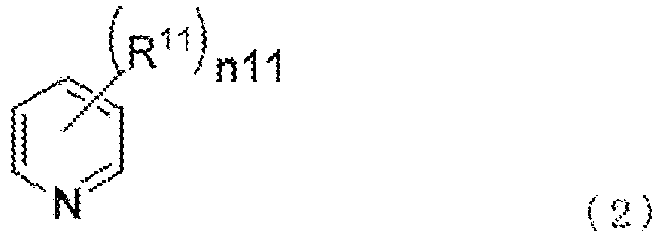 (in the general formula (2), n11 is an integer of 0 or more and 5 or less, R11 is a hydrocarbon group having 1 to 8 carbon atoms which may contain an ether bond, and when n11 is 2 or more, a plurality of R11 may be the same or different).
 - The polyisocyanate composition according to claim 1, wherein the amount of the tertiary ammonium cation of the selected amine compound is 91 mol% or more with respect to the total molar amount of all amine compounds in the composition.
- The polyisocyanate composition according to claim 1 or 2, wherein the amine compound represented by the general formula (1) is an amine compound represented by the following general formula (3),

- The polyisocyanate composition according to any one of claims 1 to 3, wherein the sulfonic acid anion group is a salt of a sulfonic acid having an active hydrogen group and at least one amine compound selected from the amine compounds represented by the general formulas (1) and (2).
- The polyisocyanate composition according to claim 4, wherein the active hydrogen group is a hydroxyl group.
- The polyisocyanate composition according to claim 5, wherein the sulfonic acid having an active hydrogen group is a compound represented by the following general formula (4),
HO-R4-SO3H (4)
(in the general formula (4), R4 is a hydrocarbon group having 1 to 10 carbon atoms which may contain at least one selected from the group consisting of a hydroxyl group, an ether bond, an ester bond, a carbonyl group, and an imino group, R4 may include a ring structure, the ring structure being an aromatic ring, a 5- or 6-membered ring containing two nitrogen atoms, or a 5- or 6-membered ring containing a nitrogen atom and an oxygen atom). - The polyisocyanate composition according to any one of claims 1 to 3, wherein the polyisocyanate having a sulfonic acid anion group in its molecule is obtained by reacting a sulfonic acid having an active hydrogen group with a polyisocyanate.
- The polyisocyanate composition according to claim 7, wherein the active hydrogen group is an amino group.
- The polyisocyanate composition according to claim 8, wherein the sulfonic acid having an active hydrogen group is a compound represented by the following general formula (5),

- The polyisocyanate composition according to any one of claims 1 to 7, wherein the polyisocyanate is at least one selected from the group consisting of an aliphatic polyisocyanate, an alicyclic polyisocyanate, and an aromatic aliphatic polyisocyanate.
- A coating composition comprising the polyisocyanate composition defined in any one of claims 1 to 10.
- A coating substrate coated with the coating composition defined in claim 11.
Applications Claiming Priority (3)
| Application Number | Priority Date | Filing Date | Title |
|---|---|---|---|
| JP2018209877 | 2018-11-07 | ||
| JP2019020003 | 2019-02-06 | ||
| PCT/JP2019/043769 WO2020096019A1 (en) | 2018-11-07 | 2019-11-07 | Polyisocyanate composition, coating composition and coating base material |
Publications (3)
| Publication Number | Publication Date |
|---|---|
| EP3878838A1 true EP3878838A1 (en) | 2021-09-15 |
| EP3878838A4 EP3878838A4 (en) | 2021-12-01 |
| EP3878838B1 EP3878838B1 (en) | 2025-07-23 |
Family
ID=70611540
Family Applications (1)
| Application Number | Title | Priority Date | Filing Date |
|---|---|---|---|
| EP19882335.3A Active EP3878838B1 (en) | 2018-11-07 | 2019-11-07 | Polyisocyanate composition, coating composition and coated substrate |
Country Status (4)
| Country | Link |
|---|---|
| EP (1) | EP3878838B1 (en) |
| JP (2) | JPWO2020096019A1 (en) |
| CN (1) | CN112996771B (en) |
| WO (1) | WO2020096019A1 (en) |
Families Citing this family (1)
| Publication number | Priority date | Publication date | Assignee | Title |
|---|---|---|---|---|
| WO2020096019A1 (en) * | 2018-11-07 | 2020-05-14 | 旭化成株式会社 | Polyisocyanate composition, coating composition and coating base material |
Family Cites Families (11)
| Publication number | Priority date | Publication date | Assignee | Title |
|---|---|---|---|---|
| US3998871A (en) * | 1969-07-14 | 1976-12-21 | Minnesota Mining And Manufacturing Company | Sulfonated isocyanate compositions |
| JPS5919942A (en) * | 1982-07-27 | 1984-02-01 | Mitsubishi Paper Mills Ltd | Photosensitive material for diffusion transfer |
| DE4432690A1 (en) | 1994-09-14 | 1996-03-21 | Basf Ag | Process for the production of ammonia water |
| DE10024624A1 (en) * | 2000-05-18 | 2001-11-22 | Bayer Ag | Modified polyisocyanates, e.g. useful in coating compositions, obtained by reacting polyisocyanates with 2-(cyclohexylamino)ethanesulfonic acid and/or 3-(cyclohexylamino)propanesulfonic acid |
| ATE497510T1 (en) * | 2007-07-19 | 2011-02-15 | Basf Se | WATER DISPERSIBLE POLYISOCYANATES |
| JP5882044B2 (en) * | 2011-12-21 | 2016-03-09 | 旭化成ケミカルズ株式会社 | Modified polyisocyanate composition |
| CN104448232B (en) | 2013-09-13 | 2017-12-15 | 万华化学集团股份有限公司 | Polyisocyanates that a kind of sulfamic acid is modified and its production and use |
| JP6294136B2 (en) | 2014-04-17 | 2018-03-14 | 旭化成株式会社 | Polyisocyanate composition |
| JP6360377B2 (en) * | 2014-07-09 | 2018-07-18 | 旭化成株式会社 | Polyisocyanate composition |
| JP6713542B2 (en) * | 2016-10-11 | 2020-06-24 | 旭化成株式会社 | Polyisocyanate composition |
| WO2020096019A1 (en) * | 2018-11-07 | 2020-05-14 | 旭化成株式会社 | Polyisocyanate composition, coating composition and coating base material |
-
2019
- 2019-11-07 WO PCT/JP2019/043769 patent/WO2020096019A1/en not_active Ceased
- 2019-11-07 JP JP2020555606A patent/JPWO2020096019A1/en not_active Withdrawn
- 2019-11-07 EP EP19882335.3A patent/EP3878838B1/en active Active
- 2019-11-07 CN CN201980073240.5A patent/CN112996771B/en active Active
-
2022
- 2022-08-24 JP JP2022133454A patent/JP7400039B2/en active Active
Also Published As
| Publication number | Publication date |
|---|---|
| JP2022172210A (en) | 2022-11-15 |
| JP7400039B2 (en) | 2023-12-18 |
| JPWO2020096019A1 (en) | 2021-09-02 |
| WO2020096019A1 (en) | 2020-05-14 |
| EP3878838B1 (en) | 2025-07-23 |
| CN112996771B (en) | 2023-08-01 |
| CN112996771A (en) | 2021-06-18 |
| EP3878838A4 (en) | 2021-12-01 |
Similar Documents
| Publication | Publication Date | Title |
|---|---|---|
| EP3527596B1 (en) | Polyisocyanate composition | |
| US9988481B2 (en) | Polyisocyanate composition, coating composition, coating film and method for producing same, and humidity stabilization method | |
| EP3239202B1 (en) | Polyisocyanate composition and method for producing the same, blocked polyisocyanate composition and method for producing the same, resin composition and hardened material | |
| EP4122966B1 (en) | Polyisocyanate composition, blocked polyisocyanate composition, hydrophilic polyisocyanate composition, coating material composition, and coating film | |
| CN106905509B (en) | Polyisocyanate composition, coating composition and coating method | |
| JP2015205957A (en) | Polyisocyanate composition | |
| CN115124682B (en) | Polyisocyanate composition, coating composition and coated substrate | |
| JP6393122B2 (en) | Polyisocyanate composition, coating composition and coating film | |
| CN111741991B (en) | Polyisocyanate composition, coating composition and coated substrate | |
| JP7249793B2 (en) | Polyisocyanate composition, coating composition and coating substrate | |
| EP3878838B1 (en) | Polyisocyanate composition, coating composition and coated substrate | |
| JP7858294B2 (en) | Polyisocyanate composition, aqueous coating composition, and coating substrate | |
| JP7411363B2 (en) | Paint film and coating base material | |
| EP3812411B1 (en) | Polyisocyanate composition, coating composition and coated substrate | |
| JP7092613B2 (en) | Hydrophilic polyisocyanate composition, curing agent composition and water-based coating composition | |
| CN116217886B (en) | Polyisocyanate compositions, coating compositions and coating substrates | |
| JP7377613B2 (en) | Polyisocyanate compositions, coating compositions and coating substrates | |
| JP7429159B2 (en) | Polyisocyanate compositions, coating compositions and coating substrates | |
| JP7498621B2 (en) | Polyisocyanate composition, coating composition and coated substrate | |
| JP7267677B2 (en) | Curing agent composition and aqueous coating composition | |
| JP2023083901A (en) | Polyisocyanate composition, coating composition and coating substrate |
Legal Events
| Date | Code | Title | Description |
|---|---|---|---|
| STAA | Information on the status of an ep patent application or granted ep patent |
Free format text: STATUS: THE INTERNATIONAL PUBLICATION HAS BEEN MADE |
|
| PUAI | Public reference made under article 153(3) epc to a published international application that has entered the european phase |
Free format text: ORIGINAL CODE: 0009012 |
|
| STAA | Information on the status of an ep patent application or granted ep patent |
Free format text: STATUS: REQUEST FOR EXAMINATION WAS MADE |
|
| 17P | Request for examination filed |
Effective date: 20210526 |
|
| AK | Designated contracting states |
Kind code of ref document: A1 Designated state(s): AL AT BE BG CH CY CZ DE DK EE ES FI FR GB GR HR HU IE IS IT LI LT LU LV MC MK MT NL NO PL PT RO RS SE SI SK SM TR |
|
| A4 | Supplementary search report drawn up and despatched |
Effective date: 20211103 |
|
| RIC1 | Information provided on ipc code assigned before grant |
Ipc: C08G 18/70 20060101ALI20211027BHEP Ipc: C08G 18/79 20060101ALI20211027BHEP Ipc: C08G 18/28 20060101ALI20211027BHEP Ipc: C08G 18/62 20060101ALI20211027BHEP Ipc: C08G 18/08 20060101ALI20211027BHEP Ipc: C08G 18/77 20060101ALI20211027BHEP Ipc: C08G 18/76 20060101ALI20211027BHEP Ipc: C08G 18/75 20060101ALI20211027BHEP Ipc: C08G 18/73 20060101ALI20211027BHEP Ipc: C08G 18/38 20060101ALI20211027BHEP Ipc: C09D 175/04 20060101ALI20211027BHEP Ipc: C07C 309/10 20060101AFI20211027BHEP |
|
| STAA | Information on the status of an ep patent application or granted ep patent |
Free format text: STATUS: EXAMINATION IS IN PROGRESS |
|
| 17Q | First examination report despatched |
Effective date: 20220104 |
|
| DAV | Request for validation of the european patent (deleted) | ||
| DAX | Request for extension of the european patent (deleted) | ||
| GRAP | Despatch of communication of intention to grant a patent |
Free format text: ORIGINAL CODE: EPIDOSNIGR1 |
|
| STAA | Information on the status of an ep patent application or granted ep patent |
Free format text: STATUS: GRANT OF PATENT IS INTENDED |
|
| GRAJ | Information related to disapproval of communication of intention to grant by the applicant or resumption of examination proceedings by the epo deleted |
Free format text: ORIGINAL CODE: EPIDOSDIGR1 |
|
| STAA | Information on the status of an ep patent application or granted ep patent |
Free format text: STATUS: EXAMINATION IS IN PROGRESS |
|
| GRAP | Despatch of communication of intention to grant a patent |
Free format text: ORIGINAL CODE: EPIDOSNIGR1 |
|
| STAA | Information on the status of an ep patent application or granted ep patent |
Free format text: STATUS: GRANT OF PATENT IS INTENDED |
|
| INTG | Intention to grant announced |
Effective date: 20250303 |
|
| P01 | Opt-out of the competence of the unified patent court (upc) registered |
Free format text: CASE NUMBER: APP_13410/2025 Effective date: 20250318 |
|
| INTG | Intention to grant announced |
Effective date: 20250331 |
|
| GRAS | Grant fee paid |
Free format text: ORIGINAL CODE: EPIDOSNIGR3 |
|
| GRAA | (expected) grant |
Free format text: ORIGINAL CODE: 0009210 |
|
| STAA | Information on the status of an ep patent application or granted ep patent |
Free format text: STATUS: THE PATENT HAS BEEN GRANTED |
|
| AK | Designated contracting states |
Kind code of ref document: B1 Designated state(s): AL AT BE BG CH CY CZ DE DK EE ES FI FR GB GR HR HU IE IS IT LI LT LU LV MC MK MT NL NO PL PT RO RS SE SI SK SM TR |
|
| REG | Reference to a national code |
Ref country code: GB Ref legal event code: FG4D |
|
| REG | Reference to a national code |
Ref country code: CH Ref legal event code: EP |
|
| REG | Reference to a national code |
Ref country code: IE Ref legal event code: FG4D |
|
| REG | Reference to a national code |
Ref country code: DE Ref legal event code: R096 Ref document number: 602019073057 Country of ref document: DE |
|
| REG | Reference to a national code |
Ref country code: NL Ref legal event code: MP Effective date: 20250723 |
|
| PG25 | Lapsed in a contracting state [announced via postgrant information from national office to epo] |
Ref country code: PT Free format text: LAPSE BECAUSE OF FAILURE TO SUBMIT A TRANSLATION OF THE DESCRIPTION OR TO PAY THE FEE WITHIN THE PRESCRIBED TIME-LIMIT Effective date: 20251124 |
|
| PG25 | Lapsed in a contracting state [announced via postgrant information from national office to epo] |
Ref country code: NL Free format text: LAPSE BECAUSE OF FAILURE TO SUBMIT A TRANSLATION OF THE DESCRIPTION OR TO PAY THE FEE WITHIN THE PRESCRIBED TIME-LIMIT Effective date: 20250723 |
|
| REG | Reference to a national code |
Ref country code: AT Ref legal event code: MK05 Ref document number: 1816330 Country of ref document: AT Kind code of ref document: T Effective date: 20250723 |
|
| PG25 | Lapsed in a contracting state [announced via postgrant information from national office to epo] |
Ref country code: IS Free format text: LAPSE BECAUSE OF FAILURE TO SUBMIT A TRANSLATION OF THE DESCRIPTION OR TO PAY THE FEE WITHIN THE PRESCRIBED TIME-LIMIT Effective date: 20251123 |
|
| PG25 | Lapsed in a contracting state [announced via postgrant information from national office to epo] |
Ref country code: NO Free format text: LAPSE BECAUSE OF FAILURE TO SUBMIT A TRANSLATION OF THE DESCRIPTION OR TO PAY THE FEE WITHIN THE PRESCRIBED TIME-LIMIT Effective date: 20251023 |
|
| REG | Reference to a national code |
Ref country code: LT Ref legal event code: MG9D |
|
| PG25 | Lapsed in a contracting state [announced via postgrant information from national office to epo] |
Ref country code: AT Free format text: LAPSE BECAUSE OF FAILURE TO SUBMIT A TRANSLATION OF THE DESCRIPTION OR TO PAY THE FEE WITHIN THE PRESCRIBED TIME-LIMIT Effective date: 20250723 |
|
| PG25 | Lapsed in a contracting state [announced via postgrant information from national office to epo] |
Ref country code: FI Free format text: LAPSE BECAUSE OF FAILURE TO SUBMIT A TRANSLATION OF THE DESCRIPTION OR TO PAY THE FEE WITHIN THE PRESCRIBED TIME-LIMIT Effective date: 20250723 |
|
| PG25 | Lapsed in a contracting state [announced via postgrant information from national office to epo] |
Ref country code: HR Free format text: LAPSE BECAUSE OF FAILURE TO SUBMIT A TRANSLATION OF THE DESCRIPTION OR TO PAY THE FEE WITHIN THE PRESCRIBED TIME-LIMIT Effective date: 20250723 |
|
| PG25 | Lapsed in a contracting state [announced via postgrant information from national office to epo] |
Ref country code: GR Free format text: LAPSE BECAUSE OF FAILURE TO SUBMIT A TRANSLATION OF THE DESCRIPTION OR TO PAY THE FEE WITHIN THE PRESCRIBED TIME-LIMIT Effective date: 20251024 |
|
| PG25 | Lapsed in a contracting state [announced via postgrant information from national office to epo] |
Ref country code: SE Free format text: LAPSE BECAUSE OF FAILURE TO SUBMIT A TRANSLATION OF THE DESCRIPTION OR TO PAY THE FEE WITHIN THE PRESCRIBED TIME-LIMIT Effective date: 20250723 |
|
| PG25 | Lapsed in a contracting state [announced via postgrant information from national office to epo] |
Ref country code: LV Free format text: LAPSE BECAUSE OF FAILURE TO SUBMIT A TRANSLATION OF THE DESCRIPTION OR TO PAY THE FEE WITHIN THE PRESCRIBED TIME-LIMIT Effective date: 20250723 |
|
| PG25 | Lapsed in a contracting state [announced via postgrant information from national office to epo] |
Ref country code: BG Free format text: LAPSE BECAUSE OF FAILURE TO SUBMIT A TRANSLATION OF THE DESCRIPTION OR TO PAY THE FEE WITHIN THE PRESCRIBED TIME-LIMIT Effective date: 20250723 Ref country code: PL Free format text: LAPSE BECAUSE OF FAILURE TO SUBMIT A TRANSLATION OF THE DESCRIPTION OR TO PAY THE FEE WITHIN THE PRESCRIBED TIME-LIMIT Effective date: 20250723 |
|
| PG25 | Lapsed in a contracting state [announced via postgrant information from national office to epo] |
Ref country code: RS Free format text: LAPSE BECAUSE OF FAILURE TO SUBMIT A TRANSLATION OF THE DESCRIPTION OR TO PAY THE FEE WITHIN THE PRESCRIBED TIME-LIMIT Effective date: 20251023 |
|
| PG25 | Lapsed in a contracting state [announced via postgrant information from national office to epo] |
Ref country code: ES Free format text: LAPSE BECAUSE OF FAILURE TO SUBMIT A TRANSLATION OF THE DESCRIPTION OR TO PAY THE FEE WITHIN THE PRESCRIBED TIME-LIMIT Effective date: 20250723 |
|
| PG25 | Lapsed in a contracting state [announced via postgrant information from national office to epo] |
Ref country code: RO Free format text: LAPSE BECAUSE OF FAILURE TO SUBMIT A TRANSLATION OF THE DESCRIPTION OR TO PAY THE FEE WITHIN THE PRESCRIBED TIME-LIMIT Effective date: 20250723 |
|
| PG25 | Lapsed in a contracting state [announced via postgrant information from national office to epo] |
Ref country code: SM Free format text: LAPSE BECAUSE OF FAILURE TO SUBMIT A TRANSLATION OF THE DESCRIPTION OR TO PAY THE FEE WITHIN THE PRESCRIBED TIME-LIMIT Effective date: 20250723 |
|
| PG25 | Lapsed in a contracting state [announced via postgrant information from national office to epo] |
Ref country code: DK Free format text: LAPSE BECAUSE OF FAILURE TO SUBMIT A TRANSLATION OF THE DESCRIPTION OR TO PAY THE FEE WITHIN THE PRESCRIBED TIME-LIMIT Effective date: 20250723 |
|
| PG25 | Lapsed in a contracting state [announced via postgrant information from national office to epo] |
Ref country code: IT Free format text: LAPSE BECAUSE OF FAILURE TO SUBMIT A TRANSLATION OF THE DESCRIPTION OR TO PAY THE FEE WITHIN THE PRESCRIBED TIME-LIMIT Effective date: 20250723 |
|
| PG25 | Lapsed in a contracting state [announced via postgrant information from national office to epo] |
Ref country code: CZ Free format text: LAPSE BECAUSE OF FAILURE TO SUBMIT A TRANSLATION OF THE DESCRIPTION OR TO PAY THE FEE WITHIN THE PRESCRIBED TIME-LIMIT Effective date: 20250723 |
|
| REG | Reference to a national code |
Ref country code: DE Ref legal event code: R097 Ref document number: 602019073057 Country of ref document: DE |
|
| PG25 | Lapsed in a contracting state [announced via postgrant information from national office to epo] |
Ref country code: EE Free format text: LAPSE BECAUSE OF FAILURE TO SUBMIT A TRANSLATION OF THE DESCRIPTION OR TO PAY THE FEE WITHIN THE PRESCRIBED TIME-LIMIT Effective date: 20250723 Ref country code: SK Free format text: LAPSE BECAUSE OF FAILURE TO SUBMIT A TRANSLATION OF THE DESCRIPTION OR TO PAY THE FEE WITHIN THE PRESCRIBED TIME-LIMIT Effective date: 20250723 |
|
| PLBE | No opposition filed within time limit |
Free format text: ORIGINAL CODE: 0009261 |
|
| STAA | Information on the status of an ep patent application or granted ep patent |
Free format text: STATUS: NO OPPOSITION FILED WITHIN TIME LIMIT |
|
| REG | Reference to a national code |
Ref country code: DE Ref legal event code: R119 Ref document number: 602019073057 Country of ref document: DE |
|
| REG | Reference to a national code |
Ref country code: CH Ref legal event code: L10 Free format text: ST27 STATUS EVENT CODE: U-0-0-L10-L00 (AS PROVIDED BY THE NATIONAL OFFICE) Effective date: 20260604 |
|
| REG | Reference to a national code |
Ref country code: CH Ref legal event code: H13 Free format text: ST27 STATUS EVENT CODE: U-0-0-H10-H13 (AS PROVIDED BY THE NATIONAL OFFICE) Effective date: 20260623 |
|
| PG25 | Lapsed in a contracting state [announced via postgrant information from national office to epo] |
Ref country code: LT Free format text: LAPSE BECAUSE OF FAILURE TO SUBMIT A TRANSLATION OF THE DESCRIPTION OR TO PAY THE FEE WITHIN THE PRESCRIBED TIME-LIMIT Effective date: 20250723 Ref country code: MC Free format text: LAPSE BECAUSE OF FAILURE TO SUBMIT A TRANSLATION OF THE DESCRIPTION OR TO PAY THE FEE WITHIN THE PRESCRIBED TIME-LIMIT Effective date: 20250723 |
|
| 26N | No opposition filed |
Effective date: 20260424 |
|
| PG25 | Lapsed in a contracting state [announced via postgrant information from national office to epo] |
Ref country code: CH Free format text: LAPSE BECAUSE OF NON-PAYMENT OF DUE FEES Effective date: 20251130 Ref country code: LU Free format text: LAPSE BECAUSE OF NON-PAYMENT OF DUE FEES Effective date: 20251107 |