EP3876604B1 - Wlan-lenkung basierend auf fähigkeiten - Google Patents
Wlan-lenkung basierend auf fähigkeiten Download PDFInfo
- Publication number
- EP3876604B1 EP3876604B1 EP20197317.9A EP20197317A EP3876604B1 EP 3876604 B1 EP3876604 B1 EP 3876604B1 EP 20197317 A EP20197317 A EP 20197317A EP 3876604 B1 EP3876604 B1 EP 3876604B1
- Authority
- EP
- European Patent Office
- Prior art keywords
- wlan
- access point
- electronic device
- capability
- ieee
- Prior art date
- Legal status (The legal status is an assumption and is not a legal conclusion. Google has not performed a legal analysis and makes no representation as to the accuracy of the status listed.)
- Active
Links
Images








Classifications
-
- H—ELECTRICITY
- H04—ELECTRIC COMMUNICATION TECHNIQUE
- H04W—WIRELESS COMMUNICATION NETWORKS
- H04W48/00—Access restriction; Network selection; Access point selection
- H04W48/08—Access restriction or access information delivery, e.g. discovery data delivery
- H04W48/12—Access restriction or access information delivery, e.g. discovery data delivery using downlink control channel
-
- H—ELECTRICITY
- H04—ELECTRIC COMMUNICATION TECHNIQUE
- H04W—WIRELESS COMMUNICATION NETWORKS
- H04W36/00—Hand-off or reselection arrangements
- H04W36/14—Reselecting a network or an air interface
- H04W36/142—Reselecting a network or an air interface over the same radio air interface technology
-
- H—ELECTRICITY
- H04—ELECTRIC COMMUNICATION TECHNIQUE
- H04W—WIRELESS COMMUNICATION NETWORKS
- H04W36/00—Hand-off or reselection arrangements
- H04W36/34—Reselection control
- H04W36/38—Reselection control by fixed network equipment
-
- H—ELECTRICITY
- H04—ELECTRIC COMMUNICATION TECHNIQUE
- H04W—WIRELESS COMMUNICATION NETWORKS
- H04W8/00—Network data management
- H04W8/22—Processing or transfer of terminal data, e.g. status or physical capabilities
-
- H—ELECTRICITY
- H04—ELECTRIC COMMUNICATION TECHNIQUE
- H04W—WIRELESS COMMUNICATION NETWORKS
- H04W48/00—Access restriction; Network selection; Access point selection
- H04W48/18—Selecting a network or a communication service
-
- H—ELECTRICITY
- H04—ELECTRIC COMMUNICATION TECHNIQUE
- H04W—WIRELESS COMMUNICATION NETWORKS
- H04W48/00—Access restriction; Network selection; Access point selection
- H04W48/20—Selecting an access point
-
- H—ELECTRICITY
- H04—ELECTRIC COMMUNICATION TECHNIQUE
- H04W—WIRELESS COMMUNICATION NETWORKS
- H04W84/00—Network topologies
- H04W84/02—Hierarchically pre-organised networks, e.g. paging networks, cellular networks, WLAN [Wireless Local Area Network] or WLL [Wireless Local Loop]
- H04W84/10—Small scale networks; Flat hierarchical networks
- H04W84/12—WLAN [Wireless Local Area Networks]
-
- H—ELECTRICITY
- H04—ELECTRIC COMMUNICATION TECHNIQUE
- H04W—WIRELESS COMMUNICATION NETWORKS
- H04W88/00—Devices specially adapted for wireless communication networks, e.g. terminals, base stations or access point devices
- H04W88/08—Access point devices
-
- H—ELECTRICITY
- H04—ELECTRIC COMMUNICATION TECHNIQUE
- H04W—WIRELESS COMMUNICATION NETWORKS
- H04W88/00—Devices specially adapted for wireless communication networks, e.g. terminals, base stations or access point devices
- H04W88/12—Access point controller devices
Definitions
- the described embodiments relate to techniques for an access point to provide steering or transition recommendations based at least in part on capabilities of a wireless local area network (WLAN) and of an associated electronic device.
- WLAN wireless local area network
- these electronic devices are capable of wirelessly communicating with other electronic devices.
- these electronic devices can include a networking subsystem that implements a network interface for: a cellular network (UMTS, LTE, etc.), a wireless local area network (e.g., a wireless network such as described in the Institute of Electrical and Electronics Engineers (IEEE) 802.11 standard or Bluetooth TM from the Bluetooth Special Interest Group of Kirkland, Washington), and/or another type of wireless network.
- UMTS cellular network
- LTE Long Term Evolution
- IEEE Institute of Electrical and Electronics Engineers
- Bluetooth Bluetooth Special Interest Group of Kirkland, Washington
- an electronic device in an IEEE 802.11-compatible wireless network, an electronic device often actively scans for a nearby operating access point by transmitting a probe request. In response to receiving a probe request, an access point typically transmits a probe response.
- some legacy electronic devices may not be able to understand a probe response from an access point that is using IEEE-802.11ax (which is sometimes referred to as 'Wi-Fi 6'). Consequently, these legacy electronic devices may not be able to associate with and use this access point.
- some legacy electronic devices may not be able to see a beacon from an access point that is using IEEE-802.11ax during a passive scan, and thus may not be able to associate with and use this access point.
- an IEEE-802.11ax-compatible access point may be downgraded so that it operates using an earlier version of an IEEE 802.11 standard (such as IEEE 802.11ac, which is sometimes referred to as 'Wi-Fi 5'). While this approach will allow all legacy electronic devices to use this access point, the advantages of IEEE 802.11ax will be lost.
- WLANs wireless area networks
- SSIDs different service set identifiers
- BSSIDs basic service set identifiers
- legacy electronic devices can associate with and use the first WLAN
- electronic devices that support IEEE 802.11ax can associate with and use the second WLAN.
- European Patent No. 3,281,451 entitled “Methods to Support Inter-Wireless Local Area Network Communication by a Radio Access Network,” discloses techniques for reporting differences associated with values of communication characteristic(s) for communication with a WLAN.
- PCT Patent Appl. No. WO 2014/145073 entitled “Improving Distribution of Clients Across a Network,” discloses techniques for redistributing wireless clients to improve service.
- US Patent Appl. No. 2018/176284 entitled “Steering Between Content Streaming Devices Using Derived Link Metrics and Channel Utilization Information,” discloses steering client devices between content streaming apparatuses in a WLAN.
- An access point that provides a transition recommendation includes an interface circuit that wirelessly communicates with an electronic device. Moreover, the access point may provide a first WLAN having a first capability. During operation, the access point may associate, in the first WLAN, with the electronic device. Moreover, the access point may determine that the electronic device has a second capability that is different from the first capability, where the second capability is determined based at least in part on information included in a packet or a frame associated with the electronic device , and where the first capability comprises a compatibility with a first IEEE 802.11 standard and the second capability comprises a compatibility with a second IEEE 802.11 standard and an incompatibility with the first IEEE 802.11 standard. Next, the access point may provide the transition recommendation addressed to the electronic device based at least in part on the difference in the first capability and the second capability, where the transition recommendation recommends that the electronic device transition from the first WLAN to a second WLAN that has the second capability.
- the second IEEE 802.11 standard may be more recent than the first IEEE 802.11 standard.
- the second IEEE 802.11 standard may include IEEE 802.11ax or Wi-Fi 6
- the first IEEE 802.11 standard may include an earlier IEEE 802.11 standard, such as IEEE 802.11ac or Wi-Fi 5.
- the second WLAN may be provided by the access point.
- the second WLAN may be provided by a second access point.
- the transition recommendation may be based at least in part on a difference in a communication-performance metric in the first WLAN and the second WLAN.
- the communication-performance metric may include one or more of: throughput, access time, access duration, a number of associated electronic devices, a received signal strength indication (RSSI), etc.
- the transition recommendation may be based at least in part on communication performance of a wireless network that includes the first WLAN and the second WLAN.
- the transition recommendation may be provided when the communication-performance metric in the first WLAN and the second WLAN is approximately the same (such as within 10 or 25%). Alternatively, the transition recommendation may be provided even when the communication-performance metric in the second WLAN is less than the communication-performance metric in the first WLAN.
- the access point may terminate the association with the electronic device.
- the transition recommendation includes a basic service set transition management (BTM) frame.
- BTM basic service set transition management
- the first WLAN may have a first service set identifier (SSID) and a first basic service set identifier (BSSID), and the second WLAN may have a second SSID and a second BSSID.
- SSID service set identifier
- BSSID basic service set identifier
- the information may be included one or more fields, such as a high-efficiency (HE) field in a Media Access Control (MAC) header or an extended capabilities element in a probe request.
- HE high-efficiency
- MAC Media Access Control
- This computer-readable storage medium may include program instructions that, when executed by the access point, cause the access point to perform at least some of the aforementioned operations.
- Another embodiment provides a method. This method includes at least some of the operations performed by the access point.
- This access point may provide a first WLAN having a first capability.
- the access point may associate with an electronic device.
- the access point may determine that the electronic device has a second capability that is different from the first capability.
- the first capability may include compatibility with a first IEEE 802.11 standard and the second capability may include compatibility with a second IEEE 802.11 standard.
- the access point may provide the transition recommendation addressed to the electronic device based at least in part on the difference in the first capability and the second capability, where the transition recommendation recommends that the electronic device transition from the first WLAN to a second WLAN that has the second capability.
- these communication techniques may help ensure that the capability of the electronic device matches the capability of the WLAN with which it is associated. This may improve the communication performance of the electronic device, the WLANs and/or a wireless network that includes the WLANs.
- the first IEEE 802.11 standard may include IEEE 802.11ax
- the communication techniques may help ensure that the first WLAN includes sufficient associated electronic devices that uplink orthogonal frequency-division multiple access (OFDMA) is beneficial. This capability may allow legacy electronic devices and new electronic devices to operate at their full potential. Consequently, the communication techniques may reduce user frustration when using the electronic device, the access point and the wireless network and, thus, may provide an improved user experience.
- OFDMA orthogonal frequency-division multiple access
- a wireless communication protocol such as: a wireless communication protocol that is compatible with an IEEE 802.11 standard (which is sometimes referred to as 'Wi-Fi ® ,' from the Wi-Fi Alliance of Austin, Texas), Bluetooth, and/or another type of wireless interface (such as another wireless-local-area-network interface).
- an access point in the system may communicate with a controller or services using a wired communication protocol, such as a wired communication protocol that is compatible with an IEEE 802.3 standard (which is sometimes referred to as 'Ethernet'), e.g., an Ethernet II standard.
- a wide variety of communication protocols may be used in the system, including wired and/or wireless communication.
- Wi-Fi and Ethernet are used as illustrative examples.
- FIG. 1 presents a block diagram illustrating an example of a system 110, which may include components, such as: one or more access points 112, one or more electronic devices 114 (such as cellular telephones, stations or clients, another type of electronic device, etc.), and one or more optional controllers 116.
- one or more of the one or more access points 112 may wirelessly communicate with one or more of the one or more electronic devices 114 using wireless communication that is compatible with an IEEE 802.11 standard.
- the wireless communication may occur in, e.g., a 2.4 GHz, a 5 GHz, a 6 GHz and/or a 60 GHz frequency band.
- the one or more access points 112 may communicate with the one or more optional controllers 116 via network 118 (such as the Internet, an intra-net and/or one or more dedicated links).
- network 118 such as the Internet, an intra-net and/or one or more dedicated links.
- the one or more optional controllers 116 may be at the same location as the other components in system 110 or may be located remotely (i.e., at a different location).
- the one or more access points 112 may be managed and/or configured by the one or more optional controllers 116.
- the one or more access points 112 may provide access to network 118 (e.g., via an Ethernet protocol), and may be a physical access point or a virtual or 'software' access point that is implemented on a computer or an electronic device. While not shown in FIG. 1 , there may be additional components or electronic devices, such as a router.
- the one or more access points 112 and the one or more electronic devices 114 may communicate via wireless communication.
- one or more of access points 112 and one or more of electronic devices 114 may wirelessly communicate while: transmitting advertising frames on wireless channels, detecting one another by scanning wireless channels, exchanging subsequent data/management frames (such as association requests and responses) to establish a connection, configure security options (e.g., Internet Protocol Security), transmit and receive frames or packets via the connection (which may include the association requests and/or additional information as payloads), etc.
- security options e.g., Internet Protocol Security
- the one or more access points 112, the one or more electronic devices 114 and/or the one or more optional controllers 116 may include subsystems, such as a networking subsystem, a memory subsystem and a processor subsystem.
- the one or more access points 112 and the one or more electronic devices 114 may include radios 120 in the networking subsystems. More generally, the one or more access points 112 and the one or more electronic devices 114 can include (or can be included within) any electronic devices with the networking subsystems that enable the one or more access points 112 and the one or more electronic devices 114 to wirelessly communicate with each other.
- wireless signals 122 are transmitted from a radio 120-2 in electronic device 114-1. These wireless signals are received by radio 120-1 in at least one of the one or more access points 112, such as access point 112-1.
- electronic device 114-1 may transmit frames or packets. In turn, these frames or packets may be received by access point 112-1. This may allow electronic device 114-1 to communicate information to access point 112-1.
- the communication between electronic device 114-1 and access point 112-1 may be characterized by a variety of performance metrics, such as: a data rate, a data rate for successful communication (which is sometimes referred to as a 'throughput'), an error rate (such as a retry or resend rate), a mean-square error of equalized signals relative to an equalization target, intersymbol interference, multipath interference, a signal-to-noise ratio, a width of an eye pattern, a ratio of number of bytes successfully communicated during a time interval (such as 1-10 s) to an estimated maximum number of bytes that can be communicated in the time interval (the latter of which is sometimes referred to as the 'capacity' of a communication channel or link), and/or a ratio of an actual data rate to an estimated data rate (which is sometimes referred to as 'utilization'). While instances of radios 120 are shown in the one or more electronic devices 114 and the one or more access points 112, one or more of these instances may be different
- electronic devices 114 may regularly transmit multiple probe requests. If an access point (such as access point 112-1) is compatible with and uses an IEEE 802.11 standard that is not supported by a legacy electronic device (such as electronic device 114-1) that has a radio from a particular manufacturer (i.e., electronic device 114-1 may be in a subset of legacy electronic devices), then, when access point 112-1 provides a probe response in response to a probe request from electronic device 114-1 (such as a wild-card probe request), electronic device 114-1 may not be able to receive the probe response. This may prevent electronic device 114-1 from associating with and, thus, communicating with access point 112-1. Similarly, while access point 112-1 may broadcast beacons, electronic device 112-1 may not be able to receive the beacons during a passive scan. Once again, this may prevent electronic device 114-1 from associating with and, thus, communicating with access point 112-1.
- At least one of access points 112 may implement or use the communication techniques according to embodiments of the present disclosure.
- access point 112-1 may advertise a first BSSID and a second BSSID having a common SSID (i.e., in the same WLAN), separate wireless connection interfaces, and different capabilities.
- the first BSSID may support a first IEEE 802.11 standard
- the second BSSID may support one or more previous IEEE 802.11 standards, but may not support the first IEEE 802.11 standard.
- the first IEEE 802.11 standard may include IEEE 802.11ax
- the one or more previous IEEE 802.11 standards may include one or more of: IEEE 802.11a, IEEE 802.11b, IEEE 802.11g, IEEE 802.11n, or IEEE 802.11ac.
- the first IEEE 802.11 standard may include Wi-Fi 6
- the one or more previous IEEE 802.11 standards may include Wi-Fi 5.
- access point 112-1 may receive a probe request from electronic device 114-1. Moreover, access point 112-1 may determine whether electronic device 114-1 supports the first IEEE 802.11 standard based at least in part on one or more fields in the probe request. For example, the one or more fields may include at least an HE field in a MAC header in the probe request. When the HE field is present, access point 112-1 may determine that electronic device 114-1 supports the first IEEE 802.11 standard.
- access point 112-1 may selectively provide a probe response to electronic device 114-1 based at least in part on the determination.
- the probe response may include the first BSSID when the determination indicates that electronic device 114-1 supports the first standard.
- the probe response may include the second BSSID when the determination indicates that electronic device 114-1 does not support the first IEEE 802.11 standard.
- access point 112-1 may respond to directed probe requests that include the first BSSID or the second BSSID with a corresponding probe response that includes the first BSSID or the second BSSID. For example, when the probe request includes the second BSSID and the determination indicates that electronic device 114-1 supports the first IEEE 802.11 standard, access point 112-1 may provide the probe response with the second BSSID to electronic device 114-1. Then, after electronic device 114-1 has associated with access point 112-1 using the second BSSID, access point 112-1 may recommend that electronic device 114-1 transition to the first BSSID (e.g., using a BTM frame).
- the probe request includes the second BSSID and the determination indicates that electronic device 114-1 supports the first IEEE 802.11 standard
- access point 112-1 may provide the probe response with the second BSSID to electronic device 114-1. Then, after electronic device 114-1 has associated with access point 112-1 using the second BSSID, access point 112-1 may recommend that electronic device 114-1 transition to the first BSSID (e.g.,
- access points that use the communication techniques may provide backwards compatibility to legacy electronic devices and may support electronic devices that support and use a new IEEE 802.11 standard (such as the first IEEE 802.11 standard).
- access point 112-1 may ensure that electronic device 114-1 selectively receives an appropriate probe response (including the correct BSSID) based at least in part on the capabilities of electronic device 114-1 (such as whether or not electronic device 114-1 supports the first IEEE 802.11 standard).
- the communication techniques may allow legacy electronic devices and new electronic devices to coexist and to be supported by access point 112-1, while minimizing management traffic. Consequently, the communication techniques may reduce user frustration when using access point 112-1, electronic device 114-1 and the associated WLAN having the common SSID and, thus, may provide an improved user experience.
- multi-BSS capability allows access points to aggregate beacons and/or probe responses together, which can reduce management from overhead in a WLAN.
- electronic devices 114 may support multi-BSS capability.
- At least one of access points 112 may implement or use the communication techniques.
- access point 112-1 may transmit a multi-BSS beacon with a transmitted BSSID and one or more non-transmitted BSSIDs, and may transmit separate (i.e., individual) beacons for the transmitted BSSID and the one or more non-transmitted BSSIDs.
- access point 112-1 may receive a probe request associated with electronic device 114-1, where the probe request includes a multi-BSS indication (such as a multi-BSS bit).
- access point 112-1 may selectively provide one or more probe responses, where the one or more probe responses include a type of probe response that is based at least in part on the multi-BSS indication.
- the one or more probe responses may include an aggregated probe response for the transmitted BSSID and the one or more non-transmitted BSSIDs.
- the one or more probe responses may not include the aggregated probe response.
- the probe request is a wild-card probe request
- the one or more probe responses may include separate (i.e., individual) probe responses for the transmitted BSSID and the one or more non-transmitted BSSIDs.
- the BSSIDs in the individual probe responses for the one or more non-transmitted BSSIDs may correspond to the one or more non-transmitted BSSIDs, because they have the same SSIDs as the one or more non-transmitted BSSIDs, but these BSSIDs may not be the same as the one or more non-transmitted BSSIDs.
- access point 112-1 may have separate wireless connection interfaces with the corresponding (but different) BSSIDs and, as noted previously, the same SSIDs as the one or more non-transmitted BSSIDs.
- the individual probe responses for the one or more non-transmitted BSSIDs may include the one or more non-transmitted BSSIDs.
- the type of probe response may include an aggregated probe response for the transmitted BSSID and the one or more non-transmitted BSSIDs, or a probe response for a given BSSID.
- access point 112-1 may transmit a multi-BSS beacon.
- the multi-BSS beacon may include a broadcast bit at a first bit position in the multi-BSS beacon, and one or more unicast bits at one or more second bit positions in the multi-BSS beacon.
- a first value of the broadcast bit may specify a broadcast to a group of one or more of electronic devices 114 that are associated with access point 112-1, and a given value of a given unicast bit may specify a unicast transmission to a given one of the one or more electronic devices 114 (such as electronic device 114-1).
- access point 112-1 may transmit a beacon to electronic device 114-1, where the beacon includes a transmitted BSSID in the multi-BSS beacon, a non-transmitted BSSID in the multi-BSS beacon or another BSSID corresponding to the non-transmitted BSSID in the multi-BSS beacon.
- the beacon may include an element in which the first bit position has a first value indicating the broadcast to the group, and in which a given second bit position in the one or more second bit positions corresponding to the second electronic device has the first value indicating the broadcast to the group.
- access points that use the communication techniques may provide backwards compatibility to legacy electronic devices and may support electronic devices that support and use multi-BSS.
- access point 112-1 may ensure that electronic device 114-1 selectively receives an appropriate type of probe response based at least in part on the capabilities of electronic device 114-1 (such as whether or not electronic device 114-1 supports multi-BSS).
- the communication techniques may allow legacy electronic devices and new electronic devices to coexist and to be supported by access point 112-1. Consequently, the communication techniques may reduce the number of probe responses (and, thus, the probe-response management overhead) in the WLAN, may improve performance and reduce user frustration when using access point 112-1, electronic device 114-1 and the associated WLAN and, thus, may provide an improved user experience.
- an electronic device may still associate with an access point (such as access point 112-1) that has different capabilities.
- a Wi-Fi 5 capable electronic device may associate with a Wi-Fi 6 capable access point or a Wi-Fi 6 capable electronic device may associate with a Wi-Fi 5 capable access point.
- electronic device 114-1 may still discover access point 112-1, such as by receiving beacons broadcast by access point 112-1. Consequently, electronic device 114-1 may inadvertently associate with access point 112-1.
- access point 112-1 may address these challenges by selectively withholding a frame, such as an association frame.
- a frame such as an association frame.
- this approach may upset a user of electronic device 114-1, which may result in the user no longer using access point 112-1 or an associated wireless network.
- selective withholding of an authorization frame may cause software in electronic device 114-1 to blacklist access point 112-1.
- At least one of access points 112 may implement or use the communication techniques.
- access point 112-1 may associate with electronic device 114-1.
- access point 112-1 may determine that electronic device 114-1 has a second capability that is different from a first capability of a first WLAN provided by access point 112-1, such as based at least in part on information included in a packet or a frame associated with electronic device 114-1.
- the first capability may include compatibility with a first IEEE 802.11 standard
- the second capability may include compatibility with a second IEEE 802.11 standard.
- access point 112-1 may provide the transition recommendation (such as a BTM frame) to electronic device 114-1 based at least in part on the difference in the first capability and the second capability, where the transition recommendation recommends that electronic device 114-1 transition from the first WLAN to a second WLAN that has the second capability.
- the transition recommendation such as a BTM frame
- access point 112-1 may provide the first WLAN and the second WLAN.
- the first WLAN may have a first SSID and a first BSSID
- the second WLAN may have a second SSID and a second BSSID.
- a different access point in access points 112 (such as access point 112-2) may provide the second WLAN.
- the first SSID and the second SSID are the same.
- the transition recommendation may be based at least in part on a difference in a communication-performance metric in the first WLAN and the second WLAN.
- the communication-performance metric may include one or more of: throughput, access time, access duration, a number of associated electronic devices, an RSSI, etc.
- the transition recommendation may be provided when the communication-performance metric in the first WLAN and the second WLAN is approximately the same (such as within 10 or 25%).
- the transition recommendation may be provided even when the communication-performance metric in the second WLAN is less than the communication-performance metric in the first WLAN.
- the transition recommendation may be based at least in part on communication performance of a wireless network that includes the first WLAN and the second WLAN.
- access point 112-1 may take further action. For example, access point 112-1 may terminate the association with electronic device 114-1.
- access points that use the communication techniques may provide backwards compatibility to legacy electronic devices and may support electronic devices that support and use a new IEEE 802.11 standard.
- the communication techniques may help ensure that the capability of electronic device 114-1 matches the capability of the WLAN with which it is associated. This may improve the communication performance of electronic device 114-1, the WLANs and/or a wireless network that includes the WLANs. Consequently, the communication techniques may reduce user frustration when using electronic device 114-1, access point 112-1 and the wireless network and, thus, may provide an improved user experience.
- processing a frame or a packet in a given one of the one or more access points 112 or a given one of the one or more electronic devices 114 may include: receiving wireless signals 122 with the frame or packet; decoding/extracting the frame or packet from the received wireless signals 122 to acquire the frame or packet; and processing the frame or packet to determine information contained in the frame or packet.
- FIG. 1 Although we describe the network environment shown in FIG. 1 as an example, in alternative embodiments, different numbers or types of electronic devices or components may be present. For example, some embodiments comprise more or fewer electronic devices or components. Therefore, in some embodiments there may be fewer or additional instances of at least some of the one or more access points 112, the one or more electronic devices 114 and/or the one or more optional controllers 116. As another example, in another embodiment, different electronic devices are transmitting and/or receiving frames or packets.
- FIG. 2 presents an example of a flow diagram illustrating an example method 200 for selectively providing a probe response.
- method 200 may be performed by an electronic device, such as one of the one or more access points 112 in FIG. 1 , e.g., access point 112-1.
- an electronic device may advertise a first BSSID and a second BSSID (operation 210) having a common SSID, separate wireless connection interfaces, and different capabilities, where the first BSSID may support a first IEEE 802.11 standard, and the second BSSID may support one or more previous IEEE 802.11 standards, but may not support the first IEEE 802.11 standard.
- the first IEEE 802.11 standard may include IEEE 802.11ax
- the one or more previous IEEE 802.11 standards may include one or more of: IEEE 802.11a, IEEE 802.11b, IEEE 802.11g, IEEE 802.11n, or IEEE 802.11ac.
- the first IEEE 802.11 standard may include Wi-Fi 6
- the one or more previous IEEE 802.11 standards may include Wi-Fi 5.
- the electronic device may receive a probe request (operation 212) associated with a second electronic device. Moreover, the electronic device may determine whether the second electronic device supports the first IEEE 802.11 standard (operation 214) based at least in part on one or more fields in the probe request. Note that the one or more fields may include an HE field in a MAC header in the probe request, and the determination may be based at least in part on the presence or absence of at least the HE field.
- the electronic device may selectively provide a probe response (operation 216) intended for the second electronic device based at least in part on the determination.
- the probe response may include the first BSSID when the determination indicates that the second electronic device supports the first IEEE 802.11 standard.
- the probe response may include the second BSSID when the determination indicates that the second electronic device does not support the first IEEE 802.11 standard.
- the probe request may include a broadcast probe request, which may include a wild-card SSID or it may include the SSID.
- the electronic device may provide a probe response with the BSSID, even if it does not match the capabilities of the second electronic device.
- the electronic device may perform a remedial action. For example, when the determination indicates that the second electronic device supports the first IEEE 802.11 standard and the probe request includes the second BSSID, the electronic device may provide the probe response with the second BSSID to the second electronic device. Then, after the second electronic device has associated with the electronic device using the second BSSID, the electronic device may recommend that the second electronic device transition to the first BSSID.
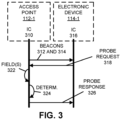
- FIG. 3 presents a drawing illustrating an example of communication between access point 112-1 and electronic device 114-1.
- an interface circuit (IC) 310 in access point 112-1 may transmit or provide a beacon 312 with a first BSSID and a beacon 314 with a second BSSID.
- These BSSIDs may have a common SSID, separate wireless connection interfaces, and different capabilities.
- the first BSSID may support a first IEEE 802.11 standard
- the second BSSID may support one or more previous IEEE 802.11 standards, but may not support the first IEEE 802.11 standard.
- an interface circuit 316 in electronic device 114-1 may provide a probe request 318.
- interface circuit 310 may determine 324 whether electronic device 114-1 supports the first IEEE 802.11 standard based at least in part on one or more fields 322 in probe request 318.
- interface circuit 310 may selectively provide a probe response 326 to electronic device 114-1 based at least in part on the determination 324.
- probe response 326 may include the appropriate BSSID (i.e., the first BSSID or the second BSSID) that has capabilities that match those of electronic device 114-1.
- FIG. 4 presents an example of a flow diagram illustrating an example method 400 for selectively providing a probe response.
- method 400 may be performed by an electronic device, such as one of the one or more access points 112 in FIG. 1 , e.g., access point 112-1.
- an electronic device may transmit a multi-BSS beacon (operation 410) with a transmitted BSSID and one or more non-transmitted BSSIDs, and may transmit separate beacons for the transmitted BSSID and the one or more non-transmitted BSSIDs. Then, the electronic device may receive a probe request (operation 412) associated with the second electronic device, where the probe request includes a multi-BSS indication. Next, the electronic device may selectively provide one or more probe responses (operation 414), where the one or more probe responses include a type of probe response that is based at least in part on the multi-BSS indication.
- the one or more probe responses may include an aggregated probe response for the transmitted BSSID and the one or more non-transmitted BSSIDs.
- the one or more probe responses may not include the aggregated probe response.
- the probe request is a wild-card probe request
- the one or more probe responses may include separate probe responses for the transmitted BSSID and the one or more non-transmitted BSSIDs.
- the type of probe response may include an aggregated probe response for the transmitted BSSID and the one or more non-transmitted BSSIDs, or a probe response for a given BSSID (e.g., a set of probe responses for each of the BSSIDs).
- the probe responses may include the transmitted BSSID and the one or more non-transmitted BSSIDs or the transmitted BSSID and one or more additional BSSIDs that correspond to the one or more non-transmitted BSSIDs.
- FIG. 5 presents a drawing illustrating an example of communication between access point 112-1 and electronic device 114-1.
- an interface circuit 510 in access point 112-1 may transmit or provide a multi-BSS beacon 512 with a transmitted BSSID and one or more non-transmitted BSSIDs, and may transmit separate beacons 514 for the transmitted BSSID and the one or more non-transmitted BSSIDs.
- an interface circuit 516 in electronic device 114-1 may provide a probe request 518 to access point 112-1.
- This probe request may include a multi-BSS indication 520.
- interface circuit 510 may selectively provide one or more probe responses 522, where the one or more probe responses 522 include a type of probe response that is based at least in part on the multi-BSS indication 520.
- the one or more probe responses 522 may include an aggregate probe response for the transmitted BSSID and the one or more non-transmitted BSSIDs.
- the one or more probe responses 522 may include separate probe responses for the transmitted BSSID and each of the one or more non-transmitted BSSIDs.
- FIG. 6 presents a drawing illustrating an example of a multi-BSS beacon 600.
- the multi-BSS beacon 600 may include a beacon 610 with an SSID 612 and a BSSID 614 (which is sometimes referred to as a ⁇ transmitted BSSID').
- the multi-BSS beacon 600 may include SSIDs 616 and associated BSSIDs 618 (which are sometimes referred to as 'non-transmitted BSSIDs').
- BSSID 618-1 may equal BSSID 614 plus one
- BSSID 618-2 may equal BSSID 614 plus two, etc.
- FIG. 7 presents a drawing illustrating an example of a beacon 700 for a particular BSSID.
- beacon 700 may include an SSID 710 (which may be one of SSID 612 or one of SSIDs 616) and a BSSID 712.
- a legacy beacon (such as beacon 700) may be identified relative to a multi-BSS beacon (such as multi-BSS beacon 600 in FIG. 6 ) by the inclusion of a MAC address in the beacon.
- multi-BSS beacon 600 ( FIG. 6 ) and/or beacon 700 may include additional information, less information or different information from that shown in FIGs. 6 and 7 .
- FIG. 8 presents a flow diagram illustrating an example method 800 for providing a beacon. Moreover, method 800 may be performed by an electronic device, such as one of the one or more access points 112 in FIG. 1 , e.g., access point 112-1.
- an electronic device may transmit a multi-BSS beacon (operation 810) with a broadcast bit at a first bit position in the multi-BSS beacon, and one or more unicast bits at one or more second bit positions in the multi-BSS beacon, where a first value of the broadcast bit may specify a broadcast to a group of one or more second electronic devices that are associated with the electronic device, and a given value of a given unicast bit may specify a unicast transmission to a given one of the one or more second electronic devices.
- the electronic device may transmit a beacon (operation 812) to a second electronic device in the one or more second electronic devices, where the beacon includes a transmitted BSSID in the multi-BSS beacon, a non-transmitted BSSID in the multi-BSS beacon or another BSSID corresponding to the non-transmitted BSSID in the multi-BSS beacon.
- the beacon may include an element in which the first bit position has a first value indicating the broadcast to the group, and in which a given second bit position in the one or more second bit positions corresponding to the second electronic device has the first value indicating the broadcast to the group.
- broadcast bit and the one or more unicast bits in the multi-BSS beacon may be included in a multi-BSS element in the multi-BSS beacon.
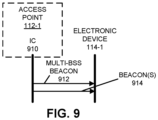
- FIG. 9 presents a drawing illustrating an example of communication between access point 112-1 and electronic device 114-1.
- an interface circuit 910 in access point 112-1 may transmit or provide a multi-BSS beacon 912 with a transmitted BSSID and one or more non-transmitted BSSIDs, and may transmit separate beacons 914 for the transmitted BSSID and the one or more non-transmitted BSSIDs.
- multi-BSS beacon 912 may include a broadcast bit at a first bit position in the multi-BSS beacon, and one or more unicast bits at one or more second bit positions in the multi-BSS beacon.
- beacons 914 which is transmitted to electronic device 114-1, may include the transmitted BSSID in multi-BSS beacon 912, the non-transmitted BSSID in multi-BSS beacon 912 or the other BSSID corresponding to the non-transmitted BSSID in multi-BSS beacon 912.
- beacon 918 may include an element in which the first bit position has a first value indicating the broadcast to the group, and in which a given second bit position in the one or more second bit positions corresponding to the second electronic device has the first value indicating the broadcast to the group.
- FIG. 10 presents a drawing illustrating an example of a multi-BSS beacon 1000.
- the multi-BSS beacon 1000 may include a multi-BSS element 1010.
- a bit 1012 (such as bit zero) in multi-BSS element 1010 may be a broadcast bit
- bits 1014 (such as bits one, two and three) in multi-BSS element 1010 may be unicast bits.
- a first value (such as '1') of the broadcast bit may specify a broadcast to a group of electronic devices that are associated with an access point
- a given value (such as '1') of a given unicast bit may specify a unicast transmission to a given one of the electronic devices.
- multi-BSS beacon 1000 may include a transmitted BSSID and one or more non-transmitted BSSIDs.
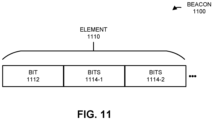
- FIG. 11 presents a drawing illustrating an example of a beacon 1100 for a particular BSSID.
- beacon 1100 may include an element 1110.
- a bit 1112 (such as bit zero) in element 1110 may be a broadcast bit, and bits 1114 (such as bits one, two and three) in element 1110 may be reserved for broadcast bits that are targeted to specific electronic devices having SSIDs. (Consequently, the first bit in element 1110 that is available to set or specify an association identifier (AID) may be the next bit after bits 1114.)
- AID association identifier
- bit 1112 may have the first value
- a given one of bits 1114 associated with a particular electronic device having an SSID (and corresponding to the same one of bits 1014 in FIG. 10 ) may also have the first value.
- bits 1114 may include three bits.
- the first four bits in element 1110 may be reserved for specifying or indicating broadcast bits, either to the entire group (via bit 1112) and/or using specific or targeted bits in bits 1114.
- a first client or electronic device may be assigned a first bit (bit one) in bits 1114
- a second client or electronic device may be assigned a second bit (bit two) in bits 1114
- a third client or electronic device may be assigned a third bit (bit three) in bits 1114. Consequently, when the broadcast bit is set to the first value in a multi-BSS beacon, a beacon may have bit zero (bit 1112) set to the first value and bit two (in bits 1114) set to the first value.
- multi-BSS beacon 1000 ( FIG. 10 ) and/or beacon 1100 may include additional information, less information or different information from that shown in FIGs. 10 and 11 .
- FIG. 12 presents a flow diagram illustrating an example method 1200 for providing a transition recommendation, which may be performed by an access point, such as one of the one or more access points 112 in FIG. 1 , e.g., access point 112-1.
- the access point may associate (operation 1210) with the electronic device.
- the access point may determine that the electronic device has a second capability that is different from a first capability (operation 1212) of a WLAN provided by the access point.
- the first capability may include compatibility with a first IEEE 802.11 standard and the second capability may include compatibility with a second IEEE 802.11 standard.
- the second IEEE 802.11 standard may be more recent than the first IEEE 802.11 standard.
- the second IEEE 802.11 standard may include IEEE 802.11ax or Wi-Fi 6
- the first IEEE 802.11 standard may include an earlier IEEE 802.11 standard, such as IEEE 802.11ac or Wi-Fi 5.
- the second IEEE 802.11 standard may be earlier than or predate the first IEEE 802.11 standard.
- the access point may determine the second capability based at least in part on information included in a packet or a frame associated with the electronic device.
- the information may be included one or more fields, such as an HE field in a MAC header or an extended capabilities element in a probe request.
- the access point may provide the transition recommendation (operation 1214) addressed to the electronic device based at least in part on the difference in the first capability and the second capability, where the transition recommendation recommends that the electronic device transition from the first WLAN to a second WLAN that has the second capability.
- the transition recommendation may include a BTM frame.
- the second WLAN may be provided by the access point.
- the second WLAN may be provided by a second access point.
- the transition recommendation may be based at least in part on a difference in a communication-performance metric in the first WLAN and the second WLAN, such as when the second WLAN is provided by the second access point.
- the communication-performance metric may include one or more of: throughput, access time, access duration, a number of associated electronic devices (i.e., a loading of an access point), an RSSI, etc.
- the transition recommendation may be provided when the communication-performance metric in the first WLAN and the second WLAN is approximately the same (such as within 10 or 25%), but may not be provided when the difference in the communication-performance metric is larger.
- the transition recommendation may be provided even when the communication-performance metric in the second WLAN is less than the communication-performance metric in the first WLAN.
- the transition recommendation may ensure that the electronic devices associated with a given WLAN have the same capabilities, which may offer benefits, such as better overall service, e.g., via uplink OFDMA (which may offer advantages when there are sufficient electronic devices associated with an access point).
- the transition recommendation may be based at least in part on communication performance or service of a wireless network that includes the first WLAN and the second WLAN. Thus, even if the communication-performance metric is degraded by the transition or steering recommendation, the overall service in the wireless network for other electronic devices may be improved.
- the access point optionally performs one or more additional operations (operation 1216). For example, after providing the transition recommendation (operation 1214), the access point may terminate the association with the electronic device.
- methods 200 ( FIG. 2 ), 400 ( FIG. 4 ), 800 ( FIG. 8 ) and/or 1200
- the order of the operations may be changed, and/or two or more operations may be combined into a single operation.
- the determination (operation 1212) is made after the access point associates (operation 1210) with the electronic device.
- the determination (operation 1212) is made before the access point associates (operation 1210) with the electronic device, such as based at least in part on information included in a probe request from the electronic device.
- the access point may associate with the electronic device even though it already knows that the first capability and the second capability are different.
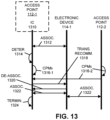
- FIG. 13 presents a drawing illustrating an example of communication between access point 112-1, access point 112-2 and electronic device 114-1.
- an interface circuit 1310 in access point 112-1 may associate 1312 with electronic device 114-1. This association may be with a first WLAN having a first capability that is provided by access point 112-1.
- interface circuit 1310 may determine 1314 that electronic device 114-1 has a second capability that is different from the first capability. For example, interface circuit 1310 may determine the difference based at least in part on information included in a packet or a frame from electronic device 114-1.
- interface circuit 1310 may selectively provide a transition recommendation 1318 to electronic device 114-1, where transition recommendation 1318 recommends that electronic device 114-1 transition from the first WLAN to a second WLAN having the second capability.
- the selective providing of transition recommendation 1318 is based at least in part on a difference in one or more communication-performance metrics (CPMs) 1316 between the first WLAN and the second WLAN. For example, when access point 112-1 provides the first WLAN and the second WLAN, interface circuit 1310 may determine one or more communication-performance metrics 1316-1. Alternatively, when access point 112-2 provides the second WLAN, access point 112-2 may determine one or more communication-performance metrics 1316-2, which are then provided to access point 112-1.
- CCMs communication-performance metrics
- electronic device 114-1 may de-associate 1320 with the first WLAN and may associate 1322 with the second WLAN (either with access point 112-1 or 112-2). However, if electronic device 114-1 ignores transition recommendation 1318, interface circuit 1310 may terminate 1324 the association of electronic device 114-1 with the first WLAN.
- FIGs. 3 , 5 , 9 and 13 illustrate some operations using unilateral or bilateral communication (which are, respectively, represented by one-sided and two-sided arrows), in general a given operation in FIGs. 3 , 5 , 9 and 13 may involve unilateral or bilateral communication.
- FIG. 14 presents a drawing illustrating an example of WLANs 1410 and associated electronic devices 114.
- WLAN 1410-1 may be a first Wi-Fi 6 capable WLAN having a first SSID
- WLAN 1410-2 may be a second Wi-Fi 6 capable WLAN having a second SSID.
- an access point such as access point 112-1
- hosts or provides WLAN 1410-1 and WLAN 1410-2 may provide an aggregate probe response for a transmitted BSSID (such as a first BSSID of WLAN 1410-1) and the one or more non-transmitted BSSIDs (such as a second BSSID of or associated with WLAN 1410-2).
- access point 112-1 may not provide a probe response (i.e., the probe response may be selectively suppressed).
- access point 112-1 may provide or host a WLAN 1410-3 having the first SSID that is Wi-Fi 5 capable and a WLAN 1410-4 having the second SSID that is Wi-Fi 5 capable.
- WLAN 1410-3 may have a third BSSID and WLAN 1410-4 may have a fourth BSSID.
- access point 112-1 may provide or host four WLANs 1410.
- WLAN 1410-3 may provide a probe response with the first SSID and the third BSSID.
- WLAN 1410-4 may provide a probe response with the second SSID and the fourth BSSID.
- WLAN 1410-3 or WLAN 1410-4 may not provide a probe response.
- electronic device 114-1 or 114-2 may, nonetheless, discover and associate with a WLAN that has different capabilities than those of electronic device 114-1 or 114-2.
- access point 112-1 may provide the transition recommendation.
- WLANs with different capabilities may be provided or hosted by different access points.
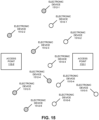
- FIG. 15 presents a drawing illustrating an example of providing a transition recommendation.
- access point 112-1 may provide or host a Wi-Fi 6 capable WLAN
- access point 112-2 may provide or host a Wi-Fi 5 capable WLAN.
- electronic devices 1510 may be associated with access point 112-1 and electronic devices 1512 may be associated with access point 112-2. These associations may not be based on the capabilities of access points 112 and electronic devices 1510 and 1512. Instead, a given electronic device may associate with the nearest access point.
- a Wi-Fi 5 capable electronic device (such as electronic device 1510-2) may receive a transition recommendation to transition to access point 112-2.
- the selective transition recommendations may also be based at least in part on one or more communication-performance metrics of the WLANs. For example, a selective transition recommendation may be provided to a given electronic device when the one or more communication-performance metrics of the WLANs for the connections with the given electronic device are approximately equal. This may ensure that access points 112 are load balanced and that the communication performance of a given electronic device is at worst approximately unchanged by transitioning between access points 112.
- the transition recommendation may degrade the communication performance of the given electronic device. For example, while the throughput may be degraded, the access time may be increased, so that the overall service is improved. Alternatively, the overall service of the given electronic device may be degraded, but the overall service of a wireless network that includes the WLANs may be improved.
- Wi-Fi 6 technology may benefit from having many Wi-Fi 6 clients connected to one WLAN.
- OFDMA may be more efficient as the number of clients using this technology that are connected to one WLAN grows.
- Steering (moving clients from WLAN to another WLAN or from one access point to another access point) clients (or electronic devices associated with an access point or a WLAN) from a Wi-Fi 5 compatible access point or a Wi-Fi 5 compatible WLAN to a Wi-Fi 6 compatible WLAN may bring performance benefits to the client and to the wireless network by increasing the number of clients associated with the Wi-Fi 6 compatible WLAN.
- clients may be steered from one access point to another access point or from one radio to another on the same access point based at least in part on the signal strength of the client or based at least in part on the traffic load on the access points or radios.
- a client signal becomes weak on one access point or radio, it may be steered to another access point or radio with a stronger signal.
- a client tries to connect to an access point or radio with many clients and lots of traffic it may be steered to another close by access point or radio that is less loaded.
- Wi-Fi 6 has brought in multi-user access to Wi-Fi, allowing many users to share the frequency bandwidth at the same time. While this technology brings benefits, it also has overhead. Only when this overhead is distributed over many clients does OFDMA start to bring benefits, such as a reduction in latency. Notably, the more clients that use OFDMA, the bigger the benefits available.
- access points may be configured to have two WLANs with the same SSID and security configurations.
- One of these WLANs may be Wi-Fi 6 capable (or compatible) and the other may be downgraded to not have Wi-Fi 6 capabilities.
- Wi-Fi 6 capable or compatible clients connect to the Wi-Fi 6 compatible WLAN. Consequently, clients may be steered to the correct WLAN through the use of probe withholding.
- a Wi-Fi 6 client multi-BSS-capable client may only get probe responses from a multi-BSS-capable WLAN.
- the Wi-Fi 5 client that is not multi-BSS capable may only get probe responses from the Wi-Fi 5 compatible WLAN.
- a Wi-Fi 6 compatible client may insist on connecting to a Wi-Fi 5 compatible access point. If the access point refuses the connection, the client may blacklist the wireless network, which is highly undesirable. Consequently, in the communication techniques, the Wi-Fi 6 compatible client may be allowed to attach to the Wi-Fi 5 compatible WLAN and then a BTM request may be send to the Wi-Fi 6 compatible client to move it over to the Wi-Fi 6 compatible WLAN on the same or a different access point.
- a wireless network may have a mix of Wi-Fi 5 and Wi-Fi 6 compatible access points. If other communication-performance metrics, such as RSSI and access-point load, for a client are roughly equal, then an access point may steer a Wi-Fi 6 compatible client to a Wi-Fi 6 compatible access point and away from a Wi-Fi 5 compatible access point. This is similar to the inter-access-point use case, except that it may take other metrics into account to make sure that the benefit from a switch to Wi-Fi 6 may compensate for any loss in, e.g., RSSI or an increase in the access-point load.
- FIG. 16 presents a block diagram illustrating an electronic device 1600 in accordance with some embodiments.
- This electronic device includes processing subsystem 1610, memory subsystem 1612, and networking subsystem 1614.
- Processing subsystem 1610 includes one or more devices configured to perform computational operations.
- processing subsystem 1610 can include one or more microprocessors, ASICs, microcontrollers, programmable-logic devices, graphical processor units (GPUs) and/or one or more digital signal processors (DSPs).
- Memory subsystem 1612 includes one or more devices for storing data and/or instructions for processing subsystem 1610 and networking subsystem 1614.
- memory subsystem 1612 can include dynamic random access memory (DRAM), static random access memory (SRAM), and/or other types of memory (which collectively or individually are sometimes referred to as a 'computer-readable storage medium').
- instructions for processing subsystem 1610 in memory subsystem 1612 include: one or more program modules or sets of instructions (such as program instructions 1622 or operating system 1624), which may be executed by processing subsystem 1610.
- the one or more computer programs may constitute a computer-program mechanism.
- instructions in the various modules in memory subsystem 1612 may be implemented in: a high-level procedural language, an object-oriented programming language, and/or in an assembly or machine language.
- the programming language may be compiled or interpreted, e.g., configurable or configured (which may be used interchangeably in this discussion), to be executed by processing subsystem 1610.
- memory subsystem 1612 can include mechanisms for controlling access to the memory.
- memory subsystem 1612 includes a memory hierarchy that comprises one or more caches coupled to a memory in electronic device 1600. In some of these embodiments, one or more of the caches is located in processing subsystem 1610.
- memory subsystem 1612 is coupled to one or more high-capacity mass-storage devices (not shown).
- memory subsystem 1612 can be coupled to a magnetic or optical drive, a solid-state drive, or another type of mass-storage device.
- memory subsystem 1612 can be used by electronic device 1600 as fast-access storage for often-used data, while the mass-storage device is used to store less frequently used data.
- Networking subsystem 1614 includes one or more devices configured to couple to and communicate on a wired and/or wireless network (i.e., to perform network operations), including: control logic 1616, an interface circuit 1618 and one or more antennas 1620 (or antenna elements).
- control logic 1616 i.e., to perform network operations
- an interface circuit 1618 i.e., to perform network operations
- antennas 1620 or antenna elements.
- FIG. 16 includes one or more antennas 1620
- electronic device 1600 includes one or more nodes, such as nodes 1608, e.g., an antenna node, a connector or a pad, which can be coupled to the one or more antennas 1620.
- networking subsystem 1614 can include a Bluetooth networking system, a cellular networking system (e.g., a 3G/4G/5G network such as UMTS, LTE, etc.), a USB networking system, a networking system based on the standards described in IEEE 802.11 (e.g., a Wi-Fi networking system), an Ethernet networking system, and/or another networking system.
- a Bluetooth networking system e.g., a Bluetooth, a cellular networking system (e.g., a 3G/4G/5G network such as UMTS, LTE, etc.), a USB networking system, a networking system based on the standards described in IEEE 802.11 (e.g., a Wi-Fi networking system), an Ethernet networking system, and/or another networking system.
- a cellular networking system e.g., a 3G/4G/5G network such as UMTS, LTE, etc.
- a USB networking system e.g., a USB networking system
- a transmit antenna radiation pattern of electronic device 1600 may be adapted or changed using pattern shapers (such as reflectors) in one or more antennas 1620 (or antenna elements), which can be independently and selectively electrically coupled to ground to steer the transmit antenna radiation pattern in different directions.
- pattern shapers such as reflectors
- the one or more antennas 1620 may have 2 N different antenna-radiation-pattern configurations.
- a given antenna radiation pattern may include amplitudes and/or phases of signals that specify a direction of the main or primary lobe of the given antenna radiation pattern, as well as so-called 'exclusion regions' or 'exclusion zones' (which are sometimes referred to as 'notches' or 'nulls').
- an exclusion zone of the given antenna radiation pattern includes a low-intensity region of the given antenna radiation pattern. While the intensity is not necessarily zero in the exclusion zone, it may be below a threshold, such as 3 dB or lower than the peak gain of the given antenna radiation pattern.
- the given antenna radiation pattern may include a local maximum (e.g., a primary beam) that directs gain in the direction of an electronic device that is of interest, and one or more local minima that reduce gain in the direction of other electronic devices that are not of interest.
- a local maximum e.g., a primary beam
- the given antenna radiation pattern may be selected so that communication that is undesirable (such as with the other electronic devices) is avoided to reduce or eliminate adverse effects, such as interference or crosstalk.
- Networking subsystem 1614 includes processors, controllers, radios/antennas, sockets/plugs, and/or other devices used for coupling to, communicating on, and handling data and events for each supported networking system.
- mechanisms used for coupling to, communicating on, and handling data and events on the network for each network system are sometimes collectively referred to as a 'network interface' for the network system.
- electronic device 1600 may use the mechanisms in networking subsystem 1614 for performing simple wireless communication between the electronic devices, e.g., transmitting frames and/or scanning for frames transmitted by other electronic devices.
- Bus 1628 may include an electrical, optical, and/or electro-optical connection that the subsystems can use to communicate commands and data among one another. Although only one bus 1628 is shown for clarity, different embodiments can include a different number or configuration of electrical, optical, and/or electro-optical connections among the subsystems.
- electronic device 1600 includes a display subsystem 1626 for displaying information on a display, which may include a display driver and the display, such as a liquid-crystal display, a multi-touch touchscreen, etc.
- Electronic device 1600 can be (or can be included in) any electronic device with at least one network interface.
- electronic device 1600 can be (or can be included in): a desktop computer, a laptop computer, a subnotebook/netbook, a server, a computer, a mainframe computer, a cloud-based computer, a tablet computer, a smartphone, a cellular telephone, a smartwatch, a wearable device, a consumer-electronic device, a portable computing device, an access point, a transceiver, a controller, a radio node, a router, a switch, communication equipment, a wireless dongle, test equipment, and/or another electronic device.
- electronic device 1600 may include one or more additional processing subsystems, memory subsystems, networking subsystems, and/or display subsystems. Additionally, one or more of the subsystems may not be present in electronic device 1600. Moreover, in some embodiments, electronic device 1600 may include one or more additional subsystems that are not shown in FIG. 16 . Also, although separate subsystems are shown in FIG. 16 , in some embodiments some or all of a given subsystem or component can be integrated into one or more of the other subsystems or component(s) in electronic device 1600. For example, in some embodiments program instructions 1622 are included in operating system 1624 and/or control logic 1616 is included in interface circuit 1618.
- circuits and components in electronic device 1600 may be implemented using any combination of analog and/or digital circuitry, including: bipolar, PMOS and/or NMOS gates or transistors.
- signals in these embodiments may include digital signals that have approximately discrete values and/or analog signals that have continuous values.
- components and circuits may be single-ended or differential, and power supplies may be unipolar or bipolar.
- An integrated circuit (which is sometimes referred to as a 'communication circuit' or a 'means for communication') may implement some or all of the functionality of networking subsystem 1614.
- the integrated circuit may include hardware and/or software mechanisms that are used for transmitting wireless signals from electronic device 1600 and receiving signals at electronic device 1600 from other electronic devices.
- radios are generally known in the art and hence are not described in detail.
- networking subsystem 1614 and/or the integrated circuit can include any number of radios. Note that the radios in multiple-radio embodiments function in a similar way to the described single-radio embodiments.
- networking subsystem 1614 and/or the integrated circuit include a configuration mechanism (such as one or more hardware and/or software mechanisms) that configures the radio(s) to transmit and/or receive on a given communication channel (e.g., a given carrier frequency).
- a configuration mechanism such as one or more hardware and/or software mechanisms
- the configuration mechanism can be used to switch the radio from monitoring and/or transmitting on a given communication channel to monitoring and/or transmitting on a different communication channel.
- an output of a process for designing the integrated circuit, or a portion of the integrated circuit, which includes one or more of the circuits described herein may be a computer-readable medium such as, for example, a magnetic tape or an optical or magnetic disk.
- the computer-readable medium may be encoded with data structures or other information describing circuitry that may be physically instantiated as the integrated circuit or the portion of the integrated circuit.
- data structures are commonly written in: Caltech Intermediate Format (CIF), Calma GDS II Stream Format (GDSII) or Electronic Design Interchange Format (EDIF).
- Wi-Fi and/or Ethernet communication protocols as illustrative examples
- communication techniques may be used in a variety of network interfaces.
- some of the operations in the preceding embodiments were implemented in hardware or software, in general the operations in the preceding embodiments can be implemented in a wide variety of configurations and architectures. Therefore, some or all of the operations in the preceding embodiments may be performed in hardware, in software or both.
- at least some of the operations in the communication techniques may be implemented using program instructions 1622, operating system 1624 (such as a driver for interface circuit 1618) or in firmware in interface circuit 1618.
- at least some of the operations in the communication techniques may be implemented in a physical layer, such as hardware in interface circuit 1618.
- wireless signals in one or more bands of frequencies
- these signals may be communicated in one or more bands of frequencies, including: a microwave frequency band, a radar frequency band, 900 MHz, 2.4 GHz, 5 GHz, 6 GHz, 60 GHz, and/or a band of frequencies used by a Citizens Broadband Radio Service or by LTE.
- the communication between electronic devices uses multi-user transmission (such as OFDMA).
Landscapes
- Engineering & Computer Science (AREA)
- Computer Networks & Wireless Communication (AREA)
- Signal Processing (AREA)
- Databases & Information Systems (AREA)
- Computer Security & Cryptography (AREA)
- Mobile Radio Communication Systems (AREA)
Claims (15)
- Zugangspunkt (112-1), umfassend:einen Antennenknoten (1608), der konfiguriert ist, mit einer Antenne (1620) gekoppelt zu werden; undeine Schnittstellenschaltung (1310, 1618), die mit der Antenne gekoppelt ist und konfiguriert ist, um mit einer elektronischen Vorrichtung (114-1) zu kommunizieren, wobei der Zugangspunkt konfiguriert ist, um ein erstes drahtloses lokales Netzwerk, WLAN, mit einer ersten Fähigkeit bereitzustellen, und wobei die Schnittstellenschaltung konfiguriert ist, um Operationen auszuführen, umfassend:
Assoziieren (1210, 1312), in dem ersten WLAN, mit der elektronischen Vorrichtung, wobei die Operationen gekennzeichnet sind durch:Ermitteln (1212, 1314), dass die elektronische Vorrichtung eine zweite Fähigkeit aufweist, die sich von der ersten Fähigkeit unterscheidet, wobei die zweite Fähigkeit zumindest teilweise auf Informationen basiert, die in einem mit der elektronischen Vorrichtung assoziierten Paket oder Rahmen beinhaltet sind, und wobei die erste Fähigkeit eine Kompatibilität mit einem ersten IEEE 802.11-Standard umfasst und die zweite Fähigkeit eine Kompatibilität mit einem zweiten IEEE 802.11-Standard umfasst und der erste IEEE 802.11-Standard älter ist als der zweite IEEE 802.11-Standard; undBereitstellen (1214) einer Übergangsempfehlung (1318), die an die elektronische Vorrichtung adressiert ist und zumindest teilweise auf dem Unterschied zwischen der ersten Fähigkeit und der zweiten Fähigkeit basiert, wobei die Übergangsempfehlung empfiehlt, dass die elektronische Vorrichtung von dem ersten WLAN zu einem zweiten WLAN übergeht, das die zweite Fähigkeit aufweist. - Zugangspunkt nach Anspruch 1, wobei die Informationen ein oder mehrere Felder in dem Paket oder Rahmen beinhalten und das eine oder die mehreren Felder ein hocheffizientes (HE)-Feld in einem Medienzugriffssteuerungs(MAC)-Header oder ein Element mit erweiterten Fähigkeiten in einer Testanforderung umfassen.
- Zugangspunkt nach einem der Ansprüche 1 bis 2, wobei der Zugangspunkt zum Bereitstellen des zweiten WLAN konfiguriert ist.
- Zugangspunkt nach einem der Ansprüche 1 bis 2, wobei der Zugangspunkt nicht zum Bereitstellen des zweiten WLAN konfiguriert ist.
- Zugangspunkt nach Anspruch 4, wobei, wenn der Zugangspunkt nicht zum Bereitstellen des zweiten WLAN konfiguriert ist, die Übergangsempfehlung zumindest teilweise auf einem Unterschied in einer Kommunikationsleistungsmetrik (1316) in dem ersten WLAN und in dem zweiten WLAN basiert.
- Zugangspunkt nach Anspruch 5, wobei die Kommunikationsleistungsmetrik ein oder mehrere umfasst von:
Durchsatz, Zugriffszeit, Zugriffsdauer, Anzahl der zugeordneten elektronischen Vorrichtungen oder eine Anzeige der empfangenen Signalstärke, RSSI. - Zugangspunkt nach Anspruch 5 oder 6, wobei die Übergangsempfehlung bereitgestellt wird, wenn die Kommunikationsleistungsmetrik in dem zweiten WLAN geringer ist als die Kommunikationsleistungsmetrik in dem ersten WLAN.
- Zugangspunkt nach einen der Ansprüche 1 bis 7, wobei die Übergangsempfehlung zumindest teilweise auf der Kommunikationsleistung eines drahtlosen Netzwerks basiert, das das erste WLAN und das zweite WLAN beinhaltet.
- Zugangspunkt nach einen der Ansprüche 1 bis 8, wobei der Zugangspunkt nach der Bereitstellung der Übergangsempfehlung zum Beenden der Assoziation (1324) mit der elektronischen Vorrichtung konfiguriert ist.
- Zugangspunkt nach einem der Ansprüche 1 bis 9, wobei die Übergangsempfehlung einen Basis-Service-Set-Transition-Management(BTM)-Rahmen umfasst.
- Nicht-flüchtiges computerlesbares Speichermedium (1612) zur Verwendung in Verbindung mit einem Zugangspunkt (112-1), wobei das computerlesbare Speichermedium Programmbefehle (1622) speichert, wobei die Programmbefehle bei Ausführung durch den Zugangspunkt den Zugangspunkt veranlassen, Operationen auszuführen, die umfassen:Bereitstellen eines ersten drahtlosen lokalen Netzwerks, WLAN, mit einer ersten Fähigkeit; und das Assoziieren (1210, 1312) in dem ersten WLAN mit einer elektronischen Vorrichtung (114-1), wobei die Operationen gekennzeichnet sind durch;Ermitteln (1212, 1314), dass die elektronische Vorrichtung eine zweite Fähigkeit aufweist, die sich von einer ersten Fähigkeit des von dem Zugangspunkt bereitgestellten ersten WLAN unterscheidet, wobei die zweite Fähigkeit zumindest teilweise auf Informationen basiert, die in einem mit der elektronischen Vorrichtung assoziierten Paket oder Rahmen beinhaltet sind, und wobei die erste Fähigkeit eine Kompatibilität mit einem ersten IEEE 802.11-Standard umfasst und die zweite Fähigkeit eine Kompatibilität mit einem zweiten IEEE 802.11-Standard umfasst und der erste IEEE 802.11-Standard älter ist als der zweite IEEE 802.11-Standard; undBereitstellen (1214) einer Übergangsempfehlung (1318), die an die elektronische Vorrichtung adressiert ist und zumindest teilweise auf dem Unterschied zwischen der ersten Fähigkeit und der zweiten Fähigkeit basiert, wobei die Übergangsempfehlung empfiehlt, dass die elektronische Vorrichtung von dem ersten WLAN zu einem zweiten WLAN übergeht, das die zweite Fähigkeit aufweist.
- Verfahren (1200) zum Bereitstellen einer Übergangsempfehlung, umfassend:
durch einen Zugangspunkt (112-1):Bereitstellen eines ersten drahtlosen lokalen Netzwerks, WLAN, mit einer ersten Fähigkeit; undAssoziieren (1210, 1312) in dem ersten WLAN mit einer elektronischen Vorrichtung (114-1), wobei das Verfahren gekennzeichnet ist durch:Ermitteln (1212), dass die elektronische Vorrichtung eine zweite Fähigkeit aufweist, die sich von einer ersten Fähigkeit des von dem Zugangspunkt bereitgestellten ersten WLAN unterscheidet, wobei die zweite Fähigkeit zumindest teilweise auf Informationen basiert, die in einem mit der elektronischen Vorrichtung assoziierten Paket oder Rahmen beinhaltet sind, und wobei die erste Fähigkeit eine Kompatibilität mit einem ersten IEEE 802.11-Standard umfasst und die zweite Fähigkeit eine Kompatibilität mit einem zweiten IEEE 802.11-Standard umfasst und der erste IEEE 802.11-Standard älter ist als der zweite IEEE 802.11-Standard; undBereitstellen (1214, 1314) einer Übergangsempfehlung (1318), die an die elektronische Vorrichtung adressiert ist und zumindest teilweise auf dem Unterschied zwischen der ersten Fähigkeit und der zweiten Fähigkeit basiert, wobei die Übergangsempfehlung empfiehlt, dass die elektronische Vorrichtung von dem ersten WLAN zu einem zweiten WLAN übergeht, das die zweite Fähigkeit aufweist. - Verfahren nach Anspruch 12, wobei, wenn der Zugangspunkt das zweite WLAN nicht bereitstellt, die Übergangsempfehlung zumindest teilweise auf einem Unterschied in einer Kommunikationsleistungsmetrik (1316) in dem ersten WLAN und in dem zweiten WLAN basiert.
- Verfahren nach Anspruch 12, wobei die Informationen ein oder mehrere Felder in dem Paket oder Rahmen beinhalten und das eine oder die mehreren Felder ein hocheffizientes (HE)-Feld in einem Medienzugriffssteuerungs(MAC)-Header oder ein Element mit erweiterten Fähigkeiten in einer Testanforderung umfassen.
- Verfahren nach Anspruch 14, wobei das Verfahren das Bereitstellen des zweiten WLAN umfasst.
Applications Claiming Priority (1)
| Application Number | Priority Date | Filing Date | Title |
|---|---|---|---|
| US202062986633P | 2020-03-07 | 2020-03-07 |
Publications (2)
| Publication Number | Publication Date |
|---|---|
| EP3876604A1 EP3876604A1 (de) | 2021-09-08 |
| EP3876604B1 true EP3876604B1 (de) | 2024-11-06 |
Family
ID=72613847
Family Applications (1)
| Application Number | Title | Priority Date | Filing Date |
|---|---|---|---|
| EP20197317.9A Active EP3876604B1 (de) | 2020-03-07 | 2020-09-21 | Wlan-lenkung basierend auf fähigkeiten |
Country Status (2)
| Country | Link |
|---|---|
| US (2) | US11356916B2 (de) |
| EP (1) | EP3876604B1 (de) |
Families Citing this family (5)
| Publication number | Priority date | Publication date | Assignee | Title |
|---|---|---|---|---|
| US11606710B2 (en) * | 2021-04-06 | 2023-03-14 | Hewlett Packard Enterprise Development Lp | Redistribution of 802.11ax capable client devices to radios to improve throughput and spectral efficiency |
| CN114501589B (zh) * | 2022-01-27 | 2024-08-30 | 阿里巴巴(中国)有限公司 | 无线接入方法、无线接入点、终端设备和存储介质 |
| US12574836B2 (en) * | 2022-06-30 | 2026-03-10 | Fortinet, Inc. | Steering Wi-Fi 6E wireless clients to Wi-Fi 6E access points on hybrid wireless networks |
| US20240163731A1 (en) * | 2022-11-15 | 2024-05-16 | Arris Enterprises Llc | Wlan steering based on band-usage history |
| CN115835334A (zh) * | 2022-11-17 | 2023-03-21 | 维沃移动通信有限公司 | Wi-Fi网络接入方法、装置、通信设备及可读存储介质 |
Citations (1)
| Publication number | Priority date | Publication date | Assignee | Title |
|---|---|---|---|---|
| EP3281451B1 (de) * | 2015-04-10 | 2019-05-08 | Telefonaktiebolaget LM Ericsson (publ) | Verfahren zur unterstützung inter-wlan kommunikation über ein funkzugangsnetz |
Family Cites Families (7)
| Publication number | Priority date | Publication date | Assignee | Title |
|---|---|---|---|---|
| US20130182611A1 (en) * | 2012-01-13 | 2013-07-18 | Nokia Corporation | Coordination of discovery responses |
| EP2974389B1 (de) | 2013-03-15 | 2019-09-18 | ARRIS Enterprises LLC | Verbesserung der verteilung von clients über ein netzwerk |
| US20170071021A1 (en) * | 2014-03-24 | 2017-03-09 | Huawei Device Co., Ltd. | Wireless communication method and wireless terminal |
| US10070339B2 (en) * | 2015-06-05 | 2018-09-04 | Apple Inc. | Method and apparatus for MIMO WLAN power optimization |
| EP4294094B1 (de) * | 2016-08-10 | 2025-05-14 | InterDigital Patent Holdings, Inc. | Lichtkonnektivität und autonome mobilität |
| US10917932B2 (en) * | 2016-09-26 | 2021-02-09 | Samsung Electronics Co., Ltd. | Method and apparatus for communication in next generation mobile communication system |
| US11297125B2 (en) | 2016-12-19 | 2022-04-05 | Arris Enterprises Llc | Steering between content streaming devices using derived link metrics and channel utilization information |
-
2020
- 2020-09-21 EP EP20197317.9A patent/EP3876604B1/de active Active
- 2020-09-21 US US17/026,539 patent/US11356916B2/en active Active
-
2022
- 2022-05-24 US US17/751,724 patent/US12284722B2/en active Active
Patent Citations (1)
| Publication number | Priority date | Publication date | Assignee | Title |
|---|---|---|---|---|
| EP3281451B1 (de) * | 2015-04-10 | 2019-05-08 | Telefonaktiebolaget LM Ericsson (publ) | Verfahren zur unterstützung inter-wlan kommunikation über ein funkzugangsnetz |
Also Published As
| Publication number | Publication date |
|---|---|
| US20220286930A1 (en) | 2022-09-08 |
| US20210282063A1 (en) | 2021-09-09 |
| EP3876604A1 (de) | 2021-09-08 |
| US11356916B2 (en) | 2022-06-07 |
| US12284722B2 (en) | 2025-04-22 |
Similar Documents
| Publication | Publication Date | Title |
|---|---|---|
| EP3876604B1 (de) | Wlan-lenkung basierend auf fähigkeiten | |
| US11350468B2 (en) | Selective probe-response suppression | |
| US11265800B2 (en) | Dynamic wireless-client distribution across radio bands | |
| US11711752B2 (en) | Backwards compatibility using selective probe-response suppression | |
| US11425589B2 (en) | Selective probe-response suppression based on snr | |
| US12342261B2 (en) | Automated establishing of a hidden transmitted basic service set | |
| EP4171131A1 (de) | Alternative erkennung von elektronischen mehrbandvorrichtungen | |
| EP3849233A1 (de) | Detektion von netzwerkabdeckungslöchern und selektive client-lenkung | |
| US20240163731A1 (en) | Wlan steering based on band-usage history | |
| US20220417837A1 (en) | Selectively providing unsolicited probe responses in a band of frequencies | |
| US20230328633A1 (en) | Selective Providing of a Personalized Selective Service Set Identifier | |
| US20230018858A1 (en) | Multiple coexisting personal area networks having different handshaking | |
| US12349047B2 (en) | Cross-subnet controller discovery via a proxy | |
| US12192771B2 (en) | Collaborative wireless intrusion protection system | |
| EP4521807A1 (de) | Nachrichtenanzeige von drahtlosvorrichtungen der drahtloskapazität | |
| US20230164632A1 (en) | Allocating Network Resources to a Mesh Access Point | |
| WO2023028464A1 (en) | Automated establishing of a hidden transmitted basic service set | |
| WO2023060016A1 (en) | High-availability connections using dynamic transparent bridging |
Legal Events
| Date | Code | Title | Description |
|---|---|---|---|
| PUAI | Public reference made under article 153(3) epc to a published international application that has entered the european phase |
Free format text: ORIGINAL CODE: 0009012 |
|
| STAA | Information on the status of an ep patent application or granted ep patent |
Free format text: STATUS: THE APPLICATION HAS BEEN PUBLISHED |
|
| AK | Designated contracting states |
Kind code of ref document: A1 Designated state(s): AL AT BE BG CH CY CZ DE DK EE ES FI FR GB GR HR HU IE IS IT LI LT LU LV MC MK MT NL NO PL PT RO RS SE SI SK SM TR |
|
| STAA | Information on the status of an ep patent application or granted ep patent |
Free format text: STATUS: REQUEST FOR EXAMINATION WAS MADE |
|
| 17P | Request for examination filed |
Effective date: 20220222 |
|
| RBV | Designated contracting states (corrected) |
Designated state(s): AL AT BE BG CH CY CZ DE DK EE ES FI FR GB GR HR HU IE IS IT LI LT LU LV MC MK MT NL NO PL PT RO RS SE SI SK SM TR |
|
| STAA | Information on the status of an ep patent application or granted ep patent |
Free format text: STATUS: EXAMINATION IS IN PROGRESS |
|
| 17Q | First examination report despatched |
Effective date: 20230510 |
|
| GRAP | Despatch of communication of intention to grant a patent |
Free format text: ORIGINAL CODE: EPIDOSNIGR1 |
|
| STAA | Information on the status of an ep patent application or granted ep patent |
Free format text: STATUS: GRANT OF PATENT IS INTENDED |
|
| RIC1 | Information provided on ipc code assigned before grant |
Ipc: H04W 88/12 20090101ALN20240430BHEP Ipc: H04W 84/12 20090101ALN20240430BHEP Ipc: H04W 48/20 20090101ALN20240430BHEP Ipc: H04W 48/18 20090101ALN20240430BHEP Ipc: H04W 48/12 20090101ALI20240430BHEP Ipc: H04W 36/14 20090101AFI20240430BHEP |
|
| INTG | Intention to grant announced |
Effective date: 20240522 |
|
| RAP3 | Party data changed (applicant data changed or rights of an application transferred) |
Owner name: ARRIS ENTERPRISES LLC |
|
| RAP1 | Party data changed (applicant data changed or rights of an application transferred) |
Owner name: RUCKUS IP HOLDINGS LLC |
|
| GRAS | Grant fee paid |
Free format text: ORIGINAL CODE: EPIDOSNIGR3 |
|
| GRAA | (expected) grant |
Free format text: ORIGINAL CODE: 0009210 |
|
| STAA | Information on the status of an ep patent application or granted ep patent |
Free format text: STATUS: THE PATENT HAS BEEN GRANTED |
|
| AK | Designated contracting states |
Kind code of ref document: B1 Designated state(s): AL AT BE BG CH CY CZ DE DK EE ES FI FR GB GR HR HU IE IS IT LI LT LU LV MC MK MT NL NO PL PT RO RS SE SI SK SM TR |
|
| REG | Reference to a national code |
Ref country code: GB Ref legal event code: FG4D |
|
| REG | Reference to a national code |
Ref country code: CH Ref legal event code: EP |
|
| REG | Reference to a national code |
Ref country code: DE Ref legal event code: R096 Ref document number: 602020040722 Country of ref document: DE |
|
| REG | Reference to a national code |
Ref country code: IE Ref legal event code: FG4D |
|
| REG | Reference to a national code |
Ref country code: LT Ref legal event code: MG9D |
|
| REG | Reference to a national code |
Ref country code: NL Ref legal event code: MP Effective date: 20241106 |
|
| PG25 | Lapsed in a contracting state [announced via postgrant information from national office to epo] |
Ref country code: PT Free format text: LAPSE BECAUSE OF FAILURE TO SUBMIT A TRANSLATION OF THE DESCRIPTION OR TO PAY THE FEE WITHIN THE PRESCRIBED TIME-LIMIT Effective date: 20250306 Ref country code: HR Free format text: LAPSE BECAUSE OF FAILURE TO SUBMIT A TRANSLATION OF THE DESCRIPTION OR TO PAY THE FEE WITHIN THE PRESCRIBED TIME-LIMIT Effective date: 20241106 Ref country code: IS Free format text: LAPSE BECAUSE OF FAILURE TO SUBMIT A TRANSLATION OF THE DESCRIPTION OR TO PAY THE FEE WITHIN THE PRESCRIBED TIME-LIMIT Effective date: 20250306 |
|
| PG25 | Lapsed in a contracting state [announced via postgrant information from national office to epo] |
Ref country code: NL Free format text: LAPSE BECAUSE OF FAILURE TO SUBMIT A TRANSLATION OF THE DESCRIPTION OR TO PAY THE FEE WITHIN THE PRESCRIBED TIME-LIMIT Effective date: 20241106 Ref country code: FI Free format text: LAPSE BECAUSE OF FAILURE TO SUBMIT A TRANSLATION OF THE DESCRIPTION OR TO PAY THE FEE WITHIN THE PRESCRIBED TIME-LIMIT Effective date: 20241106 |
|
| REG | Reference to a national code |
Ref country code: AT Ref legal event code: MK05 Ref document number: 1740760 Country of ref document: AT Kind code of ref document: T Effective date: 20241106 |
|
| PG25 | Lapsed in a contracting state [announced via postgrant information from national office to epo] |
Ref country code: BG Free format text: LAPSE BECAUSE OF FAILURE TO SUBMIT A TRANSLATION OF THE DESCRIPTION OR TO PAY THE FEE WITHIN THE PRESCRIBED TIME-LIMIT Effective date: 20241106 |
|
| PG25 | Lapsed in a contracting state [announced via postgrant information from national office to epo] |
Ref country code: ES Free format text: LAPSE BECAUSE OF FAILURE TO SUBMIT A TRANSLATION OF THE DESCRIPTION OR TO PAY THE FEE WITHIN THE PRESCRIBED TIME-LIMIT Effective date: 20241106 |
|
| PG25 | Lapsed in a contracting state [announced via postgrant information from national office to epo] |
Ref country code: NO Free format text: LAPSE BECAUSE OF FAILURE TO SUBMIT A TRANSLATION OF THE DESCRIPTION OR TO PAY THE FEE WITHIN THE PRESCRIBED TIME-LIMIT Effective date: 20250206 |
|
| PG25 | Lapsed in a contracting state [announced via postgrant information from national office to epo] |
Ref country code: GR Free format text: LAPSE BECAUSE OF FAILURE TO SUBMIT A TRANSLATION OF THE DESCRIPTION OR TO PAY THE FEE WITHIN THE PRESCRIBED TIME-LIMIT Effective date: 20250207 Ref country code: AT Free format text: LAPSE BECAUSE OF FAILURE TO SUBMIT A TRANSLATION OF THE DESCRIPTION OR TO PAY THE FEE WITHIN THE PRESCRIBED TIME-LIMIT Effective date: 20241106 Ref country code: LV Free format text: LAPSE BECAUSE OF FAILURE TO SUBMIT A TRANSLATION OF THE DESCRIPTION OR TO PAY THE FEE WITHIN THE PRESCRIBED TIME-LIMIT Effective date: 20241106 |
|
| PG25 | Lapsed in a contracting state [announced via postgrant information from national office to epo] |
Ref country code: PL Free format text: LAPSE BECAUSE OF FAILURE TO SUBMIT A TRANSLATION OF THE DESCRIPTION OR TO PAY THE FEE WITHIN THE PRESCRIBED TIME-LIMIT Effective date: 20241106 |
|
| PG25 | Lapsed in a contracting state [announced via postgrant information from national office to epo] |
Ref country code: RS Free format text: LAPSE BECAUSE OF FAILURE TO SUBMIT A TRANSLATION OF THE DESCRIPTION OR TO PAY THE FEE WITHIN THE PRESCRIBED TIME-LIMIT Effective date: 20250206 |
|
| PG25 | Lapsed in a contracting state [announced via postgrant information from national office to epo] |
Ref country code: SM Free format text: LAPSE BECAUSE OF FAILURE TO SUBMIT A TRANSLATION OF THE DESCRIPTION OR TO PAY THE FEE WITHIN THE PRESCRIBED TIME-LIMIT Effective date: 20241106 |
|
| PG25 | Lapsed in a contracting state [announced via postgrant information from national office to epo] |
Ref country code: DK Free format text: LAPSE BECAUSE OF FAILURE TO SUBMIT A TRANSLATION OF THE DESCRIPTION OR TO PAY THE FEE WITHIN THE PRESCRIBED TIME-LIMIT Effective date: 20241106 |
|
| PG25 | Lapsed in a contracting state [announced via postgrant information from national office to epo] |
Ref country code: EE Free format text: LAPSE BECAUSE OF FAILURE TO SUBMIT A TRANSLATION OF THE DESCRIPTION OR TO PAY THE FEE WITHIN THE PRESCRIBED TIME-LIMIT Effective date: 20241106 |
|
| PG25 | Lapsed in a contracting state [announced via postgrant information from national office to epo] |
Ref country code: RO Free format text: LAPSE BECAUSE OF FAILURE TO SUBMIT A TRANSLATION OF THE DESCRIPTION OR TO PAY THE FEE WITHIN THE PRESCRIBED TIME-LIMIT Effective date: 20241106 |
|
| PG25 | Lapsed in a contracting state [announced via postgrant information from national office to epo] |
Ref country code: SK Free format text: LAPSE BECAUSE OF FAILURE TO SUBMIT A TRANSLATION OF THE DESCRIPTION OR TO PAY THE FEE WITHIN THE PRESCRIBED TIME-LIMIT Effective date: 20241106 |
|
| PG25 | Lapsed in a contracting state [announced via postgrant information from national office to epo] |
Ref country code: CZ Free format text: LAPSE BECAUSE OF FAILURE TO SUBMIT A TRANSLATION OF THE DESCRIPTION OR TO PAY THE FEE WITHIN THE PRESCRIBED TIME-LIMIT Effective date: 20241106 |
|
| PG25 | Lapsed in a contracting state [announced via postgrant information from national office to epo] |
Ref country code: IT Free format text: LAPSE BECAUSE OF FAILURE TO SUBMIT A TRANSLATION OF THE DESCRIPTION OR TO PAY THE FEE WITHIN THE PRESCRIBED TIME-LIMIT Effective date: 20241106 |
|
| REG | Reference to a national code |
Ref country code: DE Ref legal event code: R097 Ref document number: 602020040722 Country of ref document: DE |
|
| PG25 | Lapsed in a contracting state [announced via postgrant information from national office to epo] |
Ref country code: SE Free format text: LAPSE BECAUSE OF FAILURE TO SUBMIT A TRANSLATION OF THE DESCRIPTION OR TO PAY THE FEE WITHIN THE PRESCRIBED TIME-LIMIT Effective date: 20241106 |
|
| PLBE | No opposition filed within time limit |
Free format text: ORIGINAL CODE: 0009261 |
|
| STAA | Information on the status of an ep patent application or granted ep patent |
Free format text: STATUS: NO OPPOSITION FILED WITHIN TIME LIMIT |
|
| PGFP | Annual fee paid to national office [announced via postgrant information from national office to epo] |
Ref country code: DE Payment date: 20250929 Year of fee payment: 6 |
|
| 26N | No opposition filed |
Effective date: 20250807 |
|
| PGFP | Annual fee paid to national office [announced via postgrant information from national office to epo] |
Ref country code: GB Payment date: 20250929 Year of fee payment: 6 |