EP3876317B1 - Negative electrode material for lithium ion battery, negative electrode for lithium ion battery, lithium ion battery, battery pack and battery powered vehicle - Google Patents
Negative electrode material for lithium ion battery, negative electrode for lithium ion battery, lithium ion battery, battery pack and battery powered vehicle Download PDFInfo
- Publication number
- EP3876317B1 EP3876317B1 EP19906148.2A EP19906148A EP3876317B1 EP 3876317 B1 EP3876317 B1 EP 3876317B1 EP 19906148 A EP19906148 A EP 19906148A EP 3876317 B1 EP3876317 B1 EP 3876317B1
- Authority
- EP
- European Patent Office
- Prior art keywords
- anode material
- lithium
- ion battery
- temperature
- temperature rise
- Prior art date
- Legal status (The legal status is an assumption and is not a legal conclusion. Google has not performed a legal analysis and makes no representation as to the accuracy of the status listed.)
- Active
Links
Images
Classifications
-
- H—ELECTRICITY
- H01—ELECTRIC ELEMENTS
- H01M—PROCESSES OR MEANS, e.g. BATTERIES, FOR THE DIRECT CONVERSION OF CHEMICAL ENERGY INTO ELECTRICAL ENERGY
- H01M4/00—Electrodes
- H01M4/02—Electrodes composed of, or comprising, active material
- H01M4/36—Selection of substances as active materials, active masses, active liquids
- H01M4/58—Selection of substances as active materials, active masses, active liquids of inorganic compounds other than oxides or hydroxides, e.g. sulfides, selenides, tellurides, halogenides or LiCoFy; of polyanionic structures, e.g. phosphates, silicates or borates
- H01M4/583—Carbonaceous material, e.g. graphite-intercalation compounds or CFx
-
- C—CHEMISTRY; METALLURGY
- C01—INORGANIC CHEMISTRY
- C01B—NON-METALLIC ELEMENTS; COMPOUNDS THEREOF; METALLOIDS OR COMPOUNDS THEREOF NOT COVERED BY SUBCLASS C01C
- C01B32/00—Carbon; Compounds thereof
- C01B32/05—Preparation or purification of carbon not covered by groups C01B32/15, C01B32/20, C01B32/25, C01B32/30
-
- C—CHEMISTRY; METALLURGY
- C01—INORGANIC CHEMISTRY
- C01B—NON-METALLIC ELEMENTS; COMPOUNDS THEREOF; METALLOIDS OR COMPOUNDS THEREOF NOT COVERED BY SUBCLASS C01C
- C01B32/00—Carbon; Compounds thereof
- C01B32/20—Graphite
- C01B32/205—Preparation
-
- H—ELECTRICITY
- H01—ELECTRIC ELEMENTS
- H01M—PROCESSES OR MEANS, e.g. BATTERIES, FOR THE DIRECT CONVERSION OF CHEMICAL ENERGY INTO ELECTRICAL ENERGY
- H01M10/00—Secondary cells; Manufacture thereof
- H01M10/05—Accumulators with non-aqueous electrolyte
- H01M10/052—Li-accumulators
- H01M10/0525—Rocking-chair batteries, i.e. batteries with lithium insertion or intercalation in both electrodes; Lithium-ion batteries
-
- H—ELECTRICITY
- H01—ELECTRIC ELEMENTS
- H01M—PROCESSES OR MEANS, e.g. BATTERIES, FOR THE DIRECT CONVERSION OF CHEMICAL ENERGY INTO ELECTRICAL ENERGY
- H01M4/00—Electrodes
- H01M4/02—Electrodes composed of, or comprising, active material
- H01M4/04—Processes of manufacture in general
- H01M4/0471—Processes of manufacture in general involving thermal treatment, e.g. firing, sintering, backing particulate active material, thermal decomposition, pyrolysis
-
- H—ELECTRICITY
- H01—ELECTRIC ELEMENTS
- H01M—PROCESSES OR MEANS, e.g. BATTERIES, FOR THE DIRECT CONVERSION OF CHEMICAL ENERGY INTO ELECTRICAL ENERGY
- H01M4/00—Electrodes
- H01M4/02—Electrodes composed of, or comprising, active material
- H01M4/13—Electrodes for accumulators with non-aqueous electrolyte, e.g. for lithium-accumulators; Processes of manufacture thereof
- H01M4/133—Electrodes based on carbonaceous material, e.g. graphite-intercalation compounds or CFx
-
- H—ELECTRICITY
- H01—ELECTRIC ELEMENTS
- H01M—PROCESSES OR MEANS, e.g. BATTERIES, FOR THE DIRECT CONVERSION OF CHEMICAL ENERGY INTO ELECTRICAL ENERGY
- H01M4/00—Electrodes
- H01M4/02—Electrodes composed of, or comprising, active material
- H01M4/36—Selection of substances as active materials, active masses, active liquids
- H01M4/58—Selection of substances as active materials, active masses, active liquids of inorganic compounds other than oxides or hydroxides, e.g. sulfides, selenides, tellurides, halogenides or LiCoFy; of polyanionic structures, e.g. phosphates, silicates or borates
- H01M4/583—Carbonaceous material, e.g. graphite-intercalation compounds or CFx
- H01M4/587—Carbonaceous material, e.g. graphite-intercalation compounds or CFx for inserting or intercalating light metals
-
- H—ELECTRICITY
- H01—ELECTRIC ELEMENTS
- H01M—PROCESSES OR MEANS, e.g. BATTERIES, FOR THE DIRECT CONVERSION OF CHEMICAL ENERGY INTO ELECTRICAL ENERGY
- H01M4/00—Electrodes
- H01M4/02—Electrodes composed of, or comprising, active material
- H01M4/62—Selection of inactive substances as ingredients for active masses, e.g. binders, fillers
- H01M4/621—Binders
- H01M4/622—Binders being polymers
- H01M4/623—Binders being polymers fluorinated polymers
-
- C—CHEMISTRY; METALLURGY
- C01—INORGANIC CHEMISTRY
- C01P—INDEXING SCHEME RELATING TO STRUCTURAL AND PHYSICAL ASPECTS OF SOLID INORGANIC COMPOUNDS
- C01P2002/00—Crystal-structural characteristics
- C01P2002/70—Crystal-structural characteristics defined by measured X-ray, neutron or electron diffraction data
- C01P2002/78—Crystal-structural characteristics defined by measured X-ray, neutron or electron diffraction data by stacking-plane distances or stacking sequences
-
- C—CHEMISTRY; METALLURGY
- C01—INORGANIC CHEMISTRY
- C01P—INDEXING SCHEME RELATING TO STRUCTURAL AND PHYSICAL ASPECTS OF SOLID INORGANIC COMPOUNDS
- C01P2002/00—Crystal-structural characteristics
- C01P2002/80—Crystal-structural characteristics defined by measured data other than those specified in group C01P2002/70
-
- C—CHEMISTRY; METALLURGY
- C01—INORGANIC CHEMISTRY
- C01P—INDEXING SCHEME RELATING TO STRUCTURAL AND PHYSICAL ASPECTS OF SOLID INORGANIC COMPOUNDS
- C01P2002/00—Crystal-structural characteristics
- C01P2002/80—Crystal-structural characteristics defined by measured data other than those specified in group C01P2002/70
- C01P2002/85—Crystal-structural characteristics defined by measured data other than those specified in group C01P2002/70 by XPS, EDX or EDAX data
-
- C—CHEMISTRY; METALLURGY
- C01—INORGANIC CHEMISTRY
- C01P—INDEXING SCHEME RELATING TO STRUCTURAL AND PHYSICAL ASPECTS OF SOLID INORGANIC COMPOUNDS
- C01P2004/00—Particle morphology
- C01P2004/60—Particles characterised by their size
- C01P2004/61—Micrometer sized, i.e. from 1-100 micrometer
-
- C—CHEMISTRY; METALLURGY
- C01—INORGANIC CHEMISTRY
- C01P—INDEXING SCHEME RELATING TO STRUCTURAL AND PHYSICAL ASPECTS OF SOLID INORGANIC COMPOUNDS
- C01P2006/00—Physical properties of inorganic compounds
- C01P2006/11—Powder tap density
-
- C—CHEMISTRY; METALLURGY
- C01—INORGANIC CHEMISTRY
- C01P—INDEXING SCHEME RELATING TO STRUCTURAL AND PHYSICAL ASPECTS OF SOLID INORGANIC COMPOUNDS
- C01P2006/00—Physical properties of inorganic compounds
- C01P2006/12—Surface area
-
- C—CHEMISTRY; METALLURGY
- C01—INORGANIC CHEMISTRY
- C01P—INDEXING SCHEME RELATING TO STRUCTURAL AND PHYSICAL ASPECTS OF SOLID INORGANIC COMPOUNDS
- C01P2006/00—Physical properties of inorganic compounds
- C01P2006/40—Electric properties
-
- H—ELECTRICITY
- H01—ELECTRIC ELEMENTS
- H01M—PROCESSES OR MEANS, e.g. BATTERIES, FOR THE DIRECT CONVERSION OF CHEMICAL ENERGY INTO ELECTRICAL ENERGY
- H01M4/00—Electrodes
- H01M4/02—Electrodes composed of, or comprising, active material
- H01M2004/021—Physical characteristics, e.g. porosity, surface area
-
- H—ELECTRICITY
- H01—ELECTRIC ELEMENTS
- H01M—PROCESSES OR MEANS, e.g. BATTERIES, FOR THE DIRECT CONVERSION OF CHEMICAL ENERGY INTO ELECTRICAL ENERGY
- H01M2220/00—Batteries for particular applications
- H01M2220/20—Batteries in motive systems, e.g. vehicle, ship, plane
-
- Y—GENERAL TAGGING OF NEW TECHNOLOGICAL DEVELOPMENTS; GENERAL TAGGING OF CROSS-SECTIONAL TECHNOLOGIES SPANNING OVER SEVERAL SECTIONS OF THE IPC; TECHNICAL SUBJECTS COVERED BY FORMER USPC CROSS-REFERENCE ART COLLECTIONS [XRACs] AND DIGESTS
- Y02—TECHNOLOGIES OR APPLICATIONS FOR MITIGATION OR ADAPTATION AGAINST CLIMATE CHANGE
- Y02E—REDUCTION OF GREENHOUSE GAS [GHG] EMISSIONS, RELATED TO ENERGY GENERATION, TRANSMISSION OR DISTRIBUTION
- Y02E60/00—Enabling technologies; Technologies with a potential or indirect contribution to GHG emissions mitigation
- Y02E60/10—Energy storage using batteries
Definitions
- the present disclosure relates to an anode active material for a lithium-ion battery, and particularly relates to a lithium-ion battery anode material, a lithium-ion battery anode, a lithium-ion battery, a battery pack, and a battery powered vehicle.
- Lithium-ion battery has been the hot topic of recent research on new energy sources due to its advantages such as higher theoretical specific capacity, longer cycle life and high safety.
- Li + embeds and de-embeds back and forth between the cathode and the anode. Therefore, the choice of the anode material plays a crucial role for the capacity of lithium-ion battery.
- the lithium-ion anode materials are mainly selected from the carbon materials, silicon materials and metal or alloy materials, wherein the carbon materials have readily available raw materials, possess high theoretical capacity, and provide sufficient lithium storage space, thus the currently commercialized lithium-ion batteries prefer carbon materials as the anode for lithium-ion batteries.
- the carbon material of the lithium-ion battery anode is generally selected from natural graphite and artificial graphite.
- the natural graphite has a larger specific surface area, a lower delithiation potential, a larger first irreversible capacity, but it is prone to generate side reactions.
- the artificial graphite generally uses petroleum coke, needle coke as the raw material, has a higher raw material cost, and requires subsequent processes such as coating and modification treatment, its technological process is complicated.
- the improvement direction of the lithium-ion battery anode materials mainly focus on increasing sphericity degree and regularity degree of graphite particles, and increasing the coulombic efficiency.
- the carbon materials prepared with the aforementioned methods have an increased capacity during the initial charging and discharging process of the lithium ion batteries, their discharge capacities will be decreased correspondingly after increasing the rate performance.
- CN 10781438 A discloses a modified microcrystal graphite cathode material of a lithium ion battery as well as a preparation method and application thereof.
- EP 3 865 457 A1 discloses a lithium-ion battery negative electrode active material.
- SILIN HUANG ET AL Carbonization and graphitization of pitch applied for anode materials of high power lithium ion batteries
- JOURNAL OF SOLID STATE ELECTROCHEMISTRY vol. 17, no. 5, 29 January 2013, pages 1401-1408 discloses preparation of artificial graphite materials by carbonizing coal tar pitch using one- and two-step processes, and all sintered samples were graphitized at 2800°C.
- the invention is defined by claims 1 and 8.
- the dependent claims relate to preferred embodiments of the invention.
- the present disclosure aims to overcome the problems with respect to the undesirable battery capacity and rate performance in the prior art, and provide a lithium-ion battery anode material, a lithium-ion battery anode, a lithium-ion battery, a battery pack, and a battery powered vehicle, the use of this battery anode material as the lithium-ion battery anode material can effectively improve the capacity and rate performance of the lithium-ion battery.
- a first aspect of the present disclosure provides a lithium-ion battery anode material, wherein the anode material has a half-value width within a range of 0.55-7eV at a peak of 284-290eV measured by X-ray Photoelectron Spectroscopy (XPS), and a C/O atomic ratio of (65-75): 1, and a peak area ratio of sp 2 C to sp 3 C being 1: (0.5-5) based on the sum of the spectral peak areas of sp 2 C and sp 3 C.
- XPS X-ray Photoelectron Spectroscopy
- the present disclosure provides a method of preparing a lithium-ion battery anode material, wherein the method comprises: subjecting a carbon source to the crushing, purification, carbonization and graphitization process sequentially to produce the anode material.
- the present disclosure provides a lithium-ion battery anode comprising the lithium-ion battery anode material of the present disclosure.
- the present disclosure provides a lithium-ion battery comprising the lithium-ion battery anode of the present disclosure, a cathode and an electrolyte, wherein the cathode and the anode are separated by a separator; the cathode, the anode and the separator are immersed in the electrolyte.
- the present disclosure provides a battery pack comprising one or more lithium-ion batteries of the present disclosure connected in series and/or in parallel.
- the present disclosure provides a battery powered vehicle comprising the battery pack of the present disclosure.
- the battery anode material produced in the present disclosure has both sp 2 C and sp 3 C structures, and a peak area ratio of sp 2 C to sp 3 C measured by XPS being 1: (0.5-5), and a C/O atomic ratio of (65-75): 1.
- the use of an anode material having the above structure as an anode of a lithium-ion battery can provide a large lithium storage space, and form a stable SEI film, enhance stability of the battery anode during the cyclic process, and improve the rate performance of the lithium-ion battery.
- any value of the ranges disclosed herein are not limited to the precise ranges or values, such ranges or values shall be comprehended as comprising the values adjacent to the ranges or values.
- numerical ranges the endpoint values of the various ranges, the endpoint values and the individual point values of the various ranges, and the individual point values may be combined with one another to produce one or more new numerical ranges, which should be deemed have been specifically disclosed herein.
- the present disclosure provides a lithium-ion battery anode material, wherein the anode material has a half-value width within a range of 0.55-7eV at a peak of 284-290eV measured by X-ray Photoelectron Spectroscopy (XPS), and a C/O atomic ratio of (65-75): 1, and a peak area ratio of sp 2 C to sp 3 C being 1: (0.5-5) based on the sum of the spectral peak areas of sp 2 C and sp 3 C.
- XPS X-ray Photoelectron Spectroscopy
- the produced anode material has a large lithium storage space, so as to facilitate the repeated intercalation/deintercalation of the lithium ions, and reduce the volume change of the anode material resulting from the intercalation/deintercalation of the lithium ions, thus the use of the anode material in a lithium-ion battery may improve the cycling stability and rate performance of the lithium-ion battery.
- the sp 2 C peak and the sp 3 C peak measured by XPS test in the present disclosure are mainly located at about 285eV, and the C-O peak is primarily located at about 286 eV
- the anode material has a C/O atomic ratio of (65-70):1, and a peak area ratio of sp 2 C to sp 3 C is 1: (0.5-2), more preferably 1: (0.7-1) based on the sum of the spectral peak areas of sp 2 C and sp 3 C.
- the anode material has a fixed carbon content/surface carbon content ratio within a range of 0.9-1.2, further preferably 1.0-1.1, the fixed carbon content is the total carbon content measured by thermogravimetric analysis, and the surface carbon content is surface carbon content measured by XPS.
- the fixed carbon content is the total carbon amount measured by thermogravimetric analysis of the anode material after removing ash content
- the surface carbon content is the carbon atom content of the anode material measured by XPS.
- the specific surface area of the anode material is within a range of 0.6-1.3m 2 /g, further preferably 0.6-1.1m 2 /g.
- the anode material has an interlayer spacing d(002) measured by X-ray diffraction of 0.336nm or less, and a graphitization degree of 85-93%.
- the battery anode provided with the above characteristics has a more stable structure and better conductivity, and can effectively enhance the rate performance of the lithium-ion battery.
- the anode material has a granularity distribution D10 within a range of 1-5 ⁇ m, D50 within a range of 12-18 ⁇ m, and D90 within a range of 25-35 ⁇ m; the anode material has a maximum particle diameter of 39 ⁇ m.
- the anode material has a tap density within a range of 0.9-1.2 g/cm 3 .
- the anode material produced in the present disclosure satisfies the above-mentioned structural features, the anode material has both a better graphitization degree and a sp 3 hybrid structure, provide a sufficient lithium storage space, and has an excellent immersion property with the electrolyte; when the anode material is applied in the lithium-ion battery, it can effectively improve the cycling stability and rate performance of the lithium-ion battery.
- the present disclosure provides a method of preparing the lithium-ion battery anode material, wherein the method comprises: subjecting a carbon source to the crushing, purification, carbonization and graphitization process sequentially to produce the anode material;
- the purification process comprises treating the crushed carbon source with HF and/or HC1.
- the crushed carbon source is treated with an acid washing solution formed by HF and HCl, and the molar ratio of HF to HCl is 1: (1-5), more preferably 1: (2-3.5).
- the carbon source may be at least one selected from the group consisting of foundry coke, metallurgical coke, coke powder and coal, preferably coke powder which has a lower cost; in addition, when the anode material obtained after the above-mentioned steps and processes is used in the lithium-ion battery, the anode material can effectively improve the capacity and rate performance of the lithium-ion battery.
- the purification process of the present disclosure relates to treating the crushed carbon source with HF and/or HCl, it is preferable to treat the carbon source with HF and HCl in combination according to the above ratio, the treatment can subject the carbon source to the modified treatment to facilitate the subsequent carbonization and graphitization to produce an anode material having both sp 2 C and sp 3 C structures.
- the carbonization and graphitization of the carbon source is carried out sequentially in steps at different temperatures, it is conducive to form an anode material having both sp 2 C and sp 3 C structures, which can be used in the lithium-ion battery anode, thereby producing the lithium-ion battery with better cycling stability and rate performance.
- the carbonization process comprises: a temperature rise from room temperature to 1,500-1,600°C, a carbonization time of 20-90min, and a heating rate of 1-10°C /min.
- the carbonization process comprises three temperature rise stages, a first temperature rise stage is raising temperature to 500-600°C and keeping the constant temperature for 20-60min; a second temperature rise stage is raising temperature to 1,000-1,200°C and keeping the constant temperature for 20-30min; a third temperature rise stage is raising temperature to 1,500-1,600°C and keeping the constant temperature for 20-30min.
- a heating rate of the first temperature rise stage is preferably 5-10°C /min
- a heating rate of the second temperature rise stage is preferably 5-8°C /min
- a heating rate of the third temperature rise stage is preferably 1-4°C /min.
- the graphitization process comprises: a temperature rise process from room temperature to 2,800-3,000°C; further preferably, the graphitization process comprises three temperature rise stages: a first temperature rise stage is raising temperature from room temperature to 1,350-1,450°C with a heating rate of r1 satisfying the condition of 3 ⁇ r1 ⁇ 6°C/min; a second temperature rise stage is raising temperature to 1,980-2,020°C with a heating rate of r2 satisfying the condition of r2 ⁇ 3°C/min; a third temperature rise stage is raising temperature to 2,800-3,000°C with a heating rate of r3 satisfying the condition of r3 ⁇ 3°C/min; and a heat preservation stage is provided between the three temperature rise stages.
- the final produced anode material has a suitable C/O atomic ratio, and a spectral peak area ratio of sp 2 C to sp 3 C of the anode material measured by XPS is 1: (0.5-5).
- the present disclosure provides lithium-ion battery anode comprising the lithium-ion battery anode material of the present disclosure.
- the battery anode of the present disclosure further comprises a binder.
- the binder used in the lithium-ion battery anode of the present disclosure is a binder conventionally used in the art, preferably at least one selected from the group consisting of polyvinylidene fluoride, carboxylic butadiene-styrene latex, polyvinyl alcohol, sodium carboxymethylcellulose and polytetrafluoroethylene. It is further preferred that the weight ratio of the anode material to the binder is 1: (0.01-0.04). It is another preferred that the weight ratio of the anode material to the binder is 1: (0.04-0.09).
- the use of the anode material produced in the present disclosure can effectively reduce the used amount of the binder and improve stability of the anode material.
- the battery comprises a conductive agent, the weight ratio of the anode material to the conductive agent is 1: (0.01-0.1).
- the use of the anode material prepared in the present disclosure in a lithium-ion battery can reduce the used amount of the binder, and effectively improve cycling stability and rate performance of a lithium-ion battery.
- the present disclosure provides a lithium-ion battery comprising the lithium-ion battery anode of the present disclosure, a cathode and an electrolyte, wherein the cathode and the anode are separated by a separator; the cathode, the anode and the separator are immersed in the electrolyte.
- the cathode is at least one selected from the group consisting of lithium, nickel-cobalt binary metal, lithium-nickel-cobalt-manganese composite metal, nickel-cobalt-aluminum ternary metal, lithium iron phosphate, lithium manganate and lithium cobaltate.
- a material of the separator is selected from polyethylene and/or polypropylene.
- the electrolyte is at least one selected from the group consisting of ethylene carbonate, propylene carbonate, diethyl carbonate, dimethyl carbonate, ethyl methyl carbonate, lithium hexafluorophosphate and phosphorus pentafluoride.
- the lithium-ion battery produced in the present disclosure has high discharge specific capacity, and a capacity retention rate of 97% or more at 0.5C, a capacity retention rate of 93% or more at 1C, a capacity retention rate of 76% or more at 4C.
- the present disclosure provides a battery comprising one or more lithium-ion batteries of the present disclosure connected in series and/or in parallel.
- the present disclosure provides a battery-powered vehicle including the battery pack of the present disclosure.
- the lithium-ion batteries of the present disclosure are connected in series and/or parallel, the lithium-ion batteries may be assembled to form a battery pack having higher coulombic efficiency and rate performance, the battery pack can be applied in a battery powered vehicle.
- the BET specific surface area of the anode material was tested by N 2 adsorption and desorption by using a V-sorb 2800P specific surface area and pore size analyzer, and distribution of pore volume between 2 and 200nm was analyzed with the BJH.
- X-Ray diffraction (XRD) crystal face structure of the anode material was tested by an X-ray diffractometer, and d(002) (interlayer spacing of graphite), Lc (Axial dimensions of graphite microcrystals), graphitization degree and the different peak intensity ratios were analyzed.
- the type of X-ray diffractometer Da Vinci; manufacturer: BRUCKER AXS GMBH in Germany; specification: 3kw; scan range: 10° to 90°; scan speed: 12° per minute; test condition: 40kV/40mA.
- d(002) was calculated according to the formula ⁇ /(2sin ⁇ ); the graphitization degree was calculated according to the formula (0.344-d(002))/(0.344-0.3354) ⁇ 100%.
- the granularity distribution of the anode material was tested by the particle size analyzer (OMEC).
- thermogravimetric curve of the anode material was tested by means of a thermogravimetric analyzer; the test conditions were as follows: the intake rate of N 2 is 10mL/min, the intake rate of Ar is 50mL/min.
- the tap density of the anode material was tested with a tap density instrument, the true density was tested with the Ultrapycnometer 1000.
- the XPS analysis on the surface of the anode material was carried out by an X-ray Photoelectron Spectroscopy analyzer, and the obtained carbon spectrum was subjected to a peak separation process using an XPSPEAK, each peak is corresponding to the sp 2 C peak, the sp 3 C peak and a C-O peak, and the anode material was analyzed based on the peak areas.
- room temperature in the following Examples and Comparative examples refers to "25°C”.
- the crushed carbon source and the acid washing solution were stirred and mixed in a volume ratio of 1:1.5, and then the mixture was subjected to a separation treatment, the obtained solid was subjected to dry for further use.
- the dried solid was subjected to a carbonization treatment, the entire carbonization process was carried out under nitrogen gas protection, and comprised three temperature rise stages.
- the first temperature rise stage was: raising temperature from the room temperature to 500°C at a heating rate of 8°C/min and keeping the constant temperature 500°C for 60min;
- the second temperature rise stage was: raising temperature to 1,000°C at a heating rate of 5°C/min and keeping the constant temperature 1,000°C for 30min;
- the third temperature rise stage was: raising temperature to 1,500°C at a heating rate of 3°C/min and keeping the constant temperature 1,500°C for 30min; then subsequently cooled to 300-400°C.
- the carbonized solid was subjected to the graphitization treatment, and the entire graphitization process was carried out under nitrogen gas protection, and included three temperature rise stages.
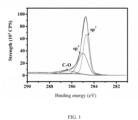
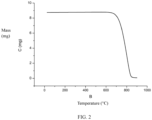
- the XPS test data for Sl was shown in FIG. 1 , and the thermal weight loss curve for Sl was illustrated in FIG. 2 .
- S1 was used as a battery anode material, acetylene black was applied as a conductive agent, and polyvinylidene fluoride was utilized as a binder.
- S1, polyvinylidene fluoride and acetylene black were weighted according to a mass ratio of 92:5:3.
- the formulated N-methyl-2-pyrrolidone solution with a concentration of 5wt% was then added and stirred at a speed of 1,500 r/min for 30min to form a paste.
- the paste was uniformly coated on a copper foil, the coated copper foil was subjected to bake in a vacuum oven at 100°C for 8h, the solvent in the paste was removed so as to prepare a battery anode.
- the electrode sheet obtained in step 2 was used as the anode of a button cell, which was punched into a circular sheet ready for use.
- the metal lithium was also punched into a circular sheet as the cathode, the cathode and the anode were separated by a polyethylene separator, and the electrolyte was 1mol/L of a solution of ethylene carbonate/ethyl methyl carbonate of lithium hexafluorophosphate (the volume ratio of ethylene carbonate to ethyl methyl carbonate 1: 1), the battery assembly was operated in a glove box to prepare and form the button cell.
- the button cell was tested with the LAND CT2001 in the voltage range of 0.001-2V vs. Li/Li + , and its first discharge specific capacity and first coulombic efficiency were tested.
- a columnar battery is assembled and formed according to the assembly standard of 18650lithium battery, by using lithium cobaltate as cathode, utilizing the mixture of lithium hexafluorophosphate and ethylene carbonate in a volume ratio of 95:5 as electrolyte, and using the S1 as the anode material.
- the first discharge capacity of the columnar battery were tested at an operating voltage of 2-4.2V, and the discharge capacity at 0.5C, 1C, and 4C was measured, respectively, and the capacity retention rates of the discharge capacities at different discharge rates with respect to the first discharge capacity were tested.
- the battery was prepared according to the same method as that in Example 1, except that: During the process of preparing a lithium battery anode material, HF and HCl were mixed in a molar ratio of 1:3.5 to form an acid washing solution. The crushed carbon source and the acid washing solution were stirred and mixed in a volume ratio of 1:1.5, and then the mixture was subjected to a separation treatment, the obtained solid was subjected to dry for further use.
- the baked solid was subjected to a carbonization treatment, the entire carbonization process was carried out under nitrogen gas protection, and comprised three temperature rise stages.
- the first temperature rise stage was: raising temperature from the room temperature to 600°C at a heating rate of 5°C/min and keeping the constant temperature 600°C for 60min;
- the second temperature rise stage was: raising temperature to 1,200°C at a heating rate of 5°C/min and keeping the constant temperature 1,200°C for 30min;
- the third temperature rise stage was: raising temperature to 1,600°C at a heating rate of 1°C/min and keeping the constant temperature 1,600°C for 30min; subsequently cooled to the room temperature.
- the carbonized solid was subjected to the graphitization treatment, and the entire graphitization process was carried out under nitrogen gas protection, and included three temperature rise stages.
- the solid was subsequently cooled to 2,000°C at the temperature fall rate of 5°C/min, and then naturally cooled to the room temperature to produce the anode material S2.
- the battery was prepared according to the same method as that in Example 1, except that: During the process of preparing a lithium battery anode material, HF and HCl were mixed in a molar ratio of 1:2 to form an acid washing solution. The crushed carbon source and the acid washing solution were stirred and mixed in a volume ratio of 1:1.5, and then the mixture was subjected to a separation treatment, the obtained solid was subjected to dry for further use.
- the dried solid was subjected to a carbonization treatment, the entire carbonization process was carried out under nitrogen gas protection, and comprised three temperature rise stages.
- the first temperature rise stage was: raising temperature from the room temperature to 500°C at a heating rate of 10°C/min and keeping the constant temperature 500°C for 60min;
- the second temperature rise stage was: raising temperature to 1,000°C at a heating rate of 8°C/min and keeping the constant temperature 1,000°C for 60min;
- the third temperature rise stage was: raising temperature to 1,500°C at a heating rate of 4°C/min and keeping the constant temperature 1,500°C for 60min; subsequently cooled to the room temperature.
- the carbonized solid was subjected to the graphitization treatment, and the entire graphitization process was carried out under nitrogen gas protection, and included three temperature rise stages.
- the solid was subsequently cooled to 2,000°C at the temperature fall rate of 5°C/min, and then naturally cooled to the room temperature to produce the anode material S3.
- the battery was prepared according to the same method as that in Example 1, except that: The baked solid was subjected to a carbonization treatment, the entire carbonization process was carried out under nitrogen gas protection, the carbonization process comprised raising temperature from the room temperature to 1,500°C at a heating rate of 5°C/min and keeping the constant temperature 1,500°C for 60min, subsequently natural cooled to the room temperature.
- the finally produced anode material produced was denoted as S4.
- the battery was prepared according to the same method as that in Example 1, except that: The carbonized solid was subjected to the graphitization treatment, and the entire graphitization process was carried out under nitrogen gas protection, and included two temperature rise stages.
- the battery was prepared according to the same method as that in Example 1, except that: when preparing the lithium battery anode material, HF and HCl were mixed in a molar ratio of 1:5 to form an acid washing liquid. The finally produced anode material was denoted as S6.
- the crushed carbon source and the acid washing solution were stirred and mixed in
- HF and HCl were subsequently mixed in a molar
- the battery was prepared according to the same method as that in Example 1, except that: when preparing the lithium battery anode material, HF and HCl were mixed in a molar ratio of 1:10 to form an acid washing liquid. The finally produced anode material was denoted as D1.
Landscapes
- Chemical & Material Sciences (AREA)
- General Chemical & Material Sciences (AREA)
- Chemical Kinetics & Catalysis (AREA)
- Electrochemistry (AREA)
- Engineering & Computer Science (AREA)
- Materials Engineering (AREA)
- Inorganic Chemistry (AREA)
- Organic Chemistry (AREA)
- Manufacturing & Machinery (AREA)
- Life Sciences & Earth Sciences (AREA)
- General Life Sciences & Earth Sciences (AREA)
- Geology (AREA)
- Battery Electrode And Active Subsutance (AREA)
- Secondary Cells (AREA)
Description
- The present disclosure relates to an anode active material for a lithium-ion battery, and particularly relates to a lithium-ion battery anode material, a lithium-ion battery anode, a lithium-ion battery, a battery pack, and a battery powered vehicle.
- Lithium-ion battery has been the hot topic of recent research on new energy sources due to its advantages such as higher theoretical specific capacity, longer cycle life and high safety. During charging and discharging process of a lithium-ion battery, Li+ embeds and de-embeds back and forth between the cathode and the anode. Therefore, the choice of the anode material plays a crucial role for the capacity of lithium-ion battery. At present, the lithium-ion anode materials are mainly selected from the carbon materials, silicon materials and metal or alloy materials, wherein the carbon materials have readily available raw materials, possess high theoretical capacity, and provide sufficient lithium storage space, thus the currently commercialized lithium-ion batteries prefer carbon materials as the anode for lithium-ion batteries.
- The carbon material of the lithium-ion battery anode is generally selected from natural graphite and artificial graphite. The natural graphite has a larger specific surface area, a lower delithiation potential, a larger first irreversible capacity, but it is prone to generate side reactions. The artificial graphite generally uses petroleum coke, needle coke as the raw material, has a higher raw material cost, and requires subsequent processes such as coating and modification treatment, its technological process is complicated.
- At present, the improvement direction of the lithium-ion battery anode materials mainly focus on increasing sphericity degree and regularity degree of graphite particles, and increasing the coulombic efficiency. Although the carbon materials prepared with the aforementioned methods have an increased capacity during the initial charging and discharging process of the lithium ion batteries, their discharge capacities will be decreased correspondingly after increasing the rate performance.
- LESIAK B. ET AL: "C sp2/sp3 hybridisations in carbon nanomaterials_XPS and (X)AES study", APPLIED SURFACE SCIENCE, vol. 452, 5 May 2018, pages 223-231 is concerned with estimating the reliability of C sp2/sp3 hybridizations derived from parameters D determined for a set of carbonium materials and study the chemical and morphological effects on the measured parameter D values.
-
CN 10781438 A discloses a modified microcrystal graphite cathode material of a lithium ion battery as well as a preparation method and application thereof. -
EP 3 865 457 A1 discloses a lithium-ion battery negative electrode active material. - SILIN HUANG ET AL: "Carbonization and graphitization of pitch applied for anode materials of high power lithium ion batteries", JOURNAL OF SOLID STATE ELECTROCHEMISTRY, vol. 17, no. 5, 29 January 2013, pages 1401-1408 discloses preparation of artificial graphite materials by carbonizing coal tar pitch using one- and two-step processes, and all sintered samples were graphitized at 2800°C.
- The invention is defined by
claims 1 and 8. The dependent claims relate to preferred embodiments of the invention. The present disclosure aims to overcome the problems with respect to the undesirable battery capacity and rate performance in the prior art, and provide a lithium-ion battery anode material, a lithium-ion battery anode, a lithium-ion battery, a battery pack, and a battery powered vehicle, the use of this battery anode material as the lithium-ion battery anode material can effectively improve the capacity and rate performance of the lithium-ion battery. - In order to achieve the above object, a first aspect of the present disclosure provides a lithium-ion battery anode material, wherein the anode material has a half-value width within a range of 0.55-7eV at a peak of 284-290eV measured by X-ray Photoelectron Spectroscopy (XPS), and a C/O atomic ratio of (65-75): 1, and a peak area ratio of sp2C to sp3C being 1: (0.5-5) based on the sum of the spectral peak areas of sp2C and sp3C.
- In a second aspect, the present disclosure provides a method of preparing a lithium-ion battery anode material, wherein the method comprises: subjecting a carbon source to the crushing, purification, carbonization and graphitization process sequentially to produce the anode material.
- In a third aspect, the present disclosure provides a lithium-ion battery anode comprising the lithium-ion battery anode material of the present disclosure.
- In a fourth aspect, the present disclosure provides a lithium-ion battery comprising the lithium-ion battery anode of the present disclosure, a cathode and an electrolyte, wherein the cathode and the anode are separated by a separator; the cathode, the anode and the separator are immersed in the electrolyte.
- In a fifth aspect, the present disclosure provides a battery pack comprising one or more lithium-ion batteries of the present disclosure connected in series and/or in parallel.
- In a sixth aspect, the present disclosure provides a battery powered vehicle comprising the battery pack of the present disclosure.
- Due to the aforementioned technical solution, the battery anode material produced in the present disclosure has both sp2C and sp3C structures, and a peak area ratio of sp2C to sp3C measured by XPS being 1: (0.5-5), and a C/O atomic ratio of (65-75): 1. The use of an anode material having the above structure as an anode of a lithium-ion battery can provide a large lithium storage space, and form a stable SEI film, enhance stability of the battery anode during the cyclic process, and improve the rate performance of the lithium-ion battery.
-
-
FIG. 1 illustrates a C1s spectrogram, measured by the X-ray Photoelectron Spectroscopy (XPS), of an anode material in Example 1; -
FIG. 2 illustrates a thermal weight loss curve in thermogravimetric analysis (TGA) of the anode material in Example 1. - The terminals and any value of the ranges disclosed herein are not limited to the precise ranges or values, such ranges or values shall be comprehended as comprising the values adjacent to the ranges or values. As for numerical ranges, the endpoint values of the various ranges, the endpoint values and the individual point values of the various ranges, and the individual point values may be combined with one another to produce one or more new numerical ranges, which should be deemed have been specifically disclosed herein.
- In a first aspect, the present disclosure provides a lithium-ion battery anode material, wherein the anode material has a half-value width within a range of 0.55-7eV at a peak of 284-290eV measured by X-ray Photoelectron Spectroscopy (XPS), and a C/O atomic ratio of (65-75): 1, and a peak area ratio of sp2C to sp3C being 1: (0.5-5) based on the sum of the spectral peak areas of sp2C and sp3C.
- The carbon-carbon bonds of the anode material of the present disclosure mainly exist in the forms of sp2 and sp3, the anode material has both the structure of a regular graphite-like layer and defect sites formed by C-O bonds and C=O bonds. When the spectral peak area ratio of sp2C to sp3C being 1: (0.5-5), and the C/O atomic ratio is (65-75):1, the produced anode material has a large lithium storage space, so as to facilitate the repeated intercalation/deintercalation of the lithium ions, and reduce the volume change of the anode material resulting from the intercalation/deintercalation of the lithium ions, thus the use of the anode material in a lithium-ion battery may improve the cycling stability and rate performance of the lithium-ion battery.
- The sp2C peak and the sp3C peak measured by XPS test in the present disclosure are mainly located at about 285eV, and the C-O peak is primarily located at about 286 eV
- For the sake of further improving the lithium storage effect of the anode material, reducing the volume change of the anode material due to intercalation/deintercalation of the lithium ions, thereby improving rate performance of the lithium-ion battery, it is preferable that the anode material has a C/O atomic ratio of (65-70):1, and a peak area ratio of sp2C to sp3C is 1: (0.5-2), more preferably 1: (0.7-1) based on the sum of the spectral peak areas of sp2C and sp3C.
- In order to improve the cycling stability of the lithium-ion battery, it is preferable that the anode material has a fixed carbon content/surface carbon content ratio within a range of 0.9-1.2, further preferably 1.0-1.1, the fixed carbon content is the total carbon content measured by thermogravimetric analysis, and the surface carbon content is surface carbon content measured by XPS.
- As shown in
FIG. 1 andFIG. 2 , the fixed carbon content is the total carbon amount measured by thermogravimetric analysis of the anode material after removing ash content, the surface carbon content is the carbon atom content of the anode material measured by XPS. In the case that the fixed carbon content and the surface carbon content satisfy the above relationship, sp2C and sp3C of the produced anode material are combined with each other, and used the produced anode material in a lithium-ion battery, the cycling stability and rate performance of the lithium-ion battery can be improved in a more effective manner. - In the present disclosure, in order to further improve the cycling stability of the lithium-ion battery, and reduce the used amount of the binder, it is preferable that the specific surface area of the anode material is within a range of 0.6-1.3m2/g, further preferably 0.6-1.1m2/g.
- For the sake of further improving stability of the battery anode, it is preferable that the anode material has an interlayer spacing d(002) measured by X-ray diffraction of 0.336nm or less, and a graphitization degree of 85-93%.
- The battery anode provided with the above characteristics has a more stable structure and better conductivity, and can effectively enhance the rate performance of the lithium-ion battery.
- In order to further improve immersion properties of the anode material and the electrolyte, and enhance cycling stability of the lithium-ion battery, it is preferable that the anode material has a granularity distribution D10 within a range of 1-5µm, D50 within a range of 12-18µm, and D90 within a range of 25-35µm; the anode material has a maximum particle diameter of 39µm.
- Preferably, the anode material has a tap density within a range of 0.9-1.2 g/cm3.
- In the case that the anode material produced in the present disclosure satisfies the above-mentioned structural features, the anode material has both a better graphitization degree and a sp3 hybrid structure, provide a sufficient lithium storage space, and has an excellent immersion property with the electrolyte; when the anode material is applied in the lithium-ion battery, it can effectively improve the cycling stability and rate performance of the lithium-ion battery.
- In a second aspect, the present disclosure provides a method of preparing the lithium-ion battery anode material, wherein the method comprises: subjecting a carbon source to the crushing, purification, carbonization and graphitization process sequentially to produce the anode material;
- preferably, the purification process comprises treating the crushed carbon source with HF and/or HC1.
- According to the present disclosure, in order to allow the anode material produced in the present disclosure has both sp2C and sp3C structure and to facilitate the subsequent carbonization and graphitization process, it is preferable that during the purification process, the crushed carbon source is treated with an acid washing solution formed by HF and HCl, and the molar ratio of HF to HCl is 1: (1-5), more preferably 1: (2-3.5).
- According to the present disclosure, the carbon source may be at least one selected from the group consisting of foundry coke, metallurgical coke, coke powder and coal, preferably coke powder which has a lower cost; in addition, when the anode material obtained after the above-mentioned steps and processes is used in the lithium-ion battery, the anode material can effectively improve the capacity and rate performance of the lithium-ion battery.
- The purification process of the present disclosure relates to treating the crushed carbon source with HF and/or HCl, it is preferable to treat the carbon source with HF and HCl in combination according to the above ratio, the treatment can subject the carbon source to the modified treatment to facilitate the subsequent carbonization and graphitization to produce an anode material having both sp2C and sp3C structures.
- In the present disclosure, after subjecting the carbon source to the purification treatment, the carbonization and graphitization of the carbon source is carried out sequentially in steps at different temperatures, it is conducive to form an anode material having both sp2C and sp3C structures, which can be used in the lithium-ion battery anode, thereby producing the lithium-ion battery with better cycling stability and rate performance. It is preferable that the carbonization process comprises: a temperature rise from room temperature to 1,500-1,600°C, a carbonization time of 20-90min, and a heating rate of 1-10°C /min. Further preferably, the carbonization process comprises three temperature rise stages, a first temperature rise stage is raising temperature to 500-600°C and keeping the constant temperature for 20-60min; a second temperature rise stage is raising temperature to 1,000-1,200°C and keeping the constant temperature for 20-30min; a third temperature rise stage is raising temperature to 1,500-1,600°C and keeping the constant temperature for 20-30min. In addition, a heating rate of the first temperature rise stage is preferably 5-10°C /min, a heating rate of the second temperature rise stage is preferably 5-8°C /min, a heating rate of the third temperature rise stage is preferably 1-4°C /min.
- In order to increase the graphitization degree of the carbon source, such that the formed anode material has a more stable structure, it is preferable that the graphitization process comprises: a temperature rise process from room temperature to 2,800-3,000°C; further preferably, the graphitization process comprises three temperature rise stages: a first temperature rise stage is raising temperature from room temperature to 1,350-1,450°C with a heating rate of r1 satisfying the condition of 3≤r1≤6°C/min; a second temperature rise stage is raising temperature to 1,980-2,020°C with a heating rate of r2 satisfying the condition of r2<3°C/min; a third temperature rise stage is raising temperature to 2,800-3,000°C with a heating rate of r3 satisfying the condition of r3<3°C/min; and a heat preservation stage is provided between the three temperature rise stages.
- The aforementioned carbon source is subjected to treatment with the above method, the final produced anode material has a suitable C/O atomic ratio, and a spectral peak area ratio of sp2C to sp3C of the anode material measured by XPS is 1: (0.5-5). Using the anode material having the structure in a lithium-ion battery can effectively enhance cycling stability and rate performance of the lithium-ion battery.
- In a third aspect, the present disclosure provides lithium-ion battery anode comprising the lithium-ion battery anode material of the present disclosure.
- For the sake of further improving the structural stability of the anode material, it is preferable that the battery anode of the present disclosure further comprises a binder. The binder used in the lithium-ion battery anode of the present disclosure is a binder conventionally used in the art, preferably at least one selected from the group consisting of polyvinylidene fluoride, carboxylic butadiene-styrene latex, polyvinyl alcohol, sodium carboxymethylcellulose and polytetrafluoroethylene. It is further preferred that the weight ratio of the anode material to the binder is 1: (0.01-0.04). It is another preferred that the weight ratio of the anode material to the binder is 1: (0.04-0.09).
- The use of the anode material produced in the present disclosure can effectively reduce the used amount of the binder and improve stability of the anode material.
- In order to further improve electric conductivity of the battery anode and the contact effect of the battery anode with the electrolyte, it is preferable that the battery comprises a conductive agent, the weight ratio of the anode material to the conductive agent is 1: (0.01-0.1).
- The use of the anode material prepared in the present disclosure in a lithium-ion battery can reduce the used amount of the binder, and effectively improve cycling stability and rate performance of a lithium-ion battery.
- In a fourth aspect, the present disclosure provides a lithium-ion battery comprising the lithium-ion battery anode of the present disclosure, a cathode and an electrolyte, wherein the cathode and the anode are separated by a separator; the cathode, the anode and the separator are immersed in the electrolyte.
- In order to provide a lithium-ion battery with a high capacity and better cycling stability, the cathode is at least one selected from the group consisting of lithium, nickel-cobalt binary metal, lithium-nickel-cobalt-manganese composite metal, nickel-cobalt-aluminum ternary metal, lithium iron phosphate, lithium manganate and lithium cobaltate.
- For the sake of facilitating rapid movement of ions in the electrolyte in the lithium-ion battery between the cathode and anode, it is preferable that a material of the separator is selected from polyethylene and/or polypropylene. The electrolyte is at least one selected from the group consisting of ethylene carbonate, propylene carbonate, diethyl carbonate, dimethyl carbonate, ethyl methyl carbonate, lithium hexafluorophosphate and phosphorus pentafluoride.
- The lithium-ion battery produced in the present disclosure has high discharge specific capacity, and a capacity retention rate of 97% or more at 0.5C, a capacity retention rate of 93% or more at 1C, a capacity retention rate of 76% or more at 4C.
- In a fifth aspect, the present disclosure provides a battery comprising one or more lithium-ion batteries of the present disclosure connected in series and/or in parallel.
- In a sixth aspect, the present disclosure provides a battery-powered vehicle including the battery pack of the present disclosure.
- The lithium-ion batteries of the present disclosure are connected in series and/or parallel, the lithium-ion batteries may be assembled to form a battery pack having higher coulombic efficiency and rate performance, the battery pack can be applied in a battery powered vehicle.
- The present disclosure will be described in detail with reference to examples. In the following Examples and Comparative examples,
- The BET specific surface area of the anode material was tested by N2 adsorption and desorption by using a V-sorb 2800P specific surface area and pore size analyzer, and distribution of pore volume between 2 and 200nm was analyzed with the BJH.
- The X-Ray diffraction (XRD) crystal face structure of the anode material was tested by an X-ray diffractometer, and d(002) (interlayer spacing of graphite), Lc (Axial dimensions of graphite microcrystals), graphitization degree and the different peak intensity ratios were analyzed. The type of X-ray diffractometer: Da Vinci; manufacturer: BRUCKER AXS GMBH in Germany; specification: 3kw; scan range: 10° to 90°; scan speed: 12° per minute; test condition: 40kV/40mA. Wherein d(002) was calculated according to the formula λ/(2sinθ); the graphitization degree was calculated according to the formula (0.344-d(002))/(0.344-0.3354) ×100%.
- The granularity distribution of the anode material was tested by the particle size analyzer (OMEC).
- The thermogravimetric curve of the anode material was tested by means of a thermogravimetric analyzer; the test conditions were as follows: the intake rate of N2 is 10mL/min, the intake rate of Ar is 50mL/min.
- The tap density of the anode material was tested with a tap density instrument, the true density was tested with the
Ultrapycnometer 1000. - The XPS analysis on the surface of the anode material was carried out by an X-ray Photoelectron Spectroscopy analyzer, and the obtained carbon spectrum was subjected to a peak separation process using an XPSPEAK, each peak is corresponding to the sp2C peak, the sp3C peak and a C-O peak, and the anode material was analyzed based on the peak areas.
- The term "room temperature" in the following Examples and Comparative examples refers to "25°C".
- The present example selected coke powder (purchased from the Baotailong New Materials Co., Ltd.) as a carbon source, and the carbon source was crushed to D50=10-19µm after drying to a state having a water content less than 1wt%, HF and HCl were subsequently mixed in a molar ratio of 1:3 to form an acid washing solution. The crushed carbon source and the acid washing solution were stirred and mixed in a volume ratio of 1:1.5, and then the mixture was subjected to a separation treatment, the obtained solid was subjected to dry for further use.
- The dried solid was subjected to a carbonization treatment, the entire carbonization process was carried out under nitrogen gas protection, and comprised three temperature rise stages. The first temperature rise stage was: raising temperature from the room temperature to 500°C at a heating rate of 8°C/min and keeping the constant temperature 500°C for 60min; the second temperature rise stage was: raising temperature to 1,000°C at a heating rate of 5°C/min and keeping the constant temperature 1,000°C for 30min; the third temperature rise stage was: raising temperature to 1,500°C at a heating rate of 3°C/min and keeping the constant temperature 1,500°C for 30min; then subsequently cooled to 300-400°C.
- The carbonized solid was subjected to the graphitization treatment, and the entire graphitization process was carried out under nitrogen gas protection, and included three temperature rise stages. The first temperature rise stage was: raising temperature to 1,400°C at a heating rate of r1=5°C/min and keeping the constant temperature 1,400°C for 60min; the second temperature rise stage was: raising temperature to 1,980°C at a heating rate of r2=2°C/min and keeping the constant temperature 1,980°C for 30min; the third temperature rise stage was: raising temperature to 3,000°C at a heating rate of r3=2°C/min and keeping the constant temperature 3,000°C for 60min; subsequently the solid was cooled and taken out from the furnace to obtain the anode material Sl. The XPS test data for Sl was shown in
FIG. 1 , and the thermal weight loss curve for Sl was illustrated inFIG. 2 . - S1 was used as a battery anode material, acetylene black was applied as a conductive agent, and polyvinylidene fluoride was utilized as a binder. S1, polyvinylidene fluoride and acetylene black were weighted according to a mass ratio of 92:5:3. The formulated N-methyl-2-pyrrolidone solution with a concentration of 5wt% was then added and stirred at a speed of 1,500 r/min for 30min to form a paste. The paste was uniformly coated on a copper foil, the coated copper foil was subjected to bake in a vacuum oven at 100°C for 8h, the solvent in the paste was removed so as to prepare a battery anode.
- The electrode sheet obtained in
step 2 was used as the anode of a button cell, which was punched into a circular sheet ready for use. The metal lithium was also punched into a circular sheet as the cathode, the cathode and the anode were separated by a polyethylene separator, and the electrolyte was 1mol/L of a solution of ethylene carbonate/ethyl methyl carbonate of lithium hexafluorophosphate (the volume ratio of ethylene carbonate to ethyl methyl carbonate 1: 1), the battery assembly was operated in a glove box to prepare and form the button cell. - The button cell was tested with the LAND CT2001 in the voltage range of 0.001-2V vs. Li/Li+, and its first discharge specific capacity and first coulombic efficiency were tested.
- A columnar battery is assembled and formed according to the assembly standard of 18650lithium battery, by using lithium cobaltate as cathode, utilizing the mixture of lithium hexafluorophosphate and ethylene carbonate in a volume ratio of 95:5 as electrolyte, and using the S1 as the anode material. The first discharge capacity of the columnar battery were tested at an operating voltage of 2-4.2V, and the discharge capacity at 0.5C, 1C, and 4C was measured, respectively, and the capacity retention rates of the discharge capacities at different discharge rates with respect to the first discharge capacity were tested.
- The battery was prepared according to the same method as that in Example 1, except that:
During the process of preparing a lithium battery anode material, HF and HCl were mixed in a molar ratio of 1:3.5 to form an acid washing solution. The crushed carbon source and the acid washing solution were stirred and mixed in a volume ratio of 1:1.5, and then the mixture was subjected to a separation treatment, the obtained solid was subjected to dry for further use. - The baked solid was subjected to a carbonization treatment, the entire carbonization process was carried out under nitrogen gas protection, and comprised three temperature rise stages. The first temperature rise stage was: raising temperature from the room temperature to 600°C at a heating rate of 5°C/min and keeping the
constant temperature 600°C for 60min; the second temperature rise stage was: raising temperature to 1,200°C at a heating rate of 5°C/min and keeping the constant temperature 1,200°C for 30min; the third temperature rise stage was: raising temperature to 1,600°C at a heating rate of 1°C/min and keeping the constant temperature 1,600°C for 30min; subsequently cooled to the room temperature. - The carbonized solid was subjected to the graphitization treatment, and the entire graphitization process was carried out under nitrogen gas protection, and included three temperature rise stages. The first temperature rise stage was: raising temperature to 1,400°C at a heating rate of r1=3°C/min and keeping the constant temperature 1,400°C for 60min; the second temperature rise stage was: raising temperature to 1,980°C at a heating rate of r2=2°C/min and keeping the constant temperature 1,980°C for 30min; the third temperature rise stage was: raising temperature to 3,000°C at a heating rate of r3=1°C/min and keeping the constant temperature 3,000°C for 60min; the solid was subsequently cooled to 2,000°C at the temperature fall rate of 5°C/min, and then naturally cooled to the room temperature to produce the anode material S2.
- The battery was prepared according to the same method as that in Example 1, except that:
During the process of preparing a lithium battery anode material, HF and HCl were mixed in a molar ratio of 1:2 to form an acid washing solution. The crushed carbon source and the acid washing solution were stirred and mixed in a volume ratio of 1:1.5, and then the mixture was subjected to a separation treatment, the obtained solid was subjected to dry for further use. - The dried solid was subjected to a carbonization treatment, the entire carbonization process was carried out under nitrogen gas protection, and comprised three temperature rise stages. The first temperature rise stage was: raising temperature from the room temperature to 500°C at a heating rate of 10°C/min and keeping the constant temperature 500°C for 60min; the second temperature rise stage was: raising temperature to 1,000°C at a heating rate of 8°C/min and keeping the constant temperature 1,000°C for 60min; the third temperature rise stage was: raising temperature to 1,500°C at a heating rate of 4°C/min and keeping the constant temperature 1,500°C for 60min; subsequently cooled to the room temperature.
- The carbonized solid was subjected to the graphitization treatment, and the entire graphitization process was carried out under nitrogen gas protection, and included three temperature rise stages. The first temperature rise stage was: raising temperature to 1,400°C at a heating rate of r1=6°C/min and keeping the constant temperature 1,400°C for 60min; the second temperature rise stage was: raising temperature to 1,980°C at a heating rate of r2=2°C/min and keeping the constant temperature 1,980°C for 60min; the third temperature rise stage was: raising temperature to 3,000°C at a heating rate of r3=2°C/min and keeping the constant temperature 3,000°C for 60min; the solid was subsequently cooled to 2,000°C at the temperature fall rate of 5°C/min, and then naturally cooled to the room temperature to produce the anode material S3.
- The battery was prepared according to the same method as that in Example 1, except that:
The baked solid was subjected to a carbonization treatment, the entire carbonization process was carried out under nitrogen gas protection, the carbonization process comprised raising temperature from the room temperature to 1,500°C at a heating rate of 5°C/min and keeping the constant temperature 1,500°C for 60min, subsequently natural cooled to the room temperature. - The finally produced anode material produced was denoted as S4.
- The battery was prepared according to the same method as that in Example 1, except that:
The carbonized solid was subjected to the graphitization treatment, and the entire graphitization process was carried out under nitrogen gas protection, and included two temperature rise stages. The first temperature rise stage was: raising temperature to 2,000°C at a heating rate of r1=5°C/min and keeping the constant temperature 2,000°C for 60min; the second temperature rise stage was: raising temperature to 3,000°C at a heating rate of r2=2°C/min and keeping the constant temperature 3,000°C for 60min; the solid was then cooled and taken out of the furnace to produce the anode material S5. - The battery was prepared according to the same method as that in Example 1, except that: when preparing the lithium battery anode material, HF and HCl were mixed in a molar ratio of 1:5 to form an acid washing liquid. The finally produced anode material was denoted as S6.
- The battery was prepared according to the same method as that in Example 1, except that: coal (produced by pulverizing and mixing anthracite, bituminous coal and lignite according to the ratio of anthracite: bituminous coal: lignite =3:6:2) was selected as the carbon source, and the carbon source was crushed to D50=10-19µm after drying to a state having a water content less than 1wt%, HF and HCl were subsequently mixed in a molar ratio of 1:3 to form an acid washing solution. The crushed carbon source and the acid washing solution were stirred and mixed in a volume ratio of 1:1.5, and then the mixture was subjected to a separation treatment, the obtained solid was subjected to dry for further use.
- The battery was prepared according to the same method as that in Example 1, except that: coal (produced by pulverizing and mixing anthracite, bituminous coal and lignite according to the ratio of anthracite: bituminous coal: lignite =3:6:2) was selected as the carbon source, and the carbon source was crushed to D50=10-19µm after drying to a state having a water content less than 1wt%, HF and HCl were subsequently mixed in a molar ratio of 1:10 to form an acid washing solution. The crushed carbon source and the acid washing solution were stirred and mixed in a volume ratio of 1:1.5, and then the mixture was subjected to a separation treatment, the obtained solid was subjected to dry for further use.
- The battery was prepared according to the same method as that in Example 1, except that: when preparing the lithium battery anode material, HF and HCl were mixed in a molar ratio of 1:10 to form an acid washing liquid. The finally produced anode material was denoted as D1.
- The performance test results of the anode materials prepared in each of the Examples and Comparative examples were shown in Table 1, and the performance test results of the lithium-ion batteries formed by assembling of the anode materials prepared in each of the Examples and Comparative examples were illustrated in Table 2.
Table 1 Anode material S1 S2 S3 S4 S5 XPS data sp2C peak Peak position/eV 284.7 284.7 284.7 284.7 284.7 Half-value width/eV 0.6 0.59 0.59 0.58 0.6 sp3C peak Peak position/eV 284.9 284.9 284.9 284.9 284.5 Half-value width/eV 1 0.92 0.95 0.98 0.9 C-O peak Peak position/eV 286.3 286.1 286.3 286.1 286.1 Half-value width/eV 1.4 1.5 1.5 1.5 1.5 C/O atomic ratio 67:1 68:1 68:1 68:1 67:1 Peak area ratio of sp2C to sp3C 1:0.78 1:0.92 1:0.95 1:0.90 1:0.85 Fixed carbon content/surface carbon content 1.01 1.01 1.01 1.01 1.12 Specific surface area/m2/g 1.05 0.98 1.02 1.12 12 d(002)/nm 0.3359 0.3359 0.3359 0.336 0.336 Graphitization degree/% 87.5 86.7 86.9 88.5 89.2 Granularity distribution D10/µm 4.71 4.8 5 3.2 3.8 D50/µm 12.5 15 15.8 16.3 17.8 D90/µm 30.6 25 32 28 34.7 Tap density/g/cm3 1.15 1.12 1.08 1.18 0.95 Table 1 (continued) Anode material S6 S7 S8 D1 XPS data sp2C peak Peak position/eV 284.7 284.7 284.7 284.7 Half-value width/eV 0.61 0.6 0.61 0.58 sp3C peak Peak position/eV 284.9 284.9 284.9 284.8 Half-value width/eV 0.92 0.9 0.92 0.95 C-O peak Peak position/eV 286.3 286.3 286.5 286.3 Half-value width/eV 1.4 1.5 1.5 1.6 C/O atomic ratio 67:1 67:1 67:1 58:1 Peak area ratio of sp2C to sp3C 1:0.82 1:0.79 1:0.87 1:0.45 Fixed carbon content/surface carbon content 1.2 1.01 1.28 1.4 Specific surface area/m2/g 1.28 1.05 1.32 1.4 d(002)/nm 0.336 0.336 0.336 0.336 Graphitization degree/% 88.9 87.8 88.5 89.4 Granularity distribution D10/µm 2.7 4.8 3.7 2.5 D50/µm 18 14.2 18.4 17.5 D90/µm 35 32 33.7 28 Tap density/g/cm3 1.2 1.15 1.2 1.78 - The results of Table 1 demonstrate that the C/O atomic ratio of the anode material produced in the Examples of the present disclosure is within a range of (65-70):1, and the peak area ratio of the sp2C spectrum to sp3C spectrum is within a range of 1: (0.5-2), the use of the anode material in a lithium-ion battery can effectively improve the cycling property and rate performance of the battery.
Table 2 Battery properties S1 S2 S3 S4 S5 Discharge specific capacity/mAh/g 358 357 365 365 362 First coulombic efficiency/% 92.5 92.7 91.8 90 89.5 0.5C capacity retention ratio/% 99.1 99 98.5 98.2 98 1C capacity retention ratio/% 98.85 98.2 98.1 97.47 97.8 4C capacity retention ratio/% 90.67 90.73 88.9 89.8 88.5 Table 2 (continued) Battery properties S6 S7 S8 D1 Discharge specific capacity/mAh/g 354 357 352 350 First coulombic efficiency/% 88.4 91.7 88.4 87.5 0.5C capacity retention ratio/% 97.54 98.2 98.1 96.4 1C capacity retention ratio/% 95.25 96.4 96.9 92.51 4C capacity retention ratio/% 79.7 88.7 80.5 68.97 - The results of Table 2 illustrate that the lithium-ion batteries formed by assembling the anode materials produced in the Examples of the present disclosure have a higher discharge specific capacity and a first coulombic efficiency, and still retain a better capacity at a high rate.
Claims (13)
- A lithium-ion battery anode material, wherein the anode material has a half-value width within a range of 0.55-7eV at a peak of 284-290eV measured by X-ray Photoelectron Spectroscopy (XPS), and a C/O atomic ratio of (65-75): 1, and a peak area ratio of sp2C to sp3C being 1: (0.5-5) based on the sum of the spectral peak areas of sp2C and sp3C;wherein the method of preparing the lithium-ion battery anode material comprising: subjecting a carbon source to the crushing, purification, carbonization and graphitization process sequentially to produce the anode material;wherein the carbon source is at least one selected from the group consisting of foundry coke, metallurgical coke, coke powder and coal;wherein the crushed carbon source is treated with an acid washing solution formed by HF and HCl, and the molar ratio of HF to HCl is 1: (1-5);wherein the carbonization process comprises three temperature rise stages, a first temperature rise stage is raising temperature to 500-600°C and keeping the constant temperature for 20-60min; a second temperature rise stage is raising temperature to 1,000-1,200°C and keeping the constant temperature for 20-30min; a third temperature rise stage is raising temperature to 1,500-1,600°C and keeping the constant temperature for 20-30min;wherein the graphitization process comprises three temperature rise stages: a first temperature rise stage is raising temperature from room temperature to 1,350-1,450°C with a heating rate of r1 satisfying the condition of 3≤r1≤6°C/min; a second temperature rise stage is raising temperature to 1,980-2,020°C with a heating rate of r2 satisfying the condition of r2<3°C/min; a third temperature rise stage is raising temperature to 2,800-3,000°C with a heating rate of r3 satisfying the condition of r3<3°C/min; and a heat preservation stage is provided between the three temperature rise stages.
- The lithium-ion battery anode material of claim 1, wherein the anode material has a C/O atomic ratio of (65-70): 1, and a peak area ratio of sp2C to sp3C being 1: (0.5-2) based on the sum of the spectral peak areas of sp2C and sp3C.
- The lithium-ion battery anode material of claim 1 or 2, wherein the anode material has a fixed carbon content/surface carbon content ratio within a range of 0.9-1.2, the fixed carbon content is the total carbon content measured by thermogravimetric analysis, and the surface carbon content is surface carbon content measured by XPS.
- The lithium-ion battery anode material of any one of claims 1-3, wherein the specific surface area of the anode material is within a range of 0.6-1.3m2/g, preferably 0.6-1.1m2/g.
- The lithium-ion battery anode material of any one of claims 1-4, wherein the anode material has an interlayer spacing d(002) measured by X-ray diffraction of 0.336nm or less, and a graphitization degree of 85-93%.
- The lithium-ion battery anode material of any one of claims 1-5, wherein the anode material has a granularity distribution D10 within a range of 1-5µm, D50 within a range of 12-18µm, and D90 within a range of 25-35µm; the anode material has a maximum particle diameter of 39µm.
- The lithium-ion battery anode material of any one of claims 1-6, wherein the anode material has a tap density within a range of 0.9-1.2 g/cm3.
- A method of preparing the lithium-ion battery anode material of any one of claims 1-7 comprising: subjecting a carbon source to the crushing, purification, carbonization and graphitization process sequentially to produce the anode material;wherein the method of preparing the lithium-ion battery anode material of any one of claims 1-7 comprising: subjecting a carbon source to the crushing, purification, carbonization and graphitization process sequentially to produce the anode material;wherein the carbon source is at least one selected from the group consisting of foundry coke, metallurgical coke, coke powder and coal;wherein the crushed carbon source is treated with an acid washing solution formed by HF and HCl, and the molar ratio of HF to HCl is 1: (1-5);wherein the carbonization process comprises three temperature rise stages, a first temperature rise stage is raising temperature to 500-600°C and keeping the constant temperature for 20-60min; a second temperature rise stage is raising temperature to 1,000-1,200°C and keeping the constant temperature for 20-30min; a third temperature rise stage is raising temperature to 1,500-1,600°C and keeping the constant temperature for 20-30min;wherein the graphitization process comprises three temperature rise stages: a first temperature rise stage is raising temperature from room temperature to 1,350-1,450°C with a heating rate of r1 satisfying the condition of 3≤r1≤6°C/min; a second temperature rise stage is raising temperature to 1,980-2,020°C with a heating rate of r2 satisfying the condition of r2<3°C/min; a third temperature rise stage is raising temperature to 2,800-3,000°C with a heating rate of r3 satisfying the condition of r3<3°C/min; and a heat preservation stage is provided between the three temperature rise stages.
- The method of claim 8, wherein during the purification process, the crushed carbon source is treated with HF and HCl, and the molar ratio of HF to HCl is 1: (2-3.5).
- A lithium-ion battery anode comprising the lithium-ion battery anode material of any one of claims 1-7;preferably, the anode further comprises a binder, the weight ratio of the anode material to the binder is 1: (0.04-0.09);preferably, the anode further comprises a conductive agent, the weight ratio of the anode material to the conductive agent is 1: (0.01-0.1).
- A lithium-ion battery comprising the lithium-ion battery anode of claim 10, a cathode and an electrolyte, wherein the cathode and the anode are separated by a separator; the cathode, the anode and the separator are immersed in the electrolyte.
- A battery pack comprising one or more lithium-ion batteries of claim 11 connected in series and/or in parallel.
- A battery powered vehicle comprising the battery pack of claim 12.
Applications Claiming Priority (2)
| Application Number | Priority Date | Filing Date | Title |
|---|---|---|---|
| CN201811643308.2A CN109888284B (en) | 2018-12-29 | 2018-12-29 | Lithium-ion battery anode materials, lithium-ion battery anodes, lithium-ion batteries, battery packs and battery powered vehicles |
| PCT/CN2019/107753 WO2020134242A1 (en) | 2018-12-29 | 2019-09-25 | Negative electrode material for lithium ion battery, negative electrode for lithium ion battery, lithium ion battery, battery pack and battery powered vehicle |
Publications (3)
| Publication Number | Publication Date |
|---|---|
| EP3876317A1 EP3876317A1 (en) | 2021-09-08 |
| EP3876317A4 EP3876317A4 (en) | 2022-01-26 |
| EP3876317B1 true EP3876317B1 (en) | 2024-09-18 |
Family
ID=66925414
Family Applications (1)
| Application Number | Title | Priority Date | Filing Date |
|---|---|---|---|
| EP19906148.2A Active EP3876317B1 (en) | 2018-12-29 | 2019-09-25 | Negative electrode material for lithium ion battery, negative electrode for lithium ion battery, lithium ion battery, battery pack and battery powered vehicle |
Country Status (6)
| Country | Link |
|---|---|
| US (1) | US20210408542A1 (en) |
| EP (1) | EP3876317B1 (en) |
| JP (1) | JP7161045B2 (en) |
| KR (1) | KR102620786B1 (en) |
| CN (1) | CN109888284B (en) |
| WO (1) | WO2020134242A1 (en) |
Families Citing this family (7)
| Publication number | Priority date | Publication date | Assignee | Title |
|---|---|---|---|---|
| CN109888284B (en) * | 2018-12-29 | 2020-05-01 | 湖南晋烨高科股份有限公司 | Lithium-ion battery anode materials, lithium-ion battery anodes, lithium-ion batteries, battery packs and battery powered vehicles |
| CN112289986B (en) * | 2020-09-28 | 2022-11-04 | 合肥国轩高科动力能源有限公司 | A kind of preparation method of high-rate fast-charging graphite negative electrode material |
| CN114956037B (en) * | 2022-05-13 | 2024-06-14 | 溧阳中科海钠科技有限责任公司 | Carbon material for sodium ion battery negative electrode and preparation method thereof, sodium ion battery negative electrode sheet and sodium ion battery |
| CN115028156A (en) * | 2022-05-30 | 2022-09-09 | 山西水木新碳材科技有限公司 | Method for preparing nitrogen-doped anthracite-based carbon material by mechanochemical method and application |
| EP4550474A4 (en) * | 2022-10-21 | 2026-01-07 | Contemporary Amperex Technology Hong Kong Ltd | CARBON-CONTAINING MATERIAL AND MANUFACTURING METHOD FOR IT, SECONDARY BATTERY CONTAINING THE CARBON-CONTAINING MATERIAL AND ELECTRICAL DEVICE |
| CN118825456B (en) * | 2024-09-18 | 2025-03-25 | 松山湖材料实验室 | Carbon-coated solid electrolyte, battery and electrical equipment |
| CN120136100B (en) * | 2025-03-24 | 2025-11-11 | 中南大学 | A method for preparing phosphorus-doped porous carbon and its application |
Family Cites Families (33)
| Publication number | Priority date | Publication date | Assignee | Title |
|---|---|---|---|---|
| JP3531274B2 (en) * | 1995-04-20 | 2004-05-24 | 三菱化学株式会社 | Non-aqueous secondary battery |
| JP3852766B2 (en) * | 2002-10-17 | 2006-12-06 | 富士電機ホールディングス株式会社 | State analysis method in carbon film |
| TWI291779B (en) * | 2003-05-09 | 2007-12-21 | Sony Corp | Negative pole material, and manufacturing method thereof, and battery |
| JP2005097010A (en) * | 2003-09-22 | 2005-04-14 | Showa Denko Kk | Carbon material, production method therefor and its application |
| JP5082207B2 (en) * | 2004-06-30 | 2012-11-28 | 三菱化学株式会社 | Method for producing negative electrode material for lithium secondary battery, and negative electrode for lithium secondary battery and lithium secondary battery using the same |
| CN1326267C (en) * | 2005-05-27 | 2007-07-11 | 深圳市贝特瑞电子材料有限公司 | Cathode material of composite carbon in use for lithium ion battery and preparation method |
| CN101728449A (en) * | 2008-10-31 | 2010-06-09 | 宋健民 | Diamond-like carbon electronic device and manufacturing method thereof |
| CN101924209B (en) * | 2009-06-16 | 2012-11-14 | 上海宝钢化工有限公司 | Lithium ion battery cathode material and preparation method thereof |
| JP2011258348A (en) * | 2010-06-07 | 2011-12-22 | Toyota Central R&D Labs Inc | Negative electrode for lithium secondary battery, lithium secondary battery and method of manufacturing negative electrode for lithium secondary battery |
| WO2012039477A1 (en) * | 2010-09-24 | 2012-03-29 | 日立化成工業株式会社 | Lithium ion battery, and battery module utilizing same |
| CN103443972B (en) * | 2011-01-17 | 2016-08-17 | 昭荣化学工业株式会社 | Positive electrode material for lithium ion secondary battery and manufacturing method thereof |
| US8865351B2 (en) * | 2011-03-14 | 2014-10-21 | Ut-Battelle, Llc | Carbon composition with hierarchical porosity, and methods of preparation |
| KR20140016925A (en) * | 2011-03-30 | 2014-02-10 | 미쓰비시 가가꾸 가부시키가이샤 | Graphite particles for nonaqueous secondary battery and method for producing same, negative electrode and nonaqueous secondary battery |
| KR101952464B1 (en) * | 2011-03-30 | 2019-02-26 | 미쯔비시 케미컬 주식회사 | Carbon material and negative electrode for nonaqueous secondary battery and nonaqueous secondary battery |
| JP5754686B2 (en) * | 2011-05-11 | 2015-07-29 | 石福金属興業株式会社 | Cathode platinum catalyst for highly active fuel cells |
| DE112013003030T5 (en) * | 2012-06-29 | 2015-04-09 | Showa Denko K.K. | Carbon material, carbonaceous material for battery electrode, and battery |
| EP2908365B1 (en) * | 2012-10-12 | 2017-05-03 | Nissan Motor Co., Ltd. | Positive electrode active substance for nonaqueous electrolyte secondary cell, method for producing positive electrode active substance for nonaqueous electrolyte secondary cell, and nonaqueous electrolyte secondary cell |
| CN103066243B (en) * | 2012-12-06 | 2015-05-13 | 中南大学 | Coke powder-based cathode material of lithium ion power battery and preparation method thereof |
| DE112013006722B4 (en) * | 2013-02-22 | 2020-10-15 | Kabushiki Kaisha Toyota Jidoshokki | Negative electrode active material, manufacturing method for the same and electric storage apparatus |
| CN111517319A (en) * | 2013-03-26 | 2020-08-11 | 三菱化学株式会社 | Carbon material and nonaqueous secondary battery using same |
| KR101971448B1 (en) * | 2013-07-29 | 2019-04-23 | 쇼와 덴코 가부시키가이샤 | Carbon material, cell electrode material, and cell |
| KR101568022B1 (en) * | 2013-12-24 | 2015-11-11 | 주식회사 포스코 | Method of preparing artificial graphite negative electrode material for rechargeable lithium battery and artificial graphite negative electrode material for rechargeable lithium battery prepared from the same |
| JP6194826B2 (en) * | 2014-03-19 | 2017-09-13 | ソニー株式会社 | Lithium ion secondary battery |
| WO2016113952A1 (en) * | 2015-01-16 | 2016-07-21 | 三菱化学株式会社 | Carbon material and nonaqueous secondary battery using carbon material |
| JP6906891B2 (en) * | 2015-09-02 | 2021-07-21 | 三菱ケミカル株式会社 | Carbon material for non-aqueous secondary batteries and lithium ion secondary batteries |
| JP2016152223A (en) * | 2015-02-19 | 2016-08-22 | 株式会社クレハ | Carbonaceous material for nonaqueous electrolyte secondary battery, negative electrode for nonaqueous electrolyte secondary battery, and nonaqueous electrolyte secondary battery |
| WO2017022486A1 (en) * | 2015-08-05 | 2017-02-09 | 株式会社クラレ | Hardly graphitizable carbonaceous material for nonaqueous electrolyte secondary batteries used in fully charged state, method for producing same, negative electrode material for nonaqueous electrolyte secondary batteries, and nonaqueous electrolyte secondary battery in fully charged state |
| CN106672960A (en) * | 2016-12-23 | 2017-05-17 | 巴中意科碳素股份有限公司 | High-density graphite material and production process thereof |
| CN107814383B (en) * | 2017-09-28 | 2020-01-14 | 广东东岛新能源股份有限公司 | Modified microcrystalline graphite negative electrode material for lithium ion battery and preparation method and application thereof |
| CN107732152A (en) * | 2017-10-31 | 2018-02-23 | 湖南国盛石墨科技有限公司 | A kind of micro crystal graphite negative electricity pole piece and its button lithium battery preparation method |
| CN107799770A (en) * | 2017-10-31 | 2018-03-13 | 湖南国盛石墨科技有限公司 | A kind of micro crystal graphite for lithium cell cathode material and preparation method thereof |
| US12113218B2 (en) * | 2018-10-10 | 2024-10-08 | Hunan Jinye High-tech Co., Ltd. | Lithium-ion battery negative electrode active material, lithium-ion battery negative electrode, lithium ion battery, battery pack and battery-powered vehicle |
| CN109888284B (en) * | 2018-12-29 | 2020-05-01 | 湖南晋烨高科股份有限公司 | Lithium-ion battery anode materials, lithium-ion battery anodes, lithium-ion batteries, battery packs and battery powered vehicles |
-
2018
- 2018-12-29 CN CN201811643308.2A patent/CN109888284B/en active Active
-
2019
- 2019-09-25 JP JP2021522336A patent/JP7161045B2/en active Active
- 2019-09-25 EP EP19906148.2A patent/EP3876317B1/en active Active
- 2019-09-25 US US17/293,761 patent/US20210408542A1/en not_active Abandoned
- 2019-09-25 KR KR1020217012613A patent/KR102620786B1/en active Active
- 2019-09-25 WO PCT/CN2019/107753 patent/WO2020134242A1/en not_active Ceased
Also Published As
| Publication number | Publication date |
|---|---|
| KR20210062694A (en) | 2021-05-31 |
| JP2022505691A (en) | 2022-01-14 |
| KR102620786B1 (en) | 2024-01-04 |
| CN109888284B (en) | 2020-05-01 |
| WO2020134242A1 (en) | 2020-07-02 |
| CN109888284A (en) | 2019-06-14 |
| US20210408542A1 (en) | 2021-12-30 |
| EP3876317A1 (en) | 2021-09-08 |
| JP7161045B2 (en) | 2022-10-25 |
| EP3876317A4 (en) | 2022-01-26 |
Similar Documents
| Publication | Publication Date | Title |
|---|---|---|
| EP3876317B1 (en) | Negative electrode material for lithium ion battery, negative electrode for lithium ion battery, lithium ion battery, battery pack and battery powered vehicle | |
| CN115064667B (en) | A biomass hard carbon based on low crystalline cellulose content and its preparation method and application | |
| KR101131937B1 (en) | Negative active material for lithium rechargeable battery, method of preparing the same, and lithium rechargeable battery comprising the same | |
| EP2892095B1 (en) | Carbonaceous material for negative electrodes of nonaqueous electrolyte secondary batteries and method for producing same | |
| CN109553085B (en) | Lithium-ion battery negative electrode active material, lithium-ion battery negative electrode, lithium-ion battery, battery pack and battery powered vehicle | |
| CN113380998A (en) | Silicon-carbon negative electrode material and preparation method and application thereof | |
| CN109553080B (en) | Lithium-ion battery negative electrode active material, lithium-ion battery negative electrode, lithium-ion battery, battery pack and battery powered vehicle | |
| CN112645300A (en) | Hard carbon negative electrode material, lithium ion battery and preparation method and application thereof | |
| CN110212183A (en) | A kind of powder pre-lithiated silicon-based negative electrode material and its preparation method and application | |
| WO2014034859A1 (en) | Carbonaceous material for negative electrodes of lithium ion capacitors and method for producing same | |
| KR20210068497A (en) | Lithium ion battery negative active material, lithium ion battery negative electrode, lithium ion battery, battery pack and battery power vehicle | |
| JP7518899B2 (en) | Composite graphite material and its manufacturing method, secondary battery and device | |
| WO2014038494A1 (en) | Material for negative electrode of non-aqueous electrolyte secondary battery | |
| CN117712375A (en) | Graphite negative electrode active material, negative electrode sheet, secondary battery and device | |
| CN102082267B (en) | Preparation and application of conductive carbon film-coated calcium nitride compound serving as anode material of lithium battery | |
| CN110752358A (en) | A kind of preparation method and application of rice husk-based silicon oxide carbon composite negative electrode material | |
| CN114551844B (en) | A lithium titanate composite negative electrode material and preparation method thereof | |
| CN118183685A (en) | A powdered carbon material with core-shell structure and its preparation and application | |
| CN115692652B (en) | Nitrogen-doped carbon nanomaterial, preparation method thereof and application as negative electrode material | |
| Skowroński et al. | Changes in electrochemical insertion of lithium into glass-like carbon affected by catalytic graphitization at 1000° C | |
| CN114864915A (en) | Preparation method of porous silicon/carbon nanotube composite material | |
| CN117776153B (en) | A method for preparing coal coke-based hard carbon by solvothermal-assisted low-temperature heat treatment | |
| CN119905549B (en) | A Na4Fe3(PO4)2(P2O7)@C lithium-ion battery cathode material, cathode, and battery | |
| CN115472831B (en) | Negative electrode material and its preparation method and application | |
| KR20250098472A (en) | Artificial graphite-derived composite materials and manufacturing method for the same |
Legal Events
| Date | Code | Title | Description |
|---|---|---|---|
| STAA | Information on the status of an ep patent application or granted ep patent |
Free format text: STATUS: THE INTERNATIONAL PUBLICATION HAS BEEN MADE |
|
| PUAI | Public reference made under article 153(3) epc to a published international application that has entered the european phase |
Free format text: ORIGINAL CODE: 0009012 |
|
| STAA | Information on the status of an ep patent application or granted ep patent |
Free format text: STATUS: REQUEST FOR EXAMINATION WAS MADE |
|
| 17P | Request for examination filed |
Effective date: 20210531 |
|
| AK | Designated contracting states |
Kind code of ref document: A1 Designated state(s): AL AT BE BG CH CY CZ DE DK EE ES FI FR GB GR HR HU IE IS IT LI LT LU LV MC MK MT NL NO PL PT RO RS SE SI SK SM TR |
|
| A4 | Supplementary search report drawn up and despatched |
Effective date: 20220104 |
|
| RIC1 | Information provided on ipc code assigned before grant |
Ipc: H01M 10/0525 20100101ALI20211221BHEP Ipc: H01M 4/133 20100101ALI20211221BHEP Ipc: H01M 4/583 20100101ALI20211221BHEP Ipc: C01B 32/05 20170101AFI20211221BHEP |
|
| DAV | Request for validation of the european patent (deleted) | ||
| DAX | Request for extension of the european patent (deleted) | ||
| STAA | Information on the status of an ep patent application or granted ep patent |
Free format text: STATUS: EXAMINATION IS IN PROGRESS |
|
| 17Q | First examination report despatched |
Effective date: 20220620 |
|
| REG | Reference to a national code |
Ref country code: DE Ref legal event code: R079 Ipc: C01B0032050000 Ref country code: DE Ref legal event code: R079 Ref document number: 602019059284 Country of ref document: DE Free format text: PREVIOUS MAIN CLASS: H01M0004583000 Ipc: C01B0032050000 |
|
| GRAP | Despatch of communication of intention to grant a patent |
Free format text: ORIGINAL CODE: EPIDOSNIGR1 |
|
| STAA | Information on the status of an ep patent application or granted ep patent |
Free format text: STATUS: GRANT OF PATENT IS INTENDED |
|
| RIC1 | Information provided on ipc code assigned before grant |
Ipc: H01M 4/133 20100101ALI20240603BHEP Ipc: H01M 10/0525 20100101ALI20240603BHEP Ipc: H01M 4/583 20100101ALI20240603BHEP Ipc: H01M 4/587 20100101ALI20240603BHEP Ipc: C01B 32/05 20170101AFI20240603BHEP |
|
| INTG | Intention to grant announced |
Effective date: 20240710 |
|
| GRAS | Grant fee paid |
Free format text: ORIGINAL CODE: EPIDOSNIGR3 |
|
| GRAA | (expected) grant |
Free format text: ORIGINAL CODE: 0009210 |
|
| STAA | Information on the status of an ep patent application or granted ep patent |
Free format text: STATUS: THE PATENT HAS BEEN GRANTED |
|
| AK | Designated contracting states |
Kind code of ref document: B1 Designated state(s): AL AT BE BG CH CY CZ DE DK EE ES FI FR GB GR HR HU IE IS IT LI LT LU LV MC MK MT NL NO PL PT RO RS SE SI SK SM TR |
|
| REG | Reference to a national code |
Ref country code: GB Ref legal event code: FG4D |
|
| REG | Reference to a national code |
Ref country code: CH Ref legal event code: EP |
|
| REG | Reference to a national code |
Ref country code: IE Ref legal event code: FG4D |
|
| REG | Reference to a national code |
Ref country code: DE Ref legal event code: R096 Ref document number: 602019059284 Country of ref document: DE |
|
| REG | Reference to a national code |
Ref country code: LT Ref legal event code: MG9D |
|
| PG25 | Lapsed in a contracting state [announced via postgrant information from national office to epo] |
Ref country code: NO Free format text: LAPSE BECAUSE OF FAILURE TO SUBMIT A TRANSLATION OF THE DESCRIPTION OR TO PAY THE FEE WITHIN THE PRESCRIBED TIME-LIMIT Effective date: 20241218 |
|
| PG25 | Lapsed in a contracting state [announced via postgrant information from national office to epo] |
Ref country code: GR Free format text: LAPSE BECAUSE OF FAILURE TO SUBMIT A TRANSLATION OF THE DESCRIPTION OR TO PAY THE FEE WITHIN THE PRESCRIBED TIME-LIMIT Effective date: 20241219 Ref country code: FI Free format text: LAPSE BECAUSE OF FAILURE TO SUBMIT A TRANSLATION OF THE DESCRIPTION OR TO PAY THE FEE WITHIN THE PRESCRIBED TIME-LIMIT Effective date: 20240918 |
|
| PG25 | Lapsed in a contracting state [announced via postgrant information from national office to epo] |
Ref country code: BG Free format text: LAPSE BECAUSE OF FAILURE TO SUBMIT A TRANSLATION OF THE DESCRIPTION OR TO PAY THE FEE WITHIN THE PRESCRIBED TIME-LIMIT Effective date: 20240918 |
|
| PG25 | Lapsed in a contracting state [announced via postgrant information from national office to epo] |
Ref country code: LV Free format text: LAPSE BECAUSE OF FAILURE TO SUBMIT A TRANSLATION OF THE DESCRIPTION OR TO PAY THE FEE WITHIN THE PRESCRIBED TIME-LIMIT Effective date: 20240918 |
|
| PG25 | Lapsed in a contracting state [announced via postgrant information from national office to epo] |
Ref country code: HR Free format text: LAPSE BECAUSE OF FAILURE TO SUBMIT A TRANSLATION OF THE DESCRIPTION OR TO PAY THE FEE WITHIN THE PRESCRIBED TIME-LIMIT Effective date: 20240918 |
|
| REG | Reference to a national code |
Ref country code: NL Ref legal event code: MP Effective date: 20240918 |
|
| PG25 | Lapsed in a contracting state [announced via postgrant information from national office to epo] |
Ref country code: RS Free format text: LAPSE BECAUSE OF FAILURE TO SUBMIT A TRANSLATION OF THE DESCRIPTION OR TO PAY THE FEE WITHIN THE PRESCRIBED TIME-LIMIT Effective date: 20241218 |
|
| PG25 | Lapsed in a contracting state [announced via postgrant information from national office to epo] |
Ref country code: RS Free format text: LAPSE BECAUSE OF FAILURE TO SUBMIT A TRANSLATION OF THE DESCRIPTION OR TO PAY THE FEE WITHIN THE PRESCRIBED TIME-LIMIT Effective date: 20241218 Ref country code: NO Free format text: LAPSE BECAUSE OF FAILURE TO SUBMIT A TRANSLATION OF THE DESCRIPTION OR TO PAY THE FEE WITHIN THE PRESCRIBED TIME-LIMIT Effective date: 20241218 Ref country code: LV Free format text: LAPSE BECAUSE OF FAILURE TO SUBMIT A TRANSLATION OF THE DESCRIPTION OR TO PAY THE FEE WITHIN THE PRESCRIBED TIME-LIMIT Effective date: 20240918 Ref country code: HR Free format text: LAPSE BECAUSE OF FAILURE TO SUBMIT A TRANSLATION OF THE DESCRIPTION OR TO PAY THE FEE WITHIN THE PRESCRIBED TIME-LIMIT Effective date: 20240918 Ref country code: GR Free format text: LAPSE BECAUSE OF FAILURE TO SUBMIT A TRANSLATION OF THE DESCRIPTION OR TO PAY THE FEE WITHIN THE PRESCRIBED TIME-LIMIT Effective date: 20241219 Ref country code: FI Free format text: LAPSE BECAUSE OF FAILURE TO SUBMIT A TRANSLATION OF THE DESCRIPTION OR TO PAY THE FEE WITHIN THE PRESCRIBED TIME-LIMIT Effective date: 20240918 Ref country code: BG Free format text: LAPSE BECAUSE OF FAILURE TO SUBMIT A TRANSLATION OF THE DESCRIPTION OR TO PAY THE FEE WITHIN THE PRESCRIBED TIME-LIMIT Effective date: 20240918 |
|
| REG | Reference to a national code |
Ref country code: AT Ref legal event code: MK05 Ref document number: 1724573 Country of ref document: AT Kind code of ref document: T Effective date: 20240918 |
|
| PG25 | Lapsed in a contracting state [announced via postgrant information from national office to epo] |
Ref country code: NL Free format text: LAPSE BECAUSE OF FAILURE TO SUBMIT A TRANSLATION OF THE DESCRIPTION OR TO PAY THE FEE WITHIN THE PRESCRIBED TIME-LIMIT Effective date: 20240918 |
|
| REG | Reference to a national code |
Ref country code: DE Ref legal event code: R119 Ref document number: 602019059284 Country of ref document: DE |
|
| PG25 | Lapsed in a contracting state [announced via postgrant information from national office to epo] |
Ref country code: PT Free format text: LAPSE BECAUSE OF FAILURE TO SUBMIT A TRANSLATION OF THE DESCRIPTION OR TO PAY THE FEE WITHIN THE PRESCRIBED TIME-LIMIT Effective date: 20250120 Ref country code: IS Free format text: LAPSE BECAUSE OF FAILURE TO SUBMIT A TRANSLATION OF THE DESCRIPTION OR TO PAY THE FEE WITHIN THE PRESCRIBED TIME-LIMIT Effective date: 20250118 |
|
| PG25 | Lapsed in a contracting state [announced via postgrant information from national office to epo] |
Ref country code: RO Free format text: LAPSE BECAUSE OF FAILURE TO SUBMIT A TRANSLATION OF THE DESCRIPTION OR TO PAY THE FEE WITHIN THE PRESCRIBED TIME-LIMIT Effective date: 20240918 Ref country code: SM Free format text: LAPSE BECAUSE OF FAILURE TO SUBMIT A TRANSLATION OF THE DESCRIPTION OR TO PAY THE FEE WITHIN THE PRESCRIBED TIME-LIMIT Effective date: 20240918 |
|
| PG25 | Lapsed in a contracting state [announced via postgrant information from national office to epo] |
Ref country code: ES Free format text: LAPSE BECAUSE OF FAILURE TO SUBMIT A TRANSLATION OF THE DESCRIPTION OR TO PAY THE FEE WITHIN THE PRESCRIBED TIME-LIMIT Effective date: 20240918 |
|
| PG25 | Lapsed in a contracting state [announced via postgrant information from national office to epo] |
Ref country code: EE Free format text: LAPSE BECAUSE OF FAILURE TO SUBMIT A TRANSLATION OF THE DESCRIPTION OR TO PAY THE FEE WITHIN THE PRESCRIBED TIME-LIMIT Effective date: 20240918 Ref country code: AT Free format text: LAPSE BECAUSE OF FAILURE TO SUBMIT A TRANSLATION OF THE DESCRIPTION OR TO PAY THE FEE WITHIN THE PRESCRIBED TIME-LIMIT Effective date: 20240918 |
|
| PG25 | Lapsed in a contracting state [announced via postgrant information from national office to epo] |
Ref country code: CZ Free format text: LAPSE BECAUSE OF FAILURE TO SUBMIT A TRANSLATION OF THE DESCRIPTION OR TO PAY THE FEE WITHIN THE PRESCRIBED TIME-LIMIT Effective date: 20240918 Ref country code: PL Free format text: LAPSE BECAUSE OF FAILURE TO SUBMIT A TRANSLATION OF THE DESCRIPTION OR TO PAY THE FEE WITHIN THE PRESCRIBED TIME-LIMIT Effective date: 20240918 |
|
| PG25 | Lapsed in a contracting state [announced via postgrant information from national office to epo] |
Ref country code: IT Free format text: LAPSE BECAUSE OF FAILURE TO SUBMIT A TRANSLATION OF THE DESCRIPTION OR TO PAY THE FEE WITHIN THE PRESCRIBED TIME-LIMIT Effective date: 20240918 Ref country code: SK Free format text: LAPSE BECAUSE OF FAILURE TO SUBMIT A TRANSLATION OF THE DESCRIPTION OR TO PAY THE FEE WITHIN THE PRESCRIBED TIME-LIMIT Effective date: 20240918 |
|
| REG | Reference to a national code |
Ref country code: CH Ref legal event code: PL |
|
| PG25 | Lapsed in a contracting state [announced via postgrant information from national office to epo] |
Ref country code: LU Free format text: LAPSE BECAUSE OF NON-PAYMENT OF DUE FEES Effective date: 20240925 |
|
| PG25 | Lapsed in a contracting state [announced via postgrant information from national office to epo] |
Ref country code: MC Free format text: LAPSE BECAUSE OF FAILURE TO SUBMIT A TRANSLATION OF THE DESCRIPTION OR TO PAY THE FEE WITHIN THE PRESCRIBED TIME-LIMIT Effective date: 20240918 |
|
| PG25 | Lapsed in a contracting state [announced via postgrant information from national office to epo] |
Ref country code: DE Free format text: LAPSE BECAUSE OF NON-PAYMENT OF DUE FEES Effective date: 20250401 |
|
| PG25 | Lapsed in a contracting state [announced via postgrant information from national office to epo] |
Ref country code: DK Free format text: LAPSE BECAUSE OF FAILURE TO SUBMIT A TRANSLATION OF THE DESCRIPTION OR TO PAY THE FEE WITHIN THE PRESCRIBED TIME-LIMIT Effective date: 20240918 |
|
| REG | Reference to a national code |
Ref country code: BE Ref legal event code: MM Effective date: 20240930 |
|
| PG25 | Lapsed in a contracting state [announced via postgrant information from national office to epo] |
Ref country code: BE Free format text: LAPSE BECAUSE OF NON-PAYMENT OF DUE FEES Effective date: 20240930 |
|
| PG25 | Lapsed in a contracting state [announced via postgrant information from national office to epo] |
Ref country code: CH Free format text: LAPSE BECAUSE OF NON-PAYMENT OF DUE FEES Effective date: 20240930 |
|
| PLBE | No opposition filed within time limit |
Free format text: ORIGINAL CODE: 0009261 |
|
| STAA | Information on the status of an ep patent application or granted ep patent |
Free format text: STATUS: NO OPPOSITION FILED WITHIN TIME LIMIT |
|
| PG25 | Lapsed in a contracting state [announced via postgrant information from national office to epo] |
Ref country code: IE Free format text: LAPSE BECAUSE OF NON-PAYMENT OF DUE FEES Effective date: 20240925 |
|
| 26N | No opposition filed |
Effective date: 20250619 |
|
| GBPC | Gb: european patent ceased through non-payment of renewal fee |
Effective date: 20241218 |
|
| PG25 | Lapsed in a contracting state [announced via postgrant information from national office to epo] |
Ref country code: SE Free format text: LAPSE BECAUSE OF FAILURE TO SUBMIT A TRANSLATION OF THE DESCRIPTION OR TO PAY THE FEE WITHIN THE PRESCRIBED TIME-LIMIT Effective date: 20240918 |
|
| PG25 | Lapsed in a contracting state [announced via postgrant information from national office to epo] |
Ref country code: GB Free format text: LAPSE BECAUSE OF NON-PAYMENT OF DUE FEES Effective date: 20241218 |
|
| PG25 | Lapsed in a contracting state [announced via postgrant information from national office to epo] |
Ref country code: FR Free format text: LAPSE BECAUSE OF NON-PAYMENT OF DUE FEES Effective date: 20241118 |
|
| PG25 | Lapsed in a contracting state [announced via postgrant information from national office to epo] |
Ref country code: CY Free format text: LAPSE BECAUSE OF FAILURE TO SUBMIT A TRANSLATION OF THE DESCRIPTION OR TO PAY THE FEE WITHIN THE PRESCRIBED TIME-LIMIT; INVALID AB INITIO Effective date: 20190925 |
|
| PG25 | Lapsed in a contracting state [announced via postgrant information from national office to epo] |
Ref country code: HU Free format text: LAPSE BECAUSE OF FAILURE TO SUBMIT A TRANSLATION OF THE DESCRIPTION OR TO PAY THE FEE WITHIN THE PRESCRIBED TIME-LIMIT; INVALID AB INITIO Effective date: 20190925 |