EP3875571A1 - Column for nucleic acid collection use - Google Patents
Column for nucleic acid collection use Download PDFInfo
- Publication number
- EP3875571A1 EP3875571A1 EP19880900.6A EP19880900A EP3875571A1 EP 3875571 A1 EP3875571 A1 EP 3875571A1 EP 19880900 A EP19880900 A EP 19880900A EP 3875571 A1 EP3875571 A1 EP 3875571A1
- Authority
- EP
- European Patent Office
- Prior art keywords
- nucleic acid
- support
- collection column
- diameter
- sub
- Prior art date
- Legal status (The legal status is an assumption and is not a legal conclusion. Google has not performed a legal analysis and makes no representation as to the accuracy of the status listed.)
- Pending
Links
- 108020004707 nucleic acids Proteins 0.000 title claims abstract description 276
- 102000039446 nucleic acids Human genes 0.000 title claims abstract description 276
- 150000007523 nucleic acids Chemical class 0.000 title claims abstract description 276
- 238000001179 sorption measurement Methods 0.000 claims abstract description 97
- 239000007788 liquid Substances 0.000 claims abstract description 38
- 229920000642 polymer Polymers 0.000 claims abstract description 24
- TWNQGVIAIRXVLR-UHFFFAOYSA-N oxo(oxoalumanyloxy)alumane Chemical compound O=[Al]O[Al]=O TWNQGVIAIRXVLR-UHFFFAOYSA-N 0.000 claims abstract description 22
- 230000007935 neutral effect Effects 0.000 claims abstract description 16
- 238000002347 injection Methods 0.000 claims abstract description 7
- 239000007924 injection Substances 0.000 claims abstract description 7
- 239000002245 particle Substances 0.000 claims description 38
- 239000000523 sample Substances 0.000 description 51
- 238000010828 elution Methods 0.000 description 43
- 239000000243 solution Substances 0.000 description 42
- 239000003480 eluent Substances 0.000 description 32
- 230000000052 comparative effect Effects 0.000 description 23
- 238000000034 method Methods 0.000 description 18
- 238000011282 treatment Methods 0.000 description 18
- 238000005119 centrifugation Methods 0.000 description 17
- 210000002966 serum Anatomy 0.000 description 14
- 108020004414 DNA Proteins 0.000 description 12
- 239000012472 biological sample Substances 0.000 description 12
- XLYOFNOQVPJJNP-UHFFFAOYSA-N water Substances O XLYOFNOQVPJJNP-UHFFFAOYSA-N 0.000 description 12
- 108091032973 (ribonucleotides)n+m Proteins 0.000 description 9
- 108090000623 proteins and genes Proteins 0.000 description 9
- 238000005406 washing Methods 0.000 description 9
- 239000007853 buffer solution Substances 0.000 description 8
- 238000004458 analytical method Methods 0.000 description 7
- 238000005259 measurement Methods 0.000 description 7
- -1 rRNA Proteins 0.000 description 7
- JKMHFZQWWAIEOD-UHFFFAOYSA-N 2-[4-(2-hydroxyethyl)piperazin-1-yl]ethanesulfonic acid Chemical compound OCC[NH+]1CCN(CCS([O-])(=O)=O)CC1 JKMHFZQWWAIEOD-UHFFFAOYSA-N 0.000 description 6
- 230000002378 acidificating effect Effects 0.000 description 6
- PNEYBMLMFCGWSK-UHFFFAOYSA-N aluminium oxide Inorganic materials [O-2].[O-2].[O-2].[Al+3].[Al+3] PNEYBMLMFCGWSK-UHFFFAOYSA-N 0.000 description 6
- 210000004369 blood Anatomy 0.000 description 6
- 239000008280 blood Substances 0.000 description 6
- 238000012360 testing method Methods 0.000 description 6
- 210000004027 cell Anatomy 0.000 description 5
- 150000001875 compounds Chemical class 0.000 description 5
- 239000011259 mixed solution Substances 0.000 description 5
- 102000004169 proteins and genes Human genes 0.000 description 5
- HEDRZPFGACZZDS-UHFFFAOYSA-N Chloroform Chemical compound ClC(Cl)Cl HEDRZPFGACZZDS-UHFFFAOYSA-N 0.000 description 4
- 239000007995 HEPES buffer Substances 0.000 description 4
- NBIIXXVUZAFLBC-UHFFFAOYSA-N Phosphoric acid Chemical compound OP(O)(O)=O NBIIXXVUZAFLBC-UHFFFAOYSA-N 0.000 description 4
- DBMJMQXJHONAFJ-UHFFFAOYSA-M Sodium laurylsulphate Chemical compound [Na+].CCCCCCCCCCCCOS([O-])(=O)=O DBMJMQXJHONAFJ-UHFFFAOYSA-M 0.000 description 4
- 210000001124 body fluid Anatomy 0.000 description 4
- 239000010839 body fluid Substances 0.000 description 4
- 238000004364 calculation method Methods 0.000 description 4
- ZJYYHGLJYGJLLN-UHFFFAOYSA-N guanidinium thiocyanate Chemical compound SC#N.NC(N)=N ZJYYHGLJYGJLLN-UHFFFAOYSA-N 0.000 description 4
- 239000002679 microRNA Substances 0.000 description 4
- 238000002205 phenol-chloroform extraction Methods 0.000 description 4
- 229920001223 polyethylene glycol Polymers 0.000 description 4
- 238000012545 processing Methods 0.000 description 4
- 229940016590 sarkosyl Drugs 0.000 description 4
- 108700004121 sarkosyl Proteins 0.000 description 4
- KSAVQLQVUXSOCR-UHFFFAOYSA-M sodium lauroyl sarcosinate Chemical compound [Na+].CCCCCCCCCCCC(=O)N(C)CC([O-])=O KSAVQLQVUXSOCR-UHFFFAOYSA-M 0.000 description 4
- KCXVZYZYPLLWCC-UHFFFAOYSA-N EDTA Chemical compound OC(=O)CN(CC(O)=O)CCN(CC(O)=O)CC(O)=O KCXVZYZYPLLWCC-UHFFFAOYSA-N 0.000 description 3
- 206010028980 Neoplasm Diseases 0.000 description 3
- 239000002202 Polyethylene glycol Substances 0.000 description 3
- HEMHJVSKTPXQMS-UHFFFAOYSA-M Sodium hydroxide Chemical compound [OH-].[Na+] HEMHJVSKTPXQMS-UHFFFAOYSA-M 0.000 description 3
- KRKNYBCHXYNGOX-UHFFFAOYSA-N citric acid Chemical compound OC(=O)CC(O)(C(O)=O)CC(O)=O KRKNYBCHXYNGOX-UHFFFAOYSA-N 0.000 description 3
- 210000004748 cultured cell Anatomy 0.000 description 3
- 230000007423 decrease Effects 0.000 description 3
- 125000000524 functional group Chemical group 0.000 description 3
- 239000003112 inhibitor Substances 0.000 description 3
- 108091070501 miRNA Proteins 0.000 description 3
- 239000000178 monomer Substances 0.000 description 3
- 229920000137 polyphosphoric acid Polymers 0.000 description 3
- 239000012088 reference solution Substances 0.000 description 3
- 239000003161 ribonuclease inhibitor Substances 0.000 description 3
- 239000007787 solid Substances 0.000 description 3
- 210000001519 tissue Anatomy 0.000 description 3
- QKNYBSVHEMOAJP-UHFFFAOYSA-N 2-amino-2-(hydroxymethyl)propane-1,3-diol;hydron;chloride Chemical compound Cl.OCC(N)(CO)CO QKNYBSVHEMOAJP-UHFFFAOYSA-N 0.000 description 2
- VEXZGXHMUGYJMC-UHFFFAOYSA-M Chloride anion Chemical compound [Cl-] VEXZGXHMUGYJMC-UHFFFAOYSA-M 0.000 description 2
- 241000588724 Escherichia coli Species 0.000 description 2
- VEXZGXHMUGYJMC-UHFFFAOYSA-N Hydrochloric acid Chemical compound Cl VEXZGXHMUGYJMC-UHFFFAOYSA-N 0.000 description 2
- 108020005196 Mitochondrial DNA Proteins 0.000 description 2
- 101710141795 Ribonuclease inhibitor Proteins 0.000 description 2
- 229940122208 Ribonuclease inhibitor Drugs 0.000 description 2
- 102100037968 Ribonuclease inhibitor Human genes 0.000 description 2
- 102000006382 Ribonucleases Human genes 0.000 description 2
- 108010083644 Ribonucleases Proteins 0.000 description 2
- XSQUKJJJFZCRTK-UHFFFAOYSA-N Urea Chemical compound NC(N)=O XSQUKJJJFZCRTK-UHFFFAOYSA-N 0.000 description 2
- 241000700605 Viruses Species 0.000 description 2
- 238000002835 absorbance Methods 0.000 description 2
- 229910000147 aluminium phosphate Inorganic materials 0.000 description 2
- 201000011510 cancer Diseases 0.000 description 2
- 239000004202 carbamide Substances 0.000 description 2
- 229920001577 copolymer Polymers 0.000 description 2
- 230000003247 decreasing effect Effects 0.000 description 2
- 238000004925 denaturation Methods 0.000 description 2
- 230000036425 denaturation Effects 0.000 description 2
- 201000010099 disease Diseases 0.000 description 2
- 208000037265 diseases, disorders, signs and symptoms Diseases 0.000 description 2
- 230000000694 effects Effects 0.000 description 2
- 238000001962 electrophoresis Methods 0.000 description 2
- 238000005516 engineering process Methods 0.000 description 2
- 230000001747 exhibiting effect Effects 0.000 description 2
- 239000007850 fluorescent dye Substances 0.000 description 2
- 239000012634 fragment Substances 0.000 description 2
- 230000002068 genetic effect Effects 0.000 description 2
- 150000004676 glycans Chemical class 0.000 description 2
- 238000004519 manufacturing process Methods 0.000 description 2
- 244000005700 microbiome Species 0.000 description 2
- 244000052769 pathogen Species 0.000 description 2
- 230000001717 pathogenic effect Effects 0.000 description 2
- 239000008188 pellet Substances 0.000 description 2
- 229920002401 polyacrylamide Polymers 0.000 description 2
- 229920001282 polysaccharide Polymers 0.000 description 2
- 239000005017 polysaccharide Substances 0.000 description 2
- 238000005070 sampling Methods 0.000 description 2
- 239000000126 substance Substances 0.000 description 2
- LNAZSHAWQACDHT-XIYTZBAFSA-N (2r,3r,4s,5r,6s)-4,5-dimethoxy-2-(methoxymethyl)-3-[(2s,3r,4s,5r,6r)-3,4,5-trimethoxy-6-(methoxymethyl)oxan-2-yl]oxy-6-[(2r,3r,4s,5r,6r)-4,5,6-trimethoxy-2-(methoxymethyl)oxan-3-yl]oxyoxane Chemical compound CO[C@@H]1[C@@H](OC)[C@H](OC)[C@@H](COC)O[C@H]1O[C@H]1[C@H](OC)[C@@H](OC)[C@H](O[C@H]2[C@@H]([C@@H](OC)[C@H](OC)O[C@@H]2COC)OC)O[C@@H]1COC LNAZSHAWQACDHT-XIYTZBAFSA-N 0.000 description 1
- VOJUXHHACRXLTD-UHFFFAOYSA-N 1,4-dihydroxy-2-naphthoic acid Chemical compound C1=CC=CC2=C(O)C(C(=O)O)=CC(O)=C21 VOJUXHHACRXLTD-UHFFFAOYSA-N 0.000 description 1
- QJPJQTDYNZXKQF-UHFFFAOYSA-N 4-bromoanisole Chemical compound COC1=CC=C(Br)C=C1 QJPJQTDYNZXKQF-UHFFFAOYSA-N 0.000 description 1
- CWSZBVAUYPTXTG-UHFFFAOYSA-N 5-[6-[[3,4-dihydroxy-6-(hydroxymethyl)-5-methoxyoxan-2-yl]oxymethyl]-3,4-dihydroxy-5-[4-hydroxy-3-(2-hydroxyethoxy)-6-(hydroxymethyl)-5-methoxyoxan-2-yl]oxyoxan-2-yl]oxy-6-(hydroxymethyl)-2-methyloxane-3,4-diol Chemical compound O1C(CO)C(OC)C(O)C(O)C1OCC1C(OC2C(C(O)C(OC)C(CO)O2)OCCO)C(O)C(O)C(OC2C(OC(C)C(O)C2O)CO)O1 CWSZBVAUYPTXTG-UHFFFAOYSA-N 0.000 description 1
- 229920000936 Agarose Polymers 0.000 description 1
- 108010088751 Albumins Proteins 0.000 description 1
- 102000009027 Albumins Human genes 0.000 description 1
- 241000894006 Bacteria Species 0.000 description 1
- 238000004131 Bayer process Methods 0.000 description 1
- 229920002101 Chitin Polymers 0.000 description 1
- 229920002307 Dextran Polymers 0.000 description 1
- 108010067770 Endopeptidase K Proteins 0.000 description 1
- 101000925662 Enterobacteria phage PRD1 Endolysin Proteins 0.000 description 1
- 239000001856 Ethyl cellulose Substances 0.000 description 1
- ZZSNKZQZMQGXPY-UHFFFAOYSA-N Ethyl cellulose Chemical compound CCOCC1OC(OC)C(OCC)C(OCC)C1OC1C(O)C(O)C(OC)C(CO)O1 ZZSNKZQZMQGXPY-UHFFFAOYSA-N 0.000 description 1
- 229920001917 Ficoll Polymers 0.000 description 1
- 108010033040 Histones Proteins 0.000 description 1
- 229920002153 Hydroxypropyl cellulose Polymers 0.000 description 1
- 241001465754 Metazoa Species 0.000 description 1
- 108010014251 Muramidase Proteins 0.000 description 1
- 102000016943 Muramidase Human genes 0.000 description 1
- 108010062010 N-Acetylmuramoyl-L-alanine Amidase Proteins 0.000 description 1
- 101710163270 Nuclease Proteins 0.000 description 1
- 108091005804 Peptidases Proteins 0.000 description 1
- 239000004372 Polyvinyl alcohol Substances 0.000 description 1
- 239000004365 Protease Substances 0.000 description 1
- 238000002123 RNA extraction Methods 0.000 description 1
- 102100037486 Reverse transcriptase/ribonuclease H Human genes 0.000 description 1
- 240000004808 Saccharomyces cerevisiae Species 0.000 description 1
- 108020004688 Small Nuclear RNA Proteins 0.000 description 1
- 102000039471 Small Nuclear RNA Human genes 0.000 description 1
- 108020003224 Small Nucleolar RNA Proteins 0.000 description 1
- 102000042773 Small Nucleolar RNA Human genes 0.000 description 1
- 108020004459 Small interfering RNA Proteins 0.000 description 1
- 239000007984 Tris EDTA buffer Substances 0.000 description 1
- 125000002777 acetyl group Chemical group [H]C([H])([H])C(*)=O 0.000 description 1
- 150000004703 alkoxides Chemical class 0.000 description 1
- AZDRQVAHHNSJOQ-UHFFFAOYSA-N alumane Chemical class [AlH3] AZDRQVAHHNSJOQ-UHFFFAOYSA-N 0.000 description 1
- 229920006187 aquazol Polymers 0.000 description 1
- 239000012861 aquazol Substances 0.000 description 1
- 230000008827 biological function Effects 0.000 description 1
- 210000000234 capsid Anatomy 0.000 description 1
- 230000015556 catabolic process Effects 0.000 description 1
- 239000003054 catalyst Substances 0.000 description 1
- 210000000170 cell membrane Anatomy 0.000 description 1
- 210000002421 cell wall Anatomy 0.000 description 1
- 239000001913 cellulose Substances 0.000 description 1
- 229920002678 cellulose Polymers 0.000 description 1
- 239000002738 chelating agent Substances 0.000 description 1
- 239000003153 chemical reaction reagent Substances 0.000 description 1
- 239000007979 citrate buffer Substances 0.000 description 1
- 238000004140 cleaning Methods 0.000 description 1
- 239000002299 complementary DNA Substances 0.000 description 1
- 229910052593 corundum Inorganic materials 0.000 description 1
- 239000013078 crystal Substances 0.000 description 1
- 238000006731 degradation reaction Methods 0.000 description 1
- 238000011161 development Methods 0.000 description 1
- 238000010790 dilution Methods 0.000 description 1
- 239000012895 dilution Substances 0.000 description 1
- 239000000975 dye Substances 0.000 description 1
- 210000001163 endosome Anatomy 0.000 description 1
- 229920001249 ethyl cellulose Polymers 0.000 description 1
- 235000019325 ethyl cellulose Nutrition 0.000 description 1
- DNJIEGIFACGWOD-UHFFFAOYSA-N ethyl mercaptane Natural products CCS DNJIEGIFACGWOD-UHFFFAOYSA-N 0.000 description 1
- 210000001808 exosome Anatomy 0.000 description 1
- 238000002474 experimental method Methods 0.000 description 1
- 210000003608 fece Anatomy 0.000 description 1
- 229910001679 gibbsite Inorganic materials 0.000 description 1
- 210000003677 hemocyte Anatomy 0.000 description 1
- 229940000351 hemocyte Drugs 0.000 description 1
- 229920001519 homopolymer Polymers 0.000 description 1
- XLYOFNOQVPJJNP-UHFFFAOYSA-M hydroxide Chemical compound [OH-] XLYOFNOQVPJJNP-UHFFFAOYSA-M 0.000 description 1
- FAHBNUUHRFUEAI-UHFFFAOYSA-M hydroxidooxidoaluminium Chemical group O[Al]=O FAHBNUUHRFUEAI-UHFFFAOYSA-M 0.000 description 1
- 235000019447 hydroxyethyl cellulose Nutrition 0.000 description 1
- 239000001863 hydroxypropyl cellulose Substances 0.000 description 1
- 235000010977 hydroxypropyl cellulose Nutrition 0.000 description 1
- 229920003088 hydroxypropyl methyl cellulose Polymers 0.000 description 1
- 208000015181 infectious disease Diseases 0.000 description 1
- 150000002500 ions Chemical class 0.000 description 1
- 238000002372 labelling Methods 0.000 description 1
- 108091091807 let-7a stem-loop Proteins 0.000 description 1
- 108091057746 let-7a-4 stem-loop Proteins 0.000 description 1
- 108091028376 let-7a-5 stem-loop Proteins 0.000 description 1
- 108091024393 let-7a-6 stem-loop Proteins 0.000 description 1
- 108091091174 let-7a-7 stem-loop Proteins 0.000 description 1
- 150000002632 lipids Chemical class 0.000 description 1
- 239000002502 liposome Substances 0.000 description 1
- 238000004020 luminiscence type Methods 0.000 description 1
- 239000004325 lysozyme Substances 0.000 description 1
- 229960000274 lysozyme Drugs 0.000 description 1
- 235000010335 lysozyme Nutrition 0.000 description 1
- 239000000463 material Substances 0.000 description 1
- 108020004999 messenger RNA Proteins 0.000 description 1
- 229920000609 methyl cellulose Polymers 0.000 description 1
- 239000001923 methylcellulose Substances 0.000 description 1
- 235000010981 methylcellulose Nutrition 0.000 description 1
- 239000000693 micelle Substances 0.000 description 1
- 238000002493 microarray Methods 0.000 description 1
- 210000003470 mitochondria Anatomy 0.000 description 1
- 239000000203 mixture Substances 0.000 description 1
- HFWWEMPLBCKNNM-UHFFFAOYSA-N n-[bis(hydroxyamino)methyl]hydroxylamine Chemical compound ONC(NO)NO HFWWEMPLBCKNNM-UHFFFAOYSA-N 0.000 description 1
- 229920005615 natural polymer Polymers 0.000 description 1
- 238000006386 neutralization reaction Methods 0.000 description 1
- 108091027963 non-coding RNA Proteins 0.000 description 1
- 102000042567 non-coding RNA Human genes 0.000 description 1
- 210000000633 nuclear envelope Anatomy 0.000 description 1
- 230000003647 oxidation Effects 0.000 description 1
- 238000007254 oxidation reaction Methods 0.000 description 1
- 239000008055 phosphate buffer solution Substances 0.000 description 1
- 210000002381 plasma Anatomy 0.000 description 1
- 229920003213 poly(N-isopropyl acrylamide) Polymers 0.000 description 1
- 229920001515 polyalkylene glycol Polymers 0.000 description 1
- 229920001451 polypropylene glycol Polymers 0.000 description 1
- 229920000136 polysorbate Polymers 0.000 description 1
- 229920000909 polytetrahydrofuran Polymers 0.000 description 1
- 229920002451 polyvinyl alcohol Polymers 0.000 description 1
- 229920000036 polyvinylpyrrolidone Polymers 0.000 description 1
- 239000001267 polyvinylpyrrolidone Substances 0.000 description 1
- 235000013855 polyvinylpyrrolidone Nutrition 0.000 description 1
- 239000002243 precursor Substances 0.000 description 1
- 108090000765 processed proteins & peptides Proteins 0.000 description 1
- 235000019419 proteases Nutrition 0.000 description 1
- 238000003757 reverse transcription PCR Methods 0.000 description 1
- 238000012216 screening Methods 0.000 description 1
- 230000035945 sensitivity Effects 0.000 description 1
- 150000003384 small molecules Chemical class 0.000 description 1
- 239000001509 sodium citrate Substances 0.000 description 1
- NLJMYIDDQXHKNR-UHFFFAOYSA-K sodium citrate Chemical compound O.O.[Na+].[Na+].[Na+].[O-]C(=O)CC(O)(CC([O-])=O)C([O-])=O NLJMYIDDQXHKNR-UHFFFAOYSA-K 0.000 description 1
- 239000001488 sodium phosphate Substances 0.000 description 1
- 229910000162 sodium phosphate Inorganic materials 0.000 description 1
- 235000019830 sodium polyphosphate Nutrition 0.000 description 1
- 238000003980 solgel method Methods 0.000 description 1
- 239000007858 starting material Substances 0.000 description 1
- 238000003756 stirring Methods 0.000 description 1
- 239000004094 surface-active agent Substances 0.000 description 1
- 229920001059 synthetic polymer Polymers 0.000 description 1
- 238000005979 thermal decomposition reaction Methods 0.000 description 1
- RYFMWSXOAZQYPI-UHFFFAOYSA-K trisodium phosphate Chemical compound [Na+].[Na+].[Na+].[O-]P([O-])([O-])=O RYFMWSXOAZQYPI-UHFFFAOYSA-K 0.000 description 1
- 210000002700 urine Anatomy 0.000 description 1
- 229920002554 vinyl polymer Polymers 0.000 description 1
- 210000005253 yeast cell Anatomy 0.000 description 1
- 229910001845 yogo sapphire Inorganic materials 0.000 description 1
- DGVVWUTYPXICAM-UHFFFAOYSA-N β‐Mercaptoethanol Chemical compound OCCS DGVVWUTYPXICAM-UHFFFAOYSA-N 0.000 description 1
Images


Classifications
-
- C—CHEMISTRY; METALLURGY
- C12—BIOCHEMISTRY; BEER; SPIRITS; WINE; VINEGAR; MICROBIOLOGY; ENZYMOLOGY; MUTATION OR GENETIC ENGINEERING
- C12M—APPARATUS FOR ENZYMOLOGY OR MICROBIOLOGY; APPARATUS FOR CULTURING MICROORGANISMS FOR PRODUCING BIOMASS, FOR GROWING CELLS OR FOR OBTAINING FERMENTATION OR METABOLIC PRODUCTS, i.e. BIOREACTORS OR FERMENTERS
- C12M47/00—Means for after-treatment of the produced biomass or of the fermentation or metabolic products, e.g. storage of biomass
- C12M47/06—Hydrolysis; Cell lysis; Extraction of intracellular or cell wall material
-
- B—PERFORMING OPERATIONS; TRANSPORTING
- B01—PHYSICAL OR CHEMICAL PROCESSES OR APPARATUS IN GENERAL
- B01D—SEPARATION
- B01D15/00—Separating processes involving the treatment of liquids with solid sorbents; Apparatus therefor
- B01D15/08—Selective adsorption, e.g. chromatography
- B01D15/10—Selective adsorption, e.g. chromatography characterised by constructional or operational features
- B01D15/20—Selective adsorption, e.g. chromatography characterised by constructional or operational features relating to the conditioning of the sorbent material
- B01D15/206—Packing or coating
-
- B—PERFORMING OPERATIONS; TRANSPORTING
- B01—PHYSICAL OR CHEMICAL PROCESSES OR APPARATUS IN GENERAL
- B01D—SEPARATION
- B01D15/00—Separating processes involving the treatment of liquids with solid sorbents; Apparatus therefor
- B01D15/08—Selective adsorption, e.g. chromatography
- B01D15/10—Selective adsorption, e.g. chromatography characterised by constructional or operational features
- B01D15/22—Selective adsorption, e.g. chromatography characterised by constructional or operational features relating to the construction of the column
-
- B—PERFORMING OPERATIONS; TRANSPORTING
- B01—PHYSICAL OR CHEMICAL PROCESSES OR APPARATUS IN GENERAL
- B01D—SEPARATION
- B01D39/00—Filtering material for liquid or gaseous fluids
- B01D39/08—Filter cloth, i.e. woven, knitted or interlaced material
-
- B—PERFORMING OPERATIONS; TRANSPORTING
- B01—PHYSICAL OR CHEMICAL PROCESSES OR APPARATUS IN GENERAL
- B01J—CHEMICAL OR PHYSICAL PROCESSES, e.g. CATALYSIS OR COLLOID CHEMISTRY; THEIR RELEVANT APPARATUS
- B01J20/00—Solid sorbent compositions or filter aid compositions; Sorbents for chromatography; Processes for preparing, regenerating or reactivating thereof
- B01J20/28—Solid sorbent compositions or filter aid compositions; Sorbents for chromatography; Processes for preparing, regenerating or reactivating thereof characterised by their form or physical properties
- B01J20/28054—Solid sorbent compositions or filter aid compositions; Sorbents for chromatography; Processes for preparing, regenerating or reactivating thereof characterised by their form or physical properties characterised by their surface properties or porosity
- B01J20/28095—Shape or type of pores, voids, channels, ducts
- B01J20/28097—Shape or type of pores, voids, channels, ducts being coated, filled or plugged with specific compounds
-
- B—PERFORMING OPERATIONS; TRANSPORTING
- B01—PHYSICAL OR CHEMICAL PROCESSES OR APPARATUS IN GENERAL
- B01J—CHEMICAL OR PHYSICAL PROCESSES, e.g. CATALYSIS OR COLLOID CHEMISTRY; THEIR RELEVANT APPARATUS
- B01J20/00—Solid sorbent compositions or filter aid compositions; Sorbents for chromatography; Processes for preparing, regenerating or reactivating thereof
- B01J20/30—Processes for preparing, regenerating, or reactivating
- B01J20/32—Impregnating or coating ; Solid sorbent compositions obtained from processes involving impregnating or coating
- B01J20/3202—Impregnating or coating ; Solid sorbent compositions obtained from processes involving impregnating or coating characterised by the carrier, support or substrate used for impregnation or coating
- B01J20/3204—Inorganic carriers, supports or substrates
-
- B—PERFORMING OPERATIONS; TRANSPORTING
- B01—PHYSICAL OR CHEMICAL PROCESSES OR APPARATUS IN GENERAL
- B01J—CHEMICAL OR PHYSICAL PROCESSES, e.g. CATALYSIS OR COLLOID CHEMISTRY; THEIR RELEVANT APPARATUS
- B01J20/00—Solid sorbent compositions or filter aid compositions; Sorbents for chromatography; Processes for preparing, regenerating or reactivating thereof
- B01J20/30—Processes for preparing, regenerating, or reactivating
- B01J20/32—Impregnating or coating ; Solid sorbent compositions obtained from processes involving impregnating or coating
- B01J20/3231—Impregnating or coating ; Solid sorbent compositions obtained from processes involving impregnating or coating characterised by the coating or impregnating layer
- B01J20/3242—Layers with a functional group, e.g. an affinity material, a ligand, a reactant or a complexing group
- B01J20/3268—Macromolecular compounds
- B01J20/327—Polymers obtained by reactions involving only carbon to carbon unsaturated bonds
-
- B—PERFORMING OPERATIONS; TRANSPORTING
- B01—PHYSICAL OR CHEMICAL PROCESSES OR APPARATUS IN GENERAL
- B01J—CHEMICAL OR PHYSICAL PROCESSES, e.g. CATALYSIS OR COLLOID CHEMISTRY; THEIR RELEVANT APPARATUS
- B01J20/00—Solid sorbent compositions or filter aid compositions; Sorbents for chromatography; Processes for preparing, regenerating or reactivating thereof
- B01J20/30—Processes for preparing, regenerating, or reactivating
- B01J20/32—Impregnating or coating ; Solid sorbent compositions obtained from processes involving impregnating or coating
- B01J20/3231—Impregnating or coating ; Solid sorbent compositions obtained from processes involving impregnating or coating characterised by the coating or impregnating layer
- B01J20/3242—Layers with a functional group, e.g. an affinity material, a ligand, a reactant or a complexing group
- B01J20/3268—Macromolecular compounds
- B01J20/3272—Polymers obtained by reactions otherwise than involving only carbon to carbon unsaturated bonds
-
- B—PERFORMING OPERATIONS; TRANSPORTING
- B01—PHYSICAL OR CHEMICAL PROCESSES OR APPARATUS IN GENERAL
- B01J—CHEMICAL OR PHYSICAL PROCESSES, e.g. CATALYSIS OR COLLOID CHEMISTRY; THEIR RELEVANT APPARATUS
- B01J20/00—Solid sorbent compositions or filter aid compositions; Sorbents for chromatography; Processes for preparing, regenerating or reactivating thereof
- B01J20/30—Processes for preparing, regenerating, or reactivating
- B01J20/32—Impregnating or coating ; Solid sorbent compositions obtained from processes involving impregnating or coating
- B01J20/3231—Impregnating or coating ; Solid sorbent compositions obtained from processes involving impregnating or coating characterised by the coating or impregnating layer
- B01J20/3242—Layers with a functional group, e.g. an affinity material, a ligand, a reactant or a complexing group
- B01J20/3268—Macromolecular compounds
- B01J20/3272—Polymers obtained by reactions otherwise than involving only carbon to carbon unsaturated bonds
- B01J20/3274—Proteins, nucleic acids, polysaccharides, antibodies or antigens
-
- B—PERFORMING OPERATIONS; TRANSPORTING
- B01—PHYSICAL OR CHEMICAL PROCESSES OR APPARATUS IN GENERAL
- B01L—CHEMICAL OR PHYSICAL LABORATORY APPARATUS FOR GENERAL USE
- B01L3/00—Containers or dishes for laboratory use, e.g. laboratory glassware; Droppers
- B01L3/50—Containers for the purpose of retaining a material to be analysed, e.g. test tubes
- B01L3/502—Containers for the purpose of retaining a material to be analysed, e.g. test tubes with fluid transport, e.g. in multi-compartment structures
- B01L3/5027—Containers for the purpose of retaining a material to be analysed, e.g. test tubes with fluid transport, e.g. in multi-compartment structures by integrated microfluidic structures, i.e. dimensions of channels and chambers are such that surface tension forces are important, e.g. lab-on-a-chip
- B01L3/502753—Containers for the purpose of retaining a material to be analysed, e.g. test tubes with fluid transport, e.g. in multi-compartment structures by integrated microfluidic structures, i.e. dimensions of channels and chambers are such that surface tension forces are important, e.g. lab-on-a-chip characterised by bulk separation arrangements on lab-on-a-chip devices, e.g. for filtration or centrifugation
-
- C—CHEMISTRY; METALLURGY
- C12—BIOCHEMISTRY; BEER; SPIRITS; WINE; VINEGAR; MICROBIOLOGY; ENZYMOLOGY; MUTATION OR GENETIC ENGINEERING
- C12M—APPARATUS FOR ENZYMOLOGY OR MICROBIOLOGY; APPARATUS FOR CULTURING MICROORGANISMS FOR PRODUCING BIOMASS, FOR GROWING CELLS OR FOR OBTAINING FERMENTATION OR METABOLIC PRODUCTS, i.e. BIOREACTORS OR FERMENTERS
- C12M23/00—Constructional details, e.g. recesses, hinges
- C12M23/50—Means for positioning or orientating the apparatus
-
- C—CHEMISTRY; METALLURGY
- C12—BIOCHEMISTRY; BEER; SPIRITS; WINE; VINEGAR; MICROBIOLOGY; ENZYMOLOGY; MUTATION OR GENETIC ENGINEERING
- C12N—MICROORGANISMS OR ENZYMES; COMPOSITIONS THEREOF; PROPAGATING, PRESERVING, OR MAINTAINING MICROORGANISMS; MUTATION OR GENETIC ENGINEERING; CULTURE MEDIA
- C12N15/00—Mutation or genetic engineering; DNA or RNA concerning genetic engineering, vectors, e.g. plasmids, or their isolation, preparation or purification; Use of hosts therefor
- C12N15/09—Recombinant DNA-technology
- C12N15/10—Processes for the isolation, preparation or purification of DNA or RNA
- C12N15/1003—Extracting or separating nucleic acids from biological samples, e.g. pure separation or isolation methods; Conditions, buffers or apparatuses therefor
- C12N15/1006—Extracting or separating nucleic acids from biological samples, e.g. pure separation or isolation methods; Conditions, buffers or apparatuses therefor by means of a solid support carrier, e.g. particles, polymers
-
- B—PERFORMING OPERATIONS; TRANSPORTING
- B01—PHYSICAL OR CHEMICAL PROCESSES OR APPARATUS IN GENERAL
- B01D—SEPARATION
- B01D2239/00—Aspects relating to filtering material for liquid or gaseous fluids
- B01D2239/04—Additives and treatments of the filtering material
- B01D2239/0414—Surface modifiers, e.g. comprising ion exchange groups
- B01D2239/0428—Rendering the filter material hydrophobic
-
- B—PERFORMING OPERATIONS; TRANSPORTING
- B01—PHYSICAL OR CHEMICAL PROCESSES OR APPARATUS IN GENERAL
- B01L—CHEMICAL OR PHYSICAL LABORATORY APPARATUS FOR GENERAL USE
- B01L2300/00—Additional constructional details
- B01L2300/06—Auxiliary integrated devices, integrated components
- B01L2300/0681—Filter
-
- B—PERFORMING OPERATIONS; TRANSPORTING
- B01—PHYSICAL OR CHEMICAL PROCESSES OR APPARATUS IN GENERAL
- B01L—CHEMICAL OR PHYSICAL LABORATORY APPARATUS FOR GENERAL USE
- B01L2300/00—Additional constructional details
- B01L2300/08—Geometry, shape and general structure
- B01L2300/0832—Geometry, shape and general structure cylindrical, tube shaped
Definitions
- the present invention relates to a nucleic acid collection column.
- Patent Literature 1 discloses a column filled with a support.
- a space to be filled with a support is a cylindrical space the height of which is smaller than the diameter of an opening (a top surface or a lower surface), that is, a wide and thin space.
- Patent Literature 1 International publication WO2016/052386
- the adsorbed nucleic acid is separated from the support and eluted into an eluent.
- increases in an adsorption ratio on the support and elution in the eluent are required.
- nucleic acid concentration that is equal to or more than a certain concentration is required. Therefore, it is necessary that a nucleic acid be collected by using a small amount of eluent. In particular, in the clinical sites, and the like, there is a need for efficiently collecting a nucleic acid and performing a test even when the amount of a sample containing a nucleic acid is small.
- an object of the present invention is to provide a nucleic acid collection column capable of efficiency collecting a nucleic acid.
- the nucleic acid collection column makes it possible to collect a nucleic acid with a small amount of eluent, especially from a small amount of sample containing a nucleic acid.
- a nucleic acid collection column for collecting a nucleic acid from a liquid sample containing the nucleic acid according to the present invention.
- the nucleic acid collection column includes: a sample injection portion having an opening into which the liquid sample containing the nucleic acid is injected; a support adsorption portion configured to house a support for adsorbing the nucleic acid, the nucleic acid being adsorbed on the support in the support adsorption portion; and a discharge portion configured to discharge a liquid passed through the support adsorption portion.
- the support includes aluminum oxide having a surface where a water-soluble neutral polymer is adsorbed, a space for housing the support in the support adsorption portion has a cylindrical shape, and has a volume of 0.13 ⁇ L or more and 13.5 ⁇ L or less, and an aspect ratio (d 1 /d 2 ) of the space satisfies 1.0 ⁇ d 1 /d 2 ⁇ 15.0, where d 1 is a length in an axial direction of the space, and d 2 is a diameter in a direction orthogonal to the axial direction.
- the discharge portion includes a support-holding sheet configured to hold the support housed in the support adsorption portion, and a ring fixing the support-holding sheet, and the ring has an internal diameter that is larger than a diameter of an opening of the support adsorption portion on a side of the discharge portion.
- the support has a particle diameter of 10 ⁇ m or more and 60 ⁇ m or less.
- nucleic acid collection column of the present invention a nucleic acid can be collected with high efficiency.
- the nucleic acid collection column provides an effect of collecting a high concentration of nucleic acid from a small amount of sample.
- a nucleic acid collection column is used to collect a nucleic acid from a sample containing a nucleic acid.
- the nucleic acid include RNA, DNA, RNA/DNA (chimera), and an artificial nucleic acid.
- DNA include cDNA, microDNA (miDNA), genome DNA, synthetic DNA, cell-free DNA (cfDNA), circulating tumor DNA (ctDNA), and mitochondrial DNA (mtDNA).
- RNA include totalRNA, mRNA, rRNA, miRNA, siRNA, snoRNA, snRNA, or non-coding RNA, or precursors thereof, and synthetic RNA.
- sample containing a nucleic acid examples include biological samples.
- a biological sample a cell-derived sample such as a cultured cell, a culture broth of a cultured cell, a tissue sample, or a specimen, a sample derived from a microorganism such as a bacterium or a virus, a sample derived from an animal including human such as a body fluid or feces, or a solution containing a compound having a biological function such as a protein, a sugar, or a lipid, can be used, in addition to the nucleic acid.
- the biological sample is not limited to them.
- the biological sample is preferably a cultured cell or a body fluid, and further preferably blood or urine.
- the blood includes whole blood, plasma, serum, and hemocyte.
- the sample containing a nucleic acid may be subjected to the following treatment, if necessary.
- the nucleic acid in the biological sample is often encapsuled in a compound such as a cell membrane, a cell wall, a vesicle, a liposome, a micelle, a ribosome, a histone, a nuclear membrane, a mitochondrion, a virus capsid, an envelope, an endosome, or an exosome or they often interact with each other.
- a treatment for releasing the nucleic acid from them may be carried out.
- the following treatment is carried out to improve the collection efficiency of a nucleic acid from a sample containing Escherichia coli.
- a mixed solution of 0.2 M sodium hydroxide and 1% sodium dodecyl sulfate (SDS) is added (alkaline denaturation method), or a 10% sarkosyl solution is added (sarkosyl non-denaturation method using sarkosyl). Lysozyme may be further added to the solution.
- the sample may also be treated with proteinase K at 37°C for 1 hour.
- an ultrasonic wave treatment may be carried out.
- the following treatment may be carried out to improve the collection efficiency of a nucleic acid.
- 10% SDS may be added after a treatment with a yeast cell wall lytic enzyme available from SEIKAGAKU CORPORATION or NACALAI TESQUE, INC.
- the following treatment may be carried out to improve the collection efficiency of a nucleic acid. Specifically, 1% SDS is added to the sample containing a cell.
- guanidium chloride, guanidine thiocyanate, urea, or the like may be added in a final concentration of 4 M or more.
- sarkosyl may also be added in a concentration of 0.5% or more.
- Mercaptoethanol may also be added in a concentration of 50 mM or more.
- an inhibitor for a nuclease may be added to suppress the degradation of a nucleic acid.
- the inhibitor include ethylenediaminetetraacetic acid (EDTA).
- EDTA ethylenediaminetetraacetic acid
- RNase RNase Inhibitor
- RNasin Plus Ribonuclease Inhibitor available from Promega Corporation
- Ribonuclease Inhibitor available from Takara Bio Inc.
- RNase Inhibitor available from TOYOBO CO., LTD.
- DNA and RNA can be separated by phenol-chloroform extraction.
- RNA and DNA are separated into an aqueous layer and a chloroform layer, respectively, by phenol-chloroform extraction under an acidic condition.
- RNA and DNA are separated into an aqueous layer by phenol-chloroform extraction under a neutral condition.
- the kind of nucleic acid to be obtained can be selected by changing the condition as described above.
- the chloroform may be replaced by p-bromoanisole.
- RNA extraction reagent from liquid sample kit (available from Toray Industries, Inc.) may be used.
- ISOGEN registered trademark: available from NIPPON GENE CO., LTD.
- TRIzol registered trademark: available from Life Technologies Japan Ltd.
- 3D-Gene registered trademark
- RNA extraction reagent from liquid sample kit (available from Toray Industries, Inc.)
- one process of the treatments may be carried out alone, or a process of different operation may be combined.
- the concentrations of the solutions used for the treatments may be changed, if necessary.
- a solution in which a nucleic acid, an artificial nucleic acid, or a nucleic acid modified with a dye, phosphoric acid, or the like is dissolved can be used.
- a liquid sample such as a body fluid or a diluted solution thereof, or a diluted solution of a solid sample such as a cell pellet or a tissue fragment can be used.
- a solution obtained after any of the aforementioned treatments may be used as it is, or may be diluted, if necessary.
- a solution for dilution is not particularly limited.
- a solution generally used for the solution containing a nucleic acid such as water or a tris-hydrochloric acid buffer solution is preferably used.
- a nucleic acid such as water or a tris-hydrochloric acid buffer solution
- guanidium chloride, guanidine thiocyanate, or urea may be added in a final concentration of 4 M or more.
- the length of a nucleic acid to be collected is not particularly limited, and is preferably 1,000 base pairs or less.
- pre-miRNA or miRNA of 300 base pairs or less can be collected at a high yield, which is hardly achieved by a conventional technology.
- FIG. 1 is a plan view schematically illustrating the nucleic acid collection column according to the embodiment of the present invention.
- FIG. 2 is a cross-sectional view of the nucleic acid collection column illustrated in FIG. 1 .
- a nucleic acid collection column 1 illustrated in FIGS. 1 and 2 has a cylindrical body 10. Into the body 10, a biological sample is introduced. The body 10 has a hole that is capable of discharge. In this hole, a sample injection portion 11, a support adsorption portion 12, and a discharge portion 13 are disposed in this order from a side of introducing the biological sample.
- the sample injection portion 11 has an opening for introducing a liquid sample containing a nucleic acid and a hole portion that is continuous to the support adsorption portion 12 in the body 10.
- the hole portion has a continuously decreased diameter at an end on a side of the support adsorption portion 12.
- the ratio of the volume of the sample injection portion 11 to the volume of the support adsorption portion 12 is preferably 100 or more and 10,000 or less.
- the support adsorption portion 12 houses a plurality of supports 121 for adsorbing a nucleic acid that is contained in the sample.
- a space (hereinafter also referred to as "adsorption portion") that houses the supports 121 has a cylindrical shape having an axis parallel to a central axis N of the hole.
- the volume of this space be 0.13 ⁇ L or more and 13.5 ⁇ L or less (the weight of the supports 121 be 0.1 mg or more and 10 mg or less).
- the aspect ratio (d 1 /d 2 ) of this space satisfy a relation of the following expression (1), where d 1 is the length (first length) in an axial direction of the space having the cylindrical shape, and d 2 is a diameter (second length) in a direction orthogonal to the axial direction (see FIG. 2 ).
- the length d 1 (first length) and the diameter d 2 (second length) extend in directions perpendicular to each other. 1.0 ⁇ d 1 / d 2 ⁇ 15.0
- 0.1 that is the lower limit value of d 1 /d 2 is a value determined based on a value when the collection rate of nucleic acid is 50% according to calculation.
- 15.0 that is the upper limit value of d 1 /d 2 is a value determined based on a value when the biological sample, a washing solution, and an eluent are passed through the support adsorption portion 12 (between the supports 121) and discharged in the nucleic acid collection column 1.
- the aspect ratio more preferably satisfies 1.0 ⁇ d 1 /d 2 ⁇ 14.0.
- the length d 1 is set within a range of 1 mm or more and 10 mm or less.
- the diameter d 2 is set within a range of 0.4 mm or more and 2 mm or less.
- the shape of the space is not limited to the cylindrical shape, and for example, may be a prismatic shape.
- the length corresponding to the diameter d 2 is a diameter of a circle circumscribed about this space.
- the supports 121 include aluminum oxide having a surface where a water-soluble neutral polymer is adsorbed.
- the supports 121 have a diameter of particles (particle diameter or particle diameter) of 10 ⁇ m or more and 60 ⁇ m or less.
- the neutral polymer is water-soluble, and the solubility thereof is at least 0.0001% by mass or more, preferably 0.001% by mass or more, more preferably 0.01% by mass or more, and further preferably 0.1% by mass or more.
- a polymer in the present invention represents a generic name for compounds in which a large number of repeating units, which are base units and are called monomer, are connected.
- the polymer used for the supports 121 includes both a homopolymer consisting of one kind of monomer and a copolymer consisting of two or more kinds of monomers.
- the polymer includes a natural polymer and a synthetic polymer.
- the neutral polymer is preferably a polymer having a zeta potential of -10 mV or more and +10 mV or less, more preferably -8 mV or more and +8 mV or less, further preferably -6 mV or more and +6 mV or less, and particularly preferably -4.0 mV or more and +1.1 V or less, in a solution with a pH of 7.
- the neutral polymer include the following.
- a polyvinyl-based polymer such as polyvinyl alcohol or polyvinyl pyrrolidone
- a polyacrylamide-based polymer such as polyacrylamide, poly(N-isopropylacrylamide), or poly(N-(hydroxymethyl)acrylamide
- a polyalkylene glycol-based polymer such as polyethylene glycol, polypropylene glycol, or polytetramethylene ether glycol
- a cellulose such as poly(2-ethyl-2-oxazoline), (hydroxypropyl)methylcellulose, methylcellulose, ethylcellulose, 2-hydroxyethylcellulose, or hydroxypropylcellulose
- a copolymer containing the aforementioned polymer can also be used.
- the neutral polymer of the present invention includes a polysaccharide such as ficoll, agarose, chitin, or dextran, or a polysaccharide analog, and a protein such as albumin, or peptide.
- a portion of a functional group of the neutral polymer may be ionized or substituted with a functional group exhibiting positivity or negativity, or a functional group exhibiting water solubility such as an acetyl group may be introduced into a side chain.
- the neutral polymer preferably has a molecular weight of 0.4 kD or more, and more preferably 6 kD or more.
- the upper limit of the molecular weight of the neutral polymer is preferably 500 kD or less, and more preferably 150 kD or less.
- the molecular weight of the neutral polymer is preferably within a range of 0.4 kD or more and 500 kD or less, and more preferably 6 kD or more and 150 kD or less.
- Aluminum oxide is an amphoteric oxide represented by a composition formula: Al 2 O 3 , also called alumina. Naturally generated aluminum oxide may be used, or industrially produced aluminum oxide may be used. Examples of a method for produced aluminum oxide include a Bayer process using gibbsite as a starting material, an alkoxide process through a hydroxide in a boehmite form (also called sol-gel process), a neutralization process, an oil droplet process, a thermal decomposition process of an aluminum salt, and an anode oxidation process.
- Aluminum oxide is classified into ⁇ -aluminum oxide, ⁇ -aluminum oxide, ⁇ -aluminum oxide, ⁇ -aluminum oxide, ⁇ -aluminum oxide, ⁇ -aluminum oxide, ⁇ -aluminum oxide, and ⁇ -aluminum oxide, depending on a crystal structure thereof.
- ⁇ -aluminum oxide having a high specific surface area is preferred.
- Acidic sites (Al + , Al-OH 2 + ) and basic sites (Al-O - ) of aluminum oxide vary depending on the baking temperature during production. Depending on the number of acidic sites and basic sites of aluminum oxide, aluminum oxide is classified. When the number of acidic sites is large, aluminum oxide is acidic alumina. When the number of basic sites is large, aluminum oxide is basic alumina. When the number of acidic sites is substantially equal to the number of basic sites, aluminum oxide is neutral alumina. In the present invention, any alumina can also be used.
- the particle diameters may be the same, or particles having different particle diameters may be mixed.
- aluminum oxide having a particle diameter of less than 212 ⁇ m is preferably used, and aluminum oxide having a particle diameter of less than 100 ⁇ m is more preferably used.
- the particle diameter is defined by an aperture dimension of a sieve in accordance with Japanese Industrial Standards (JIS Z-8801-1:2006).
- JIS Z-8801-1:2006 a particle that passes through a sieve having an aperture of 40 ⁇ m and does not pass through a sieve having an aperture of 32 ⁇ m in accordance with the JIS standard has a particle diameter of 32 ⁇ m or more and less than 40 ⁇ m.
- supports 121 supports disclosed in International publication WO2016/152763 can be preferably used.
- the coverage of the neutral polymer on a surface of aluminum oxide is preferably 7% or more, more preferably 10% or more, further preferably 20% or more, particularly preferably 30% or more, and the most preferably 40% or more.
- the discharge portion 13 discharges the biological sample that is passed through the support adsorption portion 12 to the outside.
- the diameter of an opening of the discharge portion 13 on the side of the support adsorption portion 12 is larger than the diameter of an opening of the support adsorption portion 12 on a side of the discharge portion 13.
- a support-holding sheet 131 and a ring 132 are provided in the discharge portion 13.
- the support-holding sheet 131 is provided at a boundary between the discharge portion 13 and the support adsorption portion 12, and covers an opening of the support adsorption portion 12 on the side of the discharge portion 13.
- the support-holding sheet 131 has a mesh shape that has a plurality of holes with a smaller diameter than the diameter of the supports 121.
- the ring 132 is pressed into or fixed on an internal circumferential surface of the discharge portion 13, and prevents detachment of the support-holding sheet 131 from the discharge portion 13. Due to the support-holding sheet 131 provided, leakage of the supports 121 from the discharge portion 13 to the outside is prevented.
- the support-holding sheet 131 may be subjected to a water-repellency treatment. Due to the water-repellency treatment, leakage of the sample containing a nucleic acid, the washing solution, and the eluent from the column can be prevented, and the flow rate of the column can be stabilized.
- the diameter (internal diameter) of the internal circumference be larger than the diameter of the opening of the support adsorption portion 12 on the side of the discharge portion 13.
- the ratio of the internal diameter of the ring 132 to the diameter of the opening of the support adsorption portion 12 on the side of the discharge portion 13 is preferably 1 or more and 5 or less.
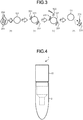
- FIG. 3 is a view illustrating the method for collecting a nucleic acid.
- FIG. 4 is a view illustrating nucleic acid collection using the nucleic acid collection column according to the embodiment of the present invention.
- a sample 200 containing a nucleic acid 201 is mixed with the support 121 (see (a) of FIG. 3 ), to adsorb the nucleic acid 201 on the support 121 (see (b) of FIG. 3 ).
- the amount of the sample 200 containing the nucleic acid 201 in the nucleic acid collection column 1 that satisfies a condition of the aforementioned equation (1) be 100 ⁇ L or more and 20 mL or less.
- the sample containing the nucleic acid is a liquid sample such as a body fluid
- the sample may be introduced into the nucleic acid collection column according to the present invention as it is after sampling, or the sample may be diluted with a solution after sampling.
- the sample containing the nucleic acid is a solid sample including a microorganism, a cell pellet, or a tissue fragment
- the sample may be diluted with water or a buffer solution.
- the sample 200 containing a nucleic acid that is not adsorbed on the support 121 may be removed prior to shifting to the next operation. Specifically, by centrifugation with a container 2 attached to the nucleic acid collection column 1, the sample 200 containing the nucleic acid that is not adsorbed on the support 121 is shifted from the nucleic acid collection column 1 to the container 2, and the support 121 on which the nucleic acid 201 is adsorbed remains in the nucleic acid collection column 1.
- the support 121 on which the nucleic acid 201 is adsorbed is cleaned with a washing solution 300 (see (c) of FIG. 3 ).
- the washing solution 300 include water, a 4-(2-hydroxyethyl)-1-piperazineethane sulfonic acid (HEPES, pH: 7) buffer solution, and a tris-hydrochloride buffer solution.
- HEPES 4-(2-hydroxyethyl)-1-piperazineethane sulfonic acid
- a tris-hydrochloride buffer solution By cleaning with the washing solution 300, a compound that is non-specifically adsorbed on the support 121 can be removed.
- a surfactant may be added to remove a protein, an ion, and a low-molecular-weight compound that are non-specifically adsorbed on the support 121.
- a protease may be added to isolate only DNA.
- a RNase may be added.
- the container 2 as illustrated in FIG. 4 is attached on a side of the discharge portion 13 of the nucleic acid collection column 1.
- the washing solution 300 is shifted from the nucleic acid collection column 1 to the container 2.
- the washing solution shifted to the container 2 contains the compound, the protein, and the RNA that are separated from the support 121.
- an eluent is added to elute the nucleic acid 201 from the support 121.
- the amount of eluent introduced is preferably an amount that is 1.6 or more times and 8.5 or less times the volume of the space that houses the support 121 in the support adsorption portion 12.
- the amount under the condition of the aforementioned equation (1) is preferably 2 ⁇ L or more and 30 ⁇ L or less.
- a container 2 illustrated in FIG. 4 is newly attached. By centrifugation with the container 2 attached to the nucleic acid collection column 1, the eluent is shifted from the nucleic acid collection column 1 to the container 2.
- the nucleic acid collection column 1 is allowed to stand, or the eluent is heated.
- the time is preferably within two hours.
- the temperature is preferably 70°C or lower, and more preferably 50°C or lower.
- the eluent shifted to the container 2 contains the nucleic acid 201 eluted from the support 121.
- the collected nucleic acid 201 is used in a genetic test and the like. For example, a treatment under centrifugation conditions of 100 to 8,000 G and about one minute is preferred.
- the eluent is not particularly limited as long as the nucleic acid 201 adsorbed on the support 121 can be eluted.
- the eluent is preferably a buffer solution.
- the buffer solution may contain a chelating agent.
- Specific examples of the buffer solution include a citrate buffer solution containing citric acid and sodium citrate, a phosphate buffer solution containing phosphoric acid and sodium phosphate, and a tris-EDTA buffer solution containing trishydroxyaminomethane and hydrochloric acid.
- the pH of the buffer solution is preferably 4 or more and 9 or less, and more preferably 5 or more and 8 or less.
- the adsorption ratio of the nucleic acid adsorbed on the support 121 can be determined as follows. The amount of the nucleic acid in the sample containing the nucleic acid is first calculated.
- Examples of a process for determining the amount of the nucleic acid include measurement of absorbance, measurement of fluorescence, measurement of luminescence, electrophoresis, PCR, RT-PCR, analysis using a microarray, and analysis using a sequencer.
- the nucleic acid is an unmodified nucleic acid
- the absorbance of light with a wavelength of 260 nm can be measured to determine the amount of the nucleic acid.
- the nucleic acid is a nucleic acid modified with a fluorescent dye
- the fluorescence intensity based on the fluorescent dye can be compared with the fluorescence intensity in a solution of a known concentration, to determine the amount of the nucleic acid.
- the amount of the nucleic acid can be determined by an electrophoresis process, in which a sample of a known concentration and a sample after nucleic acid collection are simultaneously migrated, a gel is dyed, and the concentrations of bands are compared by image processing.
- the nucleic acid is adsorbed by the nucleic acid collection column 1, and the amount of the nucleic acid in the solution after adsorption is determined. This amount of the nucleic acid is the amount of the nucleic acid in the solution except for the adsorbed nucleic acid. Subsequently, a difference between the amount of the nucleic acid before adsorption and that after adsorption is determined. This difference is divided by the amount of the nucleic acid before adsorption, to obtain the adsorption ratio of the nucleic acid.
- the elution ratio of the nucleic acid can be determined as follows. An eluent is first added to the support 121 on which the nucleic acid is adsorbed, and the amount of the nucleic acid in the solution after elution is determined. The amount of the nucleic acid corresponds to the elution amount of the nucleic acid. The elution amount of the nucleic acid is divided by the amount of the nucleic acid adsorbed on the support 121 (the amount of the nucleic acid after adsorption), to determine the elution ratio of the nucleic acid.
- the collection rate of the nucleic acid in the present invention is the product of the adsorption ratio and the elution ratio of the nucleic acid.
- the collection rate calculated by the aforementioned process is the same as the value obtained by dividing the elution amount of the nucleic acid by the amount of the nucleic acid before adsorption.
- high adsorption ratio and elution ratio can be obtained even when the eluent in a small amount of 2 ⁇ L or more and 30 ⁇ L or less is used for the sample in a small amount of 100 ⁇ L or more and 20 mL or less, as described above.
- the collection rate calculated by multiplying the adsorption ratio by the elution ratio is also increased.
- genome analysis in which 300 ⁇ L of blood is collected, a nucleic acid is collected from the blood as a sample containing the nucleic acid, and a disease such as cancer is specified can be assumed.
- the nucleic acid collection column 1 for adsorbing a nucleic acid has a configuration in which the aspect ratio (d 1 /d 2 ) of the space housing the support 121 satisfies the relation of the aforementioned equation (1) (1.0 ⁇ d 1 /d 2 ⁇ 15.0). Therefore, the volume of the column can be decreased as compared with the conventional configuration so as to increase the collection of the eluent and to decrease the volume of the eluent.
- the sensitivity of the column for collecting a nucleic acid can be increased, and the nucleic acid can be collected with high efficiency.
- a nucleic acid As the solution containing a nucleic acid, 200 ⁇ L of human serum containing 25 pmol of Cy3-DNA was used. 600 ⁇ L of solution of 7 M guanidine thiocyanate (GTN) and 25 mM (4-(2-hydroxyethyl)-1-piperazineethanesulfonic acid (HEPES, pH: 7), and 200 ⁇ L of the human serum were mixed by pipetting, and added to a nucleic acid collection column filled with the support, followed by centrifugation (200 G, 15 minutes). A collection tube (corresponding to the aforementioned container 2) was then exchanged.
- GTN guanidine thiocyanate
- HEPES 4-(2-hydroxyethyl)-1-piperazineethanesulfonic acid
- the adsorption ratio was calculated by fluorescence measurement of Cy3 as follows.
- the fluorescence intensity of the flow-through solution (nucleic acid collection solution) of the nucleic acid collection column was then measured.
- the fluorescence intensity after passage through the nucleic acid collection column was divided by the fluorescence intensity before passage through the nucleic acid collection column, and the obtained value was multiplied by the amount of the nucleic acid (25 pmol) before introduction into the nucleic acid collection column to obtain the amount of nucleic acid in the flow-through solution.
- the amount of the adsorbed nucleic acid was divided by the amount of the nucleic acid (25 pmol) before adsorption on the support to calculate the adsorption ratio.
- the elution ratio was calculated by fluorescence measurement of Cy3 as follows.
- the fluorescence intensity of the eluent was divided by the fluorescence intensity of the reference solution, and the amount of the eluted nucleic acid was calculated.
- the amount of the eluted nucleic acid was divided by the amount of the adsorbed nucleic acid to calculate the elution ratio.
- the collection rate was calculated by multiplying the obtained adsorption ratio by the elution ratio.
- nucleic acid collection column having a space (adsorption portion) that housed a support (particle) having a particle diameter of 20 ⁇ m or more and 32 ⁇ m or less, and had a diameter (corresponding to d 2 described above) of 1.60 mm, a length (corresponding to d 1 described above) of 6.0 mm, an aspect ratio (d 1 /d 2 ) of 3.75, and a volume (a volume of the space housing the support) of 12.56 ⁇ L, a nucleic acid was collected in 20 ⁇ L of eluent.
- the configuration of the nucleic acid collection column and the like of Example 1, and the adsorption ratio, elution ratio, and collection rate of a nucleic acid are listed in Table 1.
- Example 1 20 to 32 20 12.56 3.75 1.60 6.0 99.4 69.0 68.6
- Example 2 20 to 32 10 5.02 12.50 0.80 10.0 99.7 57.3 57.1
- Example 3 20 to 32 5 1.51 3.75 0.80 3.0 95.3 90.4 86.2
- Example 4 20 to 32 5 0.13 2.50 0.40 1.0 86.1 96.0 83.0
- Example 5 20 to 32 5 0.28 1.67 0.60 1.0 99.6 79.8 79.5
- Example 6 20 to 32 5 0.50 1.25 0.80 1.0 85.2 92.9 79.1
- Example 7 20 to 32 5 0.79 1.00 1.00 1.0 54.4 94.1 51.2
- nucleic acid collection column having an adsorption portion that housed a support having a particle diameter of 20 ⁇ m or more and 32 ⁇ m or less, and had a diameter of 0.80 mm, a length of 10.0 mm, an aspect ratio of 12.50, and a volume 5.02 ⁇ L, a nucleic acid was collected in 10 ⁇ L of eluent.
- the configuration of the nucleic acid collection column and the like of Example 2, and the adsorption ratio, elution ratio, and collection rate of a nucleic acid are listed in Table 1.
- Example 2 For supports (particles) of Examples 2 to 7, a particle diameter of 20 ⁇ m or more and 32 ⁇ m or less was utilized similarly to Example 1.
- nucleic acid collection column having an adsorption portion that housed a support having a particle diameter of 20 ⁇ m or more and 32 ⁇ m or less, and had a diameter of 0.80 mm, a length of 3.0 mm, an aspect ratio of 3.75, and a volume of 1.51 ⁇ L
- a nucleic acid was collected in 5 ⁇ L of eluent.
- the configuration of the nucleic acid collection column and the like of Example 3, and the adsorption ratio, elution ratio, and collection rate of a nucleic acid are listed in Table 1.
- a nucleic acid was collected in the same manner as in Example 3 except that a nucleic acid collection column having an adsorption portion having a diameter of 0.40 mm, a length of 1.0 mm (an aspect ratio of 2.50), and a volume of 0.13 ⁇ L was used.
- the configuration of the nucleic acid collection column and the like of Example 4, and the adsorption ratio, elution ratio, and collection rate of a nucleic acid are listed in Table 1.
- a nucleic acid was collected in the same manner as in Example 3 except that a nucleic acid collection column having an adsorption portion having a diameter of 0.60 mm, a length of 1.0 mm (an aspect ratio of 1.67), and a volume of 0.28 ⁇ L was used.
- the configuration of the nucleic acid collection column and the like of Example 5, and the adsorption ratio, elution ratio, and collection rate of a nucleic acid are listed in Table 1.
- a nucleic acid was collected in the same manner as in Example 3 except that a nucleic acid collection column having an adsorption portion having a diameter of 0.80 mm, a length of 1.0 mm (an aspect ratio of 1.25), and a volume of 0.50 ⁇ L was used.
- the configuration of the nucleic acid collection column and the like of Example 6, and the adsorption ratio, elution ratio, and collection rate of a nucleic acid are listed in Table 1.
- a nucleic acid was collected in the same manner as in Example 3 except that a nucleic acid collection column having an adsorption portion having a diameter of 1.00 mm, a length of 1.0 mm (an aspect ratio of 1.00), and a volume of 0.79 ⁇ L was used.
- the configuration of the nucleic acid collection column and the like of Example 7, and the adsorption ratio, elution ratio, and collection rate of a nucleic acid are listed in Table 1.
- nucleic acid collection column having an adsorption portion that housed a support having a particle diameter of 32 ⁇ m or more and 45 ⁇ m or less, and had a diameter of 0.40 mm, a length of 1.0 mm, an aspect ratio of 2.50, and a volume of 0.13 ⁇ L
- a nucleic acid was collected in 5 ⁇ L of eluent.
- the configuration of the nucleic acid collection column and the like of Example 8, and the adsorption ratio, elution ratio, and collection rate of a nucleic acid are listed in Table 2.
- Example 8 32 to 45 5 0.13 2.50 0.40 1.0 80.1 86.0 69.6
- Example 9 32 to 45 10 5.02 12.50 0.80 10.0 99.8 77.1 76.9
- nucleic acid collection column having an adsorption portion that housed a support having a particle diameter of 32 ⁇ m or more and 45 ⁇ m or less, and had a diameter of 0.80 mm, a length of 10.0 mm, an aspect ratio of 12.50, and a volume of 5.02 ⁇ L
- a nucleic acid was collected in 10 ⁇ L of eluent.
- the configuration of the nucleic acid collection column and the like of Example 9, and the adsorption ratio, elution ratio, and collection rate of a nucleic acid are listed in Table 2.
- nucleic acid collection column having an adsorption portion that housed a support having a particle diameter of 20 ⁇ m or more and 32 ⁇ m or less, and had a diameter of 5.8 mm, a length of 0.5 mm, an aspect ratio of 0.09, and a volume of 13.20 ⁇ L
- a nucleic acid was collected in 20 ⁇ L of eluent.
- the configuration of the nucleic acid collection column and the like of Comparative Example 1, and the adsorption ratio, elution ratio, and collection rate of a nucleic acid are listed in Table 3.
- nucleic acid collection column having an adsorption portion that housed a support having a particle diameter of 20 ⁇ m or more and 32 ⁇ m or less, and had a diameter of 0.8 mm, a length of 0.5 mm, an aspect ratio of 0.63, and a volume of 0.25 ⁇ L
- a nucleic acid was collected in 5 ⁇ L of eluent.
- the configuration of the nucleic acid collection column and the like of Comparative Example 2, and the adsorption ratio, elution ratio, and collection rate of a nucleic acid are listed in Table 3.
- nucleic acid collection column having an adsorption portion that housed a support having a particle diameter of 20 ⁇ m or more and 32 ⁇ m or less, and had a diameter of 0.6 mm, a length of 0.5 mm, an aspect ratio of 0.83, and a volume of 0.06 ⁇ L
- a nucleic acid was collected in 5 ⁇ L of eluent.
- the configuration of the nucleic acid collection column and the like of Comparative Example 3, and the adsorption ratio, elution ratio, and collection rate of a nucleic acid are listed in Table 3.
- nucleic acid collection column having an adsorption portion that housed a support having a particle diameter of 20 ⁇ m or more and 32 ⁇ m or less, and had a diameter of 2.0 mm, a length of 8.0 mm, an aspect ratio of 4.00, and a volume of 25.1 ⁇ L
- a nucleic acid was collected in 20 ⁇ L of eluent.
- the configuration of the nucleic acid collection column and the like of Comparative Example 4, and the adsorption ratio, elution ratio, and collection rate of a nucleic acid are listed in Table 3.
- nucleic acid collection column having an adsorption portion that housed a support having a particle diameter of 20 ⁇ m or more and 32 ⁇ m or less, and had a diameter of 7.5 mm, a length of 1.5 mm, an aspect ratio of 0.20, and a volume of 68.0 ⁇ L
- a nucleic acid was collected in 20 ⁇ L of eluent.
- the configuration of the nucleic acid collection column and the like of Comparative Example 5, and the adsorption ratio, elution ratio, and collection rate of a nucleic acid are listed in Table 3.
- a nucleic acid was collected by a nucleic acid collection column having a discharge portion 13 with an opening of different size.
- the size of the opening of the discharge portion 13 was adjusted by changing the internal diameter of a ring 132 described above.
- a nucleic acid was collected in the same manner as in Example 3 except that the diameter of an outlet opening was changed to 0.5 mm.
- the configuration of the nucleic acid collection column and the like of Example 10, and the adsorption ratio, elution ratio, and collection rate of a nucleic acid are listed in Table 4. Provided that the diameter of the outlet opening in Example 3 was 1.00 mm.
- nucleic acid collection column having an adsorption portion that housed a support having a particle diameter of 32 ⁇ m or more and 45 ⁇ m or less, and had a diameter of 0.80 mm, a length of 3.00 mm, an aspect ratio of 3.75, a volume of 1.5 ⁇ L, and a discharge portion 13 having a ring 132 with an internal diameter (diameter of an outlet opening) of 1.00 mm, a nucleic acid was collected in 5 ⁇ L of eluent.
- the configuration of the nucleic acid collection column and the like of Example 11, and the adsorption ratio, elution ratio, and collection rate of a nucleic acid are listed in Table 4.
- a nucleic acid was collected in the same manner as in Example 12 except that the diameter of an outlet opening was changed to 0.5 mm.
- the configuration of the nucleic acid collection column and the like of Example 12, and the adsorption ratio, elution ratio, and collection rate of a nucleic acid are listed in Table 4.
- Example 10 to 12 all the collection rates are more than 65%. In comparison of Example 3 with Example 10, as the diameter of the outlet opening is larger, the collection rate is higher. Similarly, in comparison of Example 11 with Example 12, as the diameter of the outlet opening is larger, the collection rate is higher. The results indicate that the outlet opening with a larger diameter enables collection of a nucleic acid at a higher collection rate.
- nucleic acid collection column 1 mL of water or serum was added to a nucleic acid collection column equipped with a container on a side of a discharge portion, and centrifuged at 200 G. For one sample, the liquid delivery amount was measured every centrifugation time. The amount of water or serum that was passed through the nucleic acid collection column and transferred to the container was measured at each centrifugation time.
- the used nucleic acid collection column housed a support having a particle diameter of 20 ⁇ m or more and 32 ⁇ m or less.
- An aspect ratio described below represents the ratio of the diameter of a space (corresponding to the support adsorption portion 12) for housing the support to the length thereof.
- nucleic acid collection column having a space (support adsorption portion) having a diameter of 0.8 mm, a length of 8 mm, and an aspect ratio of 10, 1 mL of water was added, and the liquid delivery amount was measured with change of centrifugation time (liquid delivery time).
- the configuration of the nucleic acid collection column of Example 13, and the liquid delivery amount (mL) are listed in Table 5.
- Table 5 Diameter [mm] Length [mm] Aspect ratio Time [min] 0 2 4 6 8 10 12 15
- Example 13 0.8 8 10 0 0.27 0.5 0.69 0.81 1 1 1 1
- Example 14 0.8 10 12.5 0 0.27 0.49 0 . 6 0.8 1.01 1.01 1.01
- Example 15 0.8 12 15 0 0.24 0.45 0.6 0.73 0.86 0.97 0.97
- nucleic acid collection column having a space (support adsorption portion) having a diameter of 0.8 mm, a length of 10 mm, and an aspect ratio of 12.5, 1 mL of water was added, and the liquid delivery amount was measured with change of centrifugation time (liquid delivery time).
- the configuration of the nucleic acid collection column of Example 14, and the liquid delivery amount (mL) are listed in Table 5.
- nucleic acid collection column having a space (support adsorption portion) having a diameter of 0.8 mm, a length of 12 mm, and an aspect ratio of 15, 1 mL of water was added, and the liquid delivery amount was measured with change of centrifugation time (liquid delivery time).
- the configuration of the nucleic acid collection column of Example 15, and the liquid delivery amount (mL) are listed in Table 5.
- nucleic acid collection column having a space (support adsorption portion) having a diameter of 0.8 mm, a length of 8 mm, and an aspect ratio of 10, 1 mL of serum was added, and the liquid delivery amount was measured with change of centrifugation time (liquid delivery time).
- the configuration of the nucleic acid collection column of Example 16, and the liquid delivery amount (mL) are listed in Table 6.
- nucleic acid collection column having a space (support adsorption portion) having a diameter of 0.8 mm, a length of 10 mm, and an aspect ratio of 12.5, 1 mL of serum was added, and the liquid delivery amount was measured with change of centrifugation time (liquid delivery time).
- the configuration of the nucleic acid collection column of Example 17, and the liquid delivery amount (mL) are listed in Table 6.
- nucleic acid collection column having a space (support adsorption portion) having a diameter of 0.8 mm, a length of 12 mm, and an aspect ratio of 15, 1 mL of serum was added, and the liquid delivery amount was measured with change of centrifugation time (liquid delivery time).
- the configuration of the nucleic acid collection column of Comparative Example 6, and the liquid delivery amount (mL) are listed in Table 6.
- a nucleic acid can be collected with high efficiency by adjusting the aspect ratio of a space housing a support. Since a nucleic acid can be collected with high efficiency, the present invention is industrially very applicable.
Landscapes
- Chemical & Material Sciences (AREA)
- Health & Medical Sciences (AREA)
- Engineering & Computer Science (AREA)
- Life Sciences & Earth Sciences (AREA)
- Organic Chemistry (AREA)
- Biomedical Technology (AREA)
- Genetics & Genomics (AREA)
- Bioinformatics & Cheminformatics (AREA)
- Wood Science & Technology (AREA)
- Zoology (AREA)
- Analytical Chemistry (AREA)
- Biotechnology (AREA)
- General Engineering & Computer Science (AREA)
- Chemical Kinetics & Catalysis (AREA)
- General Health & Medical Sciences (AREA)
- Biochemistry (AREA)
- Molecular Biology (AREA)
- Microbiology (AREA)
- Biophysics (AREA)
- Physics & Mathematics (AREA)
- Crystallography & Structural Chemistry (AREA)
- Plant Pathology (AREA)
- Sustainable Development (AREA)
- Clinical Laboratory Science (AREA)
- Cell Biology (AREA)
- Hematology (AREA)
- Textile Engineering (AREA)
- Inorganic Chemistry (AREA)
- Dispersion Chemistry (AREA)
- Apparatus Associated With Microorganisms And Enzymes (AREA)
- Measuring Or Testing Involving Enzymes Or Micro-Organisms (AREA)
Abstract
Description
- The present invention relates to a nucleic acid collection column.
- Development of experimental techniques using nucleic acids has enabled a novel gene search and analysis of the gene. The human genome has been analyzed to identify a disease such as cancer, and the genome of pathogen has been analyzed to identify infection of the pathogen. Thus, a screening test and a clinical test using gene analysis have been performed in clinical sites.
- For gene analysis, a step of collecting a nucleic acid from a sample containing a nucleic acid is performed. At that time, a column filled with a support for adsorbing a nucleic acid is used. For example,
Patent Literature 1 discloses a column filled with a support. InPatent Literature 1, a space to be filled with a support is a cylindrical space the height of which is smaller than the diameter of an opening (a top surface or a lower surface), that is, a wide and thin space. - Patent Literature 1:
International publication WO2016/052386 - After a nucleic acid is adsorbed on the support in the aforementioned column, the adsorbed nucleic acid is separated from the support and eluted into an eluent. To efficiently collect the nucleic acid and improve the collection rate, increases in an adsorption ratio on the support and elution in the eluent are required.
- For analysis of genetic information of a nucleic acid using a solution containing the collected nucleic acid, a nucleic acid concentration that is equal to or more than a certain concentration is required. Therefore, it is necessary that a nucleic acid be collected by using a small amount of eluent. In particular, in the clinical sites, and the like, there is a need for efficiently collecting a nucleic acid and performing a test even when the amount of a sample containing a nucleic acid is small.
- In view of the circumstances, an object of the present invention is to provide a nucleic acid collection column capable of efficiency collecting a nucleic acid. The nucleic acid collection column makes it possible to collect a nucleic acid with a small amount of eluent, especially from a small amount of sample containing a nucleic acid.
- In order to achieve the object, provided is a nucleic acid collection column for collecting a nucleic acid from a liquid sample containing the nucleic acid according to the present invention. The nucleic acid collection column includes: a sample injection portion having an opening into which the liquid sample containing the nucleic acid is injected; a support adsorption portion configured to house a support for adsorbing the nucleic acid, the nucleic acid being adsorbed on the support in the support adsorption portion; and a discharge portion configured to discharge a liquid passed through the support adsorption portion. The support includes aluminum oxide having a surface where a water-soluble neutral polymer is adsorbed, a space for housing the support in the support adsorption portion has a cylindrical shape, and has a volume of 0.13 µL or more and 13.5 µL or less, and an aspect ratio (d1/d2) of the space satisfies 1.0≤d1/d2<15.0, where d1 is a length in an axial direction of the space, and d2 is a diameter in a direction orthogonal to the axial direction.
- In the nucleic acid collection column according to the present invention, the discharge portion includes a support-holding sheet configured to hold the support housed in the support adsorption portion, and a ring fixing the support-holding sheet, and the ring has an internal diameter that is larger than a diameter of an opening of the support adsorption portion on a side of the discharge portion.
- In the nucleic acid collection column according to the present invention, the support has a particle diameter of 10 µm or more and 60 µm or less.
- According to the nucleic acid collection column of the present invention, a nucleic acid can be collected with high efficiency. In particular, the nucleic acid collection column provides an effect of collecting a high concentration of nucleic acid from a small amount of sample.
-
-
FIG. 1 is a plan view schematically illustrating a nucleic acid collection column according to one embodiment of the present invention. -
FIG. 2 is a cross-sectional view of the nucleic acid collection column illustrated inFIG. 1 . -
FIG. 3 is a view illustrating a method for collecting a nucleic acid. -
FIG. 4 is a view illustrating nucleic acid collection using the nucleic acid collection column according to the embodiment of the present invention. - Hereinafter, an aspect for carrying out the present invention will be described in detail with the drawings. The present invention is not limited to the following embodiments. The drawings referred in the following description only schematically illustrate shapes, sizes, and positional relations enough to understand the content of the present invention. Therefore, the sizes, shapes, and positional relations of the present invention are not limited to those exemplified in the drawings. In the description of the drawings, the same portions are denoted with the same reference symbols.
- A nucleic acid collection column according to the present invention is used to collect a nucleic acid from a sample containing a nucleic acid. Examples of the nucleic acid include RNA, DNA, RNA/DNA (chimera), and an artificial nucleic acid. Examples of DNA include cDNA, microDNA (miDNA), genome DNA, synthetic DNA, cell-free DNA (cfDNA), circulating tumor DNA (ctDNA), and mitochondrial DNA (mtDNA). Examples of RNA include totalRNA, mRNA, rRNA, miRNA, siRNA, snoRNA, snRNA, or non-coding RNA, or precursors thereof, and synthetic RNA.
- Examples of the sample containing a nucleic acid include biological samples. As a biological sample, a cell-derived sample such as a cultured cell, a culture broth of a cultured cell, a tissue sample, or a specimen, a sample derived from a microorganism such as a bacterium or a virus, a sample derived from an animal including human such as a body fluid or feces, or a solution containing a compound having a biological function such as a protein, a sugar, or a lipid, can be used, in addition to the nucleic acid. The biological sample is not limited to them. The biological sample is preferably a cultured cell or a body fluid, and further preferably blood or urine. The blood includes whole blood, plasma, serum, and hemocyte.
- The sample containing a nucleic acid may be subjected to the following treatment, if necessary. This is because the nucleic acid in the biological sample is often encapsuled in a compound such as a cell membrane, a cell wall, a vesicle, a liposome, a micelle, a ribosome, a histone, a nuclear membrane, a mitochondrion, a virus capsid, an envelope, an endosome, or an exosome or they often interact with each other. To collect the nucleic acid at a high yield, a treatment for releasing the nucleic acid from them may be carried out.
- Specifically, the following treatment is carried out to improve the collection efficiency of a nucleic acid from a sample containing Escherichia coli. For example, to the biological sample containing Escherichia coli, a mixed solution of 0.2 M sodium hydroxide and 1% sodium dodecyl sulfate (SDS) is added (alkaline denaturation method), or a 10% sarkosyl solution is added (sarkosyl non-denaturation method using sarkosyl). Lysozyme may be further added to the solution. The sample may also be treated with proteinase K at 37°C for 1 hour. In addition, an ultrasonic wave treatment may be carried out.
- When the sample contains a yeast, the following treatment may be carried out to improve the collection efficiency of a nucleic acid. For example, 10% SDS may be added after a treatment with a yeast cell wall lytic enzyme available from SEIKAGAKU CORPORATION or NACALAI TESQUE, INC.
- When the sample containing a nucleic acid contains a cell, the following treatment may be carried out to improve the collection efficiency of a nucleic acid. Specifically, 1% SDS is added to the sample containing a cell. In addition, guanidium chloride, guanidine thiocyanate, urea, or the like may be added in a final concentration of 4 M or more. To this solution, sarkosyl may also be added in a concentration of 0.5% or more. Mercaptoethanol may also be added in a concentration of 50 mM or more.
- In the aforementioned treatments, an inhibitor for a nuclease may be added to suppress the degradation of a nucleic acid. Examples of the inhibitor include ethylenediaminetetraacetic acid (EDTA). For example, EDTA is added in a concentration of 1 mM or less. As an inhibitor for RNase, RNasin Plus Ribonuclease Inhibitor (available from Promega Corporation), Ribonuclease Inhibitor (available from Takara Bio Inc.), or RNase Inhibitor (available from TOYOBO CO., LTD.) may be used.
- When the sample containing a nucleic acid contains DNA and RNA together, DNA and RNA can be separated by phenol-chloroform extraction. For example, RNA and DNA are separated into an aqueous layer and a chloroform layer, respectively, by phenol-chloroform extraction under an acidic condition. RNA and DNA are separated into an aqueous layer by phenol-chloroform extraction under a neutral condition. The kind of nucleic acid to be obtained can be selected by changing the condition as described above. The chloroform may be replaced by p-bromoanisole.
- In the phenol-chloroform extraction, ISOGEN (registered trademark: available from NIPPON GENE CO., LTD.), TRIzol (registered trademark: available from Life Technologies Japan Ltd.), or 3D-Gene (registered trademark) RNA extraction reagent from liquid sample kit (available from Toray Industries, Inc.) may be used. In the aforementioned treatments, one process of the treatments may be carried out alone, or a process of different operation may be combined. The concentrations of the solutions used for the treatments may be changed, if necessary.
- As the sample containing a nucleic acid in the present invention, a solution in which a nucleic acid, an artificial nucleic acid, or a nucleic acid modified with a dye, phosphoric acid, or the like is dissolved can be used. In a case of using the biological sample, a liquid sample such as a body fluid or a diluted solution thereof, or a diluted solution of a solid sample such as a cell pellet or a tissue fragment can be used. As the sample including the liquid sample or the solid sample, a solution obtained after any of the aforementioned treatments may be used as it is, or may be diluted, if necessary. A solution for dilution is not particularly limited. A solution generally used for the solution containing a nucleic acid such as water or a tris-hydrochloric acid buffer solution is preferably used. To the solution containing a nucleic acid, for example, guanidium chloride, guanidine thiocyanate, or urea may be added in a final concentration of 4 M or more.
- In the present invention, the length of a nucleic acid to be collected is not particularly limited, and is preferably 1,000 base pairs or less. In the present invention, pre-miRNA or miRNA of 300 base pairs or less can be collected at a high yield, which is hardly achieved by a conventional technology.
- A nucleic acid collection column according to an embodiment of the present invention will be described with reference to
FIGS. 1 and2 .FIG. 1 is a plan view schematically illustrating the nucleic acid collection column according to the embodiment of the present invention.FIG. 2 is a cross-sectional view of the nucleic acid collection column illustrated inFIG. 1 . A nucleicacid collection column 1 illustrated inFIGS. 1 and2 has acylindrical body 10. Into thebody 10, a biological sample is introduced. Thebody 10 has a hole that is capable of discharge. In this hole, asample injection portion 11, asupport adsorption portion 12, and adischarge portion 13 are disposed in this order from a side of introducing the biological sample. - The
sample injection portion 11 has an opening for introducing a liquid sample containing a nucleic acid and a hole portion that is continuous to thesupport adsorption portion 12 in thebody 10. The hole portion has a continuously decreased diameter at an end on a side of thesupport adsorption portion 12. The ratio of the volume of thesample injection portion 11 to the volume of thesupport adsorption portion 12 is preferably 100 or more and 10,000 or less. - The
support adsorption portion 12 houses a plurality ofsupports 121 for adsorbing a nucleic acid that is contained in the sample. In thesupport adsorption portion 12, a space (hereinafter also referred to as "adsorption portion") that houses thesupports 121 has a cylindrical shape having an axis parallel to a central axis N of the hole. For example, it is preferable that the volume of this space be 0.13 µL or more and 13.5 µL or less (the weight of thesupports 121 be 0.1 mg or more and 10 mg or less). - It is preferable that the aspect ratio (d1/d2) of this space satisfy a relation of the following expression (1), where d1 is the length (first length) in an axial direction of the space having the cylindrical shape, and d2 is a diameter (second length) in a direction orthogonal to the axial direction (see
FIG. 2 ). The length d1 (first length) and the diameter d2 (second length) extend in directions perpendicular to each other.
- Here, 0.1 that is the lower limit value of d1/d2 is a value determined based on a value when the collection rate of nucleic acid is 50% according to calculation. 15.0 that is the upper limit value of d1/d2 is a value determined based on a value when the biological sample, a washing solution, and an eluent are passed through the support adsorption portion 12 (between the supports 121) and discharged in the nucleic
acid collection column 1. The aspect ratio more preferably satisfies 1.0≤d1/d2≤14.0. - The length d1 is set within a range of 1 mm or more and 10 mm or less. The diameter d2 is set within a range of 0.4 mm or more and 2 mm or less.
- The shape of the space is not limited to the cylindrical shape, and for example, may be a prismatic shape. In the space that has the prismatic shape, the length corresponding to the diameter d2 is a diameter of a circle circumscribed about this space.
- The
supports 121 include aluminum oxide having a surface where a water-soluble neutral polymer is adsorbed. Thesupports 121 have a diameter of particles (particle diameter or particle diameter) of 10 µm or more and 60 µm or less. - The neutral polymer is water-soluble, and the solubility thereof is at least 0.0001% by mass or more, preferably 0.001% by mass or more, more preferably 0.01% by mass or more, and further preferably 0.1% by mass or more.
- Here, a polymer in the present invention represents a generic name for compounds in which a large number of repeating units, which are base units and are called monomer, are connected. The polymer used for the
supports 121 includes both a homopolymer consisting of one kind of monomer and a copolymer consisting of two or more kinds of monomers. Furthermore, the polymer includes a natural polymer and a synthetic polymer. - The neutral polymer is preferably a polymer having a zeta potential of -10 mV or more and +10 mV or less, more preferably -8 mV or more and +8 mV or less, further preferably -6 mV or more and +6 mV or less, and particularly preferably -4.0 mV or more and +1.1 V or less, in a solution with a pH of 7.
- Specific examples of the neutral polymer include the following. For example, a polyvinyl-based polymer such as polyvinyl alcohol or polyvinyl pyrrolidone, a polyacrylamide-based polymer such as polyacrylamide, poly(N-isopropylacrylamide), or poly(N-(hydroxymethyl)acrylamide), a polyalkylene glycol-based polymer such as polyethylene glycol, polypropylene glycol, or polytetramethylene ether glycol, or a cellulose such as poly(2-ethyl-2-oxazoline), (hydroxypropyl)methylcellulose, methylcellulose, ethylcellulose, 2-hydroxyethylcellulose, or hydroxypropylcellulose can be used. A copolymer containing the aforementioned polymer can also be used.
- The neutral polymer of the present invention includes a polysaccharide such as ficoll, agarose, chitin, or dextran, or a polysaccharide analog, and a protein such as albumin, or peptide.
- A portion of a functional group of the neutral polymer may be ionized or substituted with a functional group exhibiting positivity or negativity, or a functional group exhibiting water solubility such as an acetyl group may be introduced into a side chain.
- For example, the neutral polymer preferably has a molecular weight of 0.4 kD or more, and more preferably 6 kD or more. The upper limit of the molecular weight of the neutral polymer is preferably 500 kD or less, and more preferably 150 kD or less. The molecular weight of the neutral polymer is preferably within a range of 0.4 kD or more and 500 kD or less, and more preferably 6 kD or more and 150 kD or less.
- Aluminum oxide is an amphoteric oxide represented by a composition formula: Al2O3, also called alumina. Naturally generated aluminum oxide may be used, or industrially produced aluminum oxide may be used. Examples of a method for produced aluminum oxide include a Bayer process using gibbsite as a starting material, an alkoxide process through a hydroxide in a boehmite form (also called sol-gel process), a neutralization process, an oil droplet process, a thermal decomposition process of an aluminum salt, and an anode oxidation process. Aluminum oxide is classified into α-aluminum oxide, ρ-aluminum oxide, χ-aluminum oxide, κ-aluminum oxide, η-aluminum oxide, γ-aluminum oxide, δ-aluminum oxide, and θ-aluminum oxide, depending on a crystal structure thereof. In the present invention, γ-aluminum oxide having a high specific surface area is preferred. Acidic sites (Al+, Al-OH2 +) and basic sites (Al-O-) of aluminum oxide vary depending on the baking temperature during production. Depending on the number of acidic sites and basic sites of aluminum oxide, aluminum oxide is classified. When the number of acidic sites is large, aluminum oxide is acidic alumina. When the number of basic sites is large, aluminum oxide is basic alumina. When the number of acidic sites is substantially equal to the number of basic sites, aluminum oxide is neutral alumina. In the present invention, any alumina can also be used.
- It is preferable that aluminum oxide be granular. The particle diameters may be the same, or particles having different particle diameters may be mixed. For example, aluminum oxide having a particle diameter of less than 212 µm is preferably used, and aluminum oxide having a particle diameter of less than 100 µm is more preferably used. The particle diameter is defined by an aperture dimension of a sieve in accordance with Japanese Industrial Standards (JIS Z-8801-1:2006). For example, a particle that passes through a sieve having an aperture of 40 µm and does not pass through a sieve having an aperture of 32 µm in accordance with the JIS standard has a particle diameter of 32 µm or more and less than 40 µm.
- As the
supports 121, supports disclosed inInternational publication WO2016/152763 can be preferably used. - In the
supports 121, the coverage of the neutral polymer on a surface of aluminum oxide is preferably 7% or more, more preferably 10% or more, further preferably 20% or more, particularly preferably 30% or more, and the most preferably 40% or more. - The
discharge portion 13 discharges the biological sample that is passed through thesupport adsorption portion 12 to the outside. The diameter of an opening of thedischarge portion 13 on the side of thesupport adsorption portion 12 is larger than the diameter of an opening of thesupport adsorption portion 12 on a side of thedischarge portion 13. - In the
discharge portion 13, a support-holdingsheet 131 and aring 132 are provided. The support-holdingsheet 131 is provided at a boundary between thedischarge portion 13 and thesupport adsorption portion 12, and covers an opening of thesupport adsorption portion 12 on the side of thedischarge portion 13. The support-holdingsheet 131 has a mesh shape that has a plurality of holes with a smaller diameter than the diameter of thesupports 121. For example, thering 132 is pressed into or fixed on an internal circumferential surface of thedischarge portion 13, and prevents detachment of the support-holdingsheet 131 from thedischarge portion 13. Due to the support-holdingsheet 131 provided, leakage of thesupports 121 from thedischarge portion 13 to the outside is prevented. - The support-holding
sheet 131 may be subjected to a water-repellency treatment. Due to the water-repellency treatment, leakage of the sample containing a nucleic acid, the washing solution, and the eluent from the column can be prevented, and the flow rate of the column can be stabilized. - Here, in the
ring 132, it is preferable that the diameter (internal diameter) of the internal circumference be larger than the diameter of the opening of thesupport adsorption portion 12 on the side of thedischarge portion 13. Specifically, the ratio of the internal diameter of thering 132 to the diameter of the opening of thesupport adsorption portion 12 on the side of thedischarge portion 13 is preferably 1 or more and 5 or less. - In the embodiment, a method for collecting a nucleic acid from the biological sample will be described with reference to
FIGS. 3 and 4. FIG. 3 is a view illustrating the method for collecting a nucleic acid.FIG. 4 is a view illustrating nucleic acid collection using the nucleic acid collection column according to the embodiment of the present invention. - A
sample 200 containing anucleic acid 201 is mixed with the support 121 (see (a) ofFIG. 3 ), to adsorb thenucleic acid 201 on the support 121 (see (b) ofFIG. 3 ). In this case, it is preferable that the amount of thesample 200 containing thenucleic acid 201 in the nucleicacid collection column 1 that satisfies a condition of the aforementioned equation (1) be 100 µL or more and 20 mL or less. When the sample containing the nucleic acid is a liquid sample such as a body fluid, the sample may be introduced into the nucleic acid collection column according to the present invention as it is after sampling, or the sample may be diluted with a solution after sampling. When the sample containing the nucleic acid is a solid sample including a microorganism, a cell pellet, or a tissue fragment, the sample may be diluted with water or a buffer solution. - After the
nucleic acid 201 is adsorbed on thesupport 121, thesample 200 containing a nucleic acid that is not adsorbed on thesupport 121 may be removed prior to shifting to the next operation. Specifically, by centrifugation with acontainer 2 attached to the nucleicacid collection column 1, thesample 200 containing the nucleic acid that is not adsorbed on thesupport 121 is shifted from the nucleicacid collection column 1 to thecontainer 2, and thesupport 121 on which thenucleic acid 201 is adsorbed remains in the nucleicacid collection column 1. - Subsequently, the
support 121 on which thenucleic acid 201 is adsorbed is cleaned with a washing solution 300 (see (c) ofFIG. 3 ). Examples of thewashing solution 300 include water, a 4-(2-hydroxyethyl)-1-piperazineethane sulfonic acid (HEPES, pH: 7) buffer solution, and a tris-hydrochloride buffer solution. By cleaning with thewashing solution 300, a compound that is non-specifically adsorbed on thesupport 121 can be removed. To remove a protein, an ion, and a low-molecular-weight compound that are non-specifically adsorbed on thesupport 121, a surfactant may be added. To remove a protein that is non-specifically adsorbed on thesupport 121, a protease may be added. To isolate only DNA, a RNase may be added. In a washing treatment, thecontainer 2 as illustrated inFIG. 4 is attached on a side of thedischarge portion 13 of the nucleicacid collection column 1. By centrifugation with thecontainer 2 attached to the nucleicacid collection column 1, thewashing solution 300 is shifted from the nucleicacid collection column 1 to thecontainer 2. The washing solution shifted to thecontainer 2 contains the compound, the protein, and the RNA that are separated from thesupport 121. - Subsequently, an eluent is added to elute the
nucleic acid 201 from thesupport 121. The amount of eluent introduced is preferably an amount that is 1.6 or more times and 8.5 or less times the volume of the space that houses thesupport 121 in thesupport adsorption portion 12. Specifically, the amount under the condition of the aforementioned equation (1) is preferably 2 µL or more and 30 µL or less. Also in an elution treatment, such acontainer 2 illustrated inFIG. 4 is newly attached. By centrifugation with thecontainer 2 attached to the nucleicacid collection column 1, the eluent is shifted from the nucleicacid collection column 1 to thecontainer 2. After the addition of the eluent, the nucleicacid collection column 1 is allowed to stand, or the eluent is heated. Thus, the elution can be enhanced. When the nucleic acid collection column is allowed to stand, the time is preferably within two hours. When the eluent is heated, the temperature is preferably 70°C or lower, and more preferably 50°C or lower. The eluent shifted to thecontainer 2 contains thenucleic acid 201 eluted from thesupport 121. The collectednucleic acid 201 is used in a genetic test and the like. For example, a treatment under centrifugation conditions of 100 to 8,000 G and about one minute is preferred. - Here, the eluent is not particularly limited as long as the
nucleic acid 201 adsorbed on thesupport 121 can be eluted. The eluent is preferably a buffer solution. The buffer solution may contain a chelating agent. Specific examples of the buffer solution include a citrate buffer solution containing citric acid and sodium citrate, a phosphate buffer solution containing phosphoric acid and sodium phosphate, and a tris-EDTA buffer solution containing trishydroxyaminomethane and hydrochloric acid. - The pH of the buffer solution is preferably 4 or more and 9 or less, and more preferably 5 or more and 8 or less.
- The adsorption ratio of the nucleic acid adsorbed on the
support 121 can be determined as follows. The amount of the nucleic acid in the sample containing the nucleic acid is first calculated. - Examples of a process for determining the amount of the nucleic acid include measurement of absorbance, measurement of fluorescence, measurement of luminescence, electrophoresis, PCR, RT-PCR, analysis using a microarray, and analysis using a sequencer. When the nucleic acid is an unmodified nucleic acid, the absorbance of light with a wavelength of 260 nm can be measured to determine the amount of the nucleic acid. When the nucleic acid is a nucleic acid modified with a fluorescent dye, the fluorescence intensity based on the fluorescent dye can be compared with the fluorescence intensity in a solution of a known concentration, to determine the amount of the nucleic acid. Additionally, the amount of the nucleic acid can be determined by an electrophoresis process, in which a sample of a known concentration and a sample after nucleic acid collection are simultaneously migrated, a gel is dyed, and the concentrations of bands are compared by image processing.
- The nucleic acid is adsorbed by the nucleic
acid collection column 1, and the amount of the nucleic acid in the solution after adsorption is determined. This amount of the nucleic acid is the amount of the nucleic acid in the solution except for the adsorbed nucleic acid. Subsequently, a difference between the amount of the nucleic acid before adsorption and that after adsorption is determined. This difference is divided by the amount of the nucleic acid before adsorption, to obtain the adsorption ratio of the nucleic acid. - The elution ratio of the nucleic acid can be determined as follows. An eluent is first added to the
support 121 on which the nucleic acid is adsorbed, and the amount of the nucleic acid in the solution after elution is determined. The amount of the nucleic acid corresponds to the elution amount of the nucleic acid. The elution amount of the nucleic acid is divided by the amount of the nucleic acid adsorbed on the support 121 (the amount of the nucleic acid after adsorption), to determine the elution ratio of the nucleic acid. - The collection rate of the nucleic acid in the present invention is the product of the adsorption ratio and the elution ratio of the nucleic acid. The collection rate calculated by the aforementioned process is the same as the value obtained by dividing the elution amount of the nucleic acid by the amount of the nucleic acid before adsorption.
- With the method of the present invention, high adsorption ratio and elution ratio can be obtained even when the eluent in a small amount of 2 µL or more and 30 µL or less is used for the sample in a small amount of 100 µL or more and 20 mL or less, as described above. The collection rate calculated by multiplying the adsorption ratio by the elution ratio is also increased. As a specific method of using the present invention, genome analysis in which 300 µL of blood is collected, a nucleic acid is collected from the blood as a sample containing the nucleic acid, and a disease such as cancer is specified can be assumed.
- According to the aforementioned embodiment, the nucleic
acid collection column 1 for adsorbing a nucleic acid has a configuration in which the aspect ratio (d1/d2) of the space housing thesupport 121 satisfies the relation of the aforementioned equation (1) (1.0≤d1/d2<15.0). Therefore, the volume of the column can be decreased as compared with the conventional configuration so as to increase the collection of the eluent and to decrease the volume of the eluent. When a nucleic acid is collected by using the nucleicacid collection column 1 according to the embodiment, the sensitivity of the column for collecting a nucleic acid can be increased, and the nucleic acid can be collected with high efficiency. - Hereinafter, details of the present invention will be described by Examples. The present invention is not interpreted to be limited to Examples.
-
- Polymer to be adsorbed on aluminum oxide: polyethylene glycol (available from Merck Ltd.)
- Aluminum oxide: γ-aluminum oxide (N613N: available from JGC Catalysts and Chemicals Ltd.)
- Sodium polyphosphate (CAS No. 68915-31-1: available from FUJIFILM Wako Pure Chemical Corporation)
- Nucleic acid: Cy3-DNA synthesized by Cy3-labeling a 5'-terminal of "let7a" (22 bases) known as miRNA was used.
- Mixer: CUTE MIXER CM-1000 (available from TOKYO RIKAKIKAI CO., LTD.)
- Centrifugal separator: CT15RE (available from Hitachi, Ltd.)
- Human serum: From a healthy subject, a human serum was collected with venoject II vacuum blood collection tube VP-AS109K60 (available from Terumo Corporation).
- 10 mg of aluminum oxide was weighed and placed in a 1.5-mL tube. As an aqueous polymer solution, 100 µL of 10 wt% polyethylene glycol (PEG, molecular weight: 10 kD) that was a water-soluble neutral polymer was added to this tube, and stirred for 10 minutes by a mixer. After stirring, each column was filled with this solution as a solution containing a support, to produce a spin column filled with the support of the present invention. At that time, the volume of the filled support corresponded to a support-housing space of a nucleic acid collection column used in each of Examples and Comparative Examples.
- As the solution containing a nucleic acid, 200 µL of human serum containing 25 pmol of Cy3-DNA was used. 600 µL of solution of 7 M guanidine thiocyanate (GTN) and 25 mM (4-(2-hydroxyethyl)-1-piperazineethanesulfonic acid (HEPES, pH: 7), and 200 µL of the human serum were mixed by pipetting, and added to a nucleic acid collection column filled with the support, followed by centrifugation (200 G, 15 minutes). A collection tube (corresponding to the aforementioned container 2) was then exchanged.
- Subsequently, 700 µL of 0.1% Tween 20-25 mM HEPES buffer solution (pH: 7) was added as a washing solution to the nucleic acid collection column, followed by centrifugation (1,000 G, 2 minutes). A collection tube was then exchanged. This operation was further repeated again.
- 5 µL of 125 mM phosphoric acid-125 mM polyphosphoric acid mixed solution (pH: 7) was added to the nucleic acid collection column, and allowed to stand for 15 minutes. Subsequently, centrifugation (1,000 G, 2 minutes) was carried out, and a flow-through was collected as a nucleic acid collection solution.
- The adsorption ratio was calculated by fluorescence measurement of Cy3 as follows.
- The fluorescence intensity of the mixed solution containing 25 pmol of Cy3-DNA, of 600 µL of 7 M GTN-25 mM HEPES (pH: 7) solution and 200 µL of human serum before addition to the nucleic acid collection column filled with the support was first measured.
- The fluorescence intensity of the flow-through solution (nucleic acid collection solution) of the nucleic acid collection column was then measured.
- The fluorescence intensity after passage through the nucleic acid collection column was divided by the fluorescence intensity before passage through the nucleic acid collection column, and the obtained value was multiplied by the amount of the nucleic acid (25 pmol) before introduction into the nucleic acid collection column to obtain the amount of nucleic acid in the flow-through solution.
- A difference between the amount of the nucleic acid (25 pmol) before passage through the nucleic acid collection column and this value was obtained, and the amount of the adsorbed nucleic acid was calculated. The amount of the adsorbed nucleic acid was divided by the amount of the nucleic acid (25 pmol) before adsorption on the support to calculate the adsorption ratio.
- The elution ratio was calculated by fluorescence measurement of Cy3 as follows.
- To the support on which the nucleic acid was adsorbed, 5 µL of 125 mM phosphoric acid-125 mM polyphosphoric acid mixed solution (pH: 7) was first added, 95 µL of water was added to an eluent after elution, and fluorescence measurement was carried out.
- Subsequently, 5 µL of 125 mM phosphoric acid-125 mM polyphosphoric acid mixed solution (pH: 7) in which 25 pmol of Cy3-DNA was dissolved was prepared, and 95 µL of water was added to prepare a reference solution. The reference solution was subjected to fluorescence measurement.
- The fluorescence intensity of the eluent was divided by the fluorescence intensity of the reference solution, and the amount of the eluted nucleic acid was calculated. The amount of the eluted nucleic acid was divided by the amount of the adsorbed nucleic acid to calculate the elution ratio.
- The collection rate was calculated by multiplying the obtained adsorption ratio by the elution ratio.
- Using a nucleic acid collection column having a space (adsorption portion) that housed a support (particle) having a particle diameter of 20 µm or more and 32 µm or less, and had a diameter (corresponding to d2 described above) of 1.60 mm, a length (corresponding to d1 described above) of 6.0 mm, an aspect ratio (d1/d2) of 3.75, and a volume (a volume of the space housing the support) of 12.56 µL, a nucleic acid was collected in 20 µL of eluent. The configuration of the nucleic acid collection column and the like of Example 1, and the adsorption ratio, elution ratio, and collection rate of a nucleic acid are listed in Table 1.
-
Table 1 Particle Elution volume [µl] Adsorption portion Adsorption ratio [%] Elution ratio [%] Collection rate [%] Particle diameter [µm] Volume [µl] Aspect ratio Diameter [mm] Length [mm] Example 1 20 to 32 20 12.56 3.75 1.60 6.0 99.4 69.0 68.6 Example 2 20 to 32 10 5.02 12.50 0.80 10.0 99.7 57.3 57.1 Example 3 20 to 32 5 1.51 3.75 0.80 3.0 95.3 90.4 86.2 Example 4 20 to 32 5 0.13 2.50 0.40 1.0 86.1 96.0 83.0 Example 5 20 to 32 5 0.28 1.67 0.60 1.0 99.6 79.8 79.5 Example 6 20 to 32 5 0.50 1.25 0.80 1.0 85.2 92.9 79.1 Example 7 20 to 32 5 0.79 1.00 1.00 1.0 54.4 94.1 51.2 - Using a nucleic acid collection column having an adsorption portion that housed a support having a particle diameter of 20 µm or more and 32 µm or less, and had a diameter of 0.80 mm, a length of 10.0 mm, an aspect ratio of 12.50, and a volume 5.02 µL, a nucleic acid was collected in 10 µL of eluent. The configuration of the nucleic acid collection column and the like of Example 2, and the adsorption ratio, elution ratio, and collection rate of a nucleic acid are listed in Table 1.
- For supports (particles) of Examples 2 to 7, a particle diameter of 20 µm or more and 32 µm or less was utilized similarly to Example 1.
- Using a nucleic acid collection column having an adsorption portion that housed a support having a particle diameter of 20 µm or more and 32 µm or less, and had a diameter of 0.80 mm, a length of 3.0 mm, an aspect ratio of 3.75, and a volume of 1.51 µL, a nucleic acid was collected in 5 µL of eluent. The configuration of the nucleic acid collection column and the like of Example 3, and the adsorption ratio, elution ratio, and collection rate of a nucleic acid are listed in Table 1.
- A nucleic acid was collected in the same manner as in Example 3 except that a nucleic acid collection column having an adsorption portion having a diameter of 0.40 mm, a length of 1.0 mm (an aspect ratio of 2.50), and a volume of 0.13 µL was used. The configuration of the nucleic acid collection column and the like of Example 4, and the adsorption ratio, elution ratio, and collection rate of a nucleic acid are listed in Table 1.
- A nucleic acid was collected in the same manner as in Example 3 except that a nucleic acid collection column having an adsorption portion having a diameter of 0.60 mm, a length of 1.0 mm (an aspect ratio of 1.67), and a volume of 0.28 µL was used. The configuration of the nucleic acid collection column and the like of Example 5, and the adsorption ratio, elution ratio, and collection rate of a nucleic acid are listed in Table 1.
- A nucleic acid was collected in the same manner as in Example 3 except that a nucleic acid collection column having an adsorption portion having a diameter of 0.80 mm, a length of 1.0 mm (an aspect ratio of 1.25), and a volume of 0.50 µL was used. The configuration of the nucleic acid collection column and the like of Example 6, and the adsorption ratio, elution ratio, and collection rate of a nucleic acid are listed in Table 1.
- A nucleic acid was collected in the same manner as in Example 3 except that a nucleic acid collection column having an adsorption portion having a diameter of 1.00 mm, a length of 1.0 mm (an aspect ratio of 1.00), and a volume of 0.79 µL was used. The configuration of the nucleic acid collection column and the like of Example 7, and the adsorption ratio, elution ratio, and collection rate of a nucleic acid are listed in Table 1.
- Using a nucleic acid collection column having an adsorption portion that housed a support having a particle diameter of 32 µm or more and 45 µm or less, and had a diameter of 0.40 mm, a length of 1.0 mm, an aspect ratio of 2.50, and a volume of 0.13 µL, a nucleic acid was collected in 5 µL of eluent. The configuration of the nucleic acid collection column and the like of Example 8, and the adsorption ratio, elution ratio, and collection rate of a nucleic acid are listed in Table 2.
Table 2 Particle Elution volume [µl] Adsorption portion Adsorption ratio [%] Elution ratio [%] Collection rate [%] Particle diameter [µm] Volume [µl] Aspect ratio Diameter [mm] Length [mm] Example 8 32 to 45 5 0.13 2.50 0.40 1.0 80.1 86.0 69.6 Example 9 32 to 45 10 5.02 12.50 0.80 10.0 99.8 77.1 76.9 - Using a nucleic acid collection column having an adsorption portion that housed a support having a particle diameter of 32 µm or more and 45 µm or less, and had a diameter of 0.80 mm, a length of 10.0 mm, an aspect ratio of 12.50, and a volume of 5.02 µL, a nucleic acid was collected in 10 µL of eluent. The configuration of the nucleic acid collection column and the like of Example 9, and the adsorption ratio, elution ratio, and collection rate of a nucleic acid are listed in Table 2.
- Using a nucleic acid collection column having an adsorption portion that housed a support having a particle diameter of 20 µm or more and 32 µm or less, and had a diameter of 5.8 mm, a length of 0.5 mm, an aspect ratio of 0.09, and a volume of 13.20 µL, a nucleic acid was collected in 20 µL of eluent. The configuration of the nucleic acid collection column and the like of Comparative Example 1, and the adsorption ratio, elution ratio, and collection rate of a nucleic acid are listed in Table 3.
Table 3 Particle Elution volume [µl] Adsorption portion Adsorption ratio [%] Elution ratio [%] Collection rate [%] Particle diameter [µm] Volume [µl] Aspect ratio Diameter [mm] Length [mm] Comparative Example 1 20 to 32 20 13.20 0.09 5.8 0.5 31.2 67.2 21.0 Comparative Example 2 20 to 32 5 0.25 0.63 0.8 0.5 36.4 95.4 34.7 Comparative Example 3 20 to 32 5 0.06 0.83 0.6 0.5 44.2 96.9 42.8 Comparative Example 4 20 to 32 20 25.1 4.00 2.0 8.0 99.3 38.9 38.6 Comparative Example 5 20 to 32 20 68.0 0.20 7.5 1.5 99.7 20.5 20.4 - Using a nucleic acid collection column having an adsorption portion that housed a support having a particle diameter of 20 µm or more and 32 µm or less, and had a diameter of 0.8 mm, a length of 0.5 mm, an aspect ratio of 0.63, and a volume of 0.25 µL, a nucleic acid was collected in 5 µL of eluent. The configuration of the nucleic acid collection column and the like of Comparative Example 2, and the adsorption ratio, elution ratio, and collection rate of a nucleic acid are listed in Table 3.
- For supports (particles) of Comparative Examples 2 to 5, a particle diameter of 20 µm or more and 32 µm or less was utilized similarly to Comparative Example 1.
- Using a nucleic acid collection column having an adsorption portion that housed a support having a particle diameter of 20 µm or more and 32 µm or less, and had a diameter of 0.6 mm, a length of 0.5 mm, an aspect ratio of 0.83, and a volume of 0.06 µL, a nucleic acid was collected in 5 µL of eluent. The configuration of the nucleic acid collection column and the like of Comparative Example 3, and the adsorption ratio, elution ratio, and collection rate of a nucleic acid are listed in Table 3.
- Using a nucleic acid collection column having an adsorption portion that housed a support having a particle diameter of 20 µm or more and 32 µm or less, and had a diameter of 2.0 mm, a length of 8.0 mm, an aspect ratio of 4.00, and a volume of 25.1 µL, a nucleic acid was collected in 20 µL of eluent. The configuration of the nucleic acid collection column and the like of Comparative Example 4, and the adsorption ratio, elution ratio, and collection rate of a nucleic acid are listed in Table 3.
- Using a nucleic acid collection column having an adsorption portion that housed a support having a particle diameter of 20 µm or more and 32 µm or less, and had a diameter of 7.5 mm, a length of 1.5 mm, an aspect ratio of 0.20, and a volume of 68.0 µL, a nucleic acid was collected in 20 µL of eluent. The configuration of the nucleic acid collection column and the like of Comparative Example 5, and the adsorption ratio, elution ratio, and collection rate of a nucleic acid are listed in Table 3.
- In a case of using the nucleic acid collection columns of Examples 1 to 9, all the collection rates are 50% or more. In Comparative Examples 1 to 5, all the collection rates are lower than 45%, which are lower than those in Examples 1 to 9. These results indicate that an aspect ratio (d1/d2) outside a range of 0.1 or more and less than 15.0 or a volume outside a range of 0.13 µL or more and 13.5 µL or less decreases the adsorption ratio or elution ratio of the nucleic acid, resulting in a decrease in collection rate.
- Subsequently, a nucleic acid was collected by a nucleic acid collection column having a
discharge portion 13 with an opening of different size. The size of the opening of thedischarge portion 13 was adjusted by changing the internal diameter of aring 132 described above. - A nucleic acid was collected in the same manner as in Example 3 except that the diameter of an outlet opening was changed to 0.5 mm. The configuration of the nucleic acid collection column and the like of Example 10, and the adsorption ratio, elution ratio, and collection rate of a nucleic acid are listed in Table 4. Provided that the diameter of the outlet opening in Example 3 was 1.00 mm.
Table 4 Particle Elution volume [µl] Adsorption portion Outlet opening diameter [mm] Adsorption ratio [%] Elution ratio [%] Collection rate [%] Particle diameter [µm] Volume [µl] Aspect ratio Diameter [mm] Length [mm] Example 10 20 to 32 5 1.5 3.75 0.80 3.00 0.50 91.0 85.3 77.6 Example 11 32 to 45 5 1.5 3.75 0.80 3.00 1.00 91.7 90.3 82.8 Example 12 32 to 45 5 1.5 3.75 0.80 3.00 0.50 86.5 76.3 66.0 - Using a nucleic acid collection column having an adsorption portion that housed a support having a particle diameter of 32 µm or more and 45 µm or less, and had a diameter of 0.80 mm, a length of 3.00 mm, an aspect ratio of 3.75, a volume of 1.5 µL, and a
discharge portion 13 having aring 132 with an internal diameter (diameter of an outlet opening) of 1.00 mm, a nucleic acid was collected in 5 µL of eluent. The configuration of the nucleic acid collection column and the like of Example 11, and the adsorption ratio, elution ratio, and collection rate of a nucleic acid are listed in Table 4. - A nucleic acid was collected in the same manner as in Example 12 except that the diameter of an outlet opening was changed to 0.5 mm. The configuration of the nucleic acid collection column and the like of Example 12, and the adsorption ratio, elution ratio, and collection rate of a nucleic acid are listed in Table 4.
- In Examples 10 to 12, all the collection rates are more than 65%. In comparison of Example 3 with Example 10, as the diameter of the outlet opening is larger, the collection rate is higher. Similarly, in comparison of Example 11 with Example 12, as the diameter of the outlet opening is larger, the collection rate is higher. The results indicate that the outlet opening with a larger diameter enables collection of a nucleic acid at a higher collection rate.
- 1 mL of water or serum was added to a nucleic acid collection column equipped with a container on a side of a discharge portion, and centrifuged at 200 G. For one sample, the liquid delivery amount was measured every centrifugation time. The amount of water or serum that was passed through the nucleic acid collection column and transferred to the container was measured at each centrifugation time. In the liquid delivery test, the used nucleic acid collection column housed a support having a particle diameter of 20 µm or more and 32 µm or less. An aspect ratio described below represents the ratio of the diameter of a space (corresponding to the support adsorption portion 12) for housing the support to the length thereof.
- To a nucleic acid collection column having a space (support adsorption portion) having a diameter of 0.8 mm, a length of 8 mm, and an aspect ratio of 10, 1 mL of water was added, and the liquid delivery amount was measured with change of centrifugation time (liquid delivery time). The configuration of the nucleic acid collection column of Example 13, and the liquid delivery amount (mL) are listed in Table 5.
Table 5 Diameter [mm] Length [mm] Aspect ratio Time [min] 0 2 4 6 8 10 12 15 Example 13 0.8 8 10 0 0.27 0.5 0.69 0.81 1 1 1 Example 14 0.8 10 12.5 0 0.27 0.49 0 . 6 0.8 1.01 1.01 1.01 Example 15 0.8 12 15 0 0.24 0.45 0.6 0.73 0.86 0.97 0.97 - To a nucleic acid collection column having a space (support adsorption portion) having a diameter of 0.8 mm, a length of 10 mm, and an aspect ratio of 12.5, 1 mL of water was added, and the liquid delivery amount was measured with change of centrifugation time (liquid delivery time). The configuration of the nucleic acid collection column of Example 14, and the liquid delivery amount (mL) are listed in Table 5.
- To a nucleic acid collection column having a space (support adsorption portion) having a diameter of 0.8 mm, a length of 12 mm, and an aspect ratio of 15, 1 mL of water was added, and the liquid delivery amount was measured with change of centrifugation time (liquid delivery time). The configuration of the nucleic acid collection column of Example 15, and the liquid delivery amount (mL) are listed in Table 5.
- To a nucleic acid collection column having a space (support adsorption portion) having a diameter of 0.8 mm, a length of 8 mm, and an aspect ratio of 10, 1 mL of serum was added, and the liquid delivery amount was measured with change of centrifugation time (liquid delivery time). The configuration of the nucleic acid collection column of Example 16, and the liquid delivery amount (mL) are listed in Table 6.
Table 6 Diameter [mm] Length [mm] Aspect ratio Time [min] Note 0 2 4 6 8 10 15 30 Example 16 0.8 8 10 0 0.16 0.36 0.5 0.81 1.02 1.02 1.02 Example 17 0.8 10 12.5 0 0.16 0.32 0.47 0.74 1 1 1 Comparative Example 6 0.8 12 15 0 0.13 0.25 0.29 0.41 0.44 0.47 0.47 (Liquid delivery was stopped) - To a nucleic acid collection column having a space (support adsorption portion) having a diameter of 0.8 mm, a length of 10 mm, and an aspect ratio of 12.5, 1 mL of serum was added, and the liquid delivery amount was measured with change of centrifugation time (liquid delivery time). The configuration of the nucleic acid collection column of Example 17, and the liquid delivery amount (mL) are listed in Table 6.
- To a nucleic acid collection column having a space (support adsorption portion) having a diameter of 0.8 mm, a length of 12 mm, and an aspect ratio of 15, 1 mL of serum was added, and the liquid delivery amount was measured with change of centrifugation time (liquid delivery time). The configuration of the nucleic acid collection column of Comparative Example 6, and the liquid delivery amount (mL) are listed in Table 6.
- In all Examples 13 to 17, the almost whole amount of water or serum introduced into the nucleic acid collection column was delivered by centrifugation at 200 G for 10 minutes. In Comparative Example 6, liquid delivery was stopped by 8-minute centrifugation. These results indicate that when the aspect ratio is more than 15, the liquid delivery of serum is stopped on the way, and the whole amount of serum cannot be transferred.
- According to a nucleic acid collection column of the present invention, a nucleic acid can be collected with high efficiency by adjusting the aspect ratio of a space housing a support. Since a nucleic acid can be collected with high efficiency, the present invention is industrially very applicable.
-
- 1
- Nucleic acid collection column
- 10
- Body
- 11
- Sample injection portion
- 12
- Support adsorption portion
- 13
- Discharge portion
- 121
- Support
- 131
- Support-holding sheet
- 132
- Ring
Claims (3)
- A nucleic acid collection column for collecting a nucleic acid from a liquid sample containing the nucleic acid, the nucleic acid collection column comprising:a sample injection portion having an opening into which the liquid sample containing the nucleic acid is injected;a support adsorption portion configured to house a support for adsorbing the nucleic acid, the nucleic acid being adsorbed on the support in the support adsorption portion; anda discharge portion configured to discharge a liquid passed through the support adsorption portion; whereinthe support includes aluminum oxide having a surface where a water-soluble neutral polymer is adsorbed,a space for housing the support in the support adsorption portion has a cylindrical shape, and has a volume of 0.13 µL or more and 13.5 µL or less, andan aspect ratio (d1/d2) of the space satisfies 1.0≤d1/d2<15.0, where d1 is a length in an axial direction of the space, and d2 is a diameter in a direction orthogonal to the axial direction.
- The nucleic acid collection column according to claim 1, whereinthe discharge portion includes a support-holding sheet configured to hold the support housed in the support adsorption portion, and a ring fixing the support-holding sheet, andthe ring has an internal diameter that is larger than a diameter of an opening of the support adsorption portion on a side of the discharge portion.
- The nucleic acid collection column according to claim 1, wherein the support has a particle diameter of 10 µm or more and 60 µm or less.
Applications Claiming Priority (2)
| Application Number | Priority Date | Filing Date | Title |
|---|---|---|---|
| JP2018205482 | 2018-10-31 | ||
| PCT/JP2019/042599 WO2020090900A1 (en) | 2018-10-31 | 2019-10-30 | Column for nucleic acid collection use |
Publications (2)
| Publication Number | Publication Date |
|---|---|
| EP3875571A1 true EP3875571A1 (en) | 2021-09-08 |
| EP3875571A4 EP3875571A4 (en) | 2022-08-24 |
Family
ID=70463818
Family Applications (1)
| Application Number | Title | Priority Date | Filing Date |
|---|---|---|---|
| EP19880900.6A Pending EP3875571A4 (en) | 2018-10-31 | 2019-10-30 | Column for nucleic acid collection use |
Country Status (5)
| Country | Link |
|---|---|
| US (1) | US11795449B2 (en) |
| EP (1) | EP3875571A4 (en) |
| JP (1) | JP7424055B2 (en) |
| KR (1) | KR102748550B1 (en) |
| WO (1) | WO2020090900A1 (en) |
Families Citing this family (3)
| Publication number | Priority date | Publication date | Assignee | Title |
|---|---|---|---|---|
| KR102448365B1 (en) * | 2020-11-03 | 2022-09-27 | 김수 | Nucleic Acid Extraction Device |
| KR102603542B1 (en) * | 2021-06-23 | 2023-11-16 | 김수 | Nucleic acid extraction device capable of multiple sampling |
| TWI890060B (en) * | 2023-05-17 | 2025-07-11 | 列特博生技股份有限公司 | Spin column |
Family Cites Families (5)
| Publication number | Priority date | Publication date | Assignee | Title |
|---|---|---|---|---|
| DE4139664A1 (en) | 1991-12-02 | 1993-06-03 | Diagen Inst Molekularbio | DEVICE AND METHOD FOR ISOLATING AND CLEANING NUCLEIC ACIDS |
| US9347056B2 (en) * | 2012-10-26 | 2016-05-24 | Seiko Epson Corporation | Nucleic acid extraction device, and nucleic acid extraction method, nucleic acid extraction kit, and nucleic acid extraction apparatus, each using the same |
| WO2016052386A1 (en) | 2014-09-30 | 2016-04-07 | 東洋紡株式会社 | Nucleic acid separation/purification method, solid carrier, device, and kit |
| CN107406847A (en) * | 2015-03-20 | 2017-11-28 | 东丽株式会社 | The recovery method of nucleic acid |
| CA3035881A1 (en) | 2016-09-14 | 2018-03-22 | Toray Industries, Inc. | Method of collecting cell-free dna |
-
2019
- 2019-10-30 KR KR1020217010875A patent/KR102748550B1/en active Active
- 2019-10-30 WO PCT/JP2019/042599 patent/WO2020090900A1/en not_active Ceased
- 2019-10-30 EP EP19880900.6A patent/EP3875571A4/en active Pending
- 2019-10-30 JP JP2019561200A patent/JP7424055B2/en active Active
- 2019-10-30 US US17/283,624 patent/US11795449B2/en active Active
Also Published As
| Publication number | Publication date |
|---|---|
| US11795449B2 (en) | 2023-10-24 |
| KR102748550B1 (en) | 2025-01-02 |
| KR20210088540A (en) | 2021-07-14 |
| US20210340522A1 (en) | 2021-11-04 |
| EP3875571A4 (en) | 2022-08-24 |
| JPWO2020090900A1 (en) | 2021-09-24 |
| WO2020090900A1 (en) | 2020-05-07 |
| JP7424055B2 (en) | 2024-01-30 |
Similar Documents
| Publication | Publication Date | Title |
|---|---|---|
| JP6750178B2 (en) | Stabilization of biological samples | |
| US20100221788A1 (en) | Method for recovering short rna, and kit therefor | |
| Vomelova et al. | Technical note methods of RNA purification. All ways (should) lead to Rome | |
| EP3875571A1 (en) | Column for nucleic acid collection use | |
| EP3051293B1 (en) | Solution mixer, fluid device, and solution mixing method | |
| CN106574265A (en) | Method for isolating RNA with high yield | |
| EP3431598B1 (en) | Method for collecting nucleic acid | |
| WO2010134246A1 (en) | Method for preparation of nucleic acid-containing sample | |
| EP3272866B1 (en) | Method for collecting nucleic acid | |
| Peng et al. | “Sample-in, result-out” liquid biopsy chip based on immunomagnetic separation and CRISPR detection for multiplex analysis of exosomal microRNAs | |
| CN102115739B (en) | Method, reagent and kit for isolating nucleic acid | |
| US11685915B2 (en) | Method of collecting nucleic acid | |
| CN103789197A (en) | Kit and extraction method for extracting micro ribonucleic acid (RNA) | |
| CN115960885A (en) | Method and composition for extracting nucleic acid from heparin sodium sample | |
| JP3922420B2 (en) | Improved method for isolating ribonucleic acid | |
| US20130137586A1 (en) | Stabilization of nucleic acids in cell material-containing biological samples | |
| US20220090165A1 (en) | Method of collecting nucleic acid and kit for collection of nucleic acid | |
| CN112553192B (en) | Purification membrane, purification column, purification kit and purification method for purifying nucleic acid probe | |
| JP2024144118A (en) | Method for producing RNA solution | |
| CN118751206A (en) | Liposome, cfDNA extraction treatment solution and preparation method and application thereof | |
| KR20250044142A (en) | Composition for purification or extraction of nucleic acid and uses thereof |
Legal Events
| Date | Code | Title | Description |
|---|---|---|---|
| STAA | Information on the status of an ep patent application or granted ep patent |
Free format text: STATUS: THE INTERNATIONAL PUBLICATION HAS BEEN MADE |
|
| PUAI | Public reference made under article 153(3) epc to a published international application that has entered the european phase |
Free format text: ORIGINAL CODE: 0009012 |
|
| STAA | Information on the status of an ep patent application or granted ep patent |
Free format text: STATUS: REQUEST FOR EXAMINATION WAS MADE |
|
| 17P | Request for examination filed |
Effective date: 20210415 |
|
| AK | Designated contracting states |
Kind code of ref document: A1 Designated state(s): AL AT BE BG CH CY CZ DE DK EE ES FI FR GB GR HR HU IE IS IT LI LT LU LV MC MK MT NL NO PL PT RO RS SE SI SK SM TR |
|
| DAV | Request for validation of the european patent (deleted) | ||
| DAX | Request for extension of the european patent (deleted) | ||
| A4 | Supplementary search report drawn up and despatched |
Effective date: 20220721 |
|
| RIC1 | Information provided on ipc code assigned before grant |
Ipc: C12N 15/10 20060101ALI20220715BHEP Ipc: B01J 20/32 20060101ALI20220715BHEP Ipc: B01J 20/28 20060101ALI20220715BHEP Ipc: B01D 39/08 20060101ALI20220715BHEP Ipc: B01D 15/22 20060101ALI20220715BHEP Ipc: C12Q 1/6806 20180101ALI20220715BHEP Ipc: B01L 3/00 20060101ALI20220715BHEP Ipc: C12M 1/28 20060101ALI20220715BHEP Ipc: C12M 1/00 20060101AFI20220715BHEP |