EP3875431A1 - Antifouling method for polysilicon - Google Patents
Antifouling method for polysilicon Download PDFInfo
- Publication number
- EP3875431A1 EP3875431A1 EP19880200.1A EP19880200A EP3875431A1 EP 3875431 A1 EP3875431 A1 EP 3875431A1 EP 19880200 A EP19880200 A EP 19880200A EP 3875431 A1 EP3875431 A1 EP 3875431A1
- Authority
- EP
- European Patent Office
- Prior art keywords
- resin film
- polysilicon
- antifouling
- cylindrical resin
- cylindrical
- Prior art date
- Legal status (The legal status is an assumption and is not a legal conclusion. Google has not performed a legal analysis and makes no representation as to the accuracy of the status listed.)
- Pending
Links
Images

Classifications
-
- B—PERFORMING OPERATIONS; TRANSPORTING
- B29—WORKING OF PLASTICS; WORKING OF SUBSTANCES IN A PLASTIC STATE IN GENERAL
- B29C—SHAPING OR JOINING OF PLASTICS; SHAPING OF MATERIAL IN A PLASTIC STATE, NOT OTHERWISE PROVIDED FOR; AFTER-TREATMENT OF THE SHAPED PRODUCTS, e.g. REPAIRING
- B29C48/00—Extrusion moulding, i.e. expressing the moulding material through a die or nozzle which imparts the desired form; Apparatus therefor
- B29C48/001—Combinations of extrusion moulding with other shaping operations
- B29C48/0022—Combinations of extrusion moulding with other shaping operations combined with cutting
-
- C—CHEMISTRY; METALLURGY
- C01—INORGANIC CHEMISTRY
- C01B—NON-METALLIC ELEMENTS; COMPOUNDS THEREOF; METALLOIDS OR COMPOUNDS THEREOF NOT COVERED BY SUBCLASS C01C
- C01B33/00—Silicon; Compounds thereof
- C01B33/02—Silicon
-
- B—PERFORMING OPERATIONS; TRANSPORTING
- B08—CLEANING
- B08B—CLEANING IN GENERAL; PREVENTION OF FOULING IN GENERAL
- B08B17/00—Methods preventing fouling
- B08B17/02—Preventing deposition of fouling or of dust
-
- B—PERFORMING OPERATIONS; TRANSPORTING
- B26—HAND CUTTING TOOLS; CUTTING; SEVERING
- B26D—CUTTING; DETAILS COMMON TO MACHINES FOR PERFORATING, PUNCHING, CUTTING-OUT, STAMPING-OUT OR SEVERING
- B26D7/00—Details of apparatus for cutting, cutting-out, stamping-out, punching, perforating, or severing by means other than cutting
- B26D7/27—Means for performing other operations combined with cutting
-
- B—PERFORMING OPERATIONS; TRANSPORTING
- B29—WORKING OF PLASTICS; WORKING OF SUBSTANCES IN A PLASTIC STATE IN GENERAL
- B29C—SHAPING OR JOINING OF PLASTICS; SHAPING OF MATERIAL IN A PLASTIC STATE, NOT OTHERWISE PROVIDED FOR; AFTER-TREATMENT OF THE SHAPED PRODUCTS, e.g. REPAIRING
- B29C48/00—Extrusion moulding, i.e. expressing the moulding material through a die or nozzle which imparts the desired form; Apparatus therefor
- B29C48/022—Extrusion moulding, i.e. expressing the moulding material through a die or nozzle which imparts the desired form; Apparatus therefor characterised by the choice of material
-
- B—PERFORMING OPERATIONS; TRANSPORTING
- B29—WORKING OF PLASTICS; WORKING OF SUBSTANCES IN A PLASTIC STATE IN GENERAL
- B29C—SHAPING OR JOINING OF PLASTICS; SHAPING OF MATERIAL IN A PLASTIC STATE, NOT OTHERWISE PROVIDED FOR; AFTER-TREATMENT OF THE SHAPED PRODUCTS, e.g. REPAIRING
- B29C48/00—Extrusion moulding, i.e. expressing the moulding material through a die or nozzle which imparts the desired form; Apparatus therefor
- B29C48/03—Extrusion moulding, i.e. expressing the moulding material through a die or nozzle which imparts the desired form; Apparatus therefor characterised by the shape of the extruded material at extrusion
- B29C48/07—Flat, e.g. panels
- B29C48/08—Flat, e.g. panels flexible, e.g. films
-
- B—PERFORMING OPERATIONS; TRANSPORTING
- B29—WORKING OF PLASTICS; WORKING OF SUBSTANCES IN A PLASTIC STATE IN GENERAL
- B29C—SHAPING OR JOINING OF PLASTICS; SHAPING OF MATERIAL IN A PLASTIC STATE, NOT OTHERWISE PROVIDED FOR; AFTER-TREATMENT OF THE SHAPED PRODUCTS, e.g. REPAIRING
- B29C48/00—Extrusion moulding, i.e. expressing the moulding material through a die or nozzle which imparts the desired form; Apparatus therefor
- B29C48/03—Extrusion moulding, i.e. expressing the moulding material through a die or nozzle which imparts the desired form; Apparatus therefor characterised by the shape of the extruded material at extrusion
- B29C48/09—Articles with cross-sections having partially or fully enclosed cavities, e.g. pipes or channels
- B29C48/10—Articles with cross-sections having partially or fully enclosed cavities, e.g. pipes or channels flexible, e.g. blown foils
-
- B—PERFORMING OPERATIONS; TRANSPORTING
- B29—WORKING OF PLASTICS; WORKING OF SUBSTANCES IN A PLASTIC STATE IN GENERAL
- B29C—SHAPING OR JOINING OF PLASTICS; SHAPING OF MATERIAL IN A PLASTIC STATE, NOT OTHERWISE PROVIDED FOR; AFTER-TREATMENT OF THE SHAPED PRODUCTS, e.g. REPAIRING
- B29C48/00—Extrusion moulding, i.e. expressing the moulding material through a die or nozzle which imparts the desired form; Apparatus therefor
- B29C48/25—Component parts, details or accessories; Auxiliary operations
- B29C48/28—Storing of extruded material, e.g. by winding up or stacking
-
- B—PERFORMING OPERATIONS; TRANSPORTING
- B29—WORKING OF PLASTICS; WORKING OF SUBSTANCES IN A PLASTIC STATE IN GENERAL
- B29C—SHAPING OR JOINING OF PLASTICS; SHAPING OF MATERIAL IN A PLASTIC STATE, NOT OTHERWISE PROVIDED FOR; AFTER-TREATMENT OF THE SHAPED PRODUCTS, e.g. REPAIRING
- B29C48/00—Extrusion moulding, i.e. expressing the moulding material through a die or nozzle which imparts the desired form; Apparatus therefor
- B29C48/25—Component parts, details or accessories; Auxiliary operations
- B29C48/30—Extrusion nozzles or dies
- B29C48/305—Extrusion nozzles or dies having a wide opening, e.g. for forming sheets
-
- B—PERFORMING OPERATIONS; TRANSPORTING
- B29—WORKING OF PLASTICS; WORKING OF SUBSTANCES IN A PLASTIC STATE IN GENERAL
- B29C—SHAPING OR JOINING OF PLASTICS; SHAPING OF MATERIAL IN A PLASTIC STATE, NOT OTHERWISE PROVIDED FOR; AFTER-TREATMENT OF THE SHAPED PRODUCTS, e.g. REPAIRING
- B29C48/00—Extrusion moulding, i.e. expressing the moulding material through a die or nozzle which imparts the desired form; Apparatus therefor
- B29C48/25—Component parts, details or accessories; Auxiliary operations
- B29C48/30—Extrusion nozzles or dies
- B29C48/32—Extrusion nozzles or dies with annular openings, e.g. for forming tubular articles
-
- C—CHEMISTRY; METALLURGY
- C01—INORGANIC CHEMISTRY
- C01B—NON-METALLIC ELEMENTS; COMPOUNDS THEREOF; METALLOIDS OR COMPOUNDS THEREOF NOT COVERED BY SUBCLASS C01C
- C01B33/00—Silicon; Compounds thereof
- C01B33/02—Silicon
- C01B33/021—Preparation
- C01B33/027—Preparation by decomposition or reduction of gaseous or vaporised silicon compounds other than silica or silica-containing material
- C01B33/035—Preparation by decomposition or reduction of gaseous or vaporised silicon compounds other than silica or silica-containing material by decomposition or reduction of gaseous or vaporised silicon compounds in the presence of heated filaments of silicon, carbon or a refractory metal, e.g. tantalum or tungsten, or in the presence of heated silicon rods on which the formed silicon is deposited, a silicon rod being obtained, e.g. Siemens process
-
- C—CHEMISTRY; METALLURGY
- C08—ORGANIC MACROMOLECULAR COMPOUNDS; THEIR PREPARATION OR CHEMICAL WORKING-UP; COMPOSITIONS BASED THEREON
- C08J—WORKING-UP; GENERAL PROCESSES OF COMPOUNDING; AFTER-TREATMENT NOT COVERED BY SUBCLASSES C08B, C08C, C08F, C08G or C08H
- C08J5/00—Manufacture of articles or shaped materials containing macromolecular substances
- C08J5/18—Manufacture of films or sheets
-
- B—PERFORMING OPERATIONS; TRANSPORTING
- B29—WORKING OF PLASTICS; WORKING OF SUBSTANCES IN A PLASTIC STATE IN GENERAL
- B29C—SHAPING OR JOINING OF PLASTICS; SHAPING OF MATERIAL IN A PLASTIC STATE, NOT OTHERWISE PROVIDED FOR; AFTER-TREATMENT OF THE SHAPED PRODUCTS, e.g. REPAIRING
- B29C48/00—Extrusion moulding, i.e. expressing the moulding material through a die or nozzle which imparts the desired form; Apparatus therefor
- B29C48/001—Combinations of extrusion moulding with other shaping operations
- B29C48/0018—Combinations of extrusion moulding with other shaping operations combined with shaping by orienting, stretching or shrinking, e.g. film blowing
-
- B—PERFORMING OPERATIONS; TRANSPORTING
- B29—WORKING OF PLASTICS; WORKING OF SUBSTANCES IN A PLASTIC STATE IN GENERAL
- B29K—INDEXING SCHEME ASSOCIATED WITH SUBCLASSES B29B, B29C OR B29D, RELATING TO MOULDING MATERIALS OR TO MATERIALS FOR MOULDS, REINFORCEMENTS, FILLERS OR PREFORMED PARTS, e.g. INSERTS
- B29K2023/00—Use of polyalkenes or derivatives thereof as moulding material
- B29K2023/04—Polymers of ethylene
- B29K2023/06—PE, i.e. polyethylene
-
- B—PERFORMING OPERATIONS; TRANSPORTING
- B29—WORKING OF PLASTICS; WORKING OF SUBSTANCES IN A PLASTIC STATE IN GENERAL
- B29K—INDEXING SCHEME ASSOCIATED WITH SUBCLASSES B29B, B29C OR B29D, RELATING TO MOULDING MATERIALS OR TO MATERIALS FOR MOULDS, REINFORCEMENTS, FILLERS OR PREFORMED PARTS, e.g. INSERTS
- B29K2023/00—Use of polyalkenes or derivatives thereof as moulding material
- B29K2023/04—Polymers of ethylene
- B29K2023/06—PE, i.e. polyethylene
- B29K2023/0608—PE, i.e. polyethylene characterised by its density
- B29K2023/0633—LDPE, i.e. low density polyethylene
-
- C—CHEMISTRY; METALLURGY
- C08—ORGANIC MACROMOLECULAR COMPOUNDS; THEIR PREPARATION OR CHEMICAL WORKING-UP; COMPOSITIONS BASED THEREON
- C08J—WORKING-UP; GENERAL PROCESSES OF COMPOUNDING; AFTER-TREATMENT NOT COVERED BY SUBCLASSES C08B, C08C, C08F, C08G or C08H
- C08J2323/00—Characterised by the use of homopolymers or copolymers of unsaturated aliphatic hydrocarbons having only one carbon-to-carbon double bond; Derivatives of such polymers
- C08J2323/02—Characterised by the use of homopolymers or copolymers of unsaturated aliphatic hydrocarbons having only one carbon-to-carbon double bond; Derivatives of such polymers not modified by chemical after treatment
- C08J2323/04—Homopolymers or copolymers of ethene
- C08J2323/06—Polyethene
Definitions
- the present invention provides a novel antifouling method for polysilicon. Specifically, the present invention relates to an antifouling method for polysilicon which prevents surface contamination as much as possible until use, and enables to significantly reduce contamination against polysilicon caused by a resin film which is used for antifouling the polysilicon.
- polysilicon When polysilicon is transported or stored in a rod form, a cut rod form, a pulverized formed, a powder form, and the like, the polysilicon is covered with a resin film to prevent contamination caused by surrounding environment of the polysilicon, thereby antifouling of polysilicon is done.
- Polysilicon requires high purity; hence this antifouling treatment is performed not only in the air but also in a cleanroom.
- an additive-free resin film is used in general which does not cause bleeding of metal components and organic material components.
- the above-mentioned antifouling treatment is performed to polysilicon, by unrolling and cutting the resin film to an appropriate length then placing over the polysilicon; or in some cases the resin film may be placed under the polysilicon (Patent Document 1 and Patent Document 2).
- the inside of the resin film has extremely high purity, a surface of the resin film used for antifouling is exposed and contaminated by the air immediately after the production until it is used.
- the present inventors have found that the above-mentioned resin film for antifouling is highly contaminated at the time of use by contaminants such as metal components, organic material components, dopant components, and the like which are included in the air.
- the resin pushed out from T-die of an extrusion machine is elongated depending on needs to form a sheet form, then rolled-up to form a roll form.
- the surface of the resin film may contact with the air or with other contamination sources, thereby the contaminants adhere to the surface.
- a roller and the like used for rolling up the resin film may also be mentioned.
- the resin film may be produced by an inflation method using a circular die.
- a resin film of a cylindrical shape composed of an inner surface and an outer surface is obtained, and the inner surface has a high cleanness.
- both ends along longitudinal side of the cylindrical resin film are cut and rolled-up by separate rolls; or only one end along longitudinal side is cut and then rolled-up by opening the resin film.
- similar contaminations mentioned in above may occur.
- the polysilicon when the polysilicon is covered by the contaminated resin film, the polysilicon may be contaminated by the contaminants adhered to the resin film.
- the object of the present invention is to provide an antifouling method capable of effectively preventing contamination of the polysilicon caused by the resin film.
- the present inventors have carried out keen examination and found that the object of the present invention can be attained by using a cylindrical resin film for keeping an inner surface of the tube away from contacting with the air until right before use, and then exposing the inner surface right before use to contact the polysilicon and the inner surface. Thereby, the present invention was attained.
- one aspect of an embodiment of the present invention is an antifouling method for polysilicon using a cylindrical resin film composed of an inner surface and an outer surface, wherein the method includes steps of
- Another aspect of an embodiment of the present invention is an antifouling method for polysilicon using a cylindrical resin film composed of an inner surface and an outer surface, wherein the method includes steps of
- an abundance amount of iron at the inner surface of the cylindrical resin film right before use may be preferably 1 pg/cm 2 or less in terms of an iron element.
- a puncture strength of the resin film may preferably be 10 N or more.
- the resin film may preferably be an additive-free polyethylene sheet in order to prevent contamination at inside of the resin film by impurities.
- the present invention also provides an antifouling resin film for polysilicon wherein the antifouling resin film is made of a roll form by rolling-up a cylindrical resin film so that an inner surface of the cylindrical resin film is unexposed. Furthermore, the present invention provides an antifouling resin film for polysilicon, wherein a cylindrical resin film is a cut so that an inner surface of the cylindrical resin film can be exposed, and the cylindrical resin film is rolled into a roll form so that that the inner surface is kept unexposed.
- the resin film is held so that the inner surface of the cylindrical resin film is kept unexposed, then the inner surface is exposed right before use, hence a clean resin film with no contamination can be contacted with the polysilicon, thereby antifouling can be done by contacting the polysilicon and the resin film with no contamination by the air and the like. Hence, the contamination of the polysilicon can be effectively prevented.
- an antifouling method for polysilicon uses a cylindrical resin film composed of an inner surface and an outer surface, and the method includes steps of cutting the cylindrical resin film so that an inner surface can be exposed, holding the cylindrical resin film so that the inner surface is kept unexposed, and contacting a polysilicon and the exposed inner surface right before use.
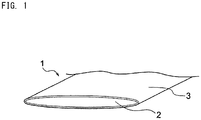
- FIG.1 shows a cylindrical resin film 1 composed of an inner surface 2 and an outer surface 3. As shown in FIG. 1 , the inner surface 2 is restricted from contacting with the air and other machines, hence it is in a clean state.
- the resin film 10 is prepared which is cut so that the inner surface 2 of the above-mentioned cylindrical resin film 1 can be exposed.
- a method of cutting is not particularly limited, and all methods which enables to expose the inner surface 2 are included. Note that, in the resin film 10 obtained by cutting the cylindrical resin film 1, the inner surface 2 is adhered to itself, thus the inner surface 2 is unexposed.
- FIG.2a to FIG.2c show representative embodiments of the resin film of which the inner surface of the cylindrical resin film 1 can be opened and kept in an unexposed state.
- FIG.2a shows the resin film 10 of which a cut is made at one side along a longitudinal direction of the cylindrical resin film.
- the resin film of this embodiment can be rolled-up into a roll form without opening the cut and forms a roll 11, hence the inner surface 2 can be kept in an unexposed state.
- the resin film 10 is unrolled from the above-mentioned roll 11, then the resin film 10 is opened from the side where the cut is made, and the inner surface 2 is contacted with the polysilicon.
- FIG.2b shows a resin film 10 of which both sides are cut along the longitudinal direction of the cylindrical resin film.
- the inner surface 2 is adhered to itself and forms a two-layer sheet, and the resin film can be rolled without releasing the two layers and forms a roll 11.
- the inner surface 2 of the resin film can be held while keeping an unexposed state.
- the resin film 10 is unrolled from the above-mentioned roll 11, and the two layers are released, then the surface which is the inner surface side is contacted with the polysilicon.
- FIG.2c is a modification example of FIG.2a , and shows a resin film 10 of which the cylindrical resin film is cut at a center part along the longitudinal direction.
- the resin films shown in FIG.2a are aligned alongside.
- the resin film 10 is unrolled from the roll 11, and one side is opened from where the cut was made and the inner surface 2 is contacted with the polysilicon.
- the cylindrical resin film may be rolled-up and held so that the inner surface is kept unexposed, then the cylindrical resin film may be unrolled and the cylindrical resin film may be cut as shown in FIG.2a to FIG.2c right before use.
- antiouling is a means using the sheet to protect the polysilicon from contaminations from surrounding environment. Specifically, a method of covering the polysilicon which is placed for storage and the like by the sheet; a method of placing the sheet under the polysilicon; a method of wrapping the polysilicon, and the like may be included. Also, when the polysilicon is being transported, a method of placing the polysilicon on the sheet provided at a bottom of the container for transportation; a method of covering the polysilicon placed in the container; and the like may be included. Since polysilicon requires a high purity, the above-mentioned methods are performed not only in the open air but also in a cleanroom as well.
- inner surface in the present invention refers to a surface at the inner side of the cylindrical resin film 1.
- the cylindrical resin film 1 is cut and opened to be used as the resin film 10.
- inner surface of the resin film refers to the surface which is the surface at the inner side of the cylindrical resin film 1 before being exposed.
- a form of the above-mentioned polysilicon is not particularly limited, and for example, a rod form which is taken out from a reactor of a Siemens method, a cut rod of which the rod has been cut, a crushed polysilicon obtained by crushing the above-mentioned rod, or the like may be included.
- etching or so may be performed for washing, and a clean surface condition is obtained.
- the antifouling method according to the present invention may be used for polysilicon of before or after washing.
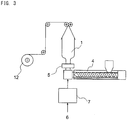
- the cylindrical resin film 1 is not particularly limited, and those obtained by a known method such as an inflation method and the like may be used. Specifically, as shown in FIG.3 , a resin is pushed out in a cylinder form using an extrusion machine 4 having a circular die 5, and if necessary, it is elongated using a mandrel to form the cylindrical resin film 1, and then rolled-up to obtain a roll 12. At the time of use, the roll 12 may be unrolled and cut as mentioned in above to obtain the resin film 10. Also, before the cylindrical resin film 1 is rolled-up, it may be cut as mentioned in above to obtain the resin film 10 of the present invention and then it may be rolled to obtain a roll 11.
- the air provided by a blower 6 may preferably be a clean air for forming the inner surface of the obtained cylindrical resin film.
- the air containing 10 particles/L or less of a particle having a size of 0.3 ⁇ m may be preferably used.
- a filter 7 may be provided between the blower 6 and the die 5.
- the filter 7 for example, HEPA filter and the like may be used.
- the used resin is not particularly limited as long as it is a thermoplastic resin.
- polyethylene based resins such as low density polyethylene (LDPE), high density polyethylene (HDPE), linear low density polyethylene (LLDPE), and the like may be preferably used.
- a thickness of the resin film may be determined depending on a shape, size, and mass of the polysilicon, and in general it is preferably 50 ⁇ m to 2 mm, and more preferably 150 to 300 ⁇ m. Also, a puncture strength of the resin film is preferably 10 N or more.
- the resin constituting the resin film may be free of additives such as an antistatic agent, a plasticizer, an antioxidant, and the like from the point of suppressing contamination caused by bleeding of metal elements and organic materials derived from the additives.
- additives such as an antistatic agent, a plasticizer, an antioxidant, and the like from the point of suppressing contamination caused by bleeding of metal elements and organic materials derived from the additives.
- the above-mentioned cylindrical resin film is constantly maintained in a clean condition as the inner surface does not contact with the air while being produced until it is rolled-up.
- a sample of the resin film right before use is confirmed to have a cleanness of 1 pg/cm 2 or less of an iron amount in terms of iron element at the inner surface.
- an iron amount at the surface of the resin film contaminated by the air is usually 10 pg/cm 2 or so.
- amounts of other metal elements are also reduced to similar level.
- a sodium amount can be 2 pg/cm 2 or less
- a calcium amount can be 5 pg/cm 2 or less
- a zinc amount can be 1 pg/cm 2 or less.
- the present invention effectively prevents polysilicon contamination when the resin film is used for antifouling. That is, the antifouling method according to the present invention includes all embodiments which keeps the inner surface of the cylindrical resin film unexposed, and then exposing the inner surface of the right before used for antifouling. Specifically, following embodiments may preferably be included.
- the clean surface of the resin film and the polysilicon are contacted, thus contamination caused from the resin film can be effectively prevented.
- Polyethylene (LDPE) which did not include additives such as an antistatic agent and the like was inflation molded using a machine shown in FIG.3 , thereby a cylindrical resin film was obtained. A thickness of the sheet was 250 ⁇ m (a puncture strength of 10 N or more was satisfied). The obtained cylindrical resin film was rolled-up and a roll was obtained. Note that, for inflation molding, the air was used which was regulated so that a particle having a size of 0.3 ⁇ m was 10 particles/L or less.
- the cylindrical resin film was unrolled and also at the same time one side along the longitudinal direction of the sheet was cut as shown in FIG.2a . Then, the sheet was opened from the side where the cut was made to expose an inner surface, and the inner surface side and polysilicon were brought into contact, thereby polysilicon was covered by the resin film.
- the above procedures were performed in a class 1000 cleanroom. Following evaluations were performed.
- Metal amounts at the inner surface and outer surface of the resin film were measured as follows. Metals adhered to the surface of the resin film were extracted from a measurement target surface of the resin film using a nitric acid aqueous solution having a concentration of 1 mass% as an extraction liquid. Then, amounts of iron, Na, Ca, and Zn as impurities were quantified by ICP-MS (inductively coupled plasma mass spectroscopy). The measurements were performed to 10 samples obtained by cutting the resin film into a size of 50 cm x 50 cm. An average is shown in Table 1.
- the resin film covered polysilicon was left for 10 days in a class 1000 cleanroom.
- Surface contamination of the polysilicon was evaluated as follows. Metals adhered to the surface of the polysilicon were extracted using a nitric acid aqueous solution having a concentration of 1 mass% as an extraction liquid. Then, amounts of iron, Na, Ca, and Zn as impurities were quantified by ICP-MS (inductively coupled plasma mass spectroscopy). Ten polysilicon fragments were selected arbitrarily and were defined as one unit, and the measurements were performed to ten units. An average value is shown in Table 2.
Landscapes
- Engineering & Computer Science (AREA)
- Chemical & Material Sciences (AREA)
- Organic Chemistry (AREA)
- Mechanical Engineering (AREA)
- Manufacturing & Machinery (AREA)
- Inorganic Chemistry (AREA)
- Health & Medical Sciences (AREA)
- Polymers & Plastics (AREA)
- Medicinal Chemistry (AREA)
- Chemical Kinetics & Catalysis (AREA)
- Materials Engineering (AREA)
- Life Sciences & Earth Sciences (AREA)
- Forests & Forestry (AREA)
- Extrusion Moulding Of Plastics Or The Like (AREA)
- Processing And Handling Of Plastics And Other Materials For Molding In General (AREA)
- Silicon Compounds (AREA)
- Shaping By String And By Release Of Stress In Plastics And The Like (AREA)
Abstract
Description
- The present invention provides a novel antifouling method for polysilicon. Specifically, the present invention relates to an antifouling method for polysilicon which prevents surface contamination as much as possible until use, and enables to significantly reduce contamination against polysilicon caused by a resin film which is used for antifouling the polysilicon.
- When polysilicon is transported or stored in a rod form, a cut rod form, a pulverized formed, a powder form, and the like, the polysilicon is covered with a resin film to prevent contamination caused by surrounding environment of the polysilicon, thereby antifouling of polysilicon is done. Polysilicon requires high purity; hence this antifouling treatment is performed not only in the air but also in a cleanroom.
- As the above-mentioned resin film used for antifouling, in order to prevent contamination of the polysilicon by the resin film, for example, an additive-free resin film is used in general which does not cause bleeding of metal components and organic material components. The above-mentioned antifouling treatment is performed to polysilicon, by unrolling and cutting the resin film to an appropriate length then placing over the polysilicon; or in some cases the resin film may be placed under the polysilicon (Patent Document 1 and Patent Document 2).
- As discussed in above, even though the inside of the resin film has extremely high purity, a surface of the resin film used for antifouling is exposed and contaminated by the air immediately after the production until it is used. The present inventors have found that the above-mentioned resin film for antifouling is highly contaminated at the time of use by contaminants such as metal components, organic material components, dopant components, and the like which are included in the air. In a production method of the resin film, the resin pushed out from T-die of an extrusion machine is elongated depending on needs to form a sheet form, then rolled-up to form a roll form. However, when this is being performed, the surface of the resin film may contact with the air or with other contamination sources, thereby the contaminants adhere to the surface. As a result, when the resin film is rolled-up, the surface contamination of the resin film is already progressed. As such contaminating sources, a roller and the like used for rolling up the resin film may also be mentioned.
- Note that, in some cases, the resin film may be produced by an inflation method using a circular die. In such case, a resin film of a cylindrical shape composed of an inner surface and an outer surface is obtained, and the inner surface has a high cleanness. However, in general, when it is used as the resin film, both ends along longitudinal side of the cylindrical resin film are cut and rolled-up by separate rolls; or only one end along longitudinal side is cut and then rolled-up by opening the resin film. When the resin film is rolled-up, similar contaminations mentioned in above may occur.
- Also, when the polysilicon is covered by the contaminated resin film, the polysilicon may be contaminated by the contaminants adhered to the resin film.
-
- Patent Document 1:
JP Patent Application Laid Open No.2017 -524632 - Patent Document 2:
JP Patent Application Laid Open No.2017-56959 - Therefore, the object of the present invention is to provide an antifouling method capable of effectively preventing contamination of the polysilicon caused by the resin film.
- The present inventors have carried out keen examination and found that the object of the present invention can be attained by using a cylindrical resin film for keeping an inner surface of the tube away from contacting with the air until right before use, and then exposing the inner surface right before use to contact the polysilicon and the inner surface. Thereby, the present invention was attained.
- That is, one aspect of an embodiment of the present invention is an antifouling method for polysilicon using a cylindrical resin film composed of an inner surface and an outer surface, wherein the method includes steps of
- holding the cylindrical resin film so that the inner surface is kept unexposed,
- cutting the cylindrical resin film so that the inner surface can be exposed right before use, and
- contacting a polysilicon and the exposed inner surface.
- Other aspect of an embodiment of the present invention is an antifouling method for polysilicon using a cylindrical resin film composed of an inner surface and an outer surface, wherein the method includes steps of
- cutting the cylindrical resin film so that the inner surface can be exposed,
- holding the cylindrical resin film o that the inner surface is kept unexposed, and
- contacting a polysilicon and the inner surface by exposing the inner surface right before use.
- In the above-mentioned antifouling method, an abundance amount of iron at the inner surface of the cylindrical resin film right before use may be preferably 1 pg/cm2 or less in terms of an iron element. Also, a puncture strength of the resin film may preferably be 10 N or more.
- Also, the resin film may preferably be an additive-free polyethylene sheet in order to prevent contamination at inside of the resin film by impurities.
- Further, a method for producing polysilicon is provided in which the contamination from the antifouling sheet is effectively prevented according to the method of the present invention.
- Furthermore, the present invention also provides an antifouling resin film for polysilicon wherein the antifouling resin film is made of a roll form by rolling-up a cylindrical resin film so that an inner surface of the cylindrical resin film is unexposed. Furthermore, the present invention provides an antifouling resin film for polysilicon, wherein a cylindrical resin film is a cut so that an inner surface of the cylindrical resin film can be exposed, and the cylindrical resin film is rolled into a roll form so that that the inner surface is kept unexposed.
- According to the present invention, by using the cylindrical resin film, the resin film is held so that the inner surface of the cylindrical resin film is kept unexposed, then the inner surface is exposed right before use, hence a clean resin film with no contamination can be contacted with the polysilicon, thereby antifouling can be done by contacting the polysilicon and the resin film with no contamination by the air and the like. Hence, the contamination of the polysilicon can be effectively prevented.
-
-
FIG.1 shows a cylindrical resin film. -
FIG.2a is a schematic diagram showing one embodiment of a resin film used for an antifouling method according to the present invention. -
FIG.2b is a schematic diagram showing one embodiment of a resin film used for an antifouling method according to the present invention. -
FIG.2c is a schematic diagram showing one embodiment of a resin film used for an antifouling method according to the present invention. -
FIG.3 is a schematic diagram showing representative steps of production of a cylindrical resin film. - As mentioned in above, an antifouling method for polysilicon according to one embodiment of the present invention uses a cylindrical resin film composed of an inner surface and an outer surface, and the method includes steps of cutting the cylindrical resin film so that an inner surface can be exposed, holding the cylindrical resin film so that the inner surface is kept unexposed, and contacting a polysilicon and the exposed inner surface right before use.
FIG.1 shows a cylindrical resin film 1 composed of aninner surface 2 and anouter surface 3. As shown inFIG. 1 , theinner surface 2 is restricted from contacting with the air and other machines, hence it is in a clean state. In the present invention, theresin film 10 is prepared which is cut so that theinner surface 2 of the above-mentioned cylindrical resin film 1 can be exposed. A method of cutting is not particularly limited, and all methods which enables to expose theinner surface 2 are included. Note that, in theresin film 10 obtained by cutting the cylindrical resin film 1, theinner surface 2 is adhered to itself, thus theinner surface 2 is unexposed. -
FIG.2a to FIG.2c show representative embodiments of the resin film of which the inner surface of the cylindrical resin film 1 can be opened and kept in an unexposed state.FIG.2a shows theresin film 10 of which a cut is made at one side along a longitudinal direction of the cylindrical resin film. The resin film of this embodiment can be rolled-up into a roll form without opening the cut and forms aroll 11, hence theinner surface 2 can be kept in an unexposed state. Then, at the time of using the resin film, theresin film 10 is unrolled from the above-mentionedroll 11, then theresin film 10 is opened from the side where the cut is made, and theinner surface 2 is contacted with the polysilicon. -
FIG.2b shows aresin film 10 of which both sides are cut along the longitudinal direction of the cylindrical resin film. In the resin film of this embodiment, theinner surface 2 is adhered to itself and forms a two-layer sheet, and the resin film can be rolled without releasing the two layers and forms aroll 11. Hence, theinner surface 2 of the resin film can be held while keeping an unexposed state. Then, at the time of using the resin film, theresin film 10 is unrolled from the above-mentionedroll 11, and the two layers are released, then the surface which is the inner surface side is contacted with the polysilicon. -
FIG.2c is a modification example ofFIG.2a , and shows aresin film 10 of which the cylindrical resin film is cut at a center part along the longitudinal direction. In the resin film of this embodiment, the resin films shown inFIG.2a are aligned alongside. At the time of using this resin film, theresin film 10 is unrolled from theroll 11, and one side is opened from where the cut was made and theinner surface 2 is contacted with the polysilicon. - Also, as an embodiment of the present invention, the cylindrical resin film may be rolled-up and held so that the inner surface is kept unexposed, then the cylindrical resin film may be unrolled and the cylindrical resin film may be cut as shown in
FIG.2a to FIG.2c right before use. - Note that, in the present invention, "antifouling" is a means using the sheet to protect the polysilicon from contaminations from surrounding environment. Specifically, a method of covering the polysilicon which is placed for storage and the like by the sheet; a method of placing the sheet under the polysilicon; a method of wrapping the polysilicon, and the like may be included. Also, when the polysilicon is being transported, a method of placing the polysilicon on the sheet provided at a bottom of the container for transportation; a method of covering the polysilicon placed in the container; and the like may be included. Since polysilicon requires a high purity, the above-mentioned methods are performed not only in the open air but also in a cleanroom as well. Though a cleanroom is extremely clean, when polysilicon is left for a long period of time, contamination progresses. Therefore, by using the antifouling method of the present invention in a cleanroom, polysilicon can be maintained in a clean state for long period of time.
- Also, "inner surface" in the present invention refers to a surface at the inner side of the cylindrical resin film 1. In the present invention, the cylindrical resin film 1 is cut and opened to be used as the
resin film 10. Also, "inner surface" of the resin film refers to the surface which is the surface at the inner side of the cylindrical resin film 1 before being exposed. - Also, a form of the above-mentioned polysilicon is not particularly limited, and for example, a rod form which is taken out from a reactor of a Siemens method, a cut rod of which the rod has been cut, a crushed polysilicon obtained by crushing the above-mentioned rod, or the like may be included. In general, after crushing the polysilicon, etching or so may be performed for washing, and a clean surface condition is obtained. The antifouling method according to the present invention may be used for polysilicon of before or after washing.
- In the present invention, the cylindrical resin film 1 is not particularly limited, and those obtained by a known method such as an inflation method and the like may be used. Specifically, as shown in
FIG.3 , a resin is pushed out in a cylinder form using anextrusion machine 4 having acircular die 5, and if necessary, it is elongated using a mandrel to form the cylindrical resin film 1, and then rolled-up to obtain aroll 12. At the time of use, theroll 12 may be unrolled and cut as mentioned in above to obtain theresin film 10. Also, before the cylindrical resin film 1 is rolled-up, it may be cut as mentioned in above to obtain theresin film 10 of the present invention and then it may be rolled to obtain aroll 11. Also, in order to form the cylindrical resin film 1, the air provided by ablower 6 may preferably be a clean air for forming the inner surface of the obtained cylindrical resin film. Specifically, the air containing 10 particles/L or less of a particle having a size of 0.3 µm may be preferably used. Hence, afilter 7 may be provided between theblower 6 and thedie 5. As for thefilter 7, for example, HEPA filter and the like may be used. - Also, the used resin is not particularly limited as long as it is a thermoplastic resin. As an inexpensive resin with an appropriate flexibility, polyethylene based resins such as low density polyethylene (LDPE), high density polyethylene (HDPE), linear low density polyethylene (LLDPE), and the like may be preferably used.
- Further, a thickness of the resin film may be determined depending on a shape, size, and mass of the polysilicon, and in general it is preferably 50 µm to 2 mm, and more preferably 150 to 300 µm. Also, a puncture strength of the resin film is preferably 10 N or more.
- Further, the resin constituting the resin film may be free of additives such as an antistatic agent, a plasticizer, an antioxidant, and the like from the point of suppressing contamination caused by bleeding of metal elements and organic materials derived from the additives.
- The above-mentioned cylindrical resin film is constantly maintained in a clean condition as the inner surface does not contact with the air while being produced until it is rolled-up. For example, in the antifouling method, a sample of the resin film right before use is confirmed to have a cleanness of 1 pg/cm2 or less of an iron amount in terms of iron element at the inner surface. On the other hand, an iron amount at the surface of the resin film contaminated by the air is usually 10 pg/cm2 or so. Also, as long as the iron amount is within the range of 1 pg/cm2 or less, amounts of other metal elements are also reduced to similar level. For example, a sodium amount can be 2 pg/cm2 or less, a calcium amount can be 5 pg/cm2 or less, and a zinc amount can be 1 pg/cm2 or less.
- By utilizing the above-mentioned characteristics of the cylindrical resin film, the present invention effectively prevents polysilicon contamination when the resin film is used for antifouling. That is, the antifouling method according to the present invention includes all embodiments which keeps the inner surface of the cylindrical resin film unexposed, and then exposing the inner surface of the right before used for antifouling. Specifically, following embodiments may preferably be included.
-
- 1. An antifouling method in which the cylindrical resin film is rolled-up and held as a roll, and the roll is unrolled upon using to cut the cylindrical resin film as mentioned in above, then the surface which is the inner surface of the cylindrical resin film is opened to contact with the polysilicon for antifouling.
- 2. An antifouling method in which the cylindrical resin film is cut in the production steps of the resin film and at the same time resin film is stacked in two layers so that the inner surface is unexposed, and the resin film is rolled-up and held in a roll, then the resin film is unrolled from the roll and the inner surface of the cylindrical resin film is opened to contact with the polysilicon for antifouling.
- 3. An antifouling method in which the cylindrical resin film is cut and held in a form of a roll as mentioned in above, then the resin film which has been cut is unrolled from the roll, and the surface which is the inner surface of the cylindrical resin film is opened and contacted with the polysilicon for antifouling.
- According to the antifouling method of the above-mentioned present invention, the clean surface of the resin film and the polysilicon are contacted, thus contamination caused from the resin film can be effectively prevented.
- Note that, even in case the resin film is produced by an inflation method, if the both ends along longitudinal side of the resin film are cut immediately after the production and then the resin films are rolled into separate rolls, the both surfaces of the resin film are contaminated by contacting with the air and a winding roll. As a result, if such resin film is used for antifouling the polysilicon, an antifouling property may be insufficient. Thus, it is extremely important for achieving the effects of the present invention to roll-up the resin film without exposing the inner surface.
- Hereinbelow, embodiments of the present invention are described, however the present invention is not limited to these embodiments.
- Polyethylene (LDPE) which did not include additives such as an antistatic agent and the like was inflation molded using a machine shown in
FIG.3 , thereby a cylindrical resin film was obtained. A thickness of the sheet was 250 µm (a puncture strength of 10 N or more was satisfied). The obtained cylindrical resin film was rolled-up and a roll was obtained. Note that, for inflation molding, the air was used which was regulated so that a particle having a size of 0.3 µm was 10 particles/L or less. - The cylindrical resin film was unrolled and also at the same time one side along the longitudinal direction of the sheet was cut as shown in
FIG.2a . Then, the sheet was opened from the side where the cut was made to expose an inner surface, and the inner surface side and polysilicon were brought into contact, thereby polysilicon was covered by the resin film. The above procedures were performed in a class 1000 cleanroom. Following evaluations were performed. - Metal amounts at the inner surface and outer surface of the resin film were measured as follows. Metals adhered to the surface of the resin film were extracted from a measurement target surface of the resin film using a nitric acid aqueous solution having a concentration of 1 mass% as an extraction liquid. Then, amounts of iron, Na, Ca, and Zn as impurities were quantified by ICP-MS (inductively coupled plasma mass spectroscopy). The measurements were performed to 10 samples obtained by cutting the resin film into a size of 50 cm x 50 cm. An average is shown in Table 1.
- After covering the polysilicon by the resin film, the resin film covered polysilicon was left for 10 days in a class 1000 cleanroom. Surface contamination of the polysilicon was evaluated as follows. Metals adhered to the surface of the polysilicon were extracted using a nitric acid aqueous solution having a concentration of 1 mass% as an extraction liquid. Then, amounts of iron, Na, Ca, and Zn as impurities were quantified by ICP-MS (inductively coupled plasma mass spectroscopy). Ten polysilicon fragments were selected arbitrarily and were defined as one unit, and the measurements were performed to ten units. An average value is shown in Table 2.
- Same procedures were performed except that the antifouling of the polysilicon was performed to the outer surface (the surface which was the outer surface of the tube) of the resin, and was contacted with the polysilicon. Results are shown in Table 2.
[Table 1] Surface Analysis Result of Polyethylene Resin Film (pg/cm2) Na Ca Fe Zn Inner Surface 1.5 1.1 <1 <1 Outer Surface 16.6 50.8 8.4 13.7 [Table 2] Polysilicon Contamination (pptw) Na Ca Fe Zn Example 1 <10 <20 <10 <10 Comparative example 1 >30 >40 >40 >30 -
- 1
- Cylindrical resin film
- 2
- Inner surface
- 3
- Outer surface
- 4
- Extrusion machine
- 5
- Circular die
- 6
- Blower
- 7
- Filter
- 10
- Resin film (already cut)
- 11
- Roll of resin film
- 12
- Roll of cylindrical resin film
Claims (9)
- An antifouling method for polysilicon using a cylindrical resin film composed of an inner surface and an outer surface, wherein the method includes steps ofholding the cylindrical resin film so that the inner surface is kept unexposed,cutting the cylindrical resin film so that the inner surface can be exposed right before use, andcontacting a polysilicon and the exposed inner surface.
- An antifouling method for polysilicon using a cylindrical resin film composed of an inner surface and an outer surface, wherein the method includes steps ofcutting the cylindrical resin film so that the inner surface can be exposed,holding the cylindrical resin film so that the inner surface is kept unexposed, andcontacting a polysilicon and the inner surface by exposing the inner surface right before use.
- The antifouling method for polysilicon according to claim 1 or 2, wherein an amount of iron at the inner surface of the cylindrical resin film right before use is 1 pg/cm2 or less in terms of an iron element.
- The antifouling method for polysilicon according to any one of claims 1 to 3, wherein the cylindrical resin film is an additive-free polyethylene sheet.
- A method for producing polysilicon including the antifouling method for polysilicon according to any one of claims 1 to 4.
- An antifouling resin film for polysilicon, wherein the antifouling resin film is made of a roll formed by rolling a cylindrical resin film so that an inner surface of the cylindrical resin film is unexposed.
- An antifouling resin film for polysilicon, wherein the antifouling resin film is made of a cylindrical resin film has been cut so that an inner surface of the cylindrical resin film can be exposed, and the cylindrical resin film is rolled so that the inner surface is kept unexposed.
- The polysilicon antifouling resin film according to claim 6 or 7, wherein an amount of iron at the inner surface of the cylindrical resin film is 0.5 pg/cm2 or less in terms of an iron element.
- The polysilicon antifouling resin film according to any one of claims 6 to 8, wherein the cylindrical resin film is an additive-free polyethylene sheet.
Applications Claiming Priority (2)
| Application Number | Priority Date | Filing Date | Title |
|---|---|---|---|
| JP2018205330 | 2018-10-31 | ||
| PCT/JP2019/042330 WO2020090804A1 (en) | 2018-10-31 | 2019-10-29 | Antifouling method for polysilicon |
Publications (2)
| Publication Number | Publication Date |
|---|---|
| EP3875431A1 true EP3875431A1 (en) | 2021-09-08 |
| EP3875431A4 EP3875431A4 (en) | 2022-08-03 |
Family
ID=70463698
Family Applications (1)
| Application Number | Title | Priority Date | Filing Date |
|---|---|---|---|
| EP19880200.1A Pending EP3875431A4 (en) | 2018-10-31 | 2019-10-29 | ANTIFOULING PROCESS FOR POLYSILICON |
Country Status (8)
| Country | Link |
|---|---|
| US (1) | US12186963B2 (en) |
| EP (1) | EP3875431A4 (en) |
| JP (1) | JP7417534B2 (en) |
| KR (1) | KR102691939B1 (en) |
| CN (1) | CN112839901A (en) |
| SG (1) | SG11202104138XA (en) |
| TW (1) | TWI865466B (en) |
| WO (1) | WO2020090804A1 (en) |
Family Cites Families (15)
| Publication number | Priority date | Publication date | Assignee | Title |
|---|---|---|---|---|
| GB1527065A (en) * | 1977-05-11 | 1978-10-04 | Izumi S | Forming and filling bags of synthetic plastics material |
| AUPQ268299A0 (en) * | 1999-09-07 | 1999-09-30 | Cryovac Australia Pty Ltd | Method for packaging and packaging apparatus |
| DE10204176A1 (en) * | 2002-02-01 | 2003-08-14 | Wacker Chemie Gmbh | Device and method for the automatic, low-contamination packaging of broken polysilicon |
| JP4142411B2 (en) | 2002-11-20 | 2008-09-03 | 大日本印刷株式会社 | Method for manufacturing a wound body of packaging material |
| DE102006035081A1 (en) | 2006-07-28 | 2008-01-31 | Wacker Chemie Ag | Method and apparatus for producing classified polycrystalline silicon fracture in high purity |
| JP4673386B2 (en) * | 2008-02-15 | 2011-04-20 | 大日本印刷株式会社 | Winding body of packaging material |
| JP2010023309A (en) * | 2008-07-17 | 2010-02-04 | Toyo Seikan Kaisha Ltd | Method for manufacturing bag-like container |
| DE102011003875A1 (en) * | 2011-02-09 | 2012-08-09 | Wacker Chemie Ag | Method and device for dosing and packaging polysilicon fragments as well as dosing and packaging unit |
| JP2015051626A (en) * | 2013-08-08 | 2015-03-19 | 日東電工株式会社 | Release sheet and silicone resin sheet with release sheet |
| US20150104369A1 (en) * | 2013-10-11 | 2015-04-16 | Rec Silicon Inc | Polysilicon transportation device and a reactor system and method of polycrystalline silicon production therewith |
| WO2015142355A1 (en) | 2014-03-21 | 2015-09-24 | Advanced Bionics Ag | Auditory prosthesis system including sound processor and wireless module for communication with an external computing device |
| US10518964B2 (en) * | 2014-09-26 | 2019-12-31 | Tokuyama Corporation | Polysilicon package |
| DE102014222883A1 (en) | 2014-11-10 | 2016-05-12 | Wacker Chemie Ag | Polycrystalline silicon rod pair and method for producing polycrystalline silicon |
| JP6339490B2 (en) * | 2014-12-17 | 2018-06-06 | 信越化学工業株式会社 | CZ silicon single crystal manufacturing method |
| JP6472732B2 (en) * | 2015-09-15 | 2019-02-20 | 信越化学工業株式会社 | Resin material, plastic bag, polycrystalline silicon rod, polycrystalline silicon lump |
-
2019
- 2019-10-29 JP JP2020553932A patent/JP7417534B2/en active Active
- 2019-10-29 EP EP19880200.1A patent/EP3875431A4/en active Pending
- 2019-10-29 KR KR1020217010808A patent/KR102691939B1/en active Active
- 2019-10-29 US US17/285,966 patent/US12186963B2/en active Active
- 2019-10-29 WO PCT/JP2019/042330 patent/WO2020090804A1/en not_active Ceased
- 2019-10-29 SG SG11202104138XA patent/SG11202104138XA/en unknown
- 2019-10-29 CN CN201980068037.9A patent/CN112839901A/en active Pending
- 2019-10-30 TW TW108139223A patent/TWI865466B/en active
Also Published As
| Publication number | Publication date |
|---|---|
| US12186963B2 (en) | 2025-01-07 |
| TW202106493A (en) | 2021-02-16 |
| CN112839901A (en) | 2021-05-25 |
| SG11202104138XA (en) | 2021-05-28 |
| TWI865466B (en) | 2024-12-11 |
| US20210339450A1 (en) | 2021-11-04 |
| JPWO2020090804A1 (en) | 2021-09-16 |
| KR20210087931A (en) | 2021-07-13 |
| KR102691939B1 (en) | 2024-08-05 |
| WO2020090804A1 (en) | 2020-05-07 |
| JP7417534B2 (en) | 2024-01-18 |
| EP3875431A4 (en) | 2022-08-03 |
Similar Documents
| Publication | Publication Date | Title |
|---|---|---|
| US11171364B2 (en) | Solid-state laminate electrode assemblies and methods of making | |
| EP0208259B1 (en) | Packaging for materials sensitive to humidity | |
| DE68914102T2 (en) | Oxygen-absorbing thermoplastic synthetic resin film. | |
| DE102013104712A1 (en) | Method for producing vacuum insulation panels | |
| DE112017003370T5 (en) | ETHYLENE TETRAFLUOROETHYLENE COPOLYMER FILM AND METHOD FOR THE PRODUCTION THEREOF | |
| EP1281790A1 (en) | Volatile corrosion inhibitors and process for making them | |
| EP0976851B1 (en) | Vapour phase corrosion inhibitors, their use and method of producing the same | |
| DE69318798T2 (en) | Process for the manufacture of containers for film cassettes | |
| US12186963B2 (en) | Antifouling method for polysilicon | |
| KR20110112988A (en) | High Performance Vaporizable Antirust Powder and Manufacturing Method Thereof | |
| AU2004245919A1 (en) | Corrosion inhibiting composition and article containing it | |
| KR102365252B1 (en) | Packaging sheet | |
| EP3139157A1 (en) | Device and method for radioscopic examination of strip-shaped material having a substantial constituent made from rubber or plastics | |
| WO2018123915A1 (en) | Laminated film | |
| WO2016120455A1 (en) | Planar packaging material and method for producing a package and for quality control of an irradiation process | |
| EP2418150B1 (en) | Method for packaging, deep draw packaging machine and packaging | |
| JP4315406B2 (en) | Processing method of Mg evaporation material | |
| DE69601657T2 (en) | Integrated system for forming and filling containers | |
| KR100232434B1 (en) | Resin composition of high purity and their materials | |
| KR102921792B1 (en) | Film for secondary battery pouches with waterproof coating layer | |
| DE102004019664A1 (en) | Ready-for-dispatch package for semiconductor wafer, has shock absorbing element with recesses in which sheathed container is embedded in positive fitting manner, and outer package surrounding embedded container | |
| EP4468471A1 (en) | Film for cell pouch and method of storing thereof | |
| JP2006273997A (en) | Polypropylene film roll | |
| DE102021210038A1 (en) | Desiccants, moisture-proof packaging and methods of manufacturing desiccants | |
| DE102006022094B3 (en) | Method for packaging and shipping semiconductor wafers |
Legal Events
| Date | Code | Title | Description |
|---|---|---|---|
| STAA | Information on the status of an ep patent application or granted ep patent |
Free format text: STATUS: THE INTERNATIONAL PUBLICATION HAS BEEN MADE |
|
| PUAI | Public reference made under article 153(3) epc to a published international application that has entered the european phase |
Free format text: ORIGINAL CODE: 0009012 |
|
| STAA | Information on the status of an ep patent application or granted ep patent |
Free format text: STATUS: REQUEST FOR EXAMINATION WAS MADE |
|
| 17P | Request for examination filed |
Effective date: 20210430 |
|
| AK | Designated contracting states |
Kind code of ref document: A1 Designated state(s): AL AT BE BG CH CY CZ DE DK EE ES FI FR GB GR HR HU IE IS IT LI LT LU LV MC MK MT NL NO PL PT RO RS SE SI SK SM TR |
|
| DAV | Request for validation of the european patent (deleted) | ||
| DAX | Request for extension of the european patent (deleted) | ||
| A4 | Supplementary search report drawn up and despatched |
Effective date: 20220704 |
|
| RIC1 | Information provided on ipc code assigned before grant |
Ipc: B65B 9/20 20120101ALI20220628BHEP Ipc: B29C 65/00 20060101ALI20220628BHEP Ipc: B29C 48/32 20190101ALI20220628BHEP Ipc: B29C 48/305 20190101ALI20220628BHEP Ipc: B29C 48/28 20190101ALI20220628BHEP Ipc: B29C 48/10 20190101ALI20220628BHEP Ipc: B29C 48/08 20190101ALI20220628BHEP Ipc: C01B 33/035 20060101ALI20220628BHEP Ipc: C01B 33/02 20060101AFI20220628BHEP |
|
| STAA | Information on the status of an ep patent application or granted ep patent |
Free format text: STATUS: EXAMINATION IS IN PROGRESS |
|
| 17Q | First examination report despatched |
Effective date: 20250212 |