EP3875382A1 - Single-serve cat food product and methods for same - Google Patents
Single-serve cat food product and methods for same Download PDFInfo
- Publication number
- EP3875382A1 EP3875382A1 EP21150264.6A EP21150264A EP3875382A1 EP 3875382 A1 EP3875382 A1 EP 3875382A1 EP 21150264 A EP21150264 A EP 21150264A EP 3875382 A1 EP3875382 A1 EP 3875382A1
- Authority
- EP
- European Patent Office
- Prior art keywords
- cat food
- grams
- cat
- food
- food product
- Prior art date
- Legal status (The legal status is an assumption and is not a legal conclusion. Google has not performed a legal analysis and makes no representation as to the accuracy of the status listed.)
- Granted
Links
Images

Classifications
-
- A—HUMAN NECESSITIES
- A23—FOODS OR FOODSTUFFS; TREATMENT THEREOF, NOT COVERED BY OTHER CLASSES
- A23K—FODDER
- A23K50/00—Feeding-stuffs specially adapted for particular animals
- A23K50/40—Feeding-stuffs specially adapted for particular animals for carnivorous animals, e.g. cats or dogs
- A23K50/45—Semi-moist feed
-
- A—HUMAN NECESSITIES
- A23—FOODS OR FOODSTUFFS; TREATMENT THEREOF, NOT COVERED BY OTHER CLASSES
- A23K—FODDER
- A23K50/00—Feeding-stuffs specially adapted for particular animals
- A23K50/40—Feeding-stuffs specially adapted for particular animals for carnivorous animals, e.g. cats or dogs
-
- A—HUMAN NECESSITIES
- A23—FOODS OR FOODSTUFFS; TREATMENT THEREOF, NOT COVERED BY OTHER CLASSES
- A23K—FODDER
- A23K50/00—Feeding-stuffs specially adapted for particular animals
- A23K50/40—Feeding-stuffs specially adapted for particular animals for carnivorous animals, e.g. cats or dogs
- A23K50/48—Moist feed
Definitions
- the present invention relates to pet food, and more particularly, to complete and balanced, cat food products and related methods.
- Pet foods are generally classified into three types by their water content: dry pet foods, semi-moist pet foods, and high water content pet foods. Dry pet foods generally have a water content of less than about 15% by weight. Semi-moist pet foods generally have a water content of 15%-55% by weight. Pet foods with a water content of greater than 55%, and more specifically in the range of about 65-95%, are classified as high water content or wet pet foods.
- the phrase "complete and balanced,” as used herein, is in general accordance with the description in National Research Council, Nutrient Requirements of Dogs and Cats, The National Academys Press (2006), Washington D.C .; Association of American Feed Control Officials Incorporated, Official Publication (2007); or other industry body in the U.S. or applicable country.
- a food is to be distinguished from what is referred to as “snacks” or “treats” by persons familiar with pet food science.
- the smallest serving size available for a complete and balanced, semi-moist or wet cat food is about 3oz. - 4oz (85 grams to 113 grams).
- Pet food and particularly for the subject of this disclosure cat food, is the subject of research into the general effectiveness at delivering nutrition, which encompasses issues of nutrient content, palatability, freshness, and the like.
- the inventors have discovered insights into cats' preferred eating habits, especially that cats prefer their meals in small discrete segments.
- the invention is a manifestation of the inventors' discoveries and insights relating cats' preferences.
- An aspect of the present invention is directed to a complete and balanced semi-moist or wet cat food product in a serving size that is suited for consumption according to a cat's natural feeding pattern.
- a complete and balanced semi-moist or wet cat food is packaged in a 10g - 40g serving size.
- a packaged, multi-meal, unitized cat food product is provided that includes: a plurality of sealed containers, each one of the containers assembled or configured into a single package or group of containers; each one of the containers including a unit of commercially sterile, complete and balanced cat food having a mass of at least 10 grams and no more than 40 grams; and the cat food having a moisture content of at least 15 percent by weight of the food.
- the cat food product may be packaged in a single unit of a 10g to 40 gram serving size.
- the cat food is shelf stable.
- the cat food may be filled in aseptic or sterile conditions or retorted in the containers.
- the cat food preferably has a mass of at least 15 grams and no more than 40 grams, more preferably, at least 20 grams and no more than 35 grams, and even more preferably at least 20 grams and no more than 30 grams.
- a method of feeding a cat includes: providing plural containers, each of which has a capacity of at least 10 grams; filling the container with at least 10 grams and no more than 40 grams of a complete and balanced cat food; sealing the containers; after the filling and sealing steps, heating the container to at least partially cook or sterilize the pet food; and after the heating step, providing the containers of pet food in a package such that each container of the package may be individually opened.
- Another method of feeding a cat includes: providing plural containers having a capacity of at least 10 grams; filling each container with at least 10 grams and no more than 40 grams of a commercially sterile complete and balanced cat food; sealing the container; and providing the containers of pet food in a package such that each container of the package may be individually opened.
- the containers are sized with a maximum capacity of about 40 grams and to enable the cat to finish eating the food before certain characteristics of the food degrade to unwanted levels.
- the degrading characteristics include decrease in palatability, decrease in moisture content, oxidation of lipids or flavorants, decrease in volatile compounds, loss or degradation of odor components, increase in malodorous compounds, color degradation, and/or loss or degradation of texture components.
- Preferred container capacities are as provided above.
- the multi-meal semi-moist or wet cat food product may b configured as a plurality of individually packaged single-serving units that are integrated together into a larger package.
- the multi-meal semi-moist or wet cat food product may be designed to provide an optimal daily diet for a cat in a variety of flavors.
- the inventors have studied the natural feeding patterns of cats and discovered that cats on average prefer particular sized servings of cat food.
- cats were fed a complete and balanced cat food to examine the cats' natural feeding patterns.
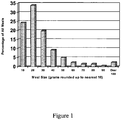
- the cats in the group ate as many as sixteen meals over a 21-hour period and averaged 7 meals per 21-hour period. Further, over 80% of the cats in the group ate between about 10g - 40g (0.35oz. - 1.41oz.) of food per meal and the entire group of cats averaged about 24g (0.85oz.) of food per meal, which equates to an average caloric intake of about 28 Kcal per meal.
- Figure 1 is a bar graph summary of the study that shows meal sizes in grams (rounded up to the nearest 10 grams) and the respective frequency at which the cats ate, as expressed in percentage of all the meals eaten.
- the assignee of the invention gathered data concerning how cat owners feed their cats. The data shows that even when feeding from smaller packages (for example, 3oz. - 4oz.) of wet cat food, less than half of the cat owners fed their cats the entire package. In this regard, of the owners who fed their cats wet food packaged in small containers (3oz. - 4oz can or pouch), only 40% fed their cats the full package, 2% fed about three-quarters of the package, 27% fed about half the package, and 31% fed one-quarter or less of the package.
- refrigerated cat food served immediately to a cat has decreased palatability.
- the assignee of the present invention has studied the effect of serving temperature on the palatability of wet cat food.
- the palatability of wet cat food is reduced when served at 3°C compared to 20°C.
- the data shows that refrigerated wet cat food, served while still cold, is less palatable than cat food served at room temperature.
- pet meals for example, cat food meals
- pet meals that are exposed to air at ambient conditions for extended periods prior to consumption by a pet, or the previously opened but unfed portion, often undergo undesirable chemical and physical changes and microbiological contamination.
- These changes can have a significant negative effect in the palatability of the meal to the pet and the nutritional value of the meal, and pose microbiological hazard to the pet.
- Pet meals are typically designed to contain several ingredients to provide nutrition, palatability, and overall visual appeal to the pet and/or pet owner.
- several micronutrients such as vitamins, and minerals are often added to provide a balanced nutritional meal to the pet.
- Oxygen uptake occurs in pet foods rapidly. For example, a 50 gram sample of typical pet food ingredients absorbs 950 milligrams of oxygen in approximately 10 hours.
- vitamins (A, E) tend to degrade when exposed to light and oxygen at rapid rates, thereby compromising the nutritional content of the food to the pet.
- carotenoid components Vitamin A
- Vitamin A are photosensitive, and tend to degrade when exposed to excessive light.
- Pet meals also contain fats, oils and natural or prepared flavorants which are protected from oxidation while sealed in the original packaging. However, when these components are exposed to air and elevated temperatures, the lipid components can undergo oxidation and tend to make the meal less palatable or non-palatable.
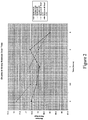
- the table provides the total loss of moisture as a weight percent (dry basis) for each variety over three hours.
- a wet meal may dry near its exposed surfaces, the pet food may develop a skin or crust.
- the crusting or skinning associated with drying may form tougher textures which are not palatable by feline pets, especially because cats, due to their design of teeth and the structure of tongue, are not good chewers of a meal and instead tend to bite and swallow meal components.
- the formation of a skin or crust can adversely affect the methods loaf format meals can be consumed by a cat.
- chunks and gravy format meals the chunk components can dry out when exposed to dry air conditions. The chunks can in turn become tough textured and lose palatability, to cats especially, due to chewiness in product texture.
- the gravy component of a meal can dry out fairly rapidly when exposed to dry air conditions, possibly causing the gravy component to become sticky and in turn cause salt and mineral components to crystallize or sediment out of the gravy system with time. Also, fats and oils can be destabilized from gravy systems due to loss in emulsified structure, causing fats to be expressed out with time, and in turn affecting the gravy palatability.
- Some ingredients in pet foods are incorporated for pleasant aroma in the pet meal both for the pet's benefit and for the pet owner's benefit.
- These aromatic compounds in wet meals typically are readily volatilized during exposure to air, and dissipate if exposed to airs for extended times.
- the wet meals can lose the attractiveness to the pet due to the loss in aroma. This effect can be intensified during extreme dry or heated air conditions, as for example during summer windy days.
- microbiological count on the same food sample can reach in excess of 1 million bacterial cells over a period of four hours. This is due to the binary fission of bacterial cells at a very rapid rate at optimum conditions of microbiological growth ( Doyle M.P et. al., Food Microbiology, 1997, page 17 ). Additionally, offensive or unattractive odors are presented to the pet and owner as microbiological or chemical degradation resulting from microbiological growth occurs. Many microbiological organisms produce sulfur or other sensory perceptive compounds as a result of the breakdown of food materials into microbiological by-products.
- Figure 3 represents cats' preference for freshly opened wet cat food versus wet cat food that has been left open for 30 minutes, 1 hour, 2 hours, and 4 hours prior to feeding, illustrating that cats prefer freshly opened food over food that has been left open for a period of time.
- the inventors have recognized that the commonly available serving sizes of complete and balanced, semi-moist and wet cat food products are not suitable for the natural feeding patterns of cats because they arc generally larger than a cat will cat in a single meal. As a result, current complete and balanced, semi-moist and wet cat food products are seldom entirely consumed by a cat in one meal. Thus, food remnants are either disposed or stored for later consumption. Disposing of remnants is wasteful and costly for the cat owner while storing remnants poses other problems because the food is subject to loss of palatability if refrigerated, and degradation and contamination, as described above, if not refrigerated. Thus, the invention provides a complete and balanced, semi-moist or wet cat food product that minimizes food waste and the need for storing food remnants.
- a complete and balanced semi-moist or wet cat food is packaged in a 10g to 40g serving size.
- Cats have been shown to eat as little as 10g per feeding and even less.
- 10g has been established as the lower limit of the proposed range because it is a small serving size that is still functionally practical with respect to production, packaging, and handling.
- the 40g value has been established as the upper limit of the proposed range to accommodate owner feeding preferences, because owners are accustomed to feeding their cats an average 57g of food per feeding from the larger 3 ounce (85 gram) or 4 ounce (113 gram) container. Because the owner ultimately makes the cat food purchase, there may be some reluctance to purchase a cat food package that is substantially smaller than 57g.
- the ideal single-serving portion for cats may be significantly less than 57g, it may be necessary, for numerous reasons, to package a cat food product in a larger serving portion so that a cat owner will purchase it.
- the upper range limit of 40 grams is considered to encompass cats' and owners' preferences.
- the present invention also encompasses wet cat food that is packaged of other sizes, including the range between at least 15 and no more than 40 grams, at least 20 and no more than 35 grams, and at least 20 and no more than 30 grams.
- the serving size is presented herein as units of mass.
- the single-serve container has a corresponding capacity.
- Such a container would have a volume capable of receiving the desired cat food mass, have a headspace suitable for packaging, retort (if applicable), and other well-known considerations such that a person familiar with pet food packaging technology would understand the meaning of a container capacity.
- the single serving (that is, in the mass range provided above) of complete and balanced semi-moist or wet cat food is preferably individually contained and provided in a unit that serves as a single cat meal.
- the single serving of cat food is placed in a sealed container and is subsequently made shelf stable or commercially sterile.
- shelf-stable refers to food stored in a sealed, substantially airtight container without refrigeration required.
- the container may be made of plastic, metal, or any other suitable material, and may be sealed with a thermoplastic film, a foil, or a foil-plastic laminate.
- the container of cat food may be subjected to a retort process or otherwise made commercially sterile.
- the smaller serving size of the present invention enables a shorter characteristic length from a core portion to the exterior of the container and often enables a larger surface area to volume ratio for a given container shape (compared to larger volumes). These factors facilitate commercial retort and sterilization processes.
- food is heated externally through the boundary layers until the core or cold spot is heated to a specified, minimum temperature.
- the boundary layers are exposed to high temperature for longer than optimum, which often results in the boundary layer being overcooked or degraded.
- the single serving size container because of its shorter characteristic distance to the central region (and possibly because of its larger surface area to volume ratio) exposes the boundary layer to high temperature for a shorter period of time compared with larger volume containers.
- a small mass of food may be commercially sterilized by heating the core to a specified temperature without overcooking or degrading the boundary layer of food in closest proximity to the heating medium.
- the inventors surmise that the preference of cats for single serving sizes described herein may be partly due to the diminished drawbacks of heating a single serving size volume compared with heating a larger volume. Moreover, the shorter time exposure to retort temperatures may also, in addition to the undesirable physical, chemical, or microbiological changes of leftover food, be a factor in cats' preference for food ideally portion sized for consumption by the pet in one eating occasion, over food that is packaged in larger portions and portion sized for multiple eating occasions.
- a plurality of individually packaged units of cat food may be assembled or integrated into a multi-meal package.
- a number of individually packaged units of cat food may be bundled together into a single package that serves as a cat's entire daily diet.
- several single serving containers may be configured together by shrink wrap, living hinges, tear away strips, tape, or any other attachment technology.
- each individually packaged unit may have a different flavor or different ingredients.
- multi-mcal packages may be designed for specific dietary needs of a cat, or provide inherently more variety to the diet, or provide inherently more variety to the diet.
- the present invention encompasses single, individually packaged units of cat food described herein.
- a method of providing a cat food is provided.
- a cat is fed a complete and balanced semi-moist or wet food in a single serving such that the food is consumed before certain characteristics (described above) of the food degrade to unwanted levels.
- the method encompasses aseptic or sterile filing and/or retorting.
- the pet food mass and container size are described above.
Landscapes
- Life Sciences & Earth Sciences (AREA)
- Chemical & Material Sciences (AREA)
- Polymers & Plastics (AREA)
- Animal Husbandry (AREA)
- Birds (AREA)
- Zoology (AREA)
- Engineering & Computer Science (AREA)
- Food Science & Technology (AREA)
- Fodder In General (AREA)
- Feed For Specific Animals (AREA)
- Feeding And Watering For Cattle Raising And Animal Husbandry (AREA)
Abstract
Description
- This application claims the benefit of
U.S. Provisional application number 60/968,829 filed August 29, 2007 - The present invention relates to pet food, and more particularly, to complete and balanced, cat food products and related methods.
- Pet foods are generally classified into three types by their water content: dry pet foods, semi-moist pet foods, and high water content pet foods. Dry pet foods generally have a water content of less than about 15% by weight. Semi-moist pet foods generally have a water content of 15%-55% by weight. Pet foods with a water content of greater than 55%, and more specifically in the range of about 65-95%, are classified as high water content or wet pet foods. The phrase "complete and balanced," as used herein, is in general accordance with the description in National Research Council, Nutrient Requirements of Dogs and Cats, The National Academies Press (2006), Washington D.C.; Association of American Feed Control Officials Incorporated, Official Publication (2007); or other industry body in the U.S. or applicable country. Further, a food is to be distinguished from what is referred to as "snacks" or "treats" by persons familiar with pet food science. Generally, the smallest serving size available for a complete and balanced, semi-moist or wet cat food is about 3oz. - 4oz (85 grams to 113 grams).
- Pet food, and particularly for the subject of this disclosure cat food, is the subject of research into the general effectiveness at delivering nutrition, which encompasses issues of nutrient content, palatability, freshness, and the like. The inventors have discovered insights into cats' preferred eating habits, especially that cats prefer their meals in small discrete segments. The invention is a manifestation of the inventors' discoveries and insights relating cats' preferences.
- This Summary is provided to introduce a selection of concepts in a simplified form that are further described below in the Detailed Description of Illustrative Embodiments. This Summary is not intended to identify key features or essential features of the claimed subject matter, nor is it intended to be used to limit the scope of the claimed subject matter.
- An aspect of the present invention is directed to a complete and balanced semi-moist or wet cat food product in a serving size that is suited for consumption according to a cat's natural feeding pattern. Thus, according to an embodiment of the invention, a complete and balanced semi-moist or wet cat food is packaged in a 10g - 40g serving size. For example, a packaged, multi-meal, unitized cat food product is provided that includes: a plurality of sealed containers, each one of the containers assembled or configured into a single package or group of containers; each one of the containers including a unit of commercially sterile, complete and balanced cat food having a mass of at least 10 grams and no more than 40 grams; and the cat food having a moisture content of at least 15 percent by weight of the food. Also, the cat food product may be packaged in a single unit of a 10g to 40 gram serving size.
- Preferably, the cat food is shelf stable. The cat food may be filled in aseptic or sterile conditions or retorted in the containers. The cat food preferably has a mass of at least 15 grams and no more than 40 grams, more preferably, at least 20 grams and no more than 35 grams, and even more preferably at least 20 grams and no more than 30 grams.
- A method of feeding a cat is also provided that includes: providing plural containers, each of which has a capacity of at least 10 grams; filling the container with at least 10 grams and no more than 40 grams of a complete and balanced cat food; sealing the containers; after the filling and sealing steps, heating the container to at least partially cook or sterilize the pet food; and after the heating step, providing the containers of pet food in a package such that each container of the package may be individually opened.
- Another method of feeding a cat includes: providing plural containers having a capacity of at least 10 grams; filling each container with at least 10 grams and no more than 40 grams of a commercially sterile complete and balanced cat food; sealing the container; and providing the containers of pet food in a package such that each container of the package may be individually opened.
- Preferably, the containers are sized with a maximum capacity of about 40 grams and to enable the cat to finish eating the food before certain characteristics of the food degrade to unwanted levels. The degrading characteristics include decrease in palatability, decrease in moisture content, oxidation of lipids or flavorants, decrease in volatile compounds, loss or degradation of odor components, increase in malodorous compounds, color degradation, and/or loss or degradation of texture components. Preferred container capacities are as provided above.
- The multi-meal semi-moist or wet cat food product may b configured as a plurality of individually packaged single-serving units that are integrated together into a larger package. Thus, in one embodiment, the multi-meal semi-moist or wet cat food product may be designed to provide an optimal daily diet for a cat in a variety of flavors.
-
-
Figure 1 is a chart illustrating cats' preferred meal sizes; -
Figure 2 is a chart illustrating the decrease in moisture of a commercially available pet food over time; and -
Figure 3 is a chart illustrating cats' preference for recently exposed food. - The inventors have studied the natural feeding patterns of cats and discovered that cats on average prefer particular sized servings of cat food. In one study, cats were fed a complete and balanced cat food to examine the cats' natural feeding patterns. The cats in the group ate as many as sixteen meals over a 21-hour period and averaged 7 meals per 21-hour period. Further, over 80% of the cats in the group ate between about 10g - 40g (0.35oz. - 1.41oz.) of food per meal and the entire group of cats averaged about 24g (0.85oz.) of food per meal, which equates to an average caloric intake of about 28 Kcal per meal.
Figure 1 is a bar graph summary of the study that shows meal sizes in grams (rounded up to the nearest 10 grams) and the respective frequency at which the cats ate, as expressed in percentage of all the meals eaten. Also, the assignee of the invention gathered data concerning how cat owners feed their cats. The data shows that even when feeding from smaller packages (for example, 3oz. - 4oz.) of wet cat food, less than half of the cat owners fed their cats the entire package. In this regard, of the owners who fed their cats wet food packaged in small containers (3oz. - 4oz can or pouch), only 40% fed their cats the full package, 2% fed about three-quarters of the package, 27% fed about half the package, and 31% fed one-quarter or less of the package. The data showed that the average amount of wet cat food that owners fed their cats was 57g. Also, the assignee of the present invention gathered data concerning how owners handle the unused portion of the wet cat food. Of the owners who fed their cats only a portion of the cat food package, 60% stored the remaining cat food in the original container and refrigerated it, 18% stored the remaining cat food in the original container and did not refrigerate it, 3% stored the remaining cat food in another container and refrigerated it, 1% stored the remaining cat food in another container and did not refrigerate it. - Accordingly, the inventors concluded that the commonly available, single-serving packages provide more semi-moist or wet cat food than both (i) cats naturally prefer to eat in a single meal and (ii) cat owners prefer to feed in a single meal. Additionally, there are other problems associated with the commonly available single-serving portions of semi-moist and wet cat food.
- For example, refrigerated cat food served immediately to a cat has decreased palatability. The assignee of the present invention has studied the effect of serving temperature on the palatability of wet cat food. In this regard, the palatability of wet cat food is reduced when served at 3°C compared to 20°C. Thus, the data shows that refrigerated wet cat food, served while still cold, is less palatable than cat food served at room temperature.
- Furthermore, pet meals (for example, cat food meals) that are exposed to air at ambient conditions for extended periods prior to consumption by a pet, or the previously opened but unfed portion, often undergo undesirable chemical and physical changes and microbiological contamination. These changes can have a significant negative effect in the palatability of the meal to the pet and the nutritional value of the meal, and pose microbiological hazard to the pet.
- Chemical changes to cat food exposed to ambient conditions include nutritional degradation and oxidation. In this regard, pet meals are typically designed to contain several ingredients to provide nutrition, palatability, and overall visual appeal to the pet and/or pet owner. For example, several micronutrients, such as vitamins, and minerals are often added to provide a balanced nutritional meal to the pet. However, once the pet meal is removed from the protective packaging and exposed in a serving dish, changes in these components can take place. Oxygen uptake occurs in pet foods rapidly. For example, a 50 gram sample of typical pet food ingredients absorbs 950 milligrams of oxygen in approximately 10 hours. Also, vitamins (A, E) tend to degrade when exposed to light and oxygen at rapid rates, thereby compromising the nutritional content of the food to the pet. In particular, carotenoid components (Vitamin A) are photosensitive, and tend to degrade when exposed to excessive light.
- Pet meals also contain fats, oils and natural or prepared flavorants which are protected from oxidation while sealed in the original packaging. However, when these components are exposed to air and elevated temperatures, the lipid components can undergo oxidation and tend to make the meal less palatable or non-palatable.
- Physical changes to cat food exposed to ambient conditions include drying and loss of volatiles by evaporation. In this regard, when wet pet meals are exposed to ambient conditions, the meal components can dry up and therefore decrease the meal palatability to the pet. Specifically, wet meals for pets are traditionally offered in 2 formats: loaf and chunks in gravy. These formats will both lose moisture when exposed to air, though a chunk in gravy format will lose moisture from the gravy at a very high rate in addition to the losses that occur from the chunks. The chunks lose moisture and degrade in a manner similar to when a wet cat food in a loaf format is exposed to air. For example,
Figure 2 illustrates the decrease of moisture content over time for two varieties of commercially available chunk in gravy cat food -- chicken and beef. The table provides the total loss of moisture as a weight percent (dry basis) for each variety over three hours.Table: Moisture Content Over Time Percent Moisture 10 hr-3hr Difference Loss from Initial Time to Final Time (Hours) 0 0.5 1 2 3 Moisture # 1 Chicken CIG71.79 70.6 70.7 69.97 69.07 2.72 Moisture # 2 Chicken CIG71.15 71.22 70.3 70.31 69.11 2.04 Moisture # 1 Beef CIG71.4 70.06 70.06 70.24 69.13 2.27 Moisture # 2 Beef CIG70.57 70.13 69.88 70.67 68.98 1.59 - Moreover, because a wet meal may dry near its exposed surfaces, the pet food may develop a skin or crust. The crusting or skinning associated with drying may form tougher textures which are not palatable by feline pets, especially because cats, due to their design of teeth and the structure of tongue, are not good chewers of a meal and instead tend to bite and swallow meal components. The formation of a skin or crust can adversely affect the methods loaf format meals can be consumed by a cat. In chunks and gravy format meals, the chunk components can dry out when exposed to dry air conditions. The chunks can in turn become tough textured and lose palatability, to cats especially, due to chewiness in product texture. The gravy component of a meal can dry out fairly rapidly when exposed to dry air conditions, possibly causing the gravy component to become sticky and in turn cause salt and mineral components to crystallize or sediment out of the gravy system with time. Also, fats and oils can be destabilized from gravy systems due to loss in emulsified structure, causing fats to be expressed out with time, and in turn affecting the gravy palatability.
- Some ingredients in pet foods are incorporated for pleasant aroma in the pet meal both for the pet's benefit and for the pet owner's benefit. These aromatic compounds in wet meals typically are readily volatilized during exposure to air, and dissipate if exposed to airs for extended times. The wet meals can lose the attractiveness to the pet due to the loss in aroma. This effect can be intensified during extreme dry or heated air conditions, as for example during summer windy days.
- Exposed wet meals pose a risk of microbiological contamination. This risk to microbiological growth in exposed cat meals increases rapidly, possibly exponentially, with time. Microbiological contamination to the wet cat meals can arise from several factors. Cats themselves carry a load of microbiological flora in their mouth, which when partly contacted with wet pet meals, can contaminate the pet meals. Some of the pathogenic microorganisms in a cat oral cavity include Pasteurella multocida, Staphylococcus aereus (Westling, K., et al., Journal of Infection, Vol 5(6)403-407). These microorganisms, when inoculated onto wet pet meals can rapidly grow and pose a microbiological risk to the pet when consumed at a later time. As an example, when a 200 microorganism load in a pet meal in left exposed at ambient conditions for a period of less than four hours, the microbiological count on the same food sample can reach in excess of 1 million bacterial cells over a period of four hours. This is due to the binary fission of bacterial cells at a very rapid rate at optimum conditions of microbiological growth (Doyle M.P et. al., Food Microbiology, 1997, page 17). Additionally, offensive or unattractive odors are presented to the pet and owner as microbiological or chemical degradation resulting from microbiological growth occurs. Many microbiological organisms produce sulfur or other sensory perceptive compounds as a result of the breakdown of food materials into microbiological by-products.
-
Figure 3 represents cats' preference for freshly opened wet cat food versus wet cat food that has been left open for 30 minutes, 1 hour, 2 hours, and 4 hours prior to feeding, illustrating that cats prefer freshly opened food over food that has been left open for a period of time. - The inventors have recognized that the commonly available serving sizes of complete and balanced, semi-moist and wet cat food products are not suitable for the natural feeding patterns of cats because they arc generally larger than a cat will cat in a single meal. As a result, current complete and balanced, semi-moist and wet cat food products are seldom entirely consumed by a cat in one meal. Thus, food remnants are either disposed or stored for later consumption. Disposing of remnants is wasteful and costly for the cat owner while storing remnants poses other problems because the food is subject to loss of palatability if refrigerated, and degradation and contamination, as described above, if not refrigerated. Thus, the invention provides a complete and balanced, semi-moist or wet cat food product that minimizes food waste and the need for storing food remnants.
- According to one embodiment, a complete and balanced semi-moist or wet cat food is packaged in a 10g to 40g serving size. Cats have been shown to eat as little as 10g per feeding and even less. Thus, 10g has been established as the lower limit of the proposed range because it is a small serving size that is still functionally practical with respect to production, packaging, and handling. The 40g value has been established as the upper limit of the proposed range to accommodate owner feeding preferences, because owners are accustomed to feeding their cats an average 57g of food per feeding from the larger 3 ounce (85 gram) or 4 ounce (113 gram) container. Because the owner ultimately makes the cat food purchase, there may be some reluctance to purchase a cat food package that is substantially smaller than 57g. Thus, although the ideal single-serving portion for cats may be significantly less than 57g, it may be necessary, for numerous reasons, to package a cat food product in a larger serving portion so that a cat owner will purchase it. The upper range limit of 40 grams is considered to encompass cats' and owners' preferences. The present invention also encompasses wet cat food that is packaged of other sizes, including the range between at least 15 and no more than 40 grams, at least 20 and no more than 35 grams, and at least 20 and no more than 30 grams.
- The serving size is presented herein as units of mass. The single-serve container has a corresponding capacity. Such a container would have a volume capable of receiving the desired cat food mass, have a headspace suitable for packaging, retort (if applicable), and other well-known considerations such that a person familiar with pet food packaging technology would understand the meaning of a container capacity.
- The single serving (that is, in the mass range provided above) of complete and balanced semi-moist or wet cat food is preferably individually contained and provided in a unit that serves as a single cat meal. The single serving of cat food is placed in a sealed container and is subsequently made shelf stable or commercially sterile. As used herein, "shelf-stable" refers to food stored in a sealed, substantially airtight container without refrigeration required. The container may be made of plastic, metal, or any other suitable material, and may be sealed with a thermoplastic film, a foil, or a foil-plastic laminate. In a preferred embodiment, the container of cat food may be subjected to a retort process or otherwise made commercially sterile. Other well-known methods of making the package shelf-stable, such as aseptic filling, controlling inherent moisture content, moisture reduction and moisture control (e.g. binding of water using humectants, sugars, and salts), irradiation, acidification, adding of yeast and mold inhibitors, adding preservatives, and any combination(s) thereof are contemplated and encompassed by the present invention.
- The smaller serving size of the present invention enables a shorter characteristic length from a core portion to the exterior of the container and often enables a larger surface area to volume ratio for a given container shape (compared to larger volumes). These factors facilitate commercial retort and sterilization processes. In this regard, during commercial retort and sterilization processes, food is heated externally through the boundary layers until the core or cold spot is heated to a specified, minimum temperature. Generally, in order for the core of a mass of food to reach a specified temperature, the boundary layers are exposed to high temperature for longer than optimum, which often results in the boundary layer being overcooked or degraded. For a given density of material, the single serving size container, because of its shorter characteristic distance to the central region (and possibly because of its larger surface area to volume ratio) exposes the boundary layer to high temperature for a shorter period of time compared with larger volume containers. Thus, a small mass of food may be commercially sterilized by heating the core to a specified temperature without overcooking or degrading the boundary layer of food in closest proximity to the heating medium.
- The inventors surmise that the preference of cats for single serving sizes described herein may be partly due to the diminished drawbacks of heating a single serving size volume compared with heating a larger volume. Moreover, the shorter time exposure to retort temperatures may also, in addition to the undesirable physical, chemical, or microbiological changes of leftover food, be a factor in cats' preference for food ideally portion sized for consumption by the pet in one eating occasion, over food that is packaged in larger portions and portion sized for multiple eating occasions.
- In accordance with an aspect of the invention, a plurality of individually packaged units of cat food may be assembled or integrated into a multi-meal package. For example, a number of individually packaged units of cat food may be bundled together into a single package that serves as a cat's entire daily diet. For example, several single serving containers may be configured together by shrink wrap, living hinges, tear away strips, tape, or any other attachment technology. Furthermore, each individually packaged unit may have a different flavor or different ingredients. Also, multi-mcal packages may be designed for specific dietary needs of a cat, or provide inherently more variety to the diet, or provide inherently more variety to the diet. The present invention encompasses single, individually packaged units of cat food described herein.
- In accordance with aspect of the invention, a method of providing a cat food is provided. According to the method, a cat is fed a complete and balanced semi-moist or wet food in a single serving such that the food is consumed before certain characteristics (described above) of the food degrade to unwanted levels. The method encompasses aseptic or sterile filing and/or retorting. The pet food mass and container size are described above. As described above, when wet food is exposed to air, several important compositional and sensory aspects of the food begin to degrade and, over time, will degrade to such levels that the food will lose its appeal to a cat. Primarily, exposed wet food becomes unappealing to a cat over time because of the reduction of certain volatile compounds that have been proven to affect cat feeding behavior. For example, moisture content levels may be reduced, which affects the taste and texture of the food in a manner that is not appealing to cats. Also, fat oxidation may occur, which results in loss of nutrients and creates off flavors that negatively affect the palatability of the food to a cat. Additionally, oxidized fats can have deleterious health effects, such as oxidation of cells, loss of nutrients in the body, and diarrhea.
- This description illustrates aspects of the embodiments of the present invention. The present invention, however, is not limited to the particular embodiments stated herein, but rather encompasses reasonably variations as would be understood by a person familiar with pet food technology. Also, the description explains possible reasons for cats' preferences that are manifested in the present invention, but the present invention is not limited to or by the these explanations. Rather, the explanations are provided to round out the teaching of the present invention.
- A non-exhaustive list of aspects of the disclosure is set out in the following numbered clauses:
- 1. A packaged, multi-meal, unitized cat food product comprising:
- a plurality of sealed containers, each one of the containers assembled into a single package;
- each one of the containers including a unit of commercially sterile, complete and balanced cat food having a mass of at least 10 grams and no more than 40 grams;
- the cat food having a moisture content of at least 15 percent by weight of the food.
- 2. The cat food product of
clause 1 wherein the cat food is shelf stable. - 3. The cat food product of
clause 2 wherein the cat food is shelf stable by retorting. - 4. The cat food product of
clause 1 wherein the cat food has a mass of at least 15 grams and no more than 40 grams. - 5. The cat food product of
clause 1 wherein the cat food has a mass of at least 20 grams and no more than 35 grams. - 6. The cat food product of
clause 1 wherein the cat food has a mass of at least 20 grams and no more than 30 grams. - 7. The cat food product of
clause 1 wherein the cat food is commercially sterile upon filling. - 8. The cat food product of
clause 1 wherein the cat food is made commercially sterile by retorting. - 9. A unitized cat food product comprising:
- a sealed container housing a unit of commercially sterile, complete and balanced cat food having a mass of at least 10 grams and no more than 40 grams;
- the cat food having a moisture content of at least 15 percent by weight of the food.
- 10. The cat food product of clause 9 wherein the cat food is shelf stable.
- 11. The cat food product of
clause 10 wherein the cat food is shelf stable by retorting. - 12. The cat food product of clause 9 wherein the cat food has a mass of at least 15 grams and no more than 40 grams.
- 13. The cat food product of clause 9 wherein the cat food has a mass of at least 20 grams and no more than 35 grams.
- 14. The cat food product of clause 9 wherein the cat food has a mass of at least 20 grams and no more than 30 grams.
- 15. The cat food product of clause 9 wherein the cat food is commercially sterile upon filling.
- 16. The cat food product of clause 9 wherein the cat food is made commercially sterile by retorting.
- 17. A method of feeding a cat, comprising the steps of:
- providing plural containers having a capacity of at least 10 grams;
- filling each container with at least 10 grams and no more than 40 grams of a complete and balanced cat food;
- sealing the container;
- after the filling and sealing steps, heating the container to at least partially cook or sterilize the pet food;
- and after the heating step, providing the containers of pet food in a package such that each container of the package may be individually opened.
- 18. The method of feeding of clause 17 wherein each container, upon opening, is sized to enable the cat to finish eating the food before certain characteristics of the food degrade to unwanted levels.
- 19. The method of clause 18, wherein degrade means decrease in palatability.
- 20. The method of clause 18, wherein degrade means decrease in moisture content.
- 21. The method of clause 18, wherein degrade means oxidation of lipids or flavorants.
- 22. The method of clause 18, wherein degrade means decrease in volatile compounds.
- 23. The method of clause 18, wherein degrade means loss or degradation of odor components.
- 24. The method of
clause 10, wherein degrade means an increase in malodorous compounds. - 25. The method of clause 18, wherein degrade means loss or degradation of texture components.
- 26. The method of clause 17 wherein the providing step includes providing plural containers having a capacity of at least 15 grams and no more than 40 grams.
- 27. The method of clause 17 wherein the providing step includes providing plural containers having a capacity of at least 20 grams and no more than 35 grams.
- 28. The method of clause 17 wherein the providing step includes providing plural containers having a capacity of at least 20 grams and no more than 30 grams.
- 29. A method of feeding a cat, comprising the steps of:
- providing plural containers having a capacity of at least 10 grams;
- filling each container with at least 10 grams and no more than 40 grams of a commercially sterile complete and balanced cat food;
- sealing the container; and
- providing the containers of pet food in a package such that each container of the package may be individually opened.
- 30. The method of clause 29 wherein the providing step includes providing plural containers having a capacity of at least 15 grams and no more than 40 grams;
- 31. The method of clause 29 wherein the providing step includes providing plural containers having a capacity of at least 20 grams and no more than 35 grams.
- 32. The method of clause 29 wherein the providing step includes providing plural containers having a capacity of at least 20 grams and no more than 30 grams.
Claims (15)
- A unitized cat food product comprising:a sealed container housing a unit of commercially sterile, complete and balanced cat food having a mass of at least 10 grams and no more than 40 grams;the cat food having a moisture content of at least 15 percent by weight of the food.
- A packaged, multi-meal cat food product comprising:a first unitized cat food product of claim 1; anda second unitized cat food product of claim 1,each one of the first unitized cat food product and the second unitized cat food product is integrated into a single package.
- The cat food product of claim 2, wherein the first unitized cat food product and the second unitized cat food product are configured together by a living hinge.
- The cat food product of any one of claims 1 to 3, wherein the cat food is shelf stable by retorting.
- The cat food product of any one of claims 1 to 4, wherein the cat food is made commercially sterile by retorting.
- The cat food product of any one of claims 1 to 5, wherein the cat food has a mass of at least 15 grams and no more than 40 grams.
- The cat food product of any one of claims 1 to 6, wherein the cat food has a mass of at least 20 grams and no more than 35 grams, preferably wherein the cat food has a mass of at least 20 grams and no more than 30 grams.
- The cat food product of any one of claims 1 to 7, wherein the cat food has a moisture content in the range of about 65-95% by weight.
- A method of providing a cat food, comprising the steps of:providing plural containers having a capacity of at least 10 grams;filling each container with at least 10 grams and no more than 40 grams of a complete and balanced cat food; andsealing the container.
- The method of claim 9, wherein the method further comprises, after the filling and sealing steps, heating the container to at least partially cook or sterilize the cat food, and to retort the cat food; or the filling step comprises filling each container with a commercially sterile complete and balanced cat food.
- The method of claim 9 or claim 10, wherein the filling step comprises filling each container with at least 10 grams and no more than 40 grams of a commercially sterile complete and balanced cat food.
- The method of any one of claims 9 to 11, wherein the plural containers are configured together by a living hinge.
- The method of any one of claims 9 to 12, wherein the providing step includes providing plural containers having a capacity of at least 15 grams, and no more than 40 grams.
- The method of any one of claims 9 to 13, wherein the providing step includes providing plural containers having a capacity of at least 20 grams and no more than 35 grams, preferably wherein the providing step includes providing plural containers having a capacity of at least 20 grams and no more than 30 grams.
- The method of any one of claims 9 to 14, wherein the filling step comprises filling each container with a cat food with a water content of about 65-95% by weight.
Priority Applications (1)
| Application Number | Priority Date | Filing Date | Title |
|---|---|---|---|
| EP24162635.7A EP4356751A3 (en) | 2007-08-29 | 2008-08-29 | Single-serve cat food product and methods for same |
Applications Claiming Priority (3)
| Application Number | Priority Date | Filing Date | Title |
|---|---|---|---|
| US96882907P | 2007-08-29 | 2007-08-29 | |
| EP08828548.1A EP2190299B1 (en) | 2007-08-29 | 2008-08-29 | Method of providing a cat food product in single-serve portions |
| PCT/US2008/074921 WO2009029893A1 (en) | 2007-08-29 | 2008-08-29 | Single-serve cat food product and methods for same |
Related Parent Applications (1)
| Application Number | Title | Priority Date | Filing Date |
|---|---|---|---|
| EP08828548.1A Division EP2190299B1 (en) | 2007-08-29 | 2008-08-29 | Method of providing a cat food product in single-serve portions |
Related Child Applications (2)
| Application Number | Title | Priority Date | Filing Date |
|---|---|---|---|
| EP24162635.7A Division EP4356751A3 (en) | 2007-08-29 | 2008-08-29 | Single-serve cat food product and methods for same |
| EP24162635.7A Division-Into EP4356751A3 (en) | 2007-08-29 | 2008-08-29 | Single-serve cat food product and methods for same |
Publications (2)
| Publication Number | Publication Date |
|---|---|
| EP3875382A1 true EP3875382A1 (en) | 2021-09-08 |
| EP3875382B1 EP3875382B1 (en) | 2025-01-15 |
Family
ID=40091940
Family Applications (3)
| Application Number | Title | Priority Date | Filing Date |
|---|---|---|---|
| EP24162635.7A Pending EP4356751A3 (en) | 2007-08-29 | 2008-08-29 | Single-serve cat food product and methods for same |
| EP08828548.1A Revoked EP2190299B1 (en) | 2007-08-29 | 2008-08-29 | Method of providing a cat food product in single-serve portions |
| EP21150264.6A Active EP3875382B1 (en) | 2007-08-29 | 2008-08-29 | Single-serve cat food product |
Family Applications Before (2)
| Application Number | Title | Priority Date | Filing Date |
|---|---|---|---|
| EP24162635.7A Pending EP4356751A3 (en) | 2007-08-29 | 2008-08-29 | Single-serve cat food product and methods for same |
| EP08828548.1A Revoked EP2190299B1 (en) | 2007-08-29 | 2008-08-29 | Method of providing a cat food product in single-serve portions |
Country Status (12)
| Country | Link |
|---|---|
| US (4) | US20090061044A1 (en) |
| EP (3) | EP4356751A3 (en) |
| JP (1) | JP2010537646A (en) |
| CN (1) | CN101820773A (en) |
| AU (1) | AU2008292864C1 (en) |
| CA (1) | CA2698051C (en) |
| ES (1) | ES3014844T3 (en) |
| HU (1) | HUE052691T2 (en) |
| NZ (1) | NZ583669A (en) |
| PL (1) | PL3875382T3 (en) |
| RU (1) | RU2476083C2 (en) |
| WO (1) | WO2009029893A1 (en) |
Families Citing this family (9)
| Publication number | Priority date | Publication date | Assignee | Title |
|---|---|---|---|---|
| CN101820773A (en) | 2007-08-29 | 2010-09-01 | 马斯公司 | Single-serve cat food product and methods for same |
| CN102469812A (en) * | 2009-07-21 | 2012-05-23 | 希尔氏宠物营养品公司 | Companion animal nutrition system |
| US20150327579A1 (en) * | 2012-12-13 | 2015-11-19 | Unicharm Corporation | Pet food |
| DE102013103541A1 (en) | 2013-04-09 | 2014-10-09 | Growth Finance Plus Ag | Liquid pet food for domestic cats or dogs and process for its preparation |
| JP7128607B2 (en) * | 2016-11-24 | 2022-08-31 | ユニ・チャーム株式会社 | Pet food package and its manufacturing method |
| RU2700501C1 (en) * | 2019-01-11 | 2019-09-17 | Евгения Павловна Юрганова | Fodder production method for cats |
| WO2021041311A1 (en) * | 2019-08-23 | 2021-03-04 | Mars, Incorporated | Method and systems for evaluating pet food |
| US20220030915A1 (en) * | 2020-07-28 | 2022-02-03 | Société des Produits Nestlé S.A. | Pet foods made by retorting at least one of yogurt, cheese, animal milk, or plant milk; and methods of making and using such pet foods |
| JP7629680B2 (en) * | 2020-11-06 | 2025-02-14 | マース インコーポレーテッド | Individualized mixed animal food composition |
Citations (4)
| Publication number | Priority date | Publication date | Assignee | Title |
|---|---|---|---|---|
| JPH10300552A (en) * | 1997-05-01 | 1998-11-13 | Matsuo Obata | Feed bowl, for pets and small animals, equipped with measuring scale |
| US20030207006A1 (en) * | 2002-05-02 | 2003-11-06 | Mars Incorporated | Method and system for preparing multiple variety pouched products |
| JP3134051U (en) * | 2007-05-21 | 2007-08-02 | アイリスオーヤマ株式会社 | Pet food products |
| WO2008010892A2 (en) * | 2006-07-19 | 2008-01-24 | Nova Chemicals (International) S.A. | Food container assembly |
Family Cites Families (77)
| Publication number | Priority date | Publication date | Assignee | Title |
|---|---|---|---|---|
| US3115409A (en) | 1959-05-04 | 1963-12-24 | Wilson & Co Inc | Pet foods and method of packaging same |
| IT1018068B (en) * | 1973-03-19 | 1977-09-30 | Latscha Kg J | PACKAGING FOR FEED IN PORTIONS |
| JPS53149574A (en) * | 1977-05-23 | 1978-12-27 | Chubu Shiriyou Kk | Jellied feed for animals |
| US4779294A (en) * | 1987-06-15 | 1988-10-25 | Miller Gary D | Protective structure |
| US5258191A (en) * | 1991-05-01 | 1993-11-02 | Anchor Hocking Corporation | Vacuum-sealed food container having press-on, pry-off closure |
| JPH07203866A (en) * | 1994-01-20 | 1995-08-08 | Beriizu:Kk | Pet food |
| ES2173274T3 (en) * | 1995-03-31 | 2002-10-16 | Jorg-Peter Prof Schur | PROCEDURE TO IMPROVE CONSERVABILITY AND / OR FOR THE STABILIZATION OF PRODUCTS LOST BY MICROBES. |
| US6911224B1 (en) * | 1996-08-06 | 2005-06-28 | Nestec S.A. | Multi-layered canned pet food |
| JP3040634U (en) * | 1997-02-17 | 1997-08-26 | いなば食品株式会社 | Baged pet food |
| JPH10276685A (en) | 1997-04-09 | 1998-10-20 | Earth Chem Corp Ltd | Animal food |
| JPH11253109A (en) * | 1998-03-12 | 1999-09-21 | Inaba Shokuhin Co Ltd | Pet food |
| US6245379B1 (en) * | 1998-09-30 | 2001-06-12 | The Iams Company | Method of administering a milk substitute to critical care animals |
| US6506401B1 (en) * | 1999-01-28 | 2003-01-14 | H. J. Heinz Company | Filled edible product, and system and method for production of a filled edible product |
| US6596303B1 (en) * | 1999-03-22 | 2003-07-22 | Mars Incorporated | Pet food for maintenance of joint health and alleviation of arthritic symptoms in companion animals |
| NO309253B1 (en) * | 1999-03-25 | 2001-01-08 | Nutreco Aquaculture Res Ct As | Process for the preparation of feed pellets and plants for use in carrying out the process |
| FR2793114B1 (en) * | 1999-04-21 | 2002-11-29 | Agronomique Inst Nat Rech | COMPLETE FEED FOR FISH LARVAE AND PROCESS FOR PREPARING SAME |
| KR100280782B1 (en) * | 1999-07-28 | 2001-01-15 | 이세원 | Novel method for wrapping foodstuff and wrapping vessels thereof |
| DE19940592A1 (en) * | 1999-08-26 | 2001-03-08 | Baensch Tetra Werke | Portion packaging for gel feed |
| US7211280B1 (en) * | 1999-09-09 | 2007-05-01 | Nestec S.A. | Condition of elderly pets |
| DE19944800B4 (en) * | 1999-09-18 | 2012-04-12 | Tetra Gmbh | Water treatment agent for prolonging water change intervals in storage systems |
| DE60042211D1 (en) * | 1999-10-13 | 2009-06-25 | Ewos Ltd | FISH FOOD WITH INCREASED NUCLEOTIDE CONTENT |
| FR2800243B1 (en) * | 1999-11-02 | 2002-01-18 | Royal Canin Sa | FOOD OR VETERINARY COMPOSITION FOR DOMESTIC CARNIVORE CONTAINING FREE TYROSINE TO PREVENT PIGMENTATION ABNORMALITY OF THE PELAGE |
| GB2358135A (en) * | 1999-12-09 | 2001-07-18 | Finnfeeds Int Ltd | Animal feed additives comprising betaine and a protease |
| US6719678B1 (en) | 2000-02-28 | 2004-04-13 | C.L.P Industries Ltd. | Recloseable retort pouch |
| DE10009510A1 (en) * | 2000-02-29 | 2001-09-06 | Effem Gmbh | Semi-moist feed product |
| JP4471442B2 (en) * | 2000-03-24 | 2010-06-02 | 日清ペットフード株式会社 | Pet food |
| US6955831B2 (en) * | 2000-05-09 | 2005-10-18 | Her Majesty The Queen In Right Of Canada As Represented By The Minister Of Fisheries And Oceans | Protein and lipid sources for use in aquafeeds and animal feeds and a process for their preparation |
| PL207930B1 (en) * | 2000-05-25 | 2011-02-28 | Nestle Sa | Novel probiotics for pet food applications |
| GB0015441D0 (en) | 2000-06-23 | 2000-08-16 | Mars Uk Ltd | Food pack |
| WO2002007531A1 (en) * | 2000-07-14 | 2002-01-31 | Societe Des Produits Nestle S.A. | Dietary lipids for improving skin and coat of pets |
| KR100343367B1 (en) * | 2000-07-31 | 2002-07-15 | 정연권 | Feed Composition of Growing Livestock for Replacing Antibiotics |
| AU2001292586A1 (en) * | 2000-09-07 | 2002-03-22 | University Of Maryland Biotechnology Institute | Use of arachidonic acid for enhanced culturing of fish larvae and broodstock |
| US7244463B2 (en) * | 2005-10-18 | 2007-07-17 | Tahitian Noni International, Inc. | Garcinia mangostana L. enhanced animal food product |
| EP1219177A1 (en) * | 2000-12-29 | 2002-07-03 | Société des Produits Nestlé S.A. | Extrusion process, apparatus and product |
| US7125574B2 (en) * | 2001-01-10 | 2006-10-24 | Nestec S.A. | Dental diet for reducing tartar |
| JP2002238464A (en) * | 2001-02-15 | 2002-08-27 | Uni Harts Kk | Pet food |
| US6586027B2 (en) * | 2001-02-23 | 2003-07-01 | T.F.H. Publications, Inc. | Health chew toy |
| EP1250851A1 (en) * | 2001-04-18 | 2002-10-23 | Societe Des Produits Nestle S.A. | Pet food composition containing semi-refined gelling agent |
| US7001610B2 (en) * | 2001-04-23 | 2006-02-21 | Omeganutrel Inc. | Food supplement and use thereof for elevating levels of essential fatty acids in livestock and products therefrom |
| US7276260B2 (en) * | 2001-05-21 | 2007-10-02 | Nestec, Ltd. | Inhibition of Tyrophagus putrescentiae in pet food products |
| US6493641B1 (en) * | 2001-06-15 | 2002-12-10 | Nestec Ltd | Methods and apparatus for customizing pet food |
| US20030026875A1 (en) * | 2001-07-31 | 2003-02-06 | Aguilar Carlos A. | Multi-compartment pet food container |
| FR2831769B1 (en) * | 2001-11-07 | 2004-07-30 | Diana Ingredients | APPEARANCE FACTOR AND TASTEFAST |
| JP2003144059A (en) * | 2001-11-08 | 2003-05-20 | Mars Inc | Pet food corresponding to heating with microwave oven and its package body |
| US7115298B2 (en) * | 2001-12-14 | 2006-10-03 | Tropicana Products, Inc. | Dried citrus peel supplement for use in commercial poultry feed |
| US7001624B2 (en) * | 2001-12-19 | 2006-02-21 | Encore Technologies, L.L.C. | Method for mixing and introduction of inulin |
| IL164123A0 (en) * | 2002-03-19 | 2005-12-18 | Advanced Bionutrition Corp | An aquatic animal feed containing microalgea containing arachadonic acid |
| US6896924B2 (en) * | 2002-09-16 | 2005-05-24 | Angel Hernandez | Two-texture pet food product |
| US6926917B2 (en) * | 2002-10-16 | 2005-08-09 | Nestec Ltd. | Dry pet food with increased palatability and method of production |
| JP4341226B2 (en) | 2002-10-16 | 2009-10-07 | キユーピー株式会社 | Fish food in retort container and manufacturing method thereof |
| US6899904B2 (en) * | 2002-11-14 | 2005-05-31 | The Meow Mix Company | Pet food compositions having electrostatically charged ingredient |
| US6841179B2 (en) * | 2002-11-14 | 2005-01-11 | The Meow Mix Company | Pet food compositions comprising electrostatically charged gelatin |
| US7485330B2 (en) * | 2002-11-26 | 2009-02-03 | Redbarn Pet Products, Inc. | Foodstuff containing a moist meaty filling |
| GB0229838D0 (en) * | 2002-12-20 | 2003-01-29 | Mars Uk Ltd | Multi-component meal |
| US7087260B2 (en) * | 2003-01-09 | 2006-08-08 | T.F.H. Publications, Inc. | Animal chew toy with flossing ribs/projections |
| US7147888B2 (en) * | 2003-02-10 | 2006-12-12 | Whitehill Oral Technologies, Inc. | Emulsion impregnated rawhide chews |
| US7063868B2 (en) * | 2003-02-28 | 2006-06-20 | T.F.H. Publications, Inc. | Method of removing molded natural resins from molds utilizing lifter bars |
| US7465471B2 (en) * | 2003-03-21 | 2008-12-16 | Novus International, Inc. | Palatability of aquaculture feed |
| US7205015B2 (en) * | 2003-06-23 | 2007-04-17 | Chia-Lung Shu | Method for producing a jerked meat rawhide chew toy |
| US7449204B2 (en) * | 2003-07-18 | 2008-11-11 | Therametric Technologies Inc. | Oral care chew products and methods for domestic animals |
| US20050042338A1 (en) | 2003-08-22 | 2005-02-24 | The Iams Company | Pet food container |
| US7282235B2 (en) * | 2003-08-27 | 2007-10-16 | Del Monte Corporation | Meat-containing, strip-shaped food product and method of making same |
| US7244460B2 (en) * | 2003-11-17 | 2007-07-17 | Nusci Laboratories Llc | Tripolyphosphate pet food palatability enhancers |
| WO2005053424A1 (en) * | 2003-11-26 | 2005-06-16 | Hill's Pet Nutrition, Inc. | Pet food composition having enhanced palatability |
| US7120588B2 (en) * | 2003-12-11 | 2006-10-10 | Versch Roman D | Selected climate change control of pet food formulation and distribution |
| US7410662B1 (en) * | 2003-12-12 | 2008-08-12 | Ourpet's Company | Apparatus and method of making canine chew toy |
| USD512810S1 (en) * | 2003-12-20 | 2005-12-20 | Hartmut Englisch | Food stuffs for animals |
| US7288275B2 (en) * | 2004-01-08 | 2007-10-30 | T.F.H. Publications, Inc | Apparatus and process for forming pet treats |
| JP2004161382A (en) | 2004-02-02 | 2004-06-10 | Nippon Suisan Kaisha Ltd | Retort food packaging |
| US7282234B2 (en) * | 2004-05-28 | 2007-10-16 | Chia-Lung Shu | Method for producing a jerked meat rawhide chew toy |
| EP1602285A1 (en) * | 2004-06-04 | 2005-12-07 | Gaines Treats Limited | A process for preparing a chewable pet food |
| US7332188B2 (en) * | 2004-11-22 | 2008-02-19 | T.F.H. Publications, Inc. | Animal chew containing fermented soyfood |
| JP2006149297A (en) * | 2004-11-30 | 2006-06-15 | Torimex Kk | Devil's tongue-containing animal feed |
| JP2006166794A (en) * | 2004-12-16 | 2006-06-29 | Inaba Shokuhin Co Ltd | Method for producing pet food |
| JP5119583B2 (en) * | 2005-09-30 | 2013-01-16 | 三菱化学株式会社 | Oil-containing pet food |
| JP2007129979A (en) * | 2005-11-11 | 2007-05-31 | Mgy:Kk | Pet animal feed |
| CN101820773A (en) | 2007-08-29 | 2010-09-01 | 马斯公司 | Single-serve cat food product and methods for same |
-
2008
- 2008-08-29 CN CN200880109557A patent/CN101820773A/en active Pending
- 2008-08-29 EP EP24162635.7A patent/EP4356751A3/en active Pending
- 2008-08-29 RU RU2010111742/13A patent/RU2476083C2/en active
- 2008-08-29 CA CA2698051A patent/CA2698051C/en active Active
- 2008-08-29 WO PCT/US2008/074921 patent/WO2009029893A1/en not_active Ceased
- 2008-08-29 AU AU2008292864A patent/AU2008292864C1/en active Active
- 2008-08-29 US US12/202,120 patent/US20090061044A1/en not_active Abandoned
- 2008-08-29 EP EP08828548.1A patent/EP2190299B1/en not_active Revoked
- 2008-08-29 HU HUE08828548A patent/HUE052691T2/en unknown
- 2008-08-29 EP EP21150264.6A patent/EP3875382B1/en active Active
- 2008-08-29 ES ES21150264T patent/ES3014844T3/en active Active
- 2008-08-29 PL PL21150264.6T patent/PL3875382T3/en unknown
- 2008-08-29 NZ NZ583669A patent/NZ583669A/en unknown
- 2008-08-29 JP JP2010523182A patent/JP2010537646A/en active Pending
-
2017
- 2017-03-10 US US15/456,349 patent/US20170181450A1/en not_active Abandoned
-
2019
- 2019-05-17 US US16/415,698 patent/US20190269154A1/en not_active Abandoned
-
2021
- 2021-08-30 US US17/460,927 patent/US20210386097A1/en not_active Abandoned
Patent Citations (4)
| Publication number | Priority date | Publication date | Assignee | Title |
|---|---|---|---|---|
| JPH10300552A (en) * | 1997-05-01 | 1998-11-13 | Matsuo Obata | Feed bowl, for pets and small animals, equipped with measuring scale |
| US20030207006A1 (en) * | 2002-05-02 | 2003-11-06 | Mars Incorporated | Method and system for preparing multiple variety pouched products |
| WO2008010892A2 (en) * | 2006-07-19 | 2008-01-24 | Nova Chemicals (International) S.A. | Food container assembly |
| JP3134051U (en) * | 2007-05-21 | 2007-08-02 | アイリスオーヤマ株式会社 | Pet food products |
Non-Patent Citations (4)
| Title |
|---|
| "National Research Council, Nutrient Requirements of Dogs and Cats", 2006, THE NATIONAL ACADEMIES PRESS |
| "Official Publication", 2007, ASSOCIATION OF AMERICAN FEED CONTROL OFFICIALS INCORPORATED |
| ANONYMOUS: "Fancy Feast Gourmet Cat Food, Canned, Variety Pack 24ea", XP002508199, Retrieved from the Internet <URL:http://international.drugstore.com/products/prod.asp?pid=199183> [retrieved on 20081215] * |
| WESTLING, K. ET AL., JOURNAL OF INFECTION, vol. 5, no. 6, pages 403 - 407 |
Also Published As
| Publication number | Publication date |
|---|---|
| US20170181450A1 (en) | 2017-06-29 |
| EP4356751A3 (en) | 2024-07-03 |
| HUE052691T2 (en) | 2021-05-28 |
| EP2190299A1 (en) | 2010-06-02 |
| AU2008292864A1 (en) | 2009-03-05 |
| AU2008292864C1 (en) | 2015-03-05 |
| EP2190299B1 (en) | 2021-01-06 |
| WO2009029893A1 (en) | 2009-03-05 |
| US20210386097A1 (en) | 2021-12-16 |
| AU2008292864B2 (en) | 2014-12-04 |
| RU2476083C2 (en) | 2013-02-27 |
| CN101820773A (en) | 2010-09-01 |
| PL3875382T3 (en) | 2025-04-28 |
| RU2010111742A (en) | 2011-10-10 |
| ES3014844T3 (en) | 2025-04-25 |
| US20190269154A1 (en) | 2019-09-05 |
| EP4356751A2 (en) | 2024-04-24 |
| US20090061044A1 (en) | 2009-03-05 |
| NZ583669A (en) | 2013-01-25 |
| EP3875382B1 (en) | 2025-01-15 |
| CA2698051C (en) | 2016-02-16 |
| JP2010537646A (en) | 2010-12-09 |
| CA2698051A1 (en) | 2009-03-05 |
Similar Documents
| Publication | Publication Date | Title |
|---|---|---|
| US20210386097A1 (en) | Single-serve cat food product and methods for same | |
| US6063414A (en) | Combination container and dry pet food for increased shelf life, freshness, palatability, and nutritional value | |
| AU2010200530B2 (en) | A kit for providing a pet meal | |
| US20010048955A1 (en) | Method of feeding an animal a balanced meal | |
| US20070251465A1 (en) | Pet container | |
| AU2020201644A1 (en) | Extruded pet food product | |
| US20090047394A1 (en) | Vacuum packed pet food | |
| HK40059833A (en) | Single-serve cat food product | |
| HK40059833B (en) | Single-serve cat food product | |
| HK40109497A (en) | Single-serve cat food product and methods for same | |
| Gautam et al. | Scientific dog feeding for good health and its preparation: A review | |
| WO2025154089A1 (en) | A complete & balanced diet for canine & feline pets derived from variety of wholefoods, made into composite dry meat flakes, and a method for making the same | |
| HK1242522A1 (en) | Extruded pet food product |
Legal Events
| Date | Code | Title | Description |
|---|---|---|---|
| PUAI | Public reference made under article 153(3) epc to a published international application that has entered the european phase |
Free format text: ORIGINAL CODE: 0009012 |
|
| STAA | Information on the status of an ep patent application or granted ep patent |
Free format text: STATUS: THE APPLICATION HAS BEEN PUBLISHED |
|
| AC | Divisional application: reference to earlier application |
Ref document number: 2190299 Country of ref document: EP Kind code of ref document: P |
|
| AK | Designated contracting states |
Kind code of ref document: A1 Designated state(s): AT BE BG CH CY CZ DE DK EE ES FI FR GB GR HR HU IE IS IT LI LT LU LV MC MT NL NO PL PT RO SE SI SK TR |
|
| STAA | Information on the status of an ep patent application or granted ep patent |
Free format text: STATUS: REQUEST FOR EXAMINATION WAS MADE |
|
| 17P | Request for examination filed |
Effective date: 20220308 |
|
| RBV | Designated contracting states (corrected) |
Designated state(s): AT BE BG CH CY CZ DE DK EE ES FI FR GB GR HR HU IE IS IT LI LT LU LV MC MT NL NO PL PT RO SE SI SK TR |
|
| REG | Reference to a national code |
Ref country code: HK Ref legal event code: DE Ref document number: 40059833 Country of ref document: HK |
|
| GRAP | Despatch of communication of intention to grant a patent |
Free format text: ORIGINAL CODE: EPIDOSNIGR1 |
|
| STAA | Information on the status of an ep patent application or granted ep patent |
Free format text: STATUS: GRANT OF PATENT IS INTENDED |
|
| INTG | Intention to grant announced |
Effective date: 20240918 |
|
| GRAS | Grant fee paid |
Free format text: ORIGINAL CODE: EPIDOSNIGR3 |
|
| GRAA | (expected) grant |
Free format text: ORIGINAL CODE: 0009210 |
|
| STAA | Information on the status of an ep patent application or granted ep patent |
Free format text: STATUS: THE PATENT HAS BEEN GRANTED |
|
| P01 | Opt-out of the competence of the unified patent court (upc) registered |
Free format text: CASE NUMBER: APP_60945/2024 Effective date: 20241113 |
|
| AC | Divisional application: reference to earlier application |
Ref document number: 2190299 Country of ref document: EP Kind code of ref document: P |
|
| AK | Designated contracting states |
Kind code of ref document: B1 Designated state(s): AT BE BG CH CY CZ DE DK EE ES FI FR GB GR HR HU IE IS IT LI LT LU LV MC MT NL NO PL PT RO SE SI SK TR |
|
| REG | Reference to a national code |
Ref country code: CH Ref legal event code: EP Ref country code: GB Ref legal event code: FG4D |
|
| REG | Reference to a national code |
Ref country code: DE Ref legal event code: R096 Ref document number: 602008065151 Country of ref document: DE |
|
| REG | Reference to a national code |
Ref country code: IE Ref legal event code: FG4D |
|
| REG | Reference to a national code |
Ref country code: ES Ref legal event code: FG2A Ref document number: 3014844 Country of ref document: ES Kind code of ref document: T3 Effective date: 20250425 |
|
| REG | Reference to a national code |
Ref country code: NL Ref legal event code: MP Effective date: 20250115 |
|
| PG25 | Lapsed in a contracting state [announced via postgrant information from national office to epo] |
Ref country code: NL Free format text: LAPSE BECAUSE OF FAILURE TO SUBMIT A TRANSLATION OF THE DESCRIPTION OR TO PAY THE FEE WITHIN THE PRESCRIBED TIME-LIMIT Effective date: 20250115 |
|
| PG25 | Lapsed in a contracting state [announced via postgrant information from national office to epo] |
Ref country code: FI Free format text: LAPSE BECAUSE OF FAILURE TO SUBMIT A TRANSLATION OF THE DESCRIPTION OR TO PAY THE FEE WITHIN THE PRESCRIBED TIME-LIMIT Effective date: 20250115 |
|
| REG | Reference to a national code |
Ref country code: LT Ref legal event code: MG9D |
|
| PG25 | Lapsed in a contracting state [announced via postgrant information from national office to epo] |
Ref country code: IS Free format text: LAPSE BECAUSE OF FAILURE TO SUBMIT A TRANSLATION OF THE DESCRIPTION OR TO PAY THE FEE WITHIN THE PRESCRIBED TIME-LIMIT Effective date: 20250515 Ref country code: NO Free format text: LAPSE BECAUSE OF FAILURE TO SUBMIT A TRANSLATION OF THE DESCRIPTION OR TO PAY THE FEE WITHIN THE PRESCRIBED TIME-LIMIT Effective date: 20250415 |
|
| REG | Reference to a national code |
Ref country code: AT Ref legal event code: MK05 Ref document number: 1759738 Country of ref document: AT Kind code of ref document: T Effective date: 20250115 |
|
| PG25 | Lapsed in a contracting state [announced via postgrant information from national office to epo] |
Ref country code: HR Free format text: LAPSE BECAUSE OF FAILURE TO SUBMIT A TRANSLATION OF THE DESCRIPTION OR TO PAY THE FEE WITHIN THE PRESCRIBED TIME-LIMIT Effective date: 20250115 |
|
| PG25 | Lapsed in a contracting state [announced via postgrant information from national office to epo] |
Ref country code: LV Free format text: LAPSE BECAUSE OF FAILURE TO SUBMIT A TRANSLATION OF THE DESCRIPTION OR TO PAY THE FEE WITHIN THE PRESCRIBED TIME-LIMIT Effective date: 20250115 Ref country code: PT Free format text: LAPSE BECAUSE OF FAILURE TO SUBMIT A TRANSLATION OF THE DESCRIPTION OR TO PAY THE FEE WITHIN THE PRESCRIBED TIME-LIMIT Effective date: 20250515 |
|
| PG25 | Lapsed in a contracting state [announced via postgrant information from national office to epo] |
Ref country code: GR Free format text: LAPSE BECAUSE OF FAILURE TO SUBMIT A TRANSLATION OF THE DESCRIPTION OR TO PAY THE FEE WITHIN THE PRESCRIBED TIME-LIMIT Effective date: 20250416 Ref country code: BG Free format text: LAPSE BECAUSE OF FAILURE TO SUBMIT A TRANSLATION OF THE DESCRIPTION OR TO PAY THE FEE WITHIN THE PRESCRIBED TIME-LIMIT Effective date: 20250115 |
|
| PG25 | Lapsed in a contracting state [announced via postgrant information from national office to epo] |
Ref country code: AT Free format text: LAPSE BECAUSE OF FAILURE TO SUBMIT A TRANSLATION OF THE DESCRIPTION OR TO PAY THE FEE WITHIN THE PRESCRIBED TIME-LIMIT Effective date: 20250115 |
|
| PG25 | Lapsed in a contracting state [announced via postgrant information from national office to epo] |
Ref country code: SE Free format text: LAPSE BECAUSE OF FAILURE TO SUBMIT A TRANSLATION OF THE DESCRIPTION OR TO PAY THE FEE WITHIN THE PRESCRIBED TIME-LIMIT Effective date: 20250115 |
|
| PGFP | Annual fee paid to national office [announced via postgrant information from national office to epo] |
Ref country code: ES Payment date: 20250901 Year of fee payment: 18 |
|
| PG25 | Lapsed in a contracting state [announced via postgrant information from national office to epo] |
Ref country code: DK Free format text: LAPSE BECAUSE OF FAILURE TO SUBMIT A TRANSLATION OF THE DESCRIPTION OR TO PAY THE FEE WITHIN THE PRESCRIBED TIME-LIMIT Effective date: 20250115 |
|
| PGFP | Annual fee paid to national office [announced via postgrant information from national office to epo] |
Ref country code: DE Payment date: 20250827 Year of fee payment: 18 |
|
| PGFP | Annual fee paid to national office [announced via postgrant information from national office to epo] |
Ref country code: PL Payment date: 20250805 Year of fee payment: 18 Ref country code: IT Payment date: 20250820 Year of fee payment: 18 |
|
| PGFP | Annual fee paid to national office [announced via postgrant information from national office to epo] |
Ref country code: GB Payment date: 20250827 Year of fee payment: 18 |
|
| REG | Reference to a national code |
Ref country code: DE Ref legal event code: R097 Ref document number: 602008065151 Country of ref document: DE |
|
| PGFP | Annual fee paid to national office [announced via postgrant information from national office to epo] |
Ref country code: FR Payment date: 20250825 Year of fee payment: 18 |
|
| PG25 | Lapsed in a contracting state [announced via postgrant information from national office to epo] |
Ref country code: CZ Free format text: LAPSE BECAUSE OF FAILURE TO SUBMIT A TRANSLATION OF THE DESCRIPTION OR TO PAY THE FEE WITHIN THE PRESCRIBED TIME-LIMIT Effective date: 20250115 Ref country code: EE Free format text: LAPSE BECAUSE OF FAILURE TO SUBMIT A TRANSLATION OF THE DESCRIPTION OR TO PAY THE FEE WITHIN THE PRESCRIBED TIME-LIMIT Effective date: 20250115 |
|
| PG25 | Lapsed in a contracting state [announced via postgrant information from national office to epo] |
Ref country code: RO Free format text: LAPSE BECAUSE OF FAILURE TO SUBMIT A TRANSLATION OF THE DESCRIPTION OR TO PAY THE FEE WITHIN THE PRESCRIBED TIME-LIMIT Effective date: 20250115 |
|
| PG25 | Lapsed in a contracting state [announced via postgrant information from national office to epo] |
Ref country code: SK Free format text: LAPSE BECAUSE OF FAILURE TO SUBMIT A TRANSLATION OF THE DESCRIPTION OR TO PAY THE FEE WITHIN THE PRESCRIBED TIME-LIMIT Effective date: 20250115 |
|
| PLBE | No opposition filed within time limit |
Free format text: ORIGINAL CODE: 0009261 |
|
| STAA | Information on the status of an ep patent application or granted ep patent |
Free format text: STATUS: NO OPPOSITION FILED WITHIN TIME LIMIT |
|
| REG | Reference to a national code |
Ref country code: CH Ref legal event code: L10 Free format text: ST27 STATUS EVENT CODE: U-0-0-L10-L00 (AS PROVIDED BY THE NATIONAL OFFICE) Effective date: 20251126 |
|
| 26N | No opposition filed |
Effective date: 20251016 |
|
| REG | Reference to a national code |
Ref country code: CH Ref legal event code: H13 Free format text: ST27 STATUS EVENT CODE: U-0-0-H10-H13 (AS PROVIDED BY THE NATIONAL OFFICE) Effective date: 20260324 |
|
| PG25 | Lapsed in a contracting state [announced via postgrant information from national office to epo] |
Ref country code: MC Free format text: LAPSE BECAUSE OF FAILURE TO SUBMIT A TRANSLATION OF THE DESCRIPTION OR TO PAY THE FEE WITHIN THE PRESCRIBED TIME-LIMIT Effective date: 20250115 |
|
| PG25 | Lapsed in a contracting state [announced via postgrant information from national office to epo] |
Ref country code: LU Free format text: LAPSE BECAUSE OF NON-PAYMENT OF DUE FEES Effective date: 20250829 |
|
| PG25 | Lapsed in a contracting state [announced via postgrant information from national office to epo] |
Ref country code: CH Free format text: LAPSE BECAUSE OF NON-PAYMENT OF DUE FEES Effective date: 20250831 |