EP3872918B1 - Cylindrical secondary battery - Google Patents
Cylindrical secondary battery Download PDFInfo
- Publication number
- EP3872918B1 EP3872918B1 EP19877401.0A EP19877401A EP3872918B1 EP 3872918 B1 EP3872918 B1 EP 3872918B1 EP 19877401 A EP19877401 A EP 19877401A EP 3872918 B1 EP3872918 B1 EP 3872918B1
- Authority
- EP
- European Patent Office
- Prior art keywords
- positive electrode
- negative electrode
- active material
- secondary battery
- assembly
- Prior art date
- Legal status (The legal status is an assumption and is not a legal conclusion. Google has not performed a legal analysis and makes no representation as to the accuracy of the status listed.)
- Active
Links
Images


Classifications
-
- H—ELECTRICITY
- H01—ELECTRIC ELEMENTS
- H01M—PROCESSES OR MEANS, e.g. BATTERIES, FOR THE DIRECT CONVERSION OF CHEMICAL ENERGY INTO ELECTRICAL ENERGY
- H01M4/00—Electrodes
- H01M4/02—Electrodes composed of, or comprising, active material
- H01M4/13—Electrodes for accumulators with non-aqueous electrolyte, e.g. for lithium-accumulators; Processes of manufacture thereof
-
- H—ELECTRICITY
- H01—ELECTRIC ELEMENTS
- H01M—PROCESSES OR MEANS, e.g. BATTERIES, FOR THE DIRECT CONVERSION OF CHEMICAL ENERGY INTO ELECTRICAL ENERGY
- H01M10/00—Secondary cells; Manufacture thereof
- H01M10/04—Construction or manufacture in general
- H01M10/0431—Cells with wound or folded electrodes
-
- H—ELECTRICITY
- H01—ELECTRIC ELEMENTS
- H01M—PROCESSES OR MEANS, e.g. BATTERIES, FOR THE DIRECT CONVERSION OF CHEMICAL ENERGY INTO ELECTRICAL ENERGY
- H01M10/00—Secondary cells; Manufacture thereof
- H01M10/05—Accumulators with non-aqueous electrolyte
- H01M10/052—Li-accumulators
- H01M10/0525—Rocking-chair batteries, i.e. batteries with lithium insertion or intercalation in both electrodes; Lithium-ion batteries
-
- H—ELECTRICITY
- H01—ELECTRIC ELEMENTS
- H01M—PROCESSES OR MEANS, e.g. BATTERIES, FOR THE DIRECT CONVERSION OF CHEMICAL ENERGY INTO ELECTRICAL ENERGY
- H01M10/00—Secondary cells; Manufacture thereof
- H01M10/05—Accumulators with non-aqueous electrolyte
- H01M10/058—Construction or manufacture
- H01M10/0587—Construction or manufacture of accumulators having only wound construction elements, i.e. wound positive electrodes, wound negative electrodes and wound separators
-
- H—ELECTRICITY
- H01—ELECTRIC ELEMENTS
- H01M—PROCESSES OR MEANS, e.g. BATTERIES, FOR THE DIRECT CONVERSION OF CHEMICAL ENERGY INTO ELECTRICAL ENERGY
- H01M4/00—Electrodes
- H01M4/02—Electrodes composed of, or comprising, active material
- H01M4/36—Selection of substances as active materials, active masses, active liquids
- H01M4/362—Composites
-
- H—ELECTRICITY
- H01—ELECTRIC ELEMENTS
- H01M—PROCESSES OR MEANS, e.g. BATTERIES, FOR THE DIRECT CONVERSION OF CHEMICAL ENERGY INTO ELECTRICAL ENERGY
- H01M4/00—Electrodes
- H01M4/02—Electrodes composed of, or comprising, active material
- H01M4/36—Selection of substances as active materials, active masses, active liquids
- H01M4/362—Composites
- H01M4/364—Composites as mixtures
-
- H—ELECTRICITY
- H01—ELECTRIC ELEMENTS
- H01M—PROCESSES OR MEANS, e.g. BATTERIES, FOR THE DIRECT CONVERSION OF CHEMICAL ENERGY INTO ELECTRICAL ENERGY
- H01M4/00—Electrodes
- H01M4/02—Electrodes composed of, or comprising, active material
- H01M4/36—Selection of substances as active materials, active masses, active liquids
- H01M4/38—Selection of substances as active materials, active masses, active liquids of elements or alloys
- H01M4/386—Silicon or alloys based on silicon
-
- H—ELECTRICITY
- H01—ELECTRIC ELEMENTS
- H01M—PROCESSES OR MEANS, e.g. BATTERIES, FOR THE DIRECT CONVERSION OF CHEMICAL ENERGY INTO ELECTRICAL ENERGY
- H01M4/00—Electrodes
- H01M4/02—Electrodes composed of, or comprising, active material
- H01M4/36—Selection of substances as active materials, active masses, active liquids
- H01M4/48—Selection of substances as active materials, active masses, active liquids of inorganic oxides or hydroxides
- H01M4/483—Selection of substances as active materials, active masses, active liquids of inorganic oxides or hydroxides for non-aqueous cells
-
- H—ELECTRICITY
- H01—ELECTRIC ELEMENTS
- H01M—PROCESSES OR MEANS, e.g. BATTERIES, FOR THE DIRECT CONVERSION OF CHEMICAL ENERGY INTO ELECTRICAL ENERGY
- H01M4/00—Electrodes
- H01M4/02—Electrodes composed of, or comprising, active material
- H01M4/36—Selection of substances as active materials, active masses, active liquids
- H01M4/48—Selection of substances as active materials, active masses, active liquids of inorganic oxides or hydroxides
- H01M4/50—Selection of substances as active materials, active masses, active liquids of inorganic oxides or hydroxides of manganese
- H01M4/505—Selection of substances as active materials, active masses, active liquids of inorganic oxides or hydroxides of manganese of mixed oxides or hydroxides containing manganese for inserting or intercalating light metals, e.g. LiMn2O4 or LiMn2OxFy
-
- H—ELECTRICITY
- H01—ELECTRIC ELEMENTS
- H01M—PROCESSES OR MEANS, e.g. BATTERIES, FOR THE DIRECT CONVERSION OF CHEMICAL ENERGY INTO ELECTRICAL ENERGY
- H01M4/00—Electrodes
- H01M4/02—Electrodes composed of, or comprising, active material
- H01M4/36—Selection of substances as active materials, active masses, active liquids
- H01M4/48—Selection of substances as active materials, active masses, active liquids of inorganic oxides or hydroxides
- H01M4/52—Selection of substances as active materials, active masses, active liquids of inorganic oxides or hydroxides of nickel, cobalt or iron
- H01M4/525—Selection of substances as active materials, active masses, active liquids of inorganic oxides or hydroxides of nickel, cobalt or iron of mixed oxides or hydroxides containing iron, cobalt or nickel for inserting or intercalating light metals, e.g. LiNiO2, LiCoO2 or LiCoOxFy
-
- H—ELECTRICITY
- H01—ELECTRIC ELEMENTS
- H01M—PROCESSES OR MEANS, e.g. BATTERIES, FOR THE DIRECT CONVERSION OF CHEMICAL ENERGY INTO ELECTRICAL ENERGY
- H01M4/00—Electrodes
- H01M4/02—Electrodes composed of, or comprising, active material
- H01M4/36—Selection of substances as active materials, active masses, active liquids
- H01M4/58—Selection of substances as active materials, active masses, active liquids of inorganic compounds other than oxides or hydroxides, e.g. sulfides, selenides, tellurides, halogenides or LiCoFy; of polyanionic structures, e.g. phosphates, silicates or borates
- H01M4/583—Carbonaceous material, e.g. graphite-intercalation compounds or CFx
- H01M4/587—Carbonaceous material, e.g. graphite-intercalation compounds or CFx for inserting or intercalating light metals
-
- H—ELECTRICITY
- H01—ELECTRIC ELEMENTS
- H01M—PROCESSES OR MEANS, e.g. BATTERIES, FOR THE DIRECT CONVERSION OF CHEMICAL ENERGY INTO ELECTRICAL ENERGY
- H01M50/00—Constructional details or processes of manufacture of the non-active parts of electrochemical cells other than fuel cells, e.g. hybrid cells
- H01M50/10—Primary casings; Jackets or wrappings
- H01M50/183—Sealing members
-
- H—ELECTRICITY
- H01—ELECTRIC ELEMENTS
- H01M—PROCESSES OR MEANS, e.g. BATTERIES, FOR THE DIRECT CONVERSION OF CHEMICAL ENERGY INTO ELECTRICAL ENERGY
- H01M50/00—Constructional details or processes of manufacture of the non-active parts of electrochemical cells other than fuel cells, e.g. hybrid cells
- H01M50/50—Current conducting connections for cells or batteries
- H01M50/531—Electrode connections inside a battery casing
-
- H—ELECTRICITY
- H01—ELECTRIC ELEMENTS
- H01M—PROCESSES OR MEANS, e.g. BATTERIES, FOR THE DIRECT CONVERSION OF CHEMICAL ENERGY INTO ELECTRICAL ENERGY
- H01M50/00—Constructional details or processes of manufacture of the non-active parts of electrochemical cells other than fuel cells, e.g. hybrid cells
- H01M50/50—Current conducting connections for cells or batteries
- H01M50/531—Electrode connections inside a battery casing
- H01M50/534—Electrode connections inside a battery casing characterised by the material of the leads or tabs
-
- H—ELECTRICITY
- H01—ELECTRIC ELEMENTS
- H01M—PROCESSES OR MEANS, e.g. BATTERIES, FOR THE DIRECT CONVERSION OF CHEMICAL ENERGY INTO ELECTRICAL ENERGY
- H01M50/00—Constructional details or processes of manufacture of the non-active parts of electrochemical cells other than fuel cells, e.g. hybrid cells
- H01M50/50—Current conducting connections for cells or batteries
- H01M50/531—Electrode connections inside a battery casing
- H01M50/536—Electrode connections inside a battery casing characterised by the method of fixing the leads to the electrodes, e.g. by welding
-
- H—ELECTRICITY
- H01—ELECTRIC ELEMENTS
- H01M—PROCESSES OR MEANS, e.g. BATTERIES, FOR THE DIRECT CONVERSION OF CHEMICAL ENERGY INTO ELECTRICAL ENERGY
- H01M50/00—Constructional details or processes of manufacture of the non-active parts of electrochemical cells other than fuel cells, e.g. hybrid cells
- H01M50/50—Current conducting connections for cells or batteries
- H01M50/531—Electrode connections inside a battery casing
- H01M50/538—Connection of several leads or tabs of wound or folded electrode stacks
-
- H—ELECTRICITY
- H01—ELECTRIC ELEMENTS
- H01M—PROCESSES OR MEANS, e.g. BATTERIES, FOR THE DIRECT CONVERSION OF CHEMICAL ENERGY INTO ELECTRICAL ENERGY
- H01M50/00—Constructional details or processes of manufacture of the non-active parts of electrochemical cells other than fuel cells, e.g. hybrid cells
- H01M50/50—Current conducting connections for cells or batteries
- H01M50/543—Terminals
- H01M50/545—Terminals formed by the casing of the cells
-
- H—ELECTRICITY
- H01—ELECTRIC ELEMENTS
- H01M—PROCESSES OR MEANS, e.g. BATTERIES, FOR THE DIRECT CONVERSION OF CHEMICAL ENERGY INTO ELECTRICAL ENERGY
- H01M10/00—Secondary cells; Manufacture thereof
- H01M10/04—Construction or manufacture in general
- H01M10/0422—Cells or battery with cylindrical casing
-
- H—ELECTRICITY
- H01—ELECTRIC ELEMENTS
- H01M—PROCESSES OR MEANS, e.g. BATTERIES, FOR THE DIRECT CONVERSION OF CHEMICAL ENERGY INTO ELECTRICAL ENERGY
- H01M50/00—Constructional details or processes of manufacture of the non-active parts of electrochemical cells other than fuel cells, e.g. hybrid cells
- H01M50/10—Primary casings; Jackets or wrappings
- H01M50/102—Primary casings; Jackets or wrappings characterised by their shape or physical structure
- H01M50/107—Primary casings; Jackets or wrappings characterised by their shape or physical structure having curved cross-section, e.g. round or elliptic
-
- Y—GENERAL TAGGING OF NEW TECHNOLOGICAL DEVELOPMENTS; GENERAL TAGGING OF CROSS-SECTIONAL TECHNOLOGIES SPANNING OVER SEVERAL SECTIONS OF THE IPC; TECHNICAL SUBJECTS COVERED BY FORMER USPC CROSS-REFERENCE ART COLLECTIONS [XRACs] AND DIGESTS
- Y02—TECHNOLOGIES OR APPLICATIONS FOR MITIGATION OR ADAPTATION AGAINST CLIMATE CHANGE
- Y02E—REDUCTION OF GREENHOUSE GAS [GHG] EMISSIONS, RELATED TO ENERGY GENERATION, TRANSMISSION OR DISTRIBUTION
- Y02E60/00—Enabling technologies; Technologies with a potential or indirect contribution to GHG emissions mitigation
- Y02E60/10—Energy storage using batteries
-
- Y—GENERAL TAGGING OF NEW TECHNOLOGICAL DEVELOPMENTS; GENERAL TAGGING OF CROSS-SECTIONAL TECHNOLOGIES SPANNING OVER SEVERAL SECTIONS OF THE IPC; TECHNICAL SUBJECTS COVERED BY FORMER USPC CROSS-REFERENCE ART COLLECTIONS [XRACs] AND DIGESTS
- Y02—TECHNOLOGIES OR APPLICATIONS FOR MITIGATION OR ADAPTATION AGAINST CLIMATE CHANGE
- Y02P—CLIMATE CHANGE MITIGATION TECHNOLOGIES IN THE PRODUCTION OR PROCESSING OF GOODS
- Y02P70/00—Climate change mitigation technologies in the production process for final industrial or consumer products
- Y02P70/50—Manufacturing or production processes characterised by the final manufactured product
Definitions
- the present disclosure relates to a cylindrical secondary battery.
- a conventional cylindrical secondary battery has a structure in which a wound electrode assembly is housed in a cylindrical case body, and an opening of the case body is sealed by a sealing assembly.
- the wound electrode assembly is formed by winding a positive electrode having a positive electrode active material layer disposed on a positive electrode current collector, a negative electrode having a negative electrode active material layer disposed on a negative electrode current collector, and a separator interposed between the positive electrode and the negative electrode.
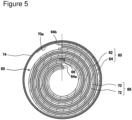
- FIG. 5 is a schematic sectional view illustrating an example of a state in which the wound electrode assembly is housed in the case body in the cylindrical secondary battery.
- a positive electrode active material layer 64 constituting a positive electrode 60 illustrated in FIG. 5 is disposed on both sides of a positive electrode current collector 62.
- a positive electrode tab 66 is connected to the positive electrode 60. The positive electrode tab 66 overlaps both one end portion 64a of the positive electrode active material layer 64 at the winding start of the positive electrode 60 and the other end portion 64b of the positive electrode active material layer 64 at the winding end of the positive electrode 60 in the radial direction of the winding cross-section of an electrode assembly 80.
- the positive electrode tab 66 extends from the positive electrode 60 and is connected to a positive electrode terminal (not illustrated) provided in the secondary battery.
- a negative electrode active material layer 72 constituting a negative electrode 68 illustrated in FIG. 5 is disposed on both sides of a negative electrode current collector 70.
- the winding end of the negative electrode 68 is provided with an exposed portion 70a of the negative electrode current collector, in which the negative electrode active material layer 72 is not formed on the negative electrode current collector 70, and the exposed portion 70a of the negative electrode current collector is in contact with the inner surface of a case body 74. That is, the case body 74 serves as a negative electrode terminal.
- Patent Literature 3 discloses a battery and it manufacture
- Patent Literature 4 discloses an organic electrolytic battery
- Patent Literature 5 discloses a non-aqueous electrolyte secondary battery.
- the negative electrode active material layer expands during charge, and accordingly, the stress of the electrode assembly increases.
- the stress remarkably increases in the vicinity of the positive electrode tab.
- the cylindrical secondary battery employing the battery structure in which the exposed portion of the negative electrode current collector formed at the winding end of the negative electrode is in contact with the inner surface of the case body a remarkable increase in the stress of the wound electrode assembly may lead to deterioration in charge-discharge cycle characteristic.
- a cylindrical secondary battery comprises: a wound electrode assembly formed by winding a positive electrode in which a positive electrode active material layer is disposed on a positive electrode current collector, a negative electrode in which a negative electrode active material layer is disposed on a negative electrode current collector, and a separator interposed between the positive electrode and the negative electrode; a positive electrode tab connected to the positive electrode; a cylindrical case body that houses the electrode assembly and the positive electrode tab; and a sealing assembly that seals an opening of the case body.
- the negative electrode has, at a winding end of the negative electrode, an exposed portion of a negative electrode current collector in which no negative electrode active material layer is disposed, and the exposed portion of the negative electrode current collector is disposed in contact with an inner surface of the case body.
- the electrode assembly has a region A where the number of layers of the positive electrode in a radial direction is smaller than in another region in a region on a winding cross-section of the electrode assembly.
- the positive electrode tab is disposed at a longitudinal center of the positive electrode and disposed in the region A where the number of layers of the positive electrode in the radial direction is smaller than in the other region in the region of the winding cross-section of the electrode assembly.
- the present disclosure it is possible to prevent deterioration in charge-discharge cycle characteristic in the cylindrical secondary battery comprising the wound electrode assembly and having the battery structure in which the exposed portion of the negative electrode current collector formed at the winding end of the negative electrode is in contact with the inner surface of the case body.
- FIG. 1 is a perspective view illustrating an external appearance of a cylindrical secondary battery according to the embodiment.
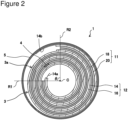
- FIG. 2 is a sectional view taken along line L1-L1 in FIG. 1 .
- a cylindrical secondary battery 1 according to the present embodiment comprises an electrode assembly 3, an electrolyte, a positive electrode tab 4, a case body 5, and a sealing assembly 6.
- the electrode assembly 3 comprises a positive electrode 11, a negative electrode 12, and a separator.
- the case body 5 houses the electrode assembly 3, the electrolyte, the positive electrode tab 4, and the like, and has a bottomed cylindrical shape having an opening, for example.
- a groove 5c recessed inward along the circumferential direction is formed in the upper portion of the case body 5.
- the inner surface of the case body 5 protrudes, and the sealing assembly 6 is supported by the protrusion to seal the opening of the case body 5.
- a gasket is desirably provided between the case body 5 and the sealing assembly 6.
- the electrode assembly 3 is a wound electrode assembly formed by winding the positive electrode 11, the negative electrode 12, and the separator interposed between the positive electrode 11 and the negative electrode 12.
- the separator constituting the electrode assembly 3 is not illustrated.
- FIG. 3 is a schematic plan view illustrating the negative electrode in a state before winding.
- the longitudinal left end portion of the negative electrode 12 is the winding start of the negative electrode 12 at the time of forming the wound electrode assembly 3 and becomes an inner peripheral portion of the electrode assembly 3.
- the longitudinal right end portion of the negative electrode 12 is the winding end of the negative electrode 12 at the time of forming the wound electrode assembly 3 and becomes an outer peripheral portion of the electrode assembly 3.
- the negative electrode 12 comprises a negative electrode current collector 14 and a negative electrode active material layer 16 disposed on the negative electrode current collector 14.
- the negative electrode active material layer 16 is desirably disposed on both sides of the negative electrode current collector 14.
- the negative electrode 12 has exposed portions 14a, 14b of the negative electrode current collector, in which the negative electrode active material layer 16 is not disposed on the negative electrode current collector 14, and the negative electrode current collector 14 is exposed.
- FIG. 3 is disposed at the winding start of the negative electrode 12, and is positioned on the inner peripheral side of the electrode assembly 3 when the electrode assembly 3 is formed, as illustrated in FIG. 2 . Further, the exposed portion 14b of the negative electrode current collector illustrated in FIG. 3 is disposed at the winding end of the negative electrode 12, and is positioned at the outermost periphery of the electrode assembly 3 when the electrode assembly 3 is formed, as illustrated in FIG. 2 . Then, as illustrated in FIG. 2 , the exposed portion 14b of the negative electrode current collector positioned on the outermost periphery of the electrode assembly 3 comes into contact with the inner surface of the case body 5. Thereby, the case body 5 becomes a negative electrode terminal.
- the negative electrode 12 need only have at least the exposed portion 14b of the negative electrode current collector, which is disposed at the winding end of the negative electrode 12.
- the length of the exposed portion 14b of the negative electrode current collector is not particularly limited, but is desirably a length one or more times around the outer periphery of the electrode assembly 3, for example, in order to obtain a good contact state with the case body 5.
- the battery has the structure in which the exposed portion 14b of the negative electrode current collector is in contact with the inner surface of the case body 5, but in addition to this structure, the battery may have a structure in which the negative electrode tab has one end connected to the negative electrode 12 and the other end connected to the case body 5 (e.g., the bottom).
- FIG. 4 is a schematic plan view illustrating the positive electrode in the state before winding.
- the longitudinal left end portion of the positive electrode 11 is the winding start of the positive electrode 11 at the time of forming the wound electrode assembly 3 and becomes the inner peripheral portion of the electrode assembly 3.
- the longitudinal right end portion of the positive electrode 11 is the winding end of the positive electrode 11 at the time of forming the wound electrode assembly 3 and becomes the outer peripheral portion of the electrode assembly 3.
- the positive electrode 11 comprises a positive electrode current collector 18 and a positive electrode active material layer 20 disposed on the positive electrode current collector 18.
- the positive electrode active material layer 20 is desirably disposed on both sides of the positive electrode current collector 18.
- the positive electrode 11 has an exposed portion 18a of the positive electrode current collector, in which the positive electrode active material layer 20 is not disposed on the positive electrode current collector 18, and the positive electrode current collector 18 is exposed.
- the exposed portion 18a of the positive electrode current collector illustrated in FIG. 4 is disposed at the longitudinal center of the positive electrode 11.
- the longitudinal center of the positive electrode 11 is a region ranging from one-third to two-thirds of the longitudinal length of the positive electrode 11 when the longitudinal length is divided into three equal parts.
- the positive electrode tab 4 is connected to the exposed portion 18a of the positive electrode current collector, which is disposed at the longitudinal center of the positive electrode 11.
- the positive electrode tab 4 extends from the positive electrode 11 and is connected to the lower surface of the sealing assembly 6. Thereby, the sealing assembly 6 becomes a positive electrode terminal.
- the positive electrode tab 4 is disposed in a region 3a where the number of layers of the positive electrode 11 in the radial direction of the electrode assembly 3 is smaller than in the other region in the region of the winding cross-section of the electrode assembly 3.
- the number of layers of the positive electrode 11 in the radial direction of the electrode assembly 3 is the number of layers in a state where the positive electrode active material layer 20 is disposed on the positive electrode current collector 18, and any layers of the positive electrode current collector 18 on which the positive electrode active material layer 20 is not disposed which are layered in the radial direction of the electrode assembly 3 are not included in the number of layers of the positive electrode 11.
- the number of layers of the positive electrode 11 in the other region is three.
- the stress of the electrode assembly increases in accordance with the expansion of the negative electrode active material layer during charge.
- the stress remarkably increases in the vicinity of the positive electrode tab.
- the positive electrode tab 4 is disposed at the longitudinal center of the positive electrode 11 and disposed in the region 3a where the number of layers of the positive electrode 11 in the radial direction of the electrode assembly 3 is smaller than in the other region in the region of the winding cross-section of the electrode assembly 3, whereby the increase in stress in the vicinity of the positive electrode tabs 4 is reduced as compared to a case in which the positive electrode tab 4 is disposed in the other region where the number of layers of the positive electrode 11 in the radial direction of the electrode assembly 3 is larger than in the region 3a.
- the increase in stress in the vicinity of the positive electrode tab 66 is reduced as compared to a case where, as illustrated in FIG. 5 , the positive electrode tab 66 is disposed so as to overlap one end portion 64a of the positive electrode active material layer 64 at the winding start of the positive electrode 60 and the other end portion 64b of the positive electrode active material layer 64 at the winding end of the positive electrode 60 in the radial direction of the winding cross-section of the electrode assembly 80.
- an angle ⁇ formed by a straight line R1 connecting one end of the region 3a and a winding center C of the positive electrode 11 and a straight line R2 connecting the other end of the region 3a and the winding center C of the positive electrode 11 is preferably in the range of 10° to 120°, and more preferably in the range of 30° to 90°.
- the width of the region 3a in the circumferential direction of the electrode assembly 3 is set in an appropriate range, thereby reducing the decrease in the energy density of the secondary battery and reducing the increase in the stress of the electrode assembly 3 during charge.
- the ratio of the diameter (L1) of the electrode assembly 3 to the inner diameter (L2) of the case body 5 (L1/L2) is preferably in the range of 0.95 to 1.05, and more preferably in the range of 0.97 to 1.03.
- the diameter (L1) of the electrode assembly 3 is the maximum diameter of the electrode assembly 3.
- the roundness in the winding cross-section of the electrode assembly 3 is preferably 0.98 or more.
- the roundness of the electrode assembly 3 satisfies the above range, the increase in the stress of the electrode assembly 3 during charge is reduced as compared to a case where the roundness of the electrode assembly 3 is less than 0.98.
- the roundness of the electrode assembly 3 greatly depends on the position of the positive electrode tab 4, as in the present embodiment, the positive electrode tab 4 is disposed in the region 3a where the number of layers of the positive electrode 11 in the radial direction of the electrode assembly 3 is smaller than in the other region in the region of the winding cross-section of the electrode assembly 3, so that the roundness in the winding cross-section of the electrode assembly 3 can be set to 0.98 or more.
- the roundness in the winding cross-section of the electrode assembly 3 is measured by the minimum diameter of the electrode assembly cross-section and the maximum diameter of the electrode assembly cross-section.
- cylindrical secondary battery of the present embodiment is not particularly limited to a lithium-ion secondary battery, an alkaline secondary battery, or the like, in the following, a lithium-ion secondary battery will be taken as an example to describe in detail the positive electrode 11, the negative electrode 12, the electrolyte, and the separator used in the lithium-ion secondary battery.
- the positive electrode current collector 18 constituting the positive electrode for example, a foil of a metal, such as aluminum, stable in the potential range of the positive electrode, a film with the metal disposed on the surface layer, or the like is used.
- the positive electrode active material layer 20 constituting the positive electrode 11 includes a positive electrode active material.
- the positive electrode active material layer 20 preferably includes a conductive agent and a binder in addition to the positive electrode active material.
- the positive electrode active material examples include lithium transition metal composite oxides, such as lithium cobalt oxide, lithium manganate, lithium nickelate, lithium nickel-manganese composite oxide, and lithium nickel-cobalt composite oxide.
- the positive electrode active material layer preferably includes a composite oxide including Ni, Co, Li, and at least one of Mn and Al, and the content of Ni in the composite oxide is preferably at least 91 mol% relative to a total number of moles of metal elements in the composite oxide excluding Li.
- the composite oxide may include elements such as Ti, Zr, Nb, B, W, Mg, Mo, and Fe.
- Examples of the conductive agent include carbon powder such as carbon black, acetylene black, Ketchen black, and graphite. These may be used alone or in a combination of two or more.
- binder examples include a fluorine-based polymer and a rubber-based polymer.
- fluorine-based polymer examples include polytetrafluoroethylene (PTFE), polyvinylidene fluoride (PVdF), or modified products thereof
- rubber-based polymer examples include ethylene-propylene-isoprene copolymer and ethylene-propylene-butadiene copolymer. These may be used alone or in a combination of two or more.
- the material of the positive electrode tab 4 is not particularly limited, and may be a metal such as aluminum or titanium.
- the negative electrode current collector 14 constituting the negative electrode 12 for example, a foil of a metal, such as copper, stable in the potential range of the negative electrode, a film with the metal disposed on the surface layer, or the like is used.
- the negative electrode active material layer 16 constituting the negative electrode 12 includes, for example, a negative electrode active material.
- the negative electrode active material layer 16 preferably includes a thickener and a binder in addition to the negative electrode active material.
- the negative electrode active material is not particularly limited as long as being a material capable of absorbing and desorbing lithium ions, and for example, a carbon material such as graphite, non-graphitizable carbon, graphitizable carbon, fibrous carbon, coke, or carbon black, a metal such as Si or Sn which is alloyed with Li, a metal compound including Si and Sn, a lithium titanium composite oxide, or the like may be used.
- the negative electrode active material preferably includes, for example, graphite and a Si compound, and the ratio of the Si compound to the total mass of the negative electrode active material is preferably 5.5 mass% or more. Examples of the Si compound include SiO x (0.5 ⁇ x ⁇ 1.6).
- PTFE styrene-butadiene copolymer
- a modified product thereof may be used.
- carboxymethyl cellulose (CMC) or the like can be used.
- the electrolyte includes a non-aqueous solvent and an electrolyte salt dissolved in the non-aqueous solvent.
- the non-aqueous solvent include esters, ethers, nitriles, amides such as dimethylformamide, isocyanates such as hexamethylene diisocyanate, and mixed solvents of two or more of these.
- the non-aqueous solvent may contain a halogen substitute obtained by substituting at least a part of hydrogen of the solvent with halogen atoms such as fluorine.
- esters examples include: cyclic carbonate esters such as ethylene carbonate (EC), propylene carbonate (PC), and butylene carbonate; chain carbonate esters such as dimethyl carbonate (DMC), ethyl methyl carbonate (EMC), diethyl carbonate (DEC), methyl propyl carbonate, ethyl propyl carbonate, and methyl isopropyl carbonate; cyclic carboxylic acid esters such as ⁇ -butyrolactone and ⁇ -valerolactone; and chain carboxylic acid esters such as methyl acetate, ethyl acetate, propyl acetate, methyl propionate (MP), and ethyl propionate.
- cyclic carbonate esters such as ethylene carbonate (EC), propylene carbonate (PC), and butylene carbonate
- chain carbonate esters such as dimethyl carbonate (DMC), ethyl methyl carbonate (EMC), diethyl carbonate (DEC
- ethers examples include: cyclic ethers such as 1,3-dioxolane, 4-methyl-1,3-dioxolane, tetrahydrofuran, 2-methyltetrahydrofuran, propylene oxide, 1,2-butylene oxide, 1,3-dioxane, 1,4-dioxane, 1, 3, 5-trioxane, furan, 2-methylfuran, 1,8-cineol, and crown ether; and chain ethers such as 1,2-dimethoxyethane, diethyl ether, dipropyl ether, diisopropyl ether, dibutyl ether, dihexyl ether, ethyl vinyl ether, butyl vinyl ether, methyl phenyl ether, ethyl phenyl ether, butyl phenyl ether, pentyl phenyl ether, methoxytoluene, benzyl ethyl ether, di
- nitriles examples include acetonitrile, propionitrile, butyronitrile, valeronitrile, n-heptanitrile, succinonitrile, glutaronitrile, adibonitrile, pimelonitrile, 1,2,3-propanetricarbonitrile, and 1,3,5-pentanetricarbonitrile.
- halogen substitute examples include fluorinated cyclic carbonate esters such as fluoroethylene carbonate (FEC), fluorinated chain carbonate esters, and fluorinated chain carboxylic acid esters such as methyl fluoropropionate (FMP).
- FEC fluoroethylene carbonate
- FMP fluorinated chain carboxylic acid esters
- electrolyte salts include: borate salts such as LiBF 4 , LiClO 4 , LiPF 6 , LiAsF 6 , LiSbF 6 , LiAlCl 4 , LiSCN, LiCF 3 SO 3 , LiCF 3 CO 2 , Li(P(C 2 O 4 )F 4 ), LiPF 6-x (CnF 2n+1 ) x (1 ⁇ x ⁇ 6, n is 1 or 2), LiB 10 Cl 10 , LiCl, LiBr, LiI, chloroborane lithium; lower aliphatic carboxylic acid lithium, Li 2 B 4 O 7 , and Li(B(C 2 O 4 )F 2 ); and imides such as LiN(SO 2 CF 3 ) 2 , LiN(C l F 2l+1 SO 2 )(C m F 2m+1 SO 2 ) (1 and m are integers equal to or larger than 0). These electrolyte salts may be used alone or as a mixture of a plurality
- the separator for example, a porous sheet having ion permeability and insulating properties, or the like, is used.
- the porous sheet include a microporous thin film, a woven fabric, and a non-woven fabric.
- the material of the separator is preferably olefin resins such as polyethylene and polypropylene, cellulose, and the like.
- the separator may be a laminate having a cellulose fiber layer and a thermoplastic resin fiber layer such as an olefin resin.
- the separator may be a multilayer separator including a polyethylene layer and a polypropylene layer, and the surface of the separator may be coated with a material such as an aramid resin or ceramic.
- a positive electrode mixture slurry was prepared by mixing 100 parts by mass of LiNi1 0.91 Co 0.045 Al 0.045 O 2 , which is a positive electrode active material, 1.0 parts by mass of acetylene black (conductive agent), 0.9 parts by mass of polyvinylidene fluoride (binder), and an appropriate amount of NMP.
- the obtained positive electrode mixture slurry was applied to both sides of an aluminum foil having a thickness of 20 ⁇ m, which becomes a positive electrode current collector, and was dried and rolled to prepare a strip-shaped positive electrode. However, an exposed portion of the positive electrode current collector was provided at the longitudinal center of the positive electrode. A positive electrode tab was welded onto the exposed portion of the positive electrode current collector.
- a negative electrode mixture slurry was prepared by mixing 100 parts by mass of the mixture, 1 part by mass of styrene-butadiene rubber (binder), 1 part by mass of carboxymethyl cellulose (thickener), and water. The obtained negative electrode mixture slurry was uniformly applied to both sides of a copper foil having a thickness of 8 ⁇ m, which becomes a negative electrode current collector, and was dried and rolled to prepare a belt-shaped negative electrode. However, an exposed portion of the negative electrode current collector was provided on both sides of the end portion on the winding end side of the negative electrode.
- a non-aqueous electrolyte was prepared by dissolving LiPF 6 at a concentration of 1.4 mol/L in a mixed solvent (volume ratio 1:1:8) of ethylene carbonate, ethyl methyl carbonate, and dimethyl carbonate.
- a positive electrode and a negative electrode were layered with a separator interposed therebetween and were wound to form a wound electrode assembly.
- the exposed portion of the negative electrode current collector was disposed in the outermost peripheral portion of the electrode assembly, and the positive electrode tab was disposed in a region where the number of layers of the positive electrode in the radial direction was smaller than the other region (hereinafter referred to as a region having a smaller number of layers) in the region of the winding cross-section of the electrode assembly.
- the winding cross-section of the electrode assembly was observed by X-ray computed tomography (CT) analysis, and it was confirmed that the exposed portion of the negative electrode current collector positioned in the outermost peripheral portion of the electrode assembly was in contact with the inner surface of the case body.
- CT computed tomography
- the angle ⁇ formed by the straight line R1 connecting one end of the region having a smaller number of layers and the winding center C of the positive electrode and the straight line R2 connecting the other end of the region having a smaller number of layers and the winding center C of the positive electrode was 100°. Note that the angles formed by the straight lines R1 and R2 and the straight line connecting the positive electrode tab disposed in the region having a smaller number of layers and the winding center of the positive electrode were 60° and 40°, respectively.
- the ratio of the diameter L1 of the electrode assembly to the inner diameter L2 of the case body (L1/L2) was 0.993.
- a cylindrical secondary battery was prepared in the same manner as in Example 1 except that the angle ⁇ formed by the straight line R1 connecting one end of the region having a smaller number of layers and the winding center C of the positive electrode and the straight line R2 connecting the other end of the region having a smaller number of layers and the winding center C of the positive electrode was set to 210°, and the angles ⁇ formed by the straight lines R1 and R2 and the straight line connecting the positive electrode tab disposed in the region having a smaller number of layers and the winding center of the positive electrode were set to 170° and 40°, respectively.
- the ratio of the diameter L1 of the electrode assembly to the inner diameter L2 of the case body (L1/L2) was 0.995.
- a cylindrical secondary battery was prepared in the same manner as in Example 1 except that no Si compound was used as the negative electrode active material.
- the ratio of the diameter L1 of the electrode assembly to the inner diameter L2 of the case body (L1/L2) was 0.994.
- a cylindrical secondary battery was prepared in the same manner as in Example 1 except that LiNi 0.88 Co 0.09 Al 0.03 O 2 was used as the positive electrode active material.
- the ratio of the diameter L1 of the electrode assembly to the inner diameter L2 of the case body (L1/L2) was 0.992.
- a cylindrical secondary battery was prepared in the same manner as in Example 2 except that LiNi 0.88 Co 0.09 Al 0.03 O 2 was used as the positive electrode active material.
- the ratio of the diameter L1 of the electrode assembly to the inner diameter L2 of the case body (L1/L2) was 0.994.
- a cylindrical secondary battery was prepared in the same manner as in Example 1 except that no Si compound was used as the negative electrode active material, and LiNi 0.88 Co 0.09 Al 0.03 O 2 was used as the positive electrode active material.
- the ratio of the diameter L1 of the electrode assembly to the inner diameter L2 of the case body (L1/L2) was 0.993.
- a cylindrical secondary battery was prepared in the same manner as in Example 2 except that no Si compound was used as the negative electrode active material, and LiNi 0.88 Co 0.09 Al 0.03 O 2 was used as the positive electrode active material.
- the ratio of the diameter L1 of the electrode assembly to the inner diameter L2 of the case body (L1/L2) was 0.994.
- a cylindrical secondary battery was prepared in the same manner as in Example 1 except that the positive electrode tab was disposed so as to overlap both one end portion of the positive electrode active material layer at the winding start of the positive electrode and the other end portion of the positive electrode active material layer at the winding end of the positive electrode in the radial direction of the winding cross-section of the electrode assembly 80, as illustrated in FIG. 5 .
- the ratio of the diameter L1 of the electrode assembly to the inner diameter L2 of the case body (L1/L2) was 0.996.
- a cylindrical secondary battery was prepared in the same manner as in Comparative Example 1 except that no Si compound was used as the negative electrode active material.
- the ratio of the diameter L1 of the electrode assembly to the inner diameter L2 of the case body (L1/L2) was 0.994.
- a cylindrical secondary battery was prepared in the same manner as in Comparative Example 1 except that LiNi 0.88 Co 0.09 Al 0.03 O 2 was used as the positive electrode active material.
- the ratio of the diameter L1 of the electrode assembly to the inner diameter L2 of the case body (L1/L2) was 0.995.
- a cylindrical secondary battery was prepared in the same manner as in Comparative Example 1 except that no Si compound was used as the negative electrode active material, and LiNi 0.88 Co 0.09 Al 0.03 O 2 was used as the positive electrode active material.
- the ratio of the diameter L1 of the electrode assembly to the inner diameter L2 of the case body (L1/L2) was 0.995.
- the charge-discharge cycle in the following charge-discharge conditions was repeated at a temperature of 25°C 300 times.
- the constant current charge was performed at a current of 1.0 It (800 mA) until the battery voltage became 4.2 V, and then the constant voltage charge was performed at a voltage of 4.2 V until the current value became 0.05 It (40 mA). After a pause for 10 minutes, the constant current discharge was performed at a current of 1.0 It (800 mA) until the battery voltage became 2.75 V.
- Capacity retention in 300th cycle (%) (Discharge capacity in 300th cycle/Discharge capacity in first cycle) x 100 [Table 1] Region having smaller number of layers L1/L2 Ratio of Ni in positive electrode active material (mol%) Ratio of Si compound in negative electrode active material (mass%) Capacity retention in 300th cycle (%) Positive electrode tab was disposed in region having smaller number of layers Angle formed by R1 and R2 Example 1 ⁇ 100° 0.993 91 5.5 75.8 Example 2 ⁇ 210° 0.995 91 5.5 72.1 Example 3 ⁇ 100° 0.994 91 0 72.4 Example 4 ⁇ 210° 0.995 91 0 71.3 Example 5 ⁇ 100° 0.992 88 5.5 72.3 Example 6 ⁇ 210° 0.994 88 5.5 70.9 Example 7 ⁇ 100°
Landscapes
- Chemical & Material Sciences (AREA)
- Chemical Kinetics & Catalysis (AREA)
- Electrochemistry (AREA)
- General Chemical & Material Sciences (AREA)
- Inorganic Chemistry (AREA)
- Engineering & Computer Science (AREA)
- Manufacturing & Machinery (AREA)
- Composite Materials (AREA)
- Materials Engineering (AREA)
- Secondary Cells (AREA)
- Connection Of Batteries Or Terminals (AREA)
- Battery Electrode And Active Subsutance (AREA)
Description
- The present disclosure relates to a cylindrical secondary battery.
- A conventional cylindrical secondary battery has a structure in which a wound electrode assembly is housed in a cylindrical case body, and an opening of the case body is sealed by a sealing assembly. The wound electrode assembly is formed by winding a positive electrode having a positive electrode active material layer disposed on a positive electrode current collector, a negative electrode having a negative electrode active material layer disposed on a negative electrode current collector, and a separator interposed between the positive electrode and the negative electrode.
-
FIG. 5 is a schematic sectional view illustrating an example of a state in which the wound electrode assembly is housed in the case body in the cylindrical secondary battery. A positive electrodeactive material layer 64 constituting apositive electrode 60 illustrated inFIG. 5 is disposed on both sides of a positive electrodecurrent collector 62. Apositive electrode tab 66 is connected to thepositive electrode 60. Thepositive electrode tab 66 overlaps both oneend portion 64a of the positive electrodeactive material layer 64 at the winding start of thepositive electrode 60 and theother end portion 64b of the positive electrodeactive material layer 64 at the winding end of thepositive electrode 60 in the radial direction of the winding cross-section of anelectrode assembly 80. Note that thepositive electrode tab 66 extends from thepositive electrode 60 and is connected to a positive electrode terminal (not illustrated) provided in the secondary battery. A negative electrodeactive material layer 72 constituting anegative electrode 68 illustrated inFIG. 5 is disposed on both sides of a negative electrodecurrent collector 70. The winding end of thenegative electrode 68 is provided with an exposedportion 70a of the negative electrode current collector, in which the negative electrodeactive material layer 72 is not formed on the negative electrodecurrent collector 70, and the exposedportion 70a of the negative electrode current collector is in contact with the inner surface of acase body 74. That is, thecase body 74 serves as a negative electrode terminal. Then,Patent Literature 3 discloses a battery and it manufacture,Patent Literature 4 discloses an organic electrolytic battery andPatent Literature 5 discloses a non-aqueous electrolyte secondary battery. -
- PATENT LITERATURE 1:
Japanese Unexamined Patent Application Publication No. 2006-24464 - PATENT LITERATURE 2:
Japanese Patent No. 6024754 - PATENT LITERATURE 3:
Japanese Unexamined Patent Application Publication No. 2000-003722 - PATENT LITERATURE 4:
Japanese Unexamined Patent Application Publication No. H06-52867 - PATENT LITERATURE 5:
PCT International Application (WO) No. 2018-168628 - In the secondary battery, the negative electrode active material layer expands during charge, and accordingly, the stress of the electrode assembly increases. In particular, in the wound electrode assembly constituting the cylindrical secondary battery, the stress remarkably increases in the vicinity of the positive electrode tab. In the cylindrical secondary battery employing the battery structure in which the exposed portion of the negative electrode current collector formed at the winding end of the negative electrode is in contact with the inner surface of the case body, a remarkable increase in the stress of the wound electrode assembly may lead to deterioration in charge-discharge cycle characteristic.
- Therefore, it is an advantage of the present disclosure to prevent deterioration in charge-discharge cycle characteristic in a cylindrical secondary battery comprising a wound electrode assembly and having a battery structure in which an exposed portion of a negative electrode current collector formed at the winding end of a negative electrode is in contact with the inner surface of a case body.
- A cylindrical secondary battery according to an aspect of the present disclosure comprises: a wound electrode assembly formed by winding a positive electrode in which a positive electrode active material layer is disposed on a positive electrode current collector, a negative electrode in which a negative electrode active material layer is disposed on a negative electrode current collector, and a separator interposed between the positive electrode and the negative electrode; a positive electrode tab connected to the positive electrode; a cylindrical case body that houses the electrode assembly and the positive electrode tab; and a sealing assembly that seals an opening of the case body. The negative electrode has, at a winding end of the negative electrode, an exposed portion of a negative electrode current collector in which no negative electrode active material layer is disposed, and the exposed portion of the negative electrode current collector is disposed in contact with an inner surface of the case body. The electrode assembly has a region A where the number of layers of the positive electrode in a radial direction is smaller than in another region in a region on a winding cross-section of the electrode assembly. The positive electrode tab is disposed at a longitudinal center of the positive electrode and disposed in the region A where the number of layers of the positive electrode in the radial direction is smaller than in the other region in the region of the winding cross-section of the electrode assembly.
- According to the present disclosure, it is possible to prevent deterioration in charge-discharge cycle characteristic in the cylindrical secondary battery comprising the wound electrode assembly and having the battery structure in which the exposed portion of the negative electrode current collector formed at the winding end of the negative electrode is in contact with the inner surface of the case body.
-
-
FIG. 1 is a perspective view illustrating an external appearance of a cylindrical secondary battery according to an embodiment. -
FIG. 2 is a sectional view taken along line L1-L1 inFIG. 1 . -
FIG. 3 is a schematic plan view illustrating a negative electrode in a state before winding. -
FIG. 4 is a schematic plan view illustrating a positive electrode in the state before winding. -
FIG. 5 is a schematic sectional view illustrating an example of a state in which a wound electrode assembly is housed in a case body in a cylindrical secondary battery. - An example of a cylindrical secondary battery which is an aspect of the present disclosure will be described below. The drawings to be referred to in the following description of an embodiment are schematically described, and dimensional ratios of components drawn in the drawings may be different from those of actual components.
-
FIG. 1 is a perspective view illustrating an external appearance of a cylindrical secondary battery according to the embodiment.FIG. 2 is a sectional view taken along line L1-L1 inFIG. 1 . A cylindrical secondary battery 1 according to the present embodiment comprises anelectrode assembly 3, an electrolyte, apositive electrode tab 4, acase body 5, and asealing assembly 6. Theelectrode assembly 3 comprises apositive electrode 11, anegative electrode 12, and a separator. - The
case body 5 houses theelectrode assembly 3, the electrolyte, thepositive electrode tab 4, and the like, and has a bottomed cylindrical shape having an opening, for example. As illustrated inFIG. 1 , agroove 5c recessed inward along the circumferential direction is formed in the upper portion of thecase body 5. In a portion where thegroove 5c is formed, the inner surface of thecase body 5 protrudes, and thesealing assembly 6 is supported by the protrusion to seal the opening of thecase body 5. A gasket is desirably provided between thecase body 5 and thesealing assembly 6. - The
electrode assembly 3 according to the present embodiment is a wound electrode assembly formed by winding thepositive electrode 11, thenegative electrode 12, and the separator interposed between thepositive electrode 11 and thenegative electrode 12. InFIG. 2 , the separator constituting theelectrode assembly 3 is not illustrated. -
FIG. 3 is a schematic plan view illustrating the negative electrode in a state before winding. InFIG. 3 , the longitudinal left end portion of thenegative electrode 12 is the winding start of thenegative electrode 12 at the time of forming thewound electrode assembly 3 and becomes an inner peripheral portion of theelectrode assembly 3. The longitudinal right end portion of thenegative electrode 12 is the winding end of thenegative electrode 12 at the time of forming thewound electrode assembly 3 and becomes an outer peripheral portion of theelectrode assembly 3. - As illustrated in
FIGS. 2 and3 , thenegative electrode 12 comprises a negative electrodecurrent collector 14 and a negative electrodeactive material layer 16 disposed on the negative electrodecurrent collector 14. As illustrated inFIG. 2 , the negative electrodeactive material layer 16 is desirably disposed on both sides of the negative electrodecurrent collector 14. - The
negative electrode 12 has exposedportions active material layer 16 is not disposed on the negativeelectrode current collector 14, and the negative electrodecurrent collector 14 is exposed. The exposedportion 14a of the negative electrode collector illustrated in -
FIG. 3 is disposed at the winding start of thenegative electrode 12, and is positioned on the inner peripheral side of theelectrode assembly 3 when theelectrode assembly 3 is formed, as illustrated inFIG. 2 . Further, the exposedportion 14b of the negative electrode current collector illustrated inFIG. 3 is disposed at the winding end of thenegative electrode 12, and is positioned at the outermost periphery of theelectrode assembly 3 when theelectrode assembly 3 is formed, as illustrated inFIG. 2 . Then, as illustrated inFIG. 2 , the exposedportion 14b of the negative electrode current collector positioned on the outermost periphery of theelectrode assembly 3 comes into contact with the inner surface of thecase body 5. Thereby, thecase body 5 becomes a negative electrode terminal. In the present embodiment, of the exposedportions negative electrode 12 need only have at least the exposedportion 14b of the negative electrode current collector, which is disposed at the winding end of thenegative electrode 12. The length of the exposedportion 14b of the negative electrode current collector is not particularly limited, but is desirably a length one or more times around the outer periphery of theelectrode assembly 3, for example, in order to obtain a good contact state with thecase body 5. In the present embodiment, the battery has the structure in which the exposedportion 14b of the negative electrode current collector is in contact with the inner surface of thecase body 5, but in addition to this structure, the battery may have a structure in which the negative electrode tab has one end connected to thenegative electrode 12 and the other end connected to the case body 5 (e.g., the bottom). -
FIG. 4 is a schematic plan view illustrating the positive electrode in the state before winding. InFIG. 4 , the longitudinal left end portion of thepositive electrode 11 is the winding start of thepositive electrode 11 at the time of forming thewound electrode assembly 3 and becomes the inner peripheral portion of theelectrode assembly 3. The longitudinal right end portion of thepositive electrode 11 is the winding end of thepositive electrode 11 at the time of forming thewound electrode assembly 3 and becomes the outer peripheral portion of theelectrode assembly 3. - As illustrated in
FIGS. 2 and4 , thepositive electrode 11 comprises a positive electrodecurrent collector 18 and a positive electrodeactive material layer 20 disposed on the positive electrodecurrent collector 18. As illustrated inFIG. 2 , the positive electrodeactive material layer 20 is desirably disposed on both sides of the positive electrodecurrent collector 18. - The
positive electrode 11 has an exposedportion 18a of the positive electrode current collector, in which the positive electrodeactive material layer 20 is not disposed on the positive electrodecurrent collector 18, and the positive electrodecurrent collector 18 is exposed. The exposedportion 18a of the positive electrode current collector illustrated inFIG. 4 is disposed at the longitudinal center of thepositive electrode 11. Here, the longitudinal center of thepositive electrode 11 is a region ranging from one-third to two-thirds of the longitudinal length of thepositive electrode 11 when the longitudinal length is divided into three equal parts. - The
positive electrode tab 4 is connected to the exposedportion 18a of the positive electrode current collector, which is disposed at the longitudinal center of thepositive electrode 11. Thepositive electrode tab 4 extends from thepositive electrode 11 and is connected to the lower surface of the sealingassembly 6. Thereby, the sealingassembly 6 becomes a positive electrode terminal. - Further, as illustrated in
FIG. 2 , thepositive electrode tab 4 is disposed in a region 3a where the number of layers of thepositive electrode 11 in the radial direction of theelectrode assembly 3 is smaller than in the other region in the region of the winding cross-section of theelectrode assembly 3. Here, the number of layers of thepositive electrode 11 in the radial direction of theelectrode assembly 3 is the number of layers in a state where the positive electrodeactive material layer 20 is disposed on the positive electrodecurrent collector 18, and any layers of the positive electrodecurrent collector 18 on which the positive electrodeactive material layer 20 is not disposed which are layered in the radial direction of theelectrode assembly 3 are not included in the number of layers of thepositive electrode 11. Hence the number of layers of thepositive electrode 11 in the region 3a illustrated inFIG. 2 is two, and the number of layers of thepositive electrode 11 in the other region is three. By designing thepositive electrode 11 such that one end portion of the positive electrodeactive material layer 20 at the winding start of thepositive electrode 11 and the other end portion of the positive electrodeactive material layer 20 at the winding end of thepositive electrode 11 do not overlap in the radial direction of the winding cross-section of theelectrode assembly 3, it is possible to form the region 3a where the number of layers of thepositive electrode 11 in the radial direction of theelectrode assembly 3 is smaller than in the other region in the region of the winding cross-section of theelectrode assembly 3. - As described above, in the cylindrical secondary battery, the stress of the electrode assembly increases in accordance with the expansion of the negative electrode active material layer during charge. In particular,, the stress remarkably increases in the vicinity of the positive electrode tab. However, as in the present embodiment, the
positive electrode tab 4 is disposed at the longitudinal center of thepositive electrode 11 and disposed in the region 3a where the number of layers of thepositive electrode 11 in the radial direction of theelectrode assembly 3 is smaller than in the other region in the region of the winding cross-section of theelectrode assembly 3, whereby the increase in stress in the vicinity of thepositive electrode tabs 4 is reduced as compared to a case in which thepositive electrode tab 4 is disposed in the other region where the number of layers of thepositive electrode 11 in the radial direction of theelectrode assembly 3 is larger than in the region 3a. Further, the increase in stress in the vicinity of thepositive electrode tab 66 is reduced as compared to a case where, as illustrated inFIG. 5 , thepositive electrode tab 66 is disposed so as to overlap oneend portion 64a of the positive electrodeactive material layer 64 at the winding start of thepositive electrode 60 and theother end portion 64b of the positive electrodeactive material layer 64 at the winding end of thepositive electrode 60 in the radial direction of the winding cross-section of theelectrode assembly 80. As a result, according to the cylindrical secondary battery of the present embodiment, deterioration in charge-discharge cycle characteristic is prevented. - When the width of the region 3a in the circumferential direction of the
electrode assembly 3 is excessively large, the amount of the positive electrodeactive material layer 20 decreases, so that the energy density of the secondary battery may decrease, and when the width of the region 3a in the circumferential direction of theelectrode assembly 3 is excessively small, the stress of theelectrode assembly 3 during charge may increase. Therefore, in the present embodiment, as illustrated inFIG. 2 , an angle θ formed by a straight line R1 connecting one end of the region 3a and a winding center C of thepositive electrode 11 and a straight line R2 connecting the other end of the region 3a and the winding center C of thepositive electrode 11 is preferably in the range of 10° to 120°, and more preferably in the range of 30° to 90°. By setting the angle θ to the above range, the width of the region 3a in the circumferential direction of theelectrode assembly 3 is set in an appropriate range, thereby reducing the decrease in the energy density of the secondary battery and reducing the increase in the stress of theelectrode assembly 3 during charge. - The ratio of the diameter (L1) of the
electrode assembly 3 to the inner diameter (L2) of the case body 5 (L1/L2) is preferably in the range of 0.95 to 1.05, and more preferably in the range of 0.97 to 1.03. Note that the diameter (L1) of theelectrode assembly 3 is the maximum diameter of theelectrode assembly 3. When L1/L2 satisfies the above range, the energy density of the secondary battery becomes high as compared to a case where L1/L2 is less than 0.97, and the increase in the stress of theelectrode assembly 3 during charge is reduced as compared to a case where L1/L2 is more than 1.03. - The roundness in the winding cross-section of the
electrode assembly 3 is preferably 0.98 or more. When the roundness of theelectrode assembly 3 satisfies the above range, the increase in the stress of theelectrode assembly 3 during charge is reduced as compared to a case where the roundness of theelectrode assembly 3 is less than 0.98. Although the roundness of theelectrode assembly 3 greatly depends on the position of thepositive electrode tab 4, as in the present embodiment, thepositive electrode tab 4 is disposed in the region 3a where the number of layers of thepositive electrode 11 in the radial direction of theelectrode assembly 3 is smaller than in the other region in the region of the winding cross-section of theelectrode assembly 3, so that the roundness in the winding cross-section of theelectrode assembly 3 can be set to 0.98 or more. The roundness in the winding cross-section of theelectrode assembly 3 is measured by the minimum diameter of the electrode assembly cross-section and the maximum diameter of the electrode assembly cross-section. - Although the cylindrical secondary battery of the present embodiment is not particularly limited to a lithium-ion secondary battery, an alkaline secondary battery, or the like, in the following, a lithium-ion secondary battery will be taken as an example to describe in detail the
positive electrode 11, thenegative electrode 12, the electrolyte, and the separator used in the lithium-ion secondary battery. - As the positive electrode
current collector 18 constituting thepositive electrode 11, for example, a foil of a metal, such as aluminum, stable in the potential range of the positive electrode, a film with the metal disposed on the surface layer, or the like is used. - The positive electrode
active material layer 20 constituting thepositive electrode 11 includes a positive electrode active material. The positive electrodeactive material layer 20 preferably includes a conductive agent and a binder in addition to the positive electrode active material. - Examples of the positive electrode active material include lithium transition metal composite oxides, such as lithium cobalt oxide, lithium manganate, lithium nickelate, lithium nickel-manganese composite oxide, and lithium nickel-cobalt composite oxide. In order to increase the capacity of the secondary battery, the positive electrode active material layer preferably includes a composite oxide including Ni, Co, Li, and at least one of Mn and Al, and the content of Ni in the composite oxide is preferably at least 91 mol% relative to a total number of moles of metal elements in the composite oxide excluding Li. Note that the composite oxide may include elements such as Ti, Zr, Nb, B, W, Mg, Mo, and Fe.
- Examples of the conductive agent include carbon powder such as carbon black, acetylene black, Ketchen black, and graphite. These may be used alone or in a combination of two or more.
- Examples of the binder include a fluorine-based polymer and a rubber-based polymer. Examples of the fluorine-based polymer include polytetrafluoroethylene (PTFE), polyvinylidene fluoride (PVdF), or modified products thereof, and examples of the rubber-based polymer include ethylene-propylene-isoprene copolymer and ethylene-propylene-butadiene copolymer. These may be used alone or in a combination of two or more.
- The material of the
positive electrode tab 4 is not particularly limited, and may be a metal such as aluminum or titanium. - As the negative electrode
current collector 14 constituting thenegative electrode 12, for example, a foil of a metal, such as copper, stable in the potential range of the negative electrode, a film with the metal disposed on the surface layer, or the like is used. - The negative electrode
active material layer 16 constituting thenegative electrode 12 includes, for example, a negative electrode active material. The negative electrodeactive material layer 16 preferably includes a thickener and a binder in addition to the negative electrode active material. - The negative electrode active material is not particularly limited as long as being a material capable of absorbing and desorbing lithium ions, and for example, a carbon material such as graphite, non-graphitizable carbon, graphitizable carbon, fibrous carbon, coke, or carbon black, a metal such as Si or Sn which is alloyed with Li, a metal compound including Si and Sn, a lithium titanium composite oxide, or the like may be used. In order to increase the capacity of the secondary battery, the negative electrode active material preferably includes, for example, graphite and a Si compound, and the ratio of the Si compound to the total mass of the negative electrode active material is preferably 5.5 mass% or more. Examples of the Si compound include SiOx (0.5 ≤ x ≤ 1.6).
- As the binder, PTFE or the like can be used as in the case of the positive electrode, but a styrene-butadiene copolymer (SBR) or a modified product thereof may be used. As the thickener, carboxymethyl cellulose (CMC) or the like can be used.
- The electrolyte includes a non-aqueous solvent and an electrolyte salt dissolved in the non-aqueous solvent. Examples of the non-aqueous solvent include esters, ethers, nitriles, amides such as dimethylformamide, isocyanates such as hexamethylene diisocyanate, and mixed solvents of two or more of these. The non-aqueous solvent may contain a halogen substitute obtained by substituting at least a part of hydrogen of the solvent with halogen atoms such as fluorine.
- Examples of the above esters include: cyclic carbonate esters such as ethylene carbonate (EC), propylene carbonate (PC), and butylene carbonate; chain carbonate esters such as dimethyl carbonate (DMC), ethyl methyl carbonate (EMC), diethyl carbonate (DEC), methyl propyl carbonate, ethyl propyl carbonate, and methyl isopropyl carbonate; cyclic carboxylic acid esters such as γ-butyrolactone and γ-valerolactone; and chain carboxylic acid esters such as methyl acetate, ethyl acetate, propyl acetate, methyl propionate (MP), and ethyl propionate.
- Examples of the above ethers include: cyclic ethers such as 1,3-dioxolane, 4-methyl-1,3-dioxolane, tetrahydrofuran, 2-methyltetrahydrofuran, propylene oxide, 1,2-butylene oxide, 1,3-dioxane, 1,4-dioxane, 1, 3, 5-trioxane, furan, 2-methylfuran, 1,8-cineol, and crown ether; and chain ethers such as 1,2-dimethoxyethane, diethyl ether, dipropyl ether, diisopropyl ether, dibutyl ether, dihexyl ether, ethyl vinyl ether, butyl vinyl ether, methyl phenyl ether, ethyl phenyl ether, butyl phenyl ether, pentyl phenyl ether, methoxytoluene, benzyl ethyl ether, diphenyl ether, dibenzyl ether, o-dimethoxybenzene, 1,2-diethoxyethane, 1,2-dibutoxyethane, diethylene glycol dimethyl ether, diethylene glycol diethyl ether, diethylene glycol dibutyl ether, 1,1-dimethoxymethane, 1,1-diethoxyethane, triethylene glycol dimethyl ether, and tetraethylene glycol dimethyl.
- Examples of the nitriles include acetonitrile, propionitrile, butyronitrile, valeronitrile, n-heptanitrile, succinonitrile, glutaronitrile, adibonitrile, pimelonitrile, 1,2,3-propanetricarbonitrile, and 1,3,5-pentanetricarbonitrile.
- Examples of the halogen substitute include fluorinated cyclic carbonate esters such as fluoroethylene carbonate (FEC), fluorinated chain carbonate esters, and fluorinated chain carboxylic acid esters such as methyl fluoropropionate (FMP).
- Examples of electrolyte salts include: borate salts such as LiBF4, LiClO4, LiPF6, LiAsF6, LiSbF6, LiAlCl4, LiSCN, LiCF3SO3, LiCF3CO2, Li(P(C2O4)F4), LiPF6-x(CnF2n+1)x (1 < x < 6, n is 1 or 2), LiB10Cl10, LiCl, LiBr, LiI, chloroborane lithium; lower aliphatic carboxylic acid lithium, Li2B4O7, and Li(B(C2O4)F2); and imides such as LiN(SO2CF3)2, LiN(ClF2l+1SO2)(CmF2m+1SO2) (1 and m are integers equal to or larger than 0). These electrolyte salts may be used alone or as a mixture of a plurality of them. The concentration of the electrolyte salt is, for example, from 0.8 to 1.8 mol per litter of the non-aqueous solvent.
- As the separator, for example, a porous sheet having ion permeability and insulating properties, or the like, is used. Specific examples of the porous sheet include a microporous thin film, a woven fabric, and a non-woven fabric. The material of the separator is preferably olefin resins such as polyethylene and polypropylene, cellulose, and the like. The separator may be a laminate having a cellulose fiber layer and a thermoplastic resin fiber layer such as an olefin resin. The separator may be a multilayer separator including a polyethylene layer and a polypropylene layer, and the surface of the separator may be coated with a material such as an aramid resin or ceramic.
- The present disclosure will be further described below with reference to examples, but the present disclosure is not limited to these examples.
- A positive electrode mixture slurry was prepared by mixing 100 parts by mass of LiNi10.91Co0.045Al0.045O2, which is a positive electrode active material, 1.0 parts by mass of acetylene black (conductive agent), 0.9 parts by mass of polyvinylidene fluoride (binder), and an appropriate amount of NMP. The obtained positive electrode mixture slurry was applied to both sides of an aluminum foil having a thickness of 20 µm, which becomes a positive electrode current collector, and was dried and rolled to prepare a strip-shaped positive electrode. However, an exposed portion of the positive electrode current collector was provided at the longitudinal center of the positive electrode. A positive electrode tab was welded onto the exposed portion of the positive electrode current collector.
- A mixture of graphite and Si compound (mass ratio 94.5: 5.5), which is a negative electrode active material, was prepared. SiO was used as the Si compound. A negative electrode mixture slurry was prepared by mixing 100 parts by mass of the mixture, 1 part by mass of styrene-butadiene rubber (binder), 1 part by mass of carboxymethyl cellulose (thickener), and water. The obtained negative electrode mixture slurry was uniformly applied to both sides of a copper foil having a thickness of 8 µm, which becomes a negative electrode current collector, and was dried and rolled to prepare a belt-shaped negative electrode. However, an exposed portion of the negative electrode current collector was provided on both sides of the end portion on the winding end side of the negative electrode.
- A non-aqueous electrolyte was prepared by dissolving LiPF6 at a concentration of 1.4 mol/L in a mixed solvent (volume ratio 1:1:8) of ethylene carbonate, ethyl methyl carbonate, and dimethyl carbonate.
- A positive electrode and a negative electrode were layered with a separator interposed therebetween and were wound to form a wound electrode assembly. At this time, the exposed portion of the negative electrode current collector was disposed in the outermost peripheral portion of the electrode assembly, and the positive electrode tab was disposed in a region where the number of layers of the positive electrode in the radial direction was smaller than the other region (hereinafter referred to as a region having a smaller number of layers) in the region of the winding cross-section of the electrode assembly.
- An insulating plate was disposed at the top and bottom of the electrode assembly, and the electrode assembly was housed into an iron case body with its inner surface nickel-plated. The positive electrode tab protruding from the electrode assembly was welded to the inner surface of the sealing assembly having a gasket at the peripheral edge. After the non-aqueous electrolyte was injected into the case body, the opening of the case body was closed with the sealing assembly, and the opening end of the case body was caulked to the peripheral edge of the sealing assembly through a gasket, thereby preparing a cylindrical secondary battery. The winding cross-section of the electrode assembly was observed by X-ray computed tomography (CT) analysis, and it was confirmed that the exposed portion of the negative electrode current collector positioned in the outermost peripheral portion of the electrode assembly was in contact with the inner surface of the case body. The angle θ formed by the straight line R1 connecting one end of the region having a smaller number of layers and the winding center C of the positive electrode and the straight line R2 connecting the other end of the region having a smaller number of layers and the winding center C of the positive electrode was 100°. Note that the angles formed by the straight lines R1 and R2 and the straight line connecting the positive electrode tab disposed in the region having a smaller number of layers and the winding center of the positive electrode were 60° and 40°, respectively. The ratio of the diameter L1 of the electrode assembly to the inner diameter L2 of the case body (L1/L2) was 0.993.
- A cylindrical secondary battery was prepared in the same manner as in Example 1 except that the angle θ formed by the straight line R1 connecting one end of the region having a smaller number of layers and the winding center C of the positive electrode and the straight line R2 connecting the other end of the region having a smaller number of layers and the winding center C of the positive electrode was set to 210°, and the angles θ formed by the straight lines R1 and R2 and the straight line connecting the positive electrode tab disposed in the region having a smaller number of layers and the winding center of the positive electrode were set to 170° and 40°, respectively. The ratio of the diameter L1 of the electrode assembly to the inner diameter L2 of the case body (L1/L2) was 0.995.
- A cylindrical secondary battery was prepared in the same manner as in Example 1 except that no Si compound was used as the negative electrode active material. The ratio of the diameter L1 of the electrode assembly to the inner diameter L2 of the case body (L1/L2) was 0.994.
- A cylindrical secondary battery was prepared in the same manner as in Example 2 except that no Si compound was used as the negative electrode active material. The ratio of the diameter L1 of the electrode assembly to the inner diameter L2 of the case body (L1/L2) was 0.995.
- A cylindrical secondary battery was prepared in the same manner as in Example 1 except that LiNi0.88Co0.09Al0.03O2 was used as the positive electrode active material. The ratio of the diameter L1 of the electrode assembly to the inner diameter L2 of the case body (L1/L2) was 0.992.
- A cylindrical secondary battery was prepared in the same manner as in Example 2 except that LiNi0.88Co0.09Al0.03O2 was used as the positive electrode active material. The ratio of the diameter L1 of the electrode assembly to the inner diameter L2 of the case body (L1/L2) was 0.994.
- A cylindrical secondary battery was prepared in the same manner as in Example 1 except that no Si compound was used as the negative electrode active material, and LiNi0.88Co0.09Al0.03O2 was used as the positive electrode active material. The ratio of the diameter L1 of the electrode assembly to the inner diameter L2 of the case body (L1/L2) was 0.993.
- A cylindrical secondary battery was prepared in the same manner as in Example 2 except that no Si compound was used as the negative electrode active material, and LiNi0.88Co0.09Al0.03O2 was used as the positive electrode active material. The ratio of the diameter L1 of the electrode assembly to the inner diameter L2 of the case body (L1/L2) was 0.994.
- A cylindrical secondary battery was prepared in the same manner as in Example 1 except that the positive electrode tab was disposed so as to overlap both one end portion of the positive electrode active material layer at the winding start of the positive electrode and the other end portion of the positive electrode active material layer at the winding end of the positive electrode in the radial direction of the winding cross-section of the
electrode assembly 80, as illustrated inFIG. 5 . The ratio of the diameter L1 of the electrode assembly to the inner diameter L2 of the case body (L1/L2) was 0.996. - A cylindrical secondary battery was prepared in the same manner as in Comparative Example 1 except that no Si compound was used as the negative electrode active material. The ratio of the diameter L1 of the electrode assembly to the inner diameter L2 of the case body (L1/L2) was 0.994.
- A cylindrical secondary battery was prepared in the same manner as in Comparative Example 1 except that LiNi0.88Co0.09Al0.03O2 was used as the positive electrode active material. The ratio of the diameter L1 of the electrode assembly to the inner diameter L2 of the case body (L1/L2) was 0.995.
- A cylindrical secondary battery was prepared in the same manner as in Comparative Example 1 except that no Si compound was used as the negative electrode active material, and LiNi0.88Co0.09Al0.03O2 was used as the positive electrode active material. The ratio of the diameter L1 of the electrode assembly to the inner diameter L2 of the case body (L1/L2) was 0.995.
- In the prepared cylindrical secondary battery, the charge-discharge cycle in the following charge-discharge conditions was repeated at a temperature of 25°C 300 times.
- The constant current charge was performed at a current of 1.0 It (800 mA) until the battery voltage became 4.2 V, and then the constant voltage charge was performed at a voltage of 4.2 V until the current value became 0.05 It (40 mA). After a pause for 10 minutes, the constant current discharge was performed at a current of 1.0 It (800 mA) until the battery voltage became 2.75 V.
- The discharge capacity in the first cycle and the discharge capacity in the 300th cycle in the above charge-discharge conditions were measured, and the capacity retention in the 300th cycle was obtained by the following formula. Table 1 shows the results.
Capacity retention in 300th cycle (%) = (Discharge capacity in 300th cycle/Discharge capacity in first cycle) x 100 [Table 1] Region having smaller number of layers L1/L2 Ratio of Ni in positive electrode active material (mol%) Ratio of Si compound in negative electrode active material (mass%) Capacity retention in 300th cycle (%) Positive electrode tab was disposed in region having smaller number of layers Angle formed by R1 and R2 Example 1 ○ 100° 0.993 91 5.5 75.8 Example 2 ○ 210° 0.995 91 5.5 72.1 Example 3 ○ 100° 0.994 91 0 72.4 Example 4 ○ 210° 0.995 91 0 71.3 Example 5 ○ 100° 0.992 88 5.5 72.3 Example 6 ○ 210° 0.994 88 5.5 70.9 Example 7 ○ 100° 0.993 88 0 70.1 Example 8 ○ 210° 0.994 88 0 69.8 Comparative Example 1 × - 0.996 91 5.5 70.2 Comparative Example 2 × - 0.994 91 0 70.3 Comparative Example 3 × - 0.995 88 5.5 70.2 Comparative Example 4 × - 0.995 88 0 69.6 - Comparing the examples with the comparative example in which the same positive electrode active material and the same negative electrode active material were used, the capacity rate in the 300th cycles was high, and the deterioration in charge-discharge cycle characteristic was prevented in Examples 1 and 2 as compared to Comparative Example 1, in Examples 3 and 4 as compared to Comparative Example 2, in Examples 5 and 6 as compared to Comparative Example 3, and in Examples 7 and 8 as compared to Comparative Example 4.
-
- 1 cylindrical secondary battery
- 3, 80 electrode assembly
- 3a region
- 4, 66 positive electrode tab
- 5, 74 case body
- 5c groove
- 6 sealing assembly
- 11, 60 positive electrode
- 12, 68 negative electrode
- 14, 70 negative electrode current collector
- 14a, 14b, 70a exposed portion of negative electrode current collector
- 16, 72 negative electrode active material layer
- 18, 62 positive electrode current collector
- 18a exposed portion of positive electrode current collector
- 20, 64 positive electrode active material layer
- 64a one end portion
- 64b other end portion
- 80 electrode assembly
Claims (6)
- A cylindrical secondary battery (1) comprising:a wound electrode assembly (3) formed by winding a positive electrode (11) having a positive electrode active material layer (20) disposed on a positive electrode current collector (18), a negative electrode (12) having a negative electrode active material layer (16) disposed on a negative electrode current collector (14), and a separator interposed between the positive electrode (11) and the negative electrode (12);a positive electrode tab (4) connected to the positive electrode (11);a cylindrical case body (5) that houses the electrode assembly (3) and the positive electrode tab (4); anda sealing assembly (6) that seals an opening of the case body (5), whereinthe negative electrode (12) has, at a winding end of the negative electrode (12), an exposed portion (14b) of the negative electrode current collector (14) in which no negative electrode active material layer (16) is disposed, and the exposed portion (14b) of the negative electrode current collector (14) is disposed in contact with an inner surface of the case body (5),the electrode assembly (3) has a region A in which the number of layers of the positive electrode (11) in a radial direction is smaller than in another region of the electrode assembly (3), on a winding cross-section of the electrode assembly (3), andthe positive electrode tab (4) is disposed at a longitudinal center of the positive electrode (11) and disposed in the region A.
- The cylindrical secondary battery (1) according to claim 1, wherein an angle formed by a straight line connecting one end of the region A and a winding center of the positive electrode (11) and a straight line connecting the other end of the region A and the winding center of the positive electrode (11) is in a range of 10° to 120°.
- The cylindrical secondary battery (1) according to claim 1 or 2, wherein a ratio of a diameter L1 of the electrode assembly (3) to an inner diameter L2 of the case body (L1/L2) is in a range of 0.97 to 1.03.
- The cylindrical secondary battery (1) according to any one of claims 1 to 3, wherein a roundness in the winding cross-section of the electrode assembly (3) is 0.98 or more.
- The cylindrical secondary battery (1) according to any one of claims 1 to 4, whereinthe positive electrode active material layer (20) includes a composite oxide including Ni, Co, Li, and at least one of Mn and Al, anda content of the Ni in the composite oxide is at least 91 mol% relative to a total number of moles of metal elements in the composite oxide excluding Li.
- The cylindrical secondary battery (1) according to any one of claims 1 to 5, whereinthe negative electrode active material layer (16) includes a negative electrode active material including graphite and a Si compound, anda ratio of the Si compound to a total mass of the negative electrode active material is 5.5 mass% or more.
Applications Claiming Priority (2)
| Application Number | Priority Date | Filing Date | Title |
|---|---|---|---|
| JP2018202181 | 2018-10-26 | ||
| PCT/JP2019/037365 WO2020084986A1 (en) | 2018-10-26 | 2019-09-24 | Cylindrical secondary battery |
Publications (3)
| Publication Number | Publication Date |
|---|---|
| EP3872918A1 EP3872918A1 (en) | 2021-09-01 |
| EP3872918A4 EP3872918A4 (en) | 2021-12-15 |
| EP3872918B1 true EP3872918B1 (en) | 2025-03-05 |
Family
ID=70331006
Family Applications (1)
| Application Number | Title | Priority Date | Filing Date |
|---|---|---|---|
| EP19877401.0A Active EP3872918B1 (en) | 2018-10-26 | 2019-09-24 | Cylindrical secondary battery |
Country Status (5)
| Country | Link |
|---|---|
| US (1) | US12155041B2 (en) |
| EP (1) | EP3872918B1 (en) |
| JP (1) | JP7320738B2 (en) |
| CN (1) | CN112868126B (en) |
| WO (1) | WO2020084986A1 (en) |
Families Citing this family (19)
| Publication number | Priority date | Publication date | Assignee | Title |
|---|---|---|---|---|
| USD921576S1 (en) * | 2018-12-14 | 2021-06-08 | Duracell U.S. Operations, Inc. | Battery |
| US20240006726A1 (en) * | 2020-08-28 | 2024-01-04 | Sanyo Electric Co., Ltd. | Secondary battery |
| WO2022188400A1 (en) * | 2021-03-12 | 2022-09-15 | 横店集团东磁股份有限公司 | Cylindrical lithium ion battery and manufacturing method therefor |
| DE102021106338A1 (en) | 2021-03-16 | 2022-09-22 | Bayerische Motoren Werke Aktiengesellschaft | CYLINDRICAL ENERGY STORAGE CELL |
| GB2613873B (en) * | 2021-12-17 | 2024-04-03 | Cognition Energy Ltd | A battery thermal testing system and apparatus |
| EP4459755A4 (en) * | 2021-12-27 | 2025-08-06 | Panasonic Ip Man Co Ltd | CYLINDRICAL SECONDARY BATTERY |
| US20250379263A1 (en) * | 2022-06-29 | 2025-12-11 | Panasonic Intellectual Property Management Co., Ltd. | Non-aqueous electrolyte secondary battery |
| CN116406484A (en) * | 2022-07-06 | 2023-07-07 | 宁德新能源科技有限公司 | Button cell and electronic device |
| WO2024019552A1 (en) * | 2022-07-19 | 2024-01-25 | 주식회사 엘지에너지솔루션 | Cylindrical battery, battery pack and vehicle |
| DE202023003006U1 (en) * | 2022-07-19 | 2025-06-03 | Lg Energy Solution, Ltd. | Cylindrical battery, battery pack and vehicle |
| KR20240163756A (en) * | 2022-08-30 | 2024-11-19 | 닝더 엠프렉스 테크놀로지 리미티드 | Electrochemical devices and electrical appliances |
| CA3237651A1 (en) * | 2023-05-12 | 2025-07-08 | E-One Moli Energy Corp. | Electric cell and battery containing the same |
| WO2024247806A1 (en) * | 2023-05-31 | 2024-12-05 | パナソニックIpマネジメント株式会社 | Non-aqueous electrolyte secondary battery |
| EP4723314A1 (en) * | 2023-06-21 | 2026-04-08 | Contemporary Amperex Technology Co., Limited | Battery cell, battery, electric device and energy storage device |
| US20250149648A1 (en) * | 2023-11-02 | 2025-05-08 | Lg Energy Solution, Ltd. | Electrode Assembly and Secondary Battery Including Same |
| DE202024103667U1 (en) * | 2023-11-02 | 2024-10-02 | Lg Energy Solution, Ltd. | Electrode arrangement, manufacturing of an electrode arrangement and secondary battery with an electrode arrangement |
| JP2026513387A (en) * | 2023-11-02 | 2026-04-23 | エルジー エナジー ソリューション リミテッド | Electrode assembly, method for manufacturing an electrode assembly, and secondary battery including an electrode assembly |
| EP4550446A1 (en) * | 2023-11-02 | 2025-05-07 | LG Energy Solution, Ltd. | Electrode assembly and secondary battery including same |
| US20260106175A1 (en) * | 2024-10-09 | 2026-04-16 | Tesla, Inc. | Shaped electrode films, and methods thereof |
Family Cites Families (17)
| Publication number | Priority date | Publication date | Assignee | Title |
|---|---|---|---|---|
| JPS6024754B2 (en) | 1979-11-21 | 1985-06-14 | 三菱重工業株式会社 | Manufacturing method of Ti-clad steel |
| JP3402628B2 (en) * | 1992-07-31 | 2003-05-06 | 三洋電機株式会社 | Organic electrolyte battery |
| JP3948121B2 (en) * | 1998-06-16 | 2007-07-25 | 宇部興産株式会社 | Battery and manufacturing method thereof |
| JP2000048852A (en) | 1998-07-24 | 2000-02-18 | Mitsubishi Cable Ind Ltd | Structure of wound battery |
| JP4097443B2 (en) * | 2002-03-27 | 2008-06-11 | 三洋電機株式会社 | Lithium secondary battery |
| JP2006024464A (en) | 2004-07-08 | 2006-01-26 | Sony Corp | Secondary battery |
| JP5034418B2 (en) * | 2006-09-29 | 2012-09-26 | ソニー株式会社 | Nonaqueous electrolyte secondary battery |
| JP5836975B2 (en) | 2010-12-13 | 2015-12-24 | 三洋電機株式会社 | Lithium secondary battery and manufacturing method thereof |
| DE102012016022A1 (en) * | 2012-08-13 | 2014-03-13 | Li-Tec Battery Gmbh | Converter cell with a cell housing, battery with at least two of these converter cells and method for producing a converter cell |
| JP6155605B2 (en) | 2012-11-16 | 2017-07-05 | ソニー株式会社 | Lithium ion secondary battery, battery pack, electronic device, electric vehicle, power storage device, and power system |
| CN104902987B (en) | 2012-12-26 | 2017-05-10 | 东丽株式会社 | Multi-stage immersion-type membrane separation device and membrane separation method |
| CN105518915B (en) * | 2013-09-13 | 2018-09-25 | 株式会社村田制作所 | Secondary battery cathode, secondary cell, battery pack, electric vehicle, power storage system, electric tool and electronic equipment |
| WO2016147564A1 (en) * | 2015-03-13 | 2016-09-22 | 三洋電機株式会社 | Non-aqueous electrolyte secondary battery |
| WO2017122251A1 (en) | 2016-01-12 | 2017-07-20 | 三洋電機株式会社 | Non-aqueous electrolyte secondary battery |
| JP6983867B2 (en) * | 2017-03-16 | 2021-12-17 | 三洋電機株式会社 | Non-aqueous electrolyte secondary battery |
| US20210119263A1 (en) * | 2017-03-24 | 2021-04-22 | Sanyo Electric Co., Ltd. | Nonaqueous electrolyte secondary battery |
| CN111183542B (en) | 2017-09-29 | 2023-06-02 | 松下控股株式会社 | Nonaqueous electrolyte secondary battery |
-
2019
- 2019-09-24 WO PCT/JP2019/037365 patent/WO2020084986A1/en not_active Ceased
- 2019-09-24 JP JP2020552998A patent/JP7320738B2/en active Active
- 2019-09-24 CN CN201980068174.2A patent/CN112868126B/en active Active
- 2019-09-24 EP EP19877401.0A patent/EP3872918B1/en active Active
- 2019-09-24 US US17/282,094 patent/US12155041B2/en active Active
Also Published As
| Publication number | Publication date |
|---|---|
| EP3872918A1 (en) | 2021-09-01 |
| JPWO2020084986A1 (en) | 2021-09-09 |
| US12155041B2 (en) | 2024-11-26 |
| CN112868126A (en) | 2021-05-28 |
| EP3872918A4 (en) | 2021-12-15 |
| JP7320738B2 (en) | 2023-08-04 |
| WO2020084986A1 (en) | 2020-04-30 |
| CN112868126B (en) | 2024-06-28 |
| US20210376391A1 (en) | 2021-12-02 |
Similar Documents
| Publication | Publication Date | Title |
|---|---|---|
| EP3872918B1 (en) | Cylindrical secondary battery | |
| EP4207355B1 (en) | Positive electrode for nonaqueous electrolyte secondary batteries, and nonaqueous electrolyte secondary battery | |
| EP3758122B1 (en) | Nonaqueous electrolyte secondary battery | |
| EP4167322A1 (en) | Positive electrode active material for non-aqueous electrolyte secondary battery, and non-aqueous electrolyte secondary battery | |
| EP3761434A1 (en) | Non-aqueous electrolyte secondary battery | |
| EP4224572A1 (en) | Positive electrode active material for nonaqueous electrolyte secondary batteries, and nonaqueous electrolyte secondary battery | |
| EP4485558A1 (en) | Positive electrode for nonaqueous electrolyte secondary batteries, and nonaqueous electrolyte secondary battery | |
| EP4485574A1 (en) | Positive electrode active material for nonaqueous electrolyte secondary batteries, and nonaqueous electrolyte secondary battery | |
| EP3706232B1 (en) | Non-aqueous electrolyte secondary cell | |
| EP4270528A1 (en) | Positive electrode for non-aqueous electrolyte secondary battery and non-aqueous electrolyte secondary battery | |
| EP4207370A1 (en) | Positive-electrode active material for nonaqueous-electrolyte secondary cell, and nonaqueous-electrolyte secondary cell | |
| EP4567932A1 (en) | Positive electrode active material for nonaqueous electrolyte secondary battery, and nonaqueous electrolyte secondary battery | |
| EP4550461A1 (en) | Positive electrode active material for non-aqueous electrolyte secondary battery, method of producing positive electrode active material for non-aqueous electrolyte secondary battery, and non-aqueous electrolyte secondary battery | |
| EP4471885A1 (en) | Non-aqueous electrolyte secondary battery | |
| EP4481845A1 (en) | Non-aqueous electrolyte secondary battery | |
| EP4411861A1 (en) | Nonaqueous electrolyte secondary battery | |
| WO2022024703A1 (en) | Non-aqueous electrolytic solution secondary battery and method for producing non-aqueous electrolytic solution secondary battery | |
| US20250246684A1 (en) | Nonaqueous electrolyte secondary battery | |
| EP4503229A1 (en) | Non-aqueous electrolyte secondary battery | |
| EP4498465A1 (en) | Non-aqueous electrolyte secondary battery | |
| JP7837950B2 (en) | Non-aqueous electrolyte secondary battery and method for manufacturing a non-aqueous electrolyte secondary battery | |
| EP4459714A1 (en) | Positive electrode active material for non-aqueous electrolyte secondary battery, and non-aqueous electrolyte secondary battery | |
| EP4550463A1 (en) | Positive electrode active material for nonaqueous electrolyte secondary batteries, and nonaqueous electrolyte secondary battery | |
| US20200067094A1 (en) | Nonaqueous electrolyte secondary battery | |
| EP4550468A1 (en) | Positive electrode active material for non-aqueous electrolyte secondary cell, and non-aqueous electrolyte secondary cell |
Legal Events
| Date | Code | Title | Description |
|---|---|---|---|
| STAA | Information on the status of an ep patent application or granted ep patent |
Free format text: STATUS: THE INTERNATIONAL PUBLICATION HAS BEEN MADE |
|
| PUAI | Public reference made under article 153(3) epc to a published international application that has entered the european phase |
Free format text: ORIGINAL CODE: 0009012 |
|
| STAA | Information on the status of an ep patent application or granted ep patent |
Free format text: STATUS: REQUEST FOR EXAMINATION WAS MADE |
|
| 17P | Request for examination filed |
Effective date: 20210420 |
|
| AK | Designated contracting states |
Kind code of ref document: A1 Designated state(s): AL AT BE BG CH CY CZ DE DK EE ES FI FR GB GR HR HU IE IS IT LI LT LU LV MC MK MT NL NO PL PT RO RS SE SI SK SM TR |
|
| A4 | Supplementary search report drawn up and despatched |
Effective date: 20211111 |
|
| RIC1 | Information provided on ipc code assigned before grant |
Ipc: H01M 10/0525 20100101ALN20211105BHEP Ipc: H01M 50/545 20210101ALI20211105BHEP Ipc: H01M 50/531 20210101ALI20211105BHEP Ipc: H01M 50/538 20210101ALI20211105BHEP Ipc: H01M 50/528 20210101ALI20211105BHEP Ipc: H01M 50/107 20210101ALI20211105BHEP Ipc: H01M 4/587 20100101ALI20211105BHEP Ipc: H01M 4/38 20060101ALI20211105BHEP Ipc: H01M 4/36 20060101ALI20211105BHEP Ipc: H01M 4/13 20100101ALI20211105BHEP Ipc: H01M 10/04 20060101ALI20211105BHEP Ipc: H01M 4/525 20100101ALI20211105BHEP Ipc: H01M 4/505 20100101ALI20211105BHEP Ipc: H01M 10/0587 20100101AFI20211105BHEP |
|
| DAV | Request for validation of the european patent (deleted) | ||
| DAX | Request for extension of the european patent (deleted) | ||
| RIC1 | Information provided on ipc code assigned before grant |
Ipc: H01M 10/0525 20100101ALN20240719BHEP Ipc: H01M 50/545 20210101ALI20240719BHEP Ipc: H01M 50/531 20210101ALI20240719BHEP Ipc: H01M 50/538 20210101ALI20240719BHEP Ipc: H01M 50/528 20210101ALI20240719BHEP Ipc: H01M 50/107 20210101ALI20240719BHEP Ipc: H01M 4/587 20100101ALI20240719BHEP Ipc: H01M 4/38 20060101ALI20240719BHEP Ipc: H01M 4/36 20060101ALI20240719BHEP Ipc: H01M 4/13 20100101ALI20240719BHEP Ipc: H01M 50/536 20210101ALI20240719BHEP Ipc: H01M 50/534 20210101ALI20240719BHEP Ipc: H01M 10/04 20060101ALI20240719BHEP Ipc: H01M 4/525 20100101ALI20240719BHEP Ipc: H01M 4/505 20100101ALI20240719BHEP Ipc: H01M 10/0587 20100101AFI20240719BHEP |
|
| GRAP | Despatch of communication of intention to grant a patent |
Free format text: ORIGINAL CODE: EPIDOSNIGR1 |
|
| STAA | Information on the status of an ep patent application or granted ep patent |
Free format text: STATUS: GRANT OF PATENT IS INTENDED |
|
| INTG | Intention to grant announced |
Effective date: 20240930 |
|
| P01 | Opt-out of the competence of the unified patent court (upc) registered |
Free format text: CASE NUMBER: APP_60067/2024 Effective date: 20241106 |
|
| GRAS | Grant fee paid |
Free format text: ORIGINAL CODE: EPIDOSNIGR3 |
|
| GRAA | (expected) grant |
Free format text: ORIGINAL CODE: 0009210 |
|
| STAA | Information on the status of an ep patent application or granted ep patent |
Free format text: STATUS: THE PATENT HAS BEEN GRANTED |
|
| AK | Designated contracting states |
Kind code of ref document: B1 Designated state(s): AL AT BE BG CH CY CZ DE DK EE ES FI FR GB GR HR HU IE IS IT LI LT LU LV MC MK MT NL NO PL PT RO RS SE SI SK SM TR |
|
| REG | Reference to a national code |
Ref country code: GB Ref legal event code: FG4D |
|
| REG | Reference to a national code |
Ref country code: CH Ref legal event code: EP |
|
| REG | Reference to a national code |
Ref country code: IE Ref legal event code: FG4D |
|
| REG | Reference to a national code |
Ref country code: DE Ref legal event code: R096 Ref document number: 602019067028 Country of ref document: DE |
|
| PG25 | Lapsed in a contracting state [announced via postgrant information from national office to epo] |
Ref country code: RS Free format text: LAPSE BECAUSE OF FAILURE TO SUBMIT A TRANSLATION OF THE DESCRIPTION OR TO PAY THE FEE WITHIN THE PRESCRIBED TIME-LIMIT Effective date: 20250605 |
|
| PG25 | Lapsed in a contracting state [announced via postgrant information from national office to epo] |
Ref country code: FI Free format text: LAPSE BECAUSE OF FAILURE TO SUBMIT A TRANSLATION OF THE DESCRIPTION OR TO PAY THE FEE WITHIN THE PRESCRIBED TIME-LIMIT Effective date: 20250305 |
|
| REG | Reference to a national code |
Ref country code: NL Ref legal event code: MP Effective date: 20250305 |
|
| PG25 | Lapsed in a contracting state [announced via postgrant information from national office to epo] |
Ref country code: ES Free format text: LAPSE BECAUSE OF FAILURE TO SUBMIT A TRANSLATION OF THE DESCRIPTION OR TO PAY THE FEE WITHIN THE PRESCRIBED TIME-LIMIT Effective date: 20250305 |
|
| REG | Reference to a national code |
Ref country code: LT Ref legal event code: MG9D |
|
| PG25 | Lapsed in a contracting state [announced via postgrant information from national office to epo] |
Ref country code: NO Free format text: LAPSE BECAUSE OF FAILURE TO SUBMIT A TRANSLATION OF THE DESCRIPTION OR TO PAY THE FEE WITHIN THE PRESCRIBED TIME-LIMIT Effective date: 20250605 |
|
| PG25 | Lapsed in a contracting state [announced via postgrant information from national office to epo] |
Ref country code: HR Free format text: LAPSE BECAUSE OF FAILURE TO SUBMIT A TRANSLATION OF THE DESCRIPTION OR TO PAY THE FEE WITHIN THE PRESCRIBED TIME-LIMIT Effective date: 20250305 |
|
| PG25 | Lapsed in a contracting state [announced via postgrant information from national office to epo] |
Ref country code: LV Free format text: LAPSE BECAUSE OF FAILURE TO SUBMIT A TRANSLATION OF THE DESCRIPTION OR TO PAY THE FEE WITHIN THE PRESCRIBED TIME-LIMIT Effective date: 20250305 |
|
| PG25 | Lapsed in a contracting state [announced via postgrant information from national office to epo] |
Ref country code: GR Free format text: LAPSE BECAUSE OF FAILURE TO SUBMIT A TRANSLATION OF THE DESCRIPTION OR TO PAY THE FEE WITHIN THE PRESCRIBED TIME-LIMIT Effective date: 20250606 Ref country code: BG Free format text: LAPSE BECAUSE OF FAILURE TO SUBMIT A TRANSLATION OF THE DESCRIPTION OR TO PAY THE FEE WITHIN THE PRESCRIBED TIME-LIMIT Effective date: 20250305 |
|
| REG | Reference to a national code |
Ref country code: AT Ref legal event code: MK05 Ref document number: 1773800 Country of ref document: AT Kind code of ref document: T Effective date: 20250305 |
|
| PG25 | Lapsed in a contracting state [announced via postgrant information from national office to epo] |
Ref country code: NL Free format text: LAPSE BECAUSE OF FAILURE TO SUBMIT A TRANSLATION OF THE DESCRIPTION OR TO PAY THE FEE WITHIN THE PRESCRIBED TIME-LIMIT Effective date: 20250305 |
|
| PG25 | Lapsed in a contracting state [announced via postgrant information from national office to epo] |
Ref country code: SE Free format text: LAPSE BECAUSE OF FAILURE TO SUBMIT A TRANSLATION OF THE DESCRIPTION OR TO PAY THE FEE WITHIN THE PRESCRIBED TIME-LIMIT Effective date: 20250305 |
|
| PG25 | Lapsed in a contracting state [announced via postgrant information from national office to epo] |
Ref country code: SM Free format text: LAPSE BECAUSE OF FAILURE TO SUBMIT A TRANSLATION OF THE DESCRIPTION OR TO PAY THE FEE WITHIN THE PRESCRIBED TIME-LIMIT Effective date: 20250305 |
|
| PG25 | Lapsed in a contracting state [announced via postgrant information from national office to epo] |
Ref country code: PT Free format text: LAPSE BECAUSE OF FAILURE TO SUBMIT A TRANSLATION OF THE DESCRIPTION OR TO PAY THE FEE WITHIN THE PRESCRIBED TIME-LIMIT Effective date: 20250707 |
|
| PGFP | Annual fee paid to national office [announced via postgrant information from national office to epo] |
Ref country code: DE Payment date: 20250919 Year of fee payment: 7 |
|
| PG25 | Lapsed in a contracting state [announced via postgrant information from national office to epo] |
Ref country code: IT Free format text: LAPSE BECAUSE OF FAILURE TO SUBMIT A TRANSLATION OF THE DESCRIPTION OR TO PAY THE FEE WITHIN THE PRESCRIBED TIME-LIMIT Effective date: 20250305 Ref country code: PL Free format text: LAPSE BECAUSE OF FAILURE TO SUBMIT A TRANSLATION OF THE DESCRIPTION OR TO PAY THE FEE WITHIN THE PRESCRIBED TIME-LIMIT Effective date: 20250305 |
|
| PGFP | Annual fee paid to national office [announced via postgrant information from national office to epo] |
Ref country code: GB Payment date: 20250919 Year of fee payment: 7 |
|
| PG25 | Lapsed in a contracting state [announced via postgrant information from national office to epo] |
Ref country code: AT Free format text: LAPSE BECAUSE OF FAILURE TO SUBMIT A TRANSLATION OF THE DESCRIPTION OR TO PAY THE FEE WITHIN THE PRESCRIBED TIME-LIMIT Effective date: 20250305 |
|
| PGFP | Annual fee paid to national office [announced via postgrant information from national office to epo] |
Ref country code: FR Payment date: 20250922 Year of fee payment: 7 |
|
| PG25 | Lapsed in a contracting state [announced via postgrant information from national office to epo] |
Ref country code: CZ Free format text: LAPSE BECAUSE OF FAILURE TO SUBMIT A TRANSLATION OF THE DESCRIPTION OR TO PAY THE FEE WITHIN THE PRESCRIBED TIME-LIMIT Effective date: 20250305 Ref country code: EE Free format text: LAPSE BECAUSE OF FAILURE TO SUBMIT A TRANSLATION OF THE DESCRIPTION OR TO PAY THE FEE WITHIN THE PRESCRIBED TIME-LIMIT Effective date: 20250305 |
|
| PG25 | Lapsed in a contracting state [announced via postgrant information from national office to epo] |
Ref country code: RO Free format text: LAPSE BECAUSE OF FAILURE TO SUBMIT A TRANSLATION OF THE DESCRIPTION OR TO PAY THE FEE WITHIN THE PRESCRIBED TIME-LIMIT Effective date: 20250305 |
|
| PG25 | Lapsed in a contracting state [announced via postgrant information from national office to epo] |
Ref country code: SK Free format text: LAPSE BECAUSE OF FAILURE TO SUBMIT A TRANSLATION OF THE DESCRIPTION OR TO PAY THE FEE WITHIN THE PRESCRIBED TIME-LIMIT Effective date: 20250305 |
|
| PG25 | Lapsed in a contracting state [announced via postgrant information from national office to epo] |
Ref country code: IS Free format text: LAPSE BECAUSE OF FAILURE TO SUBMIT A TRANSLATION OF THE DESCRIPTION OR TO PAY THE FEE WITHIN THE PRESCRIBED TIME-LIMIT Effective date: 20250705 |
|
| REG | Reference to a national code |
Ref country code: DE Ref legal event code: R097 Ref document number: 602019067028 Country of ref document: DE |
|
| PLBE | No opposition filed within time limit |
Free format text: ORIGINAL CODE: 0009261 |
|
| STAA | Information on the status of an ep patent application or granted ep patent |
Free format text: STATUS: NO OPPOSITION FILED WITHIN TIME LIMIT |
|
| PG25 | Lapsed in a contracting state [announced via postgrant information from national office to epo] |
Ref country code: DK Free format text: LAPSE BECAUSE OF FAILURE TO SUBMIT A TRANSLATION OF THE DESCRIPTION OR TO PAY THE FEE WITHIN THE PRESCRIBED TIME-LIMIT Effective date: 20250305 |
|
| REG | Reference to a national code |
Ref country code: CH Ref legal event code: L10 Free format text: ST27 STATUS EVENT CODE: U-0-0-L10-L00 (AS PROVIDED BY THE NATIONAL OFFICE) Effective date: 20260114 |
|
| 26N | No opposition filed |
Effective date: 20251208 |