EP3872695A1 - A method and system of adapting an initial model of a neural network - Google Patents
A method and system of adapting an initial model of a neural network Download PDFInfo
- Publication number
- EP3872695A1 EP3872695A1 EP20305205.5A EP20305205A EP3872695A1 EP 3872695 A1 EP3872695 A1 EP 3872695A1 EP 20305205 A EP20305205 A EP 20305205A EP 3872695 A1 EP3872695 A1 EP 3872695A1
- Authority
- EP
- European Patent Office
- Prior art keywords
- model
- images
- adapted model
- source domain
- domain
- Prior art date
- Legal status (The legal status is an assumption and is not a legal conclusion. Google has not performed a legal analysis and makes no representation as to the accuracy of the status listed.)
- Granted
Links
Images



Classifications
-
- G—PHYSICS
- G06—COMPUTING OR CALCULATING; COUNTING
- G06V—IMAGE OR VIDEO RECOGNITION OR UNDERSTANDING
- G06V20/00—Scenes; Scene-specific elements
- G06V20/50—Context or environment of the image
- G06V20/56—Context or environment of the image exterior to a vehicle by using sensors mounted on the vehicle
- G06V20/58—Recognition of moving objects or obstacles, e.g. vehicles or pedestrians; Recognition of traffic objects, e.g. traffic signs, traffic lights or roads
-
- G—PHYSICS
- G06—COMPUTING OR CALCULATING; COUNTING
- G06N—COMPUTING ARRANGEMENTS BASED ON SPECIFIC COMPUTATIONAL MODELS
- G06N3/00—Computing arrangements based on biological models
- G06N3/02—Neural networks
- G06N3/08—Learning methods
-
- G—PHYSICS
- G06—COMPUTING OR CALCULATING; COUNTING
- G06F—ELECTRIC DIGITAL DATA PROCESSING
- G06F18/00—Pattern recognition
- G06F18/20—Analysing
- G06F18/21—Design or setup of recognition systems or techniques; Extraction of features in feature space; Blind source separation
- G06F18/214—Generating training patterns; Bootstrap methods, e.g. bagging or boosting
-
- G—PHYSICS
- G06—COMPUTING OR CALCULATING; COUNTING
- G06F—ELECTRIC DIGITAL DATA PROCESSING
- G06F18/00—Pattern recognition
- G06F18/20—Analysing
- G06F18/21—Design or setup of recognition systems or techniques; Extraction of features in feature space; Blind source separation
- G06F18/2163—Partitioning the feature space
-
- G—PHYSICS
- G06—COMPUTING OR CALCULATING; COUNTING
- G06F—ELECTRIC DIGITAL DATA PROCESSING
- G06F18/00—Pattern recognition
- G06F18/20—Analysing
- G06F18/22—Matching criteria, e.g. proximity measures
-
- G—PHYSICS
- G06—COMPUTING OR CALCULATING; COUNTING
- G06F—ELECTRIC DIGITAL DATA PROCESSING
- G06F18/00—Pattern recognition
- G06F18/20—Analysing
- G06F18/24—Classification techniques
- G06F18/241—Classification techniques relating to the classification model, e.g. parametric or non-parametric approaches
- G06F18/2415—Classification techniques relating to the classification model, e.g. parametric or non-parametric approaches based on parametric or probabilistic models, e.g. based on likelihood ratio or false acceptance rate versus a false rejection rate
-
- G—PHYSICS
- G06—COMPUTING OR CALCULATING; COUNTING
- G06N—COMPUTING ARRANGEMENTS BASED ON SPECIFIC COMPUTATIONAL MODELS
- G06N3/00—Computing arrangements based on biological models
- G06N3/02—Neural networks
- G06N3/04—Architecture, e.g. interconnection topology
- G06N3/045—Combinations of networks
-
- G—PHYSICS
- G06—COMPUTING OR CALCULATING; COUNTING
- G06N—COMPUTING ARRANGEMENTS BASED ON SPECIFIC COMPUTATIONAL MODELS
- G06N3/00—Computing arrangements based on biological models
- G06N3/02—Neural networks
- G06N3/04—Architecture, e.g. interconnection topology
- G06N3/0464—Convolutional networks [CNN, ConvNet]
-
- G—PHYSICS
- G06—COMPUTING OR CALCULATING; COUNTING
- G06N—COMPUTING ARRANGEMENTS BASED ON SPECIFIC COMPUTATIONAL MODELS
- G06N3/00—Computing arrangements based on biological models
- G06N3/02—Neural networks
- G06N3/08—Learning methods
- G06N3/088—Non-supervised learning, e.g. competitive learning
-
- G—PHYSICS
- G06—COMPUTING OR CALCULATING; COUNTING
- G06N—COMPUTING ARRANGEMENTS BASED ON SPECIFIC COMPUTATIONAL MODELS
- G06N3/00—Computing arrangements based on biological models
- G06N3/02—Neural networks
- G06N3/08—Learning methods
- G06N3/0895—Weakly supervised learning, e.g. semi-supervised or self-supervised learning
-
- G—PHYSICS
- G06—COMPUTING OR CALCULATING; COUNTING
- G06N—COMPUTING ARRANGEMENTS BASED ON SPECIFIC COMPUTATIONAL MODELS
- G06N3/00—Computing arrangements based on biological models
- G06N3/02—Neural networks
- G06N3/08—Learning methods
- G06N3/09—Supervised learning
-
- G—PHYSICS
- G06—COMPUTING OR CALCULATING; COUNTING
- G06N—COMPUTING ARRANGEMENTS BASED ON SPECIFIC COMPUTATIONAL MODELS
- G06N3/00—Computing arrangements based on biological models
- G06N3/02—Neural networks
- G06N3/08—Learning methods
- G06N3/094—Adversarial learning
-
- G—PHYSICS
- G06—COMPUTING OR CALCULATING; COUNTING
- G06N—COMPUTING ARRANGEMENTS BASED ON SPECIFIC COMPUTATIONAL MODELS
- G06N3/00—Computing arrangements based on biological models
- G06N3/02—Neural networks
- G06N3/08—Learning methods
- G06N3/096—Transfer learning
-
- G—PHYSICS
- G06—COMPUTING OR CALCULATING; COUNTING
- G06V—IMAGE OR VIDEO RECOGNITION OR UNDERSTANDING
- G06V10/00—Arrangements for image or video recognition or understanding
- G06V10/70—Arrangements for image or video recognition or understanding using pattern recognition or machine learning
- G06V10/764—Arrangements for image or video recognition or understanding using pattern recognition or machine learning using classification, e.g. of video objects
-
- G—PHYSICS
- G06—COMPUTING OR CALCULATING; COUNTING
- G06V—IMAGE OR VIDEO RECOGNITION OR UNDERSTANDING
- G06V10/00—Arrangements for image or video recognition or understanding
- G06V10/70—Arrangements for image or video recognition or understanding using pattern recognition or machine learning
- G06V10/82—Arrangements for image or video recognition or understanding using pattern recognition or machine learning using neural networks
Definitions
- the present invention relates to the field of image processing and more precisely to the improvement of classification performance of neural networks.
- the invention finds a privileged application in the field of images classification for autonomous driving vehicles, but may be applied to process images of any type.
- Semantic information provides a valuable source for scene understanding around autonomous vehicles in order to plan their actions and make decisions.
- semantic segmentation of those scenes allows recognizing cars, pedestrians, traffic lanes, etc. Therefore, semantic segmentation is the backbone technique for autonomous driving systems or other automated systems.
- Semantic image segmentation typically uses models such as neural networks to perform the segmentation. These models need to be trained.
- Training a model typically comprises inputting known images to the model. For these images, a predetermined semantic segmentation is already known (an operator may have prepared the predetermined semantic segmentations of each image by labelling the images). The output of the model is then evaluated in view of the predetermined semantic segmentation, and the parameters of the model are adjusted if the output of the model differs from the predetermined semantic segmentation of an image.
- the invention proposes a method that may be used for adapting a model trained for images acquired in good weather conditions to other weather conditions.
- the invention proposes a method of adapting an initial mode of a neural network into an adapted model, wherein the initial model has been trained with labeled images of a source domain, said method comprising:
- the adapted model minimizes a function of the two following distances:
- the adapted model may be used for processing new images of the source domain or of the target domain.
- the adapted model may be used for classifying, or segmenting the new images.
- the adapted model may also be used for creating bounding boxes enclosing pixels of the new images.
- the adapted model may also be used to identify a predetermined object in the new images.
- the adapted model may also be used to compute a measure of the new images, eg a light intensity.
- the invention proposes a method of adapting a model trained for images of a source domain to images of a target domain.
- images of the source domain are images acquired in high visibility conditions and images of the target domain are images acquired in low visibility conditions.
- low visibility conditions and high visibility conditions merely indicate that the visibility (for example according to a criterion set by the person skilled in the art) is better under the “high visibility conditions” than under the “low visibility conditions, the gap between the two visibility conditions can be chosen by the person skilled in the art according to the application.
- the adapted model is based on a trained model which has been trained for images of the source domain.
- This trained model provides good accuracy for the images of the source domain but not for images of the target domain.
- the adapted model is obtained by adapting weights of an encoder part of the trained model, the architecture of the trained model and the weights of the second part of the trained model being unchanged. This results in a shorter adaptation training time by considerably reducing the complexity of the adaptation while preserving a good accuracy for images of the source domain.
- the cut of the initial trained model into an encoder part and a second part can be made at any layer of the initial model.
- Selecting this layer may be achieved after trial-and-error, for example using images of the source domain.
- the man skilled in the art may select this layer while taking into account that:
- the invention provides two distances D1 and D2.
- D1 measures the distance between features of the source domain output of the encoder part of the initial model and features of the source domain output of the encoder part of the adapted model. This measure represents how the accuracy of the processing of images of the source domain degrades.
- D2 measures a distribution distance between probabilities of features obtained for images of the source domain and probabilities of features obtained for images of the target domain.
- images of the target domain must statistically represent the same scenes as the images of the source domain but the invention does not require a correspondence among images of these two domains.
- D2 then represents the capacity of the adapted model to process images of the source domain and images of the target domain with the same accuracy.
- Function f being based on D1 and D2, the invention provides an adapted model which is optimized such that the probability distributions are similar for source and target domains features while keeping the accuracy of the processing of images of the source domain close to the one achieved with the trained initial model.
- the adapted model is therefore adapted to process new images of the source domain or of the target domain, in other words images acquired whatever the visibility conditions.
- the function is in the form of ( ⁇ D2+ ⁇ D1), where ⁇ and ⁇ are positive real numbers.
- Thes parameters ⁇ and ⁇ may be used to balance the weights of distances D1 or D2.
- the step of adapting the parameters of the encoder part uses a self-supervision loss to measure the first distance D1.
- unlabelled images are used for adapting the trained model to the adapted model, labelled-images being used only for training the initial model.
- This embodiment avoids the need for annotating images or obtaining semantic segmentation data in the target domain, for example for varying visibility conditions.
- Measuring D2 the distribution distance between probabilities of features obtained for images of the source domain and probabilities of features obtained for images of the target domain, is complex.
- this distance is obtained statistically using a maximum mean discrepancy (MMD) metric.
- MMD maximum mean discrepancy
- the second distance D2 is obtained by a second neural network used to train adversarially said encoder part to adapt the parameters of the adapted model.
- the second neural network is therefore trained to learn how to measure D2.
- the second neural network may be for example a 1st order Wasserstein neural network or a Jensen-Shannon neural network.
- the invention concerns a system for adapting an initial model of a neural network into an adapted model wherein the initial model has been trained with labeled images of a source domain, said system comprising:
- the system is a computer comprising a processor configured to execute the instructions of a computer program.
- the invention related to a computer program comprising instructions to execute a method of adapting an initial model as mentioned above.
- the invention also relate to storage means comprising:
- the invention also concerns a vehicle comprising an image acquisition module configured to acquire images, storage means comprising an adapted model as mentioned above and a module configured to process the acquired images using the adapted model.
- Figure 1 shows a flow chart of a method of adapting an initial model M ⁇ of a neural network according to one embodiment of the invention.
- the invention has been implemented with Segnet, MobileNeyV2 and DeepLabV3 but others architectures may be used.
- the method of the invention adapts the initial model M ⁇ trained with source domain images x s obtained in high visibility conditions to images of a target domain x t obtained in low visibility conditions (eg dark, foggy or snowy conditions).
- the initial model M ⁇ is trained with source domain images x s obtained in high visibility conditions.
- Figure 3 represents examples of images x s of the source domain, with their corresponding labeled images of ground truth y ⁇ s and ⁇ s labeled images output by the initial model M ⁇ .
- the specific example of Figure 3 represents an image x s represented a scene obtained in high visibility conditions, the labeled image ⁇ s in which a sign, a sidewalk, a car and a road have been detected and an image x t of the target domain, ie an image of the same scene obtained in low visibility conditions.
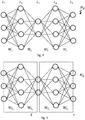
- Figure 4 is a representation of the architecture of the initial model M ⁇ .
- 5 layers are represented : the input layer L 1 , the output layer L 5 , and three hidden layers L 2 , L 3 , L 4 .
- the parameters (or weights) of the initial model M ⁇ are noted W 1 , W 2 , W 3 , W 4 .
- an adaptation step E20 the initial model M ⁇ is adapted to the target domain.
- the adapted model is noted M ⁇ .
- This adaptation step E20 comprises two preparing steps of copying E210, and dividing E220 the initial model to initialize the adapted model and an adaptation step per se E230 of the adapted model.
- the initial model M ⁇ is copied to the adapted model M ⁇ with its parameters during the copying step E210.
- the adapted model M ⁇ is divided into two parts: an encoder part E and a second part F. This division can be made at any layer of the initial model M ⁇ the output layer of the encoder part E being the input layer of the classification part F.
- Selecting this layer may be achieved after trial-and-error, for example using images of the source domain.
- the man skilled in the art may select this layer while taking into account that:
- Figure 6 is similar to Figure 2 .
- ⁇ the set of parameters of the encoder part E of the initial model M ⁇
- f ⁇ the set of features from the source domain x s output of the encoder part E of the initial model M ⁇
- ⁇ the set of parameters of the second part F.
- the adapted model M ⁇ is adapted to the target domain by using random images x s of the source domain and random images x t of the target domain. No correspondence exists between these images.
- the adapted model M ⁇ has the same architecture as the initial model M ⁇ , only the weights W E i of the encoder part E being adapted.
- the adaption comprises minimizing a function f of distances D1 and D2 detailed below.
- f is in the form of ( ⁇ D 2 + ⁇ D 1), where ⁇ and ⁇ are real positive numbers.
- the adaptation step E230 is represented by Figure 8 .
- the adaptation step E230 comprises a step E234 of measuring:
- the adapted model M ⁇ is optimized (by adapting the weights of the encoder part at step E238) such that the probabilities distributions Pr p and Pr q are similar for source and target domain features (measured by difference D2 ) and the accuracy of the source domain does not degrade (measured by D1, F being unchanged).
- the step E238 of adapting the parameters W E i of said encoder part E uses a self-supervision loss to measure the first distance D1.
- the second distance D2 can be obtained statistically using a maximum mean discrepancy MMD metric.
- the second distance D2 is obtained by a second neural network used to train adversarially the said encoder part Eto adapt (E238) its parameters W E i .
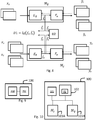
- Figure 9 represents a system 100 for adapting an initial model of a neural network according to one embodiment of the invention.
- This system comprises a preparing module PM and an adapting module AM.
- the preparing module is configured to obtain an initial model M ⁇ which has been trained with labeled images x s , y ⁇ s of a source domain, to copy this initial model into an adapted model M ⁇ and to divide the adapted model into an encoder part E and a second part F.
- the adapting module AM is configured to adapt the adapted model M ⁇ to a target domain x t using random images x s of the source domain and random images x t of the target domain as mentioned before.
- Figure 10 represents the architecture of the system of Figure 9 according to one embodiment of the invention.
- the system 100 is a computer. It comprises a processor 101, a read only memory 102, and two flash memories 103A, 103B.
- the read only memory 102 comprises a computer program PG comprising instructions to execute a method of adapting an initial model as mentioned above when it is executed by the processor 101.
- flash memory 103A comprises the initial model M ⁇ and flash memory 103 B comprises the adapted model M ⁇ .
- Flash memories 103A and 103 B constitute a storage means according to an embodiment of the invention.
- the initial model M ⁇ and the adapted model M ⁇ are stored in different zones of a same flash memory.
- a flash memory constitutes a storage means according to another embodiment of the invention.
- Figure 11 represents a vehicle 300 comprising an image acquisition module 301 and a system 302 comprising a model trained by the method as described above to perform semantic segmentation on the images acquired by the image acquisition module.
- Figure 11 represents a vehicle 300 according to one embodiment of the invention. It comprises an image acquisition module 301 configured to acquire images, storage means 103B comprising an adapted model M ⁇ as mentioned above and a module 302 configured to classify the images acquired by the module 301 using the adapted model.
- the second part F is a classifier.
- the claims method adapts (at step E20) an initial model M ⁇ of a neural network into an adapted model M ⁇ , the initial model M ⁇ having been trained (at step E10) with labeled images of a source domain.
- these labeled images are images x s of the source domain, with their corresponding labeled images of ground truth y ⁇ s .
- the method comprises:
- the adapted model M ⁇ is adapted to a target domain x t using random images x s of the source domain and random images x t of the target domain while fixing the parameters W F i of the classification part and adapting (at step E238) the parameters W E i of the encoder part E, the adapted model M ⁇ minimizing the f function the two distances D1 and D2.
- the adapted model M ⁇ may be used to classify new images of the source domain or of said target domain.
Landscapes
- Engineering & Computer Science (AREA)
- Theoretical Computer Science (AREA)
- Physics & Mathematics (AREA)
- General Physics & Mathematics (AREA)
- Evolutionary Computation (AREA)
- Artificial Intelligence (AREA)
- Data Mining & Analysis (AREA)
- Health & Medical Sciences (AREA)
- Software Systems (AREA)
- Computing Systems (AREA)
- General Engineering & Computer Science (AREA)
- General Health & Medical Sciences (AREA)
- Life Sciences & Earth Sciences (AREA)
- Biophysics (AREA)
- Mathematical Physics (AREA)
- Biomedical Technology (AREA)
- Computational Linguistics (AREA)
- Molecular Biology (AREA)
- Computer Vision & Pattern Recognition (AREA)
- Multimedia (AREA)
- Databases & Information Systems (AREA)
- Medical Informatics (AREA)
- Bioinformatics & Cheminformatics (AREA)
- Bioinformatics & Computational Biology (AREA)
- Evolutionary Biology (AREA)
- Probability & Statistics with Applications (AREA)
- Image Analysis (AREA)
Abstract
- copying the initial model into the adapted model;
- dividing the adapted model into an encoder part (E) and a second part (F), wherein the second part (F) is configured to process features (f̂ s) output from said encoder part (E);
- adapting said adapted model to a target domain (xt ) using images (xs ) of the source and target domains while fixing the parameters (WF
- a distance (D1) between features (f̂s, fs ) of the source domain (xs ) output of the encoders (E) of the initial model and of the adapted model; and
- a distance (D2) measuring a distribution distance between probabilities (Pr(f̂
Description
- The present invention relates to the field of image processing and more precisely to the improvement of classification performance of neural networks.
- The invention finds a privileged application in the field of images classification for autonomous driving vehicles, but may be applied to process images of any type.
- Semantic information provides a valuable source for scene understanding around autonomous vehicles in order to plan their actions and make decisions.
- Semantic segmentation of those scenes allows recognizing cars, pedestrians, traffic lanes, etc. Therefore, semantic segmentation is the backbone technique for autonomous driving systems or other automated systems.
- Semantic image segmentation typically uses models such as neural networks to perform the segmentation. These models need to be trained.
- Training a model typically comprises inputting known images to the model. For these images, a predetermined semantic segmentation is already known (an operator may have prepared the predetermined semantic segmentations of each image by labelling the images). The output of the model is then evaluated in view of the predetermined semantic segmentation, and the parameters of the model are adjusted if the output of the model differs from the predetermined semantic segmentation of an image.
- In order to train a semantic segmentation model, a large number of images and predetermined semantic segmentations are necessary.
- For example, it has been observed that the visual condition in bad weather (in particular when there is fog blocking the line of sight) creates visibility problems for drivers and for automated systems. While sensors and computer vision algorithms are constantly getting better, the improvements are usually benchmarked with images taken during good and bright weather. Those methods often fail to work well in other weather conditions. This prevents the automated systems from actually being used: it is not conceivable for a vehicle to avoid varying weather conditions, and the vehicle has to be able to distinguish different objects during those conditions.
- It is thus desirable to train semantic segmentation models with varying weather images (images taken during multiple state of visibility due to weather conditions).
- However, obtaining semantic segmentation data during those varying weather conditions is particularly difficult and time-consuming.
- The invention proposes a method that may be used for adapting a model trained for images acquired in good weather conditions to other weather conditions.
- More particularly, according to a first aspect, the invention proposes a method of adapting an initial mode of a neural network into an adapted model, wherein the initial model has been trained with labeled images of a source domain, said method comprising:
- copying the initial model into the adapted model;
- dividing the adapted model into an encoder part and a second part, wherein the second part is configured to process features output from the encoder part;
- adapting the adapted model to a target domain using random images of the source domain and random images of the target domain while fixing the parameters of the second part and adapting the parameters of the encoder part.
- The adapted model minimizes a function of the two following distances:
- a first distance D1 measuring a distance between features of the source domain output of the encoder part of the initial model and features of the source domain output of the encoder part of the adapted model ; and
- a second distance D2 measuring a distribution distance between probabilities of these features obtained for images of the source domain and probabilities of these features obtained for images of the target domain.
- The adapted model may be used for processing new images of the source domain or of the target domain.
- In a particular embodiment of the invention, the adapted model may be used for classifying, or segmenting the new images. The adapted model may also be used for creating bounding boxes enclosing pixels of the new images. The adapted model may also be used to identify a predetermined object in the new images. The adapted model may also be used to compute a measure of the new images, eg a light intensity.
- From a very general point of view, the invention proposes a method of adapting a model trained for images of a source domain to images of a target domain.
- In one application of the invention, images of the source domain are images acquired in high visibility conditions and images of the target domain are images acquired in low visibility conditions.
- Also, the expressions "low visibility conditions" and "high visibility conditions" merely indicate that the visibility (for example according to a criterion set by the person skilled in the art) is better under the "high visibility conditions" than under the "low visibility conditions, the gap between the two visibility conditions can be chosen by the person skilled in the art according to the application.
- According to the invention the adapted model is based on a trained model which has been trained for images of the source domain.
- This trained model provides good accuracy for the images of the source domain but not for images of the target domain.
- According to the invention, the adapted model is obtained by adapting weights of an encoder part of the trained model, the architecture of the trained model and the weights of the second part of the trained model being unchanged. This results in a shorter adaptation training time by considerably reducing the complexity of the adaptation while preserving a good accuracy for images of the source domain.
- The cut of the initial trained model into an encoder part and a second part can be made at any layer of the initial model.
- Selecting this layer may be achieved after trial-and-error, for example using images of the source domain. The man skilled in the art may select this layer while taking into account that:
- this layer must be deep enough so that the features output of the encoder vary enough;
- this layer be deep enough to have enough features to calculate the relevant distributions probabilities of D2;
- this layer should not be too deep, to avoid too high complexity for calculating D1 and D2.
- The invention provides two distances D1 and D2.
- D1 measures the distance between features of the source domain output of the encoder part of the initial model and features of the source domain output of the encoder part of the adapted model. This measure represents how the accuracy of the processing of images of the source domain degrades.
- D2 measures a distribution distance between probabilities of features obtained for images of the source domain and probabilities of features obtained for images of the target domain. For D2 to be relevant, images of the target domain must statistically represent the same scenes as the images of the source domain but the invention does not require a correspondence among images of these two domains. D2 then represents the capacity of the adapted model to process images of the source domain and images of the target domain with the same accuracy.
- Function f being based on D1 and D2, the invention provides an adapted model which is optimized such that the probability distributions are similar for source and target domains features while keeping the accuracy of the processing of images of the source domain close to the one achieved with the trained initial model.
- The adapted model is therefore adapted to process new images of the source domain or of the target domain, in other words images acquired whatever the visibility conditions.
- According to a particular embodiment, the function is in the form of (µD2+λD1), where µ and λ are positive real numbers.
- Thes parameters µ and λ may be used to balance the weights of distances D1 or D2.
- Other functions f based on D1 and D2 may be used. Preferably the function must be increasing of D1 and increasing of D2.
- According to a particular embodiment, the step of adapting the parameters of the encoder part uses a self-supervision loss to measure the first distance D1.
- Therefore, in this embodiment, unlabelled images are used for adapting the trained model to the adapted model, labelled-images being used only for training the initial model. This embodiment avoids the need for annotating images or obtaining semantic segmentation data in the target domain, for example for varying visibility conditions.
- Measuring D2, the distribution distance between probabilities of features obtained for images of the source domain and probabilities of features obtained for images of the target domain, is complex.
- In one embodiment, this distance is obtained statistically using a maximum mean discrepancy (MMD) metric.
- According to another embodiment, the second distance D2 is obtained by a second neural network used to train adversarially said encoder part to adapt the parameters of the adapted model.
- The second neural network is therefore trained to learn how to measure D2.
- In this embodiment, the second neural network may be for example a 1st order Wasserstein neural network or a Jensen-Shannon neural network.
- For more information about adversarially training, the man skilled in the art may in particular refer to:
- T.-H. Vu, H. Jain, M. Bucher, M. Cord, and P. Pérez: "ADVENT: Adversarial Entropy Minimization for Domain Adaptation in Semantic Segmentation," in CVPR, 2019) : or
- Y. Luo, L. Zheng, T. Guan, J. Yu, and Y. Yang, "Taking A Closer Look at Domain Shift: Category-level Adversaries for Semantics Consistent Domain Adaptation," in CVPR, 2019, pp. 2507-2516).
- According to a second aspect, the invention concerns a system for adapting an initial model of a neural network into an adapted model wherein the initial model has been trained with labeled images of a source domain, said system comprising:
- a preparing module configured to copy the initial model into the adapted model and to divide the adapted model into an encoder part and a second part, wherein the second part is configured to process features output from the encoder part; and
- an adapting module configured to adapt said adapted model to a target domain using random images of the source domain and random images of the target domain while fixing the parameters of said second part and adapting the parameters of said encoder part, said adapted model minimizing a function of the two following distances: - a first distance measuring a distance between features of the source domain output of the encoder part of the initial model and features of the source domain output of the encoder part of the adapted model; and
- a second distance measuring a distribution distance between probabilities of these features obtained for images of the source domain and probabilities of these features obtained for images of the target domain,
- In one embodiment of the invention, the system is a computer comprising a processor configured to execute the instructions of a computer program.
- According to a third aspect, the invention related to a computer program comprising instructions to execute a method of adapting an initial model as mentioned above.
- The invention also relate to storage means comprising:
- an initial model of a neural network which has been trained with labelled images of a source domain; and
- an adapted model obtained by adaptation of said initial model using an adaptation method as mentioned above,
- The invention also concerns a vehicle comprising an image acquisition module configured to acquire images, storage means comprising an adapted model as mentioned above and a module configured to process the acquired images using the adapted model.
- How the present invention may be put into effect will now be described by way of example with reference to the appended drawings, in which:
-
Figure 1 shows a flow chart of a method of adapting an initial model of a neural network according to one embodiment of the invention. -
Figure 2 represents an example of the training of an initial model. -
Figure 3 gives examples of images that can be used in the invention. -
Figures 4 and 5 represent the architectures of the initial model and of the adapted model. -
Figure 6 represents an encoder part and a second part of the initial model ofFigure 2 during the training. -
Figure 7 represents an encoder part and a second part of the target model during adaptation. -
Figure 8 represents an adaptation step that may be used in a specific embodiment of the invention. -
Figure 9 represents a system for adapting an initial model of a neural network according to one embodiment of the invention. -
Figure 10 represents the architecture of the system ofFigure 9 according to one embodiment of the invention. -
Figure 11 represents a vehicle according to one embodiment of the invention. - Reference will now be made in detail to exemplary embodiments of the disclosure, examples of which are illustrated in the accompanying drawings. Wherever possible, the same reference numbers will be used throughout the drawings to refer to the same or like parts.
-
Figure 1 shows a flow chart of a method of adapting an initial model M γ̂ of a neural network according to one embodiment of the invention. - The invention has been implemented with Segnet, MobileNeyV2 and DeepLabV3 but others architectures may be used.
- More precisely, the method of the invention adapts the initial model M γ̂ trained with source domain images xs obtained in high visibility conditions to images of a target domain xt obtained in low visibility conditions (eg dark, foggy or snowy conditions).
- At step E10, the initial model M γ̂ is trained with source domain images xs obtained in high visibility conditions.
- As shown on
Figures 2 and 3 , labeled images ŷs are obtained. This training step E10 uses ground truth images y̅s for the source domain. Onfigure 2 and subsequent figures, the dotted arrow represents the back-propagation. -
Figure 3 represents examples of images xs of the source domain, with their corresponding labeled images of ground truth y̅s and ŷs labeled images output by the initial model M γ̂. The specific example ofFigure 3 represents an image xs represented a scene obtained in high visibility conditions, the labeled image ŷs in which a sign, a sidewalk, a car and a road have been detected and an image xt of the target domain, ie an image of the same scene obtained in low visibility conditions. -
Figure 4 is a representation of the architecture of the initial model M γ̂. In this example, 5 layers are represented : the input layer L 1, the output layer L 5, and three hidden layers L 2, L 3, L 4 . The parameters (or weights) of the initial model M γ̂ are noted W 1 , W 2 , W 3 , W 4 . - In an adaptation step E20, the initial model M γ̂ is adapted to the target domain. The adapted model is noted Mγ. This adaptation step E20 comprises two preparing steps of copying E210, and dividing E220 the initial model to initialize the adapted model and an adaptation step per se E230 of the adapted model.
- The initial model M γ̂ is copied to the adapted model Mγ with its parameters during the copying step E210.
- Then, at step E220, the adapted model Mγ is divided into two parts: an encoder part E and a second part F. This division can be made at any layer of the initial model M γ̂ the output layer of the encoder part E being the input layer of the classification part F.
- Selecting this layer may be achieved after trial-and-error, for example using images of the source domain. The man skilled in the art may select this layer while taking into account that:
- this layer must be deep enough so that the features output of the encoder vary enough;
- this layer be deep enough to have enough features to calculate the relevant distributions probabilities of D2;
- this layer should not be too deep, to avoid too high complexity for calculating D1 and D2.
- From experience, a good accuracy may be achieved when the cut is made between the 2nd and the 6th layers for networks of size in between 10 and 15 layers.
-
Figure 5 represents the architecture of the adapted model M γ after the dividing step E220 assuming that the cut was made on layer L 3 of the initial model M γ̂. If we respectively note WEi the weights of the encoder part E and WFi the weights of the second part F, then after step E220: W E1 = W 1; W E2 = W 2; W F1 = W 3 and W F2 = W 4 . -
Figure 6 is similar toFigure 2 . InFigure 6 , we note θ̂ the set of parameters of the encoder part E of the initial model M γ̂, f̂s the set of features from the source domain xs output of the encoder part E of the initial model M γ̂ and α the set of parameters of the second part F. - During the adaptation step E230, the adapted model Mγ is adapted to the target domain by using random images xs of the source domain and random images xt of the target domain. No correspondence exists between these images.
- According to the invention, the adapted model Mγ has the same architecture as the initial model M γ̂, only the weights WE
i of the encoder part E being adapted. - As represented on
Figure 7 , we note: - ys the segmentation of images of the source domain;
- yt the segmentation of images of the target domain with the adapted model Mγ ;
- θ the set of parameters of the encoder part Eof the adapted model Mγ ; and
- fs the set of features from the source domain xs output of the encoder part Eof the adapted model Mγ.
- The set α of parameters of the second part Fis unchanged.
- According to the invention, the adaption comprises minimizing a function f of distances D1 and D2 detailed below.
- In this specific embodiment, f is in the form of (µD2 + λD1), where λ and µ are real positive numbers.
- The adaptation step E230 is represented by
Figure 8 . - The adaptation step E230 comprises a step E234 of measuring:
- a first distance D1 between (i) the features f̂ s of the source domain xs output of the encoder part Eof the initial model M γ̂ and (ii) the features fs of the source domain xs output of the encoder part E of the adapted model Mγ ; and
- a second distance D2 between (i) the probabilities Pr ( f̂
s )∼p of features obtained for images xs of the source domain and (ii) the probabilities Pr(Eθ (xt ))~q of features obtained for images xt of the target domain. - The adapted model Mγ is optimized (by adapting the weights of the encoder part at step E238) such that the probabilities distributions Prp and Prq are similar for source and target domain features (measured by difference D2) and the accuracy of the source domain does not degrade (measured by D1, F being unchanged).
- In this specific embodiment, the step E238 of adapting the parameters WE
i of said encoder part E uses a self-supervision loss to measure the first distance D1. - In this specific embodiment, this optimization consists in minimizing, f = (µD2 + λD1) (step E236) where µ and λ are real parameters that can be adjusted to balance D1 and D2.
- In one embodiment, at step E234, the second distance D2 can be obtained statistically using a maximum mean discrepancy MMD metric.
- But in the specific embodiment described here, the second distance D2 is obtained by a second neural network used to train adversarially the said encoder part Eto adapt (E238) its parameters WE
i . -
Figure 9 represents asystem 100 for adapting an initial model of a neural network according to one embodiment of the invention. - This system comprises a preparing module PM and an adapting module AM.
- The preparing module is configured to obtain an initial model M γ̂ which has been trained with labeled images xs, y̅s of a source domain, to copy this initial model into an adapted model Mγ and to divide the adapted model into an encoder part E and a second part F.
- The adapting module AM is configured to adapt the adapted model Mγ to a target domain xt using random images xs of the source domain and random images xt of the target domain as mentioned before.
-
Figure 10 represents the architecture of the system ofFigure 9 according to one embodiment of the invention. - In this specific embodiment, the
system 100 is a computer. It comprises aprocessor 101, a read onlymemory 102, and twoflash memories - The read only
memory 102 comprises a computer program PG comprising instructions to execute a method of adapting an initial model as mentioned above when it is executed by theprocessor 101. - In this specific embodiment,
flash memory 103A comprises the initial model M γ̂ andflash memory 103 B comprises the adapted model M γ̂. -
Flash memories - In another embodiment, the initial model M γ̂ and the adapted model Mγ are stored in different zones of a same flash memory. Such a flash memory constitutes a storage means according to another embodiment of the invention.
-
Figure 11 represents avehicle 300 comprising animage acquisition module 301 and asystem 302 comprising a model trained by the method as described above to perform semantic segmentation on the images acquired by the image acquisition module. -
Figure 11 represents avehicle 300 according to one embodiment of the invention. It comprises animage acquisition module 301 configured to acquire images, storage means 103B comprising an adapted model Mγ as mentioned above and amodule 302 configured to classify the images acquired by themodule 301 using the adapted model. - In the specific embodiment described before, the second part F is a classifier.
- The claims method adapts (at step E20) an initial model M γ̂ of a neural network into an adapted model Mγ, the initial model M γ̂ having been trained (at step E10) with labeled images of a source domain.
- In this specific embodiments, these labeled images are images xs of the source domain, with their corresponding labeled images of ground truth y̅s .
- The method comprises:
- copying (at step E210) the initial model M γ̂ into the adapted model Mγ ;
- dividing (at step E220) the adapted model Mγ into an encoder part E and a classification part F configured to process features f̂s output from the encoder part E.
- The adapted model Mγ is adapted to a target domain xt using random images xs of the source domain and random images xt of the target domain while fixing the parameters WF
i of the classification part and adapting (at step E238) the parameters WEi of the encoder part E, the adapted model Mγ minimizing the f function the two distances D1 and D2. - The adapted model Mγ may be used to classify new images of the source domain or of said target domain.
Claims (10)
- A method of adapting (E20) an initial model (M γ̂) of a neural network into an adapted model (Mγ ), wherein the initial model (M γ̂) has been trained (E10) with labeled images (xs , y̅s ) of a source domain, said method comprising:- copying (E210) the initial model (M γ̂) into the adapted model (Mγ );- dividing (E220) the adapted model (Mγ ) into an encoder part (E) and a second part (F), wherein the second part (F) is configured to process features (f̂s ) output from said encoder part (E);- adapting said adapted model (Mγ ) to a target domain (xt ) using random images (xs ) of the source domain and random images (xt ) of the target domain while fixing the parameters (WF
i ) of said second part (F) and adapting (E238) the parameters (WEi ) of said encoder part (E), said adapted model (Mγ ) minimizing (E236) a function (f) of the following two distances:- a first distance (D1) measuring (E234) a distance between features (f̂s ) of the source domain (xs ) output of the encoder part (E) of the initial model (M γ̂) and features (f̂s ) of the source domain (xs ) output of the encoder part (E) of the adapted model (Mγ ); and- a second distance (D2) measuring (E234) a distribution distance between probabilities (Pr(f̂said adapted model (Mγ ) being used for processing new images of said source domain or of said target domain.s )∼p) of said features obtained for images (xs ) of the source domain and probabilities (Pr (E(θ (xt )∼q ) of said features obtained for images (xt ) of the target domain, - The method of Claim 1 wherein said function (f) is in the form of (µD2 + λD1), where µ and λ are positive real numbers.
- The method of Claim 1 or 2 adapted model (Mγ ) of claim 1, wherein adapting the parameters (WE
i ) of said encoder part (E) uses (E238) a self-supervision loss to measure said first distance (D1). - The method of any one of claims 1 to 3, wherein said second distance (D2) is obtained (E234) by a second neural network used to train adversarially said encoder part (E) to adapt said parameters (WE
i ) of said adapted model (Mγ ). - The method of claim 4 wherein said second neural network is a 1st order Wasserstein (W-GAN) neural network or a Jensen-Shannon (GAN) neural network.
- The method of any one of claims 1 to 5, wherein said second distance (D2) is obtained statistically using a maximum mean discrepancy (MMD) metric.
- A system (100) for adapting (E20) an initial model (M γ̂) of a neural network into an adapted model (Mγ ), wherein the initial model (M γ̂) has been trained (E10) with labeled images (xs , y̅s ) of a source domain, said system comprising:- a preparing module (PM) configured to copy (E210) the initial model (M γ̂) into the adapted model (Mγ ) and to divide (E220) the adapted model (Mγ ) into an encoder part (E) and a second part (F), wherein the second part (F) is configured to process features (f̂s ) output from said encoder part (E); and- an adapting module (AM) configured to adapt said adapted model (Mγ ) to a target domain (xt ) using random images (xs ) of the source domain and random images (xt ) of the target domain while fixing the parameters (WF
i ) of said second part (F) and adapting (E238) the parameters (WEi ) of said encoder part (E), said adapted model (Mγ ) minimizing (E236) a function (f) of the following two distances:- a first distance (D1) measuring (E234) a distance between features (f̂s ) of the source domain (xs ) output of the encoder part (E) of the initial model (M γ̂) and features (f̂s ) of the source domain (xs ) output of the encoder part (E) of the adapted model (Mγ ); and- a second distance (D2) measuring (E234) a distribution distance between probabilities (Pr ( f̂ s)∼p) of said features obtained for images (xs ) of the source domain and probabilities (Pr (E(said adapted model (Mγ ) being used for processing new images of said source domain or of said target domain.θ (xt ))∼q) of said features obtained for images (xt ) of the target domain, - A computer program (PG) comprising instructions to execute a method of adapting an initial model according to any one of Claims 1 to 6 when it is executed by a processor (101).
- Storage means comprising:- an initial model (M γ̂) of a neural network which has been trained (E10) with labeled images (xs , y̅s ) of a source domain; and- an adapted model (Mγ ) obtained by adaptation of said initial model using an adaptation method according to any one of Claims 1 to 7,wherein the initial model (M γ̂) and the adapted model (Mγ ) both have an encoder part (E) and a second part (F) configured to process features (f̂s, fs ) output from said encoder part (E), the second part of the initial model and the second part of the adapted model having the same parameters.said adapted model (Mγ ) being used to classify new images of said source domain or of said target domain.
- A vehicle comprising (300):- an image acquisition module (301) configured to acquire images ;- part or a storage means (103B) according to Claim 9 comprising an adapted model (Mγ ) ;and- a module (302) configured to process said acquired images using said adapted model.
Priority Applications (3)
| Application Number | Priority Date | Filing Date | Title |
|---|---|---|---|
| EP20305205.5A EP3872695B1 (en) | 2020-02-28 | 2020-02-28 | A method and system of adapting an initial model of a neural network |
| US17/184,815 US20210271979A1 (en) | 2020-02-28 | 2021-02-25 | Method, a system, a storage portion and a vehicle adapting an initial model of a neural network |
| CN202110220777.9A CN113326931B (en) | 2020-02-28 | 2021-02-26 | Method, system, storage part and vehicle for adapting initial model of neural network |
Applications Claiming Priority (1)
| Application Number | Priority Date | Filing Date | Title |
|---|---|---|---|
| EP20305205.5A EP3872695B1 (en) | 2020-02-28 | 2020-02-28 | A method and system of adapting an initial model of a neural network |
Publications (3)
| Publication Number | Publication Date |
|---|---|
| EP3872695A1 true EP3872695A1 (en) | 2021-09-01 |
| EP3872695C0 EP3872695C0 (en) | 2025-09-24 |
| EP3872695B1 EP3872695B1 (en) | 2025-09-24 |
Family
ID=69845301
Family Applications (1)
| Application Number | Title | Priority Date | Filing Date |
|---|---|---|---|
| EP20305205.5A Active EP3872695B1 (en) | 2020-02-28 | 2020-02-28 | A method and system of adapting an initial model of a neural network |
Country Status (3)
| Country | Link |
|---|---|
| US (1) | US20210271979A1 (en) |
| EP (1) | EP3872695B1 (en) |
| CN (1) | CN113326931B (en) |
Cited By (1)
| Publication number | Priority date | Publication date | Assignee | Title |
|---|---|---|---|---|
| CN119205572A (en) * | 2024-11-26 | 2024-12-27 | 齐鲁工业大学(山东省科学院) | An unsupervised medical video smoke removal method and program product |
Families Citing this family (2)
| Publication number | Priority date | Publication date | Assignee | Title |
|---|---|---|---|---|
| KR102869896B1 (en) * | 2019-12-12 | 2025-10-14 | 삼성전자주식회사 | Operating apparatus, operating method, and training method of network based on domain adaptation |
| US11272097B2 (en) * | 2020-07-30 | 2022-03-08 | Steven Brian Demers | Aesthetic learning methods and apparatus for automating image capture device controls |
Citations (2)
| Publication number | Priority date | Publication date | Assignee | Title |
|---|---|---|---|---|
| US20190130220A1 (en) * | 2017-10-27 | 2019-05-02 | GM Global Technology Operations LLC | Domain adaptation via class-balanced self-training with spatial priors |
| US20190244107A1 (en) * | 2018-02-06 | 2019-08-08 | Hrl Laboratories, Llc | Domain adaption learning system |
Family Cites Families (15)
| Publication number | Priority date | Publication date | Assignee | Title |
|---|---|---|---|---|
| CN104318215B (en) * | 2014-10-27 | 2017-09-19 | 中国科学院自动化研究所 | A Cross-View Face Recognition Method Based on Domain Robust Convolutional Feature Learning |
| CN105069842A (en) * | 2015-08-03 | 2015-11-18 | 百度在线网络技术(北京)有限公司 | Modeling method and device for three-dimensional model of road |
| WO2017212459A1 (en) * | 2016-06-09 | 2017-12-14 | Sentient Technologies (Barbados) Limited | Content embedding using deep metric learning algorithms |
| CN106529605B (en) * | 2016-11-28 | 2019-06-11 | 东华大学 | Image recognition method of convolutional neural network model based on immune theory |
| CN107392246A (en) * | 2017-07-20 | 2017-11-24 | 电子科技大学 | A kind of background modeling method of feature based model to background model distance |
| CN110399929B (en) * | 2017-11-01 | 2023-04-28 | 腾讯科技(深圳)有限公司 | Fundus image classification method, fundus image classification apparatus, and computer-readable storage medium |
| CN108345860A (en) * | 2018-02-24 | 2018-07-31 | 江苏测联空间大数据应用研究中心有限公司 | Personnel based on deep learning and learning distance metric recognition methods again |
| CN108874889B (en) * | 2018-05-15 | 2021-01-12 | 中国科学院自动化研究所 | Target body retrieval method, system and device based on target body image |
| KR102695519B1 (en) * | 2018-07-02 | 2024-08-14 | 삼성전자주식회사 | Method and device to build image model |
| US11494612B2 (en) * | 2018-10-31 | 2022-11-08 | Sony Interactive Entertainment Inc. | Systems and methods for domain adaptation in neural networks using domain classifier |
| CN109523526B (en) * | 2018-11-08 | 2021-10-22 | 腾讯科技(深圳)有限公司 | Tissue nodule detection and its model training method, device, equipment and system |
| US10963644B2 (en) * | 2018-12-27 | 2021-03-30 | Microsoft Technology Licensing, Llc | Computer-implemented generation and utilization of a universal encoder component |
| EP3767536B1 (en) * | 2019-07-17 | 2025-02-19 | Naver Corporation | Latent code for unsupervised domain adaptation |
| CN110570433B (en) * | 2019-08-30 | 2022-04-22 | 北京影谱科技股份有限公司 | Image semantic segmentation model construction method and device based on generation countermeasure network |
| US11138441B2 (en) * | 2019-12-06 | 2021-10-05 | Baidu Usa Llc | Video action segmentation by mixed temporal domain adaption |
-
2020
- 2020-02-28 EP EP20305205.5A patent/EP3872695B1/en active Active
-
2021
- 2021-02-25 US US17/184,815 patent/US20210271979A1/en not_active Abandoned
- 2021-02-26 CN CN202110220777.9A patent/CN113326931B/en active Active
Patent Citations (2)
| Publication number | Priority date | Publication date | Assignee | Title |
|---|---|---|---|---|
| US20190130220A1 (en) * | 2017-10-27 | 2019-05-02 | GM Global Technology Operations LLC | Domain adaptation via class-balanced self-training with spatial priors |
| US20190244107A1 (en) * | 2018-02-06 | 2019-08-08 | Hrl Laboratories, Llc | Domain adaption learning system |
Non-Patent Citations (4)
| Title |
|---|
| JIAN SHEN ET AL: "Wasserstein Distance Guided Representation Learning for Domain Adaptation", ARXIV.ORG, CORNELL UNIVERSITY LIBRARY, 201 OLIN LIBRARY CORNELL UNIVERSITY ITHACA, NY 14853, 5 July 2017 (2017-07-05), XP081309302 * |
| SANKARANARAYANAN SWAMI ET AL: "Learning from Synthetic Data: Addressing Domain Shift for Semantic Segmentation", 2018 IEEE/CVF CONFERENCE ON COMPUTER VISION AND PATTERN RECOGNITION, IEEE, 18 June 2018 (2018-06-18), pages 3752 - 3761, XP033476346, DOI: 10.1109/CVPR.2018.00395 * |
| T.-H. VUH. JAINM. BUCHERM. CORDP. PEREZ: "ADVENT: Adversarial Entropy Minimization for Domain Adaptation in Semantic Segmentation", CVPR, 2019 |
| Y. LUOL. ZHENGT. GUANJ. YUY. YANG: "Taking A Closer Look at Domain Shift: Category-level Adversaries for Semantics Consistent Domain Adaptation", CVPR, 2019, pages 2507 - 2516 |
Cited By (1)
| Publication number | Priority date | Publication date | Assignee | Title |
|---|---|---|---|---|
| CN119205572A (en) * | 2024-11-26 | 2024-12-27 | 齐鲁工业大学(山东省科学院) | An unsupervised medical video smoke removal method and program product |
Also Published As
| Publication number | Publication date |
|---|---|
| EP3872695C0 (en) | 2025-09-24 |
| US20210271979A1 (en) | 2021-09-02 |
| CN113326931A (en) | 2021-08-31 |
| EP3872695B1 (en) | 2025-09-24 |
| CN113326931B (en) | 2024-04-30 |
Similar Documents
| Publication | Publication Date | Title |
|---|---|---|
| US11580328B1 (en) | Semantic labeling of point clouds using images | |
| CN110874564B (en) | Method and device for detecting vehicle line by classifying vehicle line post-compensation pixels | |
| US8773535B2 (en) | Adaptation for clear path detection using reliable local model updating | |
| US11386674B2 (en) | Class labeling system for autonomous driving | |
| Mu et al. | Lane detection based on object segmentation and piecewise fitting | |
| CN102682301B (en) | Adaptation for clear path detection with additional classifiers | |
| EP3872695B1 (en) | A method and system of adapting an initial model of a neural network | |
| KR102043089B1 (en) | Method for extracting driving lane, device and computer readable medium for performing the method | |
| CN112488220B (en) | A small target detection method based on deep learning | |
| US20240177499A1 (en) | Method for detecting lane lines and electronic device | |
| Saravanarajan et al. | Improving semantic segmentation under hazy weather for autonomous vehicles using explainable artificial intelligence and adaptive dehazing approach | |
| CN114882462A (en) | Method and device for identifying and tracking multiple targets in road environment | |
| CN109003286A (en) | Lane segmentation method based on deep learning and laser radar | |
| KR102223324B1 (en) | Apparatus and method for determining status of vehicle LED lighting based on average grayscale ratio | |
| CN117152715A (en) | A panoramic driving perception system and method based on improved YOLOP | |
| Sankaranarayanan et al. | Pre-processing framework with virtual mono-layer sequence of boxes for video based vehicle detection applications | |
| CN115482352A (en) | Method and apparatus for training machine learning algorithms | |
| CN115943432A (en) | Method for determining imaging degradation of an imaging sensor | |
| US12230010B2 (en) | Training of classifiers and/or regressors on uncertain training data | |
| CN119027755A (en) | A method for image target detection in low-light superimposed fog environment based on three-stage distillation of APL-Net | |
| CN116958899A (en) | Urban road waterlogging prediction method, device and application based on video analysis | |
| El-Khoreby et al. | Vehicle detection and counting using adaptive background model based on approximate median filter and triangulation threshold techniques | |
| US20260057490A1 (en) | Image analysis method and image analysis system | |
| US20250377987A1 (en) | Method for real time analysis | |
| Tabassam et al. | Methodology for Detecting Feature Availability Focusing on Sensor |
Legal Events
| Date | Code | Title | Description |
|---|---|---|---|
| PUAI | Public reference made under article 153(3) epc to a published international application that has entered the european phase |
Free format text: ORIGINAL CODE: 0009012 |
|
| STAA | Information on the status of an ep patent application or granted ep patent |
Free format text: STATUS: REQUEST FOR EXAMINATION WAS MADE |
|
| 17P | Request for examination filed |
Effective date: 20200228 |
|
| AK | Designated contracting states |
Kind code of ref document: A1 Designated state(s): AL AT BE BG CH CY CZ DE DK EE ES FI FR GB GR HR HU IE IS IT LI LT LU LV MC MK MT NL NO PL PT RO RS SE SI SK SM TR |
|
| STAA | Information on the status of an ep patent application or granted ep patent |
Free format text: STATUS: EXAMINATION IS IN PROGRESS |
|
| 17Q | First examination report despatched |
Effective date: 20230626 |
|
| REG | Reference to a national code |
Ref country code: DE Ref legal event code: R079 Free format text: PREVIOUS MAIN CLASS: G06K0009000000 Ipc: G06V0010764000 Ref country code: DE Ref legal event code: R079 Ref document number: 602020059262 Country of ref document: DE Free format text: PREVIOUS MAIN CLASS: G06K0009000000 Ipc: G06V0010764000 |
|
| GRAP | Despatch of communication of intention to grant a patent |
Free format text: ORIGINAL CODE: EPIDOSNIGR1 |
|
| STAA | Information on the status of an ep patent application or granted ep patent |
Free format text: STATUS: GRANT OF PATENT IS INTENDED |
|
| RIC1 | Information provided on ipc code assigned before grant |
Ipc: G06V 20/58 20220101ALI20250414BHEP Ipc: G06V 10/82 20220101ALI20250414BHEP Ipc: G06V 10/764 20220101AFI20250414BHEP |
|
| INTG | Intention to grant announced |
Effective date: 20250429 |
|
| GRAS | Grant fee paid |
Free format text: ORIGINAL CODE: EPIDOSNIGR3 |
|
| GRAA | (expected) grant |
Free format text: ORIGINAL CODE: 0009210 |
|
| STAA | Information on the status of an ep patent application or granted ep patent |
Free format text: STATUS: THE PATENT HAS BEEN GRANTED |
|
| AK | Designated contracting states |
Kind code of ref document: B1 Designated state(s): AL AT BE BG CH CY CZ DE DK EE ES FI FR GB GR HR HU IE IS IT LI LT LU LV MC MK MT NL NO PL PT RO RS SE SI SK SM TR |
|
| REG | Reference to a national code |
Ref country code: GB Ref legal event code: FG4D |
|
| REG | Reference to a national code |
Ref country code: CH Ref legal event code: EP |
|
| REG | Reference to a national code |
Ref country code: DE Ref legal event code: R096 Ref document number: 602020059262 Country of ref document: DE |
|
| REG | Reference to a national code |
Ref country code: IE Ref legal event code: FG4D |
|
| U01 | Request for unitary effect filed |
Effective date: 20251021 |
|
| U07 | Unitary effect registered |
Designated state(s): AT BE BG DE DK EE FI FR IT LT LU LV MT NL PT RO SE SI Effective date: 20251027 |
|
| PG25 | Lapsed in a contracting state [announced via postgrant information from national office to epo] |
Ref country code: NO Free format text: LAPSE BECAUSE OF FAILURE TO SUBMIT A TRANSLATION OF THE DESCRIPTION OR TO PAY THE FEE WITHIN THE PRESCRIBED TIME-LIMIT Effective date: 20251224 |
|
| PG25 | Lapsed in a contracting state [announced via postgrant information from national office to epo] |
Ref country code: HR Free format text: LAPSE BECAUSE OF FAILURE TO SUBMIT A TRANSLATION OF THE DESCRIPTION OR TO PAY THE FEE WITHIN THE PRESCRIBED TIME-LIMIT Effective date: 20250924 |
|
| PG25 | Lapsed in a contracting state [announced via postgrant information from national office to epo] |
Ref country code: GR Free format text: LAPSE BECAUSE OF FAILURE TO SUBMIT A TRANSLATION OF THE DESCRIPTION OR TO PAY THE FEE WITHIN THE PRESCRIBED TIME-LIMIT Effective date: 20251225 |
|
| PG25 | Lapsed in a contracting state [announced via postgrant information from national office to epo] |
Ref country code: RS Free format text: LAPSE BECAUSE OF FAILURE TO SUBMIT A TRANSLATION OF THE DESCRIPTION OR TO PAY THE FEE WITHIN THE PRESCRIBED TIME-LIMIT Effective date: 20251224 |
|
| U20 | Renewal fee for the european patent with unitary effect paid |
Year of fee payment: 7 Effective date: 20260106 |
|
| PG25 | Lapsed in a contracting state [announced via postgrant information from national office to epo] |
Ref country code: SM Free format text: LAPSE BECAUSE OF FAILURE TO SUBMIT A TRANSLATION OF THE DESCRIPTION OR TO PAY THE FEE WITHIN THE PRESCRIBED TIME-LIMIT Effective date: 20250924 |
|
| PG25 | Lapsed in a contracting state [announced via postgrant information from national office to epo] |
Ref country code: ES Free format text: LAPSE BECAUSE OF FAILURE TO SUBMIT A TRANSLATION OF THE DESCRIPTION OR TO PAY THE FEE WITHIN THE PRESCRIBED TIME-LIMIT Effective date: 20250924 |
|
| PG25 | Lapsed in a contracting state [announced via postgrant information from national office to epo] |
Ref country code: IS Free format text: LAPSE BECAUSE OF FAILURE TO SUBMIT A TRANSLATION OF THE DESCRIPTION OR TO PAY THE FEE WITHIN THE PRESCRIBED TIME-LIMIT Effective date: 20260124 |
|
| PG25 | Lapsed in a contracting state [announced via postgrant information from national office to epo] |
Ref country code: CZ Free format text: LAPSE BECAUSE OF FAILURE TO SUBMIT A TRANSLATION OF THE DESCRIPTION OR TO PAY THE FEE WITHIN THE PRESCRIBED TIME-LIMIT Effective date: 20250924 |
|
| PG25 | Lapsed in a contracting state [announced via postgrant information from national office to epo] |
Ref country code: PL Free format text: LAPSE BECAUSE OF FAILURE TO SUBMIT A TRANSLATION OF THE DESCRIPTION OR TO PAY THE FEE WITHIN THE PRESCRIBED TIME-LIMIT Effective date: 20250924 |
|
| PG25 | Lapsed in a contracting state [announced via postgrant information from national office to epo] |
Ref country code: SK Free format text: LAPSE BECAUSE OF FAILURE TO SUBMIT A TRANSLATION OF THE DESCRIPTION OR TO PAY THE FEE WITHIN THE PRESCRIBED TIME-LIMIT Effective date: 20250924 |
|
| U1N | Appointed representative for the unitary patent procedure changed after the registration of the unitary effect |
Representative=s name: MARKS & CLERK LLP; GB |