EP3869961B1 - New abamectin soluble concentrate composition (sl) - Google Patents
New abamectin soluble concentrate composition (sl) Download PDFInfo
- Publication number
- EP3869961B1 EP3869961B1 EP19789989.1A EP19789989A EP3869961B1 EP 3869961 B1 EP3869961 B1 EP 3869961B1 EP 19789989 A EP19789989 A EP 19789989A EP 3869961 B1 EP3869961 B1 EP 3869961B1
- Authority
- EP
- European Patent Office
- Prior art keywords
- polyoxyethylene
- liter
- abamectin
- grams
- soluble concentrate
- Prior art date
- Legal status (The legal status is an assumption and is not a legal conclusion. Google has not performed a legal analysis and makes no representation as to the accuracy of the status listed.)
- Active
Links
Images

Classifications
-
- A—HUMAN NECESSITIES
- A01—AGRICULTURE; FORESTRY; ANIMAL HUSBANDRY; HUNTING; TRAPPING; FISHING
- A01N—PRESERVATION OF BODIES OF HUMANS OR ANIMALS OR PLANTS OR PARTS THEREOF; BIOCIDES, e.g. AS DISINFECTANTS, AS PESTICIDES OR AS HERBICIDES; PEST REPELLANTS OR ATTRACTANTS; PLANT GROWTH REGULATORS
- A01N25/00—Biocides, pest repellants or attractants, or plant growth regulators, characterised by their forms, or by their non-active ingredients or by their methods of application, e.g. seed treatment or sequential application; Substances for reducing the noxious effect of the active ingredients to organisms other than pests
- A01N25/02—Biocides, pest repellants or attractants, or plant growth regulators, characterised by their forms, or by their non-active ingredients or by their methods of application, e.g. seed treatment or sequential application; Substances for reducing the noxious effect of the active ingredients to organisms other than pests containing liquids as carriers, diluents or solvents
-
- A—HUMAN NECESSITIES
- A01—AGRICULTURE; FORESTRY; ANIMAL HUSBANDRY; HUNTING; TRAPPING; FISHING
- A01N—PRESERVATION OF BODIES OF HUMANS OR ANIMALS OR PLANTS OR PARTS THEREOF; BIOCIDES, e.g. AS DISINFECTANTS, AS PESTICIDES OR AS HERBICIDES; PEST REPELLANTS OR ATTRACTANTS; PLANT GROWTH REGULATORS
- A01N25/00—Biocides, pest repellants or attractants, or plant growth regulators, characterised by their forms, or by their non-active ingredients or by their methods of application, e.g. seed treatment or sequential application; Substances for reducing the noxious effect of the active ingredients to organisms other than pests
- A01N25/30—Biocides, pest repellants or attractants, or plant growth regulators, characterised by their forms, or by their non-active ingredients or by their methods of application, e.g. seed treatment or sequential application; Substances for reducing the noxious effect of the active ingredients to organisms other than pests characterised by the surfactants
-
- A—HUMAN NECESSITIES
- A01—AGRICULTURE; FORESTRY; ANIMAL HUSBANDRY; HUNTING; TRAPPING; FISHING
- A01N—PRESERVATION OF BODIES OF HUMANS OR ANIMALS OR PLANTS OR PARTS THEREOF; BIOCIDES, e.g. AS DISINFECTANTS, AS PESTICIDES OR AS HERBICIDES; PEST REPELLANTS OR ATTRACTANTS; PLANT GROWTH REGULATORS
- A01N43/00—Biocides, pest repellants or attractants, or plant growth regulators containing heterocyclic compounds
- A01N43/90—Biocides, pest repellants or attractants, or plant growth regulators containing heterocyclic compounds having two or more relevant hetero rings, condensed among themselves or with a common carbocyclic ring system
-
- A—HUMAN NECESSITIES
- A01—AGRICULTURE; FORESTRY; ANIMAL HUSBANDRY; HUNTING; TRAPPING; FISHING
- A01P—BIOCIDAL, PEST REPELLANT, PEST ATTRACTANT OR PLANT GROWTH REGULATORY ACTIVITY OF CHEMICAL COMPOUNDS OR PREPARATIONS
- A01P7/00—Arthropodicides
Definitions
- the present invention relates to a new abamectin soluble concentrate composition (SL).
- SL abamectin soluble concentrate composition
- Insecticides are applied to crop foliage in order to protect the leaves, fruit or flowers from damage caused by insect pests.
- the application is usually carried out by spraying the crop with the insecticide in a carrier liquid, which is often water, but can also be an organic liquid such as diesel.
- the carrier liquid evaporates and leaves spray deposits behind on the plant foliage, which consist of the insecticide and other nonvolatile components from the formulation.
- Abamectin has intrinsic activity against several pests, such as thrips, mites and leafminers species among other insects. It is known that abamectin exhibits a translaminar movement but only a small % of abamectin enters the leaf. Abamectin that does not enter the leaf is photo-degraded after a short period of time. Thus, there is a need to design new formulations of abamectin which enable more active ingredient to enter the leaf.
- Abamectin is a crystalline solid with a melting point of 162-169 °C and a water solubility of 1.2 parts per million (" The Pesticide Manual", 15th Ed., British Crop Protection Council, 2009 ). Poorly water-soluble pesticides such as abamectin may be formulated to give spray liquids in which they are dissolved.
- One option is to make an emulsifiable concentrate where the insecticide is dissolved in a suitable organic solvent together with surfactant.
- Microemulsions are another known type of agrochemical formulation for poorly water-soluble pesticides where the active ingredient is dissolved but in contrast to an emulsifiable concentrate some organic solvent is replaced by water and surfactants. Microemulsions contain typically 20 to 30 % by weight of organic solvent (Narayanan & Chaudry, Pesticide Formulations and Application Systems Vol.12, ASTM, 1993), so they still rely on organic solvents. US2017354142 proposes formulations of abamectin with ethoxylated sorbitan oleates.
- the formulation according to the current invention provides improved uptake of abamectin into the leave compared to commercial EC abamectin formulations and that without the addition of further adjuvants. This can be observed by a significant reduction in the amount of abamectin required to achieve the same protection in the field, i.e. a so-called rate reduction.
- the formulation of the current invention is stable over a long period of time even at high storage temperatures and exhibits little degradation of abamectin. All these technical effects are achieved by the soluble concentrate (SL) formulations according to the following embodiments.
- the invention provides a soluble concentrate composition comprising
- the invention provides a soluble concentrate composition according to embodiment 1 comprising
- the invention provides a soluble concentrate composition according to embodiment 1 or 2 comprising
- Polyoxyethylene (20) sorbitan monolaurate (commercial brand names include Montanox 20 ® , Polysorbate 20 ® , PEG(20)sorbitan monolaurate ® , Alkest TW 20 ® and Tween 20 ® ) is a polysorbate-type non-ionic surfactant formed by the ethoxylation of sorbitan before the addition of lauric acid.
- Polyoxyethylene (20) sorbitan monooleate (commercial brand names include Montanox 80 ® , Alkest TW 80 ® , Tween 80 ® and Polysorbate 80 ® ) is a polysorbate-type non-ionic surfactant formed by the ethoxylation of sorbitan before the addition of oleic acid.
- the soluble concentrate composition according to any one of claims 1 to 4, wherein the pH of a 1% solution of the soluble concentrate composition in deionized water is in the range of 3 to 4.5, preferably in the range of 3.5 to 4.5.
- pH adjusting agent includes any agent capable of adjusting the pH.
- a soluble concentrate composition according to any one of embodiments 1 to 6, wherein pH adjusting agent is an anionic phosphate ester.
- a soluble concentrate composition according to embodiment 7 and 7.1 wherein the amount of anionic phosphate ester in the range from 5 to 25 grams/liter.
- a soluble concentrate composition according to any one of embodiments 1 to 7, wherein the fatty alcohol alkoxylate is ethoxylated or propoxylated or both of them.
- a method for the preparation of a soluble concentrate composition comprising the step of dissolving abamectin in a solution of polyoxyethylene (20) sorbitan monolaurate, polyoxyethylene (20) sorbitan monooleate and fatty alcohol alkoxylate by heating the solution to a temperature of maximum 45°C.
- a method of reducing or preventing insect damage in a plant comprising applying a composition according to any one of embodiments 1 to 8 to the plant.
- the plants are selected from tomato, pepper, potato, banana, eggplant, mango, onion, watermelon, apple, pear, citrus fruit, coffee, oriental melon, cotton, soybean, cucumber, pome fruits, stone fruits, strawberry, curcurbits, melon, pumpkin, squash, cabbage, chilli, okra, papaya and tea.
- the plants are selected from curcurbits, pepper, tomato, onion, melon, pumpkin, watermelon, citrus fruit, cucumber, eggplant, oriental melon, pear, pome fruits, squash, strawberry, cabbage and chilli.
- compositions of the present invention mean compositions according to any one of embodiments 1 to 8.
- the improved biological activity of the soluble concentrate compositions according to the present invention is demonstrated in the biological data presented in the experimental section.
- the treatment is up to double as effective as when the same amount of abamectin is applied to plants by using an aqueous dilution of the standard commercial emulsion concentrate.
- This has many advantages such as for example environmentally friendlier application of abamectin, i.e. less abamectin is sprayed onto fields which is important as abamectin is hightly toxic and thus needs to be handled with great care.
- the current invention provides a method for controlling a pest comprising diluting a composition according to any one of embodiments 1 to 8 with a suitable liquid carrier, in particular an aqueous liquid carrier, such as water or liquid fertilizer, and then applying the dilute composition to the plant propagation material, plant or locus thereof.
- a suitable liquid carrier in particular an aqueous liquid carrier, such as water or liquid fertilizer
- the dilute composition is applied by in furrow or T-band type application.
- the composition of the present invention may also be combined in a continuous flow apparatus with water in spray application equipment, such that no holding tank is required for the diluted product.
- active ingredients such as herbicides, plant growth regulators, algicides, fungicides, bactericides, viricides, insecticides, acaridicdes, nematicides or molluscicides may be present in the soluble concentrate compositions of the present invention or may be added as a tank-mix partner to the dilute spray compositions prepared therefrom.
- the soluble concentrate compositions of the invention may further comprise other additives.
- additives include safeners, thickeners, flow enhancers, wetting agents, antifoaming agents, biocides, buffers, chelating agents, lubricants, fillers, drift control agents, deposition enhancers, evaporation retardants, frost protecting agents, insect attracting odor agents, UV protecting agents, fragrances, and the like. These additives are known to a person skilled in the art.
- Table 1 shows that Abamectin formulations A-D are not stable under storage conditions. The formulations show failures like cloudiness and precipitates which are not acceptable for commercial formulations.
- Antifoams used (trade names): AFO1 RMAS 30 AFO2 Antifoam MSA AFO3 SAG 1572 AFO4 Silex SE-2 AFO5 Silwet L-7002
- Table 2 shows that the dissolution of the formulation in water is highly sensitive to the amounts and type of surfactants.
- Figure 1 shows the amount of abamectin remaining after storing samples for 4 weeks at 54°C.
- Formulations with a similar composition as Formulation G in Table 2 were used.
- the amount of abamectin remaining in the formulations was calculated as follows: 100% (reference value) represents the mean of the starting value as well as all cold stored reference samples that are run alongside the hot stored samples as an analytical reference at each timepoint for one batch.
- the amount of abamectin remaining was calculated at the end of the tests as follows: Measurement of the abamectin content / Average reference value * 100% .
- Figure 1 shows clearly that abamectin degrades under storage conditions in formulations.
- Table 3 Formulation K L M N O P Component g/L g/L g/L g/L g/L g/L g/L Abamectin 18 18 18 18 18 18 Silicone antifoam emulsion 0.2 0.2 0.2 0.2 0.2 0.2 fatty alcohol alkoxylate 180 180 180 180 180 Citric acid - 3 - - - - polyoxyethylene tridecyl phosphate ester - - 2.5 - 10 - Lactic acid 50% - - - 3 - - Phosphoric acid 85% - - - - - 3.5 polyoxyethylene (20) sorbitan monolaurate and polyoxyethylene (20) sorbitan monooleate Rest Rest Rest Rest Rest Rest Ratio of polyoxyethylene (20) sorbitan monolaurate to polyoxyethylene (20) sorbitan monooleate 1 : 7 1 : 7 1
- Table 3 shows that abamectin degrades under storage conditions unless the pH is in the range of 3 to 4.5.
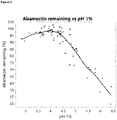
- Figure 2 shows the amount of abamectin remaining after storing the samples for 4 weeks at 54°C.
- Formulations with a similar composition as Formulation K in Table 3 were used.
- the pH of the formulation at a 1% dilution with deionized water was varied from below 3 to 6.5 using various amounts of polyoxyethylene tridecyl phosphate ester.
- the amount of abamectin remaining in the formulations was calculated as follows: 100% (reference value) represents the mean of the starting value as well as all cold stored reference samples that are run alongside the hot stored samples as an analytical reference at each timepoint for one batch.
- the amount of abamectin remaining was calculated at the end of the tests as follows: Measurement of the abamectin content / Average reference value * 100 % .
- Figure 2 shows clearly that abamectin degrades under storage conditions unless the pH of a 1% dilution of the formulation is kept in the range of 3 to 4.5, preferably 3.5 to 4.5.
- ABAM SL can provide similar level of control on the target pest using between 25 and 50% less active ingredient than ABA EC.
- crops pome fruits, stone fruits, mango trees and citrus trees among other fruit trees, for field and greenhouse vegetables, for cotton and tea.
- mites e.g. Tetranychus spp., Panonychus spp., broad mites, rust mites
- dipteran leafminers e.g. Liriomyza trifoli
- Okra plants variety MH 179 were planted in a field in Coimbatore, India, and were naturally infested by Liriomyza trifolii. Field was divided in plots of 20 m 2 (45 cm row spacing and 30 cm within row) with 3 replicates per treatment. Trial design was completely randomized. Two foliar applications were made, first when okra was at the vegetative stage of BBCH 14-15 and the second application was done 7 days later at BBCH 15-16.
- Water volume spray was 350 L/ha.There were ten treatments in total: 1) water sprayed check, 2) ABA EC at 0.27 g ai/hl, 3) ABA EC at 0.54 g ai/hl, 4) ABA EC at 1.08 g ai/hl, 5) ABA EC at 1.8 g ai/hl, 6) ABA SL at 0.135 g ai/hl, 7) ABA SL at 0.27 g ai/hl, 8) ABA SL at 0.54 g ai/hl, 9) ABA SL at 1.08 g ai/hl and 10) ABA SL at 1.8 g ai/hl.
- the BBCH-scale is a scale used to identify the phenological development stages of a plant. BBCH officially stands for "Biologische Bundesweg, Bundessortenamt und CHemische Industrie”.
- ABA SL formulation had an improved efficacy (%Ctrl of mines) when it was compared to the ABA EC formulation at the same dose rate.
- Results show ABA SL at 0.54 g ai/hl achieved the same level of control on damage on plants than 1.08 gai/hl of ABA EC. This means that ABA SL provided 50% dose rate reduction compared with the commercial standard ABA EC.
- Water volume spray was 250 L/ha for the 1 st application and 335 L/ha for the 2 nd application.There were ten treatments in total: 1) water sprayed check, 2) ABA EC at 0.675 g ai/hl, 3) ABA EC at 1.35 gai/hl, 4) ABA EC at 2.1 g ai/hl, 5) ABA EC at 2.7 g ai/hl, 6) ABA SL at 0.3375 g ai/hl, 7) ABA SL at 0.675 g ai/hl, 8) ABA SL at 1.35 g ai/hl, 9) ABA SL at 2.1 g ai/hl and 10) ABA SL at 2.7 g ai/hl.
- the BBCH-scale is a scale used to identify the phenological development stages of a plant. BBCH officially stands for "Biologische Bundesweg, Bundessortenamt und CHemische Industrie”.
- ABA SL formulation has an improved efficacy (% Ctrl of mobile insect stages) when it's compared to the EC formulation at the same dose rate.
- Results show ABA SL at 2.1 g ai/hl achieved same level of control on damage on plants than 1.35 g ai/hl of ABA EC.
- ABA SL provided 35% dose rate reduction of ABA EC.
- Table 5. %Ctrl of mobile stages of Scirtothrips dorsalis in chili open field.
- Papaya plants were planted in a field in Taiwan and were naturally infested by Tetranychus urticae. Papaya plants were distributed in rows (40 cm row spacing and 120 cm within row) with 3 replicates per treatment. Trial design was completely randomized. One foliar application was made when papaya plants were at the vegetative stage of BBCH 24-24.
- Water volume spray was 333 L/ha.There were nine treatments in total: 1) water-sprayed check, 2) ABA EC at 0.54 gai/hl, 3) ABA EC at 1.08 g ai/hl, 4) ABA EC at 1.8 gai/hl, 5) ABA SL at 0.27 g ai/hl, 6) ABA SL at 0.54 g ai/hl, 7) ABA SL at 0.81 g ai/hl, 8) ABA SL at 1.08 gai/hl and 9) ABA SL at 1.8 g ai/hl.
- the BBCH-scale is a scale used to identify the phenological development stages of a plant. BBCH officially stands for "Biologische Bundesweg, Bundessortenamt und CHemische Industrie”.
- ABAM SL formulation has an improved efficacy (%Ctrl of mobile insect stages) when it's compared to the EC formulation at the same dose rate.
- Results show ABA SL at 0.54 gai/hl achieved same level of control on damage on plants than 1.08 gai/hl of ABA EC.
- ABA SL provided 50% dose rate reduction of ABA EC.
- Table 6. %Ctrl of mobile stages of Tetranychus urticae in papaya open field.
- Cotton plants were planted in a field in Coimbatore, India and were naturally infested by Thrips palmi. Cotton plants were distributed in 20 m 2 plots (90 cm row spacing and 75 cm within row) with 3 replicates per treatment. Trial design was completely randomized. Two foliar applications were made within 7 days interval when cotton plants were at the vegetative stage of BBCH 19-22.
- Water volume spray were 350 and 400 L/ha for the 1 st and 2 nd foliar spray respectively.There were ten treatments in total: 1) water-sprayed check, 2) ABA EC at 0.54 g ai/hl, 3) ABA EC at 1.08 g ai/hl, 4) ABA EC at 2.16 g ai/hl, 5) ABA EC at 2.7 g ai/hl, 6) ABA SL at 0.54 g ai/hl, 7) ABA SL at 0.81 g ai/hl, 8) ABA SL at 1.08 g ai/hl and 9) ABA SL at 1.8 gai/hl.
- the BBCH-scale is a scale used to identify the phenological development stages of a plant. BBCH officially stands for "Biologische Bundesweg, Bundessortenamt und CHemische Industrie”.
- ABA SL formulation has an improved efficacy (%Ctrl of mobile insect stages) when it's compared to the EC formulation at the same dose rate.
- Results show ABA SL at 1.08 gai/hl achieved same level of control on damage on plants than 2.16 gai/hl of ABA EC.
- ABA SL provided 50% dose rate reduction of ABA EC.
- Table 7. %Ctrl of mobile stages of Thrips palmi in cotton open field.
Landscapes
- Life Sciences & Earth Sciences (AREA)
- General Health & Medical Sciences (AREA)
- Health & Medical Sciences (AREA)
- Engineering & Computer Science (AREA)
- Pest Control & Pesticides (AREA)
- Plant Pathology (AREA)
- Wood Science & Technology (AREA)
- Zoology (AREA)
- Environmental Sciences (AREA)
- Agronomy & Crop Science (AREA)
- Dentistry (AREA)
- Toxicology (AREA)
- General Chemical & Material Sciences (AREA)
- Chemical Kinetics & Catalysis (AREA)
- Chemical & Material Sciences (AREA)
- Insects & Arthropods (AREA)
- Agricultural Chemicals And Associated Chemicals (AREA)
- Preparation Of Compounds By Using Micro-Organisms (AREA)
- Catching Or Destruction (AREA)
- Peptides Or Proteins (AREA)
Description
- The present invention relates to a new abamectin soluble concentrate composition (SL). Such a formulation compositionsfind use in agriculture to control pests harmful to commercial crops, including ornamental plants.
- Insecticides are applied to crop foliage in order to protect the leaves, fruit or flowers from damage caused by insect pests. The application is usually carried out by spraying the crop with the insecticide in a carrier liquid, which is often water, but can also be an organic liquid such as diesel. The carrier liquid evaporates and leaves spray deposits behind on the plant foliage, which consist of the insecticide and other nonvolatile components from the formulation.
- It is well-established that the efficacy of an insecticide is improved when it exists in the spray deposit in a dissolved or amorphous form and not as crystals such that the insecticide molecules can diffuse more freely through the external cuticles of the leaf and insect pests. Faster penetration of the insecticide into the leaf is an advantage when it is required that the insecticide be active against insects living inside the leaf such as the larvae of leaf miners or when the insecticide should be available on the underside of the leaf such as during an infestation with red spider mites. Faster penetration of the insecticide into insect tissues is also an advantage leading to better control of pests with a lower overall insecticide concentration, i.e. the amount of active ingredient can be reduced.
- Abamectin has intrinsic activity against several pests, such as thrips, mites and leafminers species among other insects. It is known that abamectin exhibits a translaminar movement but only a small % of abamectin enters the leaf. Abamectin that does not enter the leaf is photo-degraded after a short period of time. Thus, there is a need to design new formulations of abamectin which enable more active ingredient to enter the leaf.
- Abamectin is a crystalline solid with a melting point of 162-169 °C and a water solubility of 1.2 parts per million ("The Pesticide Manual", 15th Ed., British Crop Protection Council, 2009). Poorly water-soluble pesticides such as abamectin may be formulated to give spray liquids in which they are dissolved. One option is to make an emulsifiable concentrate where the insecticide is dissolved in a suitable organic solvent together with surfactant. It is a disadvantage of conventional emulsifiable concentrates that high amounts of organic solvents must be used to dissolve the active ingredient, typically from 30 to 90% by weight in an emulsifiable concentrate formulation (EC) (Knowles, Chemistry and Technology of Agrochemical Formulations, Kluwer Academic Publishers, 1998). High amounts of organic solvents can be undesirable in crop protection products due to the odour, potential for increasing human skin and eye irritation or toxicity, environmental considerations and cost.
- Microemulsions are another known type of agrochemical formulation for poorly water-soluble pesticides where the active ingredient is dissolved but in contrast to an emulsifiable concentrate some organic solvent is replaced by water and surfactants. Microemulsions contain typically 20 to 30 % by weight of organic solvent (Narayanan & Chaudry, Pesticide Formulations and Application Systems Vol.12, ASTM, 1993), so they still rely on organic solvents.
US2017354142 proposes formulations of abamectin with ethoxylated sorbitan oleates. - There remains a need to provide abamectin soluble concentrate formulations which are free of organic solvents, show long term stability of abamectin in solution, do not exhibit formulation failures such as flake formation or active ingredient degradation during storage and lead to improved uptake of abamectin into the leave.
- The formulation according to the current invention provides improved uptake of abamectin into the leave compared to commercial EC abamectin formulations and that without the addition of further adjuvants. This can be observed by a significant reduction in the amount of abamectin required to achieve the same protection in the field, i.e. a so-called rate reduction. At the same time, the formulation of the current invention is stable over a long period of time even at high storage temperatures and exhibits little degradation of abamectin. All these technical effects are achieved by the soluble concentrate (SL) formulations according to the following embodiments.
- In a first aspect, as
embodiment 1, the invention provides a soluble concentrate composition comprising - (i) abamectin;
- (ii) polyoxyethylene (20) sorbitan monolaurate;
- (iii) polyoxyethylene (20) sorbitan monooleate;
- As
embodiment 2, the invention provides a soluble concentrate composition according toembodiment 1 comprising - (i) abamectin;
- (ii) 250-750 grams/liter of the composition of polyoxyethylene (20) sorbitan monolaurate;
- (iii) 50-550 grams/liter of the composition of polyoxyethylene (20) sorbitan monooleate.
- As
embodiment 3, the invention provides a soluble concentrate composition according toembodiment - (i) abamectin;
- (ii) 250-750 grams/liter of the composition polyoxyethylene (20) sorbitan monolaurate;
- (iii) 50-550 grams/liter of the composition of polyoxyethylene (20) sorbitan monooleate;
- (iv) 150-250 grams/liter of fatty alcohol alkoxylate.
- As
embodiment 4, there is provided a soluble concentrate composition according to any one ofembodiments 1 to 3 comprising - (i) abamectin;
- (ii) 250-350 grams/liter of the composition polyoxyethylene (20) sorbitan monolaurate;
- (iii) 450-550 grams/liter of the composition of polyoxyethylene (20) sorbitan monooleate;
- (iv) 150-250 grams/liter of fatty alcohol alkoxylate.
- Polyoxyethylene (20) sorbitan monolaurate (commercial brand names include Montanox 20®, Polysorbate 20®, PEG(20)sorbitan monolaurate®, Alkest TW 20® and Tween 20®) is a polysorbate-type non-ionic surfactant formed by the ethoxylation of sorbitan before the addition of lauric acid. Polyoxyethylene (20) sorbitan monooleate (commercial brand names include Montanox 80®, Alkest TW 80®, Tween 80® and Polysorbate 80®) is a polysorbate-type non-ionic surfactant formed by the ethoxylation of sorbitan before the addition of oleic acid.
- As
embodiment 5, the soluble concentrate composition according to any one ofclaims 1 to 4, wherein the pH of a 1% solution of the soluble concentrate composition in deionized water is in the range of 3 to 4.5, preferably in the range of 3.5 to 4.5. - As
embodiment 6, there is provided a soluble concentrate composition according to any one ofembodiments 1 to 5 comprising - (i) 10-50 grams/liter of the composition of abamectin;
- (ii) 250-350 grams/liter of the composition polyoxyethylene (20) sorbitan monolaurate;
- (iii) 450-550 grams/liter of the composition of polyoxyethylene (20) sorbitan monooleate;
- (iv) 150-250 grams/liter of fatty alcohol alkoxylate; and
- (v) a pH adjusting agent.
- The term "pH adjusting agent" as used herein includes any agent capable of adjusting the pH.
- As
embodiment 7, there is provided a soluble concentrate composition according to any one ofembodiments 1 to 6, wherein pH adjusting agent is an anionic phosphate ester. - As embodiment 7.1, there is provided a soluble concentrate composition according to
embodiment 7, wherein the buffer is an anionic polyoxyethylene tridecyl phosphate ester. - As embodiment 7.2, there is provided a soluble concentrate composition according to
embodiment 7 and 7.1, wherein the amount of anionic phosphate ester in the range from 5 to 25 grams/liter. - As
embodiment 8, there is provided a soluble concentrate composition according to any one ofembodiments 1 to 7, wherein the fatty alcohol alkoxylate is ethoxylated or propoxylated or both of them. - In a second aspect, as embodiment 9, there is provided a method for the preparation of a soluble concentrate composition according to any one of
embodiments 1 to 8 comprising the step of dissolving abamectin in a solution of polyoxyethylene (20) sorbitan monolaurate, polyoxyethylene (20) sorbitan monooleate and fatty alcohol alkoxylate by heating the solution to a temperature of maximum 45°C. - As embodiment 10, there is provided a method according to embodiment 9 comprising the additional step of cooling the solution back to ambient temperature and then adding a phosphate ester.
- In a third aspect, there is provided a method of reducing or preventing insect damage in a plant comprising applying a composition according to any one of
embodiments 1 to 8 to the plant. In particular, the plants are selected from tomato, pepper, potato, banana, eggplant, mango, onion, watermelon, apple, pear, citrus fruit, coffee, oriental melon, cotton, soybean, cucumber, pome fruits, stone fruits, strawberry, curcurbits, melon, pumpkin, squash, cabbage, chilli, okra, papaya and tea. - More particularly, the plants are selected from curcurbits, pepper, tomato, onion, melon, pumpkin, watermelon, citrus fruit, cucumber, eggplant, oriental melon, pear, pome fruits, squash, strawberry, cabbage and chilli.
- The term "compositions of the present invention", "compositions of the current inventions" or "inventive compositions" as used herein mean compositions according to any one of
embodiments 1 to 8. - The following advantages of the soluble concentrate composition of the present invention have been surprisingly found:
- (a) Prolonged storage stability, i.e. no occurrence of physical changes in the composition such as cloudiness, precipitation or flake building even over prolonged periods;
- (b) full dissolution of the concentrate when diluted in water;
- (c) excellent physical stability of the active ingredient abamectin;
- (d) improved biological activity compared to standard abamectin compositions.
- The improved biological activity of the soluble concentrate compositions according to the present invention is demonstrated in the biological data presented in the experimental section. In particular, when abamectin is applied to plants by using an aqueous dilution of the soluble concentrate compositions according to the present invention, then the treatment is up to double as effective as when the same amount of abamectin is applied to plants by using an aqueous dilution of the standard commercial emulsion concentrate. This means that a much smaller amount of abamectin concentrate according to the current invention is needed in practice compared to the current standard commercial abamectin concentrates in order to achieve the same insecticidal effects. This has many advantages such as for example environmentally friendlier application of abamectin, i.e. less abamectin is sprayed onto fields which is important as abamectin is hightly toxic and thus needs to be handled with great care.
- In a further aspect, the current invention provides a method for controlling a pest comprising diluting a composition according to any one of
embodiments 1 to 8 with a suitable liquid carrier, in particular an aqueous liquid carrier, such as water or liquid fertilizer, and then applying the dilute composition to the plant propagation material, plant or locus thereof. In another particular embodiment, the dilute composition is applied by in furrow or T-band type application. The composition of the present invention may also be combined in a continuous flow apparatus with water in spray application equipment, such that no holding tank is required for the diluted product. - Other active ingredients such as herbicides, plant growth regulators, algicides, fungicides, bactericides, viricides, insecticides, acaridicdes, nematicides or molluscicides may be present in the soluble concentrate compositions of the present invention or may be added as a tank-mix partner to the dilute spray compositions prepared therefrom.
- In addition, the soluble concentrate compositions of the invention may further comprise other additives. Such additives include safeners, thickeners, flow enhancers, wetting agents, antifoaming agents, biocides, buffers, chelating agents, lubricants, fillers, drift control agents, deposition enhancers, evaporation retardants, frost protecting agents, insect attracting odor agents, UV protecting agents, fragrances, and the like. These additives are known to a person skilled in the art.
- The following examples illustrate further the invention but are not intended to limit its scope.
-
Table 1: Formulation A B C D Component g/L g/L g/L g/L Abamectin 18 18 18 18 AFO1 1 AFO2 0.1 AFO3 0.3 AFO4 3 AFO5 5 fatty alcohol alkoxyate 180 180 180 180 polyoxyethylene (20) sorbitan monooleate Rest Rest Rest Rest Aspect after 2 weeks at 54°C Cloudy Clear Slightly flaky with precipitates Clear Aspect after 1 month at 54°C Cloudy Small flakes Slightly flaky with precipitates Small flakes Aspect after 3 months at room temperature Cloudy Slightly cloudy Clear Clear Aspect after 3 months at 54°C Cloudy Small precipitates Isolated flakes One flake g/L = grams / liter - Table 1 shows that Abamectin formulations A-D are not stable under storage conditions. The formulations show failures like cloudiness and precipitates which are not acceptable for commercial formulations.
- Antifoams used (trade names):
AFO1 RMAS 30 AFO2 Antifoam MSA AFO3 SAG 1572 AFO4 Silex SE-2 AFO5 Silwet L-7002 - The formulations E-J were diluted with water in cylinders. The cylinders were inverted 30 times and the dilutions checked for remains at the bottom.
Table 2: Formulation E F G H I J Component g/L g/L g/L g/L g/L g/L Abamectin 18 18 18 18 18 18 Silicone antifoam emulsion 0.3 0.3 0.3 0.3 0.5 0.5 fatty alcohol alkoxyate 180 180 180 180 180 180 polyoxyethylene (20) sorbitan monolaurate and polyoxyethylene (20) sorbitan monooleate Rest Rest Rest Rest Rest Rest Ratio of polyoxyethylene (20) sorbitan monolaurate to polyoxyethylene (20) sorbitan monooleate 1:7 1:3 1:1.7 1:1 1.7:1 15:1 Behavior in water Not dissolved Not dissolved Dissolved Dissolved Dissolved Dissolved g/L = grams / liter - Table 2 shows that the dissolution of the formulation in water is highly sensitive to the amounts and type of surfactants.
-
Figure 1 shows the amount of abamectin remaining after storing samples for 4 weeks at 54°C. Formulations with a similar composition as Formulation G in Table 2 were used. The amount of abamectin remaining in the formulations was calculated as follows:
100% (reference value) represents the mean of the starting value as well as all cold stored reference samples that are run alongside the hot stored samples as an analytical reference at each timepoint for one batch. The amount of abamectin remaining was calculated at the end of the tests as follows:
-
Figure 1 shows clearly that abamectin degrades under storage conditions in formulations.Table 3: Formulation K L M N O P Component g/L g/L g/L g/L g/L g/L Abamectin 18 18 18 18 18 18 Silicone antifoam emulsion 0.2 0.2 0.2 0.2 0.2 0.2 fatty alcohol alkoxylate 180 180 180 180 180 180 Citric acid - 3 - - - - polyoxyethylene tridecyl phosphate ester - - 2.5 - 10 - Lactic acid 50%- - - 3 - - Phosphoric acid 85%- - - - - 3.5 polyoxyethylene (20) sorbitan monolaurate and polyoxyethylene (20) sorbitan monooleate Rest Rest Rest Rest Rest Rest Ratio of polyoxyethylene (20) sorbitan monolaurate to polyoxyethylene (20) sorbitan monooleate 1 : 7 1 : 7 1 : 7 1 : 7 1 : 7 1 : 7 pH (1% in deionized water) 6.3 4.1 6.1 4.3 4.1 4.1 Al degradation (%) After 2 weeks at 54° C 30 N.d. 14 N.d. 3 0 After 1 month at 54° C 45 2 32 5 7 3.5 After 2 months at 54° C 70 2 44 9 N.d. N.d. After 3 months at 45°C N.d. N.d. N.d. N.d. 7 N.d. Physical aspects upon storage Clear solution Crystal growth after 1 month at 54° Clear solution Flakes formation after 1 month at 54°C Clear solution Flakes formation and turbidity observed after 1 month g/L = grams / liter
N.d.: not determined - Table 3 shows that abamectin degrades under storage conditions unless the pH is in the range of 3 to 4.5.
-
Figure 2 shows the amount of abamectin remaining after storing the samples for 4 weeks at 54°C. Formulations with a similar composition as Formulation K in Table 3 were used. The pH of the formulation at a 1% dilution with deionized water was varied from below 3 to 6.5 using various amounts of polyoxyethylene tridecyl phosphate ester. The amount of abamectin remaining in the formulations was calculated as follows:
100% (reference value) represents the mean of the starting value as well as all cold stored reference samples that are run alongside the hot stored samples as an analytical reference at each timepoint for one batch. The amount of abamectin remaining was calculated at the end of the tests as follows:
-
Figure 2 shows clearly that abamectin degrades under storage conditions unless the pH of a 1% dilution of the formulation is kept in the range of 3 to 4.5, preferably 3.5 to 4.5. -
- 1. Charge polyoxyethylene (20) sorbitan monooleate to vessel.
- 2. Charge polyoxyethylene (20) sorbitan monolaurate to vessel.
- 3. Charge fatty alcohol alkoxyate to vessel.
- 4. Charge abamectin.
- 5. Heating under stirring to a maximum of 45°C until complete dissolution of abamectin.
- 6. Temperature slowly cooled to room temperature.
- 7. Charge polyoxyethylene tridecyl phosphate ester.
- 8. Charge antifoam.
- 9. Filtration if needed.
- Field efficacy trials in several crops against key target insects comparing the inventive Abamectin soluble concentrate (ABA SL) against the commercial standard Abamectin emulsion concentrate (ABA EC). Both ABA SL and ABA EC had a concentration of 18 grams / liter.
- The following examples show that new formulated ABAM SL can provide similar level of control on the target pest using between 25 and 50% less active ingredient than ABA EC. This applies for the following crops: pome fruits, stone fruits, mango trees and citrus trees among other fruit trees, for field and greenhouse vegetables, for cotton and tea. Insect pests where the dose rate reduction has been observed: mites (e.g. Tetranychus spp., Panonychus spp., broad mites, rust mites), dipteran leafminers (e.g. Liriomyza trifolii and other Liriomyza spp.), thrips (e.g. Frankliniella occidentalis, Thrips palmi, Thrips tabaci, Scirtothrips spp.) and psyllids.
- Okra plants variety MH 179 were planted in a field in Coimbatore, India, and were naturally infested by Liriomyza trifolii. Field was divided in plots of 20 m2 (45 cm row spacing and 30 cm within row) with 3 replicates per treatment. Trial design was completely randomized. Two foliar applications were made, first when okra was at the vegetative stage of BBCH 14-15 and the second application was done 7 days later at BBCH 15-16. Water volume spray was 350 L/ha.There were ten treatments in total: 1) water sprayed check, 2) ABA EC at 0.27 g ai/hl, 3) ABA EC at 0.54 g ai/hl, 4) ABA EC at 1.08 g ai/hl, 5) ABA EC at 1.8 g ai/hl, 6) ABA SL at 0.135 g ai/hl, 7) ABA SL at 0.27 g ai/hl, 8) ABA SL at 0.54 g ai/hl, 9) ABA SL at 1.08 g ai/hl and 10) ABA SL at 1.8 g ai/hl. Level of efficacy of each treatment was assessed counting the damage on plants (assessing numbers of mines made by Liriomyza trifolii). Abbott's formula was used to transform the numbers of plants with mines into %Ctrl (Ctrl = control) of mines. Assessments were done at different days after application (DAA): 3DAA1 (3 days after application), 7DAA1 (7 days after application), 3DAA2, 7DAA2, 10DAA2 (10 days after application), 15DAA2 (15 days after application) and 20DAA2 (20 days after application). Statistical analysis was done using ANOVA and the Least Significant Difference (LSD) test by Fisher.
- g = gram
- ai = active ingredient
- hl = hectoliter = 100 liter
- L = liter
- ha = hectare
- The BBCH-scale is a scale used to identify the phenological development stages of a plant. BBCH officially stands for "Biologische Bundesanstalt, Bundessortenamt und CHemische Industrie".
- ABA SL formulation had an improved efficacy (%Ctrl of mines) when it was compared to the ABA EC formulation at the same dose rate. Results show ABA SL at 0.54 g ai/hl achieved the same level of control on damage on plants than 1.08 gai/hl of ABA EC. This means that ABA SL provided 50% dose rate reduction compared with the commercial standard ABA EC. The results are shown in Table 4.
Table 4. %Ctrl on mines of Liriomyza trifolii leafminers in okra open field Formulation Component Rate(s) g of ABA/hl 3DAA1 7DAA1 3DAA2 7DAA2 10DAA2 15DAA2 20DAA2 Average EC (commercial standard) 0.27 62 70 65 63 67 63 63 65 0.54 75 76 76 74 76 69 69 74 1.08 88 93 93 94 92 84 79 89 1.8 92 83 95 97 94 88 83 91 SL 0.135 56 73 72 68 71 66 62 67 0.27 65 76 78 75 79 78 76 76 0.54 85 90 91 92 90 85 82 88 1.08 94 97 96 97 94 90 88 94 1.8 96 98 97 97 94 90 89 95 Average number of insects in untreated plot 5.2 13.5 19.8 31.4 38.5 43.6 61.1 ABA = abamectin
hl = hectoliter = 100 liter
DAA = days after application
% Ctrl = % of control, calculated using Abbot's formula.
SL = ABA SL as given for formulation O in Table 3. - Chili variety Namdhari 1701 were planted in a field in Gujarat, India, and were naturally infested by Scirtothrips dorsalis. Field was divided in plots of 20 m2 (90 cm row spacing and 80 cm within row) with 3 replicates per treatment. Trial design was completely randomized. Two foliar applications were made, first when chili was at the vegetative stage of BBCH 24-24 and the second application was done 15 days later at BBCH 27-27.
- Water volume spray was 250 L/ha for the 1st application and 335 L/ha for the 2nd application.There were ten treatments in total: 1) water sprayed check, 2) ABA EC at 0.675 g ai/hl, 3) ABA EC at 1.35 gai/hl, 4) ABA EC at 2.1 g ai/hl, 5) ABA EC at 2.7 g ai/hl, 6) ABA SL at 0.3375 g ai/hl, 7) ABA SL at 0.675 g ai/hl, 8) ABA SL at 1.35 g ai/hl, 9) ABA SL at 2.1 g ai/hl and 10) ABA SL at 2.7 g ai/hl. Level of efficacy of each treatment was assessed counting the number of mobile stages of Scirtothrips on leaves (sample size: 25 leaves per plot). Abbott's formula was used to transform the numbers of mobile stages per plant into % Ctrl of mobile stages per plant. Assessments were done at different days after application (DAA): 3DAA1, 7DAA1, 10DAA1, 15DAA1, 5DAA2, 10DAA2, 15DAA2 and 20DAA2. Statistical analysis was done using ANOVA and the Least Significant Difference (LSD) test by Fisher. Abbot's formula:

- The BBCH-scale is a scale used to identify the phenological development stages of a plant. BBCH officially stands for "Biologische Bundesanstalt, Bundessortenamt und CHemische Industrie".
- ABA SL formulation has an improved efficacy (% Ctrl of mobile insect stages) when it's compared to the EC formulation at the same dose rate. Results show ABA SL at 2.1 g ai/hl achieved same level of control on damage on plants than 1.35 g ai/hl of ABA EC. ABA SL provided 35% dose rate reduction of ABA EC. The results are shown in Table 5.
Table 5. %Ctrl of mobile stages of Scirtothrips dorsalis in chili open field. Formulation Component Rate(s) g of ABA/hl 3DAA1 7DAA1 10DAA1 15DAA1 5DAA2 10DAA2 15DAA2 20DAA2 Average EC (commercial standard) 0.675 66 73 72 76 78 71 60 53 69 1.35 75 78 80 79 83 77 72 59 76 2.1 86 83 83 80 84 82 72 61 79 2.7 89 84 85 82 85 84 75 69 82 SL 0.3375 77 76 70 74 80 73 75 64 74 0.675 81 84 77 80 82 84 77 70 80 1.35 85 85 81 84 85 85 77 72 82 2.1 89 87 85 87 86 88 84 81 86 2.7 89 89 89 88 90 90 86 83 88 Average number of insects in untreated plot 46.7 47.7 38.3 54.7 51.7 56 65 75 ABA = abamectin
hl = hectoliter = 100 liter
DAA = days after application
% Ctrl = % of control, calculated using Abbot's formula.
SL = ABA SL as given for formulation O in Table 3. - Papaya plants were planted in a field in Taiwan and were naturally infested by Tetranychus urticae. Papaya plants were distributed in rows (40 cm row spacing and 120 cm within row) with 3 replicates per treatment. Trial design was completely randomized. One foliar application was made when papaya plants were at the vegetative stage of BBCH 24-24.
- Water volume spray was 333 L/ha.There were nine treatments in total: 1) water-sprayed check, 2) ABA EC at 0.54 gai/hl, 3) ABA EC at 1.08 g ai/hl, 4) ABA EC at 1.8 gai/hl, 5) ABA SL at 0.27 g ai/hl, 6) ABA SL at 0.54 g ai/hl, 7) ABA SL at 0.81 g ai/hl, 8) ABA SL at 1.08 gai/hl and 9) ABA SL at 1.8 g ai/hl. Level of efficacy of each treatment was assessed counting the number of mobile stages of Tetranychus urticae on leaves (sample size: 5 leaves per plot). Abbott's formula was used to transform the number of mobile insect stages into %Ctrl of mobile insect stages. Assessments were done at different days after application (DAA): 5DAA1, 10DAA1, 14DAA1and 21DAA2. Statistical analysis was done using ANOVA and the Least Significant Difference (LSD) test by Fisher. With the LSD test, treatments with no letter in common are significantly different at the 5% probability level. Abbot's formula:

- The BBCH-scale is a scale used to identify the phenological development stages of a plant. BBCH officially stands for "Biologische Bundesanstalt, Bundessortenamt und CHemische Industrie".
- ABAM SL formulation has an improved efficacy (%Ctrl of mobile insect stages) when it's compared to the EC formulation at the same dose rate. Results show ABA SL at 0.54 gai/hl achieved same level of control on damage on plants than 1.08 gai/hl of ABA EC. ABA SL provided 50% dose rate reduction of ABA EC. The results are shown in Table 6.
Table 6. %Ctrl of mobile stages of Tetranychus urticae in papaya open field. Formulation Component Rate(s) g of ABA/hl 5DAA1 10DAA1 14DAA1 21DAA1 Average EC (commercial standard) 0.54 88 82 85 53 77 1.08 90 91 94 74 88 1.8 94 98 99 88 95 SL 0.27 77 72 77 4 58 0.54 86 92 97 78 89 0.81 95 97 98 87 95 1.08 88 99 99 90 94 1.8 89 99 99 87 94 Average number of insects in untreated plot 146 224.3 348 189.9 ABA = abamectin
hl = hectoliter = 100 liter
DAA = days after application
% Ctrl = % of control, calculated using Abbot's formula.
SL = ABA SL as given for formulation O in Table 3. - Cotton plants were planted in a field in Coimbatore, India and were naturally infested by Thrips palmi. Cotton plants were distributed in 20 m2 plots (90 cm row spacing and 75 cm within row) with 3 replicates per treatment. Trial design was completely randomized. Two foliar applications were made within 7 days interval when cotton plants were at the vegetative stage of BBCH 19-22.
- Water volume spray were 350 and 400 L/ha for the 1st and 2nd foliar spray respectively.There were ten treatments in total: 1) water-sprayed check, 2) ABA EC at 0.54 g ai/hl, 3) ABA EC at 1.08 g ai/hl, 4) ABA EC at 2.16 g ai/hl, 5) ABA EC at 2.7 g ai/hl, 6) ABA SL at 0.54 g ai/hl, 7) ABA SL at 0.81 g ai/hl, 8) ABA SL at 1.08 g ai/hl and 9) ABA SL at 1.8 gai/hl. Level of efficacy of each treatment was assessed counting the number of number of nymphs and adults stages of Thrips palmi on leaves (sample size: 20 leaves per plot). Abbott's formula was used to transform the n° of nymphs and adults into %Ctrl of nymphs and 7DAA2, 10DAA2, 15DAA2 and 20DAA2. Statistical analysis was done using ANOVA and the Least Significant Difference (LSD) test by Fisher. Abbot's formula:

- The BBCH-scale is a scale used to identify the phenological development stages of a plant. BBCH officially stands for "Biologische Bundesanstalt, Bundessortenamt und CHemische Industrie".
- ABA SL formulation has an improved efficacy (%Ctrl of mobile insect stages) when it's compared to the EC formulation at the same dose rate. Results show ABA SL at 1.08 gai/hl achieved same level of control on damage on plants than 2.16 gai/hl of ABA EC. ABA SL provided 50% dose rate reduction of ABA EC. The results are shown in Table 7.
Table 7. %Ctrl of mobile stages of Thrips palmi in cotton open field. Formulation Component Rate(s) g of ABA/hl 3DAA1 7DAA1 3DAA2 7DAA2 10DAA2 15DAA2 20DAA2 Average EC (commercial standard) 0.54 67 63 70 67 59 57 45 62 1.08 82 76 93 88 77 76 64 80 2.16 88 82 97 90 83 78 66 84 2.7 100 92 99 94 90 83 70 90 SL 0.27 71 80 87 78 73 69 61 75 0.54 78 74 92 89 83 79 67 81 1.08 85 79 96 96 92 85 73 87 2.16 100 91 100 97 96 88 81 94 2.7 100 94 100 97 95 89 82 94 Average number of insects in untreated plot 9.8 12.3 13 14.4 17.5 19.4 18.6 ABA = abamectin
hl = hectoliter = 100 liter
DAA = days after application
% Ctrl = % of control, calculated using Abbot's formula.
SL = ABA SL as given for formulation O in Table 3.

Claims (13)
- A soluble concentrate composition comprising(i) abamectin;(ii) polyoxyethylene (20) sorbitan monolaurate;(iii) polyoxyethylene (20) sorbitan monooleate;wherein the weight ratio of polyoxyethylene (20) sorbitan monolaurate to polyoxyethylene (20) sorbitan monooleate is from 1 : 2.5 to 15 : 1.
- The soluble concentrate composition according to claim 1 comprising(i) abamectin;(ii) 250-750 grams/liter of the composition of polyoxyethylene (20) sorbitan monolaurate;(iii) 50-550 grams/liter of the composition of polyoxyethylene (20) sorbitan monooleate.
- The soluble concentrate composition according to claims 1 or 2 comprising(i) abamectin;(ii) 250-750 grams/liter of the composition polyoxyethylene (20) sorbitan monolaurate;(iii) 50-550 grams/liter of the composition of polyoxyethylene (20) sorbitan monooleate;(iv) 150-250 grams/liter of fatty alcohol alkoxylate.
- The soluble concentrate composition according to any one of claims 1 to 3 comprising(i) abamectin;(ii) 250-350 grams/liter of the composition polyoxyethylene (20) sorbitan monolaurate;(iii) 450-550 grams/liter of the composition of polyoxyethylene (20) sorbitan monooleate;(iv) 150-250 grams/liter of fatty alcohol alkoxylate.
- The soluble concentrate composition according to any one of claims 1 to 4,
wherein the pH of a 1 % solution of the composition in deionized water is in the range of 3 to 4.5. - The soluble concentrate composition according to any one of claims 1 to 5 comprising(i) 10-50 grams/liter of the composition of abamectin;(ii) 250-350 grams/liter of the composition polyoxyethylene (20) sorbitan monolaurate;(iii) 450-550 grams/liter of the composition of polyoxyethylene (20) sorbitan monooleate;(iv) 150-250 grams/liter of fatty alcohol alkoxylate; and(v) a pH adjusting agent.
- The soluble concentrate composition according to any one of claims 1 to 6, wherein the buffering agent is an anionic phosphate ester.
- The soluble concentrate composition according to any one of claims 1 to 7, wherein the fatty alcohol alkoxylate is ethoxylated or propoxylated or both of them.
- A method for the preparation of a soluble concentrate composition according to any one of claims 1 to 8 comprising the step- dissolving abamectin in a solution of polyoxyethylene (20) sorbitan monolaurate, polyoxyethylene (20) sorbitan monooleate and fatty alcohol alkoxylate by heating the solution to a temperature of maximum 45°C.
- The method according to claim 9 comprising the additional step- cooling the solution back to ambient temperature and then adding a phosphate ester.
- A method of reducing or preventing insect damage in a plant comprising applying a composition according to any one of claims 1 to 8 to the plant.
- The method according to claim 11 wherein the plant is selected from from tomato, pepper, potato, banana, eggplant, mango, onion, watermelon, apple, pear, citrus fruit, coffee, oriental melon, cotton, soybean, cucumber, pome fruits, stone fruits, strawberry, curcurbits, melon, pumpkin, squash, cabbage, chilli, okra, papaya and tea.
- The method according to claim 11 wherein the plant is selected from curcurbits, pepper, tomato, onion, melon, pumpkin, watermelon, citrus fruit, cucumber, eggplant, oriental melon, pear, pome fruits, squash, strawberry, cabbage and chilli.
Applications Claiming Priority (2)
| Application Number | Priority Date | Filing Date | Title |
|---|---|---|---|
| EP18202400 | 2018-10-24 | ||
| PCT/EP2019/078749 WO2020083925A1 (en) | 2018-10-24 | 2019-10-22 | New abamectin soluble concentrate composition (sl) |
Publications (2)
| Publication Number | Publication Date |
|---|---|
| EP3869961A1 EP3869961A1 (en) | 2021-09-01 |
| EP3869961B1 true EP3869961B1 (en) | 2022-12-07 |
Family
ID=63998512
Family Applications (1)
| Application Number | Title | Priority Date | Filing Date |
|---|---|---|---|
| EP19789989.1A Active EP3869961B1 (en) | 2018-10-24 | 2019-10-22 | New abamectin soluble concentrate composition (sl) |
Country Status (16)
| Country | Link |
|---|---|
| US (1) | US12185724B2 (en) |
| EP (1) | EP3869961B1 (en) |
| JP (1) | JP7429230B2 (en) |
| KR (1) | KR102767612B1 (en) |
| AU (1) | AU2019365385B2 (en) |
| CO (1) | CO2021005188A2 (en) |
| CR (1) | CR20210194A (en) |
| EA (1) | EA202191071A1 (en) |
| ES (1) | ES2939010T3 (en) |
| HU (1) | HUE061099T2 (en) |
| MA (1) | MA53966A (en) |
| MX (1) | MX2021004335A (en) |
| PH (1) | PH12021550625A1 (en) |
| TW (1) | TWI818102B (en) |
| UA (1) | UA127796C2 (en) |
| WO (1) | WO2020083925A1 (en) |
Family Cites Families (15)
| Publication number | Priority date | Publication date | Assignee | Title |
|---|---|---|---|---|
| US1135113A (en) | 1913-05-08 | 1915-04-13 | Frank I Hitchcock | Vapor-heater for internal-combustion engines. |
| US20060293260A1 (en) | 2005-05-24 | 2006-12-28 | Wyeth | Useful high load concentrate compositions for control of ecto-and endo-parasites |
| AR056808A1 (en) | 2005-11-18 | 2007-10-24 | Cheminova As | FORMULATION OF OIL IN WATER OF AVERMECTINES |
| US8703195B2 (en) | 2006-03-10 | 2014-04-22 | Biorem Ag | Method for solubilising, dispersing and stabilising of substances, products manufactured according to the method as well as the use thereof |
| TWI524844B (en) | 2008-05-12 | 2016-03-11 | 先正達合夥公司 | Pesticidal compositions |
| JP5694944B2 (en) | 2008-10-29 | 2015-04-01 | トパズ ファーマシューティカルズ インコーポレイティド | Emulsion-based topical preparation storage system |
| CN101606517B (en) | 2009-07-27 | 2013-03-20 | 深圳诺普信农化股份有限公司 | Pesticide emulsifiable concentrate preparation |
| CN101790978B (en) | 2009-12-02 | 2013-03-27 | 深圳诺普信农化股份有限公司 | Pesticide emulsion in water and preparation method thereof |
| CN102067848A (en) | 2011-01-12 | 2011-05-25 | 南开大学 | Graft copolymer-containing abamectin water emulsion and preparation method thereof |
| WO2013054194A1 (en) | 2011-10-13 | 2013-04-18 | Amril Ag | A formulated solvent composition for pesticide |
| JP5717034B2 (en) | 2012-08-27 | 2015-05-13 | 丸和バイオケミカル株式会社 | Soil nematode control agent containing macrolide compounds |
| AU2014222389B2 (en) | 2013-02-28 | 2018-11-29 | Pronova Biopharma Norge As | A composition comprising a lipid compound, a triglyceride, and a surfactant, and methods of using the same |
| US20150289507A1 (en) | 2014-04-14 | 2015-10-15 | Lidag, S.A. de C.V. | Naturally derived nematicide compositions |
| CN105145553A (en) | 2015-10-12 | 2015-12-16 | 广西田园生化股份有限公司 | Indissolvable pesticide solid dispersion composition |
| US11382330B2 (en) * | 2017-12-25 | 2022-07-12 | Dow Global Technologies Llc | Micro-encapsulation of an insecticide |
-
2019
- 2019-10-22 MA MA053966A patent/MA53966A/en unknown
- 2019-10-22 HU HUE19789989A patent/HUE061099T2/en unknown
- 2019-10-22 CR CR20210194A patent/CR20210194A/en unknown
- 2019-10-22 AU AU2019365385A patent/AU2019365385B2/en active Active
- 2019-10-22 EA EA202191071A patent/EA202191071A1/en unknown
- 2019-10-22 TW TW108138064A patent/TWI818102B/en active
- 2019-10-22 US US17/287,219 patent/US12185724B2/en active Active
- 2019-10-22 ES ES19789989T patent/ES2939010T3/en active Active
- 2019-10-22 WO PCT/EP2019/078749 patent/WO2020083925A1/en not_active Ceased
- 2019-10-22 MX MX2021004335A patent/MX2021004335A/en unknown
- 2019-10-22 JP JP2021521818A patent/JP7429230B2/en active Active
- 2019-10-22 KR KR1020217011386A patent/KR102767612B1/en active Active
- 2019-10-22 EP EP19789989.1A patent/EP3869961B1/en active Active
- 2019-10-22 UA UAA202102534A patent/UA127796C2/en unknown
-
2021
- 2021-03-18 PH PH12021550625A patent/PH12021550625A1/en unknown
- 2021-04-22 CO CONC2021/0005188A patent/CO2021005188A2/en unknown
Also Published As
| Publication number | Publication date |
|---|---|
| BR112021007600A2 (en) | 2021-07-27 |
| KR20210082449A (en) | 2021-07-05 |
| CR20210194A (en) | 2021-05-28 |
| PH12021550625A1 (en) | 2022-02-14 |
| US12185724B2 (en) | 2025-01-07 |
| KR102767612B1 (en) | 2025-02-12 |
| MA53966A (en) | 2022-02-09 |
| JP2022505538A (en) | 2022-01-14 |
| JP7429230B2 (en) | 2024-02-07 |
| AU2019365385A1 (en) | 2021-04-29 |
| CO2021005188A2 (en) | 2021-04-30 |
| MX2021004335A (en) | 2021-05-28 |
| TWI818102B (en) | 2023-10-11 |
| ES2939010T3 (en) | 2023-04-18 |
| TW202033092A (en) | 2020-09-16 |
| UA127796C2 (en) | 2024-01-03 |
| EP3869961A1 (en) | 2021-09-01 |
| US20210378243A1 (en) | 2021-12-09 |
| AU2019365385B2 (en) | 2025-03-27 |
| HUE061099T2 (en) | 2023-05-28 |
| WO2020083925A1 (en) | 2020-04-30 |
| EA202191071A1 (en) | 2021-09-20 |
Similar Documents
| Publication | Publication Date | Title |
|---|---|---|
| JP7848290B2 (en) | Sterilizing combinations, mixtures and compositions, and their uses | |
| US8454982B2 (en) | Stable S-(+)-abscisic acid liquid and soluble granule formulations | |
| EP2708123B1 (en) | Liquid insecticide composition | |
| EP1541023A2 (en) | Biocidally active combination for agricultural applications | |
| CN104255772B (en) | A kind of sanitary insect pest Pesticidal combination and application thereof containing Diacloden and Nylar | |
| CN102362601A (en) | Insecticidal composition containing spinetoram and lythidathion | |
| EP2119362A1 (en) | Method for improving the tolerance of crops to chilling temperatures and/or frost | |
| US12059001B2 (en) | Sprout inhibitor containing dihydrocarvyl acetate and use thereof | |
| US12185724B2 (en) | Abamectin soluble concentrate composition (SL) | |
| CN116193987A (en) | Methods and Compositions | |
| EP1642502A1 (en) | Pesticide of environmental preservation type | |
| Taylor | Preliminary studies on the integrated control of the pest complex on cowpea, Vigna unguiculata Walp., in Nigeria | |
| EA043866B1 (en) | NEW COMPOSITION IN THE FORM OF SOLUBLE CONCENTRATE (SL) OF ABAMECTIN | |
| WO2023102676A1 (en) | Synergistic insecticidal composition and method for preventing or controlling harmful organisms | |
| BR112021007600B1 (en) | NEW COMPOSITION OF SOLUBLE ABAMECTIN CONCENTRATE (SL) | |
| SK18952000A3 (en) | Agricultural/horticultural bacterial disease injury-controlling agents | |
| CN102405911A (en) | Bactericidal composition containing cyproconazole and copper abietate | |
| CN107494580A (en) | A kind of Synergistic insecticidal compositions containing guadipyr | |
| CN103704258B (en) | A kind of Fungicidal insecticidal composition containing abietic acid ketone | |
| Miftahunnaja et al. | The effectiveness of various insecticide active ingredients against the intensity of armyworm (Spodoptera exigua) attacks on onion plants (Allium ascalonicum L.) Varieties of Bima Brebes | |
| AU2024230681A1 (en) | Insecticidal composition and process for preparation thereof | |
| CN115104613A (en) | Pesticide composition of pyrazole amide compounds containing diphenyl ether | |
| CN102349518A (en) | Sterilization composition containing cyproconazole and flumorph | |
| CN110352966A (en) | A kind of composition pesticide and application thereof containing guadipyr | |
| WO2005022999A2 (en) | Pesticidal compositions containing dinocap |
Legal Events
| Date | Code | Title | Description |
|---|---|---|---|
| STAA | Information on the status of an ep patent application or granted ep patent |
Free format text: STATUS: UNKNOWN |
|
| STAA | Information on the status of an ep patent application or granted ep patent |
Free format text: STATUS: THE INTERNATIONAL PUBLICATION HAS BEEN MADE |
|
| PUAI | Public reference made under article 153(3) epc to a published international application that has entered the european phase |
Free format text: ORIGINAL CODE: 0009012 |
|
| STAA | Information on the status of an ep patent application or granted ep patent |
Free format text: STATUS: REQUEST FOR EXAMINATION WAS MADE |
|
| 17P | Request for examination filed |
Effective date: 20210525 |
|
| AK | Designated contracting states |
Kind code of ref document: A1 Designated state(s): AL AT BE BG CH CY CZ DE DK EE ES FI FR GB GR HR HU IE IS IT LI LT LU LV MC MK MT NL NO PL PT RO RS SE SI SK SM TR |
|
| DAX | Request for extension of the european patent (deleted) | ||
| RAV | Requested validation state of the european patent: fee paid |
Extension state: MA Effective date: 20210525 |
|
| REG | Reference to a national code |
Ref country code: DE Ref legal event code: R079 Ref document number: 602019022931 Country of ref document: DE Free format text: PREVIOUS MAIN CLASS: A01N0025020000 Ipc: A01P0007000000 |
|
| GRAP | Despatch of communication of intention to grant a patent |
Free format text: ORIGINAL CODE: EPIDOSNIGR1 |
|
| STAA | Information on the status of an ep patent application or granted ep patent |
Free format text: STATUS: GRANT OF PATENT IS INTENDED |
|
| RIC1 | Information provided on ipc code assigned before grant |
Ipc: A01N 43/90 20060101ALI20220527BHEP Ipc: A01N 25/02 20060101ALI20220527BHEP Ipc: A01P 7/00 20060101AFI20220527BHEP |
|
| INTG | Intention to grant announced |
Effective date: 20220705 |
|
| GRAS | Grant fee paid |
Free format text: ORIGINAL CODE: EPIDOSNIGR3 |
|
| GRAA | (expected) grant |
Free format text: ORIGINAL CODE: 0009210 |
|
| STAA | Information on the status of an ep patent application or granted ep patent |
Free format text: STATUS: THE PATENT HAS BEEN GRANTED |
|
| AK | Designated contracting states |
Kind code of ref document: B1 Designated state(s): AL AT BE BG CH CY CZ DE DK EE ES FI FR GB GR HR HU IE IS IT LI LT LU LV MC MK MT NL NO PL PT RO RS SE SI SK SM TR |
|
| REG | Reference to a national code |
Ref country code: GB Ref legal event code: FG4D |
|
| REG | Reference to a national code |
Ref country code: CH Ref legal event code: EP Ref country code: AT Ref legal event code: REF Ref document number: 1535736 Country of ref document: AT Kind code of ref document: T Effective date: 20221215 |
|
| REG | Reference to a national code |
Ref country code: DE Ref legal event code: R096 Ref document number: 602019022931 Country of ref document: DE |
|
| REG | Reference to a national code |
Ref country code: IE Ref legal event code: FG4D |
|
| REG | Reference to a national code |
Ref country code: NL Ref legal event code: FP |
|
| REG | Reference to a national code |
Ref country code: GB Ref legal event code: 732E Free format text: REGISTERED BETWEEN 20230202 AND 20230208 |
|
| REG | Reference to a national code |
Ref country code: LT Ref legal event code: MG9D |
|
| REG | Reference to a national code |
Ref country code: ES Ref legal event code: FG2A Ref document number: 2939010 Country of ref document: ES Kind code of ref document: T3 Effective date: 20230418 |
|
| PG25 | Lapsed in a contracting state [announced via postgrant information from national office to epo] |
Ref country code: SE Free format text: LAPSE BECAUSE OF FAILURE TO SUBMIT A TRANSLATION OF THE DESCRIPTION OR TO PAY THE FEE WITHIN THE PRESCRIBED TIME-LIMIT Effective date: 20221207 Ref country code: NO Free format text: LAPSE BECAUSE OF FAILURE TO SUBMIT A TRANSLATION OF THE DESCRIPTION OR TO PAY THE FEE WITHIN THE PRESCRIBED TIME-LIMIT Effective date: 20230307 Ref country code: LT Free format text: LAPSE BECAUSE OF FAILURE TO SUBMIT A TRANSLATION OF THE DESCRIPTION OR TO PAY THE FEE WITHIN THE PRESCRIBED TIME-LIMIT Effective date: 20221207 Ref country code: FI Free format text: LAPSE BECAUSE OF FAILURE TO SUBMIT A TRANSLATION OF THE DESCRIPTION OR TO PAY THE FEE WITHIN THE PRESCRIBED TIME-LIMIT Effective date: 20221207 |
|
| REG | Reference to a national code |
Ref country code: GR Ref legal event code: EP Ref document number: 20230400269 Country of ref document: GR Effective date: 20230410 |
|
| REG | Reference to a national code |
Ref country code: AT Ref legal event code: MK05 Ref document number: 1535736 Country of ref document: AT Kind code of ref document: T Effective date: 20221207 |
|
| REG | Reference to a national code |
Ref country code: HU Ref legal event code: AG4A Ref document number: E061099 Country of ref document: HU |
|
| PG25 | Lapsed in a contracting state [announced via postgrant information from national office to epo] |
Ref country code: RS Free format text: LAPSE BECAUSE OF FAILURE TO SUBMIT A TRANSLATION OF THE DESCRIPTION OR TO PAY THE FEE WITHIN THE PRESCRIBED TIME-LIMIT Effective date: 20221207 Ref country code: PL Free format text: LAPSE BECAUSE OF FAILURE TO SUBMIT A TRANSLATION OF THE DESCRIPTION OR TO PAY THE FEE WITHIN THE PRESCRIBED TIME-LIMIT Effective date: 20221207 Ref country code: LV Free format text: LAPSE BECAUSE OF FAILURE TO SUBMIT A TRANSLATION OF THE DESCRIPTION OR TO PAY THE FEE WITHIN THE PRESCRIBED TIME-LIMIT Effective date: 20221207 Ref country code: HR Free format text: LAPSE BECAUSE OF FAILURE TO SUBMIT A TRANSLATION OF THE DESCRIPTION OR TO PAY THE FEE WITHIN THE PRESCRIBED TIME-LIMIT Effective date: 20221207 |
|
| PG25 | Lapsed in a contracting state [announced via postgrant information from national office to epo] |
Ref country code: SM Free format text: LAPSE BECAUSE OF FAILURE TO SUBMIT A TRANSLATION OF THE DESCRIPTION OR TO PAY THE FEE WITHIN THE PRESCRIBED TIME-LIMIT Effective date: 20221207 Ref country code: RO Free format text: LAPSE BECAUSE OF FAILURE TO SUBMIT A TRANSLATION OF THE DESCRIPTION OR TO PAY THE FEE WITHIN THE PRESCRIBED TIME-LIMIT Effective date: 20221207 Ref country code: PT Free format text: LAPSE BECAUSE OF FAILURE TO SUBMIT A TRANSLATION OF THE DESCRIPTION OR TO PAY THE FEE WITHIN THE PRESCRIBED TIME-LIMIT Effective date: 20230410 Ref country code: EE Free format text: LAPSE BECAUSE OF FAILURE TO SUBMIT A TRANSLATION OF THE DESCRIPTION OR TO PAY THE FEE WITHIN THE PRESCRIBED TIME-LIMIT Effective date: 20221207 Ref country code: CZ Free format text: LAPSE BECAUSE OF FAILURE TO SUBMIT A TRANSLATION OF THE DESCRIPTION OR TO PAY THE FEE WITHIN THE PRESCRIBED TIME-LIMIT Effective date: 20221207 Ref country code: AT Free format text: LAPSE BECAUSE OF FAILURE TO SUBMIT A TRANSLATION OF THE DESCRIPTION OR TO PAY THE FEE WITHIN THE PRESCRIBED TIME-LIMIT Effective date: 20221207 |
|
| PG25 | Lapsed in a contracting state [announced via postgrant information from national office to epo] |
Ref country code: SK Free format text: LAPSE BECAUSE OF FAILURE TO SUBMIT A TRANSLATION OF THE DESCRIPTION OR TO PAY THE FEE WITHIN THE PRESCRIBED TIME-LIMIT Effective date: 20221207 Ref country code: IS Free format text: LAPSE BECAUSE OF FAILURE TO SUBMIT A TRANSLATION OF THE DESCRIPTION OR TO PAY THE FEE WITHIN THE PRESCRIBED TIME-LIMIT Effective date: 20230407 Ref country code: AL Free format text: LAPSE BECAUSE OF FAILURE TO SUBMIT A TRANSLATION OF THE DESCRIPTION OR TO PAY THE FEE WITHIN THE PRESCRIBED TIME-LIMIT Effective date: 20221207 |
|
| REG | Reference to a national code |
Ref country code: DE Ref legal event code: R097 Ref document number: 602019022931 Country of ref document: DE |
|
| PLBE | No opposition filed within time limit |
Free format text: ORIGINAL CODE: 0009261 |
|
| STAA | Information on the status of an ep patent application or granted ep patent |
Free format text: STATUS: NO OPPOSITION FILED WITHIN TIME LIMIT |
|
| PG25 | Lapsed in a contracting state [announced via postgrant information from national office to epo] |
Ref country code: DK Free format text: LAPSE BECAUSE OF FAILURE TO SUBMIT A TRANSLATION OF THE DESCRIPTION OR TO PAY THE FEE WITHIN THE PRESCRIBED TIME-LIMIT Effective date: 20221207 |
|
| 26N | No opposition filed |
Effective date: 20230908 |
|
| PG25 | Lapsed in a contracting state [announced via postgrant information from national office to epo] |
Ref country code: SI Free format text: LAPSE BECAUSE OF FAILURE TO SUBMIT A TRANSLATION OF THE DESCRIPTION OR TO PAY THE FEE WITHIN THE PRESCRIBED TIME-LIMIT Effective date: 20221207 |
|
| PG25 | Lapsed in a contracting state [announced via postgrant information from national office to epo] |
Ref country code: MC Free format text: LAPSE BECAUSE OF FAILURE TO SUBMIT A TRANSLATION OF THE DESCRIPTION OR TO PAY THE FEE WITHIN THE PRESCRIBED TIME-LIMIT Effective date: 20221207 |
|
| REG | Reference to a national code |
Ref country code: BE Ref legal event code: MM Effective date: 20231031 |
|
| PG25 | Lapsed in a contracting state [announced via postgrant information from national office to epo] |
Ref country code: LU Free format text: LAPSE BECAUSE OF NON-PAYMENT OF DUE FEES Effective date: 20231022 |
|
| PG25 | Lapsed in a contracting state [announced via postgrant information from national office to epo] |
Ref country code: LU Free format text: LAPSE BECAUSE OF NON-PAYMENT OF DUE FEES Effective date: 20231022 |
|
| PG25 | Lapsed in a contracting state [announced via postgrant information from national office to epo] |
Ref country code: BE Free format text: LAPSE BECAUSE OF NON-PAYMENT OF DUE FEES Effective date: 20231031 |
|
| PG25 | Lapsed in a contracting state [announced via postgrant information from national office to epo] |
Ref country code: IE Free format text: LAPSE BECAUSE OF NON-PAYMENT OF DUE FEES Effective date: 20231022 |
|
| PG25 | Lapsed in a contracting state [announced via postgrant information from national office to epo] |
Ref country code: IE Free format text: LAPSE BECAUSE OF NON-PAYMENT OF DUE FEES Effective date: 20231022 |
|
| PG25 | Lapsed in a contracting state [announced via postgrant information from national office to epo] |
Ref country code: BG Free format text: LAPSE BECAUSE OF FAILURE TO SUBMIT A TRANSLATION OF THE DESCRIPTION OR TO PAY THE FEE WITHIN THE PRESCRIBED TIME-LIMIT Effective date: 20221207 |
|
| PG25 | Lapsed in a contracting state [announced via postgrant information from national office to epo] |
Ref country code: BG Free format text: LAPSE BECAUSE OF FAILURE TO SUBMIT A TRANSLATION OF THE DESCRIPTION OR TO PAY THE FEE WITHIN THE PRESCRIBED TIME-LIMIT Effective date: 20221207 |
|
| PG25 | Lapsed in a contracting state [announced via postgrant information from national office to epo] |
Ref country code: CY Free format text: LAPSE BECAUSE OF FAILURE TO SUBMIT A TRANSLATION OF THE DESCRIPTION OR TO PAY THE FEE WITHIN THE PRESCRIBED TIME-LIMIT; INVALID AB INITIO Effective date: 20191022 |
|
| VS25 | Lapsed in a validation state [announced via postgrant information from nat. office to epo] |
Ref country code: MA Free format text: FAILURE TO ELECT DOMICILE IN THE NATIONAL COUNTRY Effective date: 20230308 |
|
| REG | Reference to a national code |
Ref country code: CH Ref legal event code: U11 Free format text: ST27 STATUS EVENT CODE: U-0-0-U10-U11 (AS PROVIDED BY THE NATIONAL OFFICE) Effective date: 20251101 |
|
| PGFP | Annual fee paid to national office [announced via postgrant information from national office to epo] |
Ref country code: HU Payment date: 20251013 Year of fee payment: 7 |
|
| PGFP | Annual fee paid to national office [announced via postgrant information from national office to epo] |
Ref country code: NL Payment date: 20251024 Year of fee payment: 7 |
|
| PGFP | Annual fee paid to national office [announced via postgrant information from national office to epo] |
Ref country code: DE Payment date: 20251028 Year of fee payment: 7 |
|
| PGFP | Annual fee paid to national office [announced via postgrant information from national office to epo] |
Ref country code: GB Payment date: 20251023 Year of fee payment: 7 |
|
| PGFP | Annual fee paid to national office [announced via postgrant information from national office to epo] |
Ref country code: IT Payment date: 20251022 Year of fee payment: 7 |
|
| PGFP | Annual fee paid to national office [announced via postgrant information from national office to epo] |
Ref country code: FR Payment date: 20251027 Year of fee payment: 7 |
|
| PGFP | Annual fee paid to national office [announced via postgrant information from national office to epo] |
Ref country code: GR Payment date: 20251020 Year of fee payment: 7 Ref country code: TR Payment date: 20251002 Year of fee payment: 7 |
|
| PGFP | Annual fee paid to national office [announced via postgrant information from national office to epo] |
Ref country code: CH Payment date: 20251101 Year of fee payment: 7 |
|
| PGFP | Annual fee paid to national office [announced via postgrant information from national office to epo] |
Ref country code: ES Payment date: 20251118 Year of fee payment: 7 |
|
| REG | Reference to a national code |
Ref country code: DE Ref legal event code: R081 Ref document number: 602019022931 Country of ref document: DE Owner name: SYNGENTA CROP PROTECTION AG, CH Free format text: FORMER OWNER: SYNGENTA PARTICIPATIONS AG, BASEL, CH |
|
| REG | Reference to a national code |
Ref country code: NL Ref legal event code: PD Owner name: SYNGENTA CROP PROTECTION AG; CH Free format text: DETAILS ASSIGNMENT: CHANGE OF OWNER(S), MERGE; FORMER OWNER NAME: SYNGENTA PARTICIPATIONS AG Effective date: 20260206 |
|
| REG | Reference to a national code |
Ref country code: CH Ref legal event code: R14 Free format text: ST27 STATUS EVENT CODE: U-0-0-R10-R14 (AS PROVIDED BY THE NATIONAL OFFICE) Effective date: 20260323 |