EP3868828A1 - Polypropylene/polycarbonate alloy having high weld bond strength and preparation method therefor - Google Patents
Polypropylene/polycarbonate alloy having high weld bond strength and preparation method therefor Download PDFInfo
- Publication number
- EP3868828A1 EP3868828A1 EP19883993.8A EP19883993A EP3868828A1 EP 3868828 A1 EP3868828 A1 EP 3868828A1 EP 19883993 A EP19883993 A EP 19883993A EP 3868828 A1 EP3868828 A1 EP 3868828A1
- Authority
- EP
- European Patent Office
- Prior art keywords
- ethylene
- weld line
- copolymer
- line strength
- polycarbonate
- Prior art date
- Legal status (The legal status is an assumption and is not a legal conclusion. Google has not performed a legal analysis and makes no representation as to the accuracy of the status listed.)
- Granted
Links
Classifications
-
- C—CHEMISTRY; METALLURGY
- C08—ORGANIC MACROMOLECULAR COMPOUNDS; THEIR PREPARATION OR CHEMICAL WORKING-UP; COMPOSITIONS BASED THEREON
- C08L—COMPOSITIONS OF MACROMOLECULAR COMPOUNDS
- C08L69/00—Compositions of polycarbonates; Compositions of derivatives of polycarbonates
-
- C—CHEMISTRY; METALLURGY
- C08—ORGANIC MACROMOLECULAR COMPOUNDS; THEIR PREPARATION OR CHEMICAL WORKING-UP; COMPOSITIONS BASED THEREON
- C08L—COMPOSITIONS OF MACROMOLECULAR COMPOUNDS
- C08L23/00—Compositions of homopolymers or copolymers of unsaturated aliphatic hydrocarbons having only one carbon-to-carbon double bond; Compositions of derivatives of such polymers
- C08L23/02—Compositions of homopolymers or copolymers of unsaturated aliphatic hydrocarbons having only one carbon-to-carbon double bond; Compositions of derivatives of such polymers not modified by chemical after-treatment
- C08L23/04—Homopolymers or copolymers of ethene
- C08L23/08—Copolymers of ethene
- C08L23/0846—Copolymers of ethene with unsaturated hydrocarbons containing atoms other than carbon or hydrogen
- C08L23/0869—Copolymers of ethene with unsaturated hydrocarbons containing atoms other than carbon or hydrogen with unsaturated acids, e.g. [meth]acrylic acid; with unsaturated esters, e.g. [meth]acrylic acid esters
-
- C—CHEMISTRY; METALLURGY
- C08—ORGANIC MACROMOLECULAR COMPOUNDS; THEIR PREPARATION OR CHEMICAL WORKING-UP; COMPOSITIONS BASED THEREON
- C08L—COMPOSITIONS OF MACROMOLECULAR COMPOUNDS
- C08L23/00—Compositions of homopolymers or copolymers of unsaturated aliphatic hydrocarbons having only one carbon-to-carbon double bond; Compositions of derivatives of such polymers
- C08L23/02—Compositions of homopolymers or copolymers of unsaturated aliphatic hydrocarbons having only one carbon-to-carbon double bond; Compositions of derivatives of such polymers not modified by chemical after-treatment
- C08L23/10—Homopolymers or copolymers of propene
-
- C—CHEMISTRY; METALLURGY
- C08—ORGANIC MACROMOLECULAR COMPOUNDS; THEIR PREPARATION OR CHEMICAL WORKING-UP; COMPOSITIONS BASED THEREON
- C08L—COMPOSITIONS OF MACROMOLECULAR COMPOUNDS
- C08L2205/00—Polymer mixtures characterised by other features
- C08L2205/02—Polymer mixtures characterised by other features containing two or more polymers of the same C08L -group
- C08L2205/025—Polymer mixtures characterised by other features containing two or more polymers of the same C08L -group containing two or more polymers of the same hierarchy C08L, and differing only in parameters such as density, comonomer content, molecular weight, structure
-
- C—CHEMISTRY; METALLURGY
- C08—ORGANIC MACROMOLECULAR COMPOUNDS; THEIR PREPARATION OR CHEMICAL WORKING-UP; COMPOSITIONS BASED THEREON
- C08L—COMPOSITIONS OF MACROMOLECULAR COMPOUNDS
- C08L2205/00—Polymer mixtures characterised by other features
- C08L2205/03—Polymer mixtures characterised by other features containing three or more polymers in a blend
-
- C—CHEMISTRY; METALLURGY
- C08—ORGANIC MACROMOLECULAR COMPOUNDS; THEIR PREPARATION OR CHEMICAL WORKING-UP; COMPOSITIONS BASED THEREON
- C08L—COMPOSITIONS OF MACROMOLECULAR COMPOUNDS
- C08L2205/00—Polymer mixtures characterised by other features
- C08L2205/03—Polymer mixtures characterised by other features containing three or more polymers in a blend
- C08L2205/035—Polymer mixtures characterised by other features containing three or more polymers in a blend containing four or more polymers in a blend
-
- C—CHEMISTRY; METALLURGY
- C08—ORGANIC MACROMOLECULAR COMPOUNDS; THEIR PREPARATION OR CHEMICAL WORKING-UP; COMPOSITIONS BASED THEREON
- C08L—COMPOSITIONS OF MACROMOLECULAR COMPOUNDS
- C08L2205/00—Polymer mixtures characterised by other features
- C08L2205/06—Polymer mixtures characterised by other features having improved processability or containing aids for moulding methods
-
- C—CHEMISTRY; METALLURGY
- C08—ORGANIC MACROMOLECULAR COMPOUNDS; THEIR PREPARATION OR CHEMICAL WORKING-UP; COMPOSITIONS BASED THEREON
- C08L—COMPOSITIONS OF MACROMOLECULAR COMPOUNDS
- C08L2205/00—Polymer mixtures characterised by other features
- C08L2205/08—Polymer mixtures characterised by other features containing additives to improve the compatibility between two polymers
Definitions
- the present invention relates to the technical field of polymer materials, and more particularly, relates to a high weld line strength polypropylene/polycarbonate alloy and a preparation method thereof.
- PC Polycarbonate
- An objective of the present invention is to overcome the above technical defects, and to provide a high weld line strength polypropylene/polycarbonate alloy, having an excellent chemical resistance.
- Another objective of the present invention is to provide a preparation method of the above-mentioned polypropylene/polycarbonate alloy.
- the present invention is realized by the following technical solution.
- a high weld line strength polypropylene/polycarbonate alloy includes the following components in parts by weight: a polypropylene 5 parts to 40 parts; a polycarbonate 40 parts to 85 parts; and an ethylene copolymer compatibilizer 1 part to 15 parts.
- the polypropylene is selected from at least one of a copolymerized polypropylene and a homopolymerized polypropylene.
- the ethylene copolymer compatibilizer is selected from at least one of an ethylene copolymer of acrylic acid, an ethylene-vinyl acetate copolymer, a styrene-butadiene-styrene copolymer, a styrene-ethylene-butadiene-styrene copolymer, and a styrene-ethylene-propylene-styrene copolymer.
- the ethylene copolymer of acrylic acid is selected from at least one of an ethylene-methacrylic acid copolymer, an ethylene-ethyl acrylate copolymer, and an ethylene-butyl acrylate copolymer.
- the ethylene copolymer compatibilizer is selected from the ethylene copolymer of acrylic acid.
- the ethylene copolymer compatibilizer is selected from an ethylene copolymer compatibilizer containing a reactive active group, wherein the ethylene copolymer is selected from at least one of an ethylene copolymer of acrylic acid, an ethylene-vinyl acetate copolymer, a styrene-butadiene-styrene copolymer, a styrene-ethylene-butadiene-styrene copolymer, and a styrene-ethylene-propylene-styrene copolymer.
- the reactive active group is at least one of a maleic anhydride group and an epoxy group, and a grafting ratio of the reactive active group is 0.1% to 15%.
- the ethylene copolymer of acrylic acid is selected from at least one of an ethylene-methacrylic acid copolymer, an ethylene-ethyl acrylate copolymer, and an ethylene-butyl acrylate copolymer.
- the ethylene copolymer is selected from the ethylene copolymer of acrylic acid.
- the polycarbonate is selected from an aromatic polycarbonate, an aliphatic polycarbonate, and an aromatic-aliphatic polycarbonate.
- the polycarbonate has a weight average molecular weight of 18,000 to 28,000.
- a processing aid and/or an additive are further included.
- weld line strength of the present invention is further improved.
- a phase structure with the polypropylene as a dispersed phase and the polycarbonate as a continuous phase is formed.
- the weld line strength is determined jointly by a particle size and an orientation of the dispersed phase at a weld line as well as a surface tension between the polycarbonate and the polypropylene. The smaller the particle size of the dispersed phase, the smaller the orientation, and the smaller the surface tension, the higher the weld line strength is.
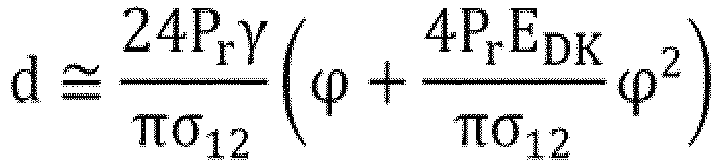
- the particle size can be known from a formula that, when a melt index of the dispersed phase is large, E DK is small, which is easier to reduce the particle size of the dispersed phase; however, according to a diffusion theory of a polymer, the large melt index of the dispersed phase will lead to an increase of the orientation, and therefore, a selection of the melt index of the dispersed phase needs to selected to balance the particle size and the orientation, and only when the particle size is reduced to a maximum extent while maintaining the relatively small orientation, the high weld line strength can be obtained.
- a general ethylene copolymer compatibilizer is a B-D type graft copolymer, wherein a B chain segment of an ethylene molecular chain segment is similar in structure to the polypropylene, and has an excellent compatibility with the polypropylene due to the similar compatibility; in addition, there is a chemical reaction between a D chain segment and an end group of the polycarbonate, and the D segment chain is combined with the polycarbonate through a chemical bond, so that a compatibility with the polycarbonate is correspondingly improved, that is to say, the compatibilizer is used as a bridging substance to connect the polypropylene and the polycarbonate, thereby improving a compatibility between the polypropylene and the polycarbonate, and thus reducing the surface tension.
- the particle size of the dispersed phase is thereby indirectly reduced.
- an interaction force between molecular chains is also increased, thereby reducing a melt index of the alloy system.
- a melt index of the ethylene copolymer compatibilizer affects a degree and a rate of diffusion.
- the melt index is too low, the ethylene copolymer compatibilizer diffuses slowly in a molten state, so that it cannot play a role of increasing the compatibility.
- the melt index reaches a certain level, the ethylene copolymer compatibilizer easily diffuses to an interface between the dispersed phase and the continuous phase, and connects the dispersed phase and the continuous phase of the alloy, thereby increasing the interfacial bonding force, and through a stress transfer, reducing the particle size of the dispersed phase and improving the weld line strength of the alloy.
- the melt index of the ethylene copolymer compatibilizer is too high, a degree of interpenetration of the ethylene copolymer compatibilizer between the dispersed phase and the continuous phase is instead reduced, and the weld line strength is instead reduced.
- a number and a type of an active group of the ethylene copolymer compatibilizer affect reactivity with the polycarbonate, and the reactive active group increases a degree of reaction with the polycarbonate, and thus the weld line strength is improved and the melt index of the alloy is decreased due to an increase in a steric hindrance and an intermolecular force.
- the particle size of the dispersed phase is reduced to a maximum extent while maintaining the relatively small orientation, and an ethylene copolymer compatibilizer is selected to indirectly reduce the particle size of the dispersed phase.
- an ethylene copolymer compatibilizer is selected to indirectly reduce the particle size of the dispersed phase.
- An ethylene copolymer of acrylic acid has a good solvent resistance and is resistant to most chemicals. Furthermore, due to its relatively high melt strength and similar compatibility of its polar group with the polycarbonate, weld line strength of a polycarbonate alloy thus can be significantly improved.
- the high weld line strength polypropylene/polycarbonate alloy of the present invention has weld line strength of 60% or more and a melt index of 10g/10min or more, and a weld line strength test is according to ASTM D638 standard test, where a test condition of the melt index is 260°C, 2.16kg. More preferably, the high weld line strength polypropylene/polycarbonate alloy has the weld line strength of 65% or more and the melt index of 10g/10min or more, and the weld line strength test is according to the ASTM D638 standard test, where the test condition of the melt index is 260°C, 2.16kg.
- a preparation method of the high weld line strength polypropylene/polycarbonate alloy includes the following steps: mixing the polycarbonate, the polypropylene, the ethylene copolymer compatibilizer, and the processing aid and/or the additive evenly according to a ratio in a high-speed mixer; then adding into a twin-screw extruder, melt mixing at a temperature of 220°C to 240°C, and then granulating, cooling and drying to obtain a high weld line strength polycarbonate alloy.
- the polypropylene has the melt index of greater than 40g/10min to 150g/10min under the test condition of 230°C, 2.16kg.
- the polypropylene has the melt index of greater than 60g/10min to 150g/10min under the test condition of 230°C, 2.16kg.
- the ethylene copolymer compatibilizer has a melt index of 0.2g/10min to 50g/10min under a test condition of 190°C, 2.16kg.
- the ethylene copolymer compatibilizer has the melt index of greater than or equal to 0.4g/10min to 35g/10min under the test condition of 190°C, 2.16kg.
- the present invention has the following beneficial effects.
- the present invention by adding the ethylene copolymer compatibilizer to a polypropylene/polycarbonate alloy, weld line strength and chemical resistance of the alloy are improved. Further, the present invention discovers that the ethylene copolymer of acrylic acid greatly improves the weld line strength and chemical resistance strength of the alloy. Further more, the present invention optimizes the melt indexes of the polypropylene and the ethylene copolymer compatibilizer, and the weld line strength of the resulting alloy is further improved.
- the present invention also discovers that a weight average molecular weight of the polycarbonate also affects the weld line strength and the chemical resistance of the alloy, that is when the weight average molecular weight of the polycarbonate is 18,000 to 28,000, the alloy has better weld line strength and chemical resistance.
- the high weld line strength polypropylene/polycarbonate alloy of the present invention has the advantages of high weld line strength, an excellent chemical resistance, and the like.
- TSx is tensile strength of weld line and TSo is tensile strength without the weld line, and an ASTM D638 standard test is applied.
- Table 3 Ingredients and ratios (in parts by weight) and each performance test results of Embodiments 21 to 22 and Comparative Examples Embodiment 21 Embodiment 22 Comparative Example 1 Comparative Example 2 Comparative Example 3 Comparative Example 4 Polypropylene MFR, g/10min 100 100 100 100 100 30 40 Amount, parts 15 15 15 15 15 15 15 Polycarbonate A, parts 80 80 80 80 80 80 80 80 80 80 80 80 80 80 80 80 80 80 Compatibilizer A Species of reactive active group - - - - - - Grafting rate of reactive active group, % - - - - - - Ethylene copolymer EMA EMA - - EMA EMA MFR, g/10min 5 5 - - 5 60 Amount, parts 1 15 - - 5 5 Amount of compatibilizer B,
- Embodiments 1 to 7 and Comparative Example 4 that as an increase of the melt index of the ethylene copolymer compatibilizer, the melt index of the product increases and the weld line strength is in an inverted U-shape; when the melt index of the ethylene copolymer compatibilizer is 0.4g/10min to 35g/10min (under a test condition of 190°C, 2.16kg), the weld line strength of the product is relatively high; when the melt index of the ethylene copolymer compatibilizer is 60g/10min (under the test condition of 190°C, 2.16kg), the weld line strength and the chemical resistance of the product are greatly reduced.
- Embodiments 3, 8 to 11 that as an increase of the melt index of the polyolefin, the weld line strength and the melt index of the product are increased.
- Embodiment 10 and Embodiments 15 to 17 that the ethylene copolymer compatibilizer containing reactive active groups is more capable of increasing the weld line strength compared with the ethylene copolymer compatibilizer containing no reactive active groups.
- Embodiments 10, 18 to 20 the product prepared by a polycarbonate with a weight average molecular weight being 18,000 to 28,000 has relatively high weld line strength.
Landscapes
- Chemical & Material Sciences (AREA)
- Health & Medical Sciences (AREA)
- Chemical Kinetics & Catalysis (AREA)
- Medicinal Chemistry (AREA)
- Polymers & Plastics (AREA)
- Organic Chemistry (AREA)
- Compositions Of Macromolecular Compounds (AREA)
- Processes Of Treating Macromolecular Substances (AREA)
- Processing And Handling Of Plastics And Other Materials For Molding In General (AREA)
Abstract
Description
- The present invention relates to the technical field of polymer materials, and more particularly, relates to a high weld line strength polypropylene/polycarbonate alloy and a preparation method thereof.
- Polycarbonate (PC) is an engineering plastic with excellent performances, having an excellent mechanical property and an excellent dimensional stability, and a thermal stability, a weather resistance, a creep resistance, and a heat resistance are good. However, due to the presence of a rigid group in the PC molecular chain, a melt viscosity thereof is high, and in addition, its product has a poor chemical resistance.
- By blending a polypropylene with the polycarbonate, flowability of the polycarbonate can be improved, and thus processability can be improved, and a material having good processability and an excellent chemical resistance can be obtained. However, due to its poor compatibility, low weld line strength, and insufficient chemical resistance, the alloy becomes a weak point, which can easily lead to fracture failure of a part.
- An objective of the present invention is to overcome the above technical defects, and to provide a high weld line strength polypropylene/polycarbonate alloy, having an excellent chemical resistance.
- Another objective of the present invention is to provide a preparation method of the above-mentioned polypropylene/polycarbonate alloy.
- The present invention is realized by the following technical solution.
- A high weld line strength polypropylene/polycarbonate alloy includes the following components in parts by weight:
a polypropylene 5 parts to 40 parts; a polycarbonate 40 parts to 85 parts; and an ethylene copolymer compatibilizer 1 part to 15 parts. - The polypropylene is selected from at least one of a copolymerized polypropylene and a homopolymerized polypropylene.
- The ethylene copolymer compatibilizer is selected from at least one of an ethylene copolymer of acrylic acid, an ethylene-vinyl acetate copolymer, a styrene-butadiene-styrene copolymer, a styrene-ethylene-butadiene-styrene copolymer, and a styrene-ethylene-propylene-styrene copolymer. The ethylene copolymer of acrylic acid is selected from at least one of an ethylene-methacrylic acid copolymer, an ethylene-ethyl acrylate copolymer, and an ethylene-butyl acrylate copolymer. Preferably, the ethylene copolymer compatibilizer is selected from the ethylene copolymer of acrylic acid.
- Preferably, the ethylene copolymer compatibilizer is selected from an ethylene copolymer compatibilizer containing a reactive active group, wherein the ethylene copolymer is selected from at least one of an ethylene copolymer of acrylic acid, an ethylene-vinyl acetate copolymer, a styrene-butadiene-styrene copolymer, a styrene-ethylene-butadiene-styrene copolymer, and a styrene-ethylene-propylene-styrene copolymer. The reactive active group is at least one of a maleic anhydride group and an epoxy group, and a grafting ratio of the reactive active group is 0.1% to 15%. The ethylene copolymer of acrylic acid is selected from at least one of an ethylene-methacrylic acid copolymer, an ethylene-ethyl acrylate copolymer, and an ethylene-butyl acrylate copolymer. Preferably, the ethylene copolymer is selected from the ethylene copolymer of acrylic acid.
- The polycarbonate is selected from an aromatic polycarbonate, an aliphatic polycarbonate, and an aromatic-aliphatic polycarbonate. Preferably, the polycarbonate has a weight average molecular weight of 18,000 to 28,000.
- In parts by weight, 0 part to 10 parts of a processing aid and/or an additive are further included.
- Further, by selecting the polypropylene and the ethylene copolymer compatibilizer, weld line strength of the present invention is further improved.
- After melt mixing the polycarbonate and the polypropylene into an alloy, a phase structure with the polypropylene as a dispersed phase and the polycarbonate as a continuous phase is formed. The weld line strength is determined jointly by a particle size and an orientation of the dispersed phase at a weld line as well as a surface tension between the polycarbonate and the polypropylene. The smaller the particle size of the dispersed phase, the smaller the orientation, and the smaller the surface tension, the higher the weld line strength is. The particle size can be known from a formula that, when a melt index of the dispersed phase is large, EDK is small, which is easier to reduce the particle size of the dispersed phase; however, according to a diffusion theory of a polymer, the large melt index of the dispersed phase will lead to an increase of the orientation, and therefore, a selection of the melt index of the dispersed phase needs to selected to balance the particle size and the orientation, and only when the particle size is reduced to a maximum extent while maintaining the relatively small orientation, the high weld line strength can be obtained.
- Futhermore, a general ethylene copolymer compatibilizer is a B-D type graft copolymer, wherein a B chain segment of an ethylene molecular chain segment is similar in structure to the polypropylene, and has an excellent compatibility with the polypropylene due to the similar compatibility; in addition, there is a chemical reaction between a D chain segment and an end group of the polycarbonate, and the D segment chain is combined with the polycarbonate through a chemical bond, so that a compatibility with the polycarbonate is correspondingly improved, that is to say, the compatibilizer is used as a bridging substance to connect the polypropylene and the polycarbonate, thereby improving a compatibility between the polypropylene and the polycarbonate, and thus reducing the surface tension. Therefore, after the ethylene copolymer compatibilizer is added to an alloy of a polypropylene resin and a polycarbonate resin, the particle size of the dispersed phase is thereby indirectly reduced. However, due to an increase in the compatibility, an interaction force between molecular chains is also increased, thereby reducing a melt index of the alloy system.
- A melt index of the ethylene copolymer compatibilizer affects a degree and a rate of diffusion. When the melt index is too low, the ethylene copolymer compatibilizer diffuses slowly in a molten state, so that it cannot play a role of increasing the compatibility. When the melt index reaches a certain level, the ethylene copolymer compatibilizer easily diffuses to an interface between the dispersed phase and the continuous phase, and connects the dispersed phase and the continuous phase of the alloy, thereby increasing the interfacial bonding force, and through a stress transfer, reducing the particle size of the dispersed phase and improving the weld line strength of the alloy. However, when the melt index of the ethylene copolymer compatibilizer is too high, a degree of interpenetration of the ethylene copolymer compatibilizer between the dispersed phase and the continuous phase is instead reduced, and the weld line strength is instead reduced.
- A number and a type of an active group of the ethylene copolymer compatibilizer affect reactivity with the polycarbonate, and the reactive active group increases a degree of reaction with the polycarbonate, and thus the weld line strength is improved and the melt index of the alloy is decreased due to an increase in a steric hindrance and an intermolecular force.
- In summary, according to the present invention, by increasing the melt index of the polypropylene within a melt index range of 40g/10min to 150g/10min under a test condition of 230°C, 2.16kg, the particle size is reduced to a maximum extent while maintaining the relatively small orientation, and an ethylene copolymer compatibilizer is selected to indirectly reduce the particle size of the dispersed phase. Such, in the polypropylene/polycarbonate alloy of the present invention, the particle size of the dispersed phase is small and the orientation is also small, and as a result, the weld line strength of the polycarbonate alloy is improved.
- An ethylene copolymer of acrylic acid has a good solvent resistance and is resistant to most chemicals. Furthermore, due to its relatively high melt strength and similar compatibility of its polar group with the polycarbonate, weld line strength of a polycarbonate alloy thus can be significantly improved.
- The high weld line strength polypropylene/polycarbonate alloy of the present invention has weld line strength of 60% or more and a melt index of 10g/10min or more, and a weld line strength test is according to ASTM D638 standard test, where a test condition of the melt index is 260°C, 2.16kg. More preferably, the high weld line strength polypropylene/polycarbonate alloy has the weld line strength of 65% or more and the melt index of 10g/10min or more, and the weld line strength test is according to the ASTM D638 standard test, where the test condition of the melt index is 260°C, 2.16kg.
- A preparation method of the high weld line strength polypropylene/polycarbonate alloy includes the following steps: mixing the polycarbonate, the polypropylene, the ethylene copolymer compatibilizer, and the processing aid and/or the additive evenly according to a ratio in a high-speed mixer; then adding into a twin-screw extruder, melt mixing at a temperature of 220°C to 240°C, and then granulating, cooling and drying to obtain a high weld line strength polycarbonate alloy.
- In order to obtain the high weld line strength polypropylene/polycarbonate alloy having the weld line strength of 60% or more and the melt index of 10g/10min or more, the polypropylene has the melt index of greater than 40g/10min to 150g/10min under the test condition of 230°C, 2.16kg. Preferably, the polypropylene has the melt index of greater than 60g/10min to 150g/10min under the test condition of 230°C, 2.16kg.
- The ethylene copolymer compatibilizer has a melt index of 0.2g/10min to 50g/10min under a test condition of 190°C, 2.16kg. Preferably, the ethylene copolymer compatibilizer has the melt index of greater than or equal to 0.4g/10min to 35g/10min under the test condition of 190°C, 2.16kg.
- The present invention has the following beneficial effects.
- According to the present invention, by adding the ethylene copolymer compatibilizer to a polypropylene/polycarbonate alloy, weld line strength and chemical resistance of the alloy are improved. Further, the present invention discovers that the ethylene copolymer of acrylic acid greatly improves the weld line strength and chemical resistance strength of the alloy. Further more, the present invention optimizes the melt indexes of the polypropylene and the ethylene copolymer compatibilizer, and the weld line strength of the resulting alloy is further improved. The present invention also discovers that a weight average molecular weight of the polycarbonate also affects the weld line strength and the chemical resistance of the alloy, that is when the weight average molecular weight of the polycarbonate is 18,000 to 28,000, the alloy has better weld line strength and chemical resistance. In summary, the high weld line strength polypropylene/polycarbonate alloy of the present invention has the advantages of high weld line strength, an excellent chemical resistance, and the like.
- The present invention will be further illustrated below by specific implementations, the following embodiments are preferred implementations of the invention, but the implementations of the present invention are not limited by the following embodiments.
- Raw materials of Embodiments and Comparative Examples are commercially available, specifically:
- polypropylene: copolymerized polypropylene;
- EMA: ethylene-methacrylic acid copolymer;
- EEA: ethylene-ethyl acrylate copolymer;
- EMA-g-GMA: ethylene-methacrylic acid graft epoxy group (GMA is an epoxy group);
- EVA: ethylene-vinyl acetate copolymer;
- SEBS: styrene-ethylene-butadiene-styrene copolymer;
- compatibilizer B: PP-G-MAH (polypropylene graft maleic anhydride);
- polycarbonate A: an aromatic polycarbonate with a weight average molecular weight being 28,000;
- polycarbonate B: an aliphatic polycarbonate with a weight average molecular weight being 18,000;
- polycarbonate C: an aromatic polycarbonate with a weight average molecular weight being 8,000;
- polycarbonate D: an aromatic polycarbonate with a weight average molecular weight being 30,000;
- anti-aging agent: anti-oxidant: anti-ultraviolet aging agent =1:1.
- A preparation method of a polycarbonate alloy in Embodiments and Comparative Examples:
- A preparation method of a polypropylene/polycarbonate alloy in Embodiments and Comparative Examples: a polycarbonate, a polypropylene, a compatibilizer, and a processing aid and/or an additive were mixed evenly according to a ratio in a high-speed mixer; then added into a twin-screw extruder, melt mixed at a temperature of 220°C to 240°C, and then granulated, cooled and dried to obtain a high weld line strength polycarbonate alloy.
- Each test method:
- (1) Alloy Melt Index (MFR): according to a test ASTM D1238, a test condition of the polycarbonate alloy is 260°C, 2.16kg;
- (2) Chemical resistance: a sample is immersed in various chemicals (methanol, 10% sulfuric acid, thinning solvent, acetone, soybean oil, and ink) for 7 days and visually observed to evaluate the chemical resistance. There are four grades: completely no changes in appearance marked as excellent, a slight swelling marked as good, a micro number of cracks marked as medium, and a large number of cracks or fractures marked as poor.
- (3) Weld line strength: characterized by a weld line coefficient FKL:

- TSx is tensile strength of weld line and TSo is tensile strength without the weld line, and an ASTM D638 standard test is applied.


Table 3: Ingredients and ratios (in parts by weight) and each performance test results of Embodiments 21 to 22 and Comparative Examples Embodiment 21 Embodiment 22 Comparative Example 1 Comparative Example 2 Comparative Example 3 Comparative Example 4 Polypropylene MFR, g/10min 100 100 100 100 30 40 Amount, parts 15 15 15 15 15 15 Polycarbonate A, parts 80 80 80 80 80 Compatibilizer A Species of reactive active group - - - - - - Grafting rate of reactive active group, % - - - - - - Ethylene copolymer EMA EMA - - EMA EMA MFR, g/10min 5 5 - - 5 60 Amount, parts 1 15 - - 5 5 Amount of compatibilizer B, parts - - - 5 - - Anti-aging agent 0.5 0.5 0.5 0.5 0.5 0.5 MFR, g/lOmin 12 28 20 30 11 40 Weld line strength, % 77 89 10 25 53 57 Chemical resistance excellent excellent poor good good good - It can be seen from Embodiments 1 to 7 and Comparative Example 4 that as an increase of the melt index of the ethylene copolymer compatibilizer, the melt index of the product increases and the weld line strength is in an inverted U-shape; when the melt index of the ethylene copolymer compatibilizer is 0.4g/10min to 35g/10min (under a test condition of 190°C, 2.16kg), the weld line strength of the product is relatively high; when the melt index of the ethylene copolymer compatibilizer is 60g/10min (under the test condition of 190°C, 2.16kg), the weld line strength and the chemical resistance of the product are greatly reduced.
- It can be seen from Embodiments 3, 8 to 11 that as an increase of the melt index of the polyolefin, the weld line strength and the melt index of the product are increased.
- It can be seen from Embodiment 10 and Embodiments 15 to 17 that the ethylene copolymer compatibilizer containing reactive active groups is more capable of increasing the weld line strength compared with the ethylene copolymer compatibilizer containing no reactive active groups.
- It can be seen from Embodiments 1, 12, 13, 14 that when the ethylene copolymer of acrylic acid is as a compatibilizer, each performance of the product is relatively good.
- It can be seen from Embodiment 3 and Comparative Example 3 that when the melt index of the polyolefin is 30g/10min (under the test condition of 230°C, 2.16kg), the weld line strength of the product is considerably decreased and the melt index is relatively low.
- It can be seen from Embodiments 10, 18 to 20 that the product prepared by a polycarbonate with a weight average molecular weight being 18,000 to 28,000 has relatively high weld line strength.
Claims (10)
- A high weld line strength polypropylene/polycarbonate alloy, comprising the following components in parts by weight:
a polypropylene 5 parts to 40 parts; an aromatic polycarbonate 40 parts to 85 parts; and an ethylene copolymer compatibilizer 1 part to 15 parts. - The high weld line strength polypropylene/polycarbonate alloy according to claim 1, wherein the polypropylene is selected from at least one of a copolymerized polypropylene and a homopolymerized polypropylene.
- The high weld line strength polycarbonate alloy according to claim 1, wherein the ethylene copolymer compatibilizer is selected from at least one of an ethylene copolymer of acrylic acid, an ethylene-vinyl acetate copolymer, a styrene-butadiene-styrene copolymer, a styrene-ethylene-butadiene-styrene copolymer, and a styrene-ethylene-propylene-styrene copolymer; the ethylene copolymer of acrylic acid is selected from at least one of an ethylene-methacrylic acid copolymer, an ethylene-ethyl acrylate copolymer, and an ethylene-butyl acrylate copolymer.
- The high weld line strength polycarbonate alloy according to claim 3, wherein the ethylene copolymer compatibilizer is selected from the ethylene copolymer of acrylic acid.
- The high weld line strength polycarbonate alloy according to claim 1, wherein the ethylene copolymer compatibilizer is selected from an ethylene copolymer compatibilizer containing a reactive active group, wherein the ethylene copolymer is selected from at least one of an ethylene copolymer of acrylic acid, an ethylene-vinyl acetate copolymer, a styrene-butadiene-styrene copolymer, a styrene-ethylene-butadiene-styrene copolymer, and a styrene-ethylene-propylene-styrene copolymer, the reactive active group is at least one of a maleic anhydride group and an epoxy group, and a grafting ratio of the reactive active group is 0.1% to 15%; and the ethylene copolymer of acrylic acid is selected from at least one of an ethylene-methacrylic acid copolymer, an ethylene-ethyl acrylate copolymer, and an ethylene-butyl acrylate copolymer.
- The high weld line strength polycarbonate alloy according to claim 5, wherein the ethylene copolymer is selected from the ethylene copolymer of acrylic acid.
- The high weld line strength polycarbonate alloy according to claim 1, wherein the polycarbonate is selected from an aromatic polycarbonate, an aliphatic polycarbonate, and an aromatic-aliphatic polycarbonate; the polycarbonate has a weight average molecular weight of 18,000 to 28,000; and in parts by weight, 0 part to 10 parts of a processing aid and/or an additive are further comprised.
- The high weld line strength polycarbonate alloy according to any one of claims 1 to 7, wherein the high weld line strength polycarbonate alloy has weld line strength of 60% or more, and a weld line strength test is according to ASTM D638 standard test; and preferably, the high weld line strength polycarbonate alloy has the weld line strength of 65% or more, and the weld line strength test is according to ASTM D638 standard test.
- A preparation method of the high weld line strength polycarbonate alloy of claim 7, comprising the following steps: mixing the polycarbonate, polyolefin, the ethylene copolymer compatibilizer, and a processing aid and/or an additive evenly according to a ratio in a high-speed mixer; then adding into a twin-screw extruder, melt mixing at a temperature of 220°C to 240°C, and then granulating, cooling and drying to obtain the high weld line strength polycarbonate alloy.
- The preparation method of the high weld line strength polycarbonate alloy according to claim 9, wherein the polyolefin has a melt index of greater than 40g/10min to 150g/10min under a test condition of 230°C, 2.16kg; preferably, the polyolefin has the melt index of greater than 60g/10min to 150g/10min under the test condition of 230°C, 2.16kg; and the ethylene copolymer compatibilizer has a melt index of 0.2g/10min to 50g/10min under a test condition of 190°C, 2.16kg; and preferably, the ethylene copolymer compatibilizer has the melt index of greater than or equal to 0.4g/10min to 35g/10min under the test condition of 190°C, 2.16kg.
Applications Claiming Priority (2)
| Application Number | Priority Date | Filing Date | Title |
|---|---|---|---|
| CN201811348964.XA CN109504058B (en) | 2018-11-13 | 2018-11-13 | A kind of high weld line strength polypropylene/polycarbonate alloy and preparation method thereof |
| PCT/CN2019/114379 WO2020098498A1 (en) | 2018-11-13 | 2019-10-30 | Polypropylene/polycarbonate alloy having high weld bond strength and preparation method therefor |
Publications (3)
| Publication Number | Publication Date |
|---|---|
| EP3868828A1 true EP3868828A1 (en) | 2021-08-25 |
| EP3868828A4 EP3868828A4 (en) | 2021-11-24 |
| EP3868828B1 EP3868828B1 (en) | 2024-08-28 |
Family
ID=65748322
Family Applications (1)
| Application Number | Title | Priority Date | Filing Date |
|---|---|---|---|
| EP19883993.8A Active EP3868828B1 (en) | 2018-11-13 | 2019-10-30 | Polypropylene/polycarbonate alloy having high weld bond strength and preparation method therefor |
Country Status (6)
| Country | Link |
|---|---|
| US (1) | US20220049091A1 (en) |
| EP (1) | EP3868828B1 (en) |
| JP (1) | JP7358468B2 (en) |
| KR (1) | KR102534707B1 (en) |
| CN (1) | CN109504058B (en) |
| WO (1) | WO2020098498A1 (en) |
Families Citing this family (5)
| Publication number | Priority date | Publication date | Assignee | Title |
|---|---|---|---|---|
| CN109504058B (en) * | 2018-11-13 | 2021-04-06 | 金发科技股份有限公司 | A kind of high weld line strength polypropylene/polycarbonate alloy and preparation method thereof |
| CN111484720A (en) * | 2019-12-20 | 2020-08-04 | 四川鑫达企业集团有限公司 | High-toughness PCABS alloy material resistant to automobile paint and preparation method thereof |
| CN112143198A (en) * | 2020-09-18 | 2020-12-29 | 金发科技股份有限公司 | Polycarbonate alloy composition and preparation method and application thereof |
| CN114350134B (en) * | 2022-01-19 | 2023-10-17 | 上海金山锦湖日丽塑料有限公司 | High-toughness transparent PC/PP resin composition, and preparation method and application thereof |
| CN115926417A (en) * | 2022-12-22 | 2023-04-07 | 东莞市骄阳塑胶科技有限公司 | Modified polycarbonate composite material and its preparation method and application |
Family Cites Families (19)
| Publication number | Priority date | Publication date | Assignee | Title |
|---|---|---|---|---|
| US4532282A (en) * | 1983-03-16 | 1985-07-30 | General Electric Company | Blends of aromatic polycarbonate resin, olefin polymers or copolymers and acrylate- or methacrylate-copolymer resins |
| US4481331A (en) * | 1983-03-22 | 1984-11-06 | Gen Electric | Polycarbonate resin mixture |
| US4587295A (en) * | 1985-01-02 | 1986-05-06 | General Electric Company | Polycarbonate composition |
| US4806597A (en) * | 1987-10-29 | 1989-02-21 | General Electric Company | Composition comprising aromatic polycarbonate, polyolefin, ethylene vinyl alcohol copolymer, and a modified hydrogenated alkylidene vinyl aromatic block copolymer |
| EP2195379A1 (en) * | 2007-09-26 | 2010-06-16 | Dow Global Technologies Inc. | Improved carbonate polymer blends with reduced gloss |
| EP2451860A4 (en) * | 2009-07-05 | 2014-08-20 | Novomer Inc | Structurally precise poly(propylene carbonate) compositions |
| GB201111929D0 (en) * | 2011-07-12 | 2011-08-24 | Norner As | Polycarbonat blends |
| BR112014007395B1 (en) * | 2011-09-30 | 2020-12-01 | Dow Global Technologies Llc | composition, wire and wire insulating sheath |
| CN104140661A (en) * | 2013-05-08 | 2014-11-12 | 广东美的暖通设备有限公司 | Polycarbonate/polyethylene compatibilization blending material and preparation method |
| CN105814138B (en) * | 2013-11-22 | 2018-06-01 | 盛禧奥欧洲有限责任公司 | Composition containing makrolon |
| US9346951B2 (en) * | 2014-01-20 | 2016-05-24 | Sk Innovation Co., Ltd. | Polyalkylene carbonate resin composition |
| KR102115244B1 (en) * | 2014-01-20 | 2020-05-27 | 에스케이이노베이션 주식회사 | Polyalkylene carbonate resin composition |
| EP3234020B1 (en) * | 2014-12-18 | 2021-03-03 | SABIC Global Technologies B.V. | Composition of polycarbonate and polypropylene blends |
| CN107735453B (en) * | 2015-08-21 | 2019-12-27 | 帝人株式会社 | Polycarbonate resin composition |
| CN106916371A (en) * | 2015-12-28 | 2017-07-04 | 黑龙江鑫达企业集团有限公司 | A kind of preparation method of high tenacity PP composites |
| CN106243672A (en) * | 2016-08-26 | 2016-12-21 | 吴小慧 | A kind of low temperature resistant poly (propylene carbonate) cable jacket material |
| CN106867113A (en) * | 2017-03-31 | 2017-06-20 | 合肥民众亿兴软件开发有限公司 | A kind of computer mouse composite and preparation method thereof |
| CN108727799A (en) * | 2018-06-21 | 2018-11-02 | 合肥安力电力工程有限公司 | A kind of high-performance electric wire cable protection pipe material and preparation method thereof |
| CN109504058B (en) * | 2018-11-13 | 2021-04-06 | 金发科技股份有限公司 | A kind of high weld line strength polypropylene/polycarbonate alloy and preparation method thereof |
-
2018
- 2018-11-13 CN CN201811348964.XA patent/CN109504058B/en active Active
-
2019
- 2019-10-30 EP EP19883993.8A patent/EP3868828B1/en active Active
- 2019-10-30 JP JP2021525822A patent/JP7358468B2/en active Active
- 2019-10-30 KR KR1020217016366A patent/KR102534707B1/en active Active
- 2019-10-30 WO PCT/CN2019/114379 patent/WO2020098498A1/en not_active Ceased
- 2019-10-30 US US17/293,489 patent/US20220049091A1/en not_active Abandoned
Also Published As
| Publication number | Publication date |
|---|---|
| EP3868828B1 (en) | 2024-08-28 |
| KR20210082519A (en) | 2021-07-05 |
| WO2020098498A1 (en) | 2020-05-22 |
| CN109504058A (en) | 2019-03-22 |
| KR102534707B1 (en) | 2023-05-18 |
| CN109504058B (en) | 2021-04-06 |
| US20220049091A1 (en) | 2022-02-17 |
| EP3868828A4 (en) | 2021-11-24 |
| JP7358468B2 (en) | 2023-10-10 |
| JP2022507322A (en) | 2022-01-18 |
Similar Documents
| Publication | Publication Date | Title |
|---|---|---|
| EP3868828B1 (en) | Polypropylene/polycarbonate alloy having high weld bond strength and preparation method therefor | |
| US20210403706A1 (en) | High weld line strength polyethylene/polycarbonate alloy and preparation method thereof | |
| CN103709709B (en) | Polycarbonate compositions of a kind of high tenacity and preparation method thereof | |
| CN114032053B (en) | Lithium battery aluminum plastic film inner layer adhesive and preparation method thereof | |
| CN105733098A (en) | Method for preparing high-performance PP/PET blend | |
| CN1064383C (en) | Preparation of lightly crosslinking-bulked PS/PE mixture | |
| CN105037656A (en) | Polypropylene/polystyrene alloy and preparation method thereof | |
| CN112574699B (en) | PET ethylene hot melt adhesive for thermal composite film and preparation method and application thereof | |
| CN104004334A (en) | Polycarbonate composition with high face impact strength and preparation method thereof | |
| CN111793335A (en) | Low-dielectric nano injection molding material | |
| EP3882312A1 (en) | Polycarbonate alloy and preparation method thereof | |
| CN111154237A (en) | A kind of polyethylene terephthalate/high density polyethylene blend and preparation method thereof | |
| CN101717474B (en) | Adhesive master batch used for preparing polypropylene hot melt adhesive and preparation method thereof | |
| CN107760240A (en) | Crystal-bonding adhesive and preparation method thereof | |
| DE112010004034T5 (en) | Modified recycled polyester resin and molding using this | |
| CN117209668A (en) | Preparation method of polylactic acid toughened graft copolymer | |
| CN107828175A (en) | A kind of PC/ABS compounds and preparation method and application | |
| CN105131190B (en) | Liquid cis butadiene multi-monomer grafting compatilizer and preparation method thereof | |
| CN121045989B (en) | Hot melt adhesive for polybutene, its preparation method and barrier sheet | |
| CN114350134A (en) | High-toughness transparent PC/PP resin composition and preparation method and application thereof | |
| CN112480399A (en) | Nucleating agent, composition for preparing transparent toughened nylon material, transparent toughened nylon material and preparation method thereof | |
| CN104418980A (en) | Nickel-maleate-grafted polypropylene ionomer as well as preparation method and application thereof | |
| JPS63274055A (en) | thin battery | |
| CN112592556B (en) | Preparation method of anti-cracking ABS material and its products | |
| CN114230928A (en) | Low-temperature impact resistant polypropylene composition and preparation method thereof |
Legal Events
| Date | Code | Title | Description |
|---|---|---|---|
| STAA | Information on the status of an ep patent application or granted ep patent |
Free format text: STATUS: THE INTERNATIONAL PUBLICATION HAS BEEN MADE |
|
| PUAI | Public reference made under article 153(3) epc to a published international application that has entered the european phase |
Free format text: ORIGINAL CODE: 0009012 |
|
| STAA | Information on the status of an ep patent application or granted ep patent |
Free format text: STATUS: REQUEST FOR EXAMINATION WAS MADE |
|
| 17P | Request for examination filed |
Effective date: 20210521 |
|
| AK | Designated contracting states |
Kind code of ref document: A1 Designated state(s): AL AT BE BG CH CY CZ DE DK EE ES FI FR GB GR HR HU IE IS IT LI LT LU LV MC MK MT NL NO PL PT RO RS SE SI SK SM TR |
|
| A4 | Supplementary search report drawn up and despatched |
Effective date: 20211022 |
|
| RIC1 | Information provided on ipc code assigned before grant |
Ipc: C08L 53/02 20060101ALI20211018BHEP Ipc: C08L 25/08 20060101ALI20211018BHEP Ipc: C08L 33/02 20060101ALI20211018BHEP Ipc: C08L 31/04 20060101ALI20211018BHEP Ipc: C08L 23/12 20060101ALI20211018BHEP Ipc: C08L 23/14 20060101ALI20211018BHEP Ipc: C08L 69/00 20060101AFI20211018BHEP |
|
| DAV | Request for validation of the european patent (deleted) | ||
| DAX | Request for extension of the european patent (deleted) | ||
| STAA | Information on the status of an ep patent application or granted ep patent |
Free format text: STATUS: EXAMINATION IS IN PROGRESS |
|
| 17Q | First examination report despatched |
Effective date: 20220614 |
|
| GRAP | Despatch of communication of intention to grant a patent |
Free format text: ORIGINAL CODE: EPIDOSNIGR1 |
|
| STAA | Information on the status of an ep patent application or granted ep patent |
Free format text: STATUS: GRANT OF PATENT IS INTENDED |
|
| INTG | Intention to grant announced |
Effective date: 20240404 |
|
| GRAS | Grant fee paid |
Free format text: ORIGINAL CODE: EPIDOSNIGR3 |
|
| GRAA | (expected) grant |
Free format text: ORIGINAL CODE: 0009210 |
|
| STAA | Information on the status of an ep patent application or granted ep patent |
Free format text: STATUS: THE PATENT HAS BEEN GRANTED |
|
| P01 | Opt-out of the competence of the unified patent court (upc) registered |
Free format text: CASE NUMBER: APP_37046/2024 Effective date: 20240620 |
|
| AK | Designated contracting states |
Kind code of ref document: B1 Designated state(s): AL AT BE BG CH CY CZ DE DK EE ES FI FR GB GR HR HU IE IS IT LI LT LU LV MC MK MT NL NO PL PT RO RS SE SI SK SM TR |
|
| REG | Reference to a national code |
Ref country code: CH Ref legal event code: EP |
|
| REG | Reference to a national code |
Ref country code: NL Ref legal event code: FP |
|
| REG | Reference to a national code |
Ref country code: DE Ref legal event code: R096 Ref document number: 602019058070 Country of ref document: DE |
|
| REG | Reference to a national code |
Ref country code: IE Ref legal event code: FG4D |
|
| REG | Reference to a national code |
Ref country code: LT Ref legal event code: MG9D |
|
| PG25 | Lapsed in a contracting state [announced via postgrant information from national office to epo] |
Ref country code: NO Free format text: LAPSE BECAUSE OF FAILURE TO SUBMIT A TRANSLATION OF THE DESCRIPTION OR TO PAY THE FEE WITHIN THE PRESCRIBED TIME-LIMIT Effective date: 20241128 |
|
| REG | Reference to a national code |
Ref country code: AT Ref legal event code: MK05 Ref document number: 1717935 Country of ref document: AT Kind code of ref document: T Effective date: 20240828 |
|
| PG25 | Lapsed in a contracting state [announced via postgrant information from national office to epo] |
Ref country code: GR Free format text: LAPSE BECAUSE OF FAILURE TO SUBMIT A TRANSLATION OF THE DESCRIPTION OR TO PAY THE FEE WITHIN THE PRESCRIBED TIME-LIMIT Effective date: 20241129 Ref country code: PL Free format text: LAPSE BECAUSE OF FAILURE TO SUBMIT A TRANSLATION OF THE DESCRIPTION OR TO PAY THE FEE WITHIN THE PRESCRIBED TIME-LIMIT Effective date: 20240828 Ref country code: FI Free format text: LAPSE BECAUSE OF FAILURE TO SUBMIT A TRANSLATION OF THE DESCRIPTION OR TO PAY THE FEE WITHIN THE PRESCRIBED TIME-LIMIT Effective date: 20240828 Ref country code: PT Free format text: LAPSE BECAUSE OF FAILURE TO SUBMIT A TRANSLATION OF THE DESCRIPTION OR TO PAY THE FEE WITHIN THE PRESCRIBED TIME-LIMIT Effective date: 20241230 |
|
| PG25 | Lapsed in a contracting state [announced via postgrant information from national office to epo] |
Ref country code: BG Free format text: LAPSE BECAUSE OF FAILURE TO SUBMIT A TRANSLATION OF THE DESCRIPTION OR TO PAY THE FEE WITHIN THE PRESCRIBED TIME-LIMIT Effective date: 20240828 |
|
| PG25 | Lapsed in a contracting state [announced via postgrant information from national office to epo] |
Ref country code: LV Free format text: LAPSE BECAUSE OF FAILURE TO SUBMIT A TRANSLATION OF THE DESCRIPTION OR TO PAY THE FEE WITHIN THE PRESCRIBED TIME-LIMIT Effective date: 20240828 |
|
| PG25 | Lapsed in a contracting state [announced via postgrant information from national office to epo] |
Ref country code: AT Free format text: LAPSE BECAUSE OF FAILURE TO SUBMIT A TRANSLATION OF THE DESCRIPTION OR TO PAY THE FEE WITHIN THE PRESCRIBED TIME-LIMIT Effective date: 20240828 Ref country code: IS Free format text: LAPSE BECAUSE OF FAILURE TO SUBMIT A TRANSLATION OF THE DESCRIPTION OR TO PAY THE FEE WITHIN THE PRESCRIBED TIME-LIMIT Effective date: 20241228 |
|
| PG25 | Lapsed in a contracting state [announced via postgrant information from national office to epo] |
Ref country code: HR Free format text: LAPSE BECAUSE OF FAILURE TO SUBMIT A TRANSLATION OF THE DESCRIPTION OR TO PAY THE FEE WITHIN THE PRESCRIBED TIME-LIMIT Effective date: 20240828 |
|
| PG25 | Lapsed in a contracting state [announced via postgrant information from national office to epo] |
Ref country code: RS Free format text: LAPSE BECAUSE OF FAILURE TO SUBMIT A TRANSLATION OF THE DESCRIPTION OR TO PAY THE FEE WITHIN THE PRESCRIBED TIME-LIMIT Effective date: 20241128 Ref country code: ES Free format text: LAPSE BECAUSE OF FAILURE TO SUBMIT A TRANSLATION OF THE DESCRIPTION OR TO PAY THE FEE WITHIN THE PRESCRIBED TIME-LIMIT Effective date: 20240828 |
|
| PG25 | Lapsed in a contracting state [announced via postgrant information from national office to epo] |
Ref country code: RS Free format text: LAPSE BECAUSE OF FAILURE TO SUBMIT A TRANSLATION OF THE DESCRIPTION OR TO PAY THE FEE WITHIN THE PRESCRIBED TIME-LIMIT Effective date: 20241128 Ref country code: PT Free format text: LAPSE BECAUSE OF FAILURE TO SUBMIT A TRANSLATION OF THE DESCRIPTION OR TO PAY THE FEE WITHIN THE PRESCRIBED TIME-LIMIT Effective date: 20241230 Ref country code: PL Free format text: LAPSE BECAUSE OF FAILURE TO SUBMIT A TRANSLATION OF THE DESCRIPTION OR TO PAY THE FEE WITHIN THE PRESCRIBED TIME-LIMIT Effective date: 20240828 Ref country code: NO Free format text: LAPSE BECAUSE OF FAILURE TO SUBMIT A TRANSLATION OF THE DESCRIPTION OR TO PAY THE FEE WITHIN THE PRESCRIBED TIME-LIMIT Effective date: 20241128 Ref country code: LV Free format text: LAPSE BECAUSE OF FAILURE TO SUBMIT A TRANSLATION OF THE DESCRIPTION OR TO PAY THE FEE WITHIN THE PRESCRIBED TIME-LIMIT Effective date: 20240828 Ref country code: IS Free format text: LAPSE BECAUSE OF FAILURE TO SUBMIT A TRANSLATION OF THE DESCRIPTION OR TO PAY THE FEE WITHIN THE PRESCRIBED TIME-LIMIT Effective date: 20241228 Ref country code: HR Free format text: LAPSE BECAUSE OF FAILURE TO SUBMIT A TRANSLATION OF THE DESCRIPTION OR TO PAY THE FEE WITHIN THE PRESCRIBED TIME-LIMIT Effective date: 20240828 Ref country code: GR Free format text: LAPSE BECAUSE OF FAILURE TO SUBMIT A TRANSLATION OF THE DESCRIPTION OR TO PAY THE FEE WITHIN THE PRESCRIBED TIME-LIMIT Effective date: 20241129 Ref country code: FI Free format text: LAPSE BECAUSE OF FAILURE TO SUBMIT A TRANSLATION OF THE DESCRIPTION OR TO PAY THE FEE WITHIN THE PRESCRIBED TIME-LIMIT Effective date: 20240828 Ref country code: ES Free format text: LAPSE BECAUSE OF FAILURE TO SUBMIT A TRANSLATION OF THE DESCRIPTION OR TO PAY THE FEE WITHIN THE PRESCRIBED TIME-LIMIT Effective date: 20240828 Ref country code: BG Free format text: LAPSE BECAUSE OF FAILURE TO SUBMIT A TRANSLATION OF THE DESCRIPTION OR TO PAY THE FEE WITHIN THE PRESCRIBED TIME-LIMIT Effective date: 20240828 Ref country code: AT Free format text: LAPSE BECAUSE OF FAILURE TO SUBMIT A TRANSLATION OF THE DESCRIPTION OR TO PAY THE FEE WITHIN THE PRESCRIBED TIME-LIMIT Effective date: 20240828 |
|
| PG25 | Lapsed in a contracting state [announced via postgrant information from national office to epo] |
Ref country code: RO Free format text: LAPSE BECAUSE OF FAILURE TO SUBMIT A TRANSLATION OF THE DESCRIPTION OR TO PAY THE FEE WITHIN THE PRESCRIBED TIME-LIMIT Effective date: 20240828 Ref country code: DK Free format text: LAPSE BECAUSE OF FAILURE TO SUBMIT A TRANSLATION OF THE DESCRIPTION OR TO PAY THE FEE WITHIN THE PRESCRIBED TIME-LIMIT Effective date: 20240828 Ref country code: SM Free format text: LAPSE BECAUSE OF FAILURE TO SUBMIT A TRANSLATION OF THE DESCRIPTION OR TO PAY THE FEE WITHIN THE PRESCRIBED TIME-LIMIT Effective date: 20240828 |
|
| PG25 | Lapsed in a contracting state [announced via postgrant information from national office to epo] |
Ref country code: EE Free format text: LAPSE BECAUSE OF FAILURE TO SUBMIT A TRANSLATION OF THE DESCRIPTION OR TO PAY THE FEE WITHIN THE PRESCRIBED TIME-LIMIT Effective date: 20240828 |
|
| PG25 | Lapsed in a contracting state [announced via postgrant information from national office to epo] |
Ref country code: CZ Free format text: LAPSE BECAUSE OF FAILURE TO SUBMIT A TRANSLATION OF THE DESCRIPTION OR TO PAY THE FEE WITHIN THE PRESCRIBED TIME-LIMIT Effective date: 20240828 |
|
| PG25 | Lapsed in a contracting state [announced via postgrant information from national office to epo] |
Ref country code: SK Free format text: LAPSE BECAUSE OF FAILURE TO SUBMIT A TRANSLATION OF THE DESCRIPTION OR TO PAY THE FEE WITHIN THE PRESCRIBED TIME-LIMIT Effective date: 20240828 Ref country code: IT Free format text: LAPSE BECAUSE OF FAILURE TO SUBMIT A TRANSLATION OF THE DESCRIPTION OR TO PAY THE FEE WITHIN THE PRESCRIBED TIME-LIMIT Effective date: 20240828 |
|
| REG | Reference to a national code |
Ref country code: DE Ref legal event code: R097 Ref document number: 602019058070 Country of ref document: DE |
|
| PLBE | No opposition filed within time limit |
Free format text: ORIGINAL CODE: 0009261 |
|
| STAA | Information on the status of an ep patent application or granted ep patent |
Free format text: STATUS: NO OPPOSITION FILED WITHIN TIME LIMIT |
|
| PG25 | Lapsed in a contracting state [announced via postgrant information from national office to epo] |
Ref country code: MC Free format text: LAPSE BECAUSE OF FAILURE TO SUBMIT A TRANSLATION OF THE DESCRIPTION OR TO PAY THE FEE WITHIN THE PRESCRIBED TIME-LIMIT Effective date: 20240828 |
|
| PG25 | Lapsed in a contracting state [announced via postgrant information from national office to epo] |
Ref country code: LU Free format text: LAPSE BECAUSE OF NON-PAYMENT OF DUE FEES Effective date: 20241030 |
|
| GBPC | Gb: european patent ceased through non-payment of renewal fee |
Effective date: 20241128 |
|
| 26N | No opposition filed |
Effective date: 20250530 |
|
| PG25 | Lapsed in a contracting state [announced via postgrant information from national office to epo] |
Ref country code: SE Free format text: LAPSE BECAUSE OF FAILURE TO SUBMIT A TRANSLATION OF THE DESCRIPTION OR TO PAY THE FEE WITHIN THE PRESCRIBED TIME-LIMIT Effective date: 20240828 |
|
| PG25 | Lapsed in a contracting state [announced via postgrant information from national office to epo] |
Ref country code: GB Free format text: LAPSE BECAUSE OF NON-PAYMENT OF DUE FEES Effective date: 20241128 |
|
| PG25 | Lapsed in a contracting state [announced via postgrant information from national office to epo] |
Ref country code: IE Free format text: LAPSE BECAUSE OF NON-PAYMENT OF DUE FEES Effective date: 20241030 |
|
| REG | Reference to a national code |
Ref country code: CH Ref legal event code: U11 Free format text: ST27 STATUS EVENT CODE: U-0-0-U10-U11 (AS PROVIDED BY THE NATIONAL OFFICE) Effective date: 20251101 |
|
| PGFP | Annual fee paid to national office [announced via postgrant information from national office to epo] |
Ref country code: NL Payment date: 20251023 Year of fee payment: 7 |
|
| PGFP | Annual fee paid to national office [announced via postgrant information from national office to epo] |
Ref country code: DE Payment date: 20251020 Year of fee payment: 7 |
|
| PGFP | Annual fee paid to national office [announced via postgrant information from national office to epo] |
Ref country code: FR Payment date: 20251024 Year of fee payment: 7 |
|
| PGFP | Annual fee paid to national office [announced via postgrant information from national office to epo] |
Ref country code: BE Payment date: 20251022 Year of fee payment: 7 |
|
| PGFP | Annual fee paid to national office [announced via postgrant information from national office to epo] |
Ref country code: CH Payment date: 20251101 Year of fee payment: 7 |
|
| PG25 | Lapsed in a contracting state [announced via postgrant information from national office to epo] |
Ref country code: HU Free format text: LAPSE BECAUSE OF FAILURE TO SUBMIT A TRANSLATION OF THE DESCRIPTION OR TO PAY THE FEE WITHIN THE PRESCRIBED TIME-LIMIT; INVALID AB INITIO Effective date: 20191030 |
|
| PG25 | Lapsed in a contracting state [announced via postgrant information from national office to epo] |
Ref country code: CY Free format text: LAPSE BECAUSE OF FAILURE TO SUBMIT A TRANSLATION OF THE DESCRIPTION OR TO PAY THE FEE WITHIN THE PRESCRIBED TIME-LIMIT; INVALID AB INITIO Effective date: 20191030 |