EP3868821A1 - Pellet-type polypropylene resin composition and preparation method therefor - Google Patents
Pellet-type polypropylene resin composition and preparation method therefor Download PDFInfo
- Publication number
- EP3868821A1 EP3868821A1 EP20872959.0A EP20872959A EP3868821A1 EP 3868821 A1 EP3868821 A1 EP 3868821A1 EP 20872959 A EP20872959 A EP 20872959A EP 3868821 A1 EP3868821 A1 EP 3868821A1
- Authority
- EP
- European Patent Office
- Prior art keywords
- resin composition
- polypropylene resin
- pellet type
- type polypropylene
- homo
- Prior art date
- Legal status (The legal status is an assumption and is not a legal conclusion. Google has not performed a legal analysis and makes no representation as to the accuracy of the status listed.)
- Pending
Links
- -1 polypropylene Polymers 0.000 title claims abstract description 116
- 239000011342 resin composition Substances 0.000 title claims abstract description 114
- 239000004743 Polypropylene Substances 0.000 title claims abstract description 99
- 229920001155 polypropylene Polymers 0.000 title claims abstract description 99
- 238000002360 preparation method Methods 0.000 title description 73
- 239000008188 pellet Substances 0.000 claims abstract description 86
- 238000000034 method Methods 0.000 claims abstract description 52
- 239000000835 fiber Substances 0.000 claims abstract description 49
- 230000003647 oxidation Effects 0.000 claims abstract description 26
- 238000007254 oxidation reaction Methods 0.000 claims abstract description 26
- 229920005629 polypropylene homopolymer Polymers 0.000 claims description 85
- 239000003963 antioxidant agent Substances 0.000 claims description 48
- 230000003078 antioxidant effect Effects 0.000 claims description 45
- CTQNGGLPUBDAKN-UHFFFAOYSA-N O-Xylene Chemical compound CC1=CC=CC=C1C CTQNGGLPUBDAKN-UHFFFAOYSA-N 0.000 claims description 43
- 239000003054 catalyst Substances 0.000 claims description 43
- 239000008096 xylene Substances 0.000 claims description 43
- 239000000126 substance Substances 0.000 claims description 40
- 239000000203 mixture Substances 0.000 claims description 38
- 238000006116 polymerization reaction Methods 0.000 claims description 38
- 238000009826 distribution Methods 0.000 claims description 27
- 150000001875 compounds Chemical class 0.000 claims description 24
- 230000008569 process Effects 0.000 claims description 24
- UFHFLCQGNIYNRP-UHFFFAOYSA-N Hydrogen Chemical compound [H][H] UFHFLCQGNIYNRP-UHFFFAOYSA-N 0.000 claims description 21
- 238000002844 melting Methods 0.000 claims description 21
- 230000008018 melting Effects 0.000 claims description 21
- 239000000178 monomer Substances 0.000 claims description 21
- VYPSYNLAJGMNEJ-UHFFFAOYSA-N Silicium dioxide Chemical compound O=[Si]=O VYPSYNLAJGMNEJ-UHFFFAOYSA-N 0.000 claims description 20
- 238000005453 pelletization Methods 0.000 claims description 20
- 238000001953 recrystallisation Methods 0.000 claims description 19
- 239000000314 lubricant Substances 0.000 claims description 17
- QQONPFPTGQHPMA-UHFFFAOYSA-N propylene Natural products CC=C QQONPFPTGQHPMA-UHFFFAOYSA-N 0.000 claims description 17
- 125000004805 propylene group Chemical group [H]C([H])([H])C([H])([*:1])C([H])([H])[*:2] 0.000 claims description 17
- 150000003623 transition metal compounds Chemical class 0.000 claims description 17
- 229910052739 hydrogen Inorganic materials 0.000 claims description 14
- 239000001257 hydrogen Substances 0.000 claims description 14
- 125000003118 aryl group Chemical group 0.000 claims description 13
- 229910052736 halogen Inorganic materials 0.000 claims description 12
- 150000002367 halogens Chemical group 0.000 claims description 12
- 125000003837 (C1-C20) alkyl group Chemical group 0.000 claims description 11
- 239000000377 silicon dioxide Substances 0.000 claims description 10
- ISWSIDIOOBJBQZ-UHFFFAOYSA-N Phenol Chemical compound OC1=CC=CC=C1 ISWSIDIOOBJBQZ-UHFFFAOYSA-N 0.000 claims description 9
- 125000000217 alkyl group Chemical group 0.000 claims description 9
- 229910052782 aluminium Inorganic materials 0.000 claims description 9
- 238000004383 yellowing Methods 0.000 claims description 9
- XAGFODPZIPBFFR-UHFFFAOYSA-N aluminium Chemical compound [Al] XAGFODPZIPBFFR-UHFFFAOYSA-N 0.000 claims description 8
- QVGXLLKOCUKJST-UHFFFAOYSA-N atomic oxygen Chemical compound [O] QVGXLLKOCUKJST-UHFFFAOYSA-N 0.000 claims description 8
- 229910052799 carbon Inorganic materials 0.000 claims description 8
- 229910052760 oxygen Inorganic materials 0.000 claims description 8
- 239000001301 oxygen Substances 0.000 claims description 8
- OKTJSMMVPCPJKN-UHFFFAOYSA-N Carbon Chemical compound [C] OKTJSMMVPCPJKN-UHFFFAOYSA-N 0.000 claims description 7
- 230000006698 induction Effects 0.000 claims description 7
- 125000003358 C2-C20 alkenyl group Chemical group 0.000 claims description 6
- RTZKZFJDLAIYFH-UHFFFAOYSA-N Diethyl ether Chemical compound CCOCC RTZKZFJDLAIYFH-UHFFFAOYSA-N 0.000 claims description 6
- 239000000498 cooling water Substances 0.000 claims description 6
- 150000001338 aliphatic hydrocarbons Chemical class 0.000 claims description 5
- 125000002877 alkyl aryl group Chemical group 0.000 claims description 5
- 125000003710 aryl alkyl group Chemical group 0.000 claims description 5
- 238000002156 mixing Methods 0.000 claims description 5
- 229910052710 silicon Inorganic materials 0.000 claims description 5
- 239000010703 silicon Substances 0.000 claims description 5
- XUIMIQQOPSSXEZ-UHFFFAOYSA-N Silicon Chemical compound [Si] XUIMIQQOPSSXEZ-UHFFFAOYSA-N 0.000 claims description 4
- 150000002431 hydrogen Chemical group 0.000 claims description 4
- ZFSLODLOARCGLH-UHFFFAOYSA-N isocyanuric acid Chemical compound OC1=NC(O)=NC(O)=N1 ZFSLODLOARCGLH-UHFFFAOYSA-N 0.000 claims description 4
- 239000000155 melt Substances 0.000 claims description 4
- 125000001997 phenyl group Chemical group [H]C1=C([H])C([H])=C(*)C([H])=C1[H] 0.000 claims description 4
- VNQNXQYZMPJLQX-UHFFFAOYSA-N 1,3,5-tris[(3,5-ditert-butyl-4-hydroxyphenyl)methyl]-1,3,5-triazinane-2,4,6-trione Chemical compound CC(C)(C)C1=C(O)C(C(C)(C)C)=CC(CN2C(N(CC=3C=C(C(O)=C(C=3)C(C)(C)C)C(C)(C)C)C(=O)N(CC=3C=C(C(O)=C(C=3)C(C)(C)C)C(C)(C)C)C2=O)=O)=C1 VNQNXQYZMPJLQX-UHFFFAOYSA-N 0.000 claims description 3
- XYXJKPCGSGVSBO-UHFFFAOYSA-N 1,3,5-tris[(4-tert-butyl-3-hydroxy-2,6-dimethylphenyl)methyl]-1,3,5-triazinane-2,4,6-trione Chemical compound CC1=CC(C(C)(C)C)=C(O)C(C)=C1CN1C(=O)N(CC=2C(=C(O)C(=CC=2C)C(C)(C)C)C)C(=O)N(CC=2C(=C(O)C(=CC=2C)C(C)(C)C)C)C1=O XYXJKPCGSGVSBO-UHFFFAOYSA-N 0.000 claims description 3
- 125000003860 C1-C20 alkoxy group Chemical group 0.000 claims description 3
- 125000005370 alkoxysilyl group Chemical group 0.000 claims description 3
- 125000005103 alkyl silyl group Chemical group 0.000 claims description 3
- CJZGTCYPCWQAJB-UHFFFAOYSA-L calcium stearate Chemical compound [Ca+2].CCCCCCCCCCCCCCCCCC([O-])=O.CCCCCCCCCCCCCCCCCC([O-])=O CJZGTCYPCWQAJB-UHFFFAOYSA-L 0.000 claims description 3
- 239000008116 calcium stearate Substances 0.000 claims description 3
- 235000013539 calcium stearate Nutrition 0.000 claims description 3
- KPUWHANPEXNPJT-UHFFFAOYSA-N disiloxane Chemical compound [SiH3]O[SiH3] KPUWHANPEXNPJT-UHFFFAOYSA-N 0.000 claims description 3
- 229910052732 germanium Inorganic materials 0.000 claims description 3
- GNPVGFCGXDBREM-UHFFFAOYSA-N germanium atom Chemical compound [Ge] GNPVGFCGXDBREM-UHFFFAOYSA-N 0.000 claims description 3
- 125000005353 silylalkyl group Chemical group 0.000 claims description 3
- 235000010237 calcium benzoate Nutrition 0.000 claims description 2
- 239000004301 calcium benzoate Substances 0.000 claims description 2
- HZQXCUSDXIKLGS-UHFFFAOYSA-L calcium;dibenzoate;trihydrate Chemical compound O.O.O.[Ca+2].[O-]C(=O)C1=CC=CC=C1.[O-]C(=O)C1=CC=CC=C1 HZQXCUSDXIKLGS-UHFFFAOYSA-L 0.000 claims description 2
- 235000010234 sodium benzoate Nutrition 0.000 claims description 2
- 239000004299 sodium benzoate Substances 0.000 claims description 2
- 238000000354 decomposition reaction Methods 0.000 abstract description 17
- 235000006708 antioxidants Nutrition 0.000 description 42
- 230000000052 comparative effect Effects 0.000 description 39
- 229920000642 polymer Polymers 0.000 description 23
- 230000000694 effects Effects 0.000 description 22
- 230000015572 biosynthetic process Effects 0.000 description 15
- 230000007423 decrease Effects 0.000 description 15
- 238000003786 synthesis reaction Methods 0.000 description 15
- YXFVVABEGXRONW-UHFFFAOYSA-N Toluene Chemical compound CC1=CC=CC=C1 YXFVVABEGXRONW-UHFFFAOYSA-N 0.000 description 12
- 238000005227 gel permeation chromatography Methods 0.000 description 12
- 230000003197 catalytic effect Effects 0.000 description 11
- 238000001125 extrusion Methods 0.000 description 11
- 239000012968 metallocene catalyst Substances 0.000 description 11
- 230000006872 improvement Effects 0.000 description 10
- 238000005259 measurement Methods 0.000 description 10
- ZOXJGFHDIHLPTG-UHFFFAOYSA-N Boron Chemical group [B] ZOXJGFHDIHLPTG-UHFFFAOYSA-N 0.000 description 9
- 125000003342 alkenyl group Chemical group 0.000 description 9
- 229910052796 boron Chemical group 0.000 description 9
- 230000003247 decreasing effect Effects 0.000 description 9
- 238000001816 cooling Methods 0.000 description 8
- 230000001747 exhibiting effect Effects 0.000 description 8
- 239000000843 powder Substances 0.000 description 8
- 238000012545 processing Methods 0.000 description 7
- 230000009257 reactivity Effects 0.000 description 7
- 229920005989 resin Polymers 0.000 description 7
- 239000011347 resin Substances 0.000 description 7
- 239000002904 solvent Substances 0.000 description 7
- GETQZCLCWQTVFV-UHFFFAOYSA-N trimethylamine Chemical compound CN(C)C GETQZCLCWQTVFV-UHFFFAOYSA-N 0.000 description 7
- PBKONEOXTCPAFI-UHFFFAOYSA-N 1,2,4-trichlorobenzene Chemical compound ClC1=CC=C(Cl)C(Cl)=C1 PBKONEOXTCPAFI-UHFFFAOYSA-N 0.000 description 6
- 239000004215 Carbon black (E152) Substances 0.000 description 6
- 239000000654 additive Substances 0.000 description 6
- 229930195733 hydrocarbon Natural products 0.000 description 6
- 150000002430 hydrocarbons Chemical class 0.000 description 6
- VLKZOEOYAKHREP-UHFFFAOYSA-N n-Hexane Chemical compound CCCCCC VLKZOEOYAKHREP-UHFFFAOYSA-N 0.000 description 6
- 238000009987 spinning Methods 0.000 description 6
- 239000002585 base Substances 0.000 description 5
- 239000002245 particle Substances 0.000 description 5
- 239000002002 slurry Substances 0.000 description 5
- 238000005979 thermal decomposition reaction Methods 0.000 description 5
- IMFACGCPASFAPR-UHFFFAOYSA-O tributylazanium Chemical compound CCCC[NH+](CCCC)CCCC IMFACGCPASFAPR-UHFFFAOYSA-O 0.000 description 5
- 239000004793 Polystyrene Substances 0.000 description 4
- 230000003064 anti-oxidating effect Effects 0.000 description 4
- 125000006165 cyclic alkyl group Chemical group 0.000 description 4
- 208000006047 familial isolated pituitary adenoma Diseases 0.000 description 4
- 208000036974 gastrointestinal defects and immunodeficiency syndrome 1 Diseases 0.000 description 4
- 125000004435 hydrogen atom Chemical group [H]* 0.000 description 4
- 125000003454 indenyl group Chemical group C1(C=CC2=CC=CC=C12)* 0.000 description 4
- 238000002347 injection Methods 0.000 description 4
- 239000007924 injection Substances 0.000 description 4
- 239000003446 ligand Substances 0.000 description 4
- 229920002223 polystyrene Polymers 0.000 description 4
- 239000000243 solution Substances 0.000 description 4
- 230000008093 supporting effect Effects 0.000 description 4
- VOITXYVAKOUIBA-UHFFFAOYSA-N triethylaluminium Chemical compound CC[Al](CC)CC VOITXYVAKOUIBA-UHFFFAOYSA-N 0.000 description 4
- ZMANZCXQSJIPKH-UHFFFAOYSA-O triethylammonium ion Chemical compound CC[NH+](CC)CC ZMANZCXQSJIPKH-UHFFFAOYSA-O 0.000 description 4
- YFTHZRPMJXBUME-UHFFFAOYSA-N tripropylamine Chemical compound CCCN(CCC)CCC YFTHZRPMJXBUME-UHFFFAOYSA-N 0.000 description 4
- YBYIRNPNPLQARY-UHFFFAOYSA-N 1H-indene Natural products C1=CC=C2CC=CC2=C1 YBYIRNPNPLQARY-UHFFFAOYSA-N 0.000 description 3
- UHOVQNZJYSORNB-UHFFFAOYSA-N Benzene Chemical compound C1=CC=CC=C1 UHOVQNZJYSORNB-UHFFFAOYSA-N 0.000 description 3
- YMWUJEATGCHHMB-UHFFFAOYSA-N Dichloromethane Chemical compound ClCCl YMWUJEATGCHHMB-UHFFFAOYSA-N 0.000 description 3
- 239000011954 Ziegler–Natta catalyst Substances 0.000 description 3
- BGYHLZZASRKEJE-UHFFFAOYSA-N [3-[3-(3,5-ditert-butyl-4-hydroxyphenyl)propanoyloxy]-2,2-bis[3-(3,5-ditert-butyl-4-hydroxyphenyl)propanoyloxymethyl]propyl] 3-(3,5-ditert-butyl-4-hydroxyphenyl)propanoate Chemical compound CC(C)(C)C1=C(O)C(C(C)(C)C)=CC(CCC(=O)OCC(COC(=O)CCC=2C=C(C(O)=C(C=2)C(C)(C)C)C(C)(C)C)(COC(=O)CCC=2C=C(C(O)=C(C=2)C(C)(C)C)C(C)(C)C)COC(=O)CCC=2C=C(C(O)=C(C=2)C(C)(C)C)C(C)(C)C)=C1 BGYHLZZASRKEJE-UHFFFAOYSA-N 0.000 description 3
- 125000004122 cyclic group Chemical group 0.000 description 3
- 238000009792 diffusion process Methods 0.000 description 3
- 238000002845 discoloration Methods 0.000 description 3
- 125000001495 ethyl group Chemical group [H]C([H])([H])C([H])([H])* 0.000 description 3
- 125000000524 functional group Chemical group 0.000 description 3
- 125000001449 isopropyl group Chemical group [H]C([H])([H])C([H])(*)C([H])([H])[H] 0.000 description 3
- 239000000463 material Substances 0.000 description 3
- 238000000691 measurement method Methods 0.000 description 3
- 229910052751 metal Inorganic materials 0.000 description 3
- 239000002184 metal Substances 0.000 description 3
- 125000002496 methyl group Chemical group [H]C([H])([H])* 0.000 description 3
- CPOFMOWDMVWCLF-UHFFFAOYSA-N methyl(oxo)alumane Chemical compound C[Al]=O CPOFMOWDMVWCLF-UHFFFAOYSA-N 0.000 description 3
- 150000002978 peroxides Chemical class 0.000 description 3
- 238000002203 pretreatment Methods 0.000 description 3
- 150000003254 radicals Chemical class 0.000 description 3
- 238000000518 rheometry Methods 0.000 description 3
- 125000001424 substituent group Chemical group 0.000 description 3
- CPLXHLVBOLITMK-UHFFFAOYSA-N Magnesium oxide Chemical compound [Mg]=O CPLXHLVBOLITMK-UHFFFAOYSA-N 0.000 description 2
- IMNFDUFMRHMDMM-UHFFFAOYSA-N N-Heptane Chemical class CCCCCCC IMNFDUFMRHMDMM-UHFFFAOYSA-N 0.000 description 2
- AFCARXCZXQIEQB-UHFFFAOYSA-N N-[3-oxo-3-(2,4,6,7-tetrahydrotriazolo[4,5-c]pyridin-5-yl)propyl]-2-[[3-(trifluoromethoxy)phenyl]methylamino]pyrimidine-5-carboxamide Chemical compound O=C(CCNC(=O)C=1C=NC(=NC=1)NCC1=CC(=CC=C1)OC(F)(F)F)N1CC2=C(CC1)NN=N2 AFCARXCZXQIEQB-UHFFFAOYSA-N 0.000 description 2
- OFBQJSOFQDEBGM-UHFFFAOYSA-N Pentane Chemical compound CCCCC OFBQJSOFQDEBGM-UHFFFAOYSA-N 0.000 description 2
- 239000012963 UV stabilizer Substances 0.000 description 2
- 239000000159 acid neutralizing agent Substances 0.000 description 2
- 230000000996 additive effect Effects 0.000 description 2
- PNEYBMLMFCGWSK-UHFFFAOYSA-N aluminium oxide Inorganic materials [O-2].[O-2].[O-2].[Al+3].[Al+3] PNEYBMLMFCGWSK-UHFFFAOYSA-N 0.000 description 2
- 239000002216 antistatic agent Substances 0.000 description 2
- 150000004945 aromatic hydrocarbons Chemical class 0.000 description 2
- TZCXTZWJZNENPQ-UHFFFAOYSA-L barium sulfate Chemical compound [Ba+2].[O-]S([O-])(=O)=O TZCXTZWJZNENPQ-UHFFFAOYSA-L 0.000 description 2
- 239000002981 blocking agent Substances 0.000 description 2
- GDTBXPJZTBHREO-UHFFFAOYSA-N bromine Chemical compound BrBr GDTBXPJZTBHREO-UHFFFAOYSA-N 0.000 description 2
- 238000011088 calibration curve Methods 0.000 description 2
- 230000008859 change Effects 0.000 description 2
- 238000006243 chemical reaction Methods 0.000 description 2
- 239000000460 chlorine Substances 0.000 description 2
- 238000005520 cutting process Methods 0.000 description 2
- SCKHCCSZFPSHGR-UHFFFAOYSA-N cyanophos Chemical compound COP(=S)(OC)OC1=CC=C(C#N)C=C1 SCKHCCSZFPSHGR-UHFFFAOYSA-N 0.000 description 2
- DIOQZVSQGTUSAI-UHFFFAOYSA-N decane Chemical compound CCCCCCCCCC DIOQZVSQGTUSAI-UHFFFAOYSA-N 0.000 description 2
- GGSUCNLOZRCGPQ-UHFFFAOYSA-O diethyl(phenyl)azanium Chemical compound CC[NH+](CC)C1=CC=CC=C1 GGSUCNLOZRCGPQ-UHFFFAOYSA-O 0.000 description 2
- 230000002708 enhancing effect Effects 0.000 description 2
- 238000012685 gas phase polymerization Methods 0.000 description 2
- 239000004519 grease Substances 0.000 description 2
- 238000010438 heat treatment Methods 0.000 description 2
- 239000012535 impurity Substances 0.000 description 2
- 238000012986 modification Methods 0.000 description 2
- 230000004048 modification Effects 0.000 description 2
- 239000004745 nonwoven fabric Substances 0.000 description 2
- SSDSCDGVMJFTEQ-UHFFFAOYSA-N octadecyl 3-(3,5-ditert-butyl-4-hydroxyphenyl)propanoate Chemical compound CCCCCCCCCCCCCCCCCCOC(=O)CCC1=CC(C(C)(C)C)=C(O)C(C(C)(C)C)=C1 SSDSCDGVMJFTEQ-UHFFFAOYSA-N 0.000 description 2
- 239000003921 oil Substances 0.000 description 2
- 230000000379 polymerizing effect Effects 0.000 description 2
- BWHMMNNQKKPAPP-UHFFFAOYSA-L potassium carbonate Chemical compound [K+].[K+].[O-]C([O-])=O BWHMMNNQKKPAPP-UHFFFAOYSA-L 0.000 description 2
- 238000001556 precipitation Methods 0.000 description 2
- 239000012748 slip agent Substances 0.000 description 2
- YWWDBCBWQNCYNR-UHFFFAOYSA-O trimethylphosphanium Chemical compound C[PH+](C)C YWWDBCBWQNCYNR-UHFFFAOYSA-O 0.000 description 2
- RIOQSEWOXXDEQQ-UHFFFAOYSA-O triphenylphosphanium Chemical compound C1=CC=CC=C1[PH+](C=1C=CC=CC=1)C1=CC=CC=C1 RIOQSEWOXXDEQQ-UHFFFAOYSA-O 0.000 description 2
- 239000003643 water by type Substances 0.000 description 2
- WCFQIFDACWBNJT-UHFFFAOYSA-N $l^{1}-alumanyloxy(2-methylpropyl)aluminum Chemical compound CC(C)C[Al]O[Al] WCFQIFDACWBNJT-UHFFFAOYSA-N 0.000 description 1
- OCJBOOLMMGQPQU-UHFFFAOYSA-N 1,4-dichlorobenzene Chemical compound ClC1=CC=C(Cl)C=C1 OCJBOOLMMGQPQU-UHFFFAOYSA-N 0.000 description 1
- KGRVJHAUYBGFFP-UHFFFAOYSA-N 2,2'-Methylenebis(4-methyl-6-tert-butylphenol) Chemical compound CC(C)(C)C1=CC(C)=CC(CC=2C(=C(C=C(C)C=2)C(C)(C)C)O)=C1O KGRVJHAUYBGFFP-UHFFFAOYSA-N 0.000 description 1
- YVSMQHYREUQGRX-UHFFFAOYSA-N 2-ethyloxaluminane Chemical compound CC[Al]1CCCCO1 YVSMQHYREUQGRX-UHFFFAOYSA-N 0.000 description 1
- PLGVIJOQDDMWAO-UHFFFAOYSA-N CCCCN(CCCC)CCCC.FC(C(F)=C(C([Al+2])=C1F)F)=C1F.FC(C(F)=C(C([Al+2])=C1F)F)=C1F.FC(C(F)=C(C([Al+2])=C1F)F)=C1F.FC(C(F)=C(C([Al+2])=C1F)F)=C1F Chemical compound CCCCN(CCCC)CCCC.FC(C(F)=C(C([Al+2])=C1F)F)=C1F.FC(C(F)=C(C([Al+2])=C1F)F)=C1F.FC(C(F)=C(C([Al+2])=C1F)F)=C1F.FC(C(F)=C(C([Al+2])=C1F)F)=C1F PLGVIJOQDDMWAO-UHFFFAOYSA-N 0.000 description 1
- JEVCOCKVSCRHMR-UHFFFAOYSA-N CCN(CC)C1=CC=CC=C1.FC(C(F)=C(C([Al+2])=C1F)F)=C1F.FC(C(F)=C(C([Al+2])=C1F)F)=C1F.FC(C(F)=C(C([Al+2])=C1F)F)=C1F.FC(C(F)=C(C([Al+2])=C1F)F)=C1F Chemical compound CCN(CC)C1=CC=CC=C1.FC(C(F)=C(C([Al+2])=C1F)F)=C1F.FC(C(F)=C(C([Al+2])=C1F)F)=C1F.FC(C(F)=C(C([Al+2])=C1F)F)=C1F.FC(C(F)=C(C([Al+2])=C1F)F)=C1F JEVCOCKVSCRHMR-UHFFFAOYSA-N 0.000 description 1
- HFEVWLDHPOCPTP-UHFFFAOYSA-N CCNCC.FC(C(F)=C(C([Al+2])=C1F)F)=C1F.FC(C(F)=C(C([Al+2])=C1F)F)=C1F.FC(C(F)=C(C([Al+2])=C1F)F)=C1F.FC(C(F)=C(C([Al+2])=C1F)F)=C1F Chemical compound CCNCC.FC(C(F)=C(C([Al+2])=C1F)F)=C1F.FC(C(F)=C(C([Al+2])=C1F)F)=C1F.FC(C(F)=C(C([Al+2])=C1F)F)=C1F.FC(C(F)=C(C([Al+2])=C1F)F)=C1F HFEVWLDHPOCPTP-UHFFFAOYSA-N 0.000 description 1
- BVKZGUZCCUSVTD-UHFFFAOYSA-L Carbonate Chemical compound [O-]C([O-])=O BVKZGUZCCUSVTD-UHFFFAOYSA-L 0.000 description 1
- KZBUYRJDOAKODT-UHFFFAOYSA-N Chlorine Chemical compound ClCl KZBUYRJDOAKODT-UHFFFAOYSA-N 0.000 description 1
- PXGOKWXKJXAPGV-UHFFFAOYSA-N Fluorine Chemical compound FF PXGOKWXKJXAPGV-UHFFFAOYSA-N 0.000 description 1
- 239000002841 Lewis acid Substances 0.000 description 1
- 239000002879 Lewis base Substances 0.000 description 1
- 229910002651 NO3 Inorganic materials 0.000 description 1
- KKCBUQHMOMHUOY-UHFFFAOYSA-N Na2O Inorganic materials [O-2].[Na+].[Na+] KKCBUQHMOMHUOY-UHFFFAOYSA-N 0.000 description 1
- NHNBFGGVMKEFGY-UHFFFAOYSA-N Nitrate Chemical compound [O-][N+]([O-])=O NHNBFGGVMKEFGY-UHFFFAOYSA-N 0.000 description 1
- OAICVXFJPJFONN-UHFFFAOYSA-N Phosphorus Chemical compound [P] OAICVXFJPJFONN-UHFFFAOYSA-N 0.000 description 1
- QAOWNCQODCNURD-UHFFFAOYSA-L Sulfate Chemical compound [O-]S([O-])(=O)=O QAOWNCQODCNURD-UHFFFAOYSA-L 0.000 description 1
- SHPVKUQHCZKKRP-UHFFFAOYSA-N [B+2]C(C(F)=C(C(F)=C1F)F)=C1F.[B+2]C(C(F)=C(C(F)=C1F)F)=C1F.[B+2]C(C(F)=C(C(F)=C1F)F)=C1F.[B+2]C(C(F)=C(C(F)=C1F)F)=C1F.CCCCN(CCCC)CCCC Chemical compound [B+2]C(C(F)=C(C(F)=C1F)F)=C1F.[B+2]C(C(F)=C(C(F)=C1F)F)=C1F.[B+2]C(C(F)=C(C(F)=C1F)F)=C1F.[B+2]C(C(F)=C(C(F)=C1F)F)=C1F.CCCCN(CCCC)CCCC SHPVKUQHCZKKRP-UHFFFAOYSA-N 0.000 description 1
- XIBZTAIPROXEDH-UHFFFAOYSA-N [B+2]C(C(F)=C(C(F)=C1F)F)=C1F.[B+2]C(C(F)=C(C(F)=C1F)F)=C1F.[B+2]C(C(F)=C(C(F)=C1F)F)=C1F.[B+2]C(C(F)=C(C(F)=C1F)F)=C1F.CCN(CC)C1=CC=CC=C1 Chemical compound [B+2]C(C(F)=C(C(F)=C1F)F)=C1F.[B+2]C(C(F)=C(C(F)=C1F)F)=C1F.[B+2]C(C(F)=C(C(F)=C1F)F)=C1F.[B+2]C(C(F)=C(C(F)=C1F)F)=C1F.CCN(CC)C1=CC=CC=C1 XIBZTAIPROXEDH-UHFFFAOYSA-N 0.000 description 1
- RPXNIXOOFOQCKJ-UHFFFAOYSA-N [B+2]C(C(F)=C(C(F)=C1F)F)=C1F.[B+2]C(C(F)=C(C(F)=C1F)F)=C1F.[B+2]C(C(F)=C(C(F)=C1F)F)=C1F.[B+2]C(C(F)=C(C(F)=C1F)F)=C1F.CCNCC Chemical compound [B+2]C(C(F)=C(C(F)=C1F)F)=C1F.[B+2]C(C(F)=C(C(F)=C1F)F)=C1F.[B+2]C(C(F)=C(C(F)=C1F)F)=C1F.[B+2]C(C(F)=C(C(F)=C1F)F)=C1F.CCNCC RPXNIXOOFOQCKJ-UHFFFAOYSA-N 0.000 description 1
- 230000003213 activating effect Effects 0.000 description 1
- 150000001336 alkenes Chemical class 0.000 description 1
- 125000003545 alkoxy group Chemical group 0.000 description 1
- 125000002178 anthracenyl group Chemical group C1(=CC=CC2=CC3=CC=CC=C3C=C12)* 0.000 description 1
- 238000013459 approach Methods 0.000 description 1
- 125000004429 atom Chemical group 0.000 description 1
- 230000008901 benefit Effects 0.000 description 1
- XSIFPSYPOVKYCO-UHFFFAOYSA-N benzoic acid butyl ester Natural products CCCCOC(=O)C1=CC=CC=C1 XSIFPSYPOVKYCO-UHFFFAOYSA-N 0.000 description 1
- 125000001797 benzyl group Chemical group [H]C1=C([H])C([H])=C(C([H])=C1[H])C([H])([H])* 0.000 description 1
- 125000002619 bicyclic group Chemical group 0.000 description 1
- 229910052795 boron group element Inorganic materials 0.000 description 1
- 229910052794 bromium Inorganic materials 0.000 description 1
- 238000012662 bulk polymerization Methods 0.000 description 1
- 125000004369 butenyl group Chemical group C(=CCC)* 0.000 description 1
- 229910052800 carbon group element Inorganic materials 0.000 description 1
- 239000007795 chemical reaction product Substances 0.000 description 1
- 229910052801 chlorine Inorganic materials 0.000 description 1
- 125000001309 chloro group Chemical group Cl* 0.000 description 1
- 238000003776 cleavage reaction Methods 0.000 description 1
- 238000010276 construction Methods 0.000 description 1
- 238000004132 cross linking Methods 0.000 description 1
- 125000000596 cyclohexenyl group Chemical group C1(=CCCCC1)* 0.000 description 1
- 125000000113 cyclohexyl group Chemical group [H]C1([H])C([H])([H])C([H])([H])C([H])(*)C([H])([H])C1([H])[H] 0.000 description 1
- 230000006866 deterioration Effects 0.000 description 1
- 238000011161 development Methods 0.000 description 1
- 229940117389 dichlorobenzene Drugs 0.000 description 1
- MYBJXSAXGLILJD-UHFFFAOYSA-N diethyl(methyl)alumane Chemical compound CC[Al](C)CC MYBJXSAXGLILJD-UHFFFAOYSA-N 0.000 description 1
- JGHYBJVUQGTEEB-UHFFFAOYSA-M dimethylalumanylium;chloride Chemical compound C[Al](C)Cl JGHYBJVUQGTEEB-UHFFFAOYSA-M 0.000 description 1
- MWNKMBHGMZHEMM-UHFFFAOYSA-N dimethylalumanylium;ethanolate Chemical compound CCO[Al](C)C MWNKMBHGMZHEMM-UHFFFAOYSA-N 0.000 description 1
- 238000007720 emulsion polymerization reaction Methods 0.000 description 1
- SHGOGDWTZKFNSC-UHFFFAOYSA-N ethyl(dimethyl)alumane Chemical compound CC[Al](C)C SHGOGDWTZKFNSC-UHFFFAOYSA-N 0.000 description 1
- 238000002474 experimental method Methods 0.000 description 1
- 230000002349 favourable effect Effects 0.000 description 1
- 239000012467 final product Substances 0.000 description 1
- 239000012530 fluid Substances 0.000 description 1
- 229910052731 fluorine Inorganic materials 0.000 description 1
- 239000011737 fluorine Substances 0.000 description 1
- 238000010528 free radical solution polymerization reaction Methods 0.000 description 1
- 230000006870 function Effects 0.000 description 1
- 230000005484 gravity Effects 0.000 description 1
- 230000001976 improved effect Effects 0.000 description 1
- 230000001939 inductive effect Effects 0.000 description 1
- 238000009776 industrial production Methods 0.000 description 1
- 230000003993 interaction Effects 0.000 description 1
- OCVXZQOKBHXGRU-UHFFFAOYSA-N iodine(1+) Chemical compound [I+] OCVXZQOKBHXGRU-UHFFFAOYSA-N 0.000 description 1
- 125000000959 isobutyl group Chemical group [H]C([H])([H])C([H])(C([H])([H])[H])C([H])([H])* 0.000 description 1
- 125000001972 isopentyl group Chemical group [H]C([H])([H])C([H])(C([H])([H])[H])C([H])([H])C([H])([H])* 0.000 description 1
- 150000007517 lewis acids Chemical class 0.000 description 1
- YIXJRHPUWRPCBB-UHFFFAOYSA-N magnesium nitrate Inorganic materials [Mg+2].[O-][N+]([O-])=O.[O-][N+]([O-])=O YIXJRHPUWRPCBB-UHFFFAOYSA-N 0.000 description 1
- 239000000395 magnesium oxide Substances 0.000 description 1
- 238000012423 maintenance Methods 0.000 description 1
- 230000007246 mechanism Effects 0.000 description 1
- BQBCXNQILNPAPX-UHFFFAOYSA-N methoxy(dimethyl)alumane Chemical compound [O-]C.C[Al+]C BQBCXNQILNPAPX-UHFFFAOYSA-N 0.000 description 1
- 125000002950 monocyclic group Chemical group 0.000 description 1
- 125000004108 n-butyl group Chemical group [H]C([H])([H])C([H])([H])C([H])([H])C([H])([H])* 0.000 description 1
- 125000000740 n-pentyl group Chemical group [H]C([H])([H])C([H])([H])C([H])([H])C([H])([H])C([H])([H])* 0.000 description 1
- 125000004123 n-propyl group Chemical group [H]C([H])([H])C([H])([H])C([H])([H])* 0.000 description 1
- 125000001624 naphthyl group Chemical group 0.000 description 1
- 125000001971 neopentyl group Chemical group [H]C([*])([H])C(C([H])([H])[H])(C([H])([H])[H])C([H])([H])[H] 0.000 description 1
- 230000007935 neutral effect Effects 0.000 description 1
- ZCYXXKJEDCHMGH-UHFFFAOYSA-N nonane Chemical compound CCCC[CH]CCCC ZCYXXKJEDCHMGH-UHFFFAOYSA-N 0.000 description 1
- BKIMMITUMNQMOS-UHFFFAOYSA-N normal nonane Natural products CCCCCCCCC BKIMMITUMNQMOS-UHFFFAOYSA-N 0.000 description 1
- JRZJOMJEPLMPRA-UHFFFAOYSA-N olefin Natural products CCCCCCCC=C JRZJOMJEPLMPRA-UHFFFAOYSA-N 0.000 description 1
- 125000002255 pentenyl group Chemical group C(=CCCC)* 0.000 description 1
- 125000000951 phenoxy group Chemical group [H]C1=C([H])C([H])=C(O*)C([H])=C1[H] 0.000 description 1
- 125000004344 phenylpropyl group Chemical group 0.000 description 1
- 229910052698 phosphorus Inorganic materials 0.000 description 1
- 239000011574 phosphorus Substances 0.000 description 1
- 229910000027 potassium carbonate Inorganic materials 0.000 description 1
- 230000002265 prevention Effects 0.000 description 1
- 239000000047 product Substances 0.000 description 1
- 230000002250 progressing effect Effects 0.000 description 1
- 125000004368 propenyl group Chemical group C(=CC)* 0.000 description 1
- 239000002516 radical scavenger Substances 0.000 description 1
- 239000002994 raw material Substances 0.000 description 1
- 238000009877 rendering Methods 0.000 description 1
- 230000007017 scission Effects 0.000 description 1
- VSZWPYCFIRKVQL-UHFFFAOYSA-N selanylidenegallium;selenium Chemical compound [Se].[Se]=[Ga].[Se]=[Ga] VSZWPYCFIRKVQL-UHFFFAOYSA-N 0.000 description 1
- 125000005373 siloxane group Chemical group [SiH2](O*)* 0.000 description 1
- 239000007787 solid Substances 0.000 description 1
- 238000010561 standard procedure Methods 0.000 description 1
- 238000006467 substitution reaction Methods 0.000 description 1
- 238000010557 suspension polymerization reaction Methods 0.000 description 1
- 238000001308 synthesis method Methods 0.000 description 1
- 125000000999 tert-butyl group Chemical group [H]C([H])([H])C(*)(C([H])([H])[H])C([H])([H])[H] 0.000 description 1
- 239000004753 textile Substances 0.000 description 1
- 238000002076 thermal analysis method Methods 0.000 description 1
- 125000003944 tolyl group Chemical group 0.000 description 1
- 238000006276 transfer reaction Methods 0.000 description 1
- 229910052723 transition metal Inorganic materials 0.000 description 1
- 150000003624 transition metals Chemical class 0.000 description 1
- NDUUEFPGQBSFPV-UHFFFAOYSA-N tri(butan-2-yl)alumane Chemical compound CCC(C)[Al](C(C)CC)C(C)CC NDUUEFPGQBSFPV-UHFFFAOYSA-N 0.000 description 1
- SQBBHCOIQXKPHL-UHFFFAOYSA-N tributylalumane Chemical compound CCCC[Al](CCCC)CCCC SQBBHCOIQXKPHL-UHFFFAOYSA-N 0.000 description 1
- CMHHITPYCHHOGT-UHFFFAOYSA-N tributylborane Chemical compound CCCCB(CCCC)CCCC CMHHITPYCHHOGT-UHFFFAOYSA-N 0.000 description 1
- PYLGJXLKFZZEBJ-UHFFFAOYSA-N tricyclopentylalumane Chemical compound C1CCCC1[Al](C1CCCC1)C1CCCC1 PYLGJXLKFZZEBJ-UHFFFAOYSA-N 0.000 description 1
- LALRXNPLTWZJIJ-UHFFFAOYSA-N triethylborane Chemical compound CCB(CC)CC LALRXNPLTWZJIJ-UHFFFAOYSA-N 0.000 description 1
- ORYGRKHDLWYTKX-UHFFFAOYSA-N trihexylalumane Chemical compound CCCCCC[Al](CCCCCC)CCCCCC ORYGRKHDLWYTKX-UHFFFAOYSA-N 0.000 description 1
- MCULRUJILOGHCJ-UHFFFAOYSA-N triisobutylaluminium Chemical compound CC(C)C[Al](CC(C)C)CC(C)C MCULRUJILOGHCJ-UHFFFAOYSA-N 0.000 description 1
- JLTRXTDYQLMHGR-UHFFFAOYSA-N trimethylaluminium Chemical compound C[Al](C)C JLTRXTDYQLMHGR-UHFFFAOYSA-N 0.000 description 1
- WXRGABKACDFXMG-UHFFFAOYSA-N trimethylborane Chemical compound CB(C)C WXRGABKACDFXMG-UHFFFAOYSA-N 0.000 description 1
- LFXVBWRMVZPLFK-UHFFFAOYSA-N trioctylalumane Chemical compound CCCCCCCC[Al](CCCCCCCC)CCCCCCCC LFXVBWRMVZPLFK-UHFFFAOYSA-N 0.000 description 1
- JOJQVUCWSDRWJE-UHFFFAOYSA-N tripentylalumane Chemical compound CCCCC[Al](CCCCC)CCCCC JOJQVUCWSDRWJE-UHFFFAOYSA-N 0.000 description 1
- JQPMDTQDAXRDGS-UHFFFAOYSA-N triphenylalumane Chemical compound C1=CC=CC=C1[Al](C=1C=CC=CC=1)C1=CC=CC=C1 JQPMDTQDAXRDGS-UHFFFAOYSA-N 0.000 description 1
- CNWZYDSEVLFSMS-UHFFFAOYSA-N tripropylalumane Chemical compound CCC[Al](CCC)CCC CNWZYDSEVLFSMS-UHFFFAOYSA-N 0.000 description 1
- ZMPKTELQGVLZTD-UHFFFAOYSA-N tripropylborane Chemical compound CCCB(CCC)CCC ZMPKTELQGVLZTD-UHFFFAOYSA-N 0.000 description 1
- XDSSGQHOYWGIKC-UHFFFAOYSA-N tris(2-methylpropyl)borane Chemical compound CC(C)CB(CC(C)C)CC(C)C XDSSGQHOYWGIKC-UHFFFAOYSA-N 0.000 description 1
- WSITXTIRYQMZHM-UHFFFAOYSA-N tris(4-methylphenyl)alumane Chemical compound C1=CC(C)=CC=C1[Al](C=1C=CC(C)=CC=1)C1=CC=C(C)C=C1 WSITXTIRYQMZHM-UHFFFAOYSA-N 0.000 description 1
- 125000000391 vinyl group Chemical group [H]C([*])=C([H])[H] 0.000 description 1
- 239000012855 volatile organic compound Substances 0.000 description 1
- XLYOFNOQVPJJNP-UHFFFAOYSA-N water Substances O XLYOFNOQVPJJNP-UHFFFAOYSA-N 0.000 description 1
- 238000004804 winding Methods 0.000 description 1
Images

Classifications
-
- C—CHEMISTRY; METALLURGY
- C08—ORGANIC MACROMOLECULAR COMPOUNDS; THEIR PREPARATION OR CHEMICAL WORKING-UP; COMPOSITIONS BASED THEREON
- C08K—Use of inorganic or non-macromolecular organic substances as compounding ingredients
- C08K5/00—Use of organic ingredients
- C08K5/0008—Organic ingredients according to more than one of the "one dot" groups of C08K5/01 - C08K5/59
- C08K5/005—Stabilisers against oxidation, heat, light, ozone
-
- C—CHEMISTRY; METALLURGY
- C08—ORGANIC MACROMOLECULAR COMPOUNDS; THEIR PREPARATION OR CHEMICAL WORKING-UP; COMPOSITIONS BASED THEREON
- C08K—Use of inorganic or non-macromolecular organic substances as compounding ingredients
- C08K5/00—Use of organic ingredients
- C08K5/16—Nitrogen-containing compounds
- C08K5/34—Heterocyclic compounds having nitrogen in the ring
- C08K5/3467—Heterocyclic compounds having nitrogen in the ring having more than two nitrogen atoms in the ring
- C08K5/3477—Six-membered rings
- C08K5/3492—Triazines
-
- B—PERFORMING OPERATIONS; TRANSPORTING
- B29—WORKING OF PLASTICS; WORKING OF SUBSTANCES IN A PLASTIC STATE IN GENERAL
- B29B—PREPARATION OR PRETREATMENT OF THE MATERIAL TO BE SHAPED; MAKING GRANULES OR PREFORMS; RECOVERY OF PLASTICS OR OTHER CONSTITUENTS OF WASTE MATERIAL CONTAINING PLASTICS
- B29B11/00—Making preforms
- B29B11/06—Making preforms by moulding the material
- B29B11/10—Extrusion moulding
-
- C—CHEMISTRY; METALLURGY
- C08—ORGANIC MACROMOLECULAR COMPOUNDS; THEIR PREPARATION OR CHEMICAL WORKING-UP; COMPOSITIONS BASED THEREON
- C08F—MACROMOLECULAR COMPOUNDS OBTAINED BY REACTIONS ONLY INVOLVING CARBON-TO-CARBON UNSATURATED BONDS
- C08F10/00—Homopolymers and copolymers of unsaturated aliphatic hydrocarbons having only one carbon-to-carbon double bond
- C08F10/04—Monomers containing three or four carbon atoms
- C08F10/06—Propene
-
- C—CHEMISTRY; METALLURGY
- C08—ORGANIC MACROMOLECULAR COMPOUNDS; THEIR PREPARATION OR CHEMICAL WORKING-UP; COMPOSITIONS BASED THEREON
- C08F—MACROMOLECULAR COMPOUNDS OBTAINED BY REACTIONS ONLY INVOLVING CARBON-TO-CARBON UNSATURATED BONDS
- C08F110/00—Homopolymers of unsaturated aliphatic hydrocarbons having only one carbon-to-carbon double bond
- C08F110/04—Monomers containing three or four carbon atoms
- C08F110/06—Propene
-
- C—CHEMISTRY; METALLURGY
- C08—ORGANIC MACROMOLECULAR COMPOUNDS; THEIR PREPARATION OR CHEMICAL WORKING-UP; COMPOSITIONS BASED THEREON
- C08F—MACROMOLECULAR COMPOUNDS OBTAINED BY REACTIONS ONLY INVOLVING CARBON-TO-CARBON UNSATURATED BONDS
- C08F4/00—Polymerisation catalysts
- C08F4/42—Metals; Metal hydrides; Metallo-organic compounds; Use thereof as catalyst precursors
- C08F4/44—Metals; Metal hydrides; Metallo-organic compounds; Use thereof as catalyst precursors selected from light metals, zinc, cadmium, mercury, copper, silver, gold, boron, gallium, indium, thallium, rare earths or actinides
- C08F4/60—Metals; Metal hydrides; Metallo-organic compounds; Use thereof as catalyst precursors selected from light metals, zinc, cadmium, mercury, copper, silver, gold, boron, gallium, indium, thallium, rare earths or actinides together with refractory metals, iron group metals, platinum group metals, manganese, rhenium technetium or compounds thereof
- C08F4/62—Refractory metals or compounds thereof
- C08F4/64—Titanium, zirconium, hafnium or compounds thereof
- C08F4/659—Component covered by group C08F4/64 containing a transition metal-carbon bond
- C08F4/65904—Component covered by group C08F4/64 containing a transition metal-carbon bond in combination with another component of C08F4/64
-
- C—CHEMISTRY; METALLURGY
- C08—ORGANIC MACROMOLECULAR COMPOUNDS; THEIR PREPARATION OR CHEMICAL WORKING-UP; COMPOSITIONS BASED THEREON
- C08F—MACROMOLECULAR COMPOUNDS OBTAINED BY REACTIONS ONLY INVOLVING CARBON-TO-CARBON UNSATURATED BONDS
- C08F4/00—Polymerisation catalysts
- C08F4/42—Metals; Metal hydrides; Metallo-organic compounds; Use thereof as catalyst precursors
- C08F4/44—Metals; Metal hydrides; Metallo-organic compounds; Use thereof as catalyst precursors selected from light metals, zinc, cadmium, mercury, copper, silver, gold, boron, gallium, indium, thallium, rare earths or actinides
- C08F4/60—Metals; Metal hydrides; Metallo-organic compounds; Use thereof as catalyst precursors selected from light metals, zinc, cadmium, mercury, copper, silver, gold, boron, gallium, indium, thallium, rare earths or actinides together with refractory metals, iron group metals, platinum group metals, manganese, rhenium technetium or compounds thereof
- C08F4/62—Refractory metals or compounds thereof
- C08F4/64—Titanium, zirconium, hafnium or compounds thereof
- C08F4/659—Component covered by group C08F4/64 containing a transition metal-carbon bond
- C08F4/65908—Component covered by group C08F4/64 containing a transition metal-carbon bond in combination with an ionising compound other than alumoxane, e.g. (C6F5)4B-X+
-
- C—CHEMISTRY; METALLURGY
- C08—ORGANIC MACROMOLECULAR COMPOUNDS; THEIR PREPARATION OR CHEMICAL WORKING-UP; COMPOSITIONS BASED THEREON
- C08F—MACROMOLECULAR COMPOUNDS OBTAINED BY REACTIONS ONLY INVOLVING CARBON-TO-CARBON UNSATURATED BONDS
- C08F4/00—Polymerisation catalysts
- C08F4/42—Metals; Metal hydrides; Metallo-organic compounds; Use thereof as catalyst precursors
- C08F4/44—Metals; Metal hydrides; Metallo-organic compounds; Use thereof as catalyst precursors selected from light metals, zinc, cadmium, mercury, copper, silver, gold, boron, gallium, indium, thallium, rare earths or actinides
- C08F4/60—Metals; Metal hydrides; Metallo-organic compounds; Use thereof as catalyst precursors selected from light metals, zinc, cadmium, mercury, copper, silver, gold, boron, gallium, indium, thallium, rare earths or actinides together with refractory metals, iron group metals, platinum group metals, manganese, rhenium technetium or compounds thereof
- C08F4/62—Refractory metals or compounds thereof
- C08F4/64—Titanium, zirconium, hafnium or compounds thereof
- C08F4/659—Component covered by group C08F4/64 containing a transition metal-carbon bond
- C08F4/6592—Component covered by group C08F4/64 containing a transition metal-carbon bond containing at least one cyclopentadienyl ring, condensed or not, e.g. an indenyl or a fluorenyl ring
- C08F4/65922—Component covered by group C08F4/64 containing a transition metal-carbon bond containing at least one cyclopentadienyl ring, condensed or not, e.g. an indenyl or a fluorenyl ring containing at least two cyclopentadienyl rings, fused or not
- C08F4/65927—Component covered by group C08F4/64 containing a transition metal-carbon bond containing at least one cyclopentadienyl ring, condensed or not, e.g. an indenyl or a fluorenyl ring containing at least two cyclopentadienyl rings, fused or not two cyclopentadienyl rings being mutually bridged
-
- C—CHEMISTRY; METALLURGY
- C08—ORGANIC MACROMOLECULAR COMPOUNDS; THEIR PREPARATION OR CHEMICAL WORKING-UP; COMPOSITIONS BASED THEREON
- C08K—Use of inorganic or non-macromolecular organic substances as compounding ingredients
- C08K5/00—Use of organic ingredients
- C08K5/04—Oxygen-containing compounds
- C08K5/09—Carboxylic acids; Metal salts thereof; Anhydrides thereof
- C08K5/098—Metal salts of carboxylic acids
-
- C—CHEMISTRY; METALLURGY
- C08—ORGANIC MACROMOLECULAR COMPOUNDS; THEIR PREPARATION OR CHEMICAL WORKING-UP; COMPOSITIONS BASED THEREON
- C08K—Use of inorganic or non-macromolecular organic substances as compounding ingredients
- C08K5/00—Use of organic ingredients
- C08K5/04—Oxygen-containing compounds
- C08K5/10—Esters; Ether-esters
- C08K5/101—Esters; Ether-esters of monocarboxylic acids
-
- C—CHEMISTRY; METALLURGY
- C08—ORGANIC MACROMOLECULAR COMPOUNDS; THEIR PREPARATION OR CHEMICAL WORKING-UP; COMPOSITIONS BASED THEREON
- C08K—Use of inorganic or non-macromolecular organic substances as compounding ingredients
- C08K5/00—Use of organic ingredients
- C08K5/04—Oxygen-containing compounds
- C08K5/10—Esters; Ether-esters
- C08K5/101—Esters; Ether-esters of monocarboxylic acids
- C08K5/105—Esters; Ether-esters of monocarboxylic acids with phenols
-
- C—CHEMISTRY; METALLURGY
- C08—ORGANIC MACROMOLECULAR COMPOUNDS; THEIR PREPARATION OR CHEMICAL WORKING-UP; COMPOSITIONS BASED THEREON
- C08K—Use of inorganic or non-macromolecular organic substances as compounding ingredients
- C08K5/00—Use of organic ingredients
- C08K5/04—Oxygen-containing compounds
- C08K5/10—Esters; Ether-esters
- C08K5/12—Esters; Ether-esters of cyclic polycarboxylic acids
-
- C—CHEMISTRY; METALLURGY
- C08—ORGANIC MACROMOLECULAR COMPOUNDS; THEIR PREPARATION OR CHEMICAL WORKING-UP; COMPOSITIONS BASED THEREON
- C08K—Use of inorganic or non-macromolecular organic substances as compounding ingredients
- C08K5/00—Use of organic ingredients
- C08K5/04—Oxygen-containing compounds
- C08K5/13—Phenols; Phenolates
- C08K5/134—Phenols containing ester groups
-
- C—CHEMISTRY; METALLURGY
- C08—ORGANIC MACROMOLECULAR COMPOUNDS; THEIR PREPARATION OR CHEMICAL WORKING-UP; COMPOSITIONS BASED THEREON
- C08K—Use of inorganic or non-macromolecular organic substances as compounding ingredients
- C08K5/00—Use of organic ingredients
- C08K5/16—Nitrogen-containing compounds
- C08K5/34—Heterocyclic compounds having nitrogen in the ring
- C08K5/3467—Heterocyclic compounds having nitrogen in the ring having more than two nitrogen atoms in the ring
- C08K5/3477—Six-membered rings
- C08K5/3492—Triazines
- C08K5/34924—Triazines containing cyanurate groups; Tautomers thereof
-
- C—CHEMISTRY; METALLURGY
- C08—ORGANIC MACROMOLECULAR COMPOUNDS; THEIR PREPARATION OR CHEMICAL WORKING-UP; COMPOSITIONS BASED THEREON
- C08L—COMPOSITIONS OF MACROMOLECULAR COMPOUNDS
- C08L23/00—Compositions of homopolymers or copolymers of unsaturated aliphatic hydrocarbons having only one carbon-to-carbon double bond; Compositions of derivatives of such polymers
- C08L23/02—Compositions of homopolymers or copolymers of unsaturated aliphatic hydrocarbons having only one carbon-to-carbon double bond; Compositions of derivatives of such polymers not modified by chemical after-treatment
- C08L23/10—Homopolymers or copolymers of propene
- C08L23/12—Polypropene
-
- D—TEXTILES; PAPER
- D01—NATURAL OR MAN-MADE THREADS OR FIBRES; SPINNING
- D01F—CHEMICAL FEATURES IN THE MANUFACTURE OF ARTIFICIAL FILAMENTS, THREADS, FIBRES, BRISTLES OR RIBBONS; APPARATUS SPECIALLY ADAPTED FOR THE MANUFACTURE OF CARBON FILAMENTS
- D01F1/00—General methods for the manufacture of artificial filaments or the like
- D01F1/02—Addition of substances to the spinning solution or to the melt
-
- D—TEXTILES; PAPER
- D01—NATURAL OR MAN-MADE THREADS OR FIBRES; SPINNING
- D01F—CHEMICAL FEATURES IN THE MANUFACTURE OF ARTIFICIAL FILAMENTS, THREADS, FIBRES, BRISTLES OR RIBBONS; APPARATUS SPECIALLY ADAPTED FOR THE MANUFACTURE OF CARBON FILAMENTS
- D01F6/00—Monocomponent artificial filaments or the like of synthetic polymers; Manufacture thereof
- D01F6/02—Monocomponent artificial filaments or the like of synthetic polymers; Manufacture thereof from homopolymers obtained by reactions only involving carbon-to-carbon unsaturated bonds
- D01F6/04—Monocomponent artificial filaments or the like of synthetic polymers; Manufacture thereof from homopolymers obtained by reactions only involving carbon-to-carbon unsaturated bonds from polyolefins
- D01F6/06—Monocomponent artificial filaments or the like of synthetic polymers; Manufacture thereof from homopolymers obtained by reactions only involving carbon-to-carbon unsaturated bonds from polyolefins from polypropylene
-
- C—CHEMISTRY; METALLURGY
- C08—ORGANIC MACROMOLECULAR COMPOUNDS; THEIR PREPARATION OR CHEMICAL WORKING-UP; COMPOSITIONS BASED THEREON
- C08F—MACROMOLECULAR COMPOUNDS OBTAINED BY REACTIONS ONLY INVOLVING CARBON-TO-CARBON UNSATURATED BONDS
- C08F4/00—Polymerisation catalysts
- C08F4/42—Metals; Metal hydrides; Metallo-organic compounds; Use thereof as catalyst precursors
- C08F4/44—Metals; Metal hydrides; Metallo-organic compounds; Use thereof as catalyst precursors selected from light metals, zinc, cadmium, mercury, copper, silver, gold, boron, gallium, indium, thallium, rare earths or actinides
- C08F4/60—Metals; Metal hydrides; Metallo-organic compounds; Use thereof as catalyst precursors selected from light metals, zinc, cadmium, mercury, copper, silver, gold, boron, gallium, indium, thallium, rare earths or actinides together with refractory metals, iron group metals, platinum group metals, manganese, rhenium technetium or compounds thereof
- C08F4/62—Refractory metals or compounds thereof
- C08F4/64—Titanium, zirconium, hafnium or compounds thereof
- C08F4/659—Component covered by group C08F4/64 containing a transition metal-carbon bond
- C08F4/65916—Component covered by group C08F4/64 containing a transition metal-carbon bond supported on a carrier, e.g. silica, MgCl2, polymer
-
- C—CHEMISTRY; METALLURGY
- C08—ORGANIC MACROMOLECULAR COMPOUNDS; THEIR PREPARATION OR CHEMICAL WORKING-UP; COMPOSITIONS BASED THEREON
- C08L—COMPOSITIONS OF MACROMOLECULAR COMPOUNDS
- C08L2201/00—Properties
- C08L2201/08—Stabilised against heat, light or radiation or oxydation
Definitions
- This invention relates to a pellet type polypropylene resin composition that exhibits excellent heat resistance and oxidation stability, and exhibits high flow without using a decomposition accelerator, and thus, can be used to prepare fine denier fiber, and a method for preparing the same.
- Polypropylene is being used as common resin in various fields, due to low specific gravity, high heat resistance, and excellent processability and chemical resistance, and particularly, high flow homo polypropylene is being used for fine denier melt blown fiber.
- homo polypropylene prepared using the same exhibits low melt index(MI).
- MI melt index
- flowability is increased through visbreaking or controlled rheology(CR) process using a peroxide based decomposition accelerator during an extrusion process.
- peroxide based decomposition accelerators may deteriorate heat resistance and oxidation stability.
- the homo polypropylene has wide molecular weight distribution, and thus, there is a limit to fine denier when applied for fiber.
- high flow polypropylene resin composition prepared using commercial metallocene catalyst is useful for preparation of fine denier fiber, it has powder shape and wide particle distribution, and it is not easy to use an antioxidant for improvement of oxidation stability.
- a pellet type polypropylene resin composition comprising:
- a method for preparing the pellet type polypropylene resin composition comprising steps of: conducting polymerization of propylene monomers while introducing hydrogen gas, in the presence of a catalyst composition comprising a transition metal compound represented by the following Chemical Formula 1, to prepare homo polypropylene exhibiting melt index of 400 g/lOmin or more, measured under load of 2.16 kg at 230°C according to ASTM D1238; and mixing the homo polypropylene with antioxidant to prepare a mixed composition, and then, extruding and pelletizing: in the Chemical Formula 1,
- fiber more specifically, non woven fabric, comprising the pellet type polypropylene resin composition.
- the pellet type polypropylene resin composition according to this invention comprises high flow homo polypropylene polymerized using a metallocene catalyst having high hydrogen reactivity, and an anti-oxidant of a specific structure, thus exhibiting excellent heat resistance and oxidation stability. And, since it exhibits high flowability, it can be used to prepare fine denier fiber without using a decomposition accelerator. Thus, it is particularly useful in the field of preparation of fiber requiring excellent filter efficiency, such as a filter or a mask, and the like.
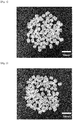
- Figs. 1 to 3 are photographs observing the shapes of polypropylene resin compositions prepared in Example 1, Comparative Example 1 and Comparative Example 3.
- pellet type polypropylene resin composition a method for preparing the same, and fiber prepared using the same will be explained in detail.
- a pellet type polypropylene resin composition with high flow can be prepared.
- the resin composition may exhibit excellent heat resistance and oxidation stability due to increase in melting temperature(Tm) and recrystallization temperature(Trc), and decrease in xylene solubles, and it may exhibit excellent fiber processability without visbreaking or rheology process using a decomposition accelerator, and thus, can be used to prepare fine denier fiber.
- a pellet type polypropylene resin composition according to one embodiment comprises:
- a pellet or pellet-type refers to a small particle or piece formed by extrusion of raw material, and includes all the shapes classified as a pellet in concerned technical field, such as a circle, a polygon, a rod, and the like.
- a pellet and powder may be classified on the basis of bulk density, and in the present disclosure, material having bulk density of 0.35 g/ml or more and 0.60 g/ml or less is defined as a pellet.
- the homo polypropylene is prepared by polymerization using a transition metal compound having a specific structure as explained later, and it exhibits high melt index of 400 g/lOmin or more (measured under load of 2.16 kg at 230 °C according to ASTM D1238), without using separate additive or process.
- homo polypropylene may further fulfill one or more, two or more, or all of the following b1) to b3) conditions:
- melt index of polymer can be adjusted by controlling the amount of hydrogen introduced during a polymerization process.
- high content of hydrogen should be introduced in the polymerization step.
- a metallocene compound of the Chemical Formula 1 which has high hydrogen reactivity, and thus, exhibits excellent catalytic activity eve if hydrogen introduction amount is decreased, and due to steric hindrance by a substituent bonded to a ligand, specifically an isopropyl group, can prepare low molecular weight polymer, homo polypropylene prepared may exhibit high melt index.
- a resin composition comprising the homo polypropylene also exhibits high flow, and thus, it may exhibit excellent fiber processability without visbreaking or rheology process using a decomposition accelerator that decreases heat resistance and oxidation stability.
- the homo polypropylene exhibits melt index of 400 g/lOmin or more, or 500 g/lOmin or more, or 510 g/lOmin or more, and 1500 g/10mim or less, or 1400 g/10mim or less, or 1300 g/10mim or less, or 1250 g/lOmin or less, or 1220 g/lOmin or less.
- the homo polypropylene has low xylene solubles(X.S) of 1wt% or less, based on the total weight of homo polypropylene, due to the characteristic preparation method.
- xylene soluble is a measurement of the content(wt%) of soluble polymer, in crystallized and cooled xylene obtained by dissolving homo polypropylene in xylene and cooling, and then, crystallizing insoluble parts from the cooled solution, and it means the content of polymer chain having low tacticity.
- homo polypropylene since homo polypropylene exhibits low xylene solubles of 1wt% or less, it has high tacticity, and thus, can increase crystallinity and recystallization temperature of a resin composition, thereby improving heat resistance and oxidation stability.
- the xylene solubles can be adjusted by controlling the kind of a catalyst used, polymerization conditions, and the like, and considering the excellent improvement effect of heat resistance and oxidation stability of the resin composition according to control of xylene solubles, the xylene solubles of the homo polypropylene may be more specifically 0.1wt% or more, or 0.2wt% or more, or 0.3wt% or more, and 1wt% or less, or less than 0.5wt%, or 0.4wt% or less.
- xylene solubles of homo polypropylene may be obtained by introducing xylene in a homo polypropylene sample, heating at 135°C for 1 hour and cooling for 30 minutes to progress pre-treatment, and then, dripping xylene at a flow rate of 1 mL/min for 4 hours in OminiSec(Viscotek Corporation FIPA) apparatus, and recording and measuring the concentration and injection amount of the pretreated sample if base lines of RI, DP, IP are stabilized, and then, calculating a peak area.
- OminiSec(Viscotek Corporation FIPA) apparatus OminiSec(Viscotek Corporation FIPA) apparatus
- the homo polypropylene exhibits narrow molecular weight distribution(MWD) of less than 2.4, due to the characteristic preparation method. As the result, it exhibits excellent fiber processability, and thus, can be used to prepare fine denier fiiber. More specifically, the MWD may be less than 2.4, or 2.3 or less, and 2.0 or more, or 2.1 or more.
- the molecular weight distribution(MWD) of the homo polypropylene may be determined by respectively measuring weight average molecular weight(Mw) and number average molecular weight(Mn) of homo polypropylene using gel permeation chromatography(GPC), and then, calculating the ratio(Mw/Mn) of the weight average molecular weight to the number average molecular weight. Specific measurement method and measurement conditions will be explained in detail in Experimental Example.
- homo polypropylene may fulfill the following b1') to b3') conditions:
- pellet type polypropylene resin composition according to one embodiment of the invention comprises an anti-oxidant, as well as the homo polypropylene.
- an antioxidant is added to polypropylene powder, and thus, it was difficult for the antioxidant to be uniformly distributed over the entire composition, and it was also difficult for the antioxidant to be distributed inside of the powder. As the result, antioxidation effect was low compared to the introduction amount.
- the antioxidant may be uniformly dispersed in the resin composition, and thus, more excellent thermal decomposition prevention effect and fiber processability enhancing effect may be exhibited.
- the antioxidant used in the pellet type polypropylene resin composition according to one embodiment of the invention comprises a phenol based compound having a long chain structure of aliphatic hydrocarbon having a carbon number of 12 or more in the molecule, or a structure of 1,3,5-triazine-2,4,6(1H,3H,5H)-trione.
- Heat, shear stress, and the like applied during the processing of polypropylene and a resin composition comprising the same induce thermal decomposition by radical mechanism to cause chain cleavage or crosslinking, thereby causing property change of the polymer and resin composition, such as viscosity decrease, and the like.
- an antioxidant is introduced, and among them, a phenol based antioxidant has excellent effect of reacting with polymer radicals and peroxy radicals produced by decomposition of polymer chain to consume radicals, and particularly has excellent property of preventing thermal decomposition, compared to common antioxidants such as phosphorus based antioxidants, and the like.
- phenol based compounds containing substituents with large steric hindrance may exhibit more excellent antioxidation effect, due to maximization of resonance effect and electron induction effect.
- the phenol based antioxidants have excellent color stability at the beginning, discoloration, specifically yellowing easily occurs with the elapse of time.
- some phenol based antiodixants such as pentaerythritol tetrakis[3-[3,5-di-tert-butyl-4-hydroxyphenyl]propionate, may be discolored into pink when preparing fiber through melt blown process, and the like.
- a phenol based antioxidant with a long chain structure of aliphatic hydrocarbon having a carbon number of 12 or more or a phenol based antioxidant having a structure of 1,3,5-triazine-2,4,6(1H,3H,5H)-trione, not only excellent oxidation stability improvement effect of homo polypropylene and a resin composition comprising the same may be exhibited, but also viscosity decrease and yellowing may be prevented.
- antioxidant octadecyl-3-[3,5-di-tert-butyl-4-hydroxyphenyl]propionate, 1,3,5-tris(3,5-di-tert-butyl-4-hydroxybenzyl)-1,3,5-triazine-2,4,6-(1H,3H,5H)-trione, and 1,3,5-tris(4-tert-butyl-3-hydroxy-2,6-dimethyl benzyl)-1,3,5-triazine-2,4,6-(1H,3H,5H)-trione, and the like may be mentioned, and among them, one or mixtures of two or more may be used. And, commercially available Irganox® 3114(BASF Corporation), Irganox® 1076 (BASF Corporation). or Cyanox® 1790 (CYTEC Corporation), fulfilling the above structural characteristics, may be also used.
- the antioxidant may be included in the content of 0.01 to 1 part by weight, based on 100 parts by weight of the homo polypropylene. If the content of the antioxidant is less than 0.01 parts by weight, improvement effect according to the use of the antioxidant may be insignificant, and if it is greater than 1 part by weight, there is a concern about viscosity decrease and discoloration due to the excessive amount of antioxidant. More specifically, the antioxidant may be included in the content of 0.05 parts by weight or more, or 0.1 parts by weight or more, and 0.5 parts by weight or less, or 0.3 parts by weight or less.
- pellet type polypropylene resin composition according to one embodiment of the invention may further comprise a lubricant.
- the lubricant has excellent antioxidation property, and thus, when used in combination with the above described high flow homo polypropylene, it may efficiently prevent decomposition by oxygen in the air or heat, thereby further improving fiber processability.
- organic metal based compounds such as calcium stearate, aluminum para-tert butyl benzoate, sodium benzoate, or calcium benzoate, and the like, may be mentioned, and among them, one or mixtures of two more may be used.
- the lubricant may be included in the content of 0.01 to 0.05 parts by weight or less, based on 100 parts by weight of the homo polypropylene. If the introduction amount of the lubricant is less than 0.01 parts by weight, antioxidation and fiber processability improvement effects according to the introduction of the lubricant may be insignificant, and if it is greater than 0.05 parts by weight, there is a concern about discoloration due to the excessive amount of lubricant. More specifically, the lubricant may be included in the content of 0.01 parts by weight or more, or 0.015 parts by weight or more, or 0.02 parts by weight or more, and 0.05 parts by weight or less, or 0.03 parts by weight or less, based on 100 parts by weight of the homo polypropylene.
- the pellet type polypropylene resin composition according to one embodiment of the invention may further comprise one or more additives such as a neutralization agent, a slip agent, an anti-blocking agent, an UV stabilizer, an antistatic agent, and the like, beside the above described components.
- the content of the additives is not specifically limited, and for example, each additive may be used in the content of 500 ppm or more, or 700 ppm or more, and 2500 ppm or less, or 1500 ppm or less, based on the total weight of the homo polypropylene.
- the pellet type polypropylene resin composition according to one embodiment of the invention comprises high flow homo polypropylene prepared by the above described preparation method, thereby fulfilling the following a1) to a6) conditions:
- pellet type polypropylene resin composition may further fulfill one or more, or two or more, or three or more, or four or more, or all of the following a1') to a6') conditions:
- the polypropylene resin composition exhibits high melt index(MI) of 400 to 1500 g/lOmin, and thus, may exhibit excellent fiber processability. More specifically, MI of the resin composition is 500 g/10min or more, or 510 g/10min or more, or 800 g/10min or more, and 1500 g/lOmin or less, or 1300 g/lOmin or less, or 1250 g/lOmin or less, or 1220 g/lOmin or less. Meanwhile, in the present disclosure, MI of the resin composition may be measured under load of 2.16kg at 230°C according to ASTM D 1238.
- fiber processability means preparing more fine denier and high strength fiber, by enabling high rate drawing due to uniform molecular weight distribution, when conducting a drawing process. If MI is less than 400 g/lOmin, processing temperature or processing pressure may increase, and thus, processability may be deteriorated, and the diameter of prepared fiber may significantly increase. And, if MI of the resin composition is greater than 1500 g/lOmin, although fiber having small diameter may be prepared with low viscosity, it may be difficult to pelletize, and compatibility with additives such as an antioxidant may be deteriorated, and thus, there is a concern about OIT decrease and yellowing. Since the pellet type polypropylene resin composition according to the invention has melt index in the controlled range of 400 to 1500 g/lOmin, fine denier and high strength fiber can be prepared.
- the pellet type polypropylene resin composition has high melting temperature(Tm) of 154°C or more, as well as high MI. Since it has high melting temperature, recrystallization temperature may increase, and it may have high tacticity, and thus, exhibit excellent heat resistance. If the melting temperature is less than 154°C, heat resistance may be deteriorated, and there is a concern about thermal decomposition when processing fiber at high temperature. More specifically, the pellet type polypropylene resin composition may have melting temperature of 154°C or more, or 155°C or more, or 156°C or more, and considering excellent heat stability as well as sufficient processability required for fiber processing, the melting temperature may be 170°C or less, or 160°C or less.
- melting temperature of the pellet type polypropylene resin composition may be measured using Differential Scanning Calorimeter(DSC). Specifically, a polypropylene resin composition is heated to 200 °C, and the temperature is maintained for 5 minutes and decreased to 30°C, and then, the temperature is increased to 200°C again. Wherein, temperature increase speed and decrease speed are respectively controlled to 10°C/min, and the melting temperature is the maximum point of an endothermic peak measured in the second temperature increase section.
- DSC Differential Scanning Calorimeter
- the pellet type polypropylene resin composition has high recrystallization temperature(Trc) of 112°C or more. Thus, it is rapidly crystallized during extrusion process, thereby enabling preparation of pellet type resin. And, it has high tacticity, and thus, may exhibit excellent heat resistance. If recrystallization temperature is less than 112°C, heat resistance may decrease, and there is a concern about thermal decomposition when processing fiber at high temperature. More specifically, recrystallization temperature of the pellet type polypropylene resin composition may be 120°C or more, and considering excellent heat stability as well as sufficient processability required for fiber processing, the recrystallization temperature may be 140°C or less, or 130°C or less.
- the recrystallization temperature(Trc) of the pellet type polypropylene resin composition may be measured using DSC, in the same manner as the measurement of melting temperature. Specifically, a polypropylene resin composition is heated to 200°C, and then, the temperature is maintained for 5 minutes, decreased to 30°C, and increased to 200°C again, and then, decreased again at 10°C/min. Wherein, temperature increase speed and decease speed are respectively controlled to 10°C/min, and the recrystallization temperature is the maximum point of an endothermic peak measured in the section where the temperature is decreased again at 10°C/min, namely the second temperature decrease section.
- the pellet type polypropylene resin composition may have xylene solubles (Xs) of 1.0 wt% or less, thus exhibiting high tacticity.
- Xs xylene solubles
- xylene soluble is the measurement of the content(wt%) of soluble polymer in crystallized cooled xylene obtained by dissolving a polypropylene resin composition in xylene, and then, cooling, and crystallizing insoluble parts from the cooled solution, and the xylene soluble comprise polymer chains of low tacticity.
- the polypropylene resin composition according to one embodiment of the invention exhibits low xylene solubles of 1.0 wt% or less, and thus, has high tacticity, thereby exhibiting excellent rigidity and flexural modulus.
- the xylene solubles may be adjusted by controlling the kind of catalyst used, the content of comonomers, and the like, and considering the excellent rigidity and flexural modulus improvement effect according to control of xylene solubles, the xylene solubles of the polypropylene resin composition may be more specifically 0.1wt% or more, or 0.2wt% or more, and 0.5 wt% or less, or 0.4 wt% or less.
- xylene solubles of the polypropylene resin composition may be obtained by introducing xylene in a polypropylene resin composition sample, heating at 135°C for 1 hour and cooling for 30 minutes for pre-treatment, and then, dripping xylene at a flow rate of 1 mL/min for 4 hours in OminiSec(Viscotek Corporation FIPA) apparatus to stabilize base lines of RI, DP, IP, and then, recording and measuring the concentration and injection amount of the pretreated sample, and then, calculating a peak area.
- the pellet type polypropylene resin composition may exhibit narrow molecular weight distribution(MWD) of less than 2.4. Thus, it exhibits excellent fiber processability, and can be used to prepare fine denier fiber. More specifically, MWD may be 2.3 or less, or 2.2 or less, and 2.0 or more, or 2.1 or more.
- the molecular weight distribution(MWD) of the pellet type polypropylene resin composition may be determined by measuring weight average molecular weight(Mw) and number average molecular weight(Mn) of the resin composition using gel permeation chromatography(GPC), and then, calculating the ratio(Mw/Mn) of the weigh average molecular weight to the number average molecular weight. Specific measurement method and conditions will be explained in Experimental Examples below.
- the pellet type polypropylene resin composition according to one embodiment of the invention exhibits high flow without using decomposition accelerator, as explained above, and it has high melting temperature and recrystallization temperature, low xylene solubles and narrow molecular weight distribution, thus exhibiting excellent heat resistance and oxidation stability.
- the pellet type polypropylene resin composition may have OIT(oxidation induction time), measured under conditions of 200°C and 50ml/min oxygen(O 2 ) according to ASTM D3985, of 30 minutes or more, more specifically 30 to 50 minutes, or 32 to 40 minutes, thus exhibiting excellent oxidation stability.
- OIT oxygen induction time
- OIT is the measurement of oxidation time under conditions of 200°C and 50ml/min oxygen(O 2 ) according to ASTM D3985, using thermal analysis device such as DSC(differential scanning calorimeter), and will be explained in more detail in Experimental Example below.
- heat resistance of the resin composition may be evaluated, and the pellet type polypropylene resin composition has heat resistance measured under the above described conditions of 8 hours or more, more specifically 8 to 15 hours, or 8 to 12 hours. As such, since it exhibits excellent heat resistance and oxidation stability as well as high flow, it may be more usefully used for the preparation of melt blown fiber.
- yellowing means that YI value measured using a color-difference meter is greater than 0, and the YI value is a value measured at 25°C using a color-difference meter(X-rite CE7000A) according to the standard method of ASTM D1925.
- the pellet type polypropylene resin composition according to one embodiment of the invention having the above described properties may be prepared by a method comprising steps of: conducting polymerization of propylene monomers while introducing hydrogen gas, in the presence of a catalyst composition comprising a transition metal compound represented by the following Chemical Formula 1, to prepare homo polypropylene (Step 1); and mixing the homo polypropylene with an antioxidant to prepare a mixed composition, and then, extruding and pelletizing (Step 2).
- a method for preparing the above described pellet type polypropylene resin composition in the Chemical Formula 1,
- Halogen may be fluorine(F), chlorine(Cl), bromine(Br) or iodine(I).
- a C 1-20 alkyl group may be a linear, branched or cyclic alkyl group.
- the C 1-20 alkyl group may be a C 1-15 linear alkyl group; a C 1-10 linear alkyl group; a C 1-5 linear alkyl group; a C 3-20 branched or cyclic alkyl group; a C 3-15 branched or cyclic alkyl group; or a C 3-10 branched or cyclic alkyl group.
- the C 1-20 alkyl group may be methyl, ethyl group, n-propyl, iso-propyl, n-butyl, iso-butyl, tert-butyl, n-pentyl, iso-pentyl, neo-pentyl or cyclohexyl group, and the like.
- a C 2-20 alkenyl group may be a linear, branched or cyclic alkenyl group.
- the C 2-20 alkenyl group may be a C 2-20 linear alkenyl group, a C 2-10 linear alkenyl group, a C 2-5 linear alkenyl group, a C 3-20 branched alkenyl group, a C 3-15 branched alkenyl group, a C 3-10 branched alkenyl group, a C 5-20 cyclic alkenyl group or a C 5-10 cyclic alkenyl group.
- the C 2-20 alkenyl group may be ethenyl, propenyl, butenyl, pentenyl or cyclohexenyl group, and the like.
- a C 6-30 aryl means monocyclic, bicyclic or tricyclic aromatic hydrocarbon. Specifically, the C 6-30 aryl may be phenyl, naphthyl or anthracenyl group, and the like.
- a C 7-30 alkylaryl means aryl of which one or more hydrogen atoms are substituted with alkyl.
- the C 7-30 alkylaryl may be methylphenyl, ethylphenyl, n-propylphenyl, isopropylphenyl, n-butylphenyl, iso-butylphenyl, tert-butylphenyl or cyclohexylphenyl, and the like.
- a C 7-30 arylalkyl means alkyl of which one or more hydrogen atoms are substituted with aryl.
- the C 7-30 arylalkyl may be benzyl, phenylpropyl or phenylhexyl and the like.
- the catalyst composition comprises a transition metal compound represented by the Chemical Formula 1 as a single catalyst.
- a transition metal compound represented by the Chemical Formula 1 as a single catalyst.
- the compound of the Chemical Formula 1 comprises a divalent functional group A di-substituted with ethyl groups as a bridge group connecting two ligands including indenyl groups, an atom size increases compared to the existing carbon bridge, an available angle increase, and monomer approach is easy, and thus, more excellent catalytic activity may be exhibited.
- two ethyl groups bonded to A may increase solubility and improve support efficiency, and solve the problem of decrease in support reactivity due to poor solubility when preparing a supported catalyst, in case a methyl group is included as a substituent of a bridge in the prior art.
- the compound of the Chemical Formula 1 comprises zirconium(Zr) as a center metal, and thus, compared to the case of comprising other Group 14 elements such as Hf and the like, it has more orbitals capable of accepting electrons, and can easily bond with monomer with higher affinity, thereby exhibiting more excellent catalytic activity improvement effect.
- A may be silicon
- R 1 and R 5 may be each independently C 6-20 aryl substituted with C 1-20 alkyl, more specifically, phenyl substituted with C 3-6 branched alkyl, such as tert-butyl phenyl.
- the alkyl substitution position to the phenyl may be a position 4 corresponding to a para position to R 1 or R 5 bonded to indenyl.
- R 2 to R 4 , and R 6 to R 5 may be hydrogen, and both X 1 and X 2 may be chloro.
- the compound of the Chemical Formula 1 may be synthesized applying known reactions, and for more detailed synthesis method, preparation examples described later may be referred to.
- the compound of the Chemical Formula 1 may be used as a single component, or it may be used in the form of a supported catalyst, while being supported in a carrier.
- particle shape and bulk density of prepared polymer When used in the form of a supported catalyst, particle shape and bulk density of prepared polymer may be excellent, and it may be suitably used for the conventional slurry polymerization or bulk polymerization, or gas phase polymerization process.
- silica, alumina, magnesia, silica-alumina, silicamagnesia, and the like may be mentioned, and they may commonly further comprise oxide, carbonate, sulfate and nitrate components, such as Na 2 O, K 2 CO 3 , BaSO 4 , and Mg(NO 3 ) 2 and the like.
- the transition metal compound is chemically bonded with reactive functional groups such as a siloxane group existing on the surface of the silica carrier, catalyst is hardly isolated from the carrier surface during propylene polymerization, thereby minimizing fouling wherein polymer particles stick to a reactor wall surface or each other, when preparing polypropylene by slurry or gas phase polymerization.
- the compound of the Chemical Formula 1 is supported in a carrier, and for example, the carrier is silica
- the compound of the Chemical Formula 1 may be supported in the content of 40 ⁇ mol or more, or 80 ⁇ mol or more, and 240 ⁇ mol or less, or 160 ⁇ mol or less, based on 1g of silica.
- appropriate activity of the supported catalyst may be exhibited, and thus, it may be favorable in terms of catalytic activity maintenance and economical efficiency.
- the catalyst composition may further comprise a cocatalyst in terms of high activity and improvement in process stability.
- the cocatalyst may comprise one or more selected from compounds represented by the following Chemical Formula 2, compounds represented by the following Chemical Formula 3, and compounds represented by the following Chemical Formula 4: [Chemical Formula 2] -[Al(R 11 )-O] m -
- alkylaluminoxane based compounds such as methylaluminoxane, ethylaluminoxane, isobutylaluminoxane or butylaluminoxane and the like, may be mentioned, and among them, one or mixtures of two or more may be used.
- the cocatalyst may be, more specifically, an alkylaluminoxane based cocatalyst such as methylaluminoxane.
- the alkylaluminoxane based cocatalyst comprises a metal element that can stabilize the transition metal compound of the Chemical Formula 1, and act as Lewis acid to form a bond through Lewis acid-base interaction with the functional group introduced in the bridge group of the transition metal compound of the Chemical Formula 1, thereby further enhancing catalytic activity.
- the content of the cocatalyst may be appropriately controlled according to the aimed properties and effects of the catalyst and resin composition.
- the cocatalyst may be supported in the content of 8mmol or more, or 10mmol or more, and 25 mmol or less, or 20 mmol or less, per carrier weight, for example, based on 1g of silica.
- the catalyst composition may further comprise a silica carrier and an alkylaluminoxane based cocatalyst, and specific contents thereof are as explained above.
- the catalyst composition having the above construction may be prepared by a method comprising steps of supporting a cocatalyst compound in a carrier, and supporting a transition metal compound represented by the Chemical Formula 1 in the carrier, wherein the sequence of supporting the cocatalyst and the transition metal compound represented by the Chemical Formula 1 may be changed as necessary.
- the prepared supported catalyst may realize high catalytic activity and more excellent process stability during the preparation process of polypropylene.
- the catalyst composition may be used for polymerization per se, or it may be prepolymerized through contact with propylene monomers before used for polymerization.
- the preparation method according to one embodiment of the invention may further comprise a step of contacting a catalyst composition with propylene monomers to prepolymerize, before preparing homo polypropylene through polymerization.
- polymerization first occurs on the surface of a carrier, and produced polymer is crystallized and inhibits monomer diffusion, and thus, empty polymer is formed, and apparent density is deteriorated.
- monomer diffusion speed inside a carrier may be controlled, thereby easily controlling and improving morphology of polymer.
- the prepolymerization may be conducted by contacting the catalyst composition with propylene monomers at 10 to 40°C, more specifically 10 to 20°C.
- propylene monomers at 10 to 40°C, more specifically 10 to 20°C.
- the prepolymerization may be conducted in the presence of an organo-aluminum compound(for example, triethylaluminum), and since monomers serves as a solvent, there is no need to introduce a separate solvent.
- an organo-aluminum compound for example, triethylaluminum
- a reactor for prepolymerization is not specifically limited, for example, it may be conducted through a Spheripol process in a loop reactor.
- the prepolymerization may be conducted for 3 to 10 minutes, or 4 to 7 minutes, and more specifically, it may be conducted such that polymerization degree of polymer after prepolymerization may become 100 to 200.
- a process of preparing homo polypropylene is conducted through a polymerization process of contacting a catalyst composition comprising a transition metal compound of the Chemical Formula 1 with propylene monomers in the presence of hydrogen gas.
- the hydrogen gas performs functions for activating the inactive sites of the metallocene catalyst and causing chain transfer reaction, thus control molecular weight.
- the metallocene compound of the present disclosure has excellent hydrogen reactivity, and thus, by controlling the amount of hydrogen gas used during a polymerization process, polypropylene having desired molecular weight and melt index may be effectively obtained.
- the hydrogen gas may be introduced in the amount of 500 to 1000 ppm, based on the total weight of propylene monomers, and more specifically, it may be introduced in the amount of 500 ppm or more, or 550ppm or more, or 600ppm or more, and 1000ppm or less, or 900ppm or less.
- the hydrogen gas may be introduced in the amount of 500 ppm or more, or 550ppm or more, or 600ppm or more, and 1000ppm or less, or 900ppm or less.
- the polymerization of homo polypropylene may be conducted by a continuous polymerization process, and for example, various polymerization processes known as a polymerization process of olefin monomers, such as solution polymerization, slurry polymerization, suspension polymerization, or emulsion polymerization, and the like, may be adopted.
- a continuous bulk slurry polymerization process in which a catalyst, propylene monomers, and optionally, hydrogen gas are continuously introduced, may be adopted.
- the polymerization may be conducted through Spheripol process using a loop reactor.
- the polymerization may be conducted at a temperature of 40°C or more, or 60°C or more, or 70°C or more, and 110°C or less or 100°C or less, and under pressure of 1 kgf/cm 2 or more, or 5 kgf/cm 2 or more, and 100 kgf/cm 2 or less, or 50kgf/cm 2 or less.
- a temperature of 40°C or more, or 60°C or more, or 70°C or more, and 110°C or less or 100°C or less and under pressure of 1 kgf/cm 2 or more, or 5 kgf/cm 2 or more, and 100 kgf/cm 2 or less, or 50kgf/cm 2 or less.
- trialkylaluminum such as triethylaluminum may be further introduced in the content of 0.01 wt% or more, or 0.05wt% or more, or 0.1wt% or more, and 1wt% or less, or 0.5wt% or less, based on the total weight of the propylene monomers. If moisture or impurity exists in a polymerization reactor, a part of a catalyst may be decomposed, but since the trialkylaluminum serves as a scavenger previously picking out moisture or impurity existing in the reactor, it can maximize the activity of a catalyst used for preparation, and thus, efficiently prepare homo polypropylene fulfilling the above described properties.
- the catalyst composition may be used in the form of a mud catalyst mixed with oil and grease.
- a catalyst composition is dissolved or diluted in C5 to 12 aliphatic hydrocarbon solvent, such as pentane, hexane, heptanes, nonane, decane, and isomers thereof; aromatic hydrocarbon solvent, such as toluene, benzene; chlorine-substituted hydrocarbon solvent, such as dichloromethane, dichlorobenzene, and the like, during propylene polymerization, the amount of volatile organic compounds contained in the prepared resin may remarkably decrease, and thus, odor caused thereby may also decrease.
- C5 to 12 aliphatic hydrocarbon solvent such as pentane, hexane, heptanes, nonane, decane, and isomers thereof
- aromatic hydrocarbon solvent such as toluene, benzene
- chlorine-substituted hydrocarbon solvent such as dichloromethane, dichlorobenzene, and
- Homo polypropylene prepared through the above explained polymerization process exhibits high flow, low xylene solubles and narrow molecular weight distribution, due to the use of a metallocene compounds having excellent hydrogen reactivity.
- excellent fiber processability may be exhibited without a visbreaking process using a decomposition accelerator, and since a decomposition accelerator used in visbreaking is not used, deterioration of heat resistance and oxidation stability of the prepared resin composition may be prevented.
- the prepared homo polypropylene is mixed with an antioxidant to prepare a mixed composition, and then, it is extruded and pelletized, thus preparing a pellet type polypropylene resin composition.
- the preparation of the mixed composition may be conducted by mixing the homo polypropylene with an antioxidant, wherein the kinds and contents of the homo polypropylene and antioxidant are as explained above.
- a lubricant when preparing the mixed composition, a lubricant may be further introduced, wherein specific kind and introduction amount of the lubricant are as explained above.
- one or more additives such as a neutralization agent, a slip agent, an anti-blocking agent, an UV stabilizer, an anti-static agent, and the like, may be further introduced, and specific kind and introduction amount thereof are as explained above.
- extrusion and pelletizing process of the mixed composition may be conducted according to a common extrusion process using a twin screw extruder, except that a die temperature for melting the mixed composition is controlled to 150 to 250°C.
- the die temperature during extrusion lowers temperature of molten-state resin, and increases viscosity, thus enabling pelletizing.
- the die temperature is less than 150°C, homo polypropylene in the mixed composition may not be sufficiently molten, and thus, pelletizing may not be sufficiently achieved, or it may be solidified to block inside of a die, thus decreasing productivity.
- the die temperature is greater than 250°C, viscosity may become too low and it may flow like fluid, and thus, it cannot be cut into a pellet shape, thus rendering pelletizing difficult.
- the die temperature may be 160°C or more, or 180°C or more, and 230°C or less, or 220°C or less.
- the die pressure may be 20bar or more, or 30bar or more, and 50bar or less, or 35bar or less.
- the pressure is controlled within such a range, the shape and properties of a pellet type polypropylene resin may be more easily realized.
- the extrusion and pelletizing process of the mixed composition may be conducted by underwater pelletizing(UWP).
- UWP method is more appropriate for pelletizing of a high flow resin composition, because a cutting process is achieved simultaneously with cooling by cooling water unlike common pelletizing methods.
- the die temperature during the extrusion and pelletizing by UWP may be, as explained above, 150 to 250°C, more specifically 160°C or more, or 180°C or more, and 230°C or less, or 220°C or less.
- the temperature of cooling water may be 40 to 80°C
- the rotation speed of a cutter may be 400 to 1,000 rpm. More specifically, the temperature of cooling water may be 40°C or more, 60 °C or more, and 80°C or less, or 70 °C or less, and the rotation speed of a cutter may be 400 rpm or more, or 500 rpm or more, and 1,000 rpm or less, or 800rpm or less, or 650rpm or less.
- the polypropylene resin composition prepared by the above method has a pellet shape, comprises an antioxidant as well as homo polypropylene, and exhibits the above explained properties.
- it has excellent fiber processability without using a peroxide based decomposition accelerator conventionally used when preparing fiber, and thus, can be used to prepare fine denier fiber, and exhibit excellent heat resistance and oxidation stability.
- it is particularly useful in the field of preparation of fiber requiring excellent filter efficiency, such as a filer or mask, and the like.
- fiber more specifically non-woven fabric, prepared using the pellet type polypropylene resin composition.
- a silica-supported metallocene catalyst was prepared by the same method as Synthesis Example 1, except that a transition metal compound(I) of the following structure was used instead of the transition metal compound of the Chemical Formula 1a in the Synthesis Example 1.
- propylene monomers(C3), triethylaluminum(TEAL) and hydrogen gas were introduced respectively using a pump under the conditions described in the following Table 1, and polymerization was conducted.
- homo polypropylene was prepared while maintaining the reactor temperature of 70°C, the pressure of 35 kg/cm 2 , and hourly productivity of 40kg.
- Homo polypropylene was prepared by the same method as Preparation Example 1, except that the process was conducted under the conditions described in the following Table 1.
- H7910® As homo polypropylene, H7910® (LG Chem) prepared by polymerizing after conducting prepolymerization, using a Ziegler-natta(Z/N) catalyst, was used.
- H7912® As homo polypropylene, H7912® (LG Chem) prepared by polymerizing after conducting prepolymerization, using a Ziegler-natta(Z/N) catalyst, was used.
- MF650W® Polymirae Company
- MF650X® Polymirae Company
- Homo polypropylene was prepared by the same method as Preparation Example 1, except that a silica-supported metallocene catalyst prepared in Synthesis Example 2 was used instead of the silica-supported metallocene catalyst prepared in Synthesis Example 1, and the process was conducted under the conditions described in the following Table 1.
- gel permeation chromatography (GPC) device
- Waters PL-GPC220 was used, and Polymer Laboratories PLgel MIX-B 300mm length column was used.
- measurement temperature was 160°C
- 1,2,4-trichlorobenzene was used as a solvent
- flow rate was 1mL/min.
- the homo polypropylene samples were respectively prepared at a concentration of 10mg/10mL, and then, fed in an amount of 200 ⁇ L.
- Mw and Mn values were derived.
- Polypropylene resin compositions were prepared by the same method as Example 1, except mixing with the composition described in the following Table 2.
- Polypropylene resin compositions were prepared by the same method as Example 1, except preparing under the conditions described in the following Table 2.
- the polypropylene resin composition For the measurement of the bulk density, 100g of the polypropylene resin composition was flowed through the orifice of standard flowmeter and received in a container with a volume of 100ml, and shaved off such that the polypropylene resin composition became horizontal, thus controlling the volume of the polypropylene resin composition to 100ml, and then, the weight of the polypropylene resin composition except the container was measured. And, the weight of the polypropylene resin composition was divided by the volume of the polypropylene resin composition, 100ml, to calculate bulk density corresponding to the weight of the polypropylene resin composition per unit volume (unit: g/ml).
- Fibers were prepared using the polypropylene resin compositions of Examples and Comparative Examples, and the diameter of prepared fiber was measured.
- the polypropylene resin compositions of Examples 1 ⁇ 9 were pellet types, and exhibited high heat resistance of 8 hours or more, and excellent oxidation stability with OIT of 30 minutes or more.
Landscapes
- Chemical & Material Sciences (AREA)
- Chemical Kinetics & Catalysis (AREA)
- Organic Chemistry (AREA)
- Health & Medical Sciences (AREA)
- Medicinal Chemistry (AREA)
- Polymers & Plastics (AREA)
- Engineering & Computer Science (AREA)
- Materials Engineering (AREA)
- Crystallography & Structural Chemistry (AREA)
- General Chemical & Material Sciences (AREA)
- Textile Engineering (AREA)
- Mechanical Engineering (AREA)
- Manufacturing & Machinery (AREA)
- Compositions Of Macromolecular Compounds (AREA)
- Addition Polymer Or Copolymer, Post-Treatments, Or Chemical Modifications (AREA)
- Processes Of Treating Macromolecular Substances (AREA)
Abstract
Description
- This application claims the benefit of
Korean Patent Application No. 10-2019-0121173 filed on September 30, 2019 Korean Patent Application No. 10-2020-0123879 filed on September 24, 2020 - This invention relates to a pellet type polypropylene resin composition that exhibits excellent heat resistance and oxidation stability, and exhibits high flow without using a decomposition accelerator, and thus, can be used to prepare fine denier fiber, and a method for preparing the same.
- Polypropylene is being used as common resin in various fields, due to low specific gravity, high heat resistance, and excellent processability and chemical resistance, and particularly, high flow homo polypropylene is being used for fine denier melt blown fiber.
- Recently, in textile industry, there is a growing demand for fine denier pellet type material that can improve filter efficiency in a filter or mask, which is the main use of the final product, and improvement in heat resistance, weather resistance and oxidation stability of a resin composition is required.
- Since common Ziegler-Natta catalyst exhibits low hydrogen reactivity, homo polypropylene prepared using the same exhibits low melt index(MI). Thus, when preparing a pellet type resin composition using the homo polypropylene, flowability is increased through visbreaking or controlled rheology(CR) process using a peroxide based decomposition accelerator during an extrusion process. However, the use of peroxide based decomposition accelerators may deteriorate heat resistance and oxidation stability. And, due to the limitation of Ziegler-Natta catalyst having multiple active sites, the homo polypropylene has wide molecular weight distribution, and thus, there is a limit to fine denier when applied for fiber.
- And, although high flow polypropylene resin composition prepared using commercial metallocene catalyst is useful for preparation of fine denier fiber, it has powder shape and wide particle distribution, and it is not easy to use an antioxidant for improvement of oxidation stability.
- Thus, there is a demand for development of a resin composition that not only has high flow, and thus, can be used to prepare fine denier fiber, but also has improved heat resistance and oxidation stability.
- It is an object of the invention to provide a pellet type polypropylene resin composition that exhibits excellent heat resistance and oxidation stability, and exhibits high flow without using a decomposition accelerator, and thus, can be used to prepare fine denier fiber, and a method for preparing the same.
- According to one embodiment of the invention, there is provided a pellet type polypropylene resin composition comprising:
- homo polypropylene having a melt index, measured under a load of 2.16 kg at 230 °C according to ASTM D1238, of 400 g/lOmin or more; and
- an antioxidant, and
- fulfilling the following conditions a1) to a6):
- a1) melt index, measured under a load of 2.16 kg at 230 °C according to ASTM D1238: 400 to 1500 g/lOmin,
- a2) melting temperature: 154°C or more,
- a3) recrystallization temperature: 112°C or more,
- a4) xylene solubles: 1.0wt% or less, based on the total weight of the pellet type polypropylene resin composition,
- a5) molecular weight distribution: less than 2.4, and
- a6) oxidation induction time, measured under conditions of 200°C and 50ml/min of oxygen according to ASTM D3985: 30 minutes or more.
- According to another embodiment of the invention, there is provided a method for preparing the pellet type polypropylene resin composition, comprising steps of: conducting polymerization of propylene monomers while introducing hydrogen gas, in the presence of a catalyst composition comprising a transition metal compound represented by the following Chemical Formula 1, to prepare homo polypropylene exhibiting melt index of 400 g/lOmin or more, measured under load of 2.16 kg at 230°C according to ASTM D1238; and mixing the homo polypropylene with antioxidant to prepare a mixed composition, and then, extruding and pelletizing:


- A is carbon, silicon or germanium,
- X1 and X2 are each independently halogen,
- R1 and R5 are each independently C6-20 aryl substituted with C1-20 alkyl,
- R2 to R4, and R6 to R5 are each independently hydrogen, halogen, C1-20 alkyl, C2-20 alkenyl, C1-20 alkylsilyl, C1-20 silylalkyl, C1-20 alkoxysilyl, C1-20 ether, C1-20 silylether, C1-20 alkoxy, C6-20 aryl, C7-20 alkylaryl, or C7-20 arylalkyl.
- According to yet another embodiment of the invention, there is provided fiber, more specifically, non woven fabric, comprising the pellet type polypropylene resin composition.
- The pellet type polypropylene resin composition according to this invention comprises high flow homo polypropylene polymerized using a metallocene catalyst having high hydrogen reactivity, and an anti-oxidant of a specific structure, thus exhibiting excellent heat resistance and oxidation stability. And, since it exhibits high flowability, it can be used to prepare fine denier fiber without using a decomposition accelerator. Thus, it is particularly useful in the field of preparation of fiber requiring excellent filter efficiency, such as a filter or a mask, and the like.
-
Figs. 1 to 3 are photographs observing the shapes of polypropylene resin compositions prepared in Example 1, Comparative Example 1 and Comparative Example 3. - Terms used herein are only to explain specific embodiments, and are not intended to limit the invention. A singular expression includes a plural expression thereof, unless it is expressly stated or obvious from the context that such is not intended. As used herein, the terms "comprise" or "have", etc. are intended to designate the existence of practiced characteristic, number, step, constructional element or combinations thereof, and they are not intended to preclude the possibility of existence or addition of one or more other characteristics, numbers, steps, constructional elements or combinations thereof.
- Although various modifications can be made to this invention and this invention may have various forms, specific examples will be illustrated and explained in detail below. However, it should be understood that these are not intended to limit the invention to specific disclosure, and that the invention includes all the modifications, equivalents or replacements thereof without departing from the spirit and technical scope of the invention.
- Hereinafter, a pellet type polypropylene resin composition, a method for preparing the same, and fiber prepared using the same will be explained in detail.
- In the present disclosure, by using high flow homo polypropylene that is prepared using a transition metal of the Chemical Formula 1 exhibiting high hydrogen reactivity, and an antioxidant having a specific structure in combination, a pellet type polypropylene resin composition with high flow can be prepared. The resin composition may exhibit excellent heat resistance and oxidation stability due to increase in melting temperature(Tm) and recrystallization temperature(Trc), and decrease in xylene solubles, and it may exhibit excellent fiber processability without visbreaking or rheology process using a decomposition accelerator, and thus, can be used to prepare fine denier fiber.
- Specifically, a pellet type polypropylene resin composition according to one embodiment comprises:
- homo polypropylene having a melt index, measured under a load of 2.16 kg at 230 °C according to ASTM D1238, of 400 g/lOmin or more; and
- an antioxidant, and
- fulfills the following conditions a1) to a6):
- a1) melt index, measured under load of 2.16 kg at 230 °C according to ASTM D1238: 400 to 1500 g/lOmin,
- a2) melting temperature: 154°C or more,
- a3) recrystallization temperature: 112°C or more,
- a4) xylene solubles: 1.0wt% or less, based on the total weight of the pellet type polypropylene resin composition,
- a5) molecular weight distribution: less than 2.4, and
- a6) oxidation induction time, measured under conditions of 200°C and 50ml/min of oxygen according to ASTM D3985: 30 minutes or more.
- As used herein, a pellet or pellet-type refers to a small particle or piece formed by extrusion of raw material, and includes all the shapes classified as a pellet in concerned technical field, such as a circle, a polygon, a rod, and the like. A pellet and powder may be classified on the basis of bulk density, and in the present disclosure, material having bulk density of 0.35 g/ml or more and 0.60 g/ml or less is defined as a pellet.
- Specifically, in the pellet type polypropylene resin composition according to one embodiment of the invention, the homo polypropylene is prepared by polymerization using a transition metal compound having a specific structure as explained later, and it exhibits high melt index of 400 g/lOmin or more (measured under load of 2.16 kg at 230 °C according to ASTM D1238), without using separate additive or process.
- And, the homo polypropylene may further fulfill one or more, two or more, or all of the following b1) to b3) conditions:
- b1) melt index, measured under a load of 2.16 kg at 230 °C according to ASTM D1238: 500 to 1500 g/10mim,
- b2) xylene solubles: 0.1 to 1wt%, based on the total weight of the homopolypropylene, and
- b3) molecular weight distribution: less than 2.4.
- Commonly, melt index of polymer can be adjusted by controlling the amount of hydrogen introduced during a polymerization process. Previously, when preparing high flow polypropylene using a Ziegler-natta catalyst, high content of hydrogen should be introduced in the polymerization step. However, in the present disclosure, by using a metallocene compound of the Chemical Formula 1, which has high hydrogen reactivity, and thus, exhibits excellent catalytic activity eve if hydrogen introduction amount is decreased, and due to steric hindrance by a substituent bonded to a ligand, specifically an isopropyl group, can prepare low molecular weight polymer, homo polypropylene prepared may exhibit high melt index. Thereby, a resin composition comprising the homo polypropylene also exhibits high flow, and thus, it may exhibit excellent fiber processability without visbreaking or rheology process using a decomposition accelerator that decreases heat resistance and oxidation stability. More specifically, the homo polypropylene exhibits melt index of 400 g/lOmin or more, or 500 g/lOmin or more, or 510 g/lOmin or more, and 1500 g/10mim or less, or 1400 g/10mim or less, or 1300 g/10mim or less, or 1250 g/lOmin or less, or 1220 g/lOmin or less.
- And, the homo polypropylene has low xylene solubles(X.S) of 1wt% or less, based on the total weight of homo polypropylene, due to the characteristic preparation method.
- In the present disclosure, xylene soluble is a measurement of the content(wt%) of soluble polymer, in crystallized and cooled xylene obtained by dissolving homo polypropylene in xylene and cooling, and then, crystallizing insoluble parts from the cooled solution, and it means the content of polymer chain having low tacticity. Thus, it can be seen that the lower the xylene solubles, the higher tacticity the homo polypropylene has. In the polypropylene resin composition according to one embodiment of the invention, since homo polypropylene exhibits low xylene solubles of 1wt% or less, it has high tacticity, and thus, can increase crystallinity and recystallization temperature of a resin composition, thereby improving heat resistance and oxidation stability. The xylene solubles can be adjusted by controlling the kind of a catalyst used, polymerization conditions, and the like, and considering the excellent improvement effect of heat resistance and oxidation stability of the resin composition according to control of xylene solubles, the xylene solubles of the homo polypropylene may be more specifically 0.1wt% or more, or 0.2wt% or more, or 0.3wt% or more, and 1wt% or less, or less than 0.5wt%, or 0.4wt% or less.
- Meanwhile, in the present disclosure, xylene solubles of homo polypropylene may be obtained by introducing xylene in a homo polypropylene sample, heating at 135°C for 1 hour and cooling for 30 minutes to progress pre-treatment, and then, dripping xylene at a flow rate of 1 mL/min for 4 hours in OminiSec(Viscotek Corporation FIPA) apparatus, and recording and measuring the concentration and injection amount of the pretreated sample if base lines of RI, DP, IP are stabilized, and then, calculating a peak area. Specific measurement method and measurement conditions will be explained in detail in Experimental Example.
- And, the homo polypropylene exhibits narrow molecular weight distribution(MWD) of less than 2.4, due to the characteristic preparation method. As the result, it exhibits excellent fiber processability, and thus, can be used to prepare fine denier fiiber. More specifically, the MWD may be less than 2.4, or 2.3 or less, and 2.0 or more, or 2.1 or more.
- Meanwhile, in the present disclosure, the molecular weight distribution(MWD) of the homo polypropylene may be determined by respectively measuring weight average molecular weight(Mw) and number average molecular weight(Mn) of homo polypropylene using gel permeation chromatography(GPC), and then, calculating the ratio(Mw/Mn) of the weight average molecular weight to the number average molecular weight. Specific measurement method and measurement conditions will be explained in detail in Experimental Example.
- More specifically, the homo polypropylene may fulfill the following b1') to b3') conditions:
- b1') melt index, measured under load of 2.16 kg at 230 °C according to ASTM D1238: 500 g/10mim or more, or 510 g/10mim or more, and 1250 g/10mim or less, or 1220 g/10mim or less,
- b2') xylene solubles: 0.1wt% or more, or 0.2wt% or more, or 0.3wt% or more, and less than 0.5wt%, or 0.4wt% or less, based on the total weight of the homo polypropylene, and
- b3') molecular weight distribution(MWD): less than 2.4, or 2.3 or less, and 2.0 or more, or 2.1 or more.
- Meanwhile, the pellet type polypropylene resin composition according to one embodiment of the invention comprises an anti-oxidant, as well as the homo polypropylene.
- In the existing power type resin composition, an antioxidant is added to polypropylene powder, and thus, it was difficult for the antioxidant to be uniformly distributed over the entire composition, and it was also difficult for the antioxidant to be distributed inside of the powder. As the result, antioxidation effect was low compared to the introduction amount. In this regard, in the present disclosure, by using an antioxidant in combination with the high flow homo polypropylene, the antioxidant may be uniformly dispersed in the resin composition, and thus, more excellent thermal decomposition prevention effect and fiber processability enhancing effect may be exhibited.
- And, the antioxidant used in the pellet type polypropylene resin composition according to one embodiment of the invention comprises a phenol based compound having a long chain structure of aliphatic hydrocarbon having a carbon number of 12 or more in the molecule, or a structure of 1,3,5-triazine-2,4,6(1H,3H,5H)-trione.
- Heat, shear stress, and the like applied during the processing of polypropylene and a resin composition comprising the same induce thermal decomposition by radical mechanism to cause chain cleavage or crosslinking, thereby causing property change of the polymer and resin composition, such as viscosity decrease, and the like. In order to prevent the change, an antioxidant is introduced, and among them, a phenol based antioxidant has excellent effect of reacting with polymer radicals and peroxy radicals produced by decomposition of polymer chain to consume radicals, and particularly has excellent property of preventing thermal decomposition, compared to common antioxidants such as phosphorus based antioxidants, and the like. In addition, phenol based compounds containing substituents with large steric hindrance may exhibit more excellent antioxidation effect, due to maximization of resonance effect and electron induction effect. However, although the phenol based antioxidants have excellent color stability at the beginning, discoloration, specifically yellowing easily occurs with the elapse of time. And, some phenol based antiodixants, such as pentaerythritol tetrakis[3-[3,5-di-tert-butyl-4-hydroxyphenyl]propionate, may be discolored into pink when preparing fiber through melt blown process, and the like.
- Thus, in the present disclosure, by using a phenol based antioxidant with a long chain structure of aliphatic hydrocarbon having a carbon number of 12 or more, or a phenol based antioxidant having a structure of 1,3,5-triazine-2,4,6(1H,3H,5H)-trione, not only excellent oxidation stability improvement effect of homo polypropylene and a resin composition comprising the same may be exhibited, but also viscosity decrease and yellowing may be prevented.
- As specific examples of the antioxidant, octadecyl-3-[3,5-di-tert-butyl-4-hydroxyphenyl]propionate, 1,3,5-tris(3,5-di-tert-butyl-4-hydroxybenzyl)-1,3,5-triazine-2,4,6-(1H,3H,5H)-trione, and 1,3,5-tris(4-tert-butyl-3-hydroxy-2,6-dimethyl benzyl)-1,3,5-triazine-2,4,6-(1H,3H,5H)-trione, and the like may be mentioned, and among them, one or mixtures of two or more may be used. And, commercially available Irganox® 3114(BASF Corporation), Irganox® 1076 (BASF Corporation). or Cyanox® 1790 (CYTEC Corporation), fulfilling the above structural characteristics, may be also used.
- The antioxidant may be included in the content of 0.01 to 1 part by weight, based on 100 parts by weight of the homo polypropylene. If the content of the antioxidant is less than 0.01 parts by weight, improvement effect according to the use of the antioxidant may be insignificant, and if it is greater than 1 part by weight, there is a concern about viscosity decrease and discoloration due to the excessive amount of antioxidant. More specifically, the antioxidant may be included in the content of 0.05 parts by weight or more, or 0.1 parts by weight or more, and 0.5 parts by weight or less, or 0.3 parts by weight or less.
- And, the pellet type polypropylene resin composition according to one embodiment of the invention may further comprise a lubricant.
- The lubricant has excellent antioxidation property, and thus, when used in combination with the above described high flow homo polypropylene, it may efficiently prevent decomposition by oxygen in the air or heat, thereby further improving fiber processability. As the lubricant, organic metal based compounds, such as calcium stearate, aluminum para-tert butyl benzoate, sodium benzoate, or calcium benzoate, and the like, may be mentioned, and among them, one or mixtures of two more may be used.
- The lubricant may be included in the content of 0.01 to 0.05 parts by weight or less, based on 100 parts by weight of the homo polypropylene. If the introduction amount of the lubricant is less than 0.01 parts by weight, antioxidation and fiber processability improvement effects according to the introduction of the lubricant may be insignificant, and if it is greater than 0.05 parts by weight, there is a concern about discoloration due to the excessive amount of lubricant. More specifically, the lubricant may be included in the content of 0.01 parts by weight or more, or 0.015 parts by weight or more, or 0.02 parts by weight or more, and 0.05 parts by weight or less, or 0.03 parts by weight or less, based on 100 parts by weight of the homo polypropylene.
- The pellet type polypropylene resin composition according to one embodiment of the invention may further comprise one or more additives such as a neutralization agent, a slip agent, an anti-blocking agent, an UV stabilizer, an antistatic agent, and the like, beside the above described components. The content of the additives is not specifically limited, and for example, each additive may be used in the content of 500 ppm or more, or 700 ppm or more, and 2500 ppm or less, or 1500 ppm or less, based on the total weight of the homo polypropylene.
- The pellet type polypropylene resin composition according to one embodiment of the invention comprises high flow homo polypropylene prepared by the above described preparation method, thereby fulfilling the following a1) to a6) conditions:
- a1) melt index, measured under load of 2.16 kg at 230°C according to ASTM D1238: 400 to 1500 g/lOmin,
- a2) melting temperature: 154°C or more,
- a3) recrystallization temperature: 112°C or more,
- a4) recrystallization temperature: 1.0wt% or less, based on the total weight of the pellet type polypropylene resin composition,
- a5) molecular weight distribution: less than 2.4, and
- a6) oxidation induction time measured under conditions of 200°C and 50ml/min oxygen according to ASTM D3985: 30 minutes or more.
- And, the pellet type polypropylene resin composition may further fulfill one or more, or two or more, or three or more, or four or more, or all of the following a1') to a6') conditions:
- a1') melt index, measured under load of 2.16 kg at 230°C according to ASTM D1238: 500 to 1500 g/lOmin,
- a2') melting temperature: 155 to 170°C,
- a3') recrystallization temperature: 120 to 130°C,
- a4') xylene solubles: 0.1 to 0.5wt%, based on the total weight of the resin composition,
- a5') molecular weight distribution: 2 to 2.3, and
- a6') heat resistance measured by a time until yellowing at 170°C (YI value greater than 0): 8 to 15 hours.
- Specifically, the polypropylene resin composition exhibits high melt index(MI) of 400 to 1500 g/lOmin, and thus, may exhibit excellent fiber processability. More specifically, MI of the resin composition is 500 g/10min or more, or 510 g/10min or more, or 800 g/10min or more, and 1500 g/lOmin or less, or 1300 g/lOmin or less, or 1250 g/lOmin or less, or 1220 g/lOmin or less. Meanwhile, in the present disclosure, MI of the resin composition may be measured under load of 2.16kg at 230°C according to ASTM D 1238.
- In the present disclosure, fiber processability means preparing more fine denier and high strength fiber, by enabling high rate drawing due to uniform molecular weight distribution, when conducting a drawing process. If MI is less than 400 g/lOmin, processing temperature or processing pressure may increase, and thus, processability may be deteriorated, and the diameter of prepared fiber may significantly increase. And, if MI of the resin composition is greater than 1500 g/lOmin, although fiber having small diameter may be prepared with low viscosity, it may be difficult to pelletize, and compatibility with additives such as an antioxidant may be deteriorated, and thus, there is a concern about OIT decrease and yellowing. Since the pellet type polypropylene resin composition according to the invention has melt index in the controlled range of 400 to 1500 g/lOmin, fine denier and high strength fiber can be prepared.
- And, the pellet type polypropylene resin composition has high melting temperature(Tm) of 154°C or more, as well as high MI. Since it has high melting temperature, recrystallization temperature may increase, and it may have high tacticity, and thus, exhibit excellent heat resistance. If the melting temperature is less than 154°C, heat resistance may be deteriorated, and there is a concern about thermal decomposition when processing fiber at high temperature. More specifically, the pellet type polypropylene resin composition may have melting temperature of 154°C or more, or 155°C or more, or 156°C or more, and considering excellent heat stability as well as sufficient processability required for fiber processing, the melting temperature may be 170°C or less, or 160°C or less.
- Meanwhile, in the present disclosure, melting temperature of the pellet type polypropylene resin composition may be measured using Differential Scanning Calorimeter(DSC). Specifically, a polypropylene resin composition is heated to 200 °C, and the temperature is maintained for 5 minutes and decreased to 30°C, and then, the temperature is increased to 200°C again. Wherein, temperature increase speed and decrease speed are respectively controlled to 10°C/min, and the melting temperature is the maximum point of an endothermic peak measured in the second temperature increase section.
- And, the pellet type polypropylene resin composition has high recrystallization temperature(Trc) of 112°C or more. Thus, it is rapidly crystallized during extrusion process, thereby enabling preparation of pellet type resin. And, it has high tacticity, and thus, may exhibit excellent heat resistance. If recrystallization temperature is less than 112°C, heat resistance may decrease, and there is a concern about thermal decomposition when processing fiber at high temperature. More specifically, recrystallization temperature of the pellet type polypropylene resin composition may be 120°C or more, and considering excellent heat stability as well as sufficient processability required for fiber processing, the recrystallization temperature may be 140°C or less, or 130°C or less.
- In the present disclosure, the recrystallization temperature(Trc) of the pellet type polypropylene resin composition may be measured using DSC, in the same manner as the measurement of melting temperature. Specifically, a polypropylene resin composition is heated to 200°C, and then, the temperature is maintained for 5 minutes, decreased to 30°C, and increased to 200°C again, and then, decreased again at 10°C/min. Wherein, temperature increase speed and decease speed are respectively controlled to 10°C/min, and the recrystallization temperature is the maximum point of an endothermic peak measured in the section where the temperature is decreased again at 10°C/min, namely the second temperature decrease section.
- And, the pellet type polypropylene resin composition may have xylene solubles (Xs) of 1.0 wt% or less, thus exhibiting high tacticity.
- In the present disclosure, xylene soluble is the measurement of the content(wt%) of soluble polymer in crystallized cooled xylene obtained by dissolving a polypropylene resin composition in xylene, and then, cooling, and crystallizing insoluble parts from the cooled solution, and the xylene soluble comprise polymer chains of low tacticity. Thus, the lower the xylene soluble, higher tacticity polymer has. The polypropylene resin composition according to one embodiment of the invention exhibits low xylene solubles of 1.0 wt% or less, and thus, has high tacticity, thereby exhibiting excellent rigidity and flexural modulus. The xylene solubles may be adjusted by controlling the kind of catalyst used, the content of comonomers, and the like, and considering the excellent rigidity and flexural modulus improvement effect according to control of xylene solubles, the xylene solubles of the polypropylene resin composition may be more specifically 0.1wt% or more, or 0.2wt% or more, and 0.5 wt% or less, or 0.4 wt% or less.
- Meanwhile, in the present disclosure, xylene solubles of the polypropylene resin composition may be obtained by introducing xylene in a polypropylene resin composition sample, heating at 135°C for 1 hour and cooling for 30 minutes for pre-treatment, and then, dripping xylene at a flow rate of 1 mL/min for 4 hours in OminiSec(Viscotek Corporation FIPA) apparatus to stabilize base lines of RI, DP, IP, and then, recording and measuring the concentration and injection amount of the pretreated sample, and then, calculating a peak area.
- And, the pellet type polypropylene resin composition may exhibit narrow molecular weight distribution(MWD) of less than 2.4. Thus, it exhibits excellent fiber processability, and can be used to prepare fine denier fiber. More specifically, MWD may be 2.3 or less, or 2.2 or less, and 2.0 or more, or 2.1 or more.
- Meanwhile, in the present disclosure, the molecular weight distribution(MWD) of the pellet type polypropylene resin composition may be determined by measuring weight average molecular weight(Mw) and number average molecular weight(Mn) of the resin composition using gel permeation chromatography(GPC), and then, calculating the ratio(Mw/Mn) of the weigh average molecular weight to the number average molecular weight. Specific measurement method and conditions will be explained in Experimental Examples below.
- The pellet type polypropylene resin composition according to one embodiment of the invention exhibits high flow without using decomposition accelerator, as explained above, and it has high melting temperature and recrystallization temperature, low xylene solubles and narrow molecular weight distribution, thus exhibiting excellent heat resistance and oxidation stability.
- Specifically, the pellet type polypropylene resin composition may have OIT(oxidation induction time), measured under conditions of 200°C and 50ml/min oxygen(O2) according to ASTM D3985, of 30 minutes or more, more specifically 30 to 50 minutes, or 32 to 40 minutes, thus exhibiting excellent oxidation stability.
- Meanwhile, in the present disclosure, OIT is the measurement of oxidation time under conditions of 200°C and 50ml/min oxygen(O2) according to ASTM D3985, using thermal analysis device such as DSC(differential scanning calorimeter), and will be explained in more detail in Experimental Example below.
- And, by measuring a time taken until a resin composition is discolored, specifically yellowed at high temperature of 170°C, heat resistance of the resin composition may be evaluated, and the pellet type polypropylene resin composition has heat resistance measured under the above described conditions of 8 hours or more, more specifically 8 to 15 hours, or 8 to 12 hours. As such, since it exhibits excellent heat resistance and oxidation stability as well as high flow, it may be more usefully used for the preparation of melt blown fiber.
- Meanwhile, in the present disclosure, yellowing means that YI value measured using a color-difference meter is greater than 0, and the YI value is a value measured at 25°C using a color-difference meter(X-rite CE7000A) according to the standard method of ASTM D1925.
- The pellet type polypropylene resin composition according to one embodiment of the invention having the above described properties may be prepared by a method comprising steps of: conducting polymerization of propylene monomers while introducing hydrogen gas, in the presence of a catalyst composition comprising a transition metal compound represented by the following Chemical Formula 1, to prepare homo polypropylene (Step 1); and mixing the homo polypropylene with an antioxidant to prepare a mixed composition, and then, extruding and pelletizing (Step 2). Thus, according to another embodiment of the invention, there is provided a method for preparing the above described pellet type polypropylene resin composition:

- A is carbon, silicon or germanium,
- X1 and X2 are each independently halogen,
- R1 and R5 are each independently C6-20 aryl substituted with C1-20 alkyl,
- R2 to R4, and R6 to R5 are each independently hydrogen, halogen, C1-20 alkyl, C2-20 alkenyl, C1-20 alkylsilyl, C1-20 silylalkyl, C1-20 alkoxysilyl, C1-20 ether, C1-20 silylether, C1-20 alkoxy, C6-20 aryl, C7-20 alkylaryl, or C7-20 arylalkyl.
- Meanwhile, unless specifically limited, the following terms may be defined as follows. Halogen may be fluorine(F), chlorine(Cl), bromine(Br) or iodine(I).
- A C1-20 alkyl group may be a linear, branched or cyclic alkyl group. Specifically, the C1-20 alkyl group may be a C1-15 linear alkyl group; a C1-10 linear alkyl group; a C1-5 linear alkyl group; a C3-20 branched or cyclic alkyl group; a C3-15 branched or cyclic alkyl group; or a C3-10 branched or cyclic alkyl group. More specifically, the C1-20 alkyl group may be methyl, ethyl group, n-propyl, iso-propyl, n-butyl, iso-butyl, tert-butyl, n-pentyl, iso-pentyl, neo-pentyl or cyclohexyl group, and the like.
- A C2-20 alkenyl group may be a linear, branched or cyclic alkenyl group. Specifically, the C2-20 alkenyl group may be a C2-20 linear alkenyl group, a C2-10 linear alkenyl group, a C2-5 linear alkenyl group, a C3-20 branched alkenyl group, a C3-15 branched alkenyl group, a C3-10 branched alkenyl group, a C5-20 cyclic alkenyl group or a C5-10 cyclic alkenyl group. More specifically, the C2-20 alkenyl group may be ethenyl, propenyl, butenyl, pentenyl or cyclohexenyl group, and the like.
- A C6-30 aryl means monocyclic, bicyclic or tricyclic aromatic hydrocarbon. Specifically, the C6-30 aryl may be phenyl, naphthyl or anthracenyl group, and the like.
- A C7-30 alkylaryl means aryl of which one or more hydrogen atoms are substituted with alkyl. Specifically, the C7-30 alkylaryl may be methylphenyl, ethylphenyl, n-propylphenyl, isopropylphenyl, n-butylphenyl, iso-butylphenyl, tert-butylphenyl or cyclohexylphenyl, and the like.
- A C7-30 arylalkyl means alkyl of which one or more hydrogen atoms are substituted with aryl. Specifically, the C7-30 arylalkyl may be benzyl, phenylpropyl or phenylhexyl and the like.
- In the above preparation method, the catalyst composition comprises a transition metal compound represented by the Chemical Formula 1 as a single catalyst. Thus, compared to the case of using two or more catalysts in combination, molecular weight distribution of prepared homo polypropylene may become remarkably narrow.
- Moreover, since the compound of the Chemical Formula 1 comprises a divalent functional group A di-substituted with ethyl groups as a bridge group connecting two ligands including indenyl groups, an atom size increases compared to the existing carbon bridge, an available angle increase, and monomer approach is easy, and thus, more excellent catalytic activity may be exhibited. And, two ethyl groups bonded to A may increase solubility and improve support efficiency, and solve the problem of decrease in support reactivity due to poor solubility when preparing a supported catalyst, in case a methyl group is included as a substituent of a bridge in the prior art.
- And, since the positions 2 of two indenyl ligands are respectively substituted with a methyl group and an isopropyl group, low molecular weight polymer can be prepared due to appropriate steric hindrance, and since both indenyl ligands comprise aryl groups in which positions 4 (R1 and R5) are substituted with alkyl, more excellent catalytic activity may be exhibited by inductive effect of supplying sufficient electrons. As the result, linear chain branch(LCB) is formed at appropriate rate/distribution in the structure of homo polypropylene, thereby preparing high flow homo polypropylene.
- And, the compound of the Chemical Formula 1 comprises zirconium(Zr) as a center metal, and thus, compared to the case of comprising other Group 14 elements such as Hf and the like, it has more orbitals capable of accepting electrons, and can easily bond with monomer with higher affinity, thereby exhibiting more excellent catalytic activity improvement effect.
- More specifically, in the Chemical Formula 1, A may be silicon.
- And, in the Chemical Formula 1, R1 and R5 may be each independently C6-20 aryl substituted with C1-20 alkyl, more specifically, phenyl substituted with C3-6 branched alkyl, such as tert-butyl phenyl. And, the alkyl substitution position to the phenyl may be a position 4 corresponding to a para position to R1 or R5 bonded to indenyl.
- And, in the Chemical Formula 1, all R2 to R4, and R6 to R5 may be hydrogen, and both X1 and X2 may be chloro.
- Representative examples of the compounds represented by the Chemical Formula 1 are as follows:

- The compound of the Chemical Formula 1 may be synthesized applying known reactions, and for more detailed synthesis method, preparation examples described later may be referred to.
- Meanwhile, the compound of the Chemical Formula 1 may be used as a single component, or it may be used in the form of a supported catalyst, while being supported in a carrier.
- When used in the form of a supported catalyst, particle shape and bulk density of prepared polymer may be excellent, and it may be suitably used for the conventional slurry polymerization or bulk polymerization, or gas phase polymerization process.
- As specific examples of the carrier, silica, alumina, magnesia, silica-alumina, silicamagnesia, and the like may be mentioned, and they may commonly further comprise oxide, carbonate, sulfate and nitrate components, such as Na2O, K2CO3, BaSO4, and Mg(NO3)2 and the like. Among them, in case a silica carrier is used, the transition metal compound is chemically bonded with reactive functional groups such as a siloxane group existing on the surface of the silica carrier, catalyst is hardly isolated from the carrier surface during propylene polymerization, thereby minimizing fouling wherein polymer particles stick to a reactor wall surface or each other, when preparing polypropylene by slurry or gas phase polymerization.
- In case the compound of the Chemical Formula 1 is supported in a carrier, and for example, the carrier is silica, the compound of the Chemical Formula 1 may be supported in the content of 40 µmol or more, or 80 µmol or more, and 240 µmol or less, or 160 µmol or less, based on 1g of silica. When supported in the above content range, appropriate activity of the supported catalyst may be exhibited, and thus, it may be favorable in terms of catalytic activity maintenance and economical efficiency.
- And, the catalyst composition may further comprise a cocatalyst in terms of high activity and improvement in process stability.
- The cocatalyst may comprise one or more selected from compounds represented by the following Chemical Formula 2, compounds represented by the following Chemical Formula 3, and compounds represented by the following Chemical Formula 4:
[Chemical Formula 2] -[Al(R11)-O]m-
- In the Chemical Formula 2,
- R11's are identical or different, and are each independently halogen; C1-20 hydrocarbon; or C1-20 hydrocarbon substituted with halogen;
- m is an integer of 2 or more;
[Chemical Formula 3] J(R12)3
- In the Chemical Formula 3,
- R12's are identical or different, and are each independently halogen; C1-20 hydrocarbon; or C1-20 hydrocarbon substituted with halogen;
- J is aluminum or boron;
[Chemical Formula 4] [E-H]+[ZD4] - or [E]+[ZD4]-
- In the Chemical Formula 4,
- E is neutral or cationic Lewis base;
- H is hydrogen atom;
- Z is Group 13 element;
- D's are identical or different, and are each independently a C6-20 aryl group or C1-20 alkyl group, of which one or more hydrogen atoms are unsubstituted or substituted with halogen, C1-20 hydrocarbon, alkoxy or phenoxy.
- As the examples of the compound represented by the Chemical Formula 2, alkylaluminoxane based compounds, such as methylaluminoxane, ethylaluminoxane, isobutylaluminoxane or butylaluminoxane and the like, may be mentioned, and among them, one or mixtures of two or more may be used.
- And, as the examples of the compound represented by the Chemical Formula 3, trimethylaluminum, triethylaluminum, triisobutylaluminum, tripropylaluminum, tributylaluminum, dimethylchloroaluminum, triisopropylaluminum, tri-s-butylaluminum, tricyclopentylaluminum, tripentylaluminum, triisopentylaluminum, trihexylaluminum, trioctylaluminum, ethyldimethylaluminum, methyldiethylaluminum, triphenylaluminum, tri-p-tolylaluminum, dimethylaluminum methoxide, dimethylaluminum ethoxide, trimethylboron, triethylboron, triisobutylboron, tripropylboron, or tributylboron and the like, may be mentioned, and among them, one or mixtures of two or more may be used.
- And, as the examples of the compound represented by the Chemical Formula 4, triethylammonium tetraphenylboron, tributylammonium tetraphenylboron, trimethylammonium tetraphenylboron, tripropylammonium tetraphenylboron, trimethylammonium tetra(p-tolyl)boron, trimethylammonium tetra(o,p-dimethylphenyl)boron, tributylammonium tetra(p-trifluoromethylphenyl)boron, trimethylammonium tetra(p-trifluoromethylphenyl)boron, tributylammonium tetrapentafluorophenylboron, N,N-diethylanilinium tetarphenylboron, N,N-diethylanilinium tetrapentafluorophenylboron, diethylammonium tetrapentafluorophenylboron, triphenylphosphonium tetraphenylboron, trimethylphosphonium tetraphenylboron, triethylammonium tetraphenylaluminum, tributylammonium tetraphenylaluminum, trimethylammonium tetraphenylaluminum, tripropylammonium tetraphenylaluminum, trimethylammonium tetra(p-tolyl)aluminum, tripropylammonium tetra(p-tolyl)aluminum, triethylammonium tetra(o,p-dimethylphenyl)aluminum, tributylammonium tetra(p-trifluoromethylphenyl)aluminum, trimethylammonium tetra(p-trifluoromethylphenyl)aluminum, tributylammonium tetrapentafluorophenylaluminum, N,N-diethylanilinium tetraphenylaluminum, N,N-diethylanilinium tetrapentafluorophenylaluminum, diethylammonium tetrapentafluorophenylaluminum, triphenylphosphonium tetraphenylaluminum, trimethylphosphonium tetraphenylaluminum, tripropylammonium tetra(p-tolyl)boron, triethylammonium tetra(o,p-dimethylphenyl)boron, tributylammonium tetra(p-trifluoromethylphenyl)boron, triphenylcarbonium tetra(p-trifluoromethylphenyl)boron, or triphenylcarbonium tetrapentafluorophenylboron and the like, may be mentioned, and among them, one or mixtures of two or more may be used.
- The cocatalyst may be, more specifically, an alkylaluminoxane based cocatalyst such as methylaluminoxane.
- The alkylaluminoxane based cocatalyst comprises a metal element that can stabilize the transition metal compound of the Chemical Formula 1, and act as Lewis acid to form a bond through Lewis acid-base interaction with the functional group introduced in the bridge group of the transition metal compound of the Chemical Formula 1, thereby further enhancing catalytic activity.
- And, the content of the cocatalyst may be appropriately controlled according to the aimed properties and effects of the catalyst and resin composition. For example, in case silica is used as the carrier, the cocatalyst may be supported in the content of 8mmol or more, or 10mmol or more, and 25 mmol or less, or 20 mmol or less, per carrier weight, for example, based on 1g of silica.
- More specifically, considering the effects of catalytic activity increase and polymer property improvement, and the like, according to the combination of a carrier and a cocatalyst in the catalyst composition, the catalyst composition may further comprise a silica carrier and an alkylaluminoxane based cocatalyst, and specific contents thereof are as explained above.
- The catalyst composition having the above construction may be prepared by a method comprising steps of supporting a cocatalyst compound in a carrier, and supporting a transition metal compound represented by the Chemical Formula 1 in the carrier, wherein the sequence of supporting the cocatalyst and the transition metal compound represented by the Chemical Formula 1 may be changed as necessary. Considering the effects of the supported catalyst having a structure determined by the supporting sequence, when a cocatalyst is supported in a carrier and then a transition metal compound is supported, the prepared supported catalyst may realize high catalytic activity and more excellent process stability during the preparation process of polypropylene.
- And, the catalyst composition may be used for polymerization per se, or it may be prepolymerized through contact with propylene monomers before used for polymerization. In the latter case, the preparation method according to one embodiment of the invention may further comprise a step of contacting a catalyst composition with propylene monomers to prepolymerize, before preparing homo polypropylene through polymerization.
- Commonly, in case a high activity supported catalyst is used, polymerization first occurs on the surface of a carrier, and produced polymer is crystallized and inhibits monomer diffusion, and thus, empty polymer is formed, and apparent density is deteriorated. Thus, in the present disclosure, by conducting prepolymerization under low temperature condition, monomer diffusion speed inside a carrier may be controlled, thereby easily controlling and improving morphology of polymer.
- Specifically, the prepolymerization may be conducted by contacting the catalyst composition with propylene monomers at 10 to 40°C, more specifically 10 to 20°C. When conducting under the above described temperature and pressure conditions, monomer diffusion speed may be easily controlled and the morphology of prepared polymer may be easily controlled.
- The prepolymerization may be conducted in the presence of an organo-aluminum compound(for example, triethylaluminum), and since monomers serves as a solvent, there is no need to introduce a separate solvent. And, although a reactor for prepolymerization is not specifically limited, for example, it may be conducted through a Spheripol process in a loop reactor.
- The prepolymerization may be conducted for 3 to 10 minutes, or 4 to 7 minutes, and more specifically, it may be conducted such that polymerization degree of polymer after prepolymerization may become 100 to 200.
- Next, a process of preparing homo polypropylene is conducted through a polymerization process of contacting a catalyst composition comprising a transition metal compound of the Chemical Formula 1 with propylene monomers in the presence of hydrogen gas.
- Wherein, the hydrogen gas performs functions for activating the inactive sites of the metallocene catalyst and causing chain transfer reaction, thus control molecular weight. The metallocene compound of the present disclosure has excellent hydrogen reactivity, and thus, by controlling the amount of hydrogen gas used during a polymerization process, polypropylene having desired molecular weight and melt index may be effectively obtained.
- The hydrogen gas may be introduced in the amount of 500 to 1000 ppm, based on the total weight of propylene monomers, and more specifically, it may be introduced in the amount of 500 ppm or more, or 550ppm or more, or 600ppm or more, and 1000ppm or less, or 900ppm or less. By progressing polymerization while supplying hydrogen gas in such an amount, homo polypropylene having narrow molecular weight distribution and high flow may be prepared.
- And, the polymerization of homo polypropylene may be conducted by a continuous polymerization process, and for example, various polymerization processes known as a polymerization process of olefin monomers, such as solution polymerization, slurry polymerization, suspension polymerization, or emulsion polymerization, and the like, may be adopted. Particularly, for realization of narrow molecular weight distribution and high flow in the prepared homo polypropylene, and industrial production of the product, a continuous bulk slurry polymerization process in which a catalyst, propylene monomers, and optionally, hydrogen gas are continuously introduced, may be adopted. For example, in the present disclosure, the polymerization may be conducted through Spheripol process using a loop reactor.
- And, the polymerization may be conducted at a temperature of 40°C or more, or 60°C or more, or 70°C or more, and 110°C or less or 100°C or less, and under pressure of 1 kgf/cm2 or more, or 5 kgf/cm2 or more, and 100 kgf/cm2 or less, or 50kgf/cm2 or less. When the polymerization is progressed under such temperature and pressure, homo polypropylene with aimed high flow may be prepared with high yield.
- And, during the polymerization, trialkylaluminum such as triethylaluminum may be further introduced in the content of 0.01 wt% or more, or 0.05wt% or more, or 0.1wt% or more, and 1wt% or less, or 0.5wt% or less, based on the total weight of the propylene monomers. If moisture or impurity exists in a polymerization reactor, a part of a catalyst may be decomposed, but since the trialkylaluminum serves as a scavenger previously picking out moisture or impurity existing in the reactor, it can maximize the activity of a catalyst used for preparation, and thus, efficiently prepare homo polypropylene fulfilling the above described properties.
- And, in the polymerization reaction, the catalyst composition may be used in the form of a mud catalyst mixed with oil and grease. In this case, compared to the conventional case wherein a catalyst composition is dissolved or diluted in C5 to 12 aliphatic hydrocarbon solvent, such as pentane, hexane, heptanes, nonane, decane, and isomers thereof; aromatic hydrocarbon solvent, such as toluene, benzene; chlorine-substituted hydrocarbon solvent, such as dichloromethane, dichlorobenzene, and the like, during propylene polymerization, the amount of volatile organic compounds contained in the prepared resin may remarkably decrease, and thus, odor caused thereby may also decrease.
- Homo polypropylene prepared through the above explained polymerization process exhibits high flow, low xylene solubles and narrow molecular weight distribution, due to the use of a metallocene compounds having excellent hydrogen reactivity. Thus, when preparing a pellet type polypropylene resin composition, excellent fiber processability may be exhibited without a visbreaking process using a decomposition accelerator, and since a decomposition accelerator used in visbreaking is not used, deterioration of heat resistance and oxidation stability of the prepared resin composition may be prevented.
- Next, the prepared homo polypropylene is mixed with an antioxidant to prepare a mixed composition, and then, it is extruded and pelletized, thus preparing a pellet type polypropylene resin composition.
- The preparation of the mixed composition may be conducted by mixing the homo polypropylene with an antioxidant, wherein the kinds and contents of the homo polypropylene and antioxidant are as explained above.
- And, when preparing the mixed composition, a lubricant may be further introduced, wherein specific kind and introduction amount of the lubricant are as explained above.
- And, when preparing the mixed composition, one or more additives such as a neutralization agent, a slip agent, an anti-blocking agent, an UV stabilizer, an anti-static agent, and the like, may be further introduced, and specific kind and introduction amount thereof are as explained above.
- Next, extrusion and pelletizing process of the mixed composition may be conducted according to a common extrusion process using a twin screw extruder, except that a die temperature for melting the mixed composition is controlled to 150 to 250°C.
- The die temperature during extrusion lowers temperature of molten-state resin, and increases viscosity, thus enabling pelletizing. In the present disclosure, if the die temperature is less than 150°C, homo polypropylene in the mixed composition may not be sufficiently molten, and thus, pelletizing may not be sufficiently achieved, or it may be solidified to block inside of a die, thus decreasing productivity. And, if the die temperature is greater than 250°C, viscosity may become too low and it may flow like fluid, and thus, it cannot be cut into a pellet shape, thus rendering pelletizing difficult. More specifically, the die temperature may be 160°C or more, or 180°C or more, and 230°C or less, or 220°C or less.
- And, in case die pressure is further controlled as well as the die temperature, the die pressure may be 20bar or more, or 30bar or more, and 50bar or less, or 35bar or less. When the pressure is controlled within such a range, the shape and properties of a pellet type polypropylene resin may be more easily realized.
- More specifically, in the preparation method according to one embodiment of the invention, the extrusion and pelletizing process of the mixed composition may be conducted by underwater pelletizing(UWP). The UWP method is more appropriate for pelletizing of a high flow resin composition, because a cutting process is achieved simultaneously with cooling by cooling water unlike common pelletizing methods.
- The die temperature during the extrusion and pelletizing by UWP may be, as explained above, 150 to 250°C, more specifically 160°C or more, or 180°C or more, and 230°C or less, or 220°C or less.
- And, since cooling and cutting processes are simultaneously achieved in the UWP method, it is preferable to simultaneously control the temperature of cooling water and the rotation speed of a cutter so as to increase pelletizing efficiency. Specifically, the temperature of cooling water may be 40 to 80°C, and the rotation speed of a cutter may be 400 to 1,000 rpm. More specifically, the temperature of cooling water may be 40°C or more, 60 °C or more, and 80°C or less, or 70 °C or less, and the rotation speed of a cutter may be 400 rpm or more, or 500 rpm or more, and 1,000 rpm or less, or 800rpm or less, or 650rpm or less.
- The polypropylene resin composition prepared by the above method has a pellet shape, comprises an antioxidant as well as homo polypropylene, and exhibits the above explained properties. Thus, it has excellent fiber processability without using a peroxide based decomposition accelerator conventionally used when preparing fiber, and thus, can be used to prepare fine denier fiber, and exhibit excellent heat resistance and oxidation stability. Thus, it is particularly useful in the field of preparation of fiber requiring excellent filter efficiency, such as a filer or mask, and the like.
- Thus, according to another embodiment of the invention, there is provided fiber, more specifically non-woven fabric, prepared using the pellet type polypropylene resin composition.
- Hereinafter, preferable examples are presented for better understanding of the invention. However, there examples are presented only as illustrations of the invention, and the scope of the invention is not limited thereby.
- 3g of silica was previously weighed in a Schlenk Flask, and then, 52mmol of methylaluminoxane(MAO) was put, and they were reacted at 90°C for 24 hours. After precipitation, the upper part was removed, and the remainder was washed with toluene twice. 240µmol of a transition metal compound(1a) of the following structure was dissolved in toluene and added to a reactor, and then, reacted at 70°C for 5 hours. After the reaction was finished and precipitation was finished, the upper part solution was removed, and the remaining reaction product was washed with toluene, and then, washed again with hexane, and vacuum dried to obtain 5g of a silica-supported metallocene catalyst in the form of solid particles.

- A silica-supported metallocene catalyst was prepared by the same method as Synthesis Example 1, except that a transition metal compound(I) of the following structure was used instead of the transition metal compound of the Chemical Formula 1a in the Synthesis Example 1.

- In the presence of the silica-supported metallocene catalyst prepared in Synthesis Example 1, under the conditions described in the following Table 1, a bulk-slurry polymerization process of propylene(C3) was conducted using continuous two loop reactors (Spheripol process) to prepare homo polypropylene.
- Specifically, first, under the conditions described in the following Table 1, 1.1g/hr of the silica-supported metallocene catalyst prepared in Synthesis Example 1 and propylene monomers(C3) were introduced in the reactor, and contacted to conduct prepolymerization (operation temperature: 20°C, polymerization degree: 100 ∼ 200, polymerization time: 4 ∼ 7 minutes). Wherein, the catalyst was introduced in the form of a 16wt% mud catalyst mixed with oil and grease.
- Subsequently, in the reactor, propylene monomers(C3), triethylaluminum(TEAL) and hydrogen gas were introduced respectively using a pump under the conditions described in the following Table 1, and polymerization was conducted. Wherein, homo polypropylene was prepared while maintaining the reactor temperature of 70°C, the pressure of 35 kg/cm2, and hourly productivity of 40kg.
- Homo polypropylene was prepared by the same method as Preparation Example 1, except that the process was conducted under the conditions described in the following Table 1.
- As homo polypropylene, H7910® (LG Chem) prepared by polymerizing after conducting prepolymerization, using a Ziegler-natta(Z/N) catalyst, was used.
- As homo polypropylene, H7912® (LG Chem) prepared by polymerizing after conducting prepolymerization, using a Ziegler-natta(Z/N) catalyst, was used.
- As homo polypropylene, MF650W® (Polymirae Company) prepared using a metallocene catalyst, was used.
- As homo polypropylene, MF650X® (Polymirae Company) prepared using a metallocene catalyst, was used.
- Homo polypropylene was prepared by the same method as Preparation Example 1, except that a silica-supported metallocene catalyst prepared in Synthesis Example 2 was used instead of the silica-supported metallocene catalyst prepared in Synthesis Example 1, and the process was conducted under the conditions described in the following Table 1.
- The activity of the catalysts used in Preparation Examples and Comparative Preparation Examples, and melt index, xylene soluble and molecular weight distribution of homo polypropylene according to Preparation Examples and Comparative Preparation Examples were measured, and shown in the following Table 1.
- (1) Catalytic activity (Activity, kgPP/gSiO2): When preparing homo polypropylene according to Preparation Examples 1∼3 and Comparative Preparation Examples 5∼8, the weight(gSiO2) of the catalyst used for polymerization, and the weight(kgPP) of polypropylene prepared from the polymerization were respectively measured, and the value obtained by dividing the measured kgPP by gSiO2 was indicated as catalytic activity.
- (2) Melt index(MI, 2.16 kg) (g/lOmin): For the homo polypropylene of Preparation Examples 1∼3 and Comparative Preparation Examples 1∼8, melt index was measured under load of 2.16 kg at 230°C according to ASTM D1238, and indicated by the weight(g) of polymer that was molten and came out for 10 minutes.
- (3) Xylene Soluble(X.S.)(wt%): In a homo polypropylene sample, xylene was put, heated at 135°C for 1 hour, and cooled for 30 minutes to conduct pretreatment. In OminiSec(Viscotek Corporation FIPA) device, xylene was flowed at a flow rate of 1 mL/min for 4 hours, and if base lines of RI, DP, IP were stabilized, the concentration and injection amount of the pretreated sample were recorded and measured, and then, a peak area was calculated.
- (4) Molecular weight distribution(MWD): Weight average molecular weight(Mw) and number average molecular weight(Mn) of homo polypropylene were respectively measured using gel permeation chromatography(GPC), and the measured weight average molecular weight was divided by the number average molecular weight to calculate molecular weight distribution (MWD, i.e., Mw/Mn).
- Specifically, as gel permeation chromatography(GPC) device, Waters PL-GPC220 was used, and Polymer Laboratories PLgel MIX-B 300mm length column was used. Wherein, measurement temperature was 160°C, 1,2,4-trichlorobenzene was used as a solvent, and flow rate was 1mL/min. The homo polypropylene samples were respectively prepared at a concentration of 10mg/10mL, and then, fed in an amount of 200 µL. Using a calibration curve formed using a polystyrene standard specimen, Mw and Mn values were derived. As the polystyrene standard specimens, 9 kinds having weight average molecular weight of 2,000 g/mol / 10,000 g/mol / 30,000 g/mol / 70,000 g/mol / 200,000 g/mol / 700,000 g/mol / 2,000,000 g/mol / 4,000,000 g/mol / 10,000,000 g/mol were used.
[Table 1] Kind of catalyst Catalyst introduction amount (g/hr) Prepolym erization temperature (°C) Polymerization pressure (kg/cm3) Polymeri ation temperature (°C ) C3 introduction amount (kg/hr) TEAL introduction amount (ppm) Hydrogen introduction amount (ppm) Catalytic activity (kg/g-cat) MI (g/10min) X. s(wt %) MWD Comparative Preparation Example 1 Ziegler-Natta - 10 - - - - - - 960 2.2 3.1 Comparative Preparation Example 2 Ziegler-Natta - 10 - - - - - - 1190 2.3 3.3 Comparative Preparation Example 3 Metallocene - - - - - - - - 510 0.5 2.1 Comparative Preparation Example 4 Metallocene - - - - - - - - 1290 0.4 2.3 Comparative Preparation Example 5 Synthesis Example2 1.1 20 35 70 80 50 650 36.4 512 0.6 2.3 Comparative Preparation Example 6 Synthesis Example2 1.1 20 35 70 80 50 800 36.4 790 0.7 2.3 Comparative Preparation Example 7 Synthesis Example2 1.0 20 35 70 80 50 1000 40.0 1180 0.6 2.4 Comparative Preparation Example 8 Synthesis Example2 1.3 20 35 70 80 50 500 30.8 380 0.6 2.3 Preparation Example 1 Synthesis Example 1 1.1 20 35 70 80 50 600 36.4 510 0.4 2.2 Preparation Example 2 Synthesis Example 1 0.9 20 35 70 80 50 700 44.4 810 0.4 2.2 Preparation Example 3 Synthesis Example 1 0.8 20 35 70 80 50 900 50.0 1220 0.3 2.2 - With the composition described in the following Table 2, based on 100 parts by weight of the homo polypropylene prepared in Preparation Example 1, 0.02 parts by weight of a lubricant and 0.10 parts by weight of an antioxidant 1(Irganox 3114®, BASF Corp.) were mixed, and then, extrusion and pelletizing process was conducted using UWP (under water pelletizer), thus preparing a polypropylene resin composition.
- Die temperature: 220°C
Cutter rotation speed: 650rpm
Cooling water temperature: 70°C - Polypropylene resin compositions were prepared by the same method as Example 1, except mixing with the composition described in the following Table 2.
- Polypropylene resin compositions were prepared by the same method as Example 1, except preparing under the conditions described in the following Table 2.
- For the polypropylene resin compositions prepared in Examples and Comparative Examples, properties were measured and evaluated as follows. The results were shown in the following Table 2.
- (1) Appearance: Bulk density of the polypropylene resin composition was measured, and from the measurement values, pellet type and powder type were classified according to the following standard.
- For the measurement of the bulk density, 100g of the polypropylene resin composition was flowed through the orifice of standard flowmeter and received in a container with a volume of 100ml, and shaved off such that the polypropylene resin composition became horizontal, thus controlling the volume of the polypropylene resin composition to 100ml, and then, the weight of the polypropylene resin composition except the container was measured. And, the weight of the polypropylene resin composition was divided by the volume of the polypropylene resin composition, 100ml, to calculate bulk density corresponding to the weight of the polypropylene resin composition per unit volume (unit: g/ml).
- Bulk density 0.25 g/ml or more and less than 0.35 g/ml: powder
Bulk density 0.35 g/ml or more and 0.60 g/ml or less: pellet - (2) Melt index(MI, 2.16 kg) (g/lOmin): Melt index of the polypropylene resin composition was measured under load of 2.16 kg at 230°C according to ASTM D1238, and indicated as the weight(g) of the polymer that was molten and came out for 10 minutes.
- (3) Melting temperature(Tm) (°C): Using DSC (DSC 2920, TA instrument Inc.), the melting temperature of the polypropylene resin composition was measured. Specifically, the polypropylene resin composition was heated to 200°C, and the temperature was maintained for 5 minutes and decreased to 30°C, and then, increased again to 200°C. Wherein, the temperature increase and decrease speeds were respectively controlled to 10°C/min, and the melting temperature was the maximum point of an endothermic peak measured in the second temperature increase section.
- (4) Recrystallization temperature(Trc) (°C): Using DSC (DSC 2920, TA instrument, Inc.), recrystallization temperature was measured. Specifically, the polypropylene resin composition was heated to 200°C, and the temperature was maintained for 5 minutes, decreased to 30°C, and increased again to 200°C, and then, the temperature was decreased again. Wherein, the temperature increase and decrease speeds were respectively controlled to 10°C/min, and the recrystallization temperature was the maximum point of an endothermic peak measured in the second temperature decrease section.
- (5) Xylene Soluble(wt%): In each polypropylene resin composition, xylene was introduced, and heated at 135°C for 1 hour and cooled for 30 minutes to conduct pre-treatment. And, in OminiSec(Viscotek Corporation FIPA) apparatus, xylene was flowed at a flow rate of 1mL/min for 4 hours, and if base lines of RI, DP, IP were stabilized, the concentration and injection amount of the pretreated sample were recorded and measured, and then, a peak area was calculated.
- (6) Molecular weight distribution(MWD, polydispersity index): Using gel permeation chromatography(GPC), weight average molecular weight(Mw) and number average molecular weight(Mn) of the polypropylene resin composition were measured, and the measured weight average molecular weight was divided by number average molecular weight to calculate molecular weight distribution (MDW, Mw/Mn).
Specifically, as gel permeation chromatography(GPC) device, Waters PL-GPC220 was used, and Polymer Laboratories PLgel MIX-B 300mm length column was used. Wherein, measurement temperature was 160°C, 1,2,4-trichlorobenzene was used as a solvent, and flow rate was 1mL/min. The homo polypropylene samples were respectively prepared at a concentration of 10mg/10mL, and then, fed in an amount of 200 µL. Using a calibration curve formed using a polystyrene standard specimen, Mw and Mn values were derived. As the polystyrene standard specimens, 9 kinds having weight average molecular weight of 2,000 g/mol / 10,000 g/mol / 30,000 g/mol / 70,000 g/mol / 200,000 g/mol / 700,000 g/mol / 2,000,000 g/mol / 4,000,000 g/mol / 10,000,000 g/mol were used. - (7) Oxidation Induction Time(OIT)(min): A time for which the polypropylene resin composition is oxidized in oxygen was measured using DSC according to ASTM D3985 (temperature: 200°C, O2 introduction condition: 50ml/min)
- (8) Heat resistance (hr, 170 °C): The polypropylene resin composition was put in a convection oven at 170 °C, and a time taken until yellowing was measured. YI value is measured at 25°C using a color-difference meter(X-rite CE7000A) according to ASTM D1925, and when the value is greater than 0, it is defined as yellowing.
- (9) Fiber diameter
- Fibers were prepared using the polypropylene resin compositions of Examples and Comparative Examples, and the diameter of prepared fiber was measured.
- Specifically, for the polypropylene resin compositions prepared in Examples and Comparative Examples, spinning was progressed using spin-draw spinning machine. The resin was introduced into spinning machine, and molten resin was discharged from a die as fiber yarn, and then, cooled and solidified by cooling air current. The resulting undrawn yarn was passed through a roller and hot drawn, thus preparing polypropylene fiber. During spinning, the speed of Gear pump was 19 rpm, discharge amount per hole was 2.5g/min/hole, spinning temperature(melting temperature) was 275°C, die temperature was 210 °C, cooling temperature was 10°C, spinning speed was 600m/min, roller speed(drawing speed) was 2400m/min, roller temperature was 135 °C, longitudinal draw ratio was 4 times, and winding speed was 2000m/min.
- For the prepared fibers, fiber diameters were measured using SEM(Scanning Electron Microscope), and the average value of the measured fiber diameters was shown.
[Table 2] Example 1 2 3 4 5 6 7 8 9 Kind of homo polypropylene Preparation Example 1 Preparation Example 1 Preparation Example 1 Preparation Example 2 Preparation Example 2 Preparation Example 2 Preparation Example 3 Preparation Example 3 Preparation Example 3 antioxidant A (parts by weight) 0.10 - - 0.10 - - 0.10 - - antioxidant B (parts by weight) - 0.10 - - 0.10 - - 0.10 - antioxidant C (parts by weight) - - 0.10 - - 0.10 - - 0.10 lubricant (parts by weight) 0.02 - 0.02 0.02 - 0.02 0.02 - 0.02 Decomposition accelerator (parts by weight) - - - - - - - - - Extrusion and pelletizing conducted conducted conducted conducted conducted conducted conducted conducted Conducted Appearance of resin composition pellet pellet pellet pellet pellet pellet pellet pellet Pellet MI (g/lOmin) 510 510 510 810 810 810 1220 1220 1220 Tm (°C) 156 156 156 157 157 157 157 157 157 Trc (°C) 120 120 120 120 120 120 121 121 121 X.S.(wt%) 0.4 0.4 0.4 0.4 0.4 0.4 0.3 0.3 0.3 MWD 2.2 2.2 2.2 2.2 2.2 2.2 2.2 2.2 2.2 OIT (min) 35.3 33.1 37.3 36.4 32.7 39.4 36.7 33.4 38.5 Heat resistance (hr, 170°C) 10 8 12 10 8 12 10 8 12 Fiber diameter (µm) 1.4 1.4 1.3 1.1 1.2 1.1 1.0 1.0 0.9 [Table 3] Comparative Example 1 2 3 4 5 6 7 8 9 10 11 12 13 14 15 Kind of homo polypropylene Comparative Preparation Example 1 Comparative Preparation Example 2 Comparative Preparation Example 3 Comparative Preparation Example 4 Comparative Preparation Example 5 Comparative Preparation Example 5 Comparative Preparation Example 5 Comparative Preparation Example 6 Comparative Preparation Example 6 Comparative Preparation Example 6 Comparative Preparation Example 7 Comparative Preparation Example 7 Comparative Preparation Example 7 Comparative Preparation Example 5 Comparative Preparation Example 8 nt A (parts by weight) 0 0.10 - - 0.10 - - 0.10 - - 0.10 - - - - antioxidant B (parts by weight) - - 0.10 0.10 - 0.10 - - 0.10 - - 0.10 - - - antioxidant C (parts by weight) - - - - - - 0.10 - - 0.10 - - 0.10 - 0.10 antioxidant D (parts by weight) - - - - - - - - - - - - - 0.10 - lubricant (parts by weight) 0.02 0.02 - - 0.02 - 0.02 0.02 - 0.02 0.02 - 0.02 0.02 0.02 Decomposition accelerator (parts by weight) 0.10 0.13 - - - - - - - - - - - - - Extrusion and pelletizing conducted conducted not conducted not conducted conducted conducted conducted conducted conducted conducted conducted conducted conducted conducted conducted Appearance of resin composition pellet pellet powder powder pellet pellet pellet pellet pellet pellet pellet pellet pellet pellet pellet MI (g/10min ) 960 1190 510 1290 512 512 512 790 790 790 1180 1180 1180 512 380 Tm(°C) 160 161 152 152 150 150 150 151 151 151 151 151 151 150 156 Trc(°C) 119 118 109 110 108 108 108 109 109 109 108 108 108 108 120 X.S (wt%) 2.2 2.3 0.5 0.4 0.6 0.6 0.6 0.7 0.7 0.7 0.6 0.6 0.6 0.6 0.6 MWD 3.1 3.1 2.3 2.3 2.5 2.5 2.5 2.5 2.5 2.5 2.6 2.6 2.6 2.5 2.3 OIT (minutes) 9.7 8.4 1.6 1.7 27.2 25.2 29.3 26.4 25.9 29.6 27.4 25.5 29.3 27.0 29.0 yellowing (Hr, 170°C) 0.5 0.5 5 5 8 7 8 8 7 8 8 7 8 7 8 Fiber diameter (µm) 1.2 1.0 1.4 1.0 1.4 1.4 1.4 1.2 1.2 1.2 1.0 1.0 1.0 1.0 1.6 - In Tables 2 and 3, materials used are as follows, and parts by weight is based on 100 parts by weight of homo polypropylene:
- Antioxidant A: 1,3,5-tiis(3,5-di-tert-butyl-4-hydroxybenzyl)-1,3,5-triazine-2,4,6-(1H,3H,5H)-trione (Irganox® 3114, BASF Corporation)
- Antioxidant B: octadecyl-3-[3,5-di-tert-butyl-4-hydroxyphenyl]propionate (Irganox® 1076, BASF Corporation)
- Antioxidant C: 1,3,5-tris(4-tert-butyl-3-hydroxy-2,6-dimethylbenzyl)-1,3,5-triazine-2,4,6-(1H,3H,5H)-trione (Cyanox® 1790, CYTEC Corporation)
- Antioxidant D: Pentaerythritol tetrakis[3-[3,5-di-tert-butyl-4-hydroxyphenyl]propionate) (Irganox 1010®, BASF Corporation)
- Lubricant: calcium stearate
- Decomposition accelerator: Lupersol® (Wallace & Tieman, Inc.)
- As the result of experiments, the polypropylene resin compositions of Examples 1∼9 were pellet types, and exhibited high heat resistance of 8 hours or more, and excellent oxidation stability with OIT of 30 minutes or more.
Claims (20)
- A pellet type polypropylene resin composition comprising:homo polypropylene having a melt index, measured under load of 2.16 kg at 230 °C according to ASTM D1238, of 400 g/lOmin or more; andan antioxidant, andfulfilling the following conditions a1) to a6):a1) melt index, measured under load of 2.16 kg at 230 °C according to ASTM D1238: 400 to 1500 g/lOmin,a2) melting temperature: 154°C or more,a3) recrystallization temperature: 112°C or more,a4) xylene solubles: 1.0wt% or less, based on the total weight of the pellet type polypropylene resin composition,a5) molecular weight distribution: less than 2.4, anda6) oxidation induction time, measured under conditions of 200°C and 50ml/min oxygen according to ASTM D3985: 30 minutes or more.
- The pellet type polypropylene resin composition according to claim 1, wherein the homo polypropylene further fulfills the following conditions b1) to b3):b1) melt index, measured under a load of 2.16 kg at 230 °C according to ASTM D1238: 500 to 1500 g/10mim,b2) xylene solubles: 0.1 to 1wt%, based on the total weight of the homo polypropylene, andb3) molecular weight distribution: less than 2.4.
- The pellet type polypropylene resin composition according to claim 1, wherein the antioxidant comprises a phenol based compound having a long chain structure of aliphatic hydrocarbon having a carbon number of 12 or more in the molecule, or a structure of 1,3,5-triazine-2,4,6(1H,3H,5H)-trione.
- The pellet type polypropylene resin composition according to claim 1, wherein the antioxidant comprises ocadecyl-3-[3,5-di-tert-butyl-4-hydroxyphenyl]propionate, 1,3,5-tris(3,5-di-tert-butyl-4-hydroxybenzyl)-1,3,5-triazine-2,4,6-(1H,3H,5H)-trione, 1,3,5-tris(4-tert-butyl-3-hydroxy-2,6-dimethylbenzyl)-1,3,5-triazine-2,4,6-(1H,3H,5H)-trione or a mixture thereof.
- The pellet type polypropylene resin composition according to claim 1, wherein the antioxidant is comprised in an amount of 0.01 to 1 part by weight, based on 100 parts by weight of the homo polypropylene.
- The pellet type polypropylene resin composition according to claim 1, wherein the pellet type polypropylene resin composition further comprises lubricant in an amount of 0.01 to 0.05 parts by weight, based on 100 parts by weight of the homo polypropylene.
- The pellet type polypropylene resin composition according to claim 6, wherein the lubricant comprises calcium stearate, aluminum para-tert-butyl benzoate, sodium benzoate, calcium benzoate, or a mixture thereof.
- The pellet type polypropylene resin composition according to claim 1, wherein the pellet type polypropylene resin composition further fulfills one or more conditions of the following a1') to a6'):a1') melt index, measured under load of 2.16 kg at 230°C according to ASTM D1238: 500 to 1500 g/lOmin,a2') melting temperature: 155 to 170°C,a3') recrystallization temperature: 120 to 130°C,a4') xylene solubles: 0.1 to 0.5wt%, based on the total weight of the resin composition,a5') molecular weight distribution: 2 to 2.3, anda6') heat resistance measured by a time until yellowing at 170°C: 8 to 15 hours.
- A method for preparing the pellet type polypropylene resin composition of claim 1, comprising steps of:conducting polymerization of propylene monomers while introducing hydrogen gas, in the presence of a catalyst composition comprising a transition metal compound represented by the following Chemical Formula 1, to prepare homo polypropylene having a melt index of 400 g/lOmin or more, measured under load of 2.16 kg at 230°C according to ASTM D1238; andmixing the homo polypropylene with an antioxidant to prepare a mixed composition, and then, extruding and pelletizing:in the Chemical Formula 1,

 A is carbon, silicon or germanium,X1 and X2 are each independently halogen,R1 and R5 are each independently C6-20 aryl substituted with C1-20 alkyl,R2 to R4, and R6 to R5 are each independently hydrogen, halogen, C1-20 alkyl, C2-20 alkenyl, C1-20 alkylsilyl, C1-20 silylalkyl, C1-20 alkoxysilyl, C1-20 ether, C1-20 silylether, C1-20 alkoxy, C6-20 aryl, C7-20 alkylaryl, or C7-20 arylalkyl.
 - The method for preparing the pellet type polypropylene resin composition according to claim 9, whereinA is silicon,R1 and R5 are each independently phenyl substituted with C3-6 branched alkyl.
- The method according to claim 9, wherein the transition metal compound is a compound represented by the following Chemical Formula 1a:

- The method according to claim 9, wherein the catalyst composition further comprises a silica carrier and an alkylaluminoxane based cocatalyst.
- The method according to claim 9, wherein the hydrogen gas is introduced in an amount of 500 to 1000ppm, based on the total weight of the propylene monomers.
- The method according to claim 9, further comprising a step of contacting and reacting the catalyst composition comprising a transition metal compound represented by the Chemical Formula 1 with propylene monomers to progress prepolymerization before preparing the homo polypropylene.
- The method according to claim 9, wherein the antioxidant comprises a phenol based compound having a long chain structure of aliphatic hydrocarbon having a carbon number of 12 or more in the molecule, or a structure of 1,3,5-triazine-2,4,6(1H,3H,5H)-trione.
- The method according to claim 9, wherein lubricant is further introduced in an amount of 0.01 to 0.05 parts by weight, based on 100 parts by weight of the homo polypropylene, when preparing the mixed composition.
- The method according to claim 9, wherein the extruding and pelletizing are conducted at 150 to 250°C.
- The method according to claim 9, wherein the extruding and pelletizing are conducted by underwater pelletizing process.
- The method according to claim 18, wherein the underwater pelletizing process is conducted at die temperature of 150 to 250°C, cooling water temperature of 40 to 80°C, and cutter rotation speed of 400 to 1,000 rpm.
- Fiber comprising the pellet type polypropylene resin composition according to any one of claims 1 to 8.
Applications Claiming Priority (3)
| Application Number | Priority Date | Filing Date | Title |
|---|---|---|---|
| KR20190121173 | 2019-09-30 | ||
| KR1020200123879A KR102482938B1 (en) | 2019-09-30 | 2020-09-24 | Pellet-type polypropylene resin composition and method for preparing the same |
| PCT/KR2020/013050 WO2021066398A1 (en) | 2019-09-30 | 2020-09-25 | Pellet-type polypropylene resin composition and preparation method therefor |
Publications (2)
| Publication Number | Publication Date |
|---|---|
| EP3868821A1 true EP3868821A1 (en) | 2021-08-25 |
| EP3868821A4 EP3868821A4 (en) | 2022-01-19 |
Family
ID=75469809
Family Applications (1)
| Application Number | Title | Priority Date | Filing Date |
|---|---|---|---|
| EP20872959.0A Pending EP3868821A4 (en) | 2019-09-30 | 2020-09-25 | PELLET-LIKE POLYPROPYLENE RESIN COMPOSITION AND PROCESS OF PRODUCTION |
Country Status (4)
| Country | Link |
|---|---|
| US (1) | US12209173B2 (en) |
| EP (1) | EP3868821A4 (en) |
| KR (1) | KR102482938B1 (en) |
| CN (1) | CN113056517B (en) |
Cited By (1)
| Publication number | Priority date | Publication date | Assignee | Title |
|---|---|---|---|---|
| EP3916048A4 (en) * | 2019-12-04 | 2022-03-30 | Lg Chem, Ltd. | POLYPROPYLENE RESIN, POLYPROPYLENE FIBER AND METHOD FOR PREPARING IT |
Families Citing this family (2)
| Publication number | Priority date | Publication date | Assignee | Title |
|---|---|---|---|---|
| KR102673974B1 (en) * | 2021-11-23 | 2024-06-11 | (주)비지에프에코머티리얼즈 | Manufacturing method for pellet type polypropylene resin, pellet type polypropylene resin and molded article comprising same |
| CN117777577A (en) * | 2022-09-20 | 2024-03-29 | 台湾塑胶工业股份有限公司 | Method for producing polyolefin material |
Family Cites Families (22)
| Publication number | Priority date | Publication date | Assignee | Title |
|---|---|---|---|---|
| JPH0615646B2 (en) | 1985-03-12 | 1994-03-02 | 三菱瓦斯化学株式会社 | Stabilized polypropylene composition |
| TW275076B (en) * | 1992-12-02 | 1996-05-01 | Hoechst Ag | |
| JPH09268242A (en) | 1996-03-29 | 1997-10-14 | Tonen Chem Corp | Polyolefin resin composition for fiber |
| FI980342A0 (en) | 1997-11-07 | 1998-02-13 | Borealis As | Polymerroer och -roerkopplingar |
| JP2000256953A (en) * | 1999-03-08 | 2000-09-19 | Japan Polychem Corp | Formed product of polypropylene fiber |
| US6476135B1 (en) | 2000-06-07 | 2002-11-05 | Basell Poliolefine Italia S.P.A. | Polyolefin composition containing low viscosity propylene homopolymer, fiber and extensible non-woven fabric prepared therefrom |
| US7169864B2 (en) * | 2004-12-01 | 2007-01-30 | Novolen Technology Holdings, C.V. | Metallocene catalysts, their synthesis and their use for the polymerization of olefins |
| WO2007045603A1 (en) * | 2005-10-21 | 2007-04-26 | Basell Polyolefine Gmbh | Propylene polymers |
| JP2007145914A (en) | 2005-11-24 | 2007-06-14 | Japan Polypropylene Corp | Polypropylene particles for melt blown nonwoven fabric and polypropylene nonwoven fabric |
| US20090017710A1 (en) | 2006-02-02 | 2009-01-15 | Basell Polyolefine Gmbh | Propylene Melt Blown Resins, Propylene Melt Blown Resin Fibers and Non-Woven Fabric Made From the Same, and Methods of Making the Same |
| KR101062997B1 (en) | 2009-05-29 | 2011-09-07 | 코오롱글로텍주식회사 | Polypropylene short fibers with high heat resistance and light resistance, manufacturing method thereof, nonwoven fabric made therefrom |
| KR20160031459A (en) | 2013-05-24 | 2016-03-22 | 다우 글로벌 테크놀로지스 엘엘씨 | Ethylene-based composition |
| CN104558825B (en) * | 2013-10-29 | 2018-05-11 | 中国石油化工股份有限公司 | A kind of polypropene composition and preparation method thereof |
| JP6015646B2 (en) | 2013-12-24 | 2016-10-26 | Jfeスチール株式会社 | Iron ion supply material |
| US20170226327A1 (en) * | 2014-10-01 | 2017-08-10 | Japan Polypropylene Corporation | Fiber-reinforced flame-retardant polypropylene resin composition and molded article using the same |
| KR102087375B1 (en) | 2015-10-30 | 2020-03-10 | 주식회사 엘지화학 | Polypropylene resin composition and molded article comprising the same |
| US20170282410A1 (en) | 2016-03-31 | 2017-10-05 | Fina Technology, Inc. | Production processing aid |
| KR102326791B1 (en) | 2017-11-27 | 2021-11-16 | 주식회사 엘지화학 | Polypropylene and method for preparing the same |
| US11117990B2 (en) | 2017-12-26 | 2021-09-14 | Lg Chem, Ltd. | Homopolypropylene and method for preparing the same |
| KR102396402B1 (en) * | 2017-12-26 | 2022-05-09 | 주식회사 엘지화학 | Homo polypropylene and method for preparing the same |
| KR102388031B1 (en) * | 2018-11-06 | 2022-04-19 | 주식회사 엘지화학 | Polypropylene resin pellet and method for preparing the same |
| WO2021112623A1 (en) * | 2019-12-04 | 2021-06-10 | 주식회사 엘지화학 | Polypropylene resin, polypropylene fiber and method for preparing same |
-
2020
- 2020-09-24 KR KR1020200123879A patent/KR102482938B1/en active Active
- 2020-09-25 US US17/290,881 patent/US12209173B2/en active Active
- 2020-09-25 CN CN202080006200.1A patent/CN113056517B/en active Active
- 2020-09-25 EP EP20872959.0A patent/EP3868821A4/en active Pending
Cited By (2)
| Publication number | Priority date | Publication date | Assignee | Title |
|---|---|---|---|---|
| EP3916048A4 (en) * | 2019-12-04 | 2022-03-30 | Lg Chem, Ltd. | POLYPROPYLENE RESIN, POLYPROPYLENE FIBER AND METHOD FOR PREPARING IT |
| US12351658B2 (en) | 2019-12-04 | 2025-07-08 | Lg Chem, Ltd. | Polypropylene resin, polypropylene fiber and method for preparing the same |
Also Published As
| Publication number | Publication date |
|---|---|
| US12209173B2 (en) | 2025-01-28 |
| CN113056517B (en) | 2024-01-02 |
| KR20210038340A (en) | 2021-04-07 |
| KR102482938B1 (en) | 2022-12-29 |
| US20210388178A1 (en) | 2021-12-16 |
| CN113056517A (en) | 2021-06-29 |
| EP3868821A4 (en) | 2022-01-19 |
Similar Documents
| Publication | Publication Date | Title |
|---|---|---|
| US11384180B2 (en) | Polypropylene and method for preparing the same | |
| EP3733724B1 (en) | Polypropylene resin pellet and method for preparing the same | |
| US12209173B2 (en) | Pellet-type polypropylene resin composition and method for preparing the same | |
| EP1303547B1 (en) | Propylene polymers with an ultra high melt flow rate | |
| EP3170845A1 (en) | Preparation method for polyolefin polymer for fiber production | |
| JP6633644B2 (en) | Polyolefin for fiber production and fiber containing the same | |
| EP3199556A1 (en) | Polyolefin pellet for preparing fiber, and fiber comprising same | |
| EP3744741A1 (en) | Propylene copolymer resin composition and preparation method therefor | |
| KR102789832B1 (en) | Pellet-type polyethylene resin composition and method for preparing the same | |
| US12351658B2 (en) | Polypropylene resin, polypropylene fiber and method for preparing the same | |
| KR102765044B1 (en) | Pellet-type polypropylene resin composition and polypropylene fiber | |
| KR102905354B1 (en) | Polyethylene and method for preparing the same | |
| EP4155327A1 (en) | Powder-type polypropylene resin and method for preparing same | |
| KR102860011B1 (en) | Method for preparing polypropylene based fiber and polypropylene based fiber prepared by using the same | |
| US20120316310A1 (en) | ETHYLENE-alpha-OLEFIN COPOLYMER | |
| EP4063451A1 (en) | Pellet-type polyethylene resin composition, and method for preparing same | |
| KR102822967B1 (en) | Polyethylene resin composition and film comprising the same | |
| CN113474382B (en) | Polypropylene resin, polypropylene fiber and preparation method thereof | |
| CN120380036A (en) | Method for producing high-fluidity polypropylene homopolymer | |
| WO2016204387A1 (en) | Polyolefin for fiber preparation and fiber comprising same |
Legal Events
| Date | Code | Title | Description |
|---|---|---|---|
| STAA | Information on the status of an ep patent application or granted ep patent |
Free format text: STATUS: THE INTERNATIONAL PUBLICATION HAS BEEN MADE |
|
| PUAI | Public reference made under article 153(3) epc to a published international application that has entered the european phase |
Free format text: ORIGINAL CODE: 0009012 |
|
| STAA | Information on the status of an ep patent application or granted ep patent |
Free format text: STATUS: REQUEST FOR EXAMINATION WAS MADE |
|
| 17P | Request for examination filed |
Effective date: 20210519 |
|
| AK | Designated contracting states |
Kind code of ref document: A1 Designated state(s): AL AT BE BG CH CY CZ DE DK EE ES FI FR GB GR HR HU IE IS IT LI LT LU LV MC MK MT NL NO PL PT RO RS SE SI SK SM TR |
|
| A4 | Supplementary search report drawn up and despatched |
Effective date: 20211216 |
|
| RIC1 | Information provided on ipc code assigned before grant |
Ipc: C08K 5/134 20060101ALI20211210BHEP Ipc: C08F 4/659 20060101ALI20211210BHEP Ipc: C08F 4/6592 20060101ALI20211210BHEP Ipc: C08F 10/06 20060101ALI20211210BHEP Ipc: C08L 23/12 20060101ALI20211210BHEP Ipc: C08K 5/098 20060101ALI20211210BHEP Ipc: C08K 5/101 20060101ALI20211210BHEP Ipc: C08K 5/3492 20060101ALI20211210BHEP Ipc: C08K 5/00 20060101AFI20211210BHEP |
|
| DAV | Request for validation of the european patent (deleted) | ||
| DAX | Request for extension of the european patent (deleted) | ||
| STAA | Information on the status of an ep patent application or granted ep patent |
Free format text: STATUS: EXAMINATION IS IN PROGRESS |
|
| 17Q | First examination report despatched |
Effective date: 20241217 |