EP3868574B1 - Bias tyre for two-wheel vehicle - Google Patents
Bias tyre for two-wheel vehicle Download PDFInfo
- Publication number
- EP3868574B1 EP3868574B1 EP21150269.5A EP21150269A EP3868574B1 EP 3868574 B1 EP3868574 B1 EP 3868574B1 EP 21150269 A EP21150269 A EP 21150269A EP 3868574 B1 EP3868574 B1 EP 3868574B1
- Authority
- EP
- European Patent Office
- Prior art keywords
- tyre
- tread
- pair
- rubber
- boundary surfaces
- Prior art date
- Legal status (The legal status is an assumption and is not a legal conclusion. Google has not performed a legal analysis and makes no representation as to the accuracy of the status listed.)
- Active
Links
Images


Classifications
-
- B—PERFORMING OPERATIONS; TRANSPORTING
- B60—VEHICLES IN GENERAL
- B60C—VEHICLE TYRES; TYRE INFLATION; TYRE CHANGING; CONNECTING VALVES TO INFLATABLE ELASTIC BODIES IN GENERAL; DEVICES OR ARRANGEMENTS RELATED TO TYRES
- B60C13/00—Tyre sidewalls; Protecting, decorating, marking, or the like, thereof
-
- B—PERFORMING OPERATIONS; TRANSPORTING
- B60—VEHICLES IN GENERAL
- B60C—VEHICLE TYRES; TYRE INFLATION; TYRE CHANGING; CONNECTING VALVES TO INFLATABLE ELASTIC BODIES IN GENERAL; DEVICES OR ARRANGEMENTS RELATED TO TYRES
- B60C9/00—Reinforcements or ply arrangement of pneumatic tyres
- B60C9/02—Carcasses
- B60C9/04—Carcasses the reinforcing cords of each carcass ply arranged in a substantially parallel relationship
- B60C9/06—Carcasses the reinforcing cords of each carcass ply arranged in a substantially parallel relationship the cords extend diagonally from bead to bead and run in opposite directions in each successive carcass ply, i.e. bias angle ply
-
- B—PERFORMING OPERATIONS; TRANSPORTING
- B60—VEHICLES IN GENERAL
- B60C—VEHICLE TYRES; TYRE INFLATION; TYRE CHANGING; CONNECTING VALVES TO INFLATABLE ELASTIC BODIES IN GENERAL; DEVICES OR ARRANGEMENTS RELATED TO TYRES
- B60C11/00—Tyre tread bands; Tread patterns; Anti-skid inserts
- B60C11/24—Wear-indicating arrangements
-
- B—PERFORMING OPERATIONS; TRANSPORTING
- B60—VEHICLES IN GENERAL
- B60C—VEHICLE TYRES; TYRE INFLATION; TYRE CHANGING; CONNECTING VALVES TO INFLATABLE ELASTIC BODIES IN GENERAL; DEVICES OR ARRANGEMENTS RELATED TO TYRES
- B60C13/00—Tyre sidewalls; Protecting, decorating, marking, or the like, thereof
- B60C2013/005—Physical properties of the sidewall rubber
-
- B—PERFORMING OPERATIONS; TRANSPORTING
- B60—VEHICLES IN GENERAL
- B60C—VEHICLE TYRES; TYRE INFLATION; TYRE CHANGING; CONNECTING VALVES TO INFLATABLE ELASTIC BODIES IN GENERAL; DEVICES OR ARRANGEMENTS RELATED TO TYRES
- B60C2200/00—Tyres specially adapted for particular applications
- B60C2200/10—Tyres specially adapted for particular applications for motorcycles, scooters or the like
Definitions
- the present invention relates to a bias tyre for two-wheel vehicle including a carcass having a bias structure.
- EP 2 722 196 A2 discloses a motorcycle tire having a hybrid construction with different rubber compound zones.
- JP 2002-337512 A discloses a tire for motorcycles having a wing rubber that forms a buttress surface and connects to a tread part of the tire.
- EP 2 777 953 A1 discloses a motorcycle tire for uneven terrain having a tread and sidewalls formed from crosslinked rubber.
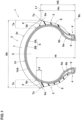
- FIG. 1 is a tyre meridian cross-sectional view of a bias tyre 1 for two-wheel vehicle (hereinafter, simply referred to as "tyre 1") under a normal state according to the first embodiment.
- tyre 1 a bias tyre 1 for two-wheel vehicle
- a distance L1 in the tyre radial direction between the outermost ends 9a of the pair of boundary surfaces 9 and the tread edges Te is equal to or less than 20 mm.
- the distance L1 is 20 mm or less, the outermost ends 9a of the boundary surfaces 9 can be located on an outer surface of the tyre 1 with less distortion during turning, and thus durability performance of the tyre 1 can be improved. From this point of view, the distance L1 is more preferably 15 mm or less.
- a distance L2 between the innermost end 9b and the outermost end 9a of each boundary surface 9 in the tyre radial direction is equal to or less than 30 mm.
- the distance L2 is more preferably equal to or less than 20 mm.
- the innermost ends 9b in the tyre axial direction of the boundary surfaces 9 are located outwardly in the tyre axial direction of the tread edges Te. In such a tyre 1, even if repeated load is applied near the boundary surfaces 9, the risk of cracking along the boundary surfaces 9 can be small, and thus durability can be improved.
- the sidewall rubber portions 8 contain preferably 30 parts by mass or more, more preferably 40 parts by mass or more of natural rubber in 100 parts by mass of the rubber component thereof. Such sidewall rubber portions 8 can suppress the occurrence of cracks and improve durability performance of the tyre 1.
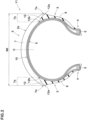
- FIG. 2 is a tyre meridian cross-sectional view of a bias tyre 11 for two-wheel vehicle (hereinafter, simply referred to as "tyre 11") under the normal state according to the second embodiment.
- tyre 11 a bias tyre 11 for two-wheel vehicle
- the bias tyre 11 includes the tread portion 2, the pair of the sidewall portions 3 extending inwardly in the tyre radial direction from the both ends of the tread portion 2, and the pair of bead portions 4 provided inwardly in the tyre radial direction of the pair of sidewall portions 3.
- the pair of bead cores 5 is disposed in the pair of bead portions 4, for example.
- the tyre 11, the same as the above-mentioned tyre 1, preferably includes the carcass 6 having a bias structure and the reinforcing layer 10 disposed outside in the tyre radial direction of the carcass 6 in the tread portion 2.
- the tyre 11 includes the tread rubber 7 forming the tread portion 2, and the pair of sidewall rubber portions 8 forming the pair of sidewall portions 3.
- the both end portions 7a of the tread rubber 7 are connected to the respective sidewall rubber portions 8 to form a pair of boundary surfaces 12 therebetween.
- outermost ends 12a in the tyre axial direction of the boundary surfaces 12 are located on an outer surface of the tyre and inwardly in the tyre radial direction of the respective tread edges Te.
- the tread rubber 7 always comes into contact with the ground and there is no risk that the sidewall rubber portions 8 come into contact with the ground.
- grip performance does not change suddenly since the sidewall rubber portions 8 do not come into contact with the ground during turning, and therefore steering stability performance can be improved.
- innermost ends 12b in the tyre axial direction of the boundary surfaces 12 are located outwardly in the tyre radial direction of the outermost ends 12a of the boundary surfaces 12.
- the innermost ends 12b of the boundary surfaces 12 are located outwardly in the tyre radial direction of the tread edges Te. In such a tyre 11, even if repeated load is applied near the boundary surfaces 12, the risk of cracking along the boundary surfaces 12 can be small, and thus durability can be improved.
- FIG. 3 is a tyre meridian cross-sectional view of a bias tyre 21 for two-wheel vehicle (hereinafter, simply referred to as "tyre 21") under the normal state and not covered by the present invention. Note that elements having the same function as the above-described embodiment are denoted by the same reference numerals, and the description thereof may be omitted.
- the tyre 21 includes the tread portion 2, the pair of the sidewall portions 3 extending inwardly in the tyre radial direction from the both ends of the tread portion 2, and the pair of bead portions 4 provided inwardly in the tyre radial direction of the pair of sidewall portions 3.
- the pair of bead cores 5 is disposed in the pair of bead portions 4, for example.
- the tyre 21, the same as the above-mentioned tyre 1, preferably includes the carcass 6 having a bias structure and the reinforcing layer 10 disposed outside in the tyre radial direction of the carcass 6 in the tread portion 2.
- the tyre 21 includes the tread rubber 7 forming the tread surface 2s of the tread portion 2, and a toroidal rubber 22 disposed inwardly in the tyre radial direction of the tread rubber 7.
- the toroidal rubber 22 includes the pair of sidewall rubber portions 22a forming an outer surface of the pair of sidewall portions 3 and a connecting rubber portion 22b extending inward of the tread rubber 7 and connecting the pair of sidewall rubber portions 22a with each other.
- the tread rubber 7 is connected to the toroidal rubber to form a boundary surface 23 including a pair of axially outer boundary surfaces 23b. That is, the tread rubber 7 and the toroidal rubber 22 are made of different rubbers with one another.
- a rubber that has superior grip performance can be employed as the tread rubber 7, and a rubber that has superior absorbing performance can be employed as the toroidal rubber 22 including the sidewall rubber portions 22a.
- the tyre 21 can improve steering stability during turning.
- outermost ends 23a in the tyre axial direction of the boundary surface 23 are located on an outer surface of the tyre and inwardly in the tyre radial direction of the respective tread edges Te.
- a distance L3 in the tyre radial direction between the outermost ends 23a of the boundary surface 23 and the tread edges Te is equal to or less than 20 mm.
- the distance L3 is 20 mm or less, the outermost ends 23a of the boundary surface 23 can be located on an outer surface of the tyre 1 with less distortion during turning, and thus durability performance of the tyre 21 can be improved. From this point of view, the distance L3 is more preferably 15 mm or less.
- a height H in the tyre radial direction from a bead baseline BL to the outermost ends 23a of the boundary surface 23 is preferably equal to or more than 60%, more preferably equal to or more than 70% of the height HS in the tyre radial direction from the bead baseline BL to the pair of tread edges Te.
- the outermost ends 23a of the boundary surface 23 can be located on a region where less distortion occurs during turning of the outer surface of the tyre 21, and thus durability performance of the tyre 21 can be improved.
- the bead baseline BL is an axial line that corresponds to a location of a rim diameter of the standard wheel rim on which the tyre 21 is to be mounted.
- the height H of the outermost ends 23a of the boundary surface 23 is preferably equal to or less than 98%, more preferably equal to or less than 95% of the height HS of the tread edges Te.
- FIG. 4 is a development view of the tread portion 2 of the tyre 21 shown in FIG. 3.
- FIG. 3 is a cross-sectional view taken along line A-A of FIG. 4 .
- the tread portion 2 is provided with a plurality of grooves 24.
- the pattern and/or shape of the grooves 24 is not limited to those shown in FIG. 4 but can include one or more circumferential grooves extending continuously in the tyre circumferential direction, for example.
- the grooves 24 have a plurality of slip signs 25 for indicating wear condition of the tread portion 2.
- the slip signs 25 are portions protruding outward in the tyre radial direction from the groove bottoms of the grooves 24. When the tread portion 2 is worn and one or more slip signs 25 are exposed on the tread surface 2s, users can know that it is time to replace the tyre.
- the connecting rubber portion 22b is located inwardly in the tyre radial direction of an outer surface 25s of the slip sign 25 that is located nearest to the tyre equator C.
- Such a connecting rubber portion 22b is unlikely to be exposed to the tread surface 2s even if the area around the tyre equator C wears to the slip sign 25.
- grip performance does not change suddenly since the connecting rubber portion 22b do not come into contact with the ground even when the wear progresses. Therefore, steering stability of the tyre can be improved.
- a thickness t of the connecting rubber portion 22b is preferably equal to or more than 0.5 mm, more preferably equal to or more than 0.8 mm.
- the thickness t of the connecting rubber portion 22b is preferably equal to or less than 2.0 mm, more preferably equal to or less than 1.8 mm.
- Such a connecting rubber portion 22b is suitable for suppressing heat generation due to distortion of the tread rubber 7 at high-speed driving.
- the axially outer boundary surfaces 23b are curved so as to be convex inwardly in the tyre radial direction. Since the ratio of the sidewall rubber portions 22a in the vicinity of the outer boundary surfaces 23b is small in such the boundary surfaces 23b, it is possible to improve steering stability of the tyre 1 when turning at large camber angles.
- Loss tangent tan ⁇ S of the sidewall rubber portions 22a and the connecting rubber portion 22b at 70 degrees C is smaller than loss tangent tan ⁇ T of the tread rubber 7 at 70 degrees C, same as the above-mentioned sidewall rubber portions 8.
- Such sidewall rubber portions 22a have excellent absorption performance and can improve riding comfort of the tyre 1.
- the sidewall rubber portions 22a and the connecting rubber portion 22b contain preferably 30 parts by mass or more, more preferably 40 parts by mass or more of natural rubber in 100 parts by mass of the rubber component. Such rubbers 22a and 22b can suppress the occurrence of cracks and improve durability performance of the tyre 21.
- the sidewall rubber portions 22a and the connecting rubber portion 22b may be formed integrally previously with one another.
- the sidewall rubber portions 22a and the connecting rubber portion 22b may be prepared separately and then be joined with one another to form the toroidal rubber 22.
- bias tyres for two-wheel vehicle having a structure shown in FIG. 1 and FIG. 2 were prototyped based on the specification of Table 1. Further, as a comparative example, a bias tyre for two-wheel vehicle in which the tread rubber and the sidewall rubber portions are formed integrally was prototyped. Then, using these prototype tyres, steering stability, ride comfort and durability were tested.
- the common specifications and test methods for each prototype tyre are as follows.
- a test rider drove a medium-sized scooter with each prototype tyre mounted on the rear wheel on a test course, and evaluated steering stability during turning in view of grip performance, feeling of ground contact, and the transient characteristics when turning by the rider's feeling.
- the test results are shown in Table 1 using an index with the comparative example as 100, wherein the larger the value, the better the steering stability.
- a test rider drove the medium-sized scooter with each prototype tyre mounted on the rear wheel on a test course, and evaluated ride comfort by the rider's feeling.
- the test results are shown in Table 1 using an index with the comparative example as 100, wherein the larger the value, the better the ride comfort.
- the prototype tyres were put into an ozone chamber having a concentration of 50 pphm for 3 weeks to be subjected to ozone deterioration treatment. Then, these tyres were made to run 10,000 km on a drum tester under a load of 3.29 kN. After that, durability performance of each tyre was evaluated based on the crack occurrence rate of the sidewall portions. The test results are shown in Table 1 using an index with the comparative example as 100, wherein the larger the value, the better the durability.
- Table 1 shows the test results.
Landscapes
- Engineering & Computer Science (AREA)
- Mechanical Engineering (AREA)
- Tires In General (AREA)
Description
- The present invention relates to a bias tyre for two-wheel vehicle including a carcass having a bias structure.
- Conventionally, bias tyres for two-wheel vehicle including a bias carcass structure are known. For example,
JP 2000-185511 A -
EP 2 722 196 A2 discloses a motorcycle tire having a hybrid construction with different rubber compound zones.JP 2002-337512 A EP 2 777 953 A1 discloses a motorcycle tire for uneven terrain having a tread and sidewalls formed from crosslinked rubber. - However, the bias tyre for motorcycle disclosed in
JP 2000-185511 A - The present invention has been made in view of the above circumstances and has a major object to provide a bias tyre for two-wheel vehicle capable of improving steering stability during turning.
- The problem is solved by a bias tyre having the features of claim 1. Preferred embodiments are defined in the dependent claims.
- In the bias tyre for two-wheel vehicle, the tread rubber is connected to the sidewall rubber portions to form the boundary surfaces, and the outermost ends in the tyre axial direction of the boundary surfaces are located on an outer surface of the tyre and inwardly in the tyre radial direction of the respective tread edges. Such a bias tyre for two-wheel vehicle using the tread rubber and the sidewall rubber portions, can improve steering stability during turning.
-
-
FIG. 1 is a tyre meridian cross-sectional view of a bias tyre for two-wheel vehicle according to the first embodiment; -
FIG. 2 is a tyre meridian cross-sectional view of a bias tyre for two-wheel vehicle according to the second embodiment; -
FIG. 3 is a tyre meridian cross-sectional view of a bias tyre for two-wheel vehicle not covered by the present invention; and -
FIG. 4 is a development view of a tread portion of the tyre shown inFIG. 3 . - An embodiment of the present invention will be explained below with reference to the accompanying drawings.
FIG. 1 is a tyre meridian cross-sectional view of a bias tyre 1 for two-wheel vehicle (hereinafter, simply referred to as "tyre 1") under a normal state according to the first embodiment. - As used herein, the "normal state" is such that the tyre 1 is mounted on a standard wheel rim with a standard pressure but loaded with no tyre load. As used herein, unless otherwise noted, dimensions of portions of the tyre 1 are values measured under the normal state.
- Further, as used herein, the "standard wheel rim" is a wheel rim officially approved for each tyre 1 by standards organizations on which the tyre is based, wherein the standard wheel rim is the "standard rim" specified in JATMA, the "Design Rim" in TRA, and the "Measuring Rim" in ETRTO, for example.
- Furthermore, as used herein, the "standard pressure" is a standard pressure officially approved for each tyre 1 by standards organizations on which the tyre is based, wherein the standard pressure is the "maximum air pressure" in JATMA, the maximum pressure given in the "Tire Load Limits at Various Cold Inflation Pressures" table in TRA, and the "Inflation Pressure" in ETRTO, for example.
- As illustrated in
FIG. 1 , the tyre 1 according to the first embodiment includes atread portion 2, a pair ofsidewall portions 3 extending inwardly in the tyre radial direction from both ends of thetread portion 2, and a pair ofbead portions 4 provided inwardly in the tyre radial direction of the pair ofsidewall portions 3. A pair ofbead cores 5 is disposed in the pair ofbead portions 4, for example. - The
tread surface 2s which is an outer surface of thetread portion 2, for example, extends between tread edges Te through the tyre equator C in an arc shape that is convex outwardly in the tyre radial direction. Preferably, the tread width Wt which is a length in the tyre axial direction between the tread edges Te corresponds to the tyre maximum width. - Such a tyre 1 can turn with large camber angles. As used herein, the tread edges Te are outermost edges of the
tread portion 2 in the tyre axial direction, and the tyre equator C is the center location between the tread edges Te in the tyre axial direction. - The tyre 1 according to the first embodiment further includes a
carcass 6 having a bias structure that extends between thebead cores 5 of thebead portions 4 through thetread portion 2 and thesidewall portions 3. Thecarcass 6 includes amain portion 6a extending between the pair ofbead cores 5, and a pair of turn-upportions 6b each turned up around a respective one of the pair ofbead cores 5. - The
carcass 6 having a bias structure includes at least one carcass ply. In the first embodiment, thecarcass 6 includes twocarcass plies carcass plies plies - The tyre 1 according to the first embodiment further includes a
tread rubber 7 forming thetread portion 2, and a pair of thesidewall rubber portions 8 forming the pair ofsidewall portions 3. In the first embodiment, thetread rubber 7 is connected to thesidewall rubber portions 8 to formboundary surfaces 9. That is, thetread rubber 7 and thesidewall rubber portions 8 according to the first embodiment are made of different rubbers with one another. In the first embodiment,outer end portions 7a in the tyre axial direction of thetread rubber 7 are connected to thesidewall rubber portions 8 via theboundary surfaces 9. - In such a tyre 1, a rubber that has superior grip performance can be employed as the
tread rubber 7, and a rubber that has superior absorbing performance can be employed as thesidewall rubber portions 8. Thus, the tyre 1 according to the first embodiment can improve steering stability during turning. - In the first embodiment,
outermost ends 9a in the tyre axial direction of theboundary surfaces 9 are located on an outer surface of the tyre and inwardly in the tyre radial direction of the respective tread edges Te. When such a tyre 1 turns at large camber angles, thetread rubber 7 always comes into contact with the ground and there is no risk that thesidewall rubber portions 8 come into contact with the ground. Hence, in the tyre 1 according to the first embodiment, grip performance does not change suddenly since thesidewall rubber portions 8 do not come into contact with the ground during turning, and therefore steering stability performance can be improved. - Preferably, a distance L1 in the tyre radial direction between the
outermost ends 9a of the pair ofboundary surfaces 9 and the tread edges Te is equal to or less than 20 mm. When the distance L1 is 20 mm or less, theoutermost ends 9a of theboundary surfaces 9 can be located on an outer surface of the tyre 1 with less distortion during turning, and thus durability performance of the tyre 1 can be improved. From this point of view, the distance L1 is more preferably 15 mm or less. - A height Ho in the tyre radial direction from a bead baseline BL to the
outermost ends 9a of the pair ofboundary surfaces 9 is preferably equal to or more than 60%, more preferably equal to or more than 70% of a height HS in the tyre radial direction from the bead baseline BL to the pair of tread edges Te. In such a tyre 1, theoutermost ends 9a of theboundary surfaces 9 can be located on a region where less distortion occurs during turning of the outer surface of the tyre 1, and thus durability performance of the tyre 1 can be improved. Note that the bead baseline BL is an axial line that corresponds to a location of a rim diameter of the standard wheel rim on which the tyre 1 is to be mounted. - The height Ho of the
outermost ends 9a of theboundary surfaces 9 is preferably equal to or less than 98%, more preferably equal to or less than 95% of the height HS of the tread edges Te. When such a tyre 1 turns at large camber angles, there is no risk that thesidewall rubber portions 8 come into contact with the ground, and therefore steering stability performance can be improved. - In the first embodiment,
innermost ends 9b in the tyre axial direction of theboundary surfaces 9 are located outwardly in the tyre radial direction of theoutermost ends 9a of theboundary surfaces 9. In such a tyre 1, even if repeated load is applied near theboundary surfaces 9, the risk of cracking along theboundary surfaces 9 can be small, and thus durability can be improved. - Preferably, a distance L2 between the
innermost end 9b and theoutermost end 9a of eachboundary surface 9 in the tyre radial direction is equal to or less than 30 mm. When the distance L2 is equal to or less than 30 mm, theoutermost ends 9a of theboundary surfaces 9 can be located on a region where less distortion occurs during turning of the outer surface of the tyre 1, and thus durability performance of the tyre 1 can be improved. From this point of view, the distance L2 is more preferably equal to or less than 20 mm. - In the first embodiment, the
innermost ends 9b in the tyre axial direction of theboundary surfaces 9 are located outwardly in the tyre axial direction of the tread edges Te. In such a tyre 1, even if repeated load is applied near theboundary surfaces 9, the risk of cracking along theboundary surfaces 9 can be small, and thus durability can be improved. - The height Hi in the tyre radial direction of the
innermost ends 9b of theboundary surfaces 9 from the bead baseline BL is preferably equal to or more than 105%, more preferably equal to or more than 110% of the height HS of the tread edges Te. Such a tyre 1 can reduce the risk that crack occurs along theboundary surfaces 9, and thus durability of the tyre can be improved. - The height Hi of the innermost ends 9b of the boundary surfaces 9 is preferably equal to or less than 130%, more preferably equal to or less than 120% of the height HS of the tread edges Te. In such a tyre 1, the outermost ends 9a of the boundary surfaces 9 can be located on a region where less distortion occurs during turning of the outer surface of the tyre 1, and thus durability performance of the tyre 1 can be improved.
- In the first embodiment, the boundary surfaces 9 are curved so as to be convex inwardly in the tyre radial direction. Since the ratio of the
sidewall rubber portions 8 in the vicinity of theouter end portions 7a of thetread rubber 7 is small in such the boundary surfaces 9, it is possible to improve steering stability of the tyre 1 when turning at large camber angles. - The bias tyre 1, for example, may include a reinforcing
layer 10 disposed outside in the tyre radial direction of thecarcass 6 in thetread portion 2. The reinforcinglayer 10 include one or more reinforcingplies 10A. In the first embodiment, one reinforcingply 10A is employed. In this case, the innermost ends 9b of the boundary surfaces 9 are located on the reinforcinglayer 10. Such a tyre 1 can suppress deformation during high-speed driving and improve high-speed durability performance. - In the first embodiment, loss tangent tan δS of the
sidewall rubber portions 8 at 70 degrees C is smaller than loss tangent tan δT of thetread rubber 7 at 70 degrees C. Suchsidewall rubber portions 8 have excellent absorption performance and can improve riding comfort of the tyre 1. As used herein, loss tangent tan δ at 70 degrees C is measured using a "viscoelastic spectrometer" in accordance with JIS-K6394 under the following condition: - measurement temperature: 70 degrees C,
- initial distortion: 10%,
- amplitude: plus/minus 1%,
- frequency: 10Hz, and
- deformation mode: tension.
- The
sidewall rubber portions 8 contain preferably 30 parts by mass or more, more preferably 40 parts by mass or more of natural rubber in 100 parts by mass of the rubber component thereof. Suchsidewall rubber portions 8 can suppress the occurrence of cracks and improve durability performance of the tyre 1. -
FIG. 2 is a tyre meridian cross-sectional view of abias tyre 11 for two-wheel vehicle (hereinafter, simply referred to as "tyre 11") under the normal state according to the second embodiment. Note that elements having the same function as the above-described embodiment are denoted by the same reference numerals, and the description thereof may be omitted. - As illustrated in
FIG. 2 , in the second embodiment, thebias tyre 11 includes thetread portion 2, the pair of thesidewall portions 3 extending inwardly in the tyre radial direction from the both ends of thetread portion 2, and the pair ofbead portions 4 provided inwardly in the tyre radial direction of the pair ofsidewall portions 3. The pair ofbead cores 5 is disposed in the pair ofbead portions 4, for example. Thetyre 11, the same as the above-mentioned tyre 1, preferably includes thecarcass 6 having a bias structure and the reinforcinglayer 10 disposed outside in the tyre radial direction of thecarcass 6 in thetread portion 2. - In the second embodiment, the
tyre 11 includes thetread rubber 7 forming thetread portion 2, and the pair ofsidewall rubber portions 8 forming the pair ofsidewall portions 3. In the second embodiment, the bothend portions 7a of thetread rubber 7 are connected to the respectivesidewall rubber portions 8 to form a pair ofboundary surfaces 12 therebetween. - In the second embodiment, outermost ends 12a in the tyre axial direction of the boundary surfaces 12 are located on an outer surface of the tyre and inwardly in the tyre radial direction of the respective tread edges Te. When such a tyre 1 turns at large camber angles, the
tread rubber 7 always comes into contact with the ground and there is no risk that thesidewall rubber portions 8 come into contact with the ground. Hence, in the tyre 1 according to the second embodiment, grip performance does not change suddenly since thesidewall rubber portions 8 do not come into contact with the ground during turning, and therefore steering stability performance can be improved. - In the second embodiment, innermost ends 12b in the tyre axial direction of the boundary surfaces 12 are located outwardly in the tyre radial direction of the outermost ends 12a of the boundary surfaces 12. In the second embodiment, the innermost ends 12b of the boundary surfaces 12 are located outwardly in the tyre radial direction of the tread edges Te. In such a
tyre 11, even if repeated load is applied near the boundary surfaces 12, the risk of cracking along the boundary surfaces 12 can be small, and thus durability can be improved. - In the second embodiment, the boundary surfaces 12 are curved so as to be convex outwardly in the tyre radial direction. Since the ratio of the
sidewall rubber portions 8 in the vicinity of theouter end portions 7a of thetread rubber 7 is large in such the boundary surfaces 12, it is possible to improve steering stability of thetyre 11 when turning at large camber angles. -
FIG. 3 is a tyre meridian cross-sectional view of abias tyre 21 for two-wheel vehicle (hereinafter, simply referred to as "tyre 21") under the normal state and not covered by the present invention. Note that elements having the same function as the above-described embodiment are denoted by the same reference numerals, and the description thereof may be omitted. - As illustrated in
FIG. 3 , thetyre 21 includes thetread portion 2, the pair of thesidewall portions 3 extending inwardly in the tyre radial direction from the both ends of thetread portion 2, and the pair ofbead portions 4 provided inwardly in the tyre radial direction of the pair ofsidewall portions 3. The pair ofbead cores 5 is disposed in the pair ofbead portions 4, for example. Thetyre 21, the same as the above-mentioned tyre 1, preferably includes thecarcass 6 having a bias structure and the reinforcinglayer 10 disposed outside in the tyre radial direction of thecarcass 6 in thetread portion 2. - The
tyre 21 includes thetread rubber 7 forming thetread surface 2s of thetread portion 2, and atoroidal rubber 22 disposed inwardly in the tyre radial direction of thetread rubber 7. InFIG. 3 , thetoroidal rubber 22 includes the pair ofsidewall rubber portions 22a forming an outer surface of the pair ofsidewall portions 3 and a connectingrubber portion 22b extending inward of thetread rubber 7 and connecting the pair ofsidewall rubber portions 22a with each other. Thetread rubber 7 is connected to the toroidal rubber to form aboundary surface 23 including a pair of axially outer boundary surfaces 23b. That is, thetread rubber 7 and thetoroidal rubber 22 are made of different rubbers with one another. - In such a
tyre 21, a rubber that has superior grip performance can be employed as thetread rubber 7, and a rubber that has superior absorbing performance can be employed as thetoroidal rubber 22 including thesidewall rubber portions 22a. Thus, thetyre 21 can improve steering stability during turning. - In such a
tyre 21, heat generation due to distortion of thetread rubber 7 during high-speed running is suppressed by the presence of connectingrubber portion 22b between thetread rubber 7 and thecarcass 6, and durability performance during high-speed running can be improved. In addition, since energy loss of thetread portion 2 of thetyre 21 is reduced, rolling resistance can be reduced and fuel efficiency can be improved. - In
FIG. 3 , outermost ends 23a in the tyre axial direction of theboundary surface 23 are located on an outer surface of the tyre and inwardly in the tyre radial direction of the respective tread edges Te. When such atyre 21, the same as the above-mentioned tyre 1, turns at large camber angles, thetread rubber 7 always comes into contact with the ground and there is no risk that thesidewall rubber portions 22a come into contact with the ground. Hence, in thetyre 21, grip performance does not change suddenly since thesidewall rubber portions 22a do not come into contact with the ground during turning, and therefore steering stability performance can be improved. - Preferably, a distance L3 in the tyre radial direction between the outermost ends 23a of the
boundary surface 23 and the tread edges Te is equal to or less than 20 mm. When the distance L3 is 20 mm or less, the outermost ends 23a of theboundary surface 23 can be located on an outer surface of the tyre 1 with less distortion during turning, and thus durability performance of thetyre 21 can be improved. From this point of view, the distance L3 is more preferably 15 mm or less. - A height H in the tyre radial direction from a bead baseline BL to the outermost ends 23a of the
boundary surface 23 is preferably equal to or more than 60%, more preferably equal to or more than 70% of the height HS in the tyre radial direction from the bead baseline BL to the pair of tread edges Te. In such atyre 21, the outermost ends 23a of theboundary surface 23 can be located on a region where less distortion occurs during turning of the outer surface of thetyre 21, and thus durability performance of thetyre 21 can be improved. Note that the bead baseline BL is an axial line that corresponds to a location of a rim diameter of the standard wheel rim on which thetyre 21 is to be mounted. - The height H of the outermost ends 23a of the
boundary surface 23 is preferably equal to or less than 98%, more preferably equal to or less than 95% of the height HS of the tread edges Te. When such atyre 21 turns at large camber angles, there is no risk that thesidewall rubber portions 22a come into contact with the ground, and therefore steering stability performance of thetyre 21 can be improved. -
FIG. 4 is a development view of thetread portion 2 of thetyre 21 shown inFIG. 3. FIG. 3 is a cross-sectional view taken along line A-A ofFIG. 4 . As illustrated inFIG. 3 andFIG. 4 , thetread portion 2 is provided with a plurality ofgrooves 24. The pattern and/or shape of thegrooves 24 is not limited to those shown inFIG. 4 but can include one or more circumferential grooves extending continuously in the tyre circumferential direction, for example. - Some of the
grooves 24 have a plurality ofslip signs 25 for indicating wear condition of thetread portion 2. Here, the slip signs 25 are portions protruding outward in the tyre radial direction from the groove bottoms of thegrooves 24. When thetread portion 2 is worn and one ormore slip signs 25 are exposed on thetread surface 2s, users can know that it is time to replace the tyre. - As illustrated in
FIG. 3 , the connectingrubber portion 22b is located inwardly in the tyre radial direction of anouter surface 25s of theslip sign 25 that is located nearest to the tyre equator C. Such a connectingrubber portion 22b is unlikely to be exposed to thetread surface 2s even if the area around the tyre equator C wears to theslip sign 25. Thus, in thetyre 21, grip performance does not change suddenly since the connectingrubber portion 22b do not come into contact with the ground even when the wear progresses. Therefore, steering stability of the tyre can be improved. - A thickness t of the connecting
rubber portion 22b is preferably equal to or more than 0.5 mm, more preferably equal to or more than 0.8 mm. The thickness t of the connectingrubber portion 22b is preferably equal to or less than 2.0 mm, more preferably equal to or less than 1.8 mm. Such a connectingrubber portion 22b is suitable for suppressing heat generation due to distortion of thetread rubber 7 at high-speed driving. - The axially outer boundary surfaces 23b are curved so as to be convex inwardly in the tyre radial direction. Since the ratio of the
sidewall rubber portions 22a in the vicinity of theouter boundary surfaces 23b is small in such the boundary surfaces 23b, it is possible to improve steering stability of the tyre 1 when turning at large camber angles. - Loss tangent tan δS of the
sidewall rubber portions 22a and the connectingrubber portion 22b at 70 degrees C is smaller than loss tangent tan δT of thetread rubber 7 at 70 degrees C, same as the above-mentionedsidewall rubber portions 8. Suchsidewall rubber portions 22a have excellent absorption performance and can improve riding comfort of the tyre 1. - The
sidewall rubber portions 22a and the connectingrubber portion 22b contain preferably 30 parts by mass or more, more preferably 40 parts by mass or more of natural rubber in 100 parts by mass of the rubber component.Such rubbers tyre 21. In one aspect, thesidewall rubber portions 22a and the connectingrubber portion 22b may be formed integrally previously with one another. In another aspect, thesidewall rubber portions 22a and the connectingrubber portion 22b may be prepared separately and then be joined with one another to form thetoroidal rubber 22. - With the first example, bias tyres for two-wheel vehicle having a structure shown in
FIG. 1 andFIG. 2 were prototyped based on the specification of Table 1. Further, as a comparative example, a bias tyre for two-wheel vehicle in which the tread rubber and the sidewall rubber portions are formed integrally was prototyped. Then, using these prototype tyres, steering stability, ride comfort and durability were tested. The common specifications and test methods for each prototype tyre are as follows. -
- Tyre size: 130/70-13M/C
- Rim size: 13x3.50MT
- Inner pressure: 225 kPa
- A test rider drove a medium-sized scooter with each prototype tyre mounted on the rear wheel on a test course, and evaluated steering stability during turning in view of grip performance, feeling of ground contact, and the transient characteristics when turning by the rider's feeling. The test results are shown in Table 1 using an index with the comparative example as 100, wherein the larger the value, the better the steering stability.
- A test rider drove the medium-sized scooter with each prototype tyre mounted on the rear wheel on a test course, and evaluated ride comfort by the rider's feeling. The test results are shown in Table 1 using an index with the comparative example as 100, wherein the larger the value, the better the ride comfort.
- The prototype tyres were put into an ozone chamber having a concentration of 50 pphm for 3 weeks to be subjected to ozone deterioration treatment. Then, these tyres were made to run 10,000 km on a drum tester under a load of 3.29 kN. After that, durability performance of each tyre was evaluated based on the crack occurrence rate of the sidewall portions. The test results are shown in Table 1 using an index with the comparative example as 100, wherein the larger the value, the better the durability.
- Table 1 shows the test results.
[Table 1] Ref. Ex. 1 Ex. 2 Ex. 3 Ex. 4 Ex. 5 Ex. 6 Ex. 7 Ex. 8 Ratio Ho/HS of height Ho of outermost ends of boundary surfaces to height HS of tread edges (%) - 95 70 55 95 95 95 95 95 Ratio Hi/HS of height Hi of innermost ends of boundary surfaces to height HS of tread edges (%) - 110 100 80 120 110 110 110 110 Orientation of boundary surfaces - convex inward convex inward convex inward convex inward convex outward convex inward convex inward convex inward Loss tangent tan δT of tread rubber 0.3 0.3 0.3 0.3 0.3 0.3 0.3 0.3 0.3 Loss tangent tan δS of sidewall rubber portions 0.3 0.15 0.15 0.15 0.15 0.15 0.23 0.15 0.15 Ratio of natural rubber in 100 parts by mass of sidewall rubber (parts by mass) 40 40 40 40 40 40 40 30 20 Steering stability (index) 100 115 120 105 105 105 110 115 115 Ride comfort (index) 100 115 110 110 110 110 105 115 115 Durability (index) 100 120 120 90 120 120 120 110 100 - Next, with the second example, bias tyres for two-wheel vehicle having a structure shown in
FIG. 3 were prototyped based on the specification of Table 2. Further, as a comparative example, a bias tyre for two-wheel vehicle in which the tread rubber and the sidewall rubber portions are formed integrally was prototyped same as the first example. Then, using these prototype tyres, high-speed durability, steering stability, ride comfort and durability were tested. The common specifications and test methods for each prototype tyre are as follows. -
- Tyre size: 130/70-13M/C
- Rim size: 13x3.50MT
- Inner pressure: 225 kPa
- Each prototype tyre was made to run on a drum tester at a speed of 81 km/h for two hours under a load of 1.99 kN. After that, the tyre was cooled to room temperature, and then the running speed was gradually increased every 30 minutes. Then, the running time until the tyre was damaged was measured. The test results are shown in Table 2 using an index with the comparative example as 100, wherein the larger the value, the better the high-speed durability.
- The test was conducted in the same way as the first example. The test results are shown in Table 2 using an index with the comparative example as 100, wherein the larger the value, the better the steering stability.
- The test was conducted in the same way as the first example. The test results are shown in Table 2 using an index with the comparative example as 100, wherein the larger the value, the better the ride comfort.
- The test was conducted in the same way as the first example. The test results are shown in Table 2 using an index with the comparative example as 100, wherein the larger the value, the better the durability.
- Table 2 shows the test results.
[Table 2] Ref. Ex. 9 Ex. 10 Ex. 11 Ex. 12 Ex. 13 Ex. 14 Ex. 15 Ratio Ho/HS of height Ho of outermost ends of boundary surfaces to height HS of tread edges (%) - 95 70 55 95 95 95 95 Thickness t of connecting rubber portion (mm) - 2 2 2 0.8 2 2 2 Loss tangent tan δT of tread rubber 0.3 0.3 0.3 0.3 0.3 0.3 0.3 0.3 Loss tangent tan δS of sidewall rubber portions 0.3 0.15 0.15 0.15 0.15 0.23 0.15 0.15 Ratio of natural rubber in 100 parts by mass of sidewall rubber (parts by mass) 40 40 40 40 40 40 30 20 High-speed durability (index) 100 120 120 120 105 110 120 120 Steering stability (index) 100 115 120 105 110 105 115 115 Ride comfort (index) 100 115 110 110 105 105 115 115 Durability (index) 100 120 120 90 120 120 110 100 - From the test results, it was confirmed that the example bias tyres for the two-wheeled vehicle were superior in steering stability performance as compared with the comparative example tyre. In addition, the tyres of the examples were better than the comparative examples in terms of the overall performance evaluated by the total of each performance. Thus, it was confirmed that steering stability during turning of Example's motorcycle bias tyres were improved.
Claims (8)
- A bias tyre (1, 11) for a two-wheel vehicle , the tyre comprising:a tread portion (2) defining a pair of tread edges (Te), the tread edges (Te) being outermost edges of the tread portion (2) in the tyre axial direction;a pair of sidewall portions (3);a carcass (6) having a bias structure;a pair of sidewall rubber portions (8) forming an outer surface of the pair of sidewall portion (3); anda tread rubber (7) forming an outer surface of the tread portion (2) and connected to the pair of sidewall rubber portions (8) to form a pair of boundary surfaces (9, 12) therebetween, outer end portions (7a) in the tyre axial direction of the tread rubber (7) being connected to the sidewall rubber portions (8) via the boundary surfaces (9, 12), whereinoutermost ends (9a, 12a) in a tyre axial direction of the pair of boundary surfaces (9, 12) are located on an outer surface of the tyre and inwardly in a tyre radial direction of the respective tread edges (Te),characterized in that innermost ends (9b, 12b) in the tyre axial direction of the boundary surfaces (9, 12) are located outwardly in the tyre radial direction of the tread edges (Te).
- The bias tyre (1, 11) according to claim 1, wherein
a distance (L1) in the tyre radial direction between the axially outermost ends (9a, 12a) of the pair of boundary surfaces (9, 12) and the tread edges (Te) is equal to or less than 20 mm. - The bias tyre (1, 11) according to claim 1 or 2, wherein
a height (Ho) in the tyre radial direction from a bead baseline (BL) to the outermost ends (9a, 12a) of the pair of boundary surfaces (9, 12) is equal to or more than 60% of a height (HS) in the tyre radial direction from the bead baseline (BL) to the pair of tread edges (Te). - The bias tyre (1, 11) according to any one of claims 1 to 3, wherein
loss tangent tan δS of the pair of sidewall rubber portions (8) is smaller than loss tangent tan δT of the tread rubber (7), each loss tangent tan δ being measured in accordance with JIS-K6394 under a measurement temperature of 70 degrees C, an initial distortion of 10 %, an amplitude of plus/minus 1 %, a frequency of 10 Hz, and a tension deformation mode. - The bias tyre (1, 11) according to any one of claims 1 to 4, wherein
the sidewall rubber portions (8) contain 30 parts by mass or more of natural rubber in 100 parts by mass of a rubber component of the sidewall rubber portions (8). - The bias tyre (1, 11) according to any one of claims 1 to 5, wherein
innermost ends (9b, 12b) in the tyre axial direction of the boundary surfaces (9, 12) are located outwardly in the tyre radial direction of the outermost ends (9a, 12a) of the boundary surfaces (9, 12). - The bias tyre (1, 11 according to any one of claims 1 to 6, wherein
the boundary surfaces (9, 12) are curved so as to be convex inwardly in the tyre radial direction. - The bias tyre (1, 11 according to any one of claims 1 to 6, wherein
the boundary surfaces (9, 12) are curved so as to be convex outwardly in the tyre radial direction.
Priority Applications (1)
| Application Number | Priority Date | Filing Date | Title |
|---|---|---|---|
| EP22152374.9A EP4005823B1 (en) | 2020-02-19 | 2021-01-05 | Bias tyre for two-wheel vehicle |
Applications Claiming Priority (2)
| Application Number | Priority Date | Filing Date | Title |
|---|---|---|---|
| JP2020026432A JP7472526B2 (en) | 2020-02-19 | 2020-02-19 | Bias tires for motorcycles |
| JP2020026433A JP7472527B2 (en) | 2020-02-19 | 2020-02-19 | Bias tires for motorcycles |
Related Child Applications (2)
| Application Number | Title | Priority Date | Filing Date |
|---|---|---|---|
| EP22152374.9A Division EP4005823B1 (en) | 2020-02-19 | 2021-01-05 | Bias tyre for two-wheel vehicle |
| EP22152374.9A Division-Into EP4005823B1 (en) | 2020-02-19 | 2021-01-05 | Bias tyre for two-wheel vehicle |
Publications (2)
| Publication Number | Publication Date |
|---|---|
| EP3868574A1 EP3868574A1 (en) | 2021-08-25 |
| EP3868574B1 true EP3868574B1 (en) | 2025-05-14 |
Family
ID=74103980
Family Applications (2)
| Application Number | Title | Priority Date | Filing Date |
|---|---|---|---|
| EP21150269.5A Active EP3868574B1 (en) | 2020-02-19 | 2021-01-05 | Bias tyre for two-wheel vehicle |
| EP22152374.9A Active EP4005823B1 (en) | 2020-02-19 | 2021-01-05 | Bias tyre for two-wheel vehicle |
Family Applications After (1)
| Application Number | Title | Priority Date | Filing Date |
|---|---|---|---|
| EP22152374.9A Active EP4005823B1 (en) | 2020-02-19 | 2021-01-05 | Bias tyre for two-wheel vehicle |
Country Status (2)
| Country | Link |
|---|---|
| EP (2) | EP3868574B1 (en) |
| CN (1) | CN113276604B (en) |
Citations (1)
| Publication number | Priority date | Publication date | Assignee | Title |
|---|---|---|---|---|
| EP2777953A1 (en) * | 2013-03-15 | 2014-09-17 | Sumitomo Rubber Industries, Ltd. | Motorcycle tire for uneven terrain |
Family Cites Families (18)
| Publication number | Priority date | Publication date | Assignee | Title |
|---|---|---|---|---|
| JPS6094804A (en) * | 1983-10-31 | 1985-05-28 | Yokohama Rubber Co Ltd:The | Tire for motor cycle |
| JP3287774B2 (en) * | 1996-10-17 | 2002-06-04 | 住友ゴム工業株式会社 | Motorcycle tires |
| JP3996273B2 (en) * | 1998-07-06 | 2007-10-24 | 住友ゴム工業株式会社 | Radial tires for motorcycles |
| JP3377459B2 (en) | 1998-12-22 | 2003-02-17 | 住友ゴム工業株式会社 | Motorcycle bias tires |
| JP2001191730A (en) * | 1999-12-29 | 2001-07-17 | Sumitomo Rubber Ind Ltd | Motorcycle tires |
| JP4658377B2 (en) * | 2001-05-22 | 2011-03-23 | 住友ゴム工業株式会社 | Radial tires for motorcycles |
| JP4040893B2 (en) * | 2002-03-22 | 2008-01-30 | 株式会社ブリヂストン | Scooter pneumatic radial tire and scooter |
| JP5020595B2 (en) * | 2006-10-24 | 2012-09-05 | 住友ゴム工業株式会社 | Tires for motorcycles |
| US7604031B2 (en) * | 2006-12-21 | 2009-10-20 | The Goodyear Tire & Rubber Company | Pneumatic tire |
| JP2008273422A (en) * | 2007-05-01 | 2008-11-13 | Sumitomo Rubber Ind Ltd | Motorcycle tires |
| JP5091599B2 (en) * | 2007-09-14 | 2012-12-05 | 住友ゴム工業株式会社 | Pneumatic tire and manufacturing method thereof |
| JP5616878B2 (en) * | 2011-12-05 | 2014-10-29 | 住友ゴム工業株式会社 | Motorcycle tires |
| US9254717B2 (en) * | 2012-10-22 | 2016-02-09 | The Goodyear Tire & Rubber Company | Motorcycle tire having a hybrid construction |
| JP6053550B2 (en) * | 2013-02-18 | 2016-12-27 | 住友ゴム工業株式会社 | Pneumatic tire |
| JP6144991B2 (en) * | 2013-08-02 | 2017-06-07 | 住友ゴム工業株式会社 | Motorcycle tires |
| JP2015033982A (en) * | 2013-08-09 | 2015-02-19 | 住友ゴム工業株式会社 | Tire for motor cycle |
| CN206106822U (en) * | 2016-08-26 | 2017-04-19 | 四川远星橡胶有限责任公司 | Tire for motorcycle |
| CN106114070A (en) * | 2016-08-26 | 2016-11-16 | 四川远星橡胶有限责任公司 | A kind of tire being applicable to cross country motorcycle |
-
2021
- 2021-01-05 EP EP21150269.5A patent/EP3868574B1/en active Active
- 2021-01-05 EP EP22152374.9A patent/EP4005823B1/en active Active
- 2021-01-28 CN CN202110118044.4A patent/CN113276604B/en active Active
Patent Citations (1)
| Publication number | Priority date | Publication date | Assignee | Title |
|---|---|---|---|---|
| EP2777953A1 (en) * | 2013-03-15 | 2014-09-17 | Sumitomo Rubber Industries, Ltd. | Motorcycle tire for uneven terrain |
Also Published As
| Publication number | Publication date |
|---|---|
| EP3868574A1 (en) | 2021-08-25 |
| EP4005823A1 (en) | 2022-06-01 |
| EP4005823B1 (en) | 2023-10-04 |
| CN113276604A (en) | 2021-08-20 |
| CN113276604B (en) | 2025-02-25 |
Similar Documents
| Publication | Publication Date | Title |
|---|---|---|
| EP2423006B1 (en) | Motorcycle tire for running on rough terrain | |
| EP1481822B1 (en) | Pneumatic radial tire | |
| EP2628612B1 (en) | Pneumatic tire | |
| EP2206612B1 (en) | Tire for motor-bicycle | |
| EP1923235B1 (en) | Off-road tire | |
| EP3730314B1 (en) | Tire for motorcycles and tire set for motorcycles | |
| EP2610075A1 (en) | Two-wheeled automotive vehicle tire | |
| EP4043241B1 (en) | Motorcycle tyre | |
| EP2261060B1 (en) | Motorcycle tire | |
| EP3521068B1 (en) | Two-wheeled vehicle tire | |
| EP3530487B1 (en) | Two-wheeled vehicle tyre | |
| EP4005824B1 (en) | Motorcycle tire | |
| EP3868574B1 (en) | Bias tyre for two-wheel vehicle | |
| EP4253087B1 (en) | Motorcycle tyre | |
| EP4070968B1 (en) | Motorcycle tyre | |
| EP4032725B1 (en) | Motorcycle tyre | |
| EP4091837B1 (en) | Motorcycle tire | |
| EP3970992B1 (en) | Motorcycle tire | |
| EP3552843B1 (en) | Two-wheeled vehicle tyre | |
| EP3944967B1 (en) | Motorcycle tyre | |
| EP4234271B1 (en) | Motorcycle tyre set | |
| EP4253096B1 (en) | Motorcycle tire | |
| EP4098460B1 (en) | Pneumatic tire for heavy duty | |
| EP4000959A1 (en) | Tire set and tricycle | |
| JP2021130380A (en) | Bias tire for bicycle |
Legal Events
| Date | Code | Title | Description |
|---|---|---|---|
| PUAI | Public reference made under article 153(3) epc to a published international application that has entered the european phase |
Free format text: ORIGINAL CODE: 0009012 |
|
| STAA | Information on the status of an ep patent application or granted ep patent |
Free format text: STATUS: THE APPLICATION HAS BEEN PUBLISHED |
|
| AK | Designated contracting states |
Kind code of ref document: A1 Designated state(s): AL AT BE BG CH CY CZ DE DK EE ES FI FR GB GR HR HU IE IS IT LI LT LU LV MC MK MT NL NO PL PT RO RS SE SI SK SM TR |
|
| STAA | Information on the status of an ep patent application or granted ep patent |
Free format text: STATUS: REQUEST FOR EXAMINATION WAS MADE |
|
| 17P | Request for examination filed |
Effective date: 20220121 |
|
| RBV | Designated contracting states (corrected) |
Designated state(s): AL AT BE BG CH CY CZ DE DK EE ES FI FR GB GR HR HU IE IS IT LI LT LU LV MC MK MT NL NO PL PT RO RS SE SI SK SM TR |
|
| STAA | Information on the status of an ep patent application or granted ep patent |
Free format text: STATUS: EXAMINATION IS IN PROGRESS |
|
| 17Q | First examination report despatched |
Effective date: 20221021 |
|
| P01 | Opt-out of the competence of the unified patent court (upc) registered |
Effective date: 20230510 |
|
| GRAP | Despatch of communication of intention to grant a patent |
Free format text: ORIGINAL CODE: EPIDOSNIGR1 |
|
| STAA | Information on the status of an ep patent application or granted ep patent |
Free format text: STATUS: GRANT OF PATENT IS INTENDED |
|
| RIC1 | Information provided on ipc code assigned before grant |
Ipc: B60C 13/00 20060101ALI20241104BHEP Ipc: B60C 11/24 20060101ALI20241104BHEP Ipc: B60C 9/06 20060101AFI20241104BHEP |
|
| INTG | Intention to grant announced |
Effective date: 20241210 |
|
| GRAS | Grant fee paid |
Free format text: ORIGINAL CODE: EPIDOSNIGR3 |
|
| GRAA | (expected) grant |
Free format text: ORIGINAL CODE: 0009210 |
|
| STAA | Information on the status of an ep patent application or granted ep patent |
Free format text: STATUS: THE PATENT HAS BEEN GRANTED |
|
| AK | Designated contracting states |
Kind code of ref document: B1 Designated state(s): AL AT BE BG CH CY CZ DE DK EE ES FI FR GB GR HR HU IE IS IT LI LT LU LV MC MK MT NL NO PL PT RO RS SE SI SK SM TR |
|
| REG | Reference to a national code |
Ref country code: GB Ref legal event code: FG4D |
|
| REG | Reference to a national code |
Ref country code: CH Ref legal event code: EP |
|
| REG | Reference to a national code |
Ref country code: IE Ref legal event code: FG4D |
|
| REG | Reference to a national code |
Ref country code: DE Ref legal event code: R096 Ref document number: 602021030655 Country of ref document: DE |
|
| REG | Reference to a national code |
Ref country code: NL Ref legal event code: MP Effective date: 20250514 |
|
| PG25 | Lapsed in a contracting state [announced via postgrant information from national office to epo] |
Ref country code: PT Free format text: LAPSE BECAUSE OF FAILURE TO SUBMIT A TRANSLATION OF THE DESCRIPTION OR TO PAY THE FEE WITHIN THE PRESCRIBED TIME-LIMIT Effective date: 20250915 Ref country code: FI Free format text: LAPSE BECAUSE OF FAILURE TO SUBMIT A TRANSLATION OF THE DESCRIPTION OR TO PAY THE FEE WITHIN THE PRESCRIBED TIME-LIMIT Effective date: 20250514 Ref country code: ES Free format text: LAPSE BECAUSE OF FAILURE TO SUBMIT A TRANSLATION OF THE DESCRIPTION OR TO PAY THE FEE WITHIN THE PRESCRIBED TIME-LIMIT Effective date: 20250514 |
|
| REG | Reference to a national code |
Ref country code: LT Ref legal event code: MG9D |
|
| PG25 | Lapsed in a contracting state [announced via postgrant information from national office to epo] |
Ref country code: GR Free format text: LAPSE BECAUSE OF FAILURE TO SUBMIT A TRANSLATION OF THE DESCRIPTION OR TO PAY THE FEE WITHIN THE PRESCRIBED TIME-LIMIT Effective date: 20250815 Ref country code: NO Free format text: LAPSE BECAUSE OF FAILURE TO SUBMIT A TRANSLATION OF THE DESCRIPTION OR TO PAY THE FEE WITHIN THE PRESCRIBED TIME-LIMIT Effective date: 20250814 |
|
| PG25 | Lapsed in a contracting state [announced via postgrant information from national office to epo] |
Ref country code: PL Free format text: LAPSE BECAUSE OF FAILURE TO SUBMIT A TRANSLATION OF THE DESCRIPTION OR TO PAY THE FEE WITHIN THE PRESCRIBED TIME-LIMIT Effective date: 20250514 Ref country code: NL Free format text: LAPSE BECAUSE OF FAILURE TO SUBMIT A TRANSLATION OF THE DESCRIPTION OR TO PAY THE FEE WITHIN THE PRESCRIBED TIME-LIMIT Effective date: 20250514 |
|
| REG | Reference to a national code |
Ref country code: AT Ref legal event code: MK05 Ref document number: 1794500 Country of ref document: AT Kind code of ref document: T Effective date: 20250514 |
|
| PG25 | Lapsed in a contracting state [announced via postgrant information from national office to epo] |
Ref country code: BG Free format text: LAPSE BECAUSE OF FAILURE TO SUBMIT A TRANSLATION OF THE DESCRIPTION OR TO PAY THE FEE WITHIN THE PRESCRIBED TIME-LIMIT Effective date: 20250514 |
|
| PG25 | Lapsed in a contracting state [announced via postgrant information from national office to epo] |
Ref country code: HR Free format text: LAPSE BECAUSE OF FAILURE TO SUBMIT A TRANSLATION OF THE DESCRIPTION OR TO PAY THE FEE WITHIN THE PRESCRIBED TIME-LIMIT Effective date: 20250514 |
|
| PG25 | Lapsed in a contracting state [announced via postgrant information from national office to epo] |
Ref country code: AT Free format text: LAPSE BECAUSE OF FAILURE TO SUBMIT A TRANSLATION OF THE DESCRIPTION OR TO PAY THE FEE WITHIN THE PRESCRIBED TIME-LIMIT Effective date: 20250514 |
|
| PG25 | Lapsed in a contracting state [announced via postgrant information from national office to epo] |
Ref country code: RS Free format text: LAPSE BECAUSE OF FAILURE TO SUBMIT A TRANSLATION OF THE DESCRIPTION OR TO PAY THE FEE WITHIN THE PRESCRIBED TIME-LIMIT Effective date: 20250814 |
|
| PG25 | Lapsed in a contracting state [announced via postgrant information from national office to epo] |
Ref country code: IS Free format text: LAPSE BECAUSE OF FAILURE TO SUBMIT A TRANSLATION OF THE DESCRIPTION OR TO PAY THE FEE WITHIN THE PRESCRIBED TIME-LIMIT Effective date: 20250914 |
|
| PG25 | Lapsed in a contracting state [announced via postgrant information from national office to epo] |
Ref country code: LV Free format text: LAPSE BECAUSE OF FAILURE TO SUBMIT A TRANSLATION OF THE DESCRIPTION OR TO PAY THE FEE WITHIN THE PRESCRIBED TIME-LIMIT Effective date: 20250514 |
|
| PG25 | Lapsed in a contracting state [announced via postgrant information from national office to epo] |
Ref country code: SM Free format text: LAPSE BECAUSE OF FAILURE TO SUBMIT A TRANSLATION OF THE DESCRIPTION OR TO PAY THE FEE WITHIN THE PRESCRIBED TIME-LIMIT Effective date: 20250514 Ref country code: DK Free format text: LAPSE BECAUSE OF FAILURE TO SUBMIT A TRANSLATION OF THE DESCRIPTION OR TO PAY THE FEE WITHIN THE PRESCRIBED TIME-LIMIT Effective date: 20250514 |
|
| PG25 | Lapsed in a contracting state [announced via postgrant information from national office to epo] |
Ref country code: CZ Free format text: LAPSE BECAUSE OF FAILURE TO SUBMIT A TRANSLATION OF THE DESCRIPTION OR TO PAY THE FEE WITHIN THE PRESCRIBED TIME-LIMIT Effective date: 20250514 |
|
| PG25 | Lapsed in a contracting state [announced via postgrant information from national office to epo] |
Ref country code: EE Free format text: LAPSE BECAUSE OF FAILURE TO SUBMIT A TRANSLATION OF THE DESCRIPTION OR TO PAY THE FEE WITHIN THE PRESCRIBED TIME-LIMIT Effective date: 20250514 |
|
| PG25 | Lapsed in a contracting state [announced via postgrant information from national office to epo] |
Ref country code: RO Free format text: LAPSE BECAUSE OF FAILURE TO SUBMIT A TRANSLATION OF THE DESCRIPTION OR TO PAY THE FEE WITHIN THE PRESCRIBED TIME-LIMIT Effective date: 20250514 Ref country code: SK Free format text: LAPSE BECAUSE OF FAILURE TO SUBMIT A TRANSLATION OF THE DESCRIPTION OR TO PAY THE FEE WITHIN THE PRESCRIBED TIME-LIMIT Effective date: 20250514 |
|
| PG25 | Lapsed in a contracting state [announced via postgrant information from national office to epo] |
Ref country code: IT Free format text: LAPSE BECAUSE OF FAILURE TO SUBMIT A TRANSLATION OF THE DESCRIPTION OR TO PAY THE FEE WITHIN THE PRESCRIBED TIME-LIMIT Effective date: 20250514 |
|
| REG | Reference to a national code |
Ref country code: DE Ref legal event code: R097 Ref document number: 602021030655 Country of ref document: DE |
|
| PLBE | No opposition filed within time limit |
Free format text: ORIGINAL CODE: 0009261 |
|
| STAA | Information on the status of an ep patent application or granted ep patent |
Free format text: STATUS: NO OPPOSITION FILED WITHIN TIME LIMIT |
|
| REG | Reference to a national code |
Ref country code: CH Ref legal event code: L10 Free format text: ST27 STATUS EVENT CODE: U-0-0-L10-L00 (AS PROVIDED BY THE NATIONAL OFFICE) Effective date: 20260325 |
|
| PGFP | Annual fee paid to national office [announced via postgrant information from national office to epo] |
Ref country code: DE Payment date: 20260328 Year of fee payment: 6 |
|
| PGFP | Annual fee paid to national office [announced via postgrant information from national office to epo] |
Ref country code: FR Payment date: 20260123 Year of fee payment: 6 |
|
| 26N | No opposition filed |
Effective date: 20260217 |