EP3868027B1 - Netzwerkvorrichtung und drahtloskommunikationsvorrichtung für zyklische kommunikation - Google Patents
Netzwerkvorrichtung und drahtloskommunikationsvorrichtung für zyklische kommunikation Download PDFInfo
- Publication number
- EP3868027B1 EP3868027B1 EP18795985.3A EP18795985A EP3868027B1 EP 3868027 B1 EP3868027 B1 EP 3868027B1 EP 18795985 A EP18795985 A EP 18795985A EP 3868027 B1 EP3868027 B1 EP 3868027B1
- Authority
- EP
- European Patent Office
- Prior art keywords
- information
- hopping sequence
- resources
- spatial
- hopping
- Prior art date
- Legal status (The legal status is an assumption and is not a legal conclusion. Google has not performed a legal analysis and makes no representation as to the accuracy of the status listed.)
- Active
Links
Images









Classifications
-
- H—ELECTRICITY
- H04—ELECTRIC COMMUNICATION TECHNIQUE
- H04B—TRANSMISSION
- H04B1/00—Details of transmission systems, not covered by a single one of groups H04B3/00 - H04B13/00; Details of transmission systems not characterised by the medium used for transmission
- H04B1/69—Spread spectrum techniques
- H04B1/713—Spread spectrum techniques using frequency hopping
- H04B1/7143—Arrangements for generation of hop patterns
-
- H—ELECTRICITY
- H04—ELECTRIC COMMUNICATION TECHNIQUE
- H04J—MULTIPLEX COMMUNICATION
- H04J11/00—Orthogonal multiplex systems, e.g. using WALSH codes
- H04J11/0023—Interference mitigation or co-ordination
- H04J11/0026—Interference mitigation or co-ordination of multi-user interference
- H04J11/003—Interference mitigation or co-ordination of multi-user interference at the transmitter
-
- H—ELECTRICITY
- H04—ELECTRIC COMMUNICATION TECHNIQUE
- H04J—MULTIPLEX COMMUNICATION
- H04J11/00—Orthogonal multiplex systems, e.g. using WALSH codes
- H04J11/0023—Interference mitigation or co-ordination
- H04J11/0026—Interference mitigation or co-ordination of multi-user interference
- H04J11/003—Interference mitigation or co-ordination of multi-user interference at the transmitter
- H04J11/0033—Interference mitigation or co-ordination of multi-user interference at the transmitter by pre-cancellation of known interference, e.g. using a matched filter, dirty paper coder or Thomlinson-Harashima precoder
-
- H—ELECTRICITY
- H04—ELECTRIC COMMUNICATION TECHNIQUE
- H04J—MULTIPLEX COMMUNICATION
- H04J13/00—Code division multiplex systems
- H04J13/0074—Code shifting or hopping
-
- H—ELECTRICITY
- H04—ELECTRIC COMMUNICATION TECHNIQUE
- H04B—TRANSMISSION
- H04B1/00—Details of transmission systems, not covered by a single one of groups H04B3/00 - H04B13/00; Details of transmission systems not characterised by the medium used for transmission
- H04B1/69—Spread spectrum techniques
- H04B2001/6904—Spread spectrum techniques using code hopping
-
- H—ELECTRICITY
- H04—ELECTRIC COMMUNICATION TECHNIQUE
- H04B—TRANSMISSION
- H04B1/00—Details of transmission systems, not covered by a single one of groups H04B3/00 - H04B13/00; Details of transmission systems not characterised by the medium used for transmission
- H04B1/69—Spread spectrum techniques
- H04B2001/6908—Spread spectrum techniques using time hopping
-
- H—ELECTRICITY
- H04—ELECTRIC COMMUNICATION TECHNIQUE
- H04B—TRANSMISSION
- H04B2201/00—Indexing scheme relating to details of transmission systems not covered by a single group of H04B3/00 - H04B13/00
- H04B2201/69—Orthogonal indexing scheme relating to spread spectrum techniques in general
- H04B2201/713—Frequency hopping
- H04B2201/71323—Adaptive systems
Definitions
- the present application relates to wireless communications suitable for smart manufacturing and industrial automation.
- the application proposes a wireless communication device and a network device, in particular suitable for cyclic communication.
- the network device is configured to provide information to the wireless communication device, the information regarding a sequence of resources to be used by the communication device for communicating with the network device, and further regarding when to repeat these resources particularly for cyclic communication.
- Wireless communication shall be used to control production and increase efficiency, enable the digitalization of factories, integrate Internet of Things (IoT) and Machine-to-Machine (M2M) communication into the industrial ecosystem, and modernize logistics and transportation.
- IoT Internet of Things
- M2M Machine-to-Machine
- indoor communication in the mm-Wave frequency bands is considered as a major technical component.
- Key characteristics are the implementation of beamforming techniques, large available bandwidth, low/moderate mobility and channel dynamics, multi-path wave propagation and Non-Line-of-Sight (NLOS), and slow changes in the network topology.
- NLOS Non-Line-of-Sight
- FIG. 13 shows typical scenarios of industrial automation and their corresponding key parameters, as well as the requirements for the wireless network.
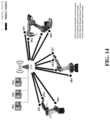
- FIG. 14 shows an example of a production unit, which consists of an infrastructure point and several users, which are mounted on robotic arms controlled by the PLC.
- FIG. 15 shows an example of industrial communication, which involves control loops with sensors/actuators and a controller, wherein latency puts constraints and limits on:
- a reliability goal is to exclude with a very high probability non-permitted error behaviors, as e.g. data packet failures in consecutive cycles (see example in FIG. 16 ). This does not (necessarily) translate into an SINR / spectral efficiency maximization.
- the main goal is to guarantee a certain (e.g. minimum) SINR, based on which modulation and coding can be adjusted. Limited information exchange leads to more challenges. This is addressed by exploiting sources of diversity and/or multi-point transmission.
- the present application focuses on the above-described special and more challenging requirements of industrial automation, particularly compared to conventional wireless (cellular) communication.
- the present use case of industrial automation comes with very unique requirements, particularly in latency and reliability.
- One example is the fact that consecutive errors are not permitted, so that production cycles are not interrupted.
- US 6298081 B1 discloses a method and apparatus for channel hopping between mobile stations and a base station in a radio communications system.
- US 2010046583 A1 discloses generating, by a network coordinator, a frequency hopping sequence to be used for communication between a network coordinator and a client, wherein the generated hopping sequence includes only select frequencies that minimize a probability of a predetermined number of consecutive frequency hop failures.
- an objective is to provide a wireless communications system, i.e. both a network device and a wireless communication device, better suitable for industrial communication scenarios.
- the aim is to meet reliability requirements in terms of packet failures. Consecutive failures should be avoided. Further, costs in terms of resources or complexity overhead should be held low.
- the present application proposes beamforming and time/frequency resource allocation, in order to achieve a reliable communication for SPS multi-point transmissions.
- a first aspect of the application provides a network device (BS), in particular for cyclic communication, configured to: provide a first information defining a hopping sequence to a wireless communication device (UE), wherein the hopping sequence specifies at least two spatial resources or at least two radio resources, or at least two spatial resources and at least two radio resources, es to be used by the UE for transmissions to and/or from the BS; and provide a second information to the UE defining when the hopping sequence should be periodically repeated and including a maximum number of communication failures for which the hopping sequence is valid.
- BS network device
- UE wireless communication device
- the UE is instructed to use a dedicated sequence and repetition of the resources. This leads to higher reliability in terms of packet failures, and in particular consecutive failures are avoided.
- the device of the first aspect is suited well for the industrial automation scenario.
- Cyclic communication can be realized by a semi-persistent communication scheme and/or an SPS or another industrial control system.
- a spatial resource may include a B S-beam and/or a UE-beam, beam pair, and/or a transmission- and/or reception point (TRP) and/or a radio resource may include a time-domain, and/or frequency-domain, and/or code-domain radio resource.
- TRP transmission- and/or reception point
- the network device is configured to: provide the first information defining a hopping pattern to multiple UEs, wherein the hopping pattern comprises different hopping sequences, one hopping sequence for each of the multiple UEs.
- the multiple UEs are instructed to use the resources in a dedicated sequence among each other.
- the hopping pattern leads to higher reliability in terms of packet failures, and in particular consecutive failures are avoided.
- the network device is configured to: calculate at least one hopping sequence.
- the network device is configured to: obtain a measurement, in particular a signal strength and/or a signal-to-interference-plus-noise ratio (SINR) from at least one UE, TRP, and/or another BS, and calculate the at least one hopping sequence on the basis of the received at least one measurement.
- a measurement in particular a signal strength and/or a signal-to-interference-plus-noise ratio (SINR) from at least one UE, TRP, and/or another BS, and calculate the at least one hopping sequence on the basis of the received at least one measurement.
- SINR signal-to-interference-plus-noise ratio
- the second information specifies a period of time and/or a number of successive transmissions, for which the at least two spatial resources and/or the at least two radio resources are to be successively used by the UE.
- the network device is configured to: obtain feedback information about a communication failure from the UE, and provide a third information about an updated hopping sequence, updated based on the received feedback information, to the UE.
- the updated hopping sequence may specify at least two spatial resources and/or radio resources to be successively used by the wireless communication device, as of receiving the updated hopping sequence, for successive transmissions to and/or from the network device.
- a communication failure can be a missed packet and/or based on a QoS failure (QoS failure as defined above).
- the communication failure can be addressed and accordingly reliability is improved.
- the second information further specifies a spatial resource and/or radio resource to be used by the UE to provide the feedback information to the BS, and the network device is configured to obtain the feedback information from the UE according to the spatial resource and/or radio resource specified by the second information.
- the feedback of one or more UEs to the network device is reliable.
- the second information further includes a spatial and/or radio resource for providing feedback information.
- the network device is configured to: provide a fourth information related to the first information and/or the second information defining a backup hopping sequence to be used by the UE, as of occurrence of a communication failure, for transmissions to and/or from the BS.
- the communication failure can be addressed quickly and efficiently, which avoids interruption of e.g. an industrial automation process.
- a second aspect of the application provides a wireless communication device (UE) configured to: receive a first information defining a hopping sequence from a BS, wherein the hopping sequence specifies at least two spatial resources or at least two radio resources, or at least two spatial resources and at least two radio resources, and receive a second information from the BS defining when the hopping sequence should be periodically repeated and including a maximum number of communication failures for which the hopping sequence is valid, and use the at least two spatial resources or at least two radio resources, or at least two spatial resources and at least two radio resources, for transmissions to or from the BS according to the second information.
- UE wireless communication device
- the UE can implement the sequence of using the resources such that its communication with the network device becomes more reliable, particularly in terms of packet failures.
- the device of the second aspect is well suited for industrial automation scenarios.
- the wireless communication device is configured to: use the at least two spatial resources and/or at least two radio resources specified by the hopping sequence for transmissions of a first transmission cycle, and again for transmissions of at least one second transmission cycle.
- a spatial resource includes a UE-beam and/or a BS-beam, and/or a TRP, and/or a radio resource includes a time-domain, and/or frequency-domain, and/or code-domain radio resource.
- the wireless communication device is configured to: obtain, particularly upon a request from the BS, a measurement, particularly a SINR in one or more radio resources while using a certain spatial resource, and transmit the measurement to the BS.
- the wireless communication device is configured to: transmit feedback information about a communication failure to the BS, receive a third information about an updated hopping sequence from the BS.
- the updated hooping sequence may specify at least two spatial resources and/or radio resource, and the wireless communication device may use, as of receiving the updated hopping sequence, the at least two spatial resources and/or radio resources specified by the updated hopping sequence for transmissions to and/or from the BS.
- the second information specifies a further spatial resource and/or radio resource to be used by the UE to provide the feedback information to the BS, and the UE is configured to: transmit the feedback information to the BS in said further spatial resource and/or radio resource specified by the second information.
- a third aspect of the application provides a method for a network device (BS), the method comprising: providing a first information about a hopping sequence to a wireless communication device (UE), wherein the hopping sequence specifies at least two spatial resources or at least two radio resources, or at least two spatial resources and at least two radio resources, to be used by the UE for transmissions to and/or from the BS, and providing a second information to the UE defining when the hopping sequence should be periodically repeated and including a maximum number of communication failures for which the hopping sequence is valid.
- BS network device
- the method comprises: providing the first information defining a hopping pattern to multiple UEs, wherein the hopping pattern comprises different hopping sequences, one hopping sequence for each of the multiple UEs.
- the method comprises: calculating at least one hopping sequence.
- the method comprises: obtaining a measurement, in particular a signal strength and/or a SINR from at least one UE, TRP, and/or another BS, and calculating the at least one hopping sequence on the basis of the received at least one measurement.
- the second information specifies a period of time and/or a number of successive transmissions, for which the at least two spatial resources and/or the at least two radio resources are to be successively used by the UE.
- the method comprises: obtaining feedback information about a communication failure from the UE, and providing a third information about an updated hopping sequence, updated based on the received feedback information, to the UE.
- the second information further specifies a spatial resource and/or radio resource to be used by the UE to provide the feedback information to the BS, and the method comprises: obtaining the feedback information from the UE according to the spatial resource and/or radio resource specified by the second information.
- the second information further a spatial and/or radio resource for providing feedback information.
- the method comprises: providing a fourth information related to the first information and/or the second information defining a backup hopping sequence to be used by the UE, as of occurrence of a communication failure, for transmissions to and/or from the BS.
- a fourth aspect of the application provides a method for a wireless communication device (UE), the method comprising: receiving a first information about a hopping sequence from a network device (BS), wherein the hopping sequence specifies at least two spatial resources or at least two radio resources, or at least two spatial resources and at least two radio resources, receiving a second information from the BS defining when the hopping sequence should be periodically repeated and including a maximum number of communication failures for which the hopping sequence is valid, and using the at least two spatial resources or at least two radio resources, or at least two spatial resources and at least two radio resources, for transmissions to or from the BS according to the second information.
- BS network device
- the method comprises: using the at least two spatial resources and/or at least two radio resources specified by the hopping sequence for transmissions of a first transmission cycle, and again for transmissions of at least one second transmission cycle.
- a spatial resource includes a UE-beam and/or a BS-beam, and/or a TRP, and/or a radio resource includes a time-domain, and/or frequency-domain, and/or code-domain radio resource.
- the method comprises: obtaining, particularly upon a request from the BS, a measurement, particularly a SINR in one or more radio resources while using a certain spatial resource, and transmit the measurement to the BS.
- the method comprises: transmitting feedback information about a communication failure to the BS, receive a third information about an updated hopping sequence from the BS.
- the second information specifies a further spatial resource and/or radio resource to be used to provide the feedback information to the BS
- the method comprises: transmitting the feedback information to the BS in said further spatial resource and/or radio resource specified by the second information.
- the above aspects and implementation forms achieve improved reliability through applying diversity, which in general is obtained in time, frequency, space (beam) and/or multiple transmit/receive points, i.e. multiple radio links.
- a certain (minimum) SINR can be guaranteed, in order to avoid packet errors, rather than maximizing the SINR or data throughput.
- Multi-point diversity is particularly helpful against link blockage in industrial environments using mm-Wave communication, and where a large number of connected infrastructure nodes are used.
- each UE can for example be served by one or more transmit receive points (TRPs), and further from each TRP by a predefined beam (Tx-Rx beam pair) and/or on a predefined frequency band and time slot/symbol within the cycle/frame.
- TRPs transmit receive points
- Tx-Rx beam pair predefined beam
- other frequency bands, time slots/symbols and/or beams may be used, in order to serve other UEs from the same or another TRP.
- FIG. 1 shows a network device 100, particularly a Base Station (BS), like a gNodeB or infrastructure node, and a wireless communication device 110, particularly User Equipment (UE), according to embodiments of the application.
- the devices 100 and 110 are configured for performing cyclic communication, i.e. a communication that is cyclically repeated.
- the devices 100 and 110 are particularly well suited for industrial automation scenarios.
- the BS is configured to provide a first information 101 defining a hopping sequence 102 to the UE 110.
- the first information 101 may include the hopping sequence 102 or may allow the UE 110 to derive the hopping sequence 102. Accordingly, the UE 110 is configured to obtain and/or receive the first information 101 defining the hopping sequence 102 from the BS 100.
- the BS 100 is further configured to provide a second information 103 to the UE 110 defining when the hopping sequence 102 should be repeated, in particular periodically repeated (i.e. my defined a "cycle"). Accordingly, the UE 110 is configured to obtain and/or receive the second information 103 from the BS 100, and may determine from the second information 103 when to repeat the hopping sequence 102.
- the hopping sequence 102 specifies at least two spatial resources and/or at least two radio resources to be used by the UE 110 for transmissions 104 to and/or from the BS 100.
- the UE 110 is thus configured to use the at least two spatial resources and/or at least two radio resources determined by the hopping sequence 102 for its transmissions 104 to and/or from the BS 100, and according to the second information 103, e.g. when, how often, and for how long.
- the network device 100 may in particular be configured to provide the first information 101 to multiple UEs 110.
- the first information 101 may define a hopping pattern, which comprises different hopping sequences 102, specifically one hopping sequence 102 per each of the multiple UEs 110.
- Each hopping sequence 102 in the hopping pattern specifies in this case at least two spatial resources and/or at least two radio resources for one of the UEs 110 to use for its transmissions 104.
- the at least two spatial resources may generally include one or more BS-beams and/or one or more UE-beams, one or more beam pairs, and/or one or more TRPs.
- the at least two radio resource may include one or more time-domain, and/or one or more frequency-domain, and/or one or more code-domain radio resources. This holds for both hopping sequence 102 and hopping pattern.
- the hopping sequence 102 may specify one or preferably even more of the following hopping types (with reference to FIG: 2 ):
- a joint spatial-frequency hopping type is particularly powerful against LOS blockage and frequency-selective fading, and "randomizes" the channel as observed between Tx and Rx in different transmissions 104. This increased diversity, for instance, reduces the probability of QoS failures in consecutive time slots, thus leading to an improved performance.
- Combinations of different hopping types in a hopping sequence 102 may include a selection of TRPs, Tx/Rx beam pairs and time/frequency resources, in order to guarantee a certain QoS (e.g. min SINR).
- beam pairs may typically be selected by beam alignment.
- exhaustive beam alignment and tracking may only offer small gains, while being complex and potentially introducing large delays.
- frequent updating may be needed, in order to ensure using the best beam pair, which may increase complexity and may introduce a time delay.
- a beam alignment may have to be performed, possibly affecting the data connection.
- each UE 110 may preferably be scheduled and served in SPS way, in particular in different time intervals, by using different beam (pairs) and on different frequencies, which may be selected based on initial measurements.
- FIG. 3 depicts an example of a hopping pattern for 4 UEs 110 ("users"; distinguished by different shadings), the hopping pattern accordingly including 4 hopping sequences 102, one for each UE 110 according to an embodiment of the application.
- the example includes 5 frequency bands (as frequency resources), six beam pairs (as spatial resources) and a 4-cycle periodicity.
- B1 to B6 are (pairs of Tx-Rx) beams, which are selected from a set of initial beam measurements performed between Tx and Rx. Assignment may be such that different beams and frequencies are used in consecutive cycles. This prevents from failures in consecutive cycles for the same UE 110.
- the hopping pattern with the hopping sequences 102 is instructed by the BS 100 to each UE 110, and may then be used repeatedly unless it is updated by the BS 100, e.g. in case of insufficient SINR, beam failure or high packet losses.
- the BS 100 may be configured to provide a third information about an updated hopping sequence 102, updated based on the insufficient SINR, beam failure or high packet losses, to a UE 110 or an updated hopping pattern to the multiple UEs 110.
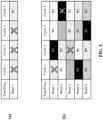
- FIG. 4 clarifies the benefits of the devices 100 and 110 according to embodiments of the application, which use a hopping sequence 102 or hopping pattern (see FIG. 4(b) ) when compared to a conventional scheme without such hopping (see FIG. 4(a) ).
- the reliability may suffer due to consecutive errors, and at the same time, in case of beam failure, a new beam search needs to be activated. This will take two cycles for the new beam search to take place, which increases the overall delay.
- the scheme implemented by the devices 100 and 110 does not suffer from these disadvantages.
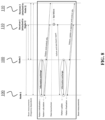
- FIG. 5 shows an example of steps of a procedure between the BS 100 ("infrastructure node") and a UE 110 ("user").
- the events of a QoS failure on both the BS side as well as on the UE side are included.
- the procedure between BS 100 and the UE(s) 110 may include:
- the feedback configuration information which is included in the control information (i.e. the second information) may specifically include following information:
- FIG. 6 shows an example of 4 UEs 110, which report feedback in a predefined time and frequency resource (RB), each one by using the assigned beam.
- RB time and frequency resource
- Different UEs' feedback can be multiplexed in time, frequency and/or beam.
- multiple UEs 110 served by a single BS 100 do not necessarily need to have the same hopping sequence 102 periodicity. However, it is required that the period of the longest cycle is a multiple of the other users' shorter periods. Control information is initially sent before the beginning of the first cycle for all users.
- feedback information can be reported - if needed - by each UE 110 independently after its own frame, i.e. after its own cycle(s). This allows for sending additional control information to these particular UEs 110, e.g. immediately after their feedback information has been received by the BS 100, in order to be used for adjusting transmission 104 in the next frames.
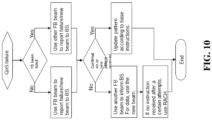
- FIG. 10 shows a procedure of a UE 110 in case of a communication failure.
- the UE 110 may follow the shown procedure, which is aligned with the sequence diagram and the overall procedure. This UE-side procedure relies on own measurements, as well as on the information exchange with the infrastructure.
- the UE 110 may be configured to determine whether a beam for providing feedback information failed. If yes, then the UE 110 may use another beam to report the communication failure to the BS 100. If the UE 110 then receives confirmation or a new hopping sequence 102 or hopping pattern, it may updated its hopping sequence 102 or the hopping pattern according to the instructions from the BS 100. If not, then it may use another beam to inform the BS 100 about the failure, and may use the beam for data. If it still does not receive any instructions after a determined number of attempts, it may use a RACH procedure.
- FIG. 11 shows a method 1100 according to an embodiment of the application, which may be performed by the BS 100 (as e.g. shown in FIG. 1 ).
- the method 1100 includes a step 1101 of providing a first information 101 about a hopping sequence 102 to a UE 100, wherein the hopping sequence 102 specifies at least two spatial resources and/or at least two radio resources to be used by the UE 110 for transmissions 104 to and/or from the BS 100.
- the method 1100 further includes a step 1102 of providing a second information 103 to the UE 110 defining when the hopping sequence 102 should be repeated, in particular, periodically repeated.
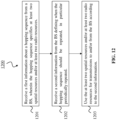
- FIG. 12 shows a method 1200 according to an embodiment of the application, which may be performed by the UE 110 (as e.g. shown in FIG. 1 ).
- the method 1200 includes a step 1201 of receiving a first information 101 about a hopping sequence 102 from a BS 100, wherein the hopping sequence 102 specifies at least two spatial resources and/or at least two radio resources.
- the method 1200 includes a step 1202 of receiving a second information 103 from the BS 100 defining when the hopping sequence 102 should be repeated, in particular periodically repeated.
- the method 1200 comprises a step 1203 of using the at least two spatial resources and/or at least two radio resources for transmissions 104 to and/or from the BS 100 according to the second information 103.
Landscapes
- Engineering & Computer Science (AREA)
- Computer Networks & Wireless Communication (AREA)
- Signal Processing (AREA)
- Mobile Radio Communication Systems (AREA)
Claims (15)
- Netzwerkvorrichtung, BS, (100) für zyklische Kommunikation, konfiguriert zum:Bereitstellen einer ersten Information (101), die eine Sprungsequenz (102) definiert, an eine Drahtloskommunikationsvorrichtung, UE, (110),wobei die Sprungsequenz (102) mindestens zwei räumliche Ressourcen oder mindestens zwei Funkressourcen oder mindestens zwei räumliche Ressourcen und mindestens zwei Funkressourcen spezifiziert, die von der UE (110) für Übertragungen (104) zu und/oder von der BS (100) verwendet werden sollen; undBereitstellen einer zweiten Information (103) an die UE (110), die festlegt, wann die Sprungsequenz (102) periodisch wiederholt werden soll, und die eine maximale Anzahl von Kommunikationsfehlern aufweist, für die die Sprungsequenz (102) gültig ist.
- Netzwerkvorrichtung (100) nach Anspruch 1, konfiguriert zum:Bereitstellen der ersten Information (101), die ein Sprungmuster definiert, an mehrere UEs (110),wobei das Sprungmuster unterschiedliche Sprungsequenzen (102) umfasst, wobei für jedes der mehreren UEs (110) eine Sprungsequenz (102) vorgesehen ist.
- Netzwerkvorrichtung (100) nach einem der Ansprüche 1 bis 2, ferner konfiguriert zum:
Berechnen mindestens einer Sprungsequenz (102). - Netzwerkvorrichtung (100) nach Anspruch 3, konfiguriert zum:Erhalten einer Messung mindestens einer von einer Signalstärke oder einem Signal-zu-Interferenz-plus-Rausch-Verhältnis, SINR, von mindestens einer UE (110), einem Sende-Empfangs-Punkt, TRP, oder einer anderen BS (100), undBerechnen der mindestens einen Sprungsequenz (102) basierend auf der empfangenen mindestens einen Messung.
- Netzwerkvorrichtung (100) nach einem der Ansprüche 1 bis 4, wobei:
die zweite Information (103) mindestens eine von einer Zeitspanne, einer Anzahl von aufeinander folgenden Übertragungen (104) spezifiziert, für die die mindestens zwei räumlichen Ressourcen oder die mindestens zwei Funkressourcen nacheinander von der UE (110) zu verwenden sind. - Netzwerkvorrichtung (100) nach einem der Ansprüche 1 bis 5, ferner konfiguriert zum:Abrufen von Feedbackinformationen über einen Kommunikationsfehler von der UE (110), undBereitstellen einer dritten Information über eine aktualisierte Sprungsequenz (102), die basierend auf der empfangenen Feedbackinformation aktualisiert wird, an die UE (110).
- Netzwerkvorrichtung (100) nach Anspruch 6, wobei:die zweite Information (103) ferner eine räumliche Ressource oder Funkressource spezifiziert, die von der UE (110) verwendet werden soll, um die Feedbackinformation an die BS (100) bereitzustellen, unddie Netzwerkvorrichtung (100) konfiguriert ist zum: Erhalten der Feedbackinformation von der UE (110) gemäß mindestens einer der räumlichen Ressource oder Funkressource, die durch die zweite Information (103) spezifiziert ist.
- Drahtloskommunikationsvorrichtung, UE, (110) konfiguriert zum:Empfangen einer ersten Information (101), die eine Sprungsequenz (102) definiert, von einer Netzwerkvorrichtung, BS, (100)wobei die Sprungsequenz (102) mindestens zwei räumliche Ressourcen oder mindestens zwei Funkressourcen oder mindestens zwei räumliche Ressourcen und mindestens zwei Funkressourcen spezifiziert, undEmpfangen einer zweiten Information (103) von der BS (100), die festlegt, wann die Sprungsequenz (102) periodisch wiederholt werden soll, und die eine maximale Anzahl von Kommunikationsfehlern aufweist, für die die Sprungsequenz (102) gültig ist, undVerwenden der mindestens zwei räumlichen Ressourcen oder der mindestens zwei Funkressourcen oder der mindestens zwei räumlichen Ressourcen und der mindestens zwei Funkressourcen für Übertragungen (104) zu oder von der BS (100) gemäß der zweiten Information (103).
- Drahtloskommunikationsvorrichtung (110) nach Anspruch 8, konfiguriert zum:
Verwenden der mindestens zwei räumlichen Ressourcen oder der mindestens zwei Funkressourcen oder der mindestens zwei räumlichen Ressourcen und der mindestens zwei Funkressourcen, die durch die Sprungsequenz (102) spezifiziert sind, für Übertragungen (104) eines ersten Übertragungszyklus und erneut für Übertragungen (104) von mindestens einem zweiten Übertragungszyklus. - Drahtloskommunikationsvorrichtung (110) nach Anspruch 9, wobei:eine räumliche Ressource mindestens einen UE-Strahl, einen BS-Strahl oder einen TRP beinhaltet,eine Funkressource mindestens eine Zeit-Domäne, eine Frequenz-Domäne oder eine Code-Domänen-Funkressource beinhaltet.
- Drahtloskommunikationsvorrichtung (110) nach einem der Ansprüche 8 bis 10, konfiguriert zum:Erhalten einer Messung auf Anfrage der BS (100), beinhaltend mindestens einer Signalstärke oder einer SINR in einer oder mehreren Funkressourcen unter Verwendung einer bestimmten räumlichen Ressource, undÜbermitteln der Messung an die BS (100).
- Drahtloskommunikationsvorrichtung (110) nach einem der Ansprüche 8 bis 11, konfiguriert zum:Übertragen von Feedbackinformation über einen Kommunikationsfehler an die BS (100),Empfangen einer dritten Information über eine aktualisierte Sprungsequenz (102) von der BS (100).
- Drahtloskommunikationsvorrichtung (110) nach einem der Ansprüche 8 bis 12, wobei:
die zweite Information (103) mindestens eine weitere einer räumlichen Ressource oder Funkressource spezifiziert, die von der UE (110) verwendet werden soll, um die Feedbackinformation an die BS (100) bereitzustellen, und die UE (110) konfiguriert ist zum:
Senden der Rückmeldeinformation an die BS (100) in der durch die zweite Information (103) spezifizierten weiteren räumlichen Ressource oder Funkressource. - Verfahren (1100) für eine Netzwerkvorrichtung, BS, (100), wobei das Verfahren (1100) Folgendes umfasst:Bereitstellen (1101) einer ersten Information (101), die eine Sprungsequenz (102) definiert, an eine Drahtloskommunikationsvorrichtung, UE, (110)wobei die Sprungsequenz (102) mindestens zwei räumliche Ressourcen oder mindestens zwei Funkressourcen oder mindestens zwei räumliche Ressourcen und mindestens zwei Funkressourcen spezifiziert, die von der UE (110) für Übertragungen (104) zu und/oder von der BS (100) verwendet werden sollen; undBereitstellen (1102) einer zweiten Information (103) an die UE (110), die festlegt, wann die Sprungsequenz (102) periodisch wiederholt werden soll, und die eine maximale Anzahl von Kommunikationsfehlern aufweist, für die die Sprungsequenz (102) gültig ist.
- Verfahren (1200) für eine Drahtloskommunikationsvorrichtung, UE, (110), wobei das Verfahren (1300) Folgendes umfasst:Empfangen (1201) einer ersten Information (101) über eine Sprungsequenz (102) von einer Netzwerkvorrichtung, BS, (100)wobei die Sprungsequenz (102) mindestens zwei räumliche Ressourcen oder mindestens zwei Funkressourcen oder mindestens zwei räumliche Ressourcen und mindestens zwei Funkressourcen spezifiziert,Empfangen (1202) einer zweiten Information (103) von der BS (100), die festlegt, wann die Sprungsequenz (102) periodisch wiederholt werden soll, und die eine maximale Anzahl von Kommunikationsfehlern aufweist, für die die Sprungsequenz (102) gültig ist, undVerwenden (1203) der mindestens zwei räumlichen Ressourcen oder mindestens zwei Funkressourcen oder mindestens zwei räumlichen Ressourcen und mindestens zwei Funkressourcen für Übertragungen (104) zu oder von der BS (100) gemäß der zweiten Information (103).
Applications Claiming Priority (1)
| Application Number | Priority Date | Filing Date | Title |
|---|---|---|---|
| PCT/EP2018/079435 WO2020083509A1 (en) | 2018-10-26 | 2018-10-26 | Network device and wireless communication device for cyclic communication |
Publications (2)
| Publication Number | Publication Date |
|---|---|
| EP3868027A1 EP3868027A1 (de) | 2021-08-25 |
| EP3868027B1 true EP3868027B1 (de) | 2025-03-26 |
Family
ID=64051553
Family Applications (1)
| Application Number | Title | Priority Date | Filing Date |
|---|---|---|---|
| EP18795985.3A Active EP3868027B1 (de) | 2018-10-26 | 2018-10-26 | Netzwerkvorrichtung und drahtloskommunikationsvorrichtung für zyklische kommunikation |
Country Status (4)
| Country | Link |
|---|---|
| US (1) | US11901935B2 (de) |
| EP (1) | EP3868027B1 (de) |
| CN (1) | CN112930649B (de) |
| WO (1) | WO2020083509A1 (de) |
Families Citing this family (2)
| Publication number | Priority date | Publication date | Assignee | Title |
|---|---|---|---|---|
| WO2020109955A1 (en) * | 2018-11-30 | 2020-06-04 | Telefonaktiebolaget Lm Ericsson (Publ) | Methods for providing lower-layer split full spatial samples |
| US11937097B2 (en) | 2021-06-04 | 2024-03-19 | Qualcomm Incorporated | Diversity improvement in wireless devices with beam hopping |
Family Cites Families (20)
| Publication number | Priority date | Publication date | Assignee | Title |
|---|---|---|---|---|
| US6298081B1 (en) * | 1996-05-31 | 2001-10-02 | Telefonaktiebolaget Lm Ericsson (Publ) | Channel hopping in a radio communications system |
| US6233466B1 (en) | 1998-12-14 | 2001-05-15 | Metawave Communications Corporation | Downlink beamforming using beam sweeping and subscriber feedback |
| US7016649B1 (en) | 2000-03-17 | 2006-03-21 | Kathrein-Werke Kg | Space-time and space-frequency hopping for capacity enhancement of mobile data systems |
| US7366223B1 (en) * | 2002-06-06 | 2008-04-29 | Arraycomm, Llc | Modifying hopping sequences in wireless networks |
| EP2232726B1 (de) | 2008-01-14 | 2017-02-08 | Telefonaktiebolaget LM Ericsson (publ) | Vorkodierer-cycling in offener schleife bei der mimo-kommunikation |
| US8149893B2 (en) * | 2008-08-22 | 2012-04-03 | Siemens Aktiengesellschaft | Reliable wireless communication system using adaptive frequency hopping |
| US8175542B2 (en) | 2009-04-22 | 2012-05-08 | Broadcom Corporation | Transceiver with plural space hopping phased array antennas and methods for use therewith |
| EP2914026B1 (de) * | 2014-02-27 | 2016-12-14 | NTT DoCoMo, Inc. | Verfahren und vorrichtung zur übertragung eines entdeckungssignals durch eine kommunikationsvorrichtung |
| KR102220377B1 (ko) | 2014-08-29 | 2021-02-25 | 삼성전자주식회사 | 다중 셀 다중 사용자 통신 시스템에서 적응적 빔 호핑을 위한 방법 및 장치 |
| US20170105214A1 (en) * | 2015-10-07 | 2017-04-13 | Microsoft Technology Licensing, Llc | Wireless communication using a channel schedule |
| US10334633B2 (en) * | 2016-01-07 | 2019-06-25 | Qualcomm Incorporated | Narrow band physical random access channel frequency hopping patterns and detection schemes |
| US20170223695A1 (en) * | 2016-02-03 | 2017-08-03 | Lg Electronics Inc. | Method and apparatus for transmitting an uplink channel in a wireless communication system |
| KR20180013811A (ko) * | 2016-07-29 | 2018-02-07 | 아서스테크 컴퓨터 인코포레이션 | 무선 통신 시스템에서 빔 동작을 위한 채널 상태 정보 리포트를 위한 방법 및 장치 |
| US10448368B2 (en) * | 2016-11-11 | 2019-10-15 | Huawei Technologies Co., Ltd. | Systems and methods for grant-free uplink transmission |
| US10869333B2 (en) * | 2016-12-16 | 2020-12-15 | Huawei Technologies Co., Ltd. | Systems and methods for mixed grant-free and grant-based uplink transmissions |
| US10965407B2 (en) * | 2017-02-02 | 2021-03-30 | Sharp Kabushiki Kaisha | User equipments, base stations and communication methods |
| US11483810B2 (en) * | 2017-04-03 | 2022-10-25 | Huawei Technologies Co., Ltd. | Methods and systems for resource configuration of wireless communication systems |
| US10645730B2 (en) * | 2017-04-06 | 2020-05-05 | Huawei Technologies Co., Ltd. | Flexible grant-free resource configuration signaling |
| US10616916B2 (en) * | 2017-05-31 | 2020-04-07 | Kt Corporation | Methods for multiplexing scheduling request information and HARQ ACK/NACK information while transmitting and receiving PUCCH and apparatuses thereof |
| EP3666001B1 (de) * | 2017-08-10 | 2022-10-05 | Sharp Kabushiki Kaisha | Verfahren, basisstation und benutzervorrichtung zur uplink-übertragung ohne berechtigung |
-
2018
- 2018-10-26 EP EP18795985.3A patent/EP3868027B1/de active Active
- 2018-10-26 WO PCT/EP2018/079435 patent/WO2020083509A1/en not_active Ceased
- 2018-10-26 CN CN201880099063.3A patent/CN112930649B/zh active Active
-
2021
- 2021-04-23 US US17/238,761 patent/US11901935B2/en active Active
Also Published As
| Publication number | Publication date |
|---|---|
| CN112930649B (zh) | 2022-11-25 |
| EP3868027A1 (de) | 2021-08-25 |
| WO2020083509A1 (en) | 2020-04-30 |
| US20210242900A1 (en) | 2021-08-05 |
| CN112930649A (zh) | 2021-06-08 |
| US11901935B2 (en) | 2024-02-13 |
Similar Documents
| Publication | Publication Date | Title |
|---|---|---|
| EP2529590B1 (de) | Verfahren zur interferenzminimierung in einem drahtlosen kommunikationssystem | |
| US10368349B2 (en) | Method for assisting bidirectional communication in wireless networks | |
| US20180302908A1 (en) | Method for scheduling closed loop information in wireless networks | |
| US20180302911A1 (en) | Method for scheduling transmissions in wireless networks | |
| CN115245010B (zh) | 用于物理上行链路控制信道资源中的重复的波束跳变 | |
| US11743743B2 (en) | Supporting analog repeater with beam sweep | |
| US20240356848A1 (en) | Latency-reducing wireless network multipoint association | |
| CN113615285A (zh) | 蜂窝网状网络中的资源分配和定时处理 | |
| CN111615796B (zh) | 用于协调式多点网络中的空间分集的技术和装置 | |
| JPWO2020230220A5 (ja) | 端末、無線通信方法及びシステム | |
| KR20180006840A (ko) | 효과적인 랜덤 액세스를 위한 제어 메시지 전송 방법 | |
| CN115868130B (zh) | 广播网络译码编码分组的基于反馈的重传 | |
| CN117561735A (zh) | 用智能反射表面进行交叉链路干扰测量资源配置和报告以用于干扰缓解 | |
| US11425735B2 (en) | Scheduling channel state information (CSI) processes in association with periodic traffic in a CoMP network | |
| US11901935B2 (en) | Network device and wireless communication device for cyclic communication | |
| CN116746076A (zh) | 接收用于无线设备之间的通信的空间配置指示 | |
| EP3566364B1 (de) | Steuerung mithilfe von nr tdd | |
| EP4011164B1 (de) | Semipersistente planung teilband-umschaltung | |
| EP3777391B1 (de) | Anhängen einer bedarfsabhängigen gewährung an eine semipersistente planungs(sps)-gewährung |
Legal Events
| Date | Code | Title | Description |
|---|---|---|---|
| STAA | Information on the status of an ep patent application or granted ep patent |
Free format text: STATUS: UNKNOWN |
|
| STAA | Information on the status of an ep patent application or granted ep patent |
Free format text: STATUS: THE INTERNATIONAL PUBLICATION HAS BEEN MADE |
|
| PUAI | Public reference made under article 153(3) epc to a published international application that has entered the european phase |
Free format text: ORIGINAL CODE: 0009012 |
|
| STAA | Information on the status of an ep patent application or granted ep patent |
Free format text: STATUS: REQUEST FOR EXAMINATION WAS MADE |
|
| 17P | Request for examination filed |
Effective date: 20210520 |
|
| AK | Designated contracting states |
Kind code of ref document: A1 Designated state(s): AL AT BE BG CH CY CZ DE DK EE ES FI FR GB GR HR HU IE IS IT LI LT LU LV MC MK MT NL NO PL PT RO RS SE SI SK SM TR |
|
| DAV | Request for validation of the european patent (deleted) | ||
| DAX | Request for extension of the european patent (deleted) | ||
| GRAP | Despatch of communication of intention to grant a patent |
Free format text: ORIGINAL CODE: EPIDOSNIGR1 |
|
| STAA | Information on the status of an ep patent application or granted ep patent |
Free format text: STATUS: GRANT OF PATENT IS INTENDED |
|
| INTG | Intention to grant announced |
Effective date: 20241108 |
|
| GRAS | Grant fee paid |
Free format text: ORIGINAL CODE: EPIDOSNIGR3 |
|
| GRAA | (expected) grant |
Free format text: ORIGINAL CODE: 0009210 |
|
| STAA | Information on the status of an ep patent application or granted ep patent |
Free format text: STATUS: THE PATENT HAS BEEN GRANTED |
|
| AK | Designated contracting states |
Kind code of ref document: B1 Designated state(s): AL AT BE BG CH CY CZ DE DK EE ES FI FR GB GR HR HU IE IS IT LI LT LU LV MC MK MT NL NO PL PT RO RS SE SI SK SM TR |
|
| REG | Reference to a national code |
Ref country code: GB Ref legal event code: FG4D |
|
| REG | Reference to a national code |
Ref country code: CH Ref legal event code: EP |
|
| REG | Reference to a national code |
Ref country code: DE Ref legal event code: R096 Ref document number: 602018080493 Country of ref document: DE |
|
| REG | Reference to a national code |
Ref country code: IE Ref legal event code: FG4D |
|
| PG25 | Lapsed in a contracting state [announced via postgrant information from national office to epo] |
Ref country code: RS Free format text: LAPSE BECAUSE OF FAILURE TO SUBMIT A TRANSLATION OF THE DESCRIPTION OR TO PAY THE FEE WITHIN THE PRESCRIBED TIME-LIMIT Effective date: 20250626 |
|
| PG25 | Lapsed in a contracting state [announced via postgrant information from national office to epo] |
Ref country code: FI Free format text: LAPSE BECAUSE OF FAILURE TO SUBMIT A TRANSLATION OF THE DESCRIPTION OR TO PAY THE FEE WITHIN THE PRESCRIBED TIME-LIMIT Effective date: 20250326 |
|
| REG | Reference to a national code |
Ref country code: LT Ref legal event code: MG9D |
|
| PG25 | Lapsed in a contracting state [announced via postgrant information from national office to epo] |
Ref country code: NO Free format text: LAPSE BECAUSE OF FAILURE TO SUBMIT A TRANSLATION OF THE DESCRIPTION OR TO PAY THE FEE WITHIN THE PRESCRIBED TIME-LIMIT Effective date: 20250626 |
|
| PG25 | Lapsed in a contracting state [announced via postgrant information from national office to epo] |
Ref country code: HR Free format text: LAPSE BECAUSE OF FAILURE TO SUBMIT A TRANSLATION OF THE DESCRIPTION OR TO PAY THE FEE WITHIN THE PRESCRIBED TIME-LIMIT Effective date: 20250326 |
|
| PG25 | Lapsed in a contracting state [announced via postgrant information from national office to epo] |
Ref country code: LV Free format text: LAPSE BECAUSE OF FAILURE TO SUBMIT A TRANSLATION OF THE DESCRIPTION OR TO PAY THE FEE WITHIN THE PRESCRIBED TIME-LIMIT Effective date: 20250326 |
|
| PG25 | Lapsed in a contracting state [announced via postgrant information from national office to epo] |
Ref country code: GR Free format text: LAPSE BECAUSE OF FAILURE TO SUBMIT A TRANSLATION OF THE DESCRIPTION OR TO PAY THE FEE WITHIN THE PRESCRIBED TIME-LIMIT Effective date: 20250627 Ref country code: BG Free format text: LAPSE BECAUSE OF FAILURE TO SUBMIT A TRANSLATION OF THE DESCRIPTION OR TO PAY THE FEE WITHIN THE PRESCRIBED TIME-LIMIT Effective date: 20250326 |
|
| REG | Reference to a national code |
Ref country code: NL Ref legal event code: MP Effective date: 20250326 |
|
| PG25 | Lapsed in a contracting state [announced via postgrant information from national office to epo] |
Ref country code: NL Free format text: LAPSE BECAUSE OF FAILURE TO SUBMIT A TRANSLATION OF THE DESCRIPTION OR TO PAY THE FEE WITHIN THE PRESCRIBED TIME-LIMIT Effective date: 20250326 |
|
| PG25 | Lapsed in a contracting state [announced via postgrant information from national office to epo] |
Ref country code: SE Free format text: LAPSE BECAUSE OF FAILURE TO SUBMIT A TRANSLATION OF THE DESCRIPTION OR TO PAY THE FEE WITHIN THE PRESCRIBED TIME-LIMIT Effective date: 20250326 |
|
| REG | Reference to a national code |
Ref country code: AT Ref legal event code: MK05 Ref document number: 1779993 Country of ref document: AT Kind code of ref document: T Effective date: 20250326 |
|
| PG25 | Lapsed in a contracting state [announced via postgrant information from national office to epo] |
Ref country code: SM Free format text: LAPSE BECAUSE OF FAILURE TO SUBMIT A TRANSLATION OF THE DESCRIPTION OR TO PAY THE FEE WITHIN THE PRESCRIBED TIME-LIMIT Effective date: 20250326 |
|
| PG25 | Lapsed in a contracting state [announced via postgrant information from national office to epo] |
Ref country code: PT Free format text: LAPSE BECAUSE OF FAILURE TO SUBMIT A TRANSLATION OF THE DESCRIPTION OR TO PAY THE FEE WITHIN THE PRESCRIBED TIME-LIMIT Effective date: 20250728 Ref country code: ES Free format text: LAPSE BECAUSE OF FAILURE TO SUBMIT A TRANSLATION OF THE DESCRIPTION OR TO PAY THE FEE WITHIN THE PRESCRIBED TIME-LIMIT Effective date: 20250326 |
|
| PG25 | Lapsed in a contracting state [announced via postgrant information from national office to epo] |
Ref country code: PL Free format text: LAPSE BECAUSE OF FAILURE TO SUBMIT A TRANSLATION OF THE DESCRIPTION OR TO PAY THE FEE WITHIN THE PRESCRIBED TIME-LIMIT Effective date: 20250326 Ref country code: IT Free format text: LAPSE BECAUSE OF FAILURE TO SUBMIT A TRANSLATION OF THE DESCRIPTION OR TO PAY THE FEE WITHIN THE PRESCRIBED TIME-LIMIT Effective date: 20250326 |
|
| PG25 | Lapsed in a contracting state [announced via postgrant information from national office to epo] |
Ref country code: AT Free format text: LAPSE BECAUSE OF FAILURE TO SUBMIT A TRANSLATION OF THE DESCRIPTION OR TO PAY THE FEE WITHIN THE PRESCRIBED TIME-LIMIT Effective date: 20250326 |
|
| PG25 | Lapsed in a contracting state [announced via postgrant information from national office to epo] |
Ref country code: EE Free format text: LAPSE BECAUSE OF FAILURE TO SUBMIT A TRANSLATION OF THE DESCRIPTION OR TO PAY THE FEE WITHIN THE PRESCRIBED TIME-LIMIT Effective date: 20250326 |
|
| PG25 | Lapsed in a contracting state [announced via postgrant information from national office to epo] |
Ref country code: RO Free format text: LAPSE BECAUSE OF FAILURE TO SUBMIT A TRANSLATION OF THE DESCRIPTION OR TO PAY THE FEE WITHIN THE PRESCRIBED TIME-LIMIT Effective date: 20250326 |
|
| PG25 | Lapsed in a contracting state [announced via postgrant information from national office to epo] |
Ref country code: SK Free format text: LAPSE BECAUSE OF FAILURE TO SUBMIT A TRANSLATION OF THE DESCRIPTION OR TO PAY THE FEE WITHIN THE PRESCRIBED TIME-LIMIT Effective date: 20250326 |
|
| PG25 | Lapsed in a contracting state [announced via postgrant information from national office to epo] |
Ref country code: IS Free format text: LAPSE BECAUSE OF FAILURE TO SUBMIT A TRANSLATION OF THE DESCRIPTION OR TO PAY THE FEE WITHIN THE PRESCRIBED TIME-LIMIT Effective date: 20250726 |
|
| REG | Reference to a national code |
Ref country code: DE Ref legal event code: R097 Ref document number: 602018080493 Country of ref document: DE |
|
| PGFP | Annual fee paid to national office [announced via postgrant information from national office to epo] |
Ref country code: DE Payment date: 20250902 Year of fee payment: 8 |
|
| PG25 | Lapsed in a contracting state [announced via postgrant information from national office to epo] |
Ref country code: DK Free format text: LAPSE BECAUSE OF FAILURE TO SUBMIT A TRANSLATION OF THE DESCRIPTION OR TO PAY THE FEE WITHIN THE PRESCRIBED TIME-LIMIT Effective date: 20250326 |
|
| PG25 | Lapsed in a contracting state [announced via postgrant information from national office to epo] |
Ref country code: CZ Free format text: LAPSE BECAUSE OF FAILURE TO SUBMIT A TRANSLATION OF THE DESCRIPTION OR TO PAY THE FEE WITHIN THE PRESCRIBED TIME-LIMIT Effective date: 20250326 |
|
| PLBE | No opposition filed within time limit |
Free format text: ORIGINAL CODE: 0009261 |
|
| STAA | Information on the status of an ep patent application or granted ep patent |
Free format text: STATUS: NO OPPOSITION FILED WITHIN TIME LIMIT |
|
| REG | Reference to a national code |
Ref country code: CH Ref legal event code: L10 Free format text: ST27 STATUS EVENT CODE: U-0-0-L10-L00 (AS PROVIDED BY THE NATIONAL OFFICE) Effective date: 20260211 |
|
| 26N | No opposition filed |
Effective date: 20260105 |