EP3867088B1 - Method of controlling an active suspension system - Google Patents
Method of controlling an active suspension system Download PDFInfo
- Publication number
- EP3867088B1 EP3867088B1 EP19872724.0A EP19872724A EP3867088B1 EP 3867088 B1 EP3867088 B1 EP 3867088B1 EP 19872724 A EP19872724 A EP 19872724A EP 3867088 B1 EP3867088 B1 EP 3867088B1
- Authority
- EP
- European Patent Office
- Prior art keywords
- wheel
- vehicle
- pothole
- suspension
- suspension assembly
- Prior art date
- Legal status (The legal status is an assumption and is not a legal conclusion. Google has not performed a legal analysis and makes no representation as to the accuracy of the status listed.)
- Active
Links
Images



Classifications
-
- B—PERFORMING OPERATIONS; TRANSPORTING
- B60—VEHICLES IN GENERAL
- B60G—VEHICLE SUSPENSION ARRANGEMENTS
- B60G17/00—Resilient suspensions having means for adjusting the spring or vibration-damper characteristics, for regulating the distance between a supporting surface and a sprung part of vehicle or for locking suspension during use to meet varying vehicular or surface conditions, e.g. due to speed or load
- B60G17/015—Resilient suspensions having means for adjusting the spring or vibration-damper characteristics, for regulating the distance between a supporting surface and a sprung part of vehicle or for locking suspension during use to meet varying vehicular or surface conditions, e.g. due to speed or load the regulating means comprising electric or electronic elements
- B60G17/018—Resilient suspensions having means for adjusting the spring or vibration-damper characteristics, for regulating the distance between a supporting surface and a sprung part of vehicle or for locking suspension during use to meet varying vehicular or surface conditions, e.g. due to speed or load the regulating means comprising electric or electronic elements characterised by the use of a specific signal treatment or control method
-
- B—PERFORMING OPERATIONS; TRANSPORTING
- B60—VEHICLES IN GENERAL
- B60G—VEHICLE SUSPENSION ARRANGEMENTS
- B60G17/00—Resilient suspensions having means for adjusting the spring or vibration-damper characteristics, for regulating the distance between a supporting surface and a sprung part of vehicle or for locking suspension during use to meet varying vehicular or surface conditions, e.g. due to speed or load
- B60G17/015—Resilient suspensions having means for adjusting the spring or vibration-damper characteristics, for regulating the distance between a supporting surface and a sprung part of vehicle or for locking suspension during use to meet varying vehicular or surface conditions, e.g. due to speed or load the regulating means comprising electric or electronic elements
- B60G17/016—Resilient suspensions having means for adjusting the spring or vibration-damper characteristics, for regulating the distance between a supporting surface and a sprung part of vehicle or for locking suspension during use to meet varying vehicular or surface conditions, e.g. due to speed or load the regulating means comprising electric or electronic elements characterised by their responsiveness, when the vehicle is travelling, to specific motion, a specific condition, or driver input
- B60G17/0165—Resilient suspensions having means for adjusting the spring or vibration-damper characteristics, for regulating the distance between a supporting surface and a sprung part of vehicle or for locking suspension during use to meet varying vehicular or surface conditions, e.g. due to speed or load the regulating means comprising electric or electronic elements characterised by their responsiveness, when the vehicle is travelling, to specific motion, a specific condition, or driver input to an external condition, e.g. rough road surface, side wind
-
- B—PERFORMING OPERATIONS; TRANSPORTING
- B60—VEHICLES IN GENERAL
- B60G—VEHICLE SUSPENSION ARRANGEMENTS
- B60G17/00—Resilient suspensions having means for adjusting the spring or vibration-damper characteristics, for regulating the distance between a supporting surface and a sprung part of vehicle or for locking suspension during use to meet varying vehicular or surface conditions, e.g. due to speed or load
- B60G17/015—Resilient suspensions having means for adjusting the spring or vibration-damper characteristics, for regulating the distance between a supporting surface and a sprung part of vehicle or for locking suspension during use to meet varying vehicular or surface conditions, e.g. due to speed or load the regulating means comprising electric or electronic elements
- B60G17/019—Resilient suspensions having means for adjusting the spring or vibration-damper characteristics, for regulating the distance between a supporting surface and a sprung part of vehicle or for locking suspension during use to meet varying vehicular or surface conditions, e.g. due to speed or load the regulating means comprising electric or electronic elements characterised by the type of sensor or the arrangement thereof
-
- B—PERFORMING OPERATIONS; TRANSPORTING
- B60—VEHICLES IN GENERAL
- B60G—VEHICLE SUSPENSION ARRANGEMENTS
- B60G17/00—Resilient suspensions having means for adjusting the spring or vibration-damper characteristics, for regulating the distance between a supporting surface and a sprung part of vehicle or for locking suspension during use to meet varying vehicular or surface conditions, e.g. due to speed or load
- B60G17/02—Spring characteristics, e.g. mechanical springs and mechanical adjusting means
-
- B—PERFORMING OPERATIONS; TRANSPORTING
- B60—VEHICLES IN GENERAL
- B60G—VEHICLE SUSPENSION ARRANGEMENTS
- B60G17/00—Resilient suspensions having means for adjusting the spring or vibration-damper characteristics, for regulating the distance between a supporting surface and a sprung part of vehicle or for locking suspension during use to meet varying vehicular or surface conditions, e.g. due to speed or load
- B60G17/02—Spring characteristics, e.g. mechanical springs and mechanical adjusting means
- B60G17/027—Mechanical springs regulated by fluid means
-
- B—PERFORMING OPERATIONS; TRANSPORTING
- B60—VEHICLES IN GENERAL
- B60G—VEHICLE SUSPENSION ARRANGEMENTS
- B60G17/00—Resilient suspensions having means for adjusting the spring or vibration-damper characteristics, for regulating the distance between a supporting surface and a sprung part of vehicle or for locking suspension during use to meet varying vehicular or surface conditions, e.g. due to speed or load
- B60G17/02—Spring characteristics, e.g. mechanical springs and mechanical adjusting means
- B60G17/033—Spring characteristics, e.g. mechanical springs and mechanical adjusting means characterised by regulating means acting on more than one spring
-
- B—PERFORMING OPERATIONS; TRANSPORTING
- B60—VEHICLES IN GENERAL
- B60G—VEHICLE SUSPENSION ARRANGEMENTS
- B60G17/00—Resilient suspensions having means for adjusting the spring or vibration-damper characteristics, for regulating the distance between a supporting surface and a sprung part of vehicle or for locking suspension during use to meet varying vehicular or surface conditions, e.g. due to speed or load
- B60G17/06—Characteristics of dampers, e.g. mechanical dampers
- B60G17/08—Characteristics of fluid dampers
-
- B—PERFORMING OPERATIONS; TRANSPORTING
- B60—VEHICLES IN GENERAL
- B60G—VEHICLE SUSPENSION ARRANGEMENTS
- B60G2202/00—Indexing codes relating to the type of spring, damper or actuator
- B60G2202/10—Type of spring
- B60G2202/12—Wound spring
-
- B—PERFORMING OPERATIONS; TRANSPORTING
- B60—VEHICLES IN GENERAL
- B60G—VEHICLE SUSPENSION ARRANGEMENTS
- B60G2202/00—Indexing codes relating to the type of spring, damper or actuator
- B60G2202/20—Type of damper
- B60G2202/24—Fluid damper
-
- B—PERFORMING OPERATIONS; TRANSPORTING
- B60—VEHICLES IN GENERAL
- B60G—VEHICLE SUSPENSION ARRANGEMENTS
- B60G2202/00—Indexing codes relating to the type of spring, damper or actuator
- B60G2202/40—Type of actuator
- B60G2202/41—Fluid actuator
-
- B—PERFORMING OPERATIONS; TRANSPORTING
- B60—VEHICLES IN GENERAL
- B60G—VEHICLE SUSPENSION ARRANGEMENTS
- B60G2202/00—Indexing codes relating to the type of spring, damper or actuator
- B60G2202/40—Type of actuator
- B60G2202/41—Fluid actuator
- B60G2202/416—Fluid actuator using a pump, e.g. in the line connecting the lower chamber to the upper chamber of the actuator
-
- B—PERFORMING OPERATIONS; TRANSPORTING
- B60—VEHICLES IN GENERAL
- B60G—VEHICLE SUSPENSION ARRANGEMENTS
- B60G2400/00—Indexing codes relating to detected, measured or calculated conditions or factors
- B60G2400/20—Speed
- B60G2400/204—Vehicle speed
-
- B—PERFORMING OPERATIONS; TRANSPORTING
- B60—VEHICLES IN GENERAL
- B60G—VEHICLE SUSPENSION ARRANGEMENTS
- B60G2400/00—Indexing codes relating to detected, measured or calculated conditions or factors
- B60G2400/60—Load
- B60G2400/61—Load distribution
-
- B—PERFORMING OPERATIONS; TRANSPORTING
- B60—VEHICLES IN GENERAL
- B60G—VEHICLE SUSPENSION ARRANGEMENTS
- B60G2400/00—Indexing codes relating to detected, measured or calculated conditions or factors
- B60G2400/80—Exterior conditions
- B60G2400/82—Ground surface
- B60G2400/821—Uneven, rough road sensing affecting vehicle body vibration
-
- B—PERFORMING OPERATIONS; TRANSPORTING
- B60—VEHICLES IN GENERAL
- B60G—VEHICLE SUSPENSION ARRANGEMENTS
- B60G2401/00—Indexing codes relating to the type of sensors based on the principle of their operation
- B60G2401/14—Photo or light sensitive means, e.g. Infrared
-
- B—PERFORMING OPERATIONS; TRANSPORTING
- B60—VEHICLES IN GENERAL
- B60G—VEHICLE SUSPENSION ARRANGEMENTS
- B60G2401/00—Indexing codes relating to the type of sensors based on the principle of their operation
- B60G2401/14—Photo or light sensitive means, e.g. Infrared
- B60G2401/142—Visual Display Camera, e.g. LCD
-
- B—PERFORMING OPERATIONS; TRANSPORTING
- B60—VEHICLES IN GENERAL
- B60G—VEHICLE SUSPENSION ARRANGEMENTS
- B60G2401/00—Indexing codes relating to the type of sensors based on the principle of their operation
- B60G2401/16—GPS track data
-
- B—PERFORMING OPERATIONS; TRANSPORTING
- B60—VEHICLES IN GENERAL
- B60G—VEHICLE SUSPENSION ARRANGEMENTS
- B60G2401/00—Indexing codes relating to the type of sensors based on the principle of their operation
- B60G2401/17—Magnetic/Electromagnetic
- B60G2401/174—Radar
-
- B—PERFORMING OPERATIONS; TRANSPORTING
- B60—VEHICLES IN GENERAL
- B60G—VEHICLE SUSPENSION ARRANGEMENTS
- B60G2500/00—Indexing codes relating to the regulated action or device
- B60G2500/10—Damping action or damper
-
- B—PERFORMING OPERATIONS; TRANSPORTING
- B60—VEHICLES IN GENERAL
- B60G—VEHICLE SUSPENSION ARRANGEMENTS
- B60G2500/00—Indexing codes relating to the regulated action or device
- B60G2500/30—Height or ground clearance
- B60G2500/32—Height or ground clearance of only one vehicle part or side
Definitions
- Disclosed embodiments are related to suspension systems including dampers and suspension actuators and their control for mitigating the effects of potholes and other road surface discontinuities.
- the suspension system of a vehicle is intended to at least partially shield the occupants from road-induced disturbances and to mitigate the effects of travel related accelerations such as in the lateral, longitudinal and vertical directions.
- travel related accelerations such as in the lateral, longitudinal and vertical directions.
- One type of jarring incident frequently encountered during vehicle travel occurs when one or more wheels of a vehicle traverse a pothole or a depression or pit in a road surface. Not only can this be a jarring experience for vehicle occupants, but it can also cause significant damage to the vehicle suspension, wheels, and tires.
- US 2017/087951 A1 discloses a method for controlling an active suspension actuator of a first suspension assembly of a vehicle.
- One or more active suspensions are used to lift or jump one or more corresponding wheels over an obstacle in the vehicle's path to avoid contact with the obstacle when the vehicle cannot practically drive over, steer around, or stop before hitting the obstacle.
- US 2014/195112 A1 and DE 10 2007 046040 A1 disclose a similar control method. Further, US 2014/0303844 A1 discloses a method of controlling an active suspension actuator and forms the basis for the preamble of claim 1.
- a method of controlling an active suspension actuator of a suspension assembly of a vehicle is defined in claim 1. Embodiments thereof are defined in the dependent claims.
- the information collected may also include information about the vehicle, for example speed of the vehicle or the mass distribution of the sprung mass of the vehicle.
- information about the pothole may include the relative position of the pothole relative to the vehicle.
- the information collected may include data from a map, GPS data, terrain-based localization data, and/or data from sensors associated with a first wheel that precedes a second wheel of the vehicle.
- a projected mismatch distance may be determined between the wheel and the road surface at the end of the pothole.
- a predetermined compressive force may be applied to the wheel assembly, with the suspension actuator of the first suspension assembly to reduce the anticipated mismatch at the end of the pothole.
- the ride height of the vehicle may be adjusted, for example increased, by using an actuator of a third and/or a fourth suspension assembly during the period when the wheel of the first suspension assembly is airborne and traversing the pothole.
- a compressive force is applied with the actuator of a second suspension assembly at least during the period when the wheel, associated with the first suspension assembly is airborne, wherein the second suspension assembly is at a corner of the vehicle located diagonally opposite to the corner where the first suspension assembly is located.
- a pothole or other depression may depend, for example, on the length and/or depth of the discontinuity, the speed of the vehicle, the weight of the sprung mass and/or un-sprung mass, the weight distribution of the sprung mass, and the construction of the suspension system of the vehicle. Inventors have recognized that these and other adverse effects may be ameliorated by a properly designed, configured, and operated active suspension system.
- the term pothole means a depression that is sized and/or positioned relative to a vehicle in a manner where one wheel may enter the pothole while, simultaneously, the remaining wheels may remain on the road surface.
- the weight of the sprung mass i.e. total vehicle body weight (TVW), including, for example, the weight of a vehicle body, the occupants and any cargo in the vehicle, is supported by multiple forces, or components of forces, in the vertical direction applied by the road surface to one or more wheels/tires of the vehicle and transmitted to the vehicle body by the vehicle suspension system.
- TVW total vehicle body weight
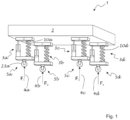
- Fig. 1 illustrates a vehicle 1 that is stationary or travelling at a constant velocity (i.e. zero acceleration) on a horizontal road surface (not shown). Under conditions where the vehicle is not undergoing acceleration, the vehicle's suspension may be exposed to static forces as a result of the TVW.
- the vehicle 1 includes vehicle body 2 and four suspension assemblies 3a-3d. The weight of the vehicle body 2 and contents (not shown) is supported by road reaction force 4a (F 1 , applied to the left front tire), road reaction force 4b (F 2 , applied to the right front tire), road reaction force 4c (F 3 , applied to the left rear tire) and road reaction force 4d (F 4 , applied to the right rear tire).
- the sum of these forces F 1 , F 2 , F 3 , and F 4 may be equal to the TVW.
- the road reaction forces 4a-4d in Fig. 1 are represented by vertical arrows of equal length, but this is not to indicate that the four forces are necessarily of equal magnitude in all embodiments and/or under all conditions.
- all the vertical forces, when the vehicle is not accelerating may be equal, approximately equal to each other (i.e. all forces are within +/- 10 % of the mean of the forces), or significantly different from each other (i.e. at least one of the indicated forces is greater than +/- 10 % of the mean of all the forces). It is also noted that only a portion of the total force applied by the road surface at each wheel, may be transmitted to the vehicle body, since the road also supports, for example, the weight of each unsprung mass as well.
- the average values of these forces may remain constant with the sum of the average quantities being equal to the TVW.
- these forces may vary due to the dynamics of the vehicle such as, for example, the forces F 1 and F 3 may increase when the vehicle rolls because it is making a right turn. Under such circumstances, the increase may be a function of the speed of the vehicle and the radius of the turn. Concurrently, forces F 2 and F 4 may decrease in magnitude. Additional forces may also be applied to the tires or wheels in the transverse or lateral direction.
- the forces F 1 and F 2 may initially increase, while F 3 and F 4 may initially decrease as the vehicle pitches forward.
- each of the forces F 1 -to-F 4 may peak, at the point where the corresponding wheel reverses direction of its vertical travel, and then return to its mean value.
- each of the suspension assemblies may include a spring-element (e.g., without limitation, a coil spring, a leaf spring, an air spring, and/or any other appropriate spring) and a damping-element (an active suspension actuator).
- a damping element that is an active actuator is referred to herein as an active suspension actuator.
- An active suspension actuator is an actuator, operatively interposed between a sprung mass (e.g. a vehicle body) and an unsprung mass (e.g. wheel assembly), that can apply an active force (i.e. a force in the direction of motion) as well as a passive or resistive force (i.e. a force in a direction that is opposite the direction of motion).
- each suspension assembly may include a spring-element that is operatively interposed between the vehicle body and the wheel in a parallel orientation relative to the damping-element.
- a suspension assembly may also include a top mount or other mounting device (not shown) that is interposed between the damping-element and the vehicle body such that the top mount may be viewed as being in line with the damping element.
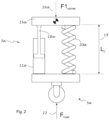
- Fig. 2 illustrates suspension assembly 3a of the suspension system of Fig. 1 , which includes a spring-element 10a and a damping-element 11a .
- the spring-element and the damping-element are arranged in a parallel orientation.
- the spring-element 10a and damping-element 11a are both interposed in between the vehicle body (i.e. sprung mass, not shown) and the wheel assembly (i.e. unsprung mass) 5a .
- the spring-element and the damping-element may be connected directly to the vehicle body or by means of one or more intervening devices 15a.
- the intervening devices may be, for example, a top mount and/or an upper spring perch.
- the corner force 16a (F1 corner ) applied to the suspension assembly 3a by the vehicle body represents the net force supported by suspension assembly 3a .
- F1 corner may include the sum of a portion of the TVW and the dynamic forces applied to the right front suspension assembly.
- the force F1 corner applied to the intervening device 15a is resisted by the forces applied by the damping-element and/or the spring-element.
- the force applied by the damping-element (that is not being compressed or extended) may be zero under certain conditions, but it may also be significant.
- the force applied by the damping element may surpass the force applied by the spring-element, for example, when the damping-element is an active suspension actuator.
- the damper element may apply an extension force that may be equal to, for example, the pre-charge pressure multiplied by the cross-sectional area of the piston rod 16a.
- This force applied by the damping-element due to the pre-charge pressure is hereinafter referred to as pre-charge-force of the damping-element.
- mechanical, electrical and/or hydraulic locking mechanisms may be included (as described below), which may be used to lock the wheel assembly in place relative to the vehicle body in compression and/or in extension.
- the damping-element in the suspension assembly is an active suspension actuator
- the damping-element may apply any compression or extension force within the performance characteristic limits of the actuator.
- This force may be an active force (i.e. force in the direction of motion) or a passive force (i.e. a force that resists motion).
- the force applied by the damping-element may be equal to, greater than, or less than the force applied by the spring-element at any given position of the wheel assembly relative to the vehicle body.
- An active force applied by the active suspension actuator during compression is herein referred to as an active-compression force.
- An active force applied by the active suspension actuator during extension is herein referred to as an active-extension force.
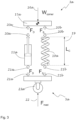
- Fig. 3 illustrates an exploded view of the suspension assembly 3a under static conditions (i.e. where the acceleration of the vehicle is zero).
- the corner force 16a may be equal to the corner weight W corner (i.e. the portion of the TVW supported by suspension assembly 3 a).
- the other suspension assemblies may also support equal or approximately equal corner weights such that the sum of all the corner weights may be equal to the TVW.
- the W corner is supported by damper force 20a F D and spring force 20b F S .
- the damping-element 11a and spring-element 10a also simultaneously apply forces 21a and 21b on the wheel assembly that are equal in magnitude to 20a and 20b respectively.
- the road reaction force 22 (F road ) applied by the road surface is equal to and resists the sum of forces 21a and 21b plus the weight of the unsprung mass. Under these conditions, the spring-element is compressed by a force 20b (which is equal to 21b ) resulting in a compressed length 19 (L C ) of the spring-element.
- Equation 1 is sometimes referred to as Hooke's Law.
- the equilibrium static forces shown in Fig. 3 may be disturbed by, for example, acceleration of the vehicle and/or the wheel assembly in one or more directions.
- the equilibrium may also be disturbed if the wheel 23a becomes airborne, e.g. while traversing a pothole.
- ⁇ F M US ⁇ a US
- ⁇ F the net force on the wheel assembly (i.e. the sum of the unbalanced forces)
- Mus the mass of the unsprung mass
- a US the acceleration of the unsprung mass.
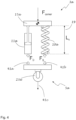
- Fig. 4 illustrates a condition of the suspension assembly 3a where the force applied by the ground is absent or effectively absent, for example, as a result of the wheel 23a becoming airborne.
- M US unsprung mass
- the force applied by the damping-element F D to the wheel assembly 5a may initially (i.e. when the wheel assembly becomes airborne) be directed away from the vehicle body (i.e. downward) because of the pre-charge pressure.
- the force applied by the damping-element may reverse direction and become a resisting force to this motion.
- This resisting force may be proportional to the product of the damping coefficient of the damping-element and the velocity of the wheel assembly relative to the vehicle body. If the damping-element shown in Fig.
- the force F D may be, for example, a resisting force, an active-compression force, or an active-extension force.
- the force may be applied, for example, from the instant that the wheel 23a becomes airborne, after that point in time, or even prior to the wheel becoming airborne as commanded by one or more controllers of the active suspension actuator.
- the magnitude and/or the timing of the force applied by the actuator may be commanded by a controller based on a prediction of the position of the wheel 23a relative to a pothole at the given speed of the vehicle.
- This prediction may be determined at least partly based on information from various sensors, for example, forward looking sensors such as LiDAR, radar, acoustic transducers and/or cameras.
- the prediction may be at least partially based on localization algorithms and/or map data from, for example, a digital remote or local (i.e. stored onboard the vehicle) map, GPS, terrain based localization data, data collected a leading wheel assembly of the vehicle to be used by a controller controlling, for example, a suspension actuator of a trailing wheel assembly, etc.
- the spring-element 10a When the vehicle is supported by, for example, a road surface or another surface, the spring-element 10a may be compressed sufficiently to support the corner weight of the vehicle, either unaided or in conjunction with the precharge force applied by the damping element. As soon as the wheel becomes airborne, Fs, applied by the spring-element and the weight of the wheel assembly 5a , may cause the wheel assembly to accelerate downward. Concurrently, the damper element may apply a retarding force on the wheel assembly The damper force, F D , may be a function of the product of the velocity of the wheel assembly relative to the vehicle body and the damping coefficient of the damper element.
- the damping coefficient may be a constant, while in the case of a semi-active damper, the damping coefficient may be a variable quantity, in an operating range determined by a controller.
- the damping-element is an active suspension actuator, it may be used to apply a force on the wheel assembly 5a that may at least partially or fully counter the force applied by the spring-element at any given position of the wheel assembly relative to the vehicle body. If the force capacity of the actuator is sufficient, the suspension actuator may be used to hold the wheel assembly in-place relative to the vehicle body or to even move it closer to the vehicle body (i.e. compress the suspension assembly).
- the wheel assembly may accelerate away from the vehicle body at a rate that is proportional to the unbalanced force though this rate of acceleration may be less that it would be in the absence of the force applied by the damping-element.
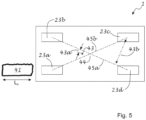
- Fig. 5 illustrates the top view of a vehicle 1 approaching a pothole 41 that is L P meters long in the direction of travel of the vehicle.
- the vehicle may have four wheels: front left wheel 23a, front right wheel 23b, rear right wheel 23c, and rear left wheel 23d.
- Axis 45a connects the center of the contact patch of the front right wheel and the center of the contact patch of diagonally opposed rear left wheel.
- Axis 45b connects the center of the contact patch of the left front tire and the center of the contact patch of the diagonally opposed right rear tire.
- Intersection point 44 is the intersection of axis 45a and axis 45b and point 43 is the top view of the center-of-gravity of the vehicle 1.
- the center-of-gravity 43 is located in front of intersection point 44 .
- the center of gravity may be located in other positions relative to point 44 as determined by the mass distribution of the vehicle, the occupants, and the cargo carried by the vehicle, as the disclosure is not so limited.
- wheel 23a may enter the pothole 41 while wheels 23b , 23c , and 23d remain on a road surface.
- wheel 23d may enter the pothole 41 while wheels 23b , 23c , and 23a remain on a road surface.
- the front left wheel 23a and rear left wheel may enter the pothole sequentially as the vehicle travels past the pothole.
- the road-reaction forces on all four tires may be affected.
- the reaction to the TVW, acting on the center of gravity 43 may be borne by one or more of the other three wheels.
- the TVW of the vehicle acting on the center of gravity 43 may induce a moment about axis 45a equal to the weight of the vehicle multiplied by the moment arm 43a.
- a compressive force may be applied to suspension assembly 3d (shown in Fig. 1 ), for example by using a suspension actuator, to reduce or cancel the effect of the force applied by spring element 10d.
- the compressive force applied by the suspension actuator may oppose an extension force applied by the associated spring which will reduce a net load applied to the wheel by the combined forces applied to the wheel by the spring and suspension actuator of the suspension assembly 3d.
- the wheel at the opposing corner is partially unloaded. It may be fully unloaded.
- the unbalanced moment applied to the vehicle may be reduced which may reduce the movement of the wheel into the pothole as the wheel traverses the pothole.
- suspension assembly 3b and/or suspension assembly 3c one or more suspension actuators that may be included in suspension assemblies 3b and 3c may be used to maintain the ride height of the vehicle by increasing the magnitude of the extension force interposed between the corresponding wheel assemblies and the vehicle body (sprung mass) to accommodate the portion of the TVW that has been offloaded from the other suspension assemblies.
- suspension actuators may be used to raise the ride height or lower the ride height depending on the magnitude of the extension forces applied by the suspension actuators of the noted suspension assemblies.
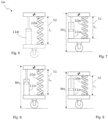
- Figs. 6-9 illustrate various degrees of extension and compression of the suspension assembly of Fig. 2 .
- no forces are applied to the spring element by the rest of the assembly (shown as a ghost view). Under these conditions, the spring-element may assume its free length L F 50 .
- Fig. 7 the suspension assembly is shown with only static forces present (i.e. no acceleration) where the spring element is at its static length Ls 51.
- the length, Ls may be determined by Equation 3.
- W Corner ⁇ K L F ⁇ L S where K is the spring constant of the spring element 10a.
- the spring element 8 and 9 show the spring element in an extended state and a compressed state respectively.
- the spring element may be extended by the application of an extension force or compressed by the application of a compression force. Such forces may result from dynamic forces acting on the vehicle body and/or due to forces applied by an active suspension actuator.
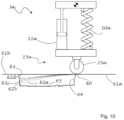
- Fig. 10 illustrates an operating condition where wheel 23a , of suspension assembly 3a , may become airborne (i.e. unsupported by the road surface, the ground or any other surface) while traversing, for example, a pothole or other discontinuity in a road surface 61a.
- the wheel may descend into, for example, a pothole by following trajectories such as, for example, 63a , 63b , 63c , 63d .
- the trajectory followed may depend on, for example, the net force on the wheel assembly (including its weight) and the mass of the wheel assembly.
- the extent to which the wheel descends into the pothole will also depend on the speed of the vehicle and the length of the discontinuity along the direction of travel which may determine the length of the period during which the wheel remains airborne.
- the extent to which the wheel penetrates into the pothole may be limited or eliminated by a locking mechanism such as, for example, the locking system described below.
- the beginning-of-pothole road surface elevation 61a is shown to be equal to the end-of-pothole road surface elevation of road surface 61b .
- the end-of-pothole road surface elevation may be higher (road surface 61c ) or lower (road surface 61d ) than the beginning-of-pothole road surface elevation 61a.
- the mismatch distance between the wheel 23a contact patch position at the end of the pothole (shown as a ghost view) 69b , 69c , and 69d may, at least, partly be a function of the end-of-pothole road surface elevation 61b , 61c , and 61d.
- a pothole may have a floor 65 that is at a lower elevation than both the beginning-of-pothole elevation and the end-of-pothole road surface elevation.
- a pothole may also include near-wall 64 and/or an end-wall 63 , see Fig. 10 .
- the embodiment of a suspension system in Fig. 10 traversing a pothole may be operated under exemplary, non-limiting conditions detailed in Table I below: Table I: Exemplary operating conditions Vehicle Mass (Ms) 2,500 kg Unsprung Mass (Mus) 50 kg Spring Rate 25 N/mm Pothole Length (L P ) 0.8 m Vehicle Speed 40 mph Vehicle Size 1.9m ⁇ 4.8m MOI 850 kg m 2 where MOI is the moment of inertia of the sprung mass about axis 45a shown in Fig. 5 .
- Fig. 12 shows the trajectory of wheel 23a of Fig. 10 , from the point when it becomes airborne, as function of the compression-force applied by the damping element 11a.
- Table II shows the compression-force for each trajectory in Fig. 11 .
- Table II Relationship between end pothole penetration and restraining force of the suspension actuator Trajectory Compression Force (N) End Pothole Penetration (cm) 62a 0 -12 62b 2000 -9 62c 3000 -7 62d 4000 -5
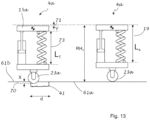
- Fig. 13 illustrates a condition where the there is sufficient intrusion into the pothole such that the wheel strikes the end-wall of the pothole. Striking the end-wall may cause damage to, for example, the wheel, tire and/or one or more suspension components.
- the distance 70 represents how far the wheel has dropped below the top of the end-wall (or the end-of-pothole road surface elevation). The distance X may be equal to the sum of the amount of extension of spring element and a degree to which the corner of the vehicle dips towards the pothole due to the unbalanced moment applied to the vehicle when the wheel becomes airborne.
- the vehicle may rotate about axis 55a in Fig. 5 as a result of the weight of the vehicle effectively acting on the center of gravity 53 and or an unbalanced force applied by spring element 11c . It is noted that the rotation about axis 55a may be greater if the wheel 23a is prevented from accelerating, or if the magnitude of the acceleration is diminished by applying a compression force with the active suspension actuator.
- the attachment device 5a may drop by an amount Y 71.
- the distance X depends partly on the length of time the wheel remains airborne which may depend on, for example, the length of the pothole "d", and the velocity of the vehicle.
- the mass of the wheel assembly and the forces applied by the spring element and the damper element may also affect the distance X. It is noted that the longer the pothole (length d) and the slower the speed of the vehicle, the further the wheel may drop into the pothole and the more severe the collision with the end-wall of the pothole.
- Fig. 14 illustrates an operating condition where the active suspension actuator is used to apply an extension force to extend the suspension assembly so that wheel 23a may travel along the floor of the pothole instead of becoming airborne.
- the elevation 90 of the vehicle may be maintained by the suspension assembly despite the presence of the pothole.
- the wheel 23a may strike the end-wall of pothole 41.
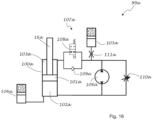
- Fig. 16 depicts an embodiment of an active suspension actuator 99a.
- Housing 100a includes a piston 101a, piston rod 16a, fluid filled compression volume 102a, and fluid filled extension volume 103a.
- the hydraulic circuit of Fig. 16 includes pressurized fluid reservoir 104a in fluid communication with the compression volume and fluid reservoir 105a in fluid communication with the extension volume. In some embodiments, these reservoirs are at least partially filled with, for example, air or other compressible medium.
- One port of a bidirectional hydraulic pump/motor 106a is in fluid communication with the compression volume 102a and a second port is in fluid communication with the extension volume 103a.
- the bi-directional hydraulic pump/motor may be a hydraulic motor that may be operated as a hydraulic pump or a hydraulic pump that may be operated as a hydraulic motor.
- valve assembly 107a may be used to control fluid flow out of and/or into the extension volume.
- valve assembly may include a two-position controlled valve 108a that in a first position allows free, or effectively free, bidirectional fluid flow to and from the extension volume, while in the second position it hydraulically locks the extension volume preventing fluid from leaving the extension volume and the active suspension actuator from undergoing extension.
- check valve 109a may be used to allow unidirectional, unrestricted or effectively unrestricted flow into the extension volume.
- the check valve 109a may be configured to prevent cavitation in the extension volume in the event of rapid compression of the suspension actuator. Such rapid compression may occur, for example, when the wheel makes contact with the road surface after being airborne for a period while traversing a pothole.
- a bypass control system 110a may be used to allow fluid exchange between the extension volume and the compression volume that bypasses the hydraulic pump/motor such that fluid flows between the extension volume and the compression volume without passing through the hydraulic pump/motor.
- the bypass control system may include one or more valves that may include one or more controlled valves.
- the hydraulic pump/motor may be used to actively control the motion of piston 101a.
- a flow restriction 111a may be interposed between the reservoir 105a and the hydraulic circuit. The restriction may act as a low pass filter that restricts the flow of fluid into and out of the reservoir at higher frequencies.
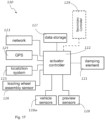
- Fig. 17 shows a block diagram of an embodiment of an exemplary control system 120 for controlling one or more damping element(s) 121 of a suspension assembly of a vehicle (not shown).
- the damping element is an active suspension actuator.
- the controller 122 may receive information from one or more sources of information including, for example: (i) a network 123 , such as a wireless network, (ii) a GPS receiver 124 , (iii) localization algorithm 125 , (iv) a leading wheel assembly sensor 126 , (v) electronic data storage device such as computer memory or a disk drive, (vi) one or more preview sensor(s) 128 (e.g., LiDAR, radar, ultrasonic transducer, video camera) and vehicle sensor(s) 128a that measure one or more vehicle state parameters.
- a network 123 such as a wireless network
- GPS receiver 124 e.g., GPS receiver 124 , iii) localization algorithm 125 , (iv) a leading wheel
- the controller may also exchange information with one or more secondary controller(s) 129 in the vehicle.
- the controller may use data from one or more sources to determine, for example, the position of a pothole relative to the vehicle, the size of the pothole, the depth of the pothole, and speed of the vehicle.
- the controller may also collect information about the likelihood of avoiding the pothole. The controller may then determine a strategy for traversing.
- the controller may adjust the operation of one or more damping elements. For example, based on the information collected, the controller may elect to traverse a pothole while the wheel is airborne or traverse a pothole by entering it and traveling along the floor of the pothole.
- the controller 122 may adjust the damping coefficient of one or more semi-active damping elements or suspension actuator in various suspension subassemblies. Alternatively or additionally, the controller may elect to activate one or more hydraulic lock mechanisms.
- the controller may activate an active suspension actuator to extend the wheel so it travels along the floor of the pothole. Additionally the controller may increase the compression force when the wheel reaches the end-wall of the pothole to facilitate the extraction of the wheel from the pothole.
- the controller may directly, or by communicating with at least one other controller, alter the operation of at least one other suspension assembly.
- the controller controlling the operation of a left front wheel of a vehicle may identify a pothole, determine its relative position, its size, and the speed of the vehicle. The controller may further elect to traverse the pothole while the wheel is airborne. The controller may determine that the left front wheel may strike the end-wall of the pothole with a certain mismatch.
- the controller may directly or by communicating with at least one additional controller, operate at least one additional controller to raise at least a portion of the vehicle to reduce the projected mismatch between the left front wheel and the end-of-pothole road surface elevation.
- the controller may cause the right front and left rear of the vehicle to be raised by an amount that is equal to or greater than the mismatch amount. Additionally or alternatively the controller may cause the actuator controller of the right rear suspension assembly to apply a compressive force on the spring element or to lock the right rear wheel assembly in place relative to the vehicle body while the right front wheel is airborne. It is noted that the vehicle may be an autonomous or driven vehicle.
- a vehicle may include a suspension assembly associated with each of four corners of the vehicle, such as the vehicle illustrated in Fig. 1 .
- Each suspension assembly may support a portion of the TVW by applying a net force on the vehicle.
- Each suspension assembly may include an active suspension actuator that may be used to modify the net force being applied by each suspension assembly.
- a controller may be used to alter the operation of an active suspension actuator in one or more of the other suspension assemblies to change the net force being applied by one or more of those other suspension assemblies.
- the actuator net force applied by suspension assembly 3b and/or suspension assembly 3c located at adjacent corners to the first corner may be increased.
- the forces applied by suspension assembly 3c and/or 3d may be increased before or after the first wheel 23a becomes airborne.
- a controller alters the operation of an active suspension actuator in the first suspension assembly associated with the first corner (e.g. 3a ).
- the associated actuator is used to apply a compressive force on the associated spring element (e.g. 1a .) to reduce or eliminate the penetration of the first wheel into the pothole.
- the actuator in the suspension assembly at the corner opposite the first corner is also used to apply a compressive force on the associated spring element to mitigate or eliminate a roll moment induced by the spring element associated with the spring assembly at the fourth corner (e.g. spring element 3d ).
- a controller may be understood to refer to one or more processors operatively coupled with associated memory which may be a non-transitory computer readable medium.
- the memory may include computer readable instructions that when executed by the one or more processors operate the suspension systems, sensors, and other components described herein to perform any of the disclosed methods in any appropriate combination.
Landscapes
- Engineering & Computer Science (AREA)
- Mechanical Engineering (AREA)
- Vehicle Body Suspensions (AREA)
Description
- Disclosed embodiments are related to suspension systems including dampers and suspension actuators and their control for mitigating the effects of potholes and other road surface discontinuities.
- The suspension system of a vehicle is intended to at least partially shield the occupants from road-induced disturbances and to mitigate the effects of travel related accelerations such as in the lateral, longitudinal and vertical directions. One type of jarring incident frequently encountered during vehicle travel occurs when one or more wheels of a vehicle traverse a pothole or a depression or pit in a road surface. Not only can this be a jarring experience for vehicle occupants, but it can also cause significant damage to the vehicle suspension, wheels, and tires.
US 2017/087951 A1 discloses a method for controlling an active suspension actuator of a first suspension assembly of a vehicle. One or more active suspensions are used to lift or jump one or more corresponding wheels over an obstacle in the vehicle's path to avoid contact with the obstacle when the vehicle cannot practically drive over, steer around, or stop before hitting the obstacle.US 2014/195112 A1 andDE 10 2007 046040 A1 disclose a similar control method. Further,US 2014/0303844 A1 discloses a method of controlling an active suspension actuator and forms the basis for the preamble ofclaim 1. - A method of controlling an active suspension actuator of a suspension assembly of a vehicle is defined in
claim 1. Embodiments thereof are defined in the dependent claims. - That the wheel of the first suspension assembly is, in the first strategy, airborne means that it is not touching or effectively not touching the floor of the pothole whereas it is in the second strategy in contact or effectively in contact with the pothole floor, for example by rolling along the floor of the pothole. In some embodiments, the information collected may also include information about the vehicle, for example speed of the vehicle or the mass distribution of the sprung mass of the vehicle. In some embodiments, information about the pothole may include the relative position of the pothole relative to the vehicle. The information collected, in some embodiments, may include data from a map, GPS data, terrain-based localization data, and/or data from sensors associated with a first wheel that precedes a second wheel of the vehicle.
- In some embodiments where the selected strategy is the first strategy described above a projected mismatch distance may be determined between the wheel and the road surface at the end of the pothole. In some embodiments, a predetermined compressive force may be applied to the wheel assembly, with the suspension actuator of the first suspension assembly to reduce the anticipated mismatch at the end of the pothole. In some embodiments the ride height of the vehicle may be adjusted, for example increased, by using an actuator of a third and/or a fourth suspension assembly during the period when the wheel of the first suspension assembly is airborne and traversing the pothole.
- According to the invention a compressive force is applied with the actuator of a second suspension assembly at least during the period when the wheel, associated with the first suspension assembly is airborne, wherein the second suspension assembly is at a corner of the vehicle located diagonally opposite to the corner where the first suspension assembly is located.
- It should be appreciated that the foregoing concepts, and additional concepts discussed below, may be arranged in any suitable combination, as the present disclosure is not limited in this respect. It should be further understood, that the disclosure is not limited to the precise arrangements, variants, structures, features, embodiments, aspects, methods, advantages, improvements, and instrumentalities shown and/or described. Additionally, the various arrangements, variants, structures, features, embodiment, aspects, methods, and instrumentalities may be used singularly in the system or method or may be used in combination with other arrangements, variants, structures, features, embodiment, aspects, methods, and instrumentalities. Further, other advantages and novel features of the present disclosure will become apparent from the following detailed description of various non-limiting embodiments when considered in conjunction with the accompanying figures.
-
-
Fig. 1 illustrates a vehicle with four suspension assemblies. -
Fig. 2 illustrates the front left suspension assembly ofFig. 1 . -
Fig. 3 shows an exploded view of the suspension assembly ofFig. 2 . -
Fig. 4 illustrates a partially exploded view of the suspension assembly ofFig. 2 . -
Fig. 5 illustrates the top view of a vehicle approaching a pothole. -
Fig. 6 illustrates suspension assembly ofFig. 2 where no forces are applied on the spring element. -
Fig. 7 illustrates suspension assembly ofFig. 2 where only static forces are applied to the spring element. -
Fig. 8 illustrates suspension assembly ofFig. 2 where the spring element is extended by dynamic forces and/or an extension force applied by an active suspension actuator. -
Fig. 9 illustrates suspension assembly ofFig. 2 where the spring element is compressed by dynamic forces and/or a compression force applied by the active suspension actuator. -
Fig. 10 illustrates four trajectories, of an airborne vehicle wheel while traversing a pothole. -
Fig. 11 illustrates the position of a vehicle wheel relative to three different end-of-pothole road surface elevations. -
Fig. 12 illustrates the pot-hole penetration distance vs. longitudinal travel of the vehicle for various compression force levels produced by the active suspension actuator. -
Fig. 13 illustrates the interaction of a wheel, that remains airborne while traversing a pothole, with the end-wall of the pothole. -
Fig. 14 illustrates a vehicle wheel that has entered a pothole and is travelling along the floor of the pothole. -
Fig. 15 illustrates the wheel ofFig. 14 that, after travelling along the bottom of the pothole, crashes into the end-wall. -
Fig. 16 illustrates a hydraulic active suspension system with a hydraulic lock to prevent actuator extension and a passive unidirectional bypass of the hydraulic lock. -
Fig. 17 illustrates an exemplary block diagram of a damping element control system. - The adverse effects of traversing discontinuities in a road surface, for example, a pothole or other depression may depend, for example, on the length and/or depth of the discontinuity, the speed of the vehicle, the weight of the sprung mass and/or un-sprung mass, the weight distribution of the sprung mass, and the construction of the suspension system of the vehicle. Inventors have recognized that these and other adverse effects may be ameliorated by a properly designed, configured, and operated active suspension system. As used herein, unless context indicates otherwise, the term pothole means a depression that is sized and/or positioned relative to a vehicle in a manner where one wheel may enter the pothole while, simultaneously, the remaining wheels may remain on the road surface.
- Typically, the weight of the sprung mass, i.e. total vehicle body weight (TVW), including, for example, the weight of a vehicle body, the occupants and any cargo in the vehicle, is supported by multiple forces, or components of forces, in the vertical direction applied by the road surface to one or more wheels/tires of the vehicle and transmitted to the vehicle body by the vehicle suspension system.
-
Fig. 1 illustrates avehicle 1 that is stationary or travelling at a constant velocity (i.e. zero acceleration) on a horizontal road surface (not shown). Under conditions where the vehicle is not undergoing acceleration, the vehicle's suspension may be exposed to static forces as a result of the TVW. In the embodiment ofFig. 1 , thevehicle 1 includesvehicle body 2 and foursuspension assemblies 3a-3d. The weight of thevehicle body 2 and contents (not shown) is supported by road reaction force 4a (F1, applied to the left front tire), road reaction force 4b (F2, applied to the right front tire), road reaction force 4c (F3, applied to the left rear tire) androad reaction force 4d (F4, applied to the right rear tire). For a vehicle that is not accelerating, the sum of these forces F1, F2, F3, and F4 may be equal to the TVW. The road reaction forces 4a-4d inFig. 1 are represented by vertical arrows of equal length, but this is not to indicate that the four forces are necessarily of equal magnitude in all embodiments and/or under all conditions. In some embodiments, all the vertical forces, when the vehicle is not accelerating, may be equal, approximately equal to each other (i.e. all forces are within +/- 10 % of the mean of the forces), or significantly different from each other (i.e. at least one of the indicated forces is greater than +/- 10 % of the mean of all the forces). It is also noted that only a portion of the total force applied by the road surface at each wheel, may be transmitted to the vehicle body, since the road also supports, for example, the weight of each unsprung mass as well. - In some embodiments, the average values of these forces (F1ave, F2ave, F3ave, and F4ave) over an extended period, such as, for example, an hour, a day or longer, may remain constant with the sum of the average quantities being equal to the TVW. Instantaneously, however, especially during dynamic operation of the vehicle, in some embodiments, these forces may vary due to the dynamics of the vehicle such as, for example, the forces F1 and F3 may increase when the vehicle rolls because it is making a right turn. Under such circumstances, the increase may be a function of the speed of the vehicle and the radius of the turn. Concurrently, forces F2 and F4 may decrease in magnitude. Additional forces may also be applied to the tires or wheels in the transverse or lateral direction. In some embodiments when the vehicle is braking, the forces F1 and F2 may initially increase, while F3 and F4 may initially decrease as the vehicle pitches forward. In some embodiments, when a vehicle traverses a trough between two hills, each of the forces F1-to-F4 may peak, at the point where the corresponding wheel reverses direction of its vertical travel, and then return to its mean value.
- In the embodiment of
Fig 1 , the forces F1-F4 are transferred to thevehicle body 2 bysuspension assemblies 3a-3d. The assemblies that are operatively interposed between thevehicle body 2 andwheel assemblies 5a-5d respectively. In some embodiments, each of the suspension assemblies may include a spring-element (e.g., without limitation, a coil spring, a leaf spring, an air spring, and/or any other appropriate spring) and a damping-element ( an active suspension actuator). A damping element that is an active actuator is referred to herein as an active suspension actuator. An active suspension actuator is an actuator, operatively interposed between a sprung mass (e.g. a vehicle body) and an unsprung mass (e.g. wheel assembly), that can apply an active force (i.e. a force in the direction of motion) as well as a passive or resistive force (i.e. a force in a direction that is opposite the direction of motion). - In some embodiments, each suspension assembly may include a spring-element that is operatively interposed between the vehicle body and the wheel in a parallel orientation relative to the damping-element. In some embodiments, a suspension assembly may also include a top mount or other mounting device (not shown) that is interposed between the damping-element and the vehicle body such that the top mount may be viewed as being in line with the damping element.
-
Fig. 2 illustratessuspension assembly 3a of the suspension system ofFig. 1 , which includes a spring-element 10a and a damping-element 11a. In this embodiment, the spring-element and the damping-element are arranged in a parallel orientation. The spring-element 10a and damping-element 11a are both interposed in between the vehicle body (i.e. sprung mass, not shown) and the wheel assembly (i.e. unsprung mass) 5a. The spring-element and the damping-element may be connected directly to the vehicle body or by means of one ormore intervening devices 15a. The intervening devices may be, for example, a top mount and/or an upper spring perch. Thecorner force 16a (F1corner) applied to thesuspension assembly 3a by the vehicle body represents the net force supported bysuspension assembly 3a. F1corner may include the sum of a portion of the TVW and the dynamic forces applied to the right front suspension assembly. In the embodiment inFig. 2 , the force F1corner applied to the interveningdevice 15a is resisted by the forces applied by the damping-element and/or the spring-element. Under static conditions, the force applied by the damping-element (that is not being compressed or extended) may be zero under certain conditions, but it may also be significant. In some embodiments, the force applied by the damping element may surpass the force applied by the spring-element, for example, when the damping-element is an active suspension actuator. - In some non-claimed embodiments, where the damping-element is a passive or semi-active damper even under static conditions (i.e. where the damper element is not undergoing compression or extension) the damper element may apply an extension force that may be equal to, for example, the pre-charge pressure multiplied by the cross-sectional area of the
piston rod 16a. This force applied by the damping-element due to the pre-charge pressure is hereinafter referred to as pre-charge-force of the damping-element. In some non-claimed embodiments, mechanical, electrical and/or hydraulic locking mechanisms may be included (as described below), which may be used to lock the wheel assembly in place relative to the vehicle body in compression and/or in extension. - If, according to the invention, the damping-element in the suspension assembly is an active suspension actuator, the damping-element may apply any compression or extension force within the performance characteristic limits of the actuator. This force may be an active force (i.e. force in the direction of motion) or a passive force (i.e. a force that resists motion). The force applied by the damping-element may be equal to, greater than, or less than the force applied by the spring-element at any given position of the wheel assembly relative to the vehicle body. An active force applied by the active suspension actuator during compression is herein referred to as an active-compression force. An active force applied by the active suspension actuator during extension is herein referred to as an active-extension force.
-
Fig. 3 illustrates an exploded view of thesuspension assembly 3a under static conditions (i.e. where the acceleration of the vehicle is zero). Thecorner force 16a may be equal to the corner weight Wcorner (i.e. the portion of the TVW supported bysuspension assembly 3a). The other suspension assemblies may also support equal or approximately equal corner weights such that the sum of all the corner weights may be equal to the TVW. - The Wcorner is supported by
damper force 20a FD and spring force 20b FS. The damping-element 11a and spring-element 10a also simultaneously applyforces forces 
element 10a and LF is the unstressed (i.e. free) length of the spring-element, as discussed below. In the art,Equation 1 is sometimes referred to as Hooke's Law. - The equilibrium static forces shown in
Fig. 3 may be disturbed by, for example, acceleration of the vehicle and/or the wheel assembly in one or more directions. The equilibrium may also be disturbed if thewheel 23a becomes airborne, e.g. while traversing a pothole. - If
wheel 23a becomes airborne, then the forces applied to thewheel assembly 5a may no longer be in balance and the wheel assembly may begin to accelerate according toEquation 2.
-
Fig. 4 illustrates a condition of thesuspension assembly 3a where the force applied by the ground is absent or effectively absent, for example, as a result of thewheel 23a becoming airborne. In this embodiment, for example, when thewheel 23a becomes airborne, there may be three forces that act on the unsprung mass (MUS): (1) the spring-element force FS, 41b, (2) the damping-element force F D 41a, and (3) the weight of the wheel assembly WWA 41c. If these forces are not in balance, the wheel assembly shown in the embodiment ofFig. 4 may begin to accelerate, relative to the vehicle body (not shown). - The force applied by the damping-element FD to the
wheel assembly 5a, if the damping-element is a passive or semi-active damper, may initially (i.e. when the wheel assembly becomes airborne) be directed away from the vehicle body (i.e. downward) because of the pre-charge pressure. As the velocity of the wheel assembly increases in the downward direction under the influence of the net force acting on it, the force applied by the damping-element may reverse direction and become a resisting force to this motion. This resisting force may be proportional to the product of the damping coefficient of the damping-element and the velocity of the wheel assembly relative to the vehicle body. If the damping-element shown inFig. 4 is an active actuator, the force FD may be, for example, a resisting force, an active-compression force, or an active-extension force. The force may be applied, for example, from the instant that thewheel 23a becomes airborne, after that point in time, or even prior to the wheel becoming airborne as commanded by one or more controllers of the active suspension actuator. - In the embodiment of
Fig. 4 , the magnitude and/or the timing of the force applied by the actuator may be commanded by a controller based on a prediction of the position of thewheel 23a relative to a pothole at the given speed of the vehicle. This prediction may be determined at least partly based on information from various sensors, for example, forward looking sensors such as LiDAR, radar, acoustic transducers and/or cameras. Alternatively or additionally, the prediction may be at least partially based on localization algorithms and/or map data from, for example, a digital remote or local (i.e. stored onboard the vehicle) map, GPS, terrain based localization data, data collected a leading wheel assembly of the vehicle to be used by a controller controlling, for example, a suspension actuator of a trailing wheel assembly, etc. - When the vehicle is supported by, for example, a road surface or another surface, the spring-
element 10a may be compressed sufficiently to support the corner weight of the vehicle, either unaided or in conjunction with the precharge force applied by the damping element. As soon as the wheel becomes airborne, Fs, applied by the spring-element and the weight of thewheel assembly 5a, may cause the wheel assembly to accelerate downward. Concurrently, the damper element may apply a retarding force on the wheel assembly The damper force, FD, may be a function of the product of the velocity of the wheel assembly relative to the vehicle body and the damping coefficient of the damper element. In the case of passive dampers, the damping coefficient may be a constant, while in the case of a semi-active damper, the damping coefficient may be a variable quantity, in an operating range determined by a controller. If the damping-element is an active suspension actuator, it may be used to apply a force on thewheel assembly 5a that may at least partially or fully counter the force applied by the spring-element at any given position of the wheel assembly relative to the vehicle body. If the force capacity of the actuator is sufficient, the suspension actuator may be used to hold the wheel assembly in-place relative to the vehicle body or to even move it closer to the vehicle body (i.e. compress the suspension assembly). Alternatively, if the damping-element is only capable of applying a force that is less than the spring force, then the wheel assembly may accelerate away from the vehicle body at a rate that is proportional to the unbalanced force though this rate of acceleration may be less that it would be in the absence of the force applied by the damping-element. -
Fig. 5 illustrates the top view of avehicle 1 approaching apothole 41 that is LP meters long in the direction of travel of the vehicle. The vehicle may have four wheels: frontleft wheel 23a, frontright wheel 23b, rearright wheel 23c, and rearleft wheel 23d.Axis 45a connects the center of the contact patch of the front right wheel and the center of the contact patch of diagonally opposed rear left wheel. Axis 45b connects the center of the contact patch of the left front tire and the center of the contact patch of the diagonally opposed right rear tire.Intersection point 44 is the intersection ofaxis 45a and axis 45b andpoint 43 is the top view of the center-of-gravity of thevehicle 1. In the embodiment inFig. 5 , the center-of-gravity 43 is located in front ofintersection point 44. However, in some embodiments, the center of gravity may be located in other positions relative to point 44 as determined by the mass distribution of the vehicle, the occupants, and the cargo carried by the vehicle, as the disclosure is not so limited. In this illustration,wheel 23a may enter thepothole 41 whilewheels wheel 23d may enter thepothole 41 whilewheels left wheel 23a and rear left wheel may enter the pothole sequentially as the vehicle travels past the pothole. - In the embodiment illustrated in
Fig. 5 , ifwheel 23a becomes airborne while traversingpothole 41, the road-reaction forces on all four tires may be affected. For example, since theairborne wheel 23a would not be in contact with the road, there would be no road reaction force which may cause there to be an unbalanced net force on the associated wheel assembly. In some embodiments, under these circumstances, the reaction to the TVW, acting on the center ofgravity 43 may be borne by one or more of the other three wheels. The TVW of the vehicle acting on the center ofgravity 43 may induce a moment aboutaxis 45a equal to the weight of the vehicle multiplied by the moment arm 43a. - It is noted further that when
wheel 23a (shown inFig. 1 ) becomes airborne, andspring element 10a is at least partially unstressed, the force applied by compressedspring element 10d, of the diagonally opposed suspension assembly, may apply an unbalanced moment aboutaxis 45a. This unbalanced moment may be in the same direction as the moment induced by the TVW acting on the center of gravity. Therefore, in some embodiments, at the time thewheel 23a becomes airborne, before thewheel 23a becomes airborne, and/or after thewheel 23a becomes airborne, a compressive force may be applied tosuspension assembly 3d (shown inFig. 1 ), for example by using a suspension actuator, to reduce or cancel the effect of the force applied byspring element 10d. For example, the compressive force applied by the suspension actuator may oppose an extension force applied by the associated spring which will reduce a net load applied to the wheel by the combined forces applied to the wheel by the spring and suspension actuator of thesuspension assembly 3d. According to the invention, the wheel at the opposing corner is partially unloaded. It may be fully unloaded. - In either case, by reducing a force applied to the wheel assembly at the corner diametrically opposite a corner where a wheel is traversing a pothole, the unbalanced moment applied to the vehicle may be reduced which may reduce the movement of the wheel into the pothole as the wheel traverses the pothole.
- As described above, in some embodiments of the vehicle illustrated in
Fig. 1 , whenwheel 23a becomes airborne the diagonally opposed wheel may be off-loaded as well. As a result, an increased portion, and in some embodiments substantially all, of the TVW may be borne bysuspension assembly 3b and/or suspension assembly 3c. Under such conditions, one or more suspension actuators that may be included insuspension assemblies 3b and 3c may be used to maintain the ride height of the vehicle by increasing the magnitude of the extension force interposed between the corresponding wheel assemblies and the vehicle body (sprung mass) to accommodate the portion of the TVW that has been offloaded from the other suspension assemblies. Alternatively, such suspension actuators may be used to raise the ride height or lower the ride height depending on the magnitude of the extension forces applied by the suspension actuators of the noted suspension assemblies. -
Figs. 6-9 illustrate various degrees of extension and compression of the suspension assembly ofFig. 2 . InFig 6 , no forces are applied to the spring element by the rest of the assembly (shown as a ghost view). Under these conditions, the spring-element may assume itsfree length L F 50. InFig. 7 the suspension assembly is shown with only static forces present (i.e. no acceleration) where the spring element is at itsstatic length Ls 51. In this state, thespring element 10a and the pre-charge force applied by thedamper element 11a support the front left corner weight of the vehicle. The length, Ls, may be determined byEquation 3.
spring element 10a.Figs. 8 and 9 show the spring element in an extended state and a compressed state respectively. The spring element may be extended by the application of an extension force or compressed by the application of a compression force. Such forces may result from dynamic forces acting on the vehicle body and/or due to forces applied by an active suspension actuator. -
Fig. 10 illustrates an operating condition wherewheel 23a, ofsuspension assembly 3a, may become airborne (i.e. unsupported by the road surface, the ground or any other surface) while traversing, for example, a pothole or other discontinuity in aroad surface 61a. Once airborne, as explained above, the wheel may descend into, for example, a pothole by following trajectories such as, for example, 63a, 63b, 63c, 63d. As discussed above, the trajectory followed may depend on, for example, the net force on the wheel assembly (including its weight) and the mass of the wheel assembly. The extent to which the wheel descends into the pothole will also depend on the speed of the vehicle and the length of the discontinuity along the direction of travel which may determine the length of the period during which the wheel remains airborne. Alternatively, the extent to which the wheel penetrates into the pothole may be limited or eliminated by a locking mechanism such as, for example, the locking system described below. - In the embodiment illustrated in
Fig 10 , the beginning-of-potholeroad surface elevation 61a is shown to be equal to the end-of-pothole road surface elevation ofroad surface 61b. However, as illustrated inFig. 11 , the end-of-pothole road surface elevation may be higher (road surface 61c) or lower (road surface 61d) than the beginning-of-potholeroad surface elevation 61a. As shown inFig. 11 , the mismatch distance between thewheel 23a contact patch position at the end of the pothole (shown as a ghost view) 69b, 69c, and 69d may, at least, partly be a function of the end-of-potholeroad surface elevation Fig. 11 , a pothole may have afloor 65 that is at a lower elevation than both the beginning-of-pothole elevation and the end-of-pothole road surface elevation. A pothole may also include near-wall 64 and/or an end-wall 63, seeFig. 10 . - The embodiment of a suspension system in
Fig. 10 traversing a pothole may be operated under exemplary, non-limiting conditions detailed in Table I below:Table I: Exemplary operating conditions Vehicle Mass (Ms) 2,500 kg Unsprung Mass (Mus) 50 kg Spring Rate 25 N/mm Pothole Length (LP) 0.8 m Vehicle Speed 40 mph Vehicle Size 1.9m × 4.8m MOI 850 kg m2 axis 45a shown inFig. 5 . -
Fig. 12 shows the trajectory ofwheel 23a ofFig. 10 , from the point when it becomes airborne, as function of the compression-force applied by the dampingelement 11a. Table II shows the compression-force for each trajectory inFig. 11 .Table II: Relationship between end pothole penetration and restraining force of the suspension actuator Trajectory Compression Force (N) End Pothole Penetration (cm) 62a 0 -12 62b 2000 -9 62c 3000 -7 62d 4000 -5 - For the exemplary embodiment and the operating conditions shown in
Fig. 10 and Table I, there is significant penetration into the pothole for the four trajectories as illustrated inFig. 12 . -
Fig. 13 illustrates a condition where the there is sufficient intrusion into the pothole such that the wheel strikes the end-wall of the pothole. Striking the end-wall may cause damage to, for example, the wheel, tire and/or one or more suspension components. In the illustration ofFig. 12 the distance 70 ("X") represents how far the wheel has dropped below the top of the end-wall (or the end-of-pothole road surface elevation). The distance X may be equal to the sum of the amount of extension of spring element and a degree to which the corner of the vehicle dips towards the pothole due to the unbalanced moment applied to the vehicle when the wheel becomes airborne. - In the embodiment illustrated in
Fig. 13 , ifwheel 23a becomes airborne when traversing a pothole, the upward force on the left front corner of the vehicle body may be reduced. It is noted that this force will not necessarily drop to zero immediately, for example, because the spring element may cause the wheel assembly to accelerate downwards by applying an unbalanced force. The spring may, as a result, also apply an equal and opposite force on the vehicle body. - Under some operating conditions, the vehicle may rotate about axis 55a in
Fig. 5 as a result of the weight of the vehicle effectively acting on the center of gravity 53 and or an unbalanced force applied by spring element 11c. It is noted that the rotation about axis 55a may be greater if thewheel 23a is prevented from accelerating, or if the magnitude of the acceleration is diminished by applying a compression force with the active suspension actuator. - In
Fig. 13 , as a result of the corner of the vehicle dipping towards the pothole, theattachment device 5a may drop by anamount Y 71. Concurrently the spring element may extend by an amount Z such that X = Y + Z. As discussed above, the distance X depends partly on the length of time the wheel remains airborne which may depend on, for example, the length of the pothole "d", and the velocity of the vehicle. The mass of the wheel assembly and the forces applied by the spring element and the damper element may also affect the distance X. It is noted that the longer the pothole (length d) and the slower the speed of the vehicle, the further the wheel may drop into the pothole and the more severe the collision with the end-wall of the pothole. - Therefore, in some embodiments and under certain conditions it may be preferred to apply an extension force with an active suspension actuator, for example, before, after, or at the moment when a wheel starts traversing a pothole.
Fig. 14 illustrates an operating condition where the active suspension actuator is used to apply an extension force to extend the suspension assembly so thatwheel 23a may travel along the floor of the pothole instead of becoming airborne. When operating in this manner, theelevation 90 of the vehicle may be maintained by the suspension assembly despite the presence of the pothole. As illustrated inFig. 15 , thewheel 23a may strike the end-wall ofpothole 41. -
Fig. 16 depicts an embodiment of anactive suspension actuator 99a.Housing 100a includes apiston 101a,piston rod 16a, fluid filledcompression volume 102a, and fluid filledextension volume 103a. The hydraulic circuit ofFig. 16 includespressurized fluid reservoir 104a in fluid communication with the compression volume andfluid reservoir 105a in fluid communication with the extension volume. In some embodiments, these reservoirs are at least partially filled with, for example, air or other compressible medium. One port of a bidirectional hydraulic pump/motor 106a is in fluid communication with thecompression volume 102a and a second port is in fluid communication with theextension volume 103a. In some embodiments, the bi-directional hydraulic pump/motor may be a hydraulic motor that may be operated as a hydraulic pump or a hydraulic pump that may be operated as a hydraulic motor. - In some embodiments,
valve assembly 107a may be used to control fluid flow out of and/or into the extension volume. In some embodiments that valve assembly may include a two-position controlledvalve 108a that in a first position allows free, or effectively free, bidirectional fluid flow to and from the extension volume, while in the second position it hydraulically locks the extension volume preventing fluid from leaving the extension volume and the active suspension actuator from undergoing extension. In some embodiments, check valve 109a may be used to allow unidirectional, unrestricted or effectively unrestricted flow into the extension volume. The check valve 109a may be configured to prevent cavitation in the extension volume in the event of rapid compression of the suspension actuator. Such rapid compression may occur, for example, when the wheel makes contact with the road surface after being airborne for a period while traversing a pothole. - In some embodiments a
bypass control system 110a may be used to allow fluid exchange between the extension volume and the compression volume that bypasses the hydraulic pump/motor such that fluid flows between the extension volume and the compression volume without passing through the hydraulic pump/motor. The bypass control system may include one or more valves that may include one or more controlled valves. The hydraulic pump/motor may be used to actively control the motion ofpiston 101a. Aflow restriction 111a may be interposed between thereservoir 105a and the hydraulic circuit. The restriction may act as a low pass filter that restricts the flow of fluid into and out of the reservoir at higher frequencies. - It should be understood that while a specific embodiment of a suspension actuator has been described above relative to
Fig. 16 , the current disclosure is not limited to only being implemented using the depicted actuator. Accordingly, any appropriate actuator capable of providing the desired functionalities described herein may be used as the disclosure is not limited in this fashion. -
Fig. 17 shows a block diagram of an embodiment of anexemplary control system 120 for controlling one or more damping element(s) 121 of a suspension assembly of a vehicle (not shown). The damping element is an active suspension actuator. Thecontroller 122 may receive information from one or more sources of information including, for example: (i) anetwork 123, such as a wireless network, (ii) aGPS receiver 124, (iii)localization algorithm 125, (iv) a leadingwheel assembly sensor 126, (v) electronic data storage device such as computer memory or a disk drive, (vi) one or more preview sensor(s) 128 (e.g., LiDAR, radar, ultrasonic transducer, video camera) and vehicle sensor(s) 128a that measure one or more vehicle state parameters. The controller may also exchange information with one or more secondary controller(s) 129 in the vehicle. The controller may use data from one or more sources to determine, for example, the position of a pothole relative to the vehicle, the size of the pothole, the depth of the pothole, and speed of the vehicle. The controller may also collect information about the likelihood of avoiding the pothole. The controller may then determine a strategy for traversing. - In some embodiments, based on the information gathered, the controller may adjust the operation of one or more damping elements. For example, based on the information collected, the controller may elect to traverse a pothole while the wheel is airborne or traverse a pothole by entering it and traveling along the floor of the pothole. The
controller 122 may adjust the damping coefficient of one or more semi-active damping elements or suspension actuator in various suspension subassemblies. Alternatively or additionally, the controller may elect to activate one or more hydraulic lock mechanisms. - For example, if it is determined that a pothole cannot be traversed while airborne, because the car is travelling too slowly or the pothole is too large, the controller may activate an active suspension actuator to extend the wheel so it travels along the floor of the pothole. Additionally the controller may increase the compression force when the wheel reaches the end-wall of the pothole to facilitate the extraction of the wheel from the pothole.
- Alternatively or additionally the controller may directly, or by communicating with at least one other controller, alter the operation of at least one other suspension assembly. For example, the controller controlling the operation of a left front wheel of a vehicle may identify a pothole, determine its relative position, its size, and the speed of the vehicle. The controller may further elect to traverse the pothole while the wheel is airborne. The controller may determine that the left front wheel may strike the end-wall of the pothole with a certain mismatch. Additionally, the controller may directly or by communicating with at least one additional controller, operate at least one additional controller to raise at least a portion of the vehicle to reduce the projected mismatch between the left front wheel and the end-of-pothole road surface elevation. For example, the controller may cause the right front and left rear of the vehicle to be raised by an amount that is equal to or greater than the mismatch amount. Additionally or alternatively the controller may cause the actuator controller of the right rear suspension assembly to apply a compressive force on the spring element or to lock the right rear wheel assembly in place relative to the vehicle body while the right front wheel is airborne. It is noted that the vehicle may be an autonomous or driven vehicle.
- In some embodiments, a vehicle may include a suspension assembly associated with each of four corners of the vehicle, such as the vehicle illustrated in
Fig. 1 . Each suspension assembly may support a portion of the TVW by applying a net force on the vehicle. Each suspension assembly may include an active suspension actuator that may be used to modify the net force being applied by each suspension assembly. In such an embodiment, at least partly based on a determination that a first wheel of a vehicle, such aswheel 5a, has become or is about to become airborne while traversing a pothole, a controller may be used to alter the operation of an active suspension actuator in one or more of the other suspension assemblies to change the net force being applied by one or more of those other suspension assemblies. This may be, for example, to at least partially compensate for the loss of support from the airborne first wheel. For example, inFig. 1 , the actuator net force applied bysuspension assembly 3b and/or suspension assembly 3c located at adjacent corners to the first corner, may be increased. In some embodiments, the forces applied by suspension assembly 3c and/or 3d may be increased before or after thefirst wheel 23a becomes airborne. - According to the invention, at least partly based on the determination that the first wheel is airborne, a controller alters the operation of an active suspension actuator in the first suspension assembly associated with the first corner (e.g. 3a). The associated actuator is used to apply a compressive force on the associated spring element (e.g. 1a.) to reduce or eliminate the penetration of the first wheel into the pothole.. Additionally, according to the invention, the actuator in the suspension assembly at the corner opposite the first corner is also used to apply a compressive force on the associated spring element to mitigate or eliminate a roll moment induced by the spring element associated with the spring assembly at the fourth corner (
e.g. spring element 3d). - In the above embodiments, a controller may be understood to refer to one or more processors operatively coupled with associated memory which may be a non-transitory computer readable medium. The memory may include computer readable instructions that when executed by the one or more processors operate the suspension systems, sensors, and other components described herein to perform any of the disclosed methods in any appropriate combination.
Claims (9)
- A method of controlling an active suspension system of a vehicle that includes a first suspension assembly (3a) located at a first corner of the vehicle and having a first wheel (23a) and a first active suspension actuator (11a) and a second suspension assembly (3d) located at a second corner of the vehicle diagonally opposite to the first corner and having a second wheel (23d) and a second active suspension actuator (11d), the method comprising:collecting information about a pothole (41) that has a floor (65) and a length along a direction of travel of the vehicle;based at least partially on the information about the pothole (41), selecting one of two strategies for traversing the pothole (41) with the first wheel (23a) of the first suspension assembly (3a), wherein a first strategy includes traversing most of the length of the pothole (41) while the first wheel (23a) of the first suspension assembly (3a) is airborne and a second strategy includes traversing more than half of the length of the pothole (41) while the first wheel (23a) of the first suspension assembly (3a) is in contact with the pothole floor (65);activating a damping element as the first active suspension actuator (11a) of the first suspension assembly (3a) of the vehicle to implement the selected strategy;wherein the selected strategy is the first strategy,characterized byapplying a predetermined compressive force with the first active suspension actuator (11a) of the first suspension assembly (3a) at least during the period when the first wheel (23a) of the first suspension assembly (3a) is airborneapplying a predetermined compressive force with the second active suspension actuator (11d) of the second suspension assembly (3d) at least during the period when the first wheel (23a) of the first suspension assembly (3a) is airborne, to, at least partially, unload the second wheel (23d) of the second suspension assembly (3d).
- The method of Claim 1, further comprising collecting information about the vehicle, wherein selecting the strategy is also based on the information about the vehicle.
- The method of Claim 2, wherein information about the vehicle is selected from the group consisting of speed of the vehicle and mass distribution of a sprung mass of the vehicle.
- The method of Claim 3, wherein the information about the pothole (41) includes a position of the vehicle relative to the pothole (41).
- The method of Claim 4, further comprising collecting information about the pothole (41) with the controller, wherein the information is selected from the group consisting of map data, GPS data, terrain-based localization data, data from a wheel other than the first wheel (23a) of the vehicle.
- The method of Claim 1, further comprising estimating a projected mismatch distance when the first wheel (23a) is at the end of the pothole (41).
- The method of Claim 1 or 6, further comprising increasing the ride height of the vehicle by using a third active suspension actuator (11b) of a third suspension assembly (3b) during the period when the first wheel (23a) of the first suspension assembly (3a) is traversing the pothole (41).
- The method of Claim 7, further comprising increasing the ride height of the vehicle by using a fourth active suspension actuator (11c) of a fourth suspension assembly (3c) during the period when the first wheel (23a) of the first suspension assembly (3a) is traversing the pothole (41).
- The method of Claim 1, further comprising fully unloading the second wheel (23d) of the second suspension assembly (3d).
Priority Applications (1)
| Application Number | Priority Date | Filing Date | Title |
|---|---|---|---|
| EP24195845.3A EP4497614A3 (en) | 2018-10-19 | 2019-10-18 | Method and apparatus for responding to road surface discontinuities |
Applications Claiming Priority (2)
| Application Number | Priority Date | Filing Date | Title |
|---|---|---|---|
| US201862747811P | 2018-10-19 | 2018-10-19 | |
| PCT/US2019/057006 WO2020081980A1 (en) | 2018-10-19 | 2019-10-18 | Method and apparatus for responding to road surface discontinuities |
Related Child Applications (1)
| Application Number | Title | Priority Date | Filing Date |
|---|---|---|---|
| EP24195845.3A Division EP4497614A3 (en) | 2018-10-19 | 2019-10-18 | Method and apparatus for responding to road surface discontinuities |
Publications (3)
| Publication Number | Publication Date |
|---|---|
| EP3867088A1 EP3867088A1 (en) | 2021-08-25 |
| EP3867088A4 EP3867088A4 (en) | 2022-07-20 |
| EP3867088B1 true EP3867088B1 (en) | 2024-08-28 |
Family
ID=70284124
Family Applications (2)
| Application Number | Title | Priority Date | Filing Date |
|---|---|---|---|
| EP19872724.0A Active EP3867088B1 (en) | 2018-10-19 | 2019-10-18 | Method of controlling an active suspension system |
| EP24195845.3A Pending EP4497614A3 (en) | 2018-10-19 | 2019-10-18 | Method and apparatus for responding to road surface discontinuities |
Family Applications After (1)
| Application Number | Title | Priority Date | Filing Date |
|---|---|---|---|
| EP24195845.3A Pending EP4497614A3 (en) | 2018-10-19 | 2019-10-18 | Method and apparatus for responding to road surface discontinuities |
Country Status (4)
| Country | Link |
|---|---|
| US (2) | US11724555B2 (en) |
| EP (2) | EP3867088B1 (en) |
| JP (2) | JP2022504463A (en) |
| WO (1) | WO2020081980A1 (en) |
Cited By (1)
| Publication number | Priority date | Publication date | Assignee | Title |
|---|---|---|---|---|
| US20240181831A1 (en) * | 2022-12-05 | 2024-06-06 | Fca Us Llc | Suspension based active force damping for a vehicle |
Families Citing this family (13)
| Publication number | Priority date | Publication date | Assignee | Title |
|---|---|---|---|---|
| US10901432B2 (en) | 2017-09-13 | 2021-01-26 | ClearMotion, Inc. | Road surface-based vehicle control |
| WO2020081980A1 (en) | 2018-10-19 | 2020-04-23 | ClearMotion, Inc. | Method and apparatus for responding to road surface discontinuities |
| US11801726B2 (en) | 2018-11-01 | 2023-10-31 | ClearMotion, Inc. | Vehicle control based on localization and road data |
| EP3942382B1 (en) | 2019-03-19 | 2026-02-25 | ClearMotion, Inc. | Vehicular localization systems, methods, and controls |
| GB2597460B (en) * | 2020-07-21 | 2023-03-29 | Jaguar Land Rover Ltd | Vehicle active suspension control system and method |
| EP4214550A4 (en) | 2020-09-17 | 2024-10-02 | Clearmotion, Inc. | Methods and systems for terrain-based localization of a vehicle |
| US12589751B2 (en) | 2020-10-27 | 2026-03-31 | ClearMotion, Inc. | Systems and methods for vehicle control using terrain-based localization |
| US11932072B2 (en) * | 2021-03-08 | 2024-03-19 | DRiV Automotive Inc. | Suspension control system and method with event detection based on unsprung mass acceleration data and pre-emptive road data |
| JP7178440B2 (en) * | 2021-03-22 | 2022-11-25 | 本田技研工業株式会社 | vehicle |
| CN113370734B (en) * | 2021-06-26 | 2022-02-11 | 燕山大学 | Active suspension inertia regulation and control method and control system based on terrain in front of vehicle |
| CN115139722A (en) * | 2022-09-06 | 2022-10-04 | 万向钱潮股份公司 | Vehicle operation adjusting method and device, traveling vehicle, electronic device and storage medium |
| KR20250088590A (en) * | 2022-10-18 | 2025-06-17 | 클리어모션, 아이엔씨. | Systems and methods for controlling interaction between a vehicle and a road surface |
| WO2026064265A1 (en) * | 2024-09-19 | 2026-03-26 | Advanced Suspension Technology Llc | Active suspension system |
Citations (1)
| Publication number | Priority date | Publication date | Assignee | Title |
|---|---|---|---|---|
| US20140303844A1 (en) * | 2013-04-08 | 2014-10-09 | Ford Global Technologies, Llc | Device and method for proactive control of a vibration damping system of a vehicle |
Family Cites Families (59)
| Publication number | Priority date | Publication date | Assignee | Title |
|---|---|---|---|---|
| JP2001191778A (en) * | 2000-01-11 | 2001-07-17 | Yamaha Motor Co Ltd | Suspension system for automobiles |
| US7641181B2 (en) * | 2003-01-24 | 2010-01-05 | Liquid Spring Technologies, Inc. | Distributed power suspension system |
| JP2004322956A (en) * | 2003-04-28 | 2004-11-18 | Tcm Corp | Suspension for container carrier |
| JP2005300294A (en) * | 2004-04-09 | 2005-10-27 | Denso Corp | Road shape detection apparatus and road shape detection method |
| JP2006027522A (en) * | 2004-07-20 | 2006-02-02 | Tcm Corp | Container carrier |
| US7334801B2 (en) * | 2005-01-28 | 2008-02-26 | Hohmann Michael F | Automated vehicle suspension system |
| DE102006039353A1 (en) * | 2006-08-22 | 2008-03-06 | Daimler Ag | Device and method for influencing the spring force characteristic of an active chassis of a motor vehicle |
| US8285447B2 (en) | 2007-03-20 | 2012-10-09 | Enpulz, L.L.C. | Look ahead vehicle suspension system |
| DE102007046040A1 (en) | 2007-09-26 | 2009-04-30 | Benjamin Struss | Motor vehicle wheel suspension device, comprises wheel guiding device, which is aligned to control dislocation of wheel of vehicle relative to vehicle in movement along spring direction depending on control signal |
| AU2008358268A1 (en) | 2008-06-25 | 2009-12-30 | Tomtom International B.V. | Navigation apparatus and method of detection that a parking facility is sought |
| DE102008032545A1 (en) | 2008-07-10 | 2010-01-14 | Daimler Ag | Influencing device for influencing active chassis system of passenger car, has active stabilizer with active roll stabilization device comprising actuator that serves as chassis actuator |
| DE102008034908A1 (en) | 2008-07-26 | 2009-03-12 | Daimler Ag | Vehicle i.e. car, stabilizing method, involves producing yaw moment of vehicle in such manner that actual characteristics of vehicle is approximated to reference characteristics |
| JP5463263B2 (en) | 2009-11-30 | 2014-04-09 | 日立オートモティブシステムズ株式会社 | Suspension control device for vehicle |
| DE102010033729B4 (en) | 2010-08-07 | 2014-05-08 | Audi Ag | Method and device for determining the position of a vehicle on a roadway and motor vehicles with such a device |
| GB2494528B (en) * | 2011-09-06 | 2014-01-29 | Jaguar Land Rover Ltd | Improvements in vehicle suspension control |
| US20140232082A1 (en) * | 2011-09-27 | 2014-08-21 | Aisin Seiki Kabushiki Kaisha | Suspension system |
| WO2013111500A1 (en) * | 2012-01-26 | 2013-08-01 | 日産自動車株式会社 | Vehicle control system |
| US9738132B2 (en) * | 2012-06-25 | 2017-08-22 | Ford Global Technologies, Llc | Ride performance optimization in an active suspension system |
| DE102012015492B4 (en) * | 2012-08-04 | 2016-05-12 | Audi Ag | Method and device for operating a chassis |
| DE102012024086B4 (en) * | 2012-12-07 | 2016-05-19 | Audi Ag | Method for operating a motor vehicle |
| US8788146B1 (en) * | 2013-01-08 | 2014-07-22 | Ford Global Technologies, Llc | Adaptive active suspension system with road preview |
| US9702349B2 (en) * | 2013-03-15 | 2017-07-11 | ClearMotion, Inc. | Active vehicle suspension system |
| US9409459B2 (en) * | 2013-07-19 | 2016-08-09 | Papé Machinery, Inc. | 4-way leveling |
| TWI507307B (en) * | 2013-08-23 | 2015-11-11 | Nat Univ Tsing Hua | Device of building real-time road contour for suspension control system |
| JP2015147486A (en) * | 2014-02-06 | 2015-08-20 | 小林 正和 | suspension control system and vehicle |
| WO2015176731A1 (en) * | 2014-05-22 | 2015-11-26 | Wabco Gmbh | Method for controlling the level of an air-suspended motor vehicle |
| JP6510796B2 (en) * | 2014-11-07 | 2019-05-08 | Kyb株式会社 | Suspension device and suspension control device |
| DE102014223475B4 (en) | 2014-11-18 | 2022-04-21 | Zf Friedrichshafen Ag | Method for operating an active chassis system of a motor vehicle |
| US9669677B2 (en) * | 2015-05-28 | 2017-06-06 | Ford Global Technologies, Llc | Vehicle active suspension system and method of control |
| WO2017031498A1 (en) | 2015-08-20 | 2017-02-23 | Zendrive, Inc. | Method for accelerometer-assisted navigation |
| US10293653B2 (en) | 2015-09-29 | 2019-05-21 | Ford Global Technologies, Llc | Obstacle avoidance system with active suspensions |
| EP3393831A4 (en) * | 2015-12-24 | 2019-09-04 | Clearmotion, Inc. | ELECTROHYDRAULIC UNITS WITH MULTIPLE INTEGRATED ACTUATORS |
| US10828954B2 (en) | 2016-07-13 | 2020-11-10 | Ford Global Technologies, Llc | Ride performance optimization systems and devices, and related methods |
| US20180079272A1 (en) | 2016-09-20 | 2018-03-22 | Apple Inc. | Motion minimization systems and methods |
| US10890197B2 (en) * | 2017-02-12 | 2021-01-12 | ClearMotion, Inc. | Hydraulic actuator with a frequency dependent relative pressure ratio |
| US10486485B1 (en) | 2017-04-19 | 2019-11-26 | Zoox, Inc. | Perception based suspension control |
| EP3642565A1 (en) | 2017-06-20 | 2020-04-29 | Nira Dynamics AB | Road conditition monitoring |
| WO2019049080A2 (en) | 2017-09-10 | 2019-03-14 | Mobiwize Solutions Ltd. | Vehicle monitor |
| US10901432B2 (en) | 2017-09-13 | 2021-01-26 | ClearMotion, Inc. | Road surface-based vehicle control |
| US11392127B2 (en) | 2018-10-15 | 2022-07-19 | Zoox, Inc. | Trajectory initialization |
| US20210379954A1 (en) * | 2018-10-19 | 2021-12-09 | ClearMotion, Inc. | Method and apparatus for operating suspension systems |
| WO2020081980A1 (en) | 2018-10-19 | 2020-04-23 | ClearMotion, Inc. | Method and apparatus for responding to road surface discontinuities |
| US11801726B2 (en) | 2018-11-01 | 2023-10-31 | ClearMotion, Inc. | Vehicle control based on localization and road data |
| US11110922B2 (en) | 2018-11-05 | 2021-09-07 | Zoox, Inc. | Vehicle trajectory modification for following |
| US12530970B2 (en) | 2018-12-26 | 2026-01-20 | Zoox, Inc. | Collision avoidance system |
| EP3942382B1 (en) | 2019-03-19 | 2026-02-25 | ClearMotion, Inc. | Vehicular localization systems, methods, and controls |
| US20220203801A1 (en) * | 2019-05-22 | 2022-06-30 | Mario Rolando NAVARRETE | Land vehicle |
| WO2021091914A1 (en) | 2019-11-04 | 2021-05-14 | ClearMotion, Inc. | Multi-lane road characterization and tracking algorithms |
| WO2021091909A1 (en) | 2019-11-04 | 2021-05-14 | ClearMotion, Inc. | Vehicle system control based on road feature detection and classification |
| CN115023355A (en) | 2019-12-30 | 2022-09-06 | 动态清晰公司 | Look-ahead control of vehicle systems |
| EP4214550A4 (en) | 2020-09-17 | 2024-10-02 | Clearmotion, Inc. | Methods and systems for terrain-based localization of a vehicle |
| US12589751B2 (en) | 2020-10-27 | 2026-03-31 | ClearMotion, Inc. | Systems and methods for vehicle control using terrain-based localization |
| EP4267916A4 (en) | 2020-12-23 | 2024-11-13 | Clearmotion, Inc. | VEHICLE LOCALIZATION SYSTEMS AND METHODS |
| KR20230124662A (en) | 2020-12-23 | 2023-08-25 | 클리어모션, 아이엔씨. | Systems and methods for terrain-based insights for advanced driver assistance systems |
| US20220281456A1 (en) | 2020-12-23 | 2022-09-08 | ClearMotion, Inc. | Systems and methods for vehicle control using terrain-based localization |
| US11754471B1 (en) * | 2021-04-30 | 2023-09-12 | Zoox, Inc. | Techniques for testing a deflection of a structural section of a vehicle |
| US11879518B2 (en) * | 2022-01-05 | 2024-01-23 | Ford Global Technologies, Llc | Suspension system with improved articulation |
| CN117301784A (en) * | 2022-06-24 | 2023-12-29 | 长城汽车股份有限公司 | A method, device, storage medium and vehicle for vehicle body height control |
| US11753024B1 (en) * | 2022-07-15 | 2023-09-12 | Ghost Autonomy Inc. | Anticipatory vehicle headlight actuation |
-
2019
- 2019-10-18 WO PCT/US2019/057006 patent/WO2020081980A1/en not_active Ceased
- 2019-10-18 EP EP19872724.0A patent/EP3867088B1/en active Active
- 2019-10-18 JP JP2021519133A patent/JP2022504463A/en active Pending
- 2019-10-18 EP EP24195845.3A patent/EP4497614A3/en active Pending
- 2019-10-18 US US17/285,174 patent/US11724555B2/en active Active
-
2023
- 2023-06-28 US US18/343,130 patent/US12447791B2/en active Active
-
2025
- 2025-09-04 JP JP2025146801A patent/JP2025183278A/en active Pending
Patent Citations (1)
| Publication number | Priority date | Publication date | Assignee | Title |
|---|---|---|---|---|
| US20140303844A1 (en) * | 2013-04-08 | 2014-10-09 | Ford Global Technologies, Llc | Device and method for proactive control of a vibration damping system of a vehicle |
Cited By (1)
| Publication number | Priority date | Publication date | Assignee | Title |
|---|---|---|---|---|
| US20240181831A1 (en) * | 2022-12-05 | 2024-06-06 | Fca Us Llc | Suspension based active force damping for a vehicle |
Also Published As
| Publication number | Publication date |
|---|---|
| JP2025183278A (en) | 2025-12-16 |
| EP3867088A4 (en) | 2022-07-20 |
| US11724555B2 (en) | 2023-08-15 |
| EP4497614A2 (en) | 2025-01-29 |
| EP4497614A3 (en) | 2025-07-30 |
| US20210394573A1 (en) | 2021-12-23 |
| JP2022504463A (en) | 2022-01-13 |
| US20240100900A1 (en) | 2024-03-28 |
| WO2020081980A1 (en) | 2020-04-23 |
| EP3867088A1 (en) | 2021-08-25 |
| US12447791B2 (en) | 2025-10-21 |
Similar Documents
| Publication | Publication Date | Title |
|---|---|---|
| EP3867088B1 (en) | Method of controlling an active suspension system | |
| DE10327593B4 (en) | System and method for determining the position of a motor vehicle | |
| DE102007025118B4 (en) | Control device for a damper with variable damping force | |
| DE112018007347B4 (en) | Suspension control device | |
| US3124368A (en) | Electronic controlled vehicle suspension system | |
| EP0318713B1 (en) | System for control of vehicle suspension | |
| US9738132B2 (en) | Ride performance optimization in an active suspension system | |
| US5765115A (en) | Pneumatic tilt stabilization suspension system | |
| SE532590C2 (en) | Suspension device and method of suspension and / or damping of vehicles | |
| DE102012216985A1 (en) | Vehicle movement control device and suspension control device | |
| JP7189514B2 (en) | Damping control device and damping control method | |
| DE112009000316T5 (en) | Damping force control device for a vehicle | |
| DE10038074B4 (en) | Control device for vehicle shock absorbers | |
| WO2009055841A1 (en) | Stability control for a vehicle | |
| US20230017774A1 (en) | Proactive control of vehicle systems | |
| US9950585B2 (en) | Method for providing a manipulated variable | |
| EP0499790B1 (en) | Procedure for semi active regulation of chassis | |
| JP5316279B2 (en) | Vehicle vibration suppression device | |
| DE102017111107B4 (en) | Method and device for adjusting a chassis in a motor vehicle | |
| DE102015208336A1 (en) | Method for controlling a compression movement of a suspension | |
| US20250229590A1 (en) | Suspension damping force control system and method | |
| US20240408927A1 (en) | Suspension damping force control system and method | |
| US20250242650A1 (en) | Suspension damping force control system and method | |
| WO2026074172A1 (en) | Control system and method for a vehicle | |
| DE102024201564A1 (en) | Method for operating a motor vehicle or vehicle combination, control device, motor vehicle or vehicle combination |
Legal Events
| Date | Code | Title | Description |
|---|---|---|---|
| STAA | Information on the status of an ep patent application or granted ep patent |
Free format text: STATUS: THE INTERNATIONAL PUBLICATION HAS BEEN MADE |
|
| PUAI | Public reference made under article 153(3) epc to a published international application that has entered the european phase |
Free format text: ORIGINAL CODE: 0009012 |
|
| STAA | Information on the status of an ep patent application or granted ep patent |
Free format text: STATUS: REQUEST FOR EXAMINATION WAS MADE |
|
| 17P | Request for examination filed |
Effective date: 20210511 |
|
| AK | Designated contracting states |
Kind code of ref document: A1 Designated state(s): AL AT BE BG CH CY CZ DE DK EE ES FI FR GB GR HR HU IE IS IT LI LT LU LV MC MK MT NL NO PL PT RO RS SE SI SK SM TR |
|
| DAV | Request for validation of the european patent (deleted) | ||
| DAX | Request for extension of the european patent (deleted) | ||
| A4 | Supplementary search report drawn up and despatched |
Effective date: 20220621 |
|
| RIC1 | Information provided on ipc code assigned before grant |
Ipc: B60G 17/0165 20060101ALI20220614BHEP Ipc: B60G 17/08 20060101ALI20220614BHEP Ipc: B60G 17/0195 20060101ALI20220614BHEP Ipc: B60G 17/019 20060101ALI20220614BHEP Ipc: B60G 17/018 20060101ALI20220614BHEP Ipc: B60G 17/04 20060101ALI20220614BHEP Ipc: B60G 17/033 20060101ALI20220614BHEP Ipc: B60G 17/027 20060101ALI20220614BHEP Ipc: B60G 17/02 20060101AFI20220614BHEP |
|
| STAA | Information on the status of an ep patent application or granted ep patent |
Free format text: STATUS: EXAMINATION IS IN PROGRESS |
|
| 17Q | First examination report despatched |
Effective date: 20230508 |
|
| GRAP | Despatch of communication of intention to grant a patent |
Free format text: ORIGINAL CODE: EPIDOSNIGR1 |
|
| STAA | Information on the status of an ep patent application or granted ep patent |
Free format text: STATUS: GRANT OF PATENT IS INTENDED |
|
| INTG | Intention to grant announced |
Effective date: 20240319 |
|
| GRAS | Grant fee paid |
Free format text: ORIGINAL CODE: EPIDOSNIGR3 |
|
| GRAA | (expected) grant |
Free format text: ORIGINAL CODE: 0009210 |
|
| STAA | Information on the status of an ep patent application or granted ep patent |
Free format text: STATUS: THE PATENT HAS BEEN GRANTED |
|
| AK | Designated contracting states |
Kind code of ref document: B1 Designated state(s): AL AT BE BG CH CY CZ DE DK EE ES FI FR GB GR HR HU IE IS IT LI LT LU LV MC MK MT NL NO PL PT RO RS SE SI SK SM TR |
|
| REG | Reference to a national code |
Ref country code: CH Ref legal event code: EP |
|
| P01 | Opt-out of the competence of the unified patent court (upc) registered |
Free format text: CASE NUMBER: APP_43616/2024 Effective date: 20240726 |
|
| REG | Reference to a national code |
Ref country code: DE Ref legal event code: R096 Ref document number: 602019058054 Country of ref document: DE |
|
| REG | Reference to a national code |
Ref country code: IE Ref legal event code: FG4D |
|
| REG | Reference to a national code |
Ref country code: LT Ref legal event code: MG9D |
|
| PG25 | Lapsed in a contracting state [announced via postgrant information from national office to epo] |
Ref country code: NO Free format text: LAPSE BECAUSE OF FAILURE TO SUBMIT A TRANSLATION OF THE DESCRIPTION OR TO PAY THE FEE WITHIN THE PRESCRIBED TIME-LIMIT Effective date: 20241128 |
|
| REG | Reference to a national code |
Ref country code: AT Ref legal event code: MK05 Ref document number: 1717591 Country of ref document: AT Kind code of ref document: T Effective date: 20240828 |
|
| PG25 | Lapsed in a contracting state [announced via postgrant information from national office to epo] |
Ref country code: NL Free format text: LAPSE BECAUSE OF FAILURE TO SUBMIT A TRANSLATION OF THE DESCRIPTION OR TO PAY THE FEE WITHIN THE PRESCRIBED TIME-LIMIT Effective date: 20240828 Ref country code: GR Free format text: LAPSE BECAUSE OF FAILURE TO SUBMIT A TRANSLATION OF THE DESCRIPTION OR TO PAY THE FEE WITHIN THE PRESCRIBED TIME-LIMIT Effective date: 20241129 Ref country code: PL Free format text: LAPSE BECAUSE OF FAILURE TO SUBMIT A TRANSLATION OF THE DESCRIPTION OR TO PAY THE FEE WITHIN THE PRESCRIBED TIME-LIMIT Effective date: 20240828 Ref country code: FI Free format text: LAPSE BECAUSE OF FAILURE TO SUBMIT A TRANSLATION OF THE DESCRIPTION OR TO PAY THE FEE WITHIN THE PRESCRIBED TIME-LIMIT Effective date: 20240828 Ref country code: PT Free format text: LAPSE BECAUSE OF FAILURE TO SUBMIT A TRANSLATION OF THE DESCRIPTION OR TO PAY THE FEE WITHIN THE PRESCRIBED TIME-LIMIT Effective date: 20241230 |
|
| PG25 | Lapsed in a contracting state [announced via postgrant information from national office to epo] |
Ref country code: BG Free format text: LAPSE BECAUSE OF FAILURE TO SUBMIT A TRANSLATION OF THE DESCRIPTION OR TO PAY THE FEE WITHIN THE PRESCRIBED TIME-LIMIT Effective date: 20240828 |
|
| PG25 | Lapsed in a contracting state [announced via postgrant information from national office to epo] |
Ref country code: LV Free format text: LAPSE BECAUSE OF FAILURE TO SUBMIT A TRANSLATION OF THE DESCRIPTION OR TO PAY THE FEE WITHIN THE PRESCRIBED TIME-LIMIT Effective date: 20240828 |
|
| REG | Reference to a national code |
Ref country code: NL Ref legal event code: MP Effective date: 20240828 |
|
| PG25 | Lapsed in a contracting state [announced via postgrant information from national office to epo] |
Ref country code: AT Free format text: LAPSE BECAUSE OF FAILURE TO SUBMIT A TRANSLATION OF THE DESCRIPTION OR TO PAY THE FEE WITHIN THE PRESCRIBED TIME-LIMIT Effective date: 20240828 Ref country code: IS Free format text: LAPSE BECAUSE OF FAILURE TO SUBMIT A TRANSLATION OF THE DESCRIPTION OR TO PAY THE FEE WITHIN THE PRESCRIBED TIME-LIMIT Effective date: 20241228 |
|
| PG25 | Lapsed in a contracting state [announced via postgrant information from national office to epo] |
Ref country code: HR Free format text: LAPSE BECAUSE OF FAILURE TO SUBMIT A TRANSLATION OF THE DESCRIPTION OR TO PAY THE FEE WITHIN THE PRESCRIBED TIME-LIMIT Effective date: 20240828 |
|
| PG25 | Lapsed in a contracting state [announced via postgrant information from national office to epo] |
Ref country code: RS Free format text: LAPSE BECAUSE OF FAILURE TO SUBMIT A TRANSLATION OF THE DESCRIPTION OR TO PAY THE FEE WITHIN THE PRESCRIBED TIME-LIMIT Effective date: 20241128 Ref country code: ES Free format text: LAPSE BECAUSE OF FAILURE TO SUBMIT A TRANSLATION OF THE DESCRIPTION OR TO PAY THE FEE WITHIN THE PRESCRIBED TIME-LIMIT Effective date: 20240828 |
|
| PG25 | Lapsed in a contracting state [announced via postgrant information from national office to epo] |
Ref country code: RS Free format text: LAPSE BECAUSE OF FAILURE TO SUBMIT A TRANSLATION OF THE DESCRIPTION OR TO PAY THE FEE WITHIN THE PRESCRIBED TIME-LIMIT Effective date: 20241128 Ref country code: PT Free format text: LAPSE BECAUSE OF FAILURE TO SUBMIT A TRANSLATION OF THE DESCRIPTION OR TO PAY THE FEE WITHIN THE PRESCRIBED TIME-LIMIT Effective date: 20241230 Ref country code: PL Free format text: LAPSE BECAUSE OF FAILURE TO SUBMIT A TRANSLATION OF THE DESCRIPTION OR TO PAY THE FEE WITHIN THE PRESCRIBED TIME-LIMIT Effective date: 20240828 Ref country code: NO Free format text: LAPSE BECAUSE OF FAILURE TO SUBMIT A TRANSLATION OF THE DESCRIPTION OR TO PAY THE FEE WITHIN THE PRESCRIBED TIME-LIMIT Effective date: 20241128 Ref country code: NL Free format text: LAPSE BECAUSE OF FAILURE TO SUBMIT A TRANSLATION OF THE DESCRIPTION OR TO PAY THE FEE WITHIN THE PRESCRIBED TIME-LIMIT Effective date: 20240828 Ref country code: LV Free format text: LAPSE BECAUSE OF FAILURE TO SUBMIT A TRANSLATION OF THE DESCRIPTION OR TO PAY THE FEE WITHIN THE PRESCRIBED TIME-LIMIT Effective date: 20240828 Ref country code: IS Free format text: LAPSE BECAUSE OF FAILURE TO SUBMIT A TRANSLATION OF THE DESCRIPTION OR TO PAY THE FEE WITHIN THE PRESCRIBED TIME-LIMIT Effective date: 20241228 Ref country code: HR Free format text: LAPSE BECAUSE OF FAILURE TO SUBMIT A TRANSLATION OF THE DESCRIPTION OR TO PAY THE FEE WITHIN THE PRESCRIBED TIME-LIMIT Effective date: 20240828 Ref country code: GR Free format text: LAPSE BECAUSE OF FAILURE TO SUBMIT A TRANSLATION OF THE DESCRIPTION OR TO PAY THE FEE WITHIN THE PRESCRIBED TIME-LIMIT Effective date: 20241129 Ref country code: FI Free format text: LAPSE BECAUSE OF FAILURE TO SUBMIT A TRANSLATION OF THE DESCRIPTION OR TO PAY THE FEE WITHIN THE PRESCRIBED TIME-LIMIT Effective date: 20240828 Ref country code: ES Free format text: LAPSE BECAUSE OF FAILURE TO SUBMIT A TRANSLATION OF THE DESCRIPTION OR TO PAY THE FEE WITHIN THE PRESCRIBED TIME-LIMIT Effective date: 20240828 Ref country code: BG Free format text: LAPSE BECAUSE OF FAILURE TO SUBMIT A TRANSLATION OF THE DESCRIPTION OR TO PAY THE FEE WITHIN THE PRESCRIBED TIME-LIMIT Effective date: 20240828 Ref country code: AT Free format text: LAPSE BECAUSE OF FAILURE TO SUBMIT A TRANSLATION OF THE DESCRIPTION OR TO PAY THE FEE WITHIN THE PRESCRIBED TIME-LIMIT Effective date: 20240828 |
|
| PG25 | Lapsed in a contracting state [announced via postgrant information from national office to epo] |
Ref country code: RO Free format text: LAPSE BECAUSE OF FAILURE TO SUBMIT A TRANSLATION OF THE DESCRIPTION OR TO PAY THE FEE WITHIN THE PRESCRIBED TIME-LIMIT Effective date: 20240828 Ref country code: DK Free format text: LAPSE BECAUSE OF FAILURE TO SUBMIT A TRANSLATION OF THE DESCRIPTION OR TO PAY THE FEE WITHIN THE PRESCRIBED TIME-LIMIT Effective date: 20240828 Ref country code: SM Free format text: LAPSE BECAUSE OF FAILURE TO SUBMIT A TRANSLATION OF THE DESCRIPTION OR TO PAY THE FEE WITHIN THE PRESCRIBED TIME-LIMIT Effective date: 20240828 |
|
| PG25 | Lapsed in a contracting state [announced via postgrant information from national office to epo] |
Ref country code: EE Free format text: LAPSE BECAUSE OF FAILURE TO SUBMIT A TRANSLATION OF THE DESCRIPTION OR TO PAY THE FEE WITHIN THE PRESCRIBED TIME-LIMIT Effective date: 20240828 |
|
| PG25 | Lapsed in a contracting state [announced via postgrant information from national office to epo] |
Ref country code: CZ Free format text: LAPSE BECAUSE OF FAILURE TO SUBMIT A TRANSLATION OF THE DESCRIPTION OR TO PAY THE FEE WITHIN THE PRESCRIBED TIME-LIMIT Effective date: 20240828 |
|
| PG25 | Lapsed in a contracting state [announced via postgrant information from national office to epo] |
Ref country code: SK Free format text: LAPSE BECAUSE OF FAILURE TO SUBMIT A TRANSLATION OF THE DESCRIPTION OR TO PAY THE FEE WITHIN THE PRESCRIBED TIME-LIMIT Effective date: 20240828 Ref country code: IT Free format text: LAPSE BECAUSE OF FAILURE TO SUBMIT A TRANSLATION OF THE DESCRIPTION OR TO PAY THE FEE WITHIN THE PRESCRIBED TIME-LIMIT Effective date: 20240828 |
|
| REG | Reference to a national code |
Ref country code: CH Ref legal event code: PL Ref country code: DE Ref legal event code: R097 Ref document number: 602019058054 Country of ref document: DE |
|
| PLBE | No opposition filed within time limit |
Free format text: ORIGINAL CODE: 0009261 |
|
| STAA | Information on the status of an ep patent application or granted ep patent |
Free format text: STATUS: NO OPPOSITION FILED WITHIN TIME LIMIT |
|
| PG25 | Lapsed in a contracting state [announced via postgrant information from national office to epo] |
Ref country code: MC Free format text: LAPSE BECAUSE OF FAILURE TO SUBMIT A TRANSLATION OF THE DESCRIPTION OR TO PAY THE FEE WITHIN THE PRESCRIBED TIME-LIMIT Effective date: 20240828 |
|
| PG25 | Lapsed in a contracting state [announced via postgrant information from national office to epo] |
Ref country code: BE Free format text: LAPSE BECAUSE OF NON-PAYMENT OF DUE FEES Effective date: 20241031 Ref country code: LU Free format text: LAPSE BECAUSE OF NON-PAYMENT OF DUE FEES Effective date: 20241018 |
|
| PG25 | Lapsed in a contracting state [announced via postgrant information from national office to epo] |
Ref country code: CH Free format text: LAPSE BECAUSE OF NON-PAYMENT OF DUE FEES Effective date: 20241031 |
|
| 26N | No opposition filed |
Effective date: 20250530 |
|
| REG | Reference to a national code |
Ref country code: BE Ref legal event code: MM Effective date: 20241031 |
|
| PG25 | Lapsed in a contracting state [announced via postgrant information from national office to epo] |
Ref country code: SE Free format text: LAPSE BECAUSE OF FAILURE TO SUBMIT A TRANSLATION OF THE DESCRIPTION OR TO PAY THE FEE WITHIN THE PRESCRIBED TIME-LIMIT Effective date: 20240828 |
|
| PG25 | Lapsed in a contracting state [announced via postgrant information from national office to epo] |
Ref country code: IE Free format text: LAPSE BECAUSE OF NON-PAYMENT OF DUE FEES Effective date: 20241018 |
|
| PGFP | Annual fee paid to national office [announced via postgrant information from national office to epo] |
Ref country code: DE Payment date: 20251029 Year of fee payment: 7 |
|
| PGFP | Annual fee paid to national office [announced via postgrant information from national office to epo] |
Ref country code: GB Payment date: 20251027 Year of fee payment: 7 |
|
| PGFP | Annual fee paid to national office [announced via postgrant information from national office to epo] |
Ref country code: FR Payment date: 20251027 Year of fee payment: 7 |
|
| PG25 | Lapsed in a contracting state [announced via postgrant information from national office to epo] |
Ref country code: CY Free format text: LAPSE BECAUSE OF FAILURE TO SUBMIT A TRANSLATION OF THE DESCRIPTION OR TO PAY THE FEE WITHIN THE PRESCRIBED TIME-LIMIT; INVALID AB INITIO Effective date: 20191018 |
|
| PG25 | Lapsed in a contracting state [announced via postgrant information from national office to epo] |
Ref country code: HU Free format text: LAPSE BECAUSE OF FAILURE TO SUBMIT A TRANSLATION OF THE DESCRIPTION OR TO PAY THE FEE WITHIN THE PRESCRIBED TIME-LIMIT; INVALID AB INITIO Effective date: 20191018 |