EP3866048A1 - Konzept einer gekoppelten elektrothermischen simulation - Google Patents
Konzept einer gekoppelten elektrothermischen simulation Download PDFInfo
- Publication number
- EP3866048A1 EP3866048A1 EP20157275.7A EP20157275A EP3866048A1 EP 3866048 A1 EP3866048 A1 EP 3866048A1 EP 20157275 A EP20157275 A EP 20157275A EP 3866048 A1 EP3866048 A1 EP 3866048A1
- Authority
- EP
- European Patent Office
- Prior art keywords
- thermal
- physical structure
- simulation
- equivalent circuit
- circuit
- Prior art date
- Legal status (The legal status is an assumption and is not a legal conclusion. Google has not performed a legal analysis and makes no representation as to the accuracy of the status listed.)
- Withdrawn
Links
Images

Classifications
-
- G—PHYSICS
- G06—COMPUTING OR CALCULATING; COUNTING
- G06F—ELECTRIC DIGITAL DATA PROCESSING
- G06F30/00—Computer-aided design [CAD]
- G06F30/30—Circuit design
- G06F30/32—Circuit design at the digital level
- G06F30/33—Design verification, e.g. functional simulation or model checking
- G06F30/3308—Design verification, e.g. functional simulation or model checking using simulation
-
- G—PHYSICS
- G01—MEASURING; TESTING
- G01R—MEASURING ELECTRIC VARIABLES; MEASURING MAGNETIC VARIABLES
- G01R31/00—Arrangements for testing electric properties; Arrangements for locating electric faults; Arrangements for electrical testing characterised by what is being tested not provided for elsewhere
- G01R31/28—Testing of electronic circuits, e.g. by signal tracer
- G01R31/2851—Testing of integrated circuits [IC]
- G01R31/2855—Environmental, reliability or burn-in testing
- G01R31/2872—Environmental, reliability or burn-in testing related to electrical or environmental aspects, e.g. temperature, humidity, vibration, nuclear radiation
- G01R31/2874—Environmental, reliability or burn-in testing related to electrical or environmental aspects, e.g. temperature, humidity, vibration, nuclear radiation related to temperature
-
- G—PHYSICS
- G06—COMPUTING OR CALCULATING; COUNTING
- G06F—ELECTRIC DIGITAL DATA PROCESSING
- G06F30/00—Computer-aided design [CAD]
- G06F30/30—Circuit design
- G06F30/39—Circuit design at the physical level
-
- G—PHYSICS
- G06—COMPUTING OR CALCULATING; COUNTING
- G06F—ELECTRIC DIGITAL DATA PROCESSING
- G06F2111/00—Details relating to CAD techniques
- G06F2111/10—Numerical modelling
-
- G—PHYSICS
- G06—COMPUTING OR CALCULATING; COUNTING
- G06F—ELECTRIC DIGITAL DATA PROCESSING
- G06F2119/00—Details relating to the type or aim of the analysis or the optimisation
- G06F2119/08—Thermal analysis or thermal optimisation
Definitions
- Embodiments according to the invention relate to a concept for creating a thermal equivalent circuit, a computer for determining such a thermal equivalent circuit, and a corresponding system and method.
- Thermal equivalent circuits for example, are used from electronics design in particular, which model the flow of heat flow between the components in an electronic circuit.
- the voltages in such a thermal equivalent circuit correspond to the temperatures established in the components.
- thermal effects have a considerable effect on their electrical behavior. It is mainly due to the growing complexity of integrated circuits and the continuing tendency towards ever higher integration densities and clock frequencies, but also to the use of electronics in technical systems under the most varied of environmental conditions, that consideration of thermal-electrical interactions is necessary as early as the circuit design.
- thermal equivalent circuits for the electronic design has already been described several times in the specialist literature, e.g. in references [1-5]. Based on a heat conduction equation and a spatial discretization of the technically implemented circuit, the problem is formulated as a matrix equation system. From this, an equivalent circuit with equivalent behavior is constructed using a suitable method. It has proven to be disadvantageous that such equivalent circuits become so large that they cannot be solved, or can only be solved with a very large expenditure of time, for practice-relevant problem sizes, despite the currently available high computing resources. They are therefore unsuitable for use in time-critical electronics design. This also applies to publications designated as references [6] and [7].
- the core idea of the solution is to consider the thermal problem in the frequency domain instead of in the time domain as in previous applications. As a result, a large number of established methods from the field of linear network theory, i.e. electrical engineering, can be transferred to the thermal problem and used to solve the problem.
- electrothermal interactions are to be analyzed in a design stage with a thermal equivalent circuit, whereby thermally induced errors can already be avoided in this phase. For example, a so-called thermal runaway of the circuit can be prevented.
- Thermal runaway refers to the overheating of the physical structure of a technical apparatus due to a self-reinforcing, heat-producing process. A runaway can often lead to a fire or an explosion and consequently causes the equipment to be destroyed, e.g. by overpressure.
- An embodiment according to this invention relates to a device for creating a thermal equivalent circuit of a physical structure, the device being designed to generate thermal admittance matrices that show a relationship between temperatures at a plurality of thermal ports, i.e. thermal inputs and outputs, via the Heat can flow in or out, and describe resulting heat flows, based on a modeling of a physical structure, for example a circuit with electrical or electronic components, to determine a plurality of frequencies of thermal excitation, for example using a thermal simulation program; and wherein the apparatus is configured to determine a linear thermal equivalent circuit based on the thermal admittance matrices for the plurality of frequencies.
- the temperatures of the components of an electrical circuit can be determined by a simple circuit simulation.
- the advantage of this embodiment is the avoidance of complicated, time-consuming methods for solving a partial differential equation / heat conduction equation, whereby an efficient consideration of electrothermal interaction effects between heat generation and heat propagation is made possible.
- An embodiment according to this invention relates to a device for thermal simulation of a physical structure, wherein the device for thermal simulation has a device for creating a thermal equivalent circuit, and wherein the device is designed, based on the thermal equivalent circuit and information about a thermal excitation, eg a quantity of heat of the physical structure that is present or flowing away at different ports of the physical structure, eg temperatures at different ports of the physical structure to determine a thermal response of the physical structure.
- a thermal excitation eg a quantity of heat of the physical structure that is present or flowing away at different ports of the physical structure, eg temperatures at different ports of the physical structure to determine a thermal response of the physical structure.
- the temperature within the physical structure of the electrical circuit is determined by direct thermal excitation on the components, advantageously enabling faster model creation by limiting the excitation to the relevant thermal ports.
- the thermal simulation device is designed to simulate an electrical circuit that is part of the physical structure, or the circuit elements of which are in thermal interaction with the physical structure.
- a temperature spread within the entire physical structure is simulated. It has proven to be advantageous that the entire physical structure is mapped in the thermal equivalent circuit model and is always taken into account in its simulation.
- the thermal simulation device is designed to determine the thermal excitation as a function of the simulation of the electrical circuit and / or to take into account the thermal response of the physical structure when simulating the electrical circuit.
- Both the electrical and the thermal behavior of the circuit can be determined at the same time. It has proven to be an advantage that the temperatures can be determined which arise during operation of the circuit due to an interaction between electrical and thermal behavior.
- the device for thermal simulation has a plurality of electrical elements. An interaction between different elements of the circuit in the thermal equivalent circuit is taken into account. It is possible here to correctly predict mutual heating of components by the model, whereby an underestimation of the temperature can be avoided.
- An embodiment according to this invention relates to a method for creating a thermal equivalent circuit of a physical structure, the method being used to determine thermal admittance matrices based on a modeling of a physical structure for a plurality of frequencies; and wherein a thermal equivalent circuit is determined based on the thermal admittance matrices for the plurality of frequencies.
- the temperatures of the components of an electrical circuit can be determined by a simple circuit simulation.
- the advantage of this method proves to be the avoidance of complicated, time-consuming methods for the solution of a partial differential equation / heat conduction equation, whereby an efficient consideration of electrothermal interaction effects between heat generation and heat propagation is made possible.
- An embodiment according to this invention relates to a method for thermal simulation of a physical structure, which has a method for creating a thermal equivalent circuit, with the method for thermal simulation, based on the thermal equivalent circuit and information about a thermal excitation of the physical structure a thermal response of the physical structure is determined.
- the temperature is determined here within the physical structure of the electrical circuit by direct thermal excitation on the components, advantageously enabling faster model creation by limiting the excitation to the relevant thermal ports.
- the method for thermal simulation is used to simulate an electrical circuit that is part of the physical structure.
- a temperature spread within the entire physical structure is simulated. It has proven to be advantageous that the entire physical structure is mapped in the thermal equivalent circuit model and is always taken into account in its simulation.
- the method for thermal simulation is used to determine the thermal excitation as a function of the simulation of the electrical circuit, and / or the thermal response of the physical structure is taken into account in the simulation of the electrical circuit.
- Both the electrical and the thermal behavior of the circuit can therefore be determined at the same time. It has proven to be an advantage that the temperatures can be determined which arise during operation of the circuit due to an interaction between electrical and thermal behavior.
- the method for thermal simulation comprises modeling a physical structure in a thermal simulation program, a selection of inputs and outputs as ports of a thermal equivalent network to be created with the thermal simulation program, in order to create a thermal admittance matrix using the thermal simulation program for different frequencies to determine.
- the method decouples the analysis of the physical structure and the creation of the thermal network list. This advantageously enables a higher degree of automation through the use of specialized algorithms for the individual process steps. Processes that are difficult to automate, such as model order reduction (MOR), can thus be avoided.
- MOR model order reduction
- a linear, thermal equivalent circuit is created from the admittance matrix in the method for thermal simulation. This makes it possible to simulate an equivalent circuit with a simple circuit simulation, whereby the use of special solvers for complex matrices can be avoided.
- non-zero elements of the admittance matrix are reduced by utilizing linear dependencies within the admittance matrix.
- the admittance matrix is approximated with rational functions, the frequency-dependent elements of which were obtained from previous calculations.
- a matrix equation with the frequency as an explicit parameter is obtained from the set of admittance matrices (one per frequency, as in the previous calculations). It is advantageous to use the system identification to construct the thermal network list from the explicit frequency dependency.
- all matrix elements of the admittance matrix are simultaneously equipped with an identical set of stable poles according to a vector adaptation principle, the admittance matrices obtained by simulation being shown explicitly.
- a common set of poles advantageously enables the admittance matrices to be represented as a matrix equation with the frequency as an explicit parameter.
- a temperature oscillating with frequency f is specified on one port, a constant temperature is specified on all other ports, resulting (normalized) heat flows result in a column of the thermal admittance matrix Y (f) at all ports, and all columns of Y (f) are determined by performing it again for remaining ports.
- the thermal simulation and the creation of the admittance matrices are decoupled.
- Such a method can advantageously be carried out using any black box method, with the knowledge of the internal equation systems required in other methods being circumvented in this way.
- the invention is based on a method which avoids the disadvantages mentioned above.
- the core idea of the solution is to consider the thermal problem in the frequency domain instead of the usual time domain.
- a large number of established methods from the field of linear network theory, ie electrical engineering, can be transferred to the thermal problem and used to solve the problem.
- FIG. 11 shows a schematic representation of a portion of the physical structure from FIG Fig. 1 .
- this thermal sub-network of the thermal equivalent circuit between the ports Ti and Tj includes an electrical resistor R connected in series with a coil L and connected in parallel with a capacitor C. etc.
- the effect of the methods described above is that a coupling between the electrical power loss of the components and the resulting self-heating in the electrical circuit can be described.
- the temperature increase due to electrical losses can be predicted at any point in the electrical circuit.
- the change in the electrical properties of the circuit caused by the increase in temperature can be determined.
- the advantage resulting therefrom is to identify and avoid disadvantageous electrothermal coupling effects as early as the development of the physical circuit, as a result of which a more reliable circuit structure is achieved.
- thermal substitute networks can be used extensively in electronics development, which contributes to an improvement in the robustness and reliability of electronic products.
- the above methods can be used in electronics development to investigate the effects of electrothermal interactions on circuit behavior, for example for voltage regulator circuits (Power Management ICs - PMICs) or high-frequency power amplifiers (RF Power Amplifiers). In this way, effects such as the already mentioned thermal runaway can be prevented in the design. This makes the electrical circuit safer and more reliable for use in the field.
- the method can also be applied to more general thermal problems with thermal sources and sinks.
- aspects have been described in connection with a device, it goes without saying that these aspects also represent a description of the corresponding method, so that a block or a component of a device is also to be understood as a corresponding method step or as a feature of a method step. Analogously to this, aspects that have been described in connection with or as a method step also represent a description of a corresponding block or details or features of a corresponding device.
- Some or all of the method steps can be performed by a hardware device (or using a hardware Apparatus), such as a microprocessor, a programmable computer or an electronic circuit. In some embodiments, some or more of the most important process steps can be performed by such an apparatus.
- a signal encoded according to the invention such as an audio signal or a video signal or a transport stream signal, can be stored on a digital storage medium or can be transmitted on a transmission medium such as a wireless transmission medium or a wired transmission medium, e.g. the Internet
- the encoded audio signal according to the invention can be stored on a digital storage medium or can be transmitted on a transmission medium such as a wireless transmission medium or a wired transmission medium such as the Internet.
- embodiments of the invention can be implemented in hardware or in software.
- the implementation can be carried out using a digital storage medium such as a floppy disk, a DVD, a Blu-ray disk, a CD, a ROM, a PROM, an EPROM, an EEPROM or a FLASH memory, a hard disk or other magnetic memory or optical memory are carried out on the electronically readable control signals are stored, which can interact with a programmable computer system or cooperate in such a way that the respective method is carried out. Therefore, the digital storage medium can be computer readable.
- Some exemplary embodiments according to the invention thus comprise a data carrier which has electronically readable control signals which are able to interact with a programmable computer system in such a way that one of the herein described procedure is carried out.
- exemplary embodiments of the present invention can be implemented as a computer program product with a program code, the program code being effective to carry out one of the methods when the computer program product runs on a computer.
- the program code can, for example, also be stored on a machine-readable carrier.
- exemplary embodiments include the computer program for performing one of the methods described herein, the computer program being stored on a machine-readable carrier.
- an exemplary embodiment of the method according to the invention is thus a computer program which has a program code for performing one of the methods described herein when the computer program runs on a computer.
- a further exemplary embodiment of the method according to the invention is thus a data carrier (or a digital storage medium or a computer-readable medium) on which the computer program for performing one of the methods described herein is recorded.
- the data carrier, the digital storage medium or the computer-readable medium are typically tangible and / or non-perishable or non-temporary.
- a further exemplary embodiment of the method according to the invention is thus a data stream or a sequence of signals which represents or represents the computer program for performing one of the methods described herein.
- the data stream or the sequence of signals can, for example, be configured to be transferred via a data communication connection, for example via the Internet.
- Another exemplary embodiment comprises a processing device, for example a computer or a programmable logic component, which is configured or adapted to carry out one of the methods described herein.
- a processing device for example a computer or a programmable logic component, which is configured or adapted to carry out one of the methods described herein.
- Another embodiment includes a computer on which the Computer program for performing one of the methods described herein is installed.
- a further exemplary embodiment according to the invention comprises a device or a system which is designed to transmit a computer program for performing at least one of the methods described herein to a receiver.
- the transmission can take place electronically or optically, for example.
- the receiver can be, for example, a computer, a mobile device, a storage device or a similar device.
- the device or the system can comprise, for example, a file server for transmitting the computer program to the recipient.
- a programmable logic component for example a field-programmable gate array, an FPGA
- a field-programmable gate array can interact with a microprocessor in order to carry out one of the methods described herein.
- the methods are performed by any hardware device. This can be hardware that can be used universally, such as a computer processor (CPU), or hardware specific to the method, such as an ASIC, for example.
- the devices described herein can be implemented, for example, using a hardware apparatus, or using a computer, or using a combination of a hardware apparatus and a computer.
- the devices described herein, or any components of the devices described herein, can be implemented at least partially in hardware and / or in software (computer program).
- the methods described herein can be implemented using hardware apparatus, or using a computer, or using a combination of hardware apparatus and a computer.
Landscapes
- Engineering & Computer Science (AREA)
- Computer Hardware Design (AREA)
- Physics & Mathematics (AREA)
- Theoretical Computer Science (AREA)
- General Physics & Mathematics (AREA)
- General Engineering & Computer Science (AREA)
- Environmental & Geological Engineering (AREA)
- Geometry (AREA)
- Evolutionary Computation (AREA)
- Health & Medical Sciences (AREA)
- Toxicology (AREA)
- Microelectronics & Electronic Packaging (AREA)
- Design And Manufacture Of Integrated Circuits (AREA)
Abstract
Description
- Ausführungsbeispiele gemäß der Erfindung beziehen sich auf ein Konzept zur Erstellung einer thermischen Ersatzschaltung, einen Rechner zum Bestimmen einer solchen thermischen Ersatzschaltung sowie ein entsprechendes System und Verfahren.
- Das Verhalten vieler technischer Systeme lässt sich durch Ersatzschaltungen beschreiben. Voraussetzung ist, dass eine mathematische Äquivalenz zwischen dem zu untersuchenden Problem und einem elektrischen Netzwerk besteht. Eine solche Ersatzschaltung ist oft intuitiver und kann beispielsweise mit einem vergleichsweise einfachen Schaltungssimulator analysiert werden.
- Insbesondere aus dem Elektronikentwurf werden zum Beispiel thermische Ersatzschaltungen genutzt, die den Fluss des Wärmestroms zwischen den Bauelementen in einer elektronischen Schaltung modellieren. Die Spannungen in einer derartigen thermischen Ersatzschaltung entsprechen dabei den sich in den Bauelementen einstellenden Temperaturen.
- In modernen elektronischen Schaltungen wirken sich thermische Effekte in erheblichem Maße auf ihr elektrisches Verhalten aus. Dabei liegt es hauptsächlich an der wachsenden Komplexität integrierter Schaltungen und die anhaltende Tendenz zu immer höheren Integrationsdichten und Taktfrequenzen, aber auch am Einsatz von Elektronik in technischen Systemen unter den verschiedensten Umgebungsbedingungen, dass eine Berücksichtigung von thermisch-elektrischen Wechselwirkungen bereits beim Schaltungsentwurf erforderlich wird.
- Thermisch-elektrische Wechselwirkungen in elektronischen Schaltungen ergeben sich aus der Temperaturabhängigkeit elektrischer Parameter der Schaltungselemente.
- Die schon erwähnte gestiegene Integrationsdichten bei elektronischen Schaltungen und der Einsatz von Elektronik unter extremen Umgebungsbedingungen, erfordern zunehmend die Berücksichtigung der thermisch-elektrischen Wechselwirkungen. Zudem beeinflussen deutlich höhere Taktfrequenzen ebenfalls die betreffenden elektronischen Schaltungen, wobei sich thermische Effekte auf einem solchen Chip zunehmend auf die Funktion der Schaltung auswirken. Daher sind Verfahren im Schaltungsentwurf, die thermischen Effekte im Chip nicht berücksichtigen, beispielsweise anhand von thermischen Ersatzschaltungen, nicht mehr sinnvoll einsetzbar.
- Die Erstellung thermischer Ersatzschaltungen für den Elektronikentwurf wurde schon mehrfach in der Fachliteratur beschrieben, wie z.B. in den Referenzen [1-5]. Darin wird ausgehend von einer Wärmeleitungsgleichung und einer räumlichen Diskretisierung der technisch realisierten Schaltung das Problem als ein Matrix-Gleichungssystem formuliert. Aus diesem wird dann durch ein geeignetes Verfahren eine Ersatzschaltung mit äquivalentem Verhalten konstruiert. Als nachteilig erweist es sich, dass derartige Ersatzschaltungen jedoch so groß werden, dass sie für praxisrelevante Problemgrößen trotz der aktuell verfügbaren hohen Rechenressourcen nicht oder nur mit sehr großem Zeitaufwand gelöst werden können. Für den Einsatz im zeitkritischen Elektronikentwurf sind sie daher ungeeignet. Dies gilt auch für als Referenzen [6] und [7] bezeichnete Druckschriften.
- Zur Lösung des Problems zu großer Ersatzschaltungen wurden mathematische Verfahren der Modellordnungsreduktion (MOR) vorgeschlagen, wie z.B. in den Referenzen [8-10]. Dabei wird die Größe des Matrix- Gleichungssystems reduziert, ohne das Verhalten der Ersatzschaltung wesentlich zu verändern.
- Zu den wesentlichen Nachteilen dieser Verfahren zählt, dass:
- Modellordnungsreduktions-Verfahren durch einen erfahrenen Anwender parametrisiert werden müssen;
- die meisten MOR-Verfahren nur für lineare Probleme funktionieren; und
- Kenntnisse des zugrundeliegenden Gleichungssystems (Systemmatrizen) erforderlich sind.
- Aufgrund der beschriebenen Nachteile vorhandener Ansätze existieren bisher keine kommerziellen Implementierungen. Daher hat einer gekoppelten elektrothermischen Simulation bisher keinen Eingang in die industrielle Praxis gefunden.
- Daher ist es wünschenswert, zu einem Konzept zu gelangen, das die zuvor genannten Nachteile vermeidet. Die Kernidee der Lösung liegt darin, das thermische Problem statt wie in bisherigen Anwendungen im Zeitbereich, nunmehr im Frequenzraum zu betrachten. Dadurch kann eine Vielzahl etablierter Verfahren aus dem Bereich der linearen Netzwerktheorie, d.h. der Elektrotechnik, auf das thermische Problem übertragen werden und zur Lösung des Problems herangezogen werden.
- Erfindungsgemäß sollen in einem Entwurf-Stadium mit einer thermischen Ersatzschaltung elektrothermische Wechselwirkungen analysiert werden, wobei thermisch bedingte Fehler bereits in dieser Phase vermieden werden können. So kann z.B. einem sogenannten thermischen Durchgehen (Englisch: "Thermal Runaway") der Schaltung vorgebeugt werden.
- Das thermische Durchgehen bezeichnet die Überhitzung eines physikalischen Aufbaus einer technischen Apparatur aufgrund eines sich selbst verstärkenden, Wärme produzierenden Prozesses. Ein Durchgehen kann häufig zu einem Brand oder einer Explosion führen und bewirkt infolgedessen eine Zerstörung der Apparatur, z.B. durch Überdruck.
- Um eine elektrothermische Analyse durchführen zu können, wird ein Verfahren zur Erstellung der thermischen Ersatzschaltung benötigt.
- Dies wird durch den Gegenstand der unabhängigen Ansprüche der vorliegenden Anmeldung erreicht.
- Weitere Ausführungsformen nach der Erfindung werden durch den Gegenstand der abhängigen Ansprüche der vorliegenden Anmeldung definiert.
- Eine Ausführungsform gemäß dieser Erfindung bezieht sich auf eine Vorrichtung zum Erstellen einer thermischen Ersatzschaltung eines physikalischen Aufbaus, wobei die Vorrichtung ausgelegt ist, um thermische Admittanzmatrizen, die einen Zusammenhang zwischen Temperaturen an einer Mehrzahl von thermischen Ports, also thermischen Ein- und Ausgängen, über die Wärme zu- oder abfließen kann, und resultierenden Wärmeströmen beschreiben, basierend auf einer Modellierung eines physikalischen Aufbaus, zum Beispiel einer Schaltung mit elektrischen oder elektronischen Bauteilen, für eine Mehrzahl von Frequenzen einer thermischen Anregung zu bestimmen, beispielsweise unter Verwendung eines thermischen Simulationsprogramms; und wobei die Vorrichtung ausgelegt ist, um eine lineare thermische Ersatzschaltung basierend auf den thermischen Admittanzmatrizen für die Mehrzahl von Frequenzen zu bestimmen.
- Mittels der Ersatzschaltung können die Temperaturen der Bauelemente einer elektrischen Schaltung durch eine einfache Schaltungssimulation ermittelt werden. Als Vorteil dieser Ausführungsform erweist sich die Vermeidung komplizierter, zeitaufwändiger Verfahren für die Lösung einer partiellen Differentialgleichung / Wärmeleitungsgleichung, wobei eine effiziente Berücksichtigung elektrothermischer Wechselwirkungseffekte zwischen Wärmeerzeugung und Wärmeausbreitung ermöglicht wird.
- Eine Ausführungsform gemäß dieser Erfindung bezieht sich auf eine Vorrichtung zur thermischen Simulation eines physikalischen Aufbaus, wobei die Vorrichtung zur thermischen Simulation eine Vorrichtung zur Erstellung einer thermischen Ersatzschaltung aufweist, und wobei die Vorrichtung ausgelegt ist, um basierend auf der thermischen Ersatzschaltung und einer Information über eine thermische Anregung, z.B. einer an verschiedenen Ports des physikalischen Aufbaus anliegenden oder abfließenden Wärmemenge des physikalischen Aufbaus, z.B. Temperaturen an verschiedenen Ports des physikalischen Aufbaus eine thermische Antwort des physikalischen Aufbaus zu bestimmen.
- Gemäß dieser Ausführungsform erfolgt eine Bestimmung der Temperatur innerhalb des physikalischen Aufbaus der elektrischen Schaltung durch direkte thermische Anregung an den Bauelementen, wobei vorteilhafterweise durch eine Eingrenzung der Anregung auf die relevanten thermischen Ports eine schnellere Modellerstellung ermöglicht wird.
- Gemäß einer Ausführungsform ist die Vorrichtung zur thermischen Simulation ausgelegt, um eine elektrische Schaltung, die Teil des physikalischen Aufbaus ist, bzw. deren Schaltungselemente in einer thermischen Wechselwirkung mit dem physikalischen Aufbau stehen, zu simulieren.
- Als technischer Effekt dieser Ausführungsform wird eine Temperaturausbreitung innerhalb des gesamten physikalischen Aufbaus simuliert. Vorteilhaft erweist es sich, dass der gesamte physikalische Aufbau im thermischen Ersatzschaltungsmodell abgebildet und bei dessen Simulation stets berücksichtigt wird.
- Gemäß einer Ausführungsform ist die Vorrichtung zur thermischen Simulation ausgelegt, um die thermische Anregung abhängig von der Simulation der elektrischen Schaltung zu bestimmen, und/oder um die thermische Antwort des physikalischen Aufbaus bei der Simulation der elektrischen Schaltung zu berücksichtigen.
- Dabei können sowohl das elektrische als auch das thermische Verhalten der Schaltung gleichzeitig bestimmt werden. Als Vorteil erweist sich, dass die Temperaturen ermittelt werden können, die im Betrieb der Schaltung aufgrund einer Wechselwirkung zwischen elektrischem und thermischem Verhalten entstehen.
- Gemäß einer Ausführungsform weist die Vorrichtung zur thermischen Simulation eine Mehrzahl von elektrischen Elementen auf. Dabei wird eine Wechselwirkung zwischen verschiedenen Elementen der Schaltung in der thermischen Ersatzschaltung berücksichtigt. Dabei ist es möglich eine gegenseitige Erwärmung von Bauelementen durch das Modell korrekt vorherzusagen, wobei eine Unterschätzung der Temperatur vermieden werden kann.
- Eine Ausführungsform gemäß dieser Erfindung bezieht sich auf ein Verfahren zum Erstellen einer thermischen Ersatzschaltung eines physikalischen Aufbaus, wobei mit dem Verfahren thermische Admittanzmatrizen basierend auf einer Modellierung eines physikalischen Aufbaus für eine Mehrzahl von Frequenzen bestimmt werden; und wobei eine thermische Ersatzschaltung basierend auf den thermischen Admittanzmatrizen für die Mehrzahl von Frequenzen bestimmt wird.
- Auch hier können die Temperaturen der Bauelemente einer elektrischen Schaltung durch eine einfache Schaltungssimulation ermittelt werden. Als Vorteil dieses Verfahrens erweist sich die Vermeidung komplizierter, zeitaufwändiger Verfahren für die Lösung einer partiellen Differentialgleichung / Wärmeleitungsgleichung, wobei eine effiziente Berücksichtigung elektrothermischer Wechselwirkungseffekte zwischen Wärmeerzeugung und Wärmeausbreitung ermöglicht wird.
- Eine Ausführungsform gemäß dieser Erfindung bezieht sich auf ein Verfahren zur thermischen Simulation eines physikalischen Aufbaus, das ein Verfahren zur Erstellung einer thermischen Ersatzschaltung aufweist, wobei mit dem Verfahren zur thermischen Simulation, basierend auf der thermischen Ersatzschaltung und einer Information über eine thermische Anregung des physikalischen Aufbaus eine thermische Antwort des physikalischen Aufbaus bestimmt wird.
- Eine Bestimmung der Temperatur erfolgt hier innerhalb des physikalischen Aufbaus der elektrischen Schaltung durch direkte thermische Anregung an den Bauelementen, wobei vorteilhafterweise durch eine Eingrenzung der Anregung auf die relevanten thermischen Ports eine schnellere Modellerstellung ermöglicht wird.
- Gemäß einer Ausführungsform wird mit dem Verfahren zur thermischen Simulation eine elektrische Schaltung, die Teil des physikalischen Aufbaus ist, simuliert.
- Gemäß dieser Ausführungsform wird eine Temperaturausbreitung innerhalb des gesamten physikalischen Aufbaus simuliert. Vorteilhaft erweist es sich, dass der gesamte physikalische Aufbau im thermischen Ersatzschaltungsmodell abgebildet und bei dessen Simulation stets berücksichtigt wird.
- Gemäß einer Ausführungsform wird mit dem Verfahren zur thermischen Simulation die thermische Anregung abhängig von der Simulation der elektrischen Schaltung bestimmt, und/oder die thermische Antwort des physikalischen Aufbaus wird bei der Simulation der elektrischen Schaltung berücksichtigt.
- Sowohl das elektrische als auch das thermische Verhalten der Schaltung können demnach gleichzeitig bestimmt werden. Als Vorteil erweist sich, dass die Temperaturen ermittelt werden können, die im Betrieb der Schaltung aufgrund einer Wechselwirkung zwischen elektrischem und thermischem Verhalten entstehen.
- Gemäß einer Ausführungsform umfasst das Verfahren zur thermischen Simulation ein Modellieren eines physikalischen Aufbaus in einem thermischen Simulationsprogramm, eine Auswahl von Ein- und Ausgängen als Ports eines mit dem thermischen Simulationsprogramm zu erstellenden thermischen Ersatznetzes, um eine thermische Admittanzmatrix unter Verwendung des thermischen Simulationsprogramms für verschiedene Frequenzen zu bestimmen.
- Bei dieser Ausführungsform entkoppelt das Verfahren die Analyse des physikalischen Aufbaus und die Erstellung der thermischen Netzliste. Dadurch wird vorteilhafter Weiseein höherer Automatisierungsgrad möglich, durch Verwendung spezialisierter Algorithmen für die einzelnen Verfahrensschritte. Schwer automatisierbare Verfahren wie die Modellordnungsreduktion (MOR), können dadurch vermieden werden.
- Gemäß einer weiteren Ausführungsform wird im Verfahren zur thermischen Simulation eine lineare, thermische Ersatzschaltung aus der Admittanzmatrix erstellt. Dadurch ist es möglich, eine Ersatzschaltung mit einem einfachen Schaltungssimulation zu simulieren, wobei eine Verwendung von Speziallösern für komplexe Matrizen vermieden werden kann.
- Gemäß einer Ausführungsform erfolgt im Verfahren zur thermischen Simulation eine Reduktion von Nicht-Null-Elementen der Admittanzmatrix durch Ausnutzen linearer Abhängigkeiten innerhalb der Admittanzmatrix.
- Als technischer Effekt ist eine Reduktion der Anzahl an Verbindungen zwischen den Bauelementen der resultierenden thermischen Ersatzschaltung möglich, wobei weniger Verbindungen eine kompaktere Ersatzschaltung erzeugt, welche in einer kürzerer Zeit simuliert werden kann.
- Gemäß einer Ausführungsform erfolgt im Verfahren zur thermischen Simulation ein Approximieren der Admittanzmatrix mit rationalen Funktionen, deren frequenzabhängige Elemente aus vorhergehenden Berechnungen erhalten wurden.
- Als technischer Effekt wird aus der Menge an Admittanzmatrizen (eine pro Frequenz, wie in den vorhergehenden Berechnungen) eine Matrixgleichung mit der Frequenz als expliziten Parameter gewonnen. Dabei ist es von Vorteil, aus der expliziten Frequenzabhängigkeit mittels Systemidentifikation die thermische Netzliste zu konstruieren.
- Gemäß einer Ausführungsform des Verfahrens zur thermischen Simulation werden alle Matrixelemente der Admittanzmatrix gleichzeitig mit einem identischen Satz stabiler Pole nach einem Vektoranpassungsprinzip ausgestattet, wobei eine explizite Darstellung der durch Simulation gewonnenen Admittanzmatrizen erfolgt. Vorteilhaft ermöglicht ein gemeinsamer Satz Pole die Darstellung der Admittanzmatrizen als Matrixgleichung mit der Frequenz als expliziter Parameter.
- Gemäß einer Ausführungsform des Verfahrens zur thermischen Simulation erfolgt eine Vorgabe einer mit Frequenz f oszillierenden Temperatur an einem Port, eine Vorgabe einer konstanten Temperatur an allen anderen Ports, resultierende (normierte) Wärmeströme ergeben an allen Ports eine Spalte der thermischen Admittanzmatrix Y(f), und eine Bestimmung aller Spalten von Y(f) erfolgt durch eine wiederholte Durchführung für verbleibende Ports.
- Als technischer Effekt werden somit die thermische Simulation und die Erstellung der Admittanzmatrizen entkoppelt. Vorteilhaft kann ein solches Verfahren mit einer beliebigen Black-Box-Methode durchgeführt werden, wobei die bei anderen Verfahren notwendige Kenntnis der internen Gleichungssysteme so umgangen wird.
- Die Zeichnungen sind nicht unbedingt maßstabsgetreu, sondern es wird in der Regel Wert darauf gelegt, die Prinzipien der Erfindung zu veranschaulichen. In der folgenden Beschreibung werden verschiedene Ausführungsformen der Erfindung mit Bezug auf die folgenden Zeichnungen beschrieben, in denen:
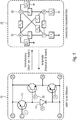
- Fig. 1
- zeigt eine schematische Darstellung eines erfindungsgemäßen Verfahrens zum Erstellen einer thermischen Ersatzschaltung eines physikalischen Aufbaus; und
- Fig. 2
- zeigt eine schematische Darstellung eines Teilbereichs des physikalischen Aufbaus aus
Fig. 1 . - Gleiche oder gleichwertige Elemente oder Elemente mit gleicher oder gleichwertiger Funktionalität werden in der folgenden Beschreibung durch gleiche oder gleichwertige Referenzziffern bezeichnet, auch wenn sie in unterschiedlichen Zahlen vorkommen.
- In der folgenden Beschreibung wird eine Vielzahl von Details dargelegt, um eine umfassendere Erklärung der Ausführungsformen der vorliegenden Erfindung zu ermöglichen. Einem Fachmann wird es jedoch klar sein, dass Ausführungsformen der vorliegenden Erfindung ohne diese spezifischen Details ausgeführt werden können. In anderen Fällen werden bekannte Strukturen und Vorrichtungen nicht im Detail, sondern im Blockdiagramm dargestellt, um zu vermeiden, dass die Ausführungsformen der vorliegenden Erfindung verborgen werden. Darüber hinaus können Merkmale der verschiedenen hierin beschriebenen Ausführungsformen miteinander kombiniert werden, sofern nicht ausdrücklich anders angegeben.
- Wie schon erwähnt basiert die Erfindung auf einem Verfahren, welches die oben genannten Nachteile vermeidet. Die Kernidee der Lösung liegt darin, das thermische Problem statt wie üblich im Zeitbereich, im Frequenzraum zu betrachten. Dadurch kann eine Vielzahl etablierter Verfahren aus dem Bereich der linearen Netzwerktheorie, d.h. der Elektrotechnik, auf das thermische Problem übertragen werden und zur Lösung des Problems herangezogen werden.
-
Fig. 1 zeigt skizzenhaft ein Ausführungsbeispiel, in dem das erfindungsgemäße Verfahren folgenden Ablauf aufweist: - 1. Modellierung des physikalischen Aufbaus einer Schaltung 10 mit thermisch aktiven Bauelementen wie z.B. Transistoren 12, Dioden 14 etc., die eine jeweilige Verlustleistung aufweisen, wie sie beispielhaft in
Fig. 1 dargestellt ist, einschließlich des Silizium-Wafers sowie sämtlicher thermischer Randbedingungen in einer thermischen Simulation (in einem thermischen Simulationsprogramm); - 2. Wahl der Ports 30, d.h. der Ein- und Ausgange, für das zu erstellende thermische Ersatznetz;
- 3. Bestimmung einer thermischen Admittanzmatrix Y(f) unter Verwendung des thermischen Simulationsprogramms für verschiedene Frequenzen f;
- 4. Reduktion der Nicht-Null-Elemente der Admittanzmatrix Y(f) durch Ausnutzen linearer Abhängigkeiten innerhalb der Matrix; und
- 5. Erstellung einer linearen, thermischen Ersatzschaltung 20 aus den Admittanzmatrizen Y(f) z.B. durch ein Verfahren, das in der Referenz [11] beschrieben ist.
- Zur Erstellung der thermischen Admittanzmatrix Y(f) kann folgendes Black-Box-Verfahren unter Verwendung der thermischen Simulation (des thermischen Simulationsprogramms) verwendet werden:
- 1. Vorgabe einer mit einer Frequenz f oszillierenden Temperatur an einem Port 30;
- 2. Vorgabe einer konstanten Temperatur an allen anderen Ports 30;
- 3. Resultierende (normierte) Wärmeströme an allen Ports ergeben eine Spalte der thermischen Admittanzmatrix Y(f)
- 4. Bestimmung aller Spalten der thermischen Admittanzmatrix Y(f) durch wiederholte Durchführung für verbleibende Ports (30)
- In einem weiteren Ausführungsbeispiel kann die Admittanzmatrix Y(f) alternativ aus einer Impedanzmatrix Z(f) gewonnen werden. Dazu kann folgendes Verfahren verwendet werden:
- 1. Vorgabe eines mit Frequenz f oszillierenden Wärmestroms an einem Port 30, wobei eine null an allen anderen Ports ansteht;
- 2. Resultierende (normierte) Temperaturen an allen Ports 30 ergeben eine Spalte der thermischen Impedanzmatrix Z(f)
- 3. Bestimmung aller Spalten der der thermischen Impedanzmatrix Z(f) durch wiederholte Durchführung für verbleibende Ports;
- 4. Bestimmung der Admittanzmatrix durch Matrixinversion Y(f) = Z(f)-1
-
Fig. 2 zeigt eine schematische Darstellung eines Teilbereichs des physikalischen Aufbaus ausFig. 1 . Beispielhaft umfasst dieses thermische Teilnetzwerk der thermischen Ersatzschaltung zwischen den Ports Ti und Tj u.a. einen elektrischen Widerstand R in Reihe geschaltet mit einer Spule L und parallel geschaltet mit einem Kondensator C. etc. - Das erläuterte Verfahren zur Erstellung einer thermischen Ersatzschaltung bietet folgende Vorteile gegenüber bekannten Lösungen:
- Vermeidung komplizierter, parameterabhängiger mathematischer Verfahren der Modellordnungsreduktion, der sogenannten MOR-Verfahren;
- Stattdessen Verwendung eines einfachen simulationsbasierten Black-Box-Verfahrens;
- Die Kenntnis des mathematischen Gleichungssystems ist dafür nicht notwendig;
- Eine Linearität des Problems nicht unmittelbar erforderlich.
- Der beschriebene Lösungsweg gestattet eine Implementierung innerhalb einer kommerziellen Software, welche eine einfach nutzbare elektrothermische Analyse in der Elektronikentwicklung ermöglicht.
- Die Wirkung der o.a. beschriebenen Verfahren besteht darin, dass eine Verkopplung zwischen der elektrischen Verlustleistung der Bauelemente und der dadurch entstehenden Selbsterwärmung in der elektrischen Schaltung beschrieben werden kann. Dadurch kann zum einen die Temperaturerhöhung aufgrund elektrischer Verluste an beliebiger Stelle in der elektrischen Schaltung vorhergesagt werden. Zum anderen kann die durch Temperaturerhöhung verursachte Änderung der elektrischen Eigenschaften der Schaltung ermittelt werden. Der sich daraus ergebene Vorteil liegt darin, bereits bei der Entwicklung der physikalischen Schaltung nachteilige elektrothermische Kopplungseffekte zu identifizieren und zu vermeiden, wodurch ein zuverlässigerer Schaltungsaufbau erzielt wird.
- Ein wesentlicher Vorteil besteht darin, dass die vorgeschlagene Lösung auch auf praktisch relevante Problemgroßen automatisiert angewendet werden kann. Dadurch können thermische Ersatznetze breitflächig in der Elektronikentwicklung eingesetzt werden, was zu einer Verbesserung der Robustheit und Zuverlässigkeit elektronischer Produkte beitragt.
- Die o.a. Verfahren können in der Elektronikentwicklung eingesetzt werden, um die Auswirkungen elektrothermischer Wechselwirkungen auf das Schaltungsverhalten beispielsweise für Spannungsregler-Schaltungen (Power Management ICs - PMICs) oder Hochfrequenz- Leistungsverstärker (RF Power Amplifiers) zu untersuchen. Dadurch kann Effekten wie z.B. dem schon erwähnten thermischen Durchgehen (Englisch: "Thermal Runaway") bereits im Entwurf vorgebeugt werden. Die elektrische Schaltung wird dadurch sicherer und zuverlässiger für den Einsatz im Feld. Darüber hinaus lasst sich das Verfahren auch auf allgemeinere thermische Problemstellungen mit thermischen Quellen und Senken anwenden.
- Obwohl bestimmte Kombinationen von Merkmalen in den Patentansprüchen angeführt und/oder in der Beschreibung offenbart sind, ist es nicht beabsichtigt, dass diese Merkmale die Offenbarung möglicher Implementierungen einschränken. Tatsächlich können zahlreiche dieser Merkmale auf Weisen kombiniert werden, die nicht spezifisch in den Patentansprüchen angeführt und/oder in der Beschreibung offenbart sind. Obwohl jeder der unten angeführten abhängigen Patentansprüche möglicherweise nur von einem oder einigen Patentansprüchen direkt abhängt, umfasst die Offenbarung möglicher Implementierungen jeden abhängigen Patentanspruch in Kombination mit allen anderen Patentansprüchen in dem Satz von Patentansprüchen.
- Obwohl manche Aspekte im Zusammenhang mit einer Vorrichtung beschrieben wurden, versteht es sich, dass diese Aspekte auch eine Beschreibung des entsprechenden Verfahrens darstellen, sodass ein Block oder ein Bauelement einer Vorrichtung auch als ein entsprechender Verfahrensschritt oder als ein Merkmal eines Verfahrensschrittes zu verstehen ist. Analog dazu stellen Aspekte, die im Zusammenhang mit einem oder als ein Verfahrensschritt beschrieben wurden, auch eine Beschreibung eines entsprechenden Blocks oder Details oder Merkmals einer entsprechenden Vorrichtung dar. Einige oder alle der Verfahrensschritte können durch einen Hardware-Apparat (oder unter Verwendung eines Hardware-Apparats), wie zum Beispiel einen Mikroprozessor, einen programmierbaren Computer oder eine elektronische Schaltung ausgeführt werden. Bei einigen Ausführungsbeispielen können einige oder mehrere der wichtigsten Verfahrensschritte durch einen solchen Apparat ausgeführt werden.
- Ein erfindungsgemäß codiertes Signal, wie beispielsweise ein Audiosignal oder ein Videosignal oder ein Transportstromsignal, kann auf einem digitalen Speichermedium gespeichert sein oder kann auf einem Übertragungsmedium wie beispielsweise einem drahtlosen Übertragungsmedium oder einem verdrahteten Übertragungsmedium, z.B. dem Internet, übertragen werden
- Das erfindungsgemäße kodierte Audiosignal kann auf einem digitalen Speichermedium gespeichert sein, oder kann auf einem Übertragungsmedium, wie beispielsweise einem drahtlosen Übertragungsmedium oder einem drahtgebundenen Übertragungsmedium, wie beispielsweise dem Internet, übertragen werden.
- Je nach bestimmten Implementierungsanforderungen können Ausführungsbeispiele der Erfindung in Hardware oder in Software implementiert sein. Die Implementierung kann unter Verwendung eines digitalen Speichermediums, beispielsweise einer Floppy-Disk, einer DVD, einer Blu-ray Disc, einer CD, eines ROM, eines PROM, eines EPROM, eines EEPROM oder eines FLASH-Speichers, einer Festplatte oder eines anderen magnetischen oder optischen Speichers durchgeführt werden, auf dem elektronisch lesbare Steuersignale gespeichert sind, die mit einem programmierbaren Computersystem derart zusammenwirken können oder zusammenwirken, dass das jeweilige Verfahren durchgeführt wird. Deshalb kann das digitale Speichermedium computerlesbar sein.
- Manche Ausführungsbeispiele gemäß der Erfindung umfassen also einen Datenträger, der elektronisch lesbare Steuersignale aufweist, die in der Lage sind, mit einem programmierbaren Computersystem derart zusammenzuwirken, dass eines der hierin beschriebenen Verfahren durchgeführt wird.
- Allgemein können Ausführungsbeispiele der vorliegenden Erfindung als Computerprogrammprodukt mit einem Programmcode implementiert sein, wobei der Programmcode dahin gehend wirksam ist, eines der Verfahren durchzuführen, wenn das Computerprogrammprodukt auf einem Computer abläuft.
- Der Programmcode kann beispielsweise auch auf einem maschinenlesbaren Träger gespeichert sein.
- Andere Ausführungsbeispiele umfassen das Computerprogramm zum Durchführen eines der hierin beschriebenen Verfahren, wobei das Computerprogramm auf einem maschinenlesbaren Träger gespeichert ist.
- Mit anderen Worten ist ein Ausführungsbeispiel des erfindungsgemäßen Verfahrens somit ein Computerprogramm, das einen Programmcode zum Durchführen eines der hierin beschriebenen Verfahren aufweist, wenn das Computerprogramm auf einem Computer abläuft.
- Ein weiteres Ausführungsbeispiel der erfindungsgemäßen Verfahren ist somit ein Datenträger (oder ein digitales Speichermedium oder ein computerlesbares Medium), auf dem das Computerprogramm zum Durchführen eines der hierin beschriebenen Verfahren aufgezeichnet ist. Der Datenträger, das digitale Speichermedium oder das computerlesbare Medium sind typischerweise gegenständlich und/oder nicht-vergänglich bzw. nicht-vorübergehend.
- Ein weiteres Ausführungsbeispiel des erfindungsgemäßen Verfahrens ist somit ein Datenstrom oder eine Sequenz von Signalen, der bzw. die das Computerprogramm zum Durchführen eines der hierin beschriebenen Verfahren darstellt bzw. darstellen. Der Datenstrom oder die Sequenz von Signalen kann bzw. können beispielsweise dahin gehend konfiguriert sein, über eine Datenkommunikationsverbindung, beispielsweise über das Internet, transferiert zu werden.
- Ein weiteres Ausführungsbeispiel umfasst eine Verarbeitungseinrichtung, beispielsweise einen Computer oder ein programmierbares Logikbauelement, die dahin gehend konfiguriert oder angepasst ist, eines der hierin beschriebenen Verfahren durchzuführen.
- Ein weiteres Ausführungsbeispiel umfasst einen Computer, auf dem das Computerprogramm zum Durchführen eines der hierin beschriebenen Verfahren installiert ist.
- Ein weiteres Ausführungsbeispiel gemäß der Erfindung umfasst eine Vorrichtung oder ein System, die bzw. das ausgelegt ist, um ein Computerprogramm zur Durchführung zumindest eines der hierin beschriebenen Verfahren zu einem Empfänger zu übertragen. Die Übertragung kann beispielsweise elektronisch oder optisch erfolgen. Der Empfänger kann beispielsweise ein Computer, ein Mobilgerät, ein Speichergerät oder eine ähnliche Vorrichtung sein. Die Vorrichtung oder das System kann beispielsweise einen Datei-Server zur Übertragung des Computerprogramms zu dem Empfänger umfassen.
- Bei manchen Ausführungsbeispielen kann ein programmierbares Logikbauelement (beispielsweise ein feldprogrammierbares Gatterarray, ein FPGA) dazu verwendet werden, manche oder alle Funktionalitäten der hierin beschriebenen Verfahren durchzuführen. Bei manchen Ausführungsbeispielen kann ein feldprogrammierbares Gatterarray mit einem Mikroprozessor zusammenwirken, um eines der hierin beschriebenen Verfahren durchzuführen. Allgemein werden die Verfahren bei einigen Ausführungsbeispielen seitens einer beliebigen Hardwarevorrichtung durchgeführt. Diese kann eine universell einsetzbare Hardware wie ein Computerprozessor (CPU) sein oder für das Verfahren spezifische Hardware, wie beispielsweise ein ASIC.
- Die hierin beschriebenen Vorrichtungen können beispielsweise unter Verwendung eines Hardware-Apparats, oder unter Verwendung eines Computers, oder unter Verwendung einer Kombination eines Hardware-Apparats und eines Computers implementiert werden.
- Die hierin beschriebenen Vorrichtungen, oder jedwede Komponenten der hierin beschriebenen Vorrichtungen können zumindest teilweise in Hardware und/oder in Software (Computerprogramm) implementiert sein.
- Die hierin beschriebenen Verfahren können beispielsweise unter Verwendung eines Hardware-Apparats, oder unter Verwendung eines Computers, oder unter Verwendung einer Kombination eines Hardware-Apparats und eines Computers implementiert werden.
- Die hierin beschriebenen Verfahren, oder jedwede Komponenten der hierin beschriebenen Verfahren können zumindest teilweise durch Hardware und/oder durch Software ausgeführt werden.
- Die oben beschriebenen Ausführungsbeispiele stellen lediglich eine Veranschaulichung der Prinzipien der vorliegenden Erfindung dar. Es versteht sich, dass Modifikationen und Variationen der hierin beschriebenen Anordnungen und Einzelheiten anderen Fachleuten einleuchten werden. Deshalb ist beabsichtigt, dass die Erfindung lediglich durch den Schutzumfang der nachstehenden Patentansprüche und nicht durch die spezifischen Einzelheiten, die anhand der Beschreibung und der Erläuterung der Ausführungsbeispiele hierin präsentiert wurden, beschränkt sei.
-
- [1] Fukahori, Kiyoshi, and Paul R. Gray. "Computer simulation of integrated circuits in the presence of electro thermal interaction." IEEE Journal of Solid-State Circuits 11.6 (1976): 834-846.
- [2] Digele, Georg, Steffi Lindenkreuz, and Erich Kasper. "Fully coupled dynamic electro-thermal simulation." IEEE Transactions on Very Large Scale Integration (VLSI) Systems 5.3 (1997): 250- 257.
- [3] S. Wunsche, C. Clauss, P. Schwarz and F. Winkler, "Electro-thermal circuit simulation using simulator coupling," in IEEE Transactions on Very Large Scale Integration (VLSI) Systems, vol. 5, no. 3, pp. 277-282, Sept. 1997.
- [4] P. Wilkerson, A. Raman and M. Turowski,"Fast, automated thermal simulation of three-dimensional integrated circuits," The Ninth Intersociety Conference on Thermal and Thermomechanical Phenomena In Electronic Systems (IEEE Cat. No.04CH37543), Las Vegas, NV, USA, 2004, pp. 706-713 Vol.1.
- [5] T. Casper, H. De Gersem and S. Schöps, "Automatic generation of equivalent electro thermal SPICE netlists from 3D electro thermal field models," 2016 17th International Conference on Thermal, Mechanical and Multi-Physics Simulation and Experiments in Microelectronics and Microsystems (EuroSimE), Montpellier, 2016, pp. 1-8.
- [6] "Chip-scale electro thermal analysis",
US9740804B2 - [7] "Post-layout thermal-aware integrated circuit performance modeling",
US9721059B1 - [8] M. Salleras et al., "Comparison of model order reduction methodologies for thermal problems," EuroSimE 2005. Proceedings of the 6th International Conference on Thermal, Mechanical and Multi-Physics Simulation and Experiments in MicroElectronics and Micro-Systems, 2005., Berlin, Germany, 2005, pp. 60-65.
- [9] Ting-Yuan Wang and Charlie Chung-Ping Chen, "SPICE-compatible thermal simulation with lumped circuit modeling for thermal reliability analysis based on modeling order reduction," International Symposium on Signals, Circuits and Systems. Proceedings, SCS 2003. (Cat. No.03EX720), San Jose, CA, USA, 2004, pp. 357-362.
- [10] Feng, L., Yue, Y., Banagaaya, N. et al., "Parametric modeling and model order reduction for (electro-) thermal analysis of nanoelectronic structures", J.Math.Industry (2016) 6: 10.
- [11] Gustavsen, Bjφrn. "Computer code for rational approximation of frequency dependent admittance matrices." IEEE Transactions on Power Delivery 17.4 (2002): 1093-1098.
Claims (16)
- Vorrichtung zum Erstellen einer thermischen Ersatzschaltung eines physikalischen Aufbaus,
wobei die Vorrichtung ausgelegt ist, um thermische Admittanzmatrizen basierend auf einer Modellierung eines physikalischen Aufbaus für eine Mehrzahl von Frequenzen zu bestimmen; und
wobei die Vorrichtung ausgelegt ist, um eine thermische Ersatzschaltung basierend auf den thermischen Admittanzmatrizen für die Mehrzahl von Frequenzen zu bestimmen. - Vorrichtung zur thermischen Simulation eines physikalischen Aufbaus,
wobei die Vorrichtung zur thermischen Simulation eine Vorrichtung zur Erstellung einer thermischen Ersatzschaltung gemäß Anspruch 1 aufweist, und
wobei die Vorrichtung ausgelegt ist, um basierend auf der thermischen Ersatzschaltung und einer Information über eine thermische Anregung des physikalischen Aufbaus eine thermische Antwort des physikalischen Aufbaus zu bestimmen. - Vorrichtung zur thermischen Simulation nach Anspruch 2,
wobei die Vorrichtung ausgelegt ist, um eine elektrische Schaltung, die Teil des physikalischen Aufbaus ist, zu simulieren. - Vorrichtung zur thermischen Simulation nach einem der Ansprüche 2 oder 3,
wobei die Vorrichtung ausgelegt ist, um die thermische Anregung abhängig von der Simulation der elektrischen Schaltung zu bestimmen, und/oder
um die thermische Antwort des physikalischen Aufbaus bei der Simulation der elektrischen Schaltung zu berücksichtigen. - Vorrichtung zur thermischen Simulation nach einem der Ansprüche 2 bis 4,
wobei die thermische Ersatzschaltung eine Mehrzahl von elektrischen Elementen aufweist. - Verfahren zum Erstellen einer thermischen Ersatzschaltung eines physikalischen Aufbaus,
wobei mit dem Verfahren thermische Admittanzmatrizen basierend auf einer Modellierung eines physikalischen Aufbaus für eine Mehrzahl von Frequenzen bestimmt werden; und
wobei eine thermische Ersatzschaltung basierend auf den thermischen Admittanzmatrizen für die Mehrzahl von Frequenzen bestimmt wird. - Verfahren zur thermischen Simulation eines physikalischen Aufbaus,
wobei das Verfahren zur thermischen Simulation ein Verfahren zur Erstellung einer thermischen Ersatzschaltung gemäß Anspruch 6 aufweist, und
wobei mit dem Verfahren zur thermischen Simulation, basierend auf der thermischen Ersatzschaltung und einer Information über eine thermische Anregung des physikalischen Aufbaus eine thermische Antwort des physikalischen Aufbaus bestimmt wird. - Verfahren zur thermischen Simulation nach Anspruch 7,
wobei mit dem Verfahren zur thermischen Simulation eine elektrische Schaltung, die Teil des physikalischen Aufbaus ist, simuliert wird. - Verfahren zur thermischen Simulation nach einem der Ansprüche 7 oder 8,
wobei mit dem Verfahren die thermische Anregung abhängig von der Simulation der elektrischen Schaltung bestimmt wird, und/oder
die thermische Antwort des physikalischen Aufbaus bei der Simulation der elektrischen Schaltung berücksichtigt wird. - Verfahren zur thermischen Simulation nach einem der Ansprüche 7 bis 9, umfassend:- Modellieren eines physikalischen Aufbaus in einem thermischen Simulationsprogramm,- Auswählen von Ein- und Ausgängen als Ports eines mit dem thermischen Simulationsprogramm zu erstellenden thermischen Ersatznetzes,- um eine thermische Admittanzmatrix Y(f) unter Verwendung des thermischen Simulationsprogramms für verschiedene Frequenzen (f) zu bestimmen.
- Verfahren zur thermischen Simulation nach einem der Ansprüche 7 bis 10, wobei- eine lineare, thermische Ersatzschaltung aus der Admittanzmatrix Y(f) erstellt wird.
- Verfahren zur thermischen Simulation nach einem der Ansprüche 7 bis 11, wobei eine Reduktion von Nicht-Null-Elementen der Admittanzmatrix Y(f) durch Ausnutzen linearer Abhängigkeiten innerhalb der Admittanzmatrix Y(f) erfolgt.
- Verfahren zur thermischen Simulation nach einem der Ansprüche 7 bis 12, wobei ein Approximieren der Admittanzmatrix Y(f) mit rationalen Funktionen erfolgt, deren frequenzabhängige Elemente aus Berechnungen erhalten wurden.
- Verfahren zur thermischen Simulation nach einem der Ansprüche 7 bis 13, wobei ein alle Matrixelemente der Admittanzmatrix Y(f) gleichzeitig mit einem identischen Satz stabiler Pole nach einem Vektoranpassungsprinzip ausgestattet werden.
- Verfahren zur thermischen Simulation nach einem der Ansprüche 7 bis 14, wobei- eine Vorgabe einer mit Frequenz f oszillierenden Temperatur an einem Port erfolgt,- eine Vorgabe einer konstanten Temperatur an allen anderen Ports erfolgt,- resultierende (normierte) Wärmeströme an allen Ports eine Spalte der thermischen Admittanzmatrix Y(f) ergeben, und- eine Bestimmung aller Spalten von Y(f) durch wiederholte Durchführung für verbleibende Ports erfolgt.
- Computerprogramm mit einem Programmcode, zum Ausführen eines Verfahrens nach einem der Ansprüche 6 bis 15 auf einem Computer.
Priority Applications (2)
| Application Number | Priority Date | Filing Date | Title |
|---|---|---|---|
| EP20157275.7A EP3866048A1 (de) | 2020-02-13 | 2020-02-13 | Konzept einer gekoppelten elektrothermischen simulation |
| US17/174,248 US20210255238A1 (en) | 2020-02-13 | 2021-02-11 | Concept of a coupled electrothermal simulation |
Applications Claiming Priority (1)
| Application Number | Priority Date | Filing Date | Title |
|---|---|---|---|
| EP20157275.7A EP3866048A1 (de) | 2020-02-13 | 2020-02-13 | Konzept einer gekoppelten elektrothermischen simulation |
Publications (1)
| Publication Number | Publication Date |
|---|---|
| EP3866048A1 true EP3866048A1 (de) | 2021-08-18 |
Family
ID=69593556
Family Applications (1)
| Application Number | Title | Priority Date | Filing Date |
|---|---|---|---|
| EP20157275.7A Withdrawn EP3866048A1 (de) | 2020-02-13 | 2020-02-13 | Konzept einer gekoppelten elektrothermischen simulation |
Country Status (2)
| Country | Link |
|---|---|
| US (1) | US20210255238A1 (de) |
| EP (1) | EP3866048A1 (de) |
Citations (2)
| Publication number | Priority date | Publication date | Assignee | Title |
|---|---|---|---|---|
| US9721059B1 (en) | 2016-01-21 | 2017-08-01 | Globalfoundries Inc. | Post-layout thermal-aware integrated circuit performance modeling |
| US9740804B2 (en) | 2014-11-03 | 2017-08-22 | Mentor Graphics Corporation | Chip-scale electrothermal analysis |
Family Cites Families (1)
| Publication number | Priority date | Publication date | Assignee | Title |
|---|---|---|---|---|
| US20140200845A1 (en) * | 2011-08-24 | 2014-07-17 | Hitachi Ltd. | Numerical Analysis System |
-
2020
- 2020-02-13 EP EP20157275.7A patent/EP3866048A1/de not_active Withdrawn
-
2021
- 2021-02-11 US US17/174,248 patent/US20210255238A1/en not_active Abandoned
Patent Citations (2)
| Publication number | Priority date | Publication date | Assignee | Title |
|---|---|---|---|---|
| US9740804B2 (en) | 2014-11-03 | 2017-08-22 | Mentor Graphics Corporation | Chip-scale electrothermal analysis |
| US9721059B1 (en) | 2016-01-21 | 2017-08-01 | Globalfoundries Inc. | Post-layout thermal-aware integrated circuit performance modeling |
Non-Patent Citations (14)
| Title |
|---|
| DIGELE, GEORGSTEFFI LINDENKREUZERICH KASPER: "Fully coupled dynamic electro-thermal simulation", IEEE TRANSACTIONS ON VERY LARGE SCALE INTEGRATION (VLSI) SYSTEMS, vol. 5.3, 1997, pages 250 - 257, XP011326080, DOI: 10.1109/92.609867 |
| FENG, L.YUE, Y.BANAGAAYA, N. ET AL.: "Parametric modeling and model order reduction for (electro-) thermal analysis of nanoelectronic structures", J.MATH.LNDUSTRY, vol. 6, 2016, pages 10 |
| FUKAHORI, KIYOSHIPAUL R. GRAY: "Computer simulation of integrated circuits in the presence of electro thermal interaction", IEEE JOURNAL OF SOLID-STATE CIRCUITS, vol. 11.6, 1976, pages 834 - 846 |
| GUSTAVSEN, BJ<J>RN: "Computer code for rational approximation of frequency dependent admittance matrices", IEEE TRANSACTIONS ON POWER DELIVERY, vol. 17.4, 2002, pages 1093 - 1098 |
| HANG LI ET AL: "EFFICIENT THERMAL SIMULATION FOR RUN-TIME TEMPERATURE TRACKING AND MANAGEMENT", COMPUTER DESIGN, 2005. PROCEEDINGS. 2005 INTERNATIONAL CONFERENCE ON SAN JOSE, CA, USA 02-05 OCT. 2005, PISCATAWAY, NJ, USA,IEEE, 2 October 2005 (2005-10-02), pages 130 - 136, XP010846366, ISBN: 978-0-7695-2451-1 * |
| M. SALLERAS ET AL.: "Comparison of model order reduction methodologies for thermal problems", EUROSIME, 2005 |
| MA KE ET AL: "Frequency-Domain Thermal Modeling and Characterization of Power Semiconductor Devices", IEEE TRANSACTIONS ON POWER ELECTRONICS, INSTITUTE OF ELECTRICAL AND ELECTRONICS ENGINEERS, USA, vol. 31, no. 10, 1 October 2016 (2016-10-01), pages 7183 - 7193, XP011610983, ISSN: 0885-8993, [retrieved on 20160520], DOI: 10.1109/TPEL.2015.2509506 * |
| MAXIM A ET AL: "A novel power PIN diode behavioral SPICE macromodel including the forward and reverse recoveries and the self-heating process", APPLIED POWER ELECTRONICS CONFERENCE AND EXPOSITION, 2000.APEC 2000.FIFTEENTH ANNUAL IEEE, IEEE, vol. 2, 6 February 2000 (2000-02-06), pages 1088 - 1094, XP010371637, ISBN: 978-0-7803-5864-5, DOI: 10.1109/APEC.2000.822823 * |
| P. WILKERSONA. RAMANM. TUROWSKI: "Fast, automated thermal simulation of three-dimensional integrated circuits", THE NINTH INTERSOCIETY CONFERENCE ON THERMAL AND THERMOMECHANICAL PHENOMENA IN ELECTRONIC SYSTEMS (IEEE CAT. NO.04CH37543, vol. 1, 2004, pages 706 - 713, XP010714930, DOI: 10.1109/ITHERM.2004.1319245 |
| PROCEEDINGS OF THE 6TH INTERNATIONAL CONFERENCE ON THERMAL, MECHANICAL AND MULTI-PHYSICS SIMULATION AND EXPERIMENTS IN MICROELECTRONICS AND MICRO-SYSTEMS, 2005, pages 60 - 65 |
| S. WUNSCHEC. CLAUSSP. SCHWARZF. WINKLER: "Electro-thermal circuit simulation using simulator coupling", IEEE TRANSACTIONS ON VERY LARGE SCALE INTEGRATION (VLSI) SYSTEMS, vol. 5, no. 3, September 1997 (1997-09-01), pages 277 - 282 |
| SZEKELY V ET AL: "Electro-thermal and logi-thermal simulation of VLSI designs", IEEE TRANSACTIONS ON VERY LARGE SCALE INTEGRATION (VLSI) SYSTEMS, IEEE SERVICE CENTER, PISCATAWAY, NJ, USA, vol. 5, no. 3, 1 September 1997 (1997-09-01), pages 258 - 269, XP011326081, ISSN: 1063-8210, DOI: 10.1109/92.609868 * |
| T. CASPERH. DE GERSEMS. SCHÖPS: "Automatic generation of equivalent electro thermal SPICE netlists from 3D electro thermal field models", 17TH INTERNATIONAL CONFERENCE ON THERMAL, MECHANICAL AND MULTI-PHYSICS SIMULATION AND EXPERIMENTS IN MICROELECTRONICS AND MICROSYSTEMS (EUROSIME, 2016, pages 1 - 8 |
| TING-YUAN WANGCHARLIE CHUNG-PING CHEN: "SPICE-compatible thermal simulation with lumped circuit modeling for thermal reliability analysis based on modeling order reduction", INTERNATIONAL SYMPOSIUM ON SIGNALS, CIRCUITS AND SYSTEMS. PROCEEDINGS, SCS 2003. (CAT. NO.03EX720, 2004, pages 357 - 362, XP010695519, DOI: 10.1109/ISQED.2004.1283700 |
Also Published As
| Publication number | Publication date |
|---|---|
| US20210255238A1 (en) | 2021-08-19 |
Similar Documents
| Publication | Publication Date | Title |
|---|---|---|
| DE112015002183T5 (de) | Computerimplementiertes System und Verfahren zum Übersetzen von Verifizierungs-Befehlen eines elektronischen Designs | |
| EP2799983A1 (de) | Flexible Aufteilung der I/O Kanäle einer Hardware Komponente | |
| EP3130970A1 (de) | Verfahren zum verbinden einer eingabe/ausgabe-schnittstelle eines für die steuergerätentwicklung eingerichteten testgeräts | |
| DE102004036813A1 (de) | Verfahren zum Erzeugen eines Schaltungsmodells | |
| EP3881216A1 (de) | Computerimplementiertes verfahren zur simulation einer elektrischen schaltung | |
| DE102011103861A1 (de) | Funktionseinheit, Simulationssystem und Verfahren zur Simulation | |
| Costabel et al. | Weighted analytic regularity in polyhedra | |
| CN112989364A (zh) | 用于数据仿真的方法、设备和计算机程序产品 | |
| DE102012016610B4 (de) | Echtzeit-Schaltungssimulation | |
| Jneid | On partial exact controllability of fractional control systems in conformable sense | |
| EP3933655A1 (de) | Informationsverarbeitungsvorrichtung, programm und simulationsverfahren | |
| US20190196925A1 (en) | Configuration system for configuring a test system suitable for testing an electronic control unit | |
| CN117408198A (zh) | 一种仿真模型建模方法、装置、设备及存储介质 | |
| US9697321B2 (en) | Method of identifying a value of an unknown circuit component in an analog circuit | |
| DE102021131391A1 (de) | Verfahren zur Simulation eines elektrischen Motors | |
| Vanassche et al. | Constructing symbolic models for the input/output behavior of periodically time-varying systems using harmonic transfer matrices | |
| DE112020007146B4 (de) | Vorrichtung zur berechnung einer finalen exponentiation, paarungsberechnungsvorrichtung, kryptographische verarbeitungsvorrichtung, verfahren zum berechnen einer finalen exponentiation und programm zum berechnen einer finalen exponentiation | |
| DE102020118626A1 (de) | Verfahren und Vorrichtungen zur Berechnung eines Zustands eines elektromechanischen Objekts | |
| Tischendorf | Regularization of electrical circuits | |
| US20240086590A1 (en) | Adaptive Grid Generating Method and Adaptive Grid Generating System | |
| EP4478239A1 (de) | Emulation einer analogen schaltung mittels programmierbarer digitaler logik | |
| Berzunza | The cut‐tree of large trees with small heights | |
| US20210255238A1 (en) | Concept of a coupled electrothermal simulation | |
| WO2016027318A1 (ja) | データ転送装置およびデータ転送方法 | |
| Rottiers et al. | Parametric state-time reduction for the transient analysis of multi-physical systems |
Legal Events
| Date | Code | Title | Description |
|---|---|---|---|
| PUAI | Public reference made under article 153(3) epc to a published international application that has entered the european phase |
Free format text: ORIGINAL CODE: 0009012 |
|
| STAA | Information on the status of an ep patent application or granted ep patent |
Free format text: STATUS: THE APPLICATION HAS BEEN PUBLISHED |
|
| AK | Designated contracting states |
Kind code of ref document: A1 Designated state(s): AL AT BE BG CH CY CZ DE DK EE ES FI FR GB GR HR HU IE IS IT LI LT LU LV MC MK MT NL NO PL PT RO RS SE SI SK SM TR |
|
| STAA | Information on the status of an ep patent application or granted ep patent |
Free format text: STATUS: REQUEST FOR EXAMINATION WAS MADE |
|
| 17P | Request for examination filed |
Effective date: 20211123 |
|
| RBV | Designated contracting states (corrected) |
Designated state(s): AL AT BE BG CH CY CZ DE DK EE ES FI FR GB GR HR HU IE IS IT LI LT LU LV MC MK MT NL NO PL PT RO RS SE SI SK SM TR |
|
| RAP3 | Party data changed (applicant data changed or rights of an application transferred) |
Owner name: FRAUNHOFER-GESELLSCHAFT ZUR FOERDERUNG DER ANGEWANDTEN FORSCHUNG E.V. |
|
| STAA | Information on the status of an ep patent application or granted ep patent |
Free format text: STATUS: EXAMINATION IS IN PROGRESS |
|
| 17Q | First examination report despatched |
Effective date: 20231213 |
|
| STAA | Information on the status of an ep patent application or granted ep patent |
Free format text: STATUS: THE APPLICATION IS DEEMED TO BE WITHDRAWN |
|
| 18D | Application deemed to be withdrawn |
Effective date: 20240416 |