EP3865324A1 - Trailer tongue load detection and related methods - Google Patents
Trailer tongue load detection and related methods Download PDFInfo
- Publication number
- EP3865324A1 EP3865324A1 EP21156754.0A EP21156754A EP3865324A1 EP 3865324 A1 EP3865324 A1 EP 3865324A1 EP 21156754 A EP21156754 A EP 21156754A EP 3865324 A1 EP3865324 A1 EP 3865324A1
- Authority
- EP
- European Patent Office
- Prior art keywords
- load
- hitch
- rear axle
- driver
- axle height
- Prior art date
- Legal status (The legal status is an assumption and is not a legal conclusion. Google has not performed a legal analysis and makes no representation as to the accuracy of the status listed.)
- Withdrawn
Links
Images


Classifications
-
- B—PERFORMING OPERATIONS; TRANSPORTING
- B60—VEHICLES IN GENERAL
- B60G—VEHICLE SUSPENSION ARRANGEMENTS
- B60G17/00—Resilient suspensions having means for adjusting the spring or vibration-damper characteristics, for regulating the distance between a supporting surface and a sprung part of vehicle or for locking suspension during use to meet varying vehicular or surface conditions, e.g. due to speed or load
- B60G17/015—Resilient suspensions having means for adjusting the spring or vibration-damper characteristics, for regulating the distance between a supporting surface and a sprung part of vehicle or for locking suspension during use to meet varying vehicular or surface conditions, e.g. due to speed or load the regulating means comprising electric or electronic elements
- B60G17/017—Resilient suspensions having means for adjusting the spring or vibration-damper characteristics, for regulating the distance between a supporting surface and a sprung part of vehicle or for locking suspension during use to meet varying vehicular or surface conditions, e.g. due to speed or load the regulating means comprising electric or electronic elements characterised by their use when the vehicle is stationary, e.g. during loading, engine start-up or switch-off
-
- B—PERFORMING OPERATIONS; TRANSPORTING
- B60—VEHICLES IN GENERAL
- B60G—VEHICLE SUSPENSION ARRANGEMENTS
- B60G17/00—Resilient suspensions having means for adjusting the spring or vibration-damper characteristics, for regulating the distance between a supporting surface and a sprung part of vehicle or for locking suspension during use to meet varying vehicular or surface conditions, e.g. due to speed or load
- B60G17/015—Resilient suspensions having means for adjusting the spring or vibration-damper characteristics, for regulating the distance between a supporting surface and a sprung part of vehicle or for locking suspension during use to meet varying vehicular or surface conditions, e.g. due to speed or load the regulating means comprising electric or electronic elements
- B60G17/018—Resilient suspensions having means for adjusting the spring or vibration-damper characteristics, for regulating the distance between a supporting surface and a sprung part of vehicle or for locking suspension during use to meet varying vehicular or surface conditions, e.g. due to speed or load the regulating means comprising electric or electronic elements characterised by the use of a specific signal treatment or control method
- B60G17/0185—Resilient suspensions having means for adjusting the spring or vibration-damper characteristics, for regulating the distance between a supporting surface and a sprung part of vehicle or for locking suspension during use to meet varying vehicular or surface conditions, e.g. due to speed or load the regulating means comprising electric or electronic elements characterised by the use of a specific signal treatment or control method for failure detection
-
- B—PERFORMING OPERATIONS; TRANSPORTING
- B60—VEHICLES IN GENERAL
- B60D—VEHICLE CONNECTIONS
- B60D1/00—Traction couplings; Hitches; Draw-gear; Towing devices
- B60D1/01—Traction couplings or hitches characterised by their type
- B60D1/02—Bolt or shackle-type couplings
-
- B—PERFORMING OPERATIONS; TRANSPORTING
- B60—VEHICLES IN GENERAL
- B60D—VEHICLE CONNECTIONS
- B60D1/00—Traction couplings; Hitches; Draw-gear; Towing devices
- B60D1/01—Traction couplings or hitches characterised by their type
- B60D1/06—Ball-and-socket hitches
-
- B—PERFORMING OPERATIONS; TRANSPORTING
- B60—VEHICLES IN GENERAL
- B60D—VEHICLE CONNECTIONS
- B60D1/00—Traction couplings; Hitches; Draw-gear; Towing devices
- B60D1/24—Traction couplings; Hitches; Draw-gear; Towing devices characterised by arrangements for particular functions
- B60D1/248—Traction couplings; Hitches; Draw-gear; Towing devices characterised by arrangements for particular functions for measuring, indicating or displaying the weight
-
- B—PERFORMING OPERATIONS; TRANSPORTING
- B60—VEHICLES IN GENERAL
- B60D—VEHICLE CONNECTIONS
- B60D1/00—Traction couplings; Hitches; Draw-gear; Towing devices
- B60D1/58—Auxiliary devices
- B60D1/62—Auxiliary devices involving supply lines, electric circuits or the like
-
- B—PERFORMING OPERATIONS; TRANSPORTING
- B60—VEHICLES IN GENERAL
- B60Q—ARRANGEMENT OF SIGNALLING OR LIGHTING DEVICES, THE MOUNTING OR SUPPORTING THEREOF OR CIRCUITS THEREFOR, FOR VEHICLES IN GENERAL
- B60Q9/00—Arrangement or adaptation of signal devices not provided for in one of main groups B60Q1/00 - B60Q7/00, e.g. haptic signalling
-
- G—PHYSICS
- G01—MEASURING; TESTING
- G01G—WEIGHING
- G01G19/00—Weighing apparatus or methods adapted for special purposes not provided for in the preceding groups
- G01G19/08—Weighing apparatus or methods adapted for special purposes not provided for in the preceding groups for incorporation in vehicles
-
- G—PHYSICS
- G01—MEASURING; TESTING
- G01G—WEIGHING
- G01G19/00—Weighing apparatus or methods adapted for special purposes not provided for in the preceding groups
- G01G19/62—Over or under weighing apparatus
-
- B—PERFORMING OPERATIONS; TRANSPORTING
- B60—VEHICLES IN GENERAL
- B60G—VEHICLE SUSPENSION ARRANGEMENTS
- B60G2204/00—Indexing codes related to suspensions per se or to auxiliary parts
- B60G2204/10—Mounting of suspension elements
- B60G2204/22—Linking of trailers to trucks, e.g. truck-trailer connections
-
- B—PERFORMING OPERATIONS; TRANSPORTING
- B60—VEHICLES IN GENERAL
- B60G—VEHICLE SUSPENSION ARRANGEMENTS
- B60G2300/00—Indexing codes relating to the type of vehicle
- B60G2300/04—Trailers
- B60G2300/044—Truck-trailer connections
-
- B—PERFORMING OPERATIONS; TRANSPORTING
- B60—VEHICLES IN GENERAL
- B60G—VEHICLE SUSPENSION ARRANGEMENTS
- B60G2400/00—Indexing codes relating to detected, measured or calculated conditions or factors
- B60G2400/25—Stroke; Height; Displacement
- B60G2400/252—Stroke; Height; Displacement vertical
-
- B—PERFORMING OPERATIONS; TRANSPORTING
- B60—VEHICLES IN GENERAL
- B60G—VEHICLE SUSPENSION ARRANGEMENTS
- B60G2400/00—Indexing codes relating to detected, measured or calculated conditions or factors
- B60G2400/60—Load
-
- B—PERFORMING OPERATIONS; TRANSPORTING
- B60—VEHICLES IN GENERAL
- B60G—VEHICLE SUSPENSION ARRANGEMENTS
- B60G2400/00—Indexing codes relating to detected, measured or calculated conditions or factors
- B60G2400/60—Load
- B60G2400/61—Load distribution
-
- B—PERFORMING OPERATIONS; TRANSPORTING
- B60—VEHICLES IN GENERAL
- B60G—VEHICLE SUSPENSION ARRANGEMENTS
- B60G2400/00—Indexing codes relating to detected, measured or calculated conditions or factors
- B60G2400/90—Other conditions or factors
-
- B—PERFORMING OPERATIONS; TRANSPORTING
- B60—VEHICLES IN GENERAL
- B60G—VEHICLE SUSPENSION ARRANGEMENTS
- B60G2500/00—Indexing codes relating to the regulated action or device
- B60G2500/30—Height or ground clearance
-
- B—PERFORMING OPERATIONS; TRANSPORTING
- B60—VEHICLES IN GENERAL
- B60G—VEHICLE SUSPENSION ARRANGEMENTS
- B60G2600/00—Indexing codes relating to particular elements, systems or processes used on suspension systems or suspension control systems
- B60G2600/04—Means for informing, instructing or displaying
- B60G2600/044—Alarm means
-
- B—PERFORMING OPERATIONS; TRANSPORTING
- B60—VEHICLES IN GENERAL
- B60G—VEHICLE SUSPENSION ARRANGEMENTS
- B60G2800/00—Indexing codes relating to the type of movement or to the condition of the vehicle and to the end result to be achieved by the control action
- B60G2800/20—Stationary vehicle
- B60G2800/204—Stationary vehicle adjusting floor height to the loading ramp level
-
- B—PERFORMING OPERATIONS; TRANSPORTING
- B60—VEHICLES IN GENERAL
- B60G—VEHICLE SUSPENSION ARRANGEMENTS
- B60G2800/00—Indexing codes relating to the type of movement or to the condition of the vehicle and to the end result to be achieved by the control action
- B60G2800/80—Detection or control after a system or component failure
Definitions
- the disclosure herein relates to trailer tongue load detection according to the method of claim 1.
- Vehicles are commonly used to pull trailers of various kinds. Examples of trailers includes trailers for hauling heavy cargo or trailers for hauling animals. Sometimes trailers are loaded with items that are placed on the trailer causing an overload on the hitch or a negative load on the hitch. An improperly loaded trailer can cause a vehicle to become unstable while driving at higher speeds and lead to catastrophic sway during use of the vehicle. What is needed is a better way to detect when inappropriate loading of a trailer has occurred.
- An objective of the invention is to provide a method which can detect an improperly loaded trailer.
- this objective is achieved by a method comprising:
- the method includes detecting whether a negative load has been placed on a hitch with a load detection assembly, determining if a rear axle height has changed from a predetermined value, determining if rear axle has been raised if the rear axle height increased from the predetermined value and whether a negative tongue load is present, and informing driver of the increase in rear axle height due to the negative load on the hitch.
- the hitch is connected to a trailer.
- the method further includes measuring the load with a load sensing trailer ball hitch.
- the method further includes measuring the load with electronic suspension sensors.
- informing the driver the increase in rear axle height due to the load on the hitch includes providing an audio notification to the driver.
- informing the driver the increase in rear axle height due to the load on the hitch includes providing a visual notification to the driver.
- informing the driver the increase in rear axle height due to the load on the hitch includes providing an audio and visual notification to the driver.
- a system 100 includes a vehicle 108 with a hitch 120 and a trailer 180.
- the load from the trailer 180 can affect the ride height, for instance causing a change in ride height 110.
- the system 100 determines if there is an overloaded tongue weight from the trailer 180 ( FIG. 2 ) or if there is a negative tongue load, which lifts up on the trailer hitch 120 ( FIG. 1 ).
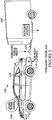
- the ride height is raised with a negative tongue weight, as shown in FIG. 1 .
- the ride height can be lowered, as shown in FIG. 2 .
- the system 100 includes a device to detect whether a trailer is present and when a trailer that is connected to the vehicle has an improper tongue load on the hitch 120.
- the device includes using the electronic suspension sensorics and logic in comparison with other vehicle signals to detect when a trailer 180 is present.
- the device used to detect tongue load is a load sensing trailer ball-hitch drawbar, for example as shown in US 6,035,521 .
- the device includes a hitch ball with a built-in scale.
- a processor is used to determine the calculations of height change and tongue load, for example.
- a method includes detecting whether a negative load has been placed on a hitch with a load detection assembly, determining if a rear axle height has changed from a predetermined value, determining if rear axle has been raised if the rear axle height increased from the predetermined value and whether a negative tongue load is present, and informing driver of the increase in rear axle height due to the negative load on the hitch.
- Figure 3 illustrates a flow chart for the method.
- the method checks at 212 whether there is a change in rear axle height from a predetermined value. If it is determined that there is a change in rear axle height, the system evaluates if is lowered or raised from the predetermined value. If lowered, there is a possible tongue overload and at 216. Using a processor, a tongue load is calculated and at 218 the tongue is raised to the target ride height if there is no tongue overload. If the tongue load calculation at 216 determines there is a tongue overload a signal is sent to inform the driver at 220, for example visually and/or audially.
Landscapes
- Engineering & Computer Science (AREA)
- Mechanical Engineering (AREA)
- Transportation (AREA)
- Physics & Mathematics (AREA)
- General Physics & Mathematics (AREA)
- Human Computer Interaction (AREA)
- Vehicle Body Suspensions (AREA)
Abstract
Description
- The disclosure herein relates to trailer tongue load detection according to the method of claim 1.
- Vehicles are commonly used to pull trailers of various kinds. Examples of trailers includes trailers for hauling heavy cargo or trailers for hauling animals. Sometimes trailers are loaded with items that are placed on the trailer causing an overload on the hitch or a negative load on the hitch. An improperly loaded trailer can cause a vehicle to become unstable while driving at higher speeds and lead to catastrophic sway during use of the vehicle. What is needed is a better way to detect when inappropriate loading of a trailer has occurred.
- An objective of the invention is to provide a method which can detect an improperly loaded trailer.
- This objective is achieved by the features of the independent claim. Advantageous embodiments of the invention are given in the sub-claims.
- In accordance with an aspect of the invention, this objective is achieved by a method comprising:
- detecting whether a negative load has been placed on a hitch with a load detection assembly;
- determining if a rear axle height has changed from a predetermined value; determining if rear axle has been raised if the rear axle height increased from the predetermined value;
- calculating a tongue load with a device;
- determining whether a negative tongue load is present; and
- informing driver of the increase in rear axle height due to the negative load on the hitch.
- The method includes detecting whether a negative load has been placed on a hitch with a load detection assembly, determining if a rear axle height has changed from a predetermined value, determining if rear axle has been raised if the rear axle height increased from the predetermined value and whether a negative tongue load is present, and informing driver of the increase in rear axle height due to the negative load on the hitch.
- In one or more embodiments, the hitch is connected to a trailer.
- In one or more embodiments, the method further includes measuring the load with a load sensing trailer ball hitch.
- In one or more embodiments, the method further includes measuring the load with electronic suspension sensors.
- In one or more embodiments, informing the driver the increase in rear axle height due to the load on the hitch includes providing an audio notification to the driver.
- In one or more embodiments, informing the driver the increase in rear axle height due to the load on the hitch includes providing a visual notification to the driver.
- In one or more embodiments, informing the driver the increase in rear axle height due to the load on the hitch includes providing an audio and visual notification to the driver.
- The invention will be better understood from the following detailed description of the preferred embodiments thereof, taken in conjunction with the accompanying drawings, wherein like reference numerals refer to like parts, in which:
-
FIG. 1 illustrates a side perspective view of a system, as constructed in accordance with one or more embodiments. -
FIG. 2 illustrates a side perspective view of a system, as constructed in accordance with one or more embodiments. -
FIG. 3 illustrates a flow chart for a method, as constructed in accordance with one or more embodiments. - These and other embodiments, aspects, advantages, and features of the present invention will be set forth in part in the description which follows and will become apparent to those skilled in the art by reference to the following description of the invention and referenced drawings or by practice of the invention. The aspects, advantages, and features of the invention are realized and attained by means of the instrumentalities, procedures, and combinations particularly pointed out in the appended claims and their equivalents.
- The following detailed description includes references to the accompanying drawings, which form a part of the detailed description. The drawings show, by way of illustration, specific embodiments in which the apparatus may be practiced. These embodiments, which are also referred to herein as "examples" or "options," are described in enough detail to enable those skilled in the art to practice the present embodiments. The embodiments may be combined, other embodiments may be utilized, or structural or logical changes may be made without departing from the scope of the invention. The following detailed description is, therefore, not to be taken in a limiting sense and the scope of the invention is defined by the appended claims and their legal equivalents.
- A
system 100, as shown inFIGs. 1 and2 , includes avehicle 108 with ahitch 120 and atrailer 180. The load from thetrailer 180 can affect the ride height, for instance causing a change inride height 110. In one or more embodiments, thesystem 100 determines if there is an overloaded tongue weight from the trailer 180 (FIG. 2 ) or if there is a negative tongue load, which lifts up on the trailer hitch 120 (FIG. 1 ). The ride height is raised with a negative tongue weight, as shown inFIG. 1 . For an overloaded trailer at the front of the trailer, the ride height can be lowered, as shown inFIG. 2 . - In one or more embodiments the
system 100 includes a device to detect whether a trailer is present and when a trailer that is connected to the vehicle has an improper tongue load on thehitch 120. In one or more embodiments, the device includes using the electronic suspension sensorics and logic in comparison with other vehicle signals to detect when atrailer 180 is present. In one or more embodiments, the device used to detect tongue load is a load sensing trailer ball-hitch drawbar, for example as shown inUS 6,035,521 . In one or more embodiments, the device includes a hitch ball with a built-in scale. In one or more embodiments, a processor is used to determine the calculations of height change and tongue load, for example. - A method includes detecting whether a negative load has been placed on a hitch with a load detection assembly, determining if a rear axle height has changed from a predetermined value, determining if rear axle has been raised if the rear axle height increased from the predetermined value and whether a negative tongue load is present, and informing driver of the increase in rear axle height due to the negative load on the hitch.
-
Figure 3 illustrates a flow chart for the method. At 210, the presence of a trailer is detected, and if a trailer is detected as being present, the method checks at 212 whether there is a change in rear axle height from a predetermined value. If it is determined that there is a change in rear axle height, the system evaluates if is lowered or raised from the predetermined value. If lowered, there is a possible tongue overload and at 216. Using a processor, a tongue load is calculated and at 218 the tongue is raised to the target ride height if there is no tongue overload. If the tongue load calculation at 216 determines there is a tongue overload a signal is sent to inform the driver at 220, for example visually and/or audially. - If at 212 it is determined there is a raise in axle height, it determines a negative tongue load is present, and at 214 the driver is informed for example visually and/or audially.
- The above description is intended to be illustrative, and not restrictive. Many other embodiments will be apparent to those of skill in the art upon reading and understanding the above description. Embodiments discussed in different portions of the description or referred to in different drawings can be combined to form additional embodiments of the present application. The scope should, therefore, be determined with reference to the appended claims, along with the full scope of equivalents to which such claims are entitled.
Claims (10)
- A method comprising:detecting whether a negative load has been placed on a hitch (120) with a load detection assembly;determining if a rear axle height (110) has changed from a predetermined value;determining if rear axle has been raised if the rear axle height (110) increased from the predetermined value;calculating a tongue load with a device;determining whether a negative tongue load is present; andinforming driver of the increase in rear axle height (110) due to the negative load on the hitch (120).
- The method according to claim 1, wherein the hitch (120) is connected to a trailer (180).
- The method according to claim 1 or 2, further comprising measuring the load with a load sensing trailer ball hitch.
- The method according to one of the claims 1 to 3, further comprising measuring the load with electronic suspension sensors.
- The method according to one of the claims 1 to 4, wherein informing the driver the increase in rear axle height (110) due to the load on the hitch (120) includes providing an audio and/or visual notification to the driver.
- The method according to one of the claims 1 to 4, wherein informing the driver the increase in rear axle height (110) due to the load on the hitch (120) includes providing a visual notification to the driver.
- The method according to one of the claims 1 to 4, wherein informing the driver the increase in rear axle height (110) due to the load on the hitch (120) includes providing an audio and visual notification to the driver.
- The method according to one of the claims 1 to 7, wherein the device is a hitch ball with a built-in scale.
- The method according to one of the claims 1 to 8, further comprising determining if there is an overload at the hitch (120).
- The method as recited in claim 9, further comprising informing the driver of the overload.
Applications Claiming Priority (1)
| Application Number | Priority Date | Filing Date | Title |
|---|---|---|---|
| US16/788,740 US20210245566A1 (en) | 2020-02-12 | 2020-02-12 | Trailer tongue load detection and related methods |
Publications (1)
| Publication Number | Publication Date |
|---|---|
| EP3865324A1 true EP3865324A1 (en) | 2021-08-18 |
Family
ID=74595100
Family Applications (1)
| Application Number | Title | Priority Date | Filing Date |
|---|---|---|---|
| EP21156754.0A Withdrawn EP3865324A1 (en) | 2020-02-12 | 2021-02-12 | Trailer tongue load detection and related methods |
Country Status (2)
| Country | Link |
|---|---|
| US (1) | US20210245566A1 (en) |
| EP (1) | EP3865324A1 (en) |
Cited By (1)
| Publication number | Priority date | Publication date | Assignee | Title |
|---|---|---|---|---|
| DE102025102092B3 (en) * | 2024-11-26 | 2026-02-05 | GM Global Technology Operations LLC | SYSTEM FOR DETECTING TRAILER LOAD-CONNECTED SUSPENSION SWIPPING AND ROLLING AWAY |
Citations (6)
| Publication number | Priority date | Publication date | Assignee | Title |
|---|---|---|---|---|
| US6035521A (en) | 1997-11-18 | 2000-03-14 | General Motors Corporation | Multi-directional crimp plate |
| DE202008015740U1 (en) * | 2008-11-29 | 2009-02-26 | GM Global Technology Operations, Inc., Detroit | Motor vehicle with electronic trailer support load detection |
| DE102009034678A1 (en) * | 2009-07-24 | 2011-01-27 | Volkswagen Ag | Method for improving dynamic control for motor vehicle, involves detecting supported load at trailer coupling, and counteracting supported load by shock absorbers of vehicle, where load is force at coupling perpendicular to road surface |
| DE102009053266A1 (en) * | 2009-11-13 | 2011-05-19 | GM Global Technology Operations, Inc., Detroit | Device for determining support load acting on trailer coupling of vehicle, has processing unit determining actual support load from determined change of vehicle position by drawing scaling data |
| DE102015207001A1 (en) * | 2015-04-17 | 2016-10-20 | Robert Bosch Gmbh | Method for driver-independent determination and adjustment of the threshold of a trailer anti-swerve system |
| US20180154726A1 (en) * | 2016-12-02 | 2018-06-07 | Toyota Motor Engineering & Manufacturing North America, Inc. | Vehicle attitude modification |
-
2020
- 2020-02-12 US US16/788,740 patent/US20210245566A1/en not_active Abandoned
-
2021
- 2021-02-12 EP EP21156754.0A patent/EP3865324A1/en not_active Withdrawn
Patent Citations (6)
| Publication number | Priority date | Publication date | Assignee | Title |
|---|---|---|---|---|
| US6035521A (en) | 1997-11-18 | 2000-03-14 | General Motors Corporation | Multi-directional crimp plate |
| DE202008015740U1 (en) * | 2008-11-29 | 2009-02-26 | GM Global Technology Operations, Inc., Detroit | Motor vehicle with electronic trailer support load detection |
| DE102009034678A1 (en) * | 2009-07-24 | 2011-01-27 | Volkswagen Ag | Method for improving dynamic control for motor vehicle, involves detecting supported load at trailer coupling, and counteracting supported load by shock absorbers of vehicle, where load is force at coupling perpendicular to road surface |
| DE102009053266A1 (en) * | 2009-11-13 | 2011-05-19 | GM Global Technology Operations, Inc., Detroit | Device for determining support load acting on trailer coupling of vehicle, has processing unit determining actual support load from determined change of vehicle position by drawing scaling data |
| DE102015207001A1 (en) * | 2015-04-17 | 2016-10-20 | Robert Bosch Gmbh | Method for driver-independent determination and adjustment of the threshold of a trailer anti-swerve system |
| US20180154726A1 (en) * | 2016-12-02 | 2018-06-07 | Toyota Motor Engineering & Manufacturing North America, Inc. | Vehicle attitude modification |
Cited By (1)
| Publication number | Priority date | Publication date | Assignee | Title |
|---|---|---|---|---|
| DE102025102092B3 (en) * | 2024-11-26 | 2026-02-05 | GM Global Technology Operations LLC | SYSTEM FOR DETECTING TRAILER LOAD-CONNECTED SUSPENSION SWIPPING AND ROLLING AWAY |
Also Published As
| Publication number | Publication date |
|---|---|
| US20210245566A1 (en) | 2021-08-12 |
Similar Documents
| Publication | Publication Date | Title |
|---|---|---|
| US8160806B2 (en) | Load-sensing systems for light-duty trucks | |
| US9969370B2 (en) | Method and control device for warning a vehicle driver of a risk of the vehicle overturning | |
| US20180065603A1 (en) | Trailer braking system and controller | |
| US7226265B2 (en) | Tire-detecting wheel chock apparatus | |
| EP1904351B1 (en) | A system and a method for stabilising a vehicle combination | |
| US6446998B1 (en) | Device for determining a distance of a motor vehicle from an object | |
| US20170174019A1 (en) | Coupling System | |
| CN111002894B (en) | Trailer loading assistance method and apparatus in a motor vehicle | |
| US9043094B2 (en) | Assembly for coupling a towing vehicle to a trailer | |
| JP2002054983A (en) | Measurement of loading state of automobile | |
| US10112485B2 (en) | Chassis monitoring system having overload detection | |
| US6378957B1 (en) | Arrangement for controlling vehicle braking | |
| US20240034303A1 (en) | Vehicle load regulating system and method thereof | |
| US7826953B2 (en) | Method for assisting the driver of a motor vehicle with a fishtailing trailer | |
| US6819980B2 (en) | Method for the avoidance of rollover phenomena in semitrailers | |
| AU2024259701A1 (en) | Weight management system for a towed vehicle | |
| EP4053819A1 (en) | Method and system of blind spot detection for a vehicle | |
| US20210245566A1 (en) | Trailer tongue load detection and related methods | |
| US9969327B2 (en) | Vehicle improper load sensor | |
| US9102208B2 (en) | Air suspension system with load detection | |
| US7209818B2 (en) | Method and arrangement for detecting a driving state | |
| US20190276038A1 (en) | Vehicle trailer detection system | |
| US12497016B2 (en) | Trailer brake temperature estimation | |
| EP1595774B1 (en) | A safety system for a semi-trailer | |
| EP2072294A1 (en) | Method and system for detecting the load of a vehicle equipped with non-pneumatic suspensions |
Legal Events
| Date | Code | Title | Description |
|---|---|---|---|
| PUAI | Public reference made under article 153(3) epc to a published international application that has entered the european phase |
Free format text: ORIGINAL CODE: 0009012 |
|
| STAA | Information on the status of an ep patent application or granted ep patent |
Free format text: STATUS: THE APPLICATION HAS BEEN PUBLISHED |
|
| AK | Designated contracting states |
Kind code of ref document: A1 Designated state(s): AL AT BE BG CH CY CZ DE DK EE ES FI FR GB GR HR HU IE IS IT LI LT LU LV MC MK MT NL NO PL PT RO RS SE SI SK SM TR |
|
| STAA | Information on the status of an ep patent application or granted ep patent |
Free format text: STATUS: REQUEST FOR EXAMINATION WAS MADE |
|
| 17P | Request for examination filed |
Effective date: 20220218 |
|
| RBV | Designated contracting states (corrected) |
Designated state(s): AL AT BE BG CH CY CZ DE DK EE ES FI FR GB GR HR HU IE IS IT LI LT LU LV MC MK MT NL NO PL PT RO RS SE SI SK SM TR |
|
| STAA | Information on the status of an ep patent application or granted ep patent |
Free format text: STATUS: EXAMINATION IS IN PROGRESS |
|
| 17Q | First examination report despatched |
Effective date: 20220725 |
|
| STAA | Information on the status of an ep patent application or granted ep patent |
Free format text: STATUS: THE APPLICATION IS DEEMED TO BE WITHDRAWN |
|
| 18D | Application deemed to be withdrawn |
Effective date: 20221206 |