EP3862349A1 - Hydrated crystalline polynuclear metal complex, hydrated crystalline polynuclear metal complex including a guest compound analyte and its use in a method for determining molecular structure of the guest compound analyte - Google Patents
Hydrated crystalline polynuclear metal complex, hydrated crystalline polynuclear metal complex including a guest compound analyte and its use in a method for determining molecular structure of the guest compound analyte Download PDFInfo
- Publication number
- EP3862349A1 EP3862349A1 EP20156456.4A EP20156456A EP3862349A1 EP 3862349 A1 EP3862349 A1 EP 3862349A1 EP 20156456 A EP20156456 A EP 20156456A EP 3862349 A1 EP3862349 A1 EP 3862349A1
- Authority
- EP
- European Patent Office
- Prior art keywords
- metal complex
- polynuclear metal
- hydrated
- crystalline
- hydrated crystalline
- Prior art date
- Legal status (The legal status is an assumption and is not a legal conclusion. Google has not performed a legal analysis and makes no representation as to the accuracy of the status listed.)
- Withdrawn
Links
- 150000001875 compounds Chemical class 0.000 title claims abstract description 35
- 239000012491 analyte Substances 0.000 title claims abstract description 33
- 150000004696 coordination complex Chemical class 0.000 title claims description 94
- 238000000034 method Methods 0.000 title claims description 30
- 239000013078 crystal Substances 0.000 claims abstract description 48
- 238000004458 analytical method Methods 0.000 claims abstract description 29
- OKKJLVBELUTLKV-UHFFFAOYSA-N Methanol Chemical compound OC OKKJLVBELUTLKV-UHFFFAOYSA-N 0.000 claims description 54
- 239000003446 ligand Substances 0.000 claims description 31
- XLYOFNOQVPJJNP-UHFFFAOYSA-N water Substances O XLYOFNOQVPJJNP-UHFFFAOYSA-N 0.000 claims description 31
- HEDRZPFGACZZDS-UHFFFAOYSA-N Chloroform Chemical compound ClC(Cl)Cl HEDRZPFGACZZDS-UHFFFAOYSA-N 0.000 claims description 28
- 239000000243 solution Substances 0.000 claims description 26
- LFQSCWFLJHTTHZ-UHFFFAOYSA-N Ethanol Chemical compound CCO LFQSCWFLJHTTHZ-UHFFFAOYSA-N 0.000 claims description 24
- 239000002904 solvent Substances 0.000 claims description 22
- 239000002178 crystalline material Substances 0.000 claims description 17
- 239000000203 mixture Substances 0.000 claims description 17
- 125000000962 organic group Chemical group 0.000 claims description 17
- 125000003118 aryl group Chemical group 0.000 claims description 16
- 239000011592 zinc chloride Substances 0.000 claims description 15
- JIAARYAFYJHUJI-UHFFFAOYSA-L zinc dichloride Chemical compound [Cl-].[Cl-].[Zn+2] JIAARYAFYJHUJI-UHFFFAOYSA-L 0.000 claims description 15
- 239000011148 porous material Substances 0.000 claims description 13
- 229910021645 metal ion Inorganic materials 0.000 claims description 12
- 230000036571 hydration Effects 0.000 claims description 9
- 238000006703 hydration reaction Methods 0.000 claims description 9
- 150000001450 anions Chemical class 0.000 claims description 6
- CBMYFVSIIYILRH-UHFFFAOYSA-N 2,4,6-tri-4-pyridyl-1,3,5-triazine Chemical compound C1=NC=CC(C=2N=C(N=C(N=2)C=2C=CN=CC=2)C=2C=CN=CC=2)=C1 CBMYFVSIIYILRH-UHFFFAOYSA-N 0.000 claims description 5
- 229910052736 halogen Inorganic materials 0.000 claims description 5
- 229910052739 hydrogen Inorganic materials 0.000 claims description 4
- 239000001257 hydrogen Substances 0.000 claims description 4
- 125000004435 hydrogen atom Chemical group [H]* 0.000 claims description 4
- LQNUZADURLCDLV-UHFFFAOYSA-N nitrobenzene Chemical compound [O-][N+](=O)C1=CC=CC=C1 LQNUZADURLCDLV-UHFFFAOYSA-N 0.000 claims description 4
- 238000005406 washing Methods 0.000 claims description 4
- 229910052727 yttrium Inorganic materials 0.000 claims description 4
- 238000004519 manufacturing process Methods 0.000 claims description 3
- 125000005843 halogen group Chemical group 0.000 claims description 2
- 239000002184 metal Substances 0.000 abstract description 25
- 229910052751 metal Inorganic materials 0.000 abstract description 25
- 238000002424 x-ray crystallography Methods 0.000 abstract description 8
- 239000000463 material Substances 0.000 description 14
- VLKZOEOYAKHREP-UHFFFAOYSA-N n-Hexane Chemical compound CCCCCC VLKZOEOYAKHREP-UHFFFAOYSA-N 0.000 description 12
- 238000003860 storage Methods 0.000 description 12
- 150000002894 organic compounds Chemical class 0.000 description 8
- 239000000523 sample Substances 0.000 description 8
- VEXZGXHMUGYJMC-UHFFFAOYSA-M Chloride anion Chemical compound [Cl-] VEXZGXHMUGYJMC-UHFFFAOYSA-M 0.000 description 7
- XDTMQSROBMDMFD-UHFFFAOYSA-N Cyclohexane Chemical compound C1CCCCC1 XDTMQSROBMDMFD-UHFFFAOYSA-N 0.000 description 6
- 238000004467 single crystal X-ray diffraction Methods 0.000 description 6
- 125000004432 carbon atom Chemical group C* 0.000 description 5
- 238000002425 crystallisation Methods 0.000 description 5
- 230000008025 crystallization Effects 0.000 description 5
- 238000005516 engineering process Methods 0.000 description 5
- 239000013590 bulk material Substances 0.000 description 4
- 150000002500 ions Chemical group 0.000 description 4
- 125000001424 substituent group Chemical group 0.000 description 4
- CPELXLSAUQHCOX-UHFFFAOYSA-M Bromide Chemical compound [Br-] CPELXLSAUQHCOX-UHFFFAOYSA-M 0.000 description 3
- PTFCDOFLOPIGGS-UHFFFAOYSA-N Zinc dication Chemical compound [Zn+2] PTFCDOFLOPIGGS-UHFFFAOYSA-N 0.000 description 3
- 239000011365 complex material Substances 0.000 description 3
- XMBWDFGMSWQBCA-UHFFFAOYSA-N hydrogen iodide Chemical compound I XMBWDFGMSWQBCA-UHFFFAOYSA-N 0.000 description 3
- -1 iron ion Chemical class 0.000 description 3
- 229910052801 chlorine Inorganic materials 0.000 description 2
- XLJKHNWPARRRJB-UHFFFAOYSA-N cobalt(2+) Chemical compound [Co+2] XLJKHNWPARRRJB-UHFFFAOYSA-N 0.000 description 2
- 230000006378 damage Effects 0.000 description 2
- 230000006866 deterioration Effects 0.000 description 2
- 150000002367 halogens Chemical group 0.000 description 2
- 150000002739 metals Chemical class 0.000 description 2
- 125000002950 monocyclic group Chemical group 0.000 description 2
- 239000003960 organic solvent Substances 0.000 description 2
- 230000000737 periodic effect Effects 0.000 description 2
- WKBOTKDWSSQWDR-UHFFFAOYSA-N Bromine atom Chemical group [Br] WKBOTKDWSSQWDR-UHFFFAOYSA-N 0.000 description 1
- JPVYNHNXODAKFH-UHFFFAOYSA-N Cu2+ Chemical compound [Cu+2] JPVYNHNXODAKFH-UHFFFAOYSA-N 0.000 description 1
- PXHVJJICTQNCMI-UHFFFAOYSA-N Nickel Chemical compound [Ni] PXHVJJICTQNCMI-UHFFFAOYSA-N 0.000 description 1
- FOIXSVOLVBLSDH-UHFFFAOYSA-N Silver ion Chemical compound [Ag+] FOIXSVOLVBLSDH-UHFFFAOYSA-N 0.000 description 1
- ZMZDMBWJUHKJPS-UHFFFAOYSA-M Thiocyanate anion Chemical compound [S-]C#N ZMZDMBWJUHKJPS-UHFFFAOYSA-M 0.000 description 1
- 125000003545 alkoxy group Chemical group 0.000 description 1
- 125000000217 alkyl group Chemical group 0.000 description 1
- 238000003556 assay Methods 0.000 description 1
- 230000015572 biosynthetic process Effects 0.000 description 1
- 229940006460 bromide ion Drugs 0.000 description 1
- 229910052799 carbon Inorganic materials 0.000 description 1
- 239000000460 chlorine Substances 0.000 description 1
- 125000001309 chloro group Chemical group Cl* 0.000 description 1
- 229910001429 cobalt ion Inorganic materials 0.000 description 1
- 229910001431 copper ion Inorganic materials 0.000 description 1
- 230000002939 deleterious effect Effects 0.000 description 1
- 230000001066 destructive effect Effects 0.000 description 1
- 230000001627 detrimental effect Effects 0.000 description 1
- 238000002845 discoloration Methods 0.000 description 1
- 125000001301 ethoxy group Chemical group [H]C([H])([H])C([H])([H])O* 0.000 description 1
- 125000001495 ethyl group Chemical group [H]C([H])([H])C([H])([H])* 0.000 description 1
- 230000001747 exhibiting effect Effects 0.000 description 1
- 229910052731 fluorine Inorganic materials 0.000 description 1
- 125000001153 fluoro group Chemical group F* 0.000 description 1
- XMBWDFGMSWQBCA-UHFFFAOYSA-M iodide Chemical compound [I-] XMBWDFGMSWQBCA-UHFFFAOYSA-M 0.000 description 1
- 229940006461 iodide ion Drugs 0.000 description 1
- 229910052740 iodine Inorganic materials 0.000 description 1
- XEEYBQQBJWHFJM-UHFFFAOYSA-N iron Substances [Fe] XEEYBQQBJWHFJM-UHFFFAOYSA-N 0.000 description 1
- 229910052742 iron Inorganic materials 0.000 description 1
- 125000001449 isopropyl group Chemical group [H]C([H])([H])C([H])(*)C([H])([H])[H] 0.000 description 1
- 239000007788 liquid Substances 0.000 description 1
- 238000002844 melting Methods 0.000 description 1
- 230000008018 melting Effects 0.000 description 1
- 239000012621 metal-organic framework Substances 0.000 description 1
- 125000000956 methoxy group Chemical group [H]C([H])([H])O* 0.000 description 1
- 125000002496 methyl group Chemical group [H]C([H])([H])* 0.000 description 1
- 238000002156 mixing Methods 0.000 description 1
- 125000006606 n-butoxy group Chemical group 0.000 description 1
- 125000003506 n-propoxy group Chemical group [H]C([H])([H])C([H])([H])C([H])([H])O* 0.000 description 1
- 125000004123 n-propyl group Chemical group [H]C([H])([H])C([H])([H])C([H])([H])* 0.000 description 1
- 230000007935 neutral effect Effects 0.000 description 1
- 229910001453 nickel ion Inorganic materials 0.000 description 1
- 238000002360 preparation method Methods 0.000 description 1
- 238000009877 rendering Methods 0.000 description 1
- 150000003384 small molecules Chemical class 0.000 description 1
- 238000003696 structure analysis method Methods 0.000 description 1
- 239000011701 zinc Substances 0.000 description 1
Images


Classifications
-
- C—CHEMISTRY; METALLURGY
- C07—ORGANIC CHEMISTRY
- C07D—HETEROCYCLIC COMPOUNDS
- C07D401/00—Heterocyclic compounds containing two or more hetero rings, having nitrogen atoms as the only ring hetero atoms, at least one ring being a six-membered ring with only one nitrogen atom
- C07D401/14—Heterocyclic compounds containing two or more hetero rings, having nitrogen atoms as the only ring hetero atoms, at least one ring being a six-membered ring with only one nitrogen atom containing three or more hetero rings
-
- C—CHEMISTRY; METALLURGY
- C30—CRYSTAL GROWTH
- C30B—SINGLE-CRYSTAL GROWTH; UNIDIRECTIONAL SOLIDIFICATION OF EUTECTIC MATERIAL OR UNIDIRECTIONAL DEMIXING OF EUTECTOID MATERIAL; REFINING BY ZONE-MELTING OF MATERIAL; PRODUCTION OF A HOMOGENEOUS POLYCRYSTALLINE MATERIAL WITH DEFINED STRUCTURE; SINGLE CRYSTALS OR HOMOGENEOUS POLYCRYSTALLINE MATERIAL WITH DEFINED STRUCTURE; AFTER-TREATMENT OF SINGLE CRYSTALS OR A HOMOGENEOUS POLYCRYSTALLINE MATERIAL WITH DEFINED STRUCTURE; APPARATUS THEREFOR
- C30B29/00—Single crystals or homogeneous polycrystalline material with defined structure characterised by the material or by their shape
- C30B29/54—Organic compounds
-
- C—CHEMISTRY; METALLURGY
- C30—CRYSTAL GROWTH
- C30B—SINGLE-CRYSTAL GROWTH; UNIDIRECTIONAL SOLIDIFICATION OF EUTECTIC MATERIAL OR UNIDIRECTIONAL DEMIXING OF EUTECTOID MATERIAL; REFINING BY ZONE-MELTING OF MATERIAL; PRODUCTION OF A HOMOGENEOUS POLYCRYSTALLINE MATERIAL WITH DEFINED STRUCTURE; SINGLE CRYSTALS OR HOMOGENEOUS POLYCRYSTALLINE MATERIAL WITH DEFINED STRUCTURE; AFTER-TREATMENT OF SINGLE CRYSTALS OR A HOMOGENEOUS POLYCRYSTALLINE MATERIAL WITH DEFINED STRUCTURE; APPARATUS THEREFOR
- C30B7/00—Single-crystal growth from solutions using solvents which are liquid at normal temperature, e.g. aqueous solutions
- C30B7/14—Single-crystal growth from solutions using solvents which are liquid at normal temperature, e.g. aqueous solutions the crystallising materials being formed by chemical reactions in the solution
-
- G—PHYSICS
- G01—MEASURING; TESTING
- G01N—INVESTIGATING OR ANALYSING MATERIALS BY DETERMINING THEIR CHEMICAL OR PHYSICAL PROPERTIES
- G01N23/00—Investigating or analysing materials by the use of wave or particle radiation, e.g. X-rays or neutrons, not covered by groups G01N3/00 – G01N17/00, G01N21/00 or G01N22/00
- G01N23/20—Investigating or analysing materials by the use of wave or particle radiation, e.g. X-rays or neutrons, not covered by groups G01N3/00 – G01N17/00, G01N21/00 or G01N22/00 by using diffraction of the radiation by the materials, e.g. for investigating crystal structure; by using scattering of the radiation by the materials, e.g. for investigating non-crystalline materials; by using reflection of the radiation by the materials
Definitions
- the present invention relates to crystalline polynuclear metal complexes and particularly those crystalline polynuclear metal complexes which include a guest compound analyte. Such crystalline polynuclear complexes are useful in crystal structure analysis methods to determine the molecular structure of the guest compound analyte present in the crystalline polynuclear metal complex. The present invention also relates to the use of such crystalline polynuclear complexes in methods for determining the molecular structure of a guest compound analyte through crystal structure analysis.
- X-ray single crystal structure analysis has been known as a method for determining the molecular structure of an organic compound.
- the molecular structure of an organic compound can be accurately determined using X-ray single crystal structure analysis when it is possible to prepare a high-quality single crystal.
- crystalline polynuclear metal complexes that can incorporate a guest compound analyte in an ordered manner has enabled the use of X-ray single crystal structure analysis even in instances wherein it is difficult to obtain a sufficient amount of a single crystal of the analyte.
- Such method of determining the molecular structure of the analyte compound is known as the crystalline sponge method.
- This emerging technology in X-ray crystallography makes it possible to obtain the crystal structure of non-crystalline (or hard-to-crystallize) compounds, without crystallization, on a microgram scale.
- crystalline polynuclear metal complexes or crystalline sponges for facilitated structure elucidation of small molecules is described in for example WO 2014/038220 and WO 2016/143872 and in for example Y. Inokuma et al., Nature 2013, 495, 461-466 (Corrigendum: Nature 2013, 501) and M. Hoshino, et al., IUCrJ, 2016, 3, 139-151 .
- the crystalline polynuclear metal complex In order to prepare a crystalline polynuclear metal complex which envelops a guest compound analyte the crystalline polynuclear metal complex is first prepared in an appropriate solvent for the crystallization of the crystalline polynuclear metal complex.
- the obtained crystalline polynuclear metal complex can be used immediately in a subsequent step to introduce the guest compound analyte or can be stored for later use. Storage of the crystalline polynuclear metal complex is generally in an appropriate storage solvent.
- the most widely used crystalline sponge material is the chloride based crystalline polynuclear metal complex [(ZnCl 2 ) 3 (tpt) 2 ] n .
- the single crystals of this material are very sensitive to minute amounts of water, which is ubiquitous for example in the form of ambient humidity or present in small amounts in organic solvents.
- the crystalline polynuclear metal complex Upon contact with the crystalline polynuclear metal complex, such water molecules are rapidly incorporated into the sponge material, leading to rapid changes in the local crystal structure. These changes induce a high level of internal stress due to the misfit of compartments free of water and those containing water.
- These misfits in turn give rise to formation of cracks and therefore loss of single crystallinity or complete destruction of the crystals rendering such crystalline polynuclear metal complexes unusable for the crystalline sponge X-ray crystallography technology.
- the crystalline sponge X-ray crystallography technology when using these crystalline polynuclear metal complexes requires strict use of freshly prepared material or storage of previously prepared crystalline material under strictly controlled dry conditions (such as dry protecting atmospheres) as well as use of dry solvents and analytes. Such requirements complicate and may limit the use of the crystalline sponge X-ray crystallography technology.
- the current invention provides a solution to the above described limitations on the use of the crystalline polynuclear metal complexes, particularly those using zinc-halogen based crystalline polynuclear metal complex such as for example [(ZnCl 2 ) 3 (tpt) 2 ] n .
- the present invention provides for a hydrated crystalline polynuclear metal complex exhibiting the same metal-organic framework but containing certain amounts of water.
- the water already present in the crystal lattice reduces the hygroscopicity of the crystalline polynuclear metal complex material and therefore stabilizes against the rapid uptake of water and the subsequent destruction of the crystalline structure.
- the hydrated material of the present invention is usable in crystalline sponge X-ray crystallography methods and can be stored under conditions without having the precautionary methods required for conventional crystalline polynuclear metal complexes used in this technology.
- the present invention provides a hydrated crystalline polynuclear metal complex, wherein the hydrated polynuclear metal complex is represented by [[M(X) 2 ] 3 (L) 2 ] n ⁇ (H 2 O) p wherein M is a metal ion, X is a monovalent anion, L is a tridentate ligand represented by formula (1), wherein Ar is a substituted or unsubstituted trivalent aromatic group, X 1 to X 3 are independently a divalent organic group, or a single bond that directly bonds Ar and Y 1 , Y 2 , or Y 3 , and Y 1 to Y 3 are independently a monovalent organic group having a coordinating moiety, n is an arbitrary natural number, and p is an arbitrary number, wherein the amount of hydration of the polynuclear metal complex represented by the value p is such that p has a value between 0.5 to 3 and wherein water of hydration is hydrogen bonded to the poly
- a method of producing a crystal structure analysis sample comprising bringing a hydrated crystalline polynuclear metal complex of the present invention into contact with an analysis target compound (analyte) containing solution to arrange molecules of an analyte in the pores and/or voids of the hydrated crystalline polynuclear metal complex in an ordered manner.
- an analysis target compound analyte
- a method for determining a molecular structure of an analysis target compound comprising performing crystal structure analysis using a crystal structure analysis sample obtained by a method for producing the crystal structure analysis sample using a hydrated crystalline polynuclear metal complex of the present invention.
- a hydrated crystalline polynuclear metal complex and its use in single crystal X-ray crystallography for the elucidation of the molecular structure of an analyte guest compound, as well as methods of preparing such hydrated crystalline polynuclear metal complex are described in detail below.
- the hydrated crystalline polynuclear metal complex used in connection with the embodiments of the invention has a three-dimensional network structure that includes a ligand having coordinating moieties, and a metal ion that serves as a center metal.
- the term "three-dimensional network structure" used herein refers to a network-like structure in which a structural unit formed by a ligand (i.e., a ligand having two or more coordinating moieties and an additional monodentate ligand) and a metal ion that is bonded to the ligand is repeatedly arranged three-dimensionally.
- the three-dimensional network structure results in the hydrated crystalline polynuclear metal complex of the present invention to have a porous structure.
- Such porous structure enables the capturing of an analyte guest compound within the porous structure of the hydrated crystalline polynuclear metal complex.
- the crystalline polynuclear metal complex acts as a "sponge" for the analyte guest compound.
- Introduction of such analyte guest compound in a hydrated crystalline complex of the present invention allows for the organized arrangement of the analyte guest compound within the complex molecule.
- This organized arrangement of the analyte guest compound enables the use of single crystal X-ray crystallography to elucidate the molecular structure of the analyte guest compound. Therefore, the single crystal X-ray crystallography method using such crystalline polynuclear metal complexes is often referred to as the Crystalline Sponge (CS) X-ray crystallography method.
- CS Crystalline Sponge
- any disruption of the organized porous structure of the crystalline polynuclear metal complex has a detrimental effect on the usability of the crystalline polynuclear metal complex as a support structure ("sponge structure") for the analyte guest compound in single crystal X-ray crystallography.
- Water even in minute amounts, can have such destructive effect on the crystallinity of the crystalline polynuclear metal complexes. Water is ubiquitous for example in the form of ambient humidity or present in small amounts in organic solvents.
- Upon contact with the crystalline polynuclear metal complex such water molecules will be rapidly incorporated into the sponge material, leading to rapid changes in the local crystal structure giving rise to fractures and loss of single crystallinity or even break-up of the three-dimensional network structure.
- the present invention described herein is directed to hydrated crystalline polynuclear metal complexes which are much less susceptible or sensitive to small amounts of water in the environment.
- the hydrated crystalline polynuclear metal complex includes a coordinating metal complex is represented by [[M(X) 2 ] 3 (L) 2 ] n ⁇ (H 2 O) p wherein M is a metal ion, X is a monovalent anion, L is a tridentate ligand represented by formula (1), wherein Ar is a substituted or unsubstituted trivalent aromatic group, X 1 to X 3 are independently a divalent organic group, or a single bond that directly bonds Ar and Y 1 , Y 2 , or Y 3 , and Y 1 to Y 3 are independently a monovalent organic group having a coordinating moiety, n is an arbitrary natural number, and p is an arbitrary number, wherein the amount of hydration of the polynuclear metal complex represented by the value p is such that p has a value between 0.5 to 3 and wherein water of hydration is hydrogen bonded to the polynuclear metal complex.
- the tridentate aromatic ligand Ar in the formula (1) is a trivalent aromatic group.
- the number of carbon atoms of Ar is normally 3 to 22, preferably 3 to 13, and more preferably 3 to 6.
- Examples of Ar include a trivalent aromatic group having a monocyclic structure that consists of one 6-membered aromatic ring, and a trivalent aromatic group having a fused ring structure in which three 6-membered aromatic rings are fused.
- Examples of the trivalent aromatic group having a monocyclic structure that consists of one 6-membered aromatic ring include the groups respectively represented by the following formulas (2a) to (2d).
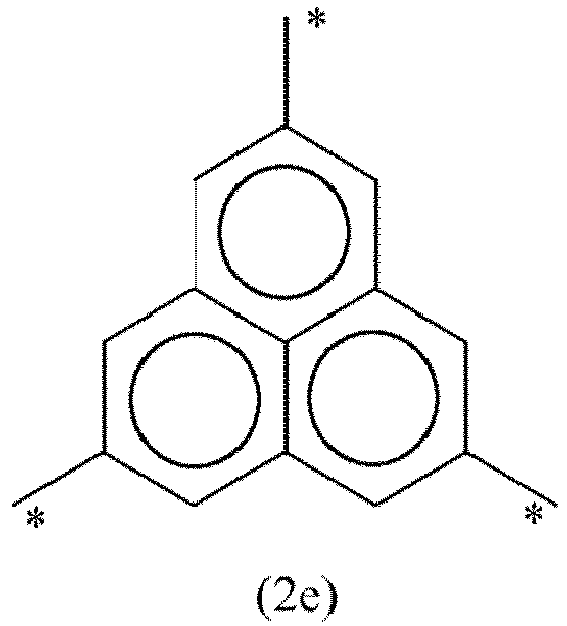
- Examples of the trivalent aromatic group having a fused ring structure in which three 6-membered aromatic rings are fused include the group represented by the following formula (2e). It is noted that "*" in the formulas (2a) to (2e) indicates the positions at which X 1 to X 3 are bonded.
- the aromatic groups represented by the formulas (2a) and (2c) to (2e) may be substituted with a substituent at an arbitrary position.
- a substituent include an alkyl group such as a methyl group, an ethyl group, an isopropyl group, an n-propyl group, and at-butyl group; an alkoxy group such as a methoxy group, an ethoxy group, an n-propoxy group, and an n-butoxy group; a halogen atom such as a fluorine atom, a chlorine atom, and a bromine atom; and the like.
- Ar is preferably the aromatic group represented by the formula (2a) or (2b), and particularly preferably the aromatic group represented by the formula (2b).
- X 1 to X 3 are independently a divalent organic group, or a single bond that directly bonds Ar and Y 1 , Y 2 , or Y 3 .
- the divalent organic group that may be represented by X 1 to X 3 is preferably a group that can form a pi electron conjugated system together with Ar.
- the planarity of the tridentate ligand represented by the formula (1) is improved, and a strong three-dimensional network structure is easily formed.
- the number of carbon atoms of the divalent organic group is preferably 2 to 18, more preferably 2 to 12, and still more preferably 2 to 6.
- Y 1 to Y 3 are independently a monovalent organic group having a coordinating moiety.
- the organic group represented by Y 1 to Y 3 is preferably a group that can form a pi electron conjugated system together with Ar and X 1 to X 3 .
- the planarity of the tridentate ligand represented by the formula (1) is improved, and a strong three-dimensional network structure is easily formed.
- the number of carbon atoms of the organic group represented by Y 1 to Y 3 is preferably 5 to 11, and more preferably 5 to 7.
- Examples of the organic group represented by Y 1 to Y 3 include the organic groups respectively represented by the following formulas (3a) to (3f). It is noted that "*" in the formulas (3a) to (3f) indicates the position at which X 1 , X 2 , or X 3 is bonded.
- the organic groups represented by the formulas (3a) to (3f) may be substituted with a substituent at an arbitrary position.
- substituents include those mentioned above in connection with Ar.
- the group represented by the formula (3a) is particularly preferable as Y 1 to Y 3 .
- the size of the pores and the like of the polynuclear-metal complex can be adjusted by appropriately selecting Ar, X 1 to X 3 , and Y 1 to Y 3 in the tridentate ligand represented by the formula (1).
- the method according to one embodiment of the invention makes it possible to efficiently obtain a stable single crystal of a polynuclear metal complex that has pores and the like having a size sufficient to include an organic compound for which the molecular structure is to be determined.
- the tridentate ligand represented by the formula (1) have high planarity and high symmetry and have a structure in which a pi-conjugated system extends over the entire ligand, since a strong three-dimensional network structure is easily formed.
- Examples of such a tridentate ligand include the ligands respectively represented by the following formulas (4a) to (4f).
- TPT 2,4,6-tris(4-pyridyl)-1,3,5-triazine
- the metal ion that serves as the center metal is not particularly limited as long as the metal ion forms a coordination bond together with the multidentate ligand to form the three-dimensional network structure.
- a known metal ion may be used as the metal ion that serves as the center metal. It is preferable to use an ion of a metal among the metals that belong to Groups 8 to 12 in the periodic table, such as an iron ion, a cobalt ion, a nickel ion, a copper ion, a zinc ion, or a silver ion, and more preferably an ion of a divalent metal among the metals that belong to Groups 8 to 12 in the periodic table.
- a zinc(II) ion or a cobalt(II) ion it is particularly preferable to use a zinc(II) ion or a cobalt(II) ion, since a polynuclear-metal complex having large pores and the like can be easily obtained. Even more preferably is the use of zinc(II) ion.
- the crystalline polynuclear metal complex used in connection with the embodiments of the invention is normally stabilized due to coordination of a monodentate ligand that serves as a counter ion in addition to the neutral multidentate ligand.
- the monodentate ligand include a monovalent anion such as a halogen ion such as a chloride ion (Cl - ), a bromide ion (Br - ) and an iodide ion (I - ), and a thiocyanate ion (SCN - ).
- the monovalent anion is a chloride ion (Cl - ).
- the polynuclear-metal complex used in connection with the embodiments of the invention may include a solvent.
- a solvent such solvent in most instances having only a weak association with the crystalline polynuclear metal complex and can easily being exchanged with another solvent.
- the solvent present in the complex is often result of the method of producing the complex. Frequently for storage purposes the solvent is chloroform (CHCl 3 ) but any other suitable storage solvent may be used in which the crystalline polynuclear metal complex remains intact, for example cyclohexane or n-hexane.
- the solvent may be exchanged prior to use in a process for introducing an analyte guest compound into the complex. Particularly when the crystalline polynuclear metal complex has been stored in chloroform and the solvent used in the process to introduce the analyte guest compound is not chloroform.
- the crystalline polynuclear metal complex used in connection with the embodiments of the invention has the three-dimensional network structure that is formed by the metal ion and the tridentate ligand that is coordinated to the metal ion, and has pores and the like which may be three-dimensionally arranged in the three-dimensional network structure in an ordered manner.
- the pores and the like that are three-dimensionally arranged in the three-dimensional network structure in an ordered manner means that the pores and the like are arranged in the three-dimensional network structure in an ordered manner to such an extent that the pores and the like can be observed by X-ray single crystal structure analysis.
- the three-dimensional network structure is not particularly limited as long as the three-dimensional network structure has the above structural features, and the pores and the like have a size sufficient to include the analyte guest compound, often an organic compound, for which the molecular structure is to be determined.
- the crystalline polynuclear metal complex of the present invention also includes water of hydration into the crystalline polynuclear metal complex thereby forming a hydrated crystalline polynuclear metal complex of the present invention.
- the water of hydration is hydrogen bonded to the crystalline polynuclear metal complex.
- the hydration of the crystalline polynuclear metal complex is from 0.5 to 3 molecules of water per unit of the polynuclear metal complex.
- the amount of water is between 0.5 and 2 molecules of water, even more preferably between 0.5 and 1.5 molecules of water, even more preferably the amount of water is between 1 and 1.5 molecules of water per unit of the polynuclear metal complex.
- the hydrated crystalline polynuclear metal complex has increased stability upon storage. Storage under ambient conditions would not lead to fractures and loss of single crystallinity or even break-up of the three-dimensional network structure of the crystalline material which is observed with unhydrated crystalline material.
- the hydrated crystalline material can be produced with higher yields and increased efficiency. For example, using a method of preparation of such hydrated crystalline material as in one embodiment of the current invention yields bulk material of higher quality.
- the amount of usable crystals of the polynuclear metal complex i.e. crystals of appropriate size of between 100 to 300 ⁇ m and uniformity, is much higher in material produced according to a method as in the current invention.
- the hydrated crystalline polynuclear metal complex material can be produced more economically and can be stored and transported without the need to maintain special storage conditions which may be expensive and/or impractical.
- the hydrated crystalline polynuclear metal complex is produced by a method comprising the steps of: a) layering a volume of a lower alcohol such as for example methanol onto a solution of ligand L in a mixture of an organic (nonpolar) solvent, for example CHCl 3 or cyclohexane or n-hexane, and the lower alcohol such as for example methanol, b) layering onto the volume of the lower alcohol of step a) a solution of MX 2 in a mixture of the lower alcohol and water, c) obtaining a crystalline material after maintaining the solution obtained in step b) for a period of about 1 to 10 days, preferably of about 3 to 7 days, at a temperature of about 15°C to 40°C, preferably at about 20°C to 30°C, and d) washing the crystalline material of step c) with an organic (nonpolar) solvent, for example CHCl 3 or cyclohexane or n-hexane.
- the term lower alcohol refers to an alcohol with 1 to 6, preferably 1 to 4 carbon atoms.
- the lower alcohol is methanol or ethanol, even more preferred is wherein the lower alcohol is methanol.
- the organic (nonpolar) solvent as used herein is a lipophilic solvent such as for example CHCl 3 , cyclohexane or n-hexane.
- the hydrated crystalline polynuclear metal complex includes Zn(ll) as the metal ion.
- the monovalent anion is either chloride (Cl - ) or Iodide (I - ).
- the preferred ligand L is 2,4,6-tris(4-pyridyl)-1,3,5-triazine (TPT).
- the crystalline polynuclear metal complex in a preferred embodiment is represented by [(ZnX 2 ) 3 -(tpt) 2 ] n ⁇ (H 2 O) p , wherein X is a halogen selected from chloride (Cl), iodide (I) and bromide (Br), n is an arbitrary natural number and p is an arbitrary number between 0.5 and 3.
- X is a halogen selected from chloride (CI) and iodide (I).
- the hydrated polynuclear metal complex is [(ZnCl 2 ) 3 (tpt) 2 ] n ⁇ (H 2 O) p .
- the hydrated crystalline polynuclear metal complex is [(ZnCl 2 ) 3 (tpt) 2 ] n ⁇ (H 2 O) 1.5 .
- X is a bromide (Br) the solution of ligand L does not contain nitrobenzene.
- a method for determining a molecular structure of an analysis target compound comprising performing crystal structure analysis using a crystal structure analysis sample obtained by such method for producing the crystal structure analysis sample as in the present invention.
- Example 1 Crystallization of ZnCl 2 -tpt hydrate.
- Example 2 Crystallization of ZnCl 2 -tpt (unhydrated).
- the unhydrated crystalline ZnCl 2 -tpt polynuclear metal complex is prepared as in example 1.
- the ZnCl 2 solution as described in example 1 is prepared as follows. 18.42 mg of ZnCl 2 are dissolved in 2.3 mL methanol. As before, after a period of 7 days for crystallization, crystals of block to short needle shape and a size of 100 - 300 ⁇ m are harvested and stored in CHCl 3 .
- Samples of both the crystalline ZnCl 2 -tpt hydrated and unhydrated material as prepared according to examples 1 and 2 were tested for their stability. All sample material was stored for 51 days at 22°C and at a relative humidity of 73%. After storage the material was visually inspected at a 50-fold magnification. Test samples included both bulk material as well as individual crystal material. The unhydrated crystalline ZnCl 2 -tpt polynuclear metal complex bulk material resulted in a mixture of crystalline material of very small size as well as limited amounts of crystalline material of appropriate size (i.e. between 100 - 300 ⁇ m) (See figure 1A ).
- the hydrated bulk crystalline ZnCl 2 -tpt polynuclear material shows almost exclusively block or short needle shaped crystals of appropriate size (see figure 1B ).
- the hydrated bulk material provides much higher amount of usuable crystalline material compared to the unhydrated material. Therefore, the yield and efficiency are also much higher when producing hydrated crystalline material.
Landscapes
- Chemical & Material Sciences (AREA)
- Organic Chemistry (AREA)
- Crystallography & Structural Chemistry (AREA)
- Engineering & Computer Science (AREA)
- Metallurgy (AREA)
- Materials Engineering (AREA)
- Life Sciences & Earth Sciences (AREA)
- General Health & Medical Sciences (AREA)
- General Physics & Mathematics (AREA)
- Immunology (AREA)
- Pathology (AREA)
- Biochemistry (AREA)
- Analytical Chemistry (AREA)
- Health & Medical Sciences (AREA)
- Physics & Mathematics (AREA)
- Chemical Kinetics & Catalysis (AREA)
- General Chemical & Material Sciences (AREA)
- Analysing Materials By The Use Of Radiation (AREA)
Abstract
The present invention is directed to hydrated crystalline polynuclear metal complexes. These hydrated crystalline metal complexes of the present invention can absorb an analyte guest compound to form a crystal structure analysis sample. The molecular structure of the analyte guest compound can be determined by X-ray crystallography using the crystal structure analysis sample obtained with the hydrated crystalline polynuclear metal complexes.
Description
- The present invention relates to crystalline polynuclear metal complexes and particularly those crystalline polynuclear metal complexes which include a guest compound analyte. Such crystalline polynuclear complexes are useful in crystal structure analysis methods to determine the molecular structure of the guest compound analyte present in the crystalline polynuclear metal complex. The present invention also relates to the use of such crystalline polynuclear complexes in methods for determining the molecular structure of a guest compound analyte through crystal structure analysis.
- X-ray single crystal structure analysis has been known as a method for determining the molecular structure of an organic compound. The molecular structure of an organic compound can be accurately determined using X-ray single crystal structure analysis when it is possible to prepare a high-quality single crystal.
- However, when the amount of organic compound is very small, and it is impossible to obtain a sufficient amount of single crystal, it is difficult to employ X-ray single crystal structure analysis for determining the molecular structure of the organic compound. It is difficult to prepare a single crystal when the organic compound for which the molecular structure is to be determined is liquid at about room temperature (i.e., when the melting point of the organic compound is equal to or lower than room temperature). This difficulty may be for example as a result of the inability of the compound in forming crystals at room temperature. Also, the difficulty can simply be that it is extremely difficult to obtain sufficient quantities of appropriate purity of the compound analyte. The use of a crystalline polynuclear complex, which is porous, acts as a framework to support the compound analyte in an ordered manner.
- The use of crystalline polynuclear metal complexes that can incorporate a guest compound analyte in an ordered manner has enabled the use of X-ray single crystal structure analysis even in instances wherein it is difficult to obtain a sufficient amount of a single crystal of the analyte. Such method of determining the molecular structure of the analyte compound is known as the crystalline sponge method. This emerging technology in X-ray crystallography makes it possible to obtain the crystal structure of non-crystalline (or hard-to-crystallize) compounds, without crystallization, on a microgram scale. The use of crystalline polynuclear metal complexes or crystalline sponges for facilitated structure elucidation of small molecules is described in for example
WO 2014/038220 andWO 2016/143872 and in for example Y. Inokuma et al., Nature 2013, 495, 461-466 (Corrigendum: Nature 2013, 501) and M. Hoshino, et al., IUCrJ, 2016, 3, 139-151. This method uses a porous crystalline polynuclear metal complex, for example [(ZnX2)3•(tpt)2]n (wherein X = Cl or I; and tpt = 2,4,6-tris(4-pyridyl)-1,3,5-triazine) as a crystalline sponge that can absorb small to medium sized organic molecules, orient them uniformly in their pores, and make them observable by conventional single crystal X-ray crystallography. - In order to prepare a crystalline polynuclear metal complex which envelops a guest compound analyte the crystalline polynuclear metal complex is first prepared in an appropriate solvent for the crystallization of the crystalline polynuclear metal complex. The obtained crystalline polynuclear metal complex can be used immediately in a subsequent step to introduce the guest compound analyte or can be stored for later use. Storage of the crystalline polynuclear metal complex is generally in an appropriate storage solvent.
- Although these methods using crystalline polynuclear metal complexes have been successful under certain conditions, the quality of the crystalline polynuclear metal complexes is often insufficient for the accurate determination of the molecular structure of a guest compound analyte.
- Currently, the most widely used crystalline sponge material is the chloride based crystalline polynuclear metal complex [(ZnCl2)3(tpt)2]n. However, the single crystals of this material are very sensitive to minute amounts of water, which is ubiquitous for example in the form of ambient humidity or present in small amounts in organic solvents. Upon contact with the crystalline polynuclear metal complex, such water molecules are rapidly incorporated into the sponge material, leading to rapid changes in the local crystal structure. These changes induce a high level of internal stress due to the misfit of compartments free of water and those containing water. These misfits in turn give rise to formation of cracks and therefore loss of single crystallinity or complete destruction of the crystals rendering such crystalline polynuclear metal complexes unusable for the crystalline sponge X-ray crystallography technology.
- As a result, the crystalline sponge X-ray crystallography technology when using these crystalline polynuclear metal complexes requires strict use of freshly prepared material or storage of previously prepared crystalline material under strictly controlled dry conditions (such as dry protecting atmospheres) as well as use of dry solvents and analytes. Such requirements complicate and may limit the use of the crystalline sponge X-ray crystallography technology.
- The current invention provides a solution to the above described limitations on the use of the crystalline polynuclear metal complexes, particularly those using zinc-halogen based crystalline polynuclear metal complex such as for example [(ZnCl2)3(tpt)2]n. The present invention provides for a hydrated crystalline polynuclear metal complex exhibiting the same metal-organic framework but containing certain amounts of water. The water already present in the crystal lattice reduces the hygroscopicity of the crystalline polynuclear metal complex material and therefore stabilizes against the rapid uptake of water and the subsequent destruction of the crystalline structure. The hydrated material of the present invention is usable in crystalline sponge X-ray crystallography methods and can be stored under conditions without having the precautionary methods required for conventional crystalline polynuclear metal complexes used in this technology.
- In one embodiment the present invention provides a hydrated crystalline polynuclear metal complex, wherein the hydrated polynuclear metal complex is represented by [[M(X)2]3(L)2]n · (H2O)p wherein
M is a metal ion,
X is a monovalent anion,
L is a tridentate ligand represented by formula (1),
n is an arbitrary natural number, and
p is an arbitrary number,
wherein the amount of hydration of the polynuclear metal complex represented by the value p is such that p has a value between 0.5 to 3 and wherein water of hydration is hydrogen bonded to the polynuclear metal complex. - In another embodiment there is provided a method of preparing a hydrated crystalline polynuclear metal complex comprising the steps of:
- a) layering a volume of a lower alcohol, for example methanol, onto a solution of ligand L in a mixture of an organic (nonpolar) solvent, for example CHCl3, cyclohexane or n-hexane, and the lower alcohol, for example methanol,
- b) layering onto the volume of the lower alcohol of step a) a solution of MX2 in a mixture of the lower alcohol and water,
- c) obtaining a crystalline material after maintaining the solution obtained in step b) for a period of 1 to 10, preferably 3 to 7 days at a temperature of 15°C to 40°C, preferably at 20°C to 30°C, and
- d) washing the crystalline material of step c) with an organic (nonpolar) solvent, for example with CHCl3 or cyclohexane or n-hexane.
- In yet another embodiment there is provided method of producing a crystal structure analysis sample, comprising bringing a hydrated crystalline polynuclear metal complex of the present invention into contact with an analysis target compound (analyte) containing solution to arrange molecules of an analyte in the pores and/or voids of the hydrated crystalline polynuclear metal complex in an ordered manner.
- In another embodiment of the present invention there is provided a method for determining a molecular structure of an analysis target compound, comprising performing crystal structure analysis using a crystal structure analysis sample obtained by a method for producing the crystal structure analysis sample using a hydrated crystalline polynuclear metal complex of the present invention.
-
-
Figure 1 : Shows bulk crystalline polynuclear metal complex material in its unhydrated form and its hydrated form after storage for 51 days at 22°C and 73% relative humidity. Infigure 1A is shown bulk unhydrated crystalline [(ZnCl2)3(tpt)2]n.Figure 1B shows bulk hydrated crystalline [(ZnCl2)3(tpt)2]n · (H2O)1.5. The pictures in bothfigure 1A and 1B are at a 50-fold magnification. -
Figure 2 : Shows an individual crystal of unhydrated and hydrated crystalline polynuclear metal complex after storage for 51 days at 22°C and 73% relative humidity. Infigure 2A an unhydrated [(ZnCl2)3(tpt)2]n is shown whereas infigure 2B a hydrated [(ZnCl2)3(tpt)2]n · (H2O)1.5 is shown. The pictures in bothfigure 2A and 2B are both at a 50-fold magnification. - A hydrated crystalline polynuclear metal complex and its use in single crystal X-ray crystallography for the elucidation of the molecular structure of an analyte guest compound, as well as methods of preparing such hydrated crystalline polynuclear metal complex are described in detail below.
- The hydrated crystalline polynuclear metal complex used in connection with the embodiments of the invention has a three-dimensional network structure that includes a ligand having coordinating moieties, and a metal ion that serves as a center metal. The term "three-dimensional network structure" used herein refers to a network-like structure in which a structural unit formed by a ligand (i.e., a ligand having two or more coordinating moieties and an additional monodentate ligand) and a metal ion that is bonded to the ligand is repeatedly arranged three-dimensionally.
- The three-dimensional network structure results in the hydrated crystalline polynuclear metal complex of the present invention to have a porous structure. Such porous structure enables the capturing of an analyte guest compound within the porous structure of the hydrated crystalline polynuclear metal complex. As such the crystalline polynuclear metal complex acts as a "sponge" for the analyte guest compound. Introduction of such analyte guest compound in a hydrated crystalline complex of the present invention allows for the organized arrangement of the analyte guest compound within the complex molecule. This organized arrangement of the analyte guest compound enables the use of single crystal X-ray crystallography to elucidate the molecular structure of the analyte guest compound. Therefore, the single crystal X-ray crystallography method using such crystalline polynuclear metal complexes is often referred to as the Crystalline Sponge (CS) X-ray crystallography method.
- Any disruption of the organized porous structure of the crystalline polynuclear metal complex (crystalline sponge) has a detrimental effect on the usability of the crystalline polynuclear metal complex as a support structure ("sponge structure") for the analyte guest compound in single crystal X-ray crystallography. Water, even in minute amounts, can have such destructive effect on the crystallinity of the crystalline polynuclear metal complexes. Water is ubiquitous for example in the form of ambient humidity or present in small amounts in organic solvents. Upon contact with the crystalline polynuclear metal complex, such water molecules will be rapidly incorporated into the sponge material, leading to rapid changes in the local crystal structure giving rise to fractures and loss of single crystallinity or even break-up of the three-dimensional network structure. The present invention described herein is directed to hydrated crystalline polynuclear metal complexes which are much less susceptible or sensitive to small amounts of water in the environment.
- The hydrated crystalline polynuclear metal complex includes a coordinating metal complex is represented by [[M(X)2]3(L)2]n · (H2O)p wherein
M is a metal ion,
X is a monovalent anion,
L is a tridentate ligand represented by formula (1),
n is an arbitrary natural number, and
p is an arbitrary number,
wherein the amount of hydration of the polynuclear metal complex represented by the value p is such that p has a value between 0.5 to 3 and wherein water of hydration is hydrogen bonded to the polynuclear metal complex. - The tridentate aromatic ligand Ar in the formula (1) is a trivalent aromatic group. The number of carbon atoms of Ar is normally 3 to 22, preferably 3 to 13, and more preferably 3 to 6. Examples of Ar include a trivalent aromatic group having a monocyclic structure that consists of one 6-membered aromatic ring, and a trivalent aromatic group having a fused ring structure in which three 6-membered aromatic rings are fused.
- Examples of the trivalent aromatic group having a monocyclic structure that consists of one 6-membered aromatic ring include the groups respectively represented by the following formulas (2a) to (2d). Examples of the trivalent aromatic group having a fused ring structure in which three 6-membered aromatic rings are fused, include the group represented by the following formula (2e). It is noted that "*" in the formulas (2a) to (2e) indicates the positions at which X1 to X3 are bonded.

- The aromatic groups represented by the formulas (2a) and (2c) to (2e) may be substituted with a substituent at an arbitrary position. Examples of a substituent include an alkyl group such as a methyl group, an ethyl group, an isopropyl group, an n-propyl group, and at-butyl group; an alkoxy group such as a methoxy group, an ethoxy group, an n-propoxy group, and an n-butoxy group; a halogen atom such as a fluorine atom, a chlorine atom, and a bromine atom; and the like. Ar is preferably the aromatic group represented by the formula (2a) or (2b), and particularly preferably the aromatic group represented by the formula (2b).
- X1 to X3 are independently a divalent organic group, or a single bond that directly bonds Ar and Y1, Y2, or Y3. The divalent organic group that may be represented by X1 to X3 is preferably a group that can form a pi electron conjugated system together with Ar. When the divalent organic group that may be represented by X1 to X3 forms a pi electron conjugated system, the planarity of the tridentate ligand represented by the formula (1) is improved, and a strong three-dimensional network structure is easily formed. The number of carbon atoms of the divalent organic group is preferably 2 to 18, more preferably 2 to 12, and still more preferably 2 to 6.
- Y1 to Y3 are independently a monovalent organic group having a coordinating moiety. The organic group represented by Y1 to Y3 is preferably a group that can form a pi electron conjugated system together with Ar and X1 to X3. When the organic group represented by Y1 to Y3 forms a pi electron conjugated system, the planarity of the tridentate ligand represented by the formula (1) is improved, and a strong three-dimensional network structure is easily formed.
- The number of carbon atoms of the organic group represented by Y1 to Y3 is preferably 5 to 11, and more preferably 5 to 7. Examples of the organic group represented by Y1 to Y3 include the organic groups respectively represented by the following formulas (3a) to (3f). It is noted that "*" in the formulas (3a) to (3f) indicates the position at which X1, X2, or X3 is bonded.

- The organic groups represented by the formulas (3a) to (3f) may be substituted with a substituent at an arbitrary position. Examples of the substituent include those mentioned above in connection with Ar. The group represented by the formula (3a) is particularly preferable as Y1 to Y3.
- The size of the pores and the like of the polynuclear-metal complex can be adjusted by appropriately selecting Ar, X1 to X3, and Y1 to Y3 in the tridentate ligand represented by the formula (1). The method according to one embodiment of the invention makes it possible to efficiently obtain a stable single crystal of a polynuclear metal complex that has pores and the like having a size sufficient to include an organic compound for which the molecular structure is to be determined.
- It is preferable that the tridentate ligand represented by the formula (1) have high planarity and high symmetry and have a structure in which a pi-conjugated system extends over the entire ligand, since a strong three-dimensional network structure is easily formed. Examples of such a tridentate ligand include the ligands respectively represented by the following formulas (4a) to (4f).


- Among these, 2,4,6-tris(4-pyridyl)-1,3,5-triazine (TPT) represented by the formula (4a) is particularly preferable as the tridentate ligand represented by the formula (1).
- The metal ion that serves as the center metal is not particularly limited as long as the metal ion forms a coordination bond together with the multidentate ligand to form the three-dimensional network structure. A known metal ion may be used as the metal ion that serves as the center metal. It is preferable to use an ion of a metal among the metals that belong to Groups 8 to 12 in the periodic table, such as an iron ion, a cobalt ion, a nickel ion, a copper ion, a zinc ion, or a silver ion, and more preferably an ion of a divalent metal among the metals that belong to Groups 8 to 12 in the periodic table. It is particularly preferable to use a zinc(II) ion or a cobalt(II) ion, since a polynuclear-metal complex having large pores and the like can be easily obtained. Even more preferably is the use of zinc(II) ion.
- The crystalline polynuclear metal complex used in connection with the embodiments of the invention is normally stabilized due to coordination of a monodentate ligand that serves as a counter ion in addition to the neutral multidentate ligand. Examples of the monodentate ligand include a monovalent anion such as a halogen ion such as a chloride ion (Cl-), a bromide ion (Br-) and an iodide ion (I-), and a thiocyanate ion (SCN-). Preferably the monovalent anion is a chloride ion (Cl-).
- The polynuclear-metal complex used in connection with the embodiments of the invention may include a solvent. Such solvent in most instances having only a weak association with the crystalline polynuclear metal complex and can easily being exchanged with another solvent. The solvent present in the complex is often result of the method of producing the complex. Frequently for storage purposes the solvent is chloroform (CHCl3) but any other suitable storage solvent may be used in which the crystalline polynuclear metal complex remains intact, for example cyclohexane or n-hexane. The solvent may be exchanged prior to use in a process for introducing an analyte guest compound into the complex. Particularly when the crystalline polynuclear metal complex has been stored in chloroform and the solvent used in the process to introduce the analyte guest compound is not chloroform.
- The crystalline polynuclear metal complex used in connection with the embodiments of the invention has the three-dimensional network structure that is formed by the metal ion and the tridentate ligand that is coordinated to the metal ion, and has pores and the like which may be three-dimensionally arranged in the three-dimensional network structure in an ordered manner.
- The expression "the pores and the like that are three-dimensionally arranged in the three-dimensional network structure in an ordered manner" means that the pores and the like are arranged in the three-dimensional network structure in an ordered manner to such an extent that the pores and the like can be observed by X-ray single crystal structure analysis. The three-dimensional network structure is not particularly limited as long as the three-dimensional network structure has the above structural features, and the pores and the like have a size sufficient to include the analyte guest compound, often an organic compound, for which the molecular structure is to be determined.
- To reduce or ameliorate the deleterious effect of water on the crystalline polynuclear metal complex, the crystalline polynuclear metal complex of the present invention also includes water of hydration into the crystalline polynuclear metal complex thereby forming a hydrated crystalline polynuclear metal complex of the present invention. The water of hydration is hydrogen bonded to the crystalline polynuclear metal complex. The hydration of the crystalline polynuclear metal complex is from 0.5 to 3 molecules of water per unit of the polynuclear metal complex. Preferable the amount of water is between 0.5 and 2 molecules of water, even more preferably between 0.5 and 1.5 molecules of water, even more preferably the amount of water is between 1 and 1.5 molecules of water per unit of the polynuclear metal complex.
- The hydrated crystalline polynuclear metal complex has increased stability upon storage. Storage under ambient conditions would not lead to fractures and loss of single crystallinity or even break-up of the three-dimensional network structure of the crystalline material which is observed with unhydrated crystalline material. In addition, the hydrated crystalline material can be produced with higher yields and increased efficiency. For example, using a method of preparation of such hydrated crystalline material as in one embodiment of the current invention yields bulk material of higher quality. The amount of usable crystals of the polynuclear metal complex, i.e. crystals of appropriate size of between 100 to 300 µm and uniformity, is much higher in material produced according to a method as in the current invention. As a result of these advantages, the hydrated crystalline polynuclear metal complex material can be produced more economically and can be stored and transported without the need to maintain special storage conditions which may be expensive and/or impractical.
- In one embodiment the hydrated crystalline polynuclear metal complex is produced by a method comprising the steps of: a) layering a volume of a lower alcohol such as for example methanol onto a solution of ligand L in a mixture of an organic (nonpolar) solvent, for example CHCl3 or cyclohexane or n-hexane, and the lower alcohol such as for example methanol, b) layering onto the volume of the lower alcohol of step a) a solution of MX2 in a mixture of the lower alcohol and water, c) obtaining a crystalline material after maintaining the solution obtained in step b) for a period of about 1 to 10 days, preferably of about 3 to 7 days, at a temperature of about 15°C to 40°C, preferably at about 20°C to 30°C, and d) washing the crystalline material of step c) with an organic (nonpolar) solvent, for example CHCl3 or cyclohexane or n-hexane. As used herein the term lower alcohol refers to an alcohol with 1 to 6, preferably 1 to 4 carbon atoms. In a preferred embodiment the lower alcohol is methanol or ethanol, even more preferred is wherein the lower alcohol is methanol. Preferably the organic (nonpolar) solvent as used herein is a lipophilic solvent such as for example CHCl3, cyclohexane or n-hexane.
- In a preferred embodiment of the present invention, the hydrated crystalline polynuclear metal complex includes Zn(ll) as the metal ion. In such preferred embodiment the monovalent anion is either chloride (Cl-) or Iodide (I-). In such hydrated crystalline polynuclear metal complex the preferred ligand L is 2,4,6-tris(4-pyridyl)-1,3,5-triazine (TPT). As such in hydrated form the crystalline polynuclear metal complex in a preferred embodiment is represented by [(ZnX2)3-(tpt)2]n · (H2O)p, wherein X is a halogen selected from chloride (Cl), iodide (I) and bromide (Br), n is an arbitrary natural number and p is an arbitrary number between 0.5 and 3. Preferably, X is a halogen selected from chloride (CI) and iodide (I). More preferably the hydrated polynuclear metal complex is [(ZnCl2)3(tpt)2]n · (H2O)p. Even more preferably the hydrated crystalline polynuclear metal complex is [(ZnCl2)3(tpt)2]n · (H2O)1.5. In embodiments wherein X is a bromide (Br) the solution of ligand L does not contain nitrobenzene.
- The hydrated crystalline polynuclear metal complexes of the present invention can be used in any known method for use in the sponge method of single crystal X-ray crystallography to determine the molecular structure of an analysis target compound. In such sponge method an analysis target compound is first introduced into the hydrated crystalline polynuclear metal complex of the present invention to obtain a crystal structure analysis sample. Such crystal structure analysis sample may be obtained by a method comprising bringing the hydrated single crystal polynuclear metal complex of the present invention into contact with an analysis target compound (analyte) containing solution to absorb molecules of an analyte in the pores and/or voids of the hydrated single crystal polynuclear metal complex. Considering that the pores in the hydrate crystalline polynuclear metal complex of the present invention are regularly and ordered such analyte is absorbed in an ordered manner in order to be useful a method to determine the molecular structure by X-ray crystallography.
- As such, in another embodiment of the present invention there is provided a method for determining a molecular structure of an analysis target compound, comprising performing crystal structure analysis using a crystal structure analysis sample obtained by such method for producing the crystal structure analysis sample as in the present invention.
- 21.27 mg tris(4-pyridyl)-1,3,5-triazine (tpt) is dissolved in a mixture of 16 mL CHCl3 and 0.833 mL methanol. 18.42 mg of ZnCl2 are dissolved in a mixture of 2 mL methanol and 300 µL water. A test tube is filled with 5 mL of the tpt solution. 400 µL MeOH is carefully layered on top of the tpt solution. Finally, 600 µL of a ZnCl2 solution is carefully layered on top of the methanol layer while avoiding instant mixing of the solutions. The so prepared layered solutions are kept in a closed environment at ambient temperature for ca. 7 days.
- After seven days, crystals of block to short needle shape and a size of 100 - 300 µm are harvested and stored in CHCl3.
- The unhydrated crystalline ZnCl2-tpt polynuclear metal complex is prepared as in example 1. However, the ZnCl2 solution as described in example 1 is prepared as follows. 18.42 mg of ZnCl2 are dissolved in 2.3 mL methanol. As before, after a period of 7 days for crystallization, crystals of block to short needle shape and a size of 100 - 300 µm are harvested and stored in CHCl3.
- Samples of both the crystalline ZnCl2-tpt hydrated and unhydrated material as prepared according to examples 1 and 2 were tested for their stability. All sample material was stored for 51 days at 22°C and at a relative humidity of 73%. After storage the material was visually inspected at a 50-fold magnification. Test samples included both bulk material as well as individual crystal material. The unhydrated crystalline ZnCl2-tpt polynuclear metal complex bulk material resulted in a mixture of crystalline material of very small size as well as limited amounts of crystalline material of appropriate size (i.e. between 100 - 300 µm) (See
figure 1A ). In contrast, the hydrated bulk crystalline ZnCl2-tpt polynuclear material shows almost exclusively block or short needle shaped crystals of appropriate size (seefigure 1B ). As a result, the hydrated bulk material provides much higher amount of usuable crystalline material compared to the unhydrated material. Therefore, the yield and efficiency are also much higher when producing hydrated crystalline material. - In addition, when comparing a single unhydrated crystal ZnCl2-tpt polynuclear metal complex (as in
figure 2A ) with a single hydrated crystal ZnCl2-tpt polynuclear metal complex (as infigure 2B ) stored under the same conditions, it is clear that the hydrated material is significantly more stable. The unhydrated ZnCl2-tpt polynuclear metal complex as shown infigure 2A shows deterioration, including fraction-lines and severe discoloration. In contrast, the hydrated ZnCl2-tpt polynuclear metal complex as shown infigure 2B shows that even after storage for 51 days under the same conditions as the unhydrated material no deterioration can be observed, and the single crystal is smooth and of uniform color.
Claims (17)
- A hydrated crystalline polynuclear metal complex, wherein the hydrated polynuclear metal complex is represented by [[M(X)2]3(L)2]n · (H2O)p wherein
M is a metal ion,
X is a monovalent anion,
L is a tridentate ligand represented by formula (1),
n is an arbitrary natural number, and
p is an arbitrary number,
wherein the amount of hydration of the polynuclear metal complex represented by the value p is such that p has a value between 0.5 to 3 and wherein water of hydration is hydrogen bonded to the polynuclear metal complex. - The hydrated crystalline polynuclear metal complex of claim 1, wherein p has a value between 0.5 to 2.
- The hydrated crystalline polynuclear metal complex of claim 2, wherein p has a value between 1 and 1.5.
- The hydrated crystalline polynuclear metal complex of any one of the preceding claims, wherein the hydrated polynuclear metal complex is [(ZnX2)3(tpt)2]n · (H2O)p.
- The hydrated crystalline polynuclear metal complex of claim 4, wherein the hydrated polynuclear metal complex is [(ZnCl2)3(tpt)2]n · (H2O)p.
- The hydrated crystalline polynuclear metal complex of claim 5, wherein the hydrated polynuclear metal complex is [(ZnCl2)3(tpt)2]n · (H2O)1.5.
- The hydrated crystalline polynuclear metal complex of any of the preceding claims, wherein the hydrated polynuclear metal complex has a porous structure.
- The hydrated crystalline polynuclear metal complex of any of the preceding claims, wherein X is a halogen selected from the group consisting of CI, and I.
- The hydrated crystalline polynuclear metal complex of any one of the preceding claims, wherein the hydrated polynuclear complex is obtained by a method comprising the steps of:a) layering a volume of a lower alcohol onto a solution of ligand L in a mixture of an organic (nonpolar) solvent and the lower alcohol,b) layering onto the volume of methanol of step a) a solution of MX2 in a mixture of the lower alcohol and water,c) obtaining a crystalline material after maintaining the solution obtained in step b) for a period of 1 to 10 days, preferably 3 to 7 days, at a temperature of 15°C to 40°C, preferably at 20°C to 30°C, andd) washing the crystalline material of step c) with an organic (nonpolar) solvent.
- The hydrated crystalline polynuclear metal complex of claim 7, wherein when X is Br the solution of ligand L does not contain nitrobenzene.
- The hydrated crystalline polynuclear metal complex of any one of claims 9 or 10, wherein the ligand L is 2,4,6-tris(4-pyridyl)-1,3,5-triazine (tpt) and MX2 is ZnCl2.
- The hydrated crystalline polynuclear metal complex of any one of claims 9 to 11, wherein the mixture of lower alcohol/water is a mixture of methanol and water at a volume ratio of 20:3.
- The hydrated crystalline polynuclear metal complex of any one of claims 9 to 12, wherein the mixture of the organic (nonpolar) solvent and lower alcohol is a mixture of CHCl3 and methanol at a volume ratio of 19:1.
- The hydrated crystalline polynuclear metal complex of any one of claims 9 to 13, wherein the volume ratio of the solution of ligand L in a mixture of CHCl3/methanol to the volume of methanol to the solution of MX2 in a mixture of methanol/water is 25 : 2 : 3.
- A method of producing a crystal structure analysis sample, comprising bringing the hydrated single crystal polynuclear metal complex according to any one of claims 1 to 14 into contact with an analysis target compound (analyte) containing solution to arrange molecules of an analyte in the pores and/or voids of the hydrated single crystal polynuclear metal complex in an ordered manner.
- A method for determining a molecular structure of an analysis target compound, comprising performing crystal structure analysis using a crystal structure analysis sample obtained by a method for producing the crystal structure analysis sample according to claim 15.
- A method of preparing a hydrated crystalline polynuclear metal complex comprising the steps of:a) layering a volume of methanol onto a solution of ligand L in a mixture of an organic (nonpolar) solvent and a lower alcohol,b) layering onto the volume of the lower alcohol of step a) a solution of MX2 in a mixture of the lower alcohol and water,c) obtaining a crystalline material after maintaining the solution obtained in step b) for a period of 1 to 10 days, preferably 3 to 7 days at a temperature of 15°C to 40°C, preferably at 20°C to 30°C, andd) washing the crystalline material of step c) with an organic (nonpolar) solvent.
Priority Applications (2)
| Application Number | Priority Date | Filing Date | Title |
|---|---|---|---|
| EP20156456.4A EP3862349A1 (en) | 2020-02-10 | 2020-02-10 | Hydrated crystalline polynuclear metal complex, hydrated crystalline polynuclear metal complex including a guest compound analyte and its use in a method for determining molecular structure of the guest compound analyte |
| TW110105379A TW202136277A (en) | 2020-02-10 | 2021-02-17 | Hydrated crystalline polynuclear metal complex, hydrated crystalline polynuclear metal complex including a guest compound analyte and its use in a method for determining molecular structure of the guest compound analyte |
Applications Claiming Priority (1)
| Application Number | Priority Date | Filing Date | Title |
|---|---|---|---|
| EP20156456.4A EP3862349A1 (en) | 2020-02-10 | 2020-02-10 | Hydrated crystalline polynuclear metal complex, hydrated crystalline polynuclear metal complex including a guest compound analyte and its use in a method for determining molecular structure of the guest compound analyte |
Publications (1)
| Publication Number | Publication Date |
|---|---|
| EP3862349A1 true EP3862349A1 (en) | 2021-08-11 |
Family
ID=69570571
Family Applications (1)
| Application Number | Title | Priority Date | Filing Date |
|---|---|---|---|
| EP20156456.4A Withdrawn EP3862349A1 (en) | 2020-02-10 | 2020-02-10 | Hydrated crystalline polynuclear metal complex, hydrated crystalline polynuclear metal complex including a guest compound analyte and its use in a method for determining molecular structure of the guest compound analyte |
Country Status (2)
| Country | Link |
|---|---|
| EP (1) | EP3862349A1 (en) |
| TW (1) | TW202136277A (en) |
Cited By (1)
| Publication number | Priority date | Publication date | Assignee | Title |
|---|---|---|---|---|
| CN114441571A (en) * | 2022-01-25 | 2022-05-06 | 苏州青云瑞晶生物科技有限公司 | Method for determining molecular structure based on three-dimensional electron diffraction |
Citations (4)
| Publication number | Priority date | Publication date | Assignee | Title |
|---|---|---|---|---|
| US20100105901A1 (en) * | 2007-03-07 | 2010-04-29 | The University Of Tokyo | Synthesis method of polymer complex crystal |
| WO2014038220A1 (en) | 2012-09-07 | 2014-03-13 | 独立行政法人 科学技術振興機構 | Guest-compound-enveloping polymer-metal-complex crystal, method for producing same, method for preparing crystal structure analysis sample, and method for determining molecular structure of organic compound |
| WO2016143872A1 (en) | 2015-03-10 | 2016-09-15 | 国立大学法人東京大学 | Single crystal of porous compound, method for assessing quality of single crystal, method for preparing solution including compound to be analyzed, method for producing crystal structure analysis sample, and method for determining molecular structure of compound to be analyzed |
| CN108586503A (en) * | 2018-04-14 | 2018-09-28 | 桂林理工大学 | 4 '-phenyl -2,2 ':The preparation method of 6 ', 2 ' '-terpyridyl nitric acid Nd complex |
-
2020
- 2020-02-10 EP EP20156456.4A patent/EP3862349A1/en not_active Withdrawn
-
2021
- 2021-02-17 TW TW110105379A patent/TW202136277A/en unknown
Patent Citations (5)
| Publication number | Priority date | Publication date | Assignee | Title |
|---|---|---|---|---|
| US20100105901A1 (en) * | 2007-03-07 | 2010-04-29 | The University Of Tokyo | Synthesis method of polymer complex crystal |
| WO2014038220A1 (en) | 2012-09-07 | 2014-03-13 | 独立行政法人 科学技術振興機構 | Guest-compound-enveloping polymer-metal-complex crystal, method for producing same, method for preparing crystal structure analysis sample, and method for determining molecular structure of organic compound |
| WO2016143872A1 (en) | 2015-03-10 | 2016-09-15 | 国立大学法人東京大学 | Single crystal of porous compound, method for assessing quality of single crystal, method for preparing solution including compound to be analyzed, method for producing crystal structure analysis sample, and method for determining molecular structure of compound to be analyzed |
| EP3269849A1 (en) * | 2015-03-10 | 2018-01-17 | The University of Tokyo | Single crystal of porous compound, method for assessing quality of single crystal, method for preparing solution including compound to be analyzed, method for producing crystal structure analysis sample, and method for determining molecular structure of compound to be analyzed |
| CN108586503A (en) * | 2018-04-14 | 2018-09-28 | 桂林理工大学 | 4 '-phenyl -2,2 ':The preparation method of 6 ', 2 ' '-terpyridyl nitric acid Nd complex |
Non-Patent Citations (3)
| Title |
|---|
| JAVIER MARTÍ-RUJAS ET AL: "Solid-liquid interface synthesis of microcrystalline porous coordination networks", CHEMICAL COMMUNICATIONS, vol. 46, no. 35, 10 August 2010 (2010-08-10), pages 6515, XP055711668, ISSN: 1359-7345, DOI: 10.1039/c0cc01141j * |
| M. HOSHINO ET AL., IUCRJ, vol. 3, 2016, pages 139 - 151 |
| Y. INOKUMA ET AL., NATURE, vol. 495, 2013, pages 461 - 466 |
Cited By (2)
| Publication number | Priority date | Publication date | Assignee | Title |
|---|---|---|---|---|
| CN114441571A (en) * | 2022-01-25 | 2022-05-06 | 苏州青云瑞晶生物科技有限公司 | Method for determining molecular structure based on three-dimensional electron diffraction |
| CN114441571B (en) * | 2022-01-25 | 2024-04-23 | 苏州青云瑞晶生物科技有限公司 | Method for determining molecular structure based on three-dimensional electron diffraction |
Also Published As
| Publication number | Publication date |
|---|---|
| TW202136277A (en) | 2021-10-01 |
Similar Documents
| Publication | Publication Date | Title |
|---|---|---|
| US10487420B2 (en) | Single crystal of porous compound, method for assessing quality of single crystal, method for preparing solution including compound to be analyzed, method for producing crystal structure analysis sample, and method for determining molecular structure of compound to be analyzed | |
| EP3118610B1 (en) | Method of preparing sample for crystal structure analysis, method of determining absolute configuration of chiral compound, and polynuclear metal complex monocrystal | |
| Kondo et al. | Vapochromic luminescence of a spin-coated copper (I) complex thin film by the direct coordination of vapour molecules | |
| US20230096322A1 (en) | Hydrated crystalline polynuclear metal complex, hydrated crystalline polynuclear metal complex including a guest compound analyte and its use in a method for determining molecular structure of the guest compound analyte | |
| Hasegawa et al. | Chiroptical spectroscopic studies on lanthanide complexes with valinamide derivatives in solution | |
| EP3862349A1 (en) | Hydrated crystalline polynuclear metal complex, hydrated crystalline polynuclear metal complex including a guest compound analyte and its use in a method for determining molecular structure of the guest compound analyte | |
| US20240151663A1 (en) | Selection method for conditions to introduce a guest analyte compound into crystalline polynuclear metal complex for use of such crystalline polynuclear metal complex including a guest compound analyte in a method for determining molecular structure of the guest compound analyte | |
| Li et al. | Luminescent Amphiphilic 2, 6‐Bis (1, 2, 3‐triazol‐4‐yl) pyridine Platinum (II) Complexes: Synthesis, Characterization, Electrochemical, Photophysical, and Langmuir–Blodgett Film‐Formation Studies | |
| Barszcz et al. | Synthesis of new pyrazole-containing binuclear and mononuclear Cu (II) complexes: crystal structure, EPR, magnetic and spectroscopic properties | |
| JP2024504644A (en) | Determining the molecular structure of a solvated crystalline polynuclear metal complex solvated using a mixture of apolar and polar solvents, such solvated crystalline polynuclear metal complex containing a guest compound analyte, and the guest compound analyte. Its use in methods | |
| Hollander et al. | Investigations of alkaline-earth β-diketone complexes. I. The crystal and molecular structure of bis (dimethylformamido) bis (1, 3-diphenyl-1, 3-propanedionato) magnesium | |
| Tidmarsh et al. | Tri-, tetra-and octa-metallic vanadium (III) clusters from new, simple starting materials: interplay of exchange and anisotropy effects | |
| SHIROTANI et al. | Solvate formation of griseofulvin with alkyl halide and alkyl dihalides | |
| CN104725407B (en) | One-dimensional chain chirality Zn (II) fluorescence complex and hydrothermal synthesis method thereof are applied with fluorescent probe | |
| CN111562230B (en) | A method for measuring dye content in dye/metal organic framework composites | |
| Zhang et al. | Ionic Crystals of Na {[TM (phen) 3][Eu (dpa) 3]}· 17H2O (TM= Ni, Co): Single-Crystal Structure and Luminescence Properties | |
| JP2023080669A (en) | Single crystal of porous polymer compound, sample for crystal structure analysis, and method for determining molecular structure of compound to be analyzed | |
| Ruser et al. | Syntheses and crystal structures of the cerium-based coordination polymers poly [(acetic acid) bis (μ-5-carboxythiophene-2-carboxylato) bis (μ-thiophene-2, 5-dicarboxylato) dicerium (III)] and poly [(μ-acetato) aqua (μ4-thiophene-2, 5-dicarboxylato) cerium (III)] | |
| Hartwell et al. | Some Quaternary Ammonium Salts of Heterocyclic Bases. II1, 2 | |
| Schoemaker et al. | kk SV. Njtor P.(ast | |
| Cavallo et al. | Tailoring the Crystal Structure of Nanoclusters Unveiled High Photoluminescence via lon Pairing Megalamane S. Bootharaju." Sergey M. Kozlov Zhen Cao." Aleksander Shkurenko | |
| CN104860968A (en) | Azo triazole zn (II) complex-based high temperature hydrothermal synthesis and application |
Legal Events
| Date | Code | Title | Description |
|---|---|---|---|
| PUAI | Public reference made under article 153(3) epc to a published international application that has entered the european phase |
Free format text: ORIGINAL CODE: 0009012 |
|
| STAA | Information on the status of an ep patent application or granted ep patent |
Free format text: STATUS: THE APPLICATION HAS BEEN PUBLISHED |
|
| AK | Designated contracting states |
Kind code of ref document: A1 Designated state(s): AL AT BE BG CH CY CZ DE DK EE ES FI FR GB GR HR HU IE IS IT LI LT LU LV MC MK MT NL NO PL PT RO RS SE SI SK SM TR |
|
| STAA | Information on the status of an ep patent application or granted ep patent |
Free format text: STATUS: THE APPLICATION IS DEEMED TO BE WITHDRAWN |
|
| 18D | Application deemed to be withdrawn |
Effective date: 20220212 |