EP3861145B1 - Abgasturbolader, der einen stahl-werkstoff für hochtemperatur-anwendungen aufweist - Google Patents
Abgasturbolader, der einen stahl-werkstoff für hochtemperatur-anwendungen aufweist Download PDFInfo
- Publication number
- EP3861145B1 EP3861145B1 EP19782583.9A EP19782583A EP3861145B1 EP 3861145 B1 EP3861145 B1 EP 3861145B1 EP 19782583 A EP19782583 A EP 19782583A EP 3861145 B1 EP3861145 B1 EP 3861145B1
- Authority
- EP
- European Patent Office
- Prior art keywords
- exhaust
- turbine
- exhaust gas
- steel material
- gas turbocharger
- Prior art date
- Legal status (The legal status is an assumption and is not a legal conclusion. Google has not performed a legal analysis and makes no representation as to the accuracy of the status listed.)
- Active
Links
Images

Classifications
-
- F—MECHANICAL ENGINEERING; LIGHTING; HEATING; WEAPONS; BLASTING
- F01—MACHINES OR ENGINES IN GENERAL; ENGINE PLANTS IN GENERAL; STEAM ENGINES
- F01D—NON-POSITIVE DISPLACEMENT MACHINES OR ENGINES, e.g. STEAM TURBINES
- F01D25/00—Component parts, details, or accessories, not provided for in, or of interest apart from, other groups
- F01D25/005—Selecting particular materials
-
- C—CHEMISTRY; METALLURGY
- C22—METALLURGY; FERROUS OR NON-FERROUS ALLOYS; TREATMENT OF ALLOYS OR NON-FERROUS METALS
- C22C—ALLOYS
- C22C38/00—Ferrous alloys, e.g. steel alloys
- C22C38/02—Ferrous alloys, e.g. steel alloys containing silicon
-
- C—CHEMISTRY; METALLURGY
- C22—METALLURGY; FERROUS OR NON-FERROUS ALLOYS; TREATMENT OF ALLOYS OR NON-FERROUS METALS
- C22C—ALLOYS
- C22C38/00—Ferrous alloys, e.g. steel alloys
- C22C38/18—Ferrous alloys, e.g. steel alloys containing chromium
- C22C38/40—Ferrous alloys, e.g. steel alloys containing chromium with nickel
- C22C38/42—Ferrous alloys, e.g. steel alloys containing chromium with nickel with copper
-
- C—CHEMISTRY; METALLURGY
- C22—METALLURGY; FERROUS OR NON-FERROUS ALLOYS; TREATMENT OF ALLOYS OR NON-FERROUS METALS
- C22C—ALLOYS
- C22C38/00—Ferrous alloys, e.g. steel alloys
- C22C38/18—Ferrous alloys, e.g. steel alloys containing chromium
- C22C38/40—Ferrous alloys, e.g. steel alloys containing chromium with nickel
- C22C38/46—Ferrous alloys, e.g. steel alloys containing chromium with nickel with vanadium
-
- C—CHEMISTRY; METALLURGY
- C22—METALLURGY; FERROUS OR NON-FERROUS ALLOYS; TREATMENT OF ALLOYS OR NON-FERROUS METALS
- C22C—ALLOYS
- C22C38/00—Ferrous alloys, e.g. steel alloys
- C22C38/18—Ferrous alloys, e.g. steel alloys containing chromium
- C22C38/40—Ferrous alloys, e.g. steel alloys containing chromium with nickel
- C22C38/48—Ferrous alloys, e.g. steel alloys containing chromium with nickel with niobium or tantalum
-
- C—CHEMISTRY; METALLURGY
- C22—METALLURGY; FERROUS OR NON-FERROUS ALLOYS; TREATMENT OF ALLOYS OR NON-FERROUS METALS
- C22C—ALLOYS
- C22C38/00—Ferrous alloys, e.g. steel alloys
- C22C38/18—Ferrous alloys, e.g. steel alloys containing chromium
- C22C38/40—Ferrous alloys, e.g. steel alloys containing chromium with nickel
- C22C38/52—Ferrous alloys, e.g. steel alloys containing chromium with nickel with cobalt
-
- C—CHEMISTRY; METALLURGY
- C22—METALLURGY; FERROUS OR NON-FERROUS ALLOYS; TREATMENT OF ALLOYS OR NON-FERROUS METALS
- C22C—ALLOYS
- C22C38/00—Ferrous alloys, e.g. steel alloys
- C22C38/18—Ferrous alloys, e.g. steel alloys containing chromium
- C22C38/40—Ferrous alloys, e.g. steel alloys containing chromium with nickel
- C22C38/58—Ferrous alloys, e.g. steel alloys containing chromium with nickel with more than 1.5% by weight of manganese
-
- F—MECHANICAL ENGINEERING; LIGHTING; HEATING; WEAPONS; BLASTING
- F01—MACHINES OR ENGINES IN GENERAL; ENGINE PLANTS IN GENERAL; STEAM ENGINES
- F01D—NON-POSITIVE DISPLACEMENT MACHINES OR ENGINES, e.g. STEAM TURBINES
- F01D17/00—Regulating or controlling by varying flow
- F01D17/10—Final actuators
- F01D17/12—Final actuators arranged in stator parts
- F01D17/14—Final actuators arranged in stator parts varying effective cross-sectional area of nozzles or guide conduits
- F01D17/16—Final actuators arranged in stator parts varying effective cross-sectional area of nozzles or guide conduits by means of nozzle vanes
- F01D17/165—Final actuators arranged in stator parts varying effective cross-sectional area of nozzles or guide conduits by means of nozzle vanes for radial flow, i.e. the vanes turning around axes which are essentially parallel to the rotor centre line
-
- F—MECHANICAL ENGINEERING; LIGHTING; HEATING; WEAPONS; BLASTING
- F01—MACHINES OR ENGINES IN GENERAL; ENGINE PLANTS IN GENERAL; STEAM ENGINES
- F01D—NON-POSITIVE DISPLACEMENT MACHINES OR ENGINES, e.g. STEAM TURBINES
- F01D25/00—Component parts, details, or accessories, not provided for in, or of interest apart from, other groups
- F01D25/24—Casings; Casing parts, e.g. diaphragms, casing fastenings
-
- F—MECHANICAL ENGINEERING; LIGHTING; HEATING; WEAPONS; BLASTING
- F02—COMBUSTION ENGINES; HOT-GAS OR COMBUSTION-PRODUCT ENGINE PLANTS
- F02B—INTERNAL-COMBUSTION PISTON ENGINES; COMBUSTION ENGINES IN GENERAL
- F02B37/00—Engines characterised by provision of pumps driven at least for part of the time by exhaust
- F02B37/12—Control of the pumps
- F02B37/16—Control of the pumps by bypassing charging air
- F02B37/162—Control of the pumps by bypassing charging air by bypassing, e.g. partially, intake air from pump inlet to pump outlet
-
- F—MECHANICAL ENGINEERING; LIGHTING; HEATING; WEAPONS; BLASTING
- F02—COMBUSTION ENGINES; HOT-GAS OR COMBUSTION-PRODUCT ENGINE PLANTS
- F02B—INTERNAL-COMBUSTION PISTON ENGINES; COMBUSTION ENGINES IN GENERAL
- F02B37/00—Engines characterised by provision of pumps driven at least for part of the time by exhaust
- F02B37/12—Control of the pumps
- F02B37/18—Control of the pumps by bypassing exhaust from the inlet to the outlet of turbine or to the atmosphere
-
- C—CHEMISTRY; METALLURGY
- C21—METALLURGY OF IRON
- C21D—MODIFYING THE PHYSICAL STRUCTURE OF FERROUS METALS; GENERAL DEVICES FOR HEAT TREATMENT OF FERROUS OR NON-FERROUS METALS OR ALLOYS; MAKING METAL MALLEABLE, e.g. BY DECARBURISATION OR TEMPERING
- C21D2211/00—Microstructure comprising significant phases
- C21D2211/001—Austenite
-
- F—MECHANICAL ENGINEERING; LIGHTING; HEATING; WEAPONS; BLASTING
- F05—INDEXING SCHEMES RELATING TO ENGINES OR PUMPS IN VARIOUS SUBCLASSES OF CLASSES F01-F04
- F05D—INDEXING SCHEME FOR ASPECTS RELATING TO NON-POSITIVE-DISPLACEMENT MACHINES OR ENGINES, GAS-TURBINES OR JET-PROPULSION PLANTS
- F05D2220/00—Application
- F05D2220/40—Application in turbochargers
-
- F—MECHANICAL ENGINEERING; LIGHTING; HEATING; WEAPONS; BLASTING
- F05—INDEXING SCHEMES RELATING TO ENGINES OR PUMPS IN VARIOUS SUBCLASSES OF CLASSES F01-F04
- F05D—INDEXING SCHEME FOR ASPECTS RELATING TO NON-POSITIVE-DISPLACEMENT MACHINES OR ENGINES, GAS-TURBINES OR JET-PROPULSION PLANTS
- F05D2250/00—Geometry
- F05D2250/10—Two-dimensional
- F05D2250/15—Two-dimensional spiral
-
- F—MECHANICAL ENGINEERING; LIGHTING; HEATING; WEAPONS; BLASTING
- F05—INDEXING SCHEMES RELATING TO ENGINES OR PUMPS IN VARIOUS SUBCLASSES OF CLASSES F01-F04
- F05D—INDEXING SCHEME FOR ASPECTS RELATING TO NON-POSITIVE-DISPLACEMENT MACHINES OR ENGINES, GAS-TURBINES OR JET-PROPULSION PLANTS
- F05D2250/00—Geometry
- F05D2250/20—Three-dimensional
- F05D2250/25—Three-dimensional helical
-
- F—MECHANICAL ENGINEERING; LIGHTING; HEATING; WEAPONS; BLASTING
- F05—INDEXING SCHEMES RELATING TO ENGINES OR PUMPS IN VARIOUS SUBCLASSES OF CLASSES F01-F04
- F05D—INDEXING SCHEME FOR ASPECTS RELATING TO NON-POSITIVE-DISPLACEMENT MACHINES OR ENGINES, GAS-TURBINES OR JET-PROPULSION PLANTS
- F05D2300/00—Materials; Properties thereof
- F05D2300/10—Metals, alloys or intermetallic compounds
- F05D2300/17—Alloys
- F05D2300/171—Steel alloys
Definitions
- the invention relates to an exhaust gas turbocharger comprising a steel material for high-temperature applications, in particular a steel material suitable for use at high temperatures up to over 1000°C.
- the operating principle of an exhaust gas turbocharger is to use the energy contained in the exhaust gas flow to increase the pressure in the intake tract of the combustion engine and thus ensure a better filling of the combustion chamber with atmospheric oxygen and thus be able to convert more fuel, petrol or diesel, per combustion process, thus increasing the performance of the combustion engine.
- the exhaust gas turbocharger has an exhaust turbine arranged in the exhaust tract of the internal combustion engine, a fresh air compressor arranged in the intake tract and a rotor bearing arranged between them.
- the exhaust turbine has a turbine housing and a turbine impeller arranged therein, driven by the exhaust gas mass flow.
- the fresh air compressor has a compressor housing and a compressor impeller arranged therein, which builds up boost pressure.
- the turbine impeller and the compressor impeller are arranged in a rotationally fixed manner on the opposite ends of a common shaft, the so-called rotor shaft, and thus form the so-called turbocharger rotor.
- the rotor shaft extends axially between the turbine impeller and the compressor impeller through the rotor bearing arranged between the exhaust turbine and the fresh air compressor and is rotatably mounted therein, radially and axially with respect to the rotor shaft axis.
- the turbine impeller driven by the exhaust gas mass flow drives the compressor impeller via the rotor shaft, thereby increasing the pressure in the intake tract of the combustion engine, relative to the fresh air mass flow behind the fresh air compressor, and thus improving the filling of the combustion chamber with atmospheric oxygen.
- a device is usually provided in the turbine housing to influence the exhaust gas mass flow onto the turbine impeller.
- a device is usually provided in the turbine housing to influence the exhaust gas mass flow onto the turbine impeller.
- One is a so-called wastegate valve, the other is a so-called variable turbine geometry (VTG).
- VVTG variable turbine geometry
- the exhaust gas mass flow can be directed past the turbine impeller directly into the exhaust tract downstream of the exhaust turbine via a wastegate valve, while the direction and quantity of the exhaust gas mass flow hitting the turbine impeller can be influenced via the variable turbine geometry.
- the wastegate valve or the variable turbine geometry is adjusted so that the speed of the turbine and compressor impeller as well as the pressure ratio, especially at the exhaust gas turbine, can be kept within the desired operating range of the exhaust gas turbocharger.
- the exhaust gas temperatures are kept as high as possible.
- the hot exhaust gases flowing through the turbine housing subject the housing and the components arranged in the exhaust mass flow to alternating thermal stresses with temperatures exceeding 1000°C. Furthermore, there is a requirement for high strength and dimensional stability of the components while keeping the weight as low as possible, thus reducing material usage.
- Such materials include, for example, cast steel materials with the abbreviation 1.4848 (GX40CrNiSi25-20) and 1.4849 (GX40NiCrSiNb38-19).
- the material 1.4848 is characterized by the following material composition: 0.3-0.5% C; 1.0-2.5% Si; max. 2.0% Mn; max. 0.04% P; max. 0.03% S; 24.0-27.0% Cr; max. 0.5% Mo; 19.0-22.0% Ni; remainder Fe.
- the material 1.4849 has the following material composition: 0.3-0.5% C; 1.0-2.5% Si; max. 2.0% Mn; max. 0.03% S; 18.0-21.0% Cr; max. 0.5% Mo; 36.0-39.0% Ni; 1.2-1.8% Nb; remainder Fe.
- the high nickel content increases the strength and durability of the materials, especially at operating temperatures up to 1050°C.
- nickel is a relatively expensive material, which is why more cost-effective alternatives are sought.
- Another high-temperature material with a very low nickel content which is particularly used in pressure and steam boiler construction, as well as in aerospace engineering and turbine construction, is 1.4923 (X22CrMoV12-1). It has the following composition: 0.18-0.24% C; 11.0-12.5% Cr; 0.3-0.8% Ni; 0.8-1.2% V; balance Fe.
- the creep elongation and creep rupture strength are increased by the vanadium content and the increased molybdenum addition.
- the strength values drop significantly at temperatures above 500°C, which significantly limits its use for exhaust turbine casings, as described above.
- the present invention is therefore based on the object of specifying an exhaust gas turbocharger comprising steel material for high-temperature applications, which is characterized by low material costs, i.e. in particular with a low nickel content of the material, in a temperature range up to over 1050°C by sufficient strength and creep rupture strength for use in conjunction with internal combustion engines.
- the amount of manganese can be further limited to a proportion of 9.0 - 12%.
- the material properties achieved are primarily due to the increased proportions of manganese, chromium, and niobium, combined with a moderate addition of nickel, compared to known steel materials for high-temperature applications.
- This alloy is characterized by high high-temperature strength combined with corrosion resistance, particularly in the aggressive, hot exhaust gases of a combustion engine.
- this can have a positive influence on various secondary material properties of the alloy, such as machinability, weldability, castability, etc.
- the steel material contains at least one of these additional elements in an amount within the specified range.
- the steel material can also contain two, three, four, five or all of the other elements mentioned in quantities within the specified limits.
- the high manganese content and the other alloying components contribute to a further improvement in the desired material properties, particularly resulting in a progressive transformation of ferrite to austenite at elevated material temperatures. Furthermore, corrosion resistance is increased.
- a further feature of the steel material used in the exhaust gas turbocharger according to the invention is characterized by the steel material having a completely austenitic structure. This leads to a significant reduction in the formation of sigma phases in the material structure and contributes to achieving and stabilizing the desired material properties.
- the material properties required for use in turbine housings for exhaust gas turbochargers with regard to the minimum yield strength, the tensile strength and the corrosion resistance are achieved, while at the same time the nickel content is significantly reduced compared to previously used high-temperature materials and thus material costs are reduced.
- the exhaust gas turbocharger comprises a turbine housing with a receiving area arranged centrally to a turbine housing axis for a turbine impeller of the exhaust gas turbocharger and at least one, spirally extending to the receiving area for
- the turbine housing has an exhaust gas spiral duct tapering toward the turbine impeller.
- the exhaust gas turbocharger according to the invention is characterized in that at least one of the components: turbine housing, spindle arm and flap plate, or bearing disks and guide vanes, comprises a steel material according to the invention with an alloy composition as described in one of the previously described embodiments.
- a corresponding exhaust gas turbocharger is characterized by an extended service life and increased operational reliability. This is achieved through the optimized material properties of the components, particularly with regard to high-temperature resistance, while simultaneously being cheaper than conventional components made of high-alloy nickel alloys.
- the figure shows the basic structure of an exhaust gas turbocharger 1 with a wastegate valve, as already roughly described in the introduction, in a schematically simplified half-section representation.
- a conventional exhaust gas turbocharger 1 has a multi-part structure.
- a turbine housing 20, which can be arranged in the exhaust tract of the internal combustion engine, a compressor housing 30, which can be arranged in the intake tract of the internal combustion engine, and a bearing housing 40 between the turbine housing 20 and the compressor housing 30 are arranged one behind the other on a common turbocharger axis 2 and are connected to one another by assembly.
- a further structural unit of the exhaust gas turbocharger 1 is the turbocharger rotor 10, which has a rotor shaft 14, a turbine impeller 12 arranged in the turbine housing 20, and a compressor impeller 13 arranged in the compressor housing 30.
- the turbine impeller 12 and the compressor impeller 13 are arranged on the opposite ends of the common rotor shaft 14 and are connected to it in a rotationally fixed manner.
- the rotor shaft 14 extends axially through the bearing housing 40 in the direction of the turbocharger axis 2 and is rotatably mounted therein axially and radially about its longitudinal axis, the rotor rotation axis 15.
- the rotor rotation axis 15 lies in the turbocharger axis 2, i.e., coincides with it.
- the turbine housing axis 2a also lies in line with the rotor rotation axis 15 and the turbocharger axis 2.
- the exhaust gas mass flow AM through the turbine housing 20 and the fresh air mass flow FM through the compressor housing 30 are each represented by corresponding arrows.
- the turbine housing 20 has one, in other embodiments possibly also several, turbine spiral ducts 22, a so-called exhaust gas duct, arranged in a ring around the turbocharger axis 2 and the receiving area of the turbine impeller 12, tapering in a helical manner towards the receiving area and the turbine impeller 12.
- This exhaust gas duct has a tangentially outwardly directed exhaust gas supply duct 23 with a manifold connection piece 24 for connection to an exhaust manifold (not shown) of an internal combustion engine, through which the exhaust gas mass flow AM flows into the respective exhaust gas duct.
- the exhaust gas duct further has an annular gap opening extending at least over part of the inner circumference, the so-called exhaust gas inlet gap 25, which extends at least partially radially towards the turbine impeller 12 and through which the exhaust gas mass flow AM flows onto the turbine impeller 12.
- the turbine housing 20 further comprises an exhaust gas discharge channel 26, which extends from the axial end of the turbine impeller 12 toward the turbocharger axis 2 and has an exhaust connection piece 27 for connection to the exhaust system (not shown) of the internal combustion engine.
- the exhaust gas mass flow AM exiting the turbine impeller 12 is discharged into the exhaust system of the internal combustion engine via this exhaust gas discharge channel 26.
- the steel material SWst according to the invention, from which the turbine housing 20 is made, is symbolized by the cross-hatching.
- a wastegate valve 29 connects the exhaust gas supply channel 23 in the flow direction of the exhaust gas mass flow AM upstream of the turbine runner 12 with the exhaust gas discharge channel 26 in the flow direction of the exhaust gas mass flow AM downstream of the turbine runner 12 via a wastegate channel 291 in the turbine housing 20.
- the wastegate valve 29 can be opened or closed via a closing device.
- This closing device has a spindle arm 292 pivotally mounted in the turbine housing 20, on which a flap plate 293 is arranged.
- both the spindle arm 292 and the flap plate 293 are made of the steel material SWst according to the invention.
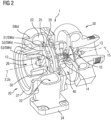
- FIG 2 shows a design of an exhaust gas turbocharger 1 with an exhaust gas guide device, here a variable turbine geometry 50, also referred to as VTG for short.
- the basic structure of the exhaust gas turbocharger 1 with turbine housing 20, compressor housing 30, bearing housing 40 and the turbocharger rotor 10 essentially corresponds to the Figure 1 shown exhaust gas turbocharger 1.
- a VTG 50 is provided here. This essentially consists of two annular bearing disks 51, 52, which are arranged at a certain distance from one another in the annular gap-shaped transition region between the turbine spiral duct 22 and the turbine impeller 12 and thus form the exhaust gas inlet gap 25.
- both the turbine housing 20 and the bearing disks 51, 52 and the guide vanes 53 are made of the steel material SWst according to the invention.
Landscapes
- Engineering & Computer Science (AREA)
- Chemical & Material Sciences (AREA)
- Mechanical Engineering (AREA)
- Materials Engineering (AREA)
- Metallurgy (AREA)
- Organic Chemistry (AREA)
- General Engineering & Computer Science (AREA)
- Combustion & Propulsion (AREA)
- Supercharger (AREA)
Description
- Die Erfindung betrifft einen Abgasturbolader, der einen Stahl-Werkstoff für Hochtemperatur-Anwendungen aufweist, insbesondere einen Stahl-Werkstoff, der sich zum Einsatz bei hohen Temperaturen bis über 1000°C eignet.
- Die Entwicklung neuer Technologien sowie die Weiterentwicklung entsprechender Vorrichtungen und Verfahren hin zu höherer Leistung und Effizienz bei gleichzeitiger Reduzierung des Ressourceneinsatzes gehen sehr häufig einher mit gesteigerten Anforderungen an die verwendeten Werkstoffe in Bezug auf Festigkeit, Temperaturbeständigkeit, Korrosionsbeständigkeit und Bearbeitbarkeit. Des Weiteren spielt beim industriellen Einsatz natürlich auch der Preis eine bedeutende Rolle.
- Einer solchen technologischen Herausforderung, die immer höhere Anforderungen stellt, ist traditionell der Fahrzeugbau und insbesondere die Entwicklung der darin eingesetzten Verbrennungsmotoren unterworfen.
- Zur Reduzierung des Kraftstoffverbrauchs und des Schadstoff-Ausstoßes bei gleichbleibender oder sogar gesteigerter Leistung des Verbrennungsmotors werden vermehrt kleinvolumige Motorkonzepte, sogenannte Downsizing-Konzepte, zugrunde gelegt, die zur Leistungssteigerung mit Abgasturboladern ausgestattet sind. Hierbei stellen insbesondere bei Otto-Verbrennungsmotoren die vorherrschenden hohen Abgastemperaturen bis über 1000°C eine starke Herausforderung für die in der Abgasturbine eingesetzten Werkstoffe dar. Hierbei besteht die Tendenz, die Betriebstemperaturen weiter zu steigern, um die bei der Verbrennung entstehende Wärmeenergie effizienter nutzen zu können. Weiterhin besteht auch bei Otto-Verbrennungsmotoren die Tendenz hin zu einem mageren Betrieb mit Lambda nahe 1, wodurch die Abgastemperaturen zusätzlich steigen. Die thermische Belastung der im Abgasbereich, also auch im Turbolader, eingesetzten Werkstoffe steigt also.
- Das Wirkprinzip eines Abgasturboladers besteht darin, die im Abgasstrom enthaltene Energie zu nutzen, um den Druck im Ansaugtrakt des Verbrennungsmotors zu erhöhen und so eine bessere Befüllung des Brennraumes mit Luft-Sauerstoff zu bewirken und somit mehr Treibstoff, Benzin oder Diesel, pro Verbrennungsvorgang umsetzen zu können, also die Leistung des Verbrennungsmotors zu erhöhen.
- Dazu weist der Abgasturbolader eine im Abgastrakt des Verbrennungsmotors angeordnete Abgasturbine, einen im Ansaugtrakt angeordneten Frischluftverdichter und ein dazwischen angeordnetes Läuferlager auf. Die Abgasturbine weist ein Turbinengehäuse und ein darin angeordnetes, durch den Abgasmassenstrom angetriebenes Turbinenlaufrad auf. Der Frischluftverdichter weist ein Verdichtergehäuse und ein darin angeordnetes, einen Ladedruck aufbauendes Verdichterlaufrad auf. Das Turbinenlaufrad und das Verdichterlaufrad sind auf den sich gegenüberliegenden Enden einer gemeinsamen Welle, der sogenannten Läuferwelle, drehfest angeordnet und bilden so den sogenannten Turboladerläufer. Die Läuferwelle erstreckt sich axial zwischen Turbinenlaufrad und Verdichterlaufrad durch das zwischen Abgasturbine und Frischluftverdichter angeordnete Läuferlager und ist in diesem, in Bezug auf die Läuferwellenachse, radial und axial drehgelagert. Gemäß diesem Aufbau treibt das vom Abgasmassenstrom angetriebene Turbinenlaufrad über die Läuferwelle das Verdichterlaufrad an, wodurch der Druck im Ansaugtrakt des Verbrennungsmotors, bezogen auf den Frischluftmassenstrom hinter dem Frischluftverdichter, erhöht und dadurch eine bessere Befüllung des Brennraumes mit Luft-Sauerstoff bewirkt wird.
- Weiterhin ist im Turbinengehäuse in der Regel eine Einrichtung vorgesehen um den auf das Turbinenlaufrad strömenden Abgas-Massenstrom zu beeinflussen. Hier gibt es im Wesentlichen zwei unterschiedliche Einrichtungen, die wahlweise vorgesehen werden. Zum einen ist dies ein sogenanntes Wastegate-Ventil, zum anderen eine sogenannte Variable Turbinengeometrie (VTG).
- Über ein Wastegate-Ventil kann der Abgasmassenstrom bei Bedarf am Turbinenlaufrad vorbei direkt in den Abgastrakt stromabwärts der Abgasturbine geleitet werden, wogegen über die variable Turbinengeometrie die Richtung und die Menge des auf das Turbinenlaufrad auftreffenden Abgasmassenstroms beeinflusst werden kann.
- Je nach Drehzahl und Abgasmassenstrom des Verbrennungsmotors wird in Abhängigkeit von den Lastanforderungen das Wastegate-Ventil bzw. die Variable Turbinengeometrie so eingestellt, dass die Drehzahl von Turbinen- und Verdichterlaufrad sowie das Druckverhältnis, insbesondere an der Abgasturbine, innerhalb des gewünschten Arbeitsbereichs des Abgasturboladers gehalten werden kann.
- Um die bei der Verbrennung im Verbrennungsmotor entstehende Wärmeenergie mit höheren Wirkungsgraden durch den Abgasturbolader nutzen zu können, werden, wie bereits erwähnt, die Abgastemperaturen möglichst hoch gehalten. Durch die heißen Abgase, die durch das Turbinengehäuse strömen, wird dieses und die im Abgasmassenstrom angeordneten Bauteile mit einer thermischen Wechselbeanspruchung mit Temperaturen bis über 1000°C beaufschlagt. Des Weiteren besteht die Forderung nach hoher Festigkeit und Formbeständigkeit der Bauteile bei einem möglichst geringen Gewicht, also einem reduzierten Materialeinsatz.
- Um diese hohen Anforderungen erfüllen zu können wurden bisher Stahl-Werkstoffe mit zumeist teilweise austenitischem Gefüge und insbesondere einem hohen Nickelgehalt bis zu 40% eingesetzt.
- Solche Werkstoffe sind zum Beispiel Stahlguss-Werkstoffe mit der Kurzbezeichnung 1.4848 (GX40CrNiSi25-20) und 1.4849 (GX40NiCrSiNb38-19).
- Dabei zeichnet sich der Werkstoff 1.4848 durch die folgende Werkstoff-Zusammensetzung aus: 0,3-0,5% C; 1,0-2,5% Si; max. 2,0% Mn; max.0,04% P; max.0,03% S; 24,0-27,0% Cr; max.0,5% Mo; 19,0-22,0% Ni; Rest Fe.
- Der Werkstoff 1.4849 weist die folgende Werkstoff-Zusammensetzung auf: 0,3-0,5% C; 1,0-2,5% Si; max. 2, 0% Mn; max.0,03% S; 18,0-21,0% Cr; max.0,5% Mo; 36,0-39,0% Ni; 1,2-1,8%Nb; Rest Fe.
- Der hohe Nickelgehalt erhöht die Festigkeit und Haltbarkeit der Werkstoffe insbesondere bei Betriebstemperaturen bis zu 1050°C. Jedoch ist Nickel ein verhältnismäßig teurer Werkstoff, weshalb kostengünstigere Alternativen gesucht werden.
- Ein weiterer hochwarmfester Werkstoff mit sehr niedrigem Nickelanteil, der insbesondere eingesetzt wird im Druck und Dampfkesselbau sowie in Luft- und Raumfahrttechnik und Turbinenbau ist der Werkstoff 1.4923 (X22CrMoV12-1), der folgende Zusammensetzung aufweist: 0,18-0,24% C; 11,0-12,5% Cr; 0,3-0,8% Ni; 0, 8-1, 2% V; Rest Fe. Bei diesem Werkstoff wird eine Erhöhung der Zeitdehn- und Zeitstandfestigkeit durch den Vanadium-Anteil und den erhöhten Molybdänzusatz bewirkt. Die Festigkeitswerte fallen jedoch bereits bei Temperaturen über 500°C erheblich ab, was die Verwendung für Abgasturbinengehäuse, wie oben beschrieben, erheblich einschränkt.
- Zudem offenbaren
WO 2010/036533 A2 ,WO 2017/194282 A1 undWO 2018/036757 A1 Abgasturbolader aus Stahl-Werkstoffen für Hochtemperatur-Anwendungen. - Der vorliegenden Erfindung liegt daher die Aufgabe zugrunde, einen Stahl-Werkstoff für Hochtemperatur-Anwendungen aufweisenden Abgasturbolader anzugeben, der sich durch niedrige Materialkosten, also insbesondere bei niedrigem Nickelanteil des Werkstoffes, in einem Temperaturbereich bis über 1050°C durch ausreichend Festigkeit und Zeitstandfestigkeit für den Einsatz in Verbindung mit Verbrennungsmotoren auszeichnet.
- Diese Aufgabe wird durch einen Abgasturbolader mit den Merkmalen gemäß Patentanspruch 1 gelöst. Vorteilhafte Aus- und Weiterbildungen, welche einzeln oder, sofern es sich nicht um sich gegenseitig ausschließende Alternativen handelt, in Kombination miteinander eingesetzt werden können, sind Gegenstand der abhängigen Ansprüche.
- Erfindungsgemäß wird ein Abgasturbolader mit einem Turbinengehäuse mit einem zentrisch zu einer Turbinengehäuseachse angeordneten Aufnahmebereich für ein Turbinenlaufrad des Abgasturboladers und zumindest einem, sich schneckenförmig zum Aufnahmebereich für das Turbinenlaufrad hin verjüngenden Turbinen-Spiralkanal offenbart, wobei im Turbinengehäuse ein Wastegate-Ventil mit einem Spindelarm und einem daran angeordneten Klappenteller, oder eine variable Abgasleiteinrichtung mit Lagerscheiben und Leitschaufeln angeordnet ist, wobei zumindest eines der Bauteile: Turbinengehäuse, Spindelarm und Klappenteller, oder Lagerscheiben und Leitschaufeln, einen Stahl-Werkstoff für Hochtemperatur-Anwendungen aufweist, dessen Werkstoffzusammensetzung außer Eisen, Fe, aus den folgende Legierungsbestandteile in Mengen in den angegebenen Grenzen in Gewichtsprozent besteht:
- Kohlenstoff, C: 0,4-0,5%;
- Silizium, Si: 1,25-1,75%;
- Mangan, Mn: 3,0-12,0%;
- Chrom, Cr: 19,5-20,5%;
- Nickel, Ni: 5,0-6,0%;
- Niob, Nb: 1,00-1,5%
- und optional zusätzlich zumindest einen der weiteren Legierungsbestandteile in Anteilen bis zu maximal den angegebenen Mengen in Gewichtsprozent enthält:
- Wolfram, W: bis zu 0,6%;
- Vanadium, V: bis zu 0,12%;
- Kupfer, Cu: bis zu 0,25%;
- Kobalt, Co: bis zu 1,0%;
- Schwefel, S: bis zu 0,03% und
- Phosphor, P: bis zu 0,04%,
- sowie unvermeidbare Verunreinigungen in Mengenanteilen, die in Bezug auf die Werkstoffeigenschaften vernachlässigbar sind, aufweist.
- In weiterer Ausführung des beim erfindungsgemäßen Abgasturbolader verwendeten Stahl-Werkstoffs kann insbesondere zumindest einer der Mengenanteile der Legierungsbestandteile Silizium und Mangan in engere Grenzen gefasst werden, so dass zumindest einer dieser Bestandteile zumindest in Mengen in den folgenden Grenzen in Gewichtsprozent zugefügt wird:
- Silizium, Si: 1,35-1,65%;
- Mangan, Mn: 7,0-12,0%.
- Die Menge an Mangan kann insbesondere auch weiter, auf einen Anteil von 9,0 - 12%, eingegrenzt werden.
- Damit können die gewünschten Werkstoffeigenschaften auf höherem Niveau mit höherer Zuverlässigkeit erzielt werden.
- Bei den oben angegebenen Legierungszusammensetzungen sind gegenüber bekannten Stahlwerkstoffen für Hochtemperatur-Anwendungen insbesondere die in Kombination erhöhten Anteile an Mangan, Chrom und Niob, bei moderater Zugabe von Nickel für die erzielten Werkstoffeigenschaften verantwortlich. Die genannte Legierung zeichnet sich dabei durch hohe Warm-Festigkeit bei gleichzeitiger Korrosionsbeständigkeit insbesondere in den aggressiven, heißen Abgasen eines Verbrennungsmotors aus.
- Weiterhin kann, zur Erzielung bestimmter Eigenschaften die erfindungsgemäße Werkstoffzusammensetzung durch Zugabe von zumindest einer der genannten weiteren Legierungsbestandteile, in Anteilen bis zu maximal den jeweils angegebenen Mengen in Gewichtsprozent, ergänzt sein:
- Wolfram, W: bis zu 0,6%;
- Vanadium, V: bis zu 0,12%;
- Kupfer, Cu: bis zu 0,25%;
- Kobalt, Co: bis zu 1,0%;
- Schwefel, S: bis zu 0,03% und
- Phosphor, P: bis zu 0,04%.
- Das heißt, zumindest eines dieser Elemente wird definitiv in messbarer Menge, jedoch in einer Menge bis zu der jeweils angegebenen Grenze zugegeben. Es können jedoch auch zwei, drei, vier, fünf oder alle dieser Elemente in unterschiedlicher Kombination, jedes jedoch nur in einer Menge bis zu der jeweils angegebenen Grenze, zugegeben werden.
- Dies kann, je nach Kombination, verschieden sekundäre Werkstoffeigenschaften der Legierung, wie zum Beispiel die Zerspanbarkeit, die Schweißbarkeit, die Gießbarkeit etc., positiv beeinflussen.
- In weiter verfeinerter Ausführung ist der beim erfindungsgemäßen Abgasturbolader verwendete Stahl-Werkstoff dadurch gekennzeichnet, dass er den zumindest einen der oben genannten, der Legierung zugefügten weitere Legierungsbestandteile in Anteilen von jeweils zumindest den angegebenen Mengen in Gewichtsprozent aufweist:
- Wolfram, W: zumindest 0,3%;
- Vanadium, V: zumindest 0,06%;
- Kupfer, Cu: zumindest 0,1%;
- Kobalt, Co: zumindest 0,5%;
- Schwefel, S: zumindest 0,013% und
- Phosphor, P: zumindest 0,02%.
- So ergibt sich, in Kombination mit den zuvor festgelegten Obergrenzen der Zugabemengen der weiteren Legierungsbestandteile jeweils ein Mengenbereich:
- für Wolfram, W: zwischen 0,3 bis 0,6%;
- für Vanadium, V: zwischen 0,06 bis 0,12%;
- für Kupfer, Cu: zwischen 0,1 bis0,25%;
- für Kobalt, Co: zwischen 0,5 bis 1,0%;
- für Schwefel, S: zwischen 0,013 bis 0,03% und
- für Phosphor, P: zwischen 0,02 bis 0,04%.
- Dabei weist der Stahl-Werkstoff zumindest eines dieser weiteren Elemente in einer Menge innerhalb des angegebenen Mengenbereichs auf. Der Stahl-Werkstoff kann jedoch auch zwei, drei, vier, fünf oder alle der genannten weiteren Elemente in Mengen innerhalb der angegebenen Grenzen aufweisen.
- Der hohe Mangananteil sowie die weiteren Legierungsbestandteile tragen zur weiteren Steigerung der gewünschten Werkstoffeigenschaften bei und bewirken insbesondere eine fortschreitende Umwandlung von Ferrit in Austenit bei erhöhten Werkstofftemperaturen. Darüber hinaus ist die Korrosionsbeständigkeit erhöht.
- Eine weitere Ausprägung des beim erfindungsgemäßen Abgasturbolader verwendeten Stahl-Werkstoffs ist demnach dadurch gekennzeichnet, dass der Stahl-Werkstoff ein vollständig austenitisch ausgebildetes Gefüge, aufweist. Dies führt zu einer signifikanten Reduktion der Bildung von Sigma-Phasen im Werkstoffgefüge und trägt zur Erzielung und Stabilisierung der gewünschten Werkstoffeigenschaften bei.
- Mit der angegebenen Werkstoffzusammensetzung des beim erfindungsgemäßen Abgasturbolader verwendeten Stahl-Werkstoffes werden die für den Einsatz bei Turbinengehäusen für Abgasturbolader erforderlichen Materialeigenschaften in Bezug auf die Mindeststeckgrenze, die Zugfestigkeit und die Korrosionsbeständigkeit erzielt bei gleichzeitig gegenüber bisher gebräuchlichen Hochtemperaturwerkstoffen stark reduziertem Nickel-Anteil und somit reduzierten Materialkosten.
- Dies wird unter anderem dadurch erzielt, dass die Legierungsbestandteile in Zusammensetzung und Menge so aufeinander abgestimmt und ggf. in engen Grenzen definiert sind, dass ein hoher Anteil an austenitischem Gefüge, ausgebildet ist, im Idealfall bis zu 100%.
- Der erfindungsgemäße Abgasturbolader weist ein Turbinengehäuse mit einem zentrisch zu einer Turbinengehäuseachse angeordneten Aufnahmebereich für ein Turbinenlaufrad des Abgasturboladers und zumindest einem, sich schneckenförmig zum Aufnahmebereich für das Turbinenlaufrad hin verjüngenden, Abgas-Spiralkanal auf. Im Turbinengehäuse ist ein Wastegate-Ventil mit einen Spindelarm und einem daran angeordneten Klappenteller oder eine variable Abgasleiteinrichtung VTG mit Lagerscheiben und Leitschaufeln angeordnet. Dies entspricht im Wesentlichen einer Anordnung wie einleitend bereits beschrieben. Der erfindungsgemäße Abgasturbolader ist dadurch gekennzeichnet, dass zumindest eines der Bauteile: Turbinengehäuse, Spindelarm und Klappenteller, oder Lagerscheiben und Leitschaufeln, einen erfindungsgemäßen Stahl-Werkstoff mit einer Legierungszusammensetzung, wie in einer der vorausgehend beschriebenen Ausführungen beschrieben, aufweist.
- Ein entsprechender Abgasturbolader zeichnet sich durch eine erhöhte Lebensdauer bei erhöhter Betriebssicherheit aus. Dies wird erzielt durch für den Einsatzfall optimierte Werkstoffeigenschaften der genannten Bauteile, insbesondere in Bezug auf die Hochtemperaturfestigkeit, bei gleichzeitig, gegenüber herkömmlichen Bauteilen aus hochlegierten Nickel-Legierungen, reduziertem Preis.
- Die Merkmale und Merkmalskombinationen der vorstehend in der Beschreibung genannten Ausführungen des erfindungsgemäßen Gegenstandes sind, soweit diese nicht alternativ anwendbar sind oder sich gar gegenseitig ausschließen, einzeln, zum Teil oder insgesamt, auch in gegenseitiger Kombination oder gegenseitiger Ergänzung, in Fortbildung des erfindungsgemäßen Gegenstands anzuwenden, ohne den Rahmen der Erfindung, wie in den Ansprüchen definiert, zu verlassen.
- Entsprechende Ausführungen erfindungsgemäßer Abgasturbolader werden mit Hilfe der Figuren näher erläutert, dabei zeigt:
- Figur 1
- eine schematisch vereinfachte Darstellung eines Abgasturboladers mit Wastegate-Ventil, in Halbschnittdarstellung, und
- Figur 2
- eine dreidimensionale Darstellung eines Abgasturboladers mit variabler Abgasleiteinrichtung, in Viertelschnittdarstellung.
- Anhand der Figur ist der prinzipielle Aufbau eines Abgasturboladers 1, mit einem Wastegate-Ventil, wie einführend bereits grob beschrieben, in schematisch vereinfachter Halbschnitt-Darstellung gezeigt.
- In der Regel weist ein gebräuchlicher Abgasturbolader 1, wie in den
Figuren 1 und2 dargestellt, einen mehrteiligen Aufbau auf. Dabei sind eine im Abgastrakt des Verbrennungsmotors anordenbares Turbinengehäuse 20, ein im Ansaugtrakt des Verbrennungsmotors anordenbares Verdichtergehäuse 30 und zwischen Turbinengehäuse 20 und Verdichtergehäuse 30 ein Lagergehäuse 40 auf einer gemeinsamen Turboladerachse 2 hintereinander angeordnet und montagetechnisch miteinander verbunden. Eine weitere Baueinheit des Abgasturboladers 1 stellt der Turboladerläufer 10 dar, der eine Läuferwelle 14, ein in dem Turbinengehäuse 20 angeordnetes Turbinenlaufrad 12 und ein in dem Verdichtergehäuse 30 angeordnetes Verdichterlaufrad 13 aufweist. Das Turbinenlaufrad 12 und das Verdichterlaufrad 13 sind auf den sich gegenüberliegenden Enden der gemeinsamen Läuferwelle 14 angeordnet und mit diesen drehfest verbunden. Die Läuferwelle 14 erstreckt sich in Richtung der Turboladerachse 2 axial durch das Lagergehäuse 40 und ist in diesem axial und radial um seine Längsachse, die Läuferdrehachse 15, drehgelagert, wobei die Läuferdrehachse 15 in der Turboladerachse 2 liegt, also mit dieser zusammenfällt. Dabei liegt auch die Turbinengehäuseachse 2a in einer Linie mit der Läuferdrehachse 15 und der Turboladerachse 2. Der Abgasmassenstrom AM durch das Turbinengehäuse 20 und der Frischluftmassenstrom FM durch das Verdichtergehäuse 30 sind jeweils mit entsprechenden Pfeilen dargestellt. - Das Turbinengehäuse 20 weist einen, in anderen Ausführungen ggf. auch mehrere, ringförmig um die Turboladerachse 2 und den Aufnahmebereich des Turbinenlaufrads 12 angeordneten, sich schneckenförmig zum Aufnahmebereich und dem Turbinenlaufrad 12 hin verjüngenden Turbinen-Spiralkanal 22, eine sogenannte Abgasflute, auf. Diese Abgasflute weist einen tangential nach außen gerichteten Abgaszuführkanal 23 mit einem Krümmer-Anschlussstutzen 24 zum Anschluss an einen Abgaskrümmer (nicht dargestellt) eines Verbrennungsmotors auf, durch den der Abgasmassenstrom AM in die jeweilige Abgasflute strömt. Die Abgasflute weist weiterhin eine zumindest über einen Teil des Innenumfanges verlaufende Ringspaltöffnung, den sogenannten Abgas-Eintrittsspalt 25, auf, der in zumindest anteilmäßig radialer Richtung auf das Turbinenlaufrad 12 hin gerichtet verläuft und durch den der Abgasmassenstrom AM auf das Turbinenlaufrad 12 strömt.
- Das Turbinengehäuse 20 weist weiterhin einen Abgasabführkanal 26 auf, der vom axialen Ende des Turbinenlaufrades 12 weg in Richtung der Turboladerachse 2 verläuft und einen Auspuff-Anschlussstutzen 27 zum Anschluss an das Auspuffsystem (nicht dargestellt) des Verbrennungsmotors aufweist. Über diesen Abgasabführkanal 26 wird der aus dem Turbinenlaufrad 12 austretende Abgasmassenstrom AM in das Auspuffsystem des Verbrennungsmotors abgeführt. Der das Turbinengehäuse 20 kennzeichnende erfindungsgemäße Stahl-Werkstoff SWst, aus dem das Turbinengehäuse 20 gefertigt ist, ist dabei durch die Kreuzschraffur symbolisiert.
- Ein Wastegate-Ventil 29 verbindet den Abgaszuführkanal 23 in Strömungsrichtung des Abgasmassenstroms AM vor dem Turbinenlaufrad 12 mit dem Abgasabführkanal 26 in Strömungsrichtung des Abgasmassenstroms AM hinter dem Turbinenlaufrad 12 über einen Wastegatekanal 291 im Turbinengehäuse 20. Das Wastegate-Ventil 29 kann über eine Schließvorrichtung, geöffnet oder gelschlossen werden. Diese Schließvorrichtung weist einen im Turbinengehäuse 20 drehgelagerten Spindelarm 292 auf, an dem ein Klappenteller 293 angeordnet ist. Sowohl Spindelarm 292 als auch der Klappenteller 293 sind in diesem Beispiel aus dem erfindungsgemäßen Stahl-Werkstoff SWst hergestellt. Durch Betätigung des Spindelarms 292 mittels eines externen Aktuators (nicht dargestellt), wird der Klappenteller 293 zum Schließen bzw. zum Öffnen des Wastegate-Ventils 29 dichtend auf den Ventilsitz 294 des Wastegatekanals 291 aufgelegt oder von diesem abgehoben.
-
Figur 2 zeigt dagegen eine Ausführung eines Abgasturboladers 1 mit einer Abgasleiteinrichtung, hier einer Variablen Turbinengeometrie 50, auch kurz als VTG bezeichnet. Der prinzipielle Aufbau des Abgasturboladers 1 mit Turbinengehäuse 20, Verdichtergehäuse 30, Lagergehäuse 40 und dem Turboladerläufer 10 stimmt dabei im Wesentlichen mit dem inFigur 1 gezeigten Abgasturbolader 1 überein. Statt eines Wastegate-Ventils ist hier jedoch eine VTG 50 vorgesehen. Diese besteht im Wesentlichen aus zwei ringförmigen Lagerscheiben 51, 52, die in einem bestimmten Abstand zueinander in dem ringspaltförmigen Übergangsbereich zwischen dem Turbinen-Spiralkanal 22 und dem Turbinenlaufrad 12 angeordnet sind und so den Abgas-Eintrittsspalt 25 bilden. Zwischen den Lagerscheiben 51, 52 sind im Abgas-Eintrittsspalt 25, über den Umfang des Abgas-Eintrittsspalts verteilt, mehrere Leitschaufeln angeordnet. Diese sind zumindest in einer der Lagerscheiben drehgelagert aufgenommen und ihre Drehlage kann mittels einer auf der Rückseite dieser Lagerscheibe angeordneten Betätigungsmechanik 55 und einem externen Aktuator (nicht dargestellt) eingestellt werden. Sowohl das Turbinengehäuse 20 als auch die Lagerscheiben 51, 52 und die Leitschaufeln 53 bestehen bei dieser Ausführung aus dem erfindungsgemäßen Stahl-Werkstoff SWst.
Claims (5)
- Abgasturbolader (1) mit einem Turbinengehäuse (21) mit einem zentrisch zu einer Turbinengehäuseachse (2a) angeordneten Aufnahmebereich für ein Turbinenlaufrad (12) des Abgasturboladers (1) und zumindest einem, sich schneckenförmig zum Aufnahmebereich für das Turbinenlaufrad (12) hin verjüngenden, Turbinen-Spiralkanal (22),wobei im Turbinengehäuse ein Wastegate-Ventil mit einem Spindelarm und einem daran angeordneten Klappenteller,oder eine variable Abgasleiteinrichtung mit Lagerscheiben und Leitschaufeln angeordnet ist,dadurch gekennzeichnet, dass zumindest eines der Bauteile:
Turbinengehäuse, Spindelarm und Klappenteller, oder Lagerscheiben und Leitschaufeln, einen Stahl-Werkstoff (21a) für Hochtemperatur-Anwendungen aufweist, dessen Werkstoffzusammensetzung, außer Eisen, Fe, aus folgenden Legierungsbestandteile in Mengen in den angegebenen Grenzen in Gewichtsprozent besteht:Kohlenstoff, C: 0,4-0,5%;Silizium, Si: 1,25-1,75%;Mangan, Mn: 3,0-12,0%;Chrom, Cr: 19,5-20,5%;Nickel, Ni: 5,0-6,0%;Niob, Nb: 1,00-1,5%,und optional zusätzlich zumindest einen der weiteren Legierungsbestandteile in Anteilen bis zu maximal den angegebenen Mengen in Gewichtsprozent enthält:Wolfram, W: bis zu 0,6%;Vanadium, V: bis zu 0,12%;Kupfer, Cu: bis zu 0,25%;Kobalt, Co: bis zu 1,0%;Schwefel, S: bis zu 0,03% undPhosphor, P: bis zu 0,04%,sowie unvermeidbare Verunreinigungen in Mengenanteilen, die in Bezug auf die Werkstoffeigenschaften vernachlässigbar sind, aufweist. - Abgasturbolader nach Anspruch 1, dadurch gekennzeichnet, dass der Stahlwerkstoff zumindest einen der angegebenen Legierungsbestandteile zumindest in Mengen in den folgenden Grenzen in Gewichtsprozent aufweist:Silizium, Si: 1,35-1,65%;Mangan, Mn: 7,0-12,0%, insbesondere 9,0-12%.
- Abgasturbolader nach Anspruch 1 oder 2, dadurch gekennzeichnet, dass der Stahlwerkstoff zumindest einen der weiteren Legierungsbestandteile in Anteilen bis zu der maximal angegebenen Menge in Gewichtsprozent enthält.
- Abgasturbolader nach Anspruch 1 oder 2, dadurch gekennzeichnet, dass der Stahlwerkstoff den zumindest einen der weiteren Legierungsbestandteile in Anteilen von jeweils zumindest den angegebenen Mengen in Gewichtsprozent enthält:Wolfram, W: zumindest 0,3%;Vanadium, V: zumindest 0,06%;Kupfer, Cu: zumindest 0,1%;Kobalt, Co: zumindest 0,5%;Schwefel, S: zumindest 0,013% undPhosphor, P: zumindest 0,02%.
- Abgasturbolader nach einem der vorhergehenden Ansprüche, dadurch gekennzeichnet, dass der Stahl-Werkstoff ein vollständig austenitisch ausgebildetes Gefüge aufweist.
Applications Claiming Priority (2)
| Application Number | Priority Date | Filing Date | Title |
|---|---|---|---|
| DE102018217057.6A DE102018217057A1 (de) | 2018-10-05 | 2018-10-05 | Stahl-Werkstoff für Hochtemperatur-Anwendungen und Abgasturbolader der diesen Stahl-Werkstoff aufweist |
| PCT/EP2019/076651 WO2020070163A1 (de) | 2018-10-05 | 2019-10-01 | Abgasturbolader, der einen stahl-werkstoff für hochtemperatur-anwendungen aufweist |
Publications (2)
| Publication Number | Publication Date |
|---|---|
| EP3861145A1 EP3861145A1 (de) | 2021-08-11 |
| EP3861145B1 true EP3861145B1 (de) | 2025-03-19 |
Family
ID=68136413
Family Applications (1)
| Application Number | Title | Priority Date | Filing Date |
|---|---|---|---|
| EP19782583.9A Active EP3861145B1 (de) | 2018-10-05 | 2019-10-01 | Abgasturbolader, der einen stahl-werkstoff für hochtemperatur-anwendungen aufweist |
Country Status (5)
| Country | Link |
|---|---|
| US (1) | US11454132B2 (de) |
| EP (1) | EP3861145B1 (de) |
| CN (1) | CN112771192A (de) |
| DE (1) | DE102018217057A1 (de) |
| WO (1) | WO2020070163A1 (de) |
Family Cites Families (15)
| Publication number | Priority date | Publication date | Assignee | Title |
|---|---|---|---|---|
| DE959681C (de) * | 1943-08-14 | 1957-03-07 | Eisen & Stahlind Ag | Schaufeln und aehnlich beanspruchte Bauteile von Gasturbinen und andere gleich oder aehnlich beanspruchte Gegenstaende |
| DE19727140C1 (de) | 1997-06-26 | 1998-12-17 | Daimler Benz Ag | Brennkraftmaschinen - Turbolader - System |
| EP2295777B1 (de) | 2003-03-31 | 2016-12-07 | Hitachi Metals, Ltd. | Kolben für eine Verbrennungsmaschine und Verfahren zu seiner Herstellung |
| US7914732B2 (en) | 2006-02-23 | 2011-03-29 | Daido Tokushuko Kabushiki Kaisha | Ferritic stainless steel cast iron, cast part using the ferritic stainless steel cast iron, and process for producing the cast part |
| DE102007025758A1 (de) * | 2007-06-01 | 2008-12-04 | Mahle International Gmbh | Dichtring |
| KR20110057213A (ko) | 2008-09-25 | 2011-05-31 | 보르그워너 인코퍼레이티드 | 터보차저 및 이를 위한 블레이드 베어링 링 |
| US20110182749A1 (en) | 2008-09-25 | 2011-07-28 | Borgwarner Inc. | Turbocharger and adjustable blade therefor |
| DE102011110481A1 (de) | 2011-08-17 | 2013-02-21 | Voith Patent Gmbh | Abgasdurchströmtes oder abgasunströmtes Bauteil oder frischluftbeaufschlagtes Bauteil, teilweise aus einer Legierung hergestellt sowie Verwendung einer Legierung zur Herstellung eines solchen Bauteils |
| US10975718B2 (en) | 2013-02-12 | 2021-04-13 | Garrett Transportation I Inc | Stainless steel alloys, turbocharger turbine housings formed from the stainless steel alloys, and methods for manufacturing the same |
| CN104651743A (zh) | 2013-11-22 | 2015-05-27 | 南红艳 | 一种多元素复合成分耐热钢 |
| US9534281B2 (en) * | 2014-07-31 | 2017-01-03 | Honeywell International Inc. | Turbocharger turbine housings formed from the stainless steel alloys, and methods for manufacturing the same |
| PL3441494T3 (pl) * | 2016-03-23 | 2022-01-17 | Nippon Steel Stainless Steel Corporation | Blacha cienka z nierdzewnej stali austenitycznej na element układu wydechowego o doskonałej odporności cieplnej i obrabialności, element turbosprężarki oraz sposób wytwarzania blachy cienkiej z nierdzewnej stali austenitycznej na element układu wydechowego |
| DE102016208301A1 (de) * | 2016-05-13 | 2017-11-16 | Continental Automotive Gmbh | Stahl-Werkstoff für Hochtemperatur-Anwendungen und Turbinengehäuse aus diesem Werkstoff |
| US10227916B2 (en) * | 2016-07-24 | 2019-03-12 | Garrett Transportation I Inc. | Turbocharger turbine wastegate assembly |
| DE102016215905A1 (de) * | 2016-08-24 | 2018-03-01 | Continental Automotive Gmbh | Eisen-Werkstoff für hochtemperaturfeste Lagerbuchsen, Lagerbuchse aus diesem Werkstoff und Abgasturbolader mit einer solchen Lagerbuchse |
-
2018
- 2018-10-05 DE DE102018217057.6A patent/DE102018217057A1/de not_active Withdrawn
-
2019
- 2019-10-01 CN CN201980065633.1A patent/CN112771192A/zh active Pending
- 2019-10-01 WO PCT/EP2019/076651 patent/WO2020070163A1/de not_active Ceased
- 2019-10-01 EP EP19782583.9A patent/EP3861145B1/de active Active
- 2019-10-01 US US17/282,816 patent/US11454132B2/en active Active
Also Published As
| Publication number | Publication date |
|---|---|
| DE102018217057A1 (de) | 2020-04-09 |
| CN112771192A (zh) | 2021-05-07 |
| US11454132B2 (en) | 2022-09-27 |
| WO2020070163A1 (de) | 2020-04-09 |
| EP3861145A1 (de) | 2021-08-11 |
| US20210388738A1 (en) | 2021-12-16 |
Similar Documents
| Publication | Publication Date | Title |
|---|---|---|
| EP2354490B1 (de) | Abgasbaugruppe | |
| DE112009002015B4 (de) | Turbolader und Schaufellagerring hierfür | |
| WO2018036757A1 (de) | Eisen-werkstoff für hochtemperaturfeste lagerbuchsen, lagerbuchse aus diesem werkstoff und abgasturbolader mit einer solchen lagerbuchse | |
| DE102009005938A1 (de) | Ladeeinrichtung | |
| DE112012003677T5 (de) | Turbolader und ein Bauteil hierfür | |
| DE112012001811T5 (de) | Turbolader und Bauteil hierfür | |
| WO2012139864A1 (de) | Gusseisen mit niob und bauteil | |
| DE112010001123T5 (de) | Abgasturbolader | |
| WO2012146510A2 (de) | Ladeeinrichtung | |
| EP3628755B1 (de) | Legierungen aus austenitischem edelstahl und aus edelstahllegierungen geformte turboladerkinematikkomponenten | |
| DE102012209562A1 (de) | Turbinengehäuse für einen Abgasturbolader | |
| EP3861145B1 (de) | Abgasturbolader, der einen stahl-werkstoff für hochtemperatur-anwendungen aufweist | |
| EP2573357A1 (de) | Klappenvorrichtung für ein Turbolder-Wastegateventil | |
| US11655527B2 (en) | Austenitic stainless steel alloys and turbocharger kinematic components formed from stainless steel alloys | |
| DE102012001236A1 (de) | Leiteinrichtung für eine Turbine eines Abgasturboladers | |
| EP3508608B1 (de) | Edelstahllegierungen und aus edelstahllegierungen geformte turboladerkinematikkomponenten | |
| WO2017194282A1 (de) | Stahl-werkstoff für hochtemperatur-anwendungen und turbinengehäuse aus diesem werkstoff | |
| DE102009014916A1 (de) | Ladeeinrichtung | |
| EP4209611A1 (de) | Hochsiliziumreiche rostfreie stahllegierungen und daraus geformte turboladerkinematikkomponenten | |
| US20230220528A1 (en) | High silicon stainless steel alloys and turbocharger kinematic components formed from the same | |
| WO2020078608A1 (de) | Abgasturbine eines abgasturboladers mit einer abgedichteten wastegate-ventileinrichtung sowie abgasturbolader | |
| DE102016213626A1 (de) | Turbine für einen Abgasturbolader | |
| WO2022228803A1 (de) | Abgasturbolader mit einem integralgehäuse und variabler turbinengeometrie und integralgehäuse für einen abgasturbolader | |
| DE102011110481A1 (de) | Abgasdurchströmtes oder abgasunströmtes Bauteil oder frischluftbeaufschlagtes Bauteil, teilweise aus einer Legierung hergestellt sowie Verwendung einer Legierung zur Herstellung eines solchen Bauteils | |
| DE102011110482A1 (de) | Abgasumströmtes Bauteil oder frischluftbeaufschlagtes Bauteil, teilweise aus einer Legierung hergestellt sowie Verwendung einer Legierung zur Herstellung eines solchen Bauteils |
Legal Events
| Date | Code | Title | Description |
|---|---|---|---|
| STAA | Information on the status of an ep patent application or granted ep patent |
Free format text: STATUS: UNKNOWN |
|
| STAA | Information on the status of an ep patent application or granted ep patent |
Free format text: STATUS: THE INTERNATIONAL PUBLICATION HAS BEEN MADE |
|
| PUAI | Public reference made under article 153(3) epc to a published international application that has entered the european phase |
Free format text: ORIGINAL CODE: 0009012 |
|
| STAA | Information on the status of an ep patent application or granted ep patent |
Free format text: STATUS: REQUEST FOR EXAMINATION WAS MADE |
|
| 17P | Request for examination filed |
Effective date: 20210506 |
|
| AK | Designated contracting states |
Kind code of ref document: A1 Designated state(s): AL AT BE BG CH CY CZ DE DK EE ES FI FR GB GR HR HU IE IS IT LI LT LU LV MC MK MT NL NO PL PT RO RS SE SI SK SM TR |
|
| RAP3 | Party data changed (applicant data changed or rights of an application transferred) |
Owner name: VITESCO TECHNOLOGIES GMBH |
|
| DAV | Request for validation of the european patent (deleted) | ||
| DAX | Request for extension of the european patent (deleted) | ||
| P01 | Opt-out of the competence of the unified patent court (upc) registered |
Effective date: 20230530 |
|
| STAA | Information on the status of an ep patent application or granted ep patent |
Free format text: STATUS: EXAMINATION IS IN PROGRESS |
|
| 17Q | First examination report despatched |
Effective date: 20240205 |
|
| REG | Reference to a national code |
Ipc: F02B0037160000 Ref country code: DE Ref legal event code: R079 Ref document number: 502019013088 Country of ref document: DE Free format text: PREVIOUS MAIN CLASS: C22C0038020000 Ipc: F02B0037160000 |
|
| GRAP | Despatch of communication of intention to grant a patent |
Free format text: ORIGINAL CODE: EPIDOSNIGR1 |
|
| STAA | Information on the status of an ep patent application or granted ep patent |
Free format text: STATUS: GRANT OF PATENT IS INTENDED |
|
| RIC1 | Information provided on ipc code assigned before grant |
Ipc: C22C 38/48 20060101ALI20241007BHEP Ipc: C22C 38/46 20060101ALI20241007BHEP Ipc: C22C 38/52 20060101ALI20241007BHEP Ipc: C22C 38/58 20060101ALI20241007BHEP Ipc: C22C 38/56 20060101ALI20241007BHEP Ipc: C22C 38/42 20060101ALI20241007BHEP Ipc: F02C 6/12 20060101ALI20241007BHEP Ipc: F02B 37/00 20060101ALI20241007BHEP Ipc: C22C 38/02 20060101ALI20241007BHEP Ipc: F02B 37/18 20060101ALI20241007BHEP Ipc: F02B 37/16 20060101AFI20241007BHEP |
|
| INTG | Intention to grant announced |
Effective date: 20241022 |
|
| GRAS | Grant fee paid |
Free format text: ORIGINAL CODE: EPIDOSNIGR3 |
|
| GRAA | (expected) grant |
Free format text: ORIGINAL CODE: 0009210 |
|
| STAA | Information on the status of an ep patent application or granted ep patent |
Free format text: STATUS: THE PATENT HAS BEEN GRANTED |
|
| AK | Designated contracting states |
Kind code of ref document: B1 Designated state(s): AL AT BE BG CH CY CZ DE DK EE ES FI FR GB GR HR HU IE IS IT LI LT LU LV MC MK MT NL NO PL PT RO RS SE SI SK SM TR |
|
| REG | Reference to a national code |
Ref country code: GB Ref legal event code: FG4D Free format text: NOT ENGLISH |
|
| REG | Reference to a national code |
Ref country code: CH Ref legal event code: EP |
|
| REG | Reference to a national code |
Ref country code: IE Ref legal event code: FG4D Free format text: LANGUAGE OF EP DOCUMENT: GERMAN |
|
| REG | Reference to a national code |
Ref country code: DE Ref legal event code: R096 Ref document number: 502019013088 Country of ref document: DE |
|
| RAP2 | Party data changed (patent owner data changed or rights of a patent transferred) |
Owner name: SCHAEFFLER TECHNOLOGIES AG & CO. KG |
|
| PG25 | Lapsed in a contracting state [announced via postgrant information from national office to epo] |
Ref country code: RS Free format text: LAPSE BECAUSE OF FAILURE TO SUBMIT A TRANSLATION OF THE DESCRIPTION OR TO PAY THE FEE WITHIN THE PRESCRIBED TIME-LIMIT Effective date: 20250619 |
|
| PG25 | Lapsed in a contracting state [announced via postgrant information from national office to epo] |
Ref country code: FI Free format text: LAPSE BECAUSE OF FAILURE TO SUBMIT A TRANSLATION OF THE DESCRIPTION OR TO PAY THE FEE WITHIN THE PRESCRIBED TIME-LIMIT Effective date: 20250319 |
|
| REG | Reference to a national code |
Ref country code: LT Ref legal event code: MG9D |
|
| PG25 | Lapsed in a contracting state [announced via postgrant information from national office to epo] |
Ref country code: NO Free format text: LAPSE BECAUSE OF FAILURE TO SUBMIT A TRANSLATION OF THE DESCRIPTION OR TO PAY THE FEE WITHIN THE PRESCRIBED TIME-LIMIT Effective date: 20250619 |
|
| PG25 | Lapsed in a contracting state [announced via postgrant information from national office to epo] |
Ref country code: HR Free format text: LAPSE BECAUSE OF FAILURE TO SUBMIT A TRANSLATION OF THE DESCRIPTION OR TO PAY THE FEE WITHIN THE PRESCRIBED TIME-LIMIT Effective date: 20250319 |
|
| PG25 | Lapsed in a contracting state [announced via postgrant information from national office to epo] |
Ref country code: LV Free format text: LAPSE BECAUSE OF FAILURE TO SUBMIT A TRANSLATION OF THE DESCRIPTION OR TO PAY THE FEE WITHIN THE PRESCRIBED TIME-LIMIT Effective date: 20250319 |
|
| PG25 | Lapsed in a contracting state [announced via postgrant information from national office to epo] |
Ref country code: BG Free format text: LAPSE BECAUSE OF FAILURE TO SUBMIT A TRANSLATION OF THE DESCRIPTION OR TO PAY THE FEE WITHIN THE PRESCRIBED TIME-LIMIT Effective date: 20250319 Ref country code: GR Free format text: LAPSE BECAUSE OF FAILURE TO SUBMIT A TRANSLATION OF THE DESCRIPTION OR TO PAY THE FEE WITHIN THE PRESCRIBED TIME-LIMIT Effective date: 20250620 |
|
| REG | Reference to a national code |
Ref country code: NL Ref legal event code: MP Effective date: 20250319 |
|
| PG25 | Lapsed in a contracting state [announced via postgrant information from national office to epo] |
Ref country code: NL Free format text: LAPSE BECAUSE OF FAILURE TO SUBMIT A TRANSLATION OF THE DESCRIPTION OR TO PAY THE FEE WITHIN THE PRESCRIBED TIME-LIMIT Effective date: 20250319 |
|
| PG25 | Lapsed in a contracting state [announced via postgrant information from national office to epo] |
Ref country code: SE Free format text: LAPSE BECAUSE OF FAILURE TO SUBMIT A TRANSLATION OF THE DESCRIPTION OR TO PAY THE FEE WITHIN THE PRESCRIBED TIME-LIMIT Effective date: 20250319 |
|
| PG25 | Lapsed in a contracting state [announced via postgrant information from national office to epo] |
Ref country code: SM Free format text: LAPSE BECAUSE OF FAILURE TO SUBMIT A TRANSLATION OF THE DESCRIPTION OR TO PAY THE FEE WITHIN THE PRESCRIBED TIME-LIMIT Effective date: 20250319 |
|
| PG25 | Lapsed in a contracting state [announced via postgrant information from national office to epo] |
Ref country code: ES Free format text: LAPSE BECAUSE OF FAILURE TO SUBMIT A TRANSLATION OF THE DESCRIPTION OR TO PAY THE FEE WITHIN THE PRESCRIBED TIME-LIMIT Effective date: 20250319 Ref country code: PT Free format text: LAPSE BECAUSE OF FAILURE TO SUBMIT A TRANSLATION OF THE DESCRIPTION OR TO PAY THE FEE WITHIN THE PRESCRIBED TIME-LIMIT Effective date: 20250721 |
|
| PG25 | Lapsed in a contracting state [announced via postgrant information from national office to epo] |
Ref country code: PL Free format text: LAPSE BECAUSE OF FAILURE TO SUBMIT A TRANSLATION OF THE DESCRIPTION OR TO PAY THE FEE WITHIN THE PRESCRIBED TIME-LIMIT Effective date: 20250319 Ref country code: IT Free format text: LAPSE BECAUSE OF FAILURE TO SUBMIT A TRANSLATION OF THE DESCRIPTION OR TO PAY THE FEE WITHIN THE PRESCRIBED TIME-LIMIT Effective date: 20250319 |
|
| PG25 | Lapsed in a contracting state [announced via postgrant information from national office to epo] |
Ref country code: EE Free format text: LAPSE BECAUSE OF FAILURE TO SUBMIT A TRANSLATION OF THE DESCRIPTION OR TO PAY THE FEE WITHIN THE PRESCRIBED TIME-LIMIT Effective date: 20250319 Ref country code: CZ Free format text: LAPSE BECAUSE OF FAILURE TO SUBMIT A TRANSLATION OF THE DESCRIPTION OR TO PAY THE FEE WITHIN THE PRESCRIBED TIME-LIMIT Effective date: 20250319 |
|
| PG25 | Lapsed in a contracting state [announced via postgrant information from national office to epo] |
Ref country code: RO Free format text: LAPSE BECAUSE OF FAILURE TO SUBMIT A TRANSLATION OF THE DESCRIPTION OR TO PAY THE FEE WITHIN THE PRESCRIBED TIME-LIMIT Effective date: 20250319 |
|
| PG25 | Lapsed in a contracting state [announced via postgrant information from national office to epo] |
Ref country code: SK Free format text: LAPSE BECAUSE OF FAILURE TO SUBMIT A TRANSLATION OF THE DESCRIPTION OR TO PAY THE FEE WITHIN THE PRESCRIBED TIME-LIMIT Effective date: 20250319 |
|
| PG25 | Lapsed in a contracting state [announced via postgrant information from national office to epo] |
Ref country code: IS Free format text: LAPSE BECAUSE OF FAILURE TO SUBMIT A TRANSLATION OF THE DESCRIPTION OR TO PAY THE FEE WITHIN THE PRESCRIBED TIME-LIMIT Effective date: 20250719 |
|
| REG | Reference to a national code |
Ref country code: DE Ref legal event code: R097 Ref document number: 502019013088 Country of ref document: DE |
|
| PGFP | Annual fee paid to national office [announced via postgrant information from national office to epo] |
Ref country code: DE Payment date: 20251031 Year of fee payment: 7 |
|
| PG25 | Lapsed in a contracting state [announced via postgrant information from national office to epo] |
Ref country code: DK Free format text: LAPSE BECAUSE OF FAILURE TO SUBMIT A TRANSLATION OF THE DESCRIPTION OR TO PAY THE FEE WITHIN THE PRESCRIBED TIME-LIMIT Effective date: 20250319 |
|
| PLBE | No opposition filed within time limit |
Free format text: ORIGINAL CODE: 0009261 |
|
| STAA | Information on the status of an ep patent application or granted ep patent |
Free format text: STATUS: NO OPPOSITION FILED WITHIN TIME LIMIT |
|
| REG | Reference to a national code |
Ref country code: CH Ref legal event code: L10 Free format text: ST27 STATUS EVENT CODE: U-0-0-L10-L00 (AS PROVIDED BY THE NATIONAL OFFICE) Effective date: 20260128 |
|
| 26N | No opposition filed |
Effective date: 20251222 |