EP3859853B1 - Batterieanordnung - Google Patents
Batterieanordnung Download PDFInfo
- Publication number
- EP3859853B1 EP3859853B1 EP21151717.2A EP21151717A EP3859853B1 EP 3859853 B1 EP3859853 B1 EP 3859853B1 EP 21151717 A EP21151717 A EP 21151717A EP 3859853 B1 EP3859853 B1 EP 3859853B1
- Authority
- EP
- European Patent Office
- Prior art keywords
- battery
- spring element
- assembly according
- battery assembly
- tie rod
- Prior art date
- Legal status (The legal status is an assumption and is not a legal conclusion. Google has not performed a legal analysis and makes no representation as to the accuracy of the status listed.)
- Active
Links
Images

Classifications
-
- H—ELECTRICITY
- H01—ELECTRIC ELEMENTS
- H01M—PROCESSES OR MEANS, e.g. BATTERIES, FOR THE DIRECT CONVERSION OF CHEMICAL ENERGY INTO ELECTRICAL ENERGY
- H01M10/00—Secondary cells; Manufacture thereof
- H01M10/04—Construction or manufacture in general
- H01M10/0481—Compression means other than compression means for stacks of electrodes and separators
-
- H—ELECTRICITY
- H01—ELECTRIC ELEMENTS
- H01M—PROCESSES OR MEANS, e.g. BATTERIES, FOR THE DIRECT CONVERSION OF CHEMICAL ENERGY INTO ELECTRICAL ENERGY
- H01M10/00—Secondary cells; Manufacture thereof
- H01M10/05—Accumulators with non-aqueous electrolyte
- H01M10/058—Construction or manufacture
- H01M10/0587—Construction or manufacture of accumulators having only wound construction elements, i.e. wound positive electrodes, wound negative electrodes and wound separators
-
- H—ELECTRICITY
- H01—ELECTRIC ELEMENTS
- H01M—PROCESSES OR MEANS, e.g. BATTERIES, FOR THE DIRECT CONVERSION OF CHEMICAL ENERGY INTO ELECTRICAL ENERGY
- H01M50/00—Constructional details or processes of manufacture of the non-active parts of electrochemical cells other than fuel cells, e.g. hybrid cells
- H01M50/20—Mountings; Secondary casings or frames; Racks, modules or packs; Suspension devices; Shock absorbers; Transport or carrying devices; Holders
- H01M50/204—Racks, modules or packs for multiple batteries or multiple cells
- H01M50/207—Racks, modules or packs for multiple batteries or multiple cells characterised by their shape
- H01M50/213—Racks, modules or packs for multiple batteries or multiple cells characterised by their shape adapted for cells having curved cross-section, e.g. round or elliptic
-
- H—ELECTRICITY
- H01—ELECTRIC ELEMENTS
- H01M—PROCESSES OR MEANS, e.g. BATTERIES, FOR THE DIRECT CONVERSION OF CHEMICAL ENERGY INTO ELECTRICAL ENERGY
- H01M50/00—Constructional details or processes of manufacture of the non-active parts of electrochemical cells other than fuel cells, e.g. hybrid cells
- H01M50/20—Mountings; Secondary casings or frames; Racks, modules or packs; Suspension devices; Shock absorbers; Transport or carrying devices; Holders
- H01M50/233—Mountings; Secondary casings or frames; Racks, modules or packs; Suspension devices; Shock absorbers; Transport or carrying devices; Holders characterised by physical properties of casings or racks, e.g. dimensions
- H01M50/242—Mountings; Secondary casings or frames; Racks, modules or packs; Suspension devices; Shock absorbers; Transport or carrying devices; Holders characterised by physical properties of casings or racks, e.g. dimensions adapted for protecting batteries against vibrations, collision impact or swelling
-
- H—ELECTRICITY
- H01—ELECTRIC ELEMENTS
- H01M—PROCESSES OR MEANS, e.g. BATTERIES, FOR THE DIRECT CONVERSION OF CHEMICAL ENERGY INTO ELECTRICAL ENERGY
- H01M50/00—Constructional details or processes of manufacture of the non-active parts of electrochemical cells other than fuel cells, e.g. hybrid cells
- H01M50/20—Mountings; Secondary casings or frames; Racks, modules or packs; Suspension devices; Shock absorbers; Transport or carrying devices; Holders
- H01M50/249—Mountings; Secondary casings or frames; Racks, modules or packs; Suspension devices; Shock absorbers; Transport or carrying devices; Holders specially adapted for aircraft or vehicles, e.g. cars or trains
-
- H—ELECTRICITY
- H01—ELECTRIC ELEMENTS
- H01M—PROCESSES OR MEANS, e.g. BATTERIES, FOR THE DIRECT CONVERSION OF CHEMICAL ENERGY INTO ELECTRICAL ENERGY
- H01M50/00—Constructional details or processes of manufacture of the non-active parts of electrochemical cells other than fuel cells, e.g. hybrid cells
- H01M50/20—Mountings; Secondary casings or frames; Racks, modules or packs; Suspension devices; Shock absorbers; Transport or carrying devices; Holders
- H01M50/289—Mountings; Secondary casings or frames; Racks, modules or packs; Suspension devices; Shock absorbers; Transport or carrying devices; Holders characterised by spacing elements or positioning means within frames, racks or packs
-
- H—ELECTRICITY
- H01—ELECTRIC ELEMENTS
- H01M—PROCESSES OR MEANS, e.g. BATTERIES, FOR THE DIRECT CONVERSION OF CHEMICAL ENERGY INTO ELECTRICAL ENERGY
- H01M2220/00—Batteries for particular applications
- H01M2220/20—Batteries in motive systems, e.g. vehicle, ship, plane
-
- Y—GENERAL TAGGING OF NEW TECHNOLOGICAL DEVELOPMENTS; GENERAL TAGGING OF CROSS-SECTIONAL TECHNOLOGIES SPANNING OVER SEVERAL SECTIONS OF THE IPC; TECHNICAL SUBJECTS COVERED BY FORMER USPC CROSS-REFERENCE ART COLLECTIONS [XRACs] AND DIGESTS
- Y02—TECHNOLOGIES OR APPLICATIONS FOR MITIGATION OR ADAPTATION AGAINST CLIMATE CHANGE
- Y02E—REDUCTION OF GREENHOUSE GAS [GHG] EMISSIONS, RELATED TO ENERGY GENERATION, TRANSMISSION OR DISTRIBUTION
- Y02E60/00—Enabling technologies; Technologies with a potential or indirect contribution to GHG emissions mitigation
- Y02E60/10—Energy storage using batteries
-
- Y—GENERAL TAGGING OF NEW TECHNOLOGICAL DEVELOPMENTS; GENERAL TAGGING OF CROSS-SECTIONAL TECHNOLOGIES SPANNING OVER SEVERAL SECTIONS OF THE IPC; TECHNICAL SUBJECTS COVERED BY FORMER USPC CROSS-REFERENCE ART COLLECTIONS [XRACs] AND DIGESTS
- Y02—TECHNOLOGIES OR APPLICATIONS FOR MITIGATION OR ADAPTATION AGAINST CLIMATE CHANGE
- Y02P—CLIMATE CHANGE MITIGATION TECHNOLOGIES IN THE PRODUCTION OR PROCESSING OF GOODS
- Y02P70/00—Climate change mitigation technologies in the production process for final industrial or consumer products
- Y02P70/50—Manufacturing or production processes characterised by the final manufactured product
Definitions
- the present invention relates to a battery arrangement with a battery pack with mechanically clamped battery cells.
- Battery packs for use as energy storage devices in vehicles are often composed of a plurality of individual cells, such as lithium-ion cells. Such battery cells are usually stored using simple cell holders. However, known cell holders are often unable to compensate for the tolerances in the dimensions of the battery cells that are caused by manufacturing or volume changes, and to ensure defined and safe storage of the battery cells, particularly under mechanical stress, such as when the battery pack hits the floor.
- WO 2018/154528 A1 describes a battery pack with cylindrical battery cells.
- EN 102012 219 022 A1 is a fuel cell stack with a clamping system and in the US 2020/0020900 A1 a battery module is described.
- EN 10 2010 012 930 A1 is a battery and in the DE 42 26 428 C2 a battery block box with a clamping device is described.
- the battery arrangement according to the invention with the features of claim 1 offers the advantage of an improved mounting of battery cells, whereby a reliable mechanical fixation of the battery cells is made possible, in particular in the case of mechanical forces and in the case of changing ambient temperatures.
- the battery cells are each arranged parallel to a longitudinal axis and arranged axially and/or radially next to one another. Preferably, at least two battery cells are arranged next to one another both axially and radially.
- the battery arrangement comprises two clamping plates, which are arranged on each axial end face of the battery pack, and at least one tie rod.
- the at least one tie rod is designed to connect the two clamping plates against each other in order to apply a pre-tensioning force to the battery pack.
- the tie rod can be rod-shaped.
- the tie rod preferably extends in the axial direction of the longitudinal axis through the entire battery pack.
- several tie rods can be provided, which are each arranged in particular parallel to the longitudinal axis.
- the battery arrangement comprises at least one spring element per tie rod.
- the spring element is designed to be elastically deformable in order to allow the length of the battery cells to be compensated.
- the spring element has a predefined elasticity which is designed so that the spring element compensates for the length compensation of the battery cell caused, for example, by changes in the ambient temperature, or to cushion external mechanical forces, for example due to an impact of the battery park on the ground.
- the spring element is designed so that the elastic fixation of the battery cells is greater than a mechanical load acting on the battery cells in the event of an impact on the ground in order to avoid damage to the battery cells due to undesirable relative movements.
- the spring element is preferably designed such that during normal operation, i.e. without external force, the preload force acting on the battery pack is smaller than a predefined maximum preload force in order to avoid plastic deformation of the battery cells due to excessive static tension.
- the tie rod is preferably designed so that it is only slightly deformed under the prestressing force.
- the tie rod has a high modulus of elasticity, preferably at least 150*10 9 N/m 2 .
- the clamping plates also preferably have only a small deformability when subjected to the prestressing force.
- Tie rods and/or clamping plates are particularly preferably made of metal. Steels with a high elastic limit of at least 1*10 9 N/m 2 are particularly suitable for this. The length compensation is thus brought about in a targeted manner by the spring element.
- the special tensioning of the battery pack allows an even distribution of the preload force on the battery cells.
- the deformability of the spring element compensates for the different relative length expansions of the individual components of the battery arrangement caused by different thermal expansion coefficients.
- the spring element allows temperature and/or service life-dependent deformation of the battery cells to be compensated for in terms of force.
- an essentially constant preload force is applied to the battery pack in all operating states.
- the battery arrangement is particularly suitable for use in two-wheelers, such as electric bicycles, where it may be necessary to remove the battery arrangement, for example for charging.
- the battery cells are usually only slightly protected from environmental conditions, so that temperature fluctuations can have a direct effect on the battery cells.
- the special bracing using clamping plates, tension rods and spring elements ensures particularly reliable mechanical fixation in all operating conditions, and in particular independent of tolerances, such as manufacturing tolerances of the battery cells.
- the spring element is preferably arranged between the tie rod and one of the two clamping plates.
- the spring element is particularly preferably arranged on a side of the clamping plate facing away from the battery cells.
- the clamping plates particularly preferably each have a through-opening through which the tie rod extends, with stops being provided on the tie rod on a side of the clamping plates facing away from the battery cells in order to enable the clamping.
- the spring element is subjected to pressure by this arrangement. This results in a particularly simple construction of the battery arrangement.
- the battery arrangement comprises two spring elements per tie rod.
- a spring element is arranged between each clamping plate and each tie rod. This means that a spring element is provided at the two axial ends of the tie rod, at each of which there is a clamping plate, in order to provide length compensation on both sides. a particularly targeted and reliable tensioning of the battery pack can be achieved.
- the two spring elements assigned to a tie rod can be designed identically or differently. In the latter case, i.e. with different spring elements on each tie rod, different spring elasticities of these spring elements can be provided, for example, in order to enable a particularly flexible and precise adjustment of the preload force to a wide variety of operating conditions.
- the spring element is preferably designed as a disc spring or as a spiral spring in order to allow a particularly simple and cost-effective manufacture of the battery arrangement.
- the spring element can also comprise several disc springs, which are preferably arranged in series and/or parallel to one another.
- other spring elements such as helical springs, can also be provided, which have a certain elastic deformability in order to allow the length compensation of the battery cells.
- the spring element particularly preferably has a low spring constant.
- the spring constant is preferably a maximum of 1000 N/m, in particular a maximum of 100 N/m.
- the spring element is particularly preferably made of a material with a low modulus of elasticity, in particular a maximum of 200*10 9 N/m 2 , in particular a maximum of 100*10 9 N/m 2 .
- the spring element can be made of metal.
- the spring elements thus enable the battery cells to be clamped in a manner that is approximately independent of the path or stroke, so that a particularly targeted, essentially service life-independent, predefined preload force can be set. Furthermore, a geometry of the spring element can be specially designed to support this effect of length compensation with an approximately constant preload force.
- the clamping plates have a high bending stiffness.
- the bending stiffness is in particular at least 5000 N/m, in particular at least 10000 N/m.
- the clamping plates have a high elasticity modulus, in particular of at least 150*10 9 N/m 2 , in particular at least 400*10 9 N/m 2 .
- Particularly stiff clamping plates can Preload force must be introduced particularly homogeneously into all battery cells of the battery pack in order to provide a reliably tensioned connection of the battery cells.
- the clamping plates are also preferably bent in the unloaded state.
- the clamping plates are preferably designed in such a way that they form a flat plate when loaded with the pre-tensioning force. This means that the clamping plates are designed in particular in such a way that they are deformed accordingly when the battery pack is assembled in order to form a flat plate so that the clamping plates can lie flat on the front sides of the battery pack.
- Such a pre-bent design of the clamping plates ensures that the pre-tensioning force is applied particularly evenly and homogeneously to the individual battery cells of the battery pack.
- the spring element and the clamping plate are designed as separate components. This means that the spring element and clamping plate can be adapted to the respective specific mechanical requirements particularly easily, cost-effectively and flexibly.
- the spring element and the clamping plate are formed in one piece to enable a particularly simple construction of the battery arrangement with few components.
- such a construction of the spring element and clamping plate together as a one-piece component enables a particularly simple assembly of the battery arrangement.
- the spring element is designed in such a way that a predefined maximum preload force is present when the spring element is tensioned to the stop.
- a state in which the spring element is tensioned to the stop is considered to be a state in which the maximum path that the spring element, particularly when subjected to pressure, can deform is completely exhausted.
- the spring element is specifically designed in such a way that the desired predefined maximum preload force is achieved in this state.
- this ensures that, in the event of a lifetime-dependent plastic deformation of the battery arrangement, a sufficiently high pre-tensioning force is always present to ensure reliable mechanical fixation of the battery cells. For example, This prevents the preload force from decreasing to such an extent that the mechanical fixation of the battery cells is undesirably loosened due to service life-dependent plastic compression of the battery cells and/or expansion of the tie rods.
- the predefined maximum preload force is further preferably based on a yield point of a material of the tie rod.
- the tie rod is preferably designed in such a way that it begins to flow, i.e. plastically deforms, when the preload force actually applied exceeds the predefined maximum preload force.
- the battery arrangement can be "over-tensioned" during assembly, for example, so that the tie rod plastically deforms.
- the resulting preload force is then adjusted so that the desired predefined maximum preload force is present, i.e. so that the spring element is tensioned to the stop and can cause length compensation with regard to compression of the battery park.
- the battery arrangement preferably also comprises a cell holder in which the battery cells are accommodated.
- the cell holder is preferably made of plastic for particularly simple and cost-effective production.
- the cell holder can be provided, for example, for holding the battery cells, in particular in the radial direction.
- the cell holder can have intermediate plates which are arranged between two battery cells arranged next to one another in the axial direction.
- the cell holder can have, for example, spacer plates which are arranged between the clamping plates and the battery cells.
- the cell holder enables, in particular, easy assembly of the battery arrangement.
- significantly different temperature-dependent changes in the length of the cell holder and the battery cells, which are preferably made of metal, as well as the tie rod can occur.
- the elastically deformable spring elements nevertheless ensure that reliable mechanical tensioning of the battery pack is guaranteed in all operating states.
- the tie rod has a thread and a nut to clamp the clamping plates.
- the nut is located on the clamping plate or on the spring element. The preload force can therefore be adjusted particularly easily by tightening the nut.
- the battery arrangement preferably comprises one EMC discharge element per clamping plate.
- the EMC discharge element can be provided, for example, as an electrical line and preferably effects an electrical connection of the clamping plates to a ground in order to provide galvanic grounding of the clamping plates.
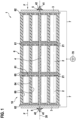
- the Figure 1 shows a simplified schematic sectional view of a battery arrangement 1 according to a first embodiment of the invention.
- the battery arrangement 1 comprises a battery pack 10 with several cylindrical battery cells 2. All battery cells 2 are arranged parallel to a longitudinal axis 20. With respect to the longitudinal axis 20, several battery cells 2 are arranged axially and radially next to one another.
- the battery cells 2 are accommodated in a cell holder 6.
- the cell holder 6 is made of plastic and in particular ensures radial positioning of the battery cells 2 relative to one another.
- the cell holder 6 has a recess 60 for each battery cell 2 in which the battery cell 2 is arranged.
- the recesses 60 are each separated from one another by cell holder walls 64.
- the cell holder 6 has intermediate plates 61 which are arranged in the axial direction between the battery cells 2 arranged next to one another in the axial direction, that is to say between respective levels of battery cells 2.
- An end plate 62 of the cell holder 6 is provided on each of the two end faces of the battery pack 10.
- the cell holder 6 thus offers, in particular, protection of the battery cells 2 from environmental influences or direct force.
- the cell holder 6 also has a circular spacer 65 which surrounds the positive pole 21 of the battery cell 2.
- the spacer 65 is designed such that it forms a flat front side together with the positive pole 21 in order to enable uniform bracing of the battery cells 2, as described below.
- the battery arrangement 1 comprises two clamping plates 3, a tension rod 4 and a spring element 5 per clamping plate 3.
- the clamping plates 3 are arranged adjacent to the end plates 62 on each axial end face of the battery pack 10. The two clamping plates 3 are clamped against each other by means of the tie rod 4 in order to apply a preload force F to the battery pack 10 in the axial direction.
- the tie rod 4 extends through the battery pack 10 and is designed as a rod which is subjected to tensile stress by the clamping.
- the tie rod 4 comprises a thread 41 and a nut 42 at each of its axial ends, whereby the nuts 42 can be screwed against each other accordingly in order to adjust the preload force F.
- One of the spring elements 5 is arranged between the nut 42 of the tie rod 4 and the corresponding clamping plate 3.
- the spring elements 5 are designed to be elastically deformable and thus allow a length compensation of the battery cells 2. Such a length compensation can occur, for example, in the case of changing ambient temperatures due to different thermal expansion coefficients of the components of the battery arrangement 1.
- the plastic Cell holder 6 can have a significantly different coefficient of thermal expansion than the battery cells 2 or the tie rod 4, which are each made of metal.
- the spring elements 5 can compensate for age-related changes in length, for example due to creep.
- a further effect of the spring elements 5 is a reduction in external mechanical forces acting on the battery cells 2.
- the elastic deformability of the spring elements 5 causes the battery pack 10 to be cushioned. This can prevent high mechanical forces acting on the battery cells 2 as a result of the impact, which could potentially damage them.
- the spring elements 5 are designed as disc springs. This means that the spring elements 5 are designed as conical ring shells that can be loaded in the axial direction. As shown in the Figure 1 As can be seen, the spring elements 5 are arranged in the direction of a side facing away from the battery pack 10. The spring elements 5 are designed as separate components and are each arranged between the clamping plate 3 and the nut 42 of the tension rod 4.
- the spring elements 5 have a low spring constant, so that only a small change in the preload force F occurs depending on a deformation path in the direction of the longitudinal axis 20. This means that the spring elements 5 enable an approximately path- or stroke-independent tensioning of the battery cells 2, so that a predefined preload force F, which is essentially independent of the service life, can be set in a particularly targeted manner.
- the clamping plates 3 are made of a particularly rigid material so that the clamping plates 3 have a high flexural rigidity. This ensures that the preload force F is distributed as homogeneously as possible across all battery cells 2. This means that the high flexural rigidity of the clamping plates 3 prevents them from bending in the area of force introduction, i.e. directly at the tie rod 4, and causing a highly uneven force introduction to the battery cells 2 in the radial direction.
- the Tie rod 4 is also made of a particularly stiff material. This prevents significant stretching of the tie rod 4 when loaded with the preload force F. This ensures that the length compensation is brought about predominantly, almost completely, by the spring elements 5.
- an EMC discharge element 7 in the form of an electrical line is provided on each of the clamping plates 3, which is connected to a ground 70 in order to earth the clamping plates 3.
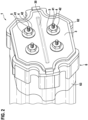
- the Figure 2 shows a perspective detail view of a battery arrangement 1 according to a second embodiment of the invention
- the Figure 3 shows a detailed sectional view of the battery arrangement of the Figure 2 .
- the second embodiment essentially corresponds to the first embodiment of the Figure 1 , with the difference that several tension rods are provided and that the spring elements 5 and the clamping plates 3 are formed in one piece.
- the second embodiment comprises a total of four tie rods 4, which are distributed over the cross section of the battery pack 10.
- a spring element 5 is provided between each tie rod 4 and each clamping plate 3, i.e. four spring elements 5 per clamping plate 3. This makes it possible to achieve a particularly uniform distribution of the preload force F over the cross section of the battery pack 10. In addition, particularly high preload forces F can be achieved in this way.
- the clamping plate 3 can, for example, comprise a bead 30, as shown in the Figures 2 and 3
- the bead 30 is provided centrally in the clamping plate 3 between two of the spring elements 5.
- clamping plates 3 and the respective adjacent spring elements 5 in the second embodiment are formed together as a one-piece component, as shown in particular in the Figure 3 This can simplify, in particular, the manufacture and assembly of the battery arrangement 1.
Landscapes
- Chemical & Material Sciences (AREA)
- Chemical Kinetics & Catalysis (AREA)
- Electrochemistry (AREA)
- General Chemical & Material Sciences (AREA)
- Engineering & Computer Science (AREA)
- Manufacturing & Machinery (AREA)
- Aviation & Aerospace Engineering (AREA)
- Battery Mounting, Suspending (AREA)
Description
- Die vorliegende Erfindung betrifft eine Batterieanordnung mit einem Batteriepack mit mechanisch eingespannten Batteriezellen. Batteriepacks zur Verwendung als Energiespeicher in Fahrzeugen sind häufig aus einer Mehrzahl an Einzelzellen, wie beispielsweise Li-lonen-Zellen, zusammengesetzt. Eine Lagerung solcher Batteriezellen erfolgt meist mittels einfacher Zellhalter. Bekannte Zellhalter können jedoch häufig nicht die fertigungsbedingten oder aus Volumenveränderungen resultierenden Toleranzen in den Abmessungen der Batteriezellen ausgleichen und eine definierte und sichere Lagerung der Batteriezellen, insbesondere bei mechanischen Belastungen, wie einem Aufprall des Batteriepacks auf einen Boden, sicherstellen.
- In der
WO 2018/154528 A1 ist ein Batteriepack mit zylindrischen Batteriezellen beschrieben. In derDE 102012 219 022 A1 ist ein Brennstoffzellenstack mit einem Spannsystem und in derUS 2020/0020900 A1 ein Batteriemodul beschrieben. In derDE 10 2010 012 930 A1 ist eine Batterie und in derDE 42 26 428 C2 ein Batterieblockkasten mit einer Spannvorrichtung beschrieben. - Die erfindungsgemäße Batterieanordnung mit den Merkmalen des Anspruchs 1 bietet demgegenüber den Vorteil einer verbesserten Halterung von Batteriezellen, wobei eine zuverlässige mechanische Fixierung der Batteriezellen, insbesondere bei mechanischen Krafteinwirkungen und bei wechselnden Umgebungstemperaturen, ermöglicht wird. Dies wird erfindungsgemäß erreicht durch eine Batterieanordnung umfassend einen Batteriepack mit einer Vielzahl an Batteriezellen.
- Die Batteriezellen sind jeweils parallel zu einer Längsachse angeordnet und axial und/oder radial nebeneinander angeordnet. Vorzugsweise sind sowohl axial als auch radial zumindest zwei Batteriezellen nebeneinander angeordnet.
- Weiterhin umfasst die Batterieanordnung zwei Spannplatten, welche an jeweils einer axialen Stirnseite des Batteriepacks angeordnet sind, und zumindest einen Zuganker. Der zumindest eine Zuganker ist eingerichtet, die beiden Spannplatten gegeneinander zu verspannen, um eine Vorspannkraft auf den Batteriepack aufzubringen. Beispielsweise kann der Zuganker stangenförmig sein. Vorzugsweise erstreckt sich der Zuganker in axialer Richtung der Längsachse durch den gesamten Batteriepack hindurch. Vorzugsweise können mehrere Zuganker vorgesehen sein, welche insbesondere jeweils parallel zur Längsachse angeordnet sind.
- Zudem umfasst die Batterieanordnung zumindest ein Federelement pro Zuganker. Das Federelement ist elastisch verformbar ausgebildet, um einen Längenausgleich der Batteriezellen zu erlauben. Insbesondere weist das Federelement dabei eine vordefinierte Elastizität auf, welche so ausgelegt ist, dass das Federelement den, beispielsweise durch Änderungen einer Umgebungstemperatur verursachten, Längenausgleich der Batteriezelle auszugleichen, oder um äußere mechanische Krafteinwirkungen, beispielsweise durch einen Aufprall des Batterieparks auf den Boden, abzufedern. Insbesondere ist das Federelement dabei so ausgelegt, dass die elastische Fixierung der Batteriezellen größer als eine bei einem Aufprall auf den Boden auf die Batteriezellen einwirkende mechanische Belastung ist, um eine Beschädigung der Batteriezellen durch unerwünschte Relativbewegungen zu vermeiden.
- Ferner ist das Federelement vorzugsweise so ausgelegt, dass im normalen Betrieb, das heißt, ohne äußere Krafteinwirkung, die auf den Batteriepack wirkende Vorspannkraft kleiner als eine vordefinierte maximale Vorspannkraft ist, um eine plastische Deformation der Batteriezellen aufgrund einer zu hohen statischen Verspannung zu vermeiden.
- Vorzugsweise ist der Zuganker dabei so ausgebildet, dass dieser unter der Vorspannkraft nur geringfügig verformt wird. Insbesondere weist der Zuganker hierfür ein hohes Elastizitätsmodul auf, vorzugsweise mindestens 150*109 N/m2. Bevorzugt weisen die Spannplatten ebenfalls nur eine geringe Verformbarkeit bei Beanspruchung durch die Vorspannkraft auf. Besonders bevorzugt sind Zuganker und/oder Spannplatten aus Metall gebildet. Insbesondere Stähle mit einer hohen Elastizitätsgrenze von mindestens 1*109 N/m2 eignen sich hierfür. Dadurch wird der Längenausgleich gezielt durch das Federelement herbeigeführt.
- Die spezielle Verspannung des Batteriepacks erlaubt dabei eine gleichmäßige Verteilung der Vorspannkraft auf die Batteriezellen. Zudem ermöglicht die Verformbarkeit des Federelements einen Ausgleich von aufgrund unterschiedlicher thermischer Ausdehnungskoeffizienten verursachten unterschiedlichen relativen Längenausdehnungen der einzelnen Bauteile der Batterieanordnung zu kompensieren. Mit anderen Worten erlaubt das Federelement eine Temperatur- und/oder Lebensdauer-abhängige Verformung der Batteriezellen krafttechnisch zu kompensieren. Insbesondere wird hierbei in sämtlichen Betriebszuständen eine im wesentlichen konstante Vorspannkraft auf den Batteriepack aufgebracht.
- Die Batterieanordnung eignet sich insbesondere für den Einsatz in Zweirädern, wie beispielsweise Elektrofahrrädern, bei welchen eine Entnahme der Batterieanordnung, beispielsweise zum Laden, erforderlich sein kann. Zudem sind hierbei die Batteriezellen meist nur wenig vor Umgebungsbedingungen geschützt, sodass sich Temperaturschwankungen unmittelbar auf die Batteriezellen auswirken können. Die spezielle Verspannung mittels Spannplatten, Zuganker und Federelement bewirkt dabei eine besonders zuverlässige mechanische Fixierung in sämtlichen Betriebszuständen, sowie insbesondere unabhängig von Toleranzen, wie beispielsweise Fertigungstoleranzen der Batteriezellen.
- Die Unteransprüche haben bevorzugte Weiterbildungen der Erfindung zum Inhalt.
- Bevorzugt ist das Federelement zwischen dem Zuganker und einer der beiden Spannplatten angeordnet. Besonders bevorzugt ist das Federelement dabei auf einer den Batteriezellen abgewandten Seite der Spannplatte angeordnet. Besonders bevorzugt weisen die Spannplatten jeweils eine Durchgangsöffnung auf, durch welche sich der Zuganker erstreckt, wobei insbesondere jeweils auf einer den Batteriezellen abgewandten Seite der Spannplatten Anschläge am Zuganker vorgesehen sind, um die Verspannung zu ermöglichen. Insbesondere ist das Federelement durch diese Anordnung auf Druck beansprucht. Dadurch ergibt sich besonders einfache Konstruktion der Batterieanordnung.
- Besonders bevorzugt umfasst die Batterieanordnung jeweils zwei Federelemente pro Zuganker. Zwischen jeder Spannplatte und jedem Zuganker ist dabei jeweils ein Federelement angeordnet. Das heißt, an den beiden axialen Enden des Zugankers, an welchen jeweils eine Spannplatte vorliegt, ist ein Federelement vorgesehen, um einen beidseitigen Längenausgleich bereitzustellen. Dadurch kann eine besonders gezielte und zuverlässige Verspannung des Batteriepacks erzielt werden. Die beiden einem Zuganker zugeordneten Federelemente können dabei identisch oder unterschiedlich ausgelegt werden. Im letzteren Fall, also bei unterschiedlichen Federelementen an jedem Zuganker, können beispielsweise verschiedene Federelastizitäten dieser Federelemente vorgesehen sein, um eine besonders flexible und präzise Anpassung der Vorspannkraft an unterschiedlichste Betriebszustände zu ermöglichen.
- Vorzugsweise ist das Federelement als Tellerfeder oder als Spiralfeder ausgebildet, um eine besonders einfache und kostengünstige Herstellung der Batterieanordnung zu erlauben. Insbesondere kann das Federelement auch mehrere Tellerfedern umfassen, welche vorzugsweise in Serie und/oder parallel zueinander angeordnet sind. Alternativ zu Tellerfedern können auch andere Federelemente, wie beispielsweise Schraubenfedern, vorgesehen sein, welche eine gewisse elastische Verformbarkeit aufweisen, um den Längenausgleich der Batteriezellen zu erlauben.
- Besonders bevorzugt weist das Federelement eine geringe Federkonstante auf. Vorzugsweise beträgt die Federkonstante maximal 1000 N/m, insbesondere maximal 100 N/m. Besonders bevorzugt ist das Federelement dabei aus einem Material mit geringem Elastizitätsmodul, insbesondere von maximal 200*109 N/m2, insbesondere maximal 100*109 N/m2 gebildet. Beispielsweise kann das Federelement aus Metall gebildet sein. Dadurch erfolgt bei einer Längenänderung der Batteriezellen eine besonders geringe Änderung der Vorspannkraft, was sich besonders günstig auf eine zuverlässige Einspannung des Batterieparks auswirkt. Die Federelemente ermöglichen somit insbesondere eine näherungsweise Weg- bzw. Hub-unabhängige Verspannung der Batteriezellen, sodass eine besonders gezielte, im wesentlichen lebensdauerunabhängige, vordefinierte Vorspannkraft eingestellt werden kann. Ferner kann eine Geometrie des Federelements speziell so ausgebildet sein, um diesen Effekt eines Längenausgleichs bei annähernd konstanter Vorspannkraft zu unterstützen.
- Vorzugsweise weisen die Spannplatten eine hohe Biegesteifigkeit auf. Die Biegesteifigkeit beträgt insbesondere mindestens 5000 N/m, insbesondere mindestens 10000 N/m. Vorzugsweise weisen die Spannplatten ein hohes Elastizitätsmodul, insbesondere von mindestens 150*109 N/m2, insbesondere mindestens 400*109 N/m2 auf. Durch besonders steife Spannplatten kann die Vorspannkraft besonders homogen in sämtliche Batteriezellen des Batteriepacks eingeleitet werden, um einen zuverlässig verspannten Verbund der Batteriezellen bereitstellen zu können.
- Weiter bevorzugt sind die Spannplatten im unbelasteten Zustand gebogen ausgebildet. Vorzugsweise sind die Spannplatten dabei so ausgebildet, dass diese unter Belastung mit der Vorspannkraft ebene Platte bilden. Das heißt, die Spannplatten sind insbesondere so ausgelegt, dass diese beim Zusammenbau des Batteriepacks entsprechend verformt werden, um ebene Platte zu bilden, sodass die Spannplatten eben an den Stirnseiten des Batteriepacks aufliegen können. Durch eine derartige vorgebogene Konstruktion der Spannplatten kann eine besonders gleichmäßige und homogene Aufbringung der Vorspannkraft auf die einzelnen Batteriezellen des Batteriepacks sichergestellt werden.
- Besonders bevorzugt sind das Federelement und die Spannplatte als separate Bauteile ausgebildet. Dadurch können Federelement und Spannplatte besonders einfach, kostengünstig und flexibel an die jeweiligen speziellen mechanischen Anforderungen angepasst werden.
- Vorzugsweise sind das Federelement die Spannplatte einstückig ausgebildet, um eine besonders einfache Konstruktion der Batterieanordnung mit wenigen Bauteilen zu ermöglichen. Insbesondere wird durch eine derartige Konstruktion von Federelement und Spannplatte zusammen als ein einstückiges Bauteil ein besonders einfacher Zusammenbau der Batterieanordnung ermöglicht.
- Weiterhin ist es vorteilhaft, wenn das Federelement so ausgebildet ist, dass eine vordefinierte maximale Vorspannkraft vorliegt, wenn das Federelement auf Anschlag gespannt ist. Als Zustand, in welchem das Federelement auf Anschlag gespannt ist, wird insbesondere ein Zustand angesehen, in welchem der maximale Weg, welche das, insbesondere auf Druck belastete, Federelement verformbar ist, vollständig ausgereizt ist. Im Falle einer auf Anschläge gespannten Tellerfeder als Federelement bedeutet dies, dass die Tellerfeder bis zu einer ebenen Fläche verformt wird. Das Federelement ist dabei speziell so ausgelegt, dass in diesem Zustand die gewünschte vordefinierte maximale Vorspannkraft vorliegt. Insbesondere wird dadurch erreicht, dass bei einer lebensdauerabhängigen plastischen Verformung der Batterieanordnung stets eine ausreichend hohe Vorspannkraft vorliegt, um eine zuverlässige mechanische Fixierung der Batteriezellen zu gewährleisten. Beispielsweise wird hierdurch vermieden, dass durch eine lebensdauerabhängige plastische Stauchung der Batteriezellen und/oder Dehnung der Zuganker die Vorspannkraft so weit abnimmt, dass die mechanische Fixierung der Batteriezellen unerwünscht gelockert wird.
- Weiter bevorzugt basiert die vordefinierte maximale Vorspannkraft auf einer Fließgrenze eines Werkstoffs des Zugankers. Das heißt, der Zuganker ist vorzugsweise so ausgebildet, dass dieser zu fließen beginnt, also sich plastisch verformt, wenn die tatsächlich aufgebrachte Vorspannkraft die vordefinierte maximale Vorspannkraft übersteigt. Dadurch kann die Batterieanordnung beim Zusammenbau beispielsweise "überspannt" werden, sodass der Zuganker sich plastisch verformt. Anschließend stellt sich die resultierende Vorspannkraft so ein, dass die gewünschte vordefinierte maximale Vorspannkraft vorliegt, also so, dass das Federelement auf Anschlag gespannt ist und hinsichtlich einer Stauchung des Batterieparks einen Längenausgleich bewirken kann. Durch eine derartige Auslegung der Batterieanordnung kann beispielsweise eine einfache Anpassung der mechanischen Verspannung an unterschiedliche Batteriepacks erfolgen.
- Vorzugsweise umfasst die Batterieanordnung ferner einen Zellhalter, in welchem die Batteriezellen aufgenommen sind. Der Zellhalter ist bevorzugt aus Kunststoff gebildet für eine besonders einfache und kostengünstige Herstellung. Der Zellhalter kann beispielsweise für eine Halterung der Batteriezellen, insbesondere in radialer Richtung, vorgesehen sein. Beispielsweise kann der Zellhalter Zwischenplatten aufweisen, welche zwischen zwei in axialer Richtung nebeneinander angeordneten Batteriezellen angeordnet sind. Ferner kann der Zellhalter beispielsweise Distanzplatten aufweisen, welche zwischen den Spannplatten und den Batteriezellen angeordnet sind. Der Zellhalter ermöglicht insbesondere einen einfachen Zusammenbau der Batterieanordnung. Im Falle eines aus Kunststoff ausgebildeten Zellhalters können dabei deutlich unterschiedliche temperaturabhängige Längenänderungen des Zellhalters und der, vorzugsweise aus Metall ausgebildeten, Batteriezellen, sowie des Zugankers auftreten. Durch die elastisch verformbaren Federelemente wird dabei dennoch sichergestellt, dass in sämtlichen Betriebszuständen eine zuverlässige mechanische Verspannung des Batteriepacks gewährleistet ist.
- Besonders bevorzugt weist der Zuganker ein Gewinde und eine Mutter auf, um die Spannplatten zu verspannen. Vorzugsweise liegt die Mutter dabei an der Spannplatte oder an dem Federelement an. Die Vorspannkraft kann somit besonders einfach durch Anziehen der Mutter eingestellt werden.
- Vorzugsweise umfasst die Batterieanordnung jeweils ein EMV-Ableitelement pro Spannplatte. Das EMV-Ableitelement kann beispielsweise als elektrische Leitung vorgesehen sein, und bewirkt vorzugsweise eine elektrische Verbindung der Spannplatten mit einer Masse, um eine galvanische Erdung der Spannplatten bereitzustellen.
- Im Folgenden wird die Erfindung anhand von Ausführungsbeispielen in Verbindung mit den Figuren beschrieben. In den Figuren sind funktional gleiche Bauteile jeweils mit gleichen Bezugszeichen gekennzeichnet. Dabei zeigt:
- Figur 1
- eine stark vereinfachte schematische Schnittansicht einer Batterieanordnung gemäß einem ersten Ausführungsbeispiel der Erfindung,
- Figur 2
- eine perspektivische Detail-Ansicht einer Batterieanordnung gemäß einem zweiten Ausführungsbeispiel der Erfindung, und
- Figur 3
- eine Detail-Schnittansicht der Batterieanordnung der
Figur 2 . - Die
Figur 1 zeigt eine vereinfachte schematische Schnittansicht einer Batterieanordnung 1 gemäß einem ersten Ausführungsbeispiel der Erfindung. Die Batterieanordnung 1 umfasst einen Batteriepack 10 mit mehreren zylindrischen Batteriezellen 2. Sämtliche Batteriezellen 2 sind parallel zu einer Längsachse 20 angeordnet. Bezüglich der Längsachse 20 sind jeweils mehrere Batteriezellen 2 axial und radial nebeneinander angeordnet. - Die Batteriezellen 2 sind in einem Zellhalter 6 aufgenommen. Der Zellhalter 6 ist aus Kunststoff gebildet und stellt insbesondere eine radiale Positionierung der Batteriezellen 2 zueinander sicher. Der Zellhalter 6 weist pro Batteriezelle 2 jeweils eine Aussparung 60 auf, in welcher die Batteriezelle 2 angeordnet ist. Die Aussparungen 60 sind jeweils durch Zellhalterwände 64 voneinander getrennt.
- Zudem weist der Zellhalter 6 Zwischenplatten 61 auf, welche in axialer Richtung zwischen den in axialer Richtung nebeneinander angeordneten Batteriezellen 2, das heißt zwischen jeweiligen Ebenen an Batteriezellen 2, angeordnet sind.
- An den beiden Stirnseiten des Batteriepacks 10 ist jeweils eine Endplatte 62 des Zellhalters 6 vorgesehen. Der Zellhalter 6 bietet somit insbesondere einen Schutz der Batteriezellen 2 vor Umwelteinflüssen oder direkter Krafteinwirkung.
- Pro Batteriezelle 2 weist der Zellhalter 6 zudem jeweils einen kreisringförmigen Abstandshalter 65 auf, welcher den Pluspol 21 der Batteriezelle 2 umgibt. Der Abstandshalter 65 ist dabei so ausgebildet, dass dieser zusammen mit dem Pluspol 21 eine ebene Stirnseite bildet, um eine gleichmäßige Verspannung der Batteriezellen 2 zu ermöglichen, wie nachfolgend beschrieben.
- Um eine zuverlässige und definierte Halterung der Batteriezellen 2 zu ermöglichen, sind diese in Richtung der Längsachse 20 eingespannt. Hierfür umfasst die Batterieanordnung 1 zwei Spannplatten 3, einen Zuganker 4 und jeweils ein Federelement 5 pro Spannplatte 3.
- Die Spannplatten 3 sind an jeweils einer axialen Stirnseite des Batteriepacks 10 an den Endplatten 62 angrenzend angeordnet. Mittels des Zugankers 4 sind die beiden Spannplatten 3 gegeneinander verspannt, um in axialer Richtung eine Vorspannkraft F auf den Batteriepack 10 aufzubringen.
- Der Zuganker 4 erstreckt sich dabei durch den Batteriepack 10 hindurch und ist als Stab ausgebildet, welcher durch die Verspannung auf Zug beansprucht wird. Um die Spannplatten 3 gegeneinander zu verspannen, umfasst die Zuganker 4 an dessen axialen Enden jeweils ein Gewinde 41 und eine Mutter 42, wobei die Muttern 42 entsprechend gegeneinander verschraubt werden können, um die Vorspannkraft F einzustellen.
- Jeweils zwischen der Mutter 42 des Zugankers 4 und der entsprechenden Spannplatte 3, ist eines der Federelemente 5 angeordnet. Die Federelemente 5 sind elastisch verformbar ausgebildet und erlauben dadurch einen Längenausgleich der Batteriezellen 2. Ein derartiger Längenausgleich kann beispielsweise bei sich ändernden Umgebungstemperaturen aufgrund unterschiedlicher Wärmeausdehnungskoeffizienten der Bauteile der Batterieanordnung 1 auftreten. Insbesondere der aus Kunststoff gebildete Zellhalter 6 kann einen deutlich anderen Wärmeausdehnungskoeffizienten als die Batteriezellen 2, oder der Zuganker 4, welche jeweils aus Metall gebildet sind, aufweisen. Ferner können die Federelemente 5 alterungsbedingte Längenänderungen, beispielsweise aufgrund von Kriechen, ausgleichen.
- Ein weiterer Effekt der Federelemente 5 ist eine Reduktion äußerer mechanischer Krafteinwirkungen auf die Batteriezellen 2. Insbesondere bei einem Aufprall der Batterieanordnung 1 auf einen Boden, bewirkt die elastische Verformbarkeit der Federelemente 5 ein Abfedern des Batteriepacks 10. Dadurch kann vermieden werden, dass durch den Aufprall hohe mechanische Kräfte auf die Batteriezellen 2 wirken, und diese unter Umständen beschädigt werden.
- Im Detail sind die Federelemente 5 als Tellerfedern ausgebildet. Das heißt, die Federelemente 5 sind als kegelige Ringschalen, die in axialer Richtung belastbar sind, ausgebildet. Wie in der
Figur 1 zu erkennen, sind die Federelemente 5 dabei in Richtung einer dem Batteriepack 10 abgewandten Seite hin zulaufend angeordnet. Die Federelemente 5 sind dabei als separate Bauteile ausgebildet und jeweils zwischen der Spannplatte 3 und der Mutter 42 des Zugankers 4 angeordnet. - Die Federelemente 5 weisen eine geringe Federkonstante auf, sodass in Abhängigkeit eines Verformungsweges in Richtung der Längsachse 20 nur eine geringe Änderung der Vorspannkraft F eintritt. Das heißt, die Federelemente 5 ermöglichen eine näherungsweise Weg- bzw. Hub-unabhängige Verspannung der Batteriezellen 2, sodass besonders gezielt eine, im wesentlichen lebensdauerunabhängige, vordefinierte Vorspannkraft F eingestellt werden kann.
- Weiterhin sind die Spannplatten 3 aus einem besonders steifen Material ausgebildet, sodass die Spannplatten 3 eine hohe Biegesteifigkeit aufweisen. Dadurch wird erreicht, dass die Vorspannkraft F möglichst homogen auf sämtliche Batteriezellen 2 verteilt wird. Das heißt, durch die hohe Biegesteifigkeit der Spannplatten 3 wird vermieden, dass sich diese im Bereich der Krafteinleitung, das heißt unmittelbar am Zuganker 4 durchbiegen und eine in radialer Richtung stark ungleichmäßige Krafteinleitung auf die Batteriezellen 2 bewirken.
- Um ein besonders definiertes elastischen Verhalten der Anordnung, welches vorwiegend auf der Elastizität der Federelemente 5 basiert, zu erhalten, ist der Zuganker 4 ebenfalls aus einem besonders steifen Material gebildet. Eine wesentliche Dehnung des Zugankers 4 bei Belastung mit der Vorspannkraft F wird hierdurch vermieden. Dadurch wird sichergestellt, dass der Längenausgleich überwiegend, näherungsweise vollständig, durch die Federelemente 5 herbeigeführt wird.
- An jeder der Spannplatten 3 ist zudem ein EMV-Ableitelement 7 in Form einer elektrischen Leitung vorgesehen, welches mit einer Masse 70 verbunden ist, um eine Erdung der Spannplatten 3 zu bewirken.
- Die
Figur 2 zeigt eine perspektivische Detail-Ansicht einer Batterieanordnung 1 gemäß einem zweiten Ausführungsbeispiel der Erfindung, und dieFigur 3 zeigt eine Detail-Schnittansicht der Batterieanordnung derFigur 2 . Das zweite Ausführungsbeispiel entspricht im Wesentlichen dem ersten Ausführungsbeispiel derFigur 1 , mit dem Unterschied, dass mehrere Zuganker vorgesehen sind, und dass die Federelemente 5 und die Spannplatten 3 einstückig ausgebildet sind. - Wie insbesondere in der
Figur 2 zu erkennen, umfasst das zweite Ausführungsbeispiel insgesamt vier Zuganker 4, welche über den Querschnitt des Batteriepacks 10 verteilt angeordnet sind. Zwischen jedem Zuganker 4 und jeder Spannplatte 3 ist dabei jeweils ein Federelement 5 vorgesehen, also vier Federelemente 5 pro Spannplatte 3. Dadurch kann eine besonders gleichmäßige Verteilung der Vorspannkraft F auf den Querschnitt des Batteriepacks 10 erreicht werden. Zudem können hierdurch besonders hohe Vorspannkräfte F erzielt werden. - Für eine zusätzliche Versteifung der Spannplatte 3 kann diese beispielsweise eine Sicke 30 umfassen, wie in den
Figuren 2 und3 dargestellt. Die Sicke 30 ist dabei mittig in der Spannplatte 3 jeweils zwischen zwei der Federelemente 5 vorgesehen. - Ferner sind die Spannplatten 3 und die jeweils angrenzenden Federelemente 5 im zweiten Ausführungsbeispiel zusammen als ein einstückiges Bauteil ausgebildet, wie insbesondere in der
Figur 3 zu erkennen. Dadurch kann insbesondere eine Herstellung sowie ein Zusammenbau der Batterieanordnung 1 vereinfacht werden.
Claims (14)
- Batterieanordnung, umfassend:- einen Batteriepack (10) mit einer Vielzahl an jeweils parallel zu einer Längsachse (20) angeordneten zylindrischen Batteriezellen (2), wobei die Batteriezellen (2) axial und/oder radial nebeneinander angeordnet sind,
gekennzeichnet durch:- zwei Spannplatten (3), welche an jeweils einer axialen Stirnseite des Batteriepacks (10) angeordnet sind,- zumindest einen Zuganker (4), welcher eingerichtet ist, die beiden Spannplatten (3) gegeneinander zu verspannen, um eine Vorspannkraft (F) auf den Batteriepack (10) aufzubringen, und- zumindest ein Federelement (5) pro Zuganker (4),- wobei das Federelement (5) elastisch verformbar ausgebildet ist, um einen Längenausgleich der Batteriezellen (2) zu erlauben. - Batterieanordnung nach Anspruch 1, wobei das Federelement (5) zwischen dem Zuganker (4) und einer der beiden Spannplatten (3) angeordnet ist.
- Batterieanordnung nach Anspruch 2, umfassend jeweils zwei Federelemente (5) pro Zuganker (4), wobei zwischen jeder Spannplatte (3) und jedem Zuganker (4) jeweils ein Federelement (5) angeordnet ist.
- Batterieanordnung nach einem der vorhergehenden Ansprüche, wobei das Federelement (5) als Tellerfeder ausgebildet ist.
- Batterieanordnung nach einem der vorhergehenden Ansprüche, wobei das Federelement (5) eine Federkonstante von maximal 1000 N/m aufweist.
- Batterieanordnung nach einem der vorhergehenden Ansprüche, wobei die Spannplatten (3) eine Biegesteifigkeit von mindestens 5000 N/m aufweisen.
- Batterieanordnung nach einem der vorhergehenden Ansprüche, wobei die Spannplatten (3) im unbelasteten Zustand gebogen ausgebildet sind, und insbesondere so ausgebildet sind, um unter Belastung mit der Vorspannkraft (F) ebene Platten zu bilden.
- Batterieanordnung nach einem der vorhergehenden Ansprüche, wobei das Federelement (5) und die Spannplatte (3) als separate Bauteile ausgebildet sind.
- Batterieanordnung nach einem der Ansprüche 1 bis 7, wobei das Federelement (5) und die Spannplatte (3) einstückig ausgebildet sind.
- Batterieanordnung nach einem der vorhergehenden Ansprüche, wobei das Federelement (5) so ausgebildet ist, dass in einem auf Anschlag gespannten Zustand des Federelements (5) eine vordefinierte maximale Vorspannkraft (F) vorliegt.
- Batterieanordnung nach Anspruch 10, wobei die vordefinierte maximale Vorspannkraft (F) auf einer Fließgrenze eines Werkstoffs des Zugankers (4) basiert.
- Batterieanordnung nach einem der vorhergehenden Ansprüche, ferner umfassend einen Zellhalter (6), in welchem die Batteriezellen (2) aufgenommen sind, wobei der Zellhalter (6) insbesondere aus Kunststoff gebildet ist.
- Batterieanordnung nach einem der vorhergehenden Ansprüche, wobei der Zuganker (4) ein Gewinde (41) und eine Mutter (42) aufweist, um die Spannplatten (3) zu verspannen.
- Batterieanordnung nach einem der vorhergehenden Ansprüche, ferner umfassend jeweils ein Elektromagnetische Verträglichkeit-Ableitelement (7) pro Spannplatte (3).
Priority Applications (1)
| Application Number | Priority Date | Filing Date | Title |
|---|---|---|---|
| EP24160864.5A EP4372885A3 (de) | 2020-01-31 | 2021-01-15 | Batterieanordnung |
Applications Claiming Priority (1)
| Application Number | Priority Date | Filing Date | Title |
|---|---|---|---|
| DE102020201165.6A DE102020201165A1 (de) | 2020-01-31 | 2020-01-31 | Batterieanordnung |
Related Child Applications (2)
| Application Number | Title | Priority Date | Filing Date |
|---|---|---|---|
| EP24160864.5A Division EP4372885A3 (de) | 2020-01-31 | 2021-01-15 | Batterieanordnung |
| EP24160864.5A Division-Into EP4372885A3 (de) | 2020-01-31 | 2021-01-15 | Batterieanordnung |
Publications (2)
| Publication Number | Publication Date |
|---|---|
| EP3859853A1 EP3859853A1 (de) | 2021-08-04 |
| EP3859853B1 true EP3859853B1 (de) | 2024-04-17 |
Family
ID=74184543
Family Applications (2)
| Application Number | Title | Priority Date | Filing Date |
|---|---|---|---|
| EP21151717.2A Active EP3859853B1 (de) | 2020-01-31 | 2021-01-15 | Batterieanordnung |
| EP24160864.5A Pending EP4372885A3 (de) | 2020-01-31 | 2021-01-15 | Batterieanordnung |
Family Applications After (1)
| Application Number | Title | Priority Date | Filing Date |
|---|---|---|---|
| EP24160864.5A Pending EP4372885A3 (de) | 2020-01-31 | 2021-01-15 | Batterieanordnung |
Country Status (2)
| Country | Link |
|---|---|
| EP (2) | EP3859853B1 (de) |
| DE (1) | DE102020201165A1 (de) |
Families Citing this family (4)
| Publication number | Priority date | Publication date | Assignee | Title |
|---|---|---|---|---|
| KR102945057B1 (ko) * | 2022-01-11 | 2026-03-26 | 주식회사 엘지에너지솔루션 | 전지 모듈 및 이를 포함하는 전지팩 |
| CN114709538B (zh) * | 2022-04-24 | 2023-01-10 | 武汉理工大学 | 一种抗冲击型电源装置 |
| DE102023108269A1 (de) * | 2023-03-31 | 2024-10-02 | Man Truck & Bus Se | Vorrichtung zur Lagerung und Temperierung mehrerer Batteriezellen |
| FR3151430B1 (fr) * | 2023-07-21 | 2025-11-21 | Renault Sas | Véhicule doté d’une batterie à ions lithium associée à un dispositif de compression |
Family Cites Families (9)
| Publication number | Priority date | Publication date | Assignee | Title |
|---|---|---|---|---|
| DE2809896C2 (de) | 1978-03-08 | 1983-01-13 | Daimler-Benz Ag, 7000 Stuttgart | Halterung für wenigstens einen Akkumulator in einem Kraftfahrzeug |
| DE4226428C3 (de) * | 1992-08-10 | 1996-09-26 | Friedhelm Mesmer | Batterieblockkasten aus thermoplastischem Kunststoff mit einer mechanischen Spannvorrichtung |
| CN100338793C (zh) | 2005-01-12 | 2007-09-19 | 中国科学院海洋研究所 | 电池连接装置 |
| DE102010012930A1 (de) * | 2010-03-26 | 2011-09-29 | Daimler Ag | Batterie mit einem Stapel von Batterieeinzelzellen |
| DE102010012935A1 (de) | 2010-03-26 | 2011-09-29 | Daimler Ag | Batterie, insbesondere Fahrzeugbatterie |
| DE102012219022B4 (de) * | 2012-10-18 | 2021-05-27 | Scheuermann & Heilig Gmbh | Spannsystem für einen Brennstoffzellenstack |
| DE102014218137A1 (de) | 2014-09-10 | 2016-03-10 | Bayerische Motoren Werke Aktiengesellschaft | Anpresskonzept für Kühlelemente eines Hochvoltspeichers |
| WO2018154528A1 (de) * | 2017-02-24 | 2018-08-30 | Tq Systems Gmbh | Batteriepack mit konvektiver kühlung |
| DE102018116734B4 (de) * | 2018-07-11 | 2025-08-21 | Dr. Ing. H.C. F. Porsche Aktiengesellschaft | Batteriemodul für ein Kraftfahrzeug |
-
2020
- 2020-01-31 DE DE102020201165.6A patent/DE102020201165A1/de active Pending
-
2021
- 2021-01-15 EP EP21151717.2A patent/EP3859853B1/de active Active
- 2021-01-15 EP EP24160864.5A patent/EP4372885A3/de active Pending
Also Published As
| Publication number | Publication date |
|---|---|
| EP4372885A3 (de) | 2024-10-16 |
| EP3859853A1 (de) | 2021-08-04 |
| EP4372885A2 (de) | 2024-05-22 |
| DE102020201165A1 (de) | 2021-08-05 |
Similar Documents
| Publication | Publication Date | Title |
|---|---|---|
| EP3859853B1 (de) | Batterieanordnung | |
| EP3420604B1 (de) | Zellmodul für eine batterie eines kraftfahrzeugs sowie verfahren zum herstellen eines solchen zellmoduls | |
| DE102012219022B4 (de) | Spannsystem für einen Brennstoffzellenstack | |
| DE102010031641A1 (de) | Batteriemodul mit einer federnden Anpressplatte | |
| DE102011009102A1 (de) | Batterie mit einer Mehrzahl von Batteriezellen | |
| DE102020130835A1 (de) | Energiespeichervorrichtung zur Speicherung elektrischer Energie, Verfahren zur Herstellung einer Energiespeichervorrichtung und Kraftfahrzeug | |
| WO2014072119A1 (de) | Batteriemodul mit zwei zugplatten und zwei spannplatten | |
| DE102020131528A1 (de) | Batterie, Kraftfahrzeug und Batteriemontageverfahren | |
| DE102018116734B4 (de) | Batteriemodul für ein Kraftfahrzeug | |
| DE102021103629A1 (de) | Batteriemodul und Batteriezelle | |
| DE102016124705A1 (de) | Batteriehalter für stabförmige Batterien sowie Batteriemodul, insbesondere für Elektromobilitätsanwendungen | |
| DE102017217887A1 (de) | Batterieanordnung und Fahrzeug mit einer derartigen Batterieanordnung | |
| DE102018201660A1 (de) | Batteriemodul mit einem Stapel von Batterie-Einzelzellen | |
| DE102018205627A1 (de) | Hochvoltbatterie für ein elektrisch antreibbares Kraftfahrzeug | |
| DE102011119936A1 (de) | Elastisches Kraftübertragungsglied und Kupplungsvorrichtung | |
| DE102023103436A1 (de) | Schutzvorrichtung für Batteriezellen einer Batterie sowie Batterie mit einer solchen Schutzvorrichtung | |
| DE102022118906A1 (de) | Batteriemodul für eine Traktionsbatterie eines Kraftfahrzeugs | |
| DE102017111514B4 (de) | Gehäuse für einen Stapel aus elektrochemischen Einheiten zur Montage in einer elektrochemischen Vorrichtung | |
| WO2017102348A1 (de) | Energiespeichermodul | |
| DE102021124833A1 (de) | Batteriemodul mit Reduzierung von Querlasten | |
| DE102015011895A1 (de) | Batterie | |
| WO2022033970A1 (de) | Spann- und haltevorrichtung | |
| DE102022103287A1 (de) | Batteriemodul, Endplatteneinheit und Kraftfahrzeug | |
| DE102022109078A1 (de) | Elektrischer Energiespeicher mit einer innerhalb eines Zellstapels angeordneten Druckplatte | |
| DE102019001198A1 (de) | Lager |
Legal Events
| Date | Code | Title | Description |
|---|---|---|---|
| PUAI | Public reference made under article 153(3) epc to a published international application that has entered the european phase |
Free format text: ORIGINAL CODE: 0009012 |
|
| STAA | Information on the status of an ep patent application or granted ep patent |
Free format text: STATUS: THE APPLICATION HAS BEEN PUBLISHED |
|
| AK | Designated contracting states |
Kind code of ref document: A1 Designated state(s): AL AT BE BG CH CY CZ DE DK EE ES FI FR GB GR HR HU IE IS IT LI LT LU LV MC MK MT NL NO PL PT RO RS SE SI SK SM TR |
|
| STAA | Information on the status of an ep patent application or granted ep patent |
Free format text: STATUS: REQUEST FOR EXAMINATION WAS MADE |
|
| 17P | Request for examination filed |
Effective date: 20220204 |
|
| RBV | Designated contracting states (corrected) |
Designated state(s): AL AT BE BG CH CY CZ DE DK EE ES FI FR GB GR HR HU IE IS IT LI LT LU LV MC MK MT NL NO PL PT RO RS SE SI SK SM TR |
|
| GRAP | Despatch of communication of intention to grant a patent |
Free format text: ORIGINAL CODE: EPIDOSNIGR1 |
|
| STAA | Information on the status of an ep patent application or granted ep patent |
Free format text: STATUS: GRANT OF PATENT IS INTENDED |
|
| INTG | Intention to grant announced |
Effective date: 20231116 |
|
| GRAS | Grant fee paid |
Free format text: ORIGINAL CODE: EPIDOSNIGR3 |
|
| GRAA | (expected) grant |
Free format text: ORIGINAL CODE: 0009210 |
|
| STAA | Information on the status of an ep patent application or granted ep patent |
Free format text: STATUS: THE PATENT HAS BEEN GRANTED |
|
| AK | Designated contracting states |
Kind code of ref document: B1 Designated state(s): AL AT BE BG CH CY CZ DE DK EE ES FI FR GB GR HR HU IE IS IT LI LT LU LV MC MK MT NL NO PL PT RO RS SE SI SK SM TR |
|
| REG | Reference to a national code |
Ref country code: GB Ref legal event code: FG4D Free format text: NOT ENGLISH |
|
| REG | Reference to a national code |
Ref country code: CH Ref legal event code: EP |
|
| REG | Reference to a national code |
Ref country code: DE Ref legal event code: R096 Ref document number: 502021003336 Country of ref document: DE |
|
| REG | Reference to a national code |
Ref country code: IE Ref legal event code: FG4D Free format text: LANGUAGE OF EP DOCUMENT: GERMAN |
|
| REG | Reference to a national code |
Ref country code: LT Ref legal event code: MG9D |
|
| REG | Reference to a national code |
Ref country code: NL Ref legal event code: FP |
|
| PG25 | Lapsed in a contracting state [announced via postgrant information from national office to epo] |
Ref country code: IS Free format text: LAPSE BECAUSE OF FAILURE TO SUBMIT A TRANSLATION OF THE DESCRIPTION OR TO PAY THE FEE WITHIN THE PRESCRIBED TIME-LIMIT Effective date: 20240817 |
|
| PG25 | Lapsed in a contracting state [announced via postgrant information from national office to epo] |
Ref country code: BG Free format text: LAPSE BECAUSE OF FAILURE TO SUBMIT A TRANSLATION OF THE DESCRIPTION OR TO PAY THE FEE WITHIN THE PRESCRIBED TIME-LIMIT Effective date: 20240417 |
|
| PG25 | Lapsed in a contracting state [announced via postgrant information from national office to epo] |
Ref country code: HR Free format text: LAPSE BECAUSE OF FAILURE TO SUBMIT A TRANSLATION OF THE DESCRIPTION OR TO PAY THE FEE WITHIN THE PRESCRIBED TIME-LIMIT Effective date: 20240417 Ref country code: FI Free format text: LAPSE BECAUSE OF FAILURE TO SUBMIT A TRANSLATION OF THE DESCRIPTION OR TO PAY THE FEE WITHIN THE PRESCRIBED TIME-LIMIT Effective date: 20240417 |
|
| PG25 | Lapsed in a contracting state [announced via postgrant information from national office to epo] |
Ref country code: GR Free format text: LAPSE BECAUSE OF FAILURE TO SUBMIT A TRANSLATION OF THE DESCRIPTION OR TO PAY THE FEE WITHIN THE PRESCRIBED TIME-LIMIT Effective date: 20240718 |
|
| PG25 | Lapsed in a contracting state [announced via postgrant information from national office to epo] |
Ref country code: PT Free format text: LAPSE BECAUSE OF FAILURE TO SUBMIT A TRANSLATION OF THE DESCRIPTION OR TO PAY THE FEE WITHIN THE PRESCRIBED TIME-LIMIT Effective date: 20240819 |
|
| PG25 | Lapsed in a contracting state [announced via postgrant information from national office to epo] |
Ref country code: ES Free format text: LAPSE BECAUSE OF FAILURE TO SUBMIT A TRANSLATION OF THE DESCRIPTION OR TO PAY THE FEE WITHIN THE PRESCRIBED TIME-LIMIT Effective date: 20240417 |
|
| PG25 | Lapsed in a contracting state [announced via postgrant information from national office to epo] |
Ref country code: PL Free format text: LAPSE BECAUSE OF FAILURE TO SUBMIT A TRANSLATION OF THE DESCRIPTION OR TO PAY THE FEE WITHIN THE PRESCRIBED TIME-LIMIT Effective date: 20240417 |
|
| PG25 | Lapsed in a contracting state [announced via postgrant information from national office to epo] |
Ref country code: LV Free format text: LAPSE BECAUSE OF FAILURE TO SUBMIT A TRANSLATION OF THE DESCRIPTION OR TO PAY THE FEE WITHIN THE PRESCRIBED TIME-LIMIT Effective date: 20240417 |
|
| PG25 | Lapsed in a contracting state [announced via postgrant information from national office to epo] |
Ref country code: PT Free format text: LAPSE BECAUSE OF FAILURE TO SUBMIT A TRANSLATION OF THE DESCRIPTION OR TO PAY THE FEE WITHIN THE PRESCRIBED TIME-LIMIT Effective date: 20240819 Ref country code: PL Free format text: LAPSE BECAUSE OF FAILURE TO SUBMIT A TRANSLATION OF THE DESCRIPTION OR TO PAY THE FEE WITHIN THE PRESCRIBED TIME-LIMIT Effective date: 20240417 Ref country code: NO Free format text: LAPSE BECAUSE OF FAILURE TO SUBMIT A TRANSLATION OF THE DESCRIPTION OR TO PAY THE FEE WITHIN THE PRESCRIBED TIME-LIMIT Effective date: 20240717 Ref country code: LV Free format text: LAPSE BECAUSE OF FAILURE TO SUBMIT A TRANSLATION OF THE DESCRIPTION OR TO PAY THE FEE WITHIN THE PRESCRIBED TIME-LIMIT Effective date: 20240417 Ref country code: IS Free format text: LAPSE BECAUSE OF FAILURE TO SUBMIT A TRANSLATION OF THE DESCRIPTION OR TO PAY THE FEE WITHIN THE PRESCRIBED TIME-LIMIT Effective date: 20240817 Ref country code: HR Free format text: LAPSE BECAUSE OF FAILURE TO SUBMIT A TRANSLATION OF THE DESCRIPTION OR TO PAY THE FEE WITHIN THE PRESCRIBED TIME-LIMIT Effective date: 20240417 Ref country code: GR Free format text: LAPSE BECAUSE OF FAILURE TO SUBMIT A TRANSLATION OF THE DESCRIPTION OR TO PAY THE FEE WITHIN THE PRESCRIBED TIME-LIMIT Effective date: 20240718 Ref country code: FI Free format text: LAPSE BECAUSE OF FAILURE TO SUBMIT A TRANSLATION OF THE DESCRIPTION OR TO PAY THE FEE WITHIN THE PRESCRIBED TIME-LIMIT Effective date: 20240417 Ref country code: ES Free format text: LAPSE BECAUSE OF FAILURE TO SUBMIT A TRANSLATION OF THE DESCRIPTION OR TO PAY THE FEE WITHIN THE PRESCRIBED TIME-LIMIT Effective date: 20240417 Ref country code: BG Free format text: LAPSE BECAUSE OF FAILURE TO SUBMIT A TRANSLATION OF THE DESCRIPTION OR TO PAY THE FEE WITHIN THE PRESCRIBED TIME-LIMIT Effective date: 20240417 Ref country code: RS Free format text: LAPSE BECAUSE OF FAILURE TO SUBMIT A TRANSLATION OF THE DESCRIPTION OR TO PAY THE FEE WITHIN THE PRESCRIBED TIME-LIMIT Effective date: 20240717 |
|
| PG25 | Lapsed in a contracting state [announced via postgrant information from national office to epo] |
Ref country code: DK Free format text: LAPSE BECAUSE OF FAILURE TO SUBMIT A TRANSLATION OF THE DESCRIPTION OR TO PAY THE FEE WITHIN THE PRESCRIBED TIME-LIMIT Effective date: 20240417 |
|
| REG | Reference to a national code |
Ref country code: DE Ref legal event code: R097 Ref document number: 502021003336 Country of ref document: DE |
|
| PG25 | Lapsed in a contracting state [announced via postgrant information from national office to epo] |
Ref country code: EE Free format text: LAPSE BECAUSE OF FAILURE TO SUBMIT A TRANSLATION OF THE DESCRIPTION OR TO PAY THE FEE WITHIN THE PRESCRIBED TIME-LIMIT Effective date: 20240417 |
|
| PG25 | Lapsed in a contracting state [announced via postgrant information from national office to epo] |
Ref country code: CZ Free format text: LAPSE BECAUSE OF FAILURE TO SUBMIT A TRANSLATION OF THE DESCRIPTION OR TO PAY THE FEE WITHIN THE PRESCRIBED TIME-LIMIT Effective date: 20240417 |
|
| PG25 | Lapsed in a contracting state [announced via postgrant information from national office to epo] |
Ref country code: SK Free format text: LAPSE BECAUSE OF FAILURE TO SUBMIT A TRANSLATION OF THE DESCRIPTION OR TO PAY THE FEE WITHIN THE PRESCRIBED TIME-LIMIT Effective date: 20240417 Ref country code: RO Free format text: LAPSE BECAUSE OF FAILURE TO SUBMIT A TRANSLATION OF THE DESCRIPTION OR TO PAY THE FEE WITHIN THE PRESCRIBED TIME-LIMIT Effective date: 20240417 |
|
| PG25 | Lapsed in a contracting state [announced via postgrant information from national office to epo] |
Ref country code: SM Free format text: LAPSE BECAUSE OF FAILURE TO SUBMIT A TRANSLATION OF THE DESCRIPTION OR TO PAY THE FEE WITHIN THE PRESCRIBED TIME-LIMIT Effective date: 20240417 |
|
| PG25 | Lapsed in a contracting state [announced via postgrant information from national office to epo] |
Ref country code: SM Free format text: LAPSE BECAUSE OF FAILURE TO SUBMIT A TRANSLATION OF THE DESCRIPTION OR TO PAY THE FEE WITHIN THE PRESCRIBED TIME-LIMIT Effective date: 20240417 Ref country code: SK Free format text: LAPSE BECAUSE OF FAILURE TO SUBMIT A TRANSLATION OF THE DESCRIPTION OR TO PAY THE FEE WITHIN THE PRESCRIBED TIME-LIMIT Effective date: 20240417 Ref country code: RO Free format text: LAPSE BECAUSE OF FAILURE TO SUBMIT A TRANSLATION OF THE DESCRIPTION OR TO PAY THE FEE WITHIN THE PRESCRIBED TIME-LIMIT Effective date: 20240417 Ref country code: EE Free format text: LAPSE BECAUSE OF FAILURE TO SUBMIT A TRANSLATION OF THE DESCRIPTION OR TO PAY THE FEE WITHIN THE PRESCRIBED TIME-LIMIT Effective date: 20240417 Ref country code: DK Free format text: LAPSE BECAUSE OF FAILURE TO SUBMIT A TRANSLATION OF THE DESCRIPTION OR TO PAY THE FEE WITHIN THE PRESCRIBED TIME-LIMIT Effective date: 20240417 Ref country code: CZ Free format text: LAPSE BECAUSE OF FAILURE TO SUBMIT A TRANSLATION OF THE DESCRIPTION OR TO PAY THE FEE WITHIN THE PRESCRIBED TIME-LIMIT Effective date: 20240417 |
|
| PG25 | Lapsed in a contracting state [announced via postgrant information from national office to epo] |
Ref country code: IT Free format text: LAPSE BECAUSE OF FAILURE TO SUBMIT A TRANSLATION OF THE DESCRIPTION OR TO PAY THE FEE WITHIN THE PRESCRIBED TIME-LIMIT Effective date: 20240417 |
|
| PLBE | No opposition filed within time limit |
Free format text: ORIGINAL CODE: 0009261 |
|
| STAA | Information on the status of an ep patent application or granted ep patent |
Free format text: STATUS: NO OPPOSITION FILED WITHIN TIME LIMIT |
|
| 26N | No opposition filed |
Effective date: 20250120 |
|
| PG25 | Lapsed in a contracting state [announced via postgrant information from national office to epo] |
Ref country code: SI Free format text: LAPSE BECAUSE OF FAILURE TO SUBMIT A TRANSLATION OF THE DESCRIPTION OR TO PAY THE FEE WITHIN THE PRESCRIBED TIME-LIMIT Effective date: 20240417 |
|
| PGFP | Annual fee paid to national office [announced via postgrant information from national office to epo] |
Ref country code: AT Payment date: 20250417 Year of fee payment: 5 |
|
| REG | Reference to a national code |
Ref country code: CH Ref legal event code: PL |
|
| PG25 | Lapsed in a contracting state [announced via postgrant information from national office to epo] |
Ref country code: SE Free format text: LAPSE BECAUSE OF FAILURE TO SUBMIT A TRANSLATION OF THE DESCRIPTION OR TO PAY THE FEE WITHIN THE PRESCRIBED TIME-LIMIT Effective date: 20240417 |
|
| PG25 | Lapsed in a contracting state [announced via postgrant information from national office to epo] |
Ref country code: LU Free format text: LAPSE BECAUSE OF NON-PAYMENT OF DUE FEES Effective date: 20250115 Ref country code: MC Free format text: LAPSE BECAUSE OF FAILURE TO SUBMIT A TRANSLATION OF THE DESCRIPTION OR TO PAY THE FEE WITHIN THE PRESCRIBED TIME-LIMIT Effective date: 20240417 |
|
| PG25 | Lapsed in a contracting state [announced via postgrant information from national office to epo] |
Ref country code: BE Free format text: LAPSE BECAUSE OF NON-PAYMENT OF DUE FEES Effective date: 20250131 |
|
| PG25 | Lapsed in a contracting state [announced via postgrant information from national office to epo] |
Ref country code: CH Free format text: LAPSE BECAUSE OF NON-PAYMENT OF DUE FEES Effective date: 20250131 |
|
| REG | Reference to a national code |
Ref country code: BE Ref legal event code: MM Effective date: 20250131 |
|
| PG25 | Lapsed in a contracting state [announced via postgrant information from national office to epo] |
Ref country code: IE Free format text: LAPSE BECAUSE OF NON-PAYMENT OF DUE FEES Effective date: 20250115 |
|
| PGFP | Annual fee paid to national office [announced via postgrant information from national office to epo] |
Ref country code: NL Payment date: 20260121 Year of fee payment: 6 |
|
| PGFP | Annual fee paid to national office [announced via postgrant information from national office to epo] |
Ref country code: GB Payment date: 20260122 Year of fee payment: 6 |
|
| PGFP | Annual fee paid to national office [announced via postgrant information from national office to epo] |
Ref country code: DE Payment date: 20260319 Year of fee payment: 6 |
|
| PGFP | Annual fee paid to national office [announced via postgrant information from national office to epo] |
Ref country code: FR Payment date: 20260128 Year of fee payment: 6 |