EP3859552B1 - Procede et systeme de traitement du contenu des paquets de donnees/trames a l'aide d'un filtre bloom adapte - Google Patents
Procede et systeme de traitement du contenu des paquets de donnees/trames a l'aide d'un filtre bloom adapte Download PDFInfo
- Publication number
- EP3859552B1 EP3859552B1 EP20315010.7A EP20315010A EP3859552B1 EP 3859552 B1 EP3859552 B1 EP 3859552B1 EP 20315010 A EP20315010 A EP 20315010A EP 3859552 B1 EP3859552 B1 EP 3859552B1
- Authority
- EP
- European Patent Office
- Prior art keywords
- structures
- field
- bits
- read
- pointed
- Prior art date
- Legal status (The legal status is an assumption and is not a legal conclusion. Google has not performed a legal analysis and makes no representation as to the accuracy of the status listed.)
- Active
Links
Images


Classifications
-
- H—ELECTRICITY
- H04—ELECTRIC COMMUNICATION TECHNIQUE
- H04L—TRANSMISSION OF DIGITAL INFORMATION, e.g. TELEGRAPHIC COMMUNICATION
- H04L41/00—Arrangements for maintenance, administration or management of data switching networks, e.g. of packet switching networks
- H04L41/06—Management of faults, events, alarms or notifications
- H04L41/0604—Management of faults, events, alarms or notifications using filtering, e.g. reduction of information by using priority, element types, position or time
-
- H—ELECTRICITY
- H04—ELECTRIC COMMUNICATION TECHNIQUE
- H04L—TRANSMISSION OF DIGITAL INFORMATION, e.g. TELEGRAPHIC COMMUNICATION
- H04L45/00—Routing or path finding of packets in data switching networks
- H04L45/74—Address processing for routing
- H04L45/745—Address table lookup; Address filtering
- H04L45/7453—Address table lookup; Address filtering using hashing
-
- H—ELECTRICITY
- H04—ELECTRIC COMMUNICATION TECHNIQUE
- H04L—TRANSMISSION OF DIGITAL INFORMATION, e.g. TELEGRAPHIC COMMUNICATION
- H04L1/00—Arrangements for detecting or preventing errors in the information received
- H04L1/12—Arrangements for detecting or preventing errors in the information received by using return channel
- H04L1/16—Arrangements for detecting or preventing errors in the information received by using return channel in which the return channel carries supervisory signals, e.g. repetition request signals
- H04L1/1607—Details of the supervisory signal
- H04L1/1642—Formats specially adapted for sequence numbers
-
- G—PHYSICS
- G06—COMPUTING OR CALCULATING; COUNTING
- G06F—ELECTRIC DIGITAL DATA PROCESSING
- G06F11/00—Error detection; Error correction; Monitoring
- G06F11/07—Responding to the occurrence of a fault, e.g. fault tolerance
- G06F11/08—Error detection or correction by redundancy in data representation, e.g. by using checking codes
-
- G—PHYSICS
- G06—COMPUTING OR CALCULATING; COUNTING
- G06F—ELECTRIC DIGITAL DATA PROCESSING
- G06F16/00—Information retrieval; Database structures therefor; File system structures therefor
- G06F16/20—Information retrieval; Database structures therefor; File system structures therefor of structured data, e.g. relational data
- G06F16/22—Indexing; Data structures therefor; Storage structures
- G06F16/2228—Indexing structures
- G06F16/2255—Hash tables
-
- G—PHYSICS
- G06—COMPUTING OR CALCULATING; COUNTING
- G06F—ELECTRIC DIGITAL DATA PROCESSING
- G06F16/00—Information retrieval; Database structures therefor; File system structures therefor
- G06F16/20—Information retrieval; Database structures therefor; File system structures therefor of structured data, e.g. relational data
- G06F16/24—Querying
- G06F16/245—Query processing
- G06F16/2453—Query optimisation
- G06F16/24532—Query optimisation of parallel queries
-
- H—ELECTRICITY
- H04—ELECTRIC COMMUNICATION TECHNIQUE
- H04L—TRANSMISSION OF DIGITAL INFORMATION, e.g. TELEGRAPHIC COMMUNICATION
- H04L43/00—Arrangements for monitoring or testing data switching networks
- H04L43/10—Active monitoring, e.g. heartbeat, ping or trace-route
- H04L43/106—Active monitoring, e.g. heartbeat, ping or trace-route using time related information in packets, e.g. by adding timestamps
-
- H—ELECTRICITY
- H04—ELECTRIC COMMUNICATION TECHNIQUE
- H04L—TRANSMISSION OF DIGITAL INFORMATION, e.g. TELEGRAPHIC COMMUNICATION
- H04L45/00—Routing or path finding of packets in data switching networks
- H04L45/74—Address processing for routing
- H04L45/745—Address table lookup; Address filtering
- H04L45/7453—Address table lookup; Address filtering using hashing
- H04L45/7459—Address table lookup; Address filtering using hashing using Bloom filters
-
- H—ELECTRICITY
- H04—ELECTRIC COMMUNICATION TECHNIQUE
- H04L—TRANSMISSION OF DIGITAL INFORMATION, e.g. TELEGRAPHIC COMMUNICATION
- H04L49/00—Packet switching elements
- H04L49/90—Buffering arrangements
- H04L49/901—Buffering arrangements using storage descriptor, e.g. read or write pointers
-
- H—ELECTRICITY
- H04—ELECTRIC COMMUNICATION TECHNIQUE
- H04L—TRANSMISSION OF DIGITAL INFORMATION, e.g. TELEGRAPHIC COMMUNICATION
- H04L65/00—Network arrangements, protocols or services for supporting real-time applications in data packet communication
- H04L65/10—Architectures or entities
-
- H—ELECTRICITY
- H04—ELECTRIC COMMUNICATION TECHNIQUE
- H04L—TRANSMISSION OF DIGITAL INFORMATION, e.g. TELEGRAPHIC COMMUNICATION
- H04L67/00—Network arrangements or protocols for supporting network services or applications
- H04L67/50—Network services
- H04L67/535—Tracking the activity of the user
-
- H—ELECTRICITY
- H04—ELECTRIC COMMUNICATION TECHNIQUE
- H04L—TRANSMISSION OF DIGITAL INFORMATION, e.g. TELEGRAPHIC COMMUNICATION
- H04L69/00—Network arrangements, protocols or services independent of the application payload and not provided for in the other groups of this subclass
- H04L69/16—Implementation or adaptation of Internet protocol [IP], of transmission control protocol [TCP] or of user datagram protocol [UDP]
-
- H—ELECTRICITY
- H04—ELECTRIC COMMUNICATION TECHNIQUE
- H04L—TRANSMISSION OF DIGITAL INFORMATION, e.g. TELEGRAPHIC COMMUNICATION
- H04L9/00—Cryptographic mechanisms or cryptographic arrangements for secret or secure communications; Network security protocols
- H04L9/32—Cryptographic mechanisms or cryptographic arrangements for secret or secure communications; Network security protocols including means for verifying the identity or authority of a user of the system or for message authentication, e.g. authorization, entity authentication, data integrity or data verification, non-repudiation, key authentication or verification of credentials
- H04L9/3297—Cryptographic mechanisms or cryptographic arrangements for secret or secure communications; Network security protocols including means for verifying the identity or authority of a user of the system or for message authentication, e.g. authorization, entity authentication, data integrity or data verification, non-repudiation, key authentication or verification of credentials involving time stamps, e.g. generation of time stamps
-
- H—ELECTRICITY
- H04—ELECTRIC COMMUNICATION TECHNIQUE
- H04L—TRANSMISSION OF DIGITAL INFORMATION, e.g. TELEGRAPHIC COMMUNICATION
- H04L1/00—Arrangements for detecting or preventing errors in the information received
- H04L1/12—Arrangements for detecting or preventing errors in the information received by using return channel
- H04L1/16—Arrangements for detecting or preventing errors in the information received by using return channel in which the return channel carries supervisory signals, e.g. repetition request signals
- H04L1/18—Automatic repetition systems, e.g. Van Duuren systems
Definitions
- the present technology relates to Bloom filters, more particularly an adapted Bloom filter for handling certain content of a data/packet frame.
- UDP User Datagram Protocol
- a sender such as a client
- a receiver such as a server
- the sender may typically retry sending the initial data packet/frame.
- the two aforementioned communicating parties may be a server hosted in a datacenter as a resource to serve multiple clients, and a remote client.
- DoS Denial of Service
- DoS Denial of Service
- the attack may for example consist in a rogue client sending a SYN data packet/frame (or many) that is not fully legitimate and that the server consumes resources in analyzing and deciding how to handle, or not timely replying an ACK data packet/frame so that the server consumes resources in waiting for, or in re-sending one or several SYN-ACK data packet/frames, etc.
- the gravity of the cyberattack for the server may be largely increased by having large numbers of remote clients having the same behaviour, and flooding the server with malicious data packet/frames in the aforementioned context of networking protocols, so that it may consume resources with handling such malicious data packet/frames, and become inoperable with other legitimate remote clients.
- data centers and cloud infrastructure have been equipped with networking pieces of equipment, installed between the servers populating such data centers and cloud infrastructure, and remote clients, with a risk mitigation function for the data traffic. Examples of such networking pieces of equipment include firewalls, switches, routers, and other dedicated security risk mitigation networking piece of equipment.
- One aspect of such mitigation function involves monitoring the received or intercepted data traffic to detect suspicious patterns of data packet/frames' content, sequencing and/or timeliness as part of a networking protocol.
- This monitoring requires the capability on the part of mitigation networking pieces of equipment, to both decide whether a particular address in a received or intercepted data packet/frame belongs or not to a group of addresses (for example known as fraudulent or illegitimate), and memorize data packet/frames over periods of time depending on the networking protocol.
- a Bloom filter is a space-efficient probabilistic data structure, that may be used to test whether an element, such as an address in a data packet/frame, is a member of a set.
- a combined time-decaying and counting Bloom filter is still desirable for processing-efficient implementation of a method or system for handling content of data packet/frames, in particular keeping track of a number of attempts and retries of sending or receiving such data packet/frames over a sliding window of time.
- a computing system may refer, but is not limited to, an "electronic device”, an “operation system”, a “system”, a “computer-based system”, a “controller unit”, a “monitoring device”, a “control device” and/or any combination thereof appropriate to the relevant task at hand.
- FPGA Field Programmable Gate Array computing systems, available on the market at the time of filing this patent application, such as references Xilinx VU9P, or Intel Stratix V, and any subsequent equivalent technologies becoming available, regardless of their name, consisting in computing system hardware programmable with software.
- processor in intended to include a single dedicated processor, a single shared processor, or a plurality of individual processors, some of which may be shared.
- the processor may be for example a general purpose processor, such as a central processing unit (CPU), a processor dedicated to a specific purpose, or a processor implemented in a FPGA.
- CPU central processing unit
- FPGA field programmable gate array
- memory is intended to include Random Access storage systems, available on the market at the time of filing this patent application, and any subsequent equivalent technologies becoming available, regardless of their name, consisting in computing system media for storing digital information.
- An example of such memory may be a Quad Data Rate (QDR) Static Random Access Memory (SRAM).
- QDR Quad Data Rate
- SRAM Static Random Access Memory
- a computer-readable medium and “the” computer-readable medium should not be construed as being the same computer-readable medium. To the contrary, and whenever appropriate, “a” computer-readable medium and “the” computer-readable medium may also be construed as a first computer-readable medium and a second computer-readable medium.
- Implementations of the present technology each have at least one of the above-mentioned object and/or aspects, but do not necessarily have all of them. It should be understood that some aspects of the present technology that have resulted from attempting to attain the above-mentioned object may not satisfy this object and/or may satisfy other objects not specifically recited herein.
- modules may be represented herein as any combination of flowchart elements or other elements indicating performance of process steps and/or textual description. Such modules may be executed by hardware that is expressly or implicitly shown. Moreover, it should be understood that module may include for example, but without being limitative, computer program logic, computer program instructions, software, stack, firmware, hardware circuitry or a combination thereof which provides the required capabilities.
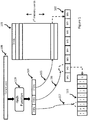
- Figure 1 depicts an example of implementation of an adapted Bloom filter according to the present technology.
- a content word 108 is to be handled, in particular without limitation in the case where such content word 108 represents certain content of a received or intercepted data packet/frame, in order to determine whether an identical content has been handled in a recent period of time.
- the content word 108 may be a content portion of a data packet/frame exchanged between a sender and a receiver over a networking protocol, and analyzed by the receiver, or exchanged between two communicating parties over a networking protocol and intercepted by a mitigation networking piece of equipment.
- the content word 108 may be a concatenation of such communicating party/sender's IP source and destination addresses, together with TCP destination port.
- a hash function 109 may be used, as is known to the person skilled in the art, to map the content word 108 into a fixed-size word 104 that may be used for indexing purposes.
- the fixed-size word 104 may be optimized, from a hardware limitation perspective, to include : - 17 bits pointing (105) to one of the 2 17 words of the memory 101; - 3 bits pointing (106) to one (example as shown Figure 1 : BF2) of 8 Bloom filter structures in a memory word 102 of the memory 101; and - 2 bits pointing (107) to one (example as shown Figure 1 : F3) of 4 bits F1-F4 of a Flags field (as explained below) in a Bloom filter structure 103.
- the values of the 2 bits may point to the bits F1-F4 as follows : Value of 2-bit field Bit pointed to in the Flags field 00 F1 01 F2 10 F3 11 F4
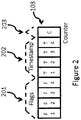
- FIG. 1 depicts an example of adapted Bloom filter structure according to the present technology.
- the Bloom filter structure 103 may include :
- This structure used with the read/write sequences explained below when a received or intercepted content word 108 is to be handled, constitutes an adapted Bloom filter that combines time-decaying with counting features that is desirable, for example for processing-efficient implementation of a method or system for handling data packet/frames by keeping track of a number of attempts and retries of sending or receiving such data packet/frames over a sliding window of time.
- the size and composition of the Bloom filter structure 103 may be adapted and optimized, without affecting the generality of the teachings herein, depending on a number of factors, including in particular and without limitation : the size (width and length) of the memory 101, the size of the content word 108, the maximum acceptable rate of false positives, the maximum number of occurrences of the same content word 108 over a sliding window of time (for example, as a number of retries under a particular networking protocol), and/or the maximum number of different content words 108 that are to be monitored simultaneously.
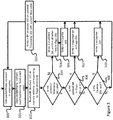
- Figure 3 depicts an application of the adapted Bloom filter according to the present technology, to the analysis of certain content of a data packet/frame either received or intercepted.
- the application may take the form of a method with steps 300 to 310.
- a data packet/frame may be received or intercepted.
- a content word of the data packet/frame may be hashed into a fixed size word, such as for example the 22-bit fixed size word 104 described above.
- the fixed size word may be used to point to, and read/write, a BF structure, such as for example the BF structure 103 described above, in a memory such as for example the memory 101 previously mentioned.
- a number of read/write operations may occur on that BF structure as follows. Numbering refers as an example to the numbered fields in the BF structure depicted Figure 2 :
- steps 308 and 309 may be adapted to check a number of occurrences beyond two of the same content word 108.
- step 309 may consist in an increment of Counter 203, instead of writing a "1" as shown on Figure 3 .
- checking steps 303, 306, 308 are represented as sequential on Figure 3 only for convenience of the description, and that such checking steps may be performed in parallel.
- the adapted BF structure 103 thus may allow in one of its possible applications as described herein, to keep track of a number of attempts and retries of sending or receiving data packet/frames with particular content.
- a period of time relative to the current time value may be defined during which content in the Timestamp 202 is considered valid, and above which such content is considered invalid.
- This period of time may be defined by the number of bits of the Timestamp 202.
- M bits for the Timestamp 202 allow to count up to 2 M time units, before the Timestamp 202, as a time counter, revolves around itself.
- a period of time relative to the current time value, and characterizing the validity of content of Timestamp 202 may be defined as other than 2 (M-1) time units without departing from the scope of the present technology.
- a time unit's duration will be decided depending on a number of factors, including the particulars of the application of the present technology, or as afforded by the clock cycle of the computing system in which the adapted BF structure may be implemented.
- a time unit may be one second.
- an optional parallel process may be implemented according to the present technology which checks the validity of content of Timestamp 202 on a regular basis regardless of the receipt or intercepting of a data packet/frame.
- This optional process may involve a complete re-initialisation of the content of memory 101 on Figure 1 at regular intervals as depicted on Figure 4 .
- This re-initialisation process may take place at a period of time of 2 (M-1) -1 time units, for example when content of the Timestamp 202 may be considered valid for 2 (M-1) time units.
- a BF structure 103 may be read in memory 101.
- the Timestamp field 202 may be checked:
- Timestamp 202 for all BF structures 103 in memory 101 have been read and checked. It will be apparent to the person skilled in the art, that the re-initialisation process described herein may take several time units before being completed for all BF structures 103 in memory 101, but that step 303 on Figure 3 will ensure that no read BF structure may be used whilst the content of its Timestamp 202 is invalid (and also when the optional re-initialisation process is not implemented).
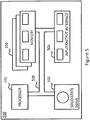
- computing system may be implemented in any other suitable hardware, software, and/or firmware, or a combination thereof, and may be a single physical entity, or several separate physical entities with a distributed functionality.
- the computing system 500 may comprise various hardware components including one or more single or multi-core processors collectively represented by a processor 501, a solid-state drive 502, a memory 503 and an input/output interface 504.
- the processor 501 may or may not be included in a FPGA.
- the computing system 500 may be an "off the shelf' generic computing system.
- the computing system 500 may also be distributed amongst multiple systems.
- the computing system 500 may also be specifically dedicated to the implementation of the present technology. As a person in the art of the present technology may appreciate, multiple variations as to how the computing system 500 is implemented may be envisioned without departing from the scope of the present technology.
- Communication between the various components of the computing system 500 may be enabled by one or more internal and/or external buses 505 (e.g. a PCI bus, universal serial bus, IEEE 1394 "Firewire” bus, SCSI bus, Serial-ATA bus, ARINC bus, etc.), to which the various hardware components are electronically coupled.
- internal and/or external buses 505 e.g. a PCI bus, universal serial bus, IEEE 1394 "Firewire” bus, SCSI bus, Serial-ATA bus, ARINC bus, etc.
- the input/output interface 504 may allow enabling networking capabilities such as wire or wireless access.
- the input/output interface 504 may comprise a networking interface such as, but not limited to, a network port, a network socket, a network interface controller and the like. Multiple examples of how the networking interface may be implemented will become apparent to the person skilled in the art of the present technology.
- the solid-state drive 502 may store program instructions, such as those part of, for example, a library, an application, etc. suitable for being loaded into the memory 503 and executed by the processor 501 for the method and process steps according to the present technology.
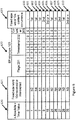
- Figure 6 illustrates the application of the present technology to a simplified examplary set of data packet/frames either received or intercepted, under the form of a table with rows 600-610 and columns 620-623.
- Values in column 620 are hypothetical « absolute » time values.
- Values in column 621 are hypothetical fixed-size words 104 received or intercepted, all pointing to one BF structure 103.
- Evolution of the BF structure 103 accordingly over time is depicted in column 622, for respectively fields Flags 201, Timestamp 202 and Counter 203 of the BF structure 103.
- Values in column 623 are comments about the occurrence information gathered from using the present technology. For simplification purposes of the description, the example is given in relation to the application of steps of Figure 3 , but not the optional parallel process of complete re-initialisation of Figure 4 .
- the "absolute” time value is 0: all bits in BF structure 103 are set to 0.
- the "absolute” time value is 1: the value of Timestamp 202 becomes "0001", and a fixed-size word 104 value N2 is received or intercepted: the value of Flags 201 becomes "0100” (the bit F2 is set to "1"), Counter 203 value remains at “0". This is a 1 st occurrence of value N2.
- the "absolute” time value is 3: the value of Timestamp 202 becomes "0011", and a fixed-size word 104 value N4 is received or intercepted: the value of Flags 201 becomes "0101" (the bit F4 is set to “1"), Counter 203 value remains at “0”.
- the "absolute” time value is 7: the value of Timestamp 202 becomes "0111”, and a fixed-size word 104 value N1 is received or intercepted: the value of Flags 201 becomes "1101” (the bit F1 is set to "1"), Counter 203 value remains at "0". This is a 1 st occurrence of value N1.
- the "absolute” time value is 9: the value of Timestamp 202 becomes “1001", and a fixed-size word 104 value N1 is again received or intercepted: the value of Flags 201 remains “1101", Counter 203 value is set at “1". This is a 2 nd occurrence of value N1.
- the "absolute” time value is 15: the value of Timestamp 202 becomes “1111”, and a fixed-size word 104 value N1 is again received or intercepted: the value of Flags 201 remains "1101", Counter 203 value remains at “1". This is a 3 rd occurrence of value N1.
- the "absolute" time value is 24 and a fixed-size word 104 value N2 is again received or intercepted: the value of Timestamp 202 which has revolved around itself becomes "1000", and since this is not a valid Timestamp 202 anymore (assuming for example, as explained above, that a Timestamp 202 is valid only when the absolute value of the difference between the value of the Timestamp 202 and the "absolute” time value, is less than 8 (2 (M-1) )), the value of Flags 201 becomes "0100” (the bit F2 is set to "1" and all bits F1, F3 and F4 are set to "0”), and Counter 203 value is set at "0".
- the "absolute” time value is 27: the value of Timestamp 202 becomes “1011”, and a fixed-size word 104 value N2 is again received or intercepted: the value of Flags 201 remains “0101", Counter 203 value is set at "1". This is a 2 nd occurrence of value N2.
- the "absolute” time value is 28: the value of Timestamp 202 becomes "1100”, and a fixed-size word 104 value N3 is received or intercepted: the value of Flags 201 becomes "0111” (the bit F3 is set to "1"), Counter 203 remains at “1". This is 1 st occurrence of value N3.
- the "absolute" time value is 29: the value of Timestamp 202 becomes "1101", and a fixed-size word 104 value N3 is again received or intercepted: the value of Flags 201 remains at "0111", and since Counter 203 is at "1", this appears like a 3 rd occurrence of value N3, a false positive since N3 occurred two times only.
- False positives are inherent to the Bloom filter technology, either adapted according to the present technology, or not, the acceptable rate of which depending on the application made of the technology.
- multiple adapted Bloom filter structures may be implemented, reducing the rate of false positives.
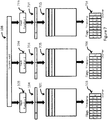
- Figure 7 depicts an embodiment of the present technology where multiple adapted Bloom filter structures are implemented. Three structures are represented therein, but it will be apparent to the person skilled in the art that more or less of such structures may be implemented still based on the teachings of the present description.
- a content word 108 is to be handled, as mentioned in relation to Figure 1 .
- Three hash functions 109, 709, 719 may be used, as is known to the person skilled in the art, to map the content word 108 into fixed-size words 104, 704, 714 that may be used for indexing purposes.
- the hash functions may be different, or two or several of them may be identical.
- the fixed-size words 104, 704, 714 may be optimized to each include :
- Bloom filter structures 103, 706, 716 may not necessarily have the same content.
- the multiplicity of such Bloom filter structures obtained with hash functions 109, 709, 719 giving rise to fixed-size words 104, 704, 714 of identical structure and pointing to memories 101, 705, 715 also of identical structure, allows to confer more robustness (ie : fewer false positives) to the present technology, for example in one of its possible applications as described herein, to keep track of a number of attempts and retries of sending or receiving data packet/frames with particular content.
- Figure 8 depicts an application of multiple adapted Bloom filter structures according to the present technology, to the analysis of certain content of a data packet/frame either received or intercepted.
- the number of hash functions, fixed size words and memories, is generalized to be "i".
- the application may take the form of a method with steps 800 to 810.
- a data packet/frame may be received or intercepted.
- a content word of the data packet/frame may be hashed through i hash functions into i fixed size words, such as for example the 22-bit fixed size word 104 described above.
- the fixed size words may be used to point to, and read/write, i BF structures, such as for example the BF structures 103, 706, 716 described above, in respectively i memories such as for example the memories 101, 705, 715 previously mentioned.
- steps 808 and 809 may be adapted to check a number of occurrences beyond two of data packet/frame content word, hashed into i fixed-size words obtained at step 801.
- checking steps 803, 806, 808 are represented as sequential on Figure 8 only for convenience of the description, and that such checking steps may be performed in parallel.
Landscapes
- Engineering & Computer Science (AREA)
- Computer Networks & Wireless Communication (AREA)
- Signal Processing (AREA)
- Theoretical Computer Science (AREA)
- General Engineering & Computer Science (AREA)
- General Physics & Mathematics (AREA)
- Physics & Mathematics (AREA)
- Computer Security & Cryptography (AREA)
- Data Mining & Analysis (AREA)
- Databases & Information Systems (AREA)
- Health & Medical Sciences (AREA)
- Cardiology (AREA)
- General Health & Medical Sciences (AREA)
- Computer Hardware Design (AREA)
- Quality & Reliability (AREA)
- Software Systems (AREA)
- Computational Linguistics (AREA)
- Multimedia (AREA)
- Data Exchanges In Wide-Area Networks (AREA)
Claims (13)
- Procédé de traitement d'un mot de contenu (108) dans un système comprenant i, i ≥ 1, mémoires (101) de 2N mots de mémoire (102) de R bits chacun, et dans lequel :- chaque mot de mémoire (102) comprend au moins 2S structures de filtre bloom, BF, (103) ;- chaque structure BF (103) comprend Partie entière inférieure(R/2S) bits dont P bits définissent un champ Drapeaux (201), M bits définissent un champ Estampille temporelle (202), Q bits définissent un champ Compteur (203), de telle manière que P + M + Q = Partie entière inférieure(R/2S) et P est une puissance de 2 ; et- une valeur de temps absolue a des incréments d'unités de temps, et une valeur de temps courante est la valeur de temps absolue modulo 2M ;le procédé comprenant :a) la réception du mot de contenu (108) ;b) le hachage (301, 801) du mot de contenu (108) en i mots de taille fixe (104, 704, 714), chacun comprenant 3 champs Ai, Bi, Ci, de respectivement N, S et racine carrée(P) bits ;c) le pointage (105) vers i mots de mémoire (102), correspondant respectivement à Ai ;d) le pointage (106) vers, et la lecture (302, 802), de i structures BF (103, 706, 716) respectivement dans les i mots de mémoire (102) pointés, correspondant respectivement à Bi ;e) le fait de vérifier (303, 803) si toutes les i structures BF (103) pointées et lues ont un champ Estampille temporelle (202) valide, et dans le cas contraire :- pour les structures BF parmi les i structures BF (103) pointées et lues ayant un champ Estampille temporelle (202) invalide : l'écriture (304, 804) d'un « 1 » dans un bit du champ Drapeaux (201) correspondant à Ci, l'écriture d'un « 0 » dans tous les autres bits du champ Drapeaux (201), et la réinitialisation à « 0 » du champ Compteur (203) ; et pour les structures BF parmi les i structures BF (103) pointées et lues ayant un champ Estampille temporelle (202) valide : l'écriture (805) d'un « 1 » dans un bit du champ Drapeaux (201) correspondant à Ci ; et- pour toutes les structures BF parmi les i structures BF (103) pointées et lues : la mise à jour (310, 810) du champ Estampille temporelle (202) avec la valeur de temps courante, et le passage à l'étape a) ;f) le fait de vérifier (306, 806) si tous les bits du champ Drapeaux (201) dans toutes les i structures BF (103) pointées et lues sont à « 1 », et dans le cas contraire :- l'écriture (307, 807) d'un « 1 » dans le bit du champ Drapeaux (201) correspondant à Ci ; et- pour toutes les structures BF parmi les i structures BF (103) pointées et lues : la mise à jour (310, 810) du champ Estampille temporelle (202) avec la valeur de temps courante, et le passage à l'étape a) ;g) le fait de vérifier (308, 808) si tous les bits dans les champs Compteur (203) dans toutes les i structures BF (103) pointées et lues sont à « 1 », et dans le cas contraire :- pour les structures BF parmi les i structures BF (103) pointées et lues ayant un champ Compteur (203) égal au Min des champs Compteur (203) dans les i structures BF (103) pointées et lues : l'incrémentation (309, 809) par un de la valeur du champ Compteur (203) ; et- pour toutes les structures BF parmi les i structures BF (103) pointées et lues : la mise à jour (310, 810) du champ Estampille temporelle (202) avec la valeur de temps courante, et le passage à l'étape a) ; eth) pour toutes les structures BF parmi les i structures BF (103) pointées et lues : la mise à jour (310, 810) du champ Estampille temporelle (202) avec la valeur de temps courante, et le passage à l'étape a).
- Procédé selon la revendication 1 comprenant en outre la lecture de toutes les structures BF (103) dans tous les mots de mémoire (102) d'au moins l'une des i mémoires (101), et pour chaque telle structure BF (103) lue, le fait de vérifier (401) si le contenu du champ Estampille temporelle (202) est valide, et dans le cas contraire : l'écriture (402) d'un « 0 » dans tous les bits du champ Drapeaux (201) ; la réinitialisation (403) à « 0 » du champ Compteur (203) ; et la mise à jour (404) du champ Estampille temporelle (202) avec la valeur de temps courante.
- Procédé selon l'une quelconque des revendications 1 et 2 dans lequel le mot de contenu (108) est une concaténation d'adresses comportant des adresses de protocole Internet source et destination.
- Procédé selon l'une quelconque des revendications 1 à 3 dans lequel chaque structure BF (103) comprend 4 bits pour le champ Drapeaux (201), 4 bits pour le champ Estampille temporelle (202), et 1 bit pour le champ Compteur (203).
- Procédé selon l'une quelconque des revendications 1 à 4 dans lequel un champ Estampille temporelle (202) est valide lorsque la valeur absolue de la différence entre la valeur du champ Estampille temporelle (202) et la valeur de temps courante est inférieure à une valeur prédéterminée.
- Procédé selon la revendication 5 dans lequel la valeur prédéterminée est 2(M-1).
- Procédé selon l'une quelconque des revendications 2, et 3 à 6 lorsqu'elles dépendent de la revendication 2, dans lequel les étapes de la revendication 2 sont effectuées à une période de temps inférieure ou égale à 2(M-1) unités de temps.
- Procédé selon l'une quelconque des revendications 1 à 7 dans lequel i est ≥ 3 et au moins deux des i mots de taille fixe (104, 704, 714) sont identiques.
- Système de traitement d'un mot de contenu (108), le système comprenant i, i ≥ 1, mémoires (101) de 2N mots de mémoire (102) de R bits chacun, dans lequel :- chaque mot de mémoire (102) comprend au moins 2S structures BF (103) ;- chaque structure BF (103) comprend Partie entière inférieure(R/2S) bits dont P bits définissent un champ Drapeaux (201), M bits définissent un champ Estampille temporelle (202), Q bits définissent un champ Compteur (203), de telle manière que P + M + Q = Partie entière inférieure(R/2S) et P est une puissance de 2 ; et- une valeur de temps absolue a des incréments d'unités de temps, et une valeur de temps courante est la valeur de temps absolue modulo 2M ;le système étant configuré pour :- recevoir le mot de contenu (108) ;- hacher (301, 801) le mot de contenu (108) en i mots de taille fixe (104, 704, 714), chacun comprenant 3 champs Ai, Bi, Ci, de respectivement N, S et racine carrée(P) bits ;- pointer (105) vers i mots de mémoire (102), correspondant respectivement à Ai ;- pointer (106) vers, et lire (302, 802), i structures BF (103, 706, 716) respectivement dans les i mots de mémoire (102) pointés, correspondant respectivement à Bi ;- vérifier (303, 803) si toutes les i structures BF (103) pointées et lues ont un champ Estampille temporelle (202) valide, et dans le cas contraire :- pour les structures BF parmi les i structures BF (103) pointées et lues ayant un champ Estampille temporelle (202) invalide : écrire (304, 804) un « 1 » dans un bit du champ Drapeaux (201) correspondant à Ci, écrire un « 0 » dans tous les autres bits du champ Drapeaux (201), et réinitialiser à « 0 » le champ Compteur (203) ; et pour les structures BF parmi les i structures BF (103) pointées et lues ayant un champ Estampille temporelle (202) valide : écrire (805) un « 1 » dans un bit du champ Drapeaux (201) correspondant à Ci ; et- pour toutes les structures BF parmi les i structures BF (103) pointées et lues : mettre à jour (310, 810) le champ Estampille temporelle (202) avec la valeur de temps courante ;- vérifier (306, 806) si tous les bits du champ Drapeaux (201) dans toutes les i structures BF (103) pointées et lues sont à « 1 », et dans le cas contraire :- écrire (307, 807) un « 1 » dans le bit du champ Drapeaux (201) correspondant à Ci ; et- pour toutes les structures BF parmi les i structures BF (103) pointées et lues : mettre à jour (310, 810) le champ Estampille temporelle (202) avec la valeur de temps courante ;- vérifier (308, 808) si tous les bits dans les champs Compteur (203) dans toutes les i structures BF (103) pointées et lues sont à « 1 », et dans le cas contraire :- pour les structures BF parmi les i structures BF (103) pointées et lues ayant un champ Compteur (203) égal au Min des champs Compteur (203) dans les i structures BF (103) pointées et lues : incrémenter (309, 809) par un la valeur du champ Compteur (203) ; et- pour toutes les structures BF parmi les i structures BF (103) pointées et lues : mettre à jour (310, 810) le champ Estampille temporelle (202) avec la valeur de temps courante ; et- pour toutes les structures BF parmi les i structures BF (103) pointées et lues : mettre à jour (310, 810) le champ Estampille temporelle (202) avec la valeur de temps courante.
- Système selon la revendication 9 étant en outre configuré pour lire toutes les structures BF (103) dans tous les mots de mémoire (102) d'au moins l'une des i mémoires (101), et pour chaque telle structure BF (103) lue, vérifier (401) si le contenu du champ Estampille temporelle (202) est valide, et dans le cas contraire : écrire (402) un « 0 » dans tous les bits du champ Drapeaux (201) ; réinitialiser (403) à « 0 » le champ Compteur (203) ; et mettre à jour (404) le champ Estampille temporelle (202) avec la valeur de temps courante.
- Système selon la revendication 9 ou 10 dans lequel le mot de contenu (108) est une portion d'un paquet de données/trame échangé entre deux dispositifs de communication, et est intercepté de façon à déterminer si un mot de contenu (108) identique a été échangé entre les deux dispositifs de communication sur une fenêtre glissante de temps absolu.
- Système selon l'une quelconque des revendications 9 à 11 dans lequel les i mémoires (101) sont des mémoires statiques à débit de données quadruple.
- Équipement de réseau entre un envoyeur et un récepteur pour surveiller des mots de contenu de trames de données/paquets échangés entre l'envoyeur et le récepteur, dans lequel l'équipement de réseau comprend le système selon l'une quelconque des revendications 9 à 12.
Priority Applications (6)
| Application Number | Priority Date | Filing Date | Title |
|---|---|---|---|
| EP20315010.7A EP3859552B1 (fr) | 2020-01-30 | 2020-01-30 | Procede et systeme de traitement du contenu des paquets de donnees/trames a l'aide d'un filtre bloom adapte |
| DK20315010.7T DK3859552T3 (da) | 2020-01-30 | 2020-01-30 | Fremgangsmåde og system til håndtering af indhold af datapakke/rammer under anvendelse af et tilpasset bloom-filter |
| PL20315010T PL3859552T3 (pl) | 2020-01-30 | 2020-01-30 | Sposób i system obsługi zawartości pakietu/ramek danych z wykorzystaniem dostosowanego filtra blooma |
| US16/995,915 US11743186B2 (en) | 2020-01-30 | 2020-08-18 | Method and system for handling of data packet/frames using an adapted bloom filter |
| CA3090576A CA3090576A1 (fr) | 2020-01-30 | 2020-08-20 | Methode et systeme pour traiter le contenu de paquets de donnees/trames au moyen d`un filtre de bloom adapte |
| CN202010982507.7A CN113206740B (zh) | 2020-01-30 | 2020-09-17 | 对内容字进行处理的方法和系统以及网络设备 |
Applications Claiming Priority (1)
| Application Number | Priority Date | Filing Date | Title |
|---|---|---|---|
| EP20315010.7A EP3859552B1 (fr) | 2020-01-30 | 2020-01-30 | Procede et systeme de traitement du contenu des paquets de donnees/trames a l'aide d'un filtre bloom adapte |
Publications (2)
| Publication Number | Publication Date |
|---|---|
| EP3859552A1 EP3859552A1 (fr) | 2021-08-04 |
| EP3859552B1 true EP3859552B1 (fr) | 2021-11-17 |
Family
ID=70921911
Family Applications (1)
| Application Number | Title | Priority Date | Filing Date |
|---|---|---|---|
| EP20315010.7A Active EP3859552B1 (fr) | 2020-01-30 | 2020-01-30 | Procede et systeme de traitement du contenu des paquets de donnees/trames a l'aide d'un filtre bloom adapte |
Country Status (6)
| Country | Link |
|---|---|
| US (1) | US11743186B2 (fr) |
| EP (1) | EP3859552B1 (fr) |
| CN (1) | CN113206740B (fr) |
| CA (1) | CA3090576A1 (fr) |
| DK (1) | DK3859552T3 (fr) |
| PL (1) | PL3859552T3 (fr) |
Families Citing this family (2)
| Publication number | Priority date | Publication date | Assignee | Title |
|---|---|---|---|---|
| JP7438924B2 (ja) * | 2020-12-15 | 2024-02-27 | 株式会社東芝 | 情報処理装置、方法及びプログラム |
| CN114595280B (zh) * | 2022-05-10 | 2022-08-02 | 鹏城实验室 | 基于滑动窗口的时间成员查询方法、装置、终端及介质 |
Family Cites Families (8)
| Publication number | Priority date | Publication date | Assignee | Title |
|---|---|---|---|---|
| US8201252B2 (en) * | 2002-09-03 | 2012-06-12 | Alcatel Lucent | Methods and devices for providing distributed, adaptive IP filtering against distributed denial of service attacks |
| US7433355B2 (en) * | 2004-02-09 | 2008-10-07 | Alcatel Lucent | Filter based longest prefix match algorithm |
| CN102253820B (zh) | 2011-06-16 | 2013-03-20 | 华中科技大学 | 一种流式重复数据检测方法 |
| EP2629212A1 (fr) | 2012-02-14 | 2013-08-21 | Alcatel Lucent | Procédé de stockage et de recherche d'éléments de contenu marqués dans un système distribué |
| CN105429968B (zh) | 2015-11-06 | 2018-10-30 | 北京数智源科技股份有限公司 | 基于布隆过滤器的网络取证载荷归属方法及系统 |
| US11076025B1 (en) * | 2016-12-27 | 2021-07-27 | Amazon Technologies, Inc. | Generating network packet centric signatures |
| US11860891B2 (en) * | 2020-11-19 | 2024-01-02 | Fivetran Inc. | Identifying changes between source and destination databases using snapshots of source database and invertible bloom filters |
| CN113315705B (zh) * | 2021-04-26 | 2022-07-15 | 中国科学院计算机网络信息中心 | 基于单次哈希布隆过滤器的Flexible IP寻址方法及装置 |
-
2020
- 2020-01-30 DK DK20315010.7T patent/DK3859552T3/da active
- 2020-01-30 EP EP20315010.7A patent/EP3859552B1/fr active Active
- 2020-01-30 PL PL20315010T patent/PL3859552T3/pl unknown
- 2020-08-18 US US16/995,915 patent/US11743186B2/en active Active
- 2020-08-20 CA CA3090576A patent/CA3090576A1/fr active Pending
- 2020-09-17 CN CN202010982507.7A patent/CN113206740B/zh active Active
Also Published As
| Publication number | Publication date |
|---|---|
| US20210243123A1 (en) | 2021-08-05 |
| EP3859552A1 (fr) | 2021-08-04 |
| CN113206740B (zh) | 2024-02-13 |
| US11743186B2 (en) | 2023-08-29 |
| PL3859552T3 (pl) | 2022-02-07 |
| CA3090576A1 (fr) | 2021-07-30 |
| DK3859552T3 (da) | 2021-12-20 |
| CN113206740A (zh) | 2021-08-03 |
Similar Documents
| Publication | Publication Date | Title |
|---|---|---|
| US10541833B2 (en) | System and method for automatically selecting baud rate in a CAN network | |
| US9413783B1 (en) | Network interface with on-board packet processing | |
| US7609625B2 (en) | Systems and methods for detecting and preventing flooding attacks in a network environment | |
| US20050022023A1 (en) | Systems and methods for providing increased computer security | |
| CN1514625A (zh) | 检测网络攻击 | |
| EP3859552B1 (fr) | Procede et systeme de traitement du contenu des paquets de donnees/trames a l'aide d'un filtre bloom adapte | |
| US11252184B2 (en) | Anti-attack data transmission method and device | |
| CN112804263A (zh) | 一种面向物联网的漏洞扫描方法、系统及设备 | |
| Ma et al. | Bayes-based ARP attack detection algorithm for cloud centers | |
| CN105634660A (zh) | 数据包检测方法及系统 | |
| AU2012245503A1 (en) | System and method for transferring data to a plurality of devices in a network | |
| Masumi et al. | Towards efficient labeling of network incident datasets using tcpreplay and snort | |
| CN110740144B (zh) | 确定攻击目标的方法、装置、设备及存储介质 | |
| US8429742B2 (en) | Detection of a denial of service attack on an internet server | |
| EP3618355B1 (fr) | Systèmes et procédés de fonctionnement d'un système de mise en réseau | |
| US11463872B2 (en) | Singularisation of frames to be transmitted by a connected object and blocking of frames retransmitted over a low-power wireless communication network | |
| US10735378B1 (en) | Systems, devices, and methods for providing improved network security | |
| US9667650B2 (en) | Anti-replay checking with multiple sequence number spaces | |
| CN113645225B (zh) | 一种网络安全设备探测方法、装置、设备及可读存储介质 | |
| CN112532610B (zh) | 一种基于tcp分段的入侵防御检测方法及装置 | |
| WO2026001463A1 (fr) | Procédé et appareil de prévention de relecture, dispositif électronique et support de stockage | |
| CN116582598A (zh) | 一种物联网设备轻量级通信方法、系统、设备及介质 | |
| EP3396920B1 (fr) | Système et procédé de filtrage de trafic sur détection d'une attaque de déni de service | |
| CN118200417B (zh) | 基于netmap的fpga算法卡调用处理方法及系统 | |
| US10951536B1 (en) | Sequence number recovery in stateful devices |
Legal Events
| Date | Code | Title | Description |
|---|---|---|---|
| PUAI | Public reference made under article 153(3) epc to a published international application that has entered the european phase |
Free format text: ORIGINAL CODE: 0009012 |
|
| STAA | Information on the status of an ep patent application or granted ep patent |
Free format text: STATUS: REQUEST FOR EXAMINATION WAS MADE |
|
| 17P | Request for examination filed |
Effective date: 20201109 |
|
| AK | Designated contracting states |
Kind code of ref document: A1 Designated state(s): AL AT BE BG CH CY CZ DE DK EE ES FI FR GB GR HR HU IE IS IT LI LT LU LV MC MK MT NL NO PL PT RO RS SE SI SK SM TR |
|
| GRAP | Despatch of communication of intention to grant a patent |
Free format text: ORIGINAL CODE: EPIDOSNIGR1 |
|
| STAA | Information on the status of an ep patent application or granted ep patent |
Free format text: STATUS: GRANT OF PATENT IS INTENDED |
|
| INTG | Intention to grant announced |
Effective date: 20210903 |
|
| GRAS | Grant fee paid |
Free format text: ORIGINAL CODE: EPIDOSNIGR3 |
|
| GRAA | (expected) grant |
Free format text: ORIGINAL CODE: 0009210 |
|
| STAA | Information on the status of an ep patent application or granted ep patent |
Free format text: STATUS: THE PATENT HAS BEEN GRANTED |
|
| AK | Designated contracting states |
Kind code of ref document: B1 Designated state(s): AL AT BE BG CH CY CZ DE DK EE ES FI FR GB GR HR HU IE IS IT LI LT LU LV MC MK MT NL NO PL PT RO RS SE SI SK SM TR |
|
| REG | Reference to a national code |
Ref country code: GB Ref legal event code: FG4D |
|
| REG | Reference to a national code |
Ref country code: DE Ref legal event code: R096 Ref document number: 602020001033 Country of ref document: DE |
|
| REG | Reference to a national code |
Ref country code: IE Ref legal event code: FG4D |
|
| REG | Reference to a national code |
Ref country code: AT Ref legal event code: REF Ref document number: 1448662 Country of ref document: AT Kind code of ref document: T Effective date: 20211215 |
|
| REG | Reference to a national code |
Ref country code: DK Ref legal event code: T3 Effective date: 20211213 |
|
| REG | Reference to a national code |
Ref country code: NL Ref legal event code: FP |
|
| REG | Reference to a national code |
Ref country code: LT Ref legal event code: MG9D |
|
| REG | Reference to a national code |
Ref country code: AT Ref legal event code: MK05 Ref document number: 1448662 Country of ref document: AT Kind code of ref document: T Effective date: 20211117 |
|
| PG25 | Lapsed in a contracting state [announced via postgrant information from national office to epo] |
Ref country code: RS Free format text: LAPSE BECAUSE OF FAILURE TO SUBMIT A TRANSLATION OF THE DESCRIPTION OR TO PAY THE FEE WITHIN THE PRESCRIBED TIME-LIMIT Effective date: 20211117 Ref country code: LT Free format text: LAPSE BECAUSE OF FAILURE TO SUBMIT A TRANSLATION OF THE DESCRIPTION OR TO PAY THE FEE WITHIN THE PRESCRIBED TIME-LIMIT Effective date: 20211117 Ref country code: FI Free format text: LAPSE BECAUSE OF FAILURE TO SUBMIT A TRANSLATION OF THE DESCRIPTION OR TO PAY THE FEE WITHIN THE PRESCRIBED TIME-LIMIT Effective date: 20211117 Ref country code: BG Free format text: LAPSE BECAUSE OF FAILURE TO SUBMIT A TRANSLATION OF THE DESCRIPTION OR TO PAY THE FEE WITHIN THE PRESCRIBED TIME-LIMIT Effective date: 20220217 Ref country code: AT Free format text: LAPSE BECAUSE OF FAILURE TO SUBMIT A TRANSLATION OF THE DESCRIPTION OR TO PAY THE FEE WITHIN THE PRESCRIBED TIME-LIMIT Effective date: 20211117 |
|
| PG25 | Lapsed in a contracting state [announced via postgrant information from national office to epo] |
Ref country code: IS Free format text: LAPSE BECAUSE OF FAILURE TO SUBMIT A TRANSLATION OF THE DESCRIPTION OR TO PAY THE FEE WITHIN THE PRESCRIBED TIME-LIMIT Effective date: 20220317 Ref country code: SE Free format text: LAPSE BECAUSE OF FAILURE TO SUBMIT A TRANSLATION OF THE DESCRIPTION OR TO PAY THE FEE WITHIN THE PRESCRIBED TIME-LIMIT Effective date: 20211117 Ref country code: PT Free format text: LAPSE BECAUSE OF FAILURE TO SUBMIT A TRANSLATION OF THE DESCRIPTION OR TO PAY THE FEE WITHIN THE PRESCRIBED TIME-LIMIT Effective date: 20220317 Ref country code: NO Free format text: LAPSE BECAUSE OF FAILURE TO SUBMIT A TRANSLATION OF THE DESCRIPTION OR TO PAY THE FEE WITHIN THE PRESCRIBED TIME-LIMIT Effective date: 20220217 Ref country code: LV Free format text: LAPSE BECAUSE OF FAILURE TO SUBMIT A TRANSLATION OF THE DESCRIPTION OR TO PAY THE FEE WITHIN THE PRESCRIBED TIME-LIMIT Effective date: 20211117 Ref country code: HR Free format text: LAPSE BECAUSE OF FAILURE TO SUBMIT A TRANSLATION OF THE DESCRIPTION OR TO PAY THE FEE WITHIN THE PRESCRIBED TIME-LIMIT Effective date: 20211117 Ref country code: GR Free format text: LAPSE BECAUSE OF FAILURE TO SUBMIT A TRANSLATION OF THE DESCRIPTION OR TO PAY THE FEE WITHIN THE PRESCRIBED TIME-LIMIT Effective date: 20220218 |
|
| PG25 | Lapsed in a contracting state [announced via postgrant information from national office to epo] |
Ref country code: SM Free format text: LAPSE BECAUSE OF FAILURE TO SUBMIT A TRANSLATION OF THE DESCRIPTION OR TO PAY THE FEE WITHIN THE PRESCRIBED TIME-LIMIT Effective date: 20211117 Ref country code: SK Free format text: LAPSE BECAUSE OF FAILURE TO SUBMIT A TRANSLATION OF THE DESCRIPTION OR TO PAY THE FEE WITHIN THE PRESCRIBED TIME-LIMIT Effective date: 20211117 Ref country code: RO Free format text: LAPSE BECAUSE OF FAILURE TO SUBMIT A TRANSLATION OF THE DESCRIPTION OR TO PAY THE FEE WITHIN THE PRESCRIBED TIME-LIMIT Effective date: 20211117 Ref country code: ES Free format text: LAPSE BECAUSE OF FAILURE TO SUBMIT A TRANSLATION OF THE DESCRIPTION OR TO PAY THE FEE WITHIN THE PRESCRIBED TIME-LIMIT Effective date: 20211117 Ref country code: EE Free format text: LAPSE BECAUSE OF FAILURE TO SUBMIT A TRANSLATION OF THE DESCRIPTION OR TO PAY THE FEE WITHIN THE PRESCRIBED TIME-LIMIT Effective date: 20211117 Ref country code: CZ Free format text: LAPSE BECAUSE OF FAILURE TO SUBMIT A TRANSLATION OF THE DESCRIPTION OR TO PAY THE FEE WITHIN THE PRESCRIBED TIME-LIMIT Effective date: 20211117 |
|
| REG | Reference to a national code |
Ref country code: DE Ref legal event code: R097 Ref document number: 602020001033 Country of ref document: DE |
|
| PG25 | Lapsed in a contracting state [announced via postgrant information from national office to epo] |
Ref country code: MC Free format text: LAPSE BECAUSE OF FAILURE TO SUBMIT A TRANSLATION OF THE DESCRIPTION OR TO PAY THE FEE WITHIN THE PRESCRIBED TIME-LIMIT Effective date: 20211117 |
|
| PLBE | No opposition filed within time limit |
Free format text: ORIGINAL CODE: 0009261 |
|
| STAA | Information on the status of an ep patent application or granted ep patent |
Free format text: STATUS: NO OPPOSITION FILED WITHIN TIME LIMIT |
|
| REG | Reference to a national code |
Ref country code: BE Ref legal event code: MM Effective date: 20220131 |
|
| 26N | No opposition filed |
Effective date: 20220818 |
|
| PG25 | Lapsed in a contracting state [announced via postgrant information from national office to epo] |
Ref country code: AL Free format text: LAPSE BECAUSE OF FAILURE TO SUBMIT A TRANSLATION OF THE DESCRIPTION OR TO PAY THE FEE WITHIN THE PRESCRIBED TIME-LIMIT Effective date: 20211117 Ref country code: LU Free format text: LAPSE BECAUSE OF NON-PAYMENT OF DUE FEES Effective date: 20220130 |
|
| PG25 | Lapsed in a contracting state [announced via postgrant information from national office to epo] |
Ref country code: BE Free format text: LAPSE BECAUSE OF NON-PAYMENT OF DUE FEES Effective date: 20220131 |
|
| PG25 | Lapsed in a contracting state [announced via postgrant information from national office to epo] |
Ref country code: IE Free format text: LAPSE BECAUSE OF NON-PAYMENT OF DUE FEES Effective date: 20220130 |
|
| PG25 | Lapsed in a contracting state [announced via postgrant information from national office to epo] |
Ref country code: IT Free format text: LAPSE BECAUSE OF FAILURE TO SUBMIT A TRANSLATION OF THE DESCRIPTION OR TO PAY THE FEE WITHIN THE PRESCRIBED TIME-LIMIT Effective date: 20211117 |
|
| P01 | Opt-out of the competence of the unified patent court (upc) registered |
Effective date: 20230513 |
|
| REG | Reference to a national code |
Ref country code: CH Ref legal event code: PL |
|
| PG25 | Lapsed in a contracting state [announced via postgrant information from national office to epo] |
Ref country code: LI Free format text: LAPSE BECAUSE OF NON-PAYMENT OF DUE FEES Effective date: 20230131 Ref country code: CH Free format text: LAPSE BECAUSE OF NON-PAYMENT OF DUE FEES Effective date: 20230131 |
|
| PG25 | Lapsed in a contracting state [announced via postgrant information from national office to epo] |
Ref country code: MK Free format text: LAPSE BECAUSE OF FAILURE TO SUBMIT A TRANSLATION OF THE DESCRIPTION OR TO PAY THE FEE WITHIN THE PRESCRIBED TIME-LIMIT Effective date: 20211117 Ref country code: CY Free format text: LAPSE BECAUSE OF FAILURE TO SUBMIT A TRANSLATION OF THE DESCRIPTION OR TO PAY THE FEE WITHIN THE PRESCRIBED TIME-LIMIT Effective date: 20211117 |
|
| PG25 | Lapsed in a contracting state [announced via postgrant information from national office to epo] |
Ref country code: HU Free format text: LAPSE BECAUSE OF FAILURE TO SUBMIT A TRANSLATION OF THE DESCRIPTION OR TO PAY THE FEE WITHIN THE PRESCRIBED TIME-LIMIT; INVALID AB INITIO Effective date: 20200130 |
|
| PG25 | Lapsed in a contracting state [announced via postgrant information from national office to epo] |
Ref country code: TR Free format text: LAPSE BECAUSE OF FAILURE TO SUBMIT A TRANSLATION OF THE DESCRIPTION OR TO PAY THE FEE WITHIN THE PRESCRIBED TIME-LIMIT Effective date: 20211117 |
|
| PG25 | Lapsed in a contracting state [announced via postgrant information from national office to epo] |
Ref country code: MT Free format text: LAPSE BECAUSE OF FAILURE TO SUBMIT A TRANSLATION OF THE DESCRIPTION OR TO PAY THE FEE WITHIN THE PRESCRIBED TIME-LIMIT Effective date: 20211117 |
|
| PGFP | Annual fee paid to national office [announced via postgrant information from national office to epo] |
Ref country code: NL Payment date: 20250121 Year of fee payment: 6 |
|
| PGFP | Annual fee paid to national office [announced via postgrant information from national office to epo] |
Ref country code: DE Payment date: 20250122 Year of fee payment: 6 |
|
| PGFP | Annual fee paid to national office [announced via postgrant information from national office to epo] |
Ref country code: DK Payment date: 20250121 Year of fee payment: 6 |
|
| PGFP | Annual fee paid to national office [announced via postgrant information from national office to epo] |
Ref country code: PL Payment date: 20250127 Year of fee payment: 6 Ref country code: FR Payment date: 20250121 Year of fee payment: 6 |
|
| PGFP | Annual fee paid to national office [announced via postgrant information from national office to epo] |
Ref country code: GB Payment date: 20250123 Year of fee payment: 6 |