EP3859272B1 - Calibration circuit to mitigate fiber-optic gyroscope (fog) bias error - Google Patents
Calibration circuit to mitigate fiber-optic gyroscope (fog) bias error Download PDFInfo
- Publication number
- EP3859272B1 EP3859272B1 EP21152789.0A EP21152789A EP3859272B1 EP 3859272 B1 EP3859272 B1 EP 3859272B1 EP 21152789 A EP21152789 A EP 21152789A EP 3859272 B1 EP3859272 B1 EP 3859272B1
- Authority
- EP
- European Patent Office
- Prior art keywords
- opt
- optical
- optical beam
- fog
- output
- Prior art date
- Legal status (The legal status is an assumption and is not a legal conclusion. Google has not performed a legal analysis and makes no representation as to the accuracy of the status listed.)
- Active
Links
Images



Classifications
-
- G—PHYSICS
- G01—MEASURING; TESTING
- G01C—MEASURING DISTANCES, LEVELS OR BEARINGS; SURVEYING; NAVIGATION; GYROSCOPIC INSTRUMENTS; PHOTOGRAMMETRY OR VIDEOGRAMMETRY
- G01C19/00—Gyroscopes; Turn-sensitive devices using vibrating masses; Turn-sensitive devices without moving masses; Measuring angular rate using gyroscopic effects
- G01C19/58—Turn-sensitive devices without moving masses
- G01C19/64—Gyrometers using the Sagnac effect, i.e. rotation-induced shifts between counter-rotating electromagnetic beams
- G01C19/72—Gyrometers using the Sagnac effect, i.e. rotation-induced shifts between counter-rotating electromagnetic beams with counter-rotating light beams in a passive ring, e.g. fibre laser gyrometers
- G01C19/721—Details, e.g. optical or electronical details
-
- G—PHYSICS
- G02—OPTICS
- G02F—OPTICAL DEVICES OR ARRANGEMENTS FOR THE CONTROL OF LIGHT BY MODIFICATION OF THE OPTICAL PROPERTIES OF THE MEDIA OF THE ELEMENTS INVOLVED THEREIN; NON-LINEAR OPTICS; FREQUENCY-CHANGING OF LIGHT; OPTICAL LOGIC ELEMENTS; OPTICAL ANALOGUE/DIGITAL CONVERTERS
- G02F1/00—Devices or arrangements for the control of the intensity, colour, phase, polarisation or direction of light arriving from an independent light source, e.g. switching, gating or modulating; Non-linear optics
- G02F1/29—Devices or arrangements for the control of the intensity, colour, phase, polarisation or direction of light arriving from an independent light source, e.g. switching, gating or modulating; Non-linear optics for the control of the position or the direction of light beams, i.e. deflection
- G02F1/31—Digital deflection, i.e. optical switching
-
- G—PHYSICS
- G02—OPTICS
- G02B—OPTICAL ELEMENTS, SYSTEMS OR APPARATUS
- G02B26/00—Optical devices or arrangements for the control of light using movable or deformable optical elements
- G02B26/08—Optical devices or arrangements for the control of light using movable or deformable optical elements for controlling the direction of light
-
- G—PHYSICS
- G02—OPTICS
- G02B—OPTICAL ELEMENTS, SYSTEMS OR APPARATUS
- G02B26/00—Optical devices or arrangements for the control of light using movable or deformable optical elements
- G02B26/08—Optical devices or arrangements for the control of light using movable or deformable optical elements for controlling the direction of light
- G02B26/0816—Optical devices or arrangements for the control of light using movable or deformable optical elements for controlling the direction of light by means of one or more reflecting elements
- G02B26/0833—Optical devices or arrangements for the control of light using movable or deformable optical elements for controlling the direction of light by means of one or more reflecting elements the reflecting element being a micromechanical device, e.g. a MEMS mirror, DMD
-
- G—PHYSICS
- G02—OPTICS
- G02B—OPTICAL ELEMENTS, SYSTEMS OR APPARATUS
- G02B6/00—Light guides; Structural details of arrangements comprising light guides and other optical elements, e.g. couplings
- G02B6/24—Coupling light guides
- G02B6/26—Optical coupling means
- G02B6/28—Optical coupling means having data bus means, i.e. plural waveguides interconnected and providing an inherently bidirectional system by mixing and splitting signals
- G02B6/2804—Optical coupling means having data bus means, i.e. plural waveguides interconnected and providing an inherently bidirectional system by mixing and splitting signals forming multipart couplers without wavelength selective elements, e.g. "T" couplers, star couplers
- G02B6/2821—Optical coupling means having data bus means, i.e. plural waveguides interconnected and providing an inherently bidirectional system by mixing and splitting signals forming multipart couplers without wavelength selective elements, e.g. "T" couplers, star couplers using lateral coupling between contiguous fibres to split or combine optical signals
-
- G—PHYSICS
- G02—OPTICS
- G02B—OPTICAL ELEMENTS, SYSTEMS OR APPARATUS
- G02B6/00—Light guides; Structural details of arrangements comprising light guides and other optical elements, e.g. couplings
- G02B6/24—Coupling light guides
- G02B6/26—Optical coupling means
- G02B6/35—Optical coupling means having switching means
- G02B6/354—Switching arrangements, i.e. number of input/output ports and interconnection types
- G02B6/3542—Non-blocking switch, e.g. with multiple potential paths between multiple inputs and outputs, the establishment of one switching path not preventing the establishment of further switching paths
-
- G—PHYSICS
- G02—OPTICS
- G02B—OPTICAL ELEMENTS, SYSTEMS OR APPARATUS
- G02B6/00—Light guides; Structural details of arrangements comprising light guides and other optical elements, e.g. couplings
- G02B6/24—Coupling light guides
- G02B6/26—Optical coupling means
- G02B6/35—Optical coupling means having switching means
- G02B6/354—Switching arrangements, i.e. number of input/output ports and interconnection types
- G02B6/3544—2D constellations, i.e. with switching elements and switched beams located in a plane
- G02B6/3546—NxM switch, i.e. a regular array of switches elements of matrix type constellation
-
- G—PHYSICS
- G02—OPTICS
- G02B—OPTICAL ELEMENTS, SYSTEMS OR APPARATUS
- G02B6/00—Light guides; Structural details of arrangements comprising light guides and other optical elements, e.g. couplings
- G02B6/24—Coupling light guides
- G02B6/42—Coupling light guides with opto-electronic elements
- G02B6/4201—Packages, e.g. shape, construction, internal or external details
- G02B6/4204—Packages, e.g. shape, construction, internal or external details the coupling comprising intermediate optical elements, e.g. lenses, holograms
- G02B6/4214—Packages, e.g. shape, construction, internal or external details the coupling comprising intermediate optical elements, e.g. lenses, holograms the intermediate optical element having redirecting reflective means, e.g. mirrors, prisms for deflecting the radiation from horizontal to down- or upward direction toward a device
-
- G—PHYSICS
- G02—OPTICS
- G02B—OPTICAL ELEMENTS, SYSTEMS OR APPARATUS
- G02B6/00—Light guides; Structural details of arrangements comprising light guides and other optical elements, e.g. couplings
- G02B6/44—Mechanical structures for providing tensile strength and external protection for fibres, e.g. optical transmission cables
- G02B6/4439—Auxiliary devices
- G02B6/4457—Bobbins; Reels
-
- G—PHYSICS
- G02—OPTICS
- G02F—OPTICAL DEVICES OR ARRANGEMENTS FOR THE CONTROL OF LIGHT BY MODIFICATION OF THE OPTICAL PROPERTIES OF THE MEDIA OF THE ELEMENTS INVOLVED THEREIN; NON-LINEAR OPTICS; FREQUENCY-CHANGING OF LIGHT; OPTICAL LOGIC ELEMENTS; OPTICAL ANALOGUE/DIGITAL CONVERTERS
- G02F2203/00—Function characteristic
- G02F2203/50—Phase-only modulation
Definitions
- This disclosure relates to sensors, and more particularly to a calibration circuit to mitigate fiber-optic gyroscope bias error.
- Fiber-optic gyroscope (FOG) coils are generally controlled by one ormore control loops where light traveling in opposite directions is applied to the coil to determine parameters such as rotation rate and angular position changes.
- rotation ofth e coil about an axis can lead to a phase difference between the counter-rotating beams.
- Phase-modulation is usually applied to the light to improve the observability of the rotation signal.
- the step duration for the modulation signal applied to the FOG is approximately equal to an optical transit time.
- random phase modulation (RPM) may be employed, but in other cases different types of modulation can be utilized.
- an automatic gain control (AGC) loop is employed to maintain unity gain around the primary (rate) servo loop for the FOG to maximize bandwidth.
- the bandwidth is generally driven by a multi-period delay in applying a new step in response to a gyroscope input.
- ADC analog-to-digital converter
- the second period is consumed processing the received gyroscope output and computing what the feedback step size should be which is then added to the appropriate modulation value.
- this new step size cannot be applied at the end of the second period and needs to wait until the end of the third period to be applied.
- CN 105973222A describes an optical fiber sensing loop structure of an interference type FOG.
- a FOG can measure angular rotation using light transmitted through a fiber optic coil of the FOG and use the Sagnac effect to sense the angular rotation.
- the FOG system includes a light source (e.g., a broadband light source or a laser) configured to generate an optical beam.
- the optical beam is provided to an optical beam controller that is configured to split the optical beam into a pair of approximately equal optical beams that are injected in opposite directions into an optical fiber coil of the FOG, with the optical fiber coil including an optical fiber that is wound around a spool in a first orientation and a second orientation opposite the first orientation.
- the optical beam that is traveling against rotation of the FOG experiences a slightly shorter optical path than the other optical beam, thus creating a phase difference in the optical beams exiting the FOG.
- the resulting difference i.e., differential phase shift
- SSF Sagnac scale factor
- the rotation e.g., rate
- modulation output signals at calculated time increments referred to as tau time periods are applied to the light beams in order to improve the sensitivity and performance (e.g., accuracy, bandwidth) of the gyroscope.
- Modulation output signals can be applied at a beginning of a transit time period tau, which refers to the time it takes for light to be applied to the optical fiber coil and returned from the other end of the optical fiber coil after being applied.
- a transit time period tau refers to the time it takes for light to be applied to the optical fiber coil and returned from the other end of the optical fiber coil after being applied.
- the modulation time is approximately equal to the optical transit time tau.
- the optical beam controller of the FOG system described herein includes an optical switch that is configured to provide the pair of optical beams into the optical fiber of the optical fiber coil in a reversible manner.
- the FOG system can periodically alternate between a first switching state and a second switching state.
- the first switching state the first optical beam of the pair of optical beams can be provided to a first input of the optical fiber coil and the second optical beam of the pair of optical beams can be provided to a second input of the optical fiber coil.
- the first optical beam can be provided to the second input of the optical fiber coil and the second optical beam can be provided to the first input. Therefore, the scale factor relating the detection signal to the rotation rate is reversed in the second switching state relative to the first switching state.
- measurements of the rotation of the FOG can be compared in each of the first and second switching states to estimate a bias error associated with the FOG system.
- the bias error can be associated with environmental variations (e.g., temperature, pressure, etc.) and process variations (e.g., tolerance mismatches, etc.) that can affect the optical path of the optical beams through the FOG. Therefore, the estimated bias error can be subtracted from the determined rotation of the FOG.
- a micro electro-mechanical system (MEMS) switch could alter the light path by changing the mechanical orientation of micro-scale optical elements as a function of an electrical actuation signal.
- the optical switch can be configured as a solid-state switch, as opposed to a MEMS switch.
- Such an optical switch can be fabricated on an electro-optic substrate (e.g., Lithium Niobate) configured to pass light in different paths depending on the voltage applied to it.
- the optical switch can be fabricated on a same substrate (e.g., Lithium Niobate) as a multifunction integrated optical chip (MIOC) that is implemented as part of the interferometer that determines the rotation of the FOG based on the phase difference of the optical beams output from the FOG.
- MIOC multifunction integrated optical chip
- the optical switch can include an input tapered coupler that receives the pair of optical beams, a phase modulator that implements directional switching of the optical beams in each of the first and second switching states in response to a switching signal, and an output tapered coupler configured that provides the pair of optical beams to the inputs of the FOG based on the switching state.
- the periodic switching between the first and second switching states can be very rapid.
- the switching time between the first and second switching states can be much faster than the transit time of light through the optical fiber coil to ensure that rotation rate data is not lost in the switching between the first and second switching states.
- FIG. 1 illustrates an example of a fiber-optic gyroscope (FOG) system 10.
- the FOG system 10 can be used in any of a variety of applications in which precise measurement of rotation of a platform is required.
- the FOG system 10 can be implemented in vehicular navigation, such as in aerospace or nautical vehicular applications as a part of an inertial navigation system (INS).
- the FOG system 10 is configured to determine a rotation, demonstrated in the example of FIG. 1 as a signal ROT, of the FOG system 10 about a sensitive axis.
- the FOG system 10 can be an interferometric FOG (iFOG) that uses interferometry to determine the rotation of the FOG system 10 about the sensitive axis.
- iFOG interferometric FOG
- the FOG system 10 includes a light source 12 (e.g., a broadband source or a laser) configured to generate an optical beam OPT.
- the optical beam OPT is provided (e.g., via an optical fiber) to an optical coupler 14 that is configured to generate an output optical beam OPT_OUT that can be monitored to determine the rotation of the FOG system 10, as described in greater detail herein.
- the optical signal OPT is provided (e.g., via an optical fiber or an optical waveguide) from optical coupler 14 to an optical beam controller 16.
- the optical beam controller 16 is configured to split the optical beam OPT into a pair of optical beams that are provided to a FOG 18 and to perform optical interferometry of the pair of optical beams that propagate through and are output from the FOG 18.
- the optical beam controller 16 can include a multifunction integrated optical circuit (MIOC) that is configured to provide phase modulation of the optical beams.
- the phase modulation can be implemented by one or more phase modulation signals PH.
- MIOC multifunction integrated optical
- the FOG 18 can include a single optical fiber that is wound around a spool such that the two ends of the fiber remain accessible.
- the fiber winding can begin from the middle of the length of fiber and winding can progress alternately from each end in opposite directions such that approximately half the length of the optical fiber can be wound in a first orientation (e.g., "clockwise") and approximately half the length of the optical fiber can be wound in a second orientation (e.g., "counter-clockwise”). Therefore, the two ends of the optical fiber can form separate respective inputs and complementary outputs of the FOG 18, demonstrated in the example of FIG. 1 as a first I/O connection 20 and a second I/O connection 22.
- the inputs to the FOG 18 from the optical beam controller 16 are demonstrated as optical beams OPT 1 and OPT 2 that correspond to the separate respective I/O connections 20 and 22 of the optical fiber, and therefore the FOG 18.
- each of the pair of optical beams can be provided to a respective input of the FOG 18 to the I/O connections 20 and 22 as the optical beams OPT 1 and OPT 2 , respectively, such that the optical beams OPT 1 and OPT 2 can each propagate through the FOG 18 and can each be output at the opposite one of the I/O connections 20 and 22 without interference of the photons of the counter-propagating optical beams OPT 1 and OPT 2 .
- the output optical beams can thus propagate back through the optical beam controller 16 to be recombined via optical interference and provided back to the optical coupler 14.
- the optical coupler 14 can provide the combined output optical beams as the optical output beam OPT_OUT.
- the optical coupler 14 can correspond to a 1x2 optical coupler that directs the optical beam OPT provided from the light source 12 to the optical beam controller 16, and can provide power separation (e.g., 50% of the power) of the optical output beam returning from the optical beam controller 16 as the OPT_OUT beam.
- the optical output beam OPT_OUT is provided to a photodetector (e.g., a photodiode) 24 that is configured to generate a voltage signal V OUT corresponding to the intensity of the optical output signal OPT_OUT.
- the voltage signal V OUT is provided to a controller 26 that is configured to determine the rotation ROT of the FOG system 10 based on the voltage signal V OUT .
- one of the optical beams OPT 1 and OPT 2 that propagates along the same direction of rotation experiences a relatively longer optical path length than the other of the optical beams OPT 1 and OPT 2 due to the Sagnac effect.
- the signals can be differentiated based on the phase modulation by the optical beam controller 16 in response to the phase modulation signals PH generated by the controller 26.
- the optical output beams provided in the combined optical output beam OPT_OUT can exhibit a phase difference.
- the differential phase difference can be identified by the controller 26 to calculate the rotation (e.g., rate) of the FOG system 10.
- the calculation of the rotation can include bias errors.
- the bias errors can be associated with environmental variations (e.g., temperature, pressure, etc.) and process variations (e.g., tolerance mismatches, etc.) that can affect the optical path of the optical beams through the FOG system 10 as well as the affecting the performance of the optical beam controller 16.
- environmental variations e.g., temperature, pressure, etc.
- process variations e.g., tolerance mismatches, etc.
- the optical beam controller 16 includes an optical switch 28 and the controller 26 can include a calibration controller 30.
- the calibration controller 30 can be configured to substantially continuously implement a calibration procedure during operation of the FOG system 10.
- the calibration controller 30 is configured to generate a switching signal SW that is provided to the optical switch 26, such that the optical switch 26 can periodically alternate between a first switching state and a second switching state associated with the pair of optical beams that are provided to the I/O connections 20 and 22 of the FOG 18.
- a first optical beam of the pair of optical beams can be provided to the first I/O connection 20 and a second optical beam of the pair of optical beams can be provided to the second I/O connection 22.
- the first optical beam can be provided to the second input of the optical fiber coil and the second optical beam can be provided to the first input.
- the calibration controller 30 can compare the measurements of the rotation ROT of the FOG system 10 in each of the first and second switching states to estimate a bias error associated with the FOG system 10. Therefore, the controller 26 can subtract the estimated bias error from the determined rotation ROT of the FOG system 10.
- the optical switch 26 can be configured as a solid-state switch, as opposed to a microelectromechanical system (MEMS) switch.
- the optical beam controller 16 can include a multifunction integrated optical chip (MIOC) that is implemented as part of the interferometer that determines the rotation of the FOG system 10 based on the phase difference of the optical beams output from the FOG 18. Therefore, the optical switch 26 can be fabricated on a same substrate (e.g., Lithium Niobate) as the MIOC of the optical beam controller 16. Because the optical switch 26 can be implemented as a solid-state switch, the optical switch 26 can implement very rapid switching (e.g., more rapid than a MEMS switch).
- MIOC multifunction integrated optical chip
- the switching signal SW can be generated to be coincident with the start of a modulation cycle of the optical fiber coil of the FOG system 10 to ensure that rotation rate data is not lost in the periodic switching between the first and second switching states.
- the optical switch 26 can be arranged as a MEMS switch instead of a solid-state switch.
- FIG. 2 illustrates an example diagram 50 of a FOG system 52 in a first switching state
- FIG. 3 illustrates an example diagram 100 of the FOG system 52 in a second switching state.
- the FOG system 52 can correspond to the FOG system 10 in the example of FIG. 1 . Therefore, reference is to be made to the example of FIG. 1 in the following description of the examples of FIGS. 2 and 3 .
- the FOG system 52 is configured substantially similar to the FOG system 10 in the example of FIG. 1 . Therefore, the FOG system 52 includes a light source 54 (e.g. a broadband source or a laser) configured to generate an optical beam OPT that is provided to an optical coupler 56 that is configured to generate an output optical beam OPT_OUT that can be monitored to determine the rotation of the FOG system 52.
- the optical signal OPT is provided (e.g., via an optical fiber or an optical waveguide) from the optical coupler 56 to an optical beam controller 58.
- the optical beam controller 58 can include an optical waveguide, such that the optical fiber OPT propagates via an optical fiber that is coupled to the waveguide associated with the optical beam controller 58 via a direct pigtail connection or fiber splice.
- the optical beam controller 58 includes a MIOC 60 and an optical switch 62.
- the MIOC 60 is configured to split the optical beam OPT into a first optical beam OPT A and a second optical beam OPT B .
- the MIOC 60 is also configured to provide phase modulation of the optical beams OPT A and OPT B in response to one or more phase modulation signals PH.
- the optical switch 62 is demonstrated in the example of FIGS. 2 and 3 as a 2x2 switch that is responsive to a switching signal SW to be set to the first switching state (e.g., as demonstrated in the diagram 50 of the example of FIG. 2 ) or to a second switching state (e.g., as demonstrated in the diagram 100 of the example of FIG. 3 ).
- the first and second switching states determine the direction of propagation of the optical beams OPT A and OPT B through the FOG 64.
- the optical switch 62 is coupled to a FOG 64 via a first I/O connection 66 and a second I/O connection 68 (e.g., via direct fiber pigtail connections or fiber splices).
- first optical beam OPT A is provided to the first I/O connection 66, propagates through the FOG 64, and is output from the FOG 64 via the second I/O connection 68.
- second optical beam OPT B is provided to the second I/O connection 68, propagates through the FOG 64, and is output from the FOG 64 via the first I/O connection 66.
- the first optical beam OPT A is provided to the second I/O connection 68, propagates through the FOG 64, and is output from the FOG 64 via the first I/O connection 66.
- the second optical beam OPT B is provided to the first I/O connection 66, propagates through the FOG 64, and is output from the FOG 64 via the second I/O connection 68.
- the optical beams OPT A and OPT B output from the FOG 64 are combined in the MIOC 60 and are provided from the optical coupler 56 as the optical output beam OPT_OUT.
- the optical coupler 56 can correspond to a 1x2 optical coupler that directs the optical beam provided from the light source 12 to the optical beam controller 16, and can provide power separation (e.g., 50% of the power) of the optical output beam returning from the optical beam controller 16 as the OPT_OUT beam.
- the optical output beam OPT_OUT is provided to a photodetector (e.g., a photodiode) 70 that is configured to generate a voltage signal V OUT corresponding to the intensity of the optical output signal OPT_OUT.
- the voltage signal V OUT is provided to a controller 72 that is configured to determine the rotation ROT of the FOG system 52 based on the voltage signal V OUT .
- the SF of the FOG 64 can be reversed in the first and second switching states relative to each other.
- the polarity of the SF is reversed based on the reversal of the optical paths of each of the optical beams OPT A and OPT B .
- the controller 72 e.g., via the calibration controller 30; not shown in the examples of FIGS. 2 and 3 ) can estimate bias errors based on comparing the determined rotation ROT in each of the first and second switching states.
- the controller 72 can substantially mitigate the bias errors by subtracting the estimated bias errors from the determined rotation ROT in a feedback manner.
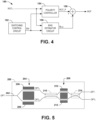
- FIG. 4 illustrates an example diagram of a calibration controller 150.
- the calibration controller 150 can correspond to the calibration controller 30 in the example of FIG. 1 , and thus can be implemented in the controller 72 in the examples of FIGS. 2 and 3 . Therefore, reference is to be made to the examples of FIGS. 1-3 in the following description of the example of FIG. 4 .
- the calibration controller 150 includes a switching control circuit 152, a polarity controller 154, and a bias estimator circuit 156.
- the switching control circuit 152 is configured to generate the switching signal SW, such as based on a local oscillator signal having a predetermined frequency, or under the control of a micro-processor.
- the predetermined frequency of the switching signal SW can be very rapid.
- the frequency of the switching signal SW can be at the resonant frequency of the optical fiber coil of the FOG 18 or FOG 64 and for example coincident with the start of a modulation cycle to ensure that rotation rate data is not lost in the periodic switching between the first and second switching states, as described in greater detail herein. Switching can also occur at a lower frequency to allow averaging in each switch state over multiple modulation cycles.
- the switching signal SW is provided to the polarity controller 154 and the bias estimator circuit 156, as well as the optical switch (e.g., the optical switch 28 or the optical switch 62; not shown in the example of FIG. 4 ).
- the polarity controller 154 and the bias estimator circuit 156 each also receive the non-compensated rotation ROT 12 (corresponding to the non-compensated rotations ROT 1 or ROT 2 ), as determined by the controller 72, that includes the bias error.
- the bias estimator circuit 156 can thus identify the switching state of the optical switch 62, such that the bias estimator circuit 156 can add the non-compensated rotation ROT 12 in each of consecutive switching states (e.g., the non-compensated rotations ROT 1 and ROT 2 ), such as provided by Equation 5. Therefore, by dividing the result of the addition of the non-compensated rotation ROT 12 in each of the consecutive states by two, the bias estimator circuit 156 can determine the estimated bias error B ERR .
- the bias estimator 156 could also include adaptive estimation approaches such as Kalman filtering to process the compensated rotation ROT 12 more optimally in dynamic conditions.
- the polarity controller 154 can likewise identify the switching state of the optical switch 62 based on the switching signal SW, and can assign a polarity to the non-compensated rotation ROT 12 based on the respective switching state corresponding to the respective reversed polarity of the SF for each of the respective switching states. Therefore, the polarity controller 154 can provide the sign-corrected non-compensated rotation ROT_P as an output.
- the calibration controller 150 further includes a summer 158 that is configured to subtract the estimated bias error B ERR from the sign-corrected non-compensated rotation ROT_P. As a result, the summer 158 can output the determined rotation ROT as a compensated rotation of the FOG 64, such that the determined rotation ROT is approximately equal to the true rotation ⁇ of the FOG system 52.
- FIG. 5 illustrates an example diagram of an optical beam controller 200.
- the optical beam controller 200 can correspond to the optical beam controller 16 and 58 in the examples of FIGS. 1-3 . Therefore, reference is to be made to the examples of FIGS. 1-3 in the following description of the example of FIG. 5 .
- the optical beam controller 200 includes a waveguide 202 that is configured to receive the optical beam OPT (e.g., and to propagate the combined optical output beam OPT_OUT before it is separated by the optical coupler 56).
- the waveguide 202 can be coupled to an optical fiber via a direct pigtail or splice.
- the waveguide 202 splits the optical beam OPT (e.g., and recombines the combined optical output beam) into the first optical beam OPT A and the second optical beam OPT B .
- the optical beam controller 200 also includes a MIOC 204.
- the MIOC 204 includes a set of electrodes 206 that can be controlled via the phase modulation signal(s) PH to implement phase modulation on the optical beams OPT A and OPT B to perform the interferometry with respect to the first and second optical beams OPT A and OPT B for determining the rotation ROT, as described herein.
- the optical beam controller 200 also includes an optical switch 208.
- the optical switch 208 includes a first tapered coupler 210, a set of electrodes 212, and a second tapered coupler 214.
- the first tapered coupler 210 is configured to propagate the optical beams OPT A and OPT B between the MIOC 204 and the electrodes 212, and can be configured to provide an approximately 50/50 power split of the optical beams OPT A and OPT B .
- the second tapered coupler 214 is configured to propagate the optical beams OPT A and OPT B between the electrodes 212 and output fibers corresponding to the optical beams OPT 1 and OPT 2 in the example of FIG.
- the electrodes 212 can be arranged substantially similarly to the electrodes 206 of the MIOC 204.
- the MIOC 204 and the optical switch 208 can be disposed on the same substrate (e.g., a Lithium Niobate substrate).
- the MIOC 204 and the optical switch 208 can be arranged on separate devices (e.g., separate chips).
- the optical switch 208 can be arranged substantially similarly, for example, to a Mach-Zehnder interferometer with counter-tapered directional couplers.
- a first state e.g., an approximately zero voltage
- the optical beam OPT A is provided through the optical switch 208 as the optical beam OPT 1
- the optical beam OPT B is provided through the optical switch 208 as the optical beam OPT 2 , such as in the first switching state corresponding to the diagram 50 in the example of FIG. 2 .
- the electrodes provide a refractive index change that provides a differential phase shift (e.g., a ⁇ differential phase shift) couples the optical energy between the separate waveguides in the first and second tapered couplers 210 and 214. Therefore, the propagating optical beams OPT A and OPT B switch waveguides, such that the optical beam OPT A is provided through the optical switch 208 as the optical beam OPT 2 and the optical beam OPT B is provided through the optical switch 208 as the optical beam OPT 1 , such as in the second switching state corresponding to the diagram 100 in the example of FIG. 3 .
- a differential phase shift e.g., a ⁇ differential phase shift
- the optical switch 208 being arranged as a solid-state optical switch, as opposed to a MEMS or a prism optical switch, can provide for very rapid switching between the first and second switching states.
- the predetermined frequency of the switching signal SW and thus the switching frequency between the first and second switching states, can be very rapid.
- the frequency of the switching signal SW can be at the resonant frequency of the optical fiber coil of the FOG 18 or FOG 64 to ensure that rotation rate data is not lost in the periodic switching between the first and second switching states.
- the FOG 18 or FOG 64 can have a coil resonant frequency in the range of between approximately 30 kHz and approximately 500 kHz.
- the switching frequency between the first and second switching states can have a settling time of less than about a microsecond.
- the switching frequency can be fast enough to achieve a switching settling time of close to approximately one nanosecond.
- FIG. 6 illustrates an example of a method 250 for determining rotation about a sensitive axis for a FOG system (e.g., the FOG system 10).
- an optical beam e.g., the optical beam OPT
- a beam source e.g., the beam source 12
- the optical beam is split into a first optical beam (e.g., the optical beam OPT A ) and a second optical beam (e.g., the optical beam OPT B ).
- an optical switch e.g., the optical switch 28
- a switching signal e.g., the switching signal SW.
- the first optical beam is provided to a first input (e.g., the I/O connection 20) associated with an optical fiber (e.g., of the FOG 18) and the second optical beam to a second input (e.g., the I/O connection 22) associated with the optical fiber in the first switching state.
- the optical fiber can form an optical fiber coil wound around a spool of a FOG (e.g., the FOG 18) in a first orientation and a second orientation opposite the first orientation, respectively.
- the optical switch is set to a second switching state via the switching signal.
- the first optical beam is provided to the second input and the second optical beam to the first input in the second switching state.
- rotation of the FOG is measured about the sensitive axis in each of the first and second switching states (e.g., via the controller 26) to substantially mitigate bias error associated with the measured rotation.
Landscapes
- Physics & Mathematics (AREA)
- General Physics & Mathematics (AREA)
- Optics & Photonics (AREA)
- Nonlinear Science (AREA)
- Engineering & Computer Science (AREA)
- Electromagnetism (AREA)
- Power Engineering (AREA)
- Radar, Positioning & Navigation (AREA)
- Remote Sensing (AREA)
- Mathematical Physics (AREA)
- Gyroscopes (AREA)
Description
- This disclosure relates to sensors, and more particularly to a calibration circuit to mitigate fiber-optic gyroscope bias error.
- Fiber-optic gyroscope (FOG) coils are generally controlled by one ormore control loops where light traveling in opposite directions is applied to the coil to determine parameters such as rotation rate and angular position changes. As an example, rotation ofth e coil about an axis can lead to a phase difference between the counter-rotating beams. Phase-modulation is usually applied to the light to improve the observability of the rotation signal. The step duration for the modulation signal applied to the FOG is approximately equal to an optical transit time. In some cases, random phase modulation (RPM) may be employed, but in other cases different types of modulation can be utilized. In the example of RPM, an automatic gain control (AGC) loop is employed to maintain unity gain around the primary (rate) servo loop for the FOG to maximize bandwidth. The bandwidth is generally driven by a multi-period delay in applying a new step in response to a gyroscope input. In the first period, the optical signal is integrated and converted by an analog-to-digital converter (ADC). The second period is consumed processing the received gyroscope output and computing what the feedback step size should be which is then added to the appropriate modulation value. Typically, this new step size cannot be applied at the end of the second period and needs to wait until the end of the third period to be applied. Asth e gyroscope sensing coil lengths is made longer however, it is possible to apply the signal at the end of the second period, but the delay may still affect bandwidth and vibration sensitivity.
CN 105973222A describes an optical fiber sensing loop structure of an interference type FOG. - We describe a FOG system according to claim 1 appended hereto, and a method fordetermining rotation about a sensitive axis for a FOG system according to claim 11 appended hereto. Preferred embodiments are defined by the dependent claims, also appended hereto.
-
-
FIG. 1 illustrates an example of a FOG system. -
FIG. 2 illustrates an example diagram of a FOG system in a first switching state. -
FIG. 3 illustrates another example diagram of a FOG system in a second switching state. -
FIG. 4 illustrates an example diagram of a calibration controller. -
FIG. 5 illustrates an example diagram of an optical beam controller. -
FIG. 6 illustrates an example of a method for determining rotation about a sensitive axis for a fiber-optic gyroscope (FOG) system. - This disclosure relates to sensors, and more particularly to a calibration circuit to mitigate fiber-optic gyroscope (FOG) bias error. A FOG can measure angular rotation using light transmitted through a fiber optic coil of the FOG and use the Sagnac effect to sense the angular rotation. The FOG system includes a light source (e.g., a broadband light source or a laser) configured to generate an optical beam. The optical beam is provided to an optical beam controller that is configured to split the optical beam into a pair of approximately equal optical beams that are injected in opposite directions into an optical fiber coil of the FOG, with the optical fiber coil including an optical fiber that is wound around a spool in a first orientation and a second orientation opposite the first orientation. Due to the Sagnac effect, the optical beam that is traveling against rotation of the FOG experiences a slightly shorter optical path than the other optical beam, thus creating a phase difference in the optical beams exiting the FOG. The resulting difference (i.e., differential phase shift) is given by the Sagnac scale factor (SSF) times the angular rate and can be used to calculate the rotation (e.g., rate) of the FOG. As an example, during operation of the FOG, modulation output signals at calculated time increments referred to as tau time periods are applied to the light beams in order to improve the sensitivity and performance (e.g., accuracy, bandwidth) of the gyroscope. Modulation output signals can be applied at a beginning of a transit time period tau, which refers to the time it takes for light to be applied to the optical fiber coil and returned from the other end of the optical fiber coil after being applied. In conventional FOGs, the modulation time is approximately equal to the optical transit time tau.
- The optical beam controller of the FOG system described herein includes an optical switch that is configured to provide the pair of optical beams into the optical fiber of the optical fiber coil in a reversible manner. For example, the FOG system can periodically alternate between a first switching state and a second switching state. In the first switching state, the first optical beam of the pair of optical beams can be provided to a first input of the optical fiber coil and the second optical beam of the pair of optical beams can be provided to a second input of the optical fiber coil. In the second switching state, the first optical beam can be provided to the second input of the optical fiber coil and the second optical beam can be provided to the first input. Therefore, the scale factor relating the detection signal to the rotation rate is reversed in the second switching state relative to the first switching state. As a result, measurements of the rotation of the FOG can be compared in each of the first and second switching states to estimate a bias error associated with the FOG system. For example, the bias error can be associated with environmental variations (e.g., temperature, pressure, etc.) and process variations (e.g., tolerance mismatches, etc.) that can affect the optical path of the optical beams through the FOG. Therefore, the estimated bias error can be subtracted from the determined rotation of the FOG.
- For example, a micro electro-mechanical system (MEMS) switch could alter the light path by changing the mechanical orientation of micro-scale optical elements as a function of an electrical actuation signal. As another example, the optical switch can be configured as a solid-state switch, as opposed to a MEMS switch. Such an optical switch can be fabricated on an electro-optic substrate (e.g., Lithium Niobate) configured to pass light in different paths depending on the voltage applied to it. As another example, the optical switch can be fabricated on a same substrate (e.g., Lithium Niobate) as a multifunction integrated optical chip (MIOC) that is implemented as part of the interferometer that determines the rotation of the FOG based on the phase difference of the optical beams output from the FOG. As an example, the optical switch can include an input tapered coupler that receives the pair of optical beams, a phase modulator that implements directional switching of the optical beams in each of the first and second switching states in response to a switching signal, and an output tapered coupler configured that provides the pair of optical beams to the inputs of the FOG based on the switching state. As a result, the periodic switching between the first and second switching states can be very rapid. For example, the switching time between the first and second switching states can be much faster than the transit time of light through the optical fiber coil to ensure that rotation rate data is not lost in the switching between the first and second switching states.
-
FIG. 1 illustrates an example of a fiber-optic gyroscope (FOG)system 10. TheFOG system 10 can be used in any of a variety of applications in which precise measurement of rotation of a platform is required. For example, theFOG system 10 can be implemented in vehicular navigation, such as in aerospace or nautical vehicular applications as a part of an inertial navigation system (INS). TheFOG system 10 is configured to determine a rotation, demonstrated in the example ofFIG. 1 as a signal ROT, of theFOG system 10 about a sensitive axis. As described herein, theFOG system 10 can be an interferometric FOG (iFOG) that uses interferometry to determine the rotation of theFOG system 10 about the sensitive axis. - The
FOG system 10 includes a light source 12 (e.g., a broadband source or a laser) configured to generate an optical beam OPT. The optical beam OPT is provided (e.g., via an optical fiber) to anoptical coupler 14 that is configured to generate an output optical beam OPT_OUT that can be monitored to determine the rotation of theFOG system 10, as described in greater detail herein. The optical signal OPT is provided (e.g., via an optical fiber or an optical waveguide) fromoptical coupler 14 to anoptical beam controller 16. Theoptical beam controller 16 is configured to split the optical beam OPT into a pair of optical beams that are provided to aFOG 18 and to perform optical interferometry of the pair of optical beams that propagate through and are output from theFOG 18. As an example, theoptical beam controller 16 can include a multifunction integrated optical circuit (MIOC) that is configured to provide phase modulation of the optical beams. In the example ofFIG. 1 , the phase modulation can be implemented by one or more phase modulation signals PH. - The FOG 18 can include a single optical fiber that is wound around a spool such that the two ends of the fiber remain accessible. For example, the fiber winding can begin from the middle of the length of fiber and winding can progress alternately from each end in opposite directions such that approximately half the length of the optical fiber can be wound in a first orientation (e.g., "clockwise") and approximately half the length of the optical fiber can be wound in a second orientation (e.g., "counter-clockwise"). Therefore, the two ends of the optical fiber can form separate respective inputs and complementary outputs of the
FOG 18, demonstrated in the example ofFIG. 1 as a first I/O connection 20 and a second I/O
connection 22. In the example ofFIG. 1 , the inputs to theFOG 18 from theoptical beam controller 16 are demonstrated as optical beams OPT1 and OPT2 that correspond to the separate respective I/O connections FOG 18. - Therefore, each of the pair of optical beams can be provided to a respective input of the
FOG 18 to the I/O connections FOG 18 and can each be output at the opposite one of the I/O connections optical beam controller 16 to be recombined via optical interference and provided back to theoptical coupler 14. As a result, theoptical coupler 14 can provide the combined output optical beams as the optical output beam OPT_OUT. For example, theoptical coupler 14 can correspond to a 1x2 optical coupler that directs the optical beam OPT provided from thelight source 12 to theoptical beam controller 16, and can provide power separation (e.g., 50% of the power) of the optical output beam returning from theoptical beam controller 16 as the OPT_OUT beam. The optical output beam OPT_OUT is provided to a photodetector (e.g., a photodiode) 24 that is configured to generate a voltage signal VOUT corresponding to the intensity of the optical output signal OPT_OUT. The voltage signal VOUT is provided to acontroller 26 that is configured to determine the rotation ROT of theFOG system 10 based on the voltage signal VOUT. - For example, in response to rotation of the
FOG 18, one of the optical beams OPT1 and OPT2 that propagates along the same direction of rotation experiences a relatively longer optical path length than the other of the optical beams OPT1 and OPT2 due to the Sagnac effect. The signals can be differentiated based on the phase modulation by theoptical beam controller 16 in response to the phase modulation signals PH generated by thecontroller 26. As a result, the optical output beams provided in the combined optical output beam OPT_OUT can exhibit a phase difference. The differential phase difference can be identified by thecontroller 26 to calculate the rotation (e.g., rate) of theFOG system 10. However, in a typical FOG, the calculation of the rotation can include bias errors. For example, the bias errors can be associated with environmental variations (e.g., temperature, pressure, etc.) and process variations (e.g., tolerance mismatches, etc.) that can affect the optical path of the optical beams through theFOG system 10 as well as the affecting the performance of theoptical beam controller 16. - To mitigate the bias errors in the determination of the rotation ROT of the
FOG system 10, theoptical beam controller 16 includes anoptical switch 28 and thecontroller 26 can include acalibration controller 30. Thecalibration controller 30 can be configured to substantially continuously implement a calibration procedure during operation of theFOG system 10. Thecalibration controller 30 is configured to generate a switching signal SW that is provided to theoptical switch 26, such that theoptical switch 26 can periodically alternate between a first switching state and a second switching state associated with the pair of optical beams that are provided to the I/O connections FOG 18. In the first switching state, a first optical beam of the pair of optical beams can be provided to the first I/O connection 20 and a second optical beam of the pair of optical beams can be provided to the second I/O connection 22. In the second switching state, the first optical beam can be provided to the second input of the optical fiber coil and the second optical beam can be provided to the first input. - Based on the switching of the optical beams being provided to the I/
O connections calibration controller 30 can compare the measurements of the rotation ROT of the FOG
system 10 in each of the first and second switching states to estimate a bias error associated with theFOG system 10. Therefore, thecontroller 26 can subtract the estimated bias error from the determined rotation ROT of theFOG system 10. - As an example, the
optical switch 26 can be configured as a solid-state switch, as opposed to a microelectromechanical system (MEMS) switch. For example, theoptical beam controller 16 can include a multifunction integrated optical chip (MIOC) that is implemented as part of the interferometer that determines the rotation of theFOG system 10 based on the phase difference of the optical beams output from theFOG 18. Therefore, theoptical switch 26 can be fabricated on a same substrate (e.g., Lithium Niobate) as the MIOC of theoptical beam controller 16. Because theoptical switch 26 can be implemented as a solid-state switch, theoptical switch 26 can implement very rapid switching (e.g., more rapid than a MEMS switch). For example, the switching signal SW can be generated to be coincident with the start of a modulation cycle of the optical fiber coil of theFOG system 10 to ensure that rotation rate data is not lost in the periodic switching between the first and second switching states. Alternatively, theoptical switch 26 can be arranged as a MEMS switch instead of a solid-state switch. -
FIG. 2 illustrates an example diagram 50 of aFOG system 52 in a first switching state, andFIG. 3 illustrates an example diagram 100 of theFOG system 52 in a second switching state. TheFOG system 52 can correspond to theFOG system 10 in the example ofFIG. 1 . Therefore, reference is to be made to the example ofFIG. 1 in the following description of the examples ofFIGS. 2 and 3 . - The
FOG system 52 is configured substantially similar to theFOG system 10 in the example ofFIG. 1 . Therefore, theFOG system 52 includes a light source 54 (e.g. a broadband source or a laser) configured to generate an optical beam OPT that is provided to anoptical coupler 56 that is configured to generate an output optical beam OPT_OUT that can be monitored to determine the rotation of theFOG system 52. The optical signal OPT is provided (e.g., via an optical fiber or an optical waveguide) from theoptical coupler 56 to anoptical beam controller 58. For example, theoptical beam controller 58 can include an optical waveguide, such that the optical fiber OPT propagates via an optical fiber that is coupled to the waveguide associated with theoptical beam controller 58 via a direct pigtail connection or fiber splice. - In the example of
FIGS. 2 and 3 , theoptical beam controller 58 includes aMIOC 60 and anoptical switch 62. TheMIOC 60 is configured to split the optical beam OPT into a first optical beam OPTA and a second optical beam OPTB. For example, theMIOC 60 is also configured to provide phase modulation of the optical beams OPTA and OPTB in response to one or more phase modulation signals PH. Theoptical switch 62 is demonstrated in the example ofFIGS. 2 and 3 as a 2x2 switch that is responsive to a switching signal SW to be set to the first switching state (e.g., as demonstrated in the diagram 50 of the example ofFIG. 2 ) or to a second switching state (e.g., as demonstrated in the diagram 100 of the example ofFIG. 3 ). The first and second switching states determine the direction of propagation of the optical beams OPTA and OPTB through theFOG 64. - The
optical switch 62 is coupled to aFOG 64 via a first I/O connection 66 and a second I/O connection 68 (e.g., via direct fiber pigtail connections or fiber splices). In the first switching state demonstrated in the diagram 50, the first optical beam OPTA is provided to the first I/O connection 66, propagates through theFOG 64, and is output from theFOG 64 via the second I/O connection 68. Similarly, in the first switching state demonstrated in the diagram 50, the second optical beam OPTB is provided to the second I/O connection 68, propagates through theFOG 64, and is output from theFOG 64 via the first I/O connection 66. However, in the second switching state demonstrated in the diagram 100, the first optical beam OPTA is provided to the second I/O connection 68, propagates through theFOG 64, and is output from theFOG 64 via the first I/O connection 66. Similarly, in the second switching state demonstrated in the diagram 100, the second optical beam OPTB is provided to the first I/O connection 66, propagates through theFOG 64, and is output from theFOG 64 via the second I/O connection 68. - Similar to as described in the example of
FIG. 1 , in each of the diagrams 50 and 100, the optical beams OPTA and OPTB output from theFOG 64 are combined in theMIOC 60 and are provided from theoptical coupler 56 as the optical output beam OPT_OUT. For example, theoptical coupler 56 can correspond to a 1x2 optical coupler that directs the optical beam provided from thelight source 12 to theoptical beam controller 16, and can provide power separation (e.g., 50% of the power) of the optical output beam returning from theoptical beam controller 16 as the OPT_OUT beam. The optical output beam OPT_OUT is provided to a photodetector (e.g., a photodiode) 70 that is configured to generate a voltage signal VOUT corresponding to the intensity of the optical output signal OPT_OUT. The voltage signal VOUT is provided to acontroller 72 that is configured to determine the rotation ROT of theFOG system 52 based on the voltage signal VOUT. - Based on the reversal of the propagation direction of the optical beams OPTA and OPTB in each of the respective switching states of the diagrams 50 and 100, the SF of the
FOG 64 can be reversed in the first and second switching states relative to each other. In other words, the polarity of the SF is reversed based on the reversal of the optical paths of each of the optical beams OPTA and OPTB. As a result, the controller 72 (e.g., via thecalibration controller 30; not shown in the examples ofFIGS. 2 and 3 ) can estimate bias errors based on comparing the determined rotation ROT in each of the first and second switching states. As a result, thecontroller 72 can substantially mitigate the bias errors by subtracting the estimated bias errors from the determined rotation ROT in a feedback manner. - For example, the non-compensated rotations ROT of the
FOG system 52 can be calculated as follows:

Where:ROT1 corresponds to the non-compensated rotation ROT in the first switching state; - ROT2 corresponds to the non-compensated rotation ROT in the second switching state;
- Ω corresponds to a true rotation of the
FOG system 52; and BERR corresponds to the bias error. -
FIG. 4 illustrates an example diagram of acalibration controller 150. Thecalibration controller 150 can correspond to thecalibration controller 30 in the example ofFIG. 1 , and thus can be implemented in thecontroller 72 in the examples ofFIGS. 2 and 3 . Therefore, reference is to be made to the examples ofFIGS. 1-3 in the following description of the example ofFIG. 4 . - The
calibration controller 150 includes a switchingcontrol circuit 152, apolarity controller 154, and abias estimator circuit 156. The switchingcontrol circuit 152 is configured to generate the switching signal SW, such as based on a local oscillator signal having a predetermined frequency, or under the control of a micro-processor. As an example, the predetermined frequency of the switching signal SW, and thus the switching frequency between the first and second switching states, can be very rapid. For example, the frequency of the switching signal SW can be at the resonant frequency of the optical fiber coil of theFOG 18 orFOG 64 and for example coincident with the start of a modulation cycle to ensure that rotation rate data is not lost in the periodic switching between the first and second switching states, as described in greater detail herein. Switching can also occur at a lower frequency to allow averaging in each switch state over multiple modulation cycles. - The switching signal SW is provided to the
polarity controller 154 and thebias estimator circuit 156, as well as the optical switch (e.g., theoptical switch 28 or theoptical switch 62; not shown in the example ofFIG. 4 ). Thepolarity controller 154 and thebias estimator circuit 156 each also receive the non-compensated rotation ROT12 (corresponding to the non-compensated rotations ROT1 or ROT2), as determined by thecontroller 72, that includes the bias error. Thebias estimator circuit 156 can thus identify the switching state of theoptical switch 62, such that thebias estimator circuit 156 can add the non-compensated rotation ROT12 in each of consecutive switching states (e.g., the non-compensated rotations ROT1 and ROT2), such as provided by Equation 5. Therefore, by dividing the result of the addition of the non-compensated rotation ROT12 in each of the consecutive states by two, thebias estimator circuit 156 can determine the estimated bias error BERR. Thebias estimator 156 could also include adaptive estimation approaches such as Kalman filtering to process the compensated rotation ROT12 more optimally in dynamic conditions. - The
polarity controller 154 can likewise identify the switching state of theoptical switch 62 based on the switching signal SW, and can assign a polarity to the non-compensated rotation ROT12 based on the respective switching state corresponding to the respective reversed polarity of the SF for each of the respective switching states. Therefore, thepolarity controller 154 can provide the sign-corrected non-compensated rotation ROT_P as an output. In the example ofFIG. 4 , thecalibration controller 150 further includes asummer 158 that is configured to subtract the estimated bias error BERR from the sign-corrected non-compensated rotation ROT_P. As a result, thesummer 158 can output the determined rotation ROT as a compensated rotation of theFOG 64, such that the determined rotation ROT is approximately equal to the true rotation Ω of theFOG system 52. -
FIG. 5 illustrates an example diagram of anoptical beam controller 200. Theoptical beam controller 200 can correspond to theoptical beam controller FIGS. 1-3 . Therefore, reference is to be made to the examples ofFIGS. 1-3 in the following description of the example ofFIG. 5 . - The
optical beam controller 200 includes awaveguide 202 that is configured to receive the optical beam OPT (e.g., and to propagate the combined optical output beam OPT_OUT before it is separated by the optical coupler 56). For example, thewaveguide 202 can be coupled to an optical fiber via a direct pigtail or splice. In the example ofFIG. 5 , thewaveguide 202 splits the optical beam OPT (e.g., and recombines the combined optical output beam) into the first optical beam OPTA and the second optical beam OPTB. Theoptical beam controller 200 also includes aMIOC 204. TheMIOC 204 includes a set ofelectrodes 206 that can be controlled via the phase modulation signal(s) PH to implement phase modulation on the optical beams OPTA and OPTB to perform the interferometry with respect to the first and second optical beams OPTA and OPTB for determining the rotation ROT, as described herein. - The
optical beam controller 200 also includes anoptical switch 208. In the example ofFIG. 5 , theoptical switch 208 includes a firsttapered coupler 210, a set ofelectrodes 212, and a secondtapered coupler 214. The firsttapered coupler 210 is configured to propagate the optical beams OPTA and OPTB between theMIOC 204 and theelectrodes 212, and can be configured to provide an approximately 50/50 power split of the optical beams OPTA and OPTB. Similarly, the secondtapered coupler 214 is configured to propagate the optical beams OPTA and OPTB between theelectrodes 212 and output fibers corresponding to the optical beams OPT1 and OPT2 in the example ofFIG. 1 , and can be configured to provide an approximately 50/50 power split of the optical beams OPTA and OPTB. Theelectrodes 212 can be arranged substantially similarly to theelectrodes 206 of theMIOC 204. For example, theMIOC 204 and theoptical switch 208 can be disposed on the same substrate (e.g., a Lithium Niobate substrate). Alternatively, theMIOC 204 and theoptical switch 208 can be arranged on separate devices (e.g., separate chips). - Therefore, the
optical switch 208 can be arranged substantially similarly, for example, to a Mach-Zehnder interferometer with counter-tapered directional couplers. For example, in response to the switching signal SW at a first state (e.g., an approximately zero voltage), the optical beam OPTA is provided through theoptical switch 208 as the optical beam OPT1 and the optical beam OPTB is provided through theoptical switch 208 as the optical beam OPT2, such as in the first switching state corresponding to the diagram 50 in the example ofFIG. 2 . However, in response to the switching signal SW at a second state (e.g., a positive voltage), the electrodes provide a refractive index change that provides a differential phase shift (e.g., a π differential phase shift) couples the optical energy between the separate waveguides in the first and secondtapered couplers optical switch 208 as the optical beam OPT2 and the optical beam OPTB is provided through theoptical switch 208 as the optical beam OPT1, such as in the second switching state corresponding to the diagram 100 in the example ofFIG. 3 . - The
optical switch 208 being arranged as a solid-state optical switch, as opposed to a MEMS or a prism optical switch, can provide for very rapid switching between the first and second switching states. As an example, the predetermined frequency of the switching signal SW, and thus the switching frequency between the first and second switching states, can be very rapid. For example, the frequency of the switching signal SW can be at the resonant frequency of the optical fiber coil of theFOG 18 orFOG 64 to ensure that rotation rate data is not lost in the periodic switching between the first and second switching states. For example, theFOG 18 orFOG 64 can have a coil resonant frequency in the range of between approximately 30 kHz and approximately 500 kHz. To avoid dropping angular rate data, the switching frequency between the first and second switching states can have a settling time of less than about a microsecond. As an example, based on the optical switch (e.g., theoptical switch 28 or the optical switch 208) being configured as a solid-state switch, the switching frequency can be fast enough to achieve a switching settling time of close to approximately one nanosecond. - In view of the foregoing structural and functional features described above, an example method will be better appreciated with reference to
FIG. 6 . While, for purposes of simplicity of explanation, the method is shown and described as executing serially, it is to be understood and appreciated that the method is not limited by the illustrated order, as parts of the method could occur in different orders and/or concurrently from that shown and described herein. Such method can be executed by various components configured in an integrated circuit, processor, or a controller, for example. -
FIG. 6 illustrates an example of amethod 250 for determining rotation about a sensitive axis for a FOG system (e.g., the FOG system 10). At 252, an optical beam (e.g., the optical beam OPT) is generated via a beam source (e.g., the beam source 12). At 254, the optical beam is split into a first optical beam (e.g., the optical beam OPTA) and a second optical beam (e.g., the optical beam OPTB). At 256, an optical switch (e.g., the optical switch 28) is set to a first switching state via a switching signal (e.g., the switching signal SW). At 258, the first optical beam is provided to a first input (e.g., the I/O connection 20) associated with an optical fiber (e.g., of the FOG 18) and the second optical beam to a second input (e.g., the I/O connection 22) associated with the optical fiber in the first switching state. The optical fiber can form an optical fiber coil wound around a spool of a FOG (e.g., the FOG 18) in a first orientation and a second orientation opposite the first orientation, respectively. At 260, the optical switch is set to a second switching state via the switching signal. At 262, the first optical beam is provided to the second input and the second optical beam to the first input in the second switching state. At 264, rotation of the FOG is measured about the sensitive axis in each of the first and second switching states (e.g., via the controller 26) to substantially mitigate bias error associated with the measured rotation. - What has been described above are examples. It is, of course, not possible to describe every conceivable combination of components or methodologies, but one of ordinary skill in the art will recognize that many further combinations and permutations are possible. Accordingly, the disclosure is intended to embrace all such alterations, modifications, and variations that fall within the scope of the appended claims. As used herein, the term "includes" means includes but not limited to, the term "including" means including but not limited to. The term "based on" means based at least in part on. Additionally, where the disclosure or claims recite "a," "an," "a first," or "another" element, or the equivalent thereof, it should be interpreted to include one or more than one such element, neither requiring nor excluding two or more such elements.


Claims (13)
- A fiber-optic gyroscope (FOG) system (10, 52) comprising:an optical fiber coil comprising an optical fiber wound around a spool of a FOG (18, 64) in a first orientation and a second orientation opposite the first orientation, the optical fiber comprising a first input/output (20, 66) and a second input/output (22, 68); andan optical beam controller (16, 58) comprising an optical switch (28, 62) configured to provide a first optical beam (OPT1, OPTA) to the first input/output (20, 66) and a second optical beam (OPT2, OPTB) to the second input/output (22, 68) during a first switching state and to provide the first optical beam (OPT1, OPTA) to the second input/output (22, 68) and the second optical beam (OPT2, OPTB) to the first input/output (20, 66) during a second switching state; characterized in that it further comprises:a controller (26, 72) configured to mitigate bias error in a determination of rotation (ROT) of the FOG (18, 64) about a sensitive axis by:measuring the rotation (ROT) of the FOG (18, 64) about the sensitive axis in the first switching state with a first scale factor;measuring the rotation (ROT) of the FOG (18, 64) about the sensitive axis in the second switching state with a second scale factor, wherein the first and second scale factors are equal and opposite to each other;estimating the bias error based on the measured rotation (ROT) of the FOG (18, 64) in the first and second switching states; andsubtracting the estimated bias error from the determined rotation (ROT) in a feedback manner.
- The system of claim 1, wherein the optical beam controller (16, 58) further comprises a multifunction integrated optical chip (MIOC) (204) configured to provide phase control of the first (OPT1, OPTA) and second (OPT2, OPTB) optical beams.
- The system of claim 2, wherein the optical switch (28, 62) is configured as a 2x2 solid-state optical switch.
- The system of claim 3, wherein each of the MIOC (204) and the optical switch (28, 62) are formed on a common substrate.
- The system of claim 2, wherein the optical switch (28, 62) is configured as a 2x2 micro electro-mechanical system (MEMS) optical switch.
- The system of claim 1, wherein the optical switch (28, 62) comprises:a first tapered coupler (210) configured to receive the first optical beam (OPT1, OPTA) at a first coupler input and the second optical beam (OPT2, OPTB) at a second coupler input;a phase modulator to implement directional switching of the first (OPT1, OPTA) and second (OPT2, OPTB) optical beams in each of the first and second switching states; anda second tapered coupler (214) configured to provide the first optical beam (OPT1, OPTA) from a first coupler output and the second optical beam (OPT2, OPTB) from a second coupler output during the first switching state and to provide the first optical beam (OPT1, OPTA) from the second coupler output and the second optical beam (OPT2, OPTB) from the first coupler output during the second switching state.
- The system of claim 1, wherein the controller (26, 72) is further configured to provide a switching signal (SW) to the optical switch (28, 62) to periodically change the optical switch (28, 62) between the first switching state and the second switching state.
- The system of claim 7, wherein the switching signal (SW) has a frequency that is less than or equal to a resonant frequency of the optical fiber coil.
- The system of claim 1, further comprising a light source (12, 54) configured to generate an input optical beam (OPT), wherein the optical beam controller (16, 58) is configured to split the input optical beam (OPT) into the first (OPT1, OPTA) and second (OPT2, OPTB) optical beams, where the estimated bias is calculated by one of comparing the measurements from the first switching state and the second switching state and by an adaptive filter combining multiple measurements from the first switching state and the second switching state.
- The system of claim 1, further comprising:a 1x2 optical coupler (14, 56) interconnecting a light source (12, 54) configured to generate the input optical beam (OPT) and the optical beam controller (16, 58), the 1x2 optical coupler (14, 56) receiving from the optical beam controller (16, 58) a combined output beam (OPT_OUT) comprising the first (OPT1, OPTA) and second (OPT2, OPTB) optical beams output from the FOG(18, 64), the 1x2 optical coupler (14, 56) being configured to split the combined output beam (OPT_OUT) from the input optical beam (OPT); anda photodetector (24, 70) configured to monitor the combined output beam (OPT_OUT), wherein the controller (26, 72) is configured to determine the rotation (ROT) of the FOG (28, 64) about a sensitive axis based on the monitored combined output beam (OPT_OUT).
- A method for determining rotation about a sensitive axis for a fiber-optic gyroscope (FOG) system (10, 52), the method comprising:generating an input optical beam (OPT) via a beam source (12, 54);splitting the input optical beam (OPT) into a first optical beam (OPT1, OPTA) and a second optical beam (OPT2, OPTB);setting an optical switch (28, 62) to a first switching state via a switching signal (SW);providing the first optical beam (OPT1, OPTA) to a first input/output (20, 66) associated with an optical fiber and the second optical beam (OPT2, OPTB) to a second input/output (22, 68) associated with the optical fiber in the first switching state, the optical fiber forming an optical fiber coil wound around a spool of a FOG (18, 64);setting the optical switch (28, 62) to a second switching state via the switching signal (SW); andproviding the first optical beam (OPT1, OPTA) to the second input/output (22, 68) and the second optical beam (OPT2, OPTB) to the first input/output (20, 66) in the second switching state;characterized in that the method further comprises:measuring the rotation (ROT) of the FOG (18, 64) about the sensitive axis in the first switching state with a first scale factor;measuring the rotation (ROT) of the FOG (18, 64) about the sensitive axis in the second switching state with a second scale factor, wherein the first and second scale factors are equal and opposite to each other;estimating a bias error based on the measured rotation (ROT) of the FOG (18, 64) in the first and second switching states; andsubtracting the estimated bias error from the measured rotation (ROT) in a feedback manner.
- The method of claim 11, wherein setting the optical switch (28, 62) comprises setting the optical switch (28, 62) configured as a 2x2 solid-state optical switch that is formed on a common substrate with a multifunction integrated optical chip (MIOC) (204) configured to provide phase control of the first (OPT1, OPTA) and second (OPT2, OPTB) optical beams.
- The method of claim 11, wherein setting the optical switch (28, 62) comprises:receiving the first optical beam (OPT1, OPTA) at a first coupler input of a first tapered coupler (210) and receiving the second optical beam (OPT2, OPTB) at a second coupler input of the first tapered coupler (210);phase modulating the first (OPT1, OPTA) and second (OPT2, OPTB) optical beams in each of the first and second switching states to implement directional switching in each of the first and second switching states; andproviding the first optical beam (OPT1, OPTA) from a first coupler output of a second tapered coupler (214) and providing the second optical beam (OPT2, OPTB) from a second coupler output of the second tapered coupler (214) during the first switching state; andproviding the first optical beam (OPT1, OPTA) from the second coupler output of the second tapered coupler (214) and providing the second optical beam (OPT2, OPTB) from the first coupler output of the second tapered coupler (214) during the second switching state.
Applications Claiming Priority (1)
| Application Number | Priority Date | Filing Date | Title |
|---|---|---|---|
| US16/778,589 US10989535B1 (en) | 2020-01-31 | 2020-01-31 | Calibration circuit to mitigate fiber-optic gyroscope (FOG) bias error |
Publications (2)
| Publication Number | Publication Date |
|---|---|
| EP3859272A1 EP3859272A1 (en) | 2021-08-04 |
| EP3859272B1 true EP3859272B1 (en) | 2023-04-05 |
Family
ID=74205661
Family Applications (1)
| Application Number | Title | Priority Date | Filing Date |
|---|---|---|---|
| EP21152789.0A Active EP3859272B1 (en) | 2020-01-31 | 2021-01-21 | Calibration circuit to mitigate fiber-optic gyroscope (fog) bias error |
Country Status (3)
| Country | Link |
|---|---|
| US (1) | US10989535B1 (en) |
| EP (1) | EP3859272B1 (en) |
| JP (1) | JP7097469B2 (en) |
Families Citing this family (5)
| Publication number | Priority date | Publication date | Assignee | Title |
|---|---|---|---|---|
| US11268812B1 (en) * | 2020-09-10 | 2022-03-08 | The United States Of America As Represented By The Secretary Of The Navy | Bias corrected inertial navigation system |
| US11435234B1 (en) * | 2021-02-10 | 2022-09-06 | Quantum Valley Ideas Laboratories | Increasing the measurement precision of optical instrumentation using Kalman-type filters |
| CN113532412A (en) * | 2021-07-05 | 2021-10-22 | 浙江大学 | Device for improving reciprocity of interference type optical fiber gyroscope |
| CN114993283B (en) * | 2022-08-02 | 2022-11-08 | 武汉利科夫科技有限公司 | Optical fiber winding method capable of accurately controlling turn-changing area of optical fiber loop |
| US20240210175A1 (en) * | 2022-12-22 | 2024-06-27 | Anello Photonics, Inc. | Integrated photonics chip with electro-optic material based waveguide components |
Family Cites Families (22)
| Publication number | Priority date | Publication date | Assignee | Title |
|---|---|---|---|---|
| JPS61288110A (en) * | 1985-06-14 | 1986-12-18 | Yokogawa Electric Corp | Optical fiber gyro device |
| JPS62218811A (en) * | 1986-03-20 | 1987-09-26 | Fujitsu Ltd | Wave guide device for gyroscope |
| DE3883552T2 (en) * | 1987-01-13 | 1993-12-16 | Itt | Device and method for producing lens-ending optical fibers. |
| DE3912005A1 (en) | 1989-04-12 | 1990-10-18 | Messerschmitt Boelkow Blohm | METHOD FOR EVALUATING SIGNALS FOR A FIBER GYRO |
| US5394242A (en) * | 1989-12-15 | 1995-02-28 | The Charles Stark Draper Laboratory, Inc. | Fiber optic resonant ring sensor and source |
| JP3023878B2 (en) * | 1990-04-16 | 2000-03-21 | 日本電信電話株式会社 | Waveguide type optical branching device |
| US5157461A (en) * | 1990-06-14 | 1992-10-20 | Smiths Industries Aerospace & Defense Systems Inc. | Interface configuration for rate sensor apparatus |
| JPH0682257A (en) * | 1992-08-31 | 1994-03-22 | Japan Aviation Electron Ind Ltd | Light interference angular velocity meter |
| US5365337A (en) * | 1992-10-28 | 1994-11-15 | Smiths Industries Aerospace & Defense Systems, Inc. | Method and apparatus for compensating for the residual birefringence in interferometric fiber-optic gyros |
| US5469257A (en) | 1993-11-24 | 1995-11-21 | Honeywell Inc. | Fiber optic gyroscope output noise reducer |
| FR2733320B1 (en) * | 1995-04-18 | 1997-07-04 | Photonetics | MULTI-AXIS MEASUREMENT METHOD OF ROTATION SPEEDS AND MULTI-AXIS MULTIPLEX GYROFIBER ALLOWING SUCH MEASUREMENT |
| JP4023584B2 (en) * | 2001-03-02 | 2007-12-19 | 富士通株式会社 | Light switch |
| JP4290128B2 (en) * | 2005-02-25 | 2009-07-01 | キヤノン株式会社 | Sensor |
| US7336364B2 (en) * | 2005-11-29 | 2008-02-26 | Honeywell International, Inc. | Minimal bias switching for fiber optic gyroscopes |
| WO2012048448A1 (en) | 2010-10-15 | 2012-04-19 | 北京大学 | Method for eliminating zero drift of interference all-fiber-optic gyroscope and interference all-fiber-optic gyroscope corresponding to the same |
| US9857176B2 (en) * | 2013-06-20 | 2018-01-02 | Tubitak (Turkiye Bilimsel Ve Teknolojik Arastirma Kurumu) | Dynamically monitoring the instantaneous zero rotation rate voltage of interferometric fiber optic gyroscope (IFOG) |
| US9140551B2 (en) * | 2013-07-16 | 2015-09-22 | Honeywell International Inc. | Fiber optic gyroscope dead band error suppression |
| US10578438B2 (en) * | 2016-02-12 | 2020-03-03 | Agency For Science, Technology And Research | Optical gyroscope, electro-optic system, and methods of forming the same |
| CN105973222A (en) * | 2016-06-17 | 2016-09-28 | 同济大学 | Sagnac phase shifting multiplication structure of interferometric fiber-optic gyroscope |
| JP7253493B2 (en) * | 2017-05-30 | 2023-04-06 | カリフォルニア インスティチュート オブ テクノロジー | Integrated optical gyroscope with noise rejection |
| US11047688B2 (en) * | 2017-10-13 | 2021-06-29 | Northrop Grumman Systems Corporation | Flange-bonded loopback for fiber-optic gyroscope (FOG) |
| US10823571B1 (en) * | 2019-07-31 | 2020-11-03 | Honeywell International Inc. | Switching SBS gyro with fixed pump separation |
-
2020
- 2020-01-31 US US16/778,589 patent/US10989535B1/en active Active
-
2021
- 2021-01-19 JP JP2021006391A patent/JP7097469B2/en active Active
- 2021-01-21 EP EP21152789.0A patent/EP3859272B1/en active Active
Also Published As
| Publication number | Publication date |
|---|---|
| JP7097469B2 (en) | 2022-07-07 |
| EP3859272A1 (en) | 2021-08-04 |
| JP2021124501A (en) | 2021-08-30 |
| US10989535B1 (en) | 2021-04-27 |
Similar Documents
| Publication | Publication Date | Title |
|---|---|---|
| EP3859272B1 (en) | Calibration circuit to mitigate fiber-optic gyroscope (fog) bias error | |
| US10921125B2 (en) | Optical gyroscope | |
| EP1476721B1 (en) | (fiber) optic sensor with proper modulation | |
| US6798523B2 (en) | Sensor and method for detecting fiber optic faults | |
| EP3011270B1 (en) | Dynamically monitoring the instantaneous zero rotation rate voltage of interferometric fiber optic gyroscope (ifog) | |
| US9644966B2 (en) | Integrated optic circuit with waveguides stitched at supplementary angles for reducing coherent backscatter | |
| JPH0477844B2 (en) | ||
| WO2006083691A1 (en) | Hollow core fiber optical gyro | |
| JP2724915B2 (en) | Interferometer signal analysis with modulation switching | |
| Kaiser et al. | Experimental developments in the RFOG | |
| US4382681A (en) | Measurement of rotation rate using Sagnac effect | |
| CN105547279B (en) | Gyro rate calculation for interferometric fiber optic gyroscope | |
| EP0416070B1 (en) | Single-polarization, integrated optical components for optical gyroscopes | |
| JP2838592B2 (en) | Determination of optical signal transit delay time in optical interferometer | |
| Chamoun | A laser-driven fiber optic gyroscope for inertial navigation of aircraft | |
| EP0410057B1 (en) | Wavelength meter | |
| JP2000146596A (en) | Resonant point tracking system and ring resonant optical fiber gyro using this system | |
| RU2795737C1 (en) | Fiber optic angular rate sensor | |
| RU2793727C1 (en) | Angular rate sensor | |
| Ma et al. | Zero-deviation effect in a resonator optic gyro caused by nonideal digital ramp phase modulation | |
| JPH05172574A (en) | Fiber optic gyro system | |
| JPS622121A (en) | Optical fiber gyroscope | |
| Armenise et al. | Out-of-resonance measurement scheme for ring resonator gyroscopes | |
| JPH0718707B2 (en) | Light fiber gyro |
Legal Events
| Date | Code | Title | Description |
|---|---|---|---|
| PUAI | Public reference made under article 153(3) epc to a published international application that has entered the european phase |
Free format text: ORIGINAL CODE: 0009012 |
|
| STAA | Information on the status of an ep patent application or granted ep patent |
Free format text: STATUS: REQUEST FOR EXAMINATION WAS MADE |
|
| 17P | Request for examination filed |
Effective date: 20210121 |
|
| AK | Designated contracting states |
Kind code of ref document: A1 Designated state(s): AL AT BE BG CH CY CZ DE DK EE ES FI FR GB GR HR HU IE IS IT LI LT LU LV MC MK MT NL NO PL PT RO RS SE SI SK SM TR |
|
| GRAP | Despatch of communication of intention to grant a patent |
Free format text: ORIGINAL CODE: EPIDOSNIGR1 |
|
| STAA | Information on the status of an ep patent application or granted ep patent |
Free format text: STATUS: GRANT OF PATENT IS INTENDED |
|
| INTG | Intention to grant announced |
Effective date: 20221027 |
|
| GRAS | Grant fee paid |
Free format text: ORIGINAL CODE: EPIDOSNIGR3 |
|
| GRAA | (expected) grant |
Free format text: ORIGINAL CODE: 0009210 |
|
| STAA | Information on the status of an ep patent application or granted ep patent |
Free format text: STATUS: THE PATENT HAS BEEN GRANTED |
|
| AK | Designated contracting states |
Kind code of ref document: B1 Designated state(s): AL AT BE BG CH CY CZ DE DK EE ES FI FR GB GR HR HU IE IS IT LI LT LU LV MC MK MT NL NO PL PT RO RS SE SI SK SM TR |
|
| REG | Reference to a national code |
Ref country code: GB Ref legal event code: FG4D |
|
| REG | Reference to a national code |
Ref country code: DE Ref legal event code: R096 Ref document number: 602021001772 Country of ref document: DE |
|
| REG | Reference to a national code |
Ref country code: CH Ref legal event code: EP |
|
| REG | Reference to a national code |
Ref country code: AT Ref legal event code: REF Ref document number: 1558541 Country of ref document: AT Kind code of ref document: T Effective date: 20230415 |
|
| REG | Reference to a national code |
Ref country code: IE Ref legal event code: FG4D |
|
| P01 | Opt-out of the competence of the unified patent court (upc) registered |
Effective date: 20230607 |
|
| REG | Reference to a national code |
Ref country code: LT Ref legal event code: MG9D |
|
| REG | Reference to a national code |
Ref country code: NL Ref legal event code: MP Effective date: 20230405 |
|
| REG | Reference to a national code |
Ref country code: AT Ref legal event code: MK05 Ref document number: 1558541 Country of ref document: AT Kind code of ref document: T Effective date: 20230405 |
|
| PG25 | Lapsed in a contracting state [announced via postgrant information from national office to epo] |
Ref country code: NL Free format text: LAPSE BECAUSE OF FAILURE TO SUBMIT A TRANSLATION OF THE DESCRIPTION OR TO PAY THE FEE WITHIN THE PRESCRIBED TIME-LIMIT Effective date: 20230405 |
|
| PG25 | Lapsed in a contracting state [announced via postgrant information from national office to epo] |
Ref country code: SE Free format text: LAPSE BECAUSE OF FAILURE TO SUBMIT A TRANSLATION OF THE DESCRIPTION OR TO PAY THE FEE WITHIN THE PRESCRIBED TIME-LIMIT Effective date: 20230405 Ref country code: PT Free format text: LAPSE BECAUSE OF FAILURE TO SUBMIT A TRANSLATION OF THE DESCRIPTION OR TO PAY THE FEE WITHIN THE PRESCRIBED TIME-LIMIT Effective date: 20230807 Ref country code: NO Free format text: LAPSE BECAUSE OF FAILURE TO SUBMIT A TRANSLATION OF THE DESCRIPTION OR TO PAY THE FEE WITHIN THE PRESCRIBED TIME-LIMIT Effective date: 20230705 Ref country code: ES Free format text: LAPSE BECAUSE OF FAILURE TO SUBMIT A TRANSLATION OF THE DESCRIPTION OR TO PAY THE FEE WITHIN THE PRESCRIBED TIME-LIMIT Effective date: 20230405 Ref country code: AT Free format text: LAPSE BECAUSE OF FAILURE TO SUBMIT A TRANSLATION OF THE DESCRIPTION OR TO PAY THE FEE WITHIN THE PRESCRIBED TIME-LIMIT Effective date: 20230405 |
|
| PG25 | Lapsed in a contracting state [announced via postgrant information from national office to epo] |
Ref country code: RS Free format text: LAPSE BECAUSE OF FAILURE TO SUBMIT A TRANSLATION OF THE DESCRIPTION OR TO PAY THE FEE WITHIN THE PRESCRIBED TIME-LIMIT Effective date: 20230405 Ref country code: PL Free format text: LAPSE BECAUSE OF FAILURE TO SUBMIT A TRANSLATION OF THE DESCRIPTION OR TO PAY THE FEE WITHIN THE PRESCRIBED TIME-LIMIT Effective date: 20230405 Ref country code: LV Free format text: LAPSE BECAUSE OF FAILURE TO SUBMIT A TRANSLATION OF THE DESCRIPTION OR TO PAY THE FEE WITHIN THE PRESCRIBED TIME-LIMIT Effective date: 20230405 Ref country code: LT Free format text: LAPSE BECAUSE OF FAILURE TO SUBMIT A TRANSLATION OF THE DESCRIPTION OR TO PAY THE FEE WITHIN THE PRESCRIBED TIME-LIMIT Effective date: 20230405 Ref country code: IS Free format text: LAPSE BECAUSE OF FAILURE TO SUBMIT A TRANSLATION OF THE DESCRIPTION OR TO PAY THE FEE WITHIN THE PRESCRIBED TIME-LIMIT Effective date: 20230805 Ref country code: HR Free format text: LAPSE BECAUSE OF FAILURE TO SUBMIT A TRANSLATION OF THE DESCRIPTION OR TO PAY THE FEE WITHIN THE PRESCRIBED TIME-LIMIT Effective date: 20230405 Ref country code: GR Free format text: LAPSE BECAUSE OF FAILURE TO SUBMIT A TRANSLATION OF THE DESCRIPTION OR TO PAY THE FEE WITHIN THE PRESCRIBED TIME-LIMIT Effective date: 20230706 Ref country code: AL Free format text: LAPSE BECAUSE OF FAILURE TO SUBMIT A TRANSLATION OF THE DESCRIPTION OR TO PAY THE FEE WITHIN THE PRESCRIBED TIME-LIMIT Effective date: 20230405 |
|
| PG25 | Lapsed in a contracting state [announced via postgrant information from national office to epo] |
Ref country code: FI Free format text: LAPSE BECAUSE OF FAILURE TO SUBMIT A TRANSLATION OF THE DESCRIPTION OR TO PAY THE FEE WITHIN THE PRESCRIBED TIME-LIMIT Effective date: 20230405 |
|
| REG | Reference to a national code |
Ref country code: DE Ref legal event code: R097 Ref document number: 602021001772 Country of ref document: DE |
|
| PG25 | Lapsed in a contracting state [announced via postgrant information from national office to epo] |
Ref country code: SK Free format text: LAPSE BECAUSE OF FAILURE TO SUBMIT A TRANSLATION OF THE DESCRIPTION OR TO PAY THE FEE WITHIN THE PRESCRIBED TIME-LIMIT Effective date: 20230405 |
|
| PG25 | Lapsed in a contracting state [announced via postgrant information from national office to epo] |
Ref country code: SM Free format text: LAPSE BECAUSE OF FAILURE TO SUBMIT A TRANSLATION OF THE DESCRIPTION OR TO PAY THE FEE WITHIN THE PRESCRIBED TIME-LIMIT Effective date: 20230405 Ref country code: SK Free format text: LAPSE BECAUSE OF FAILURE TO SUBMIT A TRANSLATION OF THE DESCRIPTION OR TO PAY THE FEE WITHIN THE PRESCRIBED TIME-LIMIT Effective date: 20230405 Ref country code: RO Free format text: LAPSE BECAUSE OF FAILURE TO SUBMIT A TRANSLATION OF THE DESCRIPTION OR TO PAY THE FEE WITHIN THE PRESCRIBED TIME-LIMIT Effective date: 20230405 Ref country code: EE Free format text: LAPSE BECAUSE OF FAILURE TO SUBMIT A TRANSLATION OF THE DESCRIPTION OR TO PAY THE FEE WITHIN THE PRESCRIBED TIME-LIMIT Effective date: 20230405 Ref country code: DK Free format text: LAPSE BECAUSE OF FAILURE TO SUBMIT A TRANSLATION OF THE DESCRIPTION OR TO PAY THE FEE WITHIN THE PRESCRIBED TIME-LIMIT Effective date: 20230405 Ref country code: CZ Free format text: LAPSE BECAUSE OF FAILURE TO SUBMIT A TRANSLATION OF THE DESCRIPTION OR TO PAY THE FEE WITHIN THE PRESCRIBED TIME-LIMIT Effective date: 20230405 |
|
| PLBE | No opposition filed within time limit |
Free format text: ORIGINAL CODE: 0009261 |
|
| STAA | Information on the status of an ep patent application or granted ep patent |
Free format text: STATUS: NO OPPOSITION FILED WITHIN TIME LIMIT |
|
| 26N | No opposition filed |
Effective date: 20240108 |
|
| PG25 | Lapsed in a contracting state [announced via postgrant information from national office to epo] |
Ref country code: SI Free format text: LAPSE BECAUSE OF FAILURE TO SUBMIT A TRANSLATION OF THE DESCRIPTION OR TO PAY THE FEE WITHIN THE PRESCRIBED TIME-LIMIT Effective date: 20230405 |
|
| PG25 | Lapsed in a contracting state [announced via postgrant information from national office to epo] |
Ref country code: SI Free format text: LAPSE BECAUSE OF FAILURE TO SUBMIT A TRANSLATION OF THE DESCRIPTION OR TO PAY THE FEE WITHIN THE PRESCRIBED TIME-LIMIT Effective date: 20230405 |
|
| PG25 | Lapsed in a contracting state [announced via postgrant information from national office to epo] |
Ref country code: MC Free format text: LAPSE BECAUSE OF FAILURE TO SUBMIT A TRANSLATION OF THE DESCRIPTION OR TO PAY THE FEE WITHIN THE PRESCRIBED TIME-LIMIT Effective date: 20230405 |
|
| PG25 | Lapsed in a contracting state [announced via postgrant information from national office to epo] |
Ref country code: MC Free format text: LAPSE BECAUSE OF FAILURE TO SUBMIT A TRANSLATION OF THE DESCRIPTION OR TO PAY THE FEE WITHIN THE PRESCRIBED TIME-LIMIT Effective date: 20230405 |
|
| REG | Reference to a national code |
Ref country code: CH Ref legal event code: PL |
|
| PG25 | Lapsed in a contracting state [announced via postgrant information from national office to epo] |
Ref country code: LU Free format text: LAPSE BECAUSE OF NON-PAYMENT OF DUE FEES Effective date: 20240121 |
|
| PG25 | Lapsed in a contracting state [announced via postgrant information from national office to epo] |
Ref country code: LU Free format text: LAPSE BECAUSE OF NON-PAYMENT OF DUE FEES Effective date: 20240121 |
|
| PG25 | Lapsed in a contracting state [announced via postgrant information from national office to epo] |
Ref country code: BE Free format text: LAPSE BECAUSE OF NON-PAYMENT OF DUE FEES Effective date: 20240131 |
|
| PG25 | Lapsed in a contracting state [announced via postgrant information from national office to epo] |
Ref country code: CH Free format text: LAPSE BECAUSE OF NON-PAYMENT OF DUE FEES Effective date: 20240131 |
|
| PG25 | Lapsed in a contracting state [announced via postgrant information from national office to epo] |
Ref country code: CH Free format text: LAPSE BECAUSE OF NON-PAYMENT OF DUE FEES Effective date: 20240131 Ref country code: BE Free format text: LAPSE BECAUSE OF NON-PAYMENT OF DUE FEES Effective date: 20240131 |
|
| REG | Reference to a national code |
Ref country code: BE Ref legal event code: MM Effective date: 20240131 |
|
| PG25 | Lapsed in a contracting state [announced via postgrant information from national office to epo] |
Ref country code: BG Free format text: LAPSE BECAUSE OF FAILURE TO SUBMIT A TRANSLATION OF THE DESCRIPTION OR TO PAY THE FEE WITHIN THE PRESCRIBED TIME-LIMIT Effective date: 20230405 |
|
| PG25 | Lapsed in a contracting state [announced via postgrant information from national office to epo] |
Ref country code: BG Free format text: LAPSE BECAUSE OF FAILURE TO SUBMIT A TRANSLATION OF THE DESCRIPTION OR TO PAY THE FEE WITHIN THE PRESCRIBED TIME-LIMIT Effective date: 20230405 |
|
| PG25 | Lapsed in a contracting state [announced via postgrant information from national office to epo] |
Ref country code: IE Free format text: LAPSE BECAUSE OF NON-PAYMENT OF DUE FEES Effective date: 20240121 |
|
| PG25 | Lapsed in a contracting state [announced via postgrant information from national office to epo] |
Ref country code: IE Free format text: LAPSE BECAUSE OF NON-PAYMENT OF DUE FEES Effective date: 20240121 |
|
| PG25 | Lapsed in a contracting state [announced via postgrant information from national office to epo] |
Ref country code: CY Free format text: LAPSE BECAUSE OF FAILURE TO SUBMIT A TRANSLATION OF THE DESCRIPTION OR TO PAY THE FEE WITHIN THE PRESCRIBED TIME-LIMIT; INVALID AB INITIO Effective date: 20210121 |
|
| PG25 | Lapsed in a contracting state [announced via postgrant information from national office to epo] |
Ref country code: HU Free format text: LAPSE BECAUSE OF FAILURE TO SUBMIT A TRANSLATION OF THE DESCRIPTION OR TO PAY THE FEE WITHIN THE PRESCRIBED TIME-LIMIT; INVALID AB INITIO Effective date: 20210121 |
|
| PG25 | Lapsed in a contracting state [announced via postgrant information from national office to epo] |
Ref country code: TR Free format text: LAPSE BECAUSE OF FAILURE TO SUBMIT A TRANSLATION OF THE DESCRIPTION OR TO PAY THE FEE WITHIN THE PRESCRIBED TIME-LIMIT Effective date: 20230405 |
|
| PGFP | Annual fee paid to national office [announced via postgrant information from national office to epo] |
Ref country code: GB Payment date: 20260123 Year of fee payment: 6 |
|
| PGFP | Annual fee paid to national office [announced via postgrant information from national office to epo] |
Ref country code: DE Payment date: 20260121 Year of fee payment: 6 |
|
| PGFP | Annual fee paid to national office [announced via postgrant information from national office to epo] |
Ref country code: IT Payment date: 20260126 Year of fee payment: 6 |
|
| PGFP | Annual fee paid to national office [announced via postgrant information from national office to epo] |
Ref country code: FR Payment date: 20260123 Year of fee payment: 6 |