EP3858914A1 - Cyclic olefin-based resin composition, molded body and optical component - Google Patents
Cyclic olefin-based resin composition, molded body and optical component Download PDFInfo
- Publication number
- EP3858914A1 EP3858914A1 EP19866228.0A EP19866228A EP3858914A1 EP 3858914 A1 EP3858914 A1 EP 3858914A1 EP 19866228 A EP19866228 A EP 19866228A EP 3858914 A1 EP3858914 A1 EP 3858914A1
- Authority
- EP
- European Patent Office
- Prior art keywords
- group
- cyclic olefin
- monocyclic
- bonded
- ring
- Prior art date
- Legal status (The legal status is an assumption and is not a legal conclusion. Google has not performed a legal analysis and makes no representation as to the accuracy of the status listed.)
- Granted
Links
Classifications
-
- C—CHEMISTRY; METALLURGY
- C08—ORGANIC MACROMOLECULAR COMPOUNDS; THEIR PREPARATION OR CHEMICAL WORKING-UP; COMPOSITIONS BASED THEREON
- C08J—WORKING-UP; GENERAL PROCESSES OF COMPOUNDING; AFTER-TREATMENT NOT COVERED BY SUBCLASSES C08B, C08C, C08F, C08G or C08H
- C08J5/00—Manufacture of articles or shaped materials containing macromolecular substances
- C08J5/18—Manufacture of films or sheets
-
- C—CHEMISTRY; METALLURGY
- C08—ORGANIC MACROMOLECULAR COMPOUNDS; THEIR PREPARATION OR CHEMICAL WORKING-UP; COMPOSITIONS BASED THEREON
- C08F—MACROMOLECULAR COMPOUNDS OBTAINED BY REACTIONS ONLY INVOLVING CARBON-TO-CARBON UNSATURATED BONDS
- C08F210/00—Copolymers of unsaturated aliphatic hydrocarbons having only one carbon-to-carbon double bond
- C08F210/02—Ethene
-
- C—CHEMISTRY; METALLURGY
- C08—ORGANIC MACROMOLECULAR COMPOUNDS; THEIR PREPARATION OR CHEMICAL WORKING-UP; COMPOSITIONS BASED THEREON
- C08F—MACROMOLECULAR COMPOUNDS OBTAINED BY REACTIONS ONLY INVOLVING CARBON-TO-CARBON UNSATURATED BONDS
- C08F232/00—Copolymers of cyclic compounds containing no unsaturated aliphatic radicals in a side chain, and having one or more carbon-to-carbon double bonds in a carbocyclic ring system
- C08F232/08—Copolymers of cyclic compounds containing no unsaturated aliphatic radicals in a side chain, and having one or more carbon-to-carbon double bonds in a carbocyclic ring system having condensed rings
-
- C—CHEMISTRY; METALLURGY
- C08—ORGANIC MACROMOLECULAR COMPOUNDS; THEIR PREPARATION OR CHEMICAL WORKING-UP; COMPOSITIONS BASED THEREON
- C08F—MACROMOLECULAR COMPOUNDS OBTAINED BY REACTIONS ONLY INVOLVING CARBON-TO-CARBON UNSATURATED BONDS
- C08F8/00—Chemical modification by after-treatment
- C08F8/46—Reaction with unsaturated dicarboxylic acids or anhydrides thereof, e.g. maleinisation
-
- C—CHEMISTRY; METALLURGY
- C08—ORGANIC MACROMOLECULAR COMPOUNDS; THEIR PREPARATION OR CHEMICAL WORKING-UP; COMPOSITIONS BASED THEREON
- C08K—Use of inorganic or non-macromolecular organic substances as compounding ingredients
- C08K3/00—Use of inorganic substances as compounding ingredients
- C08K3/18—Oxygen-containing compounds, e.g. metal carbonyls
- C08K3/20—Oxides; Hydroxides
- C08K3/22—Oxides; Hydroxides of metals
-
- C—CHEMISTRY; METALLURGY
- C08—ORGANIC MACROMOLECULAR COMPOUNDS; THEIR PREPARATION OR CHEMICAL WORKING-UP; COMPOSITIONS BASED THEREON
- C08K—Use of inorganic or non-macromolecular organic substances as compounding ingredients
- C08K5/00—Use of organic ingredients
- C08K5/04—Oxygen-containing compounds
- C08K5/09—Carboxylic acids; Metal salts thereof; Anhydrides thereof
-
- C—CHEMISTRY; METALLURGY
- C08—ORGANIC MACROMOLECULAR COMPOUNDS; THEIR PREPARATION OR CHEMICAL WORKING-UP; COMPOSITIONS BASED THEREON
- C08K—Use of inorganic or non-macromolecular organic substances as compounding ingredients
- C08K9/00—Use of pretreated ingredients
- C08K9/04—Ingredients treated with organic substances
-
- C—CHEMISTRY; METALLURGY
- C08—ORGANIC MACROMOLECULAR COMPOUNDS; THEIR PREPARATION OR CHEMICAL WORKING-UP; COMPOSITIONS BASED THEREON
- C08K—Use of inorganic or non-macromolecular organic substances as compounding ingredients
- C08K9/00—Use of pretreated ingredients
- C08K9/04—Ingredients treated with organic substances
- C08K9/06—Ingredients treated with organic substances with silicon-containing compounds
-
- C—CHEMISTRY; METALLURGY
- C08—ORGANIC MACROMOLECULAR COMPOUNDS; THEIR PREPARATION OR CHEMICAL WORKING-UP; COMPOSITIONS BASED THEREON
- C08L—COMPOSITIONS OF MACROMOLECULAR COMPOUNDS
- C08L45/00—Compositions of homopolymers or copolymers of compounds having no unsaturated aliphatic radicals in side chain, and having one or more carbon-to-carbon double bonds in a carbocyclic or in a heterocyclic ring system; Compositions of derivatives of such polymers
-
- C—CHEMISTRY; METALLURGY
- C08—ORGANIC MACROMOLECULAR COMPOUNDS; THEIR PREPARATION OR CHEMICAL WORKING-UP; COMPOSITIONS BASED THEREON
- C08L—COMPOSITIONS OF MACROMOLECULAR COMPOUNDS
- C08L65/00—Compositions of macromolecular compounds obtained by reactions forming a carbon-to-carbon link in the main chain; Compositions of derivatives of such polymers
-
- G—PHYSICS
- G02—OPTICS
- G02B—OPTICAL ELEMENTS, SYSTEMS OR APPARATUS
- G02B1/00—Optical elements characterised by the material of which they are made; Optical coatings for optical elements
- G02B1/04—Optical elements characterised by the material of which they are made; Optical coatings for optical elements made of organic materials, e.g. plastics
-
- G—PHYSICS
- G02—OPTICS
- G02B—OPTICAL ELEMENTS, SYSTEMS OR APPARATUS
- G02B1/00—Optical elements characterised by the material of which they are made; Optical coatings for optical elements
- G02B1/04—Optical elements characterised by the material of which they are made; Optical coatings for optical elements made of organic materials, e.g. plastics
- G02B1/041—Lenses
-
- C—CHEMISTRY; METALLURGY
- C08—ORGANIC MACROMOLECULAR COMPOUNDS; THEIR PREPARATION OR CHEMICAL WORKING-UP; COMPOSITIONS BASED THEREON
- C08F—MACROMOLECULAR COMPOUNDS OBTAINED BY REACTIONS ONLY INVOLVING CARBON-TO-CARBON UNSATURATED BONDS
- C08F2420/00—Metallocene catalysts
- C08F2420/04—Cp or analog not bridged to a non-Cp X ancillary anionic donor
-
- C—CHEMISTRY; METALLURGY
- C08—ORGANIC MACROMOLECULAR COMPOUNDS; THEIR PREPARATION OR CHEMICAL WORKING-UP; COMPOSITIONS BASED THEREON
- C08F—MACROMOLECULAR COMPOUNDS OBTAINED BY REACTIONS ONLY INVOLVING CARBON-TO-CARBON UNSATURATED BONDS
- C08F4/00—Polymerisation catalysts
- C08F4/42—Metals; Metal hydrides; Metallo-organic compounds; Use thereof as catalyst precursors
- C08F4/44—Metals; Metal hydrides; Metallo-organic compounds; Use thereof as catalyst precursors selected from light metals, zinc, cadmium, mercury, copper, silver, gold, boron, gallium, indium, thallium, rare earths or actinides
- C08F4/60—Metals; Metal hydrides; Metallo-organic compounds; Use thereof as catalyst precursors selected from light metals, zinc, cadmium, mercury, copper, silver, gold, boron, gallium, indium, thallium, rare earths or actinides together with refractory metals, iron group metals, platinum group metals, manganese, rhenium technetium or compounds thereof
- C08F4/62—Refractory metals or compounds thereof
- C08F4/64—Titanium, zirconium, hafnium or compounds thereof
- C08F4/659—Component covered by group C08F4/64 containing a transition metal-carbon bond
- C08F4/65912—Component covered by group C08F4/64 containing a transition metal-carbon bond in combination with an organoaluminium compound
-
- C—CHEMISTRY; METALLURGY
- C08—ORGANIC MACROMOLECULAR COMPOUNDS; THEIR PREPARATION OR CHEMICAL WORKING-UP; COMPOSITIONS BASED THEREON
- C08J—WORKING-UP; GENERAL PROCESSES OF COMPOUNDING; AFTER-TREATMENT NOT COVERED BY SUBCLASSES C08B, C08C, C08F, C08G or C08H
- C08J2345/00—Characterised by the use of homopolymers or copolymers of compounds having no unsaturated aliphatic radicals in side chain, and having one or more carbon-to-carbon double bonds in a carbocyclic or in a heterocyclic ring system; Derivatives of such polymers
-
- C—CHEMISTRY; METALLURGY
- C08—ORGANIC MACROMOLECULAR COMPOUNDS; THEIR PREPARATION OR CHEMICAL WORKING-UP; COMPOSITIONS BASED THEREON
- C08K—Use of inorganic or non-macromolecular organic substances as compounding ingredients
- C08K3/00—Use of inorganic substances as compounding ingredients
- C08K3/18—Oxygen-containing compounds, e.g. metal carbonyls
- C08K3/20—Oxides; Hydroxides
- C08K3/22—Oxides; Hydroxides of metals
- C08K2003/2227—Oxides; Hydroxides of metals of aluminium
-
- C—CHEMISTRY; METALLURGY
- C08—ORGANIC MACROMOLECULAR COMPOUNDS; THEIR PREPARATION OR CHEMICAL WORKING-UP; COMPOSITIONS BASED THEREON
- C08K—Use of inorganic or non-macromolecular organic substances as compounding ingredients
- C08K3/00—Use of inorganic substances as compounding ingredients
- C08K3/18—Oxygen-containing compounds, e.g. metal carbonyls
- C08K3/20—Oxides; Hydroxides
- C08K3/22—Oxides; Hydroxides of metals
- C08K2003/2237—Oxides; Hydroxides of metals of titanium
- C08K2003/2241—Titanium dioxide
-
- C—CHEMISTRY; METALLURGY
- C08—ORGANIC MACROMOLECULAR COMPOUNDS; THEIR PREPARATION OR CHEMICAL WORKING-UP; COMPOSITIONS BASED THEREON
- C08K—Use of inorganic or non-macromolecular organic substances as compounding ingredients
- C08K3/00—Use of inorganic substances as compounding ingredients
- C08K3/18—Oxygen-containing compounds, e.g. metal carbonyls
- C08K3/20—Oxides; Hydroxides
- C08K3/22—Oxides; Hydroxides of metals
- C08K2003/2244—Oxides; Hydroxides of metals of zirconium
-
- C—CHEMISTRY; METALLURGY
- C08—ORGANIC MACROMOLECULAR COMPOUNDS; THEIR PREPARATION OR CHEMICAL WORKING-UP; COMPOSITIONS BASED THEREON
- C08K—Use of inorganic or non-macromolecular organic substances as compounding ingredients
- C08K2201/00—Specific properties of additives
- C08K2201/011—Nanostructured additives
-
- C—CHEMISTRY; METALLURGY
- C08—ORGANIC MACROMOLECULAR COMPOUNDS; THEIR PREPARATION OR CHEMICAL WORKING-UP; COMPOSITIONS BASED THEREON
- C08K—Use of inorganic or non-macromolecular organic substances as compounding ingredients
- C08K5/00—Use of organic ingredients
- C08K5/49—Phosphorus-containing compounds
- C08K5/51—Phosphorus bound to oxygen
- C08K5/52—Phosphorus bound to oxygen only
- C08K5/521—Esters of phosphoric acids, e.g. of H3PO4
-
- C—CHEMISTRY; METALLURGY
- C08—ORGANIC MACROMOLECULAR COMPOUNDS; THEIR PREPARATION OR CHEMICAL WORKING-UP; COMPOSITIONS BASED THEREON
- C08K—Use of inorganic or non-macromolecular organic substances as compounding ingredients
- C08K5/00—Use of organic ingredients
- C08K5/49—Phosphorus-containing compounds
- C08K5/51—Phosphorus bound to oxygen
- C08K5/53—Phosphorus bound to oxygen bound to oxygen and to carbon only
- C08K5/5317—Phosphonic compounds, e.g. R—P(:O)(OR')2
-
- C—CHEMISTRY; METALLURGY
- C08—ORGANIC MACROMOLECULAR COMPOUNDS; THEIR PREPARATION OR CHEMICAL WORKING-UP; COMPOSITIONS BASED THEREON
- C08L—COMPOSITIONS OF MACROMOLECULAR COMPOUNDS
- C08L2203/00—Applications
- C08L2203/16—Applications used for films
-
- C—CHEMISTRY; METALLURGY
- C08—ORGANIC MACROMOLECULAR COMPOUNDS; THEIR PREPARATION OR CHEMICAL WORKING-UP; COMPOSITIONS BASED THEREON
- C08L—COMPOSITIONS OF MACROMOLECULAR COMPOUNDS
- C08L2205/00—Polymer mixtures characterised by other features
- C08L2205/03—Polymer mixtures characterised by other features containing three or more polymers in a blend
Definitions
- the present invention relates to a cyclic olefin-based resin composition, a molded product, and an optical component.
- Cyclic olefin-based copolymers have excellent optical performance and are therefore used as optical components such as, for example, optical lenses.
- Patent Document 1 Japanese Unexamined Patent Publication No. 2013-209501
- Patent Document 2 Japanese Unexamined Patent Publication No. 2009-108282
- Patent Document 1 discloses a nano-dispersion in which particles of an inorganic compound having an average particle size of equal to or less than 100 nm are dispersed in a matrix of a terminal-modified vinyl alicyclic hydrocarbon polymer hydride containing a functional group at the end of a molecular chain.
- Patent Document 1 it is described that when such a nano-dispersion is used, an optical lens having high refractive index characteristics is obtained.
- Patent Document 2 discloses an alicyclic structure-containing polymer obtainable by polymerizing at least a polymerizable monomer composition including: 5% to 30% by weight of an alicyclic structure-containing polymerizable monomer (A) that has an alicyclic structure having a silicon-containing group having a specific structure and a carbon-carbon double bond in the ring and does not have an aromatic ring structure; 50% to 90% by weight of an alicyclic structure-containing polymerizable monomer (B) that has an alicyclic structure having an aromatic ring structure and a carbon-carbon double bond in the ring and does not have a silicon atom; and 0% to 45% by weight of a polymerizable monomer (C) that can be copolymerized with these monomers.
- Patent Document 2 it is described that when such an alicyclic structure-containing polymer is used, an optical lens having all of a high refractive index, a high Abbe number, and a high light transmittance is obtained.
- the present invention has been made in view of the above-described circumstances, and the invention provides a cyclic olefin-based resin composition that can realize an optical component having transparency and a high refractive index.
- the present inventors intensively studied to achieve the above objects. As a result, the inventors found that a cyclic olefin-based resin composition which can realize an optical component having excellent performance balance between transparency and a high refractive index is obtained by finely dispersing inorganic fine particles having a surface modified by a modifier against a cyclic olefin-based copolymer, and the inventors completed the present invention.
- the present invention is as shown below.
- a cyclic olefin-based resin composition that can realize an optical component having transparency and a high refractive index can be provided.
- the expression "A to B" indicating a numerical value range means, unless stated otherwise, equal to or more than A and equal to or less than B.
- the cyclic olefin-based resin composition according to the present embodiment includes a cyclic olefin-based copolymer (A) and inorganic fine particles (B) having a surface modified by a modifier.
- the modifier is one kind or two or more kinds selected from the group consisting of a phosphoric acid ester, an organic phosphonic acid, a phosphonic acid ester, a carboxylic acid, a sulfonic acid, a hydrocarbon compound having an amino group, and a silane coupling agent, and the inorganic fine particles (B) exist in a state of being dispersed in the cyclic olefin-based copolymer (A).
- the phrase that the inorganic fine particles (B) exist in a state of dispersed in the cyclic olefin-based copolymer (A) implies, for example, a state in which the inorganic fine particles (B) are scattered in a sea (matrix) of the cyclic olefin-based copolymer (A). More specifically, for example, the phrase means a state in which the average aggregated particle size (secondary particle size) of the scattered inorganic fine particles (B) is equal to or less than 500 nm, preferably equal to or less than 200 nm, and more preferably equal to or less than 100 nm.
- the average aggregated particle size (secondary particle size) of the inorganic fine particles (B) can be measured using, for example, an electron microscope.
- the cyclic olefin-based resin composition of the embodiments according to the present invention includes the cyclic olefin-based copolymer (A) and the inorganic fine particles (B) modified by the above-mentioned modifier, and the dispersibility of the inorganic fine particles (B) in the matrix can be improved by an interaction between the two. This makes it possible to realize excellent transparency and a high refractive index in an obtainable molded product and an optical component.
- the content of the inorganic fine particles (B) in the cyclic olefin-based resin composition according to the present embodiment is preferably equal to or more than 5% by mass, and more preferably equal to or more than 10% by mass, when the total amount of the cyclic olefin-based resin composition is designated as 100% by mass, from the viewpoint of further increasing the refractive index of an obtainable optical component, and the content is preferably equal to or less than 60% by mass, more preferably equal to or less than 50% by mass, and even more preferably equal to or less than 40% by mass, from the viewpoint of further enhancing the transparency, refractive index, and mechanical characteristics of an obtainable optical component, and further enhancing the dispersibility of the inorganic fine particles (B).
- the total content of the polar group-containing cyclic olefin-based copolymer (A) and the inorganic fine particles (B) in the cyclic olefin-based resin composition according to the present embodiment is preferably equal to or more than 50% by mass and equal to or less than 100% by mass, more preferably equal to or more than 70% by mass and equal to or less than 100% by mass, even more preferably equal to or more than 80% by mass and equal to or less than 100% by mass, and particularly preferably equal to or more than 90% by mass and equal to or less than 100% by mass, when the total amount of the cyclic olefin-based resin composition is designated as 100% by mass, from the viewpoint of further enhancing the performance balance between transparency and the refractive index of an obtainable molded product.
- the refractive index (nD) of the film at a wavelength of 589 nm is preferably equal to or higher than 1.545, more preferably equal to or higher than 1.550, even more preferably equal to or higher than 1.554, and particularly preferably equal to or higher than 1.560.
- the thickness can be made thinner while maintaining satisfactory optical characteristics of an obtainable optical component.
- the molded product has solvent resistance.
- Solvent resistance can be evaluated by, for example, using the insoluble fraction (% by mass), and the insoluble fraction (% by mass) can be adjusted to be equal to or higher than the content percentage of the inorganic fine particles (B) in the cyclic olefin-based resin composition.
- the insoluble fraction (% by mass) can be determined, for example, as follows.
- a film having a film thickness of 100 ⁇ m is produced using the cyclic olefin-based resin composition according to the present embodiment, and 0.3 g of the film is introduced into a flask and precisely weighed (Y (g)), toluene is added thereto to obtain a 1 mass% solution, and the film is immersed for 24 hours at 25°C.
- the solvent containing the film is filtered through a membrane filter (pore size 10 ⁇ m) to capture insoluble matter, the insoluble matter is dried for 48 hours at 25°C, subsequently the mass of the insoluble matter (Z (g)) is measured, and the insoluble fraction can be calculated by the following formula.
- Insoluble fraction % by mass Z / Y ⁇ 100
- the molded product has abrasion resistance.
- the abrasion resistance can be evaluated as follows. First, a film having a film thickness of 100 ⁇ m is produced by using the cyclic olefin-based resin composition according to the present embodiment. Subsequently, the film is scratched under a load of 200 g using a sapphire needle having a diameter of 0.3 mm, and evaluation is performed based on the depth of the abraded site. At this time, it is preferable that the depth of the abraded site (scratch) is less than 10 ⁇ m, and more preferably less than 5 ⁇ m.
- the depth of the abraded site can be measured with, for example, a surface roughness meter.
- the cyclic olefin-based copolymer (A) according to the present embodiment includes one kind or two or more kinds selected from the following [A-1], [A-2], [A-3], and [A-4]:
- the ⁇ -olefin having 2 to 20 carbon atoms in the random copolymer of an ⁇ -olefin having 2 to 20 carbon atoms and a cyclic olefin represented by the following Formula [I], [II], [III], [IV], or [V] may be a linear olefin or a branched olefin.
- Examples of such an ⁇ -olefin include linear ⁇ -olefins each having 2 to 20 carbon atoms, such as ethylene, propylene, 1-butene, 1-pentene, 1-hexene, 1-octene, 1-decene, 1-dodecene, 1-tetradecene, 1-hexadecene, 1-octadecene, and 1-eicosene; and branched ⁇ -olefins each having 4 to 20 carbon atoms 4-methyl-1-pentene, 3-methyl-1-pentene, and 3-methyl-1-butene.
- a linear ⁇ -olefin having 2 to 4 carbon atoms is preferred, and ethylene is particularly preferred.
- Such ⁇ -olefins may be used singly or may be used in combination of two or more kinds thereof.
- the content of a constituent unit derived from the ⁇ -olefin having 2 to 20 carbon atoms is preferably equal to or more than 30 mol% and equal to or less than 88 mol%, and more preferably equal to or more than 40 mol% and equal to or less than 78 mol%.
- the content of the ⁇ -olefin-derived constituent unit is equal to or more than the above-described lower limit value, the heat resistance and dimensional stability of an obtainable optical component can be enhanced. Furthermore, when the content of the ⁇ -olefin-derived constituent unit is equal to or less than the above-described upper limit value, transparency and the like of an obtainable optical component can be enhanced.
- R a and R b each independently represent the following atom or hydrocarbon group, and when q represents 0, the respective linking bonds are bonded to form a 5-membered ring.
- R 1 to R 18 and R a and R b each independently represent a hydrogen atom, a halogen atom, a carboxyl group, a hydroxyl group, a sulfonic acid group, an acid anhydride group, an epoxy group, an amino group, or a hydrocarbon group which may be substituted with a halogen atom, a carboxyl group, a hydroxyl group, a sulfonic acid group, an acid anhydride group, an epoxy group, or an amino group.
- the halogen atom is a fluorine atom, a chlorine atom, a bromine atom, or an iodine atom.
- the hydrocarbon groups may be each independently, for example, an alkyl group having 1 to 20 carbon atoms, a cycloalkyl group having 3 to 15 carbon atoms, or an aromatic hydrocarbon group. More specifically, examples of the alkyl group include a methyl group, an ethyl group, a propyl group, an isopropyl group, an amyl group, a hexyl group, an octyl group, a decyl group, a dodecyl group, and an octadecyl group; examples of the cycloalkyl group include a cyclohexyl group; and examples of the aromatic hydrocarbon group include a phenyl group and a naphthyl group. These hydrocarbon groups may be each substituted with a halogen atom, a carboxyl group, a hydroxyl group, a sulfonic acid group, an acid anhydride group, an epoxy group, or an amino group.
- R 15 to R 18 may be bonded to each other (in cooperation with each other) to form a monocyclic or polycyclic ring, and a monocyclic or polycyclic ring thus formed may have a double bond.
- specific examples of the monocyclic or polycyclic ring to be formed will be shown below.
- the carbon atoms assigned with number 1 or 2 represent carbon atoms to which R 15 (R 16 ) or R 17 (R 18 ) is bonded, respectively, in the Formula [I].
- R 15 and R 16 , or R 17 and R 18 may form an alkylidene group.
- Such an alkylidene group is, for example, an alkylidene group having 2 to 20 carbon atoms, and specific examples of such an alkylidene group include an ethylidene group, a propylidene group, and an isopropylidene group.
- R 1 to R 19 each independently represent a hydrogen atom, a halogen atom, a carboxyl group, a hydroxyl group, a sulfonic acid group, an acid anhydride group, an epoxy group, an amino group, or a hydrocarbon group or an alkoxy group, both of which may be substituted with a halogen atom, a carboxyl group, a hydroxyl group, a sulfonic acid group, an acid anhydride group, an epoxy group, or an amino group.
- the halogen atom has the same meaning as the halogen atom for the above-described Formula [I].
- the hydrocarbon groups may be each independently, for example, an alkyl group having 1 to 20 carbon atoms, an alkyl halide group having 1 to 20 carbon atoms, a cycloalkyl group having 3 to 15 carbon atoms, or an aromatic hydrocarbon group.
- examples of the alkyl group include a methyl group, an ethyl group, a propyl group, an isopropyl group, an amyl group, a hexyl group, an octyl group, a decyl group, a dodecyl group, and an octadecyl group;
- examples of the cycloalkyl group include a cyclohexyl group;
- examples of the aromatic hydrocarbon group include an aryl group and an aralkyl group, specifically such as a phenyl group, a tolyl group, a naphthyl group, a benzyl group, and a phenylethyl group.
- alkoxy group examples include a methoxy group, an ethoxy group, and a propoxy group. These hydrocarbon group and alkoxy group may be each substituted with a halogen atom, a carboxyl group, a hydroxyl group, a sulfonic acid group, an acid anhydride group, an epoxy group, or an amino group.
- the carbon atom to which R 9 and R 10 are bonded may be bonded to the carbon atom to which R 13 is bonded or to the carbon atom to which R 11 is bonded, directly or through an alkylene group having 1 to 3 carbon atoms. That is, in a case in which the above-described two carbon atoms are bonded through an alkylene group, the groups represented by R 9 and R 13 or the groups represented by R 10 and R 11 form, in cooperation with each other, any one alkylene group of a methylene group (-CH 2 -), an ethylene group (-CH 2 CH 2 -) or a propylene group (-CH 2 CH 2 CH 2 -) .
- R 15 and R 12 or R 15 and R 19 may be bonded to each other to form a monocyclic or polycyclic aromatic ring.
- q has the same meaning as q for the above-described Formula [II].
- Examples of the cyclic olefin represented by Formula [I] or [II] as described above include: (in the formula, numbers 1 to 7 represent carbon position numbers) and derivatives obtained by substituting a hydrocarbon group into this bicyclo[2.2.1]-2-heptene.
- hydrocarbon group examples include 5-methyl, 5,6-dimethyl, 1-methyl, 5-ethyl, 5-n-butyl, 5-isobutyl, 7-methyl, 5-phenyl, and 5-methyl-5-phenyl, 5-benzyl, 5-tolyl, 5-(ethylphenyl), 5-(isopropylphenyl), 5-(biphenyl), 5-( ⁇ -naphthyl), 5-( ⁇ -naphthyl), 5-(anthracenyl), and 5,6-diphenyl.
- examples of the cyclic olefin represented by the Formula [I] or [II] include bicyclo[2.2.1]-2-heptene derivatives such as a cyclopentadiene-acenaphthylene adduct, 1,4-methano-1,4,4a,9a-tetrahydrofluorene, and 1,4-methano-1,4,4a,5,10,10a-hexahydroanthracene.
- examples of the cyclic olefin represented by the Formula [I] or [II] include tricyclo [4.3.0.1 2,5 ]-3-decene derivatives such as tricyclo [4.3.0.1 2,5 ]-3-decene, 2-methyltricyclo[4.3.0.1 2,5 ]-3-decene, and 5-methyltricyclo[4.3.0.1 2,5 ]-3-decene; tricyclo[4.4.0.1 2,5 ]-3-undecene derivatives such as tricyclo[4.4.0.1 2,5 ]-3-undecene and 10-methyltricyclo[4.4.0.1 2,5 ]-3-undecene; (in the formula, numbers 1 to 12 represent carbon position numbers), and derivatives obtained by substituting a hydrocarbon group into tetracyclo [4.4.0.1 2,5 .1 7,10 ]-3-dodecene.
- hydrocarbon group examples include 8-methyl, 8-ethyl, 8-propyl, 8-butyl, 8-isobutyl, 8-hexyl, 8-cyclohexyl, 8-stearyl, 5,10-dimethyl, 2,10-dimethyl, 8,9-dimethyl, 8-ethyl-9-methyl, 11,12-dimethyl, 2,7,9-trimethyl, 2,7-dimethyl-9-ethyl, 9-isobutyl-2,7-dimethyl, 9,11,12-trimethyl, 9-ethyl-11,12-dimethyl, 9-isobutyl-11,12-dimethyl, 5,8,9,10-tetramethyl, 8-ethylidene, 8-ethylidene-9-methyl, 8-ethylidene-9-ethyl, 8-ethylidene-9-isopropyl, 8-ethylidene-9-butyl, 8-n-propylid
- examples of the cyclic olefin represented by the Formula [I] or [II] include pentacyclopentadecadiene compounds such as an adduct of (a cyclopentadiene-acenaphthylene adduct) and cyclopentadiene, pentacyclo [6.5.1.1 3,6 .0 2,7 .0 9.13 ]-4-pentadecene and derivatives thereof, pentacyclo [7.4.0.1 2,5 .1 9,12 .0 8,13 ]-3-pentadecene and derivatives thereof, and pentacyclo[6.5.1.1 3,6 .0 2,7 .0 9,13 ]-4,10-pentadecadiene; pentacyclo [8.4.0.1 2,5 .1 9,12 .0 8,13 ]-3-hexadecene and derivatives thereof, pentacyclo [6.6.1.1 3,6 .0 2,7 .0 9,14 ]-4-hexa
- n and m each independently represent 0, 1, or 2, and q represents 1, 2, or 3.
- m is preferably 0 or 1, and more preferably 1.
- n is preferably 0 or 1, and more preferably 0.
- q is preferably 1 or 2, and more preferably 1.
- R 18 to R 31 each independently represent a hydrogen atom, a halogen atom, a carboxyl group, a hydroxyl group, a sulfonic acid group, an acid anhydride group, an epoxy group, an amino group, or a hydrocarbon group having 1 to 20 carbon atoms which may be substituted with a halogen atom, a carboxyl group, a hydroxyl group, a sulfonic acid group, an acid anhydride group, an epoxy group, or an amino group, and it is preferable that R 18 to R 31 each independently represent a hydrogen atom or a hydrocarbon group having 1 to 20 carbon atoms, and more preferably a hydrogen atom.
- R 28 and R 29 , R 29 and R 30 , or R 30 and R 31 may be bonded to each other to form a monocyclic or polycyclic ring
- R 28 and R 28 , R 28 and R 29 , R 29 and R 30 , R 30 and R 31 , or R 31 and R 31 may be bonded to each other to form a monocyclic or polycyclic ring.
- the monocyclic ring or the polycyclic ring may have a double bond, and the monocyclic ring or the polycyclic ring may be an aromatic ring.
- q represents 1, 2, or 3, preferably 1 or 2, and more preferably 1.
- R 32 to R 39 each independently represent a hydrogen atom, a halogen atom, a carboxyl group, a hydroxyl group, a sulfonic acid group, an acid anhydride group, an epoxy group, an amino group, or a hydrocarbon group having 1 to 20 carbon atoms which may be substituted with a halogen atom, a carboxyl group, a hydroxyl group, a sulfonic acid group, an acid anhydride group, an epoxy group, or an amino group, and it is preferable that R 32 to R 39 each independently represent a hydrogen atom or a hydrocarbon group having 1 to 20 carbon atoms, and more preferably a hydrogen atom.
- R 36 and R 37 , R 37 and R 38 , or R 38 and R 39 may be bonded to each other to form a monocyclic or polycyclic ring
- R 36 and R 36 , R 36 and R 37 , R 37 and R 38 , R 38 and R 39 , or R 39 and R 39 may be bonded to each other to form a monocyclic or polycyclic ring.
- the monocyclic ring or the polycyclic ring may have a double bond, and the monocyclic ring or the polycyclic ring may be an aromatic ring.
- n and q each independently represent 0, 1, or 2.
- n is preferably 0 or 1, and more preferably 0.
- q is preferably 0 or 1, and more preferably 0.
- R 1 to R 17 each independently represent a hydrogen atom, a halogen atom, a carboxyl group, a hydroxyl group, a sulfonic acid group, an acid anhydride group, an epoxy group, an amino group, or a hydrocarbon group having 1 to 20 carbon atoms which may be substituted with a halogen atom, a carboxyl group, a hydroxyl group, a sulfonic acid group, an acid anhydride group, an epoxy group, or an amino group, and one of R 10 to R 17 is a linking bond, while it is preferable that R 15 is a linking bond.
- R 1 to R 17 each independently represent a hydrogen atom or a hydrocarbon group having 1 to 20 carbon atoms, and more preferably a hydrogen atom.
- the monocyclic ring or the polycyclic ring may have a double bond, and the monocyclic ring or the polycyclic ring may be an aromatic ring.
- n represents 0, 1, or 2. n is preferably 0 or 1, and more preferably 0.
- R 1 to R 14 each independently represent a hydrogen atom, a halogen atom, a carboxyl group, a hydroxyl group, a sulfonic acid group, an acid anhydride group, an epoxy group, an amino group, or a hydrocarbon group having 1 to 20 carbon atoms which may be substituted with a halogen atom, a carboxyl group, a hydroxyl group, a sulfonic acid group, an acid anhydride group, an epoxy group, or an amino group.
- the hydrocarbon groups having 1 to 20 carbon atoms may be each independently, for example, an alkyl group having 1 to 20 carbon atoms, a cycloalkyl group having 3 to 15 carbon atoms, and an aromatic hydrocarbon group.
- examples of the alkyl group include a methyl group, an ethyl group, a propyl group, an isopropyl group, an amyl group, a hexyl group, an octyl group, a decyl group, a dodecyl group, and an octadecyl group;
- examples of the cycloalkyl group include a cyclohexyl group;
- examples of the aromatic hydrocarbon group include aryl groups or aralkyl groups, such as a phenyl group, a tolyl group, a naphthyl group, a benzyl group, and a phenylethyl group. These hydrocarbon groups may be each substituted with a halogen atom except for a fluorine atom, a carboxyl group, a hydroxyl group, a sulfonic acid group, an acid anhydride group, or an amino group.
- the cyclic olefin-derived constituent unit according to the present embodiment preferabliy includes a repeating unit derived from at least one compound selected from bicyclo[2.2.1]-2-heptene, a bicyclo[2.2.1]-2-heptene derivative, tetracyclo[4.4.0.1 2,5 .1 7,10 ]-3-dodecene, a tetracyclo[4.4.0.1 2,5 .1 7,10 ]-3-dodecene derivative, hexacyclo[6.6.1.1 3 , 6 .1 10,13 .0 2,7 .0 9,14 ]-4-heptadecene, a hexacyclo[6.6.1.1 3,6 .1 10,13 .0 2,7 .0 9,14 ]-4-heptadecene derivative, benzonorbornadiene, indene norbornene, and methyl phenyl norbornene, and it is more preferable that the cyclic
- the cyclic olefin-derived constituent unit includes a repeating unit derived from tetracyclo[4.4.0.1 2,5 .1 7,10 ]-3-dodecene.
- the random copolymer (A1) according to the present embodiment may contain two or more units derived from the above-described cyclic olefins.
- the cyclic olefin represented by the above-described Formula [I], [II], [III], [IV], or [V] can be produced by, for example, subjecting olefins having a structure corresponding to cyclopentadiene to a Diels-Alder reaction.
- n, m, q, R 1 to R 18 , R a , and R b have the same meanings as those in the Formula [I].
- n, m, p, q, and R 1 to R 19 have the same meanings as those in the Formula [II].
- n, m, q, and R 18 to R 31 have the same meanings as those in the Formula [III].
- n, q, and R 1 to R 17 have the same meanings as those in the Formula [V].
- the cyclic olefin-based copolymer of the present embodiment includes one kind or two or more kinds selected from: [A-1] a random copolymer of an ⁇ -olefin having 2 to 20 carbon atoms and a cyclic olefin represented by the above-described Formula [I], [II], [III], [IV], or [V] ; [A-2] a ring-opening polymer or a copolymer of a cyclic olefin represented by the Formula [I], [II], [III], [IV], or [V]; [A-3] a hydride of the ring-opening polymer or copolymer [A-2]; and [A-4] a graft-modification product of the above-described item [A-1], [A-2], or [A-3].
- the cyclic olefin-based copolymer of the present embodiment includes a repeating unit derived from an ⁇ -olefin having 2 to 20 carbon atoms, and it is more preferable that the cyclic olefin-based copolymer includes [A-1] a random copolymer of an ⁇ -olefin having 2 to 20 carbon atoms and a cyclic olefin represented by the Formula [I], [II], [III], [IV], or [V].
- the content of the constituent unit derived from a cyclic olefin represented by the Formula [I], [II], [III], [IV], or [V] is preferably equal to or more than 10 mol% and equal to or less than 60 mol%, and more preferably equal to or more than 20 mol% and equal to or less than 50 mol%.
- the glass transition temperature of the cyclic olefin-based copolymer (A) according to the present embodiment is preferably 110°C to 200°C, more preferably 115°C to 190°C, and even more preferably 120°C to 180°C, from the viewpoint of further enhancing heat resistance while maintaining satisfactory transparency and refractive index of an obtainable optical component.
- the limiting viscosity [ ⁇ ] (in decalin at 135°C) of the cyclic olefin-based copolymer (A) according to the present embodiment is, for example, 0.05 to 5.0 dl/g, preferably 0.2 to 4.0 dl/g, more preferably 0.3 to 2.0 dl/g, and particularly preferably 0.4 to 2.0 dl/g.
- the limiting viscosity [ ⁇ ] is equal to or higher than the above-described lower limit value, the mechanical strength of an obtainable molded product can be enhanced. Furthermore, when the limiting viscosity [ ⁇ ] is equal to or lower than the above-described upper limit value, the moldability of the cyclic olefin-based resin composition according to the present embodiment can be enhanced.
- the cyclic olefin-based copolymer (A) includes a polar group-containing cyclic olefin-based copolymer (A-a) including a constituent unit (a3) derived from a monomer having a polar group, and it is preferable that the polar group is one kind or two or more kinds selected from a carboxyl group, a hydroxyl group, a sulfonic acid group, an acid anhydride group, an epoxy group, and an amino group.
- the constituent unit (a3) derived from a monomer having a polar group is located within the main chain or in a side chain of the polymer chain of the cyclic olefin-based copolymer (A) .
- the cyclic olefin-based copolymer (A) which is a matrix, has the above-mentioned polar group within the main chain or in a side chain of the polymer chain, the dispersibility of the inorganic fine particles (B) in the matrix can be made more satisfactory as a result of an interaction between the polar group and the inorganic fine particles (B). This makes it possible to realize higher transparency and a higher refractive index for an obtainable optical component.
- the cyclic olefin-based copolymer (A) according to the present embodiment has the above-mentioned polar group.
- the content of the constituent unit (a3) derived from a monomer having the above-described polar group in the polar group-containing cyclic olefin-based copolymer (A-a) is preferably equal to or more than 0.1 mol%, more preferably equal to or more than 0.2 mol%, and even more preferably equal to or more than 0.5 mol%, when the sum of all the constituent units constituting the polar group-containing cyclic olefin-based copolymer (A-a) is designated as 100 mol%, and from the viewpoint of further enhancing the refractive index, moisture resistance, and heat resistance of an obtainable optical component, the content is preferably equal to or less than 20 mol%, more preferably equal to or less than 10 mol%, even more preferably equal to or less than 5 mol%, and particularly
- the polar group-containing cyclic olefin-based copolymer (A-a) includes one kind or two or more kinds selected from a random copolymer (A1) of a monomer having the above-described polar group and a cyclic olefin, and a graft copolymer (A2) obtained by grafting or graft-polymerizing a monomer having the above-described polar group into a cyclic olefin-based polymer.
- grafting means introducing a monomer having a polar group into a stem polymer that serves as a main chain.
- graft-polymerizing means introducing a branch polymer composed of a polymer different from the main chain, into a stem polymer that serves as the main chain.
- the polar group-containing cyclic olefin-based copolymer (A-a) includes a random copolymer (A1) having: a constituent unit (a1) derived from an ⁇ -olefin having 2 to 20 carbon atoms; a constituent unit (a2) derived from a cyclic olefin represented by the above-described Formula [I], [II], [III], [IV], or [V] ; and a constituent unit (a3) derived from a monomer having the above-described polar group.
- the ⁇ -olefin having 2 to 20 carbon atoms may be a linear olefin or a branched olefin.
- Examples of such an ⁇ -olefin include linear ⁇ -olefins each having 2 to 20 carbon atoms, such as ethylene, propylene, 1-butene, 1-pentene, 1-hexene, 1-octene, 1-decene, 1-dodecene, 1-tetradecene, 1-hexadecene, 1-octadecene, and 1-eicosene; and branched ⁇ -olefins each having 4 to 20 carbon atoms, such as 4-methyl-1-pentene, 3-methyl-1-pentene, and 3-methyl-1-butene.
- the constituent unit (a1) derived from an ⁇ -olefin in the random copolymer (A1) includes a repeating unit derived from ethylene.
- Such ⁇ -olefins may be used singly or may be used in combination of two or more kinds thereof.
- the content of the ⁇ -olefin-derived constituent unit (a1) is preferably equal to or more than 30 mol% and equal to or less than 88 mol%, and more preferably equal to or more than 40 mol% and equal to or less than 78 mol%.
- the content of the ⁇ -olefin-derived constituent unit (a1) is equal to or more than the above-described lower limit value, the heat resistance and dimensional stability of an obtainable optical component can be enhanced. Furthermore, when the content of the ⁇ -olefin-derived constituent unit (a1) is equal to or less than the above-described upper limit value, transparency and the like of an obtainable optical component can be enhanced.
- the content of the ⁇ -olefin-derived constituent unit (a1) is preferably equal to or more than 30 mol% and equal to or less than 88 mol%, and more preferably equal to or more than 40 mol% and equal to or less than 78 mol%.
- the content of the ⁇ -olefin-derived constituent unit (a1) is equal to or more than the above-described lower limit value, the heat resistance and dimensional stability of an obtainable optical component can be enhanced. Furthermore, when the content of the ⁇ -olefin-derived constituent unit (a1) is equal to or less than the above-described upper limit value, transparency and the like of an obtainable optical component can be enhanced.
- the cyclic olefin-derived constituent unit (a2) is a constituent unit having an alicyclic structure and derived from a cyclic olefin represented by the Formula [I], [II], [III], [IV], or [V].
- the cyclic olefin-derived constituent unit (a2) in the random copolymer (A1) includes a repeating unit derived from one kind or two or more kinds of compounds selected from bicyclo[2.2.1]-2-heptene and tetracyclo [4.4.0.1 2,5 .1 7,10 ]-3-dodecene.
- the constituent unit (a3) derived from a monomer having a polar group is a constituent unit derived from a monomer having at least one polar group selected from a carboxyl group, a hydroxyl group, a sulfonic acid group, an acid anhydride group, and an amino group.
- the monomer having a polar group is not particularly limited as long as it is a monomer having the above-described polar group; however, examples thereof include a monomer represented by the following Formula (10).
- CH 2 CH-R 1 -Xp (10)
- p represents a positive integer of equal to or more than 1 and equal to or less than 3, and is preferably 1.
- R 1 is a hydrocarbon group having equal to or more than 0 carbon atoms, preferably a hydrocarbon group having equal to or more than 2 carbon atoms, more preferably a hydrocarbon group having equal to or more than 3 and equal to or fewer than 20 carbon atoms, and more preferably a hydrocarbon group having equal to or more than 5 and equal to or fewer than 15 carbon atoms.
- X is at least one polar group selected from a carboxyl group, a hydroxyl group, a sulfonic acid group, an acid anhydride group, an epoxy group, and an amino group; more preferably at least one polar group selected from a carboxyl group, a hydroxyl group, and an acid anhydride group; and even more preferably at least one polar group selected from a carboxyl group and a hydroxyl group.
- the monomer having a polar group include compounds having at least one polar group selected from a carboxyl group, a hydroxyl group, a sulfonic acid group, an acid anhydride group, an epoxy group, and an amino group, among the compounds described on pages 11 to 17 of Japanese Unexamined Patent Publication No. H02-51510 .
- one kind thereof may be used alone, or two or more kinds thereof may be used in combination.
- the monomer having a polar group includes at least one selected from acrylic acid, 3-butenoic acid, 4-pentenoic acid, 5-hexenoic acid, 6-heptenoic acid, 7-octenoic acid, 8-nonenoic acid, 9-decenoic acid, 10-undecenoic acid (undecylenic acid), 11-dodecenoic acid, 2-propen-1-o1, 3-buten-1-ol, 4-penten-1-ol, 5-hexen-1-ol, 6-hepten-1-ol, 7-octen-1-ol, 8-nonen-1-ol, undecenol, and 11-dodecen-1-ol; more preferably at least one selected from acrylic acid, 4-pentenoic acid, 6-heptenoic acid, 9-decenoic acid, 10-undecenol, and unde
- the content of the constituent unit (a3) derived from a monomer having a polar group is preferably equal to or more than 0.1 mol%, more preferably equal to or more than 0.2 mol%, and even more preferably equal to or more than 0.5 mol%, from the viewpoint of enhancing the dispersibility of the random copolymer (A1) in the matrix and further enhancing the transparency of an obtainable optical component, and the content is preferably equal to or less than 20 mol%, more preferably equal to or less than 10 mol%, even more preferably equal to or less than 5 mol%, and particularly preferably equal to or less than 2 mol%, from the viewpoint of further enhancing the refractive index, moisture resistance, and heat resistance of an obtainable optical component.
- the random copolymer (A1) according to the present embodiment can be produced by, for example, the production methods described in Japanese Unexamined Patent Publication No. H02-51510 , Japanese Patent No. 3817015 , and Japanese Patent No. 5594712 , using an ⁇ -olefin having 2 to 20 carbon atoms, a cyclic olefin represented by the Formula [I], [II], [III], [IV], or [V], and a monomer having the above-described polar group.
- the polar group-containing cyclic olefin-based copolymer (A-a) includes a graft copolymer (A2) obtained by grafting or graft-polymerizing a monomer having the above-described polar group into a cyclic olefin-based polymer having a constituent unit (a2) derived from a cyclic olefin represented by the Formula [I], [II], [III], [IV], or [V].
- the cyclic olefin-based polymer having the constituent unit (a2) derived from a cyclic olefin may be a ring-opening polymer of a cyclic olefin represented by the Formula [I], [II], [III], [IV], or [V], or may be a random copolymer of an ⁇ -olefin having 2 to 20 carbon atoms and a cyclic olefin represented by the Formula [I], [II], [III], [IV], or [V].
- the cyclic olefin-derived constituent unit (a2) in the graft copolymer (A2) includes a repeating unit derived from one kind or two or more kinds of compounds selected from bicyclo[2.2.1]-2-heptene and tetracyclo [4.4.0.1 2,5 .1 7,10 ] -3-dodecene.
- the content of the cyclic olefin-derived constituent unit (a2) is preferably equal to or more than 10 mol% and equal to or less than 60 mol%, and more preferably equal to or more than 20 mol% and equal to or less than 50 mol%.
- the content of the cyclic olefin-derived constituent unit (a2) is equal to or more than the above-described lower limit value, transparency and the like of an obtainable optical component can be enhanced. Furthermore, when the content of the cyclic olefin-derived constituent unit (a2) is equal to or less than the above-described upper limit value, the heat resistance and dimensional stability of an obtainable optical component can be enhanced.
- the graft copolymer (A2) further has a constituent unit (a1) derived from an ⁇ -olefin having 2 to 20 carbon atoms.
- the same ⁇ -olefin as the ⁇ -olefin described for the above-described random copolymer (A1) can be used. Therefore, further description thereof will not be repeated here.
- the content of the ⁇ -olefin-derived constituent unit (a1) is preferably equal to or more than 30 mol% and equal to or less than 88 mol%, and more preferably equal to or more than 40 mol% and equal to or less than 78 mol%.
- the content of the ⁇ -olefin-derived constituent unit (a1) is equal to or more than the above-described lower limit value, the heat resistance and dimensional stability of an obtainable optical component can be enhanced. Furthermore, when the content of the ⁇ -olefin-derived constituent unit (a1) is equal to or less than the above-described upper limit value, transparency and the like of an obtainable optical component can be enhanced.
- the constituent unit (a3) derived from a monomer having a polar group is a constituent unit derived from a monomer having at least one polar group selected from a carboxyl group, a hydroxyl group, a sulfonic acid group, an acid anhydride group, an epoxy group, and an amino group.
- the monomer having a polar group in the graft copolymer (A2) according to the present embodiment is not particularly limited as long as it is a monomer having the above-described polar group; however, examples thereof include a monomer having the above-described polar group described for the random copolymer (A1), acrylic acid, methacrylic acid, maleic acid, and maleic anhydride.
- one kind thereof may be used alone, or two or more kinds thereof may be used in combination.
- the monomer includes at least one selected from acrylic acid, methacrylic acid, maleic acid, and maleic anhydride, from the viewpoint of the ease of grafting to the cyclic olefin-based polymer.
- the content of the constituent unit (a3) derived from a monomer having a polar group is preferably equal to or more than 0.1 mol%, more preferably equal to or more than 0.2 mol%, and even more preferably equal to or more than 0.5 mol%, from the viewpoint of enhancing the dispersibility of the graft copolymer (A2) in the matrix and further enhancing the transparency of an obtainable optical component, and the content is preferably equal to or less than 20 mol%, more preferably equal to or less than 10 mol%, even more preferably equal to or less than 5 mol%, and particularly preferably equal to or less than 2 mol%, from the viewpoint of further enhancing the refractive index, moisture resistance, and heat resistance of an obtainable optical component.
- the graft copolymer (A2) according to the present embodiment can be obtained by, for example, grafting or graft-polymerizing a monomer having the above-described polar group by a method described in, for example, Japanese Unexamined Patent Publication No. 2016-056318 , International Publication No. WO 2008/059938 , International Publication No. WO 2010/050437 , or the like, to a cyclic olefin-based polymer produced by a production method described in Japanese Unexamined Patent Publication No. H05-320258 , Japanese Examined Patent Publication No. H07-13084 , or the like.
- the cyclic olefin-based resin composition according to the present embodiment includes inorganic fine particles (B) having a surface modified by a modifier, and the modifier is one kind or two or more kinds selected from the group consisting of a phosphoric acid ester, an organic phosphonic acid, a phosphonic acid ester, a carboxylic acid, a sulfonic acid, a hydrocarbon compound having an amino group, and a silane coupling agent.
- the modifier is a compound represented by the following Formula (1).
- R 1 represents a hydrocarbon group having 3 to 18 carbon atoms.
- the hydrocarbon group having 3 to 18 carbon atoms include a linear or branched alkyl group, a linear or branched alkenyl group, a linear or branched alkynyl group, a hydrocarbon group having an alicyclic structure, and a hydrocarbon group having an aromatic ring structure.
- a chain-like hydrocarbon group having 3 to 18 carbon atoms which does not include a ring structure is preferred, a linear hydrocarbon group having 3 to 18 carbon atoms is more preferred, and a linear hydrocarbon group having 12 to 18 carbon atoms is particularly preferred.
- X represents a functional group that produces bonding with the surface of the inorganic fine particles (B), or an atomic group having the functional group.
- the modifier has a functional group that produces bonding with the surface of the inorganic fine particles (B), a condensation reaction occurs between these groups and a functional group existing on the surface of the inorganic particles (for example, a hydroxyl group or a mercapto group), and the surface is modified by the modifier.
- examples of the functional group that produces bonding with the surface of the inorganic fine particles (B) include hydrolyzable groups such as a hydroxyl group, a carboxyl group, a hydrohydroxyphosphoryl group, a phosphono group, a sulfino group, a sulfo group, and a thioxy group.
- examples of the atomic group having a functional group that produces bonding with the surface of the inorganic particles include atomic groups represented by the following Formulae (2) to (4):
- Y represents a hydroxyl group or a hydrolyzable group
- Z 1 and Z 2 each independently represent a hydrogen atom, a hydroxyl group, a hydrocarbon group having 1 to 18 carbon atoms, or a hydrocarbon oxy group having 1 to 18 carbon atoms.
- Symbol * represents a linking bond to R 1 .
- Examples of the hydrocarbon group having 1 to 18 carbon atoms of Z 1 and Z 2 include a group represented by R 1 ; and a hydrocarbon group having 1 to 18 carbon atoms, such as a methyl group, an ethyl group, an n-propyl group, an isopropyl group, a vinyl group, an allyl group, or a phenyl group.
- Examples of the hydrocarbon oxy group having 1 to 18 carbon atoms of Z 1 and Z 2 include a group represented by -OR 1 ; and a hydrocarbon oxy group having 1 to 18 carbon atoms, such as a methoxy group, an ethoxy group, a vinyloxy group, an allyloxy group, or a phenoxy group.
- the modifier modifies the inorganic particles in a bidentate conformation or a tridentate conformation. Therefore, it is more preferable that Z 1 in the Formulae (2) to (4) represents a hydrogen atom or a hydroxyl group.
- a compound that is used as the modifier according to the present embodiment include butanoic acid, hexanoic acid, heptanoic acid, octanoic acid, nonanoic acid, decanoic acid, dodecanoic acid, tetradecanoic acid, pentadecanoic acid, hexadecanoic acid, heptadecanoic acid, octadecanoic acid, oleic acid, linoleic acid, cyclohexanecarboxylic acid, 1-adamantanecarboxylic acid; phosphoric acid esters such as dodecenyl phosphate, tridecenyl phosphate, tetradecenyl phosphate, pentadecenyl phosphate, hexadecenyl phosphate, heptadecenyl phosphate, octadecenyl phosphate, oleyl phosphate
- the compounds used as the modifier can be used singly or in combination of two or more kinds thereof.
- the modifier includes one kind or two or more kinds selected from phosphoric acid esters and carboxylic acids, and it is particularly preferable that the modifier includes one kind or two or more kinds selected from phosphoric acid esters including a hydrocarbon group having 12 to 18 carbon atoms, and carboxylic acids including a hydrocarbon group having 12 to 18 carbon atoms.
- the dispersibility of the inorganic fine particles (B) in the matrix can be further improved by an interaction between the two.
- the inorganic fine particles (B) according to the present embodiment are not particularly limited as long as they are finely dispersed in the matrix of the cyclic olefin-based copolymer (A); however, from the viewpoint of having an excellent effect of increasing the refractive index of an obtainable optical component, examples include zirconia; titania; alumina; oxides or nitrides of Zr, Ti, Hf, Al, Zn, and lanthanoids; oxides or nitrides of composite metals; and the like. Among these, zirconia, titania, and alumina are preferred. These may be used singly or in combination of two or more kinds thereof.
- zirconia and titania are preferred from the viewpoint of being much superior in the effect of increasing the refractive index, and zirconia is more preferred from the viewpoint that deterioration of the cyclic olefin-based copolymer (A), particularly the polar group-containing cyclic olefin-based copolymer (A), can be prevented.
- the average particle size D 50 of the inorganic fine particles (B) is preferably equal to or less than 100 nm, more preferably equal to or less than 80 nm, even more preferably equal to or less than 60 nm, and particularly preferably equal to or less than 20 nm, from the viewpoint of enhancing the dispersibility in the matrix of the cyclic olefin-based copolymer (A) and further enhancing the transparency of an obtainable optical component.
- the average particle size D 50 of the inorganic fine particles (B) is not particularly limited; however, for example, the average particle size is equal to or more than 1 nm.
- the average particle size D 50 of the inorganic fine particles (B) can be measured by, for example, a dynamic light scattering method.
- the method for producing inorganic fine particles (B) having a surface modified by a modifier is not particularly limited; however, the inorganic fine particles can be obtained by, for example, the following method.
- an aqueous dispersion of inorganic fine particles (B), in which the inorganic fine particles (B) are dispersed in water, is obtained.
- the aqueous dispersion of the inorganic fine particles (B) and the above-described surface modifier are mixed.
- the surface modifier can be added as a simple substance of the surface modifier, or a surface modifier that has been mixed in advance with an organic solvent can be added.
- the amount of modification of the modifier that modifies the surface of the inorganic fine particles (B) can be adjusted by adjusting the blending ratio of the inorganic fine particles (B) and the surface modifier.
- the amount of modification of the modifier that modifies the surface of the inorganic fine particles (B) is not particularly limited; however, when the amount of the inorganic fine particles (B) is designated as 100 % by mass, the amount of modification is preferably equal to or more than 20% by mass and equal to or less than 40% by mass, and more preferably equal to or more than 20% by mass and equal to or less than 30% by mass.
- the amount of modification of the modifier that modifies the surface of the inorganic fine particles (B) By setting the amount of modification of the modifier that modifies the surface of the inorganic fine particles (B) to be in the above-described value range, the dispersibility of the inorganic fine particles (B) in the matrix can be further improved, and an effect of increasing the refractive index by dispersing the inorganic fine particles (B) can be sufficiently obtained.
- water is removed by any method from the obtained mixed solution including the aqueous dispersion of the inorganic fine particles (B) and the surface modifier, and the water is replaced with an organic solvent.
- a process of adding an organic solvent to the obtained mixed solution including the aqueous dispersion of the inorganic fine particles (B) and the surface modifier, and removing the dispersing medium by evaporation is repeated as necessary, and a dispersion solution of the inorganic fine particles (B), in which the inorganic fine particles (B) are dispersed in an organic solvent, can be obtained.
- a phenol-based stabilizer a higher fatty acid metal salt, an antioxidant, an ultraviolet absorber, a hindered amine-based light stabilizer, a hydrochloric acid absorber, a metal inactivator, an antistatic agent, an antifogging agent, a lubricant, a slip agent, a nucleating agent, a plasticizer, a flame retardant, a phosphorus-based stabilizer, and the like can be incorporated to the extent that the object of the present invention is not impaired, and the mixing proportions thereof are adequate amounts.
- the cyclic olefin-based resin composition according to the present embodiment can be obtained by methods such as a method of kneading the cyclic olefin-based copolymer (A) and the inorganic fine particles (B) using known kneading apparatuses such as an extruder and a Banbury mixer; and a method of dissolving or dispersing the cyclic olefin-based copolymer (A) and the inorganic fine particles (B) in a common solvent, mixing them, and then evaporating the solvent.
- a method of dissolving or dispersing the cyclic olefin-based copolymer (A) and the inorganic fine particles (B) in a common solvent, mixing them, and then evaporating the solvent is preferred.
- the molded product according to the present embodiment is molded using the cyclic olefin-based resin composition according to the present embodiment.
- the molded product according to the present embodiment is formed of the cyclic olefin-based resin composition according to the present embodiment, the molded product has transparency and a high refractive index. Therefore, the molded product can be suitably used as an optical component in an optical system that needs to identify an image with high accuracy.
- Optical components are components used in optical equipment and the like, and specific examples include spectacle lenses, f ⁇ lenses, pickup lenses, imaging lenses, sensor lenses such as lenses used for image sensors, prisms, projector lenses, light guiding plates, and in-vehicle camera lenses.
- the optical component according to the present embodiment can be suitably used particularly as an imaging lens.
- the light transmittance is defined as the spectral light transmittance or the total light transmittance depending on the use application.
- the total light transmittance is high, and the total light transmittance in a state in which an antireflection film is not provided on the surface is equal to or higher than 85%, and preferably 88% to 93%.
- the total light transmittance is equal to or higher than 85%, the required amount of light can be secured.
- any known method can be applied, and the measuring apparatus and the like are not limited; however, for example, a method of molding the cyclic olefin-based resin composition according to the present embodiment into a sheet having a thickness of 3 mm according to ASTM D1003, and measuring the total light transmittance of the sheet obtainable by molding the cyclic olefin-based resin composition according to the present embodiment using a haze meter, and the like may be mentioned.
- the molded product can be used, even if the total light transmittance is not high, as long as the spectral light transmittance in the wavelength region is satisfactory.
- the spectral light transmittance at the usage wavelength in a state in which an antireflection film is not provided on the surface is preferably equal to or higher than 85%, and more preferably 86% to 93%.
- the spectral light transmittance is equal to or higher than 85%, the required amount of light can be secured.
- any known method can be applied, and specifically, a spectrophotometer can be mentioned as an example.
- the molded product according to the present embodiment has excellent light transmittance for light having a wavelength of 450 nm to 800 nm.
- the light transmittance can be further increased by providing a known antireflection film on the surface.
- the molded product according to the present embodiment can be used in various forms such as a spherical shape, a rod shape, a plate shape, a columnar shape, a cylindrical shape, a tubular shape, a fibrous shape, and a film or sheet shape.
- the method for molding the cyclic olefin-based resin composition according to the present embodiment to obtain a molded product is not particularly limited, and any known method can be used. Depending on the use application and shape, for example, extrusion molding, injection molding, inflation molding, blow molding, extrusion blow molding, injection blow molding, press molding, vacuum molding, powder slush molding, calender molding, foam molding, and the like can be applied. Among these, an injection molding method is preferred from the viewpoints of moldability and productivity.
- the molding conditions are appropriately selected depending on the purpose of use or the molding method; however, for example, the resin temperature in injection molding is appropriately selected in the range of usually 150°C to 400°C, preferably 200°C to 350°C, and more preferably 230°C to 330°C.
- Nitrogen as an inert gas was allowed to flow into a glass reaction vessel having a volume of 2,000 ml and equipped with a stirring apparatus for 30 minutes at a flow rate of 100 NL/h, subsequently cyclohexane (an amount with which the sum of cyclohexane, tetracyclo [4.4.0.1 2,5 .1 7,10 ]-3-dodecene, and undecylenic acid becomes 1,000ml), tetracyclo [4.4.0.1 2,5 .1 7,10 ]-3-dodecene (hereinafter, also referred to as tetracyclododecene), and undecylenic acid were introduced therein at the proportions described in Table 1, and then a toluene solution of triisobutylaluminum (26.4 mmol, concentration 1.0 mM/mL) was added thereto.
- the solvent temperature was raised to 50°C while the polymerization solvent was stirred at a speed of rotation of 600 rpm. After the solvent temperature reached a predetermined temperature, the flowing gas was switched from nitrogen to ethylene, and ethylene was allowed to flow into the reaction vessel at a supply rate of 100 NL/h. After 10 minutes had passed, a toluene solution of (cyclopentadienyl)titanium (di-t-butyl ketimido)dichloride (0.040 mmol) and a toluene solution of methylaluminoxane (12 mmol) were introduced into the glass reaction vessel to initiate polymerization.
- a toluene solution of (cyclopentadienyl)titanium (di-t-butyl ketimido)dichloride 0.040 mmol
- a toluene solution of methylaluminoxane (12 mmol) were introduced into the glass reaction vessel to initiate polymerization.
- APL6015T 100 parts by mass manufactured by Mitsui Chemicals, Inc. was blended with a solution obtained by dissolving 1.5 parts by mass of maleic anhydride (manufactured by Wako Pure Chemical Industries, Ltd.) and 1.5 parts by mass of t-butyl peroxybenzoate (manufactured by NOF Corporation, trade name PERBUTYL Z) in acetone. Subsequently, the mixture was subjected to melt degeneration using a twin-screw extruder (manufactured by Technovel Corporation, KZW15) at a resin temperature of 250°C, a speed of screw rotation of 200 rpm, and a discharge rate of 25 g/min.
- KZW15 twin-screw extruder
- Surface-modified zirconia having a surface modified by butanoic acid, lauric acid, palmitic acid, or dodecyl phosphoric acid was produced by the following method.
- each of various hydrophobizing surface modifiers in an amount equivalent to 23% by mass with respect to the zirconia to be treated was taken and mixed with 42 mL of toluene as a water-insoluble organic solvent and 30 mL of methanol as an amphiphilic organic solvent, and the mixture was mixed with 3 mL of an aqueous dispersion liquid of zirconia fine particles (zirconia content: 30% by mass) added thereto.
- the aqueous dispersion liquid of zirconia fine particles (SZR-W) manufactured by Sakai Chemical Industry Co., Ltd. was used.
- the mixed liquid obtained as described above was stirred for one hour at room temperature, and then the dispersing medium was evaporated and removed using a rotary evaporator until the volume reached about 3 to 5 mL. Evaporation and removal of the dispersing medium was carried out by reducing the pressure of the atmosphere to a pressure that did not cause bumping in the liquid phase while maintaining the mixed liquid at room temperature.
- the mixed liquid remaining in the eggplant-shaped flask exhibited white clouding after the evaporation and removal of the dispersing medium of a first time, and the liquid phase was separated into two phases.
- the mixed liquid was subjected to an operation of further adding 30 mL of methanol and 42 mL of toluene to the mixed liquid to obtain a cloudy dispersion liquid having no interface again, and performing evaporation again until the amount reached about 3 to 5 mL.
- the dispersion liquid could be changed from a cloudy state to a colorless and transparent state, depending on the type and amount of the surface modifier used, and the remaining liquid phase could be made into a single phase .
- the mixed solvent of water / methanol / toluene was replaced with a solvent containing toluene only by performing the operation 5 to 6 times, and thereby a toluene dispersion liquid of zirconia fine particles was obtained.
- Toluene was removed from the toluene dispersion liquid of zirconia fine particles by evaporation, subsequently the residue was vacuum dried for 24 hours at 25°C, and white solid zirconia fine particles were obtained.
- the zirconia fine particles thus obtained were redispersed in toluene, and the particle size was measured by dynamic light scattering (DLS).
- the average particle size of lauric acid-modified zirconia fine particles was 18.4 nm.
- a cyclic olefin-based polymer / zirconia nanoparticle compositized film was produced by the following method. Furthermore, various physical properties were measured or evaluated by the following methods. The obtained results are shown in Table 2.
- the cyclic olefin-based copolymers A-1 and A-2 synthesized in Production Examples 1 and 2 and APL6509T (cyclic olefin-based copolymer A-3 containing no polar group) manufactured by Mitsui Chemicals, Inc. were each dissolved in cyclohexane, and 5 mass% solutions were respectively prepared.
- the mixture was stirred with a magnetic stirrer at room temperature for 1 hour and was flow cast on a glass plate and bar-coated.
- the mixture was dried for 24 hours at 25°C, the solvent was removed by vacuum drying for 15 hours at 80°C, and a cyclic olefin-based polymer / zirconia nanoparticle compositized film having a film thickness of 100 ⁇ m was obtained for each case.
- the total light transmittance was measured according to JIS K-7105 using a double beam type haze computer HZ-2 manufactured by Suga Test Instruments Co., Ltd., and the total light transmittance was evaluated according to the following criteria.
- Tg glass transition temperature
- the refractive index (nD) at a wavelength of 589 nm was measured using a refractive index / film thickness measuring apparatus (manufactured by Metricon Corporation, PRISM COUPLER Model 2010/M) .
- the insoluble matter is considered to include zirconia that has formed a network with the resin. That is, the rating A (insoluble fraction ⁇ percentage content of zirconia (mass%)) indicates that the resin and zirconia did not pass through the filter because they sufficiently formed a network, and the rating B (insoluble fraction ⁇ percentage content of zirconia (mass%)) indicates that the resin and zirconia passed through the filter because the resin and zirconia did not sufficiently form a network. It was confirmed that the cyclic olefin-based polymer alone and the zirconia nanoparticles alone passed through the membrane filter (pore size 10 ⁇ m), and there was no captured insoluble matter.
Landscapes
- Chemical & Material Sciences (AREA)
- Medicinal Chemistry (AREA)
- Organic Chemistry (AREA)
- Health & Medical Sciences (AREA)
- Polymers & Plastics (AREA)
- Chemical Kinetics & Catalysis (AREA)
- Physics & Mathematics (AREA)
- General Physics & Mathematics (AREA)
- Optics & Photonics (AREA)
- Engineering & Computer Science (AREA)
- Manufacturing & Machinery (AREA)
- General Chemical & Material Sciences (AREA)
- Materials Engineering (AREA)
- Compositions Of Macromolecular Compounds (AREA)
- Organic Low-Molecular-Weight Compounds And Preparation Thereof (AREA)
Abstract
Description
- The present invention relates to a cyclic olefin-based resin composition, a molded product, and an optical component.
- Cyclic olefin-based copolymers have excellent optical performance and are therefore used as optical components such as, for example, optical lenses.
- Examples of technologies related to cyclic olefin-based copolymers used in optical components include those described in Patent Document 1 (
Japanese Unexamined Patent Publication No. 2013-209501 Japanese Unexamined Patent Publication No. 2009-108282 - Patent Document 1 discloses a nano-dispersion in which particles of an inorganic compound having an average particle size of equal to or less than 100 nm are dispersed in a matrix of a terminal-modified vinyl alicyclic hydrocarbon polymer hydride containing a functional group at the end of a molecular chain. In Patent Document 1, it is described that when such a nano-dispersion is used, an optical lens having high refractive index characteristics is obtained.
- Patent Document 2 discloses an alicyclic structure-containing polymer obtainable by polymerizing at least a polymerizable monomer composition including: 5% to 30% by weight of an alicyclic structure-containing polymerizable monomer (A) that has an alicyclic structure having a silicon-containing group having a specific structure and a carbon-carbon double bond in the ring and does not have an aromatic ring structure; 50% to 90% by weight of an alicyclic structure-containing polymerizable monomer (B) that has an alicyclic structure having an aromatic ring structure and a carbon-carbon double bond in the ring and does not have a silicon atom; and 0% to 45% by weight of a polymerizable monomer (C) that can be copolymerized with these monomers. In Patent Document 2, it is described that when such an alicyclic structure-containing polymer is used, an optical lens having all of a high refractive index, a high Abbe number, and a high light transmittance is obtained.
-
- [Patent Document 1]
Japanese Unexamined Patent Publication No. 2013-209501 - [Patent Document 2]
Japanese Unexamined Patent Publication No. 2009-108282 - There has been a demand for a further increase in the refractive index in the use applications of optical components such as optical lenses, where size reduction and thickness reduction are required.
- The present invention has been made in view of the above-described circumstances, and the invention provides a cyclic olefin-based resin composition that can realize an optical component having transparency and a high refractive index.
- The present inventors intensively studied to achieve the above objects. As a result, the inventors found that a cyclic olefin-based resin composition which can realize an optical component having excellent performance balance between transparency and a high refractive index is obtained by finely dispersing inorganic fine particles having a surface modified by a modifier against a cyclic olefin-based copolymer, and the inventors completed the present invention.
- The present invention is as shown below.
- [1] A cyclic olefin-based resin composition including:
- a cyclic olefin-based copolymer (A); and
- inorganic fine particles (B) having a surface modified by a modifier,
- in which the modifier is one kind or two or more kinds selected from the group consisting of a phosphoric acid ester, an organic phosphonic acid, a phosphonic acid ester, a carboxylic acid, a sulfonic acid, a hydrocarbon compound having an amino group, and a silane coupling agent, and
- the inorganic fine particles (B) exist in a state of being dispersed in the cyclic olefin-based copolymer (A).
- [2] The cyclic olefin-based resin composition described in [1], in which the modifier is a compound represented by the following Formula (1) :
R1-X (1)
in the formula, R1 represents a hydrocarbon group having 3 to 18 carbon atoms; and X represents a functional group that produces bonding with the surface of the inorganic fine particles (B) or an atomic group having the functional group. - [3] The cyclic olefin-based resin composition described in [1] or [2],
in which the cyclic olefin-based resin (A) includes one kind or two or more kinds selected from the following [A-1], [A-2], [A-3], and [A-4] :- [A-1] a random copolymer of an α-olefin having 2 to 20 carbon atoms and a cyclic olefin represented by the following Formula [I], [II], [III], [IV], or [V],


- [A-2] a ring-opening polymer or copolymer of a cyclic olefin represented by the above-described Formula [I], [II], [III], [IV], or [V] ;
- [A-3] a hydride of the ring-opening polymer or copolymer [A-2] ; and
- [A-4] a graft-modification product of the item [A-1], [A-2], or [A-3].
- [A-1] a random copolymer of an α-olefin having 2 to 20 carbon atoms and a cyclic olefin represented by the following Formula [I], [II], [III], [IV], or [V],
- [4] The cyclic olefin-based resin composition according to any one of the above-described items [1] to [3],
in which the modifier includes one kind or two or more kinds selected from a phosphoric acid ester including a hydrocarbon group having 12 to 18 carbon atoms and a carboxylic acid including a hydrocarbon group having 12 to 18 carbon atoms. - [5] The cyclic olefin-based resin composition described in any one of [1] to [4],
in which the cyclic olefin-based copolymer (A) includes a polar group-containing cyclic olefin-based copolymer (A-a) including a constituent unit (a3) derived from a monomer having a polar group, and
the polar group is one kind or two or more kinds selected from a carboxyl group, a hydroxyl group, a sulfonic acid group, an acid anhydride group, an epoxy group, and an amino group. - [6] The cyclic olefin-based resin composition described in [5],
in which a content of the constituent unit (a3) derived from a monomer having a polar group in the polar group-containing cyclic olefin-based copolymer (A-a) is equal to or more than 0.1 mol% and equal to or less than 20 mol% in a case where a sum of entire constituent units constituting the polar group-containing cyclic olefin-based copolymer (A-a) is designated as 100 mol%. - [7] The cyclic olefin-based resin composition described in [5] or [6],
in which the polar group-containing cyclic olefin-based copolymer (A-a) includes one kind or two or more kinds selected from a random copolymer (A1) of the monomer having a polar group and a cyclic olefin, and a graft copolymer (A2) obtained by grafting or graft-polymerizing the monomer having a polar group into a cyclic olefin-based polymer. - [8] The cyclic olefin-based resin composition described in [7],
in which the polar group-containing cyclic olefin-based copolymer (A-a) includes a random copolymer (A1) having: a constituent unit (a1) derived from an α-olefin having 2 to 20 carbon atoms; a constituent unit (a2) derived from a cyclic olefin represented by the following Formula [I], [II], [III], [IV], or [V] ; and a constituent unit (a3) derived from a monomer having the above-described polar group:


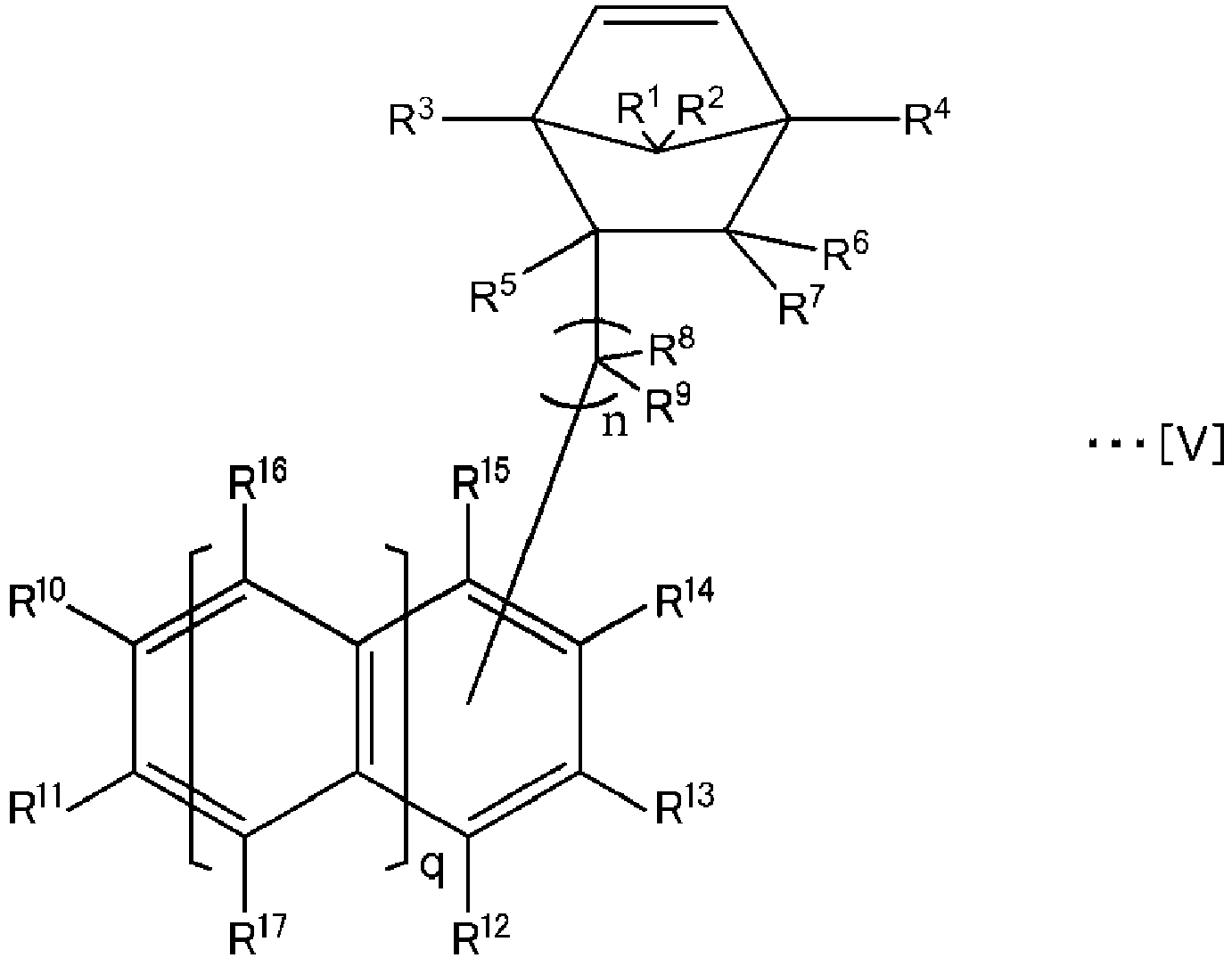
- [9] The cyclic olefin-based resin composition described in [8],
in which the cyclic olefin-derived constituent unit (a2) in the random copolymer (A1) includes a repeating unit derived from one kind or two or more kinds of compounds selected from bicyclo[2.2.1]-2-heptene and tetracyclo [4.4.0.12,5.17,10]-3-dodecene. - [10] The cyclic olefin-based resin composition described in [8] or [9],
in which the α-olefin-derived constituent unit (a1) in the random copolymer (A1) includes a repeating unit derived from ethylene. - [11] The cyclic olefin-based resin composition described in any one of [8] to [10],
in which the monomer having a polar group includes a monomer represented by the following Formula (10):
CH2=CH-R1-Xp (10)
in the Formula (10), p represents a positive integer of equal to or more than 1 and equal to or less than 3; R1 represents a hydrocarbon group having 0 or more carbon atoms; and X represents one kind or two or more kinds of polar groups selected from a carboxyl group, a hydroxyl group, a sulfonic acid group, an acid anhydride group, an epoxy group, and an amino group. - [12] The cyclic olefin-based resin composition described in [11],
in which the monomer having a polar group includes one kind or two or more kinds selected from undecenol and undecylenic acid. - [13] The cyclic olefin-based resin composition described in [7],
in which the polar group-containing cyclic olefin-based copolymer (A-a) includes a graft copolymer (A2) obtained by grafting or graft-polymerizing the monomer having a polar group into a cyclic olefin-based polymer having a constituent unit (a2) derived from a cyclic olefin represented by the following Formula [I], [II], [III], [IV], or [V]:


- [14] The cyclic olefin-based resin composition described in [13],
in which the cyclic olefin-derived constituent unit (a2) in the graft copolymer (A2) includes a repeating unit derived from one kind or two or more kinds of compounds selected from bicyclo[2.2.1]-2-heptene and tetracyclo [4.4.0.12,5.17,10]-3-dodecene. - [15] The cyclic olefin-based resin composition described in [13] or [14],
in which the graft copolymer (A2) further has a constituent unit (a1) derived from an α-olefin having 2 to 20 carbon atoms. - [16] The cyclic olefin-based resin composition described in any one of [13] to [15],
in which the monomer having a polar group includes one kind or two or more kinds selected from acrylic acid, methacrylic acid, maleic acid, and maleic anhydride. - [17] The cyclic olefin-based resin composition described in any one of [1] to [16],
in which the inorganic fine particles (B) include one kind or two or more kinds selected from zirconia, titania, and alumina. - [18] The cyclic olefin-based resin composition described in any one of [1] to [17],
in which the inorganic fine particles (B) have an average particle size D50 of equal to or more than 1 nm and equal to or less than 100 nm. - [19] The cyclic olefin-based resin composition described in any one of [1] to [18],
in which a content of the inorganic fine particles (B) is equal to or more than 5% by mass and equal to or less than 60% by mass when a total amount of the cyclic olefin-based resin composition is designated as 100% by mass. - [20] The cyclic olefin-based resin composition described in any one of [1] to [19],
in which in a case where a film having a film thickness of equal to or more than 100 µm and equal to or less than 300 µm is produced using the cyclic olefin-based resin composition,
a refractive index (nD) of the film at a wavelength of 589 nm is equal to or higher than 1.545. - [21] A molded product obtained by using the cyclic olefin-based resin composition described in any one of [1] to [20].
- [22] An optical component including the molded product described in [21] .
- According to the present invention, a cyclic olefin-based resin composition that can realize an optical component having transparency and a high refractive index can be provided.
- Hereinafter, the present invention will be described based on example embodiments. In the present embodiment, the expression "A to B" indicating a numerical value range means, unless stated otherwise, equal to or more than A and equal to or less than B.
- First, the cyclic olefin-based resin composition of the embodiments according to the present invention will be described.
- The cyclic olefin-based resin composition according to the present embodiment includes a cyclic olefin-based copolymer (A) and inorganic fine particles (B) having a surface modified by a modifier. The modifier is one kind or two or more kinds selected from the group consisting of a phosphoric acid ester, an organic phosphonic acid, a phosphonic acid ester, a carboxylic acid, a sulfonic acid, a hydrocarbon compound having an amino group, and a silane coupling agent, and the inorganic fine particles (B) exist in a state of being dispersed in the cyclic olefin-based copolymer (A).
- Here, the phrase that the inorganic fine particles (B) exist in a state of dispersed in the cyclic olefin-based copolymer (A) implies, for example, a state in which the inorganic fine particles (B) are scattered in a sea (matrix) of the cyclic olefin-based copolymer (A). More specifically, for example, the phrase means a state in which the average aggregated particle size (secondary particle size) of the scattered inorganic fine particles (B) is equal to or less than 500 nm, preferably equal to or less than 200 nm, and more preferably equal to or less than 100 nm. The average aggregated particle size (secondary particle size) of the inorganic fine particles (B) can be measured using, for example, an electron microscope.
- As the cyclic olefin-based resin composition of the embodiments according to the present invention includes the cyclic olefin-based copolymer (A) and the inorganic fine particles (B) modified by the above-mentioned modifier, and the dispersibility of the inorganic fine particles (B) in the matrix can be improved by an interaction between the two. This makes it possible to realize excellent transparency and a high refractive index in an obtainable molded product and an optical component.
- The content of the inorganic fine particles (B) in the cyclic olefin-based resin composition according to the present embodiment is preferably equal to or more than 5% by mass, and more preferably equal to or more than 10% by mass, when the total amount of the cyclic olefin-based resin composition is designated as 100% by mass, from the viewpoint of further increasing the refractive index of an obtainable optical component, and the content is preferably equal to or less than 60% by mass, more preferably equal to or less than 50% by mass, and even more preferably equal to or less than 40% by mass, from the viewpoint of further enhancing the transparency, refractive index, and mechanical characteristics of an obtainable optical component, and further enhancing the dispersibility of the inorganic fine particles (B).
- The total content of the polar group-containing cyclic olefin-based copolymer (A) and the inorganic fine particles (B) in the cyclic olefin-based resin composition according to the present embodiment is preferably equal to or more than 50% by mass and equal to or less than 100% by mass, more preferably equal to or more than 70% by mass and equal to or less than 100% by mass, even more preferably equal to or more than 80% by mass and equal to or less than 100% by mass, and particularly preferably equal to or more than 90% by mass and equal to or less than 100% by mass, when the total amount of the cyclic olefin-based resin composition is designated as 100% by mass, from the viewpoint of further enhancing the performance balance between transparency and the refractive index of an obtainable molded product.
- With regard to the cyclic olefin-based resin composition according to the present embodiment, when a film having a film thickness of equal to or more than 100 µm and equal to or less than 300 µm is produced using the cyclic olefin-based resin composition, the refractive index (nD) of the film at a wavelength of 589 nm is preferably equal to or higher than 1.545, more preferably equal to or higher than 1.550, even more preferably equal to or higher than 1.554, and particularly preferably equal to or higher than 1.560. When the refractive index (nD) is within the above-described range, the thickness can be made thinner while maintaining satisfactory optical characteristics of an obtainable optical component.
- With regard to the cyclic olefin-based resin composition according to the present embodiment, it is preferable that when a molded product is produced using the cyclic olefin-based resin composition, the molded product has solvent resistance. Solvent resistance can be evaluated by, for example, using the insoluble fraction (% by mass), and the insoluble fraction (% by mass) can be adjusted to be equal to or higher than the content percentage of the inorganic fine particles (B) in the cyclic olefin-based resin composition.
- The insoluble fraction (% by mass) can be determined, for example, as follows. A film having a film thickness of 100 µm is produced using the cyclic olefin-based resin composition according to the present embodiment, and 0.3 g of the film is introduced into a flask and precisely weighed (Y (g)), toluene is added thereto to obtain a 1 mass% solution, and the film is immersed for 24 hours at 25°C. After 24 hours, the solvent containing the film is filtered through a membrane filter (pore size 10 µm) to capture insoluble matter, the insoluble matter is dried for 48 hours at 25°C, subsequently the mass of the insoluble matter (Z (g)) is measured, and the insoluble fraction can be calculated by the following formula.

- With regard to the cyclic olefin-based resin composition according to the present embodiment, it is preferable that when a molded product is produced using the cyclic olefin-based resin composition, the molded product has abrasion resistance. Specifically, the abrasion resistance can be evaluated as follows. First, a film having a film thickness of 100 µm is produced by using the cyclic olefin-based resin composition according to the present embodiment. Subsequently, the film is scratched under a load of 200 g using a sapphire needle having a diameter of 0.3 mm, and evaluation is performed based on the depth of the abraded site. At this time, it is preferable that the depth of the abraded site (scratch) is less than 10 µm, and more preferably less than 5 µm.
- The depth of the abraded site can be measured with, for example, a surface roughness meter.
- Hereinafter, the various components will be specifically described.
- It is preferable that the cyclic olefin-based copolymer (A) according to the present embodiment includes one kind or two or more kinds selected from the following [A-1], [A-2], [A-3], and [A-4]:
- [A-1] a random copolymer of an α-olefin having 2 to 20 carbon atoms and a cyclic olefin represented by the following Formula [I], [II], [III], [IV], or [V],
- [A-2] a ring-opening polymer or copolymer of a cyclic olefin represented by the above-described Formula [I], [II], [III], [IV], or [V],
- [A-3] a hydride of the ring-opening polymer or copolymer [A-2], and
- [A-4] a graft-modification product of the above-described item [A-1], [A-2] or [A-3].
- With regard to [A-1], the α-olefin having 2 to 20 carbon atoms in the random copolymer of an α-olefin having 2 to 20 carbon atoms and a cyclic olefin represented by the following Formula [I], [II], [III], [IV], or [V] may be a linear olefin or a branched olefin. Examples of such an α-olefin include linear α-olefins each having 2 to 20 carbon atoms, such as ethylene, propylene, 1-butene, 1-pentene, 1-hexene, 1-octene, 1-decene, 1-dodecene, 1-tetradecene, 1-hexadecene, 1-octadecene, and 1-eicosene; and branched α-olefins each having 4 to 20 carbon atoms 4-methyl-1-pentene, 3-methyl-1-pentene, and 3-methyl-1-butene. Among these, a linear α-olefin having 2 to 4 carbon atoms is preferred, and ethylene is particularly preferred. Such α-olefins may be used singly or may be used in combination of two or more kinds thereof.
- With regard to [A-1], when the sum of all the constituent units constituting the random copolymer of an α-olefin having 2 to 20 carbon atoms and a cyclic olefin represented by the following Formula [I], [II], [III], [IV], or [V] is designated as 100 mol%, the content of a constituent unit derived from the α-olefin having 2 to 20 carbon atoms is preferably equal to or more than 30 mol% and equal to or less than 88 mol%, and more preferably equal to or more than 40 mol% and equal to or less than 78 mol%.
- When the content of the α-olefin-derived constituent unit is equal to or more than the above-described lower limit value, the heat resistance and dimensional stability of an obtainable optical component can be enhanced. Furthermore, when the content of the α-olefin-derived constituent unit is equal to or less than the above-described upper limit value, transparency and the like of an obtainable optical component can be enhanced.
- The cyclic olefins represented by Formula [I], [II], [III], [IV], or [V] will be shown below.

- In the Formula [I], n represents 0 or 1; m represents 0 or a positive integer; and q represents 0 or 1. When q is 1, Ra and Rb each independently represent the following atom or hydrocarbon group, and when q represents 0, the respective linking bonds are bonded to form a 5-membered ring.
- R1 to R18 and Ra and Rb each independently represent a hydrogen atom, a halogen atom, a carboxyl group, a hydroxyl group, a sulfonic acid group, an acid anhydride group, an epoxy group, an amino group, or a hydrocarbon group which may be substituted with a halogen atom, a carboxyl group, a hydroxyl group, a sulfonic acid group, an acid anhydride group, an epoxy group, or an amino group. Here, the halogen atom is a fluorine atom, a chlorine atom, a bromine atom, or an iodine atom.
- Furthermore, the hydrocarbon groups may be each independently, for example, an alkyl group having 1 to 20 carbon atoms, a cycloalkyl group having 3 to 15 carbon atoms, or an aromatic hydrocarbon group. More specifically, examples of the alkyl group include a methyl group, an ethyl group, a propyl group, an isopropyl group, an amyl group, a hexyl group, an octyl group, a decyl group, a dodecyl group, and an octadecyl group; examples of the cycloalkyl group include a cyclohexyl group; and examples of the aromatic hydrocarbon group include a phenyl group and a naphthyl group. These hydrocarbon groups may be each substituted with a halogen atom, a carboxyl group, a hydroxyl group, a sulfonic acid group, an acid anhydride group, an epoxy group, or an amino group.
- In addition, with regard to the above-described Formula [I], R15 to R18 may be bonded to each other (in cooperation with each other) to form a monocyclic or polycyclic ring, and a monocyclic or polycyclic ring thus formed may have a double bond. Here, specific examples of the monocyclic or polycyclic ring to be formed will be shown below.


- Such an alkylidene group is, for example, an alkylidene group having 2 to 20 carbon atoms, and specific examples of such an alkylidene group include an ethylidene group, a propylidene group, and an isopropylidene group.

- In the Formula [II], p and q each represent 0 or a positive integer, and m and n each represent 0, 1, or 2. Furthermore, R1 to R19 each independently represent a hydrogen atom, a halogen atom, a carboxyl group, a hydroxyl group, a sulfonic acid group, an acid anhydride group, an epoxy group, an amino group, or a hydrocarbon group or an alkoxy group, both of which may be substituted with a halogen atom, a carboxyl group, a hydroxyl group, a sulfonic acid group, an acid anhydride group, an epoxy group, or an amino group.
- The halogen atom has the same meaning as the halogen atom for the above-described Formula [I]. The hydrocarbon groups may be each independently, for example, an alkyl group having 1 to 20 carbon atoms, an alkyl halide group having 1 to 20 carbon atoms, a cycloalkyl group having 3 to 15 carbon atoms, or an aromatic hydrocarbon group. More specifically, examples of the alkyl group include a methyl group, an ethyl group, a propyl group, an isopropyl group, an amyl group, a hexyl group, an octyl group, a decyl group, a dodecyl group, and an octadecyl group; examples of the cycloalkyl group include a cyclohexyl group; and examples of the aromatic hydrocarbon group include an aryl group and an aralkyl group, specifically such as a phenyl group, a tolyl group, a naphthyl group, a benzyl group, and a phenylethyl group. Examples of the alkoxy group include a methoxy group, an ethoxy group, and a propoxy group. These hydrocarbon group and alkoxy group may be each substituted with a halogen atom, a carboxyl group, a hydroxyl group, a sulfonic acid group, an acid anhydride group, an epoxy group, or an amino group.
- Here, the carbon atom to which R9 and R10 are bonded may be bonded to the carbon atom to which R13 is bonded or to the carbon atom to which R11 is bonded, directly or through an alkylene group having 1 to 3 carbon atoms. That is, in a case in which the above-described two carbon atoms are bonded through an alkylene group, the groups represented by R9 and R13 or the groups represented by R10 and R11 form, in cooperation with each other, any one alkylene group of a methylene group (-CH2-), an ethylene group (-CH2CH2-) or a propylene group (-CH2CH2CH2-) . Furthermore, in a case of n = m = 0, R15 and R12 or R15 and R19 may be bonded to each other to form a monocyclic or polycyclic aromatic ring. Examples of the monocyclic or polycyclic aromatic ring in this case include groups in which R15 and R12 further form an aromatic ring on the occasion of n = m = 0, as described below.


- Here, q has the same meaning as q for the above-described Formula [II].
- Examples of the cyclic olefin represented by Formula [I] or [II] as described above include:

- Furthermore, examples of the cyclic olefin represented by the Formula [I] or [II] include bicyclo[2.2.1]-2-heptene derivatives such as a cyclopentadiene-acenaphthylene adduct, 1,4-methano-1,4,4a,9a-tetrahydrofluorene, and 1,4-methano-1,4,4a,5,10,10a-hexahydroanthracene.
- Furthermore, examples of the cyclic olefin represented by the Formula [I] or [II] include tricyclo [4.3.0.12,5]-3-decene derivatives such as tricyclo [4.3.0.12,5]-3-decene, 2-methyltricyclo[4.3.0.12,5]-3-decene, and 5-methyltricyclo[4.3.0.12,5]-3-decene; tricyclo[4.4.0.12,5]-3-undecene derivatives such as tricyclo[4.4.0.12,5]-3-undecene and 10-methyltricyclo[4.4.0.12,5]-3-undecene;

- Furthermore, examples of the cyclic olefin represented by the Formula [I] or [II] include pentacyclopentadecadiene compounds such as an adduct of (a cyclopentadiene-acenaphthylene adduct) and cyclopentadiene, pentacyclo [6.5.1.13,6.02,7.09.13]-4-pentadecene and derivatives thereof, pentacyclo [7.4.0.12,5.19,12.08,13]-3-pentadecene and derivatives thereof, and pentacyclo[6.5.1.13,6.02,7.09,13]-4,10-pentadecadiene; pentacyclo [8.4.0.12,5.19,12.08,13]-3-hexadecene and derivatives thereof, pentacyclo [6.6.1.13,6.02,7.09,14]-4-hexadecene and derivatives thereof, hexacyclo[6.6.1.13,6.110,13.02,7.09,14]-4-heptadecene and derivatives thereof, heptacyclo[8.7.0.12,9.14,7.111,17.03,8.012,16]-5-eicosene and derivatives thereof, heptacyclo[8.8.0.12,9.14,7.111,18.03,8.012,17]-5-heneicosene and derivatives thereof, octacyclo[8.8.0.12,9.14,7.111,18.113,16.03,8.012,17]-5-docosene and derivatives thereof, nonacyclo[10.9.1.14,7.113,20.115,18.02,10.03,8.012,21.014,19]-5-pentacosen e and derivatives thereof, and nonacyclo[10.10.1.15,8.114,21.116,19.02,11.04,9.013,22.015,20]-6-hexacosen e and derivatives thereof.

- In the Formula [III], n and m each independently represent 0, 1, or 2, and q represents 1, 2, or 3. m is preferably 0 or 1, and more preferably 1. n is preferably 0 or 1, and more preferably 0. q is preferably 1 or 2, and more preferably 1.
- R18 to R31 each independently represent a hydrogen atom, a halogen atom, a carboxyl group, a hydroxyl group, a sulfonic acid group, an acid anhydride group, an epoxy group, an amino group, or a hydrocarbon group having 1 to 20 carbon atoms which may be substituted with a halogen atom, a carboxyl group, a hydroxyl group, a sulfonic acid group, an acid anhydride group, an epoxy group, or an amino group, and it is preferable that R18 to R31 each independently represent a hydrogen atom or a hydrocarbon group having 1 to 20 carbon atoms, and more preferably a hydrogen atom.
- Furthermore, in a case of q = 1, R28 and R29, R29 and R30, or R 30 and R31 may be bonded to each other to form a monocyclic or polycyclic ring, and in a case of q = 2 or 3, R28 and R28, R28 and R29, R29 and R30, R30 and R31, or R31 and R31 may be bonded to each other to form a monocyclic or polycyclic ring. The monocyclic ring or the polycyclic ring may have a double bond, and the monocyclic ring or the polycyclic ring may be an aromatic ring.
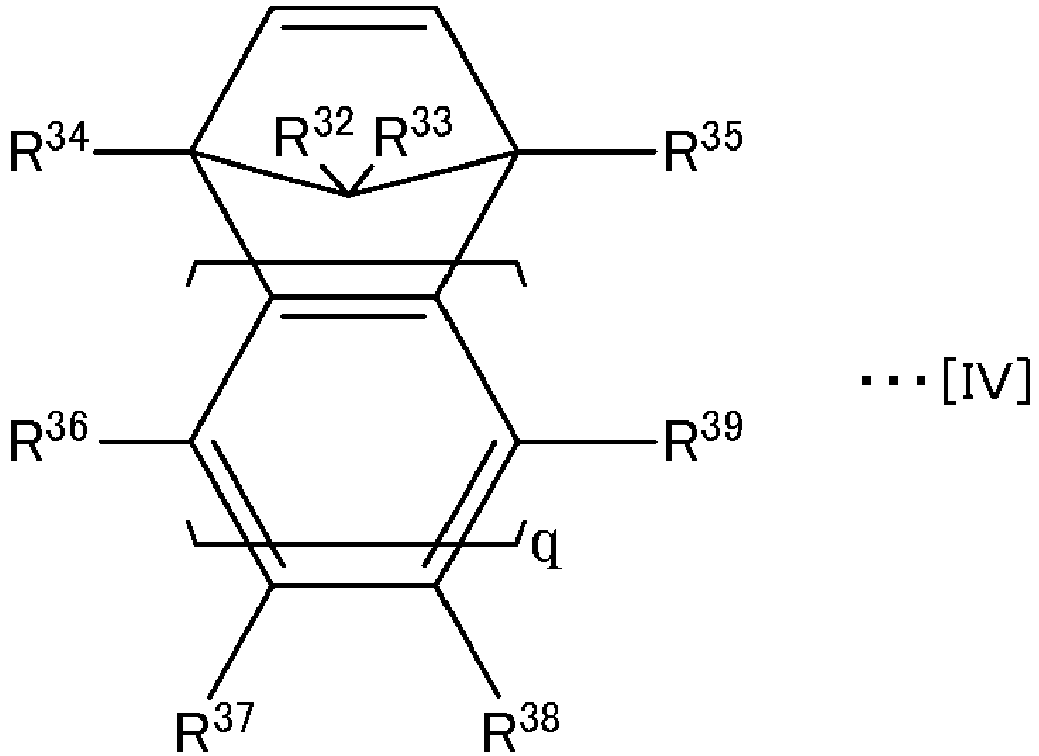
- In the Formula [IV], q represents 1, 2, or 3, preferably 1 or 2, and more preferably 1.
- R32 to R39 each independently represent a hydrogen atom, a halogen atom, a carboxyl group, a hydroxyl group, a sulfonic acid group, an acid anhydride group, an epoxy group, an amino group, or a hydrocarbon group having 1 to 20 carbon atoms which may be substituted with a halogen atom, a carboxyl group, a hydroxyl group, a sulfonic acid group, an acid anhydride group, an epoxy group, or an amino group, and it is preferable that R32 to R39 each independently represent a hydrogen atom or a hydrocarbon group having 1 to 20 carbon atoms, and more preferably a hydrogen atom.
- Furthermore, in a case of q = 1, R36 and R37, R37 and R38, or R38 and R39 may be bonded to each other to form a monocyclic or polycyclic ring, and in a case of q = 2 or 3, R36 and R36, R36 and R37, R37 and R38, R38 and R39, or R39 and R39 may be bonded to each other to form a monocyclic or polycyclic ring. The monocyclic ring or the polycyclic ring may have a double bond, and the monocyclic ring or the polycyclic ring may be an aromatic ring.

- In the Formula [V], n and q each independently represent 0, 1, or 2. n is preferably 0 or 1, and more preferably 0. q is preferably 0 or 1, and more preferably 0.
- R1 to R17 each independently represent a hydrogen atom, a halogen atom, a carboxyl group, a hydroxyl group, a sulfonic acid group, an acid anhydride group, an epoxy group, an amino group, or a hydrocarbon group having 1 to 20 carbon atoms which may be substituted with a halogen atom, a carboxyl group, a hydroxyl group, a sulfonic acid group, an acid anhydride group, an epoxy group, or an amino group, and one of R10 to R17 is a linking bond, while it is preferable that R15 is a linking bond.
- It is preferable that R1 to R17 each independently represent a hydrogen atom or a hydrocarbon group having 1 to 20 carbon atoms, and more preferably a hydrogen atom.
- In a case of q = 0, R10 and R11, R11 and R12, R12 and R13, R13 and R14, R14 and R15, or R15 and R10 may be bonded to each other to form a monocyclic or polycyclic ring, and in a case of q = 1 or 2, R10 and R11, R11 and R17, R17 and R17, R17 and R12, R12 and R13, R13 and R14, R14 and R15, R15 and R16, R16 and R16, or R16 and R10 may be bonded to each other to form a monocyclic or polycyclic ring. The monocyclic ring or the polycyclic ring may have a double bond, and the monocyclic ring or the polycyclic ring may be an aromatic ring.
- Among compounds of the Formula [V], a compound represented by the following Formula [V-1A] is preferable.
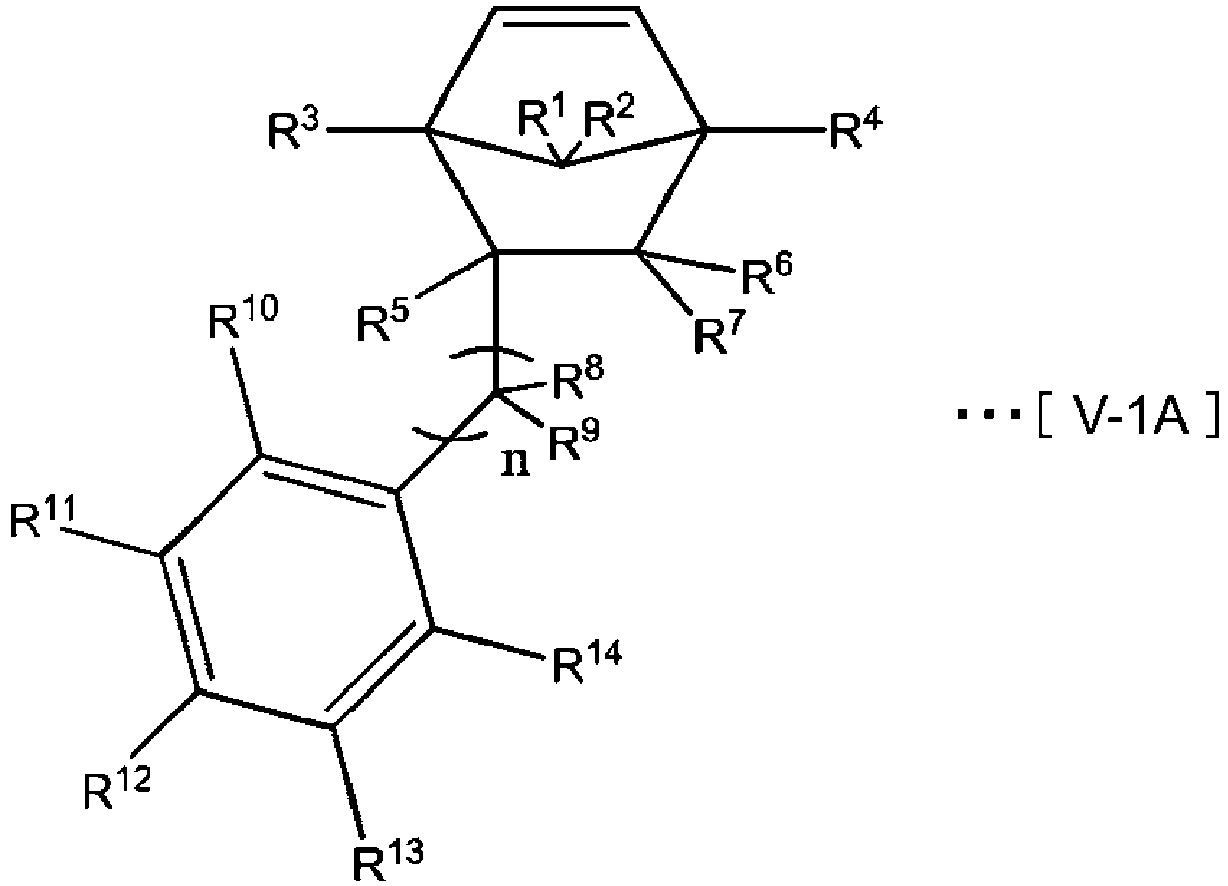
- In the Formula [V-1A], n represents 0, 1, or 2. n is preferably 0 or 1, and more preferably 0. Furthermore, in the Formula [V-1A], R1 to R14 each independently represent a hydrogen atom, a halogen atom, a carboxyl group, a hydroxyl group, a sulfonic acid group, an acid anhydride group, an epoxy group, an amino group, or a hydrocarbon group having 1 to 20 carbon atoms which may be substituted with a halogen atom, a carboxyl group, a hydroxyl group, a sulfonic acid group, an acid anhydride group, an epoxy group, or an amino group.
- In the Formulae [V] and [V-1A], the hydrocarbon groups having 1 to 20 carbon atoms may be each independently, for example, an alkyl group having 1 to 20 carbon atoms, a cycloalkyl group having 3 to 15 carbon atoms, and an aromatic hydrocarbon group. More specifically, examples of the alkyl group include a methyl group, an ethyl group, a propyl group, an isopropyl group, an amyl group, a hexyl group, an octyl group, a decyl group, a dodecyl group, and an octadecyl group; examples of the cycloalkyl group include a cyclohexyl group; and examples of the aromatic hydrocarbon group include aryl groups or aralkyl groups, such as a phenyl group, a tolyl group, a naphthyl group, a benzyl group, and a phenylethyl group. These hydrocarbon groups may be each substituted with a halogen atom except for a fluorine atom, a carboxyl group, a hydroxyl group, a sulfonic acid group, an acid anhydride group, or an amino group.
- It is preferable that the cyclic olefin-derived constituent unit according to the present embodiment preferabliy includes a repeating unit derived from at least one compound selected from bicyclo[2.2.1]-2-heptene, a bicyclo[2.2.1]-2-heptene derivative, tetracyclo[4.4.0.12,5.17,10]-3-dodecene, a tetracyclo[4.4.0.12,5.17,10]-3-dodecene derivative, hexacyclo[6.6.1.13,6.110,13.02,7.09,14]-4-heptadecene, a hexacyclo[6.6.1.13,6.110,13.02,7.09,14]-4-heptadecene derivative, benzonorbornadiene, indene norbornene, and methyl phenyl norbornene, and it is more preferable that the cyclic olefin-derived constituent unit includes a repeating unit derived from at least one compound selected from bicyclo[2.2.1]-2-heptene and tetracyclo [4.4.0.12,5.17,10] -3-dodecene. From the viewpoint of further increasing the refractive index of the optical component according to the present embodiment, it is even more preferable that the cyclic olefin-derived constituent unit includes a repeating unit derived from tetracyclo[4.4.0.12,5.17,10]-3-dodecene.
- Specific examples of the cyclic olefin represented by the above-described Formula [I], [II], [III], [IV], or [V] have been shown above; however, more specific structural examples of these compounds include the structural examples of cyclic olefins described in paragraphs [0038] to [0058] of
Japanese Unexamined Patent Publication No. H06-228380 Japanese Unexamined Patent Publication No. 2005-330465 Japanese Unexamined Patent Publication No. H07-145213 - The cyclic olefin represented by the above-described Formula [I], [II], [III], [IV], or [V] can be produced by, for example, subjecting olefins having a structure corresponding to cyclopentadiene to a Diels-Alder reaction.
- With regard to the random copolymer (A1) according to the present embodiment, at least some of the cyclic olefin represented by the Formula [I], [II], [III], [IV], or [V] is considered to constitute a repeating unit represented by the following Formula [VI], [VII], [VIII], [IX], or [X].

- In the Formula [VI], n, m, q, R1 to R18, Ra, and Rb have the same meanings as those in the Formula [I].

- In the Formula [VII], n, m, p, q, and R1 to R19 have the same meanings as those in the Formula [II].

- In the Formula [VIII], n, m, q, and R18 to R31 have the same meanings as those in the Formula [III].
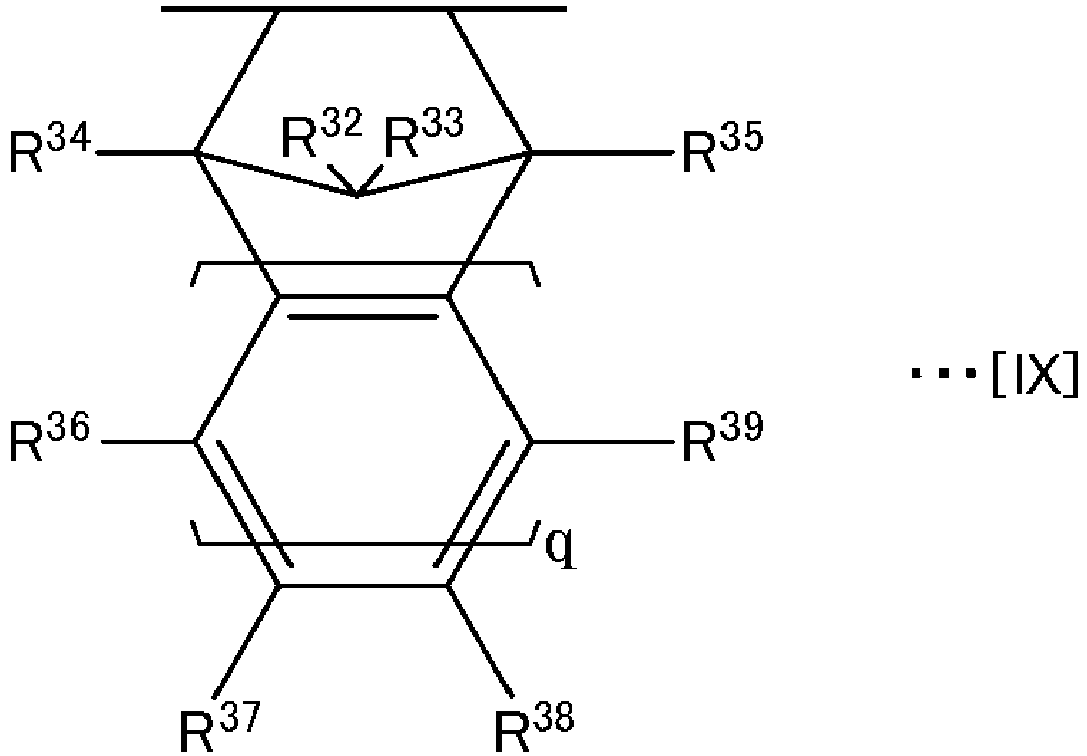
- In the Formula [IX], q and R32 to R39 have the same meanings as those in the Formula [IV].

- In the Formula [X], n, q, and R1 to R17 have the same meanings as those in the Formula [V].
- It is preferable that the cyclic olefin-based copolymer of the present embodiment includes one kind or two or more kinds selected from: [A-1] a random copolymer of an α-olefin having 2 to 20 carbon atoms and a cyclic olefin represented by the above-described Formula [I], [II], [III], [IV], or [V] ; [A-2] a ring-opening polymer or a copolymer of a cyclic olefin represented by the Formula [I], [II], [III], [IV], or [V]; [A-3] a hydride of the ring-opening polymer or copolymer [A-2]; and [A-4] a graft-modification product of the above-described item [A-1], [A-2], or [A-3]. From the viewpoint of enhancing the heat resistance and dimensional stability of an obtainable optical component, it is preferable that the cyclic olefin-based copolymer of the present embodiment includes a repeating unit derived from an α-olefin having 2 to 20 carbon atoms, and it is more preferable that the cyclic olefin-based copolymer includes [A-1] a random copolymer of an α-olefin having 2 to 20 carbon atoms and a cyclic olefin represented by the Formula [I], [II], [III], [IV], or [V].
- With regard to the above-described random copolymer, when the sum of all the constituent units constituting the random copolymer is designated as 100 mol%, the content of the constituent unit derived from a cyclic olefin represented by the Formula [I], [II], [III], [IV], or [V] is preferably equal to or more than 10 mol% and equal to or less than 60 mol%, and more preferably equal to or more than 20 mol% and equal to or less than 50 mol%.
- When the content of the constituent unit derived from a cyclic olefin represented by the Formula [I], [II], [III], [IV] or [V] is equal to or more than the lower limit value described above, transparency and the like of an obtainable optical component can be enhanced. Furthermore, when the content of the constituent unit derived from a cyclic olefin represented by the Formula [I], [II], [III], [IV], or [V] is equal to or less than the upper limit value described above, heat resistance and dimensional stability of an obtainable optical component can be enhanced.
- The glass transition temperature of the cyclic olefin-based copolymer (A) according to the present embodiment is preferably 110°C to 200°C, more preferably 115°C to 190°C, and even more preferably 120°C to 180°C, from the viewpoint of further enhancing heat resistance while maintaining satisfactory transparency and refractive index of an obtainable optical component.
- The limiting viscosity [η] (in decalin at 135°C) of the cyclic olefin-based copolymer (A) according to the present embodiment is, for example, 0.05 to 5.0 dl/g, preferably 0.2 to 4.0 dl/g, more preferably 0.3 to 2.0 dl/g, and particularly preferably 0.4 to 2.0 dl/g.
- When the limiting viscosity [η] is equal to or higher than the above-described lower limit value, the mechanical strength of an obtainable molded product can be enhanced. Furthermore, when the limiting viscosity [η] is equal to or lower than the above-described upper limit value, the moldability of the cyclic olefin-based resin composition according to the present embodiment can be enhanced.
- It is preferable that the cyclic olefin-based copolymer (A) according to the present embodiment includes a polar group-containing cyclic olefin-based copolymer (A-a) including a constituent unit (a3) derived from a monomer having a polar group, and it is preferable that the polar group is one kind or two or more kinds selected from a carboxyl group, a hydroxyl group, a sulfonic acid group, an acid anhydride group, an epoxy group, and an amino group. Furthermore, it is preferable that the constituent unit (a3) derived from a monomer having a polar group is located within the main chain or in a side chain of the polymer chain of the cyclic olefin-based copolymer (A) . As the cyclic olefin-based copolymer (A), which is a matrix, has the above-mentioned polar group within the main chain or in a side chain of the polymer chain, the dispersibility of the inorganic fine particles (B) in the matrix can be made more satisfactory as a result of an interaction between the polar group and the inorganic fine particles (B). This makes it possible to realize higher transparency and a higher refractive index for an obtainable optical component.
- Also from the viewpoints of solvent resistance and abrasion resistance obtainable when a molded product is produced using the cyclic olefin-based resin composition according to the present embodiment, it is preferable that the cyclic olefin-based copolymer (A) according to the present embodiment has the above-mentioned polar group. The reason why the solvent resistance and abrasion resistance obtainable when a molded product is produced using a cyclic olefin-based resin composition including the cyclic olefin-based copolymer (A) are enhanced as the cyclic olefin-based copolymer (A) according to the present embodiment has the polar group described above, is not necessarily clearly understood; however, it is speculated that the modifier that modifies the cyclic olefin-based copolymer (A) and the inorganic fine particles (B) forms a network.
- From the viewpoint of enhancing the dispersibility of the cyclic olefin-based copolymer (A) in the matrix and further enhancing the transparency of an obtainable optical component, the content of the constituent unit (a3) derived from a monomer having the above-described polar group in the polar group-containing cyclic olefin-based copolymer (A-a) is preferably equal to or more than 0.1 mol%, more preferably equal to or more than 0.2 mol%, and even more preferably equal to or more than 0.5 mol%, when the sum of all the constituent units constituting the polar group-containing cyclic olefin-based copolymer (A-a) is designated as 100 mol%, and from the viewpoint of further enhancing the refractive index, moisture resistance, and heat resistance of an obtainable optical component, the content is preferably equal to or less than 20 mol%, more preferably equal to or less than 10 mol%, even more preferably equal to or less than 5 mol%, and particularly preferably equal to or less than 2 mol%.
- It is preferable that the polar group-containing cyclic olefin-based copolymer (A-a) includes one kind or two or more kinds selected from a random copolymer (A1) of a monomer having the above-described polar group and a cyclic olefin, and a graft copolymer (A2) obtained by grafting or graft-polymerizing a monomer having the above-described polar group into a cyclic olefin-based polymer.
- Here, the term "grafting" means introducing a monomer having a polar group into a stem polymer that serves as a main chain. The term "graft-polymerizing" means introducing a branch polymer composed of a polymer different from the main chain, into a stem polymer that serves as the main chain.
- It is preferable that the polar group-containing cyclic olefin-based copolymer (A-a) includes a random copolymer (A1) having: a constituent unit (a1) derived from an α-olefin having 2 to 20 carbon atoms; a constituent unit (a2) derived from a cyclic olefin represented by the above-described Formula [I], [II], [III], [IV], or [V] ; and a constituent unit (a3) derived from a monomer having the above-described polar group.
- The α-olefin having 2 to 20 carbon atoms according to the present embodiment may be a linear olefin or a branched olefin. Examples of such an α-olefin include linear α-olefins each having 2 to 20 carbon atoms, such as ethylene, propylene, 1-butene, 1-pentene, 1-hexene, 1-octene, 1-decene, 1-dodecene, 1-tetradecene, 1-hexadecene, 1-octadecene, and 1-eicosene; and branched α-olefins each having 4 to 20 carbon atoms, such as 4-methyl-1-pentene, 3-methyl-1-pentene, and 3-methyl-1-butene. Among these, a linear α-olefin having 2 to 4 carbon atoms is preferred, and ethylene is particularly preferred. It is preferable that the constituent unit (a1) derived from an α-olefin in the random copolymer (A1) includes a repeating unit derived from ethylene. Such α-olefins may be used singly or may be used in combination of two or more kinds thereof.
- When the sum of all the constituent units constituting the random copolymer (A1) according to the present embodiment is designated as 100 mol%, the content of the α-olefin-derived constituent unit (a1) is preferably equal to or more than 30 mol% and equal to or less than 88 mol%, and more preferably equal to or more than 40 mol% and equal to or less than 78 mol%.
- When the content of the α-olefin-derived constituent unit (a1) is equal to or more than the above-described lower limit value, the heat resistance and dimensional stability of an obtainable optical component can be enhanced. Furthermore, when the content of the α-olefin-derived constituent unit (a1) is equal to or less than the above-described upper limit value, transparency and the like of an obtainable optical component can be enhanced.
- When the sum of all the constituent units constituting the random copolymer (A1) according to the present embodiment is designated as 100 mol%, the content of the α-olefin-derived constituent unit (a1) is preferably equal to or more than 30 mol% and equal to or less than 88 mol%, and more preferably equal to or more than 40 mol% and equal to or less than 78 mol%.
- When the content of the α-olefin-derived constituent unit (a1) is equal to or more than the above-described lower limit value, the heat resistance and dimensional stability of an obtainable optical component can be enhanced. Furthermore, when the content of the α-olefin-derived constituent unit (a1) is equal to or less than the above-described upper limit value, transparency and the like of an obtainable optical component can be enhanced.
- It is preferable that the cyclic olefin-derived constituent unit (a2) according to the present embodiment is a constituent unit having an alicyclic structure and derived from a cyclic olefin represented by the Formula [I], [II], [III], [IV], or [V].
- Specific examples of the cyclic olefin represented by the Formula [I], [II], [III], [IV], or [V] are also as described above, and it is particularly preferable that the cyclic olefin-derived constituent unit (a2) in the random copolymer (A1) includes a repeating unit derived from one kind or two or more kinds of compounds selected from bicyclo[2.2.1]-2-heptene and tetracyclo [4.4.0.12,5.17,10]-3-dodecene.
- It is preferable that the constituent unit (a3) derived from a monomer having a polar group according to the present embodiment is a constituent unit derived from a monomer having at least one polar group selected from a carboxyl group, a hydroxyl group, a sulfonic acid group, an acid anhydride group, and an amino group.
- The monomer having a polar group is not particularly limited as long as it is a monomer having the above-described polar group; however, examples thereof include a monomer represented by the following Formula (10).
CH2=CH-R1-Xp (10)
- In the Formula (10), p represents a positive integer of equal to or more than 1 and equal to or less than 3, and is preferably 1.
- R1 is a hydrocarbon group having equal to or more than 0 carbon atoms, preferably a hydrocarbon group having equal to or more than 2 carbon atoms, more preferably a hydrocarbon group having equal to or more than 3 and equal to or fewer than 20 carbon atoms, and more preferably a hydrocarbon group having equal to or more than 5 and equal to or fewer than 15 carbon atoms.
- X is at least one polar group selected from a carboxyl group, a hydroxyl group, a sulfonic acid group, an acid anhydride group, an epoxy group, and an amino group; more preferably at least one polar group selected from a carboxyl group, a hydroxyl group, and an acid anhydride group; and even more preferably at least one polar group selected from a carboxyl group and a hydroxyl group.
- Specific examples of the monomer having a polar group include compounds having at least one polar group selected from a carboxyl group, a hydroxyl group, a sulfonic acid group, an acid anhydride group, an epoxy group, and an amino group, among the compounds described on pages 11 to 17 of
Japanese Unexamined Patent Publication No. H02-51510 - Regarding the monomers having these polar groups, one kind thereof may be used alone, or two or more kinds thereof may be used in combination.
- Among these, from the viewpoint of having excellent copolymerizability with cyclic olefins, it is preferable that the monomer having a polar group includes at least one selected from acrylic acid, 3-butenoic acid, 4-pentenoic acid, 5-hexenoic acid, 6-heptenoic acid, 7-octenoic acid, 8-nonenoic acid, 9-decenoic acid, 10-undecenoic acid (undecylenic acid), 11-dodecenoic acid, 2-propen-1-o1, 3-buten-1-ol, 4-penten-1-ol, 5-hexen-1-ol, 6-hepten-1-ol, 7-octen-1-ol, 8-nonen-1-ol, undecenol, and 11-dodecen-1-ol; more preferably at least one selected from acrylic acid, 4-pentenoic acid, 6-heptenoic acid, 9-decenoic acid, 10-undecenol, and undecylenic acid; and particularly preferably at least one selected from 10-undecenol and undecylenic acid.
- With regard to the random copolymer (A1) according to the present embodiment, in a case where a sum of entire constituent units constituting the random copolymer (A1) is designated as 100 mol%, the content of the constituent unit (a3) derived from a monomer having a polar group is preferably equal to or more than 0.1 mol%, more preferably equal to or more than 0.2 mol%, and even more preferably equal to or more than 0.5 mol%, from the viewpoint of enhancing the dispersibility of the random copolymer (A1) in the matrix and further enhancing the transparency of an obtainable optical component, and the content is preferably equal to or less than 20 mol%, more preferably equal to or less than 10 mol%, even more preferably equal to or less than 5 mol%, and particularly preferably equal to or less than 2 mol%, from the viewpoint of further enhancing the refractive index, moisture resistance, and heat resistance of an obtainable optical component.
- The random copolymer (A1) according to the present embodiment can be produced by, for example, the production methods described in
Japanese Unexamined Patent Publication No. H02-51510 Japanese Patent No. 3817015 Japanese Patent No. 5594712 - It is preferable that the polar group-containing cyclic olefin-based copolymer (A-a) includes a graft copolymer (A2) obtained by grafting or graft-polymerizing a monomer having the above-described polar group into a cyclic olefin-based polymer having a constituent unit (a2) derived from a cyclic olefin represented by the Formula [I], [II], [III], [IV], or [V]. Furthermore, the cyclic olefin-based polymer having the constituent unit (a2) derived from a cyclic olefin may be a ring-opening polymer of a cyclic olefin represented by the Formula [I], [II], [III], [IV], or [V], or may be a random copolymer of an α-olefin having 2 to 20 carbon atoms and a cyclic olefin represented by the Formula [I], [II], [III], [IV], or [V].
- As the cyclic olefin represented by the Formula [I], [II], [III], [IV], or [V], the same olefin as the α-olefin described for the above-described random copolymer (A1) can be used. Therefore, further description thereof will not be repeated here.
- It is particularly preferable that the cyclic olefin-derived constituent unit (a2) in the graft copolymer (A2) includes a repeating unit derived from one kind or two or more kinds of compounds selected from bicyclo[2.2.1]-2-heptene and tetracyclo [4.4.0.12,5.17,10] -3-dodecene.
- When the sum of all the constituent units constituting the graft copolymer (A2) according to the present embodiment is designated as 100 mol%, the content of the cyclic olefin-derived constituent unit (a2) is preferably equal to or more than 10 mol% and equal to or less than 60 mol%, and more preferably equal to or more than 20 mol% and equal to or less than 50 mol%.
- When the content of the cyclic olefin-derived constituent unit (a2) is equal to or more than the above-described lower limit value, transparency and the like of an obtainable optical component can be enhanced. Furthermore, when the content of the cyclic olefin-derived constituent unit (a2) is equal to or less than the above-described upper limit value, the heat resistance and dimensional stability of an obtainable optical component can be enhanced.
- It is preferable that the graft copolymer (A2) further has a constituent unit (a1) derived from an α-olefin having 2 to 20 carbon atoms.
- As the α-olefin having 2 to 20 carbon atoms, the same α-olefin as the α-olefin described for the above-described random copolymer (A1) can be used. Therefore, further description thereof will not be repeated here.
- When the sum of all the constituent units constituting the graft copolymer (A2) according to the present embodiment is designated as 100 mol%, the content of the α-olefin-derived constituent unit (a1) is preferably equal to or more than 30 mol% and equal to or less than 88 mol%, and more preferably equal to or more than 40 mol% and equal to or less than 78 mol%.
- When the content of the α-olefin-derived constituent unit (a1) is equal to or more than the above-described lower limit value, the heat resistance and dimensional stability of an obtainable optical component can be enhanced. Furthermore, when the content of the α-olefin-derived constituent unit (a1) is equal to or less than the above-described upper limit value, transparency and the like of an obtainable optical component can be enhanced.
- With regard to the graft copolymer (A2) according to the present embodiment, the constituent unit (a3) derived from a monomer having a polar group is a constituent unit derived from a monomer having at least one polar group selected from a carboxyl group, a hydroxyl group, a sulfonic acid group, an acid anhydride group, an epoxy group, and an amino group.
- The monomer having a polar group in the graft copolymer (A2) according to the present embodiment is not particularly limited as long as it is a monomer having the above-described polar group; however, examples thereof include a monomer having the above-described polar group described for the random copolymer (A1), acrylic acid, methacrylic acid, maleic acid, and maleic anhydride.
- Regarding the monomers having these polar groups, one kind thereof may be used alone, or two or more kinds thereof may be used in combination.
- Among these, it is preferable that the monomer includes at least one selected from acrylic acid, methacrylic acid, maleic acid, and maleic anhydride, from the viewpoint of the ease of grafting to the cyclic olefin-based polymer.
- With regard to the graft copolymer (A2) according to the present embodiment, when the sum of all the constituent units constituting the graft copolymer (A2) is designated as 100 mol%, the content of the constituent unit (a3) derived from a monomer having a polar group is preferably equal to or more than 0.1 mol%, more preferably equal to or more than 0.2 mol%, and even more preferably equal to or more than 0.5 mol%, from the viewpoint of enhancing the dispersibility of the graft copolymer (A2) in the matrix and further enhancing the transparency of an obtainable optical component, and the content is preferably equal to or less than 20 mol%, more preferably equal to or less than 10 mol%, even more preferably equal to or less than 5 mol%, and particularly preferably equal to or less than 2 mol%, from the viewpoint of further enhancing the refractive index, moisture resistance, and heat resistance of an obtainable optical component.
- The graft copolymer (A2) according to the present embodiment can be obtained by, for example, grafting or graft-polymerizing a monomer having the above-described polar group by a method described in, for example,
Japanese Unexamined Patent Publication No. 2016-056318 International Publication No. WO 2008/059938 ,International Publication No. WO 2010/050437 , or the like, to a cyclic olefin-based polymer produced by a production method described inJapanese Unexamined Patent Publication No. H05-320258 Japanese Examined Patent Publication No. H07-13084 - The cyclic olefin-based resin composition according to the present embodiment includes inorganic fine particles (B) having a surface modified by a modifier, and the modifier is one kind or two or more kinds selected from the group consisting of a phosphoric acid ester, an organic phosphonic acid, a phosphonic acid ester, a carboxylic acid, a sulfonic acid, a hydrocarbon compound having an amino group, and a silane coupling agent.
- It is preferable that the modifier is a compound represented by the following Formula (1).
R1-X (1)
- In the Formula (1), R1 represents a hydrocarbon group having 3 to 18 carbon atoms. Examples of the hydrocarbon group having 3 to 18 carbon atoms include a linear or branched alkyl group, a linear or branched alkenyl group, a linear or branched alkynyl group, a hydrocarbon group having an alicyclic structure, and a hydrocarbon group having an aromatic ring structure. From the viewpoint of obtaining a resin composition having excellent transparency by particularly improving the dispersibility of the modified inorganic particles in the cyclic olefin-based copolymer (A), among these, a chain-like hydrocarbon group having 3 to 18 carbon atoms which does not include a ring structure is preferred, a linear hydrocarbon group having 3 to 18 carbon atoms is more preferred, and a linear hydrocarbon group having 12 to 18 carbon atoms is particularly preferred.
- X represents a functional group that produces bonding with the surface of the inorganic fine particles (B), or an atomic group having the functional group.
- When the modifier has a functional group that produces bonding with the surface of the inorganic fine particles (B), a condensation reaction occurs between these groups and a functional group existing on the surface of the inorganic particles (for example, a hydroxyl group or a mercapto group), and the surface is modified by the modifier.
- Here, examples of the functional group that produces bonding with the surface of the inorganic fine particles (B) include hydrolyzable groups such as a hydroxyl group, a carboxyl group, a hydrohydroxyphosphoryl group, a phosphono group, a sulfino group, a sulfo group, and a thioxy group.
- Furthermore, examples of the atomic group having a functional group that produces bonding with the surface of the inorganic particles include atomic groups represented by the following Formulae (2) to (4):


- In Formulae (2) to (4), Y represents a hydroxyl group or a hydrolyzable group; and Z1 and Z2 each independently represent a hydrogen atom, a hydroxyl group, a hydrocarbon group having 1 to 18 carbon atoms, or a hydrocarbon oxy group having 1 to 18 carbon atoms. Symbol * represents a linking bond to R1.
- Examples of the hydrocarbon group having 1 to 18 carbon atoms of Z1 and Z2 include a group represented by R1; and a hydrocarbon group having 1 to 18 carbon atoms, such as a methyl group, an ethyl group, an n-propyl group, an isopropyl group, a vinyl group, an allyl group, or a phenyl group.
- Examples of the hydrocarbon oxy group having 1 to 18 carbon atoms of Z1 and Z2 include a group represented by -OR1; and a hydrocarbon oxy group having 1 to 18 carbon atoms, such as a methoxy group, an ethoxy group, a vinyloxy group, an allyloxy group, or a phenoxy group.
- Furthermore, in order to satisfactorily disperse the modified inorganic particles in the transparent resin, it is preferable that the modifier modifies the inorganic particles in a bidentate conformation or a tridentate conformation. Therefore, it is more preferable that Z1 in the Formulae (2) to (4) represents a hydrogen atom or a hydroxyl group.
- Specific examples of a compound that is used as the modifier according to the present embodiment include butanoic acid, hexanoic acid, heptanoic acid, octanoic acid, nonanoic acid, decanoic acid, dodecanoic acid, tetradecanoic acid, pentadecanoic acid, hexadecanoic acid, heptadecanoic acid, octadecanoic acid, oleic acid, linoleic acid, cyclohexanecarboxylic acid, 1-adamantanecarboxylic acid; phosphoric acid esters such as dodecenyl phosphate, tridecenyl phosphate, tetradecenyl phosphate, pentadecenyl phosphate, hexadecenyl phosphate, heptadecenyl phosphate, octadecenyl phosphate, oleyl phosphate, octadecadienyl phosphate, octadecatrienyl phosphate, and dioleyl phosphate; organic phosphonic acids such as dodecenyl phosphonic acid, tridecenyl phosphonic acid, tetradecenyl phosphonic acid, pentadecenyl phosphonic acid, hexadecenyl phosphonic acid, heptadecenyl phosphonic acid, octadecenyl phosphonic acid, oleyl phosphonic acid, octadecadienyl phosphonic acid, octadecatrienyl phosphonic acid, and dioleyl phosphonic acid; phosphonic acid esters such as dodecenyl phosphonate, tridecenyl phosphonic acid, tetradecenyl phosphonic acid, pentadecenyl phosphonic acid, hexadecenyl phosphonate, heptadecenyl phosphonate, octadecenyl phosphonate, and oleyl phosphonate; and silane compounds such as dodecyltrimethoxysilane, octadecyltrimethoxysilane, dodecenyltrimethoxysilane, and pentadecenyltrimethoxysilane; and the like.
- The compounds used as the modifier can be used singly or in combination of two or more kinds thereof.
- It is preferable that the modifier includes one kind or two or more kinds selected from phosphoric acid esters and carboxylic acids, and it is particularly preferable that the modifier includes one kind or two or more kinds selected from phosphoric acid esters including a hydrocarbon group having 12 to 18 carbon atoms, and carboxylic acids including a hydrocarbon group having 12 to 18 carbon atoms. By including the cyclic olefin-based copolymer (A) and inorganic fine particles (B) modified by a modifier including one kind or two or more kinds selected from phosphoric acid esters including a hydrocarbon group having 12 to 18 carbon atoms and carboxylic acids including a hydrocarbon group having 12 to 18 carbon atoms, the dispersibility of the inorganic fine particles (B) in the matrix can be further improved by an interaction between the two.
- The inorganic fine particles (B) according to the present embodiment are not particularly limited as long as they are finely dispersed in the matrix of the cyclic olefin-based copolymer (A); however, from the viewpoint of having an excellent effect of increasing the refractive index of an obtainable optical component, examples include zirconia; titania; alumina; oxides or nitrides of Zr, Ti, Hf, Al, Zn, and lanthanoids; oxides or nitrides of composite metals; and the like. Among these, zirconia, titania, and alumina are preferred. These may be used singly or in combination of two or more kinds thereof. Among these, zirconia and titania are preferred from the viewpoint of being much superior in the effect of increasing the refractive index, and zirconia is more preferred from the viewpoint that deterioration of the cyclic olefin-based copolymer (A), particularly the polar group-containing cyclic olefin-based copolymer (A), can be prevented.
- The average particle size D50 of the inorganic fine particles (B) is preferably equal to or less than 100 nm, more preferably equal to or less than 80 nm, even more preferably equal to or less than 60 nm, and particularly preferably equal to or less than 20 nm, from the viewpoint of enhancing the dispersibility in the matrix of the cyclic olefin-based copolymer (A) and further enhancing the transparency of an obtainable optical component.
- The average particle size D50 of the inorganic fine particles (B) is not particularly limited; however, for example, the average particle size is equal to or more than 1 nm.
- The average particle size D50 of the inorganic fine particles (B) can be measured by, for example, a dynamic light scattering method.
- The method for producing inorganic fine particles (B) having a surface modified by a modifier is not particularly limited; however, the inorganic fine particles can be obtained by, for example, the following method.
- First, an aqueous dispersion of inorganic fine particles (B), in which the inorganic fine particles (B) are dispersed in water, is obtained. Subsequently, the aqueous dispersion of the inorganic fine particles (B) and the above-described surface modifier are mixed. At this time, the surface modifier can be added as a simple substance of the surface modifier, or a surface modifier that has been mixed in advance with an organic solvent can be added.
- Here, the amount of modification of the modifier that modifies the surface of the inorganic fine particles (B) can be adjusted by adjusting the blending ratio of the inorganic fine particles (B) and the surface modifier. The amount of modification of the modifier that modifies the surface of the inorganic fine particles (B) is not particularly limited; however, when the amount of the inorganic fine particles (B) is designated as 100 % by mass, the amount of modification is preferably equal to or more than 20% by mass and equal to or less than 40% by mass, and more preferably equal to or more than 20% by mass and equal to or less than 30% by mass.
- By setting the amount of modification of the modifier that modifies the surface of the inorganic fine particles (B) to be in the above-described value range, the dispersibility of the inorganic fine particles (B) in the matrix can be further improved, and an effect of increasing the refractive index by dispersing the inorganic fine particles (B) can be sufficiently obtained.
- Subsequently, water is removed by any method from the obtained mixed solution including the aqueous dispersion of the inorganic fine particles (B) and the surface modifier, and the water is replaced with an organic solvent. In a case in which water is removed by a rotary evaporator or the like, a process of adding an organic solvent to the obtained mixed solution including the aqueous dispersion of the inorganic fine particles (B) and the surface modifier, and removing the dispersing medium by evaporation, is repeated as necessary, and a dispersion solution of the inorganic fine particles (B), in which the inorganic fine particles (B) are dispersed in an organic solvent, can be obtained.
- In the cyclic olefin-based resin composition according to the present embodiment, if necessary, a phenol-based stabilizer, a higher fatty acid metal salt, an antioxidant, an ultraviolet absorber, a hindered amine-based light stabilizer, a hydrochloric acid absorber, a metal inactivator, an antistatic agent, an antifogging agent, a lubricant, a slip agent, a nucleating agent, a plasticizer, a flame retardant, a phosphorus-based stabilizer, and the like can be incorporated to the extent that the object of the present invention is not impaired, and the mixing proportions thereof are adequate amounts.
- The cyclic olefin-based resin composition according to the present embodiment can be obtained by methods such as a method of kneading the cyclic olefin-based copolymer (A) and the inorganic fine particles (B) using known kneading apparatuses such as an extruder and a Banbury mixer; and a method of dissolving or dispersing the cyclic olefin-based copolymer (A) and the inorganic fine particles (B) in a common solvent, mixing them, and then evaporating the solvent.
- Among these, from the viewpoint of further improving the transparency of an obtainable optical component, a method of dissolving or dispersing the cyclic olefin-based copolymer (A) and the inorganic fine particles (B) in a common solvent, mixing them, and then evaporating the solvent, is preferred.
- Next, a molded product according to embodiments of the present invention will be described.
- The molded product according to the present embodiment is molded using the cyclic olefin-based resin composition according to the present embodiment.
- Since the molded product according to the present embodiment is formed of the cyclic olefin-based resin composition according to the present embodiment, the molded product has transparency and a high refractive index. Therefore, the molded product can be suitably used as an optical component in an optical system that needs to identify an image with high accuracy. Optical components are components used in optical equipment and the like, and specific examples include spectacle lenses, fθ lenses, pickup lenses, imaging lenses, sensor lenses such as lenses used for image sensors, prisms, projector lenses, light guiding plates, and in-vehicle camera lenses. The optical component according to the present embodiment can be suitably used particularly as an imaging lens.
- In the case of using the molded product according to the present embodiment in optical use applications, since it is essential for the molded product to transmit light rays, it is preferable that the light transmittance is satisfactory. The light transmittance is defined as the spectral light transmittance or the total light transmittance depending on the use application.
- In a case in which use for total light rays or in a plurality of wavelength regions, it is necessary that the total light transmittance is high, and the total light transmittance in a state in which an antireflection film is not provided on the surface is equal to or higher than 85%, and preferably 88% to 93%. When the total light transmittance is equal to or higher than 85%, the required amount of light can be secured. Regarding the method for measuring the total light transmittance, any known method can be applied, and the measuring apparatus and the like are not limited; however, for example, a method of molding the cyclic olefin-based resin composition according to the present embodiment into a sheet having a thickness of 3 mm according to ASTM D1003, and measuring the total light transmittance of the sheet obtainable by molding the cyclic olefin-based resin composition according to the present embodiment using a haze meter, and the like may be mentioned.
- Furthermore, in the case of an optical system to be utilized only in a specific wavelength region, for example, a laser optical system, the molded product can be used, even if the total light transmittance is not high, as long as the spectral light transmittance in the wavelength region is satisfactory. In this case, the spectral light transmittance at the usage wavelength in a state in which an antireflection film is not provided on the surface is preferably equal to or higher than 85%, and more preferably 86% to 93%. When the spectral light transmittance is equal to or higher than 85%, the required amount of light can be secured. Furthermore, regarding the measurement method and the apparatus, any known method can be applied, and specifically, a spectrophotometer can be mentioned as an example.
- In addition, the molded product according to the present embodiment has excellent light transmittance for light having a wavelength of 450 nm to 800 nm.
- In the case of using the molded product as an optical component, the light transmittance can be further increased by providing a known antireflection film on the surface.
- The molded product according to the present embodiment can be used in various forms such as a spherical shape, a rod shape, a plate shape, a columnar shape, a cylindrical shape, a tubular shape, a fibrous shape, and a film or sheet shape.
- The method for molding the cyclic olefin-based resin composition according to the present embodiment to obtain a molded product is not particularly limited, and any known method can be used. Depending on the use application and shape, for example, extrusion molding, injection molding, inflation molding, blow molding, extrusion blow molding, injection blow molding, press molding, vacuum molding, powder slush molding, calender molding, foam molding, and the like can be applied. Among these, an injection molding method is preferred from the viewpoints of moldability and productivity. The molding conditions are appropriately selected depending on the purpose of use or the molding method; however, for example, the resin temperature in injection molding is appropriately selected in the range of usually 150°C to 400°C, preferably 200°C to 350°C, and more preferably 230°C to 330°C.
- The embodiments of the present invention have been described above; however, these are only examples of the present invention, and various configurations other than the above-described configurations can be adopted.
- Furthermore, the present invention is not limited to the above-described embodiments, and modifications, improvements, and the like to the extent that the object of the present invention can be achieved are to be included in the present invention.
- Hereinafter, the present invention will be described in more detail by way of Examples; however, the present invention is not intended to be limited by these.
- (Cyclopentadienyl)titanium (di-t-butylketimido)dichloride (CpTiNCtBu2Cl2) was synthesized according to
Japanese Patent No. 4245801 - Nitrogen as an inert gas was allowed to flow into a glass reaction vessel having a volume of 2,000 ml and equipped with a stirring apparatus for 30 minutes at a flow rate of 100 NL/h, subsequently cyclohexane (an amount with which the sum of cyclohexane, tetracyclo [4.4.0.12,5.17,10]-3-dodecene, and undecylenic acid becomes 1,000ml), tetracyclo [4.4.0.12,5.17,10]-3-dodecene (hereinafter, also referred to as tetracyclododecene), and undecylenic acid were introduced therein at the proportions described in Table 1, and then a toluene solution of triisobutylaluminum (26.4 mmol, concentration 1.0 mM/mL) was added thereto. Next, the solvent temperature was raised to 50°C while the polymerization solvent was stirred at a speed of rotation of 600 rpm. After the solvent temperature reached a predetermined temperature, the flowing gas was switched from nitrogen to ethylene, and ethylene was allowed to flow into the reaction vessel at a supply rate of 100 NL/h. After 10 minutes had passed, a toluene solution of (cyclopentadienyl)titanium (di-t-butyl ketimido)dichloride (0.040 mmol) and a toluene solution of methylaluminoxane (12 mmol) were introduced into the glass reaction vessel to initiate polymerization.
- After 20 minutes had passed, 5 ml of methanol and acetylacetic acid were added thereto such that the amount of acetylacetic acid would be 20 equivalents with respect to the aluminum concentration, to terminate polymerization, and a polymerization solution including a copolymer of ethylene, tetracyclododecene, and undecylenic acid was obtained. Subsequently, 500 ml of a 1.0 mol/L aqueous solution of hydrochloric acid was added to the reaction vessel, and the mixture was stirred for 1 hour at 600 rpm at 50°C. An oil layer and an aqueous layer were separated, subsequently the oil layer was introduced under stirring into a beaker containing acetone, the amount of acetone being about 3 times the volume of the oil layer, to precipitate a copolymer, and the precipitated copolymer was separated from a filtrate by filtration. The obtained polymer including the solvent was dried under reduced pressure at 130°C for 10 hours, and 3.79 g of a white powdered ethylene-tetracyclodecene-undecylenic acid copolymer (cyclic olefin-based copolymer containing a polar group (A-1)) was obtained.
Table 1 Polar group-containing cyclic olefin-based copolymer (Å) A-1 CpTiNCtBu2Cl2 mmol 0.040 PMAO mmol 12 TIBAL mmol 26.4 Total amount of reaction liquid ml 1000 TD mmol 153 Undecylenic acid mmol 12 Polymer yield g 3.79 Composition Ethylene mol% 62.3 TD mol% 36.5 Undecylenic acid mol% 1.2 Glass transition temperature (Tg) °C 132 Remarks)
* CpTiNCtBu2Cl2: (Cyclopentadienyl)titanium (di-t-butylketimido) dichloride
* PMAO: Methylaluminoxane
* TIBAL: Triisobutylaluminum
* Tetracyclododecene - APL6015T (100 parts by mass) manufactured by Mitsui Chemicals, Inc. was blended with a solution obtained by dissolving 1.5 parts by mass of maleic anhydride (manufactured by Wako Pure Chemical Industries, Ltd.) and 1.5 parts by mass of t-butyl peroxybenzoate (manufactured by NOF Corporation, trade name PERBUTYL Z) in acetone. Subsequently, the mixture was subjected to melt degeneration using a twin-screw extruder (manufactured by Technovel Corporation, KZW15) at a resin temperature of 250°C, a speed of screw rotation of 200 rpm, and a discharge rate of 25 g/min. Upon extrusion, the radical initiator, the solvent, and unreacted maleic anhydride were degassed in a vacuum. The extruded strands in a molten state were pelletized after cooling, and thus a cyclic olefin-based copolymer (A-2) containing a polar group was obtained.
- Surface-modified zirconia having a surface modified by butanoic acid, lauric acid, palmitic acid, or dodecyl phosphoric acid was produced by the following method.
- In a 200-mL eggplant-shaped flask loaded with a stirrer tip, each of various hydrophobizing surface modifiers in an amount equivalent to 23% by mass with respect to the zirconia to be treated was taken and mixed with 42 mL of toluene as a water-insoluble organic solvent and 30 mL of methanol as an amphiphilic organic solvent, and the mixture was mixed with 3 mL of an aqueous dispersion liquid of zirconia fine particles (zirconia content: 30% by mass) added thereto. As the aqueous dispersion liquid of zirconia fine particles, (SZR-W) manufactured by Sakai Chemical Industry Co., Ltd. was used. In the mixed solution thus obtained, toluene as a water-insoluble organic solvent and water were dissolved in methanol as an amphiphilic organic solvent to form a uniform liquid phase, and white clouding occurred, which was considered to be attributed to zirconia fine particles.
- The mixed liquid obtained as described above was stirred for one hour at room temperature, and then the dispersing medium was evaporated and removed using a rotary evaporator until the volume reached about 3 to 5 mL. Evaporation and removal of the dispersing medium was carried out by reducing the pressure of the atmosphere to a pressure that did not cause bumping in the liquid phase while maintaining the mixed liquid at room temperature.
- The mixed liquid remaining in the eggplant-shaped flask exhibited white clouding after the evaporation and removal of the dispersing medium of a first time, and the liquid phase was separated into two phases. The mixed liquid was subjected to an operation of further adding 30 mL of methanol and 42 mL of toluene to the mixed liquid to obtain a cloudy dispersion liquid having no interface again, and performing evaporation again until the amount reached about 3 to 5 mL. By repeating this operation approximately several times, the dispersion liquid could be changed from a cloudy state to a colorless and transparent state, depending on the type and amount of the surface modifier used, and the remaining liquid phase could be made into a single phase . In the present Example, the mixed solvent of water / methanol / toluene was replaced with a solvent containing toluene only by performing the operation 5 to 6 times, and thereby a toluene dispersion liquid of zirconia fine particles was obtained.
- Toluene was removed from the toluene dispersion liquid of zirconia fine particles by evaporation, subsequently the residue was vacuum dried for 24 hours at 25°C, and white solid zirconia fine particles were obtained. The zirconia fine particles thus obtained were redispersed in toluene, and the particle size was measured by dynamic light scattering (DLS). The average particle size of lauric acid-modified zirconia fine particles was 18.4 nm.
- A cyclic olefin-based polymer / zirconia nanoparticle compositized film was produced by the following method. Furthermore, various physical properties were measured or evaluated by the following methods. The obtained results are shown in Table 2.
- The cyclic olefin-based copolymers A-1 and A-2 synthesized in Production Examples 1 and 2 and APL6509T (cyclic olefin-based copolymer A-3 containing no polar group) manufactured by Mitsui Chemicals, Inc. were each dissolved in cyclohexane, and 5 mass% solutions were respectively prepared. To this, a 5 mass% cyclohexane solution prepared by using the surface-modified zirconia having a surface modified by butanoic acid, lauric acid, palmitic acid, or dodecyl phosphoric acid, which had been obtained by the above-described method, was added such that the amount of the zirconia nanoparticles would be the proportion shown in Table 2 with respect to the amount of the polymer. The mixture was stirred with a magnetic stirrer at room temperature for 1 hour and was flow cast on a glass plate and bar-coated. The mixture was dried for 24 hours at 25°C, the solvent was removed by vacuum drying for 15 hours at 80°C, and a cyclic olefin-based polymer / zirconia nanoparticle compositized film having a film thickness of 100 µm was obtained for each case.
- The total light transmittance was measured according to JIS K-7105 using a double beam type haze computer HZ-2 manufactured by Suga Test Instruments Co., Ltd., and the total light transmittance was evaluated according to the following criteria.
-
- AA: Equal to or higher than 90%
- A: Equal to or higher than 80% and lower than 90%
- B: Lower than 80%
- Measurement was performed in an N2 (nitrogen) atmosphere using DSC-6220 manufactured by Shimadzu Scientific Instruments, Inc. The temperature was raised from normal temperature to 200°C at a rate of temperature increase of 10°C/min and then was maintained for 5 minutes, and subsequently the temperature was lowered to -20°C at a rate of temperature decrease of 10°C/min and then was maintained for 5 minutes. Then, the glass transition temperature (Tg) of the polar group-containing cyclic olefin-based copolymer was determined from an endothermic curve obtained at the time of raising the temperature to 200°C at a rate of temperature increase of 10°C/min.
- The refractive index (nD) at a wavelength of 589 nm was measured using a refractive index / film thickness measuring apparatus (manufactured by Metricon Corporation, PRISM COUPLER Model 2010/M) .
- 0.3 g of each of the cyclic olefin-based polymer / zirconia nanoparticle compositized films having a film thickness of 100 µm, which had been obtained in the Examples and Comparative Examples, was placed in a flask and precisely weighed (Y(g)), toluene was added thereto to obtain a 1 mass% solution, and the film was immersed therein for 24 hours at 25°C. Insoluble matter was captured by filtering the mixture through a membrane filter (pore size 10 µm) and dried for 48 hours at 25°C, and then the mass (Z(g)) of the insoluble matter was measured. The insoluble fraction was calculated by the following formula and was evaluated according to the following criteria.

-
- A: Insoluble fraction ≥ percentage content of zirconia (% by mass)
- B: Insoluble fraction < percentage content of zirconia (% by mass)
- Here, the insoluble matter is considered to include zirconia that has formed a network with the resin. That is, the rating A (insoluble fraction ≥ percentage content of zirconia (mass%)) indicates that the resin and zirconia did not pass through the filter because they sufficiently formed a network, and the rating B (insoluble fraction < percentage content of zirconia (mass%)) indicates that the resin and zirconia passed through the filter because the resin and zirconia did not sufficiently form a network. It was confirmed that the cyclic olefin-based polymer alone and the zirconia nanoparticles alone passed through the membrane filter (pore size 10 µm), and there was no captured insoluble matter.
- Each of the cyclic olefin-based polymer / zirconia nanoparticle compositized films having a film thickness of 100 µm, which had been obtained in the Examples and Comparative Examples, was scratched under a load of 200 g with a sapphire needle having a diameter of 0.3 mm, the depth of an abraded site was measured with a surface roughness meter, and thereby abrasion resistance (scratch resistance) was evaluated.
-
- A: Less than 5 µm
- BB: Equal to or more than 5 µm and less than 10 µm
- B: Equal to or more than 10 µm
- For each of the evaluation items of light transmittance, refractive index, solvent resistance, and abrasion resistance, AA was given 3 points, A was given 2 points, BB was given 1 point, and B was given 0 points, and the total scores were calculated. Comprehensive evaluation was carried out according to the following criteria.
-
- A: Equal to or more than 5 points
- B: Less than 5 points
- This application claims priority on the basis of
Japanese Patent Application No. 2018-181395, filed September 27, 2018
| Example 1 | Example 2 | Example 3 | Example 4 | Example 5 | Example 6 | Example 7 | Example 8 | Example 9 | Comparative Example 1 | Comparative Example 2 | |||
| Cyclic olefin-based polymer | A-1 | wt% | 67 | 91 | 67 | 50 | 67 | 67 | - | - | - | 100 | - |
| A-2 | wt% | - | - | - | - | - | - | 67 | 67 | - | - | - | |
| A-3 | wt% | - | - | - | - | - | - | - | - | 91 | - | 91 | |
| Surface modifier | No surface modification | - | - | - | - | - | - | - | - | - | - | Yes | |
| Butanoic acid | Yes | - | - | - | - | - | Yes | - | - | - | - | ||
| Lauric acid | - | Yes | Yes | Yes | - | - | - | Yes | Yes | - | - | ||
| Palmitic acid | - | - | - | - | - | Yes | - | - | - | - | - | ||
| Dodecyl phosphoric acid | - | - | - | - | Yes | - | - | - | - | - | - | ||
| Surface-modified zirconia | wt% | 33 | 9 | 33 | 50 | 33 | 33 | 33 | 33 | 9 | 0 | 9 | |
| Light transmittance | Evaluation | A | AA | AA | AA | AA | AA | A | AA | A | AA | B | |
| Refractive index (589 nm) | 1.567 | 1.553 | 1.568 | 1.597 | 1.566 | 1.563 | 1.568 | 1.567 | 1.552 | 1.540 | 1.553 | ||
| Evaluation | A | A | A | A | A | A | A | A | A | B | A | ||
| Solvent resistance | Evaluation | A | A | A | A | A | A | A | A | B | B | B | |
| Abrasion resistance (scratch resistance) | Evaluation | A | A | A | A | A | A | A | A | BB | B | B | |
| Comprehensive evaluation | Score | 8 | 9 | 9 | 9 | 9 | 9 | 8 | 9 | 5 | 3 | 2 | |
| Evaluation | A | A | A | A | A | A | A | A | A | B | B | ||
Claims (22)
- A cyclic olefin-based resin composition comprising:a cyclic olefin-based copolymer (A); andinorganic fine particles (B) having a surface modified by a modifier,wherein the modifier is one kind or two or more kinds selected from the group consisting of a phosphoric acid ester, an organic phosphonic acid, a phosphonic acid ester, a carboxylic acid, a sulfonic acid, a hydrocarbon compound having an amino group, and a silane coupling agent, andthe inorganic fine particles (B) exist in a state of being dispersed in the cyclic olefin-based copolymer (A).
- The cyclic olefin-based resin composition according to claim 1, wherein the modifier is a compound represented by the following Formula (1):
R1-X (1)
in the formula, R1 represents a hydrocarbon group having 3 to 18 carbon atoms; and X represents a functional group that produces bonding with the surface of the inorganic fine particles (B), or an atomic group having the functional group. - The cyclic olefin-based resin composition according to claim 1 or 2,
wherein the cyclic olefin-based copolymer (A) includes one kind or two or more kinds selected from the following [A-1], [A-2], [A-3], and [A-4]:[A-1] a random copolymer of an α-olefin having 2 to 20 carbon atoms and a cyclic olefin represented by the following Formula [I], [II], [III], [IV], or [V],

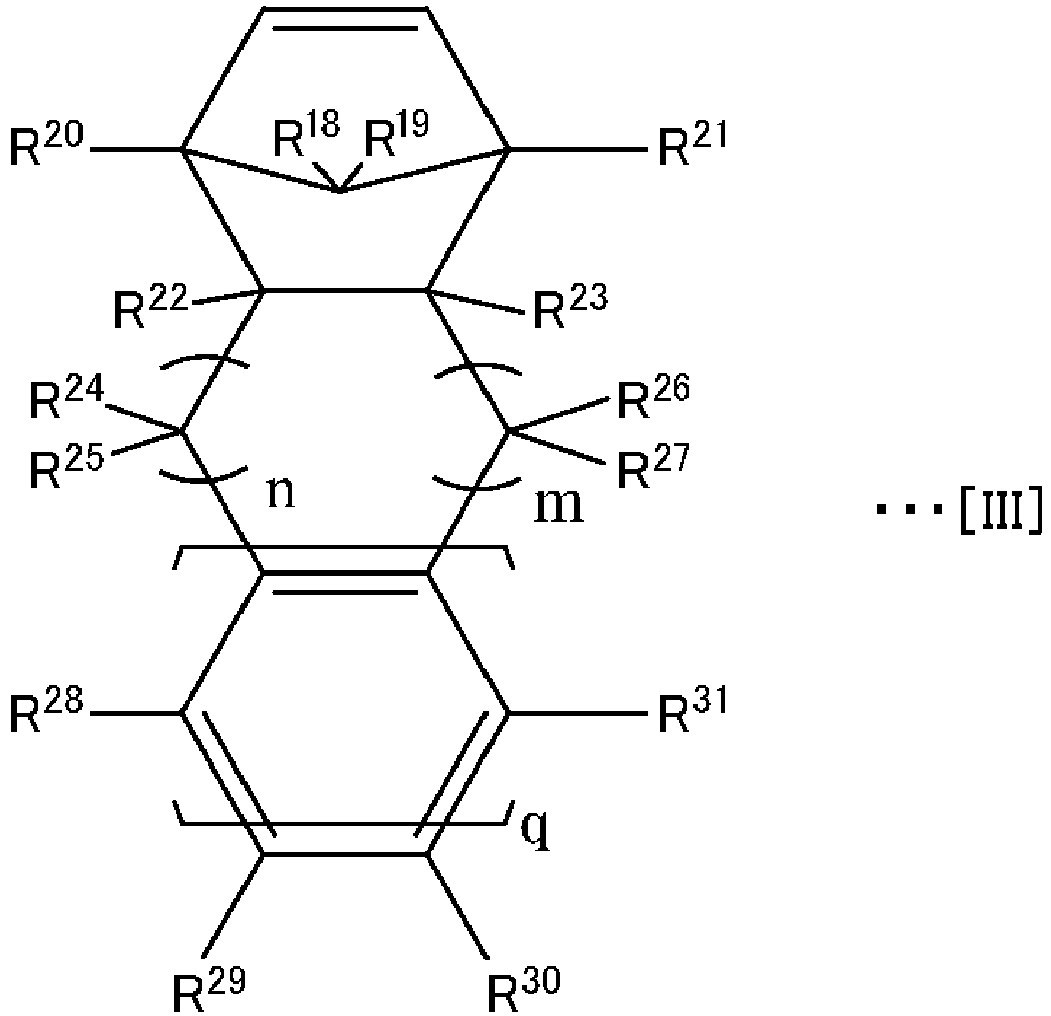

 [A-2] a ring-opening polymer or copolymer of a cyclic olefin represented by the above-described Formula [I], [II], [III], [IV], or [V];[A-3] a hydride of the ring-opening polymer or copolymer [A-2] ; and[A-4] a graft-modification product of the item [A-1], [A-2], or [A-3].
 - The cyclic olefin-based resin composition according to any one of claims 1 to 3,
wherein the modifier includes one kind or two or more kinds selected from a phosphoric acid ester including a hydrocarbon group having 12 to 18 carbon atoms and a carboxylic acid including a hydrocarbon group having 12 to 18 carbon atoms. - The cyclic olefin-based resin composition according to any one of claims 1 to 4,wherein the cyclic olefin-based copolymer (A) includes a polar group-containing cyclic olefin-based copolymer (A-a) including a constituent unit (a3) derived from a monomer having a polar group, andthe polar group is one kind or two or more kinds selected from a carboxyl group, a hydroxyl group, a sulfonic acid group, an acid anhydride group, an epoxy group, and an amino group.
- The cyclic olefin-based resin composition according to claim 5,
wherein a content of the constituent unit (a3) derived from a monomer having a polar group in the polar group-containing cyclic olefin-based copolymer (A-a) is equal to or more than 0.1 mol% and equal to or less than 20 mol% in a case where a sum of entire constituent units constituting the polar group-containing cyclic olefin-based copolymer (A-a) is designated as 100 mol%. - The cyclic olefin-based resin composition according to claim 5 or 6,
wherein the polar group-containing cyclic olefin-based copolymer (A-a) includes one kind or two or more kinds selected from a random copolymer (A1) of the monomer having a polar group and a cyclic olefin, and a graft copolymer (A2) obtained by grafting or graft-polymerizing the monomer having a polar group into a cyclic olefin-based polymer. - The cyclic olefin-based resin composition according to claim 7,
wherein the polar group-containing cyclic olefin-based copolymer (A-a) includes a random copolymer (A1) having: a constituent unit (a1) derived from an α-olefin having 2 to 20 carbon atoms; a constituent unit (a2) derived from a cyclic olefin represented by the following Formula [I], [II], [III], [IV], or [V] ; and a constituent unit (a3) derived from a monomer having the above-described polar group:


- The cyclic olefin-based resin composition according to claim 8,
wherein the cyclic olefin-derived constituent unit (a2) in the random copolymer (A1) includes a repeating unit derived from one kind or two or more kinds of compounds selected from bicyclo[2.2.1]-2-heptene and tetracyclo [4.4.0.12,5.17,10]-3-dodecene. - The cyclic olefin-based resin composition according to claim 8 or 9,
wherein the α-olefin-derived constituent unit (a1) in the random copolymer (A1) includes a repeating unit derived from ethylene. - The cyclic olefin-based resin composition according to any one of claims 8 to 10,
wherein the monomer having a polar group includes a monomer represented by the following Formula (10):
CH2=CH-R1Xp (10)
in the Formula (10), p represents a positive integer of equal to or more than 1 and equal to or less than 3; R1 represents a hydrocarbon group having 0 or more carbon atoms; and X represents one kind or two or more kinds of polar groups selected from a carboxyl group, a hydroxyl group, a sulfonic acid group, an acid anhydride group, an epoxy group, and an amino group. - The cyclic olefin-based resin composition according to claim 11,
wherein the monomer having a polar group includes one kind or two or more kinds selected from undecenol and undecylenic acid. - The cyclic olefin-based resin composition according to claim 7,
wherein the polar group-containing cyclic olefin-based copolymer (A-a) includes a graft copolymer (A2) obtained by grafting or graft-polymerizing the monomer having a polar group into a cyclic olefin-based polymer having a constituent unit (a2) derived from a cyclic olefin represented by the following Formula [I], [II], [III], [IV], or [V]:


- The cyclic olefin-based resin composition according to claim 13,
wherein the cyclic olefin-derived constituent unit (a2) in the graft copolymer (A2) includes a repeating unit derived from one kind or two or more kinds of compounds selected from bicyclo[2.2.1]-2-heptene and tetracyclo [4.4.0.12,5.17,10] -3-dodecene. - The cyclic olefin-based resin composition according to claim 13 or 14,
wherein the graft copolymer (A2) further has a constituent unit (a1) derived from an α-olefin having 2 to 20 carbon atoms. - The cyclic olefin-based resin composition according to any one of claims 13 to 15,
wherein the monomer having a polar group includes one kind or two or more kinds selected from acrylic acid, methacrylic acid, maleic acid, and maleic anhydride. - The cyclic olefin-based resin composition according to any one of claims 1 to 16,
wherein the inorganic fine particles (B) include one kind or two or more kinds selected from zirconia, titania, and alumina. - The cyclic olefin-based resin composition according to any one of claims 1 to 17,
wherein the inorganic fine particles (B) have an average particle size D50 of equal to or more than 1 nm and equal to or less than 100 nm. - The cyclic olefin-based resin composition according to any one of claims 1 to 18,
wherein a content of the inorganic fine particles (B) is equal to or more than 5% by mass and equal to or less than 60% by mass when a total amount of the cyclic olefin-based resin composition is designated as 100% by mass. - The cyclic olefin-based resin composition according to any one of claims 1 to 19,
wherein in a case where a film having a film thickness of equal to or more than 100 µm and equal to or less than 300 µm is produced using the cyclic olefin-based resin composition,
a refractive index (nD) of the film at a wavelength of 589 nm is equal to or higher than 1.545. - A molded product obtained by using the cyclic olefin-based resin composition according to any one of claims 1 to 20.
- An optical component comprising the molded product according to claim 21.
Applications Claiming Priority (2)
| Application Number | Priority Date | Filing Date | Title |
|---|---|---|---|
| JP2018181395 | 2018-09-27 | ||
| PCT/JP2019/035017 WO2020066529A1 (en) | 2018-09-27 | 2019-09-05 | Cyclic olefin-based resin composition, molded body and optical component |
Publications (3)
| Publication Number | Publication Date |
|---|---|
| EP3858914A1 true EP3858914A1 (en) | 2021-08-04 |
| EP3858914A4 EP3858914A4 (en) | 2022-07-13 |
| EP3858914B1 EP3858914B1 (en) | 2025-11-05 |
Family
ID=69952056
Family Applications (1)
| Application Number | Title | Priority Date | Filing Date |
|---|---|---|---|
| EP19866228.0A Active EP3858914B1 (en) | 2018-09-27 | 2019-09-05 | Cyclic olefin-based resin composition, molded product and optical component |
Country Status (7)
| Country | Link |
|---|---|
| US (1) | US20220033598A1 (en) |
| EP (1) | EP3858914B1 (en) |
| JP (1) | JP7248698B2 (en) |
| KR (1) | KR102556120B1 (en) |
| CN (1) | CN112771113B (en) |
| TW (1) | TWI827672B (en) |
| WO (1) | WO2020066529A1 (en) |
Families Citing this family (3)
| Publication number | Priority date | Publication date | Assignee | Title |
|---|---|---|---|---|
| JP7576424B2 (en) * | 2020-10-15 | 2024-10-31 | 三井化学株式会社 | Manufacturing method of optical member |
| JP7509933B2 (en) * | 2021-02-08 | 2024-07-02 | 三井化学株式会社 | Cyclic olefin resin composition and molded article |
| CN118546552B (en) * | 2024-06-14 | 2025-09-16 | 山东国瓷功能材料股份有限公司 | Zirconium oxide dispersion liquid and preparation method and application thereof |
Family Cites Families (31)
| Publication number | Priority date | Publication date | Assignee | Title |
|---|---|---|---|---|
| JPH0713084B2 (en) | 1985-03-26 | 1995-02-15 | 三井石油化学工業株式会社 | Method for producing cyclic olefin copolymer |
| JPH0251510A (en) * | 1988-08-15 | 1990-02-21 | Mitsui Petrochem Ind Ltd | Polar cyclic olefin copolymer and production thereof |
| JPH05320258A (en) | 1992-05-15 | 1993-12-03 | Mitsui Petrochem Ind Ltd | Cycloolefin copolymerization catalyst and method for copolymerizing cycloolefin |
| JPH06228380A (en) | 1993-01-29 | 1994-08-16 | Mitsui Petrochem Ind Ltd | Cyclic olefin polymer composition |
| JP3377833B2 (en) | 1993-08-06 | 2003-02-17 | 三井化学株式会社 | Molded article made of cyclic olefin resin and method for producing the same |
| JP3615249B2 (en) * | 1994-11-14 | 2005-02-02 | 三井化学株式会社 | Light diffusion plate |
| JP3817015B2 (en) | 1997-04-14 | 2006-08-30 | 三井化学株式会社 | Cyclic olefin copolymer and use thereof |
| JP3719308B2 (en) * | 1997-05-30 | 2005-11-24 | Jsr株式会社 | Ethylene / polar group-containing cyclic olefin copolymer |
| CA2215444C (en) | 1997-09-15 | 2005-08-02 | Stephen John Brown | Catalyst having a ketimide ligand |
| JP4120932B2 (en) * | 2003-03-24 | 2008-07-16 | 日本ゼオン株式会社 | Laminated body and optical member |
| US20080057302A1 (en) * | 2003-10-09 | 2008-03-06 | Jsr Corporation | Elastomer Films And Process For Production Thereof |
| JP2005298717A (en) * | 2004-04-14 | 2005-10-27 | Konica Minolta Opto Inc | Thermoplastic resin material, its production method and optical element using the same |
| JP2005330465A (en) | 2004-04-21 | 2005-12-02 | Mitsui Chemicals Inc | Ethylene-cyclic olefin copolymer and its optical component |
| JP2006070068A (en) * | 2004-08-31 | 2006-03-16 | Konica Minolta Opto Inc | Thermoplastic resin material and optical element obtained using the same |
| JP2006299001A (en) * | 2005-04-18 | 2006-11-02 | Konica Minolta Opto Inc | Method for making inorganic/organic composite thermoplastic material and resin composition for optical element |
| CN101541843B (en) | 2006-11-17 | 2011-05-04 | 三井化学株式会社 | Method for producing syndiotactic propylene polymer |
| WO2008068897A1 (en) * | 2006-12-05 | 2008-06-12 | Mitsui Chemicals, Inc. | Cyclic olefin polymer composition, use thereof, and cyclic olefin copolymer |
| JP2009108282A (en) | 2007-11-01 | 2009-05-21 | Nippon Zeon Co Ltd | Alicyclic structure-containing polymer, alicyclic structure-containing polymer composition, and optical component |
| WO2009123138A1 (en) * | 2008-03-31 | 2009-10-08 | 三井化学株式会社 | Ionomer resin composition and molded article obtained from the resin composition |
| WO2010050437A1 (en) | 2008-10-27 | 2010-05-06 | 三井化学株式会社 | Method for manufacturing olefin copolymer having hydroxyl group |
| JP5594712B2 (en) | 2009-03-30 | 2014-09-24 | 三井化学株式会社 | Polymer and optical material using the same |
| JP5836657B2 (en) * | 2011-06-15 | 2015-12-24 | キヤノン株式会社 | Molding |
| CN103827152B (en) * | 2011-10-13 | 2016-08-17 | 三井化学株式会社 | Vinyl copolymer, the compositions comprising this copolymer and the products formed formed by vinyl copolymer or compositions and film or sheet material |
| JP5978713B2 (en) | 2012-03-30 | 2016-08-24 | 日本ゼオン株式会社 | Terminal-modified vinyl alicyclic hydrocarbon polymer hydride |
| WO2015146925A1 (en) * | 2014-03-28 | 2015-10-01 | 日本ゼオン株式会社 | Resin composition, resin molded article, and optical component |
| JP6311143B2 (en) * | 2014-03-28 | 2018-04-18 | 日本ゼオン株式会社 | Resin composition, resin molded body, and optical component |
| JP6357390B2 (en) | 2014-09-11 | 2018-07-11 | 三井化学株式会社 | Process for producing and purifying modified polyolefin particles |
| JP6703611B2 (en) * | 2016-09-08 | 2020-06-03 | 三井化学株式会社 | Cyclic olefin resin composition and molded article |
| JP6863800B2 (en) * | 2017-03-31 | 2021-04-21 | 三井化学株式会社 | Cyclic olefin resin composition, molded article and optical component |
| JP6430576B2 (en) | 2017-04-19 | 2018-11-28 | ウィンボンド エレクトロニクス コーポレーション | Resistance change random access memory |
| JP2019182934A (en) | 2018-04-03 | 2019-10-24 | 株式会社アルバック | Polymer composite material and method for producing polymer composite material |
-
2019
- 2019-09-05 JP JP2020548315A patent/JP7248698B2/en active Active
- 2019-09-05 KR KR1020217009208A patent/KR102556120B1/en active Active
- 2019-09-05 WO PCT/JP2019/035017 patent/WO2020066529A1/en not_active Ceased
- 2019-09-05 CN CN201980063073.6A patent/CN112771113B/en active Active
- 2019-09-05 US US17/279,935 patent/US20220033598A1/en active Pending
- 2019-09-05 EP EP19866228.0A patent/EP3858914B1/en active Active
- 2019-09-11 TW TW108132739A patent/TWI827672B/en active
Also Published As
| Publication number | Publication date |
|---|---|
| WO2020066529A1 (en) | 2020-04-02 |
| EP3858914B1 (en) | 2025-11-05 |
| CN112771113B (en) | 2023-07-18 |
| JP7248698B2 (en) | 2023-03-29 |
| KR102556120B1 (en) | 2023-07-19 |
| CN112771113A (en) | 2021-05-07 |
| JPWO2020066529A1 (en) | 2021-08-30 |
| EP3858914A4 (en) | 2022-07-13 |
| KR20210048540A (en) | 2021-05-03 |
| TWI827672B (en) | 2024-01-01 |
| TW202024152A (en) | 2020-07-01 |
| US20220033598A1 (en) | 2022-02-03 |
Similar Documents
| Publication | Publication Date | Title |
|---|---|---|
| EP3858914B1 (en) | Cyclic olefin-based resin composition, molded product and optical component | |
| EP0719806B1 (en) | Cycloolefin copolymer composition | |
| JP4627064B2 (en) | Molded product for clean room and manufacturing method thereof | |
| US7122584B2 (en) | Flexible resin pellet and process for producing the same | |
| JPH08134310A (en) | Light diffuser | |
| JP6863800B2 (en) | Cyclic olefin resin composition, molded article and optical component | |
| JP2001074915A (en) | Toric lens | |
| RU2439104C2 (en) | Polymer composition and moulded article made from said composition | |
| JP4509293B2 (en) | Method for producing soft resin pellets with excellent non-adhesiveness | |
| JP3683631B2 (en) | Cyclic olefin resin composition and use thereof | |
| EP0609091B1 (en) | Process for preparing cycloolefin random copolymer pellets | |
| EP4095168B1 (en) | Optical component | |
| JP2000119474A (en) | Cycloolefin resin composition and its use | |
| JP2018145349A (en) | Optical lens and optical lens system | |
| JP3559360B2 (en) | Method for producing molded article made of cyclic olefin resin | |
| KR100864650B1 (en) | Clean room molded article and its manufacturing method | |
| JPH09176398A (en) | CYCLIC OLEFIN RESIN COMPOSITION AND USE THEREOF | |
| JPH08136446A (en) | Analytical cell consisting of cyclic olefin resin | |
| US20090264603A1 (en) | Process for Producing Cyclic olefin Random Copolymer | |
| JPWO2007066455A1 (en) | Anti-fogging agent for amorphous cyclic olefin resin, resin composition, and optical component | |
| JPH08157651A (en) | Metal-containing resin composition | |
| KR20010042631A (en) | Thermoplastic resin composition and use thereof | |
| JPH08142289A (en) | Multi-layer rolled sheet having cyclic olefin resin layer | |
| JP2002069196A (en) | Cyclic olefin polymer solution and film/sheet obtained therefrom | |
| JP2000248122A (en) | Thin-walled molded article composed of polyolefin composition |
Legal Events
| Date | Code | Title | Description |
|---|---|---|---|
| STAA | Information on the status of an ep patent application or granted ep patent |
Free format text: STATUS: THE INTERNATIONAL PUBLICATION HAS BEEN MADE |
|
| PUAI | Public reference made under article 153(3) epc to a published international application that has entered the european phase |
Free format text: ORIGINAL CODE: 0009012 |
|
| STAA | Information on the status of an ep patent application or granted ep patent |
Free format text: STATUS: REQUEST FOR EXAMINATION WAS MADE |
|
| 17P | Request for examination filed |
Effective date: 20210324 |
|
| AK | Designated contracting states |
Kind code of ref document: A1 Designated state(s): AL AT BE BG CH CY CZ DE DK EE ES FI FR GB GR HR HU IE IS IT LI LT LU LV MC MK MT NL NO PL PT RO RS SE SI SK SM TR |
|
| DAV | Request for validation of the european patent (deleted) | ||
| DAX | Request for extension of the european patent (deleted) | ||
| A4 | Supplementary search report drawn up and despatched |
Effective date: 20220613 |
|
| RIC1 | Information provided on ipc code assigned before grant |
Ipc: C08L 65/00 20060101ALI20220608BHEP Ipc: C08K 3/22 20060101ALI20220608BHEP Ipc: C08F 232/08 20060101ALI20220608BHEP Ipc: C08F 8/46 20060101ALI20220608BHEP Ipc: C08L 45/00 20060101AFI20220608BHEP |
|
| RAP3 | Party data changed (applicant data changed or rights of an application transferred) |
Owner name: MITSUI CHEMICALS, INC. |
|
| GRAP | Despatch of communication of intention to grant a patent |
Free format text: ORIGINAL CODE: EPIDOSNIGR1 |
|
| STAA | Information on the status of an ep patent application or granted ep patent |
Free format text: STATUS: GRANT OF PATENT IS INTENDED |
|
| INTG | Intention to grant announced |
Effective date: 20250507 |
|
| GRAS | Grant fee paid |
Free format text: ORIGINAL CODE: EPIDOSNIGR3 |
|
| GRAA | (expected) grant |
Free format text: ORIGINAL CODE: 0009210 |
|
| STAA | Information on the status of an ep patent application or granted ep patent |
Free format text: STATUS: THE PATENT HAS BEEN GRANTED |
|
| AK | Designated contracting states |
Kind code of ref document: B1 Designated state(s): AL AT BE BG CH CY CZ DE DK EE ES FI FR GB GR HR HU IE IS IT LI LT LU LV MC MK MT NL NO PL PT RO RS SE SI SK SM TR |
|
| REG | Reference to a national code |
Ref country code: CH Ref legal event code: F10 Free format text: ST27 STATUS EVENT CODE: U-0-0-F10-F00 (AS PROVIDED BY THE NATIONAL OFFICE) Effective date: 20251105 Ref country code: GB Ref legal event code: FG4D |
|
| REG | Reference to a national code |
Ref country code: DE Ref legal event code: R096 Ref document number: 602019077868 Country of ref document: DE |
|
| REG | Reference to a national code |
Ref country code: IE Ref legal event code: FG4D |
|
| REG | Reference to a national code |
Ref country code: NL Ref legal event code: MP Effective date: 20251105 |
|
| PG25 | Lapsed in a contracting state [announced via postgrant information from national office to epo] |
Ref country code: ES Free format text: LAPSE BECAUSE OF FAILURE TO SUBMIT A TRANSLATION OF THE DESCRIPTION OR TO PAY THE FEE WITHIN THE PRESCRIBED TIME-LIMIT Effective date: 20251105 |
|
| REG | Reference to a national code |
Ref country code: LT Ref legal event code: MG9D |
|
| PG25 | Lapsed in a contracting state [announced via postgrant information from national office to epo] |
Ref country code: NO Free format text: LAPSE BECAUSE OF FAILURE TO SUBMIT A TRANSLATION OF THE DESCRIPTION OR TO PAY THE FEE WITHIN THE PRESCRIBED TIME-LIMIT Effective date: 20260205 |
|
| PG25 | Lapsed in a contracting state [announced via postgrant information from national office to epo] |
Ref country code: AT Free format text: LAPSE BECAUSE OF FAILURE TO SUBMIT A TRANSLATION OF THE DESCRIPTION OR TO PAY THE FEE WITHIN THE PRESCRIBED TIME-LIMIT Effective date: 20251105 Ref country code: FI Free format text: LAPSE BECAUSE OF FAILURE TO SUBMIT A TRANSLATION OF THE DESCRIPTION OR TO PAY THE FEE WITHIN THE PRESCRIBED TIME-LIMIT Effective date: 20251105 Ref country code: HR Free format text: LAPSE BECAUSE OF FAILURE TO SUBMIT A TRANSLATION OF THE DESCRIPTION OR TO PAY THE FEE WITHIN THE PRESCRIBED TIME-LIMIT Effective date: 20251105 |
|
| REG | Reference to a national code |
Ref country code: AT Ref legal event code: MK05 Ref document number: 1854326 Country of ref document: AT Kind code of ref document: T Effective date: 20251105 |
|
| PG25 | Lapsed in a contracting state [announced via postgrant information from national office to epo] |
Ref country code: NL Free format text: LAPSE BECAUSE OF FAILURE TO SUBMIT A TRANSLATION OF THE DESCRIPTION OR TO PAY THE FEE WITHIN THE PRESCRIBED TIME-LIMIT Effective date: 20251105 |
|
| PG25 | Lapsed in a contracting state [announced via postgrant information from national office to epo] |
Ref country code: RS Free format text: LAPSE BECAUSE OF FAILURE TO SUBMIT A TRANSLATION OF THE DESCRIPTION OR TO PAY THE FEE WITHIN THE PRESCRIBED TIME-LIMIT Effective date: 20260205 |
|
| PG25 | Lapsed in a contracting state [announced via postgrant information from national office to epo] |
Ref country code: IS Free format text: LAPSE BECAUSE OF FAILURE TO SUBMIT A TRANSLATION OF THE DESCRIPTION OR TO PAY THE FEE WITHIN THE PRESCRIBED TIME-LIMIT Effective date: 20260305 |
|
| PG25 | Lapsed in a contracting state [announced via postgrant information from national office to epo] |
Ref country code: PT Free format text: LAPSE BECAUSE OF FAILURE TO SUBMIT A TRANSLATION OF THE DESCRIPTION OR TO PAY THE FEE WITHIN THE PRESCRIBED TIME-LIMIT Effective date: 20260305 |
|
| PG25 | Lapsed in a contracting state [announced via postgrant information from national office to epo] |
Ref country code: PL Free format text: LAPSE BECAUSE OF FAILURE TO SUBMIT A TRANSLATION OF THE DESCRIPTION OR TO PAY THE FEE WITHIN THE PRESCRIBED TIME-LIMIT Effective date: 20251105 |
|
| PG25 | Lapsed in a contracting state [announced via postgrant information from national office to epo] |
Ref country code: LV Free format text: LAPSE BECAUSE OF FAILURE TO SUBMIT A TRANSLATION OF THE DESCRIPTION OR TO PAY THE FEE WITHIN THE PRESCRIBED TIME-LIMIT Effective date: 20251105 |
|
| PG25 | Lapsed in a contracting state [announced via postgrant information from national office to epo] |
Ref country code: BG Free format text: LAPSE BECAUSE OF FAILURE TO SUBMIT A TRANSLATION OF THE DESCRIPTION OR TO PAY THE FEE WITHIN THE PRESCRIBED TIME-LIMIT Effective date: 20251105 |