EP3858880A1 - Radical polymerizable resin composition and structure repairing material - Google Patents
Radical polymerizable resin composition and structure repairing material Download PDFInfo
- Publication number
- EP3858880A1 EP3858880A1 EP19866832.9A EP19866832A EP3858880A1 EP 3858880 A1 EP3858880 A1 EP 3858880A1 EP 19866832 A EP19866832 A EP 19866832A EP 3858880 A1 EP3858880 A1 EP 3858880A1
- Authority
- EP
- European Patent Office
- Prior art keywords
- radical
- meth
- acrylate
- resin composition
- mass
- Prior art date
- Legal status (The legal status is an assumption and is not a legal conclusion. Google has not performed a legal analysis and makes no representation as to the accuracy of the status listed.)
- Withdrawn
Links
- 239000011342 resin composition Substances 0.000 title claims abstract description 98
- 239000000463 material Substances 0.000 title claims abstract description 94
- -1 aromatic tertiary amine Chemical class 0.000 claims abstract description 56
- 229920005989 resin Polymers 0.000 claims abstract description 51
- 239000011347 resin Substances 0.000 claims abstract description 51
- 150000001875 compounds Chemical class 0.000 claims abstract description 48
- 239000000178 monomer Substances 0.000 claims abstract description 45
- 239000000945 filler Substances 0.000 claims abstract description 40
- 239000004925 Acrylic resin Substances 0.000 claims abstract description 34
- 125000002887 hydroxy group Chemical group [H]O* 0.000 claims abstract description 34
- 150000001451 organic peroxides Chemical class 0.000 claims abstract description 31
- DTGKSKDOIYIVQL-WEDXCCLWSA-N (+)-borneol Chemical group C1C[C@@]2(C)[C@@H](O)C[C@@H]1C2(C)C DTGKSKDOIYIVQL-WEDXCCLWSA-N 0.000 claims abstract description 25
- 229920000728 polyester Polymers 0.000 claims abstract description 23
- 229920001567 vinyl ester resin Polymers 0.000 claims abstract description 18
- JOYRKODLDBILNP-UHFFFAOYSA-N Ethyl urethane Chemical compound CCOC(N)=O JOYRKODLDBILNP-UHFFFAOYSA-N 0.000 claims abstract description 16
- NIXOWILDQLNWCW-UHFFFAOYSA-M Acrylate Chemical compound [O-]C(=O)C=C NIXOWILDQLNWCW-UHFFFAOYSA-M 0.000 claims description 109
- VYPSYNLAJGMNEJ-UHFFFAOYSA-N Silicium dioxide Chemical compound O=[Si]=O VYPSYNLAJGMNEJ-UHFFFAOYSA-N 0.000 claims description 62
- LYCAIKOWRPUZTN-UHFFFAOYSA-N Ethylene glycol Chemical compound OCCO LYCAIKOWRPUZTN-UHFFFAOYSA-N 0.000 claims description 22
- 239000000377 silicon dioxide Substances 0.000 claims description 22
- VTYYLEPIZMXCLO-UHFFFAOYSA-L Calcium carbonate Chemical compound [Ca+2].[O-]C([O-])=O VTYYLEPIZMXCLO-UHFFFAOYSA-L 0.000 claims description 20
- 125000004432 carbon atom Chemical group C* 0.000 claims description 20
- MTHSVFCYNBDYFN-UHFFFAOYSA-N diethylene glycol Chemical compound OCCOCCO MTHSVFCYNBDYFN-UHFFFAOYSA-N 0.000 claims description 18
- 239000004576 sand Substances 0.000 claims description 16
- 125000002768 hydroxyalkyl group Chemical group 0.000 claims description 14
- 239000013008 thixotropic agent Substances 0.000 claims description 12
- 239000002904 solvent Substances 0.000 claims description 11
- 150000001412 amines Chemical class 0.000 claims description 10
- 229910000019 calcium carbonate Inorganic materials 0.000 claims description 10
- 239000000835 fiber Substances 0.000 claims description 10
- 239000004568 cement Substances 0.000 claims description 9
- 239000007822 coupling agent Substances 0.000 claims description 8
- 150000002894 organic compounds Chemical class 0.000 claims description 8
- 238000006116 polymerization reaction Methods 0.000 claims description 8
- 239000003112 inhibitor Substances 0.000 claims description 7
- XLPJNCYCZORXHG-UHFFFAOYSA-N 1-morpholin-4-ylprop-2-en-1-one Chemical compound C=CC(=O)N1CCOCC1 XLPJNCYCZORXHG-UHFFFAOYSA-N 0.000 claims description 5
- ZJCCRDAZUWHFQH-UHFFFAOYSA-N Trimethylolpropane Chemical compound CCC(CO)(CO)CO ZJCCRDAZUWHFQH-UHFFFAOYSA-N 0.000 claims description 5
- 239000000654 additive Substances 0.000 claims description 5
- 125000000217 alkyl group Chemical group 0.000 claims description 5
- 230000000996 additive effect Effects 0.000 claims description 4
- 125000000956 methoxy group Chemical group [H]C([H])([H])O* 0.000 claims description 4
- 239000004575 stone Substances 0.000 claims description 4
- 239000003963 antioxidant agent Substances 0.000 claims description 3
- 230000003078 antioxidant effect Effects 0.000 claims description 2
- 238000005336 cracking Methods 0.000 abstract description 11
- 238000010276 construction Methods 0.000 abstract description 4
- 238000001723 curing Methods 0.000 description 37
- 239000000203 mixture Substances 0.000 description 23
- 230000000052 comparative effect Effects 0.000 description 19
- 239000002994 raw material Substances 0.000 description 17
- 238000000576 coating method Methods 0.000 description 14
- 239000001993 wax Substances 0.000 description 14
- 239000004593 Epoxy Substances 0.000 description 13
- 239000002253 acid Substances 0.000 description 13
- 238000007906 compression Methods 0.000 description 13
- 230000006835 compression Effects 0.000 description 13
- 239000011248 coating agent Substances 0.000 description 12
- 229920005862 polyol Polymers 0.000 description 11
- 150000003077 polyols Chemical class 0.000 description 11
- ATVJXMYDOSMEPO-UHFFFAOYSA-N 3-prop-2-enoxyprop-1-ene Chemical compound C=CCOCC=C ATVJXMYDOSMEPO-UHFFFAOYSA-N 0.000 description 10
- 150000001732 carboxylic acid derivatives Chemical class 0.000 description 10
- 238000000034 method Methods 0.000 description 10
- OFOBLEOULBTSOW-UHFFFAOYSA-N Malonic acid Chemical compound OC(=O)CC(O)=O OFOBLEOULBTSOW-UHFFFAOYSA-N 0.000 description 9
- DNIAPMSPPWPWGF-UHFFFAOYSA-N Propylene glycol Chemical compound CC(O)CO DNIAPMSPPWPWGF-UHFFFAOYSA-N 0.000 description 9
- PUPZLCDOIYMWBV-UHFFFAOYSA-N (+/-)-1,3-Butanediol Chemical compound CC(O)CCO PUPZLCDOIYMWBV-UHFFFAOYSA-N 0.000 description 8
- PEDCQBHIVMGVHV-UHFFFAOYSA-N Glycerine Chemical compound OCC(O)CO PEDCQBHIVMGVHV-UHFFFAOYSA-N 0.000 description 8
- ATUOYWHBWRKTHZ-UHFFFAOYSA-N Propane Chemical compound CCC ATUOYWHBWRKTHZ-UHFFFAOYSA-N 0.000 description 8
- 125000003647 acryloyl group Chemical group O=C([*])C([H])=C([H])[H] 0.000 description 8
- 238000006243 chemical reaction Methods 0.000 description 8
- 238000011156 evaluation Methods 0.000 description 8
- 239000000126 substance Substances 0.000 description 8
- XFCMNSHQOZQILR-UHFFFAOYSA-N 2-[2-(2-methylprop-2-enoyloxy)ethoxy]ethyl 2-methylprop-2-enoate Chemical compound CC(=C)C(=O)OCCOCCOC(=O)C(C)=C XFCMNSHQOZQILR-UHFFFAOYSA-N 0.000 description 7
- GYZLOYUZLJXAJU-UHFFFAOYSA-N diglycidyl ether Chemical compound C1OC1COCC1CO1 GYZLOYUZLJXAJU-UHFFFAOYSA-N 0.000 description 7
- TXBCBTDQIULDIA-UHFFFAOYSA-N 2-[[3-hydroxy-2,2-bis(hydroxymethyl)propoxy]methyl]-2-(hydroxymethyl)propane-1,3-diol Chemical compound OCC(CO)(CO)COCC(CO)(CO)CO TXBCBTDQIULDIA-UHFFFAOYSA-N 0.000 description 6
- 239000012298 atmosphere Substances 0.000 description 6
- 125000002496 methyl group Chemical group [H]C([H])([H])* 0.000 description 6
- 229920001451 polypropylene glycol Polymers 0.000 description 6
- NLBJAOHLJABDAU-UHFFFAOYSA-N (3-methylbenzoyl) 3-methylbenzenecarboperoxoate Chemical compound CC1=CC=CC(C(=O)OOC(=O)C=2C=C(C)C=CC=2)=C1 NLBJAOHLJABDAU-UHFFFAOYSA-N 0.000 description 5
- CERQOIWHTDAKMF-UHFFFAOYSA-N Methacrylic acid Chemical compound CC(=C)C(O)=O CERQOIWHTDAKMF-UHFFFAOYSA-N 0.000 description 5
- 150000001252 acrylic acid derivatives Chemical class 0.000 description 5
- 125000003118 aryl group Chemical group 0.000 description 5
- 239000012188 paraffin wax Substances 0.000 description 5
- 239000005056 polyisocyanate Substances 0.000 description 5
- 229920001228 polyisocyanate Polymers 0.000 description 5
- QEQBMZQFDDDTPN-UHFFFAOYSA-N (2-methylpropan-2-yl)oxy benzenecarboperoxoate Chemical compound CC(C)(C)OOOC(=O)C1=CC=CC=C1 QEQBMZQFDDDTPN-UHFFFAOYSA-N 0.000 description 4
- AHDSRXYHVZECER-UHFFFAOYSA-N 2,4,6-tris[(dimethylamino)methyl]phenol Chemical compound CN(C)CC1=CC(CN(C)C)=C(O)C(CN(C)C)=C1 AHDSRXYHVZECER-UHFFFAOYSA-N 0.000 description 4
- CEXQWAAGPPNOQF-UHFFFAOYSA-N 2-phenoxyethyl 2-methylprop-2-enoate Chemical compound CC(=C)C(=O)OCCOC1=CC=CC=C1 CEXQWAAGPPNOQF-UHFFFAOYSA-N 0.000 description 4
- FRIBMENBGGCKPD-UHFFFAOYSA-N 3-(2,3-dimethoxyphenyl)prop-2-enal Chemical compound COC1=CC=CC(C=CC=O)=C1OC FRIBMENBGGCKPD-UHFFFAOYSA-N 0.000 description 4
- LCFVJGUPQDGYKZ-UHFFFAOYSA-N Bisphenol A diglycidyl ether Chemical compound C=1C=C(OCC2OC2)C=CC=1C(C)(C)C(C=C1)=CC=C1OCC1CO1 LCFVJGUPQDGYKZ-UHFFFAOYSA-N 0.000 description 4
- QIGBRXMKCJKVMJ-UHFFFAOYSA-N Hydroquinone Chemical compound OC1=CC=C(O)C=C1 QIGBRXMKCJKVMJ-UHFFFAOYSA-N 0.000 description 4
- WYURNTSHIVDZCO-UHFFFAOYSA-N Tetrahydrofuran Chemical compound C1CCOC1 WYURNTSHIVDZCO-UHFFFAOYSA-N 0.000 description 4
- IAXXETNIOYFMLW-COPLHBTASA-N [(1s,3s,4s)-4,7,7-trimethyl-3-bicyclo[2.2.1]heptanyl] 2-methylprop-2-enoate Chemical compound C1C[C@]2(C)[C@@H](OC(=O)C(=C)C)C[C@H]1C2(C)C IAXXETNIOYFMLW-COPLHBTASA-N 0.000 description 4
- WNLRTRBMVRJNCN-UHFFFAOYSA-N adipic acid Chemical compound OC(=O)CCCCC(O)=O WNLRTRBMVRJNCN-UHFFFAOYSA-N 0.000 description 4
- 150000008064 anhydrides Chemical class 0.000 description 4
- JQRRFDWXQOQICD-UHFFFAOYSA-N biphenylen-1-ylboronic acid Chemical compound C12=CC=CC=C2C2=C1C=CC=C2B(O)O JQRRFDWXQOQICD-UHFFFAOYSA-N 0.000 description 4
- IISBACLAFKSPIT-UHFFFAOYSA-N bisphenol A Chemical compound C=1C=C(O)C=CC=1C(C)(C)C1=CC=C(O)C=C1 IISBACLAFKSPIT-UHFFFAOYSA-N 0.000 description 4
- 235000019437 butane-1,3-diol Nutrition 0.000 description 4
- SZXQTJUDPRGNJN-UHFFFAOYSA-N dipropylene glycol Chemical compound OCCCOCCCO SZXQTJUDPRGNJN-UHFFFAOYSA-N 0.000 description 4
- 238000001035 drying Methods 0.000 description 4
- 230000000694 effects Effects 0.000 description 4
- 239000003822 epoxy resin Substances 0.000 description 4
- 238000009472 formulation Methods 0.000 description 4
- 235000011187 glycerol Nutrition 0.000 description 4
- 238000002347 injection Methods 0.000 description 4
- 239000007924 injection Substances 0.000 description 4
- 239000003208 petroleum Substances 0.000 description 4
- 125000001997 phenyl group Chemical group [H]C1=C([H])C([H])=C(*)C([H])=C1[H] 0.000 description 4
- 229920000647 polyepoxide Polymers 0.000 description 4
- 229920000642 polymer Polymers 0.000 description 4
- 239000004814 polyurethane Substances 0.000 description 4
- 229920002635 polyurethane Polymers 0.000 description 4
- 239000001294 propane Substances 0.000 description 4
- CXMXRPHRNRROMY-UHFFFAOYSA-N sebacic acid Chemical compound OC(=O)CCCCCCCCC(O)=O CXMXRPHRNRROMY-UHFFFAOYSA-N 0.000 description 4
- CNHDIAIOKMXOLK-UHFFFAOYSA-N toluquinol Chemical compound CC1=CC(O)=CC=C1O CNHDIAIOKMXOLK-UHFFFAOYSA-N 0.000 description 4
- KMOUUZVZFBCRAM-OLQVQODUSA-N (3as,7ar)-3a,4,7,7a-tetrahydro-2-benzofuran-1,3-dione Chemical compound C1C=CC[C@@H]2C(=O)OC(=O)[C@@H]21 KMOUUZVZFBCRAM-OLQVQODUSA-N 0.000 description 3
- JFZVSHAMRZPOPA-UHFFFAOYSA-N 1-[n-(2-hydroxypropyl)-4-methylanilino]propan-2-ol Chemical compound CC(O)CN(CC(C)O)C1=CC=C(C)C=C1 JFZVSHAMRZPOPA-UHFFFAOYSA-N 0.000 description 3
- JMIZWXDKTUGEES-UHFFFAOYSA-N 2,2-di(cyclopenten-1-yloxy)ethyl 2-methylprop-2-enoate Chemical compound C=1CCCC=1OC(COC(=O)C(=C)C)OC1=CCCC1 JMIZWXDKTUGEES-UHFFFAOYSA-N 0.000 description 3
- ZWEHNKRNPOVVGH-UHFFFAOYSA-N 2-Butanone Chemical compound CCC(C)=O ZWEHNKRNPOVVGH-UHFFFAOYSA-N 0.000 description 3
- WTYYGFLRBWMFRY-UHFFFAOYSA-N 2-[6-(oxiran-2-ylmethoxy)hexoxymethyl]oxirane Chemical compound C1OC1COCCCCCCOCC1CO1 WTYYGFLRBWMFRY-UHFFFAOYSA-N 0.000 description 3
- WFUGQJXVXHBTEM-UHFFFAOYSA-N 2-hydroperoxy-2-(2-hydroperoxybutan-2-ylperoxy)butane Chemical compound CCC(C)(OO)OOC(C)(CC)OO WFUGQJXVXHBTEM-UHFFFAOYSA-N 0.000 description 3
- 125000000954 2-hydroxyethyl group Chemical group [H]C([*])([H])C([H])([H])O[H] 0.000 description 3
- UPMLOUAZCHDJJD-UHFFFAOYSA-N 4,4'-Diphenylmethane Diisocyanate Chemical compound C1=CC(N=C=O)=CC=C1CC1=CC=C(N=C=O)C=C1 UPMLOUAZCHDJJD-UHFFFAOYSA-N 0.000 description 3
- CSCPPACGZOOCGX-UHFFFAOYSA-N Acetone Chemical compound CC(C)=O CSCPPACGZOOCGX-UHFFFAOYSA-N 0.000 description 3
- UHOVQNZJYSORNB-UHFFFAOYSA-N Benzene Chemical compound C1=CC=CC=C1 UHOVQNZJYSORNB-UHFFFAOYSA-N 0.000 description 3
- OMPJBNCRMGITSC-UHFFFAOYSA-N Benzoylperoxide Chemical compound C=1C=CC=CC=1C(=O)OOC(=O)C1=CC=CC=C1 OMPJBNCRMGITSC-UHFFFAOYSA-N 0.000 description 3
- 229930185605 Bisphenol Natural products 0.000 description 3
- SNRUBQQJIBEYMU-UHFFFAOYSA-N Dodecane Natural products CCCCCCCCCCCC SNRUBQQJIBEYMU-UHFFFAOYSA-N 0.000 description 3
- XEKOWRVHYACXOJ-UHFFFAOYSA-N Ethyl acetate Chemical compound CCOC(C)=O XEKOWRVHYACXOJ-UHFFFAOYSA-N 0.000 description 3
- ZMXDDKWLCZADIW-UHFFFAOYSA-N N,N-Dimethylformamide Chemical compound CN(C)C=O ZMXDDKWLCZADIW-UHFFFAOYSA-N 0.000 description 3
- LGRFSURHDFAFJT-UHFFFAOYSA-N Phthalic anhydride Natural products C1=CC=C2C(=O)OC(=O)C2=C1 LGRFSURHDFAFJT-UHFFFAOYSA-N 0.000 description 3
- 239000004698 Polyethylene Substances 0.000 description 3
- 239000002202 Polyethylene glycol Substances 0.000 description 3
- YXFVVABEGXRONW-UHFFFAOYSA-N Toluene Chemical compound CC1=CC=CC=C1 YXFVVABEGXRONW-UHFFFAOYSA-N 0.000 description 3
- 125000002723 alicyclic group Chemical group 0.000 description 3
- 235000019400 benzoyl peroxide Nutrition 0.000 description 3
- 230000015572 biosynthetic process Effects 0.000 description 3
- KRKNYBCHXYNGOX-UHFFFAOYSA-N citric acid Chemical compound OC(=O)CC(O)(C(O)=O)CC(O)=O KRKNYBCHXYNGOX-UHFFFAOYSA-N 0.000 description 3
- 150000001991 dicarboxylic acids Chemical class 0.000 description 3
- 125000003700 epoxy group Chemical group 0.000 description 3
- 239000003999 initiator Substances 0.000 description 3
- 238000005259 measurement Methods 0.000 description 3
- 238000002844 melting Methods 0.000 description 3
- SLCVBVWXLSEKPL-UHFFFAOYSA-N neopentyl glycol Chemical compound OCC(C)(C)CO SLCVBVWXLSEKPL-UHFFFAOYSA-N 0.000 description 3
- WXZMFSXDPGVJKK-UHFFFAOYSA-N pentaerythritol Chemical compound OCC(CO)(CO)CO WXZMFSXDPGVJKK-UHFFFAOYSA-N 0.000 description 3
- 229920000573 polyethylene Polymers 0.000 description 3
- 229920001223 polyethylene glycol Polymers 0.000 description 3
- 230000009974 thixotropic effect Effects 0.000 description 3
- XLYOFNOQVPJJNP-UHFFFAOYSA-N water Substances O XLYOFNOQVPJJNP-UHFFFAOYSA-N 0.000 description 3
- FKTHNVSLHLHISI-UHFFFAOYSA-N 1,2-bis(isocyanatomethyl)benzene Chemical class O=C=NCC1=CC=CC=C1CN=C=O FKTHNVSLHLHISI-UHFFFAOYSA-N 0.000 description 2
- SMZOUWXMTYCWNB-UHFFFAOYSA-N 2-(2-methoxy-5-methylphenyl)ethanamine Chemical compound COC1=CC=C(C)C=C1CCN SMZOUWXMTYCWNB-UHFFFAOYSA-N 0.000 description 2
- JAHNSTQSQJOJLO-UHFFFAOYSA-N 2-(3-fluorophenyl)-1h-imidazole Chemical compound FC1=CC=CC(C=2NC=CN=2)=C1 JAHNSTQSQJOJLO-UHFFFAOYSA-N 0.000 description 2
- NIXOWILDQLNWCW-UHFFFAOYSA-N 2-Propenoic acid Natural products OC(=O)C=C NIXOWILDQLNWCW-UHFFFAOYSA-N 0.000 description 2
- LCZVSXRMYJUNFX-UHFFFAOYSA-N 2-[2-(2-hydroxypropoxy)propoxy]propan-1-ol Chemical compound CC(O)COC(C)COC(C)CO LCZVSXRMYJUNFX-UHFFFAOYSA-N 0.000 description 2
- JUVSRZCUMWZBFK-UHFFFAOYSA-N 2-[n-(2-hydroxyethyl)-4-methylanilino]ethanol Chemical compound CC1=CC=C(N(CCO)CCO)C=C1 JUVSRZCUMWZBFK-UHFFFAOYSA-N 0.000 description 2
- SVTBMSDMJJWYQN-UHFFFAOYSA-N 2-methylpentane-2,4-diol Chemical compound CC(O)CC(C)(C)O SVTBMSDMJJWYQN-UHFFFAOYSA-N 0.000 description 2
- QWGRWMMWNDWRQN-UHFFFAOYSA-N 2-methylpropane-1,3-diol Chemical compound OCC(C)CO QWGRWMMWNDWRQN-UHFFFAOYSA-N 0.000 description 2
- 125000003903 2-propenyl group Chemical group [H]C([*])([H])C([H])=C([H])[H] 0.000 description 2
- VNGLVZLEUDIDQH-UHFFFAOYSA-N 4-[2-(4-hydroxyphenyl)propan-2-yl]phenol;2-methyloxirane Chemical compound CC1CO1.C=1C=C(O)C=CC=1C(C)(C)C1=CC=C(O)C=C1 VNGLVZLEUDIDQH-UHFFFAOYSA-N 0.000 description 2
- WPSWDCBWMRJJED-UHFFFAOYSA-N 4-[2-(4-hydroxyphenyl)propan-2-yl]phenol;oxirane Chemical compound C1CO1.C=1C=C(O)C=CC=1C(C)(C)C1=CC=C(O)C=C1 WPSWDCBWMRJJED-UHFFFAOYSA-N 0.000 description 2
- 229910002012 Aerosil® Inorganic materials 0.000 description 2
- RTZKZFJDLAIYFH-UHFFFAOYSA-N Diethyl ether Chemical compound CCOCC RTZKZFJDLAIYFH-UHFFFAOYSA-N 0.000 description 2
- VZCYOOQTPOCHFL-OWOJBTEDSA-N Fumaric acid Chemical compound OC(=O)\C=C\C(O)=O VZCYOOQTPOCHFL-OWOJBTEDSA-N 0.000 description 2
- 239000006087 Silane Coupling Agent Substances 0.000 description 2
- FAPWRFPIFSIZLT-UHFFFAOYSA-M Sodium chloride Chemical compound [Na+].[Cl-] FAPWRFPIFSIZLT-UHFFFAOYSA-M 0.000 description 2
- PPBRXRYQALVLMV-UHFFFAOYSA-N Styrene Chemical compound C=CC1=CC=CC=C1 PPBRXRYQALVLMV-UHFFFAOYSA-N 0.000 description 2
- KKEYFWRCBNTPAC-UHFFFAOYSA-N Terephthalic acid Chemical compound OC(=O)C1=CC=C(C(O)=O)C=C1 KKEYFWRCBNTPAC-UHFFFAOYSA-N 0.000 description 2
- YRKCREAYFQTBPV-UHFFFAOYSA-N acetylacetone Chemical compound CC(=O)CC(C)=O YRKCREAYFQTBPV-UHFFFAOYSA-N 0.000 description 2
- 239000001361 adipic acid Substances 0.000 description 2
- 235000011037 adipic acid Nutrition 0.000 description 2
- 125000001931 aliphatic group Chemical group 0.000 description 2
- UNXHWFMMPAWVPI-UHFFFAOYSA-N butane-1,2,3,4-tetrol Chemical compound OCC(O)C(O)CO UNXHWFMMPAWVPI-UHFFFAOYSA-N 0.000 description 2
- BMRWNKZVCUKKSR-UHFFFAOYSA-N butane-1,2-diol Chemical compound CCC(O)CO BMRWNKZVCUKKSR-UHFFFAOYSA-N 0.000 description 2
- WERYXYBDKMZEQL-UHFFFAOYSA-N butane-1,4-diol Chemical compound OCCCCO WERYXYBDKMZEQL-UHFFFAOYSA-N 0.000 description 2
- JHIWVOJDXOSYLW-UHFFFAOYSA-N butyl 2,2-difluorocyclopropane-1-carboxylate Chemical compound CCCCOC(=O)C1CC1(F)F JHIWVOJDXOSYLW-UHFFFAOYSA-N 0.000 description 2
- 229910052799 carbon Inorganic materials 0.000 description 2
- 125000003178 carboxy group Chemical group [H]OC(*)=O 0.000 description 2
- 150000007942 carboxylates Chemical class 0.000 description 2
- 150000003841 chloride salts Chemical class 0.000 description 2
- JHIVVAPYMSGYDF-UHFFFAOYSA-N cyclohexanone Chemical compound O=C1CCCCC1 JHIVVAPYMSGYDF-UHFFFAOYSA-N 0.000 description 2
- DIOQZVSQGTUSAI-UHFFFAOYSA-N decane Chemical compound CCCCCCCCCC DIOQZVSQGTUSAI-UHFFFAOYSA-N 0.000 description 2
- 238000009826 distribution Methods 0.000 description 2
- 230000002708 enhancing effect Effects 0.000 description 2
- LZCLXQDLBQLTDK-UHFFFAOYSA-N ethyl 2-hydroxypropanoate Chemical compound CCOC(=O)C(C)O LZCLXQDLBQLTDK-UHFFFAOYSA-N 0.000 description 2
- 238000009415 formwork Methods 0.000 description 2
- XXMIOPMDWAUFGU-UHFFFAOYSA-N hexane-1,6-diol Chemical compound OCCCCCCO XXMIOPMDWAUFGU-UHFFFAOYSA-N 0.000 description 2
- 230000002209 hydrophobic effect Effects 0.000 description 2
- NWVVVBRKAWDGAB-UHFFFAOYSA-N hydroquinone methyl ether Natural products COC1=CC=C(O)C=C1 NWVVVBRKAWDGAB-UHFFFAOYSA-N 0.000 description 2
- WGCNASOHLSPBMP-UHFFFAOYSA-N hydroxyacetaldehyde Natural products OCC=O WGCNASOHLSPBMP-UHFFFAOYSA-N 0.000 description 2
- 230000001965 increasing effect Effects 0.000 description 2
- 229940119545 isobornyl methacrylate Drugs 0.000 description 2
- QQVIHTHCMHWDBS-UHFFFAOYSA-N isophthalic acid Chemical compound OC(=O)C1=CC=CC(C(O)=O)=C1 QQVIHTHCMHWDBS-UHFFFAOYSA-N 0.000 description 2
- 125000001449 isopropyl group Chemical group [H]C([H])([H])C([H])(*)C([H])([H])[H] 0.000 description 2
- 230000008018 melting Effects 0.000 description 2
- 229910052751 metal Inorganic materials 0.000 description 2
- 239000002184 metal Substances 0.000 description 2
- LVHBHZANLOWSRM-UHFFFAOYSA-N methylenebutanedioic acid Natural products OC(=O)CC(=C)C(O)=O LVHBHZANLOWSRM-UHFFFAOYSA-N 0.000 description 2
- 150000002762 monocarboxylic acid derivatives Chemical class 0.000 description 2
- 238000006386 neutralization reaction Methods 0.000 description 2
- XNGIFLGASWRNHJ-UHFFFAOYSA-N phthalic acid Chemical compound OC(=O)C1=CC=CC=C1C(O)=O XNGIFLGASWRNHJ-UHFFFAOYSA-N 0.000 description 2
- 229920003023 plastic Polymers 0.000 description 2
- 239000004033 plastic Substances 0.000 description 2
- 239000002685 polymerization catalyst Substances 0.000 description 2
- 239000012779 reinforcing material Substances 0.000 description 2
- 239000000758 substrate Substances 0.000 description 2
- 238000003786 synthesis reaction Methods 0.000 description 2
- 230000002194 synthesizing effect Effects 0.000 description 2
- 238000010998 test method Methods 0.000 description 2
- YLQBMQCUIZJEEH-UHFFFAOYSA-N tetrahydrofuran Natural products C=1C=COC=1 YLQBMQCUIZJEEH-UHFFFAOYSA-N 0.000 description 2
- VZCYOOQTPOCHFL-UHFFFAOYSA-N trans-butenedioic acid Natural products OC(=O)C=CC(O)=O VZCYOOQTPOCHFL-UHFFFAOYSA-N 0.000 description 2
- ZIBGPFATKBEMQZ-UHFFFAOYSA-N triethylene glycol Chemical compound OCCOCCOCCO ZIBGPFATKBEMQZ-UHFFFAOYSA-N 0.000 description 2
- RIOQSEWOXXDEQQ-UHFFFAOYSA-N triphenylphosphine Chemical compound C1=CC=CC=C1P(C=1C=CC=CC=1)C1=CC=CC=C1 RIOQSEWOXXDEQQ-UHFFFAOYSA-N 0.000 description 2
- 125000000391 vinyl group Chemical group [H]C([*])=C([H])[H] 0.000 description 2
- NOBYOEQUFMGXBP-UHFFFAOYSA-N (4-tert-butylcyclohexyl) (4-tert-butylcyclohexyl)oxycarbonyloxy carbonate Chemical compound C1CC(C(C)(C)C)CCC1OC(=O)OOC(=O)OC1CCC(C(C)(C)C)CC1 NOBYOEQUFMGXBP-UHFFFAOYSA-N 0.000 description 1
- NALFRYPTRXKZPN-UHFFFAOYSA-N 1,1-bis(tert-butylperoxy)-3,3,5-trimethylcyclohexane Chemical compound CC1CC(C)(C)CC(OOC(C)(C)C)(OOC(C)(C)C)C1 NALFRYPTRXKZPN-UHFFFAOYSA-N 0.000 description 1
- KMOUUZVZFBCRAM-UHFFFAOYSA-N 1,2,3,6-tetrahydrophthalic anhydride Chemical compound C1C=CCC2C(=O)OC(=O)C21 KMOUUZVZFBCRAM-UHFFFAOYSA-N 0.000 description 1
- ZXHZWRZAWJVPIC-UHFFFAOYSA-N 1,2-diisocyanatonaphthalene Chemical compound C1=CC=CC2=C(N=C=O)C(N=C=O)=CC=C21 ZXHZWRZAWJVPIC-UHFFFAOYSA-N 0.000 description 1
- BPXVHIRIPLPOPT-UHFFFAOYSA-N 1,3,5-tris(2-hydroxyethyl)-1,3,5-triazinane-2,4,6-trione Chemical compound OCCN1C(=O)N(CCO)C(=O)N(CCO)C1=O BPXVHIRIPLPOPT-UHFFFAOYSA-N 0.000 description 1
- RTTZISZSHSCFRH-UHFFFAOYSA-N 1,3-bis(isocyanatomethyl)benzene Chemical compound O=C=NCC1=CC=CC(CN=C=O)=C1 RTTZISZSHSCFRH-UHFFFAOYSA-N 0.000 description 1
- 229940058015 1,3-butylene glycol Drugs 0.000 description 1
- ALVZNPYWJMLXKV-UHFFFAOYSA-N 1,9-Nonanediol Chemical compound OCCCCCCCCCO ALVZNPYWJMLXKV-UHFFFAOYSA-N 0.000 description 1
- RFWBBGSPFHUYRX-UHFFFAOYSA-N 1-(n,4-dimethylanilino)propan-2-ol Chemical compound CC(O)CN(C)C1=CC=C(C)C=C1 RFWBBGSPFHUYRX-UHFFFAOYSA-N 0.000 description 1
- SKJUVEGSUDUXBW-UHFFFAOYSA-N 1-(n-methylanilino)propan-2-ol Chemical compound CC(O)CN(C)C1=CC=CC=C1 SKJUVEGSUDUXBW-UHFFFAOYSA-N 0.000 description 1
- FKOMNQCOHKHUCP-UHFFFAOYSA-N 1-[n-(2-hydroxypropyl)anilino]propan-2-ol Chemical compound CC(O)CN(CC(C)O)C1=CC=CC=C1 FKOMNQCOHKHUCP-UHFFFAOYSA-N 0.000 description 1
- YQMXOIAIYXXXEE-UHFFFAOYSA-N 1-benzylpyrrolidin-3-ol Chemical compound C1C(O)CCN1CC1=CC=CC=C1 YQMXOIAIYXXXEE-UHFFFAOYSA-N 0.000 description 1
- LGJCFVYMIJLQJO-UHFFFAOYSA-N 1-dodecylperoxydodecane Chemical compound CCCCCCCCCCCCOOCCCCCCCCCCCC LGJCFVYMIJLQJO-UHFFFAOYSA-N 0.000 description 1
- AUFZRCJENRSRLY-UHFFFAOYSA-N 2,3,5-trimethylhydroquinone Chemical compound CC1=CC(O)=C(C)C(C)=C1O AUFZRCJENRSRLY-UHFFFAOYSA-N 0.000 description 1
- XMNIXWIUMCBBBL-UHFFFAOYSA-N 2-(2-phenylpropan-2-ylperoxy)propan-2-ylbenzene Chemical compound C=1C=CC=CC=1C(C)(C)OOC(C)(C)C1=CC=CC=C1 XMNIXWIUMCBBBL-UHFFFAOYSA-N 0.000 description 1
- DIOZVWSHACHNRT-UHFFFAOYSA-N 2-(2-prop-2-enoxyethoxy)ethanol Chemical compound OCCOCCOCC=C DIOZVWSHACHNRT-UHFFFAOYSA-N 0.000 description 1
- HXCWOOAEAHVMBJ-UHFFFAOYSA-N 2-(n,4-dimethylanilino)ethanol Chemical compound OCCN(C)C1=CC=C(C)C=C1 HXCWOOAEAHVMBJ-UHFFFAOYSA-N 0.000 description 1
- GHGWQNRAYQTTCM-UHFFFAOYSA-N 2-(n-butyl-4-methylanilino)ethanol Chemical compound CCCCN(CCO)C1=CC=C(C)C=C1 GHGWQNRAYQTTCM-UHFFFAOYSA-N 0.000 description 1
- PMRRSCWLXKOMSK-UHFFFAOYSA-N 2-(n-butylanilino)ethanol Chemical compound CCCCN(CCO)C1=CC=CC=C1 PMRRSCWLXKOMSK-UHFFFAOYSA-N 0.000 description 1
- VIIZJXNVVJKISZ-UHFFFAOYSA-N 2-(n-methylanilino)ethanol Chemical compound OCCN(C)C1=CC=CC=C1 VIIZJXNVVJKISZ-UHFFFAOYSA-N 0.000 description 1
- RWLALWYNXFYRGW-UHFFFAOYSA-N 2-Ethyl-1,3-hexanediol Chemical compound CCCC(O)C(CC)CO RWLALWYNXFYRGW-UHFFFAOYSA-N 0.000 description 1
- YIJYFLXQHDOQGW-UHFFFAOYSA-N 2-[2,4,6-trioxo-3,5-bis(2-prop-2-enoyloxyethyl)-1,3,5-triazinan-1-yl]ethyl prop-2-enoate Chemical class C=CC(=O)OCCN1C(=O)N(CCOC(=O)C=C)C(=O)N(CCOC(=O)C=C)C1=O YIJYFLXQHDOQGW-UHFFFAOYSA-N 0.000 description 1
- PFUXCENAHWMURC-UHFFFAOYSA-N 2-[2-(2-prop-2-enoxyethoxy)ethoxy]ethanol Chemical compound OCCOCCOCCOCC=C PFUXCENAHWMURC-UHFFFAOYSA-N 0.000 description 1
- VIYWVRIBDZTTMH-UHFFFAOYSA-N 2-[4-[2-[4-[2-(2-methylprop-2-enoyloxy)ethoxy]phenyl]propan-2-yl]phenoxy]ethyl 2-methylprop-2-enoate Chemical compound C1=CC(OCCOC(=O)C(=C)C)=CC=C1C(C)(C)C1=CC=C(OCCOC(=O)C(C)=C)C=C1 VIYWVRIBDZTTMH-UHFFFAOYSA-N 0.000 description 1
- ZJRAAAWYHORFHN-UHFFFAOYSA-N 2-[[2,6-dibromo-4-[2-[3,5-dibromo-4-(oxiran-2-ylmethoxy)phenyl]propan-2-yl]phenoxy]methyl]oxirane Chemical compound C=1C(Br)=C(OCC2OC2)C(Br)=CC=1C(C)(C)C(C=C1Br)=CC(Br)=C1OCC1CO1 ZJRAAAWYHORFHN-UHFFFAOYSA-N 0.000 description 1
- RFPQEJLNGOULDC-UHFFFAOYSA-N 2-[n-(2-hydroxyethyl)-4-methoxyanilino]ethanol Chemical compound COC1=CC=C(N(CCO)CCO)C=C1 RFPQEJLNGOULDC-UHFFFAOYSA-N 0.000 description 1
- OJPDDQSCZGTACX-UHFFFAOYSA-N 2-[n-(2-hydroxyethyl)anilino]ethanol Chemical compound OCCN(CCO)C1=CC=CC=C1 OJPDDQSCZGTACX-UHFFFAOYSA-N 0.000 description 1
- SNZYOYGFWBZAQY-UHFFFAOYSA-N 2-ethyl-2-(hydroxymethyl)propane-1,3-diol;2-methyloxirane Chemical compound CC1CO1.CCC(CO)(CO)CO SNZYOYGFWBZAQY-UHFFFAOYSA-N 0.000 description 1
- YTZRFUSYPGFDNC-UHFFFAOYSA-N 2-ethyl-2-(hydroxymethyl)propane-1,3-diol;2-methyloxirane;oxirane Chemical compound C1CO1.CC1CO1.CCC(CO)(CO)CO YTZRFUSYPGFDNC-UHFFFAOYSA-N 0.000 description 1
- RSROEZYGRKHVMN-UHFFFAOYSA-N 2-ethyl-2-(hydroxymethyl)propane-1,3-diol;oxirane Chemical compound C1CO1.CCC(CO)(CO)CO RSROEZYGRKHVMN-UHFFFAOYSA-N 0.000 description 1
- LTEZFGUQABCALX-UHFFFAOYSA-N 2-ethyl-2-(hydroxymethyl)propane-1,3-diol;oxolane Chemical compound C1CCOC1.CCC(CO)(CO)CO LTEZFGUQABCALX-UHFFFAOYSA-N 0.000 description 1
- TVWBTVJBDFTVOW-UHFFFAOYSA-N 2-methyl-1-(2-methylpropylperoxy)propane Chemical compound CC(C)COOCC(C)C TVWBTVJBDFTVOW-UHFFFAOYSA-N 0.000 description 1
- CESZUODSLPRJDU-UHFFFAOYSA-N 2-methyloxirane;oxirane;propane-1,2,3-triol Chemical compound C1CO1.CC1CO1.OCC(O)CO CESZUODSLPRJDU-UHFFFAOYSA-N 0.000 description 1
- BJUPZVQSAAGZJL-UHFFFAOYSA-N 2-methyloxirane;propane-1,2,3-triol Chemical compound CC1CO1.OCC(O)CO BJUPZVQSAAGZJL-UHFFFAOYSA-N 0.000 description 1
- QTWJRLJHJPIABL-UHFFFAOYSA-N 2-methylphenol;3-methylphenol;4-methylphenol Chemical compound CC1=CC=C(O)C=C1.CC1=CC=CC(O)=C1.CC1=CC=CC=C1O QTWJRLJHJPIABL-UHFFFAOYSA-N 0.000 description 1
- GCYHRYNSUGLLMA-UHFFFAOYSA-N 2-prop-2-enoxyethanol Chemical compound OCCOCC=C GCYHRYNSUGLLMA-UHFFFAOYSA-N 0.000 description 1
- BQKZEKVKJUIRGH-UHFFFAOYSA-N 2-prop-2-enoxypropan-1-ol Chemical compound OCC(C)OCC=C BQKZEKVKJUIRGH-UHFFFAOYSA-N 0.000 description 1
- NFPBWZOKGZKYRE-UHFFFAOYSA-N 2-propan-2-ylperoxypropane Chemical compound CC(C)OOC(C)C NFPBWZOKGZKYRE-UHFFFAOYSA-N 0.000 description 1
- WPIYAXQPRQYXCN-UHFFFAOYSA-N 3,3,5-trimethylhexanoyl 3,3,5-trimethylhexaneperoxoate Chemical compound CC(C)CC(C)(C)CC(=O)OOC(=O)CC(C)(C)CC(C)C WPIYAXQPRQYXCN-UHFFFAOYSA-N 0.000 description 1
- OMQHDIHZSDEIFH-UHFFFAOYSA-N 3-Acetyldihydro-2(3H)-furanone Chemical compound CC(=O)C1CCOC1=O OMQHDIHZSDEIFH-UHFFFAOYSA-N 0.000 description 1
- ZSQBOLJWJIDCRY-UHFFFAOYSA-N 3-oxo-n-pyrrolidin-1-ylbutanamide Chemical compound CC(=O)CC(=O)NN1CCCC1 ZSQBOLJWJIDCRY-UHFFFAOYSA-N 0.000 description 1
- FYRWKWGEFZTOQI-UHFFFAOYSA-N 3-prop-2-enoxy-2,2-bis(prop-2-enoxymethyl)propan-1-ol Chemical compound C=CCOCC(CO)(COCC=C)COCC=C FYRWKWGEFZTOQI-UHFFFAOYSA-N 0.000 description 1
- JIGUICYYOYEXFS-UHFFFAOYSA-N 3-tert-butylbenzene-1,2-diol Chemical compound CC(C)(C)C1=CC=CC(O)=C1O JIGUICYYOYEXFS-UHFFFAOYSA-N 0.000 description 1
- SXIFAEWFOJETOA-UHFFFAOYSA-N 4-hydroxy-butyl Chemical group [CH2]CCCO SXIFAEWFOJETOA-UHFFFAOYSA-N 0.000 description 1
- MWSKJDNQKGCKPA-UHFFFAOYSA-N 6-methyl-3a,4,5,7a-tetrahydro-2-benzofuran-1,3-dione Chemical compound C1CC(C)=CC2C(=O)OC(=O)C12 MWSKJDNQKGCKPA-UHFFFAOYSA-N 0.000 description 1
- KNDQHSIWLOJIGP-UHFFFAOYSA-N 826-62-0 Chemical compound C1C2C3C(=O)OC(=O)C3C1C=C2 KNDQHSIWLOJIGP-UHFFFAOYSA-N 0.000 description 1
- LPEKGGXMPWTOCB-UHFFFAOYSA-N 8beta-(2,3-epoxy-2-methylbutyryloxy)-14-acetoxytithifolin Natural products COC(=O)C(C)O LPEKGGXMPWTOCB-UHFFFAOYSA-N 0.000 description 1
- MRABAEUHTLLEML-UHFFFAOYSA-N Butyl lactate Chemical compound CCCCOC(=O)C(C)O MRABAEUHTLLEML-UHFFFAOYSA-N 0.000 description 1
- NLZUEZXRPGMBCV-UHFFFAOYSA-N Butylhydroxytoluene Chemical compound CC1=CC(C(C)(C)C)=C(O)C(C(C)(C)C)=C1 NLZUEZXRPGMBCV-UHFFFAOYSA-N 0.000 description 1
- UXVMQQNJUSDDNG-UHFFFAOYSA-L Calcium chloride Chemical compound [Cl-].[Cl-].[Ca+2] UXVMQQNJUSDDNG-UHFFFAOYSA-L 0.000 description 1
- BVKZGUZCCUSVTD-UHFFFAOYSA-L Carbonate Chemical compound [O-]C([O-])=O BVKZGUZCCUSVTD-UHFFFAOYSA-L 0.000 description 1
- IAYPIBMASNFSPL-UHFFFAOYSA-N Ethylene oxide Chemical compound C1CO1 IAYPIBMASNFSPL-UHFFFAOYSA-N 0.000 description 1
- 239000005057 Hexamethylene diisocyanate Substances 0.000 description 1
- DTGKSKDOIYIVQL-MRTMQBJTSA-N Isoborneol Natural products C1C[C@@]2(C)[C@H](O)C[C@@H]1C2(C)C DTGKSKDOIYIVQL-MRTMQBJTSA-N 0.000 description 1
- 239000005058 Isophorone diisocyanate Substances 0.000 description 1
- CERQOIWHTDAKMF-UHFFFAOYSA-M Methacrylate Chemical compound CC(=C)C([O-])=O CERQOIWHTDAKMF-UHFFFAOYSA-M 0.000 description 1
- NTIZESTWPVYFNL-UHFFFAOYSA-N Methyl isobutyl ketone Chemical compound CC(C)CC(C)=O NTIZESTWPVYFNL-UHFFFAOYSA-N 0.000 description 1
- UIHCLUNTQKBZGK-UHFFFAOYSA-N Methyl isobutyl ketone Natural products CCC(C)C(C)=O UIHCLUNTQKBZGK-UHFFFAOYSA-N 0.000 description 1
- JLTDJTHDQAWBAV-UHFFFAOYSA-N N,N-dimethylaniline Chemical compound CN(C)C1=CC=CC=C1 JLTDJTHDQAWBAV-UHFFFAOYSA-N 0.000 description 1
- SECXISVLQFMRJM-UHFFFAOYSA-N N-Methylpyrrolidone Chemical compound CN1CCCC1=O SECXISVLQFMRJM-UHFFFAOYSA-N 0.000 description 1
- QORUGOXNWQUALA-UHFFFAOYSA-N N=C=O.N=C=O.N=C=O.C1=CC=C(C(C2=CC=CC=C2)C2=CC=CC=C2)C=C1 Chemical compound N=C=O.N=C=O.N=C=O.C1=CC=C(C(C2=CC=CC=C2)C2=CC=CC=C2)C=C1 QORUGOXNWQUALA-UHFFFAOYSA-N 0.000 description 1
- CTQNGGLPUBDAKN-UHFFFAOYSA-N O-Xylene Chemical compound CC1=CC=CC=C1C CTQNGGLPUBDAKN-UHFFFAOYSA-N 0.000 description 1
- 240000007594 Oryza sativa Species 0.000 description 1
- 235000007164 Oryza sativa Nutrition 0.000 description 1
- ALQSHHUCVQOPAS-UHFFFAOYSA-N Pentane-1,5-diol Chemical compound OCCCCCO ALQSHHUCVQOPAS-UHFFFAOYSA-N 0.000 description 1
- RVGRUAULSDPKGF-UHFFFAOYSA-N Poloxamer Chemical compound C1CO1.CC1CO1 RVGRUAULSDPKGF-UHFFFAOYSA-N 0.000 description 1
- 229920003171 Poly (ethylene oxide) Polymers 0.000 description 1
- 239000004721 Polyphenylene oxide Substances 0.000 description 1
- 239000011398 Portland cement Substances 0.000 description 1
- GOOHAUXETOMSMM-UHFFFAOYSA-N Propylene oxide Chemical compound CC1CO1 GOOHAUXETOMSMM-UHFFFAOYSA-N 0.000 description 1
- RTAQQCXQSZGOHL-UHFFFAOYSA-N Titanium Chemical compound [Ti] RTAQQCXQSZGOHL-UHFFFAOYSA-N 0.000 description 1
- YIMQCDZDWXUDCA-UHFFFAOYSA-N [4-(hydroxymethyl)cyclohexyl]methanol Chemical compound OCC1CCC(CO)CC1 YIMQCDZDWXUDCA-UHFFFAOYSA-N 0.000 description 1
- KXBFLNPZHXDQLV-UHFFFAOYSA-N [cyclohexyl(diisocyanato)methyl]cyclohexane Chemical compound C1CCCCC1C(N=C=O)(N=C=O)C1CCCCC1 KXBFLNPZHXDQLV-UHFFFAOYSA-N 0.000 description 1
- 238000010521 absorption reaction Methods 0.000 description 1
- DHKHKXVYLBGOIT-UHFFFAOYSA-N acetaldehyde Diethyl Acetal Natural products CCOC(C)OCC DHKHKXVYLBGOIT-UHFFFAOYSA-N 0.000 description 1
- 150000001241 acetals Chemical class 0.000 description 1
- 150000007513 acids Chemical class 0.000 description 1
- 150000001253 acrylic acids Chemical class 0.000 description 1
- XYLMUPLGERFSHI-UHFFFAOYSA-N alpha-Methylstyrene Chemical compound CC(=C)C1=CC=CC=C1 XYLMUPLGERFSHI-UHFFFAOYSA-N 0.000 description 1
- 229910052782 aluminium Inorganic materials 0.000 description 1
- XAGFODPZIPBFFR-UHFFFAOYSA-N aluminium Chemical compound [Al] XAGFODPZIPBFFR-UHFFFAOYSA-N 0.000 description 1
- WNROFYMDJYEPJX-UHFFFAOYSA-K aluminium hydroxide Chemical compound [OH-].[OH-].[OH-].[Al+3] WNROFYMDJYEPJX-UHFFFAOYSA-K 0.000 description 1
- PNEYBMLMFCGWSK-UHFFFAOYSA-N aluminium oxide Inorganic materials [O-2].[O-2].[O-2].[Al+3].[Al+3] PNEYBMLMFCGWSK-UHFFFAOYSA-N 0.000 description 1
- 150000001408 amides Chemical class 0.000 description 1
- 239000012164 animal wax Substances 0.000 description 1
- 235000013871 bee wax Nutrition 0.000 description 1
- 239000012166 beeswax Substances 0.000 description 1
- 125000001797 benzyl group Chemical group [H]C1=C([H])C([H])=C(C([H])=C1[H])C([H])([H])* 0.000 description 1
- 238000007664 blowing Methods 0.000 description 1
- CKDOCTFBFTVPSN-UHFFFAOYSA-N borneol Natural products C1CC2(C)C(C)CC1C2(C)C CKDOCTFBFTVPSN-UHFFFAOYSA-N 0.000 description 1
- 150000001649 bromium compounds Chemical class 0.000 description 1
- 125000006226 butoxyethyl group Chemical group 0.000 description 1
- 239000001191 butyl (2R)-2-hydroxypropanoate Substances 0.000 description 1
- 239000001110 calcium chloride Substances 0.000 description 1
- 229910001628 calcium chloride Inorganic materials 0.000 description 1
- 239000004204 candelilla wax Substances 0.000 description 1
- 235000013868 candelilla wax Nutrition 0.000 description 1
- 229940073532 candelilla wax Drugs 0.000 description 1
- 150000001244 carboxylic acid anhydrides Chemical class 0.000 description 1
- 150000001735 carboxylic acids Chemical class 0.000 description 1
- 239000004359 castor oil Substances 0.000 description 1
- 235000019438 castor oil Nutrition 0.000 description 1
- 230000015556 catabolic process Effects 0.000 description 1
- 239000012295 chemical reaction liquid Substances 0.000 description 1
- 229930003836 cresol Natural products 0.000 description 1
- 238000004132 cross linking Methods 0.000 description 1
- 150000007973 cyanuric acids Chemical class 0.000 description 1
- IFDVQVHZEKPUSC-UHFFFAOYSA-N cyclohex-3-ene-1,2-dicarboxylic acid Chemical compound OC(=O)C1CCC=CC1C(O)=O IFDVQVHZEKPUSC-UHFFFAOYSA-N 0.000 description 1
- 125000000113 cyclohexyl group Chemical group [H]C1([H])C([H])([H])C([H])([H])C([H])(*)C([H])([H])C1([H])[H] 0.000 description 1
- 125000001511 cyclopentyl group Chemical group [H]C1([H])C([H])([H])C([H])([H])C([H])(*)C1([H])[H] 0.000 description 1
- FOTKYAAJKYLFFN-UHFFFAOYSA-N decane-1,10-diol Chemical compound OCCCCCCCCCCO FOTKYAAJKYLFFN-UHFFFAOYSA-N 0.000 description 1
- 238000000354 decomposition reaction Methods 0.000 description 1
- 125000002704 decyl group Chemical group [H]C([H])([H])C([H])([H])C([H])([H])C([H])([H])C([H])([H])C([H])([H])C([H])([H])C([H])([H])C([H])([H])C([H])([H])* 0.000 description 1
- 238000006731 degradation reaction Methods 0.000 description 1
- LSXWFXONGKSEMY-UHFFFAOYSA-N di-tert-butyl peroxide Chemical compound CC(C)(C)OOC(C)(C)C LSXWFXONGKSEMY-UHFFFAOYSA-N 0.000 description 1
- ZQMIGQNCOMNODD-UHFFFAOYSA-N diacetyl peroxide Natural products CC(=O)OOC(C)=O ZQMIGQNCOMNODD-UHFFFAOYSA-N 0.000 description 1
- 239000012933 diacyl peroxide Substances 0.000 description 1
- 125000005442 diisocyanate group Chemical group 0.000 description 1
- 150000002009 diols Chemical class 0.000 description 1
- 238000007598 dipping method Methods 0.000 description 1
- DTGKSKDOIYIVQL-UHFFFAOYSA-N dl-isoborneol Natural products C1CC2(C)C(O)CC1C2(C)C DTGKSKDOIYIVQL-UHFFFAOYSA-N 0.000 description 1
- 125000003438 dodecyl group Chemical group [H]C([H])([H])C([H])([H])C([H])([H])C([H])([H])C([H])([H])C([H])([H])C([H])([H])C([H])([H])C([H])([H])C([H])([H])C([H])([H])C([H])([H])* 0.000 description 1
- ODQWQRRAPPTVAG-GZTJUZNOSA-N doxepin Chemical compound C1OC2=CC=CC=C2C(=C/CCN(C)C)/C2=CC=CC=C21 ODQWQRRAPPTVAG-GZTJUZNOSA-N 0.000 description 1
- 150000002170 ethers Chemical class 0.000 description 1
- 125000005448 ethoxyethyl group Chemical group [H]C([H])([H])C([H])([H])OC([H])([H])C([H])([H])* 0.000 description 1
- XYIBRDXRRQCHLP-UHFFFAOYSA-N ethyl acetoacetate Chemical compound CCOC(=O)CC(C)=O XYIBRDXRRQCHLP-UHFFFAOYSA-N 0.000 description 1
- 125000001495 ethyl group Chemical group [H]C([H])([H])C([H])([H])* 0.000 description 1
- 229940116333 ethyl lactate Drugs 0.000 description 1
- 229960005082 etohexadiol Drugs 0.000 description 1
- 230000008020 evaporation Effects 0.000 description 1
- 238000001704 evaporation Methods 0.000 description 1
- 230000008014 freezing Effects 0.000 description 1
- 238000007710 freezing Methods 0.000 description 1
- 239000001530 fumaric acid Substances 0.000 description 1
- 229910021485 fumed silica Inorganic materials 0.000 description 1
- 239000007789 gas Substances 0.000 description 1
- ZEMPKEQAKRGZGQ-XOQCFJPHSA-N glycerol triricinoleate Natural products CCCCCC[C@@H](O)CC=CCCCCCCCC(=O)OC[C@@H](COC(=O)CCCCCCCC=CC[C@@H](O)CCCCCC)OC(=O)CCCCCCCC=CC[C@H](O)CCCCCC ZEMPKEQAKRGZGQ-XOQCFJPHSA-N 0.000 description 1
- 125000003055 glycidyl group Chemical group C(C1CO1)* 0.000 description 1
- VOZRXNHHFUQHIL-UHFFFAOYSA-N glycidyl methacrylate Chemical compound CC(=C)C(=O)OCC1CO1 VOZRXNHHFUQHIL-UHFFFAOYSA-N 0.000 description 1
- 150000004820 halides Chemical class 0.000 description 1
- 238000010438 heat treatment Methods 0.000 description 1
- IUJAMGNYPWYUPM-UHFFFAOYSA-N hentriacontane Chemical compound CCCCCCCCCCCCCCCCCCCCCCCCCCCCCCC IUJAMGNYPWYUPM-UHFFFAOYSA-N 0.000 description 1
- 125000003187 heptyl group Chemical group [H]C([*])([H])C([H])([H])C([H])([H])C([H])([H])C([H])([H])C([H])([H])C([H])([H])[H] 0.000 description 1
- RRAMGCGOFNQTLD-UHFFFAOYSA-N hexamethylene diisocyanate Chemical compound O=C=NCCCCCCN=C=O RRAMGCGOFNQTLD-UHFFFAOYSA-N 0.000 description 1
- 125000004051 hexyl group Chemical group [H]C([H])([H])C([H])([H])C([H])([H])C([H])([H])C([H])([H])C([H])([H])* 0.000 description 1
- 229940051250 hexylene glycol Drugs 0.000 description 1
- 229930195733 hydrocarbon Natural products 0.000 description 1
- 150000002430 hydrocarbons Chemical class 0.000 description 1
- 150000002432 hydroperoxides Chemical class 0.000 description 1
- 229910002011 hydrophilic fumed silica Inorganic materials 0.000 description 1
- 230000001771 impaired effect Effects 0.000 description 1
- 239000011256 inorganic filler Substances 0.000 description 1
- 229910003475 inorganic filler Inorganic materials 0.000 description 1
- 230000002452 interceptive effect Effects 0.000 description 1
- 125000000959 isobutyl group Chemical group [H]C([H])([H])C([H])(C([H])([H])[H])C([H])([H])* 0.000 description 1
- 239000012948 isocyanate Substances 0.000 description 1
- IQPQWNKOIGAROB-UHFFFAOYSA-N isocyanate group Chemical group [N-]=C=O IQPQWNKOIGAROB-UHFFFAOYSA-N 0.000 description 1
- 150000002513 isocyanates Chemical class 0.000 description 1
- NIMLQBUJDJZYEJ-UHFFFAOYSA-N isophorone diisocyanate Chemical compound CC1(C)CC(N=C=O)CC(C)(CN=C=O)C1 NIMLQBUJDJZYEJ-UHFFFAOYSA-N 0.000 description 1
- 239000012182 japan wax Substances 0.000 description 1
- 150000002576 ketones Chemical class 0.000 description 1
- 150000003903 lactic acid esters Chemical class 0.000 description 1
- 239000007788 liquid Substances 0.000 description 1
- VZCYOOQTPOCHFL-UPHRSURJSA-N maleic acid Chemical compound OC(=O)\C=C/C(O)=O VZCYOOQTPOCHFL-UPHRSURJSA-N 0.000 description 1
- 239000011976 maleic acid Substances 0.000 description 1
- 238000004519 manufacturing process Methods 0.000 description 1
- 125000005641 methacryl group Chemical group 0.000 description 1
- 229940057867 methyl lactate Drugs 0.000 description 1
- 239000012184 mineral wax Substances 0.000 description 1
- 238000002156 mixing Methods 0.000 description 1
- 239000012170 montan wax Substances 0.000 description 1
- 238000000465 moulding Methods 0.000 description 1
- GYVGXEWAOAAJEU-UHFFFAOYSA-N n,n,4-trimethylaniline Chemical compound CN(C)C1=CC=C(C)C=C1 GYVGXEWAOAAJEU-UHFFFAOYSA-N 0.000 description 1
- YPEWWOUWRRQBAX-UHFFFAOYSA-N n,n-dimethyl-3-oxobutanamide Chemical compound CN(C)C(=O)CC(C)=O YPEWWOUWRRQBAX-UHFFFAOYSA-N 0.000 description 1
- 125000004108 n-butyl group Chemical group [H]C([H])([H])C([H])([H])C([H])([H])C([H])([H])* 0.000 description 1
- 125000000740 n-pentyl group Chemical group [H]C([H])([H])C([H])([H])C([H])([H])C([H])([H])C([H])([H])* 0.000 description 1
- 125000004123 n-propyl group Chemical group [H]C([H])([H])C([H])([H])C([H])([H])* 0.000 description 1
- OTLDLKLSNZMTTA-UHFFFAOYSA-N octahydro-1h-4,7-methanoindene-1,5-diyldimethanol Chemical compound C1C2C3C(CO)CCC3C1C(CO)C2 OTLDLKLSNZMTTA-UHFFFAOYSA-N 0.000 description 1
- TVMXDCGIABBOFY-UHFFFAOYSA-N octane Chemical compound CCCCCCCC TVMXDCGIABBOFY-UHFFFAOYSA-N 0.000 description 1
- QUANRIQJNFHVEU-UHFFFAOYSA-N oxirane;propane-1,2,3-triol Chemical compound C1CO1.OCC(O)CO QUANRIQJNFHVEU-UHFFFAOYSA-N 0.000 description 1
- KZOCFZSBERZALM-UHFFFAOYSA-N oxolane;propane-1,2,3-triol Chemical compound C1CCOC1.OCC(O)CO KZOCFZSBERZALM-UHFFFAOYSA-N 0.000 description 1
- 239000003973 paint Substances 0.000 description 1
- 239000002245 particle Substances 0.000 description 1
- 150000002978 peroxides Chemical class 0.000 description 1
- 125000005634 peroxydicarbonate group Chemical group 0.000 description 1
- 239000012169 petroleum derived wax Substances 0.000 description 1
- 235000019381 petroleum wax Nutrition 0.000 description 1
- 230000000704 physical effect Effects 0.000 description 1
- 238000005498 polishing Methods 0.000 description 1
- 229920005906 polyester polyol Polymers 0.000 description 1
- 239000004645 polyester resin Substances 0.000 description 1
- 229920001225 polyester resin Polymers 0.000 description 1
- 229920000570 polyether Polymers 0.000 description 1
- 229920000193 polymethacrylate Polymers 0.000 description 1
- 238000001556 precipitation Methods 0.000 description 1
- RQAGEUFKLGHJPA-UHFFFAOYSA-N prop-2-enoylsilicon Chemical compound [Si]C(=O)C=C RQAGEUFKLGHJPA-UHFFFAOYSA-N 0.000 description 1
- BWJUFXUULUEGMA-UHFFFAOYSA-N propan-2-yl propan-2-yloxycarbonyloxy carbonate Chemical compound CC(C)OC(=O)OOC(=O)OC(C)C BWJUFXUULUEGMA-UHFFFAOYSA-N 0.000 description 1
- 239000007870 radical polymerization initiator Substances 0.000 description 1
- 238000010526 radical polymerization reaction Methods 0.000 description 1
- 150000003254 radicals Chemical class 0.000 description 1
- 230000009257 reactivity Effects 0.000 description 1
- 238000010992 reflux Methods 0.000 description 1
- 235000009566 rice Nutrition 0.000 description 1
- 150000003839 salts Chemical class 0.000 description 1
- FZHAPNGMFPVSLP-UHFFFAOYSA-N silanamine Chemical compound [SiH3]N FZHAPNGMFPVSLP-UHFFFAOYSA-N 0.000 description 1
- 239000011780 sodium chloride Substances 0.000 description 1
- 239000000243 solution Substances 0.000 description 1
- 239000012177 spermaceti Substances 0.000 description 1
- 229940084106 spermaceti Drugs 0.000 description 1
- 238000005507 spraying Methods 0.000 description 1
- 230000003068 static effect Effects 0.000 description 1
- 125000004079 stearyl group Chemical group [H]C([*])([H])C([H])([H])C([H])([H])C([H])([H])C([H])([H])C([H])([H])C([H])([H])C([H])([H])C([H])([H])C([H])([H])C([H])([H])C([H])([H])C([H])([H])C([H])([H])C([H])([H])C([H])([H])C([H])([H])C([H])([H])[H] 0.000 description 1
- 125000000999 tert-butyl group Chemical group [H]C([H])([H])C(*)(C([H])([H])[H])C([H])([H])[H] 0.000 description 1
- CIHOLLKRGTVIJN-UHFFFAOYSA-N tert‐butyl hydroperoxide Chemical compound CC(C)(C)OO CIHOLLKRGTVIJN-UHFFFAOYSA-N 0.000 description 1
- UFDHBDMSHIXOKF-UHFFFAOYSA-N tetrahydrophthalic acid Natural products OC(=O)C1=C(C(O)=O)CCCC1 UFDHBDMSHIXOKF-UHFFFAOYSA-N 0.000 description 1
- 238000010257 thawing Methods 0.000 description 1
- 239000010936 titanium Substances 0.000 description 1
- 229910052719 titanium Inorganic materials 0.000 description 1
- 238000004448 titration Methods 0.000 description 1
- DVKJHBMWWAPEIU-UHFFFAOYSA-N toluene 2,4-diisocyanate Chemical compound CC1=CC=C(N=C=O)C=C1N=C=O DVKJHBMWWAPEIU-UHFFFAOYSA-N 0.000 description 1
- RUELTTOHQODFPA-UHFFFAOYSA-N toluene 2,6-diisocyanate Chemical compound CC1=C(N=C=O)C=CC=C1N=C=O RUELTTOHQODFPA-UHFFFAOYSA-N 0.000 description 1
- 150000003628 tricarboxylic acids Chemical class 0.000 description 1
- 125000002889 tridecyl group Chemical group [H]C([*])([H])C([H])([H])C([H])([H])C([H])([H])C([H])([H])C([H])([H])C([H])([H])C([H])([H])C([H])([H])C([H])([H])C([H])([H])C([H])([H])C([H])([H])[H] 0.000 description 1
- 239000012178 vegetable wax Substances 0.000 description 1
- UKRDPEFKFJNXQM-UHFFFAOYSA-N vinylsilane Chemical compound [SiH3]C=C UKRDPEFKFJNXQM-UHFFFAOYSA-N 0.000 description 1
- 239000008096 xylene Substances 0.000 description 1
Images

Classifications
-
- C—CHEMISTRY; METALLURGY
- C08—ORGANIC MACROMOLECULAR COMPOUNDS; THEIR PREPARATION OR CHEMICAL WORKING-UP; COMPOSITIONS BASED THEREON
- C08F—MACROMOLECULAR COMPOUNDS OBTAINED BY REACTIONS ONLY INVOLVING CARBON-TO-CARBON UNSATURATED BONDS
- C08F283/00—Macromolecular compounds obtained by polymerising monomers on to polymers provided for in subclass C08G
- C08F283/01—Macromolecular compounds obtained by polymerising monomers on to polymers provided for in subclass C08G on to unsaturated polyesters
-
- C—CHEMISTRY; METALLURGY
- C08—ORGANIC MACROMOLECULAR COMPOUNDS; THEIR PREPARATION OR CHEMICAL WORKING-UP; COMPOSITIONS BASED THEREON
- C08F—MACROMOLECULAR COMPOUNDS OBTAINED BY REACTIONS ONLY INVOLVING CARBON-TO-CARBON UNSATURATED BONDS
- C08F290/00—Macromolecular compounds obtained by polymerising monomers on to polymers modified by introduction of aliphatic unsaturated end or side groups
- C08F290/02—Macromolecular compounds obtained by polymerising monomers on to polymers modified by introduction of aliphatic unsaturated end or side groups on to polymers modified by introduction of unsaturated end groups
- C08F290/06—Polymers provided for in subclass C08G
- C08F290/064—Polymers containing more than one epoxy group per molecule
-
- C—CHEMISTRY; METALLURGY
- C08—ORGANIC MACROMOLECULAR COMPOUNDS; THEIR PREPARATION OR CHEMICAL WORKING-UP; COMPOSITIONS BASED THEREON
- C08K—Use of inorganic or non-macromolecular organic substances as compounding ingredients
- C08K13/00—Use of mixtures of ingredients not covered by one single of the preceding main groups, each of these compounds being essential
- C08K13/02—Organic and inorganic ingredients
-
- E—FIXED CONSTRUCTIONS
- E04—BUILDING
- E04G—SCAFFOLDING; FORMS; SHUTTERING; BUILDING IMPLEMENTS OR AIDS, OR THEIR USE; HANDLING BUILDING MATERIALS ON THE SITE; REPAIRING, BREAKING-UP OR OTHER WORK ON EXISTING BUILDINGS
- E04G23/00—Working measures on existing buildings
- E04G23/02—Repairing, e.g. filling cracks; Restoring; Altering; Enlarging
- E04G23/0203—Arrangements for filling cracks or cavities in building constructions
- E04G23/0211—Arrangements for filling cracks or cavities in building constructions using injection
-
- C—CHEMISTRY; METALLURGY
- C08—ORGANIC MACROMOLECULAR COMPOUNDS; THEIR PREPARATION OR CHEMICAL WORKING-UP; COMPOSITIONS BASED THEREON
- C08K—Use of inorganic or non-macromolecular organic substances as compounding ingredients
- C08K3/00—Use of inorganic substances as compounding ingredients
- C08K3/18—Oxygen-containing compounds, e.g. metal carbonyls
- C08K3/24—Acids; Salts thereof
- C08K3/26—Carbonates; Bicarbonates
- C08K2003/265—Calcium, strontium or barium carbonate
-
- C—CHEMISTRY; METALLURGY
- C08—ORGANIC MACROMOLECULAR COMPOUNDS; THEIR PREPARATION OR CHEMICAL WORKING-UP; COMPOSITIONS BASED THEREON
- C08K—Use of inorganic or non-macromolecular organic substances as compounding ingredients
- C08K3/00—Use of inorganic substances as compounding ingredients
- C08K3/34—Silicon-containing compounds
- C08K3/36—Silica
-
- C—CHEMISTRY; METALLURGY
- C08—ORGANIC MACROMOLECULAR COMPOUNDS; THEIR PREPARATION OR CHEMICAL WORKING-UP; COMPOSITIONS BASED THEREON
- C08K—Use of inorganic or non-macromolecular organic substances as compounding ingredients
- C08K5/00—Use of organic ingredients
- C08K5/01—Hydrocarbons
Definitions
- the present invention relates to a radical-polymerizable resin composition and a structure repairing material containing it.
- a method injecting an injection material into cracks of concrete structures there is known a method injecting an injection material into cracks of concrete structures.
- the injection material in general, those containing an epoxy resin are used.
- an epoxy resin tends to have an extremely lowered curing speed in low-temperature environments.
- the injection material using an epoxy resin may have an extremely increased viscosity in low temperature environments, and is therefore problematic in workability in injecting the injection material into the depth of cracks.
- PTL 1 describes a composition containing a radical-polymerizable resin composition, a hydroxy group-containing aromatic tertiary amine, an organic peroxide and an inorganic filler.
- the radical-polymerizable resin composition contains at least one radical-polymerizable resin of a vinyl ester resin, an urethane (meth)acrylate resin and a polyester (meth)acrylate resin, and a radical-polymerizable unsaturated monomer having 2 or more (meth)acryloyl groups in the molecule.
- PTL 2 describes a resin composition containing a resin component, an aromatic tertiary amine, and an organic peroxide.
- the resin component contains at least one radical-reactive resin of a vinyl ester resin, a urethane (meth)acrylate resin, and a polyester (meth)acrylate, and a radical-polymerizable unsaturated monomer having a (meth)acryloyloxy group in the molecule.
- the radical-polymerizable resin composition described in PTL 1 uses, as mentioned above, a radical-polymerizable unsaturated monomer having 2 or more (meth)acryloyl groups in the molecule and achieves a high compression strength.
- VE5 and VE6 in the section of Examples given hereunder each contain a large amount of diethylene glycol dimethacrylate as a radical-polymerizable monomer (B), there is still a room for improvement in point of linear shrinkage, that is, shrinkage by curing, as known from Comparative Example 5 and Comparative Example 6 using these.
- a mixture of a resin component, an aromatic tertiary amine (C) and an organic peroxide (D) in Example 1 in PTL 2 corresponds to a mixture of a resin composition (X) and an organic peroxide in Comparative Example 1 and Comparative Example 3 given hereunder
- Example 2 in PTL 2 corresponds to Comparative Example 2 and Comparative Example 4 also given hereunder.
- Comparative Examples 1 to 4 referred to herein still have a room for improvement in point of the compression strength at -10°C, as described hereunder.
- an object of the present invention is to provide a radical-polymerizable resin composition and a structure repairing material which, when used in repairing concrete structures, enable construction working even in low-temperature environments, secure high strength, and low shrinkage by curing, and prevent cracking.
- the constitution of the present invention is as follows.
- R 1 represents H, CH 3 or OCH 3
- R 2 represents a hydroxyalkyl group having 1 to 10 carbon atoms
- R 3 represents an alkyl group having 1 to 10 carbon atoms, or a hydroxyalkyl group having 1 to 10 carbon atoms.
- a radical-polymerizable resin composition and a structure repairing material which, when used in repairing concrete structures, enable construction working even in low-temperature environments, secure high strength, and low shrinkage by curing, and prevent cracking.
- Fig. 1 is a flowchart showing one example of a structure repairing method using a structure repairing material of the present invention.
- “Curing” means formation of a network-structure polymer through bonding by chemical reaction of molecules contained in a raw material.
- “Drying” means evaporation of a part of components contained in a mixture or a composition not accompanied by chemical reaction. Curing and drying may occur and run on simultaneously and, for example, a component not undergoing chemical reaction, or a component formed through chemical reaction may evaporate with progression of curing.
- (Meth)acrylate means acrylate or methacrylate
- (meth)acryl means acryl or methacryl
- (meth)acryloyl means acryloyl or methacryloyl.
- Radar-polymerizable means a property of a component contained in a composition to cure through radical polymerization under certain conditions, and examples of curing conditions include heating, and irradiation with light.
- "Radical-polymerizable component” is a compound having radical polymerizability, and examples thereof include the radical-polymerizable resin (A) and the radical-polymerizable monomer (B) to be mentioned hereinunder. Namely, the amount of the "radical-polymerizable component” means a total amount of the radical-polymerizable resin (A) and the radical-polymerizable monomer (B).
- Ethylenically-unsaturated bond means a double bond between carbon atoms except carbon atoms that form an aromatic ring.
- “Laitance layer” means a porous and brittle muddy film layer formed through precipitation of a component contained in concrete, on the surface of concrete.
- the structure repairing material of this embodiment contains a radical-polymerizable resin composition (X), an organic peroxide (Y) and a filler (Z).
- X radical-polymerizable resin composition
- Y organic peroxide
- Z filler
- the radical-polymerizable resin composition (X) (hereinunder this may be simply referred to as resin composition (X)) contains a radical-polymerizable resin (A), a radical-polymerizable monomer (B) containing an isobornyl group-having unsaturated compound (B1), and a hydroxy group-containing aromatic tertiary mine (C) represented by the following general formula (I).
- R 1 represents H, CH 3 or OCH 3
- R 2 represents a hydroxyalkyl group having 1 to 10 carbon atoms
- R 3 represents an alkyl group having 1 to 10 carbon atoms, or a hydroxyalkyl group having 1 to 10 carbon atoms.
- the total content ratio of the radical-polymerizable resin (A) and the radical-polymerizable monomer (B) is 75% by mass or more, preferably 85% by mass or more, more preferably 95% by mass or more.
- the resin composition (X) does not contain a component corresponding to the filler (Z) to be mentioned hereinunder.
- the radical-polymerizable resin (A) contains at least one selected from the group consisting of a vinyl ester resin, a urethane (meth)acrylate resin and a polyester (meth)acrylate resin.
- the radical-polymerizable resin (A) contains a vinyl ester resin and is more preferably a vinyl ester resin.
- the vinyl ester resin, the urethane (meth)acrylate resin and the polyester (meth)acrylate resin usable as the radical-polymerizable resin (A) are described individually.
- the vinyl ester resin may be called an epoxy (meth)acrylate resin, and for example, it is an esterified product of an epoxy compound and a carboxylic acid having one or plural ethylenically-unsaturated bonds or a derivative thereof.
- the carboxylic acid derivative includes a carboxylic acid halide, and a carboxylic acid anhydride.
- the vinyl ester resin is an epoxy compound polymer having an ethylenically-unsaturated bond bonding to at least any terminal of an epoxy polymer via an ester bond.
- the ethylenically-unsaturated bond is at the terminal of the molecule, and is more preferably a vinyl group, an allyl group, a (meth)acryloyl group or a (meth)acryloyloxy group.
- vinyl ester resins are described in " Polyester Resin Handbook (issued by Nikkan Kogyo Shimbun, Ltd, in 1988 )", and " Dictionary of Paint Terms (edited by Japan Society of Color Material, issued in 1993 )".
- the epoxy compound used as a raw material for the vinyl ester resin is preferably a diepoxy compound, and examples thereof include a bisphenol A-type glycidyl ether and a novolak-type glycidyl ether. More specifically, the epoxy compound includes bisphenol A diglycidyl ether, hydrogenated bisphenol A diglycidyl ether, tetrabromobisphenol A diglycidyl ether, novolak-type diglycidyl ether, and cresol novolak-type diglycidyl ether.
- epoxy compounds include 1,6-hexanediol diglycidyl ether, 1,4-cyclohexanedimethanol diglycidyl ether, 5-norbornane-2,3-dimethanol diglycidyl ether, tricyclodecane dimethanol diglycidyl ether, alicyclic diepoxy carbonate, alicyclic diepoxy acetal, and alicyclic diepoxy carboxylate.
- epoxy compounds may be used either singly or as mixed, but preferably, bisphenol A diglycidyl ether and a linear diglycidyl ether are mixed and used. This is for improving the flexibility and the toughness of the cured structure repairing material.
- the epoxy compound is more preferably a mixture of bisphenol A diglycidyl ether and 1,6-hexanediol diglycidyl ether.
- the ethylenically-unsaturated bond-having carboxylic acid used as a raw material for the vinyl ester resin preferably, two hydrogen atoms bond to one carbon atom that forms the ethylenically-unsaturated bond, that is, the ethylenically-unsaturated bond is at the terminal of the molecule, and more preferably, the ethylenically-unsaturated bond forms a vinyl group or an allyl group.
- Examples of the monocarboxylic acid having one ethylenically-unsaturated bond include acrylic acid and methacrylic acid.
- Examples of the monocarboxylic acid having plural ethylenically-unsaturated bonds include half ester carboxylic acids to be produced through reaction of trimethylolpropane diallyl ether and phthalic anhydride or a derivative thereof.
- Examples of the derivative of phthalic anhydride include tetrahydrophthalic anhydride, methyl-tetrahydrophthalic anhydride, and endomethylene-tetrahydrophthalic anhydride. A tetrahydrophthalic anhydride is preferred.
- One alone or two or more kinds of these carboxylic acids may be used either singly or as mixed.
- the ethylenically-unsaturated bond-having carboxylic acid may also be a dicarboxylic acid.
- the ethylenically-unsaturated bond-having dicarboxylic acid includes an esterified product produced by reacting one carboxy group of a tricarboxylic acid such as citric acid with a compound having an ethylenically-unsaturated bond and a hydroxy group such as trimethylolpropane diallyl ether.
- halides such as chlorides or bromides of the above-mentioned carboxylic acid, or anhydrides of the above-mentioned carboxylic acid may be used.
- the vinyl ester resin may be such that a part of the terminal epoxy groups of an epoxy polymer to be a raw material are reacted with a carboxylic acid not having an ethylenically-unsaturated bond.
- carboxylic acid not having an ethylenically-unsaturated bond include adipic acid, sebacic acid, and phthalic anhydride.
- the urethane (meth)acrylate resin can be produced by reacting a polyisocyanate and a polyol to give a polyurethane having an isocyanate group at the terminal and reacting it with a hydroxy group-containing (meth)acrylate.
- a hydroxy group-containing allyl ether compound may be further added.
- the urethane (meth)acrylate resin is a polyurethane having a (meth)acryloyl group at least at any terminal in the molecule.
- the method for synthesizing the urethane (meth)acrylate resin is not limited to only the above, and for example, the resin can also be produced by reacting a polyisocyanate and a polyol to give a polyurethane having a hydroxy group at the terminal and reacting it with an isocyanate-containing (meth)acrylate.
- Examples of the polyisocyanate to be used as a raw material for the urethane (meth)acrylate resin include 2,4-tolylene diisocyanate, 2,6-tolylene diisocyanate, 4,4'-diphenylmethane diisocyanate, hexamethylene diisocyanate, hydrogenated xylylene diisocyanate, isophorone diisocyanate, xylylene diisocyanate, dicyclohexylmethane diisocyanate, naphthalene diisocyanate, and triphenylmethane triisocyanate, and commercial products thereof include Millionate MT (by Nippon Polyurethane Industry Co., Ltd.), Burnock D-750 (by DIC Corporation), Crisvon NK (by DIC Corporation), Desmodur L (by Sumika Covestro Urethane Co., Ltd.), Coronate L (by Tosoh Corporation), Takenate D102 (by Mitsui Chemicals Inc.),
- polyisocyanates for use herein are preferably diisocyanates, and among these, 4,4'-diphenylmethane diisocyanate is more preferred from the viewpoint of cost.
- Examples of the polyol to be used as a raw material for the urethane (meth)acrylate resin include ethylene glycol, diethylene glycol, triethylene glycol, polyethylene glycol, propylene glycol, dipropylene glycol, polypropylene glycol, 2-methyl-1,3-propanediol, 1,3-butanediol, bisphenol A propylene oxide adduct, bisphenol A ethylene oxide adduct, 1,2,3,4-tetrahydroxybutane, glycerin, trimethylolpropane, 1,3-butanediol, 1,2-cyclohexaneglycol, 1,3-cyclohexaneglycol, 1,4-cyclohexaneglycol, paraxyleneglycol, bicyclohexyl-4,4-diol, 2,6-decalinglycol, and 2,7-decalinglycol.
- the polyol also includes a polyester polyol and a polyether polyol. More specifically, the polyol includes glycerin ethylene oxide adduct, glycerin propylene oxide adduct, glycerin tetrahydrofuran adduct, glycerin ethylene oxide propylene oxide adduct, trimethylolpropane ethylene oxide adduct, trimethylolpropane propylene oxide adduct, trimethylolpropane tetrahydrofuran adduct, trimethylolpropane ethylene oxide propylene oxide adduct, dipentaerythritol ethylene oxide adduct, dipentaerythritol propylene oxide adduct, dipentaerythritol tetrahydrofuran adduct, and dipentaerythritol ethylene oxide propylene oxide adduct.
- One alone or two or more kinds of these polyhydroxy compounds
- Examples of the hydroxy group-containing (meth)acrylate to be used as a raw material for the urethane (meth)acrylate resin include 2-hydroxyethyl (meth)acrylate, 2-hydroxypropyl (meth)acrylate, 3-hydroxybutyl (meth)acrylate, polyethylene glycol mono(meth)acrylate, polypropylene glycol mono(meth)acrylate, tris(hydroxyethyl)isocyanuric acid di(meth)acrylate, pentaerythritol tri(meth)acrylate, and glycerin (mono)(meth)acrylate, and commercial products thereof include Blemmer (registered trademark) series (by NOF Corporation).
- (meth)acrylates those having one hydroxy group and one (meth)acryloyl group in the molecule, that is, 2-hydroxyethyl (meth)acrylate, 2-hydroxypropyl (meth)acrylate, and 3-hydroxybutyl (meth)acrylate are preferred, and 2-hydroxypropyl (meth)acrylate is especially preferred.
- 2-hydroxyethyl (meth)acrylate, 2-hydroxypropyl (meth)acrylate, and 3-hydroxybutyl (meth)acrylate 2-hydroxypropyl (meth)acrylate is especially preferred.
- One alone or two or more kinds of these hydroxy group-containing (meth)acrylates can be used either singly or as mixed.
- Examples of the hydroxy group-containing allyl ether compound to be used as a raw material for the urethane (meth)acrylate resin include ethylene glycol monoallyl ether, diethylene glycol monoallyl ether, triethylene glycol monoallyl ether, polyethylene glycol monoallyl ether, propylene glycol monoallyl ether, dipropylene glycol monoallyl ether, tripropylene glycol monoallyl ether, polypropylene glycol monoallyl ether, 1,2-butylene glycol monoallyl ether, 1,3-butylene glycol monoallyl ether, hexylene glycol monoallyl ether, octylene glycol monoallyl ether, trimethylolpropane diallyl ether, glycerin diallyl ether, and pentaerythritol triallyl ether.
- One alone or two or more kinds of these hydroxy group-containing allyl ether compounds may be used either singly or as mixed.
- the polyester (meth)acrylate resin can be produced by reacting a (meth)acrylate having a hydroxy group or an epoxy group, with a polyester having a carboxy group at the terminal that is produced, for example, from a polycarboxylic acid and a polyol.
- the polyester (meth)acrylate resin can also be produced by reacting a polyester having a hydroxy group at the terminal that is produced, for example, from a polycarboxylic acid and a polyol, with a (meth)acrylic acid.
- the polyester (meth)acrylate resin is a polyester having a (meth)acryloyl group at least at any terminal of the molecular chain.
- the polycarboxylic acid to be used as a raw material for the polyester (meth)acrylate resin is preferably at least one of an aromatic dicarboxylic acid and an aliphatic saturated dicarboxylic acid, more preferably an aromatic dicarboxylic acid.
- aromatic dicarboxylic acid include phthalic acid, isophthalic acid, terephthalic acid, and anhydrides thereof.
- aliphatic dicarboxylic acid include adipic acid, sebacic acid, and anhydrides thereof.
- One alone or two or more kinds of these polycarboxylic acids may be used either singly or as mixed.
- the polycarboxylic acid to be used as a raw material for the polyester (meth)acrylate resin may also include an aliphatic unsaturated dicarboxylic acid, and examples of the aliphatic unsaturated dicarboxylic acid include fumaric acid, maleic acid, itaconic acid, tetrahydrophthalic acid, and anhydrides thereof.
- One alone or two or more kinds of these aliphatic unsaturated dicarboxylic acids may be used either singly or as mixed.
- the polycarboxylic acid be used as a raw material for the polyester (meth)acrylate resin may also include any other polycarboxylic acid than the above-mentioned dicarboxylic acids, and the dicarboxylic acid and any other polycarboxylic acid than the dicarboxylic acid can also be combined and used.
- the polyol to be used as a raw material for the polyester (meth)acrylate resin is preferably a diol, and examples thereof include ethylene glycol, propylene glycol, diethylene glycol, dipropylene glycol, 1,2-butanediol, 1,3-butanediol, 1,5-pentanediol, 1,6-hexanediol, 2-methyl-1,3-propanediol, 2,2-dimethyl-1,3-propanediol, cyclohexane-1,4-dimethanol, bisphenol A ethylene oxide adduct, and bisphenol A propylene oxide adduct.
- One alone or two or more kinds of these polyols may be used either singly or as mixed.
- the epoxy group-having (meth)acrylate to be used as a raw material for the polyester (meth)acrylate resin is preferably one not having any other unsaturated bond than an a, ⁇ -unsaturated bond, more preferably one in which the number of the epoxy group contained in the molecule is one, for example, glycidyl methacrylate.
- the hydroxy group-containing (meth)acrylate to be used as a raw material for the polyester (meth)acrylate resin includes the same compounds as those exemplified hereinabove as the hydroxy group-containing (meth)acrylate for use as a raw material for the above-mentioned urethane (meth)acrylate resin, and one alone or two or more kinds thereof may be used either singly or as mixed.
- Examples of the (meth)acrylic acid to be used as a raw material for the polyester (meth)acrylate resin include acrylic acid, methacrylic acid, and itaconic acid.
- acrylic acid, methacrylic acid, and itaconic acid One alone or two or more kinds of these (meth)acrylic acids may be used either singly or as mixed.
- polyester (meth)acrylate resins to be produced from the above-mentioned raw materials bisphenol A-type polyester (meth)acrylate resins are preferred, from the viewpoint of enhancing the mechanical strength (compression strength, hardness) of the cured structure repairing material.
- the radical-polymerizable monomer (B) can appropriately lower the viscosity of the resin composition (X) and the structure repairing material and can improve the strength, the chemical resistance and the waterproofness of the cured structure repairing material.
- the radical-polymerizable monomer (B) contains an isobornyl group-having unsaturated compound (B1) (hereinunder this may be referred to as an unsaturated compound (B1)).
- the radical-polymerizable monomer (B) does not contain a component corresponding to the radical-polymerizable resin (A).
- the content ratio of the radical-polymerizable monomer (B) in the resin composition (X) is preferably 40% by mass or more. Falling within the range, not only the resin composition (X) can have a viscosity suitable for good workability even at a low temperature (for example, at -25°C), but also the composition can have good wettability to the filler (Z) to be mentioned below. From this viewpoint, the content ratio of the radical-polymerizable monomer (B) is more preferably 50% by mass or more, even more preferably 55% by mass or more.
- the content ratio of the radical-polymerizable monomer (B) in the resin composition (X) is preferably 90% by mass or less. Falling within the range, the cured structure repairing material can maintain high strength and waterproofness. From this viewpoint, the content ratio of the radical-polymerizable monomer (B) is more preferably 80% by mass or less, even more preferably 70% by mass or less.
- the unsaturated compound (B1) is a compound having an isobornyl group and an ethylenically-unsaturated bond.
- the unsaturated compound (B1) can enhance the strength of the cured resin composition (X) not significantly increasing the shrinkage of the resin composition (X) by curing.
- the unsaturated compound (B1) is preferably a (meth)acrylate having an isobornyl group, more preferably isobornyl (meth)acrylate.
- the isobornyl group means a residue formed by removing a hydroxy group from isoborneol.
- the content ratio of the unsaturated compound (B1) in the radical-polymerizable components (A) + (B) is preferably 10% by mass or more. Falling within the range, the strength of the cured repairing material increases. From this viewpoint, the content ratio of the unsaturated compound (B1) in the radical-polymerizable components (A) + (B) is more preferably 20% by mass or more, even more preferably 30% by mass or more.
- the content ratio of the unsaturated compound (B1) in the radical-polymerizable components (A) + (B) is 65% by mass or less. Falling within the range, the shrinkage of the repairing material by curing reduces. From this viewpoint, the content ratio of the unsaturated compound (B1) in the radical-polymerizable components (A) + (B) is more preferably 55% by mass or less, even more preferably 45% by mass or less.
- the content ratio of the unsaturated compound (B1) in the radical-polymerizable compound (B) is 30% by mass or more. Falling within the range, the strength of the cured repairing material increases. From this viewpoint, the content ratio of the unsaturated compound (B1) in the radical-polymerizable compound (B) is more preferably 40% by mass or more, even more preferably 50% by mass or more.
- the content ratio of the unsaturated compound (B1) in the radical-polymerizable compound (B) is 90% by mass or less. Falling within the range, the shrinkage of the repairing material by curing reduces. From this viewpoint, the content ratio of the unsaturated compound (B1) in the radical-polymerizable compound (B) is more preferably 80% by mass or less, even more preferably 70% by mass or less.
- the radical-polymerizable monomer (B) may contain any other radical-polymerizable monomer (B2) in addition to the unsaturated compound (B1).
- the other radical-polymerizable monomer (B2) contains an ethylenically-unsaturated bond.
- the other radical-polymerizable monomer (B2) includes unsaturated carboxylates, unsaturated dicarboxylic acid monoesters, styrene, ⁇ -methylstyrene, aromatic vinyl compounds, and glycidyl (meth)acrylate.
- the other radical-polymerizable monomer (B2) contains a (meth)acrylate, and more preferably contains at least one selected from the group consisting of mono(meth)acrylates, di(meth)acrylates and tri(meth)acrylates.
- the mono(meth)acrylate is not specifically limited. Examples thereof include methyl (meth)acrylate, ethyl (meth)acrylate, n-propyl (meth)acrylate, i-propyl (meth)acrylate, n-butyl (meth)acrylate, i-butyl (meth)acrylate, t-butyl (meth)acrylate, amyl (meth)acrylate, hexyl (meth)acrylate, heptyl (meth)acrylate, 2-ethylhexyl (meth)acrylate, n-octyl (meth)acrylate, isooctyl (meth)acrylate, n-nonyl (meth)acrylate, isononyl (meth)acrylate, decyl (meth)acrylate, dodecyl (meth)acrylate, n-lauryl (meth)acrylate, tridecyl (meth)acrylate
- the di(meth)acrylate is not specifically limited. Examples thereof include ethylene glycol di(meth)acrylate, diethylene glycol di(meth)acrylate, triethylene glycol di(meth)acrylate, polyoxyethylene glycol di(meth)acrylate, propylene glycol di(meth)acrylate, dipropylene glycol di(meth)acrylate, tripropylene glycol di(meth)acrylate, polypropylene glycol di(meth)acrylate, ethoxylated bisphenol A di(meth)acrylate, tricyclodecane di(meth)acrylate, 1,10-decanediol di(meth)acrylate, 1,4-butanediol di(meth)acrylate, 1,6-hexanediol di(meth)acrylate, 1,9-nonanediol di(meth)acrylate, neopentyl glycol di(meth)acrylate, glycerin di(meth)acrylate
- the tri(meth)acrylate is not specifically limited, including trimethylolpropane tri(meth)acrylate, ethoxylated isocyanuric acid tri(meth)acrylate, ⁇ -caprolactone-modified tris(2-acryloyloxyethyl) isocyanurate, and pentaerythritol tri(meth)acrylate.
- the other radical-polymerizable monomer (B2) preferably contains at least one selected from the group consisting of dicyclopentenyloxyethyl (meth)acrylate, (meth)acryloylmorpholine, ethylene glycol di(meth)acrylate, diethylene glycol di(meth)acrylate, and trimethylolpropane tri(meth)acrylate.
- dimethylolpropane tetra(meth)acrylate, ethoxylated pentaerythritol tetra(meth)acrylate, dipentaerythritol poly(meth)acrylate, and dipentaerythritol hexa(meth)acrylate can also be used as the other radical-polymerizable monomer (B2), within a range capable of attaining the object of the present invention.
- the hydroxy group-containing aromatic tertiary amine (C) is represented by the following formula (I).
- R 1 represents H, CH 3 or OCH 3 , and is preferably CH 3 , more preferably CH 3 at the p-position.
- R 2 represents a hydroxyalkyl group having 1 to 10 carbon atoms and is preferably a hydroxyalkyl group having 3 or less carbon atoms.
- R 3 represents an alkyl group having 1 to 10 carbon atoms or a hydroxyalkyl group having 1 to 10 carbon atoms and is preferably an alkyl group or a hydroxyalkyl group having 4 or less carbon atoms, even more preferably a hydroxyalkyl group having 4 or less carbon atoms. Still more preferably, R 2 and R 3 are the same hydroxyalkyl group.
- the hydroxy group-containing aromatic tertiary amine (C) represented by the general formula (I) is not specifically limited, and examples thereof include N-methyl-N- ⁇ -hydroxyethylaniline, N-butyl-N- ⁇ -hydroxyethylaniline, N-methyl-N- ⁇ -hydroxyethyl-p-toluidine, N-butyl-N- ⁇ -hydroxyethyl-p-toluidine, N-methyl-N- ⁇ -hydroxypropylaniline, N-methyl-N- ⁇ -hydroxypropyl-p-toluidine, N,N-di( ⁇ -hydroxyethyl)aniline, N,N-di( ⁇ -hydroxypropyl)aniline, N,N-di( ⁇ -hydroxyethyl)-p-toluidine, N,N-di( ⁇ -hydroxypropyl)p-toluidine, N,N-di( ⁇ -hydroxypropyl)p-toluidine, N,N-di(
- One alone or two or more kinds of these hydroxy group-containing aromatic tertiary amines (C) may be used either singly or as combined.
- the content ratio of the hydroxy group-containing aromatic tertiary amine (C) in the resin composition (X) is preferably 0.1 to 10% by mass, more preferably 0.1 to 5.0% by mass, even more preferably 0.2 to 3.0% by mass. Containing the hydroxy group-containing aromatic tertiary amine (C), the curing reaction of the resin composition (X) can be promoted to improve the workability thereof.
- the additive component contained in the resin composition (X) includes wax, other amines than the hydroxy group-containing aromatic tertiary amine (C) (hereinafter this may be referred to as "amine of an optional component"), solvents, polymerization inhibitors, coupling agents, curing accelerators, and antioxidants, which can be used so far as the object of the present invention can be attained.
- wax examples include, though not limited thereto, petroleum wax (paraffin wax, microcrystalline), vegetable wax (candelilla wax, rice wax, Japan wax), animal wax (beeswax, spermaceti), mineral wax (montan wax), and synthetic wax (polyethylene wax, amide wax). More specifically, there is mentioned a paraffin wax having a melting point of 20°C to 80°C or so, and commercial products thereof include Paraffin Wax 115°F and Paraffin Wax 125°F (by Nippon Seiro Co., Ltd.), and BYK (registered trademark)-S-750, BYK (registered trademark)-S-740, and BYK (registered trademark)-S-780 (by BYK Japan KK). One alone or two or more kinds of these waxes can be used either singly or as mixed, and for example, waxes each having a different melting point can be combined and used.
- paraffin wax having a melting point of 20°C to 80°C or so
- commercial products thereof include
- the content ratio of wax in the resin composition (X) is not specifically limited, but is preferably 0.01 to 5.0% by mass, more preferably 0.01 to 2.0% by mass.
- the drying time for the structure repairing material can be shortened.
- the optional component, amine includes an aromatic tertiary amine except the hydroxy group-containing aromatic tertiary amine (C), for example, an aromatic tertiary amine not containing a hydroxy group.
- C hydroxy group-containing aromatic tertiary amine
- Examples of the optional component, amine include dimethylaniline and dimethyl-paratoluidine. One alone or two or more kinds of these may be used either singly or as combined.
- the content ratio of the amine of an optional component in the resin composition (X) is preferably 0.01 to 5.0% by mass, more preferably 0.1 to 3.0% by mass. Containing an amine of an optional component, polymerization of the radical-polymerizable components contained in the resin component (X) can be promoted because of decomposition of an organic peroxide (Y) to be mentioned below through contact of the peroxide with the amine of an optional component, and the surface drying performance and the curability of the structure repairing material can be thereby more enhanced.
- examples of the solvent include alkyl acetates such as ethyl acetate; ethers such as tetrahydrofuran; ketones such as acetone, methyl ethyl ketone, methyl isobutyl ketone, and cyclohexanone; hydrocarbons such as benzene, toluene, xylene, octane, decane, and dodecane; petroleum solvents such as petroleum ether, petroleum naphtha, hydrogenated petroleum naphtha, and solvent naphtha; lactates such as methyl lactate, ethyl lactate and butyl lactate; and dimethylformamide, and N-methylpyrrolidone.
- alkyl acetates such as ethyl acetate
- ethers such as tetrahydrofuran
- ketones such as acetone, methyl ethyl ketone, methyl isobutyl ketone, and cyclo
- the content ratio of the solvent in the resin composition (X) is not specifically limited, but is preferably 0.1 to 10% by mass, more preferably 0.1 to 5.0% by mass.
- the solvent can control the viscosity of the resin composition (X) to fall within a range suitable for working, and when used along with wax, especially paraffin wax, the solvent can improve the solubility and the dispersibility of wax.
- the polymerization inhibitor includes hydroquinone, methylhydroquinone, trimethylhydroquinone, tert-butyl catechol, and 2,6-di-tertiary butyl-4-methylphenol.
- the content ratio of the polymerization inhibitor in the resin composition (X) is not specifically limited, but is preferably 0.001 to 1.0% by mass, more preferably 0.005 to 0.5% by mass.
- the polymerization inhibitor can retard the progression of curing of the structure repairing material and can secure a working time.
- the coupling agent is preferably a silane coupling agent.
- the silane coupling agent includes aminosilane, vinylsilane, epoxysilane and acrylsilane. One alone or two or more kinds of these coupling agents may be used either singly or as mixed.
- the content ratio of the coupling agent in the resin composition (X) is not specifically limited, but is preferably 0.01 to 10% by mass, more preferably 0.1 to 5.0% by mass.
- the coupling agent can enhance the strength of the structure repairing material.
- the curing accelerator includes ⁇ -diketone compounds such as acetylacetone, ethyl acetoacetate, ⁇ -acetyl- ⁇ -butyrolactone, N-pyrrolidinoacetoacetamide, and N,N-dimethylacetoacetamide.
- ⁇ -diketone compounds such as acetylacetone, ethyl acetoacetate, ⁇ -acetyl- ⁇ -butyrolactone, N-pyrrolidinoacetoacetamide, and N,N-dimethylacetoacetamide.
- ⁇ -diketone compounds such as acetylacetone, ethyl acetoacetate, ⁇ -acetyl- ⁇ -butyrolactone, N-pyrrolidinoacetoacetamide, and N,N-dimethylacetoacetamide.
- One alone or two or more of these curing accelerators may be used either singly or as mixed.
- the content ratio of the curing accelerator in the resin composition (X) is not specifically limited, but is preferably 0.01 to 10% by mass, more preferably 0.1 to 5.0% by mass.
- the curing accelerator can shorten the curing time for the resin composition (X).
- the resin composition (X) can still contain the polymerization catalyst used in synthesizing the radical-polymerizable resin (A), even after synthesis of the radical-polymerizable resin (A), so far as the performance of the resin composition (X) and the repairing material is not significantly impaired.
- the polymerization catalyst include 2,4,6-tris(dimethylaminomethyl)phenol and triphenyl phosphine.
- the organic peroxide (Y) acts as a room-temperature radical polymerization initiator.
- the organic peroxide (Y) is mixed with the resin composition (X) just before the structure repairing step. This is for the purpose of preventing the resin composition (X) from being cured before use of the structure repairing material.
- the organic peroxide (Y) is not specifically limited, and examples thereof include those grouped in ketone peroxides, peroxyketals, hydroperoxides, diallyl peroxides, diacyl peroxides, peroxyesters, and peroxydicarbonates.
- the organic peroxide includes dibenzoyl peroxide, dicumyl peroxide, diisopropyl peroxide, di-t-butyl peroxide, 1,1-bis(t-butylperoxy)-3,3,5-trimethylcyclohexane, 2,5-dimethyl- 2,5-bis(t-butylperoxy)hexyl-3,3-isopropyl hydroperoxide, t-butyl hydroperoxide, dicumyl hydroperoxide, acetyl peroxide, bis(4-t-butylcyclohexyl)peroxy dicarbonate, diisopropylperoxy dicarbonate, isobutyl peroxide, 3,3,5-trimethylhexanoyl peroxide, lauryl peroxide, benzoyl m-methylbenzoyl peroxide, m-toluoyl peroxide, methyl ethyl ketone peroxide, cumene hydroper
- At least one selected from the group consisting of dibenzoyl peroxide, benzoyl m-methylbenzoyl peroxide, m-toluoyl peroxide, methyl ethyl ketone peroxide, cumene hydroperoxide and t-butyl peroxybenzoate is preferred.
- the one-minute half-life temperature of the organic peroxide (Y) in this embodiment is preferably 80°C or higher. Falling within the range, the storability at room temperature of the organic peroxide (Y) is good. From this viewpoint, the one-minute half-life temperature of the organic peroxide (Y) is more preferably 100°C or higher, even more preferably 110°C or higher. Preferably, the one-minute half-life temperature of the organic peroxide (Y) in this embodiment is 250°C or lower. Falling within the range, the low-temperature curability of the structure repairing material is good. From this viewpoint, the one-minute half-life temperature of the organic peroxide (Y) in this embodiment is more preferably 200°C or lower, even more preferably 170°C or lower.
- One alone or two or more kinds of these organic peroxides (Y) may be used either singly or as mixed.
- Examples of the mixture of two or more kinds thereof include a mixture of dibenzoyl peroxide and benzoyl m-methylbenzoyl peroxide and m-toluoyl peroxide, a mixture of cumene hydroperoxide and t-butyl peroxybenzoate, and a mixture of cumene hydroperoxide and t-butyl peroxybenzoate and methyl ethyl ketone peroxide.
- the amount of the organic peroxide (Y) to be added is preferably 0.1 parts by mass or more relative to 100 parts by mass of the resin composition (X), more preferably 0.5 parts by mass or more, even more preferably 1.0 part by mass or more.
- the content of the organic peroxide (Y) is preferably 10 parts by mass or less, more preferably 8.0 parts by mass or less, even more preferably 6.0 parts by mass or less.
- the filler (B) may contain those acting as a thixotropic agent and a reinforcing material, in addition to the others acting as aggregate.
- Examples of the filler (Z) include an inorganic thixotropic agent, an organic compound fiber, calcium carbonate, cement, silica sand, and silica stone.
- the filler preferably contains at least one selected from the group consisting of an inorganic thixotropic agent, calcium carbonate, cement, silica sand, and silica stone, and from the viewpoint of cost and material availability, more preferably, the filler contains at least one selected from the group consisting of calcium carbonate, cement and silica sand, and above all, especially more preferably, the filler contains at least any of calcium carbonate and silica sand.
- these fillers (Z) may be used either singly or as combined.
- the content of the filler (Z) in the structure repairing material is preferably 100 parts by mass or more relative of 100 parts by mass of the resin composition (X). Falling within the range, the structure repairing material can be prevented from flowing and therefore can be prevented from deformation owing to the self-weight of the structure repairing material in applying to wall surfaces or ceiling surfaces, and from dropping of liquid droplets. From this viewpoint, the content of the filler (Z) is more preferably 200 parts by mass or more relative to 100 parts by mass of the resin composition (X), even more preferably 300 parts by mass or more.
- the content of the filler (Z) means the total content of all the components corresponding to the filler (Z). (The same shall apply to the description of the upper limit to follow later.)
- the content of the filler (Z) in the structure repairing material is preferably 700 parts by mass or less relative of 100 parts by mass of the resin composition (X). Falling within the range, the structure repairing material is easy to handle, the workability thereof in coating is good, and the filler (Z) can be sufficiently bonded to the repaired material by curing the resin composition (X). From this viewpoint, the content of the filler (Z) is more preferably 600 parts by mass or less relative to 100 parts by mass of the resin composition (X), even more preferably 500 parts by mass or less.
- examples of inorganic thixotropic agents include hydrophobic fumed silica (Cabosil TS-720 by Cabot Corporation), and hydrophilic fumed silica (Aerosil (registered trademark) 200 by Nippon Aerosil Co., Ltd.).
- examples of organic thixotropic agents include polyethylene flocculent fibers ("Kemibesto" by Mitsui Chemicals, Inc.), and hydrogenated castor oil. Above all, hydrophobic silica, and hydrophilic silica, and Kemibesto are preferred. One alone or two or more kinds of these thixotropic agents can be used either singly or as mixed. Hydrophilic silica can be used together with a thixotropic aid such as BYK (registered trademark) R605 (by BYK Japan KK).
- the amount of the thixotropic agent to be added is not specifically limited but is preferably 0.1 to 10 parts by mass relative to 100 parts by mass of the resin composition (X), more preferably 0.2 to 5.0 parts by mass. Containing a thixotropic agent, the structure repairing material can be given good thixotropic nature to improve workability.
- Calcium carbonate improves the viscosity of the structure repairing material to improve the coating workability with a trowel.
- calcium carbonate has a number-average particle size of 10 pm or less.
- the amount of calcium carbonate to be added is not specifically limited but is preferably 10 to 100 parts by mass relative to 100 parts by mass of the resin composition (X), more preferably 15 to 70 parts by mass.
- Organic compound fibers include polyethylene flocculent fibers ("Kemibesto" by Mitsui Chemicals, Inc.).
- the organic compound fibers Preferably, the organic compound fibers have a length in the short side of 100 nm or more from the viewpoint of workability.
- the organic compound fibers can impart thixotropic nature to resin to improve coating workability with the structure repairing material and prevent dripping.
- the amount of the organic compound fibers to be added is not specifically limited but is preferably 0.1 to 10 parts by mass relative to 100 parts by mass of the resin composition (X), more preferably 0.2 to 5.0 parts by mass.
- Cement improves trowel workability with the structure repairing material.
- Cement preferably contains Portland cement.
- the amount of cement to be added is not specifically limited but is preferably 10 to 100 parts by mass relative to 100 parts by mass of the resin composition (X), more preferably 40 to 80 parts by mass.
- Silica sand can impart resistance to heat to the structure repairing material and improve compression strength.
- at least any of No. 4 to No. 8 silica sand is used here, more preferably at least any of No. 5 to No. 7 silica sand.
- Two kinds of silica sand each having a different size distribution can be used, and especially preferably, No. 5 silica sand and No. 7 silica sand are combined and used.
- the amount of silica sand to be added is not specifically limited but is preferably 100 to 500 parts by mass relative to 100 parts by mass of the resin composition (X), more preferably 200 to 400 parts by mass.
- the amount of silica sand to be added is not specifically limited but is preferably 100 to 500 parts by mass relative to 100 parts by mass of the resin composition (X), more preferably 200 to 400 parts by mass.
- two or more kinds of silica sand each having a different size distribution are used as combined, preferably, they are used in the same amount by mass.
- alumina, aluminum hydroxide, aluminum and titanium are also added as the filler (Z).
- the amount of each component contained in the filler (Z) can be appropriately controlled depending on the formulation of the structure repairing material, the desired performance, and the effect relative to the amount of each component.
- the structure repairing material may contain any other component than the above, as an optional component within a range not interfering with the advantageous effects of the present invention.
- the optional component include, though not limited thereto, a photopolymerization initiator, a reinforcing material and various additives.
- Fig. 1 is a flowchart showing one example of a structure repairing method of this embodiment.
- the structure repairing method of this embodiment includes a structure repairing material preparing step S1, a coating step S2 of coating the structure repairing material to a structure, and a curing step S3 of curing the structure repairing material.
- the ambient temperature in these steps is not specifically limited, but the structure repairing material of this embodiment is suitable for use in a low -temperature environment at -10°C or lower.
- a resin composition (X), an organic peroxide (Y) and a filler (Z) are mixed to prepare a structure repairing material.
- the addition sequence is not specifically limited, falling within a range capable of attaining the effect of the present invention.
- the filler (Z) and the resin composition (X) may be mixed before adding the organic peroxide (Y), the filler (Z) and the resin composition (X) may be mixed.
- the filler (Z) may be added to the mixture thereof.
- the resin composition (X), the organic peroxide (Y) and the filler (Z) may be mixed at the same time.
- the order of mixing these components may be appropriately determined in consideration of the reactivity between the resin composition (X) and the organic peroxide (Y), and the physical properties such as viscosity of the resin composition (X), the organic peroxide (Y) and the filler (Z).
- the resin composition (X) and the filler (Z) are mixed before the organic peroxide (Y) is added.
- the structure repairing material is applied to the surface of a structure.
- stains, deposits and brittle layers such as laitance layers are previously removed from the working face of the structure.
- working faces are subjected to substrate treatment for preparing them, prior to this step.
- substrate treatment include a polishing treatment for roughened or dirty surfaces of structures using a disc sander, a sand blaster, a water jet, etc. Through the treatment, the adhesion strength of the cured structure repairing material to the working face can be enhanced.
- the coating amount of the structure repairing material in this embodiment is preferably 5 to 30 kg/m 2 , more preferably 10 to 25 kg/m 2 , even more preferably 13 to 23 kg/m 2 .
- Examples of the coating method in this step include, though not limited thereto, a coating method using instruments such as a trowel, a roller, a brush, or a spatula, and a spray coating or dipping method.
- the structure repairing material applied to the structure is cured.
- the curing method is not specifically limited, for which the working face may be covered with a curing sheet and left as such for a period of time enough to cure.
- the time and the adequate temperature in leaving as such vary depending on the components and the formulation of the resin composition (X).
- the curing may be promoted efficiently by irradiation with light.
- the wavelength range of light for irradiation can be appropriately determined depending on the components of the resin composition (X), especially the kind of the photopolymerization initiator.
- the material may be checked for absence of finger mark by finger-touch, that is, no plastic deformation of the structure repairing material may be confirmed by finger-touch check.
- the acid value was measured based on the neutralization titration method described in JIS K 0070:1992, Section 3.1 (the same shall apply to acid value measurement hereinunder). In the method, a small amount (about 0.1 mL) of the reaction liquid was sampled for the measurement, and the sampled amount does not have any influence on the total amount (the same shall apply to acid value measurement hereinunder). In 4 hours after the temperature reached 130°C, the acid value was 14 mgKOH/g.
- the radical-polymerizable mixtures VE-1 to VE-6 were left to stand at - 10°C for 24 hours to make these mixtures at a temperature of -10°C, and then mixed in an environment at -10°C in the formulation and the amount shown in Table 2 for Examples 1 to 4 and Comparative Examples 1 to 6 thereby preparing structure repairing materials.
- a concrete plate from which laitance layers had been removed was cured in a -10°C atmosphere for 24 hours.
- the structure repairing material having the formulation shown in Table 2 was applied to the concrete plate to have a coating thickness of 10 mm under the same temperature condition.
- the concrete plate coated with the structure repairing material was left to stand at -10°C, and after 6 hours and 12 hours from completion of coating the structure repairing material, the structure repairing material was checked for curing. In the case where the structure repairing material was judged to have been cured after 6 hours, it is unnecessary to further check for curing after 12 hours, and therefore the checking was omitted.
- the material was checked for absence of finger mark by finger-touch, that is, no plastic deformation of the structure repairing material was confirmed by finger-touch check.
- the structure repairing material confirmed to have been cured after 6 hours from completion of coating the structure repairing material was evaluated as "excellent", the structure repairing material confirmed to have been cured for the first time after 12 hours from completion of coating was evaluated as "good”, and the structure repairing material not confirmed to have been cured after 12 hours was evaluated as "poor”.
- the evaluation results of -10°C curability of the structure repairing materials of Examples and Comparative Examples are as shown in Table 2.
- the structure repairing material of the present invention when used for repairing concrete structures, construction working is possible even in a low-temperature environment, a high strength can be achieved, a shrinkage by curing is low, and cracking can be prevented.
Landscapes
- Chemical & Material Sciences (AREA)
- Chemical Kinetics & Catalysis (AREA)
- Engineering & Computer Science (AREA)
- Architecture (AREA)
- Medicinal Chemistry (AREA)
- Organic Chemistry (AREA)
- Polymers & Plastics (AREA)
- Health & Medical Sciences (AREA)
- Electrochemistry (AREA)
- Mechanical Engineering (AREA)
- Civil Engineering (AREA)
- Structural Engineering (AREA)
- Macromonomer-Based Addition Polymer (AREA)
- Working Measures On Existing Buildindgs (AREA)
Abstract
Description
- The present invention relates to a radical-polymerizable resin composition and a structure repairing material containing it.
- Recently, concrete structures have become extremely degraded owing to influences of neutralization or salt damage and have been in need for repairing. Especially in cold regions, cracking may occur owing to freezing and thawing of water contained in concrete, and by chlorides such as calcium chloride and sodium chloride used as a snow-melting chemical, degradation of concrete is further promoted. Consequently, in cold regions, concrete structures need to be repaired frequently.
- As one repairing method for concrete structures, there is known a method injecting an injection material into cracks of concrete structures. As the injection material, in general, those containing an epoxy resin are used.
- However, an epoxy resin tends to have an extremely lowered curing speed in low-temperature environments. In addition, the injection material using an epoxy resin may have an extremely increased viscosity in low temperature environments, and is therefore problematic in workability in injecting the injection material into the depth of cracks.
- Regarding a cold curable repairing material,
PTL 1 describes a composition containing a radical-polymerizable resin composition, a hydroxy group-containing aromatic tertiary amine, an organic peroxide and an inorganic filler. The radical-polymerizable resin composition contains at least one radical-polymerizable resin of a vinyl ester resin, an urethane (meth)acrylate resin and a polyester (meth)acrylate resin, and a radical-polymerizable unsaturated monomer having 2 or more (meth)acryloyl groups in the molecule. - PTL 2 describes a resin composition containing a resin component, an aromatic tertiary amine, and an organic peroxide. This discloses that the resin component contains at least one radical-reactive resin of a vinyl ester resin, a urethane (meth)acrylate resin, and a polyester (meth)acrylate, and a radical-polymerizable unsaturated monomer having a (meth)acryloyloxy group in the molecule.
-
- PTL 1:
WO2016/133094 - PTL 2:
JP 2017-214441 A - The radical-polymerizable resin composition described in
PTL 1 uses, as mentioned above, a radical-polymerizable unsaturated monomer having 2 or more (meth)acryloyl groups in the molecule and achieves a high compression strength. However, though VE5 and VE6 in the section of Examples given hereunder each contain a large amount of diethylene glycol dimethacrylate as a radical-polymerizable monomer (B), there is still a room for improvement in point of linear shrinkage, that is, shrinkage by curing, as known from Comparative Example 5 and Comparative Example 6 using these. - Regarding the resin composition described in PTL 2, for example, a mixture of a resin component, an aromatic tertiary amine (C) and an organic peroxide (D) in Example 1 in PTL 2 corresponds to a mixture of a resin composition (X) and an organic peroxide in Comparative Example 1 and Comparative Example 3 given hereunder, and Example 2 in PTL 2 corresponds to Comparative Example 2 and Comparative Example 4 also given hereunder. With that, Comparative Examples 1 to 4 referred to herein still have a room for improvement in point of the compression strength at -10°C, as described hereunder.
- Accordingly, an object of the present invention is to provide a radical-polymerizable resin composition and a structure repairing material which, when used in repairing concrete structures, enable construction working even in low-temperature environments, secure high strength, and low shrinkage by curing, and prevent cracking.
- To attain the above-mentioned object, the constitution of the present invention is as follows.
- [1] A radical-polymerizable resin composition comprising:
- a radical-polymerizable resin (A) containing at least one selected from the group consisting of a vinyl ester resin, an urethane (meth)acrylate resin, and a polyester (meth)acrylate resin,
- a radical-polymerizable monomer (B) containing an isobornyl group-having unsaturated compound (B1), and
- a hydroxy group-containing aromatic tertiary amine (C) represented by the following general formula (I),
- and containing the radical-polymerizable resin (A) and the radical-polymerizable monomer (B) in a total amount of 75% by mass or more.
- In the general formula (I), R1 represents H, CH3 or OCH3, R2 represents a hydroxyalkyl group having 1 to 10 carbon atoms, R3 represents an alkyl group having 1 to 10 carbon atoms, or a hydroxyalkyl group having 1 to 10 carbon atoms.
- [2] The radical-polymerizable resin composition according to the above [1], wherein the isobornyl group-having unsaturated compound (B1) contains an ethylenically-unsaturated bond.
- [3] The radical-polymerizable resin composition according to the above [2], wherein the isobornyl group-having unsaturated compound (B1) is an isobornyl (meth)acrylate.
- [4] The radical-polymerizable resin composition according to any of the above [1] to [3], wherein the content ratio of the isobornyl group-having unsaturated compound (B1) relative to the total amount of the radical-polymerizable resin (A) and the radical-polymerizable monomer (B) is 10% by mass or more and 65% by mass or less.
- [5] The radical-polymerizable resin composition according to any of the above [1] to [4], wherein the content ratio of the isobornyl group-having unsaturated compound (B1) in the radical-polymerizable monomer (B) is 30% by mass or more and 90% by mass or less.
- [6] The radical-polymerizable resin composition according to any of the above [1] to [5], wherein the other radical-polymerizable monomer (B2) than the isobornyl group-having unsaturated compound (B1) in the radical-polymerizable monomer (B) contains at least one selected from the group consisting of a mono(meth)acrylate, a di(meth)acrylate and a tri(meth)acrylate.
- [7] The radical-polymerizable resin composition according to any of the above [1] to [6], wherein the other radical-polymerizable monomer (B2) than the isobornyl group-having unsaturated compound (B1) in the radical-polymerizable monomer (B) contains at least one selected from the group consisting of dicyclopentenyloxyethyl (meth)acrylate, (meth)acryloylmorpholine, ethylene glycol di(meth)acrylate, diethylene glycol di(meth)acrylate, and trimethylolpropane tri(meth)acrylate.
- [8] The radical-polymerizable resin composition according to any of the above [1] to [7], wherein, in the general formula (I), R3 is a hydroxyalkyl group having 1 to 10 carbon atoms.
- [9] The radical-polymerizable resin composition according to any of the above [1] to [8], wherein the content ratio of the hydroxy group-containing aromatic tertiary amine (C) is 0.1 to 10% by mass.
- [10] The radical-polymerizable resin composition according to any of the above [1] to [9], wherein the radical-polymerizable resin (A) contains a vinyl ester resin.
- [11] The radical-polymerizable resin composition according to any of the above [1] to [10], further containing, as an additive component, at least one selected from a wax, any other amine than the hydroxy group-containing aromatic tertiary amine (C), a solvent, a polymerization inhibitor, a coupling agent, a curing accelerator, and an antioxidant.
- [12] A structure repairing material containing a radical-polymerizable resin composition (X) of any of the above [1] to [11], an organic peroxide (Y) and a filler (Z).
- [13] The structure repairing material according to the above [12], wherein the filler (Z) contains at least one selected from the group consisting of an inorganic thixotropic agent, an organic compound fiber, calcium carbonate, cement, silica sand, and silica stone.
- [14] The structure repairing material according to the above [12] or [13], wherein the content of the filler (Z) relative to 100 parts by mass of the radical-polymerizable resin composition (X) is 100 to 700 parts by mass.
- [15] The structure repairing material according to any of the above [12] to [14], wherein the content of the organic peroxide (Y) relative to 100 parts by mass of the radical-polymerizable resin composition (X) is 0.1 parts by mass or more and 10 parts by mass or less.
- According to the present invention, there can be provided a radical-polymerizable resin composition and a structure repairing material which, when used in repairing concrete structures, enable construction working even in low-temperature environments, secure high strength, and low shrinkage by curing, and prevent cracking.
-
Fig. 1 is a flowchart showing one example of a structure repairing method using a structure repairing material of the present invention. - Embodiments of the present invention are described in detail hereinunder.
- "Curing" means formation of a network-structure polymer through bonding by chemical reaction of molecules contained in a raw material. "Drying" means evaporation of a part of components contained in a mixture or a composition not accompanied by chemical reaction. Curing and drying may occur and run on simultaneously and, for example, a component not undergoing chemical reaction, or a component formed through chemical reaction may evaporate with progression of curing.
- "(Meth)acrylate" means acrylate or methacrylate; "(meth)acryl" means acryl or methacryl; and "(meth)acryloyl" means acryloyl or methacryloyl.
- "Radical-polymerizable" means a property of a component contained in a composition to cure through radical polymerization under certain conditions, and examples of curing conditions include heating, and irradiation with light. "Radical-polymerizable component" is a compound having radical polymerizability, and examples thereof include the radical-polymerizable resin (A) and the radical-polymerizable monomer (B) to be mentioned hereinunder. Namely, the amount of the "radical-polymerizable component" means a total amount of the radical-polymerizable resin (A) and the radical-polymerizable monomer (B).
- "Ethylenically-unsaturated bond" means a double bond between carbon atoms except carbon atoms that form an aromatic ring.
- "Laitance layer" means a porous and brittle muddy film layer formed through precipitation of a component contained in concrete, on the surface of concrete.
- The structure repairing material of this embodiment contains a radical-polymerizable resin composition (X), an organic peroxide (Y) and a filler (Z). Hereinunder these components contained in the structure repairing material of this embodiment are described individually.
- The radical-polymerizable resin composition (X) (hereinunder this may be simply referred to as resin composition (X)) contains a radical-polymerizable resin (A), a radical-polymerizable monomer (B) containing an isobornyl group-having unsaturated compound (B1), and a hydroxy group-containing aromatic tertiary mine (C) represented by the following general formula (I).
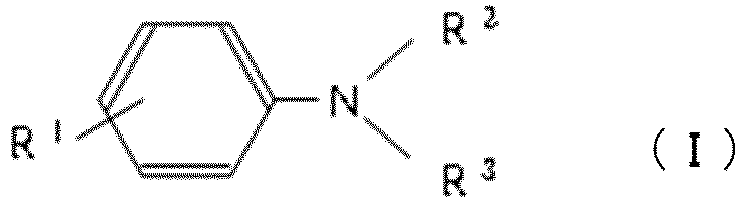
- In the general formula (I), R1 represents H, CH3 or OCH3, R2 represents a hydroxyalkyl group having 1 to 10 carbon atoms, and R3 represents an alkyl group having 1 to 10 carbon atoms, or a hydroxyalkyl group having 1 to 10 carbon atoms.
- In the resin composition (X), the total content ratio of the radical-polymerizable resin (A) and the radical-polymerizable monomer (B) (the content ratio of the radical-polymerizable components) is 75% by mass or more, preferably 85% by mass or more, more preferably 95% by mass or more. Preferably, the resin composition (X) does not contain a component corresponding to the filler (Z) to be mentioned hereinunder.
- The radical-polymerizable resin (A) contains at least one selected from the group consisting of a vinyl ester resin, a urethane (meth)acrylate resin and a polyester (meth)acrylate resin. Preferably, the radical-polymerizable resin (A) contains a vinyl ester resin and is more preferably a vinyl ester resin. Hereinunder the vinyl ester resin, the urethane (meth)acrylate resin and the polyester (meth)acrylate resin usable as the radical-polymerizable resin (A) are described individually.
- The vinyl ester resin may be called an epoxy (meth)acrylate resin, and for example, it is an esterified product of an epoxy compound and a carboxylic acid having one or plural ethylenically-unsaturated bonds or a derivative thereof. The carboxylic acid derivative includes a carboxylic acid halide, and a carboxylic acid anhydride. Namely, the vinyl ester resin is an epoxy compound polymer having an ethylenically-unsaturated bond bonding to at least any terminal of an epoxy polymer via an ester bond. Here, preferably, the ethylenically-unsaturated bond is at the terminal of the molecule, and is more preferably a vinyl group, an allyl group, a (meth)acryloyl group or a (meth)acryloyloxy group. Examples of such vinyl ester resins are described in "Polyester Resin Handbook (issued by Nikkan Kogyo Shimbun, Ltd, in 1988)", and "Dictionary of Paint Terms (edited by Japan Society of Color Material, issued in 1993)".
- The epoxy compound used as a raw material for the vinyl ester resin is preferably a diepoxy compound, and examples thereof include a bisphenol A-type glycidyl ether and a novolak-type glycidyl ether. More specifically, the epoxy compound includes bisphenol A diglycidyl ether, hydrogenated bisphenol A diglycidyl ether, tetrabromobisphenol A diglycidyl ether, novolak-type diglycidyl ether, and cresol novolak-type diglycidyl ether. Other epoxy compounds include 1,6-hexanediol diglycidyl ether, 1,4-cyclohexanedimethanol diglycidyl ether, 5-norbornane-2,3-dimethanol diglycidyl ether, tricyclodecane dimethanol diglycidyl ether, alicyclic diepoxy carbonate, alicyclic diepoxy acetal, and alicyclic diepoxy carboxylate.
- One alone or two or more kinds of these epoxy compounds may be used either singly or as mixed, but preferably, bisphenol A diglycidyl ether and a linear diglycidyl ether are mixed and used. This is for improving the flexibility and the toughness of the cured structure repairing material. From this viewpoint, the epoxy compound is more preferably a mixture of bisphenol A diglycidyl ether and 1,6-hexanediol diglycidyl ether.
- In the ethylenically-unsaturated bond-having carboxylic acid used as a raw material for the vinyl ester resin, preferably, two hydrogen atoms bond to one carbon atom that forms the ethylenically-unsaturated bond, that is, the ethylenically-unsaturated bond is at the terminal of the molecule, and more preferably, the ethylenically-unsaturated bond forms a vinyl group or an allyl group.
- Examples of the monocarboxylic acid having one ethylenically-unsaturated bond include acrylic acid and methacrylic acid. Examples of the monocarboxylic acid having plural ethylenically-unsaturated bonds include half ester carboxylic acids to be produced through reaction of trimethylolpropane diallyl ether and phthalic anhydride or a derivative thereof. Examples of the derivative of phthalic anhydride include tetrahydrophthalic anhydride, methyl-tetrahydrophthalic anhydride, and endomethylene-tetrahydrophthalic anhydride. A tetrahydrophthalic anhydride is preferred. One alone or two or more kinds of these carboxylic acids may be used either singly or as mixed.
- The ethylenically-unsaturated bond-having carboxylic acid may also be a dicarboxylic acid. The ethylenically-unsaturated bond-having dicarboxylic acid includes an esterified product produced by reacting one carboxy group of a tricarboxylic acid such as citric acid with a compound having an ethylenically-unsaturated bond and a hydroxy group such as trimethylolpropane diallyl ether.
- In the case where an ethylenically-unsaturated bond-having carboxylic acid derivative is used in place of the ethylenically-unsaturated bond-having carboxylic acid, halides such as chlorides or bromides of the above-mentioned carboxylic acid, or anhydrides of the above-mentioned carboxylic acid may be used.
- For controlling the crosslinking degree of the cured product, the vinyl ester resin may be such that a part of the terminal epoxy groups of an epoxy polymer to be a raw material are reacted with a carboxylic acid not having an ethylenically-unsaturated bond. Examples of the carboxylic acid not having an ethylenically-unsaturated bond include adipic acid, sebacic acid, and phthalic anhydride.
- For example, the urethane (meth)acrylate resin can be produced by reacting a polyisocyanate and a polyol to give a polyurethane having an isocyanate group at the terminal and reacting it with a hydroxy group-containing (meth)acrylate. In reacting with a hydroxy group-containing (meth)acrylate, a hydroxy group-containing allyl ether compound may be further added. Namely, the urethane (meth)acrylate resin is a polyurethane having a (meth)acryloyl group at least at any terminal in the molecule.
- The method for synthesizing the urethane (meth)acrylate resin is not limited to only the above, and for example, the resin can also be produced by reacting a polyisocyanate and a polyol to give a polyurethane having a hydroxy group at the terminal and reacting it with an isocyanate-containing (meth)acrylate.
- Examples of the polyisocyanate to be used as a raw material for the urethane (meth)acrylate resin include 2,4-tolylene diisocyanate, 2,6-tolylene diisocyanate, 4,4'-diphenylmethane diisocyanate, hexamethylene diisocyanate, hydrogenated xylylene diisocyanate, isophorone diisocyanate, xylylene diisocyanate, dicyclohexylmethane diisocyanate, naphthalene diisocyanate, and triphenylmethane triisocyanate, and commercial products thereof include Millionate MT (by Nippon Polyurethane Industry Co., Ltd.), Burnock D-750 (by DIC Corporation), Crisvon NK (by DIC Corporation), Desmodur L (by Sumika Covestro Urethane Co., Ltd.), Coronate L (by Tosoh Corporation), Takenate D102 (by Mitsui Chemicals Inc.), Isonate 143L (by Mitsubishi Chemical Corporation), and Duranate (registered trademark) series (by Asahi Kasei Corporation). One alone or two or more kinds of these polyisocyanates may be used either singly or as mixed. The polyisocyanates for use herein are preferably diisocyanates, and among these, 4,4'-diphenylmethane diisocyanate is more preferred from the viewpoint of cost.
- Examples of the polyol to be used as a raw material for the urethane (meth)acrylate resin include ethylene glycol, diethylene glycol, triethylene glycol, polyethylene glycol, propylene glycol, dipropylene glycol, polypropylene glycol, 2-methyl-1,3-propanediol, 1,3-butanediol, bisphenol A propylene oxide adduct, bisphenol A ethylene oxide adduct, 1,2,3,4-tetrahydroxybutane, glycerin, trimethylolpropane, 1,3-butanediol, 1,2-cyclohexaneglycol, 1,3-cyclohexaneglycol, 1,4-cyclohexaneglycol, paraxyleneglycol, bicyclohexyl-4,4-diol, 2,6-decalinglycol, and 2,7-decalinglycol. The polyol also includes a polyester polyol and a polyether polyol. More specifically, the polyol includes glycerin ethylene oxide adduct, glycerin propylene oxide adduct, glycerin tetrahydrofuran adduct, glycerin ethylene oxide propylene oxide adduct, trimethylolpropane ethylene oxide adduct, trimethylolpropane propylene oxide adduct, trimethylolpropane tetrahydrofuran adduct, trimethylolpropane ethylene oxide propylene oxide adduct, dipentaerythritol ethylene oxide adduct, dipentaerythritol propylene oxide adduct, dipentaerythritol tetrahydrofuran adduct, and dipentaerythritol ethylene oxide propylene oxide adduct. One alone or two or more kinds of these polyhydroxy compounds may be used either singly or as mixed. The polyol to be used here is preferably a linear glycol, more preferably a polypropylene glycol.
- Examples of the hydroxy group-containing (meth)acrylate to be used as a raw material for the urethane (meth)acrylate resin include 2-hydroxyethyl (meth)acrylate, 2-hydroxypropyl (meth)acrylate, 3-hydroxybutyl (meth)acrylate, polyethylene glycol mono(meth)acrylate, polypropylene glycol mono(meth)acrylate, tris(hydroxyethyl)isocyanuric acid di(meth)acrylate, pentaerythritol tri(meth)acrylate, and glycerin (mono)(meth)acrylate, and commercial products thereof include Blemmer (registered trademark) series (by NOF Corporation). Among these (meth)acrylates, those having one hydroxy group and one (meth)acryloyl group in the molecule, that is, 2-hydroxyethyl (meth)acrylate, 2-hydroxypropyl (meth)acrylate, and 3-hydroxybutyl (meth)acrylate are preferred, and 2-hydroxypropyl (meth)acrylate is especially preferred. One alone or two or more kinds of these hydroxy group-containing (meth)acrylates can be used either singly or as mixed.
- Examples of the hydroxy group-containing allyl ether compound to be used as a raw material for the urethane (meth)acrylate resin include ethylene glycol monoallyl ether, diethylene glycol monoallyl ether, triethylene glycol monoallyl ether, polyethylene glycol monoallyl ether, propylene glycol monoallyl ether, dipropylene glycol monoallyl ether, tripropylene glycol monoallyl ether, polypropylene glycol monoallyl ether, 1,2-butylene glycol monoallyl ether, 1,3-butylene glycol monoallyl ether, hexylene glycol monoallyl ether, octylene glycol monoallyl ether, trimethylolpropane diallyl ether, glycerin diallyl ether, and pentaerythritol triallyl ether. One alone or two or more kinds of these hydroxy group-containing allyl ether compounds may be used either singly or as mixed.
- The polyester (meth)acrylate resin can be produced by reacting a (meth)acrylate having a hydroxy group or an epoxy group, with a polyester having a carboxy group at the terminal that is produced, for example, from a polycarboxylic acid and a polyol. The polyester (meth)acrylate resin can also be produced by reacting a polyester having a hydroxy group at the terminal that is produced, for example, from a polycarboxylic acid and a polyol, with a (meth)acrylic acid. Namely, the polyester (meth)acrylate resin is a polyester having a (meth)acryloyl group at least at any terminal of the molecular chain.
- The polycarboxylic acid to be used as a raw material for the polyester (meth)acrylate resin is preferably at least one of an aromatic dicarboxylic acid and an aliphatic saturated dicarboxylic acid, more preferably an aromatic dicarboxylic acid. Examples of the aromatic dicarboxylic acid include phthalic acid, isophthalic acid, terephthalic acid, and anhydrides thereof. Examples of the aliphatic dicarboxylic acid include adipic acid, sebacic acid, and anhydrides thereof. One alone or two or more kinds of these polycarboxylic acids may be used either singly or as mixed.
- The polycarboxylic acid to be used as a raw material for the polyester (meth)acrylate resin may also include an aliphatic unsaturated dicarboxylic acid, and examples of the aliphatic unsaturated dicarboxylic acid include fumaric acid, maleic acid, itaconic acid, tetrahydrophthalic acid, and anhydrides thereof. One alone or two or more kinds of these aliphatic unsaturated dicarboxylic acids may be used either singly or as mixed.
- The polycarboxylic acid be used as a raw material for the polyester (meth)acrylate resin may also include any other polycarboxylic acid than the above-mentioned dicarboxylic acids, and the dicarboxylic acid and any other polycarboxylic acid than the dicarboxylic acid can also be combined and used.
- The polyol to be used as a raw material for the polyester (meth)acrylate resin is preferably a diol, and examples thereof include ethylene glycol, propylene glycol, diethylene glycol, dipropylene glycol, 1,2-butanediol, 1,3-butanediol, 1,5-pentanediol, 1,6-hexanediol, 2-methyl-1,3-propanediol, 2,2-dimethyl-1,3-propanediol, cyclohexane-1,4-dimethanol, bisphenol A ethylene oxide adduct, and bisphenol A propylene oxide adduct. One alone or two or more kinds of these polyols may be used either singly or as mixed.
- The epoxy group-having (meth)acrylate to be used as a raw material for the polyester (meth)acrylate resin is preferably one not having any other unsaturated bond than an a, β-unsaturated bond, more preferably one in which the number of the epoxy group contained in the molecule is one, for example, glycidyl methacrylate.
- The hydroxy group-containing (meth)acrylate to be used as a raw material for the polyester (meth)acrylate resin includes the same compounds as those exemplified hereinabove as the hydroxy group-containing (meth)acrylate for use as a raw material for the above-mentioned urethane (meth)acrylate resin, and one alone or two or more kinds thereof may be used either singly or as mixed.
- Examples of the (meth)acrylic acid to be used as a raw material for the polyester (meth)acrylate resin include acrylic acid, methacrylic acid, and itaconic acid. One alone or two or more kinds of these (meth)acrylic acids may be used either singly or as mixed.
- Among the polyester (meth)acrylate resins to be produced from the above-mentioned raw materials, bisphenol A-type polyester (meth)acrylate resins are preferred, from the viewpoint of enhancing the mechanical strength (compression strength, hardness) of the cured structure repairing material.
- The radical-polymerizable monomer (B) can appropriately lower the viscosity of the resin composition (X) and the structure repairing material and can improve the strength, the chemical resistance and the waterproofness of the cured structure repairing material. The radical-polymerizable monomer (B) contains an isobornyl group-having unsaturated compound (B1) (hereinunder this may be referred to as an unsaturated compound (B1)). The radical-polymerizable monomer (B) does not contain a component corresponding to the radical-polymerizable resin (A).
- The content ratio of the radical-polymerizable monomer (B) in the resin composition (X) is preferably 40% by mass or more. Falling within the range, not only the resin composition (X) can have a viscosity suitable for good workability even at a low temperature (for example, at -25°C), but also the composition can have good wettability to the filler (Z) to be mentioned below. From this viewpoint, the content ratio of the radical-polymerizable monomer (B) is more preferably 50% by mass or more, even more preferably 55% by mass or more.
- The content ratio of the radical-polymerizable monomer (B) in the resin composition (X) is preferably 90% by mass or less. Falling within the range, the cured structure repairing material can maintain high strength and waterproofness. From this viewpoint, the content ratio of the radical-polymerizable monomer (B) is more preferably 80% by mass or less, even more preferably 70% by mass or less.
- The unsaturated compound (B1) is a compound having an isobornyl group and an ethylenically-unsaturated bond. The unsaturated compound (B1) can enhance the strength of the cured resin composition (X) not significantly increasing the shrinkage of the resin composition (X) by curing. The unsaturated compound (B1) is preferably a (meth)acrylate having an isobornyl group, more preferably isobornyl (meth)acrylate. The isobornyl group means a residue formed by removing a hydroxy group from isoborneol.
- The content ratio of the unsaturated compound (B1) in the radical-polymerizable components (A) + (B) is preferably 10% by mass or more. Falling within the range, the strength of the cured repairing material increases. From this viewpoint, the content ratio of the unsaturated compound (B1) in the radical-polymerizable components (A) + (B) is more preferably 20% by mass or more, even more preferably 30% by mass or more.
- Preferably, the content ratio of the unsaturated compound (B1) in the radical-polymerizable components (A) + (B) is 65% by mass or less. Falling within the range, the shrinkage of the repairing material by curing reduces. From this viewpoint, the content ratio of the unsaturated compound (B1) in the radical-polymerizable components (A) + (B) is more preferably 55% by mass or less, even more preferably 45% by mass or less.
- Preferably, the content ratio of the unsaturated compound (B1) in the radical-polymerizable compound (B) is 30% by mass or more. Falling within the range, the strength of the cured repairing material increases. From this viewpoint, the content ratio of the unsaturated compound (B1) in the radical-polymerizable compound (B) is more preferably 40% by mass or more, even more preferably 50% by mass or more.
- Preferably, the content ratio of the unsaturated compound (B1) in the radical-polymerizable compound (B) is 90% by mass or less. Falling within the range, the shrinkage of the repairing material by curing reduces. From this viewpoint, the content ratio of the unsaturated compound (B1) in the radical-polymerizable compound (B) is more preferably 80% by mass or less, even more preferably 70% by mass or less.
- The radical-polymerizable monomer (B) may contain any other radical-polymerizable monomer (B2) in addition to the unsaturated compound (B1). The other radical-polymerizable monomer (B2) contains an ethylenically-unsaturated bond. The other radical-polymerizable monomer (B2) includes unsaturated carboxylates, unsaturated dicarboxylic acid monoesters, styrene, α-methylstyrene, aromatic vinyl compounds, and glycidyl (meth)acrylate. Preferably, the other radical-polymerizable monomer (B2) contains a (meth)acrylate, and more preferably contains at least one selected from the group consisting of mono(meth)acrylates, di(meth)acrylates and tri(meth)acrylates.
- The mono(meth)acrylate is not specifically limited. Examples thereof include methyl (meth)acrylate, ethyl (meth)acrylate, n-propyl (meth)acrylate, i-propyl (meth)acrylate, n-butyl (meth)acrylate, i-butyl (meth)acrylate, t-butyl (meth)acrylate, amyl (meth)acrylate, hexyl (meth)acrylate, heptyl (meth)acrylate, 2-ethylhexyl (meth)acrylate, n-octyl (meth)acrylate, isooctyl (meth)acrylate, n-nonyl (meth)acrylate, isononyl (meth)acrylate, decyl (meth)acrylate, dodecyl (meth)acrylate, n-lauryl (meth)acrylate, tridecyl (meth)acrylate, stearyl (meth)acrylate, cyclohexyl (meth)acrylate, cyclopentyl (meth)acrylate, benzyl (meth)acrylate, dicyclopentenyl (meth)acrylate, dicyclopentenyloxyethyl (meth)acrylate, methoxyethyl (meth)acrylate, ethoxyethyl (meth)acrylate, butoxyethyl (meth)acrylate, phenoxyethyl (meth)acrylate, tetrahydrofurfuryl (meth)acrylate, 2-hydroxyethyl (meth)acrylate, 2-hydroxypropyl (meth)acrylate, and 4-hydroxybutyl (meth)acrylate. One alone or two or more kinds of these (meth)acrylate monomers may be used either singly or as mixed.
- The di(meth)acrylate is not specifically limited. Examples thereof include ethylene glycol di(meth)acrylate, diethylene glycol di(meth)acrylate, triethylene glycol di(meth)acrylate, polyoxyethylene glycol di(meth)acrylate, propylene glycol di(meth)acrylate, dipropylene glycol di(meth)acrylate, tripropylene glycol di(meth)acrylate, polypropylene glycol di(meth)acrylate, ethoxylated bisphenol A di(meth)acrylate, tricyclodecane di(meth)acrylate, 1,10-decanediol di(meth)acrylate, 1,4-butanediol di(meth)acrylate, 1,6-hexanediol di(meth)acrylate, 1,9-nonanediol di(meth)acrylate, neopentyl glycol di(meth)acrylate, glycerin di(meth)acrylate, ethoxylated polypropylene glycol di(meth)acrylate, 2,2-bis[4-(methacryloyloxyethoxy)phenyl]propane, 2,2-bis[4-(methacryloyloxy-diethoxy)phenyl]propane, 2,2-bis[4-(methacryloyloxy-polyethoxy)phenyl]propane, 2,2-bis[4-(acryloyloxy-diethoxy)phenyl]propane, and 2,2-bis[4-(acryloyloxy-polyethoxy)phenyl]propane.
- The tri(meth)acrylate is not specifically limited, including trimethylolpropane tri(meth)acrylate, ethoxylated isocyanuric acid tri(meth)acrylate, ε-caprolactone-modified tris(2-acryloyloxyethyl) isocyanurate, and pentaerythritol tri(meth)acrylate.
- From the viewpoint of workability and compression strength, the other radical-polymerizable monomer (B2) preferably contains at least one selected from the group consisting of dicyclopentenyloxyethyl (meth)acrylate, (meth)acryloylmorpholine, ethylene glycol di(meth)acrylate, diethylene glycol di(meth)acrylate, and trimethylolpropane tri(meth)acrylate.
- In addition to the above, dimethylolpropane tetra(meth)acrylate, ethoxylated pentaerythritol tetra(meth)acrylate, dipentaerythritol poly(meth)acrylate, and dipentaerythritol hexa(meth)acrylate can also be used as the other radical-polymerizable monomer (B2), within a range capable of attaining the object of the present invention.
- The hydroxy group-containing aromatic tertiary amine (C) is represented by the following formula (I).

- In the formula (I), R1 represents H, CH3 or OCH3, and is preferably CH3, more preferably CH3 at the p-position. R2 represents a hydroxyalkyl group having 1 to 10 carbon atoms and is preferably a hydroxyalkyl group having 3 or less carbon atoms. R3 represents an alkyl group having 1 to 10 carbon atoms or a hydroxyalkyl group having 1 to 10 carbon atoms and is preferably an alkyl group or a hydroxyalkyl group having 4 or less carbon atoms, even more preferably a hydroxyalkyl group having 4 or less carbon atoms. Still more preferably, R2 and R3 are the same hydroxyalkyl group.
- The hydroxy group-containing aromatic tertiary amine (C) represented by the general formula (I) is not specifically limited, and examples thereof include N-methyl-N-β-hydroxyethylaniline, N-butyl-N-β-hydroxyethylaniline, N-methyl-N-β-hydroxyethyl-p-toluidine, N-butyl-N-β-hydroxyethyl-p-toluidine, N-methyl-N-β-hydroxypropylaniline, N-methyl-N-β-hydroxypropyl-p-toluidine, N,N-di(β-hydroxyethyl)aniline, N,N-di(β-hydroxypropyl)aniline, N,N-di(β-hydroxyethyl)-p-toluidine, N,N-di(β-hydroxypropyl)p-toluidine, N,N-diisopropanol-p-toluidine, and N,N-di(β-hydroxyethyl)-p-anisidine. Among these, N,N-di(β-hydroxyethyl)-p-toluidine an N,N-di(β-hydroxypropyl)-p-toluidine are preferred from the viewpoint of low-temperature curability.
- One alone or two or more kinds of these hydroxy group-containing aromatic tertiary amines (C) may be used either singly or as combined.
- The content ratio of the hydroxy group-containing aromatic tertiary amine (C) in the resin composition (X) is preferably 0.1 to 10% by mass, more preferably 0.1 to 5.0% by mass, even more preferably 0.2 to 3.0% by mass. Containing the hydroxy group-containing aromatic tertiary amine (C), the curing reaction of the resin composition (X) can be promoted to improve the workability thereof.
- The additive component contained in the resin composition (X) includes wax, other amines than the hydroxy group-containing aromatic tertiary amine (C) (hereinafter this may be referred to as "amine of an optional component"), solvents, polymerization inhibitors, coupling agents, curing accelerators, and antioxidants, which can be used so far as the object of the present invention can be attained.
- Examples of wax include, though not limited thereto, petroleum wax (paraffin wax, microcrystalline), vegetable wax (candelilla wax, rice wax, Japan wax), animal wax (beeswax, spermaceti), mineral wax (montan wax), and synthetic wax (polyethylene wax, amide wax). More specifically, there is mentioned a paraffin wax having a melting point of 20°C to 80°C or so, and commercial products thereof include Paraffin Wax 115°F and Paraffin Wax 125°F (by Nippon Seiro Co., Ltd.), and BYK (registered trademark)-S-750, BYK (registered trademark)-S-740, and BYK (registered trademark)-S-780 (by BYK Japan KK). One alone or two or more kinds of these waxes can be used either singly or as mixed, and for example, waxes each having a different melting point can be combined and used.
- In the case where the resin composition (X) contains wax, the content ratio of wax in the resin composition (X) is not specifically limited, but is preferably 0.01 to 5.0% by mass, more preferably 0.01 to 2.0% by mass. When the resin composition (X) contains wax, the drying time for the structure repairing material can be shortened.
- The optional component, amine includes an aromatic tertiary amine except the hydroxy group-containing aromatic tertiary amine (C), for example, an aromatic tertiary amine not containing a hydroxy group. Examples of the optional component, amine include dimethylaniline and dimethyl-paratoluidine. One alone or two or more kinds of these may be used either singly or as combined.
- In the case where the resin composition (X) contains an amine of an optional component, the content ratio of the amine of an optional component in the resin composition (X) is preferably 0.01 to 5.0% by mass, more preferably 0.1 to 3.0% by mass. Containing an amine of an optional component, polymerization of the radical-polymerizable components contained in the resin component (X) can be promoted because of decomposition of an organic peroxide (Y) to be mentioned below through contact of the peroxide with the amine of an optional component, and the surface drying performance and the curability of the structure repairing material can be thereby more enhanced.
- Not specifically limited, examples of the solvent include alkyl acetates such as ethyl acetate; ethers such as tetrahydrofuran; ketones such as acetone, methyl ethyl ketone, methyl isobutyl ketone, and cyclohexanone; hydrocarbons such as benzene, toluene, xylene, octane, decane, and dodecane; petroleum solvents such as petroleum ether, petroleum naphtha, hydrogenated petroleum naphtha, and solvent naphtha; lactates such as methyl lactate, ethyl lactate and butyl lactate; and dimethylformamide, and N-methylpyrrolidone. One alone or two or more kinds of these solvents may be used either singly or as mixed.
- In the case where the resin composition (X) contains a solvent, the content ratio of the solvent in the resin composition (X) is not specifically limited, but is preferably 0.1 to 10% by mass, more preferably 0.1 to 5.0% by mass. The solvent can control the viscosity of the resin composition (X) to fall within a range suitable for working, and when used along with wax, especially paraffin wax, the solvent can improve the solubility and the dispersibility of wax.
- The polymerization inhibitor includes hydroquinone, methylhydroquinone, trimethylhydroquinone, tert-butyl catechol, and 2,6-di-tertiary butyl-4-methylphenol.
- In the case where the resin composition (X) contains a polymerization inhibitor, the content ratio of the polymerization inhibitor in the resin composition (X) is not specifically limited, but is preferably 0.001 to 1.0% by mass, more preferably 0.005 to 0.5% by mass. The polymerization inhibitor can retard the progression of curing of the structure repairing material and can secure a working time.
- The coupling agent is preferably a silane coupling agent. The silane coupling agent includes aminosilane, vinylsilane, epoxysilane and acrylsilane. One alone or two or more kinds of these coupling agents may be used either singly or as mixed.
- In the case where the resin composition (X) contains a coupling agent, the content ratio of the coupling agent in the resin composition (X) is not specifically limited, but is preferably 0.01 to 10% by mass, more preferably 0.1 to 5.0% by mass. The coupling agent can enhance the strength of the structure repairing material.
- Not specifically limited, the curing accelerator includes β-diketone compounds such as acetylacetone, ethyl acetoacetate, α-acetyl-γ-butyrolactone, N-pyrrolidinoacetoacetamide, and N,N-dimethylacetoacetamide. One alone or two or more of these curing accelerators may be used either singly or as mixed.
- In the case where the resin composition (X) contains a curing accelerator, the content ratio of the curing accelerator in the resin composition (X) is not specifically limited, but is preferably 0.01 to 10% by mass, more preferably 0.1 to 5.0% by mass. The curing accelerator can shorten the curing time for the resin composition (X).
- The resin composition (X) can still contain the polymerization catalyst used in synthesizing the radical-polymerizable resin (A), even after synthesis of the radical-polymerizable resin (A), so far as the performance of the resin composition (X) and the repairing material is not significantly impaired. Examples of the polymerization catalyst include 2,4,6-tris(dimethylaminomethyl)phenol and triphenyl phosphine.
- When used in combination with the hydroxy group-containing aromatic tertiary amine (C), the organic peroxide (Y) acts as a room-temperature radical polymerization initiator. Preferably, the organic peroxide (Y) is mixed with the resin composition (X) just before the structure repairing step. This is for the purpose of preventing the resin composition (X) from being cured before use of the structure repairing material.
- The organic peroxide (Y) is not specifically limited, and examples thereof include those grouped in ketone peroxides, peroxyketals, hydroperoxides, diallyl peroxides, diacyl peroxides, peroxyesters, and peroxydicarbonates. More specifically, the organic peroxide includes dibenzoyl peroxide, dicumyl peroxide, diisopropyl peroxide, di-t-butyl peroxide, 1,1-bis(t-butylperoxy)-3,3,5-trimethylcyclohexane, 2,5-dimethyl- 2,5-bis(t-butylperoxy)hexyl-3,3-isopropyl hydroperoxide, t-butyl hydroperoxide, dicumyl hydroperoxide, acetyl peroxide, bis(4-t-butylcyclohexyl)peroxy dicarbonate, diisopropylperoxy dicarbonate, isobutyl peroxide, 3,3,5-trimethylhexanoyl peroxide, lauryl peroxide, benzoyl m-methylbenzoyl peroxide, m-toluoyl peroxide, methyl ethyl ketone peroxide, cumene hydroperoxide, and t-butyl peroxybenzoate. Among these, at least one selected from the group consisting of dibenzoyl peroxide, benzoyl m-methylbenzoyl peroxide, m-toluoyl peroxide, methyl ethyl ketone peroxide, cumene hydroperoxide and t-butyl peroxybenzoate is preferred.
- The one-minute half-life temperature of the organic peroxide (Y) in this embodiment is preferably 80°C or higher. Falling within the range, the storability at room temperature of the organic peroxide (Y) is good. From this viewpoint, the one-minute half-life temperature of the organic peroxide (Y) is more preferably 100°C or higher, even more preferably 110°C or higher. Preferably, the one-minute half-life temperature of the organic peroxide (Y) in this embodiment is 250°C or lower. Falling within the range, the low-temperature curability of the structure repairing material is good. From this viewpoint, the one-minute half-life temperature of the organic peroxide (Y) in this embodiment is more preferably 200°C or lower, even more preferably 170°C or lower.
- One alone or two or more kinds of these organic peroxides (Y) may be used either singly or as mixed. Examples of the mixture of two or more kinds thereof include a mixture of dibenzoyl peroxide and benzoyl m-methylbenzoyl peroxide and m-toluoyl peroxide, a mixture of cumene hydroperoxide and t-butyl peroxybenzoate, and a mixture of cumene hydroperoxide and t-butyl peroxybenzoate and methyl ethyl ketone peroxide.
- For sufficiently curing the resin composition (X), the amount of the organic peroxide (Y) to be added is preferably 0.1 parts by mass or more relative to 100 parts by mass of the resin composition (X), more preferably 0.5 parts by mass or more, even more preferably 1.0 part by mass or more. For cost reduction and for enhancing the strength of the cured structure repairing material, the content of the organic peroxide (Y) is preferably 10 parts by mass or less, more preferably 8.0 parts by mass or less, even more preferably 6.0 parts by mass or less.
- The filler (B) may contain those acting as a thixotropic agent and a reinforcing material, in addition to the others acting as aggregate. Examples of the filler (Z) include an inorganic thixotropic agent, an organic compound fiber, calcium carbonate, cement, silica sand, and silica stone. Among these, the filler preferably contains at least one selected from the group consisting of an inorganic thixotropic agent, calcium carbonate, cement, silica sand, and silica stone, and from the viewpoint of cost and material availability, more preferably, the filler contains at least one selected from the group consisting of calcium carbonate, cement and silica sand, and above all, especially more preferably, the filler contains at least any of calcium carbonate and silica sand. One alone or two or more kinds of these fillers (Z) may be used either singly or as combined.
- The content of the filler (Z) in the structure repairing material is preferably 100 parts by mass or more relative of 100 parts by mass of the resin composition (X). Falling within the range, the structure repairing material can be prevented from flowing and therefore can be prevented from deformation owing to the self-weight of the structure repairing material in applying to wall surfaces or ceiling surfaces, and from dropping of liquid droplets. From this viewpoint, the content of the filler (Z) is more preferably 200 parts by mass or more relative to 100 parts by mass of the resin composition (X), even more preferably 300 parts by mass or more. Here, in the case where two or more components are contained as the filler (Z), the content of the filler (Z) means the total content of all the components corresponding to the filler (Z). (The same shall apply to the description of the upper limit to follow later.)
- The content of the filler (Z) in the structure repairing material is preferably 700 parts by mass or less relative of 100 parts by mass of the resin composition (X). Falling within the range, the structure repairing material is easy to handle, the workability thereof in coating is good, and the filler (Z) can be sufficiently bonded to the repaired material by curing the resin composition (X). From this viewpoint, the content of the filler (Z) is more preferably 600 parts by mass or less relative to 100 parts by mass of the resin composition (X), even more preferably 500 parts by mass or less.
- Examples of the components corresponding to the filler (Z) are described below, but the filler (Z) is not limited to those mentioned below.
- Regarding the thixotropic agent, examples of inorganic thixotropic agents include hydrophobic fumed silica (Cabosil TS-720 by Cabot Corporation), and hydrophilic fumed silica (Aerosil (registered trademark) 200 by Nippon Aerosil Co., Ltd.). Examples of organic thixotropic agents include polyethylene flocculent fibers ("Kemibesto" by Mitsui Chemicals, Inc.), and hydrogenated castor oil. Above all, hydrophobic silica, and hydrophilic silica, and Kemibesto are preferred. One alone or two or more kinds of these thixotropic agents can be used either singly or as mixed. Hydrophilic silica can be used together with a thixotropic aid such as BYK (registered trademark) R605 (by BYK Japan KK).
- In the case where a thixotropic agent is added as the filler (Z), the amount of the thixotropic agent to be added is not specifically limited but is preferably 0.1 to 10 parts by mass relative to 100 parts by mass of the resin composition (X), more preferably 0.2 to 5.0 parts by mass. Containing a thixotropic agent, the structure repairing material can be given good thixotropic nature to improve workability.
- Calcium carbonate improves the viscosity of the structure repairing material to improve the coating workability with a trowel. Preferably, calcium carbonate has a number-average particle size of 10 pm or less.
- In the case where calcium carbonate is added as the filler (Z), the amount of calcium carbonate to be added is not specifically limited but is preferably 10 to 100 parts by mass relative to 100 parts by mass of the resin composition (X), more preferably 15 to 70 parts by mass.
- Organic compound fibers include polyethylene flocculent fibers ("Kemibesto" by Mitsui Chemicals, Inc.). Preferably, the organic compound fibers have a length in the short side of 100 nm or more from the viewpoint of workability. The organic compound fibers can impart thixotropic nature to resin to improve coating workability with the structure repairing material and prevent dripping.
- In the case where organic compound fibers are added as the filler (Z), the amount of the organic compound fibers to be added is not specifically limited but is preferably 0.1 to 10 parts by mass relative to 100 parts by mass of the resin composition (X), more preferably 0.2 to 5.0 parts by mass.
- Cement improves trowel workability with the structure repairing material. Cement preferably contains Portland cement.
- In the case where cement is added as the filler (Z), the amount of cement to be added is not specifically limited but is preferably 10 to 100 parts by mass relative to 100 parts by mass of the resin composition (X), more preferably 40 to 80 parts by mass.
- Silica sand can impart resistance to heat to the structure repairing material and improve compression strength. Preferably, at least any of No. 4 to No. 8 silica sand is used here, more preferably at least any of No. 5 to No. 7 silica sand. Two kinds of silica sand each having a different size distribution can be used, and especially preferably, No. 5 silica sand and No. 7 silica sand are combined and used.
- In the case where silica sand is added as the filler (Z), the amount of silica sand to be added is not specifically limited but is preferably 100 to 500 parts by mass relative to 100 parts by mass of the resin composition (X), more preferably 200 to 400 parts by mass. In the case where two or more kinds of silica sand each having a different size distribution are used as combined, preferably, they are used in the same amount by mass.
- Not limited to the above-mentioned ones, alumina, aluminum hydroxide, aluminum and titanium are also added as the filler (Z). The amount of each component contained in the filler (Z) can be appropriately controlled depending on the formulation of the structure repairing material, the desired performance, and the effect relative to the amount of each component.
- The structure repairing material may contain any other component than the above, as an optional component within a range not interfering with the advantageous effects of the present invention. Examples of the optional component include, though not limited thereto, a photopolymerization initiator, a reinforcing material and various additives.
-
Fig. 1 is a flowchart showing one example of a structure repairing method of this embodiment. The structure repairing method of this embodiment includes a structure repairing material preparing step S1, a coating step S2 of coating the structure repairing material to a structure, and a curing step S3 of curing the structure repairing material. The ambient temperature in these steps is not specifically limited, but the structure repairing material of this embodiment is suitable for use in a low -temperature environment at -10°C or lower. - In the preparing step S1, a resin composition (X), an organic peroxide (Y) and a filler (Z) are mixed to prepare a structure repairing material. The addition sequence is not specifically limited, falling within a range capable of attaining the effect of the present invention. For example, before adding the organic peroxide (Y), the filler (Z) and the resin composition (X) may be mixed. After the resin composition (X) and the organic peroxide (Y) are mixed, the filler (Z) may be added to the mixture thereof. The resin composition (X), the organic peroxide (Y) and the filler (Z) may be mixed at the same time. The order of mixing these components may be appropriately determined in consideration of the reactivity between the resin composition (X) and the organic peroxide (Y), and the physical properties such as viscosity of the resin composition (X), the organic peroxide (Y) and the filler (Z). However, for preventing progress of curing before use of the structure repairing material, preferably, the resin composition (X) and the filler (Z) are mixed before the organic peroxide (Y) is added.
- In the coating step S2, the structure repairing material is applied to the surface of a structure. Preferably, stains, deposits and brittle layers such as laitance layers are previously removed from the working face of the structure. Also preferably, working faces are subjected to substrate treatment for preparing them, prior to this step. Examples of substrate treatment include a polishing treatment for roughened or dirty surfaces of structures using a disc sander, a sand blaster, a water jet, etc. Through the treatment, the adhesion strength of the cured structure repairing material to the working face can be enhanced.
- The coating amount of the structure repairing material in this embodiment is preferably 5 to 30 kg/m2, more preferably 10 to 25 kg/m2, even more preferably 13 to 23 kg/m2. Examples of the coating method in this step include, though not limited thereto, a coating method using instruments such as a trowel, a roller, a brush, or a spatula, and a spray coating or dipping method.
- In the curing step S3, the structure repairing material applied to the structure is cured. The curing method is not specifically limited, for which the working face may be covered with a curing sheet and left as such for a period of time enough to cure. Here, the time and the adequate temperature in leaving as such vary depending on the components and the formulation of the resin composition (X). For example, in the case where the resin composition (X) contains a photopolymerization initiator, the curing may be promoted efficiently by irradiation with light. In this case, the wavelength range of light for irradiation can be appropriately determined depending on the components of the resin composition (X), especially the kind of the photopolymerization initiator. For confirming curing of the structure repairing material, the material may be checked for absence of finger mark by finger-touch, that is, no plastic deformation of the structure repairing material may be confirmed by finger-touch check.
- Hereinunder the present invention is described in more detail with reference to Examples, but the invention is not limited to these.
- In a reactor equipped with a stirrer, a reflux condenser, a gas introducing tube and a thermometer, 151 g of a bisphenol A-type epoxy resin (product name "Epomik (trademark) R140P" by Mitsui Chemicals, Inc., epoxy equivalent 189), 188 g of 1,6-hexanediol diglycidyl ether (product name "SR-16" by Sakamoto Yakuhin Kogyo Co., Ltd., epoxy equivalent 157), 129 g of trimethylolpropane diallyl ether (product name "Neoallyl (trademark) T-20" by Osaka Soda Co., Ltd.), 91 g of tetrahydrophthalic anhydride (product name "Rikacid TH" by New Japan Chemical Co., Ltd.), and 145 g of dicyclopentenyloxyethyl methacrylate (B2-1) (product name "Fancryl FA-512MT" by Showa Denko Materials Co., Ltd.) were put, and heated up to 90°C. While the temperature was kept as such, 1.0 g of 2,4,6-tris(dimethylaminomethyl)phenol (product name "Seikuol TDMP" by Seiko Chemical Co., Ltd.) and 0.3 g of methylhydroquinone (by Tokyo Chemical Industry Co., Ltd.) were added, and heated up to 110°C and reacted with an air stream kept blowing therethrough. In one hour after the start of the reaction, the acid value reached 25 mgKOH/g. At that time, 120 g of methacrylic acid (by Kuraray Co., Ltd.) and 1.0 g of 2,4,6-tris(dimethylaminomethyl)phenol were added and heated up to 130°C. The acid value was measured based on the neutralization titration method described in JIS K 0070:1992, Section 3.1 (the same shall apply to acid value measurement hereinunder). In the method, a small amount (about 0.1 mL) of the reaction liquid was sampled for the measurement, and the sampled amount does not have any influence on the total amount (the same shall apply to acid value measurement hereinunder). In 4 hours after the temperature reached 130°C, the acid value was 14 mgKOH/g. At that time, the reaction was finished to give a mixture (a) containing 679 g of vinyl ester resin (A-1), 145 g of dicyclopentenyloxyethyl methacrylate (B2-1), 2.0 g of 2,4,6-tris(dimethylaminomethyl)phenol and 0.3 g of hydroquinone.
- The mixture (a) synthesized as above, and the components shown in Table 1 were mixed to produce radical-polymerizable mixtures VE1 to VE6.

- The radical-polymerizable mixtures VE-1 to VE-6 were left to stand at - 10°C for 24 hours to make these mixtures at a temperature of -10°C, and then mixed in an environment at -10°C in the formulation and the amount shown in Table 2 for Examples 1 to 4 and Comparative Examples 1 to 6 thereby preparing structure repairing materials.


- The structure repairing materials produced in Examples 1 to 4 and Comparative Examples 1 to 6 were evaluated as follows.
- A concrete plate from which laitance layers had been removed was cured in a -10°C atmosphere for 24 hours. Subsequently, using a metal trowel, the structure repairing material having the formulation shown in Table 2 was applied to the concrete plate to have a coating thickness of 10 mm under the same temperature condition. Subsequently, the concrete plate coated with the structure repairing material was left to stand at -10°C, and after 6 hours and 12 hours from completion of coating the structure repairing material, the structure repairing material was checked for curing. In the case where the structure repairing material was judged to have been cured after 6 hours, it is unnecessary to further check for curing after 12 hours, and therefore the checking was omitted. For confirming curing of the structure repairing material, the material was checked for absence of finger mark by finger-touch, that is, no plastic deformation of the structure repairing material was confirmed by finger-touch check. The structure repairing material confirmed to have been cured after 6 hours from completion of coating the structure repairing material was evaluated as "excellent", the structure repairing material confirmed to have been cured for the first time after 12 hours from completion of coating was evaluated as "good", and the structure repairing material not confirmed to have been cured after 12 hours was evaluated as "poor". The evaluation results of -10°C curability of the structure repairing materials of Examples and Comparative Examples are as shown in Table 2.
- According to the method described in JIS A 1181:2005 "Resin Concrete Test Method", Section 7.1 "Compression Strength, Static Elastic Coefficient and Molding of Samples for Water Absorption Test", samples for evaluation of -10°C compression strength were produced in Examples and Comparative Examples. Specifically, the structure repairing material was charged in a stainless formwork in a -10°C atmosphere, and the structure repairing material thus charged in the formwork was cured in a -10°C atmosphere for 24 hours, and then demolded to give a columnar sample having a diameter of 75 mm and a height of 150 mm. The sample was tested according to the above-mentioned test method, Section 8.1 "Compression Strength Test with Columnar Sample" to measure the compression strength [MPa] at -10°C. The evaluation results of the -10°C compression strength of the structure repairing materials of Examples and Comparative Examples are as shown in Table 2.
- The structure repairing material of Examples and Comparative Examples was cast into a mold having a cuboid cavity of 60 mm in width, 60 mm in height and 240 mm in length, in a -10°C atmosphere, then cured in a -10°C atmosphere for 24 hours, and demolded, and the dimension of the cured structure repairing material was measured. From the length of the cured molded product relative to the dimension (mold dimension) of the cavity of the mold, 240 mm, the linear shrinkage was calculated according to the following math formula.

- The evaluation results of the linear shrinkage of the structure repairing materials of Examples and Comparative Examples are as shown in Table 2.
- From a flat concrete plate of 60 mm × 300 mm × 300 mm described in JIS A 5371:2016, laitance layers were removed, and the plate was cured in a -10°C atmosphere for 24 hours. Subsequently, using a metal trowel, the structure repairing material of Examples and Comparative Examples was applied to the flat concrete plate under the same temperature condition in a thickness of 30 mm. In 24 hours after the coating, the surface of the flat concrete plate on the side opposite to the side thereof coated with the structure repairing material was checked for cracking, and the flat concrete plate with no cracking was evaluated as "no", and the flat concrete plate with cracking was evaluated as "cracked". The cracking evaluation results are as shown in Table 2.
- As in Table 2, all the structure repairing materials of Examples 1 to 4 had good curability at - 10°C, had a high compression strength at - 10°C, had a low linear shrinkage by curing, and did not cure.
- In Comparative Examples 1 and 3 not containing isobornyl methacrylate (B1-1) but containing phenoxyethyl methacrylate (B2-2) and acryloylmorpholine (B2-3) as the radical-polymerizable monomer (B), the compression strength at - 10°C was low.
- In Comparative Examples 2 and 4 to 6 not containing isobornyl methacrylate (B1-1) but containing phenoxyethyl methacrylate (B2-2) and diethylene glycol dimethacrylate (B2-4) as the radical-polymerizable monomer (B), the linear shrinkage by curing was high. Further, in Comparative Examples 5 and 6 containing a large amount of diethylene glycol dimethacrylate (B2-4), cracking occurred.
- As in the above, when the structure repairing material of the present invention is used for repairing concrete structures, construction working is possible even in a low-temperature environment, a high strength can be achieved, a shrinkage by curing is low, and cracking can be prevented.

Claims (15)
- A radical-polymerizable resin composition comprising:a radical-polymerizable resin (A) containing at least one selected from the group consisting of a vinyl ester resin, a urethane (meth)acrylate resin, and a polyester (meth)acrylate resin,a radical-polymerizable monomer (B) containing an isobornyl group-having unsaturated compound (B1), anda hydroxy group-containing aromatic tertiary amine (C) represented by the following general formula (I),and containing the radical-polymerizable resin (A) and the radical-polymerizable monomer (B) in a total amount of 75% by mass or more:wherein R1 represents H, CH3 or OCH3, R2 represents a hydroxyalkyl group having 1 to 10 carbon atoms, and R3 represents an alkyl group having 1 to 10 carbon atoms, or a hydroxyalkyl group having 1 to 10 carbon atoms.

- The radical-polymerizable resin composition according to claim 1, wherein the isobornyl group-having unsaturated compound (B1) contains an ethylenically-unsaturated bond.
- The radical-polymerizable resin composition according to claim 2, wherein the isobornyl group-having unsaturated compound (B1) is an isobornyl (meth)acrylate.
- The radical-polymerizable resin composition according to any one of claims 1 to 3, wherein the content ratio of the isobornyl group-having unsaturated compound (B1) relative to the total amount of the radical-polymerizable resin (A) and the radical-polymerizable monomer (B) is 10% by mass or more and 65% by mass or less.
- The radical-polymerizable resin composition according to any one of claims 1 to 4, wherein the content ratio of the isobornyl group-having unsaturated compound (B1) in the radical-polymerizable monomer (B) is 30% by mass or more and 90% by mass or less.
- The radical-polymerizable resin composition according to any one of claims 1 to 5, wherein the other radical-polymerizable monomer (B2) than the isobornyl group-having unsaturated compound (B1) in the radical-polymerizable monomer (B) contains at least one selected from the group consisting of a mono(meth)acrylate, a di(meth)acrylate and a tri(meth)acrylate.
- The radical-polymerizable resin composition according to any one of claims 1 to 6, wherein the other radical-polymerizable monomer (B2) than the isobornyl group-having unsaturated compound (B1) in the radical-polymerizable monomer (B) contains at least one selected from the group consisting of dicyclopentenyloxyethyl (meth)acrylate, (meth)acryloylmorpholine, ethylene glycol di(meth)acrylate, diethylene glycol di(meth)acrylate, and trimethylolpropane tri(meth)acrylate.
- The radical-polymerizable resin composition according to any one of claims 1 to 7, wherein, in the general formula (I), R3 is a hydroxyalkyl group having 1 to 10 carbon atoms.
- The radical-polymerizable resin composition according to any one of claims 1 to 8, wherein the content ratio of the hydroxy group-containing aromatic tertiary amine (C) is 0.1 to 10% by mass.
- The radical-polymerizable resin composition according to any one of claims 1 to 9, wherein the radical-polymerizable resin (A) contains a vinyl ester resin.
- The radical-polymerizable resin composition according to any one of claims 1 to 10, further containing, as an additive component, at least one selected from a wax, any other amine than the hydroxy group-containing aromatic tertiary amine (C), a solvent, a polymerization inhibitor, a coupling agent, a curing accelerator, and an antioxidant.
- A structure repairing material comprising a radical-polymerizable resin composition (X) of any one of claims 1 to 11, an organic peroxide (Y) and a filler (Z).
- The structure repairing material according to claim 12, wherein the filler (Z) contains at least one selected from the group consisting of an inorganic thixotropic agent, an organic compound fiber, calcium carbonate, cement, silica sand, and silica stone.
- The structure repairing material according to claim 12 or 13, wherein the content of the filler (Z) relative to 100 parts by mass of the radical-polymerizable resin composition (X) is 100 to 700 parts by mass.
- The structure repairing material according to any one of claims 12 to 14, wherein the content of the organic peroxide (Y) relative to 100 parts by mass of the radical-polymerizable resin composition (X) is 0.1 parts by mass or more and 10 parts by mass or less.
Applications Claiming Priority (2)
| Application Number | Priority Date | Filing Date | Title |
|---|---|---|---|
| JP2018182973 | 2018-09-27 | ||
| PCT/JP2019/032364 WO2020066364A1 (en) | 2018-09-27 | 2019-08-20 | Radical polymerizable resin composition and structure repairing material |
Publications (2)
| Publication Number | Publication Date |
|---|---|
| EP3858880A1 true EP3858880A1 (en) | 2021-08-04 |
| EP3858880A4 EP3858880A4 (en) | 2022-06-22 |
Family
ID=69950443
Family Applications (1)
| Application Number | Title | Priority Date | Filing Date |
|---|---|---|---|
| EP19866832.9A Withdrawn EP3858880A4 (en) | 2018-09-27 | 2019-08-20 | Radical polymerizable resin composition and structure repairing material |
Country Status (5)
| Country | Link |
|---|---|
| US (1) | US20220049039A1 (en) |
| EP (1) | EP3858880A4 (en) |
| JP (1) | JPWO2020066364A1 (en) |
| CN (1) | CN112752775A (en) |
| WO (1) | WO2020066364A1 (en) |
Families Citing this family (1)
| Publication number | Priority date | Publication date | Assignee | Title |
|---|---|---|---|---|
| JP7439182B2 (en) * | 2022-07-28 | 2024-02-27 | 株式会社レゾナック・パッケージング | Battery packaging material |
Family Cites Families (13)
| Publication number | Priority date | Publication date | Assignee | Title |
|---|---|---|---|---|
| US5288807A (en) * | 1991-07-02 | 1994-02-22 | Rohm And Haas Company | Vinyl monomer compositions with accelerated surface cure |
| FR2732961B1 (en) * | 1995-04-13 | 1997-05-16 | Atochem Elf Sa | COMPOSITION BASED ON DICYCLOPENTENYLOXYALKYLIC ESTER OF (METH) ACRYLIC ACID AND ITS APPLICATIONS IN THE FIELD OF BUILDING |
| JP5340523B2 (en) * | 2006-01-30 | 2013-11-13 | 電気化学工業株式会社 | How to repair and reinforce structures |
| JP2008266509A (en) * | 2007-04-24 | 2008-11-06 | Mitsubishi Rayon Co Ltd | Curable resin composition and repair method and reinforcement method using the same |
| JP5457644B2 (en) * | 2008-06-03 | 2014-04-02 | 昭和電工株式会社 | Low temperature curable resin composition, coating film forming method using the same, resin mortar and fiber reinforced resin |
| JP2012219110A (en) * | 2011-04-04 | 2012-11-12 | Bridgestone Corp | Solid photosetting resin composition |
| DE102012219479B4 (en) * | 2012-10-24 | 2016-12-15 | Hilti Aktiengesellschaft | Reaction resin composition and its use |
| EP2981584B1 (en) * | 2013-04-05 | 2021-04-14 | fischerwerke GmbH & Co. KG | Synthetic-resin adhesive having biogenic reactive diluents and resins |
| EP2824155A1 (en) * | 2013-07-09 | 2015-01-14 | HILTI Aktiengesellschaft | Reaction resin composition and its use |
| US20180002562A1 (en) * | 2015-02-19 | 2018-01-04 | Showa Denko K.K. | Low-temperature-curable cross-section repair material, and cross-section repairing method using the same |
| CN105175651B (en) * | 2015-09-21 | 2018-01-30 | 江苏科技大学 | A kind of 3D printing photosensitive resin material and preparation method containing solid rubber |
| CN105753367B (en) * | 2016-01-25 | 2018-09-14 | 重庆鹏方路面工程技术研究院有限公司 | Resin concrete for rapid maintenance of bridge expansion joints and preparation method thereof |
| JP2017214441A (en) | 2016-05-30 | 2017-12-07 | 昭和電工株式会社 | Resin composition, crack injection material, and crack repair method |
-
2019
- 2019-08-20 WO PCT/JP2019/032364 patent/WO2020066364A1/en not_active Ceased
- 2019-08-20 US US17/274,527 patent/US20220049039A1/en not_active Abandoned
- 2019-08-20 JP JP2020548149A patent/JPWO2020066364A1/en active Pending
- 2019-08-20 EP EP19866832.9A patent/EP3858880A4/en not_active Withdrawn
- 2019-08-20 CN CN201980062728.8A patent/CN112752775A/en active Pending
Also Published As
| Publication number | Publication date |
|---|---|
| US20220049039A1 (en) | 2022-02-17 |
| JPWO2020066364A1 (en) | 2021-09-24 |
| WO2020066364A1 (en) | 2020-04-02 |
| EP3858880A4 (en) | 2022-06-22 |
| CN112752775A (en) | 2021-05-04 |
Similar Documents
| Publication | Publication Date | Title |
|---|---|---|
| JP6694866B2 (en) | Low temperature curing cross section restoration material and cross section restoration method using the same | |
| JP5457644B2 (en) | Low temperature curable resin composition, coating film forming method using the same, resin mortar and fiber reinforced resin | |
| JP7164522B2 (en) | Radically polymerizable resin composition and structural repair material | |
| TWI781571B (en) | Elastic materials prepared from curable liquid compositions | |
| CN107531813B (en) | Radically polymerizable aqueous resin composition, method for curing same, and method for producing radically polymerizable aqueous resin composition | |
| KR20180121545A (en) | Curable urethane acrylate composition | |
| JP2020169437A (en) | Surface coating method of structure | |
| JP2017214441A (en) | Resin composition, crack injection material, and crack repair method | |
| JP6275375B2 (en) | Temporary fixing method of member using composition | |
| JP5336730B2 (en) | Adhesive structure bonded using radical polymerizable adhesive for fiber reinforced plastic and method for producing the same | |
| TWI647274B (en) | Radical polymerizable resin composition and civil construction material | |
| EP3858805A1 (en) | Structure repairing method | |
| JP7409304B2 (en) | Radically polymerizable putty-like resin composition, sealant, and crack repair method | |
| US20220049039A1 (en) | Radical polymerizable resin composition and structure repairing material | |
| EP3838936A1 (en) | Curable compositions comprising multistage polymers | |
| JP4392591B2 (en) | Cast molding resin composition and cast molding product | |
| JP5765605B1 (en) | Concrete repair material | |
| JP7419807B2 (en) | Low odor resin composition | |
| JP5979428B2 (en) | Radical curable resin composition | |
| JP2017031334A (en) | Curable resin composition |
Legal Events
| Date | Code | Title | Description |
|---|---|---|---|
| STAA | Information on the status of an ep patent application or granted ep patent |
Free format text: STATUS: THE INTERNATIONAL PUBLICATION HAS BEEN MADE |
|
| PUAI | Public reference made under article 153(3) epc to a published international application that has entered the european phase |
Free format text: ORIGINAL CODE: 0009012 |
|
| STAA | Information on the status of an ep patent application or granted ep patent |
Free format text: STATUS: REQUEST FOR EXAMINATION WAS MADE |
|
| 17P | Request for examination filed |
Effective date: 20210413 |
|
| AK | Designated contracting states |
Kind code of ref document: A1 Designated state(s): AL AT BE BG CH CY CZ DE DK EE ES FI FR GB GR HR HU IE IS IT LI LT LU LV MC MK MT NL NO PL PT RO RS SE SI SK SM TR |
|
| DAV | Request for validation of the european patent (deleted) | ||
| DAX | Request for extension of the european patent (deleted) | ||
| A4 | Supplementary search report drawn up and despatched |
Effective date: 20220525 |
|
| RIC1 | Information provided on ipc code assigned before grant |
Ipc: E04G 23/02 20060101ALI20220519BHEP Ipc: C08F 290/06 20060101AFI20220519BHEP |
|
| STAA | Information on the status of an ep patent application or granted ep patent |
Free format text: STATUS: THE APPLICATION IS DEEMED TO BE WITHDRAWN |
|
| 18D | Application deemed to be withdrawn |
Effective date: 20230103 |