EP3858832A1 - Trifluoromethyl-substituted sulfonamide as bcl-2-selective inhibitor - Google Patents
Trifluoromethyl-substituted sulfonamide as bcl-2-selective inhibitor Download PDFInfo
- Publication number
- EP3858832A1 EP3858832A1 EP19878278.1A EP19878278A EP3858832A1 EP 3858832 A1 EP3858832 A1 EP 3858832A1 EP 19878278 A EP19878278 A EP 19878278A EP 3858832 A1 EP3858832 A1 EP 3858832A1
- Authority
- EP
- European Patent Office
- Prior art keywords
- compound
- preparation
- methyl
- group
- alkyl
- Prior art date
- Legal status (The legal status is an assumption and is not a legal conclusion. Google has not performed a legal analysis and makes no representation as to the accuracy of the status listed.)
- Pending
Links
- -1 Trifluoromethyl-substituted sulfonamide Chemical class 0.000 title claims abstract description 33
- 101000971171 Homo sapiens Apoptosis regulator Bcl-2 Proteins 0.000 title claims abstract description 18
- 102100021569 Apoptosis regulator Bcl-2 Human genes 0.000 title abstract description 10
- 229940124639 Selective inhibitor Drugs 0.000 title abstract 2
- 150000001875 compounds Chemical class 0.000 claims abstract description 776
- 150000003839 salts Chemical class 0.000 claims abstract description 40
- 208000037265 diseases, disorders, signs and symptoms Diseases 0.000 claims abstract description 25
- 201000010099 disease Diseases 0.000 claims abstract description 22
- 239000008194 pharmaceutical composition Substances 0.000 claims abstract description 19
- NQRYJNQNLNOLGT-UHFFFAOYSA-N Piperidine Chemical group C1CCNCC1 NQRYJNQNLNOLGT-UHFFFAOYSA-N 0.000 claims description 95
- 125000000592 heterocycloalkyl group Chemical group 0.000 claims description 83
- 125000002496 methyl group Chemical group [H]C([H])([H])* 0.000 claims description 53
- YNAVUWVOSKDBBP-UHFFFAOYSA-N Morpholine Chemical group C1COCCN1 YNAVUWVOSKDBBP-UHFFFAOYSA-N 0.000 claims description 42
- 125000001495 ethyl group Chemical group [H]C([H])([H])C([H])([H])* 0.000 claims description 33
- 125000000217 alkyl group Chemical group 0.000 claims description 29
- 125000004178 (C1-C4) alkyl group Chemical group 0.000 claims description 22
- 229910052736 halogen Inorganic materials 0.000 claims description 22
- 150000002367 halogens Chemical group 0.000 claims description 22
- 125000004169 (C1-C6) alkyl group Chemical group 0.000 claims description 21
- 229910052739 hydrogen Inorganic materials 0.000 claims description 20
- 125000000999 tert-butyl group Chemical group [H]C([H])([H])C(*)(C([H])([H])[H])C([H])([H])[H] 0.000 claims description 18
- 125000001559 cyclopropyl group Chemical group [H]C1([H])C([H])([H])C1([H])* 0.000 claims description 16
- 229910052731 fluorine Inorganic materials 0.000 claims description 16
- 239000011737 fluorine Substances 0.000 claims description 16
- 125000001449 isopropyl group Chemical group [H]C([H])([H])C([H])(*)C([H])([H])[H] 0.000 claims description 15
- 125000005913 (C3-C6) cycloalkyl group Chemical group 0.000 claims description 14
- DHXVGJBLRPWPCS-UHFFFAOYSA-N Tetrahydropyran Chemical compound C1CCOCC1 DHXVGJBLRPWPCS-UHFFFAOYSA-N 0.000 claims description 12
- 125000004093 cyano group Chemical group *C#N 0.000 claims description 12
- 125000001995 cyclobutyl group Chemical group [H]C1([H])C([H])([H])C([H])(*)C1([H])[H] 0.000 claims description 12
- 125000001153 fluoro group Chemical group F* 0.000 claims description 12
- RYHBNJHYFVUHQT-UHFFFAOYSA-N 1,4-Dioxane Chemical group C1COCCO1 RYHBNJHYFVUHQT-UHFFFAOYSA-N 0.000 claims description 11
- 125000002023 trifluoromethyl group Chemical group FC(F)(F)* 0.000 claims description 11
- 239000000460 chlorine Chemical group 0.000 claims description 8
- 229910052801 chlorine Chemical group 0.000 claims description 7
- 125000001160 methoxycarbonyl group Chemical group [H]C([H])([H])OC(*)=O 0.000 claims description 7
- LMBFAGIMSUYTBN-MPZNNTNKSA-N teixobactin Chemical compound C([C@H](C(=O)N[C@@H]([C@@H](C)CC)C(=O)N[C@@H](CO)C(=O)N[C@H](CCC(N)=O)C(=O)N[C@H]([C@@H](C)CC)C(=O)N[C@@H]([C@@H](C)CC)C(=O)N[C@@H](CO)C(=O)N[C@H]1C(N[C@@H](C)C(=O)N[C@@H](C[C@@H]2NC(=N)NC2)C(=O)N[C@H](C(=O)O[C@H]1C)[C@@H](C)CC)=O)NC)C1=CC=CC=C1 LMBFAGIMSUYTBN-MPZNNTNKSA-N 0.000 claims description 7
- ZAMOUSCENKQFHK-UHFFFAOYSA-N Chlorine atom Chemical group [Cl] ZAMOUSCENKQFHK-UHFFFAOYSA-N 0.000 claims description 6
- 239000012634 fragment Substances 0.000 claims description 6
- AHHWIHXENZJRFG-UHFFFAOYSA-N oxetane Chemical compound C1COC1 AHHWIHXENZJRFG-UHFFFAOYSA-N 0.000 claims description 6
- 125000000956 methoxy group Chemical group [H]C([H])([H])O* 0.000 claims description 5
- 125000006340 pentafluoro ethyl group Chemical group FC(F)(F)C(F)(F)* 0.000 claims description 4
- 239000003814 drug Substances 0.000 claims description 2
- 125000004433 nitrogen atom Chemical group N* 0.000 claims description 2
- 238000002360 preparation method Methods 0.000 abstract description 262
- 206010028980 Neoplasm Diseases 0.000 abstract description 20
- 230000002424 anti-apoptotic effect Effects 0.000 abstract description 6
- 201000011510 cancer Diseases 0.000 abstract description 4
- IAZDPXIOMUYVGZ-WFGJKAKNSA-N Dimethyl sulfoxide Chemical compound [2H]C([2H])([2H])S(=O)C([2H])([2H])[2H] IAZDPXIOMUYVGZ-WFGJKAKNSA-N 0.000 description 272
- 239000000243 solution Substances 0.000 description 145
- WEVYAHXRMPXWCK-UHFFFAOYSA-N Acetonitrile Chemical compound CC#N WEVYAHXRMPXWCK-UHFFFAOYSA-N 0.000 description 132
- 238000002330 electrospray ionisation mass spectrometry Methods 0.000 description 92
- 238000006243 chemical reaction Methods 0.000 description 87
- 238000005160 1H NMR spectroscopy Methods 0.000 description 75
- JGFZNNIVVJXRND-UHFFFAOYSA-N N,N-Diisopropylethylamine (DIPEA) Chemical compound CCN(C(C)C)C(C)C JGFZNNIVVJXRND-UHFFFAOYSA-N 0.000 description 74
- XEKOWRVHYACXOJ-UHFFFAOYSA-N Ethyl acetate Chemical compound CCOC(C)=O XEKOWRVHYACXOJ-UHFFFAOYSA-N 0.000 description 72
- 238000001644 13C nuclear magnetic resonance spectroscopy Methods 0.000 description 61
- 239000000203 mixture Substances 0.000 description 50
- FAYVDRRKPVJSPE-UHFFFAOYSA-N 4-fluoro-3-nitrobenzenesulfonamide Chemical compound NS(=O)(=O)C1=CC=C(F)C([N+]([O-])=O)=C1 FAYVDRRKPVJSPE-UHFFFAOYSA-N 0.000 description 39
- FAPWRFPIFSIZLT-UHFFFAOYSA-M Sodium chloride Chemical compound [Na+].[Cl-] FAPWRFPIFSIZLT-UHFFFAOYSA-M 0.000 description 36
- 229920006395 saturated elastomer Polymers 0.000 description 28
- XLYOFNOQVPJJNP-UHFFFAOYSA-N water Substances O XLYOFNOQVPJJNP-UHFFFAOYSA-N 0.000 description 26
- 0 C*(C)(C)C(C1)OCCN1C(F)(F)F Chemical compound C*(C)(C)C(C1)OCCN1C(F)(F)F 0.000 description 25
- UIIMBOGNXHQVGW-UHFFFAOYSA-M Sodium bicarbonate Chemical compound [Na+].OC([O-])=O UIIMBOGNXHQVGW-UHFFFAOYSA-M 0.000 description 22
- PMZURENOXWZQFD-UHFFFAOYSA-L Sodium Sulfate Chemical compound [Na+].[Na+].[O-]S([O-])(=O)=O PMZURENOXWZQFD-UHFFFAOYSA-L 0.000 description 20
- 125000002924 primary amino group Chemical group [H]N([H])* 0.000 description 20
- ZMXDDKWLCZADIW-UHFFFAOYSA-N N,N-Dimethylformamide Chemical compound CN(C)C=O ZMXDDKWLCZADIW-UHFFFAOYSA-N 0.000 description 19
- 210000004027 cell Anatomy 0.000 description 19
- YMWUJEATGCHHMB-UHFFFAOYSA-N Dichloromethane Chemical compound ClCCl YMWUJEATGCHHMB-UHFFFAOYSA-N 0.000 description 18
- OKKJLVBELUTLKV-UHFFFAOYSA-N Methanol Chemical compound OC OKKJLVBELUTLKV-UHFFFAOYSA-N 0.000 description 18
- 239000007832 Na2SO4 Substances 0.000 description 18
- 239000011780 sodium chloride Substances 0.000 description 18
- 229910052938 sodium sulfate Inorganic materials 0.000 description 18
- IAZDPXIOMUYVGZ-UHFFFAOYSA-N Dimethylsulphoxide Chemical compound CS(C)=O IAZDPXIOMUYVGZ-UHFFFAOYSA-N 0.000 description 17
- 238000000034 method Methods 0.000 description 15
- XUJNEKJLAYXESH-REOHCLBHSA-N L-Cysteine Chemical compound SC[C@H](N)C(O)=O XUJNEKJLAYXESH-REOHCLBHSA-N 0.000 description 14
- WYURNTSHIVDZCO-UHFFFAOYSA-N Tetrahydrofuran Chemical compound C1CCOC1 WYURNTSHIVDZCO-UHFFFAOYSA-N 0.000 description 14
- 238000004440 column chromatography Methods 0.000 description 14
- 125000006239 protecting group Chemical group 0.000 description 14
- 102000004169 proteins and genes Human genes 0.000 description 14
- 108090000623 proteins and genes Proteins 0.000 description 14
- NLXLAEXVIDQMFP-UHFFFAOYSA-N Ammonia chloride Chemical compound [NH4+].[Cl-] NLXLAEXVIDQMFP-UHFFFAOYSA-N 0.000 description 12
- YXFVVABEGXRONW-UHFFFAOYSA-N Toluene Chemical compound CC1=CC=CC=C1 YXFVVABEGXRONW-UHFFFAOYSA-N 0.000 description 12
- NFHFRUOZVGFOOS-UHFFFAOYSA-N palladium;triphenylphosphane Chemical compound [Pd].C1=CC=CC=C1P(C=1C=CC=CC=1)C1=CC=CC=C1.C1=CC=CC=C1P(C=1C=CC=CC=1)C1=CC=CC=C1.C1=CC=CC=C1P(C=1C=CC=CC=1)C1=CC=CC=C1.C1=CC=CC=C1P(C=1C=CC=CC=1)C1=CC=CC=C1 NFHFRUOZVGFOOS-UHFFFAOYSA-N 0.000 description 12
- 125000001997 phenyl group Chemical group [H]C1=C([H])C([H])=C(*)C([H])=C1[H] 0.000 description 12
- 241000282414 Homo sapiens Species 0.000 description 11
- 102100032305 Bcl-2 homologous antagonist/killer Human genes 0.000 description 10
- 230000000694 effects Effects 0.000 description 10
- 239000007788 liquid Substances 0.000 description 10
- 239000012074 organic phase Substances 0.000 description 10
- 239000000546 pharmaceutical excipient Substances 0.000 description 10
- 229910000030 sodium bicarbonate Inorganic materials 0.000 description 10
- 125000004432 carbon atom Chemical group C* 0.000 description 9
- 230000002401 inhibitory effect Effects 0.000 description 9
- VEXZGXHMUGYJMC-UHFFFAOYSA-N Hydrochloric acid Chemical compound Cl VEXZGXHMUGYJMC-UHFFFAOYSA-N 0.000 description 8
- 241001465754 Metazoa Species 0.000 description 8
- 241000700159 Rattus Species 0.000 description 8
- 125000001584 benzyloxycarbonyl group Chemical group C(=O)(OCC1=CC=CC=C1)* 0.000 description 8
- 125000005842 heteroatom Chemical group 0.000 description 8
- 239000012299 nitrogen atmosphere Substances 0.000 description 8
- 239000006228 supernatant Substances 0.000 description 8
- 125000000025 triisopropylsilyl group Chemical group C(C)(C)[Si](C(C)C)(C(C)C)* 0.000 description 8
- 239000004201 L-cysteine Substances 0.000 description 7
- 235000013878 L-cysteine Nutrition 0.000 description 7
- 239000008346 aqueous phase Substances 0.000 description 7
- 230000027455 binding Effects 0.000 description 7
- 238000009739 binding Methods 0.000 description 7
- 238000002474 experimental method Methods 0.000 description 7
- 239000013642 negative control Substances 0.000 description 7
- 238000000926 separation method Methods 0.000 description 7
- LWIHDJKSTIGBAC-UHFFFAOYSA-K tripotassium phosphate Chemical compound [K+].[K+].[K+].[O-]P([O-])([O-])=O LWIHDJKSTIGBAC-UHFFFAOYSA-K 0.000 description 7
- 229910000404 tripotassium phosphate Inorganic materials 0.000 description 7
- 235000019270 ammonium chloride Nutrition 0.000 description 6
- 239000000706 filtrate Substances 0.000 description 6
- 125000003386 piperidinyl group Chemical group 0.000 description 6
- 238000010791 quenching Methods 0.000 description 6
- 239000011541 reaction mixture Substances 0.000 description 6
- 239000012279 sodium borohydride Substances 0.000 description 6
- 229910000033 sodium borohydride Inorganic materials 0.000 description 6
- 102000051485 Bcl-2 family Human genes 0.000 description 5
- 108700038897 Bcl-2 family Proteins 0.000 description 5
- 241000282472 Canis lupus familiaris Species 0.000 description 5
- 102000004190 Enzymes Human genes 0.000 description 5
- 108090000790 Enzymes Proteins 0.000 description 5
- 241000124008 Mammalia Species 0.000 description 5
- 210000004369 blood Anatomy 0.000 description 5
- 239000008280 blood Substances 0.000 description 5
- 239000003153 chemical reaction reagent Substances 0.000 description 5
- 239000003085 diluting agent Substances 0.000 description 5
- 210000001853 liver microsome Anatomy 0.000 description 5
- 239000007787 solid Substances 0.000 description 5
- 238000006467 substitution reaction Methods 0.000 description 5
- ILMRJRBKQSSXGY-UHFFFAOYSA-N tert-butyl(dimethyl)silicon Chemical compound C[Si](C)C(C)(C)C ILMRJRBKQSSXGY-UHFFFAOYSA-N 0.000 description 5
- 125000001981 tert-butyldimethylsilyl group Chemical group [H]C([H])([H])[Si]([H])(C([H])([H])[H])[*]C(C([H])([H])[H])(C([H])([H])[H])C([H])([H])[H] 0.000 description 5
- 238000012360 testing method Methods 0.000 description 5
- 125000001412 tetrahydropyranyl group Chemical group 0.000 description 5
- 239000003981 vehicle Substances 0.000 description 5
- VHYFNPMBLIVWCW-UHFFFAOYSA-N 4-Dimethylaminopyridine Chemical compound CN(C)C1=CC=NC=C1 VHYFNPMBLIVWCW-UHFFFAOYSA-N 0.000 description 4
- IJGRMHOSHXDMSA-UHFFFAOYSA-N Atomic nitrogen Chemical compound N#N IJGRMHOSHXDMSA-UHFFFAOYSA-N 0.000 description 4
- DCERHCFNWRGHLK-UHFFFAOYSA-N C[Si](C)C Chemical compound C[Si](C)C DCERHCFNWRGHLK-UHFFFAOYSA-N 0.000 description 4
- 102000003952 Caspase 3 Human genes 0.000 description 4
- 108090000397 Caspase 3 Proteins 0.000 description 4
- YZCKVEUIGOORGS-OUBTZVSYSA-N Deuterium Chemical compound [2H] YZCKVEUIGOORGS-OUBTZVSYSA-N 0.000 description 4
- PXGOKWXKJXAPGV-UHFFFAOYSA-N Fluorine Chemical compound FF PXGOKWXKJXAPGV-UHFFFAOYSA-N 0.000 description 4
- KFZMGEQAYNKOFK-UHFFFAOYSA-N Isopropanol Chemical compound CC(C)O KFZMGEQAYNKOFK-UHFFFAOYSA-N 0.000 description 4
- TWRXJAOTZQYOKJ-UHFFFAOYSA-L Magnesium chloride Chemical compound [Mg+2].[Cl-].[Cl-] TWRXJAOTZQYOKJ-UHFFFAOYSA-L 0.000 description 4
- 108010090931 Proto-Oncogene Proteins c-bcl-2 Proteins 0.000 description 4
- 102000013535 Proto-Oncogene Proteins c-bcl-2 Human genes 0.000 description 4
- BLRPTPMANUNPDV-UHFFFAOYSA-N Silane Chemical group [SiH4] BLRPTPMANUNPDV-UHFFFAOYSA-N 0.000 description 4
- 125000004429 atom Chemical group 0.000 description 4
- 239000000872 buffer Substances 0.000 description 4
- 229910052805 deuterium Inorganic materials 0.000 description 4
- 125000000532 dioxanyl group Chemical group 0.000 description 4
- 238000001727 in vivo Methods 0.000 description 4
- 238000011534 incubation Methods 0.000 description 4
- 230000005764 inhibitory process Effects 0.000 description 4
- 239000002609 medium Substances 0.000 description 4
- 238000002156 mixing Methods 0.000 description 4
- 125000002757 morpholinyl group Chemical group 0.000 description 4
- 229910052757 nitrogen Inorganic materials 0.000 description 4
- UYWQUFXKFGHYNT-UHFFFAOYSA-N phenylmethyl ester of formic acid Natural products O=COCC1=CC=CC=C1 UYWQUFXKFGHYNT-UHFFFAOYSA-N 0.000 description 4
- MFRIHAYPQRLWNB-UHFFFAOYSA-N sodium tert-butoxide Chemical compound [Na+].CC(C)(C)[O-] MFRIHAYPQRLWNB-UHFFFAOYSA-N 0.000 description 4
- 239000011550 stock solution Substances 0.000 description 4
- 238000007920 subcutaneous administration Methods 0.000 description 4
- 239000000758 substrate Substances 0.000 description 4
- 239000000725 suspension Substances 0.000 description 4
- 208000024891 symptom Diseases 0.000 description 4
- 238000003786 synthesis reaction Methods 0.000 description 4
- 150000003527 tetrahydropyrans Chemical group 0.000 description 4
- 125000000026 trimethylsilyl group Chemical group [H]C([H])([H])[Si]([*])(C([H])([H])[H])C([H])([H])[H] 0.000 description 4
- SPZGXONNVLTQDE-UHFFFAOYSA-N 4-chloro-3-nitrobenzenesulfonamide Chemical compound NS(=O)(=O)C1=CC=C(Cl)C([N+]([O-])=O)=C1 SPZGXONNVLTQDE-UHFFFAOYSA-N 0.000 description 3
- ZCYVEMRRCGMTRW-UHFFFAOYSA-N 7553-56-2 Chemical compound [I] ZCYVEMRRCGMTRW-UHFFFAOYSA-N 0.000 description 3
- 208000004736 B-Cell Leukemia Diseases 0.000 description 3
- WKBOTKDWSSQWDR-UHFFFAOYSA-N Bromine atom Chemical compound [Br] WKBOTKDWSSQWDR-UHFFFAOYSA-N 0.000 description 3
- OKTJSMMVPCPJKN-UHFFFAOYSA-N Carbon Chemical group [C] OKTJSMMVPCPJKN-UHFFFAOYSA-N 0.000 description 3
- 241000699670 Mus sp. Species 0.000 description 3
- VMHLLURERBWHNL-UHFFFAOYSA-M Sodium acetate Chemical compound [Na+].CC([O-])=O VMHLLURERBWHNL-UHFFFAOYSA-M 0.000 description 3
- ZMANZCXQSJIPKH-UHFFFAOYSA-N Triethylamine Chemical compound CCN(CC)CC ZMANZCXQSJIPKH-UHFFFAOYSA-N 0.000 description 3
- ABRVLXLNVJHDRQ-UHFFFAOYSA-N [2-pyridin-3-yl-6-(trifluoromethyl)pyridin-4-yl]methanamine Chemical compound FC(C1=CC(=CC(=N1)C=1C=NC=CC=1)CN)(F)F ABRVLXLNVJHDRQ-UHFFFAOYSA-N 0.000 description 3
- XJLXINKUBYWONI-DQQFMEOOSA-N [[(2r,3r,4r,5r)-5-(6-aminopurin-9-yl)-3-hydroxy-4-phosphonooxyoxolan-2-yl]methoxy-hydroxyphosphoryl] [(2s,3r,4s,5s)-5-(3-carbamoylpyridin-1-ium-1-yl)-3,4-dihydroxyoxolan-2-yl]methyl phosphate Chemical compound NC(=O)C1=CC=C[N+]([C@@H]2[C@H]([C@@H](O)[C@H](COP([O-])(=O)OP(O)(=O)OC[C@@H]3[C@H]([C@@H](OP(O)(O)=O)[C@@H](O3)N3C4=NC=NC(N)=C4N=C3)O)O2)O)=C1 XJLXINKUBYWONI-DQQFMEOOSA-N 0.000 description 3
- 230000010100 anticoagulation Effects 0.000 description 3
- 239000012131 assay buffer Substances 0.000 description 3
- 108700000711 bcl-X Proteins 0.000 description 3
- 102000055104 bcl-X Human genes 0.000 description 3
- 230000008901 benefit Effects 0.000 description 3
- GDTBXPJZTBHREO-UHFFFAOYSA-N bromine Substances BrBr GDTBXPJZTBHREO-UHFFFAOYSA-N 0.000 description 3
- 229910052794 bromium Inorganic materials 0.000 description 3
- 125000004122 cyclic group Chemical group 0.000 description 3
- AAOVKJBEBIDNHE-UHFFFAOYSA-N diazepam Chemical compound N=1CC(=O)N(C)C2=CC=C(Cl)C=C2C=1C1=CC=CC=C1 AAOVKJBEBIDNHE-UHFFFAOYSA-N 0.000 description 3
- 229960003529 diazepam Drugs 0.000 description 3
- 230000005284 excitation Effects 0.000 description 3
- 239000001257 hydrogen Substances 0.000 description 3
- 238000000338 in vitro Methods 0.000 description 3
- 229910052740 iodine Inorganic materials 0.000 description 3
- 239000011630 iodine Substances 0.000 description 3
- 239000000463 material Substances 0.000 description 3
- 229930027945 nicotinamide-adenine dinucleotide Natural products 0.000 description 3
- 230000035755 proliferation Effects 0.000 description 3
- 238000003756 stirring Methods 0.000 description 3
- 125000001424 substituent group Chemical group 0.000 description 3
- QTUZSJSEZUZNAS-UHFFFAOYSA-N tert-butyl 4-bromo-2-(1h-pyrrolo[2,3-b]pyridin-5-yloxy)benzoate Chemical compound CC(C)(C)OC(=O)C1=CC=C(Br)C=C1OC1=CN=C(NC=C2)C2=C1 QTUZSJSEZUZNAS-UHFFFAOYSA-N 0.000 description 3
- DVFXLNFDWATPMW-IWOKLKJTSA-N tert-butyldiphenylsilyl Chemical compound O=C1NC(=O)C(C)=CN1[C@@H]1O[C@H](CO[Si](C=2C=CC=CC=2)(C=2C=CC=CC=2)C(C)(C)C)[C@@H](OP(O)(=O)OC[C@@H]2[C@H](C[C@@H](O2)N2C3=C(C(NC(N)=N3)=O)N=C2)OP(O)(=O)OC[C@@H]2[C@H](C[C@@H](O2)N2C3=C(C(NC(N)=N3)=O)N=C2)OP(O)(=O)OC[C@@H]2[C@H](C[C@@H](O2)N2C3=C(C(NC(N)=N3)=O)N=C2)OP(O)(=O)OC[C@@H]2[C@H](CC(O2)N2C3=NC=NC(N)=C3N=C2)OP(O)(=O)OC[C@@H]2[C@H](C[C@@H](O2)N2C3=C(C(NC(N)=N3)=O)N=C2)O)C1 DVFXLNFDWATPMW-IWOKLKJTSA-N 0.000 description 3
- 125000000037 tert-butyldiphenylsilyl group Chemical group [H]C1=C([H])C([H])=C([H])C([H])=C1[Si]([H])([*]C(C([H])([H])[H])(C([H])([H])[H])C([H])([H])[H])C1=C([H])C([H])=C([H])C([H])=C1[H] 0.000 description 3
- YLQBMQCUIZJEEH-UHFFFAOYSA-N tetrahydrofuran Natural products C=1C=COC=1 YLQBMQCUIZJEEH-UHFFFAOYSA-N 0.000 description 3
- 125000003718 tetrahydrofuranyl group Chemical group 0.000 description 3
- 229910021642 ultra pure water Inorganic materials 0.000 description 3
- 239000012498 ultrapure water Substances 0.000 description 3
- 238000005303 weighing Methods 0.000 description 3
- CYPYTURSJDMMMP-WVCUSYJESA-N (1e,4e)-1,5-diphenylpenta-1,4-dien-3-one;palladium Chemical compound [Pd].[Pd].C=1C=CC=CC=1\C=C\C(=O)\C=C\C1=CC=CC=C1.C=1C=CC=CC=1\C=C\C(=O)\C=C\C1=CC=CC=C1.C=1C=CC=CC=1\C=C\C(=O)\C=C\C1=CC=CC=C1 CYPYTURSJDMMMP-WVCUSYJESA-N 0.000 description 2
- LMDZBCPBFSXMTL-UHFFFAOYSA-N 1-Ethyl-3-(3-dimethylaminopropyl)carbodiimide Substances CCN=C=NCCCN(C)C LMDZBCPBFSXMTL-UHFFFAOYSA-N 0.000 description 2
- WEOXBHHRWCGBAA-SSDOTTSWSA-N 1-[(2R)-2-(aminomethyl)morpholin-4-yl]ethanone Chemical compound CC(=O)N1CCO[C@H](CN)C1 WEOXBHHRWCGBAA-SSDOTTSWSA-N 0.000 description 2
- LTZUJVUIQSNCJY-ZETCQYMHSA-N 1-[(2S)-2-(aminomethyl)morpholin-4-yl]-2-methoxyethanone Chemical compound NC[C@H]1CN(CCO1)C(COC)=O LTZUJVUIQSNCJY-ZETCQYMHSA-N 0.000 description 2
- ZVJQBBYAVPAFLX-UHFFFAOYSA-N 3,3-dimethylcyclohexan-1-one Chemical compound CC1(C)CCCC(=O)C1 ZVJQBBYAVPAFLX-UHFFFAOYSA-N 0.000 description 2
- FPQQSJJWHUJYPU-UHFFFAOYSA-N 3-(dimethylamino)propyliminomethylidene-ethylazanium;chloride Chemical compound Cl.CCN=C=NCCCN(C)C FPQQSJJWHUJYPU-UHFFFAOYSA-N 0.000 description 2
- HNQRHNYBVWICKB-UHFFFAOYSA-N 3-nitro-4-(oxan-4-ylmethylamino)benzenesulfonamide Chemical compound [O-][N+](=O)C1=CC(S(=O)(=O)N)=CC=C1NCC1CCOCC1 HNQRHNYBVWICKB-UHFFFAOYSA-N 0.000 description 2
- IQTHEAQKKVAXGV-UHFFFAOYSA-N 4-ditert-butylphosphanyl-n,n-dimethylaniline Chemical compound CN(C)C1=CC=C(P(C(C)(C)C)C(C)(C)C)C=C1 IQTHEAQKKVAXGV-UHFFFAOYSA-N 0.000 description 2
- 108091003079 Bovine Serum Albumin Proteins 0.000 description 2
- BSXRPCFOXBDGBC-UHFFFAOYSA-N CC(C)(CC1)CC(Cl)=C1C=O Chemical compound CC(C)(CC1)CC(Cl)=C1C=O BSXRPCFOXBDGBC-UHFFFAOYSA-N 0.000 description 2
- SJZXWHFRZHASIE-UHFFFAOYSA-N CC(C)(CC1)CC(c(ccc(C(F)(F)F)c2)c2Cl)=C1C=O Chemical compound CC(C)(CC1)CC(c(ccc(C(F)(F)F)c2)c2Cl)=C1C=O SJZXWHFRZHASIE-UHFFFAOYSA-N 0.000 description 2
- QVJPOGMMBHBEFG-DHUJRADRSA-N CC1(C)CC(c(ccc(C(F)(F)F)c2)c2Cl)=C(CN(CC2)CCN2c2ccc(C(NS(c(cc3)cc([N+]([O-])=O)c3NC[C@@H](C3)OCCN3C(COC)=O)(=O)=O)=O)c(Oc3cnc4[nH]ccc4c3)c2)CC1 Chemical compound CC1(C)CC(c(ccc(C(F)(F)F)c2)c2Cl)=C(CN(CC2)CCN2c2ccc(C(NS(c(cc3)cc([N+]([O-])=O)c3NC[C@@H](C3)OCCN3C(COC)=O)(=O)=O)=O)c(Oc3cnc4[nH]ccc4c3)c2)CC1 QVJPOGMMBHBEFG-DHUJRADRSA-N 0.000 description 2
- LFQSCWFLJHTTHZ-UHFFFAOYSA-N Ethanol Chemical compound CCO LFQSCWFLJHTTHZ-UHFFFAOYSA-N 0.000 description 2
- UFHFLCQGNIYNRP-UHFFFAOYSA-N Hydrogen Chemical compound [H][H] UFHFLCQGNIYNRP-UHFFFAOYSA-N 0.000 description 2
- 241000699666 Mus <mouse, genus> Species 0.000 description 2
- OAICVXFJPJFONN-UHFFFAOYSA-N Phosphorus Chemical compound [P] OAICVXFJPJFONN-UHFFFAOYSA-N 0.000 description 2
- 239000006146 Roswell Park Memorial Institute medium Substances 0.000 description 2
- NINIDFKCEFEMDL-UHFFFAOYSA-N Sulfur Chemical compound [S] NINIDFKCEFEMDL-UHFFFAOYSA-N 0.000 description 2
- DTQVDTLACAAQTR-UHFFFAOYSA-N Trifluoroacetic acid Chemical compound OC(=O)C(F)(F)F DTQVDTLACAAQTR-UHFFFAOYSA-N 0.000 description 2
- VPQQUXFGBPORRU-UHFFFAOYSA-N [4-(1,1,2,2,2-pentafluoroethylsulfonyl)morpholin-2-yl]methanamine Chemical compound NCC1CN(CCO1)S(=O)(=O)C(C(F)(F)F)(F)F VPQQUXFGBPORRU-UHFFFAOYSA-N 0.000 description 2
- XHKNQBNGLMOTDB-UHFFFAOYSA-N [4-chloro-3-(trifluoromethyl)phenyl]boronic acid Chemical compound OB(O)C1=CC=C(Cl)C(C(F)(F)F)=C1 XHKNQBNGLMOTDB-UHFFFAOYSA-N 0.000 description 2
- 230000003044 adaptive effect Effects 0.000 description 2
- 125000002947 alkylene group Chemical group 0.000 description 2
- 238000004458 analytical method Methods 0.000 description 2
- QVGXLLKOCUKJST-UHFFFAOYSA-N atomic oxygen Chemical compound [O] QVGXLLKOCUKJST-UHFFFAOYSA-N 0.000 description 2
- 230000004071 biological effect Effects 0.000 description 2
- 230000015572 biosynthetic process Effects 0.000 description 2
- 230000037396 body weight Effects 0.000 description 2
- 238000004364 calculation method Methods 0.000 description 2
- 239000002775 capsule Substances 0.000 description 2
- 229910052799 carbon Inorganic materials 0.000 description 2
- 238000005119 centrifugation Methods 0.000 description 2
- 239000012141 concentrate Substances 0.000 description 2
- 125000000753 cycloalkyl group Chemical group 0.000 description 2
- 125000001511 cyclopentyl group Chemical group [H]C1([H])C([H])([H])C([H])([H])C([H])(*)C1([H])[H] 0.000 description 2
- 230000009089 cytolysis Effects 0.000 description 2
- 238000001514 detection method Methods 0.000 description 2
- 239000013024 dilution buffer Substances 0.000 description 2
- 239000002552 dosage form Substances 0.000 description 2
- 239000008298 dragée Substances 0.000 description 2
- 239000012091 fetal bovine serum Substances 0.000 description 2
- 238000009472 formulation Methods 0.000 description 2
- 239000000499 gel Substances 0.000 description 2
- 239000008187 granular material Substances 0.000 description 2
- 150000003840 hydrochlorides Chemical class 0.000 description 2
- 125000004435 hydrogen atom Chemical group [H]* 0.000 description 2
- 239000003112 inhibitor Substances 0.000 description 2
- 239000000543 intermediate Substances 0.000 description 2
- 125000000959 isobutyl group Chemical group [H]C([H])([H])C([H])(C([H])([H])[H])C([H])([H])* 0.000 description 2
- 238000006317 isomerization reaction Methods 0.000 description 2
- 238000001294 liquid chromatography-tandem mass spectrometry Methods 0.000 description 2
- 239000006166 lysate Substances 0.000 description 2
- 239000012139 lysis buffer Substances 0.000 description 2
- 229910001629 magnesium chloride Inorganic materials 0.000 description 2
- 230000002503 metabolic effect Effects 0.000 description 2
- 125000002950 monocyclic group Chemical group 0.000 description 2
- 125000004108 n-butyl group Chemical group [H]C([H])([H])C([H])([H])C([H])([H])C([H])([H])* 0.000 description 2
- 125000004123 n-propyl group Chemical group [H]C([H])([H])C([H])([H])C([H])([H])* 0.000 description 2
- 231100000822 oral exposure Toxicity 0.000 description 2
- 229910052760 oxygen Inorganic materials 0.000 description 2
- 239000001301 oxygen Substances 0.000 description 2
- 230000036961 partial effect Effects 0.000 description 2
- 230000003285 pharmacodynamic effect Effects 0.000 description 2
- XHXFXVLFKHQFAL-UHFFFAOYSA-N phosphoryl trichloride Chemical compound ClP(Cl)(Cl)=O XHXFXVLFKHQFAL-UHFFFAOYSA-N 0.000 description 2
- 239000006187 pill Substances 0.000 description 2
- 238000000159 protein binding assay Methods 0.000 description 2
- 238000010992 reflux Methods 0.000 description 2
- 238000012216 screening Methods 0.000 description 2
- 125000002914 sec-butyl group Chemical group [H]C([H])([H])C([H])([H])C([H])(*)C([H])([H])[H] 0.000 description 2
- 235000017557 sodium bicarbonate Nutrition 0.000 description 2
- 239000002904 solvent Substances 0.000 description 2
- 125000003003 spiro group Chemical group 0.000 description 2
- 239000000126 substance Substances 0.000 description 2
- 229910052717 sulfur Inorganic materials 0.000 description 2
- 239000011593 sulfur Substances 0.000 description 2
- 238000010189 synthetic method Methods 0.000 description 2
- CWXPZXBSDSIRCS-UHFFFAOYSA-N tert-butyl piperazine-1-carboxylate Chemical compound CC(C)(C)OC(=O)N1CCNCC1 CWXPZXBSDSIRCS-UHFFFAOYSA-N 0.000 description 2
- 238000012546 transfer Methods 0.000 description 2
- LBPIQDBVEKSDQZ-UHFFFAOYSA-N (1-methylsulfonylpiperidin-3-yl)methanamine Chemical compound CS(=O)(=O)N1CCCC(CN)C1 LBPIQDBVEKSDQZ-UHFFFAOYSA-N 0.000 description 1
- RETPVBQTPDYSBS-NUBCRITNSA-N (3r)-oxan-3-amine;hydrochloride Chemical compound Cl.N[C@@H]1CCCOC1 RETPVBQTPDYSBS-NUBCRITNSA-N 0.000 description 1
- MHOVLDXJDIEEMJ-PGMHMLKASA-N (3r)-oxolan-3-amine;hydrochloride Chemical compound Cl.N[C@@H]1CCOC1 MHOVLDXJDIEEMJ-PGMHMLKASA-N 0.000 description 1
- RETPVBQTPDYSBS-JEDNCBNOSA-N (3s)-oxan-3-amine;hydrochloride Chemical compound Cl.N[C@H]1CCCOC1 RETPVBQTPDYSBS-JEDNCBNOSA-N 0.000 description 1
- MHOVLDXJDIEEMJ-WCCKRBBISA-N (3s)-oxolan-3-amine;hydrochloride Chemical compound Cl.N[C@H]1CCOC1 MHOVLDXJDIEEMJ-WCCKRBBISA-N 0.000 description 1
- YHLAAMFVHMKDAE-UHFFFAOYSA-N (4-cyclobutylsulfonylmorpholin-2-yl)methanamine Chemical compound C1(CCC1)S(=O)(=O)N1CC(OCC1)CN YHLAAMFVHMKDAE-UHFFFAOYSA-N 0.000 description 1
- AQZVAMSOJJNWKG-UHFFFAOYSA-N (4-cyclopropylsulfonylmorpholin-2-yl)methanamine Chemical compound C1COC(CN)CN1S(=O)(=O)C1CC1 AQZVAMSOJJNWKG-UHFFFAOYSA-N 0.000 description 1
- SONBQFMSRKABTF-UHFFFAOYSA-N (4-ethylmorpholin-3-yl)methanamine Chemical compound CCN1CCOCC1CN SONBQFMSRKABTF-UHFFFAOYSA-N 0.000 description 1
- MKHFWISOESFMEM-UHFFFAOYSA-N (4-ethylsulfonylmorpholin-2-yl)methanamine Chemical compound CCS(=O)(=O)N1CCOC(CN)C1 MKHFWISOESFMEM-UHFFFAOYSA-N 0.000 description 1
- JYDKRSKRMGGEBM-UHFFFAOYSA-N (4-methylsulfonylmorpholin-2-yl)methanamine Chemical compound CS(=O)(=O)N1CCOC(CN)C1 JYDKRSKRMGGEBM-UHFFFAOYSA-N 0.000 description 1
- RUHKMZRTHCXLGQ-UHFFFAOYSA-N (4-methylsulfonylmorpholin-3-yl)methanamine Chemical compound CS(=O)(=O)N1CCOCC1CN RUHKMZRTHCXLGQ-UHFFFAOYSA-N 0.000 description 1
- ALZSTTDFHZHSCA-RNVDEAKXSA-N (4s)-4-[[(2s)-2-acetamido-3-carboxypropanoyl]amino]-5-[[(2s)-1-[[(2s)-3-carboxy-1-[(4-methyl-2-oxochromen-7-yl)amino]-1-oxopropan-2-yl]amino]-3-methyl-1-oxobutan-2-yl]amino]-5-oxopentanoic acid Chemical compound CC1=CC(=O)OC2=CC(NC(=O)[C@H](CC(O)=O)NC(=O)[C@@H](NC(=O)[C@H](CCC(O)=O)NC(=O)[C@H](CC(O)=O)NC(C)=O)C(C)C)=CC=C21 ALZSTTDFHZHSCA-RNVDEAKXSA-N 0.000 description 1
- 125000006645 (C3-C4) cycloalkyl group Chemical group 0.000 description 1
- ILWJAOPQHOZXAN-UHFFFAOYSA-N 1,3-dithianyl Chemical group [CH]1SCCCS1 ILWJAOPQHOZXAN-UHFFFAOYSA-N 0.000 description 1
- LPQNAKGJOGYMDZ-UHFFFAOYSA-N 1,4-dioxan-2-ylmethanamine;hydrochloride Chemical compound Cl.NCC1COCCO1 LPQNAKGJOGYMDZ-UHFFFAOYSA-N 0.000 description 1
- 125000005940 1,4-dioxanyl group Chemical group 0.000 description 1
- HKDFRDIIELOLTJ-UHFFFAOYSA-N 1,4-dithianyl Chemical group [CH]1CSCCS1 HKDFRDIIELOLTJ-UHFFFAOYSA-N 0.000 description 1
- UATHPPZMPOSKSK-OGFXRTJISA-N 1-[(2R)-2-(aminomethyl)morpholin-4-yl]-2-methoxyethanone hydrochloride Chemical compound Cl.NC[C@@H]1CN(CCO1)C(COC)=O UATHPPZMPOSKSK-OGFXRTJISA-N 0.000 description 1
- DOWRVTIKDALKNM-QMMMGPOBSA-N 1-[(2S)-2-(aminomethyl)morpholin-4-yl]-2-methylpropan-1-one Chemical compound NC[C@H]1CN(CCO1)C(C(C)C)=O DOWRVTIKDALKNM-QMMMGPOBSA-N 0.000 description 1
- WEOXBHHRWCGBAA-ZETCQYMHSA-N 1-[(2S)-2-(aminomethyl)morpholin-4-yl]ethanone Chemical compound CC(=O)N1CCO[C@@H](CN)C1 WEOXBHHRWCGBAA-ZETCQYMHSA-N 0.000 description 1
- XIBDBNYDLIEATC-UHFFFAOYSA-N 1-[2-(aminomethyl)morpholin-4-yl]-2,2,2-trifluoroethanone Chemical compound NCC1CN(C(=O)C(F)(F)F)CCO1 XIBDBNYDLIEATC-UHFFFAOYSA-N 0.000 description 1
- DPZVIKKPMMAQCE-UHFFFAOYSA-N 1-[2-(aminomethyl)morpholin-4-yl]-2,2-dimethylpropan-1-one Chemical compound CC(C)(C)C(=O)N1CCOC(CN)C1 DPZVIKKPMMAQCE-UHFFFAOYSA-N 0.000 description 1
- DOWRVTIKDALKNM-UHFFFAOYSA-N 1-[2-(aminomethyl)morpholin-4-yl]-2-methylpropan-1-one Chemical compound CC(C)C(=O)N1CCOC(CN)C1 DOWRVTIKDALKNM-UHFFFAOYSA-N 0.000 description 1
- WEOXBHHRWCGBAA-UHFFFAOYSA-N 1-[2-(aminomethyl)morpholin-4-yl]ethanone Chemical compound CC(=O)N1CCOC(CN)C1 WEOXBHHRWCGBAA-UHFFFAOYSA-N 0.000 description 1
- JNNRGOQNFGNKQU-UHFFFAOYSA-N 1-[3-(2-aminoethyl)morpholin-4-yl]-2-methylpropan-1-one Chemical compound CC(C)C(=O)N1CCOCC1CCN JNNRGOQNFGNKQU-UHFFFAOYSA-N 0.000 description 1
- GXNKTZTVYOCCMI-UHFFFAOYSA-N 1-[3-(2-aminoethyl)morpholin-4-yl]ethanone Chemical compound CC(=O)N1CCOCC1CCN GXNKTZTVYOCCMI-UHFFFAOYSA-N 0.000 description 1
- BTSDNIOQJMSNKI-UHFFFAOYSA-N 1-[3-(aminomethyl)piperidin-1-yl]-2-(methylamino)ethanone Chemical compound NCC1CN(CCC1)C(CNC)=O BTSDNIOQJMSNKI-UHFFFAOYSA-N 0.000 description 1
- UYQIQQXAAXTPLR-UHFFFAOYSA-N 1-[3-(aminomethyl)piperidin-1-yl]-2-methoxyethanone Chemical compound COCC(=O)N1CCCC(CN)C1 UYQIQQXAAXTPLR-UHFFFAOYSA-N 0.000 description 1
- AUCFXCYGTYXJNW-UHFFFAOYSA-N 1-[4-(aminomethyl)piperidin-1-yl]-2-(methylamino)ethanone Chemical compound NCC1CCN(CC1)C(CNC)=O AUCFXCYGTYXJNW-UHFFFAOYSA-N 0.000 description 1
- TZEHVSMWDXUFNC-UHFFFAOYSA-N 1-[4-(aminomethyl)piperidin-1-yl]-2-methoxyethanone Chemical compound COCC(=O)N1CCC(CN)CC1 TZEHVSMWDXUFNC-UHFFFAOYSA-N 0.000 description 1
- PQGOVIYWZKKVET-UHFFFAOYSA-N 1-[4-(aminomethyl)piperidin-1-yl]-2-methylpropan-1-one Chemical compound CC(C)C(=O)N1CCC(CN)CC1 PQGOVIYWZKKVET-UHFFFAOYSA-N 0.000 description 1
- UXANJKWCNDPIDE-UHFFFAOYSA-N 2-(1-ethylpiperidin-4-yl)ethanamine Chemical compound CCN1CCC(CCN)CC1 UXANJKWCNDPIDE-UHFFFAOYSA-N 0.000 description 1
- IKJXAMMGTSTBLQ-UHFFFAOYSA-N 2-(1-methylpiperidin-4-yl)ethanamine Chemical compound CN1CCC(CCN)CC1 IKJXAMMGTSTBLQ-UHFFFAOYSA-N 0.000 description 1
- WFAHQIYPFQSRLE-UHFFFAOYSA-N 2-(4-methylsulfonylmorpholin-3-yl)ethanamine Chemical compound CS(=O)(=O)N1CCOCC1CCN WFAHQIYPFQSRLE-UHFFFAOYSA-N 0.000 description 1
- FNPWINDCANBCCW-UHFFFAOYSA-N 2-(aminomethyl)morpholine-4-carbaldehyde hydrochloride Chemical compound C1COC(CN1C=O)CN.Cl FNPWINDCANBCCW-UHFFFAOYSA-N 0.000 description 1
- VLQAPJJITJTNJR-UHFFFAOYSA-N 2-(oxan-2-yl)ethanamine;hydrochloride Chemical compound Cl.NCCC1CCCCO1 VLQAPJJITJTNJR-UHFFFAOYSA-N 0.000 description 1
- XKNKOCGKABTGEP-UHFFFAOYSA-N 2-(oxan-3-yl)ethanamine Chemical compound NCCC1CCCOC1 XKNKOCGKABTGEP-UHFFFAOYSA-N 0.000 description 1
- RNOAPRSAIJNXMO-UHFFFAOYSA-N 2-[1-(2-fluoroethyl)piperidin-4-yl]ethanamine Chemical compound NCCC1CCN(CCF)CC1 RNOAPRSAIJNXMO-UHFFFAOYSA-N 0.000 description 1
- 125000004493 2-methylbut-1-yl group Chemical group CC(C*)CC 0.000 description 1
- 125000005916 2-methylpentyl group Chemical group 0.000 description 1
- IEQHWSWDQPNZTK-UHFFFAOYSA-N 3-(1-methylpiperidin-4-yl)propan-1-amine Chemical compound CN1CCC(CCCN)CC1 IEQHWSWDQPNZTK-UHFFFAOYSA-N 0.000 description 1
- NBGREDVSTANCCM-UHFFFAOYSA-N 3-[2-(aminomethyl)morpholin-4-yl]-3-oxopropanenitrile Chemical compound NCC1CN(CCO1)C(CC#N)=O NBGREDVSTANCCM-UHFFFAOYSA-N 0.000 description 1
- JJYMPZGODWOLAA-UHFFFAOYSA-N 4-(2-fluoroethyl)-N-propylmorpholin-2-amine hydrochloride Chemical compound Cl.FCCN1CC(OCC1)NCCC JJYMPZGODWOLAA-UHFFFAOYSA-N 0.000 description 1
- HCFVDSVKZPCLIH-UHFFFAOYSA-N 4-ethyl-N-propylmorpholin-2-amine hydrochloride Chemical compound Cl.C(C)N1CC(OCC1)NCCC HCFVDSVKZPCLIH-UHFFFAOYSA-N 0.000 description 1
- HBAQYPYDRFILMT-UHFFFAOYSA-N 8-[3-(1-cyclopropylpyrazol-4-yl)-1H-pyrazolo[4,3-d]pyrimidin-5-yl]-3-methyl-3,8-diazabicyclo[3.2.1]octan-2-one Chemical class C1(CC1)N1N=CC(=C1)C1=NNC2=C1N=C(N=C2)N1C2C(N(CC1CC2)C)=O HBAQYPYDRFILMT-UHFFFAOYSA-N 0.000 description 1
- 108010021160 Ac-aspartyl-glutamyl-valyl-aspartyl-aminomethylcoumarin Proteins 0.000 description 1
- 208000024893 Acute lymphoblastic leukemia Diseases 0.000 description 1
- 208000014697 Acute lymphocytic leukaemia Diseases 0.000 description 1
- 102000010565 Apoptosis Regulatory Proteins Human genes 0.000 description 1
- 108010063104 Apoptosis Regulatory Proteins Proteins 0.000 description 1
- 239000012664 BCL-2-inhibitor Substances 0.000 description 1
- 229940123711 Bcl2 inhibitor Drugs 0.000 description 1
- JSPWVWWXJAEFQJ-UHFFFAOYSA-N CC(C)(C)C(C1)OCCN1C1CCOCC1 Chemical compound CC(C)(C)C(C1)OCCN1C1CCOCC1 JSPWVWWXJAEFQJ-UHFFFAOYSA-N 0.000 description 1
- UBUSTMBRFRRADF-UHFFFAOYSA-N CC(C)(C)C1OCCN(CCF)C1 Chemical compound CC(C)(C)C1OCCN(CCF)C1 UBUSTMBRFRRADF-UHFFFAOYSA-N 0.000 description 1
- BWZZQHJFDLQZQS-UHFFFAOYSA-N CC(C)(CC1)CC(c(cc2C(F)(F)F)ccc2Cl)=C1C=O Chemical compound CC(C)(CC1)CC(c(cc2C(F)(F)F)ccc2Cl)=C1C=O BWZZQHJFDLQZQS-UHFFFAOYSA-N 0.000 description 1
- DFMBQVICNVFVKA-UHFFFAOYSA-N CC(C)C(COCC1)C1C(COC(C1)C2OCC(NC)OC2)C1[Te]C Chemical compound CC(C)C(COCC1)C1C(COC(C1)C2OCC(NC)OC2)C1[Te]C DFMBQVICNVFVKA-UHFFFAOYSA-N 0.000 description 1
- JFVYRXKMKWWOCO-UHFFFAOYSA-N CC(C)C(N1CC(CCN)OCC1)=O Chemical compound CC(C)C(N1CC(CCN)OCC1)=O JFVYRXKMKWWOCO-UHFFFAOYSA-N 0.000 description 1
- JICNWXZARHANEL-UHFFFAOYSA-N CC(C)C(N1CC(CCNc(ccc(S(N)(=O)=O)c2)c2[N+]([O-])=O)OCC1)=O Chemical compound CC(C)C(N1CC(CCNc(ccc(S(N)(=O)=O)c2)c2[N+]([O-])=O)OCC1)=O JICNWXZARHANEL-UHFFFAOYSA-N 0.000 description 1
- ZCXNBNGWAXDETL-UHFFFAOYSA-N CC(C)C(N1CC(CCNc(ccc(S(NC(c(c(Oc2cnc3[nH]ccc3c2)c2)ccc2N2CCN(CC(CCC(C)(C)C3)=C3c(ccc(C(F)(F)F)c3)c3Cl)CC2)=O)(=O)=O)c2)c2[N+]([O-])=O)OCC1)=O Chemical compound CC(C)C(N1CC(CCNc(ccc(S(NC(c(c(Oc2cnc3[nH]ccc3c2)c2)ccc2N2CCN(CC(CCC(C)(C)C3)=C3c(ccc(C(F)(F)F)c3)c3Cl)CC2)=O)(=O)=O)c2)c2[N+]([O-])=O)OCC1)=O ZCXNBNGWAXDETL-UHFFFAOYSA-N 0.000 description 1
- UABOMJQOZUZLDX-UHFFFAOYSA-N CC(C1)OCCN1C(C1C[O](C)C1)=O Chemical compound CC(C1)OCCN1C(C1C[O](C)C1)=O UABOMJQOZUZLDX-UHFFFAOYSA-N 0.000 description 1
- CYHHGFOPIWZMPI-UHFFFAOYSA-N CC1(C)CC(c(cc2C(F)(F)F)ccc2Cl)=C(CN(CC2)CCN2c2ccc(C(NS(c(cc3)cc([N+]([O-])=O)c3N)(=O)=O)=O)c(Oc3cc(cc[nH]4)c4nc3)c2)CC1 Chemical compound CC1(C)CC(c(cc2C(F)(F)F)ccc2Cl)=C(CN(CC2)CCN2c2ccc(C(NS(c(cc3)cc([N+]([O-])=O)c3N)(=O)=O)=O)c(Oc3cc(cc[nH]4)c4nc3)c2)CC1 CYHHGFOPIWZMPI-UHFFFAOYSA-N 0.000 description 1
- XXVZJIPWVVBPIA-XIFFEERXSA-N CC1(C)CC(c(ccc(C(F)(F)F)c2)c2Cl)=C(CN(CC2)CCN2c(cc2)cc(Oc3cnc4[nH]ccc4c3)c2C(NS(c(cc2)cc([N+]([O-])=O)c2NC[C@@H]2OCCOC2)(=O)=O)=O)CC1 Chemical compound CC1(C)CC(c(ccc(C(F)(F)F)c2)c2Cl)=C(CN(CC2)CCN2c(cc2)cc(Oc3cnc4[nH]ccc4c3)c2C(NS(c(cc2)cc([N+]([O-])=O)c2NC[C@@H]2OCCOC2)(=O)=O)=O)CC1 XXVZJIPWVVBPIA-XIFFEERXSA-N 0.000 description 1
- VOLUQIJJKPYBDA-UHFFFAOYSA-N CC1(C)CC(c(ccc(C(F)(F)F)c2)c2Cl)=C(CN(CC2)CCN2c2cc(/[O]=S/c(cc3)cc([N+]([O-])=O)c3NCC(C3)OCCN3C(F)(F)F)c(C(N)=O)c(Oc3cnc4[nH]ccc4c3)c2)CC1 Chemical compound CC1(C)CC(c(ccc(C(F)(F)F)c2)c2Cl)=C(CN(CC2)CCN2c2cc(/[O]=S/c(cc3)cc([N+]([O-])=O)c3NCC(C3)OCCN3C(F)(F)F)c(C(N)=O)c(Oc3cnc4[nH]ccc4c3)c2)CC1 VOLUQIJJKPYBDA-UHFFFAOYSA-N 0.000 description 1
- XZZVJXXPKXEJDE-UHFFFAOYSA-N CC1(C)CC(c(ccc(C(F)(F)F)c2)c2Cl)=C(CN(CC2)CCN2c2ccc(C(NS(c(cc3)cc([N+]([O-])=O)c3NCC(C3)OCCN3C(COC)=O)=O)=O)c(Oc3cc(cc[nH]4)c4nc3)c2)CC1 Chemical compound CC1(C)CC(c(ccc(C(F)(F)F)c2)c2Cl)=C(CN(CC2)CCN2c2ccc(C(NS(c(cc3)cc([N+]([O-])=O)c3NCC(C3)OCCN3C(COC)=O)=O)=O)c(Oc3cc(cc[nH]4)c4nc3)c2)CC1 XZZVJXXPKXEJDE-UHFFFAOYSA-N 0.000 description 1
- FIVJSZBICFJXGI-UHFFFAOYSA-N CC1(C)CC(c(ccc(C(F)(F)F)c2)c2Cl)=C(CN(CC2)CCN2c2ccc(C(NS(c(cc3)cc([N+]([O-])=O)c3NCC(CCC3)CN3C(CN(C)C)=O)(=O)=O)=O)c(Oc3cc(cc[nH]4)c4nc3)c2)CC1 Chemical compound CC1(C)CC(c(ccc(C(F)(F)F)c2)c2Cl)=C(CN(CC2)CCN2c2ccc(C(NS(c(cc3)cc([N+]([O-])=O)c3NCC(CCC3)CN3C(CN(C)C)=O)(=O)=O)=O)c(Oc3cc(cc[nH]4)c4nc3)c2)CC1 FIVJSZBICFJXGI-UHFFFAOYSA-N 0.000 description 1
- RHBXIYXSWYPVRX-UHFFFAOYSA-N CC1(C)CC(c(ccc(C(F)(F)F)c2)c2Cl)=C(CN(CC2)CCN2c2ccc(C(NS(c(cc3)cc([N+]([O-])=O)c3NCC3CCOCC3)(=O)=O)=O)c(Oc3cnc4[nH]ccc4c3)c2)CC1 Chemical compound CC1(C)CC(c(ccc(C(F)(F)F)c2)c2Cl)=C(CN(CC2)CCN2c2ccc(C(NS(c(cc3)cc([N+]([O-])=O)c3NCC3CCOCC3)(=O)=O)=O)c(Oc3cnc4[nH]ccc4c3)c2)CC1 RHBXIYXSWYPVRX-UHFFFAOYSA-N 0.000 description 1
- DDHKZVWFTZQEIT-UHFFFAOYSA-N CC1(C)CC(c(ccc(C(F)(F)F)c2)c2Cl)=C(CN(CC2)CCN2c2ccc(C(NS(c(cc3)cc([N+]([O-])=O)c3NCCC(CC3)CCN3C(C)=O)(=O)=O)=O)c(Oc3cnc4[nH]ccc4c3)c2)CC1 Chemical compound CC1(C)CC(c(ccc(C(F)(F)F)c2)c2Cl)=C(CN(CC2)CCN2c2ccc(C(NS(c(cc3)cc([N+]([O-])=O)c3NCCC(CC3)CCN3C(C)=O)(=O)=O)=O)c(Oc3cnc4[nH]ccc4c3)c2)CC1 DDHKZVWFTZQEIT-UHFFFAOYSA-N 0.000 description 1
- JGOQBXFSOGEMEW-GDLZYMKVSA-N CC1(C)CC(c(ccc(C(F)(F)F)c2)c2Cl)=C(CN(CC2)CCN2c2ccc(C(NS(c(cc3)cc([N+]([O-])=O)c3NC[C@@H]3COCCC3)(=O)=O)=O)c(Oc3cnc4[nH]ccc4c3)c2)CC1 Chemical compound CC1(C)CC(c(ccc(C(F)(F)F)c2)c2Cl)=C(CN(CC2)CCN2c2ccc(C(NS(c(cc3)cc([N+]([O-])=O)c3NC[C@@H]3COCCC3)(=O)=O)=O)c(Oc3cnc4[nH]ccc4c3)c2)CC1 JGOQBXFSOGEMEW-GDLZYMKVSA-N 0.000 description 1
- QVJPOGMMBHBEFG-PGUFJCEWSA-N CC1(C)CC(c(ccc(C(F)(F)F)c2)c2Cl)=C(CN(CC2)CCN2c2ccc(C(NS(c(cc3)cc([N+]([O-])=O)c3NC[C@H](C3)OCCN3C(COC)=O)(=O)=O)=O)c(Oc3cc(cc[nH]4)c4nc3)c2)CC1 Chemical compound CC1(C)CC(c(ccc(C(F)(F)F)c2)c2Cl)=C(CN(CC2)CCN2c2ccc(C(NS(c(cc3)cc([N+]([O-])=O)c3NC[C@H](C3)OCCN3C(COC)=O)(=O)=O)=O)c(Oc3cc(cc[nH]4)c4nc3)c2)CC1 QVJPOGMMBHBEFG-PGUFJCEWSA-N 0.000 description 1
- HPJOJDYIYDOMJB-UHFFFAOYSA-N CC1(C)CC(c(ccc(C(F)(F)F)c2)c2Cl)=C(CN2CCNCC2)CC1 Chemical compound CC1(C)CC(c(ccc(C(F)(F)F)c2)c2Cl)=C(CN2CCNCC2)CC1 HPJOJDYIYDOMJB-UHFFFAOYSA-N 0.000 description 1
- LJWIMOFLGVNWLL-UHFFFAOYSA-N CC1(C)CC(c2ccc(C(F)(F)F)c(F)c2)=C(CN(CC2)CCN2c2ccc(C(NS(c(cc3)cc([N+]([O-])=O)c3NCC3CCOCC3)(=O)=O)=O)c(Oc3cc(cc[nH]4)c4nc3)c2)CC1 Chemical compound CC1(C)CC(c2ccc(C(F)(F)F)c(F)c2)=C(CN(CC2)CCN2c2ccc(C(NS(c(cc3)cc([N+]([O-])=O)c3NCC3CCOCC3)(=O)=O)=O)c(Oc3cc(cc[nH]4)c4nc3)c2)CC1 LJWIMOFLGVNWLL-UHFFFAOYSA-N 0.000 description 1
- FUTQORWBQPZWOA-UHFFFAOYSA-N CCC1OC(CC2OCCC2)CCC1 Chemical compound CCC1OC(CC2OCCC2)CCC1 FUTQORWBQPZWOA-UHFFFAOYSA-N 0.000 description 1
- ZWZNEBHWAOATGL-UHFFFAOYSA-N CCCC(C1)OCCN1S(C1CCC1)(=O)=O Chemical compound CCCC(C1)OCCN1S(C1CCC1)(=O)=O ZWZNEBHWAOATGL-UHFFFAOYSA-N 0.000 description 1
- GBPKDDMJLDFZEE-MOKVOYLWSA-N CCN(C1)C(C[C@@H]2OCCOC2)COC1C(C)(C)C Chemical compound CCN(C1)C(C[C@@H]2OCCOC2)COC1C(C)(C)C GBPKDDMJLDFZEE-MOKVOYLWSA-N 0.000 description 1
- YESHSKSVIPNFDC-UHFFFAOYSA-N CCN(CCOC1)C1S(C)C Chemical compound CCN(CCOC1)C1S(C)C YESHSKSVIPNFDC-UHFFFAOYSA-N 0.000 description 1
- HNEVSNNWSCBHCT-UHFFFAOYSA-N CCS(N1CC(C(C)C)OCC1)(=O)=O Chemical compound CCS(N1CC(C(C)C)OCC1)(=O)=O HNEVSNNWSCBHCT-UHFFFAOYSA-N 0.000 description 1
- FJBNHMCPLOCSQS-UHFFFAOYSA-N CN(C)CC(N1CC(CN)CCC1)=O Chemical compound CN(C)CC(N1CC(CN)CCC1)=O FJBNHMCPLOCSQS-UHFFFAOYSA-N 0.000 description 1
- VPOMUIUZSONTOS-UHFFFAOYSA-N CN(C)CC(N1CC(CNc(ccc(S(N)(=O)=O)c2)c2[N+]([O-])=O)CCC1)=O Chemical compound CN(C)CC(N1CC(CNc(ccc(S(N)(=O)=O)c2)c2[N+]([O-])=O)CCC1)=O VPOMUIUZSONTOS-UHFFFAOYSA-N 0.000 description 1
- XRYGCVVVDCEPRL-UHFFFAOYSA-N CNC1CCN(C)CC1 Chemical compound CNC1CCN(C)CC1 XRYGCVVVDCEPRL-UHFFFAOYSA-N 0.000 description 1
- XUKCWLJVTBDEIQ-JTQLQIEISA-N COCC(N1C[C@H](CNc(ccc(S(N)(=O)=O)c2)c2[N+]([O-])=O)OCC1)=O Chemical compound COCC(N1C[C@H](CNc(ccc(S(N)(=O)=O)c2)c2[N+]([O-])=O)OCC1)=O XUKCWLJVTBDEIQ-JTQLQIEISA-N 0.000 description 1
- RXOZQDQHDLHOOV-UHFFFAOYSA-N CS(C)(C)C(C1)OCCN1S(C1COC1)(=O)=O Chemical compound CS(C)(C)C(C1)OCCN1S(C1COC1)(=O)=O RXOZQDQHDLHOOV-UHFFFAOYSA-N 0.000 description 1
- OKTJSMMVPCPJKN-NJFSPNSNSA-N Carbon-14 Chemical compound [14C] OKTJSMMVPCPJKN-NJFSPNSNSA-N 0.000 description 1
- 102000011727 Caspases Human genes 0.000 description 1
- 108010076667 Caspases Proteins 0.000 description 1
- 108010010803 Gelatin Proteins 0.000 description 1
- 241000282412 Homo Species 0.000 description 1
- ZTCHEOLGUZDPAN-ZCFIWIBFSA-N NC[C@@H]1COCCC1 Chemical compound NC[C@@H]1COCCC1 ZTCHEOLGUZDPAN-ZCFIWIBFSA-N 0.000 description 1
- PREOONMJIVUPMI-YFKPBYRVSA-N NC[C@@H]1OCCOC1 Chemical compound NC[C@@H]1OCCOC1 PREOONMJIVUPMI-YFKPBYRVSA-N 0.000 description 1
- FPJZQSFUCNVITM-SECBINFHSA-N NS(c(cc1)cc([N+]([O-])=O)c1NC[C@@H]1COCCC1)(=O)=O Chemical compound NS(c(cc1)cc([N+]([O-])=O)c1NC[C@@H]1COCCC1)(=O)=O FPJZQSFUCNVITM-SECBINFHSA-N 0.000 description 1
- RQTYXXLPLPXMNF-QMMMGPOBSA-N NS(c(cc1)cc([N+]([O-])=O)c1NC[C@@H]1OCCOC1)(=O)=O Chemical compound NS(c(cc1)cc([N+]([O-])=O)c1NC[C@@H]1OCCOC1)(=O)=O RQTYXXLPLPXMNF-QMMMGPOBSA-N 0.000 description 1
- 206010059440 Platelet toxicity Diseases 0.000 description 1
- 208000006664 Precursor Cell Lymphoblastic Leukemia-Lymphoma Diseases 0.000 description 1
- 229940124158 Protease/peptidase inhibitor Drugs 0.000 description 1
- 238000011579 SCID mouse model Methods 0.000 description 1
- 108010087230 Sincalide Proteins 0.000 description 1
- JYDKRSKRMGGEBM-ZCFIWIBFSA-N [(2R)-4-methylsulfonylmorpholin-2-yl]methanamine Chemical compound CS(=O)(=O)N1CCO[C@H](CN)C1 JYDKRSKRMGGEBM-ZCFIWIBFSA-N 0.000 description 1
- JYDKRSKRMGGEBM-LURJTMIESA-N [(2S)-4-methylsulfonylmorpholin-2-yl]methanamine Chemical compound CS(=O)(=O)N1CCO[C@@H](CN)C1 JYDKRSKRMGGEBM-LURJTMIESA-N 0.000 description 1
- YNOGYQAEJGADFJ-RXMQYKEDSA-N [(2r)-oxolan-2-yl]methanamine Chemical compound NC[C@H]1CCCO1 YNOGYQAEJGADFJ-RXMQYKEDSA-N 0.000 description 1
- ADKXKWJPOISVRF-FYZOBXCZSA-N [(3R)-oxan-3-yl]methanamine hydrochloride Chemical compound Cl.NC[C@H]1CCCOC1 ADKXKWJPOISVRF-FYZOBXCZSA-N 0.000 description 1
- ADKXKWJPOISVRF-RGMNGODLSA-N [(3S)-oxan-3-yl]methanamine hydrochloride Chemical compound Cl.NC[C@@H]1CCCOC1 ADKXKWJPOISVRF-RGMNGODLSA-N 0.000 description 1
- CINJIXGRSTYIHP-RXMQYKEDSA-N [(3r)-oxolan-3-yl]methanamine Chemical compound NC[C@H]1CCOC1 CINJIXGRSTYIHP-RXMQYKEDSA-N 0.000 description 1
- CINJIXGRSTYIHP-YFKPBYRVSA-N [(3s)-oxolan-3-yl]methanamine Chemical compound NC[C@@H]1CCOC1 CINJIXGRSTYIHP-YFKPBYRVSA-N 0.000 description 1
- WLOJUHDFRHKFTA-UHFFFAOYSA-N [2-(aminomethyl)morpholin-4-yl]-(oxetan-3-yl)methanone Chemical compound O1CC(C1)C(=O)N1CC(OCC1)CN WLOJUHDFRHKFTA-UHFFFAOYSA-N 0.000 description 1
- DWKUGOMDRKTZFW-UHFFFAOYSA-N [2-(aminomethyl)morpholin-4-yl]-cyclopropylmethanone Chemical compound C1COC(CN)CN1C(=O)C1CC1 DWKUGOMDRKTZFW-UHFFFAOYSA-N 0.000 description 1
- JKSUCAFAUNSPLO-UHFFFAOYSA-N [2-chloro-4-(trifluoromethyl)phenyl]boronic acid Chemical compound OB(O)C1=CC=C(C(F)(F)F)C=C1Cl JKSUCAFAUNSPLO-UHFFFAOYSA-N 0.000 description 1
- SSFSVKVWAURAAM-UHFFFAOYSA-N [2-fluoro-4-(trifluoromethyl)phenyl]boronic acid Chemical compound OB(O)C1=CC=C(C(F)(F)F)C=C1F SSFSVKVWAURAAM-UHFFFAOYSA-N 0.000 description 1
- OCHKTAGGJMWISO-UHFFFAOYSA-N [3-chloro-4-(trifluoromethyl)phenyl]boronic acid Chemical compound OB(O)C1=CC=C(C(F)(F)F)C(Cl)=C1 OCHKTAGGJMWISO-UHFFFAOYSA-N 0.000 description 1
- OPDBJTGUPJBGII-UHFFFAOYSA-N [3-fluoro-4-(trifluoromethyl)phenyl]boronic acid Chemical compound OB(O)C1=CC=C(C(F)(F)F)C(F)=C1 OPDBJTGUPJBGII-UHFFFAOYSA-N 0.000 description 1
- XDQYGULJWDQJGI-UHFFFAOYSA-N [4-(1,1,2,2,2-pentafluoroethyl)morpholin-2-yl]methanamine Chemical compound NCC1CN(CCO1)C(C(F)(F)F)(F)F XDQYGULJWDQJGI-UHFFFAOYSA-N 0.000 description 1
- BDQSTJZHJIZOKP-UHFFFAOYSA-N [4-(oxan-4-yl)morpholin-2-yl]methanamine Chemical compound C1COC(CN)CN1C1CCOCC1 BDQSTJZHJIZOKP-UHFFFAOYSA-N 0.000 description 1
- YYNBHZGLDHWRJY-UHFFFAOYSA-N [4-(oxetan-3-yl)morpholin-2-yl]methanamine Chemical compound C1COC(CN)CN1C1COC1 YYNBHZGLDHWRJY-UHFFFAOYSA-N 0.000 description 1
- XQZOSJSHEGQOKE-UHFFFAOYSA-N [4-(oxetan-3-ylsulfonyl)morpholin-2-yl]methanamine Chemical compound O1CC(C1)S(=O)(=O)N1CC(OCC1)CN XQZOSJSHEGQOKE-UHFFFAOYSA-N 0.000 description 1
- QHWAQMXSNBHZQR-UHFFFAOYSA-N [4-(trifluoromethyl)morpholin-2-yl]methanamine Chemical compound NCC1CN(CCO1)C(F)(F)F QHWAQMXSNBHZQR-UHFFFAOYSA-N 0.000 description 1
- YAPBOBGBYQQYHX-UHFFFAOYSA-N [4-chloro-2-(trifluoromethyl)phenyl]boronic acid Chemical compound OB(O)C1=CC=C(Cl)C=C1C(F)(F)F YAPBOBGBYQQYHX-UHFFFAOYSA-N 0.000 description 1
- 238000002835 absorbance Methods 0.000 description 1
- 230000002378 acidificating effect Effects 0.000 description 1
- 239000004480 active ingredient Substances 0.000 description 1
- 125000005073 adamantyl group Chemical group C12(CC3CC(CC(C1)C3)C2)* 0.000 description 1
- 239000000443 aerosol Substances 0.000 description 1
- 125000003545 alkoxy group Chemical group 0.000 description 1
- 125000003282 alkyl amino group Chemical group 0.000 description 1
- 125000004390 alkyl sulfonyl group Chemical group 0.000 description 1
- 125000004414 alkyl thio group Chemical group 0.000 description 1
- 208000026935 allergic disease Diseases 0.000 description 1
- 150000001413 amino acids Chemical class 0.000 description 1
- 150000003863 ammonium salts Chemical class 0.000 description 1
- 230000003698 anagen phase Effects 0.000 description 1
- 125000003118 aryl group Chemical group 0.000 description 1
- 238000003556 assay Methods 0.000 description 1
- 125000002393 azetidinyl group Chemical group 0.000 description 1
- 230000004888 barrier function Effects 0.000 description 1
- 239000011230 binding agent Substances 0.000 description 1
- 238000009395 breeding Methods 0.000 description 1
- 230000001488 breeding effect Effects 0.000 description 1
- 150000001720 carbohydrates Chemical class 0.000 description 1
- 150000001721 carbon Chemical group 0.000 description 1
- 238000010609 cell counting kit-8 assay Methods 0.000 description 1
- 238000012512 characterization method Methods 0.000 description 1
- 239000012069 chiral reagent Substances 0.000 description 1
- 125000001309 chloro group Chemical group Cl* 0.000 description 1
- 238000005352 clarification Methods 0.000 description 1
- 239000013065 commercial product Substances 0.000 description 1
- 125000000113 cyclohexyl group Chemical group [H]C1([H])C([H])([H])C([H])([H])C([H])(*)C([H])([H])C1([H])[H] 0.000 description 1
- 238000011161 development Methods 0.000 description 1
- 230000018109 developmental process Effects 0.000 description 1
- 125000004663 dialkyl amino group Chemical group 0.000 description 1
- 239000007884 disintegrant Substances 0.000 description 1
- 238000009826 distribution Methods 0.000 description 1
- 231100000673 dose–response relationship Toxicity 0.000 description 1
- 230000008030 elimination Effects 0.000 description 1
- 238000003379 elimination reaction Methods 0.000 description 1
- 230000001804 emulsifying effect Effects 0.000 description 1
- 239000000839 emulsion Substances 0.000 description 1
- ZQZNIVUZKAVQAL-UHFFFAOYSA-N ethyl 2-(aminomethyl)morpholine-4-carboxylate Chemical compound CCOC(=O)N1CCOC(CN)C1 ZQZNIVUZKAVQAL-UHFFFAOYSA-N 0.000 description 1
- 238000011049 filling Methods 0.000 description 1
- 239000012065 filter cake Substances 0.000 description 1
- 239000000796 flavoring agent Substances 0.000 description 1
- 235000013355 food flavoring agent Nutrition 0.000 description 1
- 235000003599 food sweetener Nutrition 0.000 description 1
- 210000003194 forelimb Anatomy 0.000 description 1
- 125000000524 functional group Chemical group 0.000 description 1
- 239000008273 gelatin Substances 0.000 description 1
- 229920000159 gelatin Polymers 0.000 description 1
- 235000019322 gelatine Nutrition 0.000 description 1
- 235000011852 gelatine desserts Nutrition 0.000 description 1
- 238000000227 grinding Methods 0.000 description 1
- 125000005843 halogen group Chemical group 0.000 description 1
- ZFGMDIBRIDKWMY-PASTXAENSA-N heparin Chemical compound CC(O)=N[C@@H]1[C@@H](O)[C@H](O)[C@@H](COS(O)(=O)=O)O[C@@H]1O[C@@H]1[C@@H](C(O)=O)O[C@@H](O[C@H]2[C@@H]([C@@H](OS(O)(=O)=O)[C@@H](O[C@@H]3[C@@H](OC(O)[C@H](OS(O)(=O)=O)[C@H]3O)C(O)=O)O[C@@H]2O)CS(O)(=O)=O)[C@H](O)[C@H]1O ZFGMDIBRIDKWMY-PASTXAENSA-N 0.000 description 1
- 229920000669 heparin Polymers 0.000 description 1
- 229960001008 heparin sodium Drugs 0.000 description 1
- 125000000623 heterocyclic group Chemical group 0.000 description 1
- 125000004051 hexyl group Chemical group [H]C([H])([H])C([H])([H])C([H])([H])C([H])([H])C([H])([H])C([H])([H])* 0.000 description 1
- 125000001183 hydrocarbyl group Chemical group 0.000 description 1
- 150000002431 hydrogen Chemical class 0.000 description 1
- 230000002209 hydrophobic effect Effects 0.000 description 1
- 125000002887 hydroxy group Chemical group [H]O* 0.000 description 1
- 125000002632 imidazolidinyl group Chemical group 0.000 description 1
- 125000002883 imidazolyl group Chemical group 0.000 description 1
- 238000010832 independent-sample T-test Methods 0.000 description 1
- 239000007924 injection Substances 0.000 description 1
- 238000002347 injection Methods 0.000 description 1
- 238000007918 intramuscular administration Methods 0.000 description 1
- 238000007912 intraperitoneal administration Methods 0.000 description 1
- 238000001990 intravenous administration Methods 0.000 description 1
- PNDPGZBMCMUPRI-UHFFFAOYSA-N iodine Chemical compound II PNDPGZBMCMUPRI-UHFFFAOYSA-N 0.000 description 1
- 230000000622 irritating effect Effects 0.000 description 1
- 230000007794 irritation Effects 0.000 description 1
- 125000001972 isopentyl group Chemical group [H]C([H])([H])C([H])(C([H])([H])[H])C([H])([H])C([H])([H])* 0.000 description 1
- 125000004628 isothiazolidinyl group Chemical group S1N(CCC1)* 0.000 description 1
- 125000003965 isoxazolidinyl group Chemical group 0.000 description 1
- 230000000670 limiting effect Effects 0.000 description 1
- 239000000314 lubricant Substances 0.000 description 1
- 238000004519 manufacturing process Methods 0.000 description 1
- 238000005259 measurement Methods 0.000 description 1
- 229910052751 metal Inorganic materials 0.000 description 1
- 239000002184 metal Substances 0.000 description 1
- WGZSKRWUSQYDBU-UHFFFAOYSA-N methyl 2-(aminomethyl)morpholine-4-carboxylate Chemical compound COC(=O)N1CCOC(CN)C1 WGZSKRWUSQYDBU-UHFFFAOYSA-N 0.000 description 1
- 239000004005 microsphere Substances 0.000 description 1
- 150000007522 mineralic acids Chemical class 0.000 description 1
- 239000011259 mixed solution Substances 0.000 description 1
- 125000006578 monocyclic heterocycloalkyl group Chemical group 0.000 description 1
- 125000004312 morpholin-2-yl group Chemical group [H]N1C([H])([H])C([H])([H])OC([H])(*)C1([H])[H] 0.000 description 1
- 125000000740 n-pentyl group Chemical group [H]C([H])([H])C([H])([H])C([H])([H])C([H])([H])C([H])([H])* 0.000 description 1
- 125000001971 neopentyl group Chemical group [H]C([*])([H])C(C([H])([H])[H])(C([H])([H])[H])C([H])([H])[H] 0.000 description 1
- QJGQUHMNIGDVPM-UHFFFAOYSA-N nitrogen group Chemical group [N] QJGQUHMNIGDVPM-UHFFFAOYSA-N 0.000 description 1
- 125000002868 norbornyl group Chemical group C12(CCC(CC1)C2)* 0.000 description 1
- 238000010899 nucleation Methods 0.000 description 1
- 239000003921 oil Substances 0.000 description 1
- 239000002674 ointment Substances 0.000 description 1
- 150000007524 organic acids Chemical class 0.000 description 1
- 150000007530 organic bases Chemical class 0.000 description 1
- 239000003960 organic solvent Substances 0.000 description 1
- NYGCBQKDTGBHSC-UHFFFAOYSA-N oxan-2-ylmethanamine Chemical compound NCC1CCCCO1 NYGCBQKDTGBHSC-UHFFFAOYSA-N 0.000 description 1
- ADKXKWJPOISVRF-UHFFFAOYSA-N oxan-3-ylmethanamine;hydrochloride Chemical compound Cl.NCC1CCCOC1 ADKXKWJPOISVRF-UHFFFAOYSA-N 0.000 description 1
- AHVQYHFYQWKUKB-UHFFFAOYSA-N oxan-4-amine Chemical compound NC1CCOCC1 AHVQYHFYQWKUKB-UHFFFAOYSA-N 0.000 description 1
- 125000000160 oxazolidinyl group Chemical group 0.000 description 1
- 125000003566 oxetanyl group Chemical group 0.000 description 1
- 125000000466 oxiranyl group Chemical group 0.000 description 1
- 238000007911 parenteral administration Methods 0.000 description 1
- 235000010603 pastilles Nutrition 0.000 description 1
- 239000000137 peptide hydrolase inhibitor Substances 0.000 description 1
- 229910052698 phosphorus Inorganic materials 0.000 description 1
- 239000011574 phosphorus Substances 0.000 description 1
- 125000004193 piperazinyl group Chemical group 0.000 description 1
- 231100000201 platelet toxicity Toxicity 0.000 description 1
- 229920000642 polymer Polymers 0.000 description 1
- 238000002600 positron emission tomography Methods 0.000 description 1
- 239000000843 powder Substances 0.000 description 1
- 238000001556 precipitation Methods 0.000 description 1
- 230000000861 pro-apoptotic effect Effects 0.000 description 1
- 238000012545 processing Methods 0.000 description 1
- 239000000047 product Substances 0.000 description 1
- 125000001436 propyl group Chemical group [H]C([*])([H])C([H])([H])C([H])([H])[H] 0.000 description 1
- 238000000746 purification Methods 0.000 description 1
- 125000000719 pyrrolidinyl group Chemical group 0.000 description 1
- 239000002994 raw material Substances 0.000 description 1
- 238000005215 recombination Methods 0.000 description 1
- 230000006798 recombination Effects 0.000 description 1
- 230000002829 reductive effect Effects 0.000 description 1
- 125000006413 ring segment Chemical group 0.000 description 1
- 125000003548 sec-pentyl group Chemical group [H]C([H])([H])C([H])([H])C([H])([H])C([H])(*)C([H])([H])[H] 0.000 description 1
- 210000002966 serum Anatomy 0.000 description 1
- IZTQOLKUZKXIRV-YRVFCXMDSA-N sincalide Chemical compound C([C@@H](C(=O)N[C@@H](CCSC)C(=O)NCC(=O)N[C@@H](CC=1C2=CC=CC=C2NC=1)C(=O)N[C@@H](CCSC)C(=O)N[C@@H](CC(O)=O)C(=O)N[C@@H](CC=1C=CC=CC=1)C(N)=O)NC(=O)[C@@H](N)CC(O)=O)C1=CC=C(OS(O)(=O)=O)C=C1 IZTQOLKUZKXIRV-YRVFCXMDSA-N 0.000 description 1
- 239000002002 slurry Substances 0.000 description 1
- 239000001632 sodium acetate Substances 0.000 description 1
- 235000017281 sodium acetate Nutrition 0.000 description 1
- 239000012321 sodium triacetoxyborohydride Substances 0.000 description 1
- 239000012439 solid excipient Substances 0.000 description 1
- 241000894007 species Species 0.000 description 1
- 239000008174 sterile solution Substances 0.000 description 1
- 239000000829 suppository Substances 0.000 description 1
- 239000003765 sweetening agent Substances 0.000 description 1
- 239000003826 tablet Substances 0.000 description 1
- AZPFROWYWZQQAE-UHFFFAOYSA-N tert-butyl 4-bromo-2-[1-[tert-butyl(dimethyl)silyl]pyrrolo[2,3-b]pyridin-5-yl]oxybenzoate Chemical compound C(C)(C)(C)OC(C1=C(C=C(C=C1)Br)OC=1C=C2C(=NC1)N(C=C2)[Si](C)(C)C(C)(C)C)=O AZPFROWYWZQQAE-UHFFFAOYSA-N 0.000 description 1
- BCNZYOJHNLTNEZ-UHFFFAOYSA-N tert-butyldimethylsilyl chloride Chemical compound CC(C)(C)[Si](C)(C)Cl BCNZYOJHNLTNEZ-UHFFFAOYSA-N 0.000 description 1
- 125000005931 tert-butyloxycarbonyl group Chemical group [H]C([H])([H])C(OC(*)=O)(C([H])([H])[H])C([H])([H])[H] 0.000 description 1
- 125000005958 tetrahydrothienyl group Chemical group 0.000 description 1
- 125000004632 tetrahydrothiopyranyl group Chemical group S1C(CCCC1)* 0.000 description 1
- 229940126585 therapeutic drug Drugs 0.000 description 1
- 230000001225 therapeutic effect Effects 0.000 description 1
- 238000002560 therapeutic procedure Methods 0.000 description 1
- 125000001984 thiazolidinyl group Chemical group 0.000 description 1
- 125000002053 thietanyl group Chemical group 0.000 description 1
- 125000001730 thiiranyl group Chemical group 0.000 description 1
- 125000004568 thiomorpholinyl group Chemical group 0.000 description 1
- 206010043554 thrombocytopenia Diseases 0.000 description 1
- 231100000419 toxicity Toxicity 0.000 description 1
- 230000001988 toxicity Effects 0.000 description 1
- 210000004881 tumor cell Anatomy 0.000 description 1
- 230000004614 tumor growth Effects 0.000 description 1
- 210000003462 vein Anatomy 0.000 description 1
- LQBVNQSMGBZMKD-UHFFFAOYSA-N venetoclax Chemical compound C=1C=C(Cl)C=CC=1C=1CC(C)(C)CCC=1CN(CC1)CCN1C(C=C1OC=2C=C3C=CNC3=NC=2)=CC=C1C(=O)NS(=O)(=O)C(C=C1[N+]([O-])=O)=CC=C1NCC1CCOCC1 LQBVNQSMGBZMKD-UHFFFAOYSA-N 0.000 description 1
- 229960001183 venetoclax Drugs 0.000 description 1
Classifications
-
- C—CHEMISTRY; METALLURGY
- C07—ORGANIC CHEMISTRY
- C07D—HETEROCYCLIC COMPOUNDS
- C07D471/00—Heterocyclic compounds containing nitrogen atoms as the only ring hetero atoms in the condensed system, at least one ring being a six-membered ring with one nitrogen atom, not provided for by groups C07D451/00 - C07D463/00
- C07D471/02—Heterocyclic compounds containing nitrogen atoms as the only ring hetero atoms in the condensed system, at least one ring being a six-membered ring with one nitrogen atom, not provided for by groups C07D451/00 - C07D463/00 in which the condensed system contains two hetero rings
- C07D471/04—Ortho-condensed systems
-
- A—HUMAN NECESSITIES
- A61—MEDICAL OR VETERINARY SCIENCE; HYGIENE
- A61K—PREPARATIONS FOR MEDICAL, DENTAL OR TOILETRY PURPOSES
- A61K31/00—Medicinal preparations containing organic active ingredients
- A61K31/33—Heterocyclic compounds
- A61K31/395—Heterocyclic compounds having nitrogen as a ring hetero atom, e.g. guanethidine or rifamycins
- A61K31/495—Heterocyclic compounds having nitrogen as a ring hetero atom, e.g. guanethidine or rifamycins having six-membered rings with two or more nitrogen atoms as the only ring heteroatoms, e.g. piperazine or tetrazines
- A61K31/496—Non-condensed piperazines containing further heterocyclic rings, e.g. rifampin, thiothixene or sparfloxacin
-
- A—HUMAN NECESSITIES
- A61—MEDICAL OR VETERINARY SCIENCE; HYGIENE
- A61K—PREPARATIONS FOR MEDICAL, DENTAL OR TOILETRY PURPOSES
- A61K31/00—Medicinal preparations containing organic active ingredients
- A61K31/33—Heterocyclic compounds
- A61K31/395—Heterocyclic compounds having nitrogen as a ring hetero atom, e.g. guanethidine or rifamycins
- A61K31/535—Heterocyclic compounds having nitrogen as a ring hetero atom, e.g. guanethidine or rifamycins having six-membered rings with at least one nitrogen and one oxygen as the ring hetero atoms, e.g. 1,2-oxazines
- A61K31/5375—1,4-Oxazines, e.g. morpholine
- A61K31/5377—1,4-Oxazines, e.g. morpholine not condensed and containing further heterocyclic rings, e.g. timolol
-
- A—HUMAN NECESSITIES
- A61—MEDICAL OR VETERINARY SCIENCE; HYGIENE
- A61P—SPECIFIC THERAPEUTIC ACTIVITY OF CHEMICAL COMPOUNDS OR MEDICINAL PREPARATIONS
- A61P35/00—Antineoplastic agents
-
- A—HUMAN NECESSITIES
- A61—MEDICAL OR VETERINARY SCIENCE; HYGIENE
- A61P—SPECIFIC THERAPEUTIC ACTIVITY OF CHEMICAL COMPOUNDS OR MEDICINAL PREPARATIONS
- A61P35/00—Antineoplastic agents
- A61P35/02—Antineoplastic agents specific for leukemia
Definitions
- the present application relates to compounds that selectively inhibit anti-apoptotic protein BCL-2, a method for preparing the same, a pharmaceutical composition containing the same and use of the same in treating an anti-apoptotic protein BCL-2-related disease, e.g., cancer.
- BCL-2 proteins are classified into three families: BCL-2 family (including members such as BCL-2 and BCL-XL), BAX family and BH3-only family. Among them, the BCL-2 family plays an anti-apoptotic role, while members of the other two families play a pro-apoptotic role.
- Anti-apoptotic proteins of the BCL-2 family are associated with many diseases and are being investigated as potential targets of therapeutic drugs. These targets for interventional therapy include, for example, proteins BCL-2 and BCL-XL of the BCL-2 family, etc. Recently, inhibitors for proteins of BCL-2 family have been reported in WO2012071374 , WO2010138588 and WO2010065865 . Although inhibitors that bind to a target protein with high affinity are introduced therein, binding affinity of compounds is only one of many parameters to be considered. One objective is to produce a compound that preferentially binds to, i.e., has selectivity for, one protein over another. To show this selectivity, it is well known that the compound exhibits high binding affinity for a specific protein and lower binding affinity for another.
- BCL-2 inhibitors are less selective for anti-apoptotic BCL-XL and BCL-2 proteins, and thus have a greater probability of causing side effects. They are characterized by inhibiting anti-apoptotic BCL-XL protein and causing side effects such as thrombocytopenia.
- the present application includes a series of compounds that exhibit higher selectivity for anti-apoptotic BCL-2 and BCL-XL proteins, and also have better performance in inhibiting the activity of anti-apoptotic BCL-2 protein. Meanwhile, these compounds have better stability of liver microsomes and optimized pharmacokinetic parameters, showing a better druggability prospect.
- the prevent application relates to a compound of formula I, a stereoisomer thereof or a pharmaceutically acceptable salt thereof, wherein,
- the structural fragment is selected from . In some embodiments, the structural fragment is selected from the group consisting of and
- the structural fragment is selected from
- the structural fragment is selected from
- the structural fragment is selected from the group consisting of
- R 1 is selected from the group consisting of fluorine and chlorine. In some embodiments, R 1 is selected from chlorine.
- R 2 is selected from the group consisting of -R 3 and -C 1-6 alkylene-R 3 . In some embodiments, R 2 is selected from -C 1-4 alkylene-R 3 .
- R 2 is selected from -(CH 2 ) n -R 3 , wherein n is 0, 1, 2, 3 or 4; or n is 1, 2 or 3; or n is 1 or 2.
- R 3 is selected from 5-6 membered heterocycloalkyl, wherein the 5-6 membered heterocycloalkyl is optionally substituted with one or two groups at ring N atom.
- R 3 is selected from 5-6 membered heterocycloalkyl, wherein the 5-6 membered heterocycloalkyl is optionally substituted with one or two groups selected from the group consisting of 3-6 membered heterocycloalkyl, C 3-6 cycloalkyl, -COR a , -SO 2 R b , and C 1-6 alkyl optionally substituted with halogen.
- R 3 is selected from 5-6 membered heterocycloalkyl, wherein the 5-6 membered heterocycloalkyl is optionally substituted with one or two groups selected from the group consisting of 3-6 membered heterocycloalkyl, -COR a , -SO 2 R b , -COOC 1-6 alkyl, and C 1-6 alkyl optionally substituted with halogen.
- R 3 is selected from 5-6 membered heterocycloalkyl, wherein the 5-6 membered heterocycloalkyl is optionally substituted with one or two groups selected from the group consisting of 3-6 membered heterocycloalkyl, -COR a , -SO 2 R b , and C 1-6 alkyl optionally substituted with halogen.
- R 3 is selected from 5-6 membered heterocycloalkyl, wherein the 5-6 membered heterocycloalkyl is optionally substituted with one or two groups selected from the group consisting of -COR a , -SO 2 R b , -COOC 1-6 alkyl, and C 1-6 alkyl optionally substituted with halogen.
- R 3 is selected from 5-6 membered heterocycloalkyl, wherein the 5-6 membered heterocycloalkyl is optionally substituted with one or two groups selected from the group consisting of -COR a , -SO 2 R b , and C 1-6 alkyl optionally substituted with halogen.
- R 3 is selected from 5-6 membered heterocycloalkyl, wherein the 5-6 membered heterocycloalkyl is optionally substituted with 3-6 membered heterocycloalkyl.
- R 3 is selected from 5-6 membered heterocycloalkyl, wherein the 5-6 membered heterocycloalkyl is optionally substituted with -COR a .
- R 3 is selected from 5-6 membered heterocycloalkyl, wherein the 5-6 membered heterocycloalkyl is optionally substituted with -SO 2 R b .
- R 3 is selected from 5-6 membered heterocycloalkyl, wherein the 5-6 membered heterocycloalkyl is optionally substituted with -COOC 1-6 alkyl. In some embodiments, R 3 is selected from 5-6 membered heterocycloalkyl, wherein the 5-6 membered heterocycloalkyl is optionally substituted with -COOC 1-4 alkyl.
- R 3 is selected from 5-6 membered heterocycloalkyl, wherein the 5-6 membered heterocycloalkyl is optionally substituted with C 1-6 alkyl, wherein the C 1-6 alkyl is optionally substituted with halogen; in some embodiments, the C 1-6 alkyl is optionally substituted with fluorine. In some embodiments, the 5-6 membered heterocycloalkyl is optionally substituted with methyl, ethyl, methyl substituted with fluorine, or ethyl substituted with fluorine.
- R a or R b is each independently selected from the group consisting of H, 3-6 membered heterocycloalkyl, C 3-6 cycloalkyl and C 1-4 alkyl, wherein the C 1-4 alkyl is optionally substituted with halogen, -CN, -N(C 1-4 alkyl) 2 , -NHC 1-4 alkyl or -OC 1-4 alkyl.
- R a is selected from the group consisting of H, 3-6 membered heterocycloalkyl, C 3-6 cycloalkyl and C 1-4 alkyl, wherein the C 1-4 alkyl is optionally substituted with halogen, -CN, -N(C 1-4 alkyl) 2 or -OC 1-4 alkyl.
- R b is selected from the group consisting of 3-6 membered heterocycloalkyl, C 3-6 cycloalkyl and C 1-4 alkyl, wherein the C 1-4 alkyl is optionally substituted with halogen or -CN.
- R a or R b is each independently selected from the group consisting of H, methyl, ethyl, isopropyl, tert -butyl, cyclopropyl, cyclobutyl and monooxacyclobutyl, wherein the methyl or ethyl is optionally substituted with fluorine, -CN, -OCH 3 or -N(CH 3 ) 2 .
- R a is selected from the group consisting of H, methyl, isopropyl, tert -butyl, cyclopropyl and monooxacyclobutyl, wherein the methyl is optionally substituted with fluorine, -CN, -OCH 3 or -N(CH 3 ) 2 .
- R b is selected from the group consisting of methyl, ethyl, cyclopropyl, cyclobutyl and monooxacyclobutyl, wherein the methyl or ethyl is optionally substituted with fluorine.
- R a or R b is each independently selected from the group consisting of H, methyl, ethyl, isopropyl, tert -butyl, trifluoromethyl, pentafluoroethyl, -CH 2 OCH 3 , -CH 2 CN, -CH 2 N(CH 3 ) 2 , cyclopropyl, cyclobutyl and monooxacyclobutyl.
- R a is selected from the group consisting of H, methyl, isopropyl, tert -butyl, trifluoromethyl, -CH 2 OCH 3 , -CH 2 CN, -CH 2 N(CH 3 ) 2 , cyclopropyl and monooxacyclobutyl.
- R b is selected from the group consisting of methyl, ethyl, trifluoromethyl, pentafluoroethyl, cyclopropyl, cyclobutyl and monooxacyclobutyl.
- R a or R b is each independently selected from the group consisting of H, C 3-6 cycloalkyl and C 1-4 alkyl, wherein the C 1-4 alkyl is optionally substituted with halogen, -CN, -N(C 1-4 alkyl) 2 , -NHC 1-4 alkyl or -OC 1-4 alkyl.
- R a is selected from the group consisting of H, C 3-6 cycloalkyl and C 1-4 alkyl, wherein the C 1-4 alkyl is optionally substituted with halogen, -CN, -N(C 1-4 alkyl) 2 or -OC 1-4 alkyl.
- R b is selected from the group consisting of C 3-6 cycloalkyl and C 1-4 alkyl, wherein the C 1-4 alkyl is optionally substituted with halogen or -CN.
- R a or R b is each independently selected from the group consisting of H, methyl, ethyl, isopropyl, tert -butyl, cyclopropyl and cyclobutyl, wherein the methyl or ethyl is optionally substituted with fluorine, -CN, -OCH 3 or -N(CH 3 ) 2 .
- R a is selected from the group consisting of H, methyl, isopropyl, tert -butyl and cyclopropyl, wherein the methyl is optionally substituted with fluorine, -CN, -OCH 3 or -N(CH 3 ) 2 .
- R b is selected from the group consisting of methyl, ethyl, cyclopropyl and cyclobutyl, wherein the methyl is optionally substituted with fluorine.
- R a or R b is each independently selected from the group consisting of H, methyl, ethyl, isopropyl, tert -butyl, trifluoromethyl, -CH 2 OCH 3 , -CH 2 CN, -CH 2 N(CH 3 ) 2 , cyclopropyl and cyclobutyl.
- R a is selected from the group consisting of H, methyl, isopropyl, tert -butyl, trifluoromethyl, -CH 2 OCH 3 , -CH 2 CN, -CH 2 N(CH 3 ) 2 and cyclopropyl.
- R b is selected from the group consisting of methyl, ethyl, trifluoromethyl, cyclopropyl and cyclobutyl.
- R a or R b is each independently selected from C 1-4 alkyl optionally substituted with -OC 1-4 alkyl.
- R a or R b is each independently selected from the group consisting of methyl, isopropyl and -CH 2 OCH 3 .
- R a is selected from C 1-4 alkyl optionally substituted with -OC 1-4 alkyl.
- R a is selected from the group consisting of methyl, isopropyl and -CH 2 OCH 3 .
- R b is selected from C 1-4 alkyl.
- R b is selected from methyl.
- R 3 is selected from 5-6 membered heterocycloalkyl, wherein the 5-6 membered heterocycloalkyl is optionally substituted with -C(O)H, -COCH 3 , -COCH(CH 3 ) 2 , -COC(CH 3 ) 3 , -COCF 3 , -COCH 2 CN, -COCH 2 OCH 3 , -COCH 2 N(CH 3 ) 2 , -SO 2 CH 3 , -SO 2 CH 2 CH 3 , -SO 2 CF 3 , -SO 2 C 2 F 5 , methyl, ethyl, -CF 3 , -CH 2 CH 2 F, -C 2 F 5 , tetrahydropyran, monooxacyclobutane, -SO 2 -cyclopropane, -CO-cyclopropane, -CO-monooxacyclobutane, -SO 2 -monooxa
- R 3 is selected from 5-6 membered heterocycloalkyl, wherein the 5-6 membered heterocycloalkyl is optionally substituted with -COCH 3 , -COCH(CH 3 ) 2 , -COCH 2 OCH 3 , -SO 2 CH 3 , methyl, ethyl or -CH 2 CH 2 F.
- R 3 is selected from 5-6 membered heterocycloalkyl, wherein the 5-6 membered heterocycloalkyl is optionally substituted with -C(O)H, -COC(CH 3 ) 3 , -COCF 3 , -COCH 2 CN, -COCH 2 N(CH 3 ) 2 , -SO 2 CH 2 CH 3 , -SO 2 CF 3 , -SO 2 C 2 F 5 , -CF 3 , -C 2 F 5 , tetrahydropyran, monooxacyclobutane, -SO 2 -cyclopropane, -CO-cyclopropane, -CO-monooxacyclobutane, -SO 2 -monooxacyclobutane or -SO 2 -cyclobutane.
- R 3 is selected from 5-6 membered heterocycloalkyl, wherein the 5-6 membered heterocycloalkyl is optionally substituted with -COOCH 2 CH 3 or -COOCH 3 .
- R 3 is selected from 5-6 membered heterocycloalkyl, wherein the 5-6 membered heterocycloalkyl is optionally substituted with -C(O)H, -COCH 3 , -COCH(CH 3 ) 2 , -COC(CH 3 ) 3 , -COCF 3 , -COCH 2 CN, -COCH 2 OCH 3 , -COCH 2 N(CH 3 ) 2 , -SO 2 CH 3 , -SO 2 CH 2 CH 3 , -SO 2 CF 3 , methyl, ethyl, -CH 2 CH 2 F, tetrahydropyran, -SO 2 -cyclopropane, -CO-cyclopropane or -SO 2 -cyclobutane.
- R 3 is selected from 5-6 membered heterocycloalkyl, wherein the 5-6 membered heterocycloalkyl is optionally substituted with -C(O)H, -COC(CH 3 ) 3 , -COCF 3 , -COCH 2 CN, -COCH 2 N(CH 3 ) 2 , -SO 2 CH 2 CH 3 , -SO 2 CF 3 , -SO 2 C 2 F 5 , -CF 3 , -C 2 F 5 , tetrahydropyran, -SO 2 -cyclopropane, -CO-cyclopropane or -SO 2 -cyclobutane.
- R 3 is selected from the group consisting of tetrahydropyran, piperidine, morpholine and dioxane, wherein the tetrahydropyran, piperidine, morpholine or dioxane is optionally substituted with -C(O)H, -COCH 3 , -COCH 2 OCH 3 , -SO 2 CH 3 , -SO 2 CH 2 CH 3 , -CO-cyclopropane, -COCH 2 CN, -COCF 3 , -COCH 2 N(CH 3 ) 2 or methyl.
- R 3 is selected from the group consisting of tetrahydropyran, piperidine, morpholine and dioxane, wherein the tetrahydropyran, piperidine, morpholine or dioxane is optionally substituted with -COCH 3 , -COCH(CH 3 ) 2 , -COCH 2 OCH 3 , -SO 2 CH 3 , methyl, ethyl or -CH 2 CH 2 F.
- R 3 is selected from the group consisting of tetrahydropyran, piperidine, morpholine and dioxane, wherein the tetrahydropyran, piperidine, morpholine or dioxane is optionally substituted with -COOCH 2 CH 3 or -COOCH 3 .
- R 3 is selected from the group consisting of tetrahydropyran and dioxane.
- R 3 is selected from dioxane.
- R 3 is selected from the group consisting of piperidine and morpholine, wherein the piperidine or morpholine is optionally substituted with -C(O)H, -COCH 3 , -COCH 2 OCH 3 , -SO 2 CH 3 , -SO 2 CH 2 CH 3 , -CO-cyclopropane, -COCH 2 CN, -COCF 3 , -COCH 2 N(CH 3 ) 2 or methyl.
- R 3 is selected from the group consisting of piperidine and morpholine, wherein the piperidine or morpholine is optionally substituted with -COCH 3 , -COCH(CH 3 ) 2 , -COCH 2 OCH 3 , -SO 2 CH 3 , methyl, ethyl or -CH 2 CH 2 F.
- R 3 is selected from the group consisting of piperidine and morpholine, wherein the piperidine or morpholine is optionally substituted with -COOCH 2 CH 3 or -COOCH 3 .
- R 3 is selected from the group consisting of
- R 3 is selected from the group consisting of
- R 3 is selected from the group consisting of and
- R 3 is selected from the group consisting of
- R 3 is selected from the group consisting of
- R 3 is selected from the group consisting of
- R 3 is selected from the group consisting of
- R 3 is selected from the group consisting of
- R 3 is selected from the group consisting of
- R 3 is selected from the group consisting of
- R 3 is selected from the group consisting of
- the heteroatom in the 5-6 membered heterocycloalkyl is selected from the group consisting of N and O, and the number of the heteroatom is 1 or 2.
- the 5-6 membered heterocycloalkyl is selected from the group consisting of dioxanyl, morpholinyl, tetrahydropyranyl, piperidinyl and tetrahydrofuranyl.
- the 5-6 membered heterocycloalkyl is selected from 6 membered heterocycloalkyl.
- the 5-6 membered heterocycloalkyl is selected from the group consisting of dioxanyl, morpholinyl, tetrahydropyranyl and piperidinyl.
- the 5-6 membered heterocycloalkyl is selected from dioxanyl.
- the 5-6 membered heterocycloalkyl is selected from morpholinyl.
- the 5-6 membered heterocycloalkyl is selected from tetrahydropyranyl.
- the heteroatom in the 3-6 membered heterocycloalkyl is selected from the group consisting of N and O, and the number of the heteroatom is 1 or 2. In some embodiments, the heteroatom in the 3-6 membered heterocycloalkyl is selected from O, and the number of the heteroatom is 1 or 2. In some embodiments, the 3-6 membered heterocycloalkyl is selected from 4-6 membered heterocycloalkyl. In some embodiments, the 3-6 membered heterocycloalkyl is selected from the group consisting of 4-membered heterocycloalkyl and 6-membered heterocycloalkyl.
- the 3-6 membered heterocycloalkyl is selected from the group consisting of monooxacyclobutyl, tetrahydrofuranyl and tetrahydropyranyl.
- the C 3-6 cycloalkyl is selected from the group consisting of cyclopropyl, cyclobutyl and cyclopentyl. In some embodiments, the C 3-6 cycloalkyl is selected from C 3-4 cycloalkyl.
- the present application relates to a compound of formula II, a stereoisomer thereof or a pharmaceutically acceptable salt thereof: wherein R 2 is defined the same as in the compound of formula I.
- the present application relates to a compound of a formula selected from the group consisting of the following formulas, a stereoisomer thereof or a pharmaceutically acceptable salt thereof: or a compound of the following formula, a stereoisomer thereof or a pharmaceutically acceptable salt thereof: wherein R is independently selected from the group consisting of:
- the present application relates to a compound of a formula selected from the group consisting of the following formulas or a pharmaceutically acceptable salt thereof: or a compound of the following formula or a pharmaceutically acceptable salt thereof: wherein R is independently selected from the group consisting of:
- the present application relates to a pharmaceutical composition
- a pharmaceutical composition comprising the compound of formula I, the compound of formula II or a specific compound, the stereoisomer thereof or the pharmaceutically acceptable salt thereof disclosed herein.
- the pharmaceutical composition disclosed herein further comprises a pharmaceutically acceptable excipient.
- the present application describes a method for treating an anti-apoptotic protein BCL-2-related disease in a mammal, comprising administering to a mammal (preferably a human) in need of such treatment a therapeutically effective amount of the compound of formula I, the compound of formula II or a specific compound, the stereoisomer thereof or the pharmaceutically acceptable salt thereof, or the pharmaceutical composition thereof.
- the present application describes use of the compound of formula I, the compound of formula II or a specific compound, the stereoisomer thereof or the pharmaceutically acceptable salt thereof, or the pharmaceutical composition thereof in preparing a medicament for preventing or treating an anti-apoptotic protein BCL-2-related disease.
- the present application describes use of the compound of formula I, the compound of formula II or a specific compound, the stereoisomer thereof or the pharmaceutically acceptable salt thereof, or the pharmaceutical composition thereof in preventing or treating an anti-apoptotic protein BCL-2-related disease.
- the present application describes the compound of formula I, the compound of formula II or a specific compound, the stereoisomer thereof or the pharmaceutically acceptable salt thereof, or the pharmaceutical composition thereof for use in preventing or treating an anti-apoptotic protein BCL-2-related disease.
- the anti-apoptotic protein BCL-2-related disease is selected from cancer.
- the cancer is selected from acute lymphocytic leukemia.
- substituted means that any one or more hydrogen atoms on a specific atom are substituted with substituents, as long as the valence of the specific atom is normal and the resulting compound is stable.
- an ethyl being “optionally” substituted with halogen means that the ethyl may be unsubstituted (-CH 2 CH 3 ), monosubstituted (for example, -CH 2 CH 2 F), polysubstituted (for example, -CHFCH 2 F, -CH 2 CHF 2 and the like) or fully substituted (-CF 2 CF 3 ). It will be understood by those skilled in the art that for any group comprising one or more substituents, no substitution or substituting pattern that is spatially impossible to exist or cannot be synthesized will be introduced.
- C m-n used herein means that the moiety has an integer number of carbon atoms in the given range.
- C 1-6 means that the group may have 1 carbon atom, 2 carbon atoms, 3 carbon atoms, 4 carbon atoms, 5 carbon atoms or 6 carbon atoms.
- halo or halogen refers to fluorine, chlorine, bromine and iodine.
- alkyl refers to hydrocarbyl with a general formula of C n H 2n+1 .
- the alkyl may be linear or branched.
- C 1-6 alkyl refers to alkyl containing 1-6 carbon atoms (for example, methyl, ethyl, n -propyl, isopropyl, n -butyl, isobutyl, sec -butyl, tert -butyl, n -pentyl, 1-methylbutyl, 2-methylbutyl, 3-methylbutyl, neopentyl, hexyl, 2-methylpentyl, etc. ) .
- alkyl moieties namely alkyl of alkoxy, alkylamino, dialkylamino, alkylsulfonyl and alkylthio are similarly defined as above.
- C 1-4 alkyl refers to alkyl containing 1-4 carbon atoms (for example, methyl, ethyl, n -propyl, isopropyl, n -butyl, isobutyl, sec-butyl, tert -butyl, etc. ) .
- alkylene refers to a divalent group formed by the removal of 1 hydrogen at any position of alkyl.
- C 0-6 alkylene include, but are not limited to, methylene, ethylidene, methylmethylene, dimethylmethylene, 1,3-propylidene and the like. C 0 represents a bond.
- cycloalkyl refers to a carbon ring that is fully saturated and may exist as a monocyclic, bridged cyclic or spiro structure. Unless otherwise specified, the carbon ring is generally a 3-10 membered ring.
- Non-limiting examples of cycloalkyl include, but are not limited to, cyclopropyl, cyclobutyl, cyclopentyl, cyclohexyl, norbornyl(bicyclo[2.2.1]heptyl), bicyclo[2.2.2]octyl, adamantyl and the like.
- heterocycloalkyl refers to a cyclic group that is fully saturated and may exist as a monocyclic, bridged cyclic or spiro structure.
- the heterocyclyl is generally a 3-7 membered ring containing 1-3 heteroatoms (preferably 1 or 2 heteroatoms) independently selected from the group consisting of sulfur, oxygen and/or nitrogen.
- 3 membered heterocycloalkyl include, but are not limited to, oxiranyl, thiiranyl, and aziranyl.
- Non-limiting examples of 4 membered heterocycloalkyl include, but are not limited to, azetidinyl, oxetanyl, and thietanyl.
- Examples of 5 membered heterocycloalkyl include, but are not limited to, tetrahydrofuranyl, tetrahydrothienyl, pyrrolidinyl, isoxazolidinyl, oxazolidinyl, isothiazolidinyl, thiazolidinyl, imidazolidinyl, and tetrahydropyrazolyl.
- Examples of 6 membered heterocycloalkyl include, but are not limited to, piperidinyl, tetrahydropyranyl, tetrahydrothiopyranyl, morpholinyl, piperazinyl, 1,4-oxathianyl, 1,4-dioxanyl, thiomorpholinyl, 1,3-dithianyl, and 1,4-dithianyl.
- Examples of 7 membered heterocycloalkyl include, but are not limited to, azacycloheptanyl, oxacycloheptanyl and thiocycloheptanyl.
- the heterocycloalkyl is a monocyclic heterocycloalkyl having 5 or 6 ring atoms.
- treat or “treatment” means administering the compound or formulation disclosed herein to prevent, ameliorate or eliminate a disease or one or more symptoms associated with the disease, and includes:
- terapéuticaally effective amount refers to an amount of the compound disclosed herein for (i) treating or preventing a specific disease, condition or disorder; (ii) alleviating, ameliorating or eliminating one or more symptoms of a specific disease, condition or disorder, or (iii) preventing or delaying onset of one or more symptoms of a specific disease, condition or disorder described herein.
- the amount of the compound disclosed herein that is considered as the “therapeutically effective amount” varies dependently on the compound, the disease state and its severity, the administration regimen, and the age of the mammal to be treated, but can be determined routinely by those skilled in the art in accordance with their knowledge and the present disclosure.
- pharmaceutically acceptable means that those compounds, materials, compositions, and/or dosage forms are, within the scope of sound medical judgment, suitable for use in contact with the tissues of human beings and animals without excessive toxicity, irritation, allergic response, or other problems or complications, and commensurate with a reasonable benefit/risk ratio.
- a pharmaceutically acceptable salt may be a metal salt, an ammonium salt, a salt formed with an organic base, a salt formed with an inorganic acid, a salt formed with an organic acid, a salt formed with a basic or acidic amino acid, and the like.
- pharmaceutical composition refers to a mixture consisting of one or more of the compounds or pharmaceutically acceptable salts thereof disclosed herein and a pharmaceutically acceptable excipient.
- the pharmaceutical composition is intended to facilitate the administration of the compound to an organic entity.
- pharmaceutically acceptable excipient refers to those excipients which do not have a significant irritating effect on an organic entity and do not impair the biological activity and properties of the active compound.
- Suitable excipients are well known to those skilled in the art, for example carbohydrate, wax, water-soluble and/or water-swellable polymers, hydrophilic or hydrophobic material, gelatin, oil, solvent, or water.
- tautomer or "tautomeric form” refers to structural isomers of different energies that can interconvert via a low energy barrier.
- a proton tautomer also referred to as prototropic tautomer
- proton transfer such as keto-enol isomerization and imine-enamine isomerization.
- a specific example of a proton tautomer is an imidazole moiety where a proton can transfer between two ring nitrogens.
- a valence tautomer includes the interconversion via recombination of some bonding electrons.
- the present application also comprises isotopically-labeled compounds which are identical to those recited herein but have one or more atoms replaced by an atom having an atomic mass or mass number different from the atomic mass or mass number usually found in nature.
- isotopes that can be incorporated into the compounds disclosed herein include isotopes of hydrogen, carbon, nitrogen, oxygen, phosphorus, sulfur, fluorine, iodine, and chlorine, such as 2 H, 3 H, 11 C, 13 C, 14 C, 13 N, 15 N, 15 O, 17 O, 18 O, 31 P, 32 P, 35 S, 18 F, 123 I, 125 I and 36 Cl.
- Certain isotopically-labeled compounds disclosed herein can be used to analyze compounds and/or substrate tissue distribution.
- Tritiated (i.e., 3 H) and carbon-14 (i.e., 14 C) isotopes are particularly preferred for their ease of preparation and detectability.
- Positron emitting isotopes, such as 15 O, 13 N, 11 C, and 18 F can be used in positron emission tomography (PET) studies to determine substrate occupancy.
- Isotopically-labeled compounds disclosed herein can generally be prepared by following procedures analogous to those disclosed in the schemes and/or examples below while substituting a non-isotopically labeled reagent with an isotopically-labeled reagent.
- substitution with heavier isotopes such as deuterium may provide certain therapeutic advantages (e.g., increased in vivo half-life or reduced dosage requirement) resulting from greater metabolic stability and hence may be preferred in some circumstances in which deuterium substitution may be partial or complete, wherein partial deuterium substitution refers to substitution of at least one hydrogen with at least one deuterium.
- the compound disclosed herein can be asymmetrical, for example, has one or more stereoisomers. Unless otherwise stated, all stereoisomers are included in the present application, such as enantiomers and diastereoisomers.
- the compound containing asymetrical carbon atoms disclosed herein can be separated in an optically pure form or in a racemic form.
- the optically pure form can be separated from a racemic mixture or can be synthesized using a chiral raw material or a chiral reagent.
- the pharmaceutical composition disclosed herein can be prepared by combining the compound disclosed herein with a suitable pharmaceutically acceptable excipient, and can be formulated, for example, into a solid, semisolid, liquid, or gaseous formulation such as tablet, pill, capsule, powder, granule, ointment, emulsion, suspension, suppository, injection, inhalant, gel, microsphere, aerosol, and the like.
- a suitable pharmaceutically acceptable excipient such as tablet, pill, capsule, powder, granule, ointment, emulsion, suspension, suppository, injection, inhalant, gel, microsphere, aerosol, and the like.
- Typical routes of administration of the compound or the pharmaceutically acceptable salt thereof or the pharmaceutical composition thereof disclosed herein include, but are not limited to, oral, rectal, local, inhalation, parenteral, sublingual, intravaginal, intranasal, intraocular, intraperitoneal, intramuscular, subcutaneous and intravenous administration.
- composition disclosed herein can be manufactured by methods well known in the art, such as by conventional mixing, dissolving, granulating, dragee-making, levigating, emulsifying, lyophilizing, and the like.
- the pharmaceutical composition is in an oral form.
- the pharmaceutical composition can be formulated by mixing the active compounds with pharmaceutically acceptable excipients well known in the art. These excipients enable the compounds disclosed herein to be formulated into tablets, pills, pastilles, dragees, capsules, liquids, gels, slurries, suspensions and the like for oral administration to a patient.
- a solid oral composition can be prepared by conventional mixing, filling or tableting. For example, it can be obtained by the following method: mixing the active compounds with solid excipients, optionally grinding the resulting mixture, adding additional suitable excipients if desired, and processing the mixture into granules to get the core parts of tablets or dragees.
- suitable excipients include, but are not limited to: binders, diluents, disintegrants, lubricants, glidants, sweeteners or flavoring agents and the like.
- compositions may also be suitable for parenteral administration, such as sterile solutions, suspensions or lyophilized products in suitable unit dosage forms.
- the daily dosage administered is from 0.01 mg/kg to 200 mg/kg body weight, given in individual or separated dosages.
- the compounds disclosed herein can be prepared by a variety of synthetic methods well known to those skilled in the art, including the specific embodiments listed below, embodiments formed by combinations thereof with other chemical synthetic methods, and equivalents thereof known to those skilled in the art.
- the preferred embodiments include, but are not limited to, the examples disclosed herein.
- the chemical reactions of the embodiments disclosed herein are carried out in a suitable solvent that must be suitable for the chemical changes in the present application and the reagents and materials required therefor. In order to acquire the compounds disclosed herein, it is sometimes necessary for one skilled in the art to modify or select a synthesis procedure or a reaction scheme based on the existing embodiments.
- the compound of formula I disclosed herein can be prepared by one skilled in the art of organic synthesis through the following routes:
- X is selected from the group consisting of leaving groups, preferably fluorine, chlorine, bromine and iodine;
- R 4 is selected from the group consisting of C 1-6 alkyl and C 1-4 alkyl, preferably tert -butyl, methyl and ethyl;
- R 5 is selected from the group consisting of amino protecting groups, preferably Boc and benzyloxycarbonyl (Cbz); and
- R 6 is selected from the group consisting of amino protecting groups, preferably silane protecting groups, and more preferably tert -butyldimethylsilyl (TBS) and tert -butyldiphenylsilyl (TBDPS), or trimethylsilyl (TMS), triethylsilyl (TES) and triisopropylsilyl (TIPS) protecting groups.
- the present application also provides a method for preparing a compound of formula A-4, comprising: wherein R 1 or is defined as above; X is selected from the group consisting of leaving groups, preferably fluorine, chlorine, bromine and iodine; R 4 is selected from the group consisting of C 1-6 alkyl and C 1-4 alkyl, preferably tert -butyl, methyl and ethyl; and R 6 is selected from the group consisting of amino protecting groups, preferably silane protecting groups, and more preferably tert -butyldimethylsilyl (TBS) and tert -butyldiphenylsilyl (TBDPS), or trimethylsilyl (TMS), triethylsilyl (TES) and triisopropylsilyl (TIPS) protecting groups.
- the present application also provides a method for preparing a compound of formula A-3, comprising: wherein R 1 or is defined as above, and R 5 is selected from the group consisting of amino protecting groups, preferably Boc and benzyloxycarbonyl (Cbz).
- the present application also provides a method for preparing a compound of formula A-2, comprising: wherein R 1 or is defined as above, and R 5 is selected from the group consisting of amino protecting groups, preferably Boc and benzyloxycarbonyl (Cbz).
- the present application also provides a method for preparing a compound of formula A-5, comprising: wherein R 1 or is defined as above; R 4 is selected from the group consisting of C 1-6 alkyl and C 1-4 alkyl, preferably tert -butyl, methyl and ethyl; and R 6 is selected from the group consisting of amino protecting groups, preferably silane protecting groups, and more preferably tert -butyldimethylsilyl (TBS) and tert -butyldiphenylsilyl (TBDPS), or trimethylsilyl (TMS), triethylsilyl (TES) and triisopropylsilyl (TIPS) protecting groups.
- R 4 is selected from the group consisting of C 1-6 alkyl and C 1-4 alkyl, preferably tert -butyl, methyl and ethyl; and R 6 is selected from the group consisting of amino protecting groups, preferably silane protecting
- the present application also provides a method for preparing a compound of formula I, comprising: wherein R 1 , R 2 or is defined as above.
- R 4 is selected from the group consisting of C 1-6 alkyl and C 1-4 alkyl, preferably tert -butyl, methyl and ethyl;
- R 5 is selected from the group consisting of amino protecting groups, preferably Boc and benzyloxycarbonyl (Cbz);
- R 6 is selected from the group consisting of amino protecting groups, preferably silane protecting groups, and more preferably tert -butyldimethylsilyl (TBS) and tert -butyldiphenylsilyl (TBDPS) or trimethylsilyl (TMS), triethylsilyl (TES) and triisopropylsilyl (TIPS) protecting groups.
- the salt may be selected from the group consisting of hydrochloride salts and the like.
- the compounds are each selected from the group consisting of the compounds of the following formulas or salts thereof: or
- the salt may be selected from the group consisting of hydrochloride salts and the like.
- DMF represents N,N -dimethylformamide
- Boc represents tert -butyloxycarbonyl
- NaOAc represents sodium acetate
- tBu represents tert -butyl
- TBS represents tert -butyldimethylsilyl
- THF represents tetrahydrofuran
- DMSO dimethyl sulfoxide
- reaction solution was added with a solution of 5 wt% NaHCO 3 and 2 wt% L-cysteine in water (30 mL) and ethyl acetate (50 mL), stirred for 0.5 h and filtered, followed by liquid separation.
- the aqueous phase was extracted with ethyl acetate (60 mL ⁇ 2).
- the organic phases were combined, washed with saturated aqueous NaCl solution, dried over anhydrous Na 2 SO 4 , filtered, concentrated, and subjected to column chromatography to give compound 1-c (2 g).
- reaction solution was washed successively with 5 wt% hydrochloric acid, saturated aqueous sodium bicarbonate solution and saturated aqueous sodium chloride solution, dried over anhydrous Na 2 SO 4 , filtered and concentrated.
- the concentrate was added with dichloromethane (200 mL), stirred at room temperature for 2 h, filtered and dried to give compound 1-h (40 g).
- reaction solution was added with a solution of 5 wt% NaHCO 3 and 2 wt% L-cysteine in water (30 mL) and ethyl acetate (50 mL), stirred for 0.5 h and filtered, followed by liquid separation.
- the aqueous phase was extracted with ethyl acetate (60 mL ⁇ 2).
- the organic phases were combined, washed with saturated aqueous NaCl solution, dried over anhydrous Na 2 SO 4 , filtered, concentrated, and subjected to column chromatography to give compound 2-c (1.2 g).
- reaction solution was added with a solution of 5 wt% NaHCO 3 and 2 wt% L-cysteine in water (30 mL) and ethyl acetate (50 mL), stirred for 0.5 h and filtered, followed by liquid separation.
- the aqueous phase was extracted with ethyl acetate (60 mL ⁇ 2).
- the organic phases were combined, washed with saturated aqueous NaCl solution, dried over anhydrous Na 2 SO 4 , filtered, concentrated, and subjected to column chromatography to give compound 3-c (1.6 g).
- reaction solution was added with a solution of 5 wt% NaHCO 3 and 2 wt% L-cysteine in water (30 mL) and ethyl acetate (50 mL), stirred for 0.5 h and filtered, followed by liquid separation.
- the aqueous phase was extracted with ethyl acetate (60 mL ⁇ 2).
- the organic phases were combined, washed with saturated aqueous NaCl solution, dried over anhydrous Na 2 SO 4 , filtered, concentrated, and subjected to column chromatography to give compound 4-c (1.5 g).
- reaction solution was added with a solution of 5 wt% NaHCO 3 and 2 wt% L-cysteine in water (30 mL) and ethyl acetate (50 mL), stirred for 0.5 h and filtered, followed by liquid separation.
- the aqueous phase was extracted with ethyl acetate (60 mL ⁇ 2).
- the organic phases were combined, washed with saturated aqueous NaCl solution, dried over anhydrous Na 2 SO 4 , filtered, concentrated, and subjected to column chromatography to give compound 5-c (1.8 g).
- reaction solution was added with a solution of 5 wt% NaHCO 3 and 2 wt% L-cysteine in water (30 mL) and ethyl acetate (50 mL), stirred for 0.5 h and filtered, followed by liquid separation.
- the aqueous phase was extracted with ethyl acetate (60 mL ⁇ 2).
- the organic phases were combined, washed with saturated aqueous NaCl solution, dried over anhydrous Na 2 SO 4 , filtered, concentrated, and subjected to column chromatography to give compound 6-c (1.6 g).
- reaction solution was added dropwise with a solution of TBSCl (64.7 g) in THF (200 mL), with the internal temperature maintained at about -10 °C, and reacted for 30 min after the addition.
- the reaction solution was extracted with 500 mL of saturated sodium bicarbonate and ethyl acetate. The organic phase was collected, dried over anhydrous Na 2 SO 4 , filtered, concentrated and purified by column chromatography to give compound 7-f (150 g).
- ESI-MS: m/z 503.1 [M+H] + .
- reaction solution was washed successively with 5 wt% hydrochloric acid, saturated aqueous sodium bicarbonate solution and saturated aqueous sodium chloride solution, dried over anhydrous Na 2 SO 4 , filtered, concentrated, and purified by column chromatography to give compound 7-1 (0.8 g).
- Compound 8-1 was obtained by reference to the preparation method for compound 7-1 in step 6) of Example 7, with compound 7-k being replaced by compound 8-k.
- Compound 10-1 was obtained by reference to the preparation method for compound 7-1 in step 6) of Example 7, with compound 7-k being replaced by compound 10-k.
- Compound 11-1 was obtained by reference to the preparation method for compound 7-1 in step 6) of Example 7, with compound 7-k being replaced by compound 11-k.
- Compound 12-1 was obtained by reference to the preparation method for compound 7-1 in step 6) of Example 7, with compound 7-k being replaced by compound 12-k.
- Compound 13-1 was obtained by reference to the preparation method for compound 7-1 in step 6) of Example 7, with compound 7-k being replaced by compound 13-k.
- Compound 14-1 was obtained by reference to the preparation method for compound 7-1 in step 6) of Example 7, with compound 7-k being replaced by compound 14-k.
- Compound 15-1 was obtained by reference to the preparation method for compound 7-1 in step 6) of Example 7, with compound 7-k being replaced by compound 15-k.
- Compound 16-1 was obtained by reference to the preparation method for compound 7-1 in step 6) of Example 7, with compound 7-k being replaced by compound 16-k.
- Compound 17-1 was obtained by reference to the preparation method for compound 7-1 in step 6) of Example 7, with compound 7-k being replaced by compound 17-k.
- Compound 19-1 was obtained by reference to the preparation method for compound 7-1 in step 6) of Example 7, with compound 7-k being replaced by compound 19-k.
- Compound 20-1 was obtained by reference to the preparation method for compound 7-1 in step 6) of Example 7, with compound 7-k being replaced by compound 20-k.
- Compound 21-1 was obtained by reference to the preparation method for compound 7-1 in step 6) of Example 7, with compound 7-k being replaced by compound 21-k.
- Compound 22-1 was obtained by reference to the preparation method for compound 7-1 in step 6) of Example 7, with compound 7-k being replaced by compound 22-k.
- Compound 23-1 was obtained by reference to the preparation method for compound 7-1 in step 6) of Example 7, with compound 7-k being replaced by compound 23-k.
- Compound 24-1 was obtained by reference to the preparation method for compound 7-1 in step 6) of Example 7, with compound 7-k being replaced by compound 24-k.
- Compound 25-1 was obtained by reference to the preparation method for compound 7-1 in step 6) of Example 7, with compound 7-k being replaced by compound 25-k.
- Compound 26-k was obtained by reference to the preparation method for compound 25-k in step 1) of Example 25, with 4-aminomethyl-1-(tetrahydro-2 H -pyran)piperidine being replaced by 4-(3-oxetanyl)-2-aminomethylmorpholine.
- Compound 26-1 was obtained by reference to the preparation method for compound 7-1 in step 6) of Example 7, with compound 7-k being replaced by compound 26-k.
- Compound 27-k was obtained by reference to the preparation method for compound 25-k in step 1) of Example 25, with 4-aminomethyl-1-(tetrahydro-2 H -pyran)piperidine being replaced by 4-(tetrahydropyran-4-yl)-2-aminomethylmorpholine.
- Compound 27-1 was obtained by reference to the preparation method for compound 7-1 in step 6) of Example 7, with compound 7-k being replaced by compound 27-k.
- Compound 28-1 was obtained by reference to the preparation method for compound 7-1 in step 6) of Example 7, with compound 7-k being replaced by compound 28-k.
- Compound 29-1 was obtained by reference to the preparation method for compound 7-1 in step 6) of Example 7, with compound 7-k being replaced by compound 29-k.
- Compound 30-1 was obtained by reference to the preparation method for compound 7-1 in step 6) of Example 7, with compound 7-k being replaced by compound 30-k.
- Compound 31-1 was obtained by reference to the preparation method for compound 7-1 in step 6) of Example 7, with compound 7-k being replaced by compound 31-k.
- Compound 32-1 was obtained by reference to the preparation method for compound 7-1 in step 6) of Example 7, with compound 7-k being replaced by compound 32-k.
- Compound 33-1 was obtained by reference to the preparation method for compound 7-1 in step 6) of Example 7, with compound 7-k being replaced by compound 33-k.
- Compound 34-1 was obtained by reference to the preparation method for compound 7-1 in step 6) of Example 7, with compound 7-k being replaced by compound 34-k.
- Compound 35-1 was obtained by reference to the preparation method for compound 7-1 in step 6) of Example 7, with compound 7-k being replaced by compound 35-k.
- Compound 36-1 was obtained by reference to the preparation method for compound 7-1 in step 6) of Example 7, with compound 7-k being replaced by compound 36-k.
- Compound 37-1 was obtained by reference to the preparation method for compound 7-1 in step 6) of Example 7, with compound 7-k being replaced by compound 37-k.
- Compound 38-1 was obtained by reference to the preparation method for compound 7-1 in step 6) of Example 7, with compound 7-k being replaced by compound 38-k.
- Compound 39-1 was obtained by reference to the preparation method for compound 7-1 in step 6) of Example 7, with compound 7-k being replaced by compound 39-k.
- Compound 40-1 was obtained by reference to the preparation method for compound 7-1 in step 6) of Example 7, with compound 7-k being replaced by compound 40-k.
- Compound 41-1 was obtained by reference to the preparation method for compound 7-1 in step 6) of Example 7, with compound 7-k being replaced by compound 41-k.
- Compound 42-1 was obtained by reference to the preparation method for compound 7-1 in step 6) of Example 7, with compound 7-k being replaced by compound 42-k.
- Compound 43-1 was obtained by reference to the preparation method for compound 7-1 in step 6) of Example 7, with compound 7-k being replaced by compound 43-k.
- Compound 44-1 was obtained by reference to the preparation method for compound 7-1 in step 6) of Example 7, with compound 7-k being replaced by compound 44-k.
- Compound 45-1 was obtained by reference to the preparation method for compound 7-1 in step 6) of Example 7, with compound 7-k being replaced by compound 45-k.
- Compound 46-1 was obtained by reference to the preparation method for compound 7-1 in step 6) of Example 7, with compound 7-k being replaced by compound 46-k.
- Compound 47-1 was obtained by reference to the preparation method for compound 7-1 in step 6) of Example 7, with compound 7-k being replaced by compound 47-k.
- Compound 48-1 was obtained by reference to the preparation method for compound 7-1 in step 6) of Example 7, with compound 7-k being replaced by compound 48-k.
- Compound 50-1 was obtained by reference to the preparation method for compound 7-1 in step 6) of Example 7, with compound 7-k being replaced by compound 50-k.
- Compound 51-1 was obtained by reference to the preparation method for compound 7-1 in step 6) of Example 7, with compound 7-k being replaced by compound 51-k.
- Compound 52-1 was obtained by reference to the preparation method for compound 7-1 in step 6) of Example 7, with compound 7-k being replaced by compound 52-k.
- Compound 53-1 was obtained by reference to the preparation method for compound 7-1 in step 6) of Example 7, with compound 7-k being replaced by compound 53-k.
- Compound 54-1 was obtained by reference to the preparation method for compound 7-1 in step 6) of Example 7, with compound 7-k being replaced by compound 54-k.
- Compound 55-1 was obtained by reference to the preparation method for compound 7-1 in step 6) of Example 7, with compound 7-k being replaced by compound 55-k.
- Compound 56-1 was obtained by reference to the preparation method for compound 7-1 in step 6) of Example 7, with compound 7-k being replaced by compound 56-k.
- Compound 57-1 was obtained by reference to the preparation method for compound 7-1 in step 6) of Example 7, with compound 7-k being replaced by compound 57-k.
- Compound 58-1 was obtained by reference to the preparation method for compound 7-1 in step 6) of Example 7, with compound 7-k being replaced by compound 58-k.
- Compound 60-1 was obtained by reference to the preparation method for compound 7-1 in step 6) of Example 7, with compound 7-k being replaced by compound 60-k.
- Compound 61-1 was obtained by reference to the preparation method for compound 7-1 in step 6) of Example 7, with compound 7-k being replaced by compound 61-k.
- Compound 62-1 was obtained by reference to the preparation method for compound 7-1 in step 6) of Example 7, with compound 7-k being replaced by compound 62-k.
- Compound 63-1 was obtained by reference to the preparation method for compound 7-1 in step 6) of Example 7, with compound 7-k being replaced by compound 63-k.
- Compound 64-1 was obtained by reference to the preparation method for compound 7-1 in step 6) of Example 7, with compound 7-k being replaced by compound 64-k.
- Compound 65-1 was obtained by reference to the preparation method for compound 7-1 in step 6) of Example 7, with compound 7-k being replaced by compound 65-k.
- Compound 66-1 was obtained by reference to the preparation method for compound 7-1 in step 6) of Example 7, with compound 7-k being replaced by compound 66-k.
- Compound 67-1 was obtained by reference to the preparation method for compound 7-1 in step 6) of Example 7, with compound 7-k being replaced by compound 67-k.
- Compound 68-1 was obtained by reference to the preparation method for compound 7-1 in step 6) of Example 7, with compound 7-k being replaced by compound 68-k.
- Compound 69-1 was obtained by reference to the preparation method for compound 7-1 in step 6) of Example 7, with compound 7-k being replaced by compound 69-k.
- Compound 70-1 was obtained by reference to the preparation method for compound 7-1 in step 6) of Example 7, with compound 7-k being replaced by compound 70-k.
- Compound 71-1 was obtained by reference to the preparation method for compound 7-1 in step 6) of Example 7, with compound 7-k being replaced by compound 71-k.
- Compound 72-1 was obtained by reference to the preparation method for compound 7-1 in step 6) of Example 7, with compound 7-k being replaced by compound 72-k.
- Compound 73-1 was obtained by reference to the preparation method for compound 7-1 in step 6) of Example 7, with compound 7-k being replaced by compound 73-k.
- Compound 74-1 was obtained by reference to the preparation method for compound 7-1 in step 6) of Example 7, with compound 7-k being replaced by compound 74-k.
- Compound 75-1 was obtained by reference to the preparation method for compound 7-1 in step 6) of Example 7, with compound 7-k being replaced by compound 75-k.
- Tag1-BCL-2 protein stock solution and 20 ⁇ M Tag2-BAK protein stock solution were diluted to 5 nM and 120 nM respectively with dilution buffer in kit (model: BCL-2/BAK (BH3) BINDING ASSAY KITS, from Cisbio).
- kit model: BCL-2/BAK (BH3) BINDING ASSAY KITS, from Cisbio.
- 5 ⁇ L of Tag1-BCL-2 protein diluent was added to each well, then different compounds dissolved with DMSO were added to the wells with a nanoliter pipettor, allowing the final compound concentrations to be 200 nM to 0.0488 nM (4-fold gradient for 7 concentrations in total).
- Blank control wells (without enzyme) and negative control wells (with enzyme, plus vehicle DMSO) were set, and 2 replicate wells were set.
- Tag2-BAK protein diluent was added to each well, and the mixture was mixed well by centrifugation and incubated at 25 °C for 15 min.
- 100 ⁇ anti-Tag1-Eu 3+ and 100 ⁇ anti-Tag2-XL665 were both diluted to 1 ⁇ working concentration with the detection buffer in the kit.
- Anti-Tag1-Eu 3 + and anti-Tag2-XL665 were mixed well in a 1:1 ratio, and the mixture was added to wells at 5 ⁇ L/well, and incubated at 25 °C for 2 h or more.
- the plate was read using a PE Envision multi-functional microplate reader (excitation: 620 nm, emission: 665 nm) and IC 50 (shown in table 1) was calculated by four-parameter fitting.
- Tag1-BCL-XL protein stock solution 300 nM Tag1-BCL-XL protein stock solution and 10 ⁇ M Tag2-BAK protein stock solution were diluted to 2 nM and 80 nM respectively with dilution buffer in kit (model: BCL-XL/BAK (BH3) BINDING ASSAY KITS, from Cisbio). 5 ⁇ L of Tag1-BCL-XL protein diluent was added to each well, then different compounds dissolved with DMSO were added to the wells with a nanoliter pipettor, allowing the final compound concentrations to be 2000 nM to 0.488 nM (4-fold gradient for 7 concentrations in total). Blank control wells (without enzyme) and negative control wells (with enzyme, plus vehicle DMSO) were set, and 2 replicate wells were set.
- kit model: BCL-XL/BAK (BH3) BINDING ASSAY KITS, from Cisbio). 5 ⁇ L of Tag1-BCL-XL protein diluent was added
- Tag2-BAK protein diluent was added to each well, and the mixture was mixed well by centrifugation and incubated at 25 °C for 15 min.
- 100 ⁇ anti-Tag1-Eu 3+ and 100 ⁇ anti-Tag2-XL665 were both diluted to 1 ⁇ working concentration with the detection buffer in the kit.
- Anti-Tag1-Eu 3+ and anti-Tag2-XL665 were mixed well in a 1:1 ratio, and the mixture was added to wells at 5 ⁇ L/well, and incubated at 25 °C for 2 h or more.
- RS4;11 cells (from Nanjing Cobioer) in logarithmic growth phase and good cell condition were added to a centrifuge tube and centrifuged at 1500 rpm for 3 min in a low speed centrifuge. The supernatant was discarded, and 5 mL of complete medium (RPMI basic medium + 10 wt% fetal bovine serum (FBS)) was added using a pipette for cell resuspension. The cells were counted using a cell counter, diluted with complete medium to a cell density of 2 ⁇ 10 5 cells/mL, and added with an equivalent amount of RPMI basic medium to adjust the serum concentration to 5% and the cell density to 1 ⁇ 10 5 cells/mL for plate seeding.
- complete medium RPMI basic medium + 10 wt% fetal bovine serum (FBS)
- 300 ⁇ L of the final incubation system contains 30 ⁇ L of liver microsomes (protein concentration: 5 mg/mL), 30 ⁇ L of NADPH + MgCl 2 , 3 ⁇ L of the test compound (in acetonitrile), and 237 ⁇ L of PBS buffer (pH 7.4), wherein the proportion of the organic solvent (acetonitrile) is 1% (volume ratio). Two duplicate samples were prepared for each specie (mouse, rat and human), and each sample was 0.3 mL.
- an internal standard 20 ng/mL diazepam
- Table 3 In vitro metabolic stability of compounds in liver microsomes (1 ⁇ M) Compound number Mouse Rat Human Residual content after 60 min (%) Residual content after 60 min (%) Residual content after 60 min (%) 1-1 78.9% 88.4% 70.8% 6-1 65.3% 61.2% 65.9% 8-1 73.9% 90.9% 86.3% 9-1 55.7% 101.7% 69.8% 10-1 30.1% 69.9% 78.0% 11-1 62.9% 66.3% 67.4% 12-1 93.4% 80.2% 91.3%
- SD rats weighing 180-220 g were randomly grouped with 3 rats in each group after 3-5 days of adaptive feeding, and intragastrically administered with compounds 1-1 and 8-1 at a dosage of 5 mg/kg.
- mice The animals to be tested (SD rats) were fasted for 12 h before administration and fed 4 h after administration, and water was freely drunk before, after and during the experiment.
- the animals to be tested (male beagle dogs) were fasted for 12 h before administration and fed 4 h after administration, and water was freely drunk before, after and during the experiment.
- 50 ⁇ L of the plasma sample to be tested was added with 300 ⁇ L of acetonitrile solution containing an internal standard (20 ng/mL diazepam), shaken and mixed well for 5 min, and centrifuged at 13,000 rpm for 10 min. 75 ⁇ L of supernatant was taken and diluted with 75 ⁇ L of ultrapure water. After being mixed well, 1 ⁇ L of the resulting sample was taken for LC/MS/MS determination, and a chromatogram was recorded.
- NOD/SCID mice female, 9-10 weeks old (ages upon tumor cell grafting), body weight of 16.3-22.0 g, purchased from Beijing AniKeeper Biotech Co., Ltd.; production license number: SCXK (Jing) 2017-0006, and animal certification number: 11402400013155. Breeding environment: SPF grade. Mice were grafted subcutaneously on the right anterior dorsal side with 1 ⁇ 10 7 RS4;11 cells. The day of grafting was defined as day 0. When the mean tumor volume was 240 mm 3 , the mice were randomly grouped according to the tumor size. The administration was performed as per Table 5 below. Table 5.
- Administration route, dosage and regimen for human B-cell leukemia RS4;11 subcutaneous xenograft model Group n Administration group Dosage (mg/kg) Administration route Time of administration 1 6 Vehicle p.o. One dose 2 6 1-1 25 p.o. One dose 3 6 1-1 50 p.o. One dose 4 6 8-1 25 p.o. One dose Note: n: the number of animals; the administration volume was 10 ⁇ L/g.
- Tumor volume (mm 3 ) 1/2 ⁇ (a ⁇ b 2 ) (where a represents long diameter and b represents short diameter).
- the data were collected using StudyDirectorTM software (version No. 3.1.399.19, supplier: Studylog System, Inc., S.San Francisco, CA, USA) in the experiment, including measurements of the long and short diameters of the tumor and weighing results of the animals.
- the raw data obtained from a balance and a vernier caliper were directly imported into the software, and any change in the data was recorded.
- Relative tumor proliferation rate (T/C%) refers to the percentage of the relative tumor volume or tumor weight of the treatment and control groups at a certain time point.
- T and C are the relative tumor volume (RTV) or tumor weight (TW) at a particular time point for the treatment and control groups, respectively).
- control buffer 50 ⁇ L was added to each negative control well, and 50 ⁇ L of compound at a corresponding concentration was added to each compound well, so that the final concentration of the compound was 2.5 ⁇ M, 2 ⁇ M, 1 ⁇ M or 0.5 ⁇ M, followed by incubation in an incubator at 37 °C for 90 min.
- the liquids in the 96-well plate were transferred to 1.5 mL centrifuge tubes, respectively. The tubes were centrifuged at 4 °C and 6000 g for 5 min, and placed on ice for later use after the supernatant was discarded.
- 5 ⁇ lysis buffer was diluted into 1 ⁇ lysis buffer with water in the kit, and protease inhibitor cocktail was added at a 1:200 ratio to prepare a lysis mixture for later use.
Landscapes
- Chemical & Material Sciences (AREA)
- Health & Medical Sciences (AREA)
- Organic Chemistry (AREA)
- Life Sciences & Earth Sciences (AREA)
- General Health & Medical Sciences (AREA)
- Veterinary Medicine (AREA)
- Public Health (AREA)
- Pharmacology & Pharmacy (AREA)
- Medicinal Chemistry (AREA)
- Animal Behavior & Ethology (AREA)
- Chemical Kinetics & Catalysis (AREA)
- General Chemical & Material Sciences (AREA)
- Nuclear Medicine, Radiotherapy & Molecular Imaging (AREA)
- Epidemiology (AREA)
- Hematology (AREA)
- Oncology (AREA)
- Pharmaceuticals Containing Other Organic And Inorganic Compounds (AREA)
- Nitrogen Condensed Heterocyclic Rings (AREA)
Abstract
Description
- The present application claims the priority and benefit to the Chinese Patent Application No.
201811268572.2 201910249783.X 201910933513.0 - The present application relates to compounds that selectively inhibit anti-apoptotic protein BCL-2, a method for preparing the same, a pharmaceutical composition containing the same and use of the same in treating an anti-apoptotic protein BCL-2-related disease, e.g., cancer.
- BCL-2 proteins are classified into three families: BCL-2 family (including members such as BCL-2 and BCL-XL), BAX family and BH3-only family. Among them, the BCL-2 family plays an anti-apoptotic role, while members of the other two families play a pro-apoptotic role.
- Anti-apoptotic proteins of the BCL-2 family are associated with many diseases and are being investigated as potential targets of therapeutic drugs. These targets for interventional therapy include, for example, proteins BCL-2 and BCL-XL of the BCL-2 family, etc. Recently, inhibitors for proteins of BCL-2 family have been reported in
WO2012071374 ,WO2010138588 andWO2010065865 . Although inhibitors that bind to a target protein with high affinity are introduced therein, binding affinity of compounds is only one of many parameters to be considered. One objective is to produce a compound that preferentially binds to, i.e., has selectivity for, one protein over another. To show this selectivity, it is well known that the compound exhibits high binding affinity for a specific protein and lower binding affinity for another. - Disclosed BCL-2 inhibitors are less selective for anti-apoptotic BCL-XL and BCL-2 proteins, and thus have a greater probability of causing side effects. They are characterized by inhibiting anti-apoptotic BCL-XL protein and causing side effects such as thrombocytopenia.
- The present application includes a series of compounds that exhibit higher selectivity for anti-apoptotic BCL-2 and BCL-XL proteins, and also have better performance in inhibiting the activity of anti-apoptotic BCL-2 protein. Meanwhile, these compounds have better stability of liver microsomes and optimized pharmacokinetic parameters, showing a better druggability prospect.
- In one aspect, the prevent application relates to a compound of formula I, a stereoisomer thereof or a pharmaceutically acceptable salt thereof,

- R1 is selected from halogen;
- R2 is selected from -C0-6 alkylene-R3;
- R3 is selected from 5-6 membered heterocycloalkyl, wherein the 5-6 membered heterocycloalkyl is optionally substituted with one or two groups selected from the group consisting of 3-6 membered heterocycloalkyl, C3-6 cycloalkyl, -CORa, -SO2Rb, -COOC1-6 alkyl, and C1-6 alkyl optionally substituted with halogen; and
- Ra or Rb is each independently selected from the group consisting of H, 3-6 membered heterocycloalkyl, C3-6 cycloalkyl and C1-6 alkyl, wherein the C1-6 alkyl is optionally substituted with halogen, -CN, -N(C1-6 alkyl)2, -NHC1-6 alkyl or -OC1-6 alkyl.
- In some embodiments, the structural fragment


- In some embodiments, the structural fragment


- In some embodiments, the structural fragment


- In some embodiments, the structural fragment

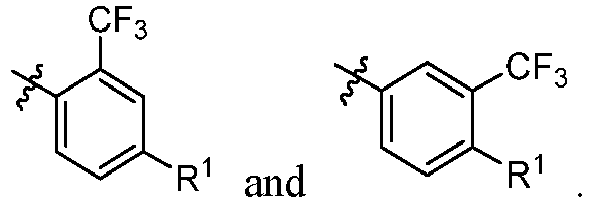
- In some embodiments, R1 is selected from the group consisting of fluorine and chlorine. In some embodiments, R1 is selected from chlorine.
- In some embodiments, R2 is selected from the group consisting of -R3 and -C1-6 alkylene-R3. In some embodiments, R2 is selected from -C1-4 alkylene-R3.
- In some embodiments, R2 is selected from -(CH2)n-R3, wherein n is 0, 1, 2, 3 or 4; or n is 1, 2 or 3; or n is 1 or 2.
- In some embodiments, R3 is selected from 5-6 membered heterocycloalkyl, wherein the 5-6 membered heterocycloalkyl is optionally substituted with one or two groups at ring N atom.
- In some embodiments, R3 is selected from 5-6 membered heterocycloalkyl, wherein the 5-6 membered heterocycloalkyl is optionally substituted with one or two groups selected from the group consisting of 3-6 membered heterocycloalkyl, C3-6 cycloalkyl, -CORa, -SO2Rb, and C1-6 alkyl optionally substituted with halogen. In some embodiments, R3 is selected from 5-6 membered heterocycloalkyl, wherein the 5-6 membered heterocycloalkyl is optionally substituted with one or two groups selected from the group consisting of 3-6 membered heterocycloalkyl, -CORa, -SO2Rb, -COOC1-6 alkyl, and C1-6 alkyl optionally substituted with halogen. In some embodiments, R3 is selected from 5-6 membered heterocycloalkyl, wherein the 5-6 membered heterocycloalkyl is optionally substituted with one or two groups selected from the group consisting of 3-6 membered heterocycloalkyl, -CORa, -SO2Rb, and C1-6 alkyl optionally substituted with halogen.
- In some embodiments, R3 is selected from 5-6 membered heterocycloalkyl, wherein the 5-6 membered heterocycloalkyl is optionally substituted with one or two groups selected from the group consisting of -CORa, -SO2Rb, -COOC1-6 alkyl, and C1-6 alkyl optionally substituted with halogen.
- In some embodiments, R3 is selected from 5-6 membered heterocycloalkyl, wherein the 5-6 membered heterocycloalkyl is optionally substituted with one or two groups selected from the group consisting of -CORa, -SO2Rb, and C1-6 alkyl optionally substituted with halogen.
- In some embodiments, R3 is selected from 5-6 membered heterocycloalkyl, wherein the 5-6 membered heterocycloalkyl is optionally substituted with 3-6 membered heterocycloalkyl.
- In some embodiments, R3 is selected from 5-6 membered heterocycloalkyl, wherein the 5-6 membered heterocycloalkyl is optionally substituted with -CORa.
- In some embodiments, R3 is selected from 5-6 membered heterocycloalkyl, wherein the 5-6 membered heterocycloalkyl is optionally substituted with -SO2Rb.
- In some embodiments, R3 is selected from 5-6 membered heterocycloalkyl, wherein the 5-6 membered heterocycloalkyl is optionally substituted with -COOC1-6 alkyl. In some embodiments, R3 is selected from 5-6 membered heterocycloalkyl, wherein the 5-6 membered heterocycloalkyl is optionally substituted with -COOC1-4 alkyl.
- In some embodiments, R3 is selected from 5-6 membered heterocycloalkyl, wherein the 5-6 membered heterocycloalkyl is optionally substituted with C1-6 alkyl, wherein the C1-6 alkyl is optionally substituted with halogen; in some embodiments, the C1-6 alkyl is optionally substituted with fluorine. In some embodiments, the 5-6 membered heterocycloalkyl is optionally substituted with methyl, ethyl, methyl substituted with fluorine, or ethyl substituted with fluorine.
- In some embodiments, Ra or Rb is each independently selected from the group consisting of H, 3-6 membered heterocycloalkyl, C3-6 cycloalkyl and C1-4 alkyl, wherein the C1-4 alkyl is optionally substituted with halogen, -CN, -N(C1-4 alkyl)2, -NHC1-4 alkyl or -OC1-4 alkyl. In some embodiments, Ra is selected from the group consisting of H, 3-6 membered heterocycloalkyl, C3-6 cycloalkyl and C1-4 alkyl, wherein the C1-4 alkyl is optionally substituted with halogen, -CN, -N(C1-4 alkyl)2 or -OC1-4 alkyl. In some embodiments, Rb is selected from the group consisting of 3-6 membered heterocycloalkyl, C3-6 cycloalkyl and C1-4 alkyl, wherein the C1-4 alkyl is optionally substituted with halogen or -CN.
- In some embodiments, Ra or Rb is each independently selected from the group consisting of H, methyl, ethyl, isopropyl, tert-butyl, cyclopropyl, cyclobutyl and monooxacyclobutyl, wherein the methyl or ethyl is optionally substituted with fluorine, -CN, -OCH3 or -N(CH3)2. In some embodiments, Ra is selected from the group consisting of H, methyl, isopropyl, tert-butyl, cyclopropyl and monooxacyclobutyl, wherein the methyl is optionally substituted with fluorine, -CN, -OCH3 or -N(CH3)2. In some embodiments, Rb is selected from the group consisting of methyl, ethyl, cyclopropyl, cyclobutyl and monooxacyclobutyl, wherein the methyl or ethyl is optionally substituted with fluorine.
- In some embodiments, Ra or Rb is each independently selected from the group consisting of H, methyl, ethyl, isopropyl, tert-butyl, trifluoromethyl, pentafluoroethyl, -CH2OCH3, -CH2CN, -CH2N(CH3)2, cyclopropyl, cyclobutyl and monooxacyclobutyl. In some embodiments, Ra is selected from the group consisting of H, methyl, isopropyl, tert-butyl, trifluoromethyl, -CH2OCH3, -CH2CN, -CH2N(CH3)2, cyclopropyl and monooxacyclobutyl. In some embodiments, Rb is selected from the group consisting of methyl, ethyl, trifluoromethyl, pentafluoroethyl, cyclopropyl, cyclobutyl and monooxacyclobutyl.
- In some embodiments, Ra or Rb is each independently selected from the group consisting of H, C3-6 cycloalkyl and C1-4 alkyl, wherein the C1-4 alkyl is optionally substituted with halogen, -CN, -N(C1-4 alkyl)2, -NHC1-4 alkyl or -OC1-4 alkyl. In some embodiments, Ra is selected from the group consisting of H, C3-6 cycloalkyl and C1-4 alkyl, wherein the C1-4 alkyl is optionally substituted with halogen, -CN, -N(C1-4 alkyl)2 or -OC1-4 alkyl. In some embodiments, Rb is selected from the group consisting of C3-6 cycloalkyl and C1-4 alkyl, wherein the C1-4 alkyl is optionally substituted with halogen or -CN.
- In some embodiments, Ra or Rb is each independently selected from the group consisting of H, methyl, ethyl, isopropyl, tert-butyl, cyclopropyl and cyclobutyl, wherein the methyl or ethyl is optionally substituted with fluorine, -CN, -OCH3 or -N(CH3)2. In some embodiments, Ra is selected from the group consisting of H, methyl, isopropyl, tert-butyl and cyclopropyl, wherein the methyl is optionally substituted with fluorine, -CN, -OCH3 or -N(CH3)2. In some embodiments, Rb is selected from the group consisting of methyl, ethyl, cyclopropyl and cyclobutyl, wherein the methyl is optionally substituted with fluorine.
- In some embodiments, Ra or Rb is each independently selected from the group consisting of H, methyl, ethyl, isopropyl, tert-butyl, trifluoromethyl, -CH2OCH3, -CH2CN, -CH2N(CH3)2, cyclopropyl and cyclobutyl. In some embodiments, Ra is selected from the group consisting of H, methyl, isopropyl, tert-butyl, trifluoromethyl, -CH2OCH3, -CH2CN, -CH2N(CH3)2 and cyclopropyl. In some embodiments, Rb is selected from the group consisting of methyl, ethyl, trifluoromethyl, cyclopropyl and cyclobutyl.
- In some embodiments, Ra or Rb is each independently selected from C1-4 alkyl optionally substituted with -OC1-4 alkyl.
- In some embodiments, Ra or Rb is each independently selected from the group consisting of methyl, isopropyl and -CH2OCH3.
- In some embodiments, Ra is selected from C1-4 alkyl optionally substituted with -OC1-4 alkyl.
- In some embodiments, Ra is selected from the group consisting of methyl, isopropyl and -CH2OCH3.
- In some embodiments, Rb is selected from C1-4 alkyl.
- In some embodiments, Rb is selected from methyl.
- In some embodiments, R3 is selected from 5-6 membered heterocycloalkyl, wherein the 5-6 membered heterocycloalkyl is optionally substituted with -C(O)H, -COCH3, -COCH(CH3)2, -COC(CH3)3, -COCF3, -COCH2CN, -COCH2OCH3, -COCH2N(CH3)2, -SO2CH3, -SO2CH2CH3, -SO2CF3, -SO2C2F5, methyl, ethyl, -CF3, -CH2CH2F, -C2F5, tetrahydropyran, monooxacyclobutane, -SO2-cyclopropane, -CO-cyclopropane, -CO-monooxacyclobutane, -SO2-monooxacyclobutane, -SO2-cyclobutane, -COOCH2CH3 or -COOCH3. In some embodiments, R3 is selected from 5-6 membered heterocycloalkyl, wherein the 5-6 membered heterocycloalkyl is optionally substituted with -COCH3, -COCH(CH3)2, -COCH2OCH3, -SO2CH3, methyl, ethyl or -CH2CH2F.
- In some embodiments, R3 is selected from 5-6 membered heterocycloalkyl, wherein the 5-6 membered heterocycloalkyl is optionally substituted with -C(O)H, -COC(CH3)3, -COCF3, -COCH2CN, -COCH2N(CH3)2, -SO2CH2CH3, -SO2CF3, -SO2C2F5, -CF3, -C2F5, tetrahydropyran, monooxacyclobutane, -SO2-cyclopropane, -CO-cyclopropane, -CO-monooxacyclobutane, -SO2-monooxacyclobutane or -SO2-cyclobutane.
- In some embodiments, R3 is selected from 5-6 membered heterocycloalkyl, wherein the 5-6 membered heterocycloalkyl is optionally substituted with -COOCH2CH3 or -COOCH3.
- In some embodiments, R3 is selected from 5-6 membered heterocycloalkyl, wherein the 5-6 membered heterocycloalkyl is optionally substituted with -C(O)H, -COCH3, -COCH(CH3)2, -COC(CH3)3, -COCF3, -COCH2CN, -COCH2OCH3, -COCH2N(CH3)2, -SO2CH3, -SO2CH2CH3, -SO2CF3, methyl, ethyl, -CH2CH2F, tetrahydropyran, -SO2-cyclopropane, -CO-cyclopropane or -SO2-cyclobutane.
- In some embodiments, R3 is selected from 5-6 membered heterocycloalkyl, wherein the 5-6 membered heterocycloalkyl is optionally substituted with -C(O)H, -COC(CH3)3, -COCF3, -COCH2CN, -COCH2N(CH3)2, -SO2CH2CH3, -SO2CF3, -SO2C2F5, -CF3, -C2F5, tetrahydropyran, -SO2-cyclopropane, -CO-cyclopropane or -SO2-cyclobutane.
- In some embodiments, R3 is selected from the group consisting of tetrahydropyran, piperidine, morpholine and dioxane, wherein the tetrahydropyran, piperidine, morpholine or dioxane is optionally substituted with -C(O)H, -COCH3, -COCH2OCH3, -SO2CH3, -SO2CH2CH3, -CO-cyclopropane, -COCH2CN, -COCF3, -COCH2N(CH3)2 or methyl.
- In some embodiments, R3 is selected from the group consisting of tetrahydropyran, piperidine, morpholine and dioxane, wherein the tetrahydropyran, piperidine, morpholine or dioxane is optionally substituted with -COCH3, -COCH(CH3)2, -COCH2OCH3, -SO2CH3, methyl, ethyl or -CH2CH2F.
- In some embodiments, R3 is selected from the group consisting of tetrahydropyran, piperidine, morpholine and dioxane, wherein the tetrahydropyran, piperidine, morpholine or dioxane is optionally substituted with -COOCH2CH3 or -COOCH3.
- In some embodiments, R3 is selected from the group consisting of tetrahydropyran and dioxane.
- In some embodiments, R3 is selected from dioxane.
- In some embodiments, R3 is selected from the group consisting of piperidine and morpholine, wherein the piperidine or morpholine is optionally substituted with -C(O)H, -COCH3, -COCH2OCH3, -SO2CH3, -SO2CH2CH3, -CO-cyclopropane, -COCH2CN, -COCF3, -COCH2N(CH3)2 or methyl. In some embodiments, R3 is selected from the group consisting of piperidine and morpholine, wherein the piperidine or morpholine is optionally substituted with -COCH3, -COCH(CH3)2, -COCH2OCH3, -SO2CH3, methyl, ethyl or -CH2CH2F.
- In some embodiments, R3 is selected from the group consisting of piperidine and morpholine, wherein the piperidine or morpholine is optionally substituted with -COOCH2CH3 or -COOCH3.
- In some embodiments, R3 is selected from the group consisting of


- In some embodiments, R3 is selected from the group consisting of


- In some embodiments, R3 is selected from the group consisting of


- In some embodiments, R3 is selected from the group consisting of

- In some embodiments, R3 is selected from the group consisting of


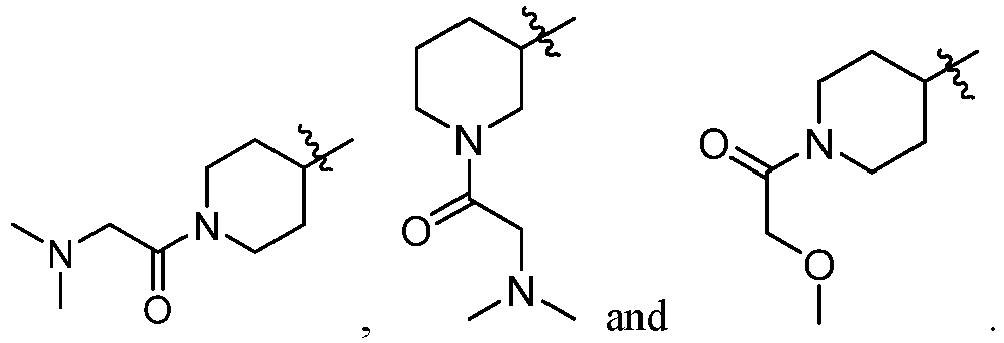
- In some embodiments, R3 is selected from the group consisting of


- In some embodiments, R3 is selected from the group consisting of

- In some embodiments, R3 is selected from the group consisting of


- In some embodiments, R3 is selected from the group consisting of

- In some embodiments, R3 is selected from the group consisting of


- In some embodiments, R3 is selected from the group consisting of


- In some embodiments, the heteroatom in the 5-6 membered heterocycloalkyl is selected from the group consisting of N and O, and the number of the heteroatom is 1 or 2.
- In some embodiments, the 5-6 membered heterocycloalkyl is selected from the group consisting of dioxanyl, morpholinyl, tetrahydropyranyl, piperidinyl and tetrahydrofuranyl.
- In some embodiments, the 5-6 membered heterocycloalkyl is selected from 6 membered heterocycloalkyl.
- In some embodiments, the 5-6 membered heterocycloalkyl is selected from the group consisting of dioxanyl, morpholinyl, tetrahydropyranyl and piperidinyl.
- In some embodiments, the 5-6 membered heterocycloalkyl is selected from dioxanyl.
- In some embodiments, the 5-6 membered heterocycloalkyl is selected from morpholinyl.
- In some embodiments, the 5-6 membered heterocycloalkyl is selected from tetrahydropyranyl.
- In some embodiments, the heteroatom in the 3-6 membered heterocycloalkyl is selected from the group consisting of N and O, and the number of the heteroatom is 1 or 2. In some embodiments, the heteroatom in the 3-6 membered heterocycloalkyl is selected from O, and the number of the heteroatom is 1 or 2. In some embodiments, the 3-6 membered heterocycloalkyl is selected from 4-6 membered heterocycloalkyl. In some embodiments, the 3-6 membered heterocycloalkyl is selected from the group consisting of 4-membered heterocycloalkyl and 6-membered heterocycloalkyl.
- In some embodiments, the 3-6 membered heterocycloalkyl is selected from the group consisting of monooxacyclobutyl, tetrahydrofuranyl and tetrahydropyranyl.
- In some embodiments, the C3-6 cycloalkyl is selected from the group consisting of cyclopropyl, cyclobutyl and cyclopentyl. In some embodiments, the C3-6 cycloalkyl is selected from C3-4 cycloalkyl.
- In another aspect, the present application relates to a compound of formula II, a stereoisomer thereof or a pharmaceutically acceptable salt thereof:

- The present application relates to a compound of a formula selected from the group consisting of the following formulas, a stereoisomer thereof or a pharmaceutically acceptable salt thereof:
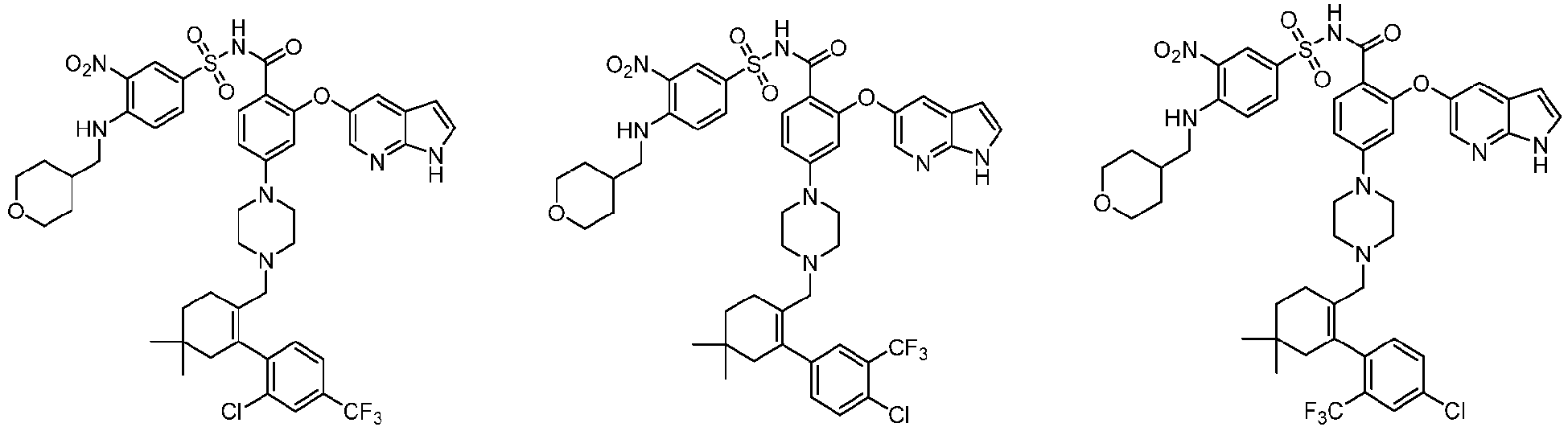


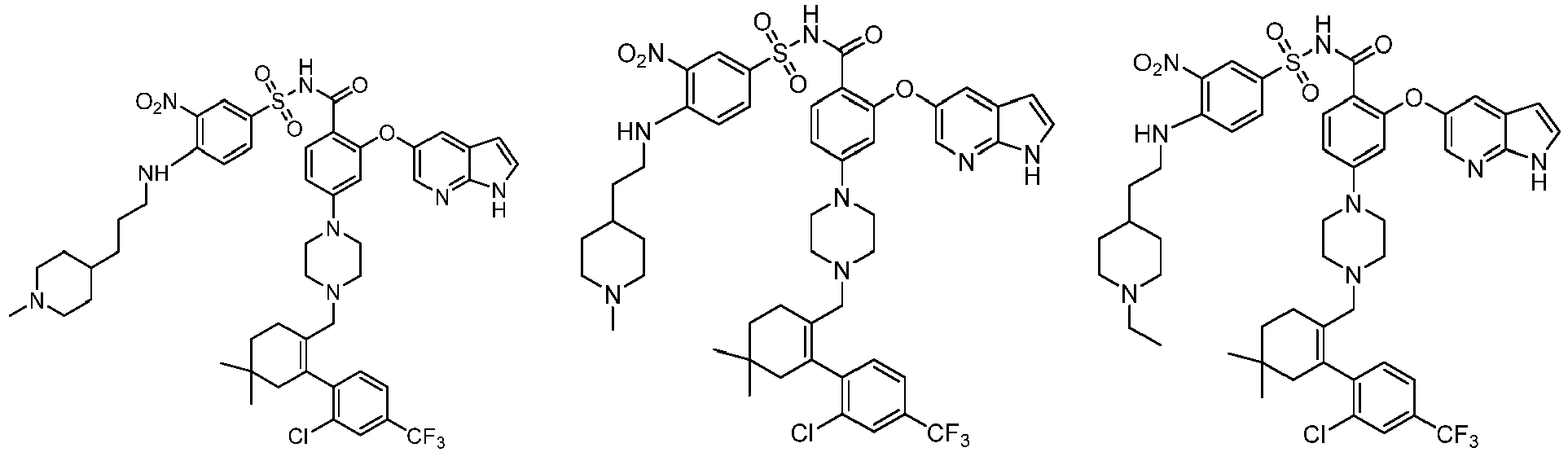


- The present application relates to a compound of a formula selected from the group consisting of the following formulas or a pharmaceutically acceptable salt thereof:


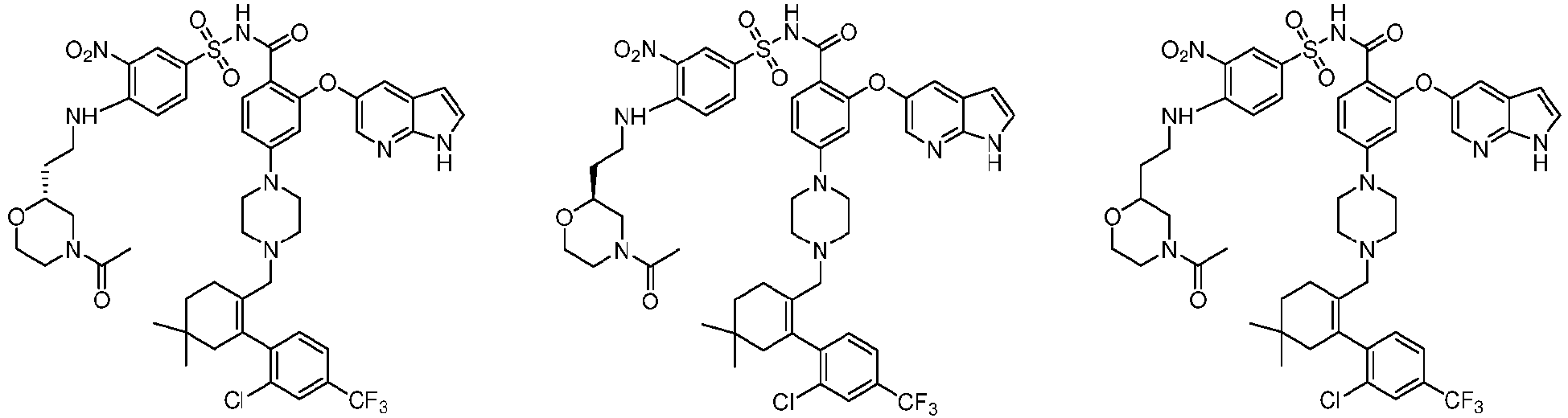

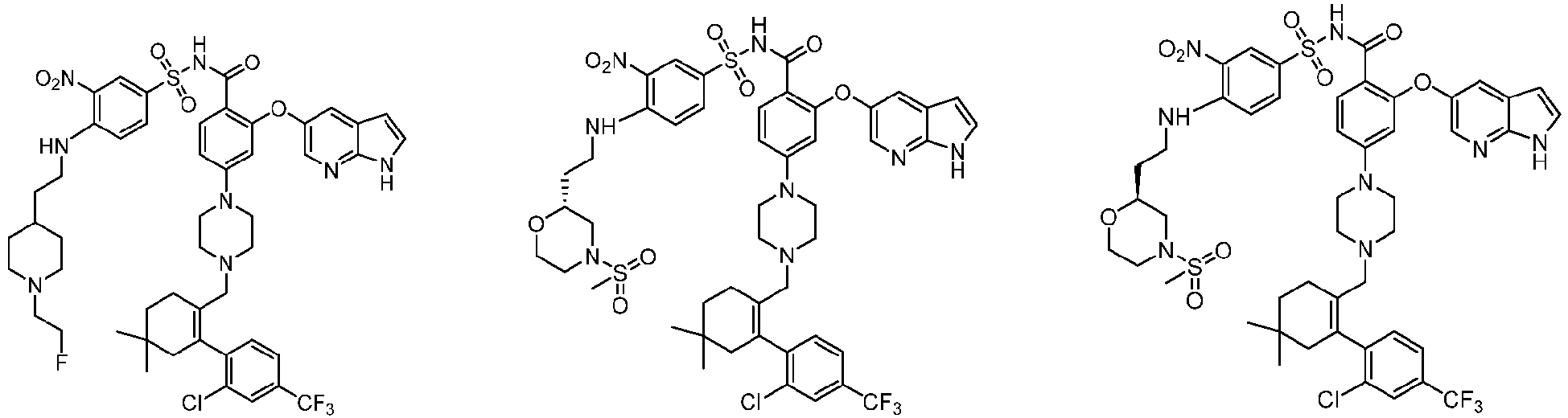


- In another aspect, the present application relates to a pharmaceutical composition comprising the compound of formula I, the compound of formula II or a specific compound, the stereoisomer thereof or the pharmaceutically acceptable salt thereof disclosed herein. In some embodiments, the pharmaceutical composition disclosed herein further comprises a pharmaceutically acceptable excipient.
- In another aspect, the present application describes a method for treating an anti-apoptotic protein BCL-2-related disease in a mammal, comprising administering to a mammal (preferably a human) in need of such treatment a therapeutically effective amount of the compound of formula I, the compound of formula II or a specific compound, the stereoisomer thereof or the pharmaceutically acceptable salt thereof, or the pharmaceutical composition thereof.
- In another aspect, the present application describes use of the compound of formula I, the compound of formula II or a specific compound, the stereoisomer thereof or the pharmaceutically acceptable salt thereof, or the pharmaceutical composition thereof in preparing a medicament for preventing or treating an anti-apoptotic protein BCL-2-related disease.
- In another aspect, the present application describes use of the compound of formula I, the compound of formula II or a specific compound, the stereoisomer thereof or the pharmaceutically acceptable salt thereof, or the pharmaceutical composition thereof in preventing or treating an anti-apoptotic protein BCL-2-related disease.
- In another aspect, the present application describes the compound of formula I, the compound of formula II or a specific compound, the stereoisomer thereof or the pharmaceutically acceptable salt thereof, or the pharmaceutical composition thereof for use in preventing or treating an anti-apoptotic protein BCL-2-related disease.
- The anti-apoptotic protein BCL-2-related disease is selected from cancer. The cancer is selected from acute lymphocytic leukemia.
- Unless otherwise stated, the following terms used in the present application shall have the following meanings. A specific term, unless otherwise specifically defined, should not be considered uncertain or unclear, but construed according to its common meaning in the field. When referring to a trade name, it is intended to refer to its corresponding commercial product or its active ingredient.
- The term "substituted" means that any one or more hydrogen atoms on a specific atom are substituted with substituents, as long as the valence of the specific atom is normal and the resulting compound is stable. When the substituent is oxo (namely =O), it means that two hydrogen atoms are substituted, and oxo is not available on an aromatic group.
- The terms "optional" or "optionally" means that the subsequently described event or circumstance may, but not necessarily, occur. The description includes instances where the event or circumstance occurs and instances where the event or circumstance does not. For example, an ethyl being "optionally" substituted with halogen means that the ethyl may be unsubstituted (-CH2CH3), monosubstituted (for example, -CH2CH2F), polysubstituted (for example, -CHFCH2F, -CH2CHF2 and the like) or fully substituted (-CF2CF3). It will be understood by those skilled in the art that for any group comprising one or more substituents, no substitution or substituting pattern that is spatially impossible to exist or cannot be synthesized will be introduced.
- Cm-n used herein means that the moiety has an integer number of carbon atoms in the given range. For example, "C1-6" means that the group may have 1 carbon atom, 2 carbon atoms, 3 carbon atoms, 4 carbon atoms, 5 carbon atoms or 6 carbon atoms.
- The term "halo" or "halogen" refers to fluorine, chlorine, bromine and iodine.
- The term "alkyl" refers to hydrocarbyl with a general formula of CnH2n+1. The alkyl may be linear or branched. For example, the term "C1-6 alkyl" refers to alkyl containing 1-6 carbon atoms (for example, methyl, ethyl, n-propyl, isopropyl, n-butyl, isobutyl, sec-butyl, tert-butyl, n-pentyl, 1-methylbutyl, 2-methylbutyl, 3-methylbutyl, neopentyl, hexyl, 2-methylpentyl, etc.). The alkyl moieties (namely alkyl) of alkoxy, alkylamino, dialkylamino, alkylsulfonyl and alkylthio are similarly defined as above. For another example, the term "C1-4 alkyl" refers to alkyl containing 1-4 carbon atoms (for example, methyl, ethyl, n-propyl, isopropyl, n-butyl, isobutyl, sec-butyl, tert-butyl, etc.).
- The term "alkylene" refers to a divalent group formed by the removal of 1 hydrogen at any position of alkyl. For example, non-limiting examples of the term "C0-6 alkylene" include, but are not limited to, methylene, ethylidene, methylmethylene, dimethylmethylene, 1,3-propylidene and the like. C0 represents a bond.
- The term "cycloalkyl" refers to a carbon ring that is fully saturated and may exist as a monocyclic, bridged cyclic or spiro structure. Unless otherwise specified, the carbon ring is generally a 3-10 membered ring. Non-limiting examples of cycloalkyl include, but are not limited to, cyclopropyl, cyclobutyl, cyclopentyl, cyclohexyl, norbornyl(bicyclo[2.2.1]heptyl), bicyclo[2.2.2]octyl, adamantyl and the like.
- The term "heterocycloalkyl" refers to a cyclic group that is fully saturated and may exist as a monocyclic, bridged cyclic or spiro structure. Unless otherwise specified, the heterocyclyl is generally a 3-7 membered ring containing 1-3 heteroatoms (preferably 1 or 2 heteroatoms) independently selected from the group consisting of sulfur, oxygen and/or nitrogen. Examples of 3 membered heterocycloalkyl include, but are not limited to, oxiranyl, thiiranyl, and aziranyl. Non-limiting examples of 4 membered heterocycloalkyl include, but are not limited to, azetidinyl, oxetanyl, and thietanyl. Examples of 5 membered heterocycloalkyl include, but are not limited to, tetrahydrofuranyl, tetrahydrothienyl, pyrrolidinyl, isoxazolidinyl, oxazolidinyl, isothiazolidinyl, thiazolidinyl, imidazolidinyl, and tetrahydropyrazolyl. Examples of 6 membered heterocycloalkyl include, but are not limited to, piperidinyl, tetrahydropyranyl, tetrahydrothiopyranyl, morpholinyl, piperazinyl, 1,4-oxathianyl, 1,4-dioxanyl, thiomorpholinyl, 1,3-dithianyl, and 1,4-dithianyl. Examples of 7 membered heterocycloalkyl include, but are not limited to, azacycloheptanyl, oxacycloheptanyl and thiocycloheptanyl. Preferably, the heterocycloalkyl is a monocyclic heterocycloalkyl having 5 or 6 ring atoms.
- The term "treat" or "treatment" means administering the compound or formulation disclosed herein to prevent, ameliorate or eliminate a disease or one or more symptoms associated with the disease, and includes:
- (i) preventing the occurrence of a disease or disease state in a mammal, particularly when such a mammal is predisposed to the disease state but has not yet been diagnosed as having it;
- (ii) inhibiting a disease or disease state, i.e., arresting its development; and
- (iii) alleviating a disease or disease state, i.e., causing its regression.
- The term "therapeutically effective amount" refers to an amount of the compound disclosed herein for (i) treating or preventing a specific disease, condition or disorder; (ii) alleviating, ameliorating or eliminating one or more symptoms of a specific disease, condition or disorder, or (iii) preventing or delaying onset of one or more symptoms of a specific disease, condition or disorder described herein. The amount of the compound disclosed herein that is considered as the "therapeutically effective amount" varies dependently on the compound, the disease state and its severity, the administration regimen, and the age of the mammal to be treated, but can be determined routinely by those skilled in the art in accordance with their knowledge and the present disclosure.
- The term "pharmaceutically acceptable" means that those compounds, materials, compositions, and/or dosage forms are, within the scope of sound medical judgment, suitable for use in contact with the tissues of human beings and animals without excessive toxicity, irritation, allergic response, or other problems or complications, and commensurate with a reasonable benefit/risk ratio.
- A pharmaceutically acceptable salt, for example, may be a metal salt, an ammonium salt, a salt formed with an organic base, a salt formed with an inorganic acid, a salt formed with an organic acid, a salt formed with a basic or acidic amino acid, and the like.
- The term "pharmaceutical composition" refers to a mixture consisting of one or more of the compounds or pharmaceutically acceptable salts thereof disclosed herein and a pharmaceutically acceptable excipient. The pharmaceutical composition is intended to facilitate the administration of the compound to an organic entity.
- The term "pharmaceutically acceptable excipient" refers to those excipients which do not have a significant irritating effect on an organic entity and do not impair the biological activity and properties of the active compound. Suitable excipients are well known to those skilled in the art, for example carbohydrate, wax, water-soluble and/or water-swellable polymers, hydrophilic or hydrophobic material, gelatin, oil, solvent, or water.
- The word "comprise" and variations thereof such as "comprises" or "comprising" will be understood in an open, non-exclusive sense, i.e., "including but not limited to".
- The compounds and intermediates disclosed herein may also exist in different tautomeric forms, and all such forms are included within the scope of the present application. The term "tautomer" or "tautomeric form" refers to structural isomers of different energies that can interconvert via a low energy barrier. For example, a proton tautomer (also referred to as prototropic tautomer) includes interconversion via proton transfer, such as keto-enol isomerization and imine-enamine isomerization. A specific example of a proton tautomer is an imidazole moiety where a proton can transfer between two ring nitrogens. A valence tautomer includes the interconversion via recombination of some bonding electrons.
- The present application also comprises isotopically-labeled compounds which are identical to those recited herein but have one or more atoms replaced by an atom having an atomic mass or mass number different from the atomic mass or mass number usually found in nature. Examples of isotopes that can be incorporated into the compounds disclosed herein include isotopes of hydrogen, carbon, nitrogen, oxygen, phosphorus, sulfur, fluorine, iodine, and chlorine, such as 2H, 3H, 11C, 13C, 14C, 13N, 15N, 15O, 17O, 18O, 31P, 32P, 35S, 18F, 123I, 125I and 36Cl.
- Certain isotopically-labeled compounds disclosed herein (e.g., those labeled with 3H and 14C) can be used to analyze compounds and/or substrate tissue distribution. Tritiated (i.e., 3H) and carbon-14 (i.e., 14C) isotopes are particularly preferred for their ease of preparation and detectability. Positron emitting isotopes, such as 15O, 13N, 11C, and 18F can be used in positron emission tomography (PET) studies to determine substrate occupancy. Isotopically-labeled compounds disclosed herein can generally be prepared by following procedures analogous to those disclosed in the schemes and/or examples below while substituting a non-isotopically labeled reagent with an isotopically-labeled reagent.
- Furthermore, substitution with heavier isotopes such as deuterium (i.e., 2H) may provide certain therapeutic advantages (e.g., increased in vivo half-life or reduced dosage requirement) resulting from greater metabolic stability and hence may be preferred in some circumstances in which deuterium substitution may be partial or complete, wherein partial deuterium substitution refers to substitution of at least one hydrogen with at least one deuterium.
- The compound disclosed herein can be asymmetrical, for example, has one or more stereoisomers. Unless otherwise stated, all stereoisomers are included in the present application, such as enantiomers and diastereoisomers. The compound containing asymetrical carbon atoms disclosed herein can be separated in an optically pure form or in a racemic form. The optically pure form can be separated from a racemic mixture or can be synthesized using a chiral raw material or a chiral reagent.
- The pharmaceutical composition disclosed herein can be prepared by combining the compound disclosed herein with a suitable pharmaceutically acceptable excipient, and can be formulated, for example, into a solid, semisolid, liquid, or gaseous formulation such as tablet, pill, capsule, powder, granule, ointment, emulsion, suspension, suppository, injection, inhalant, gel, microsphere, aerosol, and the like.
- Typical routes of administration of the compound or the pharmaceutically acceptable salt thereof or the pharmaceutical composition thereof disclosed herein include, but are not limited to, oral, rectal, local, inhalation, parenteral, sublingual, intravaginal, intranasal, intraocular, intraperitoneal, intramuscular, subcutaneous and intravenous administration.
- The pharmaceutical composition disclosed herein can be manufactured by methods well known in the art, such as by conventional mixing, dissolving, granulating, dragee-making, levigating, emulsifying, lyophilizing, and the like.
- In some embodiments, the pharmaceutical composition is in an oral form. For oral administration, the pharmaceutical composition can be formulated by mixing the active compounds with pharmaceutically acceptable excipients well known in the art. These excipients enable the compounds disclosed herein to be formulated into tablets, pills, pastilles, dragees, capsules, liquids, gels, slurries, suspensions and the like for oral administration to a patient.
- A solid oral composition can be prepared by conventional mixing, filling or tableting. For example, it can be obtained by the following method: mixing the active compounds with solid excipients, optionally grinding the resulting mixture, adding additional suitable excipients if desired, and processing the mixture into granules to get the core parts of tablets or dragees. Suitable excipients include, but are not limited to: binders, diluents, disintegrants, lubricants, glidants, sweeteners or flavoring agents and the like.
- The pharmaceutical compositions may also be suitable for parenteral administration, such as sterile solutions, suspensions or lyophilized products in suitable unit dosage forms.
- In all of the administration methods of the compound of formula I described herein, the daily dosage administered is from 0.01 mg/kg to 200 mg/kg body weight, given in individual or separated dosages.
- The compounds disclosed herein can be prepared by a variety of synthetic methods well known to those skilled in the art, including the specific embodiments listed below, embodiments formed by combinations thereof with other chemical synthetic methods, and equivalents thereof known to those skilled in the art. The preferred embodiments include, but are not limited to, the examples disclosed herein. The chemical reactions of the embodiments disclosed herein are carried out in a suitable solvent that must be suitable for the chemical changes in the present application and the reagents and materials required therefor. In order to acquire the compounds disclosed herein, it is sometimes necessary for one skilled in the art to modify or select a synthesis procedure or a reaction scheme based on the existing embodiments.
- An important consideration in synthesis route planning in the art is the selection of suitable protecting groups for reactive functional groups (e.g., hydroxyl in the present application). For example, reference may be made to
- Greene's Protective Groups in Organic Synthesis (4th Ed.) Hoboken, New Jersey: John Wiley & Sons, Inc.
- In some embodiments, the compound of formula I disclosed herein can be prepared by one skilled in the art of organic synthesis through the following routes:
- Route 1:

- Route 2:


- In above routes, R1, R2 or
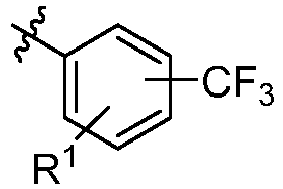
- The present application also provides a method for preparing a compound of formula A-4, comprising:

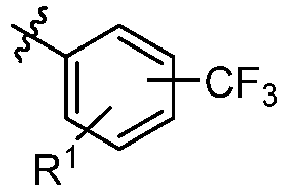
- The present application also provides a method for preparing a compound of formula A-3, comprising:


- The present application also provides a method for preparing a compound of formula A-2, comprising:

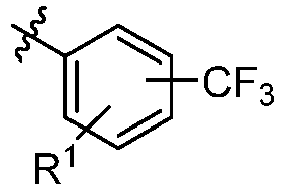
- The present application also provides a method for preparing a compound of formula A-5, comprising:


- The present application also provides a method for preparing a compound of formula I, comprising:


- The present application also provides intermediate compounds of the following formulas or salts thereof:


- In more specific embodiments, the compounds are each selected from the group consisting of the compounds of the following formulas or salts thereof:


- Abbreviation: DMF represents N,N-dimethylformamide; Boc represents tert-butyloxycarbonyl; NaOAc represents sodium acetate; tBu represents tert-butyl; TBS represents tert-butyldimethylsilyl; THF represents tetrahydrofuran; and DMSO represents dimethyl sulfoxide.
- For clarity, the present application is further described with the following examples, which are, however, not intended to limit the scope of the present application. All reagents used are commercially available and can be used without further purification.
-


- To a solution of DMF (173.7 g) in dichloromethane (460 mL) was added phosphorus oxychloride dropwise at 0 °C. After the addition, the mixture was heated to 20 °C and stirred for 1 h, then cooled to 0 °C and added with 3,3-dimethylcyclohexanone (1-a) (200 g) dropwise. After the addition, the mixture was heated to reflux overnight. The reaction solution was added to a solution containing NaOAc (86.7 g), NaCl (80 g), water (1.2 L) and dichloromethane (600 mL) dropwise while stirring. The resulting mixture was stirred at room temperature for 20 min, followed by liquid separation. The aqueous phase was extracted with dichloromethane (500 mL). The organic phases were combined, washed once with a solution of K3PO4 (40 g) and NaCl (90 g) in water (1 L), dried over anhydrous sodium sulfate, filtered and concentrated to give compound 1-b (249 g).
- Compound 1-b (5.36 g), tetrakis(triphenylphosphine)palladium (0.18 g), K3PO4 (16.5 g), DMF (60 mL) and water (60 mL) were mixed, and the mixture was stirred for 10 min. Then 2-chloro-4-trifluoromethylphenylboronic acid (6.96 g) was added and the mixture was reacted at 100 °C for 6 h under N2 atmosphere until the reaction was completed. The reaction solution was added with a solution of 5 wt% NaHCO3 and 2 wt% L-cysteine in water (30 mL) and ethyl acetate (50 mL), stirred for 0.5 h and filtered, followed by liquid separation. The aqueous phase was extracted with ethyl acetate (60 mL × 2). The organic phases were combined, washed with saturated aqueous NaCl solution, dried over anhydrous Na2SO4, filtered, concentrated, and subjected to column chromatography to give compound 1-c (2 g).
- Tert-butyl 2-[(1H-pyrrolo[2,3-b]pyridin-5-yl)oxy]-4-bromobenzoate (compound 1-d) (77.8 g), Boc-piperazine (55.8 g), tris(dibenzylideneacetone)dipalladium (9 g), [(4-(N,N-dimethylamino)phenyl]di-tert-butylphosphine (5.2 g), sodium tert-butoxide (96.1 g), toluene (800 mL) and tetrahydrofuran (300 mL) were mixed and the mixture was stirred, heated to 60 °C and reacted for 24 h under nitrogen atmosphere. The reaction solution was washed successively with a solution of L-cysteine (100 g) and NaHCO3 (150 g) in water (1.5 L) (750 mL × 2), and then washed with saturated aqueous NaCl solution, dried over anhydrous Na2SO4, filtered and concentrated to give compound 1-e (40 g). ESI-MS: m/z = 495.4 [M+H]+.
- Compound 1-e (40 g), tetrahydrofuran (800 mL), ethanol (270 mL) and water (15 mL) were mixed, and the mixture was stirred. Then KOH (45.3 g) was added, and the mixture was heated to 80 °C and stirred under reflux for 8 h until the reaction was completed. The reaction solution was added with water (500 mL), stirred, adjusted to pH 5-6 with diluted hydrochloric acid, filtered, slurried with water (1 L) (500 mL × 2) and dried to give compound 1-f (35 g).
- Compound 1-f (35 g) and dichloromethane (100 mL) were mixed and the mixture was stirred at room temperature. Then 4-dimethylaminopyridine (38.5 g) and 1-ethyl-(3-dimethylaminopropyl) carbodiimide hydrochloride (65.8 g) were added and dissolved by stirring, and the solution was added with 3-nitro-4-[[(tetrahydropyran-4-yl)methyl]amino]benzenesulfonamide (compound 1-g) (25.2 g) and reacted at room temperature for 3 h. The reaction solution was washed successively with 5 wt% hydrochloric acid, saturated aqueous sodium bicarbonate solution and saturated aqueous sodium chloride solution, dried over anhydrous Na2SO4, filtered and concentrated. The concentrate was added with dichloromethane (200 mL), stirred at room temperature for 2 h, filtered and dried to give compound 1-h (40 g).
- Compound 1-h was added to isopropanol (500 mL), and the mixture was stirred. Then concentrated HCl (50 mL) was added, and the mixture was heated to 65 °C and stirred for 8 h until the reaction was completed. The reaction mixture was filtered, and the filter cake was dissolved in water (300 mL), added dropwise with saturated sodium bicarbonate to adjust the pH to 6-7, filtered and dried. The resulting solid was slurried with ethyl acetate (200 mL), filtered and dried to give compound 1-i (27 g).
- Compound 1-c (1 g) and compound 1-i (2 g) were dissolved in methanol (20 mL), and the solution was stirred. Then sodium borohydride (0.24 g) was added, and the mixture was stirred for 6 h until the reaction was completed. The reaction solution was added with saturated aqueous ammonium chloride solution (10 mL) to quench the reaction, extracted with ethyl acetate (20 mL × 2), washed with saturated aqueous sodium chloride solution, dried over anhydrous Na2SO4 and filtered. The filtrate was concentrated and subjected to column chromatography to give compound 1-1 (200 mg).
- Compound 1-1: 1H NMR (500MHz, DMSO-d6), δ: 11.72(s, 1H), 11.68(s, 1H), 8.62(m, 1H), 8.58(d, 1H), 8.04(d, 1H), 7.83(s, 1H), 7.81(dd, 1H), 7.70(d, 1H), 7.54(m, 3H), 7.40(d, 1H), 7.12(d, 1H), 6.74(d, 1H), 6.40(s, 1H), 6.29(s, 1H), 3.87(m, 4H), 3.55(d, 2H), 3.37(d, 2H), 3.32(m, 4H), 2.27(d, 1H), 2.19(m, 1H), 2.09(s, 1H), 1.96(s, 2H), 1.89(m, 1H), 1.63(d, 2H), 1.50(m, 2H), 1.28(m, 4H), 0.98(d, 6H).
13C NMR (125MHz, DMSO-d6),δ: 163.9, 158.8, 153.9, 147.9, 142.9, 132.5, 130.1, 128.3, 125.6, 124.7, 120.3, 118.4, 115.5, 114.1, 109.6, 103.4, 100.4, 67.0, 58.3, 50.9, 48. 4, 46.9, 44.1, 34.6, 30.6, 29.1, 25.2. ESI-MS: m/z = 936.5 [M+H]+. -

- Compound 1-b (5.16 g), tetrakis(triphenylphosphine)palladium (0.17 g), K3PO4 (12.74 g), DMF (60 mL), and water (60 mL) were mixed, and the mixture was stirred for 10 min. Then 3-trifluoromethyl-4-chlorobenzeneboronic acid (6.72 g) was added, and the mixture was reacted at 100 °C for 6 h under N2 atmosphere until the reaction was completed. The reaction solution was added with a solution of 5 wt% NaHCO3 and 2 wt% L-cysteine in water (30 mL) and ethyl acetate (50 mL), stirred for 0.5 h and filtered, followed by liquid separation. The aqueous phase was extracted with ethyl acetate (60 mL × 2). The organic phases were combined, washed with saturated aqueous NaCl solution, dried over anhydrous Na2SO4, filtered, concentrated, and subjected to column chromatography to give compound 2-c (1.2 g).
- Compound 2-c (1 g) and compound 1-i (2.01 g) were dissolved in methanol (20 mL), and the solution was stirred. Then sodium borohydride (0.27 g) was added, and the mixture was stirred for 6 h until the reaction was completed. The reaction solution was added with saturated aqueous ammonium chloride solution (10 mL) to quench the reaction, extracted with ethyl acetate (20 mL × 2), washed with saturated aqueous sodium chloride solution, dried over anhydrous Na2SO4 and filtered. The filtrate was concentrated and subjected to column chromatography to give compound 2-1 (80 mg).
- Compound 2-1: 1H NMR (500MHz, DMSO-d6), δ: 11.72(s, 1H), 11.66(s, 1H), 8.61(m, 1H), 8.57(d, 1H), 8.04(d, 1H), 7.81(dd, 1H), 7.67(d, 1H), 7.54(m, 4H), 7.40(d, 1H), 7.12(d, 1H), 6.74(d, 1H), 6.40(s, 1H), 6.29(s, 1H), 3.87(m, 4H), 3.55(d, 2H), 3.32(m, 6H), 3.01 (s, 2H) 2.21(d, 2H), 1.98(m, 2H), 1.87(m, 1H), 1.60(d, 2H), 1.45(m, 2H), 1.28(m, 4H), 0.98(d, 6H).
13C NMR (125MHz, DMSO-d6),δ: 163.9, 158.7, 158.4, 158.2, 153.9, 147.9, 146.8, 145.9, 141.5, 135.6, 134.3, 134.2, 132.5, 132.4, 130.1, 130.0, 129.8, 128.3, 127.6, 127.4, 124.7, 122.1, 120.2, 118.4, 115.5, 114.0, 109.5, 103.4, 100.4, 67.0, 58.3, 50.8, 48.4, 46.7, 44.3, 34.6, 34.3, 30.6, 29.2, 28.3, 25.2, 14.4. ESI-MS: m/z = 936.5 [M+H]+. -

- Compound 1-b (5.16 g), tetrakis(triphenylphosphine)palladium (0.17 g), K3PO4 (12.74 g), DMF (60 mL), and water (60 mL) were mixed, and the mixture was stirred for 10 min. Then 2-trifluoromethyl-4-chlorobenzeneboronic acid (6.72 g) was added, and the mixture was reacted at 100 °C for 6 h under N2 atmosphere until the reaction was completed. The reaction solution was added with a solution of 5 wt% NaHCO3 and 2 wt% L-cysteine in water (30 mL) and ethyl acetate (50 mL), stirred for 0.5 h and filtered, followed by liquid separation. The aqueous phase was extracted with ethyl acetate (60 mL × 2). The organic phases were combined, washed with saturated aqueous NaCl solution, dried over anhydrous Na2SO4, filtered, concentrated, and subjected to column chromatography to give compound 3-c (1.6 g).
- Compound 3-c (1 g) and compound 1-i (2.01 g) were dissolved in methanol (20 mL), and the solution was stirred. Then sodium borohydride (0.27 g) was added, and the mixture was stirred for 6 h until the reaction was completed. The reaction solution was added with saturated aqueous ammonium chloride solution (10 mL) to quench the reaction, extracted with ethyl acetate (20 mL × 2), washed with saturated aqueous sodium chloride solution, dried over anhydrous Na2SO4 and filtered. The filtrate was concentrated and subjected to column chromatography to give compound 3-1 (110 mg).
- Compound 3-1: 1H NMR (500MHz, DMSO-d6), δ: 11.73(s, 1H), 11.67(s, 1H), 8.61(m, 1H), 8.58(d, 1H), 8.05(d, 1H), 7.79(m, 2H), 7.71(d, 1H), 7.52(m, 3H), 7.29(d, 1H), 7.13(d, 1H), 6.74(d, 1H), 6.41(s, 1H), 6.26(s, 1H), 3.84(d, 2H), 3.61(d, 2H), 3.18(m, 4H), 3.05(s, 3H), 2.31(d, 1H), 1.89(m, 5H), 1.61(d, 2H), 1.51(m, 1H), 1.41(m, 1H), 1.24(d, 6H), 0.91(m,6H).
13C NMR (125MHz, DMSO-d6),δ: 163.9, 158.8, 158.5, 158.2, 153.9, 147.9, 146.7,145.9, 139.1, 135.6, 134.3, 133.4, 133.1, 133.0, 132.6, 130.0, 128.3, 126.7, 124.7, 120.3, 118.5, 115.5, 114.1, 109.6, 103.3, 100.4, 67.0, 58.7, 48.4, 46.8, 44.3, 34.5, 34.3, 30.6, 29.4, 29.0, 28.9, 27.5, 27.0, 24.6, 22.5. ESI-MS: m/z = 936.5 [M+H]+. -

- Compound 1-b (5.16 g), tetrakis(triphenylphosphine)palladium (0.17 g), K3PO4 (12.74 g), DMF (60 mL) and water (60 mL) were mixed, and the mixture was stirred for 10 min. Then 3-chloro-4-trifluoromethylphenylboronic acid (6.72 g) was added and the mixture was reacted at 100 °C for 6 h under N2 atmosphere until the reaction was completed. The reaction solution was added with a solution of 5 wt% NaHCO3 and 2 wt% L-cysteine in water (30 mL) and ethyl acetate (50 mL), stirred for 0.5 h and filtered, followed by liquid separation. The aqueous phase was extracted with ethyl acetate (60 mL × 2). The organic phases were combined, washed with saturated aqueous NaCl solution, dried over anhydrous Na2SO4, filtered, concentrated, and subjected to column chromatography to give compound 4-c (1.5 g).
- Compound 4-c (1 g) and compound 1-i (2.01 g) were dissolved in methanol (20 mL), and the solution was stirred. Then sodium borohydride (0.27 g) was added, and the mixture was stirred for 6 h until the reaction was completed. The reaction solution was added with saturated aqueous ammonium chloride solution (10 mL) to quench the reaction, extracted with ethyl acetate (20 mL × 2), washed with saturated aqueous sodium chloride solution, dried over anhydrous Na2SO4 and filtered. The filtrate was concentrated and subjected to column chromatography to give compound 4-1 (120 mg).
- Compound 4-1: 1H NMR (500MHz, DMSO-d6), δ: 11.71(s, 1H), 11.62(s, 1H), 8.61(m, 1H), 8.57(d, 1H), 8.04(d, 1H), 7.79(m, 2H), 7.50(m, 3H), 7.43(s, 1H), 7.23(d, 1H), 7.12(d, 1H), 6.71(dd, 1H), 6.39(m, 1H), 6.25(d, 1H), 3.84(dd, 2H), 3.29(m, 4H), 3.24(m, 2H), 2.21(d, 3H), 2.03(d, 3H), 1.88(m, 1H), 1.60(m, 2H), 1.43(m, 3H), 1.22(m, 4H), 0.94(d, 9H).
13C NMR (125MHz, DMSO-d6),δ: 163.9, 158.8, 158.6, 158.3, 154.1, 147.9, 146.8, 145.9, 135.7, 134.7, 134.3, 132.5, 131.4, 130.0, 128.3, 127.8, 125.7, 124.7, 124.5, 120.2, 118.4, 115.5, 114.0, 109.5, 103.3, 100.4, 67.0, 64.6, 51.0, 48.4, 46.4, 45.2, 44.6, 34.6, 34.3, 30.6, 29.3, 29.1, 28.2, 28.1, 25.2, 24.8. ESI-MS: m/z = 936.5 [M+H]+. -

- Compound 1-b (5.16 g), tetrakis(triphenylphosphine)palladium (0.17 g), K3PO4 (12.74 g), DMF (60 mL) and water (60 mL) were mixed and the mixture was stirred for 10 min. Then 2-fluoro-4-trifluoromethylphenylboronic acid (6.24 g) was added, and the mixture was reacted at 100 °C for 6 h under N2 atmosphere until the reaction was completed. The reaction solution was added with a solution of 5 wt% NaHCO3 and 2 wt% L-cysteine in water (30 mL) and ethyl acetate (50 mL), stirred for 0.5 h and filtered, followed by liquid separation. The aqueous phase was extracted with ethyl acetate (60 mL × 2). The organic phases were combined, washed with saturated aqueous NaCl solution, dried over anhydrous Na2SO4, filtered, concentrated, and subjected to column chromatography to give compound 5-c (1.8 g).
- Compound 5-c (1 g) and compound 1-i (2.12 g) were dissolved in methanol (20 mL), and the solution was stirred. Then sodium borohydride (0.27 g) was added, and the mixture was stirred for 6 h until the reaction was completed. The reaction solution was added with saturated aqueous ammonium chloride solution (10 mL) to quench the reaction, extracted with ethyl acetate (20 mL × 2), washed with saturated aqueous sodium chloride solution, dried over anhydrous Na2SO4 and filtered. The filtrate was concentrated and subjected to column chromatography to give compound 5-1 (90 mg).
- Compound 5-1: 1H NMR (500MHz, DMSO-d6), δ: 11.71(s, 2H), 8.61(m, 1H), 8.57(d, 1H), 8.03(d, 1H), 7.80(dd, 1H), 7.66(d, 1H), 7.56(d, 1H), 7.51(dd, 3H), 7.35(m, 1H), 7.12(d, 1H), 6.73(dd, 1H), 6.39(m, 1H), 6.29(d, 1H), 3.84(m, 3H), 3.55(d, 5H), 3.24(d, 6H), 2.25(s, 2H), 1.98(m, 2H),1.88(m, 1H), 1.60(d, 2H), 1.47(m, 2H), 1.24(m, 4H), 0.95(d, 6H).
13C NMR (125MHz, DMSO-d6),δ: 163.9, 159.6, 158.7, 158.5, 158.1, 157.7, 154.0, 147.9, 146.9, 145.9, 135.6, 134.3, 133.2, 132.5, 132.1, 130.0, 128.3, 124.9, 124.7, 122.7, 122.1, 120.2, 118.2, 115.5, 114.1, 109.6, 103.5, 100.4, 67.0, 58.6, 50.8, 48.4, 45.7, 44.3, 34.5, 34.3, 30.6, 29.1, 28.6, 27.6, 25.1. ESI-MS: m/z = 920.6 [M+H]+. -

- Compound 1-b (5.16 g), tetrakis(triphenylphosphine)palladium (0.17 g), K3PO4 (12.74 g), DMF (60 mL) and water (60 mL) were mixed and the mixture was stirred for 10 min. Then 3-fluoro-4-trifluoromethylphenylboronic acid (6.24 g) was added, and the mixture was reacted at 100 °C for 6 h under N2 atmosphere until the reaction was completed. The reaction solution was added with a solution of 5 wt% NaHCO3 and 2 wt% L-cysteine in water (30 mL) and ethyl acetate (50 mL), stirred for 0.5 h and filtered, followed by liquid separation. The aqueous phase was extracted with ethyl acetate (60 mL × 2). The organic phases were combined, washed with saturated aqueous NaCl solution, dried over anhydrous Na2SO4, filtered, concentrated, and subjected to column chromatography to give compound 6-c (1.6 g).
- Compound 6-c (1 g) and compound 1-i (2.12 g) were dissolved in methanol (20 mL), and the solution was stirred. Then sodium borohydride (0.27 g) was added, and the mixture was stirred for 6 h until the reaction was completed. The reaction solution was added with saturated aqueous ammonium chloride solution (10 mL) to quench the reaction, extracted with ethyl acetate (20 mL × 2), washed with saturated aqueous sodium chloride solution, dried over anhydrous Na2SO4 and filtered. The filtrate was concentrated and subjected to column chromatography to give compound 6-1 (150 mg).
- Compound 6-1: 1H NMR (500MHz, DMSO-d6), δ: 11.72(s, 1H), 11.67(s, 1H), 8.61(m, 1H), 8.57(d, 1H), 8.04(d, 1H), 7.81(dd, 1H), 7.72(m, 1H), 7.52(dd, 3H), 7.24(d, 1H), 7.09(m, 2H), 6.72(dd, 1H), 6.39(m, 1H), 6.27(d, 1H), 3.87(m, 4H), 3.55(d, 2H), 3.37(d, 2H), 3.32(m, 4H), 2.27(d, 1H), 2.19(m, 2H), 2.09(s, 1H), 1.96(s, 2H), 1.89(m, 1H), 1.63(d, 2H), 1.50(m, 2H), 1.28(m, 4H), 0.98(d, 6H).
13C NMR (125MHz, DMSO-d6),δ: 163.9, 158.8, 158.5, 158.2, 154.0, 149.2, 147.9, 146.8, 145.9, 135.6, 134.3, 132.5, 132.4, 130.1, 130.0, 128.3, 128.1, 125.1, 120.3, 118.4, 117.6, 117.2, 117.1, 115.5, 115.3, 109.6, 103.4, 100.4, 67.0, 58.3, 50.9, 48.4, 46.4, 44.3, 34.5, 34.3, 31.7, 30.6, 29.0, 28.2, 25.5, 25.1. ESI-MS: m/z = 920.6 [M+H]+. -
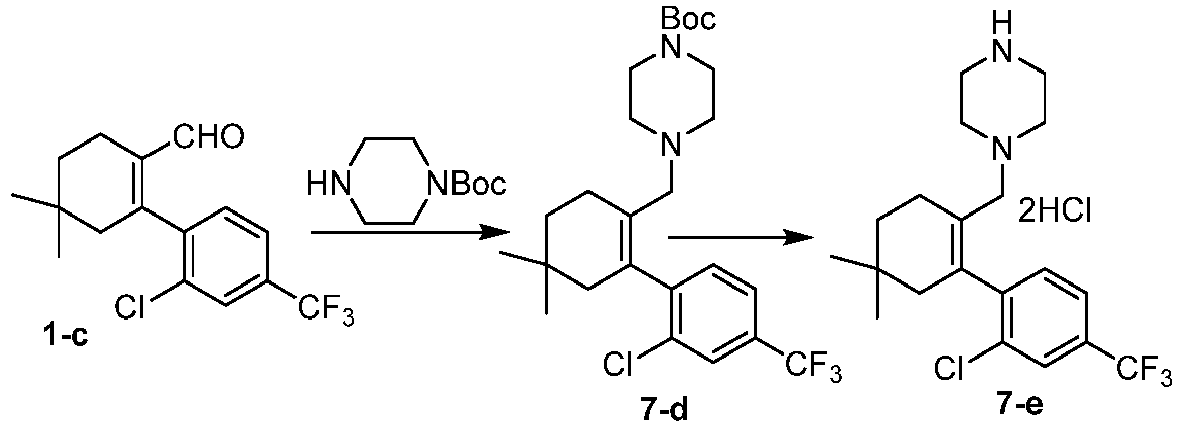

- Compound 1-c (198.6 g) and 1-Boc-piperazine (175.5 g) were dissolved in acetonitrile (800 mL), and the solution was stirred and cooled to 0 °C. Then sodium triacetoxyborohydride (532.6 g) was slowly added, and the mixture was stirred at room temperature for 5 h. After the reaction was completed, the reaction solution was extracted with water (1 L) and ethyl acetate (300 mL). The organic phase was collected, dried over anhydrous Na2SO4, filtered and concentrated to give compound 7-d (269.8 g).
- Compound 7-d (269.8 g), isopropanol (800 mL) and hydrochloric acid (36-38 wt%, 169 mL) were mixed, and the mixture was heated to 65 °C and reacted for 3 h. The reaction solution was cooled to precipitate a solid, filtered and dried to give compound 7-e (151.2 g).
- Compound 7-e: 1H NMR (500MHz, DMSO-d6), δ: 7.82(s, 1H), 7.68(d, 1H), 7.36(d, 1H), 7.10(dd, 1H), 2.98(s, 4H), 2.63(d, 2H), 2.23(m, 6H), 1.89(m, 2H), 1.43(s, 2H), 0.94(s, 6H).
13C NMR (125MHz, DMSO-d6), δ: 133.1, 132.6, 131.9, 130.9, 129.3, 128.6, 126.5, 125.7, 124.9, 124.6, 122.7, 60.2, 49.4, 44.7, 35.2, 29.4, 28.4, 27.1, 25.2, 21.4. ESI-MS: m/z = 387.1 [M+H]+. - NaH (21.1 g) was dissolved in THF (100 mL), and the solution was cooled to -20 °C and stirred for 10 min. Tert-butyl 2-[(1H-pyrrolo[2,3-b]pyridin-5-yl)oxy]-4-bromobenzoate (compound 1-d, 128.3 g) was dissolved in THF (200 mL), and then was slowly added dropwise to the reaction solution, with the internal temperature maintained below 0 °C. After the addition, the mixture was stirred for 30 min. The reaction solution was added dropwise with a solution of TBSCl (64.7 g) in THF (200 mL), with the internal temperature maintained at about -10 °C, and reacted for 30 min after the addition. After the reaction was completed, the reaction solution was extracted with 500 mL of saturated sodium bicarbonate and ethyl acetate. The organic phase was collected, dried over anhydrous Na2SO4, filtered, concentrated and purified by column chromatography to give compound 7-f (150 g). ESI-MS: m/z = 503.1 [M+H]+.
- Compound 7-e (151.2 g), tert-butyl 2-[(1-tert-butyldimethylsilylpyrrolo[2,3-b]pyridin-5-yl)oxy]-4-bromobenzoate (compound 7-f, 197.1 g), tris(dibenzylideneacetone)dipalladium (2.7 g), [(4-(N,N-dimethylamino)phenyl]di-tert-butylphosphine (1.6 g), sodium tert-butoxide (187.4 g) and toluene (800 mL) were mixed, and the mixture was stirred, heated to 100 °C and reacted for 24 h under nitrogen atmosphere. After the reaction was completed, the reaction solution was extracted with water (1 L) and ethyl acetate (300 mL). The organic phase was collected, dried over anhydrous Na2SO4, filtered and concentrated to give compound 7-g (181.9 g).
- Compound 7-g: 1H NMR (500MHz, DMSO-d6), δ: 7.95(s, 1H), 7.82(s, 1H), 7.65(t, 2H), 7.37(m, 4H), 6.76(d, 1H), 6.47(s, 1H), 3.14(s, 2H), 2.64(d, 1H), 2.55(d, 1H), 2.19(m, 5H), 1.92(m, 2H), 1.42(t, 2H),1.31(t, 2H), 1.22(m, 9H),0.95(d, 6H), 0.84(s, 10H), 0.60(s, 6H).
13C NMR (125MHz, DMSO-d6), δ: 164.4 156.8, 155.1, 150.3, 149.8, 146.2, 133.6, 133.4, 133.2, 132.0, 131.9, 131.5, 129.5, 129.0, 128.8, 126.4, 126.1, 124.4, 122.8, 114.4, 113.8, 110.2, 106.8, 103.3, 80.1, 60.6, 52.6, 47.1, 44.7, 35.2, 29.4, 27.9, 27.2, 26.7, 25.4, 19.0. ESI-MS: m/z = 809.4 [M+H]+ - A mixture of compound 7-g (181.9 g), toluene (1.8 L) and trifluoroacetic acid (107 mL) was heated to 45 °C and reacted for 5 h. The reaction solution was concentrated, added with ethyl acetate (1.5 L), washed with saturated aqueous NaHCO3 solution and saturated aqueous sodium chloride solution, dried over anhydrous sodium sulfate, filtered and concentrated. The concentrate was added with toluene (1 L) and ethyl acetate (200 mL), heated to dissolved clarification, cooled to precipitate a solid, filtered and dried to give compound 7-h (83.4 g).
- Compound 7-h: 1H NMR (500MHz, DMSO-d6), δ: 7.98(s, 1H), 7.82(s, 1H), 7.73(d, 1H), 7.64(d, 1H), 7.46(s, 1H), 7.40(s, 1H), 7.32(d, 1H), 6.73(d, 1H), 6.36(d, 1H), 6.34(s, 1H), 3.09(s, 4H), 2.64(d, 1H), 2.55(d, 1H), 2.19(m, 6H), 1.88(m, 2H), 1.42(m, 2H), 1.25(m, 2H), 0.95(m, 6H).
13C NMR (125MHz, DMSO-d6), δ: 166.3, 158.9, 155.1, 148.9, 146.2, 145.3, 135.0, 133.8, 133.2, 132.0, 131.9, 131.4, 129.5, 129.2, 127.8, 126.4, 124.9, 124.4, 122.7, 120.2, 116.6, 112.0, 109.5, 105.3, 100.2, 60.5, 55.3, 52.7, 47.0, 44.7, 35.2, 29.4, 27.2, 25.4. ESI-MS: m/z = 639.2 [M+H]+. - 3-nitro-4-chlorobenzenesulfonamide (0.64 g), (R)-(1,4-dioxan)-2-methylamine hydrochloride (0.5 g) and N,N-diisopropylethylamine (1.58 g) were dissolved in acetonitrile (10 mL), and the solution was heated to 85 °C and reacted for 6.5 h. The reaction solution was cooled at room temperature, left to stand overnight, and filtered to give compound 7-k (0.65 g). ESI-MS: m/z = 316.2 [M-H]-.
- Compound 7-h (1 g) and dichloromethane (10 mL) were mixed, and the mixture was stirred at room temperature. Then 4-dimethylaminopyridine (0.28 g) and 1-ethyl-(3-dimethylaminopropyl)carbodiimide hydrochloride (0.44 g) were added and dissolved with stirring. The resulting mixture was added with compound 7-k (0.5 g) and triethylamine (0.44 g), and reacted at room temperature for 3 h. The reaction solution was washed successively with 5 wt% hydrochloric acid, saturated aqueous sodium bicarbonate solution and saturated aqueous sodium chloride solution, dried over anhydrous Na2SO4, filtered, concentrated, and purified by column chromatography to give compound 7-1 (0.8 g).
- Compound 7-1: 1H NMR(500 MHz, DMSO-d6), δ: 11.66 (s, 1H), 11.37 (s, 1H), 8.59 (t, 1H), 8.57 (d, 1H), 8.05 (d, 1H), 7.88 (d, 1H), 7.83 (dd, 1H), 7.70 (d, 1H), 7.53 (d, 1H), 7.52 (m, 2H), 7.40 (m, 1H), 7.12 (d, 1H), 6.75 (dd, 1H), 6.40 (dd, 1H), 6.30 (d, 1H), 3.80 (m, 3H), 3.62 (m, 2H), 3.51 (m, 2H), 3.42 (m, 2H), 3.03 (m, 4H), 2.67 (d, 1H), 2.54 (d, 1H), 2.17 (m, 6H), 1.88 (dd, 2H), 1.42 (t, 2H), 0.97 (s, 6H).
13C NMR (125MHz, DMSO-d6), δ: 164.0, 159.2, 159.0, 158.7, 158.4, 158.2, 154.0, 147.8, 146.9, 145.8, 144.2, 139.0, 135.5, 134.3, 132.8, 132.6, 131.7, 130.1, 130.0, 128.3, 128.2, 127.0, 125.1, 124.9, 124.4, 122.75, 120.3, 118.3, 117.5, 115.7, 115.2, 114.2, 122.8, 109.7, 103.6, 100.4, 58.5, 45.2, 44.3, 43.8, 34.6, 29.2, 29.1, 27.1, 24.8. ESI-MS: m/z =938.5 [M+H]+. -

- 3-nitro-4-fluorobenzenesulfonamide (3.58 g), (S)-2-(aminomethyl)-1,4-dioxane hydrochloride (3.0 g) and N,N-diisopropylethylamine (9.47 g) were dissolved in acetonitrile (50 mL), and the solution was heated to 85 °C and reacted for 5 h. The reaction solution was cooled at room temperature, left to stand overnight, and filtered under vacuum to give compound 8-k (4.70 g). ESI-MS: m/z = 316.1 [M-H]-.
- Compound 8-1 was obtained by reference to the preparation method for compound 7-1 in step 6) of Example 7, with compound 7-k being replaced by compound 8-k.
- Compound 8-1: 1H NMR(500 MHz, DMSO-d6), δ: 11.66 (s, 1H), 11.37 (s, 1H), 8.59 (t, 1H), 8.57 (d, 1H), 8.04 (d, 1H), 7.89 (d, 1H), 7.84 (dd, 1H), 7.70 (d, 1H), 7.54 (d, 1H), 7.52 (m, 2H), 7.40 (m, 1H), 7.11 (d, 1H), 6.75 (dd, 1H), 6.40 (dd, 1H), 6.29 (d, 1H), 3.79 (m, 3H), 3.65 (m, 2H), 3.51 (m, 2H), 3.42 (m, 2H), 3.03 (m, 4H), 2.67 (d, 1H), 2.54 (d, 1H), 2.17 (m, 6H), 1.88 (dd, 2H), 1.42 (t, 2H), 0.96 (s, 6H).
13C NMR (125 MHz, DMSO-d6), δ: 164.0, 158.2, 154.0, 147.9, 146.9, 145.9, 144.3, 135.6, 134.3, 132.9, 132.6, 131.8, 130.2, 130.0, 128.3, 128.2, 127.0, 125.2, 125.0, 122.8, 120.3, 118.3, 115.7, 114.1, 109.7, 103.6, 100.4, 73.4, 68.5, 66.4, 66.2, 58.6, 45.1, 44.4, 43.9, 34.6, 29.3, 29.1, 27.2, 24.8. ESI-MS: m/z = 939.4 [M+H]+. -

- 3-nitro-4-fluorobenzenesulfonamide (0.56 g), [(4-acetylmorpholin-2-yl)methyl]amine (0.48 g) and N,N-diisopropylethylamine (0.65 g) were dissolved in acetonitrile (10 mL), and the solution was heated to 85 °C and reacted for 5 h. The reaction solution was cooled at room temperature, left to stand overnight, and filtered under vacuum to give compound 9-k (1.2 g). ESI-MS: m/z = 359.0 [M+H]+.
- Compound 9-1 was obtained by reference to the preparation method for compound 7-1 in step 6) of Example 7, with compound 7-k being replaced by compound 9-k.
- Compound 9-1: 1H NMR(500 MHz, DMSO-d6), δ: 11.71(s, 2H), 8.63 (t, 1H), 8.57 (d, 1H), 8.04 (d, 1H), 7.89 (s, 1H), 7.84 (dd, 1H), 7.70 (d, 1H), 7.53 (d, 3H), 7.39 (m, 1H), 7.15 (d, 1H), 6.75 (d, 1H), 6.40 (s, 1H), 6.30 (s, 1H), 3.87(m, 3H), 3.68 (m, 2H), 3.60 (m, 3H), 3.48 (m, 2H), 3.40 (m, 2H), 3.30 (m, 2H), 3.18 (m, 1H), 3.02 (m, 2H), 2.29 (m, 1H), 2.19(m, 1H), 1.96 (d, 2H), 1.49 (t, 2H), 1.24 (m, 1H), 0.97 (s, 9H).
13C NMR (125 MHz, DMSO-d6), δ: 169.1, 164.0, 158.9, 158.6, 158.2, 154.0, 147.9, 146.9, 145.9, 144.2, 135.5, 134.3, 132.8, 132.6, 131.7, 130.2, 128.3, 128.2, 127.0, 125.2, 124.9, 122.8, 120.3, 118.3, 117.4, 115.8, 115.1, 114.2, 109.7, 103.6, 100.4, 73.8, 66.4, 58.5, 48.5, 46.0, 45.1, 44.9, 44.3, 43.8, 34.6, 29.3, 29.1, 27.2, 24.8, 21.6, 21.6.ESI-MS: m/z =979.3 [M+H]+. -

- 3-nitro-4-fluorobenzenesulfonamide (1.48 g), [(4-isobutyrylmorpholin-2-yl)methyl]amine (1.5 g) and N,N-diisopropylethylamine (2.2 g) were dissolved in acetonitrile (10 mL), and the solution was heated to 85 °C and reacted for 5 h. The reaction solution was cooled at room temperature, left to stand overnight, and filtered under vacuum to give compound 10-k (1.8 g). ESI-MS: m/z = 387.0 [M+H]+.
- Compound 10-1 was obtained by reference to the preparation method for compound 7-1 in step 6) of Example 7, with compound 7-k being replaced by compound 10-k.
- Compound 10-1: 1H NMR(500 MHz, DMSO-d6), δ: 11.71 (s, 2H), 8.64 (t, 1H), 8.58 (s, 1H), 8.04 (d, 1H), 7.89 (s, 1H), 7.84 (t, 1H), 7.70 (d, 1H), 7.53 (d, 3H), 7.40 (d, 1H), 7.16 (t, 1H), 6.75 (d, 1H), 6.40 (s, 1H), 6.30 (s, 1H), 4.36 (m, 1H), 3.86 (m, 2H), 3.58 (m, 4H), 3.47 (t, 2H), 3.39 (m, 2H), 3.19 (m, 1H), 3.02 (m, 2H), 2.87 (m, 2H), 2.71 (m, 1H), 2.57 (m, 1H), 2.29 (m, 1H), 2.20 (m, 1H), 1.96 (s, 2H), 1.49 (m, 2H), 1.24 (m, 1H), 0.97 (s, 12H). 13C NMR (125 MHz, DMSO-d6), δ: 175.2, 164.0, 158.8, 158.6, 158.2, 154.0, 147.9, 146.9, 145.9, 144.2, 135.6, 134.3, 132.8, 132.6, 131.8, 130.2, 130.0, 128.3, 128.2, 127.0, 125.2, 124.9, 122.8, 120.3, 118.3, 117.9, 115.8, 115.6, 114.1, 109.7, 103.6, 100.4, 74.2, 74.0, 66.6, 58.5, 47.8, 45.2, 45.1, 44.3, 44.1, 34.6, 29.5, 29.3, 29.1, 27.2, 24.8, 20.0, 19.5.ESI-MS: m/z =1007.3 [M+H]+.
-

- 3-nitro-4-fluorobenzenesulfonamide (0.36 g), (R)-2-(aminomethyl)-4-methoxyacetylmorpholine hydrochloride (0.45 g) and N,N-diisopropylethylamine (0.97 g) were dissolved in acetonitrile (20 mL), and the solution was heated to 85 °C and reacted for 5 h. The reaction solution was cooled at room temperature, left to stand overnight, and filtered under vacuum to give compound 11-k (0.39 g). ESI-MS: m/z = 387.1 [M-H]-.
- Compound 11-1 was obtained by reference to the preparation method for compound 7-1 in step 6) of Example 7, with compound 7-k being replaced by compound 11-k.
- Compound 11-1: 1H NMR(500 MHz, DMSO-d6), δ:11.72 (s, 2H), 8.64 (m, 1H), 8.57 (d, 1H), 8.04 (d, 1H), 7.89 (d, 1H), 7.84 (dd, 1H), 7.70 (d, 1H), 7.54 (d, 1H), 7.52 (m, 2H), 7.38 (m, 1H), 7.21 (d, 1H), 6.75 (dd, 1H), 6.38 (dd, 1H), 6.29 (d, 1H), 3.47 (m, 3H), 3.42 (m, 1H), 3.27 (m, 5H), 2.27 (m, 3H), 2.21 (m, 1H), 2.01 (m, 2H), 1.98 (d, 2H), 1.48 (t, 3H), 1.24 (m, 7H), 0.97 (s, 9H).
ESI-MS: m/z = 1010.4 [M+H]+. -
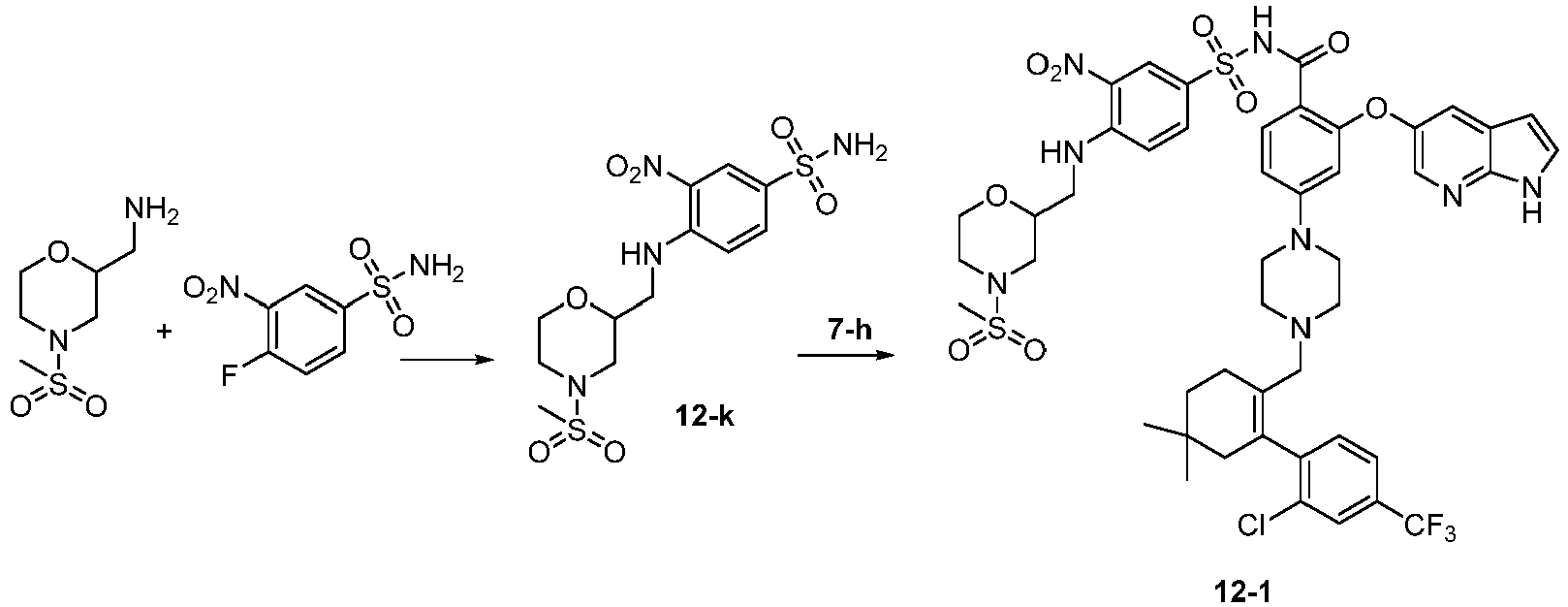
- Compound 12-1 was obtained by reference to the preparation method for compound 7-1 in step 6) of Example 7, with compound 7-k being replaced by compound 12-k.
- Compound 12-1: 1H NMR(500 MHz, DMSO-d6), δ: 11.71 (s, 2H), 8.64 (t, 1H), 8.58 (d, 1H), 8.05 (d, 1H), 7.89 (s, 1H), 7.84 (d, 1H), 7.70 (d, 1H), 7.54 (d, 3H), 7.39 (d, 1H), 7.17 (d, 1H), 6.75 (d, 1H), 6.40 (s, 1H), 6.30 (s, 1H), 3.99 (d, 1H), 3.79 (d, 2H), 3.63 (m, 5H), 3.50 (m, 1H), 3.38 (m, 3H), 2.92 (s, 3H), 2.86 (m, 2H), 2.70 (m, 2H), 2.29 (m, 1H), 2.19 (m, 1H), 1.96 (s, 3H), 1.50 (m, 2H), 1.24 (m, 1H), 0.97 (s, 6H).
13C NMR (125 MHz, DMSO-d6), δ: 164.0, 158.9, 158.6, 158.3, 154.0, 147.8, 146.9, 145.9, 144.2, 139.0, 135.6, 134.3, 132.8, 132.6, 131.8, 130.3, 128.3, 128.2, 127.0, 125.2, 124.4, 122.8, 120.3, 118.3, 117.6, 115.8, 115.2, 114.1, 109.7, 103.6, 100.4, 73.7, 66.0, 58.5, 47.8, 45.4, 45.2, 45.0, 44.3, 34.6, 34.3, 29.3, 29.3, 29.1, 27.2, 24.8. ESI-MS: m/z =1015.3 [M+H]+. -
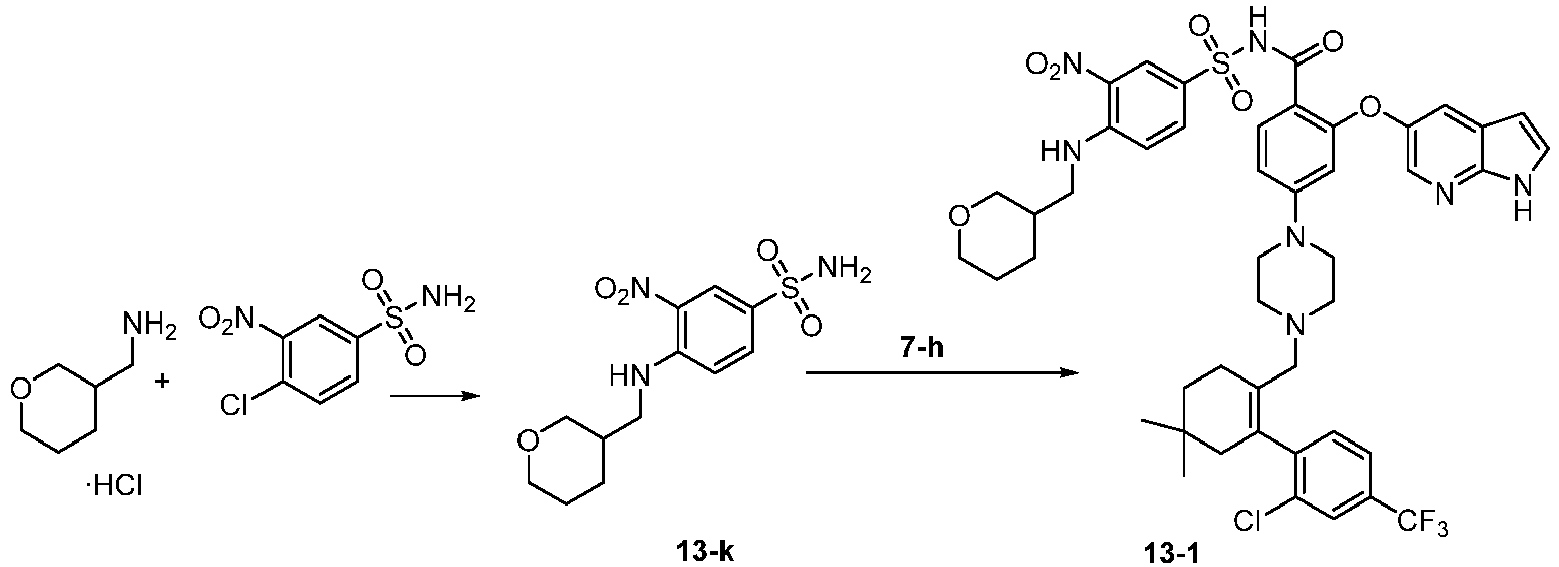
- 3-nitro-4-chlorobenzenesulfonamide (1.0 g), 3-aminomethyl tetrahydropyran hydrochloride (0.77 g) and N,N-diisopropylethylamine (2.18 g) were dissolved in acetonitrile (20 mL), and the solution was heated to 85 °C and reacted for 5 h. The reaction solution was cooled at room temperature, left to stand overnight, and filtered under vacuum to give compound 13-k (1.3 g). ESI-MS: m/z = 314.1 [M-H]-.
- Compound 13-1 was obtained by reference to the preparation method for compound 7-1 in step 6) of Example 7, with compound 7-k being replaced by compound 13-k.
- Compound 13-1: 1H NMR(500 MHz, DMSO-d6), δ: 11.71 (s, 1H), 11.69 (s, 1H), 8.59 (t, 1H), 8.57 (d, 1H), 8.05 (d, 1H), 7.88 (d, 1H), 7.82 (dd, 1H), 7.70 (d, 1H), 7.55 (d, 1H), 7.52 (m, 2H), 7.39 (m, 1H), 7.10 (d, 1H), 6.75 (dd, 1H), 6.40 (dd, 1H), 6.30 (d, 1H), 3.79 (m, 1H), 3.72 (m, 2H), 3.59 (m, 1H), 3.33 (m, 5H), 3.18 (m, 2H), 3.05 (m, 4H), 2.28 (m, 1H), 2.20 (m, 1H), 2.08 (m, 1H), 1.96 (d, 3H), 1.62 (m, 1H), 1.49 (t, 3H), 1.24 (m, 2H), 0.97 (s, 6H).
13C NMR (125 MHz, DMSO-d6), δ: 158.2, 154.0, 147.8, 146.9, 145.9, 144.2, 139.0, 135.6, 134.3, 132.8, 132.6, 131.7, 130.2, 130.1, 130.0, 128.3, 127.0, 124.9, 124.8, 124.4, 122.8, 120.3, 118.3, 117.6, 115.5, 115.3, 114.2, 109.7, 103.6, 100.4, 70.5, 68.0, 58.5, 45.1, 44.9, 44.3, 35.3, 34.6, 29.3, 29.1, 27.2, 27.1, 25.0, 24.8.
ESI-MS: m/z = 937.4 [M+H]+. -

- 3-nitro-4-chlorobenzenesulfonamide (1.2 g), 2-aminomethyl tetrahydropyran (0.7 g) and N,N-diisopropylethylamine (1.64 g) were dissolved in acetonitrile (10 mL), and the solution was heated to 85 °C and reacted for 8 h. The reaction solution was cooled at room temperature, left to stand overnight, and filtered under vacuum to give compound 14-k (1.92 g). ESI-MS: m/z = 316.0 [M+H]+.
- Compound 14-1 was obtained by reference to the preparation method for compound 7-1 in step 6) of Example 7, with compound 7-k being replaced by compound 14-k.
- Compound 14-1: 1H NMR(500 MHz, DMSO-d6), δ: 11.72 (s, 2H), 8.62 (t, 1H), 8.57 (d, 1H), 8.05 (d, 1H), 7.89 (s, 1H), 7.83 (d, 1H), 7.70 (d, 1H), 7.54 (d, 3H), 7.39 (d, 1H), 7.11 (d, 1H), 6.75 (d, 1H), 6.40 (s, 1H), 6.30 (s, 1H), 3.92 (d, 1H), 3.56 (t, 2H), 3.48 (m, 1H), 3.37 (m, 5H), 2.85 (m, 4H), 2.23 (m, 1H), 2.20 (m, 1H), 1.96 (s, 2H), 1.80 (m, 1H), 1.65 (d, 1H), 1.50 (m, 5H), 1.28 (m, 2H), 0.97 (d, 6H).
13C NMR (125 MHz, DMSO-d6), δ: 164.0, 158.9, 158.6, 158.2, 154.0, 147.9, 146.9, 145.9, 144.2, 139.0, 135.6, 134.3, 132.8, 132.6, 131.8, 130.2, 130.0, 128.3, 128.2, 127.0, 125.0, 124.4, 122.8, 120.3, 118.3, 115.8, 114.2, 109.7, 103.6, 100.4, 75.6, 68.0, 58.5, 47.9, 45.2, 44.3, 34.6, 29.3, 29.2, 29.1, 27.2, 26.0, 24.8, 22.9.
ESI-MS: m/z =936.4 [M+H]+. -

- Compound 15-1 was obtained by reference to the preparation method for compound 7-1 in step 6) of Example 7, with compound 7-k being replaced by compound 15-k.
- Compound 15-1: 1H NMR(500 MHz, DMSO-d6), δ: 11.72 (d, 2H), 8.64 (t, 1H), 8.58 (s, 1H), 8.05 (s, 1H), 7.89 (s, 1H), 7.84 (d, 1H), 7.70 (d, 1H), 7.54 (t, 3H), 7.39 (d, 1H), 7.15 (d, 1H), 6.75 (d, 1H), 6.41 (s, 1H), 6.29 (s, 1H), 3.54 (d, 2H), 3.36 (m, 6H), 2.85 (s, 4H), 2.76 (t, 2H), 2.59 (t, 1H), 2.29 (m, 1H), 2.19 (m, 1H), 1.96 (s, 4H), 1.79 (m, 2H), 1.49 (m, 4H), 1.24 (m, 3H), 0.97 (d, 6H).
13C NMR (125 MHz, DMSO-d6), δ: 164.0, 158.8, 158.2, 154.0, 147.8, 146.9, 145.9, 144.2, 135.6, 134.4, 132.8, 132.6, 131.8, 130.2, 128.3, 127.0, 125.0, 122.8, 120.3, 118.3, 115.6, 114.1, 109.7, 103.5, 100.4, 58.5, 49.3, 46.4, 45.7, 45.2, 44.4, 35.0, 34.6, 34.5, 29.3, 29.1, 27.4, 27.2, 24.8, 24.1.
ESI-MS: m/z =1013.3 [M+H]+. -

- 3-nitro-4-fluorobenzenesulfonamide (2.13 g), 2-aminoethyl-4-acetylmorpholine (2 g) and N,N-diisopropylethylamine (3.13 g) were dissolved in acetonitrile (10 mL), and the solution was heated to 85 °C and reacted for 6 h. The reaction solution was cooled at room temperature, left to stand overnight, and filtered under vacuum to give compound 16-k (3.40 g). ESI-MS: m/z = 373.1 [M+H]+.
- Compound 16-1 was obtained by reference to the preparation method for compound 7-1 in step 6) of Example 7, with compound 7-k being replaced by compound 16-k.
- Compound 16-1: 1H NMR(500 MHz, DMSO-d6), δ: 11.70(s, 2H), 8.78(s, 1H), 8.57(s, 1H), 8.04(s, 1H), 7.82(m, 2H), 7.69(d, 1H), 7.52(s, 1H), 7.44(m, 2H), 7.38(d, 1H), 7.23(m, 1H), 6.75(d, 1H), 6.39(s, 1H), 6.29(s, 1H), 4.87(m, 2H), 3.89(d, 2H), 3.43(m, 8H), 3.03(m, 4H), 2.90(m, 2H), 2.67(m, 2H), 2.20(m, 4H), 1.96(m, 3H), 1.47(m, 2H), 1.24(m, 1H), 0.96(s, 6H).
13C NMR (125 MHz, DMSO-d6), δ: 168.9, 163.9, 163.5, 153.9, 147.6, 145.9, 135.5, 134.4, 133.2, 132.8, 131.7, 130.1, 129.6, 128.3, 127.5, 124.9, 120.2, 115.2, 109.3, 100.4, 74.3, 66.6, 66.4, 58.5, 49.8, 50.4, 45.7, 45.3, 44.2, 41.2, 34.6, 31.6, 31.4, 29.3, 29.1, 27.2, 24.8, 21.6. ESI-MS: m/z =993.3 [M+H]+. -

- 3-nitro-4-fluorobenzenesulfonamide (2.34 g), 4-aminopropyl-1-methylpiperidine (2 g) and N,N-diisopropylethylamine (3.56 g) were dissolved in acetonitrile (10 mL), and the solution was heated to 85 °C and reacted for 6 h. The reaction solution was cooled at room temperature, left to stand overnight, and filtered under vacuum to give compound 17-k (3.56 g). ESI-MS: m/z = 357.2 [M+H]+.
- Compound 17-1 was obtained by reference to the preparation method for compound 7-1 in step 6) of Example 7, with compound 7-k being replaced by compound 17-k.
- Compound 17-1: 1H NMR(500 MHz, DMSO-d6), δ: 11.54 (s, 2H), 8.43 (s, 1H), 8.30 (t, 1H), 8.19 (s, 1H), 7.94 (s, 1H), 7.82 (s, 1H), 7.67 (t, 2H), 7.58 (d, 1H), 7.33 (m, 2H), 6.82 (d, 1H), 6.63 (d, 1H), 6.31 (s, 1H), 6.24 (s, 1H), 3.34 (m, 3H), 2.98 (m, 6H), 2.75 (t, 2H), 2.65 (d, 1H), 2.54 (s, 1H), 2.20 (m, 6H), 1.90 (t, 4H), 1.56 (s, 3H), 1.35 (m, 4H), 1.23 (s, 1H), 1.17 (t, 3H), 0.96 (d, 6H).
13C NMR (125 MHz, DMSO-d6), δ: 169.2, 164.0, 156.9, 153.4, 149.3, 146.2, 145.2, 135.3, 135.1, 133.2, 132.5, 132.0, 131.5, 129.8, 129.5, 129.2, 127.5, 126.5, 126.2, 125.0, 124.4, 122.8, 121.5, 120.1, 116.6, 114.1, 109.7, 105.8, 100.1, 60.6, 52.8, 51.4, 51.3, 47.7, 44.7, 35.3, 34.3, 31.3, 29.4, 29.3, 27.3, 25.4, 9.8.
ESI-MS: m/z = 977.6 [M+H]+. -

- 3-nitro-4-fluorobenzenesulfonamide (2.58 g), 4-aminoethyl-1-methylpiperidine (2 g) and N,N-diisopropylethylamine (3.78 g) were dissolved in acetonitrile (10 mL), and the solution was heated to 85 °C and reacted for 6 h. The reaction solution was cooled at room temperature, left to stand overnight, and filtered under vacuum to give compound 18-k (3.68 g). ESI-MS: m/z = 343.1 [M+H]+.
- Compound 18-1 was obtained by reference to the preparation method for compound 7-1 in step 6) of Example 7, with compound 7-k being replaced by compound 18-k.
- Compound 18-1: 1H NMR(500 MHz, DMSO-d6), δ: 11.72 (d, 2H), 8.58 (s, 2H), 8.04 (s, 1H), 7.88 (s, 1H), 7.84 (d, 1H), 7.70 (d, 1H), 7.53 (m, 3H), 7.40 (d, 1H), 7.08 (d, 1H), 6.75 (d, 1H), 6.40 (s, 1H), 6.29 (s, 1H), 3.56 (d, 1H), 3.42 (m, 6H), 3.10 (m, 1H), 2.91 (m, 3H), 2.77 (m, 4H), 2.21 (m, 2H), 1.94 (d, 4H), 1.53 (m, 4H), 1.36 (m, 2H), 1.24 (m, 2H), 0.97 (d, 9H).
13C NMR (125 MHz, DMSO-d6), δ: 164.0, 158.9, 158.6, 158.2, 154.0, 147.6, 146.9, 145.9, 144.3, 135.6, 134.4, 132.9, 132.5, 131.8, 130.1, 128.3, 125.0, 124.8, 120.3, 118.3, 115.6, 115.4, 114.2, 109.7, 103.6, 100.4, 58.5, 53.9, 45.2, 44.3, 43.1, 34.6, 34.3, 30.8, 29.4, 29.3, 29.1, 28.0, 24.8. ESI-MS: m/z = 963.8 [M+H]+. -

- 3-nitro-4-fluorobenzenesulfonamide (2.34 g), 4-aminoethyl-1-ethylpiperidine (2 g) and N,N-diisopropylethylamine (3.43 g) were dissolved in acetonitrile (10 mL), and the solution was heated to 85 °C and reacted for 6 h. The reaction solution was cooled at room temperature, left to stand overnight, and filtered under vacuum to give compound 19-k (3.35 g). ESI-MS: m/z = 357.2 [M+H]+.
- Compound 19-1 was obtained by reference to the preparation method for compound 7-1 in step 6) of Example 7, with compound 7-k being replaced by compound 19-k.
- Compound 19-1: 1H NMR(500 MHz, DMSO-d6), δ: 11.61 (s, 1H), 11.57 (s, 1H), 8.45 (s, 1H), 8.37 (t, 1H), 8.17 (s, 1H), 7.96 (s, 1H), 7.82 (s, 1H), 7.70 (d, 1H), 7.65 (d, 1H), 7.55 (d, 1H), 7.36 (s, 1H), 7.33 (d, 1H), 6.87 (d, 1H), 6.64 (d, 1H), 6.33 (s, 1H), 6.23 (s, 1H), 3.31 (m, 3H), 3.01 (s, 6H), 2.81 (t, 1H), 2.66 (m, 3H), 2.54 (s, 1H), 2.15 (m, 5H), 1.90 (d, 2H), 1.81 (d, 2H), 1.59 (m, 1H), 1.43 (m, 2H), 1.27 (m, 8H), 0.95 (d, 6H).
13C NMR (125 MHz, DMSO-d6), δ: 168.1, 157.2, 153.8, 148.7, 146.6, 146.2, 145.3, 135.4, 135.0, 133.2, 132.5, 132.0, 131.5, 129.7, 129.5, 127.7, 126.6, 126.5, 125.0, 124.7, 124.5, 122.8, 120.1, 117.0, 114.3, 109.6, 105.1, 100.2, 53.8, 52.8, 47.6, 44.7, 43.1, 42.8, 35.3, 32.6, 31.8, 31.6, 30.3, 29.4, 29.2, 27.3, 25.7, 25.4, 22.6, 14.4. ESI-MS: m/z = 977.7 [M+H]+. -

- 3-nitro-4-fluorobenzenesulfonamide (2.11 g), 4-aminoethyl-1-(2-fluoroethyl)piperidine (2 g) and N,N-diisopropylethylamine (3.09 g) were dissolved in acetonitrile (10 mL), and the solution was heated to 85 °C and reacted for 6 h. The reaction solution was cooled at room temperature, left to stand overnight, and filtered under vacuum to give compound 20-k (3.29 g). ESI-MS: m/z = 375.1 [M+H]+.
- Compound 20-1 was obtained by reference to the preparation method for compound 7-1 in step 6) of Example 7, with compound 7-k being replaced by compound 20-k.
- Compound 20-1: 1H NMR(500 MHz, DMSO-d6), δ: 11.62 (s, 2H), 8.51 (s, 1H), 8.43 (t, 1H), 8.16 (s, 1H), 8.00 (s, 1H), 7.82 (s, 1H), 7.76 (d, 1H), 7.65 (d, 1H), 7.52 (d, 1H), 7.47 (s, 1H), 7.33 (d, 1H), 6.95 (d, 1H), 6.66 (d, 1H), 6.36 (s, 1H), 6.21 (s, 1H), 4.69 (s, 1H), 4.60 (s, 1H), 3.39 (m, 2H), 3.12 (d, 2H), 3.03 (s, 3H), 2.98 (s, 1H), 2.92 (s, 1H), 2.64 (d, 1H), 2.54 (s, 1H), 2.42 (t, 2H), 2.15 (m, 6H), 1.89 (d, 2H), 1.78 (d, 2H), 1.56 (m, 2H), 1.43 (m, 3H), 1.29 (m, 3H), 0.96 (d, 6H).
13C NMR (125 MHz, DMSO-d6), δ: 163.6, 157.7, 154.4, 148.0, 147.0, 146.2, 145.6, 135.6, 134.8, 133.2, 132.5, 132.0, 131.4, 129.9, 129.5, 129.3, 128.2, 127.9, 127.3, 126.5, 124.9, 124.4, 122.8, 120.2, 117.6, 116.7, 114.7, 109.4, 104.1, 100.3, 81.6, 80.2, 60.5, 57.4, 57.3, 53.3, 52.7, 47.3, 44.7, 35.3, 34.7, 32.2, 30.7, 29.4, 25.4. ESI-MS: m/z = 995.4 [M+H]+. -

- 3-nitro-4-fluorobenzenesulfonamide (2.2 g), 2-aminoethyl-4-methylsulfonylmorpholine (2.52 g) and N,N-diisopropylethylamine (3.26 g) were dissolved in acetonitrile (10 mL), and the solution was heated to 85 °C and reacted for 6 h. The reaction solution was cooled at room temperature, left to stand overnight, concentrated and dried to give compound 21-k (3.52 g). ESI-MS: m/z = 409.1 [M+H]+.
- Compound 21-1 was obtained by reference to the preparation method for compound 7-1 in step 6) of Example 7, with compound 7-k being replaced by compound 21-k.
- Compound 21-1: 1H NMR(500 MHz, DMSO-d6), δ: 11.72(s, 2H), 8.59(d, 1H), 8.18(d, 1H), 8.04(d, 1H), 7.89(m, 2H), 7.69(dd, 1H), 7.56(d, 1H), 7.52(m, 2H), 7.40(m, 1H), 7.27(m, 1H), 6.75(d, 1H), 6.40(m, 1H), 6.30(m, 1H), 4.00(m, 3H), 3.67(m, 1H), 3.59(m, 3H), 3.46(m, 1H), 3.35(m, 5H), 3.15(m, 3H), 2.28(m, 3H), 2.05(m, 5H), 1.84(m, 1H), 1.71(m, 1H), 1.60(m, 1H), 1.49(m, 2H), 1.24(m, 1H), 0.96(s, 6H).
13C NMR (125 MHz, DMSO-d6), δ: 164.0, 158.2, 154.0, 146.9, 146.6, 145.9, 144.2, 139.0, 135.6, 134.5, 132.9, 132.5, 131.8, 130.6, 130.0, 128.3, 128.2, 127.0, 125.7, 124.9, 124.5, 122.8, 120.3, 118.3, 115.6, 114.2, 109.7, 103.6, 100.5, 66.0, 62.1, 58.5, 58.5, 48.0, 47.9, 45.2, 44.3, 34.6, 29.3, 29.2, 29.1, 27.9, 27.5, 27.1, 24.8.ESI-MS: m/z =1029.4 [M+H]+. -

- 3-nitro-4-fluorobenzenesulfonamide (2.2 g), 2-aminoethyl-4-isobutyrylmorpholine (2.42 g) and N,N-diisopropylethylamine (3.26 g) were dissolved in acetonitrile (10 mL), and the solution was heated to 85 °C and reacted for 6 h. The reaction solution was cooled at room temperature, left to stand overnight, concentrated and dried to give compound 22-k (3.42 g). ESI-MS: m/z = 401.1 [M+H]+.
- Compound 22-1 was obtained by reference to the preparation method for compound 7-1 in step 6) of Example 7, with compound 7-k being replaced by compound 22-k.
- Compound 22-1: 1H NMR(500 MHz, DMSO-d6), δ: 11.69(s, 2H), 8.79(s, 1H), 8.58(s, 1H), 8.05(s, 1H), 7.82(m, 2H), 7.65(d, 1H), 7.55(s, 1H), 7.50(m, 2H), 7.33(d, 1H), 7.06(m, 1H), 6.69(d, 1H), 6.39(s, 1H), 6.20(s, 1H), 3.89(d, 2H), 3.42(m, 8H), 3.17(m, 4H), 2.88(m, 2H), 2.66(m, 2H), 2.22(m, 4H), 1.92(m, 3H), 1.42(m, 2H), 1.23(m, 1H), 0.96(s, 12H).
13C NMR (125 MHz, DMSO-d6), δ: 174.9, 163.9, 163.5, 158.3, 155.0, 147.6, 146.9, 145.9, 135.7, 134.4, 133.2, 132.6, 131.9, 130.1, 129.6, 129.3, 128.2, 126.5, 124.9, 124.5, 122.8, 120.2, 118.3, 115.2, 112.8, 109.3, 102.8, 100.4, 74.5, 74.4, 66.6, 66.4, 60.3, 52.4, 49.8, 46.7, 46.0, 45.3, 44.8, 41.5, 35.2, 31.6, 31.4, 29.4, 29.2, 27.3, 25.3, 20.1, 19.5.ESI-MS: m/z =1021.4 [M+H]+. -

- 3-nitro-4-fluorobenzenesulfonamide (1.99 g), 4-aminomethyl-1-isobutyrylpiperidine (2.0 g) and N,N-diisopropylethylamine (2.91 g) were dissolved in acetonitrile (10 mL), and the solution was heated to 85 °C and reacted for 6 h. The reaction solution was cooled at room temperature, left to stand overnight, concentrated and dried to give compound 23-k (3.24 g). ESI-MS: m/z = 385.2 [M+H]+.
- Compound 23-1 was obtained by reference to the preparation method for compound 7-1 in step 6) of Example 7, with compound 7-k being replaced by compound 23-k.
- Compound 23-1: 1H NMR(500 MHz, DMSO-d6), δ: 11.73(s, 1H), 11.68(s, 1H), 8.64(t, 1H), 8.58(s, 1H), 8.05(s, 1H), 7.89(s, 1H), 7.82(d, 1H), 7.70(d, 1H), 7.54(m, 3H), 7.39(d, 1H), 7.14(d, 1H), 6.75(d, 1H), 6.40(s, 1H), 6.29(s, 1H), 4.42(d, 1H), 3.96(d, 2H), 3.74(m, 1H), 3.58(d, 1H), 3.40(d, 1H), 3.32(t, 4H), 2.98(t, 3H), 2.86(m, 2H), 2.47(s, 1H), 2.29(m, 1H), 2.20(m, 1H), 1.93(m, 4H), 1.74(m, 2H), 1.49(m, 2H), 1.24(m, 1H), 1.14(m, 1H), 0.97(s, 12H).
13C NMR (125 MHz, DMSO-d6), δ: 174.5, 164.0, 159.2, 158.9, 158.6, 154.0, 147.9, 146.9, 145.9, 144.2, 139.0, 135.6, 134.3, 132.8, 132.6, 131.7, 130.2, 130.1, 130.0, 128.3, 127.0, 124.8, 124.4, 122.8, 120.3, 118.4, 117.5, 115.6, 115.2, 114.2, 109.7, 103.5, 100.4, 58.5, 48.0, 45.2, 45.0, 44.3, 41.4, 35.5, 34.6, 30.7, 29.7, 29.5, 29.3, 29.1, 27.2, 24.8, 20.0, 19.9. ESI-MS: m/z = 1005.4 [M+H]+. -
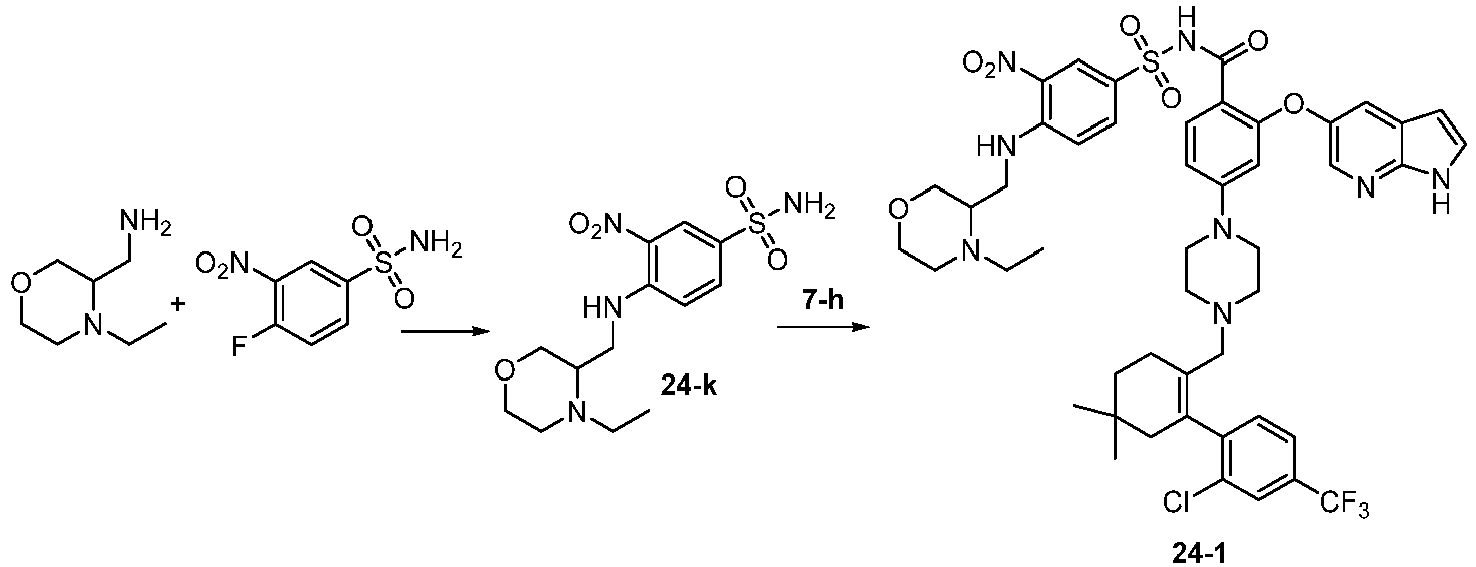
- 3-nitro-4-fluorobenzenesulfonamide (2.54 g), 3-aminomethyl-4-ethylmorpholine (2.0 g) and N,N-diisopropylethylamine (3.72 g) were dissolved in acetonitrile (10 mL), and the solution was heated to 85 °C and reacted for 6 h. The reaction solution was cooled at room temperature, left to stand overnight, concentrated and dried to give compound 24-k (3.51 g). ESI-MS: m/z = 345.1 [M+H]+.
- Compound 24-1 was obtained by reference to the preparation method for compound 7-1 in step 6) of Example 7, with compound 7-k being replaced by compound 24-k.
- Compound 24-1: 1H NMR(500 MHz, DMSO-d6), δ: 11.73(s, 2H), 8.68(t, 1H), 8.61(s, 1H), 8.05(s, 1H), 7.92(d, 1H), 7.88(s, 1H), 7.70(d, 1H), 7.58(s, 1H), 7.53(m, 2H), 7.40(d, 1H), 6.75(d, 2H), 6.41(s, 1H), 6.29(s, 1H), 4.05(d, 3H), 3.61(m, 8H), 3.35(m, 6H), 3.12(m, 3H), 2.25(m, 2H), 2.00(s, 2H), 1.49(m, 2H), 1.23(m, 4H), 0.97(s, 6H).
13C NMR (125 MHz, DMSO-d6), δ: 159.0, 158.7, 158.4, 158.3, 154.0, 146.8, 145.9, 144.2, 139.0, 135.6, 134.6, 132.8, 132.6, 131.8, 131.3, 130.2, 128.4, 128.1, 127.0, 125.9, 125.0, 124.4, 122.8, 120.3, 118.5, 117.5, 115.4, 115.2, 114.0, 109.6, 103.5, 100.5, 58.5, 47.9, 45.2, 44.3, 34.6, 29.5, 29.3, 29.1, 27.1, 24.8.
ESI-MS: m/z = 965.4 [M+H]+. -

- 3-nitro-4-fluorobenzenesulfonamide (1.67 g), 4-aminomethyl-1-(tetrahydro-2H-pyran)piperidine (2.0 g) and N,N-diisopropylethylamine (2.91 g) were dissolved in acetonitrile (10 mL), and the solution was heated to 85 °C and reacted for 6 h. The reaction solution was cooled at room temperature, left to stand overnight, concentrated and dried to give compound 25-k (2.91 g). ESI-MS: m/z = 385.2 [M+H]+.
- Compound 25-1 was obtained by reference to the preparation method for compound 7-1 in step 6) of Example 7, with compound 7-k being replaced by compound 25-k.
- Compound 25-1: 1H NMR(500 MHz, DMSO-d6), δ: 11.62(s, 1H), 11.58(s, 1H), 8.66(s, 1H), 8.50(s, 1H), 7.99(s, 1H), 7.82(s, 1H), 7.75(d, 1H), 7.66(d, 1H), 7.52(d, 1H), 7.47(s, 1H), 7.43(s, 1H), 7.34(d, 1H), 6.95(d, 1H), 6.66(d, 1H), 6.35(s, 1H), 6.22(s, 1H), 3.97(d, 1H), 3.61(t, 1H), 3.50(m, 4H), 3.36(d, 1H), 3.03(s, 4H), 3.90(s, 2H), 2.83(t, 1H), 2.61(m, 2H), 2.54(s, 1H), 2.16(m, 6H), 1.90(m, 4H), 1.74(m, 1H), 1.42(t, 2H), 1.24(m, 4H), 0.96(s, 6H).
13C NMR (125 MHz, DMSO-d6), δ: 146.2, 145.6, 135.5, 134.7, 133.2, 132.5, 132.1, 132.0, 131.4, 130.1, 130.0, 127.9, 126.5, 125.0, 124.5, 122.8, 120.2, 109.4, 100.3, 74.0, 65.9, 60.5, 52.7, 49.8, 47.3, 45.4, 44.7, 35.6, 35.3, 34.2, 31.5, 29.5, 29.4, 29.2, 29.0, 27.3, 25.4, 22.6, 14.4. ESI-MS: m/z =1005.4 [M+H]+. -

- Compound 26-k was obtained by reference to the preparation method for compound 25-k in step 1) of Example 25, with 4-aminomethyl-1-(tetrahydro-2H-pyran)piperidine being replaced by 4-(3-oxetanyl)-2-aminomethylmorpholine.
- Compound 26-1 was obtained by reference to the preparation method for compound 7-1 in step 6) of Example 7, with compound 7-k being replaced by compound 26-k.
-

- Compound 27-k was obtained by reference to the preparation method for compound 25-k in step 1) of Example 25, with 4-aminomethyl-1-(tetrahydro-2H-pyran)piperidine being replaced by 4-(tetrahydropyran-4-yl)-2-aminomethylmorpholine.
- Compound 27-1 was obtained by reference to the preparation method for compound 7-1 in step 6) of Example 7, with compound 7-k being replaced by compound 27-k.
-

- Compound 28-k (1.01 g) was obtained by reference to the preparation method for compound 25-k in step 1) of Example 25, with 4-aminomethyl-1-(tetrahydro-2H-pyran)piperidine being replaced by 4-cyclopropylsulfonyl-2-aminomethylmorpholine.
- Compound 28-1 was obtained by reference to the preparation method for compound 7-1 in step 6) of Example 7, with compound 7-k being replaced by compound 28-k.
- Compound 28-1: 1H NMR (500MHz, DMSO-d6), δ: 11.71(s, 1H), 11.67(s, 1H), 8.64(m, 1H), 8.58(s, 1H), 8.05(d, 1H), 7.89(s, 1H), 7.84(d, 1H), 7.70(d, 1H), 7.55(m, 3H), 7.38(d, 1H), 7.17(d, 1H), 6.76(d, 1H), 6.40(s, 1H), 6.29(s, 1H), 3.55(m, 7H), 3.42(m, 4H), 2.99(m, 4H), 2.83(m, 2H), 2.65(m, 1H), 2.27(m, 2H), 1.96(m, 2H), 1.50(s, 2H), 1.24(s, 1H), 0.98(m, 10H).
13C NMR (125MHz, DMSO-d6),δ: 164.0, 158.9, 158.6, 158.2, 154.0, 147.9, 146.9, 145.9, 144.2, 139.0, 135.6, 134.3, 132.8, 132.6, 131.7, 130.3, 128.3, 128.2, 125.2, 124.9, 124.4, 120.3, 118.4, 117.4, 115.8, 115.1, 114.1, 109.7, 103.5, 100.4, 73.8, 66.1, 58.5, 48.3, 45.8, 45.1, 44.9, 44.3, 34.6, 29.3, 29.1, 27.2, 25.1, 24.8, 4.4, 4.3. -

- Compound 29-k (0.85 g) was obtained by reference to the preparation method for compound 25-k in step 1) of Example 25, with 4-aminomethyl-1-(tetrahydro-2H-pyran)piperidine being replaced by 4-cyclopropanoyl-2-aminomethylmorpholine.
- Compound 29-1 was obtained by reference to the preparation method for compound 7-1 in step 6) of Example 7, with compound 7-k being replaced by compound 29-k.
- Compound 29-1: 1H NMR (500MHz, DMSO-d6), δ: 11.72(s, 1H), 11.70(s, 1H), 8.62(m, 2H), 8.05(s, 1H), 7.89(s, 1H), 7.84(d, 1H), 7.70(d, 1H), 7.55(m, 3H), 7.39(d, 1H), 7.16(d, 1H), 6.76(d, 1H), 6.40(s, 1H), 6.30(s, 1H), 3.95(d, 2H), 3.62(m, 4H), 3.49(m, 3H), 3.39(m, 3H), 2.91(m, 2H), 2.75(m, 2H), 2.33(m, 6H), 2.02(m, 1H), 1.50(s, 2H), 1.24(s, 1H), 0.97(s, 6H), 0.78 (d, 4H).
-

- Compound 30-k (0.85 g) was obtained by reference to the preparation method for compound 25-k in step 1) of Example 25, with 4-aininomethyl-1-(tetrahydro-2H-pyran)piperidine being replaced by 4-(oxetan-3 -yl)formyl-2-aminomethylmorpholine.
- Compound 30-1 was obtained by reference to the preparation method for compound 7-1 in step 6) of Example 7, with compound 7-k being replaced by compound 30-k.
-

- Compound 31-k (0.98 g) was obtained by reference to the preparation method for compound 25-k in step 1) of Example 25, with 4-aininomethyl-1-(tetrahydro-2H-pyran)piperidine being replaced by 4-cyclobutylsulfonyl-2-aminomethylmorpholine.
- Compound 31-1 was obtained by reference to the preparation method for compound 7-1 in step 6) of Example 7, with compound 7-k being replaced by compound 31-k.
- Compound 31-1: 1H NMR (500MHz, DMSO-d6), δ: 11.71(s, 1H), 11.69(s, 1H), 8.61(m, 2H), 8.05(s, 1H), 7.89(s, 1H), 7.83(d, 1H), 7.71(d, 1H), 7.54(m, 3H), 7.39(d, 1H), 7.17(d, 1H), 6.76(d, 1H), 6.40(s, 1H), 6.29(s, 1H), 3.95(d, 2H), 3.62(m, 6H), 3.49(m, 3H), 3.39(m, 3H), 2.91(m, 2H), 2.75(m, 2H), 2.33(m, 6H), 2.02(m, 4H), 1.50(s, 2H), 1.24(s, 1H), 0.97(s, 6H).
13C NMR (125MHz, DMSO-d6),δ: 163.9, 158.2, 154.0, 147.8, 146.9, 145.9, 144.2, 135.6, 134.3, 132.8, 132.6, 131.8, 130.3, 128.3, 128.2, 127.0, 125.2, 124.9, 122.8, 120.3, 118.3, 115.8, 114.1, 109.7, 103.5, 100.4, 74.0, 66.3, 58.5, 50.9, 48.0, 45.6, 45.1, 44.9, 44.3, 34.6, 29.3, 29.1, 27.2, 24.8. -

- Compound 32-k (1.01 g) was obtained by reference to the preparation method for compound 25-k in step 1) of Example 25, with 4-aininomethyl-1-(tetrahydro-2H-pyran)piperidine being replaced by 4-(oxetan-3-yl)sulfonyl-2-aminomethylmorpholine.
- Compound 32-1 was obtained by reference to the preparation method for compound 7-1 in step 6) of Example 7, with compound 7-k being replaced by compound 32-k.
-

- Compound 33-k (1.72 g) was obtained by reference to the preparation method for compound 25-k in step 1) of Example 25, with 4-aininomethyl-1-(tetrahydro-2H-pyran)piperidine being replaced by (S)-4-aminotetrahydrofuran hydrochloride.
- Compound 33-1 was obtained by reference to the preparation method for compound 7-1 in step 6) of Example 7, with compound 7-k being replaced by compound 33-k.
- Compound 33-1: 1H NMR (500MHz, DMSO-d6), δ: 11.70(s, 1H), 11.68(s, 1H), 8.57(s, 1H), 8.32(d, 1H), 8.03(s, 1H), 7.87(t, 2H), 7.70(d, 1H), 7.54(d, 3H), 7.40(d, 1H), 7.13(d 1H), 6.76(d, 1H), 6.39(s, 1H), 6.31(s, 1H), 3.93(m, 3H), 3.78(m,2H), 3.73(d, 2H), 3.58(d, 1H), 3.41(d, 1H), 3.04(m, 3H), 2.78(s, 1H), 2.34(m, 2H), 2.28(m, 1H), 2.08(s, 1H), 1.96(s,2H), 1.90(m, 1H), 1.49(m, 2H), 1.24(s, 1H), 0.97(s, 6H).
13C NMR (125MHz, DMSO-d6),δ: 164.0, 159.1, 158.9, 158.6, 158.3, 158.1, 154.0, 147.0, 146.9, 145.9, 144.2, 135.5, 134.5, 132.8, 132.5, 131.8, 130.5, 128.3, 128.1, 127.0, 125.6, 125.0, 122.8, 120.2, 118.1, 115.8, 114.3, 109.7, 103.7, 100.4, 72.7, 66.9, 58.5, 53.7, 45.2, 44.3, 34.6, 33.0, 29.3, 29.1, 27.1, 24.8. -

- Compound 34-k (1.65 g) was obtained by reference to the preparation method for compound 25-k in step 1) of Example 25, with 4-aininomethyl-1-(tetrahydro-2H-pyran)piperidine being replaced by (R)-4-aminotetrahydrofuran hydrochloride.
- Compound 34-1 was obtained by reference to the preparation method for compound 7-1 in step 6) of Example 7, with compound 7-k being replaced by compound 34-k.
- Compound 34-1: 1H NMR (500MHz, DMSO-d6), δ: 11.71(s, 1H), 11.68(s, 1H), 8.57(s, 1H), 8.32(d, 1H), 8.03(s, 1H), 7.87(t, 2H), 7.71(d, 1H), 7.54(d, 3H), 7.40(d, 1H), 7.13(s, 1H), 6.76(d, 1H), 6.39(s, 1H), 6.31(s, 1H), 3.95(m, 1H), 3.89(m, 1H), 3.79(m, 2H), 3.73(d, 2H), 3.60(d, 1H), 3.42(d, 1H), 3.29(m, 2H), 3.05(m, 3H), 2.78(m, 1H), 2.33(m, 2H), 2.21(m, 1H), 1.96(s, 2H), 1.91(m, 1H), 1.49(m, 2H), 1.23(s, 1H), 0.97(s, 6H).
13C NMR (125MHz, DMSO-d6),δ: 159.2, 158.9, 158.7, 158.4, 158.1, 154.0, 147.0, 146.9, 145.8, 144.2, 139.0, 135.4, 134.5, 132.8, 132.5, 131.7, 130.5, 128.3, 128.1, 127.1, 125.6, 124.9, 124.4, 120.3, 118.1, 117.3, 115.8, 114.9, 114.4, 109.8, 103.7, 100.4, 72.7, 66.9, 58.5, 53.7, 45.1, 44.3, 34.6, 33.0, 29.2, 29.1, 27.1, 24.8. -

- Compound 35-k (1.10 g) was obtained by reference to the preparation method for compound 25-k in step 1) of Example 25, with 4-aininomethyl-1-(tetrahydro-2H-pyran)piperidine being replaced by (3R)-tetrahydrofuran-3-methylamine.
- Compound 35-1 was obtained by reference to the preparation method for compound 7-1 in step 6) of Example 7, with compound 7-k being replaced by compound 35-k.
- Compound 35-1: 1H NMR (500MHz, DMSO-d6), δ: 11.72(s, 1H), 11.69(s, 1H), 8.64(m, 1H), 8.58(d, 1H), 8.05(d, 1H), 7.88(s, 1H), 7.82(d, 1H), 7.70(d, 1H), 7.54(d, 3H), 7.39(d, 1H), 7.12(d, 1H), 6.75(d, 1H), 6.40(s, 1H), 6.30(s, 1H), 3.80(m, 2H), 3.71(m, 2H), 3.63(m, 2H), 3.52(m, 2H), 3.40(m, 4H), 2.58(m, 1H), 2.28(m, 2H), 2.08(s, 2H), 1.98(m, 4H), 1.67(m, 1H), 1.50(m, 2H), 1.24(m, 1H), 0.97(s, 6H).
13C NMR (125MHz, DMSO-d6),δ: 163.9, 158.9, 158.6, 158.2, 154.0, 147.8, 146.9, 145.9, 144.2, 138.9, 135.6, 134.3, 132.9, 132.5, 131.8, 130.2, 130.1, 128.3, 127.0, 124.9, 124.5, 122.8, 120.3, 118.5, 118.3, 117.8, 115.5, 114.2, 109.7, 103.6, 100.4, 70.8, 67.3, 58.5, 45.8, 45.2, 44.3, 38.1, 34.6, 29.8, 29.3, 29.1, 27.2, 24.8, 1.6. -

- Compound 36-k (1.39 g) was obtained by reference to the preparation method for compound 25-k in step 1) of Example 25, with 4-aininomethyl-1-(tetrahydro-2H-pyran)piperidine being replaced by (3S)-tetrahydrofuran-3-methylamine (0.64 g).
- Compound 36-1 was obtained by reference to the preparation method for compound 7-1 in step 6) of Example 7, with compound 7-k being replaced by compound 36-k.
- Compound 36-1: 1H NMR (500MHz, DMSO-d6), δ: 11.72(s, 1H), 11.69(s, 1H), 8.65(s, 1H), 8.58(s, 1H), 8.05(s, 1H), 7.89(s, 1H), 7.83(d, 1H), 7.71(d, 1H), 7.54(d, 3H), 7.40(d, 1H), 7.12(d, 1H), 6.76(d, 1H), 6.40(s, 1H), 6.30(s, 1H), 3.81(m, 1H), 3.73(m, 2H), 3.61(m, 3H), 3.53(m, 1H), 3.41(m, 4H), 3.05(m, 3H), 2.58(m, 1H), 2.31(m, 1H), 2.27(m, 1H), 2.08(s, 1H), 1.96(m, 3H), 1.65(m, 1H), 1.49(s, 2H), 1.24(s, 1H), 0.97(s, 6H).
13C NMR (125MHz, DMSO-d6),δ: 159.2, 158.9, 158.6, 158.4, 158.1, 154.0, 147.7, 146.9, 145.9, 144.2, 139.0, 135.5, 134.3, 132.8, 132.5, 131.7, 130.1, 128.3, 128.2, 127.0, 124.9, 124.4, 122.7, 120.3, 118.3, 117.5, 115.4, 115.1, 114.2, 109.7, 103.6, 100.4, 70.8, 67.3, 58.5, 45.8, 45.1, 44.3, 38.1, 34.6, 29.8, 29.3, 29.1, 27.1, 24.8. -

- Compound 37-k (1.35 g) was obtained by reference to the preparation method for compound 25-k in step 1) of Example 25, with 4-aininomethyl-1-(tetrahydro-2H-pyran)piperidine being replaced by (S)-2-tetrahydrofurfurylamine.
- Compound 37-1 was obtained by reference to the preparation method for compound 7-1 in step 6) of Example 7, with compound 7-k being replaced by compound 37-k.
- Compound 37-1: 1H NMR(500 MHz, DMSO-d6), δ: 11.71(s, 2H), 8.62(s, 1H), 8.58(m, 1H), 8.04(s, 1H), 7.89(d, 1H), 7.81(m, 1H), 7.70(d, 1H), 7.52(m, 3H), 7.40(m, 1H), 7.13(d, 1H), 6.75(d, 1H), 6.40(s, 1H), 6.30(s, 1H), 3.83(m, 2H), 3.69(m, 2H), 3.55(m, 2H), 3.40(m, 2H), 3.29(m, 2H), 3.04(m, 3H), 2.77(m, 1H), 2.27(m, 1H), 2.21(m, 1H), 2.00(m, 1H), 1.96(m, 2H), 1.87(m, 2H), 1.66(m, 2H), 1.50(m, 2H), 0.97(s, 6H).
13C NMR (125 MHz, DMSO-d6), δ: 164.0, 159.2, 158.9, 158.1, 154.0, 148.0, 146.2, 145.9, 144.2, 139.0, 135.5, 134.3, 132.8, 130.2, 130.0, 128.3, 127.0, 125.0, 122.8, 118.3, 117.5, 115.8, 115.2, 114.2, 109.7, 100.4, 76.9, 67.9, 58.5, 46.9, 45.2, 44.3, 34.6, 29.3, 27.1, 24.8. -

- Compound 38-k (1.38 g) was obtained by reference to the preparation method for compound 25-k in step 1) of Example 25, with 4-aininomethyl-1-(tetrahydro-2H-pyran)piperidine being replaced by (R)-2-tetrahydrofurfurylamine.
- Compound 38-1 was obtained by reference to the preparation method for compound 7-1 in step 6) of Example 7, with compound 7-k being replaced by compound 38-k.
- Compound 38-1: 1H NMR (500MHz, DMSO-d6), δ: 11.72(s, 1H), 11.69(s, 1H), 8.61(m, 2H), 8.04(d, 1H), 7.88(s, 1H), 7.82(d, 1H), 7.70(d, 1H), 7.54(m, 3H), 7.39(d, 1H), 7.13(d, 1H), 6.76(d, 1H), 6.39(s, 1H), 6.29(s, 1H), 3.82(m, 2H), 3.70(m, 2H), 3.56(m, 2H), 3.41(m, 2H), 3.38(m, 1H), 3.04(m, 3H), 2.79(m, 1H), 2.31(m, 2H), 2.18(s, 1H), 1.98(m, 3H), 1.89(m, 2H), 1.65(m, 1H), 1.49(m, 2H), 1.24(s, 1H), 0.97(s, 6H).
13C NMR (125MHz, DMSO-d6),δ: 164.0, 158.9, 158.7, 158.1, 154.0, 147.9, 146.9, 145.9, 144.2, 139.0, 135.5, 134.3, 132.6, 131.7, 130.0, 128.3, 127.0, 125.0, 124.9, 124.4, 122.7, 120.3, 118.3, 117.5, 115.8, 114.2, 109.7, 103.6, 100.4, 76.9, 67.9, 58.5, 46.9, 45.1, 44.3, 34.6, 29.2, 27.1, 25.7, 24.8. -

- Compound 39-k (1.70 g) was obtained by reference to the preparation method for compound 25-k in step 1) of Example 25, with 4-aminomethyl-1-(tetrahydro-2H-pyran)piperidine being replaced by 4-aminotetrahydropyran.
- Compound 39-1 was obtained by reference to the preparation method for compound 7-1 in step 6) of Example 7, with compound 7-k being replaced by compound 39-k.
- Compound 39-1: 1H NMR(500 MHz, DMSO-d6), δ: 11.72(s, 2H), 8.58(m, 1H), 8.26(m, 1H), 8.04(s, 1H), 7.88(d, 1H), 7.82(m, 1H), 7.70(d, 1H), 7.52(m, 3H), 7.40(m, 1H), 7.20(d, 1H), 6.75(d, 1H), 6.40(s, 1H), 6.30(s, 1H), 3.88(m, 3H), 3.58(m, 2H), 3.47(m, 2H), 3.39(m, 2H), 3.30(m, 2H), 3.04(m, 3H), 2.77(m, 1H), 2.27(m, 1H), 2.21(m, 1H), 1.96(m, 2H), 1.90(m, 2H), 1.65(m, 2H), 1.50(m, 2H), 0.97(s, 6H).
13C NMR (125 MHz, DMSO-d6), δ: 164.0, 159.2, 158.9, 158.1, 154.0, 146.9, 146.7, 145.8, 144.2, 139.0, 135.5, 134.4, 132.8, 131.7, 130.1, 128.4, 127.1, 125.1, 122.8, 118.3, 117.3, 115.7, 115.0, 114.3, 109.7, 103.6, 100.4, 66.0, 58.5, 49.0, 45.1, 44.3, 34.6, 29.3, 27.1, 24.8. -

- Compound 40-k (1.08 g) was obtained by reference to the preparation method for compound 25-k in step 1) of Example 25, with 4-aminomethyl-1-(tetrahydro-2H-pyran)piperidine being replaced by (S)-3-aminotetrahydropyran hydrochloride.
- Compound 40-1 was obtained by reference to the preparation method for compound 7-1 in step 6) of Example 7, with compound 7-k being replaced by compound 40-k.
- Compound 40-1: 1H NMR (500MHz, DMSO-d6), δ: 11.72(s, 1H), 11.69(s, 1H), 8.59(s, 1H), 8.52(d, 1H), 8.05(s, 1H), 7.85(m, 2H), 7.70(s, 1H), 7.53(m, 3H), 7.40(d, 1H), 7.16(d, 1H), 6.74(d, 1H), 6.40(s, 1H), 6.29(s, 1H), 3.85(m, 3H), 3.59(m, 4H), 3.41(d, 1H), 3.05(m, 5H), 2.28(m, 2H), 2.08(s, 1H), 1.96(s, 3H), 1.74(m, 2H), 1.52(m, 3H), 1.24(s, 1H), 0.97(s, 6H).
13C NMR (125MHz, DMSO-d6),δ: 164.0, 158.9, 158.6, 158.2, 154.0, 146.9, 145.9, 144.2, 135.6, 134.6, 132.8, 131.8, 130.2, 130.0, 128.4, 127.0, 125.3, 124.9, 124.4, 120.3, 118.3, 117.6, 115.7, 115.3, 114.2, 109.7, 103.5, 100.4, 70.1, 67.8, 58.5, 48.1, 45.2, 44.3, 34.6, 29.3, 29.1, 27.7, 27.1, 24.8, 23.0, 1.6. -

- Compound 41-k (0.95 g) was obtained by reference to the preparation method for compound 25-k in step 1) of Example 25, with 4-aininomethyl-1-(tetrahydro-2H-pyran)piperidine being replaced by (R)-3-aminotetrahydropyran hydrochloride.
- Compound 41-1 was obtained by reference to the preparation method for compound 7-1 in step 6) of Example 7, with compound 7-k being replaced by compound 41-k.
- Compound 41-1: 1H NMR(500 MHz, DMSO-d6), δ: 11.72(s, 2H), 8.59(m, 1H), 8.53(m, 1H), 8.05(s, 1H), 7.88(d, 1H), 7.83(m, 1H), 7.70(d, 1H), 7.53(m, 3H), 7.40(m, 1H), 7.17(d, 1H), 6.75(d, 1H), 6.40(s, 1H), 6.30(s, 1H), 3.85(m, 3H), 3.59(m, 2H), 3.47(m, 2H), 3.39(m, 2H), 3.30(m, 2H), 3.04(m, 2H), 2.27(m, 1H), 2.21(m, 1H), 2.08(m, 2H), 1.96(m, 2H), 1.90(m, 2H), 1.69(m, 2H), 1.50(m, 2H), 0.97(s, 6H).
13C NMR (125 MHz, DMSO-d6), δ: 164.0, 158.9, 158.6, 158.2, 154.0, 146.9, 145.9, 144.2, 135.6, 134.6, 132.8, 131.8, 130.2, 128.4, 127.0, 125.3, 125.0, 120.3, 118.5, 118.3, 115.7, 114.2, 109.7, 103.5, 100.4, 70.1, 67.8, 58.5, 48.2, 45.2, 44.3, 34.6, 29.3, 27.7, 24.8, 23.0. -

- Compound 42-k (0.36 g) was obtained by reference to the preparation method for compound 25-k in step 1) of Example 25, with 4-aininomethyl-1-(tetrahydro-2H-pyran)piperidine being replaced by (R)-3-aminomethyltetrahydropyran hydrochloride.
- Compound 42-1 was obtained by reference to the preparation method for compound 7-1 in step 6) of Example 7, with compound 7-k being replaced by compound 42-k.
- Compound 42-1: 1H NMR (500MHz, DMSO-d6), δ: 11.72(s, 1H), 11.68(s, 1H), 8.57(m, 2H), 8.05(d, 1H), 7.88(s, 1H), 7.81(d, 1H), 7.70(d, 1H), 7.53(d, 3H), 7.40(d, 1H), 7.10(d, 1H), 6.75(d, 1H), 6.40(s, 1H), 6.29(s, 1H), 3.78(m, 3H), 3.59(m, 1H), 3.32(m, 7H), 2.92(m, 3H), 2.28(m, 2H), 2.08(s, 1H), 1.95(m, 4H), 1.63(m, 1H), 1.49(m, 3H), 1.31(m, 2H), 0.98(s, 6H).
13C NMR (125MHz, DMSO-d6),δ: 163.9, 158.9, 158.6, 158.2, 154.0, 147.8, 146.9, 145.9, 144.2, 139.0, 135.6, 134.3, 132.9, 132.6, 131.8, 130.2, 130.0, 128.3, 127.0, 124.9, 124.8, 122.8, 120.3, 118.3, 117.7, 115.5, 115.4, 114.2, 109.7, 103.6, 100.4, 70.6, 68.0, 58.5, 45.2, 44.9, 44.3, 35.3, 34.6, 29.3, 29.1, 27.2, 27.1, 25.0, 24.8, 1.6. -
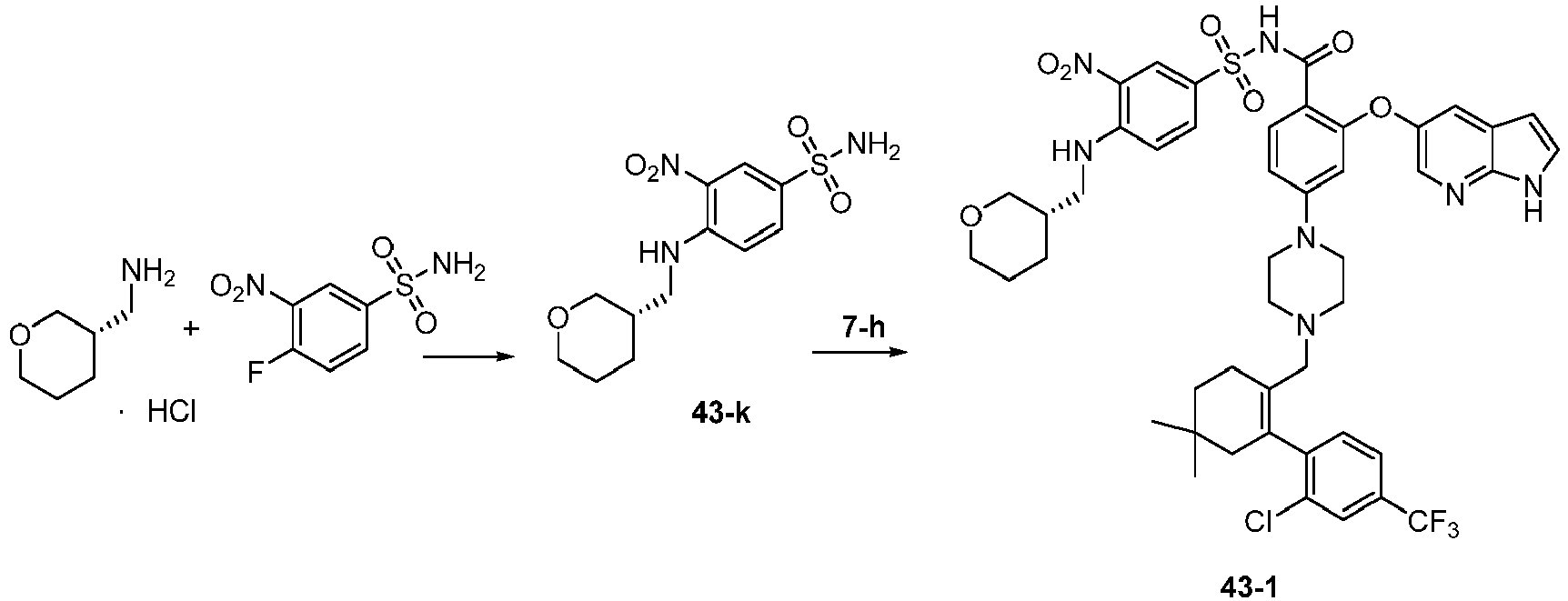
- Compound 43-k (0.39 g) was obtained by reference to the preparation method for compound 25-k in step 1) of Example 25, with 4-aminomethyl-1-(tetrahydro-2H-pyran)piperidine being replaced by (S)-3-aminomethyltetrahydropyran hydrochloride.
- Compound 43-1 was obtained by reference to the preparation method for compound 7-1 in step 6) of Example 7, with compound 7-k being replaced by compound 43-k.
- Compound 43-1: 1H NMR (500MHz, DMSO-d6), δ: 11.71(s, 1H), 11.68(s, 1H), 8.58(m, 2H), 8.05(s, 1H), 7.87(s, 1H), 7.83(d, 1H), 7.69(d, 1H), 7.53(m, 3H), 7.39(d, 1H), 7.11(d, 1H), 6.75(d, 1H), 6.40(s, 1H), 6.28(s, 1H), 3.78(m, 4H), 3.34(m, 6H), 3.15(m, 2H), 2.30(m, 1H), 2.20(m, 1H), 2.08(s, 2H), 1.95(m, 4H), 1.84(m, 1H), 1.63(m, 1H), 1.48(s, 3H), 1.31(m, 2H), 0.98(d, 6H).
13C NMR (125MHz, DMSO-d6),δ: 163.9, 158.7, 158.2, 154.2, 147.8, 146.9, 146.0, 135.7, 134.3, 132.9, 132.6, 131.8, 130.2, 128.3, 127.0, 124.9, 124.8, 122.8, 120.3, 118.5, 118.3, 115.5, 109.6, 103.4, 100.4, 70.5, 68.0, 44.9, 35.3, 29.3, 29.2, 27.2, 27.1, 25.0, 1.6. -

- Compound 44-k (1.18 g) was obtained by reference to the preparation method for compound 25-k in step 1) of Example 25, with 4-aininomethyl-1-(tetrahydro-2H-pyran)piperidine being replaced by 2-(tetrahydro-2H-pyran-2-yl)ethylamine hydrochloride.
- Compound 44-1 was obtained by reference to the preparation method for compound 7-1 in step 6) of Example 7, with compound 7-k being replaced by compound 44-k.
- Compound 44-1: 1H NMR (500MHz, DMSO-d6), δ: 11.72(s, 1H), 11.68(s, 1H), 8.86(s, 1H), 8.58(s, 1H), 8.05(s, 1H), 7.88(s, 1H), 7.83(d, 1H), 7.71(m, 1H), 7.54(m, 3H), 7.40(m, 1H), 7.03(m, 1H), 6.76(d, 1H), 6.40(s, 1H), 6.29(s, 1H), 3.93(m, 1H), 3.78(m, 1H), 3.59(d, 1H), 3.41(m, 7H), 3.05(m, 4H), 2.55(s, 2H), 2.31(m, 1H), 2.21(m, 1H), 1.96(s, 2H), 1.76(m, 3H), 1.59(d, 1H), 1.49(m, 4H), 1.29(m, 1H), 0.97(s, 6H).
13C NMR (125MHz, DMSO-d6),δ: 163.9, 158.9, 158.6, 158.4, 158.2, 154.0, 147.7, 146.9, 145.9, 144.2, 139.0, 135.5, 134.4, 132.8, 132.6, 131.7, 130.2, 130.0, 128.3, 127.0, 124.9, 124.6, 124.4, 122.8, 120.3, 118.3, 117.5, 115.2, 114.2, 109.7, 103.6, 100.4, 76.3, 67.9, 58.5, 45.2, 44.3, 34.7, 34.6, 31.8, 29.3, 29.1, 27.1, 26.0, 24.8, 23.4. -

- Compound 45-k (1.06 g) was obtained by reference to the preparation method for compound 25-k in step 1) of Example 25, with 4-aininomethyl-1-(tetrahydro-2H-pyran)piperidine being replaced by 2-(tetrahydro-2H-pyran-3-yl)ethylamine.
- Compound 45-1 was obtained by reference to the preparation method for compound 7-1 in step 6) of Example 7, with compound 7-k being replaced by compound 45-k.
- Compound 45-1: 1H NMR (500MHz, DMSO-d6), δ: 11.71(s, 2H), 8.56(m, 2H), 8.05(s, 1H), 7.84(t, 2H), 7.68(d, 1H), 7.52(m, 3H), 7.37(d, 1H), 7.05(d, 1H), 6.72(d, 1H), 6.40(s, 1H), 6.25(s, 1H), 3.37(m, 10H), 3.28(m, 2H), 3.03(m, 2H), 2.28(d, 1H), 2.17(d, 1H), 1.93(s, 2H), 1.85(d, 1H), 1.51(m, 8H), 1.23(m, 2H), 0.96(s, 6H).
13C NMR (125MHz, DMSO-d6),δ: 163.9, 158.4, 158.3, 154.5, 147.6, 146.9, 146.0, 135.7, 134.4, 133.0, 132.5, 131.8, 130.0, 128.3, 128.2, 126.8, 124.9, 124.8, 122.8, 120.3, 118.3, 115.4, 109.5, 103.2, 100.4, 72.5, 67.9, 51.6, 45.0, 34.9, 33.9, 31.2, 29.7, 29.3, 29.2, 27.2, 25.7, 25.1. -

- Compound 46-k (2.03 g) was obtained by reference to the preparation method for compound 25-k in step 1) of Example 25, with 4-aminomethyl-1-(tetrahydro-2H-pyran)piperidine being replaced by N-ethyl-2-propylaminomorpholine hydrochloride.
- Compound 46-1 was obtained by reference to the preparation method for compound 7-1 in step 6) of Example 7, with compound 7-k being replaced by compound 46-k.
-

- Compound 47-k (2.03 g) was obtained by reference to the preparation method for compound 25-k in step 1) of Example 25, with 4-aininomethyl-1-(tetrahydro-2H-pyran)piperidine being replaced by N-(2-fluoroethyl)-2-propylaminomorpholine hydrochloride.
- Compound 47-1 was obtained by reference to the preparation method for compound 7-1 in step 6) of Example 7, with compound 7-k being replaced by compound 47-k.
-

- Compound 48-k (0.50 g) was obtained by reference to the preparation method for compound 25-k in step 1) of Example 25, with 4-aminomethyl-1-(tetrahydro-2H-pyran)piperidine being replaced by N-formyl-2-aminomethylmorpholine hydrochloride.
- Compound 48-1 was obtained by reference to the preparation method for compound 7-1 in step 6) of Example 7, with compound 7-k being replaced by compound 48-k.
- Compound 48-1: 1H NMR(500 MHz, DMSO-d6), δ: 11.72(s, 2H), 8.65(s, 1H), 8.57(m, 1H), 8.04(s, 1H), 7.88(d, 1H), 7.83(m, 1H), 7.70(d, 1H), 7.54(m, 3H), 7.39(m, 1H), 7.16(d, 1H), 6.75(d, 1H), 6.40(s, 1H), 6.30(s, 1H), 3.90(m, 1H), 3.75(m, 2H), 3.60(m, 4H), 3.51(m, 1H), 3.45(m, 1H), 3.21(m, 1H), 3.06(m, 2H), 2.81(m, 1H), 2.67(m, 1H), 2.27(m, 2H), 2.07(m, 4H), 1.96(m, 2H), 1.50(m, 2H), 1.24(m, 2H), 0.97(s, 6H).
13C NMR (125 MHz, DMSO-d6), δ: 162.4, 160.1, 157.4, 156.6, 152.4, 146.3, 145.3, 144.2, 142.6, 137.5, 133.9, 132.7, 131.2, 130.2, 130.1, 128.7, 126.8, 123.6, 122.8, 118.8, 116.8, 115.6, 114.1, 108.1, 98.7, 72.8, 65.4, 56.9, 46.1, 43.6, 42.7, 33.0, 27.5, 23.2. -

- Compound 49-k (0.63 g) was obtained by reference to the preparation method for compound 25-k in step 1) of Example 25, with 4-aminomethyl-1-(tetrahydro-2H-pyran)piperidine being replaced by N-methylsulfonyl-3-aminomethylmorpholine.
- Compound 49-1 was obtained by reference to the preparation method for compound 7-1 in step 6) of Example 7, with compound 7-k being replaced by compound 49-k.
-

- Compound 50-k (1.71 g) was obtained by reference to the preparation method for compound 25-k in step 1) of Example 25, with 4-aminomethyl-1-(tetrahydro-2H-pyran)piperidine being replaced by 2-aminomethyl-4-pivaloylmorpholine.
- Compound 50-1 was obtained by reference to the preparation method for compound 7-1 in step 6) of Example 7, with compound 7-k being replaced by compound 50-k.
- Compound 50-1: 1H NMR (500MHz, DMSO-d6), δ: 11.72(s, 1H), 11.67(s, 1H), 8.78(m, 1H), 8.57(s, 1H), 8.04(s, 1H), 7.88(s, 1H), 7.83(t, 1H), 7.70(d, 1H), 7.52(d, 3H), 7.39(d, 1H), 7.06(t, 1H), 6.74(d, 1H), 6.39(s, 1H), 6.30(s, 1H), 4.25(d, 1H), 4.10(d, 1H), 3.88(d, 1H), 3.59(m, 6H), 3.50(m, 6H), 3.02(m, 2H), 2.82(m, 2H), 2.21(m, 2H), 1.98(s, 2H), 1.49(m, 2H), 1.18(s, 9H), 0.87(s, 6H).
13C NMR (125MHz, DMSO-d6),δ: 175.8, 163.9, 159.2, 158.9, 158.6, 158.3, 158.2, 154.0, 147.9, 146.9, 145.9, 144.2, 139.0, 135.6, 134.3, 132.8, 132.6, 131.8, 130.2, 129.9, 128.3, 128.2, 127.0, 125.2, 124.9, 124.5, 122.8, 120.3, 118.4, 117.7, 115.8, 115.4, 114.1, 113.0, 109.7, 103.5, 100.4, 74.1, 66.5, 58.5, 45.2, 45.0, 44.3, 34.6, 29.3, 29.1. -

- Compound 51-k (1.61 g) was obtained by reference to the preparation method for compound 25-k in step 1) of Example 25, with 4-aininomethyl-1-(tetrahydro-2H-pyran)piperidine being replaced by 2-aminomethyl-4-(2-cyanoacetyl)morpholine.
- Compound 51-1 was obtained by reference to the preparation method for compound 7-1 in step 6) of Example 7, with compound 7-k being replaced by compound 51-k.
- Compound 51-1: 1H NMR(500 MHz, DMSO-d6), δ: 11.72(s, 1H), 11.69(s, 1H), 8.05(s, 1H), 7.87(s, 1H), 7.83(d, 1H), 7.70(d, 1H), 7.54(m, 4H), 7.39(m, 2H), 7.15(d, 1H), 6.75(d, 1H), 6.40(s, 1H), 6.30(s, 1H), 3.90(m, 1H), 3.60(m, 9H), 3.31(m, 2H), 3.18(m, 1H), 3.03(m, 3H), 2.83(t, 1H), 2.66(m,1H), 2.27(m, 2H), 2.07(s, 1H), 1.96(m, 2H), 1.50(m, 2H), 1.24(t, 2H), 0.97(s, 6H).
13C NMR (125 MHz, DMSO-d6), δ: 163.9, 162.3, 159.0, 154.0, 146.9, 145.8, 139.1, 135.4, 134.3, 132.8, 132.6, 131.7, 130.3, 130.2, 128.2, 127.0, 125.2, 124.9, 124.3, 120.4, 117.1, 109.7, 103.6, 100.5, 73.7, 66.0, 58.5, 48.2, 45.7, 44.9, 44.5, 34.6, 29.3, 29.1, 27.1, 25.3, 24.8. -

- Compound 52-k (1.75 g) was obtained by reference to the preparation method for compound 25-k in step 1) of Example 25, with 4-aininomethyl-1-(tetrahydro-2H-pyran)piperidine being replaced by 2-aminomethyl-4-(2,2,2-trifluoroacetyl)morpholine.
- Compound 52-1 was obtained by reference to the preparation method for compound 7-1 in step 6) of Example 7, with compound 7-k being replaced by compound 52-k.
- Compound 52-1: 1H NMR(500 MHz, DMSO-d6), δ: 11.71(s, 2H), 8.65(s, 1H), 8.58(m, 1H), 8.05(s, 1H), 7.85(d, 1H), 7.83(m, 1H), 7.70(d, 1H), 7.54(m, 3H), 7.39(m, 1H), 7.17(d, 1H), 6.75(d, 1H), 6.40(s, 1H), 6.30(s, 1H), 3.79(m, 4H), 3.58(m, 3H), 3.32(m, 4H), 3.05(m, 4H), 2.66(m, 1H), 2.27(m, 2H), 1.96(m, 3H), 1.50(m, 2H), 1.24(t, 2H), 0.97(s, 6H).
13C NMR (125 MHz, DMSO-d6), δ: 164.0, 158.6, 154.0, 147.9, 145.9, 144.2, 139.0, 135.6, 134.3, 132.8, 132.6, 131.8, 130.3, 130.0, 128.3, 127.0, 125.3, 125.0, 120.3, 118.3, 117.5, 115.8, 109.7, 103.5, 100.4, 73.9, 66.0, 58.5, 51.1, 48.0, 45.5, 44.6, 43.1, 40.3, 34.6, 29.3. -

- Compound 53-k (1.64 g) was obtained by reference to the preparation method for compound 25-k in step 1) of Example 25, with 4-aminomethyl-1-(tetrahydro-2H-pyran)piperidine being replaced by 2-aminomethyl-4-(trifluoromethyl)morpholine.
- Compound 53-1 was obtained by reference to the preparation method for compound 7-1 in step 6) of Example 7, with compound 7-k being replaced by compound 53-k.
-
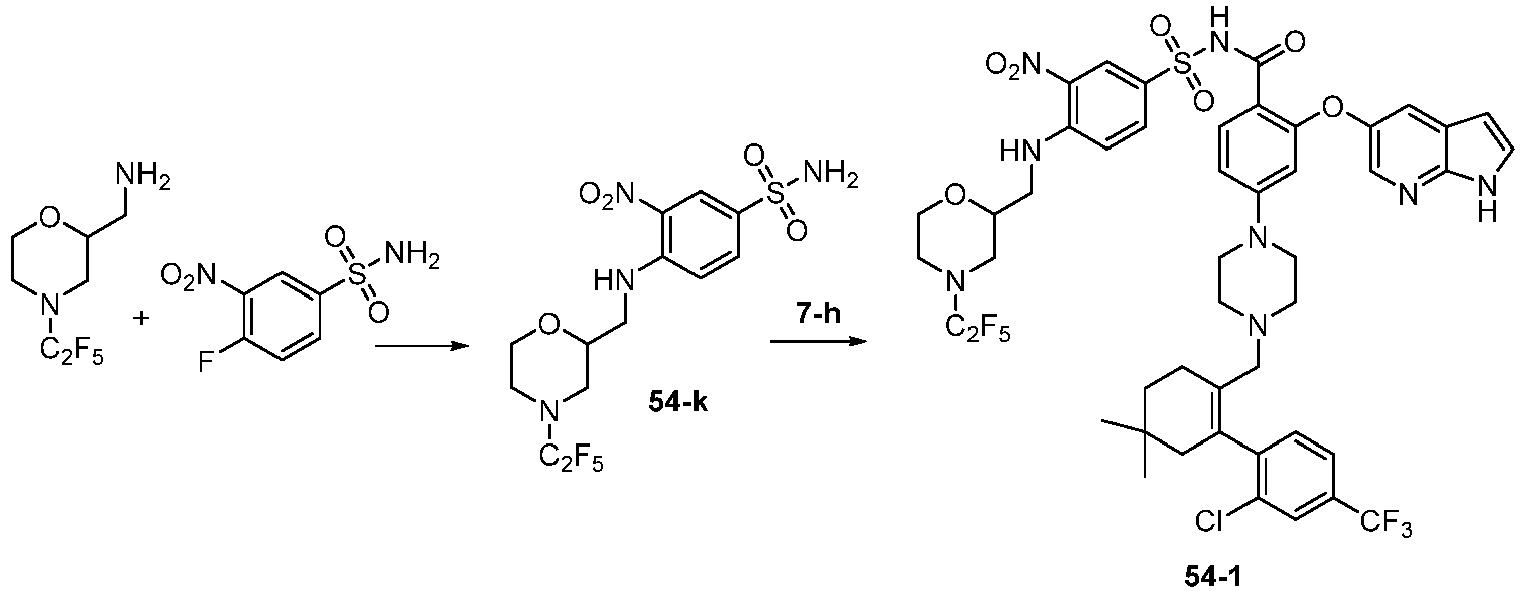
- Compound 54-k (1.93 g) was obtained by reference to the preparation method for compound 25-k in step 1) of Example 25, with 4-aininomethyl-1-(tetrahydro-2H-pyran)piperidine being replaced by 2-aminomethyl-4-(perfluoroethyl)morpholine.
- Compound 54-1 was obtained by reference to the preparation method for compound 7-1 in step 6) of Example 7, with compound 7-k being replaced by compound 54-k.
-

- Compound 55-k (2.05 g) was obtained by reference to the preparation method for compound 25-k in step 1) of Example 25, with 4-aininomethyl-1-(tetrahydro-2H-pyran)piperidine being replaced by 2-aminomethyl-4-((perfluoroethyl)sulfonyl)morpholine.
- Compound 55-1 was obtained by reference to the preparation method for compound 7-1 in step 6) of Example 7, with compound 7-k being replaced by compound 55-k.
-

- Compound 56-k (1.75 g) was obtained by reference to the preparation method for compound 25-k in step 1) of Example 25, with 4-aminomethyl-1-(tetrahydro-2H-pyran)piperidine being replaced by 2-aminomethyl-4-((perfluoroethyl)sulfonyl)morpholine.
- Compound 56-1 was obtained by reference to the preparation method for compound 7-1 in step 6) of Example 7, with compound 7-k being replaced by compound 56-k.
- Compound 56-1: 1H NMR(500 MHz, DMSO-d6), δ: 11.71 (s, 2H), 8.64 (t, 1H), 8.59 (d, 1H), 8.05 (d, 1H), 7.89 (s, 1H), 7.84 (d, 1H), 7.71 (d, 1H), 7.55 (d, 3H), 7.40 (d, 1H), 7.16 (d, 1H), 6.75 (d, 1H), 6.40 (s, 1H), 6.29 (s, 1H), 3.80 (d, 2H), 3.64 (m, 5H), 3.52 (m, 1H), 3.38 (m, 3H), 2.91 (s, 3H), 2.86 (m, 2H), 2.72 (m, 2H), 2.27 (m, 1H), 2.21 (m, 1H), 1.96 (s, 2H), 1.50 (m, 2H), 1.24 (m, 1H), 0.96 (s, 6H).
-

- Compound 57-k was obtained by reference to the preparation method for compound 25-k in step 1) of Example 25, with 4-aminomethyl-1-(tetrahydro-2H-pyran)piperidine being replaced by 2-aminomethyl-4-(ethylsulfonyl)morpholine.
- Compound 57-1 was obtained by reference to the preparation method for compound 7-1 in step 6) of Example 7, with compound 7-k being replaced by compound 57-k.
- Compound 57-1: 1H NMR(500 MHz, DMSO-d6), δ: 11.72(s, 2H), 8.64(s, 1H), 8.58(m, 1H), 8.05(s, 1H), 7.89(d, 1H), 7.83(m, 1H), 7.70(d, 1H), 7.54(m, 3H), 7.39(m, 1H), 7.16(d, 1H), 6.75(d, 1H), 6.40(s, 1H), 6.30(s, 1H), 3.95(m, 1H), 3.75(m, 2H), 3.52(m, 6H), 3.42(m, 2H), 3.39(m, 2H), 3.12(m, 3H), 2.96(m, 2H), 2.77(m, 1H), 2.28(m, 2H), 2.08(m, 1H), 1.96(m, 2H), 1.50(m, 2H), 1.24(t, 4H), 0.97(s, 6H).
13C NMR (125 MHz, DMSO-d6), δ: 164.0, 158.9, 154.0, 147.9, 145.9, 144.2, 139.0, 135.5, 134.3, 132.8, 132.6, 131.7, 130.3, 130.0, 128.3, 127.0, 125.2, 124.9, 120.3, 118.5, 117.3, 115.8, 109.7, 103.6, 100.5, 73.9, 66.3, 58.5, 47.7, 45.3, 44.9, 42.9, 34.6, 29.3, 27.4, 24.8. -

- 3-nitro-4-fluorobenzenesulfonamide (1.03 g), 3-aminomethyl-1-(2-methoxyacetyl)piperidine (1.04 g) and N,N-diisopropylethylamine (1.51 g) were dissolved in acetonitrile (10 mL), and the solution was heated to 85 °C and reacted for 6 h. The reaction solution was cooled at room temperature, left to stand overnight, concentrated and dried to give compound 58-k (1.51 g). ESI-MS: m/z = 387.0 [M+H]+.
- Compound 58-1 was obtained by reference to the preparation method for compound 7-1 in step 6) of Example 7, with compound 7-k being replaced by compound 58-k.
- Compound 58-1: 1H NMR (500MHz, DMSO-d6), δ: 11.71(s, 1H), 11.68(s, 1H), 8.64(m, 1H), 8.58(d, 1H), 8.05(d, 1H), 7.88(s, 1H), 7.83(m, 1H), 7.71(d, 1H), 7.55(m, 3H), 7.40(d, 1H), 7.16(d, 1H), 6.76(m, 1H), 6.40(m, 1H), 6.30(d, 1H), 3.93(m, 2H), 3.76(m, 8H), 3.39(m, 4H), 3.05(m, 4H), 2.79(m, 2H), 2.27(m, 2H), 2.09(s, 1H), 1.96(s, 2H), 1.62(m, 2H), 1.50(m, 2H), 1.37(m, 2H), 1.24(s, 1H), 0.97(s, 6H). ESI-MS: m/z =1007.4 [M+H]+.
-

- 3-nitro-4-fluorobenzenesulfonamide (0.91 g), 4-aminomethyl-1-(methylglycyl)piperidine (0.99 g) and N,N-diisopropylethylamine (1.34 g) were dissolved in acetonitrile (10 mL), and the solution was heated to 85 °C and reacted for 6 h. The reaction solution was cooled at room temperature, left to stand overnight, concentrated and dried to give compound 59-k (1.62 g). ESI-MS: m/z = 400.1 [M+H]+.
- Compound 59-1 was obtained by reference to the preparation method for compound 7-1 in step 6) of Example 7, with compound 7-k being replaced by compound 59-k.
ESI-MS: m/z =1020.4 [M+H]+. - Compound 59-1: 1H NMR(500 MHz, DMSO-d6), δ: 11.74(s, 2H), 8.67(s, 1H), 8.59(m, 1H), 8.05(s, 1H), 7.88(d, 1H), 7.83(m, 1H), 7.69(d, 1H), 7.54(m, 3H), 7.39(m, 1H), 7.16(d, 1H), 6.75(d, 1H), 6.40(s, 1H), 6.30(s, 1H), 3.61(m, 4H), 3.38(m, 5H), 3.02(m, 4H), 2.81(m, 7H), 2.67(m, 2H), 2.28(m, 2H), 2.02(m, 3H), 1.78(m, 2H), 1.49(m, 2H), 1.20(m, 4H), 0.97(s, 6H).
13C NMR (125 MHz, DMSO-d6), δ: 158.9, 154.0, 147.9, 145.9, 144.2, 139.0, 135.6, 134.3, 132.8, 132.6, 131.8, 130.2, 130.1, 128.3, 127.0, 124.9, 124.5, 120.3, 118.4, 117.6, 115.6, 114.2, 109.7, 103.5, 100.4, 58.5, 47.7, 45.3, 44.9, 41.7, 34.6, 29.4, 27.1, 24.8. -

- 3-nitro-4-fluorobenzenesulfonamide (0.90 g), 3-aminomethyl-1-(methylglycyl)piperidine (0.98 g) and N,N-diisopropylethylamine (1.32 g) were dissolved in acetonitrile (10 mL), and the solution was heated to 85 °C and reacted for 6 h. The reaction solution was cooled at room temperature, left to stand overnight, concentrated and dried to give compound 60-k (1.58 g). ESI-MS: m/z =400.0 [M+H]+.
- Compound 60-1 was obtained by reference to the preparation method for compound 7-1 in step 6) of Example 7, with compound 7-k being replaced by compound 60-k.
- Compound 60-1: 1H NMR (500MHz, DMSO-d6), δ: 11.72(s, 2H), 8.63(m, 1H), 8.59(d, 1H), 8.04(d, 1H), 7.88(s, 1H), 7.84(m, 1H), 7.70(d, 1H), 7.54(m, 3H), 7.40(d, 1H), 7.17(d, 1H), 6.76(m, 1H), 6.40(m, 1H), 6.29(d, 1H), 3.89(m, 2H), 3.66(m, 7H), 3.33(m, 4H), 3.04(m, 4H), 2.89(s, 6H), 2.27(m, 3H), 2.09(s, 1H), 1.96(s, 2H), 1.62(m, 2H), 1.50(m, 2H), 1.24(s, 2H), 0.97(s, 6H). ESI-MS: m/z = 1020.4[M+H]+.
-

- 3-nitro-4-fluorobenzenesulfonamide (0.68 g), (S)-2-aminomethyl-4-acetylmorpholine (0.59 g) and N,N-diisopropylethylamine (2.59 g) were dissolved in acetonitrile (10 mL), and the solution was heated to 85 °C and reacted for 6 h. The reaction solution was cooled at room temperature, left to stand overnight, concentrated and dried to give compound 61-k (0.89 g). ESI-MS: m/z = 359.0 [M+H]+.
- Compound 61-1 was obtained by reference to the preparation method for compound 7-1 in step 6) of Example 7, with compound 7-k being replaced by compound 61-k.
- Compound 61-1: 1H NMR(500 MHz, DMSO-d6), δ: 11.71(s, 2H), 8.64(s, 1H), 8.58(m, 1H), 8.05(s, 1H), 7.87(d, 1H), 7.84(m, 1H), 7.70(d, 1H), 7.54(m, 3H), 7.39(m, 1H), 7.15(d, 1H), 6.75(d, 1H), 6.40(s, 1H), 6.30(s, 1H), 3.91(m, 1H), 3.67(m, 2H), 3.60(m, 4H), 3.47(m, 2H), 3.42(m, 2H), 3.30(m, 2H), 3.17(m, 1H), 3.02(m, 2H), 2.72(m, 1H), 2.55(m, 1H), 2.27(m, 1H), 2.21(m, 2H), 2.01(m, 3H), 1.96(m, 2H), 1.50(m, 2H), 0.97(s, 6H).
13C NMR (125 MHz, DMSO-d6), δ: 169.1, 164.0, 158.9, 158.6, 154.0, 147.9, 146.9, 145.9, 144.2, 135.5, 132.8, 131.7, 130.2, 128.3, 128.2, 125.2, 120.3, 118.3, 117.4, 115.8, 114.2, 109.7, 103.6, 100.4, 73.8, 66.4, 58.5, 48.5, 45.2, 44.3, 41.2, 34.6, 29.3, 27.1, 24.8, 21.6. ESI-MS: m/z =979.4 [M+H]+. -

- 3-nitro-4-fluorobenzenesulfonamide (0.68 g), (S)-2-aminomethyl-4-isobutyrylmorpholine (0.69 g) and N,N-diisopropylethylamine (2.59 g) were dissolved in acetonitrile (10 mL), and the solution was heated to 85 °C and reacted for 6 h. The reaction solution was cooled at room temperature, left to stand overnight, concentrated and dried to give compound 62-k (0.87 g). ESI-MS: m/z = 387.0 [M+H]+.
- Compound 62-1 was obtained by reference to the preparation method for compound 7-1 in step 6) of Example 7, with compound 7-k being replaced by compound 62-k.
- Compound 62-1: 1H NMR(500 MHz, DMSO-d6), δ: 11.72(s, 1H), 11.69(s, 1H), 8.64(s, 1H), 8.58(m, 1H), 8.05(s, 1H), 7.88(d, 1H), 7.83(m, 1H), 7.70(d, 1H), 7.54(m, 3H), 7.39(m, 1H), 7.16(d, 1H), 6.75(d, 1H), 6.40(s, 1H), 6.30(s, 1H), 3.92(m, 1H), 3.80(m, 1H), 3.60(m, 4H), 3.47(m, 2H), 3.39(m, 2H), 3.30(m, 2H), 3.19(m, 1H), 2.86(m, 5H), 2.72(m, 1H), 2.57(m, 1H), 2.27(m, 2H), 1.96(m, 2H), 1.50(m, 2H), 1.00(s, 6H), 0.97(s, 6H).
13C NMR (125 MHz, DMSO-d6), δ: 158.9, 154.0, 147.9, 145.6, 144.2, 139.0, 135.5, 134.3, 132.8, 132.6, 131.7, 130.2, 130.0, 128.3, 127.0, 125.2, 125.0, 120.3, 118.4, 117.3, 115.8, 109.7, 103.6, 100.4, 74.0, 66.6, 58.5, 45.3, 44.3, 42.9, 34.6, 29.3, 27.1, 24.8, 20.0.ESI-MS: m/z = 1007.4[M+H]+. -

- 3-nitro-4-fluorobenzenesulfonamide (0.68 g), (S)-2-aminomethyl-4-(methylsulfonyl)morpholine (0.72 g) and N,N-diisopropylethylamine (2.59 g) were dissolved in acetonitrile (10 mL), and the solution was heated to 85 °C and reacted for 6 h. The reaction solution was cooled at room temperature, left to stand overnight, concentrated and dried to give compound 63-k (0.68 g). ESI-MS: m/z = 395.0 [M+H]+.
- Compound 63-1 was obtained by reference to the preparation method for compound 7-1 in step 6) of Example 7, with compound 7-k being replaced by compound 63-k.
- Compound 63-1: 1H NMR(500 MHz, DMSO-d6), δ: 11.71(s, 1H), 11.69(s, 1H), 8.65(s, 1H), 8.58(m, 1H), 8.05(s, 1H), 7.89(d, 1H), 7.84(m, 1H), 7.70(d, 1H), 7.54(m, 3H), 7.39(m, 1H), 7.16(d, 1H), 6.75(d, 1H), 6.40(s, 1H), 6.30(s, 1H), 3.98(m, 1H), 3.79(m, 3H), 3.66(m, 2H), 3.58(m, 3H), 3.49(m, 1H), 3.44(m, 1H), 3.35(m, 2H), 2.92(m, 4H), 2.85(m, 2H), 2.69(m, 2H), 2.27(m, 1H), 2.21(m, 1H), 1.96(m, 3H), 1.50(m, 2H), 0.97(s, 6H).
13C NMR (125 MHz, DMSO-d6), δ: 164.0, 158.9, 158.6, 154.0, 147.8, 146.9, 145.9, 144.2, 135.6, 132.8, 131.7, 130.3, 128.3, 128.2, 125.2, 120.3, 118.3, 115.8, 115.1, 114.1, 109.7, 103.6, 100.4, 73.7, 66.0, 58.5, 47.9, 45.4, 44.3, 34.6, 29.3, 27.2, 24.8. ESI-MS: m/z = 1015.3[M+H]+. -

- 3-nitro-4-fluorobenzenesulfonamide (0.68 g), (S)-2-aminomethyl-4-(2-methoxyacetyl)morpholine (0.70 g) and N,N-diisopropylethylamine (2.59 g) were dissolved in acetonitrile (10 mL), and the solution was heated to 85 °C and reacted for 6 h. The reaction solution was cooled at room temperature, left to stand overnight, concentrated and dried to give compound 64-k (0.68 g). ESI-MS: m/z = 389.0 [M+H]+.
- Compound 64-1 was obtained by reference to the preparation method for compound 7-1 in step 6) of Example 7, with compound 7-k being replaced by compound 64-k.
- Compound 64-1: 1H NMR(500 MHz, DMSO-d6), δ: 11.76(s, 1H), 11.73(s, 1H), 8.65(s, 1H), 8.58(m, 1H), 8.05(s, 1H), 7.88(d, 1H), 7.85(m, 1H), 7.70(d, 1H), 7.54(m, 3H), 7.40(m, 1H), 7.15(d, 1H), 6.75(d, 1H), 6.40(s, 1H), 6.30(s, 1H), 3.67(m, 5H), 3.36(m, 7H), 2.99(m, 5H), 2.78(m, 1H), 2.28(m, 3H), 1.96(m, 3H), 1.50(m, 3H), 0.97(s, 9H).
13C NMR (125 MHz, DMSO-d6), δ: 164.9, 159.3, 158.9, 158.7, 158.4, 153.0, 147.9, 145.9, 144.2, 139.1, 135.5, 134.3, 132.8, 131.7, 130.2, 128.4, 127.1, 125.0, 124.9, 124.4, 122.8, 120.5, 119.4, 117.0, 115.1, 114.8, 112.4, 109.6, 100.5, 76.7, 66.6, 58.5, 45.2, 44.7, 40.9, 34.6, 29.3, 29.1, 27.2, 24.9. ESI-MS: m/z =1009.4 [M+H]+. -

- 3-nitro-4-fluorobenzenesulfonamide (0.68 g), (R)-2-aminomethyl-4-acetylmorpholine (0.59 g) and N,N-diisopropylethylamine (2.59 g) were dissolved in acetonitrile (10 mL), and the solution was heated to 85 °C and reacted for 6 h. The reaction solution was cooled at room temperature, left to stand overnight, concentrated and dried to give compound 65-k (0.89 g). ESI-MS: m/z = 359.0 [M+H]+.
- Compound 65-1 was obtained by reference to the preparation method for compound 7-1 in step 6) of Example 7, with compound 7-k being replaced by compound 65-k.
- Compound 65-1: 1H NMR(500 MHz, DMSO-d6), δ: 11.71(s, 1H), 11.69(s, 1H), 8.64(s, 1H), 8.58(m, 1H), 8.05(s, 1H), 7.88(d, 1H), 7.84(m, 1H), 7.70(d, 1H), 7.55(m, 3H), 7.39(m, 1H), 7.15(d, 1H), 6.75(d, 1H), 6.40(s, 1H), 6.30(s, 1H), 3.89(m, 2H), 3.67(m, 2H), 3.58(m, 3H), 3.49(m, 3H), 3.30(m, 2H), 3.17(m, 2H), 3.02(m, 2H), 2.72(m, 1H), 2.56(m, 1H), 2.27(m, 2H), 2.21(m, 1H), 2.02(m, 3H), 1.96(m, 2H), 1.50(m, 2H), 0.97(s, 6H).
13C NMR (125 MHz, DMSO-d6), δ: 169.1, 164.0, 158.9, 158.6, 158.2, 154.0, 147.8, 146.9, 145.8, 144.2, 139.0, 135.5, 132.8, 131.7, 130.2, 128.3, 128.2, 124.4, 120.3, 118.3, 115.8, 114.9, 114.1, 109.7, 103.6, 100.4, 73.8, 66.4, 58.5, 48.5, 45.4, 44.3, 41.2, 34.6, 29.3, 29.1, 27.1, 24.8, 21.6. ESI-MS: m/z = 979.4[M+H]+. -

- 3-nitro-4-fluorobenzenesulfonamide (0.68 g), (R)-2-aminomethyl-4-acetylmorpholine (0.69 g) and N,N-diisopropylethylamine (2.59 g) were dissolved in acetonitrile (10 mL), and the solution was heated to 85 °C and reacted for 6 h. The reaction solution was cooled at room temperature, left to stand overnight, concentrated and dried to give compound 66-k (0.87 g). ESI-MS: m/z = 387.0 [M+H]+.
- Compound 66-1 was obtained by reference to the preparation method for compound 7-1 in step 6) of Example 7, with compound 7-k being replaced by compound 66-k.
- Compound 66-1: 1H NMR(500 MHz, DMSO-d6), δ: 11.72(s, 1H), 11.69(s, 1H), 8.64(s, 1H), 8.58(m, 1H), 8.05(s, 1H), 7.88(d, 1H), 7.84(m, 1H), 7.70(d, 1H), 7.56(m, 3H), 7.40(m, 1H), 7.16(d, 1H), 6.75(d, 1H), 6.40(s, 1H), 6.30(s, 1H), 3.91(m, 2H), 3.81(m, 1H), 3.60(m, 4H), 3.45(m, 2H), 3.39(m, 2H), 3.30(m, 2H), 3.18(m, 1H), 3.03(m, 2H), 2.87(m, 2H), 2.72(m, 1H), 2.57(m, 1H), 2.27(m, 1H), 2.21(m, 1H), 1.96(m, 2H), 1.50(m, 2H), 1.00(s, 6H), 0.97(s, 6H).
13C NMR (125 MHz, DMSO-d6), δ: 175.2, 164.0, 158.2, 154.0, 147.8, 146.9, 145.9, 144.2, 139.0, 135.5, 134.3, 132.8, 132.6, 131.7, 130.2, 128.3, 125.2, 124.4, 120.3, 118.3, 115.8, 114.1, 109.7, 103.6, 100.4, 74.0, 66.6, 58.5, 56.5, 45.3, 44.3, 41.5, 34.6, 29.4, 29.3, 27.1, 24.3, 20.0. ESI-MS: m/z = 1007.4[M+H]+. -

- 3-nitro-4-fluorobenzenesulfonamide (0.68 g), (R)-2-aminomethyl-4-(methylsulfonyl)morpholine (0.72 g) and N,N-diisopropylethylamine (2.59 g) were dissolved in acetonitrile (10 mL), and the solution was heated to 85 °C and reacted for 6 h. The reaction solution was cooled at room temperature, left to stand overnight, concentrated and dried to give compound 67-k (0.68 g). ESI-MS: m/z = 395.0 [M+H]+.
- Compound 67-1 was obtained by reference to the preparation method for compound 7-1 in step 6) of Example 7, with compound 7-k being replaced by compound 67-k.
- Compound 67-1: 1H NMR(500 MHz, DMSO-d6), δ: 11.72(s, 1H), 11.69(s, 1H), 8.64(s, 1H), 8.58(m, 1H), 8.05(s, 1H), 7.88(d, 1H), 7.85(m, 1H), 7.70(d, 1H), 7.54(m, 3H), 7.39(m, 1H), 7.16(d, 1H), 6.75(d, 1H), 6.40(s, 1H), 6.30(s, 1H), 3.98(m, 2H), 3.79(m, 2H), 3.66(m, 2H), 3.56(m, 3H), 3.49(m, 2H), 3.38(m, 3H), 2.92(m, 3H), 2.88(m, 2H), 2.70(m, 2H), 2.27(m, 1H), 2.21(m, 1H), 1.96(m, 2H), 1.50(m, 2H), 1.24(t, 1H), 0.97(s, 6H).
13C NMR (125 MHz, DMSO-d6), δ: 159.3, 159.0, 158.7, 158.2, 154.0, 147.8, 146.9, 145.8, 144.2, 139.0, 135.5, 132.8, 131.7, 130.2, 128.3, 128.2, 124.3, 120.4, 118.4, 115.8, 114.8, 114.1, 109.7, 103.6, 100.5, 73.7, 66.0, 58.5, 47.8, 45.4, 44.3, 34.6, 29.3, 29.1, 27.1, 24.8. ESI-MS: m/z =1015.3 [M+H]+. -

- 3-nitro-4-fluorobenzenesulfonamide (1.20 g), 2-aminopropyl-3-(4-acetyl)morpholine (1.22 g) and N,N-diisopropylethylamine (4.59 g) were dissolved in acetonitrile (10 mL), and the solution was heated to 85 °C and reacted for 6 h. The reaction solution was cooled at room temperature, left to stand overnight, concentrated and dried to give compound 68-k (1.67 g). ESI-MS: m/z = 387.0 [M+H]+.
- Compound 68-1 was obtained by reference to the preparation method for compound 7-1 in step 6) of Example 7, with compound 7-k being replaced by compound 68-k.
- Compound 68-1: 1H NMR(500 MHz, DMSO-d6), δ: 11.74(s, 2H), 8.61(s, 1H), 8.58(m, 1H), 8.05(s, 1H), 7.88(d, 1H), 7.85(m, 1H), 7.70(d, 1H), 7.54(m, 3H), 7.39(m, 1H), 7.07(d, 1H), 6.75(d, 1H), 6.40(s, 1H), 6.30(s, 1H), 3.83(m, 1H), 3.66(m, 2H), 3.59(m, 1H), 3.40(m, 4H), 3.32(m, 2H), 3.10(m, 2H), 3.05(m, 2H), 2.83(m, 1H), 2.63(m, 1H), 2.27(m, 2H), 2.21(m, 1H), 2.00(m, 3H), 1.71(m, 3H), 1.96(m, 2H), 1.50(m, 4H), 1.24(t, 1H), 0.97(s, 6H).
13C NMR (125 MHz, DMSO-d6), δ: 168.8, 164.0, 159.3, 159.0, 158.7, 154.0, 147.7, 145.8, 144.2, 139.0, 135.5, 132.8, 131.7, 130.1, 128.3, 124.4, 120.4, 117.3, 115.4, 114.9, 109.7, 100.5, 75.1, 66.3, 58.5, 46.1, 45.1, 44.3, 42.8, 41.3, 34.6, 29.3, 29.1, 27.1, 24.8, 21.6. ESI-MS: m/z =1007.4 [M+H]+. -

- 3-nitro-4-fluorobenzenesulfonamide (1.20 g), 2-aminopropyl-3-(4-isobutyryl)morpholine (1.40 g) and N,N-diisopropylethylamine (4.59 g) were dissolved in acetonitrile (10 mL), and the solution was heated to 85 °C and reacted for 6 h. The reaction solution was cooled at room temperature, left to stand overnight, concentrated and dried to give compound 69-k (1.69 g). ESI-MS: m/z = 415.1 [M+H]+.
- Compound 69-1 was obtained by reference to the preparation method for compound 7-1 in step 6) of Example 7, with compound 7-k being replaced by compound 69-k.
- Compound 69-1: 1H NMR(500 MHz, DMSO-d6), δ: 11.73(s, 1H), 11.67(s, 1H), 8.60(s, 1H), 8.58(m, 1H), 8.05(s, 1H), 7.88(d, 1H), 7.83(m, 1H), 7.70(d, 1H), 7.54(m, 3H), 7.39(m, 1H), 7.07(d, 1H), 6.75(d, 1H), 6.40(s, 1H), 6.30(s, 1H), 3.83(m, 3H), 3.58(m, 2H), 3.40(m, 5H), 3.32(m, 3H), 3.15(m, 1H), 3.05(m, 3H), 2.85(m, 1H), 2.64(m, 1H), 2.40(m, 1H), 2.27(m, 1H), 2.21(m, 1H), 1.96(m, 2H), 1.70(m, 2H), 1.50(m, 4H), 1.01(s, 6H), 0.97(s, 6H).
13C NMR (125 MHz, DMSO-d6), δ: 174.9, 164.0, 159.0, 158.7, 158.2, 154.0, 147.7, 146.9, 145.8, 144.2, 139.0, 135.5, 132.8, 131.7, 130.0, 128.3, 124.9, 124.4, 120.3, 118.4, 115.4, 109.7, 100.4, 75.2, 66.6, 58.5, 46.3, 45.2, 44.3, 42.9, 34.6, 29.4, 29.1, 27.1, 24.8, 24.3, 20.6. ESI-MS: m/z =1035.3 [M+H]+. -

- 3-nitro-4-fluorobenzenesulfonamide (1.20 g), 2-aminopropyl-3-(4-(2-methoxyacetyl))morpholine (1.42 g) and N,N-diisopropylethylamine (4.59 g) were dissolved in acetonitrile (10 mL), and the solution was heated to 85 °C and reacted for 6 h. The reaction solution was cooled at room temperature, left to stand overnight, concentrated and dried to give compound 70-k (1.71 g). ESI-MS: m/z = 417.1 [M+H]+.
- Compound 70-1 was obtained by reference to the preparation method for compound 7-1 in step 6) of Example 7, with compound 7-k being replaced by compound 70-k.
- Compound 70-1: 1H NMR (500MHz, DMSO-d6), δ: 11.73(s, 1H), 11.69(s, 1H), 8.64(m, 1H), 8.58(d, 1H), 8.05(d, 1H), 7.89(s, 1H), 7.83(m, 1H), 7.71(d, 1H), 7.54(m, 3H), 7.40(d, 1H), 7.18(d, 1H), 6.76(m, 1H), 6.39(m, 1H), 6.30(d, 1H), 4.26(m, 2H), 3.64(m, 6H), 3.54(m, 2H), 3.49(m, 2H), 3.39(m, 4H), 3.05(m, 4H), 2.79(m, 2H), 2.27(m, 1H), 2.21(m, 1H), 2.09(s, 1H), 1.96(s, 2H), 1.62(m, 2H), 1.50(m, 2H), 1.37(m, 2H), 1.24(s, 1H), 0.97(s, 6H).
ESI-MS: m/z =1037.2 [M+H]+. -

- 3-nitro-4-fluorobenzenesulfonamide (1.13 g), 2-aminopropyl-3-(4-(2-methylsulfonyl))morpholine (1.36 g) and N,N-diisopropylethylamine (4.59 g) were dissolved in acetonitrile (10 mL), and the solution was heated to 85 °C and reacted for 6 h. The reaction solution was cooled at room temperature, left to stand overnight, concentrated and dried to give compound 71-k (1.51 g). ESI-MS: m/z = 423.0 [M+H]+.
- Compound 71-1 was obtained by reference to the preparation method for compound 7-1 in step 6) of Example 7, with compound 7-k being replaced by compound 71-k.
- Compound 71-1: 1H NMR(500 MHz, DMSO-d6), δ: 11.72(s, 2H), 8.62(s, 1H), 8.57(m, 1H), 8.05(s, 1H), 7.89(d, 1H), 7.83(m, 1H), 7.70(d, 1H), 7.54(m, 3H), 7.39(m, 1H), 7.07(d, 1H), 6.75(d, 1H), 6.40(s, 1H), 6.30(s, 1H), 3.92(m, 1H), 3.78(m, 2H), 3.53(m, 4H), 3.35(m, 7H), 2.89(m, 7H), 2.55(m, 1H), 2.21(m, 2H), 1.96(m, 2H), 1.70(m, 2H), 1.52(m, 4H), 0.97(s, 6H).
13C NMR (125 MHz, DMSO-d6), δ: 164.0, 158.9, 154.0, 147.7, 145.9, 144.2, 136.0, 134.3, 132.9, 132.6, 131.8, 130.2, 130.0, 128.4, 127.0, 125.0, 124.7, 122.8, 120.3, 118.3, 115.4, 114.2, 109.7, 103.6, 100.4, 74.7, 65.9, 58.5, 50.1, 45.1, 44.3, 42.8, 34.6, 29.3, 27.2, 24.8. ESI-MS: m/z =1043.2 [M+H]+. -

- 3-nitro-4-fluorobenzenesulfonamide (1.20 g), 2-aminoethyl-2-(4-(2-methoxyacetyl))morpholine (1.33 g) and N,N-diisopropylethylamine (4.59 g) were dissolved in acetonitrile (10 mL), and the solution was heated to 85 °C and reacted for 6 h. The reaction solution was cooled at room temperature, left to stand overnight, concentrated and dried to give compound 72-k (1.56 g). ESI-MS: m/z = 403.0 [M+H]+.
- Compound 72-1 was obtained by reference to the preparation method for compound 7-1 in step 6) of Example 7, with compound 7-k being replaced by compound 72-k.
- Compound 72-1: 1H NMR (500MHz, DMSO-d6), δ: 11.72(s, 2H), 8.64(m, 1H), 8.58(d, 1H), 8.04(d, 1H), 7.88(s, 1H), 7.84(m, 1H), 7.70(d, 1H), 7.55(m, 3H), 7.39(d, 1H), 7.16(d, 1H), 6.76(m, 1H), 6.39(m, 1H), 6.29(d, 1H), 3.89(m, 2H), 3.70(m, 6H), 3.55(m, 2H), 3.51(m, 2H), 3.40(m, 4H), 3.04(m, 4H), 2.79(m, 2H), 2.28(m, 1H), 2.21(m, 1H), 2.11(s, 1H), 1.96(s, 2H), 1.62(m, 2H), 1.35(m, 2H), 1.24(s, 1H), 0.97(s, 6H). ESI-MS: m/z =1023.3 [M+H]+.
-

- 3-nitro-4-fluorobenzenesulfonamide (1.56 g), 4-aminomethyl-1-(2-methoxyacetyl)piperidine (1.59 g) and N,N-diisopropylethylamine (2.30 g) were dissolved in acetonitrile (10 mL), and the solution was heated to 85 °C and reacted for 6 h. The reaction solution was cooled at room temperature, left to stand overnight, concentrated and dried to give compound 73-k (2.58 g). ESI-MS: m/z = 387.0 [M+H]+.
- Compound 73-1 was obtained by reference to the preparation method for compound 7-1 in step 6) of Example 7, with compound 7-k being replaced by compound 73-k.
- Compound 73-1: 1H NMR(500 MHz, DMSO-d6), δ: 11.74(s, 1H), 11.69(s, 1H), 8.64(s, 1H), 8.58(m, 1H), 8.05(s, 1H), 7.89(d, 1H), 7.82(m, 1H), 7.70(d, 1H), 7.54(m, 3H), 7.39(m, 1H), 7.14(d, 1H), 6.75(d, 1H), 6.40(s, 1H), 6.30(s, 1H), 4.08(m, 2H), 3.76(m, 3H), 3.58(m, 1H), 3.31(m, 6H), 2.93(m, 4H), 2.54(m, 2H), 2.27(m, 2H), 1.96(m, 4H), 1.74(m, 2H), 1.50(m, 2H), 1.24(m, 4H), 0.97(s, 6H).
13C NMR (125 MHz, DMSO-d6), δ: 164.0, 158.9, 154.0, 147.9, 146.9, 145.8, 144.2, 139.0, 135.5, 134.3, 132.8, 132.6, 131.7, 130.2, 130.1, 128.3, 127.0, 124.8, 120.4, 118.5, 117.2, 115.8, 114.9, 109.7, 103.6, 100.5, 71.2, 58.7, 48.0, 45.2, 44.4, 41.3, 35.3, 30.3, 29.6, 27.4. ESI-MS: m/z =1007.3 [M+H]+. -

- 3-nitro-4-fluorobenzenesulfonamide (1.20 g), 2-aminomethyl-4-(ethoxyformyl)morpholine (1.23 g) and N,N-diisopropylethylamine (4.59 g) were dissolved in acetonitrile (10 mL), and the solution was heated to 85 °C and reacted for 6 h. The reaction solution was cooled at room temperature, left to stand overnight, concentrated and dried to give compound 74-k (1.80 g). ESI-MS: m/z = 387.1 [M-H]-.
- Compound 74-1 was obtained by reference to the preparation method for compound 7-1 in step 6) of Example 7, with compound 7-k being replaced by compound 74-k.
- Compound 74-1: 1H NMR(500 MHz, DMSO-d6), δ: 11.70(s, 2H), 8.64(s, 1H), 8.57(m, 1H), 8.04(s, 1H), 7.88(d, 1H), 7.83(m, 1H), 7.70(d, 1H), 7.53(m, 3H), 7.39(m, 1H), 7.15(d, 1H), 6.75(d, 1H), 6.40(s, 1H), 6.30(s, 1H), 4.08(m, 2H), 3.89(m, 3H), 3.65(m, 2H), 3.51(m, 7H), 2.96(m, 3H), 2.79(m, 2H), 2.21(m, 2H), 2.02(m, 1H), 1.95(m, 2H), 1.50(m, 2H), 1.23(m, 1H), 1.18(m, 3H), 0.97(s, 6H).
13C NMR (125 MHz, DMSO-d6), δ: 162.4, 156.0, 153.6, 152.5, 146.3, 145.3, 144.3, 142.8, 134.0, 132.7, 131.3, 131.0, 130.2, 128.6, 126.7, 126.6, 125.4, 123.6, 123.3, 118.7, 116.7, 114.2, 108.1, 101.9, 98.8, 72.1, 64.5, 59.8, 56.9, 43.5, 42.8, 33.1, 27.5, 25.6, 23.3. ESI-MS: m/z =1009.3 [M+H]+. -

- 3-nitro-4-fluorobenzenesulfonamide (1.20 g), 2-aminomethyl-4-(methoxyformyl)morpholine (1.14 g) and N,N-diisopropylethylamine (4.59 g) were dissolved in acetonitrile (10 mL), and the solution was heated to 85 °C and reacted for 6 h. The reaction solution was cooled at room temperature, left to stand overnight, concentrated and dried to give compound 75-k (1.73 g). ESI-MS: m/z = 373.1 [M-H]+.
- Compound 75-1 was obtained by reference to the preparation method for compound 7-1 in step 6) of Example 7, with compound 7-k being replaced by compound 75-k.
- Compound 75-1: 1H NMR (500MHz, DMSO-d6), δ: 11.71(s, 1H), 11.68(s, 1H), 8.64(m, 1H), 8.58(d, 1H), 8.05(d, 1H), 7.88(s, 1H), 7.83(m, 1H), 7.71(d, 1H), 7.55(m, 3H), 7.40(d, 1H), 7.16(d, 1H), 6.76(m, 1H), 6.40(m, 1H), 6.30(d, 1H), 3.93(m, 2H), 3.76(m, 8H), 3.49(m, 4H), 3.02(m, 4H), 2.79(m,2H), 2.28(m, 2H), 2.08(s, 1H), 1.96(s, 2H), 1.51(m, 2H), 1.24(s, 1H), 0.97(s, 6H).
13C NMR (125MHz, DMSO-d6),δ: 162.4, 157.6, 157.3, 157.0, 156.6, 154.0, 152.4, 146.3, 145.3, 144.3, 142.6, 137.4, 133.9, 132.7, 131.2, 131.0, 130.1, 128.6, 126.7, 126.6, 123.6, 123.4, 122.8, 118.7, 116.7, 115.9, 114.2, 113.6, 112.6, 108.1, 102.0, 98.8, 72.1, 64.5, 56.9, 51.3, 43.6, 43.4, 42.7, 33.0, 27.7, 27.5, 25.5, 23.2.
ESI-MS: m/z =995.3 [M+H]+. - The following compounds were obtained by reference to the preparation procedure of Example 7:
Number Structure Characterization 76-1 
1H NMR(500 MHz, DMSO-d6), δ: 11.62 (s, 1H), 11.58 (s, 1H), 8.45 (s, 1H), 8.37 (t, 1H), 8.17 (s, 1H), 7.96 (s, 1H), 7.82 (s, 1H), 7.70 (d, 1H), 7.65 (d, 1H), 7.55 (d, 1H), 7.36 (s, 1H), 7.33 (d, 1H), 6.87 (d, 1H), 6.64 (d, 1H), 6.33 (s, 1H), 6.23 (s, 1H), 3.31 (m, 4H), 3.01 (m, 6H), 2.87 (s, 1H), 2.81 (t, 1H), 2.66 (m, 3H), 2.54 (s, 1H), 1.90 (d, 2H), 1.81 (d, 2H), 1.59 (m, 2H), 1.43 (m, 2H), 1.27 (m, 8H), 0.97 (s, 6H). ESI-MS: m/z =1027.3 [M+H]+. 77-1 
1H NMR(500 MHz, DMSO-d6), δ: 11.61 (s, 1H), 11.57 (s, 1H), 8.45 (s, 1H), 8.37 (t, 1H), 8.17 (s, 1H), 7.97 (s, 1H), 7.82 (s, 1H), 7.71 (d, 1H), 7.66 (d, 1H), 7.54 (d, 1H), 7.36 (s, 1H), 7.33 (d, 1H), 6.86 (d, 1H), 6.65 (d, 1H), 6.32 (s, 1H), 6.23 (s, 1H), 3.31 (m, 3H), 3.01 (m, 6H), 2.81 (t, 1H), 2.66 (m, 3H), 2.54 (s, 1H), 2.10 (s, 3H), 1.90 (d, 2H), 1.81 (d, 2H), 1.59 (m, 2H), 1.43 (m, 2H), 1.27 (m, 7H), 0.97 (s, 6H). ESI-MS: m/z =991.4 [M+H]+. 78-1 
1H NMR(500 MHz, DMSO-d6), δ: 11.62 (s, 1H), 11.56 (s, 1H), 8.44 (s, 1H), 8.36 (t, 1H), 8.18 (s, 1H), 7.98 (s, 1H), 7.83 (s, 1H), 7.71 (d, 1H), 7.67 (d, 1H), 7.55 (d, 1H), 7.36 (s, 1H), 7.33 (d, 1H), 6.87 (d, 1H), 6.66 (d, 1H), 6.33 (s, 1H), 6.23 (s, 1H), 3.54 (m, 4H), 3.30 (m, 6H), 2.69 (t, 1H), 2.66 (m, 3H), 2.54 (s, 1H), 1.96 (m, 1H), 1.84 (d, 2H), 1.74 (d, 2H), 1.59 (m, 2H), 1.45 (m, 6H), 1.27 (m, 2H), 1.10 (s, 6H), 0.97 (s, 6H). ESI-MS: m/z =1019.4 [M+H]+. 79-1 
1H NMR(500 MHz, DMSO-d6), δ: 11.61 (s, 1H), 11.57 (s, 1H), 8.45 (s, 1H), 8.37 (t, 1H), 8.17 (s, 1H), 7.97 (s, 1H), 7.82 (s, 1H), 7.71 (d, 1H), 7.66 (d, 1H), 7.54 (d, 1H), 7.36 (s, 1H), 7.33 (d, 1H), 6.86 (d, 1H), 6.65 (d, 1H), 6.32 (s, 1H), 6.23 (s, 1H), 3.40 (m, 2H), 2.86 (m, 4H), 2.81 (t, 1H), 2.66 (m, 4H), 2.54 (s, 1H), 2.10 (s, 3H), 1.90 (d, 2H), 1.81 (d, 2H), 1.59 (m, 3H), 1.43 (m, 3H), 1.27 (m, 5H), 0.97 (s, 6H). ESI-MS: m/z =977.3 [M+H]+. 80-1 
1H NMR(500 MHz, DMSO-d6), δ: 11.63 (s, 1H), 11.57 (s, 1H), 8.44 (s, 1H), 8.36 (t, 1H), 8.16 (s, 1H), 7.98 (s, 1H), 7.83 (s, 1H), 7.70 (d, 1H), 7.67 (d, 1H), 7.55 (d, 1H), 7.36 (s, 1H), 7.33 (d, 1H), 6.87 (d, 1H), 6.66 (d, 1H), 6.33 (s, 1H), 6.23 (s, 1H), 3.54 (m, 4H), 3.30 (m, 6H), 2.69 (t, 1H), 2.66 (m, 3H), 2.54 (s, 1H), 1.96 (m, 1H), 1.84 (d, 2H), 1.74 (d, 2H), 1.59 (m, 2H), 1.45 (m, 4H), 1.27 (m, 2H), 1.10 (s, 6H), 0.97 (s, 6H). ESI-MS: m/z =1005.4 [M+H]+. 81-1 
1H NMR (500MHz, DMSO-d6), δ: 11.72 (s, 2H), 8.64 (m, 1H), 8.58 (d, 1H), 8.04 (d, 1H), 7.88 (s, 1H), 7.84 (m, 1H), 7.70 (d, 1H), 7.55 (m, 3H), 7.39 (d, 1H), 7.16 (d, 1H), 6.76 (m, 1H), 6.39 (m, 1H), 6.29 (d, 1H), 3.89 (m, 2H), 3.70 (m, 4H), 3.55 (m, 3H), 3.51 (m, 2H), 3.40 (m, 4H), 3.04 (m, 4H), 2.79 (m, 2H), 2.28 (m, 1H), 2.21 (m, 1H), 1.96 (s, 2H), 1.62 (m, 2H), 1.35 (m, 2H), 1.15 (s, 3H), 0.97 (s, 6H). ESI-MS: m/z =979.4 [M+H]+. 82-1 
1H NMR (500MHz, DMSO-d6), δ: 11.71 (s, 2H), 8.65 (m, 1H), 8.59 (d, 1H), 8.04 (d, 1H), 7.88 (s, 1H), 7.85 (m, 1H), 7.71 (d, 1H), 7.56 (m, 3H), 7.40 (d, 1H), 7.16 (d, 1H), 6.76 (m, 1H), 6.40 (m, 1H), 6.30 (d, 1H), 3.89 (m, 2H), 3.70 (m, 4H), 3.57 (m, 3H), 3.51 (m, 2H), 3.38 (m, 4H), 3.04 (m, 2H), 2.32 (s, 3H), 2.27 (m, 1H), 2.20 (m, 1H), 1.96 (s, 2H), 1.62 (m, 2H), 1.35 (m, 2H), 0.97 (s, 6H). ESI-MS: m/z =979.3 [M+H]+. - 500 nM Tag1-BCL-2 protein stock solution and 20 µM Tag2-BAK protein stock solution were diluted to 5 nM and 120 nM respectively with dilution buffer in kit (model: BCL-2/BAK (BH3) BINDING ASSAY KITS, from Cisbio). 5 µL of Tag1-BCL-2 protein diluent was added to each well, then different compounds dissolved with DMSO were added to the wells with a nanoliter pipettor, allowing the final compound concentrations to be 200 nM to 0.0488 nM (4-fold gradient for 7 concentrations in total). Blank control wells (without enzyme) and negative control wells (with enzyme, plus vehicle DMSO) were set, and 2 replicate wells were set. Finally, 5 µL of Tag2-BAK protein diluent was added to each well, and the mixture was mixed well by centrifugation and incubated at 25 °C for 15 min. 100× anti-Tag1-Eu3+ and 100× anti-Tag2-XL665 were both diluted to 1× working concentration with the detection buffer in the kit. Anti-Tag1-Eu 3+ and anti-Tag2-XL665 were mixed well in a 1:1 ratio, and the mixture was added to wells at 5 µL/well, and incubated at 25 °C for 2 h or more. The plate was read using a PE Envision multi-functional microplate reader (excitation: 620 nm, emission: 665 nm) and IC50 (shown in table 1) was calculated by four-parameter fitting.
- 300 nM Tag1-BCL-XL protein stock solution and 10 µM Tag2-BAK protein stock solution were diluted to 2 nM and 80 nM respectively with dilution buffer in kit (model: BCL-XL/BAK (BH3) BINDING ASSAY KITS, from Cisbio). 5 µL of Tag1-BCL-XL protein diluent was added to each well, then different compounds dissolved with DMSO were added to the wells with a nanoliter pipettor, allowing the final compound concentrations to be 2000 nM to 0.488 nM (4-fold gradient for 7 concentrations in total). Blank control wells (without enzyme) and negative control wells (with enzyme, plus vehicle DMSO) were set, and 2 replicate wells were set. Finally, 5 µL of Tag2-BAK protein diluent was added to each well, and the mixture was mixed well by centrifugation and incubated at 25 °C for 15 min. 100× anti-Tag1-Eu3+ and 100× anti-Tag2-XL665 were both diluted to 1× working concentration with the detection buffer in the kit. Anti-Tag1-Eu3+ and anti-Tag2-XL665 were mixed well in a 1:1 ratio, and the mixture was added to wells at 5 µL/well, and incubated at 25 °C for 2 h or more. The plate was read using a PE Envision multi-functional microplate reader (excitation: 620 nm, emission: 665 nm) and IC50 (shown in table 1) was calculated by four-parameter fitting.
Table 1. Inhibitory activity of compounds for BCL-2/BAK and BCL-XL/BAK bindings Compound BCL-2/BAK BCL-XL/BAK Compound BCL-2/BAK BCL-XL/BAK IC50(nM) IC50(nM) 1-1 2.7 133 37-1 1.59 142.1 3-1 0.86 >2000 38-1 2.81 187 4-1 0.80 >2000 42-1 2.81 220.3 6-1 5.7 1972 43-1 1.8 121 7-1 3.5 289 45-1 2.18 242.7 8-1 2.8 155 48-1 1.4 118 9-1 1.8 50-1 2.59 211.1 10-1 2.8 194 51-1 1.9 11-1 1.6 140 52-1 3.9 175 12-1 1.4 113 56-1 3.55 381 13-1 3.6 387 57-1 3.4 268 14-1 5.1 338 58-1 2.35 145.2 15-1 3.83 729 59-1 1.1 16-1 3.09 653 60-1 1.1 17-1 2.0 61-1 1.52 18-1 2.7 62-1 2.35 144.9 19-1 2.5 63-1 2.3 217 20-1 2.1 65-1 1.5 134 21-1 2.40 66-1 2.6 273 23-1 5.10 302 67-1 0.6 199 24-1 5.11 556 71-1 0.76 109 28-1 3.7 266 72-1 2.32 121.6 29-1 2.1 73-1 1.6 204 31-1 4.6 485 74-1 1.66 252.3 35-1 1.61 232.5 75-1 3.5 322 36-1 1.78 157.4 - RS4;11 cells (from Nanjing Cobioer) in logarithmic growth phase and good cell condition were added to a centrifuge tube and centrifuged at 1500 rpm for 3 min in a low speed centrifuge. The supernatant was discarded, and 5 mL of complete medium (RPMI basic medium + 10 wt% fetal bovine serum (FBS)) was added using a pipette for cell resuspension. The cells were counted using a cell counter, diluted with complete medium to a cell density of 2×10⁵ cells/mL, and added with an equivalent amount of RPMI basic medium to adjust the serum concentration to 5% and the cell density to 1×10⁵ cells/mL for plate seeding. The cells were seeded on a 96-well plate at 100 µL/well using a pipettor, and incubated in an incubator at 37 °C, 5% CO2 with saturated humidity. After 24 h of incubation, compounds were loaded using a nanoliter pipettor, 2 duplicate wells were set for each concentration, and cells without compound were used as negative controls. After 72 h, CCK-8 reagent was added at 10 µL/well for incubation for 4 h, then absorbance was measured at 450 nm with an Envision plate reader, and inhibition rate was calculated. Inhibition rate (%) = (mean value of negative control group - mean value of experimental group) / (mean value of negative control group - mean value of blank group) ×100%. A dose-response curve was fitted by four-parameter analysis, with the logarithm of compound concentration serving as abscissa and inhibition rate serving as ordinate, so that IC50 was calculated (FIG. 2).
Table 2. Inhibitory effect of compounds on proliferation of RS4;11 cells Compound RS4;11 cells Compound RS4;11 cells IC50(nM) IC50(nM) 1-1 2.3 31-1 3.0 6-1 2.4 35-1 9.6 7-1 4.6 38-1 6.6 8-1 2.5 42-1 6.8 9-1 2.7 43-1 1.9 10-1 5.6 48-1 1.4 11-1 2.5 50-1 4.3 12-1 1.7 51-1 1.1 13-1 8.1 52-1 0.9 14-1 8.6 57-1 2.3 15-1 7.2 58-1 5.3 16-1 7.8 59-1 1.0 17-1 2.9 60-1 1.3 18-1 4.3 61-1 3.2 19-1 3.5 62-1 4.1 20-1 3.9 63-1 1.4 21-1 4.1 65-1 1.8 23-1 10 66-1 3.3 28-1 3.0 67-1 0.8 29-1 1.3 71-1 6.1 74-1 6.9 73-1 1.5 75-1 3.9 - 300 µL of the final incubation system contains 30 µL of liver microsomes (protein concentration: 5 mg/mL), 30 µL of NADPH + MgCl2, 3 µL of the test compound (in acetonitrile), and 237 µL of PBS buffer (pH 7.4), wherein the proportion of the organic solvent (acetonitrile) is 1% (volume ratio). Two duplicate samples were prepared for each specie (mouse, rat and human), and each sample was 0.3 mL. Each tube which was added with 270 µL of a mixed solution of substrate and enzyme, and NADPH, after being pre-incubated at 37 °C for 5 min, was added with 30 µL of NADPH + MgCl2 and mixed. Then 50 µL of the mixture was taken at 0 min, 15 min, 30 min and 60 min, and added with 300 µL of glacial acetonitrile containing an internal standard to terminate the reaction. 50 µL of the incubated sample was added with 300 µL of glacial acetonitrile containing an internal standard (20 ng/mL diazepam) for precipitation, vortexed for 5 min, and centrifuged (13,000 rpm, 20 °C) for 10 min. 70 µL of supernatant was taken and diluted with 70 µL of ultrapure water. After being mixed well, 1 µL of the resulting sample was injected for analysis. The parameters for the elimination of compounds in liver microsomes of humans, rats and mice are shown in Table 3.
Table 3: In vitro metabolic stability of compounds in liver microsomes (1 µM) Compound number Mouse Rat Human Residual content after 60 min (%) Residual content after 60 min (%) Residual content after 60 min (%) 1-1 78.9% 88.4% 70.8% 6-1 65.3% 61.2% 65.9% 8-1 73.9% 90.9% 86.3% 9-1 55.7% 101.7% 69.8% 10-1 30.1% 69.9% 78.0% 11-1 62.9% 66.3% 67.4% 12-1 93.4% 80.2% 91.3% - SD rats weighing 180-220 g were randomly grouped with 3 rats in each group after 3-5 days of adaptive feeding, and intragastrically administered with compounds 1-1 and 8-1 at a dosage of 5 mg/kg.
- The animals to be tested (SD rats) were fasted for 12 h before administration and fed 4 h after administration, and water was freely drunk before, after and during the experiment.
- After intragastric administration, about 0.2 mL of blood was collected from the orbit at 0 min, 15 min, 30 min, 1 h, 2 h, 4 h, 6 h, 8 h, 10 h and 24 h, and after anticoagulation with EDTA-K2, blood samples were transferred to a centrifuge within 30 min, and centrifuged at 4000 rpm for 10 min at 4 °C to separate the plasma. All plasma samples were collected and immediately stored at -20 °C for testing. 50 µL of the plasma sample to be tested was added with 300 µL of acetonitrile solution containing an internal standard (20 mg/mL diazepam), shaken and mixed well for 5 min, and centrifuged at 13,000 rpm for 10 min. 75 µL of supernatant was taken and diluted with 75 µL of ultrapure water. After being mixed well, 2 µL of the resulting sample was taken for LC/MS/MS determination, and a chromatogram was recorded.
- Oral exposure of the compounds disclosed herein was evaluated by in vivo pharmacokinetic experiments in rats. The pharmacokinetic parameters for the compounds fitted using DAS3.2.5 software are shown in the table below. The pharmacokinetic data of the compounds 1-1 and 8-1 are shown in Table 4-1 below.
Table 4-1. Pharmacokinetic parameters for compounds PK parameters 1-1 IG 5mg/kg 8-1 IG 5mg/kg Tmax (h) 4.00±0.00 4.00±0.00 Cmax (ng/mL) 378±83.5 739±226 AUC(0-24h) (ng∗h/mL) 3705±848 5973±2021 AUC(0-∞) (ng∗h/mL) 4456±1335 6558±1805 t1/2(h) 8.73±0.31 7.62±2.78 MRT(0-t) (h) 8.95±4.99 7.35±0.45 - 3 male beagle dogs weighing 9-12 kg were intragastrically administered with the test compounds at a dosage of 2.5 mg/kg after adaptive feeding for a period of time.
- The animals to be tested (male beagle dogs) were fasted for 12 h before administration and fed 4 h after administration, and water was freely drunk before, after and during the experiment.
- After intragastric administration, about 0.5 mL of blood was collected from forelimb vein at 0.25 h (15 min), 0.5 h (30 min), 1 h, 1.5 h, 2 h, 4 h, 6 h, 8 h, 10 h, 24 h, 30 h, 48 h and 72 h, and placed in an EDTA-K2 anticoagulation tube. Blood samples were transferred to a centrifuge within 30 min, and centrifuged at 4000 rpm for 10 min at 4 °C to separate the plasma. All plasma samples were collected and immediately stored at -20 °C for testing. 50 µL of the plasma sample to be tested was added with 300 µL of acetonitrile solution containing an internal standard (20 ng/mL diazepam), shaken and mixed well for 5 min, and centrifuged at 13,000 rpm for 10 min. 75 µL of supernatant was taken and diluted with 75 µL of ultrapure water. After being mixed well, 1 µL of the resulting sample was taken for LC/MS/MS determination, and a chromatogram was recorded.
- Oral exposure of the compounds disclosed herein was evaluated by in vivo pharmacokinetic experiments in beagle dogs. The pharmacokinetic parameters for the compounds fitted using DAS3.2.5 software are shown in table 4-2 below.
Table 4-2. Pharmacokinetic parameters for compounds in beagle dogs Test compound 8-1 Dosage 2.5mg/kg T1/2 (h) 19.47±1.64 Tmax (h) 3.33±1.16 Cmax (ng/mL) 1429±769 AUC0-72h (h∗ng/mL) 26269±13586 AUC0-∞ (h∗ng/mL) 27692±14182 MRTlast (h) 17.2±1.62 - NOD/SCID mice, female, 9-10 weeks old (ages upon tumor cell grafting), body weight of 16.3-22.0 g, purchased from Beijing AniKeeper Biotech Co., Ltd.; production license number: SCXK (Jing) 2017-0006, and animal certification number: 11402400013155. Breeding environment: SPF grade. Mice were grafted subcutaneously on the right anterior dorsal side with 1×10⁷ RS4;11 cells. The day of grafting was defined as day 0. When the mean tumor volume was 240 mm3, the mice were randomly grouped according to the tumor size. The administration was performed as per Table 5 below.
Table 5. Administration route, dosage and regimen for human B-cell leukemia RS4;11 subcutaneous xenograft model Group n Administration group Dosage (mg/kg) Administration route Time of administration 1 6 Vehicle p.o. One dose 2 6 1-1 25 p.o. One dose 3 6 1-1 50 p.o. One dose 4 6 8-1 25 p.o. One dose Note: n: the number of animals; the administration volume was 10 µL/g. - Clinical symptoms observed during the experiment were recorded in the raw data. The calculation formula for tumor volume: Tumor volume (mm3) = 1/2 × (a × b2) (where a represents long diameter and b represents short diameter). The data were collected using StudyDirector™ software (version No. 3.1.399.19, supplier: Studylog System, Inc., S.San Francisco, CA, USA) in the experiment, including measurements of the long and short diameters of the tumor and weighing results of the animals. The raw data obtained from a balance and a vernier caliper were directly imported into the software, and any change in the data was recorded. Relative tumor proliferation rate (T/C%) refers to the percentage of the relative tumor volume or tumor weight of the treatment and control groups at a certain time point. The calculation formula is as follows:
T/C% = TRTV / CRTV × 100% (TRTV: mean RTV for treatment group; CRTV: mean RTV for vehicle control group; RTV = Vt / V0, where V0 is the tumor volume of the animal upon grouping, and Vt is the tumor volume of the animal after treatment). - Tumor growth inhibition rate (TGI%) is calculated according to the following formula: TGI% = (1 - T/C) × 100%. (T and C are the relative tumor volume (RTV) or tumor weight (TW) at a particular time point for the treatment and control groups, respectively).
- All experimental results were expressed as mean tumor volume ± SEM (standard error of mean). The relative tumor volume of the treatment group was compared with that of the control group for any significant difference by the independent sample T test. All data were analyzed using SPSS 18.0. p < 0.05 was defined as a significant difference. The results are shown in Table 6.
Table 6. Pharmacodynamics for each group of human B-cell leukemia RS4;11 subcutaneous model Experimental group Dosage mg/kg Day 17 after the end of administration Tumor volume ( x ± S)Relative tumor volume ( x ± S)TGI (%) T/C (%) P Value (compared to control group) Vehicle control group 2086.72±368.80 8.51±1.21 1-1 25 1024.97±160.59 4.39±0.83 48.5 51.5 0.35 1-1 50 465.78±95.68 1.92±0.36 77.5 22.5 <0.001 8-1 25 600.39±32.88 2.54±0.19 70.2 29.8 <0.001 Note: 1. Data were expressed as "mean ± standard error";
2. T/C% = TRTV / CRTV × 100%; TGI% = (1 - T/C) × 100%. - 10 mL of human whole blood was collected using a heparin sodium anticoagulation tube, mixed well by turning upside down, and centrifuged at 90 g for 10 min. The supernatant was collected and centrifuged at 1950 g for 10 min. The supernatant was discarded, and the residue was resuspended in 4 mL of PBS, and centrifuged at 1190 g for 5 min, and the procedure was repeated once. The supernatant was discarded, and the platelets were resuspended in PBS and adjusted to the density of 2-3×10⁸ cells/mL. Cells were seeded into a 96-well plate at a density of 2-3×10⁷ cells/mL and at 100 µL/well. 50 µL of control buffer was added to each negative control well, and 50 µL of compound at a corresponding concentration was added to each compound well, so that the final concentration of the compound was 2.5 µM, 2 µM, 1 µM or 0.5 µM, followed by incubation in an incubator at 37 °C for 90 min. The liquids in the 96-well plate were transferred to 1.5 mL centrifuge tubes, respectively. The tubes were centrifuged at 4 °C and 6000 g for 5 min, and placed on ice for later use after the supernatant was discarded. 5× lysis buffer was diluted into 1× lysis buffer with water in the kit, and protease inhibitor cocktail was added at a 1:200 ratio to prepare a lysis mixture for later use. 40 µL of lysis mixture was added to each centrifuge tube, and the platelets at the bottom were resuspended using a pipette. The suspension was lysed on ice for 15-20 min and centrifuged at 4 °C and 14,000 g for 10 min. The sample was sub-packaged for later use. 10× assay buffer was diluted into 1× assay buffer with water in the kit, and substrate Ac-DEVD-AMC was added at a 1:600 ratio to prepare a reaction mixture. 5 µL of assay buffer and 40 µL of reaction mixture were added to each blank control well. 5 µL of control platelet lysate and 40 µL of reaction mixture were added to each negative control well. 5 µL of platelet lysate and 40 µL of reaction mixture were added to each compound well. In this procedure, 40 µL of reaction mixture was added at last. The resulting mixture was mixed gently, and the plate was read by a PE Envision multi-functional microplate reader (excitation: 360 nm, emission: 460 nm) once every 10 min for 6 times. Caspase-3 activity was determined based on the intensity of the released AMC fluorescence, that is the slope of the fitted line to which each well corresponds represents Caspase activity (all data were normalized and the reference was ABT-199). The results are shown in Tables 7-8.
Table 7. Effect of compounds on human platelet Caspase-3 activity Compound Slope Compound Slope Compound concentration 2.5 µM Compound concentration 1 µM Compound concentration 2.5 µM Compound concentration 1 µM Negative 0.03 0.04 17-1 0.43 0.48 1-1 0.28 0.67 18-1 0.46 0.31 6-1 0.22 0.45 19-1 0.18 0.12 8-1 0.94 0.59 20-1 0.71 0.37 7-1 0.67 0.48 Note: Data were normalized. Table 8. Effect of compounds on human platelet Caspase-3 activity Compound Slope Compound Slope Compound concentration 0.5 µM Compound concentration 2 µM Compound concentration 0.5 µM Compound concentration 2 µM Negative 0.15 0.09 43-1 0.19 0.09 11-1 0.42 0.57 57-1 0.08 0.04 12-1 0.27 0.33 65-1 0.44 0.43 28-1 0.04 0.03 Note: Data were normalized.
Claims (15)
- A compound of formula I, a stereoisomer thereof or a pharmaceutically acceptable salt thereof,
 R1 is selected from halogen;R2 is selected from -C0-6 alkylene-R3;R3 is selected from 5-6 membered heterocycloalkyl, wherein the 5-6 membered heterocycloalkyl is optionally substituted with one or two groups selected from the group consisting of 3-6 membered heterocycloalkyl, C3-6 cycloalkyl, -CORa, -SO2Rb, -COOC1-6 alkyl, and C1-6 alkyl optionally substituted with halogen; andRa or Rb is each independently selected from the group consisting of H, 3-6 membered heterocycloalkyl, C3-6 cycloalkyl and C1-6 alkyl, wherein the C1-6 alkyl is optionally substituted with halogen, -CN, -N(C1-6 alkyl)2, -NHC1-6 alkyl or -OC1-6 alkyl.
 - The compound of formula I, the stereoisomer thereof or the pharmaceutically acceptable salt thereof according to claim 1, wherein the structural fragment


- The compound of formula I, the stereoisomer thereof or the pharmaceutically acceptable salt thereof according to claim 1 or 2, wherein R1 is selected from the group consisting of fluorine and chlorine.
- The compound of formula I, the stereoisomer thereof or the pharmaceutically acceptable salt thereof according to any of claims 1 to 3, wherein R2 is selected from -(CH2)n-R3, wherein n is 0, 1, 2, 3 or 4.
- The compound of formula I, the stereoisomer thereof or the pharmaceutically acceptable salt thereof according to any of claims 1 to 4, wherein R3 is selected from 5-6 membered heterocycloalkyl, wherein the 5-6 membered heterocycloalkyl is optionally substituted with one or two groups at ring N atom.
- The compound of formula I, the stereoisomer thereof or the pharmaceutically acceptable salt thereof according to any of claims 1 to 5, wherein R3 is selected from 5-6 membered heterocycloalkyl, wherein the 5-6 membered heterocycloalkyl is optionally substituted with one or two groups selected from the group consisting of 3-6 membered heterocycloalkyl, -CORa, -SO2Rb, -COOC1-4 alkyl, and C1-6 alkyl optionally substituted with halogen.
- The compound of formula I, the stereoisomer thereof or the pharmaceutically acceptable salt thereof according to any of claims 1 to 6, wherein Ra or Rb is each independently selected from the group consisting of H, 3-6 membered heterocycloalkyl, C3-6 cycloalkyl and C1-6 alkyl, wherein the C1-4 alkyl is optionally substituted with halogen, -CN, -N(C1-4 alkyl)2, -NHC1-4 alkyl or -OC1-4 alkyl; alternatively, Ra or Rb is each independently selected from the group consisting of H, methyl, ethyl, isopropyl, tert-butyl, cyclopropyl, cyclobutyl and monooxacyclobutyl, wherein the methyl or ethyl is optionally substituted with fluorine, -CN, -OCH3 or -N(CH3)2; alternatively, Ra or Rb is each independently selected from the group consisting of H, methyl, ethyl, isopropyl, tert-butyl, trifluoromethyl, pentafluoroethyl, -CH2OCH3, -CH2CN and -CH2N(CH3)2, cyclopropyl, cyclobutyl and monooxacyclobutyl.
- The compound of formula I, the stereoisomer thereof or the pharmaceutically acceptable salt thereof according to claim 7, wherein Ra or Rb is each independently selected from C1-4 alkyl optionally substituted with -OC1-4 alkyl; alternatively, Ra or Rb is each independently selected from the group consisting of methyl, isopropyl, and -CH2OCH3.
- The compound of formula I, the stereoisomer thereof or the pharmaceutically acceptable salt thereof according to any of claims 1 to 6, wherein R3 is selected from 5-6 membered heterocycloalkyl, wherein the 5-6 membered heterocycloalkyl is optionally substituted with -C(O)H, -COCH3, -COCH(CH3)2, -COC(CH3)3, -COCF3, -COCH2CN, -COCH2OCH3, -COCH2N(CH3)2, -SO2CH3, -SO2CH2CH3, -SO2CF3, -SO2C2F5, methyl, ethyl, -CF3, -CH2CH2F, -C2F5, tetrahydropyran, monooxacyclobutane, -SO2-cyclopropane, -CO-cyclopropane, -CO-monooxacyclobutane, -SO2-monooxacyclobutane, -SO2-cyclobutane, -COOCH2CH3 or -COOCH3; alternatively, R3 is selected from the group consisting of tetrahydropyran, piperidine, morpholine and dioxane, wherein the tetrahydropyran, piperidine, morpholine or dioxane is optionally substituted with -COCH3, -COCH(CH3)2, -COCH2OCH3, -SO2CH3, -SO2CH2CH3, -CO-cyclopropane, -COCH2CN, -COCF3, -COCH2N(CH3)2, methyl, ethyl, -CH2CH2F, -COOCH2CH3 or -COOCH3; alternatively, R3 is selected from the group consisting of tetrahydropyran, piperidine, morpholine and dioxane, wherein the tetrahydropyran, piperidine, morpholine or dioxane is optionally substituted with -COCH3, -COCH(CH3)2, -COCH2OCH3, -SO2CH3, methyl, ethyl, -CH2CH2F, -COOCH2CH3 or -COOCH3.
- The compound of formula I, the stereoisomer thereof or the pharmaceutically acceptable salt thereof according to claim 1, wherein R3 is selected from the group consisting of


- The compound of formula I, the stereoisomer thereof or the pharmaceutically acceptable salt thereof according to claim 1, selected from a compound of formula II, a stereoisomer thereof or a pharmaceutically acceptable salt thereof:

- A compound of the following formulas, a stereoisomer thereof or a pharmaceutically acceptable salt thereof:
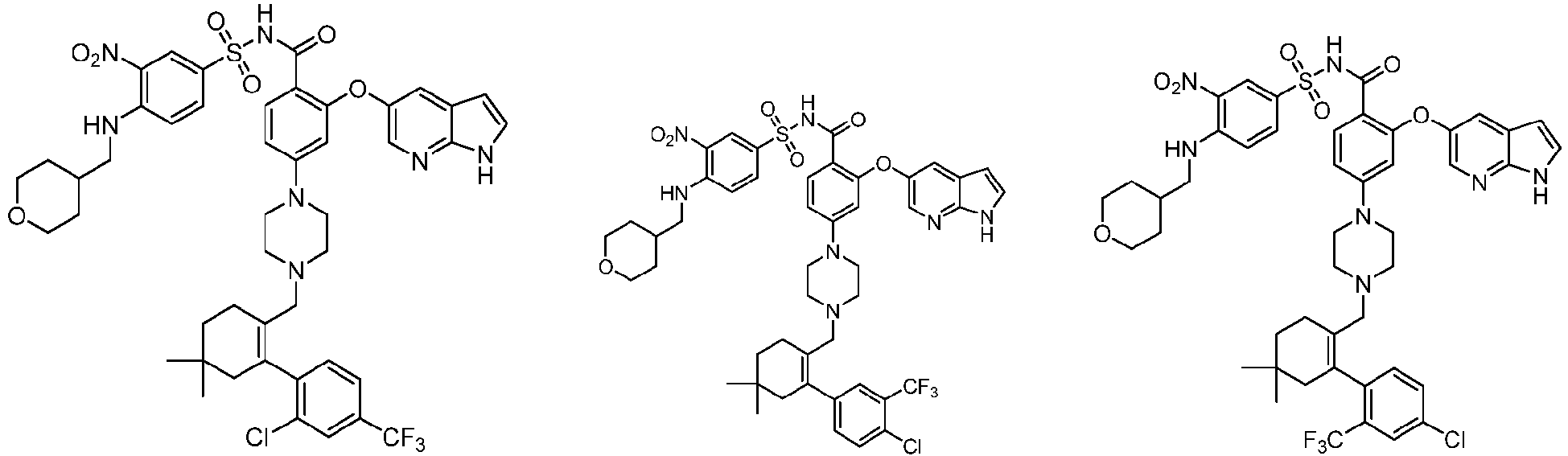


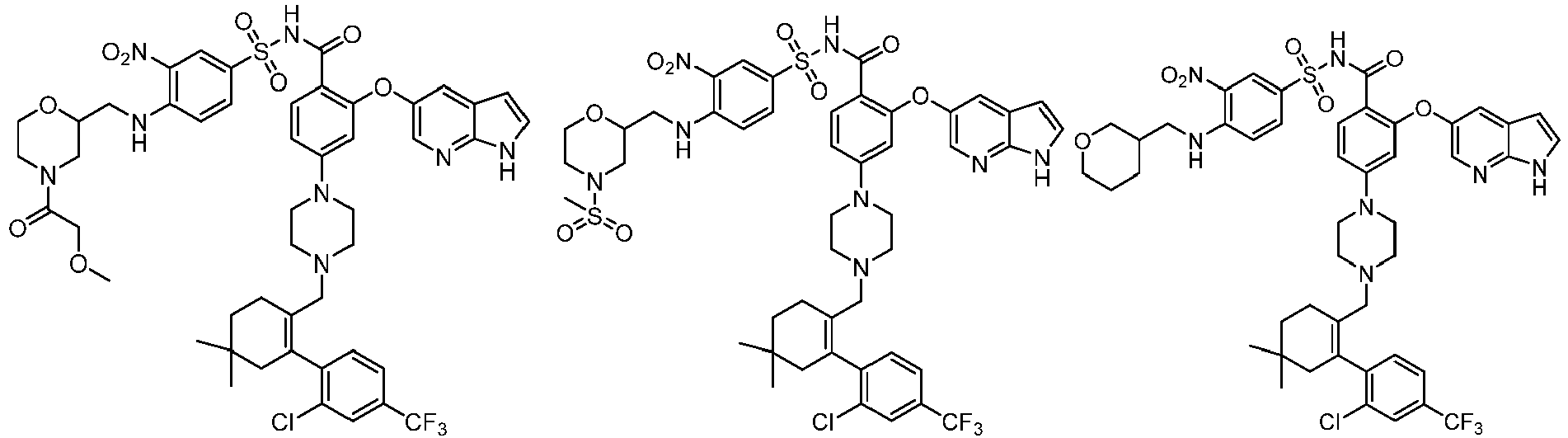


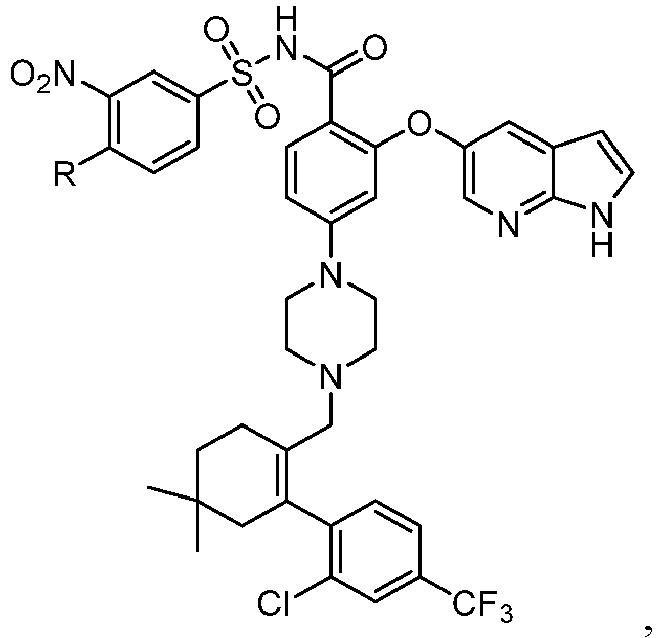


- A compound of the following formulas or a pharmaceutically acceptable salt thereof:
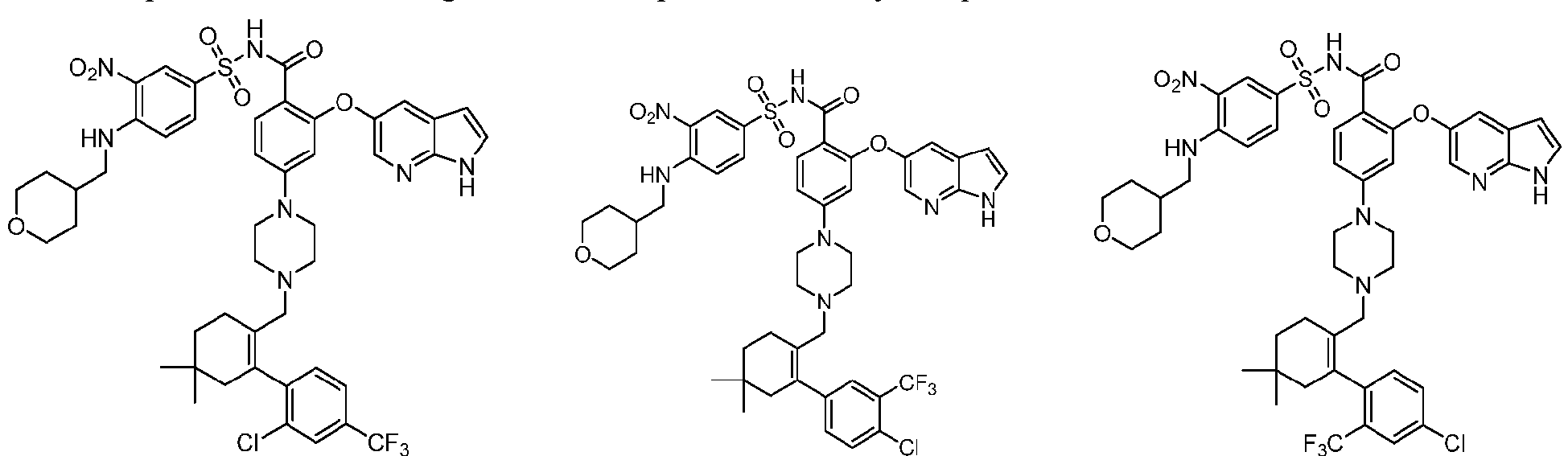


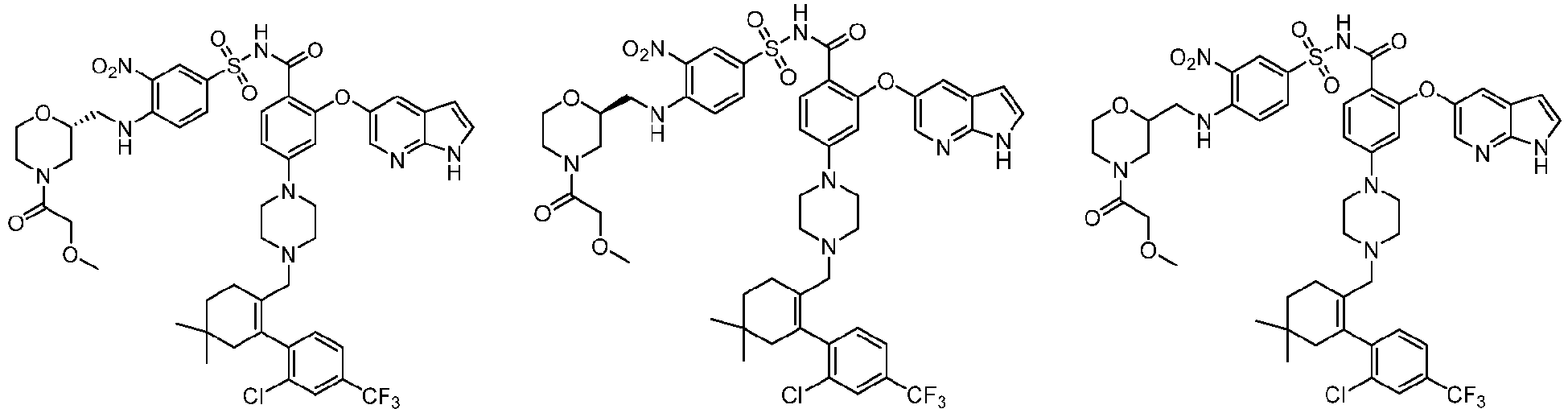


- A pharmaceutical composition comprising the compound, the stereoisomer thereof or the pharmaceutically acceptable salt thereof according to any of claims 1 to 13.
- Use of the compound, the stereoisomer thereof or the pharmaceutically acceptable salt thereof according to any of claims 1 to 13, or the pharmaceutical composition according to claim 14 in preparing a medicament for preventing or treating an anti-apoptotic protein BCL-2-related disease.
Applications Claiming Priority (4)
| Application Number | Priority Date | Filing Date | Title |
|---|---|---|---|
| CN201811268572 | 2018-10-29 | ||
| CN201910249783 | 2019-03-29 | ||
| CN201910933513 | 2019-09-29 | ||
| PCT/CN2019/113963 WO2020088442A1 (en) | 2018-10-29 | 2019-10-29 | Trifluoromethyl-substituted sulfonamide as bcl-2-selective inhibitor |
Publications (2)
| Publication Number | Publication Date |
|---|---|
| EP3858832A1 true EP3858832A1 (en) | 2021-08-04 |
| EP3858832A4 EP3858832A4 (en) | 2022-06-08 |
Family
ID=70462524
Family Applications (1)
| Application Number | Title | Priority Date | Filing Date |
|---|---|---|---|
| EP19878278.1A Pending EP3858832A4 (en) | 2018-10-29 | 2019-10-29 | Trifluoromethyl-substituted sulfonamide as bcl-2-selective inhibitor |
Country Status (14)
| Country | Link |
|---|---|
| US (2) | US12371431B2 (en) |
| EP (1) | EP3858832A4 (en) |
| JP (1) | JP7473545B2 (en) |
| KR (1) | KR102944041B1 (en) |
| CN (2) | CN116199686A (en) |
| AU (1) | AU2019372640B2 (en) |
| BR (1) | BR112021008323A2 (en) |
| CA (1) | CA3117849A1 (en) |
| IL (1) | IL282632B2 (en) |
| MX (2) | MX2021004856A (en) |
| MY (1) | MY203740A (en) |
| PH (1) | PH12021550958A1 (en) |
| SG (1) | SG11202104322YA (en) |
| WO (1) | WO2020088442A1 (en) |
Cited By (1)
| Publication number | Priority date | Publication date | Assignee | Title |
|---|---|---|---|---|
| EP4129998A4 (en) * | 2020-04-29 | 2024-05-01 | Chia Tai Tianqing Pharmaceutical Group Co., Ltd. | TRIFLUOROMETHYL/CHLORO DOUBLE SUBSTITUTED SULFONAMIDE SELECTIVE BCL-2 INHIBITOR CRYSTAL |
Families Citing this family (10)
| Publication number | Priority date | Publication date | Assignee | Title |
|---|---|---|---|---|
| EP3978494A4 (en) * | 2019-05-24 | 2023-04-19 | Chia Tai Tianqing Pharmaceutical Group Co., Ltd. | Methyl- and trifluoromethyl-containing disubstituted sulfonamide selective bcl-2 inhibitor |
| WO2022161496A1 (en) * | 2021-02-01 | 2022-08-04 | Ascentage Pharma (Suzhou) Co., Ltd. | Sulfonyl benzamide derivatives as bcl-2 inhibitors |
| EP4308092A4 (en) * | 2021-03-19 | 2025-01-22 | Eil Therapeutics, Inc. | COMPOUNDS CONTAINING ((3-NITROPHENYL)SULFONYL)ACETAMIDE AS BCL-2 INHIBITORS |
| CN117377672A (en) | 2021-06-04 | 2024-01-09 | 正大天晴药业集团股份有限公司 | Phosphate esters of trifluoromethyl-substituted sulfonamides |
| TW202402272A (en) * | 2022-07-12 | 2024-01-16 | 中國商正大天晴藥業集團股份有限公司 | Compounds containing trifluoromethyl groups |
| WO2024032776A1 (en) * | 2022-08-12 | 2024-02-15 | Fochon Biosciences, Ltd. | Compounds as bcl-2 inhibitors |
| CN115260191B (en) * | 2022-09-29 | 2022-12-27 | 上海睿跃生物科技有限公司 | Piperidine compound and preparation method and application thereof |
| CN121001725A (en) * | 2023-04-20 | 2025-11-21 | 正大天晴药业集团股份有限公司 | Application of trifluoromethyl compounds in the treatment of hematologic malignancies |
| WO2025124487A1 (en) * | 2023-12-12 | 2025-06-19 | 正大天晴药业集团股份有限公司 | Combination of trifluoromethyl-containing compound and furan-containing pyrrole compound for use in treating blood tumors |
| WO2025157254A1 (en) * | 2024-01-26 | 2025-07-31 | 正大天晴药业集团股份有限公司 | Pharmaceutical composition of compound containing sulfonyl group, and use thereof |
Family Cites Families (8)
| Publication number | Priority date | Publication date | Assignee | Title |
|---|---|---|---|---|
| UA108193C2 (en) * | 2008-12-04 | 2015-04-10 | APOPTOZINDUCE FOR THE TREATMENT OF CANCER AND IMMUNE AND AUTO-IMMUNE DISEASES | |
| DK2376480T3 (en) | 2008-12-05 | 2016-09-12 | Abbvie Inc | Sulfonamide derivatives AS BCL-2-selective apoptosis inducing agents for the treatment of cancer and immune diseases |
| CA2929347A1 (en) * | 2009-05-26 | 2010-12-02 | Milan Bruncko | (hetero)aryl substituted sulfonyl-2-(1h-pyrrolo[2,3-b]pyridine-5-oxy)benzamide compounds and their use as apoptosis-inducing agents for the treatment of cancer and immune and autoimmune diseases |
| SG10201801794WA (en) | 2010-10-29 | 2018-04-27 | Abbvie Inc | Solid dispersions containing an apoptosis-inducing agent |
| MY165884A (en) | 2010-11-23 | 2018-05-18 | Abbvie Ireland Unlimited Co | Methods of treatment using selective bcl-2 inhibitors |
| US20140275082A1 (en) * | 2013-03-14 | 2014-09-18 | Abbvie Inc. | Apoptosis-inducing agents for the treatment of cancer and immune and autoimmune diseases |
| WO2018041248A1 (en) * | 2016-09-01 | 2018-03-08 | 北京赛林泰医药技术有限公司 | Bcl-2 selective inhibitor and preparation and use thereof |
| CN111868059B (en) | 2018-03-30 | 2021-12-03 | 正大天晴药业集团股份有限公司 | Trifluoromethyl substituted sulfonamide selective BCL-2 inhibitors |
-
2019
- 2019-10-29 CA CA3117849A patent/CA3117849A1/en active Pending
- 2019-10-29 MX MX2021004856A patent/MX2021004856A/en unknown
- 2019-10-29 CN CN202310104396.3A patent/CN116199686A/en active Pending
- 2019-10-29 AU AU2019372640A patent/AU2019372640B2/en active Active
- 2019-10-29 IL IL282632A patent/IL282632B2/en unknown
- 2019-10-29 KR KR1020217016174A patent/KR102944041B1/en active Active
- 2019-10-29 MY MYPI2021002258A patent/MY203740A/en unknown
- 2019-10-29 CN CN201980067260.1A patent/CN112888687B/en active Active
- 2019-10-29 BR BR112021008323-5A patent/BR112021008323A2/en unknown
- 2019-10-29 US US17/289,406 patent/US12371431B2/en active Active
- 2019-10-29 SG SG11202104322YA patent/SG11202104322YA/en unknown
- 2019-10-29 EP EP19878278.1A patent/EP3858832A4/en active Pending
- 2019-10-29 WO PCT/CN2019/113963 patent/WO2020088442A1/en not_active Ceased
- 2019-10-29 JP JP2021523829A patent/JP7473545B2/en active Active
-
2021
- 2021-04-27 MX MX2024008886A patent/MX2024008886A/en unknown
- 2021-04-28 PH PH12021550958A patent/PH12021550958A1/en unknown
-
2025
- 2025-04-18 US US19/183,579 patent/US20250257064A1/en active Pending
Cited By (2)
| Publication number | Priority date | Publication date | Assignee | Title |
|---|---|---|---|---|
| EP4129998A4 (en) * | 2020-04-29 | 2024-05-01 | Chia Tai Tianqing Pharmaceutical Group Co., Ltd. | TRIFLUOROMETHYL/CHLORO DOUBLE SUBSTITUTED SULFONAMIDE SELECTIVE BCL-2 INHIBITOR CRYSTAL |
| US12545674B2 (en) | 2020-04-29 | 2026-02-10 | Chia Tai Tianqing Pharmaceutical Group Co., Ltd. | Crystal of trifluoromethyl/chloro disubstituted sulfonamide selective BCL-2 inhibitor |
Also Published As
| Publication number | Publication date |
|---|---|
| CA3117849A1 (en) | 2020-05-07 |
| PH12021550958A1 (en) | 2021-11-29 |
| CN112888687B (en) | 2023-01-24 |
| IL282632B1 (en) | 2024-02-01 |
| MX2024008886A (en) | 2024-09-17 |
| US20220002290A1 (en) | 2022-01-06 |
| CN116199686A (en) | 2023-06-02 |
| MX2021004856A (en) | 2021-10-13 |
| IL282632B2 (en) | 2024-06-01 |
| JP7473545B2 (en) | 2024-04-23 |
| IL282632A (en) | 2021-06-30 |
| SG11202104322YA (en) | 2021-05-28 |
| US20250257064A1 (en) | 2025-08-14 |
| CN112888687A (en) | 2021-06-01 |
| EP3858832A4 (en) | 2022-06-08 |
| KR20210086680A (en) | 2021-07-08 |
| BR112021008323A2 (en) | 2021-08-03 |
| AU2019372640B2 (en) | 2022-08-04 |
| WO2020088442A1 (en) | 2020-05-07 |
| MY203740A (en) | 2024-07-17 |
| JP2022506442A (en) | 2022-01-17 |
| KR102944041B1 (en) | 2026-03-25 |
| US12371431B2 (en) | 2025-07-29 |
| AU2019372640A1 (en) | 2021-06-03 |
Similar Documents
| Publication | Publication Date | Title |
|---|---|---|
| KR102944041B1 (en) | Trifluoromethyl-substituted sulfonamides as BCL-2-selective inhibitors | |
| US12319689B2 (en) | Methyl- and trifluoromethyl-containing disubstituted sulfonamide selective BCL-2 inhibitor | |
| WO2019185025A1 (en) | Trifluoromethyl-substituted sulfonamide as bcl-2-selective inhibitor | |
| EP4371981A1 (en) | Sulfur/phosphorus-containing aryl compound and application thereof | |
| CN119768402A (en) | Trifluoromethyl group-containing compound | |
| CN121175315A (en) | Tri-fused ring compound and medical use thereof | |
| CN117321064A (en) | Gemcitabine anticancer derivatives and anticancer medicinal uses | |
| EP3663299B1 (en) | Bicyclic compound acting as ror gamma inhibitor | |
| EP4289833A1 (en) | Tyk2 inhibitor compound containing bicyclic ring | |
| HK40058296A (en) | Trifluoromethyl-substituted sulfonamide as bcl-2-selective inhibitor | |
| RU2815486C9 (en) | Trifluoromethyl-substituted sulphonamide as selective inhibitor of bcl-2 | |
| RU2815486C2 (en) | Trifluoromethyl-substituted sulphonamide as selective inhibitor of bcl-2 | |
| BR122024022420A2 (en) | TRIFLUOROMETHYL SUBSTITUTED SULFONAMIDE COMPOUNDS AS SELECTIVE BCL-2 INHIBITOR, PHARMACEUTICAL COMPOSITION COMPRISING THE COMPOUNDS AND THEIR THERAPEUTIC USE | |
| EP4353722A1 (en) | Phosphate of trifluoromethyl-substituted sulfonamide compound | |
| HK40051476B (en) | Trifluoromethyl-substituted sulfonamide as bcl-2-selective inhibitor | |
| HK40051476A (en) | Trifluoromethyl-substituted sulfonamide as bcl-2-selective inhibitor | |
| EP4700020A1 (en) | Heterocyclic compound as tyk2 inhibitor, and synthesis and use thereof | |
| CN115707702A (en) | Crystal forms of RAD51 inhibitor compounds and uses thereof | |
| EP4538269A1 (en) | Substituted pyridazine-3-carboxamide compound serving as tyk2 inhibitor | |
| HK40110510A (en) | Compound containing cycloalkyl or haloalkyl | |
| CN115894474A (en) | Crystal form of RAD51 inhibitor compound and its application | |
| CN121652157A (en) | Parallel ring compound and medical application thereof |
Legal Events
| Date | Code | Title | Description |
|---|---|---|---|
| STAA | Information on the status of an ep patent application or granted ep patent |
Free format text: STATUS: THE INTERNATIONAL PUBLICATION HAS BEEN MADE |
|
| PUAI | Public reference made under article 153(3) epc to a published international application that has entered the european phase |
Free format text: ORIGINAL CODE: 0009012 |
|
| STAA | Information on the status of an ep patent application or granted ep patent |
Free format text: STATUS: REQUEST FOR EXAMINATION WAS MADE |
|
| 17P | Request for examination filed |
Effective date: 20210428 |
|
| AK | Designated contracting states |
Kind code of ref document: A1 Designated state(s): AL AT BE BG CH CY CZ DE DK EE ES FI FR GB GR HR HU IE IS IT LI LT LU LV MC MK MT NL NO PL PT RO RS SE SI SK SM TR |
|
| DAV | Request for validation of the european patent (deleted) | ||
| DAX | Request for extension of the european patent (deleted) | ||
| REG | Reference to a national code |
Ref country code: HK Ref legal event code: DE Ref document number: 40058296 Country of ref document: HK |
|
| A4 | Supplementary search report drawn up and despatched |
Effective date: 20220509 |
|
| RIC1 | Information provided on ipc code assigned before grant |
Ipc: A61P 35/00 20060101ALI20220502BHEP Ipc: A61K 31/404 20060101ALI20220502BHEP Ipc: C07D 215/20 20060101ALI20220502BHEP Ipc: C07D 211/96 20060101ALI20220502BHEP Ipc: C07D 471/04 20060101AFI20220502BHEP |
|
| STAA | Information on the status of an ep patent application or granted ep patent |
Free format text: STATUS: EXAMINATION IS IN PROGRESS |
|
| 17Q | First examination report despatched |
Effective date: 20231222 |