EP3858022B1 - Verfahren und vorrichtung für subbandgestützten kanalzugriff auf unlizenziertes spektrum - Google Patents
Verfahren und vorrichtung für subbandgestützten kanalzugriff auf unlizenziertes spektrum Download PDFInfo
- Publication number
- EP3858022B1 EP3858022B1 EP18935751.0A EP18935751A EP3858022B1 EP 3858022 B1 EP3858022 B1 EP 3858022B1 EP 18935751 A EP18935751 A EP 18935751A EP 3858022 B1 EP3858022 B1 EP 3858022B1
- Authority
- EP
- European Patent Office
- Prior art keywords
- bandwidth
- lbt
- bandwidth portions
- test
- portions
- Prior art date
- Legal status (The legal status is an assumption and is not a legal conclusion. Google has not performed a legal analysis and makes no representation as to the accuracy of the status listed.)
- Active
Links
Images

Classifications
-
- H—ELECTRICITY
- H04—ELECTRIC COMMUNICATION TECHNIQUE
- H04L—TRANSMISSION OF DIGITAL INFORMATION, e.g. TELEGRAPHIC COMMUNICATION
- H04L5/00—Arrangements affording multiple use of the transmission path
- H04L5/0091—Signalling for the administration of the divided path, e.g. signalling of configuration information
- H04L5/0094—Indication of how sub-channels of the path are allocated
-
- H—ELECTRICITY
- H04—ELECTRIC COMMUNICATION TECHNIQUE
- H04W—WIRELESS COMMUNICATION NETWORKS
- H04W72/00—Local resource management
- H04W72/20—Control channels or signalling for resource management
-
- H—ELECTRICITY
- H04—ELECTRIC COMMUNICATION TECHNIQUE
- H04L—TRANSMISSION OF DIGITAL INFORMATION, e.g. TELEGRAPHIC COMMUNICATION
- H04L1/00—Arrangements for detecting or preventing errors in the information received
- H04L1/12—Arrangements for detecting or preventing errors in the information received by using return channel
- H04L1/16—Arrangements for detecting or preventing errors in the information received by using return channel in which the return channel carries supervisory signals, e.g. repetition request signals
- H04L1/1607—Details of the supervisory signal
- H04L1/1614—Details of the supervisory signal using bitmaps
-
- H—ELECTRICITY
- H04—ELECTRIC COMMUNICATION TECHNIQUE
- H04L—TRANSMISSION OF DIGITAL INFORMATION, e.g. TELEGRAPHIC COMMUNICATION
- H04L27/00—Modulated-carrier systems
- H04L27/0006—Assessment of spectral gaps suitable for allocating digitally modulated signals, e.g. for carrier allocation in cognitive radio
-
- H—ELECTRICITY
- H04—ELECTRIC COMMUNICATION TECHNIQUE
- H04L—TRANSMISSION OF DIGITAL INFORMATION, e.g. TELEGRAPHIC COMMUNICATION
- H04L5/00—Arrangements affording multiple use of the transmission path
- H04L5/003—Arrangements for allocating sub-channels of the transmission path
- H04L5/0044—Allocation of payload; Allocation of data channels, e.g. PDSCH or PUSCH
-
- H—ELECTRICITY
- H04—ELECTRIC COMMUNICATION TECHNIQUE
- H04L—TRANSMISSION OF DIGITAL INFORMATION, e.g. TELEGRAPHIC COMMUNICATION
- H04L5/00—Arrangements affording multiple use of the transmission path
- H04L5/003—Arrangements for allocating sub-channels of the transmission path
- H04L5/0048—Allocation of pilot signals, i.e. of signals known to the receiver
-
- H—ELECTRICITY
- H04—ELECTRIC COMMUNICATION TECHNIQUE
- H04W—WIRELESS COMMUNICATION NETWORKS
- H04W74/00—Wireless channel access
- H04W74/08—Non-scheduled access, e.g. ALOHA
- H04W74/0808—Non-scheduled access, e.g. ALOHA using carrier sensing, e.g. carrier sense multiple access [CSMA]
-
- H—ELECTRICITY
- H04—ELECTRIC COMMUNICATION TECHNIQUE
- H04W—WIRELESS COMMUNICATION NETWORKS
- H04W72/00—Local resource management
- H04W72/04—Wireless resource allocation
- H04W72/044—Wireless resource allocation based on the type of the allocated resource
- H04W72/0453—Resources in frequency domain, e.g. a carrier in FDMA
-
- H—ELECTRICITY
- H04—ELECTRIC COMMUNICATION TECHNIQUE
- H04W—WIRELESS COMMUNICATION NETWORKS
- H04W72/00—Local resource management
- H04W72/20—Control channels or signalling for resource management
- H04W72/23—Control channels or signalling for resource management in the downlink direction of a wireless link, i.e. towards a terminal
Definitions
- the present disclosure generally relates to a method, apparatus and processor for communication, and especially to a method and apparatus for communication with 3GPP 5G new radio (NR) access on an unlicensed spectrum (NR-U).
- NR 3GPP 5G new radio
- NR-U unlicensed spectrum
- LBT Listen Before Talk or sometimes called Listen Before Transmit
- MCOT maximum channel occupancy time
- NR-U In 5G NR, very wide bandwidth is supported, for example, up to 100 MHz bandwidth for Frequency range 1 (FR1, 450MHz - 6000MHz) and up to 400MHz bandwidth for Frequency range 2 (FR2, 24250MHz - 52600MHz). Since the unlicensed spectrum at 5.7GHz has a wide bandwidth up to hundreds of MHz, NR-U also supports wide bandwidth.
- NR-U operating bandwidth is an integer multiple of 20MHz, and LBT is performed in each portion of the operating bandwidth with a 20MHz bandwidth.
- Transport Block When a Transport Block (TB) is scheduled to be transmitted on an unlicensed wide frequency, not all the portions with a 20MHz bandwidth are available for the TB. Therefore, how to transmit the data with a number of portions of the operating bandwidth unavailable is a problem the subject disclosure aim to solve.
- TB Transport Block
- VIVO "Discussion on physical UL channel design in NR unlicensed spectrum", R1- 1808236, 3GPP TSG RAN WG1 Meeting #94, Gothenburg, Sweden, August 20th - 24th, 2018 , discusses the design of physical layer UL channels in the unlicensed spectrum.
- CMCC "Discussion on DCI format design", R1-1800546, 3GPP TSG RAN WG1 Meeting AH 1801, Vancouver, Canada, January 22nd - 26th, 2018 , make various observations and proposals concerning NR DCI format design.
- Embodiments provide a method and apparatus for subband based channel access on an unlicensed spectrum.
- embodiments are provided under specific network architecture and new service scenarios, such as 3GPP 5G, 3GPP Long Term Evolution (LTE) Release 8 and so on.
- network architecture and new service scenarios such as 3GPP 5G, 3GPP Long Term Evolution (LTE) Release 8 and so on.
- LTE Long Term Evolution
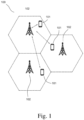
- Fig. 1 depicts a wireless communication system 100 according to the present disclosure.
- the wireless communication system 100 includes UEs 101 and BSs 102.
- the wireless communication system 100 includes three UEs 101 and three BSs 102 for illustrative purpose. Even though a specific number of UEs 101 and BSs 102 are depicted in Fig. 1 , one skilled in the art will recognize that any number of UEs 101 and BSs 102 may be included in the wireless communication system 100.
- the UEs 101 may include computing devices, such as desktop computers, laptop computers, personal digital assistants (PDAs), tablet computers, smart televisions (e.g., televisions connected to the Internet), set-top boxes, game consoles, security systems (including security cameras), vehicle on-board computers, network devices (e.g., routers, switches, and modems), or the like.
- the UEs 101 may include a portable wireless communication device, a smart phone, a cellular telephone, a flip phone, a device having a subscriber identity module, a personal computer, a selective call receiver, or any other device that is capable of sending and receiving communication signals on a wireless network.
- the UEs 101 include wearable devices, such as smart watches, fitness bands, optical head-mounted displays, or the like. Moreover, the UEs 101 may be referred to as a subscriber unit, a mobile, a mobile station, a user, a terminal, a mobile terminal, a wireless terminal, a fixed terminal, a subscriber station, a user terminal, or a device, or described using other terminology used in the art.
- the UEs 101 may communicate directly with the BSs 102 via uplink (UL) communication signals.
- UL uplink
- the BSs 102 may be distributed over a geographic region.
- each of the BSs 102 may also be referred to as an access point, an access terminal, a base, a macro cell, a Node-B, an enhanced Node B (eNB), a Home Node-B, a relay node, or a device, or described using other terminology used in the art.
- the BSs 102 are generally part of a radio access network that may include one or more controllers communicably coupled to one or more corresponding BSs 102.
- the wireless communication system 100 is compatible with any type of network that is capable of sending and receiving wireless communication signals.
- the wireless communication system 100 is compatible with a wireless communication network, a cellular telephone network, a Time Division Multiple Access (TDMA)-based network, a Code Division Multiple Access (CDMA)-based network, an Orthogonal Frequency Division Multiple Access (OFDMA)-based network, an LTE network, a 3rd Generation Partnership Project (3GPP)-based network, a 3GPP 5G network, a satellite communications network, a high altitude platform network, and/or other communications networks.
- TDMA Time Division Multiple Access
- CDMA Code Division Multiple Access
- OFDMA Orthogonal Frequency Division Multiple Access
- LTE Long Term Evolution
- 3GPP 3rd Generation Partnership Project
- 3GPP 5G 3rd Generation Partnership Project 5G network
- satellite communications network a high altitude platform network, and/or other communications networks.
- the wireless communication system 100 is compatible with the 5G new radio (NR) of the 3GPP protocol, wherein the BSs 102 transmit data using an orthogonal frequency division multiplexing (OFDM) modulation scheme on the DL and the UEs 101 transmit data on the UL using a single-carrier frequency division multiple access (SC-FDMA) or OFDM scheme. More generally, however, the wireless communication system 100 may implement some other open or proprietary communication protocols, for example, WiMAX, among other protocols.
- NR 5G new radio
- NR 5G new radio
- OFDM orthogonal frequency division multiplexing
- SC-FDMA single-carrier frequency division multiple access
- WiMAX Worldwide Interoperability for Microwave Access
- the BSs 102 may communicate using other communication protocols, such as the IEEE 802.11 family of wireless communication protocols. Further, in some embodiments, the BSs 102 may communicate over licensed spectrums, whereas in other embodiments the BSs 102 may communicate over unlicensed spectrums. The present disclosure is not intended to be limited to the implementation of any particular wireless communication system architecture or protocol. In another embodiment, the BSs 102 may communicate with the UEs 101 using the 3GPP 5G protocols.
- Wireless signal transmission on an unlicensed spectrum should meet the requirements of regulation subject to the management of the located country or region.
- the design of uplink data for NR-U for example, Physical Uplink Shared Channel (PUSCH) or Physical Uplink Control Channel (PUCCH), should meet the regulation requirements on unlicensed spectrum.
- PUSCH Physical Uplink Shared Channel
- PUCCH Physical Uplink Control Channel
- the requirements include:
- a wideband carrier is divided into a set of bandwidth portions.
- Fig. 2 illustrates a wideband carrier being divided into four subbands named Subband1, Subband2, Subband3, and Subband4, respectively, for illustrative purpose only.
- the present disclosure does not intend to limit the name of a set of bandwidth portions to subband or a number of bandwidth parts.
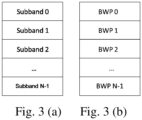
- Fig. 3(a) depicts that the name of the set of bandwidth portions may be Subband, and numbered from 0 to N-1, where N is an integer greater than 0.
- Fig. 3(b) depicts that the name of the set of bandwidth portions may be Bandwidth Part (BWP), and numbered from 0 to N-1.
- the bandwidth portion is named as a subband.
- each subband has the same bandwidth in frequency.
- each subband has a 20 MHz bandwidth.
- approaches for channel access include:
- LAA Licensed Assisted Access
- eLAA Enhanced LAA
- the UE or the BS performs an LBT test upon each subband and aggregates available subbands for a single PUSCH or PDSCH. For example, when some results of the LBT test with respect to some subbands indicate success while some results of the LBT test with respect to other subbands indicate failure, then the UE may transmit data on the subbands with the successful result of the LBT test, and not transmit data on the subbands with the failed result of the LBT test. As shown in Figure 2 , when results of LBT test with respect to Subband 1 and 4 are successful, it is allowed to utilize Subband 1 and 4 for data transmission simultaneously.
- CA-based LBT For the CA approach (i.e. the CA-based LBT), less standard impact is introduced when using LTE-based LAA as baseline and it also requires less stringent processing requirements because each TB is processed independently on each Component Carrier (CC). However, additional guard-band(s) are required between contiguous carriers for the CA approach.
- the subband operation approach i.e. the subband-based LBT
- the subband-based LBT has two features: (1) there is no need to place the guard-band(s) between contiguous subbands, therefore the spectral efficiency is improved compared to the approach of CA-based LBT; and (2) dynamic spectrum usage is realized with finer granularity of LBT bandwidth.
- the scheduling decision is made before performing LBT test.
- a TB is determined to be transmitted on a wide frequency band, for instance, the wideband carrier of Fig. 2 , subject to results of LBT test, not necessary all the subbands are available for the TB transmission at the same time.
- Methods for overcoming said situation may include: (1) rate matching on the available subbands; or (2) puncturing the data to be transmitted on the unavailable subbands.
- high coding rate may be caused in order to transmit the scheduled TB only in the available subbands and the coding rate is variable dependent on the number of available subbands.
- UE may not have enough processing time to perform rate matching, because there is nearly no extra time from the time instant when the LBT result is considered successful to the time instant that UE starts UL transmission.
- the puncturing method a portion of a TB that is mapped to the subband corresponding to a failed LBT result is punctured. Although it is more simple compared to the rate matching method, it may lead to failure of TB decoding at gNB side when too many portions of the TB are punctured.
- Some embodiments of the present disclosure provide methods to solve the aforementioned issues of the subband operation approach, and therefore improving channel utilization efficiency.
- a UE receives downlink control information (DCI) from a BS, which allocates the frequency domain resource to the UE.
- DCI downlink control information
- the DCI schedules the transmission of data on a set of subbands in a wideband carrier.
- the wideband carrier includes a plurality of subbands, and the set of subbands may be a portion or all of the plurality of subbands.
- the UE then performs an LBT test on the set of subbands for uplink transmission or the BS performs an LBT test on the set of subbands for downlink transmission.
- some subbands may be available for transmission, which means the result of the LBT test of the available subbands is successful, and the UE or the BS may transmit the data on these subbands.
- the BS or the UE will receive the data from UE or BS transmitted on the corresponding subbands.
- the subbands have the same bandwidth in frequency.
- the bandwidth of the subbands are all 20 MHz in frequency.
- Interlace-based structure is divided per 20 MHz subband.
- the carrier bandwidth is divided into multiple interlaces and each interlace includes a set of PRBs that are uniformly spaced in frequency domain. In this way, each interlace can span more than 80% of the carrier bandwidth so as to satisfy the requirement on the occupied bandwidth. Meanwhile, the minimum distance between two adjacent PRBs within each interlace is more than 1 MHz. So each PRB within one interlace can be transmitted with 10dBm power.
- the total number of Physical Resource Blocks is 106 for NR 20MHz bandwidth
- ten interlaces are formed, wherein one interlace includes 16 PRBs and each of the other nine interlaces includes 10 PRBs or each of the ten interlaces includes 10 PRBs and the 6 remaining PRBs are left unused; or 11 interlaces are formed, wherein one interlace includes 6 PRBs and each of the other ten interlaces includes 10 PRBs.
- the first level is subband-based indication
- the second level is PRB-based indication within the assigned subbands.
- the DCI includes a bitmap which indicates the allocated subbands for the transmission of data.
- Each bit of the bitmap indicates whether a corresponding subband is assigned for the transmission of data.
- the assigned subbands may be distributed in the whole wideband carrier. For example, regarding a wideband with a bandwidth of 80 MHz, it is divided into 4 subbands, each subband has a bandwidth of 20 MHz. Then, 4-bit bitmap is enough to indicate whether anyone of the four subbands is allocated or not.
- Subband 0, Subband 2, and Subband N-1 in Fig. 3(a) may be allocated for the transmission of data. In this way, the frequency diversity gain can be further improved.
- bitmap size the bandwidth of the wideband the bandwidth of the subbands
- bitmap size the bandwidth of the active bandwidth part in the wideband the bandwidth of the subbands
- the DCI may further include a bit field that indicates a starting bandwidth portion index and a number of contiguous bandwidth portions on wideband carrier.
- the bit field may specify that the allocated subbands start from Subband 2, and the number of contiguous subbands is 3. Then, the UE would know the allocated subbands are Subband 2, Subband 3, and Subband 4.
- contiguous transmission in frequency domain is realized so as to reduce the channel blocking due to power leakage on adjacent subbands.
- the data supposed to be transmitted on the particular subband are punctured.
- subband-based retransmission is proposed according to embodiments of the present disclosure, in order to recover the punctured data.
- one TB is carried on one of assigned subbands.
- the TB is transmitted from the BS to UE when the result of the LBT test indicates success on the associated subband.
- the TB is not transmitted from the BS to UE on the associated subband.
- the TB is scheduled for retransmission on the same subband or a different subband in the next transmission opportunity.
- the DCI may further includes a subband-based transmission indication (STI) for scheduling retransmission of the data.
- the DCI includes a bitmap with each bit of the bitmap indicating whether the data transmitted on a subband is to be retransmitted.
- the DCI further includes a new data indicator (NDI) with a size of one-bit. Based on the NDI and subband-based bitmap in the DCI, the UE may determine using which subband to transmit a new TB and which subband to transmit a previous TB.
- NDI new data indicator
- HARQ-ACK Hybrid Automatic Repeat Request - acknowledge
- CBG Code Block Group
- NACK Non-Acknowledge
- the transmitter knows the decoding state of each transmitted CB and only retransmit the failed CBs. In this way, retransmission efficiency is high.
- the HARQ-ACK feedback overhead may be huge.
- CBG is introduced in Radio Access Network (RAN1). Basically, the intention of CBG is to group several code blocks into one code block group and the resulting HARQ-ACK feedback is generated per CBG. Only all the code blocks within one CBG are correctly decoded the HARQ-ACK for the CBG can be set to "ACK”; otherwise, it is set to "NACK”. Upon the reception of the HARQ-ACK feedback, only the CBG(s) with "NACK" is retransmitted by the transmitter.
- RAN1 Radio Access Network
- Radio Resource Control (RRC) signaling is used to configure the maximum number of CBGs per TB.
- the maximum number of CBGs per TB can be 2, 4, 6 and 8.
- RRC Radio Resource Control
- the number of HARQ-ACK bits for one TB is equal to the configured maximum number of CBGs per TB, regardless of the variable TBs of a given TB.
- CBG-based retransmission is also suitable for unlicensed spectrums. Especially when incomplete PDSCH or PUSCH is transmitted in the initial partial slot after LBT is successful, CBG-based retransmission can be used to retransmit those CBGs punctured by the transmitter.
- a TB is divided into a plurality of CBGs, and each subband carries an integer number of CBGs.
- the numbers of CBGs carried on each subband are identical.
- Rate matching is adopted to align the CBG mapping in each subband.
- CBG transmission information (CBGTI) in DCI is used to retransmit those CBGs carried on the associated subband and punctured due to the unsuccessful result of the LBT test.
- UE Upon reception of DCI, UE prepares the data, which may be PUSCH, according to assigned subbands in the scheduled slot.
- the corresponding TB indicated by DCI is divided into multiple CBGs, and the maximum number of CBGs per TB is configured by RRC signaling.
- UE would calculate the number of CBGs within each subband and each subband carries the same number of CBGs.
- Uplink Control Information for example, ACK/NACK for DL TBs, Channel State Information (CSI), etc. is transmitted along with the data in each subband. Due to the unpredictability of the result of the LBT test, the UE and BS cannot know which subband is available before LBT test, therefore, transmitting UCI in each subband would simplify the implementation complexity of the UE and BS.
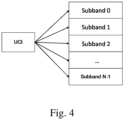
- the UCI is mapped as close as possible to the end of the transmission. For example, Fig. 4 illustrates that the UCI is mapped to each subband.
- the last several symbols carried on each subband are used for PUCCH transmission. More specifically, the number of PUCCH symbols is determined by the corresponding PUCCH format and resource.
- the UCI may be only transmitted on one subband.
- the index of the subband may be the lowest or smallest, or the index may be the highest, or largest, and the LBT test on the lowest or smallest, or on the highest, or largest index of subband is the first complete one.
- the BS needs to blind detect the potential occasions for UCI transmission.
- the LBT test on the subbands includes different types of operations.
- one type of the operation is a complete LBT Cat.4 operation with a random backoff counter selected from a variable contention window (also named type 1 UL channel access procedure in TS36.213)
- another type of the operation is a one-shot LBT operation with at least 25us sensing interval (also named type 2 UL channel access procedure in TS36.213).
- the UE selects a random subband from the allocated subbands, and performs the complete LBT Cat.4 operation on this subband. Before the LBT Cat.4 operation is completed, the UE performs the one-shot LBT operation on every other subbands of the allocated subbands.
- the BS dynamically indicates one subband in DCI to instruct the UE to perform a LBT Cat.4 operation on the subband, and perform a one-shot LBT operation on the other assigned subbands before the completion of the LBT Cat.4 on the indicated subband.
- UE determines that the subbands assigned for data transmission, for example, PUSCH transmission, are interleaved and non-contiguous, UE will perform independent LBT Cat.4 operation on each assigned subband. In this way, UE can transmit the data in a subband as soon as the LBT operation is completed on the subband without a defer period for other subbands.
- UE shall perform a LBT Cat.4 operation on one subband and a one-shot LBT operation on the other assigned subbands. In this case, defer periods are needed.
- the transmission of data on each of a set of bandwidth portions starts from a demodulation reference signal (DMRS) symbol.
- DMRS demodulation reference signal
- the wide carrier On unlicensed spectrum, for a wideband carrier with integer multiple of 20MHz bandwidth, the wide carrier is divided into multiple BWPs with each BWP occupying 20MHz bandwidth.
- the interlace-based structure is divided per BWP. Since multiple BWPs may be used for data transmission as long as the multiple BWPs have successful LBT, specification should allow in one slot when more than one BWP is activated.
- BWP-based bitmap is included in UL grant for indicating the assigned BWPs for PUSCH transmission.
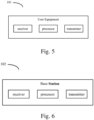
- Fig. 5 depicts a block diagram of a UE according to the embodiments of the present disclosure.
- the UE 101 may include a receiver, a processor, and a transmitter.
- the UE 101 may further include an input device, a display, a memory, and/or other elements.
- the UE may include at least one non-transitory computer-readable medium having computer executable instructions stored therein; at least one receiver; at least one transmitter; and at least one processor coupled to the at least one non-transitory computer-readable medium, the at least one receiver and the at least one transmitter.
- the computer executable instructions can be programmed to implement a method with the at least one receiver, the at least one transmitter and the at least one processor.
- the method according to an embodiment of the present disclosure for example, is the method shown in FIG.4 .
- Fig. 6 depicts a block diagram of a BS according to the embodiments of the present disclosure.
- the BS 102 may include a receiver, a processor, and a transmitter.
- the BS may include at least one non-transitory computer-readable medium having computer executable instructions stored therein; at least one receiver; at least one transmitter; and at least one processor coupled to the at least one non-transitory computer-readable medium, the at least one receiver and the at least one transmitter.
- the computer executable instructions can be programmed to implement a method with the at least one receiver, the at least one transmitter and the at least one processor.
- the method according to an embodiment of the present disclosure for example, is the method shown in FIG.4 .
- the method of the present disclosure can be implemented on a programmed processor.
- the controllers, flowcharts, and modules may also be implemented on a general purpose or special purpose computer, a programmed microprocessor or microcontroller and peripheral integrated circuit elements, an integrated circuit, a hardware electronic or logic circuit such as a discrete element circuit, a programmable logic device, or the like.
- any device that hasa finite state machine capable of implementing the flowcharts shown in the figures may be used to implement the processing functions of the present disclosure.
Landscapes
- Engineering & Computer Science (AREA)
- Signal Processing (AREA)
- Computer Networks & Wireless Communication (AREA)
- Physics & Mathematics (AREA)
- Health & Medical Sciences (AREA)
- General Health & Medical Sciences (AREA)
- Spectroscopy & Molecular Physics (AREA)
- Mobile Radio Communication Systems (AREA)
Claims (14)
- Verfahren, das durch eine Benutzerausrüstung (101) durchgeführt wird, das Verfahren umfassend:Empfangen von Downlink-Steuerinformationen, DCI, zum Planen einer Übertragung von Daten auf einem Satz von Bandbreitenteilen eines Trägers, wobei der Träger eine Vielzahl von Bandbreitenteilen umfasst, wobei die DCI ein Bitfeld einschließen, das einen Anfangsbandbreitenteilindex und eine Anzahl von zusammenhängenden Bandbreitenteilen auf dem Träger anzeigt;Durchführen eines Listen-Before-Talk-Tests, LBT-Test, an dem Satz von Bandbreitenteilen; undÜbertragen der Daten auf einem oder mehreren Bandbreitenteilen des Satzes von Bandbreitenteilen basierend auf einem Ergebnis des LBT-Tests;dadurch gekennzeichnet, dass das Durchführen eines LBT-Tests an dem Satz von Bandbreitenteilen das Durchführen einer ersten LBT-Operation des LBT-Tests an einem des Satzes von Bandbreitenteilen, wie durch die DCI angewiesen, und das Durchführen einer zweiten LBT-Operation des LBT-Tests an verbleibenden Bandbreitenteilen des Satzes von Bandbreitenteilen umfasst, wobei sich die erste LBT-Operation von der zweiten LBT-Operation unterscheidet.
- Verfahren nach Anspruch 1, wobei jeder Bandbreitenteil eine gleiche Frequenzbandbreite aufweist und optional:
wobei jeder Bandbreitenteil eine Frequenzbandbreite von 20 MHz aufweist. - Verfahren nach Anspruch 1, wobei die DCI eine Bitmap einschließen, wobei jedes Bit der Bitmap anzeigt, ob ein entsprechender Bandbreitenteil für die Übertragung von Daten zugewiesen ist, und optional
wobei eine Anzahl von Bits der Bitmap einer Anzahl von Bandbreitenteilen des Trägers entspricht. - Verfahren nach Anspruch 1, wobei die Daten eine Vielzahl von Transportblöcken, TBs, einschließen und jeder der Vielzahl von TBs auf einem entsprechenden Bandbreitenteil des Satzes von Bandbreitenteilen zu übertragen ist.
- Verfahren nach Anspruch 1, wobei die DCI eine Bitmap einschließen, wobei jedes Bit der Bitmap anzeigt, ob die Daten, die auf einem Bandbreitenteil des Satzes von Bandbreitenteilen übertragen werden, erneut zu übertragen sind.
- Verfahren nach Anspruch 3, ferner umfassend ein Bestimmen, ob ein Bandbreitenteil des Satzes von Bandbreitenteilen für ein Übertragen eines neuen Transportblocks, TB, oder ein erneutes Übertragen eines vorherigen TB basierend auf der Bitmap und einer Neudatenanzeige, NDI, die in den DCI eingeschlossen sind, geplant ist.
- Verfahren nach Anspruch 1, wobei die Daten eine Vielzahl von Codeblockgruppen, CBGs, umfassen und jeder Bandbreitenteil des Satzes von Bandbreitenteilen eine ganzzahlige Anzahl von CBGs einschließt.
- Verfahren nach Anspruch 1, ferner umfassend das Übertragen von Uplink-Steuerinformationen, UCI, zusammen mit den Daten, wobei die UCI auf jedem des Satzes von Bandbreitenteilen getragen werden oder
wobei die UCI auf einem speziellen Bandbreitenteil getragen wird, der einen niedrigsten oder kleinsten oder höchsten oder größten Bandbreitenteilindex des Satzes von Bandbreitenteilen aufweist; und wobei der LBT-Test eine Vielzahl von LBT-Operationen einschließt, die dem Satz von Bandbreitenteilen entspricht, und eine der Vielzahl von LBT-Operationen, die dem speziellen Bandbreitenteil entspricht, vor den verbleibenden der Vielzahl von LBT-Operationen abgeschlossen ist. - Verfahren nach Anspruch 1, ferner umfassend das Übertragen von Uplink-Steuerinformationen, UCI, auf mindestens einem Bandbreitenteil des Satzes von Bandbreitenteilen und wobei die UCI mindestens einem Symbol an oder nahe dem Ende des mindestens einen Bandbreitenteils zugeordnet wird.
- Verfahren nach Anspruch 1, ferner umfassend das Durchführen einer ersten LBT-Operation des LBT-Tests an jedem des Satzes von Bandbreitenteilen.
- Verfahren nach Anspruch 1, wobei die Übertragung von Daten auf jedem des Satzes von Bandbreitenteilen bei einem Demodulationsreferenzsignalsymbol, DMRS-Symbol, anfängt.
- Verfahren, das durch eine Basisstation (102) durchgeführt wird, das Verfahren umfassend:Übertragen von Downlink-Steuerinformationen, DCI, zum Planen der Übertragung von Daten auf einem Satz von Bandbreitenteilen eines Trägers, wobei der Träger eine Vielzahl von Bandbreitenteilen umfasst;Durchführen eines Listen-Before-Talk-Tests, LBT-Test, an dem Satz von Bandbreitenteilen; undEmpfangen der Daten auf einem oder mehreren Bandbreitenteilen des Satzes von Bandbreitenteilen basierend auf einem Ergebnis des LBT-Tests;wobei die DCI ein Bitfeld einschließen, das einenAnfangsbandbreitenteilindex und eine Anzahl von zusammenhängenden Bandbreitenteilen auf dem Träger anzeigt, und dadurch gekennzeichnet, dass die DCI eine Benutzerausrüstung anweisen, eine erste LBT-Operation des LBT-Tests an einem des Satzes von Bandbreitenteilen durchzuführen und eine zweite LBT-Operation des LBT-Tests an verbleibenden Bandbreitenteilen des Satzes von Bandbreitenteilen durchzuführen, wobei sich die erste LBT-Operation von der zweiten LBT-Operation unterscheidet.
- Vorrichtung, umfassend:mindestens ein nichtflüchtiges computerlesbares Medium, das computerausführbare Anweisungen darin gespeichert aufweist;mindestens eine Empfangseinrichtung;mindestens eine Übertragungseinrichtung; undmindestens einen Prozessor, der mit dem mindestens einen nichtflüchtigen computerlesbaren Medium, der mindestens einen Empfangseinrichtung und der mindestens einen Übertragungseinrichtung gekoppelt ist;wobei die computerausführbaren Anweisungen programmiert sind, um ein Verfahren nach einem der Ansprüche 1 bis 11 oder Anspruch 12 mit der mindestens einen Empfangseinrichtung, der mindestens einen Übertragungseinrichtung und dem mindestens einen Prozessor zu implementieren.
- Prozessor für drahtlose Kommunikation durch eine Benutzerausrüstung (101), wobei der Prozessor konfiguriert ist, um die Benutzerausrüstung (101) zu veranlassen zum:Empfangen von Downlink-Steuerinformationen, DCI, zum Planen der Übertragung von Daten auf einem Satz von Bandbreitenteilen eines Trägers, wobei der Träger eine Vielzahl von Bandbreitenteilen umfasst, wobei die DCI ein Bitfeld einschließen, das einen Anfangsbandbreitenteilindex und eine Anzahl von zusammenhängenden Bandbreitenteilen auf dem Träger anzeigt;Durchführen eines Listen-Before-Talk-Tests, LBT-Test, an dem Satz von Bandbreitenteilen; undÜbertragen der Daten auf einem oder mehreren Bandbreitenteilen des Satzes von Bandbreitenteilen basierend auf einem Ergebnis des LBT-Tests;dadurch gekennzeichnet, dass das Durchführen eines LBT-Tests an dem Satz von Bandbreitenteilen das Durchführen einer ersten LBT-Operation des LBT-Tests an einem des Satzes von Bandbreitenteilen, wie durch die DCI angewiesen, und das Durchführen einer zweiten LBT-Operation des LBT-Tests an verbleibenden Bandbreitenteilen des Satzes von Bandbreitenteilen umfasst, wobei sich die erste LBT-Operation von der zweiten LBT-Operation unterscheidet.
Applications Claiming Priority (1)
| Application Number | Priority Date | Filing Date | Title |
|---|---|---|---|
| PCT/CN2018/108407 WO2020062056A1 (en) | 2018-09-28 | 2018-09-28 | Method and apparatus for subband based channel access on unlicensed spectrum |
Publications (4)
| Publication Number | Publication Date |
|---|---|
| EP3858022A1 EP3858022A1 (de) | 2021-08-04 |
| EP3858022A4 EP3858022A4 (de) | 2022-05-11 |
| EP3858022B1 true EP3858022B1 (de) | 2025-02-12 |
| EP3858022C0 EP3858022C0 (de) | 2025-02-12 |
Family
ID=69949542
Family Applications (1)
| Application Number | Title | Priority Date | Filing Date |
|---|---|---|---|
| EP18935751.0A Active EP3858022B1 (de) | 2018-09-28 | 2018-09-28 | Verfahren und vorrichtung für subbandgestützten kanalzugriff auf unlizenziertes spektrum |
Country Status (5)
| Country | Link |
|---|---|
| US (1) | US11991697B2 (de) |
| EP (1) | EP3858022B1 (de) |
| CN (1) | CN112690032B (de) |
| ES (1) | ES3011561T3 (de) |
| WO (1) | WO2020062056A1 (de) |
Families Citing this family (4)
| Publication number | Priority date | Publication date | Assignee | Title |
|---|---|---|---|---|
| US11997713B2 (en) * | 2019-01-23 | 2024-05-28 | Ntt Docomo, Inc. | Transmission apparatus and radio communication method |
| WO2020167107A1 (ko) * | 2019-02-15 | 2020-08-20 | 엘지전자 주식회사 | 무선 통신 시스템에서 무선 신호 송수신 방법 및 장치 |
| CN110313215A (zh) * | 2019-05-24 | 2019-10-08 | 北京小米移动软件有限公司 | 基于非授权频谱的通信方法、装置及存储介质 |
| CN111669237B (zh) * | 2020-05-15 | 2022-02-25 | 中国信息通信研究院 | 一种先听后发传输方法、设备和系统 |
Citations (1)
| Publication number | Priority date | Publication date | Assignee | Title |
|---|---|---|---|---|
| WO2019146986A1 (en) * | 2018-01-23 | 2019-08-01 | Samsung Electronics Co., Ltd. | Listen-before-talk for wideband operation of nr unlicensed spectrum |
Family Cites Families (7)
| Publication number | Priority date | Publication date | Assignee | Title |
|---|---|---|---|---|
| JP6637163B2 (ja) * | 2015-09-17 | 2020-01-29 | エルジー エレクトロニクス インコーポレイティド | 非免許帯域を支援する無線接続システムにおいてマルチキャリア上でlbt過程を行う方法及び装置 |
| CN106658742B (zh) * | 2015-11-03 | 2020-07-03 | 中兴通讯股份有限公司 | 数据调度及传输的方法、装置及系统 |
| US11240842B2 (en) | 2016-01-08 | 2022-02-01 | Acer Incorporated | Device and method of handling transmission/reception for serving cell |
| ES3037631T3 (en) | 2016-01-13 | 2025-10-03 | Lenovo Innovations Ltd Hong Kong | Data acknowledgement in a wireless communication system |
| US10812982B2 (en) * | 2016-02-05 | 2020-10-20 | Qualcomm Incorporated | Autonomous uplink transmission in unlicensed spectrum |
| US10673566B2 (en) * | 2017-09-07 | 2020-06-02 | Sharp Kabushiki Kaisha | Determining DCI format |
| US10873423B2 (en) * | 2018-02-15 | 2020-12-22 | Huawei Technologies Co., Ltd. | Systems and methods for allocation of uplink control channel resources in unlicensed spectrum |
-
2018
- 2018-09-28 EP EP18935751.0A patent/EP3858022B1/de active Active
- 2018-09-28 US US17/276,132 patent/US11991697B2/en active Active
- 2018-09-28 WO PCT/CN2018/108407 patent/WO2020062056A1/en not_active Ceased
- 2018-09-28 ES ES18935751T patent/ES3011561T3/es active Active
- 2018-09-28 CN CN201880097518.8A patent/CN112690032B/zh active Active
Patent Citations (1)
| Publication number | Priority date | Publication date | Assignee | Title |
|---|---|---|---|---|
| WO2019146986A1 (en) * | 2018-01-23 | 2019-08-01 | Samsung Electronics Co., Ltd. | Listen-before-talk for wideband operation of nr unlicensed spectrum |
Non-Patent Citations (2)
| Title |
|---|
| FUJITSU: "On channel access procedure for NR-U", vol. RAN WG1, no. Gothenburg, Sweden; 20180820 - 20180824, 10 August 2018 (2018-08-10), XP051515676, Retrieved from the Internet <URL:http://www.3gpp.org/ftp/tsg%5Fran/WG1%5FRL1/TSGR1%5F94/Docs/R1%2D1808293%2Ezip> [retrieved on 20180810] * |
| VIVO: "Discussion on the enhancements to configured grants", vol. RAN WG1, no. Gothenburg, Sweden; 20180820 - 20180824, 10 August 2018 (2018-08-10), XP051515625, Retrieved from the Internet <URL:http://www.3gpp.org/ftp/tsg%5Fran/WG1%5FRL1/TSGR1%5F94/Docs/R1%2D1808240%2Ezip> [retrieved on 20180810] * |
Also Published As
| Publication number | Publication date |
|---|---|
| EP3858022A4 (de) | 2022-05-11 |
| WO2020062056A1 (en) | 2020-04-02 |
| US20220053536A1 (en) | 2022-02-17 |
| EP3858022A1 (de) | 2021-08-04 |
| CN112690032A (zh) | 2021-04-20 |
| EP3858022C0 (de) | 2025-02-12 |
| US11991697B2 (en) | 2024-05-21 |
| ES3011561T3 (en) | 2025-04-07 |
| CN112690032B (zh) | 2023-08-18 |
Similar Documents
| Publication | Publication Date | Title |
|---|---|---|
| EP3776970B1 (de) | Uplink-bandbreitenteilumschaltung auf neuen funk ohne lizenz | |
| EP3651522B1 (de) | Verfahren zur handhabung der kommunikation in einem unlizenzierten spektrum und zugehörige kommunikationsvorrichtung | |
| US11134482B2 (en) | Method and apparatus for transmitting uplink control information | |
| US12155487B2 (en) | Method and apparatus for reducing one-shot hybrid automatic repeat request-acknowledgement (HARQ-ACK) codebook size | |
| EP3606126B1 (de) | Verfahren und vorrichtung zur übertragung von uplink-kanälen und verfahren und vorrichtung zur übertragung von downlink-kanälen | |
| US12074803B2 (en) | Contention window size determining method and apparatus | |
| US10834763B2 (en) | Method and apparatus for handling overlap of different channels in wireless communication system | |
| EP3448108B1 (de) | Verfahren und vorrichtung zur übertragung von uplink-steuerinformationen | |
| EP3637821A1 (de) | Verfahren und vorrichtung zur übertragung von steuerungsinformationen | |
| US11902215B2 (en) | Method and apparatus for resource mapping in unlicensed spectrum | |
| CN108293268A (zh) | 非授权带中的信道接入的方法、设备和系统 | |
| US12507224B2 (en) | Method and apparatus for scheduling physical uplink shared channel (PUSCH) and physical downlink shared channel (PDSCH) | |
| EP3858022B1 (de) | Verfahren und vorrichtung für subbandgestützten kanalzugriff auf unlizenziertes spektrum | |
| CN118120313A (zh) | 边链路反馈信息的发送和接收方法以及装置 | |
| WO2023092592A1 (en) | Methods and apparatuses of resource allocation for sidelink communication | |
| WO2024031610A1 (en) | Methods and apparatuses for determining size of transport block | |
| US20230388088A1 (en) | Method and apparatus for downlink and uplink transmissions over an unlicensed spectrum |
Legal Events
| Date | Code | Title | Description |
|---|---|---|---|
| STAA | Information on the status of an ep patent application or granted ep patent |
Free format text: STATUS: THE INTERNATIONAL PUBLICATION HAS BEEN MADE |
|
| PUAI | Public reference made under article 153(3) epc to a published international application that has entered the european phase |
Free format text: ORIGINAL CODE: 0009012 |
|
| STAA | Information on the status of an ep patent application or granted ep patent |
Free format text: STATUS: REQUEST FOR EXAMINATION WAS MADE |
|
| 17P | Request for examination filed |
Effective date: 20210312 |
|
| AK | Designated contracting states |
Kind code of ref document: A1 Designated state(s): AL AT BE BG CH CY CZ DE DK EE ES FI FR GB GR HR HU IE IS IT LI LT LU LV MC MK MT NL NO PL PT RO RS SE SI SK SM TR |
|
| DAV | Request for validation of the european patent (deleted) | ||
| DAX | Request for extension of the european patent (deleted) | ||
| REG | Reference to a national code |
Ref country code: DE Ref legal event code: R079 Free format text: PREVIOUS MAIN CLASS: H04W0072040000 Ipc: H04L0005000000 Ref document number: 602018079208 Country of ref document: DE |
|
| A4 | Supplementary search report drawn up and despatched |
Effective date: 20220412 |
|
| RIC1 | Information provided on ipc code assigned before grant |
Ipc: H04W 72/12 20090101ALN20220406BHEP Ipc: H04W 72/04 20090101ALN20220406BHEP Ipc: H04W 74/08 20090101ALI20220406BHEP Ipc: H04L 27/00 20060101ALI20220406BHEP Ipc: H04L 5/00 20060101AFI20220406BHEP |
|
| STAA | Information on the status of an ep patent application or granted ep patent |
Free format text: STATUS: EXAMINATION IS IN PROGRESS |
|
| 17Q | First examination report despatched |
Effective date: 20240411 |
|
| GRAP | Despatch of communication of intention to grant a patent |
Free format text: ORIGINAL CODE: EPIDOSNIGR1 |
|
| STAA | Information on the status of an ep patent application or granted ep patent |
Free format text: STATUS: GRANT OF PATENT IS INTENDED |
|
| GRAJ | Information related to disapproval of communication of intention to grant by the applicant or resumption of examination proceedings by the epo deleted |
Free format text: ORIGINAL CODE: EPIDOSDIGR1 |
|
| STAA | Information on the status of an ep patent application or granted ep patent |
Free format text: STATUS: EXAMINATION IS IN PROGRESS |
|
| RIC1 | Information provided on ipc code assigned before grant |
Ipc: H04W 72/23 20230101ALN20240701BHEP Ipc: H04W 72/0453 20230101ALN20240701BHEP Ipc: H04W 74/0808 20240101ALI20240701BHEP Ipc: H04L 27/00 20060101ALI20240701BHEP Ipc: H04L 5/00 20060101AFI20240701BHEP |
|
| INTG | Intention to grant announced |
Effective date: 20240710 |
|
| INTC | Intention to grant announced (deleted) | ||
| RIC1 | Information provided on ipc code assigned before grant |
Ipc: H04W 72/23 20230101ALN20240801BHEP Ipc: H04W 72/0453 20230101ALN20240801BHEP Ipc: H04W 74/0808 20240101ALI20240801BHEP Ipc: H04L 27/00 20060101ALI20240801BHEP Ipc: H04L 5/00 20060101AFI20240801BHEP |
|
| GRAP | Despatch of communication of intention to grant a patent |
Free format text: ORIGINAL CODE: EPIDOSNIGR1 |
|
| STAA | Information on the status of an ep patent application or granted ep patent |
Free format text: STATUS: GRANT OF PATENT IS INTENDED |
|
| INTG | Intention to grant announced |
Effective date: 20240909 |
|
| GRAS | Grant fee paid |
Free format text: ORIGINAL CODE: EPIDOSNIGR3 |
|
| GRAA | (expected) grant |
Free format text: ORIGINAL CODE: 0009210 |
|
| STAA | Information on the status of an ep patent application or granted ep patent |
Free format text: STATUS: THE PATENT HAS BEEN GRANTED |
|
| AK | Designated contracting states |
Kind code of ref document: B1 Designated state(s): AL AT BE BG CH CY CZ DE DK EE ES FI FR GB GR HR HU IE IS IT LI LT LU LV MC MK MT NL NO PL PT RO RS SE SI SK SM TR |
|
| REG | Reference to a national code |
Ref country code: GB Ref legal event code: FG4D |
|
| REG | Reference to a national code |
Ref country code: CH Ref legal event code: EP |
|
| REG | Reference to a national code |
Ref country code: DE Ref legal event code: R096 Ref document number: 602018079208 Country of ref document: DE |
|
| REG | Reference to a national code |
Ref country code: IE Ref legal event code: FG4D |
|
| U01 | Request for unitary effect filed |
Effective date: 20250226 |
|
| REG | Reference to a national code |
Ref country code: ES Ref legal event code: FG2A Ref document number: 3011561 Country of ref document: ES Kind code of ref document: T3 Effective date: 20250407 |
|
| U07 | Unitary effect registered |
Designated state(s): AT BE BG DE DK EE FI FR IT LT LU LV MT NL PT RO SE SI Effective date: 20250307 |
|
| PG25 | Lapsed in a contracting state [announced via postgrant information from national office to epo] |
Ref country code: RS Free format text: LAPSE BECAUSE OF FAILURE TO SUBMIT A TRANSLATION OF THE DESCRIPTION OR TO PAY THE FEE WITHIN THE PRESCRIBED TIME-LIMIT Effective date: 20250512 |
|
| PG25 | Lapsed in a contracting state [announced via postgrant information from national office to epo] |
Ref country code: PL Free format text: LAPSE BECAUSE OF FAILURE TO SUBMIT A TRANSLATION OF THE DESCRIPTION OR TO PAY THE FEE WITHIN THE PRESCRIBED TIME-LIMIT Effective date: 20250212 |
|
| PG25 | Lapsed in a contracting state [announced via postgrant information from national office to epo] |
Ref country code: NO Free format text: LAPSE BECAUSE OF FAILURE TO SUBMIT A TRANSLATION OF THE DESCRIPTION OR TO PAY THE FEE WITHIN THE PRESCRIBED TIME-LIMIT Effective date: 20250512 Ref country code: IS Free format text: LAPSE BECAUSE OF FAILURE TO SUBMIT A TRANSLATION OF THE DESCRIPTION OR TO PAY THE FEE WITHIN THE PRESCRIBED TIME-LIMIT Effective date: 20250612 |
|
| PG25 | Lapsed in a contracting state [announced via postgrant information from national office to epo] |
Ref country code: HR Free format text: LAPSE BECAUSE OF FAILURE TO SUBMIT A TRANSLATION OF THE DESCRIPTION OR TO PAY THE FEE WITHIN THE PRESCRIBED TIME-LIMIT Effective date: 20250212 |
|
| PG25 | Lapsed in a contracting state [announced via postgrant information from national office to epo] |
Ref country code: GR Free format text: LAPSE BECAUSE OF FAILURE TO SUBMIT A TRANSLATION OF THE DESCRIPTION OR TO PAY THE FEE WITHIN THE PRESCRIBED TIME-LIMIT Effective date: 20250513 |
|
| PG25 | Lapsed in a contracting state [announced via postgrant information from national office to epo] |
Ref country code: SM Free format text: LAPSE BECAUSE OF FAILURE TO SUBMIT A TRANSLATION OF THE DESCRIPTION OR TO PAY THE FEE WITHIN THE PRESCRIBED TIME-LIMIT Effective date: 20250212 |
|
| PGFP | Annual fee paid to national office [announced via postgrant information from national office to epo] |
Ref country code: GB Payment date: 20250923 Year of fee payment: 8 |
|
| PG25 | Lapsed in a contracting state [announced via postgrant information from national office to epo] |
Ref country code: CZ Free format text: LAPSE BECAUSE OF FAILURE TO SUBMIT A TRANSLATION OF THE DESCRIPTION OR TO PAY THE FEE WITHIN THE PRESCRIBED TIME-LIMIT Effective date: 20250212 |
|
| PG25 | Lapsed in a contracting state [announced via postgrant information from national office to epo] |
Ref country code: SK Free format text: LAPSE BECAUSE OF FAILURE TO SUBMIT A TRANSLATION OF THE DESCRIPTION OR TO PAY THE FEE WITHIN THE PRESCRIBED TIME-LIMIT Effective date: 20250212 |
|
| U20 | Renewal fee for the european patent with unitary effect paid |
Year of fee payment: 8 Effective date: 20250925 |
|
| PLBE | No opposition filed within time limit |
Free format text: ORIGINAL CODE: 0009261 |
|
| STAA | Information on the status of an ep patent application or granted ep patent |
Free format text: STATUS: NO OPPOSITION FILED WITHIN TIME LIMIT |
|
| 26N | No opposition filed |
Effective date: 20251113 |
|
| PGFP | Annual fee paid to national office [announced via postgrant information from national office to epo] |
Ref country code: ES Payment date: 20251015 Year of fee payment: 8 |