EP3857624B1 - Batteriemodul und verfahren zum herstellen desselben - Google Patents
Batteriemodul und verfahren zum herstellen desselben Download PDFInfo
- Publication number
- EP3857624B1 EP3857624B1 EP19783449.2A EP19783449A EP3857624B1 EP 3857624 B1 EP3857624 B1 EP 3857624B1 EP 19783449 A EP19783449 A EP 19783449A EP 3857624 B1 EP3857624 B1 EP 3857624B1
- Authority
- EP
- European Patent Office
- Prior art keywords
- battery module
- battery
- battery cells
- contact
- junction
- Prior art date
- Legal status (The legal status is an assumption and is not a legal conclusion. Google has not performed a legal analysis and makes no representation as to the accuracy of the status listed.)
- Active
Links
Images




Classifications
-
- H—ELECTRICITY
- H01—ELECTRIC ELEMENTS
- H01M—PROCESSES OR MEANS, e.g. BATTERIES, FOR THE DIRECT CONVERSION OF CHEMICAL ENERGY INTO ELECTRICAL ENERGY
- H01M50/00—Constructional details or processes of manufacture of the non-active parts of electrochemical cells other than fuel cells, e.g. hybrid cells
- H01M50/20—Mountings; Secondary casings or frames; Racks, modules or packs; Suspension devices; Shock absorbers; Transport or carrying devices; Holders
- H01M50/204—Racks, modules or packs for multiple batteries or multiple cells
- H01M50/207—Racks, modules or packs for multiple batteries or multiple cells characterised by their shape
- H01M50/209—Racks, modules or packs for multiple batteries or multiple cells characterised by their shape adapted for prismatic or rectangular cells
-
- H—ELECTRICITY
- H01—ELECTRIC ELEMENTS
- H01M—PROCESSES OR MEANS, e.g. BATTERIES, FOR THE DIRECT CONVERSION OF CHEMICAL ENERGY INTO ELECTRICAL ENERGY
- H01M50/00—Constructional details or processes of manufacture of the non-active parts of electrochemical cells other than fuel cells, e.g. hybrid cells
- H01M50/20—Mountings; Secondary casings or frames; Racks, modules or packs; Suspension devices; Shock absorbers; Transport or carrying devices; Holders
- H01M50/289—Mountings; Secondary casings or frames; Racks, modules or packs; Suspension devices; Shock absorbers; Transport or carrying devices; Holders characterised by spacing elements or positioning means within frames, racks or packs
- H01M50/291—Mountings; Secondary casings or frames; Racks, modules or packs; Suspension devices; Shock absorbers; Transport or carrying devices; Holders characterised by spacing elements or positioning means within frames, racks or packs characterised by their shape
-
- H—ELECTRICITY
- H01—ELECTRIC ELEMENTS
- H01M—PROCESSES OR MEANS, e.g. BATTERIES, FOR THE DIRECT CONVERSION OF CHEMICAL ENERGY INTO ELECTRICAL ENERGY
- H01M50/00—Constructional details or processes of manufacture of the non-active parts of electrochemical cells other than fuel cells, e.g. hybrid cells
- H01M50/50—Current conducting connections for cells or batteries
- H01M50/502—Interconnectors for connecting terminals of adjacent batteries; Interconnectors for connecting cells outside a battery casing
- H01M50/503—Interconnectors for connecting terminals of adjacent batteries; Interconnectors for connecting cells outside a battery casing characterised by the shape of the interconnectors
-
- H—ELECTRICITY
- H01—ELECTRIC ELEMENTS
- H01M—PROCESSES OR MEANS, e.g. BATTERIES, FOR THE DIRECT CONVERSION OF CHEMICAL ENERGY INTO ELECTRICAL ENERGY
- H01M10/00—Secondary cells; Manufacture thereof
- H01M10/05—Accumulators with non-aqueous electrolyte
- H01M10/052—Li-accumulators
- H01M10/0525—Rocking-chair batteries, i.e. batteries with lithium insertion or intercalation in both electrodes; Lithium-ion batteries
-
- H—ELECTRICITY
- H01—ELECTRIC ELEMENTS
- H01M—PROCESSES OR MEANS, e.g. BATTERIES, FOR THE DIRECT CONVERSION OF CHEMICAL ENERGY INTO ELECTRICAL ENERGY
- H01M10/00—Secondary cells; Manufacture thereof
- H01M10/54—Reclaiming serviceable parts of waste accumulators
-
- Y—GENERAL TAGGING OF NEW TECHNOLOGICAL DEVELOPMENTS; GENERAL TAGGING OF CROSS-SECTIONAL TECHNOLOGIES SPANNING OVER SEVERAL SECTIONS OF THE IPC; TECHNICAL SUBJECTS COVERED BY FORMER USPC CROSS-REFERENCE ART COLLECTIONS [XRACs] AND DIGESTS
- Y02—TECHNOLOGIES OR APPLICATIONS FOR MITIGATION OR ADAPTATION AGAINST CLIMATE CHANGE
- Y02E—REDUCTION OF GREENHOUSE GAS [GHG] EMISSIONS, RELATED TO ENERGY GENERATION, TRANSMISSION OR DISTRIBUTION
- Y02E60/00—Enabling technologies; Technologies with a potential or indirect contribution to GHG emissions mitigation
- Y02E60/10—Energy storage using batteries
-
- Y—GENERAL TAGGING OF NEW TECHNOLOGICAL DEVELOPMENTS; GENERAL TAGGING OF CROSS-SECTIONAL TECHNOLOGIES SPANNING OVER SEVERAL SECTIONS OF THE IPC; TECHNICAL SUBJECTS COVERED BY FORMER USPC CROSS-REFERENCE ART COLLECTIONS [XRACs] AND DIGESTS
- Y02—TECHNOLOGIES OR APPLICATIONS FOR MITIGATION OR ADAPTATION AGAINST CLIMATE CHANGE
- Y02P—CLIMATE CHANGE MITIGATION TECHNOLOGIES IN THE PRODUCTION OR PROCESSING OF GOODS
- Y02P70/00—Climate change mitigation technologies in the production process for final industrial or consumer products
- Y02P70/50—Manufacturing or production processes characterised by the final manufactured product
-
- Y—GENERAL TAGGING OF NEW TECHNOLOGICAL DEVELOPMENTS; GENERAL TAGGING OF CROSS-SECTIONAL TECHNOLOGIES SPANNING OVER SEVERAL SECTIONS OF THE IPC; TECHNICAL SUBJECTS COVERED BY FORMER USPC CROSS-REFERENCE ART COLLECTIONS [XRACs] AND DIGESTS
- Y02—TECHNOLOGIES OR APPLICATIONS FOR MITIGATION OR ADAPTATION AGAINST CLIMATE CHANGE
- Y02W—CLIMATE CHANGE MITIGATION TECHNOLOGIES RELATED TO WASTEWATER TREATMENT OR WASTE MANAGEMENT
- Y02W30/00—Technologies for solid waste management
- Y02W30/50—Reuse, recycling or recovery technologies
- Y02W30/84—Recycling of batteries or fuel cells
Definitions
- the invention relates firstly to a battery module with a stack of flat battery cells and a holder for the battery cells, wherein each of the battery cells has a contact lug which is guided through the holder to a head side of the battery module, and wherein the contact lugs are connected to one another on the head side at a connection point.
- the invention further relates to a method for producing a battery module, wherein a stack of flat battery cells, each of which has a contact lug, is held in a holder and the contact lugs are guided through the holder to a head side of the battery module and connected to one another at a connection point.
- the documents EP3264493 , E3340338 and US2013/052496 reveal battery modules with multiple battery cells and frame elements.
- US 2015/037649 A1 proposes that in such a battery module and a method for its production, the contact tabs be detachably connected to one another by clamping elements in order to obtain the contact tab for reusing a used battery cell in a new battery module.
- the contact tabs were usually welded: To dispose of the battery module, the connection points were cut open to separate the battery cells from the holder. Due to the reduced length of the contact tab, the battery cells could not then be reused in a new battery module.
- Clamp connections require a high level of technical effort and a high level of precision, particularly when producing electrical connections in battery modules, in order to permanently guarantee loss-free power transmission. They are also susceptible to corrosion, particularly in installation situations that are open to the environment.
- the invention is based on the object of avoiding the disadvantages of the known prior art when reusing used battery cells.
- the invention proposes that the contact tabs, starting from the battery cells to the connection point, move away from the connection point at least in sections.
- the contact tabs of the battery cells of the battery module according to the invention have a free reserve length due to the meandering installation. After cutting out the connection point, the battery cell can continue to be used by utilizing this reserve length.
- the holder consists of a stack of spacer elements, with one of the battery cells being held in the spaces between adjacent spacer elements.
- a stacked structure of battery modules is generally known and proven.
- adjacent spacer elements each define a channel for one of the contact lugs, which guides the contact lug in the right direction.
- the channel facilitates assembly of the battery module because the contact lugs are formed by the geometry of the channels during stacking.
- the battery cells in a battery module according to the invention are lithium-ion accumulators.
- Such battery modules are generally known and proven.
- contact tabs of up to four of the battery cells are connected to one another.
- the connected battery cells are thus connected in parallel.
- groups of battery cells connected in parallel in this way or, alternatively, individual battery cells can be connected in series.
- the contact tabs are welded together at the connection point.
- the disadvantages of a clamp connection are thus avoided.
- a battery cell from a battery module according to the invention can be reused by cutting out the connection point and holding the battery cell in a further holder of a further battery module and guiding it through the further holder to a head side of the further battery module, wherein the contact lug is at least partially stretched and connected to contact lugs of further battery modules at a further connection point.
- the invention proposes that the contact tabs are laid from the battery cells to the connection point, at least in sections moving away from the connection point.
- a method according to the invention serves to produce a battery module according to the invention of the type described above and is also characterized by its advantages.
- a spacer element and one of the battery cells are placed on top of each other alternately in such a way that the spacer elements form the holder and the battery cells are held in spaces between adjacent spacer elements.
- Such a sequential construction of battery modules is generally known and proven.
- adjacent spacer elements each delimit a channel for one of the contact lugs, whereby the contact lug is forced in the direction away from the connection point by placing the spacer elements on top of one another.
- the course of the contact lug is thus determined without an additional work step.
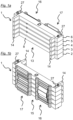
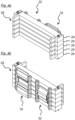
- the one in the Figures 1 The holder 1 shown in Figures a/b, 2 and 3a/b of a battery module according to the invention (not shown in more detail) with four battery cells connected in parallel consists of five spacer elements 2, 3, 4, 5, 6 made of plastic.
- the spacer elements 2, 3, 4, 5, 6 each have two lateral bearing blocks 7, which are connected by means of a bridge 8.
- the bearing blocks 7 each have on their upper sides 9 and lower sides 10 either locking pins 11 or recesses 12, in which the locking pins 11 engage when the battery module is mounted.
- the bridges 8 each have bearings 14 for the battery cells on the inner side 13 of the holder adjacent to the blocks. Electrically insulating welding rails 18, 19 or shaped rails 20, 21 are attached to the outer side 15 in two connecting planes 16, 17.
- a first battery cell is placed on a first spacer element 2, which has a first molded rail 20 in the first connection plane 16 and a first welding rail 18 in the second connection plane 17.
- the contact lug 22 of the first battery module is guided to the outside 15 via the molded rail 20 of the first spacer element 2.
- a second spacer element 3 with two identical second form rails 21 is placed in the two connecting planes 16, 17. Between the first molded rail 20 of the first spacer element 2 and the second molded rail 21 in the first connection plane 16, the contact tab 22 of the first battery cell is initially forced downwards in the direction away from the connection point 23. A second battery cell is placed on the second spacer element 3.
- a third spacer element 4 is placed on top, which has only a second welding rail 19 in the first connection plane 16.
- the contact lug 24 of the second battery cell is forced downwards between the second molded rail 21 of the second spacer element 3 and the second welding rail 19 in the direction away from the connection point 23.
- a third battery cell is placed on the third spacer element 4.
- a fourth spacer element 5 is placed on top, which has two second shaped rails 21 arranged in a mirror image of the second spacer element 3.
- the contact lug 25 of the third battery cell is forced upwards in the first connection plane 16 between the second welding rail 19 of the third spacer element 4 and the second shaped rail 21 of the fourth spacer element 5 in the direction facing away from the connection point 23.
- a fourth battery cell is placed on the fourth spacer element 5.
- a fifth spacer element 6 is placed on top, which corresponds to the first spacer element 2.
- the contact lug 26 of the fourth battery cell is forced upwards in the first connection plane 16 between the second molded rail 21 of the fourth spacer element 5 and the first molded rail 20 of the fifth spacer element 6 in the direction away from the connection point 23.
- the bearing blocks 7 of the spacer elements 2, 3, 4, 5, 6 rest on one another.
- the battery cells are clamped between the bridges 8 and the bearings 14 by means of a tension screw (not shown) that is guided through two through holes 27 in the blocks.
- the contact lugs 22, 24, 25, 26 of all four battery cells are manually pulled over the second welding rail 19 of the third spacer element 4 is bent and welded there.
- connection point 23 is cut out, the four battery modules can be processed and Figures 4a /b, 5 and 6a/b can be reassembled to form another battery module, which is again not shown.
- the other holder also consists of five spacer elements 29 with shaped rails 30 and welding rails 31 in two connection planes 32.
- the contact lugs 22, 24, 25, 26 are laid in the channels between the molded rails 30 and the welding rails 31 in smaller sections or not at all in a direction facing away from the connection point 33.
- the contact lugs 22, 24, 25, 26 shortened by cutting out the connection point 23 of the battery module according to the invention can thus be welded again in the connection point 33 of the further holder 28.
- the spacer elements 2, 3, 4, 5, 6 of the first holder 1 and the spacer elements 29 of the second holder 28 are in contact with the battery cells over a large area under high pressure, they dissipate the heat generated therein very homogeneously to the outside 15.
- a cooling element (not shown) can be attached to the outside 15. The service life of the battery module according to the invention is thereby increased compared to the prior art.
Landscapes
- Chemical & Material Sciences (AREA)
- Chemical Kinetics & Catalysis (AREA)
- Electrochemistry (AREA)
- General Chemical & Material Sciences (AREA)
- Connection Of Batteries Or Terminals (AREA)
Description
- Die Erfindung betrifft zunächst ein Batteriemodul mit einem Stapel flacher Batteriezellen und einem Halter für die Batteriezellen, wobei jede der Batteriezellen eine Kontaktfahne aufweist, die durch den Halter hindurch zu einer Kopfseite des Batteriemoduls geführt ist, und wobei die Kontaktfahnen auf der Kopfseite an einer Verbindungsstelle miteinander verbunden sind. Die Erfindung betrifft weiterhin ein Verfahren zum Herstellen eines Batteriemoduls, wobei ein Stapel flacher Batteriezellen, die je eine Kontaktfahne aufweisen, in einem Halter gehaltert wird und die Kontaktfahnen durch den Halter hindurch zu einer Kopfseite des Batteriemoduls geführt und an einer Verbindungsstelle miteinander verbunden werden. Die Dokumente
EP3264493 ,E3340338 undUS2013/052496 offenbaren Batteriemodule mit mehreren Batteriezellen und Rahmenelemente. -
US 2015/037649 A1 schlägt vor, in einem solchen Batteriemodul und einem Verfahren zu dessen Herstellung die Kontaktfahnen durch Klemmelemente lösbar miteinander zu verbinden, um die Kontaktfahne zur Wiederverwendung einer gebrauchten Batteriezelle in einem neuen Batteriemodul zu erhalten. Zuvor wurden die Kontaktfahnen üblicher Weise verschweißt: Zur Entsorgung des Batteriemoduls wurden die Verbindungsstellen aufgeschnitten um die Batteriezellen vom Halter zu trennen. Durch die reduzierte Länge der Kontaktfahne konnten die Batteriezellen anschließend nicht in einem neuen Batteriemodul weiterverwendet werden. - Klemmverbindungen erfordern einen hohen technischen Aufwand und insbesondere bei der Herstellung elektrischer Verbindungen in Batteriemodulen eine hohe Präzision, um die verlustfreie Leistungsübertragung dauerhaft zu gewährleisten. Sie sind zudem besonders in zur Umgebung offenen Einbausituationen anfällig für Korrosion.
- Der Erfindung liegt die Aufgabe zugrunde, die Nachteile des bekannten Stands der Technik bei der Wiederverwendung gebrauchter Batteriezellen zu vermeiden.
- Ausgehend von dem bekannten Batteriemodul wird nach der Erfindung vorgeschlagen, dass die Kontaktfahnen ausgehend von den Batteriezellen zu der Verbindungsstelle sich mindestens abschnittsweise von der Verbindungsstelle entfernen. Die Kontaktfahnen der Batteriezellen des erfindungsgemäßen Batteriemoduls weisen durch die mäandrierende Verlegung eine freie Reservelänge auf. Nach Ausschneiden der Verbindungstelle kann die Batteriezelle unter Ausnutzung dieser Reservelänge weiterverwendet werden.
- Vorzugsweise besteht in einem erfindungsgemäßen Batteriemodul der Halter aus einem Stapel von Distanzelementen, wobei in Zwischenräumen zwischen benachbarten Distanzelementen je eine der Batteriezellen gehaltert ist. Ein derart gestapelter Aufbau von Batteriemodulen ist allgemein bekannt und bewährt.
- Vorzugsweise begrenzen in einem erfindungsgemäßen Batteriemodul benachbarte Distanzelemente jeweils einen Kanal für eine der Kontaktfahnen, der die Kontaktfahne Richtung führt. Der Kanal erleichtert die Montage des Batteriemoduls, weil die Kontaktfahnen während des Stapelns durch die Geometrie der Kanäle geformt werden.
- Vorzugsweise sind die Batteriezellen in einem erfindungsgemäßen Batteriemodul Lithium-Ionen-Akkumulatoren. Derartige Batteriemodule sind allgemein bekannt und bewährt.
- Vorzugsweise sind in einem erfindungsgemäßen Batteriemodul jeweils Kontaktfahnen von bis zu vier der Batteriezellen miteinander verbunden. Die verbundenen Batteriezellen werden so parallel geschaltet. In einem erfindungsgemäßen Batteriemodul können Gruppen von derart parallel geschalteten Batteriezellen oder alternativ auch einzelne Batteriezellen in Serie geschaltet werden.
- Vorzugsweise sind in einem erfindungsgemäßen Batteriemodul die Kontaktfahnen an der Verbindungsstelle miteinander verschweißt. Die Nachteile einer Klemmverbindung sind so vermieden.
- Eine Batteriezelle aus einem erfindungsgemäßen Batteriemodul kann wiederverwendet werden, indem die Verbindungsstelle ausgeschnitten und die Batteriezelle in einem weiteren Halter eines weiteren Batteriemoduls gehaltert und durch den weiteren Halter hindurch zu einer Kopfseite des weiteren Batteriemoduls geführt wird, wobei die Kontaktfahne mindestens teilweise gestreckt und an einer weiteren Verbindungsstelle mit Kontaktfahnen weiterer Batteriemodule verbunden wird.
- Ausgehend von dem bekannten Verfahren wird nach der Erfindung vorgeschlagen, dass die Kontaktfahnen ausgehend von den Batteriezellen zu der Verbindungsstelle sich mindestens abschnittsweise von der Verbindungsstelle entfernend verlegt werden. Ein erfindungsgemäßes Verfahren dient der Herstellung eines erfindungsgemäßes Batteriemodul der zuvor beschriebenen Art und zeichnet sich gleichfalls durch dessen Vorteile aus.
- Vorzugsweise werden in einem erfindungsgemäßen Verfahren jeweils abwechselnd ein Distanzelement und eine der Batteriezellen derart aufeinander gelegt, dass die Distanzelemente den Halter bilden und die Batteriezellen in Zwischenräumen zwischen benachbarten Distanzelementen gehaltert werden. Ein derart sequentieller Aufbau von Batteriemodulen ist allgemein bekannt und bewährt.
- Vorzugsweise begrenzen in einem erfindungsgemäßen Verfahren benachbarte Distanzelemente jeweils einen Kanal für eine der Kontaktfahnen, wobei die Kontaktfahne durch das aufeinander Legen der Distanzelemente in die der Verbindungsstelle abgewandte Richtung gezwungen wird. Der Verlauf der Kontaktfahne wird so ohne zusätzlichen Arbeitsschritt bestimmt.
- Die Erfindung wird nachfolgend anhand eines Ausführungsbeispiels erläutert. Es zeigen
- Fig. 1a/b
- zwei Ansichten des Halters eines erfindungsgemäßen Batteriemoduls,
- Fig. 2
- eine Explosionsdarstellung des erfindungsgemäßen Halters,
- Fig. 3a/b
- zwei Schnittdarstellungen des erfindungsgemäßen Halters und
- Fig. 4a/b
- zwei Ansichten des Halters eines weiteren Batteriemoduls,
- Fig. 5
- eine Explosionsdarstellung des weiteren Halters,
- Fig. 6a/b
- zwei Schnittdarstellungen des weiteren Halters.
- Der in den
Figuren 1 a/b, 2 und 3a/b gezeigte Halter 1 eines nicht weiter dargestellten erfindungsgemäßen Batteriemoduls mit vier parallel geschalteten Batteriezellen besteht aus fünf Distanzelementen 2, 3, 4, 5, 6 aus Kunststoff. - Die Distanzelemente 2, 3, 4, 5, 6 weisen jeweils zwei seitliche Lagerblöcke 7 auf, die mittels einer Brücke 8 verbunden sind. Die Lagerblöcke 7 weisen jeweils auf ihren Oberseiten 9 und Unterseiten 10 entweder Raststifte 11 oder Vertiefungen 12 auf, in denen die Raststifte 11 bei der Montage des Batteriemoduls einrasten.
- Die Brücken 8 weisen jeweils auf der Innenseite 13 des Halters an die Blöcke angrenzend Lager 14 für die Batteriezellen auf. Auf der Außenseite 15 sind in zwei Verbindungsebenen 16, 17 elektrisch isolierende Schweißschienen 18, 19 oder Formschienen 20, 21 angebracht.
- Zur Herstellung des erfindungsgemäßen Batteriemoduls wird eine erste Batteriezelle auf ein erstes Distanzelement 2 aufgelegt, das in der ersten Verbindungsebene 16 eine erste Formschiene 20 und in der zweiten Verbindungsebene 17 eine erste Schweißschiene 18 aufweist. Die Kontaktfahne 22 des ersten Batteriemoduls wird über die Formschiene 20 des ersten Distanzelements 2 zu der Außenseite 15 geführt.
- Dann wird ein zweites Distanzelement 3 mit zwei identischen zweiten Formschienen 21 in den beiden Verbindungsebenen 16, 17 aufgelegt. Zwischen der ersten Formschiene 20 des ersten Distanzelements 2 und dem zweiten Formschiene 21 in der ersten Verbindungsebene 16 wird die Kontaktfahne 22 der ersten Batteriezelle zunächst nach unten in die der Verbindungsstelle 23 abgewandte Richtung gezwungen. Auf das zweite Distanzelement 3 wird eine zweite Batteriezelle aufgelegt.
- Dann wird ein drittes Distanzelement 4 aufgelegt, dass ausschließlich eine zweite Schweißschiene 19 in der ersten Verbindungsebene 16 aufweist. Die Kontaktfahne 24 der zweiten Batteriezelle wird zwischen der zweiten Formschiene 21 des zweiten Distanzelements 3 und der zweiten Schweißschiene 19 nach unten in die der Verbindungsstelle 23 abgewandte Richtung gezwungen. Auf das dritte Distanzelement 4 wird eine dritte Batteriezelle aufgelegt.
- Dann wird ein viertes Distanzelement 5 aufgelegt, das zwei spiegelbildlich zu dem zweiten Distanzelement 3 angeordnete zweite Formschienen 21 aufweist. Die Kontaktfahne 25 der dritten Batteriezelle wird in der ersten Verbindungsebene 16 zwischen der zweiten Schweißschiene 19 des dritten Distanzelements 4 und der zweiten Formschiene 21 des vierten Distanzelements 5 nach oben in die der Verbindungsstelle 23 abgewandte Richtung gezwungen. Auf das vierte Distanzelement 5 wird eine vierte Batteriezelle aufgelegt.
- Schließlich wird ein fünftes Distanzelement6 aufgelegt, das dem ersten Distanzelement 2 entspricht. Die Kontaktfahne 26 der vierten Batteriezelle wird in der ersten Verbindungsebene 16 zwischen der zweiten Formschiene 21 des vierten Distanzelements 5 und der ersten Formschiene 20 des fünften Distanzelements 6 nach oben in die der Verbindungsstelle 23 abgewandte Richtung gezwungen.
- In dem Halter 1 liegen die Lagerblöcke 7 der Distanzelemente 2, 3, 4, 5, 6 aufeinander auf. Die Batteriezellen werden mittels einer nicht dargestellten Zugschraube, die durch zwei durchgehende Bohrungen 27 in den Blöcken geführt wird, zwischen den Brücken 8 und den Lagern 14 eingeklemmt. Schließlich werden die Kontaktfahnen 22, 24, 25, 26 aller vier Batteriezellen händisch über die zweite Schweißschiene 19 des dritten Distanzelements 4 gebogen und dort verschweißt.
- Zur Entsorgung eines verbrauchten erfindungsgemäßen Batteriemoduls wird die Verbindungsstelle 23 herausgetrennt, die vier Batteriemodule können aufbereitet und mittels des in den
Figuren 4a /b, 5 und 6a/b gezeigten weiteren Halters 28 zu einem wiederum nicht weiter dargestellten weiteren Batteriemodul neu zusammengestellt werden. Der weitere Halter besteht gleichfalls aus fünf Distanzelementen 29 mit Formschienen 30 und Schweißschienen 31 in zwei Verbindungebenen 32. - Gegenüber dem erfindungsgemäßen Halter 1 werden in dem weiteren Halter die Kontaktfahnen 22, 24, 25, 26 in den Kanälen zwischen den Formschienen 30 und den Schweißschienen 31 in kleineren Abschnitten oder garnicht in eine der Verbindungsstelle 33 abgewandte Richtung verlegt. Die durch das Heraustrennen der Verbindungsstelle 23 des erfindungsgemäßen Batteriemoduls gekürzten Kontaktfahnen 22, 24, 25, 26 können so in der Verbindungsstelle 33 des weiteren Halters 28 erneut verschweißt werden.
- Da die Distanzelemente 2, 3, 4, 5, 6 des ersten Halters 1 und die Distanzelemente 29 des zweiten Halters 28 großflächig unter hohem Druck mit den Batteriezellen in Kontakt stehen, führen sie die darin entstehende Wärme sehr homogen zu der Außenseite 15 ab. Ergänzend kann an der Außenseite 15 ein nicht dargestelltes Kühlelement angebracht werden. Die Lebensdauer des erfindungsgemäßen Batteriemoduls ist gegenüber dem Stand der Technik dadurch erhöht.
- In den Figuren sind
- 1
- Halter
- 2
- erstes Distanzelement
- 3
- zweites Distanzelement
- 4
- drittes Distanzelement
- 5
- viertes Distanzelement
- 6
- fünftes Distanzelement
- 7
- Lagerblock
- 8
- Brücke
- 9
- Oberseite
- 10
- Unterseite
- 11
- Raststift
- 12
- Vertiefung
- 13
- Innenseite
- 14
- Lager
- 15
- Außenseite
- 16
- erste Verbindungsebene
- 17
- zweite Verbindungsebene
- 18
- erste Schweißschiene
- 19
- zweite Schweißschiene
- 20
- erste Formschiene
- 21
- zweite Formschiene
- 22
- erste Kontaktfahne
- 23
- Verbindungsstelle
- 24
- zweite Kontaktfahne
- 25
- dritte Kontaktfahne
- 26
- vierte Kontaktfahne
- 27
- Bohrung
- 28
- Halter
- 29
- Distanzelement
- 30
- Formschiene
- 31
- Schweißschiene
- 32
- Verbindungsebene
- 33
- Verbindungsstelle
Claims (10)
- Batteriemodul mit einem Stapel flacher Batteriezellen und einem Halter (1) für die Batteriezellen, wobei jede der Batteriezellen eine Kontaktfahne (22, 24, 25, 26) aufweist, die durch den Halter (1) hindurch zu einer Kopfseite des Batteriemoduls geführt ist, und wobei die Kontaktfahnen (22, 24, 25, 26) auf der Kopfseite an einer Verbindungsstelle (23) miteinander verbunden sind, dadurch gekennzeichnet, dass die Kontaktfahnen (22, 24, 25, 26) ausgehend von den Batteriezellen zu der Verbindungsstelle (23) sich mindestens abschnittsweise von der Verbindungsstelle (23) entfernen.
- Batteriemodul nach dem vorgenannten Anspruch, dadurch gekennzeichnet, dass der Halter (1) aus einem Stapel von Distanzelementen (2, 3, 4, 5, 6) besteht, wobei in Zwischenräumen zwischen benachbarten Distanzelementen (2, 3, 4, 5, 6) je eine der Batteriezellen gehaltert ist.
- Batteriemodul nach dem vorgenannten Anspruch, dadurch gekennzeichnet, dass benachbarte Distanzelemente (2, 3, 4, 5, 6) jeweils einen Kanal für eine der Kontaktfahnen (22, 24, 25, 26) begrenzen, der die Kontaktfahne (22, 24, 25, 26) führt.
- Batteriemodul nach einem der vorgenannten Ansprüche, dadurch gekennzeichnet, dass die Batteriezellen Lithium-Ionen-Akkumulatoren sind.
- Batteriemodul nach einem der vorgenannten Ansprüche, dadurch gekennzeichnet, dass jeweils Kontaktfahnen (22, 24, 25, 26) von bis zu vier der Batteriezellen miteinander verbunden sind.
- Batteriemodul nach einem der vorgenannten Ansprüche, dadurch gekennzeichnet, dass die Kontaktfahnen (22, 24, 25, 26) an der Verbindungsstelle (23) miteinander verschweißt sind.
- Verfahren zum Wiederverwerten einer Batteriezelle aus einem Batteriemodul nach einem der vorgenannten Ansprüche, dadurch gekennzeichnet, dass die Verbindungsstelle (23) ausgeschnitten und die Batteriezelle in einem weiteren Halter (28) eines weiteren Batteriemoduls gehaltert und durch den weiteren Halter (28) hindurch zu einer Kopfseite des weiteren Batteriemoduls geführt wird, wobei die Kontaktfahne (22, 24, 25, 26) mindestens teilweise gestreckt und an einer weiteren Verbindungsstelle (33) mit Kontaktfahnen (22, 24, 25, 26) weiterer Batteriemodule verbunden wird.
- Verfahren zum Herstellen eines Batteriemoduls, wobei ein Stapel flacher Batteriezellen, die je eine Kontaktfahne (22, 24, 25, 26) aufweisen, in einem Halter (1) gehaltert wird und die Kontaktfahnen (22, 24, 25, 26) durch den Halter (1) hindurch zu einer Kopfseite des Batteriemoduls geführt und an einer Verbindungsstelle (23) miteinander verbunden werden, dadurch gekennzeichnet, dass die Kontaktfahnen (22, 24, 25, 26) ausgehend von den Batteriezellen zu der Verbindungsstelle (23) sich mindestens abschnittsweise von der Verbindungsstelle (23) entfernend verlegt werden.
- Verfahren nach dem vorgenannten Anspruch, dadurch gekennzeichnet, dass jeweils abwechselnd ein Distanzelement (2, 3, 4, 5, 6) und eine der Batteriezellen derart aufeinander gelegt werden, dass die Distanzelemente (2, 3, 4, 5, 6) den Halter (1) bilden und die Batteriezellen in Zwischenräumen zwischen benachbarten Distanzelementen (2, 3, 4, 5, 6) gehaltert werden.
- Verfahren nach dem vorgenannten Anspruch, dadurch gekennzeichnet, dass benachbarte Distanzelemente (2, 3, 4, 5, 6) jeweils einen Kanal für eine der Kontaktfahnen (22, 24, 25, 26) begrenzen, wobei die
Kontaktfahne (22, 24, 25, 26) durch das aufeinander Legen der Distanzelemente (2, 3, 4, 5, 6) in die der Verbindungsstelle (23) abgewandte Richtung gezwungen wird.
Applications Claiming Priority (2)
| Application Number | Priority Date | Filing Date | Title |
|---|---|---|---|
| DE102018123893.2A DE102018123893A1 (de) | 2018-09-27 | 2018-09-27 | Batteriemodul und Verfahren zum Herstellen desselben |
| PCT/EP2019/075816 WO2020064807A1 (de) | 2018-09-27 | 2019-09-25 | Batteriemodul und verfahren zum herstellen desselben |
Publications (3)
| Publication Number | Publication Date |
|---|---|
| EP3857624A1 EP3857624A1 (de) | 2021-08-04 |
| EP3857624B1 true EP3857624B1 (de) | 2025-01-15 |
| EP3857624C0 EP3857624C0 (de) | 2025-01-15 |
Family
ID=68165507
Family Applications (1)
| Application Number | Title | Priority Date | Filing Date |
|---|---|---|---|
| EP19783449.2A Active EP3857624B1 (de) | 2018-09-27 | 2019-09-25 | Batteriemodul und verfahren zum herstellen desselben |
Country Status (3)
| Country | Link |
|---|---|
| EP (1) | EP3857624B1 (de) |
| DE (1) | DE102018123893A1 (de) |
| WO (1) | WO2020064807A1 (de) |
Families Citing this family (1)
| Publication number | Priority date | Publication date | Assignee | Title |
|---|---|---|---|---|
| WO2022160264A1 (zh) * | 2021-01-29 | 2022-08-04 | 东莞新能安科技有限公司 | 一种电池包及用电设备 |
Family Cites Families (4)
| Publication number | Priority date | Publication date | Assignee | Title |
|---|---|---|---|---|
| KR101288121B1 (ko) * | 2011-08-24 | 2013-07-19 | 삼성에스디아이 주식회사 | 이차전지 및 이차전지 모듈 |
| US9525195B2 (en) | 2013-07-30 | 2016-12-20 | Johnson Controls Technology Corporation | Remanufacturing methods for battery module |
| KR102009443B1 (ko) * | 2015-06-19 | 2019-08-12 | 주식회사 엘지화학 | 카트리지 및 이를 포함하는 전지 모듈 |
| JP6680881B2 (ja) * | 2016-02-11 | 2020-04-15 | エルジー・ケム・リミテッド | バッテリーモジュール |
-
2018
- 2018-09-27 DE DE102018123893.2A patent/DE102018123893A1/de not_active Withdrawn
-
2019
- 2019-09-25 WO PCT/EP2019/075816 patent/WO2020064807A1/de not_active Ceased
- 2019-09-25 EP EP19783449.2A patent/EP3857624B1/de active Active
Also Published As
| Publication number | Publication date |
|---|---|
| EP3857624A1 (de) | 2021-08-04 |
| DE102018123893A1 (de) | 2020-04-02 |
| EP3857624C0 (de) | 2025-01-15 |
| WO2020064807A1 (de) | 2020-04-02 |
Similar Documents
| Publication | Publication Date | Title |
|---|---|---|
| DE102016101579B4 (de) | Halbleitermodul | |
| DE102017101126B4 (de) | Leistungselektroniksystem und Verfahren zu dessen Herstellung | |
| DE102013209358A1 (de) | Verfahren zur herstellung einer elektrischen speichervorrichtung, abstandselement und elektrische speichervorrichtung | |
| DE102014106954A1 (de) | Vorrichtung zum Heizen und Kühlen eines Batteriepakets | |
| EP3411912A1 (de) | Batteriemodul mit einer mehrzahl an batteriezellen, verfahren zu dessen herstellung und batterie | |
| DE102019207207A1 (de) | Batteriemodul für ein Kraftfahrzeug | |
| DE102012218473A1 (de) | Energiespeicheranordnung und Montagevorrichtung | |
| EP3235049B1 (de) | Batterie mit kühlplatte als montageplatte | |
| DE102013219388A1 (de) | Kühlungsvorrichtung | |
| DE102018214363A1 (de) | Stromschiene, stromschienenmodul und batteriepack | |
| EP3753064B1 (de) | Batterie für ein kraftfahrzeug | |
| WO2023030885A1 (de) | Gehäuse für elektrodenstapel und batteriezellengruppe | |
| EP3857624B1 (de) | Batteriemodul und verfahren zum herstellen desselben | |
| AT522337B1 (de) | Vorrichtung mit mehreren, bezüglich einer Fügeachse parallel zueinander angeordneten Batteriezellen | |
| DE102018112475B4 (de) | Batterieanordnung und herstellverfahren | |
| DE102011087035A1 (de) | Zellkontaktieranordnung für einen Energiespeicher | |
| WO2022238068A1 (de) | Hochvoltspeicher mit kleinteiliger zellverbinderanordnung | |
| DE102019203743B4 (de) | Brennstoffzellenstapel und Verfahren zum Herstellen einer Dummyzelle | |
| DE102019206263B4 (de) | Halbleiterbauteil, Kraftfahrzeug und Verfahren zur Herstellung eines Halbleiterbauteils | |
| DE212024000069U1 (de) | Batteriemodul und Batterie | |
| EP4160788A1 (de) | Batteriemodul einer traktionsbatterie eines kraftfahrzeugs und verfahren zum herstellen desselben | |
| DE102019118392A1 (de) | Batterie für ein Kraftfahrzeug und Kraftfahrzeug | |
| DE102022130280A1 (de) | Anordnung zur Kühlung eines Batteriezellstapels für ein Fahrzeug und Anordnung zum Verspannen eines Batteriezellstapels für ein Fahrzeug sowie Batteriezellstapel mit einer solchen Anordnung | |
| DE102017011769A1 (de) | Batteriekühlsystem und Batteriemodul mit einem von Kühlmedium durchströmten mäandrierenden Wärmetauscher | |
| DE102022112213A1 (de) | Trägervorrichtung für Batterierundzellen eines Fahrzeugs |
Legal Events
| Date | Code | Title | Description |
|---|---|---|---|
| STAA | Information on the status of an ep patent application or granted ep patent |
Free format text: STATUS: UNKNOWN |
|
| STAA | Information on the status of an ep patent application or granted ep patent |
Free format text: STATUS: THE INTERNATIONAL PUBLICATION HAS BEEN MADE |
|
| PUAI | Public reference made under article 153(3) epc to a published international application that has entered the european phase |
Free format text: ORIGINAL CODE: 0009012 |
|
| STAA | Information on the status of an ep patent application or granted ep patent |
Free format text: STATUS: REQUEST FOR EXAMINATION WAS MADE |
|
| 17P | Request for examination filed |
Effective date: 20210401 |
|
| AK | Designated contracting states |
Kind code of ref document: A1 Designated state(s): AL AT BE BG CH CY CZ DE DK EE ES FI FR GB GR HR HU IE IS IT LI LT LU LV MC MK MT NL NO PL PT RO RS SE SI SK SM TR |
|
| DAV | Request for validation of the european patent (deleted) | ||
| DAX | Request for extension of the european patent (deleted) | ||
| REG | Reference to a national code |
Ref legal event code: R079 Ref country code: DE Ref legal event code: R079 Ref document number: 502019012826 Country of ref document: DE Free format text: PREVIOUS MAIN CLASS: H01M0002100000 Ipc: H01M0010052500 |
|
| GRAP | Despatch of communication of intention to grant a patent |
Free format text: ORIGINAL CODE: EPIDOSNIGR1 |
|
| STAA | Information on the status of an ep patent application or granted ep patent |
Free format text: STATUS: GRANT OF PATENT IS INTENDED |
|
| RIC1 | Information provided on ipc code assigned before grant |
Ipc: H01M 10/54 20060101ALI20241028BHEP Ipc: H01M 50/503 20210101ALI20241028BHEP Ipc: H01M 50/291 20210101ALI20241028BHEP Ipc: H01M 50/209 20210101ALI20241028BHEP Ipc: H01M 10/0525 20100101AFI20241028BHEP |
|
| INTG | Intention to grant announced |
Effective date: 20241108 |
|
| GRAS | Grant fee paid |
Free format text: ORIGINAL CODE: EPIDOSNIGR3 |
|
| GRAA | (expected) grant |
Free format text: ORIGINAL CODE: 0009210 |
|
| STAA | Information on the status of an ep patent application or granted ep patent |
Free format text: STATUS: THE PATENT HAS BEEN GRANTED |
|
| AK | Designated contracting states |
Kind code of ref document: B1 Designated state(s): AL AT BE BG CH CY CZ DE DK EE ES FI FR GB GR HR HU IE IS IT LI LT LU LV MC MK MT NL NO PL PT RO RS SE SI SK SM TR |
|
| REG | Reference to a national code |
Ref country code: CH Ref legal event code: EP Ref country code: GB Ref legal event code: FG4D Free format text: NOT ENGLISH |
|
| REG | Reference to a national code |
Ref country code: DE Ref legal event code: R096 Ref document number: 502019012826 Country of ref document: DE |
|
| REG | Reference to a national code |
Ref country code: IE Ref legal event code: FG4D Free format text: LANGUAGE OF EP DOCUMENT: GERMAN |
|
| U01 | Request for unitary effect filed |
Effective date: 20250130 |
|
| U07 | Unitary effect registered |
Designated state(s): AT BE BG DE DK EE FI FR IT LT LU LV MT NL PT RO SE SI Effective date: 20250206 |
|
| PG25 | Lapsed in a contracting state [announced via postgrant information from national office to epo] |
Ref country code: RS Free format text: LAPSE BECAUSE OF FAILURE TO SUBMIT A TRANSLATION OF THE DESCRIPTION OR TO PAY THE FEE WITHIN THE PRESCRIBED TIME-LIMIT Effective date: 20250415 |
|
| PG25 | Lapsed in a contracting state [announced via postgrant information from national office to epo] |
Ref country code: PL Free format text: LAPSE BECAUSE OF FAILURE TO SUBMIT A TRANSLATION OF THE DESCRIPTION OR TO PAY THE FEE WITHIN THE PRESCRIBED TIME-LIMIT Effective date: 20250115 |
|
| PG25 | Lapsed in a contracting state [announced via postgrant information from national office to epo] |
Ref country code: ES Free format text: LAPSE BECAUSE OF FAILURE TO SUBMIT A TRANSLATION OF THE DESCRIPTION OR TO PAY THE FEE WITHIN THE PRESCRIBED TIME-LIMIT Effective date: 20250115 |
|
| PG25 | Lapsed in a contracting state [announced via postgrant information from national office to epo] |
Ref country code: IS Free format text: LAPSE BECAUSE OF FAILURE TO SUBMIT A TRANSLATION OF THE DESCRIPTION OR TO PAY THE FEE WITHIN THE PRESCRIBED TIME-LIMIT Effective date: 20250515 Ref country code: NO Free format text: LAPSE BECAUSE OF FAILURE TO SUBMIT A TRANSLATION OF THE DESCRIPTION OR TO PAY THE FEE WITHIN THE PRESCRIBED TIME-LIMIT Effective date: 20250415 |
|
| PG25 | Lapsed in a contracting state [announced via postgrant information from national office to epo] |
Ref country code: HR Free format text: LAPSE BECAUSE OF FAILURE TO SUBMIT A TRANSLATION OF THE DESCRIPTION OR TO PAY THE FEE WITHIN THE PRESCRIBED TIME-LIMIT Effective date: 20250115 |
|
| PG25 | Lapsed in a contracting state [announced via postgrant information from national office to epo] |
Ref country code: GR Free format text: LAPSE BECAUSE OF FAILURE TO SUBMIT A TRANSLATION OF THE DESCRIPTION OR TO PAY THE FEE WITHIN THE PRESCRIBED TIME-LIMIT Effective date: 20250416 |
|
| PG25 | Lapsed in a contracting state [announced via postgrant information from national office to epo] |
Ref country code: SM Free format text: LAPSE BECAUSE OF FAILURE TO SUBMIT A TRANSLATION OF THE DESCRIPTION OR TO PAY THE FEE WITHIN THE PRESCRIBED TIME-LIMIT Effective date: 20250115 |
|
| PG25 | Lapsed in a contracting state [announced via postgrant information from national office to epo] |
Ref country code: CZ Free format text: LAPSE BECAUSE OF FAILURE TO SUBMIT A TRANSLATION OF THE DESCRIPTION OR TO PAY THE FEE WITHIN THE PRESCRIBED TIME-LIMIT Effective date: 20250115 |
|
| PG25 | Lapsed in a contracting state [announced via postgrant information from national office to epo] |
Ref country code: SK Free format text: LAPSE BECAUSE OF FAILURE TO SUBMIT A TRANSLATION OF THE DESCRIPTION OR TO PAY THE FEE WITHIN THE PRESCRIBED TIME-LIMIT Effective date: 20250115 |
|
| PLBE | No opposition filed within time limit |
Free format text: ORIGINAL CODE: 0009261 |
|
| STAA | Information on the status of an ep patent application or granted ep patent |
Free format text: STATUS: NO OPPOSITION FILED WITHIN TIME LIMIT |
|
| 26N | No opposition filed |
Effective date: 20251016 |