EP3855550B1 - Power storage device management system, storage device, server device, power storage device management method, program, and storage medium - Google Patents
Power storage device management system, storage device, server device, power storage device management method, program, and storage medium Download PDFInfo
- Publication number
- EP3855550B1 EP3855550B1 EP19863591.4A EP19863591A EP3855550B1 EP 3855550 B1 EP3855550 B1 EP 3855550B1 EP 19863591 A EP19863591 A EP 19863591A EP 3855550 B1 EP3855550 B1 EP 3855550B1
- Authority
- EP
- European Patent Office
- Prior art keywords
- battery
- replacement device
- storage device
- removable
- list
- Prior art date
- Legal status (The legal status is an assumption and is not a legal conclusion. Google has not performed a legal analysis and makes no representation as to the accuracy of the status listed.)
- Active
Links
Images






Classifications
-
- G—PHYSICS
- G06—COMPUTING OR CALCULATING; COUNTING
- G06Q—INFORMATION AND COMMUNICATION TECHNOLOGY [ICT] SPECIALLY ADAPTED FOR ADMINISTRATIVE, COMMERCIAL, FINANCIAL, MANAGERIAL OR SUPERVISORY PURPOSES; SYSTEMS OR METHODS SPECIALLY ADAPTED FOR ADMINISTRATIVE, COMMERCIAL, FINANCIAL, MANAGERIAL OR SUPERVISORY PURPOSES, NOT OTHERWISE PROVIDED FOR
- G06Q10/00—Administration; Management
- G06Q10/06—Resources, workflows, human or project management; Enterprise or organisation planning; Enterprise or organisation modelling
- G06Q10/063—Operations research, analysis or management
- G06Q10/0631—Resource planning, allocation, distributing or scheduling for enterprises or organisations
- G06Q10/06315—Needs-based resource requirements planning or analysis
-
- B—PERFORMING OPERATIONS; TRANSPORTING
- B60—VEHICLES IN GENERAL
- B60L—PROPULSION OF ELECTRICALLY-PROPELLED VEHICLES; SUPPLYING ELECTRIC POWER FOR AUXILIARY EQUIPMENT OF ELECTRICALLY-PROPELLED VEHICLES; ELECTRODYNAMIC BRAKE SYSTEMS FOR VEHICLES IN GENERAL; MAGNETIC SUSPENSION OR LEVITATION FOR VEHICLES; MONITORING OPERATING VARIABLES OF ELECTRICALLY-PROPELLED VEHICLES; ELECTRIC SAFETY DEVICES FOR ELECTRICALLY-PROPELLED VEHICLES
- B60L53/00—Methods of charging batteries, specially adapted for electric vehicles; Charging stations or on-board charging equipment therefor; Exchange of energy storage elements in electric vehicles
- B60L53/30—Constructional details of charging stations
- B60L53/305—Communication interfaces
-
- B—PERFORMING OPERATIONS; TRANSPORTING
- B60—VEHICLES IN GENERAL
- B60L—PROPULSION OF ELECTRICALLY-PROPELLED VEHICLES; SUPPLYING ELECTRIC POWER FOR AUXILIARY EQUIPMENT OF ELECTRICALLY-PROPELLED VEHICLES; ELECTRODYNAMIC BRAKE SYSTEMS FOR VEHICLES IN GENERAL; MAGNETIC SUSPENSION OR LEVITATION FOR VEHICLES; MONITORING OPERATING VARIABLES OF ELECTRICALLY-PROPELLED VEHICLES; ELECTRIC SAFETY DEVICES FOR ELECTRICALLY-PROPELLED VEHICLES
- B60L53/00—Methods of charging batteries, specially adapted for electric vehicles; Charging stations or on-board charging equipment therefor; Exchange of energy storage elements in electric vehicles
- B60L53/60—Monitoring or controlling charging stations
- B60L53/65—Monitoring or controlling charging stations involving identification of vehicles or their battery types
-
- B—PERFORMING OPERATIONS; TRANSPORTING
- B60—VEHICLES IN GENERAL
- B60L—PROPULSION OF ELECTRICALLY-PROPELLED VEHICLES; SUPPLYING ELECTRIC POWER FOR AUXILIARY EQUIPMENT OF ELECTRICALLY-PROPELLED VEHICLES; ELECTRODYNAMIC BRAKE SYSTEMS FOR VEHICLES IN GENERAL; MAGNETIC SUSPENSION OR LEVITATION FOR VEHICLES; MONITORING OPERATING VARIABLES OF ELECTRICALLY-PROPELLED VEHICLES; ELECTRIC SAFETY DEVICES FOR ELECTRICALLY-PROPELLED VEHICLES
- B60L53/00—Methods of charging batteries, specially adapted for electric vehicles; Charging stations or on-board charging equipment therefor; Exchange of energy storage elements in electric vehicles
- B60L53/60—Monitoring or controlling charging stations
- B60L53/66—Data transfer between charging stations and vehicles
-
- B—PERFORMING OPERATIONS; TRANSPORTING
- B60—VEHICLES IN GENERAL
- B60L—PROPULSION OF ELECTRICALLY-PROPELLED VEHICLES; SUPPLYING ELECTRIC POWER FOR AUXILIARY EQUIPMENT OF ELECTRICALLY-PROPELLED VEHICLES; ELECTRODYNAMIC BRAKE SYSTEMS FOR VEHICLES IN GENERAL; MAGNETIC SUSPENSION OR LEVITATION FOR VEHICLES; MONITORING OPERATING VARIABLES OF ELECTRICALLY-PROPELLED VEHICLES; ELECTRIC SAFETY DEVICES FOR ELECTRICALLY-PROPELLED VEHICLES
- B60L53/00—Methods of charging batteries, specially adapted for electric vehicles; Charging stations or on-board charging equipment therefor; Exchange of energy storage elements in electric vehicles
- B60L53/60—Monitoring or controlling charging stations
- B60L53/67—Controlling two or more charging stations
-
- B—PERFORMING OPERATIONS; TRANSPORTING
- B60—VEHICLES IN GENERAL
- B60L—PROPULSION OF ELECTRICALLY-PROPELLED VEHICLES; SUPPLYING ELECTRIC POWER FOR AUXILIARY EQUIPMENT OF ELECTRICALLY-PROPELLED VEHICLES; ELECTRODYNAMIC BRAKE SYSTEMS FOR VEHICLES IN GENERAL; MAGNETIC SUSPENSION OR LEVITATION FOR VEHICLES; MONITORING OPERATING VARIABLES OF ELECTRICALLY-PROPELLED VEHICLES; ELECTRIC SAFETY DEVICES FOR ELECTRICALLY-PROPELLED VEHICLES
- B60L53/00—Methods of charging batteries, specially adapted for electric vehicles; Charging stations or on-board charging equipment therefor; Exchange of energy storage elements in electric vehicles
- B60L53/80—Exchanging energy storage elements, e.g. removable batteries
-
- B—PERFORMING OPERATIONS; TRANSPORTING
- B60—VEHICLES IN GENERAL
- B60L—PROPULSION OF ELECTRICALLY-PROPELLED VEHICLES; SUPPLYING ELECTRIC POWER FOR AUXILIARY EQUIPMENT OF ELECTRICALLY-PROPELLED VEHICLES; ELECTRODYNAMIC BRAKE SYSTEMS FOR VEHICLES IN GENERAL; MAGNETIC SUSPENSION OR LEVITATION FOR VEHICLES; MONITORING OPERATING VARIABLES OF ELECTRICALLY-PROPELLED VEHICLES; ELECTRIC SAFETY DEVICES FOR ELECTRICALLY-PROPELLED VEHICLES
- B60L58/00—Methods or circuit arrangements for monitoring or controlling batteries or fuel cells, specially adapted for electric vehicles
- B60L58/10—Methods or circuit arrangements for monitoring or controlling batteries or fuel cells, specially adapted for electric vehicles for monitoring or controlling batteries
- B60L58/12—Methods or circuit arrangements for monitoring or controlling batteries or fuel cells, specially adapted for electric vehicles for monitoring or controlling batteries responding to state of charge [SoC]
-
- B—PERFORMING OPERATIONS; TRANSPORTING
- B60—VEHICLES IN GENERAL
- B60L—PROPULSION OF ELECTRICALLY-PROPELLED VEHICLES; SUPPLYING ELECTRIC POWER FOR AUXILIARY EQUIPMENT OF ELECTRICALLY-PROPELLED VEHICLES; ELECTRODYNAMIC BRAKE SYSTEMS FOR VEHICLES IN GENERAL; MAGNETIC SUSPENSION OR LEVITATION FOR VEHICLES; MONITORING OPERATING VARIABLES OF ELECTRICALLY-PROPELLED VEHICLES; ELECTRIC SAFETY DEVICES FOR ELECTRICALLY-PROPELLED VEHICLES
- B60L58/00—Methods or circuit arrangements for monitoring or controlling batteries or fuel cells, specially adapted for electric vehicles
- B60L58/10—Methods or circuit arrangements for monitoring or controlling batteries or fuel cells, specially adapted for electric vehicles for monitoring or controlling batteries
- B60L58/16—Methods or circuit arrangements for monitoring or controlling batteries or fuel cells, specially adapted for electric vehicles for monitoring or controlling batteries responding to battery ageing, e.g. to the number of charging cycles or the state of health [SoH]
-
- G—PHYSICS
- G06—COMPUTING OR CALCULATING; COUNTING
- G06Q—INFORMATION AND COMMUNICATION TECHNOLOGY [ICT] SPECIALLY ADAPTED FOR ADMINISTRATIVE, COMMERCIAL, FINANCIAL, MANAGERIAL OR SUPERVISORY PURPOSES; SYSTEMS OR METHODS SPECIALLY ADAPTED FOR ADMINISTRATIVE, COMMERCIAL, FINANCIAL, MANAGERIAL OR SUPERVISORY PURPOSES, NOT OTHERWISE PROVIDED FOR
- G06Q10/00—Administration; Management
- G06Q10/08—Logistics, e.g. warehousing, loading or distribution; Inventory or stock management
- G06Q10/087—Inventory or stock management, e.g. order filling, procurement or balancing against orders
-
- H—ELECTRICITY
- H01—ELECTRIC ELEMENTS
- H01M—PROCESSES OR MEANS, e.g. BATTERIES, FOR THE DIRECT CONVERSION OF CHEMICAL ENERGY INTO ELECTRICAL ENERGY
- H01M10/00—Secondary cells; Manufacture thereof
- H01M10/42—Methods or arrangements for servicing or maintenance of secondary cells or secondary half-cells
- H01M10/425—Structural combination with electronic components, e.g. electronic circuits integrated to the outside of the casing
-
- H—ELECTRICITY
- H01—ELECTRIC ELEMENTS
- H01M—PROCESSES OR MEANS, e.g. BATTERIES, FOR THE DIRECT CONVERSION OF CHEMICAL ENERGY INTO ELECTRICAL ENERGY
- H01M10/00—Secondary cells; Manufacture thereof
- H01M10/42—Methods or arrangements for servicing or maintenance of secondary cells or secondary half-cells
- H01M10/44—Methods for charging or discharging
-
- H—ELECTRICITY
- H01—ELECTRIC ELEMENTS
- H01M—PROCESSES OR MEANS, e.g. BATTERIES, FOR THE DIRECT CONVERSION OF CHEMICAL ENERGY INTO ELECTRICAL ENERGY
- H01M10/00—Secondary cells; Manufacture thereof
- H01M10/42—Methods or arrangements for servicing or maintenance of secondary cells or secondary half-cells
- H01M10/46—Accumulators structurally combined with charging apparatus
-
- H—ELECTRICITY
- H01—ELECTRIC ELEMENTS
- H01M—PROCESSES OR MEANS, e.g. BATTERIES, FOR THE DIRECT CONVERSION OF CHEMICAL ENERGY INTO ELECTRICAL ENERGY
- H01M10/00—Secondary cells; Manufacture thereof
- H01M10/42—Methods or arrangements for servicing or maintenance of secondary cells or secondary half-cells
- H01M10/48—Accumulators combined with arrangements for measuring, testing or indicating the condition of cells, e.g. the level or density of the electrolyte
-
- H—ELECTRICITY
- H01—ELECTRIC ELEMENTS
- H01M—PROCESSES OR MEANS, e.g. BATTERIES, FOR THE DIRECT CONVERSION OF CHEMICAL ENERGY INTO ELECTRICAL ENERGY
- H01M50/00—Constructional details or processes of manufacture of the non-active parts of electrochemical cells other than fuel cells, e.g. hybrid cells
- H01M50/20—Mountings; Secondary casings or frames; Racks, modules or packs; Suspension devices; Shock absorbers; Transport or carrying devices; Holders
- H01M50/244—Secondary casings; Racks; Suspension devices; Carrying devices; Holders characterised by their mounting method
-
- H—ELECTRICITY
- H01—ELECTRIC ELEMENTS
- H01M—PROCESSES OR MEANS, e.g. BATTERIES, FOR THE DIRECT CONVERSION OF CHEMICAL ENERGY INTO ELECTRICAL ENERGY
- H01M50/00—Constructional details or processes of manufacture of the non-active parts of electrochemical cells other than fuel cells, e.g. hybrid cells
- H01M50/20—Mountings; Secondary casings or frames; Racks, modules or packs; Suspension devices; Shock absorbers; Transport or carrying devices; Holders
- H01M50/258—Modular batteries; Casings provided with means for assembling
-
- H—ELECTRICITY
- H02—GENERATION; CONVERSION OR DISTRIBUTION OF ELECTRIC POWER
- H02J—ELECTRIC POWER NETWORKS; CIRCUIT ARRANGEMENTS OR SYSTEMS FOR SUPPLYING OR DISTRIBUTING ELECTRIC POWER; SYSTEMS FOR STORING ELECTRIC ENERGY
- H02J7/00—Circuit arrangements for charging or discharging batteries or for supplying loads from batteries
- H02J7/40—Circuit arrangements for charging or discharging batteries or for supplying loads from batteries characterised by the exchange of charge or discharge related data
-
- H—ELECTRICITY
- H02—GENERATION; CONVERSION OR DISTRIBUTION OF ELECTRIC POWER
- H02J—ELECTRIC POWER NETWORKS; CIRCUIT ARRANGEMENTS OR SYSTEMS FOR SUPPLYING OR DISTRIBUTING ELECTRIC POWER; SYSTEMS FOR STORING ELECTRIC ENERGY
- H02J7/00—Circuit arrangements for charging or discharging batteries or for supplying loads from batteries
- H02J7/50—Circuit arrangements for charging or discharging batteries or for supplying loads from batteries acting upon multiple batteries simultaneously or sequentially
-
- B—PERFORMING OPERATIONS; TRANSPORTING
- B60—VEHICLES IN GENERAL
- B60L—PROPULSION OF ELECTRICALLY-PROPELLED VEHICLES; SUPPLYING ELECTRIC POWER FOR AUXILIARY EQUIPMENT OF ELECTRICALLY-PROPELLED VEHICLES; ELECTRODYNAMIC BRAKE SYSTEMS FOR VEHICLES IN GENERAL; MAGNETIC SUSPENSION OR LEVITATION FOR VEHICLES; MONITORING OPERATING VARIABLES OF ELECTRICALLY-PROPELLED VEHICLES; ELECTRIC SAFETY DEVICES FOR ELECTRICALLY-PROPELLED VEHICLES
- B60L2200/00—Type of vehicles
- B60L2200/12—Bikes
-
- B—PERFORMING OPERATIONS; TRANSPORTING
- B60—VEHICLES IN GENERAL
- B60L—PROPULSION OF ELECTRICALLY-PROPELLED VEHICLES; SUPPLYING ELECTRIC POWER FOR AUXILIARY EQUIPMENT OF ELECTRICALLY-PROPELLED VEHICLES; ELECTRODYNAMIC BRAKE SYSTEMS FOR VEHICLES IN GENERAL; MAGNETIC SUSPENSION OR LEVITATION FOR VEHICLES; MONITORING OPERATING VARIABLES OF ELECTRICALLY-PROPELLED VEHICLES; ELECTRIC SAFETY DEVICES FOR ELECTRICALLY-PROPELLED VEHICLES
- B60L2240/00—Control parameters of input or output; Target parameters
- B60L2240/70—Interactions with external data bases, e.g. traffic centres
-
- B—PERFORMING OPERATIONS; TRANSPORTING
- B60—VEHICLES IN GENERAL
- B60L—PROPULSION OF ELECTRICALLY-PROPELLED VEHICLES; SUPPLYING ELECTRIC POWER FOR AUXILIARY EQUIPMENT OF ELECTRICALLY-PROPELLED VEHICLES; ELECTRODYNAMIC BRAKE SYSTEMS FOR VEHICLES IN GENERAL; MAGNETIC SUSPENSION OR LEVITATION FOR VEHICLES; MONITORING OPERATING VARIABLES OF ELECTRICALLY-PROPELLED VEHICLES; ELECTRIC SAFETY DEVICES FOR ELECTRICALLY-PROPELLED VEHICLES
- B60L2250/00—Driver interactions
- B60L2250/12—Driver interactions by confirmation, e.g. of the input
-
- B—PERFORMING OPERATIONS; TRANSPORTING
- B60—VEHICLES IN GENERAL
- B60L—PROPULSION OF ELECTRICALLY-PROPELLED VEHICLES; SUPPLYING ELECTRIC POWER FOR AUXILIARY EQUIPMENT OF ELECTRICALLY-PROPELLED VEHICLES; ELECTRODYNAMIC BRAKE SYSTEMS FOR VEHICLES IN GENERAL; MAGNETIC SUSPENSION OR LEVITATION FOR VEHICLES; MONITORING OPERATING VARIABLES OF ELECTRICALLY-PROPELLED VEHICLES; ELECTRIC SAFETY DEVICES FOR ELECTRICALLY-PROPELLED VEHICLES
- B60L2250/00—Driver interactions
- B60L2250/16—Driver interactions by display
-
- G—PHYSICS
- G06—COMPUTING OR CALCULATING; COUNTING
- G06Q—INFORMATION AND COMMUNICATION TECHNOLOGY [ICT] SPECIALLY ADAPTED FOR ADMINISTRATIVE, COMMERCIAL, FINANCIAL, MANAGERIAL OR SUPERVISORY PURPOSES; SYSTEMS OR METHODS SPECIALLY ADAPTED FOR ADMINISTRATIVE, COMMERCIAL, FINANCIAL, MANAGERIAL OR SUPERVISORY PURPOSES, NOT OTHERWISE PROVIDED FOR
- G06Q10/00—Administration; Management
- G06Q10/20—Administration of product repair or maintenance
-
- H—ELECTRICITY
- H01—ELECTRIC ELEMENTS
- H01M—PROCESSES OR MEANS, e.g. BATTERIES, FOR THE DIRECT CONVERSION OF CHEMICAL ENERGY INTO ELECTRICAL ENERGY
- H01M10/00—Secondary cells; Manufacture thereof
- H01M10/42—Methods or arrangements for servicing or maintenance of secondary cells or secondary half-cells
- H01M10/425—Structural combination with electronic components, e.g. electronic circuits integrated to the outside of the casing
- H01M2010/4278—Systems for data transfer from batteries, e.g. transfer of battery parameters to a controller, data transferred between battery controller and main controller
-
- H—ELECTRICITY
- H01—ELECTRIC ELEMENTS
- H01M—PROCESSES OR MEANS, e.g. BATTERIES, FOR THE DIRECT CONVERSION OF CHEMICAL ENERGY INTO ELECTRICAL ENERGY
- H01M2220/00—Batteries for particular applications
- H01M2220/20—Batteries in motive systems, e.g. vehicle, ship, plane
-
- H—ELECTRICITY
- H02—GENERATION; CONVERSION OR DISTRIBUTION OF ELECTRIC POWER
- H02J—ELECTRIC POWER NETWORKS; CIRCUIT ARRANGEMENTS OR SYSTEMS FOR SUPPLYING OR DISTRIBUTING ELECTRIC POWER; SYSTEMS FOR STORING ELECTRIC ENERGY
- H02J7/00—Circuit arrangements for charging or discharging batteries or for supplying loads from batteries
- H02J7/70—Circuit arrangements for charging or discharging batteries or for supplying loads from batteries characterised by the mechanical construction
- H02J7/751—Circuit arrangements for charging or discharging batteries or for supplying loads from batteries characterised by the mechanical construction concerning the insertion or the connection of the batteries
-
- Y—GENERAL TAGGING OF NEW TECHNOLOGICAL DEVELOPMENTS; GENERAL TAGGING OF CROSS-SECTIONAL TECHNOLOGIES SPANNING OVER SEVERAL SECTIONS OF THE IPC; TECHNICAL SUBJECTS COVERED BY FORMER USPC CROSS-REFERENCE ART COLLECTIONS [XRACs] AND DIGESTS
- Y02—TECHNOLOGIES OR APPLICATIONS FOR MITIGATION OR ADAPTATION AGAINST CLIMATE CHANGE
- Y02T—CLIMATE CHANGE MITIGATION TECHNOLOGIES RELATED TO TRANSPORTATION
- Y02T10/00—Road transport of goods or passengers
- Y02T10/60—Other road transportation technologies with climate change mitigation effect
- Y02T10/7072—Electromobility specific charging systems or methods for batteries, ultracapacitors, supercapacitors or double-layer capacitors
-
- Y—GENERAL TAGGING OF NEW TECHNOLOGICAL DEVELOPMENTS; GENERAL TAGGING OF CROSS-SECTIONAL TECHNOLOGIES SPANNING OVER SEVERAL SECTIONS OF THE IPC; TECHNICAL SUBJECTS COVERED BY FORMER USPC CROSS-REFERENCE ART COLLECTIONS [XRACs] AND DIGESTS
- Y02—TECHNOLOGIES OR APPLICATIONS FOR MITIGATION OR ADAPTATION AGAINST CLIMATE CHANGE
- Y02T—CLIMATE CHANGE MITIGATION TECHNOLOGIES RELATED TO TRANSPORTATION
- Y02T10/00—Road transport of goods or passengers
- Y02T10/60—Other road transportation technologies with climate change mitigation effect
- Y02T10/72—Electric energy management in electromobility
-
- Y—GENERAL TAGGING OF NEW TECHNOLOGICAL DEVELOPMENTS; GENERAL TAGGING OF CROSS-SECTIONAL TECHNOLOGIES SPANNING OVER SEVERAL SECTIONS OF THE IPC; TECHNICAL SUBJECTS COVERED BY FORMER USPC CROSS-REFERENCE ART COLLECTIONS [XRACs] AND DIGESTS
- Y02—TECHNOLOGIES OR APPLICATIONS FOR MITIGATION OR ADAPTATION AGAINST CLIMATE CHANGE
- Y02T—CLIMATE CHANGE MITIGATION TECHNOLOGIES RELATED TO TRANSPORTATION
- Y02T90/00—Enabling technologies or technologies with a potential or indirect contribution to GHG emissions mitigation
- Y02T90/10—Technologies relating to charging of electric vehicles
- Y02T90/16—Information or communication technologies improving the operation of electric vehicles
-
- Y—GENERAL TAGGING OF NEW TECHNOLOGICAL DEVELOPMENTS; GENERAL TAGGING OF CROSS-SECTIONAL TECHNOLOGIES SPANNING OVER SEVERAL SECTIONS OF THE IPC; TECHNICAL SUBJECTS COVERED BY FORMER USPC CROSS-REFERENCE ART COLLECTIONS [XRACs] AND DIGESTS
- Y04—INFORMATION OR COMMUNICATION TECHNOLOGIES HAVING AN IMPACT ON OTHER TECHNOLOGY AREAS
- Y04S—SYSTEMS INTEGRATING TECHNOLOGIES RELATED TO POWER NETWORK OPERATION, COMMUNICATION OR INFORMATION TECHNOLOGIES FOR IMPROVING THE ELECTRICAL POWER GENERATION, TRANSMISSION, DISTRIBUTION, MANAGEMENT OR USAGE, i.e. SMART GRIDS
- Y04S30/00—Systems supporting specific end-user applications in the sector of transportation
- Y04S30/10—Systems supporting the interoperability of electric or hybrid vehicles
- Y04S30/14—Details associated with the interoperability, e.g. vehicle recognition, authentication, identification or billing
Definitions
- the present invention relates to a power storage device management system, a storage device, a power storage device management method, a program, and a storage medium.
- electric vehicles such as electric vehicles (EVs) and hybrid electric vehicles (HEVs), which travel using electric motors driven with electric power supplied from batteries, have been developed.
- EVs electric vehicles
- HEVs hybrid electric vehicles
- a battery which is a drive source, has run out of power, it is necessary to charge the battery to continue subsequent traveling.
- some of recent electric vehicles adopt batteries configured to be removable (hereinafter referred to as "removable batteries").
- removable batteries When a currently mounted removable battery runs out of power in an electric vehicle that uses a removable battery, it is possible to continue traveling by performing replacement with another removable battery storing sufficient electric power such as a spare removable battery whose charging is completed.
- a user using an electric vehicle adopting a removable battery can continue to use the electric vehicle without the need for a time period other than a time period required to replace the currently mounted removable battery with a spare removable battery, i.e., a charging time period required to charge the removable battery while the electric vehicle is in use. That is, the user using the electric vehicle adopting the removable battery can eliminate the time loss due to a time period required to charge the removable battery.
- the development of a so-called battery sharing service in which a removable battery is shared by a plurality of users using electric vehicles has been studied in recent years.
- technology of a shared battery management system for driving an automobile as in Patent Document 1 has been disclosed as a mechanism of a battery sharing that eliminates the need for a time period required to charge a battery of an electric vehicle using the shared battery management system.
- This battery replacement mechanism is a mechanism for smoothly and reliably performing the replacement of batteries shared by a plurality of electric vehicles.
- a driver (a user) of the electric vehicle visits a battery replacement station when the battery needs to be replaced, removes the battery from the electric vehicle, and replaces the removed battery with a charged battery charged at a battery replacement station.
- a unique IC card is attached to each battery shared by a plurality of electric vehicles. Information is written to the IC card attached to each battery in the shared battery management system disclosed in Patent Document 1 while the electric vehicle is traveling and while replacement work is being performed at the battery replacement station.
- the battery replacement station includes a charging facility and a station management device.
- the charging facility includes a charging device and a controller having an IC card reading/writing function and a charging status monitoring function.
- the station management device is connected to the controller wirelessly or through a wired cable so that communication is enabled and communication with the system management device via a communication network such as the Internet is further enabled.
- the station management device transmits and receives information about the battery to and from the system management device at a predetermined timing.
- a system management device accesses a battery management database within the system management device and collectively manages information about batteries.
- the station management device transmits the acquired information of the battery IC card to the system management device via the communication network.
- the system management device which has received the information of the IC card transmitted from the station management device, combines the received information of the IC card with the information of the IC card stored in the battery management database and determines whether or not a battery having the attached IC card to which the received information has been written is a battery capable of being replaced at the battery replacement station.
- the system management device transmits a determination result to the station management device via the communication network.
- the station management device which has received the battery determination result transmitted from the system management device, replaces the battery installed in the battery charger by the driver (the user) of the electric vehicle with a charged battery when the received determination result is a result indicating a battery capable of being replaced.
- the driver (the user) of the electric vehicle can receive the charged battery after the replacement, attach (mount) the received battery to the electric vehicle, and use the electric vehicle again, i.e., can leave a battery replacement station to resume traveling.
- the station management device and the system management device provided in the battery replacement station perform communication via the communication network and the system management device determines that a battery is a battery capable of being replaced on the basis of information of the IC card attached to the battery, the driver (the user) of the electric vehicle can use the charged battery.
- Patent Document 2 discloses technology related to a battery rental method of renting out a battery for an article that operates using a battery.
- the technology disclosed in Patent Document 2 is technology related to a vehicle rental system including a removable battery.
- a central processor provided in the battery supply device selects the battery to be rented out by operating a battery rental processing means incorporated as software.
- Patent Document 2 thinking when the battery rental processing means incorporated as the software rents out a battery in accordance with the state of the battery in the battery supply device is shown. More specifically, in Patent Document 2, a process in which the battery rental processing means rents out a fully charged battery having a small charging count when there are a plurality of fully charged batteries in the battery supply device and rents out any fully charged battery that remains at present when a plurality of fully charged batteries are not provided in the battery supply device is disclosed.
- Patent Document 2 a process in which, when no fully charged battery is provided in the battery supply device, the battery rental processing means rents out a battery which is close to a fully charged battery and whose charging voltage is greater than or equal to a specified level and does not rent out a battery whose charging voltage is less than the specific level is disclosed.
- a portable charging/power supply device including a battery and a charging/power supplier formed to have an accommodation chamber for accommodating the battery is known (see, for example, Patent Document 3).
- a place where the battery replacement station is installed is not always a place where a station management device and a system management device can stably perform communication via a communication network all the time.
- a station management device and a system management device can stably perform communication via a communication network all the time.
- the battery replacement mechanism using the shared battery management system disclosed in Patent Document 1 may not accept the battery replacement desired by the driver (the user) of the electric vehicle. That is, if the communication speed and the communication connection stability between the station management device and the system management device are lowered, the battery replacement mechanism using the shared battery management system disclosed in Patent Document 1 may have to stop the battery replacement work in the battery sharing service.
- the battery rental method disclosed in Patent Document 2 is not always a preferable method. This is because general power storage batteries including removable batteries rented out in the battery sharing service deteriorate due to iterations of charging and discharging. Thus, the operator who provides the battery sharing service is required to perform new removable battery replacement so that a removable battery whose available discharging capacity is less than a specified value due to a predetermined charging count or more is not rented out as part of the battery sharing service because of needed maintenance.
- US 2009/198 372 A1 discloses a battery transfer and charging system for electric vehicles.
- a station removes one or more spent batteries of the electric vehicles having multiple batteries.
- the receiving system includes an engagement device for engaging with engagement structures of the batteries, in order to assist the removal of spent batteries.
- Spent batteries removed from the electric vehicles may be tested and charged as they progress through the system in an assembly-line fashion. Following recharge, the batteries may be transferred to a displacement station for installation within later arriving electric vehicles. Batteries, which cannot adequately be recharged can be automatically removed from the system.
- US 2015/149 015 A1 discloses an information output method that outputs information when swapping a secondary battery for powering a vehicle.
- the information output method includes comparing a rank related to the performance of a first battery unit (battery unit A) on board a vehicle to a rank related to the performance of a second battery unit (battery unit B) that is installable in the vehicle in place of the first battery unit.
- the information output method then outputs output information according to a result of the comparison in the comparing step.
- EP 3 357 738 A1 A shows battery replacement assisting system that includes a server configured to determine, from a plurality of battery packs including a recycled battery pack, a battery pack serving as a replacement candidate for a battery pack mounted on the vehicle.
- the server is configured to: acquire a state of deterioration of the battery pack; select a battery pack having a life longer than a period until the planned time from the plurality of battery packs by calculating a distance in which the vehicle can travel until a capacity maintenance ratio of the battery pack reaches a threshold value Qth; and determine the replacement candidate using a result of the selection and the expense information.
- the battery replacement assisting system further includes a display configured to notify the user of the replacement candidate determined by the server and the expense information of the replacement candidate.
- DE 699 33 742 T2 discloses an ID card storing ID information and issued by a central management apparatus that is read by a reception station, which carries out a predetermined renting process to write permission information into the ID card.
- the ID card is inserted into a card reader on a motor-assisted bicycle to check the ID information, so that the parking lock can electrically be unlocked.
- a battery is removed from the bicycle using the ID card, which stores a battery ID and vehicle information, and exchanged for a charged battery stored in a battery exchanger.
- the charged battery is installed on the bicycle, which is then returned to a parking lot.
- JP 2017-134 451 A discloses approaches for preventing a user from renting batteries without returning a rented battery.
- a control unit controls a lock unit to bring a lid part of a storage unit (idle slot), in which no battery is not stored, from a closed state into an open state.
- the control unit controls the lock unit to bring the state of the lid part of the storage unit, into which the battery is inserted, into the closed state and bring the lit part of the storage unit (storage slot), in which a charged battery is held, from the closed state into the open state.
- aspects of the present invention have been made on the basis of the above-described problem recognition and an objective of the present invention is to provide a power storage device management system, a storage device, a server device, a power storage device management method, a program, and a storage medium capable of constructing a battery sharing service in which reception of a battery is accepted without being affected by a communication state.
- the independent claims define the invention. Advantageous features are defined in the dependent claims
- the server device is configured to store the identification information of the power storage device shared by the plurality of users among the power storage devices as the storage identification information in the first storage unit and the storage device is configured to receive the storage identification information from the server device and store the received storage identification information in the second storage unit.
- the storage device is configured to determine whether or not the reception of the power storage device is possible on the basis of the storage identification information stored in the second storage unit.
- the storage device can also independently determine the provision of the stored power storage device in a situation in which communication between the storage device and the server device is not available.
- the power storage device management system can construct a battery sharing service without being affected by the state of communication between the storage device and the server device.
- a power storage device management system of the first embodiment is a shared battery management system for managing the reception of a plurality of removable batteries shared by a plurality of saddle riding-type electric vehicles (hereinafter referred to as "electric motorcycles"), which are electric power devices using electric power of a battery (hereinafter referred to as a “removable battery”) that is a power storage device configured to be removable, and managing the provision of alternative removable batteries
- electric motorcycles a battery management system for managing the reception of a plurality of removable batteries shared by a plurality of saddle riding-type electric vehicles
- removable battery electric power devices using electric power of a battery
- Fig. 1 is a diagram showing a concept of a so-called battery sharing service adopting the shared battery management system according to the first embodiment of the present invention.
- a shared battery management system 10 of the first embodiment is configured to include a battery replacement device 100 and an operation server 200.
- one operation server 200 may be configured to correspond to a plurality of battery replacement devices 100 in the shared battery management system 10 of the first embodiment, only one battery replacement device 100 is shown in Fig. 1 .
- an electric motorcycle 50 using a battery sharing service adopting the shared battery management system 10 is shown.
- the electric motorcycle 50 is an electric vehicle that travels using an electric motor driven with electric power supplied from a removable battery 510. Also, the electric motorcycle 50 may be a hybrid electric vehicle that travels according to driving by a combination of a removable battery 510 and an internal combustion engine such as a diesel engine or a gasoline engine. Accordingly, the electric motorcycle 50 is an example of an electric vehicle that uses the battery sharing service.
- the removable battery 510 is a cassette type power storage device (a secondary battery) that is removably mounted on the electric motorcycle 50. At least one removable battery 510 is mounted on one electric motorcycle 50. In the following description, the electric motorcycle 50 will be described as an electric vehicle equipped with one removable battery 510.
- the removable battery 510 is a power storage device shared by a plurality of electric vehicles. It is possible to identify the removable battery 510 itself using exclusively assigned identification information (hereinafter referred to as a "battery ID"). Also, although, for example, the serial number of the removable battery 510, is conceivable as the battery ID, various types of battery IDs are conceivable in the present invention.
- the battery replacement device 100 is a facility that is installed in a plurality of places and stores and charges one or more removable batteries 510. Also, the battery replacement device 100 is a facility that executes a procedure for replacing a removable battery 510 desired to be replaced by a user of the shared battery management system 10 (a user of the electric motorcycle 50 or the like) with a stored removable battery 510.
- the battery replacement device 100 is connected to the operation server 200 via a network NW.
- the network NW is a communication network such as a communication network for wireless communication.
- the network NW may be a communication network for wired communication. However, in the present invention, it is considered that a more significant effect can be obtained when the network NW is a communication network for wireless communication than when the network NW is a communication network for wired communication.
- the battery replacement device 100 exchanges information with the operation server 200 using communication via the network NW and replaces the removable battery 510. More specifically, the battery replacement device 100 acquires information of the battery ID of the removable battery 510 capable of being replaced from the operation server 200 via the network NW. Also, the battery replacement device 100 previously acquires and stores an available battery list, which is created as information of battery IDs by the operation server 200 and in which battery IDs of removable batteries 510 capable of being replaced at the battery replacement device 100 are recorded. In the available battery list, battery IDs of removable batteries 510 capable of being shared by a plurality of users such as users of electric motorcycles 50 using the battery sharing service are recorded.
- the battery ID of the removable battery 510 recorded in the available battery list is, for example, a battery ID of a removable battery 510 approved by an operator of the battery sharing service adopting the shared battery management system 10 or a manager of the shared battery management system 10.
- the battery IDs of the removable batteries 510 recorded in the available battery list may be arranged in the order in which the battery replacement device 100 rents out the removable batteries 510. In other words, information of the order in which the battery replacement device 100 rents out the removable batteries 510 may be recorded in the available battery list.
- the battery replacement device 100 can confirm a battery ID recorded in the available battery list and comprehensively ascertain whether or not a removable battery 510 to which the battery ID is assigned is a removable battery 510 provided (shared) in the battery sharing service. In Fig.
- the battery replacement device 100 independently determines whether or not the removable battery 510 running out of power brought in by the user of the electric motorcycle 50 is a removable battery 510 capable of being replaced on the basis of information of the battery IDs of the removable batteries 510 included in the available battery list L acquired from the operation server 200.
- the battery replacement device 100 replaces the removable battery 510 brought in by the user of the electric motorcycle 50 with the stored removable battery 510.
- Fig. 1 an example of the configuration of the battery replacement device 100 is shown.
- a display 110 and eight battery slots 120-1 to 120-8 having a charging function are provided in a housing 101.
- the battery slot 120 when each of the eight battery slots 120-1 to 120-8 is not distinguished, it is simply referred to as the "battery slot 120" in a state in which the hyphen "-" and the number following the hyphen "-" are omitted.
- the display 110 provided in the battery replacement device 100 is a display device that displays information of a notification to be provided to the user of the electric motorcycle 50.
- the display 110 is configured to include, for example, a thin film transistor (TFT) liquid crystal display (LCD), an organic electro luminescence (EL) display, an electrophoretic display device using electronic ink, and the like.
- TFT thin film transistor
- LCD liquid crystal display
- EL organic electro luminescence
- electrophoretic display device using electronic ink and the like.
- the display 110 displays information about the battery sharing service such as whether the removable battery 510 can be currently replaced at the battery replacement device 100.
- the battery slots 120 provided in the battery replacement device 100 include a battery slot 120 in which the removable battery 510 is accommodated (inserted) and a battery slot 120 in which no removable battery 510 is accommodated (inserted). Also, the battery slot 120 in which the removable battery 510 is accommodated includes a battery slot 120 in which the removable battery 510 is being charged and a battery slot 120 in which the charged removable battery 510 whose charging is completed and which is stored and waits for replacement (on standby). Also, the battery slot 120 in which no removable battery 510 is accommodated waits for the removable battery 510 desired to be replaced to be inserted thereinto by the user of the electric motorcycle 50.
- Each battery slot 120 includes a battery accommodator 120H and an opening/closing lid 120L.
- the battery accommodator 120H has a structure in which an opening is provided on a front surface thereof and the removable battery 510 can be moved in and out of the battery accommodator 120H through the opening.
- a structure for performing a charging process or acquiring the battery ID of the removable battery 510 when a connection with the accommodated removable battery 510 is made is provided on a back side of the battery accommodator 120H.
- the opening/closing lid 120L is a lid for opening/closing the opening on the front surface of the battery accommodator 120H and has a structure in which the removable battery 510 can be moved in and out of the battery accommodator 120H when the opening is in an open state and the removable battery 510 cannot be moved in and out of the battery accommodator 120H when the opening is in a closed state.
- each battery slot 120 can restrict the insertion and removal of the removable battery 510 accommodated in the battery accommodator 120H by locking the opening/closing lid 120L in the closed state.
- the battery accommodator 120H and the opening/closing lid 120L in the battery slot 120-1 is shown in Fig. 1 . Also, in the following description, when the battery accommodator 120H and the opening/closing lid 120L of each of the eight battery slots 120-1 to 120-8 are distinguished from each other, the hyphen "-" and a number following the hyphen "-" are shown.
- the battery accommodator 120H of the battery slot 120-1 is referred to as a "battery accommodator 120-1H” and the opening/closing lid 120L of the battery slot 120-1 is referred to as an "opening/closing lid 120-1L.”
- the state in which the removable battery 510 is moved in and out of the battery slot 120-1 is shown in Fig. 1 .
- the removable battery 510 accommodated in the battery slot 120 by the user of the electric motorcycle 50 due to power consumption is referred to as a "used battery 51ou”
- the removable battery 510 whose charging is completed by the battery replacement device 100 and which can be moved out of the battery slot 120 by the user of the electric motorcycle 50 is referred to as a "charged battery 510c.”
- the state of the electric power stored in the removable battery 510 is distinguished.
- the configuration of the battery replacement device 100 shown in Fig. 1 is an example and various configurations is conceivable as the configuration of the battery replacement device 100 in the present invention.
- the operation server 200 is a server facility that manages a removable battery 510 capable of being replaced at the battery replacement device 100.
- the operation server 200 creates and stores at least an available battery list (an available battery list L) in which battery IDs of removable batteries 510 capable of being replaced at the battery replacement device 100 are recorded. Also, the operation server 200 updates the created available battery list L. Also, for example, the creation and update of the available battery list L and the like in the operation server 200 are performed by a manager of the shared battery management system 10 or the like operating a terminal (not shown) connected to the operation server 200.
- the operation server 200 updates the available battery list L by registering the battery ID of the removable battery 510 to be added in the available battery list L when a removable battery 510 capable of being replaced at the battery replacement device 100 is newly added through an operation of the terminal (not shown) by the manager or the like. Also, the operation server 200 updates the available battery list L by deleting the battery ID of a removable battery 510 to be deregistered from the available battery list L when the removable battery 510 that cannot be replaced at the battery replacement device 100 due to deterioration or destruction of the registered removable battery 510 is deregistered according to an operation of the terminal (not shown) by the manager or the like. The operation server 200 transmits the available battery list L created or updated in response to a request from the battery replacement device 100 to the battery replacement device 100, which has transmitted the request, via the network NW.
- the battery replacement device 100 acquires the available battery list L from the operation server 200 via the network NW.
- the battery replacement device 100 performs a procedure for replacing the used battery 510u brought in by the user of the electric motorcycle 50 with the charged battery 510c on the basis of information of the battery ID of the removable battery 510 included in the available battery list L acquired from the operation server 200.
- the battery replacement device 100 acquires an available battery list L from the operation server 200 in advance, for example, at predetermined relatively long-time intervals that do not interfere with the charging of the used battery 510u, such as once every three hours or once a day and stores the acquired available battery list L.
- the battery replacement device 100 does not need to communicate with the operation server 200 via the network NW every time a procedure for replacing the used battery 510u with the charged battery 510c is performed.
- the battery replacement device 100 does not acquire information of the battery ID of the removable battery 510 capable of being replaced by performing communication with the operation server 200 via the network NW every time it is determined whether the removable battery 510 running out of power brought in by the user of the electric motorcycle 50 is a removable battery 510 capable of being replaced.
- the battery replacement device 100 independently performs a procedure for replacing the used battery 510u with the charged battery 510c on the basis of the information of the battery ID of the removable battery 510 included in the available battery list L previously acquired from the operation server 200.
- the battery replacement device 100 does not need to stop or suspend a procedure for replacing the used battery 510u brought in by the user of the electric motorcycle 50 with the charged battery 510c even if the communication with the operation server 200 via the network NW is interrupted or stable communication cannot be performed.
- the battery replacement device 100 can continue to perform the procedure for replacing the removable battery 510 independently without being affected by the state of communication (an environment of communication) with the operation server 200 via the network NW. In other words, the battery replacement device 100 can continue to provide the battery sharing service to the user of the electric motorcycle 50.
- the used battery 510u is replaced with the charged battery 510c whose charging is completed and which is stored in the battery replacement device 100 when the used battery 510u running out of power brought in the battery replacement device 100 by the user of the electric motorcycle 50 is a removable battery 510 capable of being replaced.
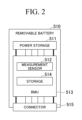
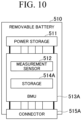
- FIG. 2 is a block diagram showing an example of the configuration of the removable battery 510 managed in the shared battery management system 10 of the first embodiment.
- the removable battery 510 includes a power storage 511, a battery management unit (BMU) 513, and a connector 515.
- the BMU 513 includes a measurement sensor 512 and a storage 514.
- the power storage 511 is configured to include a storage battery that stores electric power through charging and is discharged with the stored power.
- a storage battery included in the power storage 511 for example, a secondary battery such as a lead storage battery or a lithium-ion battery, a capacitor such as an electric double layer capacitor, a composite battery in which a secondary battery and a capacitor are combined, or the like are conceivable. Also, in the present invention, various configurations are conceivable as the configuration of the power storage 511.
- the measurement sensor 512 includes various types of sensors for measuring the state of the power storage 511.
- the measurement sensor 512 measures the voltage stored in the power storage 511 using, for example, a voltage sensor.
- the measurement sensor 512 measures the electric current flowing through the power storage 511 using, for example, a current sensor.
- the measurement sensor 512 measures the temperature at which the power storage 511 is charged or the power storage 511 is discharged using, for example, a temperature sensor.
- the measurement sensor 512 outputs a measured value indicating a measured state of the power storage 511 to a processor on the BMU 513.
- the BMU 513 is a battery management unit and controls charging and discharging of the power storage 511.
- the BMU 513 is configured to include a processor such as, for example, a central processing unit (CPU), and a memory such as, for example, a read only memory (ROM) or a random access memory (RAM), as the storage 514.
- the CPU implements a control function of the power storage 511 by reading and executing a program stored in the storage 514.
- the BMU 513 causes the storage 514 to store information such as content of the control performed on the power storage 511 on the basis of the measured value indicating the state of the power storage 511 output from the measurement sensor 512.
- the storage 514 stores information of an abnormality or a failure detected by the BMU 513 itself, an abnormality or a failure of the power storage 511 ascertained using the measurement sensor 512, or the like.
- the storage 514 is configured to include, for example, a memory such as a ROM, a RAM, or a flash memory.
- the storage 514 stores identification information (hereinafter referred to as a "battery ID") exclusively assigned to the removable battery 510.
- the storage 514 may store identification information (for example, a "user ID”) of the user of the electric motorcycle 50 currently using the removable battery 510.
- the connector 515 is a connector that supplies the electric power stored in the power storage 511 to the electric motor that is the drive source of the electric motorcycle 50 when the removable battery 510 has been mounted on the electric motorcycle 50. Also, the connector 515 is connected to a structure that is connected to the removable battery 510 provided on the back side of the battery accommodator 120H when the removable battery 510 has been accommodated in the battery slot 120 provided in the battery replacement device 100 and is also a connector for performing the transmission of information such as a battery ID that is exchanged between the removable battery 510 and the battery replacement device 100 or the transmission of electric power.
- Fig. 3 is a block diagram showing a schematic configuration of a battery replacement device 100 constituting the shared battery management system 10 of the first embodiment.
- the battery replacement device 100 includes a display 110, a connector 120T, a charger 120C, a replacement device storage 130, a replacement device controller 140, and a replacement device communicator 150.
- the replacement device controller 140 includes a charging controller 141, a measurement sensor 142, an information acquirer 143, and a processor 144.
- the connector 120T is a connector having a structure that is electrically connected to the connector 515 provided in the accommodated removable battery 510 in the battery slot 120 provided in the battery replacement device 100.
- the connector 120T is provided on the back side of the battery accommodator 120H for each battery slot 120.
- Each connector 120T transmits information such as a battery ID that is exchanged between the removable battery 510 accommodated in the corresponding battery slot 120 and the replacement device controller 140.
- the connector 120T transmits electric power to and from the removable battery 510. That is, the connector 120T supplies electric power for charging to the power storage 511 provided in the removable battery 510.
- the charger 120C is a charger that charges the removable battery 510 in accordance with control from the replacement device controller 140 when the removable battery 510 is accommodated in the battery slot 120 and the connector 515 of the accommodated removable battery 510 and the connector 120T are connected.
- the charger 120C charges the removable battery 510 by supplying electric power to the power storage 511 of the removable battery 510 via the connector 120T.
- the charger 120C is provided for each battery slot 120.
- the charger 120C may be configured to be connected to a power supply (not shown) for supplying electric power to the removable battery 510.
- the eight battery slots 120-1 to 120-8 are provided in the battery replacement device 100 shown in Fig. 1 . Accordingly, eight connector s 120T and eight chargers 120C are also provided in correspondence with the battery slots 120. Also, in the following description, when the connector 120T and the charger 120C corresponding to each of the eight battery slots 120-1 to 120-8 are distinguished and represented, the hyphen "-" and the number following the hyphen "-" are shown. For example, the connector 120T corresponding to the battery slot 120-1 is referred to as a "connector 120-1T" and the charger 120C corresponding to the battery slot 120-1 is referred to as a "charger 120-1C.”
- the replacement device storage 130 stores various information in the battery replacement device 100.
- the replacement device storage 130 stores at least the available battery list L previously acquired from the operation server 200 via the network NW.
- the replacement device storage 130 is configured to include, for example, a memory such as a ROM, a RAM, an electrically erasable programmable read only memory (EEPROM), a hard disk drive (HDD), or a flash memory.
- the replacement device storage 130 stores a program for the replacement device controller 140 to execute the function of the battery replacement device 100.
- the replacement device storage 130 may store information of whether or not the removable battery 510 has been accommodated in each battery slot 120 provided in the battery replacement device 100 and the state of the removable battery 510 accommodated in each battery slot 120, i.e., information indicating whether the removable battery 510 is being charged or charging of the removable battery 510 has been completed (hereinafter referred to as "battery state information"). Also, the replacement device storage 130 may store identification information (hereinafter referred to as a "battery replacement device ID”) exclusively assigned to the battery replacement device 100.
- the replacement device controller 140 controls the entire battery replacement device 100.
- the replacement device controller 140 is configured to include, for example, a processor such as a CPU.
- the replacement device controller 140 implements the function of the battery replacement device 100 by reading and executing the program stored in the replacement device storage 130. More specifically, the replacement device controller 140 outputs an instruction for acquiring the available battery list L to the replacement device communicator 150 at predetermined relatively long-time intervals (for example, every three hours or every day). Thereby, the replacement device communicator 150 communicates with the operation server 200 via the network NW and causes the replacement device storage 130 to store the available battery list L acquired from the operation server 200.
- the replacement device controller 140 performs a procedure for replacing the used battery 510u brought in by the user of the electric motorcycle 50 with the charged battery 510c on the basis of information of the battery IDs of the removable batteries 510 included in the available battery list L stored in the replacement device storage 130. At this time, the replacement device controller 140 notifies the user of the electric motorcycle 50 of the battery slot 120 (for example, a battery slot 120-1) in which the used battery 510u will be accommodated through the display 110. Thereby, the user of the electric motorcycle 50 accommodates the used battery 510u brought in by him or her in the battery accommodator 120-1H of the battery slot 120-1 in a state in which no removable battery 510 is accommodated.
- the replacement device controller 140 may determine whether or not the used battery 510u accommodated in the battery accommodator 120-1H is a removable battery 510 capable of being replaced on the basis of the information of the battery IDs of the removable batteries 510 included in the available battery list L.
- the replacement device controller 140 notifies the user of the electric motorcycle 50 of the battery slot 120 (for example, a battery slot 120-2) in which the charged battery 510c is accommodated through the display 110.
- the replacement device controller 140 charges the used battery 510u accommodated in the battery accommodator 120-1H.
- the replacement device controller 140 prohibits the used battery 510u from being replaced with the charged battery 510c accommodated in the battery slot 120 (for example, the battery slot 120-2).
- the replacement device controller 140 notifies the user of the electric motorcycle 50 that the used battery 510u accommodated in the battery accommodator 120-1H is a removable battery 510 that cannot be replaced through the display 110.
- the information acquirer 143 acquires information of the removable battery 510 accommodated in the battery slot 120. More specifically, the information acquirer 143 acquires the battery ID of the used battery 510u via the connector 120T when the used battery 510u is accommodated in the battery accommodator 120H of the battery slot 120 and the connector 515 and the connector 120T are connected. The information acquirer 143 outputs the acquired battery ID information to the processor 144. Also, the information acquirer 143 may cause the replacement device storage 130 to store the acquired battery ID information.
- the measurement sensor 142 is configured to include various types of sensors that measure the state when the charger 120C is charging the removable battery 510.
- the measurement sensor 142 is configured to include, for example, a voltage sensor, an electric current sensor, and a temperature sensor.
- the measurement sensor 142 measures the voltage applied to the power storage 511 using the voltage sensor and measures the electric current flowing through the power storage 511 using the electric current sensor.
- the measurement sensor 142 measures the temperature of the power storage 511 when the removable battery 510 is being charged using the temperature sensor.
- the measurement sensor 142 outputs a measured value indicating a measured state of the removable battery 510 to the charging controller 141.
- the measurement sensor 142 may be configured to acquire the state of the power storage 511 measured by the measurement sensor 512 provided in the removable battery 510 via the connector 120T. In this case, the measurement sensor 142 outputs the measured value indicating the state of the power storage 511 acquired from the measurement sensor 512 to the charging controller 141.
- the charging controller 141 also controls the charging of the removable battery 510 by controlling the charger 120C in consideration of the measured value of the removable battery 510 output from the measurement sensor 142.
- the charging controller 141 outputs information indicating that the charging has been completed to the processor 144.
- the charging controller 141 may output information indicating the current state in which the removable battery 510 is being charged to the processor 144.
- the charging controller 141 may output information indicating the current state in which the removable battery 510 is being charged to the replacement device storage 130 and update the battery state information stored in the replacement device storage 130.
- the battery replacement device 100 may cause the removable battery 510 to be temporarily discharged with the remaining power before the removable battery 510 is charged.
- the charging controller 141 also controls the discharging of the removable battery 510.
- the processor 144 performs a procedure for replacing the removable battery 510 in the battery replacement device 100. More specifically, the processor 144 combines the battery ID output from the information acquirer 143 with the battery ID of the removable battery 510 included in the available battery list L stored in the replacement device storage 130 and determines whether or not the used battery 510u accommodated in the battery slot 120 is a removable battery 510 capable of being replaced at the battery replacement device 100.
- the processor 144 When a result of the above-described determination indicates that the used battery 510u is a removable battery 510 capable of being replaced at the battery replacement device 100, the processor 144 performs a process of replacing the used battery 510u with the charged battery 510c and a process of charging the used battery 510u. In the process of replacing the used battery 510u with the charged battery 510c in the processor 144, the charged battery 510c to be replaced is selected and the notification of the battery slot 120 in which the selected charged battery 510c is accommodated for the user of the electric motorcycle 50 is provided.
- the processor 144 may be configured to output information about whether or not the removable battery 510 is accommodated in the battery slot 120 to the replacement device storage 130 and update the battery state information stored in the replacement device storage 130. Also, in the process of charging the used battery 510u in the processor 144, an instruction indicating that the used battery 510u is to be charged is output to the charging controller 141. Thereby, the charging controller 141 controls the charger 120C in consideration of the measured value of the removable battery 510 output from the measurement sensor 142, so that the charger 120C charges the used battery 510u.
- the processor 144 notifies the user of the electric motorcycle 50 that the used battery 510u cannot be replaced.
- the replacement device communicator 150 performs wireless communication with the operation server 200 via the network NW in response to an instruction from the replacement device controller 140 and acquires the available battery list L from the operation server 200.
- the replacement device communicator 150 outputs the available battery list L acquired from the operation server 200 to the replacement device storage 130 and causes the replacement device storage 130 to store the available battery list L.
- the available battery list L is not always updated every time the replacement device communicator 150 accesses the operation server 200.
- the replacement device communicator 150 first asks the operation server 200 about whether or not the available battery list L has been updated.
- the replacement device communicator 150 may acquire the current available battery list L as a new available battery list L only when the available battery list L has been updated in the operation server 200, and cause the replacement device storage 130 to store the new available battery list L, i.e., may update the available battery list L stored in the replacement device storage 130.
- the replacement device communicator 150 may notify the replacement device controller 140 (more specifically, the processor 144) of information indicating that the available battery list L stored in the replacement device storage 130 has been updated.
- the processor 144 determines whether or not the used battery 510u is a removable battery 510 capable of being replaced on the basis of the battery IDs of the removable batteries 510 included in the available battery list L previously stored in the replacement device storage 130. Therefore, whether or not the available battery list L stored in the replacement device storage 130 has been updated does not affect the determination of whether or not the used battery 510u is a removable battery 510 capable of being replaced in the processor 144. Accordingly, the replacement device communicator 150 may not necessarily output the information indicating that the available battery list L has been updated to the processor 144.
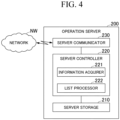
- Fig. 4 is a block diagram showing a schematic configuration of the operation server 200 constituting the shared battery management system 10 of the first embodiment.
- the operation server 200 includes a server storage 210, a server controller 220, and a server communicator 230.
- the server controller 220 includes an information acquirer 221 and a list processor 222.
- the server storage 210 stores various information in the operation server 200.
- the server storage 210 stores at least the available battery list L to be transmitted to the battery replacement device 100 via the network NW.
- the server storage 210 is configured to include, for example, a memory such as a ROM, a RAM, an EEPROM, an HDD, or a flash memory.
- the server storage 210 stores a program for the server controller 220 to execute the function of the operation server 200.
- the server storage 210 may store information in which the battery replacement device ID exclusively assigned to the battery replacement device 100 is associated with a version of the available battery list L transmitted to the battery replacement device 100.
- the server controller 220 controls the entire operation server 200.
- the server controller 220 is configured to include, for example, a processor such as a CPU.
- the server controller 220 implements the function of the operation server 200 by reading and executing the program stored in the server storage 210. More specifically, the server controller 220 creates or updates the available battery list L recording the battery ID of the removable battery 510 capable of being replaced at the battery replacement device 100 and outputs the created or updated available battery list L to the server storage 210 so that the server storage 210 stores the created or updated available battery list L.
- the creation and update of the available battery list L in the server controller 220 and the like are performed by the manager of the shared battery management system 10 operating an input device (for example, a keyboard or a mouse) (not shown) on the basis of information displayed on a display device (for example, a liquid crystal display) (not shown) of a terminal (not shown) connected to the operation server 200.
- the server controller 220 reads the available battery list L stored in the server storage 210 in response to a request from the battery replacement device 100 and outputs the available battery list L to the server communicator 230, so that the available battery list L is transmitted to the battery replacement device 100 via the network NW.
- the information acquirer 221 acquires information of a battery ID of the removable battery 510 to be included in the available battery list L for addition or deletion (deregistration) in response to an operation on the input device (not shown) of the terminal (not shown) connected to the operation server 200 by the manager of the shared battery management system 10 or the like. More specifically, the information acquirer 221 acquire the battery ID of the removable battery 510 to be added when a removable battery 510 capable of being replaced at the battery replacement device 100 is newly added according to an operation on the terminal (not shown) by the manager or the like.
- the information acquirer 221 acquires the battery ID of the removable battery 510 that cannot be replaced at the battery replacement device 100 due to deterioration or destruction when the deregistration from the available battery list L is performed according to the operation of the terminal (not shown) by the manager or the like. Also, the information acquirer 221 may acquire the battery ID of the removable battery 510 to be deregistered from the available battery list L from the battery replacement device 100. In this case, the information acquirer 221 acquires information of the battery ID of the removable battery 510 (the removable battery 510 that has deteriorated or destructed) to be deregistered from the available battery list L transmitted by the battery replacement device 100 via the network NW. The information acquirer 221 outputs the acquired information of the battery ID to the list processor 222. Also, the information acquirer 221 may cause the server storage 210 to store the acquired information of the battery ID.
- the list processor 222 processes the creation and update of the available battery list L. More specifically, when the battery ID of the removable battery 510 to be added to the available battery list L has been output from the information acquirer 221, the list processor 222 updates the available battery list L by performing a process of creating a new available battery list L in which the battery ID is registered and a process of adding (registering) a battery ID to the current available battery list L. Also, when the battery ID of the removable battery 510 to be deregistered from the available battery list L has been output from the information acquirer 221, the list processor 222 updates the available battery list L by performing a process of deleting the battery ID included (registered) in the current available battery list L.
- the list processor 222 outputs the created or updated available battery list L in the server storage 210 and causes the server storage 210 to store the output available battery list L.
- the battery replacement device 100 may be configured to perform a process of deleting the battery ID included (registered) in the current available battery list L. In this case, the battery replacement device 100 transmits the updated available battery list L to the operation server 200 via the network NW.
- the information acquirer 221 acquires the updated available battery list L transmitted by the battery replacement device 100 and outputs the updated available battery list L to the list processor 222.
- the list processor 222 outputs the updated available battery list L (which may be in the state of the available battery list L output by the information acquirer 221 as it is or may be further processed) output by the information acquirer 221 to the server storage 210 and causes the server storage 210 to store the updated available battery list L.
- the server communicator 230 performs wireless communication with the replacement device communicator 150 provided in the battery replacement device 100 via the network NW.
- the server communicator 230 transmits the available battery list L created or updated by the list processor 222 and stored in the server storage 210 to the battery replacement device 100 in response to the request of the available battery list L transmitted from the battery replacement device 100.
- the available battery list L is not always updated every time there is a request from the battery replacement device 100.
- the battery replacement device 100 first transmits an inquiry about whether or not the available battery list L has been updated.
- the server communicator 230 notifies the server controller 220 that the inquiry has been transmitted.
- the server controller 220 outputs information indicating whether or not the list processor 222 has updated the available battery list L to the server communicator 230 after the available battery list L was previously transmitted.
- the determination of whether or not the available battery list L in the server controller 220 has been updated may be performed for each operation server 200 on the basis of information in which the battery replacement device ID of the battery replacement device 100 and a version of the transmitted available battery list L stored in the server storage 210 are associated.
- the server communicator 230 transmits information indicating whether or not the available battery list L output from the server controller 220 has been updated to the battery replacement device 100 via the network NW. Subsequently, when the information indicating that the available battery list L has been updated has been transmitted to the battery replacement device 100, a request of the available battery list L is transmitted from the battery replacement device 100.
- the server communicator 230 When the request of the available battery list L has been transmitted from the battery replacement device 100, the server communicator 230 notifies the server controller 220 that the transmission of the available battery list L has been requested. Thereby, the server controller 220 reads the available battery list L stored in the server storage 210 and outputs the available battery list L to the server communicator 230. The server communicator 230 transmits the available battery list L output from the server controller 220 to the battery replacement device 100 via the network NW. Thereby, the battery replacement device 100 can independently perform a procedure for acquiring the latest available battery list L and replacing the used battery 510u with the charged battery 510c on the basis of the acquired latest available battery list L.
- FIG. 5 is a sequence diagram showing a flow of a process of acquiring information (an available battery list L) of the removable battery 510 capable of being replaced in the battery sharing service adopting the shared battery management system 10 of the first embodiment.
- Fig. 5 an example of processes of the battery replacement device 100 and the operation server 200 constituting the shared battery management system 10 that provides the battery sharing service is shown.
- Fig. 6 is a sequence diagram showing a flow of a process of replacing the removable battery 510 in the battery sharing service adopting the shared battery management system 10 of the first embodiment.
- an example of a process of the battery replacement device 100 constituting the shared battery management system 10 that provides the battery sharing service is shown in association with the removable battery 510 (the used battery 510u) to be replaced and the user of the electric motorcycle 50.
- the manager of the shared battery management system 10 or the like creates or updates an available battery list L by operating the terminal (not shown) connected to the operation server 200 in the shared battery management system 10 as described above
- the creation or update of the available battery list L according to the operation of the manager or the like is also shown as a process of the operation server 200 for ease of description in the sequence diagram shown in Fig. 5 .
- the manager In the stage before the operation of the battery sharing service starts, in the shared battery management system 10, the manager first operates the terminal (not shown) connected to the operation server 200 and creates an available battery list L in which the removable battery 510 to be rented out to the user of the electric motorcycle 50 is registered (step S101).
- the operation server 200 accesses the information acquirer 221 provided in the server controller 220 when the manager operates the terminal (not shown) and causes the information acquirer 221 to acquire information of a battery ID of the removable battery 510 included in the available battery list L and the list processor 222 provided in the server controller 220 creates a new available battery list L in which the battery ID of the removable battery 510 acquired by the information acquirer 221 is registered.
- the operation server 200 stores the created available battery list L in the server storage 210.
- the battery IDs of a plurality of removable batteries 510 capable of being rented out to the user of the electric motorcycle 50 in the battery sharing service are registered in the available battery list L created by the list processor 222 and stored in the server storage 210.
- this available battery list L is created, the operation of the battery sharing service can be started.
- the removable battery 510 to be rented out to the user of the electric motorcycle 50 is added or deregistered according to the operation of the manager on the terminal (not shown) and the available battery list L is updated (step S102).
- the information acquirer 221 acquires information of the battery ID of the removable battery 510 to be included in the available battery list L or deleted from the available battery list L according to the operation of the manager on the terminal (not shown) and the list processor 222 updates the available battery list L by registering or deregistering the battery ID of the removable battery 510 acquired by the information acquirer 221.
- the operation server 200 stores the updated available battery list L in the server storage 210. Thereby, the removable battery 510 capable of being rented out to the user of the electric motorcycle 50 in the battery sharing service is changed.
- the process of updating the available battery list L in the operation server 200 is performed at any timing after the removable battery 510 to be rented out to the user of the electric motorcycle 50 is added or deregistered according to the operation of the manager.
- the operation server 200 iterates a process of updating the available battery list L in step S102 at any timing.
- the update of the available battery list L in the operation server 200 is performed when a removable battery 510 capable of being replaced at the battery replacement device 100 has been newly added or when a registered removable battery 510 cannot be replaced at the battery replacement device 100 due to deterioration or destruction thereof, it is considered that the update is not frequently performed.
- the battery replacement device 100 asks the operation server 200 about whether or not the available battery list L has been updated (step S203).
- the processor 144 provided in the replacement device controller 140 outputs an instruction for acquiring the available battery list L to the replacement device communicator 150.
- the replacement device communicator 150 transmits an inquiry about whether or not the available battery list L has been updated to the operation server 200 via the network NW.
- the operation server 200 replies to the inquiry about whether or not the available battery list L has been updated (step S204).
- the list processor 222 outputs information indicating whether or not the available battery list L has been updated to the server communicator 230.
- the server communicator 230 transmits the information indicating whether or not the available battery list L has been updated output from the list processor 222 as a response to the inquiry to the battery replacement device 100 via the network NW.
- the battery replacement device 100 determines whether or not the available battery list L has been updated (step S205).
- the battery replacement device 100 moves the process to step S409.
- the battery replacement device 100 requests the operation server 200 to provide the updated available battery list L (step S306).
- the replacement device communicator 150 transmits the request of the available battery list L to the operation server 200 via the network NW.
- the operation server 200 transmits the available battery list L stored in the server storage 210 to the battery replacement device 100 (step S307).
- the server controller 220 reads the available battery list L stored in the server storage 210 and outputs the read available battery list L to the server communicator 230.
- the server communicator 230 transmits the available battery list L output from the server controller 220 as the latest available battery list L to the battery replacement device 100 via the network NW.
- the battery replacement device 100 stores the available battery list L transmitted from the operation server 200 in the replacement device storage 130 (step S308). At this time, in the battery replacement device 100, the replacement device communicator 150 outputs the available battery list L transmitted from the operation server 200 to the replacement device storage 130 and causes the replacement device storage 130 to store the available battery list L. Thereby, the battery replacement device 100 can independently perform a procedure for replacing the removable battery 510 on the basis of the latest available battery list L transmitted from the operation server 200.
- the battery replacement device 100 determines whether or not a predetermined time period (for example, three hours or one day) has elapsed (step S409).
- a predetermined time period for example, three hours or one day
- the battery replacement device 100 iterates the determination of step S409 in the process. That is, the battery replacement device 100 waits for the process of acquiring the available battery list L from the operation server 200 before the predetermined time period elapses.
- step S409 when a result of the determination of step S409 indicates that the predetermined time period has elapsed ("YES" in step S409), the battery replacement device 100 returns to step S203 and again asks the operation server 200 about whether or not the available battery list L has been updated. That is, the battery replacement device 100 iterates the process of acquiring the latest available battery list L from the operation server 200 (steps S203 to S308).
- the user of the electric motorcycle 50 brings the used battery 510u running out of power and accommodates the used battery 510u in the battery accommodator 120H of the battery slot 120 (step S500).
- the connector 120T within the battery accommodator 120H of any battery slot 120 provided in the battery replacement device 100 is electrically connected to the connector 515 of the used battery 510u accommodated by the user of the electric motorcycle 50.
- the replacement device controller 140 starts a process of replacing the used battery 510u with the charged battery 510c under an assumption that the replacement of the used battery 510u accommodated in the battery accommodator 120H has been requested by the user of the electric motorcycle 50.
- step S601 When the process of replacing the used battery 510u with the charged battery 510c is started at the battery replacement device 100, information of a battery ID of the used battery 510u is first acquired (step S601).
- the information acquirer 143 provided in the replacement device controller 140 acquires the information of the battery ID from the storage 514 provided in the used battery 510u via the connector 120T of the battery accommodator 120H and the connector 515.
- the information acquirer 143 outputs the acquired information of the battery ID to the processor 144 provided in the replacement device controller 140.
- the processor 144 provided in the replacement device controller 140 determines whether or not the used battery 510u accommodated in the battery accommodator 120H is a removable battery 510 capable of being replaced (step S602). At this time, the processor 144 combines the battery ID included in the available battery list L stored in the replacement device storage 130 with the battery ID output from the information acquirer 143. More specifically, the processor 144 reads the available battery list L from the replacement device storage 130 and sequentially compares battery IDs included in the read available battery list L with the battery ID output from the information acquirer 143.
- the processor 144 determines that the used battery 510u accommodated in the battery accommodator 120H is a removable battery 510 that cannot be replaced at the battery replacement device 100 in step S602 ("NO" in step S602). In this case, the processor 144 notifies the user of the electric motorcycle 50 that the used battery 510u cannot be replaced (step S703).
- a method of displaying a message indicating that the used battery 510u cannot be replaced on the display 110 is conceivable as a method of notifying the user of the electric motorcycle 50 that the used battery 510u cannot be replaced
- various methods are conceivable as a method of providing a notification to the user of the electric motorcycle 50 in the present invention.
- the processor 144 determines that the used battery 510u accommodated in the battery accommodator 120H is a removable battery 510 capable of being replaced at the battery replacement device 100 in step S602 ("YES" in step S602). In this case, the processor 144 selects a charged battery 510c for replacement from among the charged batteries 510c accommodated in the battery slots 120 different from the battery slot 120 in which the used battery 510u is accommodated (step S704).
- the processor 144 may cause the replacement device storage 130 to store information of a battery ID of the selected charged battery 510c.
- the processor 144 notifies the user of the electric motorcycle 50 of information of the selected charged battery 510c, i.e., the battery slot 120 in which the charged battery 510c for replacement is accommodated (step S705). Thereby, the user of the electric motorcycle 50 extracts the charged battery 510c accommodated in the battery accommodator 120H of the battery slot 120 indicated in the notification (step S800). That is, the user of the electric motorcycle 50 completes the replacement of the removable battery 510. Thereby, the user of the electric motorcycle 50 can mount the charged battery 510c on the electric motorcycle 50 and continue traveling.
- the replacement device controller 140 starts a process of charging the used battery 510u under an assumption that the replacement of the used battery 510u with the charged battery 510c by the user of the electric motorcycle 50 has been completed (step S906).
- the processor 144 outputs an instruction indicating that the used battery 510u is to be charged to the information acquirer 143 provided in the replacement device controller 140.
- the charging controller 141 controls the charger 120C on the basis of a measured value of the removable battery 510 output from the measurement sensor 142, so that the charger 120C charges the used battery 510u.
- the processor 144 may output an instruction to the charging controller 141 so that charging is started immediately after the replacement of the used battery 510u is completed or may output an instruction to the charging controller 141 so that charging is started when the number of charged batteries 510c becomes less than or equal to a predetermined number.
- the battery replacement device 100 is on standby in a state in which a request for replacement of the used battery 510u from the user of the electric motorcycle 50 can be accepted.
- the battery replacement device 100 iterates a process of replacing the used battery 510u with the charged battery 510c and a process of charging the used battery 510u every time the user of the electric motorcycle 50 brings the used battery 510u running out of power and the replacement of the used battery 510u is requested (steps S601 to S906).
- Fig. 7 is a diagram schematically showing a flow of a procedure for replacing the removable battery 510 in the battery sharing service adopting the shared battery management system 10 of the first embodiment.
- Fig. 8 is a diagram schematically showing a flow of a procedure for replacing the removable battery 510 in the battery sharing service adopting the conventional shared battery management system.
- the battery replacement device 100 performs a procedure for previously acquiring the available battery list L from the operation server 200 connected via the network NW and replacing the used battery 510u brought in by the user of the electric motorcycle 50 with the charged battery 510c on the basis of information of a battery ID of the removable battery 510 included in the acquired available battery list L.
- (a) of Fig. 7 schematically shows the state in which the shared battery management system 10 acquires the available battery list L created or updated by the operation server 200 via the network NW.
- a state in which the battery replacement device 100 replaces the used battery 510u brought in by the user P of the electric motorcycle 50 with the charged battery 510c on the basis of the acquired available battery list L is schematically shown.
- the battery replacement device 100 acquires an available battery list L, which is used by the battery replacement device 100 when it is determined whether or not the used battery 510u is a removable battery 510 capable of being replaced, in advance, for example, at predetermined relatively long-time intervals that do not interfere with the charging of the used battery 510u, such as once every three hours or once a day, without acquiring the available battery list L from the operation server 200 every time the determination is performed.
- the battery replacement device 100 can independently perform a procedure for replacing the removable battery 510 without being affected by the state of wireless communication (an environment of communication) between the battery replacement device 100 and the operation server 200 via the network NW. That is, as shown in (b) of Fig.
- the battery replacement device 100 can independently perform the procedure for replacing the removable battery 510 without having to stop or suspend the procedure for replacing the used battery 510u brought in by the user P of the electric motorcycle 50 with the charged battery 510c even if wireless communication with the operation server 200 via the network NW is interrupted or stable wireless communication cannot be performed.
- the battery sharing service adopting the shared battery management system 10 it is possible to replace the used battery 510u with the charged battery 510c when the user P of the electric motorcycle 50 wants to replace the used battery 510u.
- the shared battery management system 10 is considered to be significantly effective for promoting the battery sharing service.
- the battery replacement device 800 transmits information of an IC card of the used battery 510u to the system management device 900 connected via the network NW at a timing when the used battery 510u is replaced with the charged battery 510c.
- the system management device 900 determines whether or not the used battery 510u is a removable battery 510 capable of being replaced with the charged battery 510c at the battery replacement device 800 on the basis of the information of the IC card of the used battery 510u transmitted from the battery replacement device 800 and transmits a determination result to the battery replacement device 800 via the network NW.
- the battery replacement device 800 performs the procedure for replacing the used battery 510u with the charged battery 510c in accordance with the determination result transmitted from the system management device 900.
- the user P of the electric motorcycle 50 has to wait for the wireless communication between the battery replacement device 800 and the system management device 900 via the network NW to be restored.
- the user P of the electric motorcycle 50 arrives at the current battery replacement device 800 at a timing when it is expected that the removable battery 510 will run out of power and traveling of the electric motorcycle 50 will be difficult, it is considered difficult to go to another battery replacement device 800.
- the conventional shared battery management system is considered to be significantly disadvantageous for promoting the battery sharing service.
- the shared battery management system 10 includes the battery replacement device 100 installed in a plurality of places and configured to store and charge one or more removable batteries 510 and the operation server 200 configured to manage removable batteries 510 capable of being replaced at the battery replacement device 100.
- the operation server 200 creates or updates and stores the available battery list L recording battery IDs of removable batteries 510 with which replacement can be performed at the battery replacement device 100.
- the battery replacement device 100 acquires the available battery list L from the operation server 200 via the network NW at predetermined relatively long-time intervals such as once a day and stores the acquired available battery list L.
- the battery replacement device 100 determines whether or not the used battery 510u desired to be replaced by the user of the electric motorcycle 50 is a removable battery 510 capable of being replaced with a charged battery 510c whose charging is completed and which is stored on the basis of the stored available battery list L. In the first embodiment, when it is determined that the used battery 510u is a removable battery 510 capable of being replaced, the battery replacement device 100 performs the procedure for replacing the used battery 510u with the charged battery 510c. Thereby, in the first embodiment, the battery replacement device 100 is not affected by the state of communication (an environment of communication) via the network NW between the battery replacement device 100 and the operation server 200 and can independently perform a procedure for replacing the removable battery 510. Thereby, in the first embodiment, when the user of the electric motorcycle 50 using the battery sharing service adopting the shared battery management system 10 wants to replace the used battery 510u, the used battery 510u can be replaced with the charged battery 510c.
- the available battery list L used in determining whether or not the used battery 510u is a removable battery 510 capable of being replaced at the battery replacement device 100 is considered not to be frequently updated.
- the battery replacement device 100 can independently continue to perform the procedure for replacing the removable battery 510 based on the stored available battery list L. Thereby, in the first embodiment, it is possible to continue to provide the battery sharing service to the user of the electric motorcycle 50.
- the first embodiment can contribute to the promotion of the automated battery sharing service.
- the battery replacement device 100 and the operation server 200 constituting the shared battery management system 10 communicate with each other via the network NW, which is a communication network for wireless communication.
- the communication between the battery replacement device 100 and the operation server 200 in the shared battery management system 10 is not limited to wireless communication. Even if the communication between the battery replacement device 100 and the operation server 200 in the shared battery management system 10 is wired communication, i.e., the network NW is a communication network of wired communication, a case in which the wired communication is interrupted or that stable wired communication cannot be performed when maintenance of the operation server 200 is performed or the like is also considered.
- the number of removable batteries 510 mounted for the electric motorcycle 50 to travel is not limited to one. That is, a case in which the electric motorcycle 50 is an electric vehicle that travels with electric power supplied from a plurality of removable batteries 510 is also conceivable. However, even if the electric motorcycle 50 is an electric vehicle that travels in a state in which a plurality of removable batteries 510 are mounted thereon, it is possible to similarly consider a procedure for replacing the removable batteries 510.
- the electric motorcycle 50 is an electric vehicle that travels with electric power supplied from two removable batteries 510
- the user of the electric motorcycle 50 performs the operation of steps S500 and S800 shown in Fig. 6 on each removable battery 510, i.e., performs the operation twice, and the operation is the iteration of the same operation. Accordingly, a detailed description of the procedure for replacing the removable battery 510 in the electric vehicle that travels with the electric power supplied from the plurality of removable batteries 510 will be omitted.
- a power storage device management system of the second embodiment is a power storage device management system for the purpose of constructing a battery sharing service in which a method of renting out a power storage device (a removable battery) can be easily changed.
- the power storage device management system of the second embodiment is a shared battery management system for managing the reception of a plurality of removable batteries shared by electric power devices (electric motorcycles) using electric power of a removable battery and managing the provision of alternative removable batteries.
- the same reference signs are given to components that are the same as those of the first embodiment described above and a detailed description thereof will be omitted.
- Fig. 9 is a diagram showing a concept of a battery sharing service adopting the shared battery management system according to the second embodiment of the present invention.
- the shared battery management system 10A of the second embodiment is configured to include a battery replacement device 100A and an operation server 200A.
- one operation server 200A can be configured to correspond to a plurality of battery replacement devices 100A in the shared battery management system 10A of the second embodiment, only one battery replacement device 100A is shown in Fig. 9 .
- an electric motorcycle 50 which uses a battery sharing service adopting the shared battery management system 10A, is shown in Fig. 9 .
- the battery replacement device 100A is a facility that is installed in a plurality of places and stores and charges one or more removable batteries 510. Also, like the battery replacement device 100 of the first embodiment, the battery replacement device 100A is a facility that executes a procedure for replacing a removable battery 510 desired to be replaced by a user of the shared battery management system 10A (a user of an electric motorcycle 50 or the like) with a stored removable battery 510. Like the battery replacement device 100 of the first embodiment, the battery replacement device 100A is also connected to the operation server 200A via a network NW.
- the network NW is a communication network such as a communication network for wireless communication.
- the network NW may be a communication network for wired communication. However, in the present invention, it is considered that a more remarkable effect can be obtained when the network NW is a communication network for wireless communication than when the network NW is a communication network for wired communication.
- the battery replacement device 100A exchanges information with the operation server 200A using communication via the network NW and replaces the removable battery 510. More specifically, the battery replacement device 100A transmits a battery state list recording information about removable batteries 510 that are stored and charged to the operation server 200A via the network NW periodically at predetermined time intervals (for example, every 5 minutes). Also, the battery replacement device 100A acquires (receives) a rentable battery list recording information of removable batteries 510 capable of being rented out and the order of rental from the operation server 200A via the network NW periodically at predetermined time intervals (for example, every 5 minutes).
- the battery state list transmitted by the battery replacement device 100A to the operation server 200A at least information of a charging count and a deterioration state of a removable battery 510 that is stored, a charging count, a deterioration state, and the state of charge (for example, a proportion at which charging is completed: a charge rate) of a removable battery 510 that is charged, and the like is recorded as information about the removable battery 510 in addition to battery IDs of the removable batteries 510 that are stored and charged.
- the battery state list may record identification information (a battery replacement device ID) exclusively assigned to the battery replacement device 100A, information of the presence or absence of a failure in the battery replacement device 100A, and the like.
- the rentable battery list acquired by the battery replacement device 100A from the operation server 200A at least information of the removable battery 510 with which rental (replacement) can be performed at the battery replacement device 100A, the order in which rental (replacement) is performed, and the like determined by the operation server 200A on the basis of the battery state list transmitted from the battery replacement device 100A is recorded as information of the removable battery 510 capable of being rented out.
- the battery replacement device 100A acquires a rentable battery list recording the removable battery 510 with which rental (replacement) can be performed at the battery replacement device 100A and the order thereof from the operation server 200A and stores the rentable battery list. Also, the battery replacement device 100A replaces the currently stored rentable battery list with a newly acquired rentable battery list every time a new rentable battery list is acquired from the operation server 200A. That is, the battery replacement device 100A updates the stored rentable battery list at predetermined time intervals.
- Fig. 9 the state in which the battery replacement device 100A transmits a battery state list S to the operation server 200A via the network NW and the operation server 200A acquires (receives) a rentable battery list B from the operation server 200A via the network NW is shown.
- the battery replacement device 100A replaces a removable battery 510 running out of power brought in by the user of the electric motorcycle 50 with the stored removable battery 510 in accordance with information of the removable battery 510 with which rental (replacement) can be performed at the battery replacement device 100A and the order thereof indicated in the rentable battery list B acquired from the operation server 200A. Also, after replacement is performed with the stored removable battery 510, the battery replacement device 100A deletes information about the removable battery 510 with which replacement has been performed from the stored rentable battery list B. Thereby, the battery replacement device 100A can replace the removable battery 510 running out of power brought in by the user of the electric motorcycle 50 only with the removable battery 510 with which rental (replacement) can be performed included in the rentable battery list B.
- FIG. 9 An example of a configuration of the battery replacement device 100A is shown in Fig. 9 . Because the components of the battery replacement device 100A shown in Fig. 9 are similar to the components of the battery replacement device 100 of the first embodiment, the same reference signs are given thereto and a detailed description thereof will be omitted.
- Fig. 9 as in Fig. 1 , the state in which the removable battery 510 is moved in and out of the battery slot 120-1 is shown.
- the configuration of the battery replacement device 100A shown in Fig. 9 is also an example and various configurations are conceivable as the configuration of the battery replacement device 100A in the present invention.
- the operation server 200A is a server facility that manages the removable battery 510 capable of being replaced at the battery replacement device 100A as at the battery replacement device 100 of the first embodiment.
- the operation server 200A determines a removable battery 510 with which rental (replacement) can be performed at the battery replacement device 100A and the order in which rental (replacement) is performed with the removable battery 510 on the basis of the battery ID, the charging count, and the deterioration state of a removable battery 510 that is stored in the battery replacement device 100A and the battery ID, the charging count, the deterioration state, and the charge rate of a charged removable battery 510 included in the battery state list S transmitted from the battery replacement device 100A.
- the operation server 200A creates the rentable battery list B including information of a removable battery 510 with which rental (replacement) can be performed at the battery replacement device 100A, the order in which rental (replacement) is performed with the removable battery 510, and the like.
- the battery state list S transmitted by the battery replacement device 100A to the operation server 200A is a list formatted such that information of a battery ID, a charging count, a deterioration state, and a charge rate of a removable battery 510 that is stored is associated for each battery slot 120 provided in the battery replacement device 100A is considered, various formats are conceivable as the format of the battery state list S in the present invention.
- the rentable battery list B created by the operation server 200A and transmitted to the battery replacement device 100A is, for example, a list formatted such that battery IDs of removable batteries 510 with which rental (replacement) can be performed at the battery replacement device 100A are arranged in the order in which rental (replacement) is performed or the like is considered, various formats are conceivable as the format of the rentable battery list B in the present invention.
- the battery state list S transmitted by the battery replacement device 100A to the operation server 200A will be described as a list formatted such that information of the battery ID, the charging count, the deterioration state, and the charge rate of a removable battery 510 that is stored is associated and stored for each battery slot 120 provided in the battery replacement device 100A.
- the rentable battery list B created by the operation server 200A and transmitted to the battery replacement device 100A will be described as a list formatted such that battery IDs of the removable batteries 510 with which rental (replacement) can be performed at the battery replacement device 100A are arranged in the order in which rental (replacement) is performed.
- the removable battery 510 with which rental (replacement) can be performed at the battery replacement device 100A and the order thereof included in the rentable battery list B are determined will be described.
- the removable battery 510 with which rental (replacement) can be performed at the battery replacement device 100A and the order in which rental (replacement) is performed with the removable battery 510 determined by the operation server 200A can be determined on the basis of rules determined in various types of thinking. That is, the logic when the battery replacement device 100A performs a procedure for replacing the removable battery 510 can be arbitrarily changed in the shared battery management system 10A.
- a condition for determining the logic when the battery replacement device 100A performs a procedure for replacing the removable battery 510 i.e., a condition for determining a removable battery 510 with which rental (replacement) is performed and the order thereof in the operation server 200A, is conceivable.
- various external factors such as a place where the battery replacement device 100A is installed, a date and time (a date, a day of the week, a time period, and the like), weather, and the like are conceivable as a condition for determining a removable battery 510 with which rental (replacement) is performed and the order thereof in the operation server 200A.
- These conditions can be changed in accordance with rules preset in the operation server 200A.
- the rules preset in the operation server 200A can be sequentially changed on the basis of thinking, an intention, or the like when the management or operation for the removable batteries 510 is performed by the manager of the shared battery management system 10A or the operator of the battery sharing service.
- the manager of the shared battery management system 10A or the operator of the battery sharing service sets rules for determining a removable battery 510 with which rental (replacement) can be performed at the battery replacement device 100A and the order thereof in the operation server 200A by operating a terminal (not shown) connected to the operation server 200A.
- the manager of the shared battery management system 10A or the like sets a rule of the operation server 200A so that only a charged battery 510c whose charging is completed and which is stored in the battery replacement device 100A is set as a removable battery 510 with which rental (replacement) can be performed by operating the terminal (not shown) connected to the operation server 200A.
- the manager of the shared battery management system 10A or the like sets a rule in the operation server 200A so that the order in which charging is completed, the order in which deterioration is small, or the order in which deterioration is large is determined to be the order in which rental (replacement) is performed with a charged battery 510c in the battery replacement device 100A by operating the terminal (not shown).
- the manager of the shared battery management system 10A or the like sets a rule in the operation server 200A so that the order in which charging is completed is determined to be the order in which rental (replacement) is performed with a charged battery 510c in the battery replacement device 100A, the charged batteries 510c are rented out to the users of the electric motorcycles 50 sequentially from a charged battery 510c whose charging is completed at the earliest time in the battery sharing service adopting the shared battery management system 10A.
- the battery sharing service adopting the shared battery management system 10A it is possible to stably perform rental (replacement) only with the charged battery 510c.
- the manager of the shared battery management system 10A or the like sets a rule in the operation server 200A so that the order in which deterioration is small is determined to be the order in which rental (replacement) is performed with a charged battery 510c in the battery replacement device 100A, deterioration states of many removable batteries 510 with which rental (replacement) is performed can be made uniform in the battery sharing service adopting the shared battery management system 10A.
- a frequency of maintenance of the battery sharing service for replacing the deteriorated removable battery 510 can be reduced and the manager of the shared battery management system 10A or the operator of the battery sharing service can easily perform maintenance work such as simultaneous replacement of all the removable batteries 510.
- the manager of the shared battery management system 10A or the like sets a rule in the operation server 200A so that the order in which deterioration is large is determined to be the order in which rental (replacement) is performed with a charged battery 510c in the battery replacement device 100A, it is possible to prevent many removable batteries 510 to be rented out (replaced) from deteriorating at the same time in the battery sharing service adopting the shared battery management system 10A.
- a frequency of maintenance of the battery sharing service for replacing the deteriorated removable battery 510 can be averaged and the manager of the shared battery management system 10A or the operator of the battery sharing service can reduce the number of removable batteries 510 to be replaced in maintenance work at one time.
- the manager of the shared battery management system 10A or the like predetermines a threshold value of the charge rate as a rental criterion for determining (considering) the removable battery 510 with which rental (replacement) can be performed at the battery replacement device 100A.
- the manager of the shared battery management system 10A or the like sets a rule of the operation server 200A so that a removable battery 510 whose charge rate is greater than or equal to a predetermined proportion (whose charge rate is greater than or equal to 90%) is considered to be a charged battery 510c and is set as a removable battery 510 with which rental (replacement) can be performed by operating the terminal (not shown) connected to the operation server 200A. Also, for example, the manager of the shared battery management system 10A or the like sets a rule in the operation server 200A so that descending order of charge rates is determined to be the order in which rental (replacement) is performed with a removable battery 510 considered to be the charged battery 510c in the battery replacement device 100A by operating the terminal (not shown).
- the battery sharing service adopting the shared battery management system 10A it is possible to rent out (replace) the removable batteries 510 for more users of the electric motorcycles 50, for example, when it is expected that the removable batteries 510 will be frequently rented out (replaced) such as when a place where the battery replacement device 100A is installed is a tourist spot, when the weather is sunny, when a day of the week is a weekend, or when a time period is the morning.
- the manager of the shared battery management system 10A or the like can also arbitrarily change the logic when a procedure for replacing the removable battery 510 is performed in the same battery replacement device 100A by operating the terminal (not shown) and setting a rule in the operation server 200A.
- the server controller 220A within the operation server 200A may be configured to automatically perform the setting of the rule of the operation server 200A based on a condition in which a determination can be mechanically performed, for example, when the day of the week is the weekend, when the time period is the morning, or the like.
- the removable battery 510 charged at a predetermined proportion (charge rate) or more to be considered to be the charged battery 510c will also be referred to as a "charged battery 510c.”
- the operation server 200A transmits the created rentable battery list B to the battery replacement device 100A that has transmitted the battery state list S via the network NW. Thereby, the battery replacement device 100A acquires the rentable battery list B from the operation server 200A via the network NW.
- the battery replacement device 100A performs a procedure for replacing removable batteries 510 in the order of battery IDs included in the rentable battery list B acquired from the operation server 200A, i.e., in the order of charged batteries 510c indicated in the rentable battery list B.
- the rentable battery list B transmitted by the operation server 200A to the battery replacement device 100A may not necessarily include the battery IDs of all the removable batteries 510 included in the battery state list S transmitted from the battery replacement device 100A. That is, in the shared battery management system 10A, a removable battery 510 whose battery ID is not included in the rentable battery list B is a removable battery 510 that cannot be rented out at the battery replacement device 100A.
- the operation server 200A may not include the removable battery 510 as a removable battery 510 with which rental (replacement) is not performed in the battery sharing service in the rentable battery list B. That is, the operation server 200A may not intentionally include a deteriorated removable battery 510 as a removable battery 510 with which replacement is performed in the maintenance of the battery sharing service in the rentable battery list B. In this case, the operation server 200A may be configured to notify the manager of the shared battery management system 10A, the operator of the battery sharing service, or the like that there is a removable battery 510 that is intentionally not included in the rentable battery list B.
- the management of the deterioration of each removable battery 510 in the operation server 200A can be performed by counting the charging count of the removable battery 510 from the time when the new removable battery 510 for rental (replacement) is added in the battery sharing service is conceivable.
- the operation server 200A may manage the deterioration of the removable battery 510 on the basis of the charging count counted by the removable battery 510 itself.
- the operation server 200A may count the charging count of the removable battery 510 and manage the deterioration of the removable battery 510 on the basis of information about a battery ID and the state of charge of the removable battery 510 included in the battery state list S transmitted from the battery replacement device 100A.
- various methods are conceivable as a method of counting the charging count of the removable battery 510 and a method of managing the deterioration of the removable battery 510 in the operation server 200A.
- the shared battery management system 10A performs rental (replacement) with a charged battery 510c to be used instead of a used battery 510u running out of power brought in the battery replacement device 100A by the user of the electric motorcycle 50 in the logic according to the rules set in the operation server 200A by the manager of the shared battery management system 10A, the operator of the battery sharing service, or the like.
- the battery replacement device 100A performs a procedure for replacing the used battery 510u brought in by the user of the electric motorcycle 50 with the charged battery 510c in the order of the battery IDs included in the rentable battery list B acquired from the operation server 200A previously (for example, a maximum of 5 minutes ago).
- the manager of the shared battery management system 10A or the like can set a rule when a removable battery 510 with which rental (replacement) can be performed at the battery replacement device 100A and the order thereof are determined in the operation server 200A for each battery replacement device 100A. That is, in the shared battery management system 10A including the plurality of battery replacement devices 100A, the manager of the shared battery management system 10A or the like can set a rule for creating a rentable battery list B in the operation server 200A for each battery replacement device 100A.
- the operation server 200A creates the rentable battery list B corresponding to each battery replacement device 100A and transmits the created rentable battery list B.
- each battery replacement device 100A previously acquires the corresponding rentable battery list B from the operation server 200A and performs a procedure for renting out a stored charged battery 510c (replacing the used battery 510u with the charged battery 510c) on the basis of the acquired rentable battery list B.
- the rule when a removable battery 510 with which rental (replacement) can be performed at the battery replacement device 100A and the order thereof are determined set in the operation server 200A by the manager of the shared battery management system 10A or the like may be the same or different with respect to all battery replacement devices 100A. That is, in the shared battery management system 10A including a plurality of battery replacement devices 100A, the logic when the procedure for replacing the used battery 510u with the charged battery 510c can be made different for each battery replacement device 100A.
- a certain battery replacement device 100A can perform rental (replacement) with only a charged battery 510c whose charging is completed at a charge rate of 100% and which is stored and another battery replacement device 100A can perform rental (replacement) with a charged battery 510c having a charge rate of 90% or more.
- the battery replacement device 100A acquires the rentable battery list B from the operation server 200A in advance at predetermined time intervals such as every 5 minutes and stores the acquired rentable battery list B.
- the battery replacement device 100A does not need to communicate with the operation server 200A via the network NW every time a procedure for replacing the used battery 510u with the charged battery 510c is performed.
- the battery replacement device 100A does not acquire information indicating a charged battery 510c with which rental (replacement) is performed by performing communication with the operation server 200A via the network NW every time rental (replacement) is performed with the charged battery 510c to be used instead of the used battery 510u running out of power brought in by the user of the electric motorcycle 50.
- the battery replacement device 100A performs rental (replacement) with the charged batteries 510c in the order indicated in the rentable battery list B previously acquired from the operation server 200A. That is, the battery replacement device 100A independently performs the procedure for replacing the used battery 510u with the charged battery 510c on the basis of the rentable battery list B previously acquired from the operation server 200A. Therefore, in the battery replacement device 100A, for example, even if the communication with the operation server 200A via the network NW is interrupted or stable communication cannot be performed, it is possible to replace at least the used battery 510u brought in by the user of the electric motorcycle 50 with the charged battery 510c whose battery ID is included in the rentable battery list B.
- the battery replacement device 100A can independently continue to perform a procedure for replacing the removable battery 510 without stopping or suspending the procedure for replacing the removable battery 510 due to the influence of the communication state (the communication environment) for a while. In other words, the battery replacement device 100A can continue to provide the battery sharing service to the user of the electric motorcycle 50 without being affected by short-time deterioration of the state of communication (the environment of communication) between the battery replacement device 100A and the operation server 200A.
- rental is performed with a charged battery 510c to be used instead of the used battery 510u running out of power brought in the battery replacement device 100A by the user of the electric motorcycle 50 in the order determined in the logic according to a predetermined rule.
- FIG. 10 is a block diagram showing the example of the configuration of the removable battery 510 managed in the shared battery management system 10A of the second embodiment.
- the removable battery 510 has a battery management unit (BMU) 513A instead of the BMU 513 in the removable battery 510 that is rented out (replaced) at the battery replacement device 100 in the shared battery management system 10 of the first embodiment, a connector 515A instead of the connector 515, and a storage 514A instead of the storage 514.
- BMU battery management unit
- the measurement sensor 512 outputs a measured value indicating a measured state of the power storage 511 to the processor on the BMU 513A.
- the BMU 513A is a battery management unit similar to the BMU 513 provided in the removable battery 510 in the shared battery management system 10 of the first embodiment and controls charging and discharging of the power storage 511.
- the BMU 513A is configured to include a processor such as, for example, a central processing unit (CPU), and a memory such as, for example, a read only memory (ROM) or a random access memory (RAM), as the storage 514A.
- the CPU implements a control function of the power storage 511 by reading and executing a program stored in the storage 514A.
- the BMU 513A causes the storage 514A to store information such as content of the control performed on the power storage 511 on the basis of the measured value indicating the state of the power storage 511 output from the measurement sensor 512. Also, the BMU 513A may count a charging count of the power storage 511 and cause the storage 514A to store the counted charging count in addition to the function of the BMU 513 provided in the removable battery 510 in the shared battery management system 10 of the first embodiment. Further, the BMU 513A may calculate the charge rate of the power storage 511 on the basis of a measured value indicating the state of the power storage 511 output from the measurement sensor 512.
- the storage 514A stores information of an abnormality or a failure detected by the BMU 513A itself, an abnormality or a failure of the power storage 511 ascertained using the measurement sensor 512, or the like.
- the storage 514A is configured to include, for example, a memory such as a ROM, a RAM, or a flash memory. Also, the storage 514A stores information of a battery ID exclusively assigned to the removable battery 510, a charging count of the power storage 511, and the like.
- information of the charging count stored in the storage 514A is updated (i.e., incremented) when the BMU 513A adds "1" to the charging count when the charging of the power storage 511 is started or when the charging of the power storage 511 is completed.
- the storage 514A may store identification information (for example, a "user ID") of the user of the electric motorcycle 50 currently using the removable battery 510.
- the connector 515A is a connector that supplies the electric power stored in the power storage 511 to the electric motor that is the drive source of the electric motorcycle 50 when the removable battery 510 has been mounted on the electric motorcycle 50.
- the connector 515A is connected to a structure that is connected to the removable battery 510 provided on the back side of the battery accommodator 120H when the removable battery 510 has been accommodated in the battery slot 120 provided in the battery replacement device 100A and is also a connector for performing the transmission of information such as a battery ID, a charging count, and a measured value indicating the state of the power storage 511 that are exchanged between the removable battery 510 and the battery replacement device 100A or the transmission of electric power.
- Fig. 11 is a block diagram showing a schematic configuration of the battery replacement device 100A constituting the shared battery management system 10A of the second embodiment.
- the battery replacement device 100A includes a display 110, a connector 120T, a charger 120C, a replacement device storage 130A, a replacement device controller 140A, and a replacement device communicator 150A.
- the replacement device controller 140A includes a charging controller 141A, a measurement sensor 142, an information acquirer 143A, and a processor 144A.
- the replacement device storage 130A stores various information in the battery replacement device 100A like the replacement device storage 130 provided in the battery replacement device 100A in the shared battery management system 10 of the first embodiment.
- the replacement device storage 130A stores at least the rentable battery list B previously acquired from the operation server 200A via the network NW.
- the replacement device storage 130A is configured to include, for example, a memory such as a ROM, a RAM, an electrically erasable programmable read only memory (EEPROM), a hard disk drive (HDD), or a flash memory.
- the replacement device storage 130A stores a program for the replacement device controller 140A to execute the function of the battery replacement device 100A.
- the replacement device storage 130A may store information of whether or not the removable battery 510 has been accommodated in each battery slot 120 provided in the battery replacement device 100A or information (hereinafter referred to as "battery state information") of a battery ID, a charging count, a deterioration state of the removable battery 510 accommodated in each battery slot 120, a measured value indicating the state of the power storage 511, and the like. Also, the replacement device storage 130A may also store information indicating the state of charge such as a charge rate of each removable battery 510 as the battery state information. Also, the replacement device storage 130A may store identification information (a battery replacement device ID) exclusively assigned to the battery replacement device 100A.
- battery state information information of whether or not the removable battery 510 has been accommodated in each battery slot 120 provided in the battery replacement device 100A or information (hereinafter referred to as "battery state information") of a battery ID, a charging count, a deterioration state of the removable battery 510 accommodated in each battery slot 120, a measured value
- the replacement device controller 140A controls the entire battery replacement device 100A like the replacement device controller 140 provided in the battery replacement device 100A in the shared battery management system 10 of the first embodiment.
- the replacement device controller 140A is configured to include, for example, a processor such as a CPU.
- the replacement device controller 140A implements the function of the battery replacement device 100A by reading and executing the program stored in the replacement device storage 130A. More specifically, the replacement device controller 140A acquires information (battery state information) of a battery ID, a charging count, and a deterioration state of the removable battery 510 accommodated in each battery slot 120, a measured value indicating the state of the power storage 511, and the like periodically at predetermined time intervals (for example, every 5 minutes).
- the replacement device controller 140A calculates the charge rate of the power storage 511, i.e., the charge rate of the removable battery 510, on the basis of the acquired measured value representing the state of the power storage 511.
- the replacement device controller 140A may acquire information indicating the state of charge such as a charge rate of the removable battery 510 accommodated in each battery slot 120 as the battery state information periodically at predetermined time intervals (for example, every 5 minutes).
- the replacement device controller 140A outputs the acquired battery state information of each removable battery 510 and the calculated (or acquired) information of the charge rate to the replacement device communicator 150A and outputs an instruction for transmitting the output information as the battery state list S to the replacement device communicator 150A.
- the replacement device communicator 150A communicates with the operation server 200A via the network NW and transmits the battery state list S including the battery state information output by the replacement device controller 140A to the operation server 200A.
- the replacement device controller 140A causes the replacement device storage 130A to store the rentable battery list B acquired from the operation server 200A. Subsequently, the replacement device controller 140A performs a procedure for replacing the used battery 510u brought in by the user of the electric motorcycle 50 with the charged battery 510c on the basis of the order of the battery IDs included in the rentable battery list B stored in the replacement device storage 130A. At this time, the replacement device controller 140A notifies the user of the electric motorcycle 50 of the battery slot 120 (for example, a battery slot 120-1) in which the used battery 510u will be accommodated through the display 110.
- the battery slot 120 for example, a battery slot 120-1
- the user of the electric motorcycle 50 accommodates the used battery 510u that has been brought in by the user of the electric motorcycle 50 in the battery accommodator 120-1H of the battery slot 120-1 in a state in which the removable battery 510 is not accommodated.
- the replacement device controller 140A determines whether or not the used battery 510u accommodated in the battery accommodator 120-1H is a removable battery 510 capable of being replaced on the basis of the information of the battery IDs of the removable batteries 510 included in the rentable battery list B.
- the replacement device controller 140A selects a charged battery 510c on the basis of the order of the battery IDs of the removable batteries 510 included in the rentable battery list B and notifies the user of the electric motorcycle 50 of the battery slot 120 (for example, a battery slot 120-2) in which the selected charged battery 510c is accommodated through the display 110. Thereby, the user of the electric motorcycle 50 extracts the charged battery 510c from the battery accommodator 120-2H of the battery slot 120-2 and replaces the removable battery 510.
- the replacement device controller 140A charges the used battery 510u accommodated in the battery accommodator 120-1H.
- the replacement device controller 140A prohibits replacement from being performed with the charged battery 510c accommodated in the battery slot 120 (for example, the battery slot 120-2).
- the replacement device controller 140A notifies the user of the electric motorcycle 50 that the used battery 510u accommodated in the battery accommodator 120-1H is a removable battery 510 that cannot be replaced through the display 110.
- the information acquirer 143A acquires information of the removable battery 510 accommodated in the battery slot 120, i.e., the removable battery 510 stored in the battery replacement device 100A. More specifically, the information acquirer 143A acquires battery state information (information of a battery ID, a charging count, a measured value indicating the state of the power storage 511, and the like) of the removable battery 510 which is accommodated in the battery accommodator 120H of the battery slot 120 and in which the connector 515A and the connector 120T are connected via the connector 120T periodically at predetermined time intervals (for example, every 5 minutes). The information acquirer 143A outputs the acquired battery state information to the processor 144A. Also, the information acquirer 143A may cause the replacement device storage 130A to store the acquired battery state information.
- the measurement sensor 142 outputs the measured value indicating the measured state of the removable battery 510 to the charging controller 141A.
- the information acquirer 143A acquires the measured value indicating the state of the power storage 511 measured by the measurement sensor 512 provided in the removable battery 510 as the battery state information via the connector 120T.
- the measurement sensor 142 may be configured to output the measured value indicating the state of the power storage 511 acquired by the information acquirer 143A to the charging controller 141A.
- the charging controller 141A controls the charging of the removable battery 510 by controlling the charger 120C in consideration of the measured value of the removable battery 510 output from the measurement sensor 142. Also, the charging controller 141A calculates a current charge rate of the removable battery 510 that is charged, i.e., a current charge rate of the power storage 511 provided in the removable battery 510, on the basis of the measured value of the removable battery 510 output from the measurement sensor 142. The charging controller 141A outputs the calculated charge rate of the removable battery 510 to the processor 144A.
- the charging controller 141A outputs information indicating that the charging has been completed to the processor 144A when the charging of the removable battery 510 has been completed.
- the charging controller 141A may be configured to output information of the calculated current charge rate of the removable battery 510 (including the completion of charging) to the replacement device storage 130A and update the battery state information stored in the replacement device storage 130A.
- the removable battery 510 may be configured to be temporarily discharged with the remaining electric power before the removable battery 510 is charged.
- the charging controller 141A also controls the discharging of the removable battery 510.
- the processor 144A performs a procedure for replacing the removable battery 510 in the battery replacement device 100A. More specifically, the processor 144A selects a charged battery 510c to be used instead of the used battery 510u brought in by the user of the electric motorcycle 50 and accommodated in the battery slot 120 from among charged batteries 510c with which rental (replacement) can be performed included in the rentable battery list B stored in the replacement device storage 130A. At this time, the processor 144A selects the charged battery 510c with which replacement is performed in the order of the battery IDs included in the rentable battery list B.
- the processor 144A performs a process of replacing the used battery 510u with the selected charged battery 510c and a process of charging the used battery 510u.
- the user of the electric motorcycle 50 is notified of a battery slot 120 in which the selected charged battery 510c is accommodated.
- the processor 144A extracts the charged battery 510c accommodated in the battery slot 120 of which the user of the electric motorcycle 50 is notified, performs the replacement of the removable battery 510, and then updates the rentable battery list B. That is, the processor 144A deletes the battery state information about the selected charged battery 510c included in the rentable battery list B stored in the replacement device storage 130A.
- an instruction indicating that the used battery 510u is to be charged is output to the charging controller 141A.
- the charging controller 141A controls the charger 120C in consideration of the measured value of the removable battery 510 output from the measurement sensor 142, so that the charger 120C charges the used battery 510u.
- the replacement device communicator 150A performs wireless communication with the operation server 200A via the network NW in response to an instruction from the replacement device controller 140A and transmits the battery state list S to the operation server 200A. Also, the replacement device communicator 150A acquires the rentable battery list B from the operation server 200A. The replacement device communicator 150A outputs the rentable battery list B acquired from the operation server 200A to the replacement device storage 130A and causes the replacement device storage 130A to store the rentable battery list B.
- the rentable battery list B cannot always be acquired from the operation server 200A immediately after the replacement device communicator 150A transmits the battery state list S to the operation server 200A. This is because the operation server 200A determines a removable battery 510 with which rental (replacement) can be performed at the battery replacement device 100A and the order thereof on the basis of the battery state list S transmitted from the battery replacement device 100A and then creates the rentable battery list B.
- the replacement device communicator 150A receives the transmitted rentable battery list B, outputs the rentable battery list B to the replacement device storage 130A, and causes the replacement device storage 130A to store the rentable battery list B.
- the rentable battery list B stored in the replacement device storage 130A may be updated.
- the replacement device communicator 150A may be configured to ask the operation server 200A about whether or not the rentable battery list B has been updated, acquire the updated rentable battery list B when the rentable battery list B has been updated in the operation server 200A, and cause the replacement device storage 130A to store (update) the rentable battery list B.
- the replacement device communicator 150A may notify the replacement device controller 140A (more specifically, the processor 144A) of information indicating that the rentable battery list B stored in the replacement device storage 130A has been updated.
- the processor 144A selects the charged battery 510c with which replacement is performed in the order of the battery IDs included in the rentable battery list B previously stored in the replacement device storage 130A and updates the rentable battery list B by deleting the battery state information about the selected charged battery 510c included in the rentable battery list B after the removable battery 510 is replaced. That is, the rentable battery list B stored in the replacement device storage 130A is in a state in which only the battery state information about charged batteries 510c with which replacement can be performed at the battery replacement device 100A is included.
- the replacement device communicator 150A does not need to output the information indicating that the rentable battery list B has been updated to the processor 144A.
- Fig. 12 is a block diagram showing a schematic configuration of the operation server 200A constituting the shared battery management system 10A of the second embodiment.
- the operation server 200A includes a server storage 210A, a server controller 220A, and a server communicator 230A.
- the server controller 220A includes a list processor 222A.
- the server storage 210A stores various information in the operation server 200A.
- the server storage 210A stores at least the battery state list S transmitted from the battery replacement device 100A via the network NW and the rentable battery list B transmitted to the battery replacement device 100A via the network NW.
- the server storage 210A is configured to include a memory such as a ROM, a RAM, an EEPROM, an HDD, or a flash memory.
- the server storage 210A stores a program for the server controller 220A to execute the function of the operation server 200A.
- the server storage 210A may store the information of a battery replacement device ID exclusively assigned to the battery replacement device 100A.
- the server controller 220A controls the entire operation server 200A.
- the server controller 220A is configured to include a processor such as a CPU.
- the server controller 220A implements the function of the operation server 200A by reading and executing the program stored in the server storage 210A. More specifically, the server controller 220A determines a removable battery 510 with which rental (replacement) can be performed at the battery replacement device 100A and the order thereof on the basis of the battery state list S transmitted from the battery replacement device 100A.
- the manager of the shared battery management system 10A, the operator of the shared battery use service, or the like may sequentially change logics when the battery replacement device 100A performs a procedure for replacing the removable battery 510 on the basis of thinking, an intention, or the like of the management and operation for the removable battery 510 in the shared battery management system 10A.
- the manager of the shared battery management system 10A or the like may sequentially change settings of rules for determining a removable battery 510 with which rental (replacement) can be performed at the battery replacement device 100A and the order thereof by operating an input device (for example, a keyboard or a mouse) (not shown) on the basis of information displayed on a display device (for example, a liquid crystal display) (not shown) of a terminal (not shown) connected to the operation server 200A.
- an input device for example, a keyboard or a mouse
- a display device for example, a liquid crystal display
- the server controller 220A creates the rentable battery list B including information of the determined removable battery 510 with which rental (replacement) can be performed at the battery replacement device 100A, the determined order in which rental (replacement) is performed with the removable battery 510, and the like, outputs the created rentable battery list B to the server storage 210A, and causes the server storage 210A to store the created rentable battery list B. Also, the server controller 220A outputs the created rentable battery list B to the server communicator 230A, so that the rentable battery list B is transmitted to the battery replacement device 100A that has transmitted the battery state list S via the network NW.
- the list processor 222A performs a process of creating the rentable battery list B based on the battery state list S. More specifically, the list processor 222A determines a removable battery 510 with which rental (replacement) can be performed at the battery replacement device 100A and the order thereof on the basis of information of a battery ID and a charging count of the removable battery 510 that is stored in the battery replacement device 100A and a battery ID, a charging count, and a charge rate of a charged removable battery 510 included in the battery state list S transmitted from the battery replacement device 100A.
- the list processor 222A creates the rentable battery list B including information of the determined removable battery 510 with which rental (replacement) can be performed at the battery replacement device 100A, the determined order in which rental (replacement) can be performed with the removable battery 510, and the like.
- the list processor 222A associates the created rentable battery list B with the information of the battery replacement device ID of the battery replacement device 100A, outputs an association result to the server storage 210A, and causes the server storage 210A to store association result.
- the list processor 222A outputs the created rentable battery list B to the server communicator 230A and outputs an instruction for transmitting the output rentable battery list B to the battery replacement device 100A that has transmitted the battery state list S to the server communicator 230A.
- the server communicator 230A communicates with the battery replacement device 100A via the network NW and transmits the rentable battery list B output by the server controller 220A to the battery replacement device 100A.
- the server communicator 230A performs wireless communication with the replacement device communicator 150A provided in the battery replacement device 100A via the network NW.
- the server communicator 230A receives the battery state list S transmitted from the battery replacement device 100A via the network NW, and causes the server storage 210A to store the received battery state list S. Also, the server communicator 230A transmits the rentable battery list B to the battery replacement device 100A via the network NW in response to the instruction from the list processor 222A.
- the rentable battery list B cannot be always transmitted to the battery replacement device 100A immediately after the battery state list S transmitted from the battery replacement device 100A is received.
- an inquiry about whether or not the rentable battery list B has been updated is transmitted from the battery replacement device 100A.
- the server communicator 230A transmits the rentable battery list B created by the list processor 222A and stored in the server storage 210A to the battery replacement device 100A.
- the server communicator 230A reads a rentable battery list B corresponding to the battery replacement device 100A that has transmitted the inquiry, i.e., a rentable battery list B associated with the battery replacement device ID of the battery replacement device 100A that has transmitted the inquiry from the server storage 210A and transmits the read rentable battery list B to the battery replacement device 100A via the network NW.
- the battery replacement device 100A can acquire the rentable battery list B via the network NW and independently perform a procedure for performing rental (replacement) with the charged battery 510c to be used instead of the used battery 510u running out of power brought in by the user of the electric motorcycle 50 on the basis of the acquired rentable battery list B.
- FIG. 13 is a sequence diagram showing a flow of a process of acquiring information (a rentable battery list B) of removable batteries 510 with which rental (replacement) can be performed in the battery sharing service adopting the shared battery management system 10A of the second embodiment.
- a process of the battery replacement device 100A and the operation server 200A constituting the shared battery management system 10A that provides the battery sharing service is shown in association with the removable battery 510 stored in the battery replacement device 100A.
- FIG. 14 is a sequence diagram showing a flow of a process of renting out (replacing) the removable battery 510 in the battery sharing service adopting the shared battery management system 10A of the second embodiment.
- Fig. 14 an example of a process of the battery replacement device 100A constituting the shared battery management system 10A, which provides the battery sharing service, is shown in association with the removable battery 510 (the used battery 510u), which is a replacement target, and the user of the electric motorcycle 50.
- the battery replacement device 100A transmits the battery state list S to the operation server 200A and the operation server 200A creates a rentable battery list B on the basis of the battery state list S and transmits the created rentable battery list B to the battery replacement device 100A (the battery replacement device 100A acquires the rentable battery list B) will be described with reference to Fig. 13 .
- the logic when the battery replacement device 100A performs a procedure for replacing the removable battery 510 i.e., the rule for the operation server 200A to determine a removable battery 510 with which rental (replacement) can be performed at the battery replacement device 100A and the order thereof, has already been set in the operation server 200A by, for example, the manager of the shared battery management system 10A or the like.
- the manager of the shared battery management system 10A or the like may create a rentable battery list B by operating the operation server 200A in the shared battery management system 10A, a case in which the operation of the manager or the like is omitted and the operation server 200A creates the rentable battery list B will be described for ease of description in the following description.
- the battery replacement device 100A first acquires battery state information from each removable battery 510, which is stored and charged, periodically at predetermined time intervals (for example, every 5 minutes) (step S111).
- the information acquirer 143A provided in the replacement device controller 140A acquires information from components provided in the removable battery 510 via the connector 120T of each battery accommodator 120H and the connector 515A. More specifically, the information acquirer 143A acquires information of a battery ID, a charging count, and a deteriorated state from the storage 514A provided in the removable battery 510.
- the information acquirer 143A acquires information of a measured value indicating the state of the power storage 511 from the measurement sensor 512 or the BMU 513A provided in the removable battery 510. Also, the information acquirer 143A may acquire information of a charge rate from the BMU 513A provided in the removable battery 510.
- the battery replacement device 100A transmits the battery state list S recording the battery state information acquired from each removable battery 510, which is stored and charged, to the operation server 200A (step S112).
- the processor 144A provided in the replacement device controller 140A outputs an instruction for transmitting the battery state information as the battery state list S to the replacement device communicator 150A.
- the replacement device communicator 150A transmits the battery state list S including the battery state information to the operation server 200A via the network NW.
- the battery replacement device 100A transmits the battery state list S having the acquired information of the charge rate as charge rate information in the battery state information to the operation server 200A.
- the operation server 200A determines a removable battery 510 with which rental (replacement) can be performed at the battery replacement device 100A and the order thereof on the basis of the transmitted battery state list S (step S213).
- the list processor 222A provided in the server controller 220A determines a removable battery 510 with which rental (replacement) can be performed at the battery replacement device 100A and the order thereof on the basis of information of a battery ID, a charging count, and a deterioration state of each removable battery 510 that is stored in the battery replacement device 100A and a battery ID, a charging count, a deterioration state, and a charge rate of each removable battery 510 that is charged in the battery replacement device 100A included in the battery state list S.
- the operation server 200A creates a rentable battery list B (step S214).
- the list processor 222A creates the rentable battery list B including information of a removable battery 510 with which rental (replacement) can be performed at the battery replacement device 100A, the order in which rental (replacement) can be performed with the removable battery 510, and the like.
- the operation server 200A transmits the created rentable battery list B to the battery replacement device 100A (step S215).
- the list processor 222A outputs an instruction for transmitting the rentable battery list B created for the battery replacement device 100A that has transmitted the battery state list S to the server communicator 230A.
- the server communicator 230A transmits the rentable battery list B created by the list processor 222A to the battery replacement device 100A via the network NW.
- the operation server 200A transmits a corresponding rentable battery list B to the battery replacement device 100A that has transmitted the inquiry.
- the operation server 200A causes the process to return to step S213. That is, the operation server 200A waits for a process of creating the rentable battery list B in the operation server 200A to be performed until the next battery state list S is transmitted from the battery replacement device 100A.
- the operation server 200A iterates a process of creating a rentable battery list B, i.e., a process (steps S213 to S215) of determining a removable battery 510 with which rental (replacement) can be performed at the battery replacement device 100A and the order thereof, creating a rentable battery list B, and transmitting the rentable battery list B to the battery replacement device 100A.
- the battery replacement device 100A stores the rentable battery list B transmitted from the operation server 200A in the replacement device storage 130A (step S316).
- the replacement device communicator 150A outputs the rentable battery list B transmitted from the operation server 200A to the replacement device storage 130A and causes the replacement device storage 130A to store the rentable battery list B.
- the battery replacement device 100A can independently perform a procedure for replacing the used battery 510u with the charged battery 510c on the basis of the rentable battery list B transmitted from the operation server 200A.
- the battery replacement device 100A determines whether or not a predetermined time period (for example, 5 minutes) has elapsed (step S417).
- a predetermined time period for example, 5 minutes
- the battery replacement device 100A iterates the determination of step S417 in the process. That is, the battery replacement device 100A waits for the acquisition of battery state information from each removable battery 510 and the transmission of the battery state list S to the operation server 200A before the predetermined time period elapses.
- step S417 when a result of the determination of step S417 indicates that the predetermined time period has elapsed (“YES" in step S417), the battery replacement device 100A returns to step S111 and acquires the battery state information from each removable battery 510 again. That is, the battery replacement device 100A iterates a process (steps S111 to S316) of acquiring the battery state information from each removable battery 510 that is stored and charged, transmitting the battery state information as the battery state list S to the operation server 200A, and acquiring the rentable battery list B from the operation server 200A. Thereby, in the battery replacement device 100A, the rentable battery list B stored in the replacement device storage 130A is updated to the latest state periodically at predetermined time intervals (for example, every 5 minutes).
- the battery replacement device 100A and the operation server 200A communicate with each other via the network NW periodically at predetermined time intervals (for example, every 5 minutes) to update the rentable battery list B including information of a removable battery 510 with which rental (replacement) can be performed at the battery replacement device 100A and the order in which rental (replacement) is performed with the removable battery 510.
- the battery replacement device 100A can independently perform a procedure for replacing a used battery 510u running out of power brought in by the user of the electric motorcycle 50 with the stored charged battery 510c on the basis of the latest rentable battery list B reflecting a current power storage state in the power storage 511 provided in the removable battery 510.
- a process in which the battery replacement device 100A rents out (replaces) the removable battery 510 will be described with reference to Fig. 14 . Also, in the following description, it is assumed that a used battery 510u brought in by the user of the electric motorcycle 50 is replaced with a charged battery 510c. Also, in the following description, it is assumed that the rentable battery list B previously acquired from the operation server 200A in the flow of the process shown in Fig. 13 is stored in the replacement device storage 130A provided in the battery replacement device 100A.
- the user of the electric motorcycle 50 brings the used battery 510u running out of power and accommodates the used battery 510u in the battery accommodator 120H of the battery slot 120 (step S510).
- the connector 120T within the battery accommodator 120H of any battery slot 120 provided in the battery replacement device 100A is electrically connected to the connector 515A of the used battery 510u accommodated by the user of the electric motorcycle 50.
- the replacement device controller 140A starts a process of replacing the used battery 510u with the charged battery 510c under an assumption that the user of the electric motorcycle 50 has requested the replacement of the used battery 510u accommodated in the battery accommodator 120H.
- step S611 When the process of replacing the used battery 510u with the charged battery 510c is started in the battery replacement device 100A, it is first determined whether or not information of a removable battery 510 with which rental (replacement) can be performed has been recorded in the rentable battery list B (step S611). That is, the battery replacement device 100A determines whether or not the charged battery 510c with which rental (replacement) can be performed has been stored in any battery slot 120. At this time, in the battery replacement device 100A, the processor 144A provided in the replacement device controller 140A confirms whether or not information about any removable battery 510 has been included in the rentable battery list B stored in the replacement device storage 130A.
- the processor 144A determines that rental (replacement) cannot be performed with a charged battery 510c to be used instead of the used battery 510u accommodated in the battery accommodator 120H in step S611 ("NO" in step S611). In this case, the processor 144A notifies the user of the electric motorcycle 50 that the used battery 510u cannot be replaced (step S712).
- a method of displaying a message indicating that the used battery 510u cannot be replaced on the display 110 is conceivable as a method of notifying the user of the electric motorcycle 50 that the used battery 510u cannot be replaced
- various methods are conceivable as a method of providing a notification to the user of the electric motorcycle 50 in the present invention.
- the processor 144A determines that rental (replacement) can be performed with the charged battery 510c to be used instead of the used battery 510u accommodated in the battery accommodator 120H in step S611 ("YES" in step S611). In this case, the processor 144A selects the charged battery 510c with which rental (replacement) is performed from the charged batteries 510c stored in the rentable battery list B (step S713).
- a charged battery 510c having the earliest turn in order is selected as a charged battery 510c with which rental (replacement) is performed in a process of selecting the charged batteries 510c in the processor 144A.
- the processor 144A notifies the user of the electric motorcycle 50 of information of the selected charged battery 510c, i.e., the battery slot 120 in which the charged battery 510c with which rental (replacement) is performed is accommodated (step S714). At this time, the processor 144A provides a notification of information of the battery slot 120 in which the charged battery 510c with which rental (replacement) is performed is accommodated on the basis of information of the selected charged battery 510c stored in the rentable battery list B. Thereby, the user of the electric motorcycle 50 extracts the charged battery 510c accommodated in the battery accommodator 120H of the battery slot 120 indicated in the notification (step S810). That is, the user of the electric motorcycle 50 completes the replacement of the removable battery 510. Thereby, the user of the electric motorcycle 50 can mount the charged battery 510c on the electric motorcycle 50 and continue traveling.
- the replacement device controller 140A updates the rentable battery list B under an assumption that the replacement of the used battery 510u with the charged battery 510c by the user of the electric motorcycle 50 has been completed. More specifically, the processor 144A deletes the battery state information about the selected charged battery 510c from the rentable battery list B.
- a process of charging the used battery 510u accommodated in the battery slot 120 by the user of the electric motorcycle 50 is started (step S915).
- the processor 144A outputs an instruction indicating that the used battery 510u is to be charged to the information acquirer 143A provided in the replacement device controller 140A.
- the charging controller 141A controls the charger 120C on the basis of a measured value of the removable battery 510 output from the measurement sensor 142, so that the charger 120C charges the used battery 510u.
- the processor 144A may output an instruction to the charging controller 141A so that charging is started immediately after the replacement of the used battery 510u is completed or may output an instruction to the charging controller 141A so that charging is started when the number of charged batteries 510c becomes less than or equal to a predetermined number.
- the battery replacement device 100A is on standby in a state in which a request for replacement of the used battery 510u from the user of the electric motorcycle 50 can be accepted.
- the battery replacement device 100A iterates a process of replacing the used battery 510u with the charged battery 510c and a process of charging the used battery 510u (steps S611 to S915) every time the user of the electric motorcycle 50 brings the used battery 510u running out of power and the replacement of the used battery 510u is requested.
- the battery replacement device 100A can perform a process of replacing the used battery 510u with the charged battery 510c as much as information of removable batteries 510 with which rental (replacement) can be performed at the battery replacement device 100A is recorded in the rentable battery list B.
- a new rentable battery list B is created, for example, at predetermined time intervals such as every 5 minutes, and the rentable battery list stored in the replacement device storage 130A is updated as described above.
- the battery replacement device 100A can perform rental (replacement) with this charged battery 510c serving as a charged battery 510c to be used instead of another used battery 510u. That is, the shared battery management system 10A can continue to perform a procedure for replacing the removable battery 510 while the communication between the battery replacement device 100A and the operation server 200A is normally performed via the network NW.
- the rentable battery list B is stored in the battery replacement device 100A, so that the battery replacement device 100A can independently perform a procedure for replacing the used battery 510u with the charged battery 510c on the basis of the rentable battery list B.
- the shared battery management system 10A for example, even if the communication between the battery replacement device 100A and the operation server 200A via the network NW is interrupted or stable communication cannot be performed, it is possible to perform a process of replacing the used battery 510u with the charged battery 510c as much as information of removable batteries 510 with which rental (replacement) can be performed is recorded in the rentable battery list B.
- the shared battery management system 10A it is possible to avoid the stop or suspension of replacement of the removable battery 510 due to the deterioration of the state of communication (the environment of communication) between the shared battery management system 10A and the operation server 200A and continue to provide the battery sharing service to the users of the electric motorcycles 50 until the replacement of removable batteries 510, which are as many as the number of removable batteries 510 recorded in the current rentable battery list B, is completed.
- the shared battery management system 10A is considered to be significantly effective as compared with the conventional shared battery management system in which rental (replacement) is performed with a charged battery 510c using communication performed between the operation server and the battery replacement device via the network NW every time the user of the electric motorcycle 50 brings a used battery 510u running out of power.
- Fig. 15 is a diagram schematically showing a flow of a procedure for renting out the removable battery 510 in the battery sharing service adopting the shared battery management system 10A of the second embodiment.
- Fig. 16 is a diagram schematically showing a flow of a procedure for renting out the removable battery 510 in the battery sharing service adopting the conventional shared battery management system.
- the battery replacement device 100A transmits the battery state list S to the operation server 200A via the network NW and previously acquires the rentable battery list B created by the operation server 200A.
- the battery replacement device 100A independently performs a procedure for replacing the used battery 510u brought in by the user of the electric motorcycle 50 with the charged battery 510c in accordance with information of a removable battery 510 with which rental (replacement) can be performed at the battery replacement device 100A and the order thereof included in the acquired rentable battery list B.
- a state in which the shared battery management system 10A exchanges the battery state list S and the rentable battery list B between the battery replacement device 100A and the operation server 200A via the network NW is schematically shown. Also, in (b) of Fig. 15 , a state in which the battery replacement device 100A replaces the used battery 510u brought in by the user P of the electric motorcycle 50 with the charged battery 510c on the basis of the acquired rentable battery list B is schematically shown.
- the rentable battery list B for use in the battery replacement device 100A is not acquired from the operation server 200A every time selection is performed when the charged battery 510c with which rental (replacement) can be performed is selected instead of the used battery 510u and is previously acquired periodically, for example, at predetermined regular time intervals, for example, every 5 minutes.
- the battery replacement device 100A transmits the battery state information of each removable battery 510 that is stored and charged as the battery state list S to the operation server 200A, acquires the rentable battery list B created on the basis of the battery state list S transmitted by the operation server 200A, and stores the rentable battery list B.
- the battery replacement device 100A can independently perform a process of replacing the removable battery 510 on the basis of the stored rentable battery list B without being affected by the state of wireless communication (the environment of communication) via the network NW between the battery replacement device 100A and the operation server 200A. That is, as shown in (b) of Fig. 15 , the battery replacement device 100A does not need to immediately stop or suspend a procedure for replacing a used battery 510u brought in by a user P of the electric motorcycle 50 with the charged battery 510c even if wireless communication with the operation server 200A via the network NW is interrupted or stable wireless communication cannot be performed.
- the battery replacement device 100A can continue to independently perform a procedure for replacing removable batteries 510, which are as many as the number of removable batteries 510 recorded in the rentable battery list B.
- the battery sharing service adopting the shared battery management system 10A it is possible to perform replacement with the charged battery 510c when the user P of the electric motorcycle 50 wants to replace the used battery 510u.
- the shared battery management system 10A is considered to be significantly effective for maintaining the provision of the battery sharing service.
- the number of removable batteries 510 capable of being replaced at the battery replacement device 100A in a situation in which the state of wireless communication state (an environment of communication) between the shared battery management system 10A and the operation server 200A deteriorates is the number of removable batteries 510 recorded in the rentable battery list B.
- the operation server 200A manages which removable battery 510 is rented out to the user P of which electric motorcycle 50, unnecessary replacement of the removable battery 510 is not performed, so that it is also considered possible to avoid a situation in which the restoration of management information becomes difficult after the wireless communication state (the communication environment) is restored.
- the conventional shared battery management system communication via the network NW is performed between the battery supply device corresponding to the battery replacement device 100A and the system management device corresponding to the operation server 200A every time the user P of the electric motorcycle 50 brings the used battery 510u.
- the state of a process in the battery replacement device 800, which is the battery supply device, and the system management device 900 via the network NW in the conventional shared battery management system is schematically shown. More specifically, in the conventional shared battery management system, as shown in (a) of Fig. 16 , the battery replacement device 800 transmits information of the used battery 510u to the system management device 900 connected via the network NW at a timing when the used battery 510u is replaced with the charged battery 510c.
- the system management device 900 selects a charged battery 510c with which rental (replacement) is performed at the battery replacement device 800 instead of the used battery 510u on the basis of information of the used battery 510u transmitted from the battery replacement device 800 and transmits a selection result to the battery replacement device 800 via the network NW.
- the battery replacement device 800 performs a procedure for replacing the used battery 510u with the charged battery 510c in accordance with the selection result transmitted from the system management device 900.
- the user P of the electric motorcycle 50 has to wait for the wireless communication between the battery replacement device 800 and the system management device 900 via the network NW to be restored.
- the user P of the electric motorcycle 50 arrives at the current battery replacement device 800 at a timing when it is expected that the removable battery 510 will run out of power and traveling of the electric motorcycle 50 will be difficult, it is considered difficult to go to another battery replacement device 800.
- the conventional shared battery management system is considered to be significantly disadvantageous for maintaining the provision of the battery sharing service.
- the battery rental processing means incorporated as software in the battery replacement device 800 performs a procedure for replacing the used battery 510u with the charged battery 510c without using the selection result of the system management device 900 is conceivable. More specifically, a case in which the battery replacement device 800 performs a procedure for replacing the used battery 510u with a fully charged battery 510c stored in the battery replacement device 800 in accordance with a process of the battery rental processing means incorporated as software is conceivable.
- the conventional shared battery management system can also perform a procedure for replacing the used battery 510u with the charged battery 510c in a situation in which the state of wireless communication (an environment of communication) between the battery replacement device 800 and the system management device 900 via the network NW deteriorates.
- the state of wireless communication the environment of communication
- the conventional shared battery management system is configured so that the battery replacement device 800 endlessly performs replacement with fully charged batteries 510c.
- the endless replacement is considered to be a factor that causes a situation in which restoration of the management information becomes difficult after the wireless communication state (the communication environment) is restored in the conventional shared battery management system.
- the wireless communication state the communication environment
- a charged battery 510c which has been rented out, will run out of power and will be further replaced with another charged battery and the charged battery 510c running out of power will be charged and will be further rented out to a user P of another electric motorcycle 50 when charging is completed is also conceivable.
- the battery replacement device 800 which rents out the removable battery 510
- the battery replacement device 800 which rents out the removable battery 510
- the system management device 900 it is necessary for the system management device 900 to restore management information by tracing back in time series how many removable batteries 510 have been replaced until the wireless communication state (the communication environment) is restored and the restoration of the management information may be significantly difficult.
- the number of removable batteries 510 capable of being replaced at the battery replacement device 100A is limited to the number of removable batteries 510 recorded in the rentable battery list B even if the state of wireless communication (the environment of communication) between the shared battery management system 10A and the operation server 200A continues to deteriorate for a long time. That is, in the shared battery management system 10A, the number of times the removable battery 510 is rented out (replaced) by the battery replacement device 100A can be limited to a finite number in a situation in which the state of wireless communication (the environment of communication) between the shared battery management system 10A and the operation server 200A deteriorates.
- the shared battery management system 10A in a situation in which the state of wireless communication (the environment of communication) between the shared battery management system 10A and the operation server 200A deteriorates, the number of times the removable battery 510 is rented out (replaced) is finitely allowed and endless rental (replacement) of the removable battery 510 can be avoided.
- a time period for the operation server 200A to go back in time series for restoring the management information is shortened and the management information can be restored more easily than in the conventional shared battery management system.
- the shared battery management system 10A is configured to include the battery replacement device 100A installed in a plurality of places and configured to store and charge one or more removable batteries 510 and the operation server 200A configured to manage removable batteries 510 capable of being replaced at the battery replacement device 100A.
- the battery replacement device 100A transmits the battery state information of the removable batteries 510 that are stored and charged as the battery state list S to the operation server 200A via the network NW periodically at predetermined time intervals such as, for example, every five minutes.
- the battery replacement device 100A acquires a rentable battery list B recording removable batteries 510 with which rental (replacement) can be performed and the order of rental (replacement) created by the operation server 200A on the basis of the transmitted battery state list S via the network NW and stores the rentable battery list B.
- the battery replacement device 100A performs a procedure for replacing a used battery 510u desired to be replaced by the user of the electric motorcycle 50 with a removable battery 510 that is stored on the basis of the stored rentable battery list B.
- the operation server 200A determines a removable battery 510 with which rental (replacement) can be performed at the battery replacement device 100A and the order in which rental (replacement) can be performed with the removable battery 510 on the basis of the battery state list S transmitted from the battery replacement device 100A and creates a rentable battery list B.
- the operation server 200A determines a removable battery 510 with which rental (replacement) can be performed at the battery replacement device 100A and the order thereof on the basis of logic when a procedure for replacing the removable battery 510 according to a preset rule is performed and creates the rentable battery list B.
- the second embodiment it is possible to easily change a removable battery 510 with which rental (replacement) can be performed at the battery replacement device 100A and the order thereof, i.e., a method of renting out the removable battery 510, only by setting a rule for the operation server 200A to determine a removable battery 510 with which rental (replacement) can be performed at the battery replacement device 100A and the order thereof in the operation server 200A.
- a rule for the operation server 200A to determine a removable battery 510 with which rental (replacement) can be performed at the battery replacement device 100A and the order thereof in the operation server 200A.
- the second embodiment as in the conventional shared battery management system, it is possible to arbitrarily change the logic when the battery replacement device 100A performs a procedure for replacing the removable battery 510 at any timing without changing the software itself incorporated in the battery supply device.
- the second embodiment it is possible to manage a removable battery 510 with which rental (replacement) is performed at the battery replacement device 100A and the order thereof according to the rentable battery list B created by the operation server 200A. Also, in the second embodiment, it is possible to similarly easily change a removable battery 510 with which rental (replacement) is performed at the battery replacement device 100A and the order thereof, i.e., a method of renting out the removable battery 510, even if the logic when the battery replacement device 100A performs the procedure for replacing the removable battery 510 is set in the operation server 200A.
- the operation server 200A creates the rentable battery list B reflecting a current power storage state in each removable battery 510 that is stored and charged for each battery replacement device 100A.
- the logic when the battery replacement device 100A performs the procedure for replacing the removable battery 510 is made different by setting a different rule in the operation server 200A for each battery replacement device 100A constituting the shared battery management system 10A. Therefore, in the second embodiment, it is possible to easily change a method of renting out the removable battery 510 on the basis of thinking, an intention, or the like when the management or operation for the removable batteries 510 is performed by the manager of the shared battery management system 10A or the operator of the battery sharing service adopting the shared battery management system 10A.
- the battery replacement device 100A can independently perform a procedure for replacing a used battery 510u desired to be replaced by the user of the electric motorcycle 50 with a stored removable battery 510 on the basis of the stored rentable battery list B.
- the battery replacement device 100A can continue to perform a procedure for replacing removable batteries 510 until rental (replacement) of all removable batteries recorded in the rentable battery list B is completed even if the state of communication (an environment of communication) via the network NW between the battery replacement device 100A and the operation server 200A deteriorates.
- the second embodiment it is possible to continue to provide the battery sharing service to the user of the electric motorcycle 50 without stopping or suspending a procedure for replacing a removable battery 510 due to an influence of deterioration of a communication state (a communication environment) until the battery replacement device 100A completes rental (replacement) of removable batteries 510, which are as many as the number of removable batteries 510 recorded in the rentable battery list B.
- the flexibility of the battery sharing service to be provided can be improved.
- the battery replacement device 100A and the operation server 200A constituting the shared battery management system 10A communicate with each other via the network NW, which is a communication network for wireless communication has been described in the second embodiment.
- the communication between the battery replacement device 100A and the operation server 200A in the shared battery management system 10A is not limited to wireless communication and communication between the battery replacement device 100A and the operation server 200A in the shared battery management system 10A may be wired communication, i.e., the network NW may be a communication network for wired communication.
- the wired communication may be interrupted or stable wired communication may not be able to be performed, for example, when the maintenance of the operation server 200A is performed, or the like.
- the communication between the battery replacement device 100A and the operation server 200A is wired communication in the shared battery management system 10A, it is possible to similarly consider the above-described case and obtain a similar effect by replacing the network NW with wired communication. Accordingly, a detailed description of the procedure for replacing the removable battery 510 in the shared battery management system 10A when the communication between the battery replacement device 100A and the operation server 200A is wired communication will be omitted.
- the number of removable batteries 510 that are mounted for the electric motorcycle 50 to travel is not limited to one. That is, a case in which the electric motorcycle 50 is an electric vehicle that travels with electric power supplied from a plurality of removable batteries 510 is also conceivable. However, even if the electric motorcycle 50 is an electric vehicle that travels in a state in which a plurality of removable batteries 510 are mounted thereon, a procedure for replacing the removable batteries 510 is conceivable as described above.
- the electric motorcycle 50 is an electric vehicle that travels with electric power supplied from two removable batteries 510
- the user of the electric motorcycle 50 performs the operation of steps S510 and S810 shown in Fig. 14 on each removable battery 510, i.e., performs the operation twice, and the operation is the iteration of the same operation. Accordingly, a detailed description of the procedure for replacing the removable battery 510 in the electric vehicle that travels with the electric power supplied from the plurality of removable batteries 510 will be omitted.
- an electric vehicle which is an electric power device used by the user who uses the battery sharing service
- the electric motorcycle 50 which is a saddle-riding type electric vehicle
- the electric power device used by the user who uses the battery sharing service is not limited to the saddle-riding type electric vehicle as shown in the above-described embodiment.
- the electric power device in the above-described embodiment includes all vehicle-type movable objects, each of which travels using an electric motor driven with electric power supplied from the removable battery, such as a three-wheeled vehicle (including a front two-wheeled and rear one-wheeled vehicle in addition to a front one-wheeled and rear two-wheeled vehicle), a four-wheeled vehicle, and an assisted bicycle as well as a saddle-type two-wheeled vehicle.
- the "electric power device” may be a portable power charging/supplying device carried by a person or a vehicle described in Japanese Unexamined Patent Application, First Publication No. 2019-068552 .
- the "electric power device” may be a movable robot, an autonomous traveling device, an electric bicycle, an autonomous traveling vehicle, another electric vehicle, a drone flying object, or another electric movable device (electric mobility).
- the various above-described functions or processes in the power storage device management system may be performed by recording a program for implementing the functions or the processes of the storage device (for example, the battery replacement device 100) or the server (for example, the operation server 200) that is a component of the power storage device management system (for example, the shared battery management system 10) according to the present invention on a computer-readable recording medium and causing a computer system to read and execute the program recorded on the recording medium.
- the "computer system” used here is assumed to include an operating system (OS) and hardware such as peripheral devices.
- OS operating system
- the "computer system” is assumed to include a homepage providing environment (or displaying environment) when a World Wide Web (WWW) system is used.
- WWW World Wide Web
- the "computer-readable recording medium” refers to a storage device, including a flexible disk, a magneto-optical disc, a ROM, a writable non-volatile writable memory such as a flash memory, a portable medium such as a compact disc (CD)-ROM, and a hard disk embedded in the computer system.
- the "computer-readable recording medium” is assumed to include a computer-readable recording medium for retaining the program for a predetermined time period as in a volatile memory (a dynamic random-access memory (DRAM)) inside the computer system including a server and a client when the program is transmitted via a network such as the Internet or a communication circuit such as a telephone circuit.
- a volatile memory a dynamic random-access memory (DRAM)
- DRAM dynamic random-access memory
- the above-described program may be transmitted from a computer system storing the program in a storage device or the like via a transmission medium or transmitted to another computer system by transmission waves in a transmission medium.
- the "transmission medium” for transmitting the program refers to a medium having a function of transmitting information as in a network (a communication network) such as the Internet or a communication circuit (a communication line) such as a telephone circuit.
- a network a communication network
- a communication circuit a communication line
- the above-described program may be a program for implementing some of the above-described functions.
- the above-described program may be a program capable of implementing the above-described function in combination with a program already recorded on the computer system, i.e., a so-called differential file (differential program).
Landscapes
- Engineering & Computer Science (AREA)
- Business, Economics & Management (AREA)
- Power Engineering (AREA)
- Mechanical Engineering (AREA)
- Transportation (AREA)
- General Chemical & Material Sciences (AREA)
- Electrochemistry (AREA)
- Chemical Kinetics & Catalysis (AREA)
- Chemical & Material Sciences (AREA)
- Human Resources & Organizations (AREA)
- Manufacturing & Machinery (AREA)
- Economics (AREA)
- Strategic Management (AREA)
- Entrepreneurship & Innovation (AREA)
- Development Economics (AREA)
- Physics & Mathematics (AREA)
- Theoretical Computer Science (AREA)
- General Physics & Mathematics (AREA)
- General Business, Economics & Management (AREA)
- Tourism & Hospitality (AREA)
- Marketing (AREA)
- Operations Research (AREA)
- Quality & Reliability (AREA)
- Life Sciences & Earth Sciences (AREA)
- Sustainable Development (AREA)
- Sustainable Energy (AREA)
- Finance (AREA)
- Accounting & Taxation (AREA)
- Educational Administration (AREA)
- Game Theory and Decision Science (AREA)
- Microelectronics & Electronic Packaging (AREA)
- Charge And Discharge Circuits For Batteries Or The Like (AREA)
- Electric Propulsion And Braking For Vehicles (AREA)
- Secondary Cells (AREA)
- Remote Monitoring And Control Of Power-Distribution Networks (AREA)
Description
- The present invention relates to a power storage device management system, a storage device, a power storage device management method, a program, and a storage medium.
- In recent years, electric vehicles such as electric vehicles (EVs) and hybrid electric vehicles (HEVs), which travel using electric motors driven with electric power supplied from batteries, have been developed. In the electric vehicles, when a battery, which is a drive source, has run out of power, it is necessary to charge the battery to continue subsequent traveling.
- Incidentally, some of recent electric vehicles adopt batteries configured to be removable (hereinafter referred to as "removable batteries"). When a currently mounted removable battery runs out of power in an electric vehicle that uses a removable battery, it is possible to continue traveling by performing replacement with another removable battery storing sufficient electric power such as a spare removable battery whose charging is completed. Thereby, a user using an electric vehicle adopting a removable battery can continue to use the electric vehicle without the need for a time period other than a time period required to replace the currently mounted removable battery with a spare removable battery, i.e., a charging time period required to charge the removable battery while the electric vehicle is in use. That is, the user using the electric vehicle adopting the removable battery can eliminate the time loss due to a time period required to charge the removable battery. Thus, the development of a so-called battery sharing service in which a removable battery is shared by a plurality of users using electric vehicles has been studied in recent years.
- Thus, for example, technology of a shared battery management system for driving an automobile as in Patent Document 1 has been disclosed as a mechanism of a battery sharing that eliminates the need for a time period required to charge a battery of an electric vehicle using the shared battery management system. This battery replacement mechanism is a mechanism for smoothly and reliably performing the replacement of batteries shared by a plurality of electric vehicles. In the battery replacement mechanism disclosed in Patent Document 1, a driver (a user) of the electric vehicle visits a battery replacement station when the battery needs to be replaced, removes the battery from the electric vehicle, and replaces the removed battery with a charged battery charged at a battery replacement station.
- Here, in the shared battery management system disclosed in Patent Document 1, a unique IC card is attached to each battery shared by a plurality of electric vehicles. Information is written to the IC card attached to each battery in the shared battery management system disclosed in Patent Document 1 while the electric vehicle is traveling and while replacement work is being performed at the battery replacement station. Also, in the shared battery management system disclosed in Patent Document 1, the battery replacement station includes a charging facility and a station management device. Also, in the shared battery management system disclosed in Patent Document 1, the charging facility includes a charging device and a controller having an IC card reading/writing function and a charging status monitoring function. Also, in the shared battery management system disclosed in Patent Document 1, the station management device is connected to the controller wirelessly or through a wired cable so that communication is enabled and communication with the system management device via a communication network such as the Internet is further enabled. In the shared battery management system disclosed in Patent Document 1, the station management device transmits and receives information about the battery to and from the system management device at a predetermined timing. Thereby, in the shared battery management system disclosed in Patent Document 1, a system management device accesses a battery management database within the system management device and collectively manages information about batteries.
- Incidentally, in the battery replacement mechanism using the shared battery management system disclosed in Patent Document 1, it is shown that a staff member performs the battery replacement work. However, the need for installing battery replacement stations in various places is conceivable to promote the battery sharing service. Thus, in order to promote the battery sharing service, it is desirable to implement a mechanism for enabling the battery replacement to be automatically performed without the intervention of a staff member waiting at the battery replacement station, i.e., a human being other than a user using an electric vehicle, such as the battery replacement mechanism using the shared battery management system disclosed in Patent Document 1. Therefore, in the battery replacement mechanism using the shared battery management system disclosed in Patent Document 1, the following processing procedure is generally conceivable as a processing procedure at the battery replacement station in consideration of a processing procedure for automatically replacing the battery without the intervention of the staff member.
- (Procedure 1): A driver (a user) of an electric vehicle removes a battery that needs to be charged from the electric vehicle at a visited battery replacement station. Subsequently, the driver (the user) of the electric vehicle installs the removed battery in, for example, a battery charger provided in the battery replacement station. Thereby, a station management device provided in the battery replacement station acquires information of an IC card attached to the battery installed in the battery charger.
- (Procedure 2): The station management device transmits the acquired information of the battery IC card to the system management device via the communication network.
- (Procedure 3): The system management device, which has received the information of the IC card transmitted from the station management device, combines the received information of the IC card with the information of the IC card stored in the battery management database and determines whether or not a battery having the attached IC card to which the received information has been written is a battery capable of being replaced at the battery replacement station. The system management device transmits a determination result to the station management device via the communication network.
- (Procedure 4): The station management device, which has received the battery determination result transmitted from the system management device, replaces the battery installed in the battery charger by the driver (the user) of the electric vehicle with a charged battery when the received determination result is a result indicating a battery capable of being replaced. Thereby, the driver (the user) of the electric vehicle can receive the charged battery after the replacement, attach (mount) the received battery to the electric vehicle, and use the electric vehicle again, i.e., can leave a battery replacement station to resume traveling.
- (Procedure 5): Also, the charging facility provided in the battery replacement station starts charging of the replaced battery (a battery running out of power).
- As described above, in the battery replacement mechanism using the shared battery management system disclosed in Patent Document 1, after the station management device and the system management device provided in the battery replacement station perform communication via the communication network and the system management device determines that a battery is a battery capable of being replaced on the basis of information of the IC card attached to the battery, the driver (the user) of the electric vehicle can use the charged battery.
- Also, various technologies related to battery sharing services for electric vehicles have been proposed. For example, Patent Document 2 discloses technology related to a battery rental method of renting out a battery for an article that operates using a battery. The technology disclosed in Patent Document 2 is technology related to a vehicle rental system including a removable battery. In the technology disclosed in Patent Document 2, when a battery is rented out by a battery supply device placed in the same bicycle parking booth as that for an electric motorcycle, which is an example of a vehicle that is rented out in a rental system, a central processor provided in the battery supply device selects the battery to be rented out by operating a battery rental processing means incorporated as software.
- In the battery rental method disclosed in Patent Document 2, thinking when the battery rental processing means incorporated as the software rents out a battery in accordance with the state of the battery in the battery supply device is shown. More specifically, in Patent Document 2, a process in which the battery rental processing means rents out a fully charged battery having a small charging count when there are a plurality of fully charged batteries in the battery supply device and rents out any fully charged battery that remains at present when a plurality of fully charged batteries are not provided in the battery supply device is disclosed. Also, in Patent Document 2, a process in which, when no fully charged battery is provided in the battery supply device, the battery rental processing means rents out a battery which is close to a fully charged battery and whose charging voltage is greater than or equal to a specified level and does not rent out a battery whose charging voltage is less than the specific level is disclosed.
- As described above, a method of renting out a battery to a user of an electric vehicle in accordance with the state of a battery in the battery supply device is disclosed as the battery rental method disclosed in Patent Document 2.
- Also, as another example of a movable object in which a battery can be removably loaded into a main body of the movable object, a portable charging/power supply device including a battery and a charging/power supplier formed to have an accommodation chamber for accommodating the battery is known (see, for example, Patent Document 3).
-
- [Patent Document 1]
Japanese Unexamined Patent Application, First Publication No. 2011-096233 - [Patent Document 2]
Japanese Unexamined Patent Application, First Publication No. H11-259709 - [Patent Document 3]
Japanese Unexamined Patent Application, First Publication No. 2019-068552 - However, a place where the battery replacement station is installed is not always a place where a station management device and a system management device can stably perform communication via a communication network all the time. For example, in an area where a communication network is developing, it is not always possible to ensure the communication speed and communication connection stability required for the station management device and the system management device to communicate with each other.
- In the battery replacement mechanism using the shared battery management system disclosed in Patent Document 1, when the communication speed and the communication connection stability between the station management device and the system management device are lowered, it is assumed that a malfunction such as a delay of information exchange (communication) between the station management device and the system management device and non-execution of communication will occur. That is, when the state of communication (an environment of communication) between the station management device and the system management device deteriorates, it may be difficult to exchange necessary information when the battery replacement is performed such as information of an IC card attached to a battery desired to be replaced at the battery replacement station by the driver (the user) of the electric vehicle or a determination result of determining whether or not a battery is a battery capable of being replaced at the battery replacement station in the system management device. In this case, the battery replacement mechanism using the shared battery management system disclosed in Patent Document 1 may not accept the battery replacement desired by the driver (the user) of the electric vehicle. That is, if the communication speed and the communication connection stability between the station management device and the system management device are lowered, the battery replacement mechanism using the shared battery management system disclosed in Patent Document 1 may have to stop the battery replacement work in the battery sharing service.
- Also, when a method of renting out a removable battery in the battery sharing service is taken into account from the viewpoint of an operator who provides the battery sharing service, the battery rental method disclosed in Patent Document 2 is not always a preferable method. This is because general power storage batteries including removable batteries rented out in the battery sharing service deteriorate due to iterations of charging and discharging. Thus, the operator who provides the battery sharing service is required to perform new removable battery replacement so that a removable battery whose available discharging capacity is less than a specified value due to a predetermined charging count or more is not rented out as part of the battery sharing service because of needed maintenance.
- For example, a case in which a removable battery with a small charging count is rented out is conceivable as in the battery rental method disclosed in Patent Document 2. In this case, in the battery sharing service, deterioration states of many removable batteries can be made uniform and a frequency of maintenance for replacing the removable batteries can be reduced. However, in this case, during a period when the battery sharing service is operated, a large number of removable batteries having a large charging count, i.e., a large number of removable batteries that need to be replaced, may occur at the same time. Thus, the operator who provides the battery sharing service needs to provide a large number of new removable batteries for replacement in the maintenance work at the same time to continue the operation of the battery sharing service and maintenance of the battery sharing service requires significant costs.
- On the other hand, in contrast to the battery rental method disclosed in Patent Document 2, a method of renting out a removable battery with a large charging count is also conceivable. In this case, during a period when the battery sharing service is in operation, the number of removable batteries with a large charging count will increase little by little, so that it is only necessary to perform replacement with a small number of new removable batteries in the periodic maintenance work of the battery sharing service. Thus, because significant costs for continuing the operation of the battery sharing service are not required, the operator who provides the battery sharing service can operate a stable battery sharing service with less uneven operation method for the operator of the battery sharing service.
- In general, the development of software corresponding to different specifications, i.e., the customization of software, becomes a burden on the developer and requires large costs. Thus, in the mechanism of the battery sharing service using the technology disclosed in Patent Document 2, a process of providing a battery rental processing means according to each operation method for the operator of the battery sharing service will become a burden on the developer who develops the battery supply device for use in the battery sharing service and large costs will be required to construct the battery sharing service.
- Also, in general, it is necessary to change the software to be executed by the central processor after the device or system is stopped. Therefore, even if the battery rental processing means incorporated in the central processor provided in the battery supply device as software can be changed in the mechanism of the battery sharing service using the technology disclosed in Patent Document 2, the battery supply device is forced to be stopped (paused) or the battery sharing service is forced to stopped (suspended) during a period when the software is being changed.
-
US 2009/198 372 A1 discloses a battery transfer and charging system for electric vehicles. A station removes one or more spent batteries of the electric vehicles having multiple batteries. The receiving system includes an engagement device for engaging with engagement structures of the batteries, in order to assist the removal of spent batteries. Spent batteries removed from the electric vehicles may be tested and charged as they progress through the system in an assembly-line fashion. Following recharge, the batteries may be transferred to a displacement station for installation within later arriving electric vehicles. Batteries, which cannot adequately be recharged can be automatically removed from the system. -
US 2015/149 015 A1 discloses an information output method that outputs information when swapping a secondary battery for powering a vehicle. The information output method includes comparing a rank related to the performance of a first battery unit (battery unit A) on board a vehicle to a rank related to the performance of a second battery unit (battery unit B) that is installable in the vehicle in place of the first battery unit. The information output method then outputs output information according to a result of the comparison in the comparing step. -
EP 3 357 738 A1 A shows battery replacement assisting system that includes a server configured to determine, from a plurality of battery packs including a recycled battery pack, a battery pack serving as a replacement candidate for a battery pack mounted on the vehicle. The server is configured to: acquire a state of deterioration of the battery pack; select a battery pack having a life longer than a period until the planned time from the plurality of battery packs by calculating a distance in which the vehicle can travel until a capacity maintenance ratio of the battery pack reaches a threshold value Qth; and determine the replacement candidate using a result of the selection and the expense information. The battery replacement assisting system further includes a display configured to notify the user of the replacement candidate determined by the server and the expense information of the replacement candidate. -
DE 699 33 742 T2 discloses an ID card storing ID information and issued by a central management apparatus that is read by a reception station, which carries out a predetermined renting process to write permission information into the ID card. The ID card is inserted into a card reader on a motor-assisted bicycle to check the ID information, so that the parking lock can electrically be unlocked. After the motor-assisted bicycle has run, a battery is removed from the bicycle using the ID card, which stores a battery ID and vehicle information, and exchanged for a charged battery stored in a battery exchanger. The charged battery is installed on the bicycle, which is then returned to a parking lot. -
JP 2017-134 451 A - Aspects of the present invention have been made on the basis of the above-described problem recognition and an objective of the present invention is to provide a power storage device management system, a storage device, a server device, a power storage device management method, a program, and a storage medium capable of constructing a battery sharing service in which reception of a battery is accepted without being affected by a communication state. The independent claims define the invention. Advantageous features are defined in the dependent claims
- According to the above-described aspects, the server device is configured to store the identification information of the power storage device shared by the plurality of users among the power storage devices as the storage identification information in the first storage unit and the storage device is configured to receive the storage identification information from the server device and store the received storage identification information in the second storage unit. When the power storage device has been received from the user, the storage device is configured to determine whether or not the reception of the power storage device is possible on the basis of the storage identification information stored in the second storage unit. Thereby, in the power storage device management system, the storage device can also independently determine the provision of the stored power storage device in a situation in which communication between the storage device and the server device is not available. Thereby, the power storage device management system can construct a battery sharing service without being affected by the state of communication between the storage device and the server device.
-
-
Fig. 1 is a diagram showing a concept of a battery sharing service adopting a shared battery management system according to a first embodiment of the present invention. -
Fig. 2 is a block diagram showing an example of a configuration of a removable battery managed in the shared battery management system of the first embodiment. -
Fig. 3 is a block diagram showing a schematic configuration of a battery replacement device constituting the shared battery management system of the first embodiment. -
Fig. 4 is a block diagram showing a schematic configuration of an operation server constituting the shared battery management system of the first embodiment. -
Fig. 5 is a sequence diagram showing a flow of a process of acquiring information of a removable battery capable of being replaced in a battery sharing service adopting the shared battery management system of the first embodiment. -
Fig. 6 is a sequence diagram showing a flow of a process of replacing a removable battery in the battery sharing service adopting the shared battery management system of the first embodiment. -
Fig. 7 is a diagram schematically showing a flow of a procedure for replacing a removable battery in the battery sharing service adopting the shared battery management system of the first embodiment. -
Fig. 8 is a diagram schematically showing a flow of a procedure for replacing a removable battery in a battery sharing service adopting a conventional shared battery management system. -
Fig. 9 is a diagram showing a concept of a battery sharing service adopting a shared battery management system according to an example for understanding the present invention. -
Fig. 10 is a block diagram showing an example of a configuration of a removable battery managed in the shared battery management system according to an example useful for understanding the invention. -
Fig. 11 is a block diagram showing a schematic configuration of a battery replacement device constituting the shared battery management system according to an example useful for understanding the invention. -
Fig. 12 is a block diagram showing a schematic configuration of an operation server constituting the shared battery management system according to an example useful for understanding the invention. -
Fig. 13 is a sequence diagram showing a flow of a process of acquiring information of a removable battery capable of being rented out in a battery sharing service adopting the shared battery management system according to an example useful for understanding the invention. -
Fig. 14 is a sequence diagram showing a flow of a process of renting out a removable battery in the battery sharing service adopting the shared battery management system according to an example useful for understanding the invention. -
Fig. 15 is a diagram schematically showing a flow of a procedure for renting out a removable battery in the battery sharing service adopting the shared battery management system according to an example useful for understanding the invention. -
Fig. 16 is a diagram schematically showing a flow of a procedure for renting out a removable battery in a battery sharing service adopting a conventional shared battery management system. - Hereinafter, a power storage device management system, a storage device, a power storage device management method, a program, and a storage medium according to the present invention and a server device will be described with reference to the accompanying drawings.
- Hereinafter, a first embodiment of the present invention will be described with reference to the drawings. In the following description, a case in which a power storage device management system of the first embodiment is a shared battery management system for managing the reception of a plurality of removable batteries shared by a plurality of saddle riding-type electric vehicles (hereinafter referred to as "electric motorcycles"), which are electric power devices using electric power of a battery (hereinafter referred to as a "removable battery") that is a power storage device configured to be removable, and managing the provision of alternative removable batteries will be described.
-
Fig. 1 is a diagram showing a concept of a so-called battery sharing service adopting the shared battery management system according to the first embodiment of the present invention. As shown inFig. 1 , a sharedbattery management system 10 of the first embodiment is configured to include abattery replacement device 100 and anoperation server 200. Also, although oneoperation server 200 may be configured to correspond to a plurality ofbattery replacement devices 100 in the sharedbattery management system 10 of the first embodiment, only onebattery replacement device 100 is shown inFig. 1 . Also, inFig. 1 , anelectric motorcycle 50 using a battery sharing service adopting the sharedbattery management system 10 is shown. - The
electric motorcycle 50 is an electric vehicle that travels using an electric motor driven with electric power supplied from aremovable battery 510. Also, theelectric motorcycle 50 may be a hybrid electric vehicle that travels according to driving by a combination of aremovable battery 510 and an internal combustion engine such as a diesel engine or a gasoline engine. Accordingly, theelectric motorcycle 50 is an example of an electric vehicle that uses the battery sharing service. - The
removable battery 510 is a cassette type power storage device (a secondary battery) that is removably mounted on theelectric motorcycle 50. At least oneremovable battery 510 is mounted on oneelectric motorcycle 50. In the following description, theelectric motorcycle 50 will be described as an electric vehicle equipped with oneremovable battery 510. Theremovable battery 510 is a power storage device shared by a plurality of electric vehicles. It is possible to identify theremovable battery 510 itself using exclusively assigned identification information (hereinafter referred to as a "battery ID"). Also, although, for example, the serial number of theremovable battery 510, is conceivable as the battery ID, various types of battery IDs are conceivable in the present invention. - The
battery replacement device 100 is a facility that is installed in a plurality of places and stores and charges one or moreremovable batteries 510. Also, thebattery replacement device 100 is a facility that executes a procedure for replacing aremovable battery 510 desired to be replaced by a user of the shared battery management system 10 (a user of theelectric motorcycle 50 or the like) with a storedremovable battery 510. Thebattery replacement device 100 is connected to theoperation server 200 via a network NW. Here, the network NW is a communication network such as a communication network for wireless communication. Also, the network NW may be a communication network for wired communication. However, in the present invention, it is considered that a more significant effect can be obtained when the network NW is a communication network for wireless communication than when the network NW is a communication network for wired communication. - The
battery replacement device 100 exchanges information with theoperation server 200 using communication via the network NW and replaces theremovable battery 510. More specifically, thebattery replacement device 100 acquires information of the battery ID of theremovable battery 510 capable of being replaced from theoperation server 200 via the network NW. Also, thebattery replacement device 100 previously acquires and stores an available battery list, which is created as information of battery IDs by theoperation server 200 and in which battery IDs ofremovable batteries 510 capable of being replaced at thebattery replacement device 100 are recorded. In the available battery list, battery IDs ofremovable batteries 510 capable of being shared by a plurality of users such as users ofelectric motorcycles 50 using the battery sharing service are recorded. The battery ID of theremovable battery 510 recorded in the available battery list is, for example, a battery ID of aremovable battery 510 approved by an operator of the battery sharing service adopting the sharedbattery management system 10 or a manager of the sharedbattery management system 10. Also, the battery IDs of theremovable batteries 510 recorded in the available battery list may be arranged in the order in which thebattery replacement device 100 rents out theremovable batteries 510. In other words, information of the order in which thebattery replacement device 100 rents out theremovable batteries 510 may be recorded in the available battery list. Thebattery replacement device 100 can confirm a battery ID recorded in the available battery list and comprehensively ascertain whether or not aremovable battery 510 to which the battery ID is assigned is aremovable battery 510 provided (shared) in the battery sharing service. InFig. 1 , the state in which an available battery list L created by theoperation server 200 is acquired from theoperation server 200 via the network NW is shown. Thebattery replacement device 100 independently determines whether or not theremovable battery 510 running out of power brought in by the user of theelectric motorcycle 50 is aremovable battery 510 capable of being replaced on the basis of information of the battery IDs of theremovable batteries 510 included in the available battery list L acquired from theoperation server 200. When it is determined that theremovable battery 510 brought in by the user of theelectric motorcycle 50 is aremovable battery 510 capable of being replaced, thebattery replacement device 100 replaces theremovable battery 510 brought in by the user of theelectric motorcycle 50 with the storedremovable battery 510. - In
Fig. 1 , an example of the configuration of thebattery replacement device 100 is shown. In thebattery replacement device 100 shown inFig. 1 , adisplay 110 and eight battery slots 120-1 to 120-8 having a charging function are provided in ahousing 101. Also, in the following description, when each of the eight battery slots 120-1 to 120-8 is not distinguished, it is simply referred to as the "battery slot 120" in a state in which the hyphen "-" and the number following the hyphen "-" are omitted. - The
display 110 provided in thebattery replacement device 100 is a display device that displays information of a notification to be provided to the user of theelectric motorcycle 50. Thedisplay 110 is configured to include, for example, a thin film transistor (TFT) liquid crystal display (LCD), an organic electro luminescence (EL) display, an electrophoretic display device using electronic ink, and the like. Thedisplay 110 displays information about the battery sharing service such as whether theremovable battery 510 can be currently replaced at thebattery replacement device 100. - The battery slots 120 provided in the
battery replacement device 100 include a battery slot 120 in which theremovable battery 510 is accommodated (inserted) and a battery slot 120 in which noremovable battery 510 is accommodated (inserted). Also, the battery slot 120 in which theremovable battery 510 is accommodated includes a battery slot 120 in which theremovable battery 510 is being charged and a battery slot 120 in which the chargedremovable battery 510 whose charging is completed and which is stored and waits for replacement (on standby). Also, the battery slot 120 in which noremovable battery 510 is accommodated waits for theremovable battery 510 desired to be replaced to be inserted thereinto by the user of theelectric motorcycle 50. - Each battery slot 120 includes a
battery accommodator 120H and an opening/closing lid 120L. Thebattery accommodator 120H has a structure in which an opening is provided on a front surface thereof and theremovable battery 510 can be moved in and out of thebattery accommodator 120H through the opening. A structure for performing a charging process or acquiring the battery ID of theremovable battery 510 when a connection with the accommodatedremovable battery 510 is made is provided on a back side of thebattery accommodator 120H. The opening/closing lid 120L is a lid for opening/closing the opening on the front surface of thebattery accommodator 120H and has a structure in which theremovable battery 510 can be moved in and out of thebattery accommodator 120H when the opening is in an open state and theremovable battery 510 cannot be moved in and out of thebattery accommodator 120H when the opening is in a closed state. According to the above-described structure, each battery slot 120 can restrict the insertion and removal of theremovable battery 510 accommodated in thebattery accommodator 120H by locking the opening/closing lid 120L in the closed state. - The
battery accommodator 120H and the opening/closing lid 120L in the battery slot 120-1 is shown inFig. 1 . Also, in the following description, when thebattery accommodator 120H and the opening/closing lid 120L of each of the eight battery slots 120-1 to 120-8 are distinguished from each other, the hyphen "-" and a number following the hyphen "-" are shown. For example, thebattery accommodator 120H of the battery slot 120-1 is referred to as a "battery accommodator 120-1H" and the opening/closing lid 120L of the battery slot 120-1 is referred to as an "opening/closing lid 120-1L." - Also, the state in which the
removable battery 510 is moved in and out of the battery slot 120-1 is shown inFig. 1 . Also, in the following description, theremovable battery 510 accommodated in the battery slot 120 by the user of theelectric motorcycle 50 due to power consumption is referred to as a "used battery 51ou" and theremovable battery 510 whose charging is completed by thebattery replacement device 100 and which can be moved out of the battery slot 120 by the user of theelectric motorcycle 50 is referred to as a "chargedbattery 510c." Thereby, in the following description, the state of the electric power stored in theremovable battery 510 is distinguished. - Also, the configuration of the
battery replacement device 100 shown inFig. 1 is an example and various configurations is conceivable as the configuration of thebattery replacement device 100 in the present invention. - The
operation server 200 is a server facility that manages aremovable battery 510 capable of being replaced at thebattery replacement device 100. Theoperation server 200 creates and stores at least an available battery list (an available battery list L) in which battery IDs ofremovable batteries 510 capable of being replaced at thebattery replacement device 100 are recorded. Also, theoperation server 200 updates the created available battery list L. Also, for example, the creation and update of the available battery list L and the like in theoperation server 200 are performed by a manager of the sharedbattery management system 10 or the like operating a terminal (not shown) connected to theoperation server 200. More specifically, theoperation server 200 updates the available battery list L by registering the battery ID of theremovable battery 510 to be added in the available battery list L when aremovable battery 510 capable of being replaced at thebattery replacement device 100 is newly added through an operation of the terminal (not shown) by the manager or the like. Also, theoperation server 200 updates the available battery list L by deleting the battery ID of aremovable battery 510 to be deregistered from the available battery list L when theremovable battery 510 that cannot be replaced at thebattery replacement device 100 due to deterioration or destruction of the registeredremovable battery 510 is deregistered according to an operation of the terminal (not shown) by the manager or the like. Theoperation server 200 transmits the available battery list L created or updated in response to a request from thebattery replacement device 100 to thebattery replacement device 100, which has transmitted the request, via the network NW. - Thereby, the
battery replacement device 100 acquires the available battery list L from theoperation server 200 via the network NW. Thebattery replacement device 100 performs a procedure for replacing the usedbattery 510u brought in by the user of theelectric motorcycle 50 with the chargedbattery 510c on the basis of information of the battery ID of theremovable battery 510 included in the available battery list L acquired from theoperation server 200. - Also, the
battery replacement device 100 acquires an available battery list L from theoperation server 200 in advance, for example, at predetermined relatively long-time intervals that do not interfere with the charging of the usedbattery 510u, such as once every three hours or once a day and stores the acquired available battery list L. Thus, thebattery replacement device 100 does not need to communicate with theoperation server 200 via the network NW every time a procedure for replacing the usedbattery 510u with the chargedbattery 510c is performed. More specifically, thebattery replacement device 100 does not acquire information of the battery ID of theremovable battery 510 capable of being replaced by performing communication with theoperation server 200 via the network NW every time it is determined whether theremovable battery 510 running out of power brought in by the user of theelectric motorcycle 50 is aremovable battery 510 capable of being replaced. Thebattery replacement device 100 independently performs a procedure for replacing the usedbattery 510u with the chargedbattery 510c on the basis of the information of the battery ID of theremovable battery 510 included in the available battery list L previously acquired from theoperation server 200. Thus, thebattery replacement device 100 does not need to stop or suspend a procedure for replacing the usedbattery 510u brought in by the user of theelectric motorcycle 50 with the chargedbattery 510c even if the communication with theoperation server 200 via the network NW is interrupted or stable communication cannot be performed. Thereby, thebattery replacement device 100 can continue to perform the procedure for replacing theremovable battery 510 independently without being affected by the state of communication (an environment of communication) with theoperation server 200 via the network NW. In other words, thebattery replacement device 100 can continue to provide the battery sharing service to the user of theelectric motorcycle 50. - According to the above-described configuration, in the shared
battery management system 10, the usedbattery 510u is replaced with the chargedbattery 510c whose charging is completed and which is stored in thebattery replacement device 100 when the usedbattery 510u running out of power brought in thebattery replacement device 100 by the user of theelectric motorcycle 50 is aremovable battery 510 capable of being replaced. - Next, each component constituting the shared
battery management system 10 of the first embodiment will be described in more detail. - First, an example of a configuration of the
removable battery 510 will be described.Fig. 2 is a block diagram showing an example of the configuration of theremovable battery 510 managed in the sharedbattery management system 10 of the first embodiment. As shown inFig. 2 , theremovable battery 510 includes apower storage 511, a battery management unit (BMU) 513, and aconnector 515. Also, theBMU 513 includes ameasurement sensor 512 and astorage 514. - The
power storage 511 is configured to include a storage battery that stores electric power through charging and is discharged with the stored power. As the storage battery included in thepower storage 511, for example, a secondary battery such as a lead storage battery or a lithium-ion battery, a capacitor such as an electric double layer capacitor, a composite battery in which a secondary battery and a capacitor are combined, or the like are conceivable. Also, in the present invention, various configurations are conceivable as the configuration of thepower storage 511. - The
measurement sensor 512 includes various types of sensors for measuring the state of thepower storage 511. Themeasurement sensor 512 measures the voltage stored in thepower storage 511 using, for example, a voltage sensor. Also, themeasurement sensor 512 measures the electric current flowing through thepower storage 511 using, for example, a current sensor. Also, themeasurement sensor 512 measures the temperature at which thepower storage 511 is charged or thepower storage 511 is discharged using, for example, a temperature sensor. Themeasurement sensor 512 outputs a measured value indicating a measured state of thepower storage 511 to a processor on theBMU 513. - The
BMU 513 is a battery management unit and controls charging and discharging of thepower storage 511. TheBMU 513 is configured to include a processor such as, for example, a central processing unit (CPU), and a memory such as, for example, a read only memory (ROM) or a random access memory (RAM), as thestorage 514. In theBMU 513, the CPU implements a control function of thepower storage 511 by reading and executing a program stored in thestorage 514. TheBMU 513 causes thestorage 514 to store information such as content of the control performed on thepower storage 511 on the basis of the measured value indicating the state of thepower storage 511 output from themeasurement sensor 512. - The
storage 514 stores information of an abnormality or a failure detected by theBMU 513 itself, an abnormality or a failure of thepower storage 511 ascertained using themeasurement sensor 512, or the like. Thestorage 514 is configured to include, for example, a memory such as a ROM, a RAM, or a flash memory. Also, thestorage 514 stores identification information (hereinafter referred to as a "battery ID") exclusively assigned to theremovable battery 510. Also, thestorage 514 may store identification information (for example, a "user ID") of the user of theelectric motorcycle 50 currently using theremovable battery 510. - The
connector 515 is a connector that supplies the electric power stored in thepower storage 511 to the electric motor that is the drive source of theelectric motorcycle 50 when theremovable battery 510 has been mounted on theelectric motorcycle 50. Also, theconnector 515 is connected to a structure that is connected to theremovable battery 510 provided on the back side of thebattery accommodator 120H when theremovable battery 510 has been accommodated in the battery slot 120 provided in thebattery replacement device 100 and is also a connector for performing the transmission of information such as a battery ID that is exchanged between theremovable battery 510 and thebattery replacement device 100 or the transmission of electric power. - Subsequently, an example of a configuration of the
battery replacement device 100 will be described.Fig. 3 is a block diagram showing a schematic configuration of abattery replacement device 100 constituting the sharedbattery management system 10 of the first embodiment. As shown inFig. 3 , thebattery replacement device 100 includes adisplay 110, aconnector 120T, acharger 120C, areplacement device storage 130, areplacement device controller 140, and areplacement device communicator 150. Also, thereplacement device controller 140 includes a chargingcontroller 141, ameasurement sensor 142, aninformation acquirer 143, and aprocessor 144. - The
connector 120T is a connector having a structure that is electrically connected to theconnector 515 provided in the accommodatedremovable battery 510 in the battery slot 120 provided in thebattery replacement device 100. In thebattery replacement device 100, theconnector 120T is provided on the back side of thebattery accommodator 120H for each battery slot 120. Eachconnector 120T transmits information such as a battery ID that is exchanged between theremovable battery 510 accommodated in the corresponding battery slot 120 and thereplacement device controller 140. Also, theconnector 120T transmits electric power to and from theremovable battery 510. That is, theconnector 120T supplies electric power for charging to thepower storage 511 provided in theremovable battery 510. - The
charger 120C is a charger that charges theremovable battery 510 in accordance with control from thereplacement device controller 140 when theremovable battery 510 is accommodated in the battery slot 120 and theconnector 515 of the accommodatedremovable battery 510 and theconnector 120T are connected. Thecharger 120C charges theremovable battery 510 by supplying electric power to thepower storage 511 of theremovable battery 510 via theconnector 120T. In thebattery replacement device 100, thecharger 120C is provided for each battery slot 120. Also, thecharger 120C may be configured to be connected to a power supply (not shown) for supplying electric power to theremovable battery 510. - The eight battery slots 120-1 to 120-8 are provided in the
battery replacement device 100 shown inFig. 1 . Accordingly, eight connector s 120T and eightchargers 120C are also provided in correspondence with the battery slots 120. Also, in the following description, when theconnector 120T and thecharger 120C corresponding to each of the eight battery slots 120-1 to 120-8 are distinguished and represented, the hyphen "-" and the number following the hyphen "-" are shown. For example, theconnector 120T corresponding to the battery slot 120-1 is referred to as a "connector 120-1T" and thecharger 120C corresponding to the battery slot 120-1 is referred to as a "charger 120-1C." - The
replacement device storage 130 stores various information in thebattery replacement device 100. Thereplacement device storage 130 stores at least the available battery list L previously acquired from theoperation server 200 via the network NW. Thereplacement device storage 130 is configured to include, for example, a memory such as a ROM, a RAM, an electrically erasable programmable read only memory (EEPROM), a hard disk drive (HDD), or a flash memory. Also, thereplacement device storage 130 stores a program for thereplacement device controller 140 to execute the function of thebattery replacement device 100. Also, thereplacement device storage 130 may store information of whether or not theremovable battery 510 has been accommodated in each battery slot 120 provided in thebattery replacement device 100 and the state of theremovable battery 510 accommodated in each battery slot 120, i.e., information indicating whether theremovable battery 510 is being charged or charging of theremovable battery 510 has been completed (hereinafter referred to as "battery state information"). Also, thereplacement device storage 130 may store identification information (hereinafter referred to as a "battery replacement device ID") exclusively assigned to thebattery replacement device 100. - The
replacement device controller 140 controls the entirebattery replacement device 100. Thereplacement device controller 140 is configured to include, for example, a processor such as a CPU. Thereplacement device controller 140 implements the function of thebattery replacement device 100 by reading and executing the program stored in thereplacement device storage 130. More specifically, thereplacement device controller 140 outputs an instruction for acquiring the available battery list L to thereplacement device communicator 150 at predetermined relatively long-time intervals (for example, every three hours or every day). Thereby, thereplacement device communicator 150 communicates with theoperation server 200 via the network NW and causes thereplacement device storage 130 to store the available battery list L acquired from theoperation server 200. Thereplacement device controller 140 performs a procedure for replacing the usedbattery 510u brought in by the user of theelectric motorcycle 50 with the chargedbattery 510c on the basis of information of the battery IDs of theremovable batteries 510 included in the available battery list L stored in thereplacement device storage 130. At this time, thereplacement device controller 140 notifies the user of theelectric motorcycle 50 of the battery slot 120 (for example, a battery slot 120-1) in which the usedbattery 510u will be accommodated through thedisplay 110. Thereby, the user of theelectric motorcycle 50 accommodates the usedbattery 510u brought in by him or her in the battery accommodator 120-1H of the battery slot 120-1 in a state in which noremovable battery 510 is accommodated. Subsequently, thereplacement device controller 140 may determine whether or not the usedbattery 510u accommodated in the battery accommodator 120-1H is aremovable battery 510 capable of being replaced on the basis of the information of the battery IDs of theremovable batteries 510 included in the available battery list L. When it is determined that the usedbattery 510u accommodated in the battery accommodator 120-1H is aremovable battery 510 capable of being replaced, thereplacement device controller 140 notifies the user of theelectric motorcycle 50 of the battery slot 120 (for example, a battery slot 120-2) in which the chargedbattery 510c is accommodated through thedisplay 110. Thereby, the user of theelectric motorcycle 50 extracts the chargedbattery 510c from the battery accommodator 120-2H of the battery slot 120-2 and replaces theremovable battery 510 with the chargedbattery 510c. Subsequently, thereplacement device controller 140 charges the usedbattery 510u accommodated in the battery accommodator 120-1H. On the other hand, when it is determined that that the usedbattery 510u accommodated in the battery accommodator 120-1H is aremovable battery 510 that cannot be replaced, thereplacement device controller 140 prohibits the usedbattery 510u from being replaced with the chargedbattery 510c accommodated in the battery slot 120 (for example, the battery slot 120-2). Thereplacement device controller 140 notifies the user of theelectric motorcycle 50 that the usedbattery 510u accommodated in the battery accommodator 120-1H is aremovable battery 510 that cannot be replaced through thedisplay 110. - The
information acquirer 143 acquires information of theremovable battery 510 accommodated in the battery slot 120. More specifically, theinformation acquirer 143 acquires the battery ID of the usedbattery 510u via theconnector 120T when the usedbattery 510u is accommodated in thebattery accommodator 120H of the battery slot 120 and theconnector 515 and theconnector 120T are connected. Theinformation acquirer 143 outputs the acquired battery ID information to theprocessor 144. Also, theinformation acquirer 143 may cause thereplacement device storage 130 to store the acquired battery ID information. - The
measurement sensor 142 is configured to include various types of sensors that measure the state when thecharger 120C is charging theremovable battery 510. Themeasurement sensor 142 is configured to include, for example, a voltage sensor, an electric current sensor, and a temperature sensor. When theremovable battery 510 is being charged, themeasurement sensor 142 measures the voltage applied to thepower storage 511 using the voltage sensor and measures the electric current flowing through thepower storage 511 using the electric current sensor. Also, themeasurement sensor 142 measures the temperature of thepower storage 511 when theremovable battery 510 is being charged using the temperature sensor. Themeasurement sensor 142 outputs a measured value indicating a measured state of theremovable battery 510 to the chargingcontroller 141. - Also, the
measurement sensor 142 may be configured to acquire the state of thepower storage 511 measured by themeasurement sensor 512 provided in theremovable battery 510 via theconnector 120T. In this case, themeasurement sensor 142 outputs the measured value indicating the state of thepower storage 511 acquired from themeasurement sensor 512 to the chargingcontroller 141. - The charging
controller 141 also controls the charging of theremovable battery 510 by controlling thecharger 120C in consideration of the measured value of theremovable battery 510 output from themeasurement sensor 142. When the charging of theremovable battery 510 has been completed, the chargingcontroller 141 outputs information indicating that the charging has been completed to theprocessor 144. Also, the chargingcontroller 141 may output information indicating the current state in which theremovable battery 510 is being charged to theprocessor 144. At this time, when the battery state information is stored in thereplacement device storage 130, the chargingcontroller 141 may output information indicating the current state in which theremovable battery 510 is being charged to thereplacement device storage 130 and update the battery state information stored in thereplacement device storage 130. - Also, the
battery replacement device 100 may cause theremovable battery 510 to be temporarily discharged with the remaining power before theremovable battery 510 is charged. In this case, the chargingcontroller 141 also controls the discharging of theremovable battery 510. - The
processor 144 performs a procedure for replacing theremovable battery 510 in thebattery replacement device 100. More specifically, theprocessor 144 combines the battery ID output from theinformation acquirer 143 with the battery ID of theremovable battery 510 included in the available battery list L stored in thereplacement device storage 130 and determines whether or not the usedbattery 510u accommodated in the battery slot 120 is aremovable battery 510 capable of being replaced at thebattery replacement device 100. - When a result of the above-described determination indicates that the used
battery 510u is aremovable battery 510 capable of being replaced at thebattery replacement device 100, theprocessor 144 performs a process of replacing the usedbattery 510u with the chargedbattery 510c and a process of charging the usedbattery 510u. In the process of replacing the usedbattery 510u with the chargedbattery 510c in theprocessor 144, the chargedbattery 510c to be replaced is selected and the notification of the battery slot 120 in which the selected chargedbattery 510c is accommodated for the user of theelectric motorcycle 50 is provided. At this time, when the battery state information is stored in thereplacement device storage 130, theprocessor 144 may be configured to output information about whether or not theremovable battery 510 is accommodated in the battery slot 120 to thereplacement device storage 130 and update the battery state information stored in thereplacement device storage 130. Also, in the process of charging the usedbattery 510u in theprocessor 144, an instruction indicating that the usedbattery 510u is to be charged is output to the chargingcontroller 141. Thereby, the chargingcontroller 141 controls thecharger 120C in consideration of the measured value of theremovable battery 510 output from themeasurement sensor 142, so that thecharger 120C charges the usedbattery 510u. - On the other hand, when a result of the above-described determination indicates that the used
battery 510u is aremovable battery 510 that cannot be replaced at thebattery replacement device 100, theprocessor 144 notifies the user of theelectric motorcycle 50 that the usedbattery 510u cannot be replaced. - The
replacement device communicator 150 performs wireless communication with theoperation server 200 via the network NW in response to an instruction from thereplacement device controller 140 and acquires the available battery list L from theoperation server 200. Thereplacement device communicator 150 outputs the available battery list L acquired from theoperation server 200 to thereplacement device storage 130 and causes thereplacement device storage 130 to store the available battery list L. - Also, the available battery list L is not always updated every time the
replacement device communicator 150 accesses theoperation server 200. Thus, when an instruction for acquiring the available battery list L from thereplacement device controller 140 is input, thereplacement device communicator 150 first asks theoperation server 200 about whether or not the available battery list L has been updated. Thereplacement device communicator 150 may acquire the current available battery list L as a new available battery list L only when the available battery list L has been updated in theoperation server 200, and cause thereplacement device storage 130 to store the new available battery list L, i.e., may update the available battery list L stored in thereplacement device storage 130. - Also, the
replacement device communicator 150 may notify the replacement device controller 140 (more specifically, the processor 144) of information indicating that the available battery list L stored in thereplacement device storage 130 has been updated. However, theprocessor 144 determines whether or not the usedbattery 510u is aremovable battery 510 capable of being replaced on the basis of the battery IDs of theremovable batteries 510 included in the available battery list L previously stored in thereplacement device storage 130. Therefore, whether or not the available battery list L stored in thereplacement device storage 130 has been updated does not affect the determination of whether or not the usedbattery 510u is aremovable battery 510 capable of being replaced in theprocessor 144. Accordingly, thereplacement device communicator 150 may not necessarily output the information indicating that the available battery list L has been updated to theprocessor 144. - Next, an example of a configuration of the
operation server 200 will be described.Fig. 4 is a block diagram showing a schematic configuration of theoperation server 200 constituting the sharedbattery management system 10 of the first embodiment. As shown inFig. 4 , theoperation server 200 includes aserver storage 210, aserver controller 220, and aserver communicator 230. Also, theserver controller 220 includes aninformation acquirer 221 and alist processor 222. - The
server storage 210 stores various information in theoperation server 200. Theserver storage 210 stores at least the available battery list L to be transmitted to thebattery replacement device 100 via the network NW. Theserver storage 210 is configured to include, for example, a memory such as a ROM, a RAM, an EEPROM, an HDD, or a flash memory. Also, theserver storage 210 stores a program for theserver controller 220 to execute the function of theoperation server 200. Also, theserver storage 210 may store information in which the battery replacement device ID exclusively assigned to thebattery replacement device 100 is associated with a version of the available battery list L transmitted to thebattery replacement device 100. - The
server controller 220 controls theentire operation server 200. Theserver controller 220 is configured to include, for example, a processor such as a CPU. Theserver controller 220 implements the function of theoperation server 200 by reading and executing the program stored in theserver storage 210. More specifically, theserver controller 220 creates or updates the available battery list L recording the battery ID of theremovable battery 510 capable of being replaced at thebattery replacement device 100 and outputs the created or updated available battery list L to theserver storage 210 so that theserver storage 210 stores the created or updated available battery list L. Also, as described above, for example, the creation and update of the available battery list L in theserver controller 220 and the like are performed by the manager of the sharedbattery management system 10 operating an input device (for example, a keyboard or a mouse) (not shown) on the basis of information displayed on a display device (for example, a liquid crystal display) (not shown) of a terminal (not shown) connected to theoperation server 200. Also, theserver controller 220 reads the available battery list L stored in theserver storage 210 in response to a request from thebattery replacement device 100 and outputs the available battery list L to theserver communicator 230, so that the available battery list L is transmitted to thebattery replacement device 100 via the network NW. - For example, the
information acquirer 221 acquires information of a battery ID of theremovable battery 510 to be included in the available battery list L for addition or deletion (deregistration) in response to an operation on the input device (not shown) of the terminal (not shown) connected to theoperation server 200 by the manager of the sharedbattery management system 10 or the like. More specifically, theinformation acquirer 221 acquire the battery ID of theremovable battery 510 to be added when aremovable battery 510 capable of being replaced at thebattery replacement device 100 is newly added according to an operation on the terminal (not shown) by the manager or the like. Also, theinformation acquirer 221 acquires the battery ID of theremovable battery 510 that cannot be replaced at thebattery replacement device 100 due to deterioration or destruction when the deregistration from the available battery list L is performed according to the operation of the terminal (not shown) by the manager or the like. Also, theinformation acquirer 221 may acquire the battery ID of theremovable battery 510 to be deregistered from the available battery list L from thebattery replacement device 100. In this case, theinformation acquirer 221 acquires information of the battery ID of the removable battery 510 (theremovable battery 510 that has deteriorated or destructed) to be deregistered from the available battery list L transmitted by thebattery replacement device 100 via the network NW. Theinformation acquirer 221 outputs the acquired information of the battery ID to thelist processor 222. Also, theinformation acquirer 221 may cause theserver storage 210 to store the acquired information of the battery ID. - The
list processor 222 processes the creation and update of the available battery list L. More specifically, when the battery ID of theremovable battery 510 to be added to the available battery list L has been output from theinformation acquirer 221, thelist processor 222 updates the available battery list L by performing a process of creating a new available battery list L in which the battery ID is registered and a process of adding (registering) a battery ID to the current available battery list L. Also, when the battery ID of theremovable battery 510 to be deregistered from the available battery list L has been output from theinformation acquirer 221, thelist processor 222 updates the available battery list L by performing a process of deleting the battery ID included (registered) in the current available battery list L. Thelist processor 222 outputs the created or updated available battery list L in theserver storage 210 and causes theserver storage 210 to store the output available battery list L. Also, thebattery replacement device 100 may be configured to perform a process of deleting the battery ID included (registered) in the current available battery list L. In this case, thebattery replacement device 100 transmits the updated available battery list L to theoperation server 200 via the network NW. Theinformation acquirer 221 acquires the updated available battery list L transmitted by thebattery replacement device 100 and outputs the updated available battery list L to thelist processor 222. Thelist processor 222 outputs the updated available battery list L (which may be in the state of the available battery list L output by theinformation acquirer 221 as it is or may be further processed) output by theinformation acquirer 221 to theserver storage 210 and causes theserver storage 210 to store the updated available battery list L. - The
server communicator 230 performs wireless communication with thereplacement device communicator 150 provided in thebattery replacement device 100 via the network NW. Theserver communicator 230 transmits the available battery list L created or updated by thelist processor 222 and stored in theserver storage 210 to thebattery replacement device 100 in response to the request of the available battery list L transmitted from thebattery replacement device 100. - As described above, the available battery list L is not always updated every time there is a request from the
battery replacement device 100. Thus, thebattery replacement device 100 first transmits an inquiry about whether or not the available battery list L has been updated. When thebattery replacement device 100 has transmitted an inquiry about whether or not the available battery list L has been updated, theserver communicator 230 notifies theserver controller 220 that the inquiry has been transmitted. Thereby, theserver controller 220 outputs information indicating whether or not thelist processor 222 has updated the available battery list L to theserver communicator 230 after the available battery list L was previously transmitted. Also, the determination of whether or not the available battery list L in theserver controller 220 has been updated may be performed for eachoperation server 200 on the basis of information in which the battery replacement device ID of thebattery replacement device 100 and a version of the transmitted available battery list L stored in theserver storage 210 are associated. Theserver communicator 230 transmits information indicating whether or not the available battery list L output from theserver controller 220 has been updated to thebattery replacement device 100 via the network NW. Subsequently, when the information indicating that the available battery list L has been updated has been transmitted to thebattery replacement device 100, a request of the available battery list L is transmitted from thebattery replacement device 100. When the request of the available battery list L has been transmitted from thebattery replacement device 100, theserver communicator 230 notifies theserver controller 220 that the transmission of the available battery list L has been requested. Thereby, theserver controller 220 reads the available battery list L stored in theserver storage 210 and outputs the available battery list L to theserver communicator 230. Theserver communicator 230 transmits the available battery list L output from theserver controller 220 to thebattery replacement device 100 via the network NW. Thereby, thebattery replacement device 100 can independently perform a procedure for acquiring the latest available battery list L and replacing the usedbattery 510u with the chargedbattery 510c on the basis of the acquired latest available battery list L. - Next, an example of a flow of a process in the shared
battery management system 10 of the first embodiment will be described.Fig. 5 is a sequence diagram showing a flow of a process of acquiring information (an available battery list L) of theremovable battery 510 capable of being replaced in the battery sharing service adopting the sharedbattery management system 10 of the first embodiment. InFig. 5 , an example of processes of thebattery replacement device 100 and theoperation server 200 constituting the sharedbattery management system 10 that provides the battery sharing service is shown. Also,Fig. 6 is a sequence diagram showing a flow of a process of replacing theremovable battery 510 in the battery sharing service adopting the sharedbattery management system 10 of the first embodiment. InFig. 6 , an example of a process of thebattery replacement device 100 constituting the sharedbattery management system 10 that provides the battery sharing service is shown in association with the removable battery 510 (the usedbattery 510u) to be replaced and the user of theelectric motorcycle 50. - First, a process in which the
operation server 200 creates or updates the available battery list L and a process in which thebattery replacement device 100 acquires the available battery list L will be described with reference toFig. 5 . Also, in the following description, because a process from the stage before the operation of the battery sharing service is started is described, it is assumed that the sharedbattery management system 10 has not created the available battery list L at present. Also, for example, although the manager of the sharedbattery management system 10 or the like creates or updates an available battery list L by operating the terminal (not shown) connected to theoperation server 200 in the sharedbattery management system 10 as described above, the creation or update of the available battery list L according to the operation of the manager or the like is also shown as a process of theoperation server 200 for ease of description in the sequence diagram shown inFig. 5 . - In the stage before the operation of the battery sharing service starts, in the shared
battery management system 10, the manager first operates the terminal (not shown) connected to theoperation server 200 and creates an available battery list L in which theremovable battery 510 to be rented out to the user of theelectric motorcycle 50 is registered (step S101). At this time, theoperation server 200 accesses theinformation acquirer 221 provided in theserver controller 220 when the manager operates the terminal (not shown) and causes theinformation acquirer 221 to acquire information of a battery ID of theremovable battery 510 included in the available battery list L and thelist processor 222 provided in theserver controller 220 creates a new available battery list L in which the battery ID of theremovable battery 510 acquired by theinformation acquirer 221 is registered. Theoperation server 200 stores the created available battery list L in theserver storage 210. Here, the battery IDs of a plurality ofremovable batteries 510 capable of being rented out to the user of theelectric motorcycle 50 in the battery sharing service are registered in the available battery list L created by thelist processor 222 and stored in theserver storage 210. When this available battery list L is created, the operation of the battery sharing service can be started. - Subsequently, in the
operation server 200, theremovable battery 510 to be rented out to the user of theelectric motorcycle 50 is added or deregistered according to the operation of the manager on the terminal (not shown) and the available battery list L is updated (step S102). At this time, in theoperation server 200, theinformation acquirer 221 acquires information of the battery ID of theremovable battery 510 to be included in the available battery list L or deleted from the available battery list L according to the operation of the manager on the terminal (not shown) and thelist processor 222 updates the available battery list L by registering or deregistering the battery ID of theremovable battery 510 acquired by theinformation acquirer 221. Theoperation server 200 stores the updated available battery list L in theserver storage 210. Thereby, theremovable battery 510 capable of being rented out to the user of theelectric motorcycle 50 in the battery sharing service is changed. - Also, the process of updating the available battery list L in the
operation server 200 is performed at any timing after theremovable battery 510 to be rented out to the user of theelectric motorcycle 50 is added or deregistered according to the operation of the manager. Thus, theoperation server 200 iterates a process of updating the available battery list L in step S102 at any timing. - Because the update of the available battery list L in the
operation server 200 is performed when aremovable battery 510 capable of being replaced at thebattery replacement device 100 has been newly added or when a registeredremovable battery 510 cannot be replaced at thebattery replacement device 100 due to deterioration or destruction thereof, it is considered that the update is not frequently performed. - On the other hand, in the shared
battery management system 10, thebattery replacement device 100 asks theoperation server 200 about whether or not the available battery list L has been updated (step S203). At this time, in thebattery replacement device 100, theprocessor 144 provided in thereplacement device controller 140 outputs an instruction for acquiring the available battery list L to thereplacement device communicator 150. Thereby, in thebattery replacement device 100, thereplacement device communicator 150 transmits an inquiry about whether or not the available battery list L has been updated to theoperation server 200 via the network NW. - In response to this inquiry, the
operation server 200 replies to the inquiry about whether or not the available battery list L has been updated (step S204). At this time, in theoperation server 200, thelist processor 222 outputs information indicating whether or not the available battery list L has been updated to theserver communicator 230. Thereby, in theoperation server 200, theserver communicator 230 transmits the information indicating whether or not the available battery list L has been updated output from thelist processor 222 as a response to the inquiry to thebattery replacement device 100 via the network NW. - In response to this response, the
battery replacement device 100 determines whether or not the available battery list L has been updated (step S205). When a result of the determination of step S205 indicates that the available battery list L has not been updated ("NO" in step S205), thebattery replacement device 100 moves the process to step S409. On the other hand, when a result of the determination of step S205 indicates that the available battery list L has been updated ("YES" in step S205), thebattery replacement device 100 requests theoperation server 200 to provide the updated available battery list L (step S306). At this time, in thebattery replacement device 100, thereplacement device communicator 150 transmits the request of the available battery list L to theoperation server 200 via the network NW. - In response to this request, the
operation server 200 transmits the available battery list L stored in theserver storage 210 to the battery replacement device 100 (step S307). At this time, in theoperation server 200, theserver controller 220 reads the available battery list L stored in theserver storage 210 and outputs the read available battery list L to theserver communicator 230. Thereby, in theoperation server 200, theserver communicator 230 transmits the available battery list L output from theserver controller 220 as the latest available battery list L to thebattery replacement device 100 via the network NW. - The
battery replacement device 100 stores the available battery list L transmitted from theoperation server 200 in the replacement device storage 130 (step S308). At this time, in thebattery replacement device 100, thereplacement device communicator 150 outputs the available battery list L transmitted from theoperation server 200 to thereplacement device storage 130 and causes thereplacement device storage 130 to store the available battery list L. Thereby, thebattery replacement device 100 can independently perform a procedure for replacing theremovable battery 510 on the basis of the latest available battery list L transmitted from theoperation server 200. - Subsequently, the
battery replacement device 100 determines whether or not a predetermined time period (for example, three hours or one day) has elapsed (step S409). When a result of the determination of step S409 indicates that the predetermined time period has not elapsed ("NO" in step S409), thebattery replacement device 100 iterates the determination of step S409 in the process. That is, thebattery replacement device 100 waits for the process of acquiring the available battery list L from theoperation server 200 before the predetermined time period elapses. On the other hand, when a result of the determination of step S409 indicates that the predetermined time period has elapsed ("YES" in step S409), thebattery replacement device 100 returns to step S203 and again asks theoperation server 200 about whether or not the available battery list L has been updated. That is, thebattery replacement device 100 iterates the process of acquiring the latest available battery list L from the operation server 200 (steps S203 to S308). - Next, a process in which the
battery replacement device 100 replaces theremovable battery 510 will be described with reference toFig. 6 . Also, a case in which a usedbattery 510u brought in by the user of theelectric motorcycle 50 is replaced with a chargedbattery 510c will be described in the following description. Also, a case in which the available battery list L previously acquired from theoperation server 200 in the flow of the process shown inFig. 5 is stored in thereplacement device storage 130 provided in thebattery replacement device 100 will be described in the following description. Also, although a case in which a procedure for replacing theremovable battery 510 is started, for example, when the user of theelectric motorcycle 50 operates an input means (not shown) provided in thebattery replacement device 100 in the sharedbattery management system 10 is considered, a detailed description of the operation of the user of theelectric motorcycle 50 on thebattery replacement device 100 will be omitted for ease of description in the following description. - The user of the
electric motorcycle 50 brings the usedbattery 510u running out of power and accommodates the usedbattery 510u in thebattery accommodator 120H of the battery slot 120 (step S500). Thereby, theconnector 120T within thebattery accommodator 120H of any battery slot 120 provided in thebattery replacement device 100 is electrically connected to theconnector 515 of the usedbattery 510u accommodated by the user of theelectric motorcycle 50. At this time, in thebattery replacement device 100, thereplacement device controller 140 starts a process of replacing the usedbattery 510u with the chargedbattery 510c under an assumption that the replacement of the usedbattery 510u accommodated in thebattery accommodator 120H has been requested by the user of theelectric motorcycle 50. - When the process of replacing the used
battery 510u with the chargedbattery 510c is started at thebattery replacement device 100, information of a battery ID of the usedbattery 510u is first acquired (step S601). At this time, at thebattery replacement device 100, theinformation acquirer 143 provided in thereplacement device controller 140 acquires the information of the battery ID from thestorage 514 provided in the usedbattery 510u via theconnector 120T of thebattery accommodator 120H and theconnector 515. Theinformation acquirer 143 outputs the acquired information of the battery ID to theprocessor 144 provided in thereplacement device controller 140. - When the information of the battery ID is output from the
information acquirer 143, theprocessor 144 provided in thereplacement device controller 140 determines whether or not the usedbattery 510u accommodated in thebattery accommodator 120H is aremovable battery 510 capable of being replaced (step S602). At this time, theprocessor 144 combines the battery ID included in the available battery list L stored in thereplacement device storage 130 with the battery ID output from theinformation acquirer 143. More specifically, theprocessor 144 reads the available battery list L from thereplacement device storage 130 and sequentially compares battery IDs included in the read available battery list L with the battery ID output from theinformation acquirer 143. - When the battery ID output from the
information acquirer 143 is not included in the available battery list L, theprocessor 144 determines that the usedbattery 510u accommodated in thebattery accommodator 120H is aremovable battery 510 that cannot be replaced at thebattery replacement device 100 in step S602 ("NO" in step S602). In this case, theprocessor 144 notifies the user of theelectric motorcycle 50 that the usedbattery 510u cannot be replaced (step S703). Also, although a method of displaying a message indicating that the usedbattery 510u cannot be replaced on thedisplay 110 is conceivable as a method of notifying the user of theelectric motorcycle 50 that the usedbattery 510u cannot be replaced, various methods are conceivable as a method of providing a notification to the user of theelectric motorcycle 50 in the present invention. - On the other hand, when the battery ID output from the
information acquirer 143 is included in the available battery list L, theprocessor 144 determines that the usedbattery 510u accommodated in thebattery accommodator 120H is aremovable battery 510 capable of being replaced at thebattery replacement device 100 in step S602 ("YES" in step S602). In this case, theprocessor 144 selects a chargedbattery 510c for replacement from among the chargedbatteries 510c accommodated in the battery slots 120 different from the battery slot 120 in which the usedbattery 510u is accommodated (step S704). Also, although a case in which the chargedbattery 510c that has been charged at the earliest time is selected in the process of selecting the chargedbattery 510c in theprocessor 144 when a plurality of chargedbatteries 510c are accommodated is conceivable, various methods are conceivable as a method of selecting the chargedbattery 510c in theprocessor 144. Also, theprocessor 144 may cause thereplacement device storage 130 to store information of a battery ID of the selected chargedbattery 510c. - The
processor 144 notifies the user of theelectric motorcycle 50 of information of the selected chargedbattery 510c, i.e., the battery slot 120 in which the chargedbattery 510c for replacement is accommodated (step S705). Thereby, the user of theelectric motorcycle 50 extracts the chargedbattery 510c accommodated in thebattery accommodator 120H of the battery slot 120 indicated in the notification (step S800). That is, the user of theelectric motorcycle 50 completes the replacement of theremovable battery 510. Thereby, the user of theelectric motorcycle 50 can mount the chargedbattery 510c on theelectric motorcycle 50 and continue traveling. - At this time, the electrical connection between the
connector 120T within thebattery accommodator 120H of the battery slot 120 that is selected and indicated in the notification and theconnector 515 of the chargedbattery 510c that is accommodated is disconnected. Thereby, at thebattery replacement device 100, thereplacement device controller 140 starts a process of charging the usedbattery 510u under an assumption that the replacement of the usedbattery 510u with the chargedbattery 510c by the user of theelectric motorcycle 50 has been completed (step S906). At this time, at thebattery replacement device 100, theprocessor 144 outputs an instruction indicating that the usedbattery 510u is to be charged to theinformation acquirer 143 provided in thereplacement device controller 140. Thereby, the chargingcontroller 141 controls thecharger 120C on the basis of a measured value of theremovable battery 510 output from themeasurement sensor 142, so that thecharger 120C charges the usedbattery 510u. - Also, in the present invention, various timings are conceivable as the timing for starting charging of the used
battery 510u at thebattery replacement device 100. For example, when a plurality of chargedbatteries 510c are accommodated, theprocessor 144 may output an instruction to the chargingcontroller 141 so that charging is started immediately after the replacement of the usedbattery 510u is completed or may output an instruction to the chargingcontroller 141 so that charging is started when the number of chargedbatteries 510c becomes less than or equal to a predetermined number. - Also, in the present invention, various methods are conceivable as a method of controlling the
charger 120C when the usedbattery 510u is charged. - Subsequently, the
battery replacement device 100 is on standby in a state in which a request for replacement of the usedbattery 510u from the user of theelectric motorcycle 50 can be accepted. Thebattery replacement device 100 iterates a process of replacing the usedbattery 510u with the chargedbattery 510c and a process of charging the usedbattery 510u every time the user of theelectric motorcycle 50 brings the usedbattery 510u running out of power and the replacement of the usedbattery 510u is requested (steps S601 to S906). - Here, operations of a battery sharing service adopting the shared
battery management system 10 and a battery sharing service adopting the conventional shared battery management system will be compared.Fig. 7 is a diagram schematically showing a flow of a procedure for replacing theremovable battery 510 in the battery sharing service adopting the sharedbattery management system 10 of the first embodiment. Also,Fig. 8 is a diagram schematically showing a flow of a procedure for replacing theremovable battery 510 in the battery sharing service adopting the conventional shared battery management system. - As described above, in the shared
battery management system 10, thebattery replacement device 100 performs a procedure for previously acquiring the available battery list L from theoperation server 200 connected via the network NW and replacing the usedbattery 510u brought in by the user of theelectric motorcycle 50 with the chargedbattery 510c on the basis of information of a battery ID of theremovable battery 510 included in the acquired available battery list L. (a) ofFig. 7 schematically shows the state in which the sharedbattery management system 10 acquires the available battery list L created or updated by theoperation server 200 via the network NW. Also, in (b) ofFig. 7 , a state in which thebattery replacement device 100 replaces the usedbattery 510u brought in by the user P of theelectric motorcycle 50 with the chargedbattery 510c on the basis of the acquired available battery list L is schematically shown. - As shown in (a) of
Fig. 7 , thebattery replacement device 100 acquires an available battery list L, which is used by thebattery replacement device 100 when it is determined whether or not the usedbattery 510u is aremovable battery 510 capable of being replaced, in advance, for example, at predetermined relatively long-time intervals that do not interfere with the charging of the usedbattery 510u, such as once every three hours or once a day, without acquiring the available battery list L from theoperation server 200 every time the determination is performed. Thus, thebattery replacement device 100 can independently perform a procedure for replacing theremovable battery 510 without being affected by the state of wireless communication (an environment of communication) between thebattery replacement device 100 and theoperation server 200 via the network NW. That is, as shown in (b) ofFig. 7 , thebattery replacement device 100 can independently perform the procedure for replacing theremovable battery 510 without having to stop or suspend the procedure for replacing the usedbattery 510u brought in by the user P of theelectric motorcycle 50 with the chargedbattery 510c even if wireless communication with theoperation server 200 via the network NW is interrupted or stable wireless communication cannot be performed. Thus, in the battery sharing service adopting the sharedbattery management system 10, it is possible to replace the usedbattery 510u with the chargedbattery 510c when the user P of theelectric motorcycle 50 wants to replace the usedbattery 510u. Considering that the user P of theelectric motorcycle 50 uses the battery sharing service at a timing when it is expected that theremovable battery 510 will run out of power and traveling of theelectric motorcycle 50 will be difficult, the sharedbattery management system 10 is considered to be significantly effective for promoting the battery sharing service. - On the other hand, in the conventional shared battery management system, communication via the network NW is performed between a station management device corresponding to the
battery replacement device 100 and a system management device corresponding to theoperation server 200 every time the user P of theelectric motorcycle 50 brings the usedbattery 510u. In (a) ofFig. 8 , the state of a process in thebattery replacement device 800, which is the station management device, and thesystem management device 900 via the network NW in the conventional shared battery management system is schematically shown. More specifically, in the conventional shared battery management system, as shown in (a) ofFig. 8 , thebattery replacement device 800 transmits information of an IC card of the usedbattery 510u to thesystem management device 900 connected via the network NW at a timing when the usedbattery 510u is replaced with the chargedbattery 510c. In the conventional shared battery management system, as shown in (a) ofFig. 8 , thesystem management device 900 determines whether or not the usedbattery 510u is aremovable battery 510 capable of being replaced with the chargedbattery 510c at thebattery replacement device 800 on the basis of the information of the IC card of the usedbattery 510u transmitted from thebattery replacement device 800 and transmits a determination result to thebattery replacement device 800 via the network NW. In the conventional shared battery management system, thebattery replacement device 800 performs the procedure for replacing the usedbattery 510u with the chargedbattery 510c in accordance with the determination result transmitted from thesystem management device 900. - Thus, in the conventional shared battery management system, as shown in (b) of
Fig. 8 , it is not possible to perform the procedure for replacing the usedbattery 510u with the chargedbattery 510c when wireless communication via the network NW between thebattery replacement device 800 and thesystem management device 900 is interrupted or stable wireless communication cannot be performed at a timing when the user P of theelectric motorcycle 50 has brought the usedbattery 510u. That is, in the conventional shared battery management system, the procedure for replacing the usedbattery 510u brought in by the user P of theelectric motorcycle 50 with the chargedbattery 510c has to be stopped or suspended due to an influence of the state of a wireless communication (an environment of communication) via the network NW between thebattery replacement device 800 and thesystem management device 900. In this case, the user P of theelectric motorcycle 50 has to wait for the wireless communication between thebattery replacement device 800 and thesystem management device 900 via the network NW to be restored. This is because, considering that the user P of theelectric motorcycle 50 arrives at the currentbattery replacement device 800 at a timing when it is expected that theremovable battery 510 will run out of power and traveling of theelectric motorcycle 50 will be difficult, it is considered difficult to go to anotherbattery replacement device 800. Thus, considering that the user P of theelectric motorcycle 50 uses the battery sharing service for the purpose of shortening a time period required to charge theremovable battery 510 when theremovable battery 510 runs out of power and traveling of theelectric motorcycle 50 becomes difficult, the conventional shared battery management system is considered to be significantly disadvantageous for promoting the battery sharing service. - As described above, according to the first embodiment, the shared
battery management system 10 includes thebattery replacement device 100 installed in a plurality of places and configured to store and charge one or moreremovable batteries 510 and theoperation server 200 configured to manageremovable batteries 510 capable of being replaced at thebattery replacement device 100. In the first embodiment, theoperation server 200 creates or updates and stores the available battery list L recording battery IDs ofremovable batteries 510 with which replacement can be performed at thebattery replacement device 100. Also, in the first embodiment, thebattery replacement device 100 acquires the available battery list L from theoperation server 200 via the network NW at predetermined relatively long-time intervals such as once a day and stores the acquired available battery list L. In the first embodiment, thebattery replacement device 100 determines whether or not the usedbattery 510u desired to be replaced by the user of theelectric motorcycle 50 is aremovable battery 510 capable of being replaced with a chargedbattery 510c whose charging is completed and which is stored on the basis of the stored available battery list L. In the first embodiment, when it is determined that the usedbattery 510u is aremovable battery 510 capable of being replaced, thebattery replacement device 100 performs the procedure for replacing the usedbattery 510u with the chargedbattery 510c. Thereby, in the first embodiment, thebattery replacement device 100 is not affected by the state of communication (an environment of communication) via the network NW between thebattery replacement device 100 and theoperation server 200 and can independently perform a procedure for replacing theremovable battery 510. Thereby, in the first embodiment, when the user of theelectric motorcycle 50 using the battery sharing service adopting the sharedbattery management system 10 wants to replace the usedbattery 510u, the usedbattery 510u can be replaced with the chargedbattery 510c. - Moreover, according to the first embodiment, the available battery list L used in determining whether or not the used
battery 510u is aremovable battery 510 capable of being replaced at thebattery replacement device 100 is considered not to be frequently updated. Thus, in the first embodiment, for example, even if a period during which the communication between thebattery replacement device 100 and theoperation server 200 via the network NW is interrupted or stable communication cannot be performed is a long period such as several days, thebattery replacement device 100 can independently continue to perform the procedure for replacing theremovable battery 510 based on the stored available battery list L. Thereby, in the first embodiment, it is possible to continue to provide the battery sharing service to the user of theelectric motorcycle 50. - Thereby, the first embodiment can contribute to the promotion of the automated battery sharing service.
- Also, in the first embodiment, an example in which the
battery replacement device 100 and theoperation server 200 constituting the sharedbattery management system 10 communicate with each other via the network NW, which is a communication network for wireless communication, has been described. However, the communication between thebattery replacement device 100 and theoperation server 200 in the sharedbattery management system 10 is not limited to wireless communication. Even if the communication between thebattery replacement device 100 and theoperation server 200 in the sharedbattery management system 10 is wired communication, i.e., the network NW is a communication network of wired communication, a case in which the wired communication is interrupted or that stable wired communication cannot be performed when maintenance of theoperation server 200 is performed or the like is also considered. However, in the sharedbattery management system 10, even if the communication between thebattery replacement device 100 and theoperation server 200 is wired communication, it is possible to similarly consider the above-described case by replacing the network NW with the wired communication. Accordingly, a detailed description of the procedure for replacing theremovable battery 510 in the sharedbattery management system 10 when the communication between thebattery replacement device 100 and theoperation server 200 is wired communication will be omitted. - Also, an example in which one used
battery 510u is brought in by the user of theelectric motorcycle 50 and replaced at thebattery replacement device 100 has been described in the first embodiment. However, the number ofremovable batteries 510 mounted for theelectric motorcycle 50 to travel is not limited to one. That is, a case in which theelectric motorcycle 50 is an electric vehicle that travels with electric power supplied from a plurality ofremovable batteries 510 is also conceivable. However, even if theelectric motorcycle 50 is an electric vehicle that travels in a state in which a plurality ofremovable batteries 510 are mounted thereon, it is possible to similarly consider a procedure for replacing theremovable batteries 510. For example, when theelectric motorcycle 50 is an electric vehicle that travels with electric power supplied from tworemovable batteries 510, the user of theelectric motorcycle 50 performs the operation of steps S500 and S800 shown inFig. 6 on eachremovable battery 510, i.e., performs the operation twice, and the operation is the iteration of the same operation. Accordingly, a detailed description of the procedure for replacing theremovable battery 510 in the electric vehicle that travels with the electric power supplied from the plurality ofremovable batteries 510 will be omitted. - Example useful for understanding the invention, which is hereafter indicated by the term "second embodiment".
- Hereinafter, a second embodiment of the present invention will be described with reference to the drawings. A power storage device management system of the second embodiment is a power storage device management system for the purpose of constructing a battery sharing service in which a method of renting out a power storage device (a removable battery) can be easily changed. Also, in the following description, a case in which the power storage device management system of the second embodiment is a shared battery management system for managing the reception of a plurality of removable batteries shared by electric power devices (electric motorcycles) using electric power of a removable battery and managing the provision of alternative removable batteries will be described. Also, the same reference signs are given to components that are the same as those of the first embodiment described above and a detailed description thereof will be omitted.
-
Fig. 9 is a diagram showing a concept of a battery sharing service adopting the shared battery management system according to the second embodiment of the present invention. As shown inFig. 9 , the sharedbattery management system 10A of the second embodiment is configured to include abattery replacement device 100A and anoperation server 200A. Also, although oneoperation server 200A can be configured to correspond to a plurality ofbattery replacement devices 100A in the sharedbattery management system 10A of the second embodiment, only onebattery replacement device 100A is shown inFig. 9 . Also, anelectric motorcycle 50, which uses a battery sharing service adopting the sharedbattery management system 10A, is shown inFig. 9 . - Like the
battery replacement device 100 of the first embodiment, thebattery replacement device 100A is a facility that is installed in a plurality of places and stores and charges one or moreremovable batteries 510. Also, like thebattery replacement device 100 of the first embodiment, thebattery replacement device 100A is a facility that executes a procedure for replacing aremovable battery 510 desired to be replaced by a user of the sharedbattery management system 10A (a user of anelectric motorcycle 50 or the like) with a storedremovable battery 510. Like thebattery replacement device 100 of the first embodiment, thebattery replacement device 100A is also connected to theoperation server 200A via a network NW. Here, the network NW is a communication network such as a communication network for wireless communication. Also, the network NW may be a communication network for wired communication. However, in the present invention, it is considered that a more remarkable effect can be obtained when the network NW is a communication network for wireless communication than when the network NW is a communication network for wired communication. - The
battery replacement device 100A exchanges information with theoperation server 200A using communication via the network NW and replaces theremovable battery 510. More specifically, thebattery replacement device 100A transmits a battery state list recording information aboutremovable batteries 510 that are stored and charged to theoperation server 200A via the network NW periodically at predetermined time intervals (for example, every 5 minutes). Also, thebattery replacement device 100A acquires (receives) a rentable battery list recording information ofremovable batteries 510 capable of being rented out and the order of rental from theoperation server 200A via the network NW periodically at predetermined time intervals (for example, every 5 minutes). - Here, in the battery state list transmitted by the
battery replacement device 100A to theoperation server 200A, at least information of a charging count and a deterioration state of aremovable battery 510 that is stored, a charging count, a deterioration state, and the state of charge (for example, a proportion at which charging is completed: a charge rate) of aremovable battery 510 that is charged, and the like is recorded as information about theremovable battery 510 in addition to battery IDs of theremovable batteries 510 that are stored and charged. Also, the battery state list may record identification information (a battery replacement device ID) exclusively assigned to thebattery replacement device 100A, information of the presence or absence of a failure in thebattery replacement device 100A, and the like. Also, in the rentable battery list acquired by thebattery replacement device 100A from theoperation server 200A, at least information of theremovable battery 510 with which rental (replacement) can be performed at thebattery replacement device 100A, the order in which rental (replacement) is performed, and the like determined by theoperation server 200A on the basis of the battery state list transmitted from thebattery replacement device 100A is recorded as information of theremovable battery 510 capable of being rented out. - The
battery replacement device 100A acquires a rentable battery list recording theremovable battery 510 with which rental (replacement) can be performed at thebattery replacement device 100A and the order thereof from theoperation server 200A and stores the rentable battery list. Also, thebattery replacement device 100A replaces the currently stored rentable battery list with a newly acquired rentable battery list every time a new rentable battery list is acquired from theoperation server 200A. That is, thebattery replacement device 100A updates the stored rentable battery list at predetermined time intervals. InFig. 9 , the state in which thebattery replacement device 100A transmits a battery state list S to theoperation server 200A via the network NW and theoperation server 200A acquires (receives) a rentable battery list B from theoperation server 200A via the network NW is shown. - The
battery replacement device 100A replaces aremovable battery 510 running out of power brought in by the user of theelectric motorcycle 50 with the storedremovable battery 510 in accordance with information of theremovable battery 510 with which rental (replacement) can be performed at thebattery replacement device 100A and the order thereof indicated in the rentable battery list B acquired from theoperation server 200A. Also, after replacement is performed with the storedremovable battery 510, thebattery replacement device 100A deletes information about theremovable battery 510 with which replacement has been performed from the stored rentable battery list B. Thereby, thebattery replacement device 100A can replace theremovable battery 510 running out of power brought in by the user of theelectric motorcycle 50 only with theremovable battery 510 with which rental (replacement) can be performed included in the rentable battery list B. - An example of a configuration of the
battery replacement device 100A is shown inFig. 9 . Because the components of thebattery replacement device 100A shown inFig. 9 are similar to the components of thebattery replacement device 100 of the first embodiment, the same reference signs are given thereto and a detailed description thereof will be omitted. - Also, in
Fig. 9 , as inFig. 1 , the state in which theremovable battery 510 is moved in and out of the battery slot 120-1 is shown. - Also, the configuration of the
battery replacement device 100A shown inFig. 9 is also an example and various configurations are conceivable as the configuration of thebattery replacement device 100A in the present invention. - The
operation server 200A is a server facility that manages theremovable battery 510 capable of being replaced at thebattery replacement device 100A as at thebattery replacement device 100 of the first embodiment. Theoperation server 200A determines aremovable battery 510 with which rental (replacement) can be performed at thebattery replacement device 100A and the order in which rental (replacement) is performed with theremovable battery 510 on the basis of the battery ID, the charging count, and the deterioration state of aremovable battery 510 that is stored in thebattery replacement device 100A and the battery ID, the charging count, the deterioration state, and the charge rate of a chargedremovable battery 510 included in the battery state list S transmitted from thebattery replacement device 100A. Theoperation server 200A creates the rentable battery list B including information of aremovable battery 510 with which rental (replacement) can be performed at thebattery replacement device 100A, the order in which rental (replacement) is performed with theremovable battery 510, and the like. - Also, although a case in which the battery state list S transmitted by the
battery replacement device 100A to theoperation server 200A is a list formatted such that information of a battery ID, a charging count, a deterioration state, and a charge rate of aremovable battery 510 that is stored is associated for each battery slot 120 provided in thebattery replacement device 100A is considered, various formats are conceivable as the format of the battery state list S in the present invention. Also, although a case in which the rentable battery list B created by theoperation server 200A and transmitted to thebattery replacement device 100A is, for example, a list formatted such that battery IDs ofremovable batteries 510 with which rental (replacement) can be performed at thebattery replacement device 100A are arranged in the order in which rental (replacement) is performed or the like is considered, various formats are conceivable as the format of the rentable battery list B in the present invention. - In the following description, the battery state list S transmitted by the
battery replacement device 100A to theoperation server 200A will be described as a list formatted such that information of the battery ID, the charging count, the deterioration state, and the charge rate of aremovable battery 510 that is stored is associated and stored for each battery slot 120 provided in thebattery replacement device 100A. Also, the rentable battery list B created by theoperation server 200A and transmitted to thebattery replacement device 100A will be described as a list formatted such that battery IDs of theremovable batteries 510 with which rental (replacement) can be performed at thebattery replacement device 100A are arranged in the order in which rental (replacement) is performed. - Here, an example of thinking when the
removable battery 510 with which rental (replacement) can be performed at thebattery replacement device 100A and the order thereof included in the rentable battery list B are determined will be described. Theremovable battery 510 with which rental (replacement) can be performed at thebattery replacement device 100A and the order in which rental (replacement) is performed with theremovable battery 510 determined by theoperation server 200A can be determined on the basis of rules determined in various types of thinking. That is, the logic when thebattery replacement device 100A performs a procedure for replacing theremovable battery 510 can be arbitrarily changed in the sharedbattery management system 10A. Also, for example, a case in which the state of theremovable battery 510 stored in thebattery replacement device 100A and the like are taken into account as a condition for determining the logic when thebattery replacement device 100A performs a procedure for replacing theremovable battery 510, i.e., a condition for determining aremovable battery 510 with which rental (replacement) is performed and the order thereof in theoperation server 200A, is conceivable. Also, for example, various external factors such as a place where thebattery replacement device 100A is installed, a date and time (a date, a day of the week, a time period, and the like), weather, and the like are conceivable as a condition for determining aremovable battery 510 with which rental (replacement) is performed and the order thereof in theoperation server 200A. These conditions can be changed in accordance with rules preset in theoperation server 200A. For example, the rules preset in theoperation server 200A can be sequentially changed on the basis of thinking, an intention, or the like when the management or operation for theremovable batteries 510 is performed by the manager of the sharedbattery management system 10A or the operator of the battery sharing service. At this time, the manager of the sharedbattery management system 10A or the operator of the battery sharing service sets rules for determining aremovable battery 510 with which rental (replacement) can be performed at thebattery replacement device 100A and the order thereof in theoperation server 200A by operating a terminal (not shown) connected to theoperation server 200A. - For example, a case in which the
battery replacement device 100A does not perform rental (replacement) with aremovable battery 510 that is insufficiently charged is conceivable in a battery sharing service adopting the sharedbattery management system 10A. In this case, the manager of the sharedbattery management system 10A or the like sets a rule of theoperation server 200A so that only a chargedbattery 510c whose charging is completed and which is stored in thebattery replacement device 100A is set as aremovable battery 510 with which rental (replacement) can be performed by operating the terminal (not shown) connected to theoperation server 200A. Also, for example, the manager of the sharedbattery management system 10A or the like sets a rule in theoperation server 200A so that the order in which charging is completed, the order in which deterioration is small, or the order in which deterioration is large is determined to be the order in which rental (replacement) is performed with a chargedbattery 510c in thebattery replacement device 100A by operating the terminal (not shown). Here, when the manager of the sharedbattery management system 10A or the like sets a rule in theoperation server 200A so that the order in which charging is completed is determined to be the order in which rental (replacement) is performed with a chargedbattery 510c in thebattery replacement device 100A, the chargedbatteries 510c are rented out to the users of theelectric motorcycles 50 sequentially from a chargedbattery 510c whose charging is completed at the earliest time in the battery sharing service adopting the sharedbattery management system 10A. Thereby, in the battery sharing service adopting the sharedbattery management system 10A, it is possible to stably perform rental (replacement) only with the chargedbattery 510c. Also, when the manager of the sharedbattery management system 10A or the like sets a rule in theoperation server 200A so that the order in which deterioration is small is determined to be the order in which rental (replacement) is performed with a chargedbattery 510c in thebattery replacement device 100A, deterioration states of manyremovable batteries 510 with which rental (replacement) is performed can be made uniform in the battery sharing service adopting the sharedbattery management system 10A. Thereby, in the battery sharing service adopting the sharedbattery management system 10A, a frequency of maintenance of the battery sharing service for replacing the deterioratedremovable battery 510 can be reduced and the manager of the sharedbattery management system 10A or the operator of the battery sharing service can easily perform maintenance work such as simultaneous replacement of all theremovable batteries 510. Also, when the manager of the sharedbattery management system 10A or the like sets a rule in theoperation server 200A so that the order in which deterioration is large is determined to be the order in which rental (replacement) is performed with a chargedbattery 510c in thebattery replacement device 100A, it is possible to prevent manyremovable batteries 510 to be rented out (replaced) from deteriorating at the same time in the battery sharing service adopting the sharedbattery management system 10A. Thereby, in the battery sharing service adopting the sharedbattery management system 10A, a frequency of maintenance of the battery sharing service for replacing the deterioratedremovable battery 510 can be averaged and the manager of the sharedbattery management system 10A or the operator of the battery sharing service can reduce the number ofremovable batteries 510 to be replaced in maintenance work at one time. - Also, for example, in the battery sharing service adopting the shared
battery management system 10A, a case in which thebattery replacement device 100A can rent out (replace) theremovable batteries 510 for more users (users) of theelectric motorcycle 50 is also conceivable. In this case, for example, the manager of the sharedbattery management system 10A or the like predetermines a threshold value of the charge rate as a rental criterion for determining (considering) theremovable battery 510 with which rental (replacement) can be performed at thebattery replacement device 100A. The manager of the sharedbattery management system 10A or the like sets a rule of theoperation server 200A so that aremovable battery 510 whose charge rate is greater than or equal to a predetermined proportion (whose charge rate is greater than or equal to 90%) is considered to be a chargedbattery 510c and is set as aremovable battery 510 with which rental (replacement) can be performed by operating the terminal (not shown) connected to theoperation server 200A. Also, for example, the manager of the sharedbattery management system 10A or the like sets a rule in theoperation server 200A so that descending order of charge rates is determined to be the order in which rental (replacement) is performed with aremovable battery 510 considered to be the chargedbattery 510c in thebattery replacement device 100A by operating the terminal (not shown). Thereby, in the battery sharing service adopting the sharedbattery management system 10A, it is possible to rent out (replace) theremovable batteries 510 for more users of theelectric motorcycles 50, for example, when it is expected that theremovable batteries 510 will be frequently rented out (replaced) such as when a place where thebattery replacement device 100A is installed is a tourist spot, when the weather is sunny, when a day of the week is a weekend, or when a time period is the morning. - As described above, in the shared
battery management system 10A, the manager of the sharedbattery management system 10A or the like can also arbitrarily change the logic when a procedure for replacing theremovable battery 510 is performed in the samebattery replacement device 100A by operating the terminal (not shown) and setting a rule in theoperation server 200A. Also, although a method in which the manager of the sharedbattery management system 10A or the like sets rules in theoperation server 200A by operating the terminal (not shown) has been described above, theserver controller 220A within theoperation server 200A may be configured to automatically perform the setting of the rule of theoperation server 200A based on a condition in which a determination can be mechanically performed, for example, when the day of the week is the weekend, when the time period is the morning, or the like. Also, in the following description, for ease of description, theremovable battery 510 charged at a predetermined proportion (charge rate) or more to be considered to be the chargedbattery 510c will also be referred to as a "chargedbattery 510c." - The
operation server 200A transmits the created rentable battery list B to thebattery replacement device 100A that has transmitted the battery state list S via the network NW. Thereby, thebattery replacement device 100A acquires the rentable battery list B from theoperation server 200A via the network NW. Thebattery replacement device 100A performs a procedure for replacingremovable batteries 510 in the order of battery IDs included in the rentable battery list B acquired from theoperation server 200A, i.e., in the order of chargedbatteries 510c indicated in the rentable battery list B. - Also, the rentable battery list B transmitted by the
operation server 200A to thebattery replacement device 100A may not necessarily include the battery IDs of all theremovable batteries 510 included in the battery state list S transmitted from thebattery replacement device 100A. That is, in the sharedbattery management system 10A, aremovable battery 510 whose battery ID is not included in the rentable battery list B is aremovable battery 510 that cannot be rented out at thebattery replacement device 100A. Therefore, when aremovable battery 510, which has been charged a predetermined number of times or more (which has a predetermined charging count or more), i.e., which has deteriorated, included in the battery state list S transmitted from thebattery replacement device 100A has been found, theoperation server 200A may not include theremovable battery 510 as aremovable battery 510 with which rental (replacement) is not performed in the battery sharing service in the rentable battery list B. That is, theoperation server 200A may not intentionally include a deterioratedremovable battery 510 as aremovable battery 510 with which replacement is performed in the maintenance of the battery sharing service in the rentable battery list B. In this case, theoperation server 200A may be configured to notify the manager of the sharedbattery management system 10A, the operator of the battery sharing service, or the like that there is aremovable battery 510 that is intentionally not included in the rentable battery list B. - Also, for example, a case in which the management of the deterioration of each
removable battery 510 in theoperation server 200A can be performed by counting the charging count of theremovable battery 510 from the time when the newremovable battery 510 for rental (replacement) is added in the battery sharing service is conceivable. Here, if information about the charging count is output from theremovable battery 510, theoperation server 200A may manage the deterioration of theremovable battery 510 on the basis of the charging count counted by theremovable battery 510 itself. Also, if theoperation server 200A registers and manages theremovable battery 510 for the operation in the battery sharing service, theoperation server 200A may count the charging count of theremovable battery 510 and manage the deterioration of theremovable battery 510 on the basis of information about a battery ID and the state of charge of theremovable battery 510 included in the battery state list S transmitted from thebattery replacement device 100A. However, in the present invention, various methods are conceivable as a method of counting the charging count of theremovable battery 510 and a method of managing the deterioration of theremovable battery 510 in theoperation server 200A. - According to the above-described configuration, the shared
battery management system 10A performs rental (replacement) with a chargedbattery 510c to be used instead of a usedbattery 510u running out of power brought in thebattery replacement device 100A by the user of theelectric motorcycle 50 in the logic according to the rules set in theoperation server 200A by the manager of the sharedbattery management system 10A, the operator of the battery sharing service, or the like. At this time, thebattery replacement device 100A performs a procedure for replacing the usedbattery 510u brought in by the user of theelectric motorcycle 50 with the chargedbattery 510c in the order of the battery IDs included in the rentable battery list B acquired from theoperation server 200A previously (for example, a maximum of 5 minutes ago). - Also, in the case of a configuration in which one
operation server 200A corresponds to a plurality ofbattery replacement devices 100A in the sharedbattery management system 10A, the manager of the sharedbattery management system 10A or the like can set a rule when aremovable battery 510 with which rental (replacement) can be performed at thebattery replacement device 100A and the order thereof are determined in theoperation server 200A for eachbattery replacement device 100A. That is, in the sharedbattery management system 10A including the plurality ofbattery replacement devices 100A, the manager of the sharedbattery management system 10A or the like can set a rule for creating a rentable battery list B in theoperation server 200A for eachbattery replacement device 100A. Thereby, in the sharedbattery management system 10A including the plurality ofbattery replacement devices 100A, theoperation server 200A creates the rentable battery list B corresponding to eachbattery replacement device 100A and transmits the created rentable battery list B. In the sharedbattery management system 10A including the plurality ofbattery replacement devices 100A, eachbattery replacement device 100A previously acquires the corresponding rentable battery list B from theoperation server 200A and performs a procedure for renting out a stored chargedbattery 510c (replacing the usedbattery 510u with the chargedbattery 510c) on the basis of the acquired rentable battery list B. Also, in the sharedbattery management system 10A including a plurality ofbattery replacement devices 100A, the rule when aremovable battery 510 with which rental (replacement) can be performed at thebattery replacement device 100A and the order thereof are determined set in theoperation server 200A by the manager of the sharedbattery management system 10A or the like may be the same or different with respect to allbattery replacement devices 100A. That is, in the sharedbattery management system 10A including a plurality ofbattery replacement devices 100A, the logic when the procedure for replacing the usedbattery 510u with the chargedbattery 510c can be made different for eachbattery replacement device 100A. For example, a certainbattery replacement device 100A can perform rental (replacement) with only a chargedbattery 510c whose charging is completed at a charge rate of 100% and which is stored and anotherbattery replacement device 100A can perform rental (replacement) with a chargedbattery 510c having a charge rate of 90% or more. - Also, as described above, the
battery replacement device 100A acquires the rentable battery list B from theoperation server 200A in advance at predetermined time intervals such as every 5 minutes and stores the acquired rentable battery list B. Thus, thebattery replacement device 100A does not need to communicate with theoperation server 200A via the network NW every time a procedure for replacing the usedbattery 510u with the chargedbattery 510c is performed. More specifically, thebattery replacement device 100A does not acquire information indicating a chargedbattery 510c with which rental (replacement) is performed by performing communication with theoperation server 200A via the network NW every time rental (replacement) is performed with the chargedbattery 510c to be used instead of the usedbattery 510u running out of power brought in by the user of theelectric motorcycle 50. Thebattery replacement device 100A performs rental (replacement) with the chargedbatteries 510c in the order indicated in the rentable battery list B previously acquired from theoperation server 200A. That is, thebattery replacement device 100A independently performs the procedure for replacing the usedbattery 510u with the chargedbattery 510c on the basis of the rentable battery list B previously acquired from theoperation server 200A. Therefore, in thebattery replacement device 100A, for example, even if the communication with theoperation server 200A via the network NW is interrupted or stable communication cannot be performed, it is possible to replace at least the usedbattery 510u brought in by the user of theelectric motorcycle 50 with the chargedbattery 510c whose battery ID is included in the rentable battery list B. That is, even if the state of communication (an environment of communication) with theoperation server 200A via the network NW deteriorates, thebattery replacement device 100A can independently continue to perform a procedure for replacing theremovable battery 510 without stopping or suspending the procedure for replacing theremovable battery 510 due to the influence of the communication state (the communication environment) for a while. In other words, thebattery replacement device 100A can continue to provide the battery sharing service to the user of theelectric motorcycle 50 without being affected by short-time deterioration of the state of communication (the environment of communication) between thebattery replacement device 100A and theoperation server 200A. - According to the above-described configuration, in the shared
battery management system 10A, rental (replacement) is performed with a chargedbattery 510c to be used instead of the usedbattery 510u running out of power brought in thebattery replacement device 100A by the user of theelectric motorcycle 50 in the order determined in the logic according to a predetermined rule. - Next, each component constituting the shared
battery management system 10A of the second embodiment will be described in more detail. - First, an example of a configuration of the
removable battery 510 will be described.Fig. 10 is a block diagram showing the example of the configuration of theremovable battery 510 managed in the sharedbattery management system 10A of the second embodiment. As shown inFig. 10 , theremovable battery 510 has a battery management unit (BMU) 513A instead of theBMU 513 in theremovable battery 510 that is rented out (replaced) at thebattery replacement device 100 in the sharedbattery management system 10 of the first embodiment, aconnector 515A instead of theconnector 515, and astorage 514A instead of thestorage 514. - The
measurement sensor 512 outputs a measured value indicating a measured state of thepower storage 511 to the processor on theBMU 513A. - The
BMU 513A is a battery management unit similar to theBMU 513 provided in theremovable battery 510 in the sharedbattery management system 10 of the first embodiment and controls charging and discharging of thepower storage 511. TheBMU 513A is configured to include a processor such as, for example, a central processing unit (CPU), and a memory such as, for example, a read only memory (ROM) or a random access memory (RAM), as thestorage 514A. In theBMU 513A, the CPU implements a control function of thepower storage 511 by reading and executing a program stored in thestorage 514A. TheBMU 513A causes thestorage 514A to store information such as content of the control performed on thepower storage 511 on the basis of the measured value indicating the state of thepower storage 511 output from themeasurement sensor 512. Also, theBMU 513A may count a charging count of thepower storage 511 and cause thestorage 514A to store the counted charging count in addition to the function of theBMU 513 provided in theremovable battery 510 in the sharedbattery management system 10 of the first embodiment. Further, theBMU 513A may calculate the charge rate of thepower storage 511 on the basis of a measured value indicating the state of thepower storage 511 output from themeasurement sensor 512. - Like the
storage 514 provided in theremovable battery 510 in the sharedbattery management system 10 of the first embodiment, thestorage 514A stores information of an abnormality or a failure detected by theBMU 513A itself, an abnormality or a failure of thepower storage 511 ascertained using themeasurement sensor 512, or the like. Thestorage 514A is configured to include, for example, a memory such as a ROM, a RAM, or a flash memory. Also, thestorage 514A stores information of a battery ID exclusively assigned to theremovable battery 510, a charging count of thepower storage 511, and the like. Here, information of the charging count stored in thestorage 514A is updated (i.e., incremented) when theBMU 513A adds "1" to the charging count when the charging of thepower storage 511 is started or when the charging of thepower storage 511 is completed. Also, thestorage 514A may store identification information (for example, a "user ID") of the user of theelectric motorcycle 50 currently using theremovable battery 510. - Like the
connector 515 provided in theremovable battery 510 in the sharedbattery management system 10 of the first embodiment, theconnector 515A is a connector that supplies the electric power stored in thepower storage 511 to the electric motor that is the drive source of theelectric motorcycle 50 when theremovable battery 510 has been mounted on theelectric motorcycle 50. Also, theconnector 515A is connected to a structure that is connected to theremovable battery 510 provided on the back side of thebattery accommodator 120H when theremovable battery 510 has been accommodated in the battery slot 120 provided in thebattery replacement device 100A and is also a connector for performing the transmission of information such as a battery ID, a charging count, and a measured value indicating the state of thepower storage 511 that are exchanged between theremovable battery 510 and thebattery replacement device 100A or the transmission of electric power. - Subsequently, an example of a configuration of the
battery replacement device 100A will be described.Fig. 11 is a block diagram showing a schematic configuration of thebattery replacement device 100A constituting the sharedbattery management system 10A of the second embodiment. As shown inFig. 11 , thebattery replacement device 100A includes adisplay 110, aconnector 120T, acharger 120C, areplacement device storage 130A, areplacement device controller 140A, and areplacement device communicator 150A. Also, thereplacement device controller 140A includes a chargingcontroller 141A, ameasurement sensor 142, aninformation acquirer 143A, and aprocessor 144A. - The
replacement device storage 130A stores various information in thebattery replacement device 100A like thereplacement device storage 130 provided in thebattery replacement device 100A in the sharedbattery management system 10 of the first embodiment. Thereplacement device storage 130A stores at least the rentable battery list B previously acquired from theoperation server 200A via the network NW. Thereplacement device storage 130A is configured to include, for example, a memory such as a ROM, a RAM, an electrically erasable programmable read only memory (EEPROM), a hard disk drive (HDD), or a flash memory. Also, thereplacement device storage 130A stores a program for thereplacement device controller 140A to execute the function of thebattery replacement device 100A. Also, thereplacement device storage 130A may store information of whether or not theremovable battery 510 has been accommodated in each battery slot 120 provided in thebattery replacement device 100A or information (hereinafter referred to as "battery state information") of a battery ID, a charging count, a deterioration state of theremovable battery 510 accommodated in each battery slot 120, a measured value indicating the state of thepower storage 511, and the like. Also, thereplacement device storage 130A may also store information indicating the state of charge such as a charge rate of eachremovable battery 510 as the battery state information. Also, thereplacement device storage 130A may store identification information (a battery replacement device ID) exclusively assigned to thebattery replacement device 100A. - The
replacement device controller 140A controls the entirebattery replacement device 100A like thereplacement device controller 140 provided in thebattery replacement device 100A in the sharedbattery management system 10 of the first embodiment. Thereplacement device controller 140A is configured to include, for example, a processor such as a CPU. Thereplacement device controller 140A implements the function of thebattery replacement device 100A by reading and executing the program stored in thereplacement device storage 130A. More specifically, thereplacement device controller 140A acquires information (battery state information) of a battery ID, a charging count, and a deterioration state of theremovable battery 510 accommodated in each battery slot 120, a measured value indicating the state of thepower storage 511, and the like periodically at predetermined time intervals (for example, every 5 minutes). Thereplacement device controller 140A calculates the charge rate of thepower storage 511, i.e., the charge rate of theremovable battery 510, on the basis of the acquired measured value representing the state of thepower storage 511. When theremovable battery 510 itself calculates the charge rate, thereplacement device controller 140A may acquire information indicating the state of charge such as a charge rate of theremovable battery 510 accommodated in each battery slot 120 as the battery state information periodically at predetermined time intervals (for example, every 5 minutes). Thereplacement device controller 140A outputs the acquired battery state information of eachremovable battery 510 and the calculated (or acquired) information of the charge rate to thereplacement device communicator 150A and outputs an instruction for transmitting the output information as the battery state list S to thereplacement device communicator 150A. Thereby, thereplacement device communicator 150A communicates with theoperation server 200A via the network NW and transmits the battery state list S including the battery state information output by thereplacement device controller 140A to theoperation server 200A. - Also, when the rentable battery list B transmitted from the
operation server 200A is output from thereplacement device communicator 150A, thereplacement device controller 140A causes thereplacement device storage 130A to store the rentable battery list B acquired from theoperation server 200A. Subsequently, thereplacement device controller 140A performs a procedure for replacing the usedbattery 510u brought in by the user of theelectric motorcycle 50 with the chargedbattery 510c on the basis of the order of the battery IDs included in the rentable battery list B stored in thereplacement device storage 130A. At this time, thereplacement device controller 140A notifies the user of theelectric motorcycle 50 of the battery slot 120 (for example, a battery slot 120-1) in which the usedbattery 510u will be accommodated through thedisplay 110. Thereby, the user of theelectric motorcycle 50 accommodates the usedbattery 510u that has been brought in by the user of theelectric motorcycle 50 in the battery accommodator 120-1H of the battery slot 120-1 in a state in which theremovable battery 510 is not accommodated. Subsequently, thereplacement device controller 140A determines whether or not the usedbattery 510u accommodated in the battery accommodator 120-1H is aremovable battery 510 capable of being replaced on the basis of the information of the battery IDs of theremovable batteries 510 included in the rentable battery list B. When it is determined that the usedbattery 510u accommodated in the battery accommodator 120-1H is aremovable battery 510 capable of being replaced, thereplacement device controller 140A selects a chargedbattery 510c on the basis of the order of the battery IDs of theremovable batteries 510 included in the rentable battery list B and notifies the user of theelectric motorcycle 50 of the battery slot 120 (for example, a battery slot 120-2) in which the selected chargedbattery 510c is accommodated through thedisplay 110. Thereby, the user of theelectric motorcycle 50 extracts the chargedbattery 510c from the battery accommodator 120-2H of the battery slot 120-2 and replaces theremovable battery 510. Subsequently, thereplacement device controller 140A charges the usedbattery 510u accommodated in the battery accommodator 120-1H. On the other hand, when it is determined that the usedbattery 510u accommodated in the battery accommodator 120-1H is aremovable battery 510 that cannot be replaced, thereplacement device controller 140A prohibits replacement from being performed with the chargedbattery 510c accommodated in the battery slot 120 (for example, the battery slot 120-2). Thereplacement device controller 140A notifies the user of theelectric motorcycle 50 that the usedbattery 510u accommodated in the battery accommodator 120-1H is aremovable battery 510 that cannot be replaced through thedisplay 110. - Like the
information acquirer 143 provided in thebattery replacement device 100A in the sharedbattery management system 10 of the first embodiment, theinformation acquirer 143A acquires information of theremovable battery 510 accommodated in the battery slot 120, i.e., theremovable battery 510 stored in thebattery replacement device 100A. More specifically, theinformation acquirer 143A acquires battery state information (information of a battery ID, a charging count, a measured value indicating the state of thepower storage 511, and the like) of theremovable battery 510 which is accommodated in thebattery accommodator 120H of the battery slot 120 and in which theconnector 515A and theconnector 120T are connected via theconnector 120T periodically at predetermined time intervals (for example, every 5 minutes). Theinformation acquirer 143A outputs the acquired battery state information to theprocessor 144A. Also, theinformation acquirer 143A may cause thereplacement device storage 130A to store the acquired battery state information. - The
measurement sensor 142 outputs the measured value indicating the measured state of theremovable battery 510 to the chargingcontroller 141A. - Also, in the
replacement device controller 140A, theinformation acquirer 143A acquires the measured value indicating the state of thepower storage 511 measured by themeasurement sensor 512 provided in theremovable battery 510 as the battery state information via theconnector 120T. Thus, themeasurement sensor 142 may be configured to output the measured value indicating the state of thepower storage 511 acquired by theinformation acquirer 143A to the chargingcontroller 141A. - Like the charging
controller 141 provided in thebattery replacement device 100A in the sharedbattery management system 10 of the first embodiment, the chargingcontroller 141A controls the charging of theremovable battery 510 by controlling thecharger 120C in consideration of the measured value of theremovable battery 510 output from themeasurement sensor 142. Also, the chargingcontroller 141A calculates a current charge rate of theremovable battery 510 that is charged, i.e., a current charge rate of thepower storage 511 provided in theremovable battery 510, on the basis of the measured value of theremovable battery 510 output from themeasurement sensor 142. The chargingcontroller 141A outputs the calculated charge rate of theremovable battery 510 to theprocessor 144A. Also, like the chargingcontroller 141 provided in thebattery replacement device 100A in the sharedbattery management system 10 of the first embodiment, the chargingcontroller 141A outputs information indicating that the charging has been completed to theprocessor 144A when the charging of theremovable battery 510 has been completed. When information of the charge rate of eachremovable battery 510 is stored as the battery state information in thereplacement device storage 130A, the chargingcontroller 141A may be configured to output information of the calculated current charge rate of the removable battery 510 (including the completion of charging) to thereplacement device storage 130A and update the battery state information stored in thereplacement device storage 130A. - Also, in the
battery replacement device 100A, theremovable battery 510 may be configured to be temporarily discharged with the remaining electric power before theremovable battery 510 is charged. In this case, the chargingcontroller 141A also controls the discharging of theremovable battery 510. - Like the
processor 144 provided in thebattery replacement device 100A in the sharedbattery management system 10 of the first embodiment, theprocessor 144A performs a procedure for replacing theremovable battery 510 in thebattery replacement device 100A. More specifically, theprocessor 144A selects a chargedbattery 510c to be used instead of the usedbattery 510u brought in by the user of theelectric motorcycle 50 and accommodated in the battery slot 120 from among chargedbatteries 510c with which rental (replacement) can be performed included in the rentable battery list B stored in thereplacement device storage 130A. At this time, theprocessor 144A selects the chargedbattery 510c with which replacement is performed in the order of the battery IDs included in the rentable battery list B. Theprocessor 144A performs a process of replacing the usedbattery 510u with the selected chargedbattery 510c and a process of charging the usedbattery 510u. In the process of replacing the usedbattery 510u with the chargedbattery 510c in theprocessor 144A, the user of theelectric motorcycle 50 is notified of a battery slot 120 in which the selected chargedbattery 510c is accommodated. Theprocessor 144A extracts the chargedbattery 510c accommodated in the battery slot 120 of which the user of theelectric motorcycle 50 is notified, performs the replacement of theremovable battery 510, and then updates the rentable battery list B. That is, theprocessor 144A deletes the battery state information about the selected chargedbattery 510c included in the rentable battery list B stored in thereplacement device storage 130A. Also, in the process of charging the usedbattery 510u in theprocessor 144A, an instruction indicating that the usedbattery 510u is to be charged is output to the chargingcontroller 141A. Thereby, the chargingcontroller 141A controls thecharger 120C in consideration of the measured value of theremovable battery 510 output from themeasurement sensor 142, so that thecharger 120C charges the usedbattery 510u. - The
replacement device communicator 150A performs wireless communication with theoperation server 200A via the network NW in response to an instruction from thereplacement device controller 140A and transmits the battery state list S to theoperation server 200A. Also, thereplacement device communicator 150A acquires the rentable battery list B from theoperation server 200A. Thereplacement device communicator 150A outputs the rentable battery list B acquired from theoperation server 200A to thereplacement device storage 130A and causes thereplacement device storage 130A to store the rentable battery list B. - Also, the rentable battery list B cannot always be acquired from the
operation server 200A immediately after thereplacement device communicator 150A transmits the battery state list S to theoperation server 200A. This is because theoperation server 200A determines aremovable battery 510 with which rental (replacement) can be performed at thebattery replacement device 100A and the order thereof on the basis of the battery state list S transmitted from thebattery replacement device 100A and then creates the rentable battery list B. Thus, when the rentable battery list B is transmitted from theoperation server 200A, thereplacement device communicator 150A receives the transmitted rentable battery list B, outputs the rentable battery list B to thereplacement device storage 130A, and causes thereplacement device storage 130A to store the rentable battery list B. That is, the rentable battery list B stored in thereplacement device storage 130A may be updated. Also, after the battery state list S is transmitted to theoperation server 200A, thereplacement device communicator 150A may be configured to ask theoperation server 200A about whether or not the rentable battery list B has been updated, acquire the updated rentable battery list B when the rentable battery list B has been updated in theoperation server 200A, and cause thereplacement device storage 130A to store (update) the rentable battery list B. - Also, the
replacement device communicator 150A may notify thereplacement device controller 140A (more specifically, theprocessor 144A) of information indicating that the rentable battery list B stored in thereplacement device storage 130A has been updated. However, theprocessor 144A selects the chargedbattery 510c with which replacement is performed in the order of the battery IDs included in the rentable battery list B previously stored in thereplacement device storage 130A and updates the rentable battery list B by deleting the battery state information about the selected chargedbattery 510c included in the rentable battery list B after theremovable battery 510 is replaced. That is, the rentable battery list B stored in thereplacement device storage 130A is in a state in which only the battery state information about chargedbatteries 510c with which replacement can be performed at thebattery replacement device 100A is included. Therefore, whether or not the rentable battery list B stored in thereplacement device storage 130A has been updated does not affect the selection of the chargedbattery 510c with which rental (replacement) is performed in theprocessor 144A. Accordingly, thereplacement device communicator 150A does not need to output the information indicating that the rentable battery list B has been updated to theprocessor 144A. - Next, an example of a configuration of the
operation server 200A will be described.Fig. 12 is a block diagram showing a schematic configuration of theoperation server 200A constituting the sharedbattery management system 10A of the second embodiment. As shown inFig. 12 , theoperation server 200A includes aserver storage 210A, aserver controller 220A, and aserver communicator 230A. Also, theserver controller 220A includes alist processor 222A. - The
server storage 210A stores various information in theoperation server 200A. Theserver storage 210A stores at least the battery state list S transmitted from thebattery replacement device 100A via the network NW and the rentable battery list B transmitted to thebattery replacement device 100A via the network NW. For example, theserver storage 210A is configured to include a memory such as a ROM, a RAM, an EEPROM, an HDD, or a flash memory. Also, theserver storage 210A stores a program for theserver controller 220A to execute the function of theoperation server 200A. Also, theserver storage 210A may store the information of a battery replacement device ID exclusively assigned to thebattery replacement device 100A. - The
server controller 220A controls theentire operation server 200A. For example, theserver controller 220A is configured to include a processor such as a CPU. Theserver controller 220A implements the function of theoperation server 200A by reading and executing the program stored in theserver storage 210A. More specifically, theserver controller 220A determines aremovable battery 510 with which rental (replacement) can be performed at thebattery replacement device 100A and the order thereof on the basis of the battery state list S transmitted from thebattery replacement device 100A. Also, in theoperation server 200A, for example, the manager of the sharedbattery management system 10A, the operator of the shared battery use service, or the like may sequentially change logics when thebattery replacement device 100A performs a procedure for replacing theremovable battery 510 on the basis of thinking, an intention, or the like of the management and operation for theremovable battery 510 in the sharedbattery management system 10A. At this time, the manager of the sharedbattery management system 10A or the like may sequentially change settings of rules for determining aremovable battery 510 with which rental (replacement) can be performed at thebattery replacement device 100A and the order thereof by operating an input device (for example, a keyboard or a mouse) (not shown) on the basis of information displayed on a display device (for example, a liquid crystal display) (not shown) of a terminal (not shown) connected to theoperation server 200A. - The
server controller 220A creates the rentable battery list B including information of the determinedremovable battery 510 with which rental (replacement) can be performed at thebattery replacement device 100A, the determined order in which rental (replacement) is performed with theremovable battery 510, and the like, outputs the created rentable battery list B to theserver storage 210A, and causes theserver storage 210A to store the created rentable battery list B. Also, theserver controller 220A outputs the created rentable battery list B to theserver communicator 230A, so that the rentable battery list B is transmitted to thebattery replacement device 100A that has transmitted the battery state list S via the network NW. - The
list processor 222A performs a process of creating the rentable battery list B based on the battery state list S. More specifically, thelist processor 222A determines aremovable battery 510 with which rental (replacement) can be performed at thebattery replacement device 100A and the order thereof on the basis of information of a battery ID and a charging count of theremovable battery 510 that is stored in thebattery replacement device 100A and a battery ID, a charging count, and a charge rate of a chargedremovable battery 510 included in the battery state list S transmitted from thebattery replacement device 100A. Further, thelist processor 222A creates the rentable battery list B including information of the determinedremovable battery 510 with which rental (replacement) can be performed at thebattery replacement device 100A, the determined order in which rental (replacement) can be performed with theremovable battery 510, and the like. Thelist processor 222A associates the created rentable battery list B with the information of the battery replacement device ID of thebattery replacement device 100A, outputs an association result to theserver storage 210A, and causes theserver storage 210A to store association result. Also, thelist processor 222A outputs the created rentable battery list B to theserver communicator 230A and outputs an instruction for transmitting the output rentable battery list B to thebattery replacement device 100A that has transmitted the battery state list S to theserver communicator 230A. Thereby, theserver communicator 230A communicates with thebattery replacement device 100A via the network NW and transmits the rentable battery list B output by theserver controller 220A to thebattery replacement device 100A. - The
server communicator 230A performs wireless communication with thereplacement device communicator 150A provided in thebattery replacement device 100A via the network NW. Theserver communicator 230A receives the battery state list S transmitted from thebattery replacement device 100A via the network NW, and causes theserver storage 210A to store the received battery state list S. Also, theserver communicator 230A transmits the rentable battery list B to thebattery replacement device 100A via the network NW in response to the instruction from thelist processor 222A. - Also, as described above, the rentable battery list B cannot be always transmitted to the
battery replacement device 100A immediately after the battery state list S transmitted from thebattery replacement device 100A is received. In this case, an inquiry about whether or not the rentable battery list B has been updated is transmitted from thebattery replacement device 100A. When an inquiry about whether or not the rentable battery list B has been updated has been transmitted from thebattery replacement device 100A, theserver communicator 230A transmits the rentable battery list B created by thelist processor 222A and stored in theserver storage 210A to thebattery replacement device 100A. At this time, theserver communicator 230A reads a rentable battery list B corresponding to thebattery replacement device 100A that has transmitted the inquiry, i.e., a rentable battery list B associated with the battery replacement device ID of thebattery replacement device 100A that has transmitted the inquiry from theserver storage 210A and transmits the read rentable battery list B to thebattery replacement device 100A via the network NW. Thereby, thebattery replacement device 100A can acquire the rentable battery list B via the network NW and independently perform a procedure for performing rental (replacement) with the chargedbattery 510c to be used instead of the usedbattery 510u running out of power brought in by the user of theelectric motorcycle 50 on the basis of the acquired rentable battery list B. - Next, an example of a flow of a process in the shared
battery management system 10A of the second embodiment will be described.Fig. 13 is a sequence diagram showing a flow of a process of acquiring information (a rentable battery list B) ofremovable batteries 510 with which rental (replacement) can be performed in the battery sharing service adopting the sharedbattery management system 10A of the second embodiment. InFig. 13 , an example of a process of thebattery replacement device 100A and theoperation server 200A constituting the sharedbattery management system 10A that provides the battery sharing service is shown in association with theremovable battery 510 stored in thebattery replacement device 100A. Also,Fig. 14 is a sequence diagram showing a flow of a process of renting out (replacing) theremovable battery 510 in the battery sharing service adopting the sharedbattery management system 10A of the second embodiment. InFig. 14 , an example of a process of thebattery replacement device 100A constituting the sharedbattery management system 10A, which provides the battery sharing service, is shown in association with the removable battery 510 (the usedbattery 510u), which is a replacement target, and the user of theelectric motorcycle 50. - First, a process in which the
battery replacement device 100A transmits the battery state list S to theoperation server 200A and theoperation server 200A creates a rentable battery list B on the basis of the battery state list S and transmits the created rentable battery list B to thebattery replacement device 100A (thebattery replacement device 100A acquires the rentable battery list B) will be described with reference toFig. 13 . Also, in the following description, it is assumed that the logic when thebattery replacement device 100A performs a procedure for replacing theremovable battery 510, i.e., the rule for theoperation server 200A to determine aremovable battery 510 with which rental (replacement) can be performed at thebattery replacement device 100A and the order thereof, has already been set in theoperation server 200A by, for example, the manager of the sharedbattery management system 10A or the like. Also, although, for example, the manager of the sharedbattery management system 10A or the like, may create a rentable battery list B by operating theoperation server 200A in the sharedbattery management system 10A, a case in which the operation of the manager or the like is omitted and theoperation server 200A creates the rentable battery list B will be described for ease of description in the following description. - In the shared
battery management system 10A, thebattery replacement device 100A first acquires battery state information from eachremovable battery 510, which is stored and charged, periodically at predetermined time intervals (for example, every 5 minutes) (step S111). At this time, in thebattery replacement device 100A, theinformation acquirer 143A provided in thereplacement device controller 140A acquires information from components provided in theremovable battery 510 via theconnector 120T of eachbattery accommodator 120H and theconnector 515A. More specifically, theinformation acquirer 143A acquires information of a battery ID, a charging count, and a deteriorated state from thestorage 514A provided in theremovable battery 510. Also, theinformation acquirer 143A acquires information of a measured value indicating the state of thepower storage 511 from themeasurement sensor 512 or theBMU 513A provided in theremovable battery 510. Also, theinformation acquirer 143A may acquire information of a charge rate from theBMU 513A provided in theremovable battery 510. - Subsequently, the
battery replacement device 100A transmits the battery state list S recording the battery state information acquired from eachremovable battery 510, which is stored and charged, to theoperation server 200A (step S112). At this time, in thebattery replacement device 100A, theprocessor 144A provided in thereplacement device controller 140A outputs an instruction for transmitting the battery state information as the battery state list S to thereplacement device communicator 150A. Thereby, in thebattery replacement device 100A, thereplacement device communicator 150A transmits the battery state list S including the battery state information to theoperation server 200A via the network NW. Also, when theinformation acquirer 143A has acquired information of a charge rate from theremovable battery 510, thebattery replacement device 100A transmits the battery state list S having the acquired information of the charge rate as charge rate information in the battery state information to theoperation server 200A. - When the battery state list S is transmitted from the
battery replacement device 100A, theoperation server 200A determines aremovable battery 510 with which rental (replacement) can be performed at thebattery replacement device 100A and the order thereof on the basis of the transmitted battery state list S (step S213). At this time, in theoperation server 200A, thelist processor 222A provided in theserver controller 220A determines aremovable battery 510 with which rental (replacement) can be performed at thebattery replacement device 100A and the order thereof on the basis of information of a battery ID, a charging count, and a deterioration state of eachremovable battery 510 that is stored in thebattery replacement device 100A and a battery ID, a charging count, a deterioration state, and a charge rate of eachremovable battery 510 that is charged in thebattery replacement device 100A included in the battery state list S. - Subsequently, the
operation server 200A creates a rentable battery list B (step S214). At this time, in theoperation server 200A, thelist processor 222A creates the rentable battery list B including information of aremovable battery 510 with which rental (replacement) can be performed at thebattery replacement device 100A, the order in which rental (replacement) can be performed with theremovable battery 510, and the like. - The
operation server 200A transmits the created rentable battery list B to thebattery replacement device 100A (step S215). At this time, in theoperation server 200A, thelist processor 222A outputs an instruction for transmitting the rentable battery list B created for thebattery replacement device 100A that has transmitted the battery state list S to theserver communicator 230A. Thereby, in theoperation server 200A, theserver communicator 230A transmits the rentable battery list B created by thelist processor 222A to thebattery replacement device 100A via the network NW. Also, when an inquiry about whether or not the rentable battery list B has been updated has been transmitted from thebattery replacement device 100A, theoperation server 200A transmits a corresponding rentable battery list B to thebattery replacement device 100A that has transmitted the inquiry. - Subsequently, the
operation server 200A causes the process to return to step S213. That is, theoperation server 200A waits for a process of creating the rentable battery list B in theoperation server 200A to be performed until the next battery state list S is transmitted from thebattery replacement device 100A. When the next battery state list S is transmitted from thebattery replacement device 100A, theoperation server 200A iterates a process of creating a rentable battery list B, i.e., a process (steps S213 to S215) of determining aremovable battery 510 with which rental (replacement) can be performed at thebattery replacement device 100A and the order thereof, creating a rentable battery list B, and transmitting the rentable battery list B to thebattery replacement device 100A. - On the other hand, the
battery replacement device 100A stores the rentable battery list B transmitted from theoperation server 200A in thereplacement device storage 130A (step S316). At this time, in thebattery replacement device 100A, thereplacement device communicator 150A outputs the rentable battery list B transmitted from theoperation server 200A to thereplacement device storage 130A and causes thereplacement device storage 130A to store the rentable battery list B. Thereby, thebattery replacement device 100A can independently perform a procedure for replacing the usedbattery 510u with the chargedbattery 510c on the basis of the rentable battery list B transmitted from theoperation server 200A. - Subsequently, the
battery replacement device 100A determines whether or not a predetermined time period (for example, 5 minutes) has elapsed (step S417). When a result of the determination of step S417 indicates that the predetermined time period has not elapsed ("NO" in step S417), thebattery replacement device 100A iterates the determination of step S417 in the process. That is, thebattery replacement device 100A waits for the acquisition of battery state information from eachremovable battery 510 and the transmission of the battery state list S to theoperation server 200A before the predetermined time period elapses. On the other hand, when a result of the determination of step S417 indicates that the predetermined time period has elapsed ("YES" in step S417), thebattery replacement device 100A returns to step S111 and acquires the battery state information from eachremovable battery 510 again. That is, thebattery replacement device 100A iterates a process (steps S111 to S316) of acquiring the battery state information from eachremovable battery 510 that is stored and charged, transmitting the battery state information as the battery state list S to theoperation server 200A, and acquiring the rentable battery list B from theoperation server 200A. Thereby, in thebattery replacement device 100A, the rentable battery list B stored in thereplacement device storage 130A is updated to the latest state periodically at predetermined time intervals (for example, every 5 minutes). - In this manner, in the shared
battery management system 10A, thebattery replacement device 100A and theoperation server 200A communicate with each other via the network NW periodically at predetermined time intervals (for example, every 5 minutes) to update the rentable battery list B including information of aremovable battery 510 with which rental (replacement) can be performed at thebattery replacement device 100A and the order in which rental (replacement) is performed with theremovable battery 510. Thereby, in the sharedbattery management system 10A, thebattery replacement device 100A can independently perform a procedure for replacing a usedbattery 510u running out of power brought in by the user of theelectric motorcycle 50 with the stored chargedbattery 510c on the basis of the latest rentable battery list B reflecting a current power storage state in thepower storage 511 provided in theremovable battery 510. - Subsequently, a process in which the
battery replacement device 100A rents out (replaces) theremovable battery 510 will be described with reference toFig. 14 . Also, in the following description, it is assumed that a usedbattery 510u brought in by the user of theelectric motorcycle 50 is replaced with a chargedbattery 510c. Also, in the following description, it is assumed that the rentable battery list B previously acquired from theoperation server 200A in the flow of the process shown inFig. 13 is stored in thereplacement device storage 130A provided in thebattery replacement device 100A. Also, although a case in which the user of theelectric motorcycle 50 starts a procedure for replacing theremovable battery 510 by, for example, operating an input means (not shown) provided in thebattery replacement device 100A, is conceivable in the sharedbattery management system 10A, a detailed description of the operation of thebattery replacement device 100A by the user of theelectric motorcycle 50 will be omitted for ease of description in the following description. - The user of the
electric motorcycle 50 brings the usedbattery 510u running out of power and accommodates the usedbattery 510u in thebattery accommodator 120H of the battery slot 120 (step S510). Thereby, theconnector 120T within thebattery accommodator 120H of any battery slot 120 provided in thebattery replacement device 100A is electrically connected to theconnector 515A of the usedbattery 510u accommodated by the user of theelectric motorcycle 50. At this time, in thebattery replacement device 100A, thereplacement device controller 140A starts a process of replacing the usedbattery 510u with the chargedbattery 510c under an assumption that the user of theelectric motorcycle 50 has requested the replacement of the usedbattery 510u accommodated in thebattery accommodator 120H. - When the process of replacing the used
battery 510u with the chargedbattery 510c is started in thebattery replacement device 100A, it is first determined whether or not information of aremovable battery 510 with which rental (replacement) can be performed has been recorded in the rentable battery list B (step S611). That is, thebattery replacement device 100A determines whether or not the chargedbattery 510c with which rental (replacement) can be performed has been stored in any battery slot 120. At this time, in thebattery replacement device 100A, theprocessor 144A provided in thereplacement device controller 140A confirms whether or not information about anyremovable battery 510 has been included in the rentable battery list B stored in thereplacement device storage 130A. - When the information of the
removable battery 510 has not been recorded in the rentable battery list B, theprocessor 144A determines that rental (replacement) cannot be performed with a chargedbattery 510c to be used instead of the usedbattery 510u accommodated in thebattery accommodator 120H in step S611 ("NO" in step S611). In this case, theprocessor 144A notifies the user of theelectric motorcycle 50 that the usedbattery 510u cannot be replaced (step S712). Also, although a method of displaying a message indicating that the usedbattery 510u cannot be replaced on thedisplay 110 is conceivable as a method of notifying the user of theelectric motorcycle 50 that the usedbattery 510u cannot be replaced, various methods are conceivable as a method of providing a notification to the user of theelectric motorcycle 50 in the present invention. - On the other hand, when the information of the
removable battery 510 has been recorded in the rentable battery list B, theprocessor 144A determines that rental (replacement) can be performed with the chargedbattery 510c to be used instead of the usedbattery 510u accommodated in thebattery accommodator 120H in step S611 ("YES" in step S611). In this case, theprocessor 144A selects the chargedbattery 510c with which rental (replacement) is performed from the chargedbatteries 510c stored in the rentable battery list B (step S713). Also, when information of a plurality of chargedbatteries 510c has been recorded within the rentable battery list B, a chargedbattery 510c having the earliest turn in order is selected as a chargedbattery 510c with which rental (replacement) is performed in a process of selecting the chargedbatteries 510c in theprocessor 144A. - The
processor 144A notifies the user of theelectric motorcycle 50 of information of the selected chargedbattery 510c, i.e., the battery slot 120 in which the chargedbattery 510c with which rental (replacement) is performed is accommodated (step S714). At this time, theprocessor 144A provides a notification of information of the battery slot 120 in which the chargedbattery 510c with which rental (replacement) is performed is accommodated on the basis of information of the selected chargedbattery 510c stored in the rentable battery list B. Thereby, the user of theelectric motorcycle 50 extracts the chargedbattery 510c accommodated in thebattery accommodator 120H of the battery slot 120 indicated in the notification (step S810). That is, the user of theelectric motorcycle 50 completes the replacement of theremovable battery 510. Thereby, the user of theelectric motorcycle 50 can mount the chargedbattery 510c on theelectric motorcycle 50 and continue traveling. - At this time, an electrical connection between the
connector 120T within thebattery accommodator 120H of the battery slot 120 that is selected and indicated in the notification and theconnector 515A of the chargedbattery 510c that is accommodated is disconnected. Thereby, in thebattery replacement device 100A, thereplacement device controller 140A updates the rentable battery list B under an assumption that the replacement of the usedbattery 510u with the chargedbattery 510c by the user of theelectric motorcycle 50 has been completed. More specifically, theprocessor 144A deletes the battery state information about the selected chargedbattery 510c from the rentable battery list B. - Subsequently, in the
battery replacement device 100A, a process of charging the usedbattery 510u accommodated in the battery slot 120 by the user of theelectric motorcycle 50 is started (step S915). At this time, in thebattery replacement device 100A, theprocessor 144A outputs an instruction indicating that the usedbattery 510u is to be charged to theinformation acquirer 143A provided in thereplacement device controller 140A. Thereby, the chargingcontroller 141A controls thecharger 120C on the basis of a measured value of theremovable battery 510 output from themeasurement sensor 142, so that thecharger 120C charges the usedbattery 510u. - Also, in the present invention, various timings are conceivable as the timing for starting charging of the used
battery 510u in thebattery replacement device 100A. For example, when a plurality of chargedbatteries 510c are accommodated, theprocessor 144A may output an instruction to the chargingcontroller 141A so that charging is started immediately after the replacement of the usedbattery 510u is completed or may output an instruction to the chargingcontroller 141A so that charging is started when the number of chargedbatteries 510c becomes less than or equal to a predetermined number. - Also, in the present invention, various methods are conceivable as a method of controlling the
charger 120C when the usedbattery 510u is charged. - Subsequently, the
battery replacement device 100A is on standby in a state in which a request for replacement of the usedbattery 510u from the user of theelectric motorcycle 50 can be accepted. Thebattery replacement device 100A iterates a process of replacing the usedbattery 510u with the chargedbattery 510c and a process of charging the usedbattery 510u (steps S611 to S915) every time the user of theelectric motorcycle 50 brings the usedbattery 510u running out of power and the replacement of the usedbattery 510u is requested. - Also, the
battery replacement device 100A can perform a process of replacing the usedbattery 510u with the chargedbattery 510c as much as information ofremovable batteries 510 with which rental (replacement) can be performed at thebattery replacement device 100A is recorded in the rentable battery list B. However, in the sharedbattery management system 10A, if the communication between thebattery replacement device 100A and theoperation server 200A via the network NW is not interrupted, a new rentable battery list B is created, for example, at predetermined time intervals such as every 5 minutes, and the rentable battery list stored in thereplacement device storage 130A is updated as described above. Accordingly, when the usedbattery 510u brought in by the user of theelectric motorcycle 50 is charged and serves as a chargedbattery 510c, thebattery replacement device 100A can perform rental (replacement) with this chargedbattery 510c serving as a chargedbattery 510c to be used instead of another usedbattery 510u. That is, the sharedbattery management system 10A can continue to perform a procedure for replacing theremovable battery 510 while the communication between thebattery replacement device 100A and theoperation server 200A is normally performed via the network NW. - Further, in the shared
battery management system 10A, the rentable battery list B is stored in thebattery replacement device 100A, so that thebattery replacement device 100A can independently perform a procedure for replacing the usedbattery 510u with the chargedbattery 510c on the basis of the rentable battery list B. Thus, in the sharedbattery management system 10A, for example, even if the communication between thebattery replacement device 100A and theoperation server 200A via the network NW is interrupted or stable communication cannot be performed, it is possible to perform a process of replacing the usedbattery 510u with the chargedbattery 510c as much as information ofremovable batteries 510 with which rental (replacement) can be performed is recorded in the rentable battery list B. That is, in the sharedbattery management system 10A, it is possible to avoid the stop or suspension of replacement of theremovable battery 510 due to the deterioration of the state of communication (the environment of communication) between the sharedbattery management system 10A and theoperation server 200A and continue to provide the battery sharing service to the users of theelectric motorcycles 50 until the replacement ofremovable batteries 510, which are as many as the number ofremovable batteries 510 recorded in the current rentable battery list B, is completed. The sharedbattery management system 10A is considered to be significantly effective as compared with the conventional shared battery management system in which rental (replacement) is performed with a chargedbattery 510c using communication performed between the operation server and the battery replacement device via the network NW every time the user of theelectric motorcycle 50 brings a usedbattery 510u running out of power. - Here, operations of a battery sharing service adopting the shared
battery management system 10A and a battery sharing service adopting the conventional shared battery management system will be compared.Fig. 15 is a diagram schematically showing a flow of a procedure for renting out theremovable battery 510 in the battery sharing service adopting the sharedbattery management system 10A of the second embodiment. Also,Fig. 16 is a diagram schematically showing a flow of a procedure for renting out theremovable battery 510 in the battery sharing service adopting the conventional shared battery management system. - As described above, in the shared
battery management system 10A, thebattery replacement device 100A transmits the battery state list S to theoperation server 200A via the network NW and previously acquires the rentable battery list B created by theoperation server 200A. In the sharedbattery management system 10A, thebattery replacement device 100A independently performs a procedure for replacing the usedbattery 510u brought in by the user of theelectric motorcycle 50 with the chargedbattery 510c in accordance with information of aremovable battery 510 with which rental (replacement) can be performed at thebattery replacement device 100A and the order thereof included in the acquired rentable battery list B. In (a) ofFig. 15 , a state in which the sharedbattery management system 10A exchanges the battery state list S and the rentable battery list B between thebattery replacement device 100A and theoperation server 200A via the network NW is schematically shown. Also, in (b) ofFig. 15 , a state in which thebattery replacement device 100A replaces the usedbattery 510u brought in by the user P of theelectric motorcycle 50 with the chargedbattery 510c on the basis of the acquired rentable battery list B is schematically shown. - In the shared
battery management system 10A, the rentable battery list B for use in thebattery replacement device 100A is not acquired from theoperation server 200A every time selection is performed when the chargedbattery 510c with which rental (replacement) can be performed is selected instead of the usedbattery 510u and is previously acquired periodically, for example, at predetermined regular time intervals, for example, every 5 minutes. Thus, in the sharedbattery management system 10A, as shown in (a) ofFig. 15 , thebattery replacement device 100A transmits the battery state information of eachremovable battery 510 that is stored and charged as the battery state list S to theoperation server 200A, acquires the rentable battery list B created on the basis of the battery state list S transmitted by theoperation server 200A, and stores the rentable battery list B. Thereby, thebattery replacement device 100A can independently perform a process of replacing theremovable battery 510 on the basis of the stored rentable battery list B without being affected by the state of wireless communication (the environment of communication) via the network NW between thebattery replacement device 100A and theoperation server 200A. That is, as shown in (b) ofFig. 15 , thebattery replacement device 100A does not need to immediately stop or suspend a procedure for replacing a usedbattery 510u brought in by a user P of theelectric motorcycle 50 with the chargedbattery 510c even if wireless communication with theoperation server 200A via the network NW is interrupted or stable wireless communication cannot be performed. Thebattery replacement device 100A can continue to independently perform a procedure for replacingremovable batteries 510, which are as many as the number ofremovable batteries 510 recorded in the rentable battery list B. Thus, in the battery sharing service adopting the sharedbattery management system 10A, it is possible to perform replacement with the chargedbattery 510c when the user P of theelectric motorcycle 50 wants to replace the usedbattery 510u. Considering that the user P of theelectric motorcycle 50 uses the battery sharing service at a timing when it is expected that theremovable battery 510 will run out of power and traveling of theelectric motorcycle 50 will be difficult, the sharedbattery management system 10A is considered to be significantly effective for maintaining the provision of the battery sharing service. - Moreover, in the shared
battery management system 10A, the number ofremovable batteries 510 capable of being replaced at thebattery replacement device 100A in a situation in which the state of wireless communication state (an environment of communication) between the sharedbattery management system 10A and theoperation server 200A deteriorates is the number ofremovable batteries 510 recorded in the rentable battery list B. Thus, in the sharedbattery management system 10A, for example, considering that theoperation server 200A manages whichremovable battery 510 is rented out to the user P of whichelectric motorcycle 50, unnecessary replacement of theremovable battery 510 is not performed, so that it is also considered possible to avoid a situation in which the restoration of management information becomes difficult after the wireless communication state (the communication environment) is restored. - On the other hand, in the conventional shared battery management system, communication via the network NW is performed between the battery supply device corresponding to the
battery replacement device 100A and the system management device corresponding to theoperation server 200A every time the user P of theelectric motorcycle 50 brings the usedbattery 510u. In (a) ofFig. 16 , the state of a process in thebattery replacement device 800, which is the battery supply device, and thesystem management device 900 via the network NW in the conventional shared battery management system is schematically shown. More specifically, in the conventional shared battery management system, as shown in (a) ofFig. 16 , thebattery replacement device 800 transmits information of the usedbattery 510u to thesystem management device 900 connected via the network NW at a timing when the usedbattery 510u is replaced with the chargedbattery 510c. In the conventional shared battery management system, as shown in (a) ofFig. 16 , thesystem management device 900 selects a chargedbattery 510c with which rental (replacement) is performed at thebattery replacement device 800 instead of the usedbattery 510u on the basis of information of the usedbattery 510u transmitted from thebattery replacement device 800 and transmits a selection result to thebattery replacement device 800 via the network NW. In the conventional shared battery management system, thebattery replacement device 800 performs a procedure for replacing the usedbattery 510u with the chargedbattery 510c in accordance with the selection result transmitted from thesystem management device 900. - Thus, in the conventional shared battery management system, as shown in (b) of
Fig. 16 , it is not possible to perform the procedure for replacing the usedbattery 510u with the chargedbattery 510c when wireless communication via the network NW between thebattery replacement device 800 and thesystem management device 900 is interrupted or stable wireless communication cannot be performed at a timing when the user P of theelectric motorcycle 50 has brought the usedbattery 510u. That is, in the conventional shared battery management system, the procedure for replacing the usedbattery 510u brought in by the user P of theelectric motorcycle 50 with the chargedbattery 510c has to be stopped or suspended due to the state of a wireless communication (an environment of communication) via the network NW between thebattery replacement device 800 and thesystem management device 900. In this case, the user P of theelectric motorcycle 50 has to wait for the wireless communication between thebattery replacement device 800 and thesystem management device 900 via the network NW to be restored. This is because, considering that the user P of theelectric motorcycle 50 arrives at the currentbattery replacement device 800 at a timing when it is expected that theremovable battery 510 will run out of power and traveling of theelectric motorcycle 50 will be difficult, it is considered difficult to go to anotherbattery replacement device 800. Thus, considering that the user P of theelectric motorcycle 50 uses the battery sharing service for the purpose of shortening a time period required to charge theremovable battery 510 when theremovable battery 510 runs out of power and traveling of theelectric motorcycle 50 becomes difficult, the conventional shared battery management system is considered to be significantly disadvantageous for maintaining the provision of the battery sharing service. - Here, for example, a case in which the battery rental processing means incorporated as software in the
battery replacement device 800 performs a procedure for replacing the usedbattery 510u with the chargedbattery 510c without using the selection result of thesystem management device 900 is conceivable. More specifically, a case in which thebattery replacement device 800 performs a procedure for replacing the usedbattery 510u with a fully chargedbattery 510c stored in thebattery replacement device 800 in accordance with a process of the battery rental processing means incorporated as software is conceivable. In this case, the conventional shared battery management system can also perform a procedure for replacing the usedbattery 510u with the chargedbattery 510c in a situation in which the state of wireless communication (an environment of communication) between thebattery replacement device 800 and thesystem management device 900 via the network NW deteriorates. However, for example, when the state of wireless communication (the environment of communication) via the network NW between thebattery replacement device 800 and thesystem management device 900 continues to deteriorate for a long time, the conventional shared battery management system is configured so that thebattery replacement device 800 endlessly performs replacement with fully chargedbatteries 510c. This is because, for example, considering that thesystem management device 900 manages whichremovable battery 510 is rented out to the user P of whichelectric motorcycle 50, the endless replacement is considered to be a factor that causes a situation in which restoration of the management information becomes difficult after the wireless communication state (the communication environment) is restored in the conventional shared battery management system. For example, this is because a case in which, if the wireless communication state (the communication environment) continues to deteriorate for a long time, a chargedbattery 510c, which has been rented out, will run out of power and will be further replaced with another charged battery and the chargedbattery 510c running out of power will be charged and will be further rented out to a user P of anotherelectric motorcycle 50 when charging is completed is also conceivable. Also, this is because thebattery replacement device 800, which rents out theremovable battery 510, is not always the same as abattery replacement device 800, which initially rented out theremovable battery 510. In this case, in the conventional shared battery management system, it is necessary for thesystem management device 900 to restore management information by tracing back in time series how manyremovable batteries 510 have been replaced until the wireless communication state (the communication environment) is restored and the restoration of the management information may be significantly difficult. - In this regard, in the shared
battery management system 10A, the number ofremovable batteries 510 capable of being replaced at thebattery replacement device 100A is limited to the number ofremovable batteries 510 recorded in the rentable battery list B even if the state of wireless communication (the environment of communication) between the sharedbattery management system 10A and theoperation server 200A continues to deteriorate for a long time. That is, in the sharedbattery management system 10A, the number of times theremovable battery 510 is rented out (replaced) by thebattery replacement device 100A can be limited to a finite number in a situation in which the state of wireless communication (the environment of communication) between the sharedbattery management system 10A and theoperation server 200A deteriorates. In other words, in the sharedbattery management system 10A, in a situation in which the state of wireless communication (the environment of communication) between the sharedbattery management system 10A and theoperation server 200A deteriorates, the number of times theremovable battery 510 is rented out (replaced) is finitely allowed and endless rental (replacement) of theremovable battery 510 can be avoided. Thereby, in the sharedbattery management system 10A, a time period for theoperation server 200A to go back in time series for restoring the management information is shortened and the management information can be restored more easily than in the conventional shared battery management system. - As described above, according to the second embodiment, the shared
battery management system 10A is configured to include thebattery replacement device 100A installed in a plurality of places and configured to store and charge one or moreremovable batteries 510 and theoperation server 200A configured to manageremovable batteries 510 capable of being replaced at thebattery replacement device 100A. In the second embodiment, thebattery replacement device 100A transmits the battery state information of theremovable batteries 510 that are stored and charged as the battery state list S to theoperation server 200A via the network NW periodically at predetermined time intervals such as, for example, every five minutes. Also, in the second embodiment, thebattery replacement device 100A acquires a rentable battery list B recordingremovable batteries 510 with which rental (replacement) can be performed and the order of rental (replacement) created by theoperation server 200A on the basis of the transmitted battery state list S via the network NW and stores the rentable battery list B. In the second embodiment, thebattery replacement device 100A performs a procedure for replacing a usedbattery 510u desired to be replaced by the user of theelectric motorcycle 50 with aremovable battery 510 that is stored on the basis of the stored rentable battery list B. - Here, in the second embodiment, the
operation server 200A determines aremovable battery 510 with which rental (replacement) can be performed at thebattery replacement device 100A and the order in which rental (replacement) can be performed with theremovable battery 510 on the basis of the battery state list S transmitted from thebattery replacement device 100A and creates a rentable battery list B. At this time, in the second embodiment, theoperation server 200A determines aremovable battery 510 with which rental (replacement) can be performed at thebattery replacement device 100A and the order thereof on the basis of logic when a procedure for replacing theremovable battery 510 according to a preset rule is performed and creates the rentable battery list B. Thereby, in the second embodiment, it is possible to easily change aremovable battery 510 with which rental (replacement) can be performed at thebattery replacement device 100A and the order thereof, i.e., a method of renting out theremovable battery 510, only by setting a rule for theoperation server 200A to determine aremovable battery 510 with which rental (replacement) can be performed at thebattery replacement device 100A and the order thereof in theoperation server 200A. Thereby, in the second embodiment, as in the conventional shared battery management system, it is possible to arbitrarily change the logic when thebattery replacement device 100A performs a procedure for replacing theremovable battery 510 at any timing without changing the software itself incorporated in the battery supply device. In other words, in the second embodiment, it is possible to manage aremovable battery 510 with which rental (replacement) is performed at thebattery replacement device 100A and the order thereof according to the rentable battery list B created by theoperation server 200A. Also, in the second embodiment, it is possible to similarly easily change aremovable battery 510 with which rental (replacement) is performed at thebattery replacement device 100A and the order thereof, i.e., a method of renting out theremovable battery 510, even if the logic when thebattery replacement device 100A performs the procedure for replacing theremovable battery 510 is set in theoperation server 200A. Moreover, in the second embodiment, theoperation server 200A creates the rentable battery list B reflecting a current power storage state in eachremovable battery 510 that is stored and charged for eachbattery replacement device 100A. Thus, in the second embodiment, the logic when thebattery replacement device 100A performs the procedure for replacing theremovable battery 510 is made different by setting a different rule in theoperation server 200A for eachbattery replacement device 100A constituting the sharedbattery management system 10A. Therefore, in the second embodiment, it is possible to easily change a method of renting out theremovable battery 510 on the basis of thinking, an intention, or the like when the management or operation for theremovable batteries 510 is performed by the manager of the sharedbattery management system 10A or the operator of the battery sharing service adopting the sharedbattery management system 10A. - Moreover, in the second embodiment, the
battery replacement device 100A can independently perform a procedure for replacing a usedbattery 510u desired to be replaced by the user of theelectric motorcycle 50 with a storedremovable battery 510 on the basis of the stored rentable battery list B. Thus, in the second embodiment, thebattery replacement device 100A can continue to perform a procedure for replacingremovable batteries 510 until rental (replacement) of all removable batteries recorded in the rentable battery list B is completed even if the state of communication (an environment of communication) via the network NW between thebattery replacement device 100A and theoperation server 200A deteriorates. Thereby, in the second embodiment, it is possible to continue to provide the battery sharing service to the user of theelectric motorcycle 50 without stopping or suspending a procedure for replacing aremovable battery 510 due to an influence of deterioration of a communication state (a communication environment) until thebattery replacement device 100A completes rental (replacement) ofremovable batteries 510, which are as many as the number ofremovable batteries 510 recorded in the rentable battery list B. - Accordingly, in the second embodiment, the flexibility of the battery sharing service to be provided can be improved.
- Also, an example in which the
battery replacement device 100A and theoperation server 200A constituting the sharedbattery management system 10A communicate with each other via the network NW, which is a communication network for wireless communication, has been described in the second embodiment. However, the communication between thebattery replacement device 100A and theoperation server 200A in the sharedbattery management system 10A is not limited to wireless communication and communication between thebattery replacement device 100A and theoperation server 200A in the sharedbattery management system 10A may be wired communication, i.e., the network NW may be a communication network for wired communication. Also, even if the communication between thebattery replacement device 100A and theoperation server 200A in the sharedbattery management system 10A is wired communication, the wired communication may be interrupted or stable wired communication may not be able to be performed, for example, when the maintenance of theoperation server 200A is performed, or the like. However, even if the communication between thebattery replacement device 100A and theoperation server 200A is wired communication in the sharedbattery management system 10A, it is possible to similarly consider the above-described case and obtain a similar effect by replacing the network NW with wired communication. Accordingly, a detailed description of the procedure for replacing theremovable battery 510 in the sharedbattery management system 10A when the communication between thebattery replacement device 100A and theoperation server 200A is wired communication will be omitted. - Also, an example in which one used
battery 510u is brought in by the user of theelectric motorcycle 50 and replaced at thebattery replacement device 100A has been described in the second embodiment. However, the number ofremovable batteries 510 that are mounted for theelectric motorcycle 50 to travel is not limited to one. That is, a case in which theelectric motorcycle 50 is an electric vehicle that travels with electric power supplied from a plurality ofremovable batteries 510 is also conceivable. However, even if theelectric motorcycle 50 is an electric vehicle that travels in a state in which a plurality ofremovable batteries 510 are mounted thereon, a procedure for replacing theremovable batteries 510 is conceivable as described above. For example, when theelectric motorcycle 50 is an electric vehicle that travels with electric power supplied from tworemovable batteries 510, the user of theelectric motorcycle 50 performs the operation of steps S510 and S810 shown inFig. 14 on eachremovable battery 510, i.e., performs the operation twice, and the operation is the iteration of the same operation. Accordingly, a detailed description of the procedure for replacing theremovable battery 510 in the electric vehicle that travels with the electric power supplied from the plurality ofremovable batteries 510 will be omitted. - In the above-described embodiment, a case in which an electric vehicle, which is an electric power device used by the user who uses the battery sharing service, is the
electric motorcycle 50, which is a saddle-riding type electric vehicle, has been described. However, the electric power device used by the user who uses the battery sharing service is not limited to the saddle-riding type electric vehicle as shown in the above-described embodiment. For example, the electric power device in the above-described embodiment includes all vehicle-type movable objects, each of which travels using an electric motor driven with electric power supplied from the removable battery, such as a three-wheeled vehicle (including a front two-wheeled and rear one-wheeled vehicle in addition to a front one-wheeled and rear two-wheeled vehicle), a four-wheeled vehicle, and an assisted bicycle as well as a saddle-type two-wheeled vehicle. Instead of these vehicle-type movable objects, the "electric power device" may be a portable power charging/supplying device carried by a person or a vehicle described inJapanese Unexamined Patent Application, First Publication No. 2019-068552 - Also, the various above-described functions or processes in the power storage device management system may be performed by recording a program for implementing the functions or the processes of the storage device (for example, the battery replacement device 100) or the server (for example, the operation server 200) that is a component of the power storage device management system (for example, the shared battery management system 10) according to the present invention on a computer-readable recording medium and causing a computer system to read and execute the program recorded on the recording medium. Also, the "computer system" used here is assumed to include an operating system (OS) and hardware such as peripheral devices. Also, the "computer system" is assumed to include a homepage providing environment (or displaying environment) when a World Wide Web (WWW) system is used. Also, the "computer-readable recording medium" refers to a storage device, including a flexible disk, a magneto-optical disc, a ROM, a writable non-volatile writable memory such as a flash memory, a portable medium such as a compact disc (CD)-ROM, and a hard disk embedded in the computer system.
- Further, the "computer-readable recording medium" is assumed to include a computer-readable recording medium for retaining the program for a predetermined time period as in a volatile memory (a dynamic random-access memory (DRAM)) inside the computer system including a server and a client when the program is transmitted via a network such as the Internet or a communication circuit such as a telephone circuit. Also, the above-described program may be transmitted from a computer system storing the program in a storage device or the like via a transmission medium or transmitted to another computer system by transmission waves in a transmission medium. Here, the "transmission medium" for transmitting the program refers to a medium having a function of transmitting information as in a network (a communication network) such as the Internet or a communication circuit (a communication line) such as a telephone circuit. Also, the above-described program may be a program for implementing some of the above-described functions. Further, the above-described program may be a program capable of implementing the above-described function in combination with a program already recorded on the computer system, i.e., a so-called differential file (differential program).
-
- 10, 10A Shared battery management system (power storage device management system)
- 100, 100A Battery replacement device (storage device)
- 101 Housing
- 110 Display
- 120, 120-1, 120-2, 120-3, 120-4, 120-5, 120-6, 120-7, 120-8 Battery slot (accommodator)
- 120H, 120-1H Battery accommodator
- 120L, 120-1L Opening/closing lid
- 120T Connector
- 120C Charger
- 130, 130A Replacement device storage (second storage unit)
- 140, 140A Replacement device controller (determiner, provider, deleter, responder)
- 141, 141A Charging controller (charger)
- 142 Measurement sensor
- 143, 143A Information acquirer (state acquirer)
- 144, 144A Processor (determiner)
- 150, 150A Replacement device communicator (transmitter, first transmitter)
- 200, 200A Operation server (server device)
- 210, 210A Server storage (first storage unit)
- 220, 220A Server controller (deleter, decider)
- 221 Information acquirer
- 222, 222A List processor
- 230, 230A Server communicator (second transmitter)
- 50 Electric motorcycle (electric power device)
- 510 Removable battery (power storage device)
- 510u Used battery
- 510c Charged battery
- 511 Power storage
- 512 Measurement sensor
- 513, 513A BMU
- 514, 514A Storage
- 515, 515A Connector
- NW Network
- L Available battery list (storage identification information)
- S Battery state list (state information, storage information)
- B Rentable battery list (storage identification information, provision information)
Claims (15)
- A power storage device management system (10, 10A) comprising:a storage device (100, 100A) configured to store power storage devices (510) that are removably mounted on an electric power device (50) using electric power; anda server device (200, 200A) communicatively connected to the storage device (100, 100A) via a network (NW),wherein the server device (200, 200A) comprises a first storage unit (210, 210A) storing storage identification information, the storage identification information including a battery list (L, B), the battery list (L, B) recording a plurality of battery IDs of the power storage devices (510) capable of being shared by the plurality of users, andwherein the storage device (100, 100A) comprises:an accommodator (120H);a second storage unit (130, 130A) storing the storage identification information received from the server device (200, 200A); anda determiner (140, 140A) configured to:acquire new storage identification information from the server device (200, 200A) via the network (NW) at predetermined time intervals and update the storage identification information stored in the second storage unit (130, 130A) with the acquired new storage identification information;when the power storage device (510) is accommodated in the accommodator (120H) by a user, acquire a battery ID of the received power storage device (510);determine whether or not the acquired battery ID is included in the battery list (L, B) stored in the second storage unit (130, 130A);determine that replacement of the received power storage device (510) is possible when the acquired battery ID is included in the battery list (L, B); anddetermine that replacement of the received power storage device (510) is not possible when the acquired battery ID is not included in the battery list (L, B), thereby , the power storage device (510) that is not capable of being shared by the plurality of users, being prevented from being mixed in.
- The power storage device management system (10, 10A) according to claim 1,
wherein the storage device (100, 100A) comprises a provider (140, 140A) configured to determine the stored power storage device (510) to be provided to the user when the determiner (140, 140A) determines that the replacement of the power storage device (510) from the user is possible. - The power storage device management system (10, 10A) according to claim 1 or 2,
wherein the determiner (140, 140A) is configured to determine whether or not the replacement of the power storage device (510) is possible on the basis of the storage identification information, the storage identification information being stored in the second storage unit (130, 130A) before the power storage device (510) is replaced by the user. - The power storage device management system (10, 10A) according to any one of claims 1 to 3,
wherein the storage device (100, 100A) is configured to ask the server device (200, 200A) about whether or not the storage identification information has been updated at predetermined time intervals and receive the storage identification information from the server device (200, 200A) and store the received storage identification information in the second storage unit (130, 130A) only when the storage identification information has been updated. - The power storage device management system (10, 10A) according to claim 2,wherein the storage identification information includes an order in which the stored power storage devices (510) are provided, andwherein the provider (140, 140A) is configured to determine the stored power storage device (510) to be provided to the user on the basis of the order when the determiner (140, 140A) determines that the replacement of the power storage device (510) from the user is possible.
- The power storage device management system (10, 10A) according to claim 5,
wherein the server device (200, 200A) or the storage device (100, 100A) comprises a deleter (220A, 140A) configured to delete identification information of a specific power storage device (510) from the storage identification information. - The power storage device management system (10, 10A) according to claim 5 or 6,
wherein the storage device (100, 100A) comprises:a state acquirer (143A) configured to acquire state information of the stored power storage device (510); anda transmitter (150A) configured to transmit the state information acquired by the state acquirer (143A) to the server device (200, 200A), andwherein the server device (200, 200A) comprises a decider (220A) configured to decide the order in which the power storage device (510) stored in the storage device (100, 100A) is provided to the user on the basis of the state information transmitted by the transmitter (150A). - The power storage device management system (10, 10A) according to claim 7,
wherein the server device (200, 200A) is configured to decide the power storage device (510) capable of being provided to the user in the storage device (100, 100A) and the order in which the power storage device (510) is provided in logic according to a preset rule in correspondence with the storage device (100, 100A). - The power storage device management system (10, 10A) according to claim 7 or 8,
wherein the state information includes identification information of the stored power storage device (510) and at least information of a charging count, information of a deterioration state, and information of a charge rate. - The power storage device management system (10, 10A) according to any one of claims 1 to 9,
wherein the storage device (510) comprises a responder (140, 140A) configured to prohibit the stored power storage device (510) from being provided to the user or notify the user that the reception of the power storage device (510) is not possible when the determiner (140, 140A) determines that the replacement of the power storage device (510) from the user is not possible. - The power storage device management system (10, 10A) according to any one of claims 1 to 10,
wherein the storage device (100, 100A) comprises a charger (141, 141A) configured to charge the power storage device (510) received from the user after the stored power storage device (510) is provided to the user. - A storage device (100, 100A) for the power storage device management system (10, 10A) according to any one of the claims 1 to 11, comprising:an accommodator (120H) configured to accommodate power storage devices (510) that are removably mounted on an electric power device (50) using electric power;a second storage unit (130, 130A) storing storage identification information, the storage identification information including a battery list (L, B), the battery list (L, B) recording a plurality of battery IDs of the power storage devices (510) capable of being shared by the plurality of users, the storage identification information of the power storage device (510) being received from a server device (200, 200A) communicatively connected to the storage device (100, 100A); anda determiner (140, 140A) configured toacquire new storage identification information from the server device (200, 200A) via the network (NW) at predetermined time intervals and update the storage identification information stored in the second storage unit (130, 130A) with the acquired new storage identification information;when the power storage device (510) is accommodated in the accommodator (120H) bya user, acquire the battery ID of the received power storage device (510);determine whether or not the acquired battery ID is included in the battery list (L, B) stored in the second storage unit (130, 130A) ;determine that replacement of the received power storage device (510) is possible when the acquired battery ID is included in the battery list (L,B); anddetermine that replacement of the received power storage device (510) is not possible when the acquired battery ID is not included in the battery list (L, B), thereby , the power storage device (510) that is not capable of being shared by the plurality of users, being prevented from being mixed in.
- A power storage device management method that causes a computer of a storage device (100, 100A) comprising an accommodator (120H) configured to accommodate power storage devices (510) that are removably mounted on an electric power device (50) using electric power to perform steps of:a step of receiving storage identification information, the storage identification information including a battery list (L, B), the battery list (L, B) recording a plurality of battery IDs of the power storage devices (510) capable of being shared by the plurality of users, from a server device (200, 200A) communicatively connected to the storage device (100, 100A) via a network (NW) and storing the storage identification information;a step of acquiring new storage identification information from the server device (200, 200A) via the network (NW) at predetermined time intervals and updating the storage identification information stored in the second storage unit (130, 130A) with the acquired new storage identification information;when the power storage device (510) has been received from a user, a step of acquiring the battery ID of the received power storage device (510);a step of determining whether or not the acquired battery ID is included in the battery list (L, B) that is stored in the second storage unit(130);a step of determining that replacement of the received power storage device (510) is possible when the acquired battery ID is included in the battery list (L,B); anda step of determining that replacement of the received power storage device (510) is not possible when the acquired battery ID is not included in the battery list, thereby, the power storage device (510), that is not capable of being shared by the plurality of users, being prevented from being mixed in.
- A program for causing a computer of a storage device (100, 100A) comprising an accommodator (120) configured to accommodate power storage devices (510) that are removably mounted on an electric power device (50) using electric power to execute steps according to the method claim 13.
- A computer-readable storage medium storing a program for causing a computer of a storage device (100, 100A) comprising an accommodator (120) configured to accommodate power storage devices (510) that are removably mounted on an electric power device (50) using electric power to execute steps according to the method claim 13.
Applications Claiming Priority (3)
| Application Number | Priority Date | Filing Date | Title |
|---|---|---|---|
| JP2018175994 | 2018-09-20 | ||
| JP2018175995 | 2018-09-20 | ||
| PCT/JP2019/036865 WO2020059833A1 (en) | 2018-09-20 | 2019-09-20 | Power storage device management system, storage device, server device, power storage device management method, program, and storage medium |
Publications (3)
| Publication Number | Publication Date |
|---|---|
| EP3855550A1 EP3855550A1 (en) | 2021-07-28 |
| EP3855550A4 EP3855550A4 (en) | 2021-11-10 |
| EP3855550B1 true EP3855550B1 (en) | 2025-01-22 |
Family
ID=69887176
Family Applications (1)
| Application Number | Title | Priority Date | Filing Date |
|---|---|---|---|
| EP19863591.4A Active EP3855550B1 (en) | 2018-09-20 | 2019-09-20 | Power storage device management system, storage device, server device, power storage device management method, program, and storage medium |
Country Status (6)
| Country | Link |
|---|---|
| US (2) | US11315057B2 (en) |
| EP (1) | EP3855550B1 (en) |
| JP (1) | JP6708805B1 (en) |
| CN (1) | CN112714973B (en) |
| PH (1) | PH12021550576A1 (en) |
| WO (1) | WO2020059833A1 (en) |
Families Citing this family (26)
| Publication number | Priority date | Publication date | Assignee | Title |
|---|---|---|---|---|
| JP6978617B2 (en) | 2018-11-29 | 2021-12-08 | 本田技研工業株式会社 | Battery utilization system, information processing device, battery utilization method, and program |
| JP7243425B2 (en) * | 2019-05-14 | 2023-03-22 | トヨタ自動車株式会社 | BATTERY INFORMATION MANAGEMENT SYSTEM AND BATTERY INFORMATION MANAGEMENT METHOD |
| US20220261719A1 (en) * | 2019-07-12 | 2022-08-18 | Nec Corporation | Sharing management device, terminal, sharing management method, and recording medium |
| WO2021251024A1 (en) * | 2020-06-10 | 2021-12-16 | パナソニック インテレクチュアル プロパティ コーポレーション オブ アメリカ | Management method and management device for shared electric vehicle, and program |
| WO2022004693A1 (en) * | 2020-06-30 | 2022-01-06 | 本田技研工業株式会社 | Storage device, storage method, program, and memory medium |
| JP7550372B2 (en) * | 2020-08-03 | 2024-09-13 | パナソニックIpマネジメント株式会社 | Charging equipment, charging system |
| JP7517773B2 (en) * | 2020-08-27 | 2024-07-17 | エルジー エナジー ソリューション リミテッド | Battery integrated management platform service system and method |
| KR102578343B1 (en) * | 2020-10-16 | 2023-09-14 | 에코브 주식회사 | System for charging station of batteries for vehicle |
| JP2022107403A (en) * | 2021-01-08 | 2022-07-21 | 河村電器産業株式会社 | Cabinet type charging system |
| EP4166381B8 (en) * | 2021-08-31 | 2024-10-23 | Contemporary Amperex Technology (Hong Kong) Limited | Method for managing charging in a battery swapping station, battery swapping cabinet and system |
| KR20230037096A (en) | 2021-09-08 | 2023-03-16 | 주식회사 엘지에너지솔루션 | Battery exchanging apparatus, apparatus and method for diagnosing battery states and system using the same |
| JP7696450B2 (en) * | 2022-01-13 | 2025-06-20 | 本田技研工業株式会社 | BATTERY EXCHANGE SYSTEM, BATTERY EXCHANGE METHOD, AND MANAGEMENT DEVICE |
| JP7824098B2 (en) * | 2022-02-28 | 2026-03-04 | 本田技研工業株式会社 | Management server and management server control method |
| JP7756027B2 (en) * | 2022-03-11 | 2025-10-17 | 本田技研工業株式会社 | System, program and method |
| JP7415288B2 (en) * | 2022-03-25 | 2024-01-17 | いすゞ自動車株式会社 | Battery exchange station and battery temperature management method |
| EP4503259A4 (en) * | 2022-03-31 | 2026-04-15 | Vehicle Energy Japan Inc | BATTERY CONTROL DEVICE |
| JPWO2023249120A1 (en) | 2022-06-24 | 2023-12-28 | ||
| CN119856446A (en) | 2022-08-31 | 2025-04-18 | 本田技研工业株式会社 | Confirmation method, confirmation device, power storage device, confirmation system, program, and computer-readable storage medium |
| WO2024058158A1 (en) * | 2022-09-14 | 2024-03-21 | 本田技研工業株式会社 | Keeping device, information processing device, processing method, program, and storage device |
| TWI815717B (en) * | 2022-10-31 | 2023-09-11 | 光陽工業股份有限公司 | Battery selection methods for battery exchange and battery energy stations thereof, and computer program products |
| JPWO2024111017A1 (en) * | 2022-11-21 | 2024-05-30 | ||
| US20240239230A1 (en) * | 2023-01-17 | 2024-07-18 | Power Hero Corp. | System for a demand-sensitive networked fleet of mobile power dispensing stations |
| TWI859802B (en) * | 2023-04-06 | 2024-10-21 | 光陽工業股份有限公司 | Information management methods and systems for battery swap |
| CN116552304B (en) * | 2023-05-18 | 2026-02-03 | 北京电投绿通科技有限公司 | Shared battery selection method and device and electronic equipment |
| TWI856750B (en) * | 2023-07-24 | 2024-09-21 | 光陽工業股份有限公司 | Battery swap management methods and battery energy stations thereof,and computer program products |
| TWI880725B (en) * | 2024-04-26 | 2025-04-11 | 光陽工業股份有限公司 | Battery management methods and systems |
Citations (4)
| Publication number | Priority date | Publication date | Assignee | Title |
|---|---|---|---|---|
| DE69933742T2 (en) * | 1998-09-09 | 2007-02-22 | Honda Giken Kogyo K.K. | Motor vehicle and its key card facility |
| US20150249353A1 (en) * | 2014-02-28 | 2015-09-03 | Nrg Energy, Inc. | Power Pack Vending Apparatus, System and Method of Use |
| US20170039668A1 (en) * | 2015-08-04 | 2017-02-09 | Gogoro Inc. | Apparatus, method and article for electric vehicle sharing |
| JP2017134451A (en) * | 2016-01-25 | 2017-08-03 | パナソニックIpマネジメント株式会社 | Battery storage device and battery rental system |
Family Cites Families (15)
| Publication number | Priority date | Publication date | Assignee | Title |
|---|---|---|---|---|
| JPH11259709A (en) | 1998-03-13 | 1999-09-24 | Honda Motor Co Ltd | Battery lending method |
| US20090198372A1 (en) * | 2008-02-05 | 2009-08-06 | Unlimited Range Electric Car Systems Company | Battery charging and transfer system for electrically powered vehicles |
| JP5381329B2 (en) | 2009-05-26 | 2014-01-08 | 株式会社リコー | Image forming apparatus, authentication system, authentication control method, and authentication control program |
| JP2011096233A (en) | 2009-10-01 | 2011-05-12 | Shigeru Suganuma | Common battery management system for driving vehicle |
| US20110106294A1 (en) * | 2009-10-30 | 2011-05-05 | John Bean Technologies Corporation | Automatic battery exchange system for mobile vehicles |
| US9637019B2 (en) * | 2012-01-09 | 2017-05-02 | GM Global Technology Operations LLC | System and method for charging a plug-in electric vehicle |
| JP6155675B2 (en) | 2013-02-07 | 2017-07-05 | 株式会社デンソー | Authentication processing method and authentication processing apparatus |
| TWI626183B (en) * | 2013-11-08 | 2018-06-11 | 睿能創意公司 | Apparatus, method and article for providing vehicle event data |
| CN104670036B (en) * | 2013-11-28 | 2021-08-06 | 松下电器(美国)知识产权公司 | Information output method and information output system |
| JP6751897B2 (en) * | 2015-08-28 | 2020-09-09 | パナソニックIpマネジメント株式会社 | Information terminal control method and information terminal |
| CN106960985B (en) | 2016-01-08 | 2019-10-15 | 松下知识产权经营株式会社 | Control method of server device and server device |
| JP6683144B2 (en) * | 2017-02-07 | 2020-04-15 | トヨタ自動車株式会社 | Battery replacement support system and server used therefor |
| JP7214339B2 (en) | 2017-09-29 | 2023-01-30 | 本田技研工業株式会社 | Portable charging and feeding device |
| JP2018175994A (en) | 2018-08-28 | 2018-11-15 | 株式会社大一商会 | Gaming machine |
| JP2018175995A (en) | 2018-08-28 | 2018-11-15 | 株式会社大一商会 | Gaming machine |
-
2019
- 2019-09-20 WO PCT/JP2019/036865 patent/WO2020059833A1/en not_active Ceased
- 2019-09-20 EP EP19863591.4A patent/EP3855550B1/en active Active
- 2019-09-20 CN CN201980060658.2A patent/CN112714973B/en active Active
- 2019-09-20 JP JP2020511554A patent/JP6708805B1/en active Active
- 2019-09-20 US US17/267,817 patent/US11315057B2/en active Active
-
2021
- 2021-03-16 PH PH12021550576A patent/PH12021550576A1/en unknown
-
2022
- 2022-03-24 US US17/702,845 patent/US12001983B2/en active Active
Patent Citations (4)
| Publication number | Priority date | Publication date | Assignee | Title |
|---|---|---|---|---|
| DE69933742T2 (en) * | 1998-09-09 | 2007-02-22 | Honda Giken Kogyo K.K. | Motor vehicle and its key card facility |
| US20150249353A1 (en) * | 2014-02-28 | 2015-09-03 | Nrg Energy, Inc. | Power Pack Vending Apparatus, System and Method of Use |
| US20170039668A1 (en) * | 2015-08-04 | 2017-02-09 | Gogoro Inc. | Apparatus, method and article for electric vehicle sharing |
| JP2017134451A (en) * | 2016-01-25 | 2017-08-03 | パナソニックIpマネジメント株式会社 | Battery storage device and battery rental system |
Also Published As
| Publication number | Publication date |
|---|---|
| EP3855550A4 (en) | 2021-11-10 |
| US12001983B2 (en) | 2024-06-04 |
| US20210248535A1 (en) | 2021-08-12 |
| CN112714973B (en) | 2024-07-02 |
| US20220230111A1 (en) | 2022-07-21 |
| PH12021550576A1 (en) | 2021-11-29 |
| JP6708805B1 (en) | 2020-06-10 |
| EP3855550A1 (en) | 2021-07-28 |
| CN112714973A (en) | 2021-04-27 |
| JPWO2020059833A1 (en) | 2021-01-07 |
| WO2020059833A1 (en) | 2020-03-26 |
| US11315057B2 (en) | 2022-04-26 |
Similar Documents
| Publication | Publication Date | Title |
|---|---|---|
| EP3855550B1 (en) | Power storage device management system, storage device, server device, power storage device management method, program, and storage medium | |
| US12128787B2 (en) | Battery use system, charging device, information processing device, battery use method, program, and storage medium | |
| US11581752B2 (en) | Battery charging system, charging device, information processing device, battery charging method, program, and storage medium | |
| CN111439163B (en) | Control device and computer-readable storage medium | |
| CN112311041B (en) | Battery sharing system, method of controlling battery, and mobile sharing service system | |
| US20220021220A1 (en) | Battery utilization system, storing device, battery utilization method, program, and storage medium | |
| US10286790B2 (en) | Charge controller for vehicle | |
| JP7438140B2 (en) | Energy storage device management system, storage device, and energy storage device management method | |
| WO2020166602A1 (en) | Charging apparatus, charging method, program, and memory medium | |
| JP2021078175A (en) | Battery replacement system, management device, management method, and program | |
| JP7426417B2 (en) | Systems and methods for managing batteries | |
| WO2019188863A1 (en) | Shared vehicle management system, management server, charge recording device, and compensation determination method | |
| KR102138640B1 (en) | Method, system and program for providing delivery electric car charging service | |
| WO2021241764A1 (en) | Information acquisition device, information processing system, estimation device, information acquisition method, estimation method, control method, program, and computer-readable recording medium | |
| WO2019181669A1 (en) | Management device | |
| JP7778074B2 (en) | STORAGE DEVICE, STORAGE METHOD, PROGRAM, AND STORAGE MEDIUM | |
| JP7519914B2 (en) | Storage device and storage method | |
| JPWO2020027087A1 (en) | Guidance system, server device, guidance method, computer program and storage medium | |
| US20230162288A1 (en) | Information processing apparatus, information processing method and storage medium | |
| US20240177229A1 (en) | Server | |
| WO2024024010A1 (en) | Fee charging system, fee charging method, and program | |
| WO2024038841A1 (en) | Battery lending system, battery lending method, and program |
Legal Events
| Date | Code | Title | Description |
|---|---|---|---|
| STAA | Information on the status of an ep patent application or granted ep patent |
Free format text: STATUS: THE INTERNATIONAL PUBLICATION HAS BEEN MADE |
|
| PUAI | Public reference made under article 153(3) epc to a published international application that has entered the european phase |
Free format text: ORIGINAL CODE: 0009012 |
|
| STAA | Information on the status of an ep patent application or granted ep patent |
Free format text: STATUS: REQUEST FOR EXAMINATION WAS MADE |
|
| 17P | Request for examination filed |
Effective date: 20210415 |
|
| AK | Designated contracting states |
Kind code of ref document: A1 Designated state(s): AL AT BE BG CH CY CZ DE DK EE ES FI FR GB GR HR HU IE IS IT LI LT LU LV MC MK MT NL NO PL PT RO RS SE SI SK SM TR |
|
| A4 | Supplementary search report drawn up and despatched |
Effective date: 20211012 |
|
| RIC1 | Information provided on ipc code assigned before grant |
Ipc: B60L 58/16 20190101ALI20211006BHEP Ipc: B60L 58/12 20190101ALI20211006BHEP Ipc: B60L 53/67 20190101ALI20211006BHEP Ipc: B60L 53/66 20190101ALI20211006BHEP Ipc: B60L 53/65 20190101ALI20211006BHEP Ipc: B60L 53/30 20190101ALI20211006BHEP Ipc: H02J 7/00 20060101ALI20211006BHEP Ipc: H01M 10/48 20060101ALI20211006BHEP Ipc: H01M 10/46 20060101ALI20211006BHEP Ipc: H01M 10/44 20060101ALI20211006BHEP Ipc: B60L 53/80 20190101ALI20211006BHEP Ipc: H01M 10/42 20060101AFI20211006BHEP |
|
| DAV | Request for validation of the european patent (deleted) | ||
| DAX | Request for extension of the european patent (deleted) | ||
| STAA | Information on the status of an ep patent application or granted ep patent |
Free format text: STATUS: EXAMINATION IS IN PROGRESS |
|
| 17Q | First examination report despatched |
Effective date: 20220620 |
|
| REG | Reference to a national code |
Ref country code: DE Ref legal event code: R079 Free format text: PREVIOUS MAIN CLASS: H01M0010420000 Ipc: H01M0050244000 Ref country code: DE Ref legal event code: R079 Ref document number: 602019065220 Country of ref document: DE Free format text: PREVIOUS MAIN CLASS: H01M0010420000 Ipc: H01M0050244000 |
|
| GRAP | Despatch of communication of intention to grant a patent |
Free format text: ORIGINAL CODE: EPIDOSNIGR1 |
|
| RIC1 | Information provided on ipc code assigned before grant |
Ipc: H02J 7/00 20060101ALI20240808BHEP Ipc: H01M 10/42 20060101ALI20240808BHEP Ipc: H01M 10/48 20060101ALI20240808BHEP Ipc: B60L 58/16 20190101ALI20240808BHEP Ipc: B60L 58/12 20190101ALI20240808BHEP Ipc: B60L 53/80 20190101ALI20240808BHEP Ipc: B60L 53/67 20190101ALI20240808BHEP Ipc: B60L 53/66 20190101ALI20240808BHEP Ipc: B60L 53/65 20190101ALI20240808BHEP Ipc: B60L 53/30 20190101ALI20240808BHEP Ipc: H01M 50/258 20210101ALI20240808BHEP Ipc: H01M 50/244 20210101AFI20240808BHEP |
|
| STAA | Information on the status of an ep patent application or granted ep patent |
Free format text: STATUS: GRANT OF PATENT IS INTENDED |
|
| INTG | Intention to grant announced |
Effective date: 20240912 |
|
| GRAS | Grant fee paid |
Free format text: ORIGINAL CODE: EPIDOSNIGR3 |
|
| GRAA | (expected) grant |
Free format text: ORIGINAL CODE: 0009210 |
|
| STAA | Information on the status of an ep patent application or granted ep patent |
Free format text: STATUS: THE PATENT HAS BEEN GRANTED |
|
| AK | Designated contracting states |
Kind code of ref document: B1 Designated state(s): AL AT BE BG CH CY CZ DE DK EE ES FI FR GB GR HR HU IE IS IT LI LT LU LV MC MK MT NL NO PL PT RO RS SE SI SK SM TR |
|
| REG | Reference to a national code |
Ref country code: GB Ref legal event code: FG4D |
|
| REG | Reference to a national code |
Ref country code: CH Ref legal event code: EP |
|
| REG | Reference to a national code |
Ref country code: IE Ref legal event code: FG4D |
|
| REG | Reference to a national code |
Ref country code: DE Ref legal event code: R096 Ref document number: 602019065220 Country of ref document: DE |
|
| REG | Reference to a national code |
Ref country code: SE Ref legal event code: TRGR |
|
| REG | Reference to a national code |
Ref country code: NL Ref legal event code: MP Effective date: 20250122 |
|
| PG25 | Lapsed in a contracting state [announced via postgrant information from national office to epo] |
Ref country code: NL Free format text: LAPSE BECAUSE OF FAILURE TO SUBMIT A TRANSLATION OF THE DESCRIPTION OR TO PAY THE FEE WITHIN THE PRESCRIBED TIME-LIMIT Effective date: 20250122 |
|
| PG25 | Lapsed in a contracting state [announced via postgrant information from national office to epo] |
Ref country code: RS Free format text: LAPSE BECAUSE OF FAILURE TO SUBMIT A TRANSLATION OF THE DESCRIPTION OR TO PAY THE FEE WITHIN THE PRESCRIBED TIME-LIMIT Effective date: 20250422 |
|
| PG25 | Lapsed in a contracting state [announced via postgrant information from national office to epo] |
Ref country code: FI Free format text: LAPSE BECAUSE OF FAILURE TO SUBMIT A TRANSLATION OF THE DESCRIPTION OR TO PAY THE FEE WITHIN THE PRESCRIBED TIME-LIMIT Effective date: 20250122 |
|
| PG25 | Lapsed in a contracting state [announced via postgrant information from national office to epo] |
Ref country code: PL Free format text: LAPSE BECAUSE OF FAILURE TO SUBMIT A TRANSLATION OF THE DESCRIPTION OR TO PAY THE FEE WITHIN THE PRESCRIBED TIME-LIMIT Effective date: 20250122 |
|
| PG25 | Lapsed in a contracting state [announced via postgrant information from national office to epo] |
Ref country code: ES Free format text: LAPSE BECAUSE OF FAILURE TO SUBMIT A TRANSLATION OF THE DESCRIPTION OR TO PAY THE FEE WITHIN THE PRESCRIBED TIME-LIMIT Effective date: 20250122 |
|
| REG | Reference to a national code |
Ref country code: LT Ref legal event code: MG9D |
|
| PG25 | Lapsed in a contracting state [announced via postgrant information from national office to epo] |
Ref country code: IS Free format text: LAPSE BECAUSE OF FAILURE TO SUBMIT A TRANSLATION OF THE DESCRIPTION OR TO PAY THE FEE WITHIN THE PRESCRIBED TIME-LIMIT Effective date: 20250522 Ref country code: NO Free format text: LAPSE BECAUSE OF FAILURE TO SUBMIT A TRANSLATION OF THE DESCRIPTION OR TO PAY THE FEE WITHIN THE PRESCRIBED TIME-LIMIT Effective date: 20250422 |
|
| REG | Reference to a national code |
Ref country code: AT Ref legal event code: MK05 Ref document number: 1762158 Country of ref document: AT Kind code of ref document: T Effective date: 20250122 |
|
| PG25 | Lapsed in a contracting state [announced via postgrant information from national office to epo] |
Ref country code: HR Free format text: LAPSE BECAUSE OF FAILURE TO SUBMIT A TRANSLATION OF THE DESCRIPTION OR TO PAY THE FEE WITHIN THE PRESCRIBED TIME-LIMIT Effective date: 20250122 |
|
| PG25 | Lapsed in a contracting state [announced via postgrant information from national office to epo] |
Ref country code: PT Free format text: LAPSE BECAUSE OF FAILURE TO SUBMIT A TRANSLATION OF THE DESCRIPTION OR TO PAY THE FEE WITHIN THE PRESCRIBED TIME-LIMIT Effective date: 20250522 Ref country code: LV Free format text: LAPSE BECAUSE OF FAILURE TO SUBMIT A TRANSLATION OF THE DESCRIPTION OR TO PAY THE FEE WITHIN THE PRESCRIBED TIME-LIMIT Effective date: 20250122 |
|
| PG25 | Lapsed in a contracting state [announced via postgrant information from national office to epo] |
Ref country code: GR Free format text: LAPSE BECAUSE OF FAILURE TO SUBMIT A TRANSLATION OF THE DESCRIPTION OR TO PAY THE FEE WITHIN THE PRESCRIBED TIME-LIMIT Effective date: 20250423 Ref country code: BG Free format text: LAPSE BECAUSE OF FAILURE TO SUBMIT A TRANSLATION OF THE DESCRIPTION OR TO PAY THE FEE WITHIN THE PRESCRIBED TIME-LIMIT Effective date: 20250122 |
|
| RAP4 | Party data changed (patent owner data changed or rights of a patent transferred) |
Owner name: HONDA MOTOR CO., LTD. |
|
| REG | Reference to a national code |
Ref country code: DE Ref legal event code: R084 Ref document number: 602019065220 Country of ref document: DE |
|
| PG25 | Lapsed in a contracting state [announced via postgrant information from national office to epo] |
Ref country code: AT Free format text: LAPSE BECAUSE OF FAILURE TO SUBMIT A TRANSLATION OF THE DESCRIPTION OR TO PAY THE FEE WITHIN THE PRESCRIBED TIME-LIMIT Effective date: 20250122 |
|
| REG | Reference to a national code |
Ref country code: GB Ref legal event code: 746 Effective date: 20250822 |
|
| PG25 | Lapsed in a contracting state [announced via postgrant information from national office to epo] |
Ref country code: SM Free format text: LAPSE BECAUSE OF FAILURE TO SUBMIT A TRANSLATION OF THE DESCRIPTION OR TO PAY THE FEE WITHIN THE PRESCRIBED TIME-LIMIT Effective date: 20250122 |
|
| PG25 | Lapsed in a contracting state [announced via postgrant information from national office to epo] |
Ref country code: DK Free format text: LAPSE BECAUSE OF FAILURE TO SUBMIT A TRANSLATION OF THE DESCRIPTION OR TO PAY THE FEE WITHIN THE PRESCRIBED TIME-LIMIT Effective date: 20250122 |
|
| PGFP | Annual fee paid to national office [announced via postgrant information from national office to epo] |
Ref country code: DE Payment date: 20250826 Year of fee payment: 7 |
|
| PG25 | Lapsed in a contracting state [announced via postgrant information from national office to epo] |
Ref country code: IT Free format text: LAPSE BECAUSE OF FAILURE TO SUBMIT A TRANSLATION OF THE DESCRIPTION OR TO PAY THE FEE WITHIN THE PRESCRIBED TIME-LIMIT Effective date: 20250122 |
|
| PGFP | Annual fee paid to national office [announced via postgrant information from national office to epo] |
Ref country code: GB Payment date: 20250923 Year of fee payment: 7 |
|
| PGFP | Annual fee paid to national office [announced via postgrant information from national office to epo] |
Ref country code: FR Payment date: 20250926 Year of fee payment: 7 |
|
| PGFP | Annual fee paid to national office [announced via postgrant information from national office to epo] |
Ref country code: SE Payment date: 20250922 Year of fee payment: 7 |
|
| PG25 | Lapsed in a contracting state [announced via postgrant information from national office to epo] |
Ref country code: EE Free format text: LAPSE BECAUSE OF FAILURE TO SUBMIT A TRANSLATION OF THE DESCRIPTION OR TO PAY THE FEE WITHIN THE PRESCRIBED TIME-LIMIT Effective date: 20250122 Ref country code: CZ Free format text: LAPSE BECAUSE OF FAILURE TO SUBMIT A TRANSLATION OF THE DESCRIPTION OR TO PAY THE FEE WITHIN THE PRESCRIBED TIME-LIMIT Effective date: 20250122 |
|
| REG | Reference to a national code |
Ref country code: DE Ref legal event code: R097 Ref document number: 602019065220 Country of ref document: DE |
|
| PG25 | Lapsed in a contracting state [announced via postgrant information from national office to epo] |
Ref country code: RO Free format text: LAPSE BECAUSE OF FAILURE TO SUBMIT A TRANSLATION OF THE DESCRIPTION OR TO PAY THE FEE WITHIN THE PRESCRIBED TIME-LIMIT Effective date: 20250122 |
|
| PG25 | Lapsed in a contracting state [announced via postgrant information from national office to epo] |
Ref country code: SK Free format text: LAPSE BECAUSE OF FAILURE TO SUBMIT A TRANSLATION OF THE DESCRIPTION OR TO PAY THE FEE WITHIN THE PRESCRIBED TIME-LIMIT Effective date: 20250122 |
|
| PLBE | No opposition filed within time limit |
Free format text: ORIGINAL CODE: 0009261 |
|
| STAA | Information on the status of an ep patent application or granted ep patent |
Free format text: STATUS: NO OPPOSITION FILED WITHIN TIME LIMIT |
|
| REG | Reference to a national code |
Ref country code: CH Ref legal event code: L10 Free format text: ST27 STATUS EVENT CODE: U-0-0-L10-L00 (AS PROVIDED BY THE NATIONAL OFFICE) Effective date: 20251203 |
|
| 26N | No opposition filed |
Effective date: 20251023 |
|
| REG | Reference to a national code |
Ref country code: CH Ref legal event code: H13 Free format text: ST27 STATUS EVENT CODE: U-0-0-H10-H13 (AS PROVIDED BY THE NATIONAL OFFICE) Effective date: 20260425 |