EP3855542B1 - Anode catalyst layer for fuel cell and fuel cell using same - Google Patents
Anode catalyst layer for fuel cell and fuel cell using same Download PDFInfo
- Publication number
- EP3855542B1 EP3855542B1 EP19861507.2A EP19861507A EP3855542B1 EP 3855542 B1 EP3855542 B1 EP 3855542B1 EP 19861507 A EP19861507 A EP 19861507A EP 3855542 B1 EP3855542 B1 EP 3855542B1
- Authority
- EP
- European Patent Office
- Prior art keywords
- catalyst layer
- mass
- carbon
- particles
- graphitized carbon
- Prior art date
- Legal status (The legal status is an assumption and is not a legal conclusion. Google has not performed a legal analysis and makes no representation as to the accuracy of the status listed.)
- Active
Links
Images

Classifications
-
- H—ELECTRICITY
- H01—ELECTRIC ELEMENTS
- H01M—PROCESSES OR MEANS, e.g. BATTERIES, FOR THE DIRECT CONVERSION OF CHEMICAL ENERGY INTO ELECTRICAL ENERGY
- H01M4/00—Electrodes
- H01M4/86—Inert electrodes with catalytic activity, e.g. for fuel cells
- H01M4/8647—Inert electrodes with catalytic activity, e.g. for fuel cells consisting of more than one material, e.g. consisting of composites
- H01M4/8652—Inert electrodes with catalytic activity, e.g. for fuel cells consisting of more than one material, e.g. consisting of composites as mixture
-
- H—ELECTRICITY
- H01—ELECTRIC ELEMENTS
- H01M—PROCESSES OR MEANS, e.g. BATTERIES, FOR THE DIRECT CONVERSION OF CHEMICAL ENERGY INTO ELECTRICAL ENERGY
- H01M4/00—Electrodes
- H01M4/86—Inert electrodes with catalytic activity, e.g. for fuel cells
- H01M4/8663—Selection of inactive substances as ingredients for catalytic active masses, e.g. binders, fillers
- H01M4/8668—Binders
-
- H—ELECTRICITY
- H01—ELECTRIC ELEMENTS
- H01M—PROCESSES OR MEANS, e.g. BATTERIES, FOR THE DIRECT CONVERSION OF CHEMICAL ENERGY INTO ELECTRICAL ENERGY
- H01M4/00—Electrodes
- H01M4/86—Inert electrodes with catalytic activity, e.g. for fuel cells
- H01M4/8663—Selection of inactive substances as ingredients for catalytic active masses, e.g. binders, fillers
- H01M4/8673—Electrically conductive fillers
-
- H—ELECTRICITY
- H01—ELECTRIC ELEMENTS
- H01M—PROCESSES OR MEANS, e.g. BATTERIES, FOR THE DIRECT CONVERSION OF CHEMICAL ENERGY INTO ELECTRICAL ENERGY
- H01M4/00—Electrodes
- H01M4/86—Inert electrodes with catalytic activity, e.g. for fuel cells
- H01M4/88—Processes of manufacture
- H01M4/8825—Methods for deposition of the catalytic active composition
-
- H—ELECTRICITY
- H01—ELECTRIC ELEMENTS
- H01M—PROCESSES OR MEANS, e.g. BATTERIES, FOR THE DIRECT CONVERSION OF CHEMICAL ENERGY INTO ELECTRICAL ENERGY
- H01M4/00—Electrodes
- H01M4/86—Inert electrodes with catalytic activity, e.g. for fuel cells
- H01M4/88—Processes of manufacture
- H01M4/8825—Methods for deposition of the catalytic active composition
- H01M4/8846—Impregnation
- H01M4/885—Impregnation followed by reduction of the catalyst salt precursor
-
- H—ELECTRICITY
- H01—ELECTRIC ELEMENTS
- H01M—PROCESSES OR MEANS, e.g. BATTERIES, FOR THE DIRECT CONVERSION OF CHEMICAL ENERGY INTO ELECTRICAL ENERGY
- H01M4/00—Electrodes
- H01M4/86—Inert electrodes with catalytic activity, e.g. for fuel cells
- H01M4/90—Selection of catalytic material
- H01M4/9075—Catalytic material supported on carriers, e.g. powder carriers
- H01M4/9083—Catalytic material supported on carriers, e.g. powder carriers on carbon or graphite
-
- H—ELECTRICITY
- H01—ELECTRIC ELEMENTS
- H01M—PROCESSES OR MEANS, e.g. BATTERIES, FOR THE DIRECT CONVERSION OF CHEMICAL ENERGY INTO ELECTRICAL ENERGY
- H01M4/00—Electrodes
- H01M4/86—Inert electrodes with catalytic activity, e.g. for fuel cells
- H01M4/90—Selection of catalytic material
- H01M4/92—Metals of platinum group
-
- H—ELECTRICITY
- H01—ELECTRIC ELEMENTS
- H01M—PROCESSES OR MEANS, e.g. BATTERIES, FOR THE DIRECT CONVERSION OF CHEMICAL ENERGY INTO ELECTRICAL ENERGY
- H01M4/00—Electrodes
- H01M4/86—Inert electrodes with catalytic activity, e.g. for fuel cells
- H01M4/90—Selection of catalytic material
- H01M4/92—Metals of platinum group
- H01M4/925—Metals of platinum group supported on carriers, e.g. powder carriers
- H01M4/926—Metals of platinum group supported on carriers, e.g. powder carriers on carbon or graphite
-
- H—ELECTRICITY
- H01—ELECTRIC ELEMENTS
- H01M—PROCESSES OR MEANS, e.g. BATTERIES, FOR THE DIRECT CONVERSION OF CHEMICAL ENERGY INTO ELECTRICAL ENERGY
- H01M8/00—Fuel cells; Manufacture thereof
- H01M8/10—Fuel cells with solid electrolytes
- H01M8/1004—Fuel cells with solid electrolytes characterised by membrane-electrode assemblies [MEA]
-
- H—ELECTRICITY
- H01—ELECTRIC ELEMENTS
- H01M—PROCESSES OR MEANS, e.g. BATTERIES, FOR THE DIRECT CONVERSION OF CHEMICAL ENERGY INTO ELECTRICAL ENERGY
- H01M8/00—Fuel cells; Manufacture thereof
- H01M8/10—Fuel cells with solid electrolytes
- H01M8/1007—Fuel cells with solid electrolytes with both reactants being gaseous or vaporised
-
- H—ELECTRICITY
- H01—ELECTRIC ELEMENTS
- H01M—PROCESSES OR MEANS, e.g. BATTERIES, FOR THE DIRECT CONVERSION OF CHEMICAL ENERGY INTO ELECTRICAL ENERGY
- H01M4/00—Electrodes
- H01M4/86—Inert electrodes with catalytic activity, e.g. for fuel cells
- H01M2004/8678—Inert electrodes with catalytic activity, e.g. for fuel cells characterised by the polarity
- H01M2004/8684—Negative electrodes
-
- H—ELECTRICITY
- H01—ELECTRIC ELEMENTS
- H01M—PROCESSES OR MEANS, e.g. BATTERIES, FOR THE DIRECT CONVERSION OF CHEMICAL ENERGY INTO ELECTRICAL ENERGY
- H01M8/00—Fuel cells; Manufacture thereof
- H01M8/10—Fuel cells with solid electrolytes
- H01M2008/1095—Fuel cells with polymeric electrolytes
-
- H—ELECTRICITY
- H01—ELECTRIC ELEMENTS
- H01M—PROCESSES OR MEANS, e.g. BATTERIES, FOR THE DIRECT CONVERSION OF CHEMICAL ENERGY INTO ELECTRICAL ENERGY
- H01M4/00—Electrodes
- H01M4/86—Inert electrodes with catalytic activity, e.g. for fuel cells
- H01M4/90—Selection of catalytic material
- H01M4/9016—Oxides, hydroxides or oxygenated metallic salts
-
- Y—GENERAL TAGGING OF NEW TECHNOLOGICAL DEVELOPMENTS; GENERAL TAGGING OF CROSS-SECTIONAL TECHNOLOGIES SPANNING OVER SEVERAL SECTIONS OF THE IPC; TECHNICAL SUBJECTS COVERED BY FORMER USPC CROSS-REFERENCE ART COLLECTIONS [XRACs] AND DIGESTS
- Y02—TECHNOLOGIES OR APPLICATIONS FOR MITIGATION OR ADAPTATION AGAINST CLIMATE CHANGE
- Y02E—REDUCTION OF GREENHOUSE GAS [GHG] EMISSIONS, RELATED TO ENERGY GENERATION, TRANSMISSION OR DISTRIBUTION
- Y02E60/00—Enabling technologies; Technologies with a potential or indirect contribution to GHG emissions mitigation
- Y02E60/30—Hydrogen technology
- Y02E60/50—Fuel cells
Definitions
- the present invention relates to an anode catalyst layer for a fuel cell and a fuel cell using the same.
- fuel cells have high power generation efficiency, are easy to miniaturize, and have little adverse effects on the environment, the use thereof is expected in various fields such as personal computers, mobile devices such as mobile phones, automobiles, and vehicles such as trains.
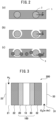
- FIG. 3 shows an example of the structure of a fuel cell.
- the fuel cell 200 comprises, as a unit cell, a membrane electrode assembly (100), an anode side gas flow path 21, an anode side gas diffusion layer 22, an anode side separator 23, a cathode side gas flow path 31, a cathode side gas diffusion layer 32, and a cathode side separator 33.
- the membrane electrode assembly 100 has a structure in which an electrolyte membrane 10 having proton conductivity is sandwiched by the anode catalyst layer 20 and the cathode catalyst layer 30. Hydrogen is supplied to the anode side, and oxygen is supplied to the cathode side.
- an oxygen reduction reaction (A) occurs in the cathode catalyst layer
- a hydrogen oxidation reaction (B) occurs in the anode catalyst layer 20
- power is generated due to the difference in the standard redox potentials E 0 of the reactions.
- the catalyst layer contains electrode catalyst particles, a carrier on which electrode catalyst particles are supported, and a proton-conducting binder.
- a carbon carrier is used as the carrier for the electrode catalyst particles of a fuel cell, and platinum or a platinum alloy is used as the electrode catalyst particles.
- An ionomer is conventionally used as the proton-conducting binder.
- reaction (D) since the carbon carrier in the catalyst layer reacts and disappears, when the hydrogen deficient state continues in the anode catalyst layer, the catalyst layer deteriorates. In particular, when the reaction overpotential of the water electrolysis reaction (C) becomes high and the reaction efficiency thereof decreases, reaction (D) tends to occur, and the disappearance of the carbon carrier proceeds.
- anode catalyst layer with water electrolysis catalyst particles such as iridium oxide is known (for example, Patent Literature 1 to 3).
- water electrolysis catalyst particles such as iridium oxide
- the water in the anode catalyst layer is electrolyzed without reacting with the carbon carrier.
- the electrolyzed water then supplies protons and electrons, whereby operation of the cell can continue.
- the disappearance of the carbon carrier is prevented by using such water electrolysis catalyst particles.
- the CA 3 035 582 A1 discloses a membrane electrode assembly for fuel cells including an anode electrode; a cathode electrode; and a polymer electrolyte membrane; wherein the cathode includes a first cathode catalyst sublayer including a first precious metal catalyst composition and a first ionomer composition including a first ionomer and a second ionomer; and a second cathode catalyst sublayer including a second precious metal catalyst composition and a second ionomer composition including a third ionomer; wherein the first ionomer is different from the second ionomer in at least one of chemical structure and equivalent weight.
- the US 2016/126577 A1 discloses a process for separating an electrode for membrane-electrode assemblies of fuel cells from the decal transfer film and an apparatus for separating the electrode.
- an electrode is separated from the decal transfer film on which the electrode is coated, without any damage, by a freezing method for freezing the specimen on the deionized water surface.
- the JP 2002/083604 A discloses a manufacturing method of a catalyst carrying carbon nanofibers.
- the method comprises a dispersion process, in which carbon nanofibers are made to be dispersed in an aqueous solution containing salts which are precursors of catalyst for the battery, a carrying process where alkali is added to an aqueous solution and the reaction product is made to be carried on surfaces of the carbon nanofibers, and a reduction process where the reaction product is reduced to form the catalyst for the battery.
- a liquid fuel cell includes a positive electrode for reducing oxygen, a negative electrode for oxidizing fuel, a solid electrolyte placed between the positive electrode and the negative electrode, and liquid fuel, wherein the positive electrode and the negative electrode respectively include catalyst layers, with a thickness of 20 ⁇ m or more, at least one of the respective catalyst layers, has a pore with a pore diameter in a range of 0.3 mum to 2.0 ⁇ m, and a pore volume of the pore is 4 % or more with respect to a total pore volume.
- the US 2012/064435 A1 discloses an anode-side catalyst composition for fuel cells, comprising a catalyst obtained by supporting a catalyst particle on an electrically conductive material and an ion exchange resin, wherein the catalyst particle is composed of a metal, a metal oxide, a partial metal oxide or a mixture thereof each being lower in both the oxygen reduction ability and the water electrolysis overvoltage than platinum and having a hydrogen oxidation ability.
- An object of the present invention is to provide an anode catalyst layer which does not easily deteriorate even if a hydrogen deficient state continues for a long time, and a fuel cell using the anode catalyst layer.
- An anode catalyst layer for a fuel cell comprising electrode catalyst particles, a carbon carrier on which the electrode catalyst particles are supported, water electrolysis catalyst particles, a proton-conducting binder, and graphitized carbon, wherein
- a membrane electrode assembly comprising the anode catalyst layer according to any one of Aspects 1 to 4, a cathode catalyst layer, and an electrolyte membrane sandwiched by the anode catalyst layer and the cathode catalyst layer.
- a fuel cell comprising, as a unit cell, the membrane electrode assembly according to Aspect 5, an anode side gas flow path, an anode side gas diffusion layer, an anode side separator, a cathode side gas flow path, a cathode side gas diffusion layer, and a cathode side separator.
- a method for the production of an anode catalyst layer for a fuel cell comprising the steps of:
- the anode catalyst layer for a fuel cell of the present application comprises:
- Patent Literature 1 to 3 conventionally, water electrolysis catalyst particles have been used in order to prevent the carbon carrier from disappearing and the anode catalyst layer from deteriorating in a hydrogen deficient state.
- the investigations of the present inventors have revealed that anode catalyst layers, even if such water electrolysis catalyst particles are used, deteriorate due to long-term hydrogen deficiency.
- the present inventors have discovered that by including a specific quantity of graphitized carbon in the anode catalyst layer, deterioration of the anode catalyst layer can be prevented even if a hydrogen deficient state continues for a long time.
- the thickness of the catalyst layer of the present invention may be 1 ⁇ m or more, 3 ⁇ m or more, 5 ⁇ m or more, 10 ⁇ m or more, or 15 ⁇ m or more, and may be 50 ⁇ m or less, 30 ⁇ m or less, 20 ⁇ m or less, 15 ⁇ m or less, or 10 ⁇ m or less.
- the electrode catalyst particles used in the present invention include, for example, platinum or a platinum alloy.
- platinum When a platinum alloy is contained, any platinum alloy which is suitably used in the prior art can suitable be used as the platinum alloy.
- the average particle diameter of the electrode catalyst particles may be 1.5 nm or more, 2.0 nm or more, 2.5 nm or more, 3.0 nm or more, 3.5 nm or more, or 4.0 nm or more, and may be 8.0 nm or less, 6.0 nm or less, 5.0 nm or less, 4.0 nm or less, 3.5 nm or less, or 3.0 nm or less.
- the average particle diameter of the electrode catalyst particles is calculated from the measured X-ray diffraction peaks using JADE analysis software.
- the average particle diameter is a number average particle diameter.
- the standard deviation of the particle diameter of the electrode catalyst particles can be calculated using the analysis software by the X-ray small angle scattering method. Nano-solver (manufactured by Rigaku Corporation) is an example of analysis software.
- the content of the electrode catalyst particles in the present invention may be, based on the total mass of the carbon carrier and the electrode catalyst particles, 10 % by mass or more, 20 % by mass or more, 30 % by mass or more, 35 % by mass or more, 40 % by mass or more, or 45 % by mass or more, and may be 70 % by mass or less, 60 % by mass or less, 55 % by mass or less, 50 % by mass or less, 45 % by mass or less, 40 % by mass or less, or 35 % by mass or less.
- the carbon carrier used in the present invention is not particularly limited as long the electrode catalyst particles are supported thereon and it has conductivity, and a carbon carrier conventionally used in the relevant field can be used.
- the BET specific surface area may be 200 m 2 /g or more, 400 m 2 /g or more, 600 m 2 /g or more, 800 m 2 /g or more, 1000 m 2 /g or more, 1200 m 2 /g or more, or 1500 m 2 /g or more, and may be 2500 m 2 /g or less, 2000 m 2 /g or less, 1800 m 2 /g or less, 1600 m 2 /g or less, 1400 m 2 /g or less, 1200 m 2 /g or less, or 1000 m 2 /g or less.
- At least a part of the carbon carrier preferably has a crystallite size La of 3.0 nm or more.
- the crystallite size La is the crystallite size determined from the (110) diffraction line, and is measured in accordance with JIS K0131 using an X-ray diffractometer (Rigaku Corporation, RINT-2500).
- the crystallite size La of at least a part of the carbon carrier used in the present invention may be 3.5 nm or more, 4.0 nm or more, 5.0 nm or more, or 6.0 nm or more, and may be 30 nm or less, 20 nm or less, 10 nm or less, 8 nm or less, or 5 nm or less.
- the amorphousness of the carbon carrier increases as the crystallite size La decreases, and the crystallinity of the carbon carrier increases as the crystallite size La increases.
- the carbon carrier has a crystallite size La in the range described above, it is possible to maintain the supporting ability of the electrode catalyst particles while suppressing deterioration of the catalyst layer.
- the investigations conducted by the present inventors have revealed that, though the crystallite size Lc of the carbon carrier is also related to the deterioration of the catalyst layer, La has a more direct relationship with the deterioration of the catalyst layer than Lc.
- the crystallite size Lc is, for example, a crystallite size determined from the (002) diffraction line or the (004) diffraction line.
- Examples of the type of the carbon carrier include activated carbon, carbon black, carbon nanotubes, solid carbon, hollow carbon, dendritic carbon, and combinations thereof.
- the average primary particle diameter of the particles of the carbon carrier may preferably be 500 nm or less, 300 nm or less, 200 nm or less, or 100 nm or less, and may be 5 nm or more, 10 nm or more, 20 nm or more, 30 nm or more, or 50 nm or more.
- the average particle diameter can be calculated from the number average equivalent diameter based on a large number of photographs taken at arbitrary locations with an electron microscope. It should be noted that the equivalent diameter refers to a diameter of a precise circle having an outer peripheral length equal to an outer peripheral length of a surface thereof.
- the total of the electrode catalyst particles and the carbon carrier in the anode catalyst layer of the present invention may be, based on the total mass of the anode catalyst layer, 10 % by mass or more, 20 % by mass or more, 30 % by mass or more, 35 % by mass or more, 40 % by mass or more, or 45 % by mass or more, and may be 85 % by mass or less, 80 % by mass or less, 70 % by mass or less, 60 % by mass or less, 55 % by mass or less, 50 % by mass or less, 45 % by mass or less, or 40 % by mass or less.
- water electrolysis catalyst particles used in the present invention include water electrolysis catalyst particles conventionally known in the relevant field. Such water electrolysis catalyst particles are not particularly limited as long as they are a catalyst which suppresses the reaction between the carbon carrier and water and promotes the electrolysis of water when hydrogen is deficient in the catalyst layer. Examples of the water electrolysis catalyst particles include particles of iridium, ruthenium, rhenium, palladium, rhodium, and oxides thereof, and in particular, iridium oxide particles.
- the number average particle diameter of the water electrolysis catalyst particles may be, for example, 30 nm or more, 50 nm or more, or 100 nm or more, and may be 1000 nm or less, 500 nm or less, 300 nm or less, or 100 nm or less.
- the number average particle diameter can be calculated from the number average equivalent diameter based on a large number of photographs taken at arbitrary positions with an electron microscope. Note that the equivalent diameter refers to a diameter of a precise circle having an outer peripheral length equal to an outer peripheral length of a surface thereof.
- the amount of the water electrolysis catalyst particles may be, based on the total mass of the anode catalyst layer, 0.2% by mass or more, 0.5% by mass or more, 1.0% by mass or more, 1.5% by mass or more, 2.0% by mass or more, or 3.0% by mass or more, and may be 10% by mass or less, 8.0% by mass or less, 5.0% by mass or less, 3.0% by mass or less, 2.5% by mass or less, 2.0% by mass or less, or 1.5% by mass or less.
- the water electrolysis catalyst particles may be contained, based on the total mass of the electrode catalyst particles, the carbon carrier, and the water electrolysis catalyst particles, in an amount of 3% by mass or more, 5% by mass or more, 8% by mass or more, or 10% by mass or more, and may be contained in an amount of 20% by mass or less, 15% by mass or less, 10% by mass or less, 8% by mass or less, or 5% by mass or less.
- the proton-conducting binder used in the present invention is not particularly limited as long as it can conduct protons generated by the chemical reaction in the catalyst layer and can bind the carbon carrier and the water electrolysis catalyst particles, and is conventionally a polymer electrolyte, in particular, an ionomer. Any proton-conducting binder known in the relevant field can be used.
- the amount of the proton-conducting binder used in the present invention may be, based on the total mass of the anode catalyst layer, 5 % by mass or more, 10 % by mass or more, 20 % by mass or more, 30 % by mass or more, 35 % by mass or more, 40 % by mass or more, or 45 % by mass or more, and may be 70 % by mass or less, 60 % by mass or less, 55 % by mass or less, 50 % by mass or less, 45 % by mass or less, 40 % by mass or less, or 35 % by mass or less.
- the graphitized carbon used in the present invention can impart the advantageous effects of the present invention, and the type thereof is not particularly limited as long as it is a carbon material which has been graphitized to a certain extent, as described below.
- the graphitized carbon used in the present invention is different from the carbon carrier on which the electrode catalyst particles are supported, and has substantially no performance for supporting, for example, the electrode catalyst particles.
- the particles become coarse. Thus, such graphitized carbon is not used as a carrier for the electrode catalyst particles.
- the graphitized carbon is contained in the catalyst layer of the present invention in an amount of 3% by mass to 70% by mass with respect to the total mass of the electrode catalyst particles, the carbon carrier, and the graphitized carbon.
- the graphitized carbon may be contained in the catalyst layer, based on the total mass of the electrode catalyst particles and the graphitized carbon, in an amount of 3 % by mass or more, 5 % by mass or more, 10 % by mass or more, 15 % by mass or more, 20 % by mass or more, 25 % by mass or more, 30 % by mass or more, 35 % by mass or more, 40 % by mass or more, 50 % by mass or more, or 55 % by mass or more, and may be contained in the catalyst layer in an amount of 70 % by mass or less, 65 % by mass or less, 60 % by mass or less, 50 % by mass or less, 40 % by mass or less, or 30 % by mass or less.
- the catalyst layer contains graphitized carbon in such a range, deterioration of the catalyst layer can be suppressed and the function of the catalyst layer can be reliably exhibited.
- the graphitized carbon is contained in an amount of 15 % by mass or more or 20 % by mass or more, the desired effect of the present invention can be reliably exhibited.
- the graphitized carbon be contained in the catalyst layer of the present invention in an amount of 5 % by volume to 70 % by volume based on the total volume of the electrode catalyst particles, the carbon carrier, and the graphitized carbon.
- the graphitized carbon may be contained in the catalyst layer, based on the total mass of the electrode catalyst particles and the graphitized carbon, in an amount of 5 % by volume or more, 10 % by volume or more, 15 % by volume or more, 20 % by volume or more, 25% by volume or more, 30 % by volume or more, 35 % by volume or more, 40 % by volume or more, or 50 % by volume or more, and may be contained in the catalyst layer in an amount of 65 % by volume or less, 60 % by volume or less, 50 % by volume or less, 40 % by volume or less, or 30% by volume or less.
- the catalyst layer contains graphitized carbon in such a range, deterioration of the catalyst layer can be suppressed and the function of the catalyst layer can be reliably exhibited.
- the graphitized carbon is contained in an amount of 20 % by volume or more or 25 % by volume or more, the desired effect of the present invention can be reliably exhibited.
- graphitized carbon refers to a carbon material having a crystallite size Lc determined from the (002) diffraction line of 4.0 nm or more.
- the crystallite size Lc may be 5.0 nm or more, 6.0 nm or more, 8.0 nm or more, or 9.0 nm or more, and may be 50 nm or less, 30 nm or less, 20 nm or less, or 15 nm or less.
- the crystallite size Lc is measured in accordance with JIS K0131 using an X-ray diffractometer (Rigaku Corporation, RINT-2500).
- the production method of the graphitized carbon is not particularly limited as long as a carbon material having a crystallite size Lc as described above is used.
- the amorphousness of the carbon material increases as the crystallite size Lc decreases, and the crystallinity of the carbon material increases as the crystallite size Lc increases. If the crystallite size Lc of the graphitized carbon is excessively small, deterioration of the catalyst layer is unlikely to be suppressed.
- the bulk density of the graphitized carbon is preferably 0.50 g/cm 3 or less, and may be, for example, 0.40 g/cm 3 or less, 0.35 g/cm 3 or less, 0.30 g/cm 3 or less, or 0.25 g/cm 3 or less, and may be 0.01 g/cm 3 or more, 0.05g/cm 3 or more, or 0.10 g/cm 3 or more.
- Graphitized carbon having a bulk density in this range has a well-developed structure. Further, contact points between the water electrolysis catalyst particles and the graphitized carbon are easily secured, whereby deterioration of the catalyst layer can be suppressed and the function of the catalyst layer can be reliably exhibited.
- the number average particle diameter of the graphitized carbon may be, for example, 1 ⁇ m or more, 3 ⁇ m or more, 5 ⁇ m or more, or 10 ⁇ m or more, and may be 30 ⁇ m or less, 20 ⁇ m or less, 10 ⁇ m or less, or 5 ⁇ m or less.
- the number average particle diameter can be calculated from the number average equivalent diameter based on a large number of photographs taken at arbitrary positions with an electron microscope.
- the BET specific surface area of the graphitized carbon may be 2 m 2 /g or more, 5 m 2 /g or more, 10 m 2 /g or more, 30 m 2 /g or more, or 50m 2 /g or more, and may be 100 m 2 /g or less, 80 m 2 /g or less, 50 m 2 /g or less, 30 m 2 /g or less, or 20 m 2 /g or less.
- the method for producing the anode catalyst layer for a fuel cell of the present invention comprises the steps of:
- This method may comprise the same step as conventionally known catalyst layer production methods, aside from the step of mixing the carbon carrier on which the electrode catalyst particles are supported, the water electrolysis catalyst particles, the proton-conducting binder, and the graphitized carbon to obtain a catalyst layer composition.
- the carbon carrier on which the electrode particles are supported may be produced by a step of mixing an electrode catalyst particle precursor solution and the carbon carrier to obtain a precursor of the electrode catalyst particle-carbon carrier, and a step of heat-treating the precursor.
- the electrode catalyst particles are platinum particles
- the electrode catalyst particle precursor solution may be a platinate solution.
- the step of mixing the platinate solution and the carbon carrier to obtain a precursor of the electrode catalyst particle-carbon carrier may include a step of mixing the platinate solution and the carbon carrier to obtain a dispersion, and a step of separating the dispersion medium from the obtained dispersion.
- the step of heat-treating the precursor of electrode catalyst particles-carbon carrier can be carried out in an inert atmosphere or a reducing atmosphere.
- the production of the carbon carrier on which the platinum particles are supported may include contacting the platinate solution with a carbon carrier and reducing the platinate with a reducing agent.
- a dinitrodiammine platinum nitric acid solution is an example of the platinate solution.
- the carbon carrier in the step of bringing the platinate solution into contact with the carbon carrier, can be dispersed in an aqueous solvent and mixed with the platinate solution.
- the aqueous solvent acidic, the occurrence of precipitation, which may be occur during mixing of the platinate solution, may be suppressed.
- the reducing agent is not particularly limited, but an alcohol, for example, ethanol, can be used.
- heat treatment can be carried out after the reducing agent is added. Though the conditions of the heat treatment vary depending on the type of reducing agent, for example, when ethanol is used as a reducing agent, heating can be carried out at a temperature of 60 °C to 90 °C, and a time of approximately 1 to 3 hours.
- the platinum particles and the carbon carrier may be separated from the dispersion to obtain platinum particles and a carbon carrier on which the platinum particles are supported. This separation may be carried out, for example, by filtration. After separating the platinum particles and the carbon carrier on which the platinum particles are supported, washing and/or drying may be carried out.
- the carbon carrier on which the platinum particles are supported in this manner may be further subjected to heat treatment.
- the temperature of heat treatment may be, for example, 200 °C or higher, 300 °C or higher, 400 °C or higher, or 500 °C or higher, and may be 1100 °C or lower, 1050 °C or lower, 1000 °C or lower, 950 °C or lower, 900 °C or lower, or 800 °C or lower.
- the time of the heat treatment may be within 5 hours, within 3 hours, within 2 hours, within 1.5 hours, within 1.0 hours, or within 0.5 hours, and may be 0.2 hours or more, 0.3 hours or more, 0.5 hours or more, 0.8 hours or more, 1.0 hours or more, or 1.5 hours or more.
- the step of forming the catalyst layer from the catalyst layer composition may be carried out by adding a dispersion medium to the catalyst layer composition and coating the base material therewith.
- the base material may be an electrolyte membrane, a gas diffusion layer, or another base material for coating.
- each element of the anode catalyst layer for a fuel cell produced by the production method of the present invention refers to the description of the configuration of each of the element of the anode catalyst layer for a fuel cell of the present invention.
- the carbon carrier used in the production method of the present invention refer to the configuration of the carbon carrier described with regarding the anode catalyst for a fuel cell of the present invention.
- the membrane electrode assembly of the present invention includes the anode catalyst layer, a cathode catalyst layer, and an electrolyte membrane sandwiched by the anode catalyst layer and the cathode catalyst layer.
- the electrolyte membrane and the cathode catalyst layer can be those well-known in the relevant field.
- the cathode catalyst layer may have the same configuration as that of the anode catalyst layer described above, except that the cathode catalyst layer does not contain graphitized carbon and water electrolysis catalyst particles.
- the electrolyte membrane a membrane composed of a polymer similar to that of the proton-conducting binder used in the anode catalyst layer described above may be used.
- the fuel cell of the present invention includes an anode side gas flow path, an anode side gas diffusion layer, an anode side separator, a cathode side gas flow path, a cathode side gas diffusion layer, and a cathode side separator as a unit cell.
- these unit cells may be stacked to constitute a cell stack, whereby high power is obtained.
- any known in the relevant field can be used for the fuel cell of the present invention.
- Iridium oxide powder (Sigma-Aldrich) was added to the obtained platinum-carbon carrier such that the mass of iridium relative to the total mass of iridium and the platinum-carbon carrier was 9 % by mass.
- a commercially available graphitized carbon (Lc: 10 nm, specific surface area: 12 m 2 /g, bulk density: 0.14 g/cm 3 ) was added to this mixture such that the mass ratio of graphitized carbon to the total mass of platinum-carbon carrier and graphitized carbon was 9 % by mass to obtain the catalyst layer composition of Example 1.
- the catalyst layer compositions of Examples 2 to 5 and Comparative Examples 1 and 2 were obtained in the same manner as in Example 1, except that the addition amount of the graphitized carbon relative to the total amount of the platinum-carbon carrier and the graphitized carbon was changed as shown in Table 1.
- Each of the catalyst layer compositions obtained in Examples 1 to 5 and Comparative Examples 1 and 2 was dispersed in an organic solvent, an ionomer dispersion was further added thereto and dispersed with ultrasonic waves. This dispersion was applied to a Teflon TM sheet to form a catalyst layer on the hydrogen electrode side. The amount of iridium was set to 0.2 mg per square centimeter of the catalyst layer. On the air electrode side, a catalyst layer was formed in the same manner as on the hydrogen electrode side except that iridium oxide and graphitized carbon were not used. Each catalyst layer was bonded by hot pressing via a polymer electrolyte membrane to prepare a membrane electrode assembly. A diffusion layer was then formed on both sides of the membrane electrode assembly to prepare an evaluation unit cell.
- Each of the catalyst layer compositions obtained in Examples 4 and 5 and Comparative Examples 1 and 2 was dispersed in an organic solvent, an ionomer dispersion was further added thereto and dispersed with ultrasonic waves. This dispersion was applied to a Teflon TM sheet to form a catalyst layer on the hydrogen electrode side. The amount of iridium was set to 0.2 mg per square centimeter of the catalyst layer. A catalyst layer was formed on the air electrode side in the same manner as in the hydrogen electrode side except that iridium oxide and graphitized carbon were not used. Each catalyst layer was bonded by hot pressing via a polymer electrolyte membrane to prepare a membrane electrode assembly. A diffusion layer was then formed on both sides of the membrane electrode assembly to prepare an evaluation unit cell.
- the greater the content of graphitized carbon the longer the water electrolysis durability time and the higher the durability. Furthermore, it can be understood that the generated voltage does not decrease as long as the content of graphitized carbon is up to approximately 70% by mass.
- the catalyst layer compositions of Examples 6 to 10 were obtained in the same manner as in Example 4, except that the graphitized carbon added was changed to the commercially available graphitized carbons having the crystallite sizes Lc, specific surfaces areas, and bulk densities shown in Table 2. Furthermore, the catalyst layer composition of Comparative Example 3 was obtained in the same manner as in Example 4 except that a carbon black derived from acetylene having a crystallite size Lc of 3.6 nm was used in place of graphitized carbon.
- the catalyst layer compositions of Examples 11 to 14 were obtained in the same manner as in Example 1, except that the type of carbon carrier was changed to the commercially available carbon carriers described in Table 1.
- Platinum was supported on only graphitized carbon in the same manner as in Examples 4 and 10, except that only the graphitized carbon was used without the use of a carbon carrier.
- the total surface area of the platinum particles supported on the graphitized carbon was then measured by the CO gas adsorption method. Further, regarding Comparative Example 1, which contained no graphitized carbon, the total surface area of platinum particles was measured by the same method.
- the total surface area of the platinum particles supported on the graphitized carbon used in Examples 4 and 10 was 0.19 times and 0.02 times, respectively, the total surface area of the platinum particles supported on the carbon carrier of Comparative Example 1.
- the graphitized carbon as used in Examples 4 and 10 is unsuitable as a carbon carrier for supporting the electrode catalyst particles.
- carbon (graphitized carbon) of a type not used as a carbon carrier in combination with an ordinary carbon carrier an advantageous effect can be exhibited.
- Platinum was supported on only graphitized carbon in the same manner as in Examples 4 and 10, except that only the graphitized carbon was used without the use of a carbon carrier.
- the total surface area of the platinum particles supported on the graphitized carbon was then measured by the CO gas adsorption method. Further, regarding Comparative Example 1, which contained no graphitized carbon, the total surface area of platinum particles was measured by the same method.
- the total surface area of the platinum particles supported on the graphitized carbon used in Examples 4 and 10 was 0.19 times and 0.02 times, respectively, the total surface area of the platinum particles supported on the carbon carrier of Comparative Example 1.
- the graphitized carbon as used in Examples 4 and 10 is unsuitable as a carbon carrier for supporting the electrode catalyst particles.
- carbon (graphitized carbon) of a type not used as a carbon carrier in combination with an ordinary carbon carrier an advantageous effect can be exhibited.
Landscapes
- Chemical & Material Sciences (AREA)
- Chemical Kinetics & Catalysis (AREA)
- Electrochemistry (AREA)
- General Chemical & Material Sciences (AREA)
- Engineering & Computer Science (AREA)
- Manufacturing & Machinery (AREA)
- Materials Engineering (AREA)
- Sustainable Development (AREA)
- Life Sciences & Earth Sciences (AREA)
- Sustainable Energy (AREA)
- Composite Materials (AREA)
- Inert Electrodes (AREA)
- Catalysts (AREA)
- Fuel Cell (AREA)
Description
- The present invention relates to an anode catalyst layer for a fuel cell and a fuel cell using the same.
- Since fuel cells have high power generation efficiency, are easy to miniaturize, and have little adverse effects on the environment, the use thereof is expected in various fields such as personal computers, mobile devices such as mobile phones, automobiles, and vehicles such as trains.
-
FIG. 3 shows an example of the structure of a fuel cell. Thefuel cell 200 comprises, as a unit cell, a membrane electrode assembly (100), an anode sidegas flow path 21, an anode sidegas diffusion layer 22, ananode side separator 23, a cathode sidegas flow path 31, a cathode sidegas diffusion layer 32, and acathode side separator 33. Themembrane electrode assembly 100 has a structure in which anelectrolyte membrane 10 having proton conductivity is sandwiched by theanode catalyst layer 20 and thecathode catalyst layer 30. Hydrogen is supplied to the anode side, and oxygen is supplied to the cathode side. Thus, an oxygen reduction reaction (A) occurs in the cathode catalyst layer, a hydrogen oxidation reaction (B) occurs in theanode catalyst layer 20, and power is generated due to the difference in the standard redox potentials E0 of the reactions.
O2 + 4H+ + 4e- → 2H2O (E0 = 1.23 V) (A)
H2 → 2H+ + 2e- (E0 = 0 V) (B)
- The catalyst layer contains electrode catalyst particles, a carrier on which electrode catalyst particles are supported, and a proton-conducting binder. Generally, a carbon carrier is used as the carrier for the electrode catalyst particles of a fuel cell, and platinum or a platinum alloy is used as the electrode catalyst particles. An ionomer is conventionally used as the proton-conducting binder.
- It is known that in anode catalyst layers, hydrogen deficiency may occur in the catalyst layer due to a situation such as a delay in supply of hydrogen to the anode side due to abrupt changes in output or a stop in supply of hydrogen to the anode side due for some other reason. If operation of the cell continues at this time, the water electrolysis reaction (C) or reaction (D) in which the carbon carrier in the catalyst layer reacts with water to produce protons and electrons together with carbon monoxide or carbon dioxide, or both occur in order to compensate for the lack of protons (H+).
2H2O → O2 + 4H+ + 4e- (C)
C + nH2O → COn + 2nH+ + 2ne- (n = 1 or 2) (D)
- In reaction (D), since the carbon carrier in the catalyst layer reacts and disappears, when the hydrogen deficient state continues in the anode catalyst layer, the catalyst layer deteriorates. In particular, when the reaction overpotential of the water electrolysis reaction (C) becomes high and the reaction efficiency thereof decreases, reaction (D) tends to occur, and the disappearance of the carbon carrier proceeds.
- As a countermeasure therefor, providing the anode catalyst layer with water electrolysis catalyst particles such as iridium oxide is known (for example,
Patent Literature 1 to 3). By using such water electrolysis catalyst particles, the water in the anode catalyst layer is electrolyzed without reacting with the carbon carrier. The electrolyzed water then supplies protons and electrons, whereby operation of the cell can continue. In the prior art, the disappearance of the carbon carrier is prevented by using such water electrolysis catalyst particles. - The
CA 3 035 582 A1 - The
US 2016/126577 A1 discloses a process for separating an electrode for membrane-electrode assemblies of fuel cells from the decal transfer film and an apparatus for separating the electrode. In particular, during the electrode separating process, only an electrode is separated from the decal transfer film on which the electrode is coated, without any damage, by a freezing method for freezing the specimen on the deionized water surface. - The
JP 2002/083604 A - The
US 2006/024562 A1 discloses a liquid fuel cell includes a positive electrode for reducing oxygen, a negative electrode for oxidizing fuel, a solid electrolyte placed between the positive electrode and the negative electrode, and liquid fuel, wherein the positive electrode and the negative electrode respectively include catalyst layers, with a thickness of 20 µm or more, at least one of the respective catalyst layers, has a pore with a pore diameter in a range of 0.3 mum to 2.0 µm, and a pore volume of the pore is 4 % or more with respect to a total pore volume. - The
US 2012/064435 A1 discloses an anode-side catalyst composition for fuel cells, comprising a catalyst obtained by supporting a catalyst particle on an electrically conductive material and an ion exchange resin, wherein the catalyst particle is composed of a metal, a metal oxide, a partial metal oxide or a mixture thereof each being lower in both the oxygen reduction ability and the water electrolysis overvoltage than platinum and having a hydrogen oxidation ability. -
- [PTL 1]
Japanese Unexamined Patent Publication (Kokai) No. 2008-41411 - [PTL 2]
Japanese Unexamined Patent Publication (Kokai) No. 2009-152143 - [PTL 3]
Japanese Unexamined Patent Publication (Kokai) No. 2010-277995 - However, the investigations of the present inventors have revealed that the anode catalyst layers according to the prior art, even if water electrolysis catalyst particles are used, deteriorate due to long-term hydrogen deficiency. An object of the present invention is to provide an anode catalyst layer which does not easily deteriorate even if a hydrogen deficient state continues for a long time, and a fuel cell using the anode catalyst layer.
- The present inventors have discovered that the above object can be achieved by the present invention including the following aspects.
- An anode catalyst layer for a fuel cell, comprising electrode catalyst particles, a carbon carrier on which the electrode catalyst particles are supported, water electrolysis catalyst particles, a proton-conducting binder, and graphitized carbon, wherein
- the content of the graphitized carbon in the anode catalyst layer for a fuel cell is 3 % by mass to 70 % by mass relative to the total mass of the electrode catalyst particles, the carbon carrier, and the graphitized carbon,
- the crystallite size Lc of the graphitized carbon is 4.0 nm or more,
- the crystallite size Lc is a value determined from a (002) diffraction line in XRD measured in accordance with JIS K0131, and
- the water electrolysis catalyst particles are at least one type of particles selected from the group consisting of iridium, ruthenium, rhenium, palladium, rhodium and oxides thereof.
- The anode catalyst layer for a fuel cell according to
Aspect - The anode catalyst layer for a fuel cell according to
Aspect - The anode catalyst layer for a fuel cell according to any one of
Aspects 1 to 3, wherein - the graphitized carbon has a number average particle diameter of 1 to 100 µm, and
- the number average particle diameter is a value calculated from a number average equivalent diameter based on a photograph taken with an electron microscope, wherein the equivalent diameter refers to a diameter of a precise circle having an outer peripheral length equal to an outer peripheral length of a surface thereof.
- A membrane electrode assembly, comprising the anode catalyst layer according to any one of
Aspects 1 to 4, a cathode catalyst layer, and an electrolyte membrane sandwiched by the anode catalyst layer and the cathode catalyst layer. - A fuel cell, comprising, as a unit cell, the membrane electrode assembly according to Aspect 5, an anode side gas flow path, an anode side gas diffusion layer, an anode side separator, a cathode side gas flow path, a cathode side gas diffusion layer, and a cathode side separator.
- A method for the production of an anode catalyst layer for a fuel cell, comprising the steps of:
- mixing a carbon carrier on which electrode catalyst particles are supported, water electrolysis catalyst particles, a proton-conducting binder, and graphitized carbon to obtain a catalyst layer composition, and
- forming a catalyst layer from the catalyst layer composition, wherein
- the content of the graphitized carbon in the catalyst layer is 3 % by mass to 70 % by mass relative to the total mass of the electrode catalyst particles, the carbon carrier, and the graphitized carbon,
- the crystallite size Lc of the graphitized carbon is 4.0 nm or more,
- the crystallite size Lc is a value determined from a (002) diffraction line in XRD measured in accordance with JIS K0131, and
- the water electrolysis catalyst particles are at least one type of particles selected from the group consisting of iridium, ruthenium, rhenium, palladium, rhodium and oxides thereof.
-
-
FIG. 1 shows a graph in which the addition amount of graphitized carbon is plotted on the horizontal axis and the water electrolysis durability time and the power generation voltage are plotted on the vertical axis. -
FIG. 2(a) schematically illustrates a catalyst layer containing water electrolysis catalyst particles.FIG. 2(b) schematically illustrates a state in which a carbon carrier in a catalyst layer containing the water electrolysis catalyst particles disappears.FIG. 2(c) schematically illustrates a state in which a carbon carrier in a catalyst layer containing water electrolysis catalyst particles and graphitized carbon disappears. -
FIG. 3 illustrates an example of an aspect of a fuel cell. - The anode catalyst layer for a fuel cell of the present application comprises:
- electrode catalyst particles, a carbon carrier on which the electrode catalyst particles are supported, water electrolysis catalyst particles, a proton-conducting binder, and graphitized carbon, wherein
- the content of the graphitized carbon in the catalyst layer is 3% by mass to 70% by mass relative to the total mass of the electrode catalyst particles, the carbon carrier, and the graphitized carbon.
- As described in
Patent Literature 1 to 3, conventionally, water electrolysis catalyst particles have been used in order to prevent the carbon carrier from disappearing and the anode catalyst layer from deteriorating in a hydrogen deficient state. However, the investigations of the present inventors have revealed that anode catalyst layers, even if such water electrolysis catalyst particles are used, deteriorate due to long-term hydrogen deficiency. Conversely, the present inventors have discovered that by including a specific quantity of graphitized carbon in the anode catalyst layer, deterioration of the anode catalyst layer can be prevented even if a hydrogen deficient state continues for a long time. - Although not bound by theory, in the
anode catalyst layer 1 containing the water electrolysis catalyst particles of the prior art as shown inFIG. 2(a) , it is considered that, when the hydrogen deficient state continues for a long time, water and the carbon carrier react around the waterelectrolysis catalyst particles 2 and disappear. In this case, as shown inFIG. 2(b) , the carbon carrier disappears around the waterelectrolysis catalyst particles 2, whereby the waterelectrolysis catalyst particles 2 are electrically insulated. Thus, it is considered that the water electrolysis reaction on the water electrolysis catalyst particles does not proceed and/or the electrical conduction of the catalyst layer is prevented, whereby the resistance of thecatalyst layer 1 increases. Conversely, when a specific quantity ofgraphitized carbon 3 is contained in thecatalyst layer 1, since thegraphitized carbon 3 is unlikely to disappear even if the carbon carrier disappears, it is considered that conduction of the waterelectrolysis catalyst particles 2 through thegraphitized carbon 3 can be secured, as shown inFIG. 2(c) , whereby the resistance of thecatalyst layer 1 is unlikely to increase. - The thickness of the catalyst layer of the present invention may be 1 µm or more, 3 µm or more, 5 µm or more, 10 µm or more, or 15 µm or more, and may be 50 µm or less, 30 µm or less, 20 µm or less, 15 µm or less, or 10 µm or less.
- The electrode catalyst particles used in the present invention include, for example, platinum or a platinum alloy. When a platinum alloy is contained, any platinum alloy which is suitably used in the prior art can suitable be used as the platinum alloy.
- The average particle diameter of the electrode catalyst particles may be 1.5 nm or more, 2.0 nm or more, 2.5 nm or more, 3.0 nm or more, 3.5 nm or more, or 4.0 nm or more, and may be 8.0 nm or less, 6.0 nm or less, 5.0 nm or less, 4.0 nm or less, 3.5 nm or less, or 3.0 nm or less.
- The average particle diameter of the electrode catalyst particles is calculated from the measured X-ray diffraction peaks using JADE analysis software. In this case, the average particle diameter is a number average particle diameter. The standard deviation of the particle diameter of the electrode catalyst particles can be calculated using the analysis software by the X-ray small angle scattering method. Nano-solver (manufactured by Rigaku Corporation) is an example of analysis software.
- The content of the electrode catalyst particles in the present invention may be, based on the total mass of the carbon carrier and the electrode catalyst particles, 10 % by mass or more, 20 % by mass or more, 30 % by mass or more, 35 % by mass or more, 40 % by mass or more, or 45 % by mass or more, and may be 70 % by mass or less, 60 % by mass or less, 55 % by mass or less, 50 % by mass or less, 45 % by mass or less, 40 % by mass or less, or 35 % by mass or less.
- The carbon carrier used in the present invention is not particularly limited as long the electrode catalyst particles are supported thereon and it has conductivity, and a carbon carrier conventionally used in the relevant field can be used.
- For example, the BET specific surface area may be 200 m2/g or more, 400 m2/g or more, 600 m2/g or more, 800 m2/g or more, 1000 m2/g or more, 1200 m2/g or more, or 1500 m2/g or more, and may be 2500 m2/g or less, 2000 m2/g or less, 1800 m2/g or less, 1600 m2/g or less, 1400 m2/g or less, 1200 m2/g or less, or 1000 m2/g or less.
- At least a part of the carbon carrier preferably has a crystallite size La of 3.0 nm or more. The crystallite size La is the crystallite size determined from the (110) diffraction line, and is measured in accordance with JIS K0131 using an X-ray diffractometer (Rigaku Corporation, RINT-2500). The crystallite size La of at least a part of the carbon carrier used in the present invention may be 3.5 nm or more, 4.0 nm or more, 5.0 nm or more, or 6.0 nm or more, and may be 30 nm or less, 20 nm or less, 10 nm or less, 8 nm or less, or 5 nm or less. The amorphousness of the carbon carrier increases as the crystallite size La decreases, and the crystallinity of the carbon carrier increases as the crystallite size La increases. When the carbon carrier has a crystallite size La in the range described above, it is possible to maintain the supporting ability of the electrode catalyst particles while suppressing deterioration of the catalyst layer. In addition, the investigations conducted by the present inventors have revealed that, though the crystallite size Lc of the carbon carrier is also related to the deterioration of the catalyst layer, La has a more direct relationship with the deterioration of the catalyst layer than Lc. It should be noted that the crystallite size Lc is, for example, a crystallite size determined from the (002) diffraction line or the (004) diffraction line.
- Examples of the type of the carbon carrier include activated carbon, carbon black, carbon nanotubes, solid carbon, hollow carbon, dendritic carbon, and combinations thereof.
- The average primary particle diameter of the particles of the carbon carrier may preferably be 500 nm or less, 300 nm or less, 200 nm or less, or 100 nm or less, and may be 5 nm or more, 10 nm or more, 20 nm or more, 30 nm or more, or 50 nm or more. In this case, the average particle diameter can be calculated from the number average equivalent diameter based on a large number of photographs taken at arbitrary locations with an electron microscope. It should be noted that the equivalent diameter refers to a diameter of a precise circle having an outer peripheral length equal to an outer peripheral length of a surface thereof.
- The total of the electrode catalyst particles and the carbon carrier in the anode catalyst layer of the present invention may be, based on the total mass of the anode catalyst layer, 10 % by mass or more, 20 % by mass or more, 30 % by mass or more, 35 % by mass or more, 40 % by mass or more, or 45 % by mass or more, and may be 85 % by mass or less, 80 % by mass or less, 70 % by mass or less, 60 % by mass or less, 55 % by mass or less, 50 % by mass or less, 45 % by mass or less, or 40 % by mass or less.
- Examples of the water electrolysis catalyst particles used in the present invention include water electrolysis catalyst particles conventionally known in the relevant field. Such water electrolysis catalyst particles are not particularly limited as long as they are a catalyst which suppresses the reaction between the carbon carrier and water and promotes the electrolysis of water when hydrogen is deficient in the catalyst layer. Examples of the water electrolysis catalyst particles include particles of iridium, ruthenium, rhenium, palladium, rhodium, and oxides thereof, and in particular, iridium oxide particles.
- The number average particle diameter of the water electrolysis catalyst particles may be, for example, 30 nm or more, 50 nm or more, or 100 nm or more, and may be 1000 nm or less, 500 nm or less, 300 nm or less, or 100 nm or less. In this case, the number average particle diameter can be calculated from the number average equivalent diameter based on a large number of photographs taken at arbitrary positions with an electron microscope. Note that the equivalent diameter refers to a diameter of a precise circle having an outer peripheral length equal to an outer peripheral length of a surface thereof.
- The amount of the water electrolysis catalyst particles may be, based on the total mass of the anode catalyst layer, 0.2% by mass or more, 0.5% by mass or more, 1.0% by mass or more, 1.5% by mass or more, 2.0% by mass or more, or 3.0% by mass or more, and may be 10% by mass or less, 8.0% by mass or less, 5.0% by mass or less, 3.0% by mass or less, 2.5% by mass or less, 2.0% by mass or less, or 1.5% by mass or less. Further, the water electrolysis catalyst particles may be contained, based on the total mass of the electrode catalyst particles, the carbon carrier, and the water electrolysis catalyst particles, in an amount of 3% by mass or more, 5% by mass or more, 8% by mass or more, or 10% by mass or more, and may be contained in an amount of 20% by mass or less, 15% by mass or less, 10% by mass or less, 8% by mass or less, or 5% by mass or less.
- The proton-conducting binder used in the present invention is not particularly limited as long as it can conduct protons generated by the chemical reaction in the catalyst layer and can bind the carbon carrier and the water electrolysis catalyst particles, and is conventionally a polymer electrolyte, in particular, an ionomer. Any proton-conducting binder known in the relevant field can be used.
- The amount of the proton-conducting binder used in the present invention may be, based on the total mass of the anode catalyst layer, 5 % by mass or more, 10 % by mass or more, 20 % by mass or more, 30 % by mass or more, 35 % by mass or more, 40 % by mass or more, or 45 % by mass or more, and may be 70 % by mass or less, 60 % by mass or less, 55 % by mass or less, 50 % by mass or less, 45 % by mass or less, 40 % by mass or less, or 35 % by mass or less.
- The graphitized carbon used in the present invention can impart the advantageous effects of the present invention, and the type thereof is not particularly limited as long as it is a carbon material which has been graphitized to a certain extent, as described below. The graphitized carbon used in the present invention is different from the carbon carrier on which the electrode catalyst particles are supported, and has substantially no performance for supporting, for example, the electrode catalyst particles. When an attempt is made to support electrode catalyst particles of platinum on graphitized carbon, as used in the present invention, the particles become coarse. Thus, such graphitized carbon is not used as a carrier for the electrode catalyst particles.
- The graphitized carbon is contained in the catalyst layer of the present invention in an amount of 3% by mass to 70% by mass with respect to the total mass of the electrode catalyst particles, the carbon carrier, and the graphitized carbon. The graphitized carbon may be contained in the catalyst layer, based on the total mass of the electrode catalyst particles and the graphitized carbon, in an amount of 3 % by mass or more, 5 % by mass or more, 10 % by mass or more, 15 % by mass or more, 20 % by mass or more, 25 % by mass or more, 30 % by mass or more, 35 % by mass or more, 40 % by mass or more, 50 % by mass or more, or 55 % by mass or more, and may be contained in the catalyst layer in an amount of 70 % by mass or less, 65 % by mass or less, 60 % by mass or less, 50 % by mass or less, 40 % by mass or less, or 30 % by mass or less. When the catalyst layer contains graphitized carbon in such a range, deterioration of the catalyst layer can be suppressed and the function of the catalyst layer can be reliably exhibited. In particular, since the graphitized carbon is contained in an amount of 15 % by mass or more or 20 % by mass or more, the desired effect of the present invention can be reliably exhibited.
- It is preferable that the graphitized carbon be contained in the catalyst layer of the present invention in an amount of 5 % by volume to 70 % by volume based on the total volume of the electrode catalyst particles, the carbon carrier, and the graphitized carbon. The graphitized carbon may be contained in the catalyst layer, based on the total mass of the electrode catalyst particles and the graphitized carbon, in an amount of 5 % by volume or more, 10 % by volume or more, 15 % by volume or more, 20 % by volume or more, 25% by volume or more, 30 % by volume or more, 35 % by volume or more, 40 % by volume or more, or 50 % by volume or more, and may be contained in the catalyst layer in an amount of 65 % by volume or less, 60 % by volume or less, 50 % by volume or less, 40 % by volume or less, or 30% by volume or less. When the catalyst layer contains graphitized carbon in such a range, deterioration of the catalyst layer can be suppressed and the function of the catalyst layer can be reliably exhibited. In particular, since the graphitized carbon is contained in an amount of 20 % by volume or more or 25 % by volume or more, the desired effect of the present invention can be reliably exhibited.
- As used herein, "graphitized carbon" refers to a carbon material having a crystallite size Lc determined from the (002) diffraction line of 4.0 nm or more. The crystallite size Lc may be 5.0 nm or more, 6.0 nm or more, 8.0 nm or more, or 9.0 nm or more, and may be 50 nm or less, 30 nm or less, 20 nm or less, or 15 nm or less. The crystallite size Lc is measured in accordance with JIS K0131 using an X-ray diffractometer (Rigaku Corporation, RINT-2500). The production method of the graphitized carbon is not particularly limited as long as a carbon material having a crystallite size Lc as described above is used. It should be noted that the amorphousness of the carbon material increases as the crystallite size Lc decreases, and the crystallinity of the carbon material increases as the crystallite size Lc increases. If the crystallite size Lc of the graphitized carbon is excessively small, deterioration of the catalyst layer is unlikely to be suppressed.
- The bulk density of the graphitized carbon is preferably 0.50 g/cm3 or less, and may be, for example, 0.40 g/cm3 or less, 0.35 g/cm3 or less, 0.30 g/cm3 or less, or 0.25 g/cm3 or less, and may be 0.01 g/cm3 or more, 0.05g/cm3 or more, or 0.10 g/cm3 or more. Graphitized carbon having a bulk density in this range has a well-developed structure. Further, contact points between the water electrolysis catalyst particles and the graphitized carbon are easily secured, whereby deterioration of the catalyst layer can be suppressed and the function of the catalyst layer can be reliably exhibited.
- The number average particle diameter of the graphitized carbon may be, for example, 1 µm or more, 3 µm or more, 5 µm or more, or 10 µm or more, and may be 30 µm or less, 20 µm or less, 10 µm or less, or 5 µm or less. In this case, the number average particle diameter can be calculated from the number average equivalent diameter based on a large number of photographs taken at arbitrary positions with an electron microscope.
- The BET specific surface area of the graphitized carbon may be 2 m2/g or more, 5 m2/g or more, 10 m2/g or more, 30 m2/g or more, or 50m2/g or more, and may be 100 m2/g or less, 80 m2/g or less, 50 m2/g or less, 30 m2/g or less, or 20 m2/g or less.
- The method for producing the anode catalyst layer for a fuel cell of the present invention comprises the steps of:
- mixing a carbon carrier on which electrode catalyst particles are supported, water electrolysis catalyst particles, a proton-conducting binder, and graphitized carbon to obtain a catalyst layer composition, and
- forming a catalyst layer from the catalyst layer composition, wherein
- the content of the graphitized carbon in the catalyst layer is 3 % by mass to 70 % by mass relative to the total mass of the electrode catalyst particles, the carbon carrier, and the graphitized carbon. The anode catalyst layer for a fuel cell of the present invention described above may be produced by the production method of the present invention.
- This method may comprise the same step as conventionally known catalyst layer production methods, aside from the step of mixing the carbon carrier on which the electrode catalyst particles are supported, the water electrolysis catalyst particles, the proton-conducting binder, and the graphitized carbon to obtain a catalyst layer composition.
- The carbon carrier on which the electrode particles are supported may be produced by a step of mixing an electrode catalyst particle precursor solution and the carbon carrier to obtain a precursor of the electrode catalyst particle-carbon carrier, and a step of heat-treating the precursor. When the electrode catalyst particles are platinum particles, the electrode catalyst particle precursor solution may be a platinate solution. In this case, the step of mixing the platinate solution and the carbon carrier to obtain a precursor of the electrode catalyst particle-carbon carrier may include a step of mixing the platinate solution and the carbon carrier to obtain a dispersion, and a step of separating the dispersion medium from the obtained dispersion. The step of heat-treating the precursor of electrode catalyst particles-carbon carrier can be carried out in an inert atmosphere or a reducing atmosphere.
- Furthermore, the production of the carbon carrier on which the platinum particles are supported may include contacting the platinate solution with a carbon carrier and reducing the platinate with a reducing agent. A dinitrodiammine platinum nitric acid solution is an example of the platinate solution.
- In the step of bringing the platinate solution into contact with the carbon carrier, the carbon carrier can be dispersed in an aqueous solvent and mixed with the platinate solution. In this case, by making the aqueous solvent acidic, the occurrence of precipitation, which may be occur during mixing of the platinate solution, may be suppressed.
- The reducing agent is not particularly limited, but an alcohol, for example, ethanol, can be used. In the reduction step, heat treatment can be carried out after the reducing agent is added. Though the conditions of the heat treatment vary depending on the type of reducing agent, for example, when ethanol is used as a reducing agent, heating can be carried out at a temperature of 60 °C to 90 °C, and a time of approximately 1 to 3 hours.
- After the reduction step, the platinum particles and the carbon carrier may be separated from the dispersion to obtain platinum particles and a carbon carrier on which the platinum particles are supported. This separation may be carried out, for example, by filtration. After separating the platinum particles and the carbon carrier on which the platinum particles are supported, washing and/or drying may be carried out.
- The carbon carrier on which the platinum particles are supported in this manner may be further subjected to heat treatment. The temperature of heat treatment may be, for example, 200 °C or higher, 300 °C or higher, 400 °C or higher, or 500 °C or higher, and may be 1100 °C or lower, 1050 °C or lower, 1000 °C or lower, 950 °C or lower, 900 °C or lower, or 800 °C or lower. The time of the heat treatment may be within 5 hours, within 3 hours, within 2 hours, within 1.5 hours, within 1.0 hours, or within 0.5 hours, and may be 0.2 hours or more, 0.3 hours or more, 0.5 hours or more, 0.8 hours or more, 1.0 hours or more, or 1.5 hours or more.
- The step of forming the catalyst layer from the catalyst layer composition may be carried out by adding a dispersion medium to the catalyst layer composition and coating the base material therewith. In this case, the base material may be an electrolyte membrane, a gas diffusion layer, or another base material for coating.
- Regarding the configuration of each element of the anode catalyst layer for a fuel cell produced by the production method of the present invention, refer to the description of the configuration of each of the element of the anode catalyst layer for a fuel cell of the present invention. Thus, regarding the carbon carrier used in the production method of the present invention, refer to the configuration of the carbon carrier described with regarding the anode catalyst for a fuel cell of the present invention.
- The membrane electrode assembly of the present invention includes the anode catalyst layer, a cathode catalyst layer, and an electrolyte membrane sandwiched by the anode catalyst layer and the cathode catalyst layer. The electrolyte membrane and the cathode catalyst layer can be those well-known in the relevant field.
- The cathode catalyst layer may have the same configuration as that of the anode catalyst layer described above, except that the cathode catalyst layer does not contain graphitized carbon and water electrolysis catalyst particles.
- As the electrolyte membrane, a membrane composed of a polymer similar to that of the proton-conducting binder used in the anode catalyst layer described above may be used.
- The fuel cell of the present invention includes an anode side gas flow path, an anode side gas diffusion layer, an anode side separator, a cathode side gas flow path, a cathode side gas diffusion layer, and a cathode side separator as a unit cell. In the fuel cell of the present invention, these unit cells may be stacked to constitute a cell stack, whereby high power is obtained. Regarding the configurations other than the membrane electrode assembly, any known in the relevant field can be used for the fuel cell of the present invention.
- 0.5 grams of carbon black (Ketjen Black, Lion Corporation, ECP300, La: 1.1 nm, Lc: 1.9 nm, BET specific surface area: 800 m2/g) as the carbon carrier was dispersed in 0.4 liters of pure water. A dinitrodiammine platinum nitric acid solution (Patent No.
4315857 - Thereafter, ethanol was added as a reducing agent to the above dispersion, and reduction loading was carried out. The dispersion was then filtered, and the recovered powder was washed and dried to obtain a carbon carrier (platinum-carbon carrier) on which the platinum particles were to be supported.
- Iridium oxide powder (Sigma-Aldrich) was added to the obtained platinum-carbon carrier such that the mass of iridium relative to the total mass of iridium and the platinum-carbon carrier was 9 % by mass.
- A commercially available graphitized carbon (Lc: 10 nm, specific surface area: 12 m2/g, bulk density: 0.14 g/cm3) was added to this mixture such that the mass ratio of graphitized carbon to the total mass of platinum-carbon carrier and graphitized carbon was 9 % by mass to obtain the catalyst layer composition of Example 1.
- The catalyst layer compositions of Examples 2 to 5 and Comparative Examples 1 and 2 were obtained in the same manner as in Example 1, except that the addition amount of the graphitized carbon relative to the total amount of the platinum-carbon carrier and the graphitized carbon was changed as shown in Table 1.
- Each of the catalyst layer compositions obtained in Examples 1 to 5 and Comparative Examples 1 and 2 was dispersed in an organic solvent, an ionomer dispersion was further added thereto and dispersed with ultrasonic waves. This dispersion was applied to a Teflon™ sheet to form a catalyst layer on the hydrogen electrode side. The amount of iridium was set to 0.2 mg per square centimeter of the catalyst layer. On the air electrode side, a catalyst layer was formed in the same manner as on the hydrogen electrode side except that iridium oxide and graphitized carbon were not used. Each catalyst layer was bonded by hot pressing via a polymer electrolyte membrane to prepare a membrane electrode assembly. A diffusion layer was then formed on both sides of the membrane electrode assembly to prepare an evaluation unit cell.
- Onto the obtained unit cell, air was flowed onto the air electrode side at a flow rate of 2 liters/min, nitrogen was flowed to the hydrogen electrode side at a flow rate of 0.5 liters/min, and the hydrogen electrode side was maintained in a hydrogen deficient state in an environment of a cell temperature of 40 °C and a humidity of 128 % (i.e., a humidity greater than the saturated water vapor amount by 28 % at which liquid water can be formed). A constant current continuous operation at 0.2 A/cm2 was then carried out using a potentiostat (HZ5000 manufactured by Hokuto Denko Corporation), and water electrolysis was caused to occur on the air electrode side. As a result of this operation, the water electrolysis overpotential increased, and the voltage applied to the unit cell in order to continue the constant current operation rose. This voltage rise was measured and the time until the voltage value reached -2 V was recorded and evaluated as the water electrolysis durability time.
- Each of the catalyst layer compositions obtained in Examples 4 and 5 and Comparative Examples 1 and 2 was dispersed in an organic solvent, an ionomer dispersion was further added thereto and dispersed with ultrasonic waves. This dispersion was applied to a Teflon™ sheet to form a catalyst layer on the hydrogen electrode side. The amount of iridium was set to 0.2 mg per square centimeter of the catalyst layer. A catalyst layer was formed on the air electrode side in the same manner as in the hydrogen electrode side except that iridium oxide and graphitized carbon were not used. Each catalyst layer was bonded by hot pressing via a polymer electrolyte membrane to prepare a membrane electrode assembly. A diffusion layer was then formed on both sides of the membrane electrode assembly to prepare an evaluation unit cell.
- Onto the obtained unit cell, air was flowed onto the air electrode side at a flow rate of 2 liters/min, and hydrogen was flowed to the hydrogen electrode side at a flow rate of 0.5 liters/min under an environment of a cell temperature of 80 °C and a humidity of 100 %. The voltage value was then measured when the current of 1.5 A/cm2 was applied using the loading device.
- The results of these tests are shown in Table 1. Furthermore, a graph in which the addition amount of graphitized carbon is plotted on the horizontal axis and the water electrolysis durability time and the power generation voltage are plotted on the vertical axis is shown in
FIG. 1 .[Table 1] Graphitized Carbon [mass%] Water Electrolysis Durability Time [sec] Generated Voltage [V] Ex 19 10836 - Ex 218 35429 - Ex 327 62243 - Ex 4 36 108920 0.379 Ex 5 60 155720 0.380 Comp Ex 175 191630 0.320 Comp Ex 20 5411 0.378 - As is clear from
FIG. 1 , the greater the content of graphitized carbon, the longer the water electrolysis durability time and the higher the durability. Furthermore, it can be understood that the generated voltage does not decrease as long as the content of graphitized carbon is up to approximately 70% by mass. - Experiment B. Experiment regarding crystallite size La of carbon carrier, specific surface area, and bulk density
- The catalyst layer compositions of Examples 6 to 10 were obtained in the same manner as in Example 4, except that the graphitized carbon added was changed to the commercially available graphitized carbons having the crystallite sizes Lc, specific surfaces areas, and bulk densities shown in Table 2. Furthermore, the catalyst layer composition of Comparative Example 3 was obtained in the same manner as in Example 4 except that a carbon black derived from acetylene having a crystallite size Lc of 3.6 nm was used in place of graphitized carbon.
- Tests were performed in the same manner as in Experiment A above using these catalyst layer compositions. The results are shown in Table 2
[Table 2] Added Carbon Water Electrolysis Durability Time (sec) Generated Voltage [V] Crystallite Size Lc [nm] Specific Surface Area [m2/g] Bulk Density [g/cm3] Ex 4 10 12 0.14 108920 0.379 Ex 6 8.8 27 0.34 118808 0.379 Ex 7 6.3 57 0.144 122655 0.378 Ex 8 5.0 80 0.10 122132 0.376 Ex 9 18.0 7 0.22 166897 0.376 Ex 1016.0 3 0.44 78904 0.378 Comp Ex 33.6 60 0.04 5669 0.377 - In Comparative Example 3, in which an added carbon having a small crystallite size Lc was used, the water electrolysis durability time was short, whereas in each of the Examples in which a graphitized carbon having a predetermined degree of crystallite size was used, the water electrolysis durability time could be extended.
- Experiment C. Experiment regarding crystallite size La of carbon carrier
- The catalyst layer compositions of Examples 11 to 14 were obtained in the same manner as in Example 1, except that the type of carbon carrier was changed to the commercially available carbon carriers described in Table 1.
- The water electrolysis durability test and the power generation test described in Experiment A described above were carried out using these catalyst layer compositions.
- These evaluation results are shown in Table 3.
[Table 3] Graphiti zed Carbon [mass%] Carbon Carrier Water Electrolysis Durability Time (sec) Generated Voltage [V] La [nm] BET Specific Surface Area [m2/g] Ex 11 36 6.3 250 235657 0.380 Ex 12 36 5.5 800 237330 0.376 Ex 13 36 3.6 150 213222 0.378 Ex 14 36 3.5 100 212890 0.377 Ex 4 36 1.1 800 108920 0.379 Comp Ex 10 1.1 800 5411 0.378 - In each of the Examples in which a carbon carrier having a large crystallite size La and the graphitized carbon were used in combination, the water electrolysis durability time could be extended.
- Reference Experiment D. Evaluation of the supporting performance of electrode catalyst particles by graphitized carbon
- In order to clarify the difference between carbon carrier and graphitized carbon, the supporting performance of the electrode catalyst particles by graphitized carbon was evaluated.
- Platinum was supported on only graphitized carbon in the same manner as in Examples 4 and 10, except that only the graphitized carbon was used without the use of a carbon carrier. The total surface area of the platinum particles supported on the graphitized carbon was then measured by the CO gas adsorption method. Further, regarding Comparative Example 1, which contained no graphitized carbon, the total surface area of platinum particles was measured by the same method.
- As a result, the total surface area of the platinum particles supported on the graphitized carbon used in Examples 4 and 10 was 0.19 times and 0.02 times, respectively, the total surface area of the platinum particles supported on the carbon carrier of Comparative Example 1.
- From this result, it can be seen that the graphitized carbon as used in Examples 4 and 10 is unsuitable as a carbon carrier for supporting the electrode catalyst particles. In the present invention, by using carbon (graphitized carbon) of a type not used as a carbon carrier in combination with an ordinary carbon carrier, an advantageous effect can be exhibited.
-
- 1
- catalyst layer
- 2
- water electrolysis catalyst particles
- 3
- graphitized carbon
- 10
- electrolyte membrane
- 20
- anode catalyst layer
- 21
- anode side gas flow path
- 22
- anode side gas diffusion layer
- 23
- anode side separator
- 30
- cathode catalyst layer
- 31
- cathode side gas flow path
- 32
- cathode side gas diffusion layer
- 33
- cathode side separator
- 100
- membrane electrode assembly
- 200
- fuel cell
- In each of the Examples in which a carbon carrier having a large crystallite size La and the graphitized carbon were used in combination, the water electrolysis durability time could be extended.
- Reference Experiment D. Evaluation of the supporting performance of electrode catalyst particles by graphitized carbon
- In order to clarify the difference between carbon carrier and graphitized carbon, the supporting performance of the electrode catalyst particles by graphitized carbon was evaluated.
- Platinum was supported on only graphitized carbon in the same manner as in Examples 4 and 10, except that only the graphitized carbon was used without the use of a carbon carrier. The total surface area of the platinum particles supported on the graphitized carbon was then measured by the CO gas adsorption method. Further, regarding Comparative Example 1, which contained no graphitized carbon, the total surface area of platinum particles was measured by the same method.
- As a result, the total surface area of the platinum particles supported on the graphitized carbon used in Examples 4 and 10 was 0.19 times and 0.02 times, respectively, the total surface area of the platinum particles supported on the carbon carrier of Comparative Example 1.
- From this result, it can be seen that the graphitized carbon as used in Examples 4 and 10 is unsuitable as a carbon carrier for supporting the electrode catalyst particles. In the present invention, by using carbon (graphitized carbon) of a type not used as a carbon carrier in combination with an ordinary carbon carrier, an advantageous effect can be exhibited.
-
- 1
- catalyst layer
- 2
- water electrolysis catalyst particles
- 3
- graphitized carbon
- 10
- electrolyte membrane
- 20
- anode catalyst layer
- 21
- anode side gas flow path
- 22
- anode side gas diffusion layer
- 23
- anode side separator
- 30
- cathode catalyst layer
- 31
- cathode side gas flow path
- 32
- cathode side gas diffusion layer
- 33
- cathode side separator
- 100
- membrane electrode assembly
- 200
- fuel cell
| Graphiti zed Carbon [mass%] | Carbon Carrier | Water Electrolysis Durability Time (sec) | Generate d Voltage [V] | ||
| La [nm] | BET Specific Surface Area [m2/g] | ||||
| Ex 11 | 36 | 6.3 | 250 | 235657 | 0.380 |
| Ex 12 | 36 | 5.5 | 800 | 237330 | 0.376 |
| Ex 13 | 36 | 3.6 | 150 | 213222 | 0.378 |
| Ex 14 | 36 | 3.5 | 100 | 212890 | 0.377 |
| Ex 4 | 36 | 1.1 | 800 | 108920 | 0.379 |
| |
0 | 1.1 | 800 | 5411 | 0.378 |
Claims (7)
- An anode catalyst layer (20) for a fuel cell (200), comprising electrode catalyst particles, a carbon carrier on which the electrode catalyst particles are supported, water electrolysis catalyst particles (2), a proton-conducting binder, and graphitized carbon (3), whereinthe content of the graphitized carbon (3) in the anode catalyst layer (20) for a fuel cell (200) is 3 % by mass to 70 % by mass relative to the total mass of the electrode catalyst particles, the carbon carrier, and the graphitized carbon (3),the crystallite size Lc of the graphitized carbon (3) is 4.0 nm or more,the crystallite size Lc is a value determined from a (002) diffraction line in XRD measured in accordance with JIS K0131, andthe water electrolysis catalyst particles (2) are at least one type of particles selected from the group consisting of iridium, ruthenium, rhenium, palladium, rhodium and oxides thereof.
- The anode catalyst layer (20) for a fuel cell (200) according to claim 1, wherein the carbon carrier has a BET specific surface area of 200 m2/g or more.
- The anode catalyst layer (20) for a fuel cell (200) according to claim 1 or 2, wherein the water electrolysis catalyst particles (2) are iridium oxide particles.
- The anode catalyst layer (20) for a fuel cell (200) according to any one of claims 1 to 3, whereinthe graphitized carbon (3) has a number average particle diameter of 1 to 100 µm, andthe number average particle diameter is a value calculated from a number average equivalent diameter based on a photograph taken with an electron microscope, wherein the equivalent diameter refers to a diameter of a precise circle having an outer peripheral length equal to an outer peripheral length of a surface thereof.
- A membrane electrode assembly (100), comprising the anode catalyst layer (20) according to any one of claims 1 to 4, a cathode catalyst layer (30), and an electrolyte membrane (10) sandwiched by the anode catalyst layer (20) and the cathode catalyst layer (30).
- A fuel cell (200), comprising, as a unit cell, the membrane electrode assembly (100) according to claim 5, an anode side gas flow path (21), an anode side gas diffusion layer (22), an anode side separator (23), a cathode side gas flow path (31), a cathode side gas diffusion layer (32), and a cathode side separator (33).
- A method for the production of an anode catalyst layer (20) for a fuel cell (200), comprising the steps of:mixing a carbon carrier on which electrode catalyst particles are supported, water electrolysis catalyst particles (2), a proton-conducting binder, and graphitized carbon (3) to obtain a catalyst layer composition, andforming a catalyst layer from the catalyst layer composition, whereinthe content of the graphitized carbon (3) in the catalyst layer is 3 % by mass to 70 % by mass relative to the total mass of the electrode catalyst particles, the carbon carrier, and the graphitized carbon (3),the crystallite size Lc of the graphitized carbon (3) is 4.0 nm or more,the crystallite size Lc is a value determined from a (002) diffraction line in XRD measured in accordance with JIS K0131, andthe water electrolysis catalyst particles (2) are at least one type of particles selected from the group consisting of iridium, ruthenium, rhenium, palladium, rhodium and oxides thereof.
Applications Claiming Priority (2)
| Application Number | Priority Date | Filing Date | Title |
|---|---|---|---|
| JP2018174019A JP6727263B2 (en) | 2018-09-18 | 2018-09-18 | Anode catalyst layer for fuel cell and fuel cell using the same |
| PCT/JP2019/034858 WO2020059503A1 (en) | 2018-09-18 | 2019-09-04 | Anode catalyst layer for fuel cell and fuel cell using same |
Publications (3)
| Publication Number | Publication Date |
|---|---|
| EP3855542A1 EP3855542A1 (en) | 2021-07-28 |
| EP3855542A4 EP3855542A4 (en) | 2022-07-13 |
| EP3855542B1 true EP3855542B1 (en) | 2024-10-30 |
Family
ID=69887344
Family Applications (1)
| Application Number | Title | Priority Date | Filing Date |
|---|---|---|---|
| EP19861507.2A Active EP3855542B1 (en) | 2018-09-18 | 2019-09-04 | Anode catalyst layer for fuel cell and fuel cell using same |
Country Status (5)
| Country | Link |
|---|---|
| US (1) | US11621428B2 (en) |
| EP (1) | EP3855542B1 (en) |
| JP (1) | JP6727263B2 (en) |
| CN (1) | CN112640169B (en) |
| WO (1) | WO2020059503A1 (en) |
Families Citing this family (6)
| Publication number | Priority date | Publication date | Assignee | Title |
|---|---|---|---|---|
| JP6727265B2 (en) * | 2018-09-18 | 2020-07-22 | 株式会社キャタラー | Anode catalyst layer for fuel cell and fuel cell using the same |
| JP7131535B2 (en) * | 2019-12-02 | 2022-09-06 | トヨタ自動車株式会社 | Catalyst layer for fuel cells |
| US12614736B2 (en) * | 2020-03-27 | 2026-04-28 | Robert Bosch Gmbh | Fuel cell graphene-based material for capturing catalyst particles |
| KR102948569B1 (en) | 2020-04-07 | 2026-04-03 | 현대자동차주식회사 | Polymer electrolyte membrane for fuel cell and method of manufacturing same |
| CN113707896A (en) * | 2021-08-30 | 2021-11-26 | 武汉理工氢电科技有限公司 | Fuel cell membrane electrode, preparation method thereof and proton exchange membrane fuel cell |
| CN116799233A (en) * | 2022-03-15 | 2023-09-22 | 中自环保科技股份有限公司 | Composite catalytic layer, catalytic membrane electrode, fuel cell and application |
Citations (1)
| Publication number | Priority date | Publication date | Assignee | Title |
|---|---|---|---|---|
| US20170062851A1 (en) * | 2015-04-24 | 2017-03-02 | GM Global Technology Operations LLC | Fuel cell stack end cells with improved diagnostic capabilities |
Family Cites Families (18)
| Publication number | Priority date | Publication date | Assignee | Title |
|---|---|---|---|---|
| JPS5822863B2 (en) * | 1975-07-29 | 1983-05-11 | 株式会社日立製作所 | How to make a difference |
| CH639115A5 (en) | 1979-07-20 | 1983-10-31 | Sandoz Ag | PROCESSES FOR THE PREPARATION OF AZOBENZENE COMPOUNDS. |
| JP3765999B2 (en) * | 2000-06-30 | 2006-04-12 | 株式会社東芝 | Fuel cell |
| US20040013935A1 (en) * | 2002-07-19 | 2004-01-22 | Siyu Ye | Anode catalyst compositions for a voltage reversal tolerant fuel cell |
| JP3981684B2 (en) * | 2003-11-26 | 2007-09-26 | 日立マクセル株式会社 | ELECTRIC POWER ELEMENT FOR LIQUID FUEL CELL, MANUFACTURING METHOD THEREOF, AND LIQUID FUEL CELL USING THE SAME |
| JP2006012476A (en) * | 2004-06-23 | 2006-01-12 | Nissan Motor Co Ltd | Membrane-electrode assembly for fuel cells |
| JP4553861B2 (en) * | 2006-03-29 | 2010-09-29 | 三洋電機株式会社 | Fuel cell |
| CN104037430A (en) * | 2006-03-29 | 2014-09-10 | 株式会社科特拉 | Conductive Carbon Carrier for Fuel Cell, Electrode Catalyst for Fuel Cell and Solid Polymer Fuel Cell Comprising Same |
| JP2008004453A (en) * | 2006-06-23 | 2008-01-10 | Toyota Motor Corp | Membrane electrode assembly for fuel cells |
| JP5261898B2 (en) | 2006-08-04 | 2013-08-14 | 日産自動車株式会社 | Fuel cell electrode |
| JP5266749B2 (en) | 2007-12-21 | 2013-08-21 | 旭硝子株式会社 | Membrane electrode assembly for polymer electrolyte fuel cell and method for producing membrane electrode assembly for polymer electrolyte fuel cell |
| JP2010277995A (en) | 2009-04-27 | 2010-12-09 | Japan Gore Tex Inc | Anode-side catalyst composition for fuel cell and membrane electrode assembly (MEA) for polymer electrolyte fuel cell |
| JP2012094315A (en) * | 2010-10-26 | 2012-05-17 | Nihon Gore Kk | Anode-side catalyst composition for fuel cell and membrane electrode assembly (mea) for solid polymer fuel cell including the same |
| GB201322494D0 (en) * | 2013-12-19 | 2014-02-05 | Johnson Matthey Fuel Cells Ltd | Catalyst layer |
| KR101637711B1 (en) * | 2014-10-30 | 2016-07-07 | 현대자동차주식회사 | A process for separating an electrode in membrane-electrode assembly for fuel cells and apparatus using it |
| JP6496531B2 (en) * | 2014-11-25 | 2019-04-03 | 新日鐵住金株式会社 | Polymer Electrolyte Fuel Cell Catalyst |
| JP6779470B2 (en) * | 2016-03-28 | 2020-11-04 | 国立大学法人九州大学 | Electrode material for water electrolysis and its manufacturing method, electrode for water electrolysis and solid polymer type water electrolysis cell |
| WO2018064623A1 (en) * | 2016-09-30 | 2018-04-05 | Ballard Power Systems Inc. | Cathode electrode design for electrochemical fuel cells |
-
2018
- 2018-09-18 JP JP2018174019A patent/JP6727263B2/en active Active
-
2019
- 2019-09-04 US US17/270,491 patent/US11621428B2/en active Active
- 2019-09-04 EP EP19861507.2A patent/EP3855542B1/en active Active
- 2019-09-04 CN CN201980057271.1A patent/CN112640169B/en active Active
- 2019-09-04 WO PCT/JP2019/034858 patent/WO2020059503A1/en not_active Ceased
Patent Citations (1)
| Publication number | Priority date | Publication date | Assignee | Title |
|---|---|---|---|---|
| US20170062851A1 (en) * | 2015-04-24 | 2017-03-02 | GM Global Technology Operations LLC | Fuel cell stack end cells with improved diagnostic capabilities |
Also Published As
| Publication number | Publication date |
|---|---|
| EP3855542A1 (en) | 2021-07-28 |
| JP2020047429A (en) | 2020-03-26 |
| CN112640169A (en) | 2021-04-09 |
| WO2020059503A1 (en) | 2020-03-26 |
| JP6727263B2 (en) | 2020-07-22 |
| US20210351419A1 (en) | 2021-11-11 |
| US11621428B2 (en) | 2023-04-04 |
| EP3855542A4 (en) | 2022-07-13 |
| CN112640169B (en) | 2024-06-18 |
Similar Documents
| Publication | Publication Date | Title |
|---|---|---|
| EP3855542B1 (en) | Anode catalyst layer for fuel cell and fuel cell using same | |
| US11450861B2 (en) | Anode catalyst layer for fuel cell and fuel cell using same | |
| EP2003718A1 (en) | Electroconductive carbon carrier for fuel battery, electrode catalyst for fuel battery, and solid polymer electrolyte fuel battery comprising the same | |
| JP3643552B2 (en) | Catalyst for air electrode of solid polymer electrolyte fuel cell and method for producing the catalyst | |
| EP3211696A1 (en) | Fuel cell electrode catalyst and manufacturing method thereof | |
| EP2053675A1 (en) | Electrode catalyst for fuel cell and method for producing the same | |
| WO2003100883A2 (en) | Conducting polymer-grafted carbon material for fuel cell applications | |
| EP2352195A1 (en) | Electrode catalyst for fuel cell | |
| EP3767723B1 (en) | Electrode catalyst for fuel cell, and fuel cell using same | |
| US11901567B2 (en) | Anode catalyst layer for fuel cell and fuel cell using same | |
| EP4282528A1 (en) | Fuel cell electrode catalyst | |
| EP3855544A1 (en) | Anode catalyst layer for fuel cell and fuel cell using same | |
| JPWO2007055411A1 (en) | Catalyst for fuel cell, electrode for fuel cell, and polymer electrolyte fuel cell having the same | |
| EP4683005A1 (en) | Electrode catalyst containing porous silicon carbide composite material, electrode for electrode catalyst, fuel cell, and manufacturing method of electrode catalyst | |
| EP2202831A1 (en) | Supported catalyst for fuel cell and fuel cells | |
| CN115241473A (en) | Catalyst for electrochemical cell and method of making the same | |
| US12586796B2 (en) | Catalyst for fuel cell |
Legal Events
| Date | Code | Title | Description |
|---|---|---|---|
| STAA | Information on the status of an ep patent application or granted ep patent |
Free format text: STATUS: THE INTERNATIONAL PUBLICATION HAS BEEN MADE |
|
| PUAI | Public reference made under article 153(3) epc to a published international application that has entered the european phase |
Free format text: ORIGINAL CODE: 0009012 |
|
| STAA | Information on the status of an ep patent application or granted ep patent |
Free format text: STATUS: REQUEST FOR EXAMINATION WAS MADE |
|
| 17P | Request for examination filed |
Effective date: 20210222 |
|
| AK | Designated contracting states |
Kind code of ref document: A1 Designated state(s): AL AT BE BG CH CY CZ DE DK EE ES FI FR GB GR HR HU IE IS IT LI LT LU LV MC MK MT NL NO PL PT RO RS SE SI SK SM TR |
|
| DAV | Request for validation of the european patent (deleted) | ||
| DAX | Request for extension of the european patent (deleted) | ||
| A4 | Supplementary search report drawn up and despatched |
Effective date: 20220614 |
|
| RIC1 | Information provided on ipc code assigned before grant |
Ipc: H01M 4/86 20060101ALI20220609BHEP Ipc: H01M 8/1004 20160101ALI20220609BHEP Ipc: H01M 4/92 20060101ALI20220609BHEP Ipc: H01M 4/90 20060101ALI20220609BHEP Ipc: H01M 4/88 20060101ALI20220609BHEP Ipc: H01M 4/96 20060101AFI20220609BHEP |
|
| RIC1 | Information provided on ipc code assigned before grant |
Ipc: H01M 4/86 20060101ALI20240322BHEP Ipc: H01M 8/1004 20160101ALI20240322BHEP Ipc: H01M 4/92 20060101ALI20240322BHEP Ipc: H01M 4/90 20060101ALI20240322BHEP Ipc: H01M 4/88 20060101ALI20240322BHEP Ipc: H01M 4/96 20060101AFI20240322BHEP |
|
| GRAP | Despatch of communication of intention to grant a patent |
Free format text: ORIGINAL CODE: EPIDOSNIGR1 |
|
| STAA | Information on the status of an ep patent application or granted ep patent |
Free format text: STATUS: GRANT OF PATENT IS INTENDED |
|
| INTG | Intention to grant announced |
Effective date: 20240510 |
|
| GRAS | Grant fee paid |
Free format text: ORIGINAL CODE: EPIDOSNIGR3 |
|
| GRAA | (expected) grant |
Free format text: ORIGINAL CODE: 0009210 |
|
| STAA | Information on the status of an ep patent application or granted ep patent |
Free format text: STATUS: THE PATENT HAS BEEN GRANTED |
|
| AK | Designated contracting states |
Kind code of ref document: B1 Designated state(s): AL AT BE BG CH CY CZ DE DK EE ES FI FR GB GR HR HU IE IS IT LI LT LU LV MC MK MT NL NO PL PT RO RS SE SI SK SM TR |
|
| REG | Reference to a national code |
Ref country code: GB Ref legal event code: FG4D |
|
| REG | Reference to a national code |
Ref country code: CH Ref legal event code: EP |
|
| REG | Reference to a national code |
Ref country code: IE Ref legal event code: FG4D |
|
| REG | Reference to a national code |
Ref country code: DE Ref legal event code: R096 Ref document number: 602019061279 Country of ref document: DE |
|
| REG | Reference to a national code |
Ref country code: LT Ref legal event code: MG9D |
|
| REG | Reference to a national code |
Ref country code: NL Ref legal event code: MP Effective date: 20241030 |
|
| PG25 | Lapsed in a contracting state [announced via postgrant information from national office to epo] |
Ref country code: PT Free format text: LAPSE BECAUSE OF FAILURE TO SUBMIT A TRANSLATION OF THE DESCRIPTION OR TO PAY THE FEE WITHIN THE PRESCRIBED TIME-LIMIT Effective date: 20250228 Ref country code: HR Free format text: LAPSE BECAUSE OF FAILURE TO SUBMIT A TRANSLATION OF THE DESCRIPTION OR TO PAY THE FEE WITHIN THE PRESCRIBED TIME-LIMIT Effective date: 20241030 Ref country code: IS Free format text: LAPSE BECAUSE OF FAILURE TO SUBMIT A TRANSLATION OF THE DESCRIPTION OR TO PAY THE FEE WITHIN THE PRESCRIBED TIME-LIMIT Effective date: 20250228 |
|
| PG25 | Lapsed in a contracting state [announced via postgrant information from national office to epo] |
Ref country code: NL Free format text: LAPSE BECAUSE OF FAILURE TO SUBMIT A TRANSLATION OF THE DESCRIPTION OR TO PAY THE FEE WITHIN THE PRESCRIBED TIME-LIMIT Effective date: 20241030 Ref country code: FI Free format text: LAPSE BECAUSE OF FAILURE TO SUBMIT A TRANSLATION OF THE DESCRIPTION OR TO PAY THE FEE WITHIN THE PRESCRIBED TIME-LIMIT Effective date: 20241030 |
|
| REG | Reference to a national code |
Ref country code: AT Ref legal event code: MK05 Ref document number: 1737829 Country of ref document: AT Kind code of ref document: T Effective date: 20241030 |
|
| PG25 | Lapsed in a contracting state [announced via postgrant information from national office to epo] |
Ref country code: BG Free format text: LAPSE BECAUSE OF FAILURE TO SUBMIT A TRANSLATION OF THE DESCRIPTION OR TO PAY THE FEE WITHIN THE PRESCRIBED TIME-LIMIT Effective date: 20241030 |
|
| PG25 | Lapsed in a contracting state [announced via postgrant information from national office to epo] |
Ref country code: ES Free format text: LAPSE BECAUSE OF FAILURE TO SUBMIT A TRANSLATION OF THE DESCRIPTION OR TO PAY THE FEE WITHIN THE PRESCRIBED TIME-LIMIT Effective date: 20241030 |
|
| PG25 | Lapsed in a contracting state [announced via postgrant information from national office to epo] |
Ref country code: NO Free format text: LAPSE BECAUSE OF FAILURE TO SUBMIT A TRANSLATION OF THE DESCRIPTION OR TO PAY THE FEE WITHIN THE PRESCRIBED TIME-LIMIT Effective date: 20250130 |
|
| PG25 | Lapsed in a contracting state [announced via postgrant information from national office to epo] |
Ref country code: LV Free format text: LAPSE BECAUSE OF FAILURE TO SUBMIT A TRANSLATION OF THE DESCRIPTION OR TO PAY THE FEE WITHIN THE PRESCRIBED TIME-LIMIT Effective date: 20241030 Ref country code: GR Free format text: LAPSE BECAUSE OF FAILURE TO SUBMIT A TRANSLATION OF THE DESCRIPTION OR TO PAY THE FEE WITHIN THE PRESCRIBED TIME-LIMIT Effective date: 20250131 Ref country code: AT Free format text: LAPSE BECAUSE OF FAILURE TO SUBMIT A TRANSLATION OF THE DESCRIPTION OR TO PAY THE FEE WITHIN THE PRESCRIBED TIME-LIMIT Effective date: 20241030 |
|
| PG25 | Lapsed in a contracting state [announced via postgrant information from national office to epo] |
Ref country code: PL Free format text: LAPSE BECAUSE OF FAILURE TO SUBMIT A TRANSLATION OF THE DESCRIPTION OR TO PAY THE FEE WITHIN THE PRESCRIBED TIME-LIMIT Effective date: 20241030 |
|
| PG25 | Lapsed in a contracting state [announced via postgrant information from national office to epo] |
Ref country code: RS Free format text: LAPSE BECAUSE OF FAILURE TO SUBMIT A TRANSLATION OF THE DESCRIPTION OR TO PAY THE FEE WITHIN THE PRESCRIBED TIME-LIMIT Effective date: 20250130 |
|
| PG25 | Lapsed in a contracting state [announced via postgrant information from national office to epo] |
Ref country code: SM Free format text: LAPSE BECAUSE OF FAILURE TO SUBMIT A TRANSLATION OF THE DESCRIPTION OR TO PAY THE FEE WITHIN THE PRESCRIBED TIME-LIMIT Effective date: 20241030 |
|
| PG25 | Lapsed in a contracting state [announced via postgrant information from national office to epo] |
Ref country code: DK Free format text: LAPSE BECAUSE OF FAILURE TO SUBMIT A TRANSLATION OF THE DESCRIPTION OR TO PAY THE FEE WITHIN THE PRESCRIBED TIME-LIMIT Effective date: 20241030 |
|
| PG25 | Lapsed in a contracting state [announced via postgrant information from national office to epo] |
Ref country code: EE Free format text: LAPSE BECAUSE OF FAILURE TO SUBMIT A TRANSLATION OF THE DESCRIPTION OR TO PAY THE FEE WITHIN THE PRESCRIBED TIME-LIMIT Effective date: 20241030 |
|
| PG25 | Lapsed in a contracting state [announced via postgrant information from national office to epo] |
Ref country code: RO Free format text: LAPSE BECAUSE OF FAILURE TO SUBMIT A TRANSLATION OF THE DESCRIPTION OR TO PAY THE FEE WITHIN THE PRESCRIBED TIME-LIMIT Effective date: 20241030 |
|
| PG25 | Lapsed in a contracting state [announced via postgrant information from national office to epo] |
Ref country code: SK Free format text: LAPSE BECAUSE OF FAILURE TO SUBMIT A TRANSLATION OF THE DESCRIPTION OR TO PAY THE FEE WITHIN THE PRESCRIBED TIME-LIMIT Effective date: 20241030 |
|
| PG25 | Lapsed in a contracting state [announced via postgrant information from national office to epo] |
Ref country code: CZ Free format text: LAPSE BECAUSE OF FAILURE TO SUBMIT A TRANSLATION OF THE DESCRIPTION OR TO PAY THE FEE WITHIN THE PRESCRIBED TIME-LIMIT Effective date: 20241030 |
|
| PG25 | Lapsed in a contracting state [announced via postgrant information from national office to epo] |
Ref country code: IT Free format text: LAPSE BECAUSE OF FAILURE TO SUBMIT A TRANSLATION OF THE DESCRIPTION OR TO PAY THE FEE WITHIN THE PRESCRIBED TIME-LIMIT Effective date: 20241030 |
|
| REG | Reference to a national code |
Ref country code: DE Ref legal event code: R097 Ref document number: 602019061279 Country of ref document: DE |
|
| PLBE | No opposition filed within time limit |
Free format text: ORIGINAL CODE: 0009261 |
|
| STAA | Information on the status of an ep patent application or granted ep patent |
Free format text: STATUS: NO OPPOSITION FILED WITHIN TIME LIMIT |
|
| PG25 | Lapsed in a contracting state [announced via postgrant information from national office to epo] |
Ref country code: SE Free format text: LAPSE BECAUSE OF FAILURE TO SUBMIT A TRANSLATION OF THE DESCRIPTION OR TO PAY THE FEE WITHIN THE PRESCRIBED TIME-LIMIT Effective date: 20241030 |
|
| 26N | No opposition filed |
Effective date: 20250731 |
|
| PGFP | Annual fee paid to national office [announced via postgrant information from national office to epo] |
Ref country code: DE Payment date: 20250919 Year of fee payment: 7 |
|
| PGFP | Annual fee paid to national office [announced via postgrant information from national office to epo] |
Ref country code: FR Payment date: 20250730 Year of fee payment: 7 |