EP3854854A1 - Tire inner liner and pneumatic tire - Google Patents
Tire inner liner and pneumatic tire Download PDFInfo
- Publication number
- EP3854854A1 EP3854854A1 EP19863746.4A EP19863746A EP3854854A1 EP 3854854 A1 EP3854854 A1 EP 3854854A1 EP 19863746 A EP19863746 A EP 19863746A EP 3854854 A1 EP3854854 A1 EP 3854854A1
- Authority
- EP
- European Patent Office
- Prior art keywords
- inner liner
- elastomer
- ethylene
- tire
- elastic modulus
- Prior art date
- Legal status (The legal status is an assumption and is not a legal conclusion. Google has not performed a legal analysis and makes no representation as to the accuracy of the status listed.)
- Withdrawn
Links
- 229920001971 elastomer Polymers 0.000 claims abstract description 89
- 239000000806 elastomer Substances 0.000 claims abstract description 66
- 229920005992 thermoplastic resin Polymers 0.000 claims abstract description 49
- 239000000463 material Substances 0.000 claims abstract description 37
- 238000003860 storage Methods 0.000 claims abstract description 32
- 229920002725 thermoplastic elastomer Polymers 0.000 claims abstract description 31
- 239000000203 mixture Substances 0.000 claims abstract description 27
- 229920000219 Ethylene vinyl alcohol Polymers 0.000 claims description 33
- RZXDTJIXPSCHCI-UHFFFAOYSA-N hexa-1,5-diene-2,5-diol Chemical group OC(=C)CCC(O)=C RZXDTJIXPSCHCI-UHFFFAOYSA-N 0.000 claims description 27
- 238000002844 melting Methods 0.000 claims description 17
- 230000008018 melting Effects 0.000 claims description 17
- 229920000728 polyester Polymers 0.000 claims description 11
- 239000006185 dispersion Substances 0.000 claims description 7
- 229920001225 polyester resin Polymers 0.000 claims description 6
- 239000004645 polyester resin Substances 0.000 claims description 6
- 238000005096 rolling process Methods 0.000 abstract description 14
- 229920001577 copolymer Polymers 0.000 description 36
- UFRKOOWSQGXVKV-UHFFFAOYSA-N ethene;ethenol Chemical class C=C.OC=C UFRKOOWSQGXVKV-UHFFFAOYSA-N 0.000 description 30
- -1 lactone compound Chemical class 0.000 description 28
- 239000005060 rubber Substances 0.000 description 23
- 125000003700 epoxy group Chemical group 0.000 description 21
- 229920001707 polybutylene terephthalate Polymers 0.000 description 20
- 229920005989 resin Polymers 0.000 description 20
- 239000011347 resin Substances 0.000 description 20
- 238000000034 method Methods 0.000 description 17
- 239000004715 ethylene vinyl alcohol Substances 0.000 description 10
- 230000000694 effects Effects 0.000 description 9
- 238000004898 kneading Methods 0.000 description 9
- 230000006866 deterioration Effects 0.000 description 8
- 229920000089 Cyclic olefin copolymer Polymers 0.000 description 7
- 150000001244 carboxylic acid anhydrides Chemical class 0.000 description 7
- 150000001732 carboxylic acid derivatives Chemical class 0.000 description 7
- 239000004711 α-olefin Substances 0.000 description 7
- 125000001931 aliphatic group Chemical group 0.000 description 6
- 239000003795 chemical substances by application Substances 0.000 description 6
- 150000001875 compounds Chemical class 0.000 description 6
- 238000004519 manufacturing process Methods 0.000 description 6
- 238000007151 ring opening polymerisation reaction Methods 0.000 description 6
- 239000000126 substance Substances 0.000 description 6
- VGGSQFUCUMXWEO-UHFFFAOYSA-N Ethene Chemical group C=C VGGSQFUCUMXWEO-UHFFFAOYSA-N 0.000 description 5
- 239000005977 Ethylene Substances 0.000 description 5
- 230000000052 comparative effect Effects 0.000 description 5
- 229920000098 polyolefin Polymers 0.000 description 5
- 229920002379 silicone rubber Polymers 0.000 description 5
- 239000004945 silicone rubber Substances 0.000 description 5
- OZJPLYNZGCXSJM-UHFFFAOYSA-N 5-valerolactone Chemical compound O=C1CCCCO1 OZJPLYNZGCXSJM-UHFFFAOYSA-N 0.000 description 4
- 229920000181 Ethylene propylene rubber Polymers 0.000 description 4
- 239000004952 Polyamide Substances 0.000 description 4
- 239000005062 Polybutadiene Substances 0.000 description 4
- 229920005549 butyl rubber Polymers 0.000 description 4
- BXOUVIIITJXIKB-UHFFFAOYSA-N ethene;styrene Chemical group C=C.C=CC1=CC=CC=C1 BXOUVIIITJXIKB-UHFFFAOYSA-N 0.000 description 4
- FPYJFEHAWHCUMM-UHFFFAOYSA-N maleic anhydride Chemical compound O=C1OC(=O)C=C1 FPYJFEHAWHCUMM-UHFFFAOYSA-N 0.000 description 4
- 238000000465 moulding Methods 0.000 description 4
- 229920002647 polyamide Polymers 0.000 description 4
- 229920002857 polybutadiene Polymers 0.000 description 4
- 229920000642 polymer Polymers 0.000 description 4
- 239000002994 raw material Substances 0.000 description 4
- 150000003440 styrenes Chemical class 0.000 description 4
- YCKRFDGAMUMZLT-UHFFFAOYSA-N Fluorine atom Chemical compound [F] YCKRFDGAMUMZLT-UHFFFAOYSA-N 0.000 description 3
- 244000043261 Hevea brasiliensis Species 0.000 description 3
- 229920000459 Nitrile rubber Polymers 0.000 description 3
- TZYHIGCKINZLPD-UHFFFAOYSA-N azepan-2-one;hexane-1,6-diamine;hexanedioic acid Chemical compound NCCCCCCN.O=C1CCCCCN1.OC(=O)CCCCC(O)=O TZYHIGCKINZLPD-UHFFFAOYSA-N 0.000 description 3
- 230000004888 barrier function Effects 0.000 description 3
- 230000015572 biosynthetic process Effects 0.000 description 3
- 150000001993 dienes Chemical class 0.000 description 3
- 229920006244 ethylene-ethyl acrylate Polymers 0.000 description 3
- 229920006225 ethylene-methyl acrylate Polymers 0.000 description 3
- 238000001125 extrusion Methods 0.000 description 3
- 239000011737 fluorine Substances 0.000 description 3
- 229910052731 fluorine Inorganic materials 0.000 description 3
- 238000005259 measurement Methods 0.000 description 3
- 229920003052 natural elastomer Polymers 0.000 description 3
- 229920001194 natural rubber Polymers 0.000 description 3
- 229920005996 polystyrene-poly(ethylene-butylene)-polystyrene Polymers 0.000 description 3
- 238000007127 saponification reaction Methods 0.000 description 3
- PAPBSGBWRJIAAV-UHFFFAOYSA-N ε-Caprolactone Chemical compound O=C1CCCCCO1 PAPBSGBWRJIAAV-UHFFFAOYSA-N 0.000 description 3
- QLZJUIZVJLSNDD-UHFFFAOYSA-N 2-(2-methylidenebutanoyloxy)ethyl 2-methylidenebutanoate Chemical class CCC(=C)C(=O)OCCOC(=O)C(=C)CC QLZJUIZVJLSNDD-UHFFFAOYSA-N 0.000 description 2
- YEJRWHAVMIAJKC-UHFFFAOYSA-N 4-Butyrolactone Chemical compound O=C1CCCO1 YEJRWHAVMIAJKC-UHFFFAOYSA-N 0.000 description 2
- 239000004709 Chlorinated polyethylene Substances 0.000 description 2
- 229920002943 EPDM rubber Polymers 0.000 description 2
- 229920002633 Kraton (polymer) Polymers 0.000 description 2
- 239000006057 Non-nutritive feed additive Substances 0.000 description 2
- 239000004721 Polyphenylene oxide Substances 0.000 description 2
- VYPSYNLAJGMNEJ-UHFFFAOYSA-N Silicium dioxide Chemical compound O=[Si]=O VYPSYNLAJGMNEJ-UHFFFAOYSA-N 0.000 description 2
- NINIDFKCEFEMDL-UHFFFAOYSA-N Sulfur Chemical compound [S] NINIDFKCEFEMDL-UHFFFAOYSA-N 0.000 description 2
- KKEYFWRCBNTPAC-UHFFFAOYSA-N Terephthalic acid Chemical compound OC(=O)C1=CC=C(C(O)=O)C=C1 KKEYFWRCBNTPAC-UHFFFAOYSA-N 0.000 description 2
- 239000000654 additive Substances 0.000 description 2
- 229920003232 aliphatic polyester Polymers 0.000 description 2
- 230000003712 anti-aging effect Effects 0.000 description 2
- YHWCPXVTRSHPNY-UHFFFAOYSA-N butan-1-olate;titanium(4+) Chemical compound [Ti+4].CCCC[O-].CCCC[O-].CCCC[O-].CCCC[O-] YHWCPXVTRSHPNY-UHFFFAOYSA-N 0.000 description 2
- WERYXYBDKMZEQL-UHFFFAOYSA-N butane-1,4-diol Chemical compound OCCCCO WERYXYBDKMZEQL-UHFFFAOYSA-N 0.000 description 2
- 238000006243 chemical reaction Methods 0.000 description 2
- 238000001816 cooling Methods 0.000 description 2
- 238000004132 cross linking Methods 0.000 description 2
- 229920006351 engineering plastic Polymers 0.000 description 2
- 229920006242 ethylene acrylic acid copolymer Polymers 0.000 description 2
- 229920005648 ethylene methacrylic acid copolymer Polymers 0.000 description 2
- 229920005680 ethylene-methyl methacrylate copolymer Polymers 0.000 description 2
- 239000000945 filler Substances 0.000 description 2
- 229920001973 fluoroelastomer Polymers 0.000 description 2
- VOZRXNHHFUQHIL-UHFFFAOYSA-N glycidyl methacrylate Chemical compound CC(=C)C(=O)OCC1CO1 VOZRXNHHFUQHIL-UHFFFAOYSA-N 0.000 description 2
- 229910052736 halogen Inorganic materials 0.000 description 2
- 150000002367 halogens Chemical class 0.000 description 2
- 125000002887 hydroxy group Chemical group [H]O* 0.000 description 2
- 230000001771 impaired effect Effects 0.000 description 2
- 230000003993 interaction Effects 0.000 description 2
- 229920003049 isoprene rubber Polymers 0.000 description 2
- 230000004048 modification Effects 0.000 description 2
- 238000012986 modification Methods 0.000 description 2
- 229920001084 poly(chloroprene) Polymers 0.000 description 2
- 229920000570 polyether Polymers 0.000 description 2
- 229920006124 polyolefin elastomer Polymers 0.000 description 2
- 230000009257 reactivity Effects 0.000 description 2
- 239000012744 reinforcing agent Substances 0.000 description 2
- 229920003048 styrene butadiene rubber Polymers 0.000 description 2
- 239000011593 sulfur Substances 0.000 description 2
- 229910052717 sulfur Inorganic materials 0.000 description 2
- 229910052719 titanium Inorganic materials 0.000 description 2
- 239000010936 titanium Substances 0.000 description 2
- VXUYXOFXAQZZMF-UHFFFAOYSA-N titanium(IV) isopropoxide Chemical compound CC(C)O[Ti](OC(C)C)(OC(C)C)OC(C)C VXUYXOFXAQZZMF-UHFFFAOYSA-N 0.000 description 2
- BQCIDUSAKPWEOX-UHFFFAOYSA-N 1,1-Difluoroethene Chemical compound FC(F)=C BQCIDUSAKPWEOX-UHFFFAOYSA-N 0.000 description 1
- SNOJPWLNAMAYSX-UHFFFAOYSA-N 2-methylpropan-1-ol;titanium Chemical compound [Ti].CC(C)CO.CC(C)CO.CC(C)CO.CC(C)CO SNOJPWLNAMAYSX-UHFFFAOYSA-N 0.000 description 1
- 239000004593 Epoxy Substances 0.000 description 1
- IMROMDMJAWUWLK-UHFFFAOYSA-N Ethenol Chemical group OC=C IMROMDMJAWUWLK-UHFFFAOYSA-N 0.000 description 1
- VQTUBCCKSQIDNK-UHFFFAOYSA-N Isobutene Chemical group CC(C)=C VQTUBCCKSQIDNK-UHFFFAOYSA-N 0.000 description 1
- VHOQXEIFYTTXJU-UHFFFAOYSA-N Isobutylene-isoprene copolymer Chemical class CC(C)=C.CC(=C)C=C VHOQXEIFYTTXJU-UHFFFAOYSA-N 0.000 description 1
- 229920002292 Nylon 6 Polymers 0.000 description 1
- 229920002302 Nylon 6,6 Polymers 0.000 description 1
- 229920000577 Nylon 6/66 Polymers 0.000 description 1
- 229930182556 Polyacetal Natural products 0.000 description 1
- 239000004697 Polyetherimide Substances 0.000 description 1
- 239000004372 Polyvinyl alcohol Substances 0.000 description 1
- 229920001328 Polyvinylidene chloride Polymers 0.000 description 1
- 229910000831 Steel Inorganic materials 0.000 description 1
- 239000002174 Styrene-butadiene Substances 0.000 description 1
- 229920006172 Tetrafluoroethylene propylene Polymers 0.000 description 1
- ATJFFYVFTNAWJD-UHFFFAOYSA-N Tin Chemical compound [Sn] ATJFFYVFTNAWJD-UHFFFAOYSA-N 0.000 description 1
- RTAQQCXQSZGOHL-UHFFFAOYSA-N Titanium Chemical compound [Ti] RTAQQCXQSZGOHL-UHFFFAOYSA-N 0.000 description 1
- QYKIQEUNHZKYBP-UHFFFAOYSA-N Vinyl ether Chemical compound C=COC=C QYKIQEUNHZKYBP-UHFFFAOYSA-N 0.000 description 1
- ISKQADXMHQSTHK-UHFFFAOYSA-N [4-(aminomethyl)phenyl]methanamine Chemical compound NCC1=CC=C(CN)C=C1 ISKQADXMHQSTHK-UHFFFAOYSA-N 0.000 description 1
- 125000004018 acid anhydride group Chemical group 0.000 description 1
- 229920000800 acrylic rubber Polymers 0.000 description 1
- 230000000996 additive effect Effects 0.000 description 1
- VEZXCJBBBCKRPI-UHFFFAOYSA-N beta-propiolactone Chemical compound O=C1CCO1 VEZXCJBBBCKRPI-UHFFFAOYSA-N 0.000 description 1
- 229920001400 block copolymer Polymers 0.000 description 1
- 230000000903 blocking effect Effects 0.000 description 1
- 229920005557 bromobutyl Polymers 0.000 description 1
- MTAZNLWOLGHBHU-UHFFFAOYSA-N butadiene-styrene rubber Chemical class C=CC=C.C=CC1=CC=CC=C1 MTAZNLWOLGHBHU-UHFFFAOYSA-N 0.000 description 1
- 125000004432 carbon atom Chemical group C* 0.000 description 1
- 239000006229 carbon black Substances 0.000 description 1
- 229920005556 chlorobutyl Polymers 0.000 description 1
- 238000013329 compounding Methods 0.000 description 1
- 238000005336 cracking Methods 0.000 description 1
- 239000003431 cross linking reagent Substances 0.000 description 1
- 230000001419 dependent effect Effects 0.000 description 1
- 238000000151 deposition Methods 0.000 description 1
- 125000000118 dimethyl group Chemical group [H]C([H])([H])* 0.000 description 1
- 238000006073 displacement reaction Methods 0.000 description 1
- 230000005489 elastic deformation Effects 0.000 description 1
- HIHIPCDUFKZOSL-UHFFFAOYSA-N ethenyl(methyl)silicon Chemical compound C[Si]C=C HIHIPCDUFKZOSL-UHFFFAOYSA-N 0.000 description 1
- 235000012438 extruded product Nutrition 0.000 description 1
- 238000009472 formulation Methods 0.000 description 1
- 229920005555 halobutyl Polymers 0.000 description 1
- 238000010438 heat treatment Methods 0.000 description 1
- 229920002681 hypalon Polymers 0.000 description 1
- 229920000554 ionomer Polymers 0.000 description 1
- 238000010030 laminating Methods 0.000 description 1
- 230000014759 maintenance of location Effects 0.000 description 1
- 239000011159 matrix material Substances 0.000 description 1
- 239000000155 melt Substances 0.000 description 1
- 239000003607 modifier Substances 0.000 description 1
- 239000000178 monomer Substances 0.000 description 1
- GKTNLYAAZKKMTQ-UHFFFAOYSA-N n-[bis(dimethylamino)phosphinimyl]-n-methylmethanamine Chemical compound CN(C)P(=N)(N(C)C)N(C)C GKTNLYAAZKKMTQ-UHFFFAOYSA-N 0.000 description 1
- 229920001778 nylon Polymers 0.000 description 1
- 230000010355 oscillation Effects 0.000 description 1
- 230000000737 periodic effect Effects 0.000 description 1
- 239000004014 plasticizer Substances 0.000 description 1
- 229920003207 poly(ethylene-2,6-naphthalate) Polymers 0.000 description 1
- 229920000058 polyacrylate Polymers 0.000 description 1
- 229920006122 polyamide resin Polymers 0.000 description 1
- 238000006068 polycondensation reaction Methods 0.000 description 1
- 229920001601 polyetherimide Polymers 0.000 description 1
- 239000011112 polyethylene naphthalate Substances 0.000 description 1
- 229920000139 polyethylene terephthalate Polymers 0.000 description 1
- 239000005020 polyethylene terephthalate Substances 0.000 description 1
- 239000002685 polymerization catalyst Substances 0.000 description 1
- 229920006324 polyoxymethylene Polymers 0.000 description 1
- 229920001296 polysiloxane Polymers 0.000 description 1
- 239000005077 polysulfide Substances 0.000 description 1
- 229920001021 polysulfide Polymers 0.000 description 1
- 150000008117 polysulfides Polymers 0.000 description 1
- 229920002451 polyvinyl alcohol Polymers 0.000 description 1
- 239000004800 polyvinyl chloride Substances 0.000 description 1
- 229920000915 polyvinyl chloride Polymers 0.000 description 1
- 239000005033 polyvinylidene chloride Substances 0.000 description 1
- 238000002360 preparation method Methods 0.000 description 1
- 229960000380 propiolactone Drugs 0.000 description 1
- 230000009467 reduction Effects 0.000 description 1
- 239000011342 resin composition Substances 0.000 description 1
- 239000000377 silicon dioxide Substances 0.000 description 1
- 230000003068 static effect Effects 0.000 description 1
- 239000010959 steel Substances 0.000 description 1
- 125000001424 substituent group Chemical group 0.000 description 1
- 238000009864 tensile test Methods 0.000 description 1
- 229920002554 vinyl polymer Polymers 0.000 description 1
- 239000004636 vulcanized rubber Substances 0.000 description 1
- 230000037303 wrinkles Effects 0.000 description 1
Classifications
-
- C—CHEMISTRY; METALLURGY
- C08—ORGANIC MACROMOLECULAR COMPOUNDS; THEIR PREPARATION OR CHEMICAL WORKING-UP; COMPOSITIONS BASED THEREON
- C08L—COMPOSITIONS OF MACROMOLECULAR COMPOUNDS
- C08L23/00—Compositions of homopolymers or copolymers of unsaturated aliphatic hydrocarbons having only one carbon-to-carbon double bond; Compositions of derivatives of such polymers
- C08L23/26—Compositions of homopolymers or copolymers of unsaturated aliphatic hydrocarbons having only one carbon-to-carbon double bond; Compositions of derivatives of such polymers modified by chemical after-treatment
-
- B—PERFORMING OPERATIONS; TRANSPORTING
- B60—VEHICLES IN GENERAL
- B60C—VEHICLE TYRES; TYRE INFLATION; TYRE CHANGING; CONNECTING VALVES TO INFLATABLE ELASTIC BODIES IN GENERAL; DEVICES OR ARRANGEMENTS RELATED TO TYRES
- B60C1/00—Tyres characterised by the chemical composition or the physical arrangement or mixture of the composition
- B60C1/0008—Compositions of the inner liner
-
- C—CHEMISTRY; METALLURGY
- C08—ORGANIC MACROMOLECULAR COMPOUNDS; THEIR PREPARATION OR CHEMICAL WORKING-UP; COMPOSITIONS BASED THEREON
- C08L—COMPOSITIONS OF MACROMOLECULAR COMPOUNDS
- C08L23/00—Compositions of homopolymers or copolymers of unsaturated aliphatic hydrocarbons having only one carbon-to-carbon double bond; Compositions of derivatives of such polymers
- C08L23/02—Compositions of homopolymers or copolymers of unsaturated aliphatic hydrocarbons having only one carbon-to-carbon double bond; Compositions of derivatives of such polymers not modified by chemical after-treatment
- C08L23/04—Homopolymers or copolymers of ethene
- C08L23/08—Copolymers of ethene
- C08L23/0846—Copolymers of ethene with unsaturated hydrocarbons containing atoms other than carbon or hydrogen
- C08L23/0869—Copolymers of ethene with unsaturated hydrocarbons containing atoms other than carbon or hydrogen with unsaturated acids, e.g. [meth]acrylic acid; with unsaturated esters, e.g. [meth]acrylic acid esters
- C08L23/0884—Epoxide-containing esters
-
- C—CHEMISTRY; METALLURGY
- C08—ORGANIC MACROMOLECULAR COMPOUNDS; THEIR PREPARATION OR CHEMICAL WORKING-UP; COMPOSITIONS BASED THEREON
- C08L—COMPOSITIONS OF MACROMOLECULAR COMPOUNDS
- C08L29/00—Compositions of homopolymers or copolymers of compounds having one or more unsaturated aliphatic radicals, each having only one carbon-to-carbon double bond, and at least one being terminated by an alcohol, ether, aldehydo, ketonic, acetal or ketal radical; Compositions of hydrolysed polymers of esters of unsaturated alcohols with saturated carboxylic acids; Compositions of derivatives of such polymers
- C08L29/02—Homopolymers or copolymers of unsaturated alcohols
- C08L29/04—Polyvinyl alcohol; Partially hydrolysed homopolymers or copolymers of esters of unsaturated alcohols with saturated carboxylic acids
-
- B—PERFORMING OPERATIONS; TRANSPORTING
- B32—LAYERED PRODUCTS
- B32B—LAYERED PRODUCTS, i.e. PRODUCTS BUILT-UP OF STRATA OF FLAT OR NON-FLAT, e.g. CELLULAR OR HONEYCOMB, FORM
- B32B2307/00—Properties of the layers or laminate
- B32B2307/50—Properties of the layers or laminate having particular mechanical properties
- B32B2307/51—Elastic
-
- B—PERFORMING OPERATIONS; TRANSPORTING
- B32—LAYERED PRODUCTS
- B32B—LAYERED PRODUCTS, i.e. PRODUCTS BUILT-UP OF STRATA OF FLAT OR NON-FLAT, e.g. CELLULAR OR HONEYCOMB, FORM
- B32B25/00—Layered products comprising a layer of natural or synthetic rubber
- B32B25/04—Layered products comprising a layer of natural or synthetic rubber comprising rubber as the main or only constituent of a layer, which is next to another layer of the same or of a different material
- B32B25/08—Layered products comprising a layer of natural or synthetic rubber comprising rubber as the main or only constituent of a layer, which is next to another layer of the same or of a different material of synthetic resin
-
- B—PERFORMING OPERATIONS; TRANSPORTING
- B32—LAYERED PRODUCTS
- B32B—LAYERED PRODUCTS, i.e. PRODUCTS BUILT-UP OF STRATA OF FLAT OR NON-FLAT, e.g. CELLULAR OR HONEYCOMB, FORM
- B32B2597/00—Tubular articles, e.g. hoses, pipes
-
- B—PERFORMING OPERATIONS; TRANSPORTING
- B32—LAYERED PRODUCTS
- B32B—LAYERED PRODUCTS, i.e. PRODUCTS BUILT-UP OF STRATA OF FLAT OR NON-FLAT, e.g. CELLULAR OR HONEYCOMB, FORM
- B32B27/00—Layered products comprising a layer of synthetic resin
- B32B27/30—Layered products comprising a layer of synthetic resin comprising vinyl (co)polymers; comprising acrylic (co)polymers
- B32B27/306—Layered products comprising a layer of synthetic resin comprising vinyl (co)polymers; comprising acrylic (co)polymers comprising vinyl acetate or vinyl alcohol (co)polymers
-
- B—PERFORMING OPERATIONS; TRANSPORTING
- B60—VEHICLES IN GENERAL
- B60C—VEHICLE TYRES; TYRE INFLATION; TYRE CHANGING; CONNECTING VALVES TO INFLATABLE ELASTIC BODIES IN GENERAL; DEVICES OR ARRANGEMENTS RELATED TO TYRES
- B60C5/00—Inflatable pneumatic tyres or inner tubes
- B60C5/12—Inflatable pneumatic tyres or inner tubes without separate inflatable inserts, e.g. tubeless tyres with transverse section open to the rim
- B60C5/14—Inflatable pneumatic tyres or inner tubes without separate inflatable inserts, e.g. tubeless tyres with transverse section open to the rim with impervious liner or coating on the inner wall of the tyre
- B60C2005/145—Inflatable pneumatic tyres or inner tubes without separate inflatable inserts, e.g. tubeless tyres with transverse section open to the rim with impervious liner or coating on the inner wall of the tyre made of laminated layers
-
- B—PERFORMING OPERATIONS; TRANSPORTING
- B60—VEHICLES IN GENERAL
- B60C—VEHICLE TYRES; TYRE INFLATION; TYRE CHANGING; CONNECTING VALVES TO INFLATABLE ELASTIC BODIES IN GENERAL; DEVICES OR ARRANGEMENTS RELATED TO TYRES
- B60C5/00—Inflatable pneumatic tyres or inner tubes
- B60C5/12—Inflatable pneumatic tyres or inner tubes without separate inflatable inserts, e.g. tubeless tyres with transverse section open to the rim
- B60C5/14—Inflatable pneumatic tyres or inner tubes without separate inflatable inserts, e.g. tubeless tyres with transverse section open to the rim with impervious liner or coating on the inner wall of the tyre
-
- C—CHEMISTRY; METALLURGY
- C08—ORGANIC MACROMOLECULAR COMPOUNDS; THEIR PREPARATION OR CHEMICAL WORKING-UP; COMPOSITIONS BASED THEREON
- C08L—COMPOSITIONS OF MACROMOLECULAR COMPOUNDS
- C08L2205/00—Polymer mixtures characterised by other features
- C08L2205/03—Polymer mixtures characterised by other features containing three or more polymers in a blend
-
- C—CHEMISTRY; METALLURGY
- C08—ORGANIC MACROMOLECULAR COMPOUNDS; THEIR PREPARATION OR CHEMICAL WORKING-UP; COMPOSITIONS BASED THEREON
- C08L—COMPOSITIONS OF MACROMOLECULAR COMPOUNDS
- C08L2207/00—Properties characterising the ingredient of the composition
- C08L2207/04—Thermoplastic elastomer
-
- Y—GENERAL TAGGING OF NEW TECHNOLOGICAL DEVELOPMENTS; GENERAL TAGGING OF CROSS-SECTIONAL TECHNOLOGIES SPANNING OVER SEVERAL SECTIONS OF THE IPC; TECHNICAL SUBJECTS COVERED BY FORMER USPC CROSS-REFERENCE ART COLLECTIONS [XRACs] AND DIGESTS
- Y02—TECHNOLOGIES OR APPLICATIONS FOR MITIGATION OR ADAPTATION AGAINST CLIMATE CHANGE
- Y02T—CLIMATE CHANGE MITIGATION TECHNOLOGIES RELATED TO TRANSPORTATION
- Y02T10/00—Road transport of goods or passengers
- Y02T10/80—Technologies aiming to reduce greenhouse gasses emissions common to all road transportation technologies
- Y02T10/86—Optimisation of rolling resistance, e.g. weight reduction
Definitions
- the present invention relates to a tire inner liner and a pneumatic tire. More specifically, the present invention relates to a tire inner liner comprising a material comprising a thermoplastic resin or a thermoplastic elastomer composition, and a pneumatic tire comprising the tire inner liner.
- a technique is known where a polymer composition obtained by melt-kneading and dynamically vulcanizing a thermoplastic resin such as polyamide and an elastomer component to thereby allow the elastomer component to form a discontinuous phase is used in a tire inner liner ( Japanese Patent No. 3217239 ).
- thermoplastic resin composition obtained by dispersing modified rubber having an acid anhydride group or an epoxy group, in polyamide and an ethylene-vinyl alcohol copolymer, is used in a tire inner liner ( Japanese Patent No. 5909846 ).
- An object of the present invention is to provide an inner liner low in rolling resistance in tire travelling as compared with an inner liner using polyamide and an ethylene-vinyl alcohol copolymer.
- the present inventors have found that an inner liner produced by using a material where the ratio of the dynamic storage elastic modulus E'(60°C) at 60°C to the dynamic storage elastic modulus E'(0°C) at 0°C is 0.01 to 0.3 can allow for a reduction in rolling resistance in tire travelling, and thus have completed the present invention.
- the present invention relates to a tire inner liner comprising a material comprising a thermoplastic resin or a thermoplastic elastomer composition containing a thermoplastic resin component and an elastomer component, wherein the ratio of the dynamic storage elastic modulus at 60°C to the dynamic storage elastic modulus at 0°C of the material is 0.01 to 0.3.
- the present invention also relates to a pneumatic tire comprising the tire inner liner.
- the present invention includes the following aspects.
- a pneumatic tire produced by using the tire inner liner of the present invention is low in rolling resistance in tire travelling.
- the present invention relates to a tire inner liner comprising a material comprising a thermoplastic resin or a thermoplastic elastomer composition containing a thermoplastic resin component and an elastomer component, wherein the ratio of the dynamic storage elastic modulus at 60°C to the dynamic storage elastic modulus at 0°C of the material is 0.01 to 0.3.
- the tire inner liner of the present invention comprises a material where the ratio of the dynamic storage elastic modulus at 60°C to the dynamic storage elastic modulus at 0°C is 0.01 to 0.3.
- the dynamic storage elastic modulus is hereinafter also referred to as "E"'.
- the dynamic storage elastic modulus at 0°C is hereinafter also referred to as "E'(0°C)”.
- the dynamic storage elastic modulus at 60°C is hereinafter also referred to as "E'(60°C)”. Accordingly, the ratio of the dynamic storage elastic modulus at 60°C to the dynamic storage elastic modulus at 0°C can be expressed as E'(60°C)/E'(0°C).
- E'(60°C)/E'(0°C) is preferably 0.02 to 0.28, more preferably 0.03 to 0.25. In a case where E'(60°C)/E'(0°C) is too small, the inner liner is too flexible in tire travelling and thus is deteriorated in travelling stability. In a case where E'(60°C)/E'(0°C) is too large, the inner liner is not flexible in tire travelling and the effect of reducing rolling resistance is hardly obtained.
- the dynamic storage elastic modulus refers to the real part of the complex elastic modulus obtained from stress-strain characteristics in application of dynamic strain to a viscoelastic body, and corresponds to the elastic term of the viscoelasticity.
- the dynamic storage elastic modulus can be determined by a method described in JIS K7198. Specifically, it can be determined as the constant of the real part of the complex elastic modulus determined by applying to a sample, not only the initial elongation, but also the sine wave dynamic strain as the periodic oscillation by a vibration exciter and here measuring the stress and displacement. Such determination in the present invention is performed at an initial elongation of 5%, a frequency of 20 Hz, and a dynamic strain of 0.1% in an atmosphere temperature range from -80°C to 160°C.
- the dynamic storage elastic modulus E'(30°C) at 30°C and the dynamic storage elastic modulus E'(60°C) at 60°C of the material constituting the tire inner liner of the present invention preferably satisfy expression (1): log 10 E ′ 60 ° C ⁇ log 10 E ′ 30 ° C / 60 ⁇ 30 ⁇ ⁇ 0.015 more preferably ⁇ 0.100 ⁇ log 10 E ′ 60 ° C ⁇ log 10 E ′ 30 ° C / 60 ⁇ 30 ⁇ ⁇ 0.018 even more preferably ⁇ 0.070 ⁇ log 10 E ′ 60 ° C ⁇ log 10 E ′ 30 ° C / 60 ⁇ 30 ⁇ ⁇ 0.020
- a too large value of (log 10 E'(60°C) - log 10 E'(30°C))/(60 - 30) leads to a small effect of reducing rolling resistance in tire travelling, and a too small value (too high gradient) leads to deterioration in stability in tire travelling.
- the tire inner liner of the present invention comprises a material comprising a thermoplastic resin or a thermoplastic elastomer composition.
- the thermoplastic elastomer composition contains a thermoplastic resin component and an elastomer component.
- thermoplastic resin is not particularly limited as long as a material where E'(60°C)/E'(0°C) is 0.01 to 0.3 can be prepared, and is preferably a modified ethylene-vinyl alcohol copolymer.
- modified ethylene-vinyl alcohol copolymer refers to a copolymer containing an ethylene unit (-CH 2 CH 2 -) and a vinyl alcohol unit (-CH 2 -CH(OH)-) as main repeating units and containing any repeating unit other than such repeating units.
- modified ethylene-vinyl alcohol copolymer is preferably obtained by reacting a compound for modification with an ethylene-vinyl alcohol copolymer (hereinafter, also referred to as "EVOH”).
- EVOH ethylene-vinyl alcohol copolymer
- the modified ethylene-vinyl alcohol copolymer is preferably a polyester-modified ethylene-vinyl alcohol copolymer.
- the polyester-modified ethylene-vinyl alcohol copolymer refers to one obtained by grafting polyester to a hydroxyl group of an ethylene-vinyl alcohol copolymer.
- the polyester-modified ethylene-vinyl alcohol copolymer is preferably an aliphatic polyester-modified ethylene-vinyl alcohol copolymer.
- the aliphatic polyester-modified ethylene-vinyl alcohol copolymer refers to one obtained by grafting an aliphatic polyester to a hydroxyl group of an ethylene-vinyl alcohol copolymer.
- the ratio of the content of an EVOH unit forming a stem of the polyester-modified ethylene-vinyl alcohol copolymer to the content of a polyester unit grafted to the stem is preferably 40/60 to 99/1, more preferably 60/40 to 95/5, even more preferably 80/20 to 90/10 on a weight ratio.
- a too low content of the EVOH unit tends to result in deterioration in gas barrier performance.
- the ratio of the content of the EVOH unit to the content of the polyester unit can be controlled by the loading ratio between EVOH and polyester in a grafting reaction.
- the method of producing the polyester-modified ethylene-vinyl alcohol copolymer can be any known method of grafting polyester to EVOH forming a stem, and in particular, a method of ring-opening polymerization of a lactone compound in the presence of EVOH is preferably used.
- the lactone compound used is not particularly limited as long as it is a lactone compound having 3 to 10 carbon atoms.
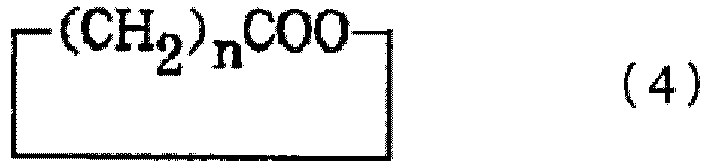
- Such a lactone compound, when has no substituent, is represented by formula (4).
- n is an integer of 2 to 9, and preferably n is 4 to 5.
- Specific examples can include ⁇ -propiolactone, ⁇ -butyrolactone, ⁇ -caprolactone, and ⁇ -valerolactone.
- ⁇ -Caprolactone and ⁇ -valerolactone are preferable, and ⁇ -caprolactone is more preferable because it is inexpensive and easily available.
- Such lactone compounds can be used in combination of two or more thereof.
- a conventionally known ring-opening polymerization catalyst is preferably added in a ring-opening polymerization reaction, and examples thereof can include a titanium-based compound and a tin-based compound.
- examples include titanium alkoxides such as titanium tetra-n-butoxide, titanium tetraisobutoxide, and titanium tetraisopropoxide; tin alkoxides such as dibutyldibutoxytin; and tin ester compounds such as dibutyl tin diacetate.
- titanium tetra-n-butoxide is preferable because it is inexpensive and easily available.
- Examples of the method of grafting to EVOH by ring-opening polymerization of the lactone compound include a method of melt-kneading both such compounds in a kneading machine, and examples of the kneading machine here include uniaxial and biaxial extruders, a Banbury mixer, a kneader, and a Brabender.
- the temperature and time of such melt-kneading are not particularly limited and may be appropriately selected so as to be any temperature where both such substances are molten and any time where grafting is completed, respectively, and are usually 50 to 250°C and 10 seconds to 24 hours, in particular, 150 to 230°C and 5 minutes to 10 hours.
- the content of ethylene in EVOH for use as a raw material is, but not limited to, usually 20 to 60% by mol, preferably 25 to 50% by mol, even more preferably 30 to 45% by mol.
- a too high content of ethylene leads to deterioration in gas barrier performance, and on the contrary, a too low content of ethylene leads to deterioration in ring-opening polymerization reactivity with the lactone compound.
- the degree of saponification of EVOH is, but not limited to, usually not less than 80% by mol, preferably 90 to 99.99% by mol, particularly preferably 99 to 99.9% by mol. A too low degree of saponification tends to lead to deterioration in gas barrier performance.
- the melt flow rate (MFR) for use as an index of the molecular weight of EVOH is usually 0.1 to 100 g/10 minutes, preferably 0.5 to 70 g/10 minutes, particularly preferably 1 to 50 g/10 minutes in conditions of 210°C and a load of 2160 g.
- MFR melt flow rate
- a too low MFR value tends to lead to deterioration in ring-opening polymerization reactivity with the lactone compound.
- EVOH here used may be a mixture of two or more of EVOHs different in content of ethylene, degree of saponification, and MFR as long as such a mixture corresponds to a combination of EVOHs where the average value satisfies the above requirements.
- the thermoplastic elastomer composition contains a thermoplastic resin component and an elastomer component.
- the thermoplastic elastomer composition is preferably one which has a phase structure (so-called sea-island structure) consisting of a continuous phase (matrix) and a dispersion phase and in which the thermoplastic resin component forms such a continuous phase and the elastomer component forms such a dispersion phase.
- thermoplastic resin component constituting the thermoplastic elastomer composition is not particularly limited as long as a material where E'(60°C)/E'(0°C) is 0.01 to 0.3 can be prepared, and examples thereof preferably include the same examples as the above thermoplastic resin. That is, the thermoplastic resin component is preferably a modified ethylene-vinyl alcohol copolymer, more preferably one obtained by reacting a compound for modification with an ethylene-vinyl alcohol copolymer, even more preferably a polyester-modified ethylene-vinyl alcohol copolymer, even more preferably an aliphatic polyester-modified ethylene-vinyl alcohol copolymer.
- the elastomer component constituting the thermoplastic elastomer composition is not particularly limited as long as a material where E'(60°C)/E'(0°C) is 0.01 to 0.3 can be prepared, and examples thereof can include diene-based rubber and a hydrogenated product thereof, olefin-based rubber, halogen-containing rubber, silicone rubber, sulfur-containing rubber, and fluororubber.
- diene-based rubber and hydrogenated product thereof examples include natural rubber (NR), isoprene rubber (IR), epoxidized natural rubber, styrene-butadiene rubber (SBR), butadiene rubber (BR) (high cis BR and low cis BR), acrylonitrile-butadiene rubber (NBR), hydrogenated NBR, and hydrogenated SBR.
- natural rubber NR
- isoprene rubber IR
- epoxidized natural rubber epoxidized natural rubber
- SBR styrene-butadiene rubber
- BR butadiene rubber
- NBR acrylonitrile-butadiene rubber
- hydrogenated NBR hydrogenated SBR
- olefin-based rubber examples include ethylene-propylene rubber (EPM), ethylene-propylene-diene rubber (EPDM), maleic acid-modified ethylene-propylene rubber (M-EPM), a maleic anhydride-modified ethylene- ⁇ -olefin copolymer, an ethylene-glycidyl methacrylate copolymer, a maleic anhydride-modified ethylene-ethyl acrylate copolymer (modified EEA), butyl rubber (IIR), a copolymer of isobutylene and an aromatic vinyl or diene-based monomer, acrylic rubber (ACM), and an ionomer.
- EPM ethylene-propylene rubber
- EPDM ethylene-propylene-diene rubber
- M-EPM maleic acid-modified ethylene-propylene rubber
- M-EPM maleic acid-modified ethylene-propylene rubber
- M-EPM maleic acid-modified ethylene-propy
- halogen-containing rubber examples include halogenated butyl rubber such as brominated butyl rubber (Br-IIR) and chlorinated butyl rubber (C1-IIR), a halogenated isomonoolefin-p-alkylstyrene copolymer (for example, brominated isobutylene-p-methylstyrene copolymer (BIMS)), halogenated isobutylene-isoprene copolymer rubber, chloroprene rubber (CR), hydrin rubber (CHR), chlorosulfonated polyethylene (CSM), chlorinated polyethylene (CM), and maleic acid-modified chlorinated polyethylene (M-CM).
- halogenated butyl rubber such as brominated butyl rubber (Br-IIR) and chlorinated butyl rubber (C1-IIR)
- a halogenated isomonoolefin-p-alkylstyrene copolymer
- silicone rubber examples include methyl vinyl silicone rubber, dimethyl silicone rubber, and methyl phenyl vinyl silicone rubber.
- sulfur-containing rubber include polysulfide rubber.
- fluororubber examples include vinylidene fluoride-based rubber, fluorine-containing vinyl ether-based rubber, tetrafluoroethylene-propylene-based rubber, fluorine-containing silicone-based rubber, and fluorine-containing phosphazene-based rubber.
- a halogenated isomonoolefin-p-alkylstyrene copolymer a maleic anhydride-modified ethylene- ⁇ -olefin copolymer, an ethylene-glycidyl methacrylate copolymer, and a maleic anhydride-modified ethylene-ethyl acrylate copolymer are preferable from the viewpoint of air blocking properties.
- any compounding agent commonly compounded into a rubber composition such as other reinforcing agent (filler) (for example, carbon black or silica), softener, anti-aging agent, and processing aid, may be compounded into the elastomer component, as long as the effects of the present invention are not impaired.
- filler for example, carbon black or silica
- softener for example, carbon black or silica
- anti-aging agent for example, silica
- processing aid any compounding agent commonly compounded into a rubber composition, such as other reinforcing agent (filler) (for example, carbon black or silica), softener, anti-aging agent, and processing aid, may be compounded into the elastomer component, as long as the effects of the present invention are not impaired.
- thermoplastic elastomer composition can be produced by melt-kneading the thermoplastic resin component and the elastomer component with, for example, a biaxially kneading extruder, and dispersing the elastomer component as a dispersion phase in such a thermoplastic resin component forming a continuous phase.
- the weight ratio of the thermoplastic resin component to the elastomer component is preferably, but not limited to, 10/90 to 90/10, more preferably 15/85 to 90/10.
- the material constituting the tire inner liner preferably further comprises a second thermoplastic resin or thermoplastic elastomer having an elastic modulus at 23°C higher than the elastic modulus at 23°C of the modified ethylene-vinyl alcohol copolymer and having a melting point of 170°C or more.
- Heat resistance can be imparted to the inner liner by incorporating the second thermoplastic resin or thermoplastic elastomer having an elastic modulus at 23°C higher than the elastic modulus at 23°C of the modified ethylene-vinyl alcohol copolymer and having a melting point of 170°C or more.
- the elastic modulus corresponds to the proportional constant between the stress and the strain in the elastic deformation region, and refers to the quotient (stress/strain) where the applied external force (stress) is defined as the numerator and the strain generated by the stress is defined as the denominator.
- the elastic modulus can be determined from the gradient of the tangent line drawn to the curve in the initial strain region of the stress-strain curve obtained according to JIS K6251 "Tensile Test Method of Vulcanized Rubber", and the elastic modulus in the present invention refers to a tensile elastic modulus.
- the second thermoplastic resin examples include a polyester resin, a polyamide resin, a polyvinyl alcohol resin, a polyvinyl chloride resin, a polyvinylidene chloride resin, a polyetherimide resin, and a polyacetal resin, and the second thermoplastic resin is preferably a polyester resin.
- the polyester resin include a polymethylene terephthalate resin, a polyethylene terephthalate resin, a polybutylene terephthalate resin, a polyethylene naphthalate resin, and a polybutylene naphthalate resin, and the polyester resin is preferably a polybutylene terephthalate resin.
- the polybutylene terephthalate resin (hereinafter, also referred to as "PBT resin”) is a polycondensation product of terephthalic acid and 1,4-butanediol.
- the polybutylene terephthalate resin here used can be any commercially available product. Examples of such any commercially available product of the polybutylene terephthalate resin include NOVADURAN® manufactured by Mitsubishi Engineering-Plastics Corporation, TORAYCON® manufactured by Toray Industries, Inc., and DURANEX® manufactured by WinTech Polymer Ltd.
- thermoplastic elastomer having an elastic modulus at 23°C higher than the elastic modulus at 23°C of the modified ethylene-vinyl alcohol copolymer and having a melting point of 170°C or more examples include a polyester elastomer and a polyamide elastomer, and the thermoplastic elastomer is preferably a polyester elastomer.
- the polyester elastomer include a polybutylene terephthalate elastomer.
- the polybutylene terephthalate elastomer (hereinafter, also referred to as "PBT elastomer”) is a thermoplastic elastomer where the hard segment corresponds to polybutylene terephthalate and the soft segment corresponds to aliphatic polyether or aliphatic polyester.
- the polybutylene terephthalate elastomer here used can be any commercially available product. Examples of such any commercially available product of the polybutylene terephthalate elastomer include PELPRENE® P type and PELPRENE® S type manufactured by Toyobo Co., Ltd., and HYTREL® manufactured by Du Pont-Toray Co., Ltd.
- the content of the second thermoplastic resin or thermoplastic elastomer is preferably 0 to 50 parts by weight, more preferably 2 to 45 parts by weight, even more preferably 5 to 40 parts by weight based on 100 parts by weight of the thermoplastic resin or the thermoplastic elastomer composition.
- a too high content may cause the inner liner not to sufficiently obtain air pressure retainability.
- the material constituting the tire inner liner can further contain an acid-modified elastomer.
- the acid-modified elastomer is contained to thereby impart the advantages of, for example, an enhancement in fatigue durability and an enhancement in followability of adjacent rubber in tire formation.
- Examples of the acid-modified elastomer include an acid-modified polyolefin-based elastomer and an acid-modified styrene-based elastomer.
- Examples of the acid-modified polyolefin-based elastomer include an ethylene- ⁇ -olefin copolymer, an ethylene-unsaturated carboxylic acid copolymer, or any derivative thereof, modified by unsaturated carboxylic acid or unsaturated carboxylic anhydride.
- Examples of the ethylene- ⁇ -olefin copolymer modified by unsaturated carboxylic acid or unsaturated carboxylic anhydride include a maleic anhydride graft-modified product of an ethylene-propylene copolymer, a maleic anhydride graft-modified product of an ethylene-butene copolymer, a maleic anhydride graft-modified product of an ethylene-hexene copolymer, and a maleic anhydride graft-modified product of an ethylene-octene copolymer.
- Examples of the ethylene-unsaturated carboxylic acid copolymer or the derivative thereof modified by unsaturated carboxylic acid or unsaturated carboxylic anhydride include an ethylene-acrylic acid copolymer modified by unsaturated carboxylic acid or unsaturated carboxylic anhydride, an ethylene-methacrylic acid copolymer modified by unsaturated carboxylic acid or unsaturated carboxylic anhydride, an ethylene-methyl acrylate copolymer modified by unsaturated carboxylic acid or unsaturated carboxylic anhydride, and an ethylene-methyl methacrylate copolymer modified by unsaturated carboxylic acid or unsaturated carboxylic anhydride.
- a preferable acid-modified polyolefin-based elastomer is any of a maleic anhydride-modified product of an ethylene-propylene copolymer and a maleic anhydride-modified product of an ethylene-butene copolymer.
- the acid-modified polyolefin-based elastomer here used can be any commercially available product. Examples of such any commercially available product of the acid-modified polyolefin-based elastomer include TAFMER® MH7010, MP7020, and MP0610 manufactured by Mitsui Chemicals, Inc.
- Examples of the acid-modified styrene-based elastomer include a maleic anhydride-modified styrene-ethylene/butylene-styrene copolymer, a maleic anhydride-modified styrene-ethylene/propylene-styrene copolymer, a maleic anhydride-modified styrene-butadiene-styrene copolymer, and a maleic anhydride-modified styrene-isoprene-styrene copolymer, and the acid-modified styrene-based elastomer is preferably a maleic anhydride-modified styrene-ethylene/butylene-styrene copolymer.
- the acid-modified styrene-based elastomer here used can be any commercially available product.
- examples of such any commercially available product of the maleic anhydride-modified styrene-ethylene/butylene-styrene copolymer include TUFTEC® M1943, M1913, and M1911 manufactured by Asahi Kasei Chemicals Co., Ltd., and KRATON® FG1924 manufactured by Kraton Polymers Japan Ltd.
- the content of the acid-modified elastomer is preferably 0 to 70 parts by weight, more preferably 10 to 68 parts by weight, even more preferably 15 to 65 parts by weight based on 100 parts by weight of the thermoplastic resin or the thermoplastic elastomer composition.
- a too high content may cause the inner liner not to sufficiently obtain air pressure retainability.
- the material constituting the tire inner liner can further contain an epoxy group-containing elastomer.
- the epoxy group-containing elastomer is contained to thereby impart the advantages of not only an enhancement in fatigue durability and an enhancement in followability of adjacent rubber in tire formation, but also an enhancement in compatibility of the thermoplastic resin with the second thermoplastic resin or thermoplastic elastomer.
- the epoxy group-containing elastomer refers to an elastomer having an epoxy group.
- the elastomer constituting the epoxy group-containing elastomer includes, but is not limited to, an ethylene- ⁇ -olefin copolymer, an ethylene-unsaturated carboxylic acid copolymer, and an ethylene-unsaturated carboxylate copolymer. That is, the epoxy group-containing elastomer is preferably an epoxy group-containing ethylene- ⁇ -olefin copolymer, an epoxy group-containing ethylene-unsaturated carboxylic acid copolymer, or an epoxy group-containing ethylene-unsaturated carboxylate copolymer.
- Examples of the ethylene- ⁇ -olefin copolymer include an ethylene-propylene copolymer, an ethylene-butene copolymer, an ethylene-hexene copolymer, and an ethylene-octene copolymer.
- Examples of the ethylene-unsaturated carboxylic acid copolymer include an ethylene-acrylic acid copolymer and an ethylene-methacrylic acid copolymer.
- Examples of the ethylene-unsaturated carboxylate copolymer include an ethylene-methyl acrylate copolymer, an ethylene-methyl methacrylate copolymer, an ethylene-ethyl acrylate copolymer, and an ethylene-ethyl methacrylate copolymer.
- the epoxy group-containing elastomer can be obtained by, for example, copolymerizing an epoxy compound such as glycidyl methacrylate to an elastomer, or epoxidizing some or all unsaturated bonds of an unsaturated bond-containing elastomer by an epoxidizing agent.
- the content of an epoxy group in the epoxy group-containing elastomer is preferably 0.01 to 5 mol/kg, more preferably 0.1 to 1.5 mol/kg.
- a too low content of an epoxy group causes the elastomer to be hardly dispersed in the thermoplastic resin, and causes desired fatigue durability to be hardly obtained.
- a too high content of an epoxy group causes interaction with the thermoplastic resin to be strengthened to lead to an increase in melt viscosity, resulting in deterioration in processability in melt forming.
- the epoxy group-containing elastomer is commercially available, and any commercially available product can be used.
- Examples of such any commercially available product include an ethylene-glycidyl methacrylate copolymer BONDFAST® BF-2C manufactured by Sumitomo Chemical Co., Ltd., an epoxy-modified ethylene-methyl acrylate copolymer ESPRENE® EMA2752 manufactured by Sumitomo Chemical Co., Ltd., and epoxy-modified styrene-butadiene-based block copolymers EPOFRIEND® AT501 and CT310 manufactured by Daicel Corporation.
- the content of the epoxy group-containing elastomer is preferably 0 to 70 parts by weight, more preferably 10 to 68 parts by weight, even more preferably 15 to 65 parts by weight based on 100 parts by weight of the thermoplastic resin or the thermoplastic elastomer composition.
- a too high content causes interaction with the thermoplastic resin to be strengthened to lead to an increase in melt viscosity, resulting in deterioration in processability in melt forming.
- the material constituting the tire inner liner may comprise any polymer other than the thermoplastic resin or the thermoplastic elastomer composition, the second thermoplastic resin or thermoplastic elastomer, the acid-modified elastomer, and the epoxy group-containing elastomer, as well as various additives, as long as the effects of the present invention are not impaired.
- an additive include a cross-linking agent, an anti-aging agent, a plasticizer, a processing aid, a cross-linking promotion aid, a cross-linking promoter, a reinforcing agent (filler), an antiscorching agent, a peptizing agent, an organic modifier, a softener, and a tackifier.
- the thickness of the tire inner liner is not particularly limited as long as the tire inner liner can have its function, and is preferably 10 to 400 ⁇ m, more preferably 15 to 350 ⁇ m, even more preferably 20 to 300 ⁇ m.
- a too thin tire inner liner is poor in handleability and is easily wrinkled in tire production, thereby possibly causing any failure such as cracking originating from such wrinkle to occur in traveling of a finished tire.
- a too thick tire inner liner is poor in followability to a rubber composition adjacent in tire production, thereby causing the problem of peeling away of such an inner liner.
- the tire inner liner of the present invention can be produced by molding the material into a film according to a molding method such as an inflation molding method or a T-die extrusion method.
- the tire inner liner of the present invention can be used in the form of a laminate obtained by laminating a layer of a rubber composition thereon in order that adhesiveness to a rubber member constituting a tire is enhanced.
- the present invention also relates to a pneumatic tire comprising the tire inner liner.
- the pneumatic tire of the present invention can be produced according to an ordinary method.
- the pneumatic tire can be produced by, for example, placing the tire inner liner of the present invention or a laminate of the tire inner liner of the present invention and a rubber composition, on a drum for tire formation, sequentially attaching and depositing thereon, members for use in usual tire production, such as a carcass layer, a belt layer, and a tread layer made of unvulcanized rubber, molding the resultant and extracting the drum to provide a green tire, and then heating and vulcanizing the green tire according to an ordinary method.
- EVOH ethylene-vinyl alcohol copolymer SoarnoL® H4815B (elastic modulus at 23°C: 1900 MPa, melting point: 158°C) manufactured by Nippon Synthetic Chemical Industry Co., Ltd.
- Nylon 6/66 polyamide 6/66 copolymer UBE NYLON® 5023B (elastic modulus at 23°C: 1000 MPa, melting point: 195°C) manufactured by Ube Industries, Ltd.
- Modified EVOH (1) SoarnoL® SG743 (aliphatic polyester-modified ethylene-vinyl alcohol copolymer, lowly modified product, elastic modulus at 23°C: 350 MPa, melting point: 110°C) manufactured by Nippon Synthetic Chemical Industry Co., Ltd.
- Modified EVOH (2) SoarnoL® SG931 (aliphatic polyester-modified ethylene-vinyl alcohol copolymer, highly modified product, elastic modulus at 23°C: 150 MPa, melting point: 95°C) manufactured by Nippon Synthetic Chemical Industry Co., Ltd.
- PBT resin NOVADURAN® 5010R5 (polybutylene terephthalate resin, elastic modulus at 23°C: 2600 MPa, melting point: 224°C) manufactured by Mitsubishi Engineering-Plastics Corporation
- PBT elastomer PELPRENE® E450B (copolymer of polybutylene terephthalate as hard segment and polyether as soft segment, elastic modulus at 23°C: 1020 MPa, melting point: 222°C) manufactured by Toyobo Co., Ltd.
- Acid-modified elastomer TAFMER® MH7020 (maleic anhydride-modified ethylene-1-butene copolymer, elastic modulus at 23°C: 15 MPa) manufactured by Mitsui Chemicals, Inc.
- Epoxy group-containing elastomer BONDFAST® 2C (ethylene-glycidyl methacrylate copolymer containing 6% by weight of glycidyl methacrylate, elastic modulus at 23°C: 140 MPa) manufactured by Sumitomo Chemical Co., Ltd.
- Raw materials at each formulation shown in Table 1 and Table 2 were introduced into a biaxially kneading extruder manufactured by Japan Steel Works, Ltd. set to a cylinder temperature which is 20°C higher than the melting point of any material having the highest melting point among polymer components, conveyed to a kneading zone having a retention time set to about 3 to 6 minutes, and melt-kneaded, and a melt-kneaded product was extruded into a strand from a die mounted to a discharge port.
- the resulting strand-shaped extruded product was pelletized by a pelletizer for resins, thereby providing a pellet-shaped material.
- the pellet-shaped material prepared according to the procedure in (2) was molded into a sheet having an average thickness of 1 mm, with a 40 mm ⁇ uniaxial extruder (Pla Giken Co., Ltd.) equipped with a T-die having a width of 200 mm, in extrusion conditions of cylinder and die temperatures of 10°C higher than the melting point of any material having the highest melting point among materials, a cooling roll temperature of 50°C and a pickup rate of 1 m/min.
- the resulting sheet was used and cut out to a strip having a width of 5 mm and a length of 60 mm, and the dynamic storage elastic modulus E' was measured with a viscoelasticity spectrometer manufactured by Toyo Seiki Seisaku-sho, Ltd., at a static strain of 5%, a dynamic strain of ⁇ 0.1%, and a frequency of 20 Hz in a temperature range from -80°C to 160°C.
- the ratio of the dynamic storage elastic modulus at 60°C to the dynamic storage elastic modulus at 0°C, namely, E'(60°C)/E'(0°C) was determined.
- the ratio is shown in Table 1 and Table 2.
- the effect of reducing rolling resistance of a tire was observed when the ratio is 0.01 to 0.3.
- the pellet-shaped material prepared according to the procedure in (2) was molded into a film having an average thickness of 0.05 mm, with a 40 mm ⁇ uniaxial extruder (Pla Giken Co., Ltd.) equipped with a T-die having a width of 550 mm, in extrusion conditions of cylinder and die temperatures of 10°C higher than the melting point of any material having the highest melting point among materials, a cooling roll temperature of 50°C and a pickup rate of 4 m/min.
- the film obtained according to the procedure in (4) was placed on the innermost surface of a tire to produce a green tire, and the green tire was then inserted into a mold at a temperature set to 180°C, and vulcanized according to an ordinary method, thereby producing a radial tire 195/65R15.
- the resisting force with respect to the tire produced was measured at a drum diameter of 1707 mm, a load of 2725 kgf, and a speed of 50 km/hr, and was defined as the rolling resistance.
- the resisting force was expressed by an index under the assumption that the rolling resistance in Comparative Example 1 was 100.
- An index of not less than 100 was graded as no effect, an index of not less than 98 and less than 100 was graded as acceptable, an index of not less than 95 and less than 98 was graded as good, an index of less than 95 was graded as excellent.
- Acceptable, good, and excellent grades were determined as exerting the effect of reducing rolling resistance.
- the measurement values (indices) are shown in Table 1 and Table 2.
- Example 3 EVOH parts by weight 100 80 Nylon 6/66 parts by weight 100 Modified EVOH (1) parts by weight 100 80 Modified EVOH (2) parts by weight 100 PBT resin parts by weight 20 20 PBT elastomer parts by weight 20 20 20 Acid-modified elastomer parts by weight 100 100 100 100 Epoxy group-containing elastomer parts by weight 100 E'(60°C)/E'(0°C) 0.38 0.75 0.42 0.08 0.03 0.10 (log 10 E'(60°C) - log 10 E'(30°C))/(60-30) -0.012 -0.008 -0.011 -0.029 -0.041 -0.028 Rolling resistance 100 106 103 95 94 96 Table 2 Example 4 Example 5 Example 6 Example 7 Example 8 EVOH parts by weight Nylon 6/66 parts by weight Modified EVOH (1) parts by weight 100 80 Modified EVOH (2) parts by weight 80 100 100 PBT resin parts by
- the tire inner liner of the present invention can be suitably utilized in production of a pneumatic tire.
Landscapes
- Chemical & Material Sciences (AREA)
- Health & Medical Sciences (AREA)
- Chemical Kinetics & Catalysis (AREA)
- Medicinal Chemistry (AREA)
- Polymers & Plastics (AREA)
- Organic Chemistry (AREA)
- Engineering & Computer Science (AREA)
- Mechanical Engineering (AREA)
- General Chemical & Material Sciences (AREA)
- Tires In General (AREA)
- Compositions Of Macromolecular Compounds (AREA)
Abstract
Description
- The present invention relates to a tire inner liner and a pneumatic tire. More specifically, the present invention relates to a tire inner liner comprising a material comprising a thermoplastic resin or a thermoplastic elastomer composition, and a pneumatic tire comprising the tire inner liner.
- A technique is known where a polymer composition obtained by melt-kneading and dynamically vulcanizing a thermoplastic resin such as polyamide and an elastomer component to thereby allow the elastomer component to form a discontinuous phase is used in a tire inner liner (
Japanese Patent No. 3217239 - A technique is known where a thermoplastic resin composition obtained by dispersing modified rubber having an acid anhydride group or an epoxy group, in polyamide and an ethylene-vinyl alcohol copolymer, is used in a tire inner liner (
Japanese Patent No. 5909846 -
- [PTL 1]
Japanese Patent No. 3217239 - [PTL 2]
Japanese Patent No. 5909846 - An object of the present invention is to provide an inner liner low in rolling resistance in tire travelling as compared with an inner liner using polyamide and an ethylene-vinyl alcohol copolymer.
- The present inventors have found that an inner liner produced by using a material where the ratio of the dynamic storage elastic modulus E'(60°C) at 60°C to the dynamic storage elastic modulus E'(0°C) at 0°C is 0.01 to 0.3 can allow for a reduction in rolling resistance in tire travelling, and thus have completed the present invention.
- The present invention relates to a tire inner liner comprising a material comprising a thermoplastic resin or a thermoplastic elastomer composition containing a thermoplastic resin component and an elastomer component, wherein the ratio of the dynamic storage elastic modulus at 60°C to the dynamic storage elastic modulus at 0°C of the material is 0.01 to 0.3.
- The present invention also relates to a pneumatic tire comprising the tire inner liner.
- The present invention includes the following aspects.
- [1] A tire inner liner comprising a material comprising a thermoplastic resin or a thermoplastic elastomer composition containing a thermoplastic resin component and an elastomer component, wherein the ratio of the dynamic storage elastic modulus at 60°C to the dynamic storage elastic modulus at 0°C of the material is 0.01 to 0.3.
- [2] The tire inner liner according to [1], wherein the dynamic storage elastic modulus E'(30°C) at 30°C and the dynamic storage elastic modulus E'(60°C) at 60°C of the material satisfy expression (1):

- [3] The tire inner liner according to [1] or [2], wherein the thermoplastic resin or the thermoplastic resin component is a modified ethylene-vinyl alcohol copolymer.
- [4] The tire inner liner according to [3], wherein the modified ethylene-vinyl alcohol copolymer is a polyester-modified ethylene-vinyl alcohol copolymer.
- [5] The tire inner liner according to any of [1] to [4], wherein the thermoplastic elastomer composition has a continuous phase and a dispersion phase, the thermoplastic resin component forms a continuous phase, and the elastomer component forms a dispersion phase.
- [6] The tire inner liner according to any of [3] to [5], wherein the material further comprises a second thermoplastic resin or thermoplastic elastomer having an elastic modulus at 23°C higher than the elastic modulus at 23°C of the modified ethylene-vinyl alcohol copolymer and having a melting point of 170°C or more.
- [7] The tire inner liner according to [6], wherein the second thermoplastic resin or thermoplastic elastomer is a polyester resin or a polyester elastomer.
- [8] A pneumatic tire comprising the tire inner liner according to any of [1] to [7].
- A pneumatic tire produced by using the tire inner liner of the present invention is low in rolling resistance in tire travelling.
- The present invention relates to a tire inner liner comprising a material comprising a thermoplastic resin or a thermoplastic elastomer composition containing a thermoplastic resin component and an elastomer component, wherein the ratio of the dynamic storage elastic modulus at 60°C to the dynamic storage elastic modulus at 0°C of the material is 0.01 to 0.3.
- The tire inner liner of the present invention comprises a material where the ratio of the dynamic storage elastic modulus at 60°C to the dynamic storage elastic modulus at 0°C is 0.01 to 0.3.
- The dynamic storage elastic modulus is hereinafter also referred to as "E"'. The dynamic storage elastic modulus at 0°C is hereinafter also referred to as "E'(0°C)". The dynamic storage elastic modulus at 60°C is hereinafter also referred to as "E'(60°C)". Accordingly, the ratio of the dynamic storage elastic modulus at 60°C to the dynamic storage elastic modulus at 0°C can be expressed as E'(60°C)/E'(0°C).
- E'(60°C)/E'(0°C) is preferably 0.02 to 0.28, more preferably 0.03 to 0.25. In a case where E'(60°C)/E'(0°C) is too small, the inner liner is too flexible in tire travelling and thus is deteriorated in travelling stability. In a case where E'(60°C)/E'(0°C) is too large, the inner liner is not flexible in tire travelling and the effect of reducing rolling resistance is hardly obtained.
- The dynamic storage elastic modulus refers to the real part of the complex elastic modulus obtained from stress-strain characteristics in application of dynamic strain to a viscoelastic body, and corresponds to the elastic term of the viscoelasticity.
- The dynamic storage elastic modulus can be determined by a method described in JIS K7198. Specifically, it can be determined as the constant of the real part of the complex elastic modulus determined by applying to a sample, not only the initial elongation, but also the sine wave dynamic strain as the periodic oscillation by a vibration exciter and here measuring the stress and displacement. Such determination in the present invention is performed at an initial elongation of 5%, a frequency of 20 Hz, and a dynamic strain of 0.1% in an atmosphere temperature range from -80°C to 160°C.
- The dynamic storage elastic modulus E'(30°C) at 30°C and the dynamic storage elastic modulus E'(60°C) at 60°C of the material constituting the tire inner liner of the present invention preferably satisfy expression (1):


- The value of (log10E'(60°C) - log10E'(30°C))/(60 - 30) almost corresponds to the gradient at 30°C to 60°C in the temperature-dependent curve of the common logarithm (log10E') of the dynamic storage elastic modulus E'.
- A too large value of (log10E'(60°C) - log10E'(30°C))/(60 - 30) (too low gradient) leads to a small effect of reducing rolling resistance in tire travelling, and a too small value (too high gradient) leads to deterioration in stability in tire travelling.
- The tire inner liner of the present invention comprises a material comprising a thermoplastic resin or a thermoplastic elastomer composition. The thermoplastic elastomer composition contains a thermoplastic resin component and an elastomer component.
- The thermoplastic resin is not particularly limited as long as a material where E'(60°C)/E'(0°C) is 0.01 to 0.3 can be prepared, and is preferably a modified ethylene-vinyl alcohol copolymer.
- The modified ethylene-vinyl alcohol copolymer (hereinafter, also referred to as "modified EVOH") refers to a copolymer containing an ethylene unit (-CH2CH2-) and a vinyl alcohol unit (-CH2-CH(OH)-) as main repeating units and containing any repeating unit other than such repeating units. The modified ethylene-vinyl alcohol copolymer is preferably obtained by reacting a compound for modification with an ethylene-vinyl alcohol copolymer (hereinafter, also referred to as "EVOH"). The modified ethylene-vinyl alcohol copolymer is preferably a polyester-modified ethylene-vinyl alcohol copolymer. The polyester-modified ethylene-vinyl alcohol copolymer refers to one obtained by grafting polyester to a hydroxyl group of an ethylene-vinyl alcohol copolymer. The polyester-modified ethylene-vinyl alcohol copolymer is preferably an aliphatic polyester-modified ethylene-vinyl alcohol copolymer. The aliphatic polyester-modified ethylene-vinyl alcohol copolymer refers to one obtained by grafting an aliphatic polyester to a hydroxyl group of an ethylene-vinyl alcohol copolymer.
- The ratio of the content of an EVOH unit forming a stem of the polyester-modified ethylene-vinyl alcohol copolymer to the content of a polyester unit grafted to the stem, i.e. EVOH unit content/polyester unit content, is preferably 40/60 to 99/1, more preferably 60/40 to 95/5, even more preferably 80/20 to 90/10 on a weight ratio. A too low content of the EVOH unit tends to result in deterioration in gas barrier performance. The ratio of the content of the EVOH unit to the content of the polyester unit can be controlled by the loading ratio between EVOH and polyester in a grafting reaction.
- The method of producing the polyester-modified ethylene-vinyl alcohol copolymer can be any known method of grafting polyester to EVOH forming a stem, and in particular, a method of ring-opening polymerization of a lactone compound in the presence of EVOH is preferably used.
- The lactone compound used is not particularly limited as long as it is a lactone compound having 3 to 10 carbon atoms. Such a lactone compound, when has no substituent, is represented by formula (4). Herein, n is an integer of 2 to 9, and preferably n is 4 to 5.
- Specific examples can include β-propiolactone, γ-butyrolactone, ε-caprolactone, and δ-valerolactone. ε-Caprolactone and δ-valerolactone are preferable, and ε-caprolactone is more preferable because it is inexpensive and easily available.
- Such lactone compounds can be used in combination of two or more thereof.
- A conventionally known ring-opening polymerization catalyst is preferably added in a ring-opening polymerization reaction, and examples thereof can include a titanium-based compound and a tin-based compound. Specific examples include titanium alkoxides such as titanium tetra-n-butoxide, titanium tetraisobutoxide, and titanium tetraisopropoxide; tin alkoxides such as dibutyldibutoxytin; and tin ester compounds such as dibutyl tin diacetate. In particular, titanium tetra-n-butoxide is preferable because it is inexpensive and easily available.
- Examples of the method of grafting to EVOH by ring-opening polymerization of the lactone compound include a method of melt-kneading both such compounds in a kneading machine, and examples of the kneading machine here include uniaxial and biaxial extruders, a Banbury mixer, a kneader, and a Brabender.
- The temperature and time of such melt-kneading are not particularly limited and may be appropriately selected so as to be any temperature where both such substances are molten and any time where grafting is completed, respectively, and are usually 50 to 250°C and 10 seconds to 24 hours, in particular, 150 to 230°C and 5 minutes to 10 hours.
- The content of ethylene in EVOH for use as a raw material is, but not limited to, usually 20 to 60% by mol, preferably 25 to 50% by mol, even more preferably 30 to 45% by mol. A too high content of ethylene leads to deterioration in gas barrier performance, and on the contrary, a too low content of ethylene leads to deterioration in ring-opening polymerization reactivity with the lactone compound.
- The degree of saponification of EVOH is, but not limited to, usually not less than 80% by mol, preferably 90 to 99.99% by mol, particularly preferably 99 to 99.9% by mol. A too low degree of saponification tends to lead to deterioration in gas barrier performance.
- The melt flow rate (MFR) for use as an index of the molecular weight of EVOH is usually 0.1 to 100 g/10 minutes, preferably 0.5 to 70 g/10 minutes, particularly preferably 1 to 50 g/10 minutes in conditions of 210°C and a load of 2160 g. A too low MFR value tends to lead to deterioration in ring-opening polymerization reactivity with the lactone compound.
- EVOH here used may be a mixture of two or more of EVOHs different in content of ethylene, degree of saponification, and MFR as long as such a mixture corresponds to a combination of EVOHs where the average value satisfies the above requirements.
- The thermoplastic elastomer composition contains a thermoplastic resin component and an elastomer component. The thermoplastic elastomer composition is preferably one which has a phase structure (so-called sea-island structure) consisting of a continuous phase (matrix) and a dispersion phase and in which the thermoplastic resin component forms such a continuous phase and the elastomer component forms such a dispersion phase.
- The thermoplastic resin component constituting the thermoplastic elastomer composition is not particularly limited as long as a material where E'(60°C)/E'(0°C) is 0.01 to 0.3 can be prepared, and examples thereof preferably include the same examples as the above thermoplastic resin. That is, the thermoplastic resin component is preferably a modified ethylene-vinyl alcohol copolymer, more preferably one obtained by reacting a compound for modification with an ethylene-vinyl alcohol copolymer, even more preferably a polyester-modified ethylene-vinyl alcohol copolymer, even more preferably an aliphatic polyester-modified ethylene-vinyl alcohol copolymer.
- The elastomer component constituting the thermoplastic elastomer composition is not particularly limited as long as a material where E'(60°C)/E'(0°C) is 0.01 to 0.3 can be prepared, and examples thereof can include diene-based rubber and a hydrogenated product thereof, olefin-based rubber, halogen-containing rubber, silicone rubber, sulfur-containing rubber, and fluororubber.
- Examples of such diene-based rubber and hydrogenated product thereof include natural rubber (NR), isoprene rubber (IR), epoxidized natural rubber, styrene-butadiene rubber (SBR), butadiene rubber (BR) (high cis BR and low cis BR), acrylonitrile-butadiene rubber (NBR), hydrogenated NBR, and hydrogenated SBR.
- Examples of the olefin-based rubber include ethylene-propylene rubber (EPM), ethylene-propylene-diene rubber (EPDM), maleic acid-modified ethylene-propylene rubber (M-EPM), a maleic anhydride-modified ethylene-α-olefin copolymer, an ethylene-glycidyl methacrylate copolymer, a maleic anhydride-modified ethylene-ethyl acrylate copolymer (modified EEA), butyl rubber (IIR), a copolymer of isobutylene and an aromatic vinyl or diene-based monomer, acrylic rubber (ACM), and an ionomer.
- Examples of the halogen-containing rubber include halogenated butyl rubber such as brominated butyl rubber (Br-IIR) and chlorinated butyl rubber (C1-IIR), a halogenated isomonoolefin-p-alkylstyrene copolymer (for example, brominated isobutylene-p-methylstyrene copolymer (BIMS)), halogenated isobutylene-isoprene copolymer rubber, chloroprene rubber (CR), hydrin rubber (CHR), chlorosulfonated polyethylene (CSM), chlorinated polyethylene (CM), and maleic acid-modified chlorinated polyethylene (M-CM).
- Examples of the silicone rubber include methyl vinyl silicone rubber, dimethyl silicone rubber, and methyl phenyl vinyl silicone rubber. Examples of the sulfur-containing rubber include polysulfide rubber. Examples of the fluororubber include vinylidene fluoride-based rubber, fluorine-containing vinyl ether-based rubber, tetrafluoroethylene-propylene-based rubber, fluorine-containing silicone-based rubber, and fluorine-containing phosphazene-based rubber.
- In particular, a halogenated isomonoolefin-p-alkylstyrene copolymer, a maleic anhydride-modified ethylene-α-olefin copolymer, an ethylene-glycidyl methacrylate copolymer, and a maleic anhydride-modified ethylene-ethyl acrylate copolymer are preferable from the viewpoint of air blocking properties.
- Any compounding agent commonly compounded into a rubber composition, such as other reinforcing agent (filler) (for example, carbon black or silica), softener, anti-aging agent, and processing aid, may be compounded into the elastomer component, as long as the effects of the present invention are not impaired.
- The thermoplastic elastomer composition can be produced by melt-kneading the thermoplastic resin component and the elastomer component with, for example, a biaxially kneading extruder, and dispersing the elastomer component as a dispersion phase in such a thermoplastic resin component forming a continuous phase. The weight ratio of the thermoplastic resin component to the elastomer component is preferably, but not limited to, 10/90 to 90/10, more preferably 15/85 to 90/10.
- The material constituting the tire inner liner preferably further comprises a second thermoplastic resin or thermoplastic elastomer having an elastic modulus at 23°C higher than the elastic modulus at 23°C of the modified ethylene-vinyl alcohol copolymer and having a melting point of 170°C or more.
- Heat resistance can be imparted to the inner liner by incorporating the second thermoplastic resin or thermoplastic elastomer having an elastic modulus at 23°C higher than the elastic modulus at 23°C of the modified ethylene-vinyl alcohol copolymer and having a melting point of 170°C or more.
- The elastic modulus corresponds to the proportional constant between the stress and the strain in the elastic deformation region, and refers to the quotient (stress/strain) where the applied external force (stress) is defined as the numerator and the strain generated by the stress is defined as the denominator.
- The elastic modulus can be determined from the gradient of the tangent line drawn to the curve in the initial strain region of the stress-strain curve obtained according to JIS K6251 "Tensile Test Method of Vulcanized Rubber", and the elastic modulus in the present invention refers to a tensile elastic modulus.
- Examples of the second thermoplastic resin include a polyester resin, a polyamide resin, a polyvinyl alcohol resin, a polyvinyl chloride resin, a polyvinylidene chloride resin, a polyetherimide resin, and a polyacetal resin, and the second thermoplastic resin is preferably a polyester resin. Examples of the polyester resin include a polymethylene terephthalate resin, a polyethylene terephthalate resin, a polybutylene terephthalate resin, a polyethylene naphthalate resin, and a polybutylene naphthalate resin, and the polyester resin is preferably a polybutylene terephthalate resin. The polybutylene terephthalate resin (hereinafter, also referred to as "PBT resin") is a polycondensation product of terephthalic acid and 1,4-butanediol. The polybutylene terephthalate resin here used can be any commercially available product. Examples of such any commercially available product of the polybutylene terephthalate resin include NOVADURAN® manufactured by Mitsubishi Engineering-Plastics Corporation, TORAYCON® manufactured by Toray Industries, Inc., and DURANEX® manufactured by WinTech Polymer Ltd.
- Examples of the thermoplastic elastomer having an elastic modulus at 23°C higher than the elastic modulus at 23°C of the modified ethylene-vinyl alcohol copolymer and having a melting point of 170°C or more include a polyester elastomer and a polyamide elastomer, and the thermoplastic elastomer is preferably a polyester elastomer. Examples of the polyester elastomer include a polybutylene terephthalate elastomer. The polybutylene terephthalate elastomer (hereinafter, also referred to as "PBT elastomer") is a thermoplastic elastomer where the hard segment corresponds to polybutylene terephthalate and the soft segment corresponds to aliphatic polyether or aliphatic polyester. The polybutylene terephthalate elastomer here used can be any commercially available product. Examples of such any commercially available product of the polybutylene terephthalate elastomer include PELPRENE® P type and PELPRENE® S type manufactured by Toyobo Co., Ltd., and HYTREL® manufactured by Du Pont-Toray Co., Ltd.
- The content of the second thermoplastic resin or thermoplastic elastomer is preferably 0 to 50 parts by weight, more preferably 2 to 45 parts by weight, even more preferably 5 to 40 parts by weight based on 100 parts by weight of the thermoplastic resin or the thermoplastic elastomer composition. A too high content may cause the inner liner not to sufficiently obtain air pressure retainability.
- The material constituting the tire inner liner can further contain an acid-modified elastomer. The acid-modified elastomer is contained to thereby impart the advantages of, for example, an enhancement in fatigue durability and an enhancement in followability of adjacent rubber in tire formation. Examples of the acid-modified elastomer include an acid-modified polyolefin-based elastomer and an acid-modified styrene-based elastomer.
- Examples of the acid-modified polyolefin-based elastomer include an ethylene-α-olefin copolymer, an ethylene-unsaturated carboxylic acid copolymer, or any derivative thereof, modified by unsaturated carboxylic acid or unsaturated carboxylic anhydride. Examples of the ethylene-α-olefin copolymer modified by unsaturated carboxylic acid or unsaturated carboxylic anhydride include a maleic anhydride graft-modified product of an ethylene-propylene copolymer, a maleic anhydride graft-modified product of an ethylene-butene copolymer, a maleic anhydride graft-modified product of an ethylene-hexene copolymer, and a maleic anhydride graft-modified product of an ethylene-octene copolymer. Examples of the ethylene-unsaturated carboxylic acid copolymer or the derivative thereof modified by unsaturated carboxylic acid or unsaturated carboxylic anhydride include an ethylene-acrylic acid copolymer modified by unsaturated carboxylic acid or unsaturated carboxylic anhydride, an ethylene-methacrylic acid copolymer modified by unsaturated carboxylic acid or unsaturated carboxylic anhydride, an ethylene-methyl acrylate copolymer modified by unsaturated carboxylic acid or unsaturated carboxylic anhydride, and an ethylene-methyl methacrylate copolymer modified by unsaturated carboxylic acid or unsaturated carboxylic anhydride. In particular, a preferable acid-modified polyolefin-based elastomer is any of a maleic anhydride-modified product of an ethylene-propylene copolymer and a maleic anhydride-modified product of an ethylene-butene copolymer. The acid-modified polyolefin-based elastomer here used can be any commercially available product. Examples of such any commercially available product of the acid-modified polyolefin-based elastomer include TAFMER® MH7010, MP7020, and MP0610 manufactured by Mitsui Chemicals, Inc.
- Examples of the acid-modified styrene-based elastomer include a maleic anhydride-modified styrene-ethylene/butylene-styrene copolymer, a maleic anhydride-modified styrene-ethylene/propylene-styrene copolymer, a maleic anhydride-modified styrene-butadiene-styrene copolymer, and a maleic anhydride-modified styrene-isoprene-styrene copolymer, and the acid-modified styrene-based elastomer is preferably a maleic anhydride-modified styrene-ethylene/butylene-styrene copolymer. The acid-modified styrene-based elastomer here used can be any commercially available product. Examples of such any commercially available product of the maleic anhydride-modified styrene-ethylene/butylene-styrene copolymer include TUFTEC® M1943, M1913, and M1911 manufactured by Asahi Kasei Chemicals Co., Ltd., and KRATON® FG1924 manufactured by Kraton Polymers Japan Ltd.
- The content of the acid-modified elastomer is preferably 0 to 70 parts by weight, more preferably 10 to 68 parts by weight, even more preferably 15 to 65 parts by weight based on 100 parts by weight of the thermoplastic resin or the thermoplastic elastomer composition. A too high content may cause the inner liner not to sufficiently obtain air pressure retainability.
- The material constituting the tire inner liner can further contain an epoxy group-containing elastomer. The epoxy group-containing elastomer is contained to thereby impart the advantages of not only an enhancement in fatigue durability and an enhancement in followability of adjacent rubber in tire formation, but also an enhancement in compatibility of the thermoplastic resin with the second thermoplastic resin or thermoplastic elastomer.
- The epoxy group-containing elastomer refers to an elastomer having an epoxy group.
- The elastomer constituting the epoxy group-containing elastomer includes, but is not limited to, an ethylene-α-olefin copolymer, an ethylene-unsaturated carboxylic acid copolymer, and an ethylene-unsaturated carboxylate copolymer. That is, the epoxy group-containing elastomer is preferably an epoxy group-containing ethylene-α-olefin copolymer, an epoxy group-containing ethylene-unsaturated carboxylic acid copolymer, or an epoxy group-containing ethylene-unsaturated carboxylate copolymer. Examples of the ethylene-α-olefin copolymer include an ethylene-propylene copolymer, an ethylene-butene copolymer, an ethylene-hexene copolymer, and an ethylene-octene copolymer. Examples of the ethylene-unsaturated carboxylic acid copolymer include an ethylene-acrylic acid copolymer and an ethylene-methacrylic acid copolymer. Examples of the ethylene-unsaturated carboxylate copolymer include an ethylene-methyl acrylate copolymer, an ethylene-methyl methacrylate copolymer, an ethylene-ethyl acrylate copolymer, and an ethylene-ethyl methacrylate copolymer.
- The epoxy group-containing elastomer can be obtained by, for example, copolymerizing an epoxy compound such as glycidyl methacrylate to an elastomer, or epoxidizing some or all unsaturated bonds of an unsaturated bond-containing elastomer by an epoxidizing agent. The content of an epoxy group in the epoxy group-containing elastomer is preferably 0.01 to 5 mol/kg, more preferably 0.1 to 1.5 mol/kg. A too low content of an epoxy group causes the elastomer to be hardly dispersed in the thermoplastic resin, and causes desired fatigue durability to be hardly obtained. A too high content of an epoxy group causes interaction with the thermoplastic resin to be strengthened to lead to an increase in melt viscosity, resulting in deterioration in processability in melt forming. The epoxy group-containing elastomer is commercially available, and any commercially available product can be used. Examples of such any commercially available product include an ethylene-glycidyl methacrylate copolymer BONDFAST® BF-2C manufactured by Sumitomo Chemical Co., Ltd., an epoxy-modified ethylene-methyl acrylate copolymer ESPRENE® EMA2752 manufactured by Sumitomo Chemical Co., Ltd., and epoxy-modified styrene-butadiene-based block copolymers EPOFRIEND® AT501 and CT310 manufactured by Daicel Corporation.
- The content of the epoxy group-containing elastomer is preferably 0 to 70 parts by weight, more preferably 10 to 68 parts by weight, even more preferably 15 to 65 parts by weight based on 100 parts by weight of the thermoplastic resin or the thermoplastic elastomer composition. A too high content causes interaction with the thermoplastic resin to be strengthened to lead to an increase in melt viscosity, resulting in deterioration in processability in melt forming.
- The material constituting the tire inner liner may comprise any polymer other than the thermoplastic resin or the thermoplastic elastomer composition, the second thermoplastic resin or thermoplastic elastomer, the acid-modified elastomer, and the epoxy group-containing elastomer, as well as various additives, as long as the effects of the present invention are not impaired. Examples of such an additive include a cross-linking agent, an anti-aging agent, a plasticizer, a processing aid, a cross-linking promotion aid, a cross-linking promoter, a reinforcing agent (filler), an antiscorching agent, a peptizing agent, an organic modifier, a softener, and a tackifier.
- The thickness of the tire inner liner is not particularly limited as long as the tire inner liner can have its function, and is preferably 10 to 400 µm, more preferably 15 to 350 µm, even more preferably 20 to 300 µm. A too thin tire inner liner is poor in handleability and is easily wrinkled in tire production, thereby possibly causing any failure such as cracking originating from such wrinkle to occur in traveling of a finished tire. A too thick tire inner liner is poor in followability to a rubber composition adjacent in tire production, thereby causing the problem of peeling away of such an inner liner.
- The tire inner liner of the present invention can be produced by molding the material into a film according to a molding method such as an inflation molding method or a T-die extrusion method.
- The tire inner liner of the present invention can be used in the form of a laminate obtained by laminating a layer of a rubber composition thereon in order that adhesiveness to a rubber member constituting a tire is enhanced.
- The present invention also relates to a pneumatic tire comprising the tire inner liner.
- The pneumatic tire of the present invention can be produced according to an ordinary method. The pneumatic tire can be produced by, for example, placing the tire inner liner of the present invention or a laminate of the tire inner liner of the present invention and a rubber composition, on a drum for tire formation, sequentially attaching and depositing thereon, members for use in usual tire production, such as a carcass layer, a belt layer, and a tread layer made of unvulcanized rubber, molding the resultant and extracting the drum to provide a green tire, and then heating and vulcanizing the green tire according to an ordinary method.
- Raw materials used in Examples and Comparative Examples below are as follows.
- EVOH: ethylene-vinyl alcohol copolymer SoarnoL® H4815B (elastic modulus at 23°C: 1900 MPa, melting point: 158°C) manufactured by Nippon Synthetic Chemical Industry Co., Ltd.
- Nylon 6/66: polyamide 6/66 copolymer UBE NYLON® 5023B (elastic modulus at 23°C: 1000 MPa, melting point: 195°C) manufactured by Ube Industries, Ltd.
- Modified EVOH (1): SoarnoL® SG743 (aliphatic polyester-modified ethylene-vinyl alcohol copolymer, lowly modified product, elastic modulus at 23°C: 350 MPa, melting point: 110°C) manufactured by Nippon Synthetic Chemical Industry Co., Ltd.
- Modified EVOH (2): SoarnoL® SG931 (aliphatic polyester-modified ethylene-vinyl alcohol copolymer, highly modified product, elastic modulus at 23°C: 150 MPa, melting point: 95°C) manufactured by Nippon Synthetic Chemical Industry Co., Ltd.
- PBT resin: NOVADURAN® 5010R5 (polybutylene terephthalate resin, elastic modulus at 23°C: 2600 MPa, melting point: 224°C) manufactured by Mitsubishi Engineering-Plastics Corporation
- PBT elastomer: PELPRENE® E450B (copolymer of polybutylene terephthalate as hard segment and polyether as soft segment, elastic modulus at 23°C: 1020 MPa, melting point: 222°C) manufactured by Toyobo Co., Ltd.
- Acid-modified elastomer: TAFMER® MH7020 (maleic anhydride-modified ethylene-1-butene copolymer, elastic modulus at 23°C: 15 MPa) manufactured by Mitsui Chemicals, Inc.
- Epoxy group-containing elastomer: BONDFAST® 2C (ethylene-glycidyl methacrylate copolymer containing 6% by weight of glycidyl methacrylate, elastic modulus at 23°C: 140 MPa) manufactured by Sumitomo Chemical Co., Ltd.
- Raw materials at each formulation shown in Table 1 and Table 2 were introduced into a biaxially kneading extruder manufactured by Japan Steel Works, Ltd. set to a cylinder temperature which is 20°C higher than the melting point of any material having the highest melting point among polymer components, conveyed to a kneading zone having a retention time set to about 3 to 6 minutes, and melt-kneaded, and a melt-kneaded product was extruded into a strand from a die mounted to a discharge port. The resulting strand-shaped extruded product was pelletized by a pelletizer for resins, thereby providing a pellet-shaped material.
- The pellet-shaped material prepared according to the procedure in (2) was molded into a sheet having an average thickness of 1 mm, with a 40 mmϕ uniaxial extruder (Pla Giken Co., Ltd.) equipped with a T-die having a width of 200 mm, in extrusion conditions of cylinder and die temperatures of 10°C higher than the melting point of any material having the highest melting point among materials, a cooling roll temperature of 50°C and a pickup rate of 1 m/min.
- The resulting sheet was used and cut out to a strip having a width of 5 mm and a length of 60 mm, and the dynamic storage elastic modulus E' was measured with a viscoelasticity spectrometer manufactured by Toyo Seiki Seisaku-sho, Ltd., at a static strain of 5%, a dynamic strain of ±0.1%, and a frequency of 20 Hz in a temperature range from -80°C to 160°C.
- The ratio of the dynamic storage elastic modulus at 60°C to the dynamic storage elastic modulus at 0°C, namely, E'(60°C)/E'(0°C) was determined. The ratio is shown in Table 1 and Table 2. The effect of reducing rolling resistance of a tire was observed when the ratio is 0.01 to 0.3.
- The value of (log10E'(60°C) - log10E'(30°C))/(60 - 30) was calculated. Each value calculated is shown in Table 1 and Table 2. The effect of reducing rolling resistance of a tire was observed when the ratio is less than -0.015.
- The pellet-shaped material prepared according to the procedure in (2) was molded into a film having an average thickness of 0.05 mm, with a 40 mmϕ uniaxial extruder (Pla Giken Co., Ltd.) equipped with a T-die having a width of 550 mm, in extrusion conditions of cylinder and die temperatures of 10°C higher than the melting point of any material having the highest melting point among materials, a cooling roll temperature of 50°C and a pickup rate of 4 m/min.
- The film obtained according to the procedure in (4) was placed on the innermost surface of a tire to produce a green tire, and the green tire was then inserted into a mold at a temperature set to 180°C, and vulcanized according to an ordinary method, thereby producing a radial tire 195/65R15.
- The resisting force with respect to the tire produced was measured at a drum diameter of 1707 mm, a load of 2725 kgf, and a speed of 50 km/hr, and was defined as the rolling resistance. The resisting force was expressed by an index under the assumption that the rolling resistance in Comparative Example 1 was 100. An index of not less than 100 was graded as no effect, an index of not less than 98 and less than 100 was graded as acceptable, an index of not less than 95 and less than 98 was graded as good, an index of less than 95 was graded as excellent. Acceptable, good, and excellent grades were determined as exerting the effect of reducing rolling resistance. The measurement values (indices) are shown in Table 1 and Table 2.
Table 1 Comparative Example 1 Comparative Example 2 Comparative Example 3 Example 1 Example 2 Example 3 EVOH parts by weight 100 80 Nylon 6/66 parts by weight 100 Modified EVOH (1) parts by weight 100 80 Modified EVOH (2) parts by weight 100 PBT resin parts by weight 20 20 PBT elastomer parts by weight 20 20 20 Acid-modified elastomer parts by weight 100 100 100 100 100 Epoxy group-containing elastomer parts by weight 100 E'(60°C)/E'(0°C) 0.38 0.75 0.42 0.08 0.03 0.10 (log10E'(60°C) - log10E'(30°C))/(60-30) -0.012 -0.008 -0.011 -0.029 -0.041 -0.028 Rolling resistance 100 106 103 95 94 96 Table 2 Example 4 Example 5 Example 6 Example 7 Example 8 EVOH parts by weight Nylon 6/66 parts by weight Modified EVOH (1) parts by weight 100 80 Modified EVOH (2) parts by weight 80 100 100 PBT resin parts by weight 20 PBT elastomer parts by weight 40 20 30 30 Acid-modified elastomer parts by weight 80 120 70 160 Epoxy group-containing elastomer parts by weight 80 E'(60°C)/E'(0°C) 0.12 0.04 0.05 0.07 0.20 (log10E'(60°C) - log10E'(30°C))/(60-30) -0.034 -0.036 -0.032 -0.030 -0.016 Rolling resistance 96 94 95 95 98 - The tire inner liner of the present invention can be suitably utilized in production of a pneumatic tire.
Claims (8)
- A tire inner liner comprising a material comprising a thermoplastic resin or a thermoplastic elastomer composition containing a thermoplastic resin component and an elastomer component, wherein the ratio of the dynamic storage elastic modulus at 60°C to the dynamic storage elastic modulus at 0°C of the material is 0.01 to 0.3.
- The tire inner liner according to claim 1, wherein the dynamic storage elastic modulus E'(30°C) at 30°C and the dynamic storage elastic modulus E'(60°C) at 60°C of the material satisfy expression (1):

- The tire inner liner according to claim 1 or 2, wherein the thermoplastic resin or the thermoplastic resin component is a modified ethylene-vinyl alcohol copolymer.
- The tire inner liner according to claim 3, wherein the modified ethylene-vinyl alcohol copolymer is a polyester-modified ethylene-vinyl alcohol copolymer.
- The tire inner liner according to any one of claims 1 to 4, wherein the thermoplastic elastomer composition has a continuous phase and a dispersion phase, the thermoplastic resin component forms a continuous phase, and the elastomer component forms a dispersion phase.
- The tire inner liner according to any one of claims 3 to 5, wherein the material further comprises a second thermoplastic resin or thermoplastic elastomer having an elastic modulus at 23°C higher than the elastic modulus at 23°C of the modified ethylene-vinyl alcohol copolymer and having a melting point of 170°C or more.
- The tire inner liner according to claim 6, wherein the second thermoplastic resin or thermoplastic elastomer is a polyester resin or a polyester elastomer.
- A pneumatic tire comprising the tire inner liner according to any one of claims 1 to 7.
Applications Claiming Priority (2)
| Application Number | Priority Date | Filing Date | Title |
|---|---|---|---|
| JP2018177352A JP7163118B2 (en) | 2018-09-21 | 2018-09-21 | Inner liners for tires and pneumatic tires |
| PCT/JP2019/037108 WO2020059878A1 (en) | 2018-09-21 | 2019-09-20 | Tire inner liner and pneumatic tire |
Publications (2)
| Publication Number | Publication Date |
|---|---|
| EP3854854A1 true EP3854854A1 (en) | 2021-07-28 |
| EP3854854A4 EP3854854A4 (en) | 2022-06-08 |
Family
ID=69887281
Family Applications (1)
| Application Number | Title | Priority Date | Filing Date |
|---|---|---|---|
| EP19863746.4A Withdrawn EP3854854A4 (en) | 2018-09-21 | 2019-09-20 | TIRE INNERLINER AND PNEUMATIC TIRES |
Country Status (5)
| Country | Link |
|---|---|
| US (1) | US20210347972A1 (en) |
| EP (1) | EP3854854A4 (en) |
| JP (1) | JP7163118B2 (en) |
| CN (1) | CN112654680B (en) |
| WO (1) | WO2020059878A1 (en) |
Families Citing this family (2)
| Publication number | Priority date | Publication date | Assignee | Title |
|---|---|---|---|---|
| JP7211442B2 (en) * | 2021-02-10 | 2023-01-24 | 横浜ゴム株式会社 | hose for fluid transport |
| CN117642570A (en) * | 2021-07-29 | 2024-03-01 | 横滨橡胶株式会社 | Refrigerant delivery hose |
Family Cites Families (18)
| Publication number | Priority date | Publication date | Assignee | Title |
|---|---|---|---|---|
| JPS599846B2 (en) | 1979-02-21 | 1984-03-05 | 株式会社鷺宮製作所 | Sample breakage detection device in testing machine |
| JP3217239B2 (en) | 1995-01-23 | 2001-10-09 | 横浜ゴム株式会社 | Polymer composition for tire and pneumatic tire using the same |
| KR101085033B1 (en) * | 2004-06-28 | 2011-11-18 | 코오롱인더스트리 주식회사 | Multi-layer air permeation layer of pneumatic tire |
| JP2007099146A (en) * | 2005-10-06 | 2007-04-19 | Yokohama Rubber Co Ltd:The | Layered material, and pneumatic tire using the same |
| JP4990575B2 (en) * | 2006-07-24 | 2012-08-01 | 株式会社ブリヂストン | Inner liner for pneumatic tire and pneumatic tire provided with the same |
| JP4952263B2 (en) * | 2007-01-15 | 2012-06-13 | 横浜ゴム株式会社 | Pneumatic tire |
| CN102264552B (en) * | 2008-12-26 | 2013-09-04 | 株式会社普利司通 | Pneumatic tire |
| JP5754092B2 (en) * | 2010-07-15 | 2015-07-22 | 横浜ゴム株式会社 | Laminated body and pneumatic tire using the same |
| JP4915471B1 (en) * | 2010-11-17 | 2012-04-11 | 横浜ゴム株式会社 | Pneumatic tire |
| JP6010883B2 (en) * | 2011-08-09 | 2016-10-19 | 横浜ゴム株式会社 | Pneumatic tire manufacturing method |
| JP6041859B2 (en) * | 2012-03-01 | 2016-12-14 | 株式会社ブリヂストン | tire |
| JP6021442B2 (en) * | 2012-05-28 | 2016-11-09 | 横浜ゴム株式会社 | Pneumatic tire |
| JP2016007878A (en) * | 2014-06-23 | 2016-01-18 | 東洋ゴム工業株式会社 | Air permeation resistant film for tire and manufacturing method thereof |
| US20180147887A1 (en) * | 2015-06-03 | 2018-05-31 | Bridgestone Corporation | Tire |
| JP6653624B2 (en) * | 2016-05-31 | 2020-02-26 | 株式会社ブリヂストン | Method of manufacturing inner liner of pneumatic tire and method of manufacturing pneumatic tire |
| JP6926495B2 (en) | 2017-02-01 | 2021-08-25 | 横浜ゴム株式会社 | Thermoplastic composition, inner liner and pneumatic tire |
| JP7024368B2 (en) | 2017-12-12 | 2022-02-24 | 横浜ゴム株式会社 | Thermoplastic Elastomer Compositions for Tires and Tires |
| JP7082898B2 (en) * | 2018-04-06 | 2022-06-09 | 横浜ゴム株式会社 | A method for manufacturing a thermoplastic resin composition for a tire inner liner, a tire inner liner, a pneumatic tire, a tire inner liner, and a method for manufacturing a pneumatic tire. |
-
2018
- 2018-09-21 JP JP2018177352A patent/JP7163118B2/en active Active
-
2019
- 2019-09-20 EP EP19863746.4A patent/EP3854854A4/en not_active Withdrawn
- 2019-09-20 CN CN201980058435.2A patent/CN112654680B/en active Active
- 2019-09-20 US US17/278,035 patent/US20210347972A1/en not_active Abandoned
- 2019-09-20 WO PCT/JP2019/037108 patent/WO2020059878A1/en not_active Ceased
Also Published As
| Publication number | Publication date |
|---|---|
| CN112654680A (en) | 2021-04-13 |
| JP7163118B2 (en) | 2022-10-31 |
| CN112654680B (en) | 2023-02-21 |
| US20210347972A1 (en) | 2021-11-11 |
| JP2020045470A (en) | 2020-03-26 |
| EP3854854A4 (en) | 2022-06-08 |
| WO2020059878A1 (en) | 2020-03-26 |
Similar Documents
| Publication | Publication Date | Title |
|---|---|---|
| CN103732398B (en) | Multilayer structure, inner liner for pneumatic tire, and pneumatic tire | |
| EP2267073B1 (en) | Film, inner liner for tire, and tire using the inner liner | |
| JP4668926B2 (en) | Laminated body, manufacturing method thereof, and tire using the same | |
| JP4831706B2 (en) | Polymer laminate and pneumatic tire using the same for inner liner | |
| JP4990575B2 (en) | Inner liner for pneumatic tire and pneumatic tire provided with the same | |
| JP5273560B2 (en) | Polymer composition for inner liner and pneumatic tire using the same | |
| JP5300679B2 (en) | Polymer composition for inner liner and pneumatic tire using the same | |
| US9815330B2 (en) | Laminate, tire, and method for producing tire | |
| JP2004176048A (en) | Inner liner for pneumatic tires and pneumatic tires | |
| EP2607406B1 (en) | Method for producing thermoplastic resin compositions | |
| EP2636543B1 (en) | Pneumatic tire | |
| US11566125B2 (en) | Thermoplastic elastomer composition for tires, and tire | |
| US20210347972A1 (en) | Tire inner liner and pneumatic tire | |
| JP2009274680A (en) | Heavy duty tire | |
| JP5001597B2 (en) | Pneumatic tire | |
| JP4939027B2 (en) | Method for producing adhesive composition | |
| WO1997043136A1 (en) | Pneumatic tyre | |
| JP5534784B2 (en) | Production method of inner liner for pneumatic tire | |
| EP3854853A1 (en) | Tire inner liner and pneumatic tire | |
| JPH1016137A (en) | Rubber and thermoplastic elastomer laminate | |
| JP2007320479A (en) | Pneumatic tire |
Legal Events
| Date | Code | Title | Description |
|---|---|---|---|
| STAA | Information on the status of an ep patent application or granted ep patent |
Free format text: STATUS: THE INTERNATIONAL PUBLICATION HAS BEEN MADE |
|
| PUAI | Public reference made under article 153(3) epc to a published international application that has entered the european phase |
Free format text: ORIGINAL CODE: 0009012 |
|
| STAA | Information on the status of an ep patent application or granted ep patent |
Free format text: STATUS: REQUEST FOR EXAMINATION WAS MADE |
|
| 17P | Request for examination filed |
Effective date: 20210416 |
|
| AK | Designated contracting states |
Kind code of ref document: A1 Designated state(s): AL AT BE BG CH CY CZ DE DK EE ES FI FR GB GR HR HU IE IS IT LI LT LU LV MC MK MT NL NO PL PT RO RS SE SI SK SM TR |
|
| A4 | Supplementary search report drawn up and despatched |
Effective date: 20220510 |
|
| RIC1 | Information provided on ipc code assigned before grant |
Ipc: C09J 153/02 20060101ALI20220503BHEP Ipc: B60C 1/00 20060101ALI20220503BHEP Ipc: C08L 67/00 20060101ALI20220503BHEP Ipc: C08L 23/26 20060101ALI20220503BHEP Ipc: C08L 21/00 20060101ALI20220503BHEP Ipc: B60C 5/14 20060101ALI20220503BHEP Ipc: C08L 101/00 20060101AFI20220503BHEP |
|
| RAP3 | Party data changed (applicant data changed or rights of an application transferred) |
Owner name: MITSUBISHI CHEMICAL CORPORATION Owner name: THE YOKOHAMA RUBBER CO., LTD. |
|
| RAP3 | Party data changed (applicant data changed or rights of an application transferred) |
Owner name: MITSUBISHI CHEMICAL CORPORATION Owner name: THE YOKOHAMA RUBBER CO., LTD. |
|
| STAA | Information on the status of an ep patent application or granted ep patent |
Free format text: STATUS: THE APPLICATION HAS BEEN WITHDRAWN |
|
| 18W | Application withdrawn |
Effective date: 20250220 |