EP3854548B1 - Electrode lead cutting apparatus for battery cells - Google Patents
Electrode lead cutting apparatus for battery cells Download PDFInfo
- Publication number
- EP3854548B1 EP3854548B1 EP19887330.9A EP19887330A EP3854548B1 EP 3854548 B1 EP3854548 B1 EP 3854548B1 EP 19887330 A EP19887330 A EP 19887330A EP 3854548 B1 EP3854548 B1 EP 3854548B1
- Authority
- EP
- European Patent Office
- Prior art keywords
- electrode lead
- cutting
- cut
- point
- battery cell
- Prior art date
- Legal status (The legal status is an assumption and is not a legal conclusion. Google has not performed a legal analysis and makes no representation as to the accuracy of the status listed.)
- Active
Links
Images

Classifications
-
- B—PERFORMING OPERATIONS; TRANSPORTING
- B23—MACHINE TOOLS; METAL-WORKING NOT OTHERWISE PROVIDED FOR
- B23K—SOLDERING OR UNSOLDERING; WELDING; CLADDING OR PLATING BY SOLDERING OR WELDING; CUTTING BY APPLYING HEAT LOCALLY, e.g. FLAME CUTTING; WORKING BY LASER BEAM
- B23K26/00—Working by laser beam, e.g. welding, cutting or boring
- B23K26/36—Removing material
- B23K26/38—Removing material by boring or cutting
-
- B—PERFORMING OPERATIONS; TRANSPORTING
- B26—HAND CUTTING TOOLS; CUTTING; SEVERING
- B26D—CUTTING; DETAILS COMMON TO MACHINES FOR PERFORATING, PUNCHING, CUTTING-OUT, STAMPING-OUT OR SEVERING
- B26D1/00—Cutting through work characterised by the nature or movement of the cutting member or particular materials not otherwise provided for; Apparatus or machines therefor; Cutting members therefor
- B26D1/01—Cutting through work characterised by the nature or movement of the cutting member or particular materials not otherwise provided for; Apparatus or machines therefor; Cutting members therefor involving a cutting member which does not travel with the work
- B26D1/04—Cutting through work characterised by the nature or movement of the cutting member or particular materials not otherwise provided for; Apparatus or machines therefor; Cutting members therefor involving a cutting member which does not travel with the work having a linearly-movable cutting member
- B26D1/06—Cutting through work characterised by the nature or movement of the cutting member or particular materials not otherwise provided for; Apparatus or machines therefor; Cutting members therefor involving a cutting member which does not travel with the work having a linearly-movable cutting member wherein the cutting member reciprocates
- B26D1/08—Cutting through work characterised by the nature or movement of the cutting member or particular materials not otherwise provided for; Apparatus or machines therefor; Cutting members therefor involving a cutting member which does not travel with the work having a linearly-movable cutting member wherein the cutting member reciprocates of the guillotine type
- B26D1/09—Cutting through work characterised by the nature or movement of the cutting member or particular materials not otherwise provided for; Apparatus or machines therefor; Cutting members therefor involving a cutting member which does not travel with the work having a linearly-movable cutting member wherein the cutting member reciprocates of the guillotine type with a plurality of cutting members
- B26D1/095—Cutting through work characterised by the nature or movement of the cutting member or particular materials not otherwise provided for; Apparatus or machines therefor; Cutting members therefor involving a cutting member which does not travel with the work having a linearly-movable cutting member wherein the cutting member reciprocates of the guillotine type with a plurality of cutting members for thin material, e.g. for sheets, strips or the like
-
- H—ELECTRICITY
- H01—ELECTRIC ELEMENTS
- H01M—PROCESSES OR MEANS, e.g. BATTERIES, FOR THE DIRECT CONVERSION OF CHEMICAL ENERGY INTO ELECTRICAL ENERGY
- H01M10/00—Secondary cells; Manufacture thereof
- H01M10/04—Construction or manufacture in general
- H01M10/0404—Machines for assembling batteries
-
- B—PERFORMING OPERATIONS; TRANSPORTING
- B23—MACHINE TOOLS; METAL-WORKING NOT OTHERWISE PROVIDED FOR
- B23K—SOLDERING OR UNSOLDERING; WELDING; CLADDING OR PLATING BY SOLDERING OR WELDING; CUTTING BY APPLYING HEAT LOCALLY, e.g. FLAME CUTTING; WORKING BY LASER BEAM
- B23K26/00—Working by laser beam, e.g. welding, cutting or boring
-
- B—PERFORMING OPERATIONS; TRANSPORTING
- B26—HAND CUTTING TOOLS; CUTTING; SEVERING
- B26D—CUTTING; DETAILS COMMON TO MACHINES FOR PERFORATING, PUNCHING, CUTTING-OUT, STAMPING-OUT OR SEVERING
- B26D1/00—Cutting through work characterised by the nature or movement of the cutting member or particular materials not otherwise provided for; Apparatus or machines therefor; Cutting members therefor
- B26D1/01—Cutting through work characterised by the nature or movement of the cutting member or particular materials not otherwise provided for; Apparatus or machines therefor; Cutting members therefor involving a cutting member which does not travel with the work
- B26D1/04—Cutting through work characterised by the nature or movement of the cutting member or particular materials not otherwise provided for; Apparatus or machines therefor; Cutting members therefor involving a cutting member which does not travel with the work having a linearly-movable cutting member
- B26D1/06—Cutting through work characterised by the nature or movement of the cutting member or particular materials not otherwise provided for; Apparatus or machines therefor; Cutting members therefor involving a cutting member which does not travel with the work having a linearly-movable cutting member wherein the cutting member reciprocates
-
- B—PERFORMING OPERATIONS; TRANSPORTING
- B26—HAND CUTTING TOOLS; CUTTING; SEVERING
- B26D—CUTTING; DETAILS COMMON TO MACHINES FOR PERFORATING, PUNCHING, CUTTING-OUT, STAMPING-OUT OR SEVERING
- B26D7/00—Details of apparatus for cutting, cutting-out, stamping-out, punching, perforating, or severing by means other than cutting
-
- B—PERFORMING OPERATIONS; TRANSPORTING
- B26—HAND CUTTING TOOLS; CUTTING; SEVERING
- B26D—CUTTING; DETAILS COMMON TO MACHINES FOR PERFORATING, PUNCHING, CUTTING-OUT, STAMPING-OUT OR SEVERING
- B26D7/00—Details of apparatus for cutting, cutting-out, stamping-out, punching, perforating, or severing by means other than cutting
- B26D7/0006—Means for guiding the cutter
-
- B—PERFORMING OPERATIONS; TRANSPORTING
- B26—HAND CUTTING TOOLS; CUTTING; SEVERING
- B26D—CUTTING; DETAILS COMMON TO MACHINES FOR PERFORATING, PUNCHING, CUTTING-OUT, STAMPING-OUT OR SEVERING
- B26D7/00—Details of apparatus for cutting, cutting-out, stamping-out, punching, perforating, or severing by means other than cutting
- B26D7/01—Means for holding or positioning work
-
- B—PERFORMING OPERATIONS; TRANSPORTING
- B26—HAND CUTTING TOOLS; CUTTING; SEVERING
- B26D—CUTTING; DETAILS COMMON TO MACHINES FOR PERFORATING, PUNCHING, CUTTING-OUT, STAMPING-OUT OR SEVERING
- B26D7/00—Details of apparatus for cutting, cutting-out, stamping-out, punching, perforating, or severing by means other than cutting
- B26D7/01—Means for holding or positioning work
- B26D7/018—Holding the work by suction
-
- H—ELECTRICITY
- H01—ELECTRIC ELEMENTS
- H01M—PROCESSES OR MEANS, e.g. BATTERIES, FOR THE DIRECT CONVERSION OF CHEMICAL ENERGY INTO ELECTRICAL ENERGY
- H01M10/00—Secondary cells; Manufacture thereof
- H01M10/05—Accumulators with non-aqueous electrolyte
- H01M10/052—Li-accumulators
-
- H—ELECTRICITY
- H01—ELECTRIC ELEMENTS
- H01M—PROCESSES OR MEANS, e.g. BATTERIES, FOR THE DIRECT CONVERSION OF CHEMICAL ENERGY INTO ELECTRICAL ENERGY
- H01M50/00—Constructional details or processes of manufacture of the non-active parts of electrochemical cells other than fuel cells, e.g. hybrid cells
- H01M50/10—Primary casings; Jackets or wrappings
- H01M50/102—Primary casings; Jackets or wrappings characterised by their shape or physical structure
- H01M50/105—Pouches or flexible bags
-
- H—ELECTRICITY
- H01—ELECTRIC ELEMENTS
- H01M—PROCESSES OR MEANS, e.g. BATTERIES, FOR THE DIRECT CONVERSION OF CHEMICAL ENERGY INTO ELECTRICAL ENERGY
- H01M50/00—Constructional details or processes of manufacture of the non-active parts of electrochemical cells other than fuel cells, e.g. hybrid cells
- H01M50/20—Mountings; Secondary casings or frames; Racks, modules or packs; Suspension devices; Shock absorbers; Transport or carrying devices; Holders
-
- H—ELECTRICITY
- H01—ELECTRIC ELEMENTS
- H01M—PROCESSES OR MEANS, e.g. BATTERIES, FOR THE DIRECT CONVERSION OF CHEMICAL ENERGY INTO ELECTRICAL ENERGY
- H01M50/00—Constructional details or processes of manufacture of the non-active parts of electrochemical cells other than fuel cells, e.g. hybrid cells
- H01M50/50—Current conducting connections for cells or batteries
- H01M50/531—Electrode connections inside a battery casing
-
- H—ELECTRICITY
- H01—ELECTRIC ELEMENTS
- H01M—PROCESSES OR MEANS, e.g. BATTERIES, FOR THE DIRECT CONVERSION OF CHEMICAL ENERGY INTO ELECTRICAL ENERGY
- H01M2220/00—Batteries for particular applications
- H01M2220/30—Batteries in portable systems, e.g. mobile phone, laptop
-
- H—ELECTRICITY
- H01—ELECTRIC ELEMENTS
- H01M—PROCESSES OR MEANS, e.g. BATTERIES, FOR THE DIRECT CONVERSION OF CHEMICAL ENERGY INTO ELECTRICAL ENERGY
- H01M50/00—Constructional details or processes of manufacture of the non-active parts of electrochemical cells other than fuel cells, e.g. hybrid cells
- H01M50/20—Mountings; Secondary casings or frames; Racks, modules or packs; Suspension devices; Shock absorbers; Transport or carrying devices; Holders
- H01M50/204—Racks, modules or packs for multiple batteries or multiple cells
- H01M50/207—Racks, modules or packs for multiple batteries or multiple cells characterised by their shape
- H01M50/211—Racks, modules or packs for multiple batteries or multiple cells characterised by their shape adapted for pouch cells
-
- Y—GENERAL TAGGING OF NEW TECHNOLOGICAL DEVELOPMENTS; GENERAL TAGGING OF CROSS-SECTIONAL TECHNOLOGIES SPANNING OVER SEVERAL SECTIONS OF THE IPC; TECHNICAL SUBJECTS COVERED BY FORMER USPC CROSS-REFERENCE ART COLLECTIONS [XRACs] AND DIGESTS
- Y02—TECHNOLOGIES OR APPLICATIONS FOR MITIGATION OR ADAPTATION AGAINST CLIMATE CHANGE
- Y02E—REDUCTION OF GREENHOUSE GAS [GHG] EMISSIONS, RELATED TO ENERGY GENERATION, TRANSMISSION OR DISTRIBUTION
- Y02E60/00—Enabling technologies; Technologies with a potential or indirect contribution to GHG emissions mitigation
- Y02E60/10—Energy storage using batteries
Definitions
- the present invention relates to an electrode lead cutting apparatus capable of cutting an electrode lead of a battery cell to the setting length of the electrode lead.
- EV electric vehicle
- HEV hybrid electric vehicle
- Plug-In HEV plug-in hybrid electric vehicle
- Such secondary batteries is a lithium secondary battery having a high energy density and a high voltage, into which much research has been carried out and which has also been commercialized and widely used.
- the demand for a pouch-type battery cell which has a small thickness, is easily arranged in a stacked state, and is partially deformable, is high in terms of the shape of the battery.
- the pouch-type battery cell is particularly configured to have a structure in which the laminate sheet wraps the electrode assembly such that the electrode assembly is not exposed outside, and is configured to have a structure in which heat and pressure are applied to portions of the laminate sheet to be sealed overlapping at the outer edge of the battery case in order to seal the laminate sheet.
- the electrode leads are cut to predetermined lengths, e.g. lengths that the electrode leads can easily be connected to a printed circuit board (PCB) (not shown) or an external electric device (not shown), in the state of being inserted into cutting jigs configured to intersect up and down.
- PCB printed circuit board
- an external electric device not shown
- the electrode lead cutting unit may include a cutting blade configured to cut the electrode lead in the state of being in contact with the point of the electrode lead to be cut, and the cutting blade may include a first cutting blade located above the point of the electrode lead to be cut and a second cutting blade located below the point of the electrode lead to be cut.
- the electrode lead cutting unit may further include a guide block, and at least one of the first cutting blade and the second cutting blade may be coupled to the guide block so as to be movable upwards and downwards.
- the electrode lead cutting unit may include a laser oscillator configured to apply a laser beam to the point of the electrode lead to be cut.
- the electrode lead cutting apparatus further includes an electrode lead supporting unit disposed under the electrode lead, the electrode lead supporting unit being configured to support the electrode lead.
- the electrode lead supporting unit may include a magnetic block configured to fix the electrode lead using magnetic force.
- an electrode lead cutting method for battery cells may include a step of loading a battery cell having an electrode lead exposed therefrom, a step of supplying air from above the electrode lead to fix a point of the electrode lead to be cut, and a step of cutting the fixed point of the electrode lead to be cut.
- the electrode lead cutting method may further include a step of providing magnetic force from under the electrode lead to fix the electrode lead using the magnetic force at the time of cutting the electrode lead.
- a part in the case in which a part "includes" a component, this means that the part may not exclude another component but may further include another component unless otherwise mentioned.
- the terms used herein are intended only to mention specific embodiments, not to limit the present invention, and may be interpreted as concepts that are understood by a person having ordinary skill in the art to which the present invention pertains unless otherwise defined in this specification.
- FIG. 1 is a view schematically showing an electrode lead cutting apparatus according to a first embodiment of the present invention.
- the electrode lead cutting apparatus 50 includes a cell fixing unit 100, an electrode lead cutting unit 200, and an electrode lead fixing unit 300.
- the longitudinal direction of an electrode lead in which the electrode lead extends is set to an X-axis direction
- the width direction of the electrode lead perpendicular to the X-axis direction is set to a Y-axis direction
- the direction perpendicular to the X-axis and Y-axis directions is set to a Z-axis direction.
- a battery cell 10 that is applied to the embodiment of the present invention may be configured to have a structure in which an electrode assembly and an electrolytic solution are received in a pouch sheathing member 11.
- the battery cell 10 may be a pouch-type battery cell.
- the battery cell may be a secondary battery that performs charging and discharging operations.
- An electrode lead 12 may be provided outside the pouch sheathing member 11 in a protruding form. One end of the electrode lead 12 is electrically connected to the electrode assembly, and the other end of the electrode lead 12 is exposed outside the pouch sheathing member 11, whereby the electrode lead 12 may serve as a connection terminal of the battery cell 10.
- the cell fixing unit 100 fixes the battery cell 10, which is a processing target.
- the cell fixing unit 100 may include a suction plate 110 configured to suction the battery cell 10 in a vacuum state.
- the suction plate 110 may be formed in a flat shape such that one surface of the battery cell 10 is seated on the suction plate.
- the battery cell 10 may be disposed on the suction plate 110 in the horizontal direction.
- the battery cell 10 may be seated on the suction plate 110 in the form in which the electrode lead 12 exposed outside the electrode assembly extends in the X-axis direction.
- At least one vacuum hole 111 may be formed in the suction plate 110.
- the vacuum hole 111 may be formed through the suction plate 110 in the Z-axis direction.
- the suction plate 110 may suction a battery cell located so as to correspond to the vacuum hole 111. Consequently, the battery cell may be suctioned on the suction plate 110 in a vacuum state, whereby the battery cell may be stably fixed during cutting of the electrode lead 12.
- a seating recess 112 may be formed in one surface of the suction plate 110 on which the battery cell 10 is seated, e.g. the upper surface of the suction plate 110.
- the seating recess 112 is formed so as to be recessed from the upper surface of the suction plate 110 in a concave shape in the downward direction.
- the seating recess 112 is formed so as to correspond to the external appearance of the battery cell 10. Consequently, the battery cell 10 may be seated in the seating recess 112, whereby movement of the battery cell in the X-axis or Y-axis direction may be prevented. Therefore, it is possible to improve the accuracy at the time of cutting the electrode lead 12.
- a gripper and the like may be applied in addition to the suction plate 110.
- the suction plate 110 is applied as the cell fixing unit 100.
- the electrode lead cutting unit 200 cuts the electrode lead 12.
- the electrode lead cutting unit 200 may include a cutting blade 210 configured to cut the electrode lead 12 in the state of being in contact with the electrode lead.
- the cutting blade 210 cuts a point of the electrode lead 12 to be cut.
- the cutting blade 210 may include a first cutting blade 211 and a second cutting blade 212.
- the first cutting blade 211 may be located above the point of the electrode lead 12 to be cut, and the second cutting blade 212 may be located below the point of the electrode lead 12 to be cut.
- the first cutting blade 211 and the second cutting blade 212 may be disposed so as to cut the electrode lead 12 while intersecting each other.
- the electrode lead cutting unit 200 may include a guide block 220.
- the guide block 220 may guide movement of the cutting blade 210 in the Z-axis direction, i.e. the upward-downward movement of the cutting blade, while supporting the cutting blade 210.
- the first cutting blade 211 and the second cutting blade 212 may be coupled to the guide block 220, and at least one of the first cutting blade 211 and the second cutting blade 212 may be coupled to the guide block 220 so as to be movable upwards and downwards.
- the guide block 220 may be provided with a guide rail (not shown) configured to guide the upward-downward movement of the cutting blade 210.
- the electrode lead fixing unit 300 fixes the electrode lead 12 at the time of cutting the electrode lead 12.
- An air blower configured to supply air to the electrode lead 12 of the battery cell 10 in order to fix the point of the electrode lead 12 to be cut may be applied as the electrode lead fixing unit 300.
- the air blower is mounted to the guide block 220 so as to be located above the electrode lead 12.
- the air blower may be disposed at a position corresponding to the end of the electrode lead 12. That is, the cutting blade 210 may be disposed at one side of the battery cell 10, and the air blower may be disposed at one side of the cutting blade 210.
- the longitudinal direction of the electrode lead 12 does not become perpendicular to the axial direction of the cutting blade 210. In the case in which electrode lead 12 is cut in this state, there may occur an error between the cutting length and the setting length of the electrode lead 12.
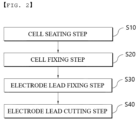
- FIG. 2 is a view showing a method of cutting an electrode lead of a battery cell according to a first embodiment of the present invention.
- the electrode lead cutting method includes a cell seating step (S10), a cell fixing step (S20), an electrode lead fixing step (S30), and an electrode lead cutting step (S40).
- a battery cell 10 is loaded on the suction plate 110.
- the battery cell 10 may be loaded on the suction plate 110 by a transfer unit, such as a robot arm.
- An electrode lead 12, which is a target to be cut, may be exposed outside the suction plate 110.
- a metal that exhibits high conductivity while not causing a chemical change in the battery may be applied as the electrode lead 12 of the battery cell 10, although not particularly restricted.
- the electrode lead 12 may be selected from the group consisting of copper (Cu), aluminum (Al), nickel (Ni), iron (Fe), carbon (C), chromium (Cr), manganese (Mn), and an alloy including two or more thereof, and may be formed in the shape of a thin plate having a thickness of 0.1 mm to 1.0 mm.
- the battery cell 10 is fixed. Since the seating recess 112 is formed in the suction plate 110 so as to correspond to the external appearance of the battery cell 10, movement of the battery cell 10 loaded on the suction plate 110 in the X-axis or Y-axis direction may be prevented. In addition, the battery cell 10 is suctioned by the suction plate 110, in which the vacuum hole 111 is formed, in a vacuum state, whereby the battery cell may be stably fixed in the cutting process.
- the electrode lead 12 may exhibit predetermined flexibility since the electrode lead has a thickness of about 0.1 mm to 1.0 mm.
- the cutting operation may be performed on the electrode lead 12 in the state in which the end of the electrode lead is tilted.
- the electrode lead 12 may be in the state of being tilted upwards.
- the electrode lead 12 is cut in this state, there may occur the difference between the cutting length and the setting length of the electrode lead.
- air is injected from the air blower disposed above the electrode lead 12. In the case in which the air is supplied, the electrode lead 12 is pushed downwards, and the pushed electrode lead 12 is maintained in the horizontal state. Consequently, the point of the electrode lead 12 to be cut may be stably secured.
- the electrode lead 12 is cut to the setting length thereof. That is, at least one of the first cutting blade 211 and the second cutting blade 212 is moved upwards and downwards to cut the electrode lead 12 in the state in which the electrode lead 12 is maintained in the horizontal state by the air blower. Since the cutting operation is performed in the state in which the electrode lead 12 is maintained in the horizontal state and the point of the electrode lead 12 to be cut is fixed, as described above, it is possible to minimize an error between the cutting length and the setting length of the electrode lead 12 at the time of cutting the electrode lead.
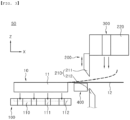
- FIG. 3 is a view schematically showing an electrode lead cutting apparatus according to a second embodiment of the present invention.
- the electrode lead cutting apparatus 50 includes a cell fixing unit 100, an electrode lead cutting unit 200, an electrode lead fixing unit 300, and an electrode lead supporting unit 400.
- Constructions of the cell fixing unit 100, the electrode lead cutting unit 200, and the electrode lead fixing unit 300 are identical or similar to those in the first embodiment, and therefore a detailed description thereof will be omitted.
- the electrode lead supporting unit 400 is disposed under an electrode lead 12 to support the electrode lead 12.
- the electrode lead supporting unit 400 may prevent drooping of the electrode lead 12 at the time of cutting the electrode lead 12. For example, when air is supplied downwards from an air blower located about the electrode lead 12, the electrode lead 12 may be drooped by the pressure at which the air is supplied.
- the electrode lead supporting unit 400 supports the electrode lead 12 under the electrode lead 12, whereby it is possible to prevent drooping of the electrode lead 12. Consequently, it is possible to secure a correct point of the electrode lead 12 to be cut at the time of cutting the electrode lead.
- the electrode lead supporting unit 400 may include a magnetic block.
- the magnetic block may fix the electrode lead 12 using magnetic force. Consequently, the electrode lead 12 may be more securely fixed by the air blower, which supplies air from above the electrode lead 12, and the magnetic block, which fixes the lower side of the electrode lead 12 using magnetic force. Since the fixed state of the electrode lead 12 is secured, it is possible to easily secure the point of the electrode lead 12 to be cut. Consequently, it is possible to minimize an error between the cutting length and the setting length of the electrode lead 12 at the time of cutting the electrode lead.
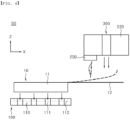
- FIG. 4 is a view schematically showing an electrode lead cutting apparatus according to a third embodiment of the present invention.
- the electrode lead cutting apparatus 50 includes a cell fixing unit 100, an electrode lead cutting unit, and an electrode lead fixing unit 300.
- Constructions of the cell fixing unit 100 and the electrode lead fixing unit 300 are identical or similar to those in the first embodiment, and therefore a detailed description thereof will be omitted.
- burrs or electrode particles may be generated on the end surface of the electrode lead 12.
- the burrs or the electrode particles generated on the end surface of the electrode lead 12 may be mixed in a battery cell 10, whereby performance of the battery cell 10 may be deteriorated.
- the electrode lead cutting unit of the third embodiment may include a laser oscillator 230.
- the laser oscillator 230 may apply a laser beam to a point of the electrode lead 12 to be cut in order to cut the electrode lead 12. Consequently, it is possible to minimize the amount of burrs or electrode particles generated on the cut surface of the electrode lead 12 at the time of cutting the electrode lead 12.
- air is supplied to a point of an electrode lead to be cut through an air blower at the time of cutting the electrode lead such that the electrode lead is maintained in a horizontal state, whereby it is possible to minimize an error in the cutting length of the electrode lead at the time of cutting the electrode lead.
- a supporting unit such as a magnetic block, is disposed under the electrode lead at the time of cutting the electrode lead, whereby it is possible to prevent the point of the electrode lead to be cut from being tilted in the downward direction at the time of supplying air through the air blower.
Landscapes
- Engineering & Computer Science (AREA)
- Mechanical Engineering (AREA)
- Life Sciences & Earth Sciences (AREA)
- Forests & Forestry (AREA)
- Electrochemistry (AREA)
- Chemical Kinetics & Catalysis (AREA)
- Chemical & Material Sciences (AREA)
- General Chemical & Material Sciences (AREA)
- Physics & Mathematics (AREA)
- Optics & Photonics (AREA)
- Plasma & Fusion (AREA)
- Manufacturing & Machinery (AREA)
- Battery Electrode And Active Subsutance (AREA)
- Connection Of Batteries Or Terminals (AREA)
Description
- The present invention relates to an electrode lead cutting apparatus capable of cutting an electrode lead of a battery cell to the setting length of the electrode lead.
- In recent years, as mobile devices have been increasingly developed and the demand for such mobile devices has increased, the demand for secondary batteries that are capable of being charged and discharged as energy sources for such mobile devices has also sharply increased. In addition, a lot of research on secondary batteries that are capable of satisfying various requirements of such mobile devices has been carried out.
- In addition, secondary batteries have also attracted considerable attention as power sources for an electric vehicle (EV), a hybrid electric vehicle (HEV), and a plug-in hybrid electric vehicle (Plug-In HEV), which have been proposed to solve problems, such as air pollution, caused by existing gasoline and diesel vehicles using fossil fuels.
- Among such secondary batteries is a lithium secondary battery having a high energy density and a high voltage, into which much research has been carried out and which has also been commercialized and widely used. Typically, the demand for a pouch-type battery cell, which has a small thickness, is easily arranged in a stacked state, and is partially deformable, is high in terms of the shape of the battery.
- The pouch-type battery cell is configured to have a structure in which an electrode assembly and an electrolytic solution are received in a pouch-type laminate sheet capable of receiving the electrode assembly therein. In a narrow meaning, the laminate sheet is called a "pouch-type battery case," and a resin layer of the laminate sheet is characterized in that the resin layer is fusible by heat.
- The pouch-type battery cell is particularly configured to have a structure in which the laminate sheet wraps the electrode assembly such that the electrode assembly is not exposed outside, and is configured to have a structure in which heat and pressure are applied to portions of the laminate sheet to be sealed overlapping at the outer edge of the battery case in order to seal the laminate sheet.
- For example, the battery cell is configured to have a structure in which the outer edges of the battery case are sealed in the state in which electrode leads protrude outwards from the battery case. Here, each of the electrode leads is made of a conductive metal material, is formed in a bar shape, and has a polygonal structure having angled corners when viewed in a plan view. In general, the electrode lead is configured to have a long rectangular structure.
- The electrode leads are cut to predetermined lengths, e.g. lengths that the electrode leads can easily be connected to a printed circuit board (PCB) (not shown) or an external electric device (not shown), in the state of being inserted into cutting jigs configured to intersect up and down.
- Conventionally, however, at the time of cutting each of the electrode leads, the cutting position of the electrode lead may be tilted due to the property of the electrode lead, such as flexibility. As a result, it may be difficult to cut a correct point of the electrode lead to be cut, and therefore the lengths of the electrode leads that are cut may be different from each other, which may cause process defects.
KR 101 816 254 B1 KR 2010 0093986 A JP H09 320567 A KR 2004 0026543 A JP H05 95806 U -
Korean Patent Application Publication No. 10-2018-037488 - An embodiment of the present invention provides an electrode lead cutting apparatus capable of accurately cutting a point of an electrode lead to be cut.
- Objects of the present invention are not limited to the aforementioned object, and other unmentioned objects and advantages will be understood from the following description.
- An electrode lead cutting apparatus for battery cells according to an embodiment of the present invention is defined in the appended set of claims, the electrode lead cutting apparatus includes a cell fixing unit configured to fix a battery cell, an electrode lead fixing unit configured to supply air to an electrode lead of the battery cell in order to fix a point of the electrode lead to be cut, and an electrode lead cutting unit configured to cut the point of the electrode lead to be cut.
- In the embodiment of the present invention, the cell fixing unit may include a suction plate configured to suction the battery cell in a vacuum state.
- In the embodiment of the present invention, the electrode lead cutting unit may include a cutting blade configured to cut the electrode lead in the state of being in contact with the point of the electrode lead to be cut, and the cutting blade may include a first cutting blade located above the point of the electrode lead to be cut and a second cutting blade located below the point of the electrode lead to be cut. The electrode lead cutting unit may further include a guide block, and at least one of the first cutting blade and the second cutting blade may be coupled to the guide block so as to be movable upwards and downwards.
- In the embodiment of the present invention, the electrode lead cutting unit may include a laser oscillator configured to apply a laser beam to the point of the electrode lead to be cut.
- In the embodiment of the present invention, the electrode lead cutting apparatus further includes an electrode lead supporting unit disposed under the electrode lead, the electrode lead supporting unit being configured to support the electrode lead. The electrode lead supporting unit may include a magnetic block configured to fix the electrode lead using magnetic force.
- In addition, an electrode lead cutting method for battery cells according to another embodiment of the present invention may include a step of loading a battery cell having an electrode lead exposed therefrom, a step of supplying air from above the electrode lead to fix a point of the electrode lead to be cut, and a step of cutting the fixed point of the electrode lead to be cut.
- In the embodiment of the present invention, the electrode lead cutting method may further include a step of providing magnetic force from under the electrode lead to fix the electrode lead using the magnetic force at the time of cutting the electrode lead.
- The following drawings appended in this specification illustrate preferred embodiments of the present invention, and serve to make it possible to further understand the technical idea of the present invention together with the detailed description of the invention, which will follow. Therefore, the present invention is not necessary to be interpreted in the state of being limited only to matters described in the drawings.
-
FIG. 1 is a view schematically showing an electrode lead cutting apparatus according to a first embodiment of the present invention. -
FIG. 2 is a flowchart schematically showing an electrode lead cutting method according to a first embodiment of the present invention. -
FIG. 3 is a view schematically showing an electrode lead cutting apparatus according to a second embodiment of the present invention. -
FIG. 4 is a view schematically showing an electrode lead cutting apparatus according to a third embodiment of the present invention. - Hereinafter, embodiments of the present invention will be described in detail with reference to the accompanying drawings. The present invention may be embodied in various different forms, and is not limited to the embodiments described herein.
- In order to clearly describe the present invention, a detailed description of parts having no relation with the essence of the present invention may be omitted, and the same or similar elements are denoted by the same reference numerals throughout the specification.
- Also, in the case in which a part "includes" a component, this means that the part may not exclude another component but may further include another component unless otherwise mentioned. The terms used herein are intended only to mention specific embodiments, not to limit the present invention, and may be interpreted as concepts that are understood by a person having ordinary skill in the art to which the present invention pertains unless otherwise defined in this specification.
-
FIG. 1 is a view schematically showing an electrode lead cutting apparatus according to a first embodiment of the present invention. - Referring to
FIG. 1 , the electrodelead cutting apparatus 50 includes acell fixing unit 100, an electrodelead cutting unit 200, and an electrodelead fixing unit 300. In the embodiment of the present invention, the longitudinal direction of an electrode lead in which the electrode lead extends is set to an X-axis direction, the width direction of the electrode lead perpendicular to the X-axis direction is set to a Y-axis direction, and the direction perpendicular to the X-axis and Y-axis directions is set to a Z-axis direction. - A
battery cell 10 that is applied to the embodiment of the present invention may be configured to have a structure in which an electrode assembly and an electrolytic solution are received in apouch sheathing member 11. For example, thebattery cell 10 may be a pouch-type battery cell. In addition, the battery cell may be a secondary battery that performs charging and discharging operations. - An
electrode lead 12 may be provided outside thepouch sheathing member 11 in a protruding form. One end of theelectrode lead 12 is electrically connected to the electrode assembly, and the other end of theelectrode lead 12 is exposed outside thepouch sheathing member 11, whereby theelectrode lead 12 may serve as a connection terminal of thebattery cell 10. - The
cell fixing unit 100 fixes thebattery cell 10, which is a processing target. Thecell fixing unit 100 may include asuction plate 110 configured to suction thebattery cell 10 in a vacuum state. Thesuction plate 110 may be formed in a flat shape such that one surface of thebattery cell 10 is seated on the suction plate. Thebattery cell 10 may be disposed on thesuction plate 110 in the horizontal direction. For example, thebattery cell 10 may be seated on thesuction plate 110 in the form in which the electrode lead 12 exposed outside the electrode assembly extends in the X-axis direction. - At least one
vacuum hole 111 may be formed in thesuction plate 110. Thevacuum hole 111 may be formed through thesuction plate 110 in the Z-axis direction. Thesuction plate 110 may suction a battery cell located so as to correspond to thevacuum hole 111. Consequently, the battery cell may be suctioned on thesuction plate 110 in a vacuum state, whereby the battery cell may be stably fixed during cutting of theelectrode lead 12. - A
seating recess 112 may be formed in one surface of thesuction plate 110 on which thebattery cell 10 is seated, e.g. the upper surface of thesuction plate 110. Theseating recess 112 is formed so as to be recessed from the upper surface of thesuction plate 110 in a concave shape in the downward direction. Theseating recess 112 is formed so as to correspond to the external appearance of thebattery cell 10. Consequently, thebattery cell 10 may be seated in theseating recess 112, whereby movement of the battery cell in the X-axis or Y-axis direction may be prevented. Therefore, it is possible to improve the accuracy at the time of cutting theelectrode lead 12. - As the
cell fixing unit 100, a gripper and the like may be applied in addition to thesuction plate 110. In the case in which thebattery cell 10 is fixed by the gripper and the like, however, the portion of thebattery cell 10 fixed by the gripper under pressure may be deformed or damaged. Preferably, therefore, thesuction plate 110 is applied as thecell fixing unit 100. - The electrode
lead cutting unit 200 cuts theelectrode lead 12. The electrodelead cutting unit 200 may include acutting blade 210 configured to cut theelectrode lead 12 in the state of being in contact with the electrode lead. Thecutting blade 210 cuts a point of theelectrode lead 12 to be cut. - The
cutting blade 210 may include afirst cutting blade 211 and asecond cutting blade 212. Thefirst cutting blade 211 may be located above the point of theelectrode lead 12 to be cut, and thesecond cutting blade 212 may be located below the point of theelectrode lead 12 to be cut. Thefirst cutting blade 211 and thesecond cutting blade 212 may be disposed so as to cut theelectrode lead 12 while intersecting each other. - The electrode
lead cutting unit 200 may include aguide block 220. Theguide block 220 may guide movement of thecutting blade 210 in the Z-axis direction, i.e. the upward-downward movement of the cutting blade, while supporting thecutting blade 210. For example, thefirst cutting blade 211 and thesecond cutting blade 212 may be coupled to theguide block 220, and at least one of thefirst cutting blade 211 and thesecond cutting blade 212 may be coupled to theguide block 220 so as to be movable upwards and downwards. Theguide block 220 may be provided with a guide rail (not shown) configured to guide the upward-downward movement of thecutting blade 210. - The electrode
lead fixing unit 300 fixes theelectrode lead 12 at the time of cutting theelectrode lead 12. An air blower configured to supply air to theelectrode lead 12 of thebattery cell 10 in order to fix the point of theelectrode lead 12 to be cut may be applied as the electrodelead fixing unit 300. The air blower is mounted to theguide block 220 so as to be located above theelectrode lead 12. The air blower may be disposed at a position corresponding to the end of theelectrode lead 12. That is, thecutting blade 210 may be disposed at one side of thebattery cell 10, and the air blower may be disposed at one side of thecutting blade 210. - At the time of cutting the
electrode lead 12, air supplied from the air blower applies pressure to theelectrode lead 12, whereby theelectrode lead 12 extending in the X-axis direction is disposed in a horizontal state, and the axial direction of thecutting blade 210 becomes perpendicular to theelectrode lead 12, and therefore it is possible to provide a correct point of theelectrode lead 12 to be cut. - In the case in which the
electrode lead 12 is cut in the state of being tilted in one direction, on the other hand, the longitudinal direction of theelectrode lead 12 does not become perpendicular to the axial direction of thecutting blade 210. In the case in whichelectrode lead 12 is cut in this state, there may occur an error between the cutting length and the setting length of theelectrode lead 12. -
FIG. 2 is a view showing a method of cutting an electrode lead of a battery cell according to a first embodiment of the present invention. - Referring to
FIGS. 1 and2 , the electrode lead cutting method includes a cell seating step (S10), a cell fixing step (S20), an electrode lead fixing step (S30), and an electrode lead cutting step (S40). - In the cell seating step (S10), a
battery cell 10 is loaded on thesuction plate 110. Thebattery cell 10 may be loaded on thesuction plate 110 by a transfer unit, such as a robot arm. Anelectrode lead 12, which is a target to be cut, may be exposed outside thesuction plate 110. - A metal that exhibits high conductivity while not causing a chemical change in the battery may be applied as the
electrode lead 12 of thebattery cell 10, although not particularly restricted. For example, theelectrode lead 12 may be selected from the group consisting of copper (Cu), aluminum (Al), nickel (Ni), iron (Fe), carbon (C), chromium (Cr), manganese (Mn), and an alloy including two or more thereof, and may be formed in the shape of a thin plate having a thickness of 0.1 mm to 1.0 mm. - In the cell fixing step (S20), the
battery cell 10 is fixed. Since theseating recess 112 is formed in thesuction plate 110 so as to correspond to the external appearance of thebattery cell 10, movement of thebattery cell 10 loaded on thesuction plate 110 in the X-axis or Y-axis direction may be prevented. In addition, thebattery cell 10 is suctioned by thesuction plate 110, in which thevacuum hole 111 is formed, in a vacuum state, whereby the battery cell may be stably fixed in the cutting process. - In the electrode lead fixing step (S30), a point of the
electrode lead 12 to be cut is fixed before cutting theelectrode lead 12. That is, theelectrode lead 12 may exhibit predetermined flexibility since the electrode lead has a thickness of about 0.1 mm to 1.0 mm. As a result, the cutting operation may be performed on theelectrode lead 12 in the state in which the end of the electrode lead is tilted. For example, theelectrode lead 12 may be in the state of being tilted upwards. In the case in which theelectrode lead 12 is cut in this state, there may occur the difference between the cutting length and the setting length of the electrode lead. In order to prevent this, air is injected from the air blower disposed above theelectrode lead 12. In the case in which the air is supplied, theelectrode lead 12 is pushed downwards, and the pushedelectrode lead 12 is maintained in the horizontal state. Consequently, the point of theelectrode lead 12 to be cut may be stably secured. - In the electrode lead cutting step (S40), the
electrode lead 12 is cut to the setting length thereof. That is, at least one of thefirst cutting blade 211 and thesecond cutting blade 212 is moved upwards and downwards to cut theelectrode lead 12 in the state in which theelectrode lead 12 is maintained in the horizontal state by the air blower. Since the cutting operation is performed in the state in which theelectrode lead 12 is maintained in the horizontal state and the point of theelectrode lead 12 to be cut is fixed, as described above, it is possible to minimize an error between the cutting length and the setting length of theelectrode lead 12 at the time of cutting the electrode lead. -
FIG. 3 is a view schematically showing an electrode lead cutting apparatus according to a second embodiment of the present invention. - Referring to
FIG. 3 , the electrodelead cutting apparatus 50 includes acell fixing unit 100, an electrodelead cutting unit 200, an electrodelead fixing unit 300, and an electrodelead supporting unit 400. - Constructions of the
cell fixing unit 100, the electrodelead cutting unit 200, and the electrodelead fixing unit 300 are identical or similar to those in the first embodiment, and therefore a detailed description thereof will be omitted. - The electrode
lead supporting unit 400 is disposed under anelectrode lead 12 to support theelectrode lead 12. The electrodelead supporting unit 400 may prevent drooping of theelectrode lead 12 at the time of cutting theelectrode lead 12. For example, when air is supplied downwards from an air blower located about theelectrode lead 12, theelectrode lead 12 may be drooped by the pressure at which the air is supplied. The electrodelead supporting unit 400 supports theelectrode lead 12 under theelectrode lead 12, whereby it is possible to prevent drooping of theelectrode lead 12. Consequently, it is possible to secure a correct point of theelectrode lead 12 to be cut at the time of cutting the electrode lead. - The electrode
lead supporting unit 400 may include a magnetic block. The magnetic block may fix theelectrode lead 12 using magnetic force. Consequently, theelectrode lead 12 may be more securely fixed by the air blower, which supplies air from above theelectrode lead 12, and the magnetic block, which fixes the lower side of theelectrode lead 12 using magnetic force. Since the fixed state of theelectrode lead 12 is secured, it is possible to easily secure the point of theelectrode lead 12 to be cut. Consequently, it is possible to minimize an error between the cutting length and the setting length of theelectrode lead 12 at the time of cutting the electrode lead. -
FIG. 4 is a view schematically showing an electrode lead cutting apparatus according to a third embodiment of the present invention. - Referring to
FIG. 4 , the electrodelead cutting apparatus 50 includes acell fixing unit 100, an electrode lead cutting unit, and an electrodelead fixing unit 300. - Constructions of the
cell fixing unit 100 and the electrodelead fixing unit 300 are identical or similar to those in the first embodiment, and therefore a detailed description thereof will be omitted. - In the case in which an
electrode lead 12 is cut using thecutting blade 210, as in the first embodiment, burrs or electrode particles may be generated on the end surface of theelectrode lead 12. The burrs or the electrode particles generated on the end surface of theelectrode lead 12 may be mixed in abattery cell 10, whereby performance of thebattery cell 10 may be deteriorated. - For this reason, the electrode lead cutting unit of the third embodiment may include a
laser oscillator 230. Thelaser oscillator 230 may apply a laser beam to a point of theelectrode lead 12 to be cut in order to cut theelectrode lead 12. Consequently, it is possible to minimize the amount of burrs or electrode particles generated on the cut surface of theelectrode lead 12 at the time of cutting theelectrode lead 12. - Those skilled in the art to which the present invention pertains should understand that the above embodiments are illustrative, not restrictive, in all aspects, since the present invention can be embodied in other concrete forms without changing the technical idea or essential features thereof.
- The scope of the present invention is limited by the appended claims, rather than the detailed description of the present invention, and all changes or modifications derived from the meaning and scope of the claims and the equivalent concept thereof should be construed as falling within the scope of the present invention.
-
- 50: Electrode lead cutting apparatus 100: Cell fixing unit
- 110: Suction plate 111: Vacuum hole
- 200: Electrode lead cutting unit 210: Cutting blade
- 211: First cutting blade 212: Second cutting blade
- 220: Guide block 230: Laser oscillator
- 300: Electrode lead fixing unit 400: Electrode lead supporting unit
- According to an embodiment of the present invention, air is supplied to a point of an electrode lead to be cut through an air blower at the time of cutting the electrode lead such that the electrode lead is maintained in a horizontal state, whereby it is possible to minimize an error in the cutting length of the electrode lead at the time of cutting the electrode lead.
- In addition, a supporting unit, such as a magnetic block, is disposed under the electrode lead at the time of cutting the electrode lead, whereby it is possible to prevent the point of the electrode lead to be cut from being tilted in the downward direction at the time of supplying air through the air blower.
Claims (8)
- An electrode lead cutting apparatus (50) for pouch-type battery cells (10), the electrode lead cutting apparatus comprising:a cell fixing unit (100) configured to fix a battery cell having an electrode lead exposed therefrom;an electrode lead fixing unit (300), provided as an air blower mounted to a guide block (220) so as to be located above the electrode lead (12),configured to supply air to the electrode lead of the battery cell in order to fix a point of the electrode lead to be cut;an electrode lead cutting unit (200) configured to cut the point of the electrode lead to be cut; andan electrode lead supporting unit (400) disposed under the electrode lead, the electrode lead supporting unit (400) being configured to support the electrode lead.
- The electrode lead cutting apparatus according to claim 1, wherein the cell fixing unit (100) comprises a suction plate (110) configured to suction the battery cell in a vacuum state.
- The electrode lead cutting apparatus according to claim 1, whereinthe electrode lead cutting unit (200) comprises a cutting blade (210) configured to cut the electrode lead in a state of being in contact with the point of the electrode lead to be cut, andthe cutting blade (210) comprises a first cutting blade (211) located above the point of the electrode lead to be cut and a second cutting blade (212) located below the point of the electrode lead to be cut.
- The electrode lead cutting apparatus according to claim 3, wherein
at least one of the first cutting blade (211) and the second cutting blade (212) is coupled to the guide block (220) so as to be movable upwards and downwards. - The electrode lead cutting apparatus according to claim 1, wherein the electrode lead cutting unit (200) comprises a laser oscillator configured to apply a laser beam to the point of the electrode lead to be cut.
- The electrode lead cutting apparatus according to claim 1, wherein the electrode lead supporting unit (400) comprises a magnetic block configured to fix the electrode lead using magnetic force.
- An electrode lead cutting method using the apparatus according to claim 1 comprising:loading a battery cell having an electrode lead exposed therefrom;supplying air from above the electrode lead to fix a point of the electrode lead to be cut; andcutting the fixed point of the electrode lead to be cut.
- The electrode lead cutting method according to claim 7, further comprising providing magnetic force from under the electrode lead to fix the electrode lead using the magnetic force at a time of cutting the electrode lead.
Applications Claiming Priority (2)
| Application Number | Priority Date | Filing Date | Title |
|---|---|---|---|
| KR1020180145971A KR102655101B1 (en) | 2018-11-23 | 2018-11-23 | Electrode lead cutting apparatus of battery cell |
| PCT/KR2019/015389 WO2020105939A1 (en) | 2018-11-23 | 2019-11-13 | Electrode lead cutting apparatus for battery cell |
Publications (3)
| Publication Number | Publication Date |
|---|---|
| EP3854548A1 EP3854548A1 (en) | 2021-07-28 |
| EP3854548A4 EP3854548A4 (en) | 2022-01-12 |
| EP3854548B1 true EP3854548B1 (en) | 2025-03-12 |
Family
ID=70774733
Family Applications (1)
| Application Number | Title | Priority Date | Filing Date |
|---|---|---|---|
| EP19887330.9A Active EP3854548B1 (en) | 2018-11-23 | 2019-11-13 | Electrode lead cutting apparatus for battery cells |
Country Status (8)
| Country | Link |
|---|---|
| US (1) | US11491582B2 (en) |
| EP (1) | EP3854548B1 (en) |
| JP (1) | JP7045573B2 (en) |
| KR (1) | KR102655101B1 (en) |
| CN (1) | CN111741837A (en) |
| ES (1) | ES3021482T3 (en) |
| HU (1) | HUE071025T2 (en) |
| WO (1) | WO2020105939A1 (en) |
Families Citing this family (7)
| Publication number | Priority date | Publication date | Assignee | Title |
|---|---|---|---|---|
| KR102869905B1 (en) | 2020-11-13 | 2025-10-14 | 주식회사 엘지에너지솔루션 | Device for cutting electrode |
| KR102279118B1 (en) * | 2021-04-13 | 2021-07-19 | (주)지피아이 | Laser notching device with scrap and hume suction device |
| KR102818419B1 (en) * | 2021-10-14 | 2025-06-13 | 주식회사 엔에스머티리얼즈 | Method for fabricating lead tab of secondary battery |
| KR102791008B1 (en) * | 2021-12-07 | 2025-04-07 | (주)에이티비 | Waste battery dismantling system |
| KR20230125675A (en) * | 2022-02-21 | 2023-08-29 | 주식회사 엘지에너지솔루션 | Cutting device and method for electrode |
| KR102727850B1 (en) * | 2024-03-25 | 2024-11-11 | 주식회사 우원기술 | Pulling device for cell stack |
| KR20260011896A (en) | 2024-07-17 | 2026-01-26 | 주식회사 엘지에너지솔루션 | Apparatus and method for manufacturing electrode assemblies |
Family Cites Families (31)
| Publication number | Priority date | Publication date | Assignee | Title |
|---|---|---|---|---|
| JPH0445242Y2 (en) * | 1987-05-11 | 1992-10-23 | ||
| JPH0747290Y2 (en) | 1992-06-05 | 1995-11-01 | 高野ベアリング株式会社 | Separating device for continuous individual packaging |
| JP3089351B2 (en) | 1996-05-28 | 2000-09-18 | 古河電池株式会社 | Tab welding apparatus for battery electrode plate and method for manufacturing battery electrode plate using the same |
| JP3787437B2 (en) * | 1998-07-31 | 2006-06-21 | 日本特殊陶業株式会社 | Flat battery and method of manufacturing the same |
| GB2356291B (en) * | 1999-11-13 | 2003-10-22 | Rolls Royce Plc | A workpiece clamping system |
| KR100803001B1 (en) | 2002-09-25 | 2008-02-14 | 주식회사 에스에프에이 | Battery manufacturing apparatus and method |
| JP2004186635A (en) * | 2002-12-06 | 2004-07-02 | Sharp Corp | Semiconductor substrate cutting apparatus and method |
| CN1979924B (en) | 2005-12-10 | 2010-08-25 | 深圳市比克电池有限公司 | Method for cutting lithium ion cell pole piece |
| KR100865166B1 (en) | 2007-08-13 | 2008-10-24 | 회광하이테크 주식회사 | Lead film bonding device for lithium polymer battery |
| KR101255628B1 (en) * | 2009-02-17 | 2013-04-16 | 주식회사 엘지화학 | Method Of Manufacturing Battery Pack With Flexible Manufacturing Plan |
| WO2011158903A1 (en) * | 2010-06-17 | 2011-12-22 | 日産自動車株式会社 | Workpiece-positioning device and battery manufacturing method |
| JP2012003960A (en) | 2010-06-17 | 2012-01-05 | Sumitomo Electric Ind Ltd | Method for producing lead member |
| WO2012053452A1 (en) * | 2010-10-19 | 2012-04-26 | 日産自動車株式会社 | Laser cutting method |
| JP5997876B2 (en) * | 2011-04-07 | 2016-09-28 | 株式会社京都製作所 | Battery electrode member conveying apparatus and method thereof |
| RU2534746C1 (en) | 2011-04-07 | 2014-12-10 | Ниссан Мотор Ко., Лтд. | Device and method for manufacturing accumulator electrodes |
| JPWO2013031889A1 (en) | 2011-08-31 | 2015-03-23 | Necエナジーデバイス株式会社 | Method for manufacturing battery electrode |
| JP2014035811A (en) | 2012-08-07 | 2014-02-24 | Showa Denko Packaging Co Ltd | Terminal lead |
| KR101365338B1 (en) | 2012-11-28 | 2014-02-27 | 전해병 | Press die for sheet plate |
| KR101311912B1 (en) | 2013-02-26 | 2013-09-26 | (주)파인테크 | Embossed mold cutting apparatus |
| TWM461498U (en) | 2013-02-27 | 2013-09-11 | Sparking Power Technology Co Ltd | Workpiece pressing-abutting device of laser cutting machine |
| KR101772729B1 (en) | 2013-10-30 | 2017-08-29 | 주식회사 엘지화학 | Jig device and processing method of using thereof |
| JP2015106442A (en) | 2013-11-28 | 2015-06-08 | 株式会社豊田自動織機 | Electrode manufacturing method, and electrode manufacturing apparatus |
| CN204800154U (en) | 2015-06-12 | 2015-11-25 | 宁德新能源科技有限公司 | Pole piece laser cutting device |
| CN205167025U (en) | 2015-09-23 | 2016-04-20 | 上海和鹰机电科技股份有限公司 | Cutter subregion adsorption system and cutter |
| CN106132141A (en) | 2016-08-03 | 2016-11-16 | 南昌欧菲光学技术有限公司 | Electronic product, glass shell and manufacture equipment thereof and method |
| KR102066909B1 (en) * | 2016-10-04 | 2020-01-16 | 주식회사 엘지화학 | Electrode Lead Machining Apparatus Capable of Forming Round Shape at Electrode Lead and Battery Cell Comprising Machined Electrode Lead by Using the Same |
| KR101816254B1 (en) | 2016-10-20 | 2018-02-22 | 주식회사 엠테크닉스 | Electrode tap cutting device of pouch cell |
| KR101813249B1 (en) | 2017-02-10 | 2017-12-29 | 신현집 | Apparatus for cutting jelly roll tab of lithium secondary battery |
| KR102236056B1 (en) | 2017-06-29 | 2021-04-05 | 주식회사 엘지화학 | Battery cell for preventing overcharge |
| CN207105103U (en) | 2017-08-28 | 2018-03-16 | 淮安市远成光伏科技有限公司 | A kind of solar cell backboard fairlead shedding motion |
| CN208033936U (en) | 2018-02-13 | 2018-11-02 | 深圳吉阳智能科技有限公司 | A kind of device using laser cutting electrodes of lithium-ion batteries |
-
2018
- 2018-11-23 KR KR1020180145971A patent/KR102655101B1/en active Active
-
2019
- 2019-11-13 CN CN201980006278.0A patent/CN111741837A/en active Pending
- 2019-11-13 ES ES19887330T patent/ES3021482T3/en active Active
- 2019-11-13 EP EP19887330.9A patent/EP3854548B1/en active Active
- 2019-11-13 HU HUE19887330A patent/HUE071025T2/en unknown
- 2019-11-13 JP JP2020524576A patent/JP7045573B2/en active Active
- 2019-11-13 US US16/961,957 patent/US11491582B2/en active Active
- 2019-11-13 WO PCT/KR2019/015389 patent/WO2020105939A1/en not_active Ceased
Also Published As
| Publication number | Publication date |
|---|---|
| KR20200060864A (en) | 2020-06-02 |
| KR102655101B1 (en) | 2024-04-08 |
| JP2021509756A (en) | 2021-04-01 |
| CN111741837A (en) | 2020-10-02 |
| ES3021482T3 (en) | 2025-05-27 |
| EP3854548A1 (en) | 2021-07-28 |
| HUE071025T2 (en) | 2025-07-28 |
| WO2020105939A1 (en) | 2020-05-28 |
| JP7045573B2 (en) | 2022-04-01 |
| US11491582B2 (en) | 2022-11-08 |
| US20200406402A1 (en) | 2020-12-31 |
Similar Documents
| Publication | Publication Date | Title |
|---|---|---|
| US11491582B2 (en) | Electrode lead cutting apparatus for battery cells | |
| US20220416374A1 (en) | Apparatus and Method for Bending Electrode Tab | |
| KR102172519B1 (en) | Bus bar assembly for connecting electrode lead and Battery module including the same | |
| US20100024203A1 (en) | Manufacturing method of electrode for battery | |
| US10056597B2 (en) | Connecting structure and method between grid and electrode tab of secondary battery | |
| CN101578722A (en) | Secondary battery and method for manufacturing same | |
| CN118472517A (en) | Power storage device | |
| US12308476B2 (en) | Battery module | |
| US20140023913A1 (en) | Prismatic secondary battery | |
| US8574756B1 (en) | Prismatic secondary battery | |
| EP4418442A1 (en) | Battery cell, battery module, and manufacturing method of the same | |
| KR102871993B1 (en) | Nonaqueous electrolyte solution secondary battery | |
| US20260027654A1 (en) | Welding method and welding structure | |
| US20240145891A1 (en) | Method of manufacturing secondary battery | |
| US20260038978A1 (en) | Battery Module and Manufacturing Method of the Same | |
| EP4661142A1 (en) | Battery activation device | |
| JP7745583B2 (en) | Method for manufacturing an electricity storage device | |
| KR20260024950A (en) | Battery cell, manufacturing apparatus of battery cell and manufacturing method of battery cell | |
| US20250183422A1 (en) | Battery can having substantially zero-radius interior corners | |
| KR20250107406A (en) | Tab guide adjusting apparatus and method of adjusting the tab guide using the same | |
| EP4651276A1 (en) | Battery cell and manufacturing method of the same | |
| EP4383443A1 (en) | Multipurpose jig for manufacturing rechargeable battery and method for setting manufacturing apparatus using same | |
| EP4465437A1 (en) | Electricity storage device | |
| EP4726821A1 (en) | A system and a method for manufacturing a secondary battery assembly | |
| EP4583263A1 (en) | Battery cell, battery cell case, and manufacturing method thereof |
Legal Events
| Date | Code | Title | Description |
|---|---|---|---|
| STAA | Information on the status of an ep patent application or granted ep patent |
Free format text: STATUS: THE INTERNATIONAL PUBLICATION HAS BEEN MADE |
|
| PUAI | Public reference made under article 153(3) epc to a published international application that has entered the european phase |
Free format text: ORIGINAL CODE: 0009012 |
|
| STAA | Information on the status of an ep patent application or granted ep patent |
Free format text: STATUS: REQUEST FOR EXAMINATION WAS MADE |
|
| 17P | Request for examination filed |
Effective date: 20200611 |
|
| AK | Designated contracting states |
Kind code of ref document: A1 Designated state(s): AL AT BE BG CH CY CZ DE DK EE ES FI FR GB GR HR HU IE IS IT LI LT LU LV MC MK MT NL NO PL PT RO RS SE SI SK SM TR |
|
| REG | Reference to a national code |
Ref country code: DE Ref legal event code: R079 Free format text: PREVIOUS MAIN CLASS: B26D0001060000 Ipc: H01M0010040000 Ref country code: DE Ref legal event code: R079 Ref document number: 602019067320 Country of ref document: DE Free format text: PREVIOUS MAIN CLASS: B26D0001060000 Ipc: H01M0010040000 |
|
| A4 | Supplementary search report drawn up and despatched |
Effective date: 20211213 |
|
| RIC1 | Information provided on ipc code assigned before grant |
Ipc: B26D 7/00 20060101ALI20211207BHEP Ipc: B26D 7/01 20060101ALI20211207BHEP Ipc: B26D 1/06 20060101ALI20211207BHEP Ipc: H01M 10/052 20100101ALI20211207BHEP Ipc: H01M 50/105 20210101ALI20211207BHEP Ipc: H01M 10/04 20060101AFI20211207BHEP |
|
| RAP1 | Party data changed (applicant data changed or rights of an application transferred) |
Owner name: LG ENERGY SOLUTION LTD. |
|
| DAV | Request for validation of the european patent (deleted) | ||
| DAX | Request for extension of the european patent (deleted) | ||
| RAP3 | Party data changed (applicant data changed or rights of an application transferred) |
Owner name: LG ENERGY SOLUTION, LTD. |
|
| GRAP | Despatch of communication of intention to grant a patent |
Free format text: ORIGINAL CODE: EPIDOSNIGR1 |
|
| STAA | Information on the status of an ep patent application or granted ep patent |
Free format text: STATUS: GRANT OF PATENT IS INTENDED |
|
| INTG | Intention to grant announced |
Effective date: 20241029 |
|
| P01 | Opt-out of the competence of the unified patent court (upc) registered |
Free format text: CASE NUMBER: APP_59649/2024 Effective date: 20241104 |
|
| GRAS | Grant fee paid |
Free format text: ORIGINAL CODE: EPIDOSNIGR3 |
|
| GRAA | (expected) grant |
Free format text: ORIGINAL CODE: 0009210 |
|
| STAA | Information on the status of an ep patent application or granted ep patent |
Free format text: STATUS: THE PATENT HAS BEEN GRANTED |
|
| AK | Designated contracting states |
Kind code of ref document: B1 Designated state(s): AL AT BE BG CH CY CZ DE DK EE ES FI FR GB GR HR HU IE IS IT LI LT LU LV MC MK MT NL NO PL PT RO RS SE SI SK SM TR |
|
| REG | Reference to a national code |
Ref country code: GB Ref legal event code: FG4D |
|
| REG | Reference to a national code |
Ref country code: CH Ref legal event code: EP |
|
| REG | Reference to a national code |
Ref country code: DE Ref legal event code: R096 Ref document number: 602019067320 Country of ref document: DE |
|
| REG | Reference to a national code |
Ref country code: IE Ref legal event code: FG4D |
|
| REG | Reference to a national code |
Ref country code: ES Ref legal event code: FG2A Ref document number: 3021482 Country of ref document: ES Kind code of ref document: T3 Effective date: 20250527 |
|
| PG25 | Lapsed in a contracting state [announced via postgrant information from national office to epo] |
Ref country code: RS Free format text: LAPSE BECAUSE OF FAILURE TO SUBMIT A TRANSLATION OF THE DESCRIPTION OR TO PAY THE FEE WITHIN THE PRESCRIBED TIME-LIMIT Effective date: 20250612 |
|
| PG25 | Lapsed in a contracting state [announced via postgrant information from national office to epo] |
Ref country code: FI Free format text: LAPSE BECAUSE OF FAILURE TO SUBMIT A TRANSLATION OF THE DESCRIPTION OR TO PAY THE FEE WITHIN THE PRESCRIBED TIME-LIMIT Effective date: 20250312 |
|
| REG | Reference to a national code |
Ref country code: LT Ref legal event code: MG9D |
|
| PG25 | Lapsed in a contracting state [announced via postgrant information from national office to epo] |
Ref country code: NO Free format text: LAPSE BECAUSE OF FAILURE TO SUBMIT A TRANSLATION OF THE DESCRIPTION OR TO PAY THE FEE WITHIN THE PRESCRIBED TIME-LIMIT Effective date: 20250612 |
|
| PG25 | Lapsed in a contracting state [announced via postgrant information from national office to epo] |
Ref country code: HR Free format text: LAPSE BECAUSE OF FAILURE TO SUBMIT A TRANSLATION OF THE DESCRIPTION OR TO PAY THE FEE WITHIN THE PRESCRIBED TIME-LIMIT Effective date: 20250312 |
|
| REG | Reference to a national code |
Ref country code: NL Ref legal event code: MP Effective date: 20250312 |
|
| PG25 | Lapsed in a contracting state [announced via postgrant information from national office to epo] |
Ref country code: LV Free format text: LAPSE BECAUSE OF FAILURE TO SUBMIT A TRANSLATION OF THE DESCRIPTION OR TO PAY THE FEE WITHIN THE PRESCRIBED TIME-LIMIT Effective date: 20250312 |
|
| PG25 | Lapsed in a contracting state [announced via postgrant information from national office to epo] |
Ref country code: BG Free format text: LAPSE BECAUSE OF FAILURE TO SUBMIT A TRANSLATION OF THE DESCRIPTION OR TO PAY THE FEE WITHIN THE PRESCRIBED TIME-LIMIT Effective date: 20250312 Ref country code: GR Free format text: LAPSE BECAUSE OF FAILURE TO SUBMIT A TRANSLATION OF THE DESCRIPTION OR TO PAY THE FEE WITHIN THE PRESCRIBED TIME-LIMIT Effective date: 20250613 |
|
| REG | Reference to a national code |
Ref country code: HU Ref legal event code: AG4A Ref document number: E071025 Country of ref document: HU |
|
| REG | Reference to a national code |
Ref country code: AT Ref legal event code: MK05 Ref document number: 1775814 Country of ref document: AT Kind code of ref document: T Effective date: 20250312 |
|
| PG25 | Lapsed in a contracting state [announced via postgrant information from national office to epo] |
Ref country code: NL Free format text: LAPSE BECAUSE OF FAILURE TO SUBMIT A TRANSLATION OF THE DESCRIPTION OR TO PAY THE FEE WITHIN THE PRESCRIBED TIME-LIMIT Effective date: 20250312 |
|
| PG25 | Lapsed in a contracting state [announced via postgrant information from national office to epo] |
Ref country code: SE Free format text: LAPSE BECAUSE OF FAILURE TO SUBMIT A TRANSLATION OF THE DESCRIPTION OR TO PAY THE FEE WITHIN THE PRESCRIBED TIME-LIMIT Effective date: 20250312 |
|
| PG25 | Lapsed in a contracting state [announced via postgrant information from national office to epo] |
Ref country code: SM Free format text: LAPSE BECAUSE OF FAILURE TO SUBMIT A TRANSLATION OF THE DESCRIPTION OR TO PAY THE FEE WITHIN THE PRESCRIBED TIME-LIMIT Effective date: 20250312 |
|
| PG25 | Lapsed in a contracting state [announced via postgrant information from national office to epo] |
Ref country code: PT Free format text: LAPSE BECAUSE OF FAILURE TO SUBMIT A TRANSLATION OF THE DESCRIPTION OR TO PAY THE FEE WITHIN THE PRESCRIBED TIME-LIMIT Effective date: 20250714 |
|
| PG25 | Lapsed in a contracting state [announced via postgrant information from national office to epo] |
Ref country code: PL Free format text: LAPSE BECAUSE OF FAILURE TO SUBMIT A TRANSLATION OF THE DESCRIPTION OR TO PAY THE FEE WITHIN THE PRESCRIBED TIME-LIMIT Effective date: 20250312 Ref country code: IT Free format text: LAPSE BECAUSE OF FAILURE TO SUBMIT A TRANSLATION OF THE DESCRIPTION OR TO PAY THE FEE WITHIN THE PRESCRIBED TIME-LIMIT Effective date: 20250312 |
|
| PG25 | Lapsed in a contracting state [announced via postgrant information from national office to epo] |
Ref country code: AT Free format text: LAPSE BECAUSE OF FAILURE TO SUBMIT A TRANSLATION OF THE DESCRIPTION OR TO PAY THE FEE WITHIN THE PRESCRIBED TIME-LIMIT Effective date: 20250312 |
|
| PG25 | Lapsed in a contracting state [announced via postgrant information from national office to epo] |
Ref country code: EE Free format text: LAPSE BECAUSE OF FAILURE TO SUBMIT A TRANSLATION OF THE DESCRIPTION OR TO PAY THE FEE WITHIN THE PRESCRIBED TIME-LIMIT Effective date: 20250312 Ref country code: CZ Free format text: LAPSE BECAUSE OF FAILURE TO SUBMIT A TRANSLATION OF THE DESCRIPTION OR TO PAY THE FEE WITHIN THE PRESCRIBED TIME-LIMIT Effective date: 20250312 |
|
| PG25 | Lapsed in a contracting state [announced via postgrant information from national office to epo] |
Ref country code: RO Free format text: LAPSE BECAUSE OF FAILURE TO SUBMIT A TRANSLATION OF THE DESCRIPTION OR TO PAY THE FEE WITHIN THE PRESCRIBED TIME-LIMIT Effective date: 20250312 |
|
| PG25 | Lapsed in a contracting state [announced via postgrant information from national office to epo] |
Ref country code: SK Free format text: LAPSE BECAUSE OF FAILURE TO SUBMIT A TRANSLATION OF THE DESCRIPTION OR TO PAY THE FEE WITHIN THE PRESCRIBED TIME-LIMIT Effective date: 20250312 |
|
| PG25 | Lapsed in a contracting state [announced via postgrant information from national office to epo] |
Ref country code: IS Free format text: LAPSE BECAUSE OF FAILURE TO SUBMIT A TRANSLATION OF THE DESCRIPTION OR TO PAY THE FEE WITHIN THE PRESCRIBED TIME-LIMIT Effective date: 20250712 |
|
| PGFP | Annual fee paid to national office [announced via postgrant information from national office to epo] |
Ref country code: HU Payment date: 20251127 Year of fee payment: 7 |
|
| REG | Reference to a national code |
Ref country code: DE Ref legal event code: R097 Ref document number: 602019067320 Country of ref document: DE |
|
| PGFP | Annual fee paid to national office [announced via postgrant information from national office to epo] |
Ref country code: DE Payment date: 20251020 Year of fee payment: 7 |
|
| PGFP | Annual fee paid to national office [announced via postgrant information from national office to epo] |
Ref country code: GB Payment date: 20251023 Year of fee payment: 7 |
|
| PG25 | Lapsed in a contracting state [announced via postgrant information from national office to epo] |
Ref country code: DK Free format text: LAPSE BECAUSE OF FAILURE TO SUBMIT A TRANSLATION OF THE DESCRIPTION OR TO PAY THE FEE WITHIN THE PRESCRIBED TIME-LIMIT Effective date: 20250312 |
|
| PGFP | Annual fee paid to national office [announced via postgrant information from national office to epo] |
Ref country code: FR Payment date: 20251021 Year of fee payment: 7 |
|
| PGFP | Annual fee paid to national office [announced via postgrant information from national office to epo] |
Ref country code: BE Payment date: 20251020 Year of fee payment: 7 |
|
| PLBE | No opposition filed within time limit |
Free format text: ORIGINAL CODE: 0009261 |
|
| STAA | Information on the status of an ep patent application or granted ep patent |
Free format text: STATUS: NO OPPOSITION FILED WITHIN TIME LIMIT |
|
| REG | Reference to a national code |
Ref country code: CH Ref legal event code: L10 Free format text: ST27 STATUS EVENT CODE: U-0-0-L10-L00 (AS PROVIDED BY THE NATIONAL OFFICE) Effective date: 20260121 |
|
| PGFP | Annual fee paid to national office [announced via postgrant information from national office to epo] |
Ref country code: ES Payment date: 20251215 Year of fee payment: 7 |
|
| 26N | No opposition filed |
Effective date: 20251215 |