EP3853322B1 - Light-emitting particle - Google Patents
Light-emitting particle Download PDFInfo
- Publication number
- EP3853322B1 EP3853322B1 EP19779397.9A EP19779397A EP3853322B1 EP 3853322 B1 EP3853322 B1 EP 3853322B1 EP 19779397 A EP19779397 A EP 19779397A EP 3853322 B1 EP3853322 B1 EP 3853322B1
- Authority
- EP
- European Patent Office
- Prior art keywords
- light
- emitting
- polymer
- group
- emitting material
- Prior art date
- Legal status (The legal status is an assumption and is not a legal conclusion. Google has not performed a legal analysis and makes no representation as to the accuracy of the status listed.)
- Active
Links
Images


Classifications
-
- C—CHEMISTRY; METALLURGY
- C09—DYES; PAINTS; POLISHES; NATURAL RESINS; ADHESIVES; COMPOSITIONS NOT OTHERWISE PROVIDED FOR; APPLICATIONS OF MATERIALS NOT OTHERWISE PROVIDED FOR
- C09K—MATERIALS FOR MISCELLANEOUS APPLICATIONS, NOT PROVIDED FOR ELSEWHERE
- C09K11/00—Luminescent materials, e.g. electroluminescent or chemiluminescent
- C09K11/02—Use of particular materials as binders, particle coatings or suspension media therefor
-
- C—CHEMISTRY; METALLURGY
- C09—DYES; PAINTS; POLISHES; NATURAL RESINS; ADHESIVES; COMPOSITIONS NOT OTHERWISE PROVIDED FOR; APPLICATIONS OF MATERIALS NOT OTHERWISE PROVIDED FOR
- C09K—MATERIALS FOR MISCELLANEOUS APPLICATIONS, NOT PROVIDED FOR ELSEWHERE
- C09K11/00—Luminescent materials, e.g. electroluminescent or chemiluminescent
- C09K11/06—Luminescent materials, e.g. electroluminescent or chemiluminescent containing organic luminescent materials
-
- G—PHYSICS
- G01—MEASURING; TESTING
- G01N—INVESTIGATING OR ANALYSING MATERIALS BY DETERMINING THEIR CHEMICAL OR PHYSICAL PROPERTIES
- G01N33/00—Investigating or analysing materials by specific methods not covered by groups G01N1/00 - G01N31/00
- G01N33/48—Biological material, e.g. blood, urine; Haemocytometers
- G01N33/50—Chemical analysis of biological material, e.g. blood, urine; Testing involving biospecific ligand binding methods; Immunological testing
- G01N33/58—Chemical analysis of biological material, e.g. blood, urine; Testing involving biospecific ligand binding methods; Immunological testing involving labelled substances
- G01N33/582—Chemical analysis of biological material, e.g. blood, urine; Testing involving biospecific ligand binding methods; Immunological testing involving labelled substances with fluorescent label
-
- C—CHEMISTRY; METALLURGY
- C09—DYES; PAINTS; POLISHES; NATURAL RESINS; ADHESIVES; COMPOSITIONS NOT OTHERWISE PROVIDED FOR; APPLICATIONS OF MATERIALS NOT OTHERWISE PROVIDED FOR
- C09K—MATERIALS FOR MISCELLANEOUS APPLICATIONS, NOT PROVIDED FOR ELSEWHERE
- C09K2211/00—Chemical nature of organic luminescent or tenebrescent compounds
- C09K2211/10—Non-macromolecular compounds
- C09K2211/1003—Carbocyclic compounds
- C09K2211/1007—Non-condensed systems
-
- C—CHEMISTRY; METALLURGY
- C09—DYES; PAINTS; POLISHES; NATURAL RESINS; ADHESIVES; COMPOSITIONS NOT OTHERWISE PROVIDED FOR; APPLICATIONS OF MATERIALS NOT OTHERWISE PROVIDED FOR
- C09K—MATERIALS FOR MISCELLANEOUS APPLICATIONS, NOT PROVIDED FOR ELSEWHERE
- C09K2211/00—Chemical nature of organic luminescent or tenebrescent compounds
- C09K2211/10—Non-macromolecular compounds
- C09K2211/1018—Heterocyclic compounds
-
- C—CHEMISTRY; METALLURGY
- C09—DYES; PAINTS; POLISHES; NATURAL RESINS; ADHESIVES; COMPOSITIONS NOT OTHERWISE PROVIDED FOR; APPLICATIONS OF MATERIALS NOT OTHERWISE PROVIDED FOR
- C09K—MATERIALS FOR MISCELLANEOUS APPLICATIONS, NOT PROVIDED FOR ELSEWHERE
- C09K2211/00—Chemical nature of organic luminescent or tenebrescent compounds
- C09K2211/10—Non-macromolecular compounds
- C09K2211/1018—Heterocyclic compounds
- C09K2211/1025—Heterocyclic compounds characterised by ligands
- C09K2211/1088—Heterocyclic compounds characterised by ligands containing oxygen as the only heteroatom
-
- C—CHEMISTRY; METALLURGY
- C09—DYES; PAINTS; POLISHES; NATURAL RESINS; ADHESIVES; COMPOSITIONS NOT OTHERWISE PROVIDED FOR; APPLICATIONS OF MATERIALS NOT OTHERWISE PROVIDED FOR
- C09K—MATERIALS FOR MISCELLANEOUS APPLICATIONS, NOT PROVIDED FOR ELSEWHERE
- C09K2211/00—Chemical nature of organic luminescent or tenebrescent compounds
- C09K2211/14—Macromolecular compounds
- C09K2211/1408—Carbocyclic compounds
- C09K2211/1416—Condensed systems
-
- C—CHEMISTRY; METALLURGY
- C09—DYES; PAINTS; POLISHES; NATURAL RESINS; ADHESIVES; COMPOSITIONS NOT OTHERWISE PROVIDED FOR; APPLICATIONS OF MATERIALS NOT OTHERWISE PROVIDED FOR
- C09K—MATERIALS FOR MISCELLANEOUS APPLICATIONS, NOT PROVIDED FOR ELSEWHERE
- C09K2211/00—Chemical nature of organic luminescent or tenebrescent compounds
- C09K2211/14—Macromolecular compounds
- C09K2211/1408—Carbocyclic compounds
- C09K2211/1425—Non-condensed systems
Definitions
- Embodiments of the present disclosure relate to light-emitting particles, in particular light-emitting particles, and the use thereof as a luminescent marker. Embodiments of the present disclosure further relate to methods of preparing said light-emitting particles.
- Nanoparticles of silica and a light-emitting material have been disclosed as labelling or detection reagents.
- Nanoscale Res. Lett., 2011, vol. 6, p 328 discloses entrapment of a small molecule in a silica matrix.
- Nanoscale, 2013, vol. 5, pp 8593-8601, Geng et al. describes silica-conjugated polymer (CP) nanoparticles wherein the LEP has pendant non-polar alkyl side chains and where the nanoparticles have a "SiO 2 @CP@SiO 2 " structure.
- GB2554666 discloses a composite particle comprising a mixture of a silica polymer and a light-emitting polymer comprising a backbone and polar groups pendant from the backbone.
- compositions comprising nanoparticles in which at least one observable marker, such as a radioisotope or fluorophore, is incorporated within the nanosized object.
- at least one observable marker such as a radioisotope or fluorophore
- US2008293584 discloses colloidal silica particles containing a fluorescent dye compound, composed of a silica particle containing a silica component and a fluorescent dye compound chemically bound or adsorbed thereto, wherein the colloidal silica particles containing a fluorescent dye compound have an average diameter of 30 nm or less, and wherein said silica particles are used simultaneously as fluorescent-labelling nanobeads.
- WO2011057295 discloses functionalized chromophoric polymer dots comprising a hydrophobic core and a hydrophilic cap, and bioconjugates thereof.
- a light-emitting polymer may be provided in a high concentration in a light-emitting particle with little or no adverse effect on brightness. This may allow formation of an ultrabright particle containing the light-emitting polymer and another light-emitting material.
- a non-polymeric light-emitting material in a particle may be susceptible to being washed out of the particle when dispersed in a liquid, e.g. a buffer solution.
- a liquid e.g. a buffer solution.
- providing an ionic non-polymeric light-emitting material and an ionic light-emitting polymer with opposing ionic charges in a particle may allow for formation of a stable colloid of the particles whilst preventing the non-polymeric light-emitting material from being washed out of the particle.
- the opposing ionic charges of the non-polymeric light-emitting material and the light-emitting polymer and / or confinement of these light-emitting materials within a particle may cause these light-emitting materials to be brought into close proximity during particle formation, resulting in particles in which the proximity of these light-emitting materials allows for efficient energy transfer, such as Förster resonance energy transfer (FRET), from the light-emitting polymer to the non-polymeric light-emitting material.
- FRET Förster resonance energy transfer
- the first light-emitting material has one of a net positive and net negative ionic charge
- the second light-emitting material has the other of net positive or net negative ionic charge
- the particles may be dispersed in a liquid, e.g. for use in an assay.
- a colloidal suspension in which the particles are suspended in a liquid.
- the inorganic matrix may be polymeric.
- the particle may be formed by polymerising a monomer for forming a polymeric matrix, e.g. a silica monomer, in the presence of the first light-emitting material and the second light-emitting material.
- the particles may be used for marking a biomolecule, e.g. to track or detect the biomolecule. Accordingly, in some embodiments there is provided a method of marking a biomolecule comprising the step of binding the biomolecule to the particle.
- an assay method for a target analyte in which a sample is contacted with light-emitting marker particles as described herein, and determining any binding of the target analyte to the light-emitting marker.
- the sample contacted with the light-emitting marker particles is analysed by flow cytometry.
- an amount of target analyte bound to the light-emitting marker particles is determined.
- the sample comprises a mixture of cells and one or more different types of target cells bound to the light-emitting marker are identified and / or quantified.
- the words “comprise,” “comprising,” and the like are to be construed in an inclusive sense, as opposed to an exclusive or exhaustive sense; that is to say, in the sense of "including, but not limited to.”
- the terms “connected,” “coupled,” or any variant thereof means any connection or coupling, either direct or indirect, between two or more elements; the coupling or connection between the elements can be physical, logical, electromagnetic, or a combination thereof.
- the words “herein,” “above,” “below,” and words of similar import when used in this application, refer to this application as a whole and not to any particular portions of this application.
- words in the Detailed Description using the singular or plural number may also include the plural or singular number respectively.
- the word "or,” in reference to a list of two or more items, covers all of the following interpretations of the word: any of the items in the list, all of the items in the list, and any combination of the items in the list.
- a particle according to some embodiments of the present disclosure comprises an inorganic matrix, a first, polymeric, light-emitting material and a second light-emitting material.
- the second light-emitting material is non-polymeric.
- a non-polymeric light-emitting compound as described herein has a molecular weight of 500 Daltons or less.
- the second light-emitting material is a second polymeric light-emitting material.
- the first, polymeric, light-emitting material has a peak emission wavelength which is shorter that of the second light-emitting material.
- the first, polymeric light-emitting material may be configured to transfer energy to the second light-emitting material (e.g. by FRET), allowing for downconversion of light.
- FRET transfer energy to the second light-emitting material
- the first light-emitting material has an absorption spectrum having a peak which at least partially overlaps with an emission spectrum of the second light-emitting material.
- the inorganic matrix comprises or consists of a matrix material selected from an oxide, optionally silica, alumina or titanium dioxide.
- the first, polymeric, light-emitting material comprises one or more ionic groups, optionally ionic substituents covalently bound to a backbone of the polymer, giving the first light-emitting material one of a net positive and a net negative charge.
- the second light-emitting material comprises one or more ionic groups such that the second light-emitting material has the other of a net positive and net negative charge.
- net charge of a material as used herein is meant the sum of the charges of anionic or cationic groups covalently bound to or bound into the material, i.e. not including the charges of any counterions.
- Figure 1 illustrates a particle 100 according to some embodiments.
- the particle comprises matrix 101, a first, polymeric, light-emitting material 103 and a second, non-polymeric light-emitting compound 105.
- first light-emitting material 103 Upon excitation of the first light-emitting material 103, for example by electromagnetic radiation at an absorption wavelength of the first light-emitting material, energy may be transferred to the second, non-polymeric light-emitting material 105 by a radiative or non-radiative energy transfer process and light may be emitted from the second light-emitting material.
- the first and second light-emitting materials alone or in combination with any further light-emitting materials of the particle, may form a tandem dye.
- the particle may contain three or more light-emitting materials, optionally up to 10 light-emitting materials, each light-emitting material independently being selected from non-polymeric and polymeric light-emitting materials.
- the first light-emitting material is the only polymeric light-emitting material of the particle.
- emission directly from each of the light-emitting materials of the particle may be observed.
- emission may be observed directly from one or more, but not all, light-emitting compounds of the particle as a result of energy transfer between light emitting materials, e.g. from the first light-emitting material to the second light-emitting material.
- the proportion of total particle emission arising from each light-emitting material may be tuned by selection of the proportion of each light-emitting material of the particle and/or the overlap between emission and absorption spectra of different light-emitting materials.
- the first light-emitting material is not covalently bound to the matrix material.
- the second light-emitting material is not covalently bound to the matrix material.
- Electrostatic attraction between the opposite charges of the first and second light-emitting materials may prevent or retard washing out of these light-emitting materials, in particular a non-polymeric second light-emitting material from the particle.
- the first, polymeric light-emitting material may be less susceptible to washing from the particle due at least in part to its relatively large size.
- the matrix may comprise a polymer, for example silica, and chains of the polymer may be entangled with, but not covalently bound to, polymer chains of the matrix.
- the particle comprises a biomolecule binding group.
- the biomolecule binding group may be configured to bind to a target biomolecule.
- Target biomolecules include without limitation DNA, RNA, peptides, carbohydrates, antibodies, antigens, enzymes, proteins and hormones. It will be understood that the biomolecule binding group may be selected according to the target biomolecule.
- the particles have a number average diameter of no more than 5000 nm, more preferably no more than 2500nm, 1000nm, 900nm, 800nm, 700nm, 600 nm, 500nm or 400 nm as measured by dynamic light scattering (DLS) using a Malvern Zetasizer Nano ZS.
- the particles have a number average diameter of between 5-5000 nm, optionally 10-1000 nm, preferably between 10-500 nm, most preferably between 10-100nm as measured by a Malvern Zetasizer Nano ZS.
- At least 50 wt% of the total weight of the particle consists of matrix material.
- at least 60, 70, 80, 90, 95, 98, 99, 99.5, 99.9 wt% of the total weight of the particle consists of matrix material.
- the particle comprises the first light-emitting material and the second light-emitting material homogeneously distributed through the matrix.
- the polymeric first light-emitting material, and any other light-emitting polymers mixed with the matrix are contained within a boundary defined by the matrix material.
- one or more light-emitting polymer chains may protrude beyond a boundary defined by the matrix material.
- the particle comprises a core comprising or consisting of the first light-emitting compound and the second light-emitting material and a shell comprising or consisting of the matrix.
- the first light-emitting material is a light-emitting polymer.
- the light-emitting polymer may emit fluorescent light, phosphorescent light or a combination thereof.
- the light-emitting polymer may be a homopolymer or may be a copolymer comprising two or more different repeat units.
- the light-emitting polymer may comprise light-emitting groups in the polymer backbone, pendant from the polymer backbone or as end groups of the polymer backbone.
- a phosphorescent metal complex preferably a phosphorescent iridium complex, may be provided in the polymer backbone, pendant from the polymer backbone or as an end group of the polymer backbone.
- the light-emitting polymer may have a non-conjugated backbone or may be a conjugated polymer.
- conjugated polymer is meant a polymer comprising repeat units in the polymer backbone that are directly conjugated to adjacent repeat units.
- Conjugated light-emitting polymers include, without limitation, polymers comprising one or more of arylene, heteroarylene and vinylene groups conjugated to one another along the polymer backbone.
- the light-emitting polymer may have a linear, branched or crosslinked backbone.
- the light-emitting polymer may comprise one or more repeat units in the backbone of the polymer substituted with at least one ionic group.
- the one or more ionic groups may be the only substituents of said repeat units, or said repeat units may be further substituted with one or more non-ionic substituents, optionally one or more substituents selected from non-ionic polar groups and C 1-40 hydrocarbyl groups.
- the repeat unit or repeat units substituted with one or more ionic groups may be the only repeat units of the polymer or the polymer may comprise one or more further co-repeat units wherein the or each co-repeat unit is unsubstituted or is substituted with one or more non-ionic substituents.
- the ionic groups of the polymer may enhance solubility of the polymer in polar solvents and may prevent the polymer from assuming a tightly coiled formation as compared to the case where a polymer which is not substituted with any polar groups is placed in a polar solvent.
- C 1-40 hydrocarbyl groups as described herein include, without limitation, C 1-20 alkyl, unsubstituted phenyl and phenyl substituted with one or more C 1-20 alkyl groups.
- non-ionic polar groups may refer to one more groups which render the light-emitting polymer with a solubility of at least 0.0005 mg/ml in an alcoholic solvent, preferably at least 0.001, more preferably at least 0.01, 0.1, or 1 mg / ml, optionally at least 5 or 10 mg/ml.
- the solubility is measured at 25°C.
- the alcoholic solvent is a C 1-10 alcohol, more preferably methanol.
- the polymer backbone may be substituted with non-ionic polar groups of formula -O(R 3 O) q -R 4 wherein R 3 in each occurrence is a C 1-10 alkylene group, optionally a C 1-5 alkylene group, wherein one or more non-adjacent, non-terminal C atoms of the alkylene group may be replaced with O, R 4 is H or C 1-5 alkyl, and q is at least 1, optionally 1-10.
- q is at least 2. More preferably, q is 2 to 5.
- the value of q may be the same in all the polar groups of formula -O(R 3 O) q -R 4 .
- the value of q may differ between non-ionic polar groups of the same polymer.
- C 1-5 alkylene group as used herein with respect to R 3 is meant a group of formula - (CH 2 ) f - wherein f is from 1-5.
- the polymer comprises non-ionic polar groups of formula -O(CH 2 CH 2 O) q R 4 wherein q is at least 1, optionally 1-10 and R 4 is a C 1-5 alkyl group, preferably methyl.
- q is at least 2. More preferably, q is 2 to 5, most preferably q is 3.
- the polymer comprises non-ionic polar groups of formula - N(R 5 ) 2 , wherein R 5 is H or C 1-12 hydrocarbyl.
- R 5 is H or C 1-12 hydrocarbyl.
- each R 5 is a C 1-12 hydrocarbyl.
- Exemplary anionic groups are -COO - , a sulfonate group; hydroxide; sulfate; phosphate; phosphinate; or phosphonate.
- An exemplary cationic group is -N(R 5 ) 3 + wherein R 5 in each occurrence is H or C 1-12 hydrocarbyl.
- R 5 is a C 1-12 hydrocarbyl.
- the charges of at least some ionic groups of the polymer may be balanced by the opposite charge of the first light-emitting compound.
- the anionic or cationic group may be monovalent or polyvalent.
- the anionic and cationic groups are monovalent.
- the polymer may comprise a plurality of anionic or cationic polar groups wherein the charge of two or more anionic or cationic groups is balanced by a single counterion.
- the polar groups comprise anionic or cationic groups comprising di- or trivalent counterions.
- the counterion is optionally a cation, optionally a metal cation, optionally Li + , Na + , K + , Cs + , preferably Cs + , or an organic cation, optionally ammonium, such as tetraalkylammonium, ethylmethyl imidazolium or pyridinium.
- the counterion is optionally an anion, optionally a halide; a sulfonate group, optionally mesylate or tosylate; hydroxide; carboxylate; sulfate; phosphate; phosphinate; phosphonate; or borate.
- the polymer comprises ionic groups and non-ionic polar groups selected from groups of formula -O(R 3 O) q -R 4 , groups of formula -N(R 5 ) 2 and groups of formula OR 4 .
- the polymer comprises ionic groups of formula -COO - and non-ionic polar groups selected from groups of formula -O(CH 2 CH 2 O) q R 4 and groups of formula -N(R 5 ) 2 .
- the backbone of the light-emitting polymer is a conjugated polymer.
- the backbone of the conjugated light-emitting polymer comprises repeat units of formula (I): wherein Ar 1 is an arylene group or heteroarylene group; Sp is a spacer group; m is 0 or 1; R 1 independently in each occurrence is a polar group including at least one ionic group; n is 1 if m is 0 and n is at least 1, optionally 1, 2, 3 or 4, if m is 1; R 2 independently in each occurrence is a non-polar group; p is 0 or a positive integer; q is at least 1, optionally 1, 2, 3 or 4; and wherein Sp, R 1 and R 2 may independently in each occurrence be the same or different.
- m is 1 and n is 1-4.
- p is 0.
- Ar 1 of formula (I) is optionally a C 6-20 arylene group or a 5-20 membered heteroarylene group.
- Ar 1 is preferably a C 6-20 arylene group, optionally phenylene, fluorene, benzofluorene, phenanthrene, naphthalene or anthracene, more preferably fluorene or phenylene, most preferably fluorene.
- Sp-(R 1 )n may be a branched group, optionally a dendritic group, substituted with polar groups.
- Sp is selected from:
- Sp is selected from:
- R 1 may be a polar group as described anywhere herein.
- R 1 in each occurrence is independently selected from the group consisting of:
- each R 1 may independently in each occurrence be the same or different with the proviso that at least one R 1 is an ionic group.
- each R 1 attached to a given Sp group is different.
- the group R 2 may be selected from:
- each R 2 is independently selected from C 1-40 hydrocarbyl, and is more preferably selected from C 1-20 alkyl; unsubstituted phenyl; phenyl substituted with one or more C 1-20 alkyl groups; and a linear or branched chain of phenyl groups, wherein each phenyl may be unsubstituted or substituted with one or more substituents.
- a polymer as described herein may comprise or consist of only one form of the repeating unit of formula (I) or may comprise or consist of two or more different repeat units of formula (I).
- the polymer comprising one or more repeat units of formula (I) is a copolymer comprising one or more co-repeat units.
- the repeat units of formula (I) may form between 0.1-99 mol % of the repeat units of the polymer, optionally 50-99 mol % or 80-99 mol %.
- the repeat units of formula (I) form at least 50 mol% of the repeat units of the polymer, more preferably at least 60, 70, 80, 90, 95, 98 or 99 mol%.
- the repeat units of the polymer consist of one or more repeat units of formula (I).
- the repeat unit of the light-emitting polymer in the case where the polymer is a homopolymer, or one or more of the different repeat units of the polymer, in the case wherein the polymer is a copolymer, may be selected to produce a desired colour of emission of the polymer.
- the light-emitting polymer may emit light having a peak wavelength in the range of 350-1000 nm.
- a blue light-emitting polymer of a particle as described herein may have a photoluminescence spectrum with a peak of no more than 500 nm, preferably in the range of 400-500 nm, optionally 400-490 nm.
- a green light-emitting polymer of a particle as described herein may have a photoluminescence spectrum with a peak of more than 500 nm up to 580 nm, optionally more than 500 nm up to 540 nm.
- a red light-emitting polymer of a particle as described herein may have a photoluminescence spectrum with a peak of no more than more than 580 nm up to 630 nm, optionally 585 nm up to 625 nm.
- the photoluminescence spectrum of light-emitting materials as described herein may be as measured using an Ocean Optics 2000+ spectrometer.
- the light-emitting polymer may have an absorption spectrum with a peak in the range of 300-900 nm.
- the light-emitting polymer may have a Stokes shift in the range of 10-850 nm, optionally 350-850 nm.
- UV/vis absorption spectra of light-emitting polymers as described herein may be as measured in methanol using a Cary 5000 UV-vis-IR spectrometer.
- the polymer may be non-conjugated or conjugated.
- the polymer is preferably a conjugated polymer comprising repeat units of formula (I) conjugated to one another and / or conjugated to aromatic or heteroaromatic groups of co-repeat units adjacent to the repeat units of formula (I).
- exemplary conjugated polymers include polymers comprising arylenevinylene repeat units; arylene repeat units; heteroarylene repeat units; amine repeat units; and combinations thereof.
- the or each co-repeat unit may be unsubstituted or substituted with one or more non-ionic substituents, optionally one or more repeat units comprising or consisting of one or more groups selected from C 6-20 arylene groups and 5-20 membered heteroarylene groups, wherein each of said arylene or heteroarylene groups independently in each occurrence may be unsubstituted or substituted with one or more non-ionic substituents.
- Arylene repeat units of the polymer include, without limitation, fluorene, preferably a 2,7-linked fluorene; phenylene, preferably a 1,4-linked phenylene; naphthalene, anthracene, indenofluorene, phenanthrene and dihydrophenanthrene repeat units.
- Arylene co-repeat units may be selected from repeat units of formulae (III)-(VI): wherein R 13 in each occurrence is independently a substituent; c is 0, 1, 2, 3 or 4, preferably 1 or 2; each d is independently 0, 1,2 or 3, preferably 0 or 1; and e is 0, 1 or 2, preferably 2.
- Repeat units comprising or consisting of one or more unsubstituted or substituted 5-20 membered heteroarylene groups in the polymer backbone include, without limitation, thiophene repeat units, bithiophene repeat units, benzothiadiazole repeat units, and combinations thereof.
- Exemplary heteroarylene co-repeat units include repeat units of formulae (VII), (VIII) and (IX): wherein R 13 in each occurrence is independently a substituent and f is 0, 1 or 2.
- R 13 in each occurrence may independently be a group comprising or consisting of a ionic group, optionally an ionic substituent -(Sp) m -(R 1 ) n , or a non-ionic substituent R 2 wherein Sp, m and R 1 are as described with reference to Formula (I).
- Arylene repeat units or heteroarylene repeat units, optionally repeat units of formulae (III)-(IX), which are unsubstituted or substituted only with one or more non-polar groups, are co-repeat units of the polymer.
- Amine repeat units of the polymer may have formula (XII): wherein Ar 8 , Ar 9 and Ar 10 in each occurrence are independently selected from substituted or unsubstituted aryl or heteroaryl, g is 0, 1 or 2, preferably 0 or 1, R 13 independently in each occurrence is a substituent, and x, y and z are each independently 1, 2 or 3.
- R 9 which may be the same or different in each occurrence when g is 1 or 2, is preferably selected from the group consisting of alkyl, optionally C 1-20 alkyl, Ar 11 and a branched or linear chain of Ar 11 groups wherein Ar 11 in each occurrence is independently substituted or unsubstituted aryl or heteroaryl.
- Any two aromatic or heteroaromatic groups selected from Ar 8 , Ar 9 , and, if present, Ar 10 and Ar 11 that are directly bound to the same N atom may be linked by a direct bond or a divalent linking atom or group.
- Preferred divalent linking atoms and groups include O, S; substituted N; and substituted C.
- Ar 8 and Ar 10 are preferably C 6-20 aryl, more preferably phenyl that may be unsubstituted or substituted with one or more substituents.
- Ar 9 is preferably C 6-20 aryl, more preferably phenyl, that may be unsubstituted or substituted with one or more substituents.
- Ar 9 is preferably C 6-20 aryl, more preferably phenyl or a polycyclic aromatic group, for example naphthalene, perylene, anthracene or fluorene, that may be unsubstituted or substituted with one or more substituents.
- R 9 is preferably Ar 11 or a branched or linear chain of Ar 11 groups.
- Ar 11 in each occurrence is preferably phenyl that may be unsubstituted or substituted with one or more substituents.
- Exemplary groups R 9 include the following, each of which may be unsubstituted or substituted with one or more substituents, and wherein * represents a point of attachment to N: x, y and z are preferably each 1.
- Ar 8 , Ar 9 , and, if present, Ar 10 and Ar 11 are each independently unsubstituted or substituted with one or more, optionally 1, 2, 3 or 4, substituents.
- Substituents may independently be a group comprising or consisting of a polar group, optionally a polar substituent -(Sp) m -(R 1 ) n , or a non-polar substituent R 2 wherein Sp, m, R 1 and R 2 are as described with reference to Formula (I).
- Preferred substituents of Ar 8 , Ar 9 , and, if present, Ar 10 and Ar 11 are C 1-40 hydrocarbyl, preferably C 1-20 alkyl.
- Preferred repeat units of formula (XII) include unsubstituted or substituted units of formulae (XII-1), (XII-2) and (XII-3):
- a polymer comprising a repeat unit of formula (XII) further comprises one or more arylene repeat units, optionally one or more arylene repeat units selected from formulae (III)-(IX).
- 0.1 - 50 mol % of a light-emitting polymer are one or more repeat units of formula (XII).
- the repeat units of a light-emitting polymer comprise or consist of one or more repeat units of formula (XII) and one or more arylene repeat units, optionally one or more repeat units of formulae (III)-(IX).
- the polymer may contain one or more repeat units selected from formulae (XIII-XVII):
- the repeat unit of formula (XIII) may be bound into the polymer backbone by a bond to ⁇ a and one of ⁇ b and ⁇ c.
- repeat units of formula (XIV) and (XVI) may be bound into the polymer backbone by a bond to ⁇ b or ⁇ c on one side of ⁇ a and by a bond to ⁇ b or ⁇ c on the other side of ⁇ a.
- the repeat unit of formula (XV) may be bound into the polymer backbone by a bond to each one of ⁇ a.
- the repeat unit of formula (XVII) may be bound into the polymer backbone by a bond to each one of ⁇ a or by a bond to each one of ⁇ c.
- Exemplary repeat units of formulae (XIII)-(XVII) include:
- a phosphorescent group preferably a metal complex, more preferably an iridium complex, may be provided in the main chain, in a side group and / or as an end group of the polymer.
- An exemplary conjugating repeat unit comprising an iridium complex has formula:
- the repeat unit of formula (I) is a repeat unit of formula (Ia): wherein R 2 , p, Sp, R 1 and n are independently in each occurrence as described in relation to the repeat unit of formula (I).
- n in each occurrence is 2.
- p in each occurrence is 0.
- An exemplary repeat unit of formula (Ia) is:
- the non-polymeric emitter: polymer ratio may be in the range of about 1 : 0.5 - 1 : 200, optionally about 1 : 1 - 1 : 100.
- the polystyrene-equivalent number-average molecular weight (Mn) measured by gel permeation chromatography of the polymers described herein, preferably the light-emitting polymers described herein may be in the range of about 1 ⁇ 10 3 to 1 ⁇ 10 8 , and preferably 1 ⁇ 10 4 to 5 ⁇ 10 6 .
- the polystyrene-equivalent weight-average molecular weight (Mw) of the polymers described herein may be 1 ⁇ 10 3 to 1 ⁇ 10 8 , and preferably 1 ⁇ 10 4 to 1 ⁇ 10 7 .
- the second light-emitting material may be a polymeric material, optionally a polymer selected from light-emitting polymers described above.
- the second light-emitting material is a non-polymeric light-emitting material.
- a non-polymeric light-emitting material as described herein optionally has a molecular weight of 500 Daltons or less.
- the non-polymeric light-emitting material is monodisperse.
- the second light-emitting material may have a net ionic charge opposite to a net ionic charge of the first light-emitting material.
- non-polymeric light-emitting materials include, without limitation, fluoresceins and salts thereof; rhodamines, for example Rhodamine 6G and Rhodamine 110 chloride; coumarins; boron-dipyrromethenes (BODIPYs); naphthalimides; perylenes; benzanthrones; benzoxanthrones; and benzothiooxanthrones, each of which may be unsubstituted or substituted with one or more substituents.
- substituents are chlorine, alkyl amino; phenylamino; and hydroxyphenyl.
- the inorganic matrix may be an oxide, optionally silica, alumina or titanium dioxide.
- the inorganic matrix is not covalently bound to the first or second light-emitting material. Accordingly, there is no need for the matrix material, the polymer and / or the non-polymeric light-emitting material to be substituted with reactive groups for forming such covalent bonds, e.g. during formation of the particles.
- a silica matrix as described herein may be formed by polymerisation of a silica monomer in the presence of the non-polymeric light-emitting material and the polymer.
- the polymerisation comprises treating a solution comprising silica monomer, the first light-emitting material and the second light-emitting material with a base, or by adding a solution of silica monomer to a solution of the first and second light-emitting materials and a base.
- the solvent of the solutions are water, one or more C 1-10 alcohols or a combination thereof.
- the process comprises polymerising silica monomer in a solution of the matrix monomer and the first and second light-emitting materials under acidic conditions.
- Polymerising a matrix monomer in the presence of a light-emitting polymer may result in one or more chains of the polymer encapsulated within the particle and / or one or more chains of the polymer extending through a particle.
- the particles may be formed in a one-step polymerisation process.
- the silica monomer is an alkoxysilane, preferably a trialkoxy or tetra-alkoxysilane, optionally a C 1-12 trialkoxy or tetra-alkoxysilane, for example tetraethyl orthosilicate.
- the silica monomer may be substituted only with alkoxy groups or may be substituted with one or more groups.
- a biomolecule binding group is bound to a surface of the particle.
- the biomolecule binding group may be bound directly to the surface of the particle group or bound through a surface binding group.
- the surface binding group may comprise polar groups.
- the surface binding group comprises a polyether chain.
- polyether chain as used herein is meant a chain having two or more ether oxygen atoms.
- Silica at the surface of the particles may be reacted to form a group at the surface capable of binding to a biomolecule binding group.
- silica at the surface is reacted with a siloxane.
- the biomolecule binding group may be selected from the group consisting of: DNA, RNA, peptides, carbohydrates, antibodies, antigens, enzymes, proteins and hormones.
- the biomolecule binding group may be selected according to a target biomolecule to be detected.
- the target biomolecule may or may not be a biomolecule, e.g. a protein, at a surface of a cell.
- a preferred biomolecule binding group is biotin.
- the biotin biomolecule binding group binds directly to a target analyte.
- the biotin biomolecule binding group is bound to a protein having a plurality of biotin binding sites, preferably streptavidin, neutravidin, avidin or a recombinant variant or derivative thereof and biotinylated biomolecule having a second biotin group is bound to the same protein.
- the biotinylated biomolecule may be selected according to the target analyte.
- the biotinylated biomolecule may comprise an antigen binding fragment, e.g. an antibody, which may be selected according to a target antigen.
- the particles may be provided as a colloidal suspension comprising the particles suspended in a liquid.
- the liquid is selected from water, C 1-10 alcohols and mixtures thereof.
- the particles form a uniform (non-aggregated) colloid in the liquid.
- the liquid may be a solution comprising salts dissolved therein, optionally a buffer solution.
- the concentration of the particles in the colloidal suspension is preferably in the range of 0.1-20 mg / mL, optionally 5-20 mg / mL.
- the particles of the present disclosure may be fluorescent or phosphorescent.
- the particles are fluorescent.
- the particles are for use as a fluorescent probe for detecting a biomolecule or for labelling a biomolecule.
- the particles may be used as a fluorescent probe in an immunoassay such as a lateral flow or solid state immunoassay.
- the particles are for use in fluorescence microscopy, flow cytometry, next generation sequencing, in-vivo imaging, or any other application where a light-emitting marker configured to bind to a target analyte is brought into contact with a sample to be analysed.
- the applications can be medical, veterinary, agricultural or environmental applications whether involving patients (where applicable) or for research purposes.
- biomolecule binding group of the particles may bind to target biomolecules which include without limitation DNA, RNA, peptides, carbohydrates, antibodies, antigens, enzymes, proteins and hormones. It will be understood that the biomolecule binding group may be selected according to the target biomolecule.
- a sample to be analysed may brought into contact with the particles, for example the particles in a colloidal suspension.
- the sample following contact with the particles is analysed by flow cytometry.
- the particles are irradiated by at least one wavelength of light, optionally two or more different wavelengths, e.g. one or more wavelengths including at least one of 355, 405, 488, 562 and 640 nm.
- Light emitted by the particles may be collected by one or more detectors. Detectors may be selected from, without limitation, photomultiplier tubes and photodiodes. To provide a background signal for calculation of a staining index, measurement may be made of particles mixed with cells which do not bind to the particles
- the target biomolecule may be immobilised on a surface which is brought into contact with the particles.
- the particles may be stored in a dry, optionally lyophilised, form. In some embodiments, the particles may be stored in a frozen form.
- a nanoparticle of a silica matrix having blue light-emitting polymer LEP1 and green-emitting small molecule Rhodamine G6 dispersed therein was formed.
- Nanoparticle Example 1 (NP1)
- ammonium hydroxide solution 28-30%, 150 uL
- a solution of tetraethylorthosilicate 200 uL
- anhydrous methanol 500 uL
- the reaction mixture was stirred at room temperature for 1 hour, after which time the resultant dispersion was centrifuged for 3 min at 14000 rpm and the supernatant was removed by decantation.
- the solid nanoparticle pellet thus isolated was redispersed by adding 2 mL of anhydrous methanol and sonicating in a bath sonicator for 5 minutes. Once fully redispersed, the solids were again isolated by centrifugation and decantation of the supernatant and this methanol wash step was repeated twice more to give Nanoparticle Example 1 (NP1).
- the pellet was resuspended in 2 mL of methanol for analysis.
- Nanoparticle Example 2 (NP2) was formed as described for Example 1 except that 0.2 mg mL -1 of the rhodamine 6G was used, giving an LEP1: rhodamine 6G mass ratio in the starting reaction mixture of 10:1.
- Nanoparticle Example 3 (NP3) was formed as described for Example 1 except that 0.02 mg mL -1 of the rhodamine 6G was used, giving an LEP1: rhodamine 6G mass ratio in the starting reaction mixture of 100:1.
- UV/vis spectra in methanol were recorded using a Cary 5000 UV-vis-IR spectrometer.
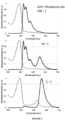
- Rhodamine 6G mass ratio With reference to Figure 2 , at higher Rhodamine 6G mass ratios the proportion of emission from blue-emitting LEP1 (peak at ⁇ 430 nm) decreases, with a corresponding increase in emission from Rhodamine 6G (peak at ⁇ 570 nm) which indicates that energy is being transferred from LEP1 and downconverted by Rhodamine 6G.
- a Malvern Zetasizer Nano S was used to determine the size and polydispersity of the nanoparticles as a dispersion in methanol at the as-purified concentration.
- the LEP1: rhodamine 6G weight ratio had little or no effect on the size of the nanoparticles.
- Nanoparticles were prepared as described in Example 1 except that Rhodamine 6G was replaced in Examples 4 and 5 with, respectively, fluorescein sodium salt and rhodamine 110 chloride.
- Nanoparticles NP1 of Example 1 and nanoparticles of Examples 4 and 5 were washed three times with methanol.
- the LEP1 : Rhodamine 6G mass ratio of NP1 was found to be comparable to the 1 : 1 ratio in the starting mixture whereas some of the small molecule emitters of Examples 4 and 5 were found to have been washed out of the nanoparticles. Upon successive washing of nanoparticles of Examples 4 and 5, the light emitted by the nanoparticles moved closer to that of the light-emitting polymer alone.
Landscapes
- Chemical & Material Sciences (AREA)
- Engineering & Computer Science (AREA)
- Health & Medical Sciences (AREA)
- Life Sciences & Earth Sciences (AREA)
- Materials Engineering (AREA)
- Organic Chemistry (AREA)
- Molecular Biology (AREA)
- Biomedical Technology (AREA)
- Urology & Nephrology (AREA)
- Hematology (AREA)
- Immunology (AREA)
- Medicinal Chemistry (AREA)
- Microbiology (AREA)
- Cell Biology (AREA)
- Food Science & Technology (AREA)
- Biotechnology (AREA)
- Physics & Mathematics (AREA)
- Analytical Chemistry (AREA)
- Biochemistry (AREA)
- General Health & Medical Sciences (AREA)
- General Physics & Mathematics (AREA)
- Pathology (AREA)
- Compositions Of Macromolecular Compounds (AREA)
- Polyoxymethylene Polymers And Polymers With Carbon-To-Carbon Bonds (AREA)
Description
- Embodiments of the present disclosure relate to light-emitting particles, in particular light-emitting particles, and the use thereof as a luminescent marker. Embodiments of the present disclosure further relate to methods of preparing said light-emitting particles.
- Nanoparticles of silica and a light-emitting material have been disclosed as labelling or detection reagents.
- Nanoscale Res. Lett., 2011, vol. 6, p 328 discloses entrapment of a small molecule in a silica matrix.
- Langmuir, 1992, vol. 8, pp 2921-2931 discloses coupling of a dye to a silane coupling agent which is then incorporated into a silica sphere.
- J. Mater. Chem., 2013, vol. 1, pp 3297-3304, Behrendt et al. describes silica-LEP nanoparticles where the LEP is covalently bound to the silica. The light emitting polymer has alkoxysilane groups pendant from the polymer backbone which react with the silica monomer during formation of the nanoparticles.
- Nanoscale, 2013, vol. 5, pp 8593-8601, Geng et al. describes silica-conjugated polymer (CP) nanoparticles wherein the LEP has pendant non-polar alkyl side chains and where the nanoparticles have a "SiO2@CP@SiO2" structure.
- Chem. Mater., 2014, vol. 26, pp 1874-1880, Geng et al. discloses poly(9,9-dihexylfluorene-alt-2,1,3-benzothiadiazole) (PFBT) loaded nanoparticles.
-
GB2554666 -
US2012267585 discloses compositions comprising nanoparticles in which at least one observable marker, such as a radioisotope or fluorophore, is incorporated within the nanosized object. -
US2008293584 discloses colloidal silica particles containing a fluorescent dye compound, composed of a silica particle containing a silica component and a fluorescent dye compound chemically bound or adsorbed thereto, wherein the colloidal silica particles containing a fluorescent dye compound have an average diameter of 30 nm or less, and wherein said silica particles are used simultaneously as fluorescent-labelling nanobeads. -
WO2011057295 discloses functionalized chromophoric polymer dots comprising a hydrophobic core and a hydrophilic cap, and bioconjugates thereof. - The present inventors have found that a light-emitting polymer may be provided in a high concentration in a light-emitting particle with little or no adverse effect on brightness. This may allow formation of an ultrabright particle containing the light-emitting polymer and another light-emitting material.
- There is provided a particle according to
claim 1. - The present inventors have found that a non-polymeric light-emitting material in a particle may be susceptible to being washed out of the particle when dispersed in a liquid, e.g. a buffer solution. The present inventors have found that providing an ionic non-polymeric light-emitting material and an ionic light-emitting polymer with opposing ionic charges in a particle may allow for formation of a stable colloid of the particles whilst preventing the non-polymeric light-emitting material from being washed out of the particle.
- The opposing ionic charges of the non-polymeric light-emitting material and the light-emitting polymer and / or confinement of these light-emitting materials within a particle may cause these light-emitting materials to be brought into close proximity during particle formation, resulting in particles in which the proximity of these light-emitting materials allows for efficient energy transfer, such as Förster resonance energy transfer (FRET), from the light-emitting polymer to the non-polymeric light-emitting material.
- Accordingly, the first light-emitting material has one of a net positive and net negative ionic charge, and the second light-emitting material has the other of net positive or net negative ionic charge.
- The particles may be dispersed in a liquid, e.g. for use in an assay.
- Accordingly, in some embodiments there is provided a colloidal suspension in which the particles are suspended in a liquid.
- The inorganic matrix may be polymeric. In some embodiments, the particle may be formed by polymerising a monomer for forming a polymeric matrix, e.g. a silica monomer, in the presence of the first light-emitting material and the second light-emitting material.
- The particles may be used for marking a biomolecule, e.g. to track or detect the biomolecule. Accordingly, in some embodiments there is provided a method of marking a biomolecule comprising the step of binding the biomolecule to the particle.
- In some embodiments, there is provided an assay method for a target analyte in which a sample is contacted with light-emitting marker particles as described herein, and determining any binding of the target analyte to the light-emitting marker.
- Optionally, the sample contacted with the light-emitting marker particles is analysed by flow cytometry.
- Optionally, an amount of target analyte bound to the light-emitting marker particles is determined.
- Optionally, the sample comprises a mixture of cells and one or more different types of target cells bound to the light-emitting marker are identified and / or quantified.
- The disclosed technology and accompanying figures describe some implementations of the disclosed technology.
-
Figure 1 is a schematic illustration of a light-emitting particle having a polymeric light-emitting compound which, upon excitation, transfers energy to a non-polymeric light-emitting compound; -
Figure 2 is graphs of absorption spectra (dotted line) and emission spectra (solid line) spectra at different non-polymeric light-emitter: light-emitting polymer mass ratios; and -
Figure 3 is graphs of nanoparticle diameters for different non-polymeric light-emitter: light-emitting polymer mass ratios. - The drawings are not drawn to scale and have various viewpoints and perspectives. The drawings are some implementations and examples. Additionally, some components and/or operations may be separated into different blocks or combined into a single block for the purposes of discussion of some of the embodiments of the disclosed technology. Moreover, while the technology is amenable to various modifications and alternative forms, specific embodiments have been shown by way of example in the drawings and are described in detail below. The intention, however, is not to limit the technology to the particular implementations described. On the contrary, the technology is intended to cover all modifications, equivalents, and alternatives falling within the scope of the technology as defined by the appended claims.
- Unless the context clearly requires otherwise, throughout the description and the claims, the words "comprise," "comprising," and the like are to be construed in an inclusive sense, as opposed to an exclusive or exhaustive sense; that is to say, in the sense of "including, but not limited to." As used herein, the terms "connected," "coupled," or any variant thereof means any connection or coupling, either direct or indirect, between two or more elements; the coupling or connection between the elements can be physical, logical, electromagnetic, or a combination thereof. Additionally, the words "herein," "above," "below," and words of similar import, when used in this application, refer to this application as a whole and not to any particular portions of this application. Where the context permits, words in the Detailed Description using the singular or plural number may also include the plural or singular number respectively. The word "or," in reference to a list of two or more items, covers all of the following interpretations of the word: any of the items in the list, all of the items in the list, and any combination of the items in the list.
- The teachings of the technology provided herein can be applied to other systems, not necessarily the system described below. The elements and acts of the various examples described below can be combined to provide further implementations of the technology. Some alternative implementations of the technology may include not only additional elements to those implementations noted below, but also may include fewer elements.
- These and other changes can be made to the technology in light of the following detailed description. While the description describes certain examples of the technology, and describes the best mode contemplated, no matter how detailed the description appears, the technology can be practiced in many ways. Details of the system may vary considerably in its specific implementation, while still being encompassed by the technology disclosed herein. As noted above, particular terminology used when describing certain features or aspects of the technology should not be taken to imply that the terminology is being redefined herein to be restricted to any specific characteristics, features, or aspects of the technology with which that terminology is associated. In general, the terms used in the following claims should not be construed to limit the technology to the specific examples disclosed in the specification, unless the Detailed Description section explicitly defines such terms. Accordingly, the actual scope of the technology encompasses not only the disclosed examples, but also all equivalent ways of practicing or implementing the technology under the claims.
- To reduce the number of claims, certain aspects of the technology are presented below in certain claim forms, but the applicant contemplates the various aspects of the technology in any number of claim forms. For example, while some aspect of the technology may be recited as a computer-readable medium claim, other aspects may likewise be embodied as a computer-readable medium claim, or in other forms, such as being embodied in a means-plus-function claim.
- In the following description, for the purposes of explanation, numerous specific details are set forth in order to provide a thorough understanding of implementations of the disclosed technology. It will be apparent, however, to one skilled in the art that embodiments of the disclosed technology may be practiced without some of these specific details.
- A particle according to some embodiments of the present disclosure comprises an inorganic matrix, a first, polymeric, light-emitting material and a second light-emitting material.
- In some embodiments, the second light-emitting material is non-polymeric. Optionally, a non-polymeric light-emitting compound as described herein has a molecular weight of 500 Daltons or less.
- In some embodiments, the second light-emitting material is a second polymeric light-emitting material.
- In some embodiments, the first, polymeric, light-emitting material has a peak emission wavelength which is shorter that of the second light-emitting material.
- The first, polymeric light-emitting material may be configured to transfer energy to the second light-emitting material (e.g. by FRET), allowing for downconversion of light.
- Optionally, the first light-emitting material has an absorption spectrum having a peak which at least partially overlaps with an emission spectrum of the second light-emitting material.
- In some embodiments the inorganic matrix comprises or consists of a matrix material selected from an oxide, optionally silica, alumina or titanium dioxide.
- The first, polymeric, light-emitting material comprises one or more ionic groups, optionally ionic substituents covalently bound to a backbone of the polymer, giving the first light-emitting material one of a net positive and a net negative charge.
- The second light-emitting material comprises one or more ionic groups such that the second light-emitting material has the other of a net positive and net negative charge.
- By "net charge" of a material as used herein is meant the sum of the charges of anionic or cationic groups covalently bound to or bound into the material, i.e. not including the charges of any counterions.
-
Figure 1 illustrates aparticle 100 according to some embodiments. The particle comprisesmatrix 101, a first, polymeric, light-emittingmaterial 103 and a second, non-polymeric light-emittingcompound 105. - Upon excitation of the first light-emitting
material 103, for example by electromagnetic radiation at an absorption wavelength of the first light-emitting material, energy may be transferred to the second, non-polymeric light-emittingmaterial 105 by a radiative or non-radiative energy transfer process and light may be emitted from the second light-emitting material. The first and second light-emitting materials, alone or in combination with any further light-emitting materials of the particle, may form a tandem dye. - In some embodiments, the particle may contain three or more light-emitting materials, optionally up to 10 light-emitting materials, each light-emitting material independently being selected from non-polymeric and polymeric light-emitting materials. Optionally, the first light-emitting material is the only polymeric light-emitting material of the particle.
- In some embodiments, emission directly from each of the light-emitting materials of the particle may be observed.
- In some embodiments, emission may be observed directly from one or more, but not all, light-emitting compounds of the particle as a result of energy transfer between light emitting materials, e.g. from the first light-emitting material to the second light-emitting material.
- The proportion of total particle emission arising from each light-emitting material may be tuned by selection of the proportion of each light-emitting material of the particle and/or the overlap between emission and absorption spectra of different light-emitting materials.
- Optionally, the first light-emitting material is not covalently bound to the matrix material.
- Optionally, the second light-emitting material is not covalently bound to the matrix material.
- Electrostatic attraction between the opposite charges of the first and second light-emitting materials may prevent or retard washing out of these light-emitting materials, in particular a non-polymeric second light-emitting material from the particle.
- The first, polymeric light-emitting material may be less susceptible to washing from the particle due at least in part to its relatively large size. The matrix may comprise a polymer, for example silica, and chains of the polymer may be entangled with, but not covalently bound to, polymer chains of the matrix.
- In some embodiments, the particle comprises a biomolecule binding group. The biomolecule binding group may be configured to bind to a target biomolecule. Target biomolecules include without limitation DNA, RNA, peptides, carbohydrates, antibodies, antigens, enzymes, proteins and hormones. It will be understood that the biomolecule binding group may be selected according to the target biomolecule.
- Preferably, the particles have a number average diameter of no more than 5000 nm, more preferably no more than 2500nm, 1000nm, 900nm, 800nm, 700nm, 600 nm, 500nm or 400 nm as measured by dynamic light scattering (DLS) using a Malvern Zetasizer Nano ZS. Preferably the particles have a number average diameter of between 5-5000 nm, optionally 10-1000 nm, preferably between 10-500 nm, most preferably between 10-100nm as measured by a Malvern Zetasizer Nano ZS.
- Preferably, at least 50 wt% of the total weight of the particle consists of matrix material. Preferably at least 60, 70, 80, 90, 95, 98, 99, 99.5, 99.9 wt% of the total weight of the particle consists of matrix material.
- In some embodiments, the particle comprises the first light-emitting material and the second light-emitting material homogeneously distributed through the matrix. In some embodiments the polymeric first light-emitting material, and any other light-emitting polymers mixed with the matrix, are contained within a boundary defined by the matrix material. In some embodiments, one or more light-emitting polymer chains may protrude beyond a boundary defined by the matrix material.
- In some embodiments, the particle comprises a core comprising or consisting of the first light-emitting compound and the second light-emitting material and a shell comprising or consisting of the matrix.
- The first light-emitting material is a light-emitting polymer. The light-emitting polymer may emit fluorescent light, phosphorescent light or a combination thereof.
- The light-emitting polymer may be a homopolymer or may be a copolymer comprising two or more different repeat units.
- The light-emitting polymer may comprise light-emitting groups in the polymer backbone, pendant from the polymer backbone or as end groups of the polymer backbone. In the case of a phosphorescent polymer, a phosphorescent metal complex, preferably a phosphorescent iridium complex, may be provided in the polymer backbone, pendant from the polymer backbone or as an end group of the polymer backbone.
- The light-emitting polymer may have a non-conjugated backbone or may be a conjugated polymer. By "conjugated polymer" is meant a polymer comprising repeat units in the polymer backbone that are directly conjugated to adjacent repeat units. Conjugated light-emitting polymers include, without limitation, polymers comprising one or more of arylene, heteroarylene and vinylene groups conjugated to one another along the polymer backbone.
- The light-emitting polymer may have a linear, branched or crosslinked backbone.
- The light-emitting polymer may comprise one or more repeat units in the backbone of the polymer substituted with at least one ionic group. The one or more ionic groups may be the only substituents of said repeat units, or said repeat units may be further substituted with one or more non-ionic substituents, optionally one or more substituents selected from non-ionic polar groups and C1-40 hydrocarbyl groups. The repeat unit or repeat units substituted with one or more ionic groups may be the only repeat units of the polymer or the polymer may comprise one or more further co-repeat units wherein the or each co-repeat unit is unsubstituted or is substituted with one or more non-ionic substituents.
- The ionic groups of the polymer may enhance solubility of the polymer in polar solvents and may prevent the polymer from assuming a tightly coiled formation as compared to the case where a polymer which is not substituted with any polar groups is placed in a polar solvent.
- C1-40 hydrocarbyl groups as described herein include, without limitation, C1-20 alkyl, unsubstituted phenyl and phenyl substituted with one or more C1-20 alkyl groups.
- As used herein "non-ionic polar groups" may refer to one more groups which render the light-emitting polymer with a solubility of at least 0.0005 mg/ml in an alcoholic solvent, preferably at least 0.001, more preferably at least 0.01, 0.1, or 1 mg / ml, optionally at least 5 or 10 mg/ml. The solubility is measured at 25°C. Preferably, the alcoholic solvent is a C1-10 alcohol, more preferably methanol.
- In some embodiments, the polymer backbone may be substituted with non-ionic polar groups of formula -O(R3O)q-R4 wherein R3 in each occurrence is a C1-10 alkylene group, optionally a C1-5 alkylene group, wherein one or more non-adjacent, non-terminal C atoms of the alkylene group may be replaced with O, R4 is H or C1-5 alkyl, and q is at least 1, optionally 1-10. Preferably, q is at least 2. More preferably, q is 2 to 5. The value of q may be the same in all the polar groups of formula -O(R3O)q-R4. The value of q may differ between non-ionic polar groups of the same polymer.
- By "C1-5 alkylene group" as used herein with respect to R3 is meant a group of formula - (CH2)f- wherein f is from 1-5.
- Preferably, the polymer comprises non-ionic polar groups of formula -O(CH2CH2O)qR4 wherein q is at least 1, optionally 1-10 and R4 is a C1-5 alkyl group, preferably methyl. Preferably, q is at least 2. More preferably, q is 2 to 5, most preferably q is 3.
- In some embodiments, the polymer comprises non-ionic polar groups of formula - N(R5)2, wherein R5 is H or C1-12 hydrocarbyl. Preferably, each R5 is a C1-12 hydrocarbyl.
- Exemplary anionic groups are -COO-, a sulfonate group; hydroxide; sulfate; phosphate; phosphinate; or phosphonate.
- An exemplary cationic group is -N(R5)3 + wherein R5 in each occurrence is H or C1-12 hydrocarbyl. Preferably, each R5 is a C1-12 hydrocarbyl.
- The charges of at least some ionic groups of the polymer may be balanced by the opposite charge of the first light-emitting compound.
- The anionic or cationic group may be monovalent or polyvalent. Preferably, the anionic and cationic groups are monovalent.
- The polymer may comprise a plurality of anionic or cationic polar groups wherein the charge of two or more anionic or cationic groups is balanced by a single counterion.
- Optionally, the polar groups comprise anionic or cationic groups comprising di- or trivalent counterions.
- The counterion is optionally a cation, optionally a metal cation, optionally Li+, Na+, K+, Cs+, preferably Cs+, or an organic cation, optionally ammonium, such as tetraalkylammonium, ethylmethyl imidazolium or pyridinium.
- The counterion is optionally an anion, optionally a halide; a sulfonate group, optionally mesylate or tosylate; hydroxide; carboxylate; sulfate; phosphate; phosphinate; phosphonate; or borate.
- In some embodiments, the polymer comprises ionic groups and non-ionic polar groups selected from groups of formula -O(R3O)q-R4, groups of formula -N(R5)2 and groups of formula OR4. Preferably, the polymer comprises ionic groups of formula -COO-and non-ionic polar groups selected from groups of formula -O(CH2CH2O)qR4 and groups of formula -N(R5)2.
- Optionally, the backbone of the light-emitting polymer is a conjugated polymer. Optionally, the backbone of the conjugated light-emitting polymer comprises repeat units of formula (I):
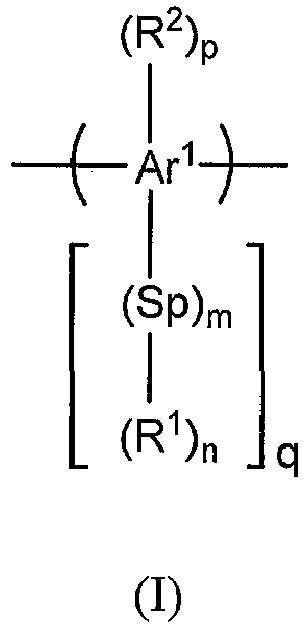
- Preferably, m is 1 and n is 1-4. Preferably p is 0.
- Ar1 of formula (I) is optionally a C6-20 arylene group or a 5-20 membered heteroarylene group. Ar1 is preferably a C6-20 arylene group, optionally phenylene, fluorene, benzofluorene, phenanthrene, naphthalene or anthracene, more preferably fluorene or phenylene, most preferably fluorene.
- Sp-(R1)n may be a branched group, optionally a dendritic group, substituted with polar groups.
- Preferably, Sp is selected from:
- C1-20 alkylene or phenylene-C1-20 alkylene wherein one or more non-adjacent C atoms may be replace with O, S, N or C=O;
- a C6-20 arylene or 5-20 membered heteroarylene, more preferably phenylene, which, in addition to the one or more substituents R1 including one or more ionic groups, may be unsubstituted or substituted with one or more non-polar substituents, optionally one or more C1-20 alkyl groups.
- More preferably, Sp is selected from:
- C1-20 alkylene wherein one or more non-adjacent C atoms may be replaced with O, S or CO; and
- a C6-20 arylene or a 5-20 membered heteroarylene, even more preferably phenylene, which may be unsubstituted or substituted with one or more non-polar substituents.
- R1 may be a polar group as described anywhere herein. Preferably, R1 in each occurrence is independently selected from the group consisting of:
- a polyethylene glycol (PEG) group of formula -O(CH2CH2O)qR4 wherein q is at least 1, optionally 1-10 and R4 is a C1-5 alkyl group, preferably methyl;
- a group of formula -N(R5)2, wherein R5 is H or C1-12 hydrocarbyl; or
- an anionic group of formula -COO-
- In the case where n is at least two, each R1 may independently in each occurrence be the same or different with the proviso that at least one R1 is an ionic group. Preferably, each R1 attached to a given Sp group is different.
- In the case where p is a positive integer, optionally 1, 2, 3 or 4, the group R2 may be selected from:
- alkyl, optionally C1-20 alkyl; and
- aryl and heteroaryl groups that may be unsubstituted or substituted with one or more substituents, preferably phenyl substituted with one or more C1-20 alkyl groups;
- a linear or branched chain of aryl or heteroaryl groups, each of which groups may independently be substituted, for example a group of formula -(Ar3)s wherein each Ar3 is independently an aryl or heteroaryl group and s is at least 2, preferably a branched or linear chain of phenyl groups each of which may be unsubstituted or substituted with one or more C1-20 alkyl groups; and
- a crosslinkable-group, for example a group comprising a double bond such and a vinyl or acrylate group, or a benzocyclobutane group.
- Preferably, each R2, where present, is independently selected from C1-40 hydrocarbyl, and is more preferably selected from C1-20 alkyl; unsubstituted phenyl; phenyl substituted with one or more C1-20 alkyl groups; and a linear or branched chain of phenyl groups, wherein each phenyl may be unsubstituted or substituted with one or more substituents.
- A polymer as described herein may comprise or consist of only one form of the repeating unit of formula (I) or may comprise or consist of two or more different repeat units of formula (I).
- Optionally, the polymer comprising one or more repeat units of formula (I) is a copolymer comprising one or more co-repeat units.
- If co-repeat units are present then the repeat units of formula (I) may form between 0.1-99 mol % of the repeat units of the polymer, optionally 50-99 mol % or 80-99 mol %. Preferably, the repeat units of formula (I) form at least 50 mol% of the repeat units of the polymer, more preferably at least 60, 70, 80, 90, 95, 98 or 99 mol%. Most preferably the repeat units of the polymer consist of one or more repeat units of formula (I).
- The repeat unit of the light-emitting polymer, in the case where the polymer is a homopolymer, or one or more of the different repeat units of the polymer, in the case wherein the polymer is a copolymer, may be selected to produce a desired colour of emission of the polymer.
- The light-emitting polymer may emit light having a peak wavelength in the range of 350-1000 nm.
- A blue light-emitting polymer of a particle as described herein may have a photoluminescence spectrum with a peak of no more than 500 nm, preferably in the range of 400-500 nm, optionally 400-490 nm.
- A green light-emitting polymer of a particle as described herein may have a photoluminescence spectrum with a peak of more than 500 nm up to 580 nm, optionally more than 500 nm up to 540 nm.
- A red light-emitting polymer of a particle as described herein may have a photoluminescence spectrum with a peak of no more than more than 580 nm up to 630 nm, optionally 585 nm up to 625 nm.
- The photoluminescence spectrum of light-emitting materials as described herein may be as measured using an Ocean Optics 2000+ spectrometer.
- The light-emitting polymer may have an absorption spectrum with a peak in the range of 300-900 nm.
- The light-emitting polymer may have a Stokes shift in the range of 10-850 nm, optionally 350-850 nm.
- UV/vis absorption spectra of light-emitting polymers as described herein may be as measured in methanol using a Cary 5000 UV-vis-IR spectrometer.
- The polymer may be non-conjugated or conjugated.
- The polymer is preferably a conjugated polymer comprising repeat units of formula (I) conjugated to one another and / or conjugated to aromatic or heteroaromatic groups of co-repeat units adjacent to the repeat units of formula (I). Exemplary conjugated polymers include polymers comprising arylenevinylene repeat units; arylene repeat units; heteroarylene repeat units; amine repeat units; and combinations thereof.
- If present, the or each co-repeat unit may be unsubstituted or substituted with one or more non-ionic substituents, optionally one or more repeat units comprising or consisting of one or more groups selected from C6-20 arylene groups and 5-20 membered heteroarylene groups, wherein each of said arylene or heteroarylene groups independently in each occurrence may be unsubstituted or substituted with one or more non-ionic substituents.
- Arylene repeat units of the polymer include, without limitation, fluorene, preferably a 2,7-linked fluorene; phenylene, preferably a 1,4-linked phenylene; naphthalene, anthracene, indenofluorene, phenanthrene and dihydrophenanthrene repeat units. Arylene co-repeat units may be selected from repeat units of formulae (III)-(VI):


- Repeat units comprising or consisting of one or more unsubstituted or substituted 5-20 membered heteroarylene groups in the polymer backbone include, without limitation, thiophene repeat units, bithiophene repeat units, benzothiadiazole repeat units, and combinations thereof. Exemplary heteroarylene co-repeat units include repeat units of formulae (VII), (VIII) and (IX):


- R13 in each occurrence may independently be a group comprising or consisting of a ionic group, optionally an ionic substituent -(Sp)m-(R1)n, or a non-ionic substituent R2 wherein Sp, m and R1 are as described with reference to Formula (I).
- Arylene repeat units or heteroarylene repeat units substituted with one or more polar groups, optionally repeat units of formulae (III)-(IX) substituted with one groups of formula -(Sp)m-(R1)n, are repeat units of formula (I).
- Arylene repeat units or heteroarylene repeat units, optionally repeat units of formulae (III)-(IX), which are unsubstituted or substituted only with one or more non-polar groups, are co-repeat units of the polymer.
- Amine repeat units of the polymer may have formula (XII):

- R9, which may be the same or different in each occurrence when g is 1 or 2, is preferably selected from the group consisting of alkyl, optionally C1-20 alkyl, Ar11 and a branched or linear chain of Ar11 groups wherein Ar11 in each occurrence is independently substituted or unsubstituted aryl or heteroaryl.
- Any two aromatic or heteroaromatic groups selected from Ar8, Ar9, and, if present, Ar10 and Ar11 that are directly bound to the same N atom may be linked by a direct bond or a divalent linking atom or group. Preferred divalent linking atoms and groups include O, S; substituted N; and substituted C.
- Ar8 and Ar10 are preferably C6-20 aryl, more preferably phenyl that may be unsubstituted or substituted with one or more substituents.
- In the case where g = 0, Ar9 is preferably C6-20 aryl, more preferably phenyl, that may be unsubstituted or substituted with one or more substituents.
- In the case where g = 1, Ar9 is preferably C6-20 aryl, more preferably phenyl or a polycyclic aromatic group, for example naphthalene, perylene, anthracene or fluorene, that may be unsubstituted or substituted with one or more substituents.
- R9 is preferably Ar11 or a branched or linear chain of Ar11 groups. Ar11 in each occurrence is preferably phenyl that may be unsubstituted or substituted with one or more substituents.
- Exemplary groups R9 include the following, each of which may be unsubstituted or substituted with one or more substituents, and wherein * represents a point of attachment to N:

- Ar8, Ar9, and, if present, Ar10 and Ar11 are each independently unsubstituted or substituted with one or more, optionally 1, 2, 3 or 4, substituents.
- Substituents may independently be a group comprising or consisting of a polar group, optionally a polar substituent -(Sp)m-(R1)n, or a non-polar substituent R2 wherein Sp, m, R1 and R2 are as described with reference to Formula (I).
- Preferred substituents of Ar8, Ar9, and, if present, Ar10 and Ar11 are C1-40 hydrocarbyl, preferably C1-20 alkyl.
- Preferred repeat units of formula (XII) include unsubstituted or substituted units of formulae (XII-1), (XII-2) and (XII-3):

- Preferably, a polymer comprising a repeat unit of formula (XII) further comprises one or more arylene repeat units, optionally one or more arylene repeat units selected from formulae (III)-(IX). Optionally, 0.1 - 50 mol % of a light-emitting polymer are one or more repeat units of formula (XII). Optionally, the repeat units of a light-emitting polymer comprise or consist of one or more repeat units of formula (XII) and one or more arylene repeat units, optionally one or more repeat units of formulae (III)-(IX).
- The polymer may contain one or more repeat units selected from formulae (XIII-XVII):


- R21, R22, R23 and R24 are each independently selected from hydrogen, fluoro, chloro, bromo, substituted or unsubstituted (1-10C)alkyl, substituted or unsubstituted (2-10C)alkenyl, substituted or unsubstituted (2-10C)alkynyl, substituted or unsubstituted aryl, substituted or unsubstituted heteroaryl, substituted or unsubstituted amino, substituted or unsubstituted (1-10C)alkoxy, substituted or unsubstituted arylalkoxy, and hydroxyl;
- each πa independently represents a π-conjugated π-donor ring system formed from one, two, three or four 6-membered aryl or 5 to 6-membered heteroaryl rings; each πb independently represents a π-conjugated 6-membered aryl or 5-6 membered heteroaryl ring;
- each πc independently represents a π-conjugated 5-6 membered heteroaryl ring, which when taken in combination with πb, forms a π-acceptor ring system; wherein:
any or all of the rings forming πa, πb and πc may be independently optionally substituted with one more ring substituents selected from halo, (1-20C)alkyl, (2-20C)alkenyl, (2-20C)alkynyl, aryl, heteroaryl, cycloalkyl, heterocyclyl, carboxyl, phosphoryl, sulfonyl, hydroxyl, (1-20C)alkoxy, nitro, amino, mercapto, silyl, siloxy, azido, boronic acid group, sulfonic acid group, hydroxamic acid group, cyanoacrylate group, and dioxocyclobutenyl group having at least one functional group selected from the group consisting of a carboxyl, phosphoryl, sulfonyl, hydroxyl, alkoxy, nitro, amino, mercapto, silyl, siloxy, azido, boronic acid group, sulfonic acid group, hydroxamic acid group and cyanoacrylate group. - The repeat unit of formula (XIII) may be bound into the polymer backbone by a bond to πa and one of πb and πc.
- The repeat units of formula (XIV) and (XVI) may be bound into the polymer backbone by a bond to πb or πc on one side of πa and by a bond to πb or πc on the other side of πa.
- The repeat unit of formula (XV) may be bound into the polymer backbone by a bond to each one of πa.
- The repeat unit of formula (XVII) may be bound into the polymer backbone by a bond to each one of πa or by a bond to each one of πc.
- Exemplary repeat units of formulae (XIII)-(XVII) include:


- In the case of a phosphorescent conjugated polymer a phosphorescent group, preferably a metal complex, more preferably an iridium complex, may be provided in the main chain, in a side group and / or as an end group of the polymer. An exemplary conjugating repeat unit comprising an iridium complex has formula:

- Preferably, the repeat unit of formula (I) is a repeat unit of formula (Ia):

- An exemplary repeat unit of formula (Ia) is:

- The non-polymeric emitter: polymer ratio may be in the range of about 1 : 0.5 - 1 : 200, optionally about 1 : 1 - 1 : 100.
- The polystyrene-equivalent number-average molecular weight (Mn) measured by gel permeation chromatography of the polymers described herein, preferably the light-emitting polymers described herein may be in the range of about 1×10³ to 1×10⁸, and preferably 1×10⁴ to 5×10⁶. The polystyrene-equivalent weight-average molecular weight (Mw) of the polymers described herein may be 1×10³ to 1×10⁸, and preferably 1×10⁴ to 1×10⁷.
- The second light-emitting material may be a polymeric material, optionally a polymer selected from light-emitting polymers described above.
- Preferably, the second light-emitting material is a non-polymeric light-emitting material. A non-polymeric light-emitting material as described herein optionally has a molecular weight of 500 Daltons or less.
- Preferably, the non-polymeric light-emitting material is monodisperse.
- The second light-emitting material may have a net ionic charge opposite to a net ionic charge of the first light-emitting material.
- Exemplary non-polymeric light-emitting materials include, without limitation, fluoresceins and salts thereof; rhodamines, for
example Rhodamine 6G and Rhodamine 110 chloride; coumarins; boron-dipyrromethenes (BODIPYs); naphthalimides; perylenes; benzanthrones; benzoxanthrones; and benzothiooxanthrones, each of which may be unsubstituted or substituted with one or more substituents. Exemplary substituents are chlorine, alkyl amino; phenylamino; and hydroxyphenyl. - The inorganic matrix may be an oxide, optionally silica, alumina or titanium dioxide.
- Preferably, the inorganic matrix is not covalently bound to the first or second light-emitting material. Accordingly, there is no need for the matrix material, the polymer and / or the non-polymeric light-emitting material to be substituted with reactive groups for forming such covalent bonds, e.g. during formation of the particles.
- In some embodiments, a silica matrix as described herein may be formed by polymerisation of a silica monomer in the presence of the non-polymeric light-emitting material and the polymer.
- In some embodiments, the polymerisation comprises treating a solution comprising silica monomer, the first light-emitting material and the second light-emitting material with a base, or by adding a solution of silica monomer to a solution of the first and second light-emitting materials and a base. Optionally, the solvent of the solutions are water, one or more C1-10 alcohols or a combination thereof.
- In some embodiments, the process comprises polymerising silica monomer in a solution of the matrix monomer and the first and second light-emitting materials under acidic conditions.
- Polymerising a matrix monomer in the presence of a light-emitting polymer may result in one or more chains of the polymer encapsulated within the particle and / or one or more chains of the polymer extending through a particle.
- The particles may be formed in a one-step polymerisation process.
- Optionally, the silica monomer is an alkoxysilane, preferably a trialkoxy or tetra-alkoxysilane, optionally a C1-12 trialkoxy or tetra-alkoxysilane, for example tetraethyl orthosilicate. The silica monomer may be substituted only with alkoxy groups or may be substituted with one or more groups.
- In some embodiments, a biomolecule binding group is bound to a surface of the particle. The biomolecule binding group may be bound directly to the surface of the particle group or bound through a surface binding group. The surface binding group may comprise polar groups. Optionally, the surface binding group comprises a polyether chain. By "polyether chain" as used herein is meant a chain having two or more ether oxygen atoms.
- Silica at the surface of the particles may be reacted to form a group at the surface capable of binding to a biomolecule binding group. Optionally, silica at the surface is reacted with a siloxane.
- The biomolecule binding group may be selected from the group consisting of: DNA, RNA, peptides, carbohydrates, antibodies, antigens, enzymes, proteins and hormones. The biomolecule binding group may be selected according to a target biomolecule to be detected. The target biomolecule may or may not be a biomolecule, e.g. a protein, at a surface of a cell.
- A preferred biomolecule binding group is biotin. In some embodiments, the biotin biomolecule binding group binds directly to a target analyte.
- In some embodiments, the biotin biomolecule binding group is bound to a protein having a plurality of biotin binding sites, preferably streptavidin, neutravidin, avidin or a recombinant variant or derivative thereof and biotinylated biomolecule having a second biotin group is bound to the same protein. The biotinylated biomolecule may be selected according to the target analyte. The biotinylated biomolecule may comprise an antigen binding fragment, e.g. an antibody, which may be selected according to a target antigen.
- The particles may be provided as a colloidal suspension comprising the particles suspended in a liquid. Preferably, the liquid is selected from water, C1-10 alcohols and mixtures thereof. Preferably, the particles form a uniform (non-aggregated) colloid in the liquid.
- The liquid may be a solution comprising salts dissolved therein, optionally a buffer solution.
- The concentration of the particles in the colloidal suspension is preferably in the range of 0.1-20 mg / mL, optionally 5-20 mg / mL.
- The particles of the present disclosure may be fluorescent or phosphorescent. Preferably the particles are fluorescent. Preferably the particles are for use as a fluorescent probe for detecting a biomolecule or for labelling a biomolecule. In some embodiments, the particles may be used as a fluorescent probe in an immunoassay such as a lateral flow or solid state immunoassay. Optionally the particles are for use in fluorescence microscopy, flow cytometry, next generation sequencing, in-vivo imaging, or any other application where a light-emitting marker configured to bind to a target analyte is brought into contact with a sample to be analysed. The applications can be medical, veterinary, agricultural or environmental applications whether involving patients (where applicable) or for research purposes.
- In use the biomolecule binding group of the particles may bind to target biomolecules which include without limitation DNA, RNA, peptides, carbohydrates, antibodies, antigens, enzymes, proteins and hormones. It will be understood that the biomolecule binding group may be selected according to the target biomolecule.
- A sample to be analysed may brought into contact with the particles, for example the particles in a colloidal suspension.
- In some embodiments, the sample following contact with the particles is analysed by flow cytometry. In flow cytometry, the particles are irradiated by at least one wavelength of light, optionally two or more different wavelengths, e.g. one or more wavelengths including at least one of 355, 405, 488, 562 and 640 nm. Light emitted by the particles may be collected by one or more detectors. Detectors may be selected from, without limitation, photomultiplier tubes and photodiodes. To provide a background signal for calculation of a staining index, measurement may be made of particles mixed with cells which do not bind to the particles
- In some embodiments, the target biomolecule may be immobilised on a surface which is brought into contact with the particles.
- In some embodiments, the particles may be stored in a dry, optionally lyophilised, form. In some embodiments, the particles may be stored in a frozen form.
- A nanoparticle of a silica matrix having blue light-emitting polymer LEP1 and green-emitting small molecule Rhodamine G6 dispersed therein was formed.

- To a solution of LEP1 in anhydrous methanol (2 mg mL-1, 1 mL) was added a solution of
Rhodamine 6G in the same solvent (2 mg mL-1, 1 mL), giving an LEP1:Rhodamine 6G weight ratio of 1:1. - To this mixture was added ammonium hydroxide solution (28-30%, 150 uL), followed by rapid addition of a solution of tetraethylorthosilicate (200 uL) in anhydrous methanol (500 uL) with stirring at room temperature. The reaction mixture was stirred at room temperature for 1 hour, after which time the resultant dispersion was centrifuged for 3 min at 14000 rpm and the supernatant was removed by decantation. The solid nanoparticle pellet thus isolated was redispersed by adding 2 mL of anhydrous methanol and sonicating in a bath sonicator for 5 minutes. Once fully redispersed, the solids were again isolated by centrifugation and decantation of the supernatant and this methanol wash step was repeated twice more to give Nanoparticle Example 1 (NP1).
- After the final wash step the pellet was resuspended in 2 mL of methanol for analysis.
- Nanoparticle Example 2 (NP2) was formed as described for Example 1 except that 0.2 mg mL-1 of the
rhodamine 6G was used, giving an LEP1:rhodamine 6G mass ratio in the starting reaction mixture of 10:1. - Nanoparticle Example 3 (NP3) was formed as described for Example 1 except that 0.02 mg mL-1 of the
rhodamine 6G was used, giving an LEP1:rhodamine 6G mass ratio in the starting reaction mixture of 100:1. - UV/vis spectra in methanol were recorded using a Cary 5000 UV-vis-IR spectrometer. Photoluminescence spectra in the same dispersant were recorded using an Olympus BX62 microscope, with a mercury short arc lamp (λex = 365 nm) for excitation and an Ocean Optics 2000+ spectrometer as the detector.
- With reference to
Figure 2 , athigher Rhodamine 6G mass ratios the proportion of emission from blue-emitting LEP1 (peak at ~430 nm) decreases, with a corresponding increase in emission fromRhodamine 6G (peak at ~570 nm) which indicates that energy is being transferred from LEP1 and downconverted byRhodamine 6G. - A Malvern Zetasizer Nano S was used to determine the size and polydispersity of the nanoparticles as a dispersion in methanol at the as-purified concentration.
- With reference to
Figure 3 , the LEP1:rhodamine 6G weight ratio had little or no effect on the size of the nanoparticles. - Nanoparticles were prepared as described in Example 1 except that
Rhodamine 6G was replaced in Examples 4 and 5 with, respectively, fluorescein sodium salt and rhodamine 110 chloride.
- Nanoparticles NP1 of Example 1 and nanoparticles of Examples 4 and 5 were washed three times with methanol.
- The LEP1 :
Rhodamine 6G mass ratio of NP1 was found to be comparable to the 1 : 1 ratio in the starting mixture whereas some of the small molecule emitters of Examples 4 and 5 were found to have been washed out of the nanoparticles. Upon successive washing of nanoparticles of Examples 4 and 5, the light emitted by the nanoparticles moved closer to that of the light-emitting polymer alone. - Without wishing to be bound by any theory, it is believed that electrostatic attraction between the anionic substituent of LEP1 and the cationic group of
Rhodamine 6G may prevent or retard washing out of the non-polymeric light-emitting material.
"non-terminal C atom" of an alkyl group as used herein means a C atom other than the methyl group at the end of an n-alkyl group or the methyl groups at the ends of a branched alkyl chain.
Claims (15)
- A particle comprising an inorganic matrix material; a first light-emitting material; and a second light-emitting material, wherein the first light-emitting material is a light-emitting polymer and wherein the first light-emitting material has one of a net positive and net negative ionic charge, and the second light-emitting material has the other of net positive or net negative ionic charge.
- The particle according to claim 1 wherein the second light-emitting material is a non-polymeric material.
- The particle according to claim 1 or 2 wherein the light-emitting polymer is a conjugated polymer.
- The particle according to claim 3 wherein the conjugated polymer comprises a repeat unit of formula (I):

- The particle according to claim 4 wherein the repeat unit of formula (I) is a repeat unit of formula (Ia):

- The particle according to any one of the preceding claims wherein the first light-emitting material is configured to transfer energy to the second light-emitting material.
- The particle according to any one of the preceding claims wherein the particle comprises a biomolecule binding group configured to bind to a target biomolecule.
- The particle according to any one of the preceding claims wherein the inorganic matrix comprises silica.
- A colloidal suspension comprising particles according to any one of the preceding claims suspended in a liquid.
- A colloidal suspension according to claim 9 wherein the liquid is a protic liquid.
- A process for preparing a particle according to claim 8, comprising formation of the silica by polymerisation of a silica monomer in the presence of the first light-emitting material and the second light-emitting material.
- A method of marking a biomolecule, the method comprising the step of binding the biomolecule to a particle according to any one of claims 1-8.
- An assay method for a target analyte comprising contacting a sample with light-emitting marker particles according to any one of claim 1-8 and determining any binding of the target analyte to the light-emitting marker.
- An assay method according to claim 13 wherein the sample contacted with the light-emitting marker particles is analysed by flow cytometry.
- An assay method according to claim 14 wherein an amount of target analyte bound to the light-emitting marker particles is determined, optionally wherein the sample comprises a mixture of cells and one or more different types of target cells bound to the light-emitting marker are identified and / or quantified.
Applications Claiming Priority (2)
| Application Number | Priority Date | Filing Date | Title |
|---|---|---|---|
| GBGB1815329.6A GB201815329D0 (en) | 2018-09-20 | 2018-09-20 | Light-emitting particle |
| PCT/EP2019/075235 WO2020058440A1 (en) | 2018-09-20 | 2019-09-19 | Light-emitting particle |
Publications (2)
| Publication Number | Publication Date |
|---|---|
| EP3853322A1 EP3853322A1 (en) | 2021-07-28 |
| EP3853322B1 true EP3853322B1 (en) | 2023-04-19 |
Family
ID=64024374
Family Applications (1)
| Application Number | Title | Priority Date | Filing Date |
|---|---|---|---|
| EP19779397.9A Active EP3853322B1 (en) | 2018-09-20 | 2019-09-19 | Light-emitting particle |
Country Status (6)
| Country | Link |
|---|---|
| US (1) | US20210355379A1 (en) |
| EP (1) | EP3853322B1 (en) |
| JP (1) | JP7389796B2 (en) |
| CN (1) | CN112739792A (en) |
| GB (1) | GB201815329D0 (en) |
| WO (1) | WO2020058440A1 (en) |
Families Citing this family (6)
| Publication number | Priority date | Publication date | Assignee | Title |
|---|---|---|---|---|
| GB2577292A (en) | 2018-09-20 | 2020-03-25 | Sumitomo Chemical Co | Light-emitting marker particles |
| GB2585225B (en) * | 2019-07-03 | 2024-02-07 | Sumitomo Chemical Co | Light-emitting polymer |
| GB2592615A (en) * | 2020-03-03 | 2021-09-08 | Sumitomo Chemical Co | Light-emitting particles |
| GB2597797A (en) | 2020-08-07 | 2022-02-09 | Sumitomo Chemical Co | Light-emitting marker |
| GB2605404A (en) * | 2021-03-30 | 2022-10-05 | Sumitomo Chemical Co | Sequencing method |
| WO2024176557A1 (en) * | 2023-02-24 | 2024-08-29 | 株式会社オハラ | Protein immobilization carrier, protein immobilization carrier dispersion liquid, protein immobilization carrier hydrate, protein support complex, and antibody testing kit |
Family Cites Families (14)
| Publication number | Priority date | Publication date | Assignee | Title |
|---|---|---|---|---|
| US7029763B2 (en) * | 2002-07-29 | 2006-04-18 | Lumimove, Inc. | Light-emitting phosphor particles and electroluminescent devices employing same |
| WO2006074482A2 (en) * | 2005-01-10 | 2006-07-13 | The Regents Of The University Of California | Methods and kits for strand-specific polynucleotide detection with cationic multichromophores |
| JP5400297B2 (en) * | 2005-12-27 | 2014-01-29 | 古河電気工業株式会社 | Fluorescent nanosilica particles, nanofluorescent material, biochip using the same, and assay method thereof |
| US8841134B2 (en) * | 2006-04-10 | 2014-09-23 | Bruker Biospin Corporation | Fluorescence resonance energy transfer detection with nanoparticles for in vitro and in vivo applications |
| US20110097723A1 (en) * | 2009-09-19 | 2011-04-28 | Qun Liu | Methods and reagents for analyte detection |
| CN102791827B (en) * | 2009-11-09 | 2016-11-16 | 华盛顿大学商业化中心 | Functionalized chromophoric polymer dots and their bioconjugates |
| US20120267585A1 (en) * | 2010-12-30 | 2012-10-25 | Ut-Battelle, Llc | Volume-labeled nanoparticles and methods of preparation |
| US9011735B2 (en) * | 2010-12-30 | 2015-04-21 | Ut-Battelle, Llc | Volume-labeled nanoparticles and methods of preparation |
| JP5791036B2 (en) * | 2011-01-19 | 2015-10-07 | 住友大阪セメント株式会社 | Organic-inorganic composite, organic-inorganic composite composition, and ink |
| WO2012133229A1 (en) * | 2011-03-28 | 2012-10-04 | 住友化学株式会社 | Electronic device and polymer compound |
| DE102011113498A1 (en) * | 2011-09-15 | 2013-03-21 | Osram Opto Semiconductors Gmbh | Phosphor mixture, optoelectronic component with a phosphor mixture and street lamp with a phosphor mixture |
| GB2529668A (en) * | 2014-08-28 | 2016-03-02 | Cambridge Display Tech Ltd | Organic light-emitting composition, device and method |
| JP2016060832A (en) * | 2014-09-18 | 2016-04-25 | Dic株式会社 | Fluorescent silica particle and method for producing the same, and labelling reagent and inspection kit comprising the same |
| GB2554666B (en) * | 2016-09-30 | 2019-12-18 | Sumitomo Chemical Co | Composite Particle |
-
2018
- 2018-09-20 GB GBGB1815329.6A patent/GB201815329D0/en not_active Ceased
-
2019
- 2019-09-19 CN CN201980061440.9A patent/CN112739792A/en active Pending
- 2019-09-19 JP JP2021515121A patent/JP7389796B2/en active Active
- 2019-09-19 EP EP19779397.9A patent/EP3853322B1/en active Active
- 2019-09-19 WO PCT/EP2019/075235 patent/WO2020058440A1/en not_active Ceased
- 2019-09-19 US US17/278,263 patent/US20210355379A1/en not_active Abandoned
Also Published As
| Publication number | Publication date |
|---|---|
| JP2022502534A (en) | 2022-01-11 |
| JP7389796B2 (en) | 2023-11-30 |
| EP3853322A1 (en) | 2021-07-28 |
| WO2020058440A1 (en) | 2020-03-26 |
| CN112739792A (en) | 2021-04-30 |
| US20210355379A1 (en) | 2021-11-18 |
| GB201815329D0 (en) | 2018-11-07 |
Similar Documents
| Publication | Publication Date | Title |
|---|---|---|
| JP7389796B2 (en) | luminescent particles | |
| JP7587555B2 (en) | Composite particles | |
| WO2020058668A1 (en) | Light-emitting marker particles | |
| JP7642662B2 (en) | Luminous Particles | |
| JP7499281B2 (en) | Luminescent Composition | |
| US20210348052A1 (en) | Light-emitting particle | |
| US20240124767A1 (en) | Light-emitting composition | |
| GB2577405A (en) | Particle | |
| US20230093363A1 (en) | Light-emitting particles | |
| US20240117244A1 (en) | Method | |
| WO2023144394A1 (en) | Light-emitting nanoparticles | |
| WO2023187020A1 (en) | Monomer and light-emitting polymer |
Legal Events
| Date | Code | Title | Description |
|---|---|---|---|
| STAA | Information on the status of an ep patent application or granted ep patent |
Free format text: STATUS: UNKNOWN |
|
| STAA | Information on the status of an ep patent application or granted ep patent |
Free format text: STATUS: THE INTERNATIONAL PUBLICATION HAS BEEN MADE |
|
| PUAI | Public reference made under article 153(3) epc to a published international application that has entered the european phase |
Free format text: ORIGINAL CODE: 0009012 |
|
| STAA | Information on the status of an ep patent application or granted ep patent |
Free format text: STATUS: REQUEST FOR EXAMINATION WAS MADE |
|
| 17P | Request for examination filed |
Effective date: 20210419 |
|
| AK | Designated contracting states |
Kind code of ref document: A1 Designated state(s): AL AT BE BG CH CY CZ DE DK EE ES FI FR GB GR HR HU IE IS IT LI LT LU LV MC MK MT NL NO PL PT RO RS SE SI SK SM TR |
|
| DAV | Request for validation of the european patent (deleted) | ||
| DAX | Request for extension of the european patent (deleted) | ||
| STAA | Information on the status of an ep patent application or granted ep patent |
Free format text: STATUS: EXAMINATION IS IN PROGRESS |
|
| 17Q | First examination report despatched |
Effective date: 20220520 |
|
| GRAP | Despatch of communication of intention to grant a patent |
Free format text: ORIGINAL CODE: EPIDOSNIGR1 |
|
| STAA | Information on the status of an ep patent application or granted ep patent |
Free format text: STATUS: GRANT OF PATENT IS INTENDED |
|
| INTG | Intention to grant announced |
Effective date: 20221026 |
|
| GRAS | Grant fee paid |
Free format text: ORIGINAL CODE: EPIDOSNIGR3 |
|
| GRAA | (expected) grant |
Free format text: ORIGINAL CODE: 0009210 |
|
| STAA | Information on the status of an ep patent application or granted ep patent |
Free format text: STATUS: THE PATENT HAS BEEN GRANTED |
|
| AK | Designated contracting states |
Kind code of ref document: B1 Designated state(s): AL AT BE BG CH CY CZ DE DK EE ES FI FR GB GR HR HU IE IS IT LI LT LU LV MC MK MT NL NO PL PT RO RS SE SI SK SM TR |
|
| REG | Reference to a national code |
Ref country code: GB Ref legal event code: FG4D |
|
| REG | Reference to a national code |
Ref country code: DE Ref legal event code: R096 Ref document number: 602019027804 Country of ref document: DE |
|
| REG | Reference to a national code |
Ref country code: CH Ref legal event code: EP |
|
| REG | Reference to a national code |
Ref country code: IE Ref legal event code: FG4D |
|
| REG | Reference to a national code |
Ref country code: AT Ref legal event code: REF Ref document number: 1561202 Country of ref document: AT Kind code of ref document: T Effective date: 20230515 |
|
| REG | Reference to a national code |
Ref country code: LT Ref legal event code: MG9D |
|
| REG | Reference to a national code |
Ref country code: NL Ref legal event code: MP Effective date: 20230419 |
|
| REG | Reference to a national code |
Ref country code: AT Ref legal event code: MK05 Ref document number: 1561202 Country of ref document: AT Kind code of ref document: T Effective date: 20230419 |
|
| PG25 | Lapsed in a contracting state [announced via postgrant information from national office to epo] |
Ref country code: NL Free format text: LAPSE BECAUSE OF FAILURE TO SUBMIT A TRANSLATION OF THE DESCRIPTION OR TO PAY THE FEE WITHIN THE PRESCRIBED TIME-LIMIT Effective date: 20230419 |
|
| PG25 | Lapsed in a contracting state [announced via postgrant information from national office to epo] |
Ref country code: SE Free format text: LAPSE BECAUSE OF FAILURE TO SUBMIT A TRANSLATION OF THE DESCRIPTION OR TO PAY THE FEE WITHIN THE PRESCRIBED TIME-LIMIT Effective date: 20230419 Ref country code: PT Free format text: LAPSE BECAUSE OF FAILURE TO SUBMIT A TRANSLATION OF THE DESCRIPTION OR TO PAY THE FEE WITHIN THE PRESCRIBED TIME-LIMIT Effective date: 20230821 Ref country code: NO Free format text: LAPSE BECAUSE OF FAILURE TO SUBMIT A TRANSLATION OF THE DESCRIPTION OR TO PAY THE FEE WITHIN THE PRESCRIBED TIME-LIMIT Effective date: 20230719 Ref country code: ES Free format text: LAPSE BECAUSE OF FAILURE TO SUBMIT A TRANSLATION OF THE DESCRIPTION OR TO PAY THE FEE WITHIN THE PRESCRIBED TIME-LIMIT Effective date: 20230419 Ref country code: AT Free format text: LAPSE BECAUSE OF FAILURE TO SUBMIT A TRANSLATION OF THE DESCRIPTION OR TO PAY THE FEE WITHIN THE PRESCRIBED TIME-LIMIT Effective date: 20230419 |
|
| PGFP | Annual fee paid to national office [announced via postgrant information from national office to epo] |
Ref country code: GB Payment date: 20230926 Year of fee payment: 5 |
|
| PG25 | Lapsed in a contracting state [announced via postgrant information from national office to epo] |
Ref country code: RS Free format text: LAPSE BECAUSE OF FAILURE TO SUBMIT A TRANSLATION OF THE DESCRIPTION OR TO PAY THE FEE WITHIN THE PRESCRIBED TIME-LIMIT Effective date: 20230419 Ref country code: PL Free format text: LAPSE BECAUSE OF FAILURE TO SUBMIT A TRANSLATION OF THE DESCRIPTION OR TO PAY THE FEE WITHIN THE PRESCRIBED TIME-LIMIT Effective date: 20230419 Ref country code: LV Free format text: LAPSE BECAUSE OF FAILURE TO SUBMIT A TRANSLATION OF THE DESCRIPTION OR TO PAY THE FEE WITHIN THE PRESCRIBED TIME-LIMIT Effective date: 20230419 Ref country code: LT Free format text: LAPSE BECAUSE OF FAILURE TO SUBMIT A TRANSLATION OF THE DESCRIPTION OR TO PAY THE FEE WITHIN THE PRESCRIBED TIME-LIMIT Effective date: 20230419 Ref country code: IS Free format text: LAPSE BECAUSE OF FAILURE TO SUBMIT A TRANSLATION OF THE DESCRIPTION OR TO PAY THE FEE WITHIN THE PRESCRIBED TIME-LIMIT Effective date: 20230819 Ref country code: HR Free format text: LAPSE BECAUSE OF FAILURE TO SUBMIT A TRANSLATION OF THE DESCRIPTION OR TO PAY THE FEE WITHIN THE PRESCRIBED TIME-LIMIT Effective date: 20230419 Ref country code: GR Free format text: LAPSE BECAUSE OF FAILURE TO SUBMIT A TRANSLATION OF THE DESCRIPTION OR TO PAY THE FEE WITHIN THE PRESCRIBED TIME-LIMIT Effective date: 20230720 Ref country code: AL Free format text: LAPSE BECAUSE OF FAILURE TO SUBMIT A TRANSLATION OF THE DESCRIPTION OR TO PAY THE FEE WITHIN THE PRESCRIBED TIME-LIMIT Effective date: 20230419 |
|
| PGFP | Annual fee paid to national office [announced via postgrant information from national office to epo] |
Ref country code: FR Payment date: 20230926 Year of fee payment: 5 Ref country code: DE Payment date: 20230928 Year of fee payment: 5 |
|
| PG25 | Lapsed in a contracting state [announced via postgrant information from national office to epo] |
Ref country code: FI Free format text: LAPSE BECAUSE OF FAILURE TO SUBMIT A TRANSLATION OF THE DESCRIPTION OR TO PAY THE FEE WITHIN THE PRESCRIBED TIME-LIMIT Effective date: 20230419 |
|
| PG25 | Lapsed in a contracting state [announced via postgrant information from national office to epo] |
Ref country code: SK Free format text: LAPSE BECAUSE OF FAILURE TO SUBMIT A TRANSLATION OF THE DESCRIPTION OR TO PAY THE FEE WITHIN THE PRESCRIBED TIME-LIMIT Effective date: 20230419 |
|
| REG | Reference to a national code |
Ref country code: DE Ref legal event code: R097 Ref document number: 602019027804 Country of ref document: DE |
|
| PG25 | Lapsed in a contracting state [announced via postgrant information from national office to epo] |
Ref country code: SM Free format text: LAPSE BECAUSE OF FAILURE TO SUBMIT A TRANSLATION OF THE DESCRIPTION OR TO PAY THE FEE WITHIN THE PRESCRIBED TIME-LIMIT Effective date: 20230419 Ref country code: SK Free format text: LAPSE BECAUSE OF FAILURE TO SUBMIT A TRANSLATION OF THE DESCRIPTION OR TO PAY THE FEE WITHIN THE PRESCRIBED TIME-LIMIT Effective date: 20230419 Ref country code: RO Free format text: LAPSE BECAUSE OF FAILURE TO SUBMIT A TRANSLATION OF THE DESCRIPTION OR TO PAY THE FEE WITHIN THE PRESCRIBED TIME-LIMIT Effective date: 20230419 Ref country code: EE Free format text: LAPSE BECAUSE OF FAILURE TO SUBMIT A TRANSLATION OF THE DESCRIPTION OR TO PAY THE FEE WITHIN THE PRESCRIBED TIME-LIMIT Effective date: 20230419 Ref country code: DK Free format text: LAPSE BECAUSE OF FAILURE TO SUBMIT A TRANSLATION OF THE DESCRIPTION OR TO PAY THE FEE WITHIN THE PRESCRIBED TIME-LIMIT Effective date: 20230419 Ref country code: CZ Free format text: LAPSE BECAUSE OF FAILURE TO SUBMIT A TRANSLATION OF THE DESCRIPTION OR TO PAY THE FEE WITHIN THE PRESCRIBED TIME-LIMIT Effective date: 20230419 |
|
| PLBE | No opposition filed within time limit |
Free format text: ORIGINAL CODE: 0009261 |
|
| STAA | Information on the status of an ep patent application or granted ep patent |
Free format text: STATUS: NO OPPOSITION FILED WITHIN TIME LIMIT |
|
| 26N | No opposition filed |
Effective date: 20240122 |
|
| REG | Reference to a national code |
Ref country code: CH Ref legal event code: PL |
|
| PG25 | Lapsed in a contracting state [announced via postgrant information from national office to epo] |
Ref country code: SI Free format text: LAPSE BECAUSE OF FAILURE TO SUBMIT A TRANSLATION OF THE DESCRIPTION OR TO PAY THE FEE WITHIN THE PRESCRIBED TIME-LIMIT Effective date: 20230419 |
|
| PG25 | Lapsed in a contracting state [announced via postgrant information from national office to epo] |
Ref country code: LU Free format text: LAPSE BECAUSE OF NON-PAYMENT OF DUE FEES Effective date: 20230919 |
|
| REG | Reference to a national code |
Ref country code: BE Ref legal event code: MM Effective date: 20230930 |
|
| PG25 | Lapsed in a contracting state [announced via postgrant information from national office to epo] |
Ref country code: SI Free format text: LAPSE BECAUSE OF FAILURE TO SUBMIT A TRANSLATION OF THE DESCRIPTION OR TO PAY THE FEE WITHIN THE PRESCRIBED TIME-LIMIT Effective date: 20230419 Ref country code: LU Free format text: LAPSE BECAUSE OF NON-PAYMENT OF DUE FEES Effective date: 20230919 Ref country code: IT Free format text: LAPSE BECAUSE OF FAILURE TO SUBMIT A TRANSLATION OF THE DESCRIPTION OR TO PAY THE FEE WITHIN THE PRESCRIBED TIME-LIMIT Effective date: 20230419 Ref country code: MC Free format text: LAPSE BECAUSE OF FAILURE TO SUBMIT A TRANSLATION OF THE DESCRIPTION OR TO PAY THE FEE WITHIN THE PRESCRIBED TIME-LIMIT Effective date: 20230419 |
|
| REG | Reference to a national code |
Ref country code: IE Ref legal event code: MM4A |
|
| PG25 | Lapsed in a contracting state [announced via postgrant information from national office to epo] |
Ref country code: IE Free format text: LAPSE BECAUSE OF NON-PAYMENT OF DUE FEES Effective date: 20230919 |
|
| PG25 | Lapsed in a contracting state [announced via postgrant information from national office to epo] |
Ref country code: CH Free format text: LAPSE BECAUSE OF NON-PAYMENT OF DUE FEES Effective date: 20230930 |
|
| PG25 | Lapsed in a contracting state [announced via postgrant information from national office to epo] |
Ref country code: IE Free format text: LAPSE BECAUSE OF NON-PAYMENT OF DUE FEES Effective date: 20230919 Ref country code: CH Free format text: LAPSE BECAUSE OF NON-PAYMENT OF DUE FEES Effective date: 20230930 |
|
| PG25 | Lapsed in a contracting state [announced via postgrant information from national office to epo] |
Ref country code: BE Free format text: LAPSE BECAUSE OF NON-PAYMENT OF DUE FEES Effective date: 20230930 |
|
| PG25 | Lapsed in a contracting state [announced via postgrant information from national office to epo] |
Ref country code: BG Free format text: LAPSE BECAUSE OF FAILURE TO SUBMIT A TRANSLATION OF THE DESCRIPTION OR TO PAY THE FEE WITHIN THE PRESCRIBED TIME-LIMIT Effective date: 20230419 |
|
| PG25 | Lapsed in a contracting state [announced via postgrant information from national office to epo] |
Ref country code: BG Free format text: LAPSE BECAUSE OF FAILURE TO SUBMIT A TRANSLATION OF THE DESCRIPTION OR TO PAY THE FEE WITHIN THE PRESCRIBED TIME-LIMIT Effective date: 20230419 |
|
| REG | Reference to a national code |
Ref country code: DE Ref legal event code: R119 Ref document number: 602019027804 Country of ref document: DE |
|
| GBPC | Gb: european patent ceased through non-payment of renewal fee |
Effective date: 20240919 |
|
| PG25 | Lapsed in a contracting state [announced via postgrant information from national office to epo] |
Ref country code: DE Free format text: LAPSE BECAUSE OF NON-PAYMENT OF DUE FEES Effective date: 20250401 |
|
| PG25 | Lapsed in a contracting state [announced via postgrant information from national office to epo] |
Ref country code: GB Free format text: LAPSE BECAUSE OF NON-PAYMENT OF DUE FEES Effective date: 20240919 |
|
| PG25 | Lapsed in a contracting state [announced via postgrant information from national office to epo] |
Ref country code: FR Free format text: LAPSE BECAUSE OF NON-PAYMENT OF DUE FEES Effective date: 20240930 |
|
| PG25 | Lapsed in a contracting state [announced via postgrant information from national office to epo] |
Ref country code: CY Free format text: LAPSE BECAUSE OF FAILURE TO SUBMIT A TRANSLATION OF THE DESCRIPTION OR TO PAY THE FEE WITHIN THE PRESCRIBED TIME-LIMIT; INVALID AB INITIO Effective date: 20190919 |
|
| PG25 | Lapsed in a contracting state [announced via postgrant information from national office to epo] |
Ref country code: HU Free format text: LAPSE BECAUSE OF FAILURE TO SUBMIT A TRANSLATION OF THE DESCRIPTION OR TO PAY THE FEE WITHIN THE PRESCRIBED TIME-LIMIT; INVALID AB INITIO Effective date: 20190919 |
|
| PG25 | Lapsed in a contracting state [announced via postgrant information from national office to epo] |
Ref country code: TR Free format text: LAPSE BECAUSE OF FAILURE TO SUBMIT A TRANSLATION OF THE DESCRIPTION OR TO PAY THE FEE WITHIN THE PRESCRIBED TIME-LIMIT Effective date: 20230419 |