EP3853225B1 - N-(5-(3-(1-((thiazol-2-yl)amino)-1-oxopropan-2-yl)phenyl)pyridin-2-yl)acrylamide derivatives as cdk7 inhibitors for the treatment of cancer - Google Patents
N-(5-(3-(1-((thiazol-2-yl)amino)-1-oxopropan-2-yl)phenyl)pyridin-2-yl)acrylamide derivatives as cdk7 inhibitors for the treatment of cancer Download PDFInfo
- Publication number
- EP3853225B1 EP3853225B1 EP19862518.8A EP19862518A EP3853225B1 EP 3853225 B1 EP3853225 B1 EP 3853225B1 EP 19862518 A EP19862518 A EP 19862518A EP 3853225 B1 EP3853225 B1 EP 3853225B1
- Authority
- EP
- European Patent Office
- Prior art keywords
- amino
- phenyl
- pyridin
- acrylamide
- oxopropan
- Prior art date
- Legal status (The legal status is an assumption and is not a legal conclusion. Google has not performed a legal analysis and makes no representation as to the accuracy of the status listed.)
- Active
Links
Images

Classifications
-
- C—CHEMISTRY; METALLURGY
- C07—ORGANIC CHEMISTRY
- C07D—HETEROCYCLIC COMPOUNDS
- C07D498/00—Heterocyclic compounds containing in the condensed system at least one hetero ring having nitrogen and oxygen atoms as the only ring hetero atoms
- C07D498/12—Heterocyclic compounds containing in the condensed system at least one hetero ring having nitrogen and oxygen atoms as the only ring hetero atoms in which the condensed system contains three hetero rings
- C07D498/18—Bridged systems
-
- C—CHEMISTRY; METALLURGY
- C07—ORGANIC CHEMISTRY
- C07D—HETEROCYCLIC COMPOUNDS
- C07D417/00—Heterocyclic compounds containing two or more hetero rings, at least one ring having nitrogen and sulfur atoms as the only ring hetero atoms, not provided for by group C07D415/00
- C07D417/02—Heterocyclic compounds containing two or more hetero rings, at least one ring having nitrogen and sulfur atoms as the only ring hetero atoms, not provided for by group C07D415/00 containing two hetero rings
- C07D417/12—Heterocyclic compounds containing two or more hetero rings, at least one ring having nitrogen and sulfur atoms as the only ring hetero atoms, not provided for by group C07D415/00 containing two hetero rings linked by a chain containing hetero atoms as chain links
-
- C—CHEMISTRY; METALLURGY
- C07—ORGANIC CHEMISTRY
- C07D—HETEROCYCLIC COMPOUNDS
- C07D277/00—Heterocyclic compounds containing 1,3-thiazole or hydrogenated 1,3-thiazole rings
- C07D277/02—Heterocyclic compounds containing 1,3-thiazole or hydrogenated 1,3-thiazole rings not condensed with other rings
- C07D277/20—Heterocyclic compounds containing 1,3-thiazole or hydrogenated 1,3-thiazole rings not condensed with other rings having two or three double bonds between ring members or between ring members and non-ring members
- C07D277/32—Heterocyclic compounds containing 1,3-thiazole or hydrogenated 1,3-thiazole rings not condensed with other rings having two or three double bonds between ring members or between ring members and non-ring members with hetero atoms or with carbon atoms having three bonds to hetero atoms with at the most one bond to halogen, e.g. ester or nitrile radicals, directly attached to ring carbon atoms
- C07D277/38—Nitrogen atoms
- C07D277/44—Acylated amino or imino radicals
- C07D277/46—Acylated amino or imino radicals by carboxylic acids, or sulfur or nitrogen analogues thereof
-
- A—HUMAN NECESSITIES
- A61—MEDICAL OR VETERINARY SCIENCE; HYGIENE
- A61P—SPECIFIC THERAPEUTIC ACTIVITY OF CHEMICAL COMPOUNDS OR MEDICINAL PREPARATIONS
- A61P35/00—Antineoplastic agents
-
- A—HUMAN NECESSITIES
- A61—MEDICAL OR VETERINARY SCIENCE; HYGIENE
- A61K—PREPARATIONS FOR MEDICAL, DENTAL OR TOILETRY PURPOSES
- A61K31/00—Medicinal preparations containing organic active ingredients
- A61K31/33—Heterocyclic compounds
- A61K31/395—Heterocyclic compounds having nitrogen as a ring hetero atom, e.g. guanethidine or rifamycins
- A61K31/41—Heterocyclic compounds having nitrogen as a ring hetero atom, e.g. guanethidine or rifamycins having five-membered rings with two or more ring hetero atoms, at least one of which being nitrogen, e.g. tetrazole
- A61K31/425—Thiazoles
- A61K31/427—Thiazoles not condensed and containing further heterocyclic rings
-
- A—HUMAN NECESSITIES
- A61—MEDICAL OR VETERINARY SCIENCE; HYGIENE
- A61P—SPECIFIC THERAPEUTIC ACTIVITY OF CHEMICAL COMPOUNDS OR MEDICINAL PREPARATIONS
- A61P1/00—Drugs for disorders of the alimentary tract or the digestive system
- A61P1/16—Drugs for disorders of the alimentary tract or the digestive system for liver or gallbladder disorders, e.g. hepatoprotective agents, cholagogues, litholytics
-
- A—HUMAN NECESSITIES
- A61—MEDICAL OR VETERINARY SCIENCE; HYGIENE
- A61P—SPECIFIC THERAPEUTIC ACTIVITY OF CHEMICAL COMPOUNDS OR MEDICINAL PREPARATIONS
- A61P35/00—Antineoplastic agents
- A61P35/02—Antineoplastic agents specific for leukemia
-
- C—CHEMISTRY; METALLURGY
- C07—ORGANIC CHEMISTRY
- C07D—HETEROCYCLIC COMPOUNDS
- C07D417/00—Heterocyclic compounds containing two or more hetero rings, at least one ring having nitrogen and sulfur atoms as the only ring hetero atoms, not provided for by group C07D415/00
- C07D417/14—Heterocyclic compounds containing two or more hetero rings, at least one ring having nitrogen and sulfur atoms as the only ring hetero atoms, not provided for by group C07D415/00 containing three or more hetero rings
-
- C—CHEMISTRY; METALLURGY
- C07—ORGANIC CHEMISTRY
- C07D—HETEROCYCLIC COMPOUNDS
- C07D471/00—Heterocyclic compounds containing nitrogen atoms as the only ring hetero atoms in the condensed system, at least one ring being a six-membered ring with one nitrogen atom, not provided for by groups C07D451/00 - C07D463/00
- C07D471/02—Heterocyclic compounds containing nitrogen atoms as the only ring hetero atoms in the condensed system, at least one ring being a six-membered ring with one nitrogen atom, not provided for by groups C07D451/00 - C07D463/00 in which the condensed system contains two hetero rings
- C07D471/04—Ortho-condensed systems
-
- C—CHEMISTRY; METALLURGY
- C07—ORGANIC CHEMISTRY
- C07D—HETEROCYCLIC COMPOUNDS
- C07D487/00—Heterocyclic compounds containing nitrogen atoms as the only ring hetero atoms in the condensed system, not provided for by groups C07D451/00 - C07D477/00
- C07D487/02—Heterocyclic compounds containing nitrogen atoms as the only ring hetero atoms in the condensed system, not provided for by groups C07D451/00 - C07D477/00 in which the condensed system contains two hetero rings
- C07D487/08—Bridged systems
-
- C—CHEMISTRY; METALLURGY
- C07—ORGANIC CHEMISTRY
- C07D—HETEROCYCLIC COMPOUNDS
- C07D487/00—Heterocyclic compounds containing nitrogen atoms as the only ring hetero atoms in the condensed system, not provided for by groups C07D451/00 - C07D477/00
- C07D487/12—Heterocyclic compounds containing nitrogen atoms as the only ring hetero atoms in the condensed system, not provided for by groups C07D451/00 - C07D477/00 in which the condensed system contains three hetero rings
- C07D487/18—Bridged systems
-
- C—CHEMISTRY; METALLURGY
- C07—ORGANIC CHEMISTRY
- C07D—HETEROCYCLIC COMPOUNDS
- C07D491/00—Heterocyclic compounds containing in the condensed ring system both one or more rings having oxygen atoms as the only ring hetero atoms and one or more rings having nitrogen atoms as the only ring hetero atoms, not provided for by groups C07D451/00 - C07D459/00, C07D463/00, C07D477/00 or C07D489/00
- C07D491/02—Heterocyclic compounds containing in the condensed ring system both one or more rings having oxygen atoms as the only ring hetero atoms and one or more rings having nitrogen atoms as the only ring hetero atoms, not provided for by groups C07D451/00 - C07D459/00, C07D463/00, C07D477/00 or C07D489/00 in which the condensed system contains two hetero rings
- C07D491/08—Bridged systems
Definitions
- the present invention relates to novel thiazole derivatives, and pharmaceutically acceptable salts thereof, and compounds of the invention for use in methods for preventing, ameliorating, or treating cancer comprising administering compounds of the invention, methods for preparing compounds of the invention, and pharmaceutical compositions comprising such compounds.
- CDKs cyclin-dependent kinases
- CDKs are family of serine/threonine protein kinases that plays an important role in cell proliferation. For example, proliferation is induced by CDK4 or CDK6 complexes acting on the G1 phase in many cancer-onset processes, Furthermore, S-phase and G2/M control mediated by CDK2 and CDK1 also play a key role in cancer.
- CDK1, 2, 4, and 6 are associated to cell cycle, whereas CDK8-13 is involved in the transcription of genes.
- CDK7 is the only component of CDK-activating kinase (CAK) and general transcription factor TFIIH, and plays an essential role in both cell cycle and transcription.
- CDK7 phosphorylates the C-terminal domain (CTD) of RNA polymerase (RNAP) II to thereby regulate the expression of oncogenic transcription factors that induce cancer cell growth and survival.
- CTD C-terminal domain
- RNAP RNA polymerase
- cancer cells have features of increased genetic heterogeneity compared to normal cells, some cancer cells can inhibit the growth of cancer cells or induce apoptosis by targeted treatment of major oncogenic driver mutations.
- transcriptional regulatory kinases such as CDK7.
- WO2006018188 has an abstract, which states: "The present invention relates to compounds of the formula (I), which are useful in treating diseases characterized by, the hyperactivity of MEK. Accordingly the compounds are useful in the treatment of diseases, such as, cancer, cognative and CNS disorders and inflammatory/autoimmune diseases".
- WO2016193939 has an abstract, which states: "The present invention provides substituted heterocyclyl derivatives of formula (I), which are therapeutically useful, particularly as selective transcriptional CDK inhibitors including CDK7, CDK9, CDK12, CDK13 and CDK18, more particularly transcriptional CDK7 inhibitors. These compounds are useful in the treatment and prevention of diseases and/or disorders associated with selective transcriptional CDKs in a mammal.
- the present invention also provides preparation of the compounds and pharmaceutical formulations comprising at least one of the substituted heterocyclyl derivatives of formula (I) or a pharmaceutically acceptable salt or a stereoisomer thereof".
- WO2008138755 has an abstract, which states: "The invention relates to solid dispersions of poorly soluble compounds formed by co-precipitation and hot melt extrusion, resulting in improved stability and bioavailability. The invention also relates to hot melt extrusion processes used to prepare such solid dispersions”.
- US2007100141 has an abstract, which states: "The invention provides novel non-peptidic NPY Y2 receptor inhibitors useful in treating or preventing: anxiolytic disorders or depression; injured mammalian nerve tissue; conditions responsive to treatment through administration of a neurotrophic factor; neurological disorders; bone loss; substance related disorders; sleep/wake disorders; cardiovascular disease; obesity; or an obesity-related disorder.
- Compounds of the invention are also useful in modulating endocrine functions, particularly endocrine functions controlled by the pituitary and hypothalamic glands, and are therefore useful in the treatment or prevention of inovulation and infertility".
- WO2012123471 has an abstract, which states: "Provided herein are compounds of the formula (I), as well as pharmaceutically acceptable salts thereof, wherein the substituents are as those disclosed in the specification. These compounds, and the pharmaceutical compositions containing them, are useful for the treatment of inflammatory diseases and disorders such as, for example, asthma and COPD".
- WO0144217 has an abstract, which states: "Compounds of formula (I) and pharmaceutically acceptable salts thereof.
- R1 and R2 are independently hydrogen, fluorine or alkyl
- R3 is aryl or heteroaryl
- R4 has various meanings
- R5 is hydrogen or alkyl
- m is an integer of 0 to 2
- n is an integer of 1 to 3.
- the compounds of formula (I) are protein kinase inhibitors and are useful in the treatment and prevention of proliferative diseases, for example, cancer, inflammation and arthritis. They may also be useful in the treatment of neurodegenerative diseases such as Alzheimer's diseases cardiovascular diseases, viral diseases and fungal diseases”.
- WO9965884 has an abstract, which states: "The compounds of formula (I) are protein kinase inhibitors and are useful in the treatment of proliferative diseases, for example, cancer, inflammation and arthritis. They may also be useful in the treatment of Alzheimer's disease, and cardiovascular disease".
- CDK cyclin-dependent kinase
- Compounds and pharmaceutical compositions disclosed herein are useful for preventing or treating CDK-related disease, especially, CDK7-related disease, e.g., by administering the compound or composition to a subject.
- FIG. 1 shows the results of confirming the phosphorylation of RNA polymerase (RNAP) II C-terminal domain and the inhibition of expression of the oncogene c-Myc protein through western blotting, when TNBC (MDA-MB-468) cells were treated with a control substance (THZ1) and the compounds of Example 37, Example 39 and Example 45 for each concentration.
- RNAP RNA polymerase
- Alkyl is a hydrocarbon having primary, secondary, tertiary, and/or quaternary carbon atoms, and encompasses saturated aliphatic groups that may be straight or branched.
- an alkyl group may have 1 to 20 carbon atoms (i.e., C 1 -C 20 alkyl), 1 to 10 carbon atoms (i.e., C 1 -C 10 alkyl), or 1 to 6 carbon atoms (i.e., C 1 -C 6 alkyl).
- alkyl refers to C 1 -C 6 alkyl.
- Examples of a suitable alkyl group include methyl (Me, -CH 3 ), ethyl (Et, -CH 2 CH 3 ), 1-propyl (n-Pr, n-propyl, -CH 2 CH 2 CH 3 ), 2-propyl (i-Pr, i-propyl, -CH(CH 3 ) 2 ), 1-butyl (n-Bu, n-butyl, -CH 2 CH 2 CH 2 CH 3 ), 2-methyl-1-propyl (i-Bu, i-butyl, - CH 2 CH(CH 3 ) 2 ), 2-butyl (s-Bu, s-butyl, -CH(CH 3 )CH 2 CH 3 ), 2-methyl-2-propyl (t-Bu, t-butyl, -C(CH 3 ) 3 ), 1-pentyl (n-pentyl, -CH 2 CH 2 CH 2 CH 3 ), 2-pentyl (-CH(CH 3 )CH
- Substituted alkyl group refers to alkyl moieties having substituents replacing a hydrogen on one or more carbons of the hydrocarbon backbone, including haloalkyl groups such as trifluoromethyl and 2,2,2-trifluoroethyl, etc.
- C x-y or "C x -C y ", when used in conjunction with a chemical moiety, such as, acyl, acyloxy, alkyl, alkenyl, alkynyl, or alkoxy is meant to include groups that contain from x to y carbons in the chain.
- C 0 alkyl indicates a hydrogen where the group is in a terminal position, a bond if internal.
- a (C 1 -C 6 )alkyl group for example, contains from one to six carbon atoms in the chain.
- acylamino is art-recognized and refers to an amino group substituted with an acyl group and may be represented, for example, by the formula hydrocarbylC(O)NH-.
- acyloxy is art-recognized and refers to a group represented by the general formula hydrocarbylC(O)O-, preferably alkylC(O)O-.
- Alkoxy refers to a group having the formula -O-alkyl, wherein the alkyl group as defined above is attached to the parent compound via an oxygen atom.
- the alkyl moiety of the alkoxy group may have, for example, 1 to 20 carbon atoms (i.e., C 1 -C 20 alkoxy), 1 to 12 carbon atoms (i.e., C 1 -C 12 alkoxy), 1 to 10 carbon atoms (i.e., C 1 -C 10 alkoxy), or 1 to 6 carbon atoms (i.e., C 1 -C 6 alkoxy).
- Examples of a suitable alkoxy group include methoxy (-O-CH 3 or -OMe), ethoxy (-OCH 2 CH 3 or -OEt), and t-butoxy (-OC(CH 3 ) 3 or -O-tBu), but it is not limited thereto.
- alkoxyalkyl refers to an alkyl group substituted with an alkoxy group and may be represented by the general formula -alkyl-O-alkyl.
- alkylamino refers to an amino group substituted with at least one alkyl group.
- alkylthio refers to a thiol group substituted with an alkyl group and may be represented by the general formula alkylS-.
- Alkenyl is a hydrocarbon having primary, secondary, tertiary, and/or quaternary carbon atoms, and encompasses straight or branched groups, and having at least one unsaturated region, i.e., a carbon-carbon sp 2 double bond.
- an alkenyl group may have 2 to 20 carbon atoms (i.e., C 2 -C 20 alkenyl), 2 to 12 carbon atoms (i.e., C 2 -C 12 alkenyl), 2 to 10 carbon atoms (i.e., C 2 -C 10 alkenyl), or 2 to 6 carbon atoms (i.e., C 2 -C 6 alkenyl).
- Alkynyl is a hydrocarbon having primary, secondary, tertiary, and/or quaternary carbon atoms, and encompasses straight or branched groups, and having at least one carbon-carbon sp triple bond.
- an alkynyl group may have 2 to 20 carbon atoms (i.e., C 2 -C 20 alkynyl), 2 to 12 carbon atoms (i.e., C 2 -C 12 alkynyl), 2 to 10 carbon atoms (i.e., C 2 -C 10 alkynyl), or 2 to 6 carbon atoms (i.e., C 2 -C 6 alkynyl).
- Alkylene refers to a saturated hydrocarbon group that may be straight or branched. and has two valencies derived by a removal of two hydrogen atoms from the same carbon atom or two different carbon atoms of a parent alkane.
- an alkylene group may have 1 to 20 carbon atoms, 1 to 10 carbon atoms, or 1 to 6 carbon atoms.
- Examples of a typical alkylene group include 1,2-ethylene (-CH 2 -CH 2 -), but it is not limited thereto.
- Alkenylene refers to an unsaturated hydrocarbon group that may be straight or branched, and has two valencies derived by a removal of two hydrogen atoms from the same carbon atom or two different carbon atoms of a parent alkene.
- an alkenylene group may have 1 to 20 carbon atoms, 1 to 10 carbon atoms, or 1 to 6 carbon atoms.
- Alkynylene refers to an unsaturated hydrocarbon group that may be straight or branched, and has two valencies derived by a removal of two hydrogen atoms from the same carbon atom or two different carbon atoms of a parent alkyne.
- an alkynylene group may have 1 to 20 carbon atoms, 1 to 10 carbon atoms, or 1 to 6 carbon atoms.
- amide refers to a group wherein R 9 and R 10 each independently represent a hydrogen or hydrocarbyl group, or R 9 and R 10 taken together with the N atom to which they are attached complete a heterocycle having from 4 to 8 atoms in the ring structure.
- amine and “amino” are art-recognized and refer to both unsubstituted and substituted amines and salts thereof, e.g., a moiety that can be represented by wherein R 9 , R 10 , and R 10' each independently represent a hydrogen or a hydrocarbyl group, or R 9 and R 10 taken together with the N atom to which they are attached complete a heterocycle having from 4 to 8 atoms in the ring structure.
- amino is -NH 2 .
- aminoalkyl refers to an alkyl group substituted with an amino group.
- aryl as used herein include monovalent or divalent aromatic hydrocarbon groups that are monocyclic, bicyclic, or polycyclic, in which each atom of the ring is carbon.
- the aryl ring is a 6- to 20-membered ring, a 6- to 14-membered ring, a 6- to 10-membered ring, or more preferably a 6-membered ring.
- the aryl group may be a polycyclic ring system having two or more cyclic rings in which two or more carbons are common to two adjoining rings wherein at least one of the rings is aromatic, e.g., the other cyclic rings can be cycloalkyls, cycloalkenyls, cycloalkynyls, aryls, heteroaryls, and/or heterocycloalkyls.
- Aryl groups include benzene, naphthalene, phenanthrene, anthracene, indene, indane, phenol, aniline, and the like.
- aralkyl refers to an alkyl group substituted with an aryl group.
- arylalkyl group examples include benzyl, 2-phenylethan-1-yl, naphthylmethyl, 2-naphthylethan-1-yl, naphthobenzyl, 2-naphthophenylethan-1-yl, and the like, but it is not limited thereto.
- An arylalkyl group may have 7 to 20 carbon atoms.
- the alkyl moiety thereof may have 1 to 6 carbon atoms, and the aryl moiety thereof may have 6 to 14 carbon atoms.
- Arylalkenyl refers to an acyclic alkenyl group in which one of the hydrogen atoms bonded to a carbon atom, typically a terminal or other sp 3 carbon atom, although an sp 2 carbon atom may also be used, is replaced by an aryl group.
- the aryl moiety of the arylalkenyl may be, for example, any aryl group described herein, and the alkenyl moiety of the arylalkenyl may comprise, for example, any of the alkenyl groups described herein.
- An arylalkenyl group may have 8 to 20 carbon atoms.
- the alkenyl moiety thereof may have 2 to 6 carbon atoms, and the aryl moiety thereof may have 6 to 14 carbon atoms.
- Arylalkynyl refers to an acyclic alkynyl group in which one of the hydrogen atoms bonded to a carbon atom, typically a terminal or other sp 3 carbon atom, although an sp carbon atom may also be used, is replaced by an aryl group.
- the aryl moiety of the arylalkynyl may be, for example, any aryl group described herein, and the alkynyl moiety of the arylalkynyl may comprise, for example, any of the alkynyl groups described herein.
- An arylalkynyl group may have 8 to 20 carbon atoms.
- the alkynyl moiety thereof may have 2 to 6 carbon atoms, and the aryl moiety thereof may have 6 to 14 carbon atoms.
- Arylheteroalkyl refers to a heteroalkyl as defined herein, wherein a hydrogen atom (which may be attached to either a carbon atom or a heteroatom) is replaced by an aryl group as defined herein. If the resulting group is chemically stable, the aryl group may be attached to a carbon atom of the heteroalkyl group or the heteroatom of the heteroalkyl group.
- an arylheteroalkyl group may have a formula of -alkylene-O-aryl, -alkylene-O-alkylene-aryl, -alkylene-NH-aryl, -alkylene-NH-alkylene-aryl, -alkylene-S-aryl, -alkylene-S-alkylene-aryl, or the like.
- carboxylate is art-recognized and refers to a group wherein R 9 and R 10 independently represent hydrogen or a hydrocarbyl group.
- Carbocyclylalkyl or “cycloalkylalkyl”, or “(cycloalkyl)alkyl”, as used herein, refers to an alkyl group substituted with a carbocycle group or a cycloalkyl group.
- carrier refers to a non-aromatic saturated or unsaturated, monovalent or divalent ring that may be monocyclic, bicyclic, or polycyclic and in which each atom of the ring is carbon.
- a cycloalkyl group may have 3 to 7 carbon atoms as a monocycle, 7 to 12 carbon atoms as a bicycle, and up to about 20 carbon atoms as a polycycle.
- a monocyclic cycloalkyl has 3 to 7 ring atoms, more typically 5 or 6 ring atoms.
- a bicyclic cycloalkyl may have 7 to 12 ring atoms and may be a fused ring system, a spirocyclic ring system, or a bridged ring system.
- the atoms may be arranged in a bicyclo[4,5], [5,5], [5,6], or [6,6] system.
- cycloalkyl contains from 3 to 20 atoms, or 3 to 10 atoms, or more preferably from 3 to 7 atoms. Examples of cycloalkyl include cyclopropyl, cyclobutyl, cyclopentyl, cyclohexyl, cycloheptyl, cyclooctyl, and the like.
- carbonate is art-recognized and refers to a group -OCO 2 -.
- esters refers to a group -C(O)OR 9 wherein R 9 represents a hydrocarbyl group.
- ether refers to a hydrocarbyl group linked through an oxygen to another hydrocarbyl group. Accordingly, an ether substituent of a hydrocarbyl group may be hydrocarbyl-O-. Ethers may be either symmetrical or unsymmetrical. Examples of ethers include, but are not limited to, heterocycle-O-heterocycle and aryl-O-heterocycle. Ethers include "alkoxyalkyl” groups, which may be represented by the general formula alkyl-O-alkyl.
- Haloalkyl is an alkyl group in which at least one of the hydrogen atoms of the alkyl group as defined above is replaced by a halogen atom.
- the alkyl moiety of the haloalkyl group may have 1 to 20 carbon atoms (i.e., C 1 -C 20 haloalkyl), 1 to 12 carbon atoms (i.e., C 1 -C 12 haloalkyl), 1 to 10 carbon atoms (i.e., C 1 -C 10 haloalkyl), or 1 to 6 carbon atoms (i.e., C 1 -C 6 haloalkyl).
- Exemplary haloalkyl groups include -CF 3 , -CHF 2 , -CFH 2 , and -CH 2 CF 3 , but are not limited thereto.
- Heteroalkyl refers to an alkyl group in which at least one carbon atom is replaced by a heteroatom such as O, N, or S.
- a carbon atom of the alkyl group attached to a parent molecule is replaced by a heteroatom (e.g., O, N, or S)
- the resulting heteroalkyl group may be an alkoxy group (e.g., - OCH 3 ), an amine group (e.g., -NHCH 3 , -N(CH 3 ) 2 , or the like), or a thioalkyl group (e.g., -SCH3), respectively.
- the resulting heteroalkyl group may be an alkyl ether (e.g., -CH 2 CH 2 -O-CH 3 or the like), an alkylamine (e.g., -CH 2 NHCH 3 , -CH 2 N(CH 3 ) 2 , or the like), or a thioalkyl ether (e.g., -CH 2 -S-CH 3 ), respectively.
- an alkyl ether e.g., -CH 2 CH 2 -O-CH 3 or the like
- an alkylamine e.g., -CH 2 NHCH 3 , -CH 2 N(CH 3 ) 2 , or the like
- a thioalkyl ether e.g., -CH 2 -S-CH 3
- the resulting heteroalkyl group may be a hydroxyalkyl group (e.g., -CH 2 CH 2 -OH), an aminoalkyl group (e.g., -CH 2 NH 2 ), or an alkyl-SH group (e.g., -CH 2 CH 2 -SH), respectively.
- a heteroalkyl group may have 1 to 20 carbon atoms, 1 to 10 carbon atoms, or 1 to 6 carbon atoms.
- a heteroalkyl group has from 2 to 20, 2 to 10, or 2 to 6 total atoms in the chain (i.e., carbon atoms plus heteroatoms combined).
- a C1-C6 heteroalkyl group refers to a heteroalkyl group having 1 to 6 carbon atoms.
- Heteroaryl refers to monovalent or divalent aromatic groups that are monocyclic, bicyclic, or polycyclic, containing at least one heteroatom in the ring.
- a suitable heteroatom that may be contained in the aromatic ring include oxygen, sulfur, and nitrogen.
- the ring system has two or more cyclic rings in which two or more carbons are common to two adjoining rings wherein at least one of the rings is heteroaromatic, e.g., the other cyclic rings can be cycloalkyls, cycloalkenyls, cycloalkynyls, aryls, heteroaryls, and/or heterocyclyls.
- Heteroaryl groups include, for example, benzofuran, benzothiophene, pyrrole, furan, thiophene, imidazole, indole, isoindole, isoxazole, isothiazole, oxazole, thiazole, quinoline, isoquinoline, pyrazole, pyridine, pyrazine, pyridazine, and pyrimidine, and the like.
- Heteroarylalkyl refers to an alkyl group as defined herein, wherein a hydrogen atom is replaced by a heteroaryl group as defined herein.
- Non-limiting examples of heteroarylalkyl include -CH 2 -pyridinyl, -CH 2 -pyrrolyl, -CH 2 -oxazolyl, -CH 2 -indolyl, -CH 2 -isoindolyl, -CH 2 -furanyl, -CH 2 -thienyl, -CH 2 -benzofuranyl, -CH 2 -benzothiophenyl, -CH 2 -carbazolyl, -CH 2 -imidazolyl, -CH 2 -thiazolyl, -CH 2 -isoxazolyl, -CH 2 -pyrazolyl, -CH 2 -isothiazolyl, -CH 2 -quinolyl, - CH 2 -iso
- heterocyclylalkyl and “heterocycloalkyl”, as used herein, refers to an alkyl group substituted with a heterocycloalkyl group.
- heterocyclyl refers to monovalent or divalent, saturated or partially saturated non-aromatic ring structures, preferably 3- to 10-membered rings, more preferably 3- to 7-membered rings, whose ring structures include at least one heteroatom, preferably one to four heteroatoms, more preferably one or two heteroatoms.
- heterocyclyl also include polycyclic ring systems having two or more cyclic rings in which two or more carbons are common to two adjoining rings wherein at least one of the rings is heterocyclic, e.g., the other cyclic rings can be cycloalkyls, cycloalkenyls, cycloalkynyls, aryls, heteroaryls, and/or heterocyclyls.
- Bicyclic and polycyclic heterocyclic ring systems may be fused, bridged, or spiro ring systems.
- Substituted heterocycle includes a heterocyclic ring substituted with any of the substituents disclosed herein, inclusive of a carbonyl group.
- Heterocyclyl groups include, for example, piperidine, piperazine, pyrrolidine, morpholine, lactones, lactams, and the like.
- heterocycles include dihydropyridyl, dihydroindolyl, tetrahydropyridyl(piperidyl), tetrahydrothiophenyl, sulfur-oxidized tetrahydrothiophenyl, indolenyl, piperidinyl, 4-piperidinyl, pyrrolidinyl, 2-pyrrolidonyl, pyrrolinyl, tetrahydrofuranyl, tetrahydroquinolinyl, tetrahydroisoquinolinyl, decahydroquinolinyl, octahydroisoquinolinyl, 6H-1,2,5-thiadiazinyl, 2H,6H-1,5,2-dithiazinyl, pyranyl, chromenyl, xanthenyl, phenoxatinyl, 2H-pyrrolyl, 3H-indolyl, 4H-quinoliziny
- Heterocyclylalkenyl refers to an acyclic alkenyl radical in which one of the hydrogen atoms bonded to a carbon atom, typically a terminal or sp3 carbon atom although a sp2 carbon atom may also be used, is replaced by a heterocyclyl radical (i.e., a heterocyclyl-alkenylene moiety).
- Heterocyclylalkynyl refers to an acyclic alkynyl radical in which one of the hydrogen atoms bonded to a carbon atom, typically a terminal or sp3 carbon atom although a sp carbon atom may also be used, is replaced by a heterocyclyl radical (i.e., a heterocyclyl-alkynylene moiety).
- Hydrocarbyl groups include, but are not limited to aryl, heteroaryl, carbocycle, heterocycle, alkyl, alkenyl, alkynyl, and combinations thereof.
- lower when used in conjunction with a chemical moiety, such as, acyl, acyloxy, alkyl, alkenyl, alkynyl, or alkoxy is meant to include groups where there are ten or fewer atoms in the substituent, preferably six or fewer.
- acyl, acyloxy, alkyl, alkenyl, alkynyl, or alkoxy substituents defined herein are respectively lower acyl, lower acyloxy, lower alkyl, lower alkenyl, lower alkynyl, or lower alkoxy, whether they appear alone or in combination with other substituents, such as in the recitations hydroxyalkyl and aralkyl (in which case, for example, the atoms within the aryl group are not counted when counting the carbon atoms in the alkyl substituent).
- polycyclyl refers to two or more rings (e.g., cycloalkyls, cycloalkenyls, cycloalkynyls, aryls, heteroaryls, and/or heterocyclyls) in which two or more atoms are common to two adjoining rings, e.g., the rings are "fused rings".
- each ring of the polycycle contains from 3 to 10 atoms in the ring, preferably from 5 to 7.
- sulfate is art-recognized and refers to the group -OSO3H, or a pharmaceutically acceptable salt thereof.
- sulfonamide is art-recognized and refers to the group represented by the general formulae wherein R 9 and R 10 independently represents hydrogen or hydrocarbyl.
- sulfoxide is art-recognized and refers to the group-S(O)-.
- sulfonate is art-recognized and refers to the group SO 3 H, or a pharmaceutically acceptable salt thereof.
- sulfone is art-recognized and refers to the group -S(O) 2 -.
- silyloxy refers to the group -O-SiR 3 , wherein each R independently is alkyl, aryl (which is substituted or unsubstituted), or heteroaryl (which is substituted or unsubstituted).
- Non-limiting examples of silyloxy include -O-Si(CH 3 ) 3 , -O-Si(CH 3 ) 2 tBu, -O-Si(tBu) 2 CH 3 , -O-Si(tBu) 3 , -O-Si(CH 3 ) 2 Ph, -O-Si(Ph) 2 CH 3 , and -O-Si(Ph) 3 .
- optionally substituted refers to a particular moiety (e.g., an optionally substituted aryl group) of the compound of the invention that optionally has one, two, or more substituents.
- substituted with respect to alkyl, alkylene, aryl, arylalkyl, heterocyclyl, and the like, for example, "substituted alkyl,” “substituted alkylene,” “substituted aryl,” “substituted arylalkyl,” “substituted heterocyclyl,” and “substituted carbocyclyl (e.g., substituted cycloalkyl),” means that at least one hydrogen atom of the alkyl, alkylene, aryl, arylalkyl, heterocyclyl, or carbocyclyl (e.g., cycloalkyl) is each independently replaced by a non-hydrogen substituent.
- Substituents can include any substituents described herein, for example, halogen, hydroxyl, alkyl, hydroxyalkyl, haloalkyl, cyanoalkyl, alkoxyalkyl, carbonyl (such as carboxyl, alkoxycarbonyl, formyl, or acyl), thiocarbonyl (such as thioester, thioacetate, or thioformate), alkoxyl, phosphoryl, phosphate, phosphonate, phosphinate, amino, amido, amidine, imine, cyano, nitro, azido, sulfhydryl, alkylthio, sulfate, sulfonate, sulfamoyl, sulfonamido, sulfonyl, heterocyclyl, aralkyl, or aromatic or heteroaromatic moiety. It will be understood by those skilled in the art that the moieties substituted on the hydrocarbon chain
- thioalkyl refers to an alkyl group substituted with a thiol group.
- thioester refers to a group -C(O)SR 9 or - SC(O)R 9 wherein R 9 represents a hydrocarbyl.
- thioether is equivalent to an ether, wherein the oxygen is replaced with a sulfur.
- urea is art-recognized and may be represented by the general formula wherein R 9 and R 10 independently represent hydrogen or a hydrocarbyl.
- compositions, excipients, adjuvants, polymers and other materials and/or dosage forms which are, within the scope of sound medical judgment, suitable for use in contact with the tissues of human beings and animals without excessive toxicity, irritation, allergic response, or other problem or complication, commensurate with a reasonable benefit/risk ratio.
- “Pharmaceutically acceptable salt” or “salt” is used herein to refer to an acid addition salt or a basic addition salt which is suitable for or compatible with the treatment of patients.
- Illustrative inorganic acids which form suitable salts include hydrochloric, hydrobromic, sulfuric and phosphoric acids, as well as metal salts such as sodium monohydrogen orthophosphate and potassium hydrogen sulfate.
- Illustrative organic acids that form suitable salts include mono-, di-, and tricarboxylic acids such as glycolic, lactic, pyruvic, malonic, succinic, glutaric, fumaric, malic, tartaric, citric, ascorbic, maleic, benzoic, phenylacetic, cinnamic and salicylic acids, as well as sulfonic acids such as p-toluene sulfonic and methanesulfonic acids. Either the mono or di-acid salts can be formed, and such salts may exist in either a hydrated, solvated or substantially anhydrous form.
- mono-, di-, and tricarboxylic acids such as glycolic, lactic, pyruvic, malonic, succinic, glutaric, fumaric, malic, tartaric, citric, ascorbic, maleic, benzoic, phenylacetic, cinnamic and salicylic acids, as well as sul
- the acid addition salts of compounds of the invention are more soluble in water and various hydrophilic organic solvents, and generally demonstrate higher melting points in comparison to their free base forms.
- the selection of the appropriate salt will be known to one skilled in the art.
- Other non-pharmaceutically acceptable salts e.g., oxalates, may be used, for example, in the isolation of compounds of the invention for laboratory use, or for subsequent conversion to a pharmaceutically acceptable acid addition salt.
- Illustrative inorganic bases which form suitable salts include lithium, sodium, potassium, calcium, magnesium, or barium hydroxide.
- Illustrative organic bases which form suitable salts include aliphatic, alicyclic, or aromatic organic amines such as methylamine, trimethylamine and picoline or ammonia.
- contemplated salts of the invention include alkyl, dialkyl, trialkyl or tetra-alkyl ammonium salts.
- contemplated salts of the invention include, but are not limited to, L-arginine, benenthamine, benzathine, betaine, calcium hydroxide, choline, deanol, diethanolamine, diethylamine, 2-(diethylamino)ethanol, ethanolamine, ethylenediamine, N-methylglucamine, hydrabamine, 1H-imidazole, lithium, L-lysine, magnesium, 4-(2-hydroxyethyl)morpholine, piperazine, potassium, 1-(2-hydroxyethyl)pyrrolidine, sodium, triethanolamine, tromethamine, and zinc salts.
- contemplated salts of the invention include, but are not limited to, Na, Ca, K, Mg, Zn or other metal salts.
- the pharmaceutically acceptable acid addition salts can also exist as various solvates, such as with water, methanol, ethanol, dimethylformamide, and the like. Mixtures of such solvates can also be prepared.
- the source of such solvate can be from the solvent of crystallization, inherent in the solvent of preparation or crystallization, or adventitious to such solvent.
- the R moiety of the ester may be any carbon-containing group that forms a stable ester moiety, which includes, but is not limited to, alkyl, alkenyl, alkynyl, cycloalkyl, cycloalkylalkyl, aryl, arylalkyl, heterocyclyl, heterocyclylalkyl, and substituted derivatives thereof.
- compounds of the invention may be racemic. In certain embodiments, compounds of the invention may be enriched in one enantiomer. For example, a compound of the invention may have greater than 30% ee, 40% ee, 50% ee, 60% ee, 70% ee, 80% ee, 90% ee, or even 95% or greater ee.
- Certain compounds useful in the methods and compositions of this disclosure may have at least one stereogenic center in their structure.
- This stereogenic center may be present in a R or a S configuration, said R and S notation is used in correspondence with the rules described in Pure Appl. Chem. (1976), 45, 11-30 .
- the disclosure contemplates all stereoisomeric forms such as enantiomeric and diastereoisomeric forms of the compounds, salts or mixtures thereof (including all possible mixtures of stereoisomers).
- Certain compounds of the invention have more than one stereogenic center. Accordingly, the compounds of the invention may be enriched in one or more diastereomers. For example, a compound of the invention may have greater than 30% de, 40% de, 50% de, 60% de, 70% de, 80% de, 90% de, or even 95% or greater de. In certain embodiments, the compounds of the invention have substantially one isomeric configuration at one or more stereogenic centers, and have multiple isomeric configutations at the remaining stereogenic centers.
- the enantiomeric excess of a given stereogeneric center in the compound is at least 40% ee, 50% ee, 60% ee, 70% ee, 80% ee, 90% ee, 92% ee, 94% ee, 95% ee, 96% ee, 98% ee or greater ee.
- Prodrug or “pharmaceutically acceptable prodrug” refers to a compound that is metabolized, for example hydrolyzed or oxidized, in the host after administration to form the compound of the present invention.
- Typical examples of prodrugs include compounds that have biologically labile or cleavable (protecting) groups on a functional moiety of the active compound.
- Prodrugs include compounds that can be oxidized, reduced, aminated, deaminated, hydroxylated, dehydroxylated, hydrolyzed, dehydrolyzed, alkylated, dealkylated, acylated, deacylated, phosphorylated, or dephosphorylated to produce the active compound.
- prodrugs using ester or phosphoramidate as biologically labile or cleavable (protecting) groups are disclosed in U.S. Patents 6,875,751 , 7,585,851 , and 7,964,580 .
- the prodrugs of this disclosure are metabolized to produce a compound of the invention. Conventional procedures for the selection and preparation of suitable prodrugs are described, for example, in " Design of Prodrugs” Ed. H. Bundgaard, Elsevier, 1985 .
- a therapeutic preparation of the compound of the invention may be enriched to provide predominantly one enantiomer of a compound.
- An enantiomerically enriched mixture may comprise, for example, at least 60 mol percent of one enantiomer, or more preferably at least 75, 90, 95, or even 99 mol percent.
- the compound enriched in one enantiomer is substantially free of the other enantiomer, wherein substantially free means that the substance in question makes up less than 10%, or less than 5%, or less than 4%, or less than 3%, or less than 2%, or less than 1% as compared to the amount of the other enantiomer, e.g., in the composition or compound mixture.
- composition or compound mixture contains 98 grams of a first enantiomer and 2 grams of a second enantiomer, it would be said to contain 98 mol percent of the first enantiomer and only 2% of the second enantiomer.
- the ring A may be 6- to 10-membered aryl; 5-or 6-membered heteroaryl containing 1 to 4 heteroatoms independently selected from the group consisting of N, O, and S; or 5- or 6-membered heterocycloalkyl containing 1 to 4 heteroatoms independently selected from the group consisting of N, O, and S. More preferably, the ring A may be phenyl, pyridinyl, pyrazinyl, pyrazolyl, thiophenyl, thiazolyl, or piperidinyl.
- the ring B may be 6- to 10-membered aryl; 5-or 6-membered heteroaryl containing 1 to 4 heteroatoms independently selected from the group consisting of N, O, and S; or 5- or 6-membered heterocycloalkyl containing 1 to 4 heteroatoms independently selected from the group consisting of N, O, and S. More preferably, the ring B may be phenyl, pyridinyl, pyrimidinyl, pyrazinyl, pyridazinyl, pyrazolyl, imidazolyl, thiazolyl, tetrahydropyridinyl, piperidinyl, or piperazinyl.
- the R 1 may be halo, C 1 -C 6 alkyl, C 3 -C 7 cycloalkyl, C 1 -C 6 haloalkyl, cyano, -SR c , -C(O)R c , -C(O)OR c , -N(R c )(R d ), -OR c , or -C(R g ) 2 -OR c ; R c and R d may be each independently H or C 1 -C 6 alkyl; and R g may be H or C 1 -C 6 alkyl.
- R 2 V and R 2 W may be each independently H, halo, or C 1 -C 6 alkyl; or R 2 V and R 2 W , taken together with the atom to which they are attached, form a C 3 -C 7 cycloalkyl.
- L 1 may be absent, -N(R e )-, or -CH 2 N(R e )-,
- L 1 may be absent, -N(R e )-, or -CH 2 N(R e )-, where R e may be H or C 1 -C 6 alkyl; or R e may be covalently bound to an atom on ring B, thereby forming pyrrolidine or pyrrole which is unsubstituted or substituted with C 1 -C 6 alkyl.
- R 3 may be or
- each R a may be independently H, halo, or C 1 -C 6 alkyl
- the m and n may be 1.
- ring A is aryl or heteroaryl, for example, pyrrolidinyl, furanyl, thiophenyl, pyrrolyl, thiazolyl, oxazolyl, thiadiazolyl, oxadiazolyl, pyrazolyl, triazolyl, phenyl, pyridinyl, pyrazinyl, pyridazinyl, pyrimidinyl, piperidinyl, piperazinyl, cyclohexyl, azetidinyl, benzimidazolyl, benzthiazolyl, or quinolinyl.
- ring A is phenyl. In other preferred such embodiments, ring A is pyridinyl. In still other preferred such embodiments, ring A is thiophenyl. In yet other preferred such embodiments, ring A is pyrazolyl.
- the compound of Chemical Formula (I) may be a compound of the following Chemical Formula (Ia). wherein X 1 , X 2 , X 3 and X 4 are each independently CH or N.
- the compound of Chemical Formula (I) may be a compound of the following Chemical Formula (Iai).
- the compound of Chemical Formula (I) may be a compound of the following Chemical Formula (Iaii).
- the compound of Chemical Formula (I) may be a compound of the following Chemical Formula (Iaiii).
- the compound of Chemical Formula (I) may be a compound of the following Chemical Formula (Ib). wherein X 1 , X 2 , X 3 and X 4 are each independently CH, O, S, or N.
- the compound of Chemical Formula (I) may be a compound of the following Chemical Formula (Ibi).
- the compound of Chemical Formula (I) may be a compound of the following Chemical Formula (Ibii).
- the ring B of formula (I), (Ia), (Iai), (Iaii), (Iaiii), (Ib), (Ibi), or (Ibii) is aryl or heteroaryl, such as phenyl, pyridinyl, pyrimidinyl, pyrazinyl, pyridazinyl, pyrazolyl, imidazolyl, thiazolyl, tetrahydropyridinyl, piperidinyl, or piperazinyl.
- the compound of Chemical Formula (I) may be a compound of the following Chemical Formula (Ic). wherein X 9 , X 10 , X 11 , and X 12 are each independently CH or N.
- the compound of Chemical Formula (I) may be a compound of the following Chemical Formula (Ici).
- the compound of Chemical Formula (I) may be a compound of the following Chemical Formula (Ibcii).
- the compound of Chemical Formula (I) may be a compound of the following Chemical Formula (Iciii).
- the compound of Chemical Formula (I) may be a compound of the following Chemical Formula (Iciv).
- the compound of Chemical Formula (I) may be a compound of the following Chemical Formula (Icv).
- the compound of Chemical Formula (I) may be a compound of the following Chemical Formula (Icvi).
- the compound of Chemical Formula (I) may be a compound of the following Chemical Formula (Icvii).
- R 1 is halo, alkyl, cycloalkyl, haloalkyl, cyano, -SR c , -C(O)R c , -C(O)OR c , -N(R c )(R d ), -OR c , or - C(R g ) 2 -OR c ; R c is independently H or alkyl.
- R 2 V and R 2 W are each independently H, halo, or alkyl.
- R 2 V and R 2 W is H and the other is alkyl or R 2 V and R 2 W taken together with the atom to which they are attached, form a C 3 -C 7 cycloalkyl.
- L 1 is absent or - N(R e )-.
- the ring B is heterocycloalkyl and is attached to a nitrogen atom in the ring B heterocycloalkyl, then L 1 is absent.
- L 1 is -N(R e )-.
- R e is H.
- R 3 is or
- R 3 is
- R f1 is H; and R f2 and R f3 are each independently H, alkyl, cycloalkyl, heterocycloalkyl, -N(R c' )(R d' ), or -(C(R g' ) 2 ) q -N(R c' )(R d' ).
- R 3 is or
- R a is H or halo.
- R b is H, halo, alkyl, or heterocycloalkyl.
- a thirty-first representative embodiment contemplates a pharmaceutical composition comprising a compound as defined in any of the above embodiments.
- a thirty-second representative embodiment contemplates a method of inhibiting CDK7, comprising administering a compound as defined in any of the first to thirtieth representative embodiments, or a pharmaceutical composition of the thirty-second representative embodiment.
- a thirty-third representative embodiment contemplates a method of treating or preventing a disease in a subject, comprising administering a compound as defined in any of the first to thirtieth representative embodiments, or a pharmaceutical composition of the thirty-second representative embodiment.
- the disease may be any of the diseases discussed herein, and is preferably a disease associated with unwanted activity of CDK7.
- the compound of Chemical Formula (I) is a compound represented by Formula (Id), or a pharmaceutically acceptable salt thereof.
- Representative compounds of Chemical Formulas (I)-(Icvii) include compounds selected from compounds 1) to 149), but are not limited thereto.
- the compounds of Chemical Formulas (I) to (V) as active ingredients of therapeutic agents includes any pharmaceutically acceptable salt thereof, and all thereof must be construed as being included within the scope of the present invention. For the convenience of description, they may be simply abbreviated as compounds of Chemical Formulas (I) to (V) or compounds of the invention.
- the compounds of the present invention may exist in the form of a salt, particularly a pharmaceutically acceptable salt.
- a salt such as acid addition salts formed by pharmaceutically acceptable free acids, can be used without limitation.
- pharmaceutically acceptable salt used herein refers to any organic or inorganic addition salt of the compounds of the invention, in which the adverse effect caused by the salt does not impair the beneficial effect of the compounds at a concentration exhibiting relatively non-toxic and non-harmful effective activity to a patient.
- Organic acids and inorganic acids can be used as the free acids.
- the pharmaceutically acceptable salt includes acid addition salts formed by inorganic acids such as hydrochloric acid, sulfuric acid, nitric acid, phosphoric acid, hydrobromic acid, hydroiodic acid, etc.; organic carbonic acids such as tartaric acid, formic acid, citric acid, acetic acid, trichloroacetic acid, trifluoroacetic acid, gluconic acid, benzoic acid, lactic acid, mandelic acid, fumaric acid, maleic acid, salicylic acid, etc.; or sulfonic acids such as methanesulfonic acid, ethanesulfonic acid, benzenesulfonic acid, p-toluenesulfonic acid, etc.
- carboxylic acid salts examples include metal salts or alkaline earth metal salts formed by lithium, sodium, potassium, calcium, magnesium, etc., amino acid salts such as lysine, arginine, guanidine, etc., organic salts such as dicyclohexylamine, N-methyl-D-glucamine, tris(hydroxymethyl)methylamine, diethanolamine, choline, triethylamine, etc.
- the compounds according to the present invention may also be converted into their salts by conventional methods.
- the compounds of the present invention include not only pharmaceutically acceptable salts thereof, but also all possible optical isomers, without limitation.
- the stereoisomers of the compounds of the invention may be prepared using methods known in the art.
- the compounds of the present invention may be prepared either in a crystalline form or in a non-crystalline form. When the compounds are prepared in a crystalline form, they may be optionally hydrated or solvated.
- Hydates of the compounds of the invention include stoichiometric hydrates (i.e., 1:1 ratio of compound molecule to water molecule), and non-stoichiometric hydrates (i.e., ratios of compound molecule to water molecule other than 1:1).
- solvates of the compound of of the present invention includes both stoichiometric solvates and non-stoichiometric solvates.
- references to methods of treatment in the subsequent paragraphs of this description are to be interpreted as references to the compounds, pharmaceutical compositions and medicaments of the present invention for use in a method for treatment of the human or animal body by therapy or for diagnosis.
- thiazole derivatives according to the invention inhibit activities of the cyclin-dependent kinase, preferably CDK7, thereby exhibiting prophylactic or therapeutic effects of proliferative disorders or diseases associated with these activities, and infectious diseases.
- the present invention also relates to a pharmaceutical composition for use in preventing or treating disorder or disease associated with CDK activity, or infectious disease comprising a compound of the invention, or a pharmaceutically acceptable salt or optical isomer thereof as an active ingredient.
- the present invention relates to compounds for use in a method for preventing or treating disorder or disease associated with the CDK activity, or infectious diseases comprising a step of administering a compound of the invention, or a pharmaceutically acceptable salt or optical isomer thereof.
- the present invention relates to a use of a compound of the invention, or a pharmaceutically acceptable salt or optical isomer thereof for preventing or treating disorder or disease related to CDK activity, or infectious disease.
- the pharmaceutical composition of the present invention may prevent or treat disease or disorder related to CDK activity such as proliferative diseases or infectious diseases by inhibiting one or more cyclin dependent kinases.
- the proliferative disease means, for example, cancer, benign neoplasm, angiogenesis, inflammatory diseases, autoinflammatory diseases or autoimmune diseases, and the infectious disease means, for example, bacterial diseases or viral diseases.
- the proliferative disorders to be treated or prevented using the thiazole derivative compounds according to the present invention may be typically be associated with the aberrant activity of CDK7. Aberrant activity of CDK7 may be an elevated and/or an inappropriate (e.g., aberrant) activity of the CDK7.
- a proliferative disease may also be associated with inhibition of apoptosis of a cell in a biological sample or subject. Inhibition of CDK7 activity is expected to result in cytotoxicity through induction of apoptosis.
- Compounds of the invention, and pharmaceutically acceptable salts and/or optical isomers thereof according to the present invention may induce apoptosis, and therefore, be useful in treating and/or preventing proliferative diseases.
- neoplasm and “tumor” are used herein interchangeably and refer to an abnormal mass of tissue wherein the growth of the mass surpasses and is not coordinated with the growth of a normal tissue.
- a neoplasm or tumor may be “benign” or “malignant,” depending on the following characteristics: degree of cellular differentiation (including morphology and functionality), rate of growth, local invasion, and metastasis.
- a “benign neoplasm” is generally well differentiated, has characteristically slower growth than a malignant neoplasm, and remains localized to the site of origin.
- a benign neoplasm does not have the capacity to infiltrate, invade, or metastasize to distant sites.
- Exemplary benign neoplasms include, but are not limited to, lipoma, chondroma, adenomas, acrochordon, senile angiomas, seborrheic keratoses, lentigos, and sebaceous hyperplasias.
- certain "benign" tumors may later give rise to malignant neoplasms, which may result from additional genetic changes in a subpopulation of the tumor's neoplastic cells, and these tumors are referred to as "pre-malignant neoplasms.”
- An exemplary pre-malignant neoplasm is a teratoma.
- a malignant neoplasm is generally poorly differentiated (anaplasia) and has characteristically rapid growth accompanied by progressive infiltration, invasion, and destruction of the surrounding tissue. Furthermore, a malignant neoplasm generally has the capacity to metastasize to distant sites.
- cancer refers to a malignant neoplasm.
- exemplary cancers include, but are not limited to, acoustic neuroma; adenocarcinoma; adrenal gland cancer; anal cancer; angiosarcoma (e.g., lymphangiosarcoma, lymphangioendotheliosarcoma, hemangiosarcoma); appendix cancer; benign monoclonal gammopathy; biliary cancer (e.g., cholangiocarcinoma); bladder cancer; breast cancer (e.g., adenocarcinoma of the breast, papillary carcinoma of the breast, mammary cancer, medullary carcinoma of the breast); brain cancer (e.g., meningioma, glioblastomas, glioma (e.g., astrocytoma, oligodendroglioma), medulloblastoma); bronchus cancer; carcinoid tumor;
- angiogenesis refers to the formation and the growth of new blood vessels.
- Normal angiogenesis occurs in the healthy body of a subject for healing wounds and for restoring blood flow to tissues after injury.
- the healthy body controls angiogenesis through a number of means, e.g., angiogenesis-stimulating growth factors and angiogenesis inhibitors.
- Many disease states such as cancer, diabetic blindness, age-related macular degeneration, rheumatoid arthritis, and psoriasis, are characterized by abnormal (i.e., increased or excessive) angiogenesis.
- Abnormal angiogenesis refers to angiogenesis greater than that in a normal body, especially angiogenesis in an adult not related to normal angiogenesis (e.g., menstruation or wound healing).
- Abnormal angiogenesis can provide new blood vessels that feed diseased tissues and/or destroy normal tissues, and in the case of cancer, the new vessels can allow tumor cells to escape into the circulation and lodge in other organs (tumor metastases).
- an "inflammatory disease” refers to a disease caused by, resulting from, or resulting in inflammation.
- the term “inflammatory disease” may also refer to a dysregulated inflammatory reaction that causes an exaggerated response by macrophages, granulocytes, and/or T-lymphocytes leading to abnormal tissue damage and/or cell death.
- An inflammatory disease can be either an acute or chronic inflammatory condition and can result from infections or non-infectious causes.
- Inflammatory diseases include, without limitation, atherosclerosis, arteriosclerosis, autoimmune disorders, multiple sclerosis, systemic lupus erythematosus, polymyalgia rheumatica (PMR), gouty arthritis, degenerative arthritis, tendonitis, bursitis, psoriasis, cystic fibrosis, arthrosteitis, rheumatoid arthritis, inflammatory arthritis, Sjogren's syndrome, giant cell arteritis, progressive systemic sclerosis (scleroderma), ankylosing spondylitis, polymyositis, dermatomyositis, pemphigus, pemphigoid, diabetes (e.g., Type I), myasthenia gravis, Hashimoto's thyroiditis, Graves' disease, Goodpasture's disease, mixed connective tissue disease, sclerosing cholangitis, inflammatory bowel disease, Crohn's disease, ulcerative colitis, per
- an "autoimmune disease” refers to a disease arising from an inappropriate immune response of the body of a subject against substances and tissues normally present in the body. In other words, the immune system mistakes some part of the body as a pathogen and attacks its own cells. This may be restricted to certain organs (e.g., in autoimmune thyroiditis) or involve a particular tissue in different places (e.g., Goodpasture's disease which may affect the basement membrane in both the lung and kidney).
- the treatment of autoimmune diseases is typically with immunosuppression, e.g., medications which decrease the immune response.
- Exemplary autoimmune diseases include, but are not limited to, glomerulonephritis, Goodpasture's syndrome, necrotizing vasculitis, lymphadenitis, peri-arteritis nodosa, systemic lupus erythematosis, rheumatoid, arthritis, psoriatic arthritis, systemic lupus erythematosis, psoriasis, ulcerative colitis, systemic sclerosis, dermatomyositis/polymyositis, anti-phospholipid antibody syndrome, scleroderma, pemphigus vulgaris, ANCA-associated vasculitis (e.g., Wegener's granulomatosis, microscopic polyangiitis), uveitis, Sjogren's syndrome, Crohn's disease, Reiter's syndrome, ankylosing spondylitis, Lyme arthritis, Guillain-Barre syndrome, Hashimoto's thyroiditis, and
- autoinflammatory disease refers to a category of diseases that are similar but different from autoimmune diseases. Autoinflammatory and autoimmune diseases share common characteristics in that both groups of disorders result from the immune system attacking a subject's own tissues and result in increased inflammation. In autoinflammatory diseases, a subject's innate immune system causes inflammation for unknown reasons. The innate immune system reacts even though it has never encountered autoantibodies or antigens in the subject. Autoinflammatory disorders are characterized by intense episodes of inflammation that result in such symptoms as fever, rash, or joint swelling. These diseases also carry the risk of amyloidosis, a potentially fatal buildup of a blood protein in organs.
- Autoinflammatory diseases include, but are not limited to, familial Mediterranean fever (FMF), neonatal onset multisystem inflammatory disease (NOMID), tumor necrosis factor (TNF) receptor-associated periodic syndrome (TRAPS), deficiency of the interleukin-1 receptor antagonist (DIRA), and Behcet's disease.
- FMF familial Mediterranean fever
- NOMID neonatal onset multisystem inflammatory disease
- TNF tumor necrosis factor
- TRAPS tumor necrosis factor receptor-associated periodic syndrome
- DIRA deficiency of the interleukin-1 receptor antagonist
- Behcet's disease Behcet's disease.
- novel thiazole derivatives according to the present invention have remarkable inhibitory activity against CDK in comparison with the compounds known in the art.
- the compounds of the present invention have not only highly selective inhibitory activity against CDK7 compared with any known compounds in the art, but also have reduced side effects and toxicity, which results in exerting remarkable prophylactic or therapeutic effects on proliferative diseases or infectious diseases associated with CDK7.
- the compounds of the present invention are at least 2 times more selective for CDK7 than other types of CDKs, especially CDK2 or CDK5.
- the compounds may be at least 2 times, at least 3 times at least 5 times, or even at least 10 times more selective for CDK7 than other types of CDKs, such as CDK2 or CDK5.
- the compounds of the present invention may be at least 100 times more selective for CDK7 than other types of CDKs, especially CDK2 or CDK5.
- the CDK7-inhibitory activity (quantified as IC 50 ) of the compounds of the present invention is less than 1000 nM. In some embodiments, the CDK7-inhibitory activity (IC 50 ) of the compounds of present invention is less than 500 nM. In preferred embodiments, the CDK7-inhibitory activity (IC 50 ) of the compounds of present invention is less than 100 nM.
- thiazole derivative compounds according to the present invention can be prepared from readily available starting materials using modifications to the specific synthesis protocols set forth below that would be well known to those of skill in the art.
- intermediates 1-b and 1-c of the compound of the present invention may be prepared according to Scheme 1 below. wherein ring A, R 2v , R a and m are as defined above.
- Compound 1-a is dissolved in a solvent, e.g., THF, and reacted with in an appropriate amount of a base, e.g., NaHMDS or LiHMDS, followed by adding halogenated alkyl (R 2v -I) to obtain compound 1-b substituted with different alkyl groups.
- Compound 1-c in (S)-form is then separated from compound 1-b in racemic acid form.
- compound 1-b is dissolved in a suitable solvent, e.g., ACN, adding a base in (R)-form that is able to form a salt with an acid compound, e.g., (R)-1-phenylethan-1-amine, precipitating a salt, and filtering.
- the recrystallization with ACN is repeated twice, extracted under acid conditions, and dried, to obtain intermediate Compound 1-c in (S)-form.
- intermediate 2-b of the compound of the present invention may be prepared according to Scheme 2-1 below. wherein ring B, R 3 , R b , L 1 and n are as defined above.
- Compound 2-a is reacted with an acid chloride or carboxylic acid, which is commercially available, under appropriate reaction condition (e.g., SOCl 2 or (COCl) 2 , DMF (catalytic amount), room temperature), and then under suitable base condition (e.g., triethylamine, diisopropylamine, pyridine, etc.), to obtain Compound 2-b.
- appropriate reaction condition e.g., SOCl 2 or (COCl) 2 , DMF (catalytic amount), room temperature
- suitable base condition e.g., triethylamine, diisopropylamine, pyridine, etc.
- Compound 2-a is reacted with carboxylic acid in the presence of an appropriate coupling agent comprising, for example, HATU, HBTU, TBTU, EDC/HOBt, or T 3 P, under suitable base condition (e.g., pyridine, triethylamine, diisopropylethylamine, etc.), to obtain Compound 2-b.
- an appropriate coupling agent comprising, for example, HATU, HBTU, TBTU, EDC/HOBt, or T 3 P
- suitable base condition e.g., pyridine, triethylamine, diisopropylethylamine, etc.
- the compound of the present invention may be prepared according to Scheme 3 below. wherein ring A, ring B, R 1 , R 2v , R 2w , R 3 , R a , R b , L 1 , m and n are as defined above.
- Intermediate 1-b or 1-c which is commercially available or synthesized, is reacted with an acid chloride under appropriate reaction condition (e.g., SOCl 2 or (COCl) 2 , DMF (catalytic amount), room temperature) and then under suitable base condition (e.g., pyridine, triethylamine, diisopropylethylamine, etc.) to obtain compound 3-a.
- suitable base condition e.g., pyridine, triethylamine, diisopropylethylamine, etc.
- suitable base condition e.g., pyridine, triethylamine, diisopropylethylamine, etc.
- suitable coupling agent may comprise HATU, HBTU, TBTU, EDC/HOBt, or T 3 P, where the reaction may be conducted under suitable base condition.
- the base may comprise pyridine, triethylamine, diisopropylethylamine, etc.
- Intermediate 3-b is synthesized by using Miyaura reaction in the presence of a catalyst such as pd(dppf)Cl 2 .DCM, a base such as Na 2 CO 3 , and in a solvent such as 1,4-dioxane.
- the desired compound 3-c can be synthesized under Suzuki condition in the presence of a catalyst such as pd(dppf)Cl 2 .DCM or Pd(PPh 3 ) 4 , a base such as Na 2 CO 3 , NaHCO 3 , or Cs 2 CO 3 , and a solvent such as 1,4-dioxane/water.
- the compound of the present invention may be prepared according to Scheme 4 below. wherein ring A, ring B, R 1 , R 2v , R 2w , R 3 , R a , R b , L 1 , m and n are as defined above.
- Compound 4-a is synthesized from compound 3-b in the presence of a catalyst such as pd(dppf)Cl 2 .DCM or Pd(PPh 3 ) 4 , a base such as Na 2 CO 3 or Cs 2 CO 3 , and a solvent such as 1,4-dioxane/water, and then the desired compound 4-b can be synthesized under the condition of Scheme 2.
- a catalyst such as pd(dppf)Cl 2 .DCM or Pd(PPh 3 ) 4
- a base such as Na 2 CO 3 or Cs 2 CO 3
- a solvent such as 1,4-dioxane/water
- the compound of the present invention may be prepared according to Scheme 5 below. wherein A, B, R 1 , R 2v , R 2w , R 3 , R a , R b , L 1 , m and n are as defined above.
- Intermediate 1-b or 1-c is reacted under acid condition of alcohol solvent (esterification reaction), and is then subjected to Miyaura reaction in the presence of a suitable catalyst such as pd(dppf)Cl 2 .DCM, a base such as Na 2 CO 3 , and a solvent such as 1,4-dioxane to obtain intermediate 5-b.
- a suitable catalyst such as pd(dppf)Cl 2 .DCM
- a base such as Na 2 CO 3
- solvent such as 1,4-dioxane
- the hydrolysis is then conducted with a base such as LiOH or NaOH to obtain Compound 5-d, followed by using an appropriate coupling agent to obtain Compound 5-e.
- the coupling agent may comprise HATU, HBTU, TBTU, EDC/HOBt, or T 3 P, where the reaction may be conducted under suitable base condition (e.g., pyridine, triethylamine, diisopropylethylamine, etc.).
- N-(5-methylthiazol-2-yl)-2-(3-(4,4,5,5-tetramethyl-1,3,2-dioxaborolan-2-yl)phenyl)propanamide (372 mg, 1 mmol)
- N-(5-bromopyridin-2-yl)acrylamide (227 mg, 1 mmol) and Cs 2 CO 3 (815 mg, 2.5 mmol) were added H 2 O (4 ml) and 1,4-dioxane (15 ml), and the reaction mixture was stirred and degassed. Then, Pd(dppf)Cl 2 .
- DCM(253mg, 0.31mmol) was added thereto and stirred at 100°C for 4 hours.
- the title compound was prepared in the same manner as in Example 1, except for using 5-cyclopropylthiazol-2-amine instead of 5-methylthiazol-2-amine.
- the title compound was prepared in the same manner as in Example 1, except for using 5-ethylthiazol-2-amine instead of 5-methylthiazol-2-amine.
- the title compound was prepared in the same manner as in Example 1, except for using 5-cyclopropylthiazole-2-amine instead of 5-methylthiazol-2-amine, and using (E)-N-(5-bromopyridin-2-yl)-4-(dimethylamino)but-2-enamideinstead of acryloyl chloride.
- the title compound was prepared in the same manner as in Example 1, except for using N-(4-bromo-2-fluorophenyl)acrylamide instead of N-(5-bromopyridin-2-yl)acrylamide.
- the title compound was prepared in the same manner as in Example 1, except for using 1-(5-bromoindolan-1-yl)prop-2-en-1-one instead of N-(5-bromopyridin-2-yl)acrylamide.
- the title compound was prepared in the same manner as in Example 1, except for using 2-(3-bromophenyl)-2,2-difluoro acetic acid instead of 2- (3-bromophenyl)propanoic acid, and using (E)-N-(5-bromopyridin-2-yl)-4-(dimethylamino)but-2-enamide instead of N-(5-bromopyridin-2-yl)acrylamide.
- the title compound was prepared in the same manner as in Example 1, except for using 2-(5-bromo-2-fluorophenyl)acetic acid instead of 2-(3-bromophenyl)acetic acid, using 5-cyanothiazol-2-amine instead of 5-methylthiazol-2-amine, and using N-(6-bromopyridazin-3-yl)acrylamide instead of N-(5-bromopyridin-2-yl)acrylamide.
- the title compound was prepared in the same manner as in Example 1, except for using 2-iodopropaneinstead of isodomethane, using 5-cyanothiazol-2-amine instead of 5-methylthiazol-2-amine, and using N-(6-bromopyridazin-3-yl)acrylamide instead of N-(5-bromopyridin-2-yl)acrylamide.
- the title compound was prepared in the same manner as in Example 1, except for using 2-(3-bromo-4-fluorophenyl)acetic acid instead of 2-(3-bromophenyl)acetic acid, using 5-cyanothiazol-2-amine instead of 5-methylthiazol-2-amine and using N-(6-bromopyridazin-3-yl)acrylamide instead of N-(5-bromopyridin-2-yl)acrylamide.
- ACN 165 ml was added to racemic form 2-(3-bromophenyl) propanoic acid (33.13 g, 144.63 mmol), followed by adding (R)-1-phenylethan-1-amine thereinto andstirred at 30-35 ° C. After stirring for 2 hours at 20 ⁇ 25 °C, the reactant was filtered, washed with ACN (100ml) of 0 ⁇ 5 °C and dried. ACN (165ml) was added to the dried compound, and the mixture was stirred at 80 ° C to 85 ° C for 1 hour. Then the mixture was cooled to 30 ⁇ 35 ° C, and stired for 1 hour.
- reaction mixture was diluted with DCM, washed with water, dried (MgSO4), filtrated and dried under reduced pressure.
- the residue was purified by a Combi-flash column (EA/Hex 0 to 60% gradient) to give the title compound (2.97 g, 78%) as a white solid.
- the title compound was prepared in the same manner as in Example 14, except for using N-(6-bromopyrazin-2-yl)acrylamide instead of N-(5-bromopyridin-2-yl)acrylamide.
- the title compound was prepared in the same manner as in Example 14, except for using 5-ethylthiazole-2-amine instead of 5-cyclopropylthiazol-2-amine, and using (E)-N-(5-bromopyridin-2-yl)-4-(dimethylamino)but-2-enamide instead of N-(5-bromopyridin-2-yl)acrylamide.
- the title compound was prepared in the same manner as in Example 14, except for using 2-cyanothiazol-2-amine instead of 5-cyclopropylthiazol-2-amine.
- the title compound was prepared in the same manner as in Example 14, except for using 5-ethylthiazol-2-amine instead of 5-cyclopropylthiazol-2-amine, and using (S)-2-(3-bromophenyl)butanoic acid instead of (S)-2-(3-bromophenyl)propanoic acid.
- the title compound was prepared in the same manner as in Example 14, except for using 5-ethylthiazol-2-amine instead of 5-cyclopropylthiazol-2-amine, using (S)-2-(3-bromophenyl)butanoic acid instead of (S)-2-(3-bromophenyl)propanoic acid and using N-(4-bromo-2-fluorophenyl)acrylamide instead of N-(5-bromopyridin-2-yl)acrylamide.
- the title compound was prepared in the same manner as in Example 14, except for using 5-cyanothiazol-2-amine instead of 5-cyclopropylthiazole-2-amine, and using (E)-N-(5-bromopyridin-2-yl)-4-(dimethylamino)but-2-enamide instead of N-(5-bromopyridin-2-yl)acrylamide.
- the title compound was prepared in the same manner as in Example 14, except for using N-(5-bromopyrazin-2-yl)acrylamide instead of N-(5-bromopyridin-2-yl)acrylamide.
- the title compound was prepared in the same manner as in Example 14, except for using N-(4-bromophenyl)acrylamide instead of N-(5-bromopyridin-2-yl)acrylamide.
- the title compound was prepared in the same manner as in Example 14, except for using N-(4-bromo-2-fluorophenyl)acrylamide instead of N-(5-bromopyridin-2-yl)acrylamide.
- the title compound was prepared in the same manner as in Example 14, except for using 5-cyanothiazol-2-amine instead of 5-cyclopropylthiazol-2-amine, and using N- (5-bromopyrazin-2-yl)acrylamide instead of N-(5-bromopyridin-2-yl)acrylamide.
- the title compound was prepared in the same manner as in Example 14, except for using 5-cyanothiazol-2-amine instead of 5-cyclopropylthiazole-2-amine, and using N-(6-bromopyrazin-2-yl)acrylamide instead of N-(5-bromopyridin-2-yl)acrylamide.
- the title compound was prepared in the same manner as in Example 14, except for using N-(5-bromopyrimidin-2-yl)acrylamide instead of N-(5-bromopyridin-2-yl)acrylamide.
- the title compound was prepared in the same manner as in Example 14, except for using N-(6-bromopyridazin-3-yl)acrylamide instead of N-(5-bromopyridin-2-yl)acrylamide.
- the title compound was prepared in the same manner as in Example 14, except for using N-(5-bromo-3-fluoropyridin-2-yl)acrylamide instead of N-(5-bromopyridin-2-yl)acrylamide.
- the title compound was prepared in the same manner as in Example 14, except for using 5-ethylthiazole-2-amine instead of 5-cyclopropylthiazole-2-amine, and using N-(4-bromo-2-cyanophenyl)acrylamide instead of N-(5-bromopyridin-2-yl)acrylamide.
- the title compound was prepared in the same manner as in Example 14, except for using 5-ethylthiazole-2-amine instead of 5-cyclopropylthiazole-2-amine, and using N-(5-bromo-6-fluoropyridin-2-yl)acrylamide instead of N-(5-bromopyridin-2-yl)acrylamide.
- the title compound was prepared in the same manner as in Example 14, except for using 5-cyanothiazol-2-amine instead of 5-cyclopropylthiazole-2-amine, and using N-(6-bromopyridazin-3-yl)acrylamide instead of N-(5-bromopyridin-2-yl)acrylamide.
- the title compound was prepared in the same manner as in Example 14, except for using 5-cyanothiazol-2-amineinstead of 5-cyclopropylthiazole-2-amine, and using N-(5-bromo-3-fluoropyridin-2-yl)acrylamide instead of N-(5-bromopyridin-2-yl)acrylamide.
- the title compound was prepared in the same manner as in Example 14, except for using 5-cyanothiazol-2-amineinstead of 5-cyclopropylthiazole-2-amine, and using N-(5-bromo-3-methylpyrazin-2-yl)acrylamide instead of N-(5-bromopyridin-2-yl)acrylamide.
- the title compound was prepared in the same manner as in Example 14, except for using 5-isopropylthiazol-2-amine instead of 5-cyclopropylthiazole-2-amine.
- the title compound was prepared in the same manner as in Example 14, except for using 5-isopropylthiazol-2-amine instead of 5-cyclopropylthiazole-2-amine, and using N-(5-bromopyrazin-2-yl)acrylamide instead of N-(5-bromopyridin-2-yl)acrylamide.
- the title compound was prepared in the same manner as in Example 14, except for using 5- (trifluoromethyl)thiazol-2-amine instead of 5-cyclopropylthiazole-2-amine, and using N-(5-bromopyrazin-2-yl)acrylamide instead of N-(5-bromopyridin-2-yl)acrylamide.
- the title compound was prepared in the same manner as in Example 14, except for using 5- (trifluoromethyl)thiazol-2-amine instead of 5-cyclopropylthiazole-2-amine.
- the title compound was prepared in the same manner as in Example 14, except for using 5- (trifluoromethyl)thiazol-2-amine instead of 5-cyclopropylthiazole-2-amine, and using N-(6-bromopyridazin-3-yl)acrylamide instead of N-(5-bromopyridin-2-yl)acrylamide.
- the title compound was prepared in the same manner as in Example 14, except for using 5-isopropylthiazol-2-amine instead of 5-cyclopropylthiazole-2-amine, and using N-(6-bromopyridazin-3-yl)acrylamide instead of N-(5-bromopyridin-2-yl)acrylamide.
- the title compound was prepared in the same manner as in Example 43, except for using 5-cyanothiazol-2-amine instead of 5-cyclopropylthiazol-2-amine.
- the title compound was prepared in the same manner as in Example 43, except for using 5- (trifluoromethyl)thiazol-2-amine instead of 5-cyclopropylthiazol-2-amine.
- the title compound was prepared in the same manner as in Example 43, except for using 5-ethylthiazol-2-amine instead of 5-cyclopropylthiazol-2-amine.
- the title compound was prepared in the same manner as in Example 43, except for using 5-isopropyl-thiazol-2-amine instead of 5-cyclopropylthiazol-2-amine.
- the title compound was prepared in the same manner as in Example 43, except for using 1-(2-aminothiazol-5-yl)ethan-1-one instead of 5-cyclopropylthiazol-2-amine.
- the title compound was prepared in the same manner as in Example 43, except for using 5-(trifluoromethyl)thiazol-2-amine instead of 5-cyclopropylthiazol-2-amine and using N-(6-bromopyridazin-3-yl)acrylamide instead of N-(5-bromopyrazin-2-yl)acrylamide.
- the title compound was prepared in the same manner as in Example 43, except for using 2-(2-bromopyridin-4-yl)acetic acid instead of 2-(5-bromopyridin-3-yl)acetic acid.
- the title compound was prepared in the same manner as in Example 1, except for using 5-cyclopropylthiazol-2-amine instead of 5-methylthiazol-2-amine, and using 2-(3-bromo-5-fluorophenyl)acetic acid instead of 2-(3-bromophenyl)acetic acid.
- the title compound was prepared in the same manner as in Example 43, except for using 5- (trifluoromethyl)thiazol-2-amine instead of 5-cyclopropylthiazol-2-amine , and using 2-(5-bromopyridin-3-yl)-2-methylpropanoic acid instead of 2-(5-bromopyridin-3-yl)propanoic acid.
- the title compound was prepared in the same manner as in Example 14, except for using5-(trifluoromethyl)thiazol-2-amine instead of 5-cyclopropylthiazole-2-amine, and using N-(5-bromopyrazin-2-yl)-2-cyanoacetamide instead of N-(5-bromopyridin-2-yl)acrylamide.
- the title compound was prepared in the same manner as in Example 43, except for using 5-(trifluoromethyl)thiazol-2-amine instead of 5-cyclopropylthiazol-2-amine, and using 2-(4-bromothiophen-2-yl)acetic acid instead of 2-(5-bromopyridin-3-yl)propanoic acid.
- the title compound was prepared in the same manner as in Example 14, except for using 5-cyanothiazol-2-amine instead of 5-cyclopropylthiazole-2-amine, and using N-(5-bromopyrazin-2-yl)-2-cyanoacetamide instead of N-(5-bromopyridin-2-yl)acrylamide.
- the title compound was prepared in the same manner as in Example 41, except for using t-butyl4-(4,4,5,5-tetramethyl-1,3,2-dioxaborolane-2-yl)-3,6-dihydropyridin-1(2H)-carboxylate instead of 5- (4,4,5,5-tetramethyl-1,3,2-dioxaborolan-2-yl)pyridin-2-amine.
- the title compound was prepared in the same manner as in Example 43, except for using 5-chlorothiazol-2-amine instead of 5-cyclopropylthiazole-2-amine.
- CDK7 kinase-inhibitory activity was measured using recombinant purified human CDK7 kinase (ThermoFisher, PV3868) and ADP Glo kinase assays kit (Promega, V9102).
- CDK7 kinase was diluted with 1X kinase reaction buffer (40 mM Tris-Cl, pH 7.5, 20 mM MgCl 2 , 0.1 mg/ml BSA and 50 ⁇ M DTT) and added to 96 well plates (final concentration of CDK7 per reaction: 50 ng).
- the compound was finally treated to be a 1% DMSO aqueous solution, and a substrate cocktail containing ATP (final concentration of 90 ⁇ M) and 0.2 ⁇ g/ ⁇ l of MBP (Myelin basic protein) in a total of 25 ⁇ l of reaction mass was added to 96 well plates, thereby initiating an enzymatic reaction.
- 1X kinase reaction buffer 40 mM Tris-Cl, pH 7.5, 20 mM MgCl 2 , 0.1 mg/ml BSA and 50 ⁇ M DTT
- the compound was finally treated to be a 1% DMSO aqueous solution, and a substrate cocktail
- CDK7 kinase-inhibitory activity of the compounds of the present invention Example CDK7 inhibition (IC50 nM)
- Example CDK7 inhibition (IC50 nM) 2 40 106 71 6 35 107 31 14 28 108 10.5 15 11 109 8.2 17 11 110 5.9 37 17 111 9.5 45 22 112 17 52 19 113 8.5 63 17 114 12 73 43 115 17 74 77 116 13 76 92 117 15 81 6.4 118 20 82 36 119 9 83 23 120 16 84 68 121 7 88 16 122 6 91 8 123 5.3 92 42 124 4.5 93 93 125 13 94 14 128 50 95 80 129 17 96 7.6 130 8 98 87 131 59 99 7.6 132 6.6 100 9.8 133 47 101 7 135 13 102 13 136 33 103 13 137 13 104 9 138 8
- ScanMAX SM Kinase Assay Panel contains a set of 468 kinases including CDK2, CDK5. The compounds were screened at 1 ⁇ M, and results for binding interactions are reported compared to control (%).
- the present compounds exerted the high inhibition to CDK7, and low inhibition of CDK 2 and CDK5. It was confirmed from the result that the present compounds highly selectively inhibit CDK7.
- MDA-MB-468 cells are one of the cells of triple-negative breast cancer (TNBC: negative for estrogen receptor, progesterone receptor, and HER2 expression) that is difficulty to be diagnosed at an early stage and is known as malignant tumors having high metastatic potential, and these cells are often used to test the inhibition of proliferation and survival of breast cancer cells.
- TNBC triple-negative breast cancer
- Representative compounds of the present invention were tested at different concentrations (from 1000 nM to 25 nM) to assess their ability to inhibit the proliferation of MDA-MB-468 cells.
- Cells were grown in RPMI 1640 (Welgene) + 10% FBS (Gibco) + 1% penicillin/streptomycin (Gibco) and cultured at 37°C in a humidified chamber in the presence of 5% CO 2 .
- MDA-MB-468 cells cultured in 96-well cell culture plates were treated with representative compounds of the present invention and cultured for 72 hours. Then, the anti-proliferative effect of the compounds was assayed by MTT method using tetrazolium salt, and the results are shown in Table 3 below. The% values in Table 3 below represent the inhibition rate at a compound concentration of 100 nM.
- MV4-11 cells are one of acute myelogenous leukemia cells with Fms-like tyrosine kinase (FLT3) gene mutation, and are often used to test the inhibition of proliferation and survival of leukemia cells.
- FLT3 Fms-like tyrosine kinase
- Representative compounds of the present invention were tested at different concentrations (from 100 nM to 10 nM) to assess their ability to inhibit the proliferation of MV4-11 cells.
- Cells were grown in IMDM (Welgene) + 10% FBS (Gibco) + 1% penicillin/streptomycin (Gibco) and cultured at 37°C in a humidified chamber in the presence of 5% CO 2 .
- MV4-11 cells cultured in 96-well cell culture plates were treated with representative compounds of the present invention and cultured for 72 hours. Then, the anti-proliferative effect of the compounds was assayed by CCK-8 method using tetrazolium salt, and the results are shown in Table 4 below. The% values in Table 4 below represent the inhibition rate at a compound concentration of 100 nM.
- the compounds of the present invention were tested at different concentrations (from 1000 nM to 1 nM) to assess their ability for inhibiting the proliferation of MDA-MB-468 cells.
- Cells were cultivated in RPMI 1640 (Welgene) + 10% FBS (Gibco) + 1% penicillin/streptomycin (Gibco) and cultured at 37°C in a humidified chamber in the presence of 5% CO2.
- MDA-MB-468 cells cultured in 96-well cell culture plates were treated with the compounds of the present invention and incubated for 72 hours. Then, the anti-proliferative effect of the compounds was assayed by MTT method using tetrazolium salt, and the results are shown in Table 5 below.
- HepG2 cells which are human hepatocellular carcinoma cells
- MEM Methyl methyl methyl methyl methyl methyl methyl methyl methyl methyl methyl methyl methyl methyl methyl methyl methyl methyl methyl methyl methyl methyl methyl methyl-N-phosphate-phosphate, and 1% penicillin/streptomycin (Gibco).
- HepG2 cells cultured in 96-well cell culture plates were treated with the compounds and cultured for 72 hours.
- Cell viability was measured by CCK-8 method using tetrazolium salt, and the ability of the compounds according to the present invention to inhibit cancer cell proliferation was calculated.
- the compounds of the present invention were tested at different concentrations (from 250 nM to 100 nM) to assess their ability for inhibiting gene expression involving the proliferation of cancer cells of MDA-MB-468 cells, which are triple-negative breast cancers (TNBC: negative for estrogen receptor, progesterone receptor, and HER2 expression).
- TNBC triple-negative breast cancers
- Cells were cultivated in RPMI 1640 (Welgene) + 10% FBS (Gibco) + 1% penicillin/streptomycin (Gibco) and cultured at 37°C in a humidified chamber in the presence of 5% CO2.
- MDA-MB-468 cells cultured in 96-well cell culture plates were treated with the compounds of the present invention and incubated for 24 hours. Then, proteins were extracted from the cells using RIPA (Radio immunoprecipitation assay) buffer comprising protease and phosphatase inhibitor. The proteins were separated depending on molecular weight by SDS-PAGE, and transferred to nitrocellulose membrane.
- RNAPII CTD p-Ser2, RNAPII CTD p-Ser5, RNAPII CTD p-Ser7, CDK7, c-Myc, and beta-Actin antibodies were reacted with the membrane at 4°C for 18 hours and then the antibodies were reacted with ECL (enhanced chemiluminescence). The luminescence produced during the reaction was transmitted on X-Ray film and developed, and the results are shown in Fig. 1 .
- the compounds according to the present invention have excellent activity against proliferative diseases such as cancer by phosphorylating RNAPII CTD that plays important roles in gene transcription process, and effectively inhibiting MYC (a gene encoding a transcription factor) associated with proliferative diseases.
Landscapes
- Chemical & Material Sciences (AREA)
- Organic Chemistry (AREA)
- Health & Medical Sciences (AREA)
- Veterinary Medicine (AREA)
- Medicinal Chemistry (AREA)
- Pharmacology & Pharmacy (AREA)
- Life Sciences & Earth Sciences (AREA)
- Animal Behavior & Ethology (AREA)
- General Health & Medical Sciences (AREA)
- Public Health (AREA)
- Nuclear Medicine, Radiotherapy & Molecular Imaging (AREA)
- Chemical Kinetics & Catalysis (AREA)
- General Chemical & Material Sciences (AREA)
- Epidemiology (AREA)
- Hematology (AREA)
- Oncology (AREA)
- Gastroenterology & Hepatology (AREA)
- Engineering & Computer Science (AREA)
- Bioinformatics & Cheminformatics (AREA)
- Pharmaceuticals Containing Other Organic And Inorganic Compounds (AREA)
- Plural Heterocyclic Compounds (AREA)
- Nitrogen Condensed Heterocyclic Rings (AREA)
- Thiazole And Isothizaole Compounds (AREA)
Description
- The present invention relates to novel thiazole derivatives, and pharmaceutically acceptable salts thereof, and compounds of the invention for use in methods for preventing, ameliorating, or treating cancer comprising administering compounds of the invention, methods for preparing compounds of the invention, and pharmaceutical compositions comprising such compounds.
- Cancer represents a pathological manifestation of uncontrolled cell division. In particular, cyclin-dependent kinases (CDKs) that promote transition through the cell cycle are expected to be key therapeutic targets. CDKs are family of serine/threonine protein kinases that plays an important role in cell proliferation. For example, proliferation is induced by CDK4 or CDK6 complexes acting on the G1 phase in many cancer-onset processes, Furthermore, S-phase and G2/M control mediated by CDK2 and CDK1 also play a key role in cancer. CDK1, 2, 4, and 6 are associated to cell cycle, whereas CDK8-13 is involved in the transcription of genes.
- Among mammals, CDK7 is the only component of CDK-activating kinase (CAK) and general transcription factor TFIIH, and plays an essential role in both cell cycle and transcription. CDK7 phosphorylates the C-terminal domain (CTD) of RNA polymerase (RNAP) II to thereby regulate the expression of oncogenic transcription factors that induce cancer cell growth and survival.
- Although cancer cells have features of increased genetic heterogeneity compared to normal cells, some cancer cells can inhibit the growth of cancer cells or induce apoptosis by targeted treatment of major oncogenic driver mutations. However, in the case of "transcriptionally addicted cancer cells" without specific driver mutations, they can be inhibited by transcriptional regulatory kinases such as CDK7. (Yubao Wang et al., Cell 163, 174-186, September 24, 2015). Thus, there is a need for compounds that treat diseases and disorders associated with selective transcriptional CDKs, particularly CDK7.
-
WO2006018188 has an abstract, which states: "The present invention relates to compounds of the formula (I), which are useful in treating diseases characterized by, the hyperactivity of MEK. Accordingly the compounds are useful in the treatment of diseases, such as, cancer, cognative and CNS disorders and inflammatory/autoimmune diseases". -
WO2016193939 has an abstract, which states: "The present invention provides substituted heterocyclyl derivatives of formula (I), which are therapeutically useful, particularly as selective transcriptional CDK inhibitors including CDK7, CDK9, CDK12, CDK13 and CDK18, more particularly transcriptional CDK7 inhibitors. These compounds are useful in the treatment and prevention of diseases and/or disorders associated with selective transcriptional CDKs in a mammal. The present invention also provides preparation of the compounds and pharmaceutical formulations comprising at least one of the substituted heterocyclyl derivatives of formula (I) or a pharmaceutically acceptable salt or a stereoisomer thereof". -
WO2008138755 has an abstract, which states: "The invention relates to solid dispersions of poorly soluble compounds formed by co-precipitation and hot melt extrusion, resulting in improved stability and bioavailability. The invention also relates to hot melt extrusion processes used to prepare such solid dispersions". -
US2007100141 has an abstract, which states: "The invention provides novel non-peptidic NPY Y2 receptor inhibitors useful in treating or preventing: anxiolytic disorders or depression; injured mammalian nerve tissue; conditions responsive to treatment through administration of a neurotrophic factor; neurological disorders; bone loss; substance related disorders; sleep/wake disorders; cardiovascular disease; obesity; or an obesity-related disorder. Compounds of the invention are also useful in modulating endocrine functions, particularly endocrine functions controlled by the pituitary and hypothalamic glands, and are therefore useful in the treatment or prevention of inovulation and infertility". -
WO2012123471 has an abstract, which states: "Provided herein are compounds of the formula (I), as well as pharmaceutically acceptable salts thereof, wherein the substituents are as those disclosed in the specification. These compounds, and the pharmaceutical compositions containing them, are useful for the treatment of inflammatory diseases and disorders such as, for example, asthma and COPD". -
WO0144217 -
WO9965884 - In accordance with an aspect of the present invention, there is provided a compound represented by the following Formula (I), or a pharmaceutically acceptable salt thereof:

- ring A is cycloalkyl, aryl, heteroaryl, or heterocycloalkyl;
- ring B is cycloalkyl, aryl, heteroaryl, or heterocycloalkyl;
- R1 is H, halo, alkyl, cycloalkyl, heterocycloalkyl, aryl, heteroaryl, haloalkyl, cyano, -SRc, -C(O)Rc, -C(O)ORc, -C(O)N(Rc)(Rd), -N(Rc)(Rd), - (C(Rg)2)q-N(Rc)(Rd), -ORc, or -(C(Rg)2)q-ORc;
- Rc and Rd are each independently H, alkyl, cycloalkyl, aryl, heterocycloalkyl, or heteroaryl; or
- Rc and Rd, taken together with the atom to which they are attached, form a substituted or unsubstituted heterocycloalkyl;
- each q is independently an integer from 1-3;
- Rg is H or alkyl;
- R2 V and R2 W are each independently H, halo, hydroxy, alkyl, cycloalkyl, heterocycloalkyl, alkoxy, alkoxyalkyl, or amino; or
- R2 V and R2 W, taken together with the atom to which they are attached, form a cycloalkyl or heterocycloalkyl;
- L1 is absent, -N(Re)-, -CH2N(Re)-, -CH2CH2N(Re)-, or alkylene, provided that if L1 is -CH2N(Re)- or -CH2CH2N(Re)-, then ring B is attached to carbon terminus of the substituent and R3 is attached to the nitrogen terminus of the substituent;
- where Re is H or alkyl; or Re is covalently bound to a position on ring B, thereby forming a heteroaryl or heterocycloalkyl ring structure, which is unsubstituted or substituted;
R3 is
- wherein Rεi is H, halo, alkyl or cyano;
- Rf2 and Rf3 are each independently H, halo, alkyl, cycloalkyl, heterocycloalkyl, heteroaryl, aryl, alkoxy, alkoxyalkyl, -N(Rc')(Rd'), or - (C(Rg')2)q-N(Rc')(Rd');
- each Rg' is independently H or alkyl;
- Rc' and Rd' are each independently H, alkyl, heterocycloalkyl, alkoxy or alkoxyalkyl; or
- Rc' and Rd', taken together with the atom to which they are attached, form a substituted or unsubstituted heterocycloalkyl,
- each Ra is independently H, halo, hydroxyl, nitro, or cyano; or is alkyl, alkoxy, alkoxyalkyl, amino, haloalkyl, aryl, heteroaryl, heterocycloalkyl or cycloalkyl, which is unsubstituted or substituted;
- each Rb is independently H, halo, hydroxyl, nitro, or cyano, or is alkyl, alkoxy, alkoxyalkyl, amino, haloalkyl, aryl, heteroaryl, heterocycloalkyl, cycloalkyl or -NRhRj, which is unsubstituted or substituted;
- Rh and Rj are each independently H, alkyl, -N(Rh')(Rj'), -(C(Rg')2)q-N(Rh')(Rj'), or heterocycloalkyl,
- Rh' and Rj' are each independently H or alkyl; or
- Rh' and Rj', taken together with the atom to which they are attached, form an unsubstituted or substituted heterocycloalkyl; and
- m and n are integers each independently selected from 1 to 4.
- Compounds disclosed herein include compounds having highly selective inhibitory activity against a cyclin-dependent kinase (CDK), especially, CDK7.
- Compounds and pharmaceutical compositions disclosed herein are useful for preventing or treating CDK-related disease, especially, CDK7-related disease, e.g., by administering the compound or composition to a subject.
-
FIG. 1 shows the results of confirming the phosphorylation of RNA polymerase (RNAP) II C-terminal domain and the inhibition of expression of the oncogene c-Myc protein through western blotting, when TNBC (MDA-MB-468) cells were treated with a control substance (THZ1) and the compounds of Example 37, Example 39 and Example 45 for each concentration. - Hereinafter, the present invention will be described in more detail.
- Unless otherwise defined, all technical terms used herein have the same meaning as commonly understood by one of ordinary skill in the art to which this invention belongs. Furthermore, the numerical values set forth herein are considered to include the meaning of "about" unless explicitly stated.
- The definition of moieties and substituents used herein are provided below. Unless otherwise indicated, each moiety has the following definition and is used in the sense as commonly understood by one of ordinary skill in the art.
- According to the convention used in the art,

- "Alkyl" is a hydrocarbon having primary, secondary, tertiary, and/or quaternary carbon atoms, and encompasses saturated aliphatic groups that may be straight or branched. For example, an alkyl group may have 1 to 20 carbon atoms (i.e., C1-C20 alkyl), 1 to 10 carbon atoms (i.e., C1-C10 alkyl), or 1 to 6 carbon atoms (i.e., C1-C6 alkyl). Unless otherwise defined, in preferred embodiments, alkyl refers to C1-C6 alkyl. Examples of a suitable alkyl group include methyl (Me, -CH3), ethyl (Et, -CH2CH3), 1-propyl (n-Pr, n-propyl, -CH2CH2CH3), 2-propyl (i-Pr, i-propyl, -CH(CH3)2), 1-butyl (n-Bu, n-butyl, -CH2CH2CH2CH3), 2-methyl-1-propyl (i-Bu, i-butyl, - CH2CH(CH3)2), 2-butyl (s-Bu, s-butyl, -CH(CH3)CH2CH3), 2-methyl-2-propyl (t-Bu, t-butyl, -C(CH3)3), 1-pentyl (n-pentyl, -CH2CH2CH2CH2CH3), 2-pentyl (-CH(CH3)CH2CH2CH3), 3-pentyl (-CH(CH2CH3)2), 2-methyl-2-butyl (-C(CH3)2CH2CH3), 3-methyl-2-butyl (-CH(CH3)CH(CH3)2), 3-methyl-1-butyl (-CH2CH2CH(CH3)2), 2-methyl-1-butyl (-CH2CH(CH3)CH2CH3), 1-hexyl (-CH2CH2CH2CH2CH2CH3), 2-hexyl (-CH(CH3)CH2CH2CH2CH3), 3-hexyl (-CH(CH2CH3)(CH2CH2CH3)), 2-methyl-2-pentyl (-C(CH3)2CH2CH2CH3), 3-methyl-2-pentyl (-CH(CH3)CH(CH3)CH2CH3), 4-methyl-2-pentyl (-CH(CH3)CH2CH(CH3)2), 3-methyl-3-pentyl (-C(CH3)(CH2CH3)2), 2-methyl-3-pentyl (-CH(CH2CH3)CH(CH3)2), 2,3-dimethyl-2-butyl (-C(CH3)2CH(CH3)2), 3,3-dimethyl-2-butyl (-CH(CH3)C(CH3)3), and octyl (-(CH2)7CH3), but it is not limited thereto.
- Substituted alkyl group refers to alkyl moieties having substituents replacing a hydrogen on one or more carbons of the hydrocarbon backbone, including haloalkyl groups such as trifluoromethyl and 2,2,2-trifluoroethyl, etc.
- The term "Cx-y" or "Cx-Cy", when used in conjunction with a chemical moiety, such as, acyl, acyloxy, alkyl, alkenyl, alkynyl, or alkoxy is meant to include groups that contain from x to y carbons in the chain. C0alkyl indicates a hydrogen where the group is in a terminal position, a bond if internal. A (C1-C6)alkyl group, for example, contains from one to six carbon atoms in the chain.
- "Acyl" refers to -C(=O)-alkyl, -C(=O)-carbocycle (which is substituted or unsubstituted), and -C(=O)-heterocycle, wherein the alkyl, carbocycle, or heterocycle moiety is as defined herein. Non-limiting examples of "acyl" include -C(=O)CH3, -C(=O)CH2CH3, -C(=O)CH(CH3)2, -C(=O)C(CH3)3, -C(=O)-phenyl, -C(=O)-cyclopropyl, -C(=O)-cyclobutyl, -C(=O)-cyclopentyl, -C(=O)-cyclohexyl, and -C(=O)-pyridyl.
- The term "acylamino" is art-recognized and refers to an amino group substituted with an acyl group and may be represented, for example, by the formula hydrocarbylC(O)NH-.
- The term "acyloxy" is art-recognized and refers to a group represented by the general formula hydrocarbylC(O)O-, preferably alkylC(O)O-.
- "Alkoxy" refers to a group having the formula -O-alkyl, wherein the alkyl group as defined above is attached to the parent compound via an oxygen atom. The alkyl moiety of the alkoxy group may have, for example, 1 to 20 carbon atoms (i.e., C1-C20 alkoxy), 1 to 12 carbon atoms (i.e., C1-C12 alkoxy), 1 to 10 carbon atoms (i.e., C1-C10 alkoxy), or 1 to 6 carbon atoms (i.e., C1-C6 alkoxy). Examples of a suitable alkoxy group include methoxy (-O-CH3 or -OMe), ethoxy (-OCH2CH3 or -OEt), and t-butoxy (-OC(CH3)3 or -O-tBu), but it is not limited thereto.
- The term "alkoxyalkyl" refers to an alkyl group substituted with an alkoxy group and may be represented by the general formula -alkyl-O-alkyl.
- The term "alkylamino", as used herein, refers to an amino group substituted with at least one alkyl group.
- The term "alkylthio", as used herein, refers to a thiol group substituted with an alkyl group and may be represented by the general formula alkylS-.
- "Alkenyl" is a hydrocarbon having primary, secondary, tertiary, and/or quaternary carbon atoms, and encompasses straight or branched groups, and having at least one unsaturated region, i.e., a carbon-carbon sp2 double bond. For example, an alkenyl group may have 2 to 20 carbon atoms (i.e., C2-C20 alkenyl), 2 to 12 carbon atoms (i.e., C2-C12 alkenyl), 2 to 10 carbon atoms (i.e., C2-C10 alkenyl), or 2 to 6 carbon atoms (i.e., C2-C6 alkenyl). Examples of a suitable alkenyl group include vinyl (-CH=CH2), allyl (-CH2CH=CH2), and 5-hexenyl (-CH2CH2CH2CH2CH=CH2), but it is not limited thereto.
- "Alkynyl" is a hydrocarbon having primary, secondary, tertiary, and/or quaternary carbon atoms, and encompasses straight or branched groups, and having at least one carbon-carbon sp triple bond. For example, an alkynyl group may have 2 to 20 carbon atoms (i.e., C2-C20 alkynyl), 2 to 12 carbon atoms (i.e., C2-C12 alkynyl), 2 to 10 carbon atoms (i.e., C2-C10 alkynyl), or 2 to 6 carbon atoms (i.e., C2-C6 alkynyl). Examples of a suitable alkynyl group include acetylenic (-C=CH) and propargyl (-CH2C≡CH), but it is not limited thereto.
- "Alkylene" refers to a saturated hydrocarbon group that may be straight or branched. and has two valencies derived by a removal of two hydrogen atoms from the same carbon atom or two different carbon atoms of a parent alkane. For example, an alkylene group may have 1 to 20 carbon atoms, 1 to 10 carbon atoms, or 1 to 6 carbon atoms. Examples of a typical alkylene group include 1,2-ethylene (-CH2-CH2-), but it is not limited thereto.
- "Alkenylene" refers to an unsaturated hydrocarbon group that may be straight or branched, and has two valencies derived by a removal of two hydrogen atoms from the same carbon atom or two different carbon atoms of a parent alkene. For example, an alkenylene group may have 1 to 20 carbon atoms, 1 to 10 carbon atoms, or 1 to 6 carbon atoms. Examples of a typical alkenylene group include 1,2-ethenylene (-CH=CH-), but it is not limited thereto.
- "Alkynylene" refers to an unsaturated hydrocarbon group that may be straight or branched, and has two valencies derived by a removal of two hydrogen atoms from the same carbon atom or two different carbon atoms of a parent alkyne. For example, an alkynylene group may have 1 to 20 carbon atoms, 1 to 10 carbon atoms, or 1 to 6 carbon atoms. Examples of a typical alkynylene radical include acetylenylene (-C = C-), propargylene (-CH2C ≡ C-), and 4-pentynylene (-CH2CH2CH2C ≡ C-), but it is not limited thereto.
- The term "amide", as used herein, refers to a group

- The terms "amine" and "amino" are art-recognized and refer to both unsubstituted and substituted amines and salts thereof, e.g., a moiety that can be represented by

- The term "aminoalkyl", as used herein, refers to an alkyl group substituted with an amino group.
- The term "aryl" as used herein include monovalent or divalent aromatic hydrocarbon groups that are monocyclic, bicyclic, or polycyclic, in which each atom of the ring is carbon. Preferably the aryl ring is a 6- to 20-membered ring, a 6- to 14-membered ring, a 6- to 10-membered ring, or more preferably a 6-membered ring. The aryl group may be a polycyclic ring system having two or more cyclic rings in which two or more carbons are common to two adjoining rings wherein at least one of the rings is aromatic, e.g., the other cyclic rings can be cycloalkyls, cycloalkenyls, cycloalkynyls, aryls, heteroaryls, and/or heterocycloalkyls. Aryl groups include benzene, naphthalene, phenanthrene, anthracene, indene, indane, phenol, aniline, and the like.
- The term "aralkyl", or the term "arylalkyl" as used herein, refers to an alkyl group substituted with an aryl group. Examples of a typical arylalkyl group include benzyl, 2-phenylethan-1-yl, naphthylmethyl, 2-naphthylethan-1-yl, naphthobenzyl, 2-naphthophenylethan-1-yl, and the like, but it is not limited thereto. An arylalkyl group may have 7 to 20 carbon atoms. For example, the alkyl moiety thereof may have 1 to 6 carbon atoms, and the aryl moiety thereof may have 6 to 14 carbon atoms.
- "Arylalkenyl" refers to an acyclic alkenyl group in which one of the hydrogen atoms bonded to a carbon atom, typically a terminal or other sp3 carbon atom, although an sp2 carbon atom may also be used, is replaced by an aryl group. The aryl moiety of the arylalkenyl may be, for example, any aryl group described herein, and the alkenyl moiety of the arylalkenyl may comprise, for example, any of the alkenyl groups described herein. An arylalkenyl group may have 8 to 20 carbon atoms. For example, the alkenyl moiety thereof may have 2 to 6 carbon atoms, and the aryl moiety thereof may have 6 to 14 carbon atoms.
- "Arylalkynyl" refers to an acyclic alkynyl group in which one of the hydrogen atoms bonded to a carbon atom, typically a terminal or other sp3 carbon atom, although an sp carbon atom may also be used, is replaced by an aryl group. The aryl moiety of the arylalkynyl may be, for example, any aryl group described herein, and the alkynyl moiety of the arylalkynyl may comprise, for example, any of the alkynyl groups described herein. An arylalkynyl group may have 8 to 20 carbon atoms. For example, the alkynyl moiety thereof may have 2 to 6 carbon atoms, and the aryl moiety thereof may have 6 to 14 carbon atoms.
- "Arylheteroalkyl" refers to a heteroalkyl as defined herein, wherein a hydrogen atom (which may be attached to either a carbon atom or a heteroatom) is replaced by an aryl group as defined herein. If the resulting group is chemically stable, the aryl group may be attached to a carbon atom of the heteroalkyl group or the heteroatom of the heteroalkyl group. For example, an arylheteroalkyl group may have a formula of -alkylene-O-aryl, -alkylene-O-alkylene-aryl, -alkylene-NH-aryl, -alkylene-NH-alkylene-aryl, -alkylene-S-aryl, -alkylene-S-alkylene-aryl, or the like.
- The term "carbamate" is art-recognized and refers to a group

- The term "carbocyclylalkyl", or "cycloalkylalkyl", or "(cycloalkyl)alkyl", as used herein, refers to an alkyl group substituted with a carbocycle group or a cycloalkyl group.
- The terms "carbocycle", "carbocyclyl", "carbocyclic", or "cycloalkyl" as used herein, refers to a non-aromatic saturated or unsaturated, monovalent or divalent ring that may be monocyclic, bicyclic, or polycyclic and in which each atom of the ring is carbon. A cycloalkyl group may have 3 to 7 carbon atoms as a monocycle, 7 to 12 carbon atoms as a bicycle, and up to about 20 carbon atoms as a polycycle. A monocyclic cycloalkyl has 3 to 7 ring atoms, more typically 5 or 6 ring atoms. A bicyclic cycloalkyl may have 7 to 12 ring atoms and may be a fused ring system, a spirocyclic ring system, or a bridged ring system. In exemplary cycloalkyl groups, the atoms may be arranged in a bicyclo[4,5], [5,5], [5,6], or [6,6] system. In certain embodiments, cycloalkyl contains from 3 to 20 atoms, or 3 to 10 atoms, or more preferably from 3 to 7 atoms. Examples of cycloalkyl include cyclopropyl, cyclobutyl, cyclopentyl, cyclohexyl, cycloheptyl, cyclooctyl, and the like.
- The term "carbonate" is art-recognized and refers to a group -OCO2-.
- The term "carboxy", as used herein, refers to a group represented by the formula -CO2H.
- The term "ester", as used herein, refers to a group -C(O)OR9 wherein R9 represents a hydrocarbyl group.
- The term "ether", as used herein, refers to a hydrocarbyl group linked through an oxygen to another hydrocarbyl group. Accordingly, an ether substituent of a hydrocarbyl group may be hydrocarbyl-O-. Ethers may be either symmetrical or unsymmetrical. Examples of ethers include, but are not limited to, heterocycle-O-heterocycle and aryl-O-heterocycle. Ethers include "alkoxyalkyl" groups, which may be represented by the general formula alkyl-O-alkyl.
- The terms "halo" and "halogen" as used herein means halogen and includes chloro, fluoro, bromo, and iodo.
- "Haloalkyl" is an alkyl group in which at least one of the hydrogen atoms of the alkyl group as defined above is replaced by a halogen atom. The alkyl moiety of the haloalkyl group may have 1 to 20 carbon atoms (i.e., C1-C20 haloalkyl), 1 to 12 carbon atoms (i.e., C1-C12 haloalkyl), 1 to 10 carbon atoms (i.e., C1-C10 haloalkyl), or 1 to 6 carbon atoms (i.e., C1-C6 haloalkyl). Exemplary haloalkyl groups include -CF3, -CHF2, -CFH2, and -CH2CF3, but are not limited thereto.
- "Heteroalkyl" refers to an alkyl group in which at least one carbon atom is replaced by a heteroatom such as O, N, or S. For example, if a carbon atom of the alkyl group attached to a parent molecule is replaced by a heteroatom (e.g., O, N, or S), the resulting heteroalkyl group may be an alkoxy group (e.g., - OCH3), an amine group (e.g., -NHCH3, -N(CH3)2, or the like), or a thioalkyl group (e.g., -SCH3), respectively. If a non-terminal carbon atom of the alkyl group that is not attached to a parent molecule is replaced by a heteroatom (e.g., O, N, or S), the resulting heteroalkyl group may be an alkyl ether (e.g., -CH2CH2-O-CH3 or the like), an alkylamine (e.g., -CH2NHCH3, -CH2N(CH3)2, or the like), or a thioalkyl ether (e.g., -CH2-S-CH3), respectively. If the terminal carbon atom of the alkyl group is replaced by a heteroatom (for example, O, N, or S), the resulting heteroalkyl group may be a hydroxyalkyl group (e.g., -CH2CH2-OH), an aminoalkyl group (e.g., -CH2NH2), or an alkyl-SH group (e.g., -CH2CH2-SH), respectively. For example, a heteroalkyl group may have 1 to 20 carbon atoms, 1 to 10 carbon atoms, or 1 to 6 carbon atoms. Preferably, a heteroalkyl group has from 2 to 20, 2 to 10, or 2 to 6 total atoms in the chain (i.e., carbon atoms plus heteroatoms combined). A C1-C6 heteroalkyl group refers to a heteroalkyl group having 1 to 6 carbon atoms.
- "Heteroaryl" refers to monovalent or divalent aromatic groups that are monocyclic, bicyclic, or polycyclic, containing at least one heteroatom in the ring. Non-limiting examples of a suitable heteroatom that may be contained in the aromatic ring include oxygen, sulfur, and nitrogen. In polycyclic heteroaryl ring systems, the ring system has two or more cyclic rings in which two or more carbons are common to two adjoining rings wherein at least one of the rings is heteroaromatic, e.g., the other cyclic rings can be cycloalkyls, cycloalkenyls, cycloalkynyls, aryls, heteroaryls, and/or heterocyclyls. Heteroaryl groups include, for example, benzofuran, benzothiophene, pyrrole, furan, thiophene, imidazole, indole, isoindole, isoxazole, isothiazole, oxazole, thiazole, quinoline, isoquinoline, pyrazole, pyridine, pyrazine, pyridazine, and pyrimidine, and the like.
- "Heteroarylalkyl" refers to an alkyl group as defined herein, wherein a hydrogen atom is replaced by a heteroaryl group as defined herein. Non-limiting examples of heteroarylalkyl include -CH2-pyridinyl, -CH2-pyrrolyl, -CH2-oxazolyl, -CH2-indolyl, -CH2-isoindolyl, -CH2-furanyl, -CH2-thienyl, -CH2-benzofuranyl, -CH2-benzothiophenyl, -CH2-carbazolyl, -CH2-imidazolyl, -CH2-thiazolyl, -CH2-isoxazolyl, -CH2-pyrazolyl, -CH2-isothiazolyl, -CH2-quinolyl, - CH2-isoquinolyl, -CH2-pyridazyl, -CH2-pyrimidyl, -CH2-pyrazyl, -CH(CH3)-pyridinyl, -CH(CH3)-pyrrolyl, -CH(CH3)-oxazolyl, -CH(CH3)-indolyl, - CH(CH3)-isoindolyl, -CH(CH3)-furanyl, -CH(CH3)-thienyl, -CH(CH3)-benzofuranyl, -CH(CH3)-benzothiophenyl, -CH(CH3)-carbazolyl, -CH(CH3)-imidazolyl, -CH(CH3)-thiazolyl, -CH(CH3)-isoxazolyl, -CH(CH3)-pyrazolyl, - CH(CH3)-isothiazolyl, -CH(CH3)-quinolyl, -CH(CH3)-isoquinolyl, -CH(CH3)-pyridazyl, -CH(CH3)-pyrimidyl, -CH(CH3)-pyrazyl, and the like.
- The term "heterocyclylalkyl" and "heterocycloalkyl", as used herein, refers to an alkyl group substituted with a heterocycloalkyl group.
- The terms "heterocyclyl", "heterocycle", "heterocyclic", and "heterocycloalkyl" refer to monovalent or divalent, saturated or partially saturated non-aromatic ring structures, preferably 3- to 10-membered rings, more preferably 3- to 7-membered rings, whose ring structures include at least one heteroatom, preferably one to four heteroatoms, more preferably one or two heteroatoms. The terms "heterocyclyl," "heterocycle," "heterocyclic," and "heterocycloalkyl" also include polycyclic ring systems having two or more cyclic rings in which two or more carbons are common to two adjoining rings wherein at least one of the rings is heterocyclic, e.g., the other cyclic rings can be cycloalkyls, cycloalkenyls, cycloalkynyls, aryls, heteroaryls, and/or heterocyclyls. Bicyclic and polycyclic heterocyclic ring systems may be fused, bridged, or spiro ring systems. Substituted heterocycle, for example, includes a heterocyclic ring substituted with any of the substituents disclosed herein, inclusive of a carbonyl group. Heterocyclyl groups include, for example, piperidine, piperazine, pyrrolidine, morpholine, lactones, lactams, and the like. Further exemplary heterocycles include dihydropyridyl, dihydroindolyl, tetrahydropyridyl(piperidyl), tetrahydrothiophenyl, sulfur-oxidized tetrahydrothiophenyl, indolenyl, piperidinyl, 4-piperidinyl, pyrrolidinyl, 2-pyrrolidonyl, pyrrolinyl, tetrahydrofuranyl, tetrahydroquinolinyl, tetrahydroisoquinolinyl, decahydroquinolinyl, octahydroisoquinolinyl, 6H-1,2,5-thiadiazinyl, 2H,6H-1,5,2-dithiazinyl, pyranyl, chromenyl, xanthenyl, phenoxatinyl, 2H-pyrrolyl, 3H-indolyl, 4H-quinolizinyl, phthalazinyl, naphthyridinyl, quinoxalinyl, quinazolinyl, cinnolinyl, phtheridinyl, 4aH-carbazolyl, carbazolyl, β-carbolinyl, phenanthridinyl, acridinyl, phenanthrolinyl, phenazinyl, phenothiazinyl, furazanyl, phenoxazinyl, isochromanyl, chromanyl, imidazolidinyl, imidazolinyl, pyrazolidinyl, pyrazolinyl, piperazinyl, quinuclidinyl, morpholinyl, and oxazolidinyl, but it is not limited thereto
- "Heterocyclylalkenyl" refers to an acyclic alkenyl radical in which one of the hydrogen atoms bonded to a carbon atom, typically a terminal or sp3 carbon atom although a sp2 carbon atom may also be used, is replaced by a heterocyclyl radical (i.e., a heterocyclyl-alkenylene moiety).
- "Heterocyclylalkynyl" refers to an acyclic alkynyl radical in which one of the hydrogen atoms bonded to a carbon atom, typically a terminal or sp3 carbon atom although a sp carbon atom may also be used, is replaced by a heterocyclyl radical (i.e., a heterocyclyl-alkynylene moiety).
- The term "hydrocarbyl", as used herein, refers to a group that is bonded through a carbon atom that does not have a =O or =S substituent, and typically has at least one carbon-hydrogen bond and a primarily carbon backbone, but may optionally include heteroatoms. Thus, groups like methyl, ethoxyethyl, 2-pyridyl, and even trifluoromethyl are considered to be hydrocarbyl for the purposes of this application, but substituents such as acetyl (which has a =O substituent on the linking carbon) and ethoxy (which is linked through oxygen, not carbon) are not. Hydrocarbyl groups include, but are not limited to aryl, heteroaryl, carbocycle, heterocycle, alkyl, alkenyl, alkynyl, and combinations thereof.
- The term "hydroxyalkyl", as used herein, refers to an alkyl group substituted with a hydroxy group.
- The term "lower" when used in conjunction with a chemical moiety, such as, acyl, acyloxy, alkyl, alkenyl, alkynyl, or alkoxy is meant to include groups where there are ten or fewer atoms in the substituent, preferably six or fewer. A "lower alkyl", for example, refers to an alkyl group that contains ten or fewer carbon atoms, preferably six or fewer. In certain embodiments, acyl, acyloxy, alkyl, alkenyl, alkynyl, or alkoxy substituents defined herein are respectively lower acyl, lower acyloxy, lower alkyl, lower alkenyl, lower alkynyl, or lower alkoxy, whether they appear alone or in combination with other substituents, such as in the recitations hydroxyalkyl and aralkyl (in which case, for example, the atoms within the aryl group are not counted when counting the carbon atoms in the alkyl substituent).
- The terms "polycyclyl", "polycycle", and "polycyclic" refer to two or more rings (e.g., cycloalkyls, cycloalkenyls, cycloalkynyls, aryls, heteroaryls, and/or heterocyclyls) in which two or more atoms are common to two adjoining rings, e.g., the rings are "fused rings". In certain embodiments, each ring of the polycycle contains from 3 to 10 atoms in the ring, preferably from 5 to 7.
- The term "sulfate" is art-recognized and refers to the group -OSO3H, or a pharmaceutically acceptable salt thereof.
- The term "sulfonamide" is art-recognized and refers to the group represented by the general formulae

- The term "sulfoxide" is art-recognized and refers to the group-S(O)-.
- The term "sulfonate" is art-recognized and refers to the group SO3H, or a pharmaceutically acceptable salt thereof.
- The term "sulfone" is art-recognized and refers to the group -S(O)2-.
- "Silyloxy" refers to the group -O-SiR3, wherein each R independently is alkyl, aryl (which is substituted or unsubstituted), or heteroaryl (which is substituted or unsubstituted). Non-limiting examples of silyloxy include -O-Si(CH3)3, -O-Si(CH3)2tBu, -O-Si(tBu)2CH3, -O-Si(tBu)3, -O-Si(CH3)2Ph, -O-Si(Ph)2CH3, and -O-Si(Ph)3.
- The term "optionally substituted" refers to a particular moiety (e.g., an optionally substituted aryl group) of the compound of the invention that optionally has one, two, or more substituents.
- The term "substituted" with respect to alkyl, alkylene, aryl, arylalkyl, heterocyclyl, and the like, for example, "substituted alkyl," "substituted alkylene," "substituted aryl," "substituted arylalkyl," "substituted heterocyclyl," and "substituted carbocyclyl (e.g., substituted cycloalkyl)," means that at least one hydrogen atom of the alkyl, alkylene, aryl, arylalkyl, heterocyclyl, or carbocyclyl (e.g., cycloalkyl) is each independently replaced by a non-hydrogen substituent. Substituents can include any substituents described herein, for example, halogen, hydroxyl, alkyl, hydroxyalkyl, haloalkyl, cyanoalkyl, alkoxyalkyl, carbonyl (such as carboxyl, alkoxycarbonyl, formyl, or acyl), thiocarbonyl (such as thioester, thioacetate, or thioformate), alkoxyl, phosphoryl, phosphate, phosphonate, phosphinate, amino, amido, amidine, imine, cyano, nitro, azido, sulfhydryl, alkylthio, sulfate, sulfonate, sulfamoyl, sulfonamido, sulfonyl, heterocyclyl, aralkyl, or aromatic or heteroaromatic moiety. It will be understood by those skilled in the art that the moieties substituted on the hydrocarbon chain can themselves be substituted, if appropriate.
- The term "thioalkyl", as used herein, refers to an alkyl group substituted with a thiol group.
- The term "thioester", as used herein, refers to a group -C(O)SR9 or - SC(O)R9 wherein R9 represents a hydrocarbyl.
- The term "thioether", as used herein, is equivalent to an ether, wherein the oxygen is replaced with a sulfur.
- The term "urea" is art-recognized and may be represented by the general formula

- The phrase "pharmaceutically acceptable" is art-recognized. In certain embodiments, the term includes compositions, excipients, adjuvants, polymers and other materials and/or dosage forms which are, within the scope of sound medical judgment, suitable for use in contact with the tissues of human beings and animals without excessive toxicity, irritation, allergic response, or other problem or complication, commensurate with a reasonable benefit/risk ratio.
- "Pharmaceutically acceptable salt" or "salt" is used herein to refer to an acid addition salt or a basic addition salt which is suitable for or compatible with the treatment of patients. Illustrative inorganic acids which form suitable salts include hydrochloric, hydrobromic, sulfuric and phosphoric acids, as well as metal salts such as sodium monohydrogen orthophosphate and potassium hydrogen sulfate. Illustrative organic acids that form suitable salts include mono-, di-, and tricarboxylic acids such as glycolic, lactic, pyruvic, malonic, succinic, glutaric, fumaric, malic, tartaric, citric, ascorbic, maleic, benzoic, phenylacetic, cinnamic and salicylic acids, as well as sulfonic acids such as p-toluene sulfonic and methanesulfonic acids. Either the mono or di-acid salts can be formed, and such salts may exist in either a hydrated, solvated or substantially anhydrous form. In general, the acid addition salts of compounds of the invention are more soluble in water and various hydrophilic organic solvents, and generally demonstrate higher melting points in comparison to their free base forms. The selection of the appropriate salt will be known to one skilled in the art. Other non-pharmaceutically acceptable salts, e.g., oxalates, may be used, for example, in the isolation of compounds of the invention for laboratory use, or for subsequent conversion to a pharmaceutically acceptable acid addition salt. Illustrative inorganic bases which form suitable salts include lithium, sodium, potassium, calcium, magnesium, or barium hydroxide. Illustrative organic bases which form suitable salts include aliphatic, alicyclic, or aromatic organic amines such as methylamine, trimethylamine and picoline or ammonia. Thus, in some examples, contemplated salts of the invention include alkyl, dialkyl, trialkyl or tetra-alkyl ammonium salts. In certain embodiments, contemplated salts of the invention include, but are not limited to, L-arginine, benenthamine, benzathine, betaine, calcium hydroxide, choline, deanol, diethanolamine, diethylamine, 2-(diethylamino)ethanol, ethanolamine, ethylenediamine, N-methylglucamine, hydrabamine, 1H-imidazole, lithium, L-lysine, magnesium, 4-(2-hydroxyethyl)morpholine, piperazine, potassium, 1-(2-hydroxyethyl)pyrrolidine, sodium, triethanolamine, tromethamine, and zinc salts. In certain embodiments, contemplated salts of the invention include, but are not limited to, Na, Ca, K, Mg, Zn or other metal salts.
- The selection of the appropriate salt will be known to a person skilled in the art.
- The pharmaceutically acceptable acid addition salts can also exist as various solvates, such as with water, methanol, ethanol, dimethylformamide, and the like. Mixtures of such solvates can also be prepared. The source of such solvate can be from the solvent of crystallization, inherent in the solvent of preparation or crystallization, or adventitious to such solvent.
- The term "ester thereof" refers to any ester of a compound wherein any - COOH functional group of the molecule is modified to be a -COOR functional group or any -OH functional group of the molecule is modified to be a - OC(=O)R. Here, the R moiety of the ester may be any carbon-containing group that forms a stable ester moiety, which includes, but is not limited to, alkyl, alkenyl, alkynyl, cycloalkyl, cycloalkylalkyl, aryl, arylalkyl, heterocyclyl, heterocyclylalkyl, and substituted derivatives thereof.
- In certain embodiments, compounds of the invention may be racemic. In certain embodiments, compounds of the invention may be enriched in one enantiomer. For example, a compound of the invention may have greater than 30% ee, 40% ee, 50% ee, 60% ee, 70% ee, 80% ee, 90% ee, or even 95% or greater ee.
- Certain compounds useful in the methods and compositions of this disclosure may have at least one stereogenic center in their structure. This stereogenic center may be present in a R or a S configuration, said R and S notation is used in correspondence with the rules described in Pure Appl. Chem. (1976), 45, 11-30. The disclosure contemplates all stereoisomeric forms such as enantiomeric and diastereoisomeric forms of the compounds, salts or mixtures thereof (including all possible mixtures of stereoisomers).
- Certain compounds of the invention have more than one stereogenic center. Accordingly, the compounds of the invention may be enriched in one or more diastereomers. For example, a compound of the invention may have greater than 30% de, 40% de, 50% de, 60% de, 70% de, 80% de, 90% de, or even 95% or greater de. In certain embodiments, the compounds of the invention have substantially one isomeric configuration at one or more stereogenic centers, and have multiple isomeric configutations at the remaining stereogenic centers.
- In certain embodiments, the enantiomeric excess of a given stereogeneric center in the compound is at least 40% ee, 50% ee, 60% ee, 70% ee, 80% ee, 90% ee, 92% ee, 94% ee, 95% ee, 96% ee, 98% ee or greater ee.
- As used herein, single bonds drawn without stereochemistry do not indicate the stereochemistry of the compound. The compound of formula (I) provides an example of a compound for which no stereochemistry is indicated.
- Furthermore, certain compounds which contain alkenyl groups may exist as Z (zusammen) or E (entgegen) isomers. In each instance, the disclosure includes both mixture and separate individual isomers.
- Some of the compounds may also exist in tautomeric forms. Such forms, although not explicitly indicated in the formulae described herein, are intended to be included within the scope of the present disclosure.
- "Prodrug" or "pharmaceutically acceptable prodrug" refers to a compound that is metabolized, for example hydrolyzed or oxidized, in the host after administration to form the compound of the present invention. Typical examples of prodrugs include compounds that have biologically labile or cleavable (protecting) groups on a functional moiety of the active compound. Prodrugs include compounds that can be oxidized, reduced, aminated, deaminated, hydroxylated, dehydroxylated, hydrolyzed, dehydrolyzed, alkylated, dealkylated, acylated, deacylated, phosphorylated, or dephosphorylated to produce the active compound. Examples of prodrugs using ester or phosphoramidate as biologically labile or cleavable (protecting) groups are disclosed in
U.S. Patents 6,875,751 ,7,585,851 , and7,964,580 . The prodrugs of this disclosure are metabolized to produce a compound of the invention. Conventional procedures for the selection and preparation of suitable prodrugs are described, for example, in "Design of Prodrugs" Ed. H. Bundgaard, Elsevier, 1985. - In certain embodiments, a therapeutic preparation of the compound of the invention may be enriched to provide predominantly one enantiomer of a compound. An enantiomerically enriched mixture may comprise, for example, at least 60 mol percent of one enantiomer, or more preferably at least 75, 90, 95, or even 99 mol percent. In certain embodiments, the compound enriched in one enantiomer is substantially free of the other enantiomer, wherein substantially free means that the substance in question makes up less than 10%, or less than 5%, or less than 4%, or less than 3%, or less than 2%, or less than 1% as compared to the amount of the other enantiomer, e.g., in the composition or compound mixture. For example, if a composition or compound mixture contains 98 grams of a first enantiomer and 2 grams of a second enantiomer, it would be said to contain 98 mol percent of the first enantiomer and only 2% of the second enantiomer.
- Representative embodiments of the compounds of the invention follow. Such compounds, like the compounds disclosed elsewhere herein, are suitable for formulation in any of the pharmaceutical compositions disclosed herein, or for use in any of the methods or treatments disclosed herein.
- In accordance with a first representative embodiment, there is provided a compound represented by Formula (I), or a pharmaceutically acceptable salt thereof:

- ring A is cycloalkyl, aryl, heteroaryl, or heterocycloalkyl;
- ring B is cycloalkyl, aryl, heteroaryl, or heterocycloalkyl;
- R1 is H, halo, alkyl, cycloalkyl, heterocycloalkyl, aryl, heteroaryl, haloalkyl, cyano, -SRc, -C(O)Rc, -C(O)ORc, -C(O)N(Rc)(Rd), -N(Rc)(Rd), - (C(Rg)2)q-N(Rc)(Rd), -ORc, or -(C(Rg)2)q-ORc;
- Rc and Rd are each independently H, alkyl, cycloalkyl, aryl, heterocycloalkyl, or heteroaryl; or
- Rc and Rd, taken together with the atom to which they are attached, form a substituted or unsubstituted heterocycloalkyl;
- each q is independently an integer from 1-3;
- Rg is H or alkyl;
- R2 V and R2 W are each independently H, halo, hydroxy, alkyl, cycloalkyl, heterocycloalkyl, alkoxy, alkoxyalkyl, or amino; or
- R2 V and R2 W, taken together with the atom to which they are attached, form a cycloalkyl or heterocycloalkyl;
- L1 is absent, -N(Re)-, -CH2N(Re)-, -CH2CH2N(Re)-, or alkylene, provided that if L1 is -CH2N(Re)- or -CH2CH2N(Re)-, then ring B is attached to carbon terminus of the substituent and R3 is attached to the nitrogen terminus of the substituent;
- where Re is H or alkyl; or Re is covalently bound to a position on ring B, thereby forming a heteroaryl or heterocycloalkyl ring structure, which is unsubstituted or substituted;
- R3 is

- wherein Rεi is H, halo, alkyl or cyano;
- Rf2 and Rf3 are each independently H, halo, alkyl, cycloalkyl, heterocycloalkyl, heteroaryl, aryl, alkoxy, alkoxyalkyl, -N(Rc')(Rd'), or - (C(Rg')2)q-N(Rc')(Rd');
- each Rg' is independently H or alkyl;
- Rc' and Rd' are each independently H, alkyl, heterocycloalkyl, alkoxy or alkoxyalkyl; or
- Rc' and Rd', taken together with the atom to which they are attached, form a substituted or unsubstituted heterocycloalkyl,
- each Ra is independently H, halo, hydroxyl, nitro, or cyano; or is alkyl, alkoxy, alkoxyalkyl, amino, haloalkyl, aryl, heteroaryl, heterocycloalkyl or cycloalkyl, which is unsubstituted or substituted;
- each Rb is independently H, halo, hydroxyl, nitro, or cyano, or is alkyl, alkoxy, alkoxyalkyl, amino, haloalkyl, aryl, heteroaryl, heterocycloalkyl, cycloalkyl or -NRhRj, which is unsubstituted or substituted;
- Rh and Rj are each independently H, alkyl, -N(Rh')(Rj'), -(C(Rg')2)q-N(Rh')(Rj'), or heterocycloalkyl,
- Rh' and Rj' are each independently H or alkyl; or
- Rh' and Rj', taken together with the atom to which they are attached, form an unsubstituted or substituted heterocycloalkyl; and
- m and n are integers each independently selected from 1 to 4.
- In preferred embodiments, the ring A may be 6- to 10-membered aryl; 5-or 6-membered heteroaryl containing 1 to 4 heteroatoms independently selected from the group consisting of N, O, and S; or 5- or 6-membered heterocycloalkyl containing 1 to 4 heteroatoms independently selected from the group consisting of N, O, and S. More preferably, the ring A may be phenyl, pyridinyl, pyrazinyl, pyrazolyl, thiophenyl, thiazolyl, or piperidinyl.
- In preferred embodiments, the ring B may be 6- to 10-membered aryl; 5-or 6-membered heteroaryl containing 1 to 4 heteroatoms independently selected from the group consisting of N, O, and S; or 5- or 6-membered heterocycloalkyl containing 1 to 4 heteroatoms independently selected from the group consisting of N, O, and S. More preferably, the ring B may be phenyl, pyridinyl, pyrimidinyl, pyrazinyl, pyridazinyl, pyrazolyl, imidazolyl, thiazolyl, tetrahydropyridinyl, piperidinyl, or piperazinyl.
- In preferred embodiments, the R1 may be halo, C1-C6 alkyl, C3-C7 cycloalkyl, C1-C6 haloalkyl, cyano, -SRc, -C(O)Rc, -C(O)ORc, -N(Rc)(Rd), -ORc, or -C(Rg)2-ORc; Rc and Rd may be each independently H or C1-C6 alkyl; and Rg may be H or C1-C6 alkyl.
- In preferred embodiments, the R2 V and R2 W may be each independently H, halo, or C1-C6 alkyl; or R2 V and R2 W, taken together with the atom to which they are attached, form a C3-C7 cycloalkyl.
- In preferred embodiments, L1 may be absent, -N(Re)-, or -CH2N(Re)-,
- where Re may be H or C1-C6 alkyl; or
- Re may be covalently bound to an atom on ring B, thereby forming 5- or 6-membered heteroaryl containing 1 to 4 heteroatoms independently selected from the group consisting of N, O, and S; or 5- or 6-membered heterocycloalkyl containing 1 to 4 heteroatoms independently selected from the group consisting of N, O, and S,
- where the heteroaryl or heterocycloalkyl may be unsubstituted or substituted with C1-C6 alkyl.
- More preferably, L1 may be absent, -N(Re)-, or -CH2N(Re)-, where Re may be H or C1-C6 alkyl; or
Re may be covalently bound to an atom on ring B, thereby forming pyrrolidine or pyrrole which is unsubstituted or substituted with C1-C6 alkyl. - In preferred embodiments, R3 may be


- wherein Rεi may be H, C1-C6 alkyl or cyano;
- Rf2 and Rf3 may be each independently H, C1-C6 alkyl, C3-C7 cycloalkyl, -N(Rc')(Rd'), or -(CH2)N(Rc')(Rd');
- Rc' and Rd' may be each independently H, or C1-C6 alkyl; or
- Rc' and Rd', taken together with the atom to which they are attached, form a 4- to 7-membered heterocycloalkyl containing 1 to 3 heteroatoms independently selected from the group consisting of N, O, and S, wherein heterocycloalkyl may be unsubstituted or substituted with halo, hydroxy, C1-C6 alkyl or C1-C6 alkoxy-C1-C6 alkyl. More preferably, R3 may be


- wherein Rεi may be H, C1-C6 alkyl, or cyano;
- Rf2 and Rf3 may be each independently H, C1-C6 alkyl, C3-C7 cycloalkyl, - N(CH3)2, or -(CH2)N(Rc')(Rd');
- Rc' and Rd' may be each independently C1-C6 alkyl; or
- Rc' and Rd', taken together with the atom to which they are attached, form azetidinyl; piperidinyl; morpholinyl; piperazinyl which is unsubstituted or substituted with C1-C6 alkyl; 2,5-diazabicyclo[2.2.1]heptanyl which is unsubstituted or substituted with C1-C6 alkyl; 2-oxa-5-azabicyclo[2.2.1]heptanyl; or pyrrolidinyl which is unsubstituted or substituted with halo, hydroxy or C1-C6 alkoxy-C1-C6 alkyl.
- In preferred embodiments, each Ra may be independently H, halo, or C1-C6 alkyl;
- each Rb may be independently H, halo, C1-C6 alkyl, C3-C7 cycloalkyl, C1-C6 alkoxy, cyano, C1-C6 haloalkyl, -NRhRj, or a 5- to 6-membered heterocycloalkyl containing 1 to 4 heteroatoms independently selected from the group consisting of N, O, and S where the heterocycloalkyl may be unsubstituted or substituted with C1-C6 alkyl,
- Rb and Rj may be each independently C1-C6 alkyl, -CH2CH2N(Rh')(Rj'); and
- Rh' and Rj' may be each independently H or C1-C6 alkyl. More preferably, each Ra may be independently H, halo, or C1-C6 alkyl;
- each Rb may be independently H, halo, C1-C6 alkyl, C3-C7 cycloalkyl, C1-C6 alkoxy, cyano, C1-C6 haloalkyl, -N(CH3)-CH2CH2-N(CH3)2, or piperazinyl which is unsubstituted or substituted with C1-C6 alkyl.
- In preferred embodiments, the m and n may be 1.
- In preferred embodiments within Formula I, ring A is aryl or heteroaryl, for example, pyrrolidinyl, furanyl, thiophenyl, pyrrolyl, thiazolyl, oxazolyl, thiadiazolyl, oxadiazolyl, pyrazolyl, triazolyl, phenyl, pyridinyl, pyrazinyl, pyridazinyl, pyrimidinyl, piperidinyl, piperazinyl, cyclohexyl, azetidinyl, benzimidazolyl, benzthiazolyl, or quinolinyl.
- In certain preferred such embodiments, ring A is phenyl. In other preferred such embodiments, ring A is pyridinyl. In still other preferred such embodiments, ring A is thiophenyl. In yet other preferred such embodiments, ring A is pyrazolyl.
- In a second representative embodiment, the compound of Chemical Formula (I) may be a compound of the following Chemical Formula (Ia).

- In a third representative embodiment, the compound of Chemical Formula (I) may be a compound of the following Chemical Formula (Iai).

- In a fourth representative embodiment, the compound of Chemical Formula (I) may be a compound of the following Chemical Formula (Iaii).

- In a fifth representative embodiment, the compound of Chemical Formula (I) may be a compound of the following Chemical Formula (Iaiii).

- In a sixth representative embodiment, the compound of Chemical Formula (I) may be a compound of the following Chemical Formula (Ib).

- In a seventh representative embodiment, the compound of Chemical Formula (I) may be a compound of the following Chemical Formula (Ibi).

- In an eighth representative embodiment, the compound of Chemical Formula (I) may be a compound of the following Chemical Formula (Ibii).

- In certain preferred embodiments, the ring B of formula (I), (Ia), (Iai), (Iaii), (Iaiii), (Ib), (Ibi), or (Ibii) is aryl or heteroaryl, such as phenyl, pyridinyl, pyrimidinyl, pyrazinyl, pyridazinyl, pyrazolyl, imidazolyl, thiazolyl, tetrahydropyridinyl, piperidinyl, or piperazinyl.
- In a ninth representative embodiment, the compound of Chemical Formula (I) may be a compound of the following Chemical Formula (Ic).

- In a tenth representative embodiment, the compound of Chemical Formula (I) may be a compound of the following Chemical Formula (Ici).

- In an eleventh representative embodiment, the compound of Chemical Formula (I) may be a compound of the following Chemical Formula (Ibcii).

- In a twelfth representative embodiment, the compound of Chemical Formula (I) may be a compound of the following Chemical Formula (Iciii).

- In a thirteenth representative embodiment, the compound of Chemical Formula (I) may be a compound of the following Chemical Formula (Iciv).
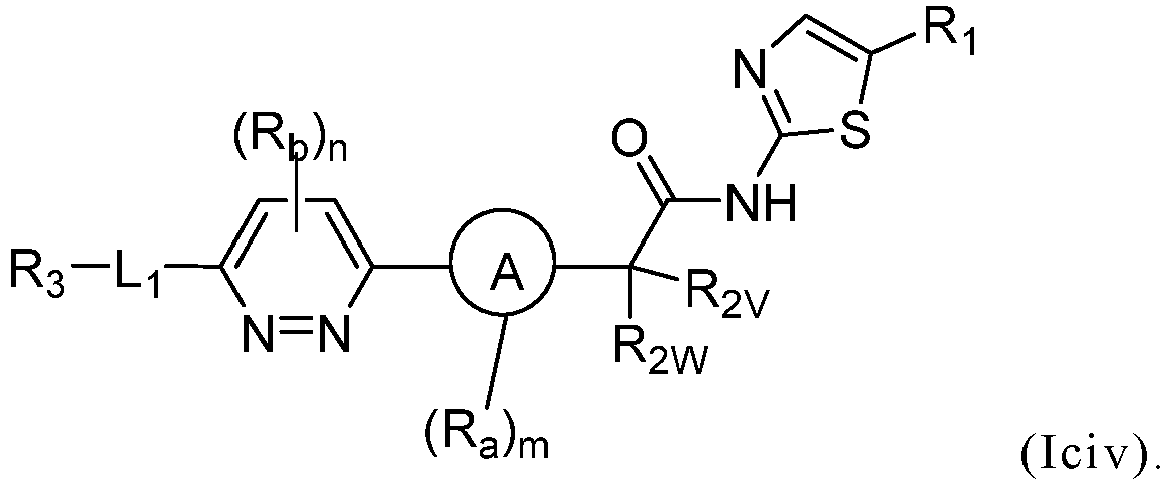
- In a fourteenth representative embodiment, the compound of Chemical Formula (I) may be a compound of the following Chemical Formula (Icv).

- In a fifteenth representative embodiment, the compound of Chemical Formula (I) may be a compound of the following Chemical Formula (Icvi).

- In a sixteenth representative embodiment, the compound of Chemical Formula (I) may be a compound of the following Chemical Formula (Icvii).

- In seventeenth representative embodiment, in formula (I), (Ia), (Iai), (Iaii), (Iaiii), (Ib), (Ibi), (Ibii), (Ici), (Icii), (Iciii) (Iciv), (Icv), (Icvi), or (Icvii) as defined in any of the representative embodiments above, R1 is halo, alkyl, cycloalkyl, haloalkyl, cyano, -SRc, -C(O)Rc, -C(O)ORc, -N(Rc)(Rd), -ORc, or - C(Rg)2-ORc; Rc is independently H or alkyl.
- In an eighteenth representative embodiment, in formula (I), (Ia), (Iai), (Iaii), (Iaiii), (Ib), (Ibi), (Ibii), (Ici), (Icii), (Iciii) (Iciv), (Icv), (Icvi), or (Icvii) as defined in any of the representative embodiments above, R2 V and R2 W are each independently H, halo, or alkyl.
- In a nineteenth representative embodiment, in formula (I), (Ia), (Iai), (Iaii), (Iaiii), (Ib), (Ibi), (Ibii), (Ici), (Icii), (Iciii) (Iciv), (Icv), (Icvi), or (Icvii) as defined in any of the representative embodiments above, one of R2 V and R2 W is H and the other is alkyl or R2 V and R2 W taken together with the atom to which they are attached, form a C3-C7 cycloalkyl.
- In a twentieth representative embodiment, in formula (I), (Ia), (Iai), (Iaii), (Iaiii), (Ib), (Ibi), (Ibii), (Ici), (Icii), (Iciii) (Iciv), (Icv), (Icvi), or (Icvii) as defined in any of the representative embodiments above, one of R2 V and R2 W is H and the other is methyl.
- In a twenty-first representative embodiment, in formula (I), (Ia), (Iai), (Iaii), (Iaiii), (Ib), (Ibi), (Ibii), (Ici), (Icii), (Iciii) (Iciv), (Icv), (Icvi), or (Icvii) as defined in any of the representative embodiments above, L1 is absent or - N(Re)-.
- In a twenty-second representative embodiment, in formula (I), (Ia), (Iai), (Iaii), (Iaiii), (Ib), (Ibi), or (Ibii) as defined in any of the representative embodiments above, the ring B is heterocycloalkyl and

- In a twenty-third representative embodiment, in formula (I), (Ia), (Iai), (Iaii), (Iaiii), (Ib), (Ibi), (Ibii), (Ici), (Icii), (Iciii) (Iciv), (Icv), (Icvi), or (Icvii) as defined in any of the representative embodiments above, L1 is -N(Re)-.
- In a twenty-fourth representative embodiment, in formula (I), (Ia), (Iai), (Iaii), (Iaiii), (Ib), (Ibi), (Ibii), (Ici), (Icii), (Iciii) (Iciv), (Icv), (Icvi), or (Icvii) as defined in any of the representative embodiments above, Re is H.
- In a twenty-fifth representative embodiment, in formula (I), (Ia), (Iai), (Iaii), (Iaiii), (Ib), (Ibi), (Ibii), (Ici), (Icii), (Iciii) (Iciv), (Icv), (Icvi), or (Icvii) as defined in any of the representative embodiments above, R3 is

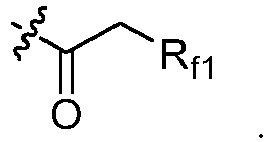
- In a twenty-sixth representative embodiment, in formula (I), (Ia), (Iai), (Iaii), (Iaiii), (Ib), (Ibi), (Ibii), (Ici), (Icii), (Iciii) (Iciv), (Icv), (Icvi), or (Icvii) as defined in any of the representative embodiments above, R3 is

- In a twenty-seventh representative embodiment, in formula (I), (Ia), (Iai), (Iaii), (Iaiii), (Ib), (Ibi), (Ibii), (Ici), (Icii), (Iciii) (Iciv), (Icv), (Icvi), or (Icvii) as defined in any of the representative embodiments above, Rf1 is H; and Rf2 and Rf3 are each independently H, alkyl, cycloalkyl, heterocycloalkyl, -N(Rc')(Rd'), or -(C(Rg')2)q-N(Rc')(Rd').
- In a twenty-eighth representative embodiment, in formula (I), (Ia), (Iai), (Iaii), (Iaiii), (Ib), (Ibi), (Ibii), (Ici), (Icii), (Iciii) (Iciv), (Icv), (Icvi), or (Icvii) as defined in any of the representative embodiments above, R3 is


- In a twenty-ninth representative embodiment, in formula (I), (Ia), (Iai), (Iaii), (Iaiii), (Ib), (Ibi), (Ibii), (Ici), (Icii), (Iciii) (Iciv), (Icv), (Icvi), or (Icvii) as defined in any of the representative embodiments above, Ra is H or halo.
- In a thirtieth representative embodiment, in formula (I), (Ia), (Iai), (Iaii), (Iaiii), (Ib), (Ibi), (Ibii), (Ici), (Icii), (Iciii) (Iciv), (Icv), (Icvi), or (Icvii) as defined in any of the representative embodiments above, Rb is H, halo, alkyl, or heterocycloalkyl.
- A thirty-first representative embodiment contemplates a pharmaceutical composition comprising a compound as defined in any of the above embodiments.
- A thirty-second representative embodiment contemplates a method of inhibiting CDK7, comprising administering a compound as defined in any of the first to thirtieth representative embodiments, or a pharmaceutical composition of the thirty-second representative embodiment.
- A thirty-third representative embodiment contemplates a method of treating or preventing a disease in a subject, comprising administering a compound as defined in any of the first to thirtieth representative embodiments, or a pharmaceutical composition of the thirty-second representative embodiment. The disease may be any of the diseases discussed herein, and is preferably a disease associated with unwanted activity of CDK7.
- In particularly preferred embodiments, the compound of Chemical Formula (I) is a compound represented by Formula (Id), or a pharmaceutically acceptable salt thereof.

- R1 is C1-C3 alkyl, which is unsubstituted or substituted with halogen; and
- Rb is CN or halogen.
- Representative compounds of Chemical Formulas (I)-(Icvii) include compounds selected from compounds 1) to 149), but are not limited thereto.
- 1) N-(5-(3-(1-((5-methylthiazol-2-yl)amino)-1-oxopropan-2-yl)phenyl)pyridin-2-yl)acrylamide;
- 2) N-(5-(3-(1-((5-cyclopropylthiazol-2-yl)amino) -1-oxopropan-2-yl)phenyl)pyridin-2-yl)acrylamide;
- 3) (R)-N-(-5-(3-(1-((5-cyclopropylthiazol-2-yl)amino)-1-oxopropan-2-yl)phenyl)pyridin-2-yl)acrylamide;
- 4) N-(5-(3-(1-((5-ethylthiazol-2-yl)amino)-1-oxopropan-2-yl)phenyl)pyridin-2-yl)acrylamide;
- 5) (E)-4-(dimethylamino)-N-(5-(3-(1-((5-methylthiazol-2-yl)amino)-1-oxopropan-2-yl)phenyl)pyridin-2-yl)but-2-enamide;
- 6) (E)-N-(5-(3-(1-((5-cyclopropylthiazol-2-yl)amino)-1-oxopropan-2-yl)phenyl)pyridin-2-yl)-4-(dimethylamino)but-2-enamide;
- 7) (E)-4-(dimethylamino)-N-(5-(3-(1-((5-methylthiazol-2-yl)amino-1-oxopropan-2-yl)phenyl)pyridin-2-yl)but-2-enamide hydrochloride;
- 8) N-(3-fluoro-3'-(1-((5-methylthiazol-2-yl)amino-1-oxopropan-2-yl)-[1,1'-biphenyl]-4-yl)acrylamide;
- 9) 2-(3-(1-acryloylindolin-5-yl)phenyl)-N-(5-methylthiazol-2-yl)propanamide;
- 10) (E)-N-(5-(3-(1,1-difluoro-2-((5-methylthiaaol-2-yl)amino)-2-oxoethyl)phenyl)pyridin-2-yl)-4-(dimethylamino)but-2-enamide;
- 11) N-(6-(3-(1-((5-cyanothiazol-2-yl)amino)-1-oxopropane-2-yl)-4-fluorophenyl)pyridazin-3-yl)acrylamide;
- 12) 2-(3-(6-acrylamidopyridazin-3-yl)phenyl)-N-(5-cyanothiazol-2-yl)-3-methylbutanamide;
- 13) N-(6-(5-(1-((5-cyanothiazol-2-yl)amino)-1-oxopropan-2-yl)-2-fluorophenyl)pyridazin-3-yl)acrylamide;
- 14) (S)-N-(5-(3-(1-(5-cyclopropylthiazol-2-yl)amino)-1-oxopropane-2-yl)phenyl)pyridin-2-yl)acrylamide;
- 15) (S,E)-N-(5-(3-(1-(5-cyclopropylthiazol-2-yl)amino)-1-oxopropan-2-yl)phenyl)pyridin-2-yl)-4-(dimethylamino)but-2-enamide;
- 16) (S)-N-(6-(3-(1-(5-cyclopropylthiazol-2-yl)amino)-1-oxopropan-2-yl)phenyl)pyrazin-2-yl)acrylamide;
- 17) (S,E)-4-(dimethylamino)-N-(5-(3-(1-((5-ethylthiazol-2-yl)amino)-1-oxopropan-2-yl)phenyl)pyridin-2-yl)but-2-enamide;
- 18) (S)-N-(5-(3-(1-((5-cyanothiazole-2-yl)amino)-1-oxopropan-2-yl)phenyl)pyridin-2-yl)acrylamide;
- 19) (S)-2-(3-(6-acrylamidopyridin-3-yl)phenyl)-N-(5-ethylthiazol-2-yl)butanamide;
- 20) (S)-2-(4'-acrylamido-3'-fluoro-[1,1'-biphenyl]-3-yl)-N-(5-ethylthiazol-2-yl)butanamide;
- 21) (S,E)-N-(5-(3-(1-((5-cyanothiazol-2-yl)amino)-1-oxopropan-2-yl)phenyl)pyridin-2-yl)-4-(dimethylamino)but-2-enamide;
- 22) (S)-N-(5-(3-(1-(5-cyclopropylthiazol-2-yl)amino)-1-oxopropan-2-yl)phenyl)pyrazin-2-yl)acrylamide;
- 23) (S)-N-(3'-(1-((5-cyclopropylthiazol-2-yl)amino)-1-oxopropan-2-yl)-[1,1'-biphenyl]-4-yl)acrylamide;
- 24) (S)-N-(3'-(1-((5-cyclopropylthiazol-2-yl)amino)-1-oxopropan-2-yl)-3-fluoro-[1,1'-biphenyl]-4-yl)acrylamide;
- 25) (S)-N-(5-(3-(1-((5-cyanothiazol-2-yl)amino)-1-oxopropan-2-yl)phenyl)pyrazin-2-yl)acrylamide;
- 26) (S)-N-(6-(3-(1-((5-cyanothiazol-2-yl)amino)-1-oxopropan-2-yl)phenyl)pyrazin-2-yl)acrylamide;
- 27) (S)-N-(5-(3-(1-(5-cyclopropylthiazol-2-yl)amino)-1-oxopropan-2-yl)phenyl)pyrimidin-2-yl)acrylamide;
- 28) (S)-N-(6-(3-(1-(_5-cyclopropylthiazol-2-yl)amino)-1-oxopropan-2-yl)phenyl)pyridazin-3-yl)acrylamide;
- 29) (S)-N-(5-(3-(1-(5-cyclopropylthiazol-2-yl)amino)-1-oxopropan-2-yl)phenyl)-3-fluoropyridin-2-yl)acrylamide;
- 30) (S)-N-(3-cyano-3'-(1-((5-ethylthiazol-2-yl)amino)-1-oxopropan-2-yl)-[1,1'-biphenyl]-4-yl)acrylamide;
- 31) (S)-N-(5-(3-(1-((5-ethylthiazol-2-yl)amino)-1-oxopropan-2-yl)phenyl)-6-fluoropyridin-2-yl)acrylamide;
- 32) (S)-N-(6-(3-(1-((5-cyanothiazol-2-yl)amino)-1-oxopropan-2-yl)phenyl)pyridazin-3-yl)acrylamide;
- 33) (S)-N-(5-(3-(1-((5-cyanothiazol-2-yl)amino)-1-oxopropan-2-yl)phenyl)-3-fluoropyridin-2-yl)acrylamide;
- 34) (S)-N-(5-(3-(1-((5-cyanothiazol-2-yl)amino)-1-oxopropan-2-yl)phenyl)-3-methylpyrazin-2-yl)acrylamide;
- 35) (S)-N-(5-(3-(1-((5-isopropylthiazol-2-yl)amino)-1-oxopropan-2-yl)phenyl)pyridin-2-yl)acrylamide;
- 36) (S)-N-(5-(3-(1-((5-isopropylthiazol-2-yl)amino)-1-oxopropan-2-yl)phenyl)pyrazin-2-yl)acrylamide;
- 37) (S)-N-(5-(3-(1-oxo-1-((5-(trifluoromethyl)thiazol-2-yl)amino)propan-2-yl)phenyl)pyrazin-2-yl)acrylamide;
- 38) (S)-N-(5-(3-(1-oxo-1-((5-(trifluoromethyl)thiazol-2-yl)amino)propan-2-yl)phenyl)pyridin-2-yl)acrylamide;
- 39) (S)-N-(6-(3-(1-oxo-1-((5-(trifluoromethyl)thiazol-2-yl)amino)propan-2-yl)phenyl)pyridazin-3-yl)acrylamide;
- 40) (S)-N-(6-(3-(1-((5-isopropylthiazol-2-yl)amino)-1-oxopropan-2-yl)phenyl)pyridazin-3-yl)acrylamide;
- 41) N-(5'-(1-((5-cyanothiazol-2-yl)amino)-1-oxopropane-2-yl)-[3,3'-bipyridin]-6-yl)acrylamide;
- 42) N-(4-(1-((5-cyanothiazole-2-yl)amino)-1-oxopropan-2-yl)-[2,3'-bipyridine]-6'-yl)acrylamide;
- 43) N-(5-(5-(1-((5-cyclopropylthiazol-2-yl)amino) -1-oxopropan-2-yl)pyridin-3-yl)pyrazin-2-yl)acrylamide;
- 44) N-(5-(5-(1-((5-cyanothiazol-2-yl)amino)-1-oxopropan-2-yl)pyridin-3-yl)pyrazin-2-yl)acrylamide;
- 45) N-(5-(5-(1-oxo-1-((5-(trifluoromethyl)thiazol-2-yl)amino)propan-2-yl)pyridin-3-yl)pyrazin-2-yl)acrylamide;
- 46) N-(5-(5-(1-((5-ethylthiazol-2-yl)amino)-1-oxopropan-2-yl)pyridin-3-yl)pyrazin-2-yl)acrylamide;
- 47) N-(5-(_5-(1-((5-isopropylthiazol-2-yl)amino)-1-oxopropan-2-yl)pyridin-3-yl)pyrazin-2-yl)acrylamide;
- 48) N-(5-(5-(1-((5-acetylthiazol-2-yl)amino)-1-oxopropan-2-yl)pyridin-3-yl)pyrazin-2-yl)acrylamide;
- 49) N-(6-(5-(1-oxo-1-((5-(trifluoromethyl)thiaaol-2-yl)amino)propan-2-yl)pyridin-3-yl)pyridazin-3-yl)acrylamide;
- 50) N-(4-(1-((5-cyclopropylthiazol-2-yl)amino)-1-oxopropan-2-yl)-[2,3'-bipyridine]-6'-yl)acrylamide;
- 51) (R)-N-(5-(5-(1-oxo-1-((5-(trifluoromethyl)thiazol-2-yl)amino)propan-2-yl)pyridin-3-yl)pyrazin-2-yl)acrylamide;
- 52) (S)-N-(5-(5-(1-oxo-1-((5-(trifluoromethyl)thiazol-2-yl)amino)propan-2-yl)pyridin-3-yl)pyrazin-2-yl)acrylamide;
- 53) N-(5-(5-(1-oxo-1-((5-(trifluoromethyl)thiazol-2-yl)amino)propan-2-yl)thiophen-3-yl)pyridin-2-yl)acrylamide;
- 54) N-(5-(3-(1-((5-cyclopropylthiazol-2-yl)amino) -1-oxopropan-2-yl)-5-fluorophenyl)pyridin-2-yl)acrylamide;
- 55) N-(5-(-5-(2-methyl-1-oxo-1-((5-(trifluoromethyl)thiazol-2-yl)amino)propan-2-yl)pyridin-3-yl)pyrazin-2-yl)acrylamide;
- 56) (S)-2-(3-(5-(2-cyanoacetamido)pyrazin-2-yl)phenyl)-N-(5-(trifluoromethyl)thiazol-2-yl)propanamide;
- 57) N-(5-(5-(1-oxo-1-((5-(trifluoromethyl)thiazol-2-yl)amino)propan-2-yl)thiophen-3-yl)pyrazin-2-yl)acrylamide;
- 58) (S)-2-(3-(5-(2-cyanoacetamido)pyrazin-2-yl) phenyl)-N-(5-cyanothiazol-2-yl)propanamide;
- 59) N-(5-(3-methyl-1-(1-oxo-1-((5- (trifluoromethyl)thiazol-2-yl)amino)propan-2-yl)-1H-pyrazol-4-yl)pyridin-2-yl)acrylamide;
- 60) 2-(1'-acryloyl-l',2',3',6'-tetrahydro- [3,4'-bipyridine]-5-yl)-N-(5-cyanothiazol-2-yl)propanamide;
- 61) N-(5-(5-(1-((5-chlorothiazol-2-yl)amino)-1-oxopropan-2-yl)pyridin-3-yl)pyrazine-2-yl)acrylamide;
- 62) (S)-N-(6-(3-(1-((5-cyclopropylthiazol-2-yl)amino)-1-oxopropan-2-yl)phenyl)pyridin-3-yl)acrylamide;
- 63) (E)-4-(dimethylamino)-N-(5-(5-(1-oxo-1-((5-(trifluoromethyl)thiazol-2-yl)amino)propan-2-yl)pyridin-3-yl)pyrazin-2-yl)but-2-enamide;
- 64) 2-(5-(5-(2-cyanoacetamido)pyrazin-2-yl)pyridin-3-yl)-N-(5-(trifluoromethyl)thiazol-2-yl)propanamide;
- 65) (E)-2-cyano-3-cyclopropyl-N-(5-(5-(1-oxo-1-((5-(trifluoromethyl)thiazol-2-yl)amino)propan-2-yl)pyridin-3-yl)pyrazin-2-yl)acrylamide;
- 66) N-(5-(5-(1-((5-methoxythiazol-2-yl)amino)-1-oxopropan-2-yl)pyridin-3-yl)pyrazin-2-yl)acrylamide;
- 67) N-(5-(5-(1-((5-fluorothiazol-2-yl)amino)-1-oxopropan-2-yl)pyridin-3-yl)pyrazin-2-yl)acrylamide;
- 68) N-(2-(4-methylpiperazin-1-yl)-4-(5-(1-oxo-1-((5-(trifluoromethyl)thiazol-2-yl)amino)propan-2-yl)pyridin-3-yl)phenyl)acrylamide;
- 69) (E)-2-cyano-3-(dimethylamino)-N-(5-(5-(1-oxo-1-((5-(trifluoromethyl)thiazol-2-yl)amino)propan-2-yl)pyridin-3-yl)pyrazin-2-yl)acrylamide;
- 70) N-(1-(5-(1-oxo-1-((5-(trifluoromethyl)thiazol-2-yl)amino)propan-2-yl)pyridin-3-yl)piperidin-4-yl)acrylamide;
- 71) N-(5-(5-(1-((5-(methylthio)thiazol-2-yl)amino)-1-oxopropan-2-yl)pyridin-3-yl)pyrazin-2-yl)acrylamide;
- 72) ethyl 2-(2-(5-(5-acrylamidopyrazin-2-yl)pyridin-3-yl)propanamido)thiazole-5-carboxylate;
- 73) (E)-N-(5-(5-(1-((5-chlorothiazol-2-yl)amino)-1-oxopropan-2-yl)pyridin-3-yl)pyrazin-2-yl)-4-(dimethylamino)but-2-enamide;
- 74) (E)-4-morpholino-N-(5-(5-(1-oxo-1-((5-(trifluoromethyl)thiazol-2-yl)amino)propan-2-yl)pyridin-3-yl)pyrazin-2-yl)but-2-enamide;
- 75) (E)-N-(5-(5-(1-oxo-1-((5-(trifluoromethyl)thiazol-2-yl)amino)propan-2-yl)pyridin-3-yl)pyrazin-2-yl)but-2-enamide;
- 76) N-(5-(5-(1-((5-chlorothiazol-2-yl)amino)-1-oxopropan-2-yl)thiophen-3-yl)pyridin-2-yl)acrylamide;
- 77) N-(5-(5-(1-((5-ethylthiazol-2-yl)amino)-1-oxopropan-2-yl)thiophen-3-yl)pyridin-2-yl)acrylamide;
- 78) N-(5-(5-(1-((5-acetylthiazol-2-yl)amino)-1-oxopropan-2-yl)thiophen-3-yl)pyridin-2-yl)acrylamide;
- 79) 2-(5-(5-propionamidopyrazin-2-yl)pyridin-3-yl)-N-(5-(trifluoromethyl)thiazol-2-yl)propanamide;
- 80) (E)-4-(5-methyl-2,5-diazabicyclo[2.2.1]heptan-2-yl)-N-(5-(5-(1-oxo-1-((5-(trifluoromethyl)thiazol-2-yl)amino)propan-2-yl)pyridin-3-yl)pyrazin-2-yl)but-2-enamide;
- 81)(S,E)-4-(dimethylamino)-N-(5-(3-(1-oxo-1-((5-(trifluoromethyl)thiazol-2-yl)amino)propan-2-yl)phenyl)pyrazin-2-yl)but-2-enamide;
- 82) N-(5'-(1-oxo-1-((5-(trifluoromethyl)thiazol-2-yl)amino)propan-2-yl)-[3,3'-bipyridin]-6-yl)acrylamide;
- 83) (E)-4-(2-oxa-5-azabicyclo[2.2.1]heptan-5-yl)-N-(5-(5-(1-oxo-1-((5-(trifluoromethyl)thiazol-2-yl)amino)propan-2-yl)pyridin-3-yl)pyrazin-2-yl)but-2-enamide;
- 84) N-(4-fluoro-5'-(1-oxo-1-((5-(trifluoromethyl)thiazol-2-yl)amino)propan-2-yl)-[3,3'-bipyridin]-6-yl)acrylamide;
- 85) 2-(5-(4-acryloylpiperazin-1-yl)pyridin-3-yl)-N-(5-(trifluoromethyl)thiazol-2-yl)propanamide;
- 86) 2-(5-(4-acryloylpiperazin-1-yl)pyridin-3-yl)-N-(5-ethylthiazol-2-yl)propanamide;
- 87) N-(6-(5-(1-((5-ethylthiazol-2-yl)amino)-1-oxopropan-2-yl)thiophen-3-yl)pyridin-3-yl)acrylamide;
- 88) N-(5-cyano-5'-(1-oxo-1-((5-(trifluoromethyl)thiazol-2-yl)amino)propan-2-yl)-[3,3'-bipyridin]-6-yl)acrylamide;
- 89) N-((5'-(1-oxo-1-((5-(trifluoromethyl)thiazol-2-yl)amino)propan-2-yl)-[3,3'-bipyridin]-6-yl)methyl)acrylamide;
- 90) N-(5'-(1-oxo-1-((5-(trifluoromethyl)thiazol-2-yl)amino)propan-2-yl)-[2,3'-bipyridin]-5-yl)acrylamide;
- 91) (S,E)-4-(dimethylamino)-N-(5-(3-(1-oxo-1-((5-(trifluoromethyl)thiazol-2-yl)amino)propan-2-yl)phenyl)pyrazin-2-yl)but-2-enamide;
- 92) (S,E)-4-morpholino-N-(5-(3-(1-oxo-1-((5-(trifluoromethyl)thiazol-2-yl)amino)propan-2-yl)phenyl)pyrazin-2-yl)but-2-enamide;
- 93) (S,E)-N-(5-(3-(1-((5-chlorothiazol-2-yl)amino)-1-oxopropan-2-yl)phenyl)pyrazin-2-yl)-4-(dimethylamino)but-2-enamide;
- 94) (E)-4-(2-oxa-5-azabicyclo[2.2.1]heptan-5-yl)-N-(5-(3-((S)-1-((5-chlorothiazol-2-yl)amino)-1-oxopropan-2-yl)phenyl)pyrazin-2-yl)but-2-enamide;
- 95) (S,E)-4-(4-methylpiperazin-1-yl)-N-(5-(3-(1-oxo-1-((5-(trifluoromethyl)thiazol-2-yl)amino)propan-2-yl)phenyl)pyrazin-2-yl)but-2-enamide;
- 96) (E)-4-(2-oxa-5-azabicyclo[2.2.1]heptan-5-yl)-N-(5-(3-((S)-1-oxo-1-((5-(trifluoromethyl)thiazol-2-yl)amino)propan-2-yl)phenyl)pyrazin-2-yl)but-2-enamide;
- 97) (S,E)-N-(5-(3-(1-((5-chlorothiazol-2-yl)amino)-1-oxopropan-2-yl)phenyl)pyrazin-2-yl)-4-(4-methylpiperazin-1-yl)but-2-enamide;
- 98) (S,E)-N-(5-(3-(1-((5-chlorothiazol-2-yl)amino)-1-oxopropan-2-yl)phenyl)pyrazin-2-yl)-4-morpholinobut-2-enamide;
- 99) (S,E)-4-(dimethylamino)-N-(3-fluoro-5-(3-(1-oxo-1-((5-(trifluoromethyl)thiazol-2-yl)amino)propan-2-yl)phenyl)pyridin-2-yl)but-2-enamide;
- 100) (S,E)-4-(dimethylamino)-N-(3-methoxy-5-(3-(1-oxo-1-((5-(trifluoromethyl)thiazol-2-yl)amino)propan-2-yl)phenyl)pyridin-2-yl)but-2-enamide;
- 101) (S,E)-N-(3-cyano-5-(3-(1-oxo-1-((5-(trifluoromethyl)thiazol-2-yl)amino)propan-2-yl)phenyl)pyridin-2-yl)-4-(dimethylamino)but-2-enamide;
- 102) (S,E)-N-(5-(3-(1-oxo-1-((5-(trifluoromethyl)thiazol-2-yl)amino)propan-2-yl)phenyl)pyrazin-2-yl)-4-(pyrrolidin-1-yl)but-2-enamide;
- 103) (S,E)-4-(azetidin-1-yl)-N-(5-(3-(1-oxo-1-((5-(trifluoromethyl)thiazol-2-yl)amino)propan-2-yl)phenyl)pyrazin-2-yl)but-2-enamide;
- 104) (S,E)-N-(5-(3-(1-((5-cyclobutylthiazol-2-yl)amino)-1-oxopropan-2-yl)phenyl)pyrazin-2-yl)-4-(dimethylamino)but-2-enamide;
- 105) (S,E)-4-(dimethylamino)-N-(5-(3-(1-((5-(2-hydroxypropan-2-yl)thiazol-2-yl)amino)-1-oxopropan-2-yl)phenyl)pyrazin-2-yl)but-2-enamide;
- 106) (S,E)-4-(dimethylamino)-N-(5-(3-(1-((5-(dimethylamino)thiazol-2-yl)amino)-1-oxopropan-2-yl)phenyl)pyrazin-2-yl)but-2-enamide;
- 107) (E)-4-(dimethylamino)-N-(5'-(1-oxo-1-((5-(trifluoromethyl)thiazol-2-yl)amino)propan-2-yl)-[3,3'-bipyridin]-6-yl)but-2-enamide;
- 108) (E)-N-(5-cyano-5'-(1-oxo-1-((5-(trifluoromethyl)thiazol-2-yl)amino)propan-2-yl)-[3,3'-bipyridin]-6-yl)-4-(dimethylamino)but-2-enamide;
- 109) (S,E)-4-(dimethylamino)-N-(3-methoxy-5-(3-(1-oxo-1-((5-(trifluoromethyl)thiazol-2-yl)amino)propan-2-yl)phenyl)pyrazin-2-yl)but-2-enamide;
- 110) (S,E)-2-(3-(1-(4-(dimethylamino)but-2-enoyl)-2,3-dihydro-1H-pyrrolo[2,3-b]pyridin-5-yl)phenyl)-N-(5-(trifluoromethyl)thiazol-2-yl)propanamide;
- 111) (S,E)-4-(dimethylamino)-N-(5-(3-(1-oxo-1-((5-(trifluoromethyl)thiazol-2-yl)amino)propan-2-yl)phenyl)-3-(trifluoromethyl)pyridin-2-yl)but-2-enamide;
- 112) (S,E)-4-(dimethylamino)-N-(3-methyl-5-(3-(1-oxo-1-((5-(trifluoromethyl)thiazol-2-yl)amino)propan-2-yl)phenyl)pyridin-2-yl)but-2-enamide;
- 113) (S,E)-N-(3-chloro-5-(3-(1-oxo-1-((5-(trifluoromethyl)thiazol-2-yl)amino)propan-2-yl)phenyl)pyridin-2-yl)-4-(dimethylamino)but-2-enamide;
- 114) (S,E)-4-(diethylamino)-N-(5-(3-(1-oxo-1-((5-(trifluoromethyl)thiazol-2-yl)amino)propan-2-yl)phenyl)pyrazin-2-yl)but-2-enamide;
- 115) (E)-4-((R)-3-fluoropyrrolidin-1-yl)-N-(5-(3-((S)-1-oxo-1-((5-(trifluoromethyl)thiazol-2-yl)amino)propan-2-yl)phenyl)pyrazin-2-yl)but-2-enamide;
- 116) (S,E)-4-(dimethylamino)-N-(5-(3-(1-oxo-1-((5-(trifluoromethyl)thiazol-2-yl)amino)propan-2-yl)phenyl)pyridin-2-yl)but-2-enamide;
- 117) (E)-4-((S)-3-fluoropyrrolidin-1-yl)-N-(5-(3-((S)-1-oxo-1-((5-(trifluoromethyl)thiazol-2-yl)amino)propan-2-yl)phenyl)pyrazin-2-yl)but-2-enamide;
- 118) (E)-4-((S)-2-(methoxymethyl)pyrrolidin-1-yl)-N-(5-(3-((S)-1-oxo-1-((5-(trifluoromethyl)thiazol-2-yl)amino)propan-2-yl)phenyl)pyrazin-2-yl)but-2-enamide;
- 119) (E)-4-(3-hydroxypyrrolidin-1-yl)-N-(5-(3-((S)-1-oxo-1-((5-(trifluoromethyl)thiazol-2-yl)amino)propan-2-yl)phenyl)pyrazin-2-yl)but-2-enamide;
- 120) (S,E)-N-(5-(3-(1-oxo-1-((5-(trifluoromethyl)thiazol-2-yl)amino)propan-2-yl)phenyl)pyrazin-2-yl)-4-(piperidin-1-yl)but-2-enamide;
- 121) (S,E)-N-(3-cyano-5-(3-(1-((5-ethylthiazol-2-yl)amino)-1-oxopropan-2-yl)phenyl)pyridin-2-yl)-4-(dimethylamino)but-2-enamide;
- 122) (S,E)-2-(3-(1-(4-(dimethylamino)but-2-enoyl)-2,3-dihydro-1H-pyrrolo[2,3-b]pyridin-5-yl)phenyl)-N-(5-ethylthiazol-2-yl)propanamide;
- 123) (E)-4-(2-oxa-5-azabicyclo[2.2.1]heptan-5-yl)-N-(3-cyano-5-(3-((S)-1-((5-ethylthiazol-2-yl)amino)-1-oxopropan-2-yl)phenyl)pyridin-2-yl)but-2-enamide;
- 124) (S)-N-(3-cyano-5-(3-(1-oxo-1-((5-(trifluoromethyl)thiazol-2-yl)amino)propan-2-yl)phenyl)pyridin-2-yl)acrylamide;
- 125) (S,E)-4-(dimethylamino)-N-(5-(3-(1-((5-ethylthiazol-2-yl)amino)-1-oxopropan-2-yl)phenyl)-3-methylpyridin-2-yl)but-2-enamide;
- 126) (S,E)-2-(3-(1-(4-(dimethylamino)but-2-enoyl)-2-methyl-1H-pyrrolo[2,3-b]pyridin-5-yl)phenyl)-N-(5-ethylthiazol-2-yl)propanamide;
- 127) (S,E)-2-(3-(1-(4-(dimethylamino)but-2-enoyl)-1H-pyrrolo[2,3-b]pyridin-5-yl)phenyl)-N-(5-ethylthiazol-2-yl)propanamide;
- 128) (E)-1-(3-(5-cyano-6-(4-(dimethylamino)but-2-enamido)pyridin-3-yl)phenyl)-N-(5-ethylthiazol-2-yl)cyclopropane-1-carboxamide;
- 129) (S,E)-4-(dimethylamino)-N-(5-(3-(1-((5-ethylthiazol-2-yl)amino)-1-oxopropan-2-yl)phenyl)pyridin-2-yl)-N-methylbut-2-enamide;
- 130) (S,E)-4-(dimethylamino)-N-(5-(3-(1-((5-ethylthiazol-2-yl)amino)-1-oxopropan-2-yl)phenyl)-3-fluoropyridin-2-yl)but-2-enamide;
- 131) (E)-4-(dimethylamino)-N-(6-(3-(1-((5-ethylthiazol-2-yl)amino)-1-oxobutan-2-yl)phenyl)pyridin-3-yl)but-2-enamide;
- 132) (S,E)-N-(3-cyano-5-(3-(1-((5-ethylthiazol-2-yl)amino)-1-oxopropan-2-yl)phenyl)pyridin-2-yl)-4-(dimethylamino)-N-methylbut-2-enamide;
- 133) (E)-1-(3-(1-(4-(dimethylamino)but-2-enoyl)-2,3-dihydro-1H-pyrrolo[2,3-b]pyridin-5-yl)phenyl)-N-(5-ethylthiazol-2-yl)cyclopropane-1-carboxamide;
- 134) (E)-1-(3-(6-(4-(dimethylamino)but-2-enamido)-5-fluoropyridin-3-yl)phenyl)-N-(5-ethylthiazol-2-yl)cyclopropane-1-carboxamide;
- 135) (S,E)-N-(3-cyano-5-(3-(1-((5-ethylthiazol-2-yl)amino)-1-oxopropan-2-yl)phenyl)pyridin-2-yl)-4-morpholinobut-2-enamide;
- 136) (S,E)-N-(3-cyano-5-(3-(1-((5-ethylthiazol-2-yl)amino)-1-oxopropan-2-yl)phenyl)pyridin-2-yl)-4-(4-methylpiperazin-1-yl)but-2-enamide;
- 137)(E)-N-(5-cyano-5'-(1-((5-ethylthiazol-2-yl)amino)-1-oxopropan-2-yl)-[3,3'-bipyridin]-6-yl)-4-(dimethylamino)but-2-enamide;
- 138) (E)-N-(3-cyano-5-(3-(1-((5-ethylthiazol-2-yl)amino)-1-oxobutan-2-yl)phenyl)pyridin-2-yl)-4-(dimethylamino)but-2-enamide;
- 139) (S)-2-(3-(5-cyano-6-(2-cyanoacetamido)pyridin-3-yl)phenyl)-N-(5-ethylthiazol-2-yl)propanamide;
- 140) N-(5-(6-(1-((5-methylthiazol-2-yl)amino)-1-oxopropan-2-yl)pyrazin-2-yl)pyridin-2-yl)acrylamide;
- 141) N-(2'-(1-((5-methylthiazol-2-yl)amino)-1-oxopropan-2-yl)-[3,4'-bipyridin]-6-yl)acrylamide;
- 142) N-(4-(3-(1-((5-methylthiazol-2-yl)amino)-1-oxopropan-2-yl)piperidin-1-yl)phenyl)acrylamide;
- 143) N-(5-(2-(1-((5-methylthiazol-2-yl)amino)-1-oxopropan-2-yl)thiazol-4-yl)pyridin-2-yl)acrylamide;
- 144) (S)-N-(3-cyclopropyl-5-(3-(1-((5-ethylthiazol-2-yl)amino)-1-oxopropan-2-yl)phenyl)pyridin-2-yl)acrylamide;
- 145) (S)-N-(3-((2-(dimethylamino)ethyl)(methyl)amino)-3'-(1-((5-ethylthiazol-2-yl)amino)-1-oxopropan-2-yl)-[1,1'-biphenyl]-4-yl)acrylamide;
- 146) (S)-N-(5-ethylthiazol-2-yl)-2-(3-(6-(vinylsulfonamido)pyridin-3-yl)phenyl)propanamide;
- 147) (S)-N-(3-(3-(1-((5-ethylthiazol-2-yl)amino)-1-oxopropan-2-yl)phenyl)-1-methyl-1H-pyrazol-5-yl)acrylamide;
- 148) (S)-N-(4-(3-(1-((5-ethylthiazol-2-yl)amino)-1-oxopropan-2-yl)phenyl)-1H-imidazol-2-yl)acrylamide; and
- 149) (S)-N-(4-(3-(1-((5-ethylthiazol-2-yl)amino)-1-oxopropan-2-yl)phenyl)thiazol-2-yl)acrylamide.
- Unless otherwise stated hereinafter, the compounds of Chemical Formulas (I) to (V) as active ingredients of therapeutic agents includes any pharmaceutically acceptable salt thereof, and all thereof must be construed as being included within the scope of the present invention. For the convenience of description, they may be simply abbreviated as compounds of Chemical Formulas (I) to (V) or compounds of the invention.
- The compounds of the present invention may exist in the form of a salt, particularly a pharmaceutically acceptable salt. As the salt, salts commonly used in the art, such as acid addition salts formed by pharmaceutically acceptable free acids, can be used without limitation. The term "pharmaceutically acceptable salt" used herein refers to any organic or inorganic addition salt of the compounds of the invention, in which the adverse effect caused by the salt does not impair the beneficial effect of the compounds at a concentration exhibiting relatively non-toxic and non-harmful effective activity to a patient.
- Organic acids and inorganic acids can be used as the free acids. The pharmaceutically acceptable salt includes acid addition salts formed by inorganic acids such as hydrochloric acid, sulfuric acid, nitric acid, phosphoric acid, hydrobromic acid, hydroiodic acid, etc.; organic carbonic acids such as tartaric acid, formic acid, citric acid, acetic acid, trichloroacetic acid, trifluoroacetic acid, gluconic acid, benzoic acid, lactic acid, mandelic acid, fumaric acid, maleic acid, salicylic acid, etc.; or sulfonic acids such as methanesulfonic acid, ethanesulfonic acid, benzenesulfonic acid, p-toluenesulfonic acid, etc. Examples of pharmaceutically acceptable carboxylic acid salts include metal salts or alkaline earth metal salts formed by lithium, sodium, potassium, calcium, magnesium, etc., amino acid salts such as lysine, arginine, guanidine, etc., organic salts such as dicyclohexylamine, N-methyl-D-glucamine, tris(hydroxymethyl)methylamine, diethanolamine, choline, triethylamine, etc. The compounds according to the present invention may also be converted into their salts by conventional methods.
- In addition, the compounds of the present invention include not only pharmaceutically acceptable salts thereof, but also all possible optical isomers, without limitation. The stereoisomers of the compounds of the invention may be prepared using methods known in the art.
- Further, the compounds of the present invention may be prepared either in a crystalline form or in a non-crystalline form. When the compounds are prepared in a crystalline form, they may be optionally hydrated or solvated. Hydates of the compounds of the invention include stoichiometric hydrates (i.e., 1:1 ratio of compound molecule to water molecule), and non-stoichiometric hydrates (i.e., ratios of compound molecule to water molecule other than 1:1). Similarly, solvates of the compound of of the present invention includes both stoichiometric solvates and non-stoichiometric solvates.
- Other terms have the same meaning as generally understood in the art to which the present invention pertains.
- Any references to methods of treatment in the subsequent paragraphs of this description are to be interpreted as references to the compounds, pharmaceutical compositions and medicaments of the present invention for use in a method for treatment of the human or animal body by therapy or for diagnosis.
- The thiazole derivatives according to the invention, pharmaceutically acceptable salts, optical isomers, solvates or hydrates thereof inhibit activities of the cyclin-dependent kinase, preferably CDK7, thereby exhibiting prophylactic or therapeutic effects of proliferative disorders or diseases associated with these activities, and infectious diseases.
- Accordingly, the present invention also relates to a pharmaceutical composition for use in preventing or treating disorder or disease associated with CDK activity, or infectious disease comprising a compound of the invention, or a pharmaceutically acceptable salt or optical isomer thereof as an active ingredient.
- Further, the present invention relates to compounds for use in a method for preventing or treating disorder or disease associated with the CDK activity, or infectious diseases comprising a step of administering a compound of the invention, or a pharmaceutically acceptable salt or optical isomer thereof.
- Furthermore, the present invention relates to a use of a compound of the invention, or a pharmaceutically acceptable salt or optical isomer thereof for preventing or treating disorder or disease related to CDK activity, or infectious disease. Specifically, the pharmaceutical composition of the present invention may prevent or treat disease or disorder related to CDK activity such as proliferative diseases or infectious diseases by inhibiting one or more cyclin dependent kinases. The proliferative disease means, for example, cancer, benign neoplasm, angiogenesis, inflammatory diseases, autoinflammatory diseases or autoimmune diseases, and the infectious disease means, for example, bacterial diseases or viral diseases. The proliferative disorders to be treated or prevented using the thiazole derivative compounds according to the present invention may be typically be associated with the aberrant activity of CDK7. Aberrant activity of CDK7 may be an elevated and/or an inappropriate (e.g., aberrant) activity of the CDK7.
- A proliferative disease may also be associated with inhibition of apoptosis of a cell in a biological sample or subject. Inhibition of CDK7 activity is expected to result in cytotoxicity through induction of apoptosis. Compounds of the invention, and pharmaceutically acceptable salts and/or optical isomers thereof according to the present invention may induce apoptosis, and therefore, be useful in treating and/or preventing proliferative diseases.
- The terms "neoplasm" and "tumor" are used herein interchangeably and refer to an abnormal mass of tissue wherein the growth of the mass surpasses and is not coordinated with the growth of a normal tissue. A neoplasm or tumor may be "benign" or "malignant," depending on the following characteristics: degree of cellular differentiation (including morphology and functionality), rate of growth, local invasion, and metastasis. A "benign neoplasm" is generally well differentiated, has characteristically slower growth than a malignant neoplasm, and remains localized to the site of origin. In addition, a benign neoplasm does not have the capacity to infiltrate, invade, or metastasize to distant sites. Exemplary benign neoplasms include, but are not limited to, lipoma, chondroma, adenomas, acrochordon, senile angiomas, seborrheic keratoses, lentigos, and sebaceous hyperplasias. In some cases, certain "benign" tumors may later give rise to malignant neoplasms, which may result from additional genetic changes in a subpopulation of the tumor's neoplastic cells, and these tumors are referred to as "pre-malignant neoplasms." An exemplary pre-malignant neoplasm is a teratoma. In contrast, a "malignant neoplasm" is generally poorly differentiated (anaplasia) and has characteristically rapid growth accompanied by progressive infiltration, invasion, and destruction of the surrounding tissue. Furthermore, a malignant neoplasm generally has the capacity to metastasize to distant sites.
- As used herein, the term "cancer" refers to a malignant neoplasm. Exemplary cancers include, but are not limited to, acoustic neuroma; adenocarcinoma; adrenal gland cancer; anal cancer; angiosarcoma (e.g., lymphangiosarcoma, lymphangioendotheliosarcoma, hemangiosarcoma); appendix cancer; benign monoclonal gammopathy; biliary cancer (e.g., cholangiocarcinoma); bladder cancer; breast cancer (e.g., adenocarcinoma of the breast, papillary carcinoma of the breast, mammary cancer, medullary carcinoma of the breast); brain cancer (e.g., meningioma, glioblastomas, glioma (e.g., astrocytoma, oligodendroglioma), medulloblastoma); bronchus cancer; carcinoid tumor; cervical cancer (e.g., cervical adenocarcinoma); choriocarcinoma; chordoma; craniopharyngioma; colorectal cancer (e.g., colon cancer, rectal cancer, colorectal adenocarcinoma); connective tissue cancer; epithelial carcinoma; ependymoma; endotheliosarcoma (e.g., Kaposi's sarcoma, multiple idiopathic hemorrhagic sarcoma); endometrial cancer (e.g., uterine cancer, uterine sarcoma); esophageal cancer (e.g., adenocarcinoma of the esophagus, Barrett's adenocarcinoma); Ewing's sarcoma; eye cancer (e.g., intraocular melanoma, retinoblastoma); familiar hypereosinophilia; gall bladder cancer; gastric cancer (e.g., stomach adenocarcinoma); gastrointestinal stromal tumor (GIST); germ cell cancer; head and neck cancer (e.g., head and neck squamous cell carcinoma, oral cancer (e.g., oral squamous cell carcinoma), throat cancer (e.g., laryngeal cancer, pharyngeal cancer, nasopharyngeal cancer, oropharyngeal cancer)); hematopoietic cancers (e.g., leukemia such as acute lymphocytic leukemia (ALL) (e.g., B-cell ALL, T-cell ALL), acute myelocytic leukemia (AML) (e.g., B-cell AML, T-cell AML), chronic myelocytic leukemia (CML) (e.g., B-cell CML, T-cell CML), and chronic lymphocytic leukemia (CLL) (e.g., B-cell CLL, T-cell CLL)); lymphoma such as Hodgkin lymphoma (HL) (e.g., B-cell HL, T-cell HL) and non-Hodgkin lymphoma (NHL) (e.g., B-cell NHL such as diffuse large cell lymphoma (DLCL) (e.g., diffuse large B-cell lymphoma), follicular lymphoma, chronic lymphocytic leukemia/small lymphocytic lymphoma (CLL/SLL), mantle cell lymphoma (MCL), marginal zone B-cell lymphomas (e.g., mucosa-associated lymphoid tissue (MALT) lymphomas, nodal marginal zone B-cell lymphoma, splenic marginal zone B-cell lymphoma), primary mediastinal B-cell lymphoma, Burkitt lymphoma, lymphoplasmacytic lymphoma (i.e., Waldenstrom's macroglobulinemia), hairy cell leukemia (HCL), immunoblastic large cell lymphoma, precursor B-lymphoblastic lymphoma and primary central nervous system (CNS) lymphoma; and T-cell NHL such as precursor T-lymphoblastic lymphomalleukemia, peripheral T-cell lymphoma (PTCL) (e.g., cutaneous T-cell lymphoma (CTCL) (e.g., mycosis fungoides, Sezary syndrome), angioimmunoblastic T-cell lymphoma, extranodal natural killer T-cell lymphoma, enteropathy type T-cell lymphoma, subcutaneous panniculitis-like T-cell lymphoma, and anaplastic large cell lymphoma); a mixture of one or more leukemiallymphoma as described above; and multiple myeloma (MM)), heavy chain disease (e.g., alpha chain disease, gamma chain disease, mu chain disease); hemangioblastoma; hypopharynx cancer; inflammatory myofibroblastic tumors; immunocytic amyloidosis; kidney cancer (e.g., nephroblastoma also known as Wilms' tumor, renal cell carcinoma); liver cancer (e.g., hepatocellular cancer (HCC), malignant hepatoma); lung cancer (e.g., bronchogenic carcinoma, small cell lung cancer (SCLC), non-small cell lung cancer (NSCLC), adenocarcinoma of the lung); leiomyosarcoma (LMS); mastocytosis (e.g., systemic mastocytosis); muscle cancer; myelodysplastic syndrome (MDS); mesothelioma; myeloproliferative disorder (MPD) (e.g., polycythemia vera (PV), essential thrombocytosis (ET), agnogenic myeloid metaplasia (AMM) also known as myelofibrosis (MF), chronic idiopathic myelofibrosis, chronic myelocytic leukemia (CML), chronic neutrophilic leukemia (CNL), hypereosinophilic syndrome (HES)); neuroblastoma; neurofibroma (e.g., neurofibromatosis (NF) type 1 or type 2, schwannomatosis); neuroendocrine cancer (e.g., gastroenteropancreatic neuroendocrine tumor (GEP-NET), carcinoid tumor); osteosarcoma (e.g., bone cancer); ovarian cancer (e.g., cystadenocarcinoma, ovarian embryonal carcinoma, ovarian adenocarcinoma); papillary adenocarcinoma; pancreatic cancer (e.g., pancreatic adenocarcinoma, intraductal papillary mucinous neoplasm (IPMN), Islet cell tumors); penile cancer (e.g., Paget's disease of the penis and scrotum); pinealoma; primitive neuroectodermal tumor (PNT); plasma cell neoplasia; paraneoplastic syndromes; intraepithelial neoplasms; prostate cancer (e.g., prostate adenocarcinoma); rectal cancer; rhabdomyosarcoma; salivary gland cancer; skin cancer (e.g., squamous cell carcinoma (SCC), keratoacanthoma (KA), melanoma, basal cell carcinoma (BCC)); small bowel cancer (e.g., appendix cancer); soft tissue sarcoma (e.g., malignant fibrous histiocytoma (MFH), liposarcoma, malignant peripheral nerve sheath tumor (MPNST), chondrosarcoma, fibrosarcoma, myxosarcoma); sebaceous gland carcinoma; small intestine cancer; sweat gland carcinoma; synovioma; testicular cancer (e.g., seminoma, testicular embryonal carcinoma); thyroid cancer (e.g., papillary carcinoma of the thyroid, papillary thyroid carcinoma (PTC), medullary thyroid cancer); urethral cancer; vaginal cancer; and vulvar cancer (e.g., Paget's disease of the vulva).
- The term "angiogenesis" refers to the formation and the growth of new blood vessels. Normal angiogenesis occurs in the healthy body of a subject for healing wounds and for restoring blood flow to tissues after injury. The healthy body controls angiogenesis through a number of means, e.g., angiogenesis-stimulating growth factors and angiogenesis inhibitors. Many disease states, such as cancer, diabetic blindness, age-related macular degeneration, rheumatoid arthritis, and psoriasis, are characterized by abnormal (i.e., increased or excessive) angiogenesis. Abnormal angiogenesis refers to angiogenesis greater than that in a normal body, especially angiogenesis in an adult not related to normal angiogenesis (e.g., menstruation or wound healing). Abnormal angiogenesis can provide new blood vessels that feed diseased tissues and/or destroy normal tissues, and in the case of cancer, the new vessels can allow tumor cells to escape into the circulation and lodge in other organs (tumor metastases).
- As used herein, an "inflammatory disease" refers to a disease caused by, resulting from, or resulting in inflammation. The term "inflammatory disease" may also refer to a dysregulated inflammatory reaction that causes an exaggerated response by macrophages, granulocytes, and/or T-lymphocytes leading to abnormal tissue damage and/or cell death. An inflammatory disease can be either an acute or chronic inflammatory condition and can result from infections or non-infectious causes. Inflammatory diseases include, without limitation, atherosclerosis, arteriosclerosis, autoimmune disorders, multiple sclerosis, systemic lupus erythematosus, polymyalgia rheumatica (PMR), gouty arthritis, degenerative arthritis, tendonitis, bursitis, psoriasis, cystic fibrosis, arthrosteitis, rheumatoid arthritis, inflammatory arthritis, Sjogren's syndrome, giant cell arteritis, progressive systemic sclerosis (scleroderma), ankylosing spondylitis, polymyositis, dermatomyositis, pemphigus, pemphigoid, diabetes (e.g., Type I), myasthenia gravis, Hashimoto's thyroiditis, Graves' disease, Goodpasture's disease, mixed connective tissue disease, sclerosing cholangitis, inflammatory bowel disease, Crohn's disease, ulcerative colitis, pernicious anemia, inflammatory dermatoses, usual interstitial pneumonitis (UIP), asbestosis, silicosis, bronchiectasis, berylliosis, talcosis, pneumoconiosis, sarcoidosis, desquamative interstitial pneumonia, lymphoid interstitial pneumonia, giant cell interstitial pneumonia, cellular interstitial pneumonia, extrinsic allergic alveolitis, Wegener's granulomatosis and related forms of angiitis (temporal arteritis and polyarteritis nodosa), inflammatory dermatoses, hepatitis, delayed-type hypersensitivity reactions (e.g., poison ivy dermatitis), pneumonia, respiratory tract inflammation, Adult Respiratory Distress Syndrome (ARDS), encephalitis, immediate hypersensitivity reactions, asthma, hayfever, allergies, acute anaphylaxis, rheumatic fever, glomerulonephritis, pyelonephritis, cellulitis, cystitis, chronic cholecystitis, ischemia (ischemic injury), reperfusion injury, allograft rejection, host-versus-graft rejection, appendicitis, arteritis, blepharitis, bronchiolitis, bronchitis, cervicitis, cholangitis, chorioamnionitis, conjunctivitis, dacryoadenitis, dermatomyositis, endocarditis, endometritis, enteritis, enterocolitis, epicondylitis, epididymitis, fasciitis, fibrositis, gastritis, gastroenteritis, gingivitis, ileitis, iritis, laryngitis, myelitis, myocarditis, nephritis, omphalitis, oophoritis, orchitis, osteitis, otitis, pancreatitis, parotitis, pericarditis, pharyngitis, pleuritis, phlebitis, pneumonitis, proctitis, prostatitis, rhinitis, salpingitis, sinusitis, stomatitis, synovitis, testitis, tonsillitis, urethritis, urocystitis, uveitis, vaginitis, vasculitis, vulvitis, vulvovaginitis, angitis, chronic bronchitis, osteomyelitis, optic neuritis, temporal arteritis, transverse myelitis, necrotizing fasciitis, and necrotizing enterocolitis.
- As used herein, an "autoimmune disease" refers to a disease arising from an inappropriate immune response of the body of a subject against substances and tissues normally present in the body. In other words, the immune system mistakes some part of the body as a pathogen and attacks its own cells. This may be restricted to certain organs (e.g., in autoimmune thyroiditis) or involve a particular tissue in different places (e.g., Goodpasture's disease which may affect the basement membrane in both the lung and kidney). The treatment of autoimmune diseases is typically with immunosuppression, e.g., medications which decrease the immune response. Exemplary autoimmune diseases include, but are not limited to, glomerulonephritis, Goodpasture's syndrome, necrotizing vasculitis, lymphadenitis, peri-arteritis nodosa, systemic lupus erythematosis, rheumatoid, arthritis, psoriatic arthritis, systemic lupus erythematosis, psoriasis, ulcerative colitis, systemic sclerosis, dermatomyositis/polymyositis, anti-phospholipid antibody syndrome, scleroderma, pemphigus vulgaris, ANCA-associated vasculitis (e.g., Wegener's granulomatosis, microscopic polyangiitis), uveitis, Sjogren's syndrome, Crohn's disease, Reiter's syndrome, ankylosing spondylitis, Lyme arthritis, Guillain-Barre syndrome, Hashimoto's thyroiditis, and cardiomyopathy.
- The term "autoinflammatory disease" refers to a category of diseases that are similar but different from autoimmune diseases. Autoinflammatory and autoimmune diseases share common characteristics in that both groups of disorders result from the immune system attacking a subject's own tissues and result in increased inflammation. In autoinflammatory diseases, a subject's innate immune system causes inflammation for unknown reasons. The innate immune system reacts even though it has never encountered autoantibodies or antigens in the subject. Autoinflammatory disorders are characterized by intense episodes of inflammation that result in such symptoms as fever, rash, or joint swelling. These diseases also carry the risk of amyloidosis, a potentially fatal buildup of a blood protein in organs. Autoinflammatory diseases include, but are not limited to, familial Mediterranean fever (FMF), neonatal onset multisystem inflammatory disease (NOMID), tumor necrosis factor (TNF) receptor-associated periodic syndrome (TRAPS), deficiency of the interleukin-1 receptor antagonist (DIRA), and Behcet's disease.
- The novel thiazole derivatives according to the present invention have remarkable inhibitory activity against CDK in comparison with the compounds known in the art. Specifically, the compounds of the present invention have not only highly selective inhibitory activity against CDK7 compared with any known compounds in the art, but also have reduced side effects and toxicity, which results in exerting remarkable prophylactic or therapeutic effects on proliferative diseases or infectious diseases associated with CDK7.
- In some embodiments, the compounds of the present invention are at least 2 times more selective for CDK7 than other types of CDKs, especially CDK2 or CDK5. For example, the compounds may be at least 2 times, at least 3 times at least 5 times, or even at least 10 times more selective for CDK7 than other types of CDKs, such as CDK2 or CDK5. In some embodiments, the compounds of the present invention may be at least 100 times more selective for CDK7 than other types of CDKs, especially CDK2 or CDK5.
- Similarly, the CDK7-inhibitory activity (quantified as IC50) of the compounds of the present invention is less than 1000 nM. In some embodiments, the CDK7-inhibitory activity (IC50) of the compounds of present invention is less than 500 nM. In preferred embodiments, the CDK7-inhibitory activity (IC50) of the compounds of present invention is less than 100 nM.
- The thiazole derivative compounds according to the present invention can be prepared from readily available starting materials using modifications to the specific synthesis protocols set forth below that would be well known to those of skill in the art.
- As a specific embodiment, intermediates 1-b and 1-c of the compound of the present invention may be prepared according to Scheme 1 below.

- Compound 1-a is dissolved in a solvent, e.g., THF, and reacted with in an appropriate amount of a base, e.g., NaHMDS or LiHMDS, followed by adding halogenated alkyl (R2v-I) to obtain compound 1-b substituted with different alkyl groups. Compound 1-c in (S)-form is then separated from compound 1-b in racemic acid form. Specifically, compound 1-b is dissolved in a suitable solvent, e.g., ACN, adding a base in (R)-form that is able to form a salt with an acid compound, e.g., (R)-1-phenylethan-1-amine, precipitating a salt, and filtering. The recrystallization with ACN is repeated twice, extracted under acid conditions, and dried, to obtain intermediate Compound 1-c in (S)-form.
- As a specific embodiment, intermediate 2-b of the compound of the present invention may be prepared according to Scheme 2-1 below.

- Compound 2-a is reacted with an acid chloride or carboxylic acid, which is commercially available, under appropriate reaction condition (e.g., SOCl2 or (COCl)2, DMF (catalytic amount), room temperature), and then under suitable base condition (e.g., triethylamine, diisopropylamine, pyridine, etc.), to obtain Compound 2-b. Otherwise, Compound 2-a is reacted with carboxylic acid in the presence of an appropriate coupling agent comprising, for example, HATU, HBTU, TBTU, EDC/HOBt, or T3P, under suitable base condition (e.g., pyridine, triethylamine, diisopropylethylamine, etc.), to obtain Compound 2-b.

- In the scheme, Compound 2-b' is obtained under the condition of Scheme 2-1, and reacted with dimethylamine under suitable solvent (e.g., ACN or THF) and base condition (K2CO3 or DPIEA) at an appropriate temperature, to obtain compound 2-b".
- The compound of the present invention may be prepared according to Scheme 3 below.

- Intermediate 1-b or 1-c, which is commercially available or synthesized, is reacted with an acid chloride under appropriate reaction condition (e.g., SOCl2 or (COCl)2, DMF (catalytic amount), room temperature) and then under suitable base condition (e.g., pyridine, triethylamine, diisopropylethylamine, etc.) to obtain compound 3-a. Otherwise, intermediate 1-b or 1-c is reacted in the presence of an appropriate coupling agent to obtain compound 3-a. The coupling agent may comprise HATU, HBTU, TBTU, EDC/HOBt, or T3P, where the reaction may be conducted under suitable base condition. The base may comprise pyridine, triethylamine, diisopropylethylamine, etc. Intermediate 3-b is synthesized by using Miyaura reaction in the presence of a catalyst such as pd(dppf)Cl2.DCM, a base such as Na2CO3, and in a solvent such as 1,4-dioxane. The desired compound 3-c can be synthesized under Suzuki condition in the presence of a catalyst such as pd(dppf)Cl2.DCM or Pd(PPh3)4, a base such as Na2CO3, NaHCO3, or Cs2CO3, and a solvent such as 1,4-dioxane/water.
- The compound of the present invention may be prepared according to Scheme 4 below.

- Compound 4-a is synthesized from compound 3-b in the presence of a catalyst such as pd(dppf)Cl2.DCM or Pd(PPh3)4, a base such as Na2CO3 or Cs2CO3, and a solvent such as 1,4-dioxane/water, and then the desired compound 4-b can be synthesized under the condition of Scheme 2.
- The compound of the present invention may be prepared according to Scheme 5 below.

- Intermediate 1-b or 1-c is reacted under acid condition of alcohol solvent (esterification reaction), and is then subjected to Miyaura reaction in the presence of a suitable catalyst such as pd(dppf)Cl2.DCM, a base such as Na2CO3, and a solvent such as 1,4-dioxane to obtain intermediate 5-b. Compound 5-c is then synthesized by using Suzuki reaction in a catalyst such as pd(dppf)Cl2.DCM or Pd(PPh3)4, a base such as Na2CO3 or Cs2CO3, and a solvent such as 1,4-dioxane/water. The hydrolysis is then conducted with a base such as LiOH or NaOH to obtain Compound 5-d, followed by using an appropriate coupling agent to obtain Compound 5-e. The coupling agent may comprise HATU, HBTU, TBTU, EDC/HOBt, or T3P, where the reaction may be conducted under suitable base condition (e.g., pyridine, triethylamine, diisopropylethylamine, etc.).
- The present invention will be described in detail with reference to the following Examples and Experimental Examples. In the examples, the contents of methods for synthesizing intermediates for making final compounds and methods for synthesizing final compounds using the compounds of the examples are described.
-

- 2-(3-bromophenyl) acetic acid (21 g, 97.56 mmol) was dissolved in THF (200 ml, 0.5 M) and then 1 M NaHMDS (200 ml, 200 mmol) was added dropwise at 0 ° C. After stirring for 30 minutes, MeI (6.07ml, 97.56 mmol) was added, followed by stirring at room temperature for 2 hours. The mixture was diluted with EtOAc, washed with 1N HCl, and then the organic layer was dried (MgSO4), filtered and dried under reduced pressure. The residue was purified by using a Combi-flash column (100% gradient in EA / Hex 10) to give the title compound (19.6 g, 92%).
- To 2-(3-bromophenyl)propanoic acid (2 g, 8.73 mmol), HOBt (1.77g, 13.1mmol), DIPEA (4.6ml, 26.2mmol) and EDCI (2.5g, 13.1mmol) were added DCM (50ml, 0.2M). The mixture was stirred at room temperature for 30 minutes, then 5-methylthiazol-2-amine (1 g, 8.73 mmol) was added thereto and stirred at room temperature for 15 hours. This mixture was diluted with EtOAc, washed with 1N HCl, washed with saturated NaHCO3solution, then dried (MgSO4), filtered and then dried under reduced pressure. The residue was purified by a Combi-flash column (EA/Hex 10 to 100% gradient) to give the title compound (2.27 g, 80%) as a white solid.
- 1H NMR (400 MHz, CDCl3) δ 7.46 (s, 1H), 7.40 (d, J = 5.7 Hz, 1H), 7.23-7.17 (m, 2H), 7.03 (m, 1H), 3.75 (q, J = 5.1 Hz, 1H), 2.41 (s, 3H), 1.60 (d, J = 5.1 Hz, 3H); MS (m/z): 326.0 [M+1]
- To 2-(3-bromophenyl)-N-(5-methylthiazol-2-yl)propanamide (1.0 g, 3.07 mmol) and KOAc (904 mg, 9.21 mmol) were added anhydrous 1,4-dioxane (15 ml, 0.2 M), and the reaction mixture was stirred and degassed. Bis(pinacolato)diboron (0.94 g, 3.69 mmol) and Pd (dppf)Cl2.DCM (253 mg, 0.31 mmol) were added and stirred at 85°C for 15 hours. This mixture was diluted with EtOAc, washed with water, then dried (MgSO4), filtered and then dried under reduced pressure. The residue was purified by a Combi-flash column (EA/Hex 20 to 100% gradient) to give the title compound (704 g, 62%) as a white solid.
- 1H NMR (400 MHz, CDCl3) δ 9.80 (s, 1H), 7.78-7.71 (2H), 7.43 (d, J = 6.0 Hz, 1H), 7.36 (t, J = 5.7 Hz, 1H), 7.02 (s, 1H), 3.81 (q, J = 5.1 Hz, 1H), 2.39 (s, 3H), 1.62 (d, J = 5.4 Hz, 3H), 1.34 (s, 12H) ; MS (m/z): 373.0 [M+1]
- To N-(5-methylthiazol-2-yl)-2-(3-(4,4,5,5-tetramethyl-1,3,2-dioxaborolan-2-yl)phenyl)propanamide (372 mg, 1 mmol), N-(5-bromopyridin-2-yl)acrylamide (227 mg, 1 mmol) and Cs2CO3 (815 mg, 2.5 mmol) were added H2O (4 ml) and 1,4-dioxane (15 ml), and the reaction mixture was stirred and degassed. Then, Pd(dppf)Cl2. DCM(253mg, 0.31mmol) was added thereto and stirred at 100°C for 4 hours. This mixture was diluted with EtOAc, washed with water, further washed with brine, then dried (MgSO4), filtered and then dried under reduced pressure. The residue was purified by a Combi-flash column (EA/Hex 50 to 100% gradient) to give the title compound (118mg, 30%) as a white solid.
- 1H NMR (400 MHz, CDCl3) δ 10.96 (s, 1H), 9.36 (s, 1H), 8.34 (d, J = 6.6Hz, 1H), 8.19 (s, 1H), 7.82 (d, J = 6.6Hz, 1H), 7.39-7.37 (m, 3H), 7.30-7.29 (m, 1H), 7.06 (s, 1H), 6.50 (d, J = 13.2 Hz, 1H), 6.29 (dd, J = 12.9, 7.5 Hz, 1H), 5.81 (d, J = 7.5 Hz, 1H), 3.90-3.86 (m, 1H), 2.40 (s, 3H), 1.64 (d, J = 5.4 Hz, 3H) ; MS (m/z): 393.0 [M+1]
-

- The title compound was prepared in the same manner as in Example 1, except for using 5-cyclopropylthiazol-2-amine instead of 5-methylthiazol-2-amine.
- 1H NMR (400 MHz, CDCl3) δ 9.45 (s, 1H), 8.57 (s, 1H), 8.37-8.34 (m, 2H), 7.87 (dd, J = 8.8, 2.4 Hz, 1H), 7.45-7.44 (m, 3H), 7.33-7.32 (m, 1H), 7.04 (s, 1H), 6.50 (d, J = 16.8 Hz, 1H), 6.29 (dd, J = 16.8, 10.0 Hz, 1H), 5.84 (d, J = 10.0 Hz, 1H), 3.88-3.83 (m, 1H), 1.98-1.94 (m, 1H), 1.65 (d, J = 7.2 Hz, 3H), 0.99-0.95 (m, 2H), 0.72-0.69 (m, 2H) ; MS (m/z): 419.0 [M+1]
-

- Only R-form was separated from the compound of Example 2using a chiral column.
- 1H NMR (400 MHz, CDCl3) δ 9.63 (s, 1H), 8.73 (s, 1H), 8.36 (d, J = 8.8 Hz, 1H), 8.31 (s, 1H), 7.87 (dd, J = 8.4, 2.4 Hz, 1H), 7.45-7.43 (m, 3H), 7.33-7.31 (m, 1H), 7.05 (s, 1H), 6.50 (d, J = 16.8 Hz, 1H), 6.29 (dd, J = 16.8, 10.4 Hz, 1H), 5.84 (d, J = 10.4 Hz, 1H), 3.88-3.86 (m, 1H), 1.98-1.94 (m, 1H), 1.66 (d, J = 7.2 Hz, 3H), 0.99-0.96 (m, 2H), 0.71-0.69 (m, 2H); MS (m/z): 419.0 [M+1]
-

- The title compound was prepared in the same manner as in Example 1, except for using 5-ethylthiazol-2-amine instead of 5-methylthiazol-2-amine.
- 1H NMR (400 MHz, CDCl3) δ 10.12 (s, 1H), 8.93 (s, 1H), 8.36 (d, J = 8.8 Hz, 1H), 8.28 (s, 1H), 7.86 (dd, J = 8.4, 2.4 Hz, 1H), 7.43-7.41 (m, 3H), 7.33-7.31 (m, 1H), 7.06 (s, 1H), 6.50 (d, J = 16.8 Hz, 1H), 6.29 (dd, J = 16.8,10.4 Hz, 1H), 5.83 (d, J = 10.0 Hz, 1H), 3.88 (q, J = 7.2 Hz, 1H), 2.78 (q, J = 6.8 Hz, 2H), 1.65 (d, J = 7.2 Hz, 3H), 1.29 (t, J = 7.6 Hz, 3H) ; MS (m/z): 407.2 [M+1]
-

- The title compound was prepared in the same manner as in Example 1, except for using ((E)-N-(5-bromopyridin-2-yl)-4-(dimethylamino)but-2-enamideand dimethylamine instead of acryloyl chloride (see International Patent Publication No.
WO 2015/154038 ). - 1H NMR (400 MHz, CDCl3) δ 9.56 (s, 1H), 8.51 (s, 1H), 8.37-8.34 (m, 2H), 7.87 (dd, J = 8.8, 2.4 Hz, 1H), 7.46-7.43 (m, 3H), 7.33-7.32 (m, 1H), 7.07-6.99 (m, 2H), 6.17 (d, J = 15.6 Hz, 1H), 3.87-3.86 (m, 1H), 3.16 (d, J = 5.6 Hz, 2H), 2.39 (s, 3H), 2.31 (s, 6H), 1.64 (d, J = 7.2 Hz, 3H) ; MS (m/z): 450.5[M+1]
-

- The title compound was prepared in the same manner as in Example 1, except for using 5-cyclopropylthiazole-2-amine instead of 5-methylthiazol-2-amine, and using (E)-N-(5-bromopyridin-2-yl)-4-(dimethylamino)but-2-enamideinstead of acryloyl chloride.
- 1H NMR (400 MHz, CDCl3) δ 9.88 (s, 1H), 8.69 (s, 1H), 8.36-8.32 (m, 2H), 7.86 (dd, J = 8.4, 2.4 Hz, 1H), 7.43-7.42 (m, 3H), 7.32-7.26 (m, 1H), 7.06-7.00 (m, 2H), 6.15 (d, J = 15.6 Hz, 1H), 3.89-3.84 (m, 1H), 3.13 (d, J = 6.0 Hz, 2H), 2.29(s, 6H), 1.99-1.92 (m, 1H), 1.65 (d, J = 7.2 Hz, 3H), 0.99-0.96 (m, 2H), 0.71-0.67 (m, 2H) ; MS (m/z): 476.0 [M+1]
-

- After the compound of Example 5 (30 mg, 0.06 mmol) was dissolved in DCM (1 ml), cHCl (2.5 uL) was added thereto at 0°C and stirred for 5 minutes. The precipitated solid is filtered and washed with MC/Hex.
- 1H NMR (400 MHz, CDCl3) δ 9.45 (s, 1H), 8.57 (s, 1H), 8.37-8.34 (m, 2H), 7.87 (dd, J = 8.8, 2.4 Hz, 1H), 7.45-7.44 (m, 3H), 7.33-7.32 (m, 1H), 7.04 (s, 1H), 6.50 (d, J = 16.8 Hz, 1H), 6.29 (dd, J = 16.8, 10.0 Hz, 1H), 5.84 (d, J = 10.0 Hz, 1H), 3.88-3.83 (m, 1H), 1.98-1.94 (m, 1H), 1.65 (d, J = 7.2 Hz, 3H), 0.99-0.95 (m, 2H), 0.72-0.69 (m, 2H) ; MS (m/z): 450.5 [M+1]
-

- The title compound was prepared in the same manner as in Example 1, except for using N-(4-bromo-2-fluorophenyl)acrylamide instead of N-(5-bromopyridin-2-yl)acrylamide.
- 1H NMR (400 MHz, DMSO-d6) δ 12.12 (s, 1H), 10.05 (s, 1H), 8.14 (t, J = 8.4 Hz, 1H), 7.70 (s, 1H), 7.61-7.57 (m, 2H), 7.49 (d, J = 7.6 Hz, 1H), 7.42 (t, J = 7.6 Hz, 1H), 7.35 (d, J = 7.6 Hz, 1H), 7.10 (s, 1H), 6.65 (dd, J = 17.0, 10.4 Hz, 1H), 6.30 (d, J = 16.8 Hz, 1H), 5.79 (d, J = 10.0 Hz, 1H), 4.02-4.00 (m, 1H), 2.31 (s, 3H), 1.49 (d, J = 6.8 Hz, 3H) ; MS (m/z): 410.0 [M+1]
-

- The title compound was prepared in the same manner as in Example 1, except for using 1-(5-bromoindolan-1-yl)prop-2-en-1-one instead of N-(5-bromopyridin-2-yl)acrylamide.
- 1H NMR (400 MHz, DMSO-d6) δ 12.08 (s, 1H), 8.22 (d, J = 7.6 Hz, 1H), 7.65 (s, 1H), 7.54-7.47 (m, 3H), 7.39 (t, J = 7.6 Hz, 1H), 7.30 (d, J = 7.6 Hz, 1H), 7.09 (s, 1H), 6.77 (dd, J = 16.4, 10.4 Hz, 1H), 6.32 (d, J = 16.4 Hz, 1H), 5.84 (d, J = 10.4 Hz, 1H), 4.27 (t, J = 8.4 Hz, 2H), 4.00 (q, J = 6.8 Hz, 1H), 3.24 (t, J = 8.8 Hz, 2H), 2.30 (s, 3H), 1.48 (d, J = 6.8 Hz, 3H) ; MS (m/z): 418.0 [M+1]
-

- The title compound was prepared in the same manner as in Example 1, except for using 2-(3-bromophenyl)-2,2-difluoro acetic acid instead of 2- (3-bromophenyl)propanoic acid, and using (E)-N-(5-bromopyridin-2-yl)-4-(dimethylamino)but-2-enamide instead of N-(5-bromopyridin-2-yl)acrylamide.
- 1H NMR (400 MHz, DMSO-d6) δ 10.77 (s, 1H), 8.64 (s, 1H), 8.28 (d, J = 8.7 Hz, 1H), 8.10 (d, J = 11.4 Hz, 1H), 7.86 (s, 1H), 7.82-7.80 (m, 1H), 7.60-7.55 (m, 1H), 6.98 (s, 1H), 6.78 (d, J = 16.2 Hz, 1H), 6.45 (d, J = 16.2 Hz, 1H), 3.05 (d, J = 6 Hz, 2H), 2.23 (s, 3H), 2.16 (s, 6H); MS (m/z): 472.0 [M+1]
-

- The title compound was prepared in the same manner as in Example 1, except for using 2-(5-bromo-2-fluorophenyl)acetic acid instead of 2-(3-bromophenyl)acetic acid, using 5-cyanothiazol-2-amine instead of 5-methylthiazol-2-amine, and using N-(6-bromopyridazin-3-yl)acrylamide instead of N-(5-bromopyridin-2-yl)acrylamide.
- 1H NMR (400 MHz, DMSO) δ 13.25(br, 1H), 11.45(s, 1H), 8.50(d, J=9.6 Hz, 1H), 8.36(s, 1H), 8.26(d, J=9.6 Hz, 1H), 8.17(dd, J=7.2, 2.4 Hz, 1H), 8.02-8.03(m, 1H), 7.40-7.36(m, 1H), 6.68(dd, J=16.8, 10.0 Hz, 1H), 6.38(dd, J=16.8, 1.2 Hz, 1H), 5.88(dd, J=10.0, 1.2 Hz, 1H), 4.38-4.32(m, 1H), 1.58(d, J=7.2 Hz, 3H) ; MS (m/z): 423.0 [M+1]
-

- The title compound was prepared in the same manner as in Example 1, except for using 2-iodopropaneinstead of isodomethane, using 5-cyanothiazol-2-amine instead of 5-methylthiazol-2-amine, and using N-(6-bromopyridazin-3-yl)acrylamide instead of N-(5-bromopyridin-2-yl)acrylamide.
- 1H NMR (400 MHz, CDCl3) δ 13.68(br, 1H), 11.32(s, 1H), 8.84(d, J=9.2 Hz, 1H), 8.36(s, 1H), 8.01(s, 1H), 7.89-7.87(m, 2H), 7.59(d, J=5.2 Hz, 1H), 6.59(dd, J=16.8, 1.2 Hz, 1H), 6.44(dd, J=16.8, 10.0 Hz, 1H), 5.97(dd, J=10.0, 1.2 Hz, 1H), 4.61(d, J=10.0, 1H), 2.52-2.46(m, 1H), 0.79(d, J=6.4 Hz, 3H), 0.52(d, J=6.4 Hz, 3H) ; MS (m/z): 433.0 [M+1]
-

- The title compound was prepared in the same manner as in Example 1, except for using 2-(3-bromo-4-fluorophenyl)acetic acid instead of 2-(3-bromophenyl)acetic acid, using 5-cyanothiazol-2-amine instead of 5-methylthiazol-2-amine and using N-(6-bromopyridazin-3-yl)acrylamide instead of N-(5-bromopyridin-2-yl)acrylamide.
- 1H NMR (400 MHz, DMSO-d6) δ 13.21 (s, 1H), 11.52 (s, 1H), 8.54-8.52 (m, 1H), 8.34 (s, 1H), 8.09-7.95 (m, 2H), 7.55-7.51 (m, 1H), 7.41-7.38 (m, 1H), 6.71-6.66 (m, 1H), 6.41-6.37 (m, 1H), 5.90-5.87 (m, 1H), 4.15-4.10 (m, 1H), 1.55-1.48 (m, 3H); MS (m/z): 423.0 [M+1]
-

- ACN (165 ml) was added to racemic form 2-(3-bromophenyl) propanoic acid (33.13 g, 144.63 mmol), followed by adding (R)-1-phenylethan-1-amine thereinto andstirred at 30-35 ° C. After stirring for 2 hours at 20 ∼ 25 °C, the reactant was filtered, washed with ACN (100ml) of 0 ∼ 5 °C and dried. ACN (165ml) was added to the dried compound, and the mixture was stirred at 80 ° C to 85 ° C for 1 hour. Then the mixture was cooled to 30 ∼ 35 ° C, and stired for 1 hour. After cooling to 20 ∼ 25°C, the mixture was stirred for 3 hours, filtered and dried with ACN (100ml) cooled to 0 ∼ 5 °C. This process was repeated twice. MC (265 ml) and 1N HCl (132 ml) were added to the obtained solid, and the solid was extracted, dried over MgSO4, filtered, and concentrated to obtain 6.6 g of the title compound.
- 1H NMR (400 MHz, CDCl3) δ 9.85(br, 1H), 7.45-7.44(m, 1H), 7.43-7.40 (m, 1H), 7.23-7.20 (m, 2H), 7.05-7.04(m, 1H), 3.76-3.71(m, 1H), 2.00-1.94(m, 1H), 1.60(d, J=6.8, Hz, 3H), 1.01-0.96 (m, 2H), 0.75-0.69(m, 2H); MS (m/z): 352.0 [M+1]; 99.6ee%
- After (S)-2-(3-bromophenyl)propanoic acid (2.6g, 11.35mmol) was dissolved in DCM (113ml, 0.1M), oxalyl chloride (1.09ml, 12.97mmol) was added and 2 ∼ 3 drops of DMF was added. The mixture was stirred at room temperature for 1 hour and then concentrated. The concentrated mixture was dissolved in DCM (113 ml, 0.1 M) and 5-cyclopropylthiazol-2-amine (1.51 g, 10.81 mmol) was added.DIPEA (2.1 ml, 12.28 mmol) was slowly added and stirred at room temperature for 3 hours. The reaction mixture was diluted with DCM, washed with water, dried (MgSO4), filtrated and dried under reduced pressure. The residue was purified by a Combi-flash column (EA/Hex 0 to 60% gradient) to give the title compound (2.97 g, 78%) as a white solid.
- 1H NMR (400 MHz, CDCl3) δ 9.85(br, 1H), 7.45-7.44(m, 1H), 7.43-7.40 (m, 1H), 7.23-7.20 (m, 2H), 7.05-7.04(m, 1H), 3.76-3.71(m, 1H), 2.00-1.94(m, 1H), 1.60(d, J=6.8, Hz, 3H), 1.01-0.96 (m, 2H), 0.75-0.69(m, 2H); MS (m/z): 352.0 [M+1]
- To (S)-2-(3-bromophenyl)-N-(5-cyclopropylthiazol-2-yl)propanamide(2.97g, 8.46mmol) and KOAc (1.66g, 16.91mmol) were added anhydrous 1,4-dioxane (42 ml, 0.2 M)and the reaction mixture was stirred and degassed. Then, bis(pinacolato)diboron (2.79g, 10.99mmol) and Pd(dppf)Cl2.DCM(690mg, 0.85mmol) were added and stirred at 85°C for 15 hours. This mixture was diluted with EtOAc, washed with water, then dried (MgSO4), filtered and then dried under reduced pressure. The residue was purified by a Combi-flash column (EA/Hex 0 to 60% gradient) to give the title compound (2.12 g, 63%) as a white solid.
- 1H NMR (400 MHz, CDCl3) δ 8.96(br, 1H), 7.75-7.73(m, 2H), 7.41-7.37 (m, 2H), 7.02-7.01 (m, 21), 3.82-3.77(m, 1H), 1.97-1.91(m, 1H), 1.62(d, J=7.2, Hz, 3H), 0.97-0.93 (m, 2H), 0.71-0.69(m, 2H); MS (m/z): 399.0 [M+1]
- To (S)-N-(5-cyclopropylthiazol-2-yl)-2-(3-(4,4,5,5-tetramethyl-1,3,2-dioxaborolan-2-yl)phenyl)propanamide(1.2g, 3.0mmol), N-(5-bromopyridin-2-yl)acrylamide (680 mg, 3.0 mmol) and Cs2CO3 (2.44 g, 7.5 mmol) were added H2O (15 ml) and 1,4-dioxane (45 ml), and the reaction mixture was stirred and degassed. Then, Pd(dppf)Cl2.DCM (244 mg, 0.30 mmol) was added and stirred at 100°C for 3 hours. This mixture was diluted with EtOAc, washed with water, further washed with brine, then dried (MgSO4), filtered and then dried under reduced pressure. The residue was purified by a Combi-flash column (EA/Hex 50 to 100% gradient) to give the title compound (474 mg, 38%) as a white solid.
- 1H NMR(400 MHz, CDCl3) δ 9.47 (s, 1H), 8.63 (s, 1H), 8.36 (d, J = 8.4 Hz, 1H), 8.34 (s, 1H), 7.87 (dd, J = 8.4, 2.4 Hz, 1H), 7.45-7.44 (m, 3H), 7.33-7.31 (m, 1H), 7.05 (s, 1H), 6.50 (d, J = 16.8 Hz, 1H), 6.29 (dd, J = 16.8, 10.4 Hz, 1H), 5.84 (d, J = 10.4 Hz, 1H), 3.89-3.84 (m, 1H), 1.99-1.94 (m, 1H), 1.66 (d, J = 7.2 Hz, 3H), 0.99-0.95 (m, 2H), 0.72-0.69 (m, 2H); MS (m/z): 419.0 [M+1] ; 78ee%
-

- The title compound was prepared in the same manner as in Example 14, except for using (E)-N-(5-bromopyridin-2-yl)-4-(dimethylamino)but-2-enamide instead of N-(5-bromopyridin-2-yl)acrylamide.
- 1H NMR (400 MHz, CDCl3) δ 9.85(br, 1H), 8.74(s, 1H), 8.37-8.33(m, 2H), 7.87-7.84 (m, 1H), 7.44-7.43 (m, 3H), 7.33-7.32(m, 1H), 7.05-7.00(m, 2H), 6.15(d, J=15.6 Hz, 1H), 3.88-3.84(m, 1H), 3.13(d, J=6.0, Hz, 2H), 2.28(s, 6H), 1.98-1.93 (m, 1H), 1.65(d, J=6.8 Hz, 3H), 0.99-0.96(m, 2H), 0.72-0.68(m, 2H); MS (m/z): 476.0 [M+1]; 76 ee%
-

- The title compound was prepared in the same manner as in Example 14, except for using N-(6-bromopyrazin-2-yl)acrylamide instead of N-(5-bromopyridin-2-yl)acrylamide.
- 1H NMR (400 MHz, CDCl3) δ 9.71(br, 1H), 9.54(s, 1H), 8.69(s, 1H), 8.29(s, 1H), 7.74(s, 1H), 7.72-7.71(m, 1H), 7.33-7.32(m, 2H), 7.07(s, 1H), 6.61-6.52(m, 2H), 5.93(d, J=10.0 Hz, 1H), 3.77-3.78(m, 1H), 1.94-1.93(m, 1H), 1.65(d, J=6.8 Hz, 3H), 0.98-0.96(m, 2H), 0.69-0.68(m, 2H); MS (m/z): 420.0 [M+1]; 74 ee%
-

- The title compound was prepared in the same manner as in Example 14, except for using 5-ethylthiazole-2-amine instead of 5-cyclopropylthiazol-2-amine, and using (E)-N-(5-bromopyridin-2-yl)-4-(dimethylamino)but-2-enamide instead of N-(5-bromopyridin-2-yl)acrylamide.
- 1H NMR (400 MHz, DMSO) δ 12.12(s, 1H), 10.75(s, 1H), 8.63(d, J=2.4 Hz, 1H), 8.28(d, J=8.8 Hz, 1H), 8.09(dd, J=8.4, 2.4 Hz, 1H), 7.71(s, 1H), 7.60(d, J=7.6 Hz, 1H), 7.46-7.43(m, 1H), 7.36(d, J=8.0 Hz, 1H), 7.13(s, 1H), 6.85-6.78(m, 1H), 6.46(d, J=15.6 Hz, 1H), 4.04-4.02(m, 1H), 3.05(d, J=4.8, Hz, 2H), 2.73-2.67 (m, 2H), 2.17(s, 6H), 1.49(d, J=6.8 Hz, 3H), 1.23-1.17(m, 3H) ; MS (m/z): 464.0 [M+1] ; 80ee%
-

- The title compound was prepared in the same manner as in Example 14, except for using 2-cyanothiazol-2-amine instead of 5-cyclopropylthiazol-2-amine.
- 1H NMR (400 MHz, DMSO-d6) δ 13.14(s, 1H), 10.86(s, 1H), 8.66(d, J=2.0 Hz, 1H), 8.34(s, 1H), 8.30(d, J=8.4 Hz, 1H), 8.11(dd, J=8.4, 2.4 Hz, 1H), 7.72(s, 1H), 7.62(d, J=7.6 Hz, 1H), 7.48-7.44(m, 1H), 7.36(d, J=8.0 Hz, 1H), 6.64(dd, J=16.8, 10.0 Hz, 1H), 6.33(dd, J=16.8, 1.2 Hz, 1H), 5.80(dd, J=10.0, 1.2 Hz, 1H), 4.11-4.09(m, 1H), 1.53(d, J=7.2 Hz, 3H) ; MS (m/z): 404.0 [M+1]; 75ee%
-

- The title compound was prepared in the same manner as in Example 14, except for using 5-ethylthiazol-2-amine instead of 5-cyclopropylthiazol-2-amine, and using (S)-2-(3-bromophenyl)butanoic acid instead of (S)-2-(3-bromophenyl)propanoic acid.
- 1H NMR (400 MHz, CDCl3) δ 10.67(br, 1H), 9.17(s, 1H), 8.38(s, 1H), 8.35(d, J=2.4 Hz, 1H), 7.85(dd, J=8.8, 2.4 Hz, 1H), 7.44-7.37(m, 4H), 7.09(s, 1H), 6.49(dd, J=16.8, 0.8 Hz, 1H), 6.31(dd, J=16.8, 10.0 Hz, 1H), 5.82(dd, J=10.0, 0.8 Hz, 1H), 3.63-3.59(m, 1H), 2.82-2.77(m, 2H), 2.34-2.28(m, 1H), 1.98-1.90(m, 1H), 1.33-1.24(m, 6H) ; MS (m/z): 421.0 [M+1]; 72 ee%
-

- The title compound was prepared in the same manner as in Example 14, except for using 5-ethylthiazol-2-amine instead of 5-cyclopropylthiazol-2-amine, using (S)-2-(3-bromophenyl)butanoic acid instead of (S)-2-(3-bromophenyl)propanoic acid and using N-(4-bromo-2-fluorophenyl)acrylamide instead of N-(5-bromopyridin-2-yl)acrylamide.
- 1H NMR (400 MHz, CDCl3) δ 8.43(br, 1H), 7.53(br, 1H), 7.44-7.42(m, 2H), 7.37-7.33(m, 1H), 7.30-7.26(m, 1H), 7.22-7.29(m, 1H), 7.12-7.09(m, 2H), 6.80-6.68(m, 1H), 6.48(dd, J=16.8, 1.2 Hz, 1H), 6.30(dd, J=16.8, 10.0 Hz, 1H), 5.83(dd, J=10.0, 1.2 Hz, 1H), 3.58-3.55(m, 1H), 2.82-2.74(m, 2H), 2.35-2.22(m, 1H), 1.99-1.89(m, 1H), 1.31-1.24(m, 6H) ; MS (m/z): 438.0 [M+1]; 71ee%
-

- The title compound was prepared in the same manner as in Example 14, except for using 5-cyanothiazol-2-amine instead of 5-cyclopropylthiazole-2-amine, and using (E)-N-(5-bromopyridin-2-yl)-4-(dimethylamino)but-2-enamide instead of N-(5-bromopyridin-2-yl)acrylamide.
- 1H NMR (400 MHz, DMSO-d6) δ 13.05(br, 1H), 10.75(s, 1H), 8.64(dd, J=2.4, 0.8 Hz, 1H), 8.34(s, 1H), 8.28(dd, J=8.8, 0.8 Hz, 1H), 8.09(dd, J=8.8, 2.4 Hz, 1H), 7.71(s, 1H), 7.61(d, J=8.0, 1H), 7.47-7.44(m, 1H), 7.37-7.34(m, 1H), 6.85-6.78(m, 1H), 6.49-6.45(m, 1H), 4.11-4.09(m, 1H), 3.09-3.08(m, 2H), 2.19(s, 6H), 1.53(d, J=7.2, 3H) ; MS (m/z): 461.0 [M+1]; 75ee%
-

- The title compound was prepared in the same manner as in Example 14, except for using N-(5-bromopyrazin-2-yl)acrylamide instead of N-(5-bromopyridin-2-yl)acrylamide.
- 1H NMR (400 MHz, CDCl3) δ 9.81(br, 1H), 9.62(s, 1H), 8.68(s, 1H), 8.38(s, 1H), 7.90(s, 1H), 7.78-7.76(m, 1H), 7.46-7.42(m, 1H), 7.38-7.36(m, 1H), 7.06(s, 1H), 6.54(dd, J=16.8, 1.2 Hz, 1H), 6.31(dd, J=16.8, 10.0 Hz, 1H), 5.88(dd, J=10.0, 1.2 Hz, 1H), 3.91-3.89(m, 1H), 1.96-1.95(m, 1H), 1.66(d, J=7.2 Hz, 3H), 0.99-0.95(m, 2H), 0.72-0.69(m, 2H) ; MS (m/z): 420.0 [M+1]; 73ee%
-

- The title compound was prepared in the same manner as in Example 14, except for using N-(4-bromophenyl)acrylamide instead of N-(5-bromopyridin-2-yl)acrylamide.
- 1H NMR (400 MHz, CDCl3) δ 9.56(br, 1H), ), 7.63(d, J=8.0 Hz, 2H), 7.52-7.45(m, 4H), 7.41-7.37(m, 2H), 7.24(s, 1H), 7.04(s, 1H), 6.46(dd, J=16.8, 1.2 Hz, 1H), 6.27(dd, J=16.8, 10.8 Hz, 1H), 5.80(dd, J=10.8, 1.2 Hz, 1H), 3.87-3.81(m, 1H), 1.96-1.92(m, 1H), 1.66(d, J=7.2 Hz, 3H), 0.98-0.95(m, 2H), 0.69-0.67(m, 2H) ; MS (m/z): 418.0 [M+1] ; 78ee%
-

- The title compound was prepared in the same manner as in Example 14, except for using N-(4-bromo-2-fluorophenyl)acrylamide instead of N-(5-bromopyridin-2-yl)acrylamide.
- 1H NMR (400 MHz, CDCl3) δ 9.26(s, 1H), ), 8.49(br, 1H), 7.49-7.48(m, 2H), 7.47-7.46(m, 1H), 7.43-7.39(m, 1H), 7.36-7.31(m, 1H), 7.29-7.27(m, 2H), 7.04(s, 1H), 6.48(dd, J=16.8, 1.2 Hz, 1H), 6.30(dd, J=16.8, 10.0 Hz, 1H), 5.84(dd, J=10.0, 1.2 Hz, 1H), 3.86-3.81(m, 1H), 1.96-1.92(m, 1H), 1.66(d, J=7.2 Hz, 3H), 0.98-0.95(m, 2H), 0.72-0.65(m, 2H) ; MS (m/z): 436.0 [M+1] ; 72ee%
-

- The title compound was prepared in the same manner as in Example 14, except for using 5-cyanothiazol-2-amine instead of 5-cyclopropylthiazol-2-amine, and using N- (5-bromopyrazin-2-yl)acrylamide instead of N-(5-bromopyridin-2-yl)acrylamide.
- 1H NMR (400 MHz, CDCl3) δ 9.65(dd, J=4.8, 1.6 Hz, 1H), 9.42(br, 1H), 8.65(dd, J=10.0, 1.6 Hz, 1H), 8.13(s, 1H), 7.99(s, 1H), 7.90-7.88(m, 2H), 7.54-7.50(m, 1H), 7.38(d, J=10.0 Hz, 1H), 6.54(dd, J=16.8, 0.8 Hz, 1H), 6.31(dd, J=16.8, 10.0 Hz, 1H), 5.91(dd, J=10.0, 0.8 Hz, 1H), 3.99-3.94(m, 1H), 1.70(d, J=7.2 Hz, 3H) ; MS (m/z): 405.0 [M+1]; 72ee%
-

- The title compound was prepared in the same manner as in Example 14, except for using 5-cyanothiazol-2-amine instead of 5-cyclopropylthiazole-2-amine, and using N-(6-bromopyrazin-2-yl)acrylamide instead of N-(5-bromopyridin-2-yl)acrylamide.
- 1H NMR (400 MHz, CDCl3) δ 9.58(s, 1H), 9.46(br, 1H), 8.78(d, J=2.4 Hz, 1H), 8.08(s, 1H), 7.92-7.89(m, 3H), 7.54-7.50(m, 1H), 7.41(d, J=7.6 Hz, 1H), 6.56(dd, J=16.8, 0.8 Hz, 1H), 6.36(dd, J=16.8, 10.0 Hz, 1H), 5.93(dd, J=10.0, 0.8 Hz, 1H), 3.98-3.89(m, 1H), 1.69(d, J=7.2 Hz, 3H) ; MS (m/z): 405.0 [M+1]; 75ee%
-
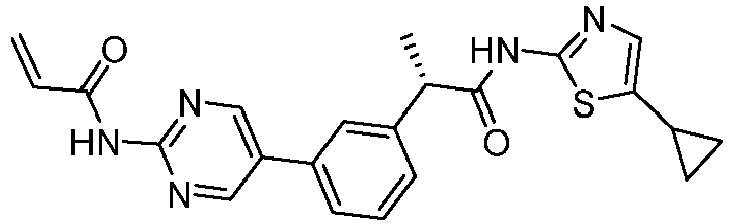
- The title compound was prepared in the same manner as in Example 14, except for using N-(5-bromopyrimidin-2-yl)acrylamide instead of N-(5-bromopyridin-2-yl)acrylamide.
- 1H NMR (400 MHz, DMSO-d6) δ 12.10 (s, 1H), 10.96 (s, 1H), 8.99 (s, 2H), 7.75 (s, 1H), 7.66 (d, J = 8.0 Hz, 1H), 7.48 (t, J = 8.0 Hz, 1H), 7.41 (d, J = 8.0 Hz, 1H), 7.13 (s, 1H), 6.69 (dd, J = 16.8 Hz, 10.0 Hz, 1H), 6.32 (dd, J = 17.0 Hz, 2.0 Hz, 1H), 5.81 (dd, J = 10.0 Hz, 1.6 Hz, 1H), 4.03 (q, J = 6.8 Hz, 2H), 2.00-1.97 (m, 1H), 1.49 (d, J = 6.8 Hz, 3H), 0.94-0.89 (m, 2H), 0.62-0.60 (m, 2H) ; MS (m/z): 420.0 [M+1] ; 77ee%
-

- The title compound was prepared in the same manner as in Example 14, except for using N-(6-bromopyridazin-3-yl)acrylamide instead of N-(5-bromopyridin-2-yl)acrylamide.
- 1H NMR (400 MHz, CDCl3) δ 12.64(s, 1H), ), 11.89(s, 1H), 8.73(d, J=9.6 Hz, 1H), 8.54(s, 1H), 7.86(d, J=9.6 Hz, 1H), 7.68(d, J=8.0 Hz, 1H), 7.58(d, J=8.0 Hz, 1H), 7.52-7.48(m, 1H), 7.12(s, 1H), 6.56(s, 1H), 6.54(d, J=2.4 Hz, 1H), 5.92-5.89(m, 1H), 4.90-4.88(m, 1H), 2.02-1.98(m, 1H), 1.60(d, J=7.2 Hz, 3H), 1.03-0.98(m, 2H), 0.76-0.72(m, 2H) ; MS (m/z): 420.0 [M+1]; 78ee%
-

- The title compound was prepared in the same manner as in Example 14, except for using N-(5-bromo-3-fluoropyridin-2-yl)acrylamide instead of N-(5-bromopyridin-2-yl)acrylamide.
- 1H NMR (400 MHz, CDCl3) δ 8.33 (s, 1H), 8.22 (s, 1H), 7.64 (d, J = 10.4 Hz, 1H), 7.46-7.36 (m, 5H), 7.05 (s, 1H), 6.55-6.50 (m, 2H), 5.87-5.84 (m, 1H), 3.88 (q, J = 7.2 Hz, 1H), 1.97-1.93 (m, 1H), 1.66 (d, J = 6.8 Hz, 3H), 1.00-0.95 (m, 2H), 0.71-0.68 (m, 2H) ; MS (m/z): 437.0 [M+1]; 78ee%
-

- The title compound was prepared in the same manner as in Example 14, except for using 5-ethylthiazole-2-amine instead of 5-cyclopropylthiazole-2-amine, and using N-(4-bromo-2-cyanophenyl)acrylamide instead of N-(5-bromopyridin-2-yl)acrylamide.
- 1H NMR (400 MHz, CDCl3) δ 9.11(br, 1H), 8.61(d, J=8.8 Hz, 1H), 7.81-7.77(m, 3H), 7.48-7.46(m, 3H), 7.35-7.33(m, 1H), 7.05-7.04(m, 1H), 6.52(dd, J=16.8, 0.8 Hz, 1H), 6.34(dd, J=16.8, 10.0 Hz, 1H), 5.91(dd, J=10.0, 0.8 Hz, 1H), 3.88-3.82(m, 1H), 2.80-2.75(m, 1H), 1.67(d, J=6.4 Hz, 3H), 1.31-1.27(m, 3H) ; MS (m/z): 431.0 [M+1]; 73ee%
-

- The title compound was prepared in the same manner as in Example 14, except for using 5-ethylthiazole-2-amine instead of 5-cyclopropylthiazole-2-amine, and using N-(5-bromo-6-fluoropyridin-2-yl)acrylamide instead of N-(5-bromopyridin-2-yl)acrylamide.
- 1H NMR (400 MHz, DMSO-d6) δ 12.10 (s, 1H), 11.03 (s, 1H), 8.22 (dd, J = 8.0 Hz, 1.6 Hz, 1H), 8.13 (dd, J = 10.0 Hz, 8.0 Hz, 1H) 7.61 (s, 1H), 7.50-7.39 (m, 3H), 7.13 (s, 1H), 6.59 (dd, J = 16.8 Hz, 10.0 Hz, 1H), 6.35 (dd, J = 17.0 Hz, 2.0 Hz, 1H), 5.84 (dd, J = 10.4 Hz, 2.0 Hz, 1H), 4.02 (q, J = 6.8 Hz, 1H), 2.71 (q, J = 7.2 Hz, 2H), 1.47 (d, J = 6.8 Hz, 3H), 1.18 (t, J = 7.2 Hz, 3H) ; MS (m/z): 425.0 [M+1]; 78ee%
-

- The title compound was prepared in the same manner as in Example 14, except for using 5-cyanothiazol-2-amine instead of 5-cyclopropylthiazole-2-amine, and using N-(6-bromopyridazin-3-yl)acrylamide instead of N-(5-bromopyridin-2-yl)acrylamide.
- 1H NMR (400 MHz, CDCl3) δ 13.28(br, 1H), 11.17(s, 1H), 8.70(dd, J=9.6, 4.8 Hz, 1H), 8.49(d, J=17.2 Hz, 1H), 7.99(d, J=4.0, 1H), 7.91(d, J=9.2, 1H), 7.66-7.63(m, 2H), 7.58-7.54(m, 1H), 6.58(d, J=17.2, 1H), 6.43(dd, J=17.2, 10.0 Hz, 1H), 5.96(d, J=10.0, 1H), 4.98-4.97(m, 1H), 1.62(d, J=6.8 Hz, 3H) ; MS (m/z): 405.0 [M+1] ; 75ee%
-

- The title compound was prepared in the same manner as in Example 14, except for using 5-cyanothiazol-2-amineinstead of 5-cyclopropylthiazole-2-amine, and using N-(5-bromo-3-fluoropyridin-2-yl)acrylamide instead of N-(5-bromopyridin-2-yl)acrylamide.
- 1H NMR (400 MHz, CDCl3) δ 9.66(br, 1H), 8.30-8.29(m, 1H), 8.00(s, 1H), 7.91(s, 1H), 7.64(dd, J=10.4, 2.0 Hz, 1H), 7.52-7.47(m, 2H), 7.43(s, 1H), 7.39-7.37(m, 1H), 6.57-6.51(m, 2H), 5.90-5.87(m, 1H), 3.98-3.93(m, 1H), 1.69(d, J=7.2 Hz, 3H) ; MS (m/z): 422.0 [M+1] ; 75ee%
-

- The title compound was prepared in the same manner as in Example 14, except for using 5-cyanothiazol-2-amineinstead of 5-cyclopropylthiazole-2-amine, and using N-(5-bromo-3-methylpyrazin-2-yl)acrylamide instead of N-(5-bromopyridin-2-yl)acrylamide.
- 1H NMR (400 MHz, DMSO-d6) δ 13.15 (s, 1H), 10.61 (s, 1H), 8.91 (s, 1H), 8.31 (s, 1H), 8.11 (s, 1H), 8.80 (d, J = 7.2 Hz, 1H), 7.51-7.45 (m, 2H), 6.54 (dd, J = 17.0 Hz, 10.4 Hz, 1H), 6.32 (dd, J = 17.0 Hz, 2.0 Hz, 1H), 5.84 (dd, J = 10.4 Hz, 2.0 Hz, 1H), 4.12-4.08 (m, 1H), 2.48 (s, 3H), 1.53 (d, J = 7.2 Hz, 3H) ; MS (m/z): 419.0 [M+1] ; 78ee%
-

- The title compound was prepared in the same manner as in Example 14, except for using 5-isopropylthiazol-2-amine instead of 5-cyclopropylthiazole-2-amine.
- 1H NMR (400 MHz, DMSO-d6) δ 12.13 (s, 1H), 10.88 (s, 1H), 8.66 (s, 1H), 8.31 (d, J = 9.6 Hz, 1H), 8.11 (dd, J = 8.4 Hz, 2.4 Hz, 1H), 7.73 (s, 1H), 7.61 (d, J = 7.6 Hz, 1H), 7.45 (t, J = 7.6 hz, 1H), 7.38 (d, J = 7.6 Hz, 1H), 7.14 (s, 1H), 6.65 (dd, J =16.8 Hz, 10.0 Hz, 1H), 6.34 (dd, J = 16.8 Hz, 2.0 Hz, 1H), 5.81 (dd, J = 10.0 Hz, 2.0 Hz, 1H), 4.03 (q, J = 6.8 Hz, 1H), 3.10-3.05 (m, 1H), 1.50 (d, J = 6.8 Hz, 3H), 1.23 (d, J = 6.8 Hz, 6H) ; MS (m/z): 421.0 [M+1]; 73ee%
-

- The title compound was prepared in the same manner as in Example 14, except for using 5-isopropylthiazol-2-amine instead of 5-cyclopropylthiazole-2-amine, and using N-(5-bromopyrazin-2-yl)acrylamide instead of N-(5-bromopyridin-2-yl)acrylamide.
- 1H NMR (400 MHz, DMSO-d6) δ 12.18 (s, 1H), 11.16 (s, 1H), 9.52 (s, 1H), 9.02 (s, 1H), 8.16 (s, 1H), 8.00 (d, J = 7.6 Hz, 1H), 7.51-7.45 (m, 2H), 7.14 (s, 1H), 6.65 (dd, J = 16.8 Hz, 10.0 Hz, 1H), 6.39 (dd, J = 17.0 Hz, 2.0 Hz, 1H), 5.88 (dd, J = 10.0 Hz, 2.0 Hz, 1H), 4.12 -4.05 (m, 1H), 3.13-3.07 (m, 1H), 1.50 (d, J = 7.2 Hz, 3H), 1.24 (d, J = 6.8 Hz, 6H) ; MS (m/z): 422.0 [M+1] ; 72ee%
-

- The title compound was prepared in the same manner as in Example 14, except for using 5- (trifluoromethyl)thiazol-2-amine instead of 5-cyclopropylthiazole-2-amine, and using N-(5-bromopyrazin-2-yl)acrylamide instead of N-(5-bromopyridin-2-yl)acrylamide.
- 1H NMR (400 MHz, CDCl3) δ 9.66(dd, J=4.0, 1.2 Hz, 1H), 9.15(br, 1H), 8.64(dd, J=14.8, 1.6 Hz, 1H), 8.14(br, 1H), 8.00-7.99(m, 1H), 7.90-7.88(m, 1H), 7.69(d, J=1.2 Hz, 1H), 7.54-7.50(m, 1H), 7.39(d, J=8.0, 1H), 6.55(dd, J=16.8, 1.2 Hz, 1H), 6.32(dd, J=16.8, 10.0 Hz, 1H), 5.91(dd, J=10.0, 1.2 Hz, 1H), 3.97-3.92(m, 1H), 1.70(d, J=7.2 Hz, 3H) ; MS (m/z): 448.0 [M+1] ; 70ee%
-

- The title compound was prepared in the same manner as in Example 14, except for using 5- (trifluoromethyl)thiazol-2-amine instead of 5-cyclopropylthiazole-2-amine.
- 1H NMR (400 MHz, CDCl3) δ 9.76(s, 1H), 8.63(s, 1H), 8.37(d, J=8.8, 1H), 8.30(d, J=1.6 Hz, 1H), 7.87(dd, J=8.8, 2.4 Hz, 1H), 7.10(d, J=1.2 Hz, 1H), 7.49-7.45(m, 2H), 7.44(s, 1H), 7.34-7.31(m, 1H), 6.50(dd, J=16.8, 1.2 Hz, 1H), 6.27(dd, J=16.8, 10.0 Hz, 1H), 5.85(dd, J=10.0, 1.2 Hz, 1H), 3.96-3.91(m, 1H), 1.68(d, J=7.2 Hz, 3H) ; MS (m/z): 447.0 [M+1] ; 69ee%
-

- The title compound was prepared in the same manner as in Example 14, except for using 5- (trifluoromethyl)thiazol-2-amine instead of 5-cyclopropylthiazole-2-amine, and using N-(6-bromopyridazin-3-yl)acrylamide instead of N-(5-bromopyridin-2-yl)acrylamide.
- 1H NMR (400 MHz, CDCl3) δ 12.75(br, 1H), 11.16(br, 1H), 8.76(d, J=9.6, 1H), 8.51(s, 1H), 7.90(d, J=9.2, 1H), 7.76(d, J=1.2 Hz, 1H), 7.65(d, J=7.2 Hz, 2H), 7.52-7.51(m, 1H), 6.58(dd, J=16.8, 1.2 Hz, 1H), 6.46(dd, J=16.8, 10.0 Hz, 1H), 5.95(dd, J=10.0, 1.2 Hz, 1H), 4.89-4.88(m, 1H), 1.63(d, J=7.2 Hz, 3H) ; MS (m/z): 448.0 [M+1] ; 68ee%
-

- The title compound was prepared in the same manner as in Example 14, except for using 5-isopropylthiazol-2-amine instead of 5-cyclopropylthiazole-2-amine, and using N-(6-bromopyridazin-3-yl)acrylamide instead of N-(5-bromopyridin-2-yl)acrylamide.
- 1H NMR (400 MHz, DMSO-d6) δ 12.20 (s, 1H), 11.47 (s, 1H), 8.52 (d, J = 9.6 Hz, 1H), 8.25 (d, J = 9.6 Hz, 1H), 8.19 (s, 1H), 7.96-7.94 (m, 1H), 7.54-7.50 (m, 2H), 7.14 (s, 1H), 6.70 (dd, J = 16.8 Hz, 10.0 Hz, 1H), 6.39 (dd, J = 17.0 Hz, 2.0 Hz, 1H), 5.88 (dd, J =10.0 Hz, 2.0 Hz, 1H), 4.12-4.06 (m, 1H), 3.12-3.05 (m, 1H), 1.51 (d, J = 6.8 Hz, 3H), 1.24 (d, J = 6.8 Hz, 6H) ; MS (m/z): 422.0 [M+1] ; 70ee%
-

- 2-(5-bromopyridin-3-yl) acetic acid (5 g, 23.144 mmol) was dissolved in THF (65 ml), then added 1 M NaHMDS (50.9 ml, 50.9 mmol) thereto dropwise at 0 ° C. After stirring for 30 minutes, MeI (1.7 ml, 27.77 mmol) was added and the mixture was stirred at room temperature for 3 hours. The mixture was diluted with EtOAc, washed with 4N HCl, and the organic layer was dried (MgSO4), filtered and dried under reduced pressure. The residue was purified by using a Combi-flash column (100% gradient in EA / Hex 10) to obtain the title compound (3.4 g, 63%).
- To 2-(5-bromopyridin-3-yl)propanoic acid (500 mg, 2.173 mmol) and 5-cyanothiazol-2-amine (306 mg, 2.39 mmol) were added DCM (11 ml, 0.2 M), and TEA was added thereto and stirred at room temperature for 5 minutes. Then, HATU was added and stirred at room temperature for 5 hours. This mixture was diluted with EtOAc, washed with saturated NaHCO3solution, then dried (MgSO4), filtered and then dried under reduced pressure. The residue was purified by a Combi-flash column (EA/Hex 10 to 100% gradient) to give the title compound (2.27 g, 80%) as a white solid.
- 1H NMR (400 MHz, DMSO-d6) δ13.23 (s, 1H), 8.64 (s, 1H), 8.56 (s, 1H), 8.38 (s, 1H), 8.04 (s, 1H), 4.11-4.08 (m, 1H), 1.53 (d, J = 5.4 Hz, 3H) ; MS (m/z): 338.0 [M+1]
- To 2-(5-bromopyridin-3-yl)-N-(5-cyanothiazol-2-yl)propanamide (100mg, 0.29mmol) and Cs2CO3 (815mg, 2.5mmol) were added H2O (0.7 ml) and 1,4-dioxane (2 ml), and the reaction mixture was stirred and degassed. Then, 5-(4,4,5,5-tetramethyl-1,3,2-dioxaborolane-2-yl)pyridin-2-amine and Pd(dppf)Cl2.DCM (24 mg, 0.03 mmol) were added thereto and stirred at 100°C for 3 hours. This mixture was diluted with EtOAc, washed with water, further washed with brine, then dried (MgSO4), filtered and then dried under reduced pressure. The residue was purified by a Combi-flash column (EA/Hex 50 to 100% gradient) to give the title compound (21mg, 20%) as a white solid.
- 1H NMR (400 MHz, DMSO-d6) δ13.21 (s, 1H), 8.72 (s, 1H), 8.46 (s, 1H), 8.37 (s, 1H), 8.30 (s, 1H), 7.92 (s, 1H), 7.76 (d, J = 6.6 Hz, 1H), 6.56 (d, J = 6.6 Hz, 1H), 6.22 (s, 2H), 4.13-4.09 (m, 1H), 1.56 (d, J = 5.1 Hz, 3H) ; MS (m/z): 351.0 [M+1]
- To 2-(6'-amino-[3,3'-bipyridine]-5-yl)-N-(5-cyanothiazol-2-yl)propanamide (20mg, 0.057mmol) was added THF, and then DIPEA (30uL, 0.17mmol) was added, and acryloyl chloride (4.6uL, 0.057mol) was slowly added at 0°C. The mixture was stirred at 0°C for 30 minutes, then diluted with EtOAc, washed with saturated NaHCO3solution, then dried (MgSO4), filtered and then dried under reduced pressure. The residue was purified by preparative TLC (MC: MeOH = 15: 1) to give the title compound (1.3 mg, 6%) as a white solid.
- 1H NMR (400 MHz, DMSO-d6) δ 10.92 (s, 1H), 8.82 (s, 1H), 8.73 (s, 1H), 8.55 (s, 1H), 8.32 (d, J = 8.8 Hz, 1H), 8.21-8.18 (m, 2H), 8.07 (s, 1H), 6.64 (dd, J = 16.8 Hz, 10.0 Hz, 1H), 6.34 (dd, J = 16.8 Hz, 2.0 Hz, 1H), 5.81 (dd, J = 10.0 Hz, 1.6 Hz, 1H), 4.04 (q, J = 7.6 Hz, 1H), 1.55 (d, J = 7.2 Hz, 3H) ; MS (m/z): 405.0 [M+1]
-

- The title compound was prepared in the same manner as in Example 41, except for using 2-(5-bromopyridin-3-yl)acetic acid instead of 2-(2-bromopyridin-4-yl)acetic acid. ;MS (m/z): 405.0 [M+1]
-

- To 2-(5-bromopyridin-3-yl)propanoic acid (1.5 g, 6.548 mmol) was added MeOH (40ml, 0.15M), and SOCl2was slowly added.The reaction mixture was stirred at 60°C for 18 hours and then concentrated under reduced pressure. This mixture was diluted with EtOAc, washed with saturated NaHCO3solution, then dried (MgSO4), filtered and then dried under reduced pressure. The residue was purified by a Combi-flash column (MC/MEOH5 to 10% gradient) to give the title compound (1.27 g, 79%).
- To methyl 2-(5-bromopyridin-3-yl)propanoate (200mg, 0.819mmol) and KOAc (196mg, 2.047mmol) were added anhydrous 1,4-dioxane (4 ml, 0.2 M), and the reaction mixture was stirred and degassed. Bis(pinacolato)diboron (250 mg, 0.983 mmol) and Pd(dppf)Cl2.DCM (33 mg, 0.041 mmol) were added and stirred at 85°C for 2 hours. This mixture was diluted with EtOAc, filtered through celite, and dried under reduced pressure to give the crude title compound as a black oil.
; MS (m/z): 210.0 [M+1] - To methyl 2-(5-(4,4,5,5-tetramethyl-1,3,2-dioxaborolan-2-yl)pyridin-3-yl)propanoate(crude, 0.819mmol), N-(5-bromopyrazin-2-yl)acrylamide (143 mg, 0.63 mmol) and Cs2CO3 (513 mg, 1.57 mmol) were addedH2O (3 ml) and 1,4-dioxane (9 ml), and the reaction mixture was stirred and degassed. Then, Pd(dppf)Cl2.DCM(51mg, 0.082mmol) was added and stirred at 100°C for 1.5 hours. This mixture was diluted with EtOAc, washed with water, further washed with brine, then dried (MgSO4), filtered and then dried under reduced pressure. The residue was purified by a Combi-flash column (EA/Hex 50 to 100% gradient) to give the title compound (116mg, 45%) as a white solid.
- 1H NMR (400 MHz, CDCl3) δ 9.71 (s, 1H), 9.09 (s, 1H), 8.73 (s, 1H), 8.62 (s, 1H), 8.29 (s, 1H), 8.02 (s, 1H), 5.56 (d, J = 17.2Hz, 1H), 6.34 (dd, J = 17.2 Hz, 10.4 Hz, 1H), 5.92 (d, J = 10.4 Hz, 1H), 3.86 (q, J = 7.2 Hz, 1H), 3.71 (s, 3H), 1.61 (d, J = 7.2 Hz, 3H) ; MS (m/z): 312.0 [M+1]
- To methyl 2-(5-(5-acrylamidopyrazin-2-yl)pyridin-3-yl)propanoate (116mg, 0.373mmol) was added THF(2.7ml),and then a solution of LiOH (18 mg, 0.75 mmol) in H2O (0.9 ml) was added. This mixture was stirred at room temperature for 2 hours, diluted with EtOAc, washed with water, further washed with 1N HCl, and extracted three times with EA. The extracts were then dried (MgSO4), filtered and then dried under reduced pressure to give the title compound (80 mg, 72%) as an apricot-colored solid.
; MS (m/z): 298.0 [M+1] - After 2-(5-(5-acrylamidopyrazin-2-yl)pyridin-3-yl)propanoic acid (15mg, 0.05mmol) and 5-cyclopropylthiazol-2-amine (7 mg, 0.05 mmol) were dissolved in DCM (0.5 ml, 0.1 M) and then DIPEA (26 ul, 0.15 mol) was added. HATU (21 mg, 0.06 mmol) was added with stirring at room temperature, followed by stirring at room temperature for 20 minutes. The mixture was diluted with EtOAc, washed with water, dried (MgSO4), filtered and then dried under reduced pressure. The residue was purified by preparative TLC (MC: MeOH = 20: 1) to give the title compound (4.5 mg, 21%) as an off-white solid.
- 1H NMR (400 MHz, DMSO-d6) δ 12.23 (s, 1H), 11.22 (s, 1H), 9.55 (s, 1H), 9.20 (s, 1H), 9.14 (s, 1H), 8.64 (s, 1H), 8.44 (s, 1H), 7.16 (s, 1H), 6.66 (dd, J = 17.2 Hz, 10.0 Hz, 1H), 6.40 (dd, J = 17.2 Hz, 2.0 Hz, 1H), 5.89 (dd, J = 10.0 Hz, 2.0 Hz, 1H), 4.14-4.08 (m, 1H), 2.03-1.96 (m, 1H), 1.54 (d, J = 6.8 Hz, 3H), 0.95-0.92 (m, 2H), 0.63-0.61 (m, 2H) ; MS (m/z): 421.0 [M+1]
-

- The title compound was prepared in the same manner as in Example 43, except for using 5-cyanothiazol-2-amine instead of 5-cyclopropylthiazol-2-amine.
- 1H NMR (400 MHz, DMSO-d6) δ 13.27 (s, 1H), 11.22 (s, 1H), 9.55 (s, 1H), 9.21 (s, 1H), 9.14 (s, 1H), 8.65 (s, 1H), 8.45 (s, 1H), 8.36 (s, 1H), 6.66 (dd, J = 17.2 Hz, 10.0 Hz, 1H), 6.40 (dd, J = 17.2 Hz, 2.0 Hz, 1H), 5.89 (dd, J = 10.0 Hz, 1.6 Hz, 1H), 4.22-4.16 (m, 1H), 1.59 (d, J = 7.2 Hz, 3H) ; MS (m/z): 406.0 [M+1]
-

- The title compound was prepared in the same manner as in Example 43, except for using 5- (trifluoromethyl)thiazol-2-amine instead of 5-cyclopropylthiazol-2-amine.
- 1H NMR (400 MHz, DMSO-d6) δ 11.22 (s, 1H), 9.55 (s, 1H), 9.21 (s, 1H), 9.14 (s, 1H), 8.65 (s, 1H), 8.45 (s, 1H), 8.10 (s, 1H), 6.65 (dd, J = 17.2 Hz, 10.0 Hz, 1H), 6.40 (dd, J = 17.2 Hz, 2.0 Hz, 1H), 5.89 (dd, J = 10.0 Hz, 2.0 Hz, 1H) 4.19 (q, J = 7.2 Hz, 1H), 1.59 (d, J = 7.2 Hz, 3H) ; MS (m/z): 449.0 [M+1]
-

- The title compound was prepared in the same manner as in Example 43, except for using 5-ethylthiazol-2-amine instead of 5-cyclopropylthiazol-2-amine.
- 1H NMR (400 MHz, DMSO-d6) δ 12.26 (s, 1H), 11.22 (s, 1H), 9.55 (s, 1H), 9.20 (s, 1H), 9.14 (s, 1H), 8.64 (s, 1H), 8.45 (s, 1H), 7.16 (s, 1H), 6.65 (dd, J = 17.2 Hz, 10.0 Hz, 1H), 6.40 (dd, J = 17.2 Hz, 2.0 Hz, 1H), 5.89 (dd, J = 10.0 Hz, 2.0 Hz, 1H), 4.16-4.08 (m, 1H), 2.72 (q, J = 8.8 Hz, 2H), 1.55 (d, J = 7.2 Hz, 3H), 1.18 (t, J = 8.8 Hz, 3H) ; MS (m/z): 409.0 [M+1]
-

- The title compound was prepared in the same manner as in Example 43, except for using 5-isopropyl-thiazol-2-amine instead of 5-cyclopropylthiazol-2-amine.
- 1H NMR (400 MHz, DMSO-d6) δ 12.26 (s, 1H), 11.22 (s, 1H), 9.55 (s, 1H), 9.20 (s, 1H), 9.14 (s, 1H), 8.64 (s, 1H),8.46 (s, 1H), 7.16 (s, 1H), 6.65 (dd, J = 17.2 Hz, 10.0 Hz, 1H), 6.40 (dd,, J = 17.2 Hz, 2.0 Hz, 1H), 5.89 (dd, J = 10.0 Hz, 2.0 Hz, 1H), 4.12 (q, J = 6.8 Hz, 1H), 3.17-3.08 (m, 1H), 1.55 (d, J = 6.8 Hz, 3H), 1.24 (d, J = 6.8 Hz, 6H) ; MS (m/z): 423.0 [M+1]
-

- The title compound was prepared in the same manner as in Example 43, except for using 1-(2-aminothiazol-5-yl)ethan-1-one instead of 5-cyclopropylthiazol-2-amine.
- 1H NMR (400 MHz, DMSO-d6) δ 11.20 (s, 1H), 9.55 (s, 1H), 9.20 (s, 1H), 9.14 (s, 1H), 8.65 (s, 1H), 8.45 (s, 1H), 8.34 (s, 1H), 6.65 (dd, J = 17.2 Hz, 10.0 Hz, 1H), 6.40 (dd, J = 17.2 Hz, 2.0 Hz, 1H), 5.89 (dd, J = 10.0 Hz, 2.0 Hz, 1H), 4.17 (q, J = 7.2 Hz, 1H), 2.49 (s, 3H), 1.57 (d, J = 7.2 Hz, 3H) ; MS (m/z): 423.0 [M+1]
-

- The title compound was prepared in the same manner as in Example 43, except for using 5-(trifluoromethyl)thiazol-2-amine instead of 5-cyclopropylthiazol-2-amine and using N-(6-bromopyridazin-3-yl)acrylamide instead of N-(5-bromopyrazin-2-yl)acrylamide.
- 1H NMR (400 MHz, DMSO-d6) δ 11.53 (s, 1H), 9.17 (s, 1H), 8.70 (s, 1H), 8.55 (d, J = 9.6 Hz, 1H), 8.51 (s, 1H), 8.38 (d, J = 9.2 Hz, 1H), 8.11 (s, 1H), 6.70 (dd, J = 16.8 Hz, 10.0 Hz, 1H), 6.40 (dd, J = 16.8 Hz, 2.0 Hz, 1H), 5.90 (dd, J = 10.0 Hz, 2.0 Hz, 1H), 4.22 (q, J = 6.8 Hz, 1H), 1.60 (d, J = 6.8 Hz, 3H) ; MS (m/z): 449.0 [M+1]
-

- The title compound was prepared in the same manner as in Example 43, except for using 2-(2-bromopyridin-4-yl)acetic acid instead of 2-(5-bromopyridin-3-yl)acetic acid.
- 1H NMR (400 MHz, DMSO-d6) δ 10.96 (s, 1H), 9.04 (s, 1H), 8.61 (d, J = 5.2 Hz, 1H), 8.47 (d, J = 8.8 Hz, 2.4 Hz, 1H), 8.33 (d, J = 8.8 Hz, 1H), 7.98 (s, 1H), 7.32 (d, J = 4.8 Hz, 1H), 7.15 (s, 1H), 6.65 (dd, J = 17.2 Hz, 10.0 Hz, 1H), 6.35 (dd, J = 17.2 Hz, 2.0 Hz, 1H), 5.82 (dd, J = 10.0 Hz, 2.0 Hz, 1H), 4.06-4.00 (m, 1H), 2.04-1.96 (m, 1H), 1.52 (d, J = 7.2 Hz, 3H), 0.96-0.91 (m, 2H), 0.64-0.61 (m, 2H) ; MS (m/z): 420.0 [M+1]
- Only R-form was separated from the compound of Example 45 using a chiral column.
- 1H NMR (400 MHz, DMSO-d6) δ 11.22 (s, 1H), 9.55 (s, 1H), 9.21 (s, 1H), 9.14 (s, 1H), 8.65 (s, 1H), 8.45 (s, 1H), 8.10 (s, 1H), 6.65 (dd, J = 12.9 Hz, 7.5 Hz, 1H), 6.40 (dd, J = 12.9 Hz, 1.5 Hz, 1H), 5.89 (dd, J = 7.5 Hz, 1.5 Hz, 1H) 4.19 (q, J = 5.4 Hz, 1H), 1.59 (d, J = 5.4 Hz, 3H) ; MS (m/z): 449.0 [M+1]
- Only S-form was separated from the compound of Example 45 using a chiral column.
- 1H NMR (400 MHz, DMSO-d6) δ 11.22 (s, 1H), 9.55 (s, 1H), 9.21 (s, 1H), 9.14 (s, 1H), 8.65 (s, 1H), 8.45 (s, 1H), 8.10 (s, 1H), 6.65 (dd, J = 12.9 Hz, 7.5 Hz, 1H), 6.40 (dd, J = 12.9 Hz, 1.5 Hz, 1H), 5.89 (dd, J = 7.5 Hz, 1.5 Hz, 1H) 4.19 (q, J = 5.4 Hz, 1H), 1.59 (d, J = 5.4 Hz, 3H) ; MS (m/z): 449.0 [M+1]
-

- The title compound was prepared in the same manner as in Example 41, except for using2-(4-bromothiophen-2-yl)acetic acid instead of 2-(5-bromopyridin-3-yl)acetic acid, and using 5-(trifluoromethyl)thiazol-2-amine instead of 5-cyanothiazol-2-amine.
; MS (m/z): 453.0 [M+1] -

- The title compound was prepared in the same manner as in Example 1, except for using 5-cyclopropylthiazol-2-amine instead of 5-methylthiazol-2-amine, and using 2-(3-bromo-5-fluorophenyl)acetic acid instead of 2-(3-bromophenyl)acetic acid.
- 1H NMR (400 MHz, DMSO-d6) δ 10.90 (s, 1H), 8.30 (d, J=8.4 Hz, 1H), 8.15 (d, J=8.8 Hz, 1H), 7.57 (s, 1H), 7.51 (d, J=9.2 Hz, 1H), 7.18 (d, J=11.2 Hz, 1H), 7.12 (s, 1H), 6.64 (dd, J=16.0 Hz, 9.6 Hz, 1H), 6.34 (d, J=16.0 Hz, 1H), 5.81 (d, J=9.6 Hz, 1H), 4.04-4.02 (m, 1H), 1.98 (m, 1H), 1.49 (d, J=7.2 Hz, 3H), 0.93-0.86 (m, 2H), 0.62-0.61 (m, 2H) ; MS (m/z): 437.0 [M+1]
-

- The title compound was prepared in the same manner as in Example 43, except for using 5- (trifluoromethyl)thiazol-2-amine instead of 5-cyclopropylthiazol-2-amine , and using 2-(5-bromopyridin-3-yl)-2-methylpropanoic acid instead of 2-(5-bromopyridin-3-yl)propanoic acid.
- 1H NMR (400 MHz, DMSO-d6) δ 11.21 (s, 1H), 9.54 (s, 1H), 9.17 (s, 1H), 9.15 (s, 1H), 8.59 (s, 1H), 8.37 (t, J = 2.0 Hz, 1H), 7.98 (s, 1H), 6.66 (dd, J = 16.0 Hz, 10.0 Hz, 1H), 6.40 (dd, J = 16.0 Hz, 2.0 Hz, 1H), 5.89 (dd, J = 10.0 Hz, 2.0Hz, 1H), 1.71 (s, 6H) ; MS (m/z): 463.0 [M+1]
-

- The title compound was prepared in the same manner as in Example 14, except for using5-(trifluoromethyl)thiazol-2-amine instead of 5-cyclopropylthiazole-2-amine, and using N-(5-bromopyrazin-2-yl)-2-cyanoacetamide instead of N-(5-bromopyridin-2-yl)acrylamide.
- 1H NMR (400 MHz, CDCl3) δ 9.49(s, 1H), 9.18(s, 1H), 8.69(d, J=1.6 Hz, 1H), 8.51(s, 1H), 8.00(t, J=1.6 Hz, 1H), 7.90(dd, J=8.0, 1.6 Hz, 1H), 7.69(d, J=1.6 Hz, 1H), 7.53-7.51(m, 1H), 7.42(d, J=8.0 Hz, 1H), 3.97-3.92(m, 1H), 3.66(s, 2H), 1.70(d, J=7.2 Hz, 3H) ; MS (m/z): 461.0 [M+1]
-

- The title compound was prepared in the same manner as in Example 43, except for using 5-(trifluoromethyl)thiazol-2-amine instead of 5-cyclopropylthiazol-2-amine, and using 2-(4-bromothiophen-2-yl)acetic acid instead of 2-(5-bromopyridin-3-yl)propanoic acid.
- 1H NMR (400 MHz, DMSO-d6) δ 11.04(s, 1H), 9.40(s, 1H), 7.98(s, 1H), 7.61(s, 1H), 7.54(s, 1H), 6.63(dd, J=16.8, 10.0 Hz, 1H), 6.36(dd, J=16.8, 1.8 Hz, 1H), 5.85(dd, J=10.0, 1.8 Hz, 1H), 3.99-3.94(m, 1H), 1.68(d, J=6.8 Hz, 3H) ; MS (m/z): 454.0 [M+1]
-

- The title compound was prepared in the same manner as in Example 14, except for using 5-cyanothiazol-2-amine instead of 5-cyclopropylthiazole-2-amine, and using N-(5-bromopyrazin-2-yl)-2-cyanoacetamide instead of N-(5-bromopyridin-2-yl)acrylamide.
- 1H NMR (400 MHz, DMSO-d6) δ 9.34 (s, 1H), 9.03 (s, 1H), 8.33 (s, 1H), 8.14 (s, 1H), 8.00 (d, J = 7.2, 1.6 Hz, 1H), 7.52-7.47 (m, 2H), 4.06 (s, 2H), 4.04-4.00 (m, 1H), 1.53 (dd, J = 6.8 Hz, 3H) ; MS (m/z): 418.1 [M+1]
-

- The title compound was prepared in the same manner as in Example 41, except for using 5-(trifluoro)thiazoleamine instead of 5-cyanothiazole amine, and using 2-(4-bromo-3-methyl-1H-pyrazol-1-yl)acetic acid instead of 2-(5-bromopyridin-3-yl)acetic acid.
MS (m/z): 451.0 [M+1] -
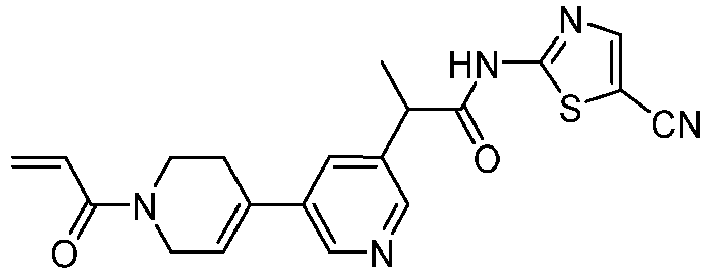
- The title compound was prepared in the same manner as in Example 41, except for using t-butyl4-(4,4,5,5-tetramethyl-1,3,2-dioxaborolane-2-yl)-3,6-dihydropyridin-1(2H)-carboxylate instead of 5- (4,4,5,5-tetramethyl-1,3,2-dioxaborolan-2-yl)pyridin-2-amine.
- 1H NMR (400 MHz, DMSO-d6) δ 8.57 (s, 1H), 8.46 (s, 1H), 8.29 (s, 1H), 7.79 (s, 1H), 6.95-6.75 (m, 1H), 6.30-6.27 (m, 1H), 6.15 (d, J = 16.0 Hz, 1H), 5.72 (dd, J = 10.4 Hz, 2.4 Hz, 1H), 4.29 (s, 1H), 4.20 (s, 1H), 4.04-4.02 (m, 2H), 3.78-3.75 (m, 3H), 1.52 (d, J = 7.2 Hz, 3H); MS (m/z): 394.0 [M+1]
-
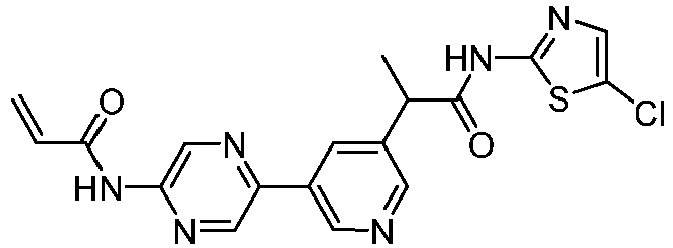
- The title compound was prepared in the same manner as in Example 43, except for using 5-chlorothiazol-2-amine instead of 5-cyclopropylthiazole-2-amine.
- 1H NMR (400 MHz, DMSO-d6) δ 11.21 (s, 1H), 9.55 (d, J = 1.6 Hz, 1H), 9.20 (d, J = 2.0 Hz, 1H), 9.13 (d, J = 1.6 Hz, 1H), 8.64 (d, J = 2.0 Hz, 1H), 8.44 (t, J = 2.0 Hz, 1H), 7.49 (s, 1H), 6.66 (dd, J = 17.2 Hz, 7.5 Hz, 1H), 6.40 (dd, J = 16.8 Hz, 1.6 Hz, 1H), 5.89 (dd, J = 10.0 Hz, 1.6 Hz, 1H), 4.12 (q, J = 7.2 Hz, 1H), 1.56 (d, J = 7.2 Hz, 1H); MS (m/z): 415.5 [M+1]
- The compounds of the following Examples 62-149 were prepared according to the reaction described in the example shown in Table 1 below, and the NMR results thereof are shown in Table 1.
[Table 1] Exa mple Structure 1H NMR Examp le # 62 
1H NMR (400MHz, DMSO-d6) δ 12.16 (brs, 1H), 10.51 (s, 1H), 8.89 (d, J = 2.4 Hz, 1H), 8.25 (dd, J = 8.8 Hz, 2.8 Hz, 1H), 8.11 (s, 1H), 7.94 (d, J = 8.8 Hz, 1H), 7.90 (d, J = 7.6 Hz, 1H), 7.45-7.38 (m, 2H), 7.13 (s, 1H), 6.48 (dd, J = 16.8 Hz, 10.0 Hz, 1H), 6.32 (dd, J = 16.8 Hz, 1.6 Hz, 1H), 5.83 (dd, J = 10.0 Hz, 2.0 Hz, 1H), 4.03 (q, J = 7.2 Hz, 1H), 2.01-1.96 (m, 1H), 1.48 (d, J = 7.2 Hz, 3H), 0.95-0.90 (m, 2H), 0.64-0.60 (m, 2H); MS (m/z): 419.0 [M+1]; 75ee% Examp le 14 63 
1H NMR (400MHz, DMSO-d6) δ 13.02 (brs, 1H), 11.09 (s, 1H), 9.54 (d, J = 1.6 Hz, 1H), 9.20 (d, J = 2.0 Hz, 1H), 9.12 (d, J = 1.6 Hz, 1H), 8.65 (d, J = 2.0 Hz, 1H), 8.45 (t, 2.0 Hz, 1H), 8.08 (s, 1H), 6.89 (dt, J=15.6 Hz, 6.0 Hz, 1H), 6.49 (d, J = 15.2 Hz, 1H), 4.18 (q, J = 6.8 Hz, 1H), 3.09 (d, J = 5.6 Hz, 2H), 2.19 (s, 6H), 1.58 (d, J = 7.2 Hz, 3H); MS (m/z): 506.0 [M+1] Examp le43 64 
1H NMR (400MHz, DMSO-d6) δ 13.06 (br, 1H), 11.33 (s, 1H), 9.38 (s, 1H), 9.21 (d, J = 2.4 Hz, 1H), 9.14 (d, J = 1.6 Hz, 1H), 8.66 (d, J = 2.0 Hz, 1H), 8.45 (t, J = 2.0 Hz, 1H), 8.11 (d, J = 1.2 Hz, 1H), 4.21 (m, 1H), 4.08 (s, 2H), 1.58 (d, J = 7.2 Hz, 1H); MS (m/z): 463.0 [M+1] Examp le41 65 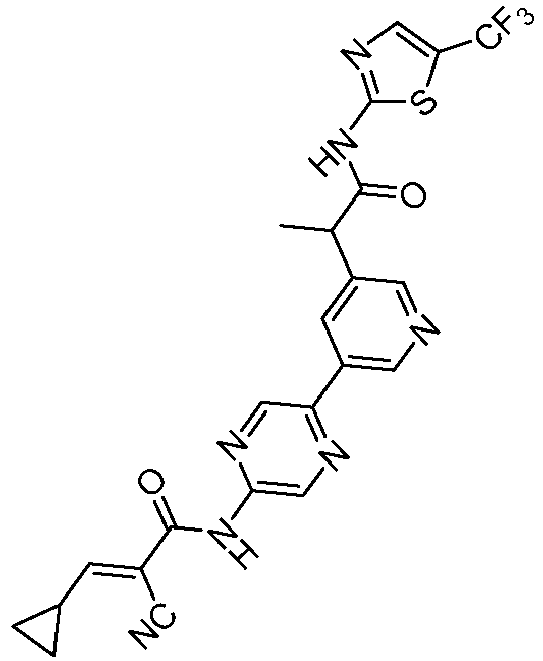
1H NMR (400MHz, DMSO-d6) δ 13.01 (br, 1H), 11.13 (s, 1H), 9.36 (d, J = 1.2 Hz, 1H), 9.22 (d, J = 2.0 Hz, 1H), 9.17 (d, J = 2.0 Hz, 1H), 8.66 (d, J = 2.0 Hz, 1H), 8.46 (t, J = 2.0 Hz, 1H), 8.10 (d, J = 1.2 Hz, 1H), 4.19 (m, 1H), 2.00(m, 1H), 1.59 (d, J = 7.2 Hz, 1H), 1.33(m, 1H), 1.07(m, 1H); MS (m/z): 514.0 [M+1] Examp le41 66 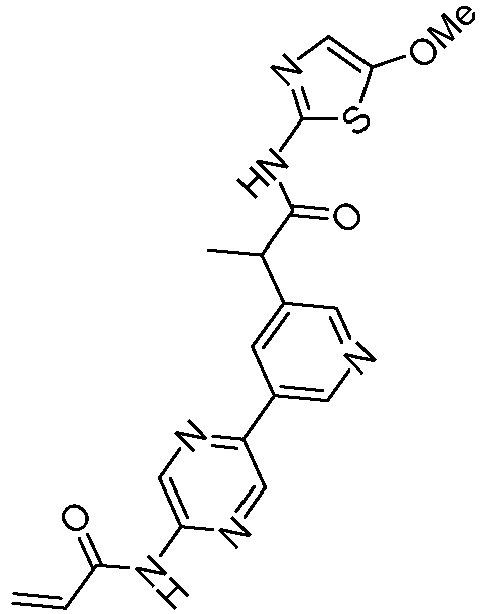
1H NMR (400MHz, DMSO-d6) δ 12.17(s, 1H), 11.22(s, 1H), 9.55(d, J=1.6 Hz, 1H), 9.20(d, J=2.0 Hz, 1H), 9.14(d, J=1.2 Hz, 1H), 8.64(d, J=2.0 Hz, 1H), 8.45(t, J=2.0 Hz, 1H), 6.84(s, 1H), 6.66(dd, J=17.2, 10.0 Hz, 1H), 6.40(dd, J=16.8, 1.6 Hz, 1H), 5.90(dd, J=10.4, 1.6 Hz, 1H), 4.09(q, J=7.2 Hz, 1H), 3.83(s, 3H), 1.54(d, J=7.2 Hz, 3H); MS (m/z): 411.0 [M+1] Examp le43 67 
1H NMR (400MHz, DMSO-d6) δ 12.50(s, 1H), 11.21(s, 1H), 9.55(d, J=1.2 Hz, 1H), 9.20(d, J=2.0 Hz, 1H), 9.14(d, J=1.6 Hz, 1H), 8.64(d, J=2.0 Hz, 1H), 8.45-8.44(m, 1H), 6.66(dd, J=16.8, 10.0 Hz, 1H), 6.40(dd, J=16.8, 1.6 Hz, 1H), 5.89(dd, J=10.0, 1.6 Hz, 1H), 4.11(q, J=7.2 Hz, 1H), 1.56(d, J=7.2 Hz, 3H); MS (m/z): 399.0 [M+1] Examp le43 68 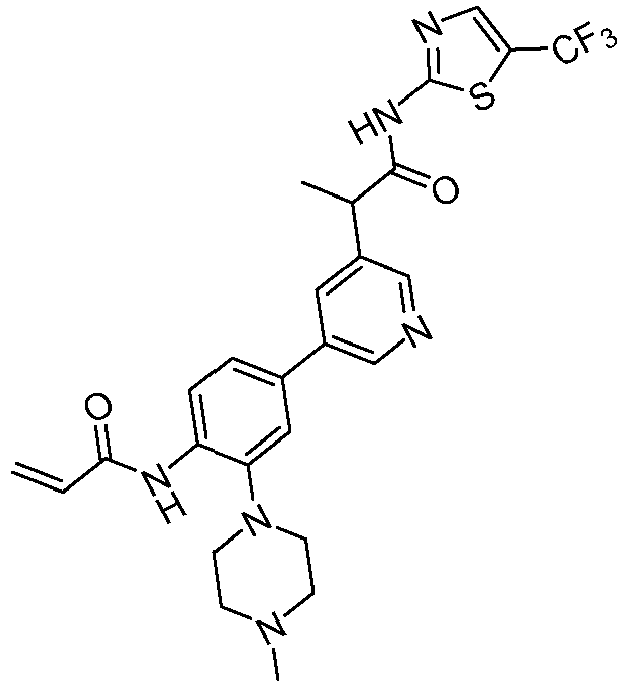
1H NMR (400MHz, DMSO-d6) δ 9.13 (s, 1H), 8.75 (s, 1H), 8.51 (d, J = 1.6 Hz, 1H), 8.09 (d, J = 8.0 Hz, 1H), 7.99 (s, 1H), 7.89 (s, 1H), 7.45-7.41 (m, 2H), 6.67 (dd, J = 16.8 Hz, 10.4 Hz, 1H), 6.27 (dd, J = 16.8 Hz, 1.6 Hz, 1H), 5.79 (dd, J = 10.4 Hz, 1.6 Hz, 1H), 4.04-3.97 (m, 1H), 2.92 (t, J = 4.8 Hz, 4H), 2.58-2.55 (m, 4H) 2.27 (s, 3H), 1.54 (d, J = 6.8 Hz, 3H); MS (m/z): 545.0 [M+1] Examp le1 69 
1H NMR (400MHz, DMSO-d6) δ 13.10 (br, 1H), 9.74 (s, 1H), 9.35 (d, J = 1.2 Hz, 1H), 9.19 (d, J = 2.0 Hz, 1H), 9.08 (d, J = 1.2 Hz, 1H), 8.64 (d, J = 2.0 Hz, 1H), 8.44 (t, J = 2.0 Hz, 1H), 8.09 (d, J = 1.2 Hz, 1H), 8.00(s, 1H), 4.18 (m, 1H), 3.32(s, 6H), 1.58 (d, J = 7.2 Hz, 1H); MS (m/z): 517.0 [M+1] Examp le41 70 
1H NMR (400MHz, DMSO-d6) δ 12.95(s, 1H), 8.22(d, J=2.8 Hz, 1H), 8.10-8.08(m, 2H), 7.96(d, J=1.6 Hz, 1H), 7.30-7.29(m, 1H), 6.21(dd, J=17.2, 10.0 Hz, 1H), 6.09(dd, J=17.2, 2.4 Hz, 1H), 5.59(dd, J=10.0, 2.4 Hz, 1H), 3.99(q, J=7.2 Hz, 1H), 3.86-3.38(m, 2H), 3.74-3.71(m, 3H), 2.92-2.86(m, 2H), 1.87-1.85(m, 2H), 1.49(d, J=7.2 Hz, 3H); MS (m/z): 454.0 [M+1] Examp le41 71 
1H NMR (400MHz, DMSO-d6) δ 12.58(s, 1H), 11.22(s, 1H), 9.55(d, J=1.2 Hz, 1H), 9.21(d, J=2.0 Hz, 1H), 9.14(d, J=1.6 Hz, 1H), 8.65(d, J=2.4 Hz, 1H), 8.46-8.45(m, 1H), 8.17(s, 1H), 7.49(s, 1H), 6.66(dd, J=16.8, 10.0 Hz, 1H), 6.40(dd, J=16.8, 1.6 Hz, 1H), 5.89(dd, J=10.0, 1.6 Hz, 1H), 4.15(q, J=7.2 Hz, 2H), 2.34(s, 3H), 1.56(d, J=7.2 Hz, 3H); MS (m/z): 427.0 [M+1] Examp le43 72 
1H NMR (400MHz, DMSO-d6) δ 12.94(s, 1H), 11.21(s, 1H), 9.55(d, J=1.2 Hz, 1H), 9.21(s, 1H), 9.13(d, J=1.2 Hz, 1H), 8.65(s, 1H), 8.46-8.45(m, 1H), 8.14(s, 1H), 6.65(dd, J=17.2, 10.0 Hz, 1H), 6.40(dd, J=17.2, 1.6 Hz, 1H), 5.89(dd, J=10.0, 1.6 Hz, 1H), 4.26(q, J=7.2 Hz, 2H), 4.19(q, J=6.8 Hz, 1H), 1.58(d, J=7.2 Hz, 3H), 1.28(t, J=6.8 Hz, 3H); MS (m/z): 453.0 [M+1] Examp le43 73 
1H NMR (400MHz, DMSO-d6) δ12.71 (brs, 1H), 11.10 (s, 1H), 9.54 (d, J = 1.6 Hz, 1H), 9.20 (d, J = 2.0 Hz, 1H), 9.12 (d, J = 1.6 Hz, 1H), 8.64 (d, J = 2.4 Hz, 1H), 8.44 (t, J = 2.0 Hz, 1H), 7.52 (s, 1H), 6.89 (dt, J = 15.6 Hz, 6.0 Hz, 1H), 6.49 (d, J = 15.6 Hz, 1H), 4.15 (q, J = 6.8 Hz, 1H), 3.09 (d, J = 6.0 Hz, 2H), 2.19 (s, 6H), 1.57 (d, J = 7.2 Hz, 3H); MS (m/z): 472.5 [M+1] Examp le1 74 
1H NMR (400MHz, DMSO-d6) δ 13.06 (s, 1H), 11.11 (s, 1H), 9.53 (d, J = 1.2 Hz, 1H), m 9.21 (d, J = 2.0 Hz, 1H), 9.12 (d, J = 1.2 Hz, 1H), 8.65 (d, J = 1.6 Hz, 1H), 8.45 (t, J = 1.6 Hz, 1H), 8.11 (d, J = 1.2 Hz, 1H), 6.89 (dt, J = 15.6 Hz, 6.0 Hz, 1H), 6.52 (d, J = 15. 6 Hz, 1H), 4.20 (q, J = 7.2 Hz, 1H), 3.63-3.58 (m, 4H), 3.17 (s, 2H), 2.43-2.36 (m, 4H), 1.59 (d, J = 7.2 Hz, 3H); MS (m/z): 548.0 [M+1] Examp le1 75 
1H NMR (400MHz, DMSO-d6) 13.06 (s, 1H), 11.02 (s, 1H), 9.53 (d, J = 1.6 Hz, 1H), 9.20 (d, J = 2.0 Hz, 1H), 9.12 (d, J = 1.2 Hz, 1H), 8.65 (d, J = 1.6 Hz, 1H), 8.45 (t, J = 2.0 Hz, 1H), 8.11 (d, J = 1.6 Hz, 1H), 7.00-6.91 (m, 1H), 6.35 (dd, J = 16.8 Hz, 1.6 Hz, 1H), 4.20 (q, J = 6.8 Hz, 1H), 1.90 (dd, J = 6.8 Hz, 1.2 Hz, 3H), 1.59 (d, J = 7.2 Hz, 3H); MS (m/z): 463.0 [M+1] Examp le1 76 
1H NMR (400MHz, DMSO-d6) δ 12.70(s, 1H), 10.81(s, 1H), 8.70(d, J=2.0 Hz, 1H), 8.23(d, J=8.4 Hz, 1H), 8.12(d, J=2.4 Hz, 1H), 8.10(d, J=2.4 Hz, 1H), 7.83(d, J=1.2 Hz, 1H), 7.54-7.52(m, 2H), 6.63(dd, J=16.8, 10.0 Hz, 1H), 6.32(dd, J=17.2, 2.0 Hz, 1H), 5.80(dd, J=10.4, 2.0 Hz, 1H), 4.32(q, J=6.8 Hz, 1H), 1.56(d, J=19.2 Hz, 3H); MS (m/z): 419.5 [M+1] Examp le41 77 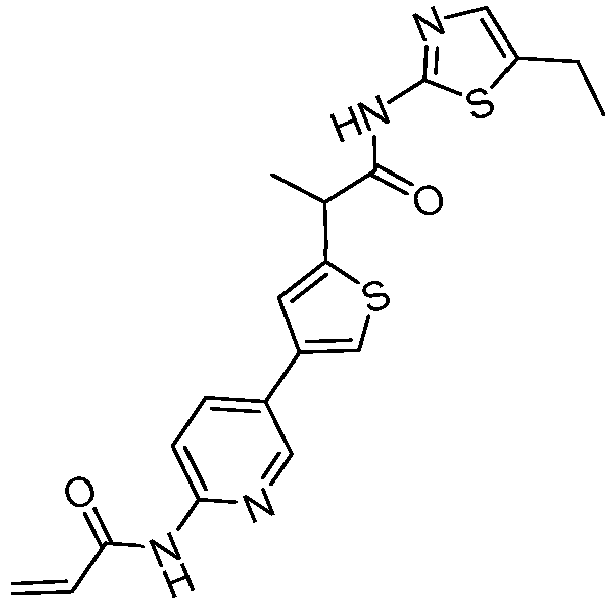
1H NMR (400MHz, DMSO-d6) δ 12.25(s, 1H), 10.81(s, 1H), 8.70(d, J=2.0 Hz, 1H), 8.23(d, J=8.4 Hz, 1H), 8.11(dd, J=8.8, 2.4 Hz, 1H), 7.82(d, J=1.2 Hz, 1H), 7.51(s, 1H), 7.17(s, 1H), 6.63(dd, J=16.8, 10.0 Hz, 1H), 6.32(dd, J=17.2, 2.0 Hz, 1H), 5.80(dd, J=10.0, 2.0 Hz, 1H), 4.30(q, J=7.2 Hz, 1H), 2.74(q, J=7.6 Hz, 2H), 1.54(d, J=6.8 Hz, 3H), 1.21(t, J=7.6 Hz, 3H); MS (m/z): 413.0 [M+1] Examp le41 78 
1H NMR (400MHz, DMSO-d6) δ 12.89(s, 1H), 10.82(s, 1H), 8.70(dd, J=2.4, 0.4 Hz, 1H), 8.37(s, 1H), 8.23(dd, J=8.8, 0.4 Hz, 1H), 8.11(dd, J=8.8, 2.4 Hz, 1H), 7.84(d, J=1.2 Hz, 1H), 7.53(d, J=1.2 Hz, 1H), 6.63(dd, J=17.2, 10.0 Hz, 1H), 6.32(dd, J=17.2, 2.0 Hz, 1H), 5.80(dd, J=10.4, 2.0 Hz, 1H), 4.36(q, J=6.8 Hz, 1H), 2.70(s, 3H), 1.57(d, J=6.8 Hz, 3H); MS (m/z): 427.0 [M+1] Examp le41 79 
1H NMR (400MHz, DMSO-d6) δ 13.05 (s, 1H), 10.92 (s, 1H), 9.45 (d, J = 1.6 Hz, 1H), 9.19 (d, J = 1.6 Hz, 1H), 9.10 (d, J = 1.6 Hz, 1H), 8.64 (d, J = 1.6 Hz, 1H), 8.44 (t, J = 2.0 Hz, 1H), 8.09 (d J = 1.2 Hz, 1H), 4.18 (q, J = 6.8 Hz, 1H), 2.48 (q, J = 7.6 Hz, 2H), 1.58 (d, J = 6.8 Hz, 3H), 1.11 (t, J = 7.6 Hz, 3H); MS (m/z): 451.0 [M+1] Examp le1 80 
; MS (m/z): 573.0 [M+1] Examp le1 81 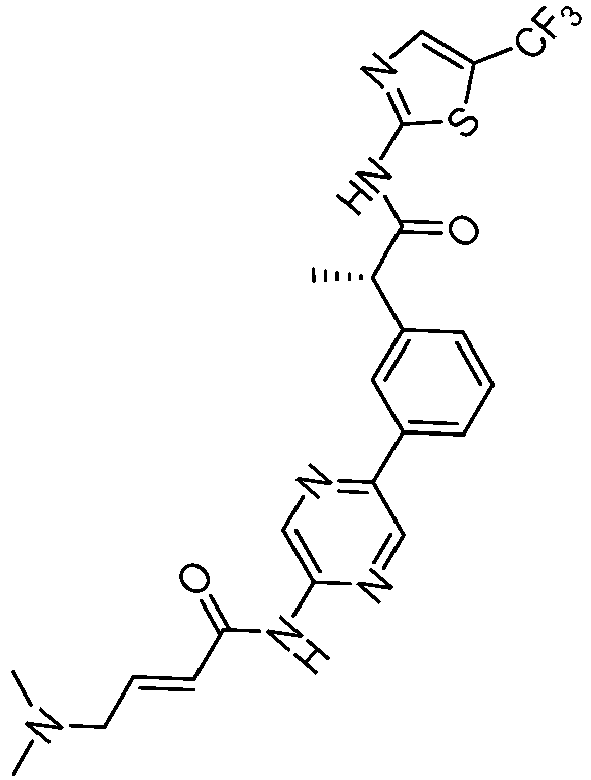
1H NMR (400MHz, DMSO-d6) δ13.01 (s, 1H), 11.02 (s, 1H), 9.50 (d, J = 1.2 Hz, 1H), 9.01 (d, J = 1.6 Hz, 1H), 8.14 (s, 1H), 8.05 (s, 1H), 7.99 (dt, J = 7.6 Hz, 2.0 Hz, 1H), 7.51-7.44 (m, 2H), 6.88 (dt, J = 15.6 Hz, 2.0Hz, 1H), 6.48 (d, J = 15.6 Hz, 1H), 4.11 (q, J = 6.8 Hz, 1H), 3.08 (d, J = 6.0 Hz, 2H), 2.19 (s, 6H), 1.53 (d, J = 7.2 Hz, 3H); MS (m/z): 505.0 [M+1]; 70ee% Examp le14 82 
1H NMR (400MHz, DMSO-d6) δ10.93 (s, 1H), 8.85 (d, J = 2.4 Hz, 1H), 8.74 (d, J = 2.4 Hz, 1H), 8.58 (d, J = 2.0 Hz, 1H), 8.33 (d, J = 8.4 Hz, 1H), 8.21 (dd, J = 8.8 Hz, 2.4 Hz, 1H), 8.10 (t, J = 2.0 Hz, 1H), 8.03 (s, 1H), 6.65 (dd, J = 16.8 Hz, 10.4 Hz, 1H), 6.35 (dd, J = 16.8 Hz, 1.6 Hz, 1H), 5.82 (dd, J = 8.0 Hz, 2.0 Hz, 1H), 4.18-4.08 (m, 1H), 1.58 (d, J = 7.2 Hz, 3H); MS (m/z): 448.0 [M+1] Examp le1 83 
1H NMR (400MHz, DMSO-d6) δ 13.01 (brs, 1H), 11.08 (s, 1H), 9.54 (d, J = 1.2 Hz, 1H), 9.19 (d, J = 2.0 Hz, 1H), 9.12 (d, J = 1.2 Hz, 1H), 8.65 (d, J = 2.0 Hz, 1H), 8.44 (t, J = 2.0 Hz, 1H), 8.07 (s, 1H), 6.90 (dt, J = 15.2 Hz, 8.8 Hz, 1H), 6.53 (d, J = 15.2 Hz, 1H), 4.37 (s, 1H), 4.18-4.15 (m, 1H), 3.86 (d, J = 7.2 Hz, 1H), 3.56-3.49 (m, 2H), 3.41-3.38 (m, 1H), 3.32-3.31 (m, 2H), 2.80-2.76 (m, 1H), 1.79-1.74 (m, 1H), 1.62-1.56 (m, 4H); MS (m/z): 560.0 [M+1] Examp le1 84 
1H NMR (400MHz, DMSO-d6) δ13.03 (brs, 1H), 11.20 (s, 1H), 8.71 (s, 1H), 8.62-8.60 (m, 2H), 8.17 (d, J = 13.2 Hz, 1H), 8.02-7.09 (m, 1H), 6.64 (dd, J = 17.2 Hz, 6.8 Hz, 1H), 6.37 (dd, J = 17.2 Hz, 2.0 Hz, 1H), 5.86 (dd, J = 10.4 Hz, 2.0 Hz, 1H), 4.12-4.07 (m, 1H), 1.56 (d, J = 7.2 Hz, 3H); MS (m/z): 466.0 [M+1] Examp le1 85 
1H NMR (400MHz, DMSO-d6) δ 12.96(s, 1H), 8.23(d, J=2.8 Hz, 1H), 8.11-8.10(m, 1H), 8.02(d, J=1.6 Hz, 1H), 7.31(t, J=2.4 Hz, 1H), 6.86(dd, J=16.4, 10.4 Hz, 1H), 6.15(dd, J=16.8, 2.4 Hz, 1H), 5.72(dd, J=10.4, 2.4 Hz, 1H), 4.02(q, J=6.8 Hz, 1H), 3.73-3.66(m, 4H), 3.23-3.22(m, 4H), 1.50(d, J=6.8 Hz, 3H); MS (m/z): 440.0 [M+1] Examp le41 86 
1H NMR (400MHz, DMSO-d6) δ 12.12(s, 1H), 8.22(d, J=2.8 Hz, 1H), 8.02(d, J=1.6 Hz, 1H), 7.31(d, J=2.0 Hz, 1H), 7.45(s, 1H), 6.86(dd, J=16.8, 10.4 Hz, 1H), 6.15(dd, J=16.8, 2.4 Hz, 1H), 5.72(dd, J=10.4, 2.4 Hz, 1H), 3.94(q, J=7.2 Hz, 1H), 3.72-3.69(m, 4H), 3.23-3.22(m, 4H), 2.73(q, J=7.6 Hz, 2H), 1.46(d, J=7.2 Hz, 3H), 1.20(t, J=7.6 Hz, 3H); MS (m/z): 400.0 [M+1] Examp le41 87 
1H NMR (400MHz, DMSO-d6) δ 12.25(s, 1H), 10.42(s, 1H), 8.79(d, J=2.0 Hz, 1H), 8.16(dd, J=8.8, 2.4 Hz, 1H), 7.94(d, J=1.2 Hz, 1H), 7.82(d, J=8.0 Hz, 1H), 7.64(d, J=0.8 Hz, 1H), 7.18-7.17(m, 1H), 6.46(dd, J=16.8, 10.0 Hz, 1H), 6.30(dd, J=17.2, 2.0 Hz, 1H), 5.82(dd, J=10.0, 2.0 Hz, 1H), 4.29(q, J=7.2 Hz, 1H), 2.60(q, J=7.6 Hz, 3H), 1.53(d, J=7.2 Hz, 3H), 1.21(t, J=7.6 Hz, 3H); MS (m/z): 413.0 [M+1] Examp le43 88 
; MS (m/z): 473.0 [M+1] Examp le1 89 
; MS (m/z): 462.0 [M+1] Examp le1 90 
; MS (m/z): 448.0 [M+1] Examp le1 91 
1H NMR (400MHz, DMSO-d6) 613.00 (s, 1H), 11.05 (s, 1H), 9.51 (d, J = 1.2 Hz, 1H), 9.02 (d, J = 1.6 Hz, 1H), 8.15 (s, 1H), 8.08 (s, 1H), 8.00 (dt, J = 7.6 Hz, 1H), 7.50 (t, J = 8.0Hz, 1H), 7.45 (d, J = 7.6 Hz, 1H), 6.87 (dt, J = 15.6 Hz, 5.6Hz, 1H), 6.48 (d, J = 15.6 Hz, 1H), 4.11 (q, J = 6.8 Hz, 1H), 3.08 (d, J = 4.8 Hz, 2H), 2.18 (s, 6H), 1.53 (d, J = 7.2 Hz, 3H); MS (m/z): 505.0 [M+1]; 70ee% Examp le14 92 
1H NMR (400MHz, DMSO-d6) δ 12.94 (s, 1H), 11.06 (s, 1H), 9.50 (d, J = 1.2 Hz, 1H), 9.01 (d, J = 1.6 Hz, 1H), 8.14 (s, 1H), 8.05 (s, 1H), 7.99 (d, J = 6.8 Hz, 1H), 7.51-7.44 (m, 2H), 6.86 (dt, J = 15.6 Hz, 5.6 Hz, 1H), 6.51 (d, J = 15.6 Hz, 1H), 4.15-4.08 (m, 1H), 3.61 (t, J = 4.4 Hz, 4H), 3.15 (d, J = 5.6 Hz, 2H), 2.43-2.38 (m, 4H), 1.52 (d, J = 6.8 Hz, 3H); MS (m/z): 547.0 [M+1]; 72ee% Examp le14 93 
1H NMR (400MHz, DMSO-d6) δ 12.60(s, 1H), 11.03(s, 1H), 9.50(d, J=1.2 Hz, 1H), 9.01(d, J=1.2 Hz, 1H), 8.14(s, 1H), 8.00(d, J=7.6 Hz, 1H), 7.56-7.44(m, 3H), 6.88(dt, J=15.2, 6.0 Hz, 1H), 6.48(d, J=18.8 Hz, 1H), 4.09(q, J=7.2 Hz, 1H), 3.08(d, J=4.4 Hz, 2H), 2.19(s, 6H), 1.52(d, J=7.2 Hz, 3H); MS (m/z): 471.5 [M+1]; 75ee% Examp le14 94 
1H NMR (400MHz, DMSO-d6) δ 12.60(s, 1H), 11.01(s, 1H), 9.50(d, J=1.2 Hz, 1H), 9.00(d, J=2.0 Hz, 1H), 8.13(s, 1H), 7.99(d, J=11.2 Hz, 1H), 7.51-7.44(m, 3H), 6.89(dt, J=15.6, 4.8 Hz, 1H), 6.52(d, J=15.6 Hz, 1H), 4.37(s, 1H), 4.08(q, J=6.8 Hz, 1H), 3.86(d, J=7.6 Hz, 1H), 3.54(dd, J=7.6, 1.6 Hz, 1H), 3.50(s, 6H), 3.40-3.36(m, 3H), 2.78(dd, J=10.0, 1.6 Hz, 1H), 1.77(dd, J=8.0, 1.6 Hz, 1H), 1.62-1.59(m, 1H), 1.52(d, J=7.2 Hz, 3H); MS (m/z): 526.0 [M+1]; 70ee% Examp le14 95 
1H NMR (400MHz, DMSO-d6) δ 13.00 (s, 1H), 11.04 (s, 1H), 9.49 (d, J = 1.2 Hz, 1H), 9.01 (d, J = 1.2 Hz, 1H), 8.14 (s, 1H), 8.05 (s, 1H), 7.99 (d, J = 7.6 Hz, 1H), 7.51-7.44 (m, 2H), 6.86 (dt, J = 15.6 Hz, 6.0 Hz, 1H), 6.49 (d, J = 15.6 Hz, 1H), 4.13-4.09 (m, 1H), 3.14 (d, J = 6.0 Hz, 2H), 2.50-2.30 (m, 8H), 2.17 (s, 3H), 1.53 (d, J = 7.2 Hz, 3H); MS (m/z): 560.0 [M+1]; 70ee% Examp le14 96 
1H NMR (400MHz, DMSO-d6) δ 13.01 (s, 1H), 11.02 (s, 1H), 9.50 (s, 1H), 9.01 (s, 1H), 8.14 (s, 1H), 8.07 (s, 1H), 7.99 (d, J = 7.2 Hz, 1H), 7.51-7.44 (m, 2H), 6.89 (dt, J = 15.2 Hz, 4.8 Hz, 1H), 6.52 (d, J = 15.2 Hz, 1H), 4.37 (s, 1H), 4.15-4.10 (m, 1H), 3.86 (d, J = 7.6 Hz, 1H), 3.54 (d, J = 7.6 Hz, 1H), 3.50 (s, 1H), 3.17 (d, J = 5.2 Hz, 2H), 2.78 (d, J = 9.6 Hz, 1H), 2.50-2.48 (m, 1H), 1.77 (d, J = 6.4 Hz, 1H); MS (m/z): 559.0 [M+1]; 68ee% Examp le14 97 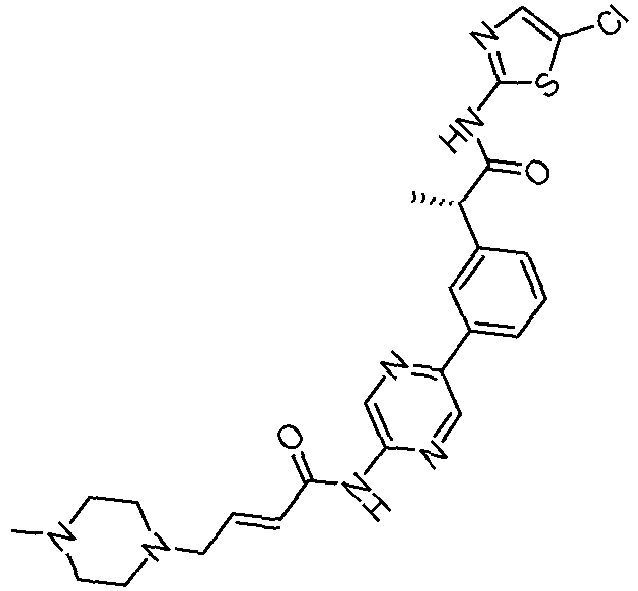
1H NMR (400MHz, DMSO-d6) δ 12.61(s, 1H), 11.04(s, 1H), 9.50(d, J=1.6 Hz, 1H), 9.01(d, J=1.6 Hz, 1H), 8.14(s, 1H), 8.00(dt, J=6.0, 1.2 Hz, 1H), 7.51-7.44(m, 3H), 6.86(dt, J=15.6, 5.6 Hz, 1H), 6.49(d, J=15.2 Hz, 1H), 4.09(q, J=7.2 Hz, 1H), 3.14(d, J=4.8 Hz, 2H), 2.41-2.36(m, 8H), 2.18(s, 3H), 1.52(d, J=7.2 Hz, 3H); MS (m/z): 527.0 [M+1]; 73ee% Examp 1e14 98 
1H NMR (400MHz, DMSO-d6)) δ 12.61(s, 1H), 11.05(s, 1H), 9.50(d, J=1.6 Hz, 1H), 9.01(d, J=1.6 Hz, 1H), 8.14(s, 1H), 7.99(dt, J=7.6, 1.6 Hz, 1H), 7.51-7.44(m, 3H), 6.87(dt, J=15.6, 5.6 Hz, 1H), 6.51(d, J=15.2 Hz, 1H), 4.09(q, J=6.8 Hz, 1H), 3.61(t, J=4.8 Hz, 4H), 3.15(dd, J=6.0, 1.2 Hz, 1H), 2.41(t, J=4.8 Hz, 4H), 1.51(d, J=6.8 Hz, 3H); MS (m/z): 514.0 [M+1]; 73ee% Examp lel4 99 
1H NMR (400MHz, DMSO-d6) δ 10.40 (s, 1H), 8.60 (s, 1H), 8.11 (dd, J = 11.2 Hz, 2.0 Hz, 1H), 8.15-7.98 (m, 1H), 7.78 (s, 1H), 7.67 (d, J = 8.0 Hz, 1H), 7.49 -7.40 (m, 2H), 6.80 (dt, J = 15.6 Hz, 6.0 Hz, 1H), 6.35 (d, J = 15.6 Hz, 1H) 4.07-4.02 (m, 1H), 3.08 (d, J = 7.2 Hz, 2H), 12.19 (s, 6H), 1.53 (d, J = 6.8 Hz, 3H); MS (m/z): 522.0 [M+1]; 70ee% Examp le14 100 
1H NMR (400MHz, DMSO-d6) δ 9.88 (s, 1H), 8.25 (d, J = 2.0 Hz, 1H), 7.99 (s, 1H), 7.73 (s, 1H), 7.67-7.64 (m, 2H), 7.49-7.39 (m, 2H), 6.72 (dt, J = 15.6 Hz, 2.0Hz, 1H), 6.37 (d, J = 15.6 Hz, 1H), 4.09-4.03 (m, 1H), 3.92 (s, 3H), 3.05 (d, J = 6.0 Hz, 2H), 2.18 (s, 6H), 1.53 (d, J = 7.2 Hz, 3H); MS (m/z): 534.0 [M+1]; 71ee% Examp le14 101 
1H NMR (400MHz, DMSO-d6) δ 12.91 (brs, 1H), 11.04 (s, 1H), 9.03 (d, J = 2.4 Hz, 1H), 8.67 (d, J = 2.4 Hz, 1H), 8.10 (t, J = 1.6 Hz, 1H), 7.84 (s, 1H), 7.75 (d, J = 7.6 Hz, 1H), 7.52 (t, J = 7.6 Hz, 1H), 7.46 (d, J = 8.0 Hz, 1H), 6.90 (dt, J = 15.6 Hz, 6.0 Hz, 1H), 6.40 (dt, J = 15.6 Hz, 1.6 Hz, 1H), 4.13 (q, J = 6.8 Hz, 1H), 3.12 (dd, J = 6.0 Hz, 1.2 Hz, 2H), 2.22 (s, 6H), 1.57 (d, J = 6.8 Hz, 3H); MS (m/z): 529.0 [M+1]; 70ee% Examp le14 102 
1H NMR (400MHz, DMSO-d6) δ 11.01 (s, 1H), 9.50 (d, J = 1.6 Hz, 1H), 9.00 (d, J = 1.6 Hz, 1H), 8.14 (s, 1H), 8.03 (s, 1H), 7.99 (d, J = 7.2 Hz, 1H), 7.51-7.43 (m, 2H), 6.92 (dt, J = 15.2 Hz, 6.0 Hz, 1H), 6.50 (d, J = 15.6 Hz, 1H), 4.10 (q, J = 7.2 Hz, 1H), 3.40-3.30 (m, 4H), 3.26 (d, J = 5.6 Hz, 2H), 1.74-1.68 (m, 4H), 1.53 (d, J = 7.2 Hz, 3H); MS (m/z): 531.0 [M+1]; 71ee% Examp le14 103 
1H NMR (400MHz, DMSO-d6) δ 10.99 (s, 1H), 9.49 (d, J = 1.6 Hz, 1H), 8.99 (d, J = 1.6 Hz, 1H), 8.12 (s, 1H), 7.98-7.92 (m, 2H), 7.49-7.43 (m, 2H), 7.81-6.75 (m, 1H), 6.44 (d, J = 15.6 Hz, 1H), 4.06-4.01 (m, 1H), 3.20-3.16 (m, 6H), 2.05-1.98 (m, 2H), 1.51 (d, J = 7.2 Hz, 3H); MS (m/z): 517.0 [M+1]; 68ee% Examp le14 104 
1H NMR (400MHz, DMSO-d6) δ 12.18(s, 1H), 11.02(s, 1H), 9.50(d, J=1.6 Hz, 1H), 9.00(d, J=1.6 Hz, 1H), 8.15(s, 1H), 7.98(dt, J=7.2, 2.0 Hz, 1H), 7.51-7.44(m, 2H), 7.15(d, J=0.8 Hz, 1H), 6.88(dt, J=15.6, 5.6 Hz, 1H), 6.48(dt, J=15.6, 1.6 Hz, 1H), 4.07(q, J=6.8 Hz, 1H), 3.63(qui, J=8.4 Hz, 1H), 3.09(dd, J=6.4, 1.6 Hz, 2H), 2.37-2.29(m, 2H), 2.19(s, 6H), 2.09-2.02(m, 2H), 1.97-1.90(m, 1H), 1.87-1.82(m, 1H), 1.50(d, J=6.8 Hz, 3H); MS (m/z): 491.0 [M+1]; ; 72ee% Examp le14 105 
1H NMR (400 MHz, CDCl3) δ 10.51(s, 1H), 9.59-9.58(m, 1H), 8.57-8.39(m, 2H), 7.95-7.76(m, 2H), 7.42-7.38(m, 2H), 7.26-7.22(m, 2H), 7.05-7.00(m, 1H), 6.18(d, J=15.6 Hz, 1H), 3.93(q, J=7.2 Hz, 1H), 3.16(dd, J=5.6, 1.2 Hz, 2H), 2.30(s, 6H), 1.67-1.65(m, 9H); MS (m/z): 495.0 [M+1]; 66ee% Examp le14 106 
1H NMR (400MHz, DMSO-d6) δ 11.91(s, 1H), 11.03(s, 1H), 9.51(s, 1H), 9.00(s, 1H), 8.14(s, 1H), 7.98(d, J=7.6 Hz, 1H), 7.50-7.43(m, 2H), 6.88(dt, J=15.2, 6.0 Hz, 1H), 6.48(d, J=15.2 Hz, 1H), 6.42(s, 1H), 4.04-4.00(m, 1H), 3.08(d, J=5.2 Hz, 2H), 2.75(s, 6H), 2.19(s, 6H), 1.48(d, J=6.8 Hz, 3H); MS (m/z): 480.0 [M+1]; 66ee% Examp le14 107 
1H NMR (400MHz, DMSO-d6) 8.82 (d, J = 2.4 Hz, 1H), 8.60 (d, J = 2.0 Hz, 1H), 8.49 (d, J = 2.4 Hz, 1H), 8.44 (d, J = 8.4 Hz, 1H), 8.19 (s, 1H), 7.93 (dd, J = 8.8 Hz, 1.8 Hz, 1H), 7.85 (t, J = 2.4 Hz, 1H), 7.75 (d, J = 1.6 Hz, 1H), 7.09-6.99 (m, 1H), 6.16 (d, J = 15.2 Hz, 1H), 3.93 (q, J = 7.2 Hz, 1H), 3.14 (dd, J = 6.0 Hz, 1.6 Hz, 2H), 2.29 (s, 6H), 1.72 (d, J = 6.8 Hz, 3H); MS (m/z): 505.0 [M+1] Examp le1 108 
1H NMR (400MHz, DMSO-d6) δ 11.08 (s, 1H), 9.11 (d, J = 2.4 Hz, 1H), 8.95 (d, J = 2.4 Hz, 1H), 8.80 (d, J = 2.4 Hz, 1H), 8.66 (d, J = 2.0 Hz, 1H), 8.24 (t, J = 2.0 Hz, 1H), 8.04 (s, 1H), 6.92 (dt, J = 15.6 Hz, 5.6 Hz, 1H), 6.41 (dt, J = 15.2 Hz, 1.6 Hz, 1H), 4.15 (q, J = 7.6 Hz, 1H), 3.13 (d, J = 6.0 Hz, 2H), 2.21 (s, 6H), 1.62 (d, J = 7.2 Hz, 3H); MS (m/z): 530.0 [M+1] Examp le1 109 
1H NMR (400MHz, DMSO-d6) δ 12.95(s, 1H), 10.21(s, 1H), 8.60(s, 1H), 8.10-8.08(m, 2H), 8.01(d, J=7.2 Hz, 1H), 7.52-7.44(m, 2H), 6.77(dt, J=15.6, 6.0 Hz, 1H), 6.41(d, J=15.2 Hz, 1H), 4.14(q, J=6.8 Hz, 1H), 4.03(s, 3H), 3.07(dd, J=6.0, 1.2 Hz, 2H), 2.19(s, 6H), 1.54(d, J=7.2 Hz, 3H); MS (m/z): 535.0 [M+1]; 68ee% Examp le14 110 
1H NMR (400MHz, DMSO-d6) δ 8.44 (s, 1H), 7.96-7.91 (m, 3H), 7.69 (s, 1H), 7.57 (d, J = 7.6 Hz, 1H), 7.43 (t, J = 7.6 Hz, 1H), 7.36 (d, J = 7.6 Hz, 1H), 6.87 (dd, J = 15.6 Hz, 6.0 Hz, 1H), 4.12-4.02 (m, 3H), 3.13 -3.11 (m, 4H), 2.20 (s, 6H), 1.51 (d, J = 7.2 Hz, 3H); MS (m/z): 530.0 [M+1]; 69ee% Examp le14 111 
1H NMR (400MHz, DMSO-d6) δ 10.38 (s, 1H), 9.04 (s, 1H), 8.41 (s, 1H), 7.08-7.70 (m, 2H), 7.51-7.46 (m, 2H), 6.80-6.75 (m, 2H), 6.32 (d, J = 15.2 Hz, 1H), 4.10-4.00 (m, 1H), 3.08 (d, J = 7.2 Hz, 2H), 2.19 (s, 6H), 1.52 (d, J = 7.2 Hz, 3H); MS (m/z): 572.0 [M+1]; 70ee% Examp le14 112 
1H NMR (400MHz, DMSO-d6) δ10.21 (s, 1H), 8.54 (d, J = 2.0 Hz, 1H), 7.97 (d, J = 1.6 Hz, 2H), 7.71 (s, 1H), 7.61 (d, J = 8.0 Hz, 1H), 7.45 (t, J = 7.6 Hz, 1H), 7.39 (d, J = 8.0 Hz, 1H), 6.76 (dt, J = 15.6 Hz, 6.0 Hz, 1H), 6.34 (d, J = 15.6 Hz, 1H), 4.11 (q, J = 5.2 Hz, 1H), 3.07 (d, J = 6.0 Hz, 2H), 2.24 (s, 3H), 2.19 (s, 6H), 1.52 (d, J = 7.2 Hz, 3H); MS (m/z): 518.0 [M+1]; 70ee% Examp le14 113 
1H NMR (400MHz, DMSO-d6) δ 10.41 (s, 1H), 8.72 (d, J = 2.0 Hz, 1H), 8.29 (d, J = 2.0 Hz, 1H), 7.99 (s, 1H), 7.78 (s, 1H), 7.68 (d, J = 7.6 Hz, 1H), 7.48 (t, J = 7.6 Hz, 1H), 7.42 (d, J = 8.0 Hz, 1H), 6.79 (dt, J = 15.6 Hz, 6.0 Hz, 1H), 6.34 (d, J = 15.6 Hz, 1H), 4.11 (q, 5.2 Hz, 1H), 3.08 (dd, J = 6.0 Hz, 2H), 2.19 (s, 6H), 1.53 (d, J = 7.2 Hz, 3H); MS (m/z): 538.5 [M+1]; 68ee% Examp le14 114 
1H NMR (400MHz, DMSO-d6) δ 12.97(s, 1H), 11.03(s, 1H), 9.50(d, J=1.2 Hz, 1H), 9.01(d, J=1.2 Hz, 1H), 8.15(s, 1H), 8.09(d, J=1.2 Hz, 1H), 8.00(d, J=7.6 Hz, 1H), 7.52-7.44(m, 2H), 6.91(dt, J=15.2, 6.0 Hz, 1H), 6.50(d, J=15.6 Hz, 1H), 4.14(q, J=6.8 Hz, 1H), 3.24(d, J=4.4 Hz, 2H), 2.50-2.46(m, 4H), 1.54(d, J=7.2 Hz, 3H), 0.99(t, J=6.8 Hz, 6H); MS (m/z): 533.0 [M+1]; 67ee% Examp le14 115 
1H NMR (400MHz, DMSO-d6) δ 12.99(s, 1H), 11.05(s, 1H), 9.50(d, J=1.6 Hz, 1H), 9.01(d, J=1.6 Hz, 1H), 8.15(s, 1H), 8.09-8.08(m, 1H), 8.00(dt, J=7.6, 1.6 Hz, 1H), 7.52-7.45(m, 2H), 6.91(dt, J=15.2, 5.6 Hz, 1H), 6.52(d, J=15.2 Hz, 1H), 5.31-5.14(m, 1H), 4.14(q, J=7.2 Hz, 1H), 3.31-3.29(m, 2H), 2.91-2.81(m, 2H), 2.72-2.60(m, 1H), 2.40-2.34(m, 1H), 2.23-2.08(m, 1H), 1.98-1.83(m, 1H), 1.54(d, J=6.8 Hz, 3H); MS (m/z): 549.0 [M+1]; 68ee% Examp le14 116 
1H NMR (400MHz, DMSO-d6) δ 10.75 (s, 1H), 8.65 (d, J = 2.0 Hz, 1H), 8.29 (d, J = 8.8 Hz, 1H), 8.10 (m, 1H), 8.04 (m, 1H), 7.72 (m, 1H), 7.61 (d, J = 7.2 Hz, 1H), 7.48(m, 1H), 7.44(m, 1H), 7.38(m, 1H), 7.29(m, 1H), 6.81(m, 1H), 6.46(m, 1H), 4.10 (m, 1H), 3.06 (d, J = 6.4 Hz, 1H), 2.18(s, 6H), 1.53 (d, J = 6.8 Hz, 1H); MS (m/z): 504.0 [M+1]; 70ee% Examp le14 117 
1H NMR (400MHz, DMSO-d6) δ 12.97(s, 1H), 11.04(s, 1H), 9.50(d, J=1.2 Hz, 1H), 9.01(d, J=1.6 Hz, 1H), 8.15(s, 1H), 8.10-8.09(m, 1H), 8.00(dt, J=7.6, 1.6 Hz, 1H), 7.52-7.45(m, 2H), 6.91(dt, J=15.6, 5.6 Hz, 1H), 6.52(dt, J=15.6, 1.6 Hz, 1H), 5.31-5.14(m, 1H), 4.14(q, J=6.8 Hz, 1H), 3.31-3.29(m, 2H), 2.91-2.81(m, 2H), 2.72-2.60(m, 1H), 2.40-2.34(m, 1H), 2.23-2.08(m, 1H), 1.98-1.83(m, 1H), 1.54(d, J=7.2 Hz, 3H); MS (m/z): 549.0 [M+1]; 65ee% Examp le14 118 
1H NMR (400MHz, DMSO-d6) δ 13.02(s, 1H), 11.01(s, 1H), 9.50(d, J=1.6 Hz, 1H), 9.01(d, J=1.6 Hz, 1H), 8.14(s, 1H), 8.07(s, 1H), 8.00(d, J=7.2 Hz, 1H), 7.51-7.44(m, 2H), 6.95-6.89(m, 1H), 6.48(d, J=15.2 Hz, 1H), 4.24-4.22(m, 1H), 4.15(q, J=6.8 Hz, 1H), 4.04-3.99(m, 1H), 3.73-3.52(m, 4H), 3.36(s, 3H), 3.34-3.16(m, 1H), 2.34-2.15(m, 1H), 2.09-2.01(m, 1H), 1.94-1.87(m, 1H), 1.76-1.72(m, 1H), 1.54(d, J=6.8 Hz, 3H); MS (m/z): 575.0 [M+1]; 65ee% Examp le14 119 
1H NMR (400MHz, DMSO-d6) δ 12.96(s, 1H), 11.03(s, 1H), 9.50(d, J=1.6 Hz, 1H), 9.07(d, J=1.6 Hz, 1H), 8.15(s, 1H), 8.09(t, J=1.2 Hz, 1H), 8.02-7.99(m, 1H), 7.52-7.44(m, 2H), 6.87(dt, J=15.6, 6.0 Hz, 1H), 6.48(d, J=15.6 Hz, 1H), 4.14(q, J=7.2 Hz, 1H), 3.11(dd, J=5.6, 1.2 Hz, 1H), 2.36(s, 4H), 1.55-1.50(m, 4H), 1.41-1.40(m, 2H); MS (m/z): 547.0 [M+1]; 65ee% Examp le14 120 
1H NMR (400MHz, DMSO-d6) δ 12.97(s, 1H), 11.02(s, 1H), 9.50(d, J=1.2 Hz, 1H), 9.01(d, J=1.6 Hz, 1H), 8.15(s, 1H), 8.08(s, 1H), 8.00(d, J=7.6 Hz, 1H), 7.52-7.44(m, 2H), 6.90(dt, J=15.6, 5.2 Hz, 1H), 6.50(d, J=15.6 Hz, 1H), 4.73-4.72(m, 1H), 4.21-4.20(m, 1H), 4.13(q, J=6.8 Hz, 1H), 3.25(d, J=5.6 Hz, 1H), 2.77-2.74(m, 1H), 2.63-2.51(m, 2H), 2.51-2.50(m, 1H), 2.37-2.34(m, 1H), 2.02-1.92(m, 1H), 2.09-2.01(m, 1H), 2.55-1.53(m, 5H); MS (m/z): 545.0 [M+1]; 65ee% Examp le14 121 
1H NMR (400MHz, DMSO-d6) δ 12.10 (brs, 1H), 11.03 (brs, 1H), 9.01 (d, J = 2.4 Hz, 1H), 8.65 (d, J = 2.4 Hz, 1H), 7.82 (s, 1H), 7.72 (d, J = 7.6 Hz, 1H), 7.51-7.43 (m, 2H), 7.14 (s, 1H), 6.89 (dt, J = 15.6 Hz, 6.0 Hz, 1H), 6.38 (d, J = 15.6 Hz, 1H), 4.05 (q, J = 6.8 Hz, 1H), 3.10 (dd, J = 5.6 Hz, 1.2 Hz, 2H), 2.72 (q, J = 7.2 Hz, 2H), 2.20 (s, 6H), 1.52 (d, J = 7.2 Hz, 3H), 1.19 (t, J = 7.2 Hz, 3H); MS (m/z): 489.0 [M+1]; 75ee% Examp le14 122 
1H NMR (400MHz, DMSO-d6) δ 12.10 (s, 1H), 8.44 (d, J = 2.0 Hz, 1H), 7.96-7.92 (m, 2H), 7.70 (s, 1H), 7.58 (d, J = 7.6 Hz, 1H), 7.43 (t, J = 7.6 Hz, 1H), 7.36 (d, J = 7.6 Hz, 1H), 7.12 (s, 1H), 6.87 (dd, J = 15.2 Hz, 6.4 Hz, 1H), 4.13-4.06 (m, 2H), 4.04 -3.98 (m, 1H), 3.15-3.10 (m, 4H), 2.74-2.67 (m, 2H), 2.20 (s, 6H), 1.50 (d, J = 7.2 Hz, 3H), 1.19 (t, J = 7.6 Hz, 3H); MS (m/z): 490.0 [M+1]; 72ee% Examp le14 123 
1H NMR (400MHz, DMSO-d6) δ 12.11 (brs, 1H), 11.05 (brs, 1H), 9.00 (d, J = 2.4 Hz, 1H), 8.64 (d, J = 2.4 Hz, 1H), 7.82 (s, 1H), 7.71 (d, J = 8.0 Hz, 1H), 7.51-7.43 (m, 2H), 7.13 (s, 1H), 6.89 (dt, J = 15.6 Hz, 5.2 Hz, 1H), 6.41 (d, J = 15.2 Hz, 1H), 4.38 (s, 1H), 4.04 (q, J = 6.8 Hz, 1H), 3.86 (d, J = 7.6 Hz, 1H), 3.57-4.90 (m, 2H), 3.43-3.37 (m, 2H), 2.82-2.67 (m, 4H), 1.77 (d, J = 7.6 Hz, 1H), 1.61 (d, J = 10.2 Hz, 1H), 1.51 (d, J = 7.2 Hz, 3H), 1.19 (t, J = 7.2 Hz, 3H); MS (m/z): 543.0 [M+1]; 73ee% Examp le14 124 
1H NMR (400 MHz, CDCl3) δ 9.08 (s, 1H), 8.70 (d, J = 2.4 Hz, 1H), 8.19 (s, 1H), 8.17 (d, J = 2.4 Hz, 1H), 7.72 (d, J = 1.2 Hz, 1H), 7.57-7.41 (m, 3H), 6.60 (dd, J = 17.2 Hz, 1.2 Hz, 1H), 6.46 (dd, J = 16.8 Hz, 10.4 Hz, 1H), 5.95 (dd, J = 10.4 Hz, 1.2 Hz, 1H), 3.93 (q, J = 7.2 Hz, 1H), 1.70 (d, J = 7.2 Hz, 3H); MS (m/z): 472.0 [M+1]; 71ee% Examp le14 125 
1H NMR (400MHz, DMSO-d6) δ 12.13(s, 1H), 10.21(s, 1H), 8.54(d, J=2.4 Hz, 1H), 7.96(d, J=1.6 Hz, 1H), 7.73(s, 1H), 7.62(d, J=8.0 Hz, 1H), 7.46(t, J=7.6 Hz, 1H), 7.39(d, J=7.6 Hz, 1H), 7.14(s, 1H), 6.76(dt, J=15.2, 6.0 Hz, 1H), 6.34(d, J=15.6 Hz, 1H), 4.04(q, J=7.2 Hz, 1H), 3.07(d, J=4.8 Hz, 2H), 2.72(q, J=7.6 Hz, 2H), 2.24(s, 3H), 2.19(s, 6H), 1.50(d, J=6.8 Hz, 3H), 1.19(t, J=7.2 Hz, 3H); MS (m/z): 478.0 [M+1]; 70ee% Examp le14 126 
1H NMR (400MHz, DMSO-d6) δ 12.12(s, 1H), 8.51(d, J=1.2 Hz, 1H), 8.13(d, J=1.6 Hz, 1H), 7.74(s, 1H), 7.61(d, J=7.6 Hz, 1H), 7.45(t, J=7.6 Hz, 1H), 7.35(d, J=8.0 Hz, 1H), 7.14-7.09(m, 2H), 6.87-6.78(m, 1H), 6.43(s, 1H), 4.06-4.01(m, 1H), 3.36(d, J=7.2 Hz, 1H), 3.07(s, 3H), 2.86(s, 3H), 2.72(q, J=7.2 Hz, 2H), 2.52(s, 3H), 1.51(d, J=7.2 Hz, 3H), 1.24(s, 3H), 1.21-1.17(m, 3H); MS (m/z): 502.0 [M+1]; 70ee% Examp le14 127 
1H NMR (400MHz, DMSO-d6) δ 12.13(s, 1H), 8.58(d, J=2.0 Hz, 1H), 8.26(d, J=2.0 Hz, 1H), 8.02(d, J=3.6 Hz, 1H), 7.74(s, 1H), 7.62(d, J=7.6 Hz, 1H), 7.52-7.44(m, 2H), 7.37(d, J=7.6 Hz, 1H), 7.14(s, 1H), 6.73(d, J=3.6 Hz, 1H), 6.29-6.25(m, 1H), 4.06-4.04(m, 1H), 3.36-3.33(m, 2H), 3.06(s, 3H), 2.86(s, 3H), 2.71(q, J=7.6 Hz, 2H), 1.51(d, J=6.8 Hz, 3H), 1.18(d, J=7.6 Hz, 3H); MS (m/z): 488.0 [M+1]; 70ee% Examp le14 128 
1H NMR (400MHz, DMSO-d6) δ 11.03(s, 1H), 9.06(d, J=2.4 Hz, 1H), 8.72(d, J=2.4 Hz, 1H), 7.85(s, 1H), 7.79-7.76(m, 1H), 7.52-7.47(m, 2H), 7.11(s, 1H), 6.88(dt, J=15.6, 5.6 Hz, 1H), 6.38(d, J=15.6 Hz, 1H), 3.11-3.10(m, 2H), 2.72(q, J=7.2 Hz, 1H), 2.20(s, 6H), 1.56-1.55(m, 2H), 1.33-1.31(m, 2H), 1.20(t, J=7.6 Hz, 3H); MS (m/z): 501.0 [M+1]; 70ee% Examp le43 129 
1H NMR (400MHz, DMSO-d6) 12.13 (s, 1H), 8.78 (d, J = 2.4 Hz, 1H), 8.16 (dd, J = 8.4 Hz, 2.4 Hz, 1H), 7.75 (s, 1H), 7.65 (d, J = 7.6 Hz, 1H), 7.51-7.41 (m, 3H), 7.14 (s, 1H), 6.70 (dt, J = 15.2 Hz, 6.0 Hz, 1H), 6.16 (d, J = 14.8 Hz, 1H), 4.05 (q, J = 6.8 Hz, 1H), 2.96 (d, J = 5.2 Hz, 2H), 2.72 (q, J = 7.6 Hz, 2H), 2.09 (s, 9H), 1.51 (d, J = 7.2 Hz, 3H), 1.19 (t, J = 7.6 Hz, 3H); MS (m/z): 478.0 [M+1]; 65ee% Examp le1 130 
1H NMR (400MHz, DMSO-d6) δ 12.10 (brs, 1H), 10.48 (s, 1H), 8.59 (s, 1H), 8.10 (dd, J = 11.2 Hz, 2.0 Hz, 1H), 7.78 (s, 1H), 7.68 (d, J = 7.6 Hz, 1H), 7.48 (t, J = 7.6 Hz, 1H), 7.42 (d, J = 8.0 Hz, 1H), 7.13 (s, 1H), 6.80 (dt, J = 15.2 Hz, 6.0 Hz, 1H), 6.35 (d, J = 15.6 Hz, 1H), 4.03 (q, J = 7.2 Hz, 1H), 3.07 (d, J = 5.2 Hz, 2H), 2.72 (q, J = 7.2 Hz, 2H), 2.19 (s, 6H), 1.51 (d, J = 6.8 Hz, 3H), 1.19 (t, J = 7.2 Hz, 3H); MS (m/z): 482.0 [M+1]; 65ee% Examp le14 131 
1H NMR (400MHz, DMSO-d6) δ 12.17(s, 1H), 10.40(s, 1H), 8.88(d, J=2.4 Hz, 1H), 8.23(dd, J=8.8, 2.4 Hz, 1H), 8.11(s, 1H), 7.93-7.89(m, 2H), 7.14(s, 1H), 6.83-6.77(m, 1H), 6.31(d, J=15.2 Hz, 1H), 3.81(t, J=7.2 Hz, 1H), 3.09(d, J=6.0 Hz, 2H), 2.72(t, J=7.6 Hz, 2H), 2.20(s, 6H), 2.16-2.09(m, 1H), 1.84-1.77(m, 1H), 1. 19(t, J=7.6 Hz, 3H), 0.86(t, J=7.2 Hz, 3H); MS (m/z): 478.0 [M+1] Examp le1 132 
1H NMR, 400MHz, CDCl3, 8.87 (d, J = 2.4 Hz, 1H), 8.19 (d, J = 2.4 Hz, 1H), 7.56-7.45 (m, 4H), 7.04-6.99 (m, 2H), 6.13-6.09 (m, 1H), 3.75-3.67 (m, 1H), 3.52 (s, 3H), 3.16-3.11 (m, 2H), 2.78 (q, J = 7.6 Hz, 2H), 2.30 (s, 6H), 1.69 (d, J = 7.2 Hz, 3H), 1.29 (t, J = 7.6 Hz, 3H); MS (m/z): 503.0 [M+1]; 72ee% Examp le14 133 
1H NMR (400MHz, DMSO-d6) δ 11.09(s, 1H), 8.49(d, J=2.0 Hz, 1H), 8.02(s, 1H), 7.94(d, J=15.6 Hz, 1H), 7.72(s, 1H), 7.63(d, J=8 Hz, 1H), 7.45(t, J=7.6 Hz, 1H), 7.40(d, J=7.6 Hz, 2H), 7.11(s, 1H), 6.87(dt, J=15.6, 6.0 Hz, 1H), 4.09(t, J=8.0 Hz, 2H), 3.15-3.10(m, 4H), 2.71(q, J=7.2 Hz, 2H), 2.19(s, 6H), 1.55-1.52(m, 2H), 1.29-1.26(m, 2H), 1.21-1.16(m, 3H); MS (m/z): 502.0 [M+1] Examp le1 134 
1H NMR (400MHz, DMSO-d6) δ 8.63 (s, 1H), 8.16 (dd, J = 11.6 Hz, 2.0 Hz, 1H), 7.78 (s, 1H), 7.71 (d, J = 7.2 Hz, 1H), 7.49-7.43 (m, 2H), 7.08 (s, 1H), 6.80 (dt, J = 15.6 Hz, 6.0 Hz, 1H), 6.34 (d, J = 15.6 Hz, 1H), 3.07 (d, J = 6.0 Hz, 2H), 2.70 (q, J = 7.6 Hz, 2H), 2.19 (s, 6H), 1.55-1.51 (m, 2H), 1.28-1.24 (m, 2H), 1.20-1.16 (m, 3H); MS (m/z): 494.0 [M+1] Examp le1 135 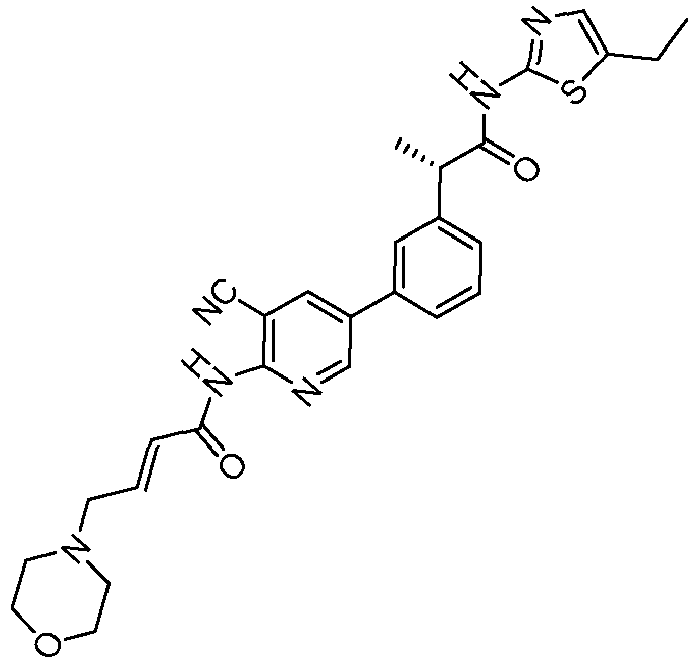
1H NMR (400MHz, DMSO-d6) δ 12.12 (s, 1H), 11.06 (s, 1H), 9.03 (d, J = 2.4 Hz, 1H), 8.67 (d, J = 2.4 Hz, 1H) 7.84 (s, 1H), 7.74 (d, J = 8.0 Hz, 1H), 7.53-7.49 (m, 1H), 7.46 (d, J = 8.0 Hz, 1H), 7.16 (s, 1H), 6.93-6.86 (m, 1H), 6.43 (d, J = 15.6 Hz, 1H), 4.09-4.04 (m, 1H), 3.63 (t, J = 4.6Hz, 4H), 3.19 (d, J = 5.2 Hz, 2H), 2.73 (q, J = 7.4 Hz, 2H), 2.44 (m, 4H), 1.53 (d, J = 6.8 Hz, 3H), 1.21 (t, J = 7.4 Hz, 3H); MS (m/z): 531.0 [M+1]; 68ee% Examp le14 136 
1H NMR (400MHz, DMSO-d6) δ 12.12 (s, 1H), 11.04 (s, 1H), 9.02 (d, J = 2.4 Hz, 1H), 8.66 (d, J = 2.4 Hz, 1H), 7.84 (s, 1H), 7.74 (d, J = 7.6 Hz, 1H), 7.53-7.45 (m, 2H), 7.16 (s, 1H), 6.92-6.86 (m, 1H), 6.43 (d, J = 15.6 Hz, 1H), 4.09-4.04 (m, 1H), 3.18 (d, J = 4.8 Hz, 2H), 2.76-2.69 (m, 2H), 2.44-2.35 (m, 8H), 1.93 (s, 3H) 1.54 (d, J = 6.8 Hz, 3H), 1.21 (t, J = 7.4 Hz, 3H); MS (m/z): 544.0 [M+1]; 66ee% Examp le14 137 
1H NMR (400MHz, DMSO-d6) δ 12.25(s, 1H), 11.10(s, 1H), 9.10(d, J=2.4 Hz, 1H), 8.95(d, J=2.0 Hz, 1H), 8.79(d, J=2.4 Hz, 1H), 8.65(d, J=2.0 Hz, 1H), 8.23(t, J=2.0 Hz, 1H), 7.17(t, J=1.2 Hz, 1H), 6.91(dt, J=15.6, 5.6 Hz, 1H), 6.40(dt, J=15.6, 1.6 Hz, 1H), 4.12(q, J=7.2 Hz, 1H), 3.12(dd, J=6.0, 2.0 Hz, 2H), 2.76-2.72(m, 2H), 2.21(s, 6H), 1.59(d, J=7.2 Hz, 3H), 1.21(t, J=7.6 Hz, 3H); MS (m/z): 490.0 [M+1] Examp le1 138 
1H NMR (400MHz, DMSO-d6) δ 9.01 (d, J = 2.4 Hz, 1H), 8.65 (d, J = 2.4 Hz, 1H), 7.82 (s, 1H), 7.73 (d, J = 7.6 Hz, 1H), 7.51 (t, J = 7.6 Hz, 1H), 7.46 (d, J = 7.6 Hz, 1H), 7.15 (s, 1H), 6.89 (dt, J = 15.6 Hz, 6.0 Hz, 1H), 6.39 (d, J = 15.6 Hz, 1H), 3.83 (t, J = 7.2 Hz, 1H), 3.12 (d, J = 6.0 Hz, 2H), 2.73 (q, J = 7.2 Hz, 1H), 2.22 (s, 6H), 1.21 (t, J = 7.6 Hz, 3H), 0.89 (t, J = 7.2 Hz, 3H); MS (m/z): 503.0 [M+1] Examp le1 139 
1H NMR (400MHz, DMSO-d6) δ 12.16 (br, 1H), 11.79 (br, 1H), 8.93 (s, 2H), 7.81 (s, 1H), 7.72 (d, J = 8.0 Hz, 1H), 7.51 (t, J = 7.6 Hz, 1H), 7.43 (d, J = 8.0 Hz, 1H), 7.15(s, 1H), 4.06 (m, 1H), 3.32(s, 2H), 1.55 (d, J = 7.2 Hz, 1H), 1.21 (m, 3H); MS (m/z): 445.0 [M+1]; 70ee% Examp le14 140 
MS (m/z): 395.0 [M+1] Examp le 41 141 
MS (m/z): 394.0 [M+1] Examp le 41 142 
MS (m/z): 399.0 [M+1] Examp le 41 143 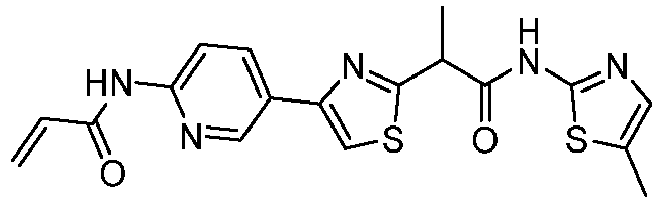
MS (m/z): 400.0 [M+1] Examp le 41 144 
MS (m/z): 447.0 [M+1] Examp le 14 145 
MS (m/z): 506.0 [M+1]; 68ee% Examp le 14 146 
MS (m/z): 443.0 [M+1]; 70ee% Examp le 14 147 
MS (m/z): 410.0 [M+1]; 70ee% Examp le 14 148 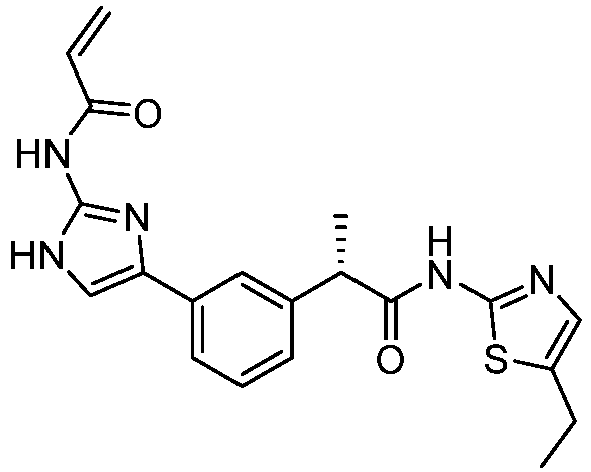
MS (m/z): 396.0 [M+1]; 67ee% Examp le 14 149 
MS (m/z): 413.0 [M+1]; 68ee% Examp le 14 - The efficacies of the compounds prepared in Examples above were evaluated as follows, and the results are shown below.
- Representative compounds of the present invention were assayed in vitro for CDK7 kinase-inhibitory activities using ADP-Glo platform. In detail, CDK7 kinase-inhibitory activity was measured using recombinant purified human CDK7 kinase (ThermoFisher, PV3868) and ADP Glo kinase assays kit (Promega, V9102). CDK7 kinase was diluted with 1X kinase reaction buffer (40 mM Tris-Cl, pH 7.5, 20 mM MgCl2, 0.1 mg/ml BSA and 50 µM DTT) and added to 96 well plates (final concentration of CDK7 per reaction: 50 ng).The compound was finally treated to be a 1% DMSO aqueous solution, and a substrate cocktail containing ATP (final concentration of 90 µM) and 0.2 µg/µl of MBP (Myelin basic protein) in a total of 25 µl of reaction mass was added to 96 well plates, thereby initiating an enzymatic reaction. After 2 hours of incubation (30°C), equivalent volume (25 µl per reaction) of ADP Glo was added and incubated (30°C) at room temperature for 60 minutes. The kinase detection reagent (50 µl per reaction) was then added and incubated (30°C) at room temperature for 30 minutes. The kinase activity was measured by chemiluminescence method according to ADP Glo Kanease Assay Kit instruction manual, and the CDK7-inhibitory activity of the compounds according to the present invention was calculated. The result analysis of each compound was performed using Microsoft Excel, and IC50 values were calculated by Prism software. The CDK7 kinase-inhibitory IC50 values were recorded for selected test compounds reported below in Table 2.
[Table 2] CDK7 kinase-inhibitory activity of the compounds of the present invention Example CDK7 inhibition (IC50 nM) Example CDK7 inhibition (IC50 nM) 2 40 106 71 6 35 107 31 14 28 108 10.5 15 11 109 8.2 17 11 110 5.9 37 17 111 9.5 45 22 112 17 52 19 113 8.5 63 17 114 12 73 43 115 17 74 77 116 13 76 92 117 15 81 6.4 118 20 82 36 119 9 83 23 120 16 84 68 121 7 88 16 122 6 91 8 123 5.3 92 42 124 4.5 93 93 125 13 94 14 128 50 95 80 129 17 96 7.6 130 8 98 87 131 59 99 7.6 132 6.6 100 9.8 133 47 101 7 135 13 102 13 136 33 103 13 137 13 104 9 138 8 - The assay (scanMAXSM Kinase Assay Panel) was performed. ScanMAXSM Kinase Assay Panel contains a set of 468 kinases including CDK2, CDK5. The compounds were screened at 1 µM, and results for binding interactions are reported compared to control (%).
[Table 3] Percent inhibition of various kinase of the compounds of the present invention Example % inhibition at 1uM CDK2 CDK5 CDK7 101 26 22 99 121 20 30 99 - As shown in Table 3 above, the present compounds exerted the high inhibition to CDK7, and low inhibition of CDK 2 and CDK5. It was confirmed from the result that the present compounds highly selectively inhibit CDK7.
- MDA-MB-468 cells are one of the cells of triple-negative breast cancer (TNBC: negative for estrogen receptor, progesterone receptor, and HER2 expression) that is difficulty to be diagnosed at an early stage and is known as malignant tumors having high metastatic potential, and these cells are often used to test the inhibition of proliferation and survival of breast cancer cells.
- Representative compounds of the present invention were tested at different concentrations (from 1000 nM to 25 nM) to assess their ability to inhibit the proliferation of MDA-MB-468 cells. Cells were grown in RPMI 1640 (Welgene) + 10% FBS (Gibco) + 1% penicillin/streptomycin (Gibco) and cultured at 37°C in a humidified chamber in the presence of 5% CO2.
- MDA-MB-468 cells cultured in 96-well cell culture plates were treated with representative compounds of the present invention and cultured for 72 hours. Then, the anti-proliferative effect of the compounds was assayed by MTT method using tetrazolium salt, and the results are shown in Table 3 below. The% values in Table 3 below represent the inhibition rate at a compound concentration of 100 nM.
[Table 4] Inhibition rate ofMDA-MB-468 cells at 100 nM Example % Inhibition (@100nM) Example % Inhibition (@100nM) 1 54% 36 64% 2 50% 37 60% 4 56% 38 64% 6 66% 39 67% 11 53% 40 64% 14 74% 45 59% 15 73% 47 72% 16 53% 49 67% 17 70% 50 66% 22 72% 52 72% 25 71% 53 51% 27 74% 61 73% 28 74% 29 75% 33 59% - MV4-11 cells are one of acute myelogenous leukemia cells with Fms-like tyrosine kinase (FLT3) gene mutation, and are often used to test the inhibition of proliferation and survival of leukemia cells.
- Representative compounds of the present invention were tested at different concentrations (from 100 nM to 10 nM) to assess their ability to inhibit the proliferation of MV4-11 cells. Cells were grown in IMDM (Welgene) + 10% FBS (Gibco) + 1% penicillin/streptomycin (Gibco) and cultured at 37°C in a humidified chamber in the presence of 5% CO2.
- MV4-11 cells cultured in 96-well cell culture plates were treated with representative compounds of the present invention and cultured for 72 hours. Then, the anti-proliferative effect of the compounds was assayed by CCK-8 method using tetrazolium salt, and the results are shown in Table 4 below. The% values in Table 4 below represent the inhibition rate at a compound concentration of 100 nM.
[Table 5] Inhibition rate of MV4-11 cells at 100 nM Example % Inhibition (@100nM) Example % Inhibition (@100nM) 1 80% 34 80% 4 100% 35 98% 14 100% 36 100% 15 100% 37 100% 16 90% 38 98% 17 100% 39 100% 18 67% 40 100% 19 75% 41 100% 21 84% 42 100% 22 100% 43 100% 25 100% 44 100% 27 100% 45 100% 28 100% 46 100% 29 100% 47 100% 30 96% 48 100% 31 98% 49 100% 32 100% 50 100% 33 100% - The compounds of the present invention were tested at different concentrations (from 1000 nM to 1 nM) to assess their ability for inhibiting the proliferation of MDA-MB-468 cells. Cells were cultivated in RPMI 1640 (Welgene) + 10% FBS (Gibco) + 1% penicillin/streptomycin (Gibco) and cultured at 37°C in a humidified chamber in the presence of 5% CO2.
- MDA-MB-468 cells cultured in 96-well cell culture plates were treated with the compounds of the present invention and incubated for 72 hours. Then, the anti-proliferative effect of the compounds was assayed by MTT method using tetrazolium salt, and the results are shown in Table 5 below.
•[Table 6] Inhibitory effect of the compounds of the present invention on the proliferation of MDA-MB-468 cells Example MDA-MB-468 (IC50 nM) Example MDA-MB-468 (IC50 nM) 2 104 104 44 6 86 108 31 14 63 109 31 15 46 110 74 17 26 111 32 37 40 112 59 45 10 113 35 63 20 114 56 73 35 115 75 74 65 116 65 81 39 117 56 82 32 118 47 83 21 119 44 88 54 120 51 91 38 121 23 92 52 122 34 93 38 123 24 94 59 124 40 95 57 125 33 96 68 130 18 99 23 132 32 100 56 135 48 101 30 137 47 102 57 138 100 103 68 - The ability to inhibit the proliferation of HepG2 cells, which are human hepatocellular carcinoma cells, was measured through the in vitro cell viability assay. Cells were cultured at 37°C in a humidified condition in the presence of 5% CO2 using a culture medium of MEM (Welgene) + 10% FBS (Gibco) + 1% penicillin/streptomycin (Gibco). HepG2 cells cultured in 96-well cell culture plates were treated with the compounds and cultured for 72 hours. Cell viability was measured by CCK-8 method using tetrazolium salt, and the ability of the compounds according to the present invention to inhibit cancer cell proliferation was calculated. The result analysis of each compound was performed using Microsoft Excel and IC50 values were calculated by Prism software and are shown in Table 6 below.
[Table 7] Inhibitory effect of the compound of the present invention on the proliferation of HCC (HepG2) cells Example HepG2 (IC50 nM) Example HepG2 (IC50 nM) 2 15 103 14 6 22 104 8 14 5 107 3.1 37 8 108 4.6 45 8 109 2.6 63 2 110 17.4 81 11 111 4 82 4 112 8.7 83 3 113 4.2 88 9 114 12 91 9.5 115 12 92 74 121 3 93 21 122 38 94 25 123 11 96 19 130 3.8 99 5 132 9.5 100 8 135 10 101 5 137 18 102 13 138 52 - The compounds of the present invention were tested at different concentrations (from 250 nM to 100 nM) to assess their ability for inhibiting gene expression involving the proliferation of cancer cells of MDA-MB-468 cells, which are triple-negative breast cancers (TNBC: negative for estrogen receptor, progesterone receptor, and HER2 expression). Cells were cultivated in RPMI 1640 (Welgene) + 10% FBS (Gibco) + 1% penicillin/streptomycin (Gibco) and cultured at 37°C in a humidified chamber in the presence of 5% CO2.
- MDA-MB-468 cells cultured in 96-well cell culture plates were treated with the compounds of the present invention and incubated for 24 hours. Then, proteins were extracted from the cells using RIPA (Radio immunoprecipitation assay) buffer comprising protease and phosphatase inhibitor. The proteins were separated depending on molecular weight by SDS-PAGE, and transferred to nitrocellulose membrane. RNAPII CTD p-Ser2, RNAPII CTD p-Ser5, RNAPII CTD p-Ser7, CDK7, c-Myc, and beta-Actin antibodies were reacted with the membrane at 4°C for 18 hours and then the antibodies were reacted with ECL (enhanced chemiluminescence). The luminescence produced during the reaction was transmitted on X-Ray film and developed, and the results are shown in
Fig. 1 . - It can be seen that the compounds according to the present invention have excellent activity against proliferative diseases such as cancer by phosphorylating RNAPII CTD that plays important roles in gene transcription process, and effectively inhibiting MYC (a gene encoding a transcription factor) associated with proliferative diseases.
Claims (15)
- A compound represented by Formula (I), or a pharmaceutically acceptable salt thereof
 ring A is cycloalkyl, aryl, heteroaryl, or heterocycloalkyl;ring B is cycloalkyl, aryl, heteroaryl, or heterocycloalkyl;R1 is H, halo, alkyl, cycloalkyl, heterocycloalkyl, aryl, heteroaryl, haloalkyl, cyano, -SRc, -C(O)Rc, -C(O)ORc, -C(O)N(Rc)(Rd), -N(Rc)(Rd), - (C(Rg)2)q-N(Rc)(Rd), -ORc, or -(C(Rg)2)q-ORc;Rc and Rd are each independently H, alkyl, cycloalkyl, aryl, heterocycloalkyl, or heteroaryl; orRc and Rd, taken together with the atom to which they are attached, form a substituted or unsubstituted heterocycloalkyl;each q is independently an integer from 1-3;Rg is H or alkyl;R2V and R2W are each independently H, halo, hydroxy, alkyl, cycloalkyl, heterocycloalkyl, alkoxy, alkoxyalkyl, or amino; orR2V and R2W, taken together with the atom to which they are attached, form a cycloalkyl or heterocycloalkyl;L1 is absent, -N(Re)-, -CH2N(Re)-, -CH2CH2N(Re)-, or alkylene, provided that if L1 is -CH2N(Re)- or -CH2CH2N(Re)-, then ring B is attached to carbon terminus of the substituent and R3 is attached to the nitrogen terminus of the substituent;where Re is H or alkyl; or Re is covalently bound to a position on ring B, thereby forming a heteroaryl or heterocycloalkyl ring structure, which is unsubstituted or substituted;R3 is
 wherein Rf1 is H, halo, alkyl or cyano;Rf2 and Rf3 are each independently H, halo, alkyl, cycloalkyl, heterocycloalkyl, heteroaryl, aryl, alkoxy, alkoxyalkyl, -N(Rc')(Rd'), or -(C(Rg')2)q-N(Rc')(Rd');each Rg' is independently H or alkyl;Rc' and Rd' are each independently H, alkyl, heterocycloalkyl, alkoxy or alkoxyalkyl; orRc' and Rd', taken together with the atom to which they are attached, form a substituted or unsubstituted heterocycloalkyl,each Ra is independently H, halo, hydroxyl, nitro, or cyano; or is alkyl, alkoxy, alkoxyalkyl, amino, haloalkyl, aryl, heteroaryl, heterocycloalkyl or cycloalkyl, which is unsubstituted or substituted;each Rb is independently H, halo, hydroxyl, nitro, or cyano, or is alkyl, alkoxy, alkoxyalkyl, amino, haloalkyl, aryl, heteroaryl, heterocycloalkyl, cycloalkyl or -NRhRj, which is unsubstituted or substituted;Rh and Rj are each independently H, alkyl, -N(Rh')(Rj'), -(C(Rg')2)q-N(Rh')(Rj'), or heterocycloalkyl,Rh' and Rj' are each independently H or alkyl; orRh' and Rj', taken together with the atom to which they are attached, form a unsubstituted or substituted heterocycloalkyl; andm and n are integers each independently selected from 1 to 4.
 - The compound of claim 1, wherein:(a) ring A is 6- to 10-membered aryl; 5- or 6-membered heteroaryl containing 1 to 4 heteroatoms independently selected from the group consisting of N, O, and S; or 5- or 6-membered heterocycloalkyl containing 1 to 4 heteroatoms independently selected from the group consisting of N, O, and S; and/or(b) ring A is phenyl, pyridinyl, pyrazinyl, pyrazolyl, thiophenyl, thiazolyl, or piperidinyl; and/or(c) ring B is 6- to 10-membered aryl; 5- or 6-membered heteroaryl containing 1 to 4 heteroatoms independently selected from the group consisting of N, O, and S; or 5- or 6-membered heterocycloalkyl containing 1 to 4 heteroatoms independently selected from the group consisting of N, O, and S; and/or(d) ring B is phenyl, pyridinyl, pyrimidinyl, pyrazinyl, pyridazinyl, pyrazolyl, imidazolyl, thiazolyl, tetrahydropyridinyl, piperidinyl, or piperazinyl.
- The compound of claim 1 or 2, wherein:(a) R1 is halo, C1-C6 alkyl, C3-C7 cycloalkyl, C1-C6 haloalkyl, cyano, -SRc, -C(O)Rc, -C(O)ORc, -N(Rc)(Rd), -ORc, or -C(Rg)2-ORc; Rc and Rd are each independently H or C1-C6 alkyl; and Rg is H or C1-C6 alkyl; and/or (b) R2V and R2W are each independently H, halo, or C1-C6 alkyl; or R2V and R2W, taken together with the atom to which they are attached, form a C3-C7 cycloalkyl.
- The compound of any one of claims 1-3, wherein:(a) L1 is absent, -N(Re)-, or -CH2N(Re)-,where Re is H or C1-C6 alkyl; orRe is covalently bound to an atom on ring B, thereby forming 5- or 6-membered heteroaryl containing 1 to 4 heteroatoms independently selected from the group consisting of N, O, and S; or 5- or 6-membered heterocycloalkyl containing 1 to 4 heteroatoms independently selected from the group consisting of N, O, and S,where the heteroaryl or heterocycloalkyl is unsubstituted or substituted with C1-C6 alkyl; and/or(b) L1 is absent, -N(Re)-, or -CH2N(Re)-,where Re is H or C1-C6 alkyl; orRe is covalently bound to an atom on ring B, thereby forming pyrrolidine or pyrrole which is unsubstituted or substituted with C1-C6 alkyl.
- The compound of any one of claims 1-4, wherein:(a) R3 is
 wherein Rf1 is H, C1-C6 alkyl or cyano;Rf2 and Rf3 are each independently H, C1-C6 alkyl, C3-C7 cycloalkyl, - N(Rc')(Rd'), or -(CH2)N(Rc')(Rd');Rc' and Rd' are each independently H, or C1-C6 alkyl; orRc' and Rd', taken together with the atom to which they are attached, form a 4- to 7-membered heterocycloalkyl containing 1 to 3 heteroatoms independently selected from the group consisting of N, O, and S, wherein heterocycloalkyl is unsubstituted or substituted with halo, hydroxy, C1-C6 alkyl or C1-C6 alkoxy-C1-C6 alkyl; and/or(b) R3 is
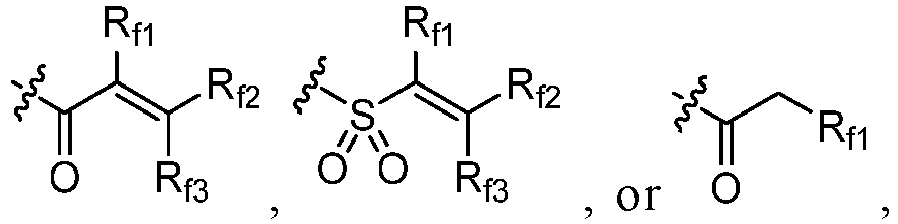 wherein Rf1 is H, C1-C6 alkyl, or cyano;Rf2 and Rf3 are each independently H, C1-C6 alkyl, C3-C7 cycloalkyl, - N(CH3)2, or -(CH2)N(Rc')(Rd');Rc' and Rd' are each independently C1-C6 alkyl; orRc' and Rd', taken together with the atom to which they are attached, form azetidinyl; piperidinyl; morpholinyl; piperazinyl which is unsubstituted or substituted with C1-C6 alkyl; 2,5-diazabicyclo[2.2.1]heptanyl which is unsubstituted or substituted with C1-C6 alkyl; 2-oxa-5-azabicyclo[2.2.1]heptanyl; or pyrrolidinyl which is unsubstituted or substituted with halo, hydroxy or C1-C6 alkoxy-C1-C6 alkyl.
 - The compound of any one of claims 1-5, wherein:(a) each Ra is independently H, halo, or C1-C6 alkyl;each Rb is independently H, halo, C1-C6 alkyl, C3-C7 cycloalkyl, C1-C6 alkoxy, cyano, C1-C6 haloalkyl, -NRhRj, or a 5- to 6-membered heterocycloalkyl containing 1 to 4 heteroatoms independently selected from the group consisting of N, O, and S where the heterocycloalkyl is unsubstituted or substituted with C1-C6 alkyl,Rh and Rj are each independently C1-C6 alkyl, -CH2CH2N(Rh')(Rj'); andRh' and Rj' are each independently H or C1-C6 alkyl; and/or(b) each Ra is independently H, halo, or C1-C6 alkyl;each Rb is independently H, halo, C1-C6 alkyl, C3-C7 cycloalkyl, C1-C6 alkoxy, cyano, C1-C6 haloalkyl, -N(CH3)-CH2CH2-N(CH3)2, orpiperazinyl which is unsubstituted or substituted with C1-C6 alkyl; and/or(c) m and n are 1.
- The compound of claim 1, wherein ring A is aryl or heteroaryl, optionally wherein ring A is pyrrolidinyl, furanyl, thiophenyl, pyrrolyl, thiazolyl, oxazolyl, thiadiazolyl, oxadiazolyl, pyrazolyl, triazolyl, phenyl, pyridinyl, pyrazinyl, pyridazinyl, pyrimidinyl, piperidinyl, piperazinyl, cyclohexyl, azetidinyl, benzimidazolyl, benzthiazolyl, or quinolinyl, optionally wherein ring A is phenyl; or pyridinyl; or thiophenyl; or pyrazolyl.
- The compound of claim 1 or 7, having the structure of formula (Ia):
 (a) having the structure of formula (Iai):
 (b) having the structure of formula (Iaii):
 (c) having the structure of formula (Iaiii):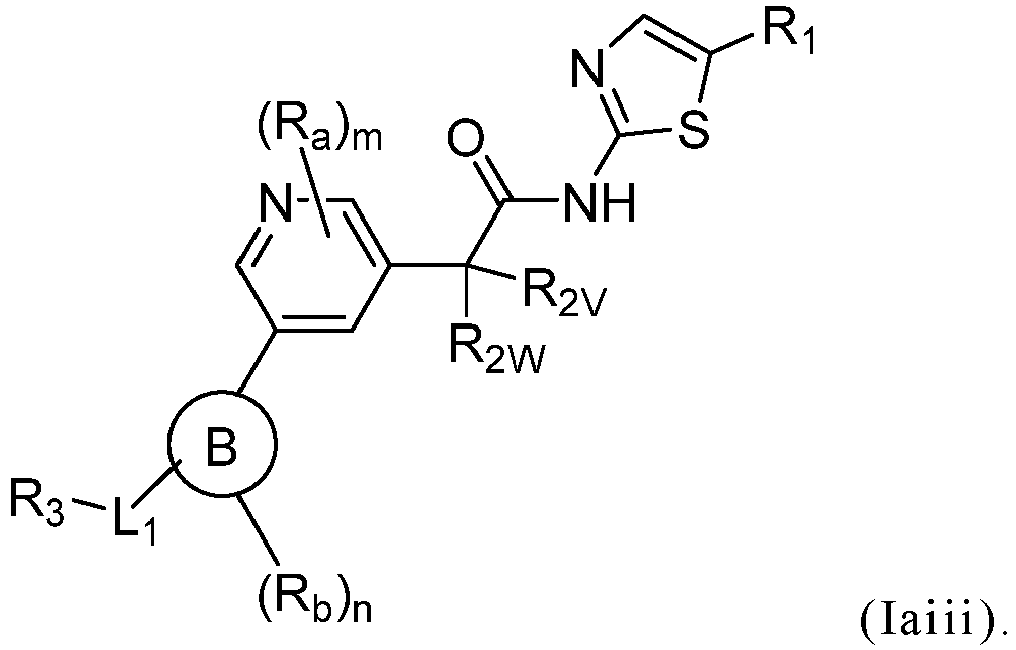
- The compound of claim 1 or 7, having the structure of formula (Ib):
 (a) having the structure of formula (Ibi):
 (b) having the structure of formula (Ibii):
 (i) wherein ring B is aryl or heteroaryl; and/or(ii) wherein ring B is phenyl, pyridinyl, pyrimidinyl, pyrazinyl, pyridazinyl, pyrazolyl, imidazolyl, thiazolyl, tetrahydropyridinyl, piperidinyl, or piperazinyl.
 - The compound of any one of claims 1 and 7-9, having the structure of formula (Ic):
 (a) having the structure of formula (Ici):
 (b) having the structure of formula (Icii):
 (c) having the structure of formula (Iciii):
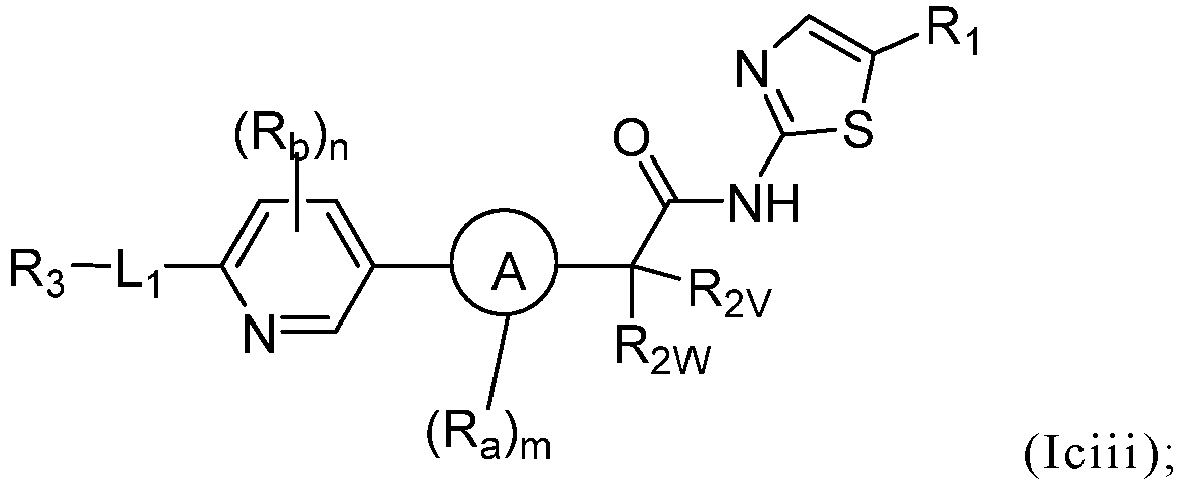 (d) having the structure of formula (Iciv):
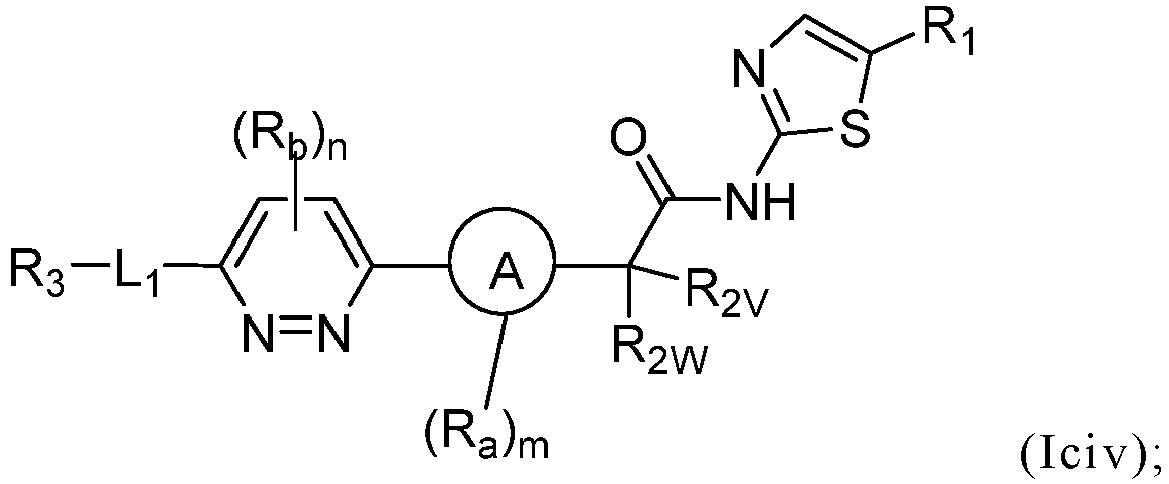 (e) having the structure of formula (Icv):
 (f) having the structure of formula (Icvi):
 (g) having the structure of formula (Icvii):
- The compound of any one of claims 1 and 7-10, wherein:(a) R1 is halo, alkyl, cycloalkyl, haloalkyl, cyano, -SRc, -C(O)Rc, -C(O)ORc, -N(Rc)(Rd), -ORc, or -C(Rg)2-ORc; Rc is independently H or alkyl; and/or(b) R2 V and R2 W are each independently H, halo, or alkyl; and/or(c) one of R2 V and R2 W is H and the other is alkyl or R2 V and R2 W taken together with the atom to which they are attached, form a C3-C7 cycloalkyl; and/or(d) one of R2 V and R2 W is H and the other is methyl; and/or(e) L1 is absent or -N(Re)-.
- The compound of any one of claims 1 and 7-9, wherein when ring B is heterocycloalkyl and

- The compound of any one of claims 1 and 7-11, wherein:(a) L1 is -N(Re)-, optionally wherein Re is H; and/or(b) R3 is

 (c) R3 is
 (d) Ra is H or halo; and/or(e) Rb is H, halo, alkyl, or heterocycloalkyl.
 - The compound of claim 1, selected from the group consisting of the following compounds, or a pharmaceutically acceptable salt thereof:1) N-(5-(3-(1-((5-methylthiazol-2-yl)amino)-1-oxopropan-2-yl)phenyl)pyridin-2-yl)acrylamide;2) N-(5-(3-(1-((5-cyclopropylthiazol-2-yl)amino)-1-oxopropan-2-yl)phenyl)pyridin-2-yl)acrylamide;3) (R)-N-(5-(3-(1-((5-cyclopropylthiazol-2-yl)amino)-1-oxopropan-2-yl)phenyl)pyridin-2-yl)acrylamide;4) N-(5-(3-(1-((5-ethylthiazol-2-yl)amino)-1-oxopropan-2-yl)phenyl)pyridin-2-yl)acrylamide;5) (E)-4-(dimethylamino)-N-(5-(3-(1-((5-methylthiazol-2-yl)amino)-1-oxopropan-2-yl)phenyl)pyridin-2-yl)but-2-enamide;6) (E)-N-(5-(3-(1-((5-cyclopropylthiazol-2-yl)amino)-1-oxopropan-2-yl)phenyl)pyridin-2-yl)-4-(dimethylamino)but-2-enamide;7) (E)-4-(dimethylamino)-N-(5-(3-(1-((5-methylthiazol-2-yl)amino-1-oxopropan-2-yl)phenyl)pyridin-2-yl)but-2-enamide hydrochloride;8) N-(3-fluoro-3'-(1-((5-methylthiazol-2-yl)amino-1-oxopropan-2-yl)-[1,1'-biphenyl]-4-yl)acrylamide;9) 2-(3-(1-acryloylindolin-5-yl)phenyl)-N-(5-methylthiazol-2-yl)propanamide;10) (E)-N-(5-(3-(1,1-difluoro-2-((5-methylthiazol-2-yl)amino)-2-oxoethyl)phenyl)pyridin-2-yl)-4-(dimethylamino)but-2-enamide;11) N-(6-(3-(1-((5-cyanothiazol-2-yl)amino)-1-oxopropane-2-yl)-4-fluorophenyl)pyridazin-3-yl)acrylamide;12) 2-(3-(6-acrylamidopyridazin-3-yl)phenyl)-N-(5-cyanothiazol-2-yl)-3-methylbutanamide;13) N-(6-(5-(1-((5-cyanothiazol-2-yl)amino)-1-oxopropan-2-yl)-2-fluorophenyl)pyridazin-3-yl)acrylamide;14) (S)-N-(_5-(3-(1-(5-cyclopropylthiazol-2-yl)amino)-1-oxopropane-2-yl)phenyl)pyridin-2-yl)acrylamide;15) (S,E)-N-(5-(3-(1-(5-cyclopropylthiazol-2-yl)amino)-1-oxopropan-2-yl)phenyl)pyridin-2-yl)-4-(dimethylamino)but-2-enamide;16) (S)-N-(6-(3-(1-(5-cyclopropylthiazol-2-yl)amino)-1-oxopropan-2-yl)phenyl)pyrazin-2-yl)acrylamide;17) (S,E)-4-(dimethylamino)-N-(5-(3-(1-((5-ethylthiazol-2-yl)amino)-1-oxopropan-2-yl)phenyl)pyridin-2-yl)but-2-enamide;18) (S)-N-(5-(3-(1-((5-cyanothiazole-2-yl)amino)-1-oxopropan-2-yl)phenyl)pyridin-2-yl)acrylamide;19) (S)-2-(3-(6-acrylamidopyridin-3-yl)phenyl)-N-(5-ethylthiazol-2-yl)butanamide;20) (S)-2-(4'-acrylamido-3'-fluoro-[1,1'-biphenyl]-3-yl)-N-(5-ethylthiazol-2-yl)butanamide;21) (S,E)-N-(5-(3-(1-((5-cyanothiazol-2-yl)amino)-1-oxopropan-2-yl)phenyl)pyridin-2-yl)-4-(dimethylamino)but-2-enamide;22) (S)-N-(5-(3-(1-(5-cyclopropylthiazol-2-yl)amino)-1-oxopropan-2-yl)phenyl)pyrazin-2-yl)acrylamide;23) (S)-N-(3'-(1-((5-cyclopropylthiazol-2-yl)amino)-1-oxopropan-2-yl)-[1,1'-biphenyl]-4-yl)acrylamide;24) (S)-N-(3'-(1-((5-cyclopropylthiazol-2-yl)amino)-1-oxopropan-2-yl)-3-fluoro-[1,1'-biphenyl]-4-yl)acrylamide;25) (S)-N-(5-(3-(1-((5-cyanothiazol-2-yl)amino)-1-oxopropan-2-yl)phenyl)pyrazin-2-yl)acrylamide;26) (S)-N-(6-(3-(1-((5-cyanothiazol-2-yl)amino)-1-oxopropan-2-yl)phenyl)pyrazin-2-yl)acrylamide;27) (S)-N-(5-(3-(1-(5-cyclopropylthiazol-2-yl)amino)-1-oxopropan-2-yl)phenyl)pyrimidin-2-yl)acryl amide;28) (S)-N-(6-(3-(1-(5-cyclopropylthiazol-2-yl)amino)-1-oxopropan-2-yl)phenyl)pyridazin-3-yl)acrylamide;29) (S)-N-(5-(3-(1-(5-cyclopropylthiazol-2-yl)amino)-1-oxopropan-2-yl)phenyl)-3-fluoropyridin-2-yl)acrylamide;30) (S)-N-(3-cyano-3'-(1-((5-ethylthiazol-2-yl)amino)-1-oxopropan-2-yl)-[1,1'-biphenyl]-4-yl)acrylamide;31) (S)-N-(5-(3-(1-((5-ethylthiazol-2-yl)amino)-1-oxopropan-2-yl)phenyl)-6-fluoropyridin-2-yl)acrylamide;32) (S)-N-(6-(3-(1-((5-cyanothiazol-2-yl)amino)-1-oxopropan-2-yl)phenyl)pyridazin-3-yl)acrylamide;33) (S)-N-(5-(3-(1-((5-cyanothiazol-2-yl)amino)-1-oxopropan-2-yl)phenyl)-3-fluoropyridin-2-yl)acrylamide;34) (S)-N-(5-(3-(1-((5-cyanothiazol-2-yl)amino)-1-oxopropan-2-yl)phenyl)-3-methylpyrazin-2-yl)acrylamide;35) (S)-N-(5-(3-(1-((5-isopropylthiazol-2-yl)amino)-1-oxopropan-2-yl)phenyl)pyridin-2-yl)acrylamide;36) (S)-N-(5-(3-(1-((5-isopropylthiazol-2-yl)amino)-1-oxopropan-2-yl)phenyl)pyrazin-2-yl)acrylamide;37) (S)-N-(5-(3-(1-oxo-1-((5-(trifluoromethyl)thiazol-2-yl)amino)propan-2-yl)phenyl)pyrazin-2-yl)acrylamide;38) (S)-N-(5-(3-(1-oxo-1-((5-(trifluoromethyl)thiazol-2-yl)amino)propan-2-yl)phenyl)pyridin-2-yl)acryl amide;39) (S)-N-(6-(3-(1-oxo-1-((5-(trifluoromethyl)thiazol-2-yl)amino)propan-2-yl)phenyl)pyridazin-3-yl)acrylamide;40) (S)-N-(6-(3-(1-((5-isopropylthiazol-2-yl)amino)-1-oxopropan-2-yl)phenyl)pyridazin-3-yl)acrylamide;41) N-(5'-(1-((5-cyanothiazol-2-yl)amino)-1-oxopropane-2-yl)-[3,3'-bipyridin]-6-yl)acrylamide;42) N-(4-(1-((5-cyanothiazole-2-yl)amino)-1-oxopropan-2-yl)-[2,3'-bipyridine]-6'-yl)acrylamide;43) N-(5-(5-(1-((5-cyclopropylthiazol-2-yl)amino) -1-oxopropan-2-yl)pyridin-3-yl)pyrazin-2-yl)acrylamide;44) N-(5-(5-(1-((5-cyanothiazol-2-yl)amino)-1-oxopropan-2-yl)pyridin-3-yl)pyrazin-2-yl)acrylamide;45) N-(5-(5-(1-oxo-1-((5-(trifluoromethyl)thiazol-2-yl)amino)propan-2-yl)pyridin-3-yl)pyrazin-2-yl)acrylamide;46) N-(5-(5-(1-((5-ethylthiazol-2-yl)amino)-1-oxopropan-2-yl)pyridin-3-yl)pyrazin-2-yl)acrylamide;47) N-(5-(5-(1-((5-isopropylthiazol-2-yl)amino)-1-oxopropan-2-yl)pyridin-3-yl)pyrazin-2-yl)acrylamide;48) N-(5-(5-(1-((5-acetylthiazol-2-yl)amino)-1-oxopropan-2-yl)pyridin-3-yl)pyrazin-2-yl)acrylamide;49) N-(6-(5-(1-oxo-1-((5-(trifluoromethyl)thiazol-2-yl)amino)propan-2-yl)pyridin-3-yl)pyridazin-3-yl)acrylamide;50) N-(4-(1-((5-cyclopropylthiazol-2-yl)amino)-1-oxopropan-2-yl)-[2,3'-bipyridine]-6'-yl)acrylamide;51) (R)-N-(5-(5-(1-oxo-1-((5-(trifluoromethyl)thiazol-2-yl)amino)propan-2-yl)pyridin-3-yl)pyrazin-2-yl)acrylamide;52) (S)-N-(5-(5-(1-oxo-1-((5-(trifluoromethyl)thiazol-2-yl)amino)propan-2-yl)pyridin-3-yl)pyrazin-2-yl)acrylamide;53) N-(5-(5-(1-oxo-1-((5-(trifluoromethyl)thiazol-2-yl)amino)propan-2-yl)thiophen-3-yl)pyridin-2-yl)acrylamide;54) N-(5-(3-(1-((5-cyclopropylthiazol-2-yl)amino)-1-oxopropan-2-yl)-5-fluorophenyl)pyridin-2-yl)acrylamide;55) N-(5-(5-(2-methyl-1-oxo-1-((5-(trifluoromethyl)thiazol-2-yl)amino)propan-2-yl)pyridin-3-yl)pyrazin-2-yl)acrylamide;56) (S)-2-(3-(5-(2-cyanoacetamido)pyrazin-2-yl)phenyl)-N-(5-(trifluoromethyl)thiazol-2-yl)propanamide;57) N-(5-(5-(1-oxo-1-((5-(trifluoromethyl)thiazol-2-yl)amino)propan-2-yl)thiophen-3-yl)pyrazin-2-yl)acrylamide;58) (S)-2-(3-(5-(2-cyanoacetamido)pyrazin-2-yl) phenyl)-N-(5-cyanothiazol-2-yl)propanamide;59) N-(5-(3-methyl-1-(1-oxo-1-((5- (trifluoromethyl)thiazol-2-yl)amino)propan-2-yl)-1H-pyrazol-4-yl)pyridin-2-yl)acrylamide;60) 2-(1'-acryloyl-1',2',3',6'-tetrahydro- [3,4'-bipyridine]-5-yl)-N-(5-cyanothiazol-2-yl)propanamide;61) N-(5-(5-(1-((5-chlorothiazol-2-yl)amino)-1-oxopropan-2-yl)pyridin-3-yl)pyrazine-2-yl)acrylamide;62) (S)-N-(6-(3-(1-((5-cyclopropylthiazol-2-yl)amino)-1-oxopropan-2-yl)phenyl)pyridin-3-yl)acrylamide;63) (E)-4-(dimethylamino)-N-(5-(5-(1-oxo-1-((5-(trifluoromethyl)thiazol-2-yl)amino)propan-2-yl)pyridin-3-yl)pyrazin-2-yl)but-2-enamide;64) 2-(5-(5-(2-cyanoacetamido)pyrazin-2-yl)pyridin-3-yl)-N-(5-(trifluoromethyl)thiazol-2-yl)propanamide;65) (E)-2-cyano-3-cyclopropyl-N-(5-(5-(1-oxo-1-((5-(trifluoromethyl)thiazol-2-yl)amino)propan-2-yl)pyridin-3-yl)pyrazin-2-yl)acrylamide;66) N-(5-(5-(1-((5-methoxythiazol-2-yl)amino)-1-oxopropan-2-yl)pyridin-3-yl)pyrazin-2-yl)acrylamide;67) N-(5-(5-(1-((5-fluorothiazol-2-yl)amino)-1-oxopropan-2-yl)pyridin-3-yl)pyrazin-2-yl)acrylamide;68) N-(2-(4-methylpiperazin-1-yl)-4-(5-(1-oxo-1-((5-(trifluoromethyl)thiazol-2-yl)amino)propan-2-yl)pyridin-3-yl)phenyl)acrylamide;69) (E)-2-cyano-3-(dimethylamino)-N-(5-(5-(1-oxo-1-((5-(trifluoromethyl)thiazol-2-yl)amino)propan-2-yl)pyridin-3-yl)pyrazin-2-yl)acrylamide;70) N-(1-(5-(1-oxo-1-((5-(trifluoromethyl)thiazol-2-yl)amino)propan-2-yl)pyridin-3-yl)piperidin-4-yl)acrylamide;71) N-(5-(5-(1-((5-(methylthio)thiazol-2-yl)amino)-1-oxopropan-2-yl)pyridin-3-yl)pyrazin-2-yl)acrylamide;72) ethyl 2-(2-(5-(5-acrylamidopyrazin-2-yl)pyridin-3-yl)propanamido)thiazole-5-carboxylate;73) (E)-N-(5-(5-(1-((5-chlorothiazol-2-yl)amino)-1-oxopropan-2-yl)pyridin-3-yl)pyrazin-2-yl)-4-(dimethylamino)but-2-enamide;74) (E)-4-morpholino-N-(5-(5-(1-oxo-1-((5-(trifluoromethyl)thiazol-2-yl)amino)propan-2-yl)pyridin-3-yl)pyrazin-2-yl)but-2-enamide;75) (E)-N-(5-(5-(1-oxo-1-((5-(trifluoromethyl)thiazole-yl)amino)propan-2-yl)pyridin-3-yl)pyrazin-2-yl)but-2-enamide;76) N-(5-(5-(1-((5-chlorothiazol-2-yl)amino)-1-oxopropan-2-yl)thiophen-3-yl)pyridin-2-yl)acrylamide;77) N-(5-(5-(1-((5-ethylthiazol-2-yl)amino)-1-oxopropan-2-yl)thiophen-3-yl)pyridin-2-yl)acrylamide;78) N-(5-(5-(1-((5-acetylthiazol-2-yl)amino)-1-oxopropan-2-yl)thiophen-3-yl)pyridin-2-yl)acrylamide;79) 2-(5-(5-propionamidopyrazin-2-yl)pyridin-3-yl)-N-(5-(trifluoromethyl)thiazol-2-yl)propanamide;80) (E)-4-(5-methyl-2,5-diazabicyclo[2.2.1]heptan-2-yl)-N-(5-(5-(1-oxo-1-((5-(trifluoromethyl)thiazol-2-yl)amino)propan-2-yl)pyridin-3-yl)pyrazin-2-yl)but-2-enamide;81)(S,E)-4-(dimethylamino)-N-(5-(3-(1-oxo-1-((5-(trifluoromethyl)thiazol-2-yl)amino)propan-2-yl)phenyl)pyrazin-2-yl)but-2-enamide;82) N-(5'-(1-oxo-1-((5-(trifluoromethyl)thiazol-2-yl)amino)propan-2-yl)-[3,3'-bipyridin]-6-yl)acrylamide;83) (E)-4-(2-oxa-5-azabicyclo[2.2.1]heptan-5-yl)-N-(5-(5-(1-oxo-1-((5-(trifluoromethyl)thiazol-2-yl)amino)propan-2-yl)pyridin-3-yl)pyrazin-2-yl)but-2-enamide;84) N-(4-fluoro-5'-(1-oxo-1-((5-(trifluoromethyl)thiazol-2-yl)amino)propan-2-yl)-[3,3'-bipyridin]-6-yl)acrylamide;85) 2-(5-(4-acryloylpiperazin-1-yl)pyridin-3-yl)-N-(5-(trifluoromethyl)thiazol-2-yl)propanamide;86) 2-(5-(4-acryloylpiperazin-1-yl)pyridin-3-yl)-N-(5-ethylthiazol-2-yl)propanamide;87) N-(6-(5-(1-((5-ethylthiazol-2-yl)amino)-1-oxopropan-2-yl)thiophen-3-yl)pyridin-3-yl)acrylamide;88) N-(5-cyano-5'-(1-oxo-1-((5-(trifluoromethyl)thiazol-2-yl)amino)propan-2-yl)-[3,3'-bipyridin]-6-yl)acrylamide;89) N-((5'-(1-oxo-1-((5-(trifluoromethyl)thiazol-2-yl)amino)propan-2-yl)-[3,3'-bipyridin]-6-yl)methyl)acrylamide;90) N-(5'-(1-oxo-1-((5-(trifluoromethyl)thiazol-2-yl)amino)propan-2-yl)-[2,3'-bipyridin]-5-yl)acrylamide;91) (S,E)-4-(dimethylamino)-N-(5-(3-(1-oxo-1-((5-(trifluoromethyl)thiazol-2-yl)amino)propan-2-yl)phenyl)pyrazin-2-yl)but-2-enamide;92) (S,E)-4-morpholino-N-(5-(3-(1-oxo-1-((5-(trifluoromethyl)thiazol-2-yl)amino)propan-2-yl)phenyl)pyrazin-2-yl)but-2-enamide;93) (S,E)-N-(5-(3-(1-((5-chlorothiazol-2-yl)amino)-1-oxopropan-2-yl)phenyl)pyrazin-2-yl)-4-(dimethylamino)but-2-enamide;94) (E)-4-(2-oxa-5-azabicyclo[2.2.1]heptan-5-yl)-N-(5-(3-((S)-1-((5-chlorothiazol-2-yl)amino)-1-oxopropan-2-yl)phenyl)pyrazin-2-yl)but-2-enamide;95) (S,E)-4-(4-methylpiperazin-1-yl)-N-(5-(3-(1-oxo-1-((5-(trifluoromethyl)thiazol-2-yl)amino)propan-2-yl)phenyl)pyrazin-2-yl)but-2-enamide;96) (E)-4-(2-oxa-5-azabicyclo[2.2.1]heptan-5-yl)-N-(5-(3-((S)-1-oxo-1-((5-(trifluoromethyl)thiazol-2-yl)amino)propan-2-yl)phenyl)pyrazin-2-yl)but-2-enamide;97) (S,E)-N-(5-(3-(1-((5-chlorothiazol-2-yl)amino)-1-oxopropan-2-yl)phenyl)pyrazin-2-yl)-4-(4-methylpiperazin-1-yl)but-2-enamide;98) (S,E)-N-(5-(3-(1-((5-chlorothiazol-2-yl)amino)-1-oxopropan-2-yl)phenyl)pyrazin-2-yl)-4-morpholinobut-2-enamide;99) (S,E)-4-(dimethylamino)-N-(3-fluoro-5-(3-(1-oxo-1-((5-(trifluoromethyl)thiazol-2-yl)amino)propan-2-yl)phenyl)pyridin-2-yl)but-2-enamide;100) (S,E)-4-(dimethylamino)-N-(3-methoxy-5-(3-(1-oxo-1-((5-(trifluoromethyl)thiazol-2-yl)amino)propan-2-yl)phenyl)pyridin-2-yl)but-2-enamide;101) (S,E)-N-(3-cyano-5-(3-(1-oxo-1-((5-(trifluoromethyl)thiazol-2-yl)amino)propan-2-yl)phenyl)pyridin-2-yl)-4-(dimethylamino)but-2-enamide;102) (S,E)-N-(5-(3-(1-oxo-1-((5-(trifluoromethyl)thiazol-2-yl)amino)propan-2-yl)phenyl)pyrazin-2-yl)-4-(pyrrolidin-1-yl)but-2-enamide;103) (S,E)-4-(azetidin-1-yl)-N-(5-(3-(1-oxo-1-((5-(trifluoromethyl)thiazol-2-yl)amino)propan-2-yl)phenyl)pyrazin-2-yl)but-2-enamide;104) (S,E)-N-(5-(3-(1-((5-cyclobutylthiazol-2-yl)amino)-1-oxopropan-2-yl)phenyl)pyrazin-2-yl)-4-(dimethylamino)but-2-enamide;105) (S,E)-4-(dimethylamino)-N-(5-(3-(1-((5-(2-hydroxypropan-2-yl)thiazol-2-yl)amino)-1-oxopropan-2-yl)phenyl)pyrazin-2-yl)but-2-enamide;106) (S,E)-4-(dimethylamino)-N-(5-(3-(1-((5-(dimethylamino)thiazol-2-yl)amino)-1-oxopropan-2-yl)phenyl)pyrazin-2-yl)but-2-enamide;107) (E)-4-(dimethylamino)-N-(5'-(1-oxo-1-((5-(trifluoromethyl)thiazol-2-yl)amino)propan-2-yl)-[3,3'-bipyridin]-6-yl)but-2-enamide;108) (E)-N-(5-cyano-5'-(1-oxo-1-((5-(trifluoromethyl)thiazol-2-yl)amino)propan-2-yl)-[3,3'-bipyridin]-6-yl)-4-(dimethylamino)but-2-enamide;109) (S,E)-4-(dimethylamino)-N-(3-methoxy-5-(3-(1-oxo-1-((5-(trifluoromethyl)thiazol-2-yl)amino)propan-2-yl)phenyl)pyrazin-2-yl)but-2-enamide;110) (S,E)-2-(3-(1-(4-(dimethylamino)but-2-enoyl)-2,3-dihydro-1H-pyrrolo[2,3-b]pyridin-5-yl)phenyl)-N-(5-(trifluoromethyl)thiazol-2-yl)propanamide;111) (S,E)-4-(dimethylamino)-N-(5-(3-(1-oxo-1-((5-(trifluoromethyl)thiazol-2-yl)amino)propan-2-yl)phenyl)-3-(trifluoromethyl)pyridin-2-yl)but-2-enamide;112) (S,E)-4-(dimethylamino)-N-(3-methyl-5-(3-(1-oxo-1-((5-(trifluoromethyl)thiazol-2-yl)amino)propan-2-yl)phenyl)pyridin-2-yl)but-2-enamide;113) (S,E)-N-(3-chloro-5-(3-(1-oxo-1-((5-(trifluoromethyl)thiazol-2-yl)amino)propan-2-yl)phenyl)pyridin-2-yl)-4-(dimethylamino)but-2-enamide;114) (S,E)-4-(diethylamino)-N-(5-(3-(1-oxo-1-((5-(trifluoromethyl)thiazol-2-yl)amino)propan-2-yl)phenyl)pyrazin-2-yl)but-2-enamide;115) (E)-4-((R)-3-fluoropyrrolidin-1-yl)-N-(5-(3-((S)-1-oxo-1-((5-(trifluoromethyl)thiazol-2-yl)amino)propan-2-yl)phenyl)pyrazin-2-yl)but-2-enamide;116) (S,E)-4-(dimethylamino)-N-(5-(3-(1-oxo-1-((5-(trifluoromethyl)thiazol-2-yl)amino)propan-2-yl)phenyl)pyridin-2-yl)but-2-enamide;117) (E)-4-((S)-3-fluoropyrrolidin-1-yl)-N-(5-(3-((S)-1-oxo-1-((5-(trifluoromethyl)thiazol-2-yl)amino)propan-2-yl)phenyl)pyrazin-2-yl)but-2-enamide;118) (E)-4-((S)-2-(methoxymethyl)pyrrolidin-1-yl)-N-(5-(3-((S)-1-oxo-1-((5-(trifluoromethyl)thiazol-2-yl)amino)propan-2-yl)phenyl)pyrazin-2-yl)but-2-enamide;119) (E)-4-(3-hydroxypyrrolidin-1-yl)-N-(5-(3-((S)-1-oxo-1-((5-(trifluoromethyl)thiazol-2-yl)amino)propan-2-yl)phenyl)pyrazin-2-yl)but-2-enamide;120) (S,E)-N-(5-(3-(1-oxo-1-((5-(trifluoromethyl)thiazol-2-yl)amino)propan-2-yl)phenyl)pyrazin-2-yl)-4-(piperidin-1-yl)but-2-enamide;121) (S,E)-N-(3-cyano-5-(3-(1-((5-ethylthiazol-2-yl)amino)-1-oxopropan-2-yl)phenyl)pyridin-2-yl)-4-(dimethylamino)but-2-enamide;122) (S,E)-2-(3-(1-(4-(dimethylamino)but-2-enoyl)-2,3-dihydro-1H-pyrrolo[2,3-b]pyridin-5-yl)phenyl)-N-(5-ethylthiazol-2-yl)propanamide;123) (E)-4-(2-oxa-5-azabicyclo[2.2.1]heptan-5-yl)-N-(3-cyano-5-(3-((S)-1-((5-ethylthiazol-2-yl)amino)-1-oxopropan-2-yl)phenyl)pyridin-2-yl)but-2-enamide;124) (S)-N-(3-cyano-5-(3-(1-oxo-1-((5-(trifluoromethyl)thiazol-2-yl)amino)propan-2-yl)phenyl)pyridin-2-yl)acrylamide;125) (S,E)-4-(dimethylamino)-N-(5-(3-(1-((5-ethylthiazol-2-yl)amino)-1-oxopropan-2-yl)phenyl)-3-methylpyridin-2-yl)but-2-enamide;126) (S,E)-2-(3-(1-(4-(dimethylamino)but-2-enoyl)-2-methyl-1H-pyrrolo[2,3-b]pyridin-5-yl)phenyl)-N-(5-ethylthiazol-2-yl)propanamide;127) (S,E)-2-(3-(1-(4-(dimethylamino)but-2-enoyl)-1H-pyrrolo[2,3-b]pyridin-5-yl)phenyl)-N-(5-ethylthiazol-2-yl)propanamide;128) (E)-1-(3-(5-cyano-6-(4-(dimethylamino)but-2-enamido)pyridin-3-yl)phenyl)-N-(5-ethylthiazol-2-yl)cyclopropane-1-carboxamide;129) (S,E)-4-(dimethylamino)-N-(5-(3-(1-((5-ethylthiaaol-2-yl)amino)-1-oxopropan-2-yl)phenyl)pyridin-2-yl)-N-methylbut-2-enamide;130) (S,E)-4-(dimethylamino)-N-(5-(3-(1-((5-ethylthiazol-2-yl)amino)-1-oxopropan-2-yl)phenyl)-3-fluoropyridin-2-yl)but-2-enamide;131) (E)-4-(dimethylamino)-N-(6-(3-(1-((5-ethylthiazol-2-yl)amino)-1-oxobutan-2-yl)phenyl)pyridin-3-yl)but-2-enamide;132) (S,E)-N-(3-cyano-5-(3-(1-((5-ethylthiazol-2-yl)amino)-1-oxopropan-2-yl)phenyl)pyridin-2-yl)-4-(dimethylamino)-N-methylbut-2-enamide;133) (E)-1-(3-(1-(4-(dimethylamino)but-2-enoyl)-2,3-dihydro-1H-pyrrolo[2,3-b]pyridin-5-yl)phenyl)-N-(5-ethylthiazol-2-yl)cyclopropane-1-carboxamide;134) (E)-1-(3-(6-(4-(dimethylamino)but-2-enamido)-5-fluoropyridin-3-yl)phenyl)-N-(5-ethylthiazol-2-yl)cyclopropane-1-carboxamide;135) (S,E)-N-(3-cyano-5-(3-(1-((5-ethylthiazol-2-yl)amino)-1-oxopropan-2-yl)phenyl)pyridin-2-yl)-4-morpholinobut-2-enamide;136) (S,E)-N-(3-cyano-5-(3-(1-((5-ethylthiazol-2-yl)amino)-1-oxopropan-2-yl)phenyl)pyridin-2-yl)-4-(4-methylpiperazin-1-yl)but-2-enamide;137)(E)-N-(5-cyano-5'-(1-((5-ethylthiaaol-2-yl)amino)-1-oxopropan-2-yl)-[3,3'-bipyridin]-6-yl)-4-(dimethylamino)but-2-enamide;138) (E)-N-(3-cyano-5-(3-(1-((5-ethylthiazol-2-yl)amino)-1-oxobutan-2-yl)phenyl)pyridin-2-yl)-4-(dimethylamino)but-2-enamide;139)(S)-2-(3-(5-cyano-6-(2-cyanoacetamido)pyridin-3-yl)phenyl)-N-(5-ethyl thiazol-2-yl)propanamide;140) N-(5-(6-(1-((5-methylthiazol-2-yl)amino)-1-oxopropan-2-yl)pyrazin-2-yl)pyridin-2-yl)acrylamide;141) N-(2'-(1-((5-methylthiazol-2-yl)amino)-1-oxopropan-2-yl)-[3,4'-bipyridin]-6-yl)acrylamide;142) N-(4-(3-(1-((5-methylthiazol-2-yl)amino)-1-oxopropan-2-yl)piperidin-1-yl)phenyl)acrylamide;143) N-(5-(2-(1-((5-methylthiazol-2-yl)amino)-1-oxopropan-2-yl)thiazol-4-yl)pyridin-2-yl)acrylamide;144) (S)-N-(3-cyclopropyl-5-(3-(1-((5-ethylthiazol-2-yl)amino)-1-oxopropan-2-yl)phenyl)pyridin-2-yl)acrylamide;145) (S)-N-(3-((2-(dimethylamino)ethyl)(methyl)amino)-3'-(1-((5-ethylthiazol-2-yl)amino)-1-oxopropan-2-yl)-[1,1'-biphenyl]-4-yl)acrylamide;146) (S)-N-(5-ethylthiazol-2-yl)-2-(3-(6-(vinylsulfonamido)pyridin-3-yl)phenyl)propanamide;147) (S)-N-(3-(3-(1-((5-ethylthiazol-2-yl)amino)-1-oxopropan-2-yl)phenyl)-1-methyl-1H-pyrazol-5-yl)acrylamide;148) (S)-N-(4-(3-(1-((5-ethylthiazol-2-yl)amino)-1-oxopropan-2-yl)phenyl)-1H-imidazol-2-yl)acrylamide; and149) (S)-N-(4-(3-(1-((5-ethylthiazol-2-yl)amino)-1-oxopropan-2-yl)phenyl)thiazol-2-yl)acrylamide.
- A compound of any one of claims 1-14 for use in a method of treating cancer.
Applications Claiming Priority (2)
| Application Number | Priority Date | Filing Date | Title |
|---|---|---|---|
| KR20180111001 | 2018-09-17 | ||
| PCT/KR2019/011887 WO2020060112A1 (en) | 2018-09-17 | 2019-09-11 | Novel thiazole derivatives and pharmaceutically acceptable salts thereof |
Publications (4)
| Publication Number | Publication Date |
|---|---|
| EP3853225A1 EP3853225A1 (en) | 2021-07-28 |
| EP3853225A4 EP3853225A4 (en) | 2022-06-15 |
| EP3853225C0 EP3853225C0 (en) | 2023-11-29 |
| EP3853225B1 true EP3853225B1 (en) | 2023-11-29 |
Family
ID=69887568
Family Applications (1)
| Application Number | Title | Priority Date | Filing Date |
|---|---|---|---|
| EP19862518.8A Active EP3853225B1 (en) | 2018-09-17 | 2019-09-11 | N-(5-(3-(1-((thiazol-2-yl)amino)-1-oxopropan-2-yl)phenyl)pyridin-2-yl)acrylamide derivatives as cdk7 inhibitors for the treatment of cancer |
Country Status (19)
| Country | Link |
|---|---|
| US (1) | US12110299B2 (en) |
| EP (1) | EP3853225B1 (en) |
| JP (1) | JP7235859B2 (en) |
| KR (2) | KR102130253B1 (en) |
| CN (1) | CN112739695B (en) |
| AU (1) | AU2019344240B2 (en) |
| BR (1) | BR112021004999A2 (en) |
| CA (1) | CA3106855A1 (en) |
| CL (1) | CL2021000594A1 (en) |
| CO (1) | CO2021003412A2 (en) |
| EA (1) | EA202190558A1 (en) |
| IL (1) | IL280639B (en) |
| MX (1) | MX2021002456A (en) |
| PH (1) | PH12021550572A1 (en) |
| SG (1) | SG11202100531RA (en) |
| TW (1) | TW202023548A (en) |
| UA (1) | UA125427C2 (en) |
| WO (1) | WO2020060112A1 (en) |
| ZA (1) | ZA202101652B (en) |
Families Citing this family (2)
| Publication number | Priority date | Publication date | Assignee | Title |
|---|---|---|---|---|
| EP3853225B1 (en) | 2018-09-17 | 2023-11-29 | Yungjin Pharm. Co., Ltd. | N-(5-(3-(1-((thiazol-2-yl)amino)-1-oxopropan-2-yl)phenyl)pyridin-2-yl)acrylamide derivatives as cdk7 inhibitors for the treatment of cancer |
| KR102335637B1 (en) * | 2020-03-13 | 2021-12-06 | 영진약품 주식회사 | Novel compounds of inhibiting cdk7, and their pharmaceutically acceptable salts |
Family Cites Families (36)
| Publication number | Priority date | Publication date | Assignee | Title |
|---|---|---|---|---|
| US4259341A (en) | 1977-06-01 | 1981-03-31 | Merck & Co., Inc. | Di- and tri-substituted thiazoles |
| US6262096B1 (en) | 1997-11-12 | 2001-07-17 | Bristol-Myers Squibb Company | Aminothiazole inhibitors of cyclin dependent kinases |
| EP1087951B9 (en) | 1998-06-18 | 2006-09-13 | Bristol-Myers Squibb Company | Carbon substituted aminothiazole inhibitors of cyclin dependent kinases |
| DK1346731T3 (en) | 1998-07-22 | 2007-04-10 | Osprey Pharmaceuticals Ltd | Conjugates for the treatment of inflammatory disorders and corresponding tissue damage |
| US6875751B2 (en) | 2000-06-15 | 2005-04-05 | Idenix Pharmaceuticals, Inc. | 3′-prodrugs of 2′-deoxy-β-L-nucleosides |
| WO2003008365A2 (en) * | 2001-07-19 | 2003-01-30 | Pharmacia Italia S.P.A. | Phenylacetamido-thiazole derivatives, process for their preparation and their use as antitumor agents |
| JP4638355B2 (en) | 2003-12-26 | 2011-02-23 | 協和発酵キリン株式会社 | Thiazole derivative |
| BRPI0514515A (en) * | 2004-08-17 | 2008-06-10 | Hoffmann La Roche | substituted hydantoins |
| SE0402735D0 (en) | 2004-11-09 | 2004-11-09 | Astrazeneca Ab | Novel compounds |
| US20090264415A2 (en) * | 2004-12-30 | 2009-10-22 | Steven De Jonghe | Pyrido(3,2-d)pyrimidines and pharmaceutical compositions useful for medical treatment |
| JP2008528585A (en) | 2005-01-26 | 2008-07-31 | アイアールエム・リミテッド・ライアビリティ・カンパニー | Compounds and compositions as protein kinase inhibitors |
| EP1948629A1 (en) | 2005-10-31 | 2008-07-30 | Janssen Pharmaceutica N.V. | Substituted piperazines and piperidines as modulators of the neuropeptide y2 receptor |
| CN101516877B (en) | 2006-09-22 | 2013-09-11 | 诺瓦提斯公司 | Heterocyclic organic compounds |
| US7964580B2 (en) | 2007-03-30 | 2011-06-21 | Pharmasset, Inc. | Nucleoside phosphoramidate prodrugs |
| WO2008138755A2 (en) | 2007-05-11 | 2008-11-20 | F. Hoffmann-La Roche Ag | Pharmaceutical compositions for poorly soluble drugs |
| CN101801967A (en) | 2007-07-27 | 2010-08-11 | 同和药品株式会社 | Novel benzamidine derivatives, process for the preparation thereof and pharmaceutical composition for preventing or treating osteoporosis comprising the same |
| ES2331220B1 (en) | 2007-10-02 | 2010-09-23 | Palobiofarma, S.L. | NEW COMPOUNDS AS ANTAGONISTS OF ADENOSINE A1 RECEPTORS. |
| AU2009314310A1 (en) * | 2008-10-29 | 2010-05-20 | Sirtris Pharmaceuticals, Inc. | Pyridine, bicyclic pyridine and related analogs as sirtuin modulators |
| UA113383C2 (en) | 2009-09-02 | 2017-01-25 | THERAPEUTIC AGENT FOR TREATMENT OF ANXIETY DISORDERS | |
| US9221773B2 (en) | 2009-12-22 | 2015-12-29 | The Translational Genomics Research Institute | Benzamide derivatives |
| US8952004B2 (en) * | 2010-01-07 | 2015-02-10 | Boehringer Ingelheim International Gmbh | CXCR3 receptor antagonists |
| US8404859B2 (en) | 2011-03-16 | 2013-03-26 | Hoffmann-La Roche Inc. | Thiazole and thiophene compounds |
| CA2831966C (en) | 2011-05-23 | 2016-07-19 | Merck Patent Gmbh | Thiazole derivatives |
| US9499533B2 (en) | 2012-03-27 | 2016-11-22 | Shionogi & Co., Ltd. | Aromatic 5-membered heterocyclic derivative having TRPV4-Inhibiting activity |
| US10112927B2 (en) | 2012-10-18 | 2018-10-30 | Dana-Farber Cancer Institute, Inc. | Inhibitors of cyclin-dependent kinase 7 (CDK7) |
| WO2014113620A2 (en) | 2013-01-18 | 2014-07-24 | Bristol-Myers Squibb Company | Phthalazinones and isoquinolinones as rock inhibitors |
| WO2015058140A1 (en) | 2013-10-18 | 2015-04-23 | Dana-Farber Cancer Institute, Inc. | Polycyclic inhibitors of cyclin-dependent kinase 7 (cdk7) |
| EP2878339A1 (en) | 2013-12-02 | 2015-06-03 | Siena Biotech S.p.A. | SIP3 antagonists |
| RU2016141934A (en) | 2014-04-04 | 2018-05-07 | Сирос Фармасьютикалз, Инк. | CYCLINE-DEPENDENT KINASE 7 INHIBITORS (CDK7) |
| GB201417561D0 (en) | 2014-10-03 | 2014-11-19 | Redx Pharma Ltd | Compounds |
| KR20160118417A (en) | 2015-04-01 | 2016-10-12 | (주)황후연 | Manufacturing Method and Composion for Viper Venom Liquid Mixture |
| WO2016193939A1 (en) | 2015-06-04 | 2016-12-08 | Aurigene Discovery Technologies Limited | Substituted heterocyclyl derivatives as cdk inhibitors |
| CA2988055A1 (en) | 2015-06-04 | 2016-12-08 | Novartis Ag | Use of il-1 beta binding antibodies to treat peripheral arterial disease |
| KR101802514B1 (en) | 2016-12-09 | 2017-11-29 | 아주대학교산학협력단 | Compisition for treating or preventing antiinflammatory disease including naja melanoleucas |
| ES2676535B1 (en) | 2017-01-20 | 2019-04-29 | Palobiofarma Sl | MODULATORS OF A3 ADENOSINE RECEIVERS |
| EP3853225B1 (en) | 2018-09-17 | 2023-11-29 | Yungjin Pharm. Co., Ltd. | N-(5-(3-(1-((thiazol-2-yl)amino)-1-oxopropan-2-yl)phenyl)pyridin-2-yl)acrylamide derivatives as cdk7 inhibitors for the treatment of cancer |
-
2019
- 2019-09-11 EP EP19862518.8A patent/EP3853225B1/en active Active
- 2019-09-11 WO PCT/KR2019/011887 patent/WO2020060112A1/en not_active Ceased
- 2019-09-11 AU AU2019344240A patent/AU2019344240B2/en active Active
- 2019-09-11 CN CN201980060101.9A patent/CN112739695B/en active Active
- 2019-09-11 CA CA3106855A patent/CA3106855A1/en not_active Abandoned
- 2019-09-11 IL IL280639A patent/IL280639B/en unknown
- 2019-09-11 UA UAA202101314A patent/UA125427C2/en unknown
- 2019-09-11 MX MX2021002456A patent/MX2021002456A/en unknown
- 2019-09-11 JP JP2021514364A patent/JP7235859B2/en active Active
- 2019-09-11 KR KR1020190113157A patent/KR102130253B1/en active Active
- 2019-09-11 US US17/277,033 patent/US12110299B2/en active Active
- 2019-09-11 SG SG11202100531RA patent/SG11202100531RA/en unknown
- 2019-09-11 EA EA202190558A patent/EA202190558A1/en unknown
- 2019-09-11 BR BR112021004999-1A patent/BR112021004999A2/en not_active Application Discontinuation
- 2019-09-17 TW TW108133355A patent/TW202023548A/en unknown
-
2020
- 2020-06-25 KR KR1020200078100A patent/KR20200078465A/en not_active Withdrawn
-
2021
- 2021-03-10 CL CL2021000594A patent/CL2021000594A1/en unknown
- 2021-03-11 ZA ZA2021/01652A patent/ZA202101652B/en unknown
- 2021-03-15 PH PH12021550572A patent/PH12021550572A1/en unknown
- 2021-03-16 CO CONC2021/0003412A patent/CO2021003412A2/en unknown
Also Published As
| Publication number | Publication date |
|---|---|
| WO2020060112A1 (en) | 2020-03-26 |
| JP7235859B2 (en) | 2023-03-08 |
| KR20200032002A (en) | 2020-03-25 |
| SG11202100531RA (en) | 2021-02-25 |
| EA202190558A1 (en) | 2022-02-03 |
| BR112021004999A2 (en) | 2021-06-08 |
| KR102130253B1 (en) | 2020-07-03 |
| UA125427C2 (en) | 2022-03-02 |
| PH12021550572A1 (en) | 2021-10-25 |
| EP3853225C0 (en) | 2023-11-29 |
| CN112739695A (en) | 2021-04-30 |
| TW202023548A (en) | 2020-07-01 |
| AU2019344240B2 (en) | 2022-09-29 |
| IL280639B (en) | 2022-07-01 |
| MX2021002456A (en) | 2021-06-15 |
| EP3853225A1 (en) | 2021-07-28 |
| AU2019344240A1 (en) | 2021-02-25 |
| US20210284658A1 (en) | 2021-09-16 |
| KR20200078465A (en) | 2020-07-01 |
| CO2021003412A2 (en) | 2021-04-08 |
| IL280639A (en) | 2021-03-25 |
| US12110299B2 (en) | 2024-10-08 |
| ZA202101652B (en) | 2022-07-27 |
| CN112739695B (en) | 2025-03-18 |
| EP3853225A4 (en) | 2022-06-15 |
| CA3106855A1 (en) | 2020-03-26 |
| CL2021000594A1 (en) | 2021-12-03 |
| JP2021535924A (en) | 2021-12-23 |
Similar Documents
| Publication | Publication Date | Title |
|---|---|---|
| EP3761980B1 (en) | Amino acid compounds and methods of use | |
| EP3126352B1 (en) | Inhibitors of cyclin-dependent kinase 7 (cdk7) | |
| EP3209656B1 (en) | Indole carboxamides compounds useful as kinase inhibitors | |
| EP3129371B1 (en) | Inhibitors of cyclin-dependent kinase 7 (cdk7) | |
| CN112638373A (en) | Cyclin-dependent kinase inhibitors | |
| WO2015058163A2 (en) | Inhibitors of cyclin-dependent kinase 7 (cdk7) | |
| CN105960405A (en) | glutaminase inhibitors | |
| IL283290B1 (en) | Cyclic ureas | |
| CN113454082A (en) | Imidazopyridinyl compounds and their use for the treatment of neurodegenerative diseases | |
| TW201315727A (en) | Uracil derivatives and their medical use | |
| WO2016196910A1 (en) | Compounds for the modulation of myc activity | |
| US12110299B2 (en) | Thiazole derivatives and pharmaceutically acceptable salts thereof | |
| JP2024544529A (en) | BTK inhibitors | |
| EP4499611B1 (en) | Malt1 modulators and uses thereof | |
| HK40047684A (en) | Novel thiazole derivatives and pharmaceutically acceptable salts thereof | |
| HK1229328B (en) | Inhibitors of cyclin-dependent kinase 7 (cdk7) | |
| HK1229328A1 (en) | Inhibitors of cyclin-dependent kinase 7 (cdk7) | |
| HK1235064B (en) | Indole carboxamides compounds useful as kinase inhibitors | |
| HK1235064A1 (en) | Indole carboxamides compounds useful as kinase inhibitors |
Legal Events
| Date | Code | Title | Description |
|---|---|---|---|
| STAA | Information on the status of an ep patent application or granted ep patent |
Free format text: STATUS: THE INTERNATIONAL PUBLICATION HAS BEEN MADE |
|
| PUAI | Public reference made under article 153(3) epc to a published international application that has entered the european phase |
Free format text: ORIGINAL CODE: 0009012 |
|
| STAA | Information on the status of an ep patent application or granted ep patent |
Free format text: STATUS: REQUEST FOR EXAMINATION WAS MADE |
|
| 17P | Request for examination filed |
Effective date: 20210208 |
|
| AK | Designated contracting states |
Kind code of ref document: A1 Designated state(s): AL AT BE BG CH CY CZ DE DK EE ES FI FR GB GR HR HU IE IS IT LI LT LU LV MC MK MT NL NO PL PT RO RS SE SI SK SM TR |
|
| DAV | Request for validation of the european patent (deleted) | ||
| DAX | Request for extension of the european patent (deleted) | ||
| A4 | Supplementary search report drawn up and despatched |
Effective date: 20220518 |
|
| RIC1 | Information provided on ipc code assigned before grant |
Ipc: A61P 1/16 20060101ALI20220512BHEP Ipc: A61P 35/02 20060101ALI20220512BHEP Ipc: A61P 35/00 20060101ALI20220512BHEP Ipc: A61K 31/427 20060101ALI20220512BHEP Ipc: C07D 491/08 20060101ALI20220512BHEP Ipc: C07D 487/08 20060101ALI20220512BHEP Ipc: C07D 471/04 20060101ALI20220512BHEP Ipc: C07D 277/46 20060101ALI20220512BHEP Ipc: C07D 417/14 20060101ALI20220512BHEP Ipc: C07D 417/12 20060101AFI20220512BHEP |
|
| GRAP | Despatch of communication of intention to grant a patent |
Free format text: ORIGINAL CODE: EPIDOSNIGR1 |
|
| STAA | Information on the status of an ep patent application or granted ep patent |
Free format text: STATUS: GRANT OF PATENT IS INTENDED |
|
| RIC1 | Information provided on ipc code assigned before grant |
Ipc: A61P 1/16 20060101ALI20230517BHEP Ipc: A61P 35/02 20060101ALI20230517BHEP Ipc: A61P 35/00 20060101ALI20230517BHEP Ipc: A61K 31/427 20060101ALI20230517BHEP Ipc: C07D 491/08 20060101ALI20230517BHEP Ipc: C07D 487/08 20060101ALI20230517BHEP Ipc: C07D 471/04 20060101ALI20230517BHEP Ipc: C07D 277/46 20060101ALI20230517BHEP Ipc: C07D 417/14 20060101ALI20230517BHEP Ipc: C07D 417/12 20060101AFI20230517BHEP |
|
| INTG | Intention to grant announced |
Effective date: 20230619 |
|
| GRAS | Grant fee paid |
Free format text: ORIGINAL CODE: EPIDOSNIGR3 |
|
| GRAA | (expected) grant |
Free format text: ORIGINAL CODE: 0009210 |
|
| STAA | Information on the status of an ep patent application or granted ep patent |
Free format text: STATUS: THE PATENT HAS BEEN GRANTED |
|
| AK | Designated contracting states |
Kind code of ref document: B1 Designated state(s): AL AT BE BG CH CY CZ DE DK EE ES FI FR GB GR HR HU IE IS IT LI LT LU LV MC MK MT NL NO PL PT RO RS SE SI SK SM TR |
|
| REG | Reference to a national code |
Ref country code: GB Ref legal event code: FG4D |
|
| REG | Reference to a national code |
Ref country code: CH Ref legal event code: EP |
|
| REG | Reference to a national code |
Ref country code: DE Ref legal event code: R096 Ref document number: 602019042558 Country of ref document: DE |
|
| REG | Reference to a national code |
Ref country code: IE Ref legal event code: FG4D |
|
| U01 | Request for unitary effect filed |
Effective date: 20231228 |
|
| U07 | Unitary effect registered |
Designated state(s): AT BE BG DE DK EE FI FR IT LT LU LV MT NL PT SE SI Effective date: 20240108 |
|
| PG25 | Lapsed in a contracting state [announced via postgrant information from national office to epo] |
Ref country code: GR Free format text: LAPSE BECAUSE OF FAILURE TO SUBMIT A TRANSLATION OF THE DESCRIPTION OR TO PAY THE FEE WITHIN THE PRESCRIBED TIME-LIMIT Effective date: 20240301 |
|
| PG25 | Lapsed in a contracting state [announced via postgrant information from national office to epo] |
Ref country code: IS Free format text: LAPSE BECAUSE OF FAILURE TO SUBMIT A TRANSLATION OF THE DESCRIPTION OR TO PAY THE FEE WITHIN THE PRESCRIBED TIME-LIMIT Effective date: 20240329 |
|
| PG25 | Lapsed in a contracting state [announced via postgrant information from national office to epo] |
Ref country code: ES Free format text: LAPSE BECAUSE OF FAILURE TO SUBMIT A TRANSLATION OF THE DESCRIPTION OR TO PAY THE FEE WITHIN THE PRESCRIBED TIME-LIMIT Effective date: 20231129 |
|
| PG25 | Lapsed in a contracting state [announced via postgrant information from national office to epo] |
Ref country code: IS Free format text: LAPSE BECAUSE OF FAILURE TO SUBMIT A TRANSLATION OF THE DESCRIPTION OR TO PAY THE FEE WITHIN THE PRESCRIBED TIME-LIMIT Effective date: 20240329 Ref country code: GR Free format text: LAPSE BECAUSE OF FAILURE TO SUBMIT A TRANSLATION OF THE DESCRIPTION OR TO PAY THE FEE WITHIN THE PRESCRIBED TIME-LIMIT Effective date: 20240301 Ref country code: ES Free format text: LAPSE BECAUSE OF FAILURE TO SUBMIT A TRANSLATION OF THE DESCRIPTION OR TO PAY THE FEE WITHIN THE PRESCRIBED TIME-LIMIT Effective date: 20231129 |
|
| PG25 | Lapsed in a contracting state [announced via postgrant information from national office to epo] |
Ref country code: RS Free format text: LAPSE BECAUSE OF FAILURE TO SUBMIT A TRANSLATION OF THE DESCRIPTION OR TO PAY THE FEE WITHIN THE PRESCRIBED TIME-LIMIT Effective date: 20231129 Ref country code: PL Free format text: LAPSE BECAUSE OF FAILURE TO SUBMIT A TRANSLATION OF THE DESCRIPTION OR TO PAY THE FEE WITHIN THE PRESCRIBED TIME-LIMIT Effective date: 20231129 Ref country code: NO Free format text: LAPSE BECAUSE OF FAILURE TO SUBMIT A TRANSLATION OF THE DESCRIPTION OR TO PAY THE FEE WITHIN THE PRESCRIBED TIME-LIMIT Effective date: 20240229 Ref country code: HR Free format text: LAPSE BECAUSE OF FAILURE TO SUBMIT A TRANSLATION OF THE DESCRIPTION OR TO PAY THE FEE WITHIN THE PRESCRIBED TIME-LIMIT Effective date: 20231129 |
|
| PG25 | Lapsed in a contracting state [announced via postgrant information from national office to epo] |
Ref country code: CZ Free format text: LAPSE BECAUSE OF FAILURE TO SUBMIT A TRANSLATION OF THE DESCRIPTION OR TO PAY THE FEE WITHIN THE PRESCRIBED TIME-LIMIT Effective date: 20231129 |
|
| PG25 | Lapsed in a contracting state [announced via postgrant information from national office to epo] |
Ref country code: SK Free format text: LAPSE BECAUSE OF FAILURE TO SUBMIT A TRANSLATION OF THE DESCRIPTION OR TO PAY THE FEE WITHIN THE PRESCRIBED TIME-LIMIT Effective date: 20231129 |
|
| PG25 | Lapsed in a contracting state [announced via postgrant information from national office to epo] |
Ref country code: SM Free format text: LAPSE BECAUSE OF FAILURE TO SUBMIT A TRANSLATION OF THE DESCRIPTION OR TO PAY THE FEE WITHIN THE PRESCRIBED TIME-LIMIT Effective date: 20231129 Ref country code: SK Free format text: LAPSE BECAUSE OF FAILURE TO SUBMIT A TRANSLATION OF THE DESCRIPTION OR TO PAY THE FEE WITHIN THE PRESCRIBED TIME-LIMIT Effective date: 20231129 Ref country code: RO Free format text: LAPSE BECAUSE OF FAILURE TO SUBMIT A TRANSLATION OF THE DESCRIPTION OR TO PAY THE FEE WITHIN THE PRESCRIBED TIME-LIMIT Effective date: 20231129 Ref country code: CZ Free format text: LAPSE BECAUSE OF FAILURE TO SUBMIT A TRANSLATION OF THE DESCRIPTION OR TO PAY THE FEE WITHIN THE PRESCRIBED TIME-LIMIT Effective date: 20231129 |
|
| REG | Reference to a national code |
Ref country code: DE Ref legal event code: R097 Ref document number: 602019042558 Country of ref document: DE |
|
| U20 | Renewal fee for the european patent with unitary effect paid |
Year of fee payment: 6 Effective date: 20240807 |
|
| PLBE | No opposition filed within time limit |
Free format text: ORIGINAL CODE: 0009261 |
|
| STAA | Information on the status of an ep patent application or granted ep patent |
Free format text: STATUS: NO OPPOSITION FILED WITHIN TIME LIMIT |
|
| 26N | No opposition filed |
Effective date: 20240830 |
|
| PG25 | Lapsed in a contracting state [announced via postgrant information from national office to epo] |
Ref country code: MC Free format text: LAPSE BECAUSE OF FAILURE TO SUBMIT A TRANSLATION OF THE DESCRIPTION OR TO PAY THE FEE WITHIN THE PRESCRIBED TIME-LIMIT Effective date: 20231129 |
|
| REG | Reference to a national code |
Ref country code: CH Ref legal event code: PL |
|
| PG25 | Lapsed in a contracting state [announced via postgrant information from national office to epo] |
Ref country code: CH Free format text: LAPSE BECAUSE OF NON-PAYMENT OF DUE FEES Effective date: 20240930 |
|
| PG25 | Lapsed in a contracting state [announced via postgrant information from national office to epo] |
Ref country code: IE Free format text: LAPSE BECAUSE OF NON-PAYMENT OF DUE FEES Effective date: 20240911 |
|
| U20 | Renewal fee for the european patent with unitary effect paid |
Year of fee payment: 7 Effective date: 20250807 |
|
| PGFP | Annual fee paid to national office [announced via postgrant information from national office to epo] |
Ref country code: GB Payment date: 20250703 Year of fee payment: 7 |
|
| PG25 | Lapsed in a contracting state [announced via postgrant information from national office to epo] |
Ref country code: CY Free format text: LAPSE BECAUSE OF FAILURE TO SUBMIT A TRANSLATION OF THE DESCRIPTION OR TO PAY THE FEE WITHIN THE PRESCRIBED TIME-LIMIT; INVALID AB INITIO Effective date: 20190911 |
|
| PG25 | Lapsed in a contracting state [announced via postgrant information from national office to epo] |
Ref country code: HU Free format text: LAPSE BECAUSE OF FAILURE TO SUBMIT A TRANSLATION OF THE DESCRIPTION OR TO PAY THE FEE WITHIN THE PRESCRIBED TIME-LIMIT; INVALID AB INITIO Effective date: 20190911 |