EP3852381A1 - Method and apparatus for controlling horizontal and vertical screen operation of television, and storage medium - Google Patents
Method and apparatus for controlling horizontal and vertical screen operation of television, and storage medium Download PDFInfo
- Publication number
- EP3852381A1 EP3852381A1 EP20841842.6A EP20841842A EP3852381A1 EP 3852381 A1 EP3852381 A1 EP 3852381A1 EP 20841842 A EP20841842 A EP 20841842A EP 3852381 A1 EP3852381 A1 EP 3852381A1
- Authority
- EP
- European Patent Office
- Prior art keywords
- screen
- television
- image
- displayed
- mobile terminal
- Prior art date
- Legal status (The legal status is an assumption and is not a legal conclusion. Google has not performed a legal analysis and makes no representation as to the accuracy of the status listed.)
- Withdrawn
Links
Images




Classifications
-
- H—ELECTRICITY
- H04—ELECTRIC COMMUNICATION TECHNIQUE
- H04N—PICTORIAL COMMUNICATION, e.g. TELEVISION
- H04N21/00—Selective content distribution, e.g. interactive television or video on demand [VOD]
- H04N21/40—Client devices specifically adapted for the reception of or interaction with content, e.g. set-top-box [STB]; Operations thereof
- H04N21/41—Structure of client; Structure of client peripherals
- H04N21/422—Input-only peripherals, i.e. input devices connected to specially adapted client devices, e.g. global positioning system [GPS]
- H04N21/42202—Input-only peripherals, i.e. input devices connected to specially adapted client devices, e.g. global positioning system [GPS] environmental sensors, e.g. for detecting temperature, luminosity, pressure, earthquakes
-
- H—ELECTRICITY
- H04—ELECTRIC COMMUNICATION TECHNIQUE
- H04N—PICTORIAL COMMUNICATION, e.g. TELEVISION
- H04N21/00—Selective content distribution, e.g. interactive television or video on demand [VOD]
- H04N21/40—Client devices specifically adapted for the reception of or interaction with content, e.g. set-top-box [STB]; Operations thereof
- H04N21/41—Structure of client; Structure of client peripherals
- H04N21/4104—Peripherals receiving signals from specially adapted client devices
- H04N21/4126—The peripheral being portable, e.g. PDAs or mobile phones
-
- H—ELECTRICITY
- H04—ELECTRIC COMMUNICATION TECHNIQUE
- H04N—PICTORIAL COMMUNICATION, e.g. TELEVISION
- H04N21/00—Selective content distribution, e.g. interactive television or video on demand [VOD]
- H04N21/40—Client devices specifically adapted for the reception of or interaction with content, e.g. set-top-box [STB]; Operations thereof
- H04N21/43—Processing of content or additional data, e.g. demultiplexing additional data from a digital video stream; Elementary client operations, e.g. monitoring of home network or synchronising decoder's clock; Client middleware
- H04N21/44—Processing of video elementary streams, e.g. splicing a video clip retrieved from local storage with an incoming video stream or rendering scenes according to encoded video stream scene graphs
- H04N21/4402—Processing of video elementary streams, e.g. splicing a video clip retrieved from local storage with an incoming video stream or rendering scenes according to encoded video stream scene graphs involving reformatting operations of video signals for household redistribution, storage or real-time display
- H04N21/440263—Processing of video elementary streams, e.g. splicing a video clip retrieved from local storage with an incoming video stream or rendering scenes according to encoded video stream scene graphs involving reformatting operations of video signals for household redistribution, storage or real-time display by altering the spatial resolution, e.g. for displaying on a connected PDA
- H04N21/440272—Processing of video elementary streams, e.g. splicing a video clip retrieved from local storage with an incoming video stream or rendering scenes according to encoded video stream scene graphs involving reformatting operations of video signals for household redistribution, storage or real-time display by altering the spatial resolution, e.g. for displaying on a connected PDA for performing aspect ratio conversion
-
- G—PHYSICS
- G06—COMPUTING OR CALCULATING; COUNTING
- G06F—ELECTRIC DIGITAL DATA PROCESSING
- G06F1/00—Details not covered by groups G06F3/00 - G06F13/00 and G06F21/00
- G06F1/16—Constructional details or arrangements
- G06F1/1601—Constructional details related to the housing of computer displays, e.g. of CRT monitors, of flat displays
-
- G—PHYSICS
- G06—COMPUTING OR CALCULATING; COUNTING
- G06F—ELECTRIC DIGITAL DATA PROCESSING
- G06F1/00—Details not covered by groups G06F3/00 - G06F13/00 and G06F21/00
- G06F1/16—Constructional details or arrangements
- G06F1/1613—Constructional details or arrangements for portable computers
- G06F1/1626—Constructional details or arrangements for portable computers with a single-body enclosure integrating a flat display, e.g. Personal Digital Assistants [PDAs]
-
- G—PHYSICS
- G06—COMPUTING OR CALCULATING; COUNTING
- G06F—ELECTRIC DIGITAL DATA PROCESSING
- G06F1/00—Details not covered by groups G06F3/00 - G06F13/00 and G06F21/00
- G06F1/16—Constructional details or arrangements
- G06F1/1613—Constructional details or arrangements for portable computers
- G06F1/1633—Constructional details or arrangements of portable computers not specific to the type of enclosures covered by groups G06F1/1615 - G06F1/1626
- G06F1/1684—Constructional details or arrangements related to integrated I/O peripherals not covered by groups G06F1/1635 - G06F1/1675
- G06F1/1694—Constructional details or arrangements related to integrated I/O peripherals not covered by groups G06F1/1635 - G06F1/1675 the I/O peripheral being a single or a set of motion sensors for pointer control or gesture input obtained by sensing movements of the portable computer
-
- G—PHYSICS
- G06—COMPUTING OR CALCULATING; COUNTING
- G06F—ELECTRIC DIGITAL DATA PROCESSING
- G06F3/00—Input arrangements for transferring data to be processed into a form capable of being handled by the computer; Output arrangements for transferring data from processing unit to output unit, e.g. interface arrangements
- G06F3/14—Digital output to display device ; Cooperation and interconnection of the display device with other functional units
- G06F3/1454—Digital output to display device ; Cooperation and interconnection of the display device with other functional units involving copying of the display data of a local workstation or window to a remote workstation or window so that an actual copy of the data is displayed simultaneously on two or more displays, e.g. teledisplay
-
- H—ELECTRICITY
- H04—ELECTRIC COMMUNICATION TECHNIQUE
- H04M—TELEPHONIC COMMUNICATION
- H04M1/00—Substation equipment, e.g. for use by subscribers
- H04M1/72—Mobile telephones; Cordless telephones, i.e. devices for establishing wireless links to base stations without route selection
- H04M1/724—User interfaces specially adapted for cordless or mobile telephones
- H04M1/72403—User interfaces specially adapted for cordless or mobile telephones with means for local support of applications that increase the functionality
- H04M1/72409—User interfaces specially adapted for cordless or mobile telephones with means for local support of applications that increase the functionality by interfacing with external accessories
- H04M1/72415—User interfaces specially adapted for cordless or mobile telephones with means for local support of applications that increase the functionality by interfacing with external accessories for remote control of appliances
-
- H—ELECTRICITY
- H04—ELECTRIC COMMUNICATION TECHNIQUE
- H04N—PICTORIAL COMMUNICATION, e.g. TELEVISION
- H04N21/00—Selective content distribution, e.g. interactive television or video on demand [VOD]
- H04N21/40—Client devices specifically adapted for the reception of or interaction with content, e.g. set-top-box [STB]; Operations thereof
- H04N21/41—Structure of client; Structure of client peripherals
- H04N21/4104—Peripherals receiving signals from specially adapted client devices
- H04N21/4122—Peripherals receiving signals from specially adapted client devices additional display device, e.g. video projector
-
- H—ELECTRICITY
- H04—ELECTRIC COMMUNICATION TECHNIQUE
- H04N—PICTORIAL COMMUNICATION, e.g. TELEVISION
- H04N21/00—Selective content distribution, e.g. interactive television or video on demand [VOD]
- H04N21/40—Client devices specifically adapted for the reception of or interaction with content, e.g. set-top-box [STB]; Operations thereof
- H04N21/41—Structure of client; Structure of client peripherals
- H04N21/414—Specialised client platforms, e.g. receiver in car or embedded in a mobile appliance
- H04N21/41407—Specialised client platforms, e.g. receiver in car or embedded in a mobile appliance embedded in a portable device, e.g. video client on a mobile phone, PDA, laptop
-
- H—ELECTRICITY
- H04—ELECTRIC COMMUNICATION TECHNIQUE
- H04N—PICTORIAL COMMUNICATION, e.g. TELEVISION
- H04N21/00—Selective content distribution, e.g. interactive television or video on demand [VOD]
- H04N21/40—Client devices specifically adapted for the reception of or interaction with content, e.g. set-top-box [STB]; Operations thereof
- H04N21/41—Structure of client; Structure of client peripherals
- H04N21/422—Input-only peripherals, i.e. input devices connected to specially adapted client devices, e.g. global positioning system [GPS]
- H04N21/42204—User interfaces specially adapted for controlling a client device through a remote control device; Remote control devices therefor
- H04N21/42206—User interfaces specially adapted for controlling a client device through a remote control device; Remote control devices therefor characterized by hardware details
- H04N21/4222—Remote control device emulator integrated into a non-television apparatus, e.g. a PDA, media center or smart toy
-
- H—ELECTRICITY
- H04—ELECTRIC COMMUNICATION TECHNIQUE
- H04N—PICTORIAL COMMUNICATION, e.g. TELEVISION
- H04N21/00—Selective content distribution, e.g. interactive television or video on demand [VOD]
- H04N21/40—Client devices specifically adapted for the reception of or interaction with content, e.g. set-top-box [STB]; Operations thereof
- H04N21/43—Processing of content or additional data, e.g. demultiplexing additional data from a digital video stream; Elementary client operations, e.g. monitoring of home network or synchronising decoder's clock; Client middleware
- H04N21/4302—Content synchronisation processes, e.g. decoder synchronisation
- H04N21/4307—Synchronising the rendering of multiple content streams or additional data on devices, e.g. synchronisation of audio on a mobile phone with the video output on the TV screen
-
- H—ELECTRICITY
- H04—ELECTRIC COMMUNICATION TECHNIQUE
- H04N—PICTORIAL COMMUNICATION, e.g. TELEVISION
- H04N21/00—Selective content distribution, e.g. interactive television or video on demand [VOD]
- H04N21/40—Client devices specifically adapted for the reception of or interaction with content, e.g. set-top-box [STB]; Operations thereof
- H04N21/43—Processing of content or additional data, e.g. demultiplexing additional data from a digital video stream; Elementary client operations, e.g. monitoring of home network or synchronising decoder's clock; Client middleware
- H04N21/431—Generation of visual interfaces for content selection or interaction; Content or additional data rendering
- H04N21/4318—Generation of visual interfaces for content selection or interaction; Content or additional data rendering by altering the content in the rendering process, e.g. blanking, blurring or masking an image region
-
- H—ELECTRICITY
- H04—ELECTRIC COMMUNICATION TECHNIQUE
- H04N—PICTORIAL COMMUNICATION, e.g. TELEVISION
- H04N21/00—Selective content distribution, e.g. interactive television or video on demand [VOD]
- H04N21/40—Client devices specifically adapted for the reception of or interaction with content, e.g. set-top-box [STB]; Operations thereof
- H04N21/43—Processing of content or additional data, e.g. demultiplexing additional data from a digital video stream; Elementary client operations, e.g. monitoring of home network or synchronising decoder's clock; Client middleware
- H04N21/436—Interfacing a local distribution network, e.g. communicating with another STB or one or more peripheral devices inside the home
-
- H—ELECTRICITY
- H04—ELECTRIC COMMUNICATION TECHNIQUE
- H04N—PICTORIAL COMMUNICATION, e.g. TELEVISION
- H04N21/00—Selective content distribution, e.g. interactive television or video on demand [VOD]
- H04N21/40—Client devices specifically adapted for the reception of or interaction with content, e.g. set-top-box [STB]; Operations thereof
- H04N21/43—Processing of content or additional data, e.g. demultiplexing additional data from a digital video stream; Elementary client operations, e.g. monitoring of home network or synchronising decoder's clock; Client middleware
- H04N21/44—Processing of video elementary streams, e.g. splicing a video clip retrieved from local storage with an incoming video stream or rendering scenes according to encoded video stream scene graphs
- H04N21/4402—Processing of video elementary streams, e.g. splicing a video clip retrieved from local storage with an incoming video stream or rendering scenes according to encoded video stream scene graphs involving reformatting operations of video signals for household redistribution, storage or real-time display
- H04N21/440263—Processing of video elementary streams, e.g. splicing a video clip retrieved from local storage with an incoming video stream or rendering scenes according to encoded video stream scene graphs involving reformatting operations of video signals for household redistribution, storage or real-time display by altering the spatial resolution, e.g. for displaying on a connected PDA
-
- H—ELECTRICITY
- H04—ELECTRIC COMMUNICATION TECHNIQUE
- H04N—PICTORIAL COMMUNICATION, e.g. TELEVISION
- H04N21/00—Selective content distribution, e.g. interactive television or video on demand [VOD]
- H04N21/40—Client devices specifically adapted for the reception of or interaction with content, e.g. set-top-box [STB]; Operations thereof
- H04N21/43—Processing of content or additional data, e.g. demultiplexing additional data from a digital video stream; Elementary client operations, e.g. monitoring of home network or synchronising decoder's clock; Client middleware
- H04N21/442—Monitoring of processes or resources, e.g. detecting the failure of a recording device, monitoring the downstream bandwidth, the number of times a movie has been viewed, the storage space available from the internal hard disk
-
- H—ELECTRICITY
- H04—ELECTRIC COMMUNICATION TECHNIQUE
- H04N—PICTORIAL COMMUNICATION, e.g. TELEVISION
- H04N21/00—Selective content distribution, e.g. interactive television or video on demand [VOD]
- H04N21/40—Client devices specifically adapted for the reception of or interaction with content, e.g. set-top-box [STB]; Operations thereof
- H04N21/47—End-user applications
- H04N21/485—End-user interface for client configuration
- H04N21/4858—End-user interface for client configuration for modifying screen layout parameters, e.g. fonts, size of the windows
-
- G—PHYSICS
- G06—COMPUTING OR CALCULATING; COUNTING
- G06F—ELECTRIC DIGITAL DATA PROCESSING
- G06F2200/00—Indexing scheme relating to G06F1/04 - G06F1/32
- G06F2200/16—Indexing scheme relating to G06F1/16 - G06F1/18
- G06F2200/161—Indexing scheme relating to constructional details of the monitor
- G06F2200/1614—Image rotation following screen orientation, e.g. switching from landscape to portrait mode
-
- G—PHYSICS
- G06—COMPUTING OR CALCULATING; COUNTING
- G06F—ELECTRIC DIGITAL DATA PROCESSING
- G06F2200/00—Indexing scheme relating to G06F1/04 - G06F1/32
- G06F2200/16—Indexing scheme relating to G06F1/16 - G06F1/18
- G06F2200/163—Indexing scheme relating to constructional details of the computer
- G06F2200/1637—Sensing arrangement for detection of housing movement or orientation, e.g. for controlling scrolling or cursor movement on the display of an handheld computer
-
- G—PHYSICS
- G09—EDUCATION; CRYPTOGRAPHY; DISPLAY; ADVERTISING; SEALS
- G09G—ARRANGEMENTS OR CIRCUITS FOR CONTROL OF INDICATING DEVICES USING STATIC MEANS TO PRESENT VARIABLE INFORMATION
- G09G2340/00—Aspects of display data processing
- G09G2340/04—Changes in size, position or resolution of an image
- G09G2340/0442—Handling or displaying different aspect ratios, or changing the aspect ratio
-
- G—PHYSICS
- G09—EDUCATION; CRYPTOGRAPHY; DISPLAY; ADVERTISING; SEALS
- G09G—ARRANGEMENTS OR CIRCUITS FOR CONTROL OF INDICATING DEVICES USING STATIC MEANS TO PRESENT VARIABLE INFORMATION
- G09G2340/00—Aspects of display data processing
- G09G2340/04—Changes in size, position or resolution of an image
- G09G2340/0492—Change of orientation of the displayed image, e.g. upside-down, mirrored
-
- G—PHYSICS
- G09—EDUCATION; CRYPTOGRAPHY; DISPLAY; ADVERTISING; SEALS
- G09G—ARRANGEMENTS OR CIRCUITS FOR CONTROL OF INDICATING DEVICES USING STATIC MEANS TO PRESENT VARIABLE INFORMATION
- G09G2354/00—Aspects of interface with display user
-
- H—ELECTRICITY
- H04—ELECTRIC COMMUNICATION TECHNIQUE
- H04N—PICTORIAL COMMUNICATION, e.g. TELEVISION
- H04N5/00—Details of television systems
- H04N5/64—Constructional details of receivers, e.g. cabinets or dust covers
Definitions
- the disclosure relates to the field of television interaction, in particular to a method, a device and a computer readable storage medium for controlling a horizontal or a vertical screen of a television.
- the main purpose of the present disclosure is to provide a method of controlling a horizontal screen or a vertical screen of a television, a device and a computer readable storage medium, aiming at enabling a television system to play vertical screen videos.
- the present disclosure provides a method for controlling the horizontal screen or a vertical screen of a television, which includes the following operations:
- a method of controlling a horizontal or a vertical screen of a television includes: in response that the television is not in the mobile phone mode, playing the image in the horizontal screen under a TV mode.
- the method prior to the operation of acquiring an image to be displayed, the method further includes:
- the operation of acquiring an image to be displayed includes: in response that the result is "cancel", displaying corresponding prompt information on a screen of the television.
- the method prior to the operation of sending an instruction to the mobile terminal for request to project a screen, and receiving a result of the request returned by the mobile terminal, the method includes:
- the method prior to the operation of sending an instruction to the mobile terminal for request to project a screen, and receiving a result of the request returned by the mobile terminal, the method includes: in response that the external connection is off, displaying corresponding prompt information on a screen of the television.
- the method includes:
- the method further includes:
- the present disclosure further provides a device of controlling a horizontal screen or vertical screen of a television.
- the device includes: a memory, a processor and one or more programs for controlling a horizontal screen or vertical screen of a television stored in the memory and executable on the processor, and when executed by the processor, the programs implement the operations as described above.
- this disclosure further provides a computer readable storage medium, on which one or more program for controlling a horizontal screen or a vertical screen of a television is stored, and when the programs for controlling the horizontal screen or the vertical screen of a television is executed by a processor, the operations of the above method for controlling a horizontal screen or a vertical screen of a television are implemented.
- the disclosure provides a method of controlling a horizontal screen or vertical screen of a television, a device, and a computer storage medium.
- the method comprises the following operations of: acquiring a mode of a television, and judging whether the mode is a mobile phone mode; in response that the television is in the mobile phone mode, acquiring an image to be displayed, and playing the image in the vertical screen according to a vertical state of the image.
- the disclosure can play the vertical screen corresponding to the TV screen according to the image to be displayed on the TV.
- the user can not only play the horizontal screen on the TV, but further play the vertical screen according to the TV content, improving the user's viewing experience and providing the user with a better visual effect.
- FIG. 1 is a structural schematic diagram of a hardware operating environment according to some embodiments of the present application
- the terminal of the embodiment of the disclosure can be a PC, or a terminal device with data processing function such as a smart phone, a tablet computer, a portable computer, etc.
- the terminal may include a processor 1001, such as a CPU, a network interface 1004, a user interface 1003, a memory 1005, and a communication bus 1002.
- the communication bus 1002 is configured to implement connection and communication between these components.
- the user interface 1003 may include a display, an input unit such as a keyboard, and the user interface 1003 may optionally further include a standard wired interface and a wireless interface.
- the network interface 1004 may optionally include a standard wired interface and a wireless interface (such as a WI-FI interface).
- the memory 1005 may be a high speed RAM memory or a non-volatile memory such as a disk memory.
- the memory 1005 may alternatively be a storage device independent of the aforementioned processor 1001,
- the terminal may further include a camera, RF(Radio Frequency) circuits, sensors, audio circuits, WiFi modules, etc.
- the sensors may include light sensors, motion sensors and others.
- the light sensors can include an ambient light sensor and a proximity sensor, wherein the ambient light sensor can adjust the brightness of the display screen according to the brightness of ambient light, and the proximity sensor can turn off the display screen and/or backlight when the mobile terminal moves to the ear.
- the gravity acceleration sensor can detect the magnitude of acceleration in all directions (generally three axes), and when stationary, it can detect the magnitude and direction of gravity, which can be used to identify mobile terminal posture applications (such as horizontal and vertical screen switching, related games, magnetometer posture calibration), vibration identification related functions (such as pedometer, tapping), etc.
- mobile terminal posture applications such as horizontal and vertical screen switching, related games, magnetometer posture calibration), vibration identification related functions (such as pedometer, tapping), etc.
- the mobile terminal can also be equipped with gyroscopes, barometers, hygrometers, thermometers, infrared sensors and other sensors, which will not be described herein.
- terminal shown in Fig. 1 does not constitute a limitation to the terminal, which may include more or fewer components than shown, or some components may be combined, or different components arranged.
- the memory 1005 as a computer storage medium may include an operating system, a network communication module, a user interface module, and a program of controlling a horizontal screen or a vertical screen of a television.
- the network interface 1004 is mainly configured to connect with a back-end server and perform data communication with the back-end server.
- the user interface 1003 is mainly configured to connect the client (user end) and perform data communication with the client end; while the processor 1001 can be configured to call the program of controlling a horizontal screen or a vertical screen of a television stored in the memory 1005 and execute the following operations:
- the processor 1001 may call the program of controlling a horizontal screen or a vertical screen of a television stored in the memory 1005, and implement the following operations: where a method of controlling a horizontal screen or a vertical screen of a television includes: in response that the television is not in the mobile phone mode, playing the image in the horizontal screen under a TV mode.
- the processor 1001 may call the program of controlling a horizontal screen or a vertical screen of the television stored in the memory 1005, and implement the following operations: prior to the operation of acquiring an image to be displayed, the method further includes:
- the processor 1001 may call the program of controlling a horizontal screen or a vertical screen of a television stored in the memory 1005, and implement the following operations: the operation of acquiring an image to be displayed further includes: in response that the result is "cancel", displaying corresponding prompt information on a screen of the television.
- the processor 1001 may call the program of controlling a horizontal screen or a vertical screen of a television stored in the memory 1005, and implement the following operations: prior to the operation of sending an instruction to the mobile terminal for request to project a screen, and receiving a result of the request returned by the mobile terminal, the method includes:
- the processor 1001 may call the program of controlling a horizontal screen or a vertical screen of a television stored in the memory 1005, and implement the following operations: prior to the operation of sending an instruction to the mobile terminal for request to project a screen, and receiving a result of the request returned by the mobile terminal, the method includes: in response that the external connection is off, displaying corresponding prompt information on the screen of the television.
- the processor 1001 may call the program of controlling a horizontal screen or a vertical screen of a television stored in the memory 1005, and implement the following operations: after the operation of acquiring an image to be displayed, and playing the image in the vertical screen according to a vertical state of the image, the method includes:
- the processor 1001 may call the program of controlling a horizontal screen or a vertical screen of a television stored in the memory 1005, and implement the following operations: after the operation of adjusting the screen state of the TV to be consistent with the screen state of the image to be displayed, the method further includes:
- the specific embodiments of the device of controlling a horizontal screen or a vertical screen of a television in this disclosure are basically the same as the following embodiments of the method of controlling a horizontal screen or a vertical screen of a television, and will not be described in detail herein.
- Fig. 2 is referred to, which is a schematic flow chart of a method of controlling a horizontal screen or a vertical screen of a television according to a first embodiment of the present disclosure.
- the method includes: operation S100, acquiring a mode of the television, and judging if the television is in a mobile phone mode.
- the TV in the method of this disclosure can be set to switch between the horizontal and vertical screens.
- the rotation can be triggered by operating a rotation button, or any other equivalent means.
- There is a rotation structure at the back of the TV configured to rotate the TV screen.
- the rotating structure can be a rotation screw, a rotatable bracket or other structures.
- a TV can have an normal TV system for horizontal screen display and a vertical screen system that can be switched to from the horizontal screen system. That is, it enables two systems, and in some other cases, it can only have a vertical screen system.
- the mode of the TV is acquired, and it is judged whether the mode is a mobile phone mode.
- Mobile phone mode is a mode that allows horizontal and vertical screens. That is, in this mode, the TV can play the image and rotate between horizontal and vertical screens.
- operation S200 In response that the television is in the mobile phone mode, operation S200 would be implemented: acquiring an image to be displayed, and playing the image in the vertical screen according to a vertical state of the image.
- the image to be displayed is acquired, and the corresponding horizontal screen or vertical screen are played according to the horizontal and vertical screen states of the displayed image.
- the image to be displayed can be a display image projected by a mobile phone connected with TV control or a display image projected by devices such as Ipad connected with TV control. Or it can be a display screen triggered by some software in the television system.
- the TV After the TV acquires the image to be displayed, it can be determined whether the TV performs the corresponding horizontal and vertical screen rotation according to the horizontal or vertical screen state of the image. If the image to be displayed is a video of Tiktok, which is a vertical image, and the TV is a horizontal screen. Then the TV is to be rotated to a vertical screen, and the Tiktok video is played on the vertical screen.
- the normal TV mode is the normal state of the existing TVs. That is, the TV mode is a mode that cannot rotate between the horizontal and vertical screens. If it is detected that the mobile phone is not a mobile phone mode and is in the normal TV mode, the TV image will be directly played horizontally. Of course, if the TV has only one mode, such as a mode for only vertical screens, it is not necessary to judge the mode of TV. The image to be displayed would be directly acquired, and the corresponding horizontal screen or vertical screen would be played according to the horizontal or vertical screen state of the image to be displayed. Detailed information can be found in Fig. 8 and Fig.
- the display screen of the TV terminal At the top of the image is the display screen of the TV terminal, and at the bottom is the display screen of the mobile phone terminal.
- TV and mobile phone keep the same vertical or horizontal screen play.
- the TV would play on the corresponding vertical screen
- the mobile phone has a horizontal screen
- the TV would play on the corresponding horizontal screen.
- the disclosure provides a method of controlling a horizontal screen or a vertical screen of a television, a device, and a computer storage medium.
- the method includes the following operations of: acquiring a mode of a television, and judging whether the mode is a mobile phone mode; in response that the television is in the mobile phone mode, acquiring an image to be displayed, and playing the image in the horizontal or vertical screen according to a horizontal or vertical state of the image.
- the disclosure can play the horizontal or vertical screen corresponding to the TV screen according to the image to be displayed on the TV.
- the user can not only play the horizontal screen on the TV, but further play the vertical screen according to the TV content, improving the user's viewing experience and providing the user with a better visual effect.
- Fig. 3 is referred to, which is a schematic flow chart of the method of controlling a horizontal screen or a vertical screen of a television according to a second embodiment of the present disclosure.
- the method before operation S200, includes: operation S210, sending an instruction to the mobile terminal for request to project a screen, and receiving a result of the request returned by the mobile terminal; and
- an instruction for request to screen projection may be sent to the mobile terminal and the result returned by the mobile terminal may be received.
- the mobile terminal can be a mobile phone, an iPad or another mobile device.
- the screen projection can be unidirectional screen projection of mobile phone to TV, or bidirectional screen projection between mobile phone and TV.
- the screen projection and other technical operations can be implemented according to the private protocol of reverse screen projection, wireless transmission network server, encryption algorithm, streaming media protocol support, P2P Group Owner technology of WIFI-P2P, wifi-direct device discovery protocol and other technologies. binary screen projection of TV and mobile phones can give users a better control of screen projection. in response that the result is "confirm", operation S200 would be implemented: acquiring the image to be displayed sent by the mobile terminal.
- the display screen sent by the mobile terminal is acquired, and the subsequent operation is performed: the corresponding horizontal screen or vertical screen is played according to the horizontal or vertical screen state of the image to be displayed.
- operations S220 is implemented: displaying corresponding prompt information on a screen of the television.
- corresponding prompt information is displayed on a screen of the television.
- Prompt information such as "no corresponding screen projection equipment can be found", etc.
- Fig. 4 is referred to, which is a schematic flow chart of the method of controlling a horizontal screen or a vertical screen of a television according to a third embodiment of the present disclosure.
- the method before operation S210, includes: operation S230, detecting an external connection for the television through a communication protocol;
- the external connection of the television can further be detected through the communication protocol, such as whether there are connected external mobile terminals or which external mobile terminals are connected.
- operation S210 is implemented: sending an instruction to the mobile terminal for request to project a screen, and receiving a result of the request returned by the mobile terminal.
- an instruction is sent to the mobile terminal for request to project a screen, and a result of the request is received returned by the mobile terminal.
- the user can select which equipment to send the instruction to request the projection, so as to send the instruction to the equipment selected by the user and receive the corresponding result returned by the mobile terminal.
- the connection between external devices and TV can be wifi wireless connection, wired connection or other connections.
- operation S240 is implemented: displaying corresponding prompt information on a screen of the television.
- corresponding prompt information is displayed on a screen of the television.
- the mobile phone when the mobile phone is connected to the TV via WIFI, it can perform corresponding screen projection on the TV, and the TV will play the image vertically according to the projected image.
- Fig. 5 is referred to, which is a schematic flow chart of the method of controlling a horizontal screen or a vertical screen of a television according to a fourth embodiment of the present disclosure.
- operation S200 includes: operation S250, acquiring a screen state of the television.
- the image to be displayed is acquired and the corresponding horizontal screen or vertical screen is played according to the horizontal or vertical screen state of the image to be displayed.
- the horizontal and vertical screen state of the TV can be acquired first, such as the horizontal screen state of the current TV or the vertical screen state of the current TV.
- Operation S260 judging whether the screen state of the television is consistent with a screen state of the image to be displayed.
- the horizontal or vertical screen state of TV After acquiring the horizontal or vertical screen state of TV, it can be judged whether the current horizontal or vertical screen state is consistent with the horizontal or vertical screen state of the image to be displayed. If the state of TV is horizontal screen and the image to be displayed is vertical screen, the screen state of TV is inconsistent with that of the image to be displayed.
- operation S270 is implemented: adjusting the screen state of the TV to be consistent with the screen state of the image to be displayed.
- the horizontal or vertical screen state of TV is adjusted to be consistent with that of the image to be displayed. If the horizontal and vertical screen state of TV is horizontal and the image to be displayed is vertical, the screen state of TV is not consistent with that of the image to be displayed.
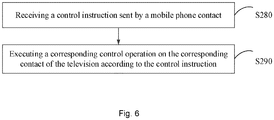
- Fig. 6 is referred to, which is a schematic flow chart of the method of controlling a horizontal screen or a vertical screen of a television according to a fifth embodiment of the present disclosure.
- the method includes: operation S280, receiving a control instruction sent by a mobile phone contact.
- the control instruction can be received from the mobile phone contact, such as the control instruction of opening a certain software, can further be received.
- Operation S290 executing a corresponding control operation on the corresponding contact of the television according to the control instruction.
- the TV After receiving the control instruction sent by the contact of the mobile phone, the TV performs the corresponding control operation on the corresponding contact of the TV according to the control instruction. For example, it can be opening a certain software at the corresponding point.
- the TV screen and the mobile phone screen can be projected mutually, and when operation such as sliding and clicking on the projected screen is conducted, the TV terminal would respond correspondingly to the operation.
- the one-to-one correspondence between contacts of TV screen and mobile phone screen can be implemented combined with private protocol.
- the contacts on mobile phone and TV can be controlled in one-to-one correspondence, and the mobile phone can be used to control TV to play the mobile phone image vertically.
- the requirement of the user to play video social media or games on TV can be fully fulfilled, and a better usage effect can be achieved.
- the embodiment of the present disclosure further provides a computer readable storage medium.
- a computer readable storage medium of the present disclosure stores one or more programs of controlling a horizontal screen or a vertical screen of a television, and when the program of controlling a horizontal screen or a vertical screen of a television is executed by a processor, the operations of the method of controlling a horizontal screen or a vertical screen of a television are implemented.
- the method implemented when the programs running on the processor for controlling a horizontal screen or a vertical screen of a television is executed can refer to each embodiment of the method of controlling a horizontal screen or a vertical screen of a televisionn in this disclosure, which is not repeated herein.
- the method of the above embodiments can be implemented by means of software plus necessary general-purpose hardware platforms. Of course, it can also be implemented by means of hardware, but in many cases the former is a better embodiment.
- the technical solution of the present application in essence, or the part contributing to the prior art, can be embodied in the form of a software product stored in a storage medium (such as a ROM/RAM, a magnetic disk, a diskette) as described above, including several instructions to cause a terminal device (which can be a mobile phone, a computer, a server, an air conditioner, or a network device, etc.) to perform the methods described in various embodiments of the present application.
Landscapes
- Engineering & Computer Science (AREA)
- Signal Processing (AREA)
- Multimedia (AREA)
- Theoretical Computer Science (AREA)
- Computer Hardware Design (AREA)
- General Engineering & Computer Science (AREA)
- Human Computer Interaction (AREA)
- Physics & Mathematics (AREA)
- General Physics & Mathematics (AREA)
- Computer Networks & Wireless Communication (AREA)
- Databases & Information Systems (AREA)
- Business, Economics & Management (AREA)
- Life Sciences & Earth Sciences (AREA)
- Biodiversity & Conservation Biology (AREA)
- Ecology (AREA)
- Emergency Management (AREA)
- Environmental & Geological Engineering (AREA)
- Environmental Sciences (AREA)
- Remote Sensing (AREA)
- Two-Way Televisions, Distribution Of Moving Picture Or The Like (AREA)
- Telephone Function (AREA)
- Controls And Circuits For Display Device (AREA)
Abstract
Description
- The present application claims the priority of the Chinese patent application filed on November 19, 2019, with the application number of
201911145223.6 - The disclosure relates to the field of television interaction, in particular to a method, a device and a computer readable storage medium for controlling a horizontal or a vertical screen of a television.
- Science and technology has brought instant video and instant video software as being a new favorite to people. Relying on the popularity of smart phones and the optimized coverage of 4G networks, increasing mobile Internet users have become viewers of instant videos, which have developed rapidly in a short time.
- However, because of small operational interface of the mobile phone, watching instant videos on mobile phones can not provides users with an excellent viewing experience. Instant videos such as Tiktok and Kuaishou are vertical screen playing images, bother the users as they can not well reflect the playing effect on horizontal TV sets.
- The main purpose of the present disclosure is to provide a method of controlling a horizontal screen or a vertical screen of a television, a device and a computer readable storage medium, aiming at enabling a television system to play vertical screen videos.
- In order to achieve the above purpose, the present disclosure provides a method for controlling the horizontal screen or a vertical screen of a television, which includes the following operations:
- acquiring a mode of the television, and judging if the television is in a mobile phone mode;
- in response that the television is in the mobile phone mode, acquiring an image to be displayed, and playing the image in the vertical screen according to a vertical state of the image.
- In an embodiment, a method of controlling a horizontal or a vertical screen of a television includes:
in response that the television is not in the mobile phone mode, playing the image in the horizontal screen under a TV mode. - In an embodiment, prior to the operation of acquiring an image to be displayed, the method further includes:
- sending an instruction to the mobile terminal for request to project a screen, and receiving a result of the request returned by the mobile terminal; and
- in response that the result is "confirm", acquiring the image to be displayed sent by the mobile terminal.
- In an embodiment, the operation of acquiring an image to be displayed, includes:
in response that the result is "cancel", displaying corresponding prompt information on a screen of the television. - In one embodiment, prior to the operation of sending an instruction to the mobile terminal for request to project a screen, and receiving a result of the request returned by the mobile terminal, the method includes:
- detecting an external connection for the television through a communication protocol;
- in response that the an external connection is on, sending an instruction to the mobile terminal for request to project a screen, and receiving a result of the request returned by the mobile terminal.
- In one embodiment, prior to the operation of sending an instruction to the mobile terminal for request to project a screen, and receiving a result of the request returned by the mobile terminal, the method includes:
in response that the external connection is off, displaying corresponding prompt information on a screen of the television. - In an embodiment, after the operation of acquiring an image to be displayed, and playing the image in the vertical screen according to a vertical state of the image, the method includes:
- acquiring a screen state of the television;
- judging whether the screen state of the television is consistent with a screen state of the image to be displayed;
- in response that the screen state of the television is inconsistent with the screen state of the image to be displayed, adjusting the screen state of the TV to be consistent with the screen state of the image to be displayed.
- In an embodiment, after the operation of adjusting the screen state of the TV to be consistent with the screen state of the image to be displayed, the method further includes:
- receiving a control instruction sent by a mobile phone contact; and
- executing a corresponding control operation on the corresponding contact of the television according to the control instruction.
- In addition, in order to achieve the above purpose, the present disclosure further provides a device of controlling a horizontal screen or vertical screen of a television. The device includes: a memory, a processor and one or more programs for controlling a horizontal screen or vertical screen of a television stored in the memory and executable on the processor, and when executed by the processor, the programs implement the operations as described above.
- In addition, in order to achieve the above purpose, this disclosure further provides a computer readable storage medium, on which one or more program for controlling a horizontal screen or a vertical screen of a television is stored, and when the programs for controlling the horizontal screen or the vertical screen of a television is executed by a processor, the operations of the above method for controlling a horizontal screen or a vertical screen of a television are implemented.
- The disclosure provides a method of controlling a horizontal screen or vertical screen of a television, a device, and a computer storage medium. The method comprises the following operations of: acquiring a mode of a television, and judging whether the mode is a mobile phone mode; in response that the television is in the mobile phone mode, acquiring an image to be displayed, and playing the image in the vertical screen according to a vertical state of the image. As such, the disclosure can play the vertical screen corresponding to the TV screen according to the image to be displayed on the TV. The user can not only play the horizontal screen on the TV, but further play the vertical screen according to the TV content, improving the user's viewing experience and providing the user with a better visual effect.
-
-
Fig. 1 is a structural schematic diagram of a hardware operating environment according to some embodiments of the present application; -
Fig. 2 is a schematic flow chart of a method of controlling a horizontal screen or a vertical screen of a television according to a first embodiment of the present disclosure; -
Fig. 3 is a schematic flow chart of the method of controlling a horizontal screen or a vertical screen of a television according to a second embodiment of the present disclosure; -
Fig. 4 is a schematic flow chart of the method of controlling a horizontal screen or a vertical screen of a television according to a third embodiment of the present disclosure; -
Fig. 5 is a schematic flow chart of the method of controlling a horizontal screen or a vertical screen of a television according to a fourth embodiment of the present disclosure; -
Fig. 6 is a schematic flow chart of the method of controlling a horizontal screen or a vertical screen of a television according to a fifth embodiment of the present disclosure; -
Fig. 7 is a diagram showing a connection of the method of controlling a horizontal screen or a vertical screen of a television according to the third embodiment of the present disclosure; -
Fig. 8 is a diagram showing a display effect of the method of controlling a horizontal screen or a vertical screen of a television according to the first embodiment of the present disclosure; and -
Fig. 9 is another diagram showing the display effect of the method of controlling a horizontal screen or a vertical screen of a television according to the first embodiment of the present disclosure. - The implementation, functional characteristics and advantages of the present application will be further described with reference to the attached drawings in combination with embodiments.
- It should be understood that the specific embodiments described herein are only for illustrative purpose and are not intended to limit the present application.
- As shown in
Fig. 1 , which is a structural schematic diagram of a hardware operating environment according to some embodiments of the present application - The terminal of the embodiment of the disclosure can be a PC, or a terminal device with data processing function such as a smart phone, a tablet computer, a portable computer, etc.
- As shown in
Fig. 1 , the terminal may include aprocessor 1001, such as a CPU, anetwork interface 1004, auser interface 1003, amemory 1005, and acommunication bus 1002. In which, thecommunication bus 1002 is configured to implement connection and communication between these components. Theuser interface 1003 may include a display, an input unit such as a keyboard, and theuser interface 1003 may optionally further include a standard wired interface and a wireless interface. Thenetwork interface 1004 may optionally include a standard wired interface and a wireless interface (such as a WI-FI interface). Thememory 1005 may be a high speed RAM memory or a non-volatile memory such as a disk memory. Thememory 1005 may alternatively be a storage device independent of theaforementioned processor 1001, - In an embodiment, the terminal may further include a camera, RF(Radio Frequency) circuits, sensors, audio circuits, WiFi modules, etc. The sensors may include light sensors, motion sensors and others. Specifically, the light sensors can include an ambient light sensor and a proximity sensor, wherein the ambient light sensor can adjust the brightness of the display screen according to the brightness of ambient light, and the proximity sensor can turn off the display screen and/or backlight when the mobile terminal moves to the ear. As a kind of motion sensor, the gravity acceleration sensor can detect the magnitude of acceleration in all directions (generally three axes), and when stationary, it can detect the magnitude and direction of gravity, which can be used to identify mobile terminal posture applications (such as horizontal and vertical screen switching, related games, magnetometer posture calibration), vibration identification related functions (such as pedometer, tapping), etc. Of course, the mobile terminal can also be equipped with gyroscopes, barometers, hygrometers, thermometers, infrared sensors and other sensors, which will not be described herein.
- It would be understood by those skilled in the art that the terminal shown in
Fig. 1 does not constitute a limitation to the terminal, which may include more or fewer components than shown, or some components may be combined, or different components arranged. - As shown in
Fig. 1 , thememory 1005 as a computer storage medium may include an operating system, a network communication module, a user interface module, and a program of controlling a horizontal screen or a vertical screen of a television. - In the terminals shown in
Fig. 1 , thenetwork interface 1004 is mainly configured to connect with a back-end server and perform data communication with the back-end server. Theuser interface 1003 is mainly configured to connect the client (user end) and perform data communication with the client end; while theprocessor 1001 can be configured to call the program of controlling a horizontal screen or a vertical screen of a television stored in thememory 1005 and execute the following operations: - acquiring a mode of the television, and judging if the television is in a mobile phone mode;
- in response that the television is in the mobile phone mode, acquiring an image to be displayed, and playing the image in the vertical screen according to a vertical state of the image.
- Further, the
processor 1001 may call the program of controlling a horizontal screen or a vertical screen of a television stored in thememory 1005, and implement the following operations:
where a method of controlling a horizontal screen or a vertical screen of a television includes:
in response that the television is not in the mobile phone mode, playing the image in the horizontal screen under a TV mode. - Further, the
processor 1001 may call the program of controlling a horizontal screen or a vertical screen of the television stored in thememory 1005, and implement the following operations:
prior to the operation of acquiring an image to be displayed, the method further includes: - sending an instruction to a mobile terminal for request to project a screen, and receiving a result of the request returned by the mobile terminal; and
- in response that the result is "confirm", acquiring the image to be displayed sent by the mobile terminal.
- Further, the
processor 1001 may call the program of controlling a horizontal screen or a vertical screen of a television stored in thememory 1005, and implement the following operations:
the operation of acquiring an image to be displayed further includes:
in response that the result is "cancel", displaying corresponding prompt information on a screen of the television. - Further, the
processor 1001 may call the program of controlling a horizontal screen or a vertical screen of a television stored in thememory 1005, and implement the following operations:
prior to the operation of sending an instruction to the mobile terminal for request to project a screen, and receiving a result of the request returned by the mobile terminal, the method includes: - detecting an external connection for the television through a communication protocol;
- in response that the an external connection is on, sending the instruction to the mobile terminal for request to project a screen, and receiving the result of the request returned by the mobile terminal.
- Further, the
processor 1001 may call the program of controlling a horizontal screen or a vertical screen of a television stored in thememory 1005, and implement the following operations:
prior to the operation of sending an instruction to the mobile terminal for request to project a screen, and receiving a result of the request returned by the mobile terminal, the method includes:
in response that the external connection is off, displaying corresponding prompt information on the screen of the television. - Further, the
processor 1001 may call the program of controlling a horizontal screen or a vertical screen of a television stored in thememory 1005, and implement the following operations:
after the operation of acquiring an image to be displayed, and playing the image in the vertical screen according to a vertical state of the image, the method includes: - acquiring a screen state of the television;
- judging whether the screen state of the television is consistent with a screen state of the image to be displayed;
- in response that the screen state of the television is inconsistent with the screen state of the image to be displayed, adjusting the screen state of the TV to be consistent with the screen state of the image to be displayed.
- Further, the
processor 1001 may call the program of controlling a horizontal screen or a vertical screen of a television stored in thememory 1005, and implement the following operations:
after the operation of adjusting the screen state of the TV to be consistent with the screen state of the image to be displayed, the method further includes: - receiving a control instruction sent by a mobile phone contact; and
- executing a corresponding control operation on a corresponding contact of the television according to the control instruction.
- The specific embodiments of the device of controlling a horizontal screen or a vertical screen of a television in this disclosure are basically the same as the following embodiments of the method of controlling a horizontal screen or a vertical screen of a television, and will not be described in detail herein.
-
Fig. 2 is referred to, which is a schematic flow chart of a method of controlling a horizontal screen or a vertical screen of a television according to a first embodiment of the present disclosure. The method includes:
operation S100, acquiring a mode of the television, and judging if the television is in a mobile phone mode. - The TV in the method of this disclosure can be set to switch between the horizontal and vertical screens. For example, the rotation can be triggered by operating a rotation button, or any other equivalent means. There is a rotation structure at the back of the TV, configured to rotate the TV screen. The rotating structure can be a rotation screw, a rotatable bracket or other structures. A TV can have an normal TV system for horizontal screen display and a vertical screen system that can be switched to from the horizontal screen system. That is, it enables two systems, and in some other cases, it can only have a vertical screen system. In the present embodiment, the mode of the TV is acquired, and it is judged whether the mode is a mobile phone mode. Mobile phone mode is a mode that allows horizontal and vertical screens. That is, in this mode, the TV can play the image and rotate between horizontal and vertical screens.
- In response that the television is in the mobile phone mode, operation S200 would be implemented: acquiring an image to be displayed, and playing the image in the vertical screen according to a vertical state of the image.
- When determining that the current mode of the TV is the mobile phone mode, the image to be displayed is acquired, and the corresponding horizontal screen or vertical screen are played according to the horizontal and vertical screen states of the displayed image. The image to be displayed can be a display image projected by a mobile phone connected with TV control or a display image projected by devices such as Ipad connected with TV control. Or it can be a display screen triggered by some software in the television system. After the TV acquires the image to be displayed, it can be determined whether the TV performs the corresponding horizontal and vertical screen rotation according to the horizontal or vertical screen state of the image. If the image to be displayed is a video of Tiktok, which is a vertical image, and the TV is a horizontal screen. Then the TV is to be rotated to a vertical screen, and the Tiktok video is played on the vertical screen.
- Further, in response that the television is not in the mobile phone mode, playing the image in the horizontal screen under a TV mode.
- If it is determined that the current mode of TV is not the mobile phone mode, but the normal TV mode, it is directly played in the horizontal screen in this mode. The normal TV mode is the normal state of the existing TVs. That is, the TV mode is a mode that cannot rotate between the horizontal and vertical screens. If it is detected that the mobile phone is not a mobile phone mode and is in the normal TV mode, the TV image will be directly played horizontally. Of course, if the TV has only one mode, such as a mode for only vertical screens, it is not necessary to judge the mode of TV. The image to be displayed would be directly acquired, and the corresponding horizontal screen or vertical screen would be played according to the horizontal or vertical screen state of the image to be displayed. Detailed information can be found in
Fig. 8 andFig. 9 regarding the specific display effect. At the top of the image is the display screen of the TV terminal, and at the bottom is the display screen of the mobile phone terminal. TV and mobile phone keep the same vertical or horizontal screen play. When the mobile phone has a vertical screen, the TV would play on the corresponding vertical screen, and when the mobile phone has a horizontal screen, the TV would play on the corresponding horizontal screen. - The disclosure provides a method of controlling a horizontal screen or a vertical screen of a television, a device, and a computer storage medium. The method includes the following operations of: acquiring a mode of a television, and judging whether the mode is a mobile phone mode; in response that the television is in the mobile phone mode, acquiring an image to be displayed, and playing the image in the horizontal or vertical screen according to a horizontal or vertical state of the image. As such, the disclosure can play the horizontal or vertical screen corresponding to the TV screen according to the image to be displayed on the TV. The user can not only play the horizontal screen on the TV, but further play the vertical screen according to the TV content, improving the user's viewing experience and providing the user with a better visual effect.
-
Fig. 3 is referred to, which is a schematic flow chart of the method of controlling a horizontal screen or a vertical screen of a television according to a second embodiment of the present disclosure. - Based on the above embodiments, in the present embodiment, before operation S200, the method includes:
operation S210, sending an instruction to the mobile terminal for request to project a screen, and receiving a result of the request returned by the mobile terminal; and - In the present embodiment, before acquiring the image to be displayed and playing the corresponding horizontal screen or vertical screen according to the horizontal or vertical screen state of the image to be displayed, an instruction for request to screen projection may be sent to the mobile terminal and the result returned by the mobile terminal may be received. The mobile terminal can be a mobile phone, an iPad or another mobile device. The screen projection can be unidirectional screen projection of mobile phone to TV, or bidirectional screen projection between mobile phone and TV. The screen projection and other technical operations can be implemented according to the private protocol of reverse screen projection, wireless transmission network server, encryption algorithm, streaming media protocol support, P2P Group Owner technology of WIFI-P2P, wifi-direct device discovery protocol and other technologies. binary screen projection of TV and mobile phones can give users a better control of screen projection.
in response that the result is "confirm", operation S200 would be implemented: acquiring the image to be displayed sent by the mobile terminal. - If the result of the screen projection request is to confirm the screen projection, the display screen sent by the mobile terminal is acquired, and the subsequent operation is performed: the corresponding horizontal screen or vertical screen is played according to the horizontal or vertical screen state of the image to be displayed.
- Further, in response that the result is "cancel", operations S220 is implemented: displaying corresponding prompt information on a screen of the television.
- In response that the result is "cancel", corresponding prompt information is displayed on a screen of the television. Prompt information such as "no corresponding screen projection equipment can be found", etc.
-
Fig. 4 is referred to, which is a schematic flow chart of the method of controlling a horizontal screen or a vertical screen of a television according to a third embodiment of the present disclosure. - Based on the above embodiments, in the present embodiment, before operation S210, the method includes:
operation S230, detecting an external connection for the television through a communication protocol; - In the present embodiment, before sending the instruction to the mobile terminal and receiving the result returned by the mobile terminal, the external connection of the television can further be detected through the communication protocol, such as whether there are connected external mobile terminals or which external mobile terminals are connected.
in response that the an external connection is on, operation S210 is implemented: sending an instruction to the mobile terminal for request to project a screen, and receiving a result of the request returned by the mobile terminal. - In response that the an external connection is on, an instruction is sent to the mobile terminal for request to project a screen, and a result of the request is received returned by the mobile terminal. When there are multiple mobile terminals interconnected, the user can select which equipment to send the instruction to request the projection, so as to send the instruction to the equipment selected by the user and receive the corresponding result returned by the mobile terminal. The connection between external devices and TV can be wifi wireless connection, wired connection or other connections.
- In response that the external connection is off, operation S240 is implemented: displaying corresponding prompt information on a screen of the television.
- In response that the external connection is off, corresponding prompt information is displayed on a screen of the television. Such as rompt information "no connected external device is detected" and etc. Specifically, as shown in
Fig. 7 , when the mobile phone is connected to the TV via WIFI, it can perform corresponding screen projection on the TV, and the TV will play the image vertically according to the projected image. -
Fig. 5 is referred to, which is a schematic flow chart of the method of controlling a horizontal screen or a vertical screen of a television according to a fourth embodiment of the present disclosure. - Based on the above embodiments, in the present embodiment, operation S200 includes:
operation S250, acquiring a screen state of the television. - In the present embodiment, the image to be displayed is acquired and the corresponding horizontal screen or vertical screen is played according to the horizontal or vertical screen state of the image to be displayed. And the horizontal and vertical screen state of the TV can be acquired first, such as the horizontal screen state of the current TV or the vertical screen state of the current TV.
- Operation S260, judging whether the screen state of the television is consistent with a screen state of the image to be displayed.
- After acquiring the horizontal or vertical screen state of TV, it can be judged whether the current horizontal or vertical screen state is consistent with the horizontal or vertical screen state of the image to be displayed. If the state of TV is horizontal screen and the image to be displayed is vertical screen, the screen state of TV is inconsistent with that of the image to be displayed.
- In response that the screen state of the television is inconsistent with the screen state of the image to be displayed, operation S270 is implemented: adjusting the screen state of the TV to be consistent with the screen state of the image to be displayed.
- If the state of TV is inconsistent with that of the image to be displayed, the horizontal or vertical screen state of TV is adjusted to be consistent with that of the image to be displayed. If the horizontal and vertical screen state of TV is horizontal and the image to be displayed is vertical, the screen state of TV is not consistent with that of the image to be displayed.
-
Fig. 6 is referred to, which is a schematic flow chart of the method of controlling a horizontal screen or a vertical screen of a television according to a fifth embodiment of the present disclosure. - Based on the above embodiments, in the present embodiment, after operation S200, the method includes:
operation S280, receiving a control instruction sent by a mobile phone contact. - In the present embodiment, after the operation of acquiring an image to be displayed, and playing the image in the vertical screen according to a vertical state of the image, the control instruction can be received from the mobile phone contact, such as the control instruction of opening a certain software, can further be received.
- Operation S290, executing a corresponding control operation on the corresponding contact of the television according to the control instruction.
- After receiving the control instruction sent by the contact of the mobile phone, the TV performs the corresponding control operation on the corresponding contact of the TV according to the control instruction. For example, it can be opening a certain software at the corresponding point. The TV screen and the mobile phone screen can be projected mutually, and when operation such as sliding and clicking on the projected screen is conducted, the TV terminal would respond correspondingly to the operation. The one-to-one correspondence between contacts of TV screen and mobile phone screen can be implemented combined with private protocol. The contacts on mobile phone and TV can be controlled in one-to-one correspondence, and the mobile phone can be used to control TV to play the mobile phone image vertically. The requirement of the user to play video social media or games on TV can be fully fulfilled, and a better usage effect can be achieved.
- In addition, the embodiment of the present disclosure further provides a computer readable storage medium.
- A computer readable storage medium of the present disclosure stores one or more programs of controlling a horizontal screen or a vertical screen of a television, and when the program of controlling a horizontal screen or a vertical screen of a television is executed by a processor, the operations of the method of controlling a horizontal screen or a vertical screen of a television are implemented.
- In which, the method implemented when the programs running on the processor for controlling a horizontal screen or a vertical screen of a television is executed can refer to each embodiment of the method of controlling a horizontal screen or a vertical screen of a televisionn in this disclosure, which is not repeated herein.
- It should be noted that in this document, the terms "comprising", "including" or any other variation thereof are intended to cover a non-exclusive inclusion, such that a process, method, article, or system that includes a list of elements includes not only those elements but further other elements not expressly listed, or elements inherent to such process, method, article, or system. Without further restrictions, an element defined by the statement" includes an" does not exclude the presence of another identical element in a process, method, article, or system including the element.
- The aforementioned serial numbers regarding the embodiments of the present application are for description only and do not represent the superiority and inferiority of the embodiments.
- From the above description of the embodiments, those skilled in the art can clearly understand that the method of the above embodiments can be implemented by means of software plus necessary general-purpose hardware platforms. Of course, it can also be implemented by means of hardware, but in many cases the former is a better embodiment. Based on this understanding, the technical solution of the present application, in essence, or the part contributing to the prior art, can be embodied in the form of a software product stored in a storage medium (such as a ROM/RAM, a magnetic disk, a diskette) as described above, including several instructions to cause a terminal device (which can be a mobile phone, a computer, a server, an air conditioner, or a network device, etc.) to perform the methods described in various embodiments of the present application.
- The description aforementioned is only the optional embodiment of the present application and is not intended to limit the scope of the present application. Any equivalent structural or flow modification made by using the description and drawings of the present application or direct/indirect application in other related technical fields under the concept of the present application shall be included in the protection scope of the present application
Claims (20)
- A method of controlling a horizontal screen or a vertical screen of a television, comprising:acquiring a mode of the television, and judging if the television is in a mobile phone mode;in response that the television is in the mobile phone mode, acquiring an image to be displayed, and playing the image in the vertical screen according to a vertical state of the image.
- The method according to claim 1, wherein the method further comprises:
in response that the television is not in the mobile phone mode, playing the image in the horizontal screen under a normal TV mode. - The method according to claim 1, wherein prior to the operation of acquiring an image to be displayed, the method comprises:sending an instruction to the mobile terminal for request to project a screen, and receiving a result of the request returned by the mobile terminal; andin response that the result is "confirm", acquiring the image to be displayed sent by the mobile terminal.
- The method according to claim 3, wherein the operation of acquiring an image to be displayed, comprises:
in response that the result is "cancel", displaying corresponding prompt information on a screen of the television. - The method according to claim 3, wherein prior to the operation of sending an instruction to the mobile terminal for request to project a screen, and receiving a result of the request returned by the mobile terminal, the method further comprises:detecting an external connection for the television through a communication protocol;in response that the an external connection is on, sending the instruction to the mobile terminal for request to project a screen, and receiving the result of the request returned by the mobile terminal.
- The method according to claim 5, wherein prior to the operation of sending an instruction to the mobile terminal for request to project a screen, and receiving a result of the request returned by the mobile terminal, the method further comprises:
in response that the external connection is off, displaying corresponding prompt information on a screen of the television. - The method according to claim 1, wherein after the operation of acquiring an image to be displayed, and playing the image in the vertical screen according to a vertical state of the image, the method comprises:acquiring a screen state of the television;judging whether the screen state of the television is consistent with a screen state of the image to be displayed;in response that the screen state of the television is inconsistent with the screen state of the image to be displayed, adjusting the screen state of the TV to be consistent with the screen state of the image to be displayed.
- The method according to claim 1, wherein after the operation of adjusting the screen state of the TV to be consistent with the screen state of the image to be displayed, the method further comprises:receiving a control instruction sent by a mobile phone contact; andexecuting a corresponding control operation on a corresponding contact of the television according to the control instruction.
- A device of controlling a horizontal screen or a vertical screen of a television, wherein the device comprises: a memory, a processor and a program of controlling a horizontal screen or a vertical screen of a television stored in the memory and executable on the processor, and when executed by the processor, the program implements the following operations:acquiring a mode of the television, and judging if the television is in a mobile phone mode;in response that the television is in the mobile phone mode, acquiring an image to be displayed, and playing the image in the vertical screen according to a vertical state of the image.
- The device according to claim 9, wherein the programs further implement the following operations:
in response that the television is not in the mobile phone mode, playing the image in the horizontal screen under a TV mode. - The device according to claim 9, wherein prior to the operation of acquiring an image to be displayed, the programs further implement the following operations:sending an instruction to the mobile terminal for request to project a screen, and receiving a result of the request returned by the mobile terminal; andin response that the result is "confirm", acquiring the image to be displayed sent by the mobile terminal.
- The device according to claim 11, wherein the operation of acquiring an image to be displayed, further comprises:
in response that the result is "cancel", displaying corresponding prompt information on a screen of the television. - The device according to claim 11, wherein prior to the operation of sending an instruction to the mobile terminal for request to project a screen, and receiving a result of the request returned by the mobile terminal, the programs further implement the following operations:detecting an external connection for the television through a communication protocol;in response that the an external connection is on, sending the instruction to the mobile terminal for request to project a screen, and receiving the result of the request returned by the mobile terminal.
- The device according to claim 13, wherein prior to the operation of sending an instruction to the mobile terminal for request to project a screen, and receiving a result of the request returned by the mobile terminal, the programs further implement the following operations:
in response that the external connection is off, displaying corresponding prompt information on a screen of the television. - The device according to claim 9, wherein after the operation of acquiring an image to be displayed, and playing the image in the vertical screen according to a vertical state of the image, the programs further implement the following operations:acquiring a screen state of the television;judging whether the screen state of the television is consistent with a screen state of the image to be displayed;in response that the screen state of the television is inconsistent with the screen state of the image to be displayed, adjusting the screen state of the TV to be consistent with the screen state of the image to be displayed.
- The device according to claim 9, wherein after the operation of adjusting the screen state of the TV to be consistent with the screen state of the image to be displayed, the programs further implement the following operations:receiving a control instruction sent by a mobile phone contact; andexecuting a corresponding control operation on a corresponding contact of the television according to the control instruction.
- A computer-readable storage medium, wherein one or more programs for controlling a horizontal screen or a vertical screen of a television are stored on the computer-readable storage medium, and when executed by a processor, the programs of controlling a horizontal screen or a vertical screen of a television implement the following operations:acquiring a mode of the television, and judging if the television is in a mobile phone mode;in response that the television is in the mobile phone mode, acquiring an image to be displayed, and playing the image in the vertical screen according to a vertical state of the image.
- The computer readable storage medium according to claim 17, wherein the programs further implement the following operations:
in response that the television is not in the mobile phone mode, playing the image in the horizontal screen under a TV mode. - The computer readable storage medium according to claim 17, wherein prior to the operation of acquiring an image to be displayed, the programs further implement the following operations:sending an instruction to the mobile terminal for request to project a screen, and receiving a result of the request returned by the mobile terminal; andin response that the result is "confirm", acquiring the image to be displayed sent by the mobile terminal.
- The computer readable storage medium according to claim 19, wherein the operation of acquiring the image to be displayed comprises:
in response that the result is "cancel", displaying corresponding prompt information on a screen of the television.
Applications Claiming Priority (2)
| Application Number | Priority Date | Filing Date | Title |
|---|---|---|---|
| CN201911145223.6A CN110996175A (en) | 2019-11-19 | 2019-11-19 | Method, device and storage medium for controlling horizontal and vertical screen operation of television |
| PCT/CN2020/129851 WO2021098738A1 (en) | 2019-11-19 | 2020-11-18 | Method and apparatus for controlling horizontal and vertical screen operation of television, and storage medium |
Publications (2)
| Publication Number | Publication Date |
|---|---|
| EP3852381A1 true EP3852381A1 (en) | 2021-07-21 |
| EP3852381A4 EP3852381A4 (en) | 2022-05-04 |
Family
ID=70085388
Family Applications (1)
| Application Number | Title | Priority Date | Filing Date |
|---|---|---|---|
| EP20841842.6A Withdrawn EP3852381A4 (en) | 2019-11-19 | 2020-11-18 | Method and apparatus for controlling horizontal and vertical screen operation of television, and storage medium |
Country Status (4)
| Country | Link |
|---|---|
| US (1) | US11343556B2 (en) |
| EP (1) | EP3852381A4 (en) |
| CN (1) | CN110996175A (en) |
| WO (1) | WO2021098738A1 (en) |
Families Citing this family (16)
| Publication number | Priority date | Publication date | Assignee | Title |
|---|---|---|---|---|
| CN110996175A (en) * | 2019-11-19 | 2020-04-10 | 深圳创维-Rgb电子有限公司 | Method, device and storage medium for controlling horizontal and vertical screen operation of television |
| CN113556591A (en) * | 2020-04-24 | 2021-10-26 | 青岛海信传媒网络技术有限公司 | Display equipment and projection screen image rotation display method |
| CN111600977A (en) * | 2020-05-15 | 2020-08-28 | 魏天骋 | Sharing device using mobile terminal as data processor |
| CN111885400A (en) * | 2020-07-31 | 2020-11-03 | 聚好看科技股份有限公司 | Media data display method, server and display equipment |
| CN111885314B (en) * | 2020-08-26 | 2024-04-02 | 深圳市雷鸟网络传媒有限公司 | Screen adjustment method, device, terminal and computer readable storage medium |
| CN112099672B (en) * | 2020-09-15 | 2025-04-11 | 深圳市绘王动漫科技有限公司 | Handwriting tablet and method for adapting the handwriting tablet to a host computer |
| CN112104916A (en) * | 2020-09-21 | 2020-12-18 | 四川长虹电器股份有限公司 | Intelligent rotary television desktop and horizontal and vertical screen management and control method thereof |
| CN112097051A (en) * | 2020-09-27 | 2020-12-18 | 四川长虹电器股份有限公司 | Rotary television bracket and control method thereof |
| CN112565861A (en) * | 2020-11-23 | 2021-03-26 | 青岛海信传媒网络技术有限公司 | Display device |
| CN112533049B (en) * | 2020-11-26 | 2022-12-27 | 深圳创维-Rgb电子有限公司 | Picture following screen rotation processing method and device, intelligent terminal and medium |
| WO2022161401A1 (en) * | 2021-01-28 | 2022-08-04 | 青岛海信传媒网络技术有限公司 | Screen-projection data processing method and display device |
| CN112969083A (en) * | 2021-02-20 | 2021-06-15 | 深圳市颍创科技有限公司 | Method and system for simultaneously displaying main picture and sub-picture in PIP picture in vertical screen mode |
| WO2022193475A1 (en) * | 2021-03-19 | 2022-09-22 | 青岛海信传媒网络技术有限公司 | Display device, method for receiving screen projection content, and screen projection method |
| CN113079388B (en) * | 2021-03-22 | 2023-02-03 | 浙江合众新能源汽车有限公司 | Playing method and system for in-vehicle multimedia content |
| CN113453050B (en) * | 2021-06-24 | 2023-03-21 | 深圳康佳电子科技有限公司 | Play mode adjusting method based on rotary screen, intelligent terminal and storage medium |
| CN115243020B (en) * | 2022-07-18 | 2025-02-25 | 海信视像科技股份有限公司 | Image following method when screen of projection device is raised or lowered and projection device |
Family Cites Families (11)
| Publication number | Priority date | Publication date | Assignee | Title |
|---|---|---|---|---|
| KR100631670B1 (en) * | 2003-12-09 | 2006-10-09 | 엘지전자 주식회사 | Portable terminal |
| US8654176B2 (en) * | 2007-06-14 | 2014-02-18 | Sharp Kabushiki Kaisha | Operating system that includes an image data receiving device and an operation device for processing image data sets |
| KR101218295B1 (en) * | 2012-07-11 | 2013-01-04 | 주식회사 엘지유플러스 | Mobile terminal and screen sharing method thereof |
| CN103226453B (en) * | 2013-03-22 | 2015-06-03 | 武汉无懈科技有限责任公司 | Method for mapping display and operation of mobile phone screen to computer terminal |
| CN104581405B (en) * | 2013-10-21 | 2018-09-04 | 中国移动通信集团公司 | A kind of display content processing method and equipment |
| CN105847911A (en) * | 2016-05-03 | 2016-08-10 | 苏州乐聚堂电子科技有限公司 | Intelligent television system |
| CN106888312B (en) * | 2016-12-27 | 2018-10-16 | 比亚迪股份有限公司 | The switching method and apparatus of the screen state of car-mounted terminal |
| CN107071551B (en) * | 2017-04-26 | 2020-07-24 | 四川长虹电器股份有限公司 | Multi-screen interactive screen response method applied to smart television system |
| CN109814828A (en) * | 2019-01-31 | 2019-05-28 | 深圳市炬力北方微电子有限公司 | Mirror image expires frame method with screen automatically |
| CN110086938A (en) * | 2019-04-29 | 2019-08-02 | 百度在线网络技术(北京)有限公司 | Throw control method, system, electronic equipment and the computer-readable medium of screen display |
| CN110996175A (en) * | 2019-11-19 | 2020-04-10 | 深圳创维-Rgb电子有限公司 | Method, device and storage medium for controlling horizontal and vertical screen operation of television |
-
2019
- 2019-11-19 CN CN201911145223.6A patent/CN110996175A/en active Pending
-
2020
- 2020-11-18 WO PCT/CN2020/129851 patent/WO2021098738A1/en not_active Ceased
- 2020-11-18 EP EP20841842.6A patent/EP3852381A4/en not_active Withdrawn
-
2021
- 2021-01-14 US US17/148,767 patent/US11343556B2/en active Active
Also Published As
| Publication number | Publication date |
|---|---|
| WO2021098738A1 (en) | 2021-05-27 |
| EP3852381A4 (en) | 2022-05-04 |
| US11343556B2 (en) | 2022-05-24 |
| US20210152868A1 (en) | 2021-05-20 |
| CN110996175A (en) | 2020-04-10 |
Similar Documents
| Publication | Publication Date | Title |
|---|---|---|
| US11343556B2 (en) | Method of controlling a horizontal screen or vertical screen of television, device, and storage medium | |
| JP6423445B2 (en) | Multimedia data reproduction method, apparatus and system | |
| JP6877808B2 (en) | Methods, devices, and systems for processing video stream data | |
| CN104270668B (en) | A kind of video content continuous playing method and system | |
| CN110536008B (en) | Screen projection method and mobile terminal | |
| CN108738374B (en) | image display device | |
| CN106686446B (en) | Content projection method and mobile terminal | |
| JP6463500B2 (en) | Method, apparatus and system for setting operating state of apparatus | |
| EP4044606B1 (en) | View adjustment method and apparatus for target device, electronic device, and medium | |
| CN113329240A (en) | Screen projection method and device | |
| RU2673560C1 (en) | Method and system for displaying multimedia information, standardized server and direct broadcast terminal | |
| JP2017502438A (en) | Description Information Display Method, Description Information Display Device, Electronic Device, Program, and Recording Medium | |
| CN114428598A (en) | Screen projection method and device, electronic equipment and storage medium | |
| US20170019482A1 (en) | Method and apparatus for downloading control program | |
| CN109155872B (en) | Information processing apparatus and method, television receiver, and information processing system | |
| CN107682541B (en) | Audio control method for screen projection, mobile terminal and storage medium | |
| KR102174858B1 (en) | Method for rendering data in a network and associated mobile device | |
| CN113973195A (en) | Projection equipment and correction method thereof | |
| EP3661220B1 (en) | Client device, companion screen device, and operation method therefor | |
| CN109889303B (en) | Video playing mode switching method and device and computer readable storage medium | |
| KR102557735B1 (en) | Electronic device and operation method for the same | |
| CN107493518B (en) | IPTV terminal network exit switching method, device and readable storage medium | |
| KR102582508B1 (en) | Display device | |
| US20160124523A1 (en) | Electronic device, display device, and method for controlling the same | |
| US20130278397A1 (en) | Remote control method and system and mobile device of the system |
Legal Events
| Date | Code | Title | Description |
|---|---|---|---|
| STAA | Information on the status of an ep patent application or granted ep patent |
Free format text: STATUS: UNKNOWN |
|
| STAA | Information on the status of an ep patent application or granted ep patent |
Free format text: STATUS: THE INTERNATIONAL PUBLICATION HAS BEEN MADE |
|
| PUAI | Public reference made under article 153(3) epc to a published international application that has entered the european phase |
Free format text: ORIGINAL CODE: 0009012 |
|
| STAA | Information on the status of an ep patent application or granted ep patent |
Free format text: STATUS: REQUEST FOR EXAMINATION WAS MADE |
|
| 17P | Request for examination filed |
Effective date: 20210126 |
|
| AK | Designated contracting states |
Kind code of ref document: A1 Designated state(s): AL AT BE BG CH CY CZ DE DK EE ES FI FR GB GR HR HU IE IS IT LI LT LU LV MC MK MT NL NO PL PT RO RS SE SI SK SM TR |
|
| REG | Reference to a national code |
Ref country code: DE Ref legal event code: R079 Free format text: PREVIOUS MAIN CLASS: H04N0021440200 Ipc: H04N0021410000 |
|
| A4 | Supplementary search report drawn up and despatched |
Effective date: 20220407 |
|
| RIC1 | Information provided on ipc code assigned before grant |
Ipc: H04N 21/442 20110101ALI20220401BHEP Ipc: H04N 21/4402 20110101ALI20220401BHEP Ipc: H04N 21/431 20110101ALI20220401BHEP Ipc: H04N 21/422 20110101ALI20220401BHEP Ipc: H04N 21/41 20110101AFI20220401BHEP |
|
| DAV | Request for validation of the european patent (deleted) | ||
| DAX | Request for extension of the european patent (deleted) | ||
| STAA | Information on the status of an ep patent application or granted ep patent |
Free format text: STATUS: THE APPLICATION IS DEEMED TO BE WITHDRAWN |
|
| 18D | Application deemed to be withdrawn |
Effective date: 20221108 |