EP3851850A1 - Reagent and method for measuring hemoglobins - Google Patents
Reagent and method for measuring hemoglobins Download PDFInfo
- Publication number
- EP3851850A1 EP3851850A1 EP19860272.4A EP19860272A EP3851850A1 EP 3851850 A1 EP3851850 A1 EP 3851850A1 EP 19860272 A EP19860272 A EP 19860272A EP 3851850 A1 EP3851850 A1 EP 3851850A1
- Authority
- EP
- European Patent Office
- Prior art keywords
- component
- less
- reagent
- weight
- moles
- Prior art date
- Legal status (The legal status is an assumption and is not a legal conclusion. Google has not performed a legal analysis and makes no representation as to the accuracy of the status listed.)
- Pending
Links
Images



Classifications
-
- G—PHYSICS
- G01—MEASURING; TESTING
- G01N—INVESTIGATING OR ANALYSING MATERIALS BY DETERMINING THEIR CHEMICAL OR PHYSICAL PROPERTIES
- G01N33/00—Investigating or analysing materials by specific methods not covered by groups G01N1/00 - G01N31/00
- G01N33/48—Biological material, e.g. blood, urine; Haemocytometers
- G01N33/50—Chemical analysis of biological material, e.g. blood, urine; Testing involving biospecific ligand binding methods; Immunological testing
- G01N33/72—Chemical analysis of biological material, e.g. blood, urine; Testing involving biospecific ligand binding methods; Immunological testing involving blood pigments, e.g. haemoglobin, bilirubin or other porphyrins; involving occult blood
- G01N33/721—Haemoglobin
-
- G—PHYSICS
- G01—MEASURING; TESTING
- G01N—INVESTIGATING OR ANALYSING MATERIALS BY DETERMINING THEIR CHEMICAL OR PHYSICAL PROPERTIES
- G01N30/00—Investigating or analysing materials by separation into components using adsorption, absorption or similar phenomena or using ion-exchange, e.g. chromatography or field flow fractionation
- G01N30/02—Column chromatography
- G01N30/04—Preparation or injection of sample to be analysed
- G01N30/06—Preparation
-
- G—PHYSICS
- G01—MEASURING; TESTING
- G01N—INVESTIGATING OR ANALYSING MATERIALS BY DETERMINING THEIR CHEMICAL OR PHYSICAL PROPERTIES
- G01N30/00—Investigating or analysing materials by separation into components using adsorption, absorption or similar phenomena or using ion-exchange, e.g. chromatography or field flow fractionation
- G01N30/02—Column chromatography
- G01N30/88—Integrated analysis systems specially adapted therefor, not covered by a single one of the groups G01N30/04 - G01N30/86
-
- B—PERFORMING OPERATIONS; TRANSPORTING
- B01—PHYSICAL OR CHEMICAL PROCESSES OR APPARATUS IN GENERAL
- B01D—SEPARATION
- B01D15/00—Separating processes involving the treatment of liquids with solid sorbents; Apparatus therefor
- B01D15/08—Selective adsorption, e.g. chromatography
- B01D15/26—Selective adsorption, e.g. chromatography characterised by the separation mechanism
- B01D15/36—Selective adsorption, e.g. chromatography characterised by the separation mechanism involving ionic interaction, e.g. ion-exchange, ion-pair, ion-suppression or ion-exclusion
- B01D15/361—Ion-exchange
- B01D15/362—Cation-exchange
-
- G—PHYSICS
- G01—MEASURING; TESTING
- G01N—INVESTIGATING OR ANALYSING MATERIALS BY DETERMINING THEIR CHEMICAL OR PHYSICAL PROPERTIES
- G01N30/00—Investigating or analysing materials by separation into components using adsorption, absorption or similar phenomena or using ion-exchange, e.g. chromatography or field flow fractionation
- G01N30/02—Column chromatography
- G01N30/88—Integrated analysis systems specially adapted therefor, not covered by a single one of the groups G01N30/04 - G01N30/86
- G01N2030/8809—Integrated analysis systems specially adapted therefor, not covered by a single one of the groups G01N30/04 - G01N30/86 analysis specially adapted for the sample
- G01N2030/8813—Integrated analysis systems specially adapted therefor, not covered by a single one of the groups G01N30/04 - G01N30/86 analysis specially adapted for the sample biological materials
- G01N2030/8822—Integrated analysis systems specially adapted therefor, not covered by a single one of the groups G01N30/04 - G01N30/86 analysis specially adapted for the sample biological materials involving blood
Definitions
- the present invention relates to a reagent for measuring hemoglobins including a surfactant.
- the present invention also relates to a method for measuring hemoglobins using the reagent for measuring hemoglobins.
- the concentration of hemoglobins is measured for the diagnosis of diabetes, hemoglobinopathy and the like.
- the concentration of hemoglobins including normal hemoglobins such as hemoglobin A1a, hemoglobin A1b, hemoglobin F, hemoglobin A1c, hemoglobin A0, and hemoglobin A2, modified hemoglobins such as acetylated hemoglobin and carbamylated hemoglobin, and abnormal hemoglobins such as hemoglobin S and hemoglobin C is measured.
- the value of hemoglobin A1c is measured.
- the method for measuring the concentration of hemoglobins mainly includes a liquid chromatography method.
- a hemolytic reagent is added to a sample such as blood, the sample after hemolysis is measured by cation exchange liquid chromatography, and the peak of the obtained chromatogram is arithmetically processed to determine the concentration of hemoglobins such as the value of hemoglobin A1c.
- a hemolytic reagent a composition containing polyoxyethylene octyl phenyl ether having an average number of moles of an oxyethylene group added of 10 (for example, trade name "Triton X-100") is used as a hemolytic reagent.
- Patent Document 1 discloses a method for separating hemoglobin A1c for separating hemoglobin A1c in a sample of human blood from other glycosylated and non-glycosylated hemoglobins and a Schiff base of a precursor of hemoglobin A1c.
- a hemolytic reagent containing 0.33% by weight of Triton X-100 is used.
- Patent Document 2 discloses a hemolytic reagent used for hemolyzing a blood sample in a method for measuring hemoglobins by cation exchange liquid chromatography.
- the hemolytic reagent contains chaotropic ions.
- a hemolytic reagent containing 0.1% by weight of Triton X-100 is used.
- Hemolytic reagents (reagents for measuring hemoglobins) including polyoxyethylene octyl phenyl ether having an average number of moles of an oxyethylene group added of 10 as described in Patent Documents 1 and 2 are excellent in hemolytic performance.
- a peak of hemoglobins is satisfactorily obtained.
- a shoulder peak and a split peak are less likely to occur in all the obtained peaks.
- hemoglobins can be measured with high accuracy.
- Hemolytic reagents including polyoxyethylene octyl phenyl ether having an average number of moles of an oxyethylene group added of 10 cause less carryover in measurement by cation exchange liquid chromatography. Thus, even when a large number of samples are continuously measured, hemoglobins can be measured with high accuracy.
- An object of the present invention is to provide a reagent for measuring hemoglobins capable of satisfactorily causing hemolysis and measuring hemoglobins with high accuracy. More specifically, an object of the present invention is to provide a reagent for measuring hemoglobins capable of, without including polyoxyethylene octyl phenyl ether having an average number of moles of an oxyethylene group added of 10, causing hemolysis at a level equivalent to that of a reagent for measuring hemoglobins containing the component, and measuring hemoglobins with equivalent accuracy.
- Another object of the present invention is to provide a method for measuring hemoglobins using the reagent for measuring hemoglobins.
- a reagent for measuring hemoglobins used for measuring hemoglobins by cation exchange liquid chromatography, including: a nonionic surfactant or an amphoteric surfactant, the nonionic surfactant being Component A1 below, Component A2 below, Component A3 below, Component A4 below, Component A5 below, Component A6 below, Component A7 below, Component A8 below, or Component A9 below, and the amphoteric surfactant being Component B1 below, Component B2 below, or Component B3 below.
- the reagent for measuring hemoglobins includes the nonionic surfactant, the nonionic surfactant includes the Component A1, the Component A2, the Component A3, the Component A4, the Component A5, or the Component A6,
- the Component A1 is polyoxyethylene lauryl ether having an average number of moles of an oxyethylene group added of 9, 12, or 19, or polyoxyethylene cetyl ether having an average number of moles of an oxyethylene group added of 13 or 20
- the Component A2 is polyoxyethylene stearyl ether having an average number of moles of an oxyethylene group added of 50
- the Component A3 is polyoxyethylene oleyl ether having an average number of moles of an oxyethylene group added of 9 or 13
- the Component A4 is polyoxyethylene-sec-alkyl ether having an average number of moles of an oxyethylene group added of 7 or 9 and a carbon number of an alkyl group of 11 or more
- the reagent for measuring hemoglobins includes the nonionic surfactant, the nonionic surfactant includes the Component A1 or the Component A3, the Component A1 is polyoxyethylene alkyl ether having an average number of moles of an oxyethylene group added of 10 or more and 15 or less, and a carbon number of an alkyl group of 12 or more and 17 or less, and the Component A3 is polyoxyethylene oleyl ether having an average number of moles of an oxyethylene group added of 10 or more and 15 or less.
- the Component A1 is polyoxyethylene lauryl ether having an average number of moles of an oxyethylene group added of 12, or polyoxyethylene cetyl ether having an average number of moles of an oxyethylene group added of 13, and the Component A3 is polyoxyethylene oleyl ether having an average number of moles of an oxyethylene group added of 13.
- the reagent for measuring hemoglobins includes the nonionic surfactant, and the reagent for measuring hemoglobins has a content of the nonionic surfactant of 0.01% by weight or more and 1.0% by weight or less.
- the reagent for measuring hemoglobins includes the amphoteric surfactant, and the reagent for measuring hemoglobins has a content of the amphoteric surfactant of 0.01% by weight or more and 1.0% by weight or less.
- a method for measuring hemoglobins including the steps of: mixing an erythrocyte-containing sample and the reagent for measuring hemoglobins to obtain a mixed solution; and measuring the mixed solution by cation exchange liquid chromatography.
- the reagent for measuring hemoglobins according to the present invention is used for measuring hemoglobins by cation exchange liquid chromatography.
- the reagent for measuring hemoglobins according to the present invention includes a nonionic surfactant or an amphoteric surfactant.
- the nonionic surfactant is any of Components A1 to A9 below, or the amphoteric surfactant is any of Components B1 to B3 below.
- Component A1 Polyoxyethylene alkyl ether having an average number of moles of an oxyethylene group added of 8 or more and 20 or less, and a carbon number of an alkyl group of 12 or more and 17 or less.
- Component A2 Polyoxyethylene stearyl ether having an average number of moles of an oxyethylene group added of 40 or more and 60 or less.
- Component A3 Polyoxyethylene oleyl ether having an average number of moles of an oxyethylene group added of 9 or more and 15 or less.
- Component A4 Polyoxyethylene-sec-alkyl ether having an average number of moles of an oxyethylene group added of 6 or more and 10 or less, and a carbon number of an alkyl group of 11 or more and 15 or less.
- Component A5 Polyoxyethylene tridecyl ether having an average number of moles of an oxyethylene group added of 15.
- Component A6 Polyoxyethylene polyoxypropylene alkyl ether having an HLB value of 11 or more and 15 or less.
- Component A7 n-nonanoyl-N-methyl-D-glucamine.
- Component A8 n-octyl- ⁇ -D-glucopyranoside.
- Component A9 Saponin.
- Component B1 3-[(3-cholamidopropyl)dimethylammonio]propane sulfonate.
- Component B2 3-[(3-cholamidopropyl)dimethylammonio]-2-hydroxypropane sulfonate.
- Component B3 Lauryl dimethylamine oxide.
- the reagent for measuring hemoglobins according to the present invention has the above-mentioned configuration, and thus is capable of satisfactorily causing hemolysis and measuring hemoglobins with high accuracy.
- the reagent for measuring hemoglobins according to the present invention is used for measuring hemoglobins by cation exchange liquid chromatography.
- the reagent for measuring hemoglobins according to the present invention includes a nonionic surfactant or an amphoteric surfactant.
- the nonionic surfactant is polyoxyethylene alkyl ether having an average number of moles of an oxyethylene group added of 8 or more and 20 or less, and a carbon number of an alkyl group of 12 or more and 17 or less, polyoxyethylene stearyl ether having an average number of moles of an oxyethylene group added of 40 or more and 60 or less, polyoxyethylene oleyl ether having an average number of moles of an oxyethylene group added of 9 or more and 15 or less, polyoxyethylene-sec-alkyl ether having an average number of moles of an oxyethylene group added of 6 or more and 10 or less, and a carbon number of an alkyl group of 11 or more and 15 or less, polyoxyethylene tridecyl ether having an average number of moles of an oxyethylene group added of 15, polyoxyethylene polyoxypropylene alkyl ether having an HLB value of 11 or more and 15 or less, n-nonanoy
- the amphoteric surfactant is 3-[(3-cholamidopropyl)dimethylammonio]propane sulfonate, 3-[(3-cholamidopropyl)dimethylammonio]-2-hydroxypropane sulfonate, or lauryl dimethylamine oxide.
- Polyoxyethylene alkyl ether having an average number of moles of an oxyethylene group added of 8 or more and 20 or less, and a carbon number of an alkyl group of 12 or more and 17 or less may be referred to as "Component A1".
- Component A1 polyoxyethylene alkyl ether having an average number of moles of an oxyethylene group added of 10 or more and 15 or less, and a carbon number of an alkyl group of 12 or more and 17 or less
- Component A1' polyoxyethylene alkyl ether having an average number of moles of an oxyethylene group added of 10 or more and 15 or less, and a carbon number of an alkyl group of 12 or more and 17 or less
- Polyoxyethylene stearyl ether having an average number of moles of an oxyethylene group added of 40 or more and 60 or less may be referred to as "Component A2”.
- Polyoxyethylene oleyl ether having an average number of moles of an oxyethylene group added of 9 or more and 15 or less may be referred to as "Component A3".
- Component A3 Polyoxyethylene oleyl ether having an average number of moles of an oxyethylene group added of 10 or more and 15 or less
- Component A3' Polyoxyethylene oleyl ether having an average number of moles of an oxyethylene group added of 10 or more and 15 or less
- Polyoxyethylene-sec-alkyl ether having an average number of moles of an oxyethylene group added of 6 or more and 10 or less, and a carbon number of an alkyl group of 11 or more and 15 or less may be referred to as "Component A4".
- Polyoxyethylene tridecyl ether having an average number of moles of an oxyethylene group added of 15 may be referred to as "Component A5".
- Polyoxyethylene polyoxypropylene alkyl ether having an HLB value of 11 or more and 15 or less may be referred to as "Component A6”.
- n-nonanoyl-N-methyl-D-glucamine may be referred to as "Component A7”.
- n-octyl- ⁇ -D-glucopyranoside may be referred to as "Component A8”.
- Component B1 3-[(3-cholamidopropyl)dimethylammonio]propane sulfonate
- Component B2 3-[(3-cholamidopropyl)dimethylammonio]-2-hydroxypropane sulfonate
- Polyoxyethylene octyl phenyl ether having an average number of moles of an oxyethylene group added of 10 may be referred to as "Component X”.
- the reagent for measuring hemoglobins includes a nonionic surfactant or an amphoteric surfactant, and the nonionic surfactant is Component A1, Component A2, Component A3, Component A4, Component A5, Component A6, Component A7, Component A8, or Component A9, or the amphoteric surfactant is Component B1, Component B2, or Component B3.
- the reagent for measuring hemoglobins according to the present invention has the above-mentioned configuration, and thus is capable of satisfactorily causing hemolysis and measuring hemoglobins with high accuracy.
- a conventional reagent for measuring hemoglobins including Component X is capable of satisfactorily causing hemolysis and measuring hemoglobins with high accuracy.
- a reagent for measuring hemoglobins not including Component X is not capable of satisfactorily causing hemolysis and measuring hemoglobins with high accuracy.
- the reagent for measuring hemoglobins according to the present invention has the above-mentioned configuration, and thus is capable of, without including Component X, causing hemolysis at a level equivalent to that of a reagent for measuring hemoglobins including Component X, and measuring hemoglobins with equivalent accuracy.
- the reagent for measuring hemoglobins according to the present invention is capable of satisfactorily causing hemolysis, and thus the peak of hemoglobins can be satisfactorily obtained when measurement is performed by cation exchange liquid chromatography. In addition, a shoulder peak and a split peak are less likely to occur in all the obtained peaks. Thus, hemoglobins can be measured with high accuracy. With the reagent for measuring hemoglobins according to the present invention, carryover can be reduced. Thus, even when a large number of samples are continuously measured, hemoglobins can be measured with high accuracy.
- the mixed solution may be stored for a certain period (for example, several days) before the mixed solution is measured by cation exchange chromatography.
- the reagent for measuring hemoglobins according to the present invention can increase the storage stability of a mixed solution obtained by mixing the reagent and the substance to be tested.
- the substance to be tested includes, in addition to an erythrocyte-containing sample such as blood (for example, blood of a subject), a hemoglobin-containing sample without an erythrocyte (for example, a standard substance for hemoglobins and a hemoglobin substance for measurement control).
- the reagent for measuring hemoglobins according to the present invention includes Component A1' or Component A3'
- the storage stability of the mixed solution obtained by mixing the reagent for measuring hemoglobins and the substance to be tested can be further increased, and the storage stability of the reagent for measuring hemoglobins can also be increased.
- the reagent for measuring hemoglobins according to the present invention is used for measuring hemoglobins by cation exchange liquid chromatography.
- the reagent for measuring hemoglobins is preferably used for measuring hemoglobins by cation exchange high performance liquid chromatography.
- hemoglobins examples include normal hemoglobins such as hemoglobin A1a, hemoglobin A1b, hemoglobin F, hemoglobin A1c, hemoglobin A0, and hemoglobin A2, modified hemoglobins such as acetylated hemoglobin and carbamylated hemoglobin, and abnormal hemoglobins such as hemoglobin S and hemoglobin C.
- the reagent for measuring hemoglobins according to the present invention is suitably used for measuring the value of the hemoglobin A1c (the concentration of hemoglobin A1c).
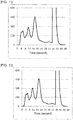
- Fig. 1 is an example of a chromatogram obtained when measurement is performed by cation exchange liquid chromatography using the reagent for measuring hemoglobins according to one embodiment of the present invention.
- Fig. 2 is an example of a chromatogram obtained when measurement is performed by cation exchange liquid chromatography using a conventional reagent for measuring hemoglobins (a conventional reagent for measuring hemoglobins including Component X).
- Figs. 1 and 2 are, for example, examples of chromatograms when measurement is performed under the measurement conditions used in Examples below.
- a component that is subject to the REACH regulation can be eliminated, and thus the influence on the environment can be reduced and the safety can be increased compared to the conventional reagent for measuring hemoglobins including Component X.
- the reagent for measuring hemoglobins according to the present invention can include the nonionic surfactant, can include the amphoteric surfactant, or can include both of the nonionic surfactant and the amphoteric surfactant.
- the reagent for measuring hemoglobins preferably includes a nonionic surfactant.
- the nonionic surfactant is any of Components A1 to A9. As the above-mentioned nonionic surfactant, only one of Components A1 to A9 can be used, or two or more can be used in combination.
- Component A1 is polyoxyethylene alkyl ether having an average number of moles of an oxyethylene group added of 8 or more and 20 or less, and a carbon number of an alkyl group of 12 or more and 17 or less.
- Component A1 is a component represented by the formula (1) below. As Component A1, only one type can be used, or two or more types can be used in combination. R-O(CH 2 CH 2 O) n H ... (1)
- R represents an alkyl group having 12 or more and 17 or less carbon atoms
- n represents a number of 8 or more and 20 or less.
- polyoxyethylene alkyl ether having an average number of moles of an oxyethylene group added of less than 8 and a carbon number of an alkyl group of less than 12 the surfactant is less likely to dissolve and a reagent for measuring hemoglobins may not be prepared.
- polyoxyethylene alkyl ether having an average number of moles of an oxyethylene group added of less than 8 and a carbon number of an alkyl group of less than 12 a good peak may not be obtained.
- polyoxyethylene alkyl ether having an average number of moles of an oxyethylene group added of more than 20 and a carbon number of an alkyl group of more than 17 a good peak may not be obtained or carryover may occur.
- the average number of moles of an oxyethylene group added in Component A1 is preferably 9 or more, more preferably 10 or more, further preferably 11 or more, and preferably 19 or less.
- the carbon number of the alkyl group of Component A1 is preferably 17 or less, more preferably 16 or less, and particularly preferably 12 or 16.
- Component A1 is polyoxyethylene lauryl ether
- Component A1 is polyoxyethylene cetyl ether.
- Component A1 is particularly preferably polyoxyethylene lauryl ether having an average number of moles of an oxyethylene group added of 8 or more and 20 or less, or polyoxyethylene cetyl ether having an average number of moles of an oxyethylene group added of 8 or more and 20 or less.
- the average number of moles of an oxyethylene group added in the polyoxyethylene lauryl ether is preferably 9 or more, more preferably 10 or more, further preferably 11 or more, and preferably 19 or less, more preferably 16 or less, further preferably 13 or less.
- the average number of moles of an oxyethylene group added in the polyoxyethylene lauryl ether is also preferably 9, 12, or 19, and most preferably 12.
- the solubility of the surfactant can be further increased, the hemolysis can be satisfactorily performed, hemoglobins can be measured with even higher accuracy, and the storage stability of the mixed solution obtained by mixing the reagent for measuring hemoglobins and the substance to be tested can be further increased.
- the average number of moles of an oxyethylene group added in the polyoxyethylene cetyl ether is preferably 10 or more, more preferably 12 or more, and preferably 19 or less, more preferably 16 or less, further preferably 14 or less.
- the average number of moles of an oxyethylene group added in the polyoxyethylene cetyl ether is also preferably 13 or 20, and most preferably 13.
- the solubility of the surfactant can be further increased, the hemolysis can be satisfactorily performed, hemoglobins can be measured with even higher accuracy, and the storage stability of the mixed solution obtained by mixing the reagent for measuring hemoglobins and the substance to be tested can be further increased.
- Component A1 is preferably polyoxyethylene lauryl ether having an average number of moles of an oxyethylene group added of 9, 12, or 19, or polyoxyethylene cetyl ether having an average number of moles of an oxyethylene group added of 13 or 20.
- Component A1 is most preferably polyoxyethylene lauryl ether having an average number of moles of an oxyethylene group added of 12, or polyoxyethylene cetyl ether having an average number of moles of an oxyethylene group added of 13.
- Component A1 is preferably polyoxyethylene alkyl ether having an average number of moles of an oxyethylene group added of 10 or more and 15 or less, and a carbon number of an alkyl group of 12 or more and 17 or less. That is, Component A1 is preferably Component A1'.
- the HLB (Hydrophilc Lipophilc Balance) value of Component A1 is preferably 10 or more, more preferably 12 or more, and preferably 18 or less, more preferably 16 or less.
- the HLB value is greater than or equal to the lower limit, generation of micelles can be suppressed, and column clogging can be effectively suppressed.
- the HLB value is less than or equal to the upper limit, the cell membrane of blood cell components can be sufficiently dissolved, and column clogging can be effectively suppressed.
- the HLB value of Component A1 and the HLB value of each component described later are the HLB value determined by Griffin method.
- the HLB value is 0 or more and 20 or less. The smaller the HLB value, the stronger the hydrophobicity (lipophilicity), and the larger the HLB value, the stronger the hydrophilicity.
- the clouding point of Component A1 is preferably 80°C or more, more preferably 90°C or more, and preferably 150°C or less, more preferably 120°C or less.
- the clouding point is greater than or equal to the lower limit and less than or equal to the upper limit, the solubility of the surfactant can be increased, and the reagent for measuring hemoglobins can be sufficiently prepared.
- the clouding point is the temperature at which a transparent or translucent liquid undergoes phase separation due to a temperature change, and as a result, the liquid becomes opaque.
- the clouding point is also generally referred to as the lower critical solution temperature.
- the content of Component A1 is preferably 0.01% by weight or more, more preferably 0.05% by weight or more, further preferably 0.08% by weight or more, particularly preferably 0.1% by weight or more in 100% by weight of the reagent for measuring hemoglobins.
- the content of Component A1 is preferably 1.0% by weight or less, more preferably 0.8% by weight or less, further preferably 0.6% by weight or less, particularly preferably 0.5% by weight or less in 100% by weight of the reagent for measuring hemoglobins.
- Examples of the commercially available product of Component A1 include "EMULGEN 109P” manufactured by Kao Corporation (polyoxyethylene lauryl ether having an average number of moles of an oxyethylene group added of 9, polyoxyethylene (9) lauryl ether), “EMULGEN 120” manufactured by Kao Corporation (polyoxyethylene lauryl ether having an average number of moles of an oxyethylene group added of 12, polyoxyethylene (12) lauryl ether), “EMULGEN 147” manufactured by Kao Corporation (polyoxyethylene lauryl ether having an average number of moles of an oxyethylene group added of 19, polyoxyethylene (19) lauryl ether), “EMULGEN 220” manufactured by Kao Corporation (polyoxyethylene cetyl ether having an average number of moles of an oxyethylene group added of 13, polyoxyethylene (13) cetyl ether), and “Brij (registered trademark) 58" manufactured by Sigma-Aldrich (polyoxyethylene cetyl ether having an average number of moles of an oxyethylene group added
- Component A2 is polyoxyethylene stearyl ether having an average number of moles of an oxyethylene group added of 40 or more and 60 or less.
- Component A2 is a component represented by the formula (2) below. As Component A2, only one type can be used, or two or more types can be used in combination. C 18 H 37 O(CH 2 CH 2 O) n H ... (2)
- n represents a number of 40 or more and 60 or less.
- polyoxyethylene stearyl ether having an average number of moles of an oxyethylene group added of less than 40 the surfactant is less likely to dissolve and a reagent for measuring hemoglobins may not be prepared.
- a good peak may not be obtained.
- polyoxyethylene stearyl ether having an average number of moles of an oxyethylene group added of more than 60 a good peak may not be obtained or carryover may occur.
- the average number of moles of an oxyethylene group added in Component A2 is preferably 45 or more, and preferably 55 or less. From the viewpoint of further increasing the solubility of the surfactant, and from the viewpoint of even more satisfactorily causing hemolysis and measuring hemoglobins with even higher accuracy, the average number of moles of an oxyethylene group added in Component A2 is most preferably 50.
- the HLB value of Component A2 is preferably 13 or more, more preferably 15 or more, and preferably 19 or less, more preferably 18 or less.
- the HLB value is greater than or equal to the lower limit, generation of micelles can be suppressed, and column clogging can be effectively suppressed.
- the HLB value is less than or equal to the upper limit, the cell membrane of blood cell components can be sufficiently dissolved, and column clogging can be effectively suppressed.
- the HLB value of Component A2 can be determined by the above-mentioned method.
- the clouding point of Component A2 is preferably 80°C or more, more preferably 90°C or more. When the clouding point is greater than or equal to the lower limit, the solubility of the surfactant can be increased, and the reagent for measuring hemoglobins can be sufficiently prepared.
- the content of Component A2 is preferably 0.01% by weight or more, more preferably 0.05% by weight or more, further preferably 0.08% by weight or more, particularly preferably 0.1% by weight or more in 100% by weight of the reagent for measuring hemoglobins.
- the content of Component A2 is preferably 1.0% by weight or less, more preferably 0.8% by weight or less, further preferably 0.6% by weight or less, particularly preferably 0.5% by weight or less in 100% by weight of the reagent for measuring hemoglobins.
- the content of Component A2 is greater than or equal to the lower limit and less than or equal to the upper limit, the effect of the present invention can be even more effectively exhibited.
- Examples of the commercially available product of Component A2 include "EMULGEN 350” manufactured by Kao Corporation (polyoxyethylene stearyl ether having an average number of moles of an oxyethylene group added of 50, polyoxyethylene (50) stearyl ether).
- Component A3 is polyoxyethylene oleyl ether having an average number of moles of an oxyethylene group added of 9 or more and 15 or less.
- Component A3 is a component represented by the formula (3) below. As Component A3, only one type can be used, or two or more types can be used in combination. C 18 H 35 O(CH 2 CH 2 O) n H ... (3)
- n represents a number of 9 or more and 15 or less.
- polyoxyethylene oleyl ether having an average number of moles of an oxyethylene group added of less than 9 the surfactant is less likely to dissolve and a reagent for measuring hemoglobins may not be prepared.
- a good peak may not be obtained.
- polyoxyethylene oleyl ether having an average number of moles of an oxyethylene group added of more than 15 a good peak may not be obtained or carryover may occur.
- the average number of moles of an oxyethylene group added in Component A3 is preferably 14 or less. From the viewpoint of further increasing the solubility of the surfactant, and from the viewpoint of even more satisfactorily causing hemolysis and measuring hemoglobins with even higher accuracy, the average number of moles of an oxyethylene group added in Component A3 is particularly preferably 9 or 13, most preferably 13.
- Component A3 is preferably polyoxyethylene oleyl ether having an average number of moles of an oxyethylene group added of 10 or more and 15 or less. That is, Component A3 is preferably Component A3'.
- the HLB value of Component A3 is preferably 10 or more, more preferably 12 or more, and preferably 17 or less, more preferably 15 or less.
- the HLB value is greater than or equal to the lower limit, generation of micelles can be suppressed, and column clogging can be effectively suppressed.
- the HLB value is less than or equal to the upper limit, the cell membrane of blood cell components can be sufficiently dissolved, and column clogging can be effectively suppressed.
- the HLB value of Component A3 can be determined by the above-mentioned method.
- the clouding point of Component A3 is preferably 50°C or more, more preferably 85°C or more, and preferably 100°C or less, more preferably 95°C or less.
- the clouding point is greater than or equal to the lower limit and less than or equal to the upper limit, the solubility of the surfactant can be increased, and the reagent for measuring hemoglobins can be sufficiently prepared.
- the content of Component A3 is preferably 0.01% by weight or more, more preferably 0.05% by weight or more, further preferably 0.08% by weight or more, particularly preferably 0.1% by weight or more in 100% by weight of the reagent for measuring hemoglobins.
- the content of Component A3 is preferably 1.0% by weight or less, more preferably 0.8% by weight or less, further preferably 0.6% by weight or less, particularly preferably 0.5% by weight or less in 100% by weight of the reagent for measuring hemoglobins.
- the content of Component A3 is greater than or equal to the lower limit and less than or equal to the upper limit, the effect of the present invention can be even more effectively exhibited.
- Examples of the commercially available product of Component A3 include "EMULGEN 409PV” manufactured by Kao Corporation (polyoxyethylene oleyl ether having an average number of moles of an oxyethylene group added of 9, polyoxyethylene (9) oleyl ether) and “EMULGEN 420” manufactured by Kao Corporation (polyoxyethylene oleyl ether having an average number of moles of an oxyethylene group added of 13, polyoxyethylene (13) oleyl ether).
- Component A4 is polyoxyethylene-sec-alkyl ether having an average number of moles of an oxyethylene group added of 6 or more and 10 or less, and a carbon number of an alkyl group of 11 or more and 15 or less.
- Component A4 is a component represented by the formula (4) below.
- Component A4 is an adduct of ethylene oxide and a secondary alcohol having 11 to 15 carbon atoms.
- Component A4 is different from Component A1.
- n represents a number of 6 or more and 10 or less.
- polyoxyethylene-sec-alkyl ether having an average number of moles of an oxyethylene group added of less than 6 and a carbon number of an alkyl group of 11 or more and 15 or less
- the surfactant is less likely to dissolve and a reagent for measuring hemoglobins may not be prepared.
- polyoxyethylene-sec-alkyl ether having an average number of moles of an oxyethylene group added of less than 6 and a carbon number of an alkyl group of 11 or more and 15 or less a good peak may not be obtained.
- the average number of moles of an oxyethylene group added in Component A4 is preferably 7 or more, preferably 9 or less, and more preferably 7 or 9.
- the HLB value of Component A4 is preferably 10 or more, more preferably 12 or more, and preferably 17 or less, more preferably 15 or less.
- the HLB value is greater than or equal to the lower limit, generation of micelles can be suppressed, and column clogging can be effectively suppressed.
- the HLB value is less than or equal to the upper limit, the cell membrane of blood cell components can be sufficiently dissolved, and column clogging can be effectively suppressed.
- the HLB value of Component A4 can be determined by the above-mentioned method.
- the clouding point of Component A4 is preferably 30°C or more, and preferably 60°C or less.
- the clouding point is greater than or equal to the lower limit and less than or equal to the upper limit, the solubility of the surfactant can be increased, and the reagent for measuring hemoglobins can be sufficiently prepared.
- the content of Component A4 is preferably 0.01% by weight or more, more preferably 0.05% by weight or more, further preferably 0.08% by weight or more, particularly preferably 0.1% by weight or more in 100% by weight of the reagent for measuring hemoglobins.
- the content of Component A4 is preferably 1.0% by weight or less, more preferably 0.8% by weight or less, further preferably 0.6% by weight or less, particularly preferably 0.5% by weight or less in 100% by weight of the reagent for measuring hemoglobins.
- the content of Component A4 is greater than or equal to the lower limit and less than or equal to the upper limit, the effect of the present invention can be even more effectively exhibited.
- Examples of the commercially available product of Component A4 include "EMULGEN 707” manufactured by Kao Corporation (polyoxyethylene-sec-alkyl ether having an average number of moles of an oxyethylene group added of 7 and a carbon number of an alkyl group of 11 or more and 15 or less) and “EMULGEN 709” manufactured by Kao Corporation (polyoxyethylene-sec-alkyl ether having an average number of moles of an oxyethylene group added of 9 and a carbon number of an alkyl group of 11 or more and 15 or less).
- Component A5 is polyoxyethylene tridecyl ether having an average number of moles of an oxyethylene group added of 15.
- Component A5 is a component represented by the formula (5) below. As Component A5, only one type can be used, or two or more types can be used in combination. C 13 H 27 O(CH 2 CH 2 O) 15 H ... (5)
- the content of Component A5 is preferably 0.01% by weight or more, more preferably 0.05% by weight or more, further preferably 0.08% by weight or more, particularly preferably 0.1% by weight or more in 100% by weight of the reagent for measuring hemoglobins.
- the content of Component A5 is preferably 1.0% by weight or less, more preferably 0.8% by weight or less, further preferably 0.6% by weight or less, particularly preferably 0.5% by weight or less in 100% by weight of the reagent for measuring hemoglobins.
- the content of Component A5 is greater than or equal to the lower limit and less than or equal to the upper limit, the effect of the present invention can be even more effectively exhibited.
- Examples of the commercially available product of Component A5 include "LEOCOL TD-150" manufactured by Lion Corporation.
- Component A6 is polyoxyethylene polyoxypropylene alkyl ether having an HLB value of 11 or more and 15 or less.
- the polyoxyethylene polyoxypropylene alkyl ether has an oxypropylene group and an oxyethylene group.
- Component A6 is a component represented by the formula (6) below. As Component A6, only one type can be used, or two or more types can be used in combination. R-(CH 2 CH(CH 3 )O) m (CH 2 CH 2 O) n H ... (6)
- R represents an alkyl group
- m represents a number of 1 or more
- n represents a number of 1 or more.
- the HLB value of Component A6 is preferably 11.5 or more, more preferably 12 or more, and preferably 14.5 or less.
- the HLB value is greater than or equal to the lower limit, generation of micelles can be suppressed, and column clogging can be effectively suppressed.
- the HLB value is less than or equal to the upper limit, the cell membrane of blood cell components can be sufficiently dissolved, and column clogging can be effectively suppressed.
- the HLB value of Component A6 is preferably 12.5, 12.7, or 14.0.
- the HLB value of Component A6 can be determined by the above-mentioned method.
- the clouding point of Component A6 is preferably 30°C or more, more preferably 50°C or more, and preferably 95°C or less, more preferably 90°C or less.
- the clouding point is greater than or equal to the lower limit and less than or equal to the upper limit, the solubility of the surfactant can be increased, and the reagent for measuring hemoglobins can be sufficiently prepared.
- the content of Component A6 is preferably 0.01% by weight or more, more preferably 0.05% by weight or more, further preferably 0.08% by weight or more, particularly preferably 0.1% by weight or more in 100% by weight of the reagent for measuring hemoglobins.
- the content of Component A6 is preferably 1.0% by weight or less, more preferably 0.8% by weight or less, further preferably 0.6% by weight or less, particularly preferably 0.5% by weight or less in 100% by weight of the reagent for measuring hemoglobins.
- the content of Component A6 is greater than or equal to the lower limit and less than or equal to the upper limit, the effect of the present invention can be even more effectively exhibited.
- Examples of the commercially available product of Component A6 include "EMULGEN LS-106" manufactured by Kao Corporation (polyoxyethylene polyoxypropylene alkyl ether having an HLB value of 12.5), “EMULGEN LS-114" manufactured by Kao Corporation (polyoxyethylene polyoxypropylene alkyl (C12 to 14) ether having an HLB value of 14.0), and “EMULGEN MS-110” manufactured by Kao Corporation (polyoxyethylene polyoxypropylene alkyl ether having an HLB value of 12.7).
- Component A7 is n-nonanoyl-N-methyl-D-glucamine.
- the content of Component A7 is preferably 0.01% by weight or more, more preferably 0.05% by weight or more, further preferably 0.08% by weight or more, particularly preferably 0.1% by weight or more in 100% by weight of the reagent for measuring hemoglobins.
- the content of Component A7 is preferably 1.0% by weight or less, more preferably 0.8% by weight or less, further preferably 0.6% by weight or less, particularly preferably 0.5% by weight or less in 100% by weight of the reagent for measuring hemoglobins.
- the content of Component A7 is greater than or equal to the lower limit and less than or equal to the upper limit, the effect of the present invention can be even more effectively exhibited.
- Examples of the commercially available product of Component A7 include "MEGA-9” manufactured by Dojindo Molecular Technologies, Inc.
- Component A8 is n-octyl- ⁇ -D-glucopyranoside.
- the content of Component A8 is preferably 0.01% by weight or more, more preferably 0.05% by weight or more, further preferably 0.08% by weight or more, particularly preferably 0.1% by weight or more in 100% by weight of the reagent for measuring hemoglobins.
- the content of Component A8 is preferably 1.0% by weight or less, more preferably 0.8% by weight or less, further preferably 0.6% by weight or less, particularly preferably 0.5% by weight or less in 100% by weight of the reagent for measuring hemoglobins.
- the content of Component A8 is greater than or equal to the lower limit and less than or equal to the upper limit, the effect of the present invention can be even more effectively exhibited.
- Examples of the commercially available product of Component A8 include "n-octyl- ⁇ -D-glucopyranoside" manufactured by Dojindo Molecular Technologies, Inc.
- Component A9 is saponin. As Component A9, only one type can be used, or two or more types can be used in combination.
- Component A9 is preferably soybean saponin, more preferably soybean saponin represented by the formula (9) below.
- the content of Component A9 is preferably 0.01% by weight or more, more preferably 0.05% by weight or more, further preferably 0.08% by weight or more, particularly preferably 0.1% by weight or more in 100% by weight of the reagent for measuring hemoglobins.
- the content of Component A9 is preferably 1.0% by weight or less, more preferably 0.8% by weight or less, further preferably 0.6% by weight or less, particularly preferably 0.5% by weight or less in 100% by weight of the reagent for measuring hemoglobins.
- the content of Component A9 is greater than or equal to the lower limit and less than or equal to the upper limit, the effect of the present invention can be even more effectively exhibited.
- Examples of the commercially available product of Component A9 include “Saponin” manufactured by NACALAI TESQUE, INC.
- the reagent for measuring hemoglobins preferably includes an amphoteric surfactant.
- the surfactant is any of Components B1 to B3. As the above-mentioned amphoteric surfactant, only one of Components B1 to B3 can be used, or two or more can be used in combination.
- Component B1 is 3-[(3-cholamidopropyl)dimethylammonio]propane sulfonate (CHAPS).
- the content of Component B1 is preferably 0.01% by weight or more, more preferably 0.05% by weight or more, further preferably 0.08% by weight or more, particularly preferably 0.1% by weight or more in 100% by weight of the reagent for measuring hemoglobins.
- the content of Component B1 is preferably 1.0% by weight or less, more preferably 0.8% by weight or less, further preferably 0.6% by weight or less, particularly preferably 0.5% by weight or less in 100% by weight of the reagent for measuring hemoglobins.
- the content of Component B1 is greater than or equal to the lower limit and less than or equal to the upper limit, the effect of the present invention can be even more effectively exhibited.
- Component B1 examples include "CHAPS” manufactured by Dojindo Molecular Technologies, Inc.
- Component B2 is 3-[(3-cholamidopropyl)dimethylammonio]-2-hydroxypropane sulfonate (CHAPSO).
- the content of Component B2 is preferably 0.01% by weight or more, more preferably 0.05% by weight or more, further preferably 0.08% by weight or more, particularly preferably 0.1% by weight or more in 100% by weight of the reagent for measuring hemoglobins.
- the content of Component B2 is preferably 1.0% by weight or less, more preferably 0.8% by weight or less, further preferably 0.6% by weight or less, particularly preferably 0.5% by weight or less in 100% by weight of the reagent for measuring hemoglobins.
- the content of Component B2 is greater than or equal to the lower limit and less than or equal to the upper limit, the effect of the present invention can be even more effectively exhibited.
- Component B2 examples include "CHAPSO” manufactured by Dojindo Molecular Technologies, Inc.
- Component B3 is lauryl dimethylamine oxide.
- the content of Component B3 is preferably 0.01% by weight or more, more preferably 0.05% by weight or more, further preferably 0.08% by weight or more, particularly preferably 0.1% by weight or more in 100% by weight of the reagent for measuring hemoglobins.
- the content of Component B3 is preferably 1.0% by weight or less, more preferably 0.8% by weight or less, further preferably 0.6% by weight or less, particularly preferably 0.5% by weight or less in 100% by weight of the reagent for measuring hemoglobins.
- the content of Component B3 is greater than or equal to the lower limit and less than or equal to the upper limit, the effect of the present invention can be even more effectively exhibited.
- Examples of the commercially available product of Component B3 include "AMPHITOL 20N” manufactured by Kao Corporation.
- the reagent for measuring hemoglobins preferably includes a buffering agent.
- a buffering agent By inclusion of the buffering agent, variation in pH can be suppressed.
- the buffering agent only one type can be used, or two or more types can be used in combination.
- buffering agent examples include phosphates such as sodium phosphate, disodium hydrogen phosphate, sodium dihydrogen phosphate, potassium phosphate, dipotassium hydrogen phosphate, and potassium dihydrogen phosphate, carbonates such as sodium carbonate and sodium hydrogen carbonate, borate such as sodium borate, and carboxylic acid, dicarboxylic acid, carboxylic acid derivative, hydroxycarboxylic acid, aniline, aniline derivative, amino acid, an amine compound, an imidazole compound, an alcohol compound, ethylenediaminetetraacetic acid, pyrophosphoric acid, pyridine, cacodylic acid, glycerol phosphate, 2,4,6-collidine, N-ethylmorpholine, morpholine, 4-aminopyridine, ammonia, ephedrine, hydroxyproline, piperidine, tris(hydroxymethyl)aminomethane, and glycylglycine.
- phosphates such as sodium phosphate, dis
- the buffering agent is preferably phosphate.
- the content of the buffering agent in the reagent for measuring hemoglobins is not particularly limited as long as buffer action is exhibited.
- the content of the buffering agent can be 0.01% by weight or more, can be 0.02% by weight or more, and can be 0.2% by weight or less, 0.1% by weight or less in 100% by weight of the reagent for measuring hemoglobins.
- the reagent for measuring hemoglobins preferably includes an inorganic salt.
- the inorganic salt By inclusion of the inorganic salt, the osmotic pressure can be satisfactorily adjusted.
- the inorganic salt only one type can be used, or two or more types can be used in combination.
- Examples of the inorganic salt include sodium chloride, potassium chloride, sodium sulfate, and potassium sulfate.
- the inorganic salt is preferably sodium chloride, potassium chloride, sodium sulfate, or potassium sulfate, and more preferably sodium chloride.
- the content of the inorganic salt in the reagent for measuring hemoglobins is not particularly limited.
- the content of the inorganic salt can be 0.1% by weight or more, and can be 1.0% by weight or less in 100% by weight of the reagent for measuring hemoglobins.
- the reagent for measuring hemoglobins preferably includes water.
- the content of water is preferably 80% by weight or more, more preferably 90% by weight or more, further preferably 95% by weight in 100% by weight of the reagent for measuring hemoglobins.
- the reagent for measuring hemoglobins can include other components other than the above-mentioned components.
- the other components include a preservative, a hemoglobin stabilizer, and a pH adjuster.
- a preservative e.g., a preservative for measuring hemoglobins
- a hemoglobin stabilizer e.g., a preservative for measuring hemoglobins
- a pH adjuster e.g., a preservative, a hemoglobin stabilizer, and a pH adjuster.
- the other components only one type can be used, or two or more types can be used in combination.
- Examples of the preservative include sodium azide, thymol, and sodium propionate.
- hemoglobin stabilizer examples include chelating agents such as ethylenediaminetetraacetic acid (EDTA), and glutathione.
- Examples of the pH adjuster include acids such as hydrochloric acid, phosphoric acid, nitric acid, and sulfuric acid, and bases such as sodium hydroxide, potassium hydroxide, lithium hydroxide, magnesium hydroxide, barium hydroxide, and calcium hydroxide.
- acids such as hydrochloric acid, phosphoric acid, nitric acid, and sulfuric acid
- bases such as sodium hydroxide, potassium hydroxide, lithium hydroxide, magnesium hydroxide, barium hydroxide, and calcium hydroxide.
- the reagent for measuring hemoglobins preferably includes the nonionic surfactant, more preferably includes, as the nonionic surfactant, Component A1, Component A2, Component A3, Component A4, Component A5, or Component A6, further preferably includes Component A1 or Component A3, and particularly preferably includes Component A1' or Component A3'.
- the effect of the present invention can be even more effectively exhibited.
- the storage stability of the mixed solution obtained by mixing the reagent for measuring hemoglobins and the substance to be tested can be further increased.
- the content of the nonionic surfactant (the total content of Components A1 to A9) is preferably 0.01% by weight or more, more preferably 0.05% by weight or more, further preferably 0.08% by weight or more, and particularly preferably 0.1% by weight or more in 100% by weight of the reagent for measuring hemoglobins.
- the content of the nonionic surfactant (the total content of Components A1 to A9) is preferably 1.0% by weight or less, more preferably 0.8% by weight or less, further preferably 0.6% by weight or less, particularly preferably 0.5% by weight or less in 100% by weight of the reagent for measuring hemoglobins.
- the content of the nonionic surfactant (the total content of Components A1 to A9) is greater than or equal to the lower limit and less than or equal to the upper limit, the effect of the present invention can be even more effectively exhibited.
- the storage stability of the mixed solution obtained by mixing the reagent for measuring hemoglobins and the substance to be tested can be further increased.
- the content of the amphoteric surfactant (the total content of Components B1 to B3) is preferably 0.01% by weight or more, more preferably 0.05% by weight or more, further preferably 0.08% by weight or more, and particularly preferably 0.1% by weight or more in 100% by weight of the reagent for measuring hemoglobins.
- the content of the amphoteric surfactant (the total content of Components B1 to B3) is preferably 1.0% by weight or less, more preferably 0.8% by weight or less, further preferably 0.6% by weight or less, particularly preferably 0.5% by weight or less in 100% by weight of the reagent for measuring hemoglobins.
- the reagent for measuring hemoglobins preferably does not include Component X.
- the effects of the present invention can be exhibited without including Component X.
- the storage stability of the mixed solution obtained by mixing the reagent for measuring hemoglobins and the substance to be tested can be increased without including Component X.
- the reagent for measuring hemoglobins can include Component X.
- the reagent for measuring hemoglobins can include Component X at a concentration not subject to the REACH regulation (the content of Component X of less than 0.1% by weight in 100% by weight of the reagent for measuring hemoglobins).
- the pH of the reagent for measuring hemoglobins is preferably 6.0 or more, more preferably 7.0 or more, and preferably 8.5 or less, more preferably 8.0 or less.
- pH is greater than or equal to the lower limit and less than or equal to the upper limit, hemolysis can be even more satisfactorily caused.
- the osmotic pressure of the reagent for measuring hemoglobins is preferably 50 mOsm or more, more preferably 75 mOsm or more, and preferably 200 mOsm or less, more preferably 150 mOsm or less.
- hemolysis can be even more satisfactorily caused.
- the osmotic pressure can be measured using an osmometer (for example, "Osmometer 3250" manufactured by Advanced Instruments, Inc.).
- the reagent for measuring hemoglobins is suitably used for hemolyzing erythrocyte.
- the reagent for measuring hemoglobins is preferably a hemolytic reagent.
- the reagent for measuring hemoglobins is suitably mixed with a substance to be tested and used.
- a substance to be tested examples include an erythrocyte-containing sample such as blood, a standard substance for hemoglobins, and a hemoglobin substance for measurement control.
- the reagent for measuring hemoglobins is suitably used as a diluting solution for dissolving or diluting a sample not containing erythrocyte and having a known hemoglobin concentration (a standard substance for hemoglobins, a hemoglobin substance for measurement control and the like). Further, the reagent for measuring hemoglobins is also suitably used as a washing liquid for a liquid chromatograph and a washing liquid for a column.
- the method for measuring hemoglobins includes the steps of: mixing an erythrocyte-containing sample and the reagent for measuring hemoglobins to obtain a mixed solution; and measuring the mixed solution by cation exchange liquid chromatography.
- the cation exchange liquid chromatography is preferably cation exchange high performance liquid chromatography.
- Examples of the erythrocyte-containing sample include blood.
- a mixed solution prepared from a sample not containing erythrocyte and having a known concentration of hemoglobins to be measured is also measured.
- the sample not containing erythrocyte and having a known concentration of hemoglobins to be measured include a standard substance for hemoglobins to be measured (hemoglobins to be measured having a known concentration), and a hemoglobin substance for measurement control to be measured (hemoglobins to be measured having a known concentration; multiple concentrations such as a low concentration, a medium concentration, and a high concentration are preferably measured).
- the standard substance for hemoglobins and the hemoglobin substance for measurement control are preferably a sample prepared at time of use, a freeze-dried sample, or a frozen sample.
- the standard substance for hemoglobins and the hemoglobin substance for measurement control are commercially available as a freeze-dried product or a frozen product.
- the concentration of hemoglobins is preferably determined, for example, as follows. (1) The erythrocyte-containing sample and the reagent for measuring hemoglobins are mixed to obtain a mixed solution. (2) The mixed solution is measured by cation exchange liquid chromatography. (3) The ratio of the peak area of hemoglobins to be measured to the total of the peak areas of hemoglobins (the peak area of hemoglobins to be measured/the total of the peak areas of hemoglobins) is taken as the hemoglobin value (the concentration of hemoglobins) to be measured.
- the ratio of the peak area of hemoglobin A1c to the total of the peak areas of hemoglobins is taken as the value of hemoglobin A1c.
- the concentration of hemoglobins can also be determined, for example, as follows. (1) The erythrocyte-containing sample and the reagent for measuring hemoglobins are mixed to obtain a first mixed solution. (2) A hemoglobin-containing sample having a known concentration of hemoglobins to be measured and the reagent for measuring hemoglobins are mixed to obtain a second mixed solution. (3) The first mixed solution and the second mixed solution are measured by cation exchange liquid chromatography.
- the measurement value obtained by measuring the mixed solution containing the hemoglobin-containing sample having a known concentration of hemoglobins to be measured by cation exchange liquid chromatography, and the measurement value obtained by measuring the mixed solution containing the erythrocyte-containing sample are compared to determine the concentration of hemoglobins in the erythrocyte-containing sample.
- the reagent for measuring hemoglobins is preferably mixed in an amount of preferably 25 mL or more, more preferably 50 mL or more, and preferably 400 mL or less, more preferably 200 mL or less relative to 1 mL of the erythrocyte-containing sample.
- measurement is preferably performed by a salt concentration gradient or a pH gradient.
- the gradient can be a linear gradient or a step gradient.
- Two or more eluents are preferably used in the gradient measurement.
- an eluent having a low salt concentration and an eluent having a high salt concentration for example, an eluent having an NaCl concentration of 50 mM and an eluent having an NaCl concentration of 200 mM
- an eluent having an NaCl concentration of 50 mM and an eluent having an NaCl concentration of 200 mM can be used.
- two types of eluents having different pHs for example, an eluent at pH 5.4 and an eluent at pH 8.0
- a commercially available product can also be used as the eluent.
- Examples of the commercially available product of the eluent include “Eluent 80A”, “Eluent 80B”, “Eluent 60A-VP/TP”, “Eluent 60B-VP/TP”, and “Eluent 60C-VP” manufactured by ARKRAY, Inc.
- the cation exchange column used in the cation exchange liquid chromatography a conventionally known cation exchange column can be used.
- the cation exchange column is preferably a column packed with a packing material having a cation exchange group such as a carboxyl group, a sulfonic acid group, or a phosphoric acid group.
- Examples of the commercially available product of the cation exchange column include "COLUMN UNIT 80" and "COLUMN UNIT HSVI-VP" manufactured by ARKRAY, Inc.
- Potassium dihydrogen phosphate, dipotassium hydrogen phosphate, sodium chloride, sodium azide, and water were mixed to obtain a first composition.
- Each surfactant shown in Tables 2 to 6 was added to the obtained first composition and the mixture was mixed to prepare a reagent for measuring hemoglobins.
- the composition of the obtained reagent for measuring hemoglobins is shown in Table 1 below.
- the type, the content, the HLB value, and the clouding point of the surfactant in Table 1 are shown in Tables 2 to 6.
- the HLB value of the surfactant is the value measured by the above-mentioned method.
- the solubility of the surfactant when the surfactant was added to the first composition and the mixture was mixed was visually checked.
- the solubility of the surfactant was judged based on the following criteria.
- Whole blood (erythrocyte-containing sample) contained in a blood collection tube (manufactured by SEKISUI MEDICAL CO., LTD.) was prepared.
- the obtained reagent for measuring hemoglobins (100 mL) was mixed with whole blood (1 mL) to obtain a mixed solution.
- the obtained mixed solution was measured under the following conditions.
- the reagent for measuring hemoglobins that had the judgement result of ⁇ in "(1) Solubility of surfactant" was not measured by cation exchange liquid chromatography.
- the measurement was performed by the measurement method installed in the HPLC instrument.
- the peak height of hemoglobin A1c obtained in Reference Example A was compared with the peak height of hemoglobin A1c obtained in Examples and Comparative Examples.
- the obtained peak height of hemoglobin A1c was decreased 50 or more based on absorbance compared with the peak height of hemoglobin A1c obtained in Reference Example A, the separation of the peak of hemoglobin A1c was judged to be good, and when it was decreased more than 50, it was judged to be bad.
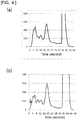
- FIG. 3(a) An example of a chromatogram judged to be good is shown in Fig. 3(a) , and an example of a chromatogram judged to be bad is shown in Fig. 3 (b) .
- Fig. 4(a) An example of a chromatogram judged to be good is shown in Fig. 4(a)
- Fig. 4(b) An example of a chromatogram judged to be bad is shown in Fig. 4(b) .
- the peak indicated by the arrow in Fig. 4(b) is the shoulder peak.
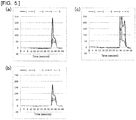
- the peak height of hemoglobin A0 obtained in Reference Example A was compared with the peak height of hemoglobin A0 obtained in Examples and Comparative Examples.
- the judgement of good was given, and when it was increased more than 100, the judgement of bad was given.
- FIG. 5(a) An example of the chromatogram obtained in Reference Example A is shown in Fig. 5(a) , an example of a chromatogram judged to be good is shown in Fig. 5(b) , and an example of a chromatogram judged to be bad is shown in Fig. 5(c) .
- the presence or absence of the peak of hemoglobin A1c was checked. When no peak of hemoglobin A1c was observed, the judgement of good was given, and when the peak of hemoglobin A1c was observed, the judgement of bad given.
- the presence or absence of the drift of the peak of hemoglobin A0 was checked. When no drift was observed, the judgement of good was given, and when the drift was observed, the judgement of bad was given.
- the pH of the reagent for measuring hemoglobins obtained in Reference Example A and Examples was measured using a pH meter ("F-52" manufactured by HORIBA, Ltd.).
- the osmotic pressure of the reagent for measuring hemoglobins obtained in Reference Example A and Examples was measured using an osmometer ("Osmometer 3250" manufactured by Advanced Instruments, Inc.).
- the reagents for measuring hemoglobins obtained in Examples 1 to 30 are capable of satisfactorily causing hemolysis and measuring hemoglobins with high accuracy.
- a reagent for measuring hemoglobins was prepared in the same manner as in Example 1 except that the compositions were changed to those shown in Table 7.
- the reagent for measuring hemoglobins obtained in Reference Example A and each reagent for measuring hemoglobins obtained in Examples 32, 34, 36 to 38 having a concentration of a surfactant of 0.5% by weight were respectively sealed in a glass vial and stored at 60°C for 7 days. After the storage, properties of the reagent for measuring hemoglobins were visually checked.
- a reagent for measuring hemoglobins is stored at room temperature.
- the reagent for measuring hemoglobins was stored and evaluated under a temperature condition severer than that in a normal storage condition.
- Whole blood (erythrocyte-containing sample) was prepared. Each reagent for measuring hemoglobins obtained in Reference Example A and Examples 31 to 36 was prepared. Whole blood was diluted 101-fold with the reagent for measuring hemoglobins to obtain a mixed solution. The obtained mixed solution was placed in a glass vial and stored at 4°C. Before the storage, and on the 1st day, the 2nd day, the 5th day, the 7th day, and the 9th day after the storage, the mixed solution was repeatedly measured 3 times under the measurement conditions described in "(2) Measurement by cation exchange liquid chromatography", and the value of hemoglobin A1c and the variation in the value of the hemoglobin A1c were determined from the average.
- Fig. 6(a) is a figure showing the relationship between the number of storage days and the value of hemoglobin A1c in a mixed solution with whole blood.
- Fig. 6(b) is a figure showing the relationship between the number of storage days and the variation in the value of hemoglobin A1c in a mixed solution with whole blood.
- a hemoglobin A1c substance for measurement control having a value of hemoglobin A1c of 5.8% (low concentration) (IRC-L) was prepared. Each reagent for measuring hemoglobins obtained in Reference Example A and Examples 31 to 36 was prepared. The hemoglobin A1c substance for measurement control (low concentration) (IRC-L) was diluted 101-fold with the reagent for measuring hemoglobins to obtain a mixed solution. The obtained mixed solution was placed in a glass vial and stored at 4°C.
- the mixed solution was repeatedly measured 3 times under the measurement conditions in "(2) Measurement by cation exchange liquid chromatography", and the value of hemoglobin A1c and the variation in the value of the hemoglobin A1c were determined from the average in the same manner as above.
- Fig. 7(a) is a figure showing the relationship between the number of storage days and the value of hemoglobin A1c in a mixed solution with a hemoglobin A1c substance for measurement control (low concentration) (IRC-L).
- Fig. 7(b) is a figure showing the relationship between the number of storage days and the variation in the value of hemoglobin A1c in a mixed solution with a hemoglobin A1c substance for measurement control (low concentration) (IRC-L) .
- hemoglobin A1c and the variation in the value of hemoglobin A1c were determined in the same manner as in "(6-2) Storage stability of mixed solution with hemoglobin A1c substance for measurement control (low concentration) (IRC-L)" except that the hemoglobin A1c substance for measurement control (low concentration) (IRC-L) was changed to the hemoglobin A1c substance for measurement control having a value of hemoglobin A1c of 10.4% (high concentration) (IRC-H).
- Fig. 8(a) is a figure showing the relationship between the number of storage days and the value of hemoglobin A1c in a mixed solution with a hemoglobin A1c substance for measurement control (high concentration) (IRC-H).
- Fig. 8(b) is a figure showing the relationship between the number of storage days and the variation in the value of hemoglobin A1c in a mixed solution with a hemoglobin A1c substance for measurement control (high concentration) (IRC-H).
- Each reagent for measuring hemoglobins obtained in Examples 31 to 36 successfully increased its storage stability compared with each reagent for measuring hemoglobins obtained in Examples 37 and 38.
- Each reagent for measuring hemoglobins obtained in Examples 31 to 36 also successfully increased the storage stability of a mixed solution obtained by mixing the reagent and the substance to be tested.
- Each reagent for measuring hemoglobins obtained in Examples 31 to 36 can measure hemoglobins with high accuracy even after the mixed solution obtained by mixing the reagent for measuring hemoglobins and the substance to be tested is stored for a long time.
- the obtained Liquid (2) was measured 3 times. Then, every time the obtained Liquid (1) was passed through the column multiple times (tens of times to 200 times), Liquid (2) was measured 3 times. Liquid (1) and Liquid (2) were repeatedly measured according to the above procedure until the number of samples loaded on the column reached about 3000.
- the measurement was performed by the measurement method installed in the HPLC instrument.
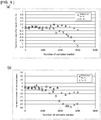
- Fig. 9(a) is a figure showing the relationship between the number of samples loaded on the column and the variation in the value of hemoglobin Ale.
- Fig. 9(b) is a figure showing the relationship between the number of samples loaded on the column and the variation in the number of theoretical plates.
- the vertical axis shows the difference between the value of hemoglobin A1c in Liquid (2) measured first and the value of hemoglobin A1c in Liquid (2) measured at each number of samples loaded (value of hemoglobin A1c in Liquid (2) measured first - value of hemoglobin A1c in Liquid (2) measured at each number of samples loaded).
- the vertical axis shows the difference between the number of theoretical plates in Liquid (2) measured first and the number of theoretical plates in Liquid (2) measured at each number of samples loaded (number of theoretical plates in Liquid (2) measured first - number of theoretical plates in Liquid (2) measured at each number of samples loaded).
- the reagent for measuring hemoglobins obtained in Example 32 was superior to the reagent for measuring hemoglobins obtained in Reference Example A in column durability.
Landscapes
- Health & Medical Sciences (AREA)
- Life Sciences & Earth Sciences (AREA)
- Immunology (AREA)
- Hematology (AREA)
- Engineering & Computer Science (AREA)
- Chemical & Material Sciences (AREA)
- Analytical Chemistry (AREA)
- Biochemistry (AREA)
- Pathology (AREA)
- Molecular Biology (AREA)
- Urology & Nephrology (AREA)
- General Physics & Mathematics (AREA)
- General Health & Medical Sciences (AREA)
- Biomedical Technology (AREA)
- Physics & Mathematics (AREA)
- Medicinal Chemistry (AREA)
- Cell Biology (AREA)
- Food Science & Technology (AREA)
- Biotechnology (AREA)
- Microbiology (AREA)
- Investigating Or Analysing Biological Materials (AREA)
Abstract
Description
- The present invention relates to a reagent for measuring hemoglobins including a surfactant. The present invention also relates to a method for measuring hemoglobins using the reagent for measuring hemoglobins.
- Conventionally, the concentration of hemoglobins is measured for the diagnosis of diabetes, hemoglobinopathy and the like. For example, the concentration of hemoglobins including normal hemoglobins such as hemoglobin A1a, hemoglobin A1b, hemoglobin F, hemoglobin A1c, hemoglobin A0, and hemoglobin A2, modified hemoglobins such as acetylated hemoglobin and carbamylated hemoglobin, and abnormal hemoglobins such as hemoglobin S and hemoglobin C is measured. Among these hemoglobins, in particular, the value of hemoglobin A1c is measured. Examples of the method for measuring the concentration of hemoglobins mainly includes a liquid chromatography method.
- In the liquid chromatography method, a hemolytic reagent is added to a sample such as blood, the sample after hemolysis is measured by cation exchange liquid chromatography, and the peak of the obtained chromatogram is arithmetically processed to determine the concentration of hemoglobins such as the value of hemoglobin A1c. Conventionally, as a hemolytic reagent, a composition containing polyoxyethylene octyl phenyl ether having an average number of moles of an oxyethylene group added of 10 (for example, trade name "Triton X-100") is used.
-
Patent Document 1 below discloses a method for separating hemoglobin A1c for separating hemoglobin A1c in a sample of human blood from other glycosylated and non-glycosylated hemoglobins and a Schiff base of a precursor of hemoglobin A1c. In Example ofPatent Document 1, a hemolytic reagent containing 0.33% by weight of Triton X-100 is used. -
Patent Document 2 below discloses a hemolytic reagent used for hemolyzing a blood sample in a method for measuring hemoglobins by cation exchange liquid chromatography. The hemolytic reagent contains chaotropic ions. In Example ofPatent Document 2, a hemolytic reagent containing 0.1% by weight of Triton X-100 is used. -
- Patent Document 1:
JP S58-191968 A - Patent Document 2:
JP 2001-021555 A - Hemolytic reagents (reagents for measuring hemoglobins) including polyoxyethylene octyl phenyl ether having an average number of moles of an oxyethylene group added of 10 as described in
Patent Documents - Hemolytic reagents including polyoxyethylene octyl phenyl ether having an average number of moles of an oxyethylene group added of 10 cause less carryover in measurement by cation exchange liquid chromatography. Thus, even when a large number of samples are continuously measured, hemoglobins can be measured with high accuracy.
- Meanwhile, in Europe, the REACH regulation (Registration, Evaluation, Authorization and Restriction of Chemicals) has come into effect in 2007, and the use of specific chemicals have been limited. In 2017, products containing 0.1% by weight or more of polyoxyethylene octyl phenyl ether having an average number of moles of an oxyethylene group added of 10 have become subject to the REACH regulation. Also, in countries other than Europe, reduction of the amount of polyoxyethylene octyl phenyl ether having an average number of moles of an oxyethylene group added of 10 used contributes to the reduction of the environmental load and the improvement of the safety of a human body.
- An object of the present invention is to provide a reagent for measuring hemoglobins capable of satisfactorily causing hemolysis and measuring hemoglobins with high accuracy. More specifically, an object of the present invention is to provide a reagent for measuring hemoglobins capable of, without including polyoxyethylene octyl phenyl ether having an average number of moles of an oxyethylene group added of 10, causing hemolysis at a level equivalent to that of a reagent for measuring hemoglobins containing the component, and measuring hemoglobins with equivalent accuracy.
- Another object of the present invention is to provide a method for measuring hemoglobins using the reagent for measuring hemoglobins.
- According to a broad aspect of the present invention, there is provided a reagent for measuring hemoglobins used for measuring hemoglobins by cation exchange liquid chromatography, including: a nonionic surfactant or an amphoteric surfactant, the nonionic surfactant being Component A1 below, Component A2 below, Component A3 below, Component A4 below, Component A5 below, Component A6 below, Component A7 below, Component A8 below, or Component A9 below, and the amphoteric surfactant being Component B1 below, Component B2 below, or Component B3 below.
- Component A1: Polyoxyethylene alkyl ether having an average number of moles of an oxyethylene group added of 8 or more and 20 or less, and a carbon number of an alkyl group of 12 or more and 17 or less
- Component A2: Polyoxyethylene stearyl ether having an average number of moles of an oxyethylene group added of 40 or more and 60 or less
- Component A3: Polyoxyethylene oleyl ether having an average number of moles of an oxyethylene group added of 9 or more and 15 or less
- Component A4: Polyoxyethylene-sec-alkyl ether having an average number of moles of an oxyethylene group added of 6 or more and 10 or less, and a carbon number of an alkyl group of 11 or more and 15 or less
- Component A5: Polyoxyethylene tridecyl ether having an average number of moles of an oxyethylene group added of 15
- Component A6: Polyoxyethylene polyoxypropylene alkyl ether having an HLB value of 11 or more and 15 or less
- Component A7: n-nonanoyl-N-methyl-D-glucamine
- Component A8: n-octyl-β-D-glucopyranoside
- Component A9: Saponin
- Component B1: 3-[(3-cholamidopropyl)dimethylammonio]propane sulfonate
- Component B2: 3-[(3-cholamidopropyl)dimethylammonio]-2-hydroxypropane sulfonate
- Component B3: Lauryl dimethylamine oxide
- In a particular aspect of the reagent for measuring hemoglobins according to the present invention, the reagent for measuring hemoglobins includes the nonionic surfactant, the nonionic surfactant includes the Component A1, the Component A2, the Component A3, the Component A4, the Component A5, or the Component A6, the Component A1 is polyoxyethylene lauryl ether having an average number of moles of an oxyethylene group added of 9, 12, or 19, or polyoxyethylene cetyl ether having an average number of moles of an oxyethylene group added of 13 or 20, the Component A2 is polyoxyethylene stearyl ether having an average number of moles of an oxyethylene group added of 50, the Component A3 is polyoxyethylene oleyl ether having an average number of moles of an oxyethylene group added of 9 or 13, the Component A4 is polyoxyethylene-sec-alkyl ether having an average number of moles of an oxyethylene group added of 7 or 9 and a carbon number of an alkyl group of 11 or more and 15 or less, and the Component A6 is polyoxyethylene polyoxypropylene alkyl ether having an HLB value of 12.5, 12.7, or 14.0.
- In a particular aspect of the reagent for measuring hemoglobins according to the present invention, the reagent for measuring hemoglobins includes the nonionic surfactant, the nonionic surfactant includes the Component A1 or the Component A3, the Component A1 is polyoxyethylene alkyl ether having an average number of moles of an oxyethylene group added of 10 or more and 15 or less, and a carbon number of an alkyl group of 12 or more and 17 or less, and the Component A3 is polyoxyethylene oleyl ether having an average number of moles of an oxyethylene group added of 10 or more and 15 or less.
- In a particular aspect of the reagent for measuring hemoglobins according to the present invention, the Component A1 is polyoxyethylene lauryl ether having an average number of moles of an oxyethylene group added of 12, or polyoxyethylene cetyl ether having an average number of moles of an oxyethylene group added of 13, and the Component A3 is polyoxyethylene oleyl ether having an average number of moles of an oxyethylene group added of 13.
- In a particular aspect of the reagent for measuring hemoglobins according to the present invention, the reagent for measuring hemoglobins includes the nonionic surfactant, and the reagent for measuring hemoglobins has a content of the nonionic surfactant of 0.01% by weight or more and 1.0% by weight or less.
- In a particular aspect of the reagent for measuring hemoglobins according to the present invention, the reagent for measuring hemoglobins includes the amphoteric surfactant, and the reagent for measuring hemoglobins has a content of the amphoteric surfactant of 0.01% by weight or more and 1.0% by weight or less.
- According to a broad aspect of the present invention, there is provided a method for measuring hemoglobins, including the steps of: mixing an erythrocyte-containing sample and the reagent for measuring hemoglobins to obtain a mixed solution; and measuring the mixed solution by cation exchange liquid chromatography.
- The reagent for measuring hemoglobins according to the present invention is used for measuring hemoglobins by cation exchange liquid chromatography. The reagent for measuring hemoglobins according to the present invention includes a nonionic surfactant or an amphoteric surfactant. In the reagent for measuring hemoglobins according to the present invention, the nonionic surfactant is any of Components A1 to A9 below, or the amphoteric surfactant is any of Components B1 to B3 below. Component A1: Polyoxyethylene alkyl ether having an average number of moles of an oxyethylene group added of 8 or more and 20 or less, and a carbon number of an alkyl group of 12 or more and 17 or less. Component A2: Polyoxyethylene stearyl ether having an average number of moles of an oxyethylene group added of 40 or more and 60 or less. Component A3: Polyoxyethylene oleyl ether having an average number of moles of an oxyethylene group added of 9 or more and 15 or less. Component A4: Polyoxyethylene-sec-alkyl ether having an average number of moles of an oxyethylene group added of 6 or more and 10 or less, and a carbon number of an alkyl group of 11 or more and 15 or less. Component A5: Polyoxyethylene tridecyl ether having an average number of moles of an oxyethylene group added of 15. Component A6: Polyoxyethylene polyoxypropylene alkyl ether having an HLB value of 11 or more and 15 or less. Component A7: n-nonanoyl-N-methyl-D-glucamine. Component A8: n-octyl-β-D-glucopyranoside. Component A9: Saponin. Component B1: 3-[(3-cholamidopropyl)dimethylammonio]propane sulfonate. Component B2: 3-[(3-cholamidopropyl)dimethylammonio]-2-hydroxypropane sulfonate. Component B3: Lauryl dimethylamine oxide. The reagent for measuring hemoglobins according to the present invention has the above-mentioned configuration, and thus is capable of satisfactorily causing hemolysis and measuring hemoglobins with high accuracy.
-
- [
Fig. 1] Fig. 1 is an example of a chromatogram obtained when measurement is performed by cation exchange liquid chromatography using the reagent for measuring hemoglobins according to one embodiment of the present invention. - [
Fig. 2] Fig. 2 is an example of a chromatogram obtained when measurement is performed by cation exchange liquid chromatography using a conventional reagent for measuring hemoglobins. - [
Fig. 3] Figs. 3(a) and 3(b) are examples of chromatograms for evaluating the shape of the peak of hemoglobin A0. - [
Fig. 4] Figs. 4(a) and 4(b) are examples of chromatograms for evaluating the peak shape of the first fraction. - [
Fig. 5] Figs. 5(a) to 5(c) are examples of chromatograms for evaluating the height of the peak of hemoglobin A0. - [
Fig. 6] Figs. 6 (a) and 6(b) are figures showing the relationship between the number of storage days and the value of hemoglobin A1c, and the relationship between the number of storage days and the variation in the value of hemoglobin A1c in a mixed solution of a reagent for measuring hemoglobins and whole blood. - [
Fig. 7] Figs. 7(a) and 7(b) are figures showing the relationship between the number of storage days and the value of hemoglobin A1c, and the relationship between the number of storage days and the variation in the value of hemoglobin A1c in a mixed solution of a reagent for measuring hemoglobins and a hemoglobin A1c substance for measurement control (low concentration) (IRC-L). - [
Fig. 8] Figs. 8(a) and 8(b) are figures showing the relationship between the number of storage days and the value of hemoglobin A1c, and the relationship between the number of storage days and the variation in the value of hemoglobin A1c in a mixed solution of a reagent for measuring hemoglobins and a hemoglobin A1c substance for measurement control (high concentration) (IRC-H). - [
Fig. 9] Figs. 9(a) and 9(b) are figures showing column durability in a mixed solution of a reagent for measuring hemoglobins and a hemoglobin A1c substance for measurement control (high concentration) (IRC-H). - Hereinafter, the present invention will be described in detail.
- The reagent for measuring hemoglobins according to the present invention is used for measuring hemoglobins by cation exchange liquid chromatography. The reagent for measuring hemoglobins according to the present invention includes a nonionic surfactant or an amphoteric surfactant.
- In the reagent for measuring hemoglobins according to the present invention, the nonionic surfactant is polyoxyethylene alkyl ether having an average number of moles of an oxyethylene group added of 8 or more and 20 or less, and a carbon number of an alkyl group of 12 or more and 17 or less, polyoxyethylene stearyl ether having an average number of moles of an oxyethylene group added of 40 or more and 60 or less, polyoxyethylene oleyl ether having an average number of moles of an oxyethylene group added of 9 or more and 15 or less, polyoxyethylene-sec-alkyl ether having an average number of moles of an oxyethylene group added of 6 or more and 10 or less, and a carbon number of an alkyl group of 11 or more and 15 or less, polyoxyethylene tridecyl ether having an average number of moles of an oxyethylene group added of 15, polyoxyethylene polyoxypropylene alkyl ether having an HLB value of 11 or more and 15 or less, n-nonanoyl-N-methyl-D-glucamine, n-octyl-β-D-glucopyranoside, or saponin.
- In the reagent for measuring hemoglobins according to the present invention, the amphoteric surfactant is 3-[(3-cholamidopropyl)dimethylammonio]propane sulfonate, 3-[(3-cholamidopropyl)dimethylammonio]-2-hydroxypropane sulfonate, or lauryl dimethylamine oxide.
- In the present specification, "Polyoxyethylene alkyl ether having an average number of moles of an oxyethylene group added of 8 or more and 20 or less, and a carbon number of an alkyl group of 12 or more and 17 or less" may be referred to as "Component A1".
- In the present specification, for Component A1, "polyoxyethylene alkyl ether having an average number of moles of an oxyethylene group added of 10 or more and 15 or less, and a carbon number of an alkyl group of 12 or more and 17 or less" may be referred to as "Component A1'".
- In the present specification, "Polyoxyethylene stearyl ether having an average number of moles of an oxyethylene group added of 40 or more and 60 or less" may be referred to as "Component A2".
- In the present specification, "Polyoxyethylene oleyl ether having an average number of moles of an oxyethylene group added of 9 or more and 15 or less" may be referred to as "Component A3".
- In the present specification, for Component A3, "Polyoxyethylene oleyl ether having an average number of moles of an oxyethylene group added of 10 or more and 15 or less" may be referred to as "Component A3'".
- In the present specification, "Polyoxyethylene-sec-alkyl ether having an average number of moles of an oxyethylene group added of 6 or more and 10 or less, and a carbon number of an alkyl group of 11 or more and 15 or less" may be referred to as "Component A4".
- In the present specification, "Polyoxyethylene tridecyl ether having an average number of moles of an oxyethylene group added of 15" may be referred to as "Component A5".
- In the present specification, "Polyoxyethylene polyoxypropylene alkyl ether having an HLB value of 11 or more and 15 or less" may be referred to as "Component A6".
- In the present specification, "n-nonanoyl-N-methyl-D-glucamine" may be referred to as "Component A7".
- In the present specification, "n-octyl-β-D-glucopyranoside" may be referred to as "Component A8".
- In the present specification, "Saponin" may be referred to as "Component A9".
- In the present specification, "3-[(3-cholamidopropyl)dimethylammonio]propane sulfonate" may be referred to as "Component B1".
- In the present specification, "3-[(3-cholamidopropyl)dimethylammonio]-2-hydroxypropane sulfonate" may be referred to as "Component B2".
- In the present specification, "Lauryl dimethylamine oxide" may be referred to as "Component B3".
- In the present specification, "Polyoxyethylene octyl phenyl ether having an average number of moles of an oxyethylene group added of 10" may be referred to as "Component X".
- The reagent for measuring hemoglobins according to the present invention includes a nonionic surfactant or an amphoteric surfactant, and the nonionic surfactant is Component A1, Component A2, Component A3, Component A4, Component A5, Component A6, Component A7, Component A8, or Component A9, or the amphoteric surfactant is Component B1, Component B2, or Component B3.
- The reagent for measuring hemoglobins according to the present invention has the above-mentioned configuration, and thus is capable of satisfactorily causing hemolysis and measuring hemoglobins with high accuracy.
- A conventional reagent for measuring hemoglobins including Component X is capable of satisfactorily causing hemolysis and measuring hemoglobins with high accuracy. On the other hand, a reagent for measuring hemoglobins not including Component X is not capable of satisfactorily causing hemolysis and measuring hemoglobins with high accuracy.
- In contrast, the reagent for measuring hemoglobins according to the present invention has the above-mentioned configuration, and thus is capable of, without including Component X, causing hemolysis at a level equivalent to that of a reagent for measuring hemoglobins including Component X, and measuring hemoglobins with equivalent accuracy.
- The reagent for measuring hemoglobins according to the present invention is capable of satisfactorily causing hemolysis, and thus the peak of hemoglobins can be satisfactorily obtained when measurement is performed by cation exchange liquid chromatography. In addition, a shoulder peak and a split peak are less likely to occur in all the obtained peaks. Thus, hemoglobins can be measured with high accuracy. With the reagent for measuring hemoglobins according to the present invention, carryover can be reduced. Thus, even when a large number of samples are continuously measured, hemoglobins can be measured with high accuracy.
- At a test center, after a hemolytic reagent (a reagent for measuring hemoglobins) and a substance to be tested are mixed, the mixed solution may be stored for a certain period (for example, several days) before the mixed solution is measured by cation exchange chromatography. The reagent for measuring hemoglobins according to the present invention can increase the storage stability of a mixed solution obtained by mixing the reagent and the substance to be tested. The substance to be tested includes, in addition to an erythrocyte-containing sample such as blood (for example, blood of a subject), a hemoglobin-containing sample without an erythrocyte (for example, a standard substance for hemoglobins and a hemoglobin substance for measurement control). With the reagent for measuring hemoglobins according to the present invention, even when the mixed solution is stored for a certain period of time, the peak shape of hemoglobins is less likely to change before and after storage, and the measurement value is less likely to vary.
- Particularly, when the reagent for measuring hemoglobins according to the present invention includes Component A1' or Component A3', the storage stability of the mixed solution obtained by mixing the reagent for measuring hemoglobins and the substance to be tested can be further increased, and the storage stability of the reagent for measuring hemoglobins can also be increased.
- The reagent for measuring hemoglobins according to the present invention is used for measuring hemoglobins by cation exchange liquid chromatography. The reagent for measuring hemoglobins is preferably used for measuring hemoglobins by cation exchange high performance liquid chromatography.
- Examples of the hemoglobins include normal hemoglobins such as hemoglobin A1a, hemoglobin A1b, hemoglobin F, hemoglobin A1c, hemoglobin A0, and hemoglobin A2, modified hemoglobins such as acetylated hemoglobin and carbamylated hemoglobin, and abnormal hemoglobins such as hemoglobin S and hemoglobin C.
- The reagent for measuring hemoglobins according to the present invention is suitably used for measuring the value of the hemoglobin A1c (the concentration of hemoglobin A1c).
-
Fig. 1 is an example of a chromatogram obtained when measurement is performed by cation exchange liquid chromatography using the reagent for measuring hemoglobins according to one embodiment of the present invention. -
Fig. 2 is an example of a chromatogram obtained when measurement is performed by cation exchange liquid chromatography using a conventional reagent for measuring hemoglobins (a conventional reagent for measuring hemoglobins including Component X). - In
Figs. 1 and 2 , the peak detected at about 19 seconds is the peak of hemoglobin A1c, and the peak detected at about 40 seconds is the peak of hemoglobin A0.Figs. 1 and 2 are, for example, examples of chromatograms when measurement is performed under the measurement conditions used in Examples below. - With the reagent for measuring hemoglobins according to the present invention, a peak shape equivalent to that of a conventional reagent for measuring hemoglobins including Component X can be obtained.
- With the reagent for measuring hemoglobins according to the present invention, a component that is subject to the REACH regulation can be eliminated, and thus the influence on the environment can be reduced and the safety can be increased compared to the conventional reagent for measuring hemoglobins including Component X.
- The reagent for measuring hemoglobins according to the present invention can include the nonionic surfactant, can include the amphoteric surfactant, or can include both of the nonionic surfactant and the amphoteric surfactant.
- The reagent for measuring hemoglobins preferably includes a nonionic surfactant. The nonionic surfactant is any of Components A1 to A9. As the above-mentioned nonionic surfactant, only one of Components A1 to A9 can be used, or two or more can be used in combination.
- Component A1 is polyoxyethylene alkyl ether having an average number of moles of an oxyethylene group added of 8 or more and 20 or less, and a carbon number of an alkyl group of 12 or more and 17 or less. Component A1 is a component represented by the formula (1) below. As Component A1, only one type can be used, or two or more types can be used in combination.
R-O(CH2CH2O)nH ... (1)
- In the formula (1) above, R represents an alkyl group having 12 or more and 17 or less carbon atoms, and n represents a number of 8 or more and 20 or less.
- In the case of polyoxyethylene alkyl ether having an average number of moles of an oxyethylene group added of less than 8 and a carbon number of an alkyl group of less than 12, the surfactant is less likely to dissolve and a reagent for measuring hemoglobins may not be prepared. In the case of polyoxyethylene alkyl ether having an average number of moles of an oxyethylene group added of less than 8 and a carbon number of an alkyl group of less than 12, a good peak may not be obtained. In the case of polyoxyethylene alkyl ether having an average number of moles of an oxyethylene group added of more than 20 and a carbon number of an alkyl group of more than 17, a good peak may not be obtained or carryover may occur.
- From the viewpoint of increasing the solubility of the surfactant, and from the viewpoint of satisfactorily causing hemolysis and measuring hemoglobins with high accuracy, the average number of moles of an oxyethylene group added in Component A1 is preferably 9 or more, more preferably 10 or more, further preferably 11 or more, and preferably 19 or less.
- From the viewpoint of effectively exhibiting the effect of the present invention, and from the viewpoint of increasing the storage stability of the mixed solution obtained by mixing the reagent for measuring hemoglobins and the substance to be tested, the carbon number of the alkyl group of Component A1 is preferably 17 or less, more preferably 16 or less, and particularly preferably 12 or 16. When the carbon number of the alkyl group is 12, Component A1 is polyoxyethylene lauryl ether, and when the carbon number of the alkyl group is 16, Component A1 is polyoxyethylene cetyl ether.
- Thus, Component A1 is particularly preferably polyoxyethylene lauryl ether having an average number of moles of an oxyethylene group added of 8 or more and 20 or less, or polyoxyethylene cetyl ether having an average number of moles of an oxyethylene group added of 8 or more and 20 or less.
- When Component A1 is polyoxyethylene lauryl ether, the average number of moles of an oxyethylene group added in the polyoxyethylene lauryl ether is preferably 9 or more, more preferably 10 or more, further preferably 11 or more, and preferably 19 or less, more preferably 16 or less, further preferably 13 or less. The average number of moles of an oxyethylene group added in the polyoxyethylene lauryl ether is also preferably 9, 12, or 19, and most preferably 12. When the average number of moles of an oxyethylene group added is in the above-mentioned preferred range or value, the solubility of the surfactant can be further increased, the hemolysis can be satisfactorily performed, hemoglobins can be measured with even higher accuracy, and the storage stability of the mixed solution obtained by mixing the reagent for measuring hemoglobins and the substance to be tested can be further increased.
- When Component A1 is polyoxyethylene cetyl ether, the average number of moles of an oxyethylene group added in the polyoxyethylene cetyl ether is preferably 10 or more, more preferably 12 or more, and preferably 19 or less, more preferably 16 or less, further preferably 14 or less. The average number of moles of an oxyethylene group added in the polyoxyethylene cetyl ether is also preferably 13 or 20, and most preferably 13. When the average number of moles of an oxyethylene group added is in the above-mentioned preferred range or value, the solubility of the surfactant can be further increased, the hemolysis can be satisfactorily performed, hemoglobins can be measured with even higher accuracy, and the storage stability of the mixed solution obtained by mixing the reagent for measuring hemoglobins and the substance to be tested can be further increased.
- Thus, Component A1 is preferably polyoxyethylene lauryl ether having an average number of moles of an oxyethylene group added of 9, 12, or 19, or polyoxyethylene cetyl ether having an average number of moles of an oxyethylene group added of 13 or 20. Component A1 is most preferably polyoxyethylene lauryl ether having an average number of moles of an oxyethylene group added of 12, or polyoxyethylene cetyl ether having an average number of moles of an oxyethylene group added of 13.
- From the viewpoint of effectively exhibiting the effect of the present invention, and from the viewpoint of increasing the storage stability of the reagent for measuring hemoglobins and the storage stability of the mixed solution obtained by mixing the reagent and the substance to be tested, Component A1 is preferably polyoxyethylene alkyl ether having an average number of moles of an oxyethylene group added of 10 or more and 15 or less, and a carbon number of an alkyl group of 12 or more and 17 or less. That is, Component A1 is preferably Component A1'.
- The HLB (Hydrophilc Lipophilc Balance) value of Component A1 is preferably 10 or more, more preferably 12 or more, and preferably 18 or less, more preferably 16 or less. When the HLB value is greater than or equal to the lower limit, generation of micelles can be suppressed, and column clogging can be effectively suppressed. When the HLB value is less than or equal to the upper limit, the cell membrane of blood cell components can be sufficiently dissolved, and column clogging can be effectively suppressed.
- The HLB value of Component A1 and the HLB value of each component described later are the HLB value determined by Griffin method. The HLB value is 0 or more and 20 or less. The smaller the HLB value, the stronger the hydrophobicity (lipophilicity), and the larger the HLB value, the stronger the hydrophilicity. The HLB value determined by Griffin method is calculated by the following formula.

- The clouding point of Component A1 is preferably 80°C or more, more preferably 90°C or more, and preferably 150°C or less, more preferably 120°C or less. When the clouding point is greater than or equal to the lower limit and less than or equal to the upper limit, the solubility of the surfactant can be increased, and the reagent for measuring hemoglobins can be sufficiently prepared.
- The clouding point is the temperature at which a transparent or translucent liquid undergoes phase separation due to a temperature change, and as a result, the liquid becomes opaque. The clouding point is also generally referred to as the lower critical solution temperature.
- The content of Component A1 is preferably 0.01% by weight or more, more preferably 0.05% by weight or more, further preferably 0.08% by weight or more, particularly preferably 0.1% by weight or more in 100% by weight of the reagent for measuring hemoglobins. The content of Component A1 is preferably 1.0% by weight or less, more preferably 0.8% by weight or less, further preferably 0.6% by weight or less, particularly preferably 0.5% by weight or less in 100% by weight of the reagent for measuring hemoglobins. When the content of Component A1 is greater than or equal to the lower limit and less than or equal to the upper limit, the effect of the present invention can be even more effectively exhibited, and the storage stability of the mixed solution obtained by mixing the reagent for measuring hemoglobins and the substance to be tested can be further increased.
- Examples of the commercially available product of Component A1 include "EMULGEN 109P" manufactured by Kao Corporation (polyoxyethylene lauryl ether having an average number of moles of an oxyethylene group added of 9, polyoxyethylene (9) lauryl ether), "EMULGEN 120" manufactured by Kao Corporation (polyoxyethylene lauryl ether having an average number of moles of an oxyethylene group added of 12, polyoxyethylene (12) lauryl ether), "EMULGEN 147" manufactured by Kao Corporation (polyoxyethylene lauryl ether having an average number of moles of an oxyethylene group added of 19, polyoxyethylene (19) lauryl ether), "EMULGEN 220" manufactured by Kao Corporation (polyoxyethylene cetyl ether having an average number of moles of an oxyethylene group added of 13, polyoxyethylene (13) cetyl ether), and "Brij (registered trademark) 58" manufactured by Sigma-Aldrich (polyoxyethylene cetyl ether having an average number of moles of an oxyethylene group added of 20, polyoxyethylene (20) cetyl ether).
- Component A2 is polyoxyethylene stearyl ether having an average number of moles of an oxyethylene group added of 40 or more and 60 or less. Component A2 is a component represented by the formula (2) below. As Component A2, only one type can be used, or two or more types can be used in combination.
C18H37O(CH2CH2O)nH ... (2)
- In the formula (2) above, n represents a number of 40 or more and 60 or less.
- In the case of polyoxyethylene stearyl ether having an average number of moles of an oxyethylene group added of less than 40, the surfactant is less likely to dissolve and a reagent for measuring hemoglobins may not be prepared. In the case of polyoxyethylene stearyl ether having an average number of moles of an oxyethylene group added of less than 40, a good peak may not be obtained. In the case of polyoxyethylene stearyl ether having an average number of moles of an oxyethylene group added of more than 60, a good peak may not be obtained or carryover may occur.
- From the viewpoint of increasing the solubility of the surfactant, and from the viewpoint of satisfactorily causing hemolysis and measuring hemoglobins with high accuracy, the average number of moles of an oxyethylene group added in Component A2 is preferably 45 or more, and preferably 55 or less. From the viewpoint of further increasing the solubility of the surfactant, and from the viewpoint of even more satisfactorily causing hemolysis and measuring hemoglobins with even higher accuracy, the average number of moles of an oxyethylene group added in Component A2 is most preferably 50.
- The HLB value of Component A2 is preferably 13 or more, more preferably 15 or more, and preferably 19 or less, more preferably 18 or less. When the HLB value is greater than or equal to the lower limit, generation of micelles can be suppressed, and column clogging can be effectively suppressed. When the HLB value is less than or equal to the upper limit, the cell membrane of blood cell components can be sufficiently dissolved, and column clogging can be effectively suppressed.
- The HLB value of Component A2 can be determined by the above-mentioned method.
- The clouding point of Component A2 is preferably 80°C or more, more preferably 90°C or more. When the clouding point is greater than or equal to the lower limit, the solubility of the surfactant can be increased, and the reagent for measuring hemoglobins can be sufficiently prepared.
- The content of Component A2 is preferably 0.01% by weight or more, more preferably 0.05% by weight or more, further preferably 0.08% by weight or more, particularly preferably 0.1% by weight or more in 100% by weight of the reagent for measuring hemoglobins. The content of Component A2 is preferably 1.0% by weight or less, more preferably 0.8% by weight or less, further preferably 0.6% by weight or less, particularly preferably 0.5% by weight or less in 100% by weight of the reagent for measuring hemoglobins. When the content of Component A2 is greater than or equal to the lower limit and less than or equal to the upper limit, the effect of the present invention can be even more effectively exhibited.
- Examples of the commercially available product of Component A2 include "EMULGEN 350" manufactured by Kao Corporation (polyoxyethylene stearyl ether having an average number of moles of an oxyethylene group added of 50, polyoxyethylene (50) stearyl ether).
- Component A3 is polyoxyethylene oleyl ether having an average number of moles of an oxyethylene group added of 9 or more and 15 or less. Component A3 is a component represented by the formula (3) below. As Component A3, only one type can be used, or two or more types can be used in combination.
C18H35O(CH2CH2O)nH ... (3)
- In the formula (3) above, n represents a number of 9 or more and 15 or less.
- In the case of polyoxyethylene oleyl ether having an average number of moles of an oxyethylene group added of less than 9, the surfactant is less likely to dissolve and a reagent for measuring hemoglobins may not be prepared. In the case of polyoxyethylene oleyl ether having an average number of moles of an oxyethylene group added of less than 9, a good peak may not be obtained. In the case of polyoxyethylene oleyl ether having an average number of moles of an oxyethylene group added of more than 15, a good peak may not be obtained or carryover may occur.
- From the viewpoint of increasing the solubility of the surfactant, and from the viewpoint of satisfactorily causing hemolysis and measuring hemoglobins with high accuracy, the average number of moles of an oxyethylene group added in Component A3 is preferably 14 or less. From the viewpoint of further increasing the solubility of the surfactant, and from the viewpoint of even more satisfactorily causing hemolysis and measuring hemoglobins with even higher accuracy, the average number of moles of an oxyethylene group added in Component A3 is particularly preferably 9 or 13, most preferably 13.
- From the viewpoint of effectively exhibiting the effect of the present invention, and from the viewpoint of increasing the storage stability of the reagent for measuring hemoglobins and the storage stability of the mixed solution obtained by mixing the reagent and the substance to be tested, Component A3 is preferably polyoxyethylene oleyl ether having an average number of moles of an oxyethylene group added of 10 or more and 15 or less. That is, Component A3 is preferably Component A3'.
- The HLB value of Component A3 is preferably 10 or more, more preferably 12 or more, and preferably 17 or less, more preferably 15 or less. When the HLB value is greater than or equal to the lower limit, generation of micelles can be suppressed, and column clogging can be effectively suppressed. When the HLB value is less than or equal to the upper limit, the cell membrane of blood cell components can be sufficiently dissolved, and column clogging can be effectively suppressed.
- The HLB value of Component A3 can be determined by the above-mentioned method.
- The clouding point of Component A3 is preferably 50°C or more, more preferably 85°C or more, and preferably 100°C or less, more preferably 95°C or less. When the clouding point is greater than or equal to the lower limit and less than or equal to the upper limit, the solubility of the surfactant can be increased, and the reagent for measuring hemoglobins can be sufficiently prepared.
- The content of Component A3 is preferably 0.01% by weight or more, more preferably 0.05% by weight or more, further preferably 0.08% by weight or more, particularly preferably 0.1% by weight or more in 100% by weight of the reagent for measuring hemoglobins. The content of Component A3 is preferably 1.0% by weight or less, more preferably 0.8% by weight or less, further preferably 0.6% by weight or less, particularly preferably 0.5% by weight or less in 100% by weight of the reagent for measuring hemoglobins. When the content of Component A3 is greater than or equal to the lower limit and less than or equal to the upper limit, the effect of the present invention can be even more effectively exhibited.
- Examples of the commercially available product of Component A3 include "EMULGEN 409PV" manufactured by Kao Corporation (polyoxyethylene oleyl ether having an average number of moles of an oxyethylene group added of 9, polyoxyethylene (9) oleyl ether) and "EMULGEN 420" manufactured by Kao Corporation (polyoxyethylene oleyl ether having an average number of moles of an oxyethylene group added of 13, polyoxyethylene (13) oleyl ether).
- Component A4 is polyoxyethylene-sec-alkyl ether having an average number of moles of an oxyethylene group added of 6 or more and 10 or less, and a carbon number of an alkyl group of 11 or more and 15 or less. Component A4 is a component represented by the formula (4) below. Component A4 is an adduct of ethylene oxide and a secondary alcohol having 11 to 15 carbon atoms. Component A4 is different from Component A1. As Component A4, only one type can be used, or two or more types can be used in combination.
CmH2m+1O(CH2CH2O)nH ... (4)
- In the formula (4) above, m represents a number of 11 or more and 15 or less, and n represents a number of 6 or more and 10 or less.
- In the case of polyoxyethylene-sec-alkyl ether having an average number of moles of an oxyethylene group added of less than 6 and a carbon number of an alkyl group of 11 or more and 15 or less, the surfactant is less likely to dissolve and a reagent for measuring hemoglobins may not be prepared. In addition, in the case of polyoxyethylene-sec-alkyl ether having an average number of moles of an oxyethylene group added of less than 6 and a carbon number of an alkyl group of 11 or more and 15 or less, a good peak may not be obtained.
- From the viewpoint of increasing the solubility of the surfactant, and from the viewpoint of satisfactorily causing hemolysis and measuring hemoglobins with high accuracy, the average number of moles of an oxyethylene group added in Component A4 is preferably 7 or more, preferably 9 or less, and more preferably 7 or 9.
- The HLB value of Component A4 is preferably 10 or more, more preferably 12 or more, and preferably 17 or less, more preferably 15 or less. When the HLB value is greater than or equal to the lower limit, generation of micelles can be suppressed, and column clogging can be effectively suppressed. When the HLB value is less than or equal to the upper limit, the cell membrane of blood cell components can be sufficiently dissolved, and column clogging can be effectively suppressed.
- The HLB value of Component A4 can be determined by the above-mentioned method.
- The clouding point of Component A4 is preferably 30°C or more, and preferably 60°C or less. When the clouding point is greater than or equal to the lower limit and less than or equal to the upper limit, the solubility of the surfactant can be increased, and the reagent for measuring hemoglobins can be sufficiently prepared.
- The content of Component A4 is preferably 0.01% by weight or more, more preferably 0.05% by weight or more, further preferably 0.08% by weight or more, particularly preferably 0.1% by weight or more in 100% by weight of the reagent for measuring hemoglobins. The content of Component A4 is preferably 1.0% by weight or less, more preferably 0.8% by weight or less, further preferably 0.6% by weight or less, particularly preferably 0.5% by weight or less in 100% by weight of the reagent for measuring hemoglobins. When the content of Component A4 is greater than or equal to the lower limit and less than or equal to the upper limit, the effect of the present invention can be even more effectively exhibited.
- Examples of the commercially available product of Component A4 include "EMULGEN 707" manufactured by Kao Corporation (polyoxyethylene-sec-alkyl ether having an average number of moles of an oxyethylene group added of 7 and a carbon number of an alkyl group of 11 or more and 15 or less) and "EMULGEN 709" manufactured by Kao Corporation (polyoxyethylene-sec-alkyl ether having an average number of moles of an oxyethylene group added of 9 and a carbon number of an alkyl group of 11 or more and 15 or less).
- Component A5 is polyoxyethylene tridecyl ether having an average number of moles of an oxyethylene group added of 15. Component A5 is a component represented by the formula (5) below. As Component A5, only one type can be used, or two or more types can be used in combination.
C13H27O(CH2CH2O)15H ... (5)
- The content of Component A5 is preferably 0.01% by weight or more, more preferably 0.05% by weight or more, further preferably 0.08% by weight or more, particularly preferably 0.1% by weight or more in 100% by weight of the reagent for measuring hemoglobins. The content of Component A5 is preferably 1.0% by weight or less, more preferably 0.8% by weight or less, further preferably 0.6% by weight or less, particularly preferably 0.5% by weight or less in 100% by weight of the reagent for measuring hemoglobins. When the content of Component A5 is greater than or equal to the lower limit and less than or equal to the upper limit, the effect of the present invention can be even more effectively exhibited.
- Examples of the commercially available product of Component A5 include "LEOCOL TD-150" manufactured by Lion Corporation.
- Component A6 is polyoxyethylene polyoxypropylene alkyl ether having an HLB value of 11 or more and 15 or less. The polyoxyethylene polyoxypropylene alkyl ether has an oxypropylene group and an oxyethylene group. Component A6 is a component represented by the formula (6) below. As Component A6, only one type can be used, or two or more types can be used in combination.
R-(CH2CH(CH3)O)m(CH2CH2O)nH ... (6)
- In the formula (6) above, R represents an alkyl group, m represents a number of 1 or more, and n represents a number of 1 or more.
- The HLB value of Component A6 is preferably 11.5 or more, more preferably 12 or more, and preferably 14.5 or less. When the HLB value is greater than or equal to the lower limit, generation of micelles can be suppressed, and column clogging can be effectively suppressed. When the HLB value is less than or equal to the upper limit, the cell membrane of blood cell components can be sufficiently dissolved, and column clogging can be effectively suppressed. From the viewpoint of even more effectively exhibiting the effects of the present invention, and from the viewpoint of even more effectively suppressing the column clogging, the HLB value of Component A6 is preferably 12.5, 12.7, or 14.0.
- The HLB value of Component A6 can be determined by the above-mentioned method.
- The clouding point of Component A6 is preferably 30°C or more, more preferably 50°C or more, and preferably 95°C or less, more preferably 90°C or less. When the clouding point is greater than or equal to the lower limit and less than or equal to the upper limit, the solubility of the surfactant can be increased, and the reagent for measuring hemoglobins can be sufficiently prepared.
- The content of Component A6 is preferably 0.01% by weight or more, more preferably 0.05% by weight or more, further preferably 0.08% by weight or more, particularly preferably 0.1% by weight or more in 100% by weight of the reagent for measuring hemoglobins. The content of Component A6 is preferably 1.0% by weight or less, more preferably 0.8% by weight or less, further preferably 0.6% by weight or less, particularly preferably 0.5% by weight or less in 100% by weight of the reagent for measuring hemoglobins. When the content of Component A6 is greater than or equal to the lower limit and less than or equal to the upper limit, the effect of the present invention can be even more effectively exhibited.
- Examples of the commercially available product of Component A6 include "EMULGEN LS-106" manufactured by Kao Corporation (polyoxyethylene polyoxypropylene alkyl ether having an HLB value of 12.5), "EMULGEN LS-114" manufactured by Kao Corporation (polyoxyethylene polyoxypropylene alkyl (C12 to 14) ether having an HLB value of 14.0), and "EMULGEN MS-110" manufactured by Kao Corporation (polyoxyethylene polyoxypropylene alkyl ether having an HLB value of 12.7).
- Component A7 is n-nonanoyl-N-methyl-D-glucamine.
- The content of Component A7 is preferably 0.01% by weight or more, more preferably 0.05% by weight or more, further preferably 0.08% by weight or more, particularly preferably 0.1% by weight or more in 100% by weight of the reagent for measuring hemoglobins. The content of Component A7 is preferably 1.0% by weight or less, more preferably 0.8% by weight or less, further preferably 0.6% by weight or less, particularly preferably 0.5% by weight or less in 100% by weight of the reagent for measuring hemoglobins. When the content of Component A7 is greater than or equal to the lower limit and less than or equal to the upper limit, the effect of the present invention can be even more effectively exhibited.
- Examples of the commercially available product of Component A7 include "MEGA-9" manufactured by Dojindo Molecular Technologies, Inc.
- Component A8 is n-octyl-β-D-glucopyranoside.
- The content of Component A8 is preferably 0.01% by weight or more, more preferably 0.05% by weight or more, further preferably 0.08% by weight or more, particularly preferably 0.1% by weight or more in 100% by weight of the reagent for measuring hemoglobins. The content of Component A8 is preferably 1.0% by weight or less, more preferably 0.8% by weight or less, further preferably 0.6% by weight or less, particularly preferably 0.5% by weight or less in 100% by weight of the reagent for measuring hemoglobins. When the content of Component A8 is greater than or equal to the lower limit and less than or equal to the upper limit, the effect of the present invention can be even more effectively exhibited.
- Examples of the commercially available product of Component A8 include "n-octyl-β-D-glucopyranoside" manufactured by Dojindo Molecular Technologies, Inc.
- Component A9 is saponin. As Component A9, only one type can be used, or two or more types can be used in combination.
- Component A9 is preferably soybean saponin, more preferably soybean saponin represented by the formula (9) below.


- The content of Component A9 is preferably 0.01% by weight or more, more preferably 0.05% by weight or more, further preferably 0.08% by weight or more, particularly preferably 0.1% by weight or more in 100% by weight of the reagent for measuring hemoglobins. The content of Component A9 is preferably 1.0% by weight or less, more preferably 0.8% by weight or less, further preferably 0.6% by weight or less, particularly preferably 0.5% by weight or less in 100% by weight of the reagent for measuring hemoglobins. When the content of Component A9 is greater than or equal to the lower limit and less than or equal to the upper limit, the effect of the present invention can be even more effectively exhibited.
- Examples of the commercially available product of Component A9 include "Saponin" manufactured by NACALAI TESQUE, INC.
- The reagent for measuring hemoglobins preferably includes an amphoteric surfactant. The surfactant is any of Components B1 to B3. As the above-mentioned amphoteric surfactant, only one of Components B1 to B3 can be used, or two or more can be used in combination.
- Component B1 is 3-[(3-cholamidopropyl)dimethylammonio]propane sulfonate (CHAPS).
- The content of Component B1 is preferably 0.01% by weight or more, more preferably 0.05% by weight or more, further preferably 0.08% by weight or more, particularly preferably 0.1% by weight or more in 100% by weight of the reagent for measuring hemoglobins. The content of Component B1 is preferably 1.0% by weight or less, more preferably 0.8% by weight or less, further preferably 0.6% by weight or less, particularly preferably 0.5% by weight or less in 100% by weight of the reagent for measuring hemoglobins. When the content of Component B1 is greater than or equal to the lower limit and less than or equal to the upper limit, the effect of the present invention can be even more effectively exhibited.
- Examples of the commercially available product of Component B1 include "CHAPS" manufactured by Dojindo Molecular Technologies, Inc.
- Component B2 is 3-[(3-cholamidopropyl)dimethylammonio]-2-hydroxypropane sulfonate (CHAPSO).
- The content of Component B2 is preferably 0.01% by weight or more, more preferably 0.05% by weight or more, further preferably 0.08% by weight or more, particularly preferably 0.1% by weight or more in 100% by weight of the reagent for measuring hemoglobins. The content of Component B2 is preferably 1.0% by weight or less, more preferably 0.8% by weight or less, further preferably 0.6% by weight or less, particularly preferably 0.5% by weight or less in 100% by weight of the reagent for measuring hemoglobins. When the content of Component B2 is greater than or equal to the lower limit and less than or equal to the upper limit, the effect of the present invention can be even more effectively exhibited.
- Examples of the commercially available product of Component B2 include "CHAPSO" manufactured by Dojindo Molecular Technologies, Inc.
- Component B3 is lauryl dimethylamine oxide.
- The content of Component B3 is preferably 0.01% by weight or more, more preferably 0.05% by weight or more, further preferably 0.08% by weight or more, particularly preferably 0.1% by weight or more in 100% by weight of the reagent for measuring hemoglobins. The content of Component B3 is preferably 1.0% by weight or less, more preferably 0.8% by weight or less, further preferably 0.6% by weight or less, particularly preferably 0.5% by weight or less in 100% by weight of the reagent for measuring hemoglobins. When the content of Component B3 is greater than or equal to the lower limit and less than or equal to the upper limit, the effect of the present invention can be even more effectively exhibited.
- Examples of the commercially available product of Component B3 include "AMPHITOL 20N" manufactured by Kao Corporation.
- The reagent for measuring hemoglobins preferably includes a buffering agent. By inclusion of the buffering agent, variation in pH can be suppressed. As the buffering agent, only one type can be used, or two or more types can be used in combination.
- Examples of the buffering agent include phosphates such as sodium phosphate, disodium hydrogen phosphate, sodium dihydrogen phosphate, potassium phosphate, dipotassium hydrogen phosphate, and potassium dihydrogen phosphate, carbonates such as sodium carbonate and sodium hydrogen carbonate, borate such as sodium borate, and carboxylic acid, dicarboxylic acid, carboxylic acid derivative, hydroxycarboxylic acid, aniline, aniline derivative, amino acid, an amine compound, an imidazole compound, an alcohol compound, ethylenediaminetetraacetic acid, pyrophosphoric acid, pyridine, cacodylic acid, glycerol phosphate, 2,4,6-collidine, N-ethylmorpholine, morpholine, 4-aminopyridine, ammonia, ephedrine, hydroxyproline, piperidine, tris(hydroxymethyl)aminomethane, and glycylglycine.
- From the viewpoint of maintaining the pH of the reagent for measuring hemoglobins in a preferred range described below, the buffering agent is preferably phosphate.
- The content of the buffering agent in the reagent for measuring hemoglobins is not particularly limited as long as buffer action is exhibited. The content of the buffering agent can be 0.01% by weight or more, can be 0.02% by weight or more, and can be 0.2% by weight or less, 0.1% by weight or less in 100% by weight of the reagent for measuring hemoglobins.
- The reagent for measuring hemoglobins preferably includes an inorganic salt. By inclusion of the inorganic salt, the osmotic pressure can be satisfactorily adjusted. As the inorganic salt, only one type can be used, or two or more types can be used in combination.
- Examples of the inorganic salt include sodium chloride, potassium chloride, sodium sulfate, and potassium sulfate.
- From the viewpoint of maintaining the osmotic pressure of the reagent for measuring hemoglobins in the preferred range described below, the inorganic salt is preferably sodium chloride, potassium chloride, sodium sulfate, or potassium sulfate, and more preferably sodium chloride.
- The content of the inorganic salt in the reagent for measuring hemoglobins is not particularly limited. The content of the inorganic salt can be 0.1% by weight or more, and can be 1.0% by weight or less in 100% by weight of the reagent for measuring hemoglobins.
- The reagent for measuring hemoglobins preferably includes water.
- The content of water is preferably 80% by weight or more, more preferably 90% by weight or more, further preferably 95% by weight in 100% by weight of the reagent for measuring hemoglobins.
- The reagent for measuring hemoglobins can include other components other than the above-mentioned components. Examples of the other components include a preservative, a hemoglobin stabilizer, and a pH adjuster. As the other components, only one type can be used, or two or more types can be used in combination.
- Examples of the preservative include sodium azide, thymol, and sodium propionate.
- Examples of the hemoglobin stabilizer include chelating agents such as ethylenediaminetetraacetic acid (EDTA), and glutathione.
- Examples of the pH adjuster include acids such as hydrochloric acid, phosphoric acid, nitric acid, and sulfuric acid, and bases such as sodium hydroxide, potassium hydroxide, lithium hydroxide, magnesium hydroxide, barium hydroxide, and calcium hydroxide.
- The reagent for measuring hemoglobins preferably includes the nonionic surfactant, more preferably includes, as the nonionic surfactant, Component A1, Component A2, Component A3, Component A4, Component A5, or Component A6, further preferably includes Component A1 or Component A3, and particularly preferably includes Component A1' or Component A3'. In this case, the effect of the present invention can be even more effectively exhibited. The storage stability of the mixed solution obtained by mixing the reagent for measuring hemoglobins and the substance to be tested can be further increased.
- When the reagent for measuring hemoglobins includes the nonionic surfactant, the content of the nonionic surfactant (the total content of Components A1 to A9) is preferably 0.01% by weight or more, more preferably 0.05% by weight or more, further preferably 0.08% by weight or more, and particularly preferably 0.1% by weight or more in 100% by weight of the reagent for measuring hemoglobins. The content of the nonionic surfactant (the total content of Components A1 to A9) is preferably 1.0% by weight or less, more preferably 0.8% by weight or less, further preferably 0.6% by weight or less, particularly preferably 0.5% by weight or less in 100% by weight of the reagent for measuring hemoglobins. When the content of the nonionic surfactant (the total content of Components A1 to A9) is greater than or equal to the lower limit and less than or equal to the upper limit, the effect of the present invention can be even more effectively exhibited. The storage stability of the mixed solution obtained by mixing the reagent for measuring hemoglobins and the substance to be tested can be further increased.
- When the reagent for measuring hemoglobins includes the amphoteric surfactant, the content of the amphoteric surfactant (the total content of Components B1 to B3) is preferably 0.01% by weight or more, more preferably 0.05% by weight or more, further preferably 0.08% by weight or more, and particularly preferably 0.1% by weight or more in 100% by weight of the reagent for measuring hemoglobins. The content of the amphoteric surfactant (the total content of Components B1 to B3) is preferably 1.0% by weight or less, more preferably 0.8% by weight or less, further preferably 0.6% by weight or less, particularly preferably 0.5% by weight or less in 100% by weight of the reagent for measuring hemoglobins. When the content of the amphoteric surfactant (the total content of Components B1 to B3) is greater than or equal to the lower limit and less than or equal to the upper limit, the effect of the present invention can be even more effectively exhibited.
- The reagent for measuring hemoglobins preferably does not include Component X. In the present invention, the effects of the present invention can be exhibited without including Component X. In the present invention, the storage stability of the mixed solution obtained by mixing the reagent for measuring hemoglobins and the substance to be tested can be increased without including Component X. However, the reagent for measuring hemoglobins can include Component X. For example, the reagent for measuring hemoglobins can include Component X at a concentration not subject to the REACH regulation (the content of Component X of less than 0.1% by weight in 100% by weight of the reagent for measuring hemoglobins).
- The pH of the reagent for measuring hemoglobins is preferably 6.0 or more, more preferably 7.0 or more, and preferably 8.5 or less, more preferably 8.0 or less. When the pH is greater than or equal to the lower limit and less than or equal to the upper limit, hemolysis can be even more satisfactorily caused.
- The osmotic pressure of the reagent for measuring hemoglobins is preferably 50 mOsm or more, more preferably 75 mOsm or more, and preferably 200 mOsm or less, more preferably 150 mOsm or less. When the osmotic pressure is greater than or equal to the lower limit and less than or equal to the upper limit, hemolysis can be even more satisfactorily caused.
- The osmotic pressure can be measured using an osmometer (for example, "Osmometer 3250" manufactured by Advanced Instruments, Inc.).
- The reagent for measuring hemoglobins is suitably used for hemolyzing erythrocyte. The reagent for measuring hemoglobins is preferably a hemolytic reagent.
- The reagent for measuring hemoglobins is suitably mixed with a substance to be tested and used. Examples of the substance to be tested include an erythrocyte-containing sample such as blood, a standard substance for hemoglobins, and a hemoglobin substance for measurement control.
- The reagent for measuring hemoglobins is suitably used as a diluting solution for dissolving or diluting a sample not containing erythrocyte and having a known hemoglobin concentration (a standard substance for hemoglobins, a hemoglobin substance for measurement control and the like). Further, the reagent for measuring hemoglobins is also suitably used as a washing liquid for a liquid chromatograph and a washing liquid for a column.
- The method for measuring hemoglobins according to the present invention includes the steps of: mixing an erythrocyte-containing sample and the reagent for measuring hemoglobins to obtain a mixed solution; and measuring the mixed solution by cation exchange liquid chromatography.
- The cation exchange liquid chromatography is preferably cation exchange high performance liquid chromatography.
- Examples of the erythrocyte-containing sample include blood.
- Generally, in the cation exchange liquid chromatography, in addition to a mixed solution prepared from blood collected from a patient or the like (an erythrocyte-containing sample), a mixed solution prepared from a sample not containing erythrocyte and having a known concentration of hemoglobins to be measured is also measured. Examples of the sample not containing erythrocyte and having a known concentration of hemoglobins to be measured include a standard substance for hemoglobins to be measured (hemoglobins to be measured having a known concentration), and a hemoglobin substance for measurement control to be measured (hemoglobins to be measured having a known concentration; multiple concentrations such as a low concentration, a medium concentration, and a high concentration are preferably measured). The standard substance for hemoglobins and the hemoglobin substance for measurement control are preferably a sample prepared at time of use, a freeze-dried sample, or a frozen sample. The standard substance for hemoglobins and the hemoglobin substance for measurement control are commercially available as a freeze-dried product or a frozen product.
- In the method for measuring hemoglobins, the concentration of hemoglobins is preferably determined, for example, as follows. (1) The erythrocyte-containing sample and the reagent for measuring hemoglobins are mixed to obtain a mixed solution. (2) The mixed solution is measured by cation exchange liquid chromatography. (3) The ratio of the peak area of hemoglobins to be measured to the total of the peak areas of hemoglobins (the peak area of hemoglobins to be measured/the total of the peak areas of hemoglobins) is taken as the hemoglobin value (the concentration of hemoglobins) to be measured. For example, when the value of hemoglobin A1c is determined, in the above (3), the ratio of the peak area of hemoglobin A1c to the total of the peak areas of hemoglobins (the peak area of hemoglobin A1c/the total of the peak areas of hemoglobins) is taken as the value of hemoglobin A1c.
- In the method for measuring hemoglobins, the concentration of hemoglobins can also be determined, for example, as follows. (1) The erythrocyte-containing sample and the reagent for measuring hemoglobins are mixed to obtain a first mixed solution. (2) A hemoglobin-containing sample having a known concentration of hemoglobins to be measured and the reagent for measuring hemoglobins are mixed to obtain a second mixed solution. (3) The first mixed solution and the second mixed solution are measured by cation exchange liquid chromatography. (4) The measurement value obtained by measuring the mixed solution containing the hemoglobin-containing sample having a known concentration of hemoglobins to be measured by cation exchange liquid chromatography, and the measurement value obtained by measuring the mixed solution containing the erythrocyte-containing sample are compared to determine the concentration of hemoglobins in the erythrocyte-containing sample.
- From the viewpoint of even more satisfactorily causing hemolysis, the reagent for measuring hemoglobins is preferably mixed in an amount of preferably 25 mL or more, more preferably 50 mL or more, and preferably 400 mL or less, more preferably 200 mL or less relative to 1 mL of the erythrocyte-containing sample.
- In the cation exchange liquid chromatography, measurement is preferably performed by a salt concentration gradient or a pH gradient. The gradient can be a linear gradient or a step gradient.
- Two or more eluents are preferably used in the gradient measurement. When measurement is performed by the salt concentration gradient, as the eluent, an eluent having a low salt concentration and an eluent having a high salt concentration (for example, an eluent having an NaCl concentration of 50 mM and an eluent having an NaCl concentration of 200 mM) can be used. When measurement is performed by the pH gradient, two types of eluents having different pHs (for example, an eluent at pH 5.4 and an eluent at pH 8.0) can be used. A commercially available product can also be used as the eluent. Examples of the commercially available product of the eluent include "Eluent 80A", "Eluent 80B", "Eluent 60A-VP/TP", "Eluent 60B-VP/TP", and "Eluent 60C-VP" manufactured by ARKRAY, Inc.
- As the cation exchange column used in the cation exchange liquid chromatography, a conventionally known cation exchange column can be used. The cation exchange column is preferably a column packed with a packing material having a cation exchange group such as a carboxyl group, a sulfonic acid group, or a phosphoric acid group. Examples of the commercially available product of the cation exchange column include "COLUMN UNIT 80" and "COLUMN UNIT HSVI-VP" manufactured by ARKRAY, Inc.
- Hereinafter, the present invention will be specifically described by giving Examples, Reference Example, and Comparative Examples. The present invention is not limited to the following Examples.
- Potassium dihydrogen phosphate, dipotassium hydrogen phosphate, sodium chloride, sodium azide, and water were mixed to obtain a first composition. Each surfactant shown in Tables 2 to 6 was added to the obtained first composition and the mixture was mixed to prepare a reagent for measuring hemoglobins. The composition of the obtained reagent for measuring hemoglobins is shown in Table 1 below. The type, the content, the HLB value, and the clouding point of the surfactant in Table 1 are shown in Tables 2 to 6. The HLB value of the surfactant is the value measured by the above-mentioned method.
[Table 1] Content in 100% by weight of reagent for measuring hemoglobins Potassium dihydrogen phosphate % by weight 0.013 Dipotassium hydrogen phosphate % by weight 0.052 Sodium chloride % by weight 0.233 Sodium azide % by weight 0.02 Surfactant * % by weight * Water % by weight Remainder Total % by weight 100 * Type and content of surfactants are shown in Tables 2 to 6. - The solubility of the surfactant when the surfactant was added to the first composition and the mixture was mixed was visually checked. The solubility of the surfactant was judged based on the following criteria.
-
- ○○: Surfactant is completely dissolved in less than 15 minutes
- ○: Surfactant is completely dissolved in 15 minutes or more and less than 30 minutes
- Δ: Surfactant is completely dissolved in 30 minutes or more and less than 1 hour
- × : Surfactant is completely dissolved in 1 hour or more, or is not dissolved
- Whole blood (erythrocyte-containing sample) contained in a blood collection tube (manufactured by SEKISUI MEDICAL CO., LTD.) was prepared. The obtained reagent for measuring hemoglobins (100 mL) was mixed with whole blood (1 mL) to obtain a mixed solution. The obtained mixed solution was measured under the following conditions. The reagent for measuring hemoglobins that had the judgement result of × in "(1) Solubility of surfactant" was not measured by cation exchange liquid chromatography.
- Cation exchange chromatography conditions:
- HPLC instrument: glycohemoglobin analyzer ("HA-8180" manufactured by ARKRAY, Inc.)
- Cation exchange column: COLUMN UNIT 80 (manufactured by ARKRAY, Inc.)
- Eluent A: ELUENT 80A (manufactured by ARKRAY, Inc.)
- Eluent B: ELUENT 80B (manufactured by ARKRAY, Inc.)
- The measurement was performed by the measurement method installed in the HPLC instrument.
- The following i) to iii) were checked for the chromatogram obtained by measuring the mixed solution. In Reference Example A, a peak pattern of a chromatogram shown in
Fig. 2 was obtained. In the obtained chromatogram, the peak detected at about 19 seconds is the peak of hemoglobin A1c, and the peak detected at about 40 seconds is the peak of hemoglobin A0. - The peak height of hemoglobin A1c obtained in Reference Example A was compared with the peak height of hemoglobin A1c obtained in Examples and Comparative Examples. When the obtained peak height of hemoglobin A1c was decreased 50 or more based on absorbance compared with the peak height of hemoglobin A1c obtained in Reference Example A, the separation of the peak of hemoglobin A1c was judged to be good, and when it was decreased more than 50, it was judged to be bad.
- In Reference Example A, no peak was detected in the peak tail part of the peak of hemoglobin A0. The shape of the peak tail of the peak of hemoglobin A0 obtained in Examples and Comparative Examples was checked. In this peak tail part, when no peak was detected, the shape of the peak of hemoglobin A0 was judged to be good, and when a peak was detected, it was judged to be bad.
- An example of a chromatogram judged to be good is shown in
Fig. 3(a) , and an example of a chromatogram judged to be bad is shown inFig. 3 (b) . - In Reference Example A, no shoulder peak was detected in the peak of the first fraction. The peak shape of the fast fraction obtained in Examples and Comparative Examples was checked. In the peak of the first fraction, when no shoulder peak was detected, the peak shape of the first fraction was judged to be good, and when a shoulder peak was detected, it was judged to be bad.
- An example of a chromatogram judged to be good is shown in
Fig. 4(a) , and an example of a chromatogram judged to be bad is shown inFig. 4(b) . The peak indicated by the arrow inFig. 4(b) is the shoulder peak. -
- ○: All judgments in i) to iii) are good
- ×: Any of judgments in i) to iii) is bad
- Following the measurement of the mixed solution obtained by mixing whole blood and the reagent for measuring hemoglobins, only the reagent for measuring hemoglobins was continuously measured 5 times. The following i) to iii) were checked for the obtained chromatogram.
- In the first measurement of the reagent for measuring hemoglobins, the peak height of hemoglobin A0 obtained in Reference Example A was compared with the peak height of hemoglobin A0 obtained in Examples and Comparative Examples. When the obtained peak height of hemoglobin A0 was not increased 100 or more based on absorbance compared with the peak height of hemoglobin A0 obtained in Reference Example A, the judgement of good was given, and when it was increased more than 100, the judgement of bad was given.
- An example of the chromatogram obtained in Reference Example A is shown in
Fig. 5(a) , an example of a chromatogram judged to be good is shown inFig. 5(b) , and an example of a chromatogram judged to be bad is shown inFig. 5(c) . - In the first measurement of the reagent for measuring hemoglobins, the presence or absence of the peak of hemoglobin A1c was checked. When no peak of hemoglobin A1c was observed, the judgement of good was given, and when the peak of hemoglobin A1c was observed, the judgement of bad given.
- In the first measurement of the reagent for measuring hemoglobins, the presence or absence of the drift of the peak of hemoglobin A0 was checked. When no drift was observed, the judgement of good was given, and when the drift was observed, the judgement of bad was given.
-
- ○: All judgments in i) to iii) are good
- ×: Any of judgments in i) to iii) is bad
- The pH of the reagent for measuring hemoglobins obtained in Reference Example A and Examples was measured using a pH meter ("F-52" manufactured by HORIBA, Ltd.).
- The osmotic pressure of the reagent for measuring hemoglobins obtained in Reference Example A and Examples was measured using an osmometer ("Osmometer 3250" manufactured by Advanced Instruments, Inc.).
- The compositions and results are shown in Tables 2 to 6 below. In Tables 2, 3, and 5, the value represented by "E.O." means the average number of moles of an oxyethylene group added.


- It can be understood that the reagents for measuring hemoglobins obtained in Examples 1 to 30 are capable of satisfactorily causing hemolysis and measuring hemoglobins with high accuracy.
- A reagent for measuring hemoglobins was prepared in the same manner as in Example 1 except that the compositions were changed to those shown in Table 7.
- The reagent for measuring hemoglobins obtained in Reference Example A and each reagent for measuring hemoglobins obtained in Examples 32, 34, 36 to 38 having a concentration of a surfactant of 0.5% by weight were respectively sealed in a glass vial and stored at 60°C for 7 days. After the storage, properties of the reagent for measuring hemoglobins were visually checked.
- Generally, a reagent for measuring hemoglobins is stored at room temperature. In this evaluation item, the reagent for measuring hemoglobins was stored and evaluated under a temperature condition severer than that in a normal storage condition.
-
- A: Phase separation does not occur
- B: Phase separation occurs
- Whole blood (erythrocyte-containing sample) was prepared. Each reagent for measuring hemoglobins obtained in Reference Example A and Examples 31 to 36 was prepared. Whole blood was diluted 101-fold with the reagent for measuring hemoglobins to obtain a mixed solution. The obtained mixed solution was placed in a glass vial and stored at 4°C. Before the storage, and on the 1st day, the 2nd day, the 5th day, the 7th day, and the 9th day after the storage, the mixed solution was repeatedly measured 3 times under the measurement conditions described in "(2) Measurement by cation exchange liquid chromatography", and the value of hemoglobin A1c and the variation in the value of the hemoglobin A1c were determined from the average.


-
Fig. 6(a) is a figure showing the relationship between the number of storage days and the value of hemoglobin A1c in a mixed solution with whole blood.Fig. 6(b) is a figure showing the relationship between the number of storage days and the variation in the value of hemoglobin A1c in a mixed solution with whole blood. -
- ○: For the variation in the value of hemoglobin A1c on the 5th day, the absolute value of the difference from the value of Reference Example A is 0.2% or less
- Δ: For the variation in the value of hemoglobin A1c on the 5th day, the absolute value of the difference from the value of Reference Example A is more than 0.2% and 0.4% or less.
- ΔΔ: For the variation in the value of hemoglobin A1c on the 5th day, the absolute value of the difference from the value of Reference Example A is more than 0.4% and 0.7% or less.
- ×: For the variation in the value of hemoglobin A1c on the 5th day, the absolute value of the difference from the value of Reference Example A is more than 0.7%.
- A hemoglobin A1c substance for measurement control having a value of hemoglobin A1c of 5.8% (low concentration) (IRC-L) was prepared. Each reagent for measuring hemoglobins obtained in Reference Example A and Examples 31 to 36 was prepared. The hemoglobin A1c substance for measurement control (low concentration) (IRC-L) was diluted 101-fold with the reagent for measuring hemoglobins to obtain a mixed solution. The obtained mixed solution was placed in a glass vial and stored at 4°C. Before the storage, and on the 1st day, the 2nd day, the 3rd day, the 9th day, and the 14th day after the storage, the mixed solution was repeatedly measured 3 times under the measurement conditions in "(2) Measurement by cation exchange liquid chromatography", and the value of hemoglobin A1c and the variation in the value of the hemoglobin A1c were determined from the average in the same manner as above.
-
Fig. 7(a) is a figure showing the relationship between the number of storage days and the value of hemoglobin A1c in a mixed solution with a hemoglobin A1c substance for measurement control (low concentration) (IRC-L).Fig. 7(b) is a figure showing the relationship between the number of storage days and the variation in the value of hemoglobin A1c in a mixed solution with a hemoglobin A1c substance for measurement control (low concentration) (IRC-L) . -
- ○: For the variation in the value of hemoglobin A1c on the 14th day, the absolute value of the difference from the value of Reference Example A is 0.2% or less
- Δ: For the variation in the value of hemoglobin A1c on the 14th day, the absolute value of the difference from the value of Reference Example A is more than 0.2% and 0.4% or less.
- ΔΔ: For the variation in the value of hemoglobin A1c on the 14th day, the absolute value of the difference from the value of Reference Example A is more than 0.4% and 0.7% or less.
- ×: For the variation in the value of hemoglobin A1c on the 14th day, the absolute value of the difference from the value of Reference Example A is more than 0.7%.
- The value of hemoglobin A1c and the variation in the value of hemoglobin A1c were determined in the same manner as in "(6-2) Storage stability of mixed solution with hemoglobin A1c substance for measurement control (low concentration) (IRC-L)" except that the hemoglobin A1c substance for measurement control (low concentration) (IRC-L) was changed to the hemoglobin A1c substance for measurement control having a value of hemoglobin A1c of 10.4% (high concentration) (IRC-H).
-
Fig. 8(a) is a figure showing the relationship between the number of storage days and the value of hemoglobin A1c in a mixed solution with a hemoglobin A1c substance for measurement control (high concentration) (IRC-H).Fig. 8(b) is a figure showing the relationship between the number of storage days and the variation in the value of hemoglobin A1c in a mixed solution with a hemoglobin A1c substance for measurement control (high concentration) (IRC-H). -
- ○: For the variation in the value of hemoglobin A1c on the 14th day, the absolute value of the difference from the value of Reference Example A is 0.25% or less
- Δ: For the variation in the value of hemoglobin A1c on the 14th day, the absolute value of the difference from the value of Reference Example A is more than 0.25% and 0.45% or less
- ΔΔ: For the variation in the value of hemoglobin A1c on the 14th day, the absolute value of the difference from the value of Reference Example A is more than 0.45% and 0.75% or less
- ×: For the variation in the value of hemoglobin A1c on the 14th day, the absolute value of the difference from the value of Reference Example A is more than 0.75%
- The compositions and results are shown in Tables 7 below.
[Table 7] Product name Name of component Reference Example A Example 31 Example 32 Example 33 Example 34 Example 35 Example 36 Example 37 Example 38 Potassium dihydrogen phosphate % by weight 0.013 0.013 0.013 0.013 0.013 0.013 0.013 0.013 0.013 Dipotassium hydrogen phosphate % by weight 0.052 0.052 0.052 0.052 0.052 0.052 0.052 0.052 0.052 Sodium chloride % by weight 0.233 0.233 0.233 0.233 0.233 0.233 0.233 0.233 0.233 Sodium azide % by weight 0.02 0.02 0.02 0.02 0.02 0.02 0.02 0.02 0.02 Component X Triton X-100 Polyoxyethylene octyl phenyl ether (10 E.O.) % by weight 0.1 Component A1 EMULGEN 120 Polyoxyethylene lauryl ether (12 E.O.) % by weight 0.1 0.5 Component A1 EMULGEN 220 Polyoxyethylene cetyl ether (13 E.O.) % by weight 0.1 0.5 Component A3 EMULGEN 420 Polyoxyethylene oleyl ether (13 E.O.) % by weight 0.1 0.5 Component A6 EMULGEN LS-114 Polyoxyethylene polyoxypropylene alkyl ether % by weight 0.5 Component A6 EMULGEN MS-100 Polyoxyethylene polyoxypropylene alkyl ether % by weight 0.5 Water % by weight Remainder Remainder Remainder Remainder Remainder Remainder Remainder Remainder Remainder Total % by weight 100 100 100 100 100 100 100 100 100 Evaluation Storage stability of reagent for measuring hemoglobins (60°C, 7 days) Judgement A - A - A - A B B Storage stability of mixed solution Mixed solution with whole blood (4°C, 5 days) Judgement - ○ ○ ○ Δ Δ ΔΔ - - Mixed solution with hemoglobin A1c substance for measurement control (low concentration) (IRC-L) (4°C, 14 days) Judgement - ○ Δ ○ Δ ○ ○ - - Mixed solution with hemoglobin A1c substance for measurement control (high concentration) (IRC-H) (4°C, 14 days) Judgement - Δ ΔΔ ○ ΔΔ ○ ○ - - - Each reagent for measuring hemoglobins obtained in Examples 31 to 36 successfully increased its storage stability compared with each reagent for measuring hemoglobins obtained in Examples 37 and 38. Each reagent for measuring hemoglobins obtained in Examples 31 to 36 also successfully increased the storage stability of a mixed solution obtained by mixing the reagent and the substance to be tested. Each reagent for measuring hemoglobins obtained in Examples 31 to 36 can measure hemoglobins with high accuracy even after the mixed solution obtained by mixing the reagent for measuring hemoglobins and the substance to be tested is stored for a long time.
- Whole blood (erythrocyte-containing sample), a hemoglobin A1c substance for measurement control having a value of hemoglobin A1c of 10.4% (high concentration) (IRC-H), and each reagent for measuring hemoglobins obtained in Reference Example A and Example 32 were prepared. Whole blood was diluted 101-fold with the reagent for measuring hemoglobins to obtain Liquid (1). The hemoglobin A1c substance for measurement control was diluted 101-fold with the reagent for measuring hemoglobins to obtain Liquid (2). Liquid (1) is a measurement sample for applying a load to the column, and Liquid (2) is a measurement sample for checking the variation in the value of hemoglobin A1c and the variation in the number of theoretical plates. The obtained Liquid (1) and Liquid (2) were measured according to the following procedures under the following conditions.
- First, the obtained Liquid (2) was measured 3 times. Then, every time the obtained Liquid (1) was passed through the column multiple times (tens of times to 200 times), Liquid (2) was measured 3 times. Liquid (1) and Liquid (2) were repeatedly measured according to the above procedure until the number of samples loaded on the column reached about 3000.
- Cation exchange chromatography conditions:
- HPLC instrument: glycohemoglobin analyzer ("HA-8160VP" manufactured by ARKRAY, Inc.)
- Cation exchange column: COLUMN UNIT HSVI-VP (manufactured by ARKRAY, Inc.)
- Eluent A: ELUENT 60A-VP/TP (manufactured by ARKRAY, Inc.)
- Eluent B: ELUENT 60B-VP/TP (manufactured by ARKRAY, Inc.)
- Eluent C: ELUENT 60C-VP (manufactured by ARKRAY, Inc.)
- The measurement was performed by the measurement method installed in the HPLC instrument.
-
Fig. 9(a) is a figure showing the relationship between the number of samples loaded on the column and the variation in the value of hemoglobin Ale.Fig. 9(b) is a figure showing the relationship between the number of samples loaded on the column and the variation in the number of theoretical plates. - In
Fig. 9(a) , the vertical axis shows the difference between the value of hemoglobin A1c in Liquid (2) measured first and the value of hemoglobin A1c in Liquid (2) measured at each number of samples loaded (value of hemoglobin A1c in Liquid (2) measured first - value of hemoglobin A1c in Liquid (2) measured at each number of samples loaded). InFig. 9(b) , the vertical axis shows the difference between the number of theoretical plates in Liquid (2) measured first and the number of theoretical plates in Liquid (2) measured at each number of samples loaded (number of theoretical plates in Liquid (2) measured first - number of theoretical plates in Liquid (2) measured at each number of samples loaded). - The reagent for measuring hemoglobins obtained in Example 32 was superior to the reagent for measuring hemoglobins obtained in Reference Example A in column durability.
Claims (7)
- A reagent for measuring hemoglobins used for measuring hemoglobins by cation exchange liquid chromatography, comprising:a nonionic surfactant or an amphoteric surfactant,the nonionic surfactant being Component A1 below, Component A2 below, Component A3 below, Component A4 below, Component A5 below, Component A6 below, Component A7 below, Component A8 below, or Component A9 below, andthe amphoteric surfactant being Component B1 below, Component B2 below, or Component B3 below:Component A1: Polyoxyethylene alkyl ether having an average number of moles of an oxyethylene group added of 8 or more and 20 or less, and a carbon number of an alkyl group of 12 or more and 17 or lessComponent A2: Polyoxyethylene stearyl ether having an average number of moles of an oxyethylene group added of 40 or more and 60 or lessComponent A3: Polyoxyethylene oleyl ether having an average number of moles of an oxyethylene group added of 9 or more and 15 or lessComponent A4: Polyoxyethylene-sec-alkyl ether having an average number of moles of an oxyethylene group added of 6 or more and 10 or less, and a carbon number of an alkyl group of 11 or more and 15 or lessComponent A5: Polyoxyethylene tridecyl ether having an average number of moles of an oxyethylene group added of 15Component A6: Polyoxyethylene polyoxypropylene alkyl ether having an HLB value of 11 or more and 15 or lessComponent A7: n-nonanoyl-N-methyl-D-glucamineComponent A8: n-octyl-β-D-glucopyranosideComponent A9: SaponinComponent B1: 3-[(3-cholamidopropyl)dimethylammonio]propane sulfonateComponent B2: 3-[(3-cholamidopropyl)dimethylammonio]-2-hydroxypropane sulfonateComponent B3: Lauryl dimethylamine oxide.
- The reagent for measuring hemoglobins according to claim 1, comprising the nonionic surfactant,
the nonionic surfactant including the Component A1, the Component A2, the Component A3, the Component A4, the Component A5, or the Component A6,
the Component A1 being polyoxyethylene lauryl ether having an average number of moles of an oxyethylene group added of 9, 12, or 19, or polyoxyethylene cetyl ether having an average number of moles of an oxyethylene group added of 13 or 20,
the Component A2 being polyoxyethylene stearyl ether having an average number of moles of an oxyethylene group added of 50,
the Component A3 being polyoxyethylene oleyl ether having an average number of moles of an oxyethylene group added of 9 or 13,
the Component A4 being polyoxyethylene-sec-alkyl ether having an average number of moles of an oxyethylene group added of 7 or 9 and a carbon number of an alkyl group of 11 or more and 15 or less, and
the Component A6 being polyoxyethylene polyoxypropylene alkyl ether having an HLB value of 12.5, 12.7, or 14.0. - The reagent for measuring hemoglobins according to claim 1, comprising the nonionic surfactant,
the nonionic surfactant including the Component A1 or the Component A3,
the Component A1 being polyoxyethylene alkyl ether having an average number of moles of an oxyethylene group added of 10 or more and 15 or less, and a carbon number of an alkyl group of 12 or more and 17 or less, and
the Component A3 being polyoxyethylene oleyl ether having an average number of moles of an oxyethylene group added of 10 or more and 15 or less. - The reagent for measuring hemoglobins according to any one of claims 1 to 3,
the Component A1 being polyoxyethylene lauryl ether having an average number of moles of an oxyethylene group added of 12, or polyoxyethylene cetyl ether having an average number of moles of an oxyethylene group added of 13, and
the Component A3 being polyoxyethylene oleyl ether having an average number of moles of an oxyethylene group added of 13. - The reagent for measuring hemoglobins according to any one of claims 1 to 4, comprising the nonionic surfactant,
the reagent for measuring hemoglobins having a content of the nonionic surfactant of 0.01% by weight or more and 1.0% by weight or less. - The reagent for measuring hemoglobins according to any one of claims 1 to 5, comprising the amphoteric surfactant,
the reagent for measuring hemoglobins having a content of the amphoteric surfactant of 0.01% by weight or more and 1.0% by weight or less. - A method for measuring hemoglobins, comprising the steps of:mixing an erythrocyte-containing sample and the reagent for measuring hemoglobins according to any one of claims 1 to 6 to obtain a mixed solution; andmeasuring the mixed solution by cation exchange liquid chromatography.
Applications Claiming Priority (3)
| Application Number | Priority Date | Filing Date | Title |
|---|---|---|---|
| JP2018170563 | 2018-09-12 | ||
| JP2018170562 | 2018-09-12 | ||
| PCT/JP2019/034972 WO2020054572A1 (en) | 2018-09-12 | 2019-09-05 | Reagent and method for measuring hemoglobins |
Publications (2)
| Publication Number | Publication Date |
|---|---|
| EP3851850A1 true EP3851850A1 (en) | 2021-07-21 |
| EP3851850A4 EP3851850A4 (en) | 2022-06-08 |
Family
ID=69568302
Family Applications (1)
| Application Number | Title | Priority Date | Filing Date |
|---|---|---|---|
| EP19860272.4A Pending EP3851850A4 (en) | 2018-09-12 | 2019-09-05 | REAGENT AND METHOD FOR MEASURING HEMOGLOBINS |
Country Status (2)
| Country | Link |
|---|---|
| EP (1) | EP3851850A4 (en) |
| JP (1) | JP6651066B1 (en) |
Families Citing this family (1)
| Publication number | Priority date | Publication date | Assignee | Title |
|---|---|---|---|---|
| JP7502169B2 (en) * | 2020-12-11 | 2024-06-18 | アークレイ株式会社 | Hemoglobin measurement reagents |
Family Cites Families (13)
| Publication number | Priority date | Publication date | Assignee | Title |
|---|---|---|---|---|
| JPH0774799B2 (en) * | 1988-04-28 | 1995-08-09 | 積水化学工業株式会社 | Method for measuring blood components |
| CA2230284A1 (en) * | 1996-07-03 | 1998-01-08 | Anna P. Jaklitsch | Pretreatment reagents and methods using the same |
| JP4094776B2 (en) * | 1999-07-06 | 2008-06-04 | 積水化学工業株式会社 | Hemolysis reagent and method for measuring hemoglobin using the same |
| JP2002082105A (en) * | 2000-06-20 | 2002-03-22 | Sekisui Chem Co Ltd | Filler for liquid chromatography, column, and method for measuring hemoglobins using the same |
| JP4061365B2 (en) * | 2002-05-31 | 2008-03-19 | アークレイ株式会社 | Hemoglobin solution |
| WO2006112339A1 (en) * | 2005-04-14 | 2006-10-26 | Matsushita Electric Industrial Co., Ltd. | Method for determination of hemoglobin derivative, and reagent composition, assay kit, analysis device and analysis system for use in the method |
| JP2007163182A (en) * | 2005-12-09 | 2007-06-28 | Fujifilm Corp | Hemolysis method and hemolysis reagent |
| WO2007072941A1 (en) * | 2005-12-22 | 2007-06-28 | Kyowa Medex Co., Ltd. | Method for determination of glycosylated protein |
| JP4459299B2 (en) * | 2008-03-21 | 2010-04-28 | 積水メディカル株式会社 | Method for quantifying soluble LR11 |
| JP5852329B2 (en) * | 2011-05-31 | 2016-02-03 | 積水メディカル株式会社 | Method for immunological measurement of HbA1c |
| JP5906604B2 (en) * | 2011-08-11 | 2016-04-20 | 東洋紡株式会社 | Whole blood sample component measurement method |
| JP6208473B2 (en) * | 2012-06-20 | 2017-10-04 | アークレイ株式会社 | Method for processing samples containing blood components |
| JP6786917B2 (en) * | 2016-07-08 | 2020-11-18 | 東ソー株式会社 | Hemoglobin preparation solution and hemoglobin measurement liquid chromatography method |
-
2019
- 2019-09-05 JP JP2019566860A patent/JP6651066B1/en active Active
- 2019-09-05 EP EP19860272.4A patent/EP3851850A4/en active Pending
Also Published As
| Publication number | Publication date |
|---|---|
| EP3851850A4 (en) | 2022-06-08 |
| JP6651066B1 (en) | 2020-02-19 |
| JPWO2020054572A1 (en) | 2020-12-17 |
Similar Documents
| Publication | Publication Date | Title |
|---|---|---|
| JP7593713B2 (en) | Hemoglobin measuring reagent and hemoglobin measuring method | |
| EP3483603B1 (en) | Hemoglobin liquid preparation and liquid chromatography method for measuring hemoglobin component | |
| EP1992943A1 (en) | Method of determining metal by colorimetry and determination reagent | |
| EP3492600B1 (en) | Method for measuring glycated hemoglobin | |
| Frigerio et al. | Development and validation of a liquid chromatography/tandem mass spectrometry method to quantify metabolites of phthalates, including di‐2‐ethylhexyl terephthalate (DEHTP) and bisphenol A, in human urine | |
| EP2420844B1 (en) | Analytical method of hemoglobin | |
| JP6651066B1 (en) | Reagent for measuring hemoglobins and method for measuring hemoglobins | |
| EP3498860B1 (en) | Method for measuring hba1c | |
| EP4011473B1 (en) | Method for measurement of hemoglobin | |
| EP3461908B1 (en) | Measurement of glycoprotein | |
| Yamagami et al. | Measurement and prediction of hydrophobicity parameters for highly lipophilic compounds: Application of the HPLC column-switching technique to measurement of log P of diarylpyrazines | |
| Holleran et al. | Quantitation of iohexol, a glomerular filtration marker, in human plasma by LC–MS/MS | |
| EP2400034B1 (en) | Diluent for preparing analytical sample | |
| EP4249905A1 (en) | Method of measuring hemoglobin f | |
| EP4119941A1 (en) | Hemoglobin assay method | |
| US6984308B2 (en) | Electrochemical analysis of coenzyme Q10 and reduced coenzyme Q10 | |
| EP4692785A1 (en) | Preparation liquid for analyzing hemoglobin component, and method for measuring hemoglobin component | |
| CN115372486A (en) | Glycosylated hemoglobin detection kit and application thereof | |
| JPWO2006054519A1 (en) | Standard product for fractional determination of components in lipoproteins | |
| EP4644904A1 (en) | Reagent for detecting glycated hemoglobin, detection method, and use | |
| EP4685479A1 (en) | Blood analysis device and blood analysis method | |
| JP7547952B2 (en) | Hemoglobin preparation and method for measuring hemoglobins using the hemoglobin preparation | |
| JPH02259467A (en) | Unstable type saccharified hemoglobin dissociation agent | |
| Nilsson | High sensitivity determination of the remoxipride hydroquinone metabolite NCQ‐344 in plasma by coupled column reversed‐phase liquid chromatography and electrochemical detection | |
| JPS63298064A (en) | Unstable type saccharogenic hemoglobin dissociating agent |
Legal Events
| Date | Code | Title | Description |
|---|---|---|---|
| STAA | Information on the status of an ep patent application or granted ep patent |
Free format text: STATUS: THE INTERNATIONAL PUBLICATION HAS BEEN MADE |
|
| PUAI | Public reference made under article 153(3) epc to a published international application that has entered the european phase |
Free format text: ORIGINAL CODE: 0009012 |
|
| STAA | Information on the status of an ep patent application or granted ep patent |
Free format text: STATUS: REQUEST FOR EXAMINATION WAS MADE |
|
| 17P | Request for examination filed |
Effective date: 20210107 |
|
| AK | Designated contracting states |
Kind code of ref document: A1 Designated state(s): AL AT BE BG CH CY CZ DE DK EE ES FI FR GB GR HR HU IE IS IT LI LT LU LV MC MK MT NL NO PL PT RO RS SE SI SK SM TR |
|
| TPAC | Observations filed by third parties |
Free format text: ORIGINAL CODE: EPIDOSNTIPA |
|
| DAV | Request for validation of the european patent (deleted) | ||
| DAX | Request for extension of the european patent (deleted) | ||
| A4 | Supplementary search report drawn up and despatched |
Effective date: 20220509 |
|
| RIC1 | Information provided on ipc code assigned before grant |
Ipc: B01D 15/36 20060101ALI20220502BHEP Ipc: G01N 30/88 20060101ALI20220502BHEP Ipc: G01N 33/72 20060101ALI20220502BHEP Ipc: G01N 30/06 20060101AFI20220502BHEP |
|
| RAP1 | Party data changed (applicant data changed or rights of an application transferred) |
Owner name: SEKISUI MEDICAL CO., LTD. |
|
| STAA | Information on the status of an ep patent application or granted ep patent |
Free format text: STATUS: EXAMINATION IS IN PROGRESS |
|
| 17Q | First examination report despatched |
Effective date: 20250227 |