EP3850549B1 - System and method for obtaining training data - Google Patents
System and method for obtaining training data Download PDFInfo
- Publication number
- EP3850549B1 EP3850549B1 EP19859523.3A EP19859523A EP3850549B1 EP 3850549 B1 EP3850549 B1 EP 3850549B1 EP 19859523 A EP19859523 A EP 19859523A EP 3850549 B1 EP3850549 B1 EP 3850549B1
- Authority
- EP
- European Patent Office
- Prior art keywords
- classifier
- vehicle
- trigger
- sensor data
- neural network
- Prior art date
- Legal status (The legal status is an assumption and is not a legal conclusion. Google has not performed a legal analysis and makes no representation as to the accuracy of the status listed.)
- Active
Links
Images


Classifications
-
- G—PHYSICS
- G06—COMPUTING OR CALCULATING; COUNTING
- G06N—COMPUTING ARRANGEMENTS BASED ON SPECIFIC COMPUTATIONAL MODELS
- G06N3/00—Computing arrangements based on biological models
- G06N3/02—Neural networks
- G06N3/08—Learning methods
- G06N3/082—Learning methods modifying the architecture, e.g. adding, deleting or silencing nodes or connections
-
- G—PHYSICS
- G05—CONTROLLING; REGULATING
- G05D—SYSTEMS FOR CONTROLLING OR REGULATING NON-ELECTRIC VARIABLES
- G05D1/00—Control of position, course, altitude or attitude of land, water, air or space vehicles, e.g. using automatic pilots
- G05D1/02—Control of position or course in two dimensions
- G05D1/021—Control of position or course in two dimensions specially adapted to land vehicles
- G05D1/0231—Control of position or course in two dimensions specially adapted to land vehicles using optical position detecting means
- G05D1/0246—Control of position or course in two dimensions specially adapted to land vehicles using optical position detecting means using a video camera in combination with image processing means
-
- G—PHYSICS
- G06—COMPUTING OR CALCULATING; COUNTING
- G06F—ELECTRIC DIGITAL DATA PROCESSING
- G06F18/00—Pattern recognition
- G06F18/20—Analysing
- G06F18/21—Design or setup of recognition systems or techniques; Extraction of features in feature space; Blind source separation
- G06F18/214—Generating training patterns; Bootstrap methods, e.g. bagging or boosting
-
- G—PHYSICS
- G06—COMPUTING OR CALCULATING; COUNTING
- G06F—ELECTRIC DIGITAL DATA PROCESSING
- G06F18/00—Pattern recognition
- G06F18/20—Analysing
- G06F18/24—Classification techniques
- G06F18/241—Classification techniques relating to the classification model, e.g. parametric or non-parametric approaches
- G06F18/2413—Classification techniques relating to the classification model, e.g. parametric or non-parametric approaches based on distances to training or reference patterns
- G06F18/24133—Distances to prototypes
- G06F18/24137—Distances to cluster centroïds
- G06F18/2414—Smoothing the distance, e.g. radial basis function networks [RBFN]
-
- G—PHYSICS
- G06—COMPUTING OR CALCULATING; COUNTING
- G06N—COMPUTING ARRANGEMENTS BASED ON SPECIFIC COMPUTATIONAL MODELS
- G06N3/00—Computing arrangements based on biological models
- G06N3/02—Neural networks
- G06N3/04—Architecture, e.g. interconnection topology
- G06N3/045—Combinations of networks
-
- G—PHYSICS
- G06—COMPUTING OR CALCULATING; COUNTING
- G06N—COMPUTING ARRANGEMENTS BASED ON SPECIFIC COMPUTATIONAL MODELS
- G06N3/00—Computing arrangements based on biological models
- G06N3/02—Neural networks
- G06N3/04—Architecture, e.g. interconnection topology
- G06N3/0464—Convolutional networks [CNN, ConvNet]
-
- G—PHYSICS
- G06—COMPUTING OR CALCULATING; COUNTING
- G06N—COMPUTING ARRANGEMENTS BASED ON SPECIFIC COMPUTATIONAL MODELS
- G06N3/00—Computing arrangements based on biological models
- G06N3/02—Neural networks
- G06N3/08—Learning methods
-
- G—PHYSICS
- G06—COMPUTING OR CALCULATING; COUNTING
- G06N—COMPUTING ARRANGEMENTS BASED ON SPECIFIC COMPUTATIONAL MODELS
- G06N3/00—Computing arrangements based on biological models
- G06N3/02—Neural networks
- G06N3/08—Learning methods
- G06N3/09—Supervised learning
-
- G—PHYSICS
- G06—COMPUTING OR CALCULATING; COUNTING
- G06V—IMAGE OR VIDEO RECOGNITION OR UNDERSTANDING
- G06V10/00—Arrangements for image or video recognition or understanding
- G06V10/70—Arrangements for image or video recognition or understanding using pattern recognition or machine learning
- G06V10/764—Arrangements for image or video recognition or understanding using pattern recognition or machine learning using classification, e.g. of video objects
-
- G—PHYSICS
- G06—COMPUTING OR CALCULATING; COUNTING
- G06V—IMAGE OR VIDEO RECOGNITION OR UNDERSTANDING
- G06V10/00—Arrangements for image or video recognition or understanding
- G06V10/70—Arrangements for image or video recognition or understanding using pattern recognition or machine learning
- G06V10/77—Processing image or video features in feature spaces; using data integration or data reduction, e.g. principal component analysis [PCA] or independent component analysis [ICA] or self-organising maps [SOM]; Blind source separation
- G06V10/774—Generating sets of training patterns; Bootstrap methods, e.g. bagging or boosting
-
- G—PHYSICS
- G06—COMPUTING OR CALCULATING; COUNTING
- G06V—IMAGE OR VIDEO RECOGNITION OR UNDERSTANDING
- G06V10/00—Arrangements for image or video recognition or understanding
- G06V10/70—Arrangements for image or video recognition or understanding using pattern recognition or machine learning
- G06V10/82—Arrangements for image or video recognition or understanding using pattern recognition or machine learning using neural networks
-
- G—PHYSICS
- G06—COMPUTING OR CALCULATING; COUNTING
- G06V—IMAGE OR VIDEO RECOGNITION OR UNDERSTANDING
- G06V20/00—Scenes; Scene-specific elements
- G06V20/50—Context or environment of the image
- G06V20/56—Context or environment of the image exterior to a vehicle by using sensors mounted on the vehicle
-
- G—PHYSICS
- G06—COMPUTING OR CALCULATING; COUNTING
- G06V—IMAGE OR VIDEO RECOGNITION OR UNDERSTANDING
- G06V20/00—Scenes; Scene-specific elements
- G06V20/50—Context or environment of the image
- G06V20/56—Context or environment of the image exterior to a vehicle by using sensors mounted on the vehicle
- G06V20/58—Recognition of moving objects or obstacles, e.g. vehicles or pedestrians; Recognition of traffic objects, e.g. traffic signs, traffic lights or roads
-
- G—PHYSICS
- G08—SIGNALLING
- G08G—TRAFFIC CONTROL SYSTEMS
- G08G1/00—Traffic control systems for road vehicles
- G08G1/01—Detecting movement of traffic to be counted or controlled
- G08G1/0104—Measuring and analyzing of parameters relative to traffic conditions
- G08G1/0108—Measuring and analyzing of parameters relative to traffic conditions based on the source of data
- G08G1/0112—Measuring and analyzing of parameters relative to traffic conditions based on the source of data from the vehicle, e.g. floating car data [FCD]
-
- G—PHYSICS
- G08—SIGNALLING
- G08G—TRAFFIC CONTROL SYSTEMS
- G08G1/00—Traffic control systems for road vehicles
- G08G1/01—Detecting movement of traffic to be counted or controlled
- G08G1/0104—Measuring and analyzing of parameters relative to traffic conditions
- G08G1/0125—Traffic data processing
- G08G1/0129—Traffic data processing for creating historical data or processing based on historical data
-
- G—PHYSICS
- G08—SIGNALLING
- G08G—TRAFFIC CONTROL SYSTEMS
- G08G1/00—Traffic control systems for road vehicles
- G08G1/01—Detecting movement of traffic to be counted or controlled
- G08G1/0104—Measuring and analyzing of parameters relative to traffic conditions
- G08G1/0125—Traffic data processing
- G08G1/0133—Traffic data processing for classifying traffic situation
-
- G—PHYSICS
- G01—MEASURING; TESTING
- G01S—RADIO DIRECTION-FINDING; RADIO NAVIGATION; DETERMINING DISTANCE OR VELOCITY BY USE OF RADIO WAVES; LOCATING OR PRESENCE-DETECTING BY USE OF THE REFLECTION OR RERADIATION OF RADIO WAVES; ANALOGOUS ARRANGEMENTS USING OTHER WAVES
- G01S17/00—Systems using the reflection or reradiation of electromagnetic waves other than radio waves, e.g. lidar systems
- G01S17/88—Lidar systems specially adapted for specific applications
- G01S17/93—Lidar systems specially adapted for specific applications for anti-collision purposes
- G01S17/931—Lidar systems specially adapted for specific applications for anti-collision purposes of land vehicles
-
- G—PHYSICS
- G06—COMPUTING OR CALCULATING; COUNTING
- G06N—COMPUTING ARRANGEMENTS BASED ON SPECIFIC COMPUTATIONAL MODELS
- G06N20/00—Machine learning
- G06N20/10—Machine learning using kernel methods, e.g. support vector machines [SVM]
-
- G—PHYSICS
- G06—COMPUTING OR CALCULATING; COUNTING
- G06V—IMAGE OR VIDEO RECOGNITION OR UNDERSTANDING
- G06V2201/00—Indexing scheme relating to image or video recognition or understanding
- G06V2201/08—Detecting or categorising vehicles
Definitions
- the present disclosure relates to systems and techniques for machine learning. More specifically, the present disclosure relates to techniques for generation of training data.
- Deep learning systems used for applications such as autonomous driving are developed by training a machine learning model.
- the performance of the deep learning system is limited at least in part by the quality of the training set used to train the model.
- significant resources are invested in collecting, curating, and annotating the training data.
- the effort required to create the training set can be significant and is often tedious.
- Alainán et al "Understanding intermediate layers using linear classifier probes", 14 October 2016, p. 1-9 , relates to neural network models.
- Effective machine learning techniques rely upon training data sets which are used to inform underlying machine learning models.
- a neural network may be trained using thousands, hundreds of thousands, millions, and so on, of examples.
- these examples may be used to adjust parameters of the neural network (e.g., weights, biases, and so on).
- parameters of the neural network e.g., weights, biases, and so on
- hyperparameters of the neural network e.g., a number of layers.
- neural networks may require a greater number of training examples as compared to shallower neural networks to ensure that their generalizability is high.
- a neural network may be trained to be highly accurate with respect to training data, the neural network may not generalize well to unseen future examples. In this example, the neural network may benefit from additional examples included in training data.
- obtaining training data may present enormous technical hurdles.
- certain machine learning models may be used to classify features or objects included in images.
- a machine learning model may learn to recognize a first object (e.g., a car) from a second object (e.g., a stop sign).
- the effectiveness of these machine learning models may be constrained according to the number of examples of the features or objects.
- an entity may desire the machine learning model to recognize a bike being ridden on the street.
- the entity may desire the machine learning model to recognize a bike being carried on a back of a car. Absent sufficient training examples of these examples, the machine learning model may not be sufficiently accurate in its recognition to be usable.
- an entity may be required to spend great efforts having persons label images for inclusion of certain features or objects. For example, the persons may have to manually review images and then assign labels to portions of the images as corresponding to certain features or objects.
- training data may include examples of any desired learnable feature.
- training data may be rapidly generated which includes examples of any desired object or feature in images. These objects or features may represent typically tough to identify 'edge cases.
- training data may be generated which includes images of complex scenes desired by an entity.
- the entity may prefer to obtain images depicting bikes on the back or front of vehicles (e.g., a bike being carried in a front-rack of a public bus).
- the above-described entity may leverage a multitude (e.g., thousands, millions) of vehicles which are traveling about various roads, or otherwise navigable areas, of the world. These vehicles may include, or otherwise have access to, sensors (e.g., cameras). As these vehicles travel about, they may capture sensor information. For example, the sensor information may be captured in the normal course of operation of the vehicles. The sensor information may be used by the vehicles for certain automated driving features, such as lane navigation. However, in one embodiment, the system includes circuits and software that allows the vehicles to collect examples of image features or objects desired by the entity to be used as training data for machine learning systems.
- classifiers may be uploaded to at least a portion of the vehicles.
- the vehicles may obtain sensor information (e.g., images, video) during normal operation and the classifiers may be configured to identify specific features or objects represented in the sensor information.
- these classifiers Prior to being provided to the vehicles, these classifiers may be trained to classify images as including specific image features or objects. For example, a limited number of examples of the specific image features or objects (e.g., one hundred, one thousand, and so on) may be used to train these classifiers.
- the classifiers may then classify sensor data using information from an intermediate layer of a machine learning model executing on the vehicles.
- An example machine learning model may include a convolutional network. The example machine learning model may be used, at least in part, for the above-described automated driving features.
- the classifiers may leverage the existent example machine learning model.
- a multitude of these classifiers may be uploaded to a computer system within a vehicle, such that the classifier may be used to recognize specific image features or objects associated with the classifiers.
- the captured images that are designated by the classifier as including the particular feature or object can then be transmitted to a central server system and used as training data for neural network systems. Since the classifiers may leverage existing machine learning models already being executed by the vehicles in typical operation, the classifiers may be efficient in terms of processing requirements. Additionally, there may be a large number of vehicles being driven in disparate environments, which increases the likelihood of obtaining examples of hard to find 'edge cases' of certain features. In this way, the entity may rapidly obtain sensor information (e.g., images) which represent specific image features or objects of interest to the entity.
- sensor information e.g., images
- an object or feature to be learned may represent any real-world object, scenario, feature, and so on, which can be captured in sensor data.
- Example objects or features may include a tire in a road, a tunnel exit, a bike, a tree with branches extending into the road, a scene in which vehicles are oriented in a particular way or performing a particular action or maneuver, and so on.
- identifying training data for a use case or purpose.
- An example use case or purpose may include identifying one or more objects, features, and so on.
- vehicles obtaining sensor information such as images
- classifiers may be provided to user devices (e.g., smart phones) and used to recognize particular image features or objects.
- classifiers may be used in airplanes, unmanned aerial vehicles, unmanned vehicles, and so on.
- a neural network training technique for identifying additional training data relevant to particular use cases is disclosed.
- a deep learning system can be re-trained to improve its performance. For example, a difficult use case can be identified and data can be collected based on the use case.
- a new machine learning model can then be trained with the newly collected data that outperforms the old model.
- the existing machine learning model is utilized with a trigger classifier to identify relevant training data.
- the relevant training data is then transmitted back for processing to create new training data.
- an initial data set representative of the targeted use case is created and used to create a trigger classifier.
- a deep learning system for autonomous driving may have difficulty analyzing and identifying a tunnel exit.
- a training data set is created with positive and negative examples of a tunnel exit.
- the trigger classifier is trained on an initial training data set using an intermediate output of a layer of the existing machine learning model.
- the layer is the intermediate layer.
- data from the training set is fed to an existing machine learning model and the output of the second to last layer of the model is used as input to train a trigger classifier.
- the trigger classifier is a support vector machine that is trained offline from the deployed deep learning application. Once trained, the trigger classifier may be installed or deployed to run alongside a deep learning system that is already in use within an autonomous driving system of a vehicle.
- the trigger classifier may be deployed through a wireless network that downloads and installs the trigger classifier in the vehicle.
- the trigger classifier is applied to the intermediate output of the same layer of the deployed deep learning system to determine a classifier score.
- the input to the trigger classifier is the intermediate output of a layer of a convolution neural network (CNN) applied to sensor data captured by an autonomous vehicle, for example image data captured by cameras on the vehicle.
- CNN convolution neural network
- the trigger classifier implemented using a single support vector machine, a small neural network, or another appropriate classifier, may be applied on the whole captured image and/or to specific locations of the image.
- the trigger classifier can be applied at every single location of an image or a subset of locations.
- the trigger classifier can be applied to effectively scan across the features of the neural network spatially to identify small parts such as shopping carts, animals, etc.
- the trigger classifier determines a classifier score and depending on the score, the sensor data is identified and retained as potentially useful training data.
- the trigger classifier scores sensor data from a camera based on how likely the data represents a tunnel exit. Sensor data that scores high and likely represents a tunnel exit is retained and flagged to be used as training data.
- trigger properties such as filters are applied to the trigger classifier to determine the conditions that must be met to proceed with determining a classifier score, the circumstances under which the classifier score exceeds a threshold, and/or the conditions necessary to retain the sensor data.
- sensor data is scored and collected at most once every interval, such as no more than once every 30 minutes. The classifier score must exceed a threshold for the sensor data to be collected and retained. In the event the sensor data meets the configured threshold, the sensor data is retained and used as potential new training data.
- the sensor data is wirelessly uploaded to a server that is managing the training data system.
- additional metadata is collected and retained along with the sensor data such as the location, the road type, the model of vehicle, whether the vehicle is left-hand drive or right-hand drive, the time of day, the classifier score, the length of time since the last transmitted sensor data, and/or vehicle control parameters/operating conditions such as speed, acceleration, steering, braking, steering angle, etc.
- the data and metadata are transmitted to a computer data server where it is used for creating a new training data set to improve the application of the deep learning system for the particular use case. For example, retained sensor data associated with identified tunnel exits is identified by the trigger classifier and used to create additional training data for identifying tunnel exits.
- the data may be annotated as positive samples of tunnel exits and may be used to supplement an original training data set that includes many more use cases.
- a new machine learning model is trained using the newly curated data set to improve the autonomous vehicle neural network, and is then deployed to vehicles as an update to the autonomous vehicle system.
- the newly deployed machine learning model has an improved ability to detect the particular use case (for example, tunnel exit) targeted by the trigger classifier.
- the improved model will have improved accuracy and performance in identifying tunnel exits.
- Additional examples of use cases include trigger classifiers trained for identifying particular objects (e.g., shopping carts, animals, etc.), road conditions, weather, driving patterns, hazards, etc.
- the trigger classifier can be developed and deployed to a fleet of vehicles without updating the core software for a vehicle, such as components of a deep learning system used for autonomous driving.
- New and updated trigger classifiers that link into and are associated with the vehicle's existing neural network software can be pushed to vehicles much more frequently and with little to no impact to the core vehicle functionality such as driving, safety systems, and navigation, among others.
- a trigger classifier can be trained to identify cobblestone roads, be deployed to a fleet of vehicles, and begin to gather image and related data of cobblestone roads within minutes.
- the speed to gather relevant training data for specific use cases is vastly improved with little to no impact on ongoing vehicle operation or on the driver or passengers of the vehicle.
- New trigger classifiers can be deployed without a long and laborious installation process.
- the process can be performed remotely and dynamically, for example, using an over-the-air update, without requiring the vehicle be brought to a service location.
- the trigger classifier may begin scanning captured images for any that meet the trigger conditions, and then upload images which meet those conditions as future training data objects.
- sensor data is transmitted and received by different devices.
- a vehicle equipped with autonomous driving technology including sensors for gathering information related to its surroundings, receives sensor data from its sensors.
- the vehicle is equipped with sensors such as cameras, ultrasonic sensors, radar sensors, LiDAR, and/or other appropriate sensors, to capture data related to autonomous driving.
- a neural network is applied to the sensor data.
- a convolutional neural network (CNN) is applied to the received sensor data, such as an image of the road in front of the vehicle.
- the CNN may be used to identify objects in the captured sensor data and the result of applying the neural network is used for controlling the vehicle.
- road lane lines are identified and used to maintain the vehicle between the identified lane lines.
- a trigger classifier is applied to an intermediate output of the neural network to determine a classifier score for the sensor data.
- the intermediate output of a layer is fed into a trigger classifier, which determines a classifier score for the sensor data.
- the neural network includes multiple intermediate layers and the particular intermediate output (and corresponding layer) from which to receive the input into the trigger classifier is configurable.
- the trigger classifier can be configured to receive the output of the layer that is the second to last, the third to last, the fourth to last, etc.
- the intermediate output is the output from any of the intermediate layers of the neural network.
- the intermediate output may be the output of the first layer of the neural network.
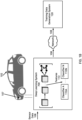
- Figure 1A is a schematic diagram illustrating a vehicle traveling along a road and gathering training data from its surroundings.
- a vehicle 102 is driving about a road.
- the vehicle 102 includes sensors, such as cameras, radar, and so on, such that the sensors capture information regarding a sensor volume 104 about the vehicle 102.
- An example sensor 107 is illustrated in Figure 1A .
- the vehicle 102 may obtain images of the surroundings of the vehicle 102. These obtained images may then be analyzed in an effort to understand the surroundings.
- the images may be analyzed to classify objects represented in the images.
- the images may be analyzed to identify other vehicles, road markings, trees or other vegetation, obstacles in the road, pedestrians, signs, and so on.
- the vehicle 102 may leverage machine learning techniques to analyze the sensor information.
- one or more convolutional neural networks may be used to classify objects included in the example sensor volume 104.
- Example description of a deep learning system 700 which may be used by the vehicle 102 is included below, with respect to Figure 1B and Figure 7 .
- a tire 106 is shown positioned on the road on which the vehicle 102 is driving. Being able to recognizing this tire 106 may be enhance safety and performance of the vehicle 102. As an example, the vehicle 102 may perform automated driving techniques to navigate around the tire 106 if the tire 106 is in the path of the vehicle 102. Additionally, even if the tire is not in the path of the vehicle 102, recognizing the tire 102 may still affect automated driving of the vehicle 102. For example, other vehicles may suddenly veer into the vehicle's 102 lane to avoid the tire 106. In this example, being able to identify the tire 106 may thus inform future predicted movements of the vehicle 102 (e.g., preemptively slowing down as another vehicle approaches the tire 106).
- future predicted movements of the vehicle 102 e.g., preemptively slowing down as another vehicle approaches the tire 106.
- the training data may include images of multitudes of tires of all configurations which are on various roads.
- the training data may be enhanced by the inclusion of images of different tires on different roads.
- the training data may be enhanced by images of different tires on different roads in different driving environments. For example, it may be advantageous to have images of tires partially included in snow on different roads. As another example, it may be advantageous to have images of deflated tires included in dusty roads. Acquiring access to such images may present great technical challenges.
- one or more classifiers may be trained to recognize tires.
- the classifiers may be trained using a limited set of training examples.
- These classifiers may then be provided to the vehicle 102 via an over the air (OTA) update.
- OTA over the air
- the OTA update may be received wirelessly via the vehicle 102 (e.g., over Wi-Fi, via cellular signals such as LTE networks, and so on).
- a classifier may then analyze sensor information obtained the vehicle 102. If the classifier detects that a tire is depicted in the sensor information (e.g., an image), the vehicle 102 may transmit the sensor information to an outside system for processing. This outside system may aggregate such received sensor information to create training data sets of tires.
- these training data sets may then be used to train complex machine learning models executing on the vehicle 102 (e.g., convolutional neural networks).
- complex machine learning models e.g., convolutional neural networks.
- the machine learning models and thus the ability of the vehicle 102 to perform automated driving tasks, may be enhanced.
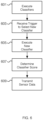
- FIG 1B is a block diagram illustrating generation of training data.
- sensor data 108 is being received by the vehicle 102.
- the sensor data 108 may include one or more images or video which depict the tire 106 illustrated in Figure 1 .
- This sensor data 108 may be provided to a deep learning system 700 of one or more processors, which is included in the vehicle 102.
- An example of aspects of the deep learning system 700 is illustrated in Figure 1B .
- the deep learning system 700 may use example machine learning techniques, such as a convolutional neural network, to analyze the received sensor data 108.
- the sensor data 108 may be pre-processed (e.g., normalized, passed through a filter, and so on).
- a convolutional neural network may include a multitude of convolutional layers. These convolutional layers may apply convolutional filters such that output volumes are created.
- one or more fully-connected or dense layers may be used as final layers to classify features or objects included in the sensor data 108.
- one or more softmax layers or independent logistic classifiers may be used to classify the features or objects.
- the deep learning system 700 may identify real-world objects, scenarios, and so on, which are included in the sensor volume 104 surrounding the vehicle 102. Based on identifying these real-world objects, scenarios, and so on, the vehicle 102 may perform automated driving tasks. Thus, the vehicle 102 may implement the convolutional neural network in its typical operation.
- the deep learning system 700 includes one or more classifiers.
- classifiers A-N 110A-110N are illustrated in Figure 1B . These classifiers 110A-110N may have been received via OTA updates to the vehicle 102 (e.g., periodic updates provided to the vehicle).
- an entity Prior to receiving the classifiers 110A-110N, an entity may have trained them to identify respective features or objects as represented in sensor data.
- classifier A 110A may have been trained to identify a snowy scene.
- classifier N 110N may have been trained to identify tires, bikes on a road, and so on.
- the entity may have trained the classifiers 110A-110N using limited training data. For example, classifier N 110N may have been trained using 100, 500, 1000, examples of tires on a road or a specific type of tire on a specific type of road.
- the classifiers 110A-110N may use information obtained from an intermediate layer of an example machine learning model (e.g., convolutional neural network).
- features 112 may be obtained from an intermediate layer of the convolutional neural network. Since the convolutional neural network may be trained to classify or otherwise identify features or objects in sensor data, the classifiers may leverage this existing ability.
- the convolutional neural network may learn to apply convolutional filters to learn features indicative of real-world objects. The convolutional neural network may then classify features as corresponding to specific categories or classes of real-world objects.
- classifiers 110A-110N When training the classifiers 110A-110N, they may therefore be trained using information obtained from an intermediate layer of the convolutional neural network.
- classifier 110N may be trained using a limited training data set of images depicting tires.
- the images may be provided to the example convolutional neural network.
- features 112 may be provided to classifier 110N.
- the classifier 110N may then be trained to assign a high classifier score for an image depicting a tire.
- the classifier 110N may optionally be trained to assign a low classifier score for an image which does not depict a tire. In this way, the classifier 110N may leverage the convolutional neural network, which as described above may be used in typical operation of the vehicle 102.
- the classifiers 110A-110N are receiving features 112 from an intermediate layer of the convolutional neural network.
- the classifiers 110A-110N may use features from different intermediate layers.
- classifier N 110N may use features from a first layer (e.g., layer 4, 5, and so on) while classifier A 110N may use features from a second layer (e.g., 6, 7, and so on).
- a specific layer from which to receive features may be identified for each classifier.
- the specific layer may be identified based on an accuracy of the corresponding training classifier with respect to a validation data set.
- one of the classifiers 110A-110N may be trained to identify tires.
- classifier N 110N may be trained to identify tires.
- classifier N 110N may assign a classifier score to the sensor data 108.
- classifier N 110N has assigned a classifier score greater than a threshold (e.g., .5, .7, and so on).
- the vehicle 102 may therefore transmit the sensor data 108 to an outside system (e.g., a training data generation system 120).
- the vehicle may transmit the sensor data 108 over a network (e.g., the internet) via Wi-Fi, cellular service, and so on.
- the outside system 120 may receive sensor data 108 from a multitude of vehicles.
- the outside system 120 may receive images depicting tires from vehicles which, in their normal course of operation, may happen to pass proximate to tires.
- these tires may be of different types, may be deflated or in states of decay, may be represented in different road conditions, may be partially occluded, and so on.
- the classifiers 110A-110N may, as an example, use classifier scores which cause transmission of a multitude of sensor data 108 to the outside system 120.
- a portion of images transmitted to the system 120 may not include tires.
- the entity may thus rapidly review and discard certain of the images.
- the remaining images may be aggregated into large training data sets and used to update the machine learning models executing on the vehicle.
- the convolutional neural network may be trained to identify tires.
- bounding boxes or other label information may be assigned to images included in the aggregated training data sets.
- the vehicle 102 may have a greater number of classifiers than is currently being executed by the vehicle 102.
- the vehicle 102 may have 50, 75, 100, classifiers.
- the vehicle 102 may execute 20, 30, 40 or more of the classifiers.
- the vehicle 102 may determine respective classifier scores for a subset of the total classifiers stored by the vehicle 102.
- each classifier may execute for a particular period of time before being swapped for another classifier.
- the vehicle 102 may execute certain classifiers depending on one or more triggers.
- the vehicle 102 may receive information identifying locations, or approximate locations, which are known to have certain real-world objects, features, or exhibit certain scenarios.
- the vehicle 102 may access map information identifying that a tunnel exit is in a certain area.
- the vehicle 102 may ensure that a classifier associated with identifying tunnel exits is executing at a time when the vehicle 102 is proximate to the tunnel it.
- the outside system 120 may optionally receive location information along with received sensor data.
- the outside system 120 may identify that a threshold number of vehicles have transmitted sensor data based on a same classifier for a particular real-world area.
- the outside system 120 may identify that a particular on-ramp has an obstruction in the road.
- the outside system 120 may identify that a particular on-ramp has a certain type of obstruction in the road.
- the system 120 may then transmit information to a portion of vehicles to execute the same classifier when proximate to the particular real-world area. In this way, the system 120 may ensure that it is able to obtain a greater quantity of training data based on this same sensor.
- the system 120 may instruct vehicles to transmit sensor data even if the above-described classifier does not assign a classifier score greater than a threshold.
- the system 120 may receive sensor data from a threshold number of vehicles proximate to a real-world location.
- the system 120 may instruct any vehicle within a threshold distance of that real-world location to transmit sensor data (e.g., images) even if their classifiers do not generate a classifier score greater than a threshold. Since the classifier may be trained on a training set with a limited number of examples (e.g., 100, 1000, as described above), depending on the angle of a particular vehicle with respect to an object, the particular vehicle's classifier may not identify the object.
- the sensor data may be useful to the generation of a robust training set for the object.
- the object may be partially visible in images obtained by the particular vehicle and therefore may be useful in a large training set to identify the object.
- the outside system 120 may override the classifier and cause the particular vehicle to transmit sensor data.
- the outside system 120 receives location information, or any identifying information, it should be understood that the information may be anonymized. Additionally, such techniques may require affirmative user consent (e.g., opt-in).
- Figure 2 is a flow diagram illustrating an embodiment of a process for applying a trigger classifier to the intermediate result of a machine learning model.
- the process of Figure 2 is utilized to collect and retain sensor data captured by sensors for a machine learning model for autonomous driving and that meets a particular use case.
- the particular use case may be associated with identification of certain features, objects, scenarios, and so on.
- the process of Figure 2 is implemented on a vehicle enabled with autonomous driving whether the autonomous driving control is enabled or not.
- sensor data can be collected in the moments immediately after autonomous driving is disengaged or while a vehicle is being driven by a human driver.
- the techniques described by Figure 2 can be applied to other deep learning systems outside the context of autonomous driving to improve the training data set, particularly for difficult to analyze use cases.
- the trigger classifier has been trained using the intermediate output of a layer of the machine learning and training data designed for the use case.
- multiple triggers and/or multiple classifiers may be used together to identify sensor data for multiple use cases.
- one trigger may be used to identify tunnels, another for manholes, another for forks in a road, etc.
- the functional components of a trigger classifier for determining a classifier score and/or applying required conditions are shared between different triggers.
- each trigger is specified using a weighted vector, an optional bias, and one or more threshold metrics to compare the classifier score with.
- additional required conditions such as the time of day, the vehicle location, the road type, etc. are specified for a particular trigger. For example, a trigger may require that sensor data of a tunnel be captured only at dawn and dusk.
- a trigger may require that sensor data be captured at most every 30 minutes and only after the vehicle has been driven for at least 20 minutes.
- the trigger threshold(s) and required conditions are properties specified for the trigger classifier.
- sensor data is received.
- a vehicle equipped with sensors captures sensor data and provides the sensor data to a neural network running on the vehicle.
- the sensor data may be vision data, ultrasonic data, LiDAR data, or other appropriate sensor data.
- an image is captured from a high dynamic range forward-facing camera.
- ultrasonic data is captured from a side-facing ultrasonic sensor.
- a vehicle is affixed with multiple sensors for capturing data.
- eight surround cameras are affixed to a vehicle and provide 360 degrees of visibility around the vehicle with a range of up to 250 meters.
- camera sensors include a wide forward camera, a narrow forward camera, a rear view camera, forward looking side cameras, and/or rearward looking side cameras.
- ultrasonic and/or radar sensors are used to capture surrounding details. For example, twelve ultrasonic sensors may be affixed to the vehicle to detect both hard and soft objects.
- a forward-facing radar is utilized to capture data of the surrounding environment.
- radar sensors are able to capture surrounding detail despite heavy rain, fog, dust, and other vehicles. The various sensors are used to capture the environment surrounding the vehicle and the captured image is provided for deep learning analysis.
- the sensor data is pre-processed.
- one or more pre-processing passes may be performed on the sensor data.
- the data may be pre-processed to remove noise, to correct for alignment issues and/or blurring, etc.
- one or more different filtering passes are performed on the data.
- a high-pass filter may be performed on the data and a low-pass filter may be performed on the data to separate out different components of the sensor data.
- the pre-processing step performed at 203 is optional and/or may be incorporated into the neural network.
- deep learning analysis of the sensor data is initiated.
- the deep learning analysis is performed on the sensor data optionally pre-processed at 203.
- the deep learning analysis is performed using a neural network such as a convolutional neural network (CNN).
- CNN convolutional neural network
- the machine learning model is trained offline and installed onto the vehicle for performing inference on the sensor data.
- the model may be trained to identify road lane lines, obstacles, pedestrians, moving vehicles, parked vehicles, drivable space, etc., as appropriate.
- the neural network includes multiple layers including one or more intermediate layers.
- potential training data is identified.
- sensor data that may be used for training the machine learning model is identified from the sensor data analyzed using the deep learning analysis.
- the identified training data is data associated with a particular use case.
- possible use cases may involve identifying: a curved road, an on ramp, an off ramp, the entrance to a tunnel, the exit of a tunnel, an obstacle in the road, a fork in the road, road lane lines or markers, drivable space, road signage, contents of signs (e.g., words, numbers, symbols, etc.), and/or other features as appropriate for autonomous driving.
- the use case depicted in the sensor data is identified by using the intermediate output of a layer of the neural network used for deep learning analysis and a trigger classifier.
- a trigger classifier determines a classifier score using the output of an intermediate layer of a neural network.
- a classifier score that exceeds a threshold and passes the required conditions specified along with the trigger is identified as potential training data.
- the threshold is utilized to identify positive examples of the use case. For example a higher classified score indicates a higher likelihood the sensor data is representative of the use case.
- the classifier score is a number between negative one and positive one. A score closer to positive one is more likely to be representative of the targeted use case.
- conditions specified by additional filters such as time of day, vehicle type, location, etc. are used to identify sensor data for the targeted use case.
- the identified sensor data is transmitted.
- the sensor data identified at 207 is transmitted to a computer server for additional processing.
- the additional processing includes creating a training set using the identified sensor data.
- the sensor data is transmitted wirelessly, for example, via a WiFi or cellular connection, from a vehicle to a data center.
- metadata is transmitted along with the sensor data.
- metadata may include the classifier score, the time of day, a timestamp, the location, the type of vehicle, vehicle control and/or operating parameters such as speed, acceleration, braking, whether autonomous driving was enabled, steering angle, etc.
- Additional metadata includes the time since the last previous sensor data was transmitted, the vehicle type, weather conditions, road conditions, etc.
- post-processing of the data is performed.
- different post-processing techniques are utilized to enhance the quality and/or to reduce the amount of data required to represent the data.
- the output of the deep learning analysis is merged with the result of deep learning applied to other sensors.
- the post-processing is used to smooth out the analysis performed on different sensor data.
- the processed data may be used for controlling the vehicle. Additional information related to the data may also be processed at 211. For example, information such as the configuration of the autonomous driving system, including what autonomous driving features are enabled, may be combined with the deep learning analysis. Other information may include the vehicle operating and/or control parameters and/or environmental data such as a map, topography, and/or GPS data.
- the post-processing may include combining the result of deep learning analysis performed on data from other sensors to create a unified representation of the vehicle's surrounding environment.
- the post-processing step at 211 is an optional step.
- the results of the deep learning analysis are provided to vehicle control.
- the results are used by a vehicle control module to control the vehicle for autonomous driving.
- the vehicle control can modulate the speed and/or steering of the vehicle.
- the vehicle control may be disabled but the intermediate results of the deep learning analysis at 205 are utilized for identifying training data at 207 and transmitting the identified sensor data at 209. In this manner, the deep learning analysis can be utilized to identify and retain suitable training data even when the vehicle is not under the control of the autonomous driving system.
- sensor data is identified and retained when the autonomous driving system is active.
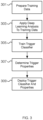
- Figure 3 is a flow diagram illustrating an embodiment of a process for creating a trigger classifier using the intermediate result of a machine learning model.
- the process of Figure 3 is utilized to train a trigger classifier for identifying and retaining relevant sensor data for a particular use case.
- sensor data processed by a deep learning system during its regular use includes a subset of data that is useful as training data.
- the trigger classifier can be trained to identify use cases such as tunnel entrances, tunnel exits, forks in the road, a curved road, on ramps, and other appropriate features useful for autonomous driving using the intermediate results of a deep learning system for autonomous driving.
- the efficiency of the identification and collection is greatly improved.
- the trained trigger classifier is installed along with trigger properties on a deployed deep learning system to collect and retain potential training data for relevant use cases.
- the trigger classifier is a support vector machine although other appropriate classifiers may be used.
- the trigger classifier is a neural network and may include one or more intermediate layers.
- the deployed deep learning system utilizes the process of Figure 2 .
- training data is prepared. For example, positive and negative examples of a particular use case are prepared as training data. As one example, positive and negative examples of a tunnel exit are collected and annotated. The curated and annotated data set is used to create a training set. In some embodiments, the annotating includes labeling the data and may be performed by a human curator. In some embodiments, the format of the data is compatible with a machine learning model used on a deployed deep learning application. In various embodiments, the training data includes validation data for testing the accuracy of the trained model.
- deep learning analysis is applied to the training data.
- an existing machine learning model is used to initiate a deep learning process.
- the deep learning model is a neural network such as a convolutional neural network (CNN) with multiple layers.
- the CNN may include three or more intermediate layers. Examples of the deep learning analysis include a neural network for autonomous driving.
- the deep learning analysis is initiated by feeding the training data prepared at 301 to a neural network to produce the intermediate layer results.
- a trigger classifier is trained.
- a trigger classifier is a support vector machine or small neural network.
- the input to the trigger classifier is the output of the first or an intermediate layer of a machine learning model of the deep learning system.
- the particular layer utilized for the input may be configurable. For example, the output of the second to last layer, the third to last layer, the fourth to last layer, and so forth, up to the first layer may be utilized as input for training the trigger classifier.
- the annotated results of the training data are used with the raw data (such as image data) for training the trigger classifier.
- the trigger classifier is trained to identify the likelihood an input (for example, an input from sensor data) is a match for the particular use case, such as a tunnel exit.
- the results of the trained trigger classifier are validated using a validation data set created at 301.
- the trigger classifier is trained using an offline neural network that matches the neural network deployed on a vehicle.
- an output of a neural network output is a feature vector that identifies features of the input data (such as a raw image).
- Features may include the number of vehicles, the number of signs, the number of lanes, etc., in the raw data.
- the intermediate outputs of the layers e.g., the layers processed ahead of the final layer, include semantic information of the raw input data.
- the intermediate output of the layer may be represented in vector form and the vector has more elements than the vector output of the final layer. For example, a final output of a neural network may be a 32-element vector while the output of the second to last layer may be a 64-element vector.
- the output of first and intermediate layers of the neural network includes a greater amount of semantic information associated with the raw input data than the output of the final layer of the neural network (such as, for example, a 32-element vector) and is thus used for training the trigger classifier.
- the particular layer chosen for training the trigger classifier may be selected dynamically. For example, a particular intermediate layer (such as an earlier layer) may be selected based on an improvement in the accuracy of that particular layer compared to another layer (such as a layer closer to the final layer). In some embodiments, the particular layer is chosen based on the efficiency in utilizing the layer. For example a layer with a smaller output vector may be chosen in the event the results using the layer meet accuracy demands.
- the input from different intermediate layers is used to train more than one trigger classifier and the different trained classifiers are compared to one another.
- a balance between accuracy and performance is used to determine which of the multiple classifiers to use. For example, the output of an earlier intermediate layer is necessary for some use cases while the output of a later intermediate layer is sufficient for other use cases.
- the output of the optimal intermediate layer may be determined by comparing multiple trained trigger classifiers. In various embodiments, which layer of the neural network from which to receive an intermediate result is dynamically selected as part of the trigger classifier training process.
- the trained classifier may be specified by a vector and a bias factor.
- the trained classifier may be a vector of weights that are offset by a bias factor to determine a classifier score.
- the number of elements of the vector is the same as the number of elements of the output of the intermediate layer used and the number of elements of the input for training the classifier.
- the output of the intermediate layer used to train the classifier is 1024 elements
- the input data used to train the trigger classifier is 1024 elements and the resulting trigger classifier can be represented as a 1024 weighted vector and a bias.
- the bias is optional and may be taken into account by the elements of the weighted vector.
- trigger properties for the classifier trained at 305 are determined. For example, a threshold may be determined that is compared to the classifier score determined by the trained trigger classifier. For example, a classifier score that exceeds the threshold indicates the raw input associated with the score is likely to be a positive example of the target use case. For example, a trigger classifier trained to identify tunnel exits determines a classifier score. Using a threshold of 0.5, a classifier score of 0.7 indicates the data is likely representative of a tunnel exit. In some embodiments, a score of -1.0 is a negative example and a score of 1.0 is a positive example. Classifier scores lie between -1.0 and 1.0 to indicate how likely the raw input is a positive or negative example of the targeted use case.
- the trigger properties include required conditions such as trigger filters.
- Trigger filters are filters used to restrict the retention of sensor data to the described conditions.
- the sensor data may be triggered for retention based on the location associated with the data.
- Other examples include the length of time since the last sensor data triggered and positive identification, the length of time since the drive started, the time of day, the location, the road type, etc.
- one or more trigger properties can be specified to limit the conditions under which the trigger classifier is used to collect and retain sensor data.
- the trigger classifier and trigger properties are deployed.
- the trigger classifier and properties used to trigger the classifier for retaining sensor data are installed alongside a deep learning system.
- the trigger classifier and properties may be packaged as a small binary that is transmitted wirelessly to a vehicle.
- the packaged trigger classifier and properties are transmitted as an over-the-air update using wireless technology such as a WiFi or cellular network connection.
- the trigger classifier and properties are installed as part of the autonomous driving system.
- only the trigger classifier is installed.
- the trigger classifier and the deep learning model for autonomous driving are installed together.
- the machine learning model of the autonomous driving system matches the one used to train the trigger classifier.
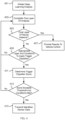
- Figure 4 is a flow diagram illustrating an embodiment of a process for identifying potential training data using a trigger classifier.
- the trigger classifier is run in conjunction with a deep learning system.
- a deep learning system using a machine learning model that matches the one used to train the trigger classifier is utilized with a trigger classifier as part of an autonomous driving system.
- the trigger classifier analyzes sensor data at least partially analyzed by the deep learning system to identify whether the sensor data meets particular use cases that warrant retaining the sensor data.
- the sensor data is then transmitted to a computer server and may be used to create training data for a revised machine learning model with improved performance in identifying the particular use case.
- Examples of the use cases include identifying an on ramp, a tunnel exit, an obstacle in the road, a fork in the road, specific types of vehicles, etc.
- trigger parameters are used to configure the conditions under which the trigger classifier identifies a relevant result.
- one or more trigger classifiers and parameters are used to identify one or more different use cases.
- the process of Figure 4 is performed at 205, 207, 209, 211, and/or 213 of Figure 2 .
- the trigger classifier used in the process of Figure 4 is trained using the process of Figure 3 .
- a deep learning analysis is initiated.
- a deep learning analysis of an autonomous driving system is initiated with sensor data captured by sensors attached to a vehicle.
- the initiated deep learning analysis includes pre-processing the sensor data.
- the deep learning analysis utilizes a trained machine learning model with multiple layers including one or more intermediate layers.
- the output of the first layer and any intermediate layer is considered an intermediate output.
- an intermediate output is the output of a layer of a machine learning model other than the final output (e.g., the output of the final layer of the model).
- a neural network includes multiple layers including intermediate layers followed by a final layer.
- the output of each layer (e.g., an intermediate result) is fed as input to the next layer.
- the output of the first layer and each intermediate layer is considered an intermediate result.
- the result of determining the output of a single layer is a vector that may be used as an input to the next layer.
- the input to the first layer of a neural network is sensor data such as image data.
- the neural network is a convolutional neural network.
- the output at 405 provided to 407 is a feature vector.
- the results of performing the deep learning analysis on the sensor data is provided to vehicle control.
- the results are post-processed.
- the results of one or more different neural networks for input from one or more different sensors may be combined.
- the vehicle control is implemented using a vehicle control module to control the operation of the vehicle.
- the vehicle control is able to modify the speed, steering, acceleration, braking, etc. of the vehicle for autonomous driving.
- the vehicle control may enable or disable the turn signals, brakes lights, headlights, and/or operate other controls/signals of the vehicle including network controls such as sending network messages via a wireless network such as a WiFi or cellular network.
- the vehicle control may not be enabled to actively control the vehicle, for example, when an autonomous driving feature is disabled.
- the deep learning analysis at 401 and 403 is performed to provide results as input to the trigger classifier in order to identify potential training data even when the autonomous driving system is not actively controlling the vehicle.
- the trigger properties indicate the conditions required for applying the trigger classifier. Examples of conditions include whether the length of time since the last capture has exceeded a minimum amount of time, whether a minimum length of time driving has elapsed, whether the time of day is within a certain range, etc. Examples of different times of day may include dawn, dusk, daytime, nighttime, etc. Additional conditional requirements may be based on the location, the weather, road conditions, road type, vehicle type, disengagement of an autonomous driving feature, steering angle (e.g., exceeding a steering angle threshold), change in acceleration, activation of the brakes, or other appropriate feature.
- steering angle e.g., exceeding a steering angle threshold
- Examples of different weather conditions may include snow, hail, sleet, rain, heavy rain, overcast, sunny, cloudy, foggy, etc.
- Different conditions may be specified by the trigger properties.
- different use cases may utilize different trigger properties and the intermediate result of different layers of the neural network. For example, some use cases may be more efficient and produce high quality results using the intermediate result of a latter layer of the neural network. Other use cases may require an earlier intermediate result in order to identify useful examples of sensor data that meet the use case.
- the trigger properties used to specify the conditions to apply the trigger classifier can be nested using multiple conditional checks and/or logical operators such as AND and OR operators.
- a trigger classifier score is determined.
- a trigger classifier score is determined by applying the trigger classifier to the intermediate results of the neural network.
- the application of the trigger classifier utilizes a weighted vector and an optional bias to determine the classifier score associated with the sensor data.
- the trigger classifier is a support vector machine or a neural network.
- the performance of the trigger classifier is improved by running the classifier on a customized artificial intelligence (AI) processor.
- AI artificial intelligence
- an AI processor can perform a dot product operation on two vectors in very few cycles and/or multiple dot products with limited wasted cycles.
- the determined classifier score is a floating point number that represents the likelihood the sensor data is a positive (or negative) example of the targeted use case. For example, a particular range such as between -1 and +1 may be used to represent the likelihood the sensor data is a negative or positive example of the targeted use case.
- a classifier score is compared to a threshold value. In the event the classifier score exceeds the threshold value, processing continues to 415. In the event the classifier score does not exceed the threshold value, processing continues to 403.
- additional trigger required conditions may be applied after the classifier score is determined. For example, the determined classifier score may be compared to previously determined classifier scores within a certain time window. As another example, the determined classifier score may be compared to previously determined scores from the same location. As another example, sensor data may be required to meet both a time condition and a location condition.
- the conditions may include trigger properties that function as a filter to either transmit or not transmit the sensor data.
- the conditions at 413 are optional and only the classifier score is compared to the threshold.
- a separate threshold exists for both positive and negative examples.
- a threshold of +0.5 and -0.5 may be utilized to identify positive and negative sensor data as potential training data.
- Classifier scores between +0.5 and 1.0 are used to identify positive examples and classifier scores between -1.0 and -0.5 are used to identify negative examples.
- only positive examples are retained for transmittal.
- the identified sensor data is transmitted.
- the sensor data identified is transmitted to a computer server (e.g., the training data generation system 120) where it may be used to create training data.
- the training data includes a training data set and a validation data set.
- the sensor data transmitted includes metadata. Examples of metadata may include the time of data, a timestamp, the road conditions, the weather conditions, the location, the vehicle type, whether the vehicle is a left-hand drive or right-hand drive vehicle, the classifier score, the use case, an identifier of the neural network, an identifier of the trigger classifier, a firmware version associated with the autonomous driving system, or other appropriate metadata associated with the sensor data and/or vehicle.
- the time of day may indicate a period of time such as dusk, dawn, night, daylight, full moon, solar eclipse, etc.
- an identifier of the neural network and/or the trigger classifier may be transmitted to identify the particular trained machine learning model used for training the trigger classifier and used in determining the classifier score.
- the sensor data and/or metadata is first compressed before being transmitted.
- the sensor data is sent in batches to more efficiently transfer the sensor data. For example, compression of multiple images of sensor data is performed and a series of sensor data is transmitted together.
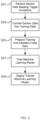
- Figure 5 is a flow diagram illustrating an embodiment of a process for creating training data from data corresponding to use cases identified by a trigger classifier.
- sensor data received is processed to create training data for training a machine learning model.
- the sensor data corresponds to driving data captured via an autonomous driving system utilizing a trigger classifier.
- the sensor data is received using the process of Figure 4 by a trigger classifier trained using the process of Figure 3 .
- the sensor data corresponds to sensor data captured based on particular use cases, such as the identification of a fork in the road, an on ramp, an off ramp, a tunnel entrance, etc.
- the sensor data received corresponds to only positive examples of the use case.
- the sensor data includes both positive and negative examples.
- the sensor data includes metadata such as the classifier score, the location, the time of day, or other appropriate metadata.
- sensor data meeting trigger conditions is received.
- sensor data is received that corresponds to a particular target use case and may be used as potential training data.
- the sensor data is in the format that the machine learning model uses as input.
- the sensor data may be raw or processed image data.
- the data is data captured from ultrasonic sensors, radar, LiDAR sensors, or other appropriate technology.
- the trigger conditions are specified using a trigger classifier and trigger properties as described with respect to Figures 2-4 .
- the sensor data is converted into training data.
- the sensor data received at 501 includes data identified as potentially useful training data.
- the received sensor data is compressed to improve the efficiency for transmitting the data from a remotely located vehicle and is first uncompressed.
- the data is reviewed to determine whether the sensor data accurately represents the target use case. For example, a targeted use case for identifying examples of a tunnel exit is reviewed to determine whether the raw sensor data is indeed that of a tunnel exit.
- a highly accurate machine learning model is used to confirm whether the sensor data represents the targeted use case.
- a human reviews and confirms whether the sensor data represents the targeted use case.
- the useful data for training is annotated.
- the data may be marked as either a positive or negative example.
- the data is annotated for the target object and may be labeled. For example, lane markers, signs, traffic lights, etc. may be annotated depending on the target use case.
- the annotation may be used for training and/or verification of the trained machine learning model.
- the training data converted at 503 is prepared as training and validation data sets.
- the converted sensor data at 503 is prepared into a data set for training and a validation data set for validating the machine learning model.
- the training data of 503 is merged into existing training data sets. For example, an existing training data set applicable for most use cases is merged with the newly converted training data for improved coverage of a particular use case. The newly converted training data is useful for improving the accuracy of the model in identifying the particular use case. In some embodiments, some portions of the existing training data are discarded and/or replaced with the new training data.
- a machine learning model is trained.
- a machine learning model is trained using the data prepared at 505.
- the model is a neural network such as a convolutional neural network (CNN).
- CNN convolutional neural network
- the model includes multiple intermediate layers.
- the neural network may include multiple layers including multiple convolution and pooling layers.
- the training model is validated using a validation data set created from the received sensor data.
- the trained machine learning model is deployed.
- the trained machine learning model is installed on a vehicle as an update for the autonomous learning system.
- an over-the-air update can be used to install the new model.
- the update is a firmware update transmitted using a wireless network such as a WiFi or cellular network.
- the new model is utilized for training new trigger classifiers.
- existing trigger classifiers based on the old model are expired and new trigger classifiers are deployed based on the newly trained model.
- the new machine learning model is installed when the vehicle is serviced.
- FIG. 6 is a flow diagram illustrating an embodiment of a process for causing selection of a classifier on a vehicle.
- the process may optionally be implemented by a vehicle, such as a vehicle of one or more processors.
- a vehicle may have stored a multitude of classifiers.
- the vehicle may execute a subset of the classifiers to conserve processing resources.
- the vehicle may determine classifier scores for only the subset.
- the vehicle may update the subset periodically (e.g., select a new classifier after a threshold amount of time).
- the vehicle may receive information from an outside system (e.g., system 120) identifying that the vehicle is to execute one or more specific classifiers.
- an outside system e.g., system 120
- the vehicle executes classifiers.
- the vehicle may obtain sensor data and determine classifier scores based on the sensor data.
- the vehicle receives a trigger to select a new classifier.
- the vehicle may monitor its location via, at least, a global navigation satellite system (GNSS) receiver.
- GNSS global navigation satellite system
- the vehicle may have access to map information.
- the map information may identify certain features or use cases for which it may be advantageous to obtain training data.
- the map information may identify tunnel exits.
- the map information may identify a partially occluded or hidden side-road.
- the map information may identify a location of a particular style or form of bike lane (e.g., a raised or offset bike lane).
- the vehicle may determine when it is proximate (e.g., with a threshold distance) of a particular feature or use case.
- the vehicle may then obtain information identifying a new classifier which associated with a particular feature or use case. This new classifier may then be executed by the vehicle to determine classifier scores for received sensor data.
- the vehicle may transmit location information to the outside system.
- the outside system may then transmit information to the vehicle regarding one or more new classifiers which the vehicle is to execute.
- the outside system may transmit a unique identifier associated with each classifier.
- the outside system may have received information from a same classifier executing on at least a particular number of vehicles (e.g., 1, 3, 10, 20). These vehicles may have been within a threshold distance (e.g., radius) of each other, such that the outside system determines the existence of a feature or use case proximate to their location.
- the outside system may instruct the vehicle to execute the same classifier if it is within a threshold distance of location. In this way, the outside system can obtain sensor data associated with this classifier.
- the vehicle executes the new classifier.
- the new classifier may obtain information from an intermediate layer of a machine learning model (e.g., convolutional neural network).
- the vehicle determines classifier scores.
- the vehicle transmits sensor data (e.g., images) based on a classifier score exceeding a threshold.
- the sensor data may be transmitted with metadata.
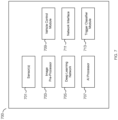
- Figure 7 is a block diagram illustrating an embodiment of a deep learning system for identifying potential training data.
- the block diagram includes different components of a deep learning system connected to a trigger classifier for autonomous driving where a subset of the sensor data captured for autonomous driving is identified as potential training data.
- the deep learning system may passively analyze sensor data and the intermediate output of a layer of the deep learning system is used as an input to a trigger classifier.
- the deep learning system actively analyzes and controls the operation of the vehicle while also identifying and retaining potentially useful sensor data for creating additional training data.
- the autonomous driving system is utilized for self-driving or driver-assisted operation of the vehicle.
- the processes of Figures 2-6 utilize a deep learning system and/or components of a system such as the one described in Figure 7 .
- deep learning system 700 is a deep learning network that includes sensors 701, image pre-processor 703, deep learning network 705, artificial intelligence (AI) processor 707, vehicle control module 709, network interface 711, and trigger classifier module 713.
- AI artificial intelligence
- the different components are communicatively connected.
- sensor data from sensors 701 is fed to image pre-processor 703.
- Processed sensor data of image pre-processor 703 is fed to deep learning network 705 running on AI processor 707.
- the output of deep learning network 705 running on AI processor 707 is fed to vehicle control module 709.
- Intermediate results of deep learning network 705 running on AI processor 707 are fed to trigger classifier module 713.
- the sensor data that triggers retention for transmittal by trigger classifier module 713 is sent via network interface 711.
- trigger classifier module 713 runs on AI processor 707.
- network interface 711 is used to communicate with remote servers, to make phone calls, to send and/or receive text messages, to transmit sensor data identified by trigger classifier module 713, etc. based on the autonomous operation of the vehicle and/or the results of trigger classifier module 713.
- deep learning system 700 may include additional or fewer components as appropriate.
- image pre-processor 703 is an optional component.
- a post-processing component (not shown) is used to perform post-processing on the output of deep learning network 705 before the output is provided to vehicle control module 709.
- sensors 701 include one or more sensors.
- sensors 701 may be affixed to a vehicle, at different locations of the vehicle, and/or oriented in one or more different directions.
- sensors 701 may be affixed to the front, sides, rear, and/or roof, etc. of the vehicle in forward-facing, rear-facing, side-facing, etc. directions.
- sensors 701 may be image sensors such as high dynamic range cameras.
- sensors 701 include non-visual sensors.
- sensors 701 include radar, LiDAR, and/or ultrasonic sensors, among others.
- sensors 701 are not mounted to the vehicle with vehicle control module 709.
- sensors 701 may be mounted on neighboring vehicles and/or affixed to the road or environment and are included as part of a deep learning system for capturing sensor data.
- image pre-processor 703 is used to pre-process sensor data of sensors 701.
- image pre-processor 703 may be used to pre-process the sensor data, split sensor data into one or more components, and/or post-process the one or more components.
- image pre-processor 703 is a graphics processing unit (GPU), a central processing unit (CPU), an image signal processor, or a specialized image processor.
- image pre-processor 703 is a tone-mapper processor to process high dynamic range data.
- image pre-processor 703 is implemented as part of artificial intelligence (AI) processor 707.
- AI artificial intelligence
- image pre-processor 703 may be a component of AI processor 707.
- deep learning network 705 is a deep learning network for implementing autonomous vehicle control.
- deep learning network 705 may be an artificial neural network such as a convolutional neural network (CNN) that is trained using sensor data and its output is provided to vehicle control module 709.
- CNN convolutional neural network
- a duplicate of the neural network of deep learning network 705 is utilized for creating the trigger classifier of trigger classifier module 713.
- AI processor 707 is a hardware processor for running deep learning network 705 and/or trigger classifier module 713.
- AI processor 707 is a specialized AI processor for performing inference using a convolutional neural network (CNN) on sensor data.
- CNN convolutional neural network
- AI processor 707 is optimized for the bit depth of the sensor data.
- AI processor 707 is optimized for deep learning operations such as neural network operations including convolution, dot-product, vector, and/or matrix operations, among others.
- AI processor 707 is implemented using a graphics processing unit (GPU).
- GPU graphics processing unit
- AI processor 707 is coupled to memory that is configured to provide the AI processor with instructions which when executed cause the AI processor to perform deep learning analysis on the received input sensor data and to determine a machine learning result used to at least in part autonomously operate a vehicle.
- AI processor 707 is configured to output the intermediate results of one or more layers of deep learning network 705 to trigger classifier module 713 for determining a classifier score.
- vehicle control module 709 is utilized to process the output of artificial intelligence (AI) processor 707 and to translate the output into a vehicle control operation. In some embodiments, vehicle control module 709 is utilized to control the vehicle for autonomous driving. In some embodiments, vehicle control module 709 can adjust the speed and/or steering of the vehicle. For example, vehicle control module 709 may be used to control a vehicle by braking, steering, changing lanes, accelerating, and merging into another lane, etc. In some embodiments, vehicle control module 709 is used to control vehicle lighting such as brake lights, turns signals, headlights, etc.
- AI artificial intelligence
- vehicle control module 709 is used to control vehicle audio conditions such as the vehicle's sound system, playing audio alerts, enabling a microphone, enabling the horn, etc.
- vehicle control module 709 is used to control notification systems including warning systems to inform the driver and/or passengers of driving events such as a potential collision or the approach of an intended destination.
- vehicle control module 709 is used to adjust sensors such as sensors 701 of a vehicle.
- vehicle control module 709 may be used to change parameters of one or more sensors such as modifying the orientation, changing the output resolution and/or format type, increasing or decreasing the capture rate, adjusting the captured dynamic range, adjusting the focus of a camera, enabling and/or disabling a sensor, etc.
- vehicle control module 709 may be used to change parameters of image pre-processor 703 such as modifying the frequency range of filters, adjusting feature and/or edge detection parameters, adjusting channels and bit depth, etc. In various embodiments, vehicle control module 709 is used to implement self-driving and/or driver-assisted control of a vehicle.
- network interface 711 is a communication interface for sending and/or receiving data including voice data.
- a network interface 711 includes a cellular or wireless interface for interfacing with remote servers, to connect and make voice calls, to send and/or receive text messages, to transmit sensor data, to receive updates to the autonomous driving system including trigger classifiers and properties, etc.
- network interface 711 may be used to receive an update for the instructions and/or operating parameters for sensors 701, image pre-processor 703, deep learning network 705, AI processor 707, vehicle control module 709, and/or trigger classifier module 713.
- a machine learning model of deep learning network 705 may be updated using network interface 711.
- network interface 711 may be used to update firmware of sensors 701 and/or operating parameters of image pre-processor 703 such as image processing parameters.
- network interface 711 is used to transmit sensor data identified by trigger classifier module 713. For example, sensor data corresponding a particular use case identified by a trigger classifier and meeting the conditions of the associated trigger properties is transmitted via network interface 711 to a computer server, such as a remote computer server.
- the trigger classifier and trigger properties are updated via network interface 711. The updated trigger classifier and trigger properties are installed to trigger classifier module 713 and used to identify and retain sensor data corresponding to a particular use case.
- network interface 711 is used to make emergency contact with emergency services in the event of an accident or near-accident. For example, in the event of a collision, network interface 711 may be used to contact emergency services for help and may inform the emergency services of the location of the vehicle and collision details. In various embodiments, network interface 711 is used to implement autonomous driving features such as accessing calendar information to retrieve and/or update a destination location and/or expected arrival time.
- trigger classifier module 713 is utilized to identify and retain sensor data corresponding to a particular use case. For example, trigger classifier module 713 determines a classifier score for a data captured by one or more sensors of sensors 701. The classifier score is compared to a threshold and may be retained and transmitted via network interface 711 to a remote computer server. In some embodiments, trigger classifier module 713 utilizes trigger properties to determine whether the appropriate conditions are met for determining a classifier score and/or retaining sensor data that meets a classifier score threshold. In some embodiments, the trigger classifier module is a support vector machine and receives the intermediate output of deep learning network 705 as an input representative of sensor data of sensors 701.
- trigger classifier module 713 is configured to receive the intermediate results of one or multiple layers of deep learning network 705. The output of the particular layer may depend on the trigger classifier and/or trigger properties. For example, some use cases may use an earlier intermediate result and others may utilize a later intermediate result.
- AI processor 707 may be utilized to perform the processing of trigger classifier module 713.
- the sensor data identified by trigger classifier module 713 is used to create new training data sets for identifying particular use cases.
- the various aspects, embodiments, implementations or features of the described embodiments can be used separately or in any combination.
- Various aspects of the described embodiments can be implemented by software, hardware or a combination of hardware and software.
- the described embodiments can also be embodied as computer readable code on a computer readable medium for controlling manufacturing operations or as computer readable code on a computer readable medium for controlling a manufacturing line.
- the computer readable medium is any data storage device that can store data, which can thereafter be read by a computer system. Examples of the computer readable medium include read-only memory, random-access memory, CD-ROMs, HDDs, DVDs, magnetic tape, and optical data storage devices.
- the computer readable medium can also be distributed over network-coupled computer systems so that the computer readable code is stored and executed in a distributed fashion.
- each of the processes, methods, and algorithms described herein and/or depicted in the figures may be embodied in, and fully or partially automated by, code modules executed by one or more physical computing systems, hardware computer processors, application-specific circuitry, and/or electronic hardware configured to execute specific and particular computer instructions.
- computing systems may include general purpose computers (e.g., servers) programmed with specific computer instructions or special purpose computers, special purpose circuitry, and so forth.
- a code module may be compiled and linked into an executable program, installed in a dynamic link library, or may be written in an interpreted programming language.
- particular operations and methods may be performed by circuitry that is specific to a given function.
- a video may include many frames, with each frame having millions of pixels, and specifically programmed computer hardware is necessary to process the video data to provide a desired image processing task or application in a commercially reasonable amount of time.
- Code modules or any type of data may be stored on any type of non-transitory computer-readable medium, such as physical computer storage including hard drives, solid state memory, random access memory (RAM), read only memory (ROM), optical disc, volatile or non-volatile storage, combinations of the same and/or the like.
- the non-transitory computer-readable medium may be part of one or more of the local processing and data module, the remote processing module, and remote data repository.
- the methods and modules may also be transmitted as generated data signals (e.g., as part of a carrier wave or other analog or digital propagated signal) on a variety of computer-readable transmission mediums, including wireless-based and wired/cable-based mediums, and may take a variety of forms (e.g., as part of a single or multiplexed analog signal, or as multiple discrete digital packets or frames).
- generated data signals e.g., as part of a carrier wave or other analog or digital propagated signal
- computer-readable transmission mediums including wireless-based and wired/cable-based mediums, and may take a variety of forms (e.g., as part of a single or multiplexed analog signal, or as multiple discrete digital packets or frames).
- the results of the disclosed processes or process steps may be stored, persistently or otherwise, in any type of non-transitory, tangible computer storage or may be communicated via a computer-readable transmission medium.
- any processes, blocks, states, steps, or functionalities in flow diagrams described herein and/or depicted in the attached figures should be understood as potentially representing code modules, segments, or portions of code which include one or more executable instructions for implementing specific functions (e.g., logical or arithmetical) or steps in the process.
- the various processes, blocks, states, steps, or functionalities may be combined, rearranged, added to, deleted from, modified, or otherwise changed from the illustrative examples provided herein.
- additional or different computing systems or code modules may perform some or all of the functionalities described herein.
Landscapes
- Engineering & Computer Science (AREA)
- Theoretical Computer Science (AREA)
- Physics & Mathematics (AREA)
- General Physics & Mathematics (AREA)
- Evolutionary Computation (AREA)
- Software Systems (AREA)
- Artificial Intelligence (AREA)
- Computing Systems (AREA)
- General Health & Medical Sciences (AREA)
- Health & Medical Sciences (AREA)
- Multimedia (AREA)
- Computer Vision & Pattern Recognition (AREA)
- Data Mining & Analysis (AREA)
- Medical Informatics (AREA)
- General Engineering & Computer Science (AREA)
- Databases & Information Systems (AREA)
- Mathematical Physics (AREA)
- Life Sciences & Earth Sciences (AREA)
- Biomedical Technology (AREA)
- Biophysics (AREA)
- Computational Linguistics (AREA)
- Molecular Biology (AREA)
- Analytical Chemistry (AREA)
- Chemical & Material Sciences (AREA)
- Radar, Positioning & Navigation (AREA)
- Electromagnetism (AREA)
- Evolutionary Biology (AREA)
- Remote Sensing (AREA)
- Bioinformatics & Computational Biology (AREA)
- Bioinformatics & Cheminformatics (AREA)
- Computer Networks & Wireless Communication (AREA)
- Aviation & Aerospace Engineering (AREA)
- Automation & Control Theory (AREA)
- Traffic Control Systems (AREA)
- Image Analysis (AREA)
- Testing Or Calibration Of Command Recording Devices (AREA)
Description
- The present disclosure relates to systems and techniques for machine learning. More specifically, the present disclosure relates to techniques for generation of training data.
- Deep learning systems used for applications such as autonomous driving are developed by training a machine learning model. Typically, the performance of the deep learning system is limited at least in part by the quality of the training set used to train the model. In many instances, significant resources are invested in collecting, curating, and annotating the training data. The effort required to create the training set can be significant and is often tedious. Moreover, it is often difficult to collect data for particular use cases that a machine learning model needs improvement on.
- Alain Guillaume et al: "Understanding intermediate layers using linear classifier probes", 14 October 2016, p. 1-9, relates to neural network models.
- Mariusz Bojarski et al: "End to End Learning for Self-Driving Cars", Cornell University Library, 201 Olin Library Cornell University Ithaca, NY 14853, 25 April 2016, relates to self-driving cars.
- The invention is defined in the independent claims. Preferred embodiments are set forth in the dependent claims.
- The following drawings and the associated descriptions are provided to illustrate embodiments of the present disclosure.
-
Figure 1A is a schematic diagram illustrating an automobile driving on a road and detecting a tire positioned on the road. -
Figure 1B is a block diagram illustrating one embodiment of a system for generating training data. -
Figure 2 is a flow diagram illustrating an embodiment of a process for applying a trigger classifier to the intermediate result of a machine learning model. -
Figure 3 is a flow diagram illustrating an embodiment of a process for creating a trigger classifier using the intermediate result of a machine learning model. -
Figure 4 is a flow diagram illustrating an embodiment of a process for identifying potential training data using a trigger classifier and transmitting sensor data. -
Figure 5 is a flow diagram illustrating an embodiment of a process for deploying training data from data corresponding to use cases identified by a trigger classifier. -
Figure 6 is a flow diagram illustrating an embodiment of a process for executing a selection of a classifier on a vehicle and transmitting sensor data. -
Figure 7 is a block diagram illustrating an embodiment of a deep learning system for identifying potential training data. - This specification describes innovations which, at least, address the following technical problems. Effective machine learning techniques rely upon training data sets which are used to inform underlying machine learning models. For example, a neural network may be trained using thousands, hundreds of thousands, millions, and so on, of examples. During training, these examples may be used to adjust parameters of the neural network (e.g., weights, biases, and so on). Additionally, these examples may be used to adjust hyperparameters of the neural network (e.g., a number of layers). Thus, access to training data is a constraint on the use of such machine learning techniques.
- As machine learning models grow more complex, such as deeper neural networks, the necessity of large training data sets increases accordingly. These deeper neural networks may require a greater number of training examples as compared to shallower neural networks to ensure that their generalizability is high. For example, while a neural network may be trained to be highly accurate with respect to training data, the neural network may not generalize well to unseen future examples. In this example, the neural network may benefit from additional examples included in training data.
- It may be appreciated that obtaining training data may present enormous technical hurdles. For example, certain machine learning models may be used to classify features or objects included in images. In this example, a machine learning model may learn to recognize a first object (e.g., a car) from a second object (e.g., a stop sign). The effectiveness of these machine learning models may be constrained according to the number of examples of the features or objects. For example, an entity may desire the machine learning model to recognize a bike being ridden on the street. As another example, the entity may desire the machine learning model to recognize a bike being carried on a back of a car. Absent sufficient training examples of these examples, the machine learning model may not be sufficiently accurate in its recognition to be usable. In general, an entity may be required to spend great efforts having persons label images for inclusion of certain features or objects. For example, the persons may have to manually review images and then assign labels to portions of the images as corresponding to certain features or objects.
- One embodiment is a system and method that addresses this problem by rapidly generating training data. In one embodiment, the training data may include examples of any desired learnable feature. With respect to computer vision, training data may be rapidly generated which includes examples of any desired object or feature in images. These objects or features may represent typically tough to identify 'edge cases.' For example, training data may be generated which includes images of complex scenes desired by an entity. In this example, the entity may prefer to obtain images depicting bikes on the back or front of vehicles (e.g., a bike being carried in a front-rack of a public bus).
- The above-described entity may leverage a multitude (e.g., thousands, millions) of vehicles which are traveling about various roads, or otherwise navigable areas, of the world. These vehicles may include, or otherwise have access to, sensors (e.g., cameras). As these vehicles travel about, they may capture sensor information. For example, the sensor information may be captured in the normal course of operation of the vehicles. The sensor information may be used by the vehicles for certain automated driving features, such as lane navigation. However, in one embodiment, the system includes circuits and software that allows the vehicles to collect examples of image features or objects desired by the entity to be used as training data for machine learning systems.
- For example, classifiers (e.g., small or shallow neural networks, support vector machines, and so on) may be uploaded to at least a portion of the vehicles. The vehicles may obtain sensor information (e.g., images, video) during normal operation and the classifiers may be configured to identify specific features or objects represented in the sensor information. Prior to being provided to the vehicles, these classifiers may be trained to classify images as including specific image features or objects. For example, a limited number of examples of the specific image features or objects (e.g., one hundred, one thousand, and so on) may be used to train these classifiers. As will be described, the classifiers may then classify sensor data using information from an intermediate layer of a machine learning model executing on the vehicles. An example machine learning model may include a convolutional network. The example machine learning model may be used, at least in part, for the above-described automated driving features. Thus, the classifiers may leverage the existent example machine learning model.
- A multitude of these classifiers may be uploaded to a computer system within a vehicle, such that the classifier may be used to recognize specific image features or objects associated with the classifiers. The captured images that are designated by the classifier as including the particular feature or object can then be transmitted to a central server system and used as training data for neural network systems. Since the classifiers may leverage existing machine learning models already being executed by the vehicles in typical operation, the classifiers may be efficient in terms of processing requirements. Additionally, there may be a large number of vehicles being driven in disparate environments, which increases the likelihood of obtaining examples of hard to find 'edge cases' of certain features. In this way, the entity may rapidly obtain sensor information (e.g., images) which represent specific image features or objects of interest to the entity.
- In this specification, an object or feature to be learned may represent any real-world object, scenario, feature, and so on, which can be captured in sensor data. Example objects or features may include a tire in a road, a tunnel exit, a bike, a tree with branches extending into the road, a scene in which vehicles are oriented in a particular way or performing a particular action or maneuver, and so on. Furthermore, reference herein is made to identifying training data for a use case or purpose. An example use case or purpose may include identifying one or more objects, features, and so on. Additionally, while this specification describes vehicles obtaining sensor information, such as images, it may be understood that the features described herein may be broadly applicable. For example, classifiers may be provided to user devices (e.g., smart phones) and used to recognize particular image features or objects. As another example, classifiers may be used in airplanes, unmanned aerial vehicles, unmanned vehicles, and so on.
- A neural network training technique for identifying additional training data relevant to particular use cases is disclosed. By identifying and collecting additional training data, particularly data for difficult to correctly analyze use cases, a deep learning system can be re-trained to improve its performance. For example, a difficult use case can be identified and data can be collected based on the use case. A new machine learning model can then be trained with the newly collected data that outperforms the old model. The existing machine learning model is utilized with a trigger classifier to identify relevant training data. The relevant training data is then transmitted back for processing to create new training data. In some embodiments, an initial data set representative of the targeted use case is created and used to create a trigger classifier.
- For example, a deep learning system for autonomous driving may have difficulty analyzing and identifying a tunnel exit. A training data set is created with positive and negative examples of a tunnel exit. The trigger classifier is trained on an initial training data set using an intermediate output of a layer of the existing machine learning model. In some embodiments, the layer is the intermediate layer. For example, data from the training set is fed to an existing machine learning model and the output of the second to last layer of the model is used as input to train a trigger classifier. In some embodiments, the trigger classifier is a support vector machine that is trained offline from the deployed deep learning application. Once trained, the trigger classifier may be installed or deployed to run alongside a deep learning system that is already in use within an autonomous driving system of a vehicle. For example, the trigger classifier may be deployed through a wireless network that downloads and installs the trigger classifier in the vehicle. The trigger classifier is applied to the intermediate output of the same layer of the deployed deep learning system to determine a classifier score. In some embodiments, the input to the trigger classifier is the intermediate output of a layer of a convolution neural network (CNN) applied to sensor data captured by an autonomous vehicle, for example image data captured by cameras on the vehicle.
- In some embodiments, the trigger classifier, implemented using a single support vector machine, a small neural network, or another appropriate classifier, may be applied on the whole captured image and/or to specific locations of the image. For example, the trigger classifier can be applied at every single location of an image or a subset of locations. The trigger classifier can be applied to effectively scan across the features of the neural network spatially to identify small parts such as shopping carts, animals, etc. Once applied, the trigger classifier determines a classifier score and depending on the score, the sensor data is identified and retained as potentially useful training data. As one example, the trigger classifier scores sensor data from a camera based on how likely the data represents a tunnel exit. Sensor data that scores high and likely represents a tunnel exit is retained and flagged to be used as training data. In some embodiments, trigger properties such as filters are applied to the trigger classifier to determine the conditions that must be met to proceed with determining a classifier score, the circumstances under which the classifier score exceeds a threshold, and/or the conditions necessary to retain the sensor data. For example, in some embodiments, sensor data is scored and collected at most once every interval, such as no more than once every 30 minutes. The classifier score must exceed a threshold for the sensor data to be collected and retained. In the event the sensor data meets the configured threshold, the sensor data is retained and used as potential new training data. In one embodiment, the sensor data is wirelessly uploaded to a server that is managing the training data system.
- In some embodiments, additional metadata is collected and retained along with the sensor data such as the location, the road type, the model of vehicle, whether the vehicle is left-hand drive or right-hand drive, the time of day, the classifier score, the length of time since the last transmitted sensor data, and/or vehicle control parameters/operating conditions such as speed, acceleration, steering, braking, steering angle, etc. In various embodiments, the data and metadata are transmitted to a computer data server where it is used for creating a new training data set to improve the application of the deep learning system for the particular use case. For example, retained sensor data associated with identified tunnel exits is identified by the trigger classifier and used to create additional training data for identifying tunnel exits.
- In some embodiments, after uploading the sensor data is reviewed and annotated to create a new training data set that is used to improve the autonomous driving features of the vehicle. For example, the data may be annotated as positive samples of tunnel exits and may be used to supplement an original training data set that includes many more use cases. A new machine learning model is trained using the newly curated data set to improve the autonomous vehicle neural network, and is then deployed to vehicles as an update to the autonomous vehicle system. The newly deployed machine learning model has an improved ability to detect the particular use case (for example, tunnel exit) targeted by the trigger classifier. As one example, the improved model will have improved accuracy and performance in identifying tunnel exits. Additional examples of use cases include trigger classifiers trained for identifying particular objects (e.g., shopping carts, animals, etc.), road conditions, weather, driving patterns, hazards, etc.
- In various embodiments, the trigger classifier can be developed and deployed to a fleet of vehicles without updating the core software for a vehicle, such as components of a deep learning system used for autonomous driving. New and updated trigger classifiers that link into and are associated with the vehicle's existing neural network software can be pushed to vehicles much more frequently and with little to no impact to the core vehicle functionality such as driving, safety systems, and navigation, among others. For example, a trigger classifier can be trained to identify cobblestone roads, be deployed to a fleet of vehicles, and begin to gather image and related data of cobblestone roads within minutes. Using the disclosed techniques, the speed to gather relevant training data for specific use cases is vastly improved with little to no impact on ongoing vehicle operation or on the driver or passengers of the vehicle. New trigger classifiers can be deployed without a long and laborious installation process. The process can be performed remotely and dynamically, for example, using an over-the-air update, without requiring the vehicle be brought to a service location. After such an update, the trigger classifier may begin scanning captured images for any that meet the trigger conditions, and then upload images which meet those conditions as future training data objects.
- In some embodiments, sensor data is transmitted and received by different devices. For example, a vehicle equipped with autonomous driving technology, including sensors for gathering information related to its surroundings, receives sensor data from its sensors. In some embodiments, the vehicle is equipped with sensors such as cameras, ultrasonic sensors, radar sensors, LiDAR, and/or other appropriate sensors, to capture data related to autonomous driving. In some embodiments, a neural network is applied to the sensor data. For example, a convolutional neural network (CNN) is applied to the received sensor data, such as an image of the road in front of the vehicle. The CNN may be used to identify objects in the captured sensor data and the result of applying the neural network is used for controlling the vehicle. As an example, road lane lines are identified and used to maintain the vehicle between the identified lane lines.
- A trigger classifier is applied to an intermediate output of the neural network to determine a classifier score for the sensor data. The intermediate output of a layer is fed into a trigger classifier, which determines a classifier score for the sensor data. In some embodiments, the neural network includes multiple intermediate layers and the particular intermediate output (and corresponding layer) from which to receive the input into the trigger classifier is configurable. For example, the trigger classifier can be configured to receive the output of the layer that is the second to last, the third to last, the fourth to last, etc. In some embodiments, the intermediate output is the output from any of the intermediate layers of the neural network. In some embodiments, the intermediate output may be the output of the first layer of the neural network. A determination is made whether to transmit via a computer network at least a portion of the sensor data based at least in part on the classifier score. A determination is made based on whether the classifier score exceeds a threshold required to retain the sensor data and transmit the data for further use. In some embodiments, the determination is made based on the classifier score and whether additional trigger classifier conditions are met. Examples of required conditions may be used to filter the captured sensor data based on the location of the vehicle, the amount of time the vehicle has been driving, the type of vehicle, whether an autonomous driving feature was recently disengaged, etc. Sensor data that meets the required conditions and score threshold is transmitted via a computer network, such as a WiFi or cellular network, to a computer server for further processing. In some embodiments, the data is processed to create a new or additional training data set. In various embodiments, the training data includes both training and validation data.
-
Figure 1A is a schematic diagram illustrating a vehicle traveling along a road and gathering training data from its surroundings. In the example block diagram, avehicle 102 is driving about a road. Thevehicle 102 includes sensors, such as cameras, radar, and so on, such that the sensors capture information regarding asensor volume 104 about thevehicle 102. Anexample sensor 107 is illustrated inFigure 1A . For example, thevehicle 102 may obtain images of the surroundings of thevehicle 102. These obtained images may then be analyzed in an effort to understand the surroundings. For example, the images may be analyzed to classify objects represented in the images. In this example, the images may be analyzed to identify other vehicles, road markings, trees or other vegetation, obstacles in the road, pedestrians, signs, and so on. As will be described in more detail below, thevehicle 102 may leverage machine learning techniques to analyze the sensor information. For example, one or more convolutional neural networks may be used to classify objects included in theexample sensor volume 104. Example description of adeep learning system 700 which may be used by thevehicle 102 is included below, with respect toFigure 1B andFigure 7 . - While the above-described machine learning techniques may be used to analyze sensor information, it is to be appreciated that certain real-world objects or scenarios may be difficult for the
vehicle 102 to accurately understand or classify. For example, atire 106 is shown positioned on the road on which thevehicle 102 is driving. Being able to recognizing thistire 106 may be enhance safety and performance of thevehicle 102. As an example, thevehicle 102 may perform automated driving techniques to navigate around thetire 106 if thetire 106 is in the path of thevehicle 102. Additionally, even if the tire is not in the path of thevehicle 102, recognizing thetire 102 may still affect automated driving of thevehicle 102. For example, other vehicles may suddenly veer into the vehicle's 102 lane to avoid thetire 106. In this example, being able to identify thetire 106 may thus inform future predicted movements of the vehicle 102 (e.g., preemptively slowing down as another vehicle approaches the tire 106). - Thus, it may be beneficial for the
vehicle 102 to accurately identify thetire 106 as being included in thesensor volume 104. However, and as described above, being able to identify thetire 106 may require substantial training data. The training data may include images of multitudes of tires of all configurations which are on various roads. The training data may be enhanced by the inclusion of images of different tires on different roads. Additionally, the training data may be enhanced by images of different tires on different roads in different driving environments. For example, it may be advantageous to have images of tires partially included in snow on different roads. As another example, it may be advantageous to have images of deflated tires included in dusty roads. Acquiring access to such images may present great technical challenges. - As will be described, one or more classifiers may be trained to recognize tires. For example, the classifiers may be trained using a limited set of training examples. These classifiers may then be provided to the
vehicle 102 via an over the air (OTA) update. For example, the OTA update may be received wirelessly via the vehicle 102 (e.g., over Wi-Fi, via cellular signals such as LTE networks, and so on). A classifier may then analyze sensor information obtained thevehicle 102. If the classifier detects that a tire is depicted in the sensor information (e.g., an image), thevehicle 102 may transmit the sensor information to an outside system for processing. This outside system may aggregate such received sensor information to create training data sets of tires. As will be described, these training data sets may then be used to train complex machine learning models executing on the vehicle 102 (e.g., convolutional neural networks). In this way, the machine learning models, and thus the ability of thevehicle 102 to perform automated driving tasks, may be enhanced. -
Figure 1B is a block diagram illustrating generation of training data. In this illustration,sensor data 108 is being received by thevehicle 102. Thesensor data 108 may include one or more images or video which depict thetire 106 illustrated inFigure 1 . Thissensor data 108 may be provided to adeep learning system 700 of one or more processors, which is included in thevehicle 102. An example of aspects of thedeep learning system 700 is illustrated inFigure 1B . - As illustrated, the
deep learning system 700 may use example machine learning techniques, such as a convolutional neural network, to analyze the receivedsensor data 108. As described inFigure 2 , thesensor data 108 may be pre-processed (e.g., normalized, passed through a filter, and so on). It may be appreciated that a convolutional neural network may include a multitude of convolutional layers. These convolutional layers may apply convolutional filters such that output volumes are created. In some embodiments, one or more fully-connected or dense layers may be used as final layers to classify features or objects included in thesensor data 108. As an example, one or more softmax layers or independent logistic classifiers may be used to classify the features or objects. In this way, thedeep learning system 700 may identify real-world objects, scenarios, and so on, which are included in thesensor volume 104 surrounding thevehicle 102. Based on identifying these real-world objects, scenarios, and so on, thevehicle 102 may perform automated driving tasks. Thus, thevehicle 102 may implement the convolutional neural network in its typical operation. - The
deep learning system 700 includes one or more classifiers. For example, classifiers A-N 110A-110N are illustrated inFigure 1B . Theseclassifiers 110A-110N may have been received via OTA updates to the vehicle 102 (e.g., periodic updates provided to the vehicle). Prior to receiving theclassifiers 110A-110N, an entity may have trained them to identify respective features or objects as represented in sensor data. For example,classifier A 110A may have been trained to identify a snowy scene. As another example,classifier N 110N may have been trained to identify tires, bikes on a road, and so on. The entity may have trained theclassifiers 110A-110N using limited training data. For example,classifier N 110N may have been trained using 100, 500, 1000, examples of tires on a road or a specific type of tire on a specific type of road. - As illustrated, the
classifiers 110A-110N may use information obtained from an intermediate layer of an example machine learning model (e.g., convolutional neural network). For example, features 112 may be obtained from an intermediate layer of the convolutional neural network. Since the convolutional neural network may be trained to classify or otherwise identify features or objects in sensor data, the classifiers may leverage this existing ability. As an example, the convolutional neural network may learn to apply convolutional filters to learn features indicative of real-world objects. The convolutional neural network may then classify features as corresponding to specific categories or classes of real-world objects. - When training the
classifiers 110A-110N, they may therefore be trained using information obtained from an intermediate layer of the convolutional neural network. For example,classifier 110N may be trained using a limited training data set of images depicting tires. In this example, the images may be provided to the example convolutional neural network. At a particular intermediate layer of the convolutional neural network, features 112 may be provided toclassifier 110N. Theclassifier 110N may then be trained to assign a high classifier score for an image depicting a tire. Theclassifier 110N may optionally be trained to assign a low classifier score for an image which does not depict a tire. In this way, theclassifier 110N may leverage the convolutional neural network, which as described above may be used in typical operation of thevehicle 102. - As illustrated in
Figure 1B , theclassifiers 110A-110N are receivingfeatures 112 from an intermediate layer of the convolutional neural network. Optionally, theclassifiers 110A-110N may use features from different intermediate layers. For example,classifier N 110N may use features from a first layer (e.g., layer 4, 5, and so on) whileclassifier A 110N may use features from a second layer (e.g., 6, 7, and so on). During training, a specific layer from which to receive features may be identified for each classifier. For example, the specific layer may be identified based on an accuracy of the corresponding training classifier with respect to a validation data set. - With respect to the
tire 106 illustrated inFigure 1A , one of theclassifiers 110A-110N may be trained to identify tires. For example,classifier N 110N may be trained to identify tires. In this example,classifier N 110N may assign a classifier score to thesensor data 108. In the illustrated example,classifier N 110N has assigned a classifier score greater than a threshold (e.g., .5, .7, and so on). Thevehicle 102 may therefore transmit thesensor data 108 to an outside system (e.g., a training data generation system 120). For example, the vehicle may transmit thesensor data 108 over a network (e.g., the internet) via Wi-Fi, cellular service, and so on. - Thus, the
outside system 120 may receivesensor data 108 from a multitude of vehicles. For example, theoutside system 120 may receive images depicting tires from vehicles which, in their normal course of operation, may happen to pass proximate to tires. Advantageously, these tires may be of different types, may be deflated or in states of decay, may be represented in different road conditions, may be partially occluded, and so on. Theclassifiers 110A-110N may, as an example, use classifier scores which cause transmission of a multitude ofsensor data 108 to theoutside system 120. For example, a portion of images transmitted to thesystem 120 may not include tires. In some embodiments, the entity may thus rapidly review and discard certain of the images. The remaining images may be aggregated into large training data sets and used to update the machine learning models executing on the vehicle. For example, the convolutional neural network may be trained to identify tires. Optionally, bounding boxes or other label information may be assigned to images included in the aggregated training data sets. - In some embodiments, the
vehicle 102 may have a greater number of classifiers than is currently being executed by thevehicle 102. For example, thevehicle 102 may have 50, 75, 100, classifiers. However, during operation of thevehicle 102, thevehicle 102 may execute 20, 30, 40 or more of the classifiers. For example, thevehicle 102 may determine respective classifier scores for a subset of the total classifiers stored by thevehicle 102. Optionally, each classifier may execute for a particular period of time before being swapped for another classifier. - Additionally, the
vehicle 102 may execute certain classifiers depending on one or more triggers. As an example, thevehicle 102 may receive information identifying locations, or approximate locations, which are known to have certain real-world objects, features, or exhibit certain scenarios. For example, thevehicle 102 may access map information identifying that a tunnel exit is in a certain area. In this example, thevehicle 102 may ensure that a classifier associated with identifying tunnel exits is executing at a time when thevehicle 102 is proximate to the tunnel it. - As another example, the
outside system 120 may optionally receive location information along with received sensor data. Thus, theoutside system 120 may identify that a threshold number of vehicles have transmitted sensor data based on a same classifier for a particular real-world area. As an example, theoutside system 120 may identify that a particular on-ramp has an obstruction in the road. As another example, theoutside system 120 may identify that a particular on-ramp has a certain type of obstruction in the road. Thesystem 120 may then transmit information to a portion of vehicles to execute the same classifier when proximate to the particular real-world area. In this way, thesystem 120 may ensure that it is able to obtain a greater quantity of training data based on this same sensor. - Furthermore, the
system 120 may instruct vehicles to transmit sensor data even if the above-described classifier does not assign a classifier score greater than a threshold. As an example, thesystem 120 may receive sensor data from a threshold number of vehicles proximate to a real-world location. In this example, thesystem 120 may instruct any vehicle within a threshold distance of that real-world location to transmit sensor data (e.g., images) even if their classifiers do not generate a classifier score greater than a threshold. Since the classifier may be trained on a training set with a limited number of examples (e.g., 100, 1000, as described above), depending on the angle of a particular vehicle with respect to an object, the particular vehicle's classifier may not identify the object. However, the sensor data may be useful to the generation of a robust training set for the object. For example, the object may be partially visible in images obtained by the particular vehicle and therefore may be useful in a large training set to identify the object. In this way, theoutside system 120 may override the classifier and cause the particular vehicle to transmit sensor data. - In all situations in which the
outside system 120 receives location information, or any identifying information, it should be understood that the information may be anonymized. Additionally, such techniques may require affirmative user consent (e.g., opt-in). -
Figure 2 is a flow diagram illustrating an embodiment of a process for applying a trigger classifier to the intermediate result of a machine learning model. In some embodiments, the process ofFigure 2 is utilized to collect and retain sensor data captured by sensors for a machine learning model for autonomous driving and that meets a particular use case. For example, the particular use case may be associated with identification of certain features, objects, scenarios, and so on. In some embodiments, the process ofFigure 2 is implemented on a vehicle enabled with autonomous driving whether the autonomous driving control is enabled or not. For example, sensor data can be collected in the moments immediately after autonomous driving is disengaged or while a vehicle is being driven by a human driver. In some embodiments, the techniques described byFigure 2 can be applied to other deep learning systems outside the context of autonomous driving to improve the training data set, particularly for difficult to analyze use cases. In various embodiments, the trigger classifier has been trained using the intermediate output of a layer of the machine learning and training data designed for the use case. - In some embodiments, multiple triggers and/or multiple classifiers may be used together to identify sensor data for multiple use cases. For example, one trigger may be used to identify tunnels, another for manholes, another for forks in a road, etc. In some embodiments, the functional components of a trigger classifier for determining a classifier score and/or applying required conditions are shared between different triggers. In some embodiments, each trigger is specified using a weighted vector, an optional bias, and one or more threshold metrics to compare the classifier score with. In some embodiments, additional required conditions such as the time of day, the vehicle location, the road type, etc. are specified for a particular trigger. For example, a trigger may require that sensor data of a tunnel be captured only at dawn and dusk. As another example and useful to reduce duplicative data, a trigger may require that sensor data be captured at most every 30 minutes and only after the vehicle has been driven for at least 20 minutes. In various embodiments, the trigger threshold(s) and required conditions are properties specified for the trigger classifier.
- At 201, sensor data is received. For example, a vehicle equipped with sensors captures sensor data and provides the sensor data to a neural network running on the vehicle. In some embodiments, the sensor data may be vision data, ultrasonic data, LiDAR data, or other appropriate sensor data. For example, an image is captured from a high dynamic range forward-facing camera. As another example, ultrasonic data is captured from a side-facing ultrasonic sensor. In some embodiments, a vehicle is affixed with multiple sensors for capturing data. For example, in some embodiments, eight surround cameras are affixed to a vehicle and provide 360 degrees of visibility around the vehicle with a range of up to 250 meters. In some embodiments, camera sensors include a wide forward camera, a narrow forward camera, a rear view camera, forward looking side cameras, and/or rearward looking side cameras. In some embodiments, ultrasonic and/or radar sensors are used to capture surrounding details. For example, twelve ultrasonic sensors may be affixed to the vehicle to detect both hard and soft objects. In some embodiments, a forward-facing radar is utilized to capture data of the surrounding environment. In various embodiments, radar sensors are able to capture surrounding detail despite heavy rain, fog, dust, and other vehicles. The various sensors are used to capture the environment surrounding the vehicle and the captured image is provided for deep learning analysis.
- At 203, the sensor data is pre-processed. In some embodiments, one or more pre-processing passes may be performed on the sensor data. For example, the data may be pre-processed to remove noise, to correct for alignment issues and/or blurring, etc. In some embodiments, one or more different filtering passes are performed on the data. For example, a high-pass filter may be performed on the data and a low-pass filter may be performed on the data to separate out different components of the sensor data. In various embodiments, the pre-processing step performed at 203 is optional and/or may be incorporated into the neural network.
- At 205, deep learning analysis of the sensor data is initiated. In some embodiments, the deep learning analysis is performed on the sensor data optionally pre-processed at 203. In various embodiments, the deep learning analysis is performed using a neural network such as a convolutional neural network (CNN). In various embodiments, the machine learning model is trained offline and installed onto the vehicle for performing inference on the sensor data. For example, the model may be trained to identify road lane lines, obstacles, pedestrians, moving vehicles, parked vehicles, drivable space, etc., as appropriate. In various embodiments, the neural network includes multiple layers including one or more intermediate layers.
- At 207, potential training data is identified. For example, sensor data that may be used for training the machine learning model is identified from the sensor data analyzed using the deep learning analysis. In some embodiments, the identified training data is data associated with a particular use case. For example, possible use cases may involve identifying: a curved road, an on ramp, an off ramp, the entrance to a tunnel, the exit of a tunnel, an obstacle in the road, a fork in the road, road lane lines or markers, drivable space, road signage, contents of signs (e.g., words, numbers, symbols, etc.), and/or other features as appropriate for autonomous driving. In various embodiments, the use case depicted in the sensor data is identified by using the intermediate output of a layer of the neural network used for deep learning analysis and a trigger classifier. A trigger classifier determines a classifier score using the output of an intermediate layer of a neural network. A classifier score that exceeds a threshold and passes the required conditions specified along with the trigger is identified as potential training data. In various embodiments, the threshold is utilized to identify positive examples of the use case. For example a higher classified score indicates a higher likelihood the sensor data is representative of the use case. In some embodiments, the classifier score is a number between negative one and positive one. A score closer to positive one is more likely to be representative of the targeted use case. In various embodiments, conditions specified by additional filters such as time of day, vehicle type, location, etc. are used to identify sensor data for the targeted use case.
- At 209, the identified sensor data is transmitted. For example, the sensor data identified at 207 is transmitted to a computer server for additional processing. In some embodiments, the additional processing includes creating a training set using the identified sensor data. In various embodiments, the sensor data is transmitted wirelessly, for example, via a WiFi or cellular connection, from a vehicle to a data center. In some embodiments, metadata is transmitted along with the sensor data. For example, metadata may include the classifier score, the time of day, a timestamp, the location, the type of vehicle, vehicle control and/or operating parameters such as speed, acceleration, braking, whether autonomous driving was enabled, steering angle, etc. Additional metadata includes the time since the last previous sensor data was transmitted, the vehicle type, weather conditions, road conditions, etc.
- At 211, post-processing of the data is performed. In some embodiments, different post-processing techniques are utilized to enhance the quality and/or to reduce the amount of data required to represent the data. In some embodiments, the output of the deep learning analysis is merged with the result of deep learning applied to other sensors. In some embodiments, the post-processing is used to smooth out the analysis performed on different sensor data. The processed data may be used for controlling the vehicle. Additional information related to the data may also be processed at 211. For example, information such as the configuration of the autonomous driving system, including what autonomous driving features are enabled, may be combined with the deep learning analysis. Other information may include the vehicle operating and/or control parameters and/or environmental data such as a map, topography, and/or GPS data. In some embodiments, the post-processing may include combining the result of deep learning analysis performed on data from other sensors to create a unified representation of the vehicle's surrounding environment. In some embodiments, the post-processing step at 211 is an optional step.
- At 213, the results of the deep learning analysis are provided to vehicle control. For example, the results are used by a vehicle control module to control the vehicle for autonomous driving. In some embodiments, the vehicle control can modulate the speed and/or steering of the vehicle. In various embodiments, the vehicle control may be disabled but the intermediate results of the deep learning analysis at 205 are utilized for identifying training data at 207 and transmitting the identified sensor data at 209. In this manner, the deep learning analysis can be utilized to identify and retain suitable training data even when the vehicle is not under the control of the autonomous driving system. In various embodiments, sensor data is identified and retained when the autonomous driving system is active.
-
Figure 3 is a flow diagram illustrating an embodiment of a process for creating a trigger classifier using the intermediate result of a machine learning model. In some embodiments, the process ofFigure 3 is utilized to train a trigger classifier for identifying and retaining relevant sensor data for a particular use case. For example, sensor data processed by a deep learning system during its regular use includes a subset of data that is useful as training data. The trigger classifier can be trained to identify use cases such as tunnel entrances, tunnel exits, forks in the road, a curved road, on ramps, and other appropriate features useful for autonomous driving using the intermediate results of a deep learning system for autonomous driving. By utilizing the intermediate results of a deep learning system with the trigger classifier, the efficiency of the identification and collection is greatly improved. In various embodiments, the trained trigger classifier is installed along with trigger properties on a deployed deep learning system to collect and retain potential training data for relevant use cases. In some embodiments, the trigger classifier is a support vector machine although other appropriate classifiers may be used. For example, in some embodiments, the trigger classifier is a neural network and may include one or more intermediate layers. In some embodiments, the deployed deep learning system utilizes the process ofFigure 2 . - At 301, training data is prepared. For example, positive and negative examples of a particular use case are prepared as training data. As one example, positive and negative examples of a tunnel exit are collected and annotated. The curated and annotated data set is used to create a training set. In some embodiments, the annotating includes labeling the data and may be performed by a human curator. In some embodiments, the format of the data is compatible with a machine learning model used on a deployed deep learning application. In various embodiments, the training data includes validation data for testing the accuracy of the trained model.
- At 303, deep learning analysis is applied to the training data. For example, an existing machine learning model is used to initiate a deep learning process. In some embodiments, the deep learning model is a neural network such as a convolutional neural network (CNN) with multiple layers. In some embodiments, the CNN may include three or more intermediate layers. Examples of the deep learning analysis include a neural network for autonomous driving. In various embodiments, the deep learning analysis is initiated by feeding the training data prepared at 301 to a neural network to produce the intermediate layer results.
- At 305, a trigger classifier is trained. In some embodiments, a trigger classifier is a support vector machine or small neural network. In various embodiments, the input to the trigger classifier is the output of the first or an intermediate layer of a machine learning model of the deep learning system. The particular layer utilized for the input may be configurable. For example, the output of the second to last layer, the third to last layer, the fourth to last layer, and so forth, up to the first layer may be utilized as input for training the trigger classifier. In various embodiments, the annotated results of the training data are used with the raw data (such as image data) for training the trigger classifier. By using positive and negative examples, the trigger classifier is trained to identify the likelihood an input (for example, an input from sensor data) is a match for the particular use case, such as a tunnel exit. In some embodiments, the results of the trained trigger classifier are validated using a validation data set created at 301. In some embodiments, the trigger classifier is trained using an offline neural network that matches the neural network deployed on a vehicle.
- In some embodiments, an output of a neural network output is a feature vector that identifies features of the input data (such as a raw image). Features may include the number of vehicles, the number of signs, the number of lanes, etc., in the raw data. The intermediate outputs of the layers, e.g., the layers processed ahead of the final layer, include semantic information of the raw input data. In some embodiments, the intermediate output of the layer may be represented in vector form and the vector has more elements than the vector output of the final layer. For example, a final output of a neural network may be a 32-element vector while the output of the second to last layer may be a 64-element vector. In various embodiments, the output of first and intermediate layers of the neural network (such as, for example, a 64-element vector) includes a greater amount of semantic information associated with the raw input data than the output of the final layer of the neural network (such as, for example, a 32-element vector) and is thus used for training the trigger classifier. In some embodiments, the particular layer chosen for training the trigger classifier may be selected dynamically. For example, a particular intermediate layer (such as an earlier layer) may be selected based on an improvement in the accuracy of that particular layer compared to another layer (such as a layer closer to the final layer). In some embodiments, the particular layer is chosen based on the efficiency in utilizing the layer. For example a layer with a smaller output vector may be chosen in the event the results using the layer meet accuracy demands.
- In some embodiments, the input from different intermediate layers is used to train more than one trigger classifier and the different trained classifiers are compared to one another. A balance between accuracy and performance is used to determine which of the multiple classifiers to use. For example, the output of an earlier intermediate layer is necessary for some use cases while the output of a later intermediate layer is sufficient for other use cases. The output of the optimal intermediate layer may be determined by comparing multiple trained trigger classifiers. In various embodiments, which layer of the neural network from which to receive an intermediate result is dynamically selected as part of the trigger classifier training process.
- In some embodiments, the trained classifier may be specified by a vector and a bias factor. For example, the trained classifier may be a vector of weights that are offset by a bias factor to determine a classifier score. In some embodiments, the number of elements of the vector is the same as the number of elements of the output of the intermediate layer used and the number of elements of the input for training the classifier. For example, in the event the output of the intermediate layer used to train the classifier is 1024 elements, the input data used to train the trigger classifier is 1024 elements and the resulting trigger classifier can be represented as a 1024 weighted vector and a bias. In some embodiments, the bias is optional and may be taken into account by the elements of the weighted vector.
- At 307, trigger properties for the classifier trained at 305 are determined. For example, a threshold may be determined that is compared to the classifier score determined by the trained trigger classifier. For example, a classifier score that exceeds the threshold indicates the raw input associated with the score is likely to be a positive example of the target use case. For example, a trigger classifier trained to identify tunnel exits determines a classifier score. Using a threshold of 0.5, a classifier score of 0.7 indicates the data is likely representative of a tunnel exit. In some embodiments, a score of -1.0 is a negative example and a score of 1.0 is a positive example. Classifier scores lie between -1.0 and 1.0 to indicate how likely the raw input is a positive or negative example of the targeted use case.
- In some embodiments, the trigger properties include required conditions such as trigger filters. Trigger filters are filters used to restrict the retention of sensor data to the described conditions. For example, the sensor data may be triggered for retention based on the location associated with the data. Other examples include the length of time since the last sensor data triggered and positive identification, the length of time since the drive started, the time of day, the location, the road type, etc. In various embodiments, one or more trigger properties can be specified to limit the conditions under which the trigger classifier is used to collect and retain sensor data.
- At 309, the trigger classifier and trigger properties are deployed. For example, the trigger classifier and properties used to trigger the classifier for retaining sensor data are installed alongside a deep learning system. For example, the trigger classifier and properties may be packaged as a small binary that is transmitted wirelessly to a vehicle. In some embodiments, the packaged trigger classifier and properties are transmitted as an over-the-air update using wireless technology such as a WiFi or cellular network connection. Once received at the vehicle, the trigger classifier and properties are installed as part of the autonomous driving system. In some embodiments, only the trigger classifier is installed. In some embodiments, the trigger classifier and the deep learning model for autonomous driving are installed together. In various embodiments, the machine learning model of the autonomous driving system matches the one used to train the trigger classifier.
-
Figure 4 is a flow diagram illustrating an embodiment of a process for identifying potential training data using a trigger classifier. In some embodiments, the trigger classifier is run in conjunction with a deep learning system. For example, a deep learning system using a machine learning model that matches the one used to train the trigger classifier is utilized with a trigger classifier as part of an autonomous driving system. The trigger classifier analyzes sensor data at least partially analyzed by the deep learning system to identify whether the sensor data meets particular use cases that warrant retaining the sensor data. The sensor data is then transmitted to a computer server and may be used to create training data for a revised machine learning model with improved performance in identifying the particular use case. Examples of the use cases include identifying an on ramp, a tunnel exit, an obstacle in the road, a fork in the road, specific types of vehicles, etc. In some embodiments, trigger parameters are used to configure the conditions under which the trigger classifier identifies a relevant result. In some embodiments, one or more trigger classifiers and parameters are used to identify one or more different use cases. In some embodiments, the process ofFigure 4 is performed at 205, 207, 209, 211, and/or 213 ofFigure 2 . In some embodiments, the trigger classifier used in the process ofFigure 4 is trained using the process ofFigure 3 . - At 401, a deep learning analysis is initiated. For example, a deep learning analysis of an autonomous driving system is initiated with sensor data captured by sensors attached to a vehicle. In some embodiments, the initiated deep learning analysis includes pre-processing the sensor data. In various embodiments, the deep learning analysis utilizes a trained machine learning model with multiple layers including one or more intermediate layers. In some embodiments, the output of the first layer and any intermediate layer is considered an intermediate output. In various embodiments, an intermediate output is the output of a layer of a machine learning model other than the final output (e.g., the output of the final layer of the model).
- At 403, inference using one layer of the deep learning analysis is completed. For example, a neural network includes multiple layers including intermediate layers followed by a final layer. The output of each layer (e.g., an intermediate result) is fed as input to the next layer. In some embodiments, the output of the first layer and each intermediate layer is considered an intermediate result. In various embodiments, the result of determining the output of a single layer is a vector that may be used as an input to the next layer. In some embodiments, the input to the first layer of a neural network is sensor data such as image data. In some embodiments, the neural network is a convolutional neural network.
- At 405, a determination is made whether the output of the layer analysis performed at 403 is a result of the final layer of the neural network. In the event the output is not the result of the final layer, for example, the output is an intermediate result, processing continues to 409. In the event the output is the result of the final layer of the neural network, inference performed using the machine learning model is complete and processing continues to 407. In some embodiments, the output at 405 provided to 407 is a feature vector.
- At 407, the results of performing the deep learning analysis on the sensor data is provided to vehicle control. In some embodiments, the results are post-processed. For example, the results of one or more different neural networks for input from one or more different sensors may be combined. In some embodiments, the vehicle control is implemented using a vehicle control module to control the operation of the vehicle. For example, the vehicle control is able to modify the speed, steering, acceleration, braking, etc. of the vehicle for autonomous driving. In some embodiments, the vehicle control may enable or disable the turn signals, brakes lights, headlights, and/or operate other controls/signals of the vehicle including network controls such as sending network messages via a wireless network such as a WiFi or cellular network. In various embodiments, the vehicle control may not be enabled to actively control the vehicle, for example, when an autonomous driving feature is disabled. For example, the deep learning analysis at 401 and 403 is performed to provide results as input to the trigger classifier in order to identify potential training data even when the autonomous driving system is not actively controlling the vehicle.
- At 409, a determination is made whether the layer of the neural network and trigger conditions are appropriate for applying the trigger classifier. For example, the trigger properties indicate the conditions required for applying the trigger classifier. Examples of conditions include whether the length of time since the last capture has exceeded a minimum amount of time, whether a minimum length of time driving has elapsed, whether the time of day is within a certain range, etc. Examples of different times of day may include dawn, dusk, daytime, nighttime, etc. Additional conditional requirements may be based on the location, the weather, road conditions, road type, vehicle type, disengagement of an autonomous driving feature, steering angle (e.g., exceeding a steering angle threshold), change in acceleration, activation of the brakes, or other appropriate feature. Examples of different weather conditions may include snow, hail, sleet, rain, heavy rain, overcast, sunny, cloudy, foggy, etc. Different conditions may be specified by the trigger properties. In some embodiments, different use cases may utilize different trigger properties and the intermediate result of different layers of the neural network. For example, some use cases may be more efficient and produce high quality results using the intermediate result of a latter layer of the neural network. Other use cases may require an earlier intermediate result in order to identify useful examples of sensor data that meet the use case. In some cases, the trigger properties used to specify the conditions to apply the trigger classifier can be nested using multiple conditional checks and/or logical operators such as AND and OR operators.
- At 411, a trigger classifier score is determined. A trigger classifier score is determined by applying the trigger classifier to the intermediate results of the neural network. In some embodiments, the application of the trigger classifier utilizes a weighted vector and an optional bias to determine the classifier score associated with the sensor data. In some embodiments, the trigger classifier is a support vector machine or a neural network. In some embodiments, the performance of the trigger classifier is improved by running the classifier on a customized artificial intelligence (AI) processor. For example, an AI processor can perform a dot product operation on two vectors in very few cycles and/or multiple dot products with limited wasted cycles. In some embodiments, the determined classifier score is a floating point number that represents the likelihood the sensor data is a positive (or negative) example of the targeted use case. For example, a particular range such as between -1 and +1 may be used to represent the likelihood the sensor data is a negative or positive example of the targeted use case.
- At 413, a determination is made whether the classifier score exceeds a threshold and whether required trigger conditions are met. A classifier score is compared to a threshold value. In the event the classifier score exceeds the threshold value, processing continues to 415. In the event the classifier score does not exceed the threshold value, processing continues to 403. In some embodiments, additional trigger required conditions may be applied after the classifier score is determined. For example, the determined classifier score may be compared to previously determined classifier scores within a certain time window. As another example, the determined classifier score may be compared to previously determined scores from the same location. As another example, sensor data may be required to meet both a time condition and a location condition. For example, only sensor data with the highest score from the same location within the last 10 minutes may be retained as potential data. In various embodiments, the conditions may include trigger properties that function as a filter to either transmit or not transmit the sensor data. In some embodiments, the conditions at 413 are optional and only the classifier score is compared to the threshold.
- In some embodiments, a separate threshold exists for both positive and negative examples. For example, a threshold of +0.5 and -0.5 may be utilized to identify positive and negative sensor data as potential training data. Classifier scores between +0.5 and 1.0 are used to identify positive examples and classifier scores between -1.0 and -0.5 are used to identify negative examples. In some embodiments, only positive examples are retained for transmittal.
- At 415, the identified sensor data is transmitted. For example, the sensor data identified is transmitted to a computer server (e.g., the training data generation system 120) where it may be used to create training data. In various embodiments, the training data includes a training data set and a validation data set. In some embodiments, the sensor data transmitted includes metadata. Examples of metadata may include the time of data, a timestamp, the road conditions, the weather conditions, the location, the vehicle type, whether the vehicle is a left-hand drive or right-hand drive vehicle, the classifier score, the use case, an identifier of the neural network, an identifier of the trigger classifier, a firmware version associated with the autonomous driving system, or other appropriate metadata associated with the sensor data and/or vehicle. In some embodiments, the time of day may indicate a period of time such as dusk, dawn, night, daylight, full moon, solar eclipse, etc. For example, an identifier of the neural network and/or the trigger classifier may be transmitted to identify the particular trained machine learning model used for training the trigger classifier and used in determining the classifier score. In some embodiments, the sensor data and/or metadata is first compressed before being transmitted. In some embodiments, the sensor data is sent in batches to more efficiently transfer the sensor data. For example, compression of multiple images of sensor data is performed and a series of sensor data is transmitted together.
-
Figure 5 is a flow diagram illustrating an embodiment of a process for creating training data from data corresponding to use cases identified by a trigger classifier. For example, sensor data received is processed to create training data for training a machine learning model. In some embodiments, the sensor data corresponds to driving data captured via an autonomous driving system utilizing a trigger classifier. In some embodiments, the sensor data is received using the process ofFigure 4 by a trigger classifier trained using the process ofFigure 3 . In some embodiments, the sensor data corresponds to sensor data captured based on particular use cases, such as the identification of a fork in the road, an on ramp, an off ramp, a tunnel entrance, etc. In some embodiments, the sensor data received corresponds to only positive examples of the use case. In some embodiments, the sensor data includes both positive and negative examples. In various embodiments, the sensor data includes metadata such as the classifier score, the location, the time of day, or other appropriate metadata. - At 501, sensor data meeting trigger conditions is received. For example, sensor data is received that corresponds to a particular target use case and may be used as potential training data. In various embodiments, the sensor data is in the format that the machine learning model uses as input. For example, the sensor data may be raw or processed image data. In some embodiments, the data is data captured from ultrasonic sensors, radar, LiDAR sensors, or other appropriate technology. In various embodiments, the trigger conditions are specified using a trigger classifier and trigger properties as described with respect to
Figures 2-4 . - At 503, the sensor data is converted into training data. For example, the sensor data received at 501 includes data identified as potentially useful training data. In some embodiments, the received sensor data is compressed to improve the efficiency for transmitting the data from a remotely located vehicle and is first uncompressed. In some embodiments, the data is reviewed to determine whether the sensor data accurately represents the target use case. For example, a targeted use case for identifying examples of a tunnel exit is reviewed to determine whether the raw sensor data is indeed that of a tunnel exit. In some embodiments, a highly accurate machine learning model is used to confirm whether the sensor data represents the targeted use case. In some embodiments, a human reviews and confirms whether the sensor data represents the targeted use case. In some embodiments, the useful data for training is annotated. For example, the data may be marked as either a positive or negative example. In some embodiments, the data is annotated for the target object and may be labeled. For example, lane markers, signs, traffic lights, etc. may be annotated depending on the target use case. In various embodiments, the annotation may be used for training and/or verification of the trained machine learning model.
- At 505, the training data converted at 503 is prepared as training and validation data sets. In various embodiments, the converted sensor data at 503 is prepared into a data set for training and a validation data set for validating the machine learning model. In some embodiments, the training data of 503 is merged into existing training data sets. For example, an existing training data set applicable for most use cases is merged with the newly converted training data for improved coverage of a particular use case. The newly converted training data is useful for improving the accuracy of the model in identifying the particular use case. In some embodiments, some portions of the existing training data are discarded and/or replaced with the new training data.
- At 507, a machine learning model is trained. For example, a machine learning model is trained using the data prepared at 505. In some embodiments, the model is a neural network such as a convolutional neural network (CNN). In various embodiments, the model includes multiple intermediate layers. In some embodiments, the neural network may include multiple layers including multiple convolution and pooling layers. In some embodiments, the training model is validated using a validation data set created from the received sensor data.
- At 509, the trained machine learning model is deployed. For example, the trained machine learning model is installed on a vehicle as an update for the autonomous learning system. For example, an over-the-air update can be used to install the new model. In some embodiments, the update is a firmware update transmitted using a wireless network such as a WiFi or cellular network. In some embodiments, the new model is utilized for training new trigger classifiers. In various embodiments, existing trigger classifiers based on the old model are expired and new trigger classifiers are deployed based on the newly trained model. In some embodiments, the new machine learning model is installed when the vehicle is serviced.
-
Figure 6 is a flow diagram illustrating an embodiment of a process for causing selection of a classifier on a vehicle. The process may optionally be implemented by a vehicle, such as a vehicle of one or more processors. For example, a vehicle may have stored a multitude of classifiers. In this example, the vehicle may execute a subset of the classifiers to conserve processing resources. For example, the vehicle may determine classifier scores for only the subset. As described inFigure 1B , the vehicle may update the subset periodically (e.g., select a new classifier after a threshold amount of time). In some embodiments, the vehicle may receive information from an outside system (e.g., system 120) identifying that the vehicle is to execute one or more specific classifiers. - At
block 601, the vehicle executes classifiers. As described above, the vehicle may obtain sensor data and determine classifier scores based on the sensor data. - At
block 603, the vehicle receives a trigger to select a new classifier. The vehicle may monitor its location via, at least, a global navigation satellite system (GNSS) receiver. In some embodiments, the vehicle may have access to map information. The map information may identify certain features or use cases for which it may be advantageous to obtain training data. As an example, the map information may identify tunnel exits. As another example, the map information may identify a partially occluded or hidden side-road. As another example, the map information may identify a location of a particular style or form of bike lane (e.g., a raised or offset bike lane). The vehicle may determine when it is proximate (e.g., with a threshold distance) of a particular feature or use case. The vehicle may then obtain information identifying a new classifier which associated with a particular feature or use case. This new classifier may then be executed by the vehicle to determine classifier scores for received sensor data. - Additionally, the vehicle may transmit location information to the outside system. The outside system may then transmit information to the vehicle regarding one or more new classifiers which the vehicle is to execute. For example, the outside system may transmit a unique identifier associated with each classifier. As described in
Figure 1B , the outside system may have received information from a same classifier executing on at least a particular number of vehicles (e.g., 1, 3, 10, 20). These vehicles may have been within a threshold distance (e.g., radius) of each other, such that the outside system determines the existence of a feature or use case proximate to their location. Thus, the outside system may instruct the vehicle to execute the same classifier if it is within a threshold distance of location. In this way, the outside system can obtain sensor data associated with this classifier. - At
block 605 the vehicle executes the new classifier. As described herein, the new classifier may obtain information from an intermediate layer of a machine learning model (e.g., convolutional neural network). Atblock 607, the vehicle then determines classifier scores. Atblock 609, the vehicle then transmits sensor data (e.g., images) based on a classifier score exceeding a threshold. As describe above, the sensor data may be transmitted with metadata. -
Figure 7 is a block diagram illustrating an embodiment of a deep learning system for identifying potential training data. For example, the block diagram includes different components of a deep learning system connected to a trigger classifier for autonomous driving where a subset of the sensor data captured for autonomous driving is identified as potential training data. In some embodiments, the deep learning system may passively analyze sensor data and the intermediate output of a layer of the deep learning system is used as an input to a trigger classifier. In some embodiments, the deep learning system actively analyzes and controls the operation of the vehicle while also identifying and retaining potentially useful sensor data for creating additional training data. In some embodiments, the autonomous driving system is utilized for self-driving or driver-assisted operation of the vehicle. In various embodiments, the processes ofFigures 2-6 utilize a deep learning system and/or components of a system such as the one described inFigure 7 . - In the example shown,
deep learning system 700 is a deep learning network that includessensors 701,image pre-processor 703,deep learning network 705, artificial intelligence (AI)processor 707,vehicle control module 709,network interface 711, and triggerclassifier module 713. In various embodiments, the different components are communicatively connected. For example, sensor data fromsensors 701 is fed to imagepre-processor 703. Processed sensor data ofimage pre-processor 703 is fed todeep learning network 705 running onAI processor 707. The output ofdeep learning network 705 running onAI processor 707 is fed tovehicle control module 709. Intermediate results ofdeep learning network 705 running onAI processor 707 are fed to triggerclassifier module 713. The sensor data that triggers retention for transmittal bytrigger classifier module 713 is sent vianetwork interface 711. In some embodiments,trigger classifier module 713 runs onAI processor 707. In various embodiments,network interface 711 is used to communicate with remote servers, to make phone calls, to send and/or receive text messages, to transmit sensor data identified bytrigger classifier module 713, etc. based on the autonomous operation of the vehicle and/or the results oftrigger classifier module 713. In some embodiments,deep learning system 700 may include additional or fewer components as appropriate. For example, in some embodiments,image pre-processor 703 is an optional component. As another example, in some embodiments, a post-processing component (not shown) is used to perform post-processing on the output ofdeep learning network 705 before the output is provided tovehicle control module 709. - In some embodiments,
sensors 701 include one or more sensors. In various embodiments,sensors 701 may be affixed to a vehicle, at different locations of the vehicle, and/or oriented in one or more different directions. For example,sensors 701 may be affixed to the front, sides, rear, and/or roof, etc. of the vehicle in forward-facing, rear-facing, side-facing, etc. directions. In some embodiments,sensors 701 may be image sensors such as high dynamic range cameras. In some embodiments,sensors 701 include non-visual sensors. In some embodiments,sensors 701 include radar, LiDAR, and/or ultrasonic sensors, among others. In some embodiments,sensors 701 are not mounted to the vehicle withvehicle control module 709. For example,sensors 701 may be mounted on neighboring vehicles and/or affixed to the road or environment and are included as part of a deep learning system for capturing sensor data. - In some embodiments,
image pre-processor 703 is used to pre-process sensor data ofsensors 701. For example,image pre-processor 703 may be used to pre-process the sensor data, split sensor data into one or more components, and/or post-process the one or more components. In some embodiments,image pre-processor 703 is a graphics processing unit (GPU), a central processing unit (CPU), an image signal processor, or a specialized image processor. In various embodiments,image pre-processor 703 is a tone-mapper processor to process high dynamic range data. In some embodiments,image pre-processor 703 is implemented as part of artificial intelligence (AI)processor 707. For example,image pre-processor 703 may be a component ofAI processor 707. - In some embodiments,
deep learning network 705 is a deep learning network for implementing autonomous vehicle control. For example,deep learning network 705 may be an artificial neural network such as a convolutional neural network (CNN) that is trained using sensor data and its output is provided tovehicle control module 709. In some embodiments, a duplicate of the neural network ofdeep learning network 705 is utilized for creating the trigger classifier oftrigger classifier module 713. - In some embodiments, artificial intelligence (AI)
processor 707 is a hardware processor for runningdeep learning network 705 and/or triggerclassifier module 713. In some embodiments,AI processor 707 is a specialized AI processor for performing inference using a convolutional neural network (CNN) on sensor data. In some embodiments,AI processor 707 is optimized for the bit depth of the sensor data. In some embodiments,AI processor 707 is optimized for deep learning operations such as neural network operations including convolution, dot-product, vector, and/or matrix operations, among others. In some embodiments,AI processor 707 is implemented using a graphics processing unit (GPU). In various embodiments,AI processor 707 is coupled to memory that is configured to provide the AI processor with instructions which when executed cause the AI processor to perform deep learning analysis on the received input sensor data and to determine a machine learning result used to at least in part autonomously operate a vehicle. In some embodiments,AI processor 707 is configured to output the intermediate results of one or more layers ofdeep learning network 705 to triggerclassifier module 713 for determining a classifier score. - In some embodiments,
vehicle control module 709 is utilized to process the output of artificial intelligence (AI)processor 707 and to translate the output into a vehicle control operation. In some embodiments,vehicle control module 709 is utilized to control the vehicle for autonomous driving. In some embodiments,vehicle control module 709 can adjust the speed and/or steering of the vehicle. For example,vehicle control module 709 may be used to control a vehicle by braking, steering, changing lanes, accelerating, and merging into another lane, etc. In some embodiments,vehicle control module 709 is used to control vehicle lighting such as brake lights, turns signals, headlights, etc. In some embodiments,vehicle control module 709 is used to control vehicle audio conditions such as the vehicle's sound system, playing audio alerts, enabling a microphone, enabling the horn, etc. In some embodiments,vehicle control module 709 is used to control notification systems including warning systems to inform the driver and/or passengers of driving events such as a potential collision or the approach of an intended destination. In some embodiments,vehicle control module 709 is used to adjust sensors such assensors 701 of a vehicle. For example,vehicle control module 709 may be used to change parameters of one or more sensors such as modifying the orientation, changing the output resolution and/or format type, increasing or decreasing the capture rate, adjusting the captured dynamic range, adjusting the focus of a camera, enabling and/or disabling a sensor, etc. In some embodiments,vehicle control module 709 may be used to change parameters ofimage pre-processor 703 such as modifying the frequency range of filters, adjusting feature and/or edge detection parameters, adjusting channels and bit depth, etc. In various embodiments,vehicle control module 709 is used to implement self-driving and/or driver-assisted control of a vehicle. - In some embodiments,
network interface 711 is a communication interface for sending and/or receiving data including voice data. In various embodiments, anetwork interface 711 includes a cellular or wireless interface for interfacing with remote servers, to connect and make voice calls, to send and/or receive text messages, to transmit sensor data, to receive updates to the autonomous driving system including trigger classifiers and properties, etc. For example,network interface 711 may be used to receive an update for the instructions and/or operating parameters forsensors 701,image pre-processor 703,deep learning network 705,AI processor 707,vehicle control module 709, and/or triggerclassifier module 713. For example, a machine learning model ofdeep learning network 705 may be updated usingnetwork interface 711. As another example,network interface 711 may be used to update firmware ofsensors 701 and/or operating parameters ofimage pre-processor 703 such as image processing parameters. - In some embodiments,
network interface 711 is used to transmit sensor data identified bytrigger classifier module 713. For example, sensor data corresponding a particular use case identified by a trigger classifier and meeting the conditions of the associated trigger properties is transmitted vianetwork interface 711 to a computer server, such as a remote computer server. In some embodiments, the trigger classifier and trigger properties are updated vianetwork interface 711. The updated trigger classifier and trigger properties are installed to triggerclassifier module 713 and used to identify and retain sensor data corresponding to a particular use case. - In some embodiments,
network interface 711 is used to make emergency contact with emergency services in the event of an accident or near-accident. For example, in the event of a collision,network interface 711 may be used to contact emergency services for help and may inform the emergency services of the location of the vehicle and collision details. In various embodiments,network interface 711 is used to implement autonomous driving features such as accessing calendar information to retrieve and/or update a destination location and/or expected arrival time. - In some embodiments,
trigger classifier module 713 is utilized to identify and retain sensor data corresponding to a particular use case. For example,trigger classifier module 713 determines a classifier score for a data captured by one or more sensors ofsensors 701. The classifier score is compared to a threshold and may be retained and transmitted vianetwork interface 711 to a remote computer server. In some embodiments,trigger classifier module 713 utilizes trigger properties to determine whether the appropriate conditions are met for determining a classifier score and/or retaining sensor data that meets a classifier score threshold. In some embodiments, the trigger classifier module is a support vector machine and receives the intermediate output ofdeep learning network 705 as an input representative of sensor data ofsensors 701. In some embodiments,trigger classifier module 713 is configured to receive the intermediate results of one or multiple layers ofdeep learning network 705. The output of the particular layer may depend on the trigger classifier and/or trigger properties. For example, some use cases may use an earlier intermediate result and others may utilize a later intermediate result. In some embodiments,AI processor 707 may be utilized to perform the processing oftrigger classifier module 713. In various embodiments, the sensor data identified bytrigger classifier module 713 is used to create new training data sets for identifying particular use cases. - The various aspects, embodiments, implementations or features of the described embodiments can be used separately or in any combination. Various aspects of the described embodiments can be implemented by software, hardware or a combination of hardware and software. The described embodiments can also be embodied as computer readable code on a computer readable medium for controlling manufacturing operations or as computer readable code on a computer readable medium for controlling a manufacturing line. The computer readable medium is any data storage device that can store data, which can thereafter be read by a computer system. Examples of the computer readable medium include read-only memory, random-access memory, CD-ROMs, HDDs, DVDs, magnetic tape, and optical data storage devices. The computer readable medium can also be distributed over network-coupled computer systems so that the computer readable code is stored and executed in a distributed fashion.
- It will also be appreciated that each of the processes, methods, and algorithms described herein and/or depicted in the figures may be embodied in, and fully or partially automated by, code modules executed by one or more physical computing systems, hardware computer processors, application-specific circuitry, and/or electronic hardware configured to execute specific and particular computer instructions. For example, computing systems may include general purpose computers (e.g., servers) programmed with specific computer instructions or special purpose computers, special purpose circuitry, and so forth. A code module may be compiled and linked into an executable program, installed in a dynamic link library, or may be written in an interpreted programming language. In some embodiments, particular operations and methods may be performed by circuitry that is specific to a given function.
- Further, certain embodiments of the functionality of the present disclosure are sufficiently mathematically, computationally, or technically complex that application-specific hardware or one or more physical computing devices (utilizing appropriate specialized executable instructions) may be necessary to perform the functionality, for example, due to the volume or complexity of the calculations involved or to provide results substantially in real-time. For example, a video may include many frames, with each frame having millions of pixels, and specifically programmed computer hardware is necessary to process the video data to provide a desired image processing task or application in a commercially reasonable amount of time.
- Code modules or any type of data may be stored on any type of non-transitory computer-readable medium, such as physical computer storage including hard drives, solid state memory, random access memory (RAM), read only memory (ROM), optical disc, volatile or non-volatile storage, combinations of the same and/or the like. In some embodiments, the non-transitory computer-readable medium may be part of one or more of the local processing and data module, the remote processing module, and remote data repository. The methods and modules (or data) may also be transmitted as generated data signals (e.g., as part of a carrier wave or other analog or digital propagated signal) on a variety of computer-readable transmission mediums, including wireless-based and wired/cable-based mediums, and may take a variety of forms (e.g., as part of a single or multiplexed analog signal, or as multiple discrete digital packets or frames). The results of the disclosed processes or process steps may be stored, persistently or otherwise, in any type of non-transitory, tangible computer storage or may be communicated via a computer-readable transmission medium.
- Any processes, blocks, states, steps, or functionalities in flow diagrams described herein and/or depicted in the attached figures should be understood as potentially representing code modules, segments, or portions of code which include one or more executable instructions for implementing specific functions (e.g., logical or arithmetical) or steps in the process. The various processes, blocks, states, steps, or functionalities may be combined, rearranged, added to, deleted from, modified, or otherwise changed from the illustrative examples provided herein. In some embodiments, additional or different computing systems or code modules may perform some or all of the functionalities described herein.
Claims (14)
- A method implemented via a processor system included in a vehicle, the method comprising:receiving (201) sensor data from a plurality of sensors included in the vehicle, the sensor data comprising images;applying (203) a neural network to the sensor data;applying a trigger classifier of a plurality of trigger classifiers to an intermediate result of the neural network to determine a classifier score for the sensor data indicating a likelihood that the sensor data depicts one or more features of interest of a use case corresponding to the trigger classifier, the one or more features of interest comprising one or more objects, wherein the trigger classifier was trained via a remote system (120), which is remote from the vehicle, based on input of a training data set comprising initial images to the neural network, wherein the initial images depict the one or more features of interest, wherein the trigger classifier is configured to identify images which depict the one or more features of interest, and wherein the vehicle is configured to apply the plurality of trigger classifiers to the intermediate result; andresponsive to determining that the classifier score exceeds a threshold, transmitting at least a portion of the sensor data to the remote system (120) via a computer network;receiving, from the remote system (120), an updated neural network trained by the remote system based at least on the transmitted portion of the sensor data; andcontrolling the vehicle using the updated neural network.
- The method of claim 1, wherein the intermediate result is an output of an intermediate layer of the neural network, in particular an output of a second to last layer of the neural network, or wherein the trigger classifier specifies a particular layer of the neural network from which to receive the intermediate result.
- The method of claim 1, wherein the neural network is a convolutional neural network.
- The method of claim 1, wherein the trigger classifier is trained using an input vector, wherein the input vector is an output of a layer of the neural network, in particular, a dynamically selected layer of the neural network.
- The method of claim 4, further comprising: receiving the trigger classifier wirelessly from the remote system (120).
- The method of claim 1, wherein the trigger classifier has been generated based on an identified improvement need for the neural network.
- The method of claim 1, wherein
the features of interest include one or more of the following: a tunnel entrance, a tunnel exit, a fork in a road, an obstacle in a road, road lane lines, or drivable space. - The method of claim 1, wherein determining to apply the trigger classifier is based on satisfaction of one or more required conditions.
- The method of claim 8, wherein the one or more required conditions are indicative of one or more of the following: a length of time driving, whether an autonomous driving feature was recently disengaged, a vehicle type, a steering angle threshold, or a particular road type specified for the trigger classifier.
- The method of claim 8, wherein the processor system applies the trigger classifier if a location of the vehicle is within a threshold distance to a location received from the remote system (120).
- The method of claim 1, further comprising
transmitting at least the portion of the sensor data and metadata identifying one or more of the following: a classifier score, a location, a timestamp, a road type, a length of time since a previously transmitted sensor data, or a vehicle type; or
transmitting at least the portion of the sensor data and operating conditions of the vehicle which identifies one or more of the following: a vehicle speed, a vehicle acceleration, a vehicle braking, or a vehicle steering angle. - The method of claim 1, further comprising receiving via the computer network the trigger classifier represented by a vector of weights; wherein the trigger classifier may be represented by the vector of weights and a bias.
- A computer program product, the computer program product comprising computer instructions which, when executed by a processor system, cause the processor system to perform the method of one of the preceding claims.
- A system (700), comprising:a plurality of sensors (701) on a vehicle;an artificial intelligence processor (707);a vehicle control module (709);an image signal processor (703) configured to:cause the artificial intelligence processor (707) to:receive an image captured using the sensor;process the captured image; andprovide the processed image to a neural network;a memory coupled with the artificial intelligence processor, wherein the memory is configured to provide the artificial intelligence processor (707) with instructions which, when executed by the artificial intelligence processor (707),receive the processed image;perform an inference using the neural network on the processed image;provide an intermediate result of the neural network to a trigger classifier of a plurality of trigger classifiers, wherein the trigger classifier is used to determine a classifier score corresponding to the captured image indicating a likelihood that the captured image depicts one or more features of interest of a use case corresponding to the trigger classifier, the one or more features of interest comprising one or more objects, wherein the trigger classifier was trained via a remote system (120), which is remote from the vehicle, based on input of a training data set comprising initial images to the neural network, wherein the initial images depict the one or more features of interest, wherein the trigger classifier is configured to identify images, which depict the one or more features of interest, and wherein the vehicle is configured to apply the plurality of trigger classifiers to the intermediate result;responsive to determining that the classifier score exceeds a threshold, transmit at least a portion of the captured image to the remote system (120) via a computer network;receive, from the remote system (120), an updated neural network trained by the remote system based at least on the transmitted portion of the sensor data; andcontrol the vehicle using the updated neural network.
Priority Applications (1)
| Application Number | Priority Date | Filing Date | Title |
|---|---|---|---|
| EP25178983.0A EP4586218A3 (en) | 2018-09-14 | 2019-09-13 | System and method for obtaining training data |
Applications Claiming Priority (2)
| Application Number | Priority Date | Filing Date | Title |
|---|---|---|---|
| US201862731651P | 2018-09-14 | 2018-09-14 | |
| PCT/US2019/051121 WO2020056331A1 (en) | 2018-09-14 | 2019-09-13 | System and method for obtaining training data |
Related Child Applications (1)
| Application Number | Title | Priority Date | Filing Date |
|---|---|---|---|
| EP25178983.0A Division EP4586218A3 (en) | 2018-09-14 | 2019-09-13 | System and method for obtaining training data |
Publications (3)
| Publication Number | Publication Date |
|---|---|
| EP3850549A1 EP3850549A1 (en) | 2021-07-21 |
| EP3850549A4 EP3850549A4 (en) | 2022-06-15 |
| EP3850549B1 true EP3850549B1 (en) | 2025-05-28 |
Family
ID=69777876
Family Applications (2)
| Application Number | Title | Priority Date | Filing Date |
|---|---|---|---|
| EP25178983.0A Pending EP4586218A3 (en) | 2018-09-14 | 2019-09-13 | System and method for obtaining training data |
| EP19859523.3A Active EP3850549B1 (en) | 2018-09-14 | 2019-09-13 | System and method for obtaining training data |
Family Applications Before (1)
| Application Number | Title | Priority Date | Filing Date |
|---|---|---|---|
| EP25178983.0A Pending EP4586218A3 (en) | 2018-09-14 | 2019-09-13 | System and method for obtaining training data |
Country Status (7)
| Country | Link |
|---|---|
| US (1) | US20210271259A1 (en) |
| EP (2) | EP4586218A3 (en) |
| JP (3) | JP7227358B2 (en) |
| KR (3) | KR102538768B1 (en) |
| CN (2) | CN118447348A (en) |
| ES (1) | ES3032881T3 (en) |
| WO (1) | WO2020056331A1 (en) |
Families Citing this family (44)
| Publication number | Priority date | Publication date | Assignee | Title |
|---|---|---|---|---|
| WO2020055910A1 (en) | 2018-09-10 | 2020-03-19 | Drisk, Inc. | Systems and methods for graph-based ai training |
| IL270540A (en) * | 2018-12-26 | 2020-06-30 | Yandex Taxi Llc | Method and system for training machine learning algorithm to detect objects at distance |
| WO2020185234A1 (en) * | 2019-03-14 | 2020-09-17 | Hewlett-Packard Development Company, L.P. | Preprocessing sensor data for machine learning |
| US11983909B2 (en) | 2019-03-14 | 2024-05-14 | Hewlett-Packard Development Company, L.P. | Responding to machine learning requests from multiple clients |
| ES2905570T3 (en) | 2019-03-19 | 2022-04-11 | 2Hfutura Sa | Technique for efficient retrieval of personality data |
| KR102693851B1 (en) * | 2019-10-25 | 2024-08-13 | 현대모비스 주식회사 | Automotive sensor integration module |
| EP3819888B1 (en) * | 2019-11-05 | 2023-12-27 | Valeo Comfort and Driving Assistance | Vehicle system of a vehicle for detecting and validating an event using a deep learning model |
| US20230175852A1 (en) * | 2020-01-03 | 2023-06-08 | Mobileye Vision Technologies Ltd. | Navigation systems and methods for determining object dimensions |
| WO2021216154A1 (en) * | 2020-04-21 | 2021-10-28 | Inrix, Inc. | Travel speed prediction |
| DE102020212147A1 (en) * | 2020-09-28 | 2022-03-31 | Robert Bosch Gesellschaft mit beschränkter Haftung | Data-based update of the training of classifier networks |
| DE102020215656A1 (en) | 2020-12-10 | 2022-06-15 | Robert Bosch Gesellschaft mit beschränkter Haftung | Method for generating anomaly training data for an artificial neural network |
| WO2022146945A1 (en) * | 2020-12-30 | 2022-07-07 | Flir Unmanned Aerial Systems Ulc | Systems and methods for learning and finding objects in-the-wild |
| US20220234622A1 (en) * | 2021-01-28 | 2022-07-28 | Drisk, Inc. | Systems and Methods for Autonomous Vehicle Control |
| DE102021201539A1 (en) | 2021-02-18 | 2022-08-18 | Zf Friedrichshafen Ag | Generation of training data for a machine learning algorithm |
| EP4047515B1 (en) | 2021-02-19 | 2023-10-11 | Zenseact AB | Platform for perception system development for automated driving systems |
| EP4047514B1 (en) | 2021-02-19 | 2023-10-11 | Zenseact AB | Platform for perception system development for automated driving system |
| DE102021204143A1 (en) | 2021-04-26 | 2022-10-27 | Volkswagen Aktiengesellschaft | Obtaining a sensor data record of a vehicle in a vehicle fleet |
| EP4082862A1 (en) * | 2021-04-29 | 2022-11-02 | Zenseact AB | Platform for path planning system development for automated driving system |
| KR20230021457A (en) * | 2021-08-05 | 2023-02-14 | 현대모비스 주식회사 | Obstacle detecting system and method for vehicle |
| EP4388511A1 (en) | 2021-08-19 | 2024-06-26 | Tesla, Inc. | Vision-based system training with simulated content |
| US12462575B2 (en) | 2021-08-19 | 2025-11-04 | Tesla, Inc. | Vision-based machine learning model for autonomous driving with adjustable virtual camera |
| US12505682B2 (en) * | 2021-09-08 | 2025-12-23 | Motive Technologies, Inc. | Close following detection using machine learning models |
| CN113920222B (en) * | 2021-09-13 | 2025-03-25 | 北京三快在线科技有限公司 | Method, device, equipment and readable storage medium for obtaining map construction data |
| KR102893795B1 (en) * | 2021-09-27 | 2025-12-03 | 포티투닷 주식회사 | Apparatus and method for retraining an artificial intelligence model implementing an autonomous driving mode |
| US12542011B2 (en) | 2021-09-29 | 2026-02-03 | Matt3r Technologies Inc. | Methods and systems for monitoring driving automation |
| GB2611765B (en) * | 2021-10-08 | 2024-01-31 | Samsung Electronics Co Ltd | Method, system and apparatus for monocular depth estimation |
| KR102416691B1 (en) * | 2021-11-24 | 2022-07-06 | 주식회사 마크애니 | Multi data set-based learning apparatus and method for multi object recognition machine learning |
| DE102021214334B3 (en) | 2021-12-14 | 2023-06-07 | Continental Autonomous Mobility Germany GmbH | Vehicle data system and method for determining relevant or transferable vehicle data of an environment detection sensor |
| KR20230099518A (en) * | 2021-12-27 | 2023-07-04 | 현대자동차주식회사 | Apparatus for acquiring autonomous driving learning data and method thereof |
| EP4231196A1 (en) * | 2022-02-17 | 2023-08-23 | Volvo Car Corporation | Methods and apparatus for training a machine learning algorithm |
| EP4436851A4 (en) * | 2022-03-15 | 2025-03-12 | Huawei Technologies Co., Ltd. | SYSTEM AND METHOD FOR OPTIMIZING AN AUTONOMOUS VEHICLE MOTION PLANNER |
| JP7725398B2 (en) * | 2022-03-16 | 2025-08-19 | 株式会社東芝 | Determination device, determination method, and determination program |
| CN114662691A (en) * | 2022-03-25 | 2022-06-24 | 芜湖雄狮汽车科技有限公司 | Characteristic knowledge base system and method for automatic driving vehicle |
| US12243295B2 (en) * | 2022-03-31 | 2025-03-04 | GM Global Technology Operations LLC | Robust neural network learning system |
| DE102022111180A1 (en) | 2022-05-05 | 2023-11-09 | Bayerische Motoren Werke Aktiengesellschaft | COMPUTER-IMPLEMENTED METHOD AND DEVICE FOR DESIGNING A DATA COLLECTION CAMPAIGN FOR A MOTOR VEHICLE |
| DE102022111325A1 (en) | 2022-05-06 | 2023-11-09 | Bayerische Motoren Werke Aktiengesellschaft | METHOD AND DEVICE FOR DETECTING A MALFUNCTION OF A MOTOR VEHICLE |
| KR20240029392A (en) | 2022-08-26 | 2024-03-05 | 현대자동차주식회사 | Apparatus for detecting performance degradation of autonomous vehicle and method thereof |
| WO2024072984A1 (en) | 2022-09-30 | 2024-04-04 | Tesla, Inc. | Actuator and actuator design methodology |
| KR20240073631A (en) | 2022-11-18 | 2024-05-27 | 현대자동차주식회사 | Apparatus for collecting training image of deep learning model and method thereof |
| DE102023200611A1 (en) | 2023-01-26 | 2024-08-01 | Robert Bosch Gesellschaft mit beschränkter Haftung | Method and device for collecting information from a driver assistance system |
| DE102023114238A1 (en) * | 2023-05-31 | 2024-12-05 | Bayerische Motoren Werke Aktiengesellschaft | Determination of a busy road section |
| WO2024253004A1 (en) * | 2023-06-05 | 2024-12-12 | 日本電気株式会社 | Image selection device, image selection method, and program |
| WO2025225191A1 (en) * | 2024-04-22 | 2025-10-30 | 株式会社デンソー | Vehicle control device and program |
| WO2026024363A1 (en) * | 2024-07-24 | 2026-01-29 | Hello Everyday, Inc. | Radar-based human presence monitoring system with edge filtering and cloud-based feedback |
Family Cites Families (20)
| Publication number | Priority date | Publication date | Assignee | Title |
|---|---|---|---|---|
| US7313467B2 (en) * | 2000-09-08 | 2007-12-25 | Automotive Technologies International Inc. | System and method for in-vehicle communications |
| CN101599126B (en) * | 2009-04-22 | 2012-09-19 | 哈尔滨工业大学 | Support vector machine classifier utilizing overall intercommunication weighting |
| US9015093B1 (en) * | 2010-10-26 | 2015-04-21 | Michael Lamport Commons | Intelligent control with hierarchical stacked neural networks |
| US9542626B2 (en) * | 2013-09-06 | 2017-01-10 | Toyota Jidosha Kabushiki Kaisha | Augmenting layer-based object detection with deep convolutional neural networks |
| JP6044556B2 (en) | 2014-01-16 | 2016-12-14 | 株式会社デンソー | Learning system, in-vehicle device, and server |
| CN105320957B (en) * | 2014-07-10 | 2022-02-15 | 腾讯科技(深圳)有限公司 | Classifier training method and device |
| US20170046510A1 (en) * | 2015-08-14 | 2017-02-16 | Qualcomm Incorporated | Methods and Systems of Building Classifier Models in Computing Devices |
| US10289949B2 (en) * | 2015-09-29 | 2019-05-14 | International Business Machines Corporation | Incident prediction and response using deep learning techniques and multimodal data |
| JP6622047B2 (en) | 2015-10-02 | 2019-12-18 | 株式会社東芝 | Communication processing apparatus and communication processing method |
| WO2017175282A1 (en) * | 2016-04-04 | 2017-10-12 | オリンパス株式会社 | Learning method, image recognition device, and program |
| US20180004210A1 (en) * | 2016-07-01 | 2018-01-04 | nuTonomy Inc. | Affecting Functions of a Vehicle Based on Function-Related Information about its Environment |
| JP2018026040A (en) | 2016-08-12 | 2018-02-15 | キヤノン株式会社 | Information processing apparatus and information processing method |
| JP2018055259A (en) * | 2016-09-27 | 2018-04-05 | キヤノン株式会社 | Information processing apparatus, information processing method and program |
| JP2018060268A (en) * | 2016-10-03 | 2018-04-12 | 株式会社日立製作所 | Recognition device and learning system |
| US10748075B2 (en) * | 2016-10-21 | 2020-08-18 | Stmicroelectronics, Inc. | Method and apparatus for energy efficient probabilistic context awareness of a mobile or wearable device user by switching between a single sensor and multiple sensors |
| KR20180055708A (en) * | 2016-11-16 | 2018-05-25 | 삼성전자주식회사 | Device and method for image processing |
| US10318827B2 (en) | 2016-12-19 | 2019-06-11 | Waymo Llc | Object detection neural networks |
| JP2018125777A (en) * | 2017-02-02 | 2018-08-09 | パナソニックIpマネジメント株式会社 | Imaging device, learning server, imaging system |
| CN107766876B (en) * | 2017-09-19 | 2019-08-13 | 平安科技(深圳)有限公司 | Driving model training method, driver's recognition methods, device, equipment and medium |
| CN107818335A (en) * | 2017-10-09 | 2018-03-20 | 南京航空航天大学 | A kind of rail cracks recognition methods adaptive weighted based on multi-categorizer |
-
2019
- 2019-09-13 KR KR1020217007900A patent/KR102538768B1/en active Active
- 2019-09-13 EP EP25178983.0A patent/EP4586218A3/en active Pending
- 2019-09-13 KR KR1020247013983A patent/KR20240063182A/en active Pending
- 2019-09-13 CN CN202410604178.0A patent/CN118447348A/en active Pending
- 2019-09-13 ES ES19859523T patent/ES3032881T3/en active Active
- 2019-09-13 KR KR1020237017871A patent/KR102662474B1/en active Active
- 2019-09-13 EP EP19859523.3A patent/EP3850549B1/en active Active
- 2019-09-13 JP JP2021513897A patent/JP7227358B2/en active Active
- 2019-09-13 CN CN201980060070.7A patent/CN112771548B/en active Active
- 2019-09-13 US US17/250,825 patent/US20210271259A1/en active Pending
- 2019-09-13 WO PCT/US2019/051121 patent/WO2020056331A1/en not_active Ceased
-
2023
- 2023-02-08 JP JP2023017625A patent/JP7512452B2/en active Active
-
2024
- 2024-06-26 JP JP2024102610A patent/JP2024123217A/en active Pending
Also Published As
| Publication number | Publication date |
|---|---|
| KR102538768B1 (en) | 2023-06-01 |
| KR20230079505A (en) | 2023-06-07 |
| JP7227358B2 (en) | 2023-02-21 |
| JP2023053031A (en) | 2023-04-12 |
| ES3032881T3 (en) | 2025-07-28 |
| CN118447348A (en) | 2024-08-06 |
| EP4586218A3 (en) | 2025-09-24 |
| US20210271259A1 (en) | 2021-09-02 |
| KR102662474B1 (en) | 2024-04-30 |
| EP3850549A1 (en) | 2021-07-21 |
| EP4586218A2 (en) | 2025-07-16 |
| KR20240063182A (en) | 2024-05-09 |
| JP2024123217A (en) | 2024-09-10 |
| WO2020056331A1 (en) | 2020-03-19 |
| CN112771548A (en) | 2021-05-07 |
| KR20210045454A (en) | 2021-04-26 |
| JP7512452B2 (en) | 2024-07-08 |
| CN112771548B (en) | 2024-06-04 |
| EP3850549A4 (en) | 2022-06-15 |
| JP2021536072A (en) | 2021-12-23 |
Similar Documents
| Publication | Publication Date | Title |
|---|---|---|
| EP3850549B1 (en) | System and method for obtaining training data | |
| JP7766661B2 (en) | 3D feature prediction for autonomous driving | |
| US12223428B2 (en) | Generating ground truth for machine learning from time series elements | |
| HK40044289B (en) | System and method for obtaining training data | |
| HK40044289A (en) | System and method for obtaining training data | |
| HK40062368A (en) | Generating ground truth for machine learning from time series elements |
Legal Events
| Date | Code | Title | Description |
|---|---|---|---|
| STAA | Information on the status of an ep patent application or granted ep patent |
Free format text: STATUS: THE INTERNATIONAL PUBLICATION HAS BEEN MADE |
|
| PUAI | Public reference made under article 153(3) epc to a published international application that has entered the european phase |
Free format text: ORIGINAL CODE: 0009012 |
|
| STAA | Information on the status of an ep patent application or granted ep patent |
Free format text: STATUS: REQUEST FOR EXAMINATION WAS MADE |
|
| 17P | Request for examination filed |
Effective date: 20210302 |
|
| AK | Designated contracting states |
Kind code of ref document: A1 Designated state(s): AL AT BE BG CH CY CZ DE DK EE ES FI FR GB GR HR HU IE IS IT LI LT LU LV MC MK MT NL NO PL PT RO RS SE SI SK SM TR |
|
| DAV | Request for validation of the european patent (deleted) | ||
| DAX | Request for extension of the european patent (deleted) | ||
| REG | Reference to a national code |
Ref country code: DE Free format text: PREVIOUS MAIN CLASS: G06N0003080000 Ref country code: DE Ref legal event code: R079 Ref document number: 602019070614 Country of ref document: DE Free format text: PREVIOUS MAIN CLASS: G06N0003080000 Ipc: G06N0003040000 |
|
| RAP3 | Party data changed (applicant data changed or rights of an application transferred) |
Owner name: TESLA, INC. |
|
| A4 | Supplementary search report drawn up and despatched |
Effective date: 20220512 |
|
| RIC1 | Information provided on ipc code assigned before grant |
Ipc: G06N 3/08 20060101ALN20220506BHEP Ipc: G08G 1/01 20060101ALI20220506BHEP Ipc: G06V 20/58 20220101ALI20220506BHEP Ipc: G06V 10/82 20220101ALI20220506BHEP Ipc: G06K 9/62 20060101ALI20220506BHEP Ipc: G06N 20/10 20190101ALI20220506BHEP Ipc: G06N 3/04 20060101AFI20220506BHEP |
|
| P01 | Opt-out of the competence of the unified patent court (upc) registered |
Effective date: 20230512 |
|
| STAA | Information on the status of an ep patent application or granted ep patent |
Free format text: STATUS: EXAMINATION IS IN PROGRESS |
|
| 17Q | First examination report despatched |
Effective date: 20231025 |
|
| REG | Reference to a national code |
Ref country code: DE Free format text: PREVIOUS MAIN CLASS: G06N0003040000 Ipc: G06N0003080000 Ref country code: DE Ref legal event code: R079 Ref document number: 602019070614 Country of ref document: DE Free format text: PREVIOUS MAIN CLASS: G06N0003040000 Ipc: G06N0003080000 |
|
| GRAP | Despatch of communication of intention to grant a patent |
Free format text: ORIGINAL CODE: EPIDOSNIGR1 |
|
| STAA | Information on the status of an ep patent application or granted ep patent |
Free format text: STATUS: GRANT OF PATENT IS INTENDED |
|
| RIC1 | Information provided on ipc code assigned before grant |
Ipc: G01S 17/931 20200101ALN20241211BHEP Ipc: G06N 20/10 20190101ALN20241211BHEP Ipc: G06N 3/0464 20230101ALN20241211BHEP Ipc: G06V 10/774 20220101ALI20241211BHEP Ipc: G06V 10/764 20220101ALI20241211BHEP Ipc: G08G 1/01 20060101ALI20241211BHEP Ipc: G06V 20/58 20220101ALI20241211BHEP Ipc: G06V 10/82 20220101ALI20241211BHEP Ipc: G06N 3/045 20230101ALI20241211BHEP Ipc: G06N 3/08 20060101AFI20241211BHEP |
|
| INTG | Intention to grant announced |
Effective date: 20241219 |
|
| GRAS | Grant fee paid |
Free format text: ORIGINAL CODE: EPIDOSNIGR3 |
|
| GRAA | (expected) grant |
Free format text: ORIGINAL CODE: 0009210 |
|
| STAA | Information on the status of an ep patent application or granted ep patent |
Free format text: STATUS: THE PATENT HAS BEEN GRANTED |
|
| AK | Designated contracting states |
Kind code of ref document: B1 Designated state(s): AL AT BE BG CH CY CZ DE DK EE ES FI FR GB GR HR HU IE IS IT LI LT LU LV MC MK MT NL NO PL PT RO RS SE SI SK SM TR |
|
| REG | Reference to a national code |
Ref country code: GB Ref legal event code: FG4D |
|
| REG | Reference to a national code |
Ref country code: CH Ref legal event code: EP |
|
| REG | Reference to a national code |
Ref country code: DE Ref legal event code: R096 Ref document number: 602019070614 Country of ref document: DE |
|
| REG | Reference to a national code |
Ref country code: IE Ref legal event code: FG4D |
|
| REG | Reference to a national code |
Ref country code: ES Ref legal event code: FG2A Ref document number: 3032881 Country of ref document: ES Kind code of ref document: T3 Effective date: 20250728 |
|
| REG | Reference to a national code |
Ref country code: NL Ref legal event code: MP Effective date: 20250528 |
|
| PG25 | Lapsed in a contracting state [announced via postgrant information from national office to epo] |
Ref country code: FI Free format text: LAPSE BECAUSE OF FAILURE TO SUBMIT A TRANSLATION OF THE DESCRIPTION OR TO PAY THE FEE WITHIN THE PRESCRIBED TIME-LIMIT Effective date: 20250528 |
|
| PGFP | Annual fee paid to national office [announced via postgrant information from national office to epo] |
Ref country code: DE Payment date: 20250926 Year of fee payment: 7 |
|
| REG | Reference to a national code |
Ref country code: LT Ref legal event code: MG9D |
|
| PG25 | Lapsed in a contracting state [announced via postgrant information from national office to epo] |
Ref country code: NO Free format text: LAPSE BECAUSE OF FAILURE TO SUBMIT A TRANSLATION OF THE DESCRIPTION OR TO PAY THE FEE WITHIN THE PRESCRIBED TIME-LIMIT Effective date: 20250828 Ref country code: GR Free format text: LAPSE BECAUSE OF FAILURE TO SUBMIT A TRANSLATION OF THE DESCRIPTION OR TO PAY THE FEE WITHIN THE PRESCRIBED TIME-LIMIT Effective date: 20250829 |
|
| PG25 | Lapsed in a contracting state [announced via postgrant information from national office to epo] |
Ref country code: PL Free format text: LAPSE BECAUSE OF FAILURE TO SUBMIT A TRANSLATION OF THE DESCRIPTION OR TO PAY THE FEE WITHIN THE PRESCRIBED TIME-LIMIT Effective date: 20250528 Ref country code: NL Free format text: LAPSE BECAUSE OF FAILURE TO SUBMIT A TRANSLATION OF THE DESCRIPTION OR TO PAY THE FEE WITHIN THE PRESCRIBED TIME-LIMIT Effective date: 20250528 |
|
| PGFP | Annual fee paid to national office [announced via postgrant information from national office to epo] |
Ref country code: IT Payment date: 20250922 Year of fee payment: 7 |
|
| PG25 | Lapsed in a contracting state [announced via postgrant information from national office to epo] |
Ref country code: BG Free format text: LAPSE BECAUSE OF FAILURE TO SUBMIT A TRANSLATION OF THE DESCRIPTION OR TO PAY THE FEE WITHIN THE PRESCRIBED TIME-LIMIT Effective date: 20250528 |
|
| PGFP | Annual fee paid to national office [announced via postgrant information from national office to epo] |
Ref country code: GB Payment date: 20250923 Year of fee payment: 7 |
|
| PG25 | Lapsed in a contracting state [announced via postgrant information from national office to epo] |
Ref country code: HR Free format text: LAPSE BECAUSE OF FAILURE TO SUBMIT A TRANSLATION OF THE DESCRIPTION OR TO PAY THE FEE WITHIN THE PRESCRIBED TIME-LIMIT Effective date: 20250528 |
|
| PGFP | Annual fee paid to national office [announced via postgrant information from national office to epo] |
Ref country code: FR Payment date: 20250925 Year of fee payment: 7 |
|
| PG25 | Lapsed in a contracting state [announced via postgrant information from national office to epo] |
Ref country code: RS Free format text: LAPSE BECAUSE OF FAILURE TO SUBMIT A TRANSLATION OF THE DESCRIPTION OR TO PAY THE FEE WITHIN THE PRESCRIBED TIME-LIMIT Effective date: 20250828 |
|
| PG25 | Lapsed in a contracting state [announced via postgrant information from national office to epo] |
Ref country code: IS Free format text: LAPSE BECAUSE OF FAILURE TO SUBMIT A TRANSLATION OF THE DESCRIPTION OR TO PAY THE FEE WITHIN THE PRESCRIBED TIME-LIMIT Effective date: 20250928 |
|
| PG25 | Lapsed in a contracting state [announced via postgrant information from national office to epo] |
Ref country code: LV Free format text: LAPSE BECAUSE OF FAILURE TO SUBMIT A TRANSLATION OF THE DESCRIPTION OR TO PAY THE FEE WITHIN THE PRESCRIBED TIME-LIMIT Effective date: 20250528 |
|
| REG | Reference to a national code |
Ref country code: AT Ref legal event code: MK05 Ref document number: 1799043 Country of ref document: AT Kind code of ref document: T Effective date: 20250528 |
|
| PG25 | Lapsed in a contracting state [announced via postgrant information from national office to epo] |
Ref country code: AT Free format text: LAPSE BECAUSE OF FAILURE TO SUBMIT A TRANSLATION OF THE DESCRIPTION OR TO PAY THE FEE WITHIN THE PRESCRIBED TIME-LIMIT Effective date: 20250528 Ref country code: DK Free format text: LAPSE BECAUSE OF FAILURE TO SUBMIT A TRANSLATION OF THE DESCRIPTION OR TO PAY THE FEE WITHIN THE PRESCRIBED TIME-LIMIT Effective date: 20250528 Ref country code: SM Free format text: LAPSE BECAUSE OF FAILURE TO SUBMIT A TRANSLATION OF THE DESCRIPTION OR TO PAY THE FEE WITHIN THE PRESCRIBED TIME-LIMIT Effective date: 20250528 |
|
| PG25 | Lapsed in a contracting state [announced via postgrant information from national office to epo] |
Ref country code: CZ Free format text: LAPSE BECAUSE OF FAILURE TO SUBMIT A TRANSLATION OF THE DESCRIPTION OR TO PAY THE FEE WITHIN THE PRESCRIBED TIME-LIMIT Effective date: 20250528 |
|
| PG25 | Lapsed in a contracting state [announced via postgrant information from national office to epo] |
Ref country code: EE Free format text: LAPSE BECAUSE OF FAILURE TO SUBMIT A TRANSLATION OF THE DESCRIPTION OR TO PAY THE FEE WITHIN THE PRESCRIBED TIME-LIMIT Effective date: 20250528 |
|
| PG25 | Lapsed in a contracting state [announced via postgrant information from national office to epo] |
Ref country code: RO Free format text: LAPSE BECAUSE OF FAILURE TO SUBMIT A TRANSLATION OF THE DESCRIPTION OR TO PAY THE FEE WITHIN THE PRESCRIBED TIME-LIMIT Effective date: 20250528 Ref country code: SK Free format text: LAPSE BECAUSE OF FAILURE TO SUBMIT A TRANSLATION OF THE DESCRIPTION OR TO PAY THE FEE WITHIN THE PRESCRIBED TIME-LIMIT Effective date: 20250528 |
|
| PGFP | Annual fee paid to national office [announced via postgrant information from national office to epo] |
Ref country code: ES Payment date: 20251015 Year of fee payment: 7 |
|
| REG | Reference to a national code |
Ref country code: DE Ref legal event code: R026 Ref document number: 602019070614 Country of ref document: DE |
|
| PLBI | Opposition filed |
Free format text: ORIGINAL CODE: 0009260 |
|
| REG | Reference to a national code |
Ref country code: CH Ref legal event code: L11 Free format text: ST27 STATUS EVENT CODE: U-0-0-L10-L11 (AS PROVIDED BY THE NATIONAL OFFICE) Effective date: 20260225 |
|
| PLAB | Opposition data, opponent's data or that of the opponent's representative modified |
Free format text: ORIGINAL CODE: 0009299OPPO |
|
| REG | Reference to a national code |
Ref country code: CH Ref legal event code: L10 Free format text: ST27 STATUS EVENT CODE: U-0-0-L10-L00 (AS PROVIDED BY THE NATIONAL OFFICE) Effective date: 20260304 |
|
| PLAX | Notice of opposition and request to file observation + time limit sent |
Free format text: ORIGINAL CODE: EPIDOSNOBS2 |