EP3850070B1 - Wipe - Google Patents
Wipe Download PDFInfo
- Publication number
- EP3850070B1 EP3850070B1 EP19762433.1A EP19762433A EP3850070B1 EP 3850070 B1 EP3850070 B1 EP 3850070B1 EP 19762433 A EP19762433 A EP 19762433A EP 3850070 B1 EP3850070 B1 EP 3850070B1
- Authority
- EP
- European Patent Office
- Prior art keywords
- lactam
- wipe
- pyrrol
- methylene
- chlorophenyl
- Prior art date
- Legal status (The legal status is an assumption and is not a legal conclusion. Google has not performed a legal analysis and makes no representation as to the accuracy of the status listed.)
- Active
Links
Classifications
-
- A—HUMAN NECESSITIES
- A01—AGRICULTURE; FORESTRY; ANIMAL HUSBANDRY; HUNTING; TRAPPING; FISHING
- A01N—PRESERVATION OF BODIES OF HUMANS OR ANIMALS OR PLANTS OR PARTS THEREOF; BIOCIDES, e.g. AS DISINFECTANTS, AS PESTICIDES OR AS HERBICIDES; PEST REPELLANTS OR ATTRACTANTS; PLANT GROWTH REGULATORS
- A01N25/00—Biocides, pest repellants or attractants, or plant growth regulators, characterised by their forms, or by their non-active ingredients or by their methods of application, e.g. seed treatment or sequential application; Substances for reducing the noxious effect of the active ingredients to organisms other than pests
- A01N25/34—Shaped forms, e.g. sheets, not provided for in any other sub-group of this main group
-
- A—HUMAN NECESSITIES
- A01—AGRICULTURE; FORESTRY; ANIMAL HUSBANDRY; HUNTING; TRAPPING; FISHING
- A01N—PRESERVATION OF BODIES OF HUMANS OR ANIMALS OR PLANTS OR PARTS THEREOF; BIOCIDES, e.g. AS DISINFECTANTS, AS PESTICIDES OR AS HERBICIDES; PEST REPELLANTS OR ATTRACTANTS; PLANT GROWTH REGULATORS
- A01N25/00—Biocides, pest repellants or attractants, or plant growth regulators, characterised by their forms, or by their non-active ingredients or by their methods of application, e.g. seed treatment or sequential application; Substances for reducing the noxious effect of the active ingredients to organisms other than pests
- A01N25/26—Biocides, pest repellants or attractants, or plant growth regulators, characterised by their forms, or by their non-active ingredients or by their methods of application, e.g. seed treatment or sequential application; Substances for reducing the noxious effect of the active ingredients to organisms other than pests in coated particulate form
-
- A—HUMAN NECESSITIES
- A01—AGRICULTURE; FORESTRY; ANIMAL HUSBANDRY; HUNTING; TRAPPING; FISHING
- A01N—PRESERVATION OF BODIES OF HUMANS OR ANIMALS OR PLANTS OR PARTS THEREOF; BIOCIDES, e.g. AS DISINFECTANTS, AS PESTICIDES OR AS HERBICIDES; PEST REPELLANTS OR ATTRACTANTS; PLANT GROWTH REGULATORS
- A01N25/00—Biocides, pest repellants or attractants, or plant growth regulators, characterised by their forms, or by their non-active ingredients or by their methods of application, e.g. seed treatment or sequential application; Substances for reducing the noxious effect of the active ingredients to organisms other than pests
- A01N25/30—Biocides, pest repellants or attractants, or plant growth regulators, characterised by their forms, or by their non-active ingredients or by their methods of application, e.g. seed treatment or sequential application; Substances for reducing the noxious effect of the active ingredients to organisms other than pests characterised by the surfactants
-
- A—HUMAN NECESSITIES
- A01—AGRICULTURE; FORESTRY; ANIMAL HUSBANDRY; HUNTING; TRAPPING; FISHING
- A01N—PRESERVATION OF BODIES OF HUMANS OR ANIMALS OR PLANTS OR PARTS THEREOF; BIOCIDES, e.g. AS DISINFECTANTS, AS PESTICIDES OR AS HERBICIDES; PEST REPELLANTS OR ATTRACTANTS; PLANT GROWTH REGULATORS
- A01N37/00—Biocides, pest repellants or attractants, or plant growth regulators containing organic compounds containing a carbon atom having three bonds to hetero atoms with at the most two bonds to halogen, e.g. carboxylic acids
- A01N37/44—Biocides, pest repellants or attractants, or plant growth regulators containing organic compounds containing a carbon atom having three bonds to hetero atoms with at the most two bonds to halogen, e.g. carboxylic acids containing at least one carboxylic group or a thio analogue, or a derivative thereof, and a nitrogen atom attached to the same carbon skeleton by a single or double bond, this nitrogen atom not being a member of a derivative or of a thio analogue of a carboxylic group, e.g. amino-carboxylic acids
-
- A—HUMAN NECESSITIES
- A01—AGRICULTURE; FORESTRY; ANIMAL HUSBANDRY; HUNTING; TRAPPING; FISHING
- A01N—PRESERVATION OF BODIES OF HUMANS OR ANIMALS OR PLANTS OR PARTS THEREOF; BIOCIDES, e.g. AS DISINFECTANTS, AS PESTICIDES OR AS HERBICIDES; PEST REPELLANTS OR ATTRACTANTS; PLANT GROWTH REGULATORS
- A01N43/00—Biocides, pest repellants or attractants, or plant growth regulators containing heterocyclic compounds
- A01N43/34—Biocides, pest repellants or attractants, or plant growth regulators containing heterocyclic compounds having rings with one nitrogen atom as the only ring hetero atom
- A01N43/36—Biocides, pest repellants or attractants, or plant growth regulators containing heterocyclic compounds having rings with one nitrogen atom as the only ring hetero atom five-membered rings
-
- A—HUMAN NECESSITIES
- A01—AGRICULTURE; FORESTRY; ANIMAL HUSBANDRY; HUNTING; TRAPPING; FISHING
- A01N—PRESERVATION OF BODIES OF HUMANS OR ANIMALS OR PLANTS OR PARTS THEREOF; BIOCIDES, e.g. AS DISINFECTANTS, AS PESTICIDES OR AS HERBICIDES; PEST REPELLANTS OR ATTRACTANTS; PLANT GROWTH REGULATORS
- A01N57/00—Biocides, pest repellants or attractants, or plant growth regulators containing organic phosphorus compounds
- A01N57/18—Biocides, pest repellants or attractants, or plant growth regulators containing organic phosphorus compounds having phosphorus-to-carbon bonds
- A01N57/20—Biocides, pest repellants or attractants, or plant growth regulators containing organic phosphorus compounds having phosphorus-to-carbon bonds containing acyclic or cycloaliphatic radicals
-
- C—CHEMISTRY; METALLURGY
- C07—ORGANIC CHEMISTRY
- C07D—HETEROCYCLIC COMPOUNDS
- C07D207/00—Heterocyclic compounds containing five-membered rings not condensed with other rings, with one nitrogen atom as the only ring hetero atom
- C07D207/02—Heterocyclic compounds containing five-membered rings not condensed with other rings, with one nitrogen atom as the only ring hetero atom with only hydrogen or carbon atoms directly attached to the ring nitrogen atom
- C07D207/44—Heterocyclic compounds containing five-membered rings not condensed with other rings, with one nitrogen atom as the only ring hetero atom with only hydrogen or carbon atoms directly attached to the ring nitrogen atom having three double bonds between ring members or between ring members and non-ring members
-
- C—CHEMISTRY; METALLURGY
- C11—ANIMAL OR VEGETABLE OILS, FATS, FATTY SUBSTANCES OR WAXES; FATTY ACIDS THEREFROM; DETERGENTS; CANDLES
- C11D—DETERGENT COMPOSITIONS; USE OF SINGLE SUBSTANCES AS DETERGENTS; SOAP OR SOAP-MAKING; RESIN SOAPS; RECOVERY OF GLYCEROL
- C11D17/00—Detergent materials or soaps characterised by their shape or physical properties
- C11D17/04—Detergent materials or soaps characterised by their shape or physical properties combined with or containing other objects
- C11D17/049—Cleaning or scouring pads; Wipes
-
- C—CHEMISTRY; METALLURGY
- C11—ANIMAL OR VEGETABLE OILS, FATS, FATTY SUBSTANCES OR WAXES; FATTY ACIDS THEREFROM; DETERGENTS; CANDLES
- C11D—DETERGENT COMPOSITIONS; USE OF SINGLE SUBSTANCES AS DETERGENTS; SOAP OR SOAP-MAKING; RESIN SOAPS; RECOVERY OF GLYCEROL
- C11D3/00—Other compounding ingredients of detergent compositions covered in group C11D1/00
- C11D3/16—Organic compounds
- C11D3/26—Organic compounds containing nitrogen
- C11D3/28—Heterocyclic compounds containing nitrogen in the ring
Definitions
- the invention relates to a wipe suitable for application to a hard surface.
- Wipes are commonly used as surface care products. They can be commonly used to clean a surface using for example a detergent, or to wipe a surface using for example an antimicrobrial ingredient.
- WO 02/40628 discloses wipes, articles of manufacture and methods for cleaning and/or sanitizing/disinfecting, foods, food contact surfaces, toys and/or infant contact surfaces, especially for the purpose of making food safe for human consumption, and/or toys and/or infant contact surfaces making safe for children, safe for use by and around children.
- WO 2007/085042 discloses lactams, methods for their synthesis and uses of these compounds.
- WO 2017/029070 discloses encapsulated lactams.
- the encapsulated lactams are suitable for use in compositions, for example, in antimicrobial, anti-biofilm and bacteriostatic compositions.
- the resulting wipe provides surface care benefits to a wiped surface, for example the treated surface displays a reduced level of microbrial concentration.
- the wipes are self-preserving. There is a reduced level of bacterial growth on the lactam wipes themselves when compared to non-lactam wipes. This characteristic can thus reduce or remove the necessity for inclusion of a separate preservative.
- the invention relates in a first aspect to a wipe suitable for application to a hard surface comprising from 0.0001 to 5 wt.% of a lactam, wherein the lactam is a lactam selected from: 4-(4-chlorophenyl)-5-methylene-pyrrol-2-one; and 5-methylene-4-(p-tolyl)pyrrol-2-one.
- the wipe comprises:-
- the wipe comprises:-
- the lactam is present at a level of from 0.0001 to 2.5 wt.%, more preferably from 0.0001 to 1 wt.%, most preferably from 0.001 to 1 wt.%.
- the lactam is a lactam selected from: 4-(4-chlorophenyl)-5-methylene-pyrrol-2-one; and
- the lactam is in encapsulated form.
- the surfactant is selected from anionic and nonionic surfactants, preferably nonionic surfactants, more preferably alcohol ethoxylates.
- the chelating agent is citric acid; EDTA (ethylenediaminetetraacetic acid) or a phosphonic acid.
- the wipe additionally comprises any one or more of the following: buffers, antifoam agents, perfumes, and, preservative.
- the invention relates to the use of a lactam in a wipe product to enhance preservation of said wipe product, wherein the lactam is selected from: 4-(4-chlorophenyl)-5-methylene-pyrrol-2-one; and 5-methylene-4-(p-tolyl)pyrrol-2-one.
- the invention relates to the use of a wipe according to the first aspect of the invention on a surface to reduce microorganism buildup on said surface.
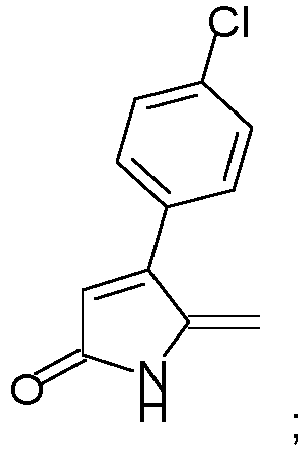
- lactam has the following structure: 4-(4-chlorophenyl)-5-methylene-pyrrol-2-one.
- indefinite article “a” or “an” and its corresponding definite article “the” as used herein means at least one, or one or more, unless specified otherwise.
- a lactam is a cyclic amide.
- the lactam is a lactam selected from: 4-(4-chlorophenyl)-5-methylene-pyrrol-2-one; and 5-methylene-4-(p-tolyl)pyrrol-2-one.
- lactam 4-(4-chlorophenyl)-5-methylene-pyrrol-2-one.
- the lactam is encapsulated.
- the encapsulated lactam is a polymer encapsulated lactam.
- the encapsulated lactam may be encapsulated in a polymer selected from a poly urea polymer, a melamine-formaldehyde copolymer; a urea formaldehyde copolymer and mixtures thereof.
- the polymer is a condensation polymer.
- the polymer may be a condensation polymer of produced from a diamine and a disocyanate.
- the polymer may be or may comprise a polyurea of Formula P1: wherein R P1 comprises a phenylene and R P2 is an alkylene.
- R P1 may be -CH 2 -phenylene; in other words, the polymer may be derived from polymethylene polyphenyl isocyanate.
- R P2 may be a straight chain alkylene of formula -(CH 2 ) m -.
- m is an integer from 2 to 10, for example from 2 to 8, for example from 4 to 8, for example, 6 (in other words, R P2 may be hexylene).
- the lactam may be encapsulated in a polymer formed from polymethylene polyphenyl isocyanate and hexamethylenediamine.
- the polymer and / or encapsulate structure is selected and / or configured to permit controlled or triggered release.
- the encapsulate may dissolve at a predetermined rate under certain conditions.
- the encapsulate may release in response to a trigger.
- the trigger may be, for example, the presence or a certain concentration of acid, base, a salt, an enzyme; or a non-chemical trigger such as ultrasound or light.
- the lactam is encapsulated to form particles whose average diameter is from about 10 nanometers to about 1000 microns, preferably from about 50 nanometers to about 100 microns, more preferably from about 2 to about 40 microns, even more preferably from about 4 to 15 microns. A particularly preferred range is from about 5 to 10 microns, for example 6 to 7 microns.
- the capsule distribution can be narrow, broad or multimodal. Multimodal distributions may be composed of different types of capsule chemistries.
- the encapsulation process suitably is done in a carrier oil, which may be a ketone.
- the carrier oil may be a C 5-20 alkyl ketone, for example a C 5-15 alkyl ketone, for example a C 5-10 alkyl ketone, for example a C 6-8 alkyl ketone, such as a C 7 alkyl ketone.
- the alkylketone may be branched or straight-chain. Preferably, it is straight chain.
- the oxo group of the alkyl ketone may be located at C2; in other words, the alkylketone may be an alkyl-2-one.
- a preferred carrier oil is 2-heptanone.
- the lactam is present at a level of from 0.0001 to 2.5 wt.%, preferably from 0.0001 to 1 wt.%.
- the lactam may be suitably present at levels of 0.001 to 1 wt.%, or even 0.01 to 1 wt.%, or even 0.01 to 0.5 wt.%.
- the wipe preferably comprises from 0.1 to 20 wt.%, more preferably from 0.5 to 10 wt.%, most preferably from 1 to 10 wt.%, or even from 1 to 8 wt.%, for example from 2 to 8 wt.% of a surfactant.
- Any suitable surfactant may be used, including for example, anionic, nonionic, cationic and amphoteric surfactants.
- the surfactant is selected from anionic and nonionic surfactants.
- Suitable anionic detergent compounds which may be used are usually water-soluble alkali metal salts of organic sulphates and sulphonates having alkyl radicals containing from about 8 to about 22 carbon atoms, the term alkyl being used to include the alkyl portion of higher alkyl radicals.
- suitable synthetic anionic detergent compounds are sodium and potassium alkyl sulphates, especially those obtained by sulphating higher C 8 to C 18 alcohols, produced for example from tallow or coconut oil, sodium and potassium alkyl C 9 to C 20 benzene sulphonates, particularly sodium linear secondary alkyl C 10 to C 15 benzene sulphonates; and sodium alkyl glyceryl ether sulphates, especially those ethers of the higher alcohols derived from tallow or coconut oil and synthetic alcohols derived from petroleum.
- the anionic surfactant is preferably selected from: linear alkyl benzene sulphonate; alkyl sulphates; alkyl ether sulphates; soaps; alkyl (preferably methyl) ester sulphonates, and mixtures thereof.
- the most preferred anionic surfactants are selected from: linear alkyl benzene sulphonate; alkyl sulphates; alkyl ether sulphates and mixtures thereof.
- the alkyl ether sulphate is a C 12 -C 14 n-alkyl ether sulphate with an average of 1 to 3EO (ethoxylate) units.
- Sodium lauryl ether sulphate is particularly preferred (SLES).
- the linear alkyl benzene sulphonate is a sodium C 11 to C 15 alkyl benzene sulphonates.
- the alkyl sulphate is a linear or branched sodium C 12 to C 18 alkyl sulphates.
- Sodium dodecyl sulphate is particularly preferred, (SDS, also known as primary alkyl sulphate).
- anionic surfactants for example linear alkyl benzene sulphonate together with an alkyl ether sulphate.
- Suitable nonionic detergent compounds which may be used include, in particular, the reaction products of compounds having an aliphatic hydrophobic group and a reactive hydrogen atom, for example, aliphatic alcohols, acids or amides, especially ethylene oxide either alone or with propylene oxide.
- Preferred nonionic detergent compounds are the condensation products of aliphatic C 8 to C 18 primary or secondary linear or branched alcohols with ethylene oxide.
- surfactants used are saturated.
- the surfactant comprises nonionic surfactants, more preferably alcohol ethoxylates.
- nonionic surfactant is a C 8 to C 18 primary alcohol with an average ethoxylation of 7EO to 9EO units.
- the wipe preferably includes water. Preferred levels of water range from 50 to 98 wt.%, morepreferably 75 to 95 wt.%
- a chelating agent is preferably included in the wipe.
- Typical inclusion levels are from 0.01 to 2.5 wt.%, preferably 0.025 to 1 wt.%.
- the chelant may preferably be: citric acid; EDTA (ethylenediaminetetraacetic acid) or a phosphonic acid.
- Example phosphonic acid (or phosphonate salt thereof) chelating agents are: 1-Hydroxyethylidene-1,1-diphosphonic acid (HEDP); Diethylenetriaminepenta(methylenephosphonic acid) (DTPMP); Hexamethylenediaminetetra(methylenephosphonic acid) (HDTMP); Aminotris(methylenephosphonic acid) (ATMP); Ethylenediaminetetra(methylenephosphonic acid) (EDTMP); Tetramethylenediaminetetra(methylenephosphonic acid) (TDTMP); and, Phosphonobutanetricarboxylic acid (PBTC); and salts thereof.
- HEDP 1-Hydroxyethylidene-1,1-diphosphonic acid
- DTPMP Diethylenetriaminepenta(methylenephosphonic acid)
- HDTMP Hexamethylenediaminetetra(methylenephosphonic acid)
- AMP Aminotris(methylenephosphonic acid)
- the wipe additionally comprises any one or more of the following: buffers, antifoam agents, perfumes, and, preservative.
- aqueous layer was extracted with dichloromethane (100 mL), and the combined organic layers washed with a 1:1 mixture of water and saturated aqueous sodium hydrogen carbonate solution (100 mL), dried (MgSO 4 ) and filtered. Silica was added to the filtrate and the mixture stirred for 10 minutes before filtering through a plug of silica, washing through with dichloromethane followed by a 3:1 mixture of dichloromethane:diethyl ether. Fractions containing the desired product were combined and concentrated under reduced pressure.
- Lactam (4-(4-chlorophenyl)-5-methylene-pyrrol-2-one) is pre-mixed to a final concentration of 1mg/ml with neat solvent (ethanol, DMSO, or methoxymethyl butanol) until fully dispersed.
- the resulting lactam solution is the added to the base wipe formulation to a final lactam concentration of 100mg/l. Continuous wipe sheets are soaked in the formulation and excess is pressed away prior to cutting to smaller pieces and packaged.
- the following wipe formulation was made:- Ingredient % wt.% Water to 100 Neodol 91-5 6.0 Chelating Agent 0.05 Buffers Qs Antifoam agent 0.08 Lactam 0.005 Methoxy Methyl Butanol (MMB) 1
- Example 3 Examples of surface wipe analysis using the wipes
- the wipe of example 2 was used to treat surfaces (stainless steel discs) which had been heavily soiled with E. coli (ATCC 10536). The treatment was 30 seconds. Both a wipe without lactam and a wipe with lactam were tested, along with a water blank disc control. The level of bacterial coverage was counted by measuring the resultant level of bacteria remaining on the stainless steel discs.
- the wipe of example 2 was used to treat surfaces (stainless steel discs) which had been heavily soiled with S . aureus. The treatment was 3 x 10 seconds. Both a wipe without lactam and a wipe with lactam were tested, along with a water blank disc control. The level of bacterial coverage was counted by measuring the resultant level of bacteria remaining on the stainless steel discs.
- the wipe of example 2 was tested to see if the wipe itself could be considered as self-preserving.
- Two types of wipe having the formulation of example 2 were produced on 2 different carriers (viscose and polyethylene terephthalate) and left for 48 hours after being challenged by S . aureus. The level of bacteria on the wipe after 48hrs was measured using fluorescence.
- Viscose Control Viscose Control + lactam PET Control PET Control + lactam Fluorescence 955.7 53.5 993.9 94.7 Standard deviation 30.8 1.2 153.0 34.0
Landscapes
- Life Sciences & Earth Sciences (AREA)
- Engineering & Computer Science (AREA)
- Wood Science & Technology (AREA)
- Chemical & Material Sciences (AREA)
- General Health & Medical Sciences (AREA)
- Health & Medical Sciences (AREA)
- Environmental Sciences (AREA)
- Dentistry (AREA)
- Pest Control & Pesticides (AREA)
- Zoology (AREA)
- Plant Pathology (AREA)
- Agronomy & Crop Science (AREA)
- Organic Chemistry (AREA)
- Chemical Kinetics & Catalysis (AREA)
- Oil, Petroleum & Natural Gas (AREA)
- Toxicology (AREA)
- Detergent Compositions (AREA)
Description
- The invention relates to a wipe suitable for application to a hard surface.
- Wipes are commonly used as surface care products. They can be commonly used to clean a surface using for example a detergent, or to wipe a surface using for example an antimicrobrial ingredient.
-
WO 02/40628 -
WO 2007/085042 discloses lactams, methods for their synthesis and uses of these compounds. -
WO 2017/029070 discloses encapsulated lactams. The encapsulated lactams are suitable for use in compositions, for example, in antimicrobial, anti-biofilm and bacteriostatic compositions. - There is a need for wipes that provide improved surface care benefits to treated surfaces.
- We have found that by adding a lactam as described herein to the wipe, the resulting wipe provides surface care benefits to a wiped surface, for example the treated surface displays a reduced level of microbrial concentration.
- Furthermore, we have found that the wipes are self-preserving. There is a reduced level of bacterial growth on the lactam wipes themselves when compared to non-lactam wipes. This characteristic can thus reduce or remove the necessity for inclusion of a separate preservative.
- The invention relates in a first aspect to a wipe suitable for application to a hard surface comprising from 0.0001 to 5 wt.% of a lactam, wherein the lactam is a lactam selected from:


- Preferably the wipe comprises:-
- a) from 0.0001 to 5 wt.% of a lactam; and,
- b) from 0.1 to 20 wt.% of a surfactant.
- More preferably the wipe comprises:-
- a) from 0.0001 to 5 wt.% of a lactam;
- b) from 0.1 to 20 wt.%, preferably from 0.5 to 10 wt.%, more preferably from 1 to 8 wt.% of a surfactant; and,
- c) from 0.01 to 2.5 wt.% of a chelating agent.
- It is preferred that the lactam is present at a level of from 0.0001 to 2.5 wt.%, more preferably from 0.0001 to 1 wt.%, most preferably from 0.001 to 1 wt.%.
- More preferably the lactam is a lactam selected from:

- Preferably the lactam is in encapsulated form.
- Preferably the surfactant is selected from anionic and nonionic surfactants, preferably nonionic surfactants, more preferably alcohol ethoxylates.
- Preferably the chelating agent is citric acid; EDTA (ethylenediaminetetraacetic acid) or a phosphonic acid.
- Preferably the wipe additionally comprises any one or more of the following: buffers, antifoam agents, perfumes, and, preservative.
- In a second aspect, the invention relates to the use of a lactam in a wipe product to enhance preservation of said wipe product, wherein the lactam is selected from:


- In a third aspect, the invention relates to the use of a wipe according to the first aspect of the invention on a surface to reduce microorganism buildup on said surface.
- Preferably in these uses of the lactam has the following structure:

- The indefinite article "a" or "an" and its corresponding definite article "the" as used herein means at least one, or one or more, unless specified otherwise.
- It will be appreciated that, except where expressly provided otherwise, all preferences are combinable.
- A lactam is a cyclic amide.
- The lactam is a lactam selected from:


- The most preferred lactam is:-

- Preferably the lactam is encapsulated.
- Suitably, the encapsulated lactam is a polymer encapsulated lactam.
- The encapsulated lactam may be encapsulated in a polymer selected from a poly urea polymer, a melamine-formaldehyde copolymer; a urea formaldehyde copolymer and mixtures thereof.
- Suitably the polymer is a condensation polymer. For example, the polymer may be a condensation polymer of produced from a diamine and a disocyanate.
- For example, the polymer may be or may comprise a polyurea of Formula P1:

- For example, RP1 may be -CH2-phenylene; in other words, the polymer may be derived from polymethylene polyphenyl isocyanate.
- For example, RP2 may be a straight chain alkylene of formula -(CH2)m-. In some cases, m is an integer from 2 to 10, for example from 2 to 8, for example from 4 to 8, for example, 6 (in other words, RP2 may be hexylene).
- In other words, the lactam may be encapsulated in a polymer formed from polymethylene polyphenyl isocyanate and hexamethylenediamine.
- In some cases, the polymer and / or encapsulate structure is selected and / or configured to permit controlled or triggered release. For example, the encapsulate may dissolve at a predetermined rate under certain conditions. For example, the encapsulate may release in response to a trigger. The trigger may be, for example, the presence or a certain concentration of acid, base, a salt, an enzyme; or a non-chemical trigger such as ultrasound or light.
- Suitably, the lactam is encapsulated to form particles whose average diameter is from about 10 nanometers to about 1000 microns, preferably from about 50 nanometers to about 100 microns, more preferably from about 2 to about 40 microns, even more preferably from about 4 to 15 microns. A particularly preferred range is from about 5 to 10 microns, for example 6 to 7 microns. The capsule distribution can be narrow, broad or multimodal. Multimodal distributions may be composed of different types of capsule chemistries.
- The encapsulation process suitably is done in a carrier oil, which may be a ketone. For example, the carrier oil may be a C5-20alkyl ketone, for example a C5-15alkyl ketone, for example a C5-10alkyl ketone, for example a C6-8alkyl ketone, such as a C7alkyl ketone. The alkylketone may be branched or straight-chain. Preferably, it is straight chain. The oxo group of the alkyl ketone may be located at C2; in other words, the alkylketone may be an alkyl-2-one. A preferred carrier oil is 2-heptanone.
- Preferably the lactam is present at a level of from 0.0001 to 2.5 wt.%, preferably from 0.0001 to 1 wt.%. For example, the lactam may be suitably present at levels of 0.001 to 1 wt.%, or even 0.01 to 1 wt.%, or even 0.01 to 0.5 wt.%.
- The wipe preferably comprises from 0.1 to 20 wt.%, more preferably from 0.5 to 10 wt.%, most preferably from 1 to 10 wt.%, or even from 1 to 8 wt.%, for example from 2 to 8 wt.% of a surfactant.
- Any suitable surfactant may be used, including for example, anionic, nonionic, cationic and amphoteric surfactants.
- Preferably the surfactant is selected from anionic and nonionic surfactants.
- Suitable anionic detergent compounds which may be used are usually water-soluble alkali metal salts of organic sulphates and sulphonates having alkyl radicals containing from about 8 to about 22 carbon atoms, the term alkyl being used to include the alkyl portion of higher alkyl radicals.
- Examples of suitable synthetic anionic detergent compounds are sodium and potassium alkyl sulphates, especially those obtained by sulphating higher C8 to C18 alcohols, produced for example from tallow or coconut oil, sodium and potassium alkyl C9 to C20 benzene sulphonates, particularly sodium linear secondary alkyl C10 to C15 benzene sulphonates; and sodium alkyl glyceryl ether sulphates, especially those ethers of the higher alcohols derived from tallow or coconut oil and synthetic alcohols derived from petroleum.
- The anionic surfactant is preferably selected from: linear alkyl benzene sulphonate; alkyl sulphates; alkyl ether sulphates; soaps; alkyl (preferably methyl) ester sulphonates, and mixtures thereof.
- The most preferred anionic surfactants are selected from: linear alkyl benzene sulphonate; alkyl sulphates; alkyl ether sulphates and mixtures thereof. Preferably the alkyl ether sulphate is a C12-C14 n-alkyl ether sulphate with an average of 1 to 3EO (ethoxylate) units.
- Sodium lauryl ether sulphate is particularly preferred (SLES). Preferably the linear alkyl benzene sulphonate is a sodium C11 to C15 alkyl benzene sulphonates. Preferably the alkyl sulphate is a linear or branched sodium C12 to C18 alkyl sulphates. Sodium dodecyl sulphate is particularly preferred, (SDS, also known as primary alkyl sulphate).
- It is possible for two or more anionic surfactants to be present, for example linear alkyl benzene sulphonate together with an alkyl ether sulphate.
- Suitable nonionic detergent compounds which may be used include, in particular, the reaction products of compounds having an aliphatic hydrophobic group and a reactive hydrogen atom, for example, aliphatic alcohols, acids or amides, especially ethylene oxide either alone or with propylene oxide. Preferred nonionic detergent compounds are the condensation products of aliphatic C8 to C18 primary or secondary linear or branched alcohols with ethylene oxide.
- Preferably the surfactants used are saturated.
- More preferably the surfactant comprises nonionic surfactants, more preferably alcohol ethoxylates.
- Most preferably the nonionic surfactant is a C8 to C18 primary alcohol with an average ethoxylation of 7EO to 9EO units.
- The wipe preferably includes water. Preferred levels of water range from 50 to 98 wt.%, morepreferably 75 to 95 wt.%
- A chelating agent is preferably included in the wipe. Typical inclusion levels are from 0.01 to 2.5 wt.%, preferably 0.025 to 1 wt.%.
- The chelant may preferably be: citric acid; EDTA (ethylenediaminetetraacetic acid) or a phosphonic acid.
- Example phosphonic acid (or phosphonate salt thereof) chelating agents are: 1-Hydroxyethylidene-1,1-diphosphonic acid (HEDP); Diethylenetriaminepenta(methylenephosphonic acid) (DTPMP); Hexamethylenediaminetetra(methylenephosphonic acid) (HDTMP); Aminotris(methylenephosphonic acid) (ATMP); Ethylenediaminetetra(methylenephosphonic acid) (EDTMP); Tetramethylenediaminetetra(methylenephosphonic acid) (TDTMP); and, Phosphonobutanetricarboxylic acid (PBTC); and salts thereof.
- Preferably the wipe additionally comprises any one or more of the following: buffers, antifoam agents, perfumes, and, preservative.
- The invention will be further described with the following non-limiting examples.
-

- 1-(4-Chlorophenyl)propan-2-one (40.00 g, 34.75 mL, 237.2 mmol), glyoxylic acid monohydrate (32.75 g, 355.8 mmol) and phosphoric acid (69.74 g, 711.7 mmol) were combined at room temperature before heating to 85 °C overnight. After cooling to room temperature, the mixture was poured into a mixture of water (500 mL) and ethyl acetate (500 mL). The layers were separated and the aqueous phase extracted with ethyl acetate (500 mL). The combined organic layers were washed with a 1:1 mixture of water and brine (2 x 500 mL), dried (MgSO4) and concentrated under reduced pressure to yield 4-(4-chlorophenyl)-5-hydroxy-5-methylfuran-2(5H)-one (66.00 g, >100% yield) as a brown oil. The material was used in the next step without further purification.
-

- 4-(4-Chlorophenyl)-5-hydroxy-5-methylfuran-2(5H)-one (66.00 g, 293.8 mmol) was dissolved in thionyl chloride (196.8 g, 120.0 mL, 1654 mmol) and heated at 40 °C for 1 hour, then 80 °C for 2 hours. The mixture was concentrated under reduced pressure and azeotroped with 2-methyltetrahydrofuran (200 mL). The residue was diluted with 2-methyltetrahydrofuran (160 mL) and this solution added to a cooled stirring mixture of 28% ammonia in water (180 mL) in 2-methyltetrahydrofuran (20 mL) at 0 °C. The mixture was warmed to room temperature and stirred overnight. Water (100 mL) and ethyl acetate (200 mL) were added and the layers separated. The aqueous phase was extracted with ethyl acetate (200 mL), and the combined organic extracts dried (MgSO4) and concentrated under reduced pressure. Purification by dry flash column chromatography (5-60% ethyl acetate in heptane) yielded 4-(4-chlorophenyl)-5-hydroxy-5-methyl-1H-pyrrol-2(5H)-one (23.18 g, 35% yield) as a cream coloured solid.
- 1H NMR (400 MHz, d6-DMSO) 8.55 (brs, 1H), 7.88-7.83 (m, 2H), 7.51-7.46 (m, 2H), 6.37 (d, 1H), 6.32 (s, 1H), 1.45 (s, 3H)
- UPLC (Basic) 1.51/5.00 min, 100% purity, M+H+ 224
- MP 177 °C
-
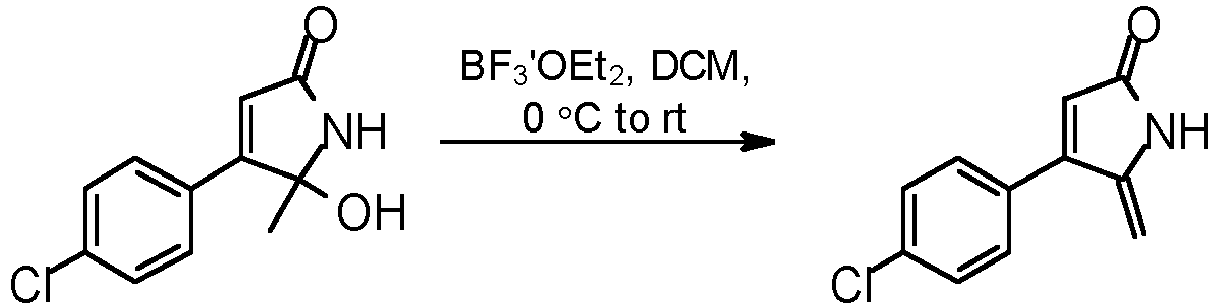
- To a cooled solution of 4-(4-chlorophenyl)-5-hydroxy-5-methyl-1H-pyrrol-2(5H)-one (10.00 g, 44.51 mmol) in dry dichloromethane (100 mL) at 0 °C was added a solution of boron trifluoride diethyl etherate (8.213 g, 7.142 mL, 57.87 mmol) in dry dichloromethane (45 mL) over 15 minutes. The mixture was stirred at 0 °C, before slowly warming to room temperature and stirring for 2 hours. The reaction was quenched with ice-water (100 mL) and the layers separated. The aqueous layer was extracted with dichloromethane (100 mL), and the combined organic layers washed with a 1:1 mixture of water and saturated aqueous sodium hydrogen carbonate solution (100 mL), dried (MgSO4) and filtered. Silica was added to the filtrate and the mixture stirred for 10 minutes before filtering through a plug of silica, washing through with dichloromethane followed by a 3:1 mixture of dichloromethane:diethyl ether. Fractions containing the desired product were combined and concentrated under reduced pressure. Upon concentration a precipitate formed, which was collected by filtration, washing with diethyl ether, to yield 4-(4-chlorophenyl)-5-methylene-1H-pyrrol-2(5H)-one (5.25 g, 57% yield) as a cream coloured solid.
- 1H NMR (400 MHz, d6-DMSO) 10.10 (s, 1H), 7.54-7.47 (m, 4H), 6.36 (s, 1H), 5.04 (t, 1H), 4.85 (s, 1H)
- UPLC (Basic) 1.87/5.00 min, 100% purity, M+H+ 206
- MP 182 °C
-

- 1-(p-Tolyl)propan-2-one (25.00 g, 24.00 mL, 168.7 mmol), glyoxylic acid monohydrate (23.29 g, 253.0 mmol) and phosphoric acid (49.60 g, 506.1 mmol) were combined at room temperature before heating at 90 °C overnight. After cooling to room temperature, the mixture was poured into a stirring mixture of ice-water (400 mL) and ethyl acetate (400 mL). The layers were separated and the organic phase washed with water (100 mL), dried (MgSO4) and concentrated under reduced pressure. The mixture was azeotroped with 2-methyltetrahydrofuran (50 mL) to yield 5-hydroxy-5-methyl-4-(p-tolyl)furan-2(5H)-one (16.50 g, 48% yield) as a brown solid.
1H NMR (400 MHz, d6-DMSO) 7.86 (s, 1H), 7.75 (d, 2H), 7.28 (d, 2H), 6.59 (s, 1H), 2.32 (s, 3H), 1.61 (s, 3H) -

- 5-Hydroxy-5-methyl-4-(p-tolyl)furan-2(5H)-one (16.50 g, 80.80 mmol) was dissolved in thionyl chloride (48.06 g, 29.47 mL, 404.0 mmol) and heated at 50 °C for 1 hour, before heating at reflux for 1 hour. After cooling to room temperature, the mixture was concentrated under reduced pressure and azeotroped with 2-methyltetra-hydrofuran (2 x 50 mL). The residue was diluted with 2-methyltetrahydrofuran (60 mL) and this solution added to a cooled stirring mixture of 28% ammonia in water (55 mL, 808.0 mol) in 2-methyltetrahydrofuran (10 mL) at 0 °C. The mixture was warmed to room temperature and stirred overnight. 2-Methyltetrahydrofuran was removed under reduced pressure, and the residue diluted with water (200 mL) and diethyl ether (100 mL) and the mixture stirred for 20 minutes at room temperature. The solids were collected by filtration and stirred in water (100 mL) and diethyl ether (50 mL) at room temperature for 10 minutes. The solids were collected by filtration and washed with water, diethyl ether and dried under vacuum at 50 °C to yield 5-hydroxy-5-methyl-4-(p-tolyl)-1H-pyrrol-2(5H)-one (10.49 g, 31% yield) as a light beige solid.
- 1H NMR (400 MHz, d6-DMSO) 8.44 (brs, 1H), 7.73 (d, 2H), 7.21 (d, 2H), 6.24 (s, 2H), 2.29 (s, 3H), 1.45 (s, 3H)
- 13C NMR (400 MHz, d6-DMSO) 170.4 (s, 1C), 161.1 (s, 1C), 139.8 (s, 1C), 129.7 (s, 2C), 128.9 (s, 1C), 128.2 (s, 2C), 119.1 (s, 1C), 87.8 (s, 1C), 26.7 (s, 1C), 21.5 (s, 1C)
- UPLC (Basic) 1.41/5.00 min, 100% purity, M+H+ 204
- MP 178 °C Decomposition
-

- To a cooled solution of 5-hydroxy-5-methyl-4-(p-tolyl)-1H-pyrrol-2(5H)-one (8.68 g, 42.7 mmol) in dry dichloromethane (87 mL) at 0 °C was added a solution of boron trifluoride diethyl etherate (6.85 g, 5.96 mL, 55.5 mmol) in dry dichloromethane (40 mL) over 15 minutes. After 1 hour the mixture was allowed to slowly warm to room temperature. After a further 3 hours, the reaction was diluted with dichloromethane (50 mL) and ice-water (100 mL) and stirred for 10 minutes. The layers were separated and the organic layer washed with water (100 mL), a 1:1 mixture of water and saturated aqueous sodium hydrogen carbonate solution (100 mL) and brine (100 mL) and the organic layer filtered through Celite, washing with dichloromethane. Any excess water was removed by pipette before drying the filtrate (MgSO4) and concentrating under reduced pressure to a brown solid. The solids were stirred in hot dichloromethane (120 mL) for 15 minutes before slowly cooling to room temperature and then 0 °C. The solids were collected by filtration to yield 5-methylene-4-(p-tolyl)-1H-pyrrol-2(5H)-one (3.87 g, 49% yield) as a yellow solid. Silica was added to the filtrate and the mixture stirred for 10 minutes before filtering through a plug of silica, washing through with dichloromethane and then a 4:1 mixture of dichloromethane:diethyl ether. The filtrate was concentrated under reduced pressure to yield 5-methylene-4-(p-tolyl)-1H-pyrrol-2(5H)-one (0.58 g, 7%) as a yellow solid. Total yield of 5-methylene-4-(p-tolyl)-1H-pyrrol-2(5H)-one (4.45 g, 56% yield).
- 1H NMR (400 MHz, d6-DMSO) 10.11 (brs, 1H), 7.35 (d, 2H), 7.25 (d, 2H), 6.25 (s, 1H), 5.01 (s, 1H), 4.85 (s, 1H), 2.31 (s, 3H)
- UPLC (Basic) 1.83/5.00 min, 100% purity, M+H+ 186
- MP 200 °C Decomposition
- Lactam (4-(4-chlorophenyl)-5-methylene-pyrrol-2-one) is pre-mixed to a final concentration of 1mg/ml with neat solvent (ethanol, DMSO, or methoxymethyl butanol) until fully dispersed. The resulting lactam solution is the added to the base wipe formulation to a final lactam concentration of 100mg/l. Continuous wipe sheets are soaked in the formulation and excess is pressed away prior to cutting to smaller pieces and packaged.
- The following wipe formulation was made:-
Ingredient % wt.% Water to 100 Neodol 91-5 6.0 Chelating Agent 0.05 Buffers Qs Antifoam agent 0.08 Lactam 0.005 Methoxy Methyl Butanol (MMB) 1 - The wipe of example 2 was used to treat surfaces (stainless steel discs) which had been heavily soiled with E. coli (ATCC 10536). The treatment was 30 seconds. Both a wipe without lactam and a wipe with lactam were tested, along with a water blank disc control. The level of bacterial coverage was counted by measuring the resultant level of bacteria remaining on the stainless steel discs.
- The results show that the lactam wipe reduced the level of E. coli compared to the same wipe without lactam. The results were statistically significant.
Water blank control treatment Control Wipe (without lactam) Invention Wipe (with lactam) Mean Log10 bacterial count 6.13 2.64 1.84 Standard Deviation 0.39 0.06 0.27 - The wipe of example 2 was used to treat surfaces (stainless steel discs) which had been heavily soiled with S. aureus. The treatment was 3 x 10 seconds. Both a wipe without lactam and a wipe with lactam were tested, along with a water blank disc control. The level of bacterial coverage was counted by measuring the resultant level of bacteria remaining on the stainless steel discs.
- The results show that the lactam wipe reduced the level of S. aureus compared to the same wipe without lactam. The results were statistically significant.
Water blank control treatment Control Wipe (without lactam) Invention Wipe (with lactam) Mean Log10 bacterial count 5.44 4.40 3.13 Standard Deviation 0.08 0.4 0.42 - The wipe of example 2 was tested to see if the wipe itself could be considered as self-preserving. Two types of wipe having the formulation of example 2 were produced on 2 different carriers (viscose and polyethylene terephthalate) and left for 48 hours after being challenged by S. aureus. The level of bacteria on the wipe after 48hrs was measured using fluorescence.
Viscose Control Viscose Control + lactam PET Control PET Control + lactam Fluorescence 955.7 53.5 993.9 94.7 Standard deviation 30.8 1.2 153.0 34.0
Claims (12)
- A wipe suitable for application to a hard surface comprising from 0.0001 to 5 wt.% of a lactam, wherein the lactam is a lactam selected from:


- A wipe according to claim 1 comprising:-a) from 0.001 to 5 wt.% of a lactam; and,b) from 0.1 to 20 wt.% of a surfactant.
- A wipe according to claim 1 or claim 2 comprising:-a) from 0.001 to 5 wt.% of a lactam;b) from 0.1 to 20 wt.%, preferably from 0.5 to 10 wt.%, more preferably from 1 to 8 wt.% of a surfactant; and,c) from 0.01 to 2.5 wt.% of a chelating agent.
- A wipe according to any preceding claim, wherein the lactam is present at a level of from 0.0001 to 2.5 wt.%, preferably from 0.0001 to 1 wt.%, more preferably from 0.001 to 1 wt.%.
- A wipe according to any preceding claim, wherein the lactam is a lactam selected from:

- A wipe according to any preceding claim, wherein the lactam is in encapsulated form.
- A wipe according to any preceding claim, wherein the surfactant is selected from anionic and nonionic surfactants, preferably nonionic surfactants, more preferably alcohol ethoxylates.
- A wipe according to any preceding claim, wherein the chelating agent is citric acid; EDTA (ethylenediaminetetraacetic acid) or a phosphonic acid.
- A wipe according to any preceding claim, additionally comprising any one or more of the following: buffers, antifoam agents, perfumes, and, preservative.
- Use of a lactam in a wipe product to enhance preservation of said wipe product, wherein the lactam is selected from:

- Use of a wipe according to any one of claims 1 to 9 on a surface to reduce microorganism buildup on said surface.
- Use according to claims 10 or 11, wherein the lactam has the following structure:

Applications Claiming Priority (2)
| Application Number | Priority Date | Filing Date | Title |
|---|---|---|---|
| EP18194538 | 2018-09-14 | ||
| PCT/EP2019/073902 WO2020053106A1 (en) | 2018-09-14 | 2019-09-06 | Wipe |
Publications (3)
| Publication Number | Publication Date |
|---|---|
| EP3850070A1 EP3850070A1 (en) | 2021-07-21 |
| EP3850070C0 EP3850070C0 (en) | 2024-11-06 |
| EP3850070B1 true EP3850070B1 (en) | 2024-11-06 |
Family
ID=63592609
Family Applications (1)
| Application Number | Title | Priority Date | Filing Date |
|---|---|---|---|
| EP19762433.1A Active EP3850070B1 (en) | 2018-09-14 | 2019-09-06 | Wipe |
Country Status (6)
| Country | Link |
|---|---|
| US (1) | US20210321611A1 (en) |
| EP (1) | EP3850070B1 (en) |
| CN (1) | CN112689664A (en) |
| BR (1) | BR112021004514A2 (en) |
| WO (1) | WO2020053106A1 (en) |
| ZA (1) | ZA202101463B (en) |
Families Citing this family (1)
| Publication number | Priority date | Publication date | Assignee | Title |
|---|---|---|---|---|
| CN116583180B (en) * | 2020-12-09 | 2025-12-12 | 联合利华知识产权控股有限公司 | Lactam Compositions and Uses |
Family Cites Families (9)
| Publication number | Priority date | Publication date | Assignee | Title |
|---|---|---|---|---|
| CN1071998C (en) * | 1996-07-16 | 2001-10-03 | 普罗格特-甘布尔公司 | Use of combination of surfactants, chelating agents and essential oils for effective disinfection |
| US6482423B1 (en) * | 1999-04-13 | 2002-11-19 | The Procter & Gamble Company | Antimicrobial wipes which provide improved residual benefit versus gram positive bacteria |
| US6413529B1 (en) * | 1999-04-13 | 2002-07-02 | The Procter & Gamble Company | Antimicrobial wipes which provide improved residual benefit versus gram negative bacteria |
| US6821940B2 (en) * | 2000-11-17 | 2004-11-23 | The Procter & Gamble Company | Wipes for cleaning foods, toys and food/child contact surfaces |
| US6930080B2 (en) * | 2002-11-08 | 2005-08-16 | S. C. Johnson & Son, Inc. | Wipes impregnated with biliquid foam treating liquids |
| KR101347278B1 (en) * | 2006-01-24 | 2014-01-03 | 바이오시그널 리미티드 | Novel lactams |
| WO2014121189A1 (en) * | 2013-02-04 | 2014-08-07 | 3M Innovative Properties Company | Antimicrobial compositions, wipes, and methods |
| CN108024939B (en) * | 2015-08-20 | 2024-06-07 | 联合利华知识产权控股有限公司 | Encapsulated lactams |
| WO2018064021A1 (en) * | 2016-09-28 | 2018-04-05 | Lonza Inc. | Low residue disinfecting wipes |
-
2019
- 2019-09-06 US US17/272,378 patent/US20210321611A1/en not_active Abandoned
- 2019-09-06 BR BR112021004514-7A patent/BR112021004514A2/en unknown
- 2019-09-06 CN CN201980060420.XA patent/CN112689664A/en active Pending
- 2019-09-06 WO PCT/EP2019/073902 patent/WO2020053106A1/en not_active Ceased
- 2019-09-06 EP EP19762433.1A patent/EP3850070B1/en active Active
-
2021
- 2021-03-03 ZA ZA2021/01463A patent/ZA202101463B/en unknown
Also Published As
| Publication number | Publication date |
|---|---|
| EP3850070A1 (en) | 2021-07-21 |
| ZA202101463B (en) | 2022-08-31 |
| BR112021004514A2 (en) | 2021-06-08 |
| EP3850070C0 (en) | 2024-11-06 |
| US20210321611A1 (en) | 2021-10-21 |
| CN112689664A (en) | 2021-04-20 |
| WO2020053106A1 (en) | 2020-03-19 |
Similar Documents
| Publication | Publication Date | Title |
|---|---|---|
| EP2376615B1 (en) | Automatic dishwashing detergent composition protecting colour | |
| EP2129761B1 (en) | Cleaning agents | |
| EP3430112B1 (en) | Granulate comprising an inorganic, solid carrier, containing at least one biosurfactant | |
| AU2002229627B2 (en) | Surface-active compositions | |
| EP2855372B1 (en) | Acidic compositions including reducing agents for elimination of hard water scale and decolorization of metal stains | |
| EP1456340B1 (en) | Method for the production of surfactant granulates containing builders | |
| US20230118925A1 (en) | Use of propoxylated surfactant or polymer in foaming applications to control viscoelasticity in highly active liquid formulations | |
| CN109661459B (en) | Solid detergent compositions and methods for adjusting the dispensing rate of solid detergents using solid anionic surfactants | |
| EP2970828B1 (en) | Cleaners for hard surfaces comprising phosphoric acid esters of a polyether-modified alkyl alcohol | |
| CN109153940B (en) | Curing Process Using Low Level Coupling Agents/Hydrotropes | |
| CN112689497B (en) | mousse composition | |
| EP2802640B1 (en) | Washing and cleaning agents containing glycerin esters | |
| EP1103599A1 (en) | Particle form rinse aid and dishwasher detergent composition | |
| US20210321611A1 (en) | Wipe | |
| DE19919443A1 (en) | Effervescent tablets with tableting aids and process for their preparation | |
| EP2963102A2 (en) | Cleaning agents comprising hydroxamic acid and/or its salts | |
| DE20014919U1 (en) | Particulate machine dishwashing detergent with rinse aid effect | |
| DE10062007A1 (en) | Production of detergent composition in powder or granular form, comprising mixing preformed detergent powder or granules with finely divided alkali metal carbonate particles to reduce caking | |
| JP5202805B2 (en) | Cleaning agent for clothing | |
| WO2001072949A1 (en) | Particle-shaped dishwashing machine detergents having a clear rinsing effect | |
| DE10063430A1 (en) | Storage-stable and accurately-dosable detergent components, for use in particulate and multi-phase machine dishwashing agents, comprise a room temperature solid mixture of surfactant(s) and soap(s) | |
| DE102007038482A1 (en) | Machine dishwashing agents, useful as clear rinsing agents and/or as drying accelerator in machine dishwasher, comprises polycarbonate, polyurethane and/or polyurea-polyorganosiloxane compounds or their acid addition compounds and/or salts |
Legal Events
| Date | Code | Title | Description |
|---|---|---|---|
| STAA | Information on the status of an ep patent application or granted ep patent |
Free format text: STATUS: UNKNOWN |
|
| STAA | Information on the status of an ep patent application or granted ep patent |
Free format text: STATUS: THE INTERNATIONAL PUBLICATION HAS BEEN MADE |
|
| PUAI | Public reference made under article 153(3) epc to a published international application that has entered the european phase |
Free format text: ORIGINAL CODE: 0009012 |
|
| STAA | Information on the status of an ep patent application or granted ep patent |
Free format text: STATUS: REQUEST FOR EXAMINATION WAS MADE |
|
| 17P | Request for examination filed |
Effective date: 20210311 |
|
| AK | Designated contracting states |
Kind code of ref document: A1 Designated state(s): AL AT BE BG CH CY CZ DE DK EE ES FI FR GB GR HR HU IE IS IT LI LT LU LV MC MK MT NL NO PL PT RO RS SE SI SK SM TR |
|
| DAV | Request for validation of the european patent (deleted) | ||
| DAX | Request for extension of the european patent (deleted) | ||
| STAA | Information on the status of an ep patent application or granted ep patent |
Free format text: STATUS: EXAMINATION IS IN PROGRESS |
|
| 17Q | First examination report despatched |
Effective date: 20230406 |
|
| GRAP | Despatch of communication of intention to grant a patent |
Free format text: ORIGINAL CODE: EPIDOSNIGR1 |
|
| STAA | Information on the status of an ep patent application or granted ep patent |
Free format text: STATUS: GRANT OF PATENT IS INTENDED |
|
| RIC1 | Information provided on ipc code assigned before grant |
Ipc: A01N 57/20 20060101ALI20240603BHEP Ipc: A01N 43/36 20060101ALI20240603BHEP Ipc: C07D 207/38 20060101ALI20240603BHEP Ipc: C07D 207/44 20060101ALI20240603BHEP Ipc: C11D 17/04 20060101ALI20240603BHEP Ipc: A01N 37/44 20060101ALI20240603BHEP Ipc: A47L 13/17 20060101ALI20240603BHEP Ipc: C11D 3/28 20060101AFI20240603BHEP |
|
| INTG | Intention to grant announced |
Effective date: 20240702 |
|
| GRAS | Grant fee paid |
Free format text: ORIGINAL CODE: EPIDOSNIGR3 |
|
| GRAA | (expected) grant |
Free format text: ORIGINAL CODE: 0009210 |
|
| STAA | Information on the status of an ep patent application or granted ep patent |
Free format text: STATUS: THE PATENT HAS BEEN GRANTED |
|
| AK | Designated contracting states |
Kind code of ref document: B1 Designated state(s): AL AT BE BG CH CY CZ DE DK EE ES FI FR GB GR HR HU IE IS IT LI LT LU LV MC MK MT NL NO PL PT RO RS SE SI SK SM TR |
|
| REG | Reference to a national code |
Ref country code: GB Ref legal event code: FG4D |
|
| REG | Reference to a national code |
Ref country code: CH Ref legal event code: EP |
|
| REG | Reference to a national code |
Ref country code: DE Ref legal event code: R096 Ref document number: 602019061530 Country of ref document: DE |
|
| REG | Reference to a national code |
Ref country code: IE Ref legal event code: FG4D |
|
| U01 | Request for unitary effect filed |
Effective date: 20241106 |
|
| U07 | Unitary effect registered |
Designated state(s): AT BE BG DE DK EE FI FR IT LT LU LV MT NL PT RO SE SI Effective date: 20241113 |
|
| PG25 | Lapsed in a contracting state [announced via postgrant information from national office to epo] |
Ref country code: IS Free format text: LAPSE BECAUSE OF FAILURE TO SUBMIT A TRANSLATION OF THE DESCRIPTION OR TO PAY THE FEE WITHIN THE PRESCRIBED TIME-LIMIT Effective date: 20250306 Ref country code: HR Free format text: LAPSE BECAUSE OF FAILURE TO SUBMIT A TRANSLATION OF THE DESCRIPTION OR TO PAY THE FEE WITHIN THE PRESCRIBED TIME-LIMIT Effective date: 20241106 |
|
| PG25 | Lapsed in a contracting state [announced via postgrant information from national office to epo] |
Ref country code: ES Free format text: LAPSE BECAUSE OF FAILURE TO SUBMIT A TRANSLATION OF THE DESCRIPTION OR TO PAY THE FEE WITHIN THE PRESCRIBED TIME-LIMIT Effective date: 20241106 |
|
| PG25 | Lapsed in a contracting state [announced via postgrant information from national office to epo] |
Ref country code: NO Free format text: LAPSE BECAUSE OF FAILURE TO SUBMIT A TRANSLATION OF THE DESCRIPTION OR TO PAY THE FEE WITHIN THE PRESCRIBED TIME-LIMIT Effective date: 20250206 |
|
| PG25 | Lapsed in a contracting state [announced via postgrant information from national office to epo] |
Ref country code: GR Free format text: LAPSE BECAUSE OF FAILURE TO SUBMIT A TRANSLATION OF THE DESCRIPTION OR TO PAY THE FEE WITHIN THE PRESCRIBED TIME-LIMIT Effective date: 20250207 |
|
| PG25 | Lapsed in a contracting state [announced via postgrant information from national office to epo] |
Ref country code: PL Free format text: LAPSE BECAUSE OF FAILURE TO SUBMIT A TRANSLATION OF THE DESCRIPTION OR TO PAY THE FEE WITHIN THE PRESCRIBED TIME-LIMIT Effective date: 20241106 |
|
| PG25 | Lapsed in a contracting state [announced via postgrant information from national office to epo] |
Ref country code: RS Free format text: LAPSE BECAUSE OF FAILURE TO SUBMIT A TRANSLATION OF THE DESCRIPTION OR TO PAY THE FEE WITHIN THE PRESCRIBED TIME-LIMIT Effective date: 20250206 |
|
| PG25 | Lapsed in a contracting state [announced via postgrant information from national office to epo] |
Ref country code: SM Free format text: LAPSE BECAUSE OF FAILURE TO SUBMIT A TRANSLATION OF THE DESCRIPTION OR TO PAY THE FEE WITHIN THE PRESCRIBED TIME-LIMIT Effective date: 20241106 |
|
| PG25 | Lapsed in a contracting state [announced via postgrant information from national office to epo] |
Ref country code: SK Free format text: LAPSE BECAUSE OF FAILURE TO SUBMIT A TRANSLATION OF THE DESCRIPTION OR TO PAY THE FEE WITHIN THE PRESCRIBED TIME-LIMIT Effective date: 20241106 |
|
| PG25 | Lapsed in a contracting state [announced via postgrant information from national office to epo] |
Ref country code: CZ Free format text: LAPSE BECAUSE OF FAILURE TO SUBMIT A TRANSLATION OF THE DESCRIPTION OR TO PAY THE FEE WITHIN THE PRESCRIBED TIME-LIMIT Effective date: 20241106 |
|
| PLBE | No opposition filed within time limit |
Free format text: ORIGINAL CODE: 0009261 |
|
| STAA | Information on the status of an ep patent application or granted ep patent |
Free format text: STATUS: NO OPPOSITION FILED WITHIN TIME LIMIT |
|
| 26N | No opposition filed |
Effective date: 20250807 |
|
| PGFP | Annual fee paid to national office [announced via postgrant information from national office to epo] |
Ref country code: GB Payment date: 20250919 Year of fee payment: 7 |
|
| U20 | Renewal fee for the european patent with unitary effect paid |
Year of fee payment: 7 Effective date: 20250924 |
|
| U1N | Appointed representative for the unitary patent procedure changed after the registration of the unitary effect |
Representative=s name: UNILEVER PATENT GROUP; NL |
|
| REG | Reference to a national code |
Ref country code: CH Ref legal event code: H13 Free format text: ST27 STATUS EVENT CODE: U-0-0-H10-H13 (AS PROVIDED BY THE NATIONAL OFFICE) Effective date: 20260504 |