EP3849906B1 - System und verfahren zur erkennung von eisbildung auf einem körper - Google Patents
System und verfahren zur erkennung von eisbildung auf einem körper Download PDFInfo
- Publication number
- EP3849906B1 EP3849906B1 EP19763012.2A EP19763012A EP3849906B1 EP 3849906 B1 EP3849906 B1 EP 3849906B1 EP 19763012 A EP19763012 A EP 19763012A EP 3849906 B1 EP3849906 B1 EP 3849906B1
- Authority
- EP
- European Patent Office
- Prior art keywords
- detector
- optic fibre
- temperature
- optical
- outer diameter
- Prior art date
- Legal status (The legal status is an assumption and is not a legal conclusion. Google has not performed a legal analysis and makes no representation as to the accuracy of the status listed.)
- Active
Links
Images

Classifications
-
- B—PERFORMING OPERATIONS; TRANSPORTING
- B64—AIRCRAFT; AVIATION; COSMONAUTICS
- B64D—EQUIPMENT FOR FITTING IN OR TO AIRCRAFT; FLIGHT SUITS; PARACHUTES; ARRANGEMENT OR MOUNTING OF POWER PLANTS OR PROPULSION TRANSMISSIONS IN AIRCRAFT
- B64D15/00—De-icing or preventing icing on exterior surfaces of aircraft
- B64D15/20—Means for detecting icing or initiating de-icing
-
- F—MECHANICAL ENGINEERING; LIGHTING; HEATING; WEAPONS; BLASTING
- F03—MACHINES OR ENGINES FOR LIQUIDS; WIND, SPRING, OR WEIGHT MOTORS; PRODUCING MECHANICAL POWER OR A REACTIVE PROPULSIVE THRUST, NOT OTHERWISE PROVIDED FOR
- F03D—WIND MOTORS
- F03D80/00—Details, components or accessories not provided for in groups F03D1/00 - F03D17/00
- F03D80/40—Ice detection; De-icing means
-
- G—PHYSICS
- G01—MEASURING; TESTING
- G01K—MEASURING TEMPERATURE; MEASURING QUANTITY OF HEAT; THERMALLY-SENSITIVE ELEMENTS NOT OTHERWISE PROVIDED FOR
- G01K11/00—Measuring temperature based upon physical or chemical changes not covered by groups G01K3/00, G01K5/00, G01K7/00 or G01K9/00
- G01K11/32—Measuring temperature based upon physical or chemical changes not covered by groups G01K3/00, G01K5/00, G01K7/00 or G01K9/00 using changes in transmittance, scattering or luminescence in optical fibres
- G01K11/3206—Measuring temperature based upon physical or chemical changes not covered by groups G01K3/00, G01K5/00, G01K7/00 or G01K9/00 using changes in transmittance, scattering or luminescence in optical fibres at discrete locations in the fibre, e.g. using Bragg scattering
-
- G—PHYSICS
- G08—SIGNALLING
- G08B—SIGNALLING SYSTEMS, e.g. PERSONAL CALLING SYSTEMS; ORDER TELEGRAPHS; ALARM SYSTEMS
- G08B19/00—Alarms responsive to two or more different undesired or abnormal conditions, e.g. burglary and fire, abnormal temperature and abnormal rate of flow
- G08B19/02—Alarm responsive to formation or anticipated formation of ice
-
- H—ELECTRICITY
- H02—GENERATION; CONVERSION OR DISTRIBUTION OF ELECTRIC POWER
- H02G—INSTALLATION OF ELECTRIC CABLES OR LINES, OR OF COMBINED OPTICAL AND ELECTRIC CABLES OR LINES
- H02G7/00—Overhead installations of electric lines or cables
- H02G7/16—Devices for removing snow or ice from lines or cables
-
- G—PHYSICS
- G01—MEASURING; TESTING
- G01D—MEASURING NOT SPECIALLY ADAPTED FOR A SPECIFIC VARIABLE; ARRANGEMENTS FOR MEASURING TWO OR MORE VARIABLES NOT COVERED IN A SINGLE OTHER SUBCLASS; TARIFF METERING APPARATUS; MEASURING OR TESTING NOT OTHERWISE PROVIDED FOR
- G01D5/00—Mechanical means for transferring the output of a sensing member; Means for converting the output of a sensing member to another variable where the form or nature of the sensing member does not constrain the means for converting; Transducers not specially adapted for a specific variable
- G01D5/26—Mechanical means for transferring the output of a sensing member; Means for converting the output of a sensing member to another variable where the form or nature of the sensing member does not constrain the means for converting; Transducers not specially adapted for a specific variable characterised by optical transfer means, i.e. using infrared, visible, or ultraviolet light
- G01D5/32—Mechanical means for transferring the output of a sensing member; Means for converting the output of a sensing member to another variable where the form or nature of the sensing member does not constrain the means for converting; Transducers not specially adapted for a specific variable characterised by optical transfer means, i.e. using infrared, visible, or ultraviolet light with attenuation or whole or partial obturation of beams of light
- G01D5/34—Mechanical means for transferring the output of a sensing member; Means for converting the output of a sensing member to another variable where the form or nature of the sensing member does not constrain the means for converting; Transducers not specially adapted for a specific variable characterised by optical transfer means, i.e. using infrared, visible, or ultraviolet light with attenuation or whole or partial obturation of beams of light the beams of light being detected by photocells
- G01D5/353—Mechanical means for transferring the output of a sensing member; Means for converting the output of a sensing member to another variable where the form or nature of the sensing member does not constrain the means for converting; Transducers not specially adapted for a specific variable characterised by optical transfer means, i.e. using infrared, visible, or ultraviolet light with attenuation or whole or partial obturation of beams of light the beams of light being detected by photocells influencing the transmission properties of an optical fibre
- G01D5/35306—Mechanical means for transferring the output of a sensing member; Means for converting the output of a sensing member to another variable where the form or nature of the sensing member does not constrain the means for converting; Transducers not specially adapted for a specific variable characterised by optical transfer means, i.e. using infrared, visible, or ultraviolet light with attenuation or whole or partial obturation of beams of light the beams of light being detected by photocells influencing the transmission properties of an optical fibre using an interferometer arrangement
- G01D5/35309—Mechanical means for transferring the output of a sensing member; Means for converting the output of a sensing member to another variable where the form or nature of the sensing member does not constrain the means for converting; Transducers not specially adapted for a specific variable characterised by optical transfer means, i.e. using infrared, visible, or ultraviolet light with attenuation or whole or partial obturation of beams of light the beams of light being detected by photocells influencing the transmission properties of an optical fibre using an interferometer arrangement using multiple waves interferometer
- G01D5/35316—Mechanical means for transferring the output of a sensing member; Means for converting the output of a sensing member to another variable where the form or nature of the sensing member does not constrain the means for converting; Transducers not specially adapted for a specific variable characterised by optical transfer means, i.e. using infrared, visible, or ultraviolet light with attenuation or whole or partial obturation of beams of light the beams of light being detected by photocells influencing the transmission properties of an optical fibre using an interferometer arrangement using multiple waves interferometer using a Bragg gratings
Definitions
- the present invention relates generally to a system and a method for monitoring the ice formation based on temperature sensors.
- the proposed sensors are immune to electromagnetic interferences (EMI) and do not affect either other electric systems around them, so the present solution avoids any constraint related to EMI in both applications.
- EMI electromagnetic interferences
- the state of the art known to the applicant includes patents related to the measurement of ice formation by different devices, technologies, systems and methods, which will be described below.
- European patent application EP1524509 A1 discloses a device and a method for detecting the variation of temperature along an optic fibre section. Said optical fibre can be placed along the front profile of an aircraft wing to detect the formation of ice on a particular point of the wing based on a single temperature measurement.
- the solutions offered by the state of the art are overcome by proposing a system based on at least two detectors with different thermal inertias, which allows to accurately detect the formation of ice on a body, and particularly the formation of ice from the freezing of supercooled water.
- the object of the present invention relates, without limitation, to a system according to claim 1.
- said second detection volume is greater than the first detection volume.
- the first and second detectors have different thermal inertia, such that they have different responses to temperature gradients. These different responses to temperature gradients are important to determine the formation of ice on a body, as will be detailed later.
- the first and second temperature sensors may include, but are not limited to, optical sensors such as optic fibre sensors.
- the first temperature sensor and the second temperature sensor are suitable for detecting the small peaks of latent heat which are emitted by the supercooled water upon freezing. This latent heat is sensed by both sensors, but with different intensity, due to the difference between the first detection volume and the second detection volume. The difference between the outputs of the first and second sensor will provide an indication that ice is forming in the surface of the part to be analyzed.
- the at least one first detector is a first optic fibre detector, wherein:
- the at least one second detector comprises a second optic fibre detector, wherein:
- the difference between the fourth inner diameter and the third outer diameter is greater than the difference between the second inner diameter and the first outer diameter.
- the electro-optic module is configured to generate light inputs and to receive optical measurements from the first and second optic fibre detectors and also configured to process and transmit the optical measurements.
- the first and/or second optic fibre sensors comprise a fibre Bragg grating or a long-period fibre grating.
- the first optic fibre detector is able to detect temperature variations faster than the second optic fibre detector. Therefore, when an optical signal generated by the electro-optic module reaches the first and second optical sensors, these optical sensors will reflect part of said optical signal as a function of the temperature of said first and second optical sensors. In this way, the filtered optical signals arriving at the electro-optic module will be different as long as the temperature of said first and second optical sensors is different. In this way, by analyzing said filtered optical signals, the electro-optic module is able to calculate the temperature at the position where the first and second optical sensors are located.
- the first outer diameter and the third outer diameter are comprised between 0.006 and 0.1265 mm.
- the second inner diameter is comprised between 0.13 and 0.25 mm.
- the fourth inner diameter is between 0.5 and 1.0 mm.
- the first capillary of the at least one first optic fibre detector comprises a fifth outer diameter comprised between 0.25 and 0.5mm and wherein the second capillary sealed of the at least one second optic fibre detector comprises a sixth outer diameter comprised between 2 and 3 mm.
- the first and second optical sensors have a length comprised between 2 and 20 mm.
- the at least one first optic fibre detector comprises:
- the third portion extends along a length comprised between 20 and 50 mm, and the first sealed capillary extends along a length comprised between 30 and 60 mm.
- the connecting element between the first protective coating and the first sealed capillary of the at least one first optic fibre detector comprises a probe or an adhesive, or a combination of both.
- the first sealed capillary comprises a metallic material and the second sealed capillary comprises glass or a polymer.
- a metallic first sealed capillary increases the reaction speed of the first detector, while a polymeric second sealed capillary decreases the reaction speed of the second detector, thus increasing the difference in the reaction time between the sensors comprised in both detectors.
- the system further comprises an aerodynamic surface with a leading edge intended to receive an air stream and an volume downstream the leading edge, wherein the first detector is located in contact with the leading edge of the aerodynamic surface and the second detector is located in the volume, downstream the first detector.
- the system may be implemented on different examples of aerodynamic surfaces, such as an aerofoil or a sensor probe.
- the first detector may be located at one side of the leading edge or the other, depending on the use of the device.
- the first detector is arranged covering at least a portion of the leading edge and comprises a plurality of sensors, at least two sensors being located at different chord line values of the aerodynamic surface.
- the plurality of sensors may measure the ice accretion in different zones of the leading edge, thus being able to differentiate the effects of different types of ice.
- a further object of the present invention is a method for detecting the ice formation on a body by a system according to any of the embodiments described herein.
- the method preferably comprises the following steps:
- the method comprises the following steps:
- the method for detecting the ice formation requires prior to the step of injecting a light beam, the method further comprising the steps of:
- the method is able to use the derivative of the temperature with respect to time to differentiate between different ice accretions, types of ice and thickness of the ice layer.
- a further object of the present invention is the use of the system according to any of the embodiments described herein, for detecting ice in any one of the following bodies: a part of an aircraft or an electrical power transmission line.
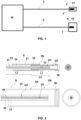
- FIG. 1-5 are accompanied of a series of numeral references which, with illustrative and non-limiting character, are hereby represented: (1) Wing (2) First detector (3) First temperature sensor (4) First housing (5) Second detector (6) Second temperature sensor (7) Second housing (8) First optic fibre detector (9) Second optic fibre detector (10) Electro-optic module (11) First optical fibre core (12) First optical sensor (13) First glass cladding (14) First protective coating (15) First sealed capillary (16) Closure cap (17) Connecting element (18) Second optical fibre core (19) Second optical sensor (20) Second glass cladding (21) Second protective coating (22) Second capillary sealed (23) Leading edge of the body (24) Inner volume behind the leading edge (25) Sensor probe
- a main object of the invention is related to a system for detecting the ice formation and accretion on a body 1, preferably suitable for determining the almost instantaneous freezing of drops of supercooled water when destabilized by, for example, impacting into the body 1.
- said ice formation and accretion detection system comprises:
- a first detection volume V1 is formed between the first temperature sensor 3 and the first housing 4, and a second detection volume V2, which is larger than volume V1, is formed between the second temperature sensor 6 and the second housing 7.
- the first and second detectors 2, 5 have different thermal inertias and hence they have different responses to temperature gradients. These different responses to temperature gradients are important to determine the formation of ice on a body 1, as will be detailed later.
- the first and second temperature sensors 3, 6 may include, but are not limited to, optical sensors such as optic fibre sensors.
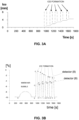
- FIG. 2 illustrates a more detailed view of an ice formation and accretion detection system according to the invention.
- This system comprises:
- the electro-optic module 10 is configured in such a way that it generates an optical signal through the first and second optic fibre detectors 8, 9 and receives said optical signals filtered by the optic fibre detectors 8, 9 to subsequently analyze and transmit measurements made on said optical signals.
- the first optic fibre detector 8 comprises:
- the first glass cladding 13 comprises:
- the first detector 8 comprises a first sealed capillary 15 comprising at least one closure cap 16 and a connecting element 17 between the first protective coating 14 and the first sealed capillary 15.
- the first sealed capillary 15 is disposed around the first glass cladding 13 at least along the first portion L1 of the first glass cladding 13.
- said first sealed capillary 15, has a second inner diameter D2 greater than the first outer diameter D1.
- the connecting element 17 may comprise a probe, an adhesive or a combination of both.
- the second optical fibre detector 9 comprises in turn:
- the thermal inertia of the first optic fibre detector 8 is lower than the thermal inertia of the second optic fibre detector 9.
- the first optic fibre detector 8 is able to detect temperature variations faster than the second optic fibre detector 9. Therefore, when an optical signal generated by the electro-optic module 10 reaches the first and second optical sensors 12, 19, these optical sensors 12, 19 will reflect part of said optical signal as a function of the temperature of said first and second optical sensors 12, 19. In this way, the filtered optical signals arriving at the electro-optic module 10 will be different as long as the temperature of said first and second optical sensors 12, 19 is different. In this way, by analyzing said filtered optical signals, the electro-optic module 10 is able to calculate the temperature at the position where the first and second optical sensors 12, 19 are located.
- the first and/or the second optical fibre cores 11, 18 comprise an external diameter between 6 and 10 micrometers.
- the first outer diameter D1 and the third outer diameter D3 are comprised between 0.006 and 0.125 mm.
- the second inner diameter D2 is comprised between 0.13 and 0.25 mm.
- the fourth inner diameter D4 is comprised between 0.5 and 1.0 mm.
- the first capillary 15 comprises a fifth outer diameter D5 comprised between 0.25 and 0.5 mm and the second capillary 22 comprises a sixth outer diameter D6 comprised between 2 and 3 mm.
- the first and second optical sensors 12, 19 have a length comprised between 2 and 20 mm.
- the first portion L1 of the first glass cladding 13 comprises a length between 2 and 20 mm.
- the third portion L3 of the first glass cladding 13 comprises a length between 20 and 50 mm.
- the first sealed capillary 15 is extended along a length comprised between 30 and 60 mm.
- the first protective coating 14 wraps the first glass cladding 13 along the second portion L2 and along the third portion L3.
- said first and / or second optical sensors 12, 19 are Fibre Bragg Gratings, also called FBG or long period fibre gratings, also called LPG.
- the first and/or the second sealed capillary 15, 22 comprise one of the following types of materials: metal, glass or polymer. Even more preferably, said first and second sealed capillaries 15, 22 are made of a thermally conductive material. In this way, the first and second sensors 12, 19 better capture the temperature of the environment.
- Another object of the invention is disclosed below, which relates to a method for detecting the ice formation and accretion on a body 1.
- Said method includes the use of the system for detecting the formation of ice in a body 1, as well as performing the following steps:
- the calculation of the derivative of the temperature with respect to time allows the estimation of the behaviour of the ice layer, and more particularly:
- this last feature is very important for the pilot, since they need to escape from the icing cloud when severe icing starts.
- the exact information about the ending of the ice accretion gives them the information so that they can stop escaping from the icing condition.
- a measure for the accretion time is the time when the sensor couple shows an increment in temperature with respect to the temperature before the ice accretion.
- a measure for the ice thickness is also the decrement of the temperature signal that is becoming weaker because of the ice layer growth.
- this method is able to detect the ice formation due to the freezing of drops of supercooled water.
- the water can be liquid at temperatures substantially below its theoretical temperature of pure water phase change, around 0° C at atmospheric pressure. Under these conditions, it is said that the water is supercooled.
- a disturbance of said drop such as the impact of said supercooled drop of water on a body 1, causes its almost instantaneous freezing, in the order of milliseconds, as well as an exothermic peak due to the release of enthalpy.
- the ice formed is around the freezing temperature of the water, around 0° C at atmospheric pressure.
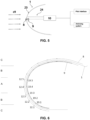
- the first optical fibre detector 8 detects quickly said temperature increase, as shown in the segments BC, FG, JK, NO or RS in continuous line of Figure 3B
- the second optic fibre detector 9 due to its greater thermal inertia, due to its protected location from the air stream and due that the energy released by the water drop is substantially lower than the energy contained in the air stream
- the second optic fibre detector 9 detects a lower temperature increase, as shown in the segments in discontinuous line BC', FG', JK ', NO' or RS' of Figure 3B .
- the electro-optic module 10 measures a temperature difference between the first and second optic fibre detectors 8, 9, as shown in Figure 3C , it sends an alarm signal of the start of the ice formation on the body 1. Subsequently, during the accretion of ice on the body 1, the first detector 8 slowly decreases the temperature detected due to the increase of the ice layer on the body 1, as shown in the respective segments CD, GH, KL, OP and ST of Figure 3C .
- the second optic fibre detector 9 slowly increases the temperature it senses due to the increase of the ice layer on the body 1, as shown in the respective segments CD ', GH ', KL', OP 'and ST' of Figure 3B .
- this layer of ice depending on its thickness, quickly acquires a temperature substantially lower than its freezing point, because the environment temperature is substantially lower than the water freezing temperature.
- both detectors 8, 9 respond substantially in the same way, performing the same simultaneous temperature measurements, as shown in segments EF, IJ, MN and QR of Figure 3B and 3C .
- the first and second optic fibre detectors 8, 9 measure almost simultaneously the same temperature increase, as shown in Figure 3B . This is because the warm air bubbles contain more thermal energy and transfer this energy faster to the body 1. In this way, false alarms when the body 1 is traversed by warm air bubbles are avoided.
- the system is prepared to detect other phase changes of water and/or other substances.
- a person skilled in the art would adjust the volume difference between the first and second detectors 2, 5, their position with respect to the body 1 or even employ some temperature sensor technology different from that based on optical fibre.
- a third object of the invention is related to the use of the system for detecting the ice formation and accretion on a body 1 in the aeronautical sector using the method explained.
- the system is installed on a part of an aircraft chosen from among the following ones: the fuselage, the wings and / or at any entrance to an engine of the aircraft.
- FIG. 4 shows a preferred embodiment of the use of the present system in a circular sensor probe 25 where ice formation is to be detected.
- This probe 25 has a leading edge 23 intended to receive an air stream in a direction d1 and an inner volume 24.
- both first and second detectors 8, 9 are located inside the volume 24.
- the first detector 8 is located in contact with the leading edge 23 of the probe 25 and the second detector 9 is located downstream the first detector 8.
- the detection system can be applied to different bodies without the need to modify them in order to introduce the optic fibre detectors 8, 9.
- FIG. 5 shows a similar embodiment, but in this case, in the wing 1 of an aircraft.
- This wing 1 comprises a leading edge 23 where an air stream impinges in a direction d1.
- the wing comprises an inner volume 24.
- the first detector 8 is located in contact with the leading edge 23 of the wing 1, but outside the inner volume 24.
- the second detector 9 is located inside the volume 24, downstream the first detector 8.
- Both optic fibre detectors 8, 9 are connected to the electro-optic module 10, which transfers the measurements and alerts to a pilot of the aircraft in order to, if necessary, activate anti-icing systems.
- the electro-optic module 10 transfers the measurements and alerts to a pilot of the aircraft in order to, if necessary, activate anti-icing systems.
- a temperature difference of several degrees between the first and the second optic fibre detector 8, 9 is detected, and therefore the system will generate an alarm signal.
- both optic fibre detectors 8, 9 will detect a substantially similar temperature, avoiding possible false alarms by the system.
- this ice detection system is used in the fuselage of an aircraft, in a blade of a wind turbine or in electric transport wires.
- FIG. 6 shows another preferred embodiment of the invention.
- the first detector 8 is also located in contact with the leading edge 23 of the wing 1, but outside the inner volume 24.
- the second detector 9 is also located inside the volume 24, downstream the first detector 8.
- the first detector 8 is arranged along the leading edge 23, covering it completely, and comprises a plurality of sensors 12.1, 12.2, 12.3, 12.4, 12.5. These sensors are also distributed along the leading edge, each one being located at different chord line values of the aerodynamic surface.
- Each one of the sensors of the first detector has a counterpart in the second detector 9, where each sensor 19.1, 19.2, 19.3, 19.4, 19.5 is associated to one of the sensors of the first detector.
- the optical fibre sensors in the nose tip (12.4, 12.5 and the corresponding inner sensors 19.4 and 19.5) will detect it, whilst the other sensors along the chord will not detect any ice accretion. If super large droplets form the ice, all the sensors along the chord (12.1 to 12.5 and 19.1 to 19.5) will detect the ice formation.
- the sensors of the first detector (12.1 to 12.5) will be in more direct contact with the air stream and the ice accretion and will react much faster than the sensors of the second detector (19.1 to 19.5), which are shielded by the wing 1 itself and a tubing where they are inside.
- These sensors can be installed in one or in several positions of the wing or control surface structure to have redundancy in the monitoring of ice events.
- the electro-optic module 10 comprises an optical interrogator.
- the formation and accretion of ice on a body 1 is allowed to be measured quickly and accurately.
- Another advantage of said detection system is that it is based on optical measurements so it does not electromagnetically interfere with the environment and is not interfered by it.
Landscapes
- Engineering & Computer Science (AREA)
- Physics & Mathematics (AREA)
- General Physics & Mathematics (AREA)
- Aviation & Aerospace Engineering (AREA)
- Sustainable Energy (AREA)
- Sustainable Development (AREA)
- Life Sciences & Earth Sciences (AREA)
- Chemical & Material Sciences (AREA)
- Combustion & Propulsion (AREA)
- Mechanical Engineering (AREA)
- General Engineering & Computer Science (AREA)
- Measuring Temperature Or Quantity Of Heat (AREA)
- Investigating Or Analyzing Materials By The Use Of Electric Means (AREA)
- Investigating Or Analyzing Materials Using Thermal Means (AREA)
- Testing Or Calibration Of Command Recording Devices (AREA)
Claims (15)
- System zum Erkennen von Eisbildung auf einem Körper (1), welches mindestens Folgendes umfasst:einen ersten Detektor (2, 8), der einen ersten Temperatursensor (3, 12) umfasst;einen zweiten Detektor (5, 9), der einen zweiten Temperatursensor (6, 19) umfasst; undein elektrooptisches Modul (10), das so ausgebildet ist, dass es Eingangsmesssignale für den ersten (2, 8) und den zweiten (5, 9) Detektor generiert, um Messsignale von dem ersten (2, 8) und dem zweiten (5, 9) Detektor zu empfangen und um Messungen zu verarbeiten und zu übertragen;wobei das System dadurch gekennzeichnet ist, dass:der erste Detektor (2, 8) ein erstes Gehäuse (4, 15) umfasst, das den ersten Temperatursensor (3, 12) umgibt und ein erstes Erkennungsvolumen (V1) definiert, das zwischen dem ersten Temperatursensor (3, 12) und dem ersten Gehäuse (4, 15) gebildet wird, wobei das erste Erkennungsvolumen (V1) von einem Fluid, wie Luft, gefüllt wird;der zweite Detektor (5, 9) ein zweites Gehäuse (7, 22) umfasst, das den zweiten Temperatursensor (6, 19) umgibt und ein zweites Erkennungsvolumen (V2) definiert, das zwischen dem zweiten Temperatursensor (6, 19) und dem zweiten Gehäuse (7, 22) gebildet wird, wobei das zweite Erkennungsvolumen (V2) von einem Fluid, wie Luft, gefüllt wird; und dassder erste Detektor (2, 8) und der zweite Detektor (5, 9) verschiedene thermische Trägheiten aufweisen.
- System nach Anspruch 1, wobei die verschiedenen thermischen Trägheiten dadurch erreicht werden, dass das zweite Erkennungsvolumen (V2) größer ist als das erste Erkennungsvolumen (V1).
- System nach einem der vorhergehenden Ansprüche, wobei der mindestens eine erste Detektor ein erster faseroptischer Detektor (8) ist, wobei:der erste faseroptische Detektor (8) einen ersten faseroptischen Kern (11) umfasst;der erste Temperatursensor in dem ersten faseroptischen Kern (11) angeordnet ist, wobei der erste Temperatursensor ein erster optischer Sensor (12) ist;der erste faseroptische Detektor (8) einen ersten Glasmantel (13) mit einem ersten Außendurchmesser umfasst, wobei der erste Glasmantel (13) so um den ersten faseroptischen Kern (11) angeordnet ist, dass ein erster Teil des ersten Glasmantels (13) den ersten optischen Sensor (12) umgibt;das erste Gehäuse eine erste abgedichtete Kapillare (15) mit einem zweiten Innendurchmesser ist, wobei die erste abgedichtete Kapillare (15) mindestens um den ersten Teil des ersten Glasmantels (13) herum angeordnet ist, wobei der zweite Innendurchmesser größer als der erste Außendurchmesser ist und das erste Erkennungsvolumen (V1) dem Volumen zwischen dem ersten Außendurchmesser und dem zweiten Innendurchmesser entspricht;wobei der mindestens eine zweite Detektor ein zweiter faseroptischer Detektor (9) ist, wobei:der zweite faseroptische Detektor (9) einen zweiten faseroptischen Kern (18) umfasst;der zweite Temperatursensor in dem zweiten faseroptischen Kern (18) angeordnet ist, wobei der zweite Temperatursensor ein zweiter optischer Sensor (19) ist;der zweite faseroptische Detektor (9) einen zweiten Glasmantel (20) mit einem dritten Außendurchmesser umfasst, wobei der zweite Glasmantel (20) um den zweiten faseroptischen Kern (18) herum angeordnet ist;das zweite Gehäuse eine zweite abgedichtete Kapillare (22) ist, wobei diese zweite abgedichtete Kapillare (22) einen vierten Innendurchmesser aufweist, die zweite abgedichtete Kapillare (22) um den zweiten Glasmantel (20) herum angeordnet ist, der vierte Innendurchmesser größer als der dritte Außendurchmesser ist und das zweite Erkennungsvolumen (V2) dem Volumen zwischen dem dritten Außendurchmesser und dem vierten Innendurchmesser entspricht,wobei die Differenz zwischen dem vierten Innendurchmesser und dem dritten Außendurchmesser größer ist als die Differenz zwischen dem zweiten Innendurchmesser und dem ersten Außendurchmesser; und wobei das elektrooptische Modul (10) so ausgebildet ist, dass es Lichteingänge generiert und optische Messungen von dem ersten und dem zweiten faseroptischen Detektor (8, 9) empfängt und auch so ausgebildet ist, dass es die optischen Messungen verarbeitet und überträgt.
- System nach Anspruch 3, wobei der erste Detektor und der zweite Detektor eine Vielzahl von faseroptischen Sensoren (12, 19) umfassen, wobei jeder faseroptische Sensor ein Faser-Bragg-Gitter oder ein langperiodisches Fasergitter umfasst.
- System nach einem der Ansprüche 3 oder 4, wobei der erste Außendurchmesser und der dritte Außendurchmesser zwischen 0,006 und 0,1265 mm umfassen, wobei der zweite Innendurchmesser zwischen 0,13 und 0,25 mm umfasst und wobei der vierte Innendurchmesser zwischen 0,5 und 1,0 mm umfasst,wobei die erste Kapillare (15) des mindestens einen ersten faseroptischen Detektors (8) einen fünften Außendurchmesser umfasst, der zwischen 0,25 und 0,5 mm umfasst, und wobei die zweite abgedichtete Kapillare (22) des mindestens einen zweiten faseroptischen Detektors (9) einen sechsten Außendurchmesser umfasst, der zwischen 2 und 3 mm umfasst, undwobei die ersten und zweiten optischen Sensoren (12, 19) eine Länge zwischen 2 und 20 mm aufweisen; undwobei die erste abgedichtete Kapillare (15) ein metallisches oder polymeres Material umfasst und die zweite abgedichtete Kapillare (22) Glas, ein Polymer oder ein Metall umfasst.
- System nach einem der Ansprüche 2 bis 5, wobei der mindestens eine erste faseroptische Detektor (8) Folgendes umfasst:eine erste Schutzschicht (14) um einen zweiten Teil des ersten Glasmantels (13) herum, so dass der zweite Teil des ersten Glasmantels (13) mit der ersten Schutzschicht (14) beschichtet ist und ein dritter Teil des ersten Glasmantels (13) nicht beschichtet ist, wobei der erste Teil im Wesentlichen in der Mitte des dritten Teils liegt und die erste abgedichtete Kapillare (15) um den dritten Teil herum angeordnet ist,ein Verbindungselement (17) zwischen der ersten Schutzschicht (14) und der ersten abgedichteten Kapillare (15);wobei der mindestens eine zweite faseroptische Detektor (9) eine zweite Schutzschicht (21) um den zweiten Glasmantel (20) herum umfasst.
- System nach dem vorhergehenden Anspruch, wobei sich der dritte Teil über eine Länge zwischen 20 und 50 mm erstreckt, und
die erste abgedichtete Kapillare (15) sich über eine Länge zwischen 30 und 60 mm erstreckt. - System nach einem der Ansprüche 6 oder 7, wobei das Verbindungselement (17) zwischen der ersten Schutzschicht (14) und der ersten abgedichteten Kapillare (15) des mindestens einen ersten faseroptischen Detektors (8) eine Sonde oder einen Klebstoff oder eine Kombination aus beidem umfasst.
- System nach einem der vorhergehenden Ansprüche, das ferner eine aerodynamische Oberfläche (1, 25) mit einer Leitkante (23), die einen Luftstrom aufnehmen soll, und ein Volumen (24) stromabwärts der Leitkante (23) umfasst, wobei der erste Detektor (8) in Kontakt mit der Leitkante (23) der aerodynamischen Oberfläche (1, 25) angeordnet ist und der zweite Detektor (9) in dem Volumen (24) stromabwärts des ersten Detektors (8) angeordnet ist.
- System nach Anspruch 9, wobei der erste Detektor so angeordnet ist, dass er mindestens einen Teil der Leitkante abdeckt und eine Vielzahl von Sensoren (12.1, 12.2, 12.3, 12.4, 12.5) umfasst, wobei mindestens zwei Sensoren an verschiedenen Sehnenlinienwerten der aerodynamischen Oberfläche angeordnet sind.
- Verfahren zum Erkennen von Eisbildung auf einem Körper (1) durch ein System nach den Ansprüchen 1 bis 10, wobei das Verfahren dadurch gekennzeichnet ist, dass es folgende Schritte umfasst:Generieren eines Eingangssignals für den ersten und den zweiten Detektor (2, 5);Generieren eines Ausgangssignals durch den ersten und den zweiten Temperatursensor (3, 6);Empfangen des Ausgangssignals im elektrooptischen Modul (10);Verarbeiten des empfangenen Ausgangssignals und Berechnen einer Temperaturdifferenz;Generieren eines Warnsignals, wenn die Temperaturdifferenz größer als ein vorgegebener Temperaturschwellenwert ist.
- Verfahren nach Anspruch 11, welches folgende Schritte umfasst:Injizieren eines Lichtstrahls in jeden der ersten und zweiten Detektoren (8, 9), wobei die Detektoren faseroptische Detektoren sind;jeweils Filtern der Lichtstrahlen in dem mindestens ersten und zweiten optischen Sensor (12, 19) in Abhängigkeit von der Temperatur des jeweiligen optischen Sensors (12, 19);Empfangen der jeweiligen gefilterten Lichtstrahlen in dem elektrooptischen Modul (10);Verarbeiten der empfangenen Lichtstrahlen und Berechnen einer Temperaturdifferenz;Generieren eines Warnsignals, wenn die Temperaturdifferenz größer als ein vorgegebener Temperaturschwellenwert ist.
- Verfahren nach Anspruch 12, wobei das Verfahren vor dem Schritt des Injizierens eines Lichtstrahls ferner folgende Schritte umfasst:Bereitstellen eines Körpers (1), an dem Eisbildung erkannt werden soll, wobei der Körper (1) eine Außenfläche (23), die einen Luftstrom aufnehmen soll, und ein Volumen (24) stromabwärts dieser Außenfläche (23) umfasst, das vor dem Luftstrom geschützt werden soll;Platzieren des mindestens einen ersten faseroptischen Detektors (8) in Kontakt mit der Außenfläche (23) des Körpers (1) und Platzieren des mindestens einen zweiten faseroptischen Detektors (9) in dem Volumen (24) hinter der Außenfläche (23).
- Verfahren nach einem der Ansprüche 11 bis 13, wobeider Schritt des Verarbeitens des Empfangsausgangssignals ferner das Berechnen der Ableitung der Temperatur nach der Zeit umfasst, undder Schritt des Generierens eines Warnsignals das Generieren eines Warnsignals aus einer vorgegebenen Gruppe von Warnsignalen umfasst, abhängig von dem Ergebnis der Ableitung der Temperatur nach der Zeit.
- Verwendung des Systems nach einem der Ansprüche 1 bis 10 oder eines Verfahrens nach einem der Ansprüche 11 bis 14 zum Erkennen von Eis in einem der folgenden Körper: einem Teil eines Flugzeugs oder einer Windkraftanlage oder einer elektrischen Stromübertragungsleitung.
Applications Claiming Priority (2)
| Application Number | Priority Date | Filing Date | Title |
|---|---|---|---|
| EP18382649.4A EP3620379A1 (de) | 2018-09-10 | 2018-09-10 | System und verfahren zur erkennung von eisbildung auf einem körper |
| PCT/EP2019/074091 WO2020053202A1 (en) | 2018-09-10 | 2019-09-10 | System and method for detecting ice formation on a body |
Publications (3)
| Publication Number | Publication Date |
|---|---|
| EP3849906A1 EP3849906A1 (de) | 2021-07-21 |
| EP3849906B1 true EP3849906B1 (de) | 2023-06-07 |
| EP3849906C0 EP3849906C0 (de) | 2023-06-07 |
Family
ID=63762433
Family Applications (2)
| Application Number | Title | Priority Date | Filing Date |
|---|---|---|---|
| EP18382649.4A Withdrawn EP3620379A1 (de) | 2018-09-10 | 2018-09-10 | System und verfahren zur erkennung von eisbildung auf einem körper |
| EP19763012.2A Active EP3849906B1 (de) | 2018-09-10 | 2019-09-10 | System und verfahren zur erkennung von eisbildung auf einem körper |
Family Applications Before (1)
| Application Number | Title | Priority Date | Filing Date |
|---|---|---|---|
| EP18382649.4A Withdrawn EP3620379A1 (de) | 2018-09-10 | 2018-09-10 | System und verfahren zur erkennung von eisbildung auf einem körper |
Country Status (5)
| Country | Link |
|---|---|
| US (1) | US11794909B2 (de) |
| EP (2) | EP3620379A1 (de) |
| ES (1) | ES2950769T3 (de) |
| PL (1) | PL3849906T3 (de) |
| WO (1) | WO2020053202A1 (de) |
Families Citing this family (8)
| Publication number | Priority date | Publication date | Assignee | Title |
|---|---|---|---|---|
| CN113155315B (zh) * | 2021-04-25 | 2022-12-16 | 中国极地研究中心 | 一种温度监测装置 |
| CN113325270B (zh) * | 2021-06-03 | 2022-08-30 | 广东电网有限责任公司 | 一种光缆输电线路监测方法及装置 |
| CN114132512B (zh) * | 2022-02-07 | 2022-04-29 | 中国空气动力研究与发展中心低速空气动力研究所 | 一种光纤结冰传感器探头及调节方法 |
| CN114180072B (zh) * | 2022-02-16 | 2022-04-12 | 中国空气动力研究与发展中心低速空气动力研究所 | 一种结冰厚度探测方法 |
| US20240017840A1 (en) * | 2022-07-15 | 2024-01-18 | Rosemount Aerospace Inc. | Temperature-based suppression of spurious ice signals |
| CN115416854B (zh) * | 2022-11-07 | 2023-01-24 | 中国空气动力研究与发展中心低速空气动力研究所 | 一种基于温度测量的结冰探测装置及结冰探测方法 |
| CN116331495A (zh) * | 2023-05-31 | 2023-06-27 | 中国航空工业集团公司沈阳空气动力研究所 | 一种管路式过冷大水滴探测器轮廓结构 |
| CN116674756A (zh) * | 2023-07-11 | 2023-09-01 | 电子科技大学 | 一种基于分布式光纤的机翼积冰探测及融冰装置 |
Family Cites Families (16)
| Publication number | Priority date | Publication date | Assignee | Title |
|---|---|---|---|---|
| US2766619A (en) * | 1953-06-26 | 1956-10-16 | Tribus Myron | Ice detecting apparatus |
| US4210021A (en) | 1978-07-06 | 1980-07-01 | Bantsekin Viktor I | Method and device for detecting icing of objects found in air flow |
| US4882574A (en) * | 1988-06-20 | 1989-11-21 | Boris Khurgin | Two-resistor ice detector |
| US6452667B1 (en) * | 1998-12-04 | 2002-09-17 | Weatherford/Lamb Inc. | Pressure-isolated bragg grating temperature sensor |
| US20060146909A1 (en) * | 2002-11-21 | 2006-07-06 | Morse Theodore F | Fiber optic temperature sensor |
| US7096683B2 (en) * | 2003-09-12 | 2006-08-29 | Ford Global Technologies, Llc | Vehicle cooling system |
| GB2407377B (en) | 2003-10-16 | 2006-04-19 | Kidde Ip Holdings Ltd | Fibre bragg grating sensors |
| WO2009068918A1 (en) * | 2007-11-30 | 2009-06-04 | Bae Systems Plc | Improvements relating to temperature monitoring |
| US8192069B2 (en) * | 2008-05-12 | 2012-06-05 | Koopmans Richard J | Water supply mixing process |
| US8517601B2 (en) * | 2010-09-10 | 2013-08-27 | Ultra Electronics Limited | Ice detection system and method |
| JP2018511769A (ja) * | 2015-04-09 | 2018-04-26 | トゥルー・マニュファクチュアリング・カンパニー・インコーポレイテッドTrue Manufacturing Co., Inc. | 採氷センサと温度センサを用いて製氷機の採氷サイクルを制御する方法及び装置 |
| US10260789B2 (en) * | 2016-04-13 | 2019-04-16 | Whirlpool Corporation | Ice making assembly with twist ice tray and directional cooling |
| US10173498B2 (en) * | 2016-06-21 | 2019-01-08 | Nissan North America, Inc. | Vehicle air conditioning system |
| GB2554062A (en) * | 2016-08-22 | 2018-03-28 | Norwegian Univ Of Science And Technology | Icing control system |
| US10457404B2 (en) * | 2017-01-31 | 2019-10-29 | Wan Tony Chee | Carbon nanotube anti-icing and de-icing means for aircraft |
| US11510576B2 (en) * | 2017-04-27 | 2022-11-29 | Medtronic Cryocath Lp | Treatment device having multifunctional sensing elements and method of use |
-
2018
- 2018-09-10 EP EP18382649.4A patent/EP3620379A1/de not_active Withdrawn
-
2019
- 2019-09-10 US US17/274,269 patent/US11794909B2/en active Active
- 2019-09-10 PL PL19763012.2T patent/PL3849906T3/pl unknown
- 2019-09-10 EP EP19763012.2A patent/EP3849906B1/de active Active
- 2019-09-10 ES ES19763012T patent/ES2950769T3/es active Active
- 2019-09-10 WO PCT/EP2019/074091 patent/WO2020053202A1/en not_active Ceased
Also Published As
| Publication number | Publication date |
|---|---|
| ES2950769T3 (es) | 2023-10-13 |
| EP3849906A1 (de) | 2021-07-21 |
| EP3620379A1 (de) | 2020-03-11 |
| US20210316869A1 (en) | 2021-10-14 |
| US11794909B2 (en) | 2023-10-24 |
| CA3110541A1 (en) | 2020-03-19 |
| EP3849906C0 (de) | 2023-06-07 |
| BR112021004166A2 (pt) | 2021-05-25 |
| WO2020053202A1 (en) | 2020-03-19 |
| PL3849906T3 (pl) | 2023-11-06 |
Similar Documents
| Publication | Publication Date | Title |
|---|---|---|
| EP3849906B1 (de) | System und verfahren zur erkennung von eisbildung auf einem körper | |
| RU2534493C2 (ru) | Система и способ применения датчика обледенения | |
| EP2800690B1 (de) | Supergekühltes grosstropfen-vereisungsbedingungsdetektionssystem | |
| US8060334B1 (en) | Aircraft pitot-static tube with ice detection | |
| CA3052014C (en) | Ice detection systems for aircraft and related methods | |
| CA2784022C (en) | Sensor system | |
| EP3739342B1 (de) | Prognostische überwachung komplementärer luftdatensystemsensoren | |
| US6430996B1 (en) | Probe and integrated ice detection and air data system | |
| US8200451B2 (en) | Method and system for detecting the risk of icing on aerodynamic surfaces | |
| CN113532304B (zh) | 基于准分布式光纤光栅的机翼蒙皮结构健康状态监测方法 | |
| EP3567369B1 (de) | Verfahren zur herstellung einer magnetostriktiven oszillator-eisratensonde | |
| GB2475553A (en) | A sensor arrangement for determining the rate of ice formation | |
| EA002165B1 (ru) | Способ и устройство для обнаружения наростов льда на поверхности летательного аппарата в движении | |
| US4965572A (en) | Method for producing a warning of the existence of low-level wind shear and aircraftborne system for performing same | |
| Gonzalez et al. | Fiber Bragg grating sensors ice detection: Methodologies and performance | |
| CA3110541C (en) | System and method for detecting ice formation on a body | |
| US6134959A (en) | Method for detecting flow bifurcation during sonic flow conditions | |
| US6380535B1 (en) | Optical tuft for flow separation detection | |
| US20230304793A1 (en) | Device for detecting frosting intensity for an aircraft in flight | |
| BR112021004166B1 (pt) | Sistema e método para detectar formação de gelo em um corpo | |
| RU2341414C1 (ru) | Способ обнаружения обледенения несущего винта вертолета | |
| Davison et al. | NRC Particle Detection Probe: Results and Analysis from Ground and Flight Tests | |
| Sachs et al. | Flight Testing the Indirect Ice Detection System in the Horizon 2020 Project SENS4ICE | |
| González del Val et al. | Fiber Bragg Grating Sensors ice detection: methodologies and performance | |
| Mckissick | Flight test of an infrared wind shear detector |
Legal Events
| Date | Code | Title | Description |
|---|---|---|---|
| STAA | Information on the status of an ep patent application or granted ep patent |
Free format text: STATUS: UNKNOWN |
|
| STAA | Information on the status of an ep patent application or granted ep patent |
Free format text: STATUS: THE INTERNATIONAL PUBLICATION HAS BEEN MADE |
|
| PUAI | Public reference made under article 153(3) epc to a published international application that has entered the european phase |
Free format text: ORIGINAL CODE: 0009012 |
|
| STAA | Information on the status of an ep patent application or granted ep patent |
Free format text: STATUS: REQUEST FOR EXAMINATION WAS MADE |
|
| 17P | Request for examination filed |
Effective date: 20210407 |
|
| AK | Designated contracting states |
Kind code of ref document: A1 Designated state(s): AL AT BE BG CH CY CZ DE DK EE ES FI FR GB GR HR HU IE IS IT LI LT LU LV MC MK MT NL NO PL PT RO RS SE SI SK SM TR |
|
| DAV | Request for validation of the european patent (deleted) | ||
| DAX | Request for extension of the european patent (deleted) | ||
| RIC1 | Information provided on ipc code assigned before grant |
Ipc: G01K 11/3206 20210101ALI20220304BHEP Ipc: G01D 5/353 20060101ALI20220304BHEP Ipc: B64D 15/20 20060101AFI20220304BHEP |
|
| GRAP | Despatch of communication of intention to grant a patent |
Free format text: ORIGINAL CODE: EPIDOSNIGR1 |
|
| STAA | Information on the status of an ep patent application or granted ep patent |
Free format text: STATUS: GRANT OF PATENT IS INTENDED |
|
| INTG | Intention to grant announced |
Effective date: 20220902 |
|
| GRAS | Grant fee paid |
Free format text: ORIGINAL CODE: EPIDOSNIGR3 |
|
| RAP3 | Party data changed (applicant data changed or rights of an application transferred) |
Owner name: INSTITUTO NACIONAL DE TECNICA AEROESPACIAL "ESTEBAN TERRADAS" |
|
| GRAA | (expected) grant |
Free format text: ORIGINAL CODE: 0009210 |
|
| STAA | Information on the status of an ep patent application or granted ep patent |
Free format text: STATUS: THE PATENT HAS BEEN GRANTED |
|
| AK | Designated contracting states |
Kind code of ref document: B1 Designated state(s): AL AT BE BG CH CY CZ DE DK EE ES FI FR GB GR HR HU IE IS IT LI LT LU LV MC MK MT NL NO PL PT RO RS SE SI SK SM TR |
|
| REG | Reference to a national code |
Ref country code: GB Ref legal event code: FG4D |
|
| REG | Reference to a national code |
Ref country code: CH Ref legal event code: EP Ref country code: AT Ref legal event code: REF Ref document number: 1574294 Country of ref document: AT Kind code of ref document: T Effective date: 20230615 Ref country code: DE Ref legal event code: R096 Ref document number: 602019030383 Country of ref document: DE |
|
| REG | Reference to a national code |
Ref country code: NO Ref legal event code: T2 Effective date: 20230607 |
|
| U01 | Request for unitary effect filed |
Effective date: 20230704 |
|
| U07 | Unitary effect registered |
Designated state(s): AT BE BG DE DK EE FI FR IT LT LU LV MT NL PT SE SI Effective date: 20230714 |
|
| U20 | Renewal fee for the european patent with unitary effect paid |
Year of fee payment: 5 Effective date: 20230718 |
|
| REG | Reference to a national code |
Ref country code: LT Ref legal event code: MG9D |
|
| REG | Reference to a national code |
Ref country code: ES Ref legal event code: FG2A Ref document number: 2950769 Country of ref document: ES Kind code of ref document: T3 Effective date: 20231013 |
|
| PG25 | Lapsed in a contracting state [announced via postgrant information from national office to epo] |
Ref country code: RS Free format text: LAPSE BECAUSE OF FAILURE TO SUBMIT A TRANSLATION OF THE DESCRIPTION OR TO PAY THE FEE WITHIN THE PRESCRIBED TIME-LIMIT Effective date: 20230607 Ref country code: HR Free format text: LAPSE BECAUSE OF FAILURE TO SUBMIT A TRANSLATION OF THE DESCRIPTION OR TO PAY THE FEE WITHIN THE PRESCRIBED TIME-LIMIT Effective date: 20230607 Ref country code: GR Free format text: LAPSE BECAUSE OF FAILURE TO SUBMIT A TRANSLATION OF THE DESCRIPTION OR TO PAY THE FEE WITHIN THE PRESCRIBED TIME-LIMIT Effective date: 20230908 |
|
| PG25 | Lapsed in a contracting state [announced via postgrant information from national office to epo] |
Ref country code: SK Free format text: LAPSE BECAUSE OF FAILURE TO SUBMIT A TRANSLATION OF THE DESCRIPTION OR TO PAY THE FEE WITHIN THE PRESCRIBED TIME-LIMIT Effective date: 20230607 |
|
| PG25 | Lapsed in a contracting state [announced via postgrant information from national office to epo] |
Ref country code: IS Free format text: LAPSE BECAUSE OF FAILURE TO SUBMIT A TRANSLATION OF THE DESCRIPTION OR TO PAY THE FEE WITHIN THE PRESCRIBED TIME-LIMIT Effective date: 20231007 |
|
| PG25 | Lapsed in a contracting state [announced via postgrant information from national office to epo] |
Ref country code: SM Free format text: LAPSE BECAUSE OF FAILURE TO SUBMIT A TRANSLATION OF THE DESCRIPTION OR TO PAY THE FEE WITHIN THE PRESCRIBED TIME-LIMIT Effective date: 20230607 Ref country code: SK Free format text: LAPSE BECAUSE OF FAILURE TO SUBMIT A TRANSLATION OF THE DESCRIPTION OR TO PAY THE FEE WITHIN THE PRESCRIBED TIME-LIMIT Effective date: 20230607 Ref country code: RO Free format text: LAPSE BECAUSE OF FAILURE TO SUBMIT A TRANSLATION OF THE DESCRIPTION OR TO PAY THE FEE WITHIN THE PRESCRIBED TIME-LIMIT Effective date: 20230607 Ref country code: IS Free format text: LAPSE BECAUSE OF FAILURE TO SUBMIT A TRANSLATION OF THE DESCRIPTION OR TO PAY THE FEE WITHIN THE PRESCRIBED TIME-LIMIT Effective date: 20231007 Ref country code: CZ Free format text: LAPSE BECAUSE OF FAILURE TO SUBMIT A TRANSLATION OF THE DESCRIPTION OR TO PAY THE FEE WITHIN THE PRESCRIBED TIME-LIMIT Effective date: 20230607 |
|
| REG | Reference to a national code |
Ref country code: DE Ref legal event code: R097 Ref document number: 602019030383 Country of ref document: DE |
|
| PLBE | No opposition filed within time limit |
Free format text: ORIGINAL CODE: 0009261 |
|
| STAA | Information on the status of an ep patent application or granted ep patent |
Free format text: STATUS: NO OPPOSITION FILED WITHIN TIME LIMIT |
|
| 26N | No opposition filed |
Effective date: 20240308 |
|
| GBPC | Gb: european patent ceased through non-payment of renewal fee |
Effective date: 20230910 |
|
| PG25 | Lapsed in a contracting state [announced via postgrant information from national office to epo] |
Ref country code: MC Free format text: LAPSE BECAUSE OF FAILURE TO SUBMIT A TRANSLATION OF THE DESCRIPTION OR TO PAY THE FEE WITHIN THE PRESCRIBED TIME-LIMIT Effective date: 20230607 |
|
| PG25 | Lapsed in a contracting state [announced via postgrant information from national office to epo] |
Ref country code: GB Free format text: LAPSE BECAUSE OF NON-PAYMENT OF DUE FEES Effective date: 20230910 |
|
| PG25 | Lapsed in a contracting state [announced via postgrant information from national office to epo] |
Ref country code: GB Free format text: LAPSE BECAUSE OF NON-PAYMENT OF DUE FEES Effective date: 20230910 |
|
| U20 | Renewal fee for the european patent with unitary effect paid |
Year of fee payment: 6 Effective date: 20240702 |
|
| U1N | Appointed representative for the unitary patent procedure changed after the registration of the unitary effect |
Representative=s name: TRBL INTELLECTUAL PROPERTY; ES |
|
| PG25 | Lapsed in a contracting state [announced via postgrant information from national office to epo] |
Ref country code: CY Free format text: LAPSE BECAUSE OF FAILURE TO SUBMIT A TRANSLATION OF THE DESCRIPTION OR TO PAY THE FEE WITHIN THE PRESCRIBED TIME-LIMIT; INVALID AB INITIO Effective date: 20190910 |
|
| PG25 | Lapsed in a contracting state [announced via postgrant information from national office to epo] |
Ref country code: HU Free format text: LAPSE BECAUSE OF FAILURE TO SUBMIT A TRANSLATION OF THE DESCRIPTION OR TO PAY THE FEE WITHIN THE PRESCRIBED TIME-LIMIT; INVALID AB INITIO Effective date: 20190910 |
|
| REG | Reference to a national code |
Ref country code: CH Ref legal event code: U11 Free format text: ST27 STATUS EVENT CODE: U-0-0-U10-U11 (AS PROVIDED BY THE NATIONAL OFFICE) Effective date: 20251001 |
|
| PGFP | Annual fee paid to national office [announced via postgrant information from national office to epo] |
Ref country code: NO Payment date: 20250929 Year of fee payment: 7 |
|
| PGFP | Annual fee paid to national office [announced via postgrant information from national office to epo] |
Ref country code: PL Payment date: 20250821 Year of fee payment: 7 |
|
| U20 | Renewal fee for the european patent with unitary effect paid |
Year of fee payment: 7 Effective date: 20250905 |
|
| PGFP | Annual fee paid to national office [announced via postgrant information from national office to epo] |
Ref country code: IE Payment date: 20250929 Year of fee payment: 7 |
|
| PG25 | Lapsed in a contracting state [announced via postgrant information from national office to epo] |
Ref country code: TR Free format text: LAPSE BECAUSE OF FAILURE TO SUBMIT A TRANSLATION OF THE DESCRIPTION OR TO PAY THE FEE WITHIN THE PRESCRIBED TIME-LIMIT Effective date: 20230607 |
|
| PGFP | Annual fee paid to national office [announced via postgrant information from national office to epo] |
Ref country code: CH Payment date: 20251001 Year of fee payment: 7 |
|
| PGFP | Annual fee paid to national office [announced via postgrant information from national office to epo] |
Ref country code: ES Payment date: 20251002 Year of fee payment: 7 |