EP3848733A1 - Composition for optical material and optical material - Google Patents
Composition for optical material and optical material Download PDFInfo
- Publication number
- EP3848733A1 EP3848733A1 EP19857539.1A EP19857539A EP3848733A1 EP 3848733 A1 EP3848733 A1 EP 3848733A1 EP 19857539 A EP19857539 A EP 19857539A EP 3848733 A1 EP3848733 A1 EP 3848733A1
- Authority
- EP
- European Patent Office
- Prior art keywords
- compound
- formula
- mass
- composition
- optical material
- Prior art date
- Legal status (The legal status is an assumption and is not a legal conclusion. Google has not performed a legal analysis and makes no representation as to the accuracy of the status listed.)
- Granted
Links
Classifications
-
- C—CHEMISTRY; METALLURGY
- C08—ORGANIC MACROMOLECULAR COMPOUNDS; THEIR PREPARATION OR CHEMICAL WORKING-UP; COMPOSITIONS BASED THEREON
- C08G—MACROMOLECULAR COMPOUNDS OBTAINED OTHERWISE THAN BY REACTIONS ONLY INVOLVING UNSATURATED CARBON-TO-CARBON BONDS
- C08G75/00—Macromolecular compounds obtained by reactions forming a linkage containing sulfur with or without nitrogen, oxygen, or carbon in the main chain of the macromolecule
- C08G75/02—Polythioethers
- C08G75/06—Polythioethers from cyclic thioethers
-
- C—CHEMISTRY; METALLURGY
- C08—ORGANIC MACROMOLECULAR COMPOUNDS; THEIR PREPARATION OR CHEMICAL WORKING-UP; COMPOSITIONS BASED THEREON
- C08G—MACROMOLECULAR COMPOUNDS OBTAINED OTHERWISE THAN BY REACTIONS ONLY INVOLVING UNSATURATED CARBON-TO-CARBON BONDS
- C08G75/00—Macromolecular compounds obtained by reactions forming a linkage containing sulfur with or without nitrogen, oxygen, or carbon in the main chain of the macromolecule
- C08G75/02—Polythioethers
- C08G75/06—Polythioethers from cyclic thioethers
- C08G75/08—Polythioethers from cyclic thioethers from thiiranes
-
- G—PHYSICS
- G02—OPTICS
- G02B—OPTICAL ELEMENTS, SYSTEMS OR APPARATUS
- G02B1/00—Optical elements characterised by the material of which they are made; Optical coatings for optical elements
- G02B1/04—Optical elements characterised by the material of which they are made; Optical coatings for optical elements made of organic materials, e.g. plastics
-
- G—PHYSICS
- G02—OPTICS
- G02B—OPTICAL ELEMENTS, SYSTEMS OR APPARATUS
- G02B1/00—Optical elements characterised by the material of which they are made; Optical coatings for optical elements
- G02B1/04—Optical elements characterised by the material of which they are made; Optical coatings for optical elements made of organic materials, e.g. plastics
- G02B1/041—Lenses
Definitions
- the present invention relates to a composition for optical materials, etc., and particularly relates to a composition for optical materials, etc. suitable for an optical material for a plastic lens, a prism, an optical fiber, an information recording substrate, a filter or the like, in particular for a plastic lens.
- Plastic lenses are lightweight, highly tough and easy to be dyed. Properties particularly required for plastic lenses are: low specific gravity; high transparency; low yellowness; high refractive index and high Abbe number as optical properties; high heat resistance; high strength; and the like. A high refractive index allows a lens to be thinner, and a high Abbe number reduces the chromatic aberration of a lens.
- Patent Document 2 An optical material obtained by using a composition for optical materials containing an organic compound having a cyclic skeleton containing a sulfur, selenium or tellurium atom was proposed, and a refractive index of 1.73 or higher was achieved thereby (Patent Document 2).
- optical materials obtained by using a composition for optical materials having a high refractive index have problems that a monomer is not easily synthesized, resulting in a high cost, that mold release characteristics after curing is insufficient and lenses are easily broken at the time of demolding, and that there is still a room for improvement of heat resistance of cured lenses.
- the problem to be solved by the present invention is to provide a composition for optical materials having a high refractive index, which ensures higher heat resistance and sufficient mold release characteristics in an optical material obtained by using the composition for optical materials, and an optical material obtained by using the same.
- the present inventors diligently made researches in order to solve the problem and solved the problem regarding further improvement of heat resistance and improvement of mold release characteristics by polymerizing and curing a composition for optical materials containing a compound (a) and/or a compound (b) and a compound (c) described below, and thus the present invention was achieved.
- the compound (a) is a compound represented by formula (1).
- the compound (b) is a compound represented by formula (2).
- the compound (c) is an episulfide compound.
- the present invention it is possible to provide a composition for optical materials having a high refractive index, which ensures a low cost, sufficient mold release characteristics after curing and higher heat resistance of cured resin in an optical material obtained by using the composition for optical materials, and an optical material obtained by using the same.
- the compound (a) to be used in the present invention is a compound represented by formula (1):
- the compound (a) can be obtained by synthesis according to a publicly-known technique.
- examples of such techniques include the technique described in Japanese Laid-Open Patent Publication No. H05-279321 .
- the compound (b) to be used in the present invention is a compound represented by formula (2):
- the compound (b) can be obtained by reduction according to a publicly-known technique in the process of obtaining the compound (a) or after obtaining the compound (a).
- the episulfide compound (c) to be used in the present invention includes all episulfide compounds. Specific examples of the episulfide compound (c) are classified into a compound having a chain aliphatic skeleton, a compound having a branched aliphatic skeleton, a compound having an aliphatic cyclic skeleton and a compound having an aromatic skeleton and listed below.
- Examples of the compound having a chain aliphatic skeleton include a compound represented by formula (3) below.
- n represents an integer of 0 to 2.
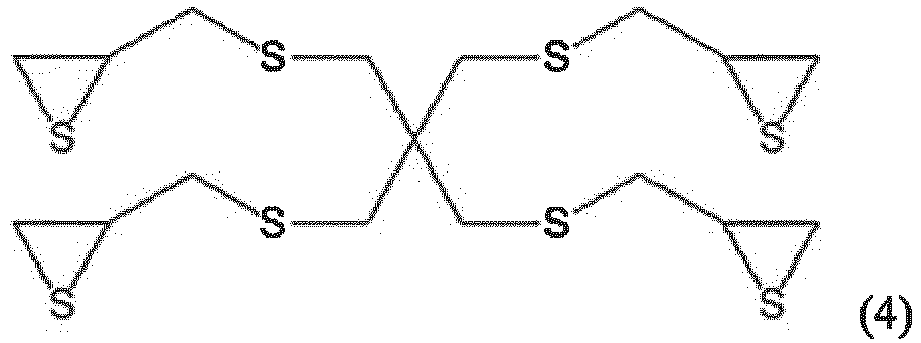
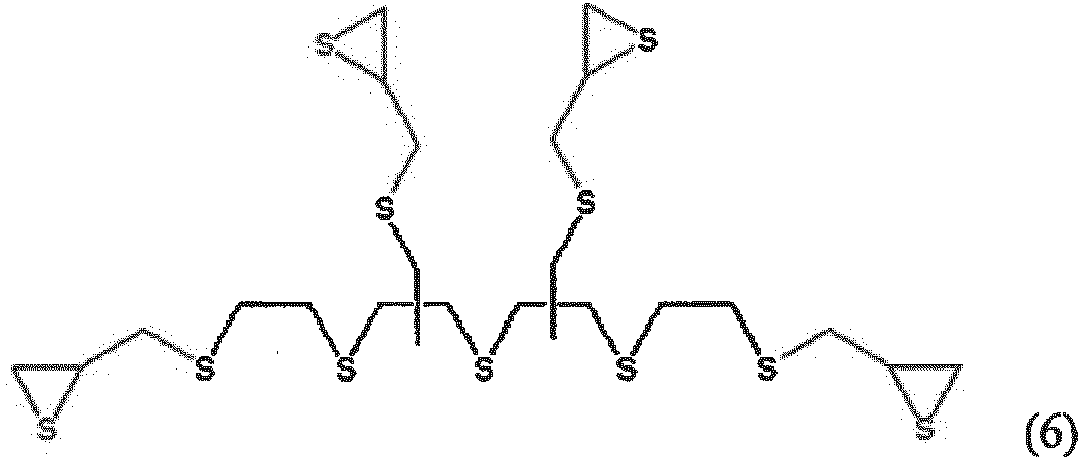
- Examples of the compound having a branched aliphatic skeleton include a compound represented by formula (4), (5) or (6) below.
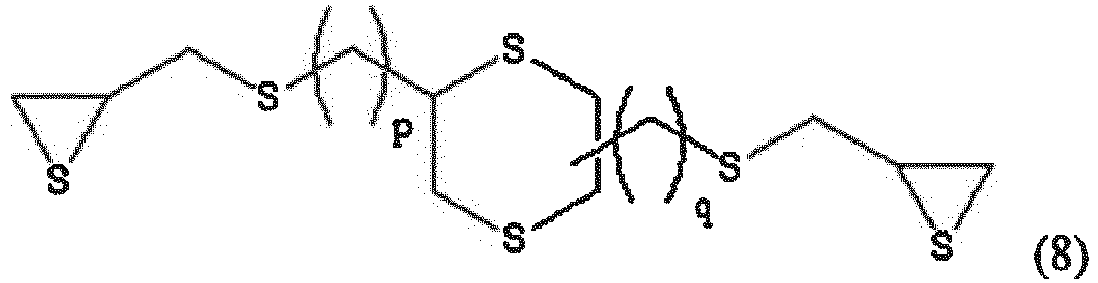
- Examples of the compound having an aliphatic cyclic skeleton include a compound represented by formula (7) or (8) below.
- Examples of the compound having an aromatic skeleton include a compound represented by formula (9), (10) or (11) below.
- R 1 and R 2 each independently represent a hydrogen atom, a methyl group, an ethyl group or a phenyl group.
- Specific examples of the compound of formula (10) include a compound in which both R 1 and R 2 are a hydrogen atom and a compound in which both R 1 and R 2 are a methyl group.
- Examples of the compound (c) to be used in the present invention are described above, but the compound (c) is not limited to these examples. Further, as the compound (c), these substances may be used solely, or two or more of them may be used as a mixture.
- the ratio of the compound (a) and/or the compound (b) in the composition for optical materials of the present invention is preferably 0.001 to 30.0% by mass, more preferably 0.005 to 10.0% by mass, and particularly preferably 0.01 to 5.0% by mass.
- the ratio of the compound (a) and/or the compound (b) is less than 0.001% by mass, sufficient effects may not be obtained.
- the ratio is more than 30.0% by mass, the viscosity of a preparation solution is increased and lens molding may not be easily performed.
- the composition for optical materials of the present invention may contain a polythiol other than the compound represented by formula (2) according to need.
- the polythiol is a thiol compound having at least two mercapto groups per one molecule.
- the polythiol has the effect of improving the color tone of resin obtained from the composition for optical materials of the present invention at the time of heating.
- the polythiol to be used in the present invention is not particularly limited, but in terms of being highly effective for the improvement of the color tone, preferred specific examples thereof include 1,2,6,7-tetramercapto-4-thiaheptane, methanedithiol, (sulfanylmethyldisulfanyl)methanethiol, bis(2-mercaptoethyl)sulfide, 2,5-bis(mercaptomethyl)-1,4-dithiane, 1,2-bis(2-mercaptoethylthio)-3 -mercaptopropane, 4,8-dimercaptomethyl-1,11-dimercapto-3,6,9-trithiaundecane, 4,7-dimercaptomethyl-1,11 -dimercapto-3,6,9-trithiaundecane, 5,7-dimercaptomethyl-1,11-dimercapto-3,6,9-trithiaundecane, 1,1,3,3-tetrakis(mercapto
- bis(2-mercaptoethyl)sulfide 1,2,6,7-tetramercapto-4-thiaheptane, 1,2-bis(2-mercaptoethylthio)-3-mercaptopropane and 1,3-bis(mercaptomethyl)benzene
- bis(2-mercaptoethyl)sulfide and 1,2,6,7-tetramercapto-4-thiaheptane are particularly preferred.
- a commercially-available product or a product obtained by synthesis according to a publicly-known method can be used. Further, two or more of these materials can be used in combination.
- the ratio of the polythiol other than the compound represented by formula (2) is preferably 0 to 25% by mass (e.g., 0.1 to 25% by mass), more preferably 0 to 20% by mass (e.g., 0.5 to 20% by mass), even more preferably 0 to 10% by mass (e.g., 0.5 to 10% by mass), and particularly preferably 0 to 5% by mass (e.g., 0.5 to 5% by mass) relative to the total amount of the composition.
- composition for optical materials of the present invention may contain sulfur and/or 1,2,3,5,6-pentathiepane (lenthionine) according to need.
- Sulfur and/or 1,2,3,5,6-pentathiepane have the effect of improving the refractive index of the optical material (resin) obtained from the composition for optical materials of the present invention.
- the sulfur to be used in the present invention may be in any form.
- Specific examples of the sulfur include finely-powdered sulfur, colloidal sulfur, precipitated sulfur, crystalline sulfur and sublimed sulfur, and from the viewpoint of the dissolution rate, finely-powdered sulfur having fine particles is preferred.
- the particle size (diameter) of the sulfur to be used in the present invention is less than 10 mesh.
- the particle size of the sulfur is more preferably less than 30 mesh, and most preferably less than 60 mesh.
- the purity of the sulfur to be used in the present invention is preferably at least 98%, more preferably at least 99.0%, even more preferably at least 99.5%, and most preferably at least 99.9%.
- the purity of the sulfur is at least 98%, the color tone of the obtained optical material is improved compared to the case of lower than 98%.
- 1,2,3,5,6-pentathiepane is not particularly limited.
- a commercially-available product may be used as 1,2,3,5,6-pentathiepane.
- 1,2,3,5,6-pentathiepane may be collected and extracted from natural materials such as crude oil, animals and plants or may be synthesized according to a publicly-known method.
- the ratio of the sulfur and/or 1,2,3,5,6-pentathiepane is preferably 0 to 40% by mass (e.g., 1 to 40% by mass), more preferably 0 to 30% by mass (e.g., 5 to 30% by mass or 10 to 30% by mass), even more preferably 0 to 25% by mass (e.g., 5 to 25% by mass), and particularly preferably 0 to 20% by mass (e.g., 5 to 20% by mass) relative to the total amount of the composition.
- a polymerization catalyst As the polymerization catalyst, amines, phosphines, onium salts, etc. may be used, but onium salts are particularly preferred. Among them, quaternary ammonium salts, quaternary phosphonium salts, tertiary sulfonium salts and secondary iodonium salts are preferred. Among them, quaternary ammonium salts and quaternary phosphonium salts, which have good compatibility with the composition for optical materials, are more preferred, and quaternary phosphonium salts are even more preferred.
- amines, phosphines, onium salts, etc. may be used, but onium salts are particularly preferred. Among them, quaternary ammonium salts, quaternary phosphonium salts, tertiary sulfonium salts and secondary iodonium salts are preferred. Among them, quaternary ammonium salts and quaternary phospho
- the polymerization catalyst include quaternary ammonium salts such as tetra-n-butylammonium bromide, triethylbenzyl ammonium chloride, cetyldimethylbenzyl ammonium chloride and 1-n-dodecyl pyridinium chloride and quaternary phosphonium salts such as tetra-n-butylphosphonium bromide and tetraphenyl phosphonium bromide.
- quaternary ammonium salts such as tetra-n-butylammonium bromide, triethylbenzyl ammonium chloride and tetra-n-butylphosphonium bromide are even more preferred polymerization catalysts.
- the amount of the polymerization catalyst to be added cannot be determined categorically because it varies depending on the components of the composition, the mixing ratio and the method for polymerization and curing, but the amount is usually 0.0001 to 10 parts by mass, preferably 0.001 to 5 parts by mass, more preferably 0.01 to 1 part by mass, and most preferably 0.01 to 0.5 part by mass when the total amount of the composition for optical materials is 100 parts by mass.
- the amount of the polymerization catalyst to be added is more than 10 parts by mass, the composition may be rapidly polymerized.
- the amount of the polymerization catalyst to be added is less than 0.0001 part by mass, the composition for optical materials may be insufficiently cured, resulting in poor heat resistance.
- the optical material according to the production method of the present invention it is surely possible to add additives such as an ultraviolet absorber, a blueing agent and a pigment to the composition for optical materials to further improve practicability of the optical material obtained.
- additives such as an ultraviolet absorber, a blueing agent and a pigment
- Preferred examples of the ultraviolet absorber include benzotriazole-based compounds, and 2-(2-hydroxy-5-methylphenyl)-2H-benzotriazol, 5-chloro-2-(3,5-di-tert-butyl-2-hydroxyphenyl)-2H-benzotriazol, 2-(2-hydroxy-4-octylphenyl)-2H-benzotriazol, 2-(2-hydroxy-4-methoxyphenyl)-2H-benzotriazol, 2-(2-hydroxy-4-ethoxyphenyl)-2H-benzotriazol, 2-(2-hydroxy-4-butoxyphenyl)-2H-benzotriazol, 2-(2-hydroxy-4-octyloxyphenyl)-2H-benzotriazol and 2-(2-hydroxy-5-t-octylphenyl)-2H-benzotriazol are particularly preferred compounds.
- the amount of these ultraviolet absorbers to be added is usually 0.01 to 5 parts by mass when the total amount of the composition for optical materials is 100 parts by mass.
- a polymerization modifier When polymerizing and curing the composition for optical materials, for the purpose of extension of the pot life, dispersion of heat generated by polymerization, etc., a polymerization modifier may be added according to need.
- the polymerization modifier include halides of groups 13 to 16 of the long form of the periodic table. Among them, halides of silicon, germanium, tin and antimony are preferred, and chlorides of germanium, tin and antimony, which have an alkyl group, are more preferred.
- dibutyltin dichloride butyltin trichloride, dioctyltin dichloride, octyltin trichloride, dibutyldichlorogermanium, butyltrichlorogermanium, diphenyldichlorogermanium, phenyltrichlorogermanium and triphenylantimony dichloride are even more preferred, and dibutyltin dichloride is the most preferred compound.
- These polymerization modifiers may be used solely, or two or more of them may be used in combination.
- the amount of the polymerization modifier to be added is 0.0001 to 5.0 parts by mass, preferably 0.0005 to 3.0 parts by mass, and more preferably 0.001 to 2.0 parts by mass when the total amount of the composition for optical materials is 100 parts by mass.
- the amount of the polymerization modifier to be added is less than 0.0001 part by mass, sufficient pot life cannot be ensured in the obtained optical material, and when the amount of the polymerization modifier to be added is more than 5.0 parts by mass, the composition for optical materials may not be sufficiently cured, and the heat resistance of the obtained optical material may be reduced.
- composition for optical materials thus obtained is injected into a mold or the like and polymerized to obtain an optical material.
- the composition for optical materials of the present invention it is preferred to filter and remove impurities using, for example, a filter having a pore diameter of about 0.1 to 5 ⁇ m in terms of improving the quality of the optical material of the present invention.
- the composition for optical materials of the present invention is usually polymerized as described below. Specifically, the curing time is usually 1 to 100 hours, and the curing temperature is usually -10°C to 140°C.
- the polymerization is conducted by carrying out a step of retaining the composition at a predetermined polymerization temperature for a predetermined amount of time, a step of increasing the temperature at a rate of 0.1 °C to 100°C/h and a step of decreasing the temperature at a rate of 0.1°C to 100°C/h, or a combination of these steps.
- the obtained optical material may be subjected to a surface treatment such as dyeing, hard coating, impact-resistant coating, antireflection treatment and imparting antifog properties according to need.
- the optical material of the present invention can be suitably used as an optical lens.
- 10 lenses of -4D having a diameter of 70 mm and a central thicknesses of 1.0 mm were prepared, and mold release characteristics thereof were evaluated.
- the case where 10 lenses were successfully removed from the mold was rated as A.
- the case where 9 lenses were successfully removed from the mold was rated as B.
- the case where 8 lenses were successfully removed from the mold was rated as C.
- the case where 7 lenses or less were successfully removed from the mold was rated as D.
- a and B are regarded as acceptable.
- a sample was cut to have a thickness of 3 mm, and the TMA measurement (Seiko Instruments Inc., TMA/SS6100) was carried out by adding 10 g of weight to a pin ( ⁇ : 0.5 mm) and elevating the temperature from 30°C at a rate of 10°C/min to measure the softening point.
- the case where the softening point was 70°C or higher was rated as A.
- the case where the softening point was 50°C or higher and lower than 70°C was rated as B.
- the case where the softening point was lower than 50°C was rated as C.
- a and B are regarded as acceptable.
- the compound (a) was obtained according to the technique described in Japanese Laid-Open Patent Publication No. H05-279321 .
- 15 g of the compound (a) was dissolved in a mixed solvent consisting of 100 ml of toluene and 150 ml of methanol.
- 2.8 g of sodium borohydride was added thereto while stirring at 5°C.
- 150 ml of water was added thereto and a toluene layer was extracted.
- washing with water was carried out, toluene was distilled away, and then purification was carried out using a silica gel column, thereby obtaining 4.5 g of the compound (b).
- Example 1 The process was carried out in a manner similar to that in Example 1, except that the composition was as shown in Table 1. The evaluation results are shown in Table 1.
- Table 1 Examples Compound (parts by mass) Mold release characteristics Heat resistance (a) (b) (c) Lenthionine Example 1 0.001 0 99.999 Not used B B Example 2 0.008 0.002 99.99 Not used B A Example 3 0.08 0.02 99.9 Not used A A Example 4 0.7 0.2 99.1 Not used A A Example 5 2.7 0.2 97.1 Not used A A Example 6 4.5 4.5 91.0 Not used B A Example 7 15.0 10.0 75.0 Not used B B Example 8 0 0.001 99.999 Not used B B Comparative Example 1 0 0 99.999 0.001 C A Comparative Example 2 0 0 90.0 10.0 C C
- Example 10 0.008 0.002 99.99 Not used B
- Example 11 0.07 0.03 99.9 Not used A
- Example 12 0.8 0.1 99.1 Not used A
- Example 13 2.6 0.3 97.1 Not used A
- Example 14 4.8 4.2 91.0 Not used B
- Example 15 15.0 10.0 75.0 Not used B
- Example 16 0 0.001 99.999 Not used B
- Comparative Example 3 0 0 99.999 0.001 C
- Comparative Example 4 0 0 90.0 10.0 C C
Landscapes
- Chemical & Material Sciences (AREA)
- Physics & Mathematics (AREA)
- Health & Medical Sciences (AREA)
- Chemical Kinetics & Catalysis (AREA)
- Medicinal Chemistry (AREA)
- Polymers & Plastics (AREA)
- Organic Chemistry (AREA)
- General Physics & Mathematics (AREA)
- Optics & Photonics (AREA)
- Polymers With Sulfur, Phosphorus Or Metals In The Main Chain (AREA)
Abstract

Description
- The present invention relates to a composition for optical materials, etc., and particularly relates to a composition for optical materials, etc. suitable for an optical material for a plastic lens, a prism, an optical fiber, an information recording substrate, a filter or the like, in particular for a plastic lens.
- Plastic lenses are lightweight, highly tough and easy to be dyed. Properties particularly required for plastic lenses are: low specific gravity; high transparency; low yellowness; high refractive index and high Abbe number as optical properties; high heat resistance; high strength; and the like. A high refractive index allows a lens to be thinner, and a high Abbe number reduces the chromatic aberration of a lens.
- Recently, many organic compounds having a sulfur atom for providing a high refractive index and a high Abbe number have been reported. Among such compounds, polyepisulfide compounds having a sulfur atom are known to provide a good balance between the refractive index and the Abbe number (Patent Document 1). High refractive indexes of 1.7 or higher were achieved by optical materials obtained from polyepisulfide compounds of these inventions. However, it has been desired to provide a material having a higher refractive index. An optical material obtained by using a composition for optical materials containing an organic compound having a cyclic skeleton containing a sulfur, selenium or tellurium atom was proposed, and a refractive index of 1.73 or higher was achieved thereby (Patent Document 2).
- However, such optical materials obtained by using a composition for optical materials having a high refractive index have problems that a monomer is not easily synthesized, resulting in a high cost, that mold release characteristics after curing is insufficient and lenses are easily broken at the time of demolding, and that there is still a room for improvement of heat resistance of cured lenses.
-
- Patent Document 1:
Japanese Laid-Open Patent Publication No. H09-110979 - Patent Document 2:
Japanese Laid-Open Patent Publication No. 2002-40201 - The problem to be solved by the present invention is to provide a composition for optical materials having a high refractive index, which ensures higher heat resistance and sufficient mold release characteristics in an optical material obtained by using the composition for optical materials, and an optical material obtained by using the same.
- The present inventors diligently made researches in order to solve the problem and solved the problem regarding further improvement of heat resistance and improvement of mold release characteristics by polymerizing and curing a composition for optical materials containing a compound (a) and/or a compound (b) and a compound (c) described below, and thus the present invention was achieved.
- The compound (a) is a compound represented by formula (1).
- The compound (b) is a compound represented by formula (2).
- The compound (c) is an episulfide compound.


- According to the present invention, it is possible to provide a composition for optical materials having a high refractive index, which ensures a low cost, sufficient mold release characteristics after curing and higher heat resistance of cured resin in an optical material obtained by using the composition for optical materials, and an optical material obtained by using the same.
- Hereinafter, raw materials to be used in the present invention, i.e., the compounds (a), (b) and (c) will be described in detail.
- The compound (a) to be used in the present invention is a compound represented by formula (1):

- The compound (a) can be obtained by synthesis according to a publicly-known technique. Examples of such techniques include the technique described in
Japanese Laid-Open Patent Publication No. H05-279321 - The compound (b) to be used in the present invention is a compound represented by formula (2):

- The compound (b) can be obtained by reduction according to a publicly-known technique in the process of obtaining the compound (a) or after obtaining the compound (a).
- The episulfide compound (c) to be used in the present invention includes all episulfide compounds. Specific examples of the episulfide compound (c) are classified into a compound having a chain aliphatic skeleton, a compound having a branched aliphatic skeleton, a compound having an aliphatic cyclic skeleton and a compound having an aromatic skeleton and listed below.
- Examples of the compound having a chain aliphatic skeleton include a compound represented by formula (3) below.

- (In the formula, m represents an integer of 0 to 4, and n represents an integer of 0 to 2.)
- Examples of the compound having a branched aliphatic skeleton include a compound represented by formula (4), (5) or (6) below.

- Examples of the compound having an aliphatic cyclic skeleton include a compound represented by formula (7) or (8) below.

- (In the formula, p and q each independently represent an integer of 0 to 4.)
- (In the formula, p and q each independently represent an integer of 0 to 4.)
- Examples of the compound having an aromatic skeleton include a compound represented by formula (9), (10) or (11) below.

- (In the formula, p and q each independently represent an integer of 0 to 4.)

- (In the formula, R1 and R2 each independently represent a hydrogen atom, a methyl group, an ethyl group or a phenyl group.)

- (In the formula, p and q each independently represent an integer of 0 or 1.)
- Specific examples of the compound of formula (3) include bis(β-epithiopropyl)sulfide (n = 0 in formula (3) above), bis(β-epithiopropyl)disulfide (m = 0 and n = 1 in formula (3) above), bis(β-epithiopropylthio)methane (m = 1 and n = 1 in formula (3) above), 1,2-bis(β-epithiopropylthio)ethane (m = 2 and n = 1 in formula (3) above), 1,3-bis(β-epithiopropylthio)propane (m = 3 and n = 1 in formula (3) above), 1,4-bis(β-epithiopropylthio)butane (m = 4 and n = 1 in formula (3) above) and bis(β-epithiopropylthioethyl)sulfide (m = 2 and n = 2 in formula (3) above).
- Specific examples of the compound of formula (7) include 1,3- or 1,4-bis(β-epithiopropylthio)cyclohexane (p = 0 and q = 0 in formula (7) above) and 1,3- or 1,4-bis(β-epithiopropylthiomethyl)cyclohexane (p = 1 and q = 1 in formula (7) above).
- Specific examples of the compound of formula (8) include 2,5-bis(β-epithiopropylthio)-1,4-dithiane (p = 0 and q = 0 in formula (8) above) and 2,5-bis(β-epithiopropylthioethylthiomethyl)-1,4-dithiane (p = 1 and q = 1 in formula (8) above).
- Specific examples of the compound of formula (9) include 1,3- or 1,4-bis(β-epithiopropylthio)benzene (p = 0 and q = 0 in formula (9) above) and 1,3- or 1,4-bis(β-epithioproplythiomethyl)benzene (p = 1 and q = 1 in formula (9) above).
- Specific examples of the compound of formula (10) include a compound in which both R1 and R2 are a hydrogen atom and a compound in which both R1 and R2 are a methyl group.
- Specific examples of the compound of formula (11) include a compound, wherein p = 0 and q = 0 in formula (11) above, and a compound, wherein p = 1 and q = 1 in formula (11) above.
- These substances may be used solely, or two or more of them may be used as a mixture.
- Among them, preferred are the compound having a chain aliphatic skeleton represented by formula (3) above and the compound having a branched aliphatic skeleton represented by formula (4), (5) or (6) above, particularly preferred are bis(β-epithiopropyl)sulfide (n = 0 in formula (3) above), bis(β-epithiopropyl)disulfide (m = 0 and n = 1 in formula (3) above) and the compound represented by formula (4), more preferred are his(β-epithiopropyl)sulfide (n = 0 in formula (3) above) and the compound represented by formula (4), and most preferred is the compound represented by formula (4).
- Examples of the compound (c) to be used in the present invention are described above, but the compound (c) is not limited to these examples. Further, as the compound (c), these substances may be used solely, or two or more of them may be used as a mixture.
- The ratio of the compound (a) and/or the compound (b) in the composition for optical materials of the present invention is preferably 0.001 to 30.0% by mass, more preferably 0.005 to 10.0% by mass, and particularly preferably 0.01 to 5.0% by mass. When the ratio of the compound (a) and/or the compound (b) is less than 0.001% by mass, sufficient effects may not be obtained. When the ratio is more than 30.0% by mass, the viscosity of a preparation solution is increased and lens molding may not be easily performed.
- The composition for optical materials of the present invention may contain a polythiol other than the compound represented by formula (2) according to need. The polythiol is a thiol compound having at least two mercapto groups per one molecule. The polythiol has the effect of improving the color tone of resin obtained from the composition for optical materials of the present invention at the time of heating.
- The polythiol to be used in the present invention is not particularly limited, but in terms of being highly effective for the improvement of the color tone, preferred specific examples thereof include 1,2,6,7-tetramercapto-4-thiaheptane, methanedithiol, (sulfanylmethyldisulfanyl)methanethiol, bis(2-mercaptoethyl)sulfide, 2,5-bis(mercaptomethyl)-1,4-dithiane, 1,2-bis(2-mercaptoethylthio)-3 -mercaptopropane, 4,8-dimercaptomethyl-1,11-dimercapto-3,6,9-trithiaundecane, 4,7-dimercaptomethyl-1,11 -dimercapto-3,6,9-trithiaundecane, 5,7-dimercaptomethyl-1,11-dimercapto-3,6,9-trithiaundecane, 1,1,3,3-tetrakis(mercaptomethylthio)propane, tetramercaptopentaerythritol, 1,3-bis(mercaptomethyl)benzene, 1,4-bis(mercaptomethyl)benzene and thiiranemethanethiol. Particularly preferred are bis(2-mercaptoethyl)sulfide, 1,2,6,7-tetramercapto-4-thiaheptane, 1,2-bis(2-mercaptoethylthio)-3-mercaptopropane and 1,3-bis(mercaptomethyl)benzene, and most preferred are bis(2-mercaptoethyl)sulfide and 1,2,6,7-tetramercapto-4-thiaheptane. As these materials, a commercially-available product or a product obtained by synthesis according to a publicly-known method can be used. Further, two or more of these materials can be used in combination.
- In the composition for optical materials of the present invention, the ratio of the polythiol other than the compound represented by formula (2) is preferably 0 to 25% by mass (e.g., 0.1 to 25% by mass), more preferably 0 to 20% by mass (e.g., 0.5 to 20% by mass), even more preferably 0 to 10% by mass (e.g., 0.5 to 10% by mass), and particularly preferably 0 to 5% by mass (e.g., 0.5 to 5% by mass) relative to the total amount of the composition.
- The composition for optical materials of the present invention may contain sulfur and/or 1,2,3,5,6-pentathiepane (lenthionine) according to need. Sulfur and/or 1,2,3,5,6-pentathiepane have the effect of improving the refractive index of the optical material (resin) obtained from the composition for optical materials of the present invention.
- The sulfur to be used in the present invention may be in any form. Specific examples of the sulfur include finely-powdered sulfur, colloidal sulfur, precipitated sulfur, crystalline sulfur and sublimed sulfur, and from the viewpoint of the dissolution rate, finely-powdered sulfur having fine particles is preferred.
- It is preferred that the particle size (diameter) of the sulfur to be used in the present invention is less than 10 mesh. When the particle size of the sulfur is more than 10 mesh, it is difficult to dissolve the sulfur completely. The particle size of the sulfur is more preferably less than 30 mesh, and most preferably less than 60 mesh.
- The purity of the sulfur to be used in the present invention is preferably at least 98%, more preferably at least 99.0%, even more preferably at least 99.5%, and most preferably at least 99.9%. When the purity of the sulfur is at least 98%, the color tone of the obtained optical material is improved compared to the case of lower than 98%.
- As the sulfur satisfying the above-described conditions, a commercially-available product can be easily obtained and suitably used.
- The method for obtaining 1,2,3,5,6-pentathiepane is not particularly limited. A commercially-available product may be used as 1,2,3,5,6-pentathiepane. Alternatively, 1,2,3,5,6-pentathiepane may be collected and extracted from natural materials such as crude oil, animals and plants or may be synthesized according to a publicly-known method.
- Examples of synthesis methods include those described in: N. Takeda et al., Bull. Chem. Soc. Jpn., 68, 2757 (1995); F. Feher et al., Angew. Chem. Int. Ed., 7, 301 (1968); G. W. Kutney et al., Can. J. Chem, 58, 1233 (1980); etc.
- In the composition for optical materials of the present invention, the ratio of the sulfur and/or 1,2,3,5,6-pentathiepane is preferably 0 to 40% by mass (e.g., 1 to 40% by mass), more preferably 0 to 30% by mass (e.g., 5 to 30% by mass or 10 to 30% by mass), even more preferably 0 to 25% by mass (e.g., 5 to 25% by mass), and particularly preferably 0 to 20% by mass (e.g., 5 to 20% by mass) relative to the total amount of the composition.
- When obtaining an optical material by polymerizing and curing the composition for optical materials of the present invention, it is preferred to add a polymerization catalyst. As the polymerization catalyst, amines, phosphines, onium salts, etc. may be used, but onium salts are particularly preferred. Among them, quaternary ammonium salts, quaternary phosphonium salts, tertiary sulfonium salts and secondary iodonium salts are preferred. Among them, quaternary ammonium salts and quaternary phosphonium salts, which have good compatibility with the composition for optical materials, are more preferred, and quaternary phosphonium salts are even more preferred. More preferred examples of the polymerization catalyst include quaternary ammonium salts such as tetra-n-butylammonium bromide, triethylbenzyl ammonium chloride, cetyldimethylbenzyl ammonium chloride and 1-n-dodecyl pyridinium chloride and quaternary phosphonium salts such as tetra-n-butylphosphonium bromide and tetraphenyl phosphonium bromide. Among them, tetra-n-butylammonium bromide, triethylbenzyl ammonium chloride and tetra-n-butylphosphonium bromide are even more preferred polymerization catalysts.
- The amount of the polymerization catalyst to be added cannot be determined categorically because it varies depending on the components of the composition, the mixing ratio and the method for polymerization and curing, but the amount is usually 0.0001 to 10 parts by mass, preferably 0.001 to 5 parts by mass, more preferably 0.01 to 1 part by mass, and most preferably 0.01 to 0.5 part by mass when the total amount of the composition for optical materials is 100 parts by mass. When the amount of the polymerization catalyst to be added is more than 10 parts by mass, the composition may be rapidly polymerized. When the amount of the polymerization catalyst to be added is less than 0.0001 part by mass, the composition for optical materials may be insufficiently cured, resulting in poor heat resistance.
- Moreover, in the production of the optical material according to the production method of the present invention, it is surely possible to add additives such as an ultraviolet absorber, a blueing agent and a pigment to the composition for optical materials to further improve practicability of the optical material obtained.
- Preferred examples of the ultraviolet absorber include benzotriazole-based compounds, and 2-(2-hydroxy-5-methylphenyl)-2H-benzotriazol, 5-chloro-2-(3,5-di-tert-butyl-2-hydroxyphenyl)-2H-benzotriazol, 2-(2-hydroxy-4-octylphenyl)-2H-benzotriazol, 2-(2-hydroxy-4-methoxyphenyl)-2H-benzotriazol, 2-(2-hydroxy-4-ethoxyphenyl)-2H-benzotriazol, 2-(2-hydroxy-4-butoxyphenyl)-2H-benzotriazol, 2-(2-hydroxy-4-octyloxyphenyl)-2H-benzotriazol and 2-(2-hydroxy-5-t-octylphenyl)-2H-benzotriazol are particularly preferred compounds.
- The amount of these ultraviolet absorbers to be added is usually 0.01 to 5 parts by mass when the total amount of the composition for optical materials is 100 parts by mass.
- When polymerizing and curing the composition for optical materials, for the purpose of extension of the pot life, dispersion of heat generated by polymerization, etc., a polymerization modifier may be added according to need. Examples of the polymerization modifier include halides of groups 13 to 16 of the long form of the periodic table. Among them, halides of silicon, germanium, tin and antimony are preferred, and chlorides of germanium, tin and antimony, which have an alkyl group, are more preferred. Further, dibutyltin dichloride, butyltin trichloride, dioctyltin dichloride, octyltin trichloride, dibutyldichlorogermanium, butyltrichlorogermanium, diphenyldichlorogermanium, phenyltrichlorogermanium and triphenylantimony dichloride are even more preferred, and dibutyltin dichloride is the most preferred compound. These polymerization modifiers may be used solely, or two or more of them may be used in combination.
- The amount of the polymerization modifier to be added is 0.0001 to 5.0 parts by mass, preferably 0.0005 to 3.0 parts by mass, and more preferably 0.001 to 2.0 parts by mass when the total amount of the composition for optical materials is 100 parts by mass. When the amount of the polymerization modifier to be added is less than 0.0001 part by mass, sufficient pot life cannot be ensured in the obtained optical material, and when the amount of the polymerization modifier to be added is more than 5.0 parts by mass, the composition for optical materials may not be sufficiently cured, and the heat resistance of the obtained optical material may be reduced.
- The composition for optical materials thus obtained is injected into a mold or the like and polymerized to obtain an optical material.
- At the time of cast-molding the composition for optical materials of the present invention, it is preferred to filter and remove impurities using, for example, a filter having a pore diameter of about 0.1 to 5 µm in terms of improving the quality of the optical material of the present invention.
- The composition for optical materials of the present invention is usually polymerized as described below. Specifically, the curing time is usually 1 to 100 hours, and the curing temperature is usually -10°C to 140°C. The polymerization is conducted by carrying out a step of retaining the composition at a predetermined polymerization temperature for a predetermined amount of time, a step of increasing the temperature at a rate of 0.1 °C to 100°C/h and a step of decreasing the temperature at a rate of 0.1°C to 100°C/h, or a combination of these steps.
- Further, it is preferred to anneal the obtained optical material at a temperature of 50 to 150°C for about 10 minutes to 5 hours after curing is completed in terms of eliminating distortion of the optical material of the present invention. Moreover, the obtained optical material may be subjected to a surface treatment such as dyeing, hard coating, impact-resistant coating, antireflection treatment and imparting antifog properties according to need.
- The optical material of the present invention can be suitably used as an optical lens.
- Hereinafter, the present invention will be specifically described by way of illustrative examples, but the present invention is not limited thereto. Note that evaluation was carried out in manners described below.
- 10 lenses of -4D having a diameter of 70 mm and a central thicknesses of 1.0 mm were prepared, and mold release characteristics thereof were evaluated. The case where 10 lenses were successfully removed from the mold was rated as A. The case where 9 lenses were successfully removed from the mold was rated as B. The case where 8 lenses were successfully removed from the mold was rated as C. The case where 7 lenses or less were successfully removed from the mold was rated as D. A and B are regarded as acceptable.
- A sample was cut to have a thickness of 3 mm, and the TMA measurement (Seiko Instruments Inc., TMA/SS6100) was carried out by adding 10 g of weight to a pin (ϕ: 0.5 mm) and elevating the temperature from 30°C at a rate of 10°C/min to measure the softening point. The case where the softening point was 70°C or higher was rated as A. The case where the softening point was 50°C or higher and lower than 70°C was rated as B. The case where the softening point was lower than 50°C was rated as C. A and B are regarded as acceptable.
- The compound (a) was obtained according to the technique described in
Japanese Laid-Open Patent Publication No. H05-279321 - To 99.999 parts by mass of tetrakis(β-epithiopropylthiomethyl)methane (compound represented by formula (4)) as the compound (c), 0.001 part by mass of the compound (a) synthesized in Synthesis Example 1 and 0.05 part by mass of tetra-n-butylphosphonium bromide as a polymerization catalyst were added, and then the mixture was well mixed homogeneously. Next, the obtained mixture was subjected to the deaeration treatment at a vacuum degree of 1.3 kPa and then injected into a mold. It was heated at 30°C for 10 hours, then the temperature was elevated to 100°C over 10 hours at a constant rate, and finally, it was heated at 100°C for 1 hour to be polymerized and cured. After cooling, the obtained product was released from the mold and annealed at 120°C for 30 minutes, thereby obtaining a molded plate. The evaluation results regarding mold release characteristics and heat resistance are shown in Table 1.
- The process was carried out in a manner similar to that in Example 1, except that the composition was as shown in Table 1. The evaluation results are shown in Table 1.
Table 1 Examples Compound (parts by mass) Mold release characteristics Heat resistance (a) (b) (c) Lenthionine Example 1 0.001 0 99.999 Not used B B Example 2 0.008 0.002 99.99 Not used B A Example 3 0.08 0.02 99.9 Not used A A Example 4 0.7 0.2 99.1 Not used A A Example 5 2.7 0.2 97.1 Not used A A Example 6 4.5 4.5 91.0 Not used B A Example 7 15.0 10.0 75.0 Not used B B Example 8 0 0.001 99.999 Not used B B Comparative Example 1 0 0 99.999 0.001 C A Comparative Example 2 0 0 90.0 10.0 C C - To 99.999 parts by mass of bis(β-epithiopropyl)sulfide (compound represented by formula (3), wherein n = 0) as the compound (c), 0.001 part by mass of the compound (a) synthesized in Synthesis Example 1 and 0.05 part by mass of tetra-n-butylphosphonium bromide as a polymerization catalyst were added, and then the mixture was well mixed homogeneously. Next, the obtained mixture was subjected to the deaeration treatment at a vacuum degree of 1.3 kPa and then injected into a mold. It was heated at 30°C for 10 hours, then the temperature was elevated to 100°C over 10 hours at a constant rate, and finally, it was heated at 100°C for 1 hour to be polymerized and cured. After cooling, the obtained product was released from the mold and annealed at 120°C for 30 minutes, thereby obtaining a molded plate. The evaluation results regarding mold release characteristics and heat resistance are shown in Table 2.
- The process was carried out in a manner similar to that in Example 9, except that the composition was as shown in Table 2. The evaluation results are shown in Table 2.
Table 2 Examples Compound (parts by mass) Mold release characteristics Heat resistance (a) (b) (c) Lenthionine Example 9 0.001 0 99.999 Not used B B Example 10 0.008 0.002 99.99 Not used B A Example 11 0.07 0.03 99.9 Not used A A Example 12 0.8 0.1 99.1 Not used A A Example 13 2.6 0.3 97.1 Not used A A Example 14 4.8 4.2 91.0 Not used B A Example 15 15.0 10.0 75.0 Not used B B Example 16 0 0.001 99.999 Not used B B Comparative Example 3 0 0 99.999 0.001 C A Comparative Example 4 0 0 90.0 10.0 C C
Claims (5)
- A composition for optical materials comprising a compound (a) and/or a compound (b) and a compound (c), wherein:the compound (a) is a compound represented by formula (1):
 the compound (b) is a compound represented by formula (2):
 the compound (c) is an episulfide compound.
 - The composition for optical materials according to claim 1, wherein the ratio of the compound (a) and/or the compound (b) is 0.001 to 30.0% by mass.
- A method for producing an optical material, which comprises:adding a polymerization catalyst to the composition for optical materials according to claim 1 or 2 in an amount of 0.0001 to 10 parts by mass relative to 100 parts by mass of the composition for optical materials, andpolymerizing and curing the resultant materials.
- An optical material obtained by the method according to claim 3.
- An optical lens made of the optical material according to claim 4.
Applications Claiming Priority (2)
| Application Number | Priority Date | Filing Date | Title |
|---|---|---|---|
| JP2018168144 | 2018-09-07 | ||
| PCT/JP2019/032529 WO2020050013A1 (en) | 2018-09-07 | 2019-08-21 | Composition for optical material and optical material |
Publications (3)
| Publication Number | Publication Date |
|---|---|
| EP3848733A1 true EP3848733A1 (en) | 2021-07-14 |
| EP3848733A4 EP3848733A4 (en) | 2021-12-29 |
| EP3848733B1 EP3848733B1 (en) | 2022-11-30 |
Family
ID=69722545
Family Applications (1)
| Application Number | Title | Priority Date | Filing Date |
|---|---|---|---|
| EP19857539.1A Active EP3848733B1 (en) | 2018-09-07 | 2019-08-21 | Composition for optical material and optical material |
Country Status (6)
| Country | Link |
|---|---|
| US (1) | US11999824B2 (en) |
| EP (1) | EP3848733B1 (en) |
| JP (1) | JP7367683B2 (en) |
| KR (1) | KR102683975B1 (en) |
| CN (1) | CN112639538B (en) |
| WO (1) | WO2020050013A1 (en) |
Family Cites Families (18)
| Publication number | Priority date | Publication date | Assignee | Title |
|---|---|---|---|---|
| JPH05279321A (en) | 1992-04-02 | 1993-10-26 | Mitsui Toatsu Chem Inc | Method for producing pentaerythrithiol |
| JP3491660B2 (en) | 1995-08-16 | 2004-01-26 | 三菱瓦斯化学株式会社 | Novel linear alkyl sulfide type episulfide compound |
| JP2000309584A (en) * | 1999-02-24 | 2000-11-07 | Mitsubishi Gas Chem Co Inc | An episulfide compound and a method for producing a high refractive index resin using the same. |
| JP2005232464A (en) * | 1999-02-24 | 2005-09-02 | Mitsubishi Gas Chem Co Inc | Episulfide compound and method for producing high refractive index resin using the same |
| JP4573148B2 (en) | 2000-07-21 | 2010-11-04 | 三菱瓦斯化学株式会社 | Composition for optical materials |
| JP4692696B2 (en) * | 2000-09-08 | 2011-06-01 | 三菱瓦斯化学株式会社 | Resin composition for optical materials |
| JP4076760B2 (en) * | 2001-11-28 | 2008-04-16 | Hoya株式会社 | Episulfide compound and method for producing the same |
| JP2003233036A (en) | 2002-02-07 | 2003-08-22 | Hoya Corp | Optical products using cyclic disulfide compounds |
| JP4506929B2 (en) * | 2002-11-27 | 2010-07-21 | 三菱瓦斯化学株式会社 | Cyclic polythiol compound |
| CN100528882C (en) * | 2002-12-20 | 2009-08-19 | 埃西勒国际通用光学公司 | Spirotetrathiocarbamates and spirooxothiocarbamates |
| JP4550446B2 (en) * | 2004-02-24 | 2010-09-22 | 三井化学株式会社 | Method for producing high refractive index episulfide compound |
| JP4250116B2 (en) * | 2004-05-17 | 2009-04-08 | 三井化学株式会社 | High refractive index episulfide compound |
| EP2431401B1 (en) * | 2009-05-14 | 2020-10-21 | Mitsubishi Gas Chemical Company, Inc. | Composition for use in optical material with high refractive index and high strength |
| CN104725593B (en) * | 2011-02-15 | 2017-10-20 | 三菱瓦斯化学株式会社 | Composition for optical material and use its optical material |
| JP2013018741A (en) | 2011-07-12 | 2013-01-31 | Asahi Kagaku Kogyo Kk | Method for producing organic disulfide compound |
| CN107735429B (en) | 2015-12-10 | 2021-05-07 | 三菱瓦斯化学株式会社 | Photocurable composition and optical material |
| JP2017114972A (en) * | 2015-12-22 | 2017-06-29 | 三菱瓦斯化学株式会社 | Composition for optical material and optical material |
| JP7014188B2 (en) | 2017-02-17 | 2022-02-01 | 三菱瓦斯化学株式会社 | Compositions for optical materials |
-
2019
- 2019-08-21 WO PCT/JP2019/032529 patent/WO2020050013A1/en not_active Ceased
- 2019-08-21 US US17/271,106 patent/US11999824B2/en active Active
- 2019-08-21 KR KR1020217005685A patent/KR102683975B1/en active Active
- 2019-08-21 JP JP2020541118A patent/JP7367683B2/en active Active
- 2019-08-21 EP EP19857539.1A patent/EP3848733B1/en active Active
- 2019-08-21 CN CN201980057674.6A patent/CN112639538B/en active Active
Also Published As
| Publication number | Publication date |
|---|---|
| US11999824B2 (en) | 2024-06-04 |
| WO2020050013A1 (en) | 2020-03-12 |
| JPWO2020050013A1 (en) | 2021-08-26 |
| EP3848733A4 (en) | 2021-12-29 |
| CN112639538B (en) | 2024-06-28 |
| KR102683975B1 (en) | 2024-07-12 |
| US20210253798A1 (en) | 2021-08-19 |
| JP7367683B2 (en) | 2023-10-24 |
| EP3848733B1 (en) | 2022-11-30 |
| CN112639538A (en) | 2021-04-09 |
| KR20210055041A (en) | 2021-05-14 |
Similar Documents
| Publication | Publication Date | Title |
|---|---|---|
| CN110198969B (en) | Composition for optical material | |
| US10508173B2 (en) | Composition for optical material and optical material using the same | |
| US9518153B2 (en) | Polymerizable composition for optical materials | |
| CN104725593A (en) | Composition used for optical material and optical material employing the same | |
| CN108276579B (en) | Manufacturing method of composition for optical materials | |
| EP3228618B1 (en) | Novel sulfur compound and composition for optical materials containing same | |
| EP3828181B1 (en) | Episulfide compound and composition for optical material | |
| EP3848733B1 (en) | Composition for optical material and optical material | |
| CN112513012B (en) | Novel allyl compound and composition for optical material | |
| EP3085726B1 (en) | Optical material composition, and application for same | |
| EP3266809B1 (en) | Novel thiol compound composition for optical material | |
| US12552902B2 (en) | Composition for optical material | |
| EP2829564B1 (en) | Method for producing optical material | |
| CN121443974A (en) | Compositions for optical materials and optical materials using the same |
Legal Events
| Date | Code | Title | Description |
|---|---|---|---|
| STAA | Information on the status of an ep patent application or granted ep patent |
Free format text: STATUS: THE INTERNATIONAL PUBLICATION HAS BEEN MADE |
|
| PUAI | Public reference made under article 153(3) epc to a published international application that has entered the european phase |
Free format text: ORIGINAL CODE: 0009012 |
|
| STAA | Information on the status of an ep patent application or granted ep patent |
Free format text: STATUS: REQUEST FOR EXAMINATION WAS MADE |
|
| 17P | Request for examination filed |
Effective date: 20210325 |
|
| AK | Designated contracting states |
Kind code of ref document: A1 Designated state(s): AL AT BE BG CH CY CZ DE DK EE ES FI FR GB GR HR HU IE IS IT LI LT LU LV MC MK MT NL NO PL PT RO RS SE SI SK SM TR |
|
| DAV | Request for validation of the european patent (deleted) | ||
| DAX | Request for extension of the european patent (deleted) | ||
| A4 | Supplementary search report drawn up and despatched |
Effective date: 20211126 |
|
| RIC1 | Information provided on ipc code assigned before grant |
Ipc: C08G 75/06 20060101ALI20211122BHEP Ipc: G02B 1/04 20060101AFI20211122BHEP |
|
| GRAP | Despatch of communication of intention to grant a patent |
Free format text: ORIGINAL CODE: EPIDOSNIGR1 |
|
| STAA | Information on the status of an ep patent application or granted ep patent |
Free format text: STATUS: GRANT OF PATENT IS INTENDED |
|
| INTG | Intention to grant announced |
Effective date: 20220824 |
|
| GRAS | Grant fee paid |
Free format text: ORIGINAL CODE: EPIDOSNIGR3 |
|
| GRAA | (expected) grant |
Free format text: ORIGINAL CODE: 0009210 |
|
| STAA | Information on the status of an ep patent application or granted ep patent |
Free format text: STATUS: THE PATENT HAS BEEN GRANTED |
|
| AK | Designated contracting states |
Kind code of ref document: B1 Designated state(s): AL AT BE BG CH CY CZ DE DK EE ES FI FR GB GR HR HU IE IS IT LI LT LU LV MC MK MT NL NO PL PT RO RS SE SI SK SM TR |
|
| REG | Reference to a national code |
Ref country code: CH Ref legal event code: EP Ref country code: GB Ref legal event code: FG4D |
|
| REG | Reference to a national code |
Ref country code: AT Ref legal event code: REF Ref document number: 1535084 Country of ref document: AT Kind code of ref document: T Effective date: 20221215 |
|
| REG | Reference to a national code |
Ref country code: IE Ref legal event code: FG4D |
|
| REG | Reference to a national code |
Ref country code: DE Ref legal event code: R096 Ref document number: 602019022717 Country of ref document: DE |
|
| REG | Reference to a national code |
Ref country code: LT Ref legal event code: MG9D |
|
| REG | Reference to a national code |
Ref country code: NL Ref legal event code: MP Effective date: 20221130 |
|
| PG25 | Lapsed in a contracting state [announced via postgrant information from national office to epo] |
Ref country code: SE Free format text: LAPSE BECAUSE OF FAILURE TO SUBMIT A TRANSLATION OF THE DESCRIPTION OR TO PAY THE FEE WITHIN THE PRESCRIBED TIME-LIMIT Effective date: 20221130 Ref country code: PT Free format text: LAPSE BECAUSE OF FAILURE TO SUBMIT A TRANSLATION OF THE DESCRIPTION OR TO PAY THE FEE WITHIN THE PRESCRIBED TIME-LIMIT Effective date: 20230331 Ref country code: NO Free format text: LAPSE BECAUSE OF FAILURE TO SUBMIT A TRANSLATION OF THE DESCRIPTION OR TO PAY THE FEE WITHIN THE PRESCRIBED TIME-LIMIT Effective date: 20230228 Ref country code: LT Free format text: LAPSE BECAUSE OF FAILURE TO SUBMIT A TRANSLATION OF THE DESCRIPTION OR TO PAY THE FEE WITHIN THE PRESCRIBED TIME-LIMIT Effective date: 20221130 Ref country code: FI Free format text: LAPSE BECAUSE OF FAILURE TO SUBMIT A TRANSLATION OF THE DESCRIPTION OR TO PAY THE FEE WITHIN THE PRESCRIBED TIME-LIMIT Effective date: 20221130 Ref country code: ES Free format text: LAPSE BECAUSE OF FAILURE TO SUBMIT A TRANSLATION OF THE DESCRIPTION OR TO PAY THE FEE WITHIN THE PRESCRIBED TIME-LIMIT Effective date: 20221130 |
|
| REG | Reference to a national code |
Ref country code: AT Ref legal event code: MK05 Ref document number: 1535084 Country of ref document: AT Kind code of ref document: T Effective date: 20221130 |
|
| PG25 | Lapsed in a contracting state [announced via postgrant information from national office to epo] |
Ref country code: RS Free format text: LAPSE BECAUSE OF FAILURE TO SUBMIT A TRANSLATION OF THE DESCRIPTION OR TO PAY THE FEE WITHIN THE PRESCRIBED TIME-LIMIT Effective date: 20221130 Ref country code: PL Free format text: LAPSE BECAUSE OF FAILURE TO SUBMIT A TRANSLATION OF THE DESCRIPTION OR TO PAY THE FEE WITHIN THE PRESCRIBED TIME-LIMIT Effective date: 20221130 Ref country code: LV Free format text: LAPSE BECAUSE OF FAILURE TO SUBMIT A TRANSLATION OF THE DESCRIPTION OR TO PAY THE FEE WITHIN THE PRESCRIBED TIME-LIMIT Effective date: 20221130 Ref country code: IS Free format text: LAPSE BECAUSE OF FAILURE TO SUBMIT A TRANSLATION OF THE DESCRIPTION OR TO PAY THE FEE WITHIN THE PRESCRIBED TIME-LIMIT Effective date: 20230330 Ref country code: HR Free format text: LAPSE BECAUSE OF FAILURE TO SUBMIT A TRANSLATION OF THE DESCRIPTION OR TO PAY THE FEE WITHIN THE PRESCRIBED TIME-LIMIT Effective date: 20221130 Ref country code: GR Free format text: LAPSE BECAUSE OF FAILURE TO SUBMIT A TRANSLATION OF THE DESCRIPTION OR TO PAY THE FEE WITHIN THE PRESCRIBED TIME-LIMIT Effective date: 20230301 |
|
| P01 | Opt-out of the competence of the unified patent court (upc) registered |
Effective date: 20230520 |
|
| PG25 | Lapsed in a contracting state [announced via postgrant information from national office to epo] |
Ref country code: NL Free format text: LAPSE BECAUSE OF FAILURE TO SUBMIT A TRANSLATION OF THE DESCRIPTION OR TO PAY THE FEE WITHIN THE PRESCRIBED TIME-LIMIT Effective date: 20221130 |
|
| PG25 | Lapsed in a contracting state [announced via postgrant information from national office to epo] |
Ref country code: SM Free format text: LAPSE BECAUSE OF FAILURE TO SUBMIT A TRANSLATION OF THE DESCRIPTION OR TO PAY THE FEE WITHIN THE PRESCRIBED TIME-LIMIT Effective date: 20221130 Ref country code: RO Free format text: LAPSE BECAUSE OF FAILURE TO SUBMIT A TRANSLATION OF THE DESCRIPTION OR TO PAY THE FEE WITHIN THE PRESCRIBED TIME-LIMIT Effective date: 20221130 Ref country code: EE Free format text: LAPSE BECAUSE OF FAILURE TO SUBMIT A TRANSLATION OF THE DESCRIPTION OR TO PAY THE FEE WITHIN THE PRESCRIBED TIME-LIMIT Effective date: 20221130 Ref country code: DK Free format text: LAPSE BECAUSE OF FAILURE TO SUBMIT A TRANSLATION OF THE DESCRIPTION OR TO PAY THE FEE WITHIN THE PRESCRIBED TIME-LIMIT Effective date: 20221130 Ref country code: CZ Free format text: LAPSE BECAUSE OF FAILURE TO SUBMIT A TRANSLATION OF THE DESCRIPTION OR TO PAY THE FEE WITHIN THE PRESCRIBED TIME-LIMIT Effective date: 20221130 Ref country code: AT Free format text: LAPSE BECAUSE OF FAILURE TO SUBMIT A TRANSLATION OF THE DESCRIPTION OR TO PAY THE FEE WITHIN THE PRESCRIBED TIME-LIMIT Effective date: 20221130 |
|
| PG25 | Lapsed in a contracting state [announced via postgrant information from national office to epo] |
Ref country code: SK Free format text: LAPSE BECAUSE OF FAILURE TO SUBMIT A TRANSLATION OF THE DESCRIPTION OR TO PAY THE FEE WITHIN THE PRESCRIBED TIME-LIMIT Effective date: 20221130 Ref country code: AL Free format text: LAPSE BECAUSE OF FAILURE TO SUBMIT A TRANSLATION OF THE DESCRIPTION OR TO PAY THE FEE WITHIN THE PRESCRIBED TIME-LIMIT Effective date: 20221130 |
|
| REG | Reference to a national code |
Ref country code: DE Ref legal event code: R097 Ref document number: 602019022717 Country of ref document: DE |
|
| PLBE | No opposition filed within time limit |
Free format text: ORIGINAL CODE: 0009261 |
|
| STAA | Information on the status of an ep patent application or granted ep patent |
Free format text: STATUS: NO OPPOSITION FILED WITHIN TIME LIMIT |
|
| 26N | No opposition filed |
Effective date: 20230831 |
|
| PG25 | Lapsed in a contracting state [announced via postgrant information from national office to epo] |
Ref country code: SI Free format text: LAPSE BECAUSE OF FAILURE TO SUBMIT A TRANSLATION OF THE DESCRIPTION OR TO PAY THE FEE WITHIN THE PRESCRIBED TIME-LIMIT Effective date: 20221130 |
|
| PG25 | Lapsed in a contracting state [announced via postgrant information from national office to epo] |
Ref country code: MC Free format text: LAPSE BECAUSE OF FAILURE TO SUBMIT A TRANSLATION OF THE DESCRIPTION OR TO PAY THE FEE WITHIN THE PRESCRIBED TIME-LIMIT Effective date: 20221130 |
|
| REG | Reference to a national code |
Ref country code: CH Ref legal event code: PL |
|
| PG25 | Lapsed in a contracting state [announced via postgrant information from national office to epo] |
Ref country code: MC Free format text: LAPSE BECAUSE OF FAILURE TO SUBMIT A TRANSLATION OF THE DESCRIPTION OR TO PAY THE FEE WITHIN THE PRESCRIBED TIME-LIMIT Effective date: 20221130 |
|
| PG25 | Lapsed in a contracting state [announced via postgrant information from national office to epo] |
Ref country code: LU Free format text: LAPSE BECAUSE OF NON-PAYMENT OF DUE FEES Effective date: 20230821 |
|
| PG25 | Lapsed in a contracting state [announced via postgrant information from national office to epo] |
Ref country code: LU Free format text: LAPSE BECAUSE OF NON-PAYMENT OF DUE FEES Effective date: 20230821 Ref country code: CH Free format text: LAPSE BECAUSE OF NON-PAYMENT OF DUE FEES Effective date: 20230831 |
|
| REG | Reference to a national code |
Ref country code: BE Ref legal event code: MM Effective date: 20230831 |
|
| REG | Reference to a national code |
Ref country code: IE Ref legal event code: MM4A |
|
| PG25 | Lapsed in a contracting state [announced via postgrant information from national office to epo] |
Ref country code: IT Free format text: LAPSE BECAUSE OF FAILURE TO SUBMIT A TRANSLATION OF THE DESCRIPTION OR TO PAY THE FEE WITHIN THE PRESCRIBED TIME-LIMIT Effective date: 20221130 |
|
| PG25 | Lapsed in a contracting state [announced via postgrant information from national office to epo] |
Ref country code: IE Free format text: LAPSE BECAUSE OF NON-PAYMENT OF DUE FEES Effective date: 20230821 |
|
| PG25 | Lapsed in a contracting state [announced via postgrant information from national office to epo] |
Ref country code: IE Free format text: LAPSE BECAUSE OF NON-PAYMENT OF DUE FEES Effective date: 20230821 |
|
| PG25 | Lapsed in a contracting state [announced via postgrant information from national office to epo] |
Ref country code: BE Free format text: LAPSE BECAUSE OF NON-PAYMENT OF DUE FEES Effective date: 20230831 |
|
| PG25 | Lapsed in a contracting state [announced via postgrant information from national office to epo] |
Ref country code: BG Free format text: LAPSE BECAUSE OF FAILURE TO SUBMIT A TRANSLATION OF THE DESCRIPTION OR TO PAY THE FEE WITHIN THE PRESCRIBED TIME-LIMIT Effective date: 20221130 |
|
| PG25 | Lapsed in a contracting state [announced via postgrant information from national office to epo] |
Ref country code: BG Free format text: LAPSE BECAUSE OF FAILURE TO SUBMIT A TRANSLATION OF THE DESCRIPTION OR TO PAY THE FEE WITHIN THE PRESCRIBED TIME-LIMIT Effective date: 20221130 |
|
| PG25 | Lapsed in a contracting state [announced via postgrant information from national office to epo] |
Ref country code: CY Free format text: LAPSE BECAUSE OF FAILURE TO SUBMIT A TRANSLATION OF THE DESCRIPTION OR TO PAY THE FEE WITHIN THE PRESCRIBED TIME-LIMIT; INVALID AB INITIO Effective date: 20190821 |
|
| PG25 | Lapsed in a contracting state [announced via postgrant information from national office to epo] |
Ref country code: HU Free format text: LAPSE BECAUSE OF FAILURE TO SUBMIT A TRANSLATION OF THE DESCRIPTION OR TO PAY THE FEE WITHIN THE PRESCRIBED TIME-LIMIT; INVALID AB INITIO Effective date: 20190821 |
|
| PGFP | Annual fee paid to national office [announced via postgrant information from national office to epo] |
Ref country code: DE Payment date: 20250702 Year of fee payment: 7 |
|
| PGFP | Annual fee paid to national office [announced via postgrant information from national office to epo] |
Ref country code: GB Payment date: 20250703 Year of fee payment: 7 |
|
| PGFP | Annual fee paid to national office [announced via postgrant information from national office to epo] |
Ref country code: FR Payment date: 20250703 Year of fee payment: 7 |
|
| PG25 | Lapsed in a contracting state [announced via postgrant information from national office to epo] |
Ref country code: TR Free format text: LAPSE BECAUSE OF FAILURE TO SUBMIT A TRANSLATION OF THE DESCRIPTION OR TO PAY THE FEE WITHIN THE PRESCRIBED TIME-LIMIT Effective date: 20221130 |