EP3848360B1 - Maleic acid salt of a cyclohexane derivative - Google Patents
Maleic acid salt of a cyclohexane derivative Download PDFInfo
- Publication number
- EP3848360B1 EP3848360B1 EP19854184.9A EP19854184A EP3848360B1 EP 3848360 B1 EP3848360 B1 EP 3848360B1 EP 19854184 A EP19854184 A EP 19854184A EP 3848360 B1 EP3848360 B1 EP 3848360B1
- Authority
- EP
- European Patent Office
- Prior art keywords
- formula
- compound
- pattern
- salt
- maleate
- Prior art date
- Legal status (The legal status is an assumption and is not a legal conclusion. Google has not performed a legal analysis and makes no representation as to the accuracy of the status listed.)
- Active
Links
Images










Classifications
-
- C—CHEMISTRY; METALLURGY
- C07—ORGANIC CHEMISTRY
- C07D—HETEROCYCLIC COMPOUNDS
- C07D333/00—Heterocyclic compounds containing five-membered rings having one sulfur atom as the only ring hetero atom
- C07D333/50—Heterocyclic compounds containing five-membered rings having one sulfur atom as the only ring hetero atom condensed with carbocyclic rings or ring systems
- C07D333/52—Benzo[b]thiophenes; Hydrogenated benzo[b]thiophenes
- C07D333/62—Benzo[b]thiophenes; Hydrogenated benzo[b]thiophenes with hetero atoms or with carbon atoms having three bonds to hetero atoms with at the most one bond to halogen, e.g. ester or nitrile radicals, directly attached to carbon atoms of the hetero ring
- C07D333/66—Nitrogen atoms not forming part of a nitro radical
-
- C—CHEMISTRY; METALLURGY
- C07—ORGANIC CHEMISTRY
- C07D—HETEROCYCLIC COMPOUNDS
- C07D333/00—Heterocyclic compounds containing five-membered rings having one sulfur atom as the only ring hetero atom
- C07D333/50—Heterocyclic compounds containing five-membered rings having one sulfur atom as the only ring hetero atom condensed with carbocyclic rings or ring systems
- C07D333/52—Benzo[b]thiophenes; Hydrogenated benzo[b]thiophenes
- C07D333/54—Benzo[b]thiophenes; Hydrogenated benzo[b]thiophenes with only hydrogen atoms, hydrocarbon or substituted hydrocarbon radicals, directly attached to carbon atoms of the hetero ring
-
- A—HUMAN NECESSITIES
- A61—MEDICAL OR VETERINARY SCIENCE; HYGIENE
- A61K—PREPARATIONS FOR MEDICAL, DENTAL OR TOILETRY PURPOSES
- A61K31/00—Medicinal preparations containing organic active ingredients
- A61K31/33—Heterocyclic compounds
- A61K31/395—Heterocyclic compounds having nitrogen as a ring hetero atom, e.g. guanethidine or rifamycins
- A61K31/495—Heterocyclic compounds having nitrogen as a ring hetero atom, e.g. guanethidine or rifamycins having six-membered rings with two or more nitrogen atoms as the only ring heteroatoms, e.g. piperazine or tetrazines
- A61K31/496—Non-condensed piperazines containing further heterocyclic rings, e.g. rifampin, thiothixene or sparfloxacin
-
- A—HUMAN NECESSITIES
- A61—MEDICAL OR VETERINARY SCIENCE; HYGIENE
- A61P—SPECIFIC THERAPEUTIC ACTIVITY OF CHEMICAL COMPOUNDS OR MEDICINAL PREPARATIONS
- A61P25/00—Drugs for disorders of the nervous system
- A61P25/18—Antipsychotics, i.e. neuroleptics; Drugs for mania or schizophrenia
-
- A—HUMAN NECESSITIES
- A61—MEDICAL OR VETERINARY SCIENCE; HYGIENE
- A61P—SPECIFIC THERAPEUTIC ACTIVITY OF CHEMICAL COMPOUNDS OR MEDICINAL PREPARATIONS
- A61P25/00—Drugs for disorders of the nervous system
- A61P25/22—Anxiolytics
-
- A—HUMAN NECESSITIES
- A61—MEDICAL OR VETERINARY SCIENCE; HYGIENE
- A61P—SPECIFIC THERAPEUTIC ACTIVITY OF CHEMICAL COMPOUNDS OR MEDICINAL PREPARATIONS
- A61P25/00—Drugs for disorders of the nervous system
- A61P25/24—Antidepressants
-
- A—HUMAN NECESSITIES
- A61—MEDICAL OR VETERINARY SCIENCE; HYGIENE
- A61P—SPECIFIC THERAPEUTIC ACTIVITY OF CHEMICAL COMPOUNDS OR MEDICINAL PREPARATIONS
- A61P25/00—Drugs for disorders of the nervous system
- A61P25/28—Drugs for disorders of the nervous system for treating neurodegenerative disorders of the central nervous system, e.g. nootropic agents, cognition enhancers, drugs for treating Alzheimer's disease or other forms of dementia
-
- C—CHEMISTRY; METALLURGY
- C07—ORGANIC CHEMISTRY
- C07C—ACYCLIC OR CARBOCYCLIC COMPOUNDS
- C07C57/00—Unsaturated compounds having carboxyl groups bound to acyclic carbon atoms
- C07C57/02—Unsaturated compounds having carboxyl groups bound to acyclic carbon atoms with only carbon-to-carbon double bonds as unsaturation
- C07C57/13—Dicarboxylic acids
- C07C57/145—Maleic acid
-
- C—CHEMISTRY; METALLURGY
- C07—ORGANIC CHEMISTRY
- C07D—HETEROCYCLIC COMPOUNDS
- C07D409/00—Heterocyclic compounds containing two or more hetero rings, at least one ring having sulfur atoms as the only ring hetero atoms
- C07D409/02—Heterocyclic compounds containing two or more hetero rings, at least one ring having sulfur atoms as the only ring hetero atoms containing two hetero rings
- C07D409/04—Heterocyclic compounds containing two or more hetero rings, at least one ring having sulfur atoms as the only ring hetero atoms containing two hetero rings directly linked by a ring-member-to-ring-member bond
Definitions
- the present invention belongs to the field of medicinal chemistry, and particularly relates to a cyclohexane derivative salt for use in treating mental diseases and a preparation method thereof.
- a more advantageous compound form is required, such as a salt of a compound of Formula I.
- the inventor develops the following salts of the compound of following Formula I, which improve the stability of the compound I and reduce the hygroscopicity of the compound I, and the experiment in vivo proves that the half-life in vivo is longer, the bioavailability in vivo is higher, and the individual difference in vivo is small.
- the present invention provides the following technical solutions.
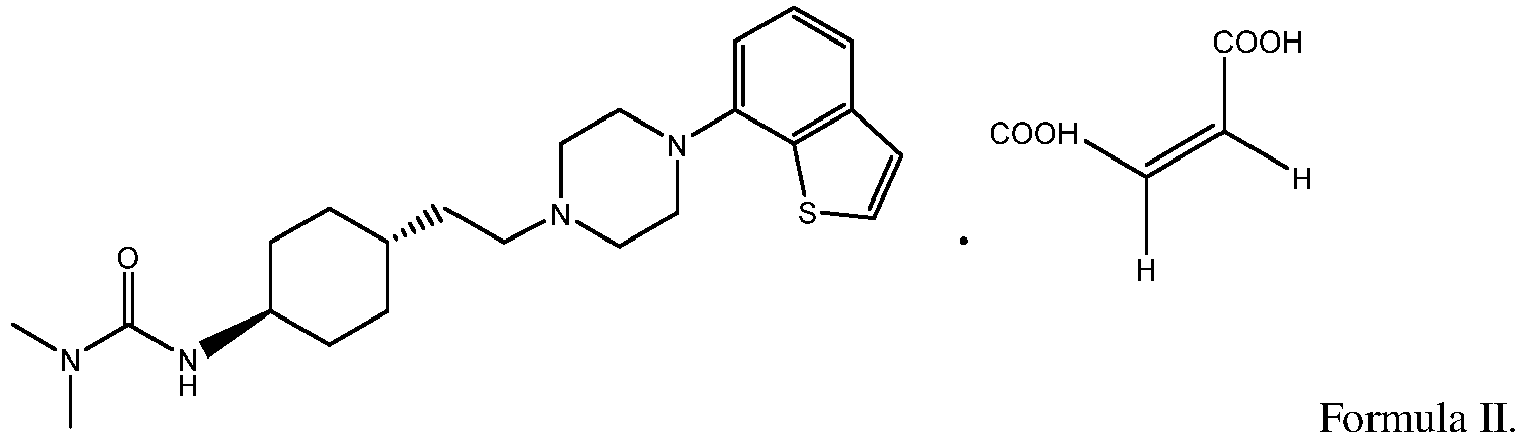
- the chemical formula of the maleate of the compound of Formula I is as shown in Formula II,
- the maleate of the present invention also has diffraction peaks at 2 ⁇ values of 11.045° ⁇ 0.2°, 22.997° ⁇ 0.2°, 25.336° ⁇ 0.2°, 27.786° ⁇ 0.2°, 28.292° ⁇ 0.2°, 28.914° ⁇ 0.2°, 29.804° ⁇ 0.2°, 30.770° ⁇ 0.2°, 31.628° ⁇ 0.2° and 33.952° ⁇ 0.2°; preferably, also has diffraction peaks at 2 ⁇ values of 11.045° ⁇ 0.02°, 22.997° ⁇ 0.02°, 25.336° ⁇ 0.02°, 27.786° ⁇ 0.02°, 28.292° ⁇ 0.02°, 28.914° ⁇ 0.02°, 29.804° ⁇ 0.02°, 30.770° ⁇ 0.02°, 31.628° ⁇ 0.02° and 33.952° ⁇ 0.02°.
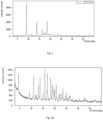
- the maleate of the present invention has an XRPD pattern as shown in Fig. 5A .
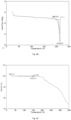
- the maleate of the present invention has an endothermic peak at 191.8°C in DSC analysis.
- the maleate of the present invention has a DSC pattern as shown in Fig. 5B . In one embodiment, the maleate of the present invention has a weight loss of up to 0.41% at 150°C in TGA analysis.
- the maleate of the present invention has a TGA pattern as shown in Fig. 5C .
- the present invention also provides a method for preparing a maleate of a compound of Formula I, comprising the following step: reacting the compound of Formula I with maleic acid in an organic solvent to obtain a maleate of the compound of Formula I.
- the compound of Formula I and maleic acid are reacted in a molar ratio of 1:1 to 1:2; preferably, the molar ratio is from 1:1 to 1:1.1.
- the organic solvent is selected from isopropanol, acetone, ethyl acetate, acetonitrile, toluene or a mixture of two or more thereof.
- the invention also provides a pharmaceutical composition for use in the treatment or amelioration of schizophrenia, abalienation, mental disorders, abalienatio mentis, emotional disturbance, bipolar disorders, depression, phobia, obsessive compulsive disorders, anxiety disorders or cognitive disorders, wherein the pharmaceutical composition comprises the maleate and pharmaceutically acceptable auxiliaries.
- the maleate of the compound of Formula I of the present invention has high crystallinity, low TGA weight loss, high and unique DSC endothermic signal; low hygroscopicity, good stability, and convenient long-term storage and transportation, thereby reducing the production cost; and it was proved by experiment in vivo that the bioavailability was high and the half-life was long, so it was an ideal salt for the compound of Formula I.
- the X-ray powder diffraction patterns of crystal forms of the various salts of N'-[trans-4-[2-[4-(benzo[b]thiophen-7-yl)piperazin-1-yl]ethyl]cyclohexyl]-N,N-dimethylurea are expressed as diffraction peak positions, i.e., diffraction angle 2 ⁇ (°), interplanar spacing d ( ⁇ ), Diffraction peak relative intensity (I/I0).
- relative intensity refers to the ratio of the intensity of the other peak to the intensity of the highest intensity peak when the intensity of the highest intensity peak of all diffraction peaks of the X-ray powder diffraction pattern is 100%.
- substantially the same means that at least 70%, at least 80%, at least 90%, at least 95%, or at least 99% of the peaks in the X-ray powder diffraction pattern appear in the given example X-ray powder diffraction pattern.
- Reagents the reactants and the catalyst used in the embodiment of the invention are chemical pure, and can be directly used or simply purified as required;
- the organic solvents and the like are all analytical reagent and are directly used. All reagents were purchased from Sinopharm Chemical Reagent Co., Ltd (Group) in Shanghai.
- the amorphous form of the compound of Formula I is prepared according to the methods reported in the literature, e.g. in Example 5 of CN 106518841A , and is not limited thereto.
- X-ray powder diffraction analysis was performed on an X-ray powder diffractometer manufactured by PANalytacal using Cu-Ku radiation, testing a continuous scan of ⁇ -2 ⁇ with a power of 45 kV x 40 mA, a step width of 0.02°, and a scan range of 3-40° (2 ⁇ ).
- Thermogravimetric analysis (TGA): using TA Q5000/5500 thermal gravimetric analyzer to determine under the condition that the protective gas is nitrogen, the heating rate is 10 °C/min, and the temperature rises gradually from room temperature to the end point.
- HPLC Content detection method
- Test sample solution 5 mg of the sample was precisely weighed and placed in a 10ml flask, dissolved with 2 ml of methanol and mixed with diluent (blank solution) at a constant volume to obtain.
- Example 1 preparation and identification of crystal Form A of the free base of N'-[trans-4-[2-[4-(benzo[b]thiophen-7-yl)piperazin-1-yl]ethyl]cyclohexyl]-N,N-dimethylurea(com pound of Formula I)
- the free base was prepared according to Example 5 of CN106518841A .
- reaction proceeded for a further 24 h at room temperature under stirring, and after reaction, 120 ml of a 10% sodium bicarbonate solution was added.
- the reaction system was directly subjected to separation, the organic phase was dried over anhydrous sodium sulfate, and finally filtered and concentrated to dryness by rotary evaporation, and the solid was dissolved in 15 ml of ethyl acetate under reflux and cooled to room temperature (25°C ⁇ 2°C) to crystallize to give 3.70 g of the desired product.
- crystal Form A of the free base of the compound of Formula I wherein the X-ray diffraction pattern (XRPD) is shown in Fig. 1 ; the solubility of the crystal Form A of the free base in water is about 0.031 mg/ml.
- hydrochloride salt 200 mg of the free base product from Example 1 was mixed and stirred with 1.05 molar ratio of hydrochloric acid in toluene at room temperature for 3 days and dried under vacuum at 50°C for 3 days to obtain the hydrochloride salt. It is in crystal form, designated as hydrochloride salt Form B of the compound of Formula I.
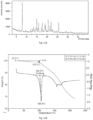
- Fig. 2A shows a powder X-ray diffraction pattern (XRPD) and the characteristic peaks for the corresponding spacing values ( ⁇ ) at 2 ⁇ are provided in Table 1.
- Table 1 XRPD Diffraction Peak Data for Hydrochloride Salt Form B Diffraction angle [° 2 ⁇ ] Interplanar spacing [ ⁇ ] Relative intensity [%] 4.576941 19.30686 55.05 9.123195 9.69356 23.68 10.982470 8.05632 76.16 11.903470 7.43497 15.55 12.216890 7.24493 13.80 13.040680 6.78905 47.00 13.738740 6.44563 69.38 15.024150 5.89694 22.99 15.800660 5.60884 100.00 16.914740 5.24185 85.20 17.370510 5.10532 7.84 18.339650 4.83767 73.96 19.119300 4.64212 49.76 19.746390 4.49609 40.83 20.029190 4.43324 32.41 20.682720 4.29462 50
- the solubility in water is greater than 4.6 mg/ml; the DSC results of Fig. 2B show that the sample has one endothermic peak at 278.2°C; TGA of Fig. 2C shows that the sample has a 0.49% weight loss when heated to 150°C.
- HPLC/IC assays are consistent with a 1:1 stoichiometry (free base : hydrochloric acid).
- sulfate (a) 200 mg of the product from Example 1 was mixed and stirred with 1.05 molar ratio of sulfuric acid in ethyl acetate (EtOAc) at room temperature for 4 days, and dried under vacuum at 50°C for 3 days to obtain the sulfate. It is in crystal form, designated as sulfate Form A of the compound of Formula I.
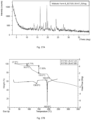
- Fig. 3A shows a powder X-ray diffraction pattern (XRPD) and the characteristic peaks for the corresponding spacing values ( ⁇ ) at 2 ⁇ are provided in Table 2.
- Table 2 XRPD Diffraction Peak Data for Sulfate Form A Diffraction angle [° 2 ⁇ .] Interplanar spacing [ ⁇ ] Relative intensity [%] 6.719282 13.15520 44.09 7.195519 12.28556 10.70 7.947205 11.12514 7.24 9.858717 8.97195 21.50 12.610270 7.01979 3.93 13.414660 6.60062 15.56 14.437150 6.13535 26.09 14.823030 5.97649 13.36 15.240620 5.81366 28.09 15.927590 5.56443 99.41 17.257190 5.13859 31.62 17.781580 4.98822 61.09 18.294180 4.84959 30.33 18.863740 4.70443 53.45 20.187920 4.39875 17.60 20.792550 4.27218 20.94
- the solubility in water is greater than 8.0mg/ml; the DSC results of Fig. 3B show that the sample has one endothermic peak at 195.1°C; TGA of Fig. 3C shows that the sample has a 0.43% weight loss when heated to 150°C.
- HPLC/IC assays are consistent with a 1:1 stoichiometry (free base : sulfuric acid).
- sulfate (b) 200 mg of the product from Example 1 was mixed and stirred with 1.05 molar ratio of sulfuric acid in isopropylamine (IPA) at room temperature for 4 days, and dried under vacuum at 50°C for 3 days to obtain the sulfate, which is in crystal form and is substantially the same as the X-ray diffraction pattern (XRPD), DSC pattern and TGA pattern of the above sulfate Form A of the compound of Formula I.
- IPA isopropylamine
- sulfate (c) 200 mg of the product from Example 1 was mixed and stirred with 1.05 molar ratio of sulfuric acid in acetonitrile (ACN) at room temperature for 4 days, and dried under vacuum at 50°C for 3 days to obtain the sulfate, which is in crystal form and is substantially the same as the X-ray diffraction pattern (XRPD), DSC pattern and TGA pattern of the above sulfate Form A of the compound of Formula I.
- XRPD X-ray diffraction pattern
- sulfate (d) 200 mg of the product from Example 1 was mixed and stirred with 1.05 molar ratio of sulfuric acid in methylbenzene (toluene) at room temperature for 4 days, and dried under vacuum at 50°C for 3 days to obtain the sulfate, which is in crystal form and is substantially the same as the X-ray diffraction pattern (XRPD), DSC pattern and TGA pattern of the above sulfate Form A of the compound of Formula I.
- XRPD X-ray diffraction pattern
- phosphate (a) 200 mg of the product from Example 1 was mixed and stirred with 1.05 molar ratio of phosphoric acid in ethyl acetate (EtOAc) at room temperature for 5 days to obtain. It is in crystal form, designated as phosphate Form A of the compound of Formula I.
- Fig. 4A shows a powder X-ray diffraction pattern (XRPD) and the characteristic peaks for the corresponding spacing values ( ⁇ ) at 2 ⁇ are provided in Table 3.
- Table 3 XRPD Diffraction Peak Data for Phosphate Form A Diffraction angle [° 2 ⁇ .] Interplanar spacing [ ⁇ ] Relative intensity [%] 6.794465 13.00980 18.09 9.973994 8.86852 17.67 13.986170 6.33215 33.04 15.241080 5.81349 33.97 15.844050 5.59358 100.00 18.154110 4.88669 20.98 19.990390 4.44176 19.30 21.005570 4.22933 30.57 21.241610 4.18287 75.24 21.811130 4.07492 26.04 24.450240 3.64073 8.99 26.019400 3.42462 0.62 27.309390 3.26572 9.19 30.710740 2.91134 3.58 32.056180 2.79215 2.76 35.718340 2.51383 2.08 36.
- the solubility in water is greater than 7.6mg/ml; the DSC results of Fig. 4B show that the sample has one endothermic peak at 213.9°C; TGA of Fig. 4C shows that the sample has a 0.7% weight loss when heated to 150°C. Results of HPLC/IC assays are consistent with a 1:1 stoichiometry (free base : phosphoric acid).
- phosphate (b) 200 mg of the product from Example 1 was mixed and stirred with 1.05 molar ratio of phosphoric acid in isopropylamine (IPA) at room temperature for 5 days to obtain the phosphate, which is in crystal form and is substantially the same as the X-ray diffraction pattern (XRPD), DSC pattern and TGA pattern of the above phosphate Form A of the compound of Formula I .
- IPA isopropylamine
- phosphate (c) 200 mg of the product from Example 1 was mixed and stirred with 1.05 molar ratio of phosphoric acid in acetone at room temperature for 5 days to obtain the phosphate, which is in crystal form and is substantially the same as the X-ray diffraction pattern (XRPD), DSC pattern and TGA pattern of the above phosphate Form A of the compound of Formula I.
- XRPD X-ray diffraction pattern
- phosphate (d) 200 mg of the product from Example 1 was mixed and stirred with 1.05 molar ratio of phosphoric acid in acetonitrile (ACN) at room temperature for 5 days to obtain the phosphate, which is in crystal form, which is substantially the same as the X-ray diffraction pattern (XRPD), DSC pattern and TGA pattern of the phosphate crystal form A of the compound of Formula I.
- ACN acetonitrile
- phosphate (e) 200 mg of the product from Example 1 was mixed and stirred with 1.05 molar ratio of phosphoric acid in methylbenzene (Toluene) at room temperature for 5 days to obtain the phosphate, which is in crystal form, which is substantially the same as the X-ray diffraction pattern (XRPD), DSC pattern and TGA pattern of the phosphate crystal form A of the compound of Formula I.
- XRPD X-ray diffraction pattern
- DSC pattern DSC pattern
- TGA pattern of the phosphate crystal form A of the compound of Formula I 200 mg of the product from Example 1 was mixed and stirred with 1.05 molar ratio of phosphoric acid in methylbenzene (Toluene) at room temperature for 5 days to obtain the phosphate, which is in crystal form, which is substantially the same as the X-ray diffraction pattern (XRPD), DSC pattern and TGA pattern of the phosphate crystal form A of the compound of Formula I.
- XRPD
- Example 5 preparation and identification of the maleate of N'-[trans-4-[2-[4-(benzo [b] thiophen-7-yl)piperazin-1-yl]ethyl]cyclohexyl]-N,N-dimethylurea
- maleate (a) 200 mg of the product from Example 1 was mixed and stirred with 1.05 molar ratio of maleic acid in acetone at room temperature for 5 days to obtain the maleate, which is in a crystal form, designated as maleate Form A of the compound of Formula I.
- Fig. 5A shows a powder X-ray diffraction pattern (XRPD) and the characteristic peaks for the corresponding spacing values ( ⁇ ) at 2 ⁇ are provided in Table 4.
- Table 4 XRPD Diffraction Peak Data for Maleate Form A Diffraction angle [° 2 ⁇ .] Interplanar spacing [ ⁇ ] Relative intensity [%] 7.246772 12.19878 29.23 11.045240 8.01067 8.33 11.804630 7.49700 48.03 12.703730 6.96836 37.24 13.493910 6.56202 40.27 14.495010 6.11099 45.47 15.096910 5.86868 100.00 17.108350 5.18296 38.11 17.567560 5.04850 24.86 18.794690 4.72156 15.60 19.104540 4.64567 36.19 19.655590 4.51666 43.21 20.023940 4.43440 37.51 20.395360 4.35447 13.70 21.030950 4.22429 14.53 21.611370 4.11213 77.73 22.496370
- the solubility in water is greater than 2.6 mg/ml; the DSC results of Fig. 5B show that the sample has one endothermic peak at 191.8°C; TGA of Fig. 5C shows that the sample has a 0.41% weight loss when heated to 150°C.
- 1 H-NMR corresponds to 1:1 stoichiometry (free base : maleic acid), results are shown in Fig. 5D .
- maleate (b) 200 mg of the product from Example 1 was mixed and stirred with 1.05 molar ratio of maleic acid in isopropylamine (IPA) at room temperature for 5 days to obtain the maleate, which is in crystal form and is substantially the same as the X-ray diffraction pattern (XRPD), DSC pattern and TGA pattern of the above maleate Form A of the compound of Formula I.
- IPA isopropylamine
- maleate (c) 200 mg of the product from Example 1 was mixed and stirred with 1.05 molar ratio of phosphoric acid in ethyl acetate (EtOAc) at room temperature for 5 days to obtain the maleate, which is in crystal form and is substantially the same as the X-ray diffraction pattern (XRPD), DSC pattern and TGA pattern of the above maleate Form A of the compound of Formula I.
- maleate (d) 200 mg of the product from Example 1 was mixed and stirred with 1.05 molar ratio of maleic acid in acetonitrile (ACN) at room temperature for 5 days to obtain the maleate, which is in crystal form and is substantially the same as the X-ray diffraction pattern (XRPD), DSC pattern and TGA pattern of the abvoe maleate Form A of the compound of Formula I.
- ACN acetonitrile
- Fig. 6A shows a powder X-ray diffraction pattern (XRPD); the DSC results of Fig. 6B show that the sample has one endothermic peak at 169.8°C; TGA of Fig. 6B shows a 5.5% weight loss of the sample when heated to 150°C.
- 1 H-NMR corresponds to 1:1 stoichiometry (free base : tartaric acid).
- Fig. 7A shows a powder X-ray diffraction pattern (XRPD); the DSC results of Fig. 7B show that the sample has one endothermic peak at 200.3°C; TGA of Fig. 7B shows a 0.9% weight loss of the sample when heated to 150°C.
- 1 H-NMR corresponds to 1:1 stoichiometry (free base : fumaric acid).
- citrate 200 mg of the product from Example 1 was mixed and stirred with 1 molar ratio of citric acid in ethyl acetate (EtOAc) at room temperature for 5 days. It is in crystal form, designated as citrate Form A of the compound of Formula I.
- EtOAc ethyl acetate
- Fig. 8A shows a powder X-ray diffraction pattern (XRPD); the DSC results of Fig. 8B show that the sample has one endothermic peak at 126.8°C; TGA of Fig. 8B shows a 2.6% weight loss of the sample when heated to 140°C.
- 1 H-NMR corresponds to 1:1 stoichiometry (free base : citric acid).
- glycolate 200 mg of the product from Example 1 was mixed and stirred with 1 molar ratio of glycollic acid in isopropylamine (IPA) at room temperature for 5 days. It is in crystal form, designated as glycolate Form A of the compound of Formula I.
- IPA isopropylamine
- Fig. 9A shows a powder X-ray diffraction pattern (XRPD); the DSC results of Fig. 9B show that the sample has one endothermic peak at 129.2°C; TGA of Fig. 9B shows a 11.9% weight loss of the sample when heated to 120°C.
- 1 H-NMR corresponds to 1:1 stoichiometry (free base : glycollic acid).
- malate Form A of the compound of Formula I 200 mg of the product from Example 1 was mixed and stirred with 1 molar ratio of L-malic acid in Acetone at room temperature for 5 days. It is in crystal form, designated as malate Form A of the compound of Formula I.
- Fig. 10A shows a powder X-ray diffraction pattern (XRPD);
- XRPD powder X-ray diffraction pattern
- the DSC results of Fig. 10B show that the sample has two endothermic peaks at 140.4 and 155.0°C;
- TGA of Fig. 10B shows a 8.8% weight loss of the sample when heated to 140°C.
- 1 H-NMR corresponds to 1:1 stoichiometry (free base : malic acid).
- Fig. 11A shows a powder X-ray diffraction pattern (XRPD); the DSC results of Fig. 11B show that the sample has one endothermic peak at 106.9°C; TGA of Fig. 11B shows a 1.7% weight loss of the sample when heated to 100°C.
- 1 H-NMR corresponds to 1:1 stoichiometry (free base : lactic acid).
- Fig. 12A shows a powder X-ray diffraction pattern (XRPD); the DSC results of Fig. 12B show that the sample has one endothermic peak at 152.0°C; TGA of Fig. 12B shows a 2.3% weight loss of the sample when heated to 150°C.
- 1H-NMR corresponds to 1:1 stoichiometry (free base : succinic acid).
- adipate Form A of the compound of Formula I 200 mg of the product from Example 1 was mixed and stirred with 1 molar ratio of adipic acid in ethyl acetate (EtOAc) at room temperature for 5 days. It is in crystal form, designated as adipate Form A of the compound of Formula I.
- Fig. 13A shows a powder X-ray diffraction pattern (XRPD)
- TGA of Fig. 13B shows a 1.0% weight loss of the sample when heated to 150°C
- the DSC results of Fig. 13B show that the sample has one endothermic peak at 115.0°C.
- 1 H-NMR corresponds to 1:1 stoichiometry (free base : adipic acid).
- p-toluenesulfonate 200 mg of the product from Example 1 was mixed and stirred with 1 molar ratio of p-toluenesulfonic acid in ethyl acetate (EtOAc) at room temperature for 5 days. It is in crystal form, designated as p-toluenesulfonate Form A of the compound of Formula I.
- Fig. 14A shows a powder X-ray diffraction pattern (XRPD); the DSC results of Fig. 14B show that the sample has one endothermic peak at 205.6°C; TGA of Fig. 14B shows that the sample had a 0.8% weight loss when heated to 150°C.
- 1 H-NMR corresponds to 1:1 stoichiometry (free base : p-toluenesulfonic acid).
- mesylate 200 mg of the product from Example 1 were stirred with 1 molar ratio of methylsulfonic acid in isopropylamine (IPA) at room temperature for 5 days. It is in crystal form, designated as mesylate Form A of the compound of Formula I.
- IPA isopropylamine
- Fig. 16A shows a powder X-ray diffraction pattern (XRPD); the DSC results of Fig. 16B show that the sample has one endothermic peak at 249.6°C; TGA of Fig. 16B shows a 1.4% weight loss of the sample when heated to 150°C.
- 1 H-NMR corresponds to 1:1 stoichiometry (free base : hydrobromic acid).
- Example 12 preparation and identification of the maleate of N'-[trans-4-[2-[4-(benzo[b]thiophen-7-yl)piperazin-1-yl]ethyl]cyclohexyl]-N,N-dimethylurea
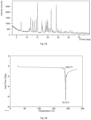
- maleate Form B of the compound of Formula I shows a powder X-ray diffraction pattern (XRPD); the DSC results of Fig. 17B show that the sample has two endothermic peaks at 138.8°C and 193.6°C; TGA of Fig. 17B shows a 4.7% weight loss of the sample when heated to 90°C and a 17.8% weight loss of the sample when continued heating to 150°C.
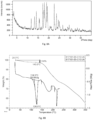
- 1 H-NMR corresponds to 1:1 stoichiometry (free base : maleic acid); and after maleate Form B was heated to 150°C and cooled to room temperature, it turned to maleate Form A, and the results are shown in Fig. 17C .
- the maleate has a relatively long half-life, prolongs the time of action in vivo, and is highly bioavailable compared with other salts.
Landscapes
- Health & Medical Sciences (AREA)
- Chemical & Material Sciences (AREA)
- Organic Chemistry (AREA)
- Medicinal Chemistry (AREA)
- Pharmacology & Pharmacy (AREA)
- Life Sciences & Earth Sciences (AREA)
- Animal Behavior & Ethology (AREA)
- General Health & Medical Sciences (AREA)
- Public Health (AREA)
- Veterinary Medicine (AREA)
- Engineering & Computer Science (AREA)
- Bioinformatics & Cheminformatics (AREA)
- Biomedical Technology (AREA)
- Neurology (AREA)
- Neurosurgery (AREA)
- Chemical Kinetics & Catalysis (AREA)
- General Chemical & Material Sciences (AREA)
- Nuclear Medicine, Radiotherapy & Molecular Imaging (AREA)
- Psychiatry (AREA)
- Epidemiology (AREA)
- Pain & Pain Management (AREA)
- Hospice & Palliative Care (AREA)
- Pharmaceuticals Containing Other Organic And Inorganic Compounds (AREA)
Description
- The present invention belongs to the field of medicinal chemistry, and particularly relates to a cyclohexane derivative salt for use in treating mental diseases and a preparation method thereof.
- The present inventors have disclosed in CN 106518841A a
compound 1 of Formula I having the chemical name - N'-[trans-4-[2-[4-(benzo[b]thiophen-7-yl)piperazin-1-yl]ethyl]cyclohexyl]-N,N-dimethylurea. A cyclohexane derivative
- N'-[trans-4-[2-[4-(benzo[b]thiophen-7-yl)piperazin-1-yl]ethyl]cyclohexyl]-N,N-dimethylurea as shown in Formula I has D2/D3 antagonist effect, 5-hydroxytryptamine absorption inhibition effect and anti-schizophrenic effect, and particularly has high D3/D2 receptor selectivity and small side effect,

- In order to improve the stability of the compound during formulation as well as during storage and to improve the pharmacokinetic properties of the compound, a more advantageous compound form is required, such as a salt of a compound of Formula I.
- Based on the existing compound of the Formula I, through intensive research, the inventor develops the following salts of the compound of following Formula I, which improve the stability of the compound I and reduce the hygroscopicity of the compound I, and the experiment in vivo proves that the half-life in vivo is longer, the bioavailability in vivo is higher, and the individual difference in vivo is small. Specifically, the present invention provides the following technical solutions.
- The present invention provides a salt of the cyclohexane derivative N'-[trans-4-[2-[4-(benzo[b]thiophen-7-yl)piperazin-1-yl]ethyl]cyclohexyl]-N,N-dimethylurea of Formula I, wherein the salt comprises an anion which is a maleate ion,

- In one embodiment, in the maleate of the present invention, the stoichiometric ratio of the compound of Formula I to the anion is 1:1.
- In one embodiment, in the maleate of the present invention, the chemical formula of the maleate of the compound of Formula I is as shown in Formula II,
- In one embodiment, the X-ray powder diffraction pattern of the maleate of the present invention, expressed in 2Θ angle by using Cu-Ku radiation, has diffraction peaks at least at 11.804°±0.2°, 12.703°±0.2°, 13.493°±0.2°, 14.495°±0.2°, 15.096°±0.2°, 17.108°±0.2°, 19.104°±0.2°, 19.655°±0.2°, 20.023°±0.2°, 21.611°±0.2° and 24.088°±0.2°; preferably, has diffraction peaks at least at 11.804°±0.02°, 12.703°±0.02°, 13.493°±0.02°, 14.495°±0.02°, 15.096°±0.02°, 17.108°±0.02°, 19.104°±0.02°, 19.655°±0.02°, 20.023°±0.02°, 21.611°±0.02° and 24.088°±0.02°. In one embodiment, the maleate of the present invention also has diffraction peaks at 2Θ values of 7.246°±0.2°, 17.567°±0.2°, 18.794°±0.2°, 20.395°±0.2°, 21.030°±0.2°, 22.496°±0.2°, 24.867°±0.2° and 26.412°±0.2°; preferably, also has diffraction peaks at 2Θ values of 7.246°±0.02°, 17.567°±0.02°, 18.794°±0.02°, 20.395°±0.02°, 21.030°±0.02°, 22.496°±0.02°, 24.867°±0.02° and 26.412°±0.02°.
- In one embodiment, the maleate of the present invention also has diffraction peaks at 2Θ values of 11.045°±0.2°, 22.997°±0.2°, 25.336°±0.2°, 27.786°±0.2°, 28.292°±0.2°, 28.914°±0.2°, 29.804°±0.2°, 30.770°±0.2°, 31.628°±0.2° and 33.952°±0.2°; preferably, also has diffraction peaks at 2Θ values of 11.045°±0.02°, 22.997°±0.02°, 25.336°±0.02°, 27.786°±0.02°, 28.292°±0.02°, 28.914°±0.02°, 29.804°±0.02°, 30.770°±0.02°, 31.628°±0.02° and 33.952°±0.02°. In one embodiment, the maleate of the present invention has an XRPD pattern as shown in
Fig. 5A . - In one embodiment, the maleate of the present invention has an endothermic peak at 191.8°C in DSC analysis.
- In one embodiment, the maleate of the present invention has a DSC pattern as shown in
Fig. 5B . In one embodiment, the maleate of the present invention has a weight loss of up to 0.41% at 150°C in TGA analysis. - In one embodiment, the maleate of the present invention has a TGA pattern as shown in
Fig. 5C . The present invention also provides a method for preparing a maleate of a compound of Formula I, comprising the following step: reacting the compound of Formula I with maleic acid in an organic solvent to obtain a maleate of the compound of Formula I. - In one embodiment, in the maleate of the present invention, the compound of Formula I and maleic acid are reacted in a molar ratio of 1:1 to 1:2; preferably, the molar ratio is from 1:1 to 1:1.1.
- In one embodiment, the organic solvent is selected from isopropanol, acetone, ethyl acetate, acetonitrile, toluene or a mixture of two or more thereof.
- The invention also provides a pharmaceutical composition for use in the treatment or amelioration of schizophrenia, abalienation, mental disorders, abalienatio mentis, emotional disturbance, bipolar disorders, depression, phobia, obsessive compulsive disorders, anxiety disorders or cognitive disorders, wherein the pharmaceutical composition comprises the maleate and pharmaceutically acceptable auxiliaries.
- The maleate of the compound of Formula I of the present invention has high crystallinity, low TGA weight loss, high and unique DSC endothermic signal; low hygroscopicity, good stability, and convenient long-term storage and transportation, thereby reducing the production cost; and it was proved by experiment in vivo that the bioavailability was high and the half-life was long, so it was an ideal salt for the compound of Formula I.
-
-
Fig. 1 is the X-ray powder diffraction pattern (XPRD pattern) of the free base of the compound of Formula I. -
Fig. 2A is the X-ray powder diffraction pattern (XPRD pattern) of the hydrochloride salt of the compound of Formula I. -
Fig. 2B is the differential scanning calorimetry pattern (DSC pattern) of the hydrochloride salt of the compound of Formula I. The abscissa is temperature (°C); the ordinate is the heat flux (W/g). -
Fig. 2C is the thermogravimetric analysis (TGA pattern) of the hydrochloride salt of the compound of Formula I. -
Fig. 3A is the X-ray powder diffraction pattern (XPRD pattern) of the sulfate of the compound of Formula I. -
Fig. 3B is the differential scanning calorimetry pattern (DSC pattern) of the sulfate of the compound of Formula I. The abscissa is temperature (°C); the ordinate is the heat flux (W/g). -
Fig. 3C is the thermogravimetric analysis pattern (TGA pattern) of the sulfate of the compound of Formula I. -
Fig. 4A is the X-ray powder diffraction pattern (XPRD pattern) of the phosphate of the compound of Formula I. -
Fig. 4B is the differential scanning calorimetry pattern (DSC pattern) of the phosphate of the compound of Formula I. The abscissa is temperature (°C); the ordinate is the heat flux (W/g). -
Fig. 4C is the thermogravimetric analysis (TGA pattern) of the phosphate of the compound of Formula I. -
Fig. 5A is the X-ray powder diffraction pattern (XPRD pattern) of crystal Form A of the maleate of the compound of Formula I in one embodiment of the present invention. -
Fig. 5B is the differential scanning calorimetry pattern (DSC pattern) of crystal Form A of the maleate of the compound of Formula I in one embodiment of the present invention. The abscissa is temperature (°C); the ordinate is the heat flux (W/g). -
Fig. 5C is the thermogravimetric analysis pattern (TGA pattern) of crystal Form A of the maleate of the compound of Formula I in one embodiment of the present invention. - Fig. SD is the 1H-NMR pattern of crystal Form A of the maleate of the compound of Formula I in one embodiment of the present invention.
-
Fig. 6A is the X-ray powder diffraction pattern (XPRD pattern) of the tartrate of the compound of Formula I. -
Fig. 6B is the differential scanning calorimetry pattern (DSC pattern) of the tartrate of the compound of Formula I. The abscissa is temperature (°C); the ordinate is the heat flux (W/g) and thermogravimetric analysis pattern (TGA pattern). -
Fig. 7A is the X-ray powder diffraction pattern (XPRD pattern) of the fumarate of the compound of Formula I. -
Fig. 7B is the differential scanning calorimetry pattern (DSC pattern) of the fumarate of the compound of Formula I. The abscissa is temperature (°C); the ordinate is the heat flux (W/g) and thermogravimetric analysis pattern (TGA pattern). -
Fig. 8A is the X-ray powder diffraction pattern (XPRD pattern) of the citrate of the compound of Formula I. -
Fig. 8B is the differential scanning calorimetry pattern (DSC pattern) of the citrate of the compound of Formula I. The abscissa is temperature (°C); the ordinate is the heat flux (W/g) and thermogravimetric analysis pattern (TGA pattern). -
Fig. 9A is the X-ray powder diffraction pattern (XPRD pattern) of the glycolate of the compound of Formula I. -
Fig. 9B is the differential scanning calorimetry pattern (DSC pattern) of the glycolate of the compound of Formula I. The abscissa is temperature (°C); the ordinate is the heat flux (W/g) and thermogravimetric analysis pattern (TGA pattern). -
Fig. 10A is the X-ray powder diffraction pattern (XPRD pattern) of the malate of the compound of Formula I. -
Fig. 10B is the differential scanning calorimetry pattern (DSC pattern) of the malate of the compound of Formula I. The abscissa is temperature (°C); the ordinate is the heat flux (W/g) and thermogravimetric analysis pattern (TGA pattern). -
Fig. 11A is the X-ray powder diffraction pattern (XPRD pattern) of the lactate of the compound of Formula I. -
Fig. 11B is the differential scanning calorimetry pattern (DSC pattern) of the lactate of the compound of Formula I. The abscissa is temperature (°C); the ordinate is the heat flux (W/g) and thermogravimetric analysis pattern (TGA pattern). -
Fig. 12A is the X-ray powder diffraction pattern (XPRD pattern) of the succinate of the compound of Formula I. -
Fig. 12B is the differential scanning calorimetry pattern (DSC pattern) of the succinate of the compound of Formula I. The abscissa is temperature (°C); the ordinate is the heat flux (W/g) and thermogravimetric analysis pattern (TGA pattern). -
Fig. 13A is the X-ray powder diffraction pattern (XPRD pattern) of the adipate of the compound of Formula I. -
Fig. 13B is the differential scanning calorimetry pattern (DSC pattern) of the adipate of the compound of Formula I. The abscissa is temperature (°C); the ordinate is the heat flux (W/g) and thermogravimetric analysis pattern (TGA pattern). -
Fig. 14A is the X-ray powder diffraction pattern (XPRD pattern) of the p-toluenesulfonate of the compound of Formula I. -
Fig. 14B is the differential scanning calorimetry pattern (DSC pattern) of the p-toluenesulfonate of the compound of Formula I. The abscissa is temperature (°C); the ordinate is the heat flux (W/g) and thermogravimetric analysis pattern (TGA pattern). -
Fig. 15A is the X-ray powder diffraction pattern (XPRD pattern) of the mesylate of the compound of Formula I. -
Fig. 15B is the differential scanning calorimetry pattern (DSC pattern) of the mesylate of the compound of Formula I. The abscissa is temperature (°C); the ordinate is the heat flux (W/g) and thermogravimetric analysis pattern (TGA pattern). -
Fig. 16A is the X-ray powder diffraction pattern (XPRD pattern) of the hydrobromide salt of the compound of Formula I. -
Fig. 16B is the differential scanning calorimetry pattern (DSC pattern) of the hydrobromide salt of the compound of Formula I. The abscissa is temperature (°C); the ordinate is the heat flux (W/g) and thermogravimetric analysis pattern (TGA pattern). -
Fig. 17A is the X-ray powder diffraction pattern (XPRD pattern) of crystal Form B of the maleate of the compound of Formula I in one embodiment of the present invention. -
Fig. 17B is the differential scanning calorimetry pattern (DSC pattern) of crystal Form B of the maleate of the compound of Formula I in one embodiment of the present invention. The abscissa is temperature (°C); the ordinate is the heat flux (W/g) and thermogravimetric analysis pattern (TGA pattern). -
Fig. 17C is the XRPD pattern of crystal Form B of the maleate of the compound of Formula I in one embodiment of the present invention before and after heating. -
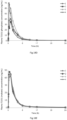
Fig. 18A is the graph of individual plasma concentration versus time after intragastric administration of 1 mg/kg of the compound of Formula I to rats. -
Fig. 18B is the graph of individual plasma concentration versus time after intragastric administration of 1 mg/kg of the sulfate of the compound of Formula I to rats. -
Fig. 18C is the graph of individual plasma concentration versus time after intragastric administration of 1 mg/kg of the hydrochloride salt of the compound of Formula I to rats. -
Fig. 18D is the graph of individual plasma concentration versus time after intragastric administration of 1 mg/kg of the phosphate of the compound of Formula I to rats. -
Fig. 18E is the graph of individual plasma concentration versus time after intragastric administration of 1 mg/kg of the maleate of the compound of Formula I to rats. - The invention is further illustrated by the following embodiments.
- The X-ray powder diffraction patterns of crystal forms of the various salts of N'-[trans-4-[2-[4-(benzo[b]thiophen-7-yl)piperazin-1-yl]ethyl]cyclohexyl]-N,N-dimethylurea, are expressed as diffraction peak positions, i.e., diffraction angle 2θ (°), interplanar spacing d (Å), Diffraction peak relative intensity (I/I0).
- The term "relative intensity" refers to the ratio of the intensity of the other peak to the intensity of the highest intensity peak when the intensity of the highest intensity peak of all diffraction peaks of the X-ray powder diffraction pattern is 100%.
- The term "substantially the same" means that at least 70%, at least 80%, at least 90%, at least 95%, or at least 99% of the peaks in the X-ray powder diffraction pattern appear in the given example X-ray powder diffraction pattern.
- Reagents: the reactants and the catalyst used in the embodiment of the invention are chemical pure, and can be directly used or simply purified as required; The organic solvents and the like are all analytical reagent and are directly used. All reagents were purchased from Sinopharm Chemical Reagent Co., Ltd (Group) in Shanghai.
- The amorphous form of the compound of Formula I is prepared according to the methods reported in the literature, e.g. in Example 5 of
CN 106518841A , and is not limited thereto. - X-ray powder diffraction:
X-ray powder diffraction analysis was performed on an X-ray powder diffractometer manufactured by PANalytacal using Cu-Ku radiation, testing a continuous scan of θ-2θ with a power of 45 kV x 40 mA, a step width of 0.02°, and a scan range of 3-40° (2θ). - Differential scanning calorimetry (DSC) characterization:
using TA Q2000/2500 differential scanning calorimeter to determine under the condition that the protective gas is nitrogen, the heating rate is 10 °C/min, and the temperature rises gradually from 25°C to the end point. - Thermogravimetric analysis (TGA):
using TA Q5000/5500 thermal gravimetric analyzer to determine under the condition that the protective gas is nitrogen, the heating rate is 10 °C/min, and the temperature rises gradually from room temperature to the end point. - Content detection method (HPLC):
-
Chromatographic column type Agilent Eclipse Plus C18 4.6*100 mm, 3.5 µm Mobile phase A 0.1% FA (formic acid) aqueous solution Mobile phase B MeOH Column temperature (°C) 40 Flow rate (ml/min) 1.0 Detection wavelength (nm) 260 Sample injection 10 µl amount Specimen disc temperature (°C) Room temperature Running gradient Time (min) Mobile phase A (%) Mobile phase B (%) 0 90 10 25 10 90 30 10 90 30.1 90 10 40 90 10 - Test sample solution: 5 mg of the sample was precisely weighed and placed in a 10ml flask, dissolved with 2 ml of methanol and mixed with diluent (blank solution) at a constant volume to obtain.
-
Ion chromatograph ThermoFisher ICS-1100 Chromatographic column IonPac AS18 Analytical Column, 250*4 mm Mobile phase 25 mM NaOH Sample injection volume 25 µL Flow rate 1.0 mL/min Temperature/° C 35° C Column temperature 35°C Electric current 80 mA Run Time The chloride ion was 6.0 min, the sulfate ion was 8.0 min, the bromide ion was 8.0 min, and the phosphate ion was 12.0 min - The free base was prepared according to Example 5 of
CN106518841A . -

- A mixture of 7.20 g of 7-bromobenzo[b]thiophene, 19.9 g of piperazine anhydride, 4.70 g of sodium tert-butoxide, 0.32 g of (R)-(+)-2,2'-bis (diphenylphosphino)-1,1'-dinaphthyl (BINAP), 0.63 g of dipalladium tris (dibenzylideneacetone) and 150 ml of toluene was refluxed under a nitrogen atmosphere for 1 h. 150 ml of water was poured into the reaction solution, then extracted with ethyl acetate (100 ml x 3), washed with water, dried over anhydrous magnesium sulfate, and allowed to evaporate the solvent under reduced pressure (0.01 MPa, 45°C). The residue was purified by silica gel column chromatography (dichloromethane : methanol : 25% aqueous ammonia = 100:10:1) to yield 4.60 g of 1-(benzo[b]thiophen-7-yl)piperazine in the form of yellow oil. 2 ml of concentrated hydrochloric acid was added to a methanol solution (25 ml) containing 4.6 g of 1-(benzo[b]thiophen-7-yl)piperazine, and the solvent was evaporated under reduced pressure (0.01 MPa, 45°C). Ethyl acetate (50 ml) was added to the residue and the precipitated crystals were filtered, dissolved at reflux in 15 ml of methanol and then cooled to room temperature (25°C) to recrystallize to obtain 1-(benzo[b]thiophen-7-yl)piperazine hydrochloride in the form of colorless needles.
-

- 2.54 g (10 mmol) of 1-(benzo[b]thiophen-7-yl)piperazine hydrochloride and 2.40 g (10 mmol) of trans-2-{ 1-[4-(N-tert-butoxycarbonyl) amino]cyclohexyl}-acetaldehyde were dissolved in 120 ml of dichloromethane, 1.40 ml (10 mmol) of triethylamine was added at room temperature ( 25°C ± 2°C) and stirred slowly for 10 min, then 3.16 g (14.8 mmol) of sodium triacetoxyborohydride was added gradually. The reaction proceeded for a further 24 h at room temperature under stirring, and after reaction, 120 ml of a 10% sodium bicarbonate solution was added. The reaction system was directly subjected to separation, the organic phase was dried over anhydrous sodium sulfate, and finally filtered and concentrated to dryness by rotary evaporation, and the solid was dissolved in 15 ml of ethyl acetate under reflux and cooled to room temperature (25°C ± 2°C) to crystallize to give 3.70 g of the desired product.
-

- 4.43 g of tert-Butyl trans-4-[2-[4-(benzo[b]thiophen-7-yl)piperazin-1-yl]ethyl]cyclohexyl-carbamate was placed in a reaction flask under ice-water bath, 80 ml of saturated hydrogen chloride in ethyl acetate was added, the reaction mixture was stirred for 8 h to carry out deprotection reaction, and finally a white precipitate was formed to give 3.42 g of the hydrochloride salt of the title compound. The above solid was added to 50 ml of dichloromethane solution, followed by addition of 50 ml of saturated sodium bicarbonate solution, stirred for half an hour, then subjected to phase separation. The organic phase was concentrated (0.01 MPa, 40°C) to give 3.30 g of the desired product.
-

- 1.73 g of trans-4-[2-[4-(benzo[b]thiophen-7-yl)piperazin-1-yl]ethyl]cyclohexylamine was dissolved in 50 ml of dichloromethane, followed by addition of 1.40 ml of triethylamine and 5.50 mmol of N, N-dimethylcarbamoyl chloride. The mixture was stirred for 48 h at room temperature (25°C ± 2°C). After reaction, 50 ml of water was added for extraction and the organic phase was concentrated (0.01 MPa, 45°C), subjected to column chromatography (methanol : dichloromethane = 1:10, 400 mesh silica gel) to collect the target fraction, which was concentrated to give 1.89 g of the amorphous desired product.
- 200 mg of the above amorphous product was dissolved in ethyl acetated at reflux temperature of 77°C, cooled to room temperature (20-25°C) and stirred for 1 h, filtered under suction and recrystallized to obtain a crystal form. It is designated as crystal Form A of the free base of the compound of Formula I, wherein the X-ray diffraction pattern (XRPD) is shown in
Fig. 1 ; the solubility of the crystal Form A of the free base in water is about 0.031 mg/ml. - Preparation of hydrochloride salt: 200 mg of the free base product from Example 1 was mixed and stirred with 1.05 molar ratio of hydrochloric acid in toluene at room temperature for 3 days and dried under vacuum at 50°C for 3 days to obtain the hydrochloride salt. It is in crystal form, designated as hydrochloride salt Form B of the compound of Formula I.
-
Fig. 2A shows a powder X-ray diffraction pattern (XRPD) and the characteristic peaks for the corresponding spacing values (Å) at 2Θ are provided in Table 1.Table 1 XRPD Diffraction Peak Data for Hydrochloride Salt Form B Diffraction angle [° 2θ] Interplanar spacing [Å] Relative intensity [%] 4.576941 19.30686 55.05 9.123195 9.69356 23.68 10.982470 8.05632 76.16 11.903470 7.43497 15.55 12.216890 7.24493 13.80 13.040680 6.78905 47.00 13.738740 6.44563 69.38 15.024150 5.89694 22.99 15.800660 5.60884 100.00 16.914740 5.24185 85.20 17.370510 5.10532 7.84 18.339650 4.83767 73.96 19.119300 4.64212 49.76 19.746390 4.49609 40.83 20.029190 4.43324 32.41 20.682720 4.29462 50.63 21.802960 4.07643 19.48 22.151700 4.01303 20.51 22.947100 3.87570 22.56 23.570630 3.77457 40.16 24.581520 3.62158 15.53 24.984200 3.56412 27.39 25.586650 3.48155 10.42 26.251890 3.39482 15.34 26.533050 3.35948 19.10 27.495840 3.24399 3.76 30.408600 2.93957 7.54 32.725620 2.73655 14.39 - For the hydrochloride salt Form B of the compound of Formula I, the solubility in water is greater than 4.6 mg/ml; the DSC results of
Fig. 2B show that the sample has one endothermic peak at 278.2°C; TGA ofFig. 2C shows that the sample has a 0.49% weight loss when heated to 150°C. HPLC/IC assays are consistent with a 1:1 stoichiometry (free base : hydrochloric acid). - Preparation of the sulfate (a): 200 mg of the product from Example 1 was mixed and stirred with 1.05 molar ratio of sulfuric acid in ethyl acetate (EtOAc) at room temperature for 4 days, and dried under vacuum at 50°C for 3 days to obtain the sulfate. It is in crystal form, designated as sulfate Form A of the compound of Formula I.
-
Fig. 3A shows a powder X-ray diffraction pattern (XRPD) and the characteristic peaks for the corresponding spacing values (Å) at 2Θ are provided in Table 2.Table 2 XRPD Diffraction Peak Data for Sulfate Form A Diffraction angle [° 2θ.] Interplanar spacing [Å] Relative intensity [%] 6.719282 13.15520 44.09 7.195519 12.28556 10.70 7.947205 11.12514 7.24 9.858717 8.97195 21.50 12.610270 7.01979 3.93 13.414660 6.60062 15.56 14.437150 6.13535 26.09 14.823030 5.97649 13.36 15.240620 5.81366 28.09 15.927590 5.56443 99.41 17.257190 5.13859 31.62 17.781580 4.98822 61.09 18.294180 4.84959 30.33 18.863740 4.70443 53.45 20.187920 4.39875 17.60 20.792550 4.27218 20.94 21.464510 4.13993 100.00 21.711510 4.09339 40.36 22.207430 4.00309 10.20 22.741540 3.91027 12.81 23.204680 3.83326 24.80 23.806940 3.73763 43.59 24.552950 3.62573 7.64 25.532400 3.48883 5.35 26.631630 3.34727 17.27 27.023930 3.29956 21.99 27.515020 3.24178 7.32 28.190910 3.16557 16.24 28.563170 3.12516 14.00 29.829620 2.99530 14.63 32.993550 2.71494 4.90 34.360750 2.60998 5.11 36.462810 2.46419 1.68 - For the sulfate Form A of the compound of Formula I, the solubility in water is greater than 8.0mg/ml; the DSC results of
Fig. 3B show that the sample has one endothermic peak at 195.1°C; TGA ofFig. 3C shows that the sample has a 0.43% weight loss when heated to 150°C. HPLC/IC assays are consistent with a 1:1 stoichiometry (free base : sulfuric acid). - Preparation of sulfate (b): 200 mg of the product from Example 1 was mixed and stirred with 1.05 molar ratio of sulfuric acid in isopropylamine (IPA) at room temperature for 4 days, and dried under vacuum at 50°C for 3 days to obtain the sulfate, which is in crystal form and is substantially the same as the X-ray diffraction pattern (XRPD), DSC pattern and TGA pattern of the above sulfate Form A of the compound of Formula I.
- Preparation of sulfate (c): 200 mg of the product from Example 1 was mixed and stirred with 1.05 molar ratio of sulfuric acid in acetonitrile (ACN) at room temperature for 4 days, and dried under vacuum at 50°C for 3 days to obtain the sulfate, which is in crystal form and is substantially the same as the X-ray diffraction pattern (XRPD), DSC pattern and TGA pattern of the above sulfate Form A of the compound of Formula I.
- Preparation of sulfate (d): 200 mg of the product from Example 1 was mixed and stirred with 1.05 molar ratio of sulfuric acid in methylbenzene (toluene) at room temperature for 4 days, and dried under vacuum at 50°C for 3 days to obtain the sulfate, which is in crystal form and is substantially the same as the X-ray diffraction pattern (XRPD), DSC pattern and TGA pattern of the above sulfate Form A of the compound of Formula I.
- Preparation of phosphate (a): 200 mg of the product from Example 1 was mixed and stirred with 1.05 molar ratio of phosphoric acid in ethyl acetate (EtOAc) at room temperature for 5 days to obtain. It is in crystal form, designated as phosphate Form A of the compound of Formula I.
-
Fig. 4A shows a powder X-ray diffraction pattern (XRPD) and the characteristic peaks for the corresponding spacing values (Å) at 2θ are provided in Table 3.Table 3 XRPD Diffraction Peak Data for Phosphate Form A Diffraction angle [° 2θ.] Interplanar spacing [Å] Relative intensity [%] 6.794465 13.00980 18.09 9.973994 8.86852 17.67 13.986170 6.33215 33.04 15.241080 5.81349 33.97 15.844050 5.59358 100.00 18.154110 4.88669 20.98 19.990390 4.44176 19.30 21.005570 4.22933 30.57 21.241610 4.18287 75.24 21.811130 4.07492 26.04 24.450240 3.64073 8.99 26.019400 3.42462 0.62 27.309390 3.26572 9.19 30.710740 2.91134 3.58 32.056180 2.79215 2.76 35.718340 2.51383 2.08 36.401270 2.46822 2.60 - For the phosphate Form A of the compound of Formula I, the solubility in water is greater than 7.6mg/ml; the DSC results of
Fig. 4B show that the sample has one endothermic peak at 213.9°C; TGA ofFig. 4C shows that the sample has a 0.7% weight loss when heated to 150°C. Results of HPLC/IC assays are consistent with a 1:1 stoichiometry (free base : phosphoric acid). - Preparation of phosphate (b): 200 mg of the product from Example 1 was mixed and stirred with 1.05 molar ratio of phosphoric acid in isopropylamine (IPA) at room temperature for 5 days to obtain the phosphate, which is in crystal form and is substantially the same as the X-ray diffraction pattern (XRPD), DSC pattern and TGA pattern of the above phosphate Form A of the compound of Formula I .
- Preparation of phosphate (c): 200 mg of the product from Example 1 was mixed and stirred with 1.05 molar ratio of phosphoric acid in acetone at room temperature for 5 days to obtain the phosphate, which is in crystal form and is substantially the same as the X-ray diffraction pattern (XRPD), DSC pattern and TGA pattern of the above phosphate Form A of the compound of Formula I.
- Preparation of phosphate (d): 200 mg of the product from Example 1 was mixed and stirred with 1.05 molar ratio of phosphoric acid in acetonitrile (ACN) at room temperature for 5 days to obtain the phosphate, which is in crystal form, which is substantially the same as the X-ray diffraction pattern (XRPD), DSC pattern and TGA pattern of the phosphate crystal form A of the compound of Formula I.
- Preparation of phosphate (e): 200 mg of the product from Example 1 was mixed and stirred with 1.05 molar ratio of phosphoric acid in methylbenzene (Toluene) at room temperature for 5 days to obtain the phosphate, which is in crystal form, which is substantially the same as the X-ray diffraction pattern (XRPD), DSC pattern and TGA pattern of the phosphate crystal form A of the compound of Formula I.
- Preparation of maleate (a): 200 mg of the product from Example 1 was mixed and stirred with 1.05 molar ratio of maleic acid in acetone at room temperature for 5 days to obtain the maleate, which is in a crystal form, designated as maleate Form A of the compound of Formula I.
-
Fig. 5A shows a powder X-ray diffraction pattern (XRPD) and the characteristic peaks for the corresponding spacing values (Å) at 2θ are provided in Table 4.Table 4 XRPD Diffraction Peak Data for Maleate Form A Diffraction angle [° 2θ.] Interplanar spacing [Å] Relative intensity [%] 7.246772 12.19878 29.23 11.045240 8.01067 8.33 11.804630 7.49700 48.03 12.703730 6.96836 37.24 13.493910 6.56202 40.27 14.495010 6.11099 45.47 15.096910 5.86868 100.00 17.108350 5.18296 38.11 17.567560 5.04850 24.86 18.794690 4.72156 15.60 19.104540 4.64567 36.19 19.655590 4.51666 43.21 20.023940 4.43440 37.51 20.395360 4.35447 13.70 21.030950 4.22429 14.53 21.611370 4.11213 77.73 22.496370 3.95232 10.60 22.997610 3.86730 4.66 24.088590 3.69457 89.87 24.867140 3.58063 13.78 25.336430 3.51536 6.62 26.412080 3.37459 12.01 27.786650 3.21070 4.90 28.292510 3.15443 6.19 28.914740 3.08795 7.44 29.804120 2.99780 4.24 30.770440 2.90583 7.49 31.628070 2.82896 6.05 33.952110 2.64045 1.97 - For the maleate Form A of the compound of Formula I, the solubility in water is greater than 2.6 mg/ml; the DSC results of
Fig. 5B show that the sample has one endothermic peak at 191.8°C; TGA ofFig. 5C shows that the sample has a 0.41% weight loss when heated to 150°C. 1H-NMR corresponds to 1:1 stoichiometry (free base : maleic acid), results are shown inFig. 5D . Preparation of maleate (b): 200 mg of the product from Example 1 was mixed and stirred with 1.05 molar ratio of maleic acid in isopropylamine (IPA) at room temperature for 5 days to obtain the maleate, which is in crystal form and is substantially the same as the X-ray diffraction pattern (XRPD), DSC pattern and TGA pattern of the above maleate Form A of the compound of Formula I. - Preparation of maleate (c): 200 mg of the product from Example 1 was mixed and stirred with 1.05 molar ratio of phosphoric acid in ethyl acetate (EtOAc) at room temperature for 5 days to obtain the maleate, which is in crystal form and is substantially the same as the X-ray diffraction pattern (XRPD), DSC pattern and TGA pattern of the above maleate Form A of the compound of Formula I.
- Preparation of maleate (d): 200 mg of the product from Example 1 was mixed and stirred with 1.05 molar ratio of maleic acid in acetonitrile (ACN) at room temperature for 5 days to obtain the maleate, which is in crystal form and is substantially the same as the X-ray diffraction pattern (XRPD), DSC pattern and TGA pattern of the abvoe maleate Form A of the compound of Formula I.
- Preparation of maleate (e): 200 mg of the product from Example 1 was mixed and stirred with 1.05 molar ratio of maleic acid in methylbenzene (Toluene) at room temperature for 5 days to obtain, which is in crystal form and is substantially the same as the X-ray diffraction pattern (XRPD), DSC pattern and TGA pattern of the above maleate Form A of the compound of Formula I.
- Preparation of tartrate: 200 mg of the product from Example 1 was mixed and stirred with 1 molar ratio of tartaric acid in acetone at room temperature for 5 days. It is in crystal form, designated as tartrate Form A of the compound of Formula I.
- With respect to tartrate Form A of the compound of Formula I,
Fig. 6A shows a powder X-ray diffraction pattern (XRPD); the DSC results ofFig. 6B show that the sample has one endothermic peak at 169.8°C; TGA ofFig. 6B shows a 5.5% weight loss of the sample when heated to 150°C. 1H-NMR corresponds to 1:1 stoichiometry (free base : tartaric acid). - Preparation of fumarate: 200 mg of the product from Example 1 was mixed and stirred with 1 molar ratio of fumaric acid in acetone at room temperature for 5 days. It is in crystal form, designated as fumarate Form A of the compound of Formula I.
- With respect to fumarate Form A of the compound of Formula I,
Fig. 7A shows a powder X-ray diffraction pattern (XRPD); the DSC results ofFig. 7B show that the sample has one endothermic peak at 200.3°C; TGA ofFig. 7B shows a 0.9% weight loss of the sample when heated to 150°C. 1H-NMR corresponds to 1:1 stoichiometry (free base : fumaric acid). - Preparation of citrate: 200 mg of the product from Example 1 was mixed and stirred with 1 molar ratio of citric acid in ethyl acetate (EtOAc) at room temperature for 5 days. It is in crystal form, designated as citrate Form A of the compound of Formula I.
- With respect to citrate Form A of the compound of Formula I,
Fig. 8A shows a powder X-ray diffraction pattern (XRPD); the DSC results ofFig. 8B show that the sample has one endothermic peak at 126.8°C; TGA ofFig. 8B shows a 2.6% weight loss of the sample when heated to 140°C. 1H-NMR corresponds to 1:1 stoichiometry (free base : citric acid). - Preparation of glycolate: 200 mg of the product from Example 1 was mixed and stirred with 1 molar ratio of glycollic acid in isopropylamine (IPA) at room temperature for 5 days. It is in crystal form, designated as glycolate Form A of the compound of Formula I.
- With respect to glycolate Form A of the compound of Formula I,
Fig. 9A shows a powder X-ray diffraction pattern (XRPD); the DSC results ofFig. 9B show that the sample has one endothermic peak at 129.2°C; TGA ofFig. 9B shows a 11.9% weight loss of the sample when heated to 120°C. 1H-NMR corresponds to 1:1 stoichiometry (free base : glycollic acid). - Preparation of malate: 200 mg of the product from Example 1 was mixed and stirred with 1 molar ratio of L-malic acid in Acetone at room temperature for 5 days. It is in crystal form, designated as malate Form A of the compound of Formula I.
- With respect to malate Form A of the compound of Formula I,
Fig. 10A shows a powder X-ray diffraction pattern (XRPD); The DSC results ofFig. 10B show that the sample has two endothermic peaks at 140.4 and 155.0°C; TGA ofFig. 10B shows a 8.8% weight loss of the sample when heated to 140°C. 1H-NMR corresponds to 1:1 stoichiometry (free base : malic acid). - Preparation of lactate: 200 mg of the product from Example 1 was mixed and stirred with 1 molar ratio of DL-lactic acid in ethyl acetate (EtOAc) at room temperature for 5 days. It is in crystal form, designated as lactate Form A of the compound of Formula I.
- With respect to lactate Form A of the compound of Formula I,
Fig. 11A shows a powder X-ray diffraction pattern (XRPD); the DSC results ofFig. 11B show that the sample has one endothermic peak at 106.9°C; TGA ofFig. 11B shows a 1.7% weight loss of the sample when heated to 100°C. 1H-NMR corresponds to 1:1 stoichiometry (free base : lactic acid). - Preparation of succinate: 200 mg of the product from Example 1 was mixed and stirred with 1 molar ratio of succinic acid in ethyl acetate (EtOAc) at room temperature for 5 days. It is in crystal form, designated as succinate Form A of the compound of Formula I.
- With respect to succinate Form A of the compound of Formula I,
Fig. 12A shows a powder X-ray diffraction pattern (XRPD); the DSC results ofFig. 12B show that the sample has one endothermic peak at 152.0°C; TGA ofFig. 12B shows a 2.3% weight loss of the sample when heated to 150°C. 1H-NMR corresponds to 1:1 stoichiometry (free base : succinic acid). - Preparation of adipate: 200 mg of the product from Example 1 was mixed and stirred with 1 molar ratio of adipic acid in ethyl acetate (EtOAc) at room temperature for 5 days. It is in crystal form, designated as adipate Form A of the compound of Formula I.
- With respect to adipate Form A of the compound of Formula I,
Fig. 13A shows a powder X-ray diffraction pattern (XRPD), TGA ofFig. 13B shows a 1.0% weight loss of the sample when heated to 150°C; the DSC results ofFig. 13B show that the sample has one endothermic peak at 115.0°C. 1H-NMR corresponds to 1:1 stoichiometry (free base : adipic acid). - Preparation of p-toluenesulfonate: 200 mg of the product from Example 1 was mixed and stirred with 1 molar ratio of p-toluenesulfonic acid in ethyl acetate (EtOAc) at room temperature for 5 days. It is in crystal form, designated as p-toluenesulfonate Form A of the compound of Formula I. With respect to p-toluenesulfonate Form A of the compound of Formula I,
Fig. 14A shows a powder X-ray diffraction pattern (XRPD); the DSC results ofFig. 14B show that the sample has one endothermic peak at 205.6°C; TGA ofFig. 14B shows that the sample had a 0.8% weight loss when heated to 150°C. 1H-NMR corresponds to 1:1 stoichiometry (free base : p-toluenesulfonic acid). - Preparation of mesylate: 200 mg of the product from Example 1 were stirred with 1 molar ratio of methylsulfonic acid in isopropylamine (IPA) at room temperature for 5 days. It is in crystal form, designated as mesylate Form A of the compound of Formula I.
- With respect to mesylate Form A of the compound of Formula I,
Fig. 15A shows a powder X-ray diffraction pattern (XRPD); the DSC results ofFig. 15B show that the sample has one endothermic peak at 211.1°C; TGA ofFig. 15B shows a 3.0% weight loss of the sample when heated to 150°C. 1H-NMR corresponds to 1:1 stoichiometry (free base : methylsulfonic acid). - Preparation of hydrobromide salt: 200 mg of the product from Example 1 was mixed and stirred with 1 molar ratio of hydrobromic acid in ethyl acetate (EtOAc) at room temperature for 5 days. It is in crystal form, designated as hydrobromide salt Form A of the compound of Formula I.
- With respect to hydrobromide salt Form A of the compound of Formula I,
Fig. 16A shows a powder X-ray diffraction pattern (XRPD); the DSC results ofFig. 16B show that the sample has one endothermic peak at 249.6°C; TGA ofFig. 16B shows a 1.4% weight loss of the sample when heated to 150°C. 1H-NMR corresponds to 1:1 stoichiometry (free base : hydrobromic acid). - Through analysis of the XRPD pattern, DSC pattern and TGA pattern of the above salts and crystal forms, based on the higher degree of crystallinity, less TGA weight loss, higher and unique DSC endothermic signal combined with the acid safety level, it can be concluded that the hydrochloride salt, sulfate, phosphate and maleate of the compounds of Formula I are preferred.
- Preparation of maleate: the maleate was obtained by adding an anti-solvent to 200 mg of the product from Example 1 in a CHCl3/IPAc (chloroform/isopropyl acetate) system. It is in crystal form, designated as maleate Form B of the compound of Formula I.
-
Fig. 17A shows a powder X-ray diffraction pattern (XRPD). - With respect to maleate Form B of the compound of Formula I, it shows a powder X-ray diffraction pattern (XRPD); the DSC results of
Fig. 17B show that the sample has two endothermic peaks at 138.8°C and 193.6°C; TGA ofFig. 17B shows a 4.7% weight loss of the sample when heated to 90°C and a 17.8% weight loss of the sample when continued heating to 150°C. 1H-NMR corresponds to 1:1 stoichiometry (free base : maleic acid); and after maleate Form B was heated to 150°C and cooled to room temperature, it turned to maleate Form A, and the results are shown inFig. 17C . - Compared with maleate Form A, maleate Form B can be turned to maleate Form A after being heated, and the stability is lower than that of maleate Form A.
- Dynamic vapor sorption curves were collected on a DVS Intrinsic by SMS (Surface Measurement Systems).
- 20 mg sample of the crystal forms of the Examples and Comparative Examples are placed in the environment of 25 °C / 80% relative humidity for a dynamic vapor sorption (DVS) test, and the test results determined by HPLC are shown in Table 5.
Table 5 Type of salt Vapor sorption Hygroscopicity The crystal form changes after DVS testing or not Example 1 free base 0.16% Almost no hygroscopicity No Reference Example 2 hydrochloride salt 0.21% Almost no hygroscopicity No Reference Example 3 sulfate 0.23% Slight hygroscopicity No Reference Example 4 phosphate 0.61% Slight hygroscopicity No Example 5 maleate 0.12 Almost no hygroscopicity No - The above results show that: within one week, hydrochloride salt, sulfate, phosphate and maleate have almost no hygroscopicity or slight hygroscopicity; Maleate is less hygroscopic than other salts.
- The in vivo absorption process and characteristics of the free base and four salts thereof (sulfate, hydrochloride salt, phosphate, maleate) of compound (I) in rats were studied. The pharmacokinetics of a single intragastric administration of 1 mg/kg of a compound of Formula I and four salts thereof (calculated by free base concentration in salt form) were studied in SD rats.
- SD rats were given a single intragastric administration of 1 mg/kg free base of Example 1 and four salts thereof (including hydrochloride salt from Reference Example 2, sulfate from Reference Example 3, phosphate from Reference Example 4 and maleate from Example 5). There were 4 male rats in each group. The concentration of the compound of Formula I in plasma was determined, and the pharmacokinetic parameters were calculated according to the concentration-time curve. The results are shown in Table 6.
Table 6 Plasma pharmacokinetic parameters in rats after intragastric administration of 1 mg/kg of the free base of compound of Formula I and four salts thereof (Analysis by non-compartmental model) (Mean ± SD, n = 6) Drug AUC0-t AUC0-∞ MRT0-∞ t1/2 Tmax Cmax ng·h/mL ng·h/mL h h h ng/mL free base 137±58.9 137±59.0 3.63±0.306 2.78±0.463 0.583±0.289 46.6±13.8 Sulfate 125±28.0 125±28.1 2.87±0.283 2.67±0.267 0.417±0.096 55.2±3.49 Hydrochloride salt 96.9±29.3 99.1±28.9 4.27±2.20 4.72±2.66 0.625±0.250 36.5±13.1 Phosphate 139±37.1 139±36.8 3.06±0.434 3.25±1.23 0.833±0.333 51.5±16.4 Maleate 124±5.79 125±7.00 3.07±0.531 4.67±2.17 0.750±0.289 45.4±2.81 - As can be seen in Table 6, the maleate has a relatively long half-life, prolongs the time of action in vivo, and is highly bioavailable compared with other salts.
- Compound of Formula I and salts thereof (sulfate, hydrochloride salt, phosphate, maleate), supplied by Shanghai Jingxin Biopharmaceutical Co., Ltd.
- Strain: SD rats; Gender: male; Body weight: about 250 grams; Source: shanghai Jiesijie Experimental Animal Co., Ltd
- Route: single intragastric administration; Capacity: measured in 10 mL/kg body weight Preparation: weighing appropriate amount of the free base or salt of the compound of Formula I, adding a small amount of 0.5% CMC-Na to grind, adding 0.5% CMC-Na to the volume. The concentration is measured as the base.
- 20 SD rats were divided into 5 groups with 4 rats in each group, fasted for 12 h and drank freely before administration. Compound of Formula I or salts was given by intragastric administration at the dose of 1 mg/kg respectively. 100 µL of orbital blood samples were collected at 5 min, 10 min, 20 min, 0.5 h, 1 h, 2 h, 4 h, 6 h, 8 h, 12 h, 24 h and 36 h before and after administration. The blood was anticoagulated with 1% heparin, the plasma was separated by 8000 rpm centrifugation for 4 min and stored at -40°C for testing.
- LC-MS/MS method.
- Pharmacokinetic parameters after administration in rats were calculated using a non-compartmental model of DAS 2.0 software.
- The individual and average plasma concentration-time curves of rats after single intragastric administration of 1 mg/kg compound of Formula I or salts thereof are shown in Table 7(a)-(e) and
Fig. 18A - Fig. 18E , respectively; It can be seen that compared with other salts, the individual difference of maleate is the smallest. Small individual differences are of great significance to clinical treatment and avoid the instability of efficacy in the process of clinical application.Table 7(a) Plasma Concentrations (ng/mL) of Compound of Formula I after intragastric administration of 1 mg/kg Compound of Formula I to rats Time after administration (h) 1♂ 2♂ 3♂ 4♂ Mean ± SD 0 0 0 0 0 0.000±0.000 0.0833 0.419 0.624 12.0 0.543 3.40±5.74 0.167 6.35 11.3 25.8 16.3 14.9±8.30 0.333 26.8 33.0 51.8 57.0 42.2±14.5 0.5 33.6 37.2 51.6 63.3 46.4±13.7 1 29.4 36.3 45.6 63.6 43.7±14.8 2 16.8 19.2 23.9 40.3 25.1±10.6 4 5.38 6.30 7.95 16.0 8.91±4.85 6 2.03 1.94 3.06 8.91 3.99±3.32 9 0.876 0.95 1.47 3.30 1.65±1.13 12 0.372 0.578 0.682 1.66 0.823±0.573 24 0.487 0.308 0.886 0.306 0.497±0.273 Note: part of the 36 h concentration was lower than LLOQ (0.1 ng/mL) and 36 h data are not tabulated. Table 7(b) Plasma Concentrations (ng/mL) of Compound of Formula I after intragastric administration of 1 mg/kg the Sulfate of Compound of Formula I to rats Time after administration (h) 1♂ 2♂ 3♂ 4♂ Mean ± SD 0 0 0 0 0 0.000±0.000 0.0833 1.54 2.41 2.56 2.48 2.25±0.476 0.167 24.0 18.4 23.0 21.3 21.7±2.45 0.333 50.4 54.4 51.0 48.9 51.2±2.32 0.5 56.0 36.0 48.0 59.4 49.9±10.4 1 42.6 30.0 38.5 45.8 39.2±6.84 2 32.7 14.5 24.1 21.3 23.2±7.54 4 10.3 4.31 10.5 6.57 7.92±3.01 6 3.08 1.35 3.99 3.05 2.87±1.10 9 1.30 0.643 1.68 0.973 1.15±0.444 12 0.718 0.317 0.827 0.561 0.606±0.221 24 0.213 0.135 0.148 0.479 0.244±0.161 Note: part of the 36 h concentration was lower than LLOQ (0.1 ng/mL) and 36 h data are not tabulated. Table 7(c) Plasma Concentrations (ng/mL) of Compound of Formula I after intragastric administration of 1 mg/kg the Hydrochloride Salt of Compound of Formula I to rats Time after administration (h) 1♂ 2♂ 3♂ 4♂ Mean ± SD 0 0 0 0 0 0.000±0.000 0.0833 0.448 1.02 9.68 32.6 10.9±15.0 0.167 5.53 10.3 4.72 25.0 11.4±9.40 0.333 37.6 25.9 8.18 45.9 29.4±16.4 0.5 48.3 30.6 15.0 46.4 35.1±15.6 1 32.4 25.3 20.8 42.7 30.3±9.55 2 19.4 11.5 13.3 24.3 17.1±5.86 4 5.99 3.04 5.43 8.99 5.86±2.45 6 2.26 1.46 2.74 3.90 2.59±1.02 9 0.932 0.683 1.32 1.25 1.05±0.295 12 0.514 0.299 1.74 0.777 0.833±0.636 24 0.139 0.423 0.591 0.190 0.336±0.210 Note: part of the 36 h concentration was lower than LLOQ (0.1 ng/mL) and 36 h data are not tabulated. Table 7(d) Plasma Concentrations (ng/mL) of Compound of Formula I after intragastric administration of 1 mg/kg the Phosphate of Compound of Formula I to rats Time after administration (h) 1♂ 2♂ 3♂ 4♂ Mean ± SD 0 0 0 0 0 0.000±0.000 0.0833 5.28 3.26 14.5 3.54 6.65±5.31 0.167 10.5 13.0 14.8 15.0 13.3±2.09 0.333 69.7 25.9 42.5 37.9 44.0±18.5 0.5 66.7 23.2 54.7 37.0 45.4±19.2 1 51.1 34.7 60.6 40.8 46.8±11.4 2 25.9 20.0 37.2 18.2 25.3±8.57 4 10.4 10.7 13.9 6.41 10.4±3.07 6 3.65 3.25 5.23 2.40 3.63±1.19 9 1.45 1.61 1.89 0.978 1.48±0.382 12 0.728 0.799 0.923 0.582 0.758±0.142 24 0.175 0.274 0.216 0.121 0.197±0.0647 Note: part of the 36 h concentration was lower than LLOQ (0.1 ng/mL) and 36 h data are not tabulated. Table 7(e) Plasma Concentrations (ng/mL) of Compound of Formula I after intragastric administration of 1 mg/kg the Maleate of Compound of Formula I to rats Time after administration (h) 1♂ 2♂ 3♂ 4♂ Mean ± SD 0 0 0 0 0 0.000±0.000 0.0833 1.15 0.643 0.768 0.624 0.796±0.244 0.167 14.5 17.9 8.05 14.8 13.8±4.14 0.333 41.2 43.9 37.1 39.3 40.4±2.89 0.5 47.4 47.7 43.6 40.6 44.8±3.38 1 45.0 44.1 44.6 41.7 43.9±1.48 2 24.4 21.8 26.7 20.1 23.3±2.90 4 8.41 7.03 7.39 8.13 7.74±0.640 6 3.17 2.38 2.67 2.84 2.77±0.330 9 1.32 1.02 0.998 1.38 1.18±0.199 12 0.835 0.637 0.423 0.985 0.720±0.244 24 0.313 0.101 0.170 0.161 0.186±0.0899 Note: part of the 36 h concentration was lower than LLOQ (0.1 ng/mL) and 36 h data are not tabulated.
Claims (10)
- A salt of a cyclohexane derivative
N'-[trans-4-[2-[4-(benzo[b]thiophen-7-yl)piperazin-1-yl]ethyl]cyclohexyl]-N,N-dimethyl urea of Formula I, wherein the salt comprises an anion, and the anion is a maleate ion,
- The salt of claim 1, characterized in that the stoichiometric ratio of the compound of Formula I to the anion is 1:1.
- The salt of claim 1, characterized in that the chemical formula of a maleate of the compound of Formula I is as shown in Formula II,

- The salt of claim 1, characterized in that the X-ray powder diffraction pattern of the salt, expressed in 2Θ angle by using Cu-Kα radiation, has diffraction peaks at least at 11.804°±0.2°, 12.703°±0.2°, 13.493°±0.2°, 14.495°±0.2°, 15.096°±0.2°, 17.108°±0.2°, 19.104°±0.2°, 19.655°±0.2°, 20.023°±0.2°, 21.611°±0.2° and 24.088°±0.2°.
- The salt of claim 4, characterized in that the salt also has diffraction peaks at 2Θ values of 7.246°±0.2°, 17.567°±0.2°, 18.794°±0.2°, 20.395°±0.2°, 21.030°±0.2°, 22.496°±0.2°, 24.867°±0.2° and 26.412°±0.2°.
- The salt of claim 5, characterized in that the salt also has diffraction peaks at 2Θ values of 11.045°±0.2°, 22.997°±0.2°, 25.336°±0.2°, 27.786°±0.2°, 28.292°±0.2°, 28.914°±0.2°, 29.804°±0.2°, 30.770°±0.2°, 31.628°±0.2° and 33.952°±0.2°.
- The salt of a compound of Formula I of claim 1, characterized in that in DSC analysis, the salt has an endothermic peak at 191.8°C; in TGA analysis, the weight loss reaches 0.41% at 150°C.
- A method for preparing the maleate of the compound of Formula I of claims 1-7, comprising the following step: reacting the compound of Formula I with maleic acid in an organic solvent to obtain the maleate of the compound of Formula I.
- The method according to claim 8, characterized in that the reaction molar ratio of the compound of Formula I to maleic acid is from 1:1 to 1:2; preferably, the molar ratio is from 1:1 to 1:1.1; the organic solvent is selected from isopropanol, acetone, ethyl acetate, acetonitrile, toluene or a mixture of two or more thereof.
- A pharmaceutical composition for use in the treatment or amelioration of schizophrenia, abalienation, mental disorders, abalienatio mentis, emotional disturbance, bipolar disorders, depression, phobia, obsessive compulsive disorders, anxiety disorders or cognitive disorders, characterized in that the pharmaceutical composition comprises the salt of claims 1-7 and pharmaceutically acceptable auxiliaries.
Applications Claiming Priority (5)
| Application Number | Priority Date | Filing Date | Title |
|---|---|---|---|
| CN201811006909.2A CN110872269B (en) | 2018-08-30 | 2018-08-30 | Salt of cyclohexane derivative |
| CN201811007027.8A CN110872270A (en) | 2018-08-30 | 2018-08-30 | Salt of cyclohexane derivative |
| CN201811009030.3A CN110872272A (en) | 2018-08-30 | 2018-08-30 | Salt of cyclohexane derivative |
| CN201811007871.0A CN110872271A (en) | 2018-08-30 | 2018-08-30 | Salt of cyclohexane derivative |
| PCT/CN2019/100366 WO2020042903A1 (en) | 2018-08-30 | 2019-08-13 | Salt of cyclohexane derivative |
Publications (3)
| Publication Number | Publication Date |
|---|---|
| EP3848360A1 EP3848360A1 (en) | 2021-07-14 |
| EP3848360A4 EP3848360A4 (en) | 2022-05-18 |
| EP3848360B1 true EP3848360B1 (en) | 2023-12-13 |
Family
ID=69642849
Family Applications (1)
| Application Number | Title | Priority Date | Filing Date |
|---|---|---|---|
| EP19854184.9A Active EP3848360B1 (en) | 2018-08-30 | 2019-08-13 | Maleic acid salt of a cyclohexane derivative |
Country Status (6)
| Country | Link |
|---|---|
| US (1) | US11584731B2 (en) |
| EP (1) | EP3848360B1 (en) |
| JP (1) | JP7581182B2 (en) |
| CA (1) | CA3110131A1 (en) |
| ES (1) | ES2973332T3 (en) |
| WO (1) | WO2020042903A1 (en) |
Family Cites Families (2)
| Publication number | Priority date | Publication date | Assignee | Title |
|---|---|---|---|---|
| WO2017045599A1 (en) * | 2015-09-15 | 2017-03-23 | 浙江京新药业股份有限公司 | Cyclohexane derivative or stereoisomer or salt thereof, and preparation and use thereof |
| CN106518841B (en) * | 2015-09-15 | 2019-03-05 | 浙江京新药业股份有限公司 | Cyclohexane derivant or its stereoisomer or salt and its preparation and application |
-
2019
- 2019-08-13 JP JP2021510970A patent/JP7581182B2/en active Active
- 2019-08-13 ES ES19854184T patent/ES2973332T3/en active Active
- 2019-08-13 WO PCT/CN2019/100366 patent/WO2020042903A1/en not_active Ceased
- 2019-08-13 US US17/267,160 patent/US11584731B2/en active Active
- 2019-08-13 EP EP19854184.9A patent/EP3848360B1/en active Active
- 2019-08-13 CA CA3110131A patent/CA3110131A1/en active Pending
Also Published As
| Publication number | Publication date |
|---|---|
| CA3110131A1 (en) | 2020-03-05 |
| US11584731B2 (en) | 2023-02-21 |
| ES2973332T3 (en) | 2024-06-19 |
| JP2021535160A (en) | 2021-12-16 |
| JP7581182B2 (en) | 2024-11-12 |
| EP3848360A4 (en) | 2022-05-18 |
| EP3848360A1 (en) | 2021-07-14 |
| WO2020042903A1 (en) | 2020-03-05 |
| US20210309631A1 (en) | 2021-10-07 |
Similar Documents
| Publication | Publication Date | Title |
|---|---|---|
| KR102810009B1 (en) | Solid form FGFR inhibitor compound and method for preparing same | |
| CN101970425A (en) | Crystalline forms and two solvated forms of 4-amino-5-fluoro-3-[5-(4-methylpiperazin-1-yl)-1h-benzimidazol-2-yl]quinolin-2(1h)-one lactic acid salts | |
| CA3261064A1 (en) | Methods for treating non-obstructive hypertrophic cardiomyopathy | |
| EP3430004B1 (en) | Solid state forms of nilotinib salts | |
| EP4711355A1 (en) | Crystal form of lipoprotein compound and preparation method therefor | |
| AU2020266699B2 (en) | Salt of diaminopyrimidine compounds, and solid form thereof, preparation method therefor and use thereof | |
| EP3848360A1 (en) | Salt of cyclohexane derivative | |
| CN110872269B (en) | Salt of cyclohexane derivative | |
| KR100496089B1 (en) | 4-amino-6,7-dimethoxy-2-(5-methanesulfonamido-1,2,3,4-tetrahydroisoquinol-2-yl)-5-(2-pyridyl)quinazoline mesylate and polymorphs | |
| CN114591307B (en) | Isoquinoline compound sulfate crystal form and preparation method and application thereof | |
| CN110872272A (en) | Salt of cyclohexane derivative | |
| CN110872270A (en) | Salt of cyclohexane derivative | |
| US20250066319A1 (en) | NOVEL ACID ADDITION SALT AND CRYSTALLINE FORM OF (2R, 3S)-2-(3-(4,5-DICHLORO-1H-BENZO[d]IMIDAZOL-1-YL)PROPYL)PIPERIDIN-3-OL | |
| CN110872271A (en) | Salt of cyclohexane derivative | |
| US20260098027A1 (en) | Pharmaceutically acceptable salt and crystal form of tetrahydronaphthalene derivative, and preparation method | |
| RU2810067C2 (en) | Compound of fgfr inhibitor in solid form and method of its preparation | |
| KR20250085708A (en) | Salt of N-[4-[4-[[2-(dimethylamino)ethyl]amino]-3-methyl-1H-pyrazolo[3,4-d]pyrimidin-6-yl)-2-fluorophenyl]-2,5-difluorobenzenesulfonamide and crystal form thereof | |
| US20070032506A1 (en) | Crystalline forms of (2r-trans)-6-chloro-5[[4-[(4-fluorophenyl)methyl]-2,5-dimethyl-1-piperazinyl]carbonyl]-n,n, 1-trimethyl-alpha-oxo-1h-indole-3-acetamide monohydrochloride | |
| CN110818676A (en) | Crystal form of cyclohexane derivative | |
| KR20230113739A (en) | Novel maleic acid salts of triazolopyrazine derivatives, compositions, methods of use and methods for their preparation | |
| EP3368506B1 (en) | Process for the preparation of enclomiphene citrate having needle shaped crystal habit. | |
| KR20260044269A (en) | Crystalline form of 6-(6-(((1R,2R,3S,5S)-2-fluoro-9-azabicyclo[3.3.1]nonane-3-yl)(methyl)amino)pyridazine-3-yl)-2-methylbenzo[D]oxazole-5-ol, a splicing modifier for the treatment of Huntington's disease | |
| CN118994107A (en) | Solid forms of a compound | |
| HK40088128A (en) | Salt of compound and pharmaceutical composition containing salt | |
| WO2018054359A1 (en) | Salt of quinazoline derivative, preparation method therefor and application thereof |
Legal Events
| Date | Code | Title | Description |
|---|---|---|---|
| STAA | Information on the status of an ep patent application or granted ep patent |
Free format text: STATUS: THE INTERNATIONAL PUBLICATION HAS BEEN MADE |
|
| PUAI | Public reference made under article 153(3) epc to a published international application that has entered the european phase |
Free format text: ORIGINAL CODE: 0009012 |
|
| STAA | Information on the status of an ep patent application or granted ep patent |
Free format text: STATUS: REQUEST FOR EXAMINATION WAS MADE |
|
| 17P | Request for examination filed |
Effective date: 20210211 |
|
| AK | Designated contracting states |
Kind code of ref document: A1 Designated state(s): AL AT BE BG CH CY CZ DE DK EE ES FI FR GB GR HR HU IE IS IT LI LT LU LV MC MK MT NL NO PL PT RO RS SE SI SK SM TR |
|
| DAV | Request for validation of the european patent (deleted) | ||
| DAX | Request for extension of the european patent (deleted) | ||
| A4 | Supplementary search report drawn up and despatched |
Effective date: 20220419 |
|
| RIC1 | Information provided on ipc code assigned before grant |
Ipc: A61P 25/28 20060101ALI20220411BHEP Ipc: A61P 25/24 20060101ALI20220411BHEP Ipc: A61P 25/22 20060101ALI20220411BHEP Ipc: A61P 25/18 20060101ALI20220411BHEP Ipc: A61K 31/496 20060101ALI20220411BHEP Ipc: C07D 333/54 20060101AFI20220411BHEP |
|
| REG | Reference to a national code |
Ref country code: DE Ref legal event code: R079 Free format text: PREVIOUS MAIN CLASS: C07D0333660000 Ipc: C07D0333540000 Ref country code: DE Ref legal event code: R079 Ref document number: 602019043367 Country of ref document: DE Free format text: PREVIOUS MAIN CLASS: C07D0333660000 Ipc: C07D0333540000 |
|
| GRAP | Despatch of communication of intention to grant a patent |
Free format text: ORIGINAL CODE: EPIDOSNIGR1 |
|
| STAA | Information on the status of an ep patent application or granted ep patent |
Free format text: STATUS: GRANT OF PATENT IS INTENDED |
|
| RIC1 | Information provided on ipc code assigned before grant |
Ipc: A61K 31/496 20060101ALI20230713BHEP Ipc: A61P 25/28 20060101ALI20230713BHEP Ipc: A61P 25/24 20060101ALI20230713BHEP Ipc: A61P 25/22 20060101ALI20230713BHEP Ipc: A61P 25/18 20060101ALI20230713BHEP Ipc: C07C 57/145 20060101ALI20230713BHEP Ipc: C07D 333/54 20060101AFI20230713BHEP |
|
| INTG | Intention to grant announced |
Effective date: 20230808 |
|
| GRAS | Grant fee paid |
Free format text: ORIGINAL CODE: EPIDOSNIGR3 |
|
| GRAA | (expected) grant |
Free format text: ORIGINAL CODE: 0009210 |
|
| STAA | Information on the status of an ep patent application or granted ep patent |
Free format text: STATUS: THE PATENT HAS BEEN GRANTED |
|
| RAP3 | Party data changed (applicant data changed or rights of an application transferred) |
Owner name: SHANGHAI JINGXIN BIOLOGY&PHARMACEUTICAL CO., LTD. Owner name: ZHEJIANG JINGXIN PHARMACEUTICAL CO., LTD. |
|
| AK | Designated contracting states |
Kind code of ref document: B1 Designated state(s): AL AT BE BG CH CY CZ DE DK EE ES FI FR GB GR HR HU IE IS IT LI LT LU LV MC MK MT NL NO PL PT RO RS SE SI SK SM TR |
|
| REG | Reference to a national code |
Ref country code: GB Ref legal event code: FG4D |
|
| REG | Reference to a national code |
Ref country code: CH Ref legal event code: EP |
|
| REG | Reference to a national code |
Ref country code: DE Ref legal event code: R096 Ref document number: 602019043367 Country of ref document: DE |
|
| REG | Reference to a national code |
Ref country code: IE Ref legal event code: FG4D |
|
| PG25 | Lapsed in a contracting state [announced via postgrant information from national office to epo] |
Ref country code: GR Free format text: LAPSE BECAUSE OF FAILURE TO SUBMIT A TRANSLATION OF THE DESCRIPTION OR TO PAY THE FEE WITHIN THE PRESCRIBED TIME-LIMIT Effective date: 20240314 |
|
| REG | Reference to a national code |
Ref country code: LT Ref legal event code: MG9D |
|
| PG25 | Lapsed in a contracting state [announced via postgrant information from national office to epo] |
Ref country code: LT Free format text: LAPSE BECAUSE OF FAILURE TO SUBMIT A TRANSLATION OF THE DESCRIPTION OR TO PAY THE FEE WITHIN THE PRESCRIBED TIME-LIMIT Effective date: 20231213 |
|
| REG | Reference to a national code |
Ref country code: NL Ref legal event code: MP Effective date: 20231213 |
|
| PG25 | Lapsed in a contracting state [announced via postgrant information from national office to epo] |
Ref country code: LT Free format text: LAPSE BECAUSE OF FAILURE TO SUBMIT A TRANSLATION OF THE DESCRIPTION OR TO PAY THE FEE WITHIN THE PRESCRIBED TIME-LIMIT Effective date: 20231213 Ref country code: GR Free format text: LAPSE BECAUSE OF FAILURE TO SUBMIT A TRANSLATION OF THE DESCRIPTION OR TO PAY THE FEE WITHIN THE PRESCRIBED TIME-LIMIT Effective date: 20240314 Ref country code: BG Free format text: LAPSE BECAUSE OF FAILURE TO SUBMIT A TRANSLATION OF THE DESCRIPTION OR TO PAY THE FEE WITHIN THE PRESCRIBED TIME-LIMIT Effective date: 20240313 |
|
| REG | Reference to a national code |
Ref country code: AT Ref legal event code: MK05 Ref document number: 1640355 Country of ref document: AT Kind code of ref document: T Effective date: 20231213 |
|
| PG25 | Lapsed in a contracting state [announced via postgrant information from national office to epo] |
Ref country code: NL Free format text: LAPSE BECAUSE OF FAILURE TO SUBMIT A TRANSLATION OF THE DESCRIPTION OR TO PAY THE FEE WITHIN THE PRESCRIBED TIME-LIMIT Effective date: 20231213 |
|
| PG25 | Lapsed in a contracting state [announced via postgrant information from national office to epo] |
Ref country code: SE Free format text: LAPSE BECAUSE OF FAILURE TO SUBMIT A TRANSLATION OF THE DESCRIPTION OR TO PAY THE FEE WITHIN THE PRESCRIBED TIME-LIMIT Effective date: 20231213 Ref country code: RS Free format text: LAPSE BECAUSE OF FAILURE TO SUBMIT A TRANSLATION OF THE DESCRIPTION OR TO PAY THE FEE WITHIN THE PRESCRIBED TIME-LIMIT Effective date: 20231213 Ref country code: NO Free format text: LAPSE BECAUSE OF FAILURE TO SUBMIT A TRANSLATION OF THE DESCRIPTION OR TO PAY THE FEE WITHIN THE PRESCRIBED TIME-LIMIT Effective date: 20240313 Ref country code: NL Free format text: LAPSE BECAUSE OF FAILURE TO SUBMIT A TRANSLATION OF THE DESCRIPTION OR TO PAY THE FEE WITHIN THE PRESCRIBED TIME-LIMIT Effective date: 20231213 Ref country code: LV Free format text: LAPSE BECAUSE OF FAILURE TO SUBMIT A TRANSLATION OF THE DESCRIPTION OR TO PAY THE FEE WITHIN THE PRESCRIBED TIME-LIMIT Effective date: 20231213 Ref country code: HR Free format text: LAPSE BECAUSE OF FAILURE TO SUBMIT A TRANSLATION OF THE DESCRIPTION OR TO PAY THE FEE WITHIN THE PRESCRIBED TIME-LIMIT Effective date: 20231213 |
|
| REG | Reference to a national code |
Ref country code: ES Ref legal event code: FG2A Ref document number: 2973332 Country of ref document: ES Kind code of ref document: T3 Effective date: 20240619 |
|
| PG25 | Lapsed in a contracting state [announced via postgrant information from national office to epo] |
Ref country code: IS Free format text: LAPSE BECAUSE OF FAILURE TO SUBMIT A TRANSLATION OF THE DESCRIPTION OR TO PAY THE FEE WITHIN THE PRESCRIBED TIME-LIMIT Effective date: 20240413 |
|
| PG25 | Lapsed in a contracting state [announced via postgrant information from national office to epo] |
Ref country code: CZ Free format text: LAPSE BECAUSE OF FAILURE TO SUBMIT A TRANSLATION OF THE DESCRIPTION OR TO PAY THE FEE WITHIN THE PRESCRIBED TIME-LIMIT Effective date: 20231213 Ref country code: AT Free format text: LAPSE BECAUSE OF FAILURE TO SUBMIT A TRANSLATION OF THE DESCRIPTION OR TO PAY THE FEE WITHIN THE PRESCRIBED TIME-LIMIT Effective date: 20231213 |
|
| PG25 | Lapsed in a contracting state [announced via postgrant information from national office to epo] |
Ref country code: SK Free format text: LAPSE BECAUSE OF FAILURE TO SUBMIT A TRANSLATION OF THE DESCRIPTION OR TO PAY THE FEE WITHIN THE PRESCRIBED TIME-LIMIT Effective date: 20231213 |
|
| PG25 | Lapsed in a contracting state [announced via postgrant information from national office to epo] |
Ref country code: SM Free format text: LAPSE BECAUSE OF FAILURE TO SUBMIT A TRANSLATION OF THE DESCRIPTION OR TO PAY THE FEE WITHIN THE PRESCRIBED TIME-LIMIT Effective date: 20231213 Ref country code: SK Free format text: LAPSE BECAUSE OF FAILURE TO SUBMIT A TRANSLATION OF THE DESCRIPTION OR TO PAY THE FEE WITHIN THE PRESCRIBED TIME-LIMIT Effective date: 20231213 Ref country code: RO Free format text: LAPSE BECAUSE OF FAILURE TO SUBMIT A TRANSLATION OF THE DESCRIPTION OR TO PAY THE FEE WITHIN THE PRESCRIBED TIME-LIMIT Effective date: 20231213 Ref country code: IS Free format text: LAPSE BECAUSE OF FAILURE TO SUBMIT A TRANSLATION OF THE DESCRIPTION OR TO PAY THE FEE WITHIN THE PRESCRIBED TIME-LIMIT Effective date: 20240413 Ref country code: EE Free format text: LAPSE BECAUSE OF FAILURE TO SUBMIT A TRANSLATION OF THE DESCRIPTION OR TO PAY THE FEE WITHIN THE PRESCRIBED TIME-LIMIT Effective date: 20231213 Ref country code: CZ Free format text: LAPSE BECAUSE OF FAILURE TO SUBMIT A TRANSLATION OF THE DESCRIPTION OR TO PAY THE FEE WITHIN THE PRESCRIBED TIME-LIMIT Effective date: 20231213 Ref country code: AT Free format text: LAPSE BECAUSE OF FAILURE TO SUBMIT A TRANSLATION OF THE DESCRIPTION OR TO PAY THE FEE WITHIN THE PRESCRIBED TIME-LIMIT Effective date: 20231213 |
|
| PG25 | Lapsed in a contracting state [announced via postgrant information from national office to epo] |
Ref country code: PL Free format text: LAPSE BECAUSE OF FAILURE TO SUBMIT A TRANSLATION OF THE DESCRIPTION OR TO PAY THE FEE WITHIN THE PRESCRIBED TIME-LIMIT Effective date: 20231213 Ref country code: PT Free format text: LAPSE BECAUSE OF FAILURE TO SUBMIT A TRANSLATION OF THE DESCRIPTION OR TO PAY THE FEE WITHIN THE PRESCRIBED TIME-LIMIT Effective date: 20240415 |
|
| PG25 | Lapsed in a contracting state [announced via postgrant information from national office to epo] |
Ref country code: PT Free format text: LAPSE BECAUSE OF FAILURE TO SUBMIT A TRANSLATION OF THE DESCRIPTION OR TO PAY THE FEE WITHIN THE PRESCRIBED TIME-LIMIT Effective date: 20240415 Ref country code: PL Free format text: LAPSE BECAUSE OF FAILURE TO SUBMIT A TRANSLATION OF THE DESCRIPTION OR TO PAY THE FEE WITHIN THE PRESCRIBED TIME-LIMIT Effective date: 20231213 |
|
| REG | Reference to a national code |
Ref country code: DE Ref legal event code: R097 Ref document number: 602019043367 Country of ref document: DE |
|
| PG25 | Lapsed in a contracting state [announced via postgrant information from national office to epo] |
Ref country code: DK Free format text: LAPSE BECAUSE OF FAILURE TO SUBMIT A TRANSLATION OF THE DESCRIPTION OR TO PAY THE FEE WITHIN THE PRESCRIBED TIME-LIMIT Effective date: 20231213 |
|
| PLBE | No opposition filed within time limit |
Free format text: ORIGINAL CODE: 0009261 |
|
| STAA | Information on the status of an ep patent application or granted ep patent |
Free format text: STATUS: NO OPPOSITION FILED WITHIN TIME LIMIT |
|
| PG25 | Lapsed in a contracting state [announced via postgrant information from national office to epo] |
Ref country code: SI Free format text: LAPSE BECAUSE OF FAILURE TO SUBMIT A TRANSLATION OF THE DESCRIPTION OR TO PAY THE FEE WITHIN THE PRESCRIBED TIME-LIMIT Effective date: 20231213 |
|
| PG25 | Lapsed in a contracting state [announced via postgrant information from national office to epo] |
Ref country code: SI Free format text: LAPSE BECAUSE OF FAILURE TO SUBMIT A TRANSLATION OF THE DESCRIPTION OR TO PAY THE FEE WITHIN THE PRESCRIBED TIME-LIMIT Effective date: 20231213 Ref country code: DK Free format text: LAPSE BECAUSE OF FAILURE TO SUBMIT A TRANSLATION OF THE DESCRIPTION OR TO PAY THE FEE WITHIN THE PRESCRIBED TIME-LIMIT Effective date: 20231213 |
|
| 26N | No opposition filed |
Effective date: 20240916 |
|
| REG | Reference to a national code |
Ref country code: CH Ref legal event code: PL |
|
| PG25 | Lapsed in a contracting state [announced via postgrant information from national office to epo] |
Ref country code: LU Free format text: LAPSE BECAUSE OF NON-PAYMENT OF DUE FEES Effective date: 20240813 |
|
| PG25 | Lapsed in a contracting state [announced via postgrant information from national office to epo] |
Ref country code: CH Free format text: LAPSE BECAUSE OF NON-PAYMENT OF DUE FEES Effective date: 20240831 Ref country code: MC Free format text: LAPSE BECAUSE OF FAILURE TO SUBMIT A TRANSLATION OF THE DESCRIPTION OR TO PAY THE FEE WITHIN THE PRESCRIBED TIME-LIMIT Effective date: 20231213 |
|
| REG | Reference to a national code |
Ref country code: BE Ref legal event code: MM Effective date: 20240831 |
|
| PG25 | Lapsed in a contracting state [announced via postgrant information from national office to epo] |
Ref country code: BE Free format text: LAPSE BECAUSE OF NON-PAYMENT OF DUE FEES Effective date: 20240831 |
|
| PG25 | Lapsed in a contracting state [announced via postgrant information from national office to epo] |
Ref country code: IE Free format text: LAPSE BECAUSE OF NON-PAYMENT OF DUE FEES Effective date: 20240813 |
|
| PG25 | Lapsed in a contracting state [announced via postgrant information from national office to epo] |
Ref country code: FI Free format text: LAPSE BECAUSE OF FAILURE TO SUBMIT A TRANSLATION OF THE DESCRIPTION OR TO PAY THE FEE WITHIN THE PRESCRIBED TIME-LIMIT Effective date: 20231213 |
|
| PGFP | Annual fee paid to national office [announced via postgrant information from national office to epo] |
Ref country code: ES Payment date: 20250908 Year of fee payment: 7 |
|
| PGFP | Annual fee paid to national office [announced via postgrant information from national office to epo] |
Ref country code: DE Payment date: 20250812 Year of fee payment: 7 |
|
| PGFP | Annual fee paid to national office [announced via postgrant information from national office to epo] |
Ref country code: IT Payment date: 20250808 Year of fee payment: 7 |
|
| PGFP | Annual fee paid to national office [announced via postgrant information from national office to epo] |
Ref country code: GB Payment date: 20250826 Year of fee payment: 7 |
|
| PGFP | Annual fee paid to national office [announced via postgrant information from national office to epo] |
Ref country code: FR Payment date: 20250828 Year of fee payment: 7 |
|
| PG25 | Lapsed in a contracting state [announced via postgrant information from national office to epo] |
Ref country code: CY Free format text: LAPSE BECAUSE OF FAILURE TO SUBMIT A TRANSLATION OF THE DESCRIPTION OR TO PAY THE FEE WITHIN THE PRESCRIBED TIME-LIMIT; INVALID AB INITIO Effective date: 20190813 |
|
| PG25 | Lapsed in a contracting state [announced via postgrant information from national office to epo] |
Ref country code: HU Free format text: LAPSE BECAUSE OF FAILURE TO SUBMIT A TRANSLATION OF THE DESCRIPTION OR TO PAY THE FEE WITHIN THE PRESCRIBED TIME-LIMIT; INVALID AB INITIO Effective date: 20190813 |