EP3848250B1 - Electrical connection box and wire harness - Google Patents
Electrical connection box and wire harness Download PDFInfo
- Publication number
- EP3848250B1 EP3848250B1 EP20214139.6A EP20214139A EP3848250B1 EP 3848250 B1 EP3848250 B1 EP 3848250B1 EP 20214139 A EP20214139 A EP 20214139A EP 3848250 B1 EP3848250 B1 EP 3848250B1
- Authority
- EP
- European Patent Office
- Prior art keywords
- wall member
- electrical wire
- side wall
- electrical
- wire drawing
- Prior art date
- Legal status (The legal status is an assumption and is not a legal conclusion. Google has not performed a legal analysis and makes no representation as to the accuracy of the status listed.)
- Active
Links
Images




Classifications
-
- B—PERFORMING OPERATIONS; TRANSPORTING
- B60—VEHICLES IN GENERAL
- B60R—VEHICLES, VEHICLE FITTINGS, OR VEHICLE PARTS, NOT OTHERWISE PROVIDED FOR
- B60R16/00—Electric or fluid circuits specially adapted for vehicles and not otherwise provided for; Arrangement of elements of electric or fluid circuits specially adapted for vehicles and not otherwise provided for
- B60R16/02—Electric or fluid circuits specially adapted for vehicles and not otherwise provided for; Arrangement of elements of electric or fluid circuits specially adapted for vehicles and not otherwise provided for electric constitutive elements
- B60R16/023—Electric or fluid circuits specially adapted for vehicles and not otherwise provided for; Arrangement of elements of electric or fluid circuits specially adapted for vehicles and not otherwise provided for electric constitutive elements for transmission of signals between vehicle parts or subsystems
- B60R16/0238—Electrical distribution centers
-
- H—ELECTRICITY
- H02—GENERATION; CONVERSION OR DISTRIBUTION OF ELECTRIC POWER
- H02G—INSTALLATION OF ELECTRIC CABLES OR LINES, OR OF COMBINED OPTICAL AND ELECTRIC CABLES OR LINES
- H02G3/00—Installations of electric cables or lines or protective tubing therefor in or on buildings, equivalent structures or vehicles
- H02G3/02—Details
- H02G3/08—Distribution boxes; Connection or junction boxes
- H02G3/081—Bases, casings or covers
-
- B—PERFORMING OPERATIONS; TRANSPORTING
- B60—VEHICLES IN GENERAL
- B60R—VEHICLES, VEHICLE FITTINGS, OR VEHICLE PARTS, NOT OTHERWISE PROVIDED FOR
- B60R16/00—Electric or fluid circuits specially adapted for vehicles and not otherwise provided for; Arrangement of elements of electric or fluid circuits specially adapted for vehicles and not otherwise provided for
- B60R16/02—Electric or fluid circuits specially adapted for vehicles and not otherwise provided for; Arrangement of elements of electric or fluid circuits specially adapted for vehicles and not otherwise provided for electric constitutive elements
- B60R16/0207—Wire harnesses
-
- H—ELECTRICITY
- H01—ELECTRIC ELEMENTS
- H01H—ELECTRIC SWITCHES; RELAYS; SELECTORS; EMERGENCY PROTECTIVE DEVICES
- H01H85/00—Protective devices in which the current flows through a part of fusible material and this current is interrupted by displacement of the fusible material when this current becomes excessive
- H01H85/02—Details
- H01H85/20—Bases for supporting the fuse; Separate parts thereof
-
- H—ELECTRICITY
- H02—GENERATION; CONVERSION OR DISTRIBUTION OF ELECTRIC POWER
- H02G—INSTALLATION OF ELECTRIC CABLES OR LINES, OR OF COMBINED OPTICAL AND ELECTRIC CABLES OR LINES
- H02G3/00—Installations of electric cables or lines or protective tubing therefor in or on buildings, equivalent structures or vehicles
- H02G3/02—Details
- H02G3/08—Distribution boxes; Connection or junction boxes
- H02G3/16—Distribution boxes; Connection or junction boxes structurally associated with support for line-connecting terminals within the box
-
- H—ELECTRICITY
- H01—ELECTRIC ELEMENTS
- H01H—ELECTRIC SWITCHES; RELAYS; SELECTORS; EMERGENCY PROTECTIVE DEVICES
- H01H85/00—Protective devices in which the current flows through a part of fusible material and this current is interrupted by displacement of the fusible material when this current becomes excessive
- H01H85/02—Details
- H01H85/20—Bases for supporting the fuse; Separate parts thereof
- H01H2085/2075—Junction box, having holders integrated with several other holders in a particular wiring layout
- H01H2085/208—Junction box, having holders integrated with several other holders in a particular wiring layout specially adapted for vehicles
-
- H—ELECTRICITY
- H01—ELECTRIC ELEMENTS
- H01R—ELECTRICALLY-CONDUCTIVE CONNECTIONS; STRUCTURAL ASSOCIATIONS OF A PLURALITY OF MUTUALLY-INSULATED ELECTRICAL CONNECTING ELEMENTS; COUPLING DEVICES; CURRENT COLLECTORS
- H01R2201/00—Connectors or connections adapted for particular applications
- H01R2201/26—Connectors or connections adapted for particular applications for vehicles
Definitions
- the present invention relates to an electrical connection box and a wire harness.
- an electrical connection box electronic components (such as circuit protection components, such as a fuse and a fusible link, and a relay) are stored in a housing, and the electronic components are electrically connected with other electronic components and/or electrical wires via a relay busbar in the housing.
- An electrical connection box of this type is disclosed in, for example, Japanese Patent Application Laid-open No. 2012-005162 or US2012/0073852 .
- the electrical wires are drawn from inside to outside the housing and electrically connected with a power source and/or a load or the like outside the housing.
- the housing is provided with a passage (electrical wire drawing path) projecting from the inside toward the outside of the housing to draw the electrical wires from the inside to the outside.
- types and/or the number of electronic components and/or electrical wires stored in a housing may vary depending on, for example, differences in specifications of the vehicle on which the electrical connection box is mounted.
- a plurality of electrical wires and/or a plurality of electrical wire bundles are routed in the electrical wire drawing path, the electrical wires and/or the electrical wire bundles having a diameter equal to or smaller than a standard diameter (a diameter of the electrical wires and/or the electrical wire bundles determined as the routing subject in the electrical wire drawing path) of a standard electrical wire and/or a standard electrical wire bundle in the electrical wire drawing path, and being able to limit the gap in the electrical wire drawing path to a gap of a predetermined size (standard gap).
- a plurality of electrical wires and/or a plurality of electrical wire bundles routed in the electrical wire drawing path may include thick electrical wires and/or thick electrical wire bundles the diameter of which exceeds the standard diameter.
- a plurality of electrical wires and/or a plurality of electrical wire bundles routed in the electrical wire drawing path may include electrical wires and/or electrical wire bundles thinner than those having the standard diameter, possibly creating a gap larger than the standard gap in the electrical wire drawing path.
- an object of the present invention is to provide an electrical connection box and a wire harness that can use a common housing for various electrical wires and/or electrical wire bundles.
- an electrical connection box includes: an electronic component with which an electrical wire is electrically connected; and an insulating housing storing therein the electronic component and in which a plurality of an electrical wire bundle and/or the electrical wire are routed therein, the electrical wire bundle being formed by bundling a plurality of the electrical wires, wherein the housing is provided with an electrical wire drawing path projecting toward outside and causing a plurality of at least one of the electrical wire bundle and the electrical wire to be drawn from inside to outside, the electrical wire drawing path includes a first wall member including two side portions extending in a projecting direction of the electrical wire drawing path, a second wall member disposed to be opposed to the first wall member with an interval, a first side wall member projecting from one side portion of the side portions of the first wall member in a direction crossing an extending direction of the side portion and toward the second wall member, and a second side wall member projecting from the other side portion of the side portions of the first wall member in a direction crossing an
- a boundary portion between the one side portion of the first wall member and the first side wall member is provided with an elastically deformable portion enabling tilt of the first side wall member with respect to the first wall member.
- a boundary portion between the other side portion of the first wall member and the second side wall member is provided with an elastically deformable portion enabling tilt of the second side wall member with respect to the first wall member.
- an end portion of the electrical wire drawing path on a projecting direction side is provided with an electrical wire drawing port causing a plurality of at least one of the electrical wire bundle and the electrical wire in the electrical wire routing space to be drawn to the outside, and the electrical wire drawing path is formed such that an interval between an end portion of the first side wall member in a projecting direction thereof and an end portion of the second side wall member in a projecting direction thereof is smaller than an interval between the two side portions of the first wall member, at the electrical wire drawing port.
- a wire harness includes: an electrical wire; an electronic component with which an the electrical wire is electrically connected; and an insulating housing storing therein the electronic component and in which a plurality of an electrical wire bundle and/or the electrical wire are routed therein, the electrical wire bundle being formed by bundling a plurality of the electrical wires, wherein the housing is provided with an electrical wire drawing path projecting toward outside and causing a plurality of at least one of the electrical wire bundle and the electrical wires to be drawn from inside to outside, the electrical wire drawing path includes a first wall member including two side portions extending in a projecting direction of the electrical wire drawing path, a second wall member disposed to be opposed to the first wall member with an interval, a first side wall member projecting from one side portion of the side portions of the first wall member in a direction crossing an extending direction of the side portion and toward the second wall member, and a second side wall member projecting from the other side portion of the side portions of the first wall member in a direction crossing an extending
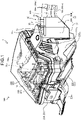
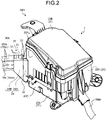
- Reference sign 1 in FIG. 1 and FIG. 2 denotes an electrical connection box according to the present embodiment.
- Reference sign WH in FIG. 1 and FIG. 2 denotes a wire harness according to the present embodiment including the electrical connection box 1.
- the electrical connection box 1 includes an electronic component 10 with which electrical wires We are electrically connected ( FIG. 1 ).
- the electrical connection box 1 also includes an insulating housing 20 ( FIG. 1 and FIG. 2 ).
- the electronic component 10 is stored inside the housing 20.
- the electrical connection box 1 forms the wire harness WH together with at least the electrical wire bundles Web or the electrical wires We drawn to the outside.
- the electronic component 10 indicates, for example, a circuit protection component, such as a fuse and a fusible link, a relay, or a connector.
- a circuit protection component such as a fuse and a fusible link
- a relay such as a relay
- a connector such as a connector
- an electronic device such as a circuit board and an electronic control unit (ECU) is also regarded as a form of the electronic component 10.
- the housing 20 is formed of an insulating material, such as synthetic resin.
- the housing 20 includes a storing chamber 20a in which the electronic component 10 is stored ( FIG. 1 ).
- the housing 20 may be a storage box formed by assembling a plurality of individually formed, divided housings with each other, or may be a storage box formed as one box.
- the housing 20 illustrated herein is formed of three divided housings, and includes a frame 20A, an upper cover 20B, and a lower cover 20C ( FIG. 1 and FIG. 2 ).
- the frame 20A is formed in a cylindrical shape with both ends open. In the housing 20, one opening 20A 1 of the frame 20A is covered with the upper cover 20B, and the other opening 20A 2 of the frame 20A is covered with the lower cover 20C ( FIG. 1 ).
- the housing 20 illustrated herein includes at least one storing member 20D detachably stored inside the frame 20A ( FIG. 1 ).
- the storing member 20D is a block storing therein the electronic component 10 and the like and having the electronic component 10 be electrically connected with the electrical wires We therein.
- the storing chamber 20a is formed in the storing member 20D.
- the storing member 20D in the illustration is inserted into the other opening 20A 2 of the frame 20A and mounted inside the frame 20A via a locking mechanism or the like, in the state in which the electronic component 10 and the like are stored in the storing member 20D and the electrical wires We are electrically connected with the electronic component 10.
- the frame 20A because a plurality of electrical wires We are electrically connected with one or a plurality of electronic components 10 inside the mounted storing member 20D or a plurality of such storing members 20D are mounted in the frame 20A, a plurality of electrical wires We are drawn out from inside to outside the storing member 20D.
- the electrical wires We drawn out from the storing member 20D to the outside are drawn out from the other opening 20A 2 on the lower cover 20C side to the outside.
- the lower cover 20C is mounted on the frame 20A such that the electrical wires We are drawn to the outside of the housing 20.
- the electrical wires We drawn out from the frame 20A to the outside may all have, for example, a cylindrical shape with a same diameter, or may include a plurality of types of cylindrical electrical wires with different diameters.
- the lower cover 20C is mounted in the state in which all the electrical wires We drawn out from the other opening 20A 2 to the outside are maintained in a single state.
- the lower cover 20C is mounted in the state in which all the electrical wires We drawn out from the other opening 20A 2 to the outside are divided into some groups each including a plurality of the electrical wires We, and the divided electrical wires We in each of the groups are bundled with a tape or a sheathing member (such as a corrugate tube) to form a plurality of electrical wire bundles Web for the respective groups.
- the lower cover 20C is mounted in the state in which one or a plurality of electrical wire bundles Web are formed from part of the electrical wires We drawn out from the other opening 20A 2 to the outside and at least one electrical wire We maintained in a single state and at least one electrical wire bundle Web exist together in a mixed state.
- the housing 20 there are cases where all the electrical wires We drawn out from the frame 20A to the outside are drawn to the outside in a single state, cases where only a plurality of electrical wire bundles Web for the respective groups drawn out from the frame 20A to the outside are drawn to the outside, and cases where at least one electrical wire We and at least one electrical wire bundles Web drawn from the frame 20A to the outside are drawn to the outside.
- a plurality of electrical wires We are bundled to form a cylindrical shape.
- the housing 20 is provided with an electrical wire drawing path 30 projecting to the outside thereof and causing a plurality of at least the electrical wire bundles Web or the electrical wires We to be drawn from the inside to the outside thereof ( FIG. 1 to FIG. 5 ).
- a plurality of at least the electrical wire bundles Web or the electrical wires We routed in an electrical wire routing space 30a of the electrical wire drawing path 30 and drawn out from the electrical wire routing space 30a to the outside are referred to as "drawn electrical wires Wep", as necessary.
- the electrical wire drawing path 30 includes a first wall member 31 including two side portions 31a and 31b extending in a projecting direction thereof, a second wall member 32 disposed to be opposed to the first wall member 31 with a space therebetween, a first side wall member 33 projecting from one side portion 31a of the first wall member 31 in a direction crossing a direction in which the one side portion 31a extends and toward the second wall member 32 side, and a second side wall member 34 projecting from the other side portion 31b of the first wall member 31 in a direction crossing a direction in which the other side portion 31b extends and toward the second wall member 32 side ( FIG. 1 to FIG. 5 ).
- a space surrounded by the first wall member 31, the second wall member 32, the first side wall member 33, and the second side wall member 34 serves as the electrical wire routing space 30a in which the drawn electrical wires Wep are drawn from the inside of the housing 20.
- the electrical wire drawing path 30 has an opening surrounded by end portions of the first wall member 31, the second wall member 32, the first side wall member 33, and the second side wall member 34 on the projecting direction side thereof.
- the opening of the electrical wire drawing path 30 serves as an electrical wire drawing port 30b causing a plurality of drawn electrical wires Wep to be drawn out from the electrical wire routing space 30a to the outside ( FIG. 1 to FIG. 4 ).
- the electrical wire drawing path 30 includes the electrical wire drawing port 30b causing a plurality of drawn electrical wires Wep in the electrical wire routing space 30a to be drawn to the outside, in the end portion on the projecting direction side thereof.
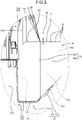
- the electrical wire drawing path 30 an opening surrounded by end portions of the first wall member 31, the second wall member 32, the first side wall member 33, and the second side wall member 34 on a side opposite to the projecting direction thereof is formed, and the opening serves as an electrical wire entrance port 30c to draw drawn electrical wires Wep drawn out from the frame 20A to the outside into the electrical wire routing space 30a ( FIG. 3 ).
- a wall surface positioned on the electrical wire routing space 30a side serves as an inner wall surface
- a wall surface positioned on a side opposite to the electrical wire routing space 30a side serves as an outer wall surface
- the first wall member 31, the first side wall member 33, and the second side wall member 34 are formed as one unitary piece with the frame 20A, and the second wall member 32 is formed as one unitary piece with the lower cover 20c ( FIG. 5 ).
- the first wall member 31 is formed to project from an outer wall surface 20A 3 of the frame 20A in a projecting direction of the electrical wire drawing path 30 ( FIG. 1 to FIG. 3 and FIG. 5 ).
- the first wall member 31 in the illustration is formed in a rectangular flat plate shape, and one side portion 31c is connected with the outer wall surface 20A 3 of the frame 20A ( FIG. 1 and FIG. 3 ).
- the two side portions 31a and 31b are portions connected with the side portion 31c on the outer wall surface 20A 3 side of the frame 20A, and project from the outer wall surface 20A 3 .
- the electrical wire drawing path 30 includes reinforcing portions 35, such as ribs, on the outer wall surface of the first wall member 31 to suppress elastic deformation of the first wall member 31 ( FIG. 1 to FIG. 5 ).
- the first side wall member 33 is formed to project from the one side portion 31a of the first wall member 31 in the direction crossing the extending direction of the one side portion 31a and toward the second wall member 32 side, and project from the outer wall surface 20A 3 of the frame 20A in the projecting direction of the electrical wire drawing path 30. Specifically, the first side wall member 33 is connected with the one side portion 31a of the first wall member 31 and the outer wall surface 20A 3 of the frame 20A.
- the second side wall member 34 is formed to project from the other side portion 31b of the first wall member 31 in the direction crossing the extending direction of the other side portion 31b and toward the second wall member 32 side, and project from the outer wall surface 20A 3 of the frame 20A in the projecting direction of the electrical wire drawing path 30.
- the second side wall member 34 is connected with the other side portion 31b of the first wall member 31 and the outer wall surface 20A 3 of the frame 20A.
- an opening surrounded by end portions of the first wall member 31, the first side wall member 33, and the second side wall member 34 on the side in the projecting direction of the electrical wire drawing path 30 forms a main shape of the electrical wire drawing port 30b.
- an opening 30d is also formed between an end portion of the first side wall member 33 on a side in a projecting direction from the one side portion 31a of the first wall member 31 and an end portion of the second side wall member 34 on a side in a projecting direction from the other side portion 31b of the first wall member 31 ( FIG. 3 to FIG. 5 ).
- the second wall member 32 covers the whole or part of the opening 30d.
- the second wall member 32 in the illustration is formed to project from an outer wall surface 20C 1 of the lower cover 20C ( FIG. 1 to FIG. 3 and FIG. 5 ).
- the second wall member 32 covers the whole or part of the opening 30d by mounting the lower cover 20C on the frame 20A.
- the first side wall member 33 and the second side wall member 34 are formed as members having an equal flat plate shape. At least one of the first side wall member 33 and the second side wall member 34 is formed as an elastically deformable member enabling change of the volume of the electrical wire routing space 30a. For example, at least one of the first side wall member 33 and the second side wall member 34 is formed as a member having a thickness enabling elastic deformation in a direction crossing the wall surface thereof.
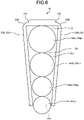
- the electrical wire drawing path 30 is enabled to route a plurality of drawn electrical wires Wep such that the gap of the electrical wire drawing port 30b is set to a gap (standard gap) of a predetermined size, without changing the shape thereof ( FIG. 6).
- FIG. 6 illustrates the shape of the electrical wire drawing port 30b in the case of drawing three electrical wire bundles Web having different diameters in which the electrical wire bundle Web located on the first wall member 31 side has the largest diameter, and one electrical wire We.
- the electrical wire drawing path 30 when electrical wires of different size and/or different number from those of the electrical wires Wep are routed in the electrical wire routing space 30a, at least one of the first side wall member 33 and the second side wall member 34 is elastically deformed to follow the drawn electrical wires Wep.
- FIG. 7 illustrates the shape of the electrical wire drawing port 30b in the case of drawing three electrical wire bundles Web having the same diameter.
- FIG. 8 illustrates the shape of the electrical wire drawing port 30b in the case of drawing three electrical wire bundles Web having different diameters, in which the electrical wire bundle Web located on the first wall member 31 side has the smallest diameter.
- the standard gap indicates a gap of the electrical wire drawing port 30b having a size capable of suppressing entering of water from the outside.
- both the first side wall member 33 and the second side wall member 34 are formed as elastically deformable members capable of changing the volume of the electrical wire routing space 30a.
- the first side wall member 33 of the illustration includes a main member 33A formed in a rectangular flat plate shape, and a variable member 33B formed in a trapezoidal flat plate shape ( FIG. 1 to FIG. 5 ).
- the main member 33A includes one side portion connected with the one side portion 31a of the first wall member 31, and another side portion connected with the outer wall surface 20A 3 of the frame 20A.
- the variable member 33B is formed in a trapezoidal flat plate shape including a side on the electrical wire drawing port 30b side serving as the upper base and a side on the electrical wire entrance port 30c side serving as the lower base.
- the variable member 33B includes a side portion running along the height direction, and the side portion is connected with the one side portion 31a of the first wall member 31.
- the variable member 33B includes a side portion on the lower base side connected with a side portion of the main member 33A on the electrical wire drawing port 30b side.
- at least the variable member 33B is formed as an elastically deformable member capable of changing the volume of the electrical wire routing space 30a.
- both the main member 33A and the variable member 33B are formed as such elastically deformable members.
- the second side wall member 34 of the illustration includes a main member 34A formed in a rectangular flat plate shape, and a variable member 34B formed in a trapezoidal flat plate shape ( FIG. 2 and FIG. 4 ).
- the main member 34A includes one side portion connected with the other side portion 31b of the first wall member 31, and another side portion connected with the outer wall surface 20A 3 of the frame 20A.
- the variable member 34B is formed in a trapezoidal flat plate shape including a side on the electrical wire drawing port 30b side serving as the upper base and a side on the electrical wire entrance port 30c side serving as the lower base.
- the variable member 34B includes a side portion running along the height direction, and the side portion is connected with the other side portion 31b of the first wall member 31.
- the variable member 34B includes a side portion on the lower base side connected with a side portion of the main member 34A on the electrical wire drawing port 30b side.
- at least the variable member 34B is formed as an elastically deformable member capable of changing the volume of the electrical wire routing space 30a.
- both the main member 34A and the variable member 34B are formed as such elastically deformable members.
- an opening surrounded by end portions of the first wall member 31, the main member 33A of the first side wall member 33, and the main member 34A of the second side wall member 34 on a side opposite to the projecting direction thereof has a rectangular shape.
- the electrical wire entrance port 30c is formed as a rectangular opening.
- a space surrounded by the first wall member 31, the main member 33A of the first side wall member 33, and the main member 34A of the second side wall member 34 may have a square shape in which the rectangular shape of the electrical wire entrance port 30c extends to the end portion (boundary portion of the space surrounded by the first wall member 31, the variable member 33B of the first side wall member 33, and the variable member 34B of the second side wall member 34) on the electrical wire drawing port 30b side, or may have a frustum shape in which the rectangular shape of the electrical wire entrance port 30c is gradually reduced to the end portion on the electrical wire drawing port 30b side.
- variable member 33B of the first side wall member 33 is formed in a shape in which the side portion on the electrical wire drawing port 30b side (upper base side) is brought close to the side portion of the variable member 34B of the second side wall member 34 on the electrical wire drawing port 30b side (upper base side), as it extends toward the opening 30d side ( FIG. 4 ).
- the variable member 33B of the first side wall member 33 in the illustration is formed in a shape in which the side portion on the opening 30d side is brought close to the side portion of the variable member 34B of the second side wall member 34 on the opening 30d side, as it extends toward the electrical wire drawing port 30b side ( FIG. 4 ).
- variable member 33B of the first side wall member 33 of the illustration is formed in a state in which the wall surface is bent such that an intersection point of the side portion on the electrical wire drawing port 30b side (upper base side) and the side portion on the opening 30d side is brought closest to the variable member 34B side of the second side wall member 34.
- variable member 34B of the second side wall member 34 is formed in a shape in which the side portion on the electrical wire drawing port 30b side (upper base side) is brought close to the side portion of the variable member 33B of the first side wall member 33 on the electrical wire drawing port 30b side (upper base side), as it extends toward the opening 30d side ( FIG. 4 ).
- variable member 34B of the second side wall member 34 in the illustration is formed in a shape in which the side portion on the opening 30d side is brought close to the side portion of the variable member 33B of the first side wall member 33 on the opening 30d side, as it extends toward the electrical wire drawing port 30b side ( FIG. 4 ). Accordingly, the variable member 34B of the second side wall member 34 of the illustration is formed in a state in which the wall surface is bent such that an intersection point of the side portion on the electrical wire drawing port 30b side (upper base side) and the side portion on the opening 30d side is brought closest to the variable member 33B side of the first side wall member 33.
- the electrical wire drawing path 30 illustrated herein is formed with a structure in which the interval between end portions (end portions on the opening 30d side) of the first side wall member 33 and the second side wall member 34 in the projecting direction is smaller than the interval between the two side portions 31a and 31b in the first wall member 31, at the electrical wire drawing port 30b.
- the electrical wire drawing port 30b has a trapezoidal shape with a portion on the opening 30d side serving as the upper base and a portion on the first wall member 31 side serving as the lower base.
- a boundary portion between the one side portion 31a of the first wall member 31 and the first side wall member 33 is preferably provided with an elastically deformable portion 36A enabling tilt of the first side wall member 33 with respect to the first wall member 31 ( FIG. 4 ).
- the elastically deformable portion 36A may be provided regardless of whether to provide the first side wall member 33 with flexibility.
- the elastically deformable portion 36A is capable of changing the volume of the electrical wire routing space 30a together with elastic deformation of the second side wall member 34, by tilting the first side wall member 33 with the portion of the first wall member 31 on the one side portion 31a side serving as the starting point.
- the elastically deformable portion 36A is capable of tilting at least the first side wall member 33 while elastically deforming the first side wall member 33.
- the elastically deformable portion 36A enables increase in deformation quantity of the volume of the electrical wire routing space 30a, in comparison with a structure without the elastically deformable portion 36A.
- the elastically deformable portion 36A is formed to be elastically deformable and to have a thickness smaller than the thickness of the first wall member 31 and the first side wall member 33.
- the elastically deformable portion 36A is preferably provided in a portion connected with at least the variable member 33B, in a boundary portion between the one side portion 31a of the first wall member 31 and the first side wall member 33.
- a boundary portion between the other side portion 31b of the first wall member 31 and the second side wall member 34 is preferably provided with an elastically deformable portion 36B enabling tilt of the second side wall member 34 with respect to the first wall member 31 ( FIG. 4 ).
- the elastically deformable portion 36B may be provided regardless of whether to provide the second side wall member 34 with flexibility.
- the elastically deformable portion 36B is capable of changing the volume of the electrical wire routing space 30a together with elastic deformation of the first side wall member 33, by tilting the second side wall member 34 with the portion of the first wall member 31 on the other side portion 31b side serving as the starting point.
- the elastically deformable portion 36B is capable of tilting at least the second side wall member 34 while elastically deforming the second side wall member 34.
- the elastically deformable portion 36B enables increase in deformation quantity of the volume of the electrical wire routing space 30a, in comparison with a structure without the elastically deformable portion 36B.
- the elastically deformable portion 36B is formed to be elastically deformable and have a thickness smaller than the thickness of the first wall member 31 and the second side wall member 34.
- the elastically deformable portion 36B is preferably provided in a portion connected with at least the variable member 34B, in a boundary portion between the other side portion 31b of the first wall member 31 and the second side wall member 34.
- the electrical wire drawing path 30 in the illustration includes the two elastically deformable portions 36A and 36B.
- the electrical wire drawing path 30 in the illustration enables tilt of the first side wall member 33 and the second side wall member 34 with the respective elastically deformable portions 36A and 36B while elastically deforming both of the first side wall member 33 and the second side wall member 34. Accordingly, the electrical wire drawing path 30 in the illustration enables increase in deformation quantity of the volume of the electrical wire routing space 30a to the maximum.
- the second wall member 32 in the illustration includes a first piece member 32A and a second piece member 32B each having a rectangular flat plate shape ( FIG. 3 to FIG. 5 ).
- the first piece member 32A is a portion covering a part of the opening 30d formed with the main member 33A of the first side wall member 33 and the main member 34A of the second side wall member 34.
- the second piece member 32B is a portion covering a part of the opening 30d formed with the variable member 33B of the first side wall member 33 and the variable member 34B of the second side wall member 34, and connected with the first piece member 32A on the electrical wire drawing port 30b side.
- the second piece member 32B may be formed as a tiltable member to enable change of the volume of the electrical wire routing space 30a.
- a boundary portion between the first piece member 32A and the second piece member 32B may be provided with an elastically deformable portion enabling tilt of the second piece member 32B with respect to the first piece member 32A.
- the elastically deformable portion is formed to be elastically deformable and to have a thickness smaller than the thickness of each of the first piece member 32A and the second piece member 32B.
- the electrical wire drawing path 30 in this case enables further increase in deformation quantity of the volume of the electrical wire routing space 30a.
- the electrical connection box 1 enables change in volume of the electrical wire routing space 30a of the electrical wire drawing path 30 included in the housing 20, and enables use of the common housing 20 compliant with various electrical wires We and/or electrical wire bundles Web having different sizes and/or numbers, for example, in vehicles having different specifications. For this reason, the electrical connection box 1 contributes to reduction in cost by application of the same housing 20 to various types of vehicles.
- the electrical connection box 1 according to the present embodiment enables change of the volume of the electrical wire routing space 30a, and enables adjustment of the gap of the electrical wire drawing port 30b to the standard gap or a size close to the standard gap. For this reason, the electrical connection box 1 enables securement of waterproof property even in vehicles having different specifications.
- the wire harness WH includes such an electrical connection box 1, and is capable of producing the effect obtained with the electrical connection box 1 in the same manner.
- the main member 33A of the first side wall member 33 may be formed to project from the one side portion 31a of the first wall member 31 toward the second wall member 32 side, in a state of being tilted to the outer wall surface side opposite to the electrical wire routing space 30a side ( FIG. 9 ).
- the main member 34A of the second side wall member 34 may be formed to project from the other side portion 31b of the first wall member 31 toward the second wall member 32 side, in a state of being tilted to the outer wall surface side opposite to the electrical wire routing space 30a side ( FIG. 9 ).
- the electrical wire drawing path 30 may be formed with a structure in which the electrical wire entrance port 30c is formed as an trapezoidal opening with a portion on the first wall member 31 side serving as the upper base and a portion on the opening 30d side serving as the lower base, and a cross section orthogonal to the projecting direction of the electrical wire drawing path 30 in the space surrounded by the first wall member 31, the main member 33A of the first side wall member 33, and the main member 34A of the second side wall member 34 is maintained at the shape of the trapezoidal electrical wire entrance port 30c.
- the electrical wire drawing path 30 enables drawing of drawn electrical wires Wep having a larger size through the electrical wire entrance port 30c into the electrical wire routing space 30a, in comparison with the structure in which the space surrounded by the first wall member 31, the main member 33A of the first side wall member 33, and the main member 34A of the second side wall member 34 has the square shape illustrated above or the like.
- the interval between end portions (that is, end portions thereof on the opening 30d side) of the variable member 33B of the first side wall member 33 and the variable member 34B of the second side wall member 34 in the projecting direction thereof can be increased to be larger than the interval between the two side portions 31a and 31b in the first wall member 31, by elastically deforming at least one of the first side wall member 33 and the second side wall member 34.
- This structure enables drawing of drawn electrical wires Wep having a larger size that are drawn from the electrical wire entrance port 30c into the electrical wire routing space 30a out of the electrical wire drawing port 30b.
- the electrical connection box according to the present embodiment enables change in volume of the electrical wire routing space of the electrical wire drawing path included in the housing by elastically deforming at least one of the first side wall member and the second side wall member, and enables use of the common housing compliant with various electrical wires and/or electrical wire bundles having different sizes and/or numbers, for example, in vehicles having different specifications.
- the wire harness according to the present embodiment includes such an electrical connection box, and is capable of producing the effect obtained with the electrical connection box in the same manner.
Landscapes
- Engineering & Computer Science (AREA)
- Mechanical Engineering (AREA)
- Architecture (AREA)
- Civil Engineering (AREA)
- Structural Engineering (AREA)
- Connection Or Junction Boxes (AREA)
Description
- The present invention relates to an electrical connection box and a wire harness.
- In an electrical connection box, electronic components (such as circuit protection components, such as a fuse and a fusible link, and a relay) are stored in a housing, and the electronic components are electrically connected with other electronic components and/or electrical wires via a relay busbar in the housing. An electrical connection box of this type is disclosed in, for example,
Japanese Patent Application Laid-open No. 2012-005162 US2012/0073852 . In such an electrical connection box, the electrical wires are drawn from inside to outside the housing and electrically connected with a power source and/or a load or the like outside the housing. For this reason, the housing is provided with a passage (electrical wire drawing path) projecting from the inside toward the outside of the housing to draw the electrical wires from the inside to the outside. - In an electrical connection box, types and/or the number of electronic components and/or electrical wires stored in a housing may vary depending on, for example, differences in specifications of the vehicle on which the electrical connection box is mounted. For example, in some vehicles, a plurality of electrical wires and/or a plurality of electrical wire bundles are routed in the electrical wire drawing path, the electrical wires and/or the electrical wire bundles having a diameter equal to or smaller than a standard diameter (a diameter of the electrical wires and/or the electrical wire bundles determined as the routing subject in the electrical wire drawing path) of a standard electrical wire and/or a standard electrical wire bundle in the electrical wire drawing path, and being able to limit the gap in the electrical wire drawing path to a gap of a predetermined size (standard gap). By contrast, in another vehicle, a plurality of electrical wires and/or a plurality of electrical wire bundles routed in the electrical wire drawing path may include thick electrical wires and/or thick electrical wire bundles the diameter of which exceeds the standard diameter. As described above, in a conventional electrical connection box, there are cases where using a common housing among vehicles having different specifications is difficult. In addition, in another vehicle different from the vehicles described above, a plurality of electrical wires and/or a plurality of electrical wire bundles routed in the electrical wire drawing path may include electrical wires and/or electrical wire bundles thinner than those having the standard diameter, possibly creating a gap larger than the standard gap in the electrical wire drawing path. In this vehicle, it is possible to use the same housing as the housing in a vehicle in which the gap of the electrical wire drawing path is the standard gap, but a measure is required to suppress entering of water through the large gap in the electrical wire drawing path, which may reduce the effect produced by using a common housing.
- For this reason, an object of the present invention is to provide an electrical connection box and a wire harness that can use a common housing for various electrical wires and/or electrical wire bundles.
- In order to achieve the above object, an electrical connection box according to one aspect of the present invention includes: an electronic component with which an electrical wire is electrically connected; and an insulating housing storing therein the electronic component and in which a plurality of an electrical wire bundle and/or the electrical wire are routed therein, the electrical wire bundle being formed by bundling a plurality of the electrical wires, wherein the housing is provided with an electrical wire drawing path projecting toward outside and causing a plurality of at least one of the electrical wire bundle and the electrical wire to be drawn from inside to outside, the electrical wire drawing path includes a first wall member including two side portions extending in a projecting direction of the electrical wire drawing path, a second wall member disposed to be opposed to the first wall member with an interval, a first side wall member projecting from one side portion of the side portions of the first wall member in a direction crossing an extending direction of the side portion and toward the second wall member, and a second side wall member projecting from the other side portion of the side portions of the first wall member in a direction crossing an extending direction of the side portion and toward the second wall member, and at least one of the first side wall member and the second side wall member is formed as an elastically deformable member enabling change of volume of an electrical wire routing space surrounded by the first wall member, the second wall member, the first side wall member, and the second side wall member.
- According to another aspect of the present invention, in the electrical connection box, it is preferable that a boundary portion between the one side portion of the first wall member and the first side wall member is provided with an elastically deformable portion enabling tilt of the first side wall member with respect to the first wall member.
- According to still another aspect of the present invention, in the electrical connection box, it is preferable that a boundary portion between the other side portion of the first wall member and the second side wall member is provided with an elastically deformable portion enabling tilt of the second side wall member with respect to the first wall member.
- According to still another aspect of the present invention, in the electrical connection box, it is preferable that an end portion of the electrical wire drawing path on a projecting direction side is provided with an electrical wire drawing port causing a plurality of at least one of the electrical wire bundle and the electrical wire in the electrical wire routing space to be drawn to the outside, and the electrical wire drawing path is formed such that an interval between an end portion of the first side wall member in a projecting direction thereof and an end portion of the second side wall member in a projecting direction thereof is smaller than an interval between the two side portions of the first wall member, at the electrical wire drawing port.
- A wire harness according to still another aspect of the present invention includes: an electrical wire; an electronic component with which an the electrical wire is electrically connected; and an insulating housing storing therein the electronic component and in which a plurality of an electrical wire bundle and/or the electrical wire are routed therein, the electrical wire bundle being formed by bundling a plurality of the electrical wires, wherein the housing is provided with an electrical wire drawing path projecting toward outside and causing a plurality of at least one of the electrical wire bundle and the electrical wires to be drawn from inside to outside, the electrical wire drawing path includes a first wall member including two side portions extending in a projecting direction of the electrical wire drawing path, a second wall member disposed to be opposed to the first wall member with an interval, a first side wall member projecting from one side portion of the side portions of the first wall member in a direction crossing an extending direction of the side portion and toward the second wall member, and a second side wall member projecting from the other side portion of the side portions of the first wall member in a direction crossing an extending direction of the side portion and toward the second wall member, and at least one of the first side wall member and the second side wall member is formed as an elastically deformable member enabling change of volume of an electrical wire routing space surrounded by the first wall member, the second wall member, the first side wall member, and the second side wall member.
- The above and other objects, features, advantages and technical and industrial significance of this invention will be better understood by reading the following detailed description of presently preferred embodiments of the invention, when considered in connection with the accompanying drawings.
-
-
FIG. 1 is a perspective view illustrating an electrical connection box and a wire harness according to an embodiment; -
FIG. 2 is a perspective view of the electrical connection box and the wire harness according to the embodiment as viewed from another angle; -
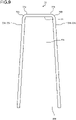
FIG. 3 is a plan view of an electrical wire drawing path of a housing as viewed from a side wall member side; -
FIG. 4 is a plan view of the electrical wire drawing path of the housing as viewed from an electrical wire drawing port side; -
FIG. 5 is an exploded perspective view of the electrical wire drawing path; -
FIG. 6 is a diagram illustrating an example of a shape of an electrical wire drawing port corresponding to drawn electrical wires; -
FIG. 7 is a diagram illustrating an example of the shape of the electrical wire drawing port corresponding to drawn electrical wires; -
FIG. 8 is a diagram illustrating an example of the shape of the electrical wire drawing port corresponding to drawn electrical wires; and -
FIG. 9 is a diagram illustrating a changed form of the shape of a first side wall member and a second side wall member on a main member side in an electrical wire routing space. - An embodiment of an electrical connection box and a wire harness according to the present invention will now be described hereinafter with reference to drawings. The present invention is not limited to the embodiment.
- An embodiment of an electrical connection box and a wire harness according to the present invention will now be described on the basis of
FIG. 1 to FIG. 9 . -
Reference sign 1 inFIG. 1 andFIG. 2 denotes an electrical connection box according to the present embodiment. Reference sign WH inFIG. 1 andFIG. 2 denotes a wire harness according to the present embodiment including theelectrical connection box 1. - The
electrical connection box 1 according to the present embodiment includes anelectronic component 10 with which electrical wires We are electrically connected (FIG. 1 ). Theelectrical connection box 1 also includes an insulating housing 20 (FIG. 1 andFIG. 2 ). Theelectronic component 10 is stored inside thehousing 20. In thehousing 20, at least electrical wire bundles Web, each of which is formed of bundled electrical wires We, or electrical wires We are routed inside, and a plurality of at least the electrical wire bundles Web or the electrical wires We are drawn out from inside to outside the housing 20 (FIG. 1 andFIG. 2 ). Theelectrical connection box 1 forms the wire harness WH together with at least the electrical wire bundles Web or the electrical wires We drawn to the outside. - The
electronic component 10 indicates, for example, a circuit protection component, such as a fuse and a fusible link, a relay, or a connector. In the present embodiment, an electronic device, such as a circuit board and an electronic control unit (ECU), is also regarded as a form of theelectronic component 10. - The
housing 20 is formed of an insulating material, such as synthetic resin. Thehousing 20 includes astoring chamber 20a in which theelectronic component 10 is stored (FIG. 1 ). Thehousing 20 may be a storage box formed by assembling a plurality of individually formed, divided housings with each other, or may be a storage box formed as one box. Thehousing 20 illustrated herein is formed of three divided housings, and includes aframe 20A, anupper cover 20B, and alower cover 20C (FIG. 1 andFIG. 2 ). Theframe 20A is formed in a cylindrical shape with both ends open. In thehousing 20, one opening 20A1 of theframe 20A is covered with theupper cover 20B, and the other opening 20A2 of theframe 20A is covered with thelower cover 20C (FIG. 1 ). - In addition, the
housing 20 illustrated herein includes at least one storingmember 20D detachably stored inside theframe 20A (FIG. 1 ). The storingmember 20D is a block storing therein theelectronic component 10 and the like and having theelectronic component 10 be electrically connected with the electrical wires We therein. For this reason, in this illustration, thestoring chamber 20a is formed in the storingmember 20D. The storingmember 20D in the illustration is inserted into the other opening 20A2 of theframe 20A and mounted inside theframe 20A via a locking mechanism or the like, in the state in which theelectronic component 10 and the like are stored in the storingmember 20D and the electrical wires We are electrically connected with theelectronic component 10. - In the
frame 20A, because a plurality of electrical wires We are electrically connected with one or a plurality ofelectronic components 10 inside the mounted storingmember 20D or a plurality of such storingmembers 20D are mounted in theframe 20A, a plurality of electrical wires We are drawn out from inside to outside the storingmember 20D. In addition, in theframe 20A, the electrical wires We drawn out from thestoring member 20D to the outside are drawn out from the other opening 20A2 on thelower cover 20C side to the outside. Thelower cover 20C is mounted on theframe 20A such that the electrical wires We are drawn to the outside of thehousing 20. The electrical wires We drawn out from theframe 20A to the outside may all have, for example, a cylindrical shape with a same diameter, or may include a plurality of types of cylindrical electrical wires with different diameters. - In the
frame 20A, there are cases where thelower cover 20C is mounted in the state in which all the electrical wires We drawn out from the other opening 20A2 to the outside are maintained in a single state. In addition, in theframe 20A, there are cases where thelower cover 20C is mounted in the state in which all the electrical wires We drawn out from the other opening 20A2 to the outside are divided into some groups each including a plurality of the electrical wires We, and the divided electrical wires We in each of the groups are bundled with a tape or a sheathing member (such as a corrugate tube) to form a plurality of electrical wire bundles Web for the respective groups. In theframe 20A, there are also cases where thelower cover 20C is mounted in the state in which one or a plurality of electrical wire bundles Web are formed from part of the electrical wires We drawn out from the other opening 20A2 to the outside and at least one electrical wire We maintained in a single state and at least one electrical wire bundle Web exist together in a mixed state. Accordingly, in thehousing 20, there are cases where all the electrical wires We drawn out from theframe 20A to the outside are drawn to the outside in a single state, cases where only a plurality of electrical wire bundles Web for the respective groups drawn out from theframe 20A to the outside are drawn to the outside, and cases where at least one electrical wire We and at least one electrical wire bundles Web drawn from theframe 20A to the outside are drawn to the outside. In each of the electrical wire bundles Web, a plurality of electrical wires We are bundled to form a cylindrical shape. - For this reason, the
housing 20 is provided with an electricalwire drawing path 30 projecting to the outside thereof and causing a plurality of at least the electrical wire bundles Web or the electrical wires We to be drawn from the inside to the outside thereof (FIG. 1 to FIG. 5 ). In the following explanation, a plurality of at least the electrical wire bundles Web or the electrical wires We routed in an electricalwire routing space 30a of the electricalwire drawing path 30 and drawn out from the electricalwire routing space 30a to the outside are referred to as "drawn electrical wires Wep", as necessary. - The electrical
wire drawing path 30 includes afirst wall member 31 including twoside portions second wall member 32 disposed to be opposed to thefirst wall member 31 with a space therebetween, a firstside wall member 33 projecting from oneside portion 31a of thefirst wall member 31 in a direction crossing a direction in which the oneside portion 31a extends and toward thesecond wall member 32 side, and a secondside wall member 34 projecting from theother side portion 31b of thefirst wall member 31 in a direction crossing a direction in which theother side portion 31b extends and toward thesecond wall member 32 side (FIG. 1 to FIG. 5 ). - In the electrical
wire drawing path 30, a space surrounded by thefirst wall member 31, thesecond wall member 32, the firstside wall member 33, and the secondside wall member 34 serves as the electricalwire routing space 30a in which the drawn electrical wires Wep are drawn from the inside of thehousing 20. The electricalwire drawing path 30 has an opening surrounded by end portions of thefirst wall member 31, thesecond wall member 32, the firstside wall member 33, and the secondside wall member 34 on the projecting direction side thereof. The opening of the electricalwire drawing path 30 serves as an electricalwire drawing port 30b causing a plurality of drawn electrical wires Wep to be drawn out from the electricalwire routing space 30a to the outside (FIG. 1 to FIG. 4 ). Specifically, the electricalwire drawing path 30 includes the electricalwire drawing port 30b causing a plurality of drawn electrical wires Wep in the electricalwire routing space 30a to be drawn to the outside, in the end portion on the projecting direction side thereof. By contrast, in the electricalwire drawing path 30, an opening surrounded by end portions of thefirst wall member 31, thesecond wall member 32, the firstside wall member 33, and the secondside wall member 34 on a side opposite to the projecting direction thereof is formed, and the opening serves as an electricalwire entrance port 30c to draw drawn electrical wires Wep drawn out from theframe 20A to the outside into the electricalwire routing space 30a (FIG. 3 ). In each of thefirst wall member 31, thesecond wall member 32, the firstside wall member 33, and the secondside wall member 34, a wall surface positioned on the electricalwire routing space 30a side serves as an inner wall surface, and a wall surface positioned on a side opposite to the electricalwire routing space 30a side serves as an outer wall surface. - In the electrical
wire drawing path 30 illustrated herein, thefirst wall member 31, the firstside wall member 33, and the secondside wall member 34 are formed as one unitary piece with theframe 20A, and thesecond wall member 32 is formed as one unitary piece with the lower cover 20c (FIG. 5 ). - The
first wall member 31 is formed to project from anouter wall surface 20A3 of theframe 20A in a projecting direction of the electrical wire drawing path 30 (FIG. 1 to FIG. 3 andFIG. 5 ). Thefirst wall member 31 in the illustration is formed in a rectangular flat plate shape, and oneside portion 31c is connected with theouter wall surface 20A3 of theframe 20A (FIG. 1 andFIG. 3 ). The twoside portions side portion 31c on theouter wall surface 20A3 side of theframe 20A, and project from theouter wall surface 20A3. The electricalwire drawing path 30 includes reinforcingportions 35, such as ribs, on the outer wall surface of thefirst wall member 31 to suppress elastic deformation of the first wall member 31 (FIG. 1 to FIG. 5 ). - The first
side wall member 33 is formed to project from the oneside portion 31a of thefirst wall member 31 in the direction crossing the extending direction of the oneside portion 31a and toward thesecond wall member 32 side, and project from theouter wall surface 20A3 of theframe 20A in the projecting direction of the electricalwire drawing path 30. Specifically, the firstside wall member 33 is connected with the oneside portion 31a of thefirst wall member 31 and theouter wall surface 20A3 of theframe 20A. - By contrast, the second
side wall member 34 is formed to project from theother side portion 31b of thefirst wall member 31 in the direction crossing the extending direction of theother side portion 31b and toward thesecond wall member 32 side, and project from theouter wall surface 20A3 of theframe 20A in the projecting direction of the electricalwire drawing path 30. Specifically, the secondside wall member 34 is connected with theother side portion 31b of thefirst wall member 31 and theouter wall surface 20A3 of theframe 20A. - In the
frame 20A in the illustration, an opening surrounded by end portions of thefirst wall member 31, the firstside wall member 33, and the secondside wall member 34 on the side in the projecting direction of the electricalwire drawing path 30 forms a main shape of the electricalwire drawing port 30b. In addition, in theframe 20A in the illustration, anopening 30d is also formed between an end portion of the firstside wall member 33 on a side in a projecting direction from the oneside portion 31a of thefirst wall member 31 and an end portion of the secondside wall member 34 on a side in a projecting direction from theother side portion 31b of the first wall member 31 (FIG. 3 to FIG. 5 ). - The
second wall member 32 covers the whole or part of theopening 30d. Thesecond wall member 32 in the illustration is formed to project from anouter wall surface 20C1 of thelower cover 20C (FIG. 1 to FIG. 3 andFIG. 5 ). Thesecond wall member 32 covers the whole or part of theopening 30d by mounting thelower cover 20C on theframe 20A. - In the electrical
wire drawing path 30 in the illustration, the firstside wall member 33 and the secondside wall member 34 are formed as members having an equal flat plate shape. At least one of the firstside wall member 33 and the secondside wall member 34 is formed as an elastically deformable member enabling change of the volume of the electricalwire routing space 30a. For example, at least one of the firstside wall member 33 and the secondside wall member 34 is formed as a member having a thickness enabling elastic deformation in a direction crossing the wall surface thereof. - With this structure, the electrical
wire drawing path 30 is enabled to route a plurality of drawn electrical wires Wep such that the gap of the electricalwire drawing port 30b is set to a gap (standard gap) of a predetermined size, without changing the shape thereof (FIG. 6). FIG. 6 illustrates the shape of the electricalwire drawing port 30b in the case of drawing three electrical wire bundles Web having different diameters in which the electrical wire bundle Web located on thefirst wall member 31 side has the largest diameter, and one electrical wire We. In the electricalwire drawing path 30, when electrical wires of different size and/or different number from those of the electrical wires Wep are routed in the electricalwire routing space 30a, at least one of the firstside wall member 33 and the secondside wall member 34 is elastically deformed to follow the drawn electrical wires Wep. This structure enables routing of a plurality of drawn electrical wires Wep such that the gap of the electricalwire drawing port 30b is set to the standard gap (FIG. 7 andFIG. 8 ).FIG. 7 illustrates the shape of the electricalwire drawing port 30b in the case of drawing three electrical wire bundles Web having the same diameter. By contrast,FIG. 8 illustrates the shape of the electricalwire drawing port 30b in the case of drawing three electrical wire bundles Web having different diameters, in which the electrical wire bundle Web located on thefirst wall member 31 side has the smallest diameter. The standard gap indicates a gap of the electricalwire drawing port 30b having a size capable of suppressing entering of water from the outside. - Specifically, in the electrical
wire drawing path 30 in the illustration, both the firstside wall member 33 and the secondside wall member 34 are formed as elastically deformable members capable of changing the volume of the electricalwire routing space 30a. - The first
side wall member 33 of the illustration includes amain member 33A formed in a rectangular flat plate shape, and avariable member 33B formed in a trapezoidal flat plate shape (FIG. 1 to FIG. 5 ). Themain member 33A includes one side portion connected with the oneside portion 31a of thefirst wall member 31, and another side portion connected with theouter wall surface 20A3 of theframe 20A. Thevariable member 33B is formed in a trapezoidal flat plate shape including a side on the electricalwire drawing port 30b side serving as the upper base and a side on the electricalwire entrance port 30c side serving as the lower base. Thevariable member 33B includes a side portion running along the height direction, and the side portion is connected with the oneside portion 31a of thefirst wall member 31. Thevariable member 33B includes a side portion on the lower base side connected with a side portion of themain member 33A on the electricalwire drawing port 30b side. In the firstside wall member 33 illustrated herein, at least thevariable member 33B is formed as an elastically deformable member capable of changing the volume of the electricalwire routing space 30a. In this example, both themain member 33A and thevariable member 33B are formed as such elastically deformable members. - In addition, the second
side wall member 34 of the illustration includes amain member 34A formed in a rectangular flat plate shape, and avariable member 34B formed in a trapezoidal flat plate shape (FIG. 2 andFIG. 4 ). Themain member 34A includes one side portion connected with theother side portion 31b of thefirst wall member 31, and another side portion connected with theouter wall surface 20A3 of theframe 20A. Thevariable member 34B is formed in a trapezoidal flat plate shape including a side on the electricalwire drawing port 30b side serving as the upper base and a side on the electricalwire entrance port 30c side serving as the lower base. Thevariable member 34B includes a side portion running along the height direction, and the side portion is connected with theother side portion 31b of thefirst wall member 31. Thevariable member 34B includes a side portion on the lower base side connected with a side portion of themain member 34A on the electricalwire drawing port 30b side. In the secondside wall member 34 illustrated herein, at least thevariable member 34B is formed as an elastically deformable member capable of changing the volume of the electricalwire routing space 30a. In this example, both themain member 34A and thevariable member 34B are formed as such elastically deformable members. - In the electrical
wire drawing path 30 in the illustration, an opening surrounded by end portions of thefirst wall member 31, themain member 33A of the firstside wall member 33, and themain member 34A of the secondside wall member 34 on a side opposite to the projecting direction thereof has a rectangular shape. Specifically, in the electricalwire drawing path 30, the electricalwire entrance port 30c is formed as a rectangular opening. In the electricalwire routing space 30a, a space surrounded by thefirst wall member 31, themain member 33A of the firstside wall member 33, and themain member 34A of the secondside wall member 34 may have a square shape in which the rectangular shape of the electricalwire entrance port 30c extends to the end portion (boundary portion of the space surrounded by thefirst wall member 31, thevariable member 33B of the firstside wall member 33, and thevariable member 34B of the second side wall member 34) on the electricalwire drawing port 30b side, or may have a frustum shape in which the rectangular shape of the electricalwire entrance port 30c is gradually reduced to the end portion on the electricalwire drawing port 30b side. - By contrast, in the electrical
wire drawing path 30 in the illustration, thevariable member 33B of the firstside wall member 33 is formed in a shape in which the side portion on the electricalwire drawing port 30b side (upper base side) is brought close to the side portion of thevariable member 34B of the secondside wall member 34 on the electricalwire drawing port 30b side (upper base side), as it extends toward theopening 30d side (FIG. 4 ). With this structure, thevariable member 33B of the firstside wall member 33 in the illustration is formed in a shape in which the side portion on theopening 30d side is brought close to the side portion of thevariable member 34B of the secondside wall member 34 on theopening 30d side, as it extends toward the electricalwire drawing port 30b side (FIG. 4 ). Accordingly, thevariable member 33B of the firstside wall member 33 of the illustration is formed in a state in which the wall surface is bent such that an intersection point of the side portion on the electricalwire drawing port 30b side (upper base side) and the side portion on theopening 30d side is brought closest to thevariable member 34B side of the secondside wall member 34. In addition, thevariable member 34B of the secondside wall member 34 is formed in a shape in which the side portion on the electricalwire drawing port 30b side (upper base side) is brought close to the side portion of thevariable member 33B of the firstside wall member 33 on the electricalwire drawing port 30b side (upper base side), as it extends toward theopening 30d side (FIG. 4 ). With this structure, thevariable member 34B of the secondside wall member 34 in the illustration is formed in a shape in which the side portion on theopening 30d side is brought close to the side portion of thevariable member 33B of the firstside wall member 33 on theopening 30d side, as it extends toward the electricalwire drawing port 30b side (FIG. 4 ). Accordingly, thevariable member 34B of the secondside wall member 34 of the illustration is formed in a state in which the wall surface is bent such that an intersection point of the side portion on the electricalwire drawing port 30b side (upper base side) and the side portion on theopening 30d side is brought closest to thevariable member 33B side of the firstside wall member 33. - As described above, the electrical
wire drawing path 30 illustrated herein is formed with a structure in which the interval between end portions (end portions on theopening 30d side) of the firstside wall member 33 and the secondside wall member 34 in the projecting direction is smaller than the interval between the twoside portions first wall member 31, at the electricalwire drawing port 30b. In the electricalwire drawing path 30 in the illustration, with the bent shapes of thevariable member 33B of the firstside wall member 33 and thevariable member 34B of the secondside wall member 34 as described above, the electricalwire drawing port 30b has a trapezoidal shape with a portion on theopening 30d side serving as the upper base and a portion on thefirst wall member 31 side serving as the lower base. - In the electrical
wire drawing path 30, a boundary portion between the oneside portion 31a of thefirst wall member 31 and the firstside wall member 33 is preferably provided with an elasticallydeformable portion 36A enabling tilt of the firstside wall member 33 with respect to the first wall member 31 (FIG. 4 ). The elasticallydeformable portion 36A may be provided regardless of whether to provide the firstside wall member 33 with flexibility. For example, when the firstside wall member 33 has no flexibility, the elasticallydeformable portion 36A is capable of changing the volume of the electricalwire routing space 30a together with elastic deformation of the secondside wall member 34, by tilting the firstside wall member 33 with the portion of thefirst wall member 31 on the oneside portion 31a side serving as the starting point. By contrast, when the firstside wall member 33 has flexibility, the elasticallydeformable portion 36A is capable of tilting at least the firstside wall member 33 while elastically deforming the firstside wall member 33. As described above, the elasticallydeformable portion 36A enables increase in deformation quantity of the volume of the electricalwire routing space 30a, in comparison with a structure without the elasticallydeformable portion 36A. For example, the elasticallydeformable portion 36A is formed to be elastically deformable and to have a thickness smaller than the thickness of thefirst wall member 31 and the firstside wall member 33. In addition, the elasticallydeformable portion 36A is preferably provided in a portion connected with at least thevariable member 33B, in a boundary portion between the oneside portion 31a of thefirst wall member 31 and the firstside wall member 33. - In addition, in the electrical
wire drawing path 30, a boundary portion between theother side portion 31b of thefirst wall member 31 and the secondside wall member 34 is preferably provided with an elasticallydeformable portion 36B enabling tilt of the secondside wall member 34 with respect to the first wall member 31 (FIG. 4 ). The elasticallydeformable portion 36B may be provided regardless of whether to provide the secondside wall member 34 with flexibility. For example, when the secondside wall member 34 has no flexibility, the elasticallydeformable portion 36B is capable of changing the volume of the electricalwire routing space 30a together with elastic deformation of the firstside wall member 33, by tilting the secondside wall member 34 with the portion of thefirst wall member 31 on theother side portion 31b side serving as the starting point. By contrast, when the secondside wall member 34 has flexibility, the elasticallydeformable portion 36B is capable of tilting at least the secondside wall member 34 while elastically deforming the secondside wall member 34. As described above, the elasticallydeformable portion 36B enables increase in deformation quantity of the volume of the electricalwire routing space 30a, in comparison with a structure without the elasticallydeformable portion 36B. For example, the elasticallydeformable portion 36B is formed to be elastically deformable and have a thickness smaller than the thickness of thefirst wall member 31 and the secondside wall member 34. In addition, the elasticallydeformable portion 36B is preferably provided in a portion connected with at least thevariable member 34B, in a boundary portion between theother side portion 31b of thefirst wall member 31 and the secondside wall member 34. - The electrical
wire drawing path 30 in the illustration includes the two elasticallydeformable portions wire drawing path 30 in the illustration enables tilt of the firstside wall member 33 and the secondside wall member 34 with the respective elasticallydeformable portions side wall member 33 and the secondside wall member 34. Accordingly, the electricalwire drawing path 30 in the illustration enables increase in deformation quantity of the volume of the electricalwire routing space 30a to the maximum. - The
second wall member 32 in the illustration includes afirst piece member 32A and asecond piece member 32B each having a rectangular flat plate shape (FIG. 3 to FIG. 5 ). Thefirst piece member 32A is a portion covering a part of theopening 30d formed with themain member 33A of the firstside wall member 33 and themain member 34A of the secondside wall member 34. Thesecond piece member 32B is a portion covering a part of theopening 30d formed with thevariable member 33B of the firstside wall member 33 and thevariable member 34B of the secondside wall member 34, and connected with thefirst piece member 32A on the electricalwire drawing port 30b side. Thesecond piece member 32B may be formed as a tiltable member to enable change of the volume of the electricalwire routing space 30a. For example, in thesecond wall member 32, a boundary portion between thefirst piece member 32A and thesecond piece member 32B may be provided with an elastically deformable portion enabling tilt of thesecond piece member 32B with respect to thefirst piece member 32A. The elastically deformable portion is formed to be elastically deformable and to have a thickness smaller than the thickness of each of thefirst piece member 32A and thesecond piece member 32B. The electricalwire drawing path 30 in this case enables further increase in deformation quantity of the volume of the electricalwire routing space 30a. - As described above, the
electrical connection box 1 according to the present embodiment enables change in volume of the electricalwire routing space 30a of the electricalwire drawing path 30 included in thehousing 20, and enables use of thecommon housing 20 compliant with various electrical wires We and/or electrical wire bundles Web having different sizes and/or numbers, for example, in vehicles having different specifications. For this reason, theelectrical connection box 1 contributes to reduction in cost by application of thesame housing 20 to various types of vehicles. In addition, theelectrical connection box 1 according to the present embodiment enables change of the volume of the electricalwire routing space 30a, and enables adjustment of the gap of the electricalwire drawing port 30b to the standard gap or a size close to the standard gap. For this reason, theelectrical connection box 1 enables securement of waterproof property even in vehicles having different specifications. In theelectrical connection box 1, waterproof property is improved by winding tape (not illustrated) around the outer wall surface of the electricalwire drawing path 30 and the drawn electrical wires Wep drawn out from the electricalwire drawing port 30b and covering the gap of the electricalwire drawing port 30b. The wire harness WH according to the present embodiment includes such anelectrical connection box 1, and is capable of producing the effect obtained with theelectrical connection box 1 in the same manner. - In the structure, the
main member 33A of the firstside wall member 33 may be formed to project from the oneside portion 31a of thefirst wall member 31 toward thesecond wall member 32 side, in a state of being tilted to the outer wall surface side opposite to the electricalwire routing space 30a side (FIG. 9 ). In addition, in the same manner, themain member 34A of the secondside wall member 34 may be formed to project from theother side portion 31b of thefirst wall member 31 toward thesecond wall member 32 side, in a state of being tilted to the outer wall surface side opposite to the electricalwire routing space 30a side (FIG. 9 ). Specifically, the electricalwire drawing path 30 may be formed with a structure in which the electricalwire entrance port 30c is formed as an trapezoidal opening with a portion on thefirst wall member 31 side serving as the upper base and a portion on theopening 30d side serving as the lower base, and a cross section orthogonal to the projecting direction of the electricalwire drawing path 30 in the space surrounded by thefirst wall member 31, themain member 33A of the firstside wall member 33, and themain member 34A of the secondside wall member 34 is maintained at the shape of the trapezoidal electricalwire entrance port 30c. - With this structure, the electrical
wire drawing path 30 enables drawing of drawn electrical wires Wep having a larger size through the electricalwire entrance port 30c into the electricalwire routing space 30a, in comparison with the structure in which the space surrounded by thefirst wall member 31, themain member 33A of the firstside wall member 33, and themain member 34A of the secondside wall member 34 has the square shape illustrated above or the like. In addition, in the electricalwire drawing path 30, the interval between end portions (that is, end portions thereof on theopening 30d side) of thevariable member 33B of the firstside wall member 33 and thevariable member 34B of the secondside wall member 34 in the projecting direction thereof can be increased to be larger than the interval between the twoside portions first wall member 31, by elastically deforming at least one of the firstside wall member 33 and the secondside wall member 34. This structure enables drawing of drawn electrical wires Wep having a larger size that are drawn from the electricalwire entrance port 30c into the electricalwire routing space 30a out of the electricalwire drawing port 30b. - The electrical connection box according to the present embodiment enables change in volume of the electrical wire routing space of the electrical wire drawing path included in the housing by elastically deforming at least one of the first side wall member and the second side wall member, and enables use of the common housing compliant with various electrical wires and/or electrical wire bundles having different sizes and/or numbers, for example, in vehicles having different specifications. In addition, the wire harness according to the present embodiment includes such an electrical connection box, and is capable of producing the effect obtained with the electrical connection box in the same manner.
Claims (5)
- An electrical connection box (1) comprising:an electronic component (10) with which an electrical wire (We) is electrically connected; andan insulating housing (20) storing therein the electronic component (10) and in which a plurality of an electrical wire bundle (Web) and/or the electrical wire (We) are routed therein, the electrical wire bundle (Web) being formed by bundling a plurality of the electrical wires, whereinthe housing (20) is provided with an electrical wire drawing path (30) projecting toward outside and causing a plurality of at least one of the electrical wire bundle (Web) and the electrical wire (We) to be drawn from inside to outside,the electrical wire drawing path (30) includes a first wall member (31) including two side portions (31a, 31b) extending in a projecting direction of the electrical wire drawing path, a second wall member (32) disposed to be opposed to the first wall member (31) with an interval, a first side wall member (33) projecting from one side portion (31a) of the side portions of the first wall member (31) in a direction crossing an extending direction of the side portion (31a) and toward the second wall member (32), and a second side wall member (34) projecting from the other side portion (31b) of the side portions of the first wall member (31) in a direction crossing an extending direction of the side portion (31b) and toward the second wall member (32), andat least one of the first side wall member (33) and the second side wall member (34) is formed as an elastically deformable member enabling change of volume of an electrical wire routing space (30a) surrounded by the first wall member (31), the second wall member (32), the first side wall member (33), and the second side wall member (34).
- The electrical connection box according to claim 1, wherein
a boundary portion between the one side portion (31a) of the first wall member (31) and the first side wall member (33) is provided with an elastically deformable portion (36A) enabling tilt of the first side wall member (33) with respect to the first wall member (31). - The electrical connection box according to claim 1 or 2, wherein
a boundary portion between the other side portion (31b) of the first wall member (31) and the second side wall member (34) is provided with an elastically deformable portion (36B) enabling tilt of the second side wall member (34) with respect to the first wall member (31). - The electrical connection box according to claim 1, 2, or 3, whereinan end portion of the electrical wire drawing path (30) on a projecting direction side is provided with an electrical wire drawing port (30b) causing a plurality of at least one of the electrical wire bundle (Web) and the electrical wire (We) in the electrical wire routing space (30a) to be drawn to the outside, andthe electrical wire drawing path (30) is formed such that an interval between an end portion of the first side wall member (33) in a projecting direction thereof and an end portion of the second side wall member (34) in a projecting direction thereof is smaller than an interval between the two side portions (31a, 31b) of the first wall member (31), at the electrical wire drawing port (30b).
- A wire harness (WH) comprising:an electrical wire (We);an electronic component (10) with which the the electrical wire (We) is electrically connected; andan insulating housing (20) storing therein the electronic component (10) and in which a plurality of an electrical wire bundle (Web) and/or the electrical wire are routed therein, the electrical wire bundle (Web) being formed by bundling a plurality of the electrical wires, whereinthe housing (20) is provided with an electrical wire drawing path (30) projecting toward outside and causing a plurality of at least one of the electrical wire bundle (Web) and the electrical wire (Web) to be drawn from inside to outside,the electrical wire drawing path (30) includes a first wall member (31) including two side portions (31a, 31 b) extending in a projecting direction of the electrical wire drawing path, a second wall member (32) disposed to be opposed to the first wall member (31) with an interval, a first side wall member (33) projecting from one side portion (31a) of the side portions of the first wall member (31) in a direction crossing an extending direction of the side portion (31a) and toward the second wall member (32), and a second side wall member (34) projecting from the other side portion (31b) of the side portions of the first wall member (31) in a direction crossing an extending direction of the side portion (31b) and toward the second wall member (32), andat least one of the first side wall member (33) and the second side wall member (34) is formed as an elastically deformable member enabling change of volume of an electrical wire routing space (30a) surrounded by the first wall member (31), the second wall member (32), the first side wall member (33), and the second side wall member (34).
Applications Claiming Priority (1)
| Application Number | Priority Date | Filing Date | Title |
|---|---|---|---|
| JP2020000918A JP2021111997A (en) | 2020-01-07 | 2020-01-07 | Electric connection box and wire harness |
Publications (2)
| Publication Number | Publication Date |
|---|---|
| EP3848250A1 EP3848250A1 (en) | 2021-07-14 |
| EP3848250B1 true EP3848250B1 (en) | 2022-06-01 |
Family
ID=73854540
Family Applications (1)
| Application Number | Title | Priority Date | Filing Date |
|---|---|---|---|
| EP20214139.6A Active EP3848250B1 (en) | 2020-01-07 | 2020-12-15 | Electrical connection box and wire harness |
Country Status (4)
| Country | Link |
|---|---|
| US (1) | US11529915B2 (en) |
| EP (1) | EP3848250B1 (en) |
| JP (1) | JP2021111997A (en) |
| CN (1) | CN113161946B (en) |
Families Citing this family (1)
| Publication number | Priority date | Publication date | Assignee | Title |
|---|---|---|---|---|
| JP2021111997A (en) * | 2020-01-07 | 2021-08-02 | 矢崎総業株式会社 | Electric connection box and wire harness |
Family Cites Families (36)
| Publication number | Priority date | Publication date | Assignee | Title |
|---|---|---|---|---|
| JP4191861B2 (en) * | 1999-10-27 | 2008-12-03 | アスモ株式会社 | Motor unit of power window device |
| JP2002305823A (en) * | 2001-03-30 | 2002-10-18 | Sumitomo Wiring Syst Ltd | Wiring harness protector |
| CN2567842Y (en) * | 2002-08-01 | 2003-08-20 | 深圳市中兴通讯股份有限公司上海第二研究所 | Coaxial cable wiring device |
| JP4641834B2 (en) * | 2004-10-25 | 2011-03-02 | 株式会社フジクラ | End face packing for waterproofing cable penetrations |
| JP4480025B2 (en) * | 2005-08-17 | 2010-06-16 | 矢崎総業株式会社 | Wiring device and wiring method |
| JP2007288975A (en) * | 2006-04-19 | 2007-11-01 | Yazaki Corp | Electrical junction box |
| JP5103196B2 (en) * | 2008-01-10 | 2012-12-19 | 株式会社オートネットワーク技術研究所 | Tube for wire harness exterior protection and wire harness |
| JP5212834B2 (en) * | 2009-06-26 | 2013-06-19 | 住友電装株式会社 | Electrical junction box |
| JP5412997B2 (en) * | 2009-06-30 | 2014-02-12 | 住友電装株式会社 | Electrical junction box |
| JP2011230593A (en) * | 2010-04-26 | 2011-11-17 | Toyota Motor Corp | Carpet clamp |
| JP2012005162A (en) | 2010-06-14 | 2012-01-05 | Yazaki Corp | Electric connection box |
| JP5535805B2 (en) * | 2010-07-22 | 2014-07-02 | 矢崎総業株式会社 | Electrical junction box |
| JP5619514B2 (en) * | 2010-08-02 | 2014-11-05 | 矢崎総業株式会社 | Electrical junction box |
| JP5612987B2 (en) * | 2010-09-29 | 2014-10-22 | 矢崎総業株式会社 | Electrical junction box |
| US8872025B2 (en) * | 2011-03-16 | 2014-10-28 | Jtekt Corporation | Waterproof structure of electronic unit |
| JP5880973B2 (en) * | 2013-01-08 | 2016-03-09 | 住友電装株式会社 | Electrical junction box |
| JP6178182B2 (en) * | 2013-09-13 | 2017-08-09 | 矢崎総業株式会社 | Electrical junction box |
| JP2015180168A (en) * | 2014-03-20 | 2015-10-08 | 住友電装株式会社 | Protector for wire harness, and wire harness |
| JP2015186307A (en) * | 2014-03-20 | 2015-10-22 | 住友電装株式会社 | protector |
| JP6349158B2 (en) * | 2014-06-06 | 2018-06-27 | 矢崎総業株式会社 | Electrical junction box |
| JP6390906B2 (en) * | 2014-12-03 | 2018-09-19 | 株式会社オートネットワーク技術研究所 | Wire harness mounting structure and wiring unit |
| JP6262178B2 (en) * | 2015-09-03 | 2018-01-17 | 矢崎総業株式会社 | Electrical junction box |
| JP2017059428A (en) * | 2015-09-17 | 2017-03-23 | 住友電装株式会社 | Electric wire cover |
| JP6364434B2 (en) * | 2016-03-01 | 2018-07-25 | 矢崎総業株式会社 | Shield connector fixing structure |
| JP6618040B2 (en) * | 2016-08-10 | 2019-12-11 | 住友電装株式会社 | Automotive parts |
| JP6543292B2 (en) * | 2017-03-09 | 2019-07-10 | 矢崎総業株式会社 | Electrical connection box and wire harness |
| JP6936970B2 (en) * | 2017-10-16 | 2021-09-22 | 住友電装株式会社 | Wire harness connection structure to the circuit inside the housing |
| JP6701260B2 (en) * | 2018-05-08 | 2020-05-27 | 矢崎総業株式会社 | Case, electric junction box and wire harness |
| JP6575639B1 (en) * | 2018-06-22 | 2019-09-18 | 株式会社オートネットワーク技術研究所 | Wiring member with support member |
| CN208620522U (en) * | 2018-07-30 | 2019-03-19 | 宁波奥克斯电气股份有限公司 | A kind of air-conditioning electric control box wire structures |
| JP6823627B2 (en) * | 2018-09-05 | 2021-02-03 | 矢崎総業株式会社 | Wire distribution structure and wire harness |
| JP6914905B2 (en) * | 2018-11-29 | 2021-08-04 | 矢崎総業株式会社 | Bonder cap containment structure, electrical junction box, and wire harness |
| JP6793171B2 (en) * | 2018-11-30 | 2020-12-02 | 矢崎総業株式会社 | Wire harness |
| JP2021111997A (en) * | 2020-01-07 | 2021-08-02 | 矢崎総業株式会社 | Electric connection box and wire harness |
| JP7013496B2 (en) * | 2020-01-07 | 2022-01-31 | 矢崎総業株式会社 | Electrical junction box and wire harness |
| JP7025464B2 (en) * | 2020-02-28 | 2022-02-24 | 矢崎総業株式会社 | connector |
-
2020
- 2020-01-07 JP JP2020000918A patent/JP2021111997A/en not_active Abandoned
- 2020-12-15 EP EP20214139.6A patent/EP3848250B1/en active Active
- 2020-12-24 US US17/133,637 patent/US11529915B2/en active Active
-
2021
- 2021-01-06 CN CN202110011286.3A patent/CN113161946B/en active Active
Also Published As
| Publication number | Publication date |
|---|---|
| US20210206333A1 (en) | 2021-07-08 |
| CN113161946B (en) | 2022-09-13 |
| US11529915B2 (en) | 2022-12-20 |
| JP2021111997A (en) | 2021-08-02 |
| EP3848250A1 (en) | 2021-07-14 |
| CN113161946A (en) | 2021-07-23 |
Similar Documents
| Publication | Publication Date | Title |
|---|---|---|
| US10237995B2 (en) | Electrical connection box and wire harness | |
| US9743545B2 (en) | Electrical connection box and wire harness | |
| US9124079B2 (en) | Electric junction box | |
| US7179101B2 (en) | Joint box for connecting electrical wires | |
| US10027100B1 (en) | Electrical connection box and wire harness | |
| EP0734097A1 (en) | A circuit member and an electrical connection box | |
| JP6581950B2 (en) | Fuse box | |
| JP6914905B2 (en) | Bonder cap containment structure, electrical junction box, and wire harness | |
| EP3848250B1 (en) | Electrical connection box and wire harness | |
| US11052837B2 (en) | Wire harness | |
| JP2023058059A (en) | protector and wire harness | |
| JP5432611B2 (en) | Electrical junction box | |
| JP7090401B2 (en) | Protector, wire harness, and fixed structure | |
| CN112751290A (en) | Protector and wiring unit | |
| US11462896B2 (en) | Electrical connection box | |
| US10103529B2 (en) | Wire harness | |
| JP7674183B2 (en) | Protector | |
| WO2014192943A1 (en) | Bus bar module and power supply device | |
| US20250372968A1 (en) | Protector | |
| JP7146836B2 (en) | Protector and connector fixing structure to the protector | |
| JP2020137212A (en) | Wire harness | |
| JP4309791B2 (en) | Fuse holder and fuse unit | |
| US20260120916A1 (en) | Wire harness | |
| JP7154975B2 (en) | electric junction box | |
| JP7301594B2 (en) | Electrical Junction Box and Wire Harness |
Legal Events
| Date | Code | Title | Description |
|---|---|---|---|
| PUAI | Public reference made under article 153(3) epc to a published international application that has entered the european phase |
Free format text: ORIGINAL CODE: 0009012 |
|
| STAA | Information on the status of an ep patent application or granted ep patent |
Free format text: STATUS: REQUEST FOR EXAMINATION WAS MADE |
|
| 17P | Request for examination filed |
Effective date: 20201215 |
|
| AK | Designated contracting states |
Kind code of ref document: A1 Designated state(s): AL AT BE BG CH CY CZ DE DK EE ES FI FR GB GR HR HU IE IS IT LI LT LU LV MC MK MT NL NO PL PT RO RS SE SI SK SM TR |
|
| GRAP | Despatch of communication of intention to grant a patent |
Free format text: ORIGINAL CODE: EPIDOSNIGR1 |
|
| STAA | Information on the status of an ep patent application or granted ep patent |
Free format text: STATUS: GRANT OF PATENT IS INTENDED |
|
| INTG | Intention to grant announced |
Effective date: 20220310 |
|
| GRAS | Grant fee paid |
Free format text: ORIGINAL CODE: EPIDOSNIGR3 |
|
| GRAA | (expected) grant |
Free format text: ORIGINAL CODE: 0009210 |
|
| STAA | Information on the status of an ep patent application or granted ep patent |
Free format text: STATUS: THE PATENT HAS BEEN GRANTED |
|
| AK | Designated contracting states |
Kind code of ref document: B1 Designated state(s): AL AT BE BG CH CY CZ DE DK EE ES FI FR GB GR HR HU IE IS IT LI LT LU LV MC MK MT NL NO PL PT RO RS SE SI SK SM TR |
|
| REG | Reference to a national code |
Ref country code: GB Ref legal event code: FG4D |
|
| REG | Reference to a national code |
Ref country code: AT Ref legal event code: REF Ref document number: 1495189 Country of ref document: AT Kind code of ref document: T Effective date: 20220615 Ref country code: CH Ref legal event code: EP Ref country code: DE Ref legal event code: R096 Ref document number: 602020003386 Country of ref document: DE |
|
| REG | Reference to a national code |
Ref country code: IE Ref legal event code: FG4D |
|
| REG | Reference to a national code |
Ref country code: LT Ref legal event code: MG9D |
|
| REG | Reference to a national code |
Ref country code: NL Ref legal event code: MP Effective date: 20220601 |
|
| PG25 | Lapsed in a contracting state [announced via postgrant information from national office to epo] |
Ref country code: SE Free format text: LAPSE BECAUSE OF FAILURE TO SUBMIT A TRANSLATION OF THE DESCRIPTION OR TO PAY THE FEE WITHIN THE PRESCRIBED TIME-LIMIT Effective date: 20220601 Ref country code: NO Free format text: LAPSE BECAUSE OF FAILURE TO SUBMIT A TRANSLATION OF THE DESCRIPTION OR TO PAY THE FEE WITHIN THE PRESCRIBED TIME-LIMIT Effective date: 20220901 Ref country code: LT Free format text: LAPSE BECAUSE OF FAILURE TO SUBMIT A TRANSLATION OF THE DESCRIPTION OR TO PAY THE FEE WITHIN THE PRESCRIBED TIME-LIMIT Effective date: 20220601 Ref country code: HR Free format text: LAPSE BECAUSE OF FAILURE TO SUBMIT A TRANSLATION OF THE DESCRIPTION OR TO PAY THE FEE WITHIN THE PRESCRIBED TIME-LIMIT Effective date: 20220601 Ref country code: GR Free format text: LAPSE BECAUSE OF FAILURE TO SUBMIT A TRANSLATION OF THE DESCRIPTION OR TO PAY THE FEE WITHIN THE PRESCRIBED TIME-LIMIT Effective date: 20220902 Ref country code: FI Free format text: LAPSE BECAUSE OF FAILURE TO SUBMIT A TRANSLATION OF THE DESCRIPTION OR TO PAY THE FEE WITHIN THE PRESCRIBED TIME-LIMIT Effective date: 20220601 Ref country code: BG Free format text: LAPSE BECAUSE OF FAILURE TO SUBMIT A TRANSLATION OF THE DESCRIPTION OR TO PAY THE FEE WITHIN THE PRESCRIBED TIME-LIMIT Effective date: 20220901 |
|
| REG | Reference to a national code |
Ref country code: AT Ref legal event code: MK05 Ref document number: 1495189 Country of ref document: AT Kind code of ref document: T Effective date: 20220601 |
|
| PG25 | Lapsed in a contracting state [announced via postgrant information from national office to epo] |
Ref country code: RS Free format text: LAPSE BECAUSE OF FAILURE TO SUBMIT A TRANSLATION OF THE DESCRIPTION OR TO PAY THE FEE WITHIN THE PRESCRIBED TIME-LIMIT Effective date: 20220601 Ref country code: PL Free format text: LAPSE BECAUSE OF FAILURE TO SUBMIT A TRANSLATION OF THE DESCRIPTION OR TO PAY THE FEE WITHIN THE PRESCRIBED TIME-LIMIT Effective date: 20220601 Ref country code: LV Free format text: LAPSE BECAUSE OF FAILURE TO SUBMIT A TRANSLATION OF THE DESCRIPTION OR TO PAY THE FEE WITHIN THE PRESCRIBED TIME-LIMIT Effective date: 20220601 |
|
| PG25 | Lapsed in a contracting state [announced via postgrant information from national office to epo] |
Ref country code: NL Free format text: LAPSE BECAUSE OF FAILURE TO SUBMIT A TRANSLATION OF THE DESCRIPTION OR TO PAY THE FEE WITHIN THE PRESCRIBED TIME-LIMIT Effective date: 20220601 |
|
| PG25 | Lapsed in a contracting state [announced via postgrant information from national office to epo] |
Ref country code: SM Free format text: LAPSE BECAUSE OF FAILURE TO SUBMIT A TRANSLATION OF THE DESCRIPTION OR TO PAY THE FEE WITHIN THE PRESCRIBED TIME-LIMIT Effective date: 20220601 Ref country code: SK Free format text: LAPSE BECAUSE OF FAILURE TO SUBMIT A TRANSLATION OF THE DESCRIPTION OR TO PAY THE FEE WITHIN THE PRESCRIBED TIME-LIMIT Effective date: 20220601 Ref country code: RO Free format text: LAPSE BECAUSE OF FAILURE TO SUBMIT A TRANSLATION OF THE DESCRIPTION OR TO PAY THE FEE WITHIN THE PRESCRIBED TIME-LIMIT Effective date: 20220601 Ref country code: PT Free format text: LAPSE BECAUSE OF FAILURE TO SUBMIT A TRANSLATION OF THE DESCRIPTION OR TO PAY THE FEE WITHIN THE PRESCRIBED TIME-LIMIT Effective date: 20221003 Ref country code: ES Free format text: LAPSE BECAUSE OF FAILURE TO SUBMIT A TRANSLATION OF THE DESCRIPTION OR TO PAY THE FEE WITHIN THE PRESCRIBED TIME-LIMIT Effective date: 20220601 Ref country code: EE Free format text: LAPSE BECAUSE OF FAILURE TO SUBMIT A TRANSLATION OF THE DESCRIPTION OR TO PAY THE FEE WITHIN THE PRESCRIBED TIME-LIMIT Effective date: 20220601 Ref country code: CZ Free format text: LAPSE BECAUSE OF FAILURE TO SUBMIT A TRANSLATION OF THE DESCRIPTION OR TO PAY THE FEE WITHIN THE PRESCRIBED TIME-LIMIT Effective date: 20220601 Ref country code: AT Free format text: LAPSE BECAUSE OF FAILURE TO SUBMIT A TRANSLATION OF THE DESCRIPTION OR TO PAY THE FEE WITHIN THE PRESCRIBED TIME-LIMIT Effective date: 20220601 |
|
| PG25 | Lapsed in a contracting state [announced via postgrant information from national office to epo] |
Ref country code: IS Free format text: LAPSE BECAUSE OF FAILURE TO SUBMIT A TRANSLATION OF THE DESCRIPTION OR TO PAY THE FEE WITHIN THE PRESCRIBED TIME-LIMIT Effective date: 20221001 |
|
| REG | Reference to a national code |
Ref country code: DE Ref legal event code: R097 Ref document number: 602020003386 Country of ref document: DE |
|
| PG25 | Lapsed in a contracting state [announced via postgrant information from national office to epo] |
Ref country code: AL Free format text: LAPSE BECAUSE OF FAILURE TO SUBMIT A TRANSLATION OF THE DESCRIPTION OR TO PAY THE FEE WITHIN THE PRESCRIBED TIME-LIMIT Effective date: 20220601 |
|
| PLBE | No opposition filed within time limit |
Free format text: ORIGINAL CODE: 0009261 |
|
| STAA | Information on the status of an ep patent application or granted ep patent |
Free format text: STATUS: NO OPPOSITION FILED WITHIN TIME LIMIT |
|
| PG25 | Lapsed in a contracting state [announced via postgrant information from national office to epo] |
Ref country code: DK Free format text: LAPSE BECAUSE OF FAILURE TO SUBMIT A TRANSLATION OF THE DESCRIPTION OR TO PAY THE FEE WITHIN THE PRESCRIBED TIME-LIMIT Effective date: 20220601 |
|
| 26N | No opposition filed |
Effective date: 20230302 |
|
| PG25 | Lapsed in a contracting state [announced via postgrant information from national office to epo] |
Ref country code: SI Free format text: LAPSE BECAUSE OF FAILURE TO SUBMIT A TRANSLATION OF THE DESCRIPTION OR TO PAY THE FEE WITHIN THE PRESCRIBED TIME-LIMIT Effective date: 20220601 |
|
| REG | Reference to a national code |
Ref country code: BE Ref legal event code: MM Effective date: 20221231 |
|
| PG25 | Lapsed in a contracting state [announced via postgrant information from national office to epo] |
Ref country code: LU Free format text: LAPSE BECAUSE OF NON-PAYMENT OF DUE FEES Effective date: 20221215 |
|
| PG25 | Lapsed in a contracting state [announced via postgrant information from national office to epo] |
Ref country code: IE Free format text: LAPSE BECAUSE OF NON-PAYMENT OF DUE FEES Effective date: 20221215 |
|
| PG25 | Lapsed in a contracting state [announced via postgrant information from national office to epo] |
Ref country code: FR Free format text: LAPSE BECAUSE OF NON-PAYMENT OF DUE FEES Effective date: 20221231 Ref country code: BE Free format text: LAPSE BECAUSE OF NON-PAYMENT OF DUE FEES Effective date: 20221231 |
|
| PG25 | Lapsed in a contracting state [announced via postgrant information from national office to epo] |
Ref country code: IT Free format text: LAPSE BECAUSE OF FAILURE TO SUBMIT A TRANSLATION OF THE DESCRIPTION OR TO PAY THE FEE WITHIN THE PRESCRIBED TIME-LIMIT Effective date: 20220601 |
|
| PG25 | Lapsed in a contracting state [announced via postgrant information from national office to epo] |
Ref country code: CY Free format text: LAPSE BECAUSE OF FAILURE TO SUBMIT A TRANSLATION OF THE DESCRIPTION OR TO PAY THE FEE WITHIN THE PRESCRIBED TIME-LIMIT Effective date: 20220601 |
|
| PG25 | Lapsed in a contracting state [announced via postgrant information from national office to epo] |
Ref country code: MK Free format text: LAPSE BECAUSE OF FAILURE TO SUBMIT A TRANSLATION OF THE DESCRIPTION OR TO PAY THE FEE WITHIN THE PRESCRIBED TIME-LIMIT Effective date: 20220601 |
|
| PG25 | Lapsed in a contracting state [announced via postgrant information from national office to epo] |
Ref country code: MC Free format text: LAPSE BECAUSE OF FAILURE TO SUBMIT A TRANSLATION OF THE DESCRIPTION OR TO PAY THE FEE WITHIN THE PRESCRIBED TIME-LIMIT Effective date: 20220601 |
|
| PG25 | Lapsed in a contracting state [announced via postgrant information from national office to epo] |
Ref country code: TR Free format text: LAPSE BECAUSE OF FAILURE TO SUBMIT A TRANSLATION OF THE DESCRIPTION OR TO PAY THE FEE WITHIN THE PRESCRIBED TIME-LIMIT Effective date: 20220601 Ref country code: MC Free format text: LAPSE BECAUSE OF FAILURE TO SUBMIT A TRANSLATION OF THE DESCRIPTION OR TO PAY THE FEE WITHIN THE PRESCRIBED TIME-LIMIT Effective date: 20220601 |
|
| REG | Reference to a national code |
Ref country code: CH Ref legal event code: PL |
|
| PG25 | Lapsed in a contracting state [announced via postgrant information from national office to epo] |
Ref country code: MT Free format text: LAPSE BECAUSE OF FAILURE TO SUBMIT A TRANSLATION OF THE DESCRIPTION OR TO PAY THE FEE WITHIN THE PRESCRIBED TIME-LIMIT Effective date: 20220601 |
|
| PG25 | Lapsed in a contracting state [announced via postgrant information from national office to epo] |
Ref country code: CH Free format text: LAPSE BECAUSE OF NON-PAYMENT OF DUE FEES Effective date: 20231231 |
|
| PG25 | Lapsed in a contracting state [announced via postgrant information from national office to epo] |
Ref country code: CH Free format text: LAPSE BECAUSE OF NON-PAYMENT OF DUE FEES Effective date: 20231231 |
|
| PG25 | Lapsed in a contracting state [announced via postgrant information from national office to epo] |
Ref country code: BG Free format text: LAPSE BECAUSE OF FAILURE TO SUBMIT A TRANSLATION OF THE DESCRIPTION OR TO PAY THE FEE WITHIN THE PRESCRIBED TIME-LIMIT Effective date: 20220601 |
|
| PG25 | Lapsed in a contracting state [announced via postgrant information from national office to epo] |
Ref country code: BG Free format text: LAPSE BECAUSE OF FAILURE TO SUBMIT A TRANSLATION OF THE DESCRIPTION OR TO PAY THE FEE WITHIN THE PRESCRIBED TIME-LIMIT Effective date: 20220601 |
|
| PG25 | Lapsed in a contracting state [announced via postgrant information from national office to epo] |
Ref country code: HU Free format text: LAPSE BECAUSE OF FAILURE TO SUBMIT A TRANSLATION OF THE DESCRIPTION OR TO PAY THE FEE WITHIN THE PRESCRIBED TIME-LIMIT; INVALID AB INITIO Effective date: 20201215 |
|
| GBPC | Gb: european patent ceased through non-payment of renewal fee |
Effective date: 20241215 |
|
| PG25 | Lapsed in a contracting state [announced via postgrant information from national office to epo] |
Ref country code: GB Free format text: LAPSE BECAUSE OF NON-PAYMENT OF DUE FEES Effective date: 20241215 |
|
| PGFP | Annual fee paid to national office [announced via postgrant information from national office to epo] |
Ref country code: DE Payment date: 20251028 Year of fee payment: 6 |