EP3848220B1 - Display device for vehicle - Google Patents
Display device for vehicle Download PDFInfo
- Publication number
- EP3848220B1 EP3848220B1 EP20178752.0A EP20178752A EP3848220B1 EP 3848220 B1 EP3848220 B1 EP 3848220B1 EP 20178752 A EP20178752 A EP 20178752A EP 3848220 B1 EP3848220 B1 EP 3848220B1
- Authority
- EP
- European Patent Office
- Prior art keywords
- vehicle
- information
- display device
- flexible display
- area
- Prior art date
- Legal status (The legal status is an assumption and is not a legal conclusion. Google has not performed a legal analysis and makes no representation as to the accuracy of the status listed.)
- Active
Links
Images






Classifications
-
- B—PERFORMING OPERATIONS; TRANSPORTING
- B60—VEHICLES IN GENERAL
- B60K—ARRANGEMENT OR MOUNTING OF PROPULSION UNITS OR OF TRANSMISSIONS IN VEHICLES; ARRANGEMENT OR MOUNTING OF PLURAL DIVERSE PRIME-MOVERS IN VEHICLES; AUXILIARY DRIVES FOR VEHICLES; INSTRUMENTATION OR DASHBOARDS FOR VEHICLES; ARRANGEMENTS IN CONNECTION WITH COOLING, AIR INTAKE, GAS EXHAUST OR FUEL SUPPLY OF PROPULSION UNITS IN VEHICLES
- B60K35/00—Instruments specially adapted for vehicles; Arrangement of instruments in or on vehicles
- B60K35/20—Output arrangements, i.e. from vehicle to user, associated with vehicle functions or specially adapted therefor
- B60K35/28—Output arrangements, i.e. from vehicle to user, associated with vehicle functions or specially adapted therefor characterised by the type of the output information, e.g. video entertainment or vehicle dynamics information; characterised by the purpose of the output information, e.g. for attracting the attention of the driver
-
- B—PERFORMING OPERATIONS; TRANSPORTING
- B60—VEHICLES IN GENERAL
- B60R—VEHICLES, VEHICLE FITTINGS, OR VEHICLE PARTS, NOT OTHERWISE PROVIDED FOR
- B60R1/00—Optical viewing arrangements; Real-time viewing arrangements for drivers or passengers using optical image capturing systems, e.g. cameras or video systems specially adapted for use in or on vehicles
-
- B—PERFORMING OPERATIONS; TRANSPORTING
- B60—VEHICLES IN GENERAL
- B60K—ARRANGEMENT OR MOUNTING OF PROPULSION UNITS OR OF TRANSMISSIONS IN VEHICLES; ARRANGEMENT OR MOUNTING OF PLURAL DIVERSE PRIME-MOVERS IN VEHICLES; AUXILIARY DRIVES FOR VEHICLES; INSTRUMENTATION OR DASHBOARDS FOR VEHICLES; ARRANGEMENTS IN CONNECTION WITH COOLING, AIR INTAKE, GAS EXHAUST OR FUEL SUPPLY OF PROPULSION UNITS IN VEHICLES
- B60K35/00—Instruments specially adapted for vehicles; Arrangement of instruments in or on vehicles
- B60K35/20—Output arrangements, i.e. from vehicle to user, associated with vehicle functions or specially adapted therefor
- B60K35/21—Output arrangements, i.e. from vehicle to user, associated with vehicle functions or specially adapted therefor using visual output, e.g. blinking lights or matrix displays
- B60K35/22—Display screens
- B60K35/223—Flexible displays
-
- B—PERFORMING OPERATIONS; TRANSPORTING
- B60—VEHICLES IN GENERAL
- B60K—ARRANGEMENT OR MOUNTING OF PROPULSION UNITS OR OF TRANSMISSIONS IN VEHICLES; ARRANGEMENT OR MOUNTING OF PLURAL DIVERSE PRIME-MOVERS IN VEHICLES; AUXILIARY DRIVES FOR VEHICLES; INSTRUMENTATION OR DASHBOARDS FOR VEHICLES; ARRANGEMENTS IN CONNECTION WITH COOLING, AIR INTAKE, GAS EXHAUST OR FUEL SUPPLY OF PROPULSION UNITS IN VEHICLES
- B60K35/00—Instruments specially adapted for vehicles; Arrangement of instruments in or on vehicles
-
- B—PERFORMING OPERATIONS; TRANSPORTING
- B60—VEHICLES IN GENERAL
- B60K—ARRANGEMENT OR MOUNTING OF PROPULSION UNITS OR OF TRANSMISSIONS IN VEHICLES; ARRANGEMENT OR MOUNTING OF PLURAL DIVERSE PRIME-MOVERS IN VEHICLES; AUXILIARY DRIVES FOR VEHICLES; INSTRUMENTATION OR DASHBOARDS FOR VEHICLES; ARRANGEMENTS IN CONNECTION WITH COOLING, AIR INTAKE, GAS EXHAUST OR FUEL SUPPLY OF PROPULSION UNITS IN VEHICLES
- B60K35/00—Instruments specially adapted for vehicles; Arrangement of instruments in or on vehicles
- B60K35/20—Output arrangements, i.e. from vehicle to user, associated with vehicle functions or specially adapted therefor
- B60K35/21—Output arrangements, i.e. from vehicle to user, associated with vehicle functions or specially adapted therefor using visual output, e.g. blinking lights or matrix displays
- B60K35/22—Display screens
-
- B—PERFORMING OPERATIONS; TRANSPORTING
- B60—VEHICLES IN GENERAL
- B60K—ARRANGEMENT OR MOUNTING OF PROPULSION UNITS OR OF TRANSMISSIONS IN VEHICLES; ARRANGEMENT OR MOUNTING OF PLURAL DIVERSE PRIME-MOVERS IN VEHICLES; AUXILIARY DRIVES FOR VEHICLES; INSTRUMENTATION OR DASHBOARDS FOR VEHICLES; ARRANGEMENTS IN CONNECTION WITH COOLING, AIR INTAKE, GAS EXHAUST OR FUEL SUPPLY OF PROPULSION UNITS IN VEHICLES
- B60K35/00—Instruments specially adapted for vehicles; Arrangement of instruments in or on vehicles
- B60K35/20—Output arrangements, i.e. from vehicle to user, associated with vehicle functions or specially adapted therefor
- B60K35/25—Output arrangements, i.e. from vehicle to user, associated with vehicle functions or specially adapted therefor using haptic output
-
- B—PERFORMING OPERATIONS; TRANSPORTING
- B60—VEHICLES IN GENERAL
- B60K—ARRANGEMENT OR MOUNTING OF PROPULSION UNITS OR OF TRANSMISSIONS IN VEHICLES; ARRANGEMENT OR MOUNTING OF PLURAL DIVERSE PRIME-MOVERS IN VEHICLES; AUXILIARY DRIVES FOR VEHICLES; INSTRUMENTATION OR DASHBOARDS FOR VEHICLES; ARRANGEMENTS IN CONNECTION WITH COOLING, AIR INTAKE, GAS EXHAUST OR FUEL SUPPLY OF PROPULSION UNITS IN VEHICLES
- B60K35/00—Instruments specially adapted for vehicles; Arrangement of instruments in or on vehicles
- B60K35/20—Output arrangements, i.e. from vehicle to user, associated with vehicle functions or specially adapted therefor
- B60K35/26—Output arrangements, i.e. from vehicle to user, associated with vehicle functions or specially adapted therefor using acoustic output
- B60K35/265—Voice
-
- B—PERFORMING OPERATIONS; TRANSPORTING
- B60—VEHICLES IN GENERAL
- B60K—ARRANGEMENT OR MOUNTING OF PROPULSION UNITS OR OF TRANSMISSIONS IN VEHICLES; ARRANGEMENT OR MOUNTING OF PLURAL DIVERSE PRIME-MOVERS IN VEHICLES; AUXILIARY DRIVES FOR VEHICLES; INSTRUMENTATION OR DASHBOARDS FOR VEHICLES; ARRANGEMENTS IN CONNECTION WITH COOLING, AIR INTAKE, GAS EXHAUST OR FUEL SUPPLY OF PROPULSION UNITS IN VEHICLES
- B60K35/00—Instruments specially adapted for vehicles; Arrangement of instruments in or on vehicles
- B60K35/20—Output arrangements, i.e. from vehicle to user, associated with vehicle functions or specially adapted therefor
- B60K35/29—Instruments characterised by the way in which information is handled, e.g. showing information on plural displays or prioritising information according to driving conditions
-
- B—PERFORMING OPERATIONS; TRANSPORTING
- B60—VEHICLES IN GENERAL
- B60K—ARRANGEMENT OR MOUNTING OF PROPULSION UNITS OR OF TRANSMISSIONS IN VEHICLES; ARRANGEMENT OR MOUNTING OF PLURAL DIVERSE PRIME-MOVERS IN VEHICLES; AUXILIARY DRIVES FOR VEHICLES; INSTRUMENTATION OR DASHBOARDS FOR VEHICLES; ARRANGEMENTS IN CONNECTION WITH COOLING, AIR INTAKE, GAS EXHAUST OR FUEL SUPPLY OF PROPULSION UNITS IN VEHICLES
- B60K35/00—Instruments specially adapted for vehicles; Arrangement of instruments in or on vehicles
- B60K35/55—Instruments with parts that can change their shape or position to configure an active screen, e.g. by folding or by rolling
-
- B—PERFORMING OPERATIONS; TRANSPORTING
- B60—VEHICLES IN GENERAL
- B60K—ARRANGEMENT OR MOUNTING OF PROPULSION UNITS OR OF TRANSMISSIONS IN VEHICLES; ARRANGEMENT OR MOUNTING OF PLURAL DIVERSE PRIME-MOVERS IN VEHICLES; AUXILIARY DRIVES FOR VEHICLES; INSTRUMENTATION OR DASHBOARDS FOR VEHICLES; ARRANGEMENTS IN CONNECTION WITH COOLING, AIR INTAKE, GAS EXHAUST OR FUEL SUPPLY OF PROPULSION UNITS IN VEHICLES
- B60K35/00—Instruments specially adapted for vehicles; Arrangement of instruments in or on vehicles
- B60K35/60—Instruments characterised by their location or relative disposition in or on vehicles
-
- B—PERFORMING OPERATIONS; TRANSPORTING
- B60—VEHICLES IN GENERAL
- B60K—ARRANGEMENT OR MOUNTING OF PROPULSION UNITS OR OF TRANSMISSIONS IN VEHICLES; ARRANGEMENT OR MOUNTING OF PLURAL DIVERSE PRIME-MOVERS IN VEHICLES; AUXILIARY DRIVES FOR VEHICLES; INSTRUMENTATION OR DASHBOARDS FOR VEHICLES; ARRANGEMENTS IN CONNECTION WITH COOLING, AIR INTAKE, GAS EXHAUST OR FUEL SUPPLY OF PROPULSION UNITS IN VEHICLES
- B60K35/00—Instruments specially adapted for vehicles; Arrangement of instruments in or on vehicles
- B60K35/65—Instruments specially adapted for specific vehicle types or users, e.g. for left- or right-hand drive
-
- B—PERFORMING OPERATIONS; TRANSPORTING
- B60—VEHICLES IN GENERAL
- B60K—ARRANGEMENT OR MOUNTING OF PROPULSION UNITS OR OF TRANSMISSIONS IN VEHICLES; ARRANGEMENT OR MOUNTING OF PLURAL DIVERSE PRIME-MOVERS IN VEHICLES; AUXILIARY DRIVES FOR VEHICLES; INSTRUMENTATION OR DASHBOARDS FOR VEHICLES; ARRANGEMENTS IN CONNECTION WITH COOLING, AIR INTAKE, GAS EXHAUST OR FUEL SUPPLY OF PROPULSION UNITS IN VEHICLES
- B60K35/00—Instruments specially adapted for vehicles; Arrangement of instruments in or on vehicles
- B60K35/80—Arrangements for controlling instruments
- B60K35/81—Arrangements for controlling instruments for controlling displays
-
- B—PERFORMING OPERATIONS; TRANSPORTING
- B60—VEHICLES IN GENERAL
- B60R—VEHICLES, VEHICLE FITTINGS, OR VEHICLE PARTS, NOT OTHERWISE PROVIDED FOR
- B60R1/00—Optical viewing arrangements; Real-time viewing arrangements for drivers or passengers using optical image capturing systems, e.g. cameras or video systems specially adapted for use in or on vehicles
- B60R1/20—Real-time viewing arrangements for drivers or passengers using optical image capturing systems, e.g. cameras or video systems specially adapted for use in or on vehicles
- B60R1/22—Real-time viewing arrangements for drivers or passengers using optical image capturing systems, e.g. cameras or video systems specially adapted for use in or on vehicles for viewing an area outside the vehicle, e.g. the exterior of the vehicle
-
- B—PERFORMING OPERATIONS; TRANSPORTING
- B60—VEHICLES IN GENERAL
- B60R—VEHICLES, VEHICLE FITTINGS, OR VEHICLE PARTS, NOT OTHERWISE PROVIDED FOR
- B60R11/00—Arrangements for holding or mounting articles, not otherwise provided for
- B60R11/02—Arrangements for holding or mounting articles, not otherwise provided for for radio sets, television sets, telephones, or the like; Arrangement of controls thereof
- B60R11/0229—Arrangements for holding or mounting articles, not otherwise provided for for radio sets, television sets, telephones, or the like; Arrangement of controls thereof for displays, e.g. cathodic tubes
- B60R11/0235—Arrangements for holding or mounting articles, not otherwise provided for for radio sets, television sets, telephones, or the like; Arrangement of controls thereof for displays, e.g. cathodic tubes of flat type, e.g. LCD
-
- B—PERFORMING OPERATIONS; TRANSPORTING
- B60—VEHICLES IN GENERAL
- B60R—VEHICLES, VEHICLE FITTINGS, OR VEHICLE PARTS, NOT OTHERWISE PROVIDED FOR
- B60R16/00—Electric or fluid circuits specially adapted for vehicles and not otherwise provided for; Arrangement of elements of electric or fluid circuits specially adapted for vehicles and not otherwise provided for
- B60R16/02—Electric or fluid circuits specially adapted for vehicles and not otherwise provided for; Arrangement of elements of electric or fluid circuits specially adapted for vehicles and not otherwise provided for electric constitutive elements
-
- G—PHYSICS
- G06—COMPUTING OR CALCULATING; COUNTING
- G06F—ELECTRIC DIGITAL DATA PROCESSING
- G06F3/00—Input arrangements for transferring data to be processed into a form capable of being handled by the computer; Output arrangements for transferring data from processing unit to output unit, e.g. interface arrangements
- G06F3/01—Input arrangements or combined input and output arrangements for interaction between user and computer
- G06F3/03—Arrangements for converting the position or the displacement of a member into a coded form
- G06F3/041—Digitisers, e.g. for touch screens or touch pads, characterised by the transducing means
- G06F3/0412—Digitisers structurally integrated in a display
-
- G—PHYSICS
- G06—COMPUTING OR CALCULATING; COUNTING
- G06F—ELECTRIC DIGITAL DATA PROCESSING
- G06F3/00—Input arrangements for transferring data to be processed into a form capable of being handled by the computer; Output arrangements for transferring data from processing unit to output unit, e.g. interface arrangements
- G06F3/01—Input arrangements or combined input and output arrangements for interaction between user and computer
- G06F3/048—Interaction techniques based on graphical user interfaces [GUI]
- G06F3/0487—Interaction techniques based on graphical user interfaces [GUI] using specific features provided by the input device, e.g. functions controlled by the rotation of a mouse with dual sensing arrangements, or of the nature of the input device, e.g. tap gestures based on pressure sensed by a digitiser
- G06F3/0488—Interaction techniques based on graphical user interfaces [GUI] using specific features provided by the input device, e.g. functions controlled by the rotation of a mouse with dual sensing arrangements, or of the nature of the input device, e.g. tap gestures based on pressure sensed by a digitiser using a touch-screen or digitiser, e.g. input of commands through traced gestures
-
- G—PHYSICS
- G09—EDUCATION; CRYPTOGRAPHY; DISPLAY; ADVERTISING; SEALS
- G09F—DISPLAYING; ADVERTISING; SIGNS; LABELS OR NAME-PLATES; SEALS
- G09F9/00—Indicating arrangements for variable information in which the information is built-up on a support by selection or combination of individual elements
- G09F9/30—Indicating arrangements for variable information in which the information is built-up on a support by selection or combination of individual elements in which the desired character or characters are formed by combining individual elements
- G09F9/301—Indicating arrangements for variable information in which the information is built-up on a support by selection or combination of individual elements in which the desired character or characters are formed by combining individual elements flexible foldable or roll-able electronic displays, e.g. thin LCD, OLED
-
- B—PERFORMING OPERATIONS; TRANSPORTING
- B60—VEHICLES IN GENERAL
- B60K—ARRANGEMENT OR MOUNTING OF PROPULSION UNITS OR OF TRANSMISSIONS IN VEHICLES; ARRANGEMENT OR MOUNTING OF PLURAL DIVERSE PRIME-MOVERS IN VEHICLES; AUXILIARY DRIVES FOR VEHICLES; INSTRUMENTATION OR DASHBOARDS FOR VEHICLES; ARRANGEMENTS IN CONNECTION WITH COOLING, AIR INTAKE, GAS EXHAUST OR FUEL SUPPLY OF PROPULSION UNITS IN VEHICLES
- B60K2360/00—Indexing scheme associated with groups B60K35/00 or B60K37/00 relating to details of instruments or dashboards
- B60K2360/16—Type of output information
-
- B—PERFORMING OPERATIONS; TRANSPORTING
- B60—VEHICLES IN GENERAL
- B60K—ARRANGEMENT OR MOUNTING OF PROPULSION UNITS OR OF TRANSMISSIONS IN VEHICLES; ARRANGEMENT OR MOUNTING OF PLURAL DIVERSE PRIME-MOVERS IN VEHICLES; AUXILIARY DRIVES FOR VEHICLES; INSTRUMENTATION OR DASHBOARDS FOR VEHICLES; ARRANGEMENTS IN CONNECTION WITH COOLING, AIR INTAKE, GAS EXHAUST OR FUEL SUPPLY OF PROPULSION UNITS IN VEHICLES
- B60K2360/00—Indexing scheme associated with groups B60K35/00 or B60K37/00 relating to details of instruments or dashboards
- B60K2360/16—Type of output information
- B60K2360/161—Explanation of functions, e.g. instructions
-
- B—PERFORMING OPERATIONS; TRANSPORTING
- B60—VEHICLES IN GENERAL
- B60K—ARRANGEMENT OR MOUNTING OF PROPULSION UNITS OR OF TRANSMISSIONS IN VEHICLES; ARRANGEMENT OR MOUNTING OF PLURAL DIVERSE PRIME-MOVERS IN VEHICLES; AUXILIARY DRIVES FOR VEHICLES; INSTRUMENTATION OR DASHBOARDS FOR VEHICLES; ARRANGEMENTS IN CONNECTION WITH COOLING, AIR INTAKE, GAS EXHAUST OR FUEL SUPPLY OF PROPULSION UNITS IN VEHICLES
- B60K2360/00—Indexing scheme associated with groups B60K35/00 or B60K37/00 relating to details of instruments or dashboards
- B60K2360/16—Type of output information
- B60K2360/165—Videos and animations
-
- B—PERFORMING OPERATIONS; TRANSPORTING
- B60—VEHICLES IN GENERAL
- B60K—ARRANGEMENT OR MOUNTING OF PROPULSION UNITS OR OF TRANSMISSIONS IN VEHICLES; ARRANGEMENT OR MOUNTING OF PLURAL DIVERSE PRIME-MOVERS IN VEHICLES; AUXILIARY DRIVES FOR VEHICLES; INSTRUMENTATION OR DASHBOARDS FOR VEHICLES; ARRANGEMENTS IN CONNECTION WITH COOLING, AIR INTAKE, GAS EXHAUST OR FUEL SUPPLY OF PROPULSION UNITS IN VEHICLES
- B60K2360/00—Indexing scheme associated with groups B60K35/00 or B60K37/00 relating to details of instruments or dashboards
- B60K2360/16—Type of output information
- B60K2360/172—Driving mode indication
-
- B—PERFORMING OPERATIONS; TRANSPORTING
- B60—VEHICLES IN GENERAL
- B60K—ARRANGEMENT OR MOUNTING OF PROPULSION UNITS OR OF TRANSMISSIONS IN VEHICLES; ARRANGEMENT OR MOUNTING OF PLURAL DIVERSE PRIME-MOVERS IN VEHICLES; AUXILIARY DRIVES FOR VEHICLES; INSTRUMENTATION OR DASHBOARDS FOR VEHICLES; ARRANGEMENTS IN CONNECTION WITH COOLING, AIR INTAKE, GAS EXHAUST OR FUEL SUPPLY OF PROPULSION UNITS IN VEHICLES
- B60K2360/00—Indexing scheme associated with groups B60K35/00 or B60K37/00 relating to details of instruments or dashboards
- B60K2360/16—Type of output information
- B60K2360/174—Economic driving
-
- B—PERFORMING OPERATIONS; TRANSPORTING
- B60—VEHICLES IN GENERAL
- B60K—ARRANGEMENT OR MOUNTING OF PROPULSION UNITS OR OF TRANSMISSIONS IN VEHICLES; ARRANGEMENT OR MOUNTING OF PLURAL DIVERSE PRIME-MOVERS IN VEHICLES; AUXILIARY DRIVES FOR VEHICLES; INSTRUMENTATION OR DASHBOARDS FOR VEHICLES; ARRANGEMENTS IN CONNECTION WITH COOLING, AIR INTAKE, GAS EXHAUST OR FUEL SUPPLY OF PROPULSION UNITS IN VEHICLES
- B60K2360/00—Indexing scheme associated with groups B60K35/00 or B60K37/00 relating to details of instruments or dashboards
- B60K2360/16—Type of output information
- B60K2360/175—Autonomous driving
-
- B—PERFORMING OPERATIONS; TRANSPORTING
- B60—VEHICLES IN GENERAL
- B60K—ARRANGEMENT OR MOUNTING OF PROPULSION UNITS OR OF TRANSMISSIONS IN VEHICLES; ARRANGEMENT OR MOUNTING OF PLURAL DIVERSE PRIME-MOVERS IN VEHICLES; AUXILIARY DRIVES FOR VEHICLES; INSTRUMENTATION OR DASHBOARDS FOR VEHICLES; ARRANGEMENTS IN CONNECTION WITH COOLING, AIR INTAKE, GAS EXHAUST OR FUEL SUPPLY OF PROPULSION UNITS IN VEHICLES
- B60K2360/00—Indexing scheme associated with groups B60K35/00 or B60K37/00 relating to details of instruments or dashboards
- B60K2360/18—Information management
- B60K2360/186—Displaying information according to relevancy
- B60K2360/1868—Displaying information according to relevancy according to driving situations
-
- B—PERFORMING OPERATIONS; TRANSPORTING
- B60—VEHICLES IN GENERAL
- B60K—ARRANGEMENT OR MOUNTING OF PROPULSION UNITS OR OF TRANSMISSIONS IN VEHICLES; ARRANGEMENT OR MOUNTING OF PLURAL DIVERSE PRIME-MOVERS IN VEHICLES; AUXILIARY DRIVES FOR VEHICLES; INSTRUMENTATION OR DASHBOARDS FOR VEHICLES; ARRANGEMENTS IN CONNECTION WITH COOLING, AIR INTAKE, GAS EXHAUST OR FUEL SUPPLY OF PROPULSION UNITS IN VEHICLES
- B60K2360/00—Indexing scheme associated with groups B60K35/00 or B60K37/00 relating to details of instruments or dashboards
- B60K2360/18—Information management
- B60K2360/186—Displaying information according to relevancy
- B60K2360/1876—Displaying information according to relevancy according to vehicle situations
-
- B—PERFORMING OPERATIONS; TRANSPORTING
- B60—VEHICLES IN GENERAL
- B60K—ARRANGEMENT OR MOUNTING OF PROPULSION UNITS OR OF TRANSMISSIONS IN VEHICLES; ARRANGEMENT OR MOUNTING OF PLURAL DIVERSE PRIME-MOVERS IN VEHICLES; AUXILIARY DRIVES FOR VEHICLES; INSTRUMENTATION OR DASHBOARDS FOR VEHICLES; ARRANGEMENTS IN CONNECTION WITH COOLING, AIR INTAKE, GAS EXHAUST OR FUEL SUPPLY OF PROPULSION UNITS IN VEHICLES
- B60K2360/00—Indexing scheme associated with groups B60K35/00 or B60K37/00 relating to details of instruments or dashboards
- B60K2360/18—Information management
- B60K2360/195—Blocking or enabling display functions
-
- B—PERFORMING OPERATIONS; TRANSPORTING
- B60—VEHICLES IN GENERAL
- B60K—ARRANGEMENT OR MOUNTING OF PROPULSION UNITS OR OF TRANSMISSIONS IN VEHICLES; ARRANGEMENT OR MOUNTING OF PLURAL DIVERSE PRIME-MOVERS IN VEHICLES; AUXILIARY DRIVES FOR VEHICLES; INSTRUMENTATION OR DASHBOARDS FOR VEHICLES; ARRANGEMENTS IN CONNECTION WITH COOLING, AIR INTAKE, GAS EXHAUST OR FUEL SUPPLY OF PROPULSION UNITS IN VEHICLES
- B60K2360/00—Indexing scheme associated with groups B60K35/00 or B60K37/00 relating to details of instruments or dashboards
- B60K2360/20—Optical features of instruments
- B60K2360/21—Optical features of instruments using cameras
-
- B—PERFORMING OPERATIONS; TRANSPORTING
- B60—VEHICLES IN GENERAL
- B60K—ARRANGEMENT OR MOUNTING OF PROPULSION UNITS OR OF TRANSMISSIONS IN VEHICLES; ARRANGEMENT OR MOUNTING OF PLURAL DIVERSE PRIME-MOVERS IN VEHICLES; AUXILIARY DRIVES FOR VEHICLES; INSTRUMENTATION OR DASHBOARDS FOR VEHICLES; ARRANGEMENTS IN CONNECTION WITH COOLING, AIR INTAKE, GAS EXHAUST OR FUEL SUPPLY OF PROPULSION UNITS IN VEHICLES
- B60K2360/00—Indexing scheme associated with groups B60K35/00 or B60K37/00 relating to details of instruments or dashboards
- B60K2360/60—Structural details of dashboards or instruments
- B60K2360/68—Features of instruments
- B60K2360/682—Arrangements to cover or hide instruments
-
- B—PERFORMING OPERATIONS; TRANSPORTING
- B60—VEHICLES IN GENERAL
- B60K—ARRANGEMENT OR MOUNTING OF PROPULSION UNITS OR OF TRANSMISSIONS IN VEHICLES; ARRANGEMENT OR MOUNTING OF PLURAL DIVERSE PRIME-MOVERS IN VEHICLES; AUXILIARY DRIVES FOR VEHICLES; INSTRUMENTATION OR DASHBOARDS FOR VEHICLES; ARRANGEMENTS IN CONNECTION WITH COOLING, AIR INTAKE, GAS EXHAUST OR FUEL SUPPLY OF PROPULSION UNITS IN VEHICLES
- B60K2360/00—Indexing scheme associated with groups B60K35/00 or B60K37/00 relating to details of instruments or dashboards
- B60K2360/84—Mounting of dashboard components
-
- B—PERFORMING OPERATIONS; TRANSPORTING
- B60—VEHICLES IN GENERAL
- B60R—VEHICLES, VEHICLE FITTINGS, OR VEHICLE PARTS, NOT OTHERWISE PROVIDED FOR
- B60R11/00—Arrangements for holding or mounting articles, not otherwise provided for
- B60R2011/0001—Arrangements for holding or mounting articles, not otherwise provided for characterised by position
- B60R2011/0003—Arrangements for holding or mounting articles, not otherwise provided for characterised by position inside the vehicle
-
- B—PERFORMING OPERATIONS; TRANSPORTING
- B60—VEHICLES IN GENERAL
- B60R—VEHICLES, VEHICLE FITTINGS, OR VEHICLE PARTS, NOT OTHERWISE PROVIDED FOR
- B60R2300/00—Details of viewing arrangements using cameras and displays, specially adapted for use in a vehicle
- B60R2300/10—Details of viewing arrangements using cameras and displays, specially adapted for use in a vehicle characterised by the type of camera system used
-
- B—PERFORMING OPERATIONS; TRANSPORTING
- B60—VEHICLES IN GENERAL
- B60R—VEHICLES, VEHICLE FITTINGS, OR VEHICLE PARTS, NOT OTHERWISE PROVIDED FOR
- B60R2300/00—Details of viewing arrangements using cameras and displays, specially adapted for use in a vehicle
- B60R2300/20—Details of viewing arrangements using cameras and displays, specially adapted for use in a vehicle characterised by the type of display used
-
- Y—GENERAL TAGGING OF NEW TECHNOLOGICAL DEVELOPMENTS; GENERAL TAGGING OF CROSS-SECTIONAL TECHNOLOGIES SPANNING OVER SEVERAL SECTIONS OF THE IPC; TECHNICAL SUBJECTS COVERED BY FORMER USPC CROSS-REFERENCE ART COLLECTIONS [XRACs] AND DIGESTS
- Y02—TECHNOLOGIES OR APPLICATIONS FOR MITIGATION OR ADAPTATION AGAINST CLIMATE CHANGE
- Y02T—CLIMATE CHANGE MITIGATION TECHNOLOGIES RELATED TO TRANSPORTATION
- Y02T10/00—Road transport of goods or passengers
- Y02T10/80—Technologies aiming to reduce greenhouse gasses emissions common to all road transportation technologies
- Y02T10/84—Data processing systems or methods, management, administration
Definitions
- the present invention relates to a vehicle display device, and more particularly to a vehicle display device that is mounted in the indoor space of a vehicle and is capable of changing the area of a display.
- a vehicle is an apparatus that transports a user in a direction desired by the user.
- a car is a representative example of such a vehicle.
- Various types of sensors and electronic devices are provided in a vehicle for convenience of the user using the vehicle.
- ADAS Advanced Driver Assistance System
- displays are disposed at various positions in a vehicle in order to display a variety of pieces of information such as vehicle-to-everything (V2X) information, and vehicle information.
- V2X vehicle-to-everything
- vehicle information vehicle information
- a display device mounted in the indoor space of a vehicle may be used to indicate information about the vehicle to persons located outside the vehicle or to other vehicles. Accordingly, as the scope of using a vehicle display device expands, the need for development of methods of controlling a vehicle display device is increasing.
- Korean Patent Application Publication No. 10-2019-0139645 discloses a head-up display device for a vehicle.
- the head-up display device for a vehicle disclosed in related art 1 includes a sensor for sensing collision of a vehicle, a controller for operating an actuator in response to a sensing signal from the sensor, and a collision preventer supported by the actuator and configured to forcibly rotate a holder to guide insertion of a combiner into a case when a hinge is disengaged from the actuator under the control of the controller , thereby rapidly returning the combiner in the event of a collision of the vehicle so as to prevent a collision between the combiner and a driver.
- related art 1 merely discloses a vehicle display device configured to be rotatable at the installation position thereof so as to be changed to a closed state as needed, and does not explicitly disclose technology for changing the shape of a vehicle display device according to various usage environments, for example, changing the area of a display according to the needs of a user.
- Korean Patent Registration No. 10-2041965 discloses a display device provided in a vehicle.
- related art 2 discloses technology in which the mode of a display is changed according to the current state of an occupant such that the display is automatically divided or merged depending on whether an occupant is in a vehicle.
- related art 2 merely discloses a vehicle display device including a plurality of displays mounted in a vehicle in a substantially fixed manner and configured such that only the area of a screen on which an image is displayed is controlled differently depending on the current state of an occupant, but does not explicitly disclose technology for physically changing the shape of a display device so as to optimize the area of a display according to the use environment.
- the vehicle display devices in the related art are limited in regard to optimizing the shape of a display so as to be suitable for any of various use environments by changing the area of the display according to the needs of a user. Therefore, there is a need for development of technology for overcoming the limitations of conventional vehicle display devices.
- DE 10 2015 011 614 A1 is directed to a vehicle including the display panel movable between a stowed position and an extended position.
- the display panel may be moved into the extended position, the more display area is required.
- the display panel may be moved towards or into the stowed position.
- US 2016/0193923 A1 is directed to a vehicle including a display apparatus capable of applying a large scale display part to a center fashion and ensuring flexibility in use in a stop state and in a driving state of the vehicle.
- the display apparatus In a short stop state, in a stop state or in a park state, the display apparatus can be disposed tilted at an angle in which the user performs an easy touch input and a superior visibility is insured even with the user's neck slightly bowed downward.
- DE 10 2005 017 556 A1 relates to a display in a vehicle, wherein a display area can be adjusted with respect to the size of information to be displayed.
- EP 1 637 386 A1 relates to a vehicle having a display, which may be moved between different positions. Before allowing movement of the display, it is checked whether a selected application for displaying data is permissible in a current vehicle mode.
- the present invention is directed to addressing the limitations associated with vehicle display devices of some related art described above.
- the vehicle display device is configured such that the screen area of the flexible display is adjusted according to the driving state of the vehicle, wherein the driving state is a parking mode.
- the driving state of the vehicle is sensed by the sensor through a traveling direction of the vehicle (10), a speed of the vehicle (10), and a distribution of neighbouring vehicles, and the screen area of the flexible display is adjusted by the controller based on the sensed driving state of the vehicle.
- the screen area of the flexible display when it is sensed that the vehicle is in a parking mode, may be increased to a preset area or greater.
- whether the driving mode of the vehicle corresponds to the parking mode may be directly sensed through user input, or may be indirectly sensed based on various pieces of estimable information.
- surrounding information of the photographed area may be displayed on the flexible display at an enlarged aspect ratio.
- surrounding information of a relatively large area photographed by a camera may be displayed on the flexible display at a constant aspect ratio.
- the driving speed of the vehicle may be sensed, and the screen area of the flexible display may be controlled based on the sensed driving speed.
- the screen area of the flexible display in response to the driving speed of the vehicle being equal to or greater than a preset speed, the screen area of the flexible display may be reduced to the smallest area, and only selected essential information may be displayed on the flexible display at a constant aspect ratio.
- the screen area of the flexible display in response to the driving speed of the vehicle being equal to or greater than a preset speed, the screen area of the flexible display may be maintained at the current area, and only selected essential information may be displayed on the flexible display at an enlarged aspect ratio.
- the screen area of the flexible display in response to the driving speed of the vehicle being below a preset speed, the screen area of the flexible display may be increased, and additional information may be displayed on the flexible display.
- the vehicle display device has the following effects.
- the driving state of the vehicle is sensed by the sensor, and the screen area of the flexible display is adjusted by the controller based on the sensed driving state of the vehicle. Accordingly, the screen area of the flexible display may be optimally controlled so as to be changed to correspond to the driving state of the vehicle.
- the screen area of the flexible display is increased to a preset area or greater. Accordingly, the user may more easily confirm information related to parking of the vehicle.
- the driving mode of the vehicle corresponds to the parking mode is directly sensed through user input, or is indirectly sensed based on various pieces of estimable information. Accordingly, the parking mode may be more effectively sensed, and the screen area of the flexible display may be increased to correspond thereto.
- the driving speed of the vehicle is sensed, and the screen area of the flexible display is controlled based on the sensed driving speed. Accordingly, it is possible to secure driving safety by changing the screen area of the flexible display according to the driving speed of the vehicle.
- the screen area of the flexible display is reduced to the smallest area, and only selected essential information is displayed on the flexible display at a constant aspect ratio. Accordingly, the user may concentrate solely on information directly related to driving of the vehicle in a situation evaluated to be relatively dangerous due to high-speed driving.
- the screen area of the flexible display is maintained at the current area, and only selected essential information is displayed on the flexible display at an enlarged aspect ratio. Accordingly, the user may more easily confirm information directly related to driving of the vehicle in a situation evaluated to be relatively dangerous due to high-speed driving.
- the screen area of the flexible display is increased, and additional information is displayed on the flexible display. Accordingly, it is possible to provide a greater variety of pieces of information to the user in a situation evaluated to be relatively safe due to low-speed driving.
- FIG. 1 is a block diagram for explaining a vehicle display device 100 .
- the vehicle display device 100 includes a wireless transceiver 110, an input interface 120, a sensor 140, an output interface 150, an interface 160, a memory 170, a controller 180, and a power supply 190.
- a wireless transceiver 110 receives a wireless signal from a wireless transceiver 110 from a wireless transceiver 110 and a wireless signal from a wireless transceiver 110.
- the wireless transceiver 110 may include one or more modules which enable wireless communication between the vehicle display device 100 and a wireless communication system, between the vehicle display device 100 and another vehicle display device 100, or between the vehicle display device 100 and an external server. Further, the wireless transceiver 110 may include one or more modules which connect the vehicle display device 100 to one or more networks.
- the wireless transceiver 110 may include at least one of a broadcasting receiving module 111, a mobile communication module 112, a wireless Internet module 113, a short-range communication module 114, or a position information module 115.
- the input interface 120 may include a camera 121 or an image input interface which receives input of an image signal, a microphone 122 or an audio input interface which receives input of an audio signal, and a user input interface 123 (for example, a touch key or a mechanical key) which receives information from a user. Voice data or image data collected by the input interface 120 is analyzed and processed as a control command of the user.
- the sensor 140 may include one or more sensors which sense at least one of information in the vehicle display device, surrounding environment information around the vehicle display device, or user information.
- the sensor 140 may include at least one of a proximity sensor 141, an illumination sensor 142, a touch sensor, an acceleration sensor, a magnetic sensor, a G-sensor, a gyroscope sensor, a motion sensor, an RGB sensor, an infrared (IR) sensor, a finger scan sensor, an ultrasonic sensor, an optical sensor (for example, a camera 121 or a microphone 122), a battery gauge, an environment sensor (for example, a barometer, a hygrometer, a thermometer, a radiation sensor, a thermal sensor, and a gas sensor), or a chemical sensor (for example, an electronic nose, a healthcare sensor, and a biometric sensor).
- the vehicle display device disclosed in the present specification may combine and utilize information sensed by at least two sensors from the above-mentioned sensors.
- the output interface 150 generates outputs related to visual, auditory, or tactile senses, and may include at least one of a display 151, a sound output interface 152, a haptic module 153, or an optical output interface 154.
- the display 151 may be configured as a touch screen by forming a mutual layered structure with a touch sensor or being formed integrally therewith.
- the touch screen may simultaneously serve as a user input interface 123 for providing an input interface between the vehicle display device 100 and the user and an output interface between the vehicle display device 100 and the user.
- the interface 160 serves as a passage between various types of external devices which are connected to the vehicle display device 100.
- the interface 160 may include at least one of a wired/wireless headset port, an external charger port, a wired/wireless data port, a memory card port, a port which connects a device equipped with an identification module, an audio input/output (I/O) port, a video input/output (I/O) port, or an earphone port.
- the vehicle display device 100 may perform appropriate control related to the connected external device in accordance with the connection of the external device to the I/O connector 160.
- the memory 170 may store data which supports various functions of the vehicle display device 100.
- the memory 170 may store a plurality of application programs or applications that are driven by the vehicle display device 100, data for operating the vehicle display device 100, and instructions. At least some of the application programs may be downloaded via an external server through wireless communication. Further, at least some of the application programs, related to basic functions of the vehicle display device 100 (for example, incoming and outgoing call functions, and message receiving and sending functions), may be installed in the vehicle display device 100 from the time of release.
- the application programs are stored in the memory 170, and are installed in the vehicle display device 100 and driven by the controller 180 to perform operations (or functions) of the vehicle display device.
- the controller 180 may generally control the overall operation of the vehicle display device 100.
- the controller 180 may process signals, data, or information which is inputted or outputted through the above-described components, or drive the application programs stored in the memory 170 to provide or process appropriate information or functions to the user.
- the controller 180 may control at least some of the components described with reference to FIG. 1 . Moreover, the controller 180 may combine and operate at least two of the components included in the vehicle display device 100 to drive the application program.
- the power supply 190 receives application of external power, and supplies the power to the respective components included in the vehicle display device 100 under the control of the controller 180. At least some of the above-described components may operate in cooperation with each other to implement the operation, the control, or the control method of the vehicle display device according to various embodiments, which will be described below. Further, the operation, the control, or the control method of the vehicle display device may be implemented in the vehicle display device by driving at least one application program stored in the memory 170.
- the broadcasting receiving module 111 of the wireless transceiver 110 receives a broadcasting signal and/or broadcasting-related information from an external broadcasting management server through a broadcasting channel.
- the broadcasting channel may include a satellite channel and a ground wave channel.
- Two or more broadcasting receiving modules for simultaneous broadcasting reception or broadcasting channel switching for at least two broadcasting channels may be provided in the vehicle display device 100.
- the broadcasting management server may refer to a server which generates and transmits a broadcasting signal and/or broadcasting-related information, or a server which is supplied with a previously generated broadcasting signal and/or broadcasting-related information and transmits the broadcasting signal and/or the broadcasting-related information to the vehicle display device.
- the broadcasting signal includes not only a TV broadcasting signal, a radio broadcasting signal, and a data broadcasting signal, but also a broadcasting signal obtained by combining a TV broadcasting signal or a radio broadcasting signal with a data broadcasting signal.
- the broadcasting signal may be encoded according to at least one technical standard for transmitting and receiving a digital broadcasting signal (or broadcasting schemes, for example, ISO, IEC, DVB, or ATSC), and the broadcasting receiving module 111 may receive the digital broadcasting signal using an appropriate method for the technical specification determined by the technical standard.
- a digital broadcasting signal or broadcasting schemes, for example, ISO, IEC, DVB, or ATSC
- the broadcasting receiving module 111 may receive the digital broadcasting signal using an appropriate method for the technical specification determined by the technical standard.
- the broadcasting-related information may refer to information related to a broadcasting channel, a broadcasting program, or a broadcasting service provider.
- the broadcasting-related information may also be provided through the mobile communication network. In this case, the broadcasting-related information may be received by the mobile communication module 112.
- the broadcasting-related information may exist in various types such as an electronic program guide of digital multimedia broadcasting (DMB) or an electronic service guide of a digital video broadcast-handheld (DVB-H).
- DMB digital multimedia broadcasting
- DVD-H digital video broadcast-handheld
- the broadcasting signal and/or the broadcasting-related information received by the broadcasting receiving module 111 may be stored in the memory 170.
- the modem 112 may transmit/receive a wireless signal to/from at least one among a base station, an external terminal, or a server on a mobile communication network established according to the technical standards or communication methods for mobile communication (for example, Global System for Mobile communication (GSM), Code Division Multi Access (CDMA), Code Division Multi Access 2000 (CDMA2000), Enhanced Voice-Data Optimized or Enhanced Voice-Data Only (EV-DO), Wideband CDMA (WCDMA), High Speed Downlink Packet Access (HSDPA), High Speed Uplink Packet Access (HSUPA), Long Term Evolution (LTE), and Long Term Evolution-Advanced (LTE-A)).
- GSM Global System for Mobile communication
- CDMA Code Division Multi Access
- CDMA2000 Code Division Multi Access 2000
- EV-DO Enhanced Voice-Data Optimized or Enhanced Voice-Data Only
- WCDMA Wideband CDMA
- HSDPA High Speed Downlink Packet Access
- HSUPA High Speed Uplink Packet Access
- LTE Long Term Evolution
- the wireless signal may include a voice call signal, a video call signal, or various types of data in accordance with transmission or reception of a text/multimedia message.
- the wireless Internet module 113 refers to a module for wireless Internet access and may be built in or external to the vehicle display device 100.
- the wireless Internet module 113 may be configured to transmit/receive a wireless signal in a communication network according to wireless Internet technologies.
- Wireless Internet technologies may include wireless LAN (WLAN), wireless fidelity (Wi-Fi), Wi-Fi direct, Digital Living Network Alliance (DLNA), wireless broadband (WiBro), Worldwide Interoperability for Microwave Access (WiMAX), High Speed Downlink Packet Access (HSDPA), High Speed Uplink Packet Access (HSUPA), Long Term Evolution (LTE), and Long Term Evolution-Advanced (LTE-A).
- the wireless Internet module 113 may transmit or receive data in accordance with at least one wireless Internet technology, including Internet technologies which have not been described above.
- the wireless Internet module 113 which performs the wireless Internet connection through the mobile communication network may be understood as a type of the mobile communication module 112.
- the short-range communication module 114 may support short-range communication using at least one of Bluetooth TM , radio frequency identification (RFID), infrared data association (IrDA), ultra wideband (UWB), ZigBee, Short-range Communication (NFC), wireless fidelity (Wi-Fi), Wi-Fi Direct, or Wireless Universal Serial Bus (Wireless USB).
- the short-range communication module 114 may support wireless communication between the vehicle display device 100 and the wireless communication system, between the vehicle display device 100 and another vehicle display device 100, or between the vehicle display device 100 and a network in which the other vehicle display device 100 (or external server) is located, through a short-range wireless communication network.
- the short-range wireless communication network may be a short-range wireless personal communication network.
- the GNSS sensor 115 is a module for obtaining the location (or the current location) of a vehicle display device, and its representative examples include a global positioning system (GPS) module or a Wi-Fi module.
- GPS global positioning system
- the vehicle display device may obtain the position of the vehicle display device using a signal transmitted from a GPS satellite.
- a Wi-Fi module the vehicle display device may obtain the position of the vehicle display device based on information of a wireless access point (AP) which transmits and receives wireless signals with the Wi-Fi module.
- AP wireless access point
- the position information module 115 may perform a function of another module of the wireless transceiver 110 to substitutably or additionally obtain data on the position of the vehicle display device.
- the position information module 115 is not limited to a module which directly calculates or obtains the position of the vehicle display device.
- the input interface 120 is provided to input video information (or signals), audio information (or signals), data, or information inputted from the user.
- the vehicle display device 100 may include one or more cameras 121.
- the camera 121 processes an image frame such as a still image or a moving image obtained by an image sensor in a video call mode or a photographing mode.
- the processed image frames may be displayed on the display 151 or stored in the memory 170.
- the plurality of cameras 121 equipped in the vehicle display device 100 may be disposed to form a matrix structure, and a plurality of pieces of image information having various angles or focal points may be inputted to the vehicle display device 100 through the cameras 121 that form the matrix structure.
- the cameras 121 may be disposed to have a stereo structure to obtain a left image and a right image to implement a stereoscopic image.
- the microphone 122 processes an external sound signal as electronic voice data.
- the processed voice data may be utilized in various forms in accordance with a function being performed by the vehicle display device 100 (or an application program which is being executed).
- various noise removal algorithms which remove noise generated during the process of receiving the external sound signal may be implemented.
- the user input interface 123 receives information from the user, and when the information is inputted through the user input interface 123, the controller 180 may control the operation of the vehicle display device 100 so as to correspond to the inputted information.
- the user input interface 123 may include a mechanical input interface (or a mechanical key, for example, a button located on a front, rear, or side surface of the vehicle display device 100, a dome switch, a jog wheel, a jog switch, or the like) and a touch type input interface.
- the touch type input interface may include a virtual key, a soft key, or a visual key displayed on the touch screen via a software process, or may include a touch key disposed on a portion other than the touch screen.
- the virtual key or the visual key may be displayed on the touch screen in various shapes, and for example, may be formed by graphics, text, icons, video, or a combination thereof.
- the sensor 140 senses at least one of information in the vehicle display device, surrounding environment information around the vehicle display device, or user information, and generates a sensing signal corresponding to the information.
- the controller 180 may control the driving or the operation of the vehicle display device 100 or perform data processing, functions, or operations related to the application programs installed in the vehicle display device 100, based on the sensing signal. Representative sensors among the various sensors which may be included in the sensor 140 will be described in more detail below.
- the proximity sensor 141 is a sensor which senses the presence of an object approaching a predetermined sensing surface or nearby objects, using an electromagnetic field force or infrared ray without any mechanical contact.
- the proximity sensor 141 may be disposed in an internal area of the vehicle display device, which is enclosed by the above-described touch screen, or in the vicinity of the touch screen.
- Examples of the proximity sensor 141 may include a transmission type photoelectric sensor, a direct reflection type photoelectric sensor, a mirror reflection type photoelectric sensor, a high frequency oscillation type proximity sensor, a capacitive proximity sensor, a magnetic proximity sensor, and an infrared proximity sensor.
- the proximity sensor 141 may be configured to detect the proximity of the object with a change in the electric field in accordance with the proximity of the object having conductivity. In this case, the touch screen (or the touch sensor) itself may be classified as a proximity sensor.
- proximity touch when an object approaches the touch screen without contacting the touch screen, and it is recognized that the object is located above the touch screen, it is referred to as a "proximity touch.”
- contact touch When the object actually touches the touch screen, it is referred to as a “contact touch”.
- a position at which the object proximately touches the touch screen refers to a position at which the object vertically corresponds to the touch screen when the object proximately touches the touch screen.
- the proximity sensor 141 may sense a proximate touch and a proximate touch pattern (for example, a proximate touch distance, a proximate touch direction, a proximate touch speed, a proximate touch time, a proximate touch position, a proximate touch movement state, etc.).
- the controller 180 may process data (or information) corresponding to the proximate touch operation and the proximate touch pattern sensed by the proximity sensor 141, and may further output visual information corresponding to the processed data on the touch screen.
- the controller 180 may control the vehicle display device 100 to process different operations or data (or information) depending on whether the touch on the same point on the touch screen is a proximity touch or a contact touch.
- the touch sensor senses a touch (or a touch input) applied to the touch screen (or the display 151) using at least one of various touch types such as a resistive film type, a capacitive type, an infrared type, an ultrasonic type, and a magnetic field type.
- various touch types such as a resistive film type, a capacitive type, an infrared type, an ultrasonic type, and a magnetic field type.
- the touch sensor may be configured to convert a change of a pressure which is applied to a specific portion of the touch screen, or a capacitance which is generated in a specific portion, into an electrical input signal.
- the touch sensor may be configured to detect a position and an area where a touch subject which applies a touch onto the touch screen is touched on the touch sensor, and a capacitance at the time of the touch.
- the touch subject is an object which applies a touch to the touch sensor, and may include, for example, a finger, a touch pen, a stylus pen, and a pointer.
- the touch controller processes the signal(s) and then transmits corresponding data to the controller 180.
- the controller 180 may confirm which area of the display 151 is touched.
- the touch controller may be a separate component from the controller 180, or may be the controller 180 itself.
- the controller 180 may perform different control or the same control depending on a type of a touch subject which touches the touch screen (or a touch key equipped other than the touch screen). Whether to perform the different control or the same control depending on the type of touch subject may be determined in accordance with an operating state of the current vehicle display device 100 or an application program which is being executed.
- the touch sensor and proximity sensor described above may, independently or in combination, sense various types of touches on the touch screen, such as a short (or tap) touch, a long touch, a multi touch, a drag touch, a flick touch, a pinch-in touch, a pinch-out touch, a swipe touch, or a hovering touch.
- the ultrasonic sensor may recognize position information of a sensing object using an ultrasonic wave.
- the controller 180 may calculate a position of a wave generating source by information sensed by the optical sensor and the plurality of ultrasonic sensors.
- a position of the wave generating source may be calculated using the property that light is much faster than an ultrasonic wave, that is, the time in which light reaches the optical sensor is much faster than the time in which the ultrasonic wave reaches the ultrasonic sensor. More specifically, the position of the wave generating source may be calculated using a time difference of the time of arrival of the ultrasonic wave with respect to light which serves as a reference signal.
- the camera 121 includes at least one of a camera sensor (for example, a CCD or a CMOS), a photo sensor (or an image sensor), or a laser sensor.
- a camera sensor for example, a CCD or a CMOS
- a photo sensor or an image sensor
- a laser sensor for example, a laser sensor
- the camera 121 and the laser sensor may be combined to sense a touch of a sensing object for a three-dimensional stereoscopic image.
- the photo sensor which is laminated on a display element, is configured to scan a motion of a sensing object proximate to the touch screen. More specifically, the photo sensor is formed by mounting photo diodes and transistors (TR) in rows/columns to scan contents which are disposed on the photo sensor using an electrical signal that changes in accordance with an amount of light applied to the photo diode. That is, the photo sensor calculates coordinates of a sensing object in accordance with a changed amount of light, and position information of the sensing object may be obtained through the coordinates.
- TR photo diodes and transistors
- the display 151 displays (outputs) information processed in the vehicle display device 100.
- the display 151 may display execution screen information of an application program driven in the vehicle display device 100 and user interface (UI) and graphic user interface (GUI) information in accordance with the execution screen information.
- UI user interface
- GUI graphic user interface
- the display 151 may be configured as a stereoscopic display which displays a stereoscopic image.
- a three-dimensional display type such as a stereoscopic type (a glass type), an autostereoscopic type (a glass-free type), a projection type (a holographic type) may be applied to the stereoscopic display.
- the speaker 152 may output audio data received from the wireless transceiver 110 or stored in the memory 170 in a call signal reception mode, a phone-call mode, a recording mode, a speech recognition mode, or a broadcasting reception mode.
- the sound output interface 152 may also output a sound signal related to a function (for example, a call signal reception sound or a message reception sound) performed in the vehicle display device 100.
- a sound output interface 152 may include, for example, a receiver, a speaker, and a buzzer.
- the haptic module 153 may generate various tactile effects that can be felt by the user.
- a representative example of the tactile effect generated by the haptic actuator 153 may be vibration.
- An intensity and a pattern of the vibration generated in the haptic module 153 may be controlled by the selection of the user or a setting of the controller 180.
- the haptic module 153 may compose different vibrations to output the composed vibrations, or sequentially output the different vibrations.
- the haptic module 153 In addition to vibration, the haptic module 153 generates various tactile effects such as effects by a pin arrangement which vertically moves to a contact skin surface, an injection force or a suction force of air through an injection port or a suction port, grazing on a skin surface, electrode contact, or stimulation of an electrostatic force or effects of reproducing a cold or hot sensation using a heat absorbing or heat emitting element.
- the haptic module 153 may not only transmit a tactile effect by means of direct contact, but may also be implemented to allow the user to feel a tactile effect by muscular sensation of a finger or an arm. Two or more haptic modules 153 may be provided in accordance with a configuration aspect of the vehicle display device 100.
- the optical output interface 154 outputs a signal for notifying occurrence of an event using light of a light source of the vehicle display device 100.
- Examples of events generated in the vehicle display device 100 may be message reception, call signal reception, missed call, alarm, schedule notification, email reception, and information reception through an application.
- the signal outputted from the optical output interface 154 is implemented as the vehicle display device emits single color or a plurality of color light to a front surface or a rear surface.
- the signal output may be completed.
- the interface 160 serves as a passage with all external devices which are connected to the vehicle display device 100.
- the interface 160 receives data from the external device or is supplied with the power source to transmit the power source to each component in the vehicle display device 100, or transmits data in the vehicle display device 100 to the external device.
- the interface 160 may include a wired/wireless headset port, an external charger port, a wired/wireless data port, a memory card port, a port which connects a device equipped with an identification module, an audio input/output (I/O) port, a video input/output (I/O) port, an earphone port, etc.
- the identification module is a chip in which various information for authenticating a usage right of the vehicle display device 100 is stored and includes a user identification module (UIM), a subscriber identification module (SIM), and a universal subscriber identity module (USIM).
- a device with an identification module (hereinafter, “identification device") may be manufactured as a smart card. Therefore, the identification device may be connected to the terminal 100 through the I/O connector 160.
- the memory 170 may store a program for an operation of the controller 180, or temporarily store input/output data (for example, a phone book, a message, a still image, a moving image, etc.).
- the memory 170 may store data on a vibration or a sound of various patterns output when the touch is inputted onto the touch screen.
- the memory 170 may include at least one type of storage medium of a flash memory type, a hard disk type, a solid state disk (SSD) type, a silicon disk drive (SDD) type, a multimedia card micro type, and card type memories (for example, SD or XD memory and the like), a random access memory (RAM), a static random access memory (SRAM), a read only memory (ROM), an electrically erasable programmable read only memory (EEPROM), a programmable read only memory (PROM), a magnetic memory, a magnetic disk, and an optical disk.
- the vehicle display device 100 may operate in association with a web storage which performs a storage function of the memory 170 on the Internet.
- the controller 180 may control an operation related to the application program and an overall operation of the vehicle display device 100. For example, when the state of the vehicle display device satisfies a predetermined condition, the controller 180 may execute or release a locking state which restricts an input of a control command of a user for the applications.
- controller 180 may perform control and processing related to voice call, data communication, and video call, or perform a pattern recognition process which recognizes a handwriting input or a picture drawing input performed on the touch screen as a text or an image, respectively. Moreover, the controller 180 may control any one or a combination of a plurality of components described above to implement various embodiments which will be described below on the vehicle display device 100 according to the present disclosure.
- the display 151 displays (outputs) information processed in the vehicle display device 100.
- the display 151 may display execution screen information of an application program driven in the vehicle display device 100 and user interface (UI) and graphic user interface (GUI) information in accordance with the execution screen information.
- UI user interface
- GUI graphic user interface
- the display 151 may include at least one of a liquid crystal display (LCD), a thin film transistor liquid crystal display (TFT LCD), an organic light emitting diode (OLED), a flexible display, a three-dimensional display (3D display), or an electronic ink display (e-ink display).
- LCD liquid crystal display
- TFT LCD thin film transistor liquid crystal display
- OLED organic light emitting diode
- flexible display a three-dimensional display
- 3D display three-dimensional display
- e-ink display electronic ink display
- two or more displays 151 may be provided in accordance with an implementation type of the vehicle display device 100.
- a plurality of displays may be disposed to be spaced apart from each other or integrally disposed on one surface of the vehicle display device 100 or may be disposed on different surfaces.
- the display 151 may include a touch sensor which senses a touch on the display 151 so as to receive the control command by the touch method. Therefore, when the touch is made on the display 151, the touch sensor senses the touch, and based on the touch the controller 180 generates a control command corresponding to the touch.
- Contents inputted by the touch method may be letters or numbers, instructions in various modes, menu items which may be designated, or the like.
- the microphone 122 is configured to receive a voice of the user, or other sounds.
- the microphone 122 is equipped in a plurality of locations to receive stereo sounds.
- the interface 160 serves as a passage through which the vehicle display device 100 is connected to the external device.
- the interface 160 may be at least one of a connection terminal for connection with other devices (for example, an earphone or an external speaker), a port for short-range communication (for example, an infrared port (IrDA port), a Bluetooth port, a wireless LAN port, etc.), or a power supply terminal for supplying a power to the vehicle display device 100.
- the interface 160 may be implemented as a socket type which accommodates an external card such as a subscriber identification module (SIM), a user identity module (UIM), and a memory card for information storage.
- SIM subscriber identification module
- UIM user identity module
- memory card for information storage.
- At least one antenna for wireless communication may be provided in a terminal body.
- the antenna may be embedded in the terminal body or formed in a case.
- the antenna which forms a part of the broadcasting receiving module 111 may be configured to be drawn from the terminal body.
- the antenna may be formed as a film type to be attached onto an inner surface of a housing, or a case including a conductive material may serve as an antenna.
- FIG. 2 is a view exemplarily showing the state in which a vehicle display device is mounted in a vehicle.
- FIGS. 3 and 4 are views exemplarily showing the operation of the vehicle display device .
- the vehicle display device 100 is mounted on an interior member 11 of a vehicle 10 and is configured such that the area of a display is changeable.
- the vehicle display device 100 includes a flexible display 200, a sensor 140, and a controller 180.
- the flexible display 200 may be mounted in the indoor space of the vehicle 10, and may be formed such that the screen area thereof is changeable.
- the screen area of the flexible display 200 may be adjusted according to, for example, the choice of a user, the state of the vehicle 10, or the external environment.
- the user may desire to obtain various pieces of information through a relatively large screen.
- the user may first increase the screen area of the flexible display 200, and may then perform manipulation so that information such as driving information of the vehicle 10, surrounding environment information, and information on the content that the user is viewing or listening to are displayed on the flexible display 200.
- the user may perform manipulation such that only essential information 20, such as driving information of the vehicle 10, is displayed on the flexible display 200 by minimizing the screen area of the flexible display 200. This is because it is increasingly likely that the field of vision of the user will be blocked and the user will be distracted when the screen area of the flexible display 200 is large.
- the user may reduce the size of the screen area of the flexible display 200 such that only driving information of the vehicle 10 is displayed thereon.
- the sensor 140 may sense the size of the screen area of the flexible display 200, and may sense a change in the screen area of the flexible display 200 through the process described above.
- the controller 180 may control the display state of information outputted through the flexible display 200 according to the sensed screen area of the flexible display 200. For example, the controller 180 may control at least one of a kind, an amount, or a size of the information that is outputted.
- the screen area of the flexible display 200 is sensed by the sensor 140 and the display state of information outputted through the flexible display 200 is controlled by the controller 180 based on the sensed screen area, it is possible to optimally control the display state of information that is outputted when the screen area of the flexible display 200 is changed.
- the vehicle display device 100 may further include a memory 170 capable of storing information outputted through the flexible display 200.
- the controller 180 may cause only selected essential information 20 to be displayed on the flexible display 200 and additional information 30, which is not displayed on the flexible display 200, to be stored in the memory 170.
- the essential information 20 refers to information that is set in advance by a user or a manufacturer of the device.
- the essential information 20 may be information that is directly related to the driving of the vehicle 10, such as a driving speed or a driving route of the vehicle 10.
- the additional information 30 refers the remaining information that is not essential information 20.
- the additional information 30 may be information that is not directly related to the driving of the vehicle 10, such as surrounding environment information, or may be information related to tastes or interests of a user, such as the content that the user is viewing or listening to.
- the vehicle display device 100 when the screen area of the flexible display 200 corresponds to the smallest area, only selected essential information 20 is displayed on the flexible display 200, and the additional information 30, which is not displayed on the flexible display 200, is stored in the memory 170. Accordingly, it is possible to efficiently display information on the flexible display 200 having a relatively small screen area.
- the controller 180 may cause a notification mark 50 associated with the additional information 30 stored in the memory 170 to be outputted to the user in the vehicle 10.
- the controller 180 may notify the user that there is information that is to be additionally displayed in response to the screen area of the flexible display 200 increasing, enabling the user to select whether to increase the screen area of the flexible display 200.
- the user may perform a manipulation of increasing the screen area of the flexible display 200. Conversely, if the user is not interested in the information being additionally displayed, the user may not change the screen area of the flexible display 200.
- the notification mark 50 associated with the additional information 30 stored in the memory 170 is outputted to the user in the vehicle 10, the user may be aware that there is additional information 30 that is not currently being displayed due to the relatively small screen area of the flexible display 200.
- the controller 180 may cause the additional information 30 stored in the memory 170 to be displayed on the flexible display 200 when the screen area of the flexible display 200 is increased.
- the user who is aware of the presence of the notification mark 50 may increase the screen area of the flexible display 200 in order to confirm the additional information 30 associated with the notification mark 50.
- the additional information 30 stored in the memory 170 is displayed on the flexible display 200. Accordingly, when the screen area of the flexible display 200 is increased, the additional information 30 may be automatically displayed without requiring the user to make a separate selection.
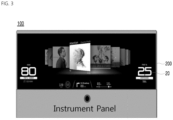
- FIGS. 5 to 8 are views exemplarily showing the operation of a vehicle display device according to the present invention.
- the vehicle display device 102 includes a flexible display 200, a sensor 140 and a controller 180.
- the sensor 140 senses the driving state of the vehicle 10, and the controller 180 controls the flexible display 200 such that the screen area of the flexible display 200 is adjusted based on the sensed driving state of the vehicle 10.
- the above-described change in the screen area of the flexible display 200 may be appropriately controlled according to the driving state of the vehicle 10 without requiring the user to manually operate the device.
- the driving state of the vehicle 10 is sensed by the sensor 140, and the screen area of the flexible display 200 is adjusted by the controller 180 based on the sensed driving state of the vehicle 10. Accordingly, the screen area of the flexible display 200 may be optimally controlled so as to be changed corresponding to the driving state of the vehicle 10.
- the senor 140 may sense that the driving state of the vehicle 10 is a parking mode, and the controller 180 may control the flexible display 200 such that the screen area thereof is increased to a preset area or greater according to the sensed parking mode.
- the screen area of the flexible display 200 may be increased so that various pieces of information related to parking are displayed, as shown in FIG. 6 .
- the user may park the vehicle 10 while confirming various pieces of information related to parking of the vehicle 10 through the flexible display 200 without performing a separate manipulation of enlarging the screen.
- the screen area of the flexible display 200 is increased to a preset arear or greater. Accordingly, the user may more easily confirm information related to parking of the vehicle 10.
- the sensor 140 may directly sense parking mode information that is inputted by the user in the vehicle 10, or may indirectly sense parking mode information through the traveling direction of the vehicle 10, the speed of the vehicle 10, and the distribution of neighboring vehicles.
- the above-described parking mode may be sensed based on parking mode information inputted by the user.
- the user may directly input parking mode information by pressing or touching a separate parking mode button installed in the vehicle 10.
- the parking mode may be indirectly sensed based on the state of the vehicle 10 without separate input by the user. For example, in response to it being sensed that the vehicle 10 is put in the reverse gear and that there is a parking line in the area to which the vehicle 10 is to be reversed, it may be estimated that the driving mode of the vehicle 10 corresponds to the parking mode.
- whether the driving mode of the vehicle 10 corresponds to the parking mode is directly sensed through user input, or is indirectly sensed based on various pieces of estimable information. Accordingly, the parking mode may be more effectively sensed, and the screen area of the flexible display 200 may be increased corresponding thereto.
- the vehicle display device 102 may further include a camera 121 capable of capturing an image of the surroundings of the vehicle 10.
- the controller 180 may cause the surrounding information of the photographed area to be displayed on the flexible display 200 at an enlarged aspect ratio.
- the surrounding information obtained through the camera 121 may be displayed on the flexible display 200.
- the surrounding information of the area that is relatively close to the vehicle 10 may be displayed in an enlarged manner.
- the information to which the user pays the greatest attention is information about other vehicles, persons, or objects relatively close to the vehicle 10. Thus, it may be most helpful to the user to only display this information in an enlarged manner.
- the vehicle display device 102 in response to the screen area of the flexible display 200 being increased to a preset area or greater, surrounding information of the photographed area is displayed on the flexible display 200 at an enlarged aspect ratio. Accordingly, the user may confirm more detailed and concrete information.
- the vehicle display device 102 may further include a camera 121 capable of capturing an image of the surroundings of the vehicle 10.
- the controller 180 may cause surrounding information of a relatively large area photographed by the camera 121 to be displayed on the flexible display 200 at a constant aspect ratio.
- the surrounding information obtained through the camera 121 may be displayed on the flexible display 200.
- surrounding information of a relatively large area around the vehicle 10 may be displayed.
- the user may desire to confirm not only information on the area close to the vehicle 10 but also information on the area far from the vehicle 10. From this point of view, it may be helpful to display and provide surrounding information of a relatively large area around the vehicle 10 to the user.
- the vehicle display device 102 in response to the screen area of the flexible display 200 being increased to a preset area or greater, surrounding information of a relatively large area photographed by the camera 121 is displayed on the flexible display 200 at a constant aspect ratio. Accordingly, the user may confirm a large amount and variety of pieces of information on a relatively large area.
- the main components of the vehicle display device 102 according to the second embodiment of the present disclosure are the same as or similar to those of the vehicle display device 100 according to the first embodiment of the present disclosure, and as such duplicate descriptions thereof are omitted.
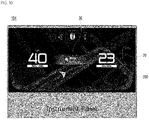
- FIGS. 9 and 10 are views exemplarily showing the operation of a vehicle display device.
- a sensor 140 may sense the driving speed of the driving state of the vehicle 10, and a controller 180 may control the screen area of the flexible display 200 according to the sensed driving speed of the vehicle 10.
- the screen area of the flexible display 200 may be maintained at the smallest area.
- the screen area of the flexible display 200 may be changed.
- the driving speed of the vehicle 10 is sensed, and the screen area of the flexible display 200 is controlled based on the sensed driving speed. Accordingly, it is possible to ensure driving safety by changing the screen area of the flexible display 200 according to the driving speed of the vehicle 10.
- the controller 180 may cause the screen area of the flexible display 200 to be reduced to the smallest area and cause only selected essential information 20 is displayed on the flexible display 200 at a constant aspect ratio.
- the controller 180 may cause the screen area of the flexible display 200 to be reduced and cause only the essential information 20, which is directly related to driving of the vehicle 10, to be displayed.
- the screen area of the flexible display 200 is reduced to the smallest area, and only selected essential information 20 is displayed on the flexible display 200 at a constant aspect ratio. Accordingly, the user may concentrate only on information directly related to driving of the vehicle 10 in a situation evaluated to be relatively dangerous due to high-speed driving.
- the controller 180 may perform control such that the screen area of the flexible display 200 is maintained at the current area and only selected essential information 20 is displayed on the flexible display 200 at an enlarged aspect ratio.
- the controller 180 may cause the screen area of the flexible display 200 to not be reduced and the information that is to be displayed on the flexible display 200 to be restricted to the essential information 20, thereby displaying the essential information 20 in an enlarged manner.
- the screen area of the flexible display 200 is maintained at the current area, and only selected essential information 20 is displayed on the flexible display 200 at an enlarged aspect ratio. Accordingly, the user may more easily confirm information directly related to driving of the vehicle 10 in a situation evaluated to be relatively dangerous due to high-speed driving.
- the controller 180 in response to the driving speed of the vehicle 10 is below a preset speed, the controller 180 may cause the screen area of the flexible display 200 to be increased and cause additional information 30 to be displayed on the flexible display 200.
- the controller 180 may cause the screen area of the flexible display 200 to be increased so that the user is capable of confirming a variety of pieces of information through the flexible display 200.
- the screen area of the flexible display 200 is increased, and additional information 30 is displayed on the flexible display 200. Accordingly, it is possible to provide a greater variety of pieces of information to the user in a situation evaluated to be relatively safe due to low-speed driving.
- the main components of the vehicle display device 104 according to the third embodiment of the present disclosure are the same as or similar to those of the vehicle display devices 100 and 102 according to the first and second embodiments of the present disclosure, and as such duplicate descriptions thereof are omitted.
- FIGS. 11 to 13 are views exemplarily showing the operation of a vehicle display device.
- the vehicle display device 106 includes a flexible display 200, an input interface 120, an output interface 150, and a controller 180.
- the input interface 120 is a part into which the user in the vehicle 10 inputs information.
- the user may input a signal for operating the vehicle display device 106 or the like through the input interface 120.
- the output interface 150 is a part from which information is outputted to the user in the vehicle 10. In addition to the information outputted through the flexible display 200, separate information, such as a sound, a notification mark 50, or vibration, may be outputted through the output interface 150.
- the controller 180 controls the operation of the flexible display 200 in response to the information inputted through the input interface 120.
- the operation of the flexible display 200 is appropriately adjusted via direct manipulation of the user intending to change the screen area of the flexible display 200.
- the vehicle display device 106 As described above, in the vehicle display device 106 according to the fourth embodiment of the present disclosure, specific information is inputted through the input interface 120 by the user, and the operation of the flexible display 200 is controlled by the controller 180 based on the inputted information. Accordingly, the operation of the vehicle display device mounted in the vehicle 10 may be optimally controlled based on the specific intention of the user.
- the vehicle display device 106 may further include a memory 170 for storing registration information on the user of the vehicle 10.
- the input interface 120 may receive user information inputted by the user in the vehicle 10, and the controller 180 may determine whether to activate the operation of the flexible display 200 depending on whether the user information matches the registration information.
- the flexible display 200 may remain in an inactivated state in which the display function thereof is not implemented.
- the flexible display 200 may become activated so as to implement the display function.
- whether to activate the operation of the flexible display 200 is determined depending on whether user information matches the registration information. Accordingly, only an authenticated user is allowed to operate the vehicle display device of the vehicle 10.
- the controller 180 may control the flexible display 200 such that the screen area of the flexible display 200 is changed to a preset area.
- the method of using the vehicle display device 106 may vary depending on the user. For example, one user may prefer the state in which the screen is relatively large and is inclined at a predetermined angle, as shown in FIG. 13 . Conversely, another user may prefer the state in which the screen is relative small and stands substantially upright, as shown in FIG. 12 .
- Such individual user preferences may be stored in advance. Therefore, when user information matches the registration information, the screen area of the flexible display 200 may be automatically changed to an area that is preset in association with the registration information and the preference of the corresponding user.
- the screen area of the flexible display 200 is changed to a preset area. Accordingly, the flexible display 200 may be optimally controlled so as to be used immediately in response to an authentication process passing without requiring the user to manually operate the device.
- the memory 170 may store respective pieces of registration information on a plurality of users, and the controller 180 may individually control the flexible display 200 according to each piece of registration information that matches the user information that is inputted.
- Only one user may use the vehicle 10. In many cases, however, a plurality of users may use the vehicle 10 in turn.
- the preferences of each user of a plurality of users may be stored in advance, and based on user information matching the registration information, the screen area of the flexible display 200 may be automatically changed to an area that is preset in association with the registration information and the preferences of the corresponding user.
- the flexible display 200 may be individually controlled according to each piece of registration information that matches the user information that is inputted. Accordingly, the flexible display 200 may be optimally controlled so as to be used immediately in consideration of the characteristics of each of a plurality of users.
- the main components of the vehicle display device 106 according to the fourth embodiment of the present disclosure are the same as or similar to those of the vehicle display devices 100, 102 and 104 according to the first to third embodiments of the present disclosure, and as such duplicate descriptions thereof will be omitted.
- FIGS. 14 and 15 are views exemplarily showing the operation of a vehicle display device.
- an output interface 150 may be disposed at a portion of the flexible display 200 so as to output a notification mark 50 to the user in the vehicle 10
- an input interface 120 may receive an authorization signal applied to the notification mark 50 by the user in the vehicle 10
- the controller 180 may control the display state of information that is outputted during the operation of the flexible display 200 depending on whether an authorization signal has been applied to the notification mark 50.
- the corresponding information may be displayed on the flexible display 200, as shown in FIG. 15 .
- the information associated with the notification mark 50 may be limited to information on a specific category, such as the main interests of the user, which is preset by the user, and may be continuously updated by, for example, artificial intelligence (AI), in consideration of the preferences of the user.
- AI artificial intelligence
- the display state of information that is outputted through the flexible display 200 is controlled depending on whether the user has applied input of an authorization signal with respect to the notification mark 50 outputted to the user. Accordingly, information to which the user is increasingly likely to pay attention may be more frequently provided to the user.
- selected information 40 which is selected by the user in the vehicle 10
- the controller 180 may cause the screen area of the flexible display 200 to increase and additional information 30 associated with the notification mark 50 to be additionally displayed in an area other than the area in which the selected information 40 is displayed.
- the notification mark 50 which indicates information other than the selected information 40, which is selected by the user so as to be displayed on the flexible display 200, may be outputted, and in response to the user applying input of an authorization signal with respect to the notification mark 50, the additional information 30 associated with the notification mark 50 may be displayed on the flexible display 200.
- the additional information 30 may be displayed in an area that does not overlap the area in which the selected information 40 is displayed, specifically, in a newly generated area due to the enlargement of the screen, thereby preventing the user from confusing the selected information 40 with the additional information 30.
- the screen area of the flexible display 200 is increased, and additional information 30 associated with the notification mark 50 is additionally displayed in an area other than the area in which the selected information 40 is displayed. Accordingly, even when the additional information 30 is displayed, the selected information 40 may be continuously and stably provided to the user.
- the selected information 40 which is selected by the user in the vehicle 10
- the controller 180 may cause the screen area of the flexible display 200 to increase and the additional information 30 associated with the notification mark 50 and the selected information 40 to be rearranged and displayed.
- the additional information 30 may be preferable to display the additional information 30 separately from the existing selected information 40.
- the visibility of the selected information 40, which has already been displayed may be degraded due to the increase in the screen area of the flexible display 200.
- the screen area of the flexible display 200 is increased, if the existing selected information 40 is still displayed at the same size as before, it may be difficult to notice the selected information 40 on the entirety of the screen. Therefore, it may be preferable to increase the size of the selected information 40 displayed on the flexible display 200 according to the increase in the screen area of the flexible display 200.
- new additional information 30 when new additional information 30 is displayed, it may be rearranged together with the existing selected information 40 so that both the selected information 40 and the additional information 30 are optimally outputted on the increased screen area of the flexible display 200.
- the screen area of the flexible display 200 is increased, and additional information 30, associated with the notification mark 50, and the existing selected information 40 are rearranged and displayed. Accordingly, all pieces of information including the additional information 30 may be optimally displayed.
- the main components of the vehicle display device 108 according to the fifth embodiment of the present disclosure are the same as or similar to those of the vehicle display devices 100, 102, 104 and 106 according to the first to fourth embodiments of the present disclosure, and as such duplicate descriptions thereof are omitted.
- FIG. 16 is a view exemplarily showing the structure for changing the screen area of the flexible display in the vehicle display devices .
- the vehicle display device 100 includes a first frame 500, a second frame 300, and a flexible display 200.
- the flexible display 200 is configured to be transformed by external force.
- the transformation may be at least one of warping, bending, folding, twisting, rolling, and spreading of the display module.
- the transformable display module may be referred to as a "flexible display 200".
- the flexible display 200 may include a general flexible display, an electronic paper (e-paper), and a combination thereof.
- a general flexible display refers to a durable display which maintains characteristics of existing flat panel displays, and is manufactured on a thin and flexible substrate which can be warped, bent, folded, twisted, rolled, and spread like paper, is light in weight, and is not easily broken.
- electronic paper is a display technique to which characteristic of general ink are applied, but uses reflection light, which is different from existing flat panel displays.
- the electronic paper may change information using a twist ball or electrophoresis using a capsule.
- Information displayed on the flexible display 200 may include visual information that is outputted on a curved surface.
- the visual information is implemented by independently controlling the light emission of unit pixels (sub pixels) disposed in a matrix.
- a unit pixel refers to a minimum unit which implements one color.
- a part of the flexible display 200 may be not flat but may be bent. In this case, when an external force is applied to the flexible display 200, a part of the flexible display 200 may be deformed into a flat state, or a less bent state or a more bent state.
- the flexible display 200 may be combined with a touch sensor to implement a flexible touch screen.
- the controller 180 (see FIG. 1 ) performs control corresponding to the touch input.
- the flexible touch screen is formed such that the touch input is sensed while a part of the flexible display 200 is spread or bent.
- the vehicle display device 100 may include a deformation sensing means which senses deformation of the flexible display 200.
- the deformation sensing means may be included in the sensor 140 (see FIG. 1 ).
- the deformation sensing means may be provided in the flexible display 200 or the first frame 500, and may sense information related to the deformation of the flexible display 200.
- the information related to the deformation may be such information as information on a deformation direction of the flexible display 200, information on how much the flexible display 200 is deformed, information on the position of the deformation, information on the time of the deformation, and information on an acceleration at which the deformed flexible display 200 is restored.
- various other types of information which can be sensed due to the bending of the flexible display 200 may also be included.
- controller 180 may change information disposed on the flexible display 200 or generate a control signal for controlling a function of the vehicle display device 100, based on the information related to the deformation of the flexible display 200 sensed by the deformation sensing means.
- the deformation of the state of the flexible display 200 is not limited to the deformation by the external force.
- the part when a part of the flexible display 200 is unfolded, the part may be deformed to be bent by the command of the user or an application.
- the first frame 500 may form the overall external appearance of the vehicle display device 100.
- the first frame 500 may be formed of a relatively solid material.
- the first frame 500 may be formed of plastic, metal, or a combination thereof.
- Other components constituting the vehicle display device 100 may be coupled to the first frame 500.
- the first frame 500 may be formed in any of various configurations for supporting other components coupled thereto.
- the first frame 500 may have a rectangular shape overall, and may also have a flat shape overall.
- the first frame 500 may be formed to have a flat surface that is perpendicular to a first direction (an X-axis direction). Accordingly, the first frame 500 has a predetermined length in a second direction (a Y-axis direction), which is perpendicular to the first direction, and further has a predetermined length in a third direction (a Z-axis direction), which is perpendicular to the first direction and the second direction.
- the first direction (the X-axis direction) is a direction that is parallel to the forward-backward direction of the vehicle 10
- the second direction (the Y-axis direction) may be a direction that is parallel to the leftward-rightward direction of the vehicle 10
- the third direction (the Z-axis direction) may be a direction that is parallel to the upward-downward direction of the vehicle 10.
- the forward-backward direction and the leftward-rightward direction may be directions that are parallel or substantially parallel to the horizontal direction
- the upward-downward direction may be a direction that is parallel or substantially parallel to the vertical direction
- the second frame 300 may be formed in a plate shape.
- the second frame 300 may be formed in a rectangular plate shape.
- the second frame 300 may include a flat surface that is perpendicular to the first direction (the X-axis direction).
- the second frame 300 may be coupled to the first frame 500 so as to perform reciprocating movement in the third direction.
- the second frame 300 may be coupled to the first frame 500 so as to perform sliding movement.
- the second frame 300 may move within a range of the distance (the stroke) from one end point to the opposite end point.
- the third direction is a direction parallel to the upward-downward direction
- the second frame 300 may move within the range between a point at which the second frame 300 is located at the lowest position with respect to the first frame 500 and a point at which the second frame 300 is located at the highest position with respect to the first frame 500.
- the left edge and the right edge of the first frame 500 may be formed in a shape suitable to guide the smooth movement of the flexible display 200.
- a left guide may be continuously formed on the left edge of the first frame 500 in the third direction
- a right guide may be continuously formed on the right edge of the first frame 500 in the third direction
- the left guide and the right guide may have concave grooves formed therein so as to face each other.
- Each groove may be formed so as to have a constant cross-section in the third direction.
- the left edge of the second frame 300 may be inserted into the groove in the left guide, and the right edge of the second frame 300 may be inserted into the groove in the right guide. Accordingly, the second frame 300 may move in the third direction with respect to the first frame 500.
- the flexible display 200 is coupled to the first frame 500 and the second frame 300 in an overall bent state.
- the flexible display 200 may be overall bent in a "U” shape, or may be overall bent in a "J" shape.
- the flexible display 200 is coupled at a portion thereof to the second frame 300.
- the flexible display 200 is coupled to the front side of the second frame 300 in the first direction.
- the portion of the flexible display 200 that is coupled to the second frame 300 moves together with the second frame 300.
- the overall shape of the flexible display 200 changes in response to the second frame 300 moving with respect to the first frame 500.
- a portion of the flexible display 200 is exposed in front of the first frame 500 and the second frame 300 so as to be oriented in the first direction, and the exposed area of the flexible display 200 that is oriented in the first direction is variable.
- the case in which the second frame 300 is located at the lowest position with respect to the first frame 500 corresponds to the state in which the exposed area of the flexible display 200 that is oriented in the first direction is the smallest
- the case in which the second frame 300 is located at the highest position with respect to the first frame 500 corresponds to the state in which the exposed area of the flexible display 200 that is oriented in the first direction is the largest.
- the vehicle display device 100 is transformed between the state in which the exposed area of the flexible display 200 that is oriented in the first direction is the smallest (the first state) and the state in which the exposed area of the flexible display 200 that is oriented in the first direction is the largest (the second state). Further, the vehicle display device 100 according to the embodiment may be maintained in the first state, the second state, or an arbitrary state between the first state and the second state.
- the flexible display 200 may include a first area and a second area.
- the first area may be an area that overlaps the outer surface of the second frame 300 and is exposed.
- the first area may be an exposed area of the flexible display 200 when viewed from the front in the first state.
- the first area may form a planar surface in the first state and the second state.
- the second area may be an area that overlaps the outer surface of a driving track, excluding the first area.
- the second area may be an area of the flexible display 200 excluding the exposed area of the flexible display 200 corresponding to the first area when viewed from the front in the second state.
- the vehicle display device 100 may be configured such that the size of the second area that is exposed together with the first area at the same side as the first area changes according to movement of the second frame 300.
- the second area may be configured such that a portion thereof forms a curved surface and the remaining portion thereof forms a planar surface.
- the portion of the second area that forms a planar surface is located opposite the first area (i.e. is oriented in the opposite X-axis direction).
- the portion of the second area that forms a curved surface may be transformed into a portion forming the same planar surface as the first area, and the remaining portion of the second area, which is located opposite the first area, may be transformed into the portion forming a curved surface.
- the second frame 300 may be formed of a solid material so that the shape thereof is maintained.
- the second frame 300 may be formed of metal, plastic, or a combination thereof.
- the teeth of a first gear 310 may be successively formed on the inner surface (the rear surface) of the second frame 300 in the moving direction of the second frame 300. That is, the teeth of the first gear 310 may be successively formed on the inner surface (the surface oriented in the opposite X-axis direction) of the second frame 300 in the upward-downward direction.
- the vehicle display device 100 may include an actuator.
- the actuator may include a driving gear 610 and a driving motor 620.
- the driving gear 610 is coupled to the inner side of the first frame 500 so as to be rotatable about the rotary shaft S3 thereof, and meshes with the first gear 310 of the second frame 300 so as to be rotated together therewith.
- the driving motor 620 may be configured as a normal motor which rotates by electric energy, and may be configured as a step motor.
- the driving motor 620 is directly coupled to the driving gear 610 to rotate the driving gear 610, or may rotate the driving gear 610 by means of another gear.
- the driving motor 620 may be fixedly coupled to the inner side of the first frame 500.
- the driving gear 610 may be located above a first roller 210 in the vehicle display device 100.
- the driving gear 610 may be disposed so as to be substantially aligned with a second roller 220 in the upward-downward direction.
- the gear module of each of the gear 310 of the second frame 300 and the driving gear 610 may be 0.3 mm in order to secure smooth movement of the second frame 300.
- the flexible display 200 and the actuator may be configured to receive power from the vehicle 10, and the power supply 190 for supplying power to the flexible display 200, and the actuator may be provided at one side of the first frame 500.
- the power supply 190 may be implemented as an electric terminal, an electric connector, or any of various devices for electrically connecting the power source of the vehicle 10 to the vehicle display device 100.
- Electric wires 505 and 625 for supplying power to the flexible display 200 and to the actuator and the controller 180 may be disposed in the space defined by the first area and the second area of the flexible display 200.
- the electric wires 505 and 625 for supplying power to the flexible display 200 and to the actuator may be formed as a flexible printed circuit board (FPCB).
- the flexible display 200 and the actuator receive power from the vehicle 10 through the electric wires disposed in the space defined by the first area and the second area of the flexible display 200, and it is thus possible to prevent an increase in the thickness of the vehicle display device 100 due to wiring.
Landscapes
- Engineering & Computer Science (AREA)
- Mechanical Engineering (AREA)
- Combustion & Propulsion (AREA)
- Transportation (AREA)
- Chemical & Material Sciences (AREA)
- Theoretical Computer Science (AREA)
- General Engineering & Computer Science (AREA)
- Multimedia (AREA)
- General Physics & Mathematics (AREA)
- Physics & Mathematics (AREA)
- Human Computer Interaction (AREA)
- Controls And Circuits For Display Device (AREA)
- Fittings On The Vehicle Exterior For Carrying Loads, And Devices For Holding Or Mounting Articles (AREA)
- Instrument Panels (AREA)
- User Interface Of Digital Computer (AREA)
Description
- The present invention relates to a vehicle display device, and more particularly to a vehicle display device that is mounted in the indoor space of a vehicle and is capable of changing the area of a display.
- A vehicle is an apparatus that transports a user in a direction desired by the user. A car is a representative example of such a vehicle. Various types of sensors and electronic devices are provided in a vehicle for convenience of the user using the vehicle.
- Various studies on an Advanced Driver Assistance System (ADAS) are being actively undertaken with regard to the driving convenience of a user. In addition, autonomous vehicles are also under active development.
- With the active development of an ADAS, there is a need for development of technology that maximizes the convenience and safety of a user driving a vehicle.
- As part of this technology, displays are disposed at various positions in a vehicle in order to display a variety of pieces of information such as vehicle-to-everything (V2X) information, and vehicle information. In addition, as the number of functions that an occupant can perform through a display increases due to the advent of autonomous driving, various methods for controlling a display mounted in a vehicle are being developed.
- In addition, a display device mounted in the indoor space of a vehicle may be used to indicate information about the vehicle to persons located outside the vehicle or to other vehicles. Accordingly, as the scope of using a vehicle display device expands, the need for development of methods of controlling a vehicle display device is increasing.
- In relation to the vehicle display device described above,
Korean Patent Application Publication No. 10-2019-0139645 related art 1") discloses a head-up display device for a vehicle. - Specifically, the head-up display device for a vehicle disclosed in
related art 1 includes a sensor for sensing collision of a vehicle, a controller for operating an actuator in response to a sensing signal from the sensor, and a collision preventer supported by the actuator and configured to forcibly rotate a holder to guide insertion of a combiner into a case when a hinge is disengaged from the actuator under the control of the controller , thereby rapidly returning the combiner in the event of a collision of the vehicle so as to prevent a collision between the combiner and a driver. - However,
related art 1 merely discloses a vehicle display device configured to be rotatable at the installation position thereof so as to be changed to a closed state as needed, and does not explicitly disclose technology for changing the shape of a vehicle display device according to various usage environments, for example, changing the area of a display according to the needs of a user. - Korean Patent Registration No.
10-2041965 related art 2") discloses a display device provided in a vehicle. - Specifically,
related art 2 discloses technology in which the mode of a display is changed according to the current state of an occupant such that the display is automatically divided or merged depending on whether an occupant is in a vehicle. - However,
related art 2 merely discloses a vehicle display device including a plurality of displays mounted in a vehicle in a substantially fixed manner and configured such that only the area of a screen on which an image is displayed is controlled differently depending on the current state of an occupant, but does not explicitly disclose technology for physically changing the shape of a display device so as to optimize the area of a display according to the use environment. - As described above, the vehicle display devices in the related art are limited in regard to optimizing the shape of a display so as to be suitable for any of various use environments by changing the area of the display according to the needs of a user. Therefore, there is a need for development of technology for overcoming the limitations of conventional vehicle display devices.
- Furthermore,
DE 10 2015 011 614 A1 is directed to a vehicle including the display panel movable between a stowed position and an extended position. The display panel may be moved into the extended position, the more display area is required. In addition, in case of an autonomous driving mode, the display panel may be moved towards or into the stowed position. -
US 2016/0193923 A1 is directed to a vehicle including a display apparatus capable of applying a large scale display part to a center fashion and ensuring flexibility in use in a stop state and in a driving state of the vehicle. In a short stop state, in a stop state or in a park state, the display apparatus can be disposed tilted at an angle in which the user performs an easy touch input and a superior visibility is insured even with the user's neck slightly bowed downward. -
DE 10 2005 017 556 A1 relates to a display in a vehicle, wherein a display area can be adjusted with respect to the size of information to be displayed. -
EP 1 637 386 A1 relates to a vehicle having a display, which may be moved between different positions. Before allowing movement of the display, it is checked whether a selected application for displaying data is permissible in a current vehicle mode. - The present invention is directed to addressing the limitations associated with vehicle display devices of some related art described above.
- It is an object of the present invention to provide a display device for a vehicle that optimises usability of the display device.
- This object is solved by the present invention as defined in
independent claim 1. - Preferred embodiments are defined by the dependent claims.
- Aspects of the present invention will be clearly understood by those skilled in the art from the following description.
- The vehicle display device according to the present invention is configured such that the screen area of the flexible display is adjusted according to the driving state of the vehicle, wherein the driving state is a parking mode. Specifically, the driving state of the vehicle is sensed by the sensor through a traveling direction of the vehicle (10), a speed of the vehicle (10), and a distribution of neighbouring vehicles, and the screen area of the flexible display is adjusted by the controller based on the sensed driving state of the vehicle.
- In the vehicle display device according to an embodiment of the present invention, when it is sensed that the vehicle is in a parking mode, the screen area of the flexible display may be increased to a preset area or greater.
- In the vehicle display device according to an embodiment, whether the driving mode of the vehicle corresponds to the parking mode may be directly sensed through user input, or may be indirectly sensed based on various pieces of estimable information.
- In the vehicle display device according to an embodiment, in response to the screen area of the flexible display being increased to a preset area or greater, surrounding information of the photographed area may be displayed on the flexible display at an enlarged aspect ratio.
- In the vehicle display device according to an embodiment, in response to the screen area of the flexible display being increased to a preset area or greater, surrounding information of a relatively large area photographed by a camera may be displayed on the flexible display at a constant aspect ratio.
- In the vehicle display device according to an embodiment, the driving speed of the vehicle may be sensed, and the screen area of the flexible display may be controlled based on the sensed driving speed.
- In the vehicle display device according to an embodiment , in response to the driving speed of the vehicle being equal to or greater than a preset speed, the screen area of the flexible display may be reduced to the smallest area, and only selected essential information may be displayed on the flexible display at a constant aspect ratio.
- In the vehicle display device according to an embodiment, in response to the driving speed of the vehicle being equal to or greater than a preset speed, the screen area of the flexible display may be maintained at the current area, and only selected essential information may be displayed on the flexible display at an enlarged aspect ratio.
- In the vehicle display device according to an embodiment, in response to the driving speed of the vehicle being below a preset speed, the screen area of the flexible display may be increased, and additional information may be displayed on the flexible display.
- As is apparent from the above description, the vehicle display device according to the present invention has the following effects.
- The driving state of the vehicle is sensed by the sensor, and the screen area of the flexible display is adjusted by the controller based on the sensed driving state of the vehicle. Accordingly, the screen area of the flexible display may be optimally controlled so as to be changed to correspond to the driving state of the vehicle.
- When it is sensed that the vehicle is in a parking mode, the screen area of the flexible display is increased to a preset area or greater. Accordingly, the user may more easily confirm information related to parking of the vehicle.
- Whether the driving mode of the vehicle corresponds to the parking mode is directly sensed through user input, or is indirectly sensed based on various pieces of estimable information. Accordingly, the parking mode may be more effectively sensed, and the screen area of the flexible display may be increased to correspond thereto.
- In response to the screen area of the flexible display being increased to a preset area or greater, surrounding information of the photographed area is displayed on the flexible display at an enlarged aspect ratio. Accordingly, the user may confirm more detailed and concrete information.
- In response to the screen area of the flexible display being increased to a preset area or greater, surrounding information of a relatively large area photographed by a camera is displayed on the flexible display at a constant aspect ratio. Accordingly, the user may confirm a large amount and variety of pieces of information on a relatively large area.
- The driving speed of the vehicle is sensed, and the screen area of the flexible display is controlled based on the sensed driving speed. Accordingly, it is possible to secure driving safety by changing the screen area of the flexible display according to the driving speed of the vehicle.
- In response to the driving speed of the vehicle being equal to or greater than a preset speed, the screen area of the flexible display is reduced to the smallest area, and only selected essential information is displayed on the flexible display at a constant aspect ratio. Accordingly, the user may concentrate solely on information directly related to driving of the vehicle in a situation evaluated to be relatively dangerous due to high-speed driving.
- In response to the driving speed of the vehicle being equal to or greater than a preset speed, the screen area of the flexible display is maintained at the current area, and only selected essential information is displayed on the flexible display at an enlarged aspect ratio. Accordingly, the user may more easily confirm information directly related to driving of the vehicle in a situation evaluated to be relatively dangerous due to high-speed driving.
- In response to the driving speed of the vehicle being below a preset speed, the screen area of the flexible display is increased, and additional information is displayed on the flexible display. Accordingly, it is possible to provide a greater variety of pieces of information to the user in a situation evaluated to be relatively safe due to low-speed driving.
- The above and other aspects, features, and advantages of the present invention will become apparent from the detailed description of the following aspects in conjunction with the accompanying drawings, in which:
-
FIG. 1 is a block diagram for explaining a vehicle display device according to an embodiment not according to the present invention; -
FIG. 2 is a view exemplarily showing the state in which the vehicle display device according to the embodiment is mounted in a vehicle; -
FIGS. 3 and4 are views exemplarily showing the operation of the vehicle display device according to the embodiment; -
FIGS. 5 to 8 are views exemplarily showing the operation of a vehicle display device according to the present invention; -
FIGS. 9 and10 are views exemplarily showing the operation of a vehicle display device according to another embodiment not according to the present invention: -
FIGS. 11 to 13 are views exemplarily showing the operation of a vehicle display device according to another embodiment not according to the present invention: -
FIGS. 14 and15 are views exemplarily showing the operation of a vehicle display device according to another embodiment not according to the present invention: and -
FIG. 16 is a view exemplarily showing the structure for changing a screen area of a flexible display in the vehicle display devices according to another embodiment not according to the present invention. -
FIG. 1 is a block diagram for explaining avehicle display device 100 . - The
vehicle display device 100 includes awireless transceiver 110, aninput interface 120, a sensor 140, anoutput interface 150, aninterface 160, amemory 170, acontroller 180, and apower supply 190. However, the components illustrated inFIG. 1 are not essential to implement the vehicle display device, and the vehicle display device described may include more or fewer components than the components described above. - More specifically, the
wireless transceiver 110 may include one or more modules which enable wireless communication between thevehicle display device 100 and a wireless communication system, between thevehicle display device 100 and anothervehicle display device 100, or between thevehicle display device 100 and an external server. Further, thewireless transceiver 110 may include one or more modules which connect thevehicle display device 100 to one or more networks. - The
wireless transceiver 110 may include at least one of abroadcasting receiving module 111, amobile communication module 112, awireless Internet module 113, a short-range communication module 114, or aposition information module 115. - The
input interface 120 may include acamera 121 or an image input interface which receives input of an image signal, amicrophone 122 or an audio input interface which receives input of an audio signal, and a user input interface 123 (for example, a touch key or a mechanical key) which receives information from a user. Voice data or image data collected by theinput interface 120 is analyzed and processed as a control command of the user. - The sensor 140 may include one or more sensors which sense at least one of information in the vehicle display device, surrounding environment information around the vehicle display device, or user information. For example, the sensor 140 may include at least one of a
proximity sensor 141, anillumination sensor 142, a touch sensor, an acceleration sensor, a magnetic sensor, a G-sensor, a gyroscope sensor, a motion sensor, an RGB sensor, an infrared (IR) sensor, a finger scan sensor, an ultrasonic sensor, an optical sensor (for example, acamera 121 or a microphone 122), a battery gauge, an environment sensor (for example, a barometer, a hygrometer, a thermometer, a radiation sensor, a thermal sensor, and a gas sensor), or a chemical sensor (for example, an electronic nose, a healthcare sensor, and a biometric sensor). Further, the vehicle display device disclosed in the present specification may combine and utilize information sensed by at least two sensors from the above-mentioned sensors. - The
output interface 150 generates outputs related to visual, auditory, or tactile senses, and may include at least one of adisplay 151, asound output interface 152, ahaptic module 153, or anoptical output interface 154. Thedisplay 151 may be configured as a touch screen by forming a mutual layered structure with a touch sensor or being formed integrally therewith. The touch screen may simultaneously serve as auser input interface 123 for providing an input interface between thevehicle display device 100 and the user and an output interface between thevehicle display device 100 and the user. - The
interface 160 serves as a passage between various types of external devices which are connected to thevehicle display device 100. Theinterface 160 may include at least one of a wired/wireless headset port, an external charger port, a wired/wireless data port, a memory card port, a port which connects a device equipped with an identification module, an audio input/output (I/O) port, a video input/output (I/O) port, or an earphone port. Thevehicle display device 100 may perform appropriate control related to the connected external device in accordance with the connection of the external device to the I/O connector 160. - Further, the
memory 170 may store data which supports various functions of thevehicle display device 100. Thememory 170 may store a plurality of application programs or applications that are driven by thevehicle display device 100, data for operating thevehicle display device 100, and instructions. At least some of the application programs may be downloaded via an external server through wireless communication. Further, at least some of the application programs, related to basic functions of the vehicle display device 100 (for example, incoming and outgoing call functions, and message receiving and sending functions), may be installed in thevehicle display device 100 from the time of release. The application programs are stored in thememory 170, and are installed in thevehicle display device 100 and driven by thecontroller 180 to perform operations (or functions) of the vehicle display device. - In addition to the operations related to the application programs, the
controller 180 may generally control the overall operation of thevehicle display device 100. Thecontroller 180 may process signals, data, or information which is inputted or outputted through the above-described components, or drive the application programs stored in thememory 170 to provide or process appropriate information or functions to the user. - Further, in order to drive the application program stored in the
memory 170, thecontroller 180 may control at least some of the components described with reference toFIG. 1 . Moreover, thecontroller 180 may combine and operate at least two of the components included in thevehicle display device 100 to drive the application program. - The
power supply 190 receives application of external power, and supplies the power to the respective components included in thevehicle display device 100 under the control of thecontroller 180. At least some of the above-described components may operate in cooperation with each other to implement the operation, the control, or the control method of the vehicle display device according to various embodiments, which will be described below. Further, the operation, the control, or the control method of the vehicle display device may be implemented in the vehicle display device by driving at least one application program stored in thememory 170. - Hereinafter, prior to describing various embodiments implemented by the
vehicle display device 100 described above, the above-mentioned components will be described in more detail with reference toFIG. 1 . - First, the
wireless transceiver 110 will be described. Thebroadcasting receiving module 111 of thewireless transceiver 110 receives a broadcasting signal and/or broadcasting-related information from an external broadcasting management server through a broadcasting channel. The broadcasting channel may include a satellite channel and a ground wave channel. Two or more broadcasting receiving modules for simultaneous broadcasting reception or broadcasting channel switching for at least two broadcasting channels may be provided in thevehicle display device 100. - The broadcasting management server may refer to a server which generates and transmits a broadcasting signal and/or broadcasting-related information, or a server which is supplied with a previously generated broadcasting signal and/or broadcasting-related information and transmits the broadcasting signal and/or the broadcasting-related information to the vehicle display device. The broadcasting signal includes not only a TV broadcasting signal, a radio broadcasting signal, and a data broadcasting signal, but also a broadcasting signal obtained by combining a TV broadcasting signal or a radio broadcasting signal with a data broadcasting signal.
- The broadcasting signal may be encoded according to at least one technical standard for transmitting and receiving a digital broadcasting signal (or broadcasting schemes, for example, ISO, IEC, DVB, or ATSC), and the
broadcasting receiving module 111 may receive the digital broadcasting signal using an appropriate method for the technical specification determined by the technical standard. - The broadcasting-related information may refer to information related to a broadcasting channel, a broadcasting program, or a broadcasting service provider. The broadcasting-related information may also be provided through the mobile communication network. In this case, the broadcasting-related information may be received by the
mobile communication module 112. - The broadcasting-related information may exist in various types such as an electronic program guide of digital multimedia broadcasting (DMB) or an electronic service guide of a digital video broadcast-handheld (DVB-H). The broadcasting signal and/or the broadcasting-related information received by the
broadcasting receiving module 111 may be stored in thememory 170. - The
modem 112 may transmit/receive a wireless signal to/from at least one among a base station, an external terminal, or a server on a mobile communication network established according to the technical standards or communication methods for mobile communication (for example, Global System for Mobile communication (GSM), Code Division Multi Access (CDMA), Code Division Multi Access 2000 (CDMA2000), Enhanced Voice-Data Optimized or Enhanced Voice-Data Only (EV-DO), Wideband CDMA (WCDMA), High Speed Downlink Packet Access (HSDPA), High Speed Uplink Packet Access (HSUPA), Long Term Evolution (LTE), and Long Term Evolution-Advanced (LTE-A)). - The wireless signal may include a voice call signal, a video call signal, or various types of data in accordance with transmission or reception of a text/multimedia message.
- The
wireless Internet module 113 refers to a module for wireless Internet access and may be built in or external to thevehicle display device 100. Thewireless Internet module 113 may be configured to transmit/receive a wireless signal in a communication network according to wireless Internet technologies. - Wireless Internet technologies may include wireless LAN (WLAN), wireless fidelity (Wi-Fi), Wi-Fi direct, Digital Living Network Alliance (DLNA), wireless broadband (WiBro), Worldwide Interoperability for Microwave Access (WiMAX), High Speed Downlink Packet Access (HSDPA), High Speed Uplink Packet Access (HSUPA), Long Term Evolution (LTE), and Long Term Evolution-Advanced (LTE-A). The
wireless Internet module 113 may transmit or receive data in accordance with at least one wireless Internet technology, including Internet technologies which have not been described above. - From the viewpoint that the wireless Internet connection by WiBro, HSDPA, HSUPA, GSM, CDMA, WCDMA, LTE, LTE-A, etc. is performed through a mobile communication network, the
wireless Internet module 113 which performs the wireless Internet connection through the mobile communication network may be understood as a type of themobile communication module 112. - The short-
range communication module 114 may support short-range communication using at least one of Bluetooth™, radio frequency identification (RFID), infrared data association (IrDA), ultra wideband (UWB), ZigBee, Short-range Communication (NFC), wireless fidelity (Wi-Fi), Wi-Fi Direct, or Wireless Universal Serial Bus (Wireless USB). The short-range communication module 114 may support wireless communication between thevehicle display device 100 and the wireless communication system, between thevehicle display device 100 and anothervehicle display device 100, or between thevehicle display device 100 and a network in which the other vehicle display device 100 (or external server) is located, through a short-range wireless communication network. The short-range wireless communication network may be a short-range wireless personal communication network. - The
GNSS sensor 115 is a module for obtaining the location (or the current location) of a vehicle display device, and its representative examples include a global positioning system (GPS) module or a Wi-Fi module. For example, when a GPS module is utilized, the vehicle display device may obtain the position of the vehicle display device using a signal transmitted from a GPS satellite. As another example, when a Wi-Fi module is utilized, the vehicle display device may obtain the position of the vehicle display device based on information of a wireless access point (AP) which transmits and receives wireless signals with the Wi-Fi module. If necessary, theposition information module 115 may perform a function of another module of thewireless transceiver 110 to substitutably or additionally obtain data on the position of the vehicle display device. As a module used to obtain a position (or a current position) of the vehicle display device, theposition information module 115 is not limited to a module which directly calculates or obtains the position of the vehicle display device. - Next, the
input interface 120 is provided to input video information (or signals), audio information (or signals), data, or information inputted from the user. In order to receive input of video information, thevehicle display device 100 may include one ormore cameras 121. Thecamera 121 processes an image frame such as a still image or a moving image obtained by an image sensor in a video call mode or a photographing mode. The processed image frames may be displayed on thedisplay 151 or stored in thememory 170. Further, the plurality ofcameras 121 equipped in thevehicle display device 100 may be disposed to form a matrix structure, and a plurality of pieces of image information having various angles or focal points may be inputted to thevehicle display device 100 through thecameras 121 that form the matrix structure. Further, thecameras 121 may be disposed to have a stereo structure to obtain a left image and a right image to implement a stereoscopic image. - The
microphone 122 processes an external sound signal as electronic voice data. The processed voice data may be utilized in various forms in accordance with a function being performed by the vehicle display device 100 (or an application program which is being executed). In the meantime, in themicrophone 122, various noise removal algorithms which remove noise generated during the process of receiving the external sound signal may be implemented. - The
user input interface 123 receives information from the user, and when the information is inputted through theuser input interface 123, thecontroller 180 may control the operation of thevehicle display device 100 so as to correspond to the inputted information. Theuser input interface 123 may include a mechanical input interface (or a mechanical key, for example, a button located on a front, rear, or side surface of thevehicle display device 100, a dome switch, a jog wheel, a jog switch, or the like) and a touch type input interface. As one example, the touch type input interface may include a virtual key, a soft key, or a visual key displayed on the touch screen via a software process, or may include a touch key disposed on a portion other than the touch screen. The virtual key or the visual key may be displayed on the touch screen in various shapes, and for example, may be formed by graphics, text, icons, video, or a combination thereof. - The sensor 140 senses at least one of information in the vehicle display device, surrounding environment information around the vehicle display device, or user information, and generates a sensing signal corresponding to the information. The
controller 180 may control the driving or the operation of thevehicle display device 100 or perform data processing, functions, or operations related to the application programs installed in thevehicle display device 100, based on the sensing signal. Representative sensors among the various sensors which may be included in the sensor 140 will be described in more detail below. - First, the
proximity sensor 141 is a sensor which senses the presence of an object approaching a predetermined sensing surface or nearby objects, using an electromagnetic field force or infrared ray without any mechanical contact. Theproximity sensor 141 may be disposed in an internal area of the vehicle display device, which is enclosed by the above-described touch screen, or in the vicinity of the touch screen. - Examples of the
proximity sensor 141 may include a transmission type photoelectric sensor, a direct reflection type photoelectric sensor, a mirror reflection type photoelectric sensor, a high frequency oscillation type proximity sensor, a capacitive proximity sensor, a magnetic proximity sensor, and an infrared proximity sensor. When the touch screen is a capacitive type, theproximity sensor 141 may be configured to detect the proximity of the object with a change in the electric field in accordance with the proximity of the object having conductivity. In this case, the touch screen (or the touch sensor) itself may be classified as a proximity sensor. - For convenience of description, when an object approaches the touch screen without contacting the touch screen, and it is recognized that the object is located above the touch screen, it is referred to as a "proximity touch." When the object actually touches the touch screen, it is referred to as a "contact touch". A position at which the object proximately touches the touch screen refers to a position at which the object vertically corresponds to the touch screen when the object proximately touches the touch screen. The
proximity sensor 141 may sense a proximate touch and a proximate touch pattern (for example, a proximate touch distance, a proximate touch direction, a proximate touch speed, a proximate touch time, a proximate touch position, a proximate touch movement state, etc.). As described above, thecontroller 180 may process data (or information) corresponding to the proximate touch operation and the proximate touch pattern sensed by theproximity sensor 141, and may further output visual information corresponding to the processed data on the touch screen. Furthermore, thecontroller 180 may control thevehicle display device 100 to process different operations or data (or information) depending on whether the touch on the same point on the touch screen is a proximity touch or a contact touch. - The touch sensor senses a touch (or a touch input) applied to the touch screen (or the display 151) using at least one of various touch types such as a resistive film type, a capacitive type, an infrared type, an ultrasonic type, and a magnetic field type.
- For example, the touch sensor may be configured to convert a change of a pressure which is applied to a specific portion of the touch screen, or a capacitance which is generated in a specific portion, into an electrical input signal. The touch sensor may be configured to detect a position and an area where a touch subject which applies a touch onto the touch screen is touched on the touch sensor, and a capacitance at the time of the touch. Here, the touch subject is an object which applies a touch to the touch sensor, and may include, for example, a finger, a touch pen, a stylus pen, and a pointer.
- As described above, when there is a touch input to the touch sensor, corresponding signals are transmitted to a touch controller. The touch controller processes the signal(s) and then transmits corresponding data to the
controller 180. By doing this, thecontroller 180 may confirm which area of thedisplay 151 is touched. Here, the touch controller may be a separate component from thecontroller 180, or may be thecontroller 180 itself. - The
controller 180 may perform different control or the same control depending on a type of a touch subject which touches the touch screen (or a touch key equipped other than the touch screen). Whether to perform the different control or the same control depending on the type of touch subject may be determined in accordance with an operating state of the currentvehicle display device 100 or an application program which is being executed. - The touch sensor and proximity sensor described above may, independently or in combination, sense various types of touches on the touch screen, such as a short (or tap) touch, a long touch, a multi touch, a drag touch, a flick touch, a pinch-in touch, a pinch-out touch, a swipe touch, or a hovering touch.
- The ultrasonic sensor may recognize position information of a sensing object using an ultrasonic wave. The
controller 180 may calculate a position of a wave generating source by information sensed by the optical sensor and the plurality of ultrasonic sensors. A position of the wave generating source may be calculated using the property that light is much faster than an ultrasonic wave, that is, the time in which light reaches the optical sensor is much faster than the time in which the ultrasonic wave reaches the ultrasonic sensor. More specifically, the position of the wave generating source may be calculated using a time difference of the time of arrival of the ultrasonic wave with respect to light which serves as a reference signal. - As seen from the configuration of the
input interface 120, thecamera 121 includes at least one of a camera sensor (for example, a CCD or a CMOS), a photo sensor (or an image sensor), or a laser sensor. - The
camera 121 and the laser sensor may be combined to sense a touch of a sensing object for a three-dimensional stereoscopic image. The photo sensor, which is laminated on a display element, is configured to scan a motion of a sensing object proximate to the touch screen. More specifically, the photo sensor is formed by mounting photo diodes and transistors (TR) in rows/columns to scan contents which are disposed on the photo sensor using an electrical signal that changes in accordance with an amount of light applied to the photo diode. That is, the photo sensor calculates coordinates of a sensing object in accordance with a changed amount of light, and position information of the sensing object may be obtained through the coordinates. - The
display 151 displays (outputs) information processed in thevehicle display device 100. For example, thedisplay 151 may display execution screen information of an application program driven in thevehicle display device 100 and user interface (UI) and graphic user interface (GUI) information in accordance with the execution screen information. - Further, the
display 151 may be configured as a stereoscopic display which displays a stereoscopic image. - A three-dimensional display type such as a stereoscopic type (a glass type), an autostereoscopic type (a glass-free type), a projection type (a holographic type) may be applied to the stereoscopic display.
- The
speaker 152 may output audio data received from thewireless transceiver 110 or stored in thememory 170 in a call signal reception mode, a phone-call mode, a recording mode, a speech recognition mode, or a broadcasting reception mode. Thesound output interface 152 may also output a sound signal related to a function (for example, a call signal reception sound or a message reception sound) performed in thevehicle display device 100. Such asound output interface 152 may include, for example, a receiver, a speaker, and a buzzer. - The
haptic module 153 may generate various tactile effects that can be felt by the user. A representative example of the tactile effect generated by thehaptic actuator 153 may be vibration. An intensity and a pattern of the vibration generated in thehaptic module 153 may be controlled by the selection of the user or a setting of thecontroller 180. For example, thehaptic module 153 may compose different vibrations to output the composed vibrations, or sequentially output the different vibrations. - In addition to vibration, the
haptic module 153 generates various tactile effects such as effects by a pin arrangement which vertically moves to a contact skin surface, an injection force or a suction force of air through an injection port or a suction port, grazing on a skin surface, electrode contact, or stimulation of an electrostatic force or effects of reproducing a cold or hot sensation using a heat absorbing or heat emitting element. - The
haptic module 153 may not only transmit a tactile effect by means of direct contact, but may also be implemented to allow the user to feel a tactile effect by muscular sensation of a finger or an arm. Two or morehaptic modules 153 may be provided in accordance with a configuration aspect of thevehicle display device 100. - The
optical output interface 154 outputs a signal for notifying occurrence of an event using light of a light source of thevehicle display device 100. Examples of events generated in thevehicle display device 100 may be message reception, call signal reception, missed call, alarm, schedule notification, email reception, and information reception through an application. - The signal outputted from the
optical output interface 154 is implemented as the vehicle display device emits single color or a plurality of color light to a front surface or a rear surface. When the vehicle display device senses the event confirmation of the user, the signal output may be completed. - The
interface 160 serves as a passage with all external devices which are connected to thevehicle display device 100. Theinterface 160 receives data from the external device or is supplied with the power source to transmit the power source to each component in thevehicle display device 100, or transmits data in thevehicle display device 100 to the external device. For example, theinterface 160 may include a wired/wireless headset port, an external charger port, a wired/wireless data port, a memory card port, a port which connects a device equipped with an identification module, an audio input/output (I/O) port, a video input/output (I/O) port, an earphone port, etc. - In the meantime, the identification module is a chip in which various information for authenticating a usage right of the
vehicle display device 100 is stored and includes a user identification module (UIM), a subscriber identification module (SIM), and a universal subscriber identity module (USIM). A device with an identification module (hereinafter, "identification device") may be manufactured as a smart card. Therefore, the identification device may be connected to the terminal 100 through the I/O connector 160. - The
memory 170 may store a program for an operation of thecontroller 180, or temporarily store input/output data (for example, a phone book, a message, a still image, a moving image, etc.). Thememory 170 may store data on a vibration or a sound of various patterns output when the touch is inputted onto the touch screen. - The
memory 170 may include at least one type of storage medium of a flash memory type, a hard disk type, a solid state disk (SSD) type, a silicon disk drive (SDD) type, a multimedia card micro type, and card type memories (for example, SD or XD memory and the like), a random access memory (RAM), a static random access memory (SRAM), a read only memory (ROM), an electrically erasable programmable read only memory (EEPROM), a programmable read only memory (PROM), a magnetic memory, a magnetic disk, and an optical disk. Thevehicle display device 100 may operate in association with a web storage which performs a storage function of thememory 170 on the Internet. - As described above, the
controller 180 may control an operation related to the application program and an overall operation of thevehicle display device 100. For example, when the state of the vehicle display device satisfies a predetermined condition, thecontroller 180 may execute or release a locking state which restricts an input of a control command of a user for the applications. - Further, the
controller 180 may perform control and processing related to voice call, data communication, and video call, or perform a pattern recognition process which recognizes a handwriting input or a picture drawing input performed on the touch screen as a text or an image, respectively. Moreover, thecontroller 180 may control any one or a combination of a plurality of components described above to implement various embodiments which will be described below on thevehicle display device 100 according to the present disclosure. - The
display 151 displays (outputs) information processed in thevehicle display device 100. For example, thedisplay 151 may display execution screen information of an application program driven in thevehicle display device 100 and user interface (UI) and graphic user interface (GUI) information in accordance with the execution screen information. - The
display 151 may include at least one of a liquid crystal display (LCD), a thin film transistor liquid crystal display (TFT LCD), an organic light emitting diode (OLED), a flexible display, a three-dimensional display (3D display), or an electronic ink display (e-ink display). - Further, two or
more displays 151 may be provided in accordance with an implementation type of thevehicle display device 100. In this case, a plurality of displays may be disposed to be spaced apart from each other or integrally disposed on one surface of thevehicle display device 100 or may be disposed on different surfaces. - The
display 151 may include a touch sensor which senses a touch on thedisplay 151 so as to receive the control command by the touch method. Therefore, when the touch is made on thedisplay 151, the touch sensor senses the touch, and based on the touch thecontroller 180 generates a control command corresponding to the touch. Contents inputted by the touch method may be letters or numbers, instructions in various modes, menu items which may be designated, or the like. - The
microphone 122 is configured to receive a voice of the user, or other sounds. Themicrophone 122 is equipped in a plurality of locations to receive stereo sounds. - The
interface 160 serves as a passage through which thevehicle display device 100 is connected to the external device. For example, theinterface 160 may be at least one of a connection terminal for connection with other devices (for example, an earphone or an external speaker), a port for short-range communication (for example, an infrared port (IrDA port), a Bluetooth port, a wireless LAN port, etc.), or a power supply terminal for supplying a power to thevehicle display device 100. Theinterface 160 may be implemented as a socket type which accommodates an external card such as a subscriber identification module (SIM), a user identity module (UIM), and a memory card for information storage. - At least one antenna for wireless communication may be provided in a terminal body. The antenna may be embedded in the terminal body or formed in a case. For example, the antenna which forms a part of the broadcasting receiving module 111 (see
FIG. 1 ) may be configured to be drawn from the terminal body. Alternatively, the antenna may be formed as a film type to be attached onto an inner surface of a housing, or a case including a conductive material may serve as an antenna. -
FIG. 2 is a view exemplarily showing the state in which a vehicle display device is mounted in a vehicle.FIGS. 3 and4 are views exemplarily showing the operation of the vehicle display device . - As shown in
FIGS. 2 to 4 , thevehicle display device 100 is mounted on aninterior member 11 of avehicle 10 and is configured such that the area of a display is changeable. In this regard, thevehicle display device 100 includes aflexible display 200, a sensor 140, and acontroller 180. - The
flexible display 200 may be mounted in the indoor space of thevehicle 10, and may be formed such that the screen area thereof is changeable. The screen area of theflexible display 200 may be adjusted according to, for example, the choice of a user, the state of thevehicle 10, or the external environment. - For example, the user may desire to obtain various pieces of information through a relatively large screen. In this case, the user may first increase the screen area of the
flexible display 200, and may then perform manipulation so that information such as driving information of thevehicle 10, surrounding environment information, and information on the content that the user is viewing or listening to are displayed on theflexible display 200. - Conversely, in order to concentrate more on driving, the user may perform manipulation such that only
essential information 20, such as driving information of thevehicle 10, is displayed on theflexible display 200 by minimizing the screen area of theflexible display 200. This is because it is increasingly likely that the field of vision of the user will be blocked and the user will be distracted when the screen area of theflexible display 200 is large. - Accordingly, the user may reduce the size of the screen area of the
flexible display 200 such that only driving information of thevehicle 10 is displayed thereon. - The sensor 140 may sense the size of the screen area of the
flexible display 200, and may sense a change in the screen area of theflexible display 200 through the process described above. - The
controller 180 may control the display state of information outputted through theflexible display 200 according to the sensed screen area of theflexible display 200. For example, thecontroller 180 may control at least one of a kind, an amount, or a size of the information that is outputted. - As described above, in the
vehicle display device 100 according to the first embodiment of the present disclosure, since the screen area of theflexible display 200 is sensed by the sensor 140 and the display state of information outputted through theflexible display 200 is controlled by thecontroller 180 based on the sensed screen area, it is possible to optimally control the display state of information that is outputted when the screen area of theflexible display 200 is changed. - The
vehicle display device 100 according to the embodiment may further include amemory 170 capable of storing information outputted through theflexible display 200. In response to the screen area of theflexible display 200 corresponding to the smallest area, Thecontroller 180 may cause only selectedessential information 20 to be displayed on theflexible display 200 andadditional information 30, which is not displayed on theflexible display 200, to be stored in thememory 170. - That is, as shown in
FIG. 3 , when it is sensed that the screen area of theflexible display 200 corresponds to the smallest area, onlyessential information 20 may be displayed on theflexible display 200. - In this case, the
essential information 20 refers to information that is set in advance by a user or a manufacturer of the device. Theessential information 20 may be information that is directly related to the driving of thevehicle 10, such as a driving speed or a driving route of thevehicle 10. - The
additional information 30 refers the remaining information that is notessential information 20. Theadditional information 30 may be information that is not directly related to the driving of thevehicle 10, such as surrounding environment information, or may be information related to tastes or interests of a user, such as the content that the user is viewing or listening to. - As described above, in the
vehicle display device 100, when the screen area of theflexible display 200 corresponds to the smallest area, only selectedessential information 20 is displayed on theflexible display 200, and theadditional information 30, which is not displayed on theflexible display 200, is stored in thememory 170. Accordingly, it is possible to efficiently display information on theflexible display 200 having a relatively small screen area. - In the
vehicle display device 100 according to the embodiment, thecontroller 180 may cause anotification mark 50 associated with theadditional information 30 stored in thememory 170 to be outputted to the user in thevehicle 10. - That is, the
controller 180 may notify the user that there is information that is to be additionally displayed in response to the screen area of theflexible display 200 increasing, enabling the user to select whether to increase the screen area of theflexible display 200. - If the user desires to confirm the information to be additionally displayed, the user may perform a manipulation of increasing the screen area of the
flexible display 200. Conversely, if the user is not interested in the information being additionally displayed, the user may not change the screen area of theflexible display 200. - As described above, in the
vehicle display device 100 according to the first embodiment of the present disclosure, since thenotification mark 50 associated with theadditional information 30 stored in thememory 170 is outputted to the user in thevehicle 10, the user may be aware that there isadditional information 30 that is not currently being displayed due to the relatively small screen area of theflexible display 200. - In the
vehicle display device 100 according to the embodiment, thecontroller 180 may cause theadditional information 30 stored in thememory 170 to be displayed on theflexible display 200 when the screen area of theflexible display 200 is increased. - As described above, the user who is aware of the presence of the
notification mark 50 may increase the screen area of theflexible display 200 in order to confirm theadditional information 30 associated with thenotification mark 50. In this case, it is preferable to output theadditional information 30 immediately upon enlarging the screen in order to increase user convenience. - As such, in the
vehicle display device 100, when the screen area of theflexible display 200 is increased, theadditional information 30 stored in thememory 170 is displayed on theflexible display 200. Accordingly, when the screen area of theflexible display 200 is increased, theadditional information 30 may be automatically displayed without requiring the user to make a separate selection. -
FIGS. 5 to 8 are views exemplarily showing the operation of a vehicle display device according to the present invention. - The
vehicle display device 102 includes aflexible display 200, a sensor 140 and acontroller 180. - The sensor 140 senses the driving state of the
vehicle 10, and thecontroller 180 controls theflexible display 200 such that the screen area of theflexible display 200 is adjusted based on the sensed driving state of thevehicle 10. - That is, the above-described change in the screen area of the
flexible display 200 may be appropriately controlled according to the driving state of thevehicle 10 without requiring the user to manually operate the device. - As described above, in the
vehicle display device 102 according to the second embodiment of the present disclosure, the driving state of thevehicle 10 is sensed by the sensor 140, and the screen area of theflexible display 200 is adjusted by thecontroller 180 based on the sensed driving state of thevehicle 10. Accordingly, the screen area of theflexible display 200 may be optimally controlled so as to be changed corresponding to the driving state of thevehicle 10. - In the
vehicle display device 102 according to the embodiment, the sensor 140 may sense that the driving state of thevehicle 10 is a parking mode, and thecontroller 180 may control theflexible display 200 such that the screen area thereof is increased to a preset area or greater according to the sensed parking mode. - That is, as shown in
FIG. 5 , when the parking mode is sensed in the state in which the screen area of theflexible display 200 is smallest, the screen area of theflexible display 200 may be increased so that various pieces of information related to parking are displayed, as shown inFIG. 6 . - Therefore, the user may park the
vehicle 10 while confirming various pieces of information related to parking of thevehicle 10 through theflexible display 200 without performing a separate manipulation of enlarging the screen. - As described above, in the
vehicle display device 102 according to the second embodiment of the present disclosure, when it is sensed that thevehicle 10 is in the parking mode, the screen area of theflexible display 200 is increased to a preset arear or greater. Accordingly, the user may more easily confirm information related to parking of thevehicle 10. - In the
vehicle display device 102 according to the embodiment, the sensor 140 may directly sense parking mode information that is inputted by the user in thevehicle 10, or may indirectly sense parking mode information through the traveling direction of thevehicle 10, the speed of thevehicle 10, and the distribution of neighboring vehicles. - That is, the above-described parking mode may be sensed based on parking mode information inputted by the user. For example, the user may directly input parking mode information by pressing or touching a separate parking mode button installed in the
vehicle 10. - Alternatively, the parking mode may be indirectly sensed based on the state of the
vehicle 10 without separate input by the user. For example, in response to it being sensed that thevehicle 10 is put in the reverse gear and that there is a parking line in the area to which thevehicle 10 is to be reversed, it may be estimated that the driving mode of thevehicle 10 corresponds to the parking mode. - As described, in the
vehicle display device 102 according to the second embodiment of the present disclosure, whether the driving mode of thevehicle 10 corresponds to the parking mode is directly sensed through user input, or is indirectly sensed based on various pieces of estimable information. Accordingly, the parking mode may be more effectively sensed, and the screen area of theflexible display 200 may be increased corresponding thereto. - The
vehicle display device 102 according to the embodiment may further include acamera 121 capable of capturing an image of the surroundings of thevehicle 10. In response to the screen area of theflexible display 200 being increased to a preset area or greater, thecontroller 180 may cause the surrounding information of the photographed area to be displayed on theflexible display 200 at an enlarged aspect ratio. - That is, as shown in
FIG. 7 , in the parking mode, the surrounding information obtained through thecamera 121 may be displayed on theflexible display 200. In this case, only the surrounding information of the area that is relatively close to thevehicle 10 may be displayed in an enlarged manner. - During parking of the
vehicle 10, the information to which the user pays the greatest attention is information about other vehicles, persons, or objects relatively close to thevehicle 10. Thus, it may be most helpful to the user to only display this information in an enlarged manner. - As described above, in the
vehicle display device 102 according to the second embodiment of the present disclosure, in response to the screen area of theflexible display 200 being increased to a preset area or greater, surrounding information of the photographed area is displayed on theflexible display 200 at an enlarged aspect ratio. Accordingly, the user may confirm more detailed and concrete information. - Meanwhile, the
vehicle display device 102 according to the embodiment may further include acamera 121 capable of capturing an image of the surroundings of thevehicle 10. In response to the screen area of theflexible display 200 being increased to a preset area or greater, thecontroller 180 may cause surrounding information of a relatively large area photographed by thecamera 121 to be displayed on theflexible display 200 at a constant aspect ratio. - That is, as shown in
FIG. 8 , in the parking mode, the surrounding information obtained through thecamera 121 may be displayed on theflexible display 200. In this case, surrounding information of a relatively large area around thevehicle 10 may be displayed. - In some cases, during parking of the
vehicle 10, the user may desire to confirm not only information on the area close to thevehicle 10 but also information on the area far from thevehicle 10. From this point of view, it may be helpful to display and provide surrounding information of a relatively large area around thevehicle 10 to the user. - As described above, in the
vehicle display device 102 according to the second embodiment of the present disclosure, in response to the screen area of theflexible display 200 being increased to a preset area or greater, surrounding information of a relatively large area photographed by thecamera 121 is displayed on theflexible display 200 at a constant aspect ratio. Accordingly, the user may confirm a large amount and variety of pieces of information on a relatively large area. - Outside of the above descriptions, the main components of the
vehicle display device 102 according to the second embodiment of the present disclosure are the same as or similar to those of thevehicle display device 100 according to the first embodiment of the present disclosure, and as such duplicate descriptions thereof are omitted. -
FIGS. 9 and10 are views exemplarily showing the operation of a vehicle display device. - In the
vehicle display device 104, a sensor 140 may sense the driving speed of the driving state of thevehicle 10, and acontroller 180 may control the screen area of theflexible display 200 according to the sensed driving speed of thevehicle 10. - That is, as shown in
FIG. 9 , when the driving speed of thevehicle 10 is relatively high and it is thus preferable for the user to concentrate on driving of thevehicle 10, the screen area of theflexible display 200 may be maintained at the smallest area. - As shown in
FIG. 10 , when the driving speed of thevehicle 10 is relatively low and it is thus preferable to provide a variety of pieces of information to the user, the screen area of theflexible display 200 may be changed. - Therefore, it is possible to prevent the attention of the user from being distracted during driving of the
vehicle 10, thereby preventing erroneous manipulation of the driving devices of thevehicle 10 or the occurrence of an accident. - As described above, in the
vehicle display device 104 according to the third embodiment of the present disclosure, the driving speed of thevehicle 10 is sensed, and the screen area of theflexible display 200 is controlled based on the sensed driving speed. Accordingly, it is possible to ensure driving safety by changing the screen area of theflexible display 200 according to the driving speed of thevehicle 10. - In the
vehicle display device 104 according to the embodiment, in response to the driving speed of thevehicle 10 being equal to or greater than a preset speed, thecontroller 180 may cause the screen area of theflexible display 200 to be reduced to the smallest area and cause only selectedessential information 20 is displayed on theflexible display 200 at a constant aspect ratio. - That is, as described above, when the driving speed of the
vehicle 10 is relatively high and it is thus preferable for the user to concentrate on driving of thevehicle 10, thecontroller 180 may cause the screen area of theflexible display 200 to be reduced and cause only theessential information 20, which is directly related to driving of thevehicle 10, to be displayed. - As described above, in the
vehicle display device 104 according to the third embodiment of the present disclosure, in response to the driving speed of thevehicle 10 being equal to or greater than a preset speed, the screen area of theflexible display 200 is reduced to the smallest area, and only selectedessential information 20 is displayed on theflexible display 200 at a constant aspect ratio. Accordingly, the user may concentrate only on information directly related to driving of thevehicle 10 in a situation evaluated to be relatively dangerous due to high-speed driving. - Meanwhile, in the
vehicle display device 104 according to the embodiment, in response to the driving speed of thevehicle 10 is equal to or greater than a preset speed, thecontroller 180 may perform control such that the screen area of theflexible display 200 is maintained at the current area and only selectedessential information 20 is displayed on theflexible display 200 at an enlarged aspect ratio. - That is, as described above, when the driving speed of the
vehicle 10 is relatively high and it is thus preferable for the user to concentrate on driving of thevehicle 10, thecontroller 180 may cause the screen area of theflexible display 200 to not be reduced and the information that is to be displayed on theflexible display 200 to be restricted to theessential information 20, thereby displaying theessential information 20 in an enlarged manner. - As described above, in the
vehicle display device 104 according to the third embodiment of the present disclosure, in response to the driving speed of thevehicle 10 is equal to or greater than a preset speed, the screen area of theflexible display 200 is maintained at the current area, and only selectedessential information 20 is displayed on theflexible display 200 at an enlarged aspect ratio. Accordingly, the user may more easily confirm information directly related to driving of thevehicle 10 in a situation evaluated to be relatively dangerous due to high-speed driving. - In the
vehicle display device 104 according to the embodiment, in response to the driving speed of thevehicle 10 is below a preset speed, thecontroller 180 may cause the screen area of theflexible display 200 to be increased and causeadditional information 30 to be displayed on theflexible display 200. - That is, as described above, in response to the driving speed of the
vehicle 10 being relatively low and it being thus preferable to provide a greater variety of pieces of information to the user, thecontroller 180 may cause the screen area of theflexible display 200 to be increased so that the user is capable of confirming a variety of pieces of information through theflexible display 200. - As such, in the
vehicle display device 104 according to the third embodiment of the present disclosure, in response to the driving speed of thevehicle 10 being below a preset speed, the screen area of theflexible display 200 is increased, andadditional information 30 is displayed on theflexible display 200. Accordingly, it is possible to provide a greater variety of pieces of information to the user in a situation evaluated to be relatively safe due to low-speed driving. - Outside of the above description, the main components of the
vehicle display device 104 according to the third embodiment of the present disclosure are the same as or similar to those of thevehicle display devices -
FIGS. 11 to 13 are views exemplarily showing the operation of a vehicle display device. - The
vehicle display device 106 according to the fourth embodiment of the present disclosure includes aflexible display 200, aninput interface 120, anoutput interface 150, and acontroller 180. - The
input interface 120 is a part into which the user in thevehicle 10 inputs information. The user may input a signal for operating thevehicle display device 106 or the like through theinput interface 120. - The
output interface 150 is a part from which information is outputted to the user in thevehicle 10. In addition to the information outputted through theflexible display 200, separate information, such as a sound, anotification mark 50, or vibration, may be outputted through theoutput interface 150. - The
controller 180 controls the operation of theflexible display 200 in response to the information inputted through theinput interface 120. - That is, the operation of the
flexible display 200 is appropriately adjusted via direct manipulation of the user intending to change the screen area of theflexible display 200. - As described above, in the
vehicle display device 106 according to the fourth embodiment of the present disclosure, specific information is inputted through theinput interface 120 by the user, and the operation of theflexible display 200 is controlled by thecontroller 180 based on the inputted information. Accordingly, the operation of the vehicle display device mounted in thevehicle 10 may be optimally controlled based on the specific intention of the user. - The
vehicle display device 106 according to the embodiment may further include amemory 170 for storing registration information on the user of thevehicle 10. Theinput interface 120 may receive user information inputted by the user in thevehicle 10, and thecontroller 180 may determine whether to activate the operation of theflexible display 200 depending on whether the user information matches the registration information. - That is, as shown in
FIG. 11 , for security reasons or the like, theflexible display 200 may remain in an inactivated state in which the display function thereof is not implemented. - As shown in
FIG. 12 , when user information is inputted by the user and the user information matches the prestored registration information, theflexible display 200 may become activated so as to implement the display function. - As described above, in the
vehicle display device 106 according to the fourth embodiment of the present disclosure, whether to activate the operation of theflexible display 200 is determined depending on whether user information matches the registration information. Accordingly, only an authenticated user is allowed to operate the vehicle display device of thevehicle 10. - In the
vehicle display device 106 according to the embodiment, when user information matches the registration information, thecontroller 180 may control theflexible display 200 such that the screen area of theflexible display 200 is changed to a preset area. - The method of using the
vehicle display device 106 may vary depending on the user. For example, one user may prefer the state in which the screen is relatively large and is inclined at a predetermined angle, as shown inFIG. 13 . Conversely, another user may prefer the state in which the screen is relative small and stands substantially upright, as shown inFIG. 12 . - Such individual user preferences may be stored in advance. Therefore, when user information matches the registration information, the screen area of the
flexible display 200 may be automatically changed to an area that is preset in association with the registration information and the preference of the corresponding user. - As described above, in the
vehicle display device 106 according to the fourth embodiment of the present disclosure, in response to user information matching the registration information, the screen area of theflexible display 200 is changed to a preset area. Accordingly, theflexible display 200 may be optimally controlled so as to be used immediately in response to an authentication process passing without requiring the user to manually operate the device. - In the
vehicle display device 106 according to the embodiment, thememory 170 may store respective pieces of registration information on a plurality of users, and thecontroller 180 may individually control theflexible display 200 according to each piece of registration information that matches the user information that is inputted. - Only one user may use the
vehicle 10. In many cases, however, a plurality of users may use thevehicle 10 in turn. - Whenever the user of the
vehicle 10 changes, it may be very cumbersome for a user to change theflexible display 200 to suit the preferences of the user. - Therefore, the preferences of each user of a plurality of users may be stored in advance, and based on user information matching the registration information, the screen area of the
flexible display 200 may be automatically changed to an area that is preset in association with the registration information and the preferences of the corresponding user. - As described above, in the
vehicle display device 106 according to the fourth embodiment of the present disclosure, theflexible display 200 may be individually controlled according to each piece of registration information that matches the user information that is inputted. Accordingly, theflexible display 200 may be optimally controlled so as to be used immediately in consideration of the characteristics of each of a plurality of users. - Outside of the above description, the main components of the
vehicle display device 106 according to the fourth embodiment of the present disclosure are the same as or similar to those of thevehicle display devices -
FIGS. 14 and15 are views exemplarily showing the operation of a vehicle display device. - In the
vehicle display device 108, anoutput interface 150 may be disposed at a portion of theflexible display 200 so as to output anotification mark 50 to the user in thevehicle 10, aninput interface 120 may receive an authorization signal applied to thenotification mark 50 by the user in thevehicle 10, and thecontroller 180 may control the display state of information that is outputted during the operation of theflexible display 200 depending on whether an authorization signal has been applied to thenotification mark 50. - For example, when the user drives the
vehicle 10 in a specific area, information on popular restaurants in the area may be automatically provided to the user. However, immediate provision of such information may distract the attention of the user depending on the state of the user or the driving state of thevehicle 10. Therefore, as shown inFIG. 14 , only thenotification mark 50 indicating such information may be preferentially outputted. - In response to the user, who has recognized the
notification mark 50, applying an authorization signal to thenotification mark 50 in order to confirm information corresponding thereto, the corresponding information may be displayed on theflexible display 200, as shown inFIG. 15 . - In this case, the information associated with the
notification mark 50 may be limited to information on a specific category, such as the main interests of the user, which is preset by the user, and may be continuously updated by, for example, artificial intelligence (AI), in consideration of the preferences of the user. - As described above, in the
vehicle display device 108 according to the fifth embodiment of the present disclosure, the display state of information that is outputted through theflexible display 200 is controlled depending on whether the user has applied input of an authorization signal with respect to thenotification mark 50 outputted to the user. Accordingly, information to which the user is increasingly likely to pay attention may be more frequently provided to the user. - In the
vehicle display device 108 according to the embodiment, selectedinformation 40, which is selected by the user in thevehicle 10, may be displayed on theflexible display 200, and, in response to the user applying input of an authorization signal with respect to thenotification mark 50, thecontroller 180 may cause the screen area of theflexible display 200 to increase andadditional information 30 associated with thenotification mark 50 to be additionally displayed in an area other than the area in which the selectedinformation 40 is displayed. - That is, the
notification mark 50, which indicates information other than the selectedinformation 40, which is selected by the user so as to be displayed on theflexible display 200, may be outputted, and in response to the user applying input of an authorization signal with respect to thenotification mark 50, theadditional information 30 associated with thenotification mark 50 may be displayed on theflexible display 200. - In this case, the
additional information 30 may be displayed in an area that does not overlap the area in which the selectedinformation 40 is displayed, specifically, in a newly generated area due to the enlargement of the screen, thereby preventing the user from confusing the selectedinformation 40 with theadditional information 30. - As described above, in the
vehicle display device 108 according to the fifth embodiment of the present disclosure, in response to the user applying input of an authorization signal with respect to thenotification mark 50, the screen area of theflexible display 200 is increased, andadditional information 30 associated with thenotification mark 50 is additionally displayed in an area other than the area in which the selectedinformation 40 is displayed. Accordingly, even when theadditional information 30 is displayed, the selectedinformation 40 may be continuously and stably provided to the user. - Meanwhile, in the
vehicle display device 108 according to the embodiment, the selectedinformation 40, which is selected by the user in thevehicle 10, may be displayed on theflexible display 200, and, in response to the user applying input of an authorization signal with respect to thenotification mark 50, thecontroller 180 may cause the screen area of theflexible display 200 to increase and theadditional information 30 associated with thenotification mark 50 and the selectedinformation 40 to be rearranged and displayed. - As described above, it may be preferable to display the
additional information 30 separately from the existing selectedinformation 40. In some cases, however, the visibility of the selectedinformation 40, which has already been displayed, may be degraded due to the increase in the screen area of theflexible display 200. - For example, when the screen area of the
flexible display 200 is increased, if the existing selectedinformation 40 is still displayed at the same size as before, it may be difficult to notice the selectedinformation 40 on the entirety of the screen. Therefore, it may be preferable to increase the size of the selectedinformation 40 displayed on theflexible display 200 according to the increase in the screen area of theflexible display 200. - Accordingly, when new
additional information 30 is displayed, it may be rearranged together with the existing selectedinformation 40 so that both the selectedinformation 40 and theadditional information 30 are optimally outputted on the increased screen area of theflexible display 200. - As described above, in the
vehicle display device 108 according to the fifth embodiment of the present disclosure, when the user applies input of an authorization signal with respect to thenotification mark 50, the screen area of theflexible display 200 is increased, andadditional information 30, associated with thenotification mark 50, and the existing selectedinformation 40 are rearranged and displayed. Accordingly, all pieces of information including theadditional information 30 may be optimally displayed. - With the exception of the above description, the main components of the
vehicle display device 108 according to the fifth embodiment of the present disclosure are the same as or similar to those of thevehicle display devices -
FIG. 16 is a view exemplarily showing the structure for changing the screen area of the flexible display in the vehicle display devices . - The
vehicle display device 100 according to the embodiment includes afirst frame 500, asecond frame 300, and aflexible display 200. - The
flexible display 200 is configured to be transformed by external force. - The transformation may be at least one of warping, bending, folding, twisting, rolling, and spreading of the display module. The transformable display module may be referred to as a "
flexible display 200". Here, theflexible display 200 may include a general flexible display, an electronic paper (e-paper), and a combination thereof. - A general flexible display refers to a durable display which maintains characteristics of existing flat panel displays, and is manufactured on a thin and flexible substrate which can be warped, bent, folded, twisted, rolled, and spread like paper, is light in weight, and is not easily broken.
- Further, electronic paper is a display technique to which characteristic of general ink are applied, but uses reflection light, which is different from existing flat panel displays. The electronic paper may change information using a twist ball or electrophoresis using a capsule.
- Information displayed on the
flexible display 200 may include visual information that is outputted on a curved surface. The visual information is implemented by independently controlling the light emission of unit pixels (sub pixels) disposed in a matrix. A unit pixel refers to a minimum unit which implements one color. - A part of the
flexible display 200 may be not flat but may be bent. In this case, when an external force is applied to theflexible display 200, a part of theflexible display 200 may be deformed into a flat state, or a less bent state or a more bent state. - The
flexible display 200 may be combined with a touch sensor to implement a flexible touch screen. When a touch is made on the flexible touch screen, the controller 180 (seeFIG. 1 ) performs control corresponding to the touch input. The flexible touch screen is formed such that the touch input is sensed while a part of theflexible display 200 is spread or bent. - The
vehicle display device 100 according to the modified example may include a deformation sensing means which senses deformation of theflexible display 200. The deformation sensing means may be included in the sensor 140 (seeFIG. 1 ). - The deformation sensing means may be provided in the
flexible display 200 or thefirst frame 500, and may sense information related to the deformation of theflexible display 200. The information related to the deformation may be such information as information on a deformation direction of theflexible display 200, information on how much theflexible display 200 is deformed, information on the position of the deformation, information on the time of the deformation, and information on an acceleration at which the deformedflexible display 200 is restored. In addition to the above information, various other types of information which can be sensed due to the bending of theflexible display 200 may also be included. - Further, the controller 180 (see
FIG. 1 ) may change information disposed on theflexible display 200 or generate a control signal for controlling a function of thevehicle display device 100, based on the information related to the deformation of theflexible display 200 sensed by the deformation sensing means. - The deformation of the state of the
flexible display 200 is not limited to the deformation by the external force. For example, when a part of theflexible display 200 is unfolded, the part may be deformed to be bent by the command of the user or an application. - The
first frame 500 may form the overall external appearance of thevehicle display device 100. Thefirst frame 500 may be formed of a relatively solid material. Thefirst frame 500 may be formed of plastic, metal, or a combination thereof. Other components constituting thevehicle display device 100 may be coupled to thefirst frame 500. - The
first frame 500 may be formed in any of various configurations for supporting other components coupled thereto. For example, thefirst frame 500 may have a rectangular shape overall, and may also have a flat shape overall. - The
first frame 500 may be formed to have a flat surface that is perpendicular to a first direction (an X-axis direction). Accordingly, thefirst frame 500 has a predetermined length in a second direction (a Y-axis direction), which is perpendicular to the first direction, and further has a predetermined length in a third direction (a Z-axis direction), which is perpendicular to the first direction and the second direction. - When the first direction (the X-axis direction) is a direction that is parallel to the forward-backward direction of the
vehicle 10, the second direction (the Y-axis direction) may be a direction that is parallel to the leftward-rightward direction of thevehicle 10, and the third direction (the Z-axis direction) may be a direction that is parallel to the upward-downward direction of thevehicle 10. - In the description of the embodiment of the present disclosure, the forward-backward direction and the leftward-rightward direction may be directions that are parallel or substantially parallel to the horizontal direction, and the upward-downward direction may be a direction that is parallel or substantially parallel to the vertical direction.
- The
second frame 300 may be formed in a plate shape. Thesecond frame 300 may be formed in a rectangular plate shape. - The
second frame 300 may include a flat surface that is perpendicular to the first direction (the X-axis direction). Thesecond frame 300 may be coupled to thefirst frame 500 so as to perform reciprocating movement in the third direction. Thesecond frame 300 may be coupled to thefirst frame 500 so as to perform sliding movement. - In response to the
second frame 300 reciprocating in the third direction with respect to thefirst frame 500, thesecond frame 300 may move within a range of the distance (the stroke) from one end point to the opposite end point. For example, when the third direction is a direction parallel to the upward-downward direction, thesecond frame 300 may move within the range between a point at which thesecond frame 300 is located at the lowest position with respect to thefirst frame 500 and a point at which thesecond frame 300 is located at the highest position with respect to thefirst frame 500. - The left edge and the right edge of the
first frame 500 may be formed in a shape suitable to guide the smooth movement of theflexible display 200. - To this end, a left guide may be continuously formed on the left edge of the
first frame 500 in the third direction, and a right guide may be continuously formed on the right edge of thefirst frame 500 in the third direction. - The left guide and the right guide may have concave grooves formed therein so as to face each other. Each groove may be formed so as to have a constant cross-section in the third direction.
- The left edge of the
second frame 300 may be inserted into the groove in the left guide, and the right edge of thesecond frame 300 may be inserted into the groove in the right guide. Accordingly, thesecond frame 300 may move in the third direction with respect to thefirst frame 500. - The
flexible display 200 is coupled to thefirst frame 500 and thesecond frame 300 in an overall bent state. Theflexible display 200 may be overall bent in a "U" shape, or may be overall bent in a "J" shape. - The
flexible display 200 is coupled at a portion thereof to thesecond frame 300. Theflexible display 200 is coupled to the front side of thesecond frame 300 in the first direction. - The portion of the
flexible display 200 that is coupled to thesecond frame 300 moves together with thesecond frame 300. The overall shape of theflexible display 200 changes in response to thesecond frame 300 moving with respect to thefirst frame 500. - A portion of the
flexible display 200 is exposed in front of thefirst frame 500 and thesecond frame 300 so as to be oriented in the first direction, and the exposed area of theflexible display 200 that is oriented in the first direction is variable. - When the third direction is a direction parallel to the upward-downward direction, the case in which the
second frame 300 is located at the lowest position with respect to thefirst frame 500 corresponds to the state in which the exposed area of theflexible display 200 that is oriented in the first direction is the smallest, and the case in which thesecond frame 300 is located at the highest position with respect to thefirst frame 500 corresponds to the state in which the exposed area of theflexible display 200 that is oriented in the first direction is the largest. - As such, the
vehicle display device 100 according to the embodiment of the present disclosure is transformed between the state in which the exposed area of theflexible display 200 that is oriented in the first direction is the smallest (the first state) and the state in which the exposed area of theflexible display 200 that is oriented in the first direction is the largest (the second state). Further, thevehicle display device 100 according to the embodiment may be maintained in the first state, the second state, or an arbitrary state between the first state and the second state. - In the
vehicle display device 100 according to the embodiment of the present disclosure, theflexible display 200 may include a first area and a second area. - The first area may be an area that overlaps the outer surface of the
second frame 300 and is exposed. The first area may be an exposed area of theflexible display 200 when viewed from the front in the first state. - The first area may form a planar surface in the first state and the second state.
- The second area may be an area that overlaps the outer surface of a driving track, excluding the first area. The second area may be an area of the
flexible display 200 excluding the exposed area of theflexible display 200 corresponding to the first area when viewed from the front in the second state. - The
vehicle display device 100 according to the embodiment of the present disclosure may be configured such that the size of the second area that is exposed together with the first area at the same side as the first area changes according to movement of thesecond frame 300. - The second area may be configured such that a portion thereof forms a curved surface and the remaining portion thereof forms a planar surface.
- In the first state, the portion of the second area that forms a planar surface is located opposite the first area (i.e. is oriented in the opposite X-axis direction).
- In response to the vehicle display device changing from the first state to the second state, the portion of the second area that forms a curved surface may be transformed into a portion forming the same planar surface as the first area, and the remaining portion of the second area, which is located opposite the first area, may be transformed into the portion forming a curved surface.
- In the
vehicle display device 100 according to the embodiment of the present disclosure, thesecond frame 300 may be formed of a solid material so that the shape thereof is maintained. Thesecond frame 300 may be formed of metal, plastic, or a combination thereof. - In the
vehicle display device 100 according to the embodiment of the present disclosure, the teeth of afirst gear 310 may be successively formed on the inner surface (the rear surface) of thesecond frame 300 in the moving direction of thesecond frame 300. That is, the teeth of thefirst gear 310 may be successively formed on the inner surface (the surface oriented in the opposite X-axis direction) of thesecond frame 300 in the upward-downward direction. - The
vehicle display device 100 according to the embodiment of the present disclosure may include an actuator. - The actuator may include a driving gear 610 and a driving motor 620.
- The driving gear 610 is coupled to the inner side of the
first frame 500 so as to be rotatable about the rotary shaft S3 thereof, and meshes with thefirst gear 310 of thesecond frame 300 so as to be rotated together therewith. - The driving motor 620 may be configured as a normal motor which rotates by electric energy, and may be configured as a step motor. The driving motor 620 is directly coupled to the driving gear 610 to rotate the driving gear 610, or may rotate the driving gear 610 by means of another gear. The driving motor 620 may be fixedly coupled to the inner side of the
first frame 500. - The driving gear 610 may be located above a
first roller 210 in thevehicle display device 100. The driving gear 610 may be disposed so as to be substantially aligned with asecond roller 220 in the upward-downward direction. - In the
vehicle display device 100 according to the embodiment of the present disclosure, the gear module of each of thegear 310 of thesecond frame 300 and the driving gear 610 may be 0.3 mm in order to secure smooth movement of thesecond frame 300. - In the
vehicle display device 100 according to the embodiment, theflexible display 200 and the actuator may be configured to receive power from thevehicle 10, and thepower supply 190 for supplying power to theflexible display 200, and the actuator may be provided at one side of thefirst frame 500. Thepower supply 190 may be implemented as an electric terminal, an electric connector, or any of various devices for electrically connecting the power source of thevehicle 10 to thevehicle display device 100. - Accordingly, the
vehicle display device 100 does not require a separate battery.Electric wires flexible display 200 and to the actuator and thecontroller 180 may be disposed in the space defined by the first area and the second area of theflexible display 200. Theelectric wires flexible display 200 and to the actuator may be formed as a flexible printed circuit board (FPCB). - As such, in the
vehicle display device 100 theflexible display 200 and the actuator receive power from thevehicle 10 through the electric wires disposed in the space defined by the first area and the second area of theflexible display 200, and it is thus possible to prevent an increase in the thickness of thevehicle display device 100 due to wiring.
Claims (8)
- A display device (100, 102, 104) for a vehicle (10), comprising:a flexible display (200) mounted in an indoor space of the vehicle (10) and configured such that a screen area of the flexible display (200) is changeable;a sensor (140) configured to sense a driving state of the vehicle (10) and a controller (180) configured to control the flexible display (200) such that the screen area is adjusted according to the sensed driving state, characterized in that the driving state of the vehicle (10) is a parking mode and is sensed through a traveling direction of the vehicle (10), a speed of the vehicle (10), and a distribution of neighbouring vehicles.
- The display device (100, 102, 104) of claim 1, wherein the sensor (140) senses that the driving state of the vehicle is a parking mode, and
wherein the controller (180) is further configured to control the flexible display (200) such that the screen area is increased to a preset area or greater according to the sensed parking mode. - The display device (100, 102, 104) of claim 2, further comprising:a camera (121) configured to capture surrounding information of the vehicle (10),wherein, in response to the screen area being increased to the preset area or greater, the controller (180) is further configured to cause the surrounding information of an area photographed by the camera (121) to be displayed on the flexible display (200) at an enlarged aspect ratio.
- The display device (100, 102, 104) of claim 2, further comprising:a camera (121) configured to capture surrounding information of the vehicle (10),wherein, in response to the screen area being increased to a preset area or greater, the controller (180) is further configured to cause the surrounding information of an area photographed by the camera (121) to be displayed on the flexible display (200) at a constant aspect ratio.
- The display device (100, 104) of one of claims 1 to 4, wherein the sensor (140) senses the driving speed of the vehicle (10), and
wherein the controller (180) is further configured to control the screen area of the flexible display (200) according to the sensed driving speed. - The display device (100, 104) of claim 5, wherein, in response to the driving speed being equal to or greater than a preset speed, the controller (180) is further configured to cause the screen area to be reduced to a smallest area and to cause only selected essential information (20) to be displayed on the flexible display (200) at a constant aspect ratio.
- The display device (100, 104) of claim 5, wherein, in response to the driving speed being equal to or greater than a preset speed, the controller (180) is further configured to cause the screen area to be maintained at a current area and to cause only selected essential information (20) to be displayed on the flexible display (200) at an enlarged aspect ratio.
- The display device (100, 104) of claim 5, wherein, in response to the driving speed being below a preset speed, the controller (180) is further configured to cause the screen area to be increased and to cause additional information (30) to be displayed on the flexible display (200).
Applications Claiming Priority (1)
| Application Number | Priority Date | Filing Date | Title |
|---|---|---|---|
| KR1020200002808A KR20210089823A (en) | 2020-01-08 | 2020-01-08 | Display apparatus for car |
Publications (2)
| Publication Number | Publication Date |
|---|---|
| EP3848220A1 EP3848220A1 (en) | 2021-07-14 |
| EP3848220B1 true EP3848220B1 (en) | 2023-03-08 |
Family
ID=71069775
Family Applications (1)
| Application Number | Title | Priority Date | Filing Date |
|---|---|---|---|
| EP20178752.0A Active EP3848220B1 (en) | 2020-01-08 | 2020-06-08 | Display device for vehicle |
Country Status (4)
| Country | Link |
|---|---|
| US (1) | US11912128B2 (en) |
| EP (1) | EP3848220B1 (en) |
| KR (1) | KR20210089823A (en) |
| CN (1) | CN113085728B (en) |
Families Citing this family (33)
| Publication number | Priority date | Publication date | Assignee | Title |
|---|---|---|---|---|
| USD941323S1 (en) * | 2019-02-08 | 2022-01-18 | Nissan Motor Co., Ltd. | Display screen or portion thereof with graphical user interface |
| USD942482S1 (en) * | 2019-08-06 | 2022-02-01 | Nissan Motor Co., Ltd. | Display screen or portion thereof with graphical user interface |
| KR102834123B1 (en) * | 2020-07-07 | 2025-07-14 | 현대자동차주식회사 | Outside mirror type display apparatus use for a car |
| US12202337B2 (en) * | 2021-04-02 | 2025-01-21 | Toyota Jidosha Kabushiki Kaisha | Display device for vehicle |
| US11893215B2 (en) | 2021-07-21 | 2024-02-06 | Samsung Electronics Co., Ltd. | Electronic device including flexible display and operation method thereof |
| DE102021120849B3 (en) * | 2021-08-11 | 2022-12-08 | Audi Aktiengesellschaft | Display device for a motor vehicle, method for displaying a display content on an extendable screen and motor vehicle with a display device |
| DE102021121136B3 (en) | 2021-08-13 | 2022-12-22 | Audi Aktiengesellschaft | System for displaying a video |
| CN113867856B (en) * | 2021-08-30 | 2025-02-07 | 惠州华阳通用电子有限公司 | A card metaphor interface implementation method |
| JP7662551B2 (en) | 2022-02-04 | 2025-04-15 | トヨタ自動車株式会社 | Vehicle display device |
| JP7719005B2 (en) | 2022-02-04 | 2025-08-05 | トヨタ自動車株式会社 | Vehicle display device |
| WO2023178577A1 (en) * | 2022-03-23 | 2023-09-28 | 京东方科技集团股份有限公司 | Scroll display device and display system |
| KR20240024530A (en) * | 2022-08-17 | 2024-02-26 | 현대모비스 주식회사 | System and method for recognizing position of automotive display |
| DE102022130495A1 (en) * | 2022-11-17 | 2024-05-23 | Bayerische Motoren Werke Aktiengesellschaft | METHOD FOR OPERATING A USER INTERFACE WITH A DEFORMABLE TOUCH-SENSITIVE DISPLAY DEVICE FOR A VEHICLE, DATA PROCESSING DEVICE, USER INTERFACE, VEHICLE AND COMPUTER PROGRAM AND/OR COMPUTER-READABLE STORAGE MEDIUM |
| EP4393743A1 (en) * | 2022-12-29 | 2024-07-03 | Grupo Antolin-Ingenieria, S.A. | Vehicle interior with a retractable flexible display |
| KR20240123070A (en) * | 2023-02-06 | 2024-08-13 | 현대모비스 주식회사 | Display device and control method thereof |
| KR20240143037A (en) | 2023-03-23 | 2024-10-02 | 이영섭 | Rotation display device for vehicle |
| USD1117255S1 (en) * | 2023-12-19 | 2026-03-10 | Lg Electronics Inc. | Display panel with animated graphical user interface |
| USD1118649S1 (en) * | 2023-12-20 | 2026-03-17 | Lg Electronics Inc. | Display screen or portion thereof with animated graphical user interface |
| USD1122943S1 (en) * | 2023-12-20 | 2026-04-21 | Lg Electronics Inc. | Display screen or portion thereof with animated graphical user interface |
| USD1121662S1 (en) * | 2023-12-20 | 2026-04-07 | Lg Electronics Inc. | Display screen or portion thereof with graphical user interface |
| USD1121639S1 (en) * | 2023-12-20 | 2026-04-07 | Lg Electronics Inc. | Display screen or portion thereof with animated graphical user interface |
| USD1101784S1 (en) * | 2023-12-20 | 2025-11-11 | Lg Electronics Inc. | Display screen or portion thereof with animated graphical user interface |
| USD1118648S1 (en) * | 2023-12-20 | 2026-03-17 | Lg Electronics Inc. | Display screen or portion thereof with animated graphical user interface |
| USD1119943S1 (en) * | 2023-12-20 | 2026-03-24 | Lg Electronics Inc. | Display screen or portion thereof with animated graphical user interface |
| USD1102452S1 (en) * | 2023-12-20 | 2025-11-18 | Lg Electronics Inc. | Display screen or portion thereof with animated graphical user interface |
| USD1121638S1 (en) * | 2023-12-20 | 2026-04-07 | Lg Electronics Inc. | Display screen or portion thereof with animated graphical user interface |
| USD1101785S1 (en) * | 2023-12-26 | 2025-11-11 | Lg Electronics Inc. | Display screen or portion thereof with graphical user interface |
| USD1122945S1 (en) * | 2023-12-26 | 2026-04-21 | Lg Electronics Inc. | Display screen or portion thereof with animated graphical user interface |
| CN117681655B (en) * | 2023-12-27 | 2025-07-25 | 惠科股份有限公司 | Control method of display module and vehicle |
| USD1118652S1 (en) * | 2023-12-27 | 2026-03-17 | Lg Electronics Inc. | Display screen or portion thereof with graphical user interface |
| USD1121640S1 (en) * | 2023-12-29 | 2026-04-07 | Lg Electronics Inc. | Display screen or portion thereof with animated graphical user interface |
| DE102024002041A1 (en) * | 2024-06-22 | 2025-07-24 | Mercedes-Benz Group AG | Display arrangement for a vehicle |
| US20260084530A1 (en) * | 2024-09-24 | 2026-03-26 | GM Global Technology Operations LLC | Vehicle deployable control for automated vehicles |
Family Cites Families (29)
| Publication number | Priority date | Publication date | Assignee | Title |
|---|---|---|---|---|
| JPH05147456A (en) * | 1991-11-27 | 1993-06-15 | Nippon Seiki Co Ltd | Vehicle display |
| JPH11119147A (en) * | 1997-10-14 | 1999-04-30 | Asahi Optical Co Ltd | Head-up display |
| JP3803488B2 (en) * | 1998-05-25 | 2006-08-02 | 日本発条株式会社 | Support device for display device |
| JP2000298032A (en) * | 1999-04-13 | 2000-10-24 | Kenwood Corp | Car navigation system |
| JP2002166787A (en) * | 2000-11-29 | 2002-06-11 | Nissan Motor Co Ltd | Display device for vehicles |
| JP2005028982A (en) * | 2003-07-11 | 2005-02-03 | Alpine Electronics Inc | In-vehicle display device |
| ATE376941T1 (en) * | 2004-09-16 | 2007-11-15 | Daimler Chrysler Ag | DISPLAY DEVICE AND METHOD FOR DISPLAYING A VEHICLE |
| DE102005017556A1 (en) * | 2005-04-16 | 2006-10-19 | Bayerische Motoren Werke Ag | Display unit for dashboard of vehicle, comprising mechanism for being moved into completely or partly visible position |
| KR20090066014A (en) | 2007-12-18 | 2009-06-23 | 주식회사 현대오토넷 | Automatic camera position control device and method |
| KR20100012945A (en) | 2008-07-30 | 2010-02-09 | 엘지전자 주식회사 | Navigation device using a transparent flexible display module and method for displaying guide information thereof |
| KR101607283B1 (en) | 2009-11-03 | 2016-03-29 | 엘지전자 주식회사 | Mobile terminal and control method thereof |
| KR20140058309A (en) | 2012-11-06 | 2014-05-14 | 삼성전자주식회사 | Control apparatus for vehicles |
| WO2015114807A1 (en) * | 2014-01-31 | 2015-08-06 | パイオニア株式会社 | Virtual image display, control method, program, and storage medium |
| DE102014006338A1 (en) * | 2014-04-30 | 2015-11-05 | GM Global Technology Operations LLC (n. d. Gesetzen des Staates Delaware) | Display device for a motor vehicle |
| KR101809924B1 (en) * | 2015-09-01 | 2017-12-20 | 엘지전자 주식회사 | Display apparatus for vehicle and Vehicle including the same |
| JP6201064B2 (en) * | 2014-12-24 | 2017-09-27 | 富士フイルム株式会社 | Projection display device, safe driving support method, and safe driving support program |
| KR20160083721A (en) * | 2015-01-02 | 2016-07-12 | 현대자동차주식회사 | Vehicle comprising display device |
| JP2017034615A (en) * | 2015-08-06 | 2017-02-09 | 株式会社Jvcケンウッド | Vehicle display device and display method |
| DE102015011403A1 (en) * | 2015-08-29 | 2017-03-16 | Audi Ag | Bendable display for displaying depth information |
| DE102015011614B4 (en) * | 2015-09-04 | 2019-04-18 | Audi Ag | Display device for a motor vehicle, motor vehicle with a display device and method for operating a display device |
| DE102016214273B4 (en) * | 2016-08-02 | 2019-10-10 | Audi Ag | A method of controlling a display device for a vehicle and vehicle with a display device |
| JP6779571B2 (en) * | 2016-08-24 | 2020-11-04 | アルパイン株式会社 | In-vehicle display device |
| DE102016216415B4 (en) * | 2016-08-31 | 2023-11-09 | Audi Ag | Method for controlling a display device for a motor vehicle and motor vehicle with a display device |
| KR20180032109A (en) * | 2016-09-21 | 2018-03-29 | 엘지전자 주식회사 | Dashboard display and vehicle comprising the same |
| KR102037324B1 (en) * | 2017-11-30 | 2019-10-28 | 엘지전자 주식회사 | Autonomous vehicle and method of controlling the same |
| KR102041965B1 (en) | 2017-12-26 | 2019-11-27 | 엘지전자 주식회사 | Display device mounted on vehicle |
| KR102664814B1 (en) | 2018-06-08 | 2024-05-10 | 현대모비스 주식회사 | Head up display appratus for vehicle |
| CN208314342U (en) * | 2018-07-12 | 2019-01-01 | 宋大为 | A kind of folding head up display |
| KR102342728B1 (en) * | 2020-01-08 | 2021-12-22 | 엘지전자 주식회사 | Display apparatus for vehicle |
-
2020
- 2020-01-08 KR KR1020200002808A patent/KR20210089823A/en not_active Ceased
- 2020-06-08 EP EP20178752.0A patent/EP3848220B1/en active Active
- 2020-07-03 CN CN202010637066.7A patent/CN113085728B/en active Active
- 2020-08-26 US US17/003,657 patent/US11912128B2/en active Active
Also Published As
| Publication number | Publication date |
|---|---|
| EP3848220A1 (en) | 2021-07-14 |
| US11912128B2 (en) | 2024-02-27 |
| CN113085728B (en) | 2023-12-22 |
| CN113085728A (en) | 2021-07-09 |
| US20210206266A1 (en) | 2021-07-08 |
| KR20210089823A (en) | 2021-07-19 |
Similar Documents
| Publication | Publication Date | Title |
|---|---|---|
| EP3848220B1 (en) | Display device for vehicle | |
| US11166388B2 (en) | Display apparatus for vehicle | |
| EP3889731B1 (en) | Flexible display device | |
| KR102315751B1 (en) | Display device for vehicle | |
| EP3848221B1 (en) | Display device for vehicle | |
| EP3848218B1 (en) | Display device for vehicle | |
| US11178782B2 (en) | Display apparatus for vehicle | |
| EP3848217B1 (en) | Display device for vehicle | |
| EP3848222B1 (en) | Display device for vehicle | |
| US11639108B2 (en) | Display apparatus and storage for vehicle |
Legal Events
| Date | Code | Title | Description |
|---|---|---|---|
| PUAI | Public reference made under article 153(3) epc to a published international application that has entered the european phase |
Free format text: ORIGINAL CODE: 0009012 |
|
| STAA | Information on the status of an ep patent application or granted ep patent |
Free format text: STATUS: REQUEST FOR EXAMINATION WAS MADE |
|
| 17P | Request for examination filed |
Effective date: 20200608 |
|
| AK | Designated contracting states |
Kind code of ref document: A1 Designated state(s): AL AT BE BG CH CY CZ DE DK EE ES FI FR GB GR HR HU IE IS IT LI LT LU LV MC MK MT NL NO PL PT RO RS SE SI SK SM TR |
|
| RIC1 | Information provided on ipc code assigned before grant |
Ipc: B60R 11/00 20060101ALN20220816BHEP Ipc: B60R 11/02 20060101ALI20220816BHEP Ipc: B60K 35/00 20060101AFI20220816BHEP |
|
| GRAP | Despatch of communication of intention to grant a patent |
Free format text: ORIGINAL CODE: EPIDOSNIGR1 |
|
| STAA | Information on the status of an ep patent application or granted ep patent |
Free format text: STATUS: GRANT OF PATENT IS INTENDED |
|
| INTG | Intention to grant announced |
Effective date: 20221020 |
|
| GRAS | Grant fee paid |
Free format text: ORIGINAL CODE: EPIDOSNIGR3 |
|
| GRAA | (expected) grant |
Free format text: ORIGINAL CODE: 0009210 |
|
| STAA | Information on the status of an ep patent application or granted ep patent |
Free format text: STATUS: THE PATENT HAS BEEN GRANTED |
|
| AK | Designated contracting states |
Kind code of ref document: B1 Designated state(s): AL AT BE BG CH CY CZ DE DK EE ES FI FR GB GR HR HU IE IS IT LI LT LU LV MC MK MT NL NO PL PT RO RS SE SI SK SM TR |
|
| REG | Reference to a national code |
Ref country code: CH Ref legal event code: EP Ref country code: AT Ref legal event code: REF Ref document number: 1552364 Country of ref document: AT Kind code of ref document: T Effective date: 20230315 |
|
| REG | Reference to a national code |
Ref country code: DE Ref legal event code: R096 Ref document number: 602020008642 Country of ref document: DE |
|
| REG | Reference to a national code |
Ref country code: IE Ref legal event code: FG4D |
|
| REG | Reference to a national code |
Ref country code: LT Ref legal event code: MG9D |
|
| REG | Reference to a national code |
Ref country code: NL Ref legal event code: MP Effective date: 20230308 |
|
| PG25 | Lapsed in a contracting state [announced via postgrant information from national office to epo] |
Ref country code: RS Free format text: LAPSE BECAUSE OF FAILURE TO SUBMIT A TRANSLATION OF THE DESCRIPTION OR TO PAY THE FEE WITHIN THE PRESCRIBED TIME-LIMIT Effective date: 20230308 Ref country code: NO Free format text: LAPSE BECAUSE OF FAILURE TO SUBMIT A TRANSLATION OF THE DESCRIPTION OR TO PAY THE FEE WITHIN THE PRESCRIBED TIME-LIMIT Effective date: 20230608 Ref country code: LV Free format text: LAPSE BECAUSE OF FAILURE TO SUBMIT A TRANSLATION OF THE DESCRIPTION OR TO PAY THE FEE WITHIN THE PRESCRIBED TIME-LIMIT Effective date: 20230308 Ref country code: LT Free format text: LAPSE BECAUSE OF FAILURE TO SUBMIT A TRANSLATION OF THE DESCRIPTION OR TO PAY THE FEE WITHIN THE PRESCRIBED TIME-LIMIT Effective date: 20230308 Ref country code: HR Free format text: LAPSE BECAUSE OF FAILURE TO SUBMIT A TRANSLATION OF THE DESCRIPTION OR TO PAY THE FEE WITHIN THE PRESCRIBED TIME-LIMIT Effective date: 20230308 Ref country code: ES Free format text: LAPSE BECAUSE OF FAILURE TO SUBMIT A TRANSLATION OF THE DESCRIPTION OR TO PAY THE FEE WITHIN THE PRESCRIBED TIME-LIMIT Effective date: 20230308 |
|
| REG | Reference to a national code |
Ref country code: AT Ref legal event code: MK05 Ref document number: 1552364 Country of ref document: AT Kind code of ref document: T Effective date: 20230308 |
|
| PG25 | Lapsed in a contracting state [announced via postgrant information from national office to epo] |
Ref country code: SE Free format text: LAPSE BECAUSE OF FAILURE TO SUBMIT A TRANSLATION OF THE DESCRIPTION OR TO PAY THE FEE WITHIN THE PRESCRIBED TIME-LIMIT Effective date: 20230308 Ref country code: NL Free format text: LAPSE BECAUSE OF FAILURE TO SUBMIT A TRANSLATION OF THE DESCRIPTION OR TO PAY THE FEE WITHIN THE PRESCRIBED TIME-LIMIT Effective date: 20230308 Ref country code: GR Free format text: LAPSE BECAUSE OF FAILURE TO SUBMIT A TRANSLATION OF THE DESCRIPTION OR TO PAY THE FEE WITHIN THE PRESCRIBED TIME-LIMIT Effective date: 20230609 Ref country code: FI Free format text: LAPSE BECAUSE OF FAILURE TO SUBMIT A TRANSLATION OF THE DESCRIPTION OR TO PAY THE FEE WITHIN THE PRESCRIBED TIME-LIMIT Effective date: 20230308 |
|
| PG25 | Lapsed in a contracting state [announced via postgrant information from national office to epo] |
Ref country code: SM Free format text: LAPSE BECAUSE OF FAILURE TO SUBMIT A TRANSLATION OF THE DESCRIPTION OR TO PAY THE FEE WITHIN THE PRESCRIBED TIME-LIMIT Effective date: 20230308 Ref country code: RO Free format text: LAPSE BECAUSE OF FAILURE TO SUBMIT A TRANSLATION OF THE DESCRIPTION OR TO PAY THE FEE WITHIN THE PRESCRIBED TIME-LIMIT Effective date: 20230308 Ref country code: PT Free format text: LAPSE BECAUSE OF FAILURE TO SUBMIT A TRANSLATION OF THE DESCRIPTION OR TO PAY THE FEE WITHIN THE PRESCRIBED TIME-LIMIT Effective date: 20230710 Ref country code: EE Free format text: LAPSE BECAUSE OF FAILURE TO SUBMIT A TRANSLATION OF THE DESCRIPTION OR TO PAY THE FEE WITHIN THE PRESCRIBED TIME-LIMIT Effective date: 20230308 Ref country code: CZ Free format text: LAPSE BECAUSE OF FAILURE TO SUBMIT A TRANSLATION OF THE DESCRIPTION OR TO PAY THE FEE WITHIN THE PRESCRIBED TIME-LIMIT Effective date: 20230308 Ref country code: AT Free format text: LAPSE BECAUSE OF FAILURE TO SUBMIT A TRANSLATION OF THE DESCRIPTION OR TO PAY THE FEE WITHIN THE PRESCRIBED TIME-LIMIT Effective date: 20230308 |
|
| PG25 | Lapsed in a contracting state [announced via postgrant information from national office to epo] |
Ref country code: SK Free format text: LAPSE BECAUSE OF FAILURE TO SUBMIT A TRANSLATION OF THE DESCRIPTION OR TO PAY THE FEE WITHIN THE PRESCRIBED TIME-LIMIT Effective date: 20230308 Ref country code: PL Free format text: LAPSE BECAUSE OF FAILURE TO SUBMIT A TRANSLATION OF THE DESCRIPTION OR TO PAY THE FEE WITHIN THE PRESCRIBED TIME-LIMIT Effective date: 20230308 Ref country code: IS Free format text: LAPSE BECAUSE OF FAILURE TO SUBMIT A TRANSLATION OF THE DESCRIPTION OR TO PAY THE FEE WITHIN THE PRESCRIBED TIME-LIMIT Effective date: 20230708 |
|
| REG | Reference to a national code |
Ref country code: DE Ref legal event code: R097 Ref document number: 602020008642 Country of ref document: DE |
|
| PLBE | No opposition filed within time limit |
Free format text: ORIGINAL CODE: 0009261 |
|
| STAA | Information on the status of an ep patent application or granted ep patent |
Free format text: STATUS: NO OPPOSITION FILED WITHIN TIME LIMIT |
|
| PG25 | Lapsed in a contracting state [announced via postgrant information from national office to epo] |
Ref country code: MC Free format text: LAPSE BECAUSE OF FAILURE TO SUBMIT A TRANSLATION OF THE DESCRIPTION OR TO PAY THE FEE WITHIN THE PRESCRIBED TIME-LIMIT Effective date: 20230308 |
|
| PG25 | Lapsed in a contracting state [announced via postgrant information from national office to epo] |
Ref country code: SI Free format text: LAPSE BECAUSE OF FAILURE TO SUBMIT A TRANSLATION OF THE DESCRIPTION OR TO PAY THE FEE WITHIN THE PRESCRIBED TIME-LIMIT Effective date: 20230308 Ref country code: MC Free format text: LAPSE BECAUSE OF FAILURE TO SUBMIT A TRANSLATION OF THE DESCRIPTION OR TO PAY THE FEE WITHIN THE PRESCRIBED TIME-LIMIT Effective date: 20230308 Ref country code: DK Free format text: LAPSE BECAUSE OF FAILURE TO SUBMIT A TRANSLATION OF THE DESCRIPTION OR TO PAY THE FEE WITHIN THE PRESCRIBED TIME-LIMIT Effective date: 20230308 |
|
| REG | Reference to a national code |
Ref country code: CH Ref legal event code: PL |
|
| 26N | No opposition filed |
Effective date: 20231211 |
|
| REG | Reference to a national code |
Ref country code: BE Ref legal event code: MM Effective date: 20230630 |
|
| PG25 | Lapsed in a contracting state [announced via postgrant information from national office to epo] |
Ref country code: LU Free format text: LAPSE BECAUSE OF NON-PAYMENT OF DUE FEES Effective date: 20230608 |
|
| REG | Reference to a national code |
Ref country code: IE Ref legal event code: MM4A |
|
| PG25 | Lapsed in a contracting state [announced via postgrant information from national office to epo] |
Ref country code: LU Free format text: LAPSE BECAUSE OF NON-PAYMENT OF DUE FEES Effective date: 20230608 |
|
| PG25 | Lapsed in a contracting state [announced via postgrant information from national office to epo] |
Ref country code: IE Free format text: LAPSE BECAUSE OF NON-PAYMENT OF DUE FEES Effective date: 20230608 |
|
| PG25 | Lapsed in a contracting state [announced via postgrant information from national office to epo] |
Ref country code: IE Free format text: LAPSE BECAUSE OF NON-PAYMENT OF DUE FEES Effective date: 20230608 Ref country code: CH Free format text: LAPSE BECAUSE OF NON-PAYMENT OF DUE FEES Effective date: 20230630 |
|
| PG25 | Lapsed in a contracting state [announced via postgrant information from national office to epo] |
Ref country code: IT Free format text: LAPSE BECAUSE OF FAILURE TO SUBMIT A TRANSLATION OF THE DESCRIPTION OR TO PAY THE FEE WITHIN THE PRESCRIBED TIME-LIMIT Effective date: 20230308 Ref country code: BE Free format text: LAPSE BECAUSE OF NON-PAYMENT OF DUE FEES Effective date: 20230630 |
|
| PG25 | Lapsed in a contracting state [announced via postgrant information from national office to epo] |
Ref country code: BG Free format text: LAPSE BECAUSE OF FAILURE TO SUBMIT A TRANSLATION OF THE DESCRIPTION OR TO PAY THE FEE WITHIN THE PRESCRIBED TIME-LIMIT Effective date: 20230308 |
|
| PG25 | Lapsed in a contracting state [announced via postgrant information from national office to epo] |
Ref country code: BG Free format text: LAPSE BECAUSE OF FAILURE TO SUBMIT A TRANSLATION OF THE DESCRIPTION OR TO PAY THE FEE WITHIN THE PRESCRIBED TIME-LIMIT Effective date: 20230308 |
|
| PGFP | Annual fee paid to national office [announced via postgrant information from national office to epo] |
Ref country code: DE Payment date: 20250508 Year of fee payment: 6 |
|
| PGFP | Annual fee paid to national office [announced via postgrant information from national office to epo] |
Ref country code: GB Payment date: 20250508 Year of fee payment: 6 |
|
| PGFP | Annual fee paid to national office [announced via postgrant information from national office to epo] |
Ref country code: FR Payment date: 20250513 Year of fee payment: 6 |
|
| PG25 | Lapsed in a contracting state [announced via postgrant information from national office to epo] |
Ref country code: CY Free format text: LAPSE BECAUSE OF FAILURE TO SUBMIT A TRANSLATION OF THE DESCRIPTION OR TO PAY THE FEE WITHIN THE PRESCRIBED TIME-LIMIT; INVALID AB INITIO Effective date: 20200608 |
|
| PG25 | Lapsed in a contracting state [announced via postgrant information from national office to epo] |
Ref country code: HU Free format text: LAPSE BECAUSE OF FAILURE TO SUBMIT A TRANSLATION OF THE DESCRIPTION OR TO PAY THE FEE WITHIN THE PRESCRIBED TIME-LIMIT; INVALID AB INITIO Effective date: 20200608 |
|
| PG25 | Lapsed in a contracting state [announced via postgrant information from national office to epo] |
Ref country code: TR Free format text: LAPSE BECAUSE OF FAILURE TO SUBMIT A TRANSLATION OF THE DESCRIPTION OR TO PAY THE FEE WITHIN THE PRESCRIBED TIME-LIMIT Effective date: 20230308 |