EP3848037B1 - Solid pharmaceutical composition containing the monomethanesulfonate of a 1,3,5-triazine derivative - Google Patents
Solid pharmaceutical composition containing the monomethanesulfonate of a 1,3,5-triazine derivative Download PDFInfo
- Publication number
- EP3848037B1 EP3848037B1 EP19858151.4A EP19858151A EP3848037B1 EP 3848037 B1 EP3848037 B1 EP 3848037B1 EP 19858151 A EP19858151 A EP 19858151A EP 3848037 B1 EP3848037 B1 EP 3848037B1
- Authority
- EP
- European Patent Office
- Prior art keywords
- pharmaceutical composition
- solid pharmaceutical
- monomethanesulfonate
- compound
- formula
- Prior art date
- Legal status (The legal status is an assumption and is not a legal conclusion. Google has not performed a legal analysis and makes no representation as to the accuracy of the status listed.)
- Active
Links
Images

Classifications
-
- A—HUMAN NECESSITIES
- A61—MEDICAL OR VETERINARY SCIENCE; HYGIENE
- A61K—PREPARATIONS FOR MEDICAL, DENTAL OR TOILETRY PURPOSES
- A61K31/00—Medicinal preparations containing organic active ingredients
- A61K31/33—Heterocyclic compounds
- A61K31/395—Heterocyclic compounds having nitrogen as a ring hetero atom, e.g. guanethidine or rifamycins
- A61K31/53—Heterocyclic compounds having nitrogen as a ring hetero atom, e.g. guanethidine or rifamycins having six-membered rings with three nitrogens as the only ring hetero atoms, e.g. chlorazanil, melamine
-
- A—HUMAN NECESSITIES
- A61—MEDICAL OR VETERINARY SCIENCE; HYGIENE
- A61K—PREPARATIONS FOR MEDICAL, DENTAL OR TOILETRY PURPOSES
- A61K47/00—Medicinal preparations characterised by the non-active ingredients used, e.g. carriers or inert additives; Targeting or modifying agents chemically bound to the active ingredient
- A61K47/06—Organic compounds, e.g. natural or synthetic hydrocarbons, polyolefins, mineral oil, petrolatum or ozokerite
- A61K47/08—Organic compounds, e.g. natural or synthetic hydrocarbons, polyolefins, mineral oil, petrolatum or ozokerite containing oxygen, e.g. ethers, acetals, ketones, quinones, aldehydes, peroxides
- A61K47/14—Esters of carboxylic acids, e.g. fatty acid monoglycerides, medium-chain triglycerides, parabens or PEG fatty acid esters
-
- A—HUMAN NECESSITIES
- A61—MEDICAL OR VETERINARY SCIENCE; HYGIENE
- A61K—PREPARATIONS FOR MEDICAL, DENTAL OR TOILETRY PURPOSES
- A61K9/00—Medicinal preparations characterised by special physical form
- A61K9/20—Pills, tablets, discs, rods
- A61K9/2004—Excipients; Inactive ingredients
- A61K9/2022—Organic macromolecular compounds
- A61K9/205—Polysaccharides, e.g. alginate, gums; Cyclodextrin
- A61K9/2054—Cellulose; Cellulose derivatives, e.g. hydroxypropyl methylcellulose
-
- A—HUMAN NECESSITIES
- A61—MEDICAL OR VETERINARY SCIENCE; HYGIENE
- A61P—SPECIFIC THERAPEUTIC ACTIVITY OF CHEMICAL COMPOUNDS OR MEDICINAL PREPARATIONS
- A61P35/00—Antineoplastic agents
-
- A—HUMAN NECESSITIES
- A61—MEDICAL OR VETERINARY SCIENCE; HYGIENE
- A61K—PREPARATIONS FOR MEDICAL, DENTAL OR TOILETRY PURPOSES
- A61K9/00—Medicinal preparations characterised by special physical form
- A61K9/20—Pills, tablets, discs, rods
- A61K9/2095—Tabletting processes
Definitions
- the present application relates to the technical field of pharmaceuticals, specifically to a solid pharmaceutical composition comprising the monomethanesulfonate of a 1,3,5-triazine derivative and a preparation method thereof, and more specifically to a solid pharmaceutical composition comprising the monomethanesulfonate of 4-( tert- butoxyamino)-6-(6-(trifluoromethyl)pyridin-2-yl)- N -(2-(trifluoromethyl)pyridin-4-yl)-1,3,5-triazin-2-amine, a preparation method thereof and use thereof, as defined in the appended claims.
- IDH is known as isocitrate dehydrogenase, and is the most important key enzyme in the tricarboxylic acid cycle in cells. It catalyzes the oxidative decarboxylation of isocitrate, producing 2-oxoglutarate (i.e. , alpha-ketoglutarate).
- IDH mutations are found in various tumors (such as glioma, sarcoma, acute myelocytic leukemia and the like), and are located at arginine residues of the catalytic site (IDH1/R132H, IDH2/R140Q, IDH2/R172K). About 15% of acute myeloid leukemia (AML) patients carry IDH2 mutations, with the rate increasing with age.
- Example 3 discloses in Example 3 a compound 4-( tert -butoxyamino) -6-(6-(trifluoromethyl)pyridin-2-yl)- N -(2-(trifluoromethyl)pyridin-4-yl)-1,3,5-triazin-2-amine having the structure of formula I, and a preparation method thereof:
- the compound of formula I is an IDH2 inhibitor and can be used for treating cancer induced by IDH2 mutation, wherein the IDH2 mutation may be IDH2/R140Q and/or IDH2/R172K mutation.
- Oral administration is the most common route of administration for drugs.
- the drug may be absorbed at a number of sites along the gastrointestinal tract including the stomach, duodenum, jejunum, ileum, and colon.
- Different chemical environments of the gastrointestinal tract will influence the dissolving and release of the pharmaceutical agent, thereby influencing the absorption of the active substance in the pharmaceutical agent.
- the pH is 1-3.5 in stomach and 4-8 in small intestine, and may significantly influence pH-dependent solubility and permeability.
- the compound of formula I and the pharmaceutically acceptable salt feature poor solubility in either acidic or basic condition, and is hardly soluble in water. Due to the physicochemical properties of the compound of formula I and the pharmaceutically acceptable salt thereof, the drug features poor hydrophilic and infiltrating characteristics, and is unfavorable for dissolving and absorption of the drug in the gastrointestinal tract after oral administration, resulting in low bioavailability and compromised efficacy. Therefore, there is a need for developing pharmaceutical preparations to satisfy the requirements of efficacy and safety, solubility and bioavailability, and controlled release in clinical use.
- WO 2018/133856 A1 discloses a crystal of 4-(tert-butoxyamino)-6-(6-(trifluoromethyl)pyridin-2-yl)-N-(2-(trifluoromethyl)pyridin-4-yl)-1,3,5-triazin-2-amine compound, a mesylate salt and crystal thereof, a preparation method thereof, a composition containing the same, and a use thereof for inhibiting activity of mutant IDH2 and treating cancer.
- the present application provides a solid pharmaceutical composition comprising the monomethanesulfonate of a compound of formula I.
- the solid pharmaceutical composition has good stability, high dissolution rate and bioavailability, and is suitable for manufacturing and clinical use.
- the present invention provides a solid pharmaceutical composition according to claim 1 and a method for preparing the same according to claim 11.
- compositions may be used for treating a cancer induced by an IDH2 mutation, including: glioblastoma (neuroglioma), myelodysplastic syndrome (MDS), myeloproliferative neoplasm (MPN), acute myeloid leukemia (AML), sarcoma, melanoma, non-small cell lung cancer, chondrosarcoma, bile duct cancer or angioimmunoblastic non-Hodgkin's lymphoma (NHL).
- the subject is a mammal, preferably a human.
- the solid pharmaceutical composition disclosed herein comprises 10-100 mg, preferably 30-80 mg, and more preferably 50-60 mg of the monomethanesulfonate of the compound of formula I.
- the monomethanesulfonate of the compound of formula I is present in an amount of 0.5-50 wt%, preferably 0.5-30 wt%, and more preferably 1-25 wt%, based on the total mass of the solid pharmaceutical composition.
- the mixture comprising the monomethanesulfonate of the compound of formula I further comprises a binder, a solubilizer and a diluent.
- the diluent is mannitol.
- the diluent is present in an amount of 10-90 wt%, preferably 20-85 wt%, 25-80 wt%, 25-75 wt%, 30-75 wt%, 40-75 wt%, 45-75 wt%, 50-75 wt%, 55-75 wt%, or 60-75 wt%, based on the solid pharmaceutical composition.
- the binder is selected from hydroxypropyl methylcellulose, hydroxypropyl cellulose and povidone.
- the binder is present in an amount of 1-10 wt%, preferably 2 wt%, 2.5 wt%, 3 wt%, 3.5 wt%, 4 wt%, 4.5 wt%, 5 wt%, 5.5 wt%, 6 wt%, 6.5 wt%, 7 wt%, 7.5 wt%, 8 wt%, 8.5 wt%, 9 wt% or 9.5 wt%, based on the solid pharmaceutical composition.
- the disintegrant is selected from: dry starch, sodium starch glycolate, sodium carboxymethyl starch, low-substituted hydroxypropyl cellulose, methylcellulose, croscarmellose sodium, sodium carboxymethyl cellulose, calcium carboxymethyl cellulose, crospovidone, alginic acid, calcium alginate, sodium alginate, chitosan, colloidal silicon dioxide, glycine, guar gum, magnesium aluminum silicate and povidone; preferably dry starch, sodium starch glycolate, sodium carboxymethyl starch, low-substituted hydroxypropyl cellulose, methylcellulose, crospovidone, croscarmellose sodium, sodium carboxymethyl cellulose and calcium carboxymethyl cellulose; and more preferably croscarmellose sodium, sodium carboxymethyl starch, crospovidone and low substituted hydroxypropyl cellulose.
- the disintegrant is present in an amount of 1-10 wt%, preferably 2 wt%, 2.5 wt%, 3 wt%, 3.5 wt%, 4 wt%, 4.5 wt%, 5 wt%, 5.5 wt%, 6 wt%, 6.5 wt%, 7 wt%, 7.5 wt%, 8 wt%, 8.5 wt%, 9 wt% or 9.5 wt%, based on the solid pharmaceutical composition.
- the lubricant is selected from: stearic acid, calcium stearate, sodium stearate, zinc stearate, magnesium stearate, glyceryl monostearate, glyceryl behenate, glyceryl dibehenate, glyceryl tribehenate, palmitoyl stearyl glyceride, leucine, myristic acid, palmitic acid, poloxamer, polyethylene glycol, potassium benzoate, sodium benzoate, sodium lauryl sulfate, magnesium lauryl sulfate, sodium stearyl fumarate and talc powder; preferably, stearic acid, calcium stearate, sodium stearate, zinc stearate, magnesium stearate, glyceryl behenate, sodium lauryl sulfate, magnesium lauryl sulfate, glyceryl monostearate and sodium stearyl fumarate; and more preferably, magnesium stearic acid, calcium
- the lubricant is present in an amount of 0.5-5 wt%, preferably 0.8 wt%, 1.0 wt%, 1.2 wt%, 1.5 wt%, 1.8 wt%, 2.0 wt%, 2.2 wt%, 2.5 wt%, 2.8 wt%, 3.0 wt%, 3.2 wt%, 3.5 wt%, 3.8 wt%, 4.0 wt%, 4.2 wt%, 4.5 wt% or 4.8 wt%, based on the solid pharmaceutical composition.
- the solid pharmaceutical composition further comprises a solubilizer selected from sodium dodecyl sulfate and magnesium dodecyl sulfate.
- the solubilizer is present in an amount of 0.5-5 wt%, preferably 0.8 wt%, 1.0 wt%, 1.2 wt%, 1.5 wt%, 2.0 wt%, 2.2 wt%, 2.5 wt%, 2.8 wt%, 3.0 wt%, 3.2 wt%, 3.5 wt%, 3.8 wt%, 4.0 wt%, 4.2 wt%, 4.5 wt% or 4.8 wt%, based on the solid pharmaceutical composition.
- the solid pharmaceutical compositions disclosed herein may be in a variety of dosage forms suitable for oral administration to human, including, for example, tablets, pills, capsules, powders, granules and the like.
- the present invention provides a tablet comprising a tablet core comprising the solid pharmaceutical composition described above.
- the tablet may be coated or uncoated.
- the coating may be selected from a film coating.
- the film-forming material of the film coating is selected according to the functions required by the preparation, such as gastric dissolving, enteric dissolving, sustained release, special stability and the like.
- the film-forming material may be selected from conventional film coating materials, such as hydroxypropyl methylcellulose, hydroxypropyl ethylcellulose, hydroxypropyl cellulose, methylcellulose, hydroxyethyl cellulose, hydroxypropyl methylcellulose acetate succinate, hydroxypropyl methylcellulose phthalate, film-forming acrylic polymers, methacrylic acid-methyl methacrylate copolymers, film-forming vinyl polymers, polyvinyl alcohol and polyvinyl acetate phthalate; may be selected from sustained release coating materials, such as methacrylate copolymer, ethyl cellulose and cellulose acetate; or may be selected from enteric coating materials such as cellulose acetate phthalate, polyvinyl alcohol phthalate, meth
- the amount of the film-forming material is selected according to the function required by the film coating.
- the film-forming material is present in an amount of 30% to 90%, for example, 30%, 40%, 50%, 60%, 70%, 80% or 90%, based on the film coating by weight.
- the film-forming material is present in an amount of 0.5% to 5%, for example, 0.5%, 1.0%, 1.5%, 2.0%, 2.5%, 3.0%, 3.5%, 4.0%, 4.5% or 5.0%, based on the solid pharmaceutical composition disclosed herein by weight.
- the film coating comprises additional components, such as plasticizers, colorants, dispersion aids, or opacifiers.
- the plasticizers improve the film flexibility and durability as well as the adhesion property of the film coating.
- Suitable plasticizers include, for example, glycerol, acetylated monoglycerides, citrates ( e.g. , triethyl citrate), propylene glycol, polyethylene glycols ( e.g. , polyethylene glycol), triacetin ( e.g. , glyceryl triacetate), triglycerides ( e.g. , castor oil), or phthalates ( e.g. , diethyl phthalate).
- the plasticizers when used, is present in an amount of 1% to 20%, for example, 5% to 15%, based on the film coating by weight.
- Suitable opacifiers and colorants are well known and include, for example, titanium dioxide, iron sesquioxide ( e.g. , iron(III) oxide).
- Suitable dispersion aids include, for example, talc.
- suitable film coatings may be from commercially available concentrates that can be diluted with water prior to adding to the composition.
- the concentrate may include cellulose ethers and plasticizers, e.g. , the Opaspray TM coating materials from Colorcon.
- the solid pharmaceutical composition comprising the monomethanesulfonate of the compound of formula I is a solid dispersion.
- the carrier material of the solid dispersion composition is selected from cellulose derivatives, polyethylene glycol, poloxamer, polyvinylpyrrolidone, copovidone and crospovidone.
- the cellulose-based compound as a carrier material is enteric, and is selected from cellulose acetate phthalate (CAP), hydroxypropyl methylcellulose phthalate (HPMCP), hydroxypropyl methylcellulose acetate succinate (HPMCAS), and carboxymethyl ethyl cellulose (CMEC); preferably, the cellulose-based compound is selected from hydroxypropyl methylcellulose phthalate (HPMCP) and hydroxypropyl methylcellulose acetate succinate (HPMCAS).
- CAP cellulose acetate phthalate
- HPMCP hydroxypropyl methylcellulose phthalate
- HPMCAS hydroxypropyl methylcellulose acetate succinate
- CMEC carboxymethyl ethyl cellulose
- the carrier material is present in an amount of 40-90%, optionally 40%, 45%, 50%, 55%, 60%, 65%, 70%, 75%, 80%, 85% or 90% by weight, preferably 60-80% by weight, and more preferably 70% by weight, based on the solid dispersion by weight.
- the solid dispersion may further comprise a stabilizer, including vitamin E, dibutylhydroxytoluene, butylhydroxyanisole, soy lecithin, ascorbic acid, citric acid, and cysteine hydrochloride; and preferably, vitamin E, ascorbic acid and butylhydroxyanisole.
- the stabilizer is present in an amount of 0.05-0.50%, optionally 0.05%, 0.10%, 0.15%, 0.20%, 0.25%, 0.30%, 0.35%, 0.40%, 0.45%, or 0.50% by weight, preferably 0.10-0.30% by weight, and more preferably 0.20% by weight, based on the solid dispersion by weight.
- the solid dispersion may comprise 10-40 wt% of the monomethanesulfonate of the compound of formula I, 60-80 wt% of a carrier material, and 0.10-0.30 wt% of a stabilizer.
- the carrier material may be selected from hydroxypropyl methylcellulose phthalate (HPMCP) and hydroxypropyl methylcellulose acetate succinate (HPMCAS); and the stabilizer may be selected from butylhydroxyanisole.
- the solid dispersion may comprise 10-40 wt% of the monomethanesulfonate of the compound of formula I, 60-80 wt% of a carrier material, and 0.10-0.30 wt% of a stabilizer.
- the carrier material may be selected from hydroxypropyl methylcellulose phthalate (HPMCP) and hydroxypropyl methylcellulose acetate succinate (HPMCAS); and the stabilizer may be selected from butylhydroxyanisole.
- the solid dispersion disclosed herein can be prepared into a general pharmaceutical preparation in the form of, for example, but not limited to, powders, tablets, pills, capsules, or the like, by known methods using excipients as needed such as diluents, disintegrants, binders, lubricants, colorants, suspending agents, sweeteners, surfactants, and the like.
- diluent examples include starch, pregelatinized starch, sucrose, lactose, fructose, maltose, trehalose, pullulan, polydextrose, dextrin, maltodextrin, microcrystalline cellulose, cellulose acetate, ethylcellulose, mannitol, sorbitol, erythritol, isomaltitol, lactitol, maltitol, polyethylene glycol, xylitol, sorbitol, calcium carbonate, calcium phosphate, calcium sulfate, magnesium carbonate, magnesium oxide, sodium carbonate, sodium bicarbonate, sodium chloride, and a mixture of any two or more thereof.
- disintegrant examples include dry starch, sodium starch glycolate, sodium carboxymethyl starch, low-substituted hydroxypropyl cellulose, methylcellulose, croscarmellose sodium, sodium carboxymethyl cellulose, calcium carboxymethyl cellulose, crospovidone, alginic acid, calcium alginate, sodium alginate, chitosan, colloidal silicon dioxide, glycine, guar gum, magnesium aluminum silicate and povidone.
- binder examples include hydroxypropyl cellulose, hydroxypropyl methylcellulose, polyvinylpyrrolidone, pregelatinized starch, syrup, or starch syrup.
- lubricant examples include stearic acid, calcium stearate, sodium stearate, zinc stearate, magnesium stearate, glyceryl monostearate, glyceryl behenate, glyceryl dibehenate, glyceryl tribehenate, palmitoyl stearyl glyceride, leucine, myristic acid, palmitic acid, poloxamer, polyethylene glycol, potassium benzoate, sodium benzoate, sodium lauryl sulfate, magnesium lauryl sulfate, sodium stearyl fumarate or talc powder.
- colorant examples include yellow iron oxide, brown iron oxide, red iron oxide, titanium oxide, brilliant blue FCF, rose bengal, or lemon yellow.
- suspending agent examples include polysorbate, polyethylene glycol, gum arabic, glycerol or gelatin.
- sweetener examples include aspartame, saccharin, sodium saccharin, starch syrup or fructose.
- surfactant examples include sodium dodecyl sulfate, polysorbate, or polyoxyethylene hydrogenated castor oil.
- Capsules can be prepared according to known methods by mixing a solid dispersion of the monomethanesulfonate of the aforementioned compound of formula I with any of the aforementioned excipients, and filling the mixture into hard capsules made of gelatin, hydroxypropyl methylcellulose, polyvinyl alcohol, or the like, or into soft capsules based on gelatin.
- the solid pharmaceutical composition of the present invention comprising the monomethanesulfonate of the compound of formula I comprises a mixture comprising the monomethanesulfonate of the compound of formula I and a fluidization excipient.
- the solid pharmaceutical composition further comprises an additional excipient.
- the solid pharmaceutical composition comprising the monomethanesulfonate of the compound of formula I is prepared by fluidized bed granulation.
- the fluidization excipient comprises a diluent and a disintegrant.
- the diluent is selected from: microcrystalline cellulose, lactose, starch, mannitol, xylitol, a mixture of microcrystalline cellulose and lactose, a mixture of microcrystalline cellulose and starch, a mixture of microcrystalline cellulose and mannitol, and a mixture of microcrystalline cellulose and xylitol; and preferably, microcrystalline cellulose, a mixture of microcrystalline cellulose and lactose, and a mixture of microcrystalline cellulose and mannitol.
- the disintegrant is selected from: croscarmellose sodium, sodium carboxymethyl starch, crospovidone, and low substituted hydroxypropyl cellulose; and preferably, croscarmellose sodium.
- the additional excipient comprises a lubricant selected from: magnesium stearate, glyceryl behenate, sodium lauryl sulfate, and sodium stearyl fumarate; and preferably, magnesium stearate.
- the diluent in the mixture comprising the monomethanesulfonate of the compound of formula I is present in an amount of 10-50 wt%, preferably 15-50 wt%, and more preferably 17-35 wt%, based on the total amount of the diluents in the solid pharmaceutical composition.
- the mixture comprising the monomethanesulfonate of the compound of formula I comprises a binder, a diluent, and a solubilizer.
- the binder is selected from: hydroxypropyl methylcellulose, hydroxypropyl cellulose, and povidone; and preferably, hydroxypropyl methylcellulose and hydroxypropyl cellulose.
- the diluent is selected from mannitol.
- the solubilizer is selected from sodium dodecyl sulfate and magnesium dodecyl sulfate; and preferably, sodium dodecyl sulfate.
- the mixture comprising the monomethanesulfonate of the compound of formula I further comprises hydroxypropyl methylcellulose, mannitol and sodium dodecyl sulfate.
- hydroxypropyl methylcellulose in the mixture is generally present in an amount of 1-10 wt%, preferably 1-5 wt%, and more preferably 2-5 wt%, based on the total mass of the solid pharmaceutical composition.
- mannitol in the mixture is generally present in an amount of 1-45 wt%, preferably 5-30 wt%, and more preferably 5-20 wt%, based on the total mass of the solid pharmaceutical composition.
- the mass ratio of the compound of formula I or the pharmaceutically acceptable salt thereof to mannitol in the mixture is generally 1:1 to 1:10, preferably 1:1 to 1:5, and more preferably 1:1 to 1:2.
- sodium dodecyl sulfate in the mixture is generally present in an amount of 0.5-5 wt%, preferably 0.5-2 wt%, and more preferably 0.5-1 wt%, based on the total mass of the solid pharmaceutical composition.
- the mixture comprising the monomethanesulfonate of the compound of formula I further comprises hydroxypropyl cellulose, mannitol and sodium dodecyl sulfate.
- hydroxypropyl cellulose in the mixture is generally present in an amount of 1-10 wt%, preferably 1-5 wt%, and more preferably 2-5 wt%, based on the total mass of the solid pharmaceutical composition.
- mannitol in the mixture is generally present in an amount of 1-45 wt%, preferably 5-30 wt%, and more preferably 5-20 wt%, based on the total mass of the solid pharmaceutical composition.
- the mass ratio of the compound of formula I or the pharmaceutically acceptable salt thereof to mannitol in the mixture is generally 1:1 to 1:10, preferably 1:1 to 1:5, and more preferably 1:1 to 1:2.
- sodium dodecyl sulfate in the suspension is generally present in an amount of 0.5-5 wt%, preferably 0.5-2 wt%, and more preferably 0.5-1 wt%, based on the total mass of the solid pharmaceutical composition.
- the fluidization excipient comprises a diluent and a disintegrant.
- the diluent is selected from: microcrystalline cellulose, lactose, starch, mannitol, xylitol, a mixture of microcrystalline cellulose and lactose, a mixture of microcrystalline cellulose and starch, a mixture of microcrystalline cellulose and mannitol, and a mixture of microcrystalline cellulose and xylitol; and preferably, microcrystalline cellulose, a mixture of microcrystalline cellulose and lactose, and a mixture of microcrystalline cellulose and mannitol.
- the disintegrant is selected from: croscarmellose sodium, sodium carboxymethyl starch, crospovidone, and low substituted hydroxypropyl cellulose; and preferably, croscarmellose sodium.
- the diluent in the fluidization excipient when the diluent in the fluidization excipient is a mixture of microcrystalline cellulose and another diluent, the another diluent may or may not be of the same kind as that of the diluent in the mixture comprising the monomethanesulfonate of the compound of formula I; preferably, the diluents are of the same kind.
- the fluidization excipient comprises microcrystalline cellulose and croscarmellose sodium.
- the fluidization excipient comprises microcrystalline cellulose, mannitol and croscarmellose sodium.
- the mass ratio of microcrystalline cellulose to mannitol in the fluidization excipient is 1:1 to 9:1, preferably 1:1 to 5:1, and more preferably 2:1 to 4:1.
- the additional excipient comprises a lubricant.
- the lubricant is selected from: magnesium stearate, glyceryl behenate, sodium lauryl sulfate, and sodium stearyl fumarate; and preferably, magnesium stearate.
- the present application provides a method for preparing a solid pharmaceutical composition comprising the monomethanesulfonate of the compound of formula I, the method being fluidized bed granulation, as claimed in claim 11.
- the method further comprises a step (5), mixing an additional excipient with the sized materials.
- the solvent of the suspension is selected from: methanol, ethanol, isopropanol, acetone, water, and any combination thereof; preferably, water and a mixture of ethanol and water; and more preferably, water.
- the mass ratio of active ingredient to solvent in the suspension is 1:5 to 1:20, preferably 1:5 to 1:15, and more preferably 1:5 to 1:10.
- the suspension of step (1) comprises a binder, a diluent, and a solubilizer.
- the binder is selected from: hydroxypropyl methylcellulose, hydroxypropyl cellulose, and povidone; and preferably, hydroxypropyl methylcellulose and hydroxypropyl cellulose.
- the diluent is selected from mannitol.
- the solubilizer is selected from sodium dodecyl sulfate and magnesium dodecyl sulfate; and preferably, sodium dodecyl sulfate.
- step (1) the monomethanesulfonate of the compound of formula I is first mixed with the binder, the diluent and/or the solubilizer to give a mixture comprising the monomethanesulfonate of the compound of formula I, and then the mixture is mixed with the solvent to give the suspension comprising the monomethanesulfonate of the compound of formula I.
- the fluidization excipient comprises a diluent and a disintegrant.
- the diluent is selected from: microcrystalline cellulose, lactose, starch, mannitol, xylitol, a mixture of microcrystalline cellulose and lactose, a mixture of microcrystalline cellulose and starch, a mixture of microcrystalline cellulose and mannitol, and a mixture of microcrystalline cellulose and xylitol; and preferably, microcrystalline cellulose, a mixture of microcrystalline cellulose and lactose, and a mixture of microcrystalline cellulose and mannitol.
- the disintegrant is selected from: croscarmellose sodium, sodium carboxymethyl starch, crospovidone, and low substituted hydroxypropyl cellulose; and preferably, croscarmellose sodium.
- the additional excipient comprises a lubricant selected from: magnesium stearate, glyceryl behenate, sodium lauryl sulfate, and sodium stearyl fumarate; and preferably, magnesium stearate.
- the diluent in the step (1) is present in an amount of 10-50 wt%, preferably 15-50 wt%, and more preferably 17-35 wt%, based on the total amount of the diluents in the solid pharmaceutical composition.
- the method for preparing the solid pharmaceutical composition comprising the monomethanesulfonate of the compound of formula I comprises: (1) preparing a suspension comprising the monomethanesulfonate of the compound of formula I, a binder, a diluent and a solubilizer as claimed; (2) mixing a diluent with a disintegrant to give a fluidization excipient; (3) placing the fluidization excipient of step (2) into a fluidized bed reactor, and spraying the suspension of step (1) into the fluidized bed for granulation; and (4) sizing.
- the preparation method comprises a step (5), mixing a lubricant with the sized material.
- the disintegrant is selected from: croscarmellose sodium, sodium carboxymethyl starch, crospovidone, and low substituted hydroxypropyl cellulose; and preferably, croscarmellose sodium.
- the lubricant is selected from: magnesium stearate, glyceryl behenate, sodium lauryl sulfate, and sodium stearyl fumarate; and preferably, magnesium stearate.
- the air input in the fluidized bed reactor is 200-1000 m 3 /h, preferably 500-800 m 3 /h.
- the air input temperature in the fluidized bed reactor is 40-80 °C, preferably 60-75 °C.
- the suspension in the method for preparing a solid pharmaceutical composition comprising the monomethanesulfonate of the compound of formula I, is sprayed into the fluidized bed at an atomization pressure of 1-5 bar, preferably 1.5-3 bar.
- the fluidized bed granulation process further comprises drying to remove the solvent from the suspension, as needed after step (3).
- the temperature for drying is 40-75 °C, and preferably 60-75 °C.
- the mass ratio of the monomethanesulfonate of the compound of formula I to the solvent in the suspension is 1:5 to 1:20, preferably 1:5 to 1:15, and more preferably 1:5 to 1:10.
- the monomethanesulfonate of the compound of formula I is present in an amount of 0.5-50 wt%, preferably 0.5-30 wt%, and more preferably 1-25 wt%, based on the total mass of the solid pharmaceutical composition.
- the suspension comprising the monomethanesulfonate of the compound of formula I further comprises hydroxypropyl methylcellulose and mannitol.
- the hydroxypropyl methylcellulose in the suspension is generally present in an amount of 1-10 wt%, preferably 1-5 wt%, and more preferably 2-5 wt%, based on the total mass of the solid pharmaceutical composition.
- the mannitol in the suspension is generally present in an amount of 1-45 wt%, preferably 5-30 wt%, more preferably 5-20 wt%, based on the total mass of the solid pharmaceutical composition.
- the mass ratio of the monomethanesulfonate of the compound of formula I to mannitol in the suspension is generally 1:0.5 to 1:10, preferably 1:0.5 to 1:5, and more preferably 1:0.5 to 1:2.
- the suspension comprising the monomethanesulfonate of the compound of formula I further comprises hydroxypropyl methylcellulose and sodium dodecyl sulfate.
- the hydroxypropyl methylcellulose in the suspension is generally present in an amount of 1-10 wt%, preferably 1-5 wt%, and more preferably 2-5 wt%, based on the total mass of the solid pharmaceutical composition.
- the sodium dodecyl sulfate in the suspension is generally present in an amount of 0.5-5 wt%, preferably 0.5-2 wt%, and more preferably 0.5-1 wt%, based on the total mass of the solid pharmaceutical composition.
- the suspension comprising the monomethanesulfonate of the compound of formula I further comprises hydroxypropyl methylcellulose, mannitol and sodium dodecyl sulfate.
- hydroxypropyl methylcellulose in the suspension is generally present in an amount of 1-10 wt%, preferably 1-5 wt%, and more preferably 2-5 wt%, based on the total mass of the solid pharmaceutical composition.
- mannitol in the suspension is generally present in an amount of 1-45 wt%, preferably 5-30 wt%, and more preferably 5-20 wt%, based on the total mass of the solid pharmaceutical composition.
- the mass ratio of the monomethanesulfonate of the compound of formula I to mannitol in the suspension is generally 1:1 to 1:10, preferably 1:1 to 1:5, and more preferably 1:1 to 1:2.
- sodium dodecyl sulfate in the suspension is generally present in an amount of 0.5-5 wt%, preferably 0.5-2 wt%, and more preferably 0.5-1 wt%, based on the total mass of the solid pharmaceutical composition.
- the suspension comprising the monomethanesulfonate of the compound of formula I further comprises hydroxypropyl cellulose, mannitol, and sodium dodecyl sulfate.
- hydroxypropyl cellulose in the suspension is generally present in an amount of 1-10 wt%, preferably 1-5 wt%, and more preferably 2-5 wt%, based on the total mass of the solid pharmaceutical composition.
- mannitol in the suspension is generally present in an amount of 1-45 wt%, preferably 5-30 wt%, and more preferably 5-20 wt%, based on the total mass of the solid pharmaceutical composition.
- the mass ratio of the monomethanesulfonate of the compound of formula I to mannitol in the suspension is generally 1:1 to 1:10, preferably 1:1 to 1:5, and more preferably 1:1 to 1:2.
- sodium dodecyl sulfate in the suspension is generally present in an amount of 0.5-5 wt%, preferably 0.5-2 wt%, and more preferably 0.5-1 wt%, based on the total mass of the solid pharmaceutical composition.
- the fluidization excipient comprises a diluent and a disintegrant.
- the diluent is selected from: microcrystalline cellulose, lactose, starch, mannitol, xylitol, a mixture of microcrystalline cellulose and lactose, a mixture of microcrystalline cellulose and starch, a mixture of microcrystalline cellulose and mannitol, and a mixture of microcrystalline cellulose and xylitol; and preferably, microcrystalline cellulose, a mixture of microcrystalline cellulose and lactose, and a mixture of microcrystalline cellulose and mannitol.
- the disintegrant is selected from: croscarmellose sodium, sodium carboxymethyl starch, crospovidone, and low substituted hydroxypropyl cellulose; and preferably, croscarmellose sodium.
- the diluent in the fluidization excipient when the diluent in the fluidization excipient is a mixture of microcrystalline cellulose and another diluent, the another diluent may or may not be of the same kind as that of the diluent in the suspension comprising the monomethanesulfonate of the compound of formula I; preferably, the diluents are of the same kind.
- the fluidization excipient comprises microcrystalline cellulose and croscarmellose sodium.
- the fluidization excipient comprises microcrystalline cellulose, mannitol and croscarmellose sodium.
- the mass ratio of microcrystalline cellulose to mannitol in the fluidization excipient is 1:1 to 9:1, preferably 1:1 to 5:1, and more preferably 2:1 to 4:1.
- the additional excipient comprises a lubricant.
- the lubricant is selected from: magnesium stearate, glyceryl behenate, sodium lauryl sulfate, and sodium stearyl fumarate; and preferably, magnesium stearate.
- the solid pharmaceutical composition comprising the monomethanesulfonate of the compound of formula I disclosed herein may comprise: a mixture comprising monomethanesulfonate of the compound of formula I, hydroxypropyl methylcellulose, mannitol, and sodium dodecyl sulfate; a fluidization excipient comprising microcrystalline cellulose and croscarmellose sodium; and an additional excipient comprising magnesium stearate.
- the solid pharmaceutical composition comprising the monomethanesulfonate of the compound of formula I is prepared by fluidized bed granulation.
- the solid pharmaceutical composition comprising the monomethanesulfonate of the compound of formula I disclosed herein may comprise: a mixture comprising monomethanesulfonate of the compound of formula I, hydroxypropyl methylcellulose, mannitol, and sodium dodecyl sulfate; a fluidization excipient comprising microcrystalline cellulose, mannitol and croscarmellose sodium; and an additional excipient comprising magnesium stearate.
- the solid pharmaceutical composition comprising the monomethanesulfonate of the compound of formula I is prepared by fluidized bed granulation.
- the solid pharmaceutical composition comprising the monomethanesulfonate of the compound of formula I disclosed herein may comprise: a mixture comprising monomethanesulfonate of the compound of formula I, hydroxypropyl cellulose, mannitol, and sodium dodecyl sulfate; a fluidization excipient comprising microcrystalline cellulose and croscarmellose sodium; and an additional excipient comprising magnesium stearate.
- the solid pharmaceutical composition comprising the monomethanesulfonate of the compound of formula I is prepared by fluidized bed granulation.
- the solid pharmaceutical composition comprising the monomethanesulfonate of the compound of formula I disclosed herein may comprise: a mixture comprising monomethanesulfonate of the compound of formula I, hydroxypropyl cellulose, mannitol, and sodium dodecyl sulfate; a fluidization excipient comprising microcrystalline cellulose, mannitol and croscarmellose sodium; and an additional excipient comprising magnesium stearate.
- the solid pharmaceutical composition comprising the monomethanesulfonate of the compound of formula I is prepared by fluidized bed granulation.
- the method for preparing the solid pharmaceutical composition comprising the monomethanesulfonate of the compound of formula I further comprises tableting; preferably, the method further comprises coating.
- the total mass of the solid pharmaceutical composition is on a dry basis, which does not include the solvents used in the preparation.
- sizing refers to the arrangement and classification of the dried granules for dispersing the agglomerated and adhered granules so as to give uniform granules with a certain particle size range.
- One of the common methods for sizing is sieving.
- the solid pharmaceutical compositions of the monomethanesulfonate of the compound of formula I disclosed herein have the following advantages: when the suspension comprising the active ingredient comprises a diluent, the components of the solid pharmaceutical composition comprising the monomethanesulfonate of the compound of formula I, by fluidized bed granulation, can solve the problem of poor dissolution rate due to the insolubility of the monomethanesulfonate of the compound of formula I. Especially, since the diluent is mannitol, the dissolution rate is significantly improved. Since the suspension comprises both diluent and solubilizer, the dissolution rate is improved to a most significant extent.
- the monomethanesulfonate of the compound of formula I, microcrystalline cellulose, mannitol, hydroxypropyl methylcellulose, croscarmellose sodium and sodium dodecyl sulfate were sieved and mixed. The mixture was subjected to dry granulation and sizing, added with magnesium stearate and mixed well. Tablets were formed by dry tableting using a tableting machine. The feeding amount of materials was for 200 tablets, each tablet containing 50 mg of the compound of formula I.
- Table 1 Components Content, mg/tablet Content, wt% Monomethanesulfonate of compound of formula I 60 20 Microcrystalline cellulose 132 44 Mannitol 72 24 Hydroxypropyl methylcellulose 6 2 Croscarmellose sodium 24 8 Sodium dodecyl sulfate 3 1 Magnesium stearate 3 1 In total 300 100
- Hydroxypropyl methylcellulose, mannitol and sodium dodecyl sulfate were dissolved in 540 mg of water.
- the monomethanesulfonate of the compound of formula I was added, and the mixture was sheared for dispersing to prepare a suspension.
- Microcrystalline cellulose and croscarmellose sodium were sieved and mixed to give a fluidization excipient for use.
- the suspension was sprayed to the fluidization excipient in a fluidized bed reactor, and the resulting fluid was subjected to granulating, in which the air input was controlled at 600 m 3 /h, air input temperature at 70 °C, and atomization pressure at 2.5 bar.
- the granules were dried with the temperature controlled at 75 °C or less and the water content ⁇ 2.0%.
- the granules were sieved for sizing.
- Magnesium stearate was added before mixing well and tableting.
- the feeding amount of materials was for 200 tablets, each tablet containing 50 mg of the compound of formula I.
- Table 2 Procedure Components Content, mg/tablet Content, wt% Suspension preparation Monomethanesulfonate of compound of formula I 60 19.8 Hydroxypropyl methylcellulose 6 2 Mannitol 72 23.8 Sodium dodecyl sulfate 3 1 Fluidization excipient Microcrystalline cellulose 135 44.5 Croscarmellose sodium 24 7.9 Additional excipient Magnesium stearate 3 1 In total 303 100
- Mannitol and hydroxypropyl methylcellulose were dissolved in 540 mg of water.
- the monomethanesulfonate of the compound of formula I was added, and the mixture was sheared for dispersing to prepare a suspension.
- Microcrystalline cellulose and croscarmellose sodium were sieved and mixed to give a fluidization excipient for use.
- the suspension was sprayed to the fluidization excipient in a fluidized bed reactor, and the resulting fluid was subjected to granulating, in which the air input was controlled at 650 m 3 /h, air input temperature at 65 °C, and atomization pressure at 2.0 bar.
- the granules were dried with the temperature controlled at 75 °C or less and the water content ⁇ 2.0%.
- Hydroxypropyl methylcellulose and sodium dodecyl sulfate were dissolved in 540 mg of water.
- the monomethanesulfonate of the compound of formula I was added, and the mixture was sheared for dispersing to prepare a suspension.
- Microcrystalline cellulose and croscarmellose sodium were sieved and mixed to give a fluidization excipient for use.
- the suspension was sprayed to the fluidization excipient in a fluidized bed reactor, and the resulting fluid was subjected to granulating, in which the air input was controlled at 600 m 3 /h, air input temperature at 68 °C, and atomization pressure at 2.0 bar.
- the granules were dried with the temperature controlled at 75 °C or less and the water content ⁇ 2.0%.
- the granules were sieved for sizing.
- Magnesium stearate was added before mixing well and tableting.
- the feeding amount of materials was for 200 tablets, each tablet containing 50 mg of the compound of formula I.
- Hydroxypropyl methylcellulose and sodium dodecyl sulfate were dissolved in 540 mg of water.
- the monomethanesulfonate of the compound of formula I was added, and the mixture was sheared for dispersing to prepare a suspension.
- Microcrystalline cellulose, mannitol and croscarmellose sodium were sieved and mixed to give a fluidization excipient for use.
- the suspension was sprayed to the fluidization excipient in a fluidized bed reactor, and the resulting fluid was subjected to granulating, in which the air input was controlled at 700 m 3 /h, air input temperature at 65 °C, and atomization pressure at 2.5 bar.
- the granules were dried with the temperature controlled at 75 °C or less and the water content ⁇ 2.0%.
- the granules were sieved for sizing.
- Magnesium stearate was added before mixing well and tableting.
- the feeding amount of materials was for 200 tablets, each tablet containing 50 mg of the compound of formula I.
- Hydroxypropyl methylcellulose, mannitol and sodium dodecyl sulfate were dissolved in 540 mg of water.
- the monomethanesulfonate of the compound of formula I was added, and the mixture was sheared for dispersing to prepare a suspension.
- Microcrystalline cellulose, mannitol and croscarmellose sodium were sieved and mixed to give a fluidization excipient for use.
- the suspension was sprayed to the fluidization excipient in a fluidized bed reactor, and the resulting fluid was subjected to granulating, in which the air input was controlled at 700 m 3 /h, air input temperature at 75 °C, and atomization pressure at 2.5 bar.
- the granules were dried with the temperature controlled at 75 °C or less and the water content ⁇ 2.0%.
- the granules were sieved for sizing.
- Magnesium stearate was added before mixing well and tableting.
- the feeding amount of materials was for 200 tablets, each tablet containing 50 mg of the compound of formula I.
- Hydroxypropyl methylcellulose, mannitol and sodium dodecyl sulfate were dissolved in 540 mg of water.
- the monomethanesulfonate of the compound of formula I was added, and the mixture was sheared for dispersing to prepare a suspension.
- Microcrystalline cellulose and croscarmellose sodium were sieved and mixed to give a fluidization excipient for use.
- the suspension was sprayed to the fluidization excipient in a fluidized bed reactor, and the resulting fluid was subjected to granulating, in which the air input was controlled at 800 m 3 /h, air input temperature at 75 °C, and atomization pressure at 1.5 bar.
- the granules were dried with the temperature controlled at 75 °C or less and the water content ⁇ 2.0%.
- the granules were sieved for sizing.
- Magnesium stearate was added before mixing well and tableting.
- the feeding amount of materials was for 200 tablets, each tablet containing 50 mg of the compound of formula I.
- Hydroxypropyl methylcellulose, lactose and sodium dodecyl sulfate were dissolved in 540 mg of water.
- the monomethanesulfonate of the compound of formula I was added, and the mixture was sheared for dispersing to prepare a suspension.
- Microcrystalline cellulose and croscarmellose sodium were sieved and mixed to give a fluidization excipient for use.
- the suspension was sprayed to the fluidization excipient in a fluidized bed reactor, and the resulting fluid was subjected to granulating, in which the air input was controlled at 700 m 3 /h, air input temperature at 70 °C, and atomization pressure at 1.5 bar.
- the granules were dried with the temperature controlled at 75 °C or less and the water content ⁇ 2.0%.
- the granules were sieved for sizing.
- Magnesium stearate was added before mixing well and tableting.
- the feeding amount of materials was for 200 tablets, each tablet containing 50 mg of the compound of formula I.
- Hydroxypropyl cellulose, sodium dodecyl sulfate and mannitol were dissolved in 540 mg of water.
- the monomethanesulfonate of the compound of formula I was added, and the mixture was sheared for dispersing to prepare a suspension.
- Microcrystalline cellulose and croscarmellose sodium were sieved and mixed to give a fluidization excipient for use.
- the suspension was sprayed to the fluidization excipient in a fluidized bed reactor, and the resulting fluid was subjected to granulating, in which the air input was controlled at 750 m 3 /h, air input temperature at 75 °C, and atomization pressure at 2.5 bar.
- the granules were dried with the temperature controlled at 75 °C or less and the water content ⁇ 2.0%.
- the granules were sieved for sizing.
- Magnesium stearate was added before mixing well and tableting.
- the feeding amount of materials was for 200 tablets, each tablet containing 50 mg of the compound of formula I.
- Example 1 The tablets of Examples 1 and 2 were stored at 40 °C and 75% relative humidity for 3 months before the total impurities and dissolution rate were measured. Dissolution rate was measured according to the Method 2 (paddle, 0.1 M hydrochloric acid medium, 1000 mL, 75 rpm) of General Chapter 0931, Chinese Pharmacopoeia, Volume IV, 2015 Editi on. The stability results are shown in Table 10. Table 10. Stability results of Examples 1 and 2 Time Example 1 Example 2 Total impurities Dissolution rate Total impurities Dissolution rate Month 0 0.15% 50 0.19% 86 Month 1 0.25% 30 0.23% 80 Month 2 0.30% 31 0.25% 81 Month 3 0.45% 30 0.27% 80
- the dissolution profiles for tablets from Examples 1-9 were measured according to the Method 2 (paddle, 0.1 M hydrochloric acid medium, 1000 mL, 75 rpm) of General Chapter 0931, Chinese Pharmacopoeia, Volume IV, 2015 Editi on.
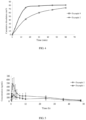
- the comparison of dissolution profiles of Examples 1 and 2 is shown in FIG. 1 ; the comparison of Examples 2 and 3 is shown in FIG. 2 ; the comparison of Examples 2, 4, 5, 6, 7 and 8 is shown in FIG. 3 .
- the comparison of Examples 2 and 9 is shown in FIG. 4 .
- Example 1 The tablets of Examples 1 and 2 were subjected to a bioavailability test in beagle dogs by oral administration (specification: 50 mg, 1 tablet/dog). The test results are shown in FIG. 5 , suggesting that the in vivo bioavailability of the tablets prepared in Example 2 is significantly higher than that of Example 1.
Landscapes
- Health & Medical Sciences (AREA)
- Chemical & Material Sciences (AREA)
- Life Sciences & Earth Sciences (AREA)
- Veterinary Medicine (AREA)
- Public Health (AREA)
- General Health & Medical Sciences (AREA)
- Animal Behavior & Ethology (AREA)
- Medicinal Chemistry (AREA)
- Pharmacology & Pharmacy (AREA)
- Epidemiology (AREA)
- General Chemical & Material Sciences (AREA)
- Chemical Kinetics & Catalysis (AREA)
- Oil, Petroleum & Natural Gas (AREA)
- Engineering & Computer Science (AREA)
- Nuclear Medicine, Radiotherapy & Molecular Imaging (AREA)
- Organic Chemistry (AREA)
- Medicinal Preparation (AREA)
Description
- The present application claims priority and benefit to the
Chinese Patent Application No. 201811021176.X, filed with National Intellectual Property Administration, PRC on Sept. 03, 2018 - The present application relates to the technical field of pharmaceuticals, specifically to a solid pharmaceutical composition comprising the monomethanesulfonate of a 1,3,5-triazine derivative and a preparation method thereof, and more specifically to a solid pharmaceutical composition comprising the monomethanesulfonate of 4-(tert-butoxyamino)-6-(6-(trifluoromethyl)pyridin-2-yl)-N-(2-(trifluoromethyl)pyridin-4-yl)-1,3,5-triazin-2-amine, a preparation method thereof and use thereof, as defined in the appended claims.
- IDH is known as isocitrate dehydrogenase, and is the most important key enzyme in the tricarboxylic acid cycle in cells. It catalyzes the oxidative decarboxylation of isocitrate, producing 2-oxoglutarate (i.e., alpha-ketoglutarate). IDH mutations are found in various tumors (such as glioma, sarcoma, acute myelocytic leukemia and the like), and are located at arginine residues of the catalytic site (IDH1/R132H, IDH2/R140Q, IDH2/R172K). About 15% of acute myeloid leukemia (AML) patients carry IDH2 mutations, with the rate increasing with age.
- International Patent Application No.
WO2017/016513 discloses in Example 3 a compound 4-(tert-butoxyamino) -6-(6-(trifluoromethyl)pyridin-2-yl)-N-(2-(trifluoromethyl)pyridin-4-yl)-1,3,5-triazin-2-amine having the structure of formula I, and a preparation method thereof:
- The compound of formula I is an IDH2 inhibitor and can be used for treating cancer induced by IDH2 mutation, wherein the IDH2 mutation may be IDH2/R140Q and/or IDH2/R172K mutation.
- Oral administration is the most common route of administration for drugs. By oral administration, the drug may be absorbed at a number of sites along the gastrointestinal tract including the stomach, duodenum, jejunum, ileum, and colon. Different chemical environments of the gastrointestinal tract will influence the dissolving and release of the pharmaceutical agent, thereby influencing the absorption of the active substance in the pharmaceutical agent. The pH is 1-3.5 in stomach and 4-8 in small intestine, and may significantly influence pH-dependent solubility and permeability.
- The compound of formula I and the pharmaceutically acceptable salt feature poor solubility in either acidic or basic condition, and is hardly soluble in water. Due to the physicochemical properties of the compound of formula I and the pharmaceutically acceptable salt thereof, the drug features poor hydrophilic and infiltrating characteristics, and is unfavorable for dissolving and absorption of the drug in the gastrointestinal tract after oral administration, resulting in low bioavailability and compromised efficacy. Therefore, there is a need for developing pharmaceutical preparations to satisfy the requirements of efficacy and safety, solubility and bioavailability, and controlled release in clinical use.
- Furthermore,
WO 2018/133856 A1 discloses a crystal of 4-(tert-butoxyamino)-6-(6-(trifluoromethyl)pyridin-2-yl)-N-(2-(trifluoromethyl)pyridin-4-yl)-1,3,5-triazin-2-amine compound, a mesylate salt and crystal thereof, a preparation method thereof, a composition containing the same, and a use thereof for inhibiting activity of mutant IDH2 and treating cancer. - In order to solve the above problems, the present application provides a solid pharmaceutical composition comprising the monomethanesulfonate of a compound of formula I. The solid pharmaceutical composition has good stability, high dissolution rate and bioavailability, and is suitable for manufacturing and clinical use.
- The present invention provides a solid pharmaceutical composition according to
claim 1 and a method for preparing the same according to claim 11. - The above solid pharmaceutical compositions may be used for treating a cancer induced by an IDH2 mutation, including: glioblastoma (neuroglioma), myelodysplastic syndrome (MDS), myeloproliferative neoplasm (MPN), acute myeloid leukemia (AML), sarcoma, melanoma, non-small cell lung cancer, chondrosarcoma, bile duct cancer or angioimmunoblastic non-Hodgkin's lymphoma (NHL). The subject is a mammal, preferably a human.
- The solid pharmaceutical composition disclosed herein comprises 10-100 mg, preferably 30-80 mg, and more preferably 50-60 mg of the monomethanesulfonate of the compound of formula I.
- Alternatively, in the solid pharmaceutical composition, the monomethanesulfonate of the compound of formula Iis present in an amount of 0.5-50 wt%, preferably 0.5-30 wt%, and more preferably 1-25 wt%, based on the total mass of the solid pharmaceutical composition.
- The mixture comprising the monomethanesulfonate of the compound of formula I further comprises a binder, a solubilizer and a diluent.
- In the present invention, the diluent is mannitol. The diluent is present in an amount of 10-90 wt%, preferably 20-85 wt%, 25-80 wt%, 25-75 wt%, 30-75 wt%, 40-75 wt%, 45-75 wt%, 50-75 wt%, 55-75 wt%, or 60-75 wt%, based on the solid pharmaceutical composition.
- In the present invention, the binder is selected from hydroxypropyl methylcellulose, hydroxypropyl cellulose and povidone. The binder is present in an amount of 1-10 wt%, preferably 2 wt%, 2.5 wt%, 3 wt%, 3.5 wt%, 4 wt%, 4.5 wt%, 5 wt%, 5.5 wt%, 6 wt%, 6.5 wt%, 7 wt%, 7.5 wt%, 8 wt%, 8.5 wt%, 9 wt% or 9.5 wt%, based on the solid pharmaceutical composition.
- In some embodiments, the disintegrant is selected from: dry starch, sodium starch glycolate, sodium carboxymethyl starch, low-substituted hydroxypropyl cellulose, methylcellulose, croscarmellose sodium, sodium carboxymethyl cellulose, calcium carboxymethyl cellulose, crospovidone, alginic acid, calcium alginate, sodium alginate, chitosan, colloidal silicon dioxide, glycine, guar gum, magnesium aluminum silicate and povidone; preferably dry starch, sodium starch glycolate, sodium carboxymethyl starch, low-substituted hydroxypropyl cellulose, methylcellulose, crospovidone, croscarmellose sodium, sodium carboxymethyl cellulose and calcium carboxymethyl cellulose; and more preferably croscarmellose sodium, sodium carboxymethyl starch, crospovidone and low substituted hydroxypropyl cellulose. The disintegrant is present in an amount of 1-10 wt%, preferably 2 wt%, 2.5 wt%, 3 wt%, 3.5 wt%, 4 wt%, 4.5 wt%, 5 wt%, 5.5 wt%, 6 wt%, 6.5 wt%, 7 wt%, 7.5 wt%, 8 wt%, 8.5 wt%, 9 wt% or 9.5 wt%, based on the solid pharmaceutical composition.
- In some embodiments, the lubricant is selected from: stearic acid, calcium stearate, sodium stearate, zinc stearate, magnesium stearate, glyceryl monostearate, glyceryl behenate, glyceryl dibehenate, glyceryl tribehenate, palmitoyl stearyl glyceride, leucine, myristic acid, palmitic acid, poloxamer, polyethylene glycol, potassium benzoate, sodium benzoate, sodium lauryl sulfate, magnesium lauryl sulfate, sodium stearyl fumarate and talc powder; preferably, stearic acid, calcium stearate, sodium stearate, zinc stearate, magnesium stearate, glyceryl behenate, sodium lauryl sulfate, magnesium lauryl sulfate, glyceryl monostearate and sodium stearyl fumarate; and more preferably, magnesium stearate, glyceryl behenate, sodium lauryl sulfate and sodium stearyl fumarate. The lubricant is present in an amount of 0.5-5 wt%, preferably 0.8 wt%, 1.0 wt%, 1.2 wt%, 1.5 wt%, 1.8 wt%, 2.0 wt%, 2.2 wt%, 2.5 wt%, 2.8 wt%, 3.0 wt%, 3.2 wt%, 3.5 wt%, 3.8 wt%, 4.0 wt%, 4.2 wt%, 4.5 wt% or 4.8 wt%, based on the solid pharmaceutical composition.
- The solid pharmaceutical composition further comprises a solubilizer selected from sodium dodecyl sulfate and magnesium dodecyl sulfate. The solubilizer is present in an amount of 0.5-5 wt%, preferably 0.8 wt%, 1.0 wt%, 1.2 wt%, 1.5 wt%, 2.0 wt%, 2.2 wt%, 2.5 wt%, 2.8 wt%, 3.0 wt%, 3.2 wt%, 3.5 wt%, 3.8 wt%, 4.0 wt%, 4.2 wt%, 4.5 wt% or 4.8 wt%, based on the solid pharmaceutical composition.
- The solid pharmaceutical compositions disclosed herein may be in a variety of dosage forms suitable for oral administration to human, including, for example, tablets, pills, capsules, powders, granules and the like. In some embodiments, the present invention provides a tablet comprising a tablet core comprising the solid pharmaceutical composition described above. The tablet may be coated or uncoated.
- The coating may be selected from a film coating. The film-forming material of the film coating is selected according to the functions required by the preparation, such as gastric dissolving, enteric dissolving, sustained release, special stability and the like. The film-forming material may be selected from conventional film coating materials, such as hydroxypropyl methylcellulose, hydroxypropyl ethylcellulose, hydroxypropyl cellulose, methylcellulose, hydroxyethyl cellulose, hydroxypropyl methylcellulose acetate succinate, hydroxypropyl methylcellulose phthalate, film-forming acrylic polymers, methacrylic acid-methyl methacrylate copolymers, film-forming vinyl polymers, polyvinyl alcohol and polyvinyl acetate phthalate; may be selected from sustained release coating materials, such as methacrylate copolymer, ethyl cellulose and cellulose acetate; or may be selected from enteric coating materials such as cellulose acetate phthalate, polyvinyl alcohol phthalate, methacrylate copolymer, cellulose acetate trimellitate, hydroxypropyl cellulose phthalate and hydroxypropyl cellulose succinate. The amount of the film-forming material is selected according to the function required by the film coating. Optionally, the film-forming material is present in an amount of 30% to 90%, for example, 30%, 40%, 50%, 60%, 70%, 80% or 90%, based on the film coating by weight. Optionally, the film-forming material is present in an amount of 0.5% to 5%, for example, 0.5%, 1.0%, 1.5%, 2.0%, 2.5%, 3.0%, 3.5%, 4.0%, 4.5% or 5.0%, based on the solid pharmaceutical composition disclosed herein by weight.
- Optionally, the film coating comprises additional components, such as plasticizers, colorants, dispersion aids, or opacifiers. The plasticizers improve the film flexibility and durability as well as the adhesion property of the film coating. Suitable plasticizers include, for example, glycerol, acetylated monoglycerides, citrates (e.g., triethyl citrate), propylene glycol, polyethylene glycols (e.g., polyethylene glycol), triacetin (e.g., glyceryl triacetate), triglycerides (e.g., castor oil), or phthalates (e.g., diethyl phthalate). Typically, the plasticizers, when used, is present in an amount of 1% to 20%, for example, 5% to 15%, based on the film coating by weight. Suitable opacifiers and colorants are well known and include, for example, titanium dioxide, iron sesquioxide (e.g., iron(III) oxide). Suitable dispersion aids include, for example, talc.
- In some embodiments, suitable film coatings may be from commercially available concentrates that can be diluted with water prior to adding to the composition. The concentrate may include cellulose ethers and plasticizers, e.g. , the Opaspray™ coating materials from Colorcon.
- In a non-claimed aspect of the present application, the solid pharmaceutical composition comprising the monomethanesulfonate of the compound of formula I is a solid dispersion. The carrier material of the solid dispersion composition is selected from cellulose derivatives, polyethylene glycol, poloxamer, polyvinylpyrrolidone, copovidone and crospovidone.
- The cellulose-based compound as a carrier material is enteric, and is selected from cellulose acetate phthalate (CAP), hydroxypropyl methylcellulose phthalate (HPMCP), hydroxypropyl methylcellulose acetate succinate (HPMCAS), and carboxymethyl ethyl cellulose (CMEC); preferably, the cellulose-based compound is selected from hydroxypropyl methylcellulose phthalate (HPMCP) and hydroxypropyl methylcellulose acetate succinate (HPMCAS).
- The carrier material is present in an amount of 40-90%, optionally 40%, 45%, 50%, 55%, 60%, 65%, 70%, 75%, 80%, 85% or 90% by weight, preferably 60-80% by weight, and more preferably 70% by weight, based on the solid dispersion by weight.
- The solid dispersion may further comprise a stabilizer, including vitamin E, dibutylhydroxytoluene, butylhydroxyanisole, soy lecithin, ascorbic acid, citric acid, and cysteine hydrochloride; and preferably, vitamin E, ascorbic acid and butylhydroxyanisole. Suitably, the stabilizer is present in an amount of 0.05-0.50%, optionally 0.05%, 0.10%, 0.15%, 0.20%, 0.25%, 0.30%, 0.35%, 0.40%, 0.45%, or 0.50% by weight, preferably 0.10-0.30% by weight, and more preferably 0.20% by weight, based on the solid dispersion by weight.
- The solid dispersion may comprise 10-40 wt% of the monomethanesulfonate of the compound of formula I, 60-80 wt% of a carrier material, and 0.10-0.30 wt% of a stabilizer. The carrier material may be selected from hydroxypropyl methylcellulose phthalate (HPMCP) and hydroxypropyl methylcellulose acetate succinate (HPMCAS); and the stabilizer may be selected from butylhydroxyanisole.
- The solid dispersion may comprise 10-40 wt% of the monomethanesulfonate of the compound of formula I, 60-80 wt% of a carrier material, and 0.10-0.30 wt% of a stabilizer. The carrier material may be selected from hydroxypropyl methylcellulose phthalate (HPMCP) and hydroxypropyl methylcellulose acetate succinate (HPMCAS); and the stabilizer may be selected from butylhydroxyanisole.
- The solid dispersion disclosed herein can be prepared into a general pharmaceutical preparation in the form of, for example, but not limited to, powders, tablets, pills, capsules, or the like, by known methods using excipients as needed such as diluents, disintegrants, binders, lubricants, colorants, suspending agents, sweeteners, surfactants, and the like. Examples of diluent include starch, pregelatinized starch, sucrose, lactose, fructose, maltose, trehalose, pullulan, polydextrose, dextrin, maltodextrin, microcrystalline cellulose, cellulose acetate, ethylcellulose, mannitol, sorbitol, erythritol, isomaltitol, lactitol, maltitol, polyethylene glycol, xylitol, sorbitol, calcium carbonate, calcium phosphate, calcium sulfate, magnesium carbonate, magnesium oxide, sodium carbonate, sodium bicarbonate, sodium chloride, and a mixture of any two or more thereof.
- Examples of disintegrant include dry starch, sodium starch glycolate, sodium carboxymethyl starch, low-substituted hydroxypropyl cellulose, methylcellulose, croscarmellose sodium, sodium carboxymethyl cellulose, calcium carboxymethyl cellulose, crospovidone, alginic acid, calcium alginate, sodium alginate, chitosan, colloidal silicon dioxide, glycine, guar gum, magnesium aluminum silicate and povidone.
- Examples of binder include hydroxypropyl cellulose, hydroxypropyl methylcellulose, polyvinylpyrrolidone, pregelatinized starch, syrup, or starch syrup.
- Examples of lubricant include stearic acid, calcium stearate, sodium stearate, zinc stearate, magnesium stearate, glyceryl monostearate, glyceryl behenate, glyceryl dibehenate, glyceryl tribehenate, palmitoyl stearyl glyceride, leucine, myristic acid, palmitic acid, poloxamer, polyethylene glycol, potassium benzoate, sodium benzoate, sodium lauryl sulfate, magnesium lauryl sulfate, sodium stearyl fumarate or talc powder.
- Examples of colorant include yellow iron oxide, brown iron oxide, red iron oxide, titanium oxide, brilliant blue FCF, rose bengal, or lemon yellow.
- Examples of suspending agent include polysorbate, polyethylene glycol, gum arabic, glycerol or gelatin.
- Examples of sweetener include aspartame, saccharin, sodium saccharin, starch syrup or fructose.
- Examples of the surfactant include sodium dodecyl sulfate, polysorbate, or polyoxyethylene hydrogenated castor oil.
- Capsules can be prepared according to known methods by mixing a solid dispersion of the monomethanesulfonate of the aforementioned compound of formula I with any of the aforementioned excipients, and filling the mixture into hard capsules made of gelatin, hydroxypropyl methylcellulose, polyvinyl alcohol, or the like, or into soft capsules based on gelatin.
- According to the present invention, the solid pharmaceutical composition of the present invention comprising the monomethanesulfonate of the compound of formula I comprises a mixture comprising the monomethanesulfonate of the compound of formula I and a fluidization excipient. In some embodiments, the solid pharmaceutical composition further comprises an additional excipient. According to the present invention, the solid pharmaceutical composition comprising the monomethanesulfonate of the compound of formula I is prepared by fluidized bed granulation.
- In some embodiments, the fluidization excipient comprises a diluent and a disintegrant. In some embodiments, the diluent is selected from: microcrystalline cellulose, lactose, starch, mannitol, xylitol, a mixture of microcrystalline cellulose and lactose, a mixture of microcrystalline cellulose and starch, a mixture of microcrystalline cellulose and mannitol, and a mixture of microcrystalline cellulose and xylitol; and preferably, microcrystalline cellulose, a mixture of microcrystalline cellulose and lactose, and a mixture of microcrystalline cellulose and mannitol. In some embodiments, the disintegrant is selected from: croscarmellose sodium, sodium carboxymethyl starch, crospovidone, and low substituted hydroxypropyl cellulose; and preferably, croscarmellose sodium.
- In some embodiments, the additional excipient comprises a lubricant selected from: magnesium stearate, glyceryl behenate, sodium lauryl sulfate, and sodium stearyl fumarate; and preferably, magnesium stearate.
- The diluent in the mixture comprising the monomethanesulfonate of the compound of formula I is present in an amount of 10-50 wt%, preferably 15-50 wt%, and more preferably 17-35 wt%, based on the total amount of the diluents in the solid pharmaceutical composition.
- According to the present invention, the mixture comprising the monomethanesulfonate of the compound of formula I comprises a binder, a diluent, and a solubilizer. The binder is selected from: hydroxypropyl methylcellulose, hydroxypropyl cellulose, and povidone; and preferably, hydroxypropyl methylcellulose and hydroxypropyl cellulose. The diluent is selected from mannitol. The solubilizer is selected from sodium dodecyl sulfate and magnesium dodecyl sulfate; and preferably, sodium dodecyl sulfate.
- In some embodiments, the mixture comprising the monomethanesulfonate of the compound of formula I further comprises hydroxypropyl methylcellulose, mannitol and sodium dodecyl sulfate. In some embodiments, hydroxypropyl methylcellulose in the mixture is generally present in an amount of 1-10 wt%, preferably 1-5 wt%, and more preferably 2-5 wt%, based on the total mass of the solid pharmaceutical composition. In some embodiments, mannitol in the mixture is generally present in an amount of 1-45 wt%, preferably 5-30 wt%, and more preferably 5-20 wt%, based on the total mass of the solid pharmaceutical composition. In a specific embodiment, the mass ratio of the compound of formula I or the pharmaceutically acceptable salt thereof to mannitol in the mixture is generally 1:1 to 1:10, preferably 1:1 to 1:5, and more preferably 1:1 to 1:2. In some embodiments, sodium dodecyl sulfate in the mixture is generally present in an amount of 0.5-5 wt%, preferably 0.5-2 wt%, and more preferably 0.5-1 wt%, based on the total mass of the solid pharmaceutical composition.
- In some embodiments, the mixture comprising the monomethanesulfonate of the compound of formula I further comprises hydroxypropyl cellulose, mannitol and sodium dodecyl sulfate. In some embodiments, hydroxypropyl cellulose in the mixture is generally present in an amount of 1-10 wt%, preferably 1-5 wt%, and more preferably 2-5 wt%, based on the total mass of the solid pharmaceutical composition. In some embodiments, mannitol in the mixture is generally present in an amount of 1-45 wt%, preferably 5-30 wt%, and more preferably 5-20 wt%, based on the total mass of the solid pharmaceutical composition. In a specific embodiment, the mass ratio of the compound of formula I or the pharmaceutically acceptable salt thereof to mannitol in the mixture is generally 1:1 to 1:10, preferably 1:1 to 1:5, and more preferably 1:1 to 1:2. In some embodiments, sodium dodecyl sulfate in the suspension is generally present in an amount of 0.5-5 wt%, preferably 0.5-2 wt%, and more preferably 0.5-1 wt%, based on the total mass of the solid pharmaceutical composition.
- In some embodiments, the fluidization excipient comprises a diluent and a disintegrant. The diluent is selected from: microcrystalline cellulose, lactose, starch, mannitol, xylitol, a mixture of microcrystalline cellulose and lactose, a mixture of microcrystalline cellulose and starch, a mixture of microcrystalline cellulose and mannitol, and a mixture of microcrystalline cellulose and xylitol; and preferably, microcrystalline cellulose, a mixture of microcrystalline cellulose and lactose, and a mixture of microcrystalline cellulose and mannitol. In some embodiments, the disintegrant is selected from: croscarmellose sodium, sodium carboxymethyl starch, crospovidone, and low substituted hydroxypropyl cellulose; and preferably, croscarmellose sodium.
- In some embodiments, when the diluent in the fluidization excipient is a mixture of microcrystalline cellulose and another diluent, the another diluent may or may not be of the same kind as that of the diluent in the mixture comprising the monomethanesulfonate of the compound of formula I; preferably, the diluents are of the same kind. In some embodiments, the fluidization excipient comprises microcrystalline cellulose and croscarmellose sodium. In some embodiments, the fluidization excipient comprises microcrystalline cellulose, mannitol and croscarmellose sodium. In a specific embodiment, the mass ratio of microcrystalline cellulose to mannitol in the fluidization excipient is 1:1 to 9:1, preferably 1:1 to 5:1, and more preferably 2:1 to 4:1.
- In some embodiments, the additional excipient comprises a lubricant. The lubricant is selected from: magnesium stearate, glyceryl behenate, sodium lauryl sulfate, and sodium stearyl fumarate; and preferably, magnesium stearate.
- In another aspect, the present application provides a method for preparing a solid pharmaceutical composition comprising the monomethanesulfonate of the compound of formula I, the method being fluidized bed granulation, as claimed in claim 11.
- In a preferred embodiment, the method further comprises a step (5), mixing an additional excipient with the sized materials.
- In step (1) of the method, the solvent of the suspension is selected from: methanol, ethanol, isopropanol, acetone, water, and any combination thereof; preferably, water and a mixture of ethanol and water; and more preferably, water. In in step (1) of the method, the mass ratio of active ingredient to solvent in the suspension is 1:5 to 1:20, preferably 1:5 to 1:15, and more preferably 1:5 to 1:10.
- According to the present invention, in addition to the active ingredient, the suspension of step (1) comprises a binder, a diluent, and a solubilizer. According to the present invention, the binder is selected from: hydroxypropyl methylcellulose, hydroxypropyl cellulose, and povidone; and preferably, hydroxypropyl methylcellulose and hydroxypropyl cellulose. According to the present invention, the diluent is selected from mannitol. According to the present invention, the solubilizer is selected from sodium dodecyl sulfate and magnesium dodecyl sulfate; and preferably, sodium dodecyl sulfate.
- In some preferred embodiments, in step (1), the monomethanesulfonate of the compound of formula I is first mixed with the binder, the diluent and/or the solubilizer to give a mixture comprising the monomethanesulfonate of the compound of formula I, and then the mixture is mixed with the solvent to give the suspension comprising the monomethanesulfonate of the compound of formula I.
- In some embodiments, in step (2), the fluidization excipient comprises a diluent and a disintegrant. In some embodiments, the diluent is selected from: microcrystalline cellulose, lactose, starch, mannitol, xylitol, a mixture of microcrystalline cellulose and lactose, a mixture of microcrystalline cellulose and starch, a mixture of microcrystalline cellulose and mannitol, and a mixture of microcrystalline cellulose and xylitol; and preferably, microcrystalline cellulose, a mixture of microcrystalline cellulose and lactose, and a mixture of microcrystalline cellulose and mannitol. In some embodiments, the disintegrant is selected from: croscarmellose sodium, sodium carboxymethyl starch, crospovidone, and low substituted hydroxypropyl cellulose; and preferably, croscarmellose sodium.
- In some embodiments, in step (5), the additional excipient comprises a lubricant selected from: magnesium stearate, glyceryl behenate, sodium lauryl sulfate, and sodium stearyl fumarate; and preferably, magnesium stearate.
- The diluent in the step (1) is present in an amount of 10-50 wt%, preferably 15-50 wt%, and more preferably 17-35 wt%, based on the total amount of the diluents in the solid pharmaceutical composition.
- In some embodiments, the method for preparing the solid pharmaceutical composition comprising the monomethanesulfonate of the compound of formula I comprises: (1) preparing a suspension comprising the monomethanesulfonate of the compound of formula I, a binder, a diluent and a solubilizer as claimed; (2) mixing a diluent with a disintegrant to give a fluidization excipient; (3) placing the fluidization excipient of step (2) into a fluidized bed reactor, and spraying the suspension of step (1) into the fluidized bed for granulation; and (4) sizing. In some embodiments, the preparation method comprises a step (5), mixing a lubricant with the sized material. In some embodiments, the disintegrant is selected from: croscarmellose sodium, sodium carboxymethyl starch, crospovidone, and low substituted hydroxypropyl cellulose; and preferably, croscarmellose sodium. In some embodiments, the lubricant is selected from: magnesium stearate, glyceryl behenate, sodium lauryl sulfate, and sodium stearyl fumarate; and preferably, magnesium stearate.
- In some embodiments, in the method for preparing a solid pharmaceutical composition comprising the monomethanesulfonate of the compound of formula I, the air input in the fluidized bed reactor is 200-1000 m3/h, preferably 500-800 m3/h.
- In some embodiments, in the method for preparing a solid pharmaceutical composition comprising the monomethanesulfonate of the compound of formula I, the air input temperature in the fluidized bed reactor is 40-80 °C, preferably 60-75 °C.
- In some embodiments, in the method for preparing a solid pharmaceutical composition comprising the monomethanesulfonate of the compound of formula I, the suspension is sprayed into the fluidized bed at an atomization pressure of 1-5 bar, preferably 1.5-3 bar.
- In the method for preparing a solid pharmaceutical composition comprising the compound of formula I or the pharmaceutically acceptable salt thereof, the fluidized bed granulation process further comprises drying to remove the solvent from the suspension, as needed after step (3). The temperature for drying is 40-75 °C, and preferably 60-75 °C.
- In some embodiments, the mass ratio of the monomethanesulfonate of the compound of formula I to the solvent in the suspension is 1:5 to 1:20, preferably 1:5 to 1:15, and more preferably 1:5 to 1:10.
- In some embodiments, the monomethanesulfonate of the compound of formula I is present in an amount of 0.5-50 wt%, preferably 0.5-30 wt%, and more preferably 1-25 wt%, based on the total mass of the solid pharmaceutical composition.
- In some non-claimed aspects, the suspension comprising the monomethanesulfonate of the compound of formula I further comprises hydroxypropyl methylcellulose and mannitol. The hydroxypropyl methylcellulose in the suspension is generally present in an amount of 1-10 wt%, preferably 1-5 wt%, and more preferably 2-5 wt%, based on the total mass of the solid pharmaceutical composition. The mannitol in the suspension is generally present in an amount of 1-45 wt%, preferably 5-30 wt%, more preferably 5-20 wt%, based on the total mass of the solid pharmaceutical composition. The mass ratio of the monomethanesulfonate of the compound of formula I to mannitol in the suspension is generally 1:0.5 to 1:10, preferably 1:0.5 to 1:5, and more preferably 1:0.5 to 1:2.
- In some non-claimed aspects, the suspension comprising the monomethanesulfonate of the compound of formula I further comprises hydroxypropyl methylcellulose and sodium dodecyl sulfate. The hydroxypropyl methylcellulose in the suspension is generally present in an amount of 1-10 wt%, preferably 1-5 wt%, and more preferably 2-5 wt%, based on the total mass of the solid pharmaceutical composition. The sodium dodecyl sulfate in the suspension is generally present in an amount of 0.5-5 wt%, preferably 0.5-2 wt%, and more preferably 0.5-1 wt%, based on the total mass of the solid pharmaceutical composition.
- In some embodiments, the suspension comprising the monomethanesulfonate of the compound of formula I further comprises hydroxypropyl methylcellulose, mannitol and sodium dodecyl sulfate. In some embodiments, hydroxypropyl methylcellulose in the suspension is generally present in an amount of 1-10 wt%, preferably 1-5 wt%, and more preferably 2-5 wt%, based on the total mass of the solid pharmaceutical composition. In some embodiments, mannitol in the suspension is generally present in an amount of 1-45 wt%, preferably 5-30 wt%, and more preferably 5-20 wt%, based on the total mass of the solid pharmaceutical composition. In a specific embodiment, the mass ratio of the monomethanesulfonate of the compound of formula I to mannitol in the suspension is generally 1:1 to 1:10, preferably 1:1 to 1:5, and more preferably 1:1 to 1:2. In some embodiments, sodium dodecyl sulfate in the suspension is generally present in an amount of 0.5-5 wt%, preferably 0.5-2 wt%, and more preferably 0.5-1 wt%, based on the total mass of the solid pharmaceutical composition.
- In some embodiments, the suspension comprising the monomethanesulfonate of the compound of formula I further comprises hydroxypropyl cellulose, mannitol, and sodium dodecyl sulfate. In some embodiments, hydroxypropyl cellulose in the suspension is generally present in an amount of 1-10 wt%, preferably 1-5 wt%, and more preferably 2-5 wt%, based on the total mass of the solid pharmaceutical composition. In some embodiments, mannitol in the suspension is generally present in an amount of 1-45 wt%, preferably 5-30 wt%, and more preferably 5-20 wt%, based on the total mass of the solid pharmaceutical composition. In a specific embodiment, the mass ratio of the monomethanesulfonate of the compound of formula I to mannitol in the suspension is generally 1:1 to 1:10, preferably 1:1 to 1:5, and more preferably 1:1 to 1:2. In some embodiments, sodium dodecyl sulfate in the suspension is generally present in an amount of 0.5-5 wt%, preferably 0.5-2 wt%, and more preferably 0.5-1 wt%, based on the total mass of the solid pharmaceutical composition.
- In some embodiments, the fluidization excipient comprises a diluent and a disintegrant. The diluent is selected from: microcrystalline cellulose, lactose, starch, mannitol, xylitol, a mixture of microcrystalline cellulose and lactose, a mixture of microcrystalline cellulose and starch, a mixture of microcrystalline cellulose and mannitol, and a mixture of microcrystalline cellulose and xylitol; and preferably, microcrystalline cellulose, a mixture of microcrystalline cellulose and lactose, and a mixture of microcrystalline cellulose and mannitol. In some embodiments, the disintegrant is selected from: croscarmellose sodium, sodium carboxymethyl starch, crospovidone, and low substituted hydroxypropyl cellulose; and preferably, croscarmellose sodium.
- In some embodiments, when the diluent in the fluidization excipient is a mixture of microcrystalline cellulose and another diluent, the another diluent may or may not be of the same kind as that of the diluent in the suspension comprising the monomethanesulfonate of the compound of formula I; preferably, the diluents are of the same kind. In some embodiments, the fluidization excipient comprises microcrystalline cellulose and croscarmellose sodium. In some embodiments, the fluidization excipient comprises microcrystalline cellulose, mannitol and croscarmellose sodium. In a specific embodiment, the mass ratio of microcrystalline cellulose to mannitol in the fluidization excipient is 1:1 to 9:1, preferably 1:1 to 5:1, and more preferably 2:1 to 4:1.
- In some embodiments, the additional excipient comprises a lubricant. The lubricant is selected from: magnesium stearate, glyceryl behenate, sodium lauryl sulfate, and sodium stearyl fumarate; and preferably, magnesium stearate. In some embodiments, the solid pharmaceutical composition comprising the monomethanesulfonate of the compound of formula I disclosed herein may comprise: a mixture comprising monomethanesulfonate of the compound of formula I, hydroxypropyl methylcellulose, mannitol, and sodium dodecyl sulfate; a fluidization excipient comprising microcrystalline cellulose and croscarmellose sodium; and an additional excipient comprising magnesium stearate. In some embodiments, the solid pharmaceutical composition comprising the monomethanesulfonate of the compound of formula I is prepared by fluidized bed granulation.
- In some embodiments, the solid pharmaceutical composition comprising the monomethanesulfonate of the compound of formula I disclosed herein may comprise: a mixture comprising monomethanesulfonate of the compound of formula I, hydroxypropyl methylcellulose, mannitol, and sodium dodecyl sulfate; a fluidization excipient comprising microcrystalline cellulose, mannitol and croscarmellose sodium; and an additional excipient comprising magnesium stearate. In some embodiments, the solid pharmaceutical composition comprising the monomethanesulfonate of the compound of formula I is prepared by fluidized bed granulation.
- In some embodiments, the solid pharmaceutical composition comprising the monomethanesulfonate of the compound of formula I disclosed herein may comprise: a mixture comprising monomethanesulfonate of the compound of formula I, hydroxypropyl cellulose, mannitol, and sodium dodecyl sulfate; a fluidization excipient comprising microcrystalline cellulose and croscarmellose sodium; and an additional excipient comprising magnesium stearate. In some embodiments, the solid pharmaceutical composition comprising the monomethanesulfonate of the compound of formula I is prepared by fluidized bed granulation.
- In some embodiments, the solid pharmaceutical composition comprising the monomethanesulfonate of the compound of formula I disclosed herein may comprise: a mixture comprising monomethanesulfonate of the compound of formula I, hydroxypropyl cellulose, mannitol, and sodium dodecyl sulfate; a fluidization excipient comprising microcrystalline cellulose, mannitol and croscarmellose sodium; and an additional excipient comprising magnesium stearate. In some embodiments, the solid pharmaceutical composition comprising the monomethanesulfonate of the compound of formula I is prepared by fluidized bed granulation.
- In some embodiments, the method for preparing the solid pharmaceutical composition comprising the monomethanesulfonate of the compound of formula I further comprises tableting; preferably, the method further comprises coating.
- In the present application, the total mass of the solid pharmaceutical composition is on a dry basis, which does not include the solvents used in the preparation.
- In the present application, sizing refers to the arrangement and classification of the dried granules for dispersing the agglomerated and adhered granules so as to give uniform granules with a certain particle size range. One of the common methods for sizing is sieving.
- The solid pharmaceutical compositions of the monomethanesulfonate of the compound of formula I disclosed herein have the following advantages: when the suspension comprising the active ingredient comprises a diluent, the components of the solid pharmaceutical composition comprising the monomethanesulfonate of the compound of formula I, by fluidized bed granulation, can solve the problem of poor dissolution rate due to the insolubility of the monomethanesulfonate of the compound of formula I. Especially, since the diluent is mannitol, the dissolution rate is significantly improved. Since the suspension comprises both diluent and solubilizer, the dissolution rate is improved to a most significant extent.
-
-
FIG. 1 illustrates the comparison of dissolution profiles of tablets according to Examples 1 and 2. -
FIG. 2 illustrates the comparison of dissolution profiles of tablets according to Examples 2 and 3. -
FIG. 3 illustrates the comparison of dissolution profiles of tablets according to Examples 2, 4, 5, 6, 7 and 8. -
FIG. 4 illustrates the comparison of dissolution profiles of tablets according to Examples 2 and 9. -
FIG. 5 illustrates the comparison of the in vivo bioavailability of tablets according to Examples 1 and 2. - The following specific examples are intended to allow those skilled in the art to clearly understand and implement the present application. They should not be construed as limiting the scope of the present application, but as exemplary and representative illustrations of the present application.
- The monomethanesulfonate of the compound of formula I, microcrystalline cellulose, mannitol, hydroxypropyl methylcellulose, croscarmellose sodium and sodium dodecyl sulfate were sieved and mixed. The mixture was subjected to dry granulation and sizing, added with magnesium stearate and mixed well. Tablets were formed by dry tableting using a tableting machine. The feeding amount of materials was for 200 tablets, each tablet containing 50 mg of the compound of formula I. The formulation is shown in Table 1 below:
Table 1 Components Content, mg/tablet Content, wt% Monomethanesulfonate of compound of formula I 60 20 Microcrystalline cellulose 132 44 Mannitol 72 24 Hydroxypropyl methylcellulose 6 2 Croscarmellose sodium 24 8 Sodium dodecyl sulfate 3 1 Magnesium stearate 3 1 In total 300 100 - Hydroxypropyl methylcellulose, mannitol and sodium dodecyl sulfate were dissolved in 540 mg of water. The monomethanesulfonate of the compound of formula I was added, and the mixture was sheared for dispersing to prepare a suspension. Microcrystalline cellulose and croscarmellose sodium were sieved and mixed to give a fluidization excipient for use. The suspension was sprayed to the fluidization excipient in a fluidized bed reactor, and the resulting fluid was subjected to granulating, in which the air input was controlled at 600 m3/h, air input temperature at 70 °C, and atomization pressure at 2.5 bar. The granules were dried with the temperature controlled at 75 °C or less and the water content ≤ 2.0%. The granules were sieved for sizing. Magnesium stearate was added before mixing well and tableting. The feeding amount of materials was for 200 tablets, each tablet containing 50 mg of the compound of formula I. The formulation is shown in Table 2 below:
Table 2 Procedure Components Content, mg/tablet Content, wt% Suspension preparation Monomethanesulfonate of compound of formula I 60 19.8 Hydroxypropyl methylcellulose 6 2 Mannitol 72 23.8 Sodium dodecyl sulfate 3 1 Fluidization excipient Microcrystalline cellulose 135 44.5 Croscarmellose sodium 24 7.9 Additional excipient Magnesium stearate 3 1 In total 303 100 - Mannitol and hydroxypropyl methylcellulose were dissolved in 540 mg of water. The monomethanesulfonate of the compound of formula I was added, and the mixture was sheared for dispersing to prepare a suspension. Microcrystalline cellulose and croscarmellose sodium were sieved and mixed to give a fluidization excipient for use. The suspension was sprayed to the fluidization excipient in a fluidized bed reactor, and the resulting fluid was subjected to granulating, in which the air input was controlled at 650 m3/h, air input temperature at 65 °C, and atomization pressure at 2.0 bar. The granules were dried with the temperature controlled at 75 °C or less and the water content ≤ 2.0%. The granules were sieved for sizing. Magnesium stearate was added before mixing well and tableting. The feeding amount of materials was for 200 tablets, each tablet containing 50 mg of the compound of formula I. The formulation is shown in Table 3 below:
Table 3 Procedure Components Example 3 Content, wt% Suspension preparation Monomethanesulfonate of compound of formula I 60 20 Hydroxypropyl methylcellulose 6 2 Mannitol 72 24 Fluidization excipient Microcrystalline cellulose 135 45 Croscarmellose sodium 24 8 Additional excipient Magnesium stearate 3 1 In total 300 100 - Hydroxypropyl methylcellulose and sodium dodecyl sulfate were dissolved in 540 mg of water. The monomethanesulfonate of the compound of formula I was added, and the mixture was sheared for dispersing to prepare a suspension. Microcrystalline cellulose and croscarmellose sodium were sieved and mixed to give a fluidization excipient for use. The suspension was sprayed to the fluidization excipient in a fluidized bed reactor, and the resulting fluid was subjected to granulating, in which the air input was controlled at 600 m3/h, air input temperature at 68 °C, and atomization pressure at 2.0 bar. The granules were dried with the temperature controlled at 75 °C or less and the water content ≤ 2.0%. The granules were sieved for sizing. Magnesium stearate was added before mixing well and tableting. The feeding amount of materials was for 200 tablets, each tablet containing 50 mg of the compound of formula I. The formulation is shown in Table 4 below:
Table 4 Procedure Components Example 4 Content, wt% Suspension preparation Monomethanesulfonate of compound of formula I 60 19.8 Hydroxypropyl methylcellulose 6 2 Sodium dodecyl sulfate 3 1 Fluidization excipient Microcrystalline cellulose 207 68.3 Croscarmellose sodium 24 7.9 Additional excipient Magnesium stearate 3 1 In total 303 100 - Hydroxypropyl methylcellulose and sodium dodecyl sulfate were dissolved in 540 mg of water. The monomethanesulfonate of the compound of formula I was added, and the mixture was sheared for dispersing to prepare a suspension. Microcrystalline cellulose, mannitol and croscarmellose sodium were sieved and mixed to give a fluidization excipient for use. The suspension was sprayed to the fluidization excipient in a fluidized bed reactor, and the resulting fluid was subjected to granulating, in which the air input was controlled at 700 m3/h, air input temperature at 65 °C, and atomization pressure at 2.5 bar. The granules were dried with the temperature controlled at 75 °C or less and the water content ≤ 2.0%. The granules were sieved for sizing. Magnesium stearate was added before mixing well and tableting. The feeding amount of materials was for 200 tablets, each tablet containing 50 mg of the compound of formula I. The formulation is shown in Table 5 below:
Table 5 Procedure Components Example 5 Content, wt% Suspension preparation Monomethanesulfonate of compound of formula I 60 19.8 Hydroxypropyl methylcellulose 6 2 Sodium dodecyl sulfate 3 1 Fluidization excipient Microcrystalline cellulose 135 44.5 Mannitol 72 23.8 Croscarmellose sodium 24 7.9 Additional excipient Magnesium stearate 3 1 In total 303 100 - Hydroxypropyl methylcellulose, mannitol and sodium dodecyl sulfate were dissolved in 540 mg of water. The monomethanesulfonate of the compound of formula I was added, and the mixture was sheared for dispersing to prepare a suspension. Microcrystalline cellulose, mannitol and croscarmellose sodium were sieved and mixed to give a fluidization excipient for use. The suspension was sprayed to the fluidization excipient in a fluidized bed reactor, and the resulting fluid was subjected to granulating, in which the air input was controlled at 700 m3/h, air input temperature at 75 °C, and atomization pressure at 2.5 bar. The granules were dried with the temperature controlled at 75 °C or less and the water content ≤ 2.0%. The granules were sieved for sizing. Magnesium stearate was added before mixing well and tableting. The feeding amount of materials was for 200 tablets, each tablet containing 50 mg of the compound of formula I. The formulation is shown in Table 6 below:
Table 6 Procedure Components Example 6 Content, wt% Suspension preparation Monomethanesulfonat e of compound of formula I 60 19.8 Hydroxypropyl methylcellulose 6 2 Mannitol 36 11.9 Sodium dodecyl sulfate 3 1 Fluidizatio n excipient Microcrystalline cellulose 135 44.5 Mannitol 36 11.9 Croscarmellose sodium 24 7.9 Additional excipient Magnesium stearate 3 1 In total 303 100 - Hydroxypropyl methylcellulose, mannitol and sodium dodecyl sulfate were dissolved in 540 mg of water. The monomethanesulfonate of the compound of formula I was added, and the mixture was sheared for dispersing to prepare a suspension. Microcrystalline cellulose and croscarmellose sodium were sieved and mixed to give a fluidization excipient for use. The suspension was sprayed to the fluidization excipient in a fluidized bed reactor, and the resulting fluid was subjected to granulating, in which the air input was controlled at 800 m3/h, air input temperature at 75 °C, and atomization pressure at 1.5 bar. The granules were dried with the temperature controlled at 75 °C or less and the water content ≤ 2.0%. The granules were sieved for sizing. Magnesium stearate was added before mixing well and tableting. The feeding amount of materials was for 200 tablets, each tablet containing 50 mg of the compound of formula I. The formulation is shown in Table 7 below:
Table 7 Procedure Components Example 7 Content, wt% Suspension preparation Monomethanesulfonate of compound of formula I 60 19.6 Hydroxypropyl methylcellulose 6 2 Mannitol 60 19.6 Sodium dodecyl sulfate 3 1 Fluidization excipient Microcrystalline cellulose 150 49 Croscarmellose sodium 24 7.8 Additional excipient Magnesium stearate 3 1 In total 306 100 - Hydroxypropyl methylcellulose, lactose and sodium dodecyl sulfate were dissolved in 540 mg of water. The monomethanesulfonate of the compound of formula I was added, and the mixture was sheared for dispersing to prepare a suspension. Microcrystalline cellulose and croscarmellose sodium were sieved and mixed to give a fluidization excipient for use. The suspension was sprayed to the fluidization excipient in a fluidized bed reactor, and the resulting fluid was subjected to granulating, in which the air input was controlled at 700 m3/h, air input temperature at 70 °C, and atomization pressure at 1.5 bar. The granules were dried with the temperature controlled at 75 °C or less and the water content ≤ 2.0%. The granules were sieved for sizing. Magnesium stearate was added before mixing well and tableting. The feeding amount of materials was for 200 tablets, each tablet containing 50 mg of the compound of formula I. The formulation is shown in Table 8 below:
Table 8 Procedure Components Example 8 Content, wt% Suspension preparation Monomethanesulfonate of compound of formula I 60 19.8 Hydroxypropyl methylcellulose 6 2 Lactose 72 23.8 Sodium dodecyl sulfate 3 1 Fluidization excipient Microcrystalline cellulose 135 44.5 Croscarmellose sodium 24 7.9 Additional excipient Magnesium stearate 3 1 In total 303 100 - Hydroxypropyl cellulose, sodium dodecyl sulfate and mannitol were dissolved in 540 mg of water. The monomethanesulfonate of the compound of formula I was added, and the mixture was sheared for dispersing to prepare a suspension. Microcrystalline cellulose and croscarmellose sodium were sieved and mixed to give a fluidization excipient for use. The suspension was sprayed to the fluidization excipient in a fluidized bed reactor, and the resulting fluid was subjected to granulating, in which the air input was controlled at 750 m3/h, air input temperature at 75 °C, and atomization pressure at 2.5 bar. The granules were dried with the temperature controlled at 75 °C or less and the water content ≤ 2.0%. The granules were sieved for sizing. Magnesium stearate was added before mixing well and tableting. The feeding amount of materials was for 200 tablets, each tablet containing 50 mg of the compound of formula I. The formulation is shown in Table 9 below:
Table 9 Procedure Components Example 9 Content, wt% Suspension preparation Monomethanesulfonate of compound of formula I 60 19.8 Hydroxypropyl cellulose 6 2 Mannitol 72 23.8 Sodium dodecyl sulfate 3 1 Fluidization excipient Microcrystalline cellulose 135 44.5 Croscarmellose sodium 24 7.9 Additional excipient Magnesium stearate 3 1 In total 303 303 - The tablets of Examples 1 and 2 were stored at 40 °C and 75% relative humidity for 3 months before the total impurities and dissolution rate were measured. Dissolution rate was measured according to the Method 2 (paddle, 0.1 M hydrochloric acid medium, 1000 mL, 75 rpm) of General Chapter 0931, Chinese Pharmacopoeia, Volume IV, 2015 Edition. The stability results are shown in Table 10.
Table 10. Stability results of Examples 1 and 2 Time Example 1 Example 2 Total impurities Dissolution rate Total impurities Dissolution rate Month 0 0.15% 50 0.19% 86 Month 10.25% 30 0.23% 80 Month 20.30% 31 0.25% 81 Month 30.45% 30 0.27% 80 - The results in Table 10 show that: for the tablets of Example 1, the total impurities increased and the dissolution rate decreased significantly over time; whereas the tablets of example 2 substantially showed no increase in total impurities and no decrease in dissolution rate over time.
- The dissolution profiles for tablets from Examples 1-9 were measured according to the Method 2 (paddle, 0.1 M hydrochloric acid medium, 1000 mL, 75 rpm) of General Chapter 0931, Chinese Pharmacopoeia, Volume IV, 2015 Edition. The comparison of dissolution profiles of Examples 1 and 2 is shown in
FIG. 1 ; the comparison of Examples 2 and 3 is shown inFIG. 2 ; the comparison of Examples 2, 4, 5, 6, 7 and 8 is shown inFIG. 3 . The comparison of Examples 2 and 9 is shown inFIG. 4 . - The tablets of Examples 1 and 2 were subjected to a bioavailability test in beagle dogs by oral administration (specification: 50 mg, 1 tablet/dog). The test results are shown in
FIG. 5 , suggesting that the in vivo bioavailability of the tablets prepared in Example 2 is significantly higher than that of Example 1.
Claims (15)
- A solid pharmaceutical composition, comprising a mixture comprising monomethanesulfonate of a compound of formula I, and a fluidization excipient, wherein the mixture comprising the monomethanesulfonate of the compound of formula I further comprises a binder, a solubilizer and a diluent;
 wherein the solid pharmaceutical composition comprises 10-100 mg of the monomethanesulfonate of the compound of formula I; or alternatively, the monomethanesulfonate of the compound of formula I is present in an amount of 0.5-50 wt%, preferably 0.5-30 wt%, and more preferably 1-25 wt%, based on the total mass of the solid pharmaceutical composition;wherein the binder is selected from hydroxypropyl methylcellulose, hydroxypropyl cellulose and povidone; the solubilizer is selected from sodium dodecyl sulfate and magnesium dodecyl sulfate; and the diluent is selected from mannitol,wherein the solid pharmaceutical composition is prepared by fluidized bed granulation.
 - The solid pharmaceutical composition according to claim 1, wherein the solid pharmaceutical composition further comprises an additional excipient.
- The solid pharmaceutical composition according to claim 1 or 2, wherein the fluidization excipient comprises a diluent and a disintegrant.
- The solid pharmaceutical composition according to claim 1 or 2, wherein the diluent in the solid pharmaceutical composition is present in an amount of 10-90 wt%, preferably 20-85 wt%, 25-80 wt%, 25-75 wt%, 30-75 wt%, 40-75 wt%, 45-75 wt%, 50-75 wt%, 55-75 wt%, or 60-75 wt%, based on the solid pharmaceutical composition.
- The solid pharmaceutical composition according to claim 4, wherein the diluent in the mixture comprising the monomethanesulfonate of the compound of formula I is present in an amount of 10-50 wt%, preferably 15-50 wt%, and more preferably 17-35 wt%, based on the total amount of diluents in the solid pharmaceutical composition; or, mannitol in the mixture comprising the monomethanesulfonate of the compound of formula I is present in an amount of 1-45 wt%, preferably 5-30 wt%, more preferably 5-20 wt%, based on the total mass of the solid pharmaceutical composition; or, the mass ratio of the monomethanesulfonate of the compound of formula I to mannitol in the mixture is 1:0.5 to 1:10, preferably 1:0.5 to 1:5, and more preferably 1:0.5 to 1:2.
- The solid pharmaceutical composition according to claim 1 or 2, wherein the binder in the mixture comprising the monomethanesulfonate of the compound of formula I is selected from hydroxypropyl methylcellulose and hydroxypropyl cellulose; and preferably, the binder is present in an amount of 1-10 wt%, based on the solid pharmaceutical composition.
- The solid pharmaceutical composition according to claim 1 or 2, wherein the solubilizer in the mixture comprising the monomethanesulfonate of the compound of formula I is sodium dodecyl sulfate; and preferably, the solubilizer is present in an amount of 0.5-5 wt%, based on the solid pharmaceutical composition.
- The solid pharmaceutical composition according to claim 3, wherein the diluent in the fluidization excipient is selected from microcrystalline cellulose, lactose, starch, mannitol, xylitol, a mixture of microcrystalline cellulose and lactose, a mixture of microcrystalline cellulose and starch, a mixture of microcrystalline cellulose and mannitol, and a mixture of microcrystalline cellulose and xylitol; and the disintegrant in the fluidization excipient is selected from croscarmellose sodium, sodium carboxymethyl starch, crospovidone and low substituted hydroxypropyl cellulose, and the disintegrant is present in an amount of 1-10 wt%, based on the solid pharmaceutical composition.
- The solid pharmaceutical composition according to claim 2, wherein the additional excipient comprises a lubricant; and preferably, the lubricant is selected from magnesium stearate, glyceryl behenate, sodium lauryl sulfate, and sodium stearyl fumarate; and the lubricant is present in an amount of 0.5-5 wt%, based on the solid pharmaceutical composition.
- The solid pharmaceutical composition according to claim 1 or 2, wherein the solid pharmaceutical compositions is a tablet, pill, capsule, powder, or granule, and preferably a tablet; and preferably, the tablet is coated or uncoated.
- A method for preparing the solid pharmaceutical composition according to any one of claims 1-10, wherein the method is fluidized bed granulation, comprising: (1) preparing a suspension comprising the monomethanesulfonate of the compound of formula I, the suspension further comprises a binder selected from hydroxypropyl methylcellulose, hydroxypropyl cellulose and povidone, a solubilizer selected from sodium dodecyl sulfate and magnesium dodecyl sulfate, and a diluent selected from mannitol; (2) preparing a fluidization excipient; (3) placing the fluidization excipient into a fluidized bed, and spraying the suspension comprising the monomethanesulfonate of the compound of formula I into the fluidized bed for granulation; (4) sizing; and optionally (5) mixing an additional excipient with the sized materials;
wherein, in step (1), a solvent of the suspension is selected from methanol, ethanol, isopropanol, acetone, water, and any combination thereof; and preferably, the mass ratio of the monomethanesulfonate of the compound of formula I to the solvent in the suspension is 1:(5-20). - The method according to claim 11, wherein in step (1), the monomethanesulfonate of the compound of formula I is first mixed with the binder, the diluent and the solubilizer to give a mixture comprising the monomethanesulfonate of the compound of formula I, and then the mixture is mixed with the solvent to give the suspension comprising the monomethanesulfonate of the compound of formula I.
- The method according to claim 11 or 12, comprising (1) preparing the suspension comprising the monomethanesulfonate of the compound of formula I, the binder, the diluent and the solubilizer; (2) mixing a diluent with a disintegrant to give the fluidization excipient; (3) placing the fluidization excipient of step (2) into a fluidized bed reactor, and spraying the suspension of step (1) into the fluidized bed for granulation; (4) sizing; and optionally (5) mixing a lubricant with a sized material from step (4).
- The method according to claim 13, wherein, in step (3), a air input in the fluidized bed reactor is 200-1000 m3/h, preferably 500-800 m3/h; a air input temperature in the fluidized bed reactor is 40-80 °C, preferably 60-75 °C; and the suspension is sprayed into the fluidized bed at an atomization pressure of 1-5 bar, preferably 1.5-3 bar.
- The method according to claim 11 or 12, wherein after step (3), the granulation process in the fluidized bed further comprises drying to remove the solvent from the suspension; and preferably, the temperature for drying is 40-75 °C, and preferably 60-75 °C.
Applications Claiming Priority (2)
| Application Number | Priority Date | Filing Date | Title |
|---|---|---|---|
| CN201811021176 | 2018-09-03 | ||
| PCT/CN2019/104191 WO2020048449A1 (en) | 2018-09-03 | 2019-09-03 | Solid pharmaceutical composition containing 1,3,5-triazine derivative or salt thereof |
Publications (3)
| Publication Number | Publication Date |
|---|---|
| EP3848037A1 EP3848037A1 (en) | 2021-07-14 |
| EP3848037A4 EP3848037A4 (en) | 2022-05-18 |
| EP3848037B1 true EP3848037B1 (en) | 2024-12-04 |
Family
ID=69722039
Family Applications (1)
| Application Number | Title | Priority Date | Filing Date |
|---|---|---|---|
| EP19858151.4A Active EP3848037B1 (en) | 2018-09-03 | 2019-09-03 | Solid pharmaceutical composition containing the monomethanesulfonate of a 1,3,5-triazine derivative |
Country Status (4)
| Country | Link |
|---|---|
| US (1) | US12097204B2 (en) |
| EP (1) | EP3848037B1 (en) |
| CN (2) | CN115715766A (en) |
| WO (1) | WO2020048449A1 (en) |
Families Citing this family (2)
| Publication number | Priority date | Publication date | Assignee | Title |
|---|---|---|---|---|
| WO2022260064A1 (en) * | 2021-06-08 | 2022-12-15 | 中外製薬株式会社 | Preparation containing dihydropyridazine-3,5-dione derivative |
| WO2025140579A1 (en) * | 2023-12-29 | 2025-07-03 | 北京普祺医药科技股份有限公司 | Pharmaceutical composition |
Family Cites Families (7)
| Publication number | Priority date | Publication date | Assignee | Title |
|---|---|---|---|---|
| EP1681056A1 (en) | 2005-01-14 | 2006-07-19 | Krka Tovarna Zdravil, D.D., Novo Mesto | Process for preparing lansoprazole |
| US9801820B2 (en) | 2012-11-12 | 2017-10-31 | New Jersey Institute Of Technology | Pharmaceutical core-shell composite powder and processes for making the same |
| CN106265547A (en) * | 2015-05-12 | 2017-01-04 | 北京济美堂医药研究有限公司 | A kind of preparation method of the razaxaban pharmaceutical composition improving production technology |
| AU2016299092B2 (en) | 2015-07-30 | 2020-08-20 | Centaurus Biopharma Co., Ltd. | 1, 3, 5-triazine derivative and method of using same |
| CN106539768B (en) * | 2015-09-18 | 2019-10-25 | 成都康弘药业集团股份有限公司 | A kind of Lurasidone HCl oral disnitegration tablet and preparation method thereof |
| KR102232614B1 (en) * | 2016-07-21 | 2021-03-29 | 난징 산홈 팔마세우티칼 컴퍼니 리미티드 | Chemical compounds of isocitrate dehydrogenase inhibitors and their application |
| JP7111725B2 (en) * | 2017-01-22 | 2022-08-02 | 正大天晴▲藥▼▲業▼集▲団▼股▲フン▼有限公司 | 1,3,5-TRIAZINE DERIVATIVE SALT AND CRYSTAL THEREOF, PRODUCTION METHOD THEREOF, PHARMACEUTICAL COMPOSITION THEREOF, AND USE THEREOF |
-
2019
- 2019-09-03 US US17/272,915 patent/US12097204B2/en active Active
- 2019-09-03 CN CN202211301530.0A patent/CN115715766A/en active Pending
- 2019-09-03 WO PCT/CN2019/104191 patent/WO2020048449A1/en not_active Ceased
- 2019-09-03 CN CN201980052490.0A patent/CN112533608B/en active Active
- 2019-09-03 EP EP19858151.4A patent/EP3848037B1/en active Active
Also Published As
| Publication number | Publication date |
|---|---|
| EP3848037A4 (en) | 2022-05-18 |
| CN115715766A (en) | 2023-02-28 |
| US20210275534A1 (en) | 2021-09-09 |
| CN112533608B (en) | 2022-09-20 |
| WO2020048449A1 (en) | 2020-03-12 |
| CN112533608A (en) | 2021-03-19 |
| US12097204B2 (en) | 2024-09-24 |
| EP3848037A1 (en) | 2021-07-14 |
Similar Documents
| Publication | Publication Date | Title |
|---|---|---|
| US20200000726A1 (en) | Gastroresistant pharmaceutical formulations containing rifaximin | |
| JP5514249B2 (en) | Anti-dementia drug stabilization method | |
| JP5794650B2 (en) | Solubility improving preparation for poorly soluble drugs | |
| RU2647472C2 (en) | Pharmaceutical composition of omeprazol | |
| WO2013147134A1 (en) | Mirabegron-containing pharmaceutical composition | |
| CN103068372B (en) | Pharmaceutical compositions of metabotropic glutamate receptor 5 (MGLU5) antagonists | |
| JP2015522653A (en) | Pharmaceutical composition of proton pump inhibitor | |
| US20200078463A1 (en) | Composition having improved water solubility and bioavailability | |
| JP2018150384A (en) | Orally disintegrating tablet and method for producing the same | |
| US12097204B2 (en) | Solid pharmaceutical composition containing 1,3,5-triazine derivative or salt thereof | |
| US20130122090A1 (en) | Multiple Unit Tablet Composition | |
| US10537562B2 (en) | Delayed release pharmaceutical composition of pantoprazole and process for formulation thereof | |
| JP2020055756A (en) | Enteric granules and enteric preparations containing the same | |
| HK40047687B (en) | Solid pharmaceutical composition containing 1,3,5-triazine derivative or salt thereof | |
| HK40047687A (en) | Solid pharmaceutical composition containing 1,3,5-triazine derivative or salt thereof | |
| JP4603803B2 (en) | Controlled release pharmaceutical composition and formulation using the same | |
| JP6903252B2 (en) | Enteric-coated preparation containing xanthine oxidase inhibitor | |
| JP2008174481A (en) | Theophylline-containing coated granules | |
| WO2023038600A1 (en) | A capsule formulation comprising macitentan | |
| EP4398910A1 (en) | A capsule formulation comprising macitentan | |
| JP2020055755A (en) | Enteric preparation | |
| HK1251880A1 (en) | Solid pharmaceutical composition of egfr inhibitor | |
| JP2008115083A (en) | Coated granule containing tramadol hydrochloride | |
| HK1181654B (en) | Pharmaceutical compositions of metabotropic glutamate 5 receptor (mglu5) antagonists |
Legal Events
| Date | Code | Title | Description |
|---|---|---|---|
| STAA | Information on the status of an ep patent application or granted ep patent |
Free format text: STATUS: THE INTERNATIONAL PUBLICATION HAS BEEN MADE |
|
| PUAI | Public reference made under article 153(3) epc to a published international application that has entered the european phase |
Free format text: ORIGINAL CODE: 0009012 |
|
| STAA | Information on the status of an ep patent application or granted ep patent |
Free format text: STATUS: REQUEST FOR EXAMINATION WAS MADE |
|
| 17P | Request for examination filed |
Effective date: 20210326 |
|
| AK | Designated contracting states |
Kind code of ref document: A1 Designated state(s): AL AT BE BG CH CY CZ DE DK EE ES FI FR GB GR HR HU IE IS IT LI LT LU LV MC MK MT NL NO PL PT RO RS SE SI SK SM TR |
|
| DAV | Request for validation of the european patent (deleted) | ||
| DAX | Request for extension of the european patent (deleted) | ||
| A4 | Supplementary search report drawn up and despatched |
Effective date: 20220420 |
|
| RIC1 | Information provided on ipc code assigned before grant |
Ipc: A61K 9/20 20060101ALI20220412BHEP Ipc: A61K 9/16 20060101ALI20220412BHEP Ipc: A61K 9/00 20060101ALI20220412BHEP Ipc: C07D 401/14 20060101ALI20220412BHEP Ipc: A61P 35/00 20060101ALI20220412BHEP Ipc: A61K 31/5377 20060101AFI20220412BHEP |
|
| STAA | Information on the status of an ep patent application or granted ep patent |
Free format text: STATUS: EXAMINATION IS IN PROGRESS |
|
| 17Q | First examination report despatched |
Effective date: 20240410 |
|
| REG | Reference to a national code |
Ref country code: DE Ref legal event code: R079 Free format text: PREVIOUS MAIN CLASS: A61K0031537700 Ipc: A61K0009200000 Ref document number: 602019063123 Country of ref document: DE |
|
| GRAP | Despatch of communication of intention to grant a patent |
Free format text: ORIGINAL CODE: EPIDOSNIGR1 |
|
| STAA | Information on the status of an ep patent application or granted ep patent |
Free format text: STATUS: GRANT OF PATENT IS INTENDED |
|
| RIC1 | Information provided on ipc code assigned before grant |
Ipc: A61K 9/16 20060101ALI20240710BHEP Ipc: C07D 401/14 20060101ALI20240710BHEP Ipc: A61P 35/00 20060101ALI20240710BHEP Ipc: A61K 31/5377 20060101ALI20240710BHEP Ipc: A61K 31/53 20060101ALI20240710BHEP Ipc: A61K 9/00 20060101ALI20240710BHEP Ipc: A61K 9/20 20060101AFI20240710BHEP |
|
| INTG | Intention to grant announced |
Effective date: 20240719 |
|
| GRAS | Grant fee paid |
Free format text: ORIGINAL CODE: EPIDOSNIGR3 |
|
| GRAA | (expected) grant |
Free format text: ORIGINAL CODE: 0009210 |
|
| STAA | Information on the status of an ep patent application or granted ep patent |
Free format text: STATUS: THE PATENT HAS BEEN GRANTED |
|
| P01 | Opt-out of the competence of the unified patent court (upc) registered |
Free format text: CASE NUMBER: APP_53107/2024 Effective date: 20240924 |
|
| AK | Designated contracting states |
Kind code of ref document: B1 Designated state(s): AL AT BE BG CH CY CZ DE DK EE ES FI FR GB GR HR HU IE IS IT LI LT LU LV MC MK MT NL NO PL PT RO RS SE SI SK SM TR |
|
| REG | Reference to a national code |
Ref country code: CH Ref legal event code: EP |
|
| REG | Reference to a national code |
Ref country code: DE Ref legal event code: R096 Ref document number: 602019063123 Country of ref document: DE |
|
| REG | Reference to a national code |
Ref country code: IE Ref legal event code: FG4D |
|
| REG | Reference to a national code |
Ref country code: LT Ref legal event code: MG9D |
|
| REG | Reference to a national code |
Ref country code: NL Ref legal event code: MP Effective date: 20241204 |
|
| PG25 | Lapsed in a contracting state [announced via postgrant information from national office to epo] |
Ref country code: HR Free format text: LAPSE BECAUSE OF FAILURE TO SUBMIT A TRANSLATION OF THE DESCRIPTION OR TO PAY THE FEE WITHIN THE PRESCRIBED TIME-LIMIT Effective date: 20241204 |
|
| PG25 | Lapsed in a contracting state [announced via postgrant information from national office to epo] |
Ref country code: FI Free format text: LAPSE BECAUSE OF FAILURE TO SUBMIT A TRANSLATION OF THE DESCRIPTION OR TO PAY THE FEE WITHIN THE PRESCRIBED TIME-LIMIT Effective date: 20241204 |
|
| PG25 | Lapsed in a contracting state [announced via postgrant information from national office to epo] |
Ref country code: BG Free format text: LAPSE BECAUSE OF FAILURE TO SUBMIT A TRANSLATION OF THE DESCRIPTION OR TO PAY THE FEE WITHIN THE PRESCRIBED TIME-LIMIT Effective date: 20241204 |
|
| PG25 | Lapsed in a contracting state [announced via postgrant information from national office to epo] |
Ref country code: ES Free format text: LAPSE BECAUSE OF FAILURE TO SUBMIT A TRANSLATION OF THE DESCRIPTION OR TO PAY THE FEE WITHIN THE PRESCRIBED TIME-LIMIT Effective date: 20241204 |
|
| PG25 | Lapsed in a contracting state [announced via postgrant information from national office to epo] |
Ref country code: NO Free format text: LAPSE BECAUSE OF FAILURE TO SUBMIT A TRANSLATION OF THE DESCRIPTION OR TO PAY THE FEE WITHIN THE PRESCRIBED TIME-LIMIT Effective date: 20250304 |
|
| PG25 | Lapsed in a contracting state [announced via postgrant information from national office to epo] |
Ref country code: LV Free format text: LAPSE BECAUSE OF FAILURE TO SUBMIT A TRANSLATION OF THE DESCRIPTION OR TO PAY THE FEE WITHIN THE PRESCRIBED TIME-LIMIT Effective date: 20241204 Ref country code: GR Free format text: LAPSE BECAUSE OF FAILURE TO SUBMIT A TRANSLATION OF THE DESCRIPTION OR TO PAY THE FEE WITHIN THE PRESCRIBED TIME-LIMIT Effective date: 20250305 |
|
| PG25 | Lapsed in a contracting state [announced via postgrant information from national office to epo] |
Ref country code: RS Free format text: LAPSE BECAUSE OF FAILURE TO SUBMIT A TRANSLATION OF THE DESCRIPTION OR TO PAY THE FEE WITHIN THE PRESCRIBED TIME-LIMIT Effective date: 20250304 |
|
| PG25 | Lapsed in a contracting state [announced via postgrant information from national office to epo] |
Ref country code: NL Free format text: LAPSE BECAUSE OF FAILURE TO SUBMIT A TRANSLATION OF THE DESCRIPTION OR TO PAY THE FEE WITHIN THE PRESCRIBED TIME-LIMIT Effective date: 20241204 |
|
| REG | Reference to a national code |
Ref country code: AT Ref legal event code: MK05 Ref document number: 1747397 Country of ref document: AT Kind code of ref document: T Effective date: 20241204 |
|
| PG25 | Lapsed in a contracting state [announced via postgrant information from national office to epo] |
Ref country code: SM Free format text: LAPSE BECAUSE OF FAILURE TO SUBMIT A TRANSLATION OF THE DESCRIPTION OR TO PAY THE FEE WITHIN THE PRESCRIBED TIME-LIMIT Effective date: 20241204 |
|
| PG25 | Lapsed in a contracting state [announced via postgrant information from national office to epo] |
Ref country code: PL Free format text: LAPSE BECAUSE OF FAILURE TO SUBMIT A TRANSLATION OF THE DESCRIPTION OR TO PAY THE FEE WITHIN THE PRESCRIBED TIME-LIMIT Effective date: 20241204 |
|
| PG25 | Lapsed in a contracting state [announced via postgrant information from national office to epo] |
Ref country code: IS Free format text: LAPSE BECAUSE OF FAILURE TO SUBMIT A TRANSLATION OF THE DESCRIPTION OR TO PAY THE FEE WITHIN THE PRESCRIBED TIME-LIMIT Effective date: 20250404 |
|
| PG25 | Lapsed in a contracting state [announced via postgrant information from national office to epo] |
Ref country code: PT Free format text: LAPSE BECAUSE OF FAILURE TO SUBMIT A TRANSLATION OF THE DESCRIPTION OR TO PAY THE FEE WITHIN THE PRESCRIBED TIME-LIMIT Effective date: 20250404 |
|
| PG25 | Lapsed in a contracting state [announced via postgrant information from national office to epo] |
Ref country code: EE Free format text: LAPSE BECAUSE OF FAILURE TO SUBMIT A TRANSLATION OF THE DESCRIPTION OR TO PAY THE FEE WITHIN THE PRESCRIBED TIME-LIMIT Effective date: 20241204 |
|
| PG25 | Lapsed in a contracting state [announced via postgrant information from national office to epo] |
Ref country code: RO Free format text: LAPSE BECAUSE OF FAILURE TO SUBMIT A TRANSLATION OF THE DESCRIPTION OR TO PAY THE FEE WITHIN THE PRESCRIBED TIME-LIMIT Effective date: 20241204 Ref country code: AT Free format text: LAPSE BECAUSE OF FAILURE TO SUBMIT A TRANSLATION OF THE DESCRIPTION OR TO PAY THE FEE WITHIN THE PRESCRIBED TIME-LIMIT Effective date: 20241204 |
|
| PG25 | Lapsed in a contracting state [announced via postgrant information from national office to epo] |
Ref country code: SK Free format text: LAPSE BECAUSE OF FAILURE TO SUBMIT A TRANSLATION OF THE DESCRIPTION OR TO PAY THE FEE WITHIN THE PRESCRIBED TIME-LIMIT Effective date: 20241204 |
|
| PG25 | Lapsed in a contracting state [announced via postgrant information from national office to epo] |
Ref country code: CZ Free format text: LAPSE BECAUSE OF FAILURE TO SUBMIT A TRANSLATION OF THE DESCRIPTION OR TO PAY THE FEE WITHIN THE PRESCRIBED TIME-LIMIT Effective date: 20241204 |
|
| PG25 | Lapsed in a contracting state [announced via postgrant information from national office to epo] |
Ref country code: IT Free format text: LAPSE BECAUSE OF FAILURE TO SUBMIT A TRANSLATION OF THE DESCRIPTION OR TO PAY THE FEE WITHIN THE PRESCRIBED TIME-LIMIT Effective date: 20241204 |
|
| REG | Reference to a national code |
Ref country code: DE Ref legal event code: R097 Ref document number: 602019063123 Country of ref document: DE |
|
| PG25 | Lapsed in a contracting state [announced via postgrant information from national office to epo] |
Ref country code: SE Free format text: LAPSE BECAUSE OF FAILURE TO SUBMIT A TRANSLATION OF THE DESCRIPTION OR TO PAY THE FEE WITHIN THE PRESCRIBED TIME-LIMIT Effective date: 20241204 |
|
| PG25 | Lapsed in a contracting state [announced via postgrant information from national office to epo] |
Ref country code: DK Free format text: LAPSE BECAUSE OF FAILURE TO SUBMIT A TRANSLATION OF THE DESCRIPTION OR TO PAY THE FEE WITHIN THE PRESCRIBED TIME-LIMIT Effective date: 20241204 |
|
| PLBE | No opposition filed within time limit |
Free format text: ORIGINAL CODE: 0009261 |
|
| STAA | Information on the status of an ep patent application or granted ep patent |
Free format text: STATUS: NO OPPOSITION FILED WITHIN TIME LIMIT |
|
| REG | Reference to a national code |
Ref country code: CH Ref legal event code: L10 Free format text: ST27 STATUS EVENT CODE: U-0-0-L10-L00 (AS PROVIDED BY THE NATIONAL OFFICE) Effective date: 20251015 |
|
| 26N | No opposition filed |
Effective date: 20250905 |
|
| REG | Reference to a national code |
Ref country code: DE Ref legal event code: R119 Ref document number: 602019063123 Country of ref document: DE |
|
| REG | Reference to a national code |
Ref country code: CH Ref legal event code: H13 Free format text: ST27 STATUS EVENT CODE: U-0-0-H10-H13 (AS PROVIDED BY THE NATIONAL OFFICE) Effective date: 20260504 |
|
| PG25 | Lapsed in a contracting state [announced via postgrant information from national office to epo] |
Ref country code: LU Free format text: LAPSE BECAUSE OF NON-PAYMENT OF DUE FEES Effective date: 20250903 |
|
| GBPC | Gb: european patent ceased through non-payment of renewal fee |
Effective date: 20250903 |
|
| REG | Reference to a national code |
Ref country code: BE Ref legal event code: MM Effective date: 20250930 |
|
| PG25 | Lapsed in a contracting state [announced via postgrant information from national office to epo] |
Ref country code: LT Free format text: LAPSE BECAUSE OF FAILURE TO SUBMIT A TRANSLATION OF THE DESCRIPTION OR TO PAY THE FEE WITHIN THE PRESCRIBED TIME-LIMIT Effective date: 20241204 |
|
| PG25 | Lapsed in a contracting state [announced via postgrant information from national office to epo] |
Ref country code: MC Free format text: LAPSE BECAUSE OF FAILURE TO SUBMIT A TRANSLATION OF THE DESCRIPTION OR TO PAY THE FEE WITHIN THE PRESCRIBED TIME-LIMIT Effective date: 20241204 |
|
| PG25 | Lapsed in a contracting state [announced via postgrant information from national office to epo] |
Ref country code: GB Free format text: LAPSE BECAUSE OF NON-PAYMENT OF DUE FEES Effective date: 20250903 |
|
| PG25 | Lapsed in a contracting state [announced via postgrant information from national office to epo] |
Ref country code: DE Free format text: LAPSE BECAUSE OF NON-PAYMENT OF DUE FEES Effective date: 20260401 |
|
| PG25 | Lapsed in a contracting state [announced via postgrant information from national office to epo] |
Ref country code: CH Free format text: LAPSE BECAUSE OF NON-PAYMENT OF DUE FEES Effective date: 20250930 Ref country code: IE Free format text: LAPSE BECAUSE OF NON-PAYMENT OF DUE FEES Effective date: 20250903 Ref country code: BE Free format text: LAPSE BECAUSE OF NON-PAYMENT OF DUE FEES Effective date: 20250930 |
|
| PG25 | Lapsed in a contracting state [announced via postgrant information from national office to epo] |
Ref country code: FR Free format text: LAPSE BECAUSE OF NON-PAYMENT OF DUE FEES Effective date: 20250930 |