EP3847347B1 - A rotary valve internal combustion engine - Google Patents
A rotary valve internal combustion engine Download PDFInfo
- Publication number
- EP3847347B1 EP3847347B1 EP19772652.4A EP19772652A EP3847347B1 EP 3847347 B1 EP3847347 B1 EP 3847347B1 EP 19772652 A EP19772652 A EP 19772652A EP 3847347 B1 EP3847347 B1 EP 3847347B1
- Authority
- EP
- European Patent Office
- Prior art keywords
- rotary valve
- valve
- engine
- cylinder
- internal combustion
- Prior art date
- Legal status (The legal status is an assumption and is not a legal conclusion. Google has not performed a legal analysis and makes no representation as to the accuracy of the status listed.)
- Active
Links
Images






Classifications
-
- F—MECHANICAL ENGINEERING; LIGHTING; HEATING; WEAPONS; BLASTING
- F01—MACHINES OR ENGINES IN GENERAL; ENGINE PLANTS IN GENERAL; STEAM ENGINES
- F01L—CYCLICALLY OPERATING VALVES FOR MACHINES OR ENGINES
- F01L7/00—Rotary or oscillatory slide valve-gear or valve arrangements
- F01L7/02—Rotary or oscillatory slide valve-gear or valve arrangements with cylindrical, sleeve, or part-annularly shaped valves
- F01L7/028—Rotary or oscillatory slide valve-gear or valve arrangements with cylindrical, sleeve, or part-annularly shaped valves having the rotational axis coaxial with the cylinder axis and the valve surface not surrounding piston or cylinder
-
- F—MECHANICAL ENGINEERING; LIGHTING; HEATING; WEAPONS; BLASTING
- F01—MACHINES OR ENGINES IN GENERAL; ENGINE PLANTS IN GENERAL; STEAM ENGINES
- F01N—GAS-FLOW SILENCERS OR EXHAUST APPARATUS FOR MACHINES OR ENGINES IN GENERAL; GAS-FLOW SILENCERS OR EXHAUST APPARATUS FOR INTERNAL-COMBUSTION ENGINES
- F01N1/00—Silencing apparatus characterised by method of silencing
- F01N1/02—Silencing apparatus characterised by method of silencing by using resonance
-
- F—MECHANICAL ENGINEERING; LIGHTING; HEATING; WEAPONS; BLASTING
- F02—COMBUSTION ENGINES; HOT-GAS OR COMBUSTION-PRODUCT ENGINE PLANTS
- F02B—INTERNAL-COMBUSTION PISTON ENGINES; COMBUSTION ENGINES IN GENERAL
- F02B63/00—Adaptations of engines for driving pumps, hand-held tools or electric generators; Portable combinations of engines with engine-driven devices
- F02B63/02—Adaptations of engines for driving pumps, hand-held tools or electric generators; Portable combinations of engines with engine-driven devices for hand-held tools
-
- F—MECHANICAL ENGINEERING; LIGHTING; HEATING; WEAPONS; BLASTING
- F02—COMBUSTION ENGINES; HOT-GAS OR COMBUSTION-PRODUCT ENGINE PLANTS
- F02F—CYLINDERS, PISTONS OR CASINGS, FOR COMBUSTION ENGINES; ARRANGEMENTS OF SEALINGS IN COMBUSTION ENGINES
- F02F1/00—Cylinders; Cylinder heads
- F02F1/24—Cylinder heads
- F02F1/242—Arrangement of spark plugs or injectors
-
- F—MECHANICAL ENGINEERING; LIGHTING; HEATING; WEAPONS; BLASTING
- F02—COMBUSTION ENGINES; HOT-GAS OR COMBUSTION-PRODUCT ENGINE PLANTS
- F02F—CYLINDERS, PISTONS OR CASINGS, FOR COMBUSTION ENGINES; ARRANGEMENTS OF SEALINGS IN COMBUSTION ENGINES
- F02F1/00—Cylinders; Cylinder heads
- F02F1/24—Cylinder heads
- F02F1/42—Shape or arrangement of intake or exhaust channels in cylinder heads
-
- F—MECHANICAL ENGINEERING; LIGHTING; HEATING; WEAPONS; BLASTING
- F02—COMBUSTION ENGINES; HOT-GAS OR COMBUSTION-PRODUCT ENGINE PLANTS
- F02M—SUPPLYING COMBUSTION ENGINES IN GENERAL WITH COMBUSTIBLE MIXTURES OR CONSTITUENTS THEREOF
- F02M35/00—Combustion-air cleaners, air intakes, intake silencers, or induction systems specially adapted for, or arranged on, internal-combustion engines
- F02M35/02—Air cleaners
- F02M35/0201—Housings; Casings; Frame constructions; Lids; Manufacturing or assembling thereof
- F02M35/0204—Housings; Casings; Frame constructions; Lids; Manufacturing or assembling thereof for connecting or joining to other devices, e.g. pipes
-
- F—MECHANICAL ENGINEERING; LIGHTING; HEATING; WEAPONS; BLASTING
- F02—COMBUSTION ENGINES; HOT-GAS OR COMBUSTION-PRODUCT ENGINE PLANTS
- F02M—SUPPLYING COMBUSTION ENGINES IN GENERAL WITH COMBUSTIBLE MIXTURES OR CONSTITUENTS THEREOF
- F02M35/00—Combustion-air cleaners, air intakes, intake silencers, or induction systems specially adapted for, or arranged on, internal-combustion engines
- F02M35/10—Air intakes; Induction systems
- F02M35/10091—Air intakes; Induction systems characterised by details of intake ducts: shapes; connections; arrangements
- F02M35/10144—Connections of intake ducts to each other or to another device
-
- F—MECHANICAL ENGINEERING; LIGHTING; HEATING; WEAPONS; BLASTING
- F01—MACHINES OR ENGINES IN GENERAL; ENGINE PLANTS IN GENERAL; STEAM ENGINES
- F01N—GAS-FLOW SILENCERS OR EXHAUST APPARATUS FOR MACHINES OR ENGINES IN GENERAL; GAS-FLOW SILENCERS OR EXHAUST APPARATUS FOR INTERNAL-COMBUSTION ENGINES
- F01N1/00—Silencing apparatus characterised by method of silencing
-
- F—MECHANICAL ENGINEERING; LIGHTING; HEATING; WEAPONS; BLASTING
- F01—MACHINES OR ENGINES IN GENERAL; ENGINE PLANTS IN GENERAL; STEAM ENGINES
- F01N—GAS-FLOW SILENCERS OR EXHAUST APPARATUS FOR MACHINES OR ENGINES IN GENERAL; GAS-FLOW SILENCERS OR EXHAUST APPARATUS FOR INTERNAL-COMBUSTION ENGINES
- F01N13/00—Exhaust or silencing apparatus characterised by constructional features
- F01N13/08—Other arrangements or adaptations of exhaust conduits
-
- F—MECHANICAL ENGINEERING; LIGHTING; HEATING; WEAPONS; BLASTING
- F01—MACHINES OR ENGINES IN GENERAL; ENGINE PLANTS IN GENERAL; STEAM ENGINES
- F01N—GAS-FLOW SILENCERS OR EXHAUST APPARATUS FOR MACHINES OR ENGINES IN GENERAL; GAS-FLOW SILENCERS OR EXHAUST APPARATUS FOR INTERNAL-COMBUSTION ENGINES
- F01N2590/00—Exhaust or silencing apparatus adapted to particular use, e.g. for military applications, airplanes, submarines
- F01N2590/06—Exhaust or silencing apparatus adapted to particular use, e.g. for military applications, airplanes, submarines for hand-held tools or portables devices
Definitions
- the present invention relates to a rotary valve internal combustion engine, particularly but not exclusively, for a manually held machine such as a horticultural grass trimmer or hedge trimmer, in which the control of the intake and exhaust gases of combustion is achieved by means of a rotary valve.
- a rotary valve internal combustion engine particularly but not exclusively, for a manually held machine such as a horticultural grass trimmer or hedge trimmer, in which the control of the intake and exhaust gases of combustion is achieved by means of a rotary valve.
- a rotary valve internal combustion engine particularly but not exclusively, for a manually held machine such as a horticultural grass trimmer or hedge trimmer, in which the control of the intake and exhaust gases of combustion is achieved by means of a rotary valve.
- a rotary valve internal combustion engine comprising: a piston connected to a crankshaft and that reciprocates in a cylinder, the cylinder having a combustion end, a combustion chamber being defined in part by the piston and the combustion end of the cylinder, a valve housing fixed at an outer portion of the combustion end of the cylinder and defining a bore and a rotary valve rotatable about a rotary valve axis in the bore in the valve housing, the rotary valve having a hollow valve body having an interior volume forming a part of the combustion chamber, wherein the interior volume of the hollow valve body is subjected to combustion gases throughout the combustion process, and further having in a wall part thereof a port giving, during rotation of the valve, fluid communication successively to and from the combustion chamber via inlet and exhaust ports in the valve housing.
- the present invention seeks to provide such an engine suitable for use with a horticultural machine, designed to be held and operated manually by an operator.
- the term horticultural machine is intended to include hand-held machines for use in horticulture, gardens and forestry for such purposes as grass trimmers, hedge trimmers, brush cutters, clearing saws, shredders, blowers vacuum collectors, mist blowers, and chainsaws.
- a rotary valve internal combustion engine comprising: a piston connected to a crankshaft and that reciprocates in a cylinder, the cylinder having a combustion end, a combustion chamber being defined in part by the piston and the combustion end of the cylinder, a valve housing fixed at an outer portion of the combustion end of the cylinder and defining a bore and a rotary valve rotatable about a rotary valve axis in the bore in the valve housing, the rotary valve having a hollow valve body having an interior volume forming a part of the combustion chamber, wherein the interior volume of the hollow valve body is subjected to combustion gases throughout the combustion process, and further having in a wall part thereof a port giving, during rotation of the valve, fluid communication successively to and from the combustion chamber via inlet and exhaust ports in the valve housing, the engine having a carburettor for controlling the air/fuel mix into the engine and an exhaust muffler for the exhaust gases, wherein the port layout is arranged to position the exhaust muffler and carb
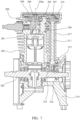
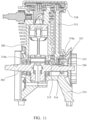
- FIG. 1 there is shown a single cylinder air cooled engine.
- the engine has a cylinder housing containing the cylinder 2.
- a piston 1 is connected in the conventional manner to a crankshaft 3 mounted for rotation in a crankcase 14 for reciprocation in the cylinder 2.
- the upper part of the cylinder 2 is closed by a combustion chamber 4 in a combustion chamber housing.
- the combustion chamber housing has an inlet port 27 for the flow of inlet air/fuel mix into the combustion chamber and an exhaust port 28 for venting the exhaust gas out of the combustion chamber 4, the gas flows being controlled by a rotary valve 5.
- the valve 5 is rotatable in a valve housing 8 in the combustion chamber housing about an axis 5a which is co-axial with the axis of the cylinder 2.
- the axis of rotation of the valve body is offset from the axis 5a of the cylinder 2.
- the rotary valve 5 has a concentric drive shaft 6 carrying a single race ball bearing 7 which rotatably supports the valve 5 in the valve housing 8.
- the valve driveshaft 6 is secured to a coaxial driven gear 9 which meshes with a drive gear 10 of a drive arrangement 11 through which the driven gear 9 and hence the rotary valve 5 is connected to the crankshaft 3.
- the drive arrangement 11 includes a drive shaft 12 which is located in a channel or tube 17 in the cylinder housing and mounted for rotation in an upper bearing 18 adjacent the drive gear 10 and a lower bearing 13 adjacent the crankshaft 3.
- the driveshaft 11 carries a bevel gear 15 which meshes with a corresponding bevel gear 16 secured on the crankshaft for rotation with the crankshaft 3.
- the rotary valve 5 comprises a generally cylindrical rotary valve body 5 rotatable about a rotary valve axis 5a with a close sliding fit in the bore in the valve housing 8, the rotary valve 5 having a hollow valve body having an interior volume 19 forming a part of the combustion chamber.
- the valve has a generally cylindrical body part comprising the valve body 19 itself which is slightly larger in diameter than the shaft 6, which forms a shoulder 14 against which the inner race of the ball bearing 7 is located.
- the valve body 19 extends into the combustion chamber and has in its interior a volume 20 which forms part of the combustion chamber 4 and which is subject to combustion gases at all stages of the combustion process.
- the shaft 6 part of the rotary valve 5 is only slightly smaller in diameter than the valve body 19 to provide the shoulder 14.
- the shaft is solid to provide a good path for conducting heat from the valve body 19 to the exterior.
- the rotary valve body 19 has a port 21 which, during rotation of the valve, enables fluid communication successively to and from the interior volume of the valve and hence the combustion chamber via the inlet and exhaust ports in the valve housing.
- the port 21 is in the form of a recess formed in the lower peripheral edge 22 of the wall 23 of the valve body adjacent to the combustion chamber 4 the recess extending upwardly from this lower edge of the wall of the valve to form the port 21 in the side of the valve
- Ignition is provided by a spark plug secured into a plug bore 25 formed in the valve housing 8 and extending into the valve bore.
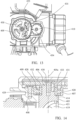
- FIG. 2 there is shown a plan view of an engine intended for a horticultural machine such as a grass trimmer or a hedge trimmer which is manually held and operated by an operator where the engine is positioned to one side and/or behind the operator.
- a carburettor for controlling the air/fuel mix through the inlet is located towards the operator. This is due to the heat of the exhaust and fact that the operator may be required to adjust the carburettor.
- a carburettor with airbox assembly 29 is attached to the inlet port 27, and an exhaust muffler 30 is connected to the exhaust port 28.
- both the carburettor airbox assembly 29 and the exhaust muffler 30 should be substantially parallel to the centreline of the crankshaft.
- the inlet and exhaust ports should be straight rather than curved to enable diecasting of the cylinder 2.
- Straight ports and exhaust muffler/carburettor airbox positions simplify manufacture, neaten the appearance of the engine and make the engine easier to package within a typical horticultural machine.
- this will require both the inlet ports and exhaust ports to be angled away from their ideal angle which is aligned with a radius running from the cylinder axis.
- the ports are angled such that the inlet port is closer to the ideal radial angle than the exhaust port.
- the top dead centre timing point is angled towards the inlet side from the centreline of the crankshaft by 10°, in other words when the piston is at top dead centre the centreline of the valve port is pointing 10 degrees towards the side of the engine nearest the operator.
- This enables the inlet port opening within the valve housing to be moved round 10 degrees towards the operator.
- This enables the inlet port 27 to be closer to the ideal radial angle than the exhaust port.
- the inlet port 27 is then angled a further 11 ° from the radial axis of the cylinder axis with the result that the mounting flange of the carburettor airbox assembly 29 is substantially parallel to the centreline of the engine
- the centreline of the exhaust port 28 is offset 15° from the radial axis.
- the exhaust muffler has an angled flange 33 which mates with the exhaust port 28 so as to allow the main body of the exhaust muffler to be aligned substantially with the centreline 31 of the engine.
- the exhaust muffler 13 is having a two-part shell construction of the muffler and a flange to mate with the angled exhaust port. This has the advantage of avoiding the use of a separate tube or pipe between the exhaust port and the muffler body.
- the inlet side of the cylinder has a curved panel 34 which serves to guide cooling air around the rear of the cylinder to provide a cooling flow around the rear of the cylinder.
- a closure plate 35 at the rear of the engine, shown in Figure 3 forms a lower face of the cooling air flow passage, which forces the cooling air to exit from the rear of cowl, rather than short circuiting down into the cooling air intake.
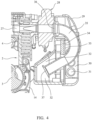
- FIG. 4 there is shown a sectional view of part of the engine of Figure 1 illustrating the air/fuel inlet tract.
- Part of the outer casing 29 of the engine comprises an air box 30, also known as a plenum chamber, which is divided by a wall 33 into an unfiltered air volume into which ambient air enters through inlet passages 31, and a filtered air volume 32.
- the dividing wall 33 contains a filter 34 through which air from the unfiltered side passes into the filtered air side volume 32.
- the inlet tract has a tuning pipe 35 secured to the carburettor.
- the tuning pipe 35 leads from the air inlet 36 of the carburettor 28 through a curved path passing through the unfiltered volume in the airbox, through the dividing wall and into the filtered air volume 32.
- the tuning pipe 35 passes through the filter itself.
- the inlet 37 to the tuning pipe 35 is located in the filtered volume 32 and is flared outwardly to improve the flow of air into the tuning pipe 35 and hence into the engine.
- the curved path maximises the length of the tuning pipe which increases the efficiency of the engine without causing a significant change to the overall size of the engine.
- the tuning pipe may have a more complex shape and may follow a serpentine path.
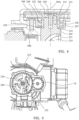
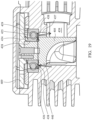
- FIG. 5 there is shown a single cylinder air cooled engine.
- the engine has a cylinder housing containing the cylinder 102.
- a piston 101 is connected in the conventional manner to a crankshaft 103 mounted for rotation in a crankcase 114 for reciprocation in the cylinder 102.
- the upper part of the cylinder 102 is closed by a combustion chamber 104 in a combustion chamber housing.
- the flow of inlet air/fuel mix and exhaust gas into and out of the combustion chamber 104 is controlled by a rotary valve 105.
- the valve 105 is rotatable in a valve housing 108 in the combustion chamber housing about an axis 105a which is co-axial with the axis of the cylinder 102.
- the axis of rotation of the valve body is offset from the axis 105a of the cylinder 102.
- the rotary valve 105 has a concentric drive shaft 106 carrying a single race ball bearing 107 which rotatably supports the valve 105 in the valve housing 108.
- the valve driveshaft 106 is secured to a coaxial driven gear 109 which meshes with a drive gear 110 of a drive arrangement 111 through which the driven gear 109 and hence the rotary valve 105 is connected to the crankshaft 103.
- the drive arrangement 111 includes a drive shaft 112 which is located in a channel or tube 117 in the cylinder housing and mounted for rotation in an upper bearing 118 adjacent the drive gear 110 and a lower bearing 113 adjacent the crankshaft 103.
- the driveshaft 111 carries a bevel gear 115 which meshes with a corresponding bevel gear 116 secured on the crankshaft for rotation with the crankshaft 103.
- the rotation of the crankshaft 103 and hence the piston movement is coordinated with the rotation of the rotary valve 105 so that the engine operates on the conventional four stroke cycle.
- the diameter of the driven gear 109 is twice that of the drive gear 110 so that the rotary valve 105 rotates at half engine speed.
- the rotary valve 105 which comprises a generally cylindrical rotary valve body 105 rotatable about a rotary valve axis 105a with a close sliding fit in the bore in the valve housing 108, the rotary valve 105 having a hollow valve body having an interior volume 119 forming a part of the combustion chamber.
- the valve has a generally cylindrical body part comprising the valve body 119 itself which is slightly larger in diameter than the shaft 106, which forms a shoulder 114 against which the inner race of the ball bearing 107 is located.
- the valve body 119 extends into the combustion chamber and has in its interior a volume 120 which forms part of the combustion chamber 104 and which is subject to combustion gases at all stages of the combustion process.
- the valve body 119 is rotatable in a bore in a valve housing 108 with a close sliding fit.
- the valve 105 and the valve housing 108 are formed of aluminium.
- the shaft 106 part of the rotary valve 105 is only slightly smaller in diameter than the valve body 119 to provide the shoulder 114.
- the shaft is solid to provide a good path for conducting heat from the valve body 119 to the exterior.
- the rotary valve body 119 has a port 121 which, during rotation of the valve, enables fluid communication successively to and from the interior volume of the valve and hence the combustion chamber via inlet and exhaust ports in the valve housing.
- the port 121 is in the form of a recess formed in the lower peripheral edge 122 of the wall 123 of the valve body adjacent to the combustion chamber 104 the recess extending upwardly from this lower edge of the wall of the valve to form the port 121 in the side of the valve.
- Ignition is provided by a spark plug secured into a plug bore 125 formed in the valve housing 108 and extending into the valve bore.
- the axis of the plug bore 125 where it meets the valve body is axially below the centreline of the valve ports. In this way, the point of ignition is closer to the main mass of the incoming fuel mixture.
- the plug bore is formed with a screw thread just long enough to secure the plug 124 in the plug bore 125, the remaining part of the plug bore 125 between the end of the screw thread supporting the plug and the opening of the plug bore 125 into the combustion chamber comprises a spark plug bore volume 126 the bore of which is smooth to improve the flow of the incoming fuel charge and to speed the passage of the flame front from the spark plug into the main volume of the combustion chamber 104.
- the plug bore volume 126 is inevitably present since it is necessary to ensure that there is a gap between the body of the spark plug itself and the rotating valve. However, this does have the disadvantage in that it forms a pocket for exhaust gases after ignition which tends to delay the incoming charge/air mixture for the next cycle and also prevents the maximum possible amount of charge/air mix reaching the spark plug.
- a vent 127 is provided leading from the spark plug bore volume 126 to the main volume of the combustion chamber so that the spark plug bore volume 126 is in fluid communication with the main volume of the combustion chamber 104. This vents the volume 126 prior to the next input of fresh fuel charge for the next cycle.
- the vent 127 comprises a bore in the valve housing leading from the volume 126 into the combustion chamber 104.
- the vent may be formed by a channel or groove formed in the valve housing 108.
- FIG. 5 and 6 shows a rotary valve internal combustion engine comprising: a piston connected to a crankshaft and that reciprocates reciprocatable in a cylinder, the cylinder having a combustion end, a combustion chamber being defined in part by the piston and the combustion end of the cylinder, a valve housing fixed at an outer portion of the combustion end of the cylinder and defining a bore and a rotary valve rotatable about a rotary valve axis in the bore in the valve housing, the rotary valve having a hollow valve body having an interior volume forming a part of the combustion chamber, wherein the interior volume of the hollow valve body is subjected to combustion gases throughout the combustion process, and further having in a wall part thereof a port giving, during rotation of the valve, fluid communication successively to and from the combustion chamber via inlet and exhaust ports in the valve housing, wherein the engine is a spark ignition engine, the spark plug being screwed into a plug bore in the valve housing adjacent the valve body, a spark plug bore volume being formed in the plug bore between the plug bore
- the vent comprises a bleed bore in the valve housing or a channel or groove in the valve housing.
- FIG. 7 there is shown a single cylinder air cooled engine.
- the engine has a cylinder housing containing the cylinder 202.
- a piston 201 is connected in the conventional manner to a crankshaft 203 mounted for rotation in a crankcase 214 for reciprocation in the cylinder 202.
- the upper part of the cylinder 202 is closed by a combustion chamber 204 in a combustion chamber housing.
- the flow of inlet air/fuel mix and exhaust gas into and out of the combustion chamber 204 is controlled by a rotary valve 205.
- the valve 205 is rotatable in a valve housing 208 in the combustion chamber housing about an axis 205a which is co-axial with the axis of the cylinder 202.
- the axis of rotation of the valve body is offset from the axis 205a of the cylinder 202.
- the rotary valve 205 has a concentric drive shaft 206 carrying a single race ball bearing 207 which rotatably supports the valve 205 in the valve housing 208.
- the valve driveshaft 206 is secured to a coaxial driven gear 209 which meshes with a drive gear 210 of a drive arrangement 211 through which the driven gear 209 and hence the rotary valve 205 is connected to the crankshaft 203.
- the drive arrangement 211 includes a drive shaft 212 which is located in a channel or tube 217 in the cylinder housing and mounted for rotation in an upper bearing 218 adjacent the drive gear 210 and a lower bearing 213 adjacent the crankshaft 203.
- the channel or tube 217 is cast into the cylinder housing.
- the channel or tube 217 is formed integrally with the cylinder housing, which may be formed by a casting process.
- the driveshaft 211 carries a bevel gear 215 which meshes with a corresponding bevel gear 216 secured on the crankshaft for rotation with the crankshaft 203.
- the rotation of the crankshaft 203 and hence the piston movement is coordinated with the rotation of the rotary valve 205 so that the engine operates on the conventional four stroke cycle.
- the diameter of the driven gear 209 is twice that of the drive gear 210 so that the rotary valve 205 rotates at half engine speed.
- the rotary valve 205 which comprises a generally cylindrical rotary valve body 205 rotatable about a rotary valve axis 205a with a close sliding fit in the bore in the valve housing 208, the rotary valve 205 having a hollow valve body having an interior volume 219 forming a part of the combustion chamber.
- the valve has a generally cylindrical body part comprising the valve body 219 itself which is slightly larger in diameter than the shaft 206, which forms a shoulder 214 against which the inner race 228 of the ball bearing 207 is located.
- the valve body 219 extends into the combustion chamber and has in its interior a volume 220 which forms part of the combustion chamber 204 and which is subject to combustion gases at all stages of the combustion process.
- the valve body 219 is rotatable in a bore in a valve housing 208 with a close sliding fit.
- the valve 205 and the valve housing 208 are formed of aluminium.
- the shaft 206 part of the rotary valve 205 is only slightly smaller in diameter than the valve body 219 to provide the shoulder 214.
- the shaft is solid to provide a good path for conducting heat from the valve body 219 to the exterior
- the rotary valve body port 221, during rotation of the valve, enables fluid communication successively to and from the interior volume of the valve and hence the combustion chamber via inlet and exhaust ports in the valve housing.
- the port 221 is in the form of a recess formed in the lower peripheral edge 222 of the wall 223 of the valve body adjacent to the combustion chamber 204 the recess extending upwardly from this lower edge of the wall of the valve to form the port 221 in the side of the valve
- the driven gear 209 is secured coaxially to the rotary valve 205 by means of a counter sunk screw 230.
- the driven gear 209 has a concentric recess which accommodates the outer end of the shaft 206 and the recess has an annular ring 231 which is aligned with the inner race 228 of the ball bearing 207.
- a small axial clearance 232 is provided between the annular ring 231 and the inner race 228 to allow a small degree of axial float which means that the valve 205 is not clamped to the inner race 228 and can therefore move slightly radially to accommodate any small concentric offset between the bearing 207 and the valve bore in which the rotary valve rotates.
- the correct location of the rotary valve 205 relative to the valve gear, which determines the timing of the engine, is achieved by a timing pin 233.
- the drive gear 210 has a timing mark 234 which indicates when the engine is at top dead centre.
- the driven gear 209 connected to the rotary valve has a timing hole 235 adapted to receive the timing pin 233 and the driven gear has a corresponding timing hole through which the timing pin is inserted to secure the driven gear 209 to the rotary valve 205 to hold the rotary valve in its top dead centre position.
- the counter sunk screw 230 is then inserted to secure the driven gear 209 to the rotary valve 205 in the correct timing position and the counter sunk head of the screw 230 engages the end of the timing pin 230 to secure this in position.
- Other means such as a washer on the screw 230 may be used to secure the timing pin 233 in position.
- a counterbalance or counterbalancing mass is created on the valve train, particularly by adding material to the driven gear 209 or by removing material at an appropriate position in the driven gear 209.
- FIG. 7 , 8 and 9 shows a rotary valve internal combustion engine comprising: a piston connected to a crankshaft and that reciprocates in a cylinder, the cylinder having a combustion end, a combustion chamber being defined in part by the piston and the combustion end of the cylinder, a valve housing fixed at an outer portion of the combustion end of the cylinder and defining a bore and a rotary valve rotatable about a rotary valve axis in the bore in the valve housing, the rotary valve having a hollow valve body having an interior volume forming a part of the combustion chamber, wherein the interior volume of the hollow valve body is subjected to combustion gases throughout the combustion process, and further having in a wall part thereof a port giving, during rotation of the valve, fluid communication successively to and from the combustion chamber via inlet and exhaust ports in the valve housing, a sealing function being carried out between the surface of the main body of the rotary valve and a contiguous surface of the bore in the valve housing, wherein the rotary valve is mounted in the valve housing
- the driven gear has an out-of-balance mass to counter-balance an out of balance mass in the rotary valve body.
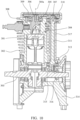
- FIG. 10 there is shown a single cylinder air cooled engine.
- the engine has a cylinder housing containing the cylinder 302.
- a piston 301 is connected in the conventional manner to a crankshaft 303 mounted for rotation in a crankcase 314 for reciprocation in the cylinder 302.
- the upper part of the cylinder 302 is closed by a combustion chamber 304 in a combustion chamber housing.
- the flow of inlet air/fuel mix and exhaust gas into and out of the combustion chamber 304 is controlled by a rotary valve 305.
- the valve 305 is rotatable in a valve housing 308 in the combustion chamber housing about an axis 305a which is co-axial with the axis of the cylinder 302.
- the axis of rotation of the valve body is offset from the axis 305a of the cylinder 302.
- the rotary valve 305 has a concentric drive shaft 306 carrying a single race ball bearing 307 which rotatably supports the valve 305 in the valve housing 308.
- the valve driveshaft 306 is secured to a coaxial driven gear 309 which meshes with a drive gear 310 of a drive arrangement 311 through which the driven gear 309 and hence the rotary valve 305 is connected to the crankshaft 303.
- the drive arrangement 311 includes a drive shaft 312 which is located in a channel or tube 317 formed integrally in the cylinder housing and mounted for rotation in an upper bearing 318 adjacent the drive gear 310 and a lower bearing 313 mounted in the cylinder housing adjacent the crankshaft 303.
- the channel or tube 317 is formed in the cylinder housing., which may be formed by a casting process.
- the driveshaft 312 carries a bevel gear 315 which meshes with a corresponding bevel gear 316 secured on the crankshaft for rotation with the crankshaft 303.
- the rotation of the crankshaft 303 and hence the piston movement is coordinated with the rotation of the rotary valve 305 so that the engine operates on the conventional four stroke cycle.
- the diameter of the driven gear 309 is twice that of the drive gear 310 so that the rotary valve 305 rotates at half engine speed.
- crankcase 314 has a bore 336 which has a diameter slightly larger than the outer diameter of the bevel gear 315 so that when the cylinder housing carrying the drive arrangement is offered up to the crankcase, the bevel gear 315 can enter the crankcase to mesh with the associated bevel gear 316 which is secured to the crankshaft 314.
- the upper surface of the crankcase 314 is arranged to mate with the lower surface of the cylinder housing assembly when this is lowered onto the crankcase.
- the lower bearing 313 is secured in a counter bore 337 formed in the cylinder housing so as to be concentric with the crankcase bore 336 a slight axial clearance is provided between the outer race of the lower bearing 313 and the end of the counter bore 337 within which the bearing sits to ensure that the cylinder housing assembly, including the drive arrangement 311 can mate correctly with the top face 314a of the crankcase 314.
- the assembly of the cylinder housing including the rotary valve 305 and the main part of the drive gear arrangement 311 is formed as a sub assembly for mating with the crankcase 314.
- the piston which is carried by the crankcase 314 is fed into the piston bore in the cylinder housing 302 and at the same time the bevel gear 315 is fed through the crankcase bore 336 to complete the engine assembly.
- FIG. 10 and 11 shows a rotary valve internal combustion engine comprising: a crankcase containing a crankshaft, a piston being connected to the crankshaft and reciprocatable in a cylinder in a cylinder housing connected to the crankcase, the cylinder having a combustion end, a combustion chamber being defined in part by the piston and the combustion end of the cylinder, a valve housing at an outer portion of the combustion end of the cylinder and defining a bore and a rotary valve rotatable about a rotary valve axis in the bore in the valve housing, the rotary valve having a hollow valve body having an interior volume forming a part of the combustion chamber, wherein the interior volume of the hollow valve body is subjected to combustion gases throughout the combustion process, and further having in a wall part thereof a port giving, during rotation of the valve, fluid communication successively to and from the combustion chamber via inlet and exhaust ports in the valve housing, wherein the rotary valve is mounted on a bearing secured in the valve housing for rotation by the crankshaft through a
- the drive shaft maybe located in a passage formed in the cylinder housing, and the drive shaft maybe located rotationally in bearings mounted in the cylinder housing.
- FIG. 12 there is shown a single cylinder air cooled engine.
- the engine has a cylinder housing containing the cylinder 402.
- a piston 401 is connected in the conventional manner to a crankshaft 403 mounted for rotation in a crankcase 414 for reciprocation in the cylinder 402.
- the upper part of the cylinder 402 is closed by a combustion chamber 404 in a combustion chamber housing.
- the flow of inlet air/fuel mix and exhaust gas into and out of the combustion chamber 404 is controlled by a rotary valve 405.
- the valve 405 is rotatable in a valve housing 408 in the combustion chamber housing about an axis 405a which is co-axial with the axis of the cylinder 402.
- the axis of rotation of the valve body is offset from the axis 405a of the cylinder 402.
- the rotary valve 405 has a concentric drive shaft 406 carrying a single race ball bearing 407 which rotatably supports the valve 405 in the valve housing 408.
- the valve driveshaft 406 is secured to a coaxial driven gear 409 which meshes with a drive gear 410 of a drive arrangement 411 through which the driven gear 409 and hence the rotary valve 405 is connected to the crankshaft 403.
- the drive arrangement 411 includes a drive shaft 412 which is located in a channel or tube 417 in the cylinder housing and mounted for rotation in an upper bearing 418 adjacent the drive gear 410 and a lower bearing 413 adjacent the crankshaft 403.
- the channel or tube 417 is cast into the cylinder housing.
- the channel or tube 417 is formed integrally with the cylinder housing, which may be formed by a casting process.
- the driveshaft 411 carries a bevel gear 415 which meshes with a corresponding bevel gear 416 secured on the crankshaft for rotation with the crankshaft 403.
- the rotation of the crankshaft 403 and hence the piston movement is coordinated with the rotation of the rotary valve 405 so that the engine operates on the conventional four stroke cycle.
- the diameter of the driven gear 409 is twice that of the drive gear 410 so that the rotary valve 405 rotates at half engine speed.
- the rotary valve 405 which comprises a generally cylindrical rotary valve body 405 rotatable about a rotary valve axis 405a with a close sliding fit in the bore in the valve housing 408, the rotary valve 405 having a hollow valve body 416 having an interior volume 419 forming a part of the combustion chamber.
- the valve has a generally cylindrical body part comprising the valve body 416 itself which is slightly larger in diameter than the shaft 406, which forms a shoulder 414 against which the inner race 428 of the ball bearing 407 is located.
- the valve body 416 extends into the combustion chamber and has in its interior a volume 420 which forms part of the combustion chamber 404 and which is subject to combustion gases at all stages of the combustion process.
- the valve body 419 is rotatable in a bore in a valve housing 408 with a close sliding fit..
- the valve 405 and the valve housing 8 are formed of aluminium.
- the shaft 406 part of the rotary valve 405 is only slightly smaller in diameter than the valve body 419 to provide the shoulder 414.
- the shaft is solid to provide a good path for conducting heat from the valve body 416 to the exterior
- the rotary valve body port 421 enables fluid communication successively to and from the interior volume of the valve and hence the combustion chamber via inlet and exhaust ports in the valve housing.
- the port 421 is in the form of a recess formed in the lower peripheral edge 422 of the wall 423 of the valve body adjacent to the combustion chamber 44 the recess extending upwardly from this lower edge of the wall of the valve to form the port 421 in the side of the valve.
- the driven gear 409 is secured coaxially to the rotary valve 405 by means of a countersunk screw 430.
- the driven gear 409 has a concentric recess which accommodates the outer end of the shaft 406 and the recess has an annular rib 431 which is aligned with the inner race 428 of the ball bearing 407.
- An axial clearance 432 is provided between the annular ring 431 and the inner race 428 to allow a small degree of axial float which means that the valve 405 is not clamped to the inner race 428 and can therefore move slightly radially to accommodate any small concentric offset between the bearing 407 and the valve bore in which the rotary valve rotates.
- a resilient element in the form of a wave spring 424 biases driven gear 409 to urge the shoulder 414 of the valve body 416 upwards into contact with the lower face of the inner race 428, as shown in Figure 15 , with a sufficient force to prevent hammering or chattering between the two components during operation but not too powerful to prevent the slight radial movement of the valve body necessary to accommodate slight misalignment between the valve and the valve housing which will occur in practice as a result of slight differences caused by manufacturing tolerances of the components.
- the wave spring consists of a generally annular plate-like body. Throughout its annular length, the wave spring 424 has a plurality of wave forms curving the spring out of a radial plane as shown particularly in Figures 5b and 5c.
- the wave spring is formed out of a spring steel.
- the spring element could be formed of other materials, designs or profiles, providing they meet the objective of being able to provide the resilient damping effect required and being able to cope with the harsh environmental conditions in the engine.
- Figure 17 illustrates a schematic perspective view of the rotary valve 405 and the driven gear 409 with the wave spring 424 in position between the inner race 428 of the bearing and the driven gear 409.
- Figure 18 illustrates a similar schematic perspective view of the rotary valve 405 and the driven gear 409 with the single race ball bearing 407 in position.
- the space between the inner and outer races 428 and 429 of the bearing 407 is closed at its lower edge by a metal seal 426.
- FIG. 19 there is shown an enlarged view of the valve and bearing arrangement illustrating an improvement in which a vent passage 437 is provided from the narrow annular space 428 between the annular metal seal 426 and the valve housing leading into the inlet port as illustrated by the black arrows 440.
- This has the advantage that the escaping combustion gases are fed back into the inlet port 439 where they are recycled through the engine to improve the engine emissions performance.
- the rotary valve has a port 421 cut in its peripheral wall, it is recognised that the mass of the valve is not uniformly disposed about its periphery and this generates out of balance forces as the rotary valve rotates in practice.
- a counterbalance or counterbalancing mass is created on the valve train, particularly by adding material to the driven gear 409 or by removing material at an appropriate position in the driven gear 409.
- the embodiment described is a single cylinder air cooled engine but it will be understood that the invention is equally applicable to multicylinder and/or watercooled engines.
- Figures 12 to 19 show a rotary valve internal combustion engine comprising: a piston connected to a crankshaft and that reciprocates in a cylinder, the cylinder having a combustion end, a combustion chamber being defined in part by the piston and the combustion end of the cylinder, a valve housing fixed at an outer portion of the combustion end of the cylinder and defining a bore and a rotary valve rotatable about a rotary valve axis in the bore in the valve housing, the rotary valve having a hollow valve body having an interior volume forming a part of the combustion chamber, wherein the interior volume of the hollow valve body is subjected to combustion gases throughout the combustion process, and further having in a wall part thereof a port giving, during rotation of the valve, fluid communication successively to and from the combustion chamber via inlet and exhaust ports in the valve housing, a sealing function being carried out between the surface of the main body of the rotary valve and a contiguous surface of the bore in the valve housing, wherein the rotary valve is mounted in the valve housing for rotation by
- the seal is on the valve side of the single race ball bearing thereby shielding the ball bearing from the combustion gases, and the seal maybe formed of metal.
- a vent passage maybe provided to vent combustion gases from between the space between the valve body and the valve housing back into the inlet port, the vent consisting of either a drilled bore or a groove in the valve bore face.
- a predetermined axial gap Is provided between the driven gear and the bearing in which the rotary valve is mounted, and the driven gear has an annular rib aligned with the inner race of the bearing, the axial gap being formed between the annular rib and the inner race of the bearing.
- the seal preferably comprises a resilient annular element, being co-axial with the rotary valve and may be a wave spring.
Landscapes
- Engineering & Computer Science (AREA)
- Mechanical Engineering (AREA)
- General Engineering & Computer Science (AREA)
- Chemical & Material Sciences (AREA)
- Combustion & Propulsion (AREA)
- Manufacturing & Machinery (AREA)
- Valve-Gear Or Valve Arrangements (AREA)
- Cylinder Crankcases Of Internal Combustion Engines (AREA)
- Combustion Methods Of Internal-Combustion Engines (AREA)
- Control Of Throttle Valves Provided In The Intake System Or In The Exhaust System (AREA)
Description
- The present invention relates to a rotary valve internal combustion engine, particularly but not exclusively, for a manually held machine such as a horticultural grass trimmer or hedge trimmer, in which the control of the intake and exhaust gases of combustion is achieved by means of a rotary valve. Such an engine is disclosed in
US 4311119 A . - A rotary valve internal combustion engine comprising: a piston connected to a crankshaft and that reciprocates in a cylinder, the cylinder having a combustion end, a combustion chamber being defined in part by the piston and the combustion end of the cylinder, a valve housing fixed at an outer portion of the combustion end of the cylinder and defining a bore and a rotary valve rotatable about a rotary valve axis in the bore in the valve housing, the rotary valve having a hollow valve body having an interior volume forming a part of the combustion chamber, wherein the interior volume of the hollow valve body is subjected to combustion gases throughout the combustion process, and further having in a wall part thereof a port giving, during rotation of the valve, fluid communication successively to and from the combustion chamber via inlet and exhaust ports in the valve housing.
- The present invention seeks to provide such an engine suitable for use with a horticultural machine, designed to be held and operated manually by an operator. The term horticultural machine is intended to include hand-held machines for use in horticulture, gardens and forestry for such purposes as grass trimmers, hedge trimmers, brush cutters, clearing saws, shredders, blowers vacuum collectors, mist blowers, and chainsaws.
- According to the present invention there is provided a rotary valve internal combustion engine comprising: a piston connected to a crankshaft and that reciprocates in a cylinder, the cylinder having a combustion end, a combustion chamber being defined in part by the piston and the combustion end of the cylinder, a valve housing fixed at an outer portion of the combustion end of the cylinder and defining a bore and a rotary valve rotatable about a rotary valve axis in the bore in the valve housing, the rotary valve having a hollow valve body having an interior volume forming a part of the combustion chamber, wherein the interior volume of the hollow valve body is subjected to combustion gases throughout the combustion process, and further having in a wall part thereof a port giving, during rotation of the valve, fluid communication successively to and from the combustion chamber via inlet and exhaust ports in the valve housing, the engine having a carburettor for controlling the air/fuel mix into the engine and an exhaust muffler for the exhaust gases, wherein the port layout is arranged to position the exhaust muffler and carburettor on opposite sides of the engine, the inlet and exhaust port angles being arranged such that the main body of the carburettor and main body of the muffler are substantially parallel to the centreline of the engine, wherein when the engine is at top dead centre, the valve port is offset a predetermined number of degrees from the ideal radial line the angular offset reducing the radial offset of the inlet port that is required to achieve a mounting flange for the carburettor that is substantially parallel to the centreline of the engine, the centreline of the inlet port is offset a predetermined number of degrees from the ideal radial line from the cylinder axis, said angular offset allowing the mounting flange for the carburettor to be substantially parallel to the centreline of the engine, and the centreline of the exhaust port is offset a predetermined number of degrees from an ideal radial line from the cylinder axis, said angular offset allowing the main body of the muffler to be substantially parallel to the centreline of the engine using an angled mounting flange.
- Preferred embodiments of the present invention will now be described by way of example with reference to the accompanying drawings, in which:-
-
Figure 1 shows a cross-sectional view of a single cylinder air cooled spark ignition rotary valve internal combustion engine, and -
Figure 2 shows a part-sectional plan view of an embodiment of the engine for use with a manually held and operated horticultural machine such as a strimmer or hedge trimmer, and -
Figure 3 shows a side view of part of the engine shown inFigure 2 . -
Figure 4 there is shown a sectional view of part of the engine ofFigure 1 illustrating the air/fuel inlet tract. -
Figure 5 shows a cross-sectional view of part of a single cylinder air cooled spark ignition rotary valve internal combustion engine. -
Figure 6 is an enlarged schematic view of part of the rotary valve body and spark plug. -
Figure 7 shows a cross-sectional view of a single cylinder air cooled rotary valve internal combustion engine. -
Figure 8 is an enlarged schematic view of part of the rotary valve body and drive gear. -
Figure 9 shows a plan view of the rotary valve drive and driven gears. -
Figure 10 shows a cross-sectional view of a single cylinder air cooled rotary valve internal combustion engine. -
Figure 11 shows the cross-sectional view of the engine illustrating the dividing line between the cylinder housing and the crankcase. -
Figure 12 shows a cross-sectional view of a single cylinder air cooled rotary valve internal combustion engine. -
Figure 13 is an enlarged schematic view of part of the rotary valve body and drive gear.Figure 14 shows a plan view of the rotary valve drive and driven gears. -
Figure 15 shows an enlarged sectional view of the rotary valve and drive gear. -
Figures 16a-16b show, respectively, plan and side views of a wave spring. -
Figure 17 shows a view of the valve and a driven gear. -
Figure 18 shows a view of the valve and a ball bearing. -
Figure 19 shows the path of escaping combustion gases. - Referring now to
Figure 1 , there is shown a single cylinder air cooled engine. The engine has a cylinder housing containing thecylinder 2. Apiston 1 is connected in the conventional manner to acrankshaft 3 mounted for rotation in acrankcase 14 for reciprocation in thecylinder 2. The upper part of thecylinder 2 is closed by acombustion chamber 4 in a combustion chamber housing. The combustion chamber housing has aninlet port 27 for the flow of inlet air/fuel mix into the combustion chamber and anexhaust port 28 for venting the exhaust gas out of thecombustion chamber 4, the gas flows being controlled by arotary valve 5. In this embodiment, thevalve 5 is rotatable in a valve housing 8 in the combustion chamber housing about an axis 5a which is co-axial with the axis of thecylinder 2. In other embodiments, the axis of rotation of the valve body is offset from the axis 5a of thecylinder 2. - At its end remote from the
combustion chamber 4, therotary valve 5 has a concentric drive shaft 6 carrying a single race ball bearing 7 which rotatably supports thevalve 5 in the valve housing 8. The valve driveshaft 6 is secured to a coaxial driven gear 9 which meshes with adrive gear 10 of a drive arrangement 11 through which the driven gear 9 and hence therotary valve 5 is connected to thecrankshaft 3. The drive arrangement 11 includes adrive shaft 12 which is located in a channel or tube 17 in the cylinder housing and mounted for rotation in an upper bearing 18 adjacent thedrive gear 10 and a lower bearing 13 adjacent thecrankshaft 3. The driveshaft 11 carries a bevel gear 15 which meshes with acorresponding bevel gear 16 secured on the crankshaft for rotation with thecrankshaft 3. Thus, the rotation of thecrankshaft 3 and hence the piston movement is coordinated with the rotation of therotary valve 5 so that the engine operates on the conventional four stroke cycle. To achieve this, the diameter of the driven gear 9 is twice that of thedrive gear 10 so that therotary valve 5 rotates at half engine speed. Therotary valve 5 comprises a generally cylindricalrotary valve body 5 rotatable about a rotary valve axis 5a with a close sliding fit in the bore in the valve housing 8, therotary valve 5 having a hollow valve body having aninterior volume 19 forming a part of the combustion chamber. The valve has a generally cylindrical body part comprising thevalve body 19 itself which is slightly larger in diameter than the shaft 6, which forms ashoulder 14 against which the inner race of the ball bearing 7 is located. Thevalve body 19 extends into the combustion chamber and has in its interior avolume 20 which forms part of thecombustion chamber 4 and which is subject to combustion gases at all stages of the combustion process. - The shaft 6 part of the
rotary valve 5 is only slightly smaller in diameter than thevalve body 19 to provide theshoulder 14. The shaft is solid to provide a good path for conducting heat from thevalve body 19 to the exterior. - The
rotary valve body 19 has aport 21 which, during rotation of the valve, enables fluid communication successively to and from the interior volume of the valve and hence the combustion chamber via the inlet and exhaust ports in the valve housing. In this embodiment theport 21 is in the form of a recess formed in the lowerperipheral edge 22 of thewall 23 of the valve body adjacent to thecombustion chamber 4 the recess extending upwardly from this lower edge of the wall of the valve to form theport 21 in the side of the valve - Ignition is provided by a spark plug secured into a
plug bore 25 formed in the valve housing 8 and extending into the valve bore. - Referring now to
Figure 2 , there is shown a plan view of an engine intended for a horticultural machine such as a grass trimmer or a hedge trimmer which is manually held and operated by an operator where the engine is positioned to one side and/or behind the operator. In such machines, it is a requirement that the exhaust and exhaust muffler is located away from the operator and a carburettor for controlling the air/fuel mix through the inlet is located towards the operator. This is due to the heat of the exhaust and fact that the operator may be required to adjust the carburettor. A carburettor withairbox assembly 29 is attached to theinlet port 27, and anexhaust muffler 30 is connected to theexhaust port 28. Ideally, both thecarburettor airbox assembly 29 and theexhaust muffler 30 should be substantially parallel to the centreline of the crankshaft. the inlet and exhaust ports should be straight rather than curved to enable diecasting of thecylinder 2. Straight ports and exhaust muffler/carburettor airbox positions simplify manufacture, neaten the appearance of the engine and make the engine easier to package within a typical horticultural machine. However, in order to provide the correct valve timing of the engine, which is determined by the position of the inlet and exhaust openings in the valve housing, this will require both the inlet ports and exhaust ports to be angled away from their ideal angle which is aligned with a radius running from the cylinder axis. - More-over as any restriction in flow in the inlet port due to a non-radial port angle will have a greater effect on engine power than the equivalent restriction in the exhaust port, the ports are angled such that the inlet port is closer to the ideal radial angle than the exhaust port.
- In this embodiment, the top dead centre timing point is angled towards the inlet side from the centreline of the crankshaft by 10°, in other words when the piston is at top dead centre the centreline of the valve port is pointing 10 degrees towards the side of the engine nearest the operator. This enables the inlet port opening within the valve housing to be moved round 10 degrees towards the operator. This enables the
inlet port 27 to be closer to the ideal radial angle than the exhaust port. Theinlet port 27 is then angled a further 11 ° from the radial axis of the cylinder axis with the result that the mounting flange of thecarburettor airbox assembly 29 is substantially parallel to the centreline of the engine - The centreline of the
exhaust port 28 is offset 15° from the radial axis. The exhaust muffler has anangled flange 33 which mates with theexhaust port 28 so as to allow the main body of the exhaust muffler to be aligned substantially with thecentreline 31 of the engine. - The exhaust muffler 13 is having a two-part shell construction of the muffler and a flange to mate with the angled exhaust port. This has the advantage of avoiding the use of a separate tube or pipe between the exhaust port and the muffler body.
- As shown in up
Figure 2 , the inlet side of the cylinder has acurved panel 34 which serves to guide cooling air around the rear of the cylinder to provide a cooling flow around the rear of the cylinder. - A
closure plate 35 at the rear of the engine, shown inFigure 3 , forms a lower face of the cooling air flow passage, which forces the cooling air to exit from the rear of cowl, rather than short circuiting down into the cooling air intake. - Referring now to
Figure 4 there is shown a sectional view of part of the engine ofFigure 1 illustrating the air/fuel inlet tract. Part of theouter casing 29 of the engine comprises anair box 30, also known as a plenum chamber, which is divided by awall 33 into an unfiltered air volume into which ambient air enters throughinlet passages 31, and a filteredair volume 32. - The dividing
wall 33 contains afilter 34 through which air from the unfiltered side passes into the filteredair side volume 32. The inlet tract has atuning pipe 35 secured to the carburettor. The tuningpipe 35 leads from theair inlet 36 of thecarburettor 28 through a curved path passing through the unfiltered volume in the airbox, through the dividing wall and into the filteredair volume 32. In one form, the tuningpipe 35 passes through the filter itself. Theinlet 37 to thetuning pipe 35 is located in the filteredvolume 32 and is flared outwardly to improve the flow of air into the tuningpipe 35 and hence into the engine. The curved path maximises the length of the tuning pipe which increases the efficiency of the engine without causing a significant change to the overall size of the engine. - Although shown as a simple curve, it will be appreciated that the tuning pipe may have a more complex shape and may follow a serpentine path.
- Referring now to
Figure 5 , there is shown a single cylinder air cooled engine. The engine has a cylinder housing containing the cylinder 102. A piston 101 is connected in the conventional manner to a crankshaft 103 mounted for rotation in acrankcase 114 for reciprocation in the cylinder 102. The upper part of the cylinder 102 is closed by acombustion chamber 104 in a combustion chamber housing. The flow of inlet air/fuel mix and exhaust gas into and out of thecombustion chamber 104 is controlled by arotary valve 105. In this embodiment, thevalve 105 is rotatable in avalve housing 108 in the combustion chamber housing about anaxis 105a which is co-axial with the axis of the cylinder 102. In other embodiments, the axis of rotation of the valve body is offset from theaxis 105a of the cylinder 102. - At its end remote from the
combustion chamber 104, therotary valve 105 has aconcentric drive shaft 106 carrying a singlerace ball bearing 107 which rotatably supports thevalve 105 in thevalve housing 108. Thevalve driveshaft 106 is secured to a coaxial driven gear 109 which meshes with a drive gear 110 of a drive arrangement 111 through which the driven gear 109 and hence therotary valve 105 is connected to the crankshaft 103. The drive arrangement 111 includes a drive shaft 112 which is located in a channel or tube 117 in the cylinder housing and mounted for rotation in an upper bearing 118 adjacent the drive gear 110 and a lower bearing 113 adjacent the crankshaft 103. The driveshaft 111 carries a bevel gear 115 which meshes with acorresponding bevel gear 116 secured on the crankshaft for rotation with the crankshaft 103. Thus, the rotation of the crankshaft 103 and hence the piston movement is coordinated with the rotation of therotary valve 105 so that the engine operates on the conventional four stroke cycle. To achieve this, the diameter of the driven gear 109 is twice that of the drive gear 110 so that therotary valve 105 rotates at half engine speed. - Referring now to
Figure 6 also, there is shown more detail of therotary valve 105 which comprises a generally cylindricalrotary valve body 105 rotatable about arotary valve axis 105a with a close sliding fit in the bore in thevalve housing 108, therotary valve 105 having a hollow valve body having aninterior volume 119 forming a part of the combustion chamber. The valve has a generally cylindrical body part comprising thevalve body 119 itself which is slightly larger in diameter than theshaft 106, which forms ashoulder 114 against which the inner race of theball bearing 107 is located. Thevalve body 119 extends into the combustion chamber and has in its interior avolume 120 which forms part of thecombustion chamber 104 and which is subject to combustion gases at all stages of the combustion process. Thevalve body 119 is rotatable in a bore in avalve housing 108 with a close sliding fit. Thevalve 105 and thevalve housing 108 are formed of aluminium. - The
shaft 106 part of therotary valve 105 is only slightly smaller in diameter than thevalve body 119 to provide theshoulder 114. The shaft is solid to provide a good path for conducting heat from thevalve body 119 to the exterior. - The
rotary valve body 119 has aport 121 which, during rotation of the valve, enables fluid communication successively to and from the interior volume of the valve and hence the combustion chamber via inlet and exhaust ports in the valve housing. In this embodiment theport 121 is in the form of a recess formed in the lowerperipheral edge 122 of thewall 123 of the valve body adjacent to thecombustion chamber 104 the recess extending upwardly from this lower edge of the wall of the valve to form theport 121 in the side of the valve. - Ignition is provided by a spark plug secured into a
plug bore 125 formed in thevalve housing 108 and extending into the valve bore. The axis of the plug bore 125 where it meets the valve body is axially below the centreline of the valve ports. In this way, the point of ignition is closer to the main mass of the incoming fuel mixture. - The plug bore is formed with a screw thread just long enough to secure the
plug 124 in the plug bore 125, the remaining part of the plug bore 125 between the end of the screw thread supporting the plug and the opening of the plug bore 125 into the combustion chamber comprises a spark plug bore volume 126 the bore of which is smooth to improve the flow of the incoming fuel charge and to speed the passage of the flame front from the spark plug into the main volume of thecombustion chamber 104. - The plug bore volume 126 is inevitably present since it is necessary to ensure that there is a gap between the body of the spark plug itself and the rotating valve. However, this does have the disadvantage in that it forms a pocket for exhaust gases after ignition which tends to delay the incoming charge/air mixture for the next cycle and also prevents the maximum possible amount of charge/air mix reaching the spark plug. To obviate this disadvantage a vent 127 is provided leading from the spark plug bore volume 126 to the main volume of the combustion chamber so that the spark plug bore volume 126 is in fluid communication with the main volume of the
combustion chamber 104. This vents the volume 126 prior to the next input of fresh fuel charge for the next cycle. As shown inFigure 6 , the vent 127 comprises a bore in the valve housing leading from the volume 126 into thecombustion chamber 104. In alternative constructions, the vent may be formed by a channel or groove formed in thevalve housing 108. - The embodiment of
Figures 5 and 6 shows a rotary valve internal combustion engine comprising: a piston connected to a crankshaft and that reciprocates reciprocatable in a cylinder, the cylinder having a combustion end, a combustion chamber being defined in part by the piston and the combustion end of the cylinder, a valve housing fixed at an outer portion of the combustion end of the cylinder and defining a bore and a rotary valve rotatable about a rotary valve axis in the bore in the valve housing, the rotary valve having a hollow valve body having an interior volume forming a part of the combustion chamber, wherein the interior volume of the hollow valve body is subjected to combustion gases throughout the combustion process, and further having in a wall part thereof a port giving, during rotation of the valve, fluid communication successively to and from the combustion chamber via inlet and exhaust ports in the valve housing, wherein the engine is a spark ignition engine, the spark plug being screwed into a plug bore in the valve housing adjacent the valve body, a spark plug bore volume being formed in the plug bore between the plug and the valve body, and a vent is located in the valve housing between the spark plug volume and the main cylinder volume, to vent combustion gases in the spark plug volume into the main cylinder volume. - In a preferred form, the vent comprises a bleed bore in the valve housing or a channel or groove in the valve housing.
- Referring now to
Figure 7 , there is shown a single cylinder air cooled engine. The engine has a cylinder housing containing thecylinder 202. Apiston 201 is connected in the conventional manner to acrankshaft 203 mounted for rotation in acrankcase 214 for reciprocation in thecylinder 202. The upper part of thecylinder 202 is closed by acombustion chamber 204 in a combustion chamber housing. The flow of inlet air/fuel mix and exhaust gas into and out of thecombustion chamber 204 is controlled by arotary valve 205. In this embodiment, thevalve 205 is rotatable in avalve housing 208 in the combustion chamber housing about anaxis 205a which is co-axial with the axis of thecylinder 202. In other embodiments, the axis of rotation of the valve body is offset from theaxis 205a of thecylinder 202. - At its end remote from the
combustion chamber 204, therotary valve 205 has aconcentric drive shaft 206 carrying a singlerace ball bearing 207 which rotatably supports thevalve 205 in thevalve housing 208. Thevalve driveshaft 206 is secured to a coaxial drivengear 209 which meshes with adrive gear 210 of adrive arrangement 211 through which the drivengear 209 and hence therotary valve 205 is connected to thecrankshaft 203. Thedrive arrangement 211 includes a drive shaft 212 which is located in a channel ortube 217 in the cylinder housing and mounted for rotation in an upper bearing 218 adjacent thedrive gear 210 and alower bearing 213 adjacent thecrankshaft 203. The channel ortube 217 is cast into the cylinder housing. The channel ortube 217 is formed integrally with the cylinder housing, which may be formed by a casting process. Thedriveshaft 211 carries abevel gear 215 which meshes with acorresponding bevel gear 216 secured on the crankshaft for rotation with thecrankshaft 203. Thus, the rotation of thecrankshaft 203 and hence the piston movement is coordinated with the rotation of therotary valve 205 so that the engine operates on the conventional four stroke cycle. To achieve this, the diameter of the drivengear 209 is twice that of thedrive gear 210 so that therotary valve 205 rotates at half engine speed. - Referring now to
Figure 8 also, there is shown more detail of therotary valve 205 which comprises a generally cylindricalrotary valve body 205 rotatable about arotary valve axis 205a with a close sliding fit in the bore in thevalve housing 208, therotary valve 205 having a hollow valve body having aninterior volume 219 forming a part of the combustion chamber. The valve has a generally cylindrical body part comprising thevalve body 219 itself which is slightly larger in diameter than theshaft 206, which forms ashoulder 214 against which theinner race 228 of theball bearing 207 is located. Thevalve body 219 extends into the combustion chamber and has in its interior a volume 220 which forms part of thecombustion chamber 204 and which is subject to combustion gases at all stages of the combustion process. Thevalve body 219 is rotatable in a bore in avalve housing 208 with a close sliding fit. Thevalve 205 and thevalve housing 208 are formed of aluminium. - The
shaft 206 part of therotary valve 205 is only slightly smaller in diameter than thevalve body 219 to provide theshoulder 214. The shaft is solid to provide a good path for conducting heat from thevalve body 219 to the exterior
The rotaryvalve body port 221, during rotation of the valve, enables fluid communication successively to and from the interior volume of the valve and hence the combustion chamber via inlet and exhaust ports in the valve housing. In this embodiment theport 221 is in the form of a recess formed in the lower peripheral edge 222 of the wall 223 of the valve body adjacent to thecombustion chamber 204 the recess extending upwardly from this lower edge of the wall of the valve to form theport 221 in the side of the valve - Referring further to
Figure 8 and Figure 9 , there is shown the connection between the drivengear 209 and therotary valve 205. The drivengear 209 is secured coaxially to therotary valve 205 by means of a counter sunkscrew 230. The drivengear 209 has a concentric recess which accommodates the outer end of theshaft 206 and the recess has anannular ring 231 which is aligned with theinner race 228 of theball bearing 207. A smallaxial clearance 232 is provided between theannular ring 231 and theinner race 228 to allow a small degree of axial float which means that thevalve 205 is not clamped to theinner race 228 and can therefore move slightly radially to accommodate any small concentric offset between the bearing 207 and the valve bore in which the rotary valve rotates. - The correct location of the
rotary valve 205 relative to the valve gear, which determines the timing of the engine, is achieved by atiming pin 233. Thedrive gear 210 has a timing mark 234 which indicates when the engine is at top dead centre. The drivengear 209 connected to the rotary valve has atiming hole 235 adapted to receive thetiming pin 233 and the driven gear has a corresponding timing hole through which the timing pin is inserted to secure the drivengear 209 to therotary valve 205 to hold the rotary valve in its top dead centre position. The counter sunkscrew 230 is then inserted to secure the drivengear 209 to therotary valve 205 in the correct timing position and the counter sunk head of thescrew 230 engages the end of thetiming pin 230 to secure this in position. Other means such as a washer on thescrew 230 may be used to secure thetiming pin 233 in position. - Because the rotary valve has a
port 221 cut in its peripheral wall, it is recognised that the mass of the valve is not uniformly disposed about its periphery and this generates out of balance forces as the rotary valve rotates in practice. In a further embodiment of the engine, a counterbalance or counterbalancing mass is created on the valve train, particularly by adding material to the drivengear 209 or by removing material at an appropriate position in the drivengear 209. - The embodiment of
Figures 7 ,8 and 9 shows a rotary valve internal combustion engine comprising: a piston connected to a crankshaft and that reciprocates in a cylinder, the cylinder having a combustion end, a combustion chamber being defined in part by the piston and the combustion end of the cylinder, a valve housing fixed at an outer portion of the combustion end of the cylinder and defining a bore and a rotary valve rotatable about a rotary valve axis in the bore in the valve housing, the rotary valve having a hollow valve body having an interior volume forming a part of the combustion chamber, wherein the interior volume of the hollow valve body is subjected to combustion gases throughout the combustion process, and further having in a wall part thereof a port giving, during rotation of the valve, fluid communication successively to and from the combustion chamber via inlet and exhaust ports in the valve housing, a sealing function being carried out between the surface of the main body of the rotary valve and a contiguous surface of the bore in the valve housing, wherein the rotary valve is mounted in the valve housing for rotation by the crankshaft through a gear drive train, the drive train comprising a drive gear connected to the crankshaft through a bevel drive arrangement, the drive gear being meshed with a driven gear rotatable about the rotary valve axis, the driven gear being rotationally fast with the rotary valve and is located in the correct timing position relative to the rotary valve by a locating pin and is secured to the rotary valve by a securing device which also locks the locating pin in position. - Preferably, the driven gear has an out-of-balance mass to counter-balance an out of balance mass in the rotary valve body.
- Referring now to
Figure 10 , there is shown a single cylinder air cooled engine. The engine has a cylinder housing containing thecylinder 302. Apiston 301 is connected in the conventional manner to acrankshaft 303 mounted for rotation in acrankcase 314 for reciprocation in thecylinder 302. The upper part of thecylinder 302 is closed by acombustion chamber 304 in a combustion chamber housing. The flow of inlet air/fuel mix and exhaust gas into and out of thecombustion chamber 304 is controlled by arotary valve 305. In this embodiment, thevalve 305 is rotatable in avalve housing 308 in the combustion chamber housing about anaxis 305a which is co-axial with the axis of thecylinder 302. In other embodiments, the axis of rotation of the valve body is offset from theaxis 305a of thecylinder 302. - At its end remote from the
combustion chamber 304, therotary valve 305 has aconcentric drive shaft 306 carrying a singlerace ball bearing 307 which rotatably supports thevalve 305 in thevalve housing 308. Thevalve driveshaft 306 is secured to a coaxial drivengear 309 which meshes with adrive gear 310 of adrive arrangement 311 through which the drivengear 309 and hence therotary valve 305 is connected to thecrankshaft 303. Thedrive arrangement 311 includes a drive shaft 312 which is located in a channel ortube 317 formed integrally in the cylinder housing and mounted for rotation in anupper bearing 318 adjacent thedrive gear 310 and alower bearing 313 mounted in the cylinder housing adjacent thecrankshaft 303. The channel ortube 317 is formed in the cylinder housing., which may be formed by a casting process. The driveshaft 312 carries abevel gear 315 which meshes with acorresponding bevel gear 316 secured on the crankshaft for rotation with thecrankshaft 303. Thus, the rotation of thecrankshaft 303 and hence the piston movement is coordinated with the rotation of therotary valve 305 so that the engine operates on the conventional four stroke cycle. To achieve this, the diameter of the drivengear 309 is twice that of thedrive gear 310 so that therotary valve 305 rotates at half engine speed. - Referring now to
Figure 11 also, where like references denote like parts, thecrankcase 314 has abore 336 which has a diameter slightly larger than the outer diameter of thebevel gear 315 so that when the cylinder housing carrying the drive arrangement is offered up to the crankcase, thebevel gear 315 can enter the crankcase to mesh with the associatedbevel gear 316 which is secured to thecrankshaft 314. The upper surface of thecrankcase 314 is arranged to mate with the lower surface of the cylinder housing assembly when this is lowered onto the crankcase. Thelower bearing 313 is secured in acounter bore 337 formed in the cylinder housing so as to be concentric with the crankcase bore 336 a slight axial clearance is provided between the outer race of thelower bearing 313 and the end of the counter bore 337 within which the bearing sits to ensure that the cylinder housing assembly, including thedrive arrangement 311 can mate correctly with thetop face 314a of thecrankcase 314. - In this way, the assembly of the cylinder housing including the
rotary valve 305 and the main part of thedrive gear arrangement 311 is formed as a sub assembly for mating with thecrankcase 314. For final assembly, the piston which is carried by thecrankcase 314 is fed into the piston bore in thecylinder housing 302 and at the same time thebevel gear 315 is fed through the crankcase bore 336 to complete the engine assembly. - The embodiment of
Figures 10 and11 shows a rotary valve internal combustion engine comprising: a crankcase containing a crankshaft, a piston being connected to the crankshaft and reciprocatable in a cylinder in a cylinder housing connected to the crankcase, the cylinder having a combustion end, a combustion chamber being defined in part by the piston and the combustion end of the cylinder, a valve housing at an outer portion of the combustion end of the cylinder and defining a bore and a rotary valve rotatable about a rotary valve axis in the bore in the valve housing, the rotary valve having a hollow valve body having an interior volume forming a part of the combustion chamber, wherein the interior volume of the hollow valve body is subjected to combustion gases throughout the combustion process, and further having in a wall part thereof a port giving, during rotation of the valve, fluid communication successively to and from the combustion chamber via inlet and exhaust ports in the valve housing, wherein the rotary valve is mounted on a bearing secured in the valve housing for rotation by the crankshaft through a gear drive train, the drive train comprising a drive gear connected to the crankshaft through a bevel drive arrangement, the drive gear being meshed with a driven gear rotatable about the rotary valve axis, the driven gear being secured for rotation with the rotary valve, the bevel drive arrangement comprising a bevel gear rotationally fast on the crankshaft meshed with a bevel gear secured at one end of a drive shaft mounted for rotation in the cylinder housing, the drive shaft carrying the drive gear on its end opposite the bevel gear, wherein a mating surface of the cylinder housing is adapted to mate with a corresponding surface on the crankcase, the crankcase incorporating an opening through which, on assembly, the bevel gear on the driveshaft enters the crankcase to engage with the bevel gear on the crankshaft. - In this embodiment the drive shaft maybe located in a passage formed in the cylinder housing, and the drive shaft maybe located rotationally in bearings mounted in the cylinder housing.
- Referring now to
Figure 12 , there is shown a single cylinder air cooled engine. The engine has a cylinder housing containing thecylinder 402. Apiston 401 is connected in the conventional manner to acrankshaft 403 mounted for rotation in acrankcase 414 for reciprocation in thecylinder 402. The upper part of thecylinder 402 is closed by acombustion chamber 404 in a combustion chamber housing. The flow of inlet air/fuel mix and exhaust gas into and out of thecombustion chamber 404 is controlled by arotary valve 405. In this embodiment, thevalve 405 is rotatable in avalve housing 408 in the combustion chamber housing about anaxis 405a which is co-axial with the axis of thecylinder 402. In other embodiments, the axis of rotation of the valve body is offset from theaxis 405a of thecylinder 402. - At its end remote from the
combustion chamber 404, therotary valve 405 has aconcentric drive shaft 406 carrying a singlerace ball bearing 407 which rotatably supports thevalve 405 in thevalve housing 408. Thevalve driveshaft 406 is secured to a coaxial drivengear 409 which meshes with adrive gear 410 of adrive arrangement 411 through which the drivengear 409 and hence therotary valve 405 is connected to thecrankshaft 403. Thedrive arrangement 411 includes adrive shaft 412 which is located in a channel ortube 417 in the cylinder housing and mounted for rotation in an upper bearing 418 adjacent thedrive gear 410 and alower bearing 413 adjacent thecrankshaft 403. The channel ortube 417 is cast into the cylinder housing. The channel ortube 417 is formed integrally with the cylinder housing, which may be formed by a casting process. Thedriveshaft 411 carries abevel gear 415 which meshes with acorresponding bevel gear 416 secured on the crankshaft for rotation with thecrankshaft 403. Thus, the rotation of thecrankshaft 403 and hence the piston movement is coordinated with the rotation of therotary valve 405 so that the engine operates on the conventional four stroke cycle. To achieve this, the diameter of the drivengear 409 is twice that of thedrive gear 410 so that therotary valve 405 rotates at half engine speed. - Referring now to
Figure 13 also, there is shown more detail of therotary valve 405 which comprises a generally cylindricalrotary valve body 405 rotatable about arotary valve axis 405a with a close sliding fit in the bore in thevalve housing 408, therotary valve 405 having ahollow valve body 416 having aninterior volume 419 forming a part of the combustion chamber. The valve has a generally cylindrical body part comprising thevalve body 416 itself which is slightly larger in diameter than theshaft 406, which forms ashoulder 414 against which theinner race 428 of theball bearing 407 is located. Thevalve body 416 extends into the combustion chamber and has in its interior a volume 420 which forms part of thecombustion chamber 404 and which is subject to combustion gases at all stages of the combustion process. Thevalve body 419 is rotatable in a bore in avalve housing 408 with a close sliding fit.. Thevalve 405 and the valve housing 8 are formed of aluminium. - The
shaft 406 part of therotary valve 405 is only slightly smaller in diameter than thevalve body 419 to provide theshoulder 414. The shaft is solid to provide a good path for conducting heat from thevalve body 416 to the exterior - The rotary
valve body port 421, during rotation of the valve, enables fluid communication successively to and from the interior volume of the valve and hence the combustion chamber via inlet and exhaust ports in the valve housing. In this embodiment theport 421 is in the form of a recess formed in the lower peripheral edge 422 of the wall 423 of the valve body adjacent to the combustion chamber 44 the recess extending upwardly from this lower edge of the wall of the valve to form theport 421 in the side of the valve. - Referring further to
Figure 13 and Figure 14 , there is shown the connection between the drivengear 409 and therotary valve 405. The drivengear 409 is secured coaxially to therotary valve 405 by means of acountersunk screw 430. The drivengear 409 has a concentric recess which accommodates the outer end of theshaft 406 and the recess has anannular rib 431 which is aligned with theinner race 428 of theball bearing 407. Anaxial clearance 432 is provided between theannular ring 431 and theinner race 428 to allow a small degree of axial float which means that thevalve 405 is not clamped to theinner race 428 and can therefore move slightly radially to accommodate any small concentric offset between the bearing 407 and the valve bore in which the rotary valve rotates. - In operation, the forces generated by the combustion gases tend to move the valve body axially relative to the valve housing. To prevent hammering of the
shoulder 414 against theinner race 428 of thebearing 407 caused by axial movement of thevalve body 416 relative to theinner race 428 of the bearing, which would otherwise occur during every combustion cycle, a resilient element in the form of awave spring 424 biases drivengear 409 to urge theshoulder 414 of thevalve body 416 upwards into contact with the lower face of theinner race 428, as shown inFigure 15 , with a sufficient force to prevent hammering or chattering between the two components during operation but not too powerful to prevent the slight radial movement of the valve body necessary to accommodate slight misalignment between the valve and the valve housing which will occur in practice as a result of slight differences caused by manufacturing tolerances of the components. - As shown in
Figures 16a-16b , the wave spring consists of a generally annular plate-like body. Throughout its annular length, thewave spring 424 has a plurality of wave forms curving the spring out of a radial plane as shown particularly in Figures 5b and 5c. In this embodiment the wave spring is formed out of a spring steel. The spring element could be formed of other materials, designs or profiles, providing they meet the objective of being able to provide the resilient damping effect required and being able to cope with the harsh environmental conditions in the engine. -
Figure 17 illustrates a schematic perspective view of therotary valve 405 and the drivengear 409 with thewave spring 424 in position between theinner race 428 of the bearing and the drivengear 409.Figure 18 illustrates a similar schematic perspective view of therotary valve 405 and the drivengear 409 with the singlerace ball bearing 407 in position. As shown also inFigure 19 , the space between the inner andouter races bearing 407 is closed at its lower edge by ametal seal 426. - It has been found that in practice some combustion gases escape between the interface between the
rotary valve body 405 and thevalve housing 408. These waste combustion gases can pass through the bearing 407 past theballs 425 and into the chamber containing the driven gear and the wave spring causing a buildup of carbon which adversely affects the performance and durability of the valve and the high temperature and corrosive action of the hot gases can cause premature failure of the wave spring.. To prevent, or at least minimise, the combustion gases leaking across thebearing 407, theseal 426 closes the gap between the inner andouter races - Referring now to
Figure 19 there is shown an enlarged view of the valve and bearing arrangement illustrating an improvement in which avent passage 437 is provided from the narrowannular space 428 between theannular metal seal 426 and the valve housing leading into the inlet port as illustrated by theblack arrows 440. This has the advantage that the escaping combustion gases are fed back into theinlet port 439 where they are recycled through the engine to improve the engine emissions performance. - Because the rotary valve has a
port 421 cut in its peripheral wall, it is recognised that the mass of the valve is not uniformly disposed about its periphery and this generates out of balance forces as the rotary valve rotates in practice. In a further embodiment of the engine, a counterbalance or counterbalancing mass is created on the valve train, particularly by adding material to the drivengear 409 or by removing material at an appropriate position in the drivengear 409. The embodiment described is a single cylinder air cooled engine but it will be understood that the invention is equally applicable to multicylinder and/or watercooled engines. - The embodiment of
Figures 12 to 19 show a rotary valve internal combustion engine comprising: a piston connected to a crankshaft and that reciprocates in a cylinder, the cylinder having a combustion end, a combustion chamber being defined in part by the piston and the combustion end of the cylinder, a valve housing fixed at an outer portion of the combustion end of the cylinder and defining a bore and a rotary valve rotatable about a rotary valve axis in the bore in the valve housing, the rotary valve having a hollow valve body having an interior volume forming a part of the combustion chamber, wherein the interior volume of the hollow valve body is subjected to combustion gases throughout the combustion process, and further having in a wall part thereof a port giving, during rotation of the valve, fluid communication successively to and from the combustion chamber via inlet and exhaust ports in the valve housing, a sealing function being carried out between the surface of the main body of the rotary valve and a contiguous surface of the bore in the valve housing, wherein the rotary valve is mounted in the valve housing for rotation by the crankshaft through a gear drive train, the drive train including a driven gear rotatable about the rotary valve axis, the driven gear being rotationally fast with the rotary valve, ,a bearing being provided between the driven gear and the valve body, the bearing comprising a single bearing, wherein the space between the inner and outer races of the bearing is closed by a seal to substantially limit combustion gases passing through the bearing. - Preferably, the seal is on the valve side of the single race ball bearing thereby shielding the ball bearing from the combustion gases, and the seal maybe formed of metal.
- In a further development, a vent passage maybe provided to vent combustion gases from between the space between the valve body and the valve housing back into the inlet port, the vent consisting of either a drilled bore or a groove in the valve bore face.
- In a further development as an embodiment, a predetermined axial gap Is provided between the driven gear and the bearing in which the rotary valve is mounted, and the driven gear has an annular rib aligned with the inner race of the bearing, the axial gap being formed between the annular rib and the inner race of the bearing.
- In this embodiment, the seal preferably comprises a resilient annular element, being co-axial with the rotary valve and may be a wave spring.
- It is to be understood that the features of the various embodiments described herein may be combined with each other, unless specifically noted.
Claims (12)
- A rotary valve internal combustion engine adapted for use in a hand-held machine, the engine comprising: a piston (1) connected to a crankshaft (3) and reciprocatable in a cylinder, the cylinder (2) having a combustion end, a combustion chamber (4) being defined in part by the piston (1) and the combustion end of the cylinder (2), a valve housing (8) fixed at an outer portion of the combustion end of the cylinder (2) and defining a bore and a rotary valve (5) rotatable about a rotary valve axis in the bore in the valve housing (8), the rotary valve (5) having a hollow valve body (19) having an interior volume (20) forming a part of the combustion chamber (4), wherein the interior volume (20) of the hollow valve body (19) is subjected to combustion gases throughout the combustion process, and further having in a wall part thereof a port (21) giving, during rotation of the valve, fluid communication successively to and from the combustion chamber (4) via inlet and exhaust ports (27, 28) in the valve housing (8), the engine having a carburettor (29) for controlling the air/fuel mix into the engine and an exhaust muffler (30) for the exhaust gases, the inlet and exhaust port angles being arranged such that the main body of the carburettor (29) and main body of the muffler (30) are on opposite sides of the engine and on an axis substantially parallel to the centreline of the engine (31), characterized in that when the engine is at top dead centre, the valve port (21) is offset a predetermined number of degrees from the ideal radial line, the angular offset reducing the radial offset of the inlet port (27) that is required to achieve a mounting flange for the carburettor that is substantially parallel to the centreline of the engine, the centreline of the inlet port (27) is offset a predetermined number of degrees from an ideal radial line from the cylinder axis, the angular offset allowing the mounting flange for the carburettor to be substantially parallel to the centreline of the engine, and the centreline of the exhaust port is offset a predetermined number of degrees from an ideal radial line from the cylinder axis, said angular offset allowing the main body of the muffler (30) to be substantially parallel to the centreline of the crankshaft using an angled mounting flange.
- A rotary valve internal combustion engine according to claim 1, wherein the radial offset is smaller for the inlet port (27) than the exhaust port (28).
- A rotary valve internal combustion engine according to claim 1 or 2 wherein the exhaust muffler (30) has an angled flange that mates with a corresponding mounting of the exhaust port (28) so that the main body of the exhaust muffler (30) is aligned substantially parallel with the centreline of the engine.
- A rotary valve internal combustion engine according to any one of the preceding claims wherein an air guide panel (34) guides the inlet cooling air around the cylinder (2) towards the rear face of the cylinder (2).
- A rotary valve internal combustion engine according to any one of the preceding claims wherein a closure plate at the rear of the engine forces the cooling air to exit from the rear of cowl rather than short circuiting down into the cooling air intake.
- A rotary valve internal combustion engine according to any one of claims 1 to 5 , wherein the engine has an airbox (29a) containing a curved tuning pipe (35) leading from the air inlet of the engine into a filtered air volume part (32) of the airbox (29a).
- A rotary valve internal combustion engine according to claim 6 , wherein the engine has a carburettor and the tuning pipe (35), the tuning pipe being secured to the air inlet of the carburettor.
- A rotary valve internal combustion engine according to claim 6 or 7, wherein the airbox is divided into an unfiltered volume and filtered volume (32) by a dividing wall (33), the dividing wall (33) containing a filter (39) through which air passes from the unfiltered volume to the filtered volume, the tuning pipe air inlet being located in the filtered volume (32).
- A rotary valve internal combustion engine according to claim 6, wherein the tuning pipe (35) passes from the carburettor through the unfiltered volume and through the dividing wall (33) into the filtered volume (32).
- A rotary valve internal combustion engine according to claim 6, wherein the tuning pipe (35) passes through the filter in the dividing wall (33).
- A rotary valve internal combustion engine according to claim 6, wherein the tuning pipe (35) has a serpentine profile along its length.
- A manually held horticultural machine having an engine as claimed in any one of claims 1 to11.
Applications Claiming Priority (8)
| Application Number | Priority Date | Filing Date | Title |
|---|---|---|---|
| GB1814530.0A GB2576915A (en) | 2018-09-06 | 2018-09-06 | A rotary valve internal combustion engine |
| GB1814514.4A GB2576909B (en) | 2018-09-06 | 2018-09-06 | A spark ignition rotary valve internal combustion engine |
| GB1814512.8A GB2576907A (en) | 2018-09-06 | 2018-09-06 | A rotary valve internal combustion engine |
| GBGB1814496.4A GB201814496D0 (en) | 2018-09-06 | 2018-09-06 | A spark iginition rotary valve internal combustion engine |
| GB1814502.9A GB2576903B (en) | 2018-09-06 | 2018-09-06 | A rotary valve internal combustion engine |
| GB1814508.6A GB2576906B (en) | 2018-09-06 | 2018-09-06 | A rotary valve internal combustion engine |
| GB1900656.8A GB2580626A (en) | 2019-01-17 | 2019-01-17 | A rotary valve internal combustion engine |
| PCT/EP2019/073559 WO2020049032A1 (en) | 2018-09-06 | 2019-09-04 | A rotary valve internal combustion engine |
Publications (2)
| Publication Number | Publication Date |
|---|---|
| EP3847347A1 EP3847347A1 (en) | 2021-07-14 |
| EP3847347B1 true EP3847347B1 (en) | 2023-10-18 |
Family
ID=69722259
Family Applications (1)
| Application Number | Title | Priority Date | Filing Date |
|---|---|---|---|
| EP19772652.4A Active EP3847347B1 (en) | 2018-09-06 | 2019-09-04 | A rotary valve internal combustion engine |
Country Status (8)
| Country | Link |
|---|---|
| US (1) | US11377983B2 (en) |
| EP (1) | EP3847347B1 (en) |
| JP (1) | JP7479612B2 (en) |
| CN (1) | CN112703301B (en) |
| AU (1) | AU2019333865B2 (en) |
| CO (1) | CO2021002958A2 (en) |
| PH (1) | PH12021550465B1 (en) |
| WO (1) | WO2020049032A1 (en) |
Citations (3)
| Publication number | Priority date | Publication date | Assignee | Title |
|---|---|---|---|---|
| US2413820A (en) * | 1943-12-24 | 1947-01-07 | Briggs Mfg Co | Engine |
| US6010549A (en) * | 1997-06-23 | 2000-01-04 | Honda Giken Kogyo Kabushiki Kaisha | Spark arrester of muffler |
| EP2882943A1 (en) * | 2012-08-10 | 2015-06-17 | RCV Engines Limited | A rotary valve internal combustion engine |
Family Cites Families (13)
| Publication number | Priority date | Publication date | Assignee | Title |
|---|---|---|---|---|
| AT184777B (en) * | 1950-03-06 | 1956-02-25 | Sebastien Jacques Marie Coic | Rotary slide control for internal combustion engines |
| GB1471533A (en) * | 1974-05-24 | 1977-04-27 | Exxon Research Engineering Co | Internal combustion engines and their operation |
| DE2643242B2 (en) | 1976-09-25 | 1978-12-14 | Fa. J. Eberspaecher, 7300 Esslingen | Small silencers, in particular for tree saw motors |
| US4311119A (en) * | 1979-04-05 | 1982-01-19 | Menzies Murray A | Internal combustion engines |
| US4494500A (en) * | 1982-06-01 | 1985-01-22 | Hansen Engine Corporation | Rotary valve assembly |
| JPH036829Y2 (en) * | 1987-06-04 | 1991-02-20 | ||
| US5474036A (en) * | 1994-02-25 | 1995-12-12 | Hansen Engine Corporation | Internal combustion engine with rotary valve assembly having variable intake valve timing |
| US5908016A (en) | 1996-03-06 | 1999-06-01 | The United States Of America As Represented By The Administrator Of The National Aeronautics And Space Administration | Carbon fiber reinforced carbon composite rotary valves for internal combustion engines |
| GB0023595D0 (en) | 2000-09-27 | 2000-11-08 | Rcv Engines Ltd | Rotating cylinder valve engine |
| CN100400823C (en) * | 2002-05-28 | 2008-07-09 | Rcv发动机有限公司 | Rotary valve sealing mechanism |
| JP4455423B2 (en) * | 2005-06-23 | 2010-04-21 | 本田技研工業株式会社 | General-purpose engine muffler structure |
| GB2467947B (en) * | 2009-02-20 | 2013-10-09 | Rcv Engines Ltd | An internal combustion engine |
| JP5515576B2 (en) * | 2009-09-30 | 2014-06-11 | 日立工機株式会社 | Engine and engine tool equipped with the same |
-
2019
- 2019-09-04 EP EP19772652.4A patent/EP3847347B1/en active Active
- 2019-09-04 US US17/272,800 patent/US11377983B2/en active Active
- 2019-09-04 AU AU2019333865A patent/AU2019333865B2/en active Active
- 2019-09-04 CN CN201980059398.7A patent/CN112703301B/en active Active
- 2019-09-04 JP JP2021512237A patent/JP7479612B2/en active Active
- 2019-09-04 PH PH1/2021/550465A patent/PH12021550465B1/en unknown
- 2019-09-04 WO PCT/EP2019/073559 patent/WO2020049032A1/en not_active Ceased
-
2021
- 2021-03-04 CO CONC2021/0002958A patent/CO2021002958A2/en unknown
Patent Citations (3)
| Publication number | Priority date | Publication date | Assignee | Title |
|---|---|---|---|---|
| US2413820A (en) * | 1943-12-24 | 1947-01-07 | Briggs Mfg Co | Engine |
| US6010549A (en) * | 1997-06-23 | 2000-01-04 | Honda Giken Kogyo Kabushiki Kaisha | Spark arrester of muffler |
| EP2882943A1 (en) * | 2012-08-10 | 2015-06-17 | RCV Engines Limited | A rotary valve internal combustion engine |
Also Published As
| Publication number | Publication date |
|---|---|
| CN112703301A (en) | 2021-04-23 |
| BR112021004246A2 (en) | 2021-05-18 |
| JP2022503632A (en) | 2022-01-12 |
| AU2019333865A1 (en) | 2021-04-15 |
| AU2019333865B2 (en) | 2025-05-01 |
| JP7479612B2 (en) | 2024-05-09 |
| US11377983B2 (en) | 2022-07-05 |
| US20210285346A1 (en) | 2021-09-16 |
| PH12021550465A1 (en) | 2021-11-22 |
| EP3847347A1 (en) | 2021-07-14 |
| CN112703301B (en) | 2023-06-27 |
| WO2020049032A1 (en) | 2020-03-12 |
| PH12021550465B1 (en) | 2024-03-22 |
| CO2021002958A2 (en) | 2021-04-08 |
Similar Documents
| Publication | Publication Date | Title |
|---|---|---|
| US11891930B2 (en) | Exhaust valve assembly for a two-stroke internal combustion engine | |
| EP3847347B1 (en) | A rotary valve internal combustion engine | |
| TW202407209A (en) | A rotary valve internal combustion engine | |
| GB2577398A (en) | A Rotary valve internal combustion engine | |
| JP2022503632A5 (en) | ||
| GB2576907A (en) | A rotary valve internal combustion engine | |
| BR112021004246B1 (en) | ROTARY VALVE INTERNAL COMBUSTION ENGINE AND PORTABLE HORTICULTURE MACHINE | |
| GB2580733A (en) | A rotary valve internal combustion engine | |
| CN102713176B (en) | Four stroke engine | |
| GB2576909A (en) | A spark ignition rotary valve internal combustion engine | |
| EP1571307B1 (en) | Engine piston channel for optimum air scavenging | |
| TWI825062B (en) | A rotary valve internal combustion engine | |
| EP3847346B1 (en) | A rotary valve internal combustion engine | |
| US11828208B2 (en) | Two-stroke internal combustion engine | |
| TWI787436B (en) | A rotary valve internal combustion engine | |
| GB2576915A (en) | A rotary valve internal combustion engine | |
| GB2576912A (en) | A rotary valve internal combustion engine | |
| JP2014062472A (en) | Engine |
Legal Events
| Date | Code | Title | Description |
|---|---|---|---|
| STAA | Information on the status of an ep patent application or granted ep patent |
Free format text: STATUS: UNKNOWN |
|
| STAA | Information on the status of an ep patent application or granted ep patent |
Free format text: STATUS: THE INTERNATIONAL PUBLICATION HAS BEEN MADE |
|
| PUAI | Public reference made under article 153(3) epc to a published international application that has entered the european phase |
Free format text: ORIGINAL CODE: 0009012 |
|
| STAA | Information on the status of an ep patent application or granted ep patent |
Free format text: STATUS: REQUEST FOR EXAMINATION WAS MADE |
|
| 17P | Request for examination filed |
Effective date: 20210406 |
|
| AK | Designated contracting states |
Kind code of ref document: A1 Designated state(s): AL AT BE BG CH CY CZ DE DK EE ES FI FR GB GR HR HU IE IS IT LI LT LU LV MC MK MT NL NO PL PT RO RS SE SI SK SM TR |
|
| DAV | Request for validation of the european patent (deleted) | ||
| DAX | Request for extension of the european patent (deleted) | ||
| RBV | Designated contracting states (corrected) |
Designated state(s): AL AT BE BG CH CY CZ DE DK EE ES FI FR GR HR HU IE IS IT LI LT LU LV MC MK MT NL NO PL PT RO RS SE SI SK SM TR |
|
| STAA | Information on the status of an ep patent application or granted ep patent |
Free format text: STATUS: EXAMINATION IS IN PROGRESS |
|
| 17Q | First examination report despatched |
Effective date: 20221121 |
|
| GRAP | Despatch of communication of intention to grant a patent |
Free format text: ORIGINAL CODE: EPIDOSNIGR1 |
|
| STAA | Information on the status of an ep patent application or granted ep patent |
Free format text: STATUS: GRANT OF PATENT IS INTENDED |
|
| INTG | Intention to grant announced |
Effective date: 20230508 |
|
| GRAS | Grant fee paid |
Free format text: ORIGINAL CODE: EPIDOSNIGR3 |
|
| GRAA | (expected) grant |
Free format text: ORIGINAL CODE: 0009210 |
|
| STAA | Information on the status of an ep patent application or granted ep patent |
Free format text: STATUS: THE PATENT HAS BEEN GRANTED |
|
| AK | Designated contracting states |
Kind code of ref document: B1 Designated state(s): AL AT BE BG CH CY CZ DE DK EE ES FI FR GR HR HU IE IS IT LI LT LU LV MC MK MT NL NO PL PT RO RS SE SI SK SM TR |
|
| REG | Reference to a national code |
Ref country code: CH Ref legal event code: EP |
|
| REG | Reference to a national code |
Ref country code: IE Ref legal event code: FG4D |
|
| REG | Reference to a national code |
Ref country code: DE Ref legal event code: R096 Ref document number: 602019039655 Country of ref document: DE |
|
| REG | Reference to a national code |
Ref country code: LT Ref legal event code: MG9D |
|
| REG | Reference to a national code |
Ref country code: SE Ref legal event code: TRGR |
|
| REG | Reference to a national code |
Ref country code: NL Ref legal event code: MP Effective date: 20231018 |
|
| REG | Reference to a national code |
Ref country code: AT Ref legal event code: MK05 Ref document number: 1622663 Country of ref document: AT Kind code of ref document: T Effective date: 20231018 |
|
| PG25 | Lapsed in a contracting state [announced via postgrant information from national office to epo] |
Ref country code: NL Free format text: LAPSE BECAUSE OF FAILURE TO SUBMIT A TRANSLATION OF THE DESCRIPTION OR TO PAY THE FEE WITHIN THE PRESCRIBED TIME-LIMIT Effective date: 20231018 |
|
| PG25 | Lapsed in a contracting state [announced via postgrant information from national office to epo] |
Ref country code: GR Free format text: LAPSE BECAUSE OF FAILURE TO SUBMIT A TRANSLATION OF THE DESCRIPTION OR TO PAY THE FEE WITHIN THE PRESCRIBED TIME-LIMIT Effective date: 20240119 |
|
| PG25 | Lapsed in a contracting state [announced via postgrant information from national office to epo] |
Ref country code: IS Free format text: LAPSE BECAUSE OF FAILURE TO SUBMIT A TRANSLATION OF THE DESCRIPTION OR TO PAY THE FEE WITHIN THE PRESCRIBED TIME-LIMIT Effective date: 20240218 |
|
| PG25 | Lapsed in a contracting state [announced via postgrant information from national office to epo] |
Ref country code: LT Free format text: LAPSE BECAUSE OF FAILURE TO SUBMIT A TRANSLATION OF THE DESCRIPTION OR TO PAY THE FEE WITHIN THE PRESCRIBED TIME-LIMIT Effective date: 20231018 |
|
| PG25 | Lapsed in a contracting state [announced via postgrant information from national office to epo] |
Ref country code: AT Free format text: LAPSE BECAUSE OF FAILURE TO SUBMIT A TRANSLATION OF THE DESCRIPTION OR TO PAY THE FEE WITHIN THE PRESCRIBED TIME-LIMIT Effective date: 20231018 |
|
| PG25 | Lapsed in a contracting state [announced via postgrant information from national office to epo] |
Ref country code: ES Free format text: LAPSE BECAUSE OF FAILURE TO SUBMIT A TRANSLATION OF THE DESCRIPTION OR TO PAY THE FEE WITHIN THE PRESCRIBED TIME-LIMIT Effective date: 20231018 |
|
| PG25 | Lapsed in a contracting state [announced via postgrant information from national office to epo] |
Ref country code: LT Free format text: LAPSE BECAUSE OF FAILURE TO SUBMIT A TRANSLATION OF THE DESCRIPTION OR TO PAY THE FEE WITHIN THE PRESCRIBED TIME-LIMIT Effective date: 20231018 Ref country code: IS Free format text: LAPSE BECAUSE OF FAILURE TO SUBMIT A TRANSLATION OF THE DESCRIPTION OR TO PAY THE FEE WITHIN THE PRESCRIBED TIME-LIMIT Effective date: 20240218 Ref country code: GR Free format text: LAPSE BECAUSE OF FAILURE TO SUBMIT A TRANSLATION OF THE DESCRIPTION OR TO PAY THE FEE WITHIN THE PRESCRIBED TIME-LIMIT Effective date: 20240119 Ref country code: ES Free format text: LAPSE BECAUSE OF FAILURE TO SUBMIT A TRANSLATION OF THE DESCRIPTION OR TO PAY THE FEE WITHIN THE PRESCRIBED TIME-LIMIT Effective date: 20231018 Ref country code: BG Free format text: LAPSE BECAUSE OF FAILURE TO SUBMIT A TRANSLATION OF THE DESCRIPTION OR TO PAY THE FEE WITHIN THE PRESCRIBED TIME-LIMIT Effective date: 20240118 Ref country code: AT Free format text: LAPSE BECAUSE OF FAILURE TO SUBMIT A TRANSLATION OF THE DESCRIPTION OR TO PAY THE FEE WITHIN THE PRESCRIBED TIME-LIMIT Effective date: 20231018 Ref country code: PT Free format text: LAPSE BECAUSE OF FAILURE TO SUBMIT A TRANSLATION OF THE DESCRIPTION OR TO PAY THE FEE WITHIN THE PRESCRIBED TIME-LIMIT Effective date: 20240219 |
|
| PG25 | Lapsed in a contracting state [announced via postgrant information from national office to epo] |
Ref country code: RS Free format text: LAPSE BECAUSE OF FAILURE TO SUBMIT A TRANSLATION OF THE DESCRIPTION OR TO PAY THE FEE WITHIN THE PRESCRIBED TIME-LIMIT Effective date: 20231018 Ref country code: PL Free format text: LAPSE BECAUSE OF FAILURE TO SUBMIT A TRANSLATION OF THE DESCRIPTION OR TO PAY THE FEE WITHIN THE PRESCRIBED TIME-LIMIT Effective date: 20231018 Ref country code: NO Free format text: LAPSE BECAUSE OF FAILURE TO SUBMIT A TRANSLATION OF THE DESCRIPTION OR TO PAY THE FEE WITHIN THE PRESCRIBED TIME-LIMIT Effective date: 20240118 Ref country code: LV Free format text: LAPSE BECAUSE OF FAILURE TO SUBMIT A TRANSLATION OF THE DESCRIPTION OR TO PAY THE FEE WITHIN THE PRESCRIBED TIME-LIMIT Effective date: 20231018 Ref country code: HR Free format text: LAPSE BECAUSE OF FAILURE TO SUBMIT A TRANSLATION OF THE DESCRIPTION OR TO PAY THE FEE WITHIN THE PRESCRIBED TIME-LIMIT Effective date: 20231018 |
|
| PG25 | Lapsed in a contracting state [announced via postgrant information from national office to epo] |
Ref country code: DK Free format text: LAPSE BECAUSE OF FAILURE TO SUBMIT A TRANSLATION OF THE DESCRIPTION OR TO PAY THE FEE WITHIN THE PRESCRIBED TIME-LIMIT Effective date: 20231018 |
|
| REG | Reference to a national code |
Ref country code: DE Ref legal event code: R097 Ref document number: 602019039655 Country of ref document: DE |
|
| PG25 | Lapsed in a contracting state [announced via postgrant information from national office to epo] |
Ref country code: CZ Free format text: LAPSE BECAUSE OF FAILURE TO SUBMIT A TRANSLATION OF THE DESCRIPTION OR TO PAY THE FEE WITHIN THE PRESCRIBED TIME-LIMIT Effective date: 20231018 |
|
| PG25 | Lapsed in a contracting state [announced via postgrant information from national office to epo] |
Ref country code: SK Free format text: LAPSE BECAUSE OF FAILURE TO SUBMIT A TRANSLATION OF THE DESCRIPTION OR TO PAY THE FEE WITHIN THE PRESCRIBED TIME-LIMIT Effective date: 20231018 |
|
| PG25 | Lapsed in a contracting state [announced via postgrant information from national office to epo] |
Ref country code: SM Free format text: LAPSE BECAUSE OF FAILURE TO SUBMIT A TRANSLATION OF THE DESCRIPTION OR TO PAY THE FEE WITHIN THE PRESCRIBED TIME-LIMIT Effective date: 20231018 Ref country code: SK Free format text: LAPSE BECAUSE OF FAILURE TO SUBMIT A TRANSLATION OF THE DESCRIPTION OR TO PAY THE FEE WITHIN THE PRESCRIBED TIME-LIMIT Effective date: 20231018 Ref country code: RO Free format text: LAPSE BECAUSE OF FAILURE TO SUBMIT A TRANSLATION OF THE DESCRIPTION OR TO PAY THE FEE WITHIN THE PRESCRIBED TIME-LIMIT Effective date: 20231018 Ref country code: EE Free format text: LAPSE BECAUSE OF FAILURE TO SUBMIT A TRANSLATION OF THE DESCRIPTION OR TO PAY THE FEE WITHIN THE PRESCRIBED TIME-LIMIT Effective date: 20231018 Ref country code: DK Free format text: LAPSE BECAUSE OF FAILURE TO SUBMIT A TRANSLATION OF THE DESCRIPTION OR TO PAY THE FEE WITHIN THE PRESCRIBED TIME-LIMIT Effective date: 20231018 Ref country code: CZ Free format text: LAPSE BECAUSE OF FAILURE TO SUBMIT A TRANSLATION OF THE DESCRIPTION OR TO PAY THE FEE WITHIN THE PRESCRIBED TIME-LIMIT Effective date: 20231018 |
|
| PLBE | No opposition filed within time limit |
Free format text: ORIGINAL CODE: 0009261 |
|
| STAA | Information on the status of an ep patent application or granted ep patent |
Free format text: STATUS: NO OPPOSITION FILED WITHIN TIME LIMIT |
|
| 26N | No opposition filed |
Effective date: 20240719 |
|
| PG25 | Lapsed in a contracting state [announced via postgrant information from national office to epo] |
Ref country code: SI Free format text: LAPSE BECAUSE OF FAILURE TO SUBMIT A TRANSLATION OF THE DESCRIPTION OR TO PAY THE FEE WITHIN THE PRESCRIBED TIME-LIMIT Effective date: 20231018 |
|
| PG25 | Lapsed in a contracting state [announced via postgrant information from national office to epo] |
Ref country code: SI Free format text: LAPSE BECAUSE OF FAILURE TO SUBMIT A TRANSLATION OF THE DESCRIPTION OR TO PAY THE FEE WITHIN THE PRESCRIBED TIME-LIMIT Effective date: 20231018 |
|
| PG25 | Lapsed in a contracting state [announced via postgrant information from national office to epo] |
Ref country code: MC Free format text: LAPSE BECAUSE OF FAILURE TO SUBMIT A TRANSLATION OF THE DESCRIPTION OR TO PAY THE FEE WITHIN THE PRESCRIBED TIME-LIMIT Effective date: 20231018 |
|
| REG | Reference to a national code |
Ref country code: CH Ref legal event code: PL |
|
| PG25 | Lapsed in a contracting state [announced via postgrant information from national office to epo] |
Ref country code: LU Free format text: LAPSE BECAUSE OF NON-PAYMENT OF DUE FEES Effective date: 20240904 |
|
| REG | Reference to a national code |
Ref country code: BE Ref legal event code: MM Effective date: 20240930 |
|
| PG25 | Lapsed in a contracting state [announced via postgrant information from national office to epo] |
Ref country code: BE Free format text: LAPSE BECAUSE OF NON-PAYMENT OF DUE FEES Effective date: 20240930 |
|
| PG25 | Lapsed in a contracting state [announced via postgrant information from national office to epo] |
Ref country code: CH Free format text: LAPSE BECAUSE OF NON-PAYMENT OF DUE FEES Effective date: 20240930 |
|
| PG25 | Lapsed in a contracting state [announced via postgrant information from national office to epo] |
Ref country code: IE Free format text: LAPSE BECAUSE OF NON-PAYMENT OF DUE FEES Effective date: 20240904 |
|
| PG25 | Lapsed in a contracting state [announced via postgrant information from national office to epo] |
Ref country code: FI Free format text: LAPSE BECAUSE OF FAILURE TO SUBMIT A TRANSLATION OF THE DESCRIPTION OR TO PAY THE FEE WITHIN THE PRESCRIBED TIME-LIMIT Effective date: 20231019 |
|
| PGFP | Annual fee paid to national office [announced via postgrant information from national office to epo] |
Ref country code: DE Payment date: 20250925 Year of fee payment: 7 |
|
| PGFP | Annual fee paid to national office [announced via postgrant information from national office to epo] |
Ref country code: IT Payment date: 20250924 Year of fee payment: 7 |
|
| PGFP | Annual fee paid to national office [announced via postgrant information from national office to epo] |
Ref country code: FR Payment date: 20250925 Year of fee payment: 7 |
|
| PGFP | Annual fee paid to national office [announced via postgrant information from national office to epo] |
Ref country code: SE Payment date: 20250925 Year of fee payment: 7 |
|
| PG25 | Lapsed in a contracting state [announced via postgrant information from national office to epo] |
Ref country code: CY Free format text: LAPSE BECAUSE OF FAILURE TO SUBMIT A TRANSLATION OF THE DESCRIPTION OR TO PAY THE FEE WITHIN THE PRESCRIBED TIME-LIMIT; INVALID AB INITIO Effective date: 20190904 |
|
| PG25 | Lapsed in a contracting state [announced via postgrant information from national office to epo] |
Ref country code: HU Free format text: LAPSE BECAUSE OF FAILURE TO SUBMIT A TRANSLATION OF THE DESCRIPTION OR TO PAY THE FEE WITHIN THE PRESCRIBED TIME-LIMIT; INVALID AB INITIO Effective date: 20190904 |