EP3846522B1 - Verfahren und vorrichtung zum einsatz einer mec-plattform - Google Patents
Verfahren und vorrichtung zum einsatz einer mec-plattform Download PDFInfo
- Publication number
- EP3846522B1 EP3846522B1 EP19861838.1A EP19861838A EP3846522B1 EP 3846522 B1 EP3846522 B1 EP 3846522B1 EP 19861838 A EP19861838 A EP 19861838A EP 3846522 B1 EP3846522 B1 EP 3846522B1
- Authority
- EP
- European Patent Office
- Prior art keywords
- server
- software
- characteristic root
- mec
- mec platform
- Prior art date
- Legal status (The legal status is an assumption and is not a legal conclusion. Google has not performed a legal analysis and makes no representation as to the accuracy of the status listed.)
- Active
Links
Images



Classifications
-
- H—ELECTRICITY
- H04—ELECTRIC COMMUNICATION TECHNIQUE
- H04M—TELEPHONIC COMMUNICATION
- H04M15/00—Arrangements for metering, time-control or time indication ; Metering, charging or billing arrangements for voice wireline or wireless communications, e.g. VoIP
- H04M15/51—Arrangements for metering, time-control or time indication ; Metering, charging or billing arrangements for voice wireline or wireless communications, e.g. VoIP for resellers, retailers or service providers
-
- G—PHYSICS
- G06—COMPUTING OR CALCULATING; COUNTING
- G06F—ELECTRIC DIGITAL DATA PROCESSING
- G06F8/00—Arrangements for software engineering
- G06F8/60—Software deployment
-
- H—ELECTRICITY
- H04—ELECTRIC COMMUNICATION TECHNIQUE
- H04L—TRANSMISSION OF DIGITAL INFORMATION, e.g. TELEGRAPHIC COMMUNICATION
- H04L63/00—Network architectures or network communication protocols for network security
- H04L63/04—Network architectures or network communication protocols for network security for providing a confidential data exchange among entities communicating through data packet networks
- H04L63/0428—Network architectures or network communication protocols for network security for providing a confidential data exchange among entities communicating through data packet networks wherein the data content is protected, e.g. by encrypting or encapsulating the payload
- H04L63/0435—Network architectures or network communication protocols for network security for providing a confidential data exchange among entities communicating through data packet networks wherein the data content is protected, e.g. by encrypting or encapsulating the payload wherein the sending and receiving network entities apply symmetric encryption, i.e. same key used for encryption and decryption
-
- H—ELECTRICITY
- H04—ELECTRIC COMMUNICATION TECHNIQUE
- H04L—TRANSMISSION OF DIGITAL INFORMATION, e.g. TELEGRAPHIC COMMUNICATION
- H04L63/00—Network architectures or network communication protocols for network security
- H04L63/08—Network architectures or network communication protocols for network security for authentication of entities
- H04L63/0823—Network architectures or network communication protocols for network security for authentication of entities using certificates
-
- H—ELECTRICITY
- H04—ELECTRIC COMMUNICATION TECHNIQUE
- H04L—TRANSMISSION OF DIGITAL INFORMATION, e.g. TELEGRAPHIC COMMUNICATION
- H04L63/00—Network architectures or network communication protocols for network security
- H04L63/08—Network architectures or network communication protocols for network security for authentication of entities
- H04L63/083—Network architectures or network communication protocols for network security for authentication of entities using passwords
-
- H—ELECTRICITY
- H04—ELECTRIC COMMUNICATION TECHNIQUE
- H04L—TRANSMISSION OF DIGITAL INFORMATION, e.g. TELEGRAPHIC COMMUNICATION
- H04L63/00—Network architectures or network communication protocols for network security
- H04L63/20—Network architectures or network communication protocols for network security for managing network security; network security policies in general
-
- H—ELECTRICITY
- H04—ELECTRIC COMMUNICATION TECHNIQUE
- H04L—TRANSMISSION OF DIGITAL INFORMATION, e.g. TELEGRAPHIC COMMUNICATION
- H04L67/00—Network arrangements or protocols for supporting network services or applications
- H04L67/34—Network arrangements or protocols for supporting network services or applications involving the movement of software or configuration parameters
-
- H—ELECTRICITY
- H04—ELECTRIC COMMUNICATION TECHNIQUE
- H04M—TELEPHONIC COMMUNICATION
- H04M15/00—Arrangements for metering, time-control or time indication ; Metering, charging or billing arrangements for voice wireline or wireless communications, e.g. VoIP
- H04M15/80—Rating or billing plans; Tariff determination aspects
- H04M15/8044—Least cost routing
-
- H—ELECTRICITY
- H04—ELECTRIC COMMUNICATION TECHNIQUE
- H04W—WIRELESS COMMUNICATION NETWORKS
- H04W12/00—Security arrangements; Authentication; Protecting privacy or anonymity
- H04W12/06—Authentication
-
- H—ELECTRICITY
- H04—ELECTRIC COMMUNICATION TECHNIQUE
- H04W—WIRELESS COMMUNICATION NETWORKS
- H04W4/00—Services specially adapted for wireless communication networks; Facilities therefor
- H04W4/24—Accounting or billing
-
- H—ELECTRICITY
- H04—ELECTRIC COMMUNICATION TECHNIQUE
- H04W—WIRELESS COMMUNICATION NETWORKS
- H04W4/00—Services specially adapted for wireless communication networks; Facilities therefor
- H04W4/50—Service provisioning or reconfiguring
-
- H—ELECTRICITY
- H04—ELECTRIC COMMUNICATION TECHNIQUE
- H04W—WIRELESS COMMUNICATION NETWORKS
- H04W4/00—Services specially adapted for wireless communication networks; Facilities therefor
- H04W4/60—Subscription-based services using application servers or record carriers, e.g. SIM application toolkits
-
- H—ELECTRICITY
- H04—ELECTRIC COMMUNICATION TECHNIQUE
- H04W—WIRELESS COMMUNICATION NETWORKS
- H04W40/00—Communication routing or communication path finding
- H04W40/24—Connectivity information management, e.g. connectivity discovery or connectivity update
- H04W40/248—Connectivity information update
-
- H—ELECTRICITY
- H04—ELECTRIC COMMUNICATION TECHNIQUE
- H04L—TRANSMISSION OF DIGITAL INFORMATION, e.g. TELEGRAPHIC COMMUNICATION
- H04L63/00—Network architectures or network communication protocols for network security
- H04L63/04—Network architectures or network communication protocols for network security for providing a confidential data exchange among entities communicating through data packet networks
- H04L63/0428—Network architectures or network communication protocols for network security for providing a confidential data exchange among entities communicating through data packet networks wherein the data content is protected, e.g. by encrypting or encapsulating the payload
- H04L63/0442—Network architectures or network communication protocols for network security for providing a confidential data exchange among entities communicating through data packet networks wherein the data content is protected, e.g. by encrypting or encapsulating the payload wherein the sending and receiving network entities apply asymmetric encryption, i.e. different keys for encryption and decryption
-
- H—ELECTRICITY
- H04—ELECTRIC COMMUNICATION TECHNIQUE
- H04L—TRANSMISSION OF DIGITAL INFORMATION, e.g. TELEGRAPHIC COMMUNICATION
- H04L63/00—Network architectures or network communication protocols for network security
- H04L63/08—Network architectures or network communication protocols for network security for authentication of entities
- H04L63/0884—Network architectures or network communication protocols for network security for authentication of entities by delegation of authentication, e.g. a proxy authenticates an entity to be authenticated on behalf of this entity vis-à-vis an authentication entity
-
- H—ELECTRICITY
- H04—ELECTRIC COMMUNICATION TECHNIQUE
- H04L—TRANSMISSION OF DIGITAL INFORMATION, e.g. TELEGRAPHIC COMMUNICATION
- H04L67/00—Network arrangements or protocols for supporting network services or applications
- H04L67/01—Protocols
- H04L67/10—Protocols in which an application is distributed across nodes in the network
-
- H—ELECTRICITY
- H04—ELECTRIC COMMUNICATION TECHNIQUE
- H04W—WIRELESS COMMUNICATION NETWORKS
- H04W12/00—Security arrangements; Authentication; Protecting privacy or anonymity
- H04W12/02—Protecting privacy or anonymity, e.g. protecting personally identifiable information [PII]
Definitions
- This disclosure relates to the field of communications technologies, and the invention particularly relates to a multi-access edge computing (Multi-access edge computing, MEC) platform deployment method.
- MEC multi-access edge computing
- MEC deploys some service processing and resource scheduling functions of applications, content, and a core network to a network edge close to an access side, so that the content and a service are closer to a user, to improve a mobile network rate, reduce a delay, and improve connection reliability.
- a MEC platform is mainly built by a carrier.
- the carrier exclusively builds the MEC platform. Therefore, the carrier needs to cooperate with third parties, such as a virtual network operator, an enterprise, and a service provider, to build MEC platforms in respective network environments and extend edge computing of a carrier network to the third-party network environments.
- third parties such as a virtual network operator, an enterprise, and a service provider
- deployment of the MEC platform needs to be manually configured by a user, and a configuration process is complex. This makes it difficult to implement a solution of co-building the MEC platform by a plurality of parties.
- MEC in 5G networks ETSI White Paper No. 28, 30 June 2018 (2018-06-30), pages 1-28, XP055622930, ETSI, 06921 Sophia Anti polis CEDEX, France ISBN: 979-10-92620-22-1 describes such deployment of MEC in 5G where the framework provides the necessary functionality to authenticate the consumer.
- a MEC service can be initially deployed as a MEC app and then become available as a MEC platform service.
- a distributed MEC host can accommodate another MEC platform service to steer traffic to local accelerators.
- US 2016/0352527 describes that a storage unit stores authentication information and a root certificate of a certificate authority manages by an authentication management unit. Cloud servers authenticate the certificate transmitted from an electronic apparatus.
- the object of the present invention is to provide a MEC platform deployment method to fast deploy a MEC platform, and facilitate implementation of a solution of co-building the MEC platform by a plurality of parties.
- Claim 1 solves this object and further advantageous embodiments and improvements of the invention are listed in the dependent claims.
- a MEC platform deployment method including: A server initiates an authentication process to a cloud server by using a characteristic root apparatus, where a digital certificate of a user and first authentication information are prestored in the characteristic root apparatus; after the authentication succeeds, the server installs a MEC platform component, where the MEC platform component includes local user plane function LUPF software and/or application agent APP agent software; then, the server executes an edge policy by using the LUPF software, where the edge policy includes a traffic routing policy and/or a charging policy; and/or the server implements service governance on a local application by using the APP agent software.
- the server automatically initiates the authentication process, and after the authentication succeeds, the server automatically installs the MEC platform component and uses the MEC platform component. In this way, plug-and-play deployment of the MEC platform is implemented on the server, facilitating implementation of a solution of co-building the MEC platform by a plurality of parties.
- the server initiates an authentication process to a cloud server by using a characteristic root apparatus includes: The server obtains the first authentication information from the characteristic root apparatus; the server sends the first authentication information to the cloud server; the server receives second authentication information sent by the cloud server; the server encrypts the second authentication information by using the digital certificate of the user; the server sends the encrypted second authentication information to the cloud server; and the server receives an authentication result sent by the cloud server, where the authentication result is that the authentication succeeds or the authentication fails.
- the cloud server can determine, through the authentication process, whether the server is a trusted node, to avoid an untrusted node affecting security of a carrier network.
- the method further includes: After the authentication succeeds, the server receives a session token sent by the cloud server, where the session token is used to identify a session between the cloud server and the server. In this way, in a subsequent information exchange process, information sent by the server to the cloud server carries the session token, so that the cloud server can learn that the information is sent by the server.
- the method further includes: When an image file of the MEC platform component is prestored in the characteristic root apparatus, the server obtains the image file of the MEC platform component from the characteristic root apparatus; or obtains an image file of the MEC platform component from the cloud server.
- the method further includes: When the edge policy is prestored in the characteristic root apparatus, the server obtains the edge policy from the characteristic root apparatus; or obtains the edge policy from the cloud server.
- the server executes an edge policy by using the LUPF software includes: When policy authorization information is prestored in the characteristic root apparatus, the server executes the edge policy by using the LUPF software, where the policy authorization information is used to indicate that the LPUF software has permission to execute the edge policy. In other words, when the policy authorization information is not stored in the characteristic root apparatus, the server cannot execute the edge policy by using the LUPF software. That is, whether a MEC server deployed by a third party may execute the edge policy by using the LUPF software depends on whether the policy authorization information is stored in the characteristic root apparatus. By using the characteristic root apparatus, a carrier can control whether the MEC server deployed by the third party may execute the edge policy by using the LUPF software.
- the server implements service governance on a local application by using the APP agent software includes: The server registers, with a service governance center by using the APP agent software, a service provided by the local application. In this way, the local application can provide a corresponding service for a terminal.
- the server implements service governance on a local application by using the APP agent software includes: If the APP agent software detects that a process of the local application is abnormal, the server sends service status information to the service governance center by using the APP agent software, where the service status information is used to notify the service governance center that the service provided by the local application is unavailable. In this way, after learning that the service provided by the local application is unavailable, the service governance center updates a traffic routing rule on a network side, and blocks traffic to the local application whose process is abnormal, to avoid the terminal generating invalid access.
- a MEC platform deployment apparatus including: an authentication module, configured to initiate an authentication process to a cloud server by using a characteristic root apparatus, where a digital certificate of a user and first authentication information are prestored in the characteristic root apparatus; an installation module, configured to install a MEC platform component after the authentication succeeds, where the MEC platform component includes local user plane function LUPF software and/or application agent APP agent software; and an enabling module, configured to execute an edge policy by using the LUPF software, where the edge policy includes a traffic routing policy and/or a charging policy; and/or implement service governance on a local application by using the APP agent software.
- An authentication module configured to initiate an authentication process to a cloud server by using a characteristic root apparatus includes the following steps: obtaining the first authentication information from the characteristic root apparatus; sending the first authentication information to the cloud server; receiving second authentication information sent by the cloud server; encrypting the second authentication information by using the digital certificate of the user; sending the encrypted second authentication information to the cloud server; and receiving an authentication result sent by the cloud server, where the authentication result is that the authentication succeeds or the authentication fails.
- the authentication module is further configured to: after the authentication succeeds, receive a session token sent by the cloud server, where the session token is used to identify a session between the cloud server and the server.
- the installation module is further configured to when an image file of the MEC platform component is prestored in the characteristic root apparatus, obtain the image file of the MEC platform component from the characteristic root apparatus; or obtain an image file of the MEC platform component from the cloud server.
- the enabling module is further configured to: when the edge policy is prestored in the characteristic root apparatus, obtain the edge policy from the characteristic root apparatus; or obtain the edge policy from the cloud server.
- the enabling module is configured to execute an edge policy by using the LUPF software and includes: when policy authorization information is prestored in the characteristic root apparatus, executing the edge policy by using the LUPF software, where the policy authorization information is used to indicate that the LPUF software has permission to execute the edge policy.
- the enabling module is configured to implement service governance on a local application by using the APP agent software and includes: registering, with a service governance center by using the APP agent software, a service provided by the local application.
- the enabling module is configured to implement service governance on a local application by using the APP agent software and includes: if the APP agent software detects that a process of the local application is abnormal, sending service status information to the service governance center by using the APP agent software, where the service status information is used to notify the service governance center that the service provided by the local application is unavailable.
- a server including: a communications interface, a processor, and a memory.
- the memory is configured to store a computer-executable instruction.
- the processor executes the computer-executable instruction stored in the memory, so that the server performs the MEC platform deployment method according to any one of the first aspect.
- a computer-readable storage medium stores an instruction.
- the computer-readable storage medium is run on a computer, the computer is enabled to perform the MEC platform deployment method according to any one of the first aspect.
- a computer program product including an instruction is provided.
- the computer program product is run on a computer, the computer is enabled to perform the MEC platform deployment method according to any one of the first aspect.
- a chip system includes a processor, configured to support a server in implementing a function of the MEC platform deployment method according to any one of the first aspect.
- the chip system further includes a memory.
- the memory is configured to store a program instruction and data that are necessary for the server.
- the chip system may include a chip, or may include a chip and another discrete component.
- a term "at least one” means one or more, and a term “a plurality of” means two or more.
- the term "and/or" in this application describes only an association relationship for describing associated objects and represents that three relationships may exist. For example, A and/or B may represent the following three cases: Only A exists, both A and B exist, and only B exists.
- the network architecture and the service scenario described in the embodiments of this application are intended to describe the technical solutions in the embodiments of this application more clearly, and do not constitute a limitation on the technical solutions provided in the embodiments of this application.
- a person of ordinary skill in the art may know that with the evolution of the network architecture and the emergence of new service scenarios, the technical solutions provided in the embodiments of this application are also applicable to similar technical problems.
- the technical solutions provided in the embodiments of this application may be used in a wireless communications system.
- the wireless communications system may be a long term evolution (long term evolution, LTE) system, an LTE-advanced (LTE-Advanced, LTE-A) system, a 5G system, another future communications system, or the like.
- LTE long term evolution
- LTE-A LTE-advanced
- 5G 5G
- uRLLC ultra-reliable and low Latency Communication
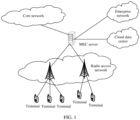
- FIG. 1 is a schematic architectural diagram of a MEC system according to an embodiment of this application.
- a MEC server is deployed between a radio access network and a core network.
- the MEC server is a server on which a MEC platform is deployed and that is managed by the MEC platform.
- the MEC server may be connected to a cloud data center and another network, for example, an enterprise network. In this way, the MEC server provides a service and a cloud computing function for a terminal nearby by using the radio access network.
- the MEC server may be established by a carrier, an enterprise, a virtual network operator, or a service provider.
- the terminal may be various devices that have a communication function, such as a handheld device, a vehicle-mounted device, a wearable device, a computer, or a network device.
- the handheld device may be a smartphone.
- the vehicle-mounted device may be a vehicle-mounted navigation system.
- the wearable device may be a smart band.
- the computer may be a personal digital assistant (personal digital assistant, PDA) computer, a tablet computer, and a laptop computer (laptop computer).
- the network device may be a residential gateway (residential gateway, RG) and a switch.
- FIG. 2 is a schematic structural diagram of hardware of a server according to an embodiment of this application.
- a server 200 may be configured to deploy a MEC platform.
- the server 200 includes at least one processor 201, a memory 202, and at least one communications interface 203.
- the processor 201 may be a central processing unit (central processing unit, CPU).
- the processor 201 may include one or more CPUs, for example, a CPU 0 and a CPU 1 in FIG. 2 .
- the server 200 may include a plurality of processors, for example, the processor 201 and a processor 206 in FIG. 2 .
- Each of the processors may be a single-core processor, or may be a multi-core processor.
- the communications interface 203 is configured to communicate with another device or a communications network, such as the Ethernet and a wireless local area network (wireless local area networks, WLAN).
- a communications network such as the Ethernet and a wireless local area network (wireless local area networks, WLAN).
- the memory 202 may be a read-only memory (read-only memory, ROM), a random access memory (random access memory, RAM), an electrically erasable programmable read-only memory (electrically erasable programmable read-only memory, EEPROM), an optical disk or another optical storage device, a magnetic disk or another magnetic storage device, or any medium that may be used to carry or store expected program code in a form of an instruction or a data structure and that may be accessed by a computer.
- the memory 202 may exist independently, and be connected to the processor 201 through a communications line. Alternatively, the memory 202 may be integrated with the processor 201.
- the memory 202 is configured to store a computer-executable instruction for executing the solutions of this application.
- the computer-executable instruction in this embodiment of the present invention may also be referred to as application program code.
- the processor 201 is configured to execute the computer-executable instruction stored in the memory 202, and control the communications interface 203 to implement a MEC platform deployment method provided in the embodiments of this application.
- the server 200 may further include an output device 204 and an input device 205.
- the output device 204 may be a liquid crystal display (liquid crystal display, LCD), a cathode ray tube (cathode ray tube, CRT) display, a projector (projector), or the like.
- the input device 205 may be a mouse, a keyboard, a touchscreen device, a sensing device, or the like.
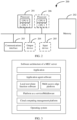
- FIG. 3 is a schematic diagram of a software architecture of a MEC server according to an embodiment of this application.
- the software architecture includes: an operating system (Operating System, OS), a cloud computing management platform, a platform as a service (Platform as a Service, PaaS), middleware, a multi-access edge platform (Multi-access edge Platform, MEP), local user plane function (local user plane function, LUPF) software, an application (Application, APP), and/or an application agent (APP agent) software.
- OS Operating System
- MEP multi-access edge platform
- MEP multi-access edge platform
- local user plane function local user plane function
- LUPF local user plane function
- APP agent application agent
- the operating system is a computer program that manages and controls computer hardware and software resources, and is basic system software. Any other software can operate only when the operating system supports the software. Functions of the operating system include managing hardware, software, and data resources of a computer system, controlling program running, improving a human-machine interface, providing support for another application software, and fully using all resources of the computer system.
- the cloud computing management platform is used to manage a virtual resource or a physical resource involved in cloud computing.
- the cloud computing management platform is deployed by using Openstack.
- the Openstack is an open-source cloud computing management platform project, including modules such as Nova, Swift, and Glance. Each module is configured to provide a corresponding service.
- the Openstack provides an application programming interface (Application Programming Interface, API). Each service is integrated through the API.
- the Nova module is configured to provide a virtual service.
- a user may use Nova-API to create and delete a virtual machine.
- the cloud computing management platform may also be implemented by using another technology. This is not limited in this embodiment of this application.
- the PaaS provides a development and test environment, a basic application, and a component in the form of a service for developers to develop, deploy, and manage a software as a service (software as a service, SaaS) application.
- the middleware is an independent system software or service program, is located between an operating system software and a user application software, and is used to connect two independent applications or independent systems.
- the middleware may have a plurality of implementations that comply with interface and protocol specifications.
- the application may work in environments with a plurality of platforms or operating systems.
- the MEP is a set of basic functions required for running the application on a specific virtualization infrastructure and enabling the MEP to provide and use a multi-access edge service.
- the MEP is further used to host the multi-access edge service, receive a domain name system (Domain Name System, DNS) record, and configure a DNS proxy/server.
- DNS Domain Name System
- the multi-access edge service includes an information providing service, a positioning service, and a bandwidth management service.
- the LUPF software is used to execute an edge policy, for example, a charging policy and/or a traffic routing policy.
- the traffic routing policy is used to route traffic that passes through a MEC platform.
- the charging policy is used to charge the traffic that passes through the MEC platform.
- the application may be an enterprise campus application, an industrial application, an internet of things application, a content delivery network (Content Delivery Network, CDN) application, or the like.
- the enterprise campus application is an application deployed by an enterprise in a campus network of the enterprise.
- the industrial application is an application used in the industrial field, for example, an application responsible for functions such as data collection, control, and communication in a sensing apparatus.
- the internet of things application is an application used in the internet of things field, for example, an application used to send alarm information to another vehicle in a vehicle to vehicle (vehicle to vehicle, V2V) scenario.
- the CDN application is used to provide a service such as video live streaming.
- the APP agent software is used to implement service governance on a local application, including: managing a service life cycle, monitoring service performance, managing service invoking, and the like.
- the embodiments of this application provide a characteristic root apparatus.
- the characteristic root apparatus is configured to enable a bare-metal server (that is, a server on which no operating system and no other software are installed) or a server on which an operating system is installed to automatically deploy software included in the software architecture shown in FIG. 3 , and enable a server having the software architecture shown in FIG. 3 to automatically execute the edge policy by using the LUPF software, and/or implement the service governance on the local application by using the APP agent software.
- a third party such as an enterprise, a virtual network operator, or a service provider can implement plug-and-play deployment of the MEC platform.
- the characteristic root apparatus is configured to enable a server into which the characteristic root apparatus is inserted to be authenticated by a cloud server, so that the server can become a trusted node in a carrier network.
- a trusted node can normally provide a service for a terminal, but an untrusted node cannot provide a service for the terminal.
- a carrier may control a quantity and areas of MEC servers deployed by a third party.
- FIG. 4 is a schematic structural diagram of a characteristic root apparatus according to an embodiment of this application.
- the characteristic root apparatus 400 includes a memory 401 and at least one communications interface 402.
- the memory 401 is connected to the communications interface 402 through a communications line.
- the memory 401 may be a read-only memory, a random access memory, an electrically erasable programmable read-only memory, an optical disc or another optical storage device, a magnetic disk or another magnetic storage device, or any medium that may be used to carry or store expected program code in a form of an instruction or a data structure and that may be accessed by a computer.
- the memory 401 is configured to store a digital certificate of a user and first authentication information.
- the memory 401 is further configured to store an edge policy and/or an image file of a MEC platform component.
- the communications interface 402 is configured to communicate with another device. For example, when the characteristic root apparatus is inserted into a server, a connection is established between the communications interface 402 of the characteristic root apparatus and a communications interface 203 of the server. In this way, the server can obtain the first authentication information from the characteristic root apparatus.
- the characteristic root apparatus 400 further includes a processor 403.
- the processor 403 may be a central processing unit.
- the processor 403 may include one or more CPUs, for example, a CPU 0 and a CPU 1 in FIG. 4 .
- the characteristic root apparatus 400 may include a plurality of processors, for example, the processor 403 and a processor 404 in FIG. 4 .
- Each of the processors may be a single-core processor, or may be a multi-core processor.
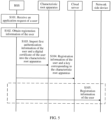
- FIG. 5 is a configuration method of a characteristic root apparatus according to an embodiment of this application, and the method includes the following steps.
- a business support system (business support system, BSS) receives an application request of a user.
- the application request is used to apply to a carrier for the characteristic root apparatus.
- the BSS obtains registration information of the user.
- the registration information includes at least the following content:
- the user enters the registration information on a registration page provided by the BSS/an OSS, so that the BSS/OSS system obtains the registration information of the user from the registration page.
- the BSS imports first authentication information and a digital certificate of the user into the characteristic root apparatus.
- the first authentication information includes the identity information of the user and a login password.
- the first authentication information further includes an identifier of the characteristic root apparatus.
- the digital certificate includes a key corresponding to the characteristic root apparatus.
- a key in the digital certificate is a private key corresponding to the characteristic root apparatus.
- the digital certificate further includes the identity information of the user and a digital signature of a certificate authorization center. It should be noted that, for a method for generating the digital certificate of the user, reference may be made to the prior art, and details are not described herein.
- the BSS may further import related data such as an edge policy and an image file of a MEC platform component into the characteristic root apparatus. It should be noted that the BSS opens a management interface that has the edge policy, so that the user can apply for or modify the edge policy by using the BSS.
- the BSS sends a key corresponding to the characteristic root apparatus and the registration information of the user to a cloud server.
- the key sent by the BSS to the cloud server is a public key corresponding to the characteristic root apparatus.
- the configuration method of the characteristic root apparatus further includes the following step S105.
- the BSS sends the registration information of the user to a network side device.
- the network side device includes an operation support system (operation support system, OSS), a control plane network element, and a user plane network element.
- operation support system operation support system
- control plane network element is a session management function (session management function, SMF) network element.
- user plane network element is a user plane function (user plane function, UPF) network element.
- the BSS first converts the registration information into configuration information, and then sends the configuration information to the network side device.
- the user may obtain the characteristic root apparatus from the carrier. In this way, the user can fast deploy the MEC platform on a server by using the characteristic root apparatus.
- FIG. 6 is a MEC platform deployment method according to an embodiment of this application, including the following steps: S201 to S204.
- a server initiates an authentication process to a cloud server by using a characteristic root apparatus.
- the server runs characteristic root basic software stored in the characteristic root apparatus, the characteristic root basic software automatically establishes a connection between the server and the cloud server, and the characteristic root basic software automatically initiates an authentication process to the cloud server, to verify whether the server is trusted.
- the authentication procedure refer to the method shown in FIG. 7 . Details are not described herein.
- connection between the server and the cloud server may be a hypertext transfer protocol (hypertext transfer protocol, http) connection.
- hypertext transfer protocol hypertext transfer protocol, http
- the server receives a session token sent by the cloud server, where the session token is used to identify a session between the cloud server and the server.
- the session token is used to identify a session between the cloud server and the server.
- information sent by the server to the cloud server carries the session token, so that the cloud server can learn that the information is sent by the server.
- aging time of the session token is preset or is delivered by the cloud server. When the aging time of the session token expires, the server needs to initiate the authentication process to the cloud server again.
- the server installs a MEC platform component.
- the MEC platform component includes LUPF software and/or APP agent software.
- the MEC platform component further includes an operating system, a cloud computing management platform, a PaaS, middleware, and the like.
- an image file of the MEC platform component is stored in the characteristic root apparatus, or stored in a database of the cloud server, or stored in the server.
- the image file may have different names, for example, an installation package and an installation file. This is not limited in this embodiment of this application.
- the server installs the MEC platform component in the following two manners: local deployment and remote deployment.
- the local deployment means that the server obtains the image file of the MEC platform component from the characteristic root apparatus or a database of the server. Then, the server runs the image file of the MEC platform component to install the MEC platform component.
- the remote deployment means that the server sends remote deployment information to the cloud server, where the remote deployment information is used to request to obtain the image file of the MEC platform component. Then, the server obtains the image file of the MEC platform component from the cloud server. Finally, the server runs the image file of the MEC platform component to install the MEC platform component.
- the remote deployment information is used to request all MEC platform components, or the remote deployment information is used to request an MEC platform component required by the server.
- the server may use both the local deployment and the remote deployment. For example, for MEC platform components stored in the characteristic root apparatus or the server, the server installs these MEC platform components through the local deployment. For MEC platform components that are not stored in the characteristic root apparatus or the server, the server installs these MEC platform components through the remote deployment.
- the server updates the MEC platform component from the cloud server.
- the server before installing the MEC platform component, the server sends registration information to the cloud server, where the registration information is used to enable the server to register as a controlled node in a carrier network.
- the server becomes the controlled node in the carrier network.
- the cloud server can manage and maintain the server, so that the server installs the MEC platform component, and uses the MEC platform component.
- the server may perform the following step S203. If the server installs the APP agent software, the server may perform the following step S204.
- the server executes an edge policy by using the LUPF software.
- the edge policy includes a traffic routing policy and/or a charging policy.
- the edge policy may further include another policy, for example, an access control policy. This is not limited in this embodiment of this application.
- the server when the edge policy is prestored in the characteristic root apparatus, the server obtains the edge policy from the characteristic root apparatus. Alternatively, the server obtains the edge policy from the cloud server.
- the server executes the edge policy by using the LUPF software.
- the policy authorization information is used to indicate that the LPUF software has permission to execute the edge policy.
- the server may not execute the edge policy by using the LUPF software.
- whether a MEC server deployed by a third party may execute the edge policy by using the LUPF software depends on whether the policy authorization information is stored in the characteristic root apparatus.
- a carrier can control whether the MEC server deployed by the third party may execute the edge policy by using the LUPF software.
- the policy authorization information may implicitly exist in the characteristic root apparatus. For example, if the edge policy is prestored in the characteristic root apparatus, it indicates that the server into which the characteristic root apparatus is inserted may execute the edge policy by using the LUPF software. If the edge policy is not stored in the characteristic root apparatus, it indicates that the server into which the characteristic root apparatus is inserted may not execute the edge policy by using the LUPF software.
- the server implements service governance on a local application by using the APP agent software.
- the local application is an application deployed on the server, or an application deployed on another node in a local area network in which the server is located.
- the server implements service governance on the local application by using the APP agent software in at least the following cases:
- the local application first registers the service with the APP agent software, so that the APP agent software learns of the service provided by the local application to the outside.
- the local application registers the service by using a registration API.
- the local application registers the service by configuring service information and information about a service available detection endpoint on the APP agent software.
- the service governance center indicates a control plane network element and a DNS server to execute a corresponding traffic routing rule
- the control plane network element also indicates a UPF network element to execute a corresponding traffic routing rule, so that traffic generated when a terminal accesses the service provided by the local application may be imported into the server.
- the server sends service status information to the service governance center by using the APP agent software, where the service status information is used to notify the service governance center that the service provided by the local application is unavailable.
- the service governance center updates a traffic routing rule on a network side, and blocks traffic to the local application whose process is abnormal, to avoid invalid access generated by the terminal.
- the server automatically initiates the authentication process, and after the authentication succeeds, the server automatically installs the MEC platform component and uses the MEC platform component. Plug-and-play of the MEC platform is implemented, and this is helpful to implement a solution of co-building the MEC platform by a plurality of parties.
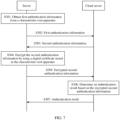
- FIG. 7 is an authentication method according to an embodiment of this application, including the following steps: S301 to S307.
- a server obtains first authentication information from a characteristic root apparatus.
- the server sends the first authentication information to the cloud server, so that the cloud server receives the first authentication information sent by the server.
- the cloud server sends second authentication information to the server, so that the server receives the second authentication information sent by the cloud server.
- the cloud server After receiving the first authentication information sent by the server, the cloud server verifies whether the first authentication information is correct. When the first authentication information is correct, the cloud server searches a database for the prestored second authentication information, or randomly generates the second authentication information, or generates the second authentication information according to a preset rule. Then the cloud server sends the second authentication information to the server, so that the server receives the second authentication information sent by the cloud server.
- That the cloud server generates the second authentication information according to a preset rule includes: generating the second authentication information by using the first authentication information with reference to information in registration information of a user.
- the cloud server may alternatively generate the second authentication information according to another rule. This is not limited in this embodiment of this application.
- the server encrypts the second authentication information by using a digital certificate stored in the characteristic root apparatus.
- the server when an asymmetric encryption technology is used, the server encrypts the second authentication information by using a private key in the digital certificate, to determine the encrypted second authentication information.
- an asymmetric encryption algorithm used by the server is an RSA encryption algorithm, a digital signature algorithm (Digital Signature Algorithm, DSA), or an Elgamal algorithm.
- the server sends the encrypted second authentication information to the cloud server, so that the cloud server receives the encrypted second authentication information sent by the server.
- the cloud server determines an authentication result based on the encrypted second authentication information.
- the authentication result is that the authentication succeeds or the authentication fails.
- the cloud server decrypts the second authentication information by using a public key corresponding to the characteristic root apparatus. If information obtained by decryption is the same as the second authentication information previously sent to the server, the cloud server determines that an authentication result of the server is that the authentication succeeds. If information obtained by decryption is not the same as the second authentication information previously sent to the server, the cloud server determines that the authentication result of the server is that the authentication fails.
- the cloud server sends the authentication result to the server, so that the server receives the authentication result sent by the cloud server.
- the cloud server may determine whether a server into which the characteristic root apparatus is inserted is a trusted node, to avoid an untrusted node affecting security of a carrier network.
- the server includes a corresponding hardware structure and/or software module for implementing each function.
- a person skilled in the art should easily be aware that, in combination with units and algorithm steps of the examples described in the embodiments disclosed in this specification, this application may be implemented by hardware or a combination of hardware and computer software. Whether a function is performed by hardware or hardware driven by computer software depends on particular applications and design constraints of the technical solutions. A person skilled in the art may use different methods to implement the described functions for each particular application, but it should not be considered that the implementation goes beyond the scope of this application.
- FIG. 8 shows a schematic structural diagram of a MEC platform deployment apparatus.
- the MEC platform deployment apparatus includes: an authentication module 801, an installation module 802, and an enabling module 803.
- the authentication module 801 is configured to perform the step S201 in FIG. 6 , and steps S301 to S305 and S307 in FIG. 7 , and/or another process used for the technology described in this specification.
- the installation module 802 is configured to perform the step S202 in FIG. 6 , and/or another process used for the technology described in this specification.
- the enabling module 803 is configured to perform the steps S203 and S204 in FIG. 6 , and/or another process used for the technology described in this specification. All related content of the steps in the foregoing method embodiments may be cited in function descriptions of corresponding function modules, and details are not described herein again.
- the authentication module 801, the installation module 802, and the enabling module 803 in FIG. 8 may be implemented by the processor 201 of the server in FIG. 2 , or implemented by the processor 201 of the server in FIG. 2 controlling the communications interface 203. This is not limited in this embodiment of this application.
- the embodiments of this application further provide a computer-readable storage medium, where the computer-readable storage medium stores a computer instruction.
- the server is enabled to perform the method shown in FIG. 6 and FIG. 7 .
- the computer-readable storage medium may be any medium accessible by a computer, or a data storage device, such as a server or a data center, integrating one or more media.
- the medium may be a magnetic medium (for example, a floppy disk, a hard disk, or a magnetic tape), an optical medium (for example, an optical disc), a semiconductor medium (for example, a solid-state disk (solid state disk, SSD)), or the like.
- the computer instruction may not only be stored in the computer-readable storage medium, and may also be transmitted from one computer-readable storage medium to another computer-readable storage medium.
- the computer instruction may be transmitted from a website, a computer, a server, or a data center to another website, another computer, another server, or another data center in a wired (for example, a coaxial cable, an optical fiber, or a twisted pair) or wireless (for example, infrared, radio, or microwave) manner.
- the embodiments of this application further provide a computer program product including a computer instruction.
- the computer program product When the computer program product is run on a computer, the computer is enabled to perform the method shown in FIG. 6 and FIG. 7 .
- the server, the computer storage medium, or the computer program product provided in the embodiments of this application are all configured to perform the corresponding methods provided above. Therefore, for beneficial effects that may be achieved thereof, refer to the beneficial effects in the corresponding methods provided above. Details are not described herein again.
Landscapes
- Engineering & Computer Science (AREA)
- Computer Networks & Wireless Communication (AREA)
- Signal Processing (AREA)
- Computer Security & Cryptography (AREA)
- General Engineering & Computer Science (AREA)
- Computing Systems (AREA)
- Computer Hardware Design (AREA)
- Software Systems (AREA)
- Theoretical Computer Science (AREA)
- General Physics & Mathematics (AREA)
- Physics & Mathematics (AREA)
- Business, Economics & Management (AREA)
- Accounting & Taxation (AREA)
- Stored Programmes (AREA)
- Information Transfer Between Computers (AREA)
Claims (11)
- Verfahren zum Einsatz einer Multi-Access-Edge-Computing-Plattform, MEC-Plattform, wobei das Verfahren Folgendes umfasst:Einfügen einer Eigenwerteinrichtung (400-404) in einen Server (200-206), wobei die Eigenwerteinrichtung (400-404) Prozessoren (403, 404), einen Speicher (401) und eine Kommunikationsschnittstelle (402) umfasst, die dazu angepasst ist, mit einer Kommunikationsschnittstelle (203) des Servers zu kommunizieren, wenn die Eigenwerteinrichtung in den Server eingefügt wird;nachdem die Eigenwerteinrichtung in den Server eingefügt wurde, Ausführen, durch den Server, von einer Eigenwertbasissoftware, die in der Eigenwerteinrichtung gespeichert ist, wobei die Eigenwertbasissoftware eine Verbindung zwischen dem Server und einem Cloud-Server herstellt, und Initiieren (S201), durch den Server (200-206), eines Authentifizierungsprozesses gegenüber dem Cloud-Server unter Verwendung der Eigenwerteinrichtung (400-404), um zu überprüfen, ob der Server vertrauenswürdig ist, wobei ein digitales Zertifikat eines Benutzers und erste Authentifizierungsinformationen in der Eigenwerteinrichtung vorgespeichert sind;Erlangen (S202), durch den Server, einer Bilddatei einer MEC-Plattformkomponente, die in der Eigenwerteinrichtung vorgespeichert ist;nachdem die Authentifizierung erfolgreich war, Installieren (S202), durch den Server (200-206), der MEC-Plattformkomponente durch Ausführen der Bilddatei der MEC-Plattformkomponente, wobei die MEC-Plattformkomponente eine Software für eine lokale Benutzerebenenfunktion, LUPF-Software, und/oder eine Software für einen Anwendungsagenten, Software für APP-Agenten, umfasst;Ausführen (S203), durch den Server, einer Edge-Richtlinie unter Verwendung der LUPF-Software, wenn die MEC-Plattformkomponente eine Software für eine lokale Benutzerebenenfunktion, LUPF-Software, umfasst, wobei die Edge-Richtlinie eine Verkehrsrouting-Richtlinie und/oder eine Gebührenberechnungsrichtlinie umfasst; und/oderImplementieren (S204), durch den Server, einer Dienstverwaltung auf einer lokalen Anwendung unter Verwendung der Software für APP-Agenten, wenn die MEC-Plattformkomponente eine Software für Anwendungsagenten, Software für APP-Agenten, umfasst.
- Verfahren zum Einsatz einer MEC-Plattform nach Anspruch 1, wobei das Initiieren, durch einen Server, eines Authentifizierungsprozesses gegenüber einem Cloud-Server unter Verwendung einer Eigenwerteinrichtung Folgendes umfasst:Erlangen (S301), durch den Server, der ersten Authentifizierungsinformationen von der Eigenwerteinrichtung;Senden (S302), durch den Server, der ersten Authentifizierungsinformationen an den Cloud-Server;Empfangen (S303), durch den Server, von zweiten Authentifizierungsinformationen, die durch den Cloud-Server gesendet werden;Verschlüsseln (S304), durch den Server, der zweiten Authentifizierungsinformationen unter Verwendung des digitalen Zertifikats des Benutzers;Senden (S305), durch den Server, der verschlüsselten zweiten Authentifizierungsinformationen an den Cloud-Server; undEmpfangen (S306), durch den Server, eines Authentifizierungsergebnisses, das durch den Cloud-Server gesendet wird, wobei das Authentifizierungsergebnis darin besteht, dass die Authentifizierung erfolgreich ist oder fehlgeschlagen ist.
- Verfahren zum Einsatz einer MEC-Plattform nach Anspruch 1 oder 2, wobei das Verfahren nach dem Initiieren, durch einen Server, eines Authentifizierungsprozesses gegenüber einem Cloud-Server unter Verwendung einer Eigenwerteinrichtung ferner Folgendes umfasst:
nachdem die Authentifizierung erfolgreich war, Empfangen (S201), durch den Server, eines Sitzungstokens von dem Cloud-Server, wobei das Sitzungstoken eine Sitzung zwischen dem Cloud-Server und dem Server identifiziert. - Verfahren zum Einsatz einer MEC-Plattform nach einem der Ansprüche 1 bis 3, wobei das Verfahren vor dem Ausführen, durch den Server, einer Edge-Richtlinie unter Verwendung der LUPF-Software ferner Folgendes umfasst:wenn die Edge-Richtlinie in der Eigenwerteinrichtung vorgespeichert ist, Erlangen (S203), durch den Server, der Edge-Richtlinie von der Eigenwerteinrichtung; oderErlangen, durch den Server, der Edge-Richtlinie von dem Cloud-Server.
- Verfahren zum Einsatz einer MEC-Plattform nach Anspruch 4, wobei das Ausführen, durch den Server, einer Edge-Richtlinie unter Verwendung der LUPF-Software Folgendes umfasst:
wenn Richtlinienautorisierungsinformationen in der Eigenwerteinrichtung vorgespeichert sind, Ausführen (S203), durch den Server, der Edge-Richtlinie unter Verwendung der LUPF-Software, wobei die Richtlinienautorisierungsinformationen angeben, dass die LUPF-Software die Berechtigung aufweist, die Edge-Richtlinie auszuführen. - Verfahren zum Einsatz einer MEC-Plattform nach Anspruch 4, wobei das Implementieren, durch den Server, der Dienstverwaltung auf einer lokalen Anwendung unter Verwendung der Software für APP-Agenten Folgendes umfasst:
Registrieren (S204), durch den Server bei einer Dienstverwaltungszentrale unter Verwendung der Software für den APP-Agenten, eines Dienstes, der durch die lokale Anwendung bereitgestellt wird. - Verfahren zum Einsatz einer MEC-Plattform nach Anspruch 4 oder 6, wobei das Implementieren, durch den Server, der Dienstverwaltung auf einer lokalen Anwendung unter Verwendung der Software für APP-Agenten Folgendes umfasst:
wenn die Software für APP-Agenten erkennt, dass ein Prozess der lokalen Anwendung abnormal ist, Senden (S204), durch den Server, von Dienststatusinformationen an die Dienstverwaltungszentrale unter Verwendung der Software für APP-Agenten, wobei die Dienststatusinformationen der Dienstverwaltungszentrale beschreiben, dass der Dienst, der durch die lokale Anwendung bereitgestellt wird, nicht verfügbar ist. - Computerlesbares Speichermedium, wobei das computerlesbare Speichermedium eine Anweisung speichert und, wenn das computerlesbare Speichermedium auf einem Computer ausgeführt wird, der Computer in die Lage versetzt wird, das Verfahren zum Einsatz einer Multi-Access-Edge-Computing-Plattform, MEC-Plattform, nach einem der Ansprüche 1 bis 7 durchzuführen.
- Computerprogrammprodukt, umfassend eine Anweisung, wobei, wenn das Computerprogrammprodukt auf einem Computer ausgeführt wird, der Computer in die Lage versetzt wird, das Verfahren zum Einsatz einer Multi-Access-Edge-Computing-Plattform, MEC-Plattform, nach einem der Ansprüche 1 bis 7 durchzuführen.
- Chipsystem, wobei das Chipsystem einen Prozessor umfasst, der dazu konfiguriert ist, einen Server bei der Implementierung einer Funktion des Verfahrens zum Einsatz einer Multi-Access-Edge-Computing-Plattform, MEC-Plattform, nach einem der Ansprüche 1 bis 7 zu unterstützen.
- Einrichtung zum Einsatz einer Multi-Access-Edge-Computing-Plattform, MEC-Plattform, umfassend Mittel zum Ausführen der Schritte des Verfahrens nach einem der Ansprüche 1 bis 7.
Applications Claiming Priority (2)
| Application Number | Priority Date | Filing Date | Title |
|---|---|---|---|
| CN201811109750.7A CN110944330B (zh) | 2018-09-21 | 2018-09-21 | Mec平台部署方法及装置 |
| PCT/CN2019/087776 WO2020057163A1 (zh) | 2018-09-21 | 2019-05-21 | Mec平台部署方法及装置 |
Publications (3)
| Publication Number | Publication Date |
|---|---|
| EP3846522A1 EP3846522A1 (de) | 2021-07-07 |
| EP3846522A4 EP3846522A4 (de) | 2021-10-13 |
| EP3846522B1 true EP3846522B1 (de) | 2025-04-23 |
Family
ID=69888221
Family Applications (1)
| Application Number | Title | Priority Date | Filing Date |
|---|---|---|---|
| EP19861838.1A Active EP3846522B1 (de) | 2018-09-21 | 2019-05-21 | Verfahren und vorrichtung zum einsatz einer mec-plattform |
Country Status (4)
| Country | Link |
|---|---|
| US (1) | US12149519B2 (de) |
| EP (1) | EP3846522B1 (de) |
| CN (1) | CN110944330B (de) |
| WO (1) | WO2020057163A1 (de) |
Families Citing this family (23)
| Publication number | Priority date | Publication date | Assignee | Title |
|---|---|---|---|---|
| US11490307B2 (en) * | 2018-12-12 | 2022-11-01 | Akamai Technologies, Inc. | Intelligently pre-positioning and migrating compute capacity in an overlay network, with compute handoff and data consistency |
| CN111615128A (zh) * | 2020-05-25 | 2020-09-01 | 浙江九州云信息科技有限公司 | 一种多接入边缘计算方法、平台及系统 |
| CN111651240A (zh) * | 2020-06-04 | 2020-09-11 | 浙江九州云信息科技有限公司 | 一种多接入边缘计算平台管理方法及装置 |
| CN112291069A (zh) * | 2020-06-10 | 2021-01-29 | 李彩云 | 应用于云边端协同的通信信息处理方法及云端通信服务器 |
| CN111835772B (zh) * | 2020-07-15 | 2022-02-18 | 中国电子技术标准化研究院 | 一种基于边缘计算的用户身份认证方法、装置 |
| CN114071799B (zh) * | 2020-08-10 | 2024-09-17 | 华为技术有限公司 | 管理会话连接的方法和装置 |
| CN114125838B (zh) * | 2020-08-31 | 2024-09-24 | 中国电信股份有限公司 | Mec应用接入认证授权方法、系统和mec业务管理平台 |
| US11340956B2 (en) | 2020-09-11 | 2022-05-24 | Toyota Motor Engineering & Manufacturing North America, Inc. | Systems and methods for dynamic prediction and optimization of edge server scheduling |
| CN112130931B (zh) * | 2020-09-27 | 2023-01-06 | 联想(北京)有限公司 | 一种应用部署方法、节点、系统及存储介质 |
| CN112243224B (zh) * | 2020-10-15 | 2022-08-02 | 中国联合网络通信集团有限公司 | 一种边缘计算网络实现方法及装置 |
| CN114531467B (zh) | 2020-11-04 | 2023-04-14 | 中移(苏州)软件技术有限公司 | 一种信息处理方法、设备和系统 |
| CN115048208A (zh) * | 2021-02-25 | 2022-09-13 | 深圳富桂精密工业有限公司 | 边缘运算平台管理方法、电子装置及计算机可读储存媒体 |
| US11191013B1 (en) | 2021-06-08 | 2021-11-30 | Peltbeam Inc. | Edge device, central cloud server, and method for handling service for multiple service providers |
| CN115529144B (zh) * | 2021-06-24 | 2024-06-18 | 中移(成都)信息通信科技有限公司 | 通信系统、方法、装置、第一设备、第二设备及存储介质 |
| US11275147B1 (en) | 2021-08-02 | 2022-03-15 | Peltbeam Inc. | Dual function edge device and method for accelerating UE-specific beamforming |
| USD966203S1 (en) | 2021-08-02 | 2022-10-11 | Peltbeam Inc. | Relay device |
| US12111388B2 (en) * | 2021-08-02 | 2024-10-08 | Peltbeam Inc | Edge device and method for sensor-assisted beamforming |
| CN113891359B (zh) * | 2021-10-11 | 2023-06-20 | 中国联合网络通信集团有限公司 | 一种数据处理方法、装置及存储介质 |
| CN113986207B (zh) * | 2021-11-16 | 2024-09-17 | 航天信息股份有限公司 | 一种软件架构生成、调用方法及装置 |
| CN114268478B (zh) * | 2021-12-14 | 2023-04-25 | 中国联合网络通信集团有限公司 | 边缘云平台的调用请求鉴权方法、装置、设备及介质 |
| CN114666131A (zh) * | 2022-03-22 | 2022-06-24 | 阿里巴巴(中国)有限公司 | 证书管理系统、证书管理方法及证书管理系统的构建方法 |
| US12238086B2 (en) * | 2022-06-17 | 2025-02-25 | Avaya Management L.P. | Systems and methods for preventing toll fraud in a SIP environment |
| CN117499225B (zh) * | 2023-11-07 | 2025-09-05 | 浪潮云信息技术股份公司 | 一种基于nats的云边消息协同配置方法 |
Family Cites Families (17)
| Publication number | Priority date | Publication date | Assignee | Title |
|---|---|---|---|---|
| US20080034216A1 (en) * | 2006-08-03 | 2008-02-07 | Eric Chun Wah Law | Mutual authentication and secure channel establishment between two parties using consecutive one-time passwords |
| CN104125251A (zh) * | 2013-04-26 | 2014-10-29 | 华茂云天科技(北京)有限公司 | 一种基于虚拟化技术的云计算安全终端 |
| CN107534648A (zh) * | 2015-02-25 | 2018-01-02 | 诺基亚通信公司 | 用于支持运营商辅助家长控制的机制 |
| JP6507854B2 (ja) * | 2015-05-28 | 2019-05-08 | 株式会社リコー | 情報処理システム、情報処理装置、電子証明書の管理方法、及びプログラム |
| JP6778748B2 (ja) * | 2015-11-24 | 2020-11-04 | エヌイーシー ラボラトリーズ ヨーロッパ ゲーエムベーハー | 仮想ネットワーク機能及びネットワークアプリケーションを管理し調整する方法及びネットワーク |
| CN106936766A (zh) * | 2015-12-29 | 2017-07-07 | 大唐高鸿信安(浙江)信息科技有限公司 | 基于可信芯片的可信云自动部署系统及方法 |
| US9866637B2 (en) * | 2016-01-11 | 2018-01-09 | Equinix, Inc. | Distributed edge processing of internet of things device data in co-location facilities |
| GB2565656B (en) * | 2016-02-25 | 2020-04-15 | Intel Corp | Platform for computing at the mobile edge |
| US9942825B1 (en) * | 2017-03-27 | 2018-04-10 | Verizon Patent And Licensing Inc. | System and method for lawful interception (LI) of Network traffic in a mobile edge computing environment |
| US10887198B2 (en) * | 2017-09-29 | 2021-01-05 | Nec Corporation | System and method to support network slicing in an MEC system providing automatic conflict resolution arising from multiple tenancy in the MEC environment |
| EP3707881B1 (de) * | 2017-11-10 | 2024-06-26 | Intel Corporation | Multi-access edge computing (mec) architektur und mobilitätsrahmenwerk |
| DE112018005693T5 (de) * | 2017-11-27 | 2020-07-09 | Intel IP Corporation | Multi-access edge computing (mec)-basierte mehrbetreiberunterstützung für cellular vehicle-to-everything (c-v2x) systeme |
| WO2019118964A1 (en) * | 2017-12-15 | 2019-06-20 | Idac Holdings, Inc. | Enhanced nef function, mec and 5g integration |
| CN117749793A (zh) * | 2018-01-12 | 2024-03-22 | 交互数字专利控股公司 | 提供无线网络信息服务的方法和设备 |
| US10728744B2 (en) * | 2018-04-27 | 2020-07-28 | Hewlett Packard Enterprise Development Lp | Transmission outside of a home network of a state of a MEC application |
| WO2019242856A1 (en) * | 2018-06-20 | 2019-12-26 | NEC Laboratories Europe GmbH | Multi-access edge computing, mec, system and method for operating the same |
| US10917800B2 (en) * | 2018-06-22 | 2021-02-09 | Huawei Technologies Co., Ltd. | Data analytics management (DAM), configuration specification and procedures, provisioning, and service based architecture (SBA) |
-
2018
- 2018-09-21 CN CN201811109750.7A patent/CN110944330B/zh active Active
-
2019
- 2019-05-21 WO PCT/CN2019/087776 patent/WO2020057163A1/zh not_active Ceased
- 2019-05-21 EP EP19861838.1A patent/EP3846522B1/de active Active
-
2021
- 2021-03-19 US US17/207,232 patent/US12149519B2/en active Active
Also Published As
| Publication number | Publication date |
|---|---|
| WO2020057163A1 (zh) | 2020-03-26 |
| EP3846522A1 (de) | 2021-07-07 |
| EP3846522A4 (de) | 2021-10-13 |
| US12149519B2 (en) | 2024-11-19 |
| US20210297410A1 (en) | 2021-09-23 |
| CN110944330B (zh) | 2021-06-22 |
| CN110944330A (zh) | 2020-03-31 |
Similar Documents
| Publication | Publication Date | Title |
|---|---|---|
| EP3846522B1 (de) | Verfahren und vorrichtung zum einsatz einer mec-plattform | |
| JP7457173B2 (ja) | モノのインターネット(iot)デバイスの管理 | |
| KR102315895B1 (ko) | 클라우드 컴퓨팅 노드들의 보안 구성 | |
| EP4675969A1 (de) | Datenverarbeitungsverfahren und -vorrichtung sowie lesbares medium und elektronische vorrichtung | |
| CN107637011B (zh) | 用于物联网网络的自配置密钥管理系统 | |
| EP3410759B1 (de) | Verfahren und zugangspunkt für den zugriff auf ein netzwerk über eine internet-der-dinge-vorrichtung | |
| CN107548499B (zh) | 用于虚拟网络功能的安全自举的技术 | |
| US10601590B1 (en) | Secure secrets in hardware security module for use by protected function in trusted execution environment | |
| EP3982272A1 (de) | Plattform zur mobile-edge-datenverarbeitung | |
| US11818574B2 (en) | Provisioning devices securely using zero touch deployments | |
| US20180115521A1 (en) | Dynamically managing, from a centralized service, valid cipher suites allowed for secured sessions | |
| JP2016522509A (ja) | 仮想ネットワーク機能マネージャによる仮想インフラストラクチャマネージャへのアクセスの自動化構成 | |
| EP3779696A1 (de) | Verfahren zum aufrufen von dienst-api und zugehörige vorrichtung | |
| JP6793667B2 (ja) | アプリケーションダウンロード方法及び装置 | |
| CN111901285A (zh) | 一种可信验证方法、系统、设备及存储介质 | |
| CN111937013B (zh) | 电子设备管理 | |
| EP3987391B1 (de) | Verfahren und system zum einsatz von dienstleistungsbildern in einem cloud-computersystem basierend auf verteilter ledger-technologie | |
| CN114239010B (zh) | 一种多节点分布式认证方法、系统、电子设备及介质 | |
| EP3085007B1 (de) | Push-basiertes vertrauensmodell für public-cloud-anwendungen | |
| CN111726328A (zh) | 用于对第一设备进行远程访问的方法、系统以及相关设备 | |
| CN116601941A (zh) | 基于通信请求的请求方真实性评估 | |
| CN108228280A (zh) | 浏览器参数的配置方法及装置、存储介质、电子设备 | |
| CN115412887A (zh) | 配网方法、装置、系统、设备及存储介质 | |
| CN114513526A (zh) | 一种跨链访问数据的方法、系统以及第一区块链 | |
| TWI817162B (zh) | 行動裝置免元件簽章系統及其方法 |
Legal Events
| Date | Code | Title | Description |
|---|---|---|---|
| STAA | Information on the status of an ep patent application or granted ep patent |
Free format text: STATUS: THE INTERNATIONAL PUBLICATION HAS BEEN MADE |
|
| STAA | Information on the status of an ep patent application or granted ep patent |
Free format text: STATUS: REQUEST FOR EXAMINATION WAS MADE |
|
| PUAI | Public reference made under article 153(3) epc to a published international application that has entered the european phase |
Free format text: ORIGINAL CODE: 0009012 |
|
| 17P | Request for examination filed |
Effective date: 20210330 |
|
| AK | Designated contracting states |
Kind code of ref document: A1 Designated state(s): AL AT BE BG CH CY CZ DE DK EE ES FI FR GB GR HR HU IE IS IT LI LT LU LV MC MK MT NL NO PL PT RO RS SE SI SK SM TR |
|
| A4 | Supplementary search report drawn up and despatched |
Effective date: 20210915 |
|
| RIC1 | Information provided on ipc code assigned before grant |
Ipc: H04W 4/60 20180101ALI20210909BHEP Ipc: H04W 4/50 20180101ALI20210909BHEP Ipc: H04L 29/08 20060101ALI20210909BHEP Ipc: H04W 4/24 20180101ALI20210909BHEP Ipc: H04M 15/00 20060101ALI20210909BHEP Ipc: H04W 4/06 20090101ALI20210909BHEP Ipc: H04L 29/06 20060101AFI20210909BHEP |
|
| DAV | Request for validation of the european patent (deleted) | ||
| DAX | Request for extension of the european patent (deleted) | ||
| REG | Reference to a national code |
Ref country code: DE Ref legal event code: R079 Free format text: PREVIOUS MAIN CLASS: H04W0012060000 Ipc: H04L0009400000 Ref country code: DE Ref legal event code: R079 Ref document number: 602019069127 Country of ref document: DE Free format text: PREVIOUS MAIN CLASS: H04W0012060000 Ipc: H04L0009400000 |
|
| GRAP | Despatch of communication of intention to grant a patent |
Free format text: ORIGINAL CODE: EPIDOSNIGR1 |
|
| STAA | Information on the status of an ep patent application or granted ep patent |
Free format text: STATUS: GRANT OF PATENT IS INTENDED |
|
| RIC1 | Information provided on ipc code assigned before grant |
Ipc: H04L 67/10 20220101ALN20241128BHEP Ipc: H04W 40/24 20090101ALI20241128BHEP Ipc: G06F 8/60 20180101ALI20241128BHEP Ipc: H04W 4/60 20180101ALI20241128BHEP Ipc: H04W 4/50 20180101ALI20241128BHEP Ipc: H04L 67/00 20220101ALI20241128BHEP Ipc: H04W 12/06 20210101ALI20241128BHEP Ipc: H04W 4/24 20180101ALI20241128BHEP Ipc: H04M 15/00 20060101ALI20241128BHEP Ipc: H04L 9/40 20220101AFI20241128BHEP |
|
| INTG | Intention to grant announced |
Effective date: 20241216 |
|
| P01 | Opt-out of the competence of the unified patent court (upc) registered |
Free format text: CASE NUMBER: APP_4439/2025 Effective date: 20250127 |
|
| GRAS | Grant fee paid |
Free format text: ORIGINAL CODE: EPIDOSNIGR3 |
|
| GRAA | (expected) grant |
Free format text: ORIGINAL CODE: 0009210 |
|
| STAA | Information on the status of an ep patent application or granted ep patent |
Free format text: STATUS: THE PATENT HAS BEEN GRANTED |
|
| AK | Designated contracting states |
Kind code of ref document: B1 Designated state(s): AL AT BE BG CH CY CZ DE DK EE ES FI FR GB GR HR HU IE IS IT LI LT LU LV MC MK MT NL NO PL PT RO RS SE SI SK SM TR |
|
| REG | Reference to a national code |
Ref country code: GB Ref legal event code: FG4D |
|
| REG | Reference to a national code |
Ref country code: CH Ref legal event code: EP |
|
| REG | Reference to a national code |
Ref country code: DE Ref legal event code: R096 Ref document number: 602019069127 Country of ref document: DE |
|
| REG | Reference to a national code |
Ref country code: IE Ref legal event code: FG4D |
|
| PGFP | Annual fee paid to national office [announced via postgrant information from national office to epo] |
Ref country code: DE Payment date: 20250408 Year of fee payment: 7 |
|
| REG | Reference to a national code |
Ref country code: NL Ref legal event code: MP Effective date: 20250423 |
|
| PG25 | Lapsed in a contracting state [announced via postgrant information from national office to epo] |
Ref country code: NL Free format text: LAPSE BECAUSE OF FAILURE TO SUBMIT A TRANSLATION OF THE DESCRIPTION OR TO PAY THE FEE WITHIN THE PRESCRIBED TIME-LIMIT Effective date: 20250423 |
|
| REG | Reference to a national code |
Ref country code: AT Ref legal event code: MK05 Ref document number: 1788892 Country of ref document: AT Kind code of ref document: T Effective date: 20250423 |
|
| PG25 | Lapsed in a contracting state [announced via postgrant information from national office to epo] |
Ref country code: ES Free format text: LAPSE BECAUSE OF FAILURE TO SUBMIT A TRANSLATION OF THE DESCRIPTION OR TO PAY THE FEE WITHIN THE PRESCRIBED TIME-LIMIT Effective date: 20250423 Ref country code: PT Free format text: LAPSE BECAUSE OF FAILURE TO SUBMIT A TRANSLATION OF THE DESCRIPTION OR TO PAY THE FEE WITHIN THE PRESCRIBED TIME-LIMIT Effective date: 20250825 Ref country code: FI Free format text: LAPSE BECAUSE OF FAILURE TO SUBMIT A TRANSLATION OF THE DESCRIPTION OR TO PAY THE FEE WITHIN THE PRESCRIBED TIME-LIMIT Effective date: 20250423 |
|
| REG | Reference to a national code |
Ref country code: LT Ref legal event code: MG9D |
|
| PG25 | Lapsed in a contracting state [announced via postgrant information from national office to epo] |
Ref country code: NO Free format text: LAPSE BECAUSE OF FAILURE TO SUBMIT A TRANSLATION OF THE DESCRIPTION OR TO PAY THE FEE WITHIN THE PRESCRIBED TIME-LIMIT Effective date: 20250723 Ref country code: GR Free format text: LAPSE BECAUSE OF FAILURE TO SUBMIT A TRANSLATION OF THE DESCRIPTION OR TO PAY THE FEE WITHIN THE PRESCRIBED TIME-LIMIT Effective date: 20250724 |
|
| PG25 | Lapsed in a contracting state [announced via postgrant information from national office to epo] |
Ref country code: PL Free format text: LAPSE BECAUSE OF FAILURE TO SUBMIT A TRANSLATION OF THE DESCRIPTION OR TO PAY THE FEE WITHIN THE PRESCRIBED TIME-LIMIT Effective date: 20250423 |
|
| PG25 | Lapsed in a contracting state [announced via postgrant information from national office to epo] |
Ref country code: BG Free format text: LAPSE BECAUSE OF FAILURE TO SUBMIT A TRANSLATION OF THE DESCRIPTION OR TO PAY THE FEE WITHIN THE PRESCRIBED TIME-LIMIT Effective date: 20250423 |
|
| PG25 | Lapsed in a contracting state [announced via postgrant information from national office to epo] |
Ref country code: HR Free format text: LAPSE BECAUSE OF FAILURE TO SUBMIT A TRANSLATION OF THE DESCRIPTION OR TO PAY THE FEE WITHIN THE PRESCRIBED TIME-LIMIT Effective date: 20250423 |
|
| PG25 | Lapsed in a contracting state [announced via postgrant information from national office to epo] |
Ref country code: AT Free format text: LAPSE BECAUSE OF FAILURE TO SUBMIT A TRANSLATION OF THE DESCRIPTION OR TO PAY THE FEE WITHIN THE PRESCRIBED TIME-LIMIT Effective date: 20250423 |
|
| PG25 | Lapsed in a contracting state [announced via postgrant information from national office to epo] |
Ref country code: RS Free format text: LAPSE BECAUSE OF FAILURE TO SUBMIT A TRANSLATION OF THE DESCRIPTION OR TO PAY THE FEE WITHIN THE PRESCRIBED TIME-LIMIT Effective date: 20250723 |
|
| PG25 | Lapsed in a contracting state [announced via postgrant information from national office to epo] |
Ref country code: IS Free format text: LAPSE BECAUSE OF FAILURE TO SUBMIT A TRANSLATION OF THE DESCRIPTION OR TO PAY THE FEE WITHIN THE PRESCRIBED TIME-LIMIT Effective date: 20250823 |
|
| PG25 | Lapsed in a contracting state [announced via postgrant information from national office to epo] |
Ref country code: LV Free format text: LAPSE BECAUSE OF FAILURE TO SUBMIT A TRANSLATION OF THE DESCRIPTION OR TO PAY THE FEE WITHIN THE PRESCRIBED TIME-LIMIT Effective date: 20250423 |
|
| REG | Reference to a national code |
Ref country code: CH Ref legal event code: H13 Free format text: ST27 STATUS EVENT CODE: U-0-0-H10-H13 (AS PROVIDED BY THE NATIONAL OFFICE) Effective date: 20251223 |
|
| PG25 | Lapsed in a contracting state [announced via postgrant information from national office to epo] |
Ref country code: SM Free format text: LAPSE BECAUSE OF FAILURE TO SUBMIT A TRANSLATION OF THE DESCRIPTION OR TO PAY THE FEE WITHIN THE PRESCRIBED TIME-LIMIT Effective date: 20250423 Ref country code: DK Free format text: LAPSE BECAUSE OF FAILURE TO SUBMIT A TRANSLATION OF THE DESCRIPTION OR TO PAY THE FEE WITHIN THE PRESCRIBED TIME-LIMIT Effective date: 20250423 |
|
| PG25 | Lapsed in a contracting state [announced via postgrant information from national office to epo] |
Ref country code: LU Free format text: LAPSE BECAUSE OF NON-PAYMENT OF DUE FEES Effective date: 20250521 |
|
| PG25 | Lapsed in a contracting state [announced via postgrant information from national office to epo] |
Ref country code: CH Free format text: LAPSE BECAUSE OF NON-PAYMENT OF DUE FEES Effective date: 20250531 |
|
| PG25 | Lapsed in a contracting state [announced via postgrant information from national office to epo] |
Ref country code: CZ Free format text: LAPSE BECAUSE OF FAILURE TO SUBMIT A TRANSLATION OF THE DESCRIPTION OR TO PAY THE FEE WITHIN THE PRESCRIBED TIME-LIMIT Effective date: 20250423 |
|
| PG25 | Lapsed in a contracting state [announced via postgrant information from national office to epo] |
Ref country code: EE Free format text: LAPSE BECAUSE OF FAILURE TO SUBMIT A TRANSLATION OF THE DESCRIPTION OR TO PAY THE FEE WITHIN THE PRESCRIBED TIME-LIMIT Effective date: 20250423 |
|
| PG25 | Lapsed in a contracting state [announced via postgrant information from national office to epo] |
Ref country code: SK Free format text: LAPSE BECAUSE OF FAILURE TO SUBMIT A TRANSLATION OF THE DESCRIPTION OR TO PAY THE FEE WITHIN THE PRESCRIBED TIME-LIMIT Effective date: 20250423 Ref country code: RO Free format text: LAPSE BECAUSE OF FAILURE TO SUBMIT A TRANSLATION OF THE DESCRIPTION OR TO PAY THE FEE WITHIN THE PRESCRIBED TIME-LIMIT Effective date: 20250423 |
|
| PG25 | Lapsed in a contracting state [announced via postgrant information from national office to epo] |
Ref country code: IT Free format text: LAPSE BECAUSE OF FAILURE TO SUBMIT A TRANSLATION OF THE DESCRIPTION OR TO PAY THE FEE WITHIN THE PRESCRIBED TIME-LIMIT Effective date: 20250423 |
|
| PG25 | Lapsed in a contracting state [announced via postgrant information from national office to epo] |
Ref country code: MC Free format text: LAPSE BECAUSE OF FAILURE TO SUBMIT A TRANSLATION OF THE DESCRIPTION OR TO PAY THE FEE WITHIN THE PRESCRIBED TIME-LIMIT Effective date: 20250423 |