EP3846515A1 - Dynamic network roaming - Google Patents
Dynamic network roaming Download PDFInfo
- Publication number
- EP3846515A1 EP3846515A1 EP19220007.9A EP19220007A EP3846515A1 EP 3846515 A1 EP3846515 A1 EP 3846515A1 EP 19220007 A EP19220007 A EP 19220007A EP 3846515 A1 EP3846515 A1 EP 3846515A1
- Authority
- EP
- European Patent Office
- Prior art keywords
- network
- transfer
- mno
- related data
- data
- Prior art date
- Legal status (The legal status is an assumption and is not a legal conclusion. Google has not performed a legal analysis and makes no representation as to the accuracy of the status listed.)
- Granted
Links
Images



Classifications
-
- H—ELECTRICITY
- H04—ELECTRIC COMMUNICATION TECHNIQUE
- H04W—WIRELESS COMMUNICATION NETWORKS
- H04W8/00—Network data management
- H04W8/02—Processing of mobility data, e.g. registration information at HLR [Home Location Register] or VLR [Visitor Location Register]; Transfer of mobility data, e.g. between HLR, VLR or external networks
- H04W8/08—Mobility data transfer
- H04W8/12—Mobility data transfer between location registers or mobility servers
-
- H—ELECTRICITY
- H04—ELECTRIC COMMUNICATION TECHNIQUE
- H04W—WIRELESS COMMUNICATION NETWORKS
- H04W36/00—Hand-off or reselection arrangements
- H04W36/0005—Control or signalling for completing the hand-off
- H04W36/0055—Transmission or use of information for re-establishing the radio link
- H04W36/0061—Transmission or use of information for re-establishing the radio link of neighbour cell information
-
- H—ELECTRICITY
- H04—ELECTRIC COMMUNICATION TECHNIQUE
- H04W—WIRELESS COMMUNICATION NETWORKS
- H04W36/00—Hand-off or reselection arrangements
- H04W36/0005—Control or signalling for completing the hand-off
- H04W36/0055—Transmission or use of information for re-establishing the radio link
- H04W36/0066—Transmission or use of information for re-establishing the radio link of control information between different types of networks in order to establish a new radio link in the target network
-
- H—ELECTRICITY
- H04—ELECTRIC COMMUNICATION TECHNIQUE
- H04W—WIRELESS COMMUNICATION NETWORKS
- H04W48/00—Access restriction; Network selection; Access point selection
- H04W48/18—Selecting a network or a communication service
Definitions
- the invention relates to a method and system for management of a transfer of network service for user equipment in a mobile telecommunication network.
- Information related to configuration and management of radio network infrastructure of mobile telecommunication networks is proprietary information for most mobile network operators, MNOs. Furthermore, said information is prone to regular changes in the technical configuration, e.g. due to new or broken parts in the infrastructure, network optimization, and changes in antenna positioning, power, and/or emission. Therefore, said information is currently not shared between MNOs. Therefore the time required for network search, network reselection, and handover can be in the order of minutes, depending on the situation, parameters, and in particular on the radio access technology (RAT).
- RAT radio access technology
- Such a seamless handover is of particular relevance for a continuous and reliable data connection.
- Said handover is of particular relevance for autonomous vehicles, trains, and unmanned aerial vehicle, UAVs, when crossing national borders or campus premises, i.e. crossing over from cells operated by different MNOs.
- Such a crossing with a continuous and reliable data connection i.e. with uninterrupted connectivity, only works when said information is shared between MNOs.
- Radio Network Configuration Management systems Even though some general aspects of Radio Network Configuration Management systems are specified by standardization bodies, the implementations of said Radio Network Configuration Management systems in networks of different MNOs often differ. They specially differ when the MNOs use different network equipment providers. Therefore, the data required for a seamless handover is usually not available when needed.
- radio networks and thus MNOs are subject to strict regulations which are managed by international regulatory bodies such as the International Telecommunication Union, ITU, and each national regulatory body, such as the Bundesnetz pal for Germany, and international alignments, e.g. concerning the frequencies and emissions at the border regions, which are often not existing or insufficient for a seamless cross-border handover.
- DLT Distributed Ledger Technology
- DLT The main feature of DLT, hereinafter also referred to as blockchain technology or blockchain, is that it is a decentralized system for managing security, trust, and information. This is fundamentally different from most existing solutions where data is kept and managed within a central system, with security built around it, rather than within it.
- the blockchain technology provides an architecture for so-called “trustless trust”. It allows the users to trust the outputs of the system without trusting single actors within the system.
- a distributed ledger is a chain of validated blocks, each block linking to its predecessor all the way to a genesis block, i.e. a first initial block.
- the aforementioned term block of the blockchain refers to a data structure containing a grouping of so-called transactions, preferably marked with a timestamp, and having a fingerprint of a respective previous block.
- a block header is preferably hashed. Additionally or alternatively added transactions are validated before including them in a valid block. Valid blocks are then added to the chain by a mechanism referred to as consensus algorithm. Examples of consensus algorithms are proof of work, proof of stake, and proof of authority, all of which are known to the skilled person.
- a transaction in simple terms, is a signed data structure. Transactions are transmitted over the blockchain network before made permanent on the blockchain.
- DLT also includes graph-like data structures, so called directed acyclic graphs, DAG, or merkle trees.
- DAG directed acyclic graphs
- merkle trees a tree-like structure is created instead of a single chain.
- blockchain is used to describe any kind of distributed ledger technology and vice versa.
- Smart contracts are often used on a blockchain. Smart contracts were first proposed by Nick Szabo in 1994, are a form of computer programs. A smart contract is typically written in a high-level programming language, like Solidity or Viper, and compiled to bytecode. This bytecode can be deployed on the DL, whereby an address is returned at which the smart contract's functions can be called. Execution of a smart contract requires sending a transaction to the contract's address, while specifying which function is to be executed, preferably with additional parameters.
- a method for management of a transfer of network service for a user equipment, UE, from a first to a second mobile telecommunication network cell comprising: a) a step of at least one mobile network operator, MNO, storing transfer-related data of the first and/or the second network cell operated by the MNO in a distributed ledger, DL; and b) a step of the MNO operating the first network cell retrieving said transfer-related data of the second network cell from the DL and providing said transfer-related data to the UE, wherein the UE is connected to the first network cell and/or providing said transfer-related data to hardware of the first network cell that communicates with the UE.
- the second network cell is neighboring and/or overlapping the first network cell and the UE is to be transferred from the first network cell to the second network cell.
- the DL is shared between MNOs operating neighboring and/or overlapping network cells.
- the method further comprises c) a step of at least one MNO updating the transfer-related data for at least one network cell operated by the MNO in the DL.
- the transfer-related data comprises at least one of data regarding network cell hardware, network cell software, network systems, network data, network metadata, network Quality of Service data, and network configurations.
- the transfer-related data preferably comprises at least one of data regarding systems, procedures, interfaces, protocols and functionality as defined in a mobile network standard of the first and/or second network cell.
- the transfer-related data more preferably comprises at least one of a Physical Cell Identity, PCI, a Cell Global Identity, CGI, a Base Station Identity Code, BSIC, a frequency, a band indicator, a frequency band, an EARFCN of the downlink carrier frequency, RSRP thresholds, RSRQ thresholds, identifiers of neighboring cells, handover capacity of neighboring cells, blacklisted cells, and Radio Access Technology, RAT, of the respective network cell.
- PCI Physical Cell Identity
- CGI Cell Global Identity
- BSIC Base Station Identity Code
- the transfer-related data relates to data, procedures, regulations, interfaces, and functionality as defined in the Harmonized Calculation Method, HCM, and/or wherein the transfer-related data is used in one ore more of
- any one of the storing step, the retrieving step, and the updating step is performed using at least one smart contract of the DL.
- the transfer-related data is hashed and only the hash values are stored in the DL, or wherein the transfer-related data is partly hashed and the hash values and parts of the transfer-related data are stored in the DL.
- the method further comprises d) a step of data verification in the distributed ledger for regulatory control, preferably via a smart contract of the DL; wherein the data verification is performed according to at least one of:
- the method further comprises a step of the MNO operating the first network cell notifying the MNO operating the second network cell about the transfer.
- the transfer of service is performed according to one of:
- the DL is configured to handle the roaming and/or billing process between the at least two MNO for the UE handover, preferably using a virtual currency native to the DL, a general virtual currency, and/or a fiat currency.
- the transfer of service relates to a service along a chain of cells or base-stations and wherein the transfer-related data comprises all transfer-related data for each of a plurality of single transfers of service along said chain, and wherein said chain corresponds to transportation infrastructure preferably to one of: highways, cross-country roads, railways, flight corridors.
- At least one smart contract of the DL is configured to handle at least one of: MNO agreements, roaming contracts, contracts in relation to the HCM agreement, RAEX tools, tariffs, user data, and UE data.
- a network node configured for management of a transfer of service for a UE between mobile telecommunication networks cells according to the method of any one of the preceding aspects.
- a computer program comprising instructions which, when the program is executed by a first computer, cause the first computer to perform the method of any one of the preceding aspects in communication with at least one second computer.
- Embodiments of the invention relate to the use of DLT for a transfer of network service between different MNOs and/or different regulatory frameworks. Based on such a system information about the Radio Network Configuration is made conditionally accessible and its usage is integrated into legacy MNO systems. Optionally the system also allows for regulatory control.
- the blockchain-system is also configured to share additional data, including signal threshold parameters, policies and historical handover data.
- the invention is implemented in existing networks and/or network configuration systems which are used for standard and legacy operations in order to implement ANR, NRT and related functionalities.
- the existing MNO infrastructure may not interact directly with the ledger, but depending on the embodiment rather via additional systems with additional interfaces. This is necessary for adjacent functionalities such as member authentication and authorization, PKI Management, asymmetric cryptography, data-extraction, data-insertion, data-transformation, data-logging, data-monitoring and others such as billing, clearing, regulatory control, and/or fraud management.
- the method and system is build upon existing MNO Blockchains.
- system and method or parts thereof are implemented in a cloud and/or virtualized. This facilitates the integration of the systems, since it is not bound to a specific implementation and/or hardware and general restrictions are removed, e.g. vendor lock-ins for legacy systems.
- the datasets comprise the data directly, in an internally referenced form and/or in an externally referenced form.
- the datasets are signed, encrypted and/or hashed.
- Hashing is defined as applying a hash function, which is used to map data of arbitrary size to fixed-size values; the latter is also referred to as hashes and is preferably used as unambiguous data fingerprint.
- only hashes of the datasets are stored in the DL and the corresponding datasets are stored separately at at least one of the respective MNOs, one or more concerned MNOs, and all MNOs.
- the hashes stored in the DL and are signed and/or encrypted, preferably using asymmetric cryptography.
- not all data of all cells is shared between every MNO, it is a preferred implementation to use a graph-like architecture. That is, in an embodiment of the invention one ledger is provided for each national border covered by the networks of the MNOs, or regional ledgers are provided for certain geographical regions with one or more national borders. That is one ledger is, e.g., provided for Southern Germany, North and Western Austria and North and Eastern Switzerland, with at least one MNOs per country, or additional ledgers with different MNO partners.
- Every MNO has up-to-date information due to the shared database nature, and preferably, depending on the implementation and MNO systems, even in real-time. In contrast, in current systems data is usually treated in several steps and it may take days from export to exchange to import.
- border may also refer to campus premises, or, in more general terms, to a region of overlap between cells and/or geographical areas operated by different MNOs.
- the term border may also refer to a service border, i.e. to a geographical area where the service of a first cell degrades and the service of a second cell improves.
- overlapping networks are operated by different MNOs.
- the overlapping network coverage is necessary in order to enable a continuous coverage.
- the technical alignment between different overlapping MNOs is complex due to, e.g., different national regulations, different roaming agreements, varying 2G/3G/4G/5G technologies and implementations, and a lack of information about frequencies used by cells operated by a different MNO.
- ANR Automatic Neighbor Relation
- the ANR function manages the conceptual Neighbor Relation Table, NRT for each cell. Located within ANR, the Neighbor Detection Function finds new neighbors and adds them to the NRT. ANR also contains the Neighbor Removal Function which removes outdated NRs. The ANR function relies on cells broadcasting their identity on a global level.
- the Neighbor Detection Function and the Neighbor Removal Function are implementation specific and many MNOs have not yet implemented the ANR function. Apart from this, cells from foreign MNOs are mostly ignored due to above mentioned reasons as well as business considerations.
- the UE can scan only one frequency for a predefined period of time; that network quality parameters are missing in the NRT; and that the NRT/NCL is growing in size, if small cells are included. Therefore, the transfer of network service and especially a blind handover, i.e. without detailed information and synchronization concerning the target cell, is thus subject to delays.
- inter-MNO interfaces which are not available in current live networks.
- base stations at different sides of a national border have no X2 (4G) / Xn (5G) interface, which, however, are essential for the handover from one cell to an adjacent cell.
- Some other inter-MNO interfaces e.g. S9, S10 for 4G, are also not implemented by most MNOs.
- coordination rules must be applied concerning the radio frequency usage in order to avoid problems such as interferences.
- the assigned frequency bands for each MNO must be organized a manner that neighboring cells are not allowed to use the same frequencies.
- some areas may have very different "best serve areas” compared to "collocated sectors" of other RATs and technological layers, e.g. 2G, 3G, 4G, or 5G, which renders inter-RAT neighbor planning even more difficult.
- 2G, 3G, 4G, or 5G which renders inter-RAT neighbor planning even more difficult.
- Fig. 1 shows an example of overlapping mobile telecommunication networks.
- Fig. 1 shows a geographical area covered by different overlapping MNO networks 101, 102, 103, 104, and 105.
- Each MNO network has a core network, CN, 1011, 1021, 1031, 1041, and 1051.
- the CNs of different networks are linked to each other via backbone and/or aggregation network connections, which are not shown.
- the borders between different MNO networks correspond to borders of different countries, however, in other embodiments the borders correspond simply to borders of coverage of a MNO network.
- MNO networks may also encompass one another, e.g. at a campus premise. At the respective borders, the networks normally have an overlap in order to guarantee coverage of at least one MNO.
- the networks 101, 102, 203, 104, and 105 are formed by the Radio Access Network, RAN, and an aggregation network 1013 and 1043 connecting the antennas and base stations of a network with the respective CN.
- the aggregation network is not shown completely, although being present in MNO networks 102, 103, and 105; it is not shown to improve intelligibility.
- the networks 101, 102, 103, 104, and 105 further comprise at least one RNC 1012, 1042 in case of pre-4G networks and/or a corresponding functionality as defined by 3GPP in case of 4G and beyond (not shown).
- Said RNC device or functionality 1012, 1042 serves a plurality of base stations, i.e. cells, and provides information regarding a transfer of network service for UEs for neighboring cells.
- the location of the RNC, the number of served cells, and even the content of the information provided by the MNO is implementation specific.
- the ANR functionality of 4G and beyond replaces the RNC, and since it must not ultimately be manifested as a specific physical hardware and/or location, it may be situated at other network locations, or even in the cloud.
- Fig. 2 shows the transfer of network service according to an embodiment of the invention.
- a UE 806a is first located in a first cell 809 operated by a first MNO 807 and serviced 903 by a base station 804 connected to MNO legacy infrastructure 802.
- MNO legacy infrastructure comprises the entire MNO infrastructure, such as systems, hardware, and software.
- the same UE 806b moves into a region with an overlap between the first and a second cell 810, wherein the second cell 810 is operated by a second MNO 808 and serviced 904 by a base station 805 connected to MNO legacy infrastructure 803.
- the still same UE 806c is located in the second cell 810 of the second MNO 808.
- the networks of both MNOs 807 and 808 are connected, via respective connections 901 and 902, to a shared ledger 801 and transfer of network service related information is stored and retrieved from said ledger.
- the shared ledger 801 due to its distributed nature, is preferably implemented in form of decentralized nodes at and synchronized 909 between at least both MNOs 807 and 808.
- nodes of the shared ledger 801 are alternatively or additionally situated at third parties such as the GSMA, clearing organizations and/or regulatory institutions.
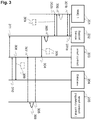
- Fig. 3 shows a flow chart of a method according to an embodiment of the invention.
- Fig. 3 shows the process of changing and/or updating a dataset of transfer-related data regarding a transfer of network service for UEs between neighboring cells. It is noted that essentially the same steps are used for creating a new dataset and/or invalidating an obsolete dataset.
- a support system 202 monitors a first MNO legacy device, system and/or service 201.
- the device, system and/or service 201 is, preferably an OSS, a BSS, an O&M, a network planning and/or a network configuration tool within a MNO's network or an MNO's infrastructure.
- said monitoring is based on a regular check 301a.
- the regular checks are repeated 302a and 302b.
- said change 300 is reported back 302b to the support System 202, preferably including a dataset 309.
- the support system 202 upon reception of an update 302b prepares a corresponding transaction 303.
- Said transaction preparation preferably comprises one or more of the steps of access validation, providing a signature, and providing an encryption.
- Said support system 202 preferably stores, manages, and provides information on where which transaction, dataset, and/or smart contracts is stored in DL, comprising search and indexing functionalities, comprising the storage "address" returned 311 afterwards.
- the addresses are preferably used to identify the transactions and datasets, and to call smart contracts and/or smart contract functions.
- the prepared transaction preferably including the dataset 309, is send 304 from the support system 202 to a smart contract 203 of a DL.
- Said smart contract 203 is preferably configured for creating, updating, verifying, invalidating, and/or querying data from the DL via smart contract functions and/or via different smart contracts.
- the ledger which stores the transaction data, i.e. the datasets of transfer-related data, is hereinafter also referred to as database service 204; however the smart contract 203 and the database service 204 are preferably implemented in the same DL.
- the database service is realized by the Inter Planetary File System, IPFS.
- the transaction is sent 305 to a further smart contract 205.
- Said further smart contract 205 is configured for regulatory control of the data stored in the DL.
- the further smart contract 205 which is preferably part of the same DL, interacts with systems from government network agencies and/or roaming agreement contracts. Preferably, said interactions are preferably also implemented via respective smart contracts.
- a data verification step 306 is performed by the further smart contract 205 and a confirmation is reported 307 to the smart contract 203.
- the smart contract 203 After reception of the confirmation 307 or in case of embodiments without verification, the smart contract 203 sends the transaction 308 to the database service 204, thereby effecting a creation, update and/or invalidation of the dataset 309 of transfer-related data in the DL.
- the database service 204 sends a response 310 to the smart contract 203 and/or the smart contract sends a response 311 to the support service to inform about the success or failure of the operation, preferably the response comprises additional technical details, more preferably storage addressing information.
- the dataset 309 comprises information about one or more of a timestamp, geographical position, PCI, CGI, a coverage area, a frequency, network Quality of Service indicators, identifiers of neighboring cells, handover capacity of neighboring cells, a network slice, and billing data of the network cell as well as information, preferably at least an identifier, of neighboring cells.
- Quality of Service indicators can contain information such as uplink bandwidth, downlink bandwidth, uplink latency, downlink latency, error rates, reference signal received power (RSRP) thresholds, reference signal received quality (RSRQ) thresholds; all of which preferably respective for a given RAT and frequency.
- Handover capacity comprises information about i.e. X2 / Xn interfaces, EPLMNs, preferred procedures such as a "release with redirection", and/or other data related to the transfer of network service to this cell.
- the dataset 309 additionally or alternatively comprises information about one or more of the following list: identifiers and/or base station identifiers, TCI, MCC, MNC, LAC, RAC, Cell CI, CID, NCGI, NCI, RNC ID, CID, SAC, SAI, LAI, RAI, RSZI, SPC, ISPC, PLMN ID, MSRN, Mobile Station International Data Number, Location Number, TMGI, MBMS Service Area Identities, Service Announcement FQDN, N3IWF FQDN, NRF, Operator Identifier, Tracking Area Identity, Visited Country FQDN, Network Slice Selection Function FQDN, AMF Set, AMF Instance, Telescopic FQDN, NAI, APN, NAPTR Resource Records, LSA ID, SNA ID, ANDSF-SN, BCC, NCC, BCCH, ARFCN, EARFCN, EARFCN of the downlink carrier frequency, Blacklisted cells, Band indicator, FCCH
- the dataset 309 comprises hashes of one or more of the above mentioned information and the corresponding real data is stored separately.
- the real data is preferably stored at one or more of the respective MNOs, concerned MNOs, and all MNOs.
- the successful modification of datasets 310 and 311 imply updates to other datasets, especially concerning the neighbor cells.
- These verifications and potential updates are preferably handled by using the identifier stored in the cells neighbor list and updating the neighbor lists of these neighbor cells.
- the geographical positions are used for verifications and identification of neighboring cells.
- the support service 202, the smart contract 203 and the database service 204, and the further smart contract 205 are comprised in an overall DL-system servicing a plurality of MNOs.
- the core part is at least one distributed ledger, which preferably is a shared, controlled, immutable and transparent, and distributed between the different MNOs. It is also preferred that regulatory institutions and/or independent non-MNOs are forming a part of the DL system.
- said support service 202 is preferably a local service at a respective MNO.
- the support service 202 interacts with the database service 204 via smart contracts 203 and 205. Since the smart contract 203, the database service 204, and the further smart contract 205 are all based on DLT, the data is stored decentralized at each MNO and access to the data is thus possible at any time and without delays via the corresponding smart contract.
- Fig. 4 shows a flow chart of a method according to a second embodiment of the invention.
- Fig. 4 shows a transfer of network service of UE 401 between a first MNO and a second MNO, and their respective legacy infrastructure and/or services 402 and 501, cf. also Fig. 2 .
- UE 401 approaches 601 a service border between the network cells of the two MNOs.
- the term service border refers to a geographical area where the service of a first cell degrades and the service of a second cell improves.
- the network 402 servicing the UE 401 or the UE 401 itself initiates a service transfer 602a and 602b, preferably as defined in the 3GPP standard, more preferably a 3GPP inter-MNO handover, even more preferably a network reselection and/or release with redirection.
- the transfer of network service also referred to as network handover, itself can be triggered by the UE 401 or the serving network 402. It thus must not always include an inter-frequency search as defined within the 3GPP "network reselection" procedure, but can e.g. also be a "blind handover", i.e. without prior knowledge or measurements of the quality or power level of the alternative target frequency or the alternative technology network, or a "release with redirect” handover, i.e. with knowledge of the transfer related data of the target cell.
- the MNO legacy device and/or service 402 of the first MNO Upon reception of the handover initiation 602a and 602b, the MNO legacy device and/or service 402 of the first MNO invokes a query 603 to the support service 202.
- said legacy device or service 402 is preferably performing an O&M system function, a RAN function, a core function and/or a cloud function.
- the support service 202 is configured to prepare and validate 604a a transaction and to invoke a query 604b about the current cell and neighboring cells, and their potential security implications with respect to the current cell servicing the UE 401 to the smart contract 203.
- this step 604a and 604a can imply a search for new neighbor cells, preferably via the identifier of the current cell stored in other cells neighbor lists, and/or geographical positions. This can also imply an update of the current cells neighbor list; both implications are not shown in the drawing.
- the smart contract 203 invokes a check 605 with a second further smart contract 206.
- Said second further smart contract 206 is preferably configured for interaction 606 with other systems and/or functions, e.g. for fraud protection and/or supervision of UEs, and is preferably part of the same DL.
- the second further smart contract 206 returns a confirmation 607 to the smart contract 203 and preferably sends a notification 701 to the second MNO, preferably to a MNO legacy device or service 501 of the second MNO, more preferably an OSS, a BSS, an O&M, and/or billing service of the second MNO.
- a potential response to 701 and consequences are not shown here, but specific embodiments of the invention may include respective actions such as lawful intercept, altering and/or refusing the transfer of network service.
- the smart contract 203 is configured to retrieve 608 the dataset with transfer related data for the respective cell servicing the UE 401.
- the dataset is returned 609 to the smart contract and from the smart contract returned 610 to the support system 202.
- no second further smart contract 206 is present.
- the smart contract 203 is configured to directly retrieve 608 the dataset with transfer related data for the respective cell servicing the UE 401.
- the dataset is returned 609 to the smart contract and from the smart contract returned 610 to the support system 202.
- said dataset is encrypted.
- said data is decrypted in a post processing step 611 at the support system 202.
- the support system 202 verifies in step 611 the comprised hash value and compares it with the hash value of the corresponding real data stored in other MNO systems, and only proceeds in case of identical values.
- the support system is further configured to provide compatibility and/or in interaction with other MNO systems.
- the support service post processes the dataset accordingly 611 by providing data transformation, signature verification, and/or consistency check services.
- the support service may filter preferred neighboring cells based on movement directions of the UE and/or roaming agreements.
- the support system 202 provides 612 the transfer-related data from the dataset to the MNO device and/or service 402.
- the transfer-related data comprises cell, identification and/or frequency information of the neighboring cell.
- the 3GPP inter-MNO service transfer phases are continued 700 between the first MNO and the second MNO.
- the transfer-related data does not have to be fetched on-demand, but can be prefetched e.g. due to cell movement patterns and/or predictions, i.e. cars on highways or trains on tracks having a predefined path. Also it may be cached and/or the smart contract automatically triggers updates of a cache, i.e. a temporary memory, in the support system upon an updated dataset.
- a cache i.e. a temporary memory
- the invention as detailed above provides a standardized system for all MNOs, which is independent of a specific 3GPP Release.
- the embodiments of the invention are compatible and complementary to ANR, handover, roaming and security specifications of 2G, 3G, 4G, and 5G. Therefore the solution of the present invention can be used independently of the used specification.
- performing a seamless inter-MNO handover i.e. a cross-border and/or a cross-technology handover, are enabled. Furthermore, the present invention allows for real-time control and billing between different MNOs.
- a virtual currency is used to provide billing services between the MNOs and/or UEs, which are in practice linked to a respective MNO customer tariff.
- the DL is interfaced and/or a part of a GSMA RAEX IR.21 database or a GSMA tool such as RAEX databases.
- GSMA RAEX IR.21 database or a GSMA tool such as RAEX databases.
- roaming and/or International Telecommunication Union, ITU, systems may be based on the invention or parts of the invention.
- the network related data from the DL is used for RAN sharing approaches where several MNOs use the same network equipment, thus being available for all UEs independent of their (the user of the UE) MNO-specific customer contract.
- the distributed ledger and/or smart contract enable the integration into and combination with fraud prevention mechanisms such as the Secure Telephone Identity Revisited, STIR, 'Signature-based Handling of Asserted information using toKENs', SHAKEN, or 'Social Linked Data', SOLID, approaches.
- fraud prevention mechanisms such as the Secure Telephone Identity Revisited, STIR, 'Signature-based Handling of Asserted information using toKENs', SHAKEN, or 'Social Linked Data', SOLID, approaches.
Landscapes
- Engineering & Computer Science (AREA)
- Computer Networks & Wireless Communication (AREA)
- Signal Processing (AREA)
- Databases & Information Systems (AREA)
- Computer Security & Cryptography (AREA)
- Mobile Radio Communication Systems (AREA)
Abstract
Description
- The invention relates to a method and system for management of a transfer of network service for user equipment in a mobile telecommunication network.
- Information related to configuration and management of radio network infrastructure of mobile telecommunication networks is proprietary information for most mobile network operators, MNOs. Furthermore, said information is prone to regular changes in the technical configuration, e.g. due to new or broken parts in the infrastructure, network optimization, and changes in antenna positioning, power, and/or emission. Therefore, said information is currently not shared between MNOs. Therefore the time required for network search, network reselection, and handover can be in the order of minutes, depending on the situation, parameters, and in particular on the radio access technology (RAT).
- However, to orchestrate a seamless handover between different MNO networks said information is essential. Such a seamless handover is of particular relevance for a continuous and reliable data connection. Said handover is of particular relevance for autonomous vehicles, trains, and unmanned aerial vehicle, UAVs, when crossing national borders or campus premises, i.e. crossing over from cells operated by different MNOs. Such a crossing with a continuous and reliable data connection, i.e. with uninterrupted connectivity, only works when said information is shared between MNOs.
- Furthermore, even though some general aspects of Radio Network Configuration Management systems are specified by standardization bodies, the implementations of said Radio Network Configuration Management systems in networks of different MNOs often differ. They specially differ when the MNOs use different network equipment providers. Therefore, the data required for a seamless handover is usually not available when needed.
- Still further, radio networks and thus MNOs are subject to strict regulations which are managed by international regulatory bodies such as the International Telecommunication Union, ITU, and each national regulatory body, such as the Bundesnetzagentur for Germany, and international alignments, e.g. concerning the frequencies and emissions at the border regions, which are often not existing or insufficient for a seamless cross-border handover.
- Distributed Ledger Technology, DLT, allows multiple parties to share a common, append-only database. The database grows larger with every new transaction and must be stored in multiple nodes, which preferably reside in different locations. This is often cheaper than paying a trusted intermediary to operate a centralized database, and it is also highly resilient because by design there is no single point of failure.
- The main feature of DLT, hereinafter also referred to as blockchain technology or blockchain, is that it is a decentralized system for managing security, trust, and information. This is fundamentally different from most existing solutions where data is kept and managed within a central system, with security built around it, rather than within it. The blockchain technology provides an architecture for so-called "trustless trust". It allows the users to trust the outputs of the system without trusting single actors within the system.
- In detail, a distributed ledger, DL, is a chain of validated blocks, each block linking to its predecessor all the way to a genesis block, i.e. a first initial block. The aforementioned term block of the blockchain refers to a data structure containing a grouping of so-called transactions, preferably marked with a timestamp, and having a fingerprint of a respective previous block.
- Depending on the used blockchain system a block header is preferably hashed. Additionally or alternatively added transactions are validated before including them in a valid block. Valid blocks are then added to the chain by a mechanism referred to as consensus algorithm. Examples of consensus algorithms are proof of work, proof of stake, and proof of authority, all of which are known to the skilled person. A transaction, in simple terms, is a signed data structure. Transactions are transmitted over the blockchain network before made permanent on the blockchain.
- The term DLT also includes graph-like data structures, so called directed acyclic graphs, DAG, or merkle trees. In said data structures, after the genesis block, a tree-like structure is created instead of a single chain. Hereinafter the term blockchain is used to describe any kind of distributed ledger technology and vice versa.
- Smart contracts are often used on a blockchain. Smart contracts were first proposed by Nick Szabo in 1994, are a form of computer programs. A smart contract is typically written in a high-level programming language, like Solidity or Viper, and compiled to bytecode. This bytecode can be deployed on the DL, whereby an address is returned at which the smart contract's functions can be called. Execution of a smart contract requires sending a transaction to the contract's address, while specifying which function is to be executed, preferably with additional parameters.
- In view of the above it is an object to provide an improved method and system for management of a transfer of network service for user equipment in a mobile telecommunication network. The above object is achieved by the subject-matter of the independent claims. The dependent claims relate to further aspects if the invention.
- According to the invention there is provided a method for management of a transfer of network service for a user equipment, UE, from a first to a second mobile telecommunication network cell comprising: a) a step of at least one mobile network operator, MNO, storing transfer-related data of the first and/or the second network cell operated by the MNO in a distributed ledger, DL; and b) a step of the MNO operating the first network cell retrieving said transfer-related data of the second network cell from the DL and providing said transfer-related data to the UE, wherein the UE is connected to the first network cell and/or providing said transfer-related data to hardware of the first network cell that communicates with the UE. The second network cell is neighboring and/or overlapping the first network cell and the UE is to be transferred from the first network cell to the second network cell. The DL is shared between MNOs operating neighboring and/or overlapping network cells.
- According to an aspect of the invention the method further comprises c) a step of at least one MNO updating the transfer-related data for at least one network cell operated by the MNO in the DL.
- According to an aspect of the invention the transfer-related data comprises at least one of data regarding network cell hardware, network cell software, network systems, network data, network metadata, network Quality of Service data, and network configurations. The transfer-related data preferably comprises at least one of data regarding systems, procedures, interfaces, protocols and functionality as defined in a mobile network standard of the first and/or second network cell. The transfer-related data more preferably comprises at least one of a Physical Cell Identity, PCI, a Cell Global Identity, CGI, a Base Station Identity Code, BSIC, a frequency, a band indicator, a frequency band, an EARFCN of the downlink carrier frequency, RSRP thresholds, RSRQ thresholds, identifiers of neighboring cells, handover capacity of neighboring cells, blacklisted cells, and Radio Access Technology, RAT, of the respective network cell.
- According to an aspect of the invention the transfer-related data relates to data, procedures, regulations, interfaces, and functionality as defined in the Harmonized Calculation Method, HCM, and/or
wherein the transfer-related data is used in one ore more of - a) in tools which implement the HCM agreement,
- b) in tools which implement roaming agreements,
- c) in the Roaming Agreement Exchange, RAEX, tools provided by the GSMA.
- According to an aspect of the invention any one of the storing step, the retrieving step, and the updating step is performed using at least one smart contract of the DL.
- According to an aspect of the invention the transfer-related data is hashed and only the hash values are stored in the DL, or wherein the transfer-related data is partly hashed and the hash values and parts of the transfer-related data are stored in the DL.
- According to an aspect of the invention the method further comprises d) a step of data verification in the distributed ledger for regulatory control, preferably via a smart contract of the DL; wherein the data verification is performed according to at least one of:
- i) a national legal framework for telecommunications;
- ii) an international legal framework for telecommunications;
- iii) a spectrum management organization;
- iv) a HCM agreement;
- v) the recommendations, specifications, and/or indication of the GSMA;
- vi) the National Table of Frequency Allocation, NTFA; and/or
- vii) security systems such as lawful intercept and/or surveillance systems.
- According to an aspect of the invention the method further comprises a step of the MNO operating the first network cell notifying the MNO operating the second network cell about the transfer.
- According to an aspect of the invention the transfer of service is performed according to one of:
- i) a "network handover" according to 3GPP specification,
- ii) a "network reselection" according to 3GPP specification,
- iii) a "blind handover" according to 3GPP specification, and/or
- iv) a "release with redirection" according to 3GPP specification.
- According to an aspect of the invention the DL is configured to handle the roaming and/or billing process between the at least two MNO for the UE handover, preferably using a virtual currency native to the DL, a general virtual currency, and/or a fiat currency.
- According to an aspect of the invention the transfer of service relates to a service along a chain of cells or base-stations and wherein the transfer-related data comprises all transfer-related data for each of a plurality of single transfers of service along said chain, and wherein said chain corresponds to transportation infrastructure preferably to one of: highways, cross-country roads, railways, flight corridors.
- According to an aspect of the invention at least one smart contract of the DL is configured to handle at least one of: MNO agreements, roaming contracts, contracts in relation to the HCM agreement, RAEX tools, tariffs, user data, and UE data.
- According the invention there is provided a network node configured for management of a transfer of service for a UE between mobile telecommunication networks cells according to the method of any one of the preceding aspects.
- According the invention there is provided a system comprising at least two network nodes according to the preceding aspect.
- According the invention there is provided a computer program comprising instructions which, when the program is executed by a first computer, cause the first computer to perform the method of any one of the preceding aspects in communication with at least one second computer.
- Embodiments of the invention relate to the use of DLT for a transfer of network service between different MNOs and/or different regulatory frameworks. Based on such a system information about the Radio Network Configuration is made conditionally accessible and its usage is integrated into legacy MNO systems. Optionally the system also allows for regulatory control.
- It is a general concept of the invention to use Distributed Ledger Technology to enable a shared, controlled, immutable, and transparent system for the management of transfer of a service for user equipment.
- It is a general concept of the invention that the blockchain-system is also configured to share additional data, including signal threshold parameters, policies and historical handover data.
- It is a general concept of the invention that the invention is implemented in existing networks and/or network configuration systems which are used for standard and legacy operations in order to implement ANR, NRT and related functionalities. The existing MNO infrastructure may not interact directly with the ledger, but depending on the embodiment rather via additional systems with additional interfaces. This is necessary for adjacent functionalities such as member authentication and authorization, PKI Management, asymmetric cryptography, data-extraction, data-insertion, data-transformation, data-logging, data-monitoring and others such as billing, clearing, regulatory control, and/or fraud management.
- It is a general concept of the invention that RAN sharing and RAN data sharing within a multiple MNO infrastructure and/or within a Mobile Virtual Network Operator, also known as Virtual Mobile Network Operator, system is integrated into the blockchain according to the invention.
- In an embodiment of the invention, the method and system is build upon existing MNO Blockchains.
- In an embodiment of the invention, the system and method or parts thereof are implemented in a cloud and/or virtualized. This facilitates the integration of the systems, since it is not bound to a specific implementation and/or hardware and general restrictions are removed, e.g. vendor lock-ins for legacy systems.
- In an embodiment of the invention, the datasets comprise the data directly, in an internally referenced form and/or in an externally referenced form.
- In an embodiment of the invention, the datasets are signed, encrypted and/or hashed. Hashing is defined as applying a hash function, which is used to map data of arbitrary size to fixed-size values; the latter is also referred to as hashes and is preferably used as unambiguous data fingerprint.
- In an embodiment of the invention, only hashes of the datasets are stored in the DL and the corresponding datasets are stored separately at at least one of the respective MNOs, one or more concerned MNOs, and all MNOs.
- In an embodiment of the invention, the hashes stored in the DL and are signed and/or encrypted, preferably using asymmetric cryptography.
- In an embodiment of the invention, not all data of all cells is shared between every MNO, it is a preferred implementation to use a graph-like architecture. That is, in an embodiment of the invention one ledger is provided for each national border covered by the networks of the MNOs, or regional ledgers are provided for certain geographical regions with one or more national borders. That is one ledger is, e.g., provided for Southern Germany, North and Western Austria and North and Eastern Switzerland, with at least one MNOs per country, or additional ledgers with different MNO partners.
- It is an advantage of the invention that a faster data access and faster synchronization is permitted. It is a further advantage that every MNO has up-to-date information due to the shared database nature, and preferably, depending on the implementation and MNO systems, even in real-time. In contrast, in current systems data is usually treated in several steps and it may take days from export to exchange to import.
- It is noted that hereinafter the term "border" may also refer to campus premises, or, in more general terms, to a region of overlap between cells and/or geographical areas operated by different MNOs. The term border may also refer to a service border, i.e. to a geographical area where the service of a first cell degrades and the service of a second cell improves.
- In the drawings
-
Fig. 1 shows an example of overlapping mobile telecommunication networks; -
Fig. 2 shows the transfer of network service according to an embodiment of the invention; -
Fig. 3 shows a flow chart of a method according to an embodiment of the invention; and -
Fig. 4 shows a flow chart of a method according to an embodiment of the invention. - In the following, embodiments of the invention will be described. It is noted that some aspects of every described embodiment may also be found in some other embodiments unless otherwise stated or obvious to the skilled person. However, for increased intelligibility, each aspect will only be described in detail when first mentioned and any repeated description of the same aspect will be omitted.
- In some areas, e.g. at country borders, overlapping networks are operated by different MNOs. The overlapping network coverage is necessary in order to enable a continuous coverage. In turn, with reasonable effort, it is technically not possible to limit a mobile network exactly to a geographical area.
- The technical alignment between different overlapping MNOs is complex due to, e.g., different national regulations, different roaming agreements, varying 2G/3G/4G/5G technologies and implementations, and a lack of information about frequencies used by cells operated by a different MNO.
- In 4G, Automatic Neighbor Relation, ANR, functionality, was introduced, which replaces the Radio Network controller, RNC. In 3G and before, the RNC was responsible for the neighbor cell management, and neighbor management was, and often still is, tedious manual work, in particular concerning cells from other MNOs. Within ANR the cell information gathering is based on the measurements from the User Equipment, UE.
- Automatic Neighbor Relation functionality has significant impact on the network performance in terms of capacity, latency and scalability which are the key optimization criteria. According to 3GPP specifications, the purpose of the functionality is to relieve the MNO from the burden of manually managing Neighbor Relations. The ANR function manages the conceptual Neighbor Relation Table, NRT for each cell. Located within ANR, the Neighbor Detection Function finds new neighbors and adds them to the NRT. ANR also contains the Neighbor Removal Function which removes outdated NRs. The ANR function relies on cells broadcasting their identity on a global level.
- However, the Neighbor Detection Function and the Neighbor Removal Function are implementation specific and many MNOs have not yet implemented the ANR function. Apart from this, cells from foreign MNOs are mostly ignored due to above mentioned reasons as well as business considerations.
- Further current drawbacks are also that the UE can scan only one frequency for a predefined period of time; that network quality parameters are missing in the NRT; and that the NRT/NCL is growing in size, if small cells are included. Therefore, the transfer of network service and especially a blind handover, i.e. without detailed information and synchronization concerning the target cell, is thus subject to delays.
- Still further, the network handover according to the 3GPP specification requires inter-MNO interfaces which are not available in current live networks. For example base stations at different sides of a national border have no X2 (4G) / Xn (5G) interface, which, however, are essential for the handover from one cell to an adjacent cell. Some other inter-MNO interfaces, e.g. S9, S10 for 4G, are also not implemented by most MNOs.
- Still further, coordination rules must be applied concerning the radio frequency usage in order to avoid problems such as interferences. For example the assigned frequency bands for each MNO must be organized a manner that neighboring cells are not allowed to use the same frequencies. Moreover, some areas may have very different "best serve areas" compared to "collocated sectors" of other RATs and technological layers, e.g. 2G, 3G, 4G, or 5G, which renders inter-RAT neighbor planning even more difficult. Especially at border regions between networks operated by different MNOs and/or national borders it is not always known which RAT is available in the neighboring network, which causes delays in reconnecting to the other mobile network of a different MNO and thus the transfer of network service.
-
Fig. 1 shows an example of overlapping mobile telecommunication networks. In detailFig. 1 shows a geographical area covered by different overlappingMNO networks - In some embodiments of the invention the borders between different MNO networks correspond to borders of different countries, however, in other embodiments the borders correspond simply to borders of coverage of a MNO network. In other embodiments, MNO networks may also encompass one another, e.g. at a campus premise. At the respective borders, the networks normally have an overlap in order to guarantee coverage of at least one MNO.
- In detail the
networks aggregation network MNO networks networks RNC - Said RNC device or
functionality -
Fig. 2 shows the transfer of network service according to an embodiment of the invention. As indicated by the time scale 905 aUE 806a is first located in afirst cell 809 operated by afirst MNO 807 and serviced 903 by abase station 804 connected toMNO legacy infrastructure 802. The term MNO legacy infrastructure comprises the entire MNO infrastructure, such as systems, hardware, and software. Then thesame UE 806b moves into a region with an overlap between the first and asecond cell 810, wherein thesecond cell 810 is operated by asecond MNO 808 and serviced 904 by a base station 805 connected toMNO legacy infrastructure 803. Finally, the stillsame UE 806c is located in thesecond cell 810 of thesecond MNO 808. According to the invention the networks of bothMNOs respective connections ledger 801 and transfer of network service related information is stored and retrieved from said ledger. - The shared
ledger 801, due to its distributed nature, is preferably implemented in form of decentralized nodes at and synchronized 909 between at least bothMNOs ledger 801 are alternatively or additionally situated at third parties such as the GSMA, clearing organizations and/or regulatory institutions. -
Fig. 3 shows a flow chart of a method according to an embodiment of the invention. In detail,Fig. 3 shows the process of changing and/or updating a dataset of transfer-related data regarding a transfer of network service for UEs between neighboring cells. It is noted that essentially the same steps are used for creating a new dataset and/or invalidating an obsolete dataset. - According to an embodiment of the invention, a
support system 202 monitors a first MNO legacy device, system and/orservice 201. The device, system and/orservice 201 is, preferably an OSS, a BSS, an O&M, a network planning and/or a network configuration tool within a MNO's network or an MNO's infrastructure. - In an embodiment of the invention, said monitoring is based on a
regular check 301a. In case no update is reported back 301b to thesupport system 202, the regular checks are repeated 302a and 302b. In case achange 300 has occurred, in the MNO device orservice 201, e.g. due to new cells, a regulation, a Self-Organizing-Network optimization, an UE measurement, or a roaming contract, saidchange 300 is reported back 302b to thesupport System 202, preferably including adataset 309. - According to the invention, the
support system 202, upon reception of anupdate 302b prepares acorresponding transaction 303. Said transaction preparation preferably comprises one or more of the steps of access validation, providing a signature, and providing an encryption. Preferably by use of one or more smart contracts of a DL, more preferably previously agreed on by the involved parties and stored beforehand in the DL. - Said
support system 202 preferably stores, manages, and provides information on where which transaction, dataset, and/or smart contracts is stored in DL, comprising search and indexing functionalities, comprising the storage "address" returned 311 afterwards. The addresses are preferably used to identify the transactions and datasets, and to call smart contracts and/or smart contract functions. - According to the invention, the prepared transaction, preferably including the
dataset 309, is send 304 from thesupport system 202 to asmart contract 203 of a DL. Saidsmart contract 203 is preferably configured for creating, updating, verifying, invalidating, and/or querying data from the DL via smart contract functions and/or via different smart contracts. The ledger which stores the transaction data, i.e. the datasets of transfer-related data, is hereinafter also referred to asdatabase service 204; however thesmart contract 203 and thedatabase service 204 are preferably implemented in the same DL. In an embodiment of the invention the database service is realized by the Inter Planetary File System, IPFS. - In a preferred embodiment of the invention, the transaction is sent 305 to a further
smart contract 205. Said furthersmart contract 205 is configured for regulatory control of the data stored in the DL. In an example the furthersmart contract 205, which is preferably part of the same DL, interacts with systems from government network agencies and/or roaming agreement contracts. Preferably, said interactions are preferably also implemented via respective smart contracts. - In an embodiment of the invention, a
data verification step 306 is performed by the furthersmart contract 205 and a confirmation is reported 307 to thesmart contract 203. - It is noted that in some embodiments no data verification is performed. After reception of the
confirmation 307 or in case of embodiments without verification, thesmart contract 203 sends thetransaction 308 to thedatabase service 204, thereby effecting a creation, update and/or invalidation of thedataset 309 of transfer-related data in the DL. Thedatabase service 204 sends aresponse 310 to thesmart contract 203 and/or the smart contract sends aresponse 311 to the support service to inform about the success or failure of the operation, preferably the response comprises additional technical details, more preferably storage addressing information. - In a preferred embodiment of the invention, the
dataset 309 comprises information about one or more of a timestamp, geographical position, PCI, CGI, a coverage area, a frequency, network Quality of Service indicators, identifiers of neighboring cells, handover capacity of neighboring cells, a network slice, and billing data of the network cell as well as information, preferably at least an identifier, of neighboring cells. - In preferred embodiments all or part of said information is comprised directly in the dataset or is comprised in form of a reference to data in further systems of the respective MNO. Quality of Service indicators can contain information such as uplink bandwidth, downlink bandwidth, uplink latency, downlink latency, error rates, reference signal received power (RSRP) thresholds, reference signal received quality (RSRQ) thresholds; all of which preferably respective for a given RAT and frequency. Handover capacity comprises information about i.e. X2 / Xn interfaces, EPLMNs, preferred procedures such as a "release with redirection", and/or other data related to the transfer of network service to this cell.
- In a preferred embodiment of the invention, the dataset 309 additionally or alternatively comprises information about one or more of the following list: identifiers and/or base station identifiers, TCI, MCC, MNC, LAC, RAC, Cell CI, CID, NCGI, NCI, RNC ID, CID, SAC, SAI, LAI, RAI, RSZI, SPC, ISPC, PLMN ID, MSRN, Mobile Station International Data Number, Location Number, TMGI, MBMS Service Area Identities, Service Announcement FQDN, N3IWF FQDN, NRF, Operator Identifier, Tracking Area Identity, Visited Country FQDN, Network Slice Selection Function FQDN, AMF Set, AMF Instance, Telescopic FQDN, NAI, APN, NAPTR Resource Records, LSA ID, SNA ID, ANDSF-SN, BCC, NCC, BCCH, ARFCN, EARFCN, EARFCN of the downlink carrier frequency, Blacklisted cells, Band indicator, FCCH, SCH, PBCCH, PCH, RACH, AGCH, Cell names, neighboring RNC Index, DL UARFCN, Route Area PLMN, scrambling codes, RAT, creator of the dataset, signaling, timing, access modes/types, maximum and minimum numbers of UEs, priorities and/or preferred partner cells, priorities and/or preferred PLMNs commercial relations, billing/tariff/invoicing, security, fraud-prevention, distinctions between national and foreign cells, and/or regulatory restrictions.
- In a preferred embodiment of the invention, the
dataset 309 comprises hashes of one or more of the above mentioned information and the corresponding real data is stored separately. The real data is preferably stored at one or more of the respective MNOs, concerned MNOs, and all MNOs. - In an embodiment of the invention, the successful modification of
datasets support service 202. - It is a concept of the invention that the
support service 202, thesmart contract 203 and thedatabase service 204, and the furthersmart contract 205 are comprised in an overall DL-system servicing a plurality of MNOs. In this DL-System the core part is at least one distributed ledger, which preferably is a shared, controlled, immutable and transparent, and distributed between the different MNOs. It is also preferred that regulatory institutions and/or independent non-MNOs are forming a part of the DL system. - That is, said
support service 202 is preferably a local service at a respective MNO. Thesupport service 202 interacts with thedatabase service 204 viasmart contracts smart contract 203, thedatabase service 204, and the furthersmart contract 205 are all based on DLT, the data is stored decentralized at each MNO and access to the data is thus possible at any time and without delays via the corresponding smart contract. -
Fig. 4 shows a flow chart of a method according to a second embodiment of the invention. In detail,Fig. 4 shows a transfer of network service ofUE 401 between a first MNO and a second MNO, and their respective legacy infrastructure and/orservices Fig. 2 . - In an embodiment of the invention,
UE 401 approaches 601 a service border between the network cells of the two MNOs. The term service border refers to a geographical area where the service of a first cell degrades and the service of a second cell improves. Upon theUE 401 approaching theborder 601 either thenetwork 402 servicing theUE 401 or theUE 401 itself initiates aservice transfer - The transfer of network service, also referred to as network handover, itself can be triggered by the
UE 401 or the servingnetwork 402. It thus must not always include an inter-frequency search as defined within the 3GPP "network reselection" procedure, but can e.g. also be a "blind handover", i.e. without prior knowledge or measurements of the quality or power level of the alternative target frequency or the alternative technology network, or a "release with redirect" handover, i.e. with knowledge of the transfer related data of the target cell. - Upon reception of the
handover initiation service 402 of the first MNO invokes aquery 603 to thesupport service 202. Depending on how the MNOs network, ANR, and NRT and such are managed, said legacy device orservice 402 is preferably performing an O&M system function, a RAN function, a core function and/or a cloud function. - In an embodiment of the invention, the
support service 202 is configured to prepare and validate 604a a transaction and to invoke aquery 604b about the current cell and neighboring cells, and their potential security implications with respect to the current cell servicing theUE 401 to thesmart contract 203. - In an embodiment of the invention, this
step - In a preferred embodiment, the
smart contract 203 invokes acheck 605 with a second furthersmart contract 206. Said second furthersmart contract 206 is preferably configured forinteraction 606 with other systems and/or functions, e.g. for fraud protection and/or supervision of UEs, and is preferably part of the same DL. - The second further
smart contract 206 returns aconfirmation 607 to thesmart contract 203 and preferably sends anotification 701 to the second MNO, preferably to a MNO legacy device orservice 501 of the second MNO, more preferably an OSS, a BSS, an O&M, and/or billing service of the second MNO. A potential response to 701 and consequences are not shown here, but specific embodiments of the invention may include respective actions such as lawful intercept, altering and/or refusing the transfer of network service. After reception of theconfirmation 607 thesmart contract 203 is configured to retrieve 608 the dataset with transfer related data for the respective cell servicing theUE 401. The dataset is returned 609 to the smart contract and from the smart contract returned 610 to thesupport system 202. - It is noted that in some embodiments of the invention no second further
smart contract 206 is present. In said embodiments thesmart contract 203 is configured to directly retrieve 608 the dataset with transfer related data for the respective cell servicing theUE 401. The dataset is returned 609 to the smart contract and from the smart contract returned 610 to thesupport system 202. - In some embodiments of the invention, said dataset is encrypted. In the latter case said data is decrypted in a
post processing step 611 at thesupport system 202. - In some embodiments of the invention in which said dataset at least partly comprises hashes, the
support system 202 verifies instep 611 the comprised hash value and compares it with the hash value of the corresponding real data stored in other MNO systems, and only proceeds in case of identical values. The support system is further configured to provide compatibility and/or in interaction with other MNO systems. To this end the support service post processes the dataset accordingly 611 by providing data transformation, signature verification, and/or consistency check services. Furthermore in 611 the support service may filter preferred neighboring cells based on movement directions of the UE and/or roaming agreements. - Subsequently the
support system 202 provides 612 the transfer-related data from the dataset to the MNO device and/orservice 402. Preferably the transfer-related data comprises cell, identification and/or frequency information of the neighboring cell. Upon reception of the transfer-relateddata 702 the 3GPP inter-MNO service transfer phases are continued 700 between the first MNO and the second MNO. - In preferred embodiments the transfer-related data does not have to be fetched on-demand, but can be prefetched e.g. due to cell movement patterns and/or predictions, i.e. cars on highways or trains on tracks having a predefined path. Also it may be cached and/or the smart contract automatically triggers updates of a cache, i.e. a temporary memory, in the support system upon an updated dataset.
- The invention as detailed above provides a standardized system for all MNOs, which is independent of a specific 3GPP Release. The embodiments of the invention are compatible and complementary to ANR, handover, roaming and security specifications of 2G, 3G, 4G, and 5G. Therefore the solution of the present invention can be used independently of the used specification.
- In an embodiment of the invention, performing a seamless inter-MNO handover, i.e. a cross-border and/or a cross-technology handover, are enabled. Furthermore, the present invention allows for real-time control and billing between different MNOs.
- In embodiments of the invention, a virtual currency is used to provide billing services between the MNOs and/or UEs, which are in practice linked to a respective MNO customer tariff.
- In an embodiment of the invention, the DL is interfaced and/or a part of a GSMA RAEX IR.21 database or a GSMA tool such as RAEX databases. Furthermore, roaming and/or International Telecommunication Union, ITU, systems may be based on the invention or parts of the invention.
- In embodiments of the invention, the network related data from the DL is used for RAN sharing approaches where several MNOs use the same network equipment, thus being available for all UEs independent of their (the user of the UE) MNO-specific customer contract.
- In an embodiment of the invention, the distributed ledger and/or smart contract enable the integration into and combination with fraud prevention mechanisms such as the Secure Telephone Identity Revisited, STIR, 'Signature-based Handling of Asserted information using toKENs', SHAKEN, or 'Social Linked Data', SOLID, approaches.
- What has been described and illustrated herein are embodiments of the invention along with some of variations. The terms, descriptions and figures used herein are set forth by way of illustration only and are not meant as limitations. Those skilled in the art will recognize that many variations are possible within the spirit and scope of the invention, which is intended to be defined by the following claims-and their equivalents-in which all terms are meant in their broadest reasonable sense unless otherwise indicated.
-
- MNO
- Mobile Network Operator
- DL
- Distributed Ledger
- DLT
- Distributed Ledger Technology
- DAG
- Directed Acyclic Graph
- RNC
- Radio Network Controller
- ANR
- Automatic Neighbor Relation
- UE
- User Equipment
- eNB
- evolved Node B
- NRT
- Neighbor Relation Table
- NCL
- Neighbor Cell List
- CN
- Core Network
- OSS
- Operations Support System
- BSS
- Business Support System.
- O&M
- Operations & Maintenance
- PCI
- Physical Cell Identity
- CGI
- Cell Global Identification
- CI
- Cell Identity/Identification
- CID
- Cell Identity/Identification
- NCGI
- NR Cell Global Identity
- NR
- New Radio
- NCGI
- NR Cell Global Identity/Identification
- NCI
- NR Cell Identity/Identification
- SAC
- Service Area Code
- SAI
- Service Area Identification
- LAI
- Location Area Identification
- RAI
- Routing Area Identification
- RSZI
- Regional Subscription Zone Identity
- (I)SPC
- (International) Signaling Point Codes
- PLMN (ID)
- Public Land Mobile Network (Identifier)
- EPLMN
- Equivalent PLMN
- RSRP
- Reference signal received power
- RSRQ
- Reference signal received quality
- MSRN
- Mobile Station Roaming Number
- TMGI
- Temporary Mobile Group Identity
- MBMS
- Multimedia Broadcast Multicast Service
- FQDN
- Fully Qualified Domain Name
- N3IWF
- Non-3GPP Inter-Working Function
- NRF
- Network Function Repository Function
- NAI
- Network Access Identifier
- APN
- Access Point Name
- NAPTR
- Naming Authority Pointer
- LSA (ID)
- Localized Service Area (Identity)
- SNA (ID)
- Shared Network Area (Identifier)
- ANDSF-SN
- Access Network Discovery and Selection Function - Server Name
- TCI
- Transceiver Control Interface
- MCC
- Mobile Country Code
- MNC
- Mobile Network Code
- LAC
- Location Area Code
- RAC
- Routing Area Code
- RNC ID
- Radio Network Controller Identifier
- UARFCN
- UTRA Absolute Radio Frequency Channel Number
- EARFCN
- E-UTRA Absolute Radio Frequency Channel Number
- Route Area PLMN
- Route Area Public Land Mobile Network
- NCC
- Network (PLMN) Color Code
- BCC
- Base Transceiver Station (BTS) Color Code
- BCCH
- broadcast control channel
- ARFCN
- Absolute Radio Frequency Channel Number
- FCCH
- Frequency Correction Channel
- SCH
- Synchronization Channel
- PBCCH
- Packet Broadcast Control Channel
- PCH
- Paging channel
- RACH
- Random access channel
- AGCH
- Access grant channel
- PKI
- Public Key Infrastructure
- IPFS
- Inter Planetary File System
- GSMA
- Global System for Mobile Communications Association
- RAEX
- Roaming Agreement Exchange
- 3GPP
- 3rd Generation Partnership Project
Claims (15)
- A method for management of a transfer of network service for a user equipment, UE, from a first to a second mobile telecommunication network cell, comprising:a) a step of at least one mobile network operator, MNO, storing transfer-related data of the first and/or the second network cell operated by the MNO in a distributed ledger, DL; andb) a step of the MNO operating the first network cell retrieving said transfer-related data of the second network cell from the DL andproviding said transfer-related data to the UE, wherein the UE is connected to the first network cell and/or
providing said transfer-related data to hardware of the first network cell that communicates with the UE;
wherein the second network cell is neighboring and/or overlapping the first network cell and the UE is to be transferred from the first network cell to the second network cell; and
wherein the DL is shared between MNOs operating neighboring and/or overlapping network cells. - The method according to claim 1, further comprising
c) a step of at least one MNO updating the transfer-related data for at least one network cell operated by the MNO in the DL. - The method according to claim 1 or 2,
wherein the transfer-related data comprises at least one of data regarding network cell hardware, network cell software, network systems, network data, network metadata, network Quality of Service data, and network configurations,
wherein the transfer-related data preferably comprises at least one of data regarding systems, procedures, interfaces, protocols and functionality as defined in a mobile network standard of the first and/or second network cell, and
wherein the transfer-related data more preferably comprises at least one of a Physical Cell Identity, PCI, a Cell Global Identity, CGI, a Base Station Identity Code, BSIC, a frequency, a band indicator, a frequency band, an EARFCN of the downlink carrier frequency, RSRP thresholds, RSRQ thresholds, identifiers of neighboring cells, handover capacity of neighboring cells, blacklisted cells, and Radio Access Technology, RAT, of the respective network cell. - The method according to any one of claims 1 to 3,
wherein the transfer-related data relates to data, procedures, regulations, interfaces, and functionality as defined in the Harmonized Calculation Method, HCM, and/or
wherein the transfer-related data is used in one ore more ofa) in tools which implement the HCM agreement,b) in tools which implement roaming agreements,c) in the Roaming Agreement Exchange, RAEX, tools provided by the GSMA. - The method according to any one of claims 2 to 4, wherein any one of the storing step, the retrieving step, and the updating step is performed using at least one smart contract of the DL.
- The method according to any one of claims 2 to 5, wherein the transfer-related data is hashed and only the hash values are stored in the DL, or wherein the transfer-related data is partly hashed and the hash values and parts of the transfer-related data are stored in the DL.
- The method according to any one of claims 1 to 6, further comprising
d) a step of data verification in the distributed ledger for regulatory control, preferably via a smart contract of the DL;
wherein the data verification is performed according to at least one of:i) a national legal framework for telecommunications;ii) an international legal framework for telecommunications;iii) a spectrum management organization;iv) a HCM agreement;v) the recommendations, specifications, and/or indication of the GSMA;vi) the National Table of Frequency Allocation, NTFA; and/orvii) security systems such as lawful intercept and/or surveillance systems. - The method according to any one of claims 1 to 7, further comprising a step of the MNO operating the first network cell notifying the MNO operating the second network cell about the transfer.
- The method according to any one of claims 1 to 8, wherein the transfer of service is performed according to one of:i) a "network handover" according to 3GPP specification,ii) a "network reselection" according to 3GPP specification,iii) a "blind handover" according to 3GPP specification, and/oriv) a "release with redirection" according to 3GPP specification.
- The method according to any one of claims 1 to 9, wherein the DL is configured to handle the roaming and/or billing process between the at least two MNO for the UE handover, preferably using a virtual currency native to the DL, a general virtual currency, and/or a fiat currency.
- The method according to any one of claims 1 to 10, wherein the transfer of service relates to a service along a chain of cells or base-stations and wherein the transfer-related data comprises all transfer-related data for each of a plurality of single transfers of service along said chain, and
wherein said chain corresponds to transportation infrastructure preferably to one of: highways, cross-country roads, railways, flight corridors. - The method according to any one of claims 1 to 11, wherein at least one smart contract of the DL is configured to handle at least one of: MNO agreements, roaming contracts, contracts in relation to the HCM agreement, RAEX tools, tariffs, user data, and UE data.
- A network node configured for manaement of a transfer of service for a UE between mobile telecommunication networks cells according to the method of any one of claims 1 to 12.
- A system comprising at least two network nodes according to claim 13.
- A computer program comprising instructions which, when the program is executed by a first computer, cause the first computer to perform the method of any one of claims 1 to 12 in communication with at least one second computer.
Priority Applications (2)
| Application Number | Priority Date | Filing Date | Title |
|---|---|---|---|
| EP19220007.9A EP3846515B1 (en) | 2019-12-30 | 2019-12-30 | Dynamic network roaming |
| PCT/EP2020/087137 WO2021136696A1 (en) | 2019-12-30 | 2020-12-18 | Dynamic network roaming |
Applications Claiming Priority (1)
| Application Number | Priority Date | Filing Date | Title |
|---|---|---|---|
| EP19220007.9A EP3846515B1 (en) | 2019-12-30 | 2019-12-30 | Dynamic network roaming |
Publications (2)
| Publication Number | Publication Date |
|---|---|
| EP3846515A1 true EP3846515A1 (en) | 2021-07-07 |
| EP3846515B1 EP3846515B1 (en) | 2023-05-24 |
Family
ID=69055838
Family Applications (1)
| Application Number | Title | Priority Date | Filing Date |
|---|---|---|---|
| EP19220007.9A Active EP3846515B1 (en) | 2019-12-30 | 2019-12-30 | Dynamic network roaming |
Country Status (2)
| Country | Link |
|---|---|
| EP (1) | EP3846515B1 (en) |
| WO (1) | WO2021136696A1 (en) |
Cited By (3)
| Publication number | Priority date | Publication date | Assignee | Title |
|---|---|---|---|---|
| CN115942410A (en) * | 2021-09-27 | 2023-04-07 | 北京小米移动软件有限公司 | Network switching method, device, electronic equipment and storage medium |
| FR3128089A1 (en) * | 2021-10-13 | 2023-04-14 | Orange | Method and device for selecting a base station |
| US20230337052A1 (en) * | 2022-04-13 | 2023-10-19 | James Tagg | Blockchain-based dynamic cellular network with proof-of-service |
Families Citing this family (5)
| Publication number | Priority date | Publication date | Assignee | Title |
|---|---|---|---|---|
| US20190236559A1 (en) | 2018-01-31 | 2019-08-01 | Salesforce.Com, Inc. | Systems, methods, and apparatuses for implementing smart flow contracts using distributed ledger technologies in a cloud based computing environment |
| US12526155B2 (en) | 2022-06-06 | 2026-01-13 | Salesforce, Inc. | Multi-signature wallets in public trust ledger actions via a database system |
| US12418793B2 (en) * | 2023-10-02 | 2025-09-16 | T-Mobile Innovations Llc | Wireless data service using content-addressing |
| EP4598122A1 (en) * | 2024-02-02 | 2025-08-06 | Telia Company AB | Management of handover |
| CN118158750A (en) * | 2024-03-21 | 2024-06-07 | 重庆梨落电子商务有限公司 | Method and system for automatically switching network of terminal |
Citations (1)
| Publication number | Priority date | Publication date | Assignee | Title |
|---|---|---|---|---|
| US20190373521A1 (en) * | 2017-04-07 | 2019-12-05 | Vapor IO Inc. | Distributed processing for determining network paths |
-
2019
- 2019-12-30 EP EP19220007.9A patent/EP3846515B1/en active Active
-
2020
- 2020-12-18 WO PCT/EP2020/087137 patent/WO2021136696A1/en not_active Ceased
Patent Citations (1)
| Publication number | Priority date | Publication date | Assignee | Title |
|---|---|---|---|---|
| US20190373521A1 (en) * | 2017-04-07 | 2019-12-05 | Vapor IO Inc. | Distributed processing for determining network paths |
Non-Patent Citations (2)
| Title |
|---|
| CLEMENTVALE BALTIC OU: "Proposal to eliminate traditional mobile roaming with the use of blockchain technology;DLT-I-108", vol. fgdlt, 2 October 2018 (2018-10-02), pages 1 - 7, XP044253847, Retrieved from the Internet <URL:https://extranet.itu.int/sites/itu-t/focusgroups/fgdlt/input/DLT-I-108.docx> [retrieved on 20181002] * |
| SOONCHUNHYANG UNIVERSITY ET AL: "Proposal for terms and definitions for DLT;DLT-I-110", vol. fgdlt, 2 October 2018 (2018-10-02), pages 1 - 16, XP044253849, Retrieved from the Internet <URL:https://extranet.itu.int/sites/itu-t/focusgroups/fgdlt/input/DLT-I-110.docx> [retrieved on 20181002] * |
Cited By (4)
| Publication number | Priority date | Publication date | Assignee | Title |
|---|---|---|---|---|
| CN115942410A (en) * | 2021-09-27 | 2023-04-07 | 北京小米移动软件有限公司 | Network switching method, device, electronic equipment and storage medium |
| FR3128089A1 (en) * | 2021-10-13 | 2023-04-14 | Orange | Method and device for selecting a base station |
| US20230337052A1 (en) * | 2022-04-13 | 2023-10-19 | James Tagg | Blockchain-based dynamic cellular network with proof-of-service |
| US11889351B2 (en) * | 2022-04-13 | 2024-01-30 | James Tagg | Blockchain-based dynamic cellular network with proof-of-service |
Also Published As
| Publication number | Publication date |
|---|---|
| WO2021136696A1 (en) | 2021-07-08 |
| EP3846515B1 (en) | 2023-05-24 |
Similar Documents
| Publication | Publication Date | Title |
|---|---|---|
| EP3846515B1 (en) | Dynamic network roaming | |
| US11140611B2 (en) | SIM whitelisting and multi-operator core networks | |
| US20250031129A1 (en) | SIM Whitelisting and Multi-Operator Core Networks | |
| US20230422142A1 (en) | Collaboration Between Mobile Network Operators for Mobile Edge Computing Applications | |
| US7792530B2 (en) | Facilitating use of a restricted base tranceiver station | |
| US8644274B2 (en) | Method and structures for mobility policy in a WiMAX communications system | |
| JP2011193478A (en) | Wireless carrier selection method | |
| US8538410B2 (en) | User-customized mobility method and system in a mobile communication system | |
| CN102185842B (en) | Communication system and method of converged network | |
| US20140256315A1 (en) | Method of Improving the Management of Mobility in a Cellular Mobile Communications System | |
| KR20140130132A (en) | Method for activating users, method for authenticating users, method for controlling user traffic, method for controlling user access on a 3g-traffic rerouting wi-fi network and system for rerouting 3g traffic | |
| CN109792600A (en) | Services provided by local operators | |
| CN101543107A (en) | Method and apparatus for resource management | |
| CN107211337A (en) | Communication method, core network control plane node device and base station | |
| US20120158955A1 (en) | Apparatus and method for lawful interception | |
| CN110351798A (en) | System and method to the switching for obscuring small cell access point are provided in network environment | |
| JP4975869B2 (en) | Method and apparatus for facilitating handover from a WCDMA public land mobile access network to a generic access network | |
| US20070127444A1 (en) | Method of managing interworking between at least one wireless local area network and one mobile network, corresponding mobile station, sgsn node and ttg gateway | |
| CN102696261A (en) | Method and device for access control of user equipment | |
| US20250234317A1 (en) | Apparatus and method for managing subscription data for multi-access mobility in wireless communication system | |
| Heider-Aviet et al. | Blockchain based ran data sharing | |
| CN102546521B (en) | Based on cdma service nesting method and the system of IMS network | |
| CN104427565A (en) | Switching processing method, access network information processing method and device | |
| CN118055458A (en) | Control method and system for QoS of satellite private network user in satellite 5G network | |
| WO2011022873A1 (en) | Technique for routing a signal in a communication network |
Legal Events
| Date | Code | Title | Description |
|---|---|---|---|
| STAA | Information on the status of an ep patent application or granted ep patent |
Free format text: STATUS: EXAMINATION IS IN PROGRESS |
|
| PUAI | Public reference made under article 153(3) epc to a published international application that has entered the european phase |
Free format text: ORIGINAL CODE: 0009012 |
|
| 17P | Request for examination filed |
Effective date: 20210112 |
|
| AK | Designated contracting states |
Kind code of ref document: A1 Designated state(s): AL AT BE BG CH CY CZ DE DK EE ES FI FR GB GR HR HU IE IS IT LI LT LU LV MC MK MT NL NO PL PT RO RS SE SI SK SM TR |
|
| GRAP | Despatch of communication of intention to grant a patent |
Free format text: ORIGINAL CODE: EPIDOSNIGR1 |
|
| STAA | Information on the status of an ep patent application or granted ep patent |
Free format text: STATUS: GRANT OF PATENT IS INTENDED |
|
| INTG | Intention to grant announced |
Effective date: 20230310 |
|
| GRAS | Grant fee paid |
Free format text: ORIGINAL CODE: EPIDOSNIGR3 |
|
| GRAA | (expected) grant |
Free format text: ORIGINAL CODE: 0009210 |
|
| STAA | Information on the status of an ep patent application or granted ep patent |
Free format text: STATUS: THE PATENT HAS BEEN GRANTED |
|
| AK | Designated contracting states |
Kind code of ref document: B1 Designated state(s): AL AT BE BG CH CY CZ DE DK EE ES FI FR GB GR HR HU IE IS IT LI LT LU LV MC MK MT NL NO PL PT RO RS SE SI SK SM TR |
|
| REG | Reference to a national code |
Ref country code: GB Ref legal event code: FG4D |
|
| REG | Reference to a national code |
Ref country code: CH Ref legal event code: EP |
|
| REG | Reference to a national code |
Ref country code: DE Ref legal event code: R096 Ref document number: 602019029230 Country of ref document: DE |
|
| REG | Reference to a national code |
Ref country code: AT Ref legal event code: REF Ref document number: 1570316 Country of ref document: AT Kind code of ref document: T Effective date: 20230615 |
|
| REG | Reference to a national code |
Ref country code: IE Ref legal event code: FG4D |
|
| REG | Reference to a national code |
Ref country code: LT Ref legal event code: MG9D |
|
| REG | Reference to a national code |
Ref country code: NL Ref legal event code: MP Effective date: 20230524 |
|
| REG | Reference to a national code |
Ref country code: AT Ref legal event code: MK05 Ref document number: 1570316 Country of ref document: AT Kind code of ref document: T Effective date: 20230524 |
|
| PG25 | Lapsed in a contracting state [announced via postgrant information from national office to epo] |
Ref country code: SE Free format text: LAPSE BECAUSE OF FAILURE TO SUBMIT A TRANSLATION OF THE DESCRIPTION OR TO PAY THE FEE WITHIN THE PRESCRIBED TIME-LIMIT Effective date: 20230524 Ref country code: PT Free format text: LAPSE BECAUSE OF FAILURE TO SUBMIT A TRANSLATION OF THE DESCRIPTION OR TO PAY THE FEE WITHIN THE PRESCRIBED TIME-LIMIT Effective date: 20230925 Ref country code: NO Free format text: LAPSE BECAUSE OF FAILURE TO SUBMIT A TRANSLATION OF THE DESCRIPTION OR TO PAY THE FEE WITHIN THE PRESCRIBED TIME-LIMIT Effective date: 20230824 Ref country code: NL Free format text: LAPSE BECAUSE OF FAILURE TO SUBMIT A TRANSLATION OF THE DESCRIPTION OR TO PAY THE FEE WITHIN THE PRESCRIBED TIME-LIMIT Effective date: 20230524 Ref country code: ES Free format text: LAPSE BECAUSE OF FAILURE TO SUBMIT A TRANSLATION OF THE DESCRIPTION OR TO PAY THE FEE WITHIN THE PRESCRIBED TIME-LIMIT Effective date: 20230524 Ref country code: AT Free format text: LAPSE BECAUSE OF FAILURE TO SUBMIT A TRANSLATION OF THE DESCRIPTION OR TO PAY THE FEE WITHIN THE PRESCRIBED TIME-LIMIT Effective date: 20230524 |
|
| PG25 | Lapsed in a contracting state [announced via postgrant information from national office to epo] |
Ref country code: IS Free format text: LAPSE BECAUSE OF FAILURE TO SUBMIT A TRANSLATION OF THE DESCRIPTION OR TO PAY THE FEE WITHIN THE PRESCRIBED TIME-LIMIT Effective date: 20230924 Ref country code: HR Free format text: LAPSE BECAUSE OF FAILURE TO SUBMIT A TRANSLATION OF THE DESCRIPTION OR TO PAY THE FEE WITHIN THE PRESCRIBED TIME-LIMIT Effective date: 20230524 Ref country code: GR Free format text: LAPSE BECAUSE OF FAILURE TO SUBMIT A TRANSLATION OF THE DESCRIPTION OR TO PAY THE FEE WITHIN THE PRESCRIBED TIME-LIMIT Effective date: 20230825 Ref country code: RS Free format text: LAPSE BECAUSE OF FAILURE TO SUBMIT A TRANSLATION OF THE DESCRIPTION OR TO PAY THE FEE WITHIN THE PRESCRIBED TIME-LIMIT Effective date: 20230524 Ref country code: PL Free format text: LAPSE BECAUSE OF FAILURE TO SUBMIT A TRANSLATION OF THE DESCRIPTION OR TO PAY THE FEE WITHIN THE PRESCRIBED TIME-LIMIT Effective date: 20230524 Ref country code: LV Free format text: LAPSE BECAUSE OF FAILURE TO SUBMIT A TRANSLATION OF THE DESCRIPTION OR TO PAY THE FEE WITHIN THE PRESCRIBED TIME-LIMIT Effective date: 20230524 Ref country code: LT Free format text: LAPSE BECAUSE OF FAILURE TO SUBMIT A TRANSLATION OF THE DESCRIPTION OR TO PAY THE FEE WITHIN THE PRESCRIBED TIME-LIMIT Effective date: 20230524 |
|
| PG25 | Lapsed in a contracting state [announced via postgrant information from national office to epo] |
Ref country code: FI Free format text: LAPSE BECAUSE OF FAILURE TO SUBMIT A TRANSLATION OF THE DESCRIPTION OR TO PAY THE FEE WITHIN THE PRESCRIBED TIME-LIMIT Effective date: 20230524 |
|
| PG25 | Lapsed in a contracting state [announced via postgrant information from national office to epo] |
Ref country code: SK Free format text: LAPSE BECAUSE OF FAILURE TO SUBMIT A TRANSLATION OF THE DESCRIPTION OR TO PAY THE FEE WITHIN THE PRESCRIBED TIME-LIMIT Effective date: 20230524 |
|
| PG25 | Lapsed in a contracting state [announced via postgrant information from national office to epo] |
Ref country code: SM Free format text: LAPSE BECAUSE OF FAILURE TO SUBMIT A TRANSLATION OF THE DESCRIPTION OR TO PAY THE FEE WITHIN THE PRESCRIBED TIME-LIMIT Effective date: 20230524 Ref country code: SK Free format text: LAPSE BECAUSE OF FAILURE TO SUBMIT A TRANSLATION OF THE DESCRIPTION OR TO PAY THE FEE WITHIN THE PRESCRIBED TIME-LIMIT Effective date: 20230524 Ref country code: RO Free format text: LAPSE BECAUSE OF FAILURE TO SUBMIT A TRANSLATION OF THE DESCRIPTION OR TO PAY THE FEE WITHIN THE PRESCRIBED TIME-LIMIT Effective date: 20230524 Ref country code: EE Free format text: LAPSE BECAUSE OF FAILURE TO SUBMIT A TRANSLATION OF THE DESCRIPTION OR TO PAY THE FEE WITHIN THE PRESCRIBED TIME-LIMIT Effective date: 20230524 Ref country code: DK Free format text: LAPSE BECAUSE OF FAILURE TO SUBMIT A TRANSLATION OF THE DESCRIPTION OR TO PAY THE FEE WITHIN THE PRESCRIBED TIME-LIMIT Effective date: 20230524 Ref country code: CZ Free format text: LAPSE BECAUSE OF FAILURE TO SUBMIT A TRANSLATION OF THE DESCRIPTION OR TO PAY THE FEE WITHIN THE PRESCRIBED TIME-LIMIT Effective date: 20230524 |
|
| REG | Reference to a national code |
Ref country code: DE Ref legal event code: R097 Ref document number: 602019029230 Country of ref document: DE |
|
| PLBE | No opposition filed within time limit |
Free format text: ORIGINAL CODE: 0009261 |
|
| STAA | Information on the status of an ep patent application or granted ep patent |
Free format text: STATUS: NO OPPOSITION FILED WITHIN TIME LIMIT |
|
| 26N | No opposition filed |
Effective date: 20240227 |
|
| PG25 | Lapsed in a contracting state [announced via postgrant information from national office to epo] |
Ref country code: SI Free format text: LAPSE BECAUSE OF FAILURE TO SUBMIT A TRANSLATION OF THE DESCRIPTION OR TO PAY THE FEE WITHIN THE PRESCRIBED TIME-LIMIT Effective date: 20230524 |
|
| PG25 | Lapsed in a contracting state [announced via postgrant information from national office to epo] |
Ref country code: SI Free format text: LAPSE BECAUSE OF FAILURE TO SUBMIT A TRANSLATION OF THE DESCRIPTION OR TO PAY THE FEE WITHIN THE PRESCRIBED TIME-LIMIT Effective date: 20230524 Ref country code: IT Free format text: LAPSE BECAUSE OF FAILURE TO SUBMIT A TRANSLATION OF THE DESCRIPTION OR TO PAY THE FEE WITHIN THE PRESCRIBED TIME-LIMIT Effective date: 20230524 |
|
| REG | Reference to a national code |
Ref country code: CH Ref legal event code: PL |
|
| PG25 | Lapsed in a contracting state [announced via postgrant information from national office to epo] |
Ref country code: LU Free format text: LAPSE BECAUSE OF NON-PAYMENT OF DUE FEES Effective date: 20231230 |
|
| PG25 | Lapsed in a contracting state [announced via postgrant information from national office to epo] |
Ref country code: MC Free format text: LAPSE BECAUSE OF FAILURE TO SUBMIT A TRANSLATION OF THE DESCRIPTION OR TO PAY THE FEE WITHIN THE PRESCRIBED TIME-LIMIT Effective date: 20230524 |
|
| REG | Reference to a national code |
Ref country code: BE Ref legal event code: MM Effective date: 20231231 |
|
| PG25 | Lapsed in a contracting state [announced via postgrant information from national office to epo] |
Ref country code: MC Free format text: LAPSE BECAUSE OF FAILURE TO SUBMIT A TRANSLATION OF THE DESCRIPTION OR TO PAY THE FEE WITHIN THE PRESCRIBED TIME-LIMIT Effective date: 20230524 Ref country code: LU Free format text: LAPSE BECAUSE OF NON-PAYMENT OF DUE FEES Effective date: 20231230 |
|
| REG | Reference to a national code |
Ref country code: IE Ref legal event code: MM4A |
|
| PG25 | Lapsed in a contracting state [announced via postgrant information from national office to epo] |
Ref country code: IE Free format text: LAPSE BECAUSE OF NON-PAYMENT OF DUE FEES Effective date: 20231230 |
|
| PG25 | Lapsed in a contracting state [announced via postgrant information from national office to epo] |
Ref country code: BE Free format text: LAPSE BECAUSE OF NON-PAYMENT OF DUE FEES Effective date: 20231231 |
|
| PG25 | Lapsed in a contracting state [announced via postgrant information from national office to epo] |
Ref country code: CH Free format text: LAPSE BECAUSE OF NON-PAYMENT OF DUE FEES Effective date: 20231231 |
|
| PG25 | Lapsed in a contracting state [announced via postgrant information from national office to epo] |
Ref country code: IE Free format text: LAPSE BECAUSE OF NON-PAYMENT OF DUE FEES Effective date: 20231230 Ref country code: CH Free format text: LAPSE BECAUSE OF NON-PAYMENT OF DUE FEES Effective date: 20231231 Ref country code: BE Free format text: LAPSE BECAUSE OF NON-PAYMENT OF DUE FEES Effective date: 20231231 |
|
| PG25 | Lapsed in a contracting state [announced via postgrant information from national office to epo] |
Ref country code: BG Free format text: LAPSE BECAUSE OF FAILURE TO SUBMIT A TRANSLATION OF THE DESCRIPTION OR TO PAY THE FEE WITHIN THE PRESCRIBED TIME-LIMIT Effective date: 20230524 |
|
| PG25 | Lapsed in a contracting state [announced via postgrant information from national office to epo] |
Ref country code: BG Free format text: LAPSE BECAUSE OF FAILURE TO SUBMIT A TRANSLATION OF THE DESCRIPTION OR TO PAY THE FEE WITHIN THE PRESCRIBED TIME-LIMIT Effective date: 20230524 |
|
| PG25 | Lapsed in a contracting state [announced via postgrant information from national office to epo] |
Ref country code: CY Free format text: LAPSE BECAUSE OF FAILURE TO SUBMIT A TRANSLATION OF THE DESCRIPTION OR TO PAY THE FEE WITHIN THE PRESCRIBED TIME-LIMIT; INVALID AB INITIO Effective date: 20191230 |
|
| PG25 | Lapsed in a contracting state [announced via postgrant information from national office to epo] |
Ref country code: HU Free format text: LAPSE BECAUSE OF FAILURE TO SUBMIT A TRANSLATION OF THE DESCRIPTION OR TO PAY THE FEE WITHIN THE PRESCRIBED TIME-LIMIT; INVALID AB INITIO Effective date: 20191230 |
|
| PG25 | Lapsed in a contracting state [announced via postgrant information from national office to epo] |
Ref country code: TR Free format text: LAPSE BECAUSE OF FAILURE TO SUBMIT A TRANSLATION OF THE DESCRIPTION OR TO PAY THE FEE WITHIN THE PRESCRIBED TIME-LIMIT Effective date: 20230524 |
|
| PGFP | Annual fee paid to national office [announced via postgrant information from national office to epo] |
Ref country code: GB Payment date: 20251218 Year of fee payment: 7 |
|
| PGFP | Annual fee paid to national office [announced via postgrant information from national office to epo] |
Ref country code: FR Payment date: 20251218 Year of fee payment: 7 |
|
| PGFP | Annual fee paid to national office [announced via postgrant information from national office to epo] |
Ref country code: DE Payment date: 20251222 Year of fee payment: 7 |