EP3846278B1 - Cell monitoring circuit and management system - Google Patents
Cell monitoring circuit and management system Download PDFInfo
- Publication number
- EP3846278B1 EP3846278B1 EP19855030.3A EP19855030A EP3846278B1 EP 3846278 B1 EP3846278 B1 EP 3846278B1 EP 19855030 A EP19855030 A EP 19855030A EP 3846278 B1 EP3846278 B1 EP 3846278B1
- Authority
- EP
- European Patent Office
- Prior art keywords
- circuit
- cell
- power
- cell supervising
- communication
- Prior art date
- Legal status (The legal status is an assumption and is not a legal conclusion. Google has not performed a legal analysis and makes no representation as to the accuracy of the status listed.)
- Active
Links
Images




Classifications
-
- H—ELECTRICITY
- H02—GENERATION; CONVERSION OR DISTRIBUTION OF ELECTRIC POWER
- H02J—ELECTRIC POWER NETWORKS; CIRCUIT ARRANGEMENTS OR SYSTEMS FOR SUPPLYING OR DISTRIBUTING ELECTRIC POWER; SYSTEMS FOR STORING ELECTRIC ENERGY
- H02J7/00—Circuit arrangements for charging or discharging batteries or for supplying loads from batteries
- H02J7/50—Circuit arrangements for charging or discharging batteries or for supplying loads from batteries acting upon multiple batteries simultaneously or sequentially
- H02J7/52—Circuit arrangements for charging or discharging batteries or for supplying loads from batteries acting upon multiple batteries simultaneously or sequentially for charge balancing, e.g. equalisation of charge between batteries
-
- H—ELECTRICITY
- H01—ELECTRIC ELEMENTS
- H01M—PROCESSES OR MEANS, e.g. BATTERIES, FOR THE DIRECT CONVERSION OF CHEMICAL ENERGY INTO ELECTRICAL ENERGY
- H01M10/00—Secondary cells; Manufacture thereof
- H01M10/05—Accumulators with non-aqueous electrolyte
- H01M10/052—Li-accumulators
-
- G—PHYSICS
- G01—MEASURING; TESTING
- G01R—MEASURING ELECTRIC VARIABLES; MEASURING MAGNETIC VARIABLES
- G01R31/00—Arrangements for testing electric properties; Arrangements for locating electric faults; Arrangements for electrical testing characterised by what is being tested not provided for elsewhere
- G01R31/36—Arrangements for testing, measuring or monitoring the electrical condition of accumulators or electric batteries, e.g. capacity or state of charge [SoC]
- G01R31/382—Arrangements for monitoring battery or accumulator variables, e.g. SoC
- G01R31/3835—Arrangements for monitoring battery or accumulator variables, e.g. SoC involving only voltage measurements
-
- G—PHYSICS
- G01—MEASURING; TESTING
- G01R—MEASURING ELECTRIC VARIABLES; MEASURING MAGNETIC VARIABLES
- G01R31/00—Arrangements for testing electric properties; Arrangements for locating electric faults; Arrangements for electrical testing characterised by what is being tested not provided for elsewhere
- G01R31/36—Arrangements for testing, measuring or monitoring the electrical condition of accumulators or electric batteries, e.g. capacity or state of charge [SoC]
- G01R31/396—Acquisition or processing of data for testing or for monitoring individual cells or groups of cells within a battery
-
- H—ELECTRICITY
- H01—ELECTRIC ELEMENTS
- H01G—CAPACITORS; CAPACITORS, RECTIFIERS, DETECTORS, SWITCHING DEVICES, LIGHT-SENSITIVE OR TEMPERATURE-SENSITIVE DEVICES OF THE ELECTROLYTIC TYPE
- H01G11/00—Hybrid capacitors, i.e. capacitors having different positive and negative electrodes; Electric double-layer [EDL] capacitors; Processes for the manufacture thereof or of parts thereof
- H01G11/14—Arrangements or processes for adjusting or protecting hybrid or EDL capacitors
-
- H—ELECTRICITY
- H01—ELECTRIC ELEMENTS
- H01M—PROCESSES OR MEANS, e.g. BATTERIES, FOR THE DIRECT CONVERSION OF CHEMICAL ENERGY INTO ELECTRICAL ENERGY
- H01M10/00—Secondary cells; Manufacture thereof
- H01M10/42—Methods or arrangements for servicing or maintenance of secondary cells or secondary half-cells
- H01M10/425—Structural combination with electronic components, e.g. electronic circuits integrated to the outside of the casing
- H01M10/4257—Smart batteries, e.g. electronic circuits inside the housing of the cells or batteries
-
- H—ELECTRICITY
- H01—ELECTRIC ELEMENTS
- H01M—PROCESSES OR MEANS, e.g. BATTERIES, FOR THE DIRECT CONVERSION OF CHEMICAL ENERGY INTO ELECTRICAL ENERGY
- H01M10/00—Secondary cells; Manufacture thereof
- H01M10/42—Methods or arrangements for servicing or maintenance of secondary cells or secondary half-cells
- H01M10/44—Methods for charging or discharging
- H01M10/441—Methods for charging or discharging for several batteries or cells simultaneously or sequentially
-
- H—ELECTRICITY
- H01—ELECTRIC ELEMENTS
- H01M—PROCESSES OR MEANS, e.g. BATTERIES, FOR THE DIRECT CONVERSION OF CHEMICAL ENERGY INTO ELECTRICAL ENERGY
- H01M10/00—Secondary cells; Manufacture thereof
- H01M10/42—Methods or arrangements for servicing or maintenance of secondary cells or secondary half-cells
- H01M10/48—Accumulators combined with arrangements for measuring, testing or indicating the condition of cells, e.g. the level or density of the electrolyte
-
- H—ELECTRICITY
- H02—GENERATION; CONVERSION OR DISTRIBUTION OF ELECTRIC POWER
- H02J—ELECTRIC POWER NETWORKS; CIRCUIT ARRANGEMENTS OR SYSTEMS FOR SUPPLYING OR DISTRIBUTING ELECTRIC POWER; SYSTEMS FOR STORING ELECTRIC ENERGY
- H02J7/00—Circuit arrangements for charging or discharging batteries or for supplying loads from batteries
- H02J7/40—Circuit arrangements for charging or discharging batteries or for supplying loads from batteries characterised by the exchange of charge or discharge related data
-
- H—ELECTRICITY
- H02—GENERATION; CONVERSION OR DISTRIBUTION OF ELECTRIC POWER
- H02J—ELECTRIC POWER NETWORKS; CIRCUIT ARRANGEMENTS OR SYSTEMS FOR SUPPLYING OR DISTRIBUTING ELECTRIC POWER; SYSTEMS FOR STORING ELECTRIC ENERGY
- H02J7/00—Circuit arrangements for charging or discharging batteries or for supplying loads from batteries
- H02J7/50—Circuit arrangements for charging or discharging batteries or for supplying loads from batteries acting upon multiple batteries simultaneously or sequentially
- H02J7/52—Circuit arrangements for charging or discharging batteries or for supplying loads from batteries acting upon multiple batteries simultaneously or sequentially for charge balancing, e.g. equalisation of charge between batteries
- H02J7/56—Active balancing, e.g. using capacitor-based, inductor-based or DC-DC converters
-
- H—ELECTRICITY
- H02—GENERATION; CONVERSION OR DISTRIBUTION OF ELECTRIC POWER
- H02J—ELECTRIC POWER NETWORKS; CIRCUIT ARRANGEMENTS OR SYSTEMS FOR SUPPLYING OR DISTRIBUTING ELECTRIC POWER; SYSTEMS FOR STORING ELECTRIC ENERGY
- H02J7/00—Circuit arrangements for charging or discharging batteries or for supplying loads from batteries
- H02J7/80—Circuit arrangements for charging or discharging batteries or for supplying loads from batteries including monitoring or indicating arrangements
-
- H—ELECTRICITY
- H02—GENERATION; CONVERSION OR DISTRIBUTION OF ELECTRIC POWER
- H02J—ELECTRIC POWER NETWORKS; CIRCUIT ARRANGEMENTS OR SYSTEMS FOR SUPPLYING OR DISTRIBUTING ELECTRIC POWER; SYSTEMS FOR STORING ELECTRIC ENERGY
- H02J7/00—Circuit arrangements for charging or discharging batteries or for supplying loads from batteries
- H02J7/80—Circuit arrangements for charging or discharging batteries or for supplying loads from batteries including monitoring or indicating arrangements
- H02J7/82—Control of state of charge [SOC]
-
- B—PERFORMING OPERATIONS; TRANSPORTING
- B60—VEHICLES IN GENERAL
- B60L—PROPULSION OF ELECTRICALLY-PROPELLED VEHICLES; SUPPLYING ELECTRIC POWER FOR AUXILIARY EQUIPMENT OF ELECTRICALLY-PROPELLED VEHICLES; ELECTRODYNAMIC BRAKE SYSTEMS FOR VEHICLES IN GENERAL; MAGNETIC SUSPENSION OR LEVITATION FOR VEHICLES; MONITORING OPERATING VARIABLES OF ELECTRICALLY-PROPELLED VEHICLES; ELECTRIC SAFETY DEVICES FOR ELECTRICALLY-PROPELLED VEHICLES
- B60L58/00—Methods or circuit arrangements for monitoring or controlling batteries or fuel cells, specially adapted for electric vehicles
- B60L58/10—Methods or circuit arrangements for monitoring or controlling batteries or fuel cells, specially adapted for electric vehicles for monitoring or controlling batteries
- B60L58/18—Methods or circuit arrangements for monitoring or controlling batteries or fuel cells, specially adapted for electric vehicles for monitoring or controlling batteries of two or more battery modules
- B60L58/22—Balancing the charge of battery modules
-
- H—ELECTRICITY
- H01—ELECTRIC ELEMENTS
- H01M—PROCESSES OR MEANS, e.g. BATTERIES, FOR THE DIRECT CONVERSION OF CHEMICAL ENERGY INTO ELECTRICAL ENERGY
- H01M10/00—Secondary cells; Manufacture thereof
- H01M10/42—Methods or arrangements for servicing or maintenance of secondary cells or secondary half-cells
- H01M10/425—Structural combination with electronic components, e.g. electronic circuits integrated to the outside of the casing
- H01M2010/4271—Battery management systems including electronic circuits, e.g. control of current or voltage to keep battery in healthy state, cell balancing
-
- H—ELECTRICITY
- H01—ELECTRIC ELEMENTS
- H01M—PROCESSES OR MEANS, e.g. BATTERIES, FOR THE DIRECT CONVERSION OF CHEMICAL ENERGY INTO ELECTRICAL ENERGY
- H01M2220/00—Batteries for particular applications
- H01M2220/20—Batteries in motive systems, e.g. vehicle, ship, plane
-
- H—ELECTRICITY
- H02—GENERATION; CONVERSION OR DISTRIBUTION OF ELECTRIC POWER
- H02J—ELECTRIC POWER NETWORKS; CIRCUIT ARRANGEMENTS OR SYSTEMS FOR SUPPLYING OR DISTRIBUTING ELECTRIC POWER; SYSTEMS FOR STORING ELECTRIC ENERGY
- H02J7/00—Circuit arrangements for charging or discharging batteries or for supplying loads from batteries
- H02J7/855—Circuit arrangements for charging or discharging batteries or for supplying loads from batteries with circuits adapted for supplying loads from the battery
-
- Y—GENERAL TAGGING OF NEW TECHNOLOGICAL DEVELOPMENTS; GENERAL TAGGING OF CROSS-SECTIONAL TECHNOLOGIES SPANNING OVER SEVERAL SECTIONS OF THE IPC; TECHNICAL SUBJECTS COVERED BY FORMER USPC CROSS-REFERENCE ART COLLECTIONS [XRACs] AND DIGESTS
- Y02—TECHNOLOGIES OR APPLICATIONS FOR MITIGATION OR ADAPTATION AGAINST CLIMATE CHANGE
- Y02E—REDUCTION OF GREENHOUSE GAS [GHG] EMISSIONS, RELATED TO ENERGY GENERATION, TRANSMISSION OR DISTRIBUTION
- Y02E60/00—Enabling technologies; Technologies with a potential or indirect contribution to GHG emissions mitigation
- Y02E60/10—Energy storage using batteries
-
- Y—GENERAL TAGGING OF NEW TECHNOLOGICAL DEVELOPMENTS; GENERAL TAGGING OF CROSS-SECTIONAL TECHNOLOGIES SPANNING OVER SEVERAL SECTIONS OF THE IPC; TECHNICAL SUBJECTS COVERED BY FORMER USPC CROSS-REFERENCE ART COLLECTIONS [XRACs] AND DIGESTS
- Y02—TECHNOLOGIES OR APPLICATIONS FOR MITIGATION OR ADAPTATION AGAINST CLIMATE CHANGE
- Y02T—CLIMATE CHANGE MITIGATION TECHNOLOGIES RELATED TO TRANSPORTATION
- Y02T10/00—Road transport of goods or passengers
- Y02T10/60—Other road transportation technologies with climate change mitigation effect
- Y02T10/70—Energy storage systems for electromobility, e.g. batteries
Definitions
- the present disclosure relates to a cell supervising circuit and a battery management system including such a cell supervising circuit.
- Patent Literature (PTL) 1 discloses a battery voltage monitoring device capable of ensuring the reliability of operation by improving the redundancy of an operating power source.
- the present disclosure provides a cell supervising circuit capable of suppressing the collapse of cell balance while suppressing the addition of components related to communication, and a battery management system using such a cell supervising circuit.
- a cell supervising circuit includes: a measurement circuit which measures a state of charge of a power storage cell; an insulation element which is provided for the measurement circuit to contactlessly receive power supply from a power source different from the power storage cell; and a communication circuit which transmits, via the insulation element to a management device which manages a status of the power storage cell, information indicating the state of charge measured by the measurement circuit.
- a battery management system includes: a management device which manages a status of a power storage cell; and a cell supervising circuit, wherein the cell supervising circuit includes: a measurement circuit which measures a state of charge of the power storage cell; an insulation element which is provided for the measurement circuit to contactlessly receive power supply from a power source different from the power storage cell; and a communication circuit which transmits, to the measurement circuit via the insulation element, information indicating the state of charge measured by the measurement circuit.
- the present disclosure realizes a cell supervising circuit capable of suppressing the collapse of cell balance while suppressing the addition of components related to communication and a battery management system using such a cell supervising circuit.
- FIG. 1 is a diagram schematically illustrating a functional configuration of the BMS according to Embodiment 1.
- BMS 100 is loaded on, for example, a vehicle such as an electric vehicle.
- BMS 100 includes: battery management unit (BMU) 10; a plurality of battery packs 20; and a plurality of cell supervising circuits (CSC) 30 corresponding to the plurality of battery packs 20.
- FIG. 1 illustrates two battery packs 20 and two cell supervising circuit 30, but the total numbers of battery packs 20 and cell supervising circuits 30 are not limited to two, and thus the aforementioned numbers may be three or more.
- BMS 100 may include one battery pack 20 and one cell supervising circuit 30.
- BMU 10 monitors the state of the plurality of battery packs 20 and controls the plurality of battery packs 20.
- Battery pack 20 includes a plurality of secondary battery cells 21 but is only required to include at least one secondary battery cell 21.
- Secondary battery cell 21 is one example of a power storage cell. More specifically, secondary battery cell 21 is a lithium ion battery but may be any other battery such as a nickel hydrogen battery.
- the plurality of secondary battery cells 21 are, for example, serially connected but may be partially or entirely connected in parallel.
- battery pack 20 be formed by one or more secondary battery cells 21 and battery pack 20 may be formed by one or more storage capacitor cells.
- the storage capacitor cell is another one example of the power storage cell. More specifically, the storage capacitor cell is an electric double layer capacitor but may be, for example, a lithium ion capacitor.
- BMU 10 includes a plurality of communication circuits 11, a plurality of primary power supply circuits 12, and control microcomputer 13.
- FIG. 1 illustrates two communication circuits 11 and two primary power supply circuits 12, but BMU 10 is only required to include the total numbers of communication circuits 11 and primary power supply circuits 12 corresponding to the total number of cell supervising circuits 30. Note that BMU 10 is only required to include at least control microcomputer 13.
- Communication circuit 11 is a circuit for BMU 10 to make communication with cell supervising circuit 30. More specifically, communication circuit 11 includes, for example, a transmission circuit, a filter, and an amplifier circuit for signal transmission; and a reception circuit, a filter, and an amplifier circuit for signal reception.
- Switching power supply circuit 40 is a power supply circuit for performing contactless power feed to cell supervising circuit 30 through a path different from battery pack 20. That is, cell supervising circuit 30 is operated not by battery pack 20 but by an electric power supplied by switching power supply circuit 40.
- Control microcomputer 13 monitors the state of the plurality of battery packs 20 and controls the plurality of battery packs 20.
- the plurality of cell supervising circuits 30 are circuits respectively corresponding to the plurality of battery packs 20.
- Cell supervising circuit 30 is a circuit module and is formed by mounting circuit components on a substrate. More specifically, cell supervising circuit 30 includes measurement circuit 31, communication circuit 37, transformer 38, and secondary power supply circuit 39.
- Measurement circuit 31 measures respective states of charge of the plurality of secondary battery cells 21 included in battery pack 20. More specifically, measurement circuit 31 measures, as parameters indicating the states of charge of secondary battery cells 21, respective voltage values of the plurality of secondary battery cells 21 included in battery pack 20. Measurement circuit 31 includes: a plurality of switching elements 32 corresponding to the plurality of secondary battery cells 21; multiplexer 33, AD converter 34, storage unit 35, and control circuit 36. Measurement circuit 31 may measure the parameters directly or indirectly indicating the states of charge.
- the plurality of switching elements 32 are switched on to individually discharge the states of charge of the corresponding plurality of secondary battery cells 21 for adjustment.
- Multiplexer 33 is a selection circuit which selects voltage values at both ends of the plurality of secondary battery cells 21.
- AD converter 34 converts the analog voltage values selected and inputted by multiplexer 33 into digital voltage values.
- Storage unit 35 is, for example, a non-volatile semiconductor memory, which stores an address for discriminating cell supervising circuit 30 from other cell supervising circuits 30 (in other words, discrimination information or recognition sign). The address can also be assumed as discrimination information for discriminating battery pack 20 from other battery packs 20. Note that, in an example of FIG. 1 , storage unit 35 is illustrated as part of measurement circuit 31 (that is, included in measurement circuit 31) but may be provided as a component separate from measurement circuit 31.
- Control circuit 36 generates information obtained by providing the address stored in storage unit 35 to the digital voltage value outputted from AD converter 34 (also written as information indicating the state of charge measured by measurement circuit 31), and outputs the generated information to communication circuit 37.
- control circuit 36 is a control logic circuit.
- Communication circuit 37 transmits, via transformer 38, information indicating the states of charge measured by measurement circuit 31 to BMU 10 which manages the state of battery packs 20. More specifically, communication circuit 37 includes: for example, a transmission circuit, a filter, and an amplifier circuit for signal transmission; and a reception circuit, a filter, and an amplifier circuit for signal reception.
- Transformer 38 is an insulation element for measurement circuit 31 to contactlessly receive the power supply from a power source (more specifically, a primary power supply circuit) different from battery pack 20.
- Transformer 38, secondary power supply circuit 39, and the primary power supply circuit form switching power supply circuit 40.
- cell supervising circuit 30 may include another coil element instead of transformer 38 as an insulation element.
- Switching power supply circuit 40 is a power supply circuit for contactlessly feeding power to cell supervising circuit 30 through a path different from battery pack 20. Measurement circuit 31 and communication circuit 37 are operated not by battery pack 20 but by the power supplied by switching power supply circuit 40. In other words, switching power supply circuit 40 is an insulated DC-DC converter.
- switching frequency of switching power supply circuit 40 is, for example, approximately 350 kHz, and the frequency band of the carrier wave in communication between cell supervising circuit 30 (communication circuit 37) and BMU 10 (communication circuit 11) is higher than 350 kHz.
- a typical BMS performs cell balance processing of equalizing the states of charge (SOC) of the plurality of secondary battery cells 21 included in battery pack 20 to charge the battery pack.
- SOC states of charge
- BMU carries out daisy (bead) communication with the plurality of cell supervising circuits in order to manage the states of charge of the secondary battery cells (in other words, the voltage values of the secondary battery cells).
- each of the plurality of cell supervising circuits in the typical BMS receives power supply from the battery pack (secondary battery cell) targeted for monitoring by the aforementioned cell supervising circuit.
- the battery pack secondary battery cell
- a variation in the operating power of the plurality of cell supervising circuits serves as a factor contributing to the collapse of cell balance.
- the variation in the operating power due to a difference in the frequency of communication of the plurality of cell supervising circuits serves as a factor largely contributing to the collapse of cell balance.
- the method for supplying a power from another power source includes, for example, power feed to the cell supervising circuit by an insulated DC-DC converter using a transformer.
- BMS 100 since BMS 100 also uses the power supply path (power line 50 and transformer 38) formed by switching power supply circuit 40 as a communication path of BMU 10 and cell supervising circuit 30, a power supply path does not have to be provided separately. That is, BMS 100 can suppress the increase in the total number of components, the weight increase, etc. and also can suppress the collapse of cell balance due to the variation in the operating power of cell supervising circuit 30.
- BMS 100 it is required to manage the state of charge for each secondary battery cell 21, and thus a mechanism of specifying individual secondary battery cells 21 by BMU 10 serving as a host system of cell supervising circuits 30 is required.
- the daisy communication is performed in the typical BMS and communication is performed in a bucket relay style in the daisy communication, so that addresses respectively specific to the plurality of cell supervising circuits 30 are sequentially provided at time of start of the communication.
- the plurality of cell supervising circuits 30 parallelly perform communication with BMU 10 in BMS 100, which therefore brings about a problem that the method for sequentially providing the addresses cannot be used.
- the address specific to the cell supervising circuit 30 is stored into storage unit 35 included in aforementioned cell supervising circuit 30 in BMS 100.
- Cell supervising circuit 30 transmits, to BMU 10, information including the address of aforementioned cell supervising circuit 30 provided to the voltage value measured by measurement circuit 31. Consequently, BMU 10 can perform management while discriminating from which cell supervising circuit 30 the voltage value acquired through the communication has been transmitted (to which battery pack 20 the voltage value corresponds).
- the voltage values of the plurality of secondary battery cells 21 included in one battery pack 20 are transmitted in sequence, and thus discrimination between the plurality of secondary battery cells 21 included in one battery pack 20 is performed based on, for example, the aforementioned sequence.
- FIG. 2 is a diagram schematically illustrating a functional configuration of the BMS according to Embodiment 2. Note that the description of Embodiment 2 will be provided, focusing on a difference from Embodiment 1, and the description of those already described in Embodiment 1 will be omitted or simplified as appropriate.
- BMS 100a includes: BMU 10a; a plurality of battery packs 20; and a plurality of cell supervising circuits 30a corresponding to the plurality of battery packs 20.
- BMU 10a includes AC power source 12a instead of primary power supply circuit 12.
- AC power source 12a supplies an AC power to cell supervising circuits 30a via AC power line 50a. That is, an AC power is supplied from BMU 10a to cell supervising circuit 30a over a galvanic isolation border in BMS 100a.
- cell supervising circuit 30 includes conversion circuit 39a instead of secondary power supply circuit 39.
- Conversion circuit 39a converts, into a DC power, an AC power supplied from AC power source 12a via transformer 38 and supplies the DC power to measurement circuit 31 and communication circuit 37. That is, transformer 38 is an insulation element for measurement circuit 31 to contactlessly receive the power supplied from AC power source 12a different from battery pack 20 in Embodiment 2. More specifically, conversion circuit 39a is formed by a full-wave rectifier circuit, a smoothening circuit, a regulator, etc.
- the frequency of AC power source 12a is, for example, 350 kHz and an effective value of AC power source 12a is, for example, 5V. Note that the frequency and the effective value of AC power source 12a are not specifically limited.
- a switching frequency and a switching pulse width fluctuate, so that a frequency component of switching noise may be spread over a wide range in some cases. That is, it may be difficult to ensure communication quality.
- FIG. 3 is a diagram schematically illustrating a functional configuration of the BMS according to Embodiment 3. Note that the description of Embodiment 3 will be provided, focusing on a difference from Embodiments 1 and 2, and the description of those already described in Embodiments 1 and 2 will be omitted or simplified as appropriate.
- BMS 100b includes: BMU 10b; a plurality of battery packs 20; a plurality of cell supervising circuits 30b corresponding to the plurality of battery packs 20.
- BMU 10a includes one communication circuit 11 and one AC power source 12a and further includes transformer 14.
- BMU 10b may include another coil element as an insulation element in place of transformer 14.
- Communication circuit 11 of BMU 10b is connected to AC power line 50b via transformer 14. More specifically, a primary coil of transformer 14 is connected to communication circuit 11 and a secondary coil of transformer 14 is connected to AC power line 50b.
- AC power line 50b is commonly used by the plurality of cell supervising circuits 30b. More specifically, each of the plurality of cell supervising circuits 30b is connected to AC power line 50b common to the plurality of cell supervising circuits 30b via transformer 38 included in aforementioned cell supervising circuit30b. More specifically, the primary coil of transformer 38 is connected to AC power line 50b and the secondary coil of transformer 38 is connected to communication circuit 37 and conversion circuit 39a.
- BMU 10b can perform communication with each of the plurality of cell supervising circuits 30b via AC power line 50b.
- AC power line 50b is a daisy communication line.
- Clock generation circuit 39b generates a clock signal synchronized with the frequency of an AC power.
- Measurement circuit 31 measures the voltage value of secondary battery cell 21 based on the clock signal generated.
- clock generation circuit 39b is realized by a phase synchronization circuit (in other words, a phase locked loop (PLL) circuit).
- PLL phase locked loop
- single AC power source 12a can be used to supply an AC power to the plurality of cell supervising circuits 30b over the galvanic isolation border. Moreover, communication can be easily performed by dedicated AC power line 50b.
- BMS 100b Assumed as a configuration similar to that of BMS 100b is a configuration such that a power supply line (also called a bus bar) connecting together the plurality of battery packs 20 is used to perform power line communication (PLC). Such a configuration can eliminate a communication line.
- a power supply line also called a bus bar
- PLC power line communication
- the bus bar is typically a single wire without a GND wire
- the use of the bus bar as a transmission line path for communication brings about a problem that noise resistance is low.
- a large current intermittently flows to the bus bar, which therefore generates very large disturbance noise.
- AC power line 50b different from the bus bar is used to perform communication in BMS 100b. More specifically, a power is supplied from AC power source 12a to the plurality of cell supervising circuits 30b over the galvanic isolation border and AC power line 50b is used to perform communication in BMS 100b. Consequently, it is possible to perform communication with high communication quality without newly providing a power supply path (more specifically, a wire, a harness, or the like) between the plurality of cell supervising circuits 30b.
- a power supply path more specifically, a wire, a harness, or the like
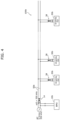
- FIG. 4 is a diagram illustrating connection relation between BMU 10b and the plurality of cell supervising circuits 30b in BMS 100b.
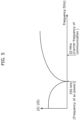
- FIG. 5 is a diagram illustrating frequency characteristics of the impedance of a transmission path including AC power line 50b.
- the transmission path including AC power line 50b has characteristics suitable for the frequency of the AC power. More specifically, the resonance frequency of the transmission path is set to a substantially same frequency as the frequency of the AC power.
- the resonance frequency of the transmission path and the frequency of the AC power are, for example, several hundreds of kilohertz and 350 kilohertz in examples of FIGS. 4 and 5 . Consequently, power supply with little loss is realized.
- the frequency band used in the communication is higher than the frequency of the AC power in BMS 100b. That is, communication circuit 37 of cell supervising circuit 30b performs communication by use of the frequency band higher than the frequency of the AC power.
- the carrier wave frequency of communication is, for example, 20 MHz.
- BMS 100b can perform communication with a relatively low communication power by use of a frequency band in which the impedance in the impedance characteristics of the transmission path is high. Note that the way of setting such a frequency band is also applicable to Embodiments 1 and 2.
- FIG. 6 is a diagram illustrating a power spectrum of the transmission path including AC power line 50b.
- BMS 100b divides the frequency band used for the communication into a plurality of communication channels 1 to n (where n is an integer of 2 or more).
- Each of the plurality of cell supervising circuits 30b is used as a communication channel having part of the frequency band assigned to cell supervising circuit 30b described above. Consequently, the communication speed and the communication quality can be improved.
- full dual communication is realized through discrimination between a transmission channel and a reception channel.
- synchronous communication between the plurality of cell supervising circuits 30b and BMU 10b is realized through communication while different communication channels are respectively assigned to the plurality of cell supervising circuits 30b.
- BMS 100b can select the communication channel in the most favorable state from among the plurality of communication channels to perform the communication, and the two communication channels are used for the transmission of the same signal and signals received on a reception side are compared to each other to realize redundant communication. Note that the way of dividing such a frequency band into a plurality of communication channels is also applicable to Embodiments 1 and 2.
- each of the plurality of cell supervising circuits includes an individual clock oscillator and the plurality of cell supervising circuits independently operate without synchronizing with each other.
- the timing of measuring the voltage is instructed from the BMU side through daisy communication, but it is impossible to accurately synchronize the timing of measuring the voltages and the timing of measuring the current with each other due to a delay in the communication time and a variation of clock generators of the plurality of cell supervising circuits.
- an AC power is supplied from single AC power source 12a to the plurality of cell supervising circuits 30b in BMS 100b. Therefore, generating a clock signal based on the frequency of the AC power by clock generation circuit 39b makes it possible to synchronize respective system clocks of the plurality of cell supervising circuits 30b. Further, synchronizing the current measurement timing on BMU 10b side with the frequency of the AC power makes it possible to accurately synchronize the timing of measuring the voltage of secondary battery cell 21 by cell supervising circuit 30b and the timing of measuring the current on BMU 10b side.
- BMS 100b can accurately measure the inner impedance of secondary battery cell 21 to thereby calculate the accurate OCV and more accurately calculate the SOC and the SOH.
- FIG. 7 is a diagram schematically illustrating a functional configuration of a BMS (BMS according to the variation of Embodiment 3) in which cell supervising circuit 30b targets on only one secondary battery cell 21 for the monitoring.
- Measurement circuit 31c does not include multiplexer 33 in BMS 100c illustrated in FIG. 7 . That is, it is possible to omit multiplexer 33 in BMS 100c.
- cell supervising circuit 30 or cell supervising circuit 30a may target on only one secondary battery cell 21 for monitoring in Embodiments 1 and 2.
- FIG. 8 is a diagram schematically illustrating a functional configuration of the BMS according to Embodiment 4. Note that the description of Embodiment 4 will be provided, focusing on a difference from Embodiments 1 to 3, and those already described in Embodiments 1 to 3 will be omitted or simplified as appropriate.
- BMS 100d includes: BMU 10b; a plurality of battery packs 20 (not illustrated in FIG. 8 ); and a plurality of cell supervising circuits 30d corresponding to the plurality of battery packs 20.
- Cell supervising circuit 30d includes voltage detection circuit 39d at a later stage of conversion circuit 39a. Although not illustrated, other configurations of cell supervising circuit 30d are the same as those of cell supervising circuit 30b.
- Voltage detection circuit 39d outputs a control signal for controlling the activation or stop of measurement circuit 31 in accordance with an output voltage of conversion circuit 39a. More specifically, voltage detection circuit 39d is realized by, for example, a comparator circuit, and outputs a control signal (at a high level) when the output voltage of conversion circuit 39a is greater than or equal to a predetermined voltage. Voltage detection circuit 39d stops a control signal (at a low level) when the output voltage of conversion circuit 39a is less than the predetermined voltage.
- control signal may be reverse, and voltage detection circuit 39d may output the control signal (at a high level) when the output voltage of conversion circuit 39a is less than the predetermined voltage and may stop the control signal (at a low level) when the output voltage of conversion circuit 39a is greater than or equal to the predetermined voltage.
- conversion circuit 39a converts the AC power provided from AC power source 12a into a DC power, and thus voltage detection circuit 39d can be said to output a control signal upon start of the supply of the AC power from AC power source 12a to cell supervising circuit 30d.
- the control signal is, for example, a signal for controlling the activation or stop of cell supervising circuit 30d (for example, a power on reset signal), and more specifically is outputted to control circuit 36.
- the cell supervising circuit needs to be shut down to suppress the power consumption of battery pack 20 at a maximum.
- the BMS is loaded on an electric car
- it is necessary that battery pack 20 do not turn into a completely discharged state the electric car needs to be operable.
- the cell supervising circuit (more specifically, a battery management IC corresponding to the cell supervising circuit, in other words, a battery monitoring IC) has a shutdown mode, but a method for activating the cell supervising circuit in the shutdown mode is still to be reviewed.
- the BMU uses a power supply system different from a high voltage system of, for example, battery pack 20, and thus the reference voltage differs from that of the cell supervising circuit and an activation signal needs to be provided to the cell supervising circuit over the galvanic isolation border in order to activate the cell supervising circuit by the BMU.
- Possible methods for providing the activation signal to the cell supervising circuit include: for example, a method using a photocoupler; and a method for transmitting an activation signal through a daisy communication interface.
- the method using the photocoupler faces a problem that a wire or a harness for connection between the plurality of cell supervising circuits and the BMU is required.
- the method for transmitting the activation signal through the daisy communication interface faces a problem that a reception circuit cannot be turned off in order to permit cell supervising circuit 30d to receive the activation signal even in the shutdown mode, which requires slight power consumption in the shutdown mode.
- BMU 10b can control the turning off and on of the control signal (that is, the activation signal) provided from voltage detection circuit 39d to measurement circuit 31 as a result of turning on and off of AC power source 12a in BMS 100d. That is, installing voltage detection circuit 39d which detects the AC power on cell supervising circuit 30d side makes it possible for BMU 10b to easily activate cell supervising circuit 30d.
- the control signal that is, the activation signal
- conversion circuit 39a which converts the AC power into a DC power can be formed by a diode bridge and a smoothening capacitor, so that a circuit current is no longer required.
- voltage detection circuit 39c operates based on the DC power source provided by rectifying the AC power, power supply from battery pack 20 side does not have to be received. Therefore, with the configuration like that of cell supervising circuit 30d, it is possible to set, to almost zero, the power supplied from battery pack 20 and consumed by cell supervising circuit 30d in the shutdown mode.
- cell supervising circuit 30 includes: measurement circuit 31 which measures a state of charge of secondary battery cell 21; transformer 38 for measurement circuit 31 to contactlessly receive power supply from a power source different from secondary battery cell 21; and communication circuit 37 which transmits, via transformer 38 to BMU 10 which manages the state of secondary battery cell 21, information indicating the state of charge measured by measurement circuit 31.
- Secondary battery cell 21 is one example of a power storage cell and transformer 38 is one example of an insulation element.
- BMU 10 is one example of a management device. Note that cell supervising circuits 30a, 30b, and 30d also have the same configuration.
- Such cell supervising circuit 30 uses, as a communication path formed with BMU 10, a power supply path from a power source different from a power source of secondary battery cell 21, and thus it is possible to suppress the collapse of cell balance due to variation in the operating power of cell supervising circuit 30 while suppressing the addition of components related to communication.
- the aforementioned power source is AC power source 12a and cell supervising circuit 30b further includes conversion circuit 39a which converts, into a DC power, the AC power supplied from AC power source 12a via transformer 38 and supplies the DC power to measurement circuit 31.
- Such cell supervising circuit 30b can covert the AC power into a DC power for operation.
- transformer 38 is connected to AC power source 12a via AC power line 50b in BMS 100b.
- AC power line 50b is connected with another cell supervising circuit 30b different from aforementioned cell supervising circuit 30b and BMS 100b.
- Such cell supervising circuit 30b can use AC power line 50b common to another cell supervising circuit 30b to perform communication with BMU 10.
- communication circuit 37 uses a frequency band higher than the frequency of the AC power to perform communication in BMS 100b.
- Such cell supervising circuit 30b can use a frequency band higher than the impedance in the impedance characteristics of the transmission path to perform communication with a relatively low communication power.
- communication circuit 37 uses part of the frequency band as a communication channel assigned to cell supervising circuit 30b in BMS 100b.
- Such cell supervising circuit 30b can utilize the communication channel to thereby improve the communication speed and the communication quality.
- cell supervising circuit 30d further includes voltage detection circuit 39d which outputs a control signal for controlling the activation or stop of measurement circuit 31 in accordance with the output voltage of conversion circuit 39a.
- BMU 10b can easily activate cell supervising circuit 30d.
- cell supervising circuit 30b further includes clock generation circuit 39b which generates a clock signal synchronized with the frequency of the AC power.
- Measurement circuit 31 measures the state of charge of secondary battery cell 21 based on the clock signal generated.
- the AC power when the AC power is supplied from single AC power source 12a to the plurality of cell supervising circuits 30b, the AC power can be used to synchronize respective system clocks of the plurality of cell supervising circuits 30b.
- cell supervising circuit 30b further includes storage unit 35 which stores an address for discriminating cell supervising circuit 30b from another cell supervising circuit 30b.
- the address is one example of discrimination information.
- BMS 100 includes: BMU 10 which manages the state of secondary battery cell 21; and cell supervising circuit 30.
- Cell supervising circuit 30 includes: measurement circuit 31 which measures the state of charge of secondary battery cell 21; transformer 38 which is provided for measurement circuit 31 to contactlessly receive the power supply from a power source different from secondary battery cell 21; and communication circuit 37 which transmits, to BMU 10 via transformer 38, information indicating the state of charge measured by the measurement circuit.
- Such BMS 100 uses, as the communication path of BMU 10 and cell supervising circuit 30, a power supply path from another power source different from secondary battery cell 21.
- BMS 100 can suppress the collapse of cell balance due to the variation in the operating power of cell supervising circuit 30 while suppressing the addition of components related to the communication.
- BMS 100b includes a plurality of cell supervising circuits 30b corresponding to the plurality of secondary battery cells 21.
- Each of the plurality of cell supervising circuits 30b is connected to AC power line 50b common to the plurality of cell supervising circuits 30b via transformer 38 included in aforementioned cell supervising circuit 30.
- BMU 10b performs communication with each of the plurality of cell supervising circuits 30b via AC power line 50b.
- BMU 10b can perform communication with each of the plurality of cell supervising circuits 30b by use of AC power line 50b common to the plurality of cell supervising circuits 30b.
- BMU 10b performs communication by use of a frequency band higher than the frequency of the AC power through AC power line 50b in BMS 100b.
- Each of the plurality of cell supervising circuits 30b uses part of the frequency band as the communication channel assigned to aforementioned cell supervising circuit 30b.
- Such BMS 100b can utilize the communication channel to thereby improve the communication speed and the communication quality.
- each of the plurality of cell supervising circuits 30b further includes storage unit 35 which stores the address for discriminating another cell supervising circuit 30b different from aforementioned cell supervising circuit 30b.
- the information having the address of aforementioned cell supervising circuit 30b provided to the measured state of charge is transmitted to BMU 10b.
- the transmission of the information provided with the address of cell supervising circuit 30b by cell supervising circuit 30b permits BMU 10b to perform management while discriminate which cell supervising circuit 30b has transmitted the state of charge acquired through the communication.
- the embodiments described above illustrate the transformer as the insulation element, but the insulation element may be another insulation element such as an electromagnetic resonance coupler.
- the battery pack used in an electric car is subjected to the management in the embodiments described above, but the BMS may manage a battery provided for any purpose.
- the circuit configurations described in the embodiments above are each one example and the present disclosure is not limited to the aforementioned circuit configurations. That is, the present disclosure also includes a circuit which can, similarly to the aforementioned circuit configuration, realize the characteristic functions of the present disclosure. For example, the present disclosure also includes those in which elements such as a switching element (transistor), a resistive element, and a capacitive element are connected in series or in parallel to a certain element within a range in which same functions as those of the aforementioned circuit configurations can be realized.
- a switching element transistor
- resistive element resistive element
- capacitive element capacitive element
- the components included in the cell supervising circuit may be integrated in any manner in the embodiments described above.
- the measurement circuit and the communication circuit may be realized as a single integrated circuit or may be realized as mutually different integrated circuits.
- the cell supervising circuit is realized by hardware in the embodiments described above. However, part of the components included in the cell supervising circuit may be realized by executing a software program suitable for the aforementioned components. Part of the components included in the cell supervising circuit may be realized by reading and executing a software program recorded on a recording medium such as a hard disc or a semiconductor memory by a program execution unit such as a central processing unit (CPU) or a processor.
- a program execution unit such as a central processing unit (CPU) or a processor.
- processing executed by the specific processor in the embodiments described above may be executed by another processor.
- sequence of a plurality of processes may be changed or the plurality of processes may be performed in parallel in the operation described in the embodiments above.
- the present disclosure also includes a mode obtained by making various modifications conceivable to those skilled in the art to the embodiments or a mode realized by combining the components and the functions in the embodiments in a desired manner within a scope not departing from the spirits of the present disclosure.
- the present disclosure may be released as a BMU, a power storage capacitor management system, or a power storage capacitor management unit, or the like.
- the present disclosure may be realized as a vehicle such as an electric car on which the cell supervising circuit or the BMS according to any of the embodiments described above is loaded.
- the present disclosure may be realized as a device other than a vehicle on which the cell supervising circuit or the BMS according to any of the embodiments described above is loaded.
- the cell supervising circuit and the BMS using such a cell supervising circuit of the present disclosure are widely usable for in-vehicle uses, etc.
Landscapes
- Engineering & Computer Science (AREA)
- Power Engineering (AREA)
- Manufacturing & Machinery (AREA)
- Chemical & Material Sciences (AREA)
- Chemical Kinetics & Catalysis (AREA)
- Electrochemistry (AREA)
- General Chemical & Material Sciences (AREA)
- Physics & Mathematics (AREA)
- General Physics & Mathematics (AREA)
- Microelectronics & Electronic Packaging (AREA)
- Charge And Discharge Circuits For Batteries Or The Like (AREA)
- Secondary Cells (AREA)
- Measurement Of Current Or Voltage (AREA)
Description
- The present disclosure relates to a cell supervising circuit and a battery management system including such a cell supervising circuit.
- Patent Literature (PTL) 1 discloses a battery voltage monitoring device capable of ensuring the reliability of operation by improving the redundancy of an operating power source.
-
- Patent Literature 1:
Japanese Unexamined Patent Application Publication No. 2011-163847 - Patent Literature 2: Japanese Patent Application
JP 2014 211402 A - Patent Literature 3: Japanese Patent Application
JP 2015 156728 A - Patent Literature 4: European
Patent Application EP 2 720 348 A2 - The present disclosure provides a cell supervising circuit capable of suppressing the collapse of cell balance while suppressing the addition of components related to communication, and a battery management system using such a cell supervising circuit.
- A cell supervising circuit according to one aspect of the present disclosure includes: a measurement circuit which measures a state of charge of a power storage cell; an insulation element which is provided for the measurement circuit to contactlessly receive power supply from a power source different from the power storage cell; and a communication circuit which transmits, via the insulation element to a management device which manages a status of the power storage cell, information indicating the state of charge measured by the measurement circuit.
- A battery management system according to another aspect of the present disclosure includes: a management device which manages a status of a power storage cell; and a cell supervising circuit, wherein the cell supervising circuit includes: a measurement circuit which measures a state of charge of the power storage cell; an insulation element which is provided for the measurement circuit to contactlessly receive power supply from a power source different from the power storage cell; and a communication circuit which transmits, to the measurement circuit via the insulation element, information indicating the state of charge measured by the measurement circuit.
- The present disclosure realizes a cell supervising circuit capable of suppressing the collapse of cell balance while suppressing the addition of components related to communication and a battery management system using such a cell supervising circuit.
-
- [
FIG. 1 ]
FIG. 1 is a diagram schematically illustrating a functional configuration of a BMS according toEmbodiment 1. - [
FIG. 2 ]
FIG. 2 is a diagram schematically illustrating a functional configuration of a BMS according toEmbodiment 2. - [
FIG. 3 ]
FIG. 3 is a diagram schematically illustrating a functional configuration of a BMS according to Embodiment 3. - [
FIG. 4 ]
FIG. 4 is a diagram illustrating connection relation between a BMU and a plurality of cell supervising circuits in the BMS according to Embodiment 3. - [
FIG. 5 ]
FIG. 5 is a diagram illustrating frequency characteristics of the impedance of a transmission path. - [
FIG. 6 ]
FIG. 6 is a diagram illustrating a power spectrum of the transmission path. - [
FIG. 7 ]
FIG. 7 is a diagram schematically illustrating a functional configuration of a BMS according to a variation of Embodiment 3. - [
FIG. 8 ]
FIG. 8 is a diagram schematically illustrating a functional configuration of a BMS according to Embodiment 4. - Hereinafter, a battery management system (BMS) according to
Embodiment 1 will be described. First, the configuration of the BMS according toEmbodiment 1 will be described.FIG. 1 is a diagram schematically illustrating a functional configuration of the BMS according toEmbodiment 1. - BMS 100 according to
Embodiment 1 is loaded on, for example, a vehicle such as an electric vehicle. BMS 100 includes: battery management unit (BMU) 10; a plurality ofbattery packs 20; and a plurality of cell supervising circuits (CSC) 30 corresponding to the plurality ofbattery packs 20.FIG. 1 illustrates twobattery packs 20 and twocell supervising circuit 30, but the total numbers ofbattery packs 20 andcell supervising circuits 30 are not limited to two, and thus the aforementioned numbers may be three or more. Moreover, BMS 100 may include onebattery pack 20 and onecell supervising circuit 30. - BMU 10 monitors the state of the plurality of
battery packs 20 and controls the plurality ofbattery packs 20.Battery pack 20 includes a plurality ofsecondary battery cells 21 but is only required to include at least onesecondary battery cell 21.Secondary battery cell 21 is one example of a power storage cell. More specifically,secondary battery cell 21 is a lithium ion battery but may be any other battery such as a nickel hydrogen battery. The plurality ofsecondary battery cells 21 are, for example, serially connected but may be partially or entirely connected in parallel. - Note that it is not essential that
battery pack 20 be formed by one or moresecondary battery cells 21 andbattery pack 20 may be formed by one or more storage capacitor cells. The storage capacitor cell is another one example of the power storage cell. More specifically, the storage capacitor cell is an electric double layer capacitor but may be, for example, a lithium ion capacitor. - More specifically, BMU 10 includes a plurality of
communication circuits 11, a plurality of primarypower supply circuits 12, andcontrol microcomputer 13.FIG. 1 illustrates twocommunication circuits 11 and two primarypower supply circuits 12, butBMU 10 is only required to include the total numbers ofcommunication circuits 11 and primarypower supply circuits 12 corresponding to the total number ofcell supervising circuits 30. Note that BMU 10 is only required to include at leastcontrol microcomputer 13. -
Communication circuit 11 is a circuit forBMU 10 to make communication withcell supervising circuit 30. More specifically,communication circuit 11 includes, for example, a transmission circuit, a filter, and an amplifier circuit for signal transmission; and a reception circuit, a filter, and an amplifier circuit for signal reception. - Primary
power supply circuit 12 forms switchingpower supply circuit 40 together withtransformer 38 and secondarypower supply circuit 39. Switchingpower supply circuit 40 is a power supply circuit for performing contactless power feed tocell supervising circuit 30 through a path different frombattery pack 20. That is,cell supervising circuit 30 is operated not bybattery pack 20 but by an electric power supplied by switchingpower supply circuit 40. -
Control microcomputer 13 monitors the state of the plurality ofbattery packs 20 and controls the plurality ofbattery packs 20. - The plurality of
cell supervising circuits 30 are circuits respectively corresponding to the plurality ofbattery packs 20.Cell supervising circuit 30 is a circuit module and is formed by mounting circuit components on a substrate. More specifically,cell supervising circuit 30 includesmeasurement circuit 31,communication circuit 37,transformer 38, and secondarypower supply circuit 39. -
Measurement circuit 31 measures respective states of charge of the plurality ofsecondary battery cells 21 included inbattery pack 20. More specifically,measurement circuit 31 measures, as parameters indicating the states of charge ofsecondary battery cells 21, respective voltage values of the plurality ofsecondary battery cells 21 included inbattery pack 20.Measurement circuit 31 includes: a plurality ofswitching elements 32 corresponding to the plurality ofsecondary battery cells 21;multiplexer 33,AD converter 34,storage unit 35, andcontrol circuit 36.Measurement circuit 31 may measure the parameters directly or indirectly indicating the states of charge. - The plurality of switching
elements 32 are switched on to individually discharge the states of charge of the corresponding plurality ofsecondary battery cells 21 for adjustment. -
Multiplexer 33 is a selection circuit which selects voltage values at both ends of the plurality ofsecondary battery cells 21. -
AD converter 34 converts the analog voltage values selected and inputted bymultiplexer 33 into digital voltage values. -
Storage unit 35 is, for example, a non-volatile semiconductor memory, which stores an address for discriminatingcell supervising circuit 30 from other cell supervising circuits 30 (in other words, discrimination information or recognition sign). The address can also be assumed as discrimination information for discriminatingbattery pack 20 from other battery packs 20. Note that, in an example ofFIG. 1 ,storage unit 35 is illustrated as part of measurement circuit 31 (that is, included in measurement circuit 31) but may be provided as a component separate frommeasurement circuit 31. -
Control circuit 36 generates information obtained by providing the address stored instorage unit 35 to the digital voltage value outputted from AD converter 34 (also written as information indicating the state of charge measured by measurement circuit 31), and outputs the generated information tocommunication circuit 37. In other words,control circuit 36 is a control logic circuit. -
Communication circuit 37 transmits, viatransformer 38, information indicating the states of charge measured bymeasurement circuit 31 toBMU 10 which manages the state of battery packs 20. More specifically,communication circuit 37 includes: for example, a transmission circuit, a filter, and an amplifier circuit for signal transmission; and a reception circuit, a filter, and an amplifier circuit for signal reception. -
Transformer 38 is an insulation element formeasurement circuit 31 to contactlessly receive the power supply from a power source (more specifically, a primary power supply circuit) different frombattery pack 20.Transformer 38, secondarypower supply circuit 39, and the primary power supply circuit form switchingpower supply circuit 40. Note thatcell supervising circuit 30 may include another coil element instead oftransformer 38 as an insulation element. - Switching
power supply circuit 40 is a power supply circuit for contactlessly feeding power tocell supervising circuit 30 through a path different frombattery pack 20.Measurement circuit 31 andcommunication circuit 37 are operated not bybattery pack 20 but by the power supplied by switchingpower supply circuit 40. In other words, switchingpower supply circuit 40 is an insulated DC-DC converter. - Note that the switching frequency of switching
power supply circuit 40 is, for example, approximately 350 kHz, and the frequency band of the carrier wave in communication between cell supervising circuit 30 (communication circuit 37) and BMU 10 (communication circuit 11) is higher than 350 kHz. - In order to suppress heat generation, ignition, explosion, and deterioration caused by overcharging of
battery pack 20 and maximize the state of charge ofsecondary battery cell 21 through charging, a typical BMS performs cell balance processing of equalizing the states of charge (SOC) of the plurality ofsecondary battery cells 21 included inbattery pack 20 to charge the battery pack. At this point, BMU carries out daisy (bead) communication with the plurality of cell supervising circuits in order to manage the states of charge of the secondary battery cells (in other words, the voltage values of the secondary battery cells). - Typically, each of the plurality of cell supervising circuits in the typical BMS receives power supply from the battery pack (secondary battery cell) targeted for monitoring by the aforementioned cell supervising circuit. With such a configuration, a variation in the operating power of the plurality of cell supervising circuits serves as a factor contributing to the collapse of cell balance. In particular, the variation in the operating power due to a difference in the frequency of communication of the plurality of cell supervising circuits serves as a factor largely contributing to the collapse of cell balance.
- There is a possible method for supplying a power from another power source (for example, a 12V battery in a case where the BMS is provided to be loaded on a vehicle) different from the battery pack to the cell supervising circuit for the purpose of suppressing the collapse of cell balance. In the method, the aforementioned another power source and the battery pack need to be galvanically isolated from each other. More specifically, the method for supplying the power from another power source to the cell supervising circuit includes, for example, power feed to the cell supervising circuit by an insulated DC-DC converter using a transformer.
- However, in a case where the method for supplying the power from another power source to the cell supervising circuit is applied to the typical BMS, a power supply path (for example, a wire or a harness) needs to be provided between the plurality of cell supervising circuits and the BMU. Thus, there arise new problems such as an increase in the total number of components and a weight increase.
- On the contrary, since
BMS 100 also uses the power supply path (power line 50 and transformer 38) formed by switchingpower supply circuit 40 as a communication path ofBMU 10 andcell supervising circuit 30, a power supply path does not have to be provided separately. That is,BMS 100 can suppress the increase in the total number of components, the weight increase, etc. and also can suppress the collapse of cell balance due to the variation in the operating power ofcell supervising circuit 30. - Next, the significance of the address stored in
storage unit 35 will be described. InBMS 100, it is required to manage the state of charge for eachsecondary battery cell 21, and thus a mechanism of specifying individualsecondary battery cells 21 byBMU 10 serving as a host system ofcell supervising circuits 30 is required. - Here, the daisy communication is performed in the typical BMS and communication is performed in a bucket relay style in the daisy communication, so that addresses respectively specific to the plurality of
cell supervising circuits 30 are sequentially provided at time of start of the communication. On the contrary, the plurality ofcell supervising circuits 30 parallelly perform communication withBMU 10 inBMS 100, which therefore brings about a problem that the method for sequentially providing the addresses cannot be used. - Thus, the address specific to the
cell supervising circuit 30 is stored intostorage unit 35 included in aforementionedcell supervising circuit 30 inBMS 100.Cell supervising circuit 30 transmits, toBMU 10, information including the address of aforementionedcell supervising circuit 30 provided to the voltage value measured bymeasurement circuit 31. Consequently,BMU 10 can perform management while discriminating from whichcell supervising circuit 30 the voltage value acquired through the communication has been transmitted (to whichbattery pack 20 the voltage value corresponds). The voltage values of the plurality ofsecondary battery cells 21 included in onebattery pack 20 are transmitted in sequence, and thus discrimination between the plurality ofsecondary battery cells 21 included in onebattery pack 20 is performed based on, for example, the aforementioned sequence. - Hereinafter, a BMS according to
Embodiment 2 will be described. First, the configuration of the BMS according toEmbodiment 2 will be described.FIG. 2 is a diagram schematically illustrating a functional configuration of the BMS according toEmbodiment 2. Note that the description ofEmbodiment 2 will be provided, focusing on a difference fromEmbodiment 1, and the description of those already described inEmbodiment 1 will be omitted or simplified as appropriate. -
BMS 100a according toEmbodiment 2 includes:BMU 10a; a plurality of battery packs 20; and a plurality ofcell supervising circuits 30a corresponding to the plurality of battery packs 20. - A difference between
BMU 10 andBMU 10a lies in thatBMU 10a includesAC power source 12a instead of primarypower supply circuit 12.AC power source 12a supplies an AC power tocell supervising circuits 30a viaAC power line 50a. That is, an AC power is supplied fromBMU 10a tocell supervising circuit 30a over a galvanic isolation border inBMS 100a. - A difference between
cell supervising circuit 30 andcell supervising circuit 30a lies in thatcell supervising circuit 30a includesconversion circuit 39a instead of secondarypower supply circuit 39. -
Conversion circuit 39a converts, into a DC power, an AC power supplied fromAC power source 12a viatransformer 38 and supplies the DC power tomeasurement circuit 31 andcommunication circuit 37. That is,transformer 38 is an insulation element formeasurement circuit 31 to contactlessly receive the power supplied fromAC power source 12a different frombattery pack 20 inEmbodiment 2. More specifically,conversion circuit 39a is formed by a full-wave rectifier circuit, a smoothening circuit, a regulator, etc. The frequency ofAC power source 12a is, for example, 350 kHz and an effective value ofAC power source 12a is, for example, 5V. Note that the frequency and the effective value ofAC power source 12a are not specifically limited. - In switching
power supply circuit 40 described inEmbodiment 1, a switching frequency and a switching pulse width fluctuate, so that a frequency component of switching noise may be spread over a wide range in some cases. That is, it may be difficult to ensure communication quality. - On the contrary, communication is performed via
AC power line 50a to which the AC power is transmitted inBMS 100a. If the waveform of the AC power is a sine wave with a single frequency, the frequency component is hardly spread, which therefore provides effect of easily ensuring the communication quality. Moreover, since the frequency component is hardly spread, the degree of freedom of a frequency band where the communication is performed is also improved. - Hereinafter, a BMS according to Embodiment 3 will be described. First, the configuration of the BMS according to Embodiment 3 will be described.
FIG. 3 is a diagram schematically illustrating a functional configuration of the BMS according to Embodiment 3. Note that the description of Embodiment 3 will be provided, focusing on a difference fromEmbodiments Embodiments -
BMS 100b according to Embodiment 3 includes:BMU 10b; a plurality of battery packs 20; a plurality ofcell supervising circuits 30b corresponding to the plurality of battery packs 20. - A difference between
BMU 10a andBMU 10b lies in thatBMU 10b includes onecommunication circuit 11 and oneAC power source 12a and further includestransformer 14. Note thatBMU 10b may include another coil element as an insulation element in place oftransformer 14. -
Communication circuit 11 ofBMU 10b is connected toAC power line 50b viatransformer 14. More specifically, a primary coil oftransformer 14 is connected tocommunication circuit 11 and a secondary coil oftransformer 14 is connected toAC power line 50b. -
AC power line 50b is commonly used by the plurality ofcell supervising circuits 30b. More specifically, each of the plurality ofcell supervising circuits 30b is connected toAC power line 50b common to the plurality ofcell supervising circuits 30b viatransformer 38 included in aforementioned cell supervising circuit30b. More specifically, the primary coil oftransformer 38 is connected toAC power line 50b and the secondary coil oftransformer 38 is connected tocommunication circuit 37 andconversion circuit 39a. - With such connection relation,
BMU 10b can perform communication with each of the plurality ofcell supervising circuits 30b viaAC power line 50b.AC power line 50b is a daisy communication line. - A difference between
cell supervising circuit 30a andcell supervising circuit 30b lies in thatcell supervising circuit 30b includesclock generation circuit 39b. -
Clock generation circuit 39b generates a clock signal synchronized with the frequency of an AC power.Measurement circuit 31 measures the voltage value ofsecondary battery cell 21 based on the clock signal generated. More specifically,clock generation circuit 39b is realized by a phase synchronization circuit (in other words, a phase locked loop (PLL) circuit). - In
BMS 100b, singleAC power source 12a can be used to supply an AC power to the plurality ofcell supervising circuits 30b over the galvanic isolation border. Moreover, communication can be easily performed by dedicatedAC power line 50b. - Assumed as a configuration similar to that of
BMS 100b is a configuration such that a power supply line (also called a bus bar) connecting together the plurality of battery packs 20 is used to perform power line communication (PLC). Such a configuration can eliminate a communication line. - Here, since the bus bar is typically a single wire without a GND wire, the use of the bus bar as a transmission line path for communication brings about a problem that noise resistance is low. Moreover, a large current intermittently flows to the bus bar, which therefore generates very large disturbance noise. Thus, there also arise a problem that it is difficult to ensure the communication quality.
- However, another
AC power line 50b different from the bus bar is used to perform communication inBMS 100b. More specifically, a power is supplied fromAC power source 12a to the plurality ofcell supervising circuits 30b over the galvanic isolation border andAC power line 50b is used to perform communication inBMS 100b. Consequently, it is possible to perform communication with high communication quality without newly providing a power supply path (more specifically, a wire, a harness, or the like) between the plurality ofcell supervising circuits 30b. - Next, the frequency band of a carrier wave of communication in BMS100b will be described.
FIG. 4 is a diagram illustrating connection relation betweenBMU 10b and the plurality ofcell supervising circuits 30b inBMS 100b.FIG. 5 is a diagram illustrating frequency characteristics of the impedance of a transmission path includingAC power line 50b. - As illustrated in
FIGS. 4 and5 , the transmission path includingAC power line 50b has characteristics suitable for the frequency of the AC power. More specifically, the resonance frequency of the transmission path is set to a substantially same frequency as the frequency of the AC power. The resonance frequency of the transmission path and the frequency of the AC power are, for example, several hundreds of kilohertz and 350 kilohertz in examples ofFIGS. 4 and5 . Consequently, power supply with little loss is realized. - Moreover, the frequency band used in the communication is higher than the frequency of the AC power in
BMS 100b. That is,communication circuit 37 ofcell supervising circuit 30b performs communication by use of the frequency band higher than the frequency of the AC power. The carrier wave frequency of communication is, for example, 20 MHz. - As described above, if the carrier wave frequency of the communication is set to a high frequency band distant from the resonance frequency of
AC power line 50b,BMS 100b can perform communication with a relatively low communication power by use of a frequency band in which the impedance in the impedance characteristics of the transmission path is high. Note that the way of setting such a frequency band is also applicable to Embodiments 1 and 2. - Moreover, the frequency band used for the communication may be divided into a plurality of frequency bands.
FIG. 6 is a diagram illustrating a power spectrum of the transmission path includingAC power line 50b. - As illustrated in
FIG. 6 ,BMS 100b divides the frequency band used for the communication into a plurality ofcommunication channels 1 to n (where n is an integer of 2 or more). Each of the plurality ofcell supervising circuits 30b is used as a communication channel having part of the frequency band assigned tocell supervising circuit 30b described above. Consequently, the communication speed and the communication quality can be improved. - For example, full dual communication is realized through discrimination between a transmission channel and a reception channel. Moreover, synchronous communication between the plurality of
cell supervising circuits 30b andBMU 10b is realized through communication while different communication channels are respectively assigned to the plurality ofcell supervising circuits 30b. Moreover,BMS 100b can select the communication channel in the most favorable state from among the plurality of communication channels to perform the communication, and the two communication channels are used for the transmission of the same signal and signals received on a reception side are compared to each other to realize redundant communication. Note that the way of dividing such a frequency band into a plurality of communication channels is also applicable to Embodiments 1 and 2. - Next, the significance of
clock generation circuit 39b will be described. Typically, accurate calculation of the SOC and a state of health (SOH) of the battery pack requires obtaining an accurate open circuit voltage (OCV). However, it is difficult to measure the accurate OCV with a load actually set to zero in a state in whichbattery pack 20 is incorporated in a set. - Thus, there is a possible method for calculating the OCV through subtraction of an operating current and a voltage drop caused by the inner impedance from the measured cell voltage value by measuring the inner impedance of
secondary battery cell 21. To calculate the accurate OCV by the aforementioned method, the timing of measuring the voltages of the plurality ofsecondary battery cells 21 and the timing of measuring the current need to be brought into agreement with each other with high accuracy. - Moreover, the current measurement is typically performed on a BMU side, targeted on one portion of the bus bar, and each of the plurality of cell supervising circuits includes an individual clock oscillator and the plurality of cell supervising circuits independently operate without synchronizing with each other. In such a case, the timing of measuring the voltage is instructed from the BMU side through daisy communication, but it is impossible to accurately synchronize the timing of measuring the voltages and the timing of measuring the current with each other due to a delay in the communication time and a variation of clock generators of the plurality of cell supervising circuits.
- On the contrary, an AC power is supplied from single
AC power source 12a to the plurality ofcell supervising circuits 30b inBMS 100b. Therefore, generating a clock signal based on the frequency of the AC power byclock generation circuit 39b makes it possible to synchronize respective system clocks of the plurality ofcell supervising circuits 30b. Further, synchronizing the current measurement timing onBMU 10b side with the frequency of the AC power makes it possible to accurately synchronize the timing of measuring the voltage ofsecondary battery cell 21 bycell supervising circuit 30b and the timing of measuring the current onBMU 10b side. - Thus,
BMS 100b can accurately measure the inner impedance ofsecondary battery cell 21 to thereby calculate the accurate OCV and more accurately calculate the SOC and the SOH. -
Cell supervising circuit 30b may target on only onesecondary battery cell 21 for monitoring.FIG. 7 is a diagram schematically illustrating a functional configuration of a BMS (BMS according to the variation of Embodiment 3) in whichcell supervising circuit 30b targets on only onesecondary battery cell 21 for the monitoring.Measurement circuit 31c does not includemultiplexer 33 inBMS 100c illustrated inFIG. 7 . That is, it is possible to omitmultiplexer 33 inBMS 100c. Note thatcell supervising circuit 30 orcell supervising circuit 30a may target on only onesecondary battery cell 21 for monitoring inEmbodiments - Hereinafter, a BMS according to Embodiment 4 will be described. First, a configuration of the BMS according to Embodiment 4 will be described.
FIG. 8 is a diagram schematically illustrating a functional configuration of the BMS according to Embodiment 4. Note that the description of Embodiment 4 will be provided, focusing on a difference fromEmbodiments 1 to 3, and those already described inEmbodiments 1 to 3 will be omitted or simplified as appropriate. -
BMS 100d according to Embodiment 4 includes:BMU 10b; a plurality of battery packs 20 (not illustrated inFIG. 8 ); and a plurality ofcell supervising circuits 30d corresponding to the plurality of battery packs 20. -
Cell supervising circuit 30d includesvoltage detection circuit 39d at a later stage ofconversion circuit 39a. Although not illustrated, other configurations ofcell supervising circuit 30d are the same as those ofcell supervising circuit 30b. -
Voltage detection circuit 39d outputs a control signal for controlling the activation or stop ofmeasurement circuit 31 in accordance with an output voltage ofconversion circuit 39a. More specifically,voltage detection circuit 39d is realized by, for example, a comparator circuit, and outputs a control signal (at a high level) when the output voltage ofconversion circuit 39a is greater than or equal to a predetermined voltage.Voltage detection circuit 39d stops a control signal (at a low level) when the output voltage ofconversion circuit 39a is less than the predetermined voltage. Note that the logic of the control signal may be reverse, andvoltage detection circuit 39d may output the control signal (at a high level) when the output voltage ofconversion circuit 39a is less than the predetermined voltage and may stop the control signal (at a low level) when the output voltage ofconversion circuit 39a is greater than or equal to the predetermined voltage. - As described above,
conversion circuit 39a converts the AC power provided fromAC power source 12a into a DC power, and thusvoltage detection circuit 39d can be said to output a control signal upon start of the supply of the AC power fromAC power source 12a tocell supervising circuit 30d. The control signal is, for example, a signal for controlling the activation or stop ofcell supervising circuit 30d (for example, a power on reset signal), and more specifically is outputted to controlcircuit 36. - Typically, when
battery pack 20 is not in use, the cell supervising circuit needs to be shut down to suppress the power consumption ofbattery pack 20 at a maximum. For example, in a case where the BMS is loaded on an electric car, even when a state in which the electric car is stopped is maintained for approximately one to two years without performing the charging ofbattery pack 20, it is necessary thatbattery pack 20 do not turn into a completely discharged state (the electric car needs to be operable). - In order to shut down the cell supervising circuit, the cell supervising circuit (more specifically, a battery management IC corresponding to the cell supervising circuit, in other words, a battery monitoring IC) has a shutdown mode, but a method for activating the cell supervising circuit in the shutdown mode is still to be reviewed. The BMU uses a power supply system different from a high voltage system of, for example,
battery pack 20, and thus the reference voltage differs from that of the cell supervising circuit and an activation signal needs to be provided to the cell supervising circuit over the galvanic isolation border in order to activate the cell supervising circuit by the BMU. - Possible methods for providing the activation signal to the cell supervising circuit include: for example, a method using a photocoupler; and a method for transmitting an activation signal through a daisy communication interface. The method using the photocoupler faces a problem that a wire or a harness for connection between the plurality of cell supervising circuits and the BMU is required. Moreover, the method for transmitting the activation signal through the daisy communication interface faces a problem that a reception circuit cannot be turned off in order to permit
cell supervising circuit 30d to receive the activation signal even in the shutdown mode, which requires slight power consumption in the shutdown mode. - On the contrary,
BMU 10b can control the turning off and on of the control signal (that is, the activation signal) provided fromvoltage detection circuit 39d tomeasurement circuit 31 as a result of turning on and off ofAC power source 12a inBMS 100d. That is, installingvoltage detection circuit 39d which detects the AC power oncell supervising circuit 30d side makes it possible forBMU 10b to easily activatecell supervising circuit 30d. - More specifically, note that
conversion circuit 39a which converts the AC power into a DC power can be formed by a diode bridge and a smoothening capacitor, so that a circuit current is no longer required. Moreover, since voltage detection circuit 39c operates based on the DC power source provided by rectifying the AC power, power supply frombattery pack 20 side does not have to be received. Therefore, with the configuration like that ofcell supervising circuit 30d, it is possible to set, to almost zero, the power supplied frombattery pack 20 and consumed bycell supervising circuit 30d in the shutdown mode. - As described above,
cell supervising circuit 30 includes:measurement circuit 31 which measures a state of charge ofsecondary battery cell 21;transformer 38 formeasurement circuit 31 to contactlessly receive power supply from a power source different fromsecondary battery cell 21; andcommunication circuit 37 which transmits, viatransformer 38 toBMU 10 which manages the state ofsecondary battery cell 21, information indicating the state of charge measured bymeasurement circuit 31.Secondary battery cell 21 is one example of a power storage cell andtransformer 38 is one example of an insulation element.BMU 10 is one example of a management device. Note thatcell supervising circuits - Such
cell supervising circuit 30 uses, as a communication path formed withBMU 10, a power supply path from a power source different from a power source ofsecondary battery cell 21, and thus it is possible to suppress the collapse of cell balance due to variation in the operating power ofcell supervising circuit 30 while suppressing the addition of components related to communication. - Moreover, for example, in
BMS 100b, the aforementioned power source isAC power source 12a andcell supervising circuit 30b further includesconversion circuit 39a which converts, into a DC power, the AC power supplied fromAC power source 12a viatransformer 38 and supplies the DC power tomeasurement circuit 31. - Such
cell supervising circuit 30b can covert the AC power into a DC power for operation. - Moreover, for example,
transformer 38 is connected toAC power source 12a viaAC power line 50b inBMS 100b.AC power line 50b is connected with anothercell supervising circuit 30b different from aforementionedcell supervising circuit 30b andBMS 100b. - Such
cell supervising circuit 30b can useAC power line 50b common to anothercell supervising circuit 30b to perform communication withBMU 10. - Moreover, for example,
communication circuit 37 uses a frequency band higher than the frequency of the AC power to perform communication inBMS 100b. - Such
cell supervising circuit 30b can use a frequency band higher than the impedance in the impedance characteristics of the transmission path to perform communication with a relatively low communication power. - Moreover, for example,
communication circuit 37 uses part of the frequency band as a communication channel assigned tocell supervising circuit 30b inBMS 100b. - Such
cell supervising circuit 30b can utilize the communication channel to thereby improve the communication speed and the communication quality. - Moreover, for example,
cell supervising circuit 30d further includesvoltage detection circuit 39d which outputs a control signal for controlling the activation or stop ofmeasurement circuit 31 in accordance with the output voltage ofconversion circuit 39a. - With such
cell supervising circuit 30d,BMU 10b can easily activatecell supervising circuit 30d. - Moreover, for example,
cell supervising circuit 30b further includesclock generation circuit 39b which generates a clock signal synchronized with the frequency of the AC power.Measurement circuit 31 measures the state of charge ofsecondary battery cell 21 based on the clock signal generated. - Consequently, for example, when the AC power is supplied from single
AC power source 12a to the plurality ofcell supervising circuits 30b, the AC power can be used to synchronize respective system clocks of the plurality ofcell supervising circuits 30b. - Moreover, for example,
cell supervising circuit 30b further includesstorage unit 35 which stores an address for discriminatingcell supervising circuit 30b from anothercell supervising circuit 30b. The address is one example of discrimination information. - With such
cell supervising circuit 30b, the transmission of the state of charge provided with the address ofcell supervising circuit 30b makes it possible forBMU 10b to discriminate whichcell supervising circuit 30b has transmitted the state of charge acquired through the communication for the purpose of management. - Moreover,
BMS 100 includes:BMU 10 which manages the state ofsecondary battery cell 21; andcell supervising circuit 30.Cell supervising circuit 30 includes:measurement circuit 31 which measures the state of charge ofsecondary battery cell 21;transformer 38 which is provided formeasurement circuit 31 to contactlessly receive the power supply from a power source different fromsecondary battery cell 21; andcommunication circuit 37 which transmits, toBMU 10 viatransformer 38, information indicating the state of charge measured by the measurement circuit. -
Such BMS 100 uses, as the communication path ofBMU 10 andcell supervising circuit 30, a power supply path from another power source different fromsecondary battery cell 21. Thus,BMS 100 can suppress the collapse of cell balance due to the variation in the operating power ofcell supervising circuit 30 while suppressing the addition of components related to the communication. - Moreover, for example,
BMS 100b includes a plurality ofcell supervising circuits 30b corresponding to the plurality ofsecondary battery cells 21. Each of the plurality ofcell supervising circuits 30b is connected toAC power line 50b common to the plurality ofcell supervising circuits 30b viatransformer 38 included in aforementionedcell supervising circuit 30.BMU 10b performs communication with each of the plurality ofcell supervising circuits 30b viaAC power line 50b. - In
such BMS 100b,BMU 10b can perform communication with each of the plurality ofcell supervising circuits 30b by use ofAC power line 50b common to the plurality ofcell supervising circuits 30b. - Moreover, for example,
BMU 10b performs communication by use of a frequency band higher than the frequency of the AC power throughAC power line 50b inBMS 100b. Each of the plurality ofcell supervising circuits 30b uses part of the frequency band as the communication channel assigned to aforementionedcell supervising circuit 30b. -
Such BMS 100b can utilize the communication channel to thereby improve the communication speed and the communication quality. - Moreover, for example, in
BMS 100b, each of the plurality ofcell supervising circuits 30b further includesstorage unit 35 which stores the address for discriminating anothercell supervising circuit 30b different from aforementionedcell supervising circuit 30b. The information having the address of aforementionedcell supervising circuit 30b provided to the measured state of charge is transmitted toBMU 10b. - In
such BMS 100b, the transmission of the information provided with the address ofcell supervising circuit 30b bycell supervising circuit 30b permitsBMU 10b to perform management while discriminate whichcell supervising circuit 30b has transmitted the state of charge acquired through the communication. - The embodiments have been described above, but the present disclosure is not limited to the embodiments described above.
- For example, the embodiments described above illustrate the transformer as the insulation element, but the insulation element may be another insulation element such as an electromagnetic resonance coupler.
- Moreover, the battery pack used in an electric car is subjected to the management in the embodiments described above, but the BMS may manage a battery provided for any purpose.
- Moreover, the circuit configurations described in the embodiments above are each one example and the present disclosure is not limited to the aforementioned circuit configurations. That is, the present disclosure also includes a circuit which can, similarly to the aforementioned circuit configuration, realize the characteristic functions of the present disclosure. For example, the present disclosure also includes those in which elements such as a switching element (transistor), a resistive element, and a capacitive element are connected in series or in parallel to a certain element within a range in which same functions as those of the aforementioned circuit configurations can be realized.
- Moreover, the components included in the cell supervising circuit may be integrated in any manner in the embodiments described above. For example, the measurement circuit and the communication circuit may be realized as a single integrated circuit or may be realized as mutually different integrated circuits.
- Moreover, the cell supervising circuit is realized by hardware in the embodiments described above. However, part of the components included in the cell supervising circuit may be realized by executing a software program suitable for the aforementioned components. Part of the components included in the cell supervising circuit may be realized by reading and executing a software program recorded on a recording medium such as a hard disc or a semiconductor memory by a program execution unit such as a central processing unit (CPU) or a processor.
- Moreover, the processing executed by the specific processor in the embodiments described above may be executed by another processor. Moreover, the sequence of a plurality of processes may be changed or the plurality of processes may be performed in parallel in the operation described in the embodiments above.
- In addition, the present disclosure also includes a mode obtained by making various modifications conceivable to those skilled in the art to the embodiments or a mode realized by combining the components and the functions in the embodiments in a desired manner within a scope not departing from the spirits of the present disclosure.
- For example, the present disclosure may be released as a BMU, a power storage capacitor management system, or a power storage capacitor management unit, or the like. The present disclosure may be realized as a vehicle such as an electric car on which the cell supervising circuit or the BMS according to any of the embodiments described above is loaded. The present disclosure may be realized as a device other than a vehicle on which the cell supervising circuit or the BMS according to any of the embodiments described above is loaded.
- The cell supervising circuit and the BMS using such a cell supervising circuit of the present disclosure are widely usable for in-vehicle uses, etc.
-
- 10, 10a, 10b BMU
- 11, 37 Communication circuit
- 12 Primary power supply circuit
- 12a AC power source
- 13 Control microcomputer
- 14, 38 Transformer
- 20 Battery pack
- 21 Secondary battery cell
- 30, 30a, 30b, 30d Cell supervising circuit
- 31, 31c Measurement circuit
- 32 Switching element
- 33 Multiplexer
- 34 AD converter
- 35 Storage unit
- 36 Control circuit
- 39 Secondary power supply circuit
- 39a Conversion circuit
- 39b Clock generation circuit
- 39d Voltage detection circuit
- 40 Switching power supply circuit
- 50 Power line
- 50a, 50b AC power line
- 100, 100a, 100b, 100c, 100d BMS
Claims (12)
- A cell supervising circuit (30 30a 30b 30d), comprising:a measurement circuit (31 31c) configured to measure a state of charge of at least one power storage cell (21);an insulation element (38) which is provided for the measurement circuit (31 31c) to contactlessly receive power supply from a power source (12 12a) different from the at least one power storage cell (21); andcharacterized in that, the cell supervising circuit (30 30a 30b 30d), further comprises:a communication circuit (37) configured to transmit, contactlessly via the insulation element (38) to a management device (10 10a 10b) configured to manage a status of the at least one power storage cell (21), information indicating the state of charge measured by the measurement circuit (31 31c),and wherein the cell supervising circuit (30 30a 30b 30d) further comprises a path configured to supply power from the power source to the measurement circuit (31 31c) and the communication circuit (37), said path comprising the insulation element (38), and said path being further configured as a communication path for the communication circuit (37).
- The cell supervising circuit (30 30a 30b 30d) according to claim 1,wherein the power source (12 12a) is an alternating current (AC) power source (12a), andthe cell supervising circuit (30 30a 30b 30d) further comprises a conversion circuit (39a) configured to convert, into a direct current (DC) power, an AC power supplied from the power source (12 12a) via the insulation element (38) and supplies the DC power to the measurement circuit (31 31c).
- The cell supervising circuit (30 30a 30b 30d) according to claim 2,wherein the insulation element (38) is connected to the power source (12 12a) via an AC power line (50a 50b), andthe AC power line (50a 50b) is connected with another cell supervising circuit (30 30a 30b 30d) different from the cell supervising circuit (30 30a 30b 30d) and the management device (10 10a 10b).
- The cell supervising circuit (30 30a 30b 30d) according to claim 2 or 3,
wherein the communication circuit (37) is configured to perform communication by use of a frequency band higher than a frequency of the AC power. - The cell supervising circuit (30 30a 30b 30d) according to claim 4,
wherein the communication circuit (37) is configured to use part of the frequency band as a communication channel allocated to the cell supervising circuit (30 30a 30b 30d). - The cell supervising circuit (30 30a 30b 30d) according to any one of claims 2 to 5, further comprising:
a voltage detection circuit (39d) configured to output a control signal for controlling activation or stop of the measurement circuit (31 31c) in accordance with an output voltage of the conversion circuit (39a). - The cell supervising circuit (30 30a 30b 30d) according to any one of claims 2 to 6, further comprising:a clock generation circuit (39b) configured to generate a clock signal synchronized with the frequency of the AC power,wherein the measurement circuit (31 31c) is configured to measure the state of charge of the at least one power storage cell (21) based on the clock signal generated.
- The cell supervising circuit (30 30a 30b 30d) according to any one of claims 1 to 7, further comprising:
a storage unit (35) configured to store discrimination information for discriminating the cell supervising circuit (30 30a 30b 30d) from another cell supervising circuit (30 30a 30b 30d). - A battery management system (100 100a 100b 100c 100d), comprising:a management device (10 10a 10b) configured to manage a status of at least one power storage cell (21); anda cell supervising circuit (30 30a 30b 30d),wherein the cell supervising circuit (30 30a 30b 30d) includes:characterized in that, the cell supervising circuit (30 30a 30b 30d) further includes:a measurement circuit (31 31c) configured to measure a state of charge of the at least one power storage cell (21);an insulation element (38) which is provided for the measurement circuit (31 31c) to contactlessly receive power supply from a power source (12 12a) different from the at least one power storage cell (21); anda communication circuit (37) configured to transmit, to a management device (10 10a 10b), contactlessly via the insulation element (38), information indicating the state of charge measured by the measurement circuit (31 31c),and wherein the cell supervising circuit (30 30a 30b 30d) further comprises a path configured to supply power from the power source to the measurement circuit (31 31c) and the communication circuit (37), said path comprising the insulation element (38), and said path being further configured as a communication path for the communication circuit (37).
- The battery management system (100 100a 100b 100c 100d) according to claim 9, further comprising:a plurality of cell supervising circuits (30 30a 30b 30d) each of which is the cell supervising circuit (30 30a 30b 30d), the plurality of cell supervising circuits (30 30a 30b 30d) being provided for a plurality of power storage cells (21) which includes the at least one power storage cell (21),wherein each of the plurality of cell supervising circuits (30 30a 30b 30d) is connected to an AC power line (50a 50b) common to the plurality of cell supervising circuits (30 30a 30b 30d) via the insulation element (38) included in the cell supervising circuit (30 30a 30b 30d), andthe management device (10 10a 10b) is configured to perform communication with each of the plurality of cell supervising circuits (30 30a 30b 30d) via the AC power line (50a 50b).
- The battery management system (100 100a 100b 100c 100d) according to claim 10,wherein the management device (10 10a 10b) is configured to perform communication through the AC power line (50a 50b) by use of a frequency band higher than a frequency of an AC power, andeach of the plurality of cell supervising circuits (30 30a 30b 30d) is configured to use part of the frequency band as a communication channel assigned to the cell supervising circuit (30 30a 30b 30d).
- The battery management system (100 100a 100b 100c 100d) according to claim 10 or 11,
wherein each of the plurality of cell supervising circuits (30 30a 30b 30d):further includes a storage unit (35) configured to store discrimination information for discriminating the cell supervising circuit (30 30a 30b 30d) from rest of the plurality of cell supervising circuits (30 30a 30b 30d) other than the cell supervising circuit (30 30a 30b 30d); andis configured to transmit, to the management device (10 10a 10b), the information including the discrimination information of the cell supervising circuit (30 30a 30b 30d) provided to the state of charge measured.
Applications Claiming Priority (2)
| Application Number | Priority Date | Filing Date | Title |
|---|---|---|---|
| JP2018160104 | 2018-08-29 | ||
| PCT/JP2019/033491 WO2020045418A1 (en) | 2018-08-29 | 2019-08-27 | Cell monitoring circuit and management system |
Publications (3)
| Publication Number | Publication Date |
|---|---|
| EP3846278A1 EP3846278A1 (en) | 2021-07-07 |
| EP3846278A4 EP3846278A4 (en) | 2022-01-12 |
| EP3846278B1 true EP3846278B1 (en) | 2025-03-19 |
Family
ID=69644281
Family Applications (1)
| Application Number | Title | Priority Date | Filing Date |
|---|---|---|---|
| EP19855030.3A Active EP3846278B1 (en) | 2018-08-29 | 2019-08-27 | Cell monitoring circuit and management system |
Country Status (5)
| Country | Link |
|---|---|
| US (1) | US12062930B2 (en) |
| EP (1) | EP3846278B1 (en) |
| JP (1) | JP7499699B2 (en) |
| CN (1) | CN112640186B (en) |
| WO (1) | WO2020045418A1 (en) |
Families Citing this family (12)
| Publication number | Priority date | Publication date | Assignee | Title |
|---|---|---|---|---|
| JP6960898B2 (en) * | 2018-10-31 | 2021-11-05 | 株式会社豊田中央研究所 | Power supply |
| JP6898904B2 (en) | 2018-10-31 | 2021-07-07 | 株式会社豊田中央研究所 | Power supply |
| JP6960897B2 (en) | 2018-10-31 | 2021-11-05 | 株式会社豊田中央研究所 | Power supply |
| KR20200100967A (en) * | 2019-02-19 | 2020-08-27 | 주식회사 엘지화학 | Integrated circuit chip and circuit system using the same |
| CN110289656B (en) * | 2019-07-04 | 2023-05-16 | 大唐恩智浦半导体有限公司 | Battery management circuit and battery module |
| CN113364068A (en) * | 2020-03-04 | 2021-09-07 | 南京德朔实业有限公司 | Charging management method and battery pack |
| JP2021196273A (en) * | 2020-06-15 | 2021-12-27 | 矢崎総業株式会社 | Voltage detection circuit |
| JP7443997B2 (en) | 2020-09-04 | 2024-03-06 | 株式会社デンソー | battery monitoring system |
| EP4303593A4 (en) * | 2021-03-05 | 2024-09-18 | Nuvoton Technology Corporation Japan | VOLTAGE MEASURING DEVICE AND BATTERY PACK SYSTEM |
| CN114089201A (en) * | 2021-11-29 | 2022-02-25 | 同济大学 | A lithium-ion battery internal state measurement system |
| JP7802530B2 (en) * | 2021-12-28 | 2026-01-20 | 株式会社マキタ | charger |
| US20230208169A1 (en) * | 2021-12-29 | 2023-06-29 | Auto Motive Power Inc. | Technique Using a Battery Charger and Battery Management System to Detect Cell Degradation and Pack Imminent Failures |
Family Cites Families (11)
| Publication number | Priority date | Publication date | Assignee | Title |
|---|---|---|---|---|
| JP4271474B2 (en) * | 2003-03-28 | 2009-06-03 | Tdk株式会社 | Power line termination circuit and method, and power line relay device |
| JP5517398B2 (en) * | 2007-03-15 | 2014-06-11 | 三菱重工業株式会社 | Power storage system |
| JP2011163847A (en) | 2010-02-08 | 2011-08-25 | Denso Corp | Battery voltage monitoring apparatus |
| JP2012129183A (en) * | 2010-11-26 | 2012-07-05 | Sony Corp | Secondary battery cell, battery pack, and electricity consumption device |
| JP5718731B2 (en) * | 2011-05-31 | 2015-05-13 | ルネサスエレクトロニクス株式会社 | Voltage monitoring system and voltage monitoring module |
| KR101386080B1 (en) * | 2011-09-05 | 2014-04-17 | 주식회사 엘지화학 | Method and system for identifier allowcation of multi-slave in battery pack |
| US9746525B2 (en) * | 2011-09-08 | 2017-08-29 | Hitachi Automotive Systems, Ltd. | Battery system monitoring device |
| JP5730401B2 (en) * | 2011-10-28 | 2015-06-10 | ルネサスエレクトロニクス株式会社 | Battery system |
| JP5496245B2 (en) * | 2012-04-13 | 2014-05-21 | 三菱電機株式会社 | Power supply system using battery pack |
| JP2014211402A (en) * | 2013-04-22 | 2014-11-13 | 株式会社リブ技術研究所 | Composite cell state monitor, composite cell state monitoring system, and composite cell state monitoring method |
| JP2015156728A (en) * | 2014-01-14 | 2015-08-27 | 日立マクセル株式会社 | Power storage device and power storage system |
-
2019
- 2019-08-27 EP EP19855030.3A patent/EP3846278B1/en active Active
- 2019-08-27 CN CN201980055818.4A patent/CN112640186B/en active Active
- 2019-08-27 JP JP2020539491A patent/JP7499699B2/en active Active
- 2019-08-27 WO PCT/JP2019/033491 patent/WO2020045418A1/en not_active Ceased
-
2021
- 2021-02-25 US US17/185,456 patent/US12062930B2/en active Active
Also Published As
| Publication number | Publication date |
|---|---|
| JPWO2020045418A1 (en) | 2021-09-02 |
| US12062930B2 (en) | 2024-08-13 |
| US20210184474A1 (en) | 2021-06-17 |
| WO2020045418A1 (en) | 2020-03-05 |
| EP3846278A1 (en) | 2021-07-07 |
| JP7499699B2 (en) | 2024-06-14 |
| CN112640186A (en) | 2021-04-09 |
| CN112640186B (en) | 2024-12-06 |
Similar Documents
| Publication | Publication Date | Title |
|---|---|---|
| EP3846278B1 (en) | Cell monitoring circuit and management system | |
| US11718188B2 (en) | Wireless battery management system and battery pack including same | |
| EP2254189B1 (en) | Battery management system and driving method thereof | |
| JP5296764B2 (en) | PoE power supply device and power supply method | |
| JP6067619B2 (en) | Energy storage system for uninterruptible power supply with battery and operation method thereof | |
| US8432132B2 (en) | Battery pack manager | |
| EP2654176B1 (en) | Power supply apparatus and controlling method of the same | |
| EP2824789B1 (en) | Frequency control method | |
| KR101857423B1 (en) | Method and apparatus for controlling a hybrid energy storage system | |
| EP2717421A1 (en) | Power storage unit control circuit | |
| JP3395952B2 (en) | Voltage detector for assembled batteries for electric vehicles | |
| US20170237707A1 (en) | Method and system for allocating communication id of battery management module | |
| KR20190010032A (en) | Wireless battery manamement system and a battery pack including the same | |
| KR20130124881A (en) | Battery management system and energy system including the battery management system | |
| US10101398B2 (en) | Cell monitoring device, method, and computer program product | |
| EP3200310B1 (en) | Electrical storage system, control apparatus, and control method | |
| US20200176996A1 (en) | Electric energy supply device comprising a busbar matrix, and method for operating the energy supply device | |
| US9753089B2 (en) | Battery cell monitoring circuit and battery cell monitoring system | |
| EP3923006A1 (en) | Method for estimating battery state of charge and battery management system equipped with same | |
| KR20190075489A (en) | Apparatus and method for diagnosing communication fault | |
| US20230001794A1 (en) | Method and device for ascertaining a state of health of a battery for a means of transportation | |
| US12100985B2 (en) | Battery management system and cell supervising circuit | |
| US10048324B2 (en) | Voltage detecting device and voltage detecting method | |
| US7757110B2 (en) | Timer circuit that bypasses frequency divider in response to receiving short-time mode instruction on dual-function external terminal | |
| EP4167426B1 (en) | Battery apparatus and control method thereof |
Legal Events
| Date | Code | Title | Description |
|---|---|---|---|
| STAA | Information on the status of an ep patent application or granted ep patent |
Free format text: STATUS: THE INTERNATIONAL PUBLICATION HAS BEEN MADE |
|
| STAA | Information on the status of an ep patent application or granted ep patent |
Free format text: STATUS: REQUEST FOR EXAMINATION WAS MADE |
|
| PUAI | Public reference made under article 153(3) epc to a published international application that has entered the european phase |
Free format text: ORIGINAL CODE: 0009012 |
|
| 17P | Request for examination filed |
Effective date: 20210224 |
|
| AK | Designated contracting states |
Kind code of ref document: A1 Designated state(s): AL AT BE BG CH CY CZ DE DK EE ES FI FR GB GR HR HU IE IS IT LI LT LU LV MC MK MT NL NO PL PT RO RS SE SI SK SM TR |
|
| DAV | Request for validation of the european patent (deleted) | ||
| DAX | Request for extension of the european patent (deleted) | ||
| A4 | Supplementary search report drawn up and despatched |
Effective date: 20211213 |
|
| RIC1 | Information provided on ipc code assigned before grant |
Ipc: H01M 10/052 20100101ALI20211207BHEP Ipc: H01M 10/44 20060101ALI20211207BHEP Ipc: H01M 10/42 20060101ALI20211207BHEP Ipc: H02J 7/00 20060101ALI20211207BHEP Ipc: H02J 7/02 20160101ALI20211207BHEP Ipc: H01G 11/14 20130101ALI20211207BHEP Ipc: G01R 31/396 20190101ALI20211207BHEP Ipc: B60L 58/22 20190101ALI20211207BHEP Ipc: H01M 10/48 20060101AFI20211207BHEP |
|
| GRAP | Despatch of communication of intention to grant a patent |
Free format text: ORIGINAL CODE: EPIDOSNIGR1 |
|
| STAA | Information on the status of an ep patent application or granted ep patent |
Free format text: STATUS: GRANT OF PATENT IS INTENDED |
|
| RIC1 | Information provided on ipc code assigned before grant |
Ipc: H01M 10/052 20100101ALI20241115BHEP Ipc: H01M 10/44 20060101ALI20241115BHEP Ipc: H01M 10/42 20060101ALI20241115BHEP Ipc: H02J 7/00 20060101ALI20241115BHEP Ipc: H02J 7/02 20160101ALI20241115BHEP Ipc: H01G 11/14 20130101ALI20241115BHEP Ipc: G01R 31/396 20190101ALI20241115BHEP Ipc: B60L 58/22 20190101ALI20241115BHEP Ipc: H01M 10/48 20060101AFI20241115BHEP |
|
| INTG | Intention to grant announced |
Effective date: 20241128 |
|
| GRAS | Grant fee paid |
Free format text: ORIGINAL CODE: EPIDOSNIGR3 |
|
| GRAA | (expected) grant |
Free format text: ORIGINAL CODE: 0009210 |
|
| STAA | Information on the status of an ep patent application or granted ep patent |
Free format text: STATUS: THE PATENT HAS BEEN GRANTED |
|
| AK | Designated contracting states |
Kind code of ref document: B1 Designated state(s): AL AT BE BG CH CY CZ DE DK EE ES FI FR GB GR HR HU IE IS IT LI LT LU LV MC MK MT NL NO PL PT RO RS SE SI SK SM TR |
|
| REG | Reference to a national code |
Ref country code: GB Ref legal event code: FG4D |
|
| REG | Reference to a national code |
Ref country code: CH Ref legal event code: EP |
|
| REG | Reference to a national code |
Ref country code: DE Ref legal event code: R096 Ref document number: 602019067579 Country of ref document: DE |
|
| REG | Reference to a national code |
Ref country code: IE Ref legal event code: FG4D |
|
| PG25 | Lapsed in a contracting state [announced via postgrant information from national office to epo] |
Ref country code: RS Free format text: LAPSE BECAUSE OF FAILURE TO SUBMIT A TRANSLATION OF THE DESCRIPTION OR TO PAY THE FEE WITHIN THE PRESCRIBED TIME-LIMIT Effective date: 20250619 |
|
| PG25 | Lapsed in a contracting state [announced via postgrant information from national office to epo] |
Ref country code: FI Free format text: LAPSE BECAUSE OF FAILURE TO SUBMIT A TRANSLATION OF THE DESCRIPTION OR TO PAY THE FEE WITHIN THE PRESCRIBED TIME-LIMIT Effective date: 20250319 |
|
| REG | Reference to a national code |
Ref country code: LT Ref legal event code: MG9D |
|
| PG25 | Lapsed in a contracting state [announced via postgrant information from national office to epo] |
Ref country code: NO Free format text: LAPSE BECAUSE OF FAILURE TO SUBMIT A TRANSLATION OF THE DESCRIPTION OR TO PAY THE FEE WITHIN THE PRESCRIBED TIME-LIMIT Effective date: 20250619 |
|
| PG25 | Lapsed in a contracting state [announced via postgrant information from national office to epo] |
Ref country code: HR Free format text: LAPSE BECAUSE OF FAILURE TO SUBMIT A TRANSLATION OF THE DESCRIPTION OR TO PAY THE FEE WITHIN THE PRESCRIBED TIME-LIMIT Effective date: 20250319 |
|
| PG25 | Lapsed in a contracting state [announced via postgrant information from national office to epo] |
Ref country code: LV Free format text: LAPSE BECAUSE OF FAILURE TO SUBMIT A TRANSLATION OF THE DESCRIPTION OR TO PAY THE FEE WITHIN THE PRESCRIBED TIME-LIMIT Effective date: 20250319 |
|
| PG25 | Lapsed in a contracting state [announced via postgrant information from national office to epo] |
Ref country code: BG Free format text: LAPSE BECAUSE OF FAILURE TO SUBMIT A TRANSLATION OF THE DESCRIPTION OR TO PAY THE FEE WITHIN THE PRESCRIBED TIME-LIMIT Effective date: 20250319 Ref country code: GR Free format text: LAPSE BECAUSE OF FAILURE TO SUBMIT A TRANSLATION OF THE DESCRIPTION OR TO PAY THE FEE WITHIN THE PRESCRIBED TIME-LIMIT Effective date: 20250620 |
|
| REG | Reference to a national code |
Ref country code: NL Ref legal event code: MP Effective date: 20250319 |
|
| REG | Reference to a national code |
Ref country code: AT Ref legal event code: MK05 Ref document number: 1777754 Country of ref document: AT Kind code of ref document: T Effective date: 20250319 |
|
| PG25 | Lapsed in a contracting state [announced via postgrant information from national office to epo] |
Ref country code: NL Free format text: LAPSE BECAUSE OF FAILURE TO SUBMIT A TRANSLATION OF THE DESCRIPTION OR TO PAY THE FEE WITHIN THE PRESCRIBED TIME-LIMIT Effective date: 20250319 |
|
| PG25 | Lapsed in a contracting state [announced via postgrant information from national office to epo] |
Ref country code: SE Free format text: LAPSE BECAUSE OF FAILURE TO SUBMIT A TRANSLATION OF THE DESCRIPTION OR TO PAY THE FEE WITHIN THE PRESCRIBED TIME-LIMIT Effective date: 20250319 |
|
| PG25 | Lapsed in a contracting state [announced via postgrant information from national office to epo] |
Ref country code: SM Free format text: LAPSE BECAUSE OF FAILURE TO SUBMIT A TRANSLATION OF THE DESCRIPTION OR TO PAY THE FEE WITHIN THE PRESCRIBED TIME-LIMIT Effective date: 20250319 |
|
| PG25 | Lapsed in a contracting state [announced via postgrant information from national office to epo] |
Ref country code: ES Free format text: LAPSE BECAUSE OF FAILURE TO SUBMIT A TRANSLATION OF THE DESCRIPTION OR TO PAY THE FEE WITHIN THE PRESCRIBED TIME-LIMIT Effective date: 20250319 Ref country code: PT Free format text: LAPSE BECAUSE OF FAILURE TO SUBMIT A TRANSLATION OF THE DESCRIPTION OR TO PAY THE FEE WITHIN THE PRESCRIBED TIME-LIMIT Effective date: 20250721 |
|
| PGFP | Annual fee paid to national office [announced via postgrant information from national office to epo] |
Ref country code: DE Payment date: 20250819 Year of fee payment: 7 |
|
| PG25 | Lapsed in a contracting state [announced via postgrant information from national office to epo] |
Ref country code: IT Free format text: LAPSE BECAUSE OF FAILURE TO SUBMIT A TRANSLATION OF THE DESCRIPTION OR TO PAY THE FEE WITHIN THE PRESCRIBED TIME-LIMIT Effective date: 20250319 Ref country code: PL Free format text: LAPSE BECAUSE OF FAILURE TO SUBMIT A TRANSLATION OF THE DESCRIPTION OR TO PAY THE FEE WITHIN THE PRESCRIBED TIME-LIMIT Effective date: 20250319 |
|
| PG25 | Lapsed in a contracting state [announced via postgrant information from national office to epo] |
Ref country code: AT Free format text: LAPSE BECAUSE OF FAILURE TO SUBMIT A TRANSLATION OF THE DESCRIPTION OR TO PAY THE FEE WITHIN THE PRESCRIBED TIME-LIMIT Effective date: 20250319 |
|
| PG25 | Lapsed in a contracting state [announced via postgrant information from national office to epo] |
Ref country code: EE Free format text: LAPSE BECAUSE OF FAILURE TO SUBMIT A TRANSLATION OF THE DESCRIPTION OR TO PAY THE FEE WITHIN THE PRESCRIBED TIME-LIMIT Effective date: 20250319 Ref country code: CZ Free format text: LAPSE BECAUSE OF FAILURE TO SUBMIT A TRANSLATION OF THE DESCRIPTION OR TO PAY THE FEE WITHIN THE PRESCRIBED TIME-LIMIT Effective date: 20250319 |
|
| PG25 | Lapsed in a contracting state [announced via postgrant information from national office to epo] |
Ref country code: RO Free format text: LAPSE BECAUSE OF FAILURE TO SUBMIT A TRANSLATION OF THE DESCRIPTION OR TO PAY THE FEE WITHIN THE PRESCRIBED TIME-LIMIT Effective date: 20250319 |
|
| PG25 | Lapsed in a contracting state [announced via postgrant information from national office to epo] |
Ref country code: SK Free format text: LAPSE BECAUSE OF FAILURE TO SUBMIT A TRANSLATION OF THE DESCRIPTION OR TO PAY THE FEE WITHIN THE PRESCRIBED TIME-LIMIT Effective date: 20250319 |
|
| PG25 | Lapsed in a contracting state [announced via postgrant information from national office to epo] |
Ref country code: IS Free format text: LAPSE BECAUSE OF FAILURE TO SUBMIT A TRANSLATION OF THE DESCRIPTION OR TO PAY THE FEE WITHIN THE PRESCRIBED TIME-LIMIT Effective date: 20250719 |
|
| REG | Reference to a national code |
Ref country code: DE Ref legal event code: R097 Ref document number: 602019067579 Country of ref document: DE |
|
| PG25 | Lapsed in a contracting state [announced via postgrant information from national office to epo] |
Ref country code: DK Free format text: LAPSE BECAUSE OF FAILURE TO SUBMIT A TRANSLATION OF THE DESCRIPTION OR TO PAY THE FEE WITHIN THE PRESCRIBED TIME-LIMIT Effective date: 20250319 |
|
| PLBE | No opposition filed within time limit |
Free format text: ORIGINAL CODE: 0009261 |
|
| STAA | Information on the status of an ep patent application or granted ep patent |
Free format text: STATUS: NO OPPOSITION FILED WITHIN TIME LIMIT |
|
| REG | Reference to a national code |
Ref country code: CH Ref legal event code: L10 Free format text: ST27 STATUS EVENT CODE: U-0-0-L10-L00 (AS PROVIDED BY THE NATIONAL OFFICE) Effective date: 20260128 |
|
| 26N | No opposition filed |
Effective date: 20251222 |
|
| REG | Reference to a national code |
Ref country code: CH Ref legal event code: H13 Free format text: ST27 STATUS EVENT CODE: U-0-0-H10-H13 (AS PROVIDED BY THE NATIONAL OFFICE) Effective date: 20260324 |
|
| PG25 | Lapsed in a contracting state [announced via postgrant information from national office to epo] |
Ref country code: MC Free format text: LAPSE BECAUSE OF FAILURE TO SUBMIT A TRANSLATION OF THE DESCRIPTION OR TO PAY THE FEE WITHIN THE PRESCRIBED TIME-LIMIT Effective date: 20250319 |
|
| PG25 | Lapsed in a contracting state [announced via postgrant information from national office to epo] |
Ref country code: LU Free format text: LAPSE BECAUSE OF NON-PAYMENT OF DUE FEES Effective date: 20250827 |
|
| PG25 | Lapsed in a contracting state [announced via postgrant information from national office to epo] |
Ref country code: CH Free format text: LAPSE BECAUSE OF NON-PAYMENT OF DUE FEES Effective date: 20250831 |