EP3845607A1 - Pigment dispersion, resist composition for color filters using said pigment dispersion, and ink composition - Google Patents
Pigment dispersion, resist composition for color filters using said pigment dispersion, and ink composition Download PDFInfo
- Publication number
- EP3845607A1 EP3845607A1 EP19855306.7A EP19855306A EP3845607A1 EP 3845607 A1 EP3845607 A1 EP 3845607A1 EP 19855306 A EP19855306 A EP 19855306A EP 3845607 A1 EP3845607 A1 EP 3845607A1
- Authority
- EP
- European Patent Office
- Prior art keywords
- pigment
- comp
- compound
- pigment dispersion
- green
- Prior art date
- Legal status (The legal status is an assumption and is not a legal conclusion. Google has not performed a legal analysis and makes no representation as to the accuracy of the status listed.)
- Granted
Links
Images
Classifications
-
- C—CHEMISTRY; METALLURGY
- C09—DYES; PAINTS; POLISHES; NATURAL RESINS; ADHESIVES; COMPOSITIONS NOT OTHERWISE PROVIDED FOR; APPLICATIONS OF MATERIALS NOT OTHERWISE PROVIDED FOR
- C09D—COATING COMPOSITIONS, e.g. PAINTS, VARNISHES OR LACQUERS; FILLING PASTES; CHEMICAL PAINT OR INK REMOVERS; INKS; CORRECTING FLUIDS; WOODSTAINS; PASTES OR SOLIDS FOR COLOURING OR PRINTING; USE OF MATERIALS THEREFOR
- C09D11/00—Inks
- C09D11/30—Inkjet printing inks
- C09D11/38—Inkjet printing inks characterised by non-macromolecular additives other than solvents, pigments or dyes
-
- C—CHEMISTRY; METALLURGY
- C09—DYES; PAINTS; POLISHES; NATURAL RESINS; ADHESIVES; COMPOSITIONS NOT OTHERWISE PROVIDED FOR; APPLICATIONS OF MATERIALS NOT OTHERWISE PROVIDED FOR
- C09D—COATING COMPOSITIONS, e.g. PAINTS, VARNISHES OR LACQUERS; FILLING PASTES; CHEMICAL PAINT OR INK REMOVERS; INKS; CORRECTING FLUIDS; WOODSTAINS; PASTES OR SOLIDS FOR COLOURING OR PRINTING; USE OF MATERIALS THEREFOR
- C09D11/00—Inks
- C09D11/02—Printing inks
- C09D11/10—Printing inks based on artificial resins
- C09D11/101—Inks specially adapted for printing processes involving curing by wave energy or particle radiation, e.g. with UV-curing following the printing
-
- C—CHEMISTRY; METALLURGY
- C09—DYES; PAINTS; POLISHES; NATURAL RESINS; ADHESIVES; COMPOSITIONS NOT OTHERWISE PROVIDED FOR; APPLICATIONS OF MATERIALS NOT OTHERWISE PROVIDED FOR
- C09D—COATING COMPOSITIONS, e.g. PAINTS, VARNISHES OR LACQUERS; FILLING PASTES; CHEMICAL PAINT OR INK REMOVERS; INKS; CORRECTING FLUIDS; WOODSTAINS; PASTES OR SOLIDS FOR COLOURING OR PRINTING; USE OF MATERIALS THEREFOR
- C09D11/00—Inks
- C09D11/30—Inkjet printing inks
- C09D11/32—Inkjet printing inks characterised by colouring agents
- C09D11/322—Pigment inks
-
- C—CHEMISTRY; METALLURGY
- C09—DYES; PAINTS; POLISHES; NATURAL RESINS; ADHESIVES; COMPOSITIONS NOT OTHERWISE PROVIDED FOR; APPLICATIONS OF MATERIALS NOT OTHERWISE PROVIDED FOR
- C09D—COATING COMPOSITIONS, e.g. PAINTS, VARNISHES OR LACQUERS; FILLING PASTES; CHEMICAL PAINT OR INK REMOVERS; INKS; CORRECTING FLUIDS; WOODSTAINS; PASTES OR SOLIDS FOR COLOURING OR PRINTING; USE OF MATERIALS THEREFOR
- C09D11/00—Inks
- C09D11/30—Inkjet printing inks
- C09D11/32—Inkjet printing inks characterised by colouring agents
- C09D11/324—Inkjet printing inks characterised by colouring agents containing carbon black
- C09D11/326—Inkjet printing inks characterised by colouring agents containing carbon black characterised by the pigment dispersant
-
- C—CHEMISTRY; METALLURGY
- C09—DYES; PAINTS; POLISHES; NATURAL RESINS; ADHESIVES; COMPOSITIONS NOT OTHERWISE PROVIDED FOR; APPLICATIONS OF MATERIALS NOT OTHERWISE PROVIDED FOR
- C09D—COATING COMPOSITIONS, e.g. PAINTS, VARNISHES OR LACQUERS; FILLING PASTES; CHEMICAL PAINT OR INK REMOVERS; INKS; CORRECTING FLUIDS; WOODSTAINS; PASTES OR SOLIDS FOR COLOURING OR PRINTING; USE OF MATERIALS THEREFOR
- C09D11/00—Inks
- C09D11/30—Inkjet printing inks
- C09D11/36—Inkjet printing inks based on non-aqueous solvents
-
- C—CHEMISTRY; METALLURGY
- C09—DYES; PAINTS; POLISHES; NATURAL RESINS; ADHESIVES; COMPOSITIONS NOT OTHERWISE PROVIDED FOR; APPLICATIONS OF MATERIALS NOT OTHERWISE PROVIDED FOR
- C09D—COATING COMPOSITIONS, e.g. PAINTS, VARNISHES OR LACQUERS; FILLING PASTES; CHEMICAL PAINT OR INK REMOVERS; INKS; CORRECTING FLUIDS; WOODSTAINS; PASTES OR SOLIDS FOR COLOURING OR PRINTING; USE OF MATERIALS THEREFOR
- C09D17/00—Pigment pastes, e.g. for mixing in paints
- C09D17/003—Pigment pastes, e.g. for mixing in paints containing an organic pigment
-
- G—PHYSICS
- G02—OPTICS
- G02B—OPTICAL ELEMENTS, SYSTEMS OR APPARATUS
- G02B1/00—Optical elements characterised by the material of which they are made; Optical coatings for optical elements
- G02B1/04—Optical elements characterised by the material of which they are made; Optical coatings for optical elements made of organic materials, e.g. plastics
-
- G—PHYSICS
- G02—OPTICS
- G02B—OPTICAL ELEMENTS, SYSTEMS OR APPARATUS
- G02B5/00—Optical elements other than lenses
- G02B5/20—Filters
- G02B5/22—Absorbing filters
- G02B5/223—Absorbing filters containing organic substances, e.g. dyes, inks or pigments
-
- G—PHYSICS
- G03—PHOTOGRAPHY; CINEMATOGRAPHY; ANALOGOUS TECHNIQUES USING WAVES OTHER THAN OPTICAL WAVES; ELECTROGRAPHY; HOLOGRAPHY
- G03F—PHOTOMECHANICAL PRODUCTION OF TEXTURED OR PATTERNED SURFACES, e.g. FOR PRINTING, FOR PROCESSING OF SEMICONDUCTOR DEVICES; MATERIALS THEREFOR; ORIGINALS THEREFOR; APPARATUS SPECIALLY ADAPTED THEREFOR
- G03F7/00—Photomechanical, e.g. photolithographic, production of textured or patterned surfaces, e.g. printing surfaces; Materials therefor, e.g. comprising photoresists; Apparatus specially adapted therefor
- G03F7/0005—Production of optical devices or components in so far as characterised by the lithographic processes or materials used therefor
- G03F7/0007—Filters, e.g. additive colour filters; Components for display devices
-
- G—PHYSICS
- G03—PHOTOGRAPHY; CINEMATOGRAPHY; ANALOGOUS TECHNIQUES USING WAVES OTHER THAN OPTICAL WAVES; ELECTROGRAPHY; HOLOGRAPHY
- G03F—PHOTOMECHANICAL PRODUCTION OF TEXTURED OR PATTERNED SURFACES, e.g. FOR PRINTING, FOR PROCESSING OF SEMICONDUCTOR DEVICES; MATERIALS THEREFOR; ORIGINALS THEREFOR; APPARATUS SPECIALLY ADAPTED THEREFOR
- G03F7/00—Photomechanical, e.g. photolithographic, production of textured or patterned surfaces, e.g. printing surfaces; Materials therefor, e.g. comprising photoresists; Apparatus specially adapted therefor
- G03F7/004—Photosensitive materials
- G03F7/027—Non-macromolecular photopolymerisable compounds having carbon-to-carbon double bonds, e.g. ethylenic compounds
-
- G—PHYSICS
- G03—PHOTOGRAPHY; CINEMATOGRAPHY; ANALOGOUS TECHNIQUES USING WAVES OTHER THAN OPTICAL WAVES; ELECTROGRAPHY; HOLOGRAPHY
- G03F—PHOTOMECHANICAL PRODUCTION OF TEXTURED OR PATTERNED SURFACES, e.g. FOR PRINTING, FOR PROCESSING OF SEMICONDUCTOR DEVICES; MATERIALS THEREFOR; ORIGINALS THEREFOR; APPARATUS SPECIALLY ADAPTED THEREFOR
- G03F7/00—Photomechanical, e.g. photolithographic, production of textured or patterned surfaces, e.g. printing surfaces; Materials therefor, e.g. comprising photoresists; Apparatus specially adapted therefor
- G03F7/004—Photosensitive materials
- G03F7/09—Photosensitive materials characterised by structural details, e.g. supports, auxiliary layers
- G03F7/105—Photosensitive materials characterised by structural details, e.g. supports, auxiliary layers having substances, e.g. indicators, for forming visible images
-
- G—PHYSICS
- G02—OPTICS
- G02B—OPTICAL ELEMENTS, SYSTEMS OR APPARATUS
- G02B5/00—Optical elements other than lenses
- G02B5/20—Filters
Definitions
- the present invention relates to a pigment dispersion used in the production process of paints, inks, color filters, resin molded products, and the like. Furthermore, the present invention relates to a resist composition and an ink composition for a color filter using the pigment dispersion as a colorant.
- a color filter is used for a color display using a liquid crystal.
- the color filter is indispensable for the color display of the liquid crystal display, and is an important component that affects the performance of the liquid crystal display.
- a conventional method of producing a color filter a dyeing method, a printing method, an inkjet method, and a photoresist method are known.
- the photoresist method has become the mainstream because it is easy to control the spectral characteristics and color reproducibility, and because the resolution is high and higher-definition patterning is possible.
- color filters using pigments have problems such as a depolarization effect (depolarization of polarized light), a decrease in the contrast ratio of the color display of a liquid crystal display, and a decrease in the brightness of the color filter, as well as a problem of a decrease in dispersion stability with respect to organic solvents and polymers.
- Patent Literature 2 an example using a cyan pigment and a yellow azo dye (Patent Literature 2) and an example using a green pigment and a yellow azo dye (Patent Literature 3) have been reported.
- dyes have a problem in storage stability as compared with pigments.
- it is insufficient to improve the dispersibility of the pigment for the reproducibility of the color space, and a pigment dispersion having excellent light transmission and color tone reproducibility is required.
- an aspect of the present invention is to provide a pigment dispersion having excellent dispersibility and storage stability.
- another aspect of the present invention is to provide a resist composition and an ink composition for a color filter using the pigment dispersion.
- a pigment dispersion including: a dispersion medium, a compound represented by the following formula (1), and at least one pigment selected from the group consisting of C. I. Pigment Blue 15, C. I. Pigment Blue 15:1, C. I. Pigment Blue 15:2, C. I. Pigment Blue 15:3, C. I. Pigment Blue 15:4, C. I. Pigment Blue 15:6, C. I. Pigment Green 7, C. I. Pigment Green 36, and C. I. Pigment Green 58, which are dispersed in the dispersion medium.
- a green-toned resist composition and ink composition for a color filter using the pigment dispersion are provided.
- R 1 and R 2 each independently represent a linear or branched alkyl group having 1 to 4 carbon atoms
- R 3 and R 4 each independently represent a linear or branched alkyl group having 2 to 8 carbon atoms
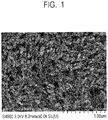
- Fig. 1 is a diagram based on an SEM photograph in which a pigment dispersion (1) using a compound (1) represented by the formula (1) is observed at a magnification of 100,000 times.
- the present inventors have made earnest studies to solve the above-mentioned problems of the related art, and have found as a result that, by allowing a compound represented by the formula (1) to be present in a dispersion medium, it is possible to obtain a pigment dispersion having an excellent dispersibility of at least one pigment selected from the group consisting of C. I. Pigment Blue 15, C. I. Pigment Blue 15:1, C. I. Pigment Blue 15:2, C. I. Pigment Blue 15:3, C. I. Pigment Blue 15:4, C. I. Pigment Blue 15:6, C. I. Pigment Green 7, C. I. Pigment Green 36, and C. I. Pigment Green 58.
- the present inventors have found that, because of high brightness and excellent green hue, it is possible to obtain a resist composition and an ink composition for a green color filter capable of displaying an image having high spectral characteristics and display contrast. Thus, the present invention has been completed.
- Examples of the cyan pigment used in the present invention include copper phthalocyanines such as C. I. Pigment Blue 15, 15:1, 15:2, 15:3, 15:4, and 15:6.
- examples of the green pigment include halogenated copper phthalocyanines such as C. I. Pigment Green 7 and C. I. Pigment Green 36, and halogenated zinc phthalocyanines such as C. I. Pigment Green 58.
- R 1 and R 2 each independently represent a linear or branched alkyl group having 1 to 4 carbon atoms
- R 3 and R 4 each independently represent a linear or branched alkyl group having 2 to 8 carbon atoms
- the linear or branched alkyl group having 1 to 4 carbon atoms in R 1 and R 2 in the formula (1) is not particularly limited, and examples thereof include a methyl group, an ethyl group, an n-propyl group, an iso-propyl group, an n-butyl group, a tert-butyl group, and a sec-butyl group.
- R 1 is more preferably an ethyl group or propyl group
- R 2 is more preferably a methyl group
- the linear or branched alkyl group having 2 to 8 carbon atoms in R 3 and R 4 in the formula (1) is an ethyl group, an n-propyl group, an iso-propyl group, an n-butyl group, an octyl group, and a 2-ethylhexyl group, and more preferably a 2-ethylhexyl group particularly because a pigment dispersion having excellent dispersibility can be obtained in the pigment of the present invention.
- the compound represented by the formula (1) according to the present invention can be synthesized with reference to, for example, a known method described in International Publication WO2008/114886 and the like.
- the compound represented by the formula (1) includes azohydrazo compatible isomers, and these compatible isomers are also within the scope of the present invention.
- the compound represented by the formula (1) has excellent coloring power.
- these compounds may be used alone or in combination with two or more known dyes may be used in order to adjust the color tone and the like according to the purpose of use.
- the pigment dispersion of the present invention can be obtained by dispersing the compound represented by the formula (1) and the following pigment in a dispersion medium.
- the dispersion medium referred to in the present invention refers to water, an organic solvent, or a mixture thereof.
- the following pigment means at least one pigment selected from the group consisting of
- the pigment dispersion of the present invention can be dispersed by a known method. For example, it can be obtained as follows.
- the pigment, the compound represented by the formula (1), and a resin if necessary, are dissolved in the dispersion medium and stirred. Furthermore, by applying a mechanical shearing force with a disperser, the pigment can be finely dispersed in the form of stable and uniform fine particles.
- the resin is dissolved in the dispersion medium, then the pigment is suspended, and the compound represented by the formula (1) is gradually added while stirring to allow them to be sufficiently blended into the dispersion medium. Furthermore, by applying a mechanical shearing force with a disperser, it is possible to finely disperse the pigment in the form of stable and uniform fine particles.
- the disperser used in the present invention is not particularly limited, but for example, a media type disperser such as a rotary shear type homogenizer, a ball mill, a sand mill, and an attritor, a high pressure opposed collision type disperser, and the like are preferably used.
- a media type disperser such as a rotary shear type homogenizer, a ball mill, a sand mill, and an attritor, a high pressure opposed collision type disperser, and the like are preferably used.
- the content of the pigment in the pigment dispersion is preferably 1.0 to 30.0 parts by mass, more preferably 2.0 to 20.0 parts by mass, and further preferably 3.0 to 15.0 parts by mass, based on 100 parts by mass of the dispersion medium. If the pigment content is too low, the coloring power is low.
- a content of the compound represented by the formula (1) is preferably 10 to 100 parts by mass, and more preferably 10 to 50 parts by mass, based on 100 parts by mass of the pigment.
- the content of the compound represented by the formula (1) is 10 parts by mass or more based on 100 parts by mass of the pigment, the dispersibility of the pigment can be improved. Also, the coloring power of the compound represented by the formula (1) is not insufficient.
- the content of the compound represented by the formula (1) is 100 parts by mass or less based on 100 parts by mass of the pigment, the dispersibility of the pigment can be improved.
- the pigment dispersion of the present invention can be dispersed in water using an emulsifier in order to obtain good dispersion stability.
- the emulsifier is not particularly limited, and examples thereof include a cationic surfactant, an anionic surfactant, and a nonionic surfactant.
- the cationic surfactant is not particularly limited, and examples thereof include the following. Dodecyl ammonium chloride, dodecyl ammonium bromide, dodecyl trimethyl ammonium bromide, dodecyl pyridinium chloride, dodecyl pyridinium bromide, hexadecyl trimethyl ammonium bromide, and the like.
- anionic surfactant examples include fatty acid soaps such as sodium stearate and sodium dodecanoate, sodium dodecyl sulfate, sodium dodecylbenzene sulfate, sodium lauryl sulfate, and the like.
- the nonionic surfactant is not particularly limited, but examples thereof include the following. Dodecyl polyoxyethylene ether, hexadecyl polyoxyethylene ether, nonylphenyl polyoxyethylene ether, lauryl polyoxyethylene ether, sorbitan monooleate polyoxyethylene ether, monodecanoyl sucrose, and the like.
- the organic solvent that can be used as the dispersion medium of the pigment dispersion of the present invention is determined according to the intended use of the pigment and is not particularly limited. Specific examples include the following. Alcohols such as methyl alcohol, ethyl alcohol, modified ethyl alcohol, isopropyl alcohol, n-butyl alcohol, isobutyl alcohol, tert-butyl alcohol, sec-butyl alcohol, tert-amyl alcohol, 3-pentanol, octyl alcohol, benzyl alcohol, and cyclohexanol; glycols such as methyl cellosolve, ethyl cellosolve, diethylene glycol, and diethylene glycol monobutyl ether; ketones such as acetone, methyl ethyl ketone, and methyl isobutyl ketone; esters such as ethyl acetate, butyl acetate, ethyl propionate, and cellosolve acetate;
- an addition-polymerizable monomer or a condensation-polymerizable monomer is also possible to use an addition-polymerizable monomer or a condensation-polymerizable monomer. It is preferably an addition-polymerizable monomer. Specific examples include the following. Styrene-based monomers such as styrene, o-methylstyrene, m-methylstyrene, p-methylstyrene, o-ethylstyrene, methylstyrene, and p-ethylstyrene; acrylate-based monomers such as methyl acrylate, ethyl acrylate, propyl acrylate, butyl acrylate, octyl acrylate, dodecyl acrylate, stearyl acrylate, behenyl acrylate, 2-ethylhexyl acrylate, dimethylaminoethyl acrylate, dieth
- the pigment dispersion of the present invention is used for a polymerized toner, among the above-mentioned polymerizable monomers, it is preferable to use styrene or a styrene-based monomer alone or in combination with another polymerizable monomer. Styrene is particularly preferable because of its ease of handling.
- a resin may be further added to the pigment dispersion.
- the resin that can be used is determined according to the intended use and is not particularly limited. Specifically, for example, the following can be mentioned. Polystyrene, styrene copolymer, polyacrylic acid, polymethacrylic acid, polyacrylic acid ester, polymethacrylic acid ester, acrylic acid-based copolymer, methacrylic acid-based copolymer, polyester, polyvinyl ether, polyvinyl methyl ether, polyvinyl alcohol, polyvinyl butyral, and the like. Other examples include polyurethane and polypeptides. These resins can be used alone or in combination of two or more kinds.
- An ink composition can be prepared in which the pigment dispersion of the present invention can be used as an ink.
- the dispersion medium is an aqueous system.
- a mixed solvent of water and a water-soluble organic solvent may be used.
- the water-soluble organic solvent used here is not limited as long as it exhibits water solubility, and examples thereof include alcohols, polyhydric alcohols, polyethylene glycols, glycol ethers, nitrogen-containing polar solvents, and sulfur-containing polar solvents.
- the pH of the ink is not particularly limited, but in consideration of safety, one having a pH in the range of 4.0 to 11.0 is preferable.
- a moisturizing solid content such as urea, a urea derivative, or trimethylolpropane may be used as a component of the ink in order to maintain the ink retention.
- the content of the moisturizing solid content in the ink is generally preferably in the range of 0.1% by mass or more and 20.0% by mass or less, and more preferably in the range of 3.0% by mass or more and 10.0% by mass or less, based on the ink.
- additives such as pH adjusters, corrosion inhibitors, preservatives, fungicides, antioxidants, anti-reducing agents, evaporation accelerators, chelating agents, and water-soluble polymers may be contained in addition to the above-mentioned components, if necessary.
- the ink containing the pigment dispersion of the present invention is particularly preferably used in an inkjet recording method in which the action of thermal energy causes droplets to be ejected for recording.
- the ink containing the pigment dispersion of the present invention can also be used as an ink applied to other inkjet recording methods and as a material for general writing instruments and the like.
- the pigment dispersion of the present invention has a bright green color tone and can be used as a green color material, preferably a colorant for a color filter, due to its spectral characteristics.
- the resist composition of the present invention contains at least one or more of binder resin, photopolymerizable monomer, photopolymerization initiator, solvent, and pigment dispersion of the present invention.
- the use of the pigment dispersion of the present invention for at least one of the multiple pixels makes it possible to obtain highly transparent and highly color-purity pixels.
- the content of the pigment in the pigment dispersion of the present invention is preferably 0.1 to 400% by mass, and more preferably 1 to 200% by mass, based on the mass of the following binder resin.
- the binder resin that can be used in the resist composition for a color filter of the present invention is not particularly limited, and may be any as long as the light irradiation part or the light shielding part can be dissolved by an organic solvent, an alkaline aqueous solution, water, or a commercially available developer. Further, from the viewpoint of workability, waste treatment, and the like, those having a composition capable of developing with water or alkali are more desirable.
- a binder resin is generally known obtained by copolymerizing a hydrophilic monomer such as acrylic acid, methacrylic acid, 2-hydroxyethyl, acrylamide, N-vinylpyrrolidone, and a monomer having an ammonium salt, and a lipophilic monomer such as acrylic acid ester, methacrylic acid ester, vinyl acetate, styrene, and N-vinylcarbazole at an appropriate mixing ratio by a known method.
- a hydrophilic monomer such as acrylic acid, methacrylic acid, 2-hydroxyethyl, acrylamide, N-vinylpyrrolidone, and a monomer having an ammonium salt
- a lipophilic monomer such as acrylic acid ester, methacrylic acid ester, vinyl acetate, styrene, and N-vinylcarbazole
- binder resins can be used in combination with a radically polymerizable monomer having an ethylenically unsaturated group, an oxirane ring, or a cationically polymerizable monomer having an oxetane ring, a radical generator, an acid generator, or a base generator. Then, they can be used as a negative type resist, that is, a type of resist in which the light shielding part is removed by development.
- binder resin typified by tert-butyl carbonic acid ester, tert-butyl ester, tetrahydroxypyranyl ester, or tetrahydroxypyranyl ether of polyhydroxystyrene.
- This type of binder resin can be used as a positive type resist in combination with an acid generator, that is, a type of resist in which the light irradiation part is removed by development.
- the resist composition for a color filter of the present invention may contain a photopolymerizable monomer having one or more ethylenically unsaturated double bonds as a monomer having an ethylenically unsaturated double bond that undergoes addition polymerization by irradiation with light.
- a photopolymerizable monomer having one or more ethylenically unsaturated double bonds as a monomer having an ethylenically unsaturated double bond that undergoes addition polymerization by irradiation with light.
- the photopolymerizable monomer include compounds having at least one addition polymerizable ethylenically unsaturated group in the molecule and having a boiling point of 100°C or higher at normal pressure.
- Examples can include monofunctional acrylates such as polyethylene glycol monoacrylate, polyethylene glycol monomethacrylate, polypropylene glycol monoacrylate, polypropylene glycol monomethacrylate, phenoxyethyl acrylate, and phenoxyethyl methacrylate, polyfunctional acrylates and methacrylates such as polyethylene glycol diacrylate, polyethylene glycol dimethacrylate, polypropylene glycol diacrylate, polypropylene glycol dimethacrylate, trimethylolethane triacrylate, trimethylolethane trimethacrylate, trimethylolpropane triacrylate, trimethylolpropane trimethacrylate, trimethylolpropane diacrylate, trimethylolpropane dimethacrylate, neopentyl glycol diacrylate, neopentyl glycol dimethacrylate, pentaerythritol tetraacrylate, pentaerythritol tetrame
- examples also include polyfunctional acrylates and methacrylates such as urethane acrylates, polyester acrylates, and epoxy acrylates which are reaction products of epoxy resin and acrylic acid or methacrylic acid.
- polyfunctional acrylates and methacrylates such as urethane acrylates, polyester acrylates, and epoxy acrylates which are reaction products of epoxy resin and acrylic acid or methacrylic acid.
- polyfunctional acrylates and methacrylates such as urethane acrylates, polyester acrylates, and epoxy acrylates which are reaction products of epoxy resin and acrylic acid or methacrylic acid.
- polyfunctional acrylates and methacrylates such as urethane acrylates, polyester acrylates, and epoxy acrylates which are reaction products of epoxy resin and acrylic acid or methacrylic acid.
- polyfunctional acrylates and methacrylates such as urethane acrylates, polyester acrylates, and epoxy acrylates which are reaction products of epoxy resin and acrylic acid or methacrylic acid.
- the photopolymerizable monomer having two or more ethylenically unsaturated double bonds may be used alone or in combination of two or more kinds.
- the content of the polymerizable compound is generally 5 to 50% by mass, and particularly preferably 10 to 40% by mass, based on the mass (total solid content) of the colored photosensitive composition. When the content is 5% by mass or more, the required light sensitivity and pixel intensity can be obtained, and when the content is 50% by mass or less, the adhesiveness of the photosensitive resin layer does not become excessive.
- the resist composition for a color filter of the present invention contains a photopolymerization initiator.
- the photopolymerization initiator include the following. Vicinal polyketaldonyl compounds, ⁇ -carbonyl compounds, acyloin ethers, diverse quinone compounds, triallyl imidazole dimer/p-aminophenyl ketone combinations, trioxadiazole compounds, and the like.
- Preferable is 2-benzyl-2-dimethylamino-1-(4-morpholinophenyl)butanone (Irgacure 369: trade name, manufactured by Ciba Specialty Chemicals Inc.). Note that when an electron beam is used for forming pixels by the colored resist of the present invention, the above photopolymerization initiator is not essential.
- the resist composition for a color filter of the present invention contains a solvent for dissolving or dispersing the binder resin, photopolymerizable monomer, photopolymerization initiator, colorant, and the like.
- a solvent for dissolving or dispersing the binder resin, photopolymerizable monomer, photopolymerization initiator, colorant, and the like examples include the following.
- the resist composition for a color filter of the present invention contains the pigment dispersion of the present invention as a colorant, and thus the hue of the formed pixels is good, and transparency and translucency can be improved.
- the obtained compound was identified using the following analyzer and spectrometer.
- the pigment dispersions of the present invention and comparative pigment dispersions were produced by the methods described below.
- Acrylic copolymer composition composed of 40% by mass of n-butyl methacrylate, 30% by mass of acrylic acid, and 30% by mass of hydroxyethyl methacrylate (weight average molecular weight 10,000) 6.7 parts ⁇ Dipentaerythritol pentaacrylate 1.3 parts ⁇ 2-Benzyl-2-dimethylamino-1-(4-morpholinophenyl)-butanone (photopolymerization initiator) 0.4 parts ⁇ Cyclohexanone 96 parts
- the green resist composition (1) for a color filter was applied onto a glass substrate for a color filter with a spin coater, and then dried at 90°C for 3 minutes to obtain a green coating film. Further, each coating film was entirely exposed to ultraviolet rays of 100 mJ/cm 2 through a photomask using a high-pressure mercury lamp, and post-cured at 180°C to prepare a color filter (1).
- Pigment dispersions (2) to (33) were obtained in the same manner as in Example 1 except for using the pigments and compounds (2) to (5), (9), (11), and (12) presented in Table 1 instead of using C. I. Pigment Blue 15:3 and compound (1) in Example 1.
- green resist compositions (2) to (33) for color filters and corresponding color filters (2) to (33) were obtained.
- Comparative pigment dispersions (1) to (35) were obtained in the same manner as in Example 1 except for using the pigments and comparative compounds (1) to (4) presented in Table 1 instead of using C. I. Pigment Blue 15:3 and compound (1) in Example 1. In addition, in the same manner, green resist compositions (1) to (35) for color filters and corresponding color filters (1) to (35) were obtained.
- the dispersibility of the pigment dispersions was evaluated as follows. It was determined by measuring the particle size of the pigments using a particle size measuring device (Grind Meter, Tester Sangyo Co., Ltd.).
- the above-obtained pigment dispersion in an amount of 20 mL was added to a 50 mL sample bottle, sealed, and allowed to stand for 48 hours under room temperature (25°C) conditions to evaluate the storage stability of the pigment dispersion.
- 20 mL of the green resist composition for a color filter obtained above was added to a 50 mL sample bottle, sealed, and allowed to stand for 48 hours under room temperature (25°C) conditions to evaluate the storage stability of the resist composition.
- the presence or absence of aggregates in each of the pigment dispersions and the resist compositions was visually observed with a phase-contrast microscope (BX53, manufactured by Olympus Corporation). It was determined that the smaller in amount the aggregates, the better the storage stability.
- the pigment dispersions of the present invention have excellent dispersibility and storage stability as compared with Comparative Examples. It was also confirmed that the resist compositions for color filters using the same were also excellent in storage stability. In addition, the color filters produced by using the above-mentioned green resist compositions for color filters had good light transmission and color tone.
Landscapes
- Chemical & Material Sciences (AREA)
- Physics & Mathematics (AREA)
- Engineering & Computer Science (AREA)
- Life Sciences & Earth Sciences (AREA)
- Materials Engineering (AREA)
- Wood Science & Technology (AREA)
- Organic Chemistry (AREA)
- General Physics & Mathematics (AREA)
- Optics & Photonics (AREA)
- Spectroscopy & Molecular Physics (AREA)
- Architecture (AREA)
- Structural Engineering (AREA)
- Optical Filters (AREA)
- Pigments, Carbon Blacks, Or Wood Stains (AREA)
- Inks, Pencil-Leads, Or Crayons (AREA)
- Materials For Photolithography (AREA)
Abstract
Description
- The present invention relates to a pigment dispersion used in the production process of paints, inks, color filters, resin molded products, and the like. Furthermore, the present invention relates to a resist composition and an ink composition for a color filter using the pigment dispersion as a colorant.
- A color filter is used for a color display using a liquid crystal. The color filter is indispensable for the color display of the liquid crystal display, and is an important component that affects the performance of the liquid crystal display. As a conventional method of producing a color filter, a dyeing method, a printing method, an inkjet method, and a photoresist method are known. Among these, the photoresist method has become the mainstream because it is easy to control the spectral characteristics and color reproducibility, and because the resolution is high and higher-definition patterning is possible.
- In the production of color filters by the photoresist method, green pigments and yellow pigments have been used as colorants (Patent Literatures 1 and 2). However, color filters using pigments have problems such as a depolarization effect (depolarization of polarized light), a decrease in the contrast ratio of the color display of a liquid crystal display, and a decrease in the brightness of the color filter, as well as a problem of a decrease in dispersion stability with respect to organic solvents and polymers.
- Therefore, attention has been paid to a production method using a dye as a colorant. For example, an example using a cyan pigment and a yellow azo dye (Patent Literature 2) and an example using a green pigment and a yellow azo dye (Patent Literature 3) have been reported. However, dyes have a problem in storage stability as compared with pigments. In addition, in order to obtain a color filter compatible with the next-generation ultra-high-definition displays such as 4K and 8K in recent years, it is insufficient to improve the dispersibility of the pigment for the reproducibility of the color space, and a pigment dispersion having excellent light transmission and color tone reproducibility is required.
-
- PTL 1:
Japanese Patent Application Laid-Open No. H11-14825 - PTL 2:
Japanese Patent No. 4481439 - PTL 3:
Japanese Patent Application Laid-Open No. 2010-139560 - In view of the above, an aspect of the present invention is to provide a pigment dispersion having excellent dispersibility and storage stability. In addition, another aspect of the present invention is to provide a resist composition and an ink composition for a color filter using the pigment dispersion.
- According to an aspect of the present invention, there is provided a pigment dispersion including: a dispersion medium, a compound represented by the following formula (1), and at least one pigment selected from the group consisting of C. I. Pigment Blue 15, C. I. Pigment Blue 15:1, C. I. Pigment Blue 15:2, C. I. Pigment Blue 15:3, C. I. Pigment Blue 15:4, C. I. Pigment Blue 15:6, C. I. Pigment Green 7, C. I. Pigment Green 36, and C. I. Pigment Green 58, which are dispersed in the dispersion medium.
- In addition, according to another aspect of the present invention, there are provided a green-toned resist composition and ink composition for a color filter using the pigment dispersion.

- According to an aspect of the present invention, it is possible to provide a pigment dispersion having excellent dispersibility and storage stability.
- In addition, according to another aspect of the present invention, it is possible to provide a green-toned resist composition and ink composition for a color filter using the pigment dispersion.
- [
Fig. 1 ]
Fig. 1 is a diagram based on an SEM photograph in which a pigment dispersion (1) using a compound (1) represented by the formula (1) is observed at a magnification of 100,000 times. - Hereinafter, the present invention is described in more detail with reference to embodiments.
- The present inventors have made earnest studies to solve the above-mentioned problems of the related art, and have found as a result that, by allowing a compound represented by the formula (1) to be present in a dispersion medium, it is possible to obtain a pigment dispersion having an excellent dispersibility of at least one pigment selected from the group consisting of C. I. Pigment Blue 15, C. I. Pigment Blue 15:1, C. I. Pigment Blue 15:2, C. I. Pigment Blue 15:3, C. I. Pigment Blue 15:4, C. I. Pigment Blue 15:6, C. I. Pigment Green 7, C. I. Pigment Green 36, and C. I. Pigment Green 58.
- In addition, the present inventors have found that, because of high brightness and excellent green hue, it is possible to obtain a resist composition and an ink composition for a green color filter capable of displaying an image having high spectral characteristics and display contrast. Thus, the present invention has been completed.
- Examples of the cyan pigment used in the present invention include copper phthalocyanines such as C. I. Pigment Blue 15, 15:1, 15:2, 15:3, 15:4, and 15:6.
- In addition, examples of the green pigment include halogenated copper phthalocyanines such as C. I. Pigment Green 7 and C. I. Pigment Green 36, and halogenated zinc phthalocyanines such as C. I. Pigment Green 58.
- In the present invention, it is presumed that the interaction between the compound represented by the formula (1) and the above-mentioned pigment suppresses self-aggregation and enables fine dispersion. On the other hand, in the case of compounds other than the compound represented by the formula (1), aggregation is promoted by the interaction with the pigment by hydrogen bonding.

- The linear or branched alkyl group having 1 to 4 carbon atoms in R1 and R2 in the formula (1) is not particularly limited, and examples thereof include a methyl group, an ethyl group, an n-propyl group, an iso-propyl group, an n-butyl group, a tert-butyl group, and a sec-butyl group.
- In particular, since a pigment dispersion having excellent dispersibility can be obtained in the pigment of the present invention, R1 is more preferably an ethyl group or propyl group, and R2 is more preferably a methyl group.
- The linear or branched alkyl group having 2 to 8 carbon atoms in R3 and R4 in the formula (1) is an ethyl group, an n-propyl group, an iso-propyl group, an n-butyl group, an octyl group, and a 2-ethylhexyl group, and more preferably a 2-ethylhexyl group particularly because a pigment dispersion having excellent dispersibility can be obtained in the pigment of the present invention.
- The compound represented by the formula (1) according to the present invention can be synthesized with reference to, for example, a known method described in
International Publication WO2008/114886 and the like. - Compounds (1) to (14) are presented as preferable specific examples of the compound represented by the formula (1) of the present invention, but the present invention is not limited to the following examples.
- In addition, the compound represented by the formula (1) includes azohydrazo compatible isomers, and these compatible isomers are also within the scope of the present invention.


- Among the above compounds, it is preferable to use the compounds (1), (2), (3), (4), (5), (9), (11), and (12), and it is more preferable to use the compounds (2) and (3).
- The compound represented by the formula (1) has excellent coloring power. In addition, these compounds may be used alone or in combination with two or more known dyes may be used in order to adjust the color tone and the like according to the purpose of use.
- The pigment dispersion of the present invention can be obtained by dispersing the compound represented by the formula (1) and the following pigment in a dispersion medium.
- The dispersion medium referred to in the present invention refers to water, an organic solvent, or a mixture thereof.
- The following pigment means at least one pigment selected from the group consisting of
- C. I. Pigment Blue 15, C. I. Pigment Blue 15:1, C. I. Pigment Blue 15:2, C. I. Pigment Blue 15:3, C. I. Pigment Blue 15:4, and C. I. Pigment Blue 15:6, and
- C. I. Pigment Green 7, C. I. Pigment Green 36, and C. I. Pigment Green 58.
- The pigment dispersion of the present invention can be dispersed by a known method. For example, it can be obtained as follows.
- The pigment, the compound represented by the formula (1), and a resin if necessary, are dissolved in the dispersion medium and stirred. Furthermore, by applying a mechanical shearing force with a disperser, the pigment can be finely dispersed in the form of stable and uniform fine particles.
- In addition, first, the resin is dissolved in the dispersion medium, then the pigment is suspended, and the compound represented by the formula (1) is gradually added while stirring to allow them to be sufficiently blended into the dispersion medium. Furthermore, by applying a mechanical shearing force with a disperser, it is possible to finely disperse the pigment in the form of stable and uniform fine particles.
- The disperser used in the present invention is not particularly limited, but for example, a media type disperser such as a rotary shear type homogenizer, a ball mill, a sand mill, and an attritor, a high pressure opposed collision type disperser, and the like are preferably used.
- The content of the pigment in the pigment dispersion is preferably 1.0 to 30.0 parts by mass, more preferably 2.0 to 20.0 parts by mass, and further preferably 3.0 to 15.0 parts by mass, based on 100 parts by mass of the dispersion medium. If the pigment content is too low, the coloring power is low.
- A content of the compound represented by the formula (1) is preferably 10 to 100 parts by mass, and more preferably 10 to 50 parts by mass, based on 100 parts by mass of the pigment.
- When the content of the compound represented by the formula (1) is 10 parts by mass or more based on 100 parts by mass of the pigment, the dispersibility of the pigment can be improved. Also, the coloring power of the compound represented by the formula (1) is not insufficient.
- When the content of the compound represented by the formula (1) is 100 parts by mass or less based on 100 parts by mass of the pigment, the dispersibility of the pigment can be improved.
- The pigment dispersion of the present invention can be dispersed in water using an emulsifier in order to obtain good dispersion stability. The emulsifier is not particularly limited, and examples thereof include a cationic surfactant, an anionic surfactant, and a nonionic surfactant.
- The cationic surfactant is not particularly limited, and examples thereof include the following. Dodecyl ammonium chloride, dodecyl ammonium bromide, dodecyl trimethyl ammonium bromide, dodecyl pyridinium chloride, dodecyl pyridinium bromide, hexadecyl trimethyl ammonium bromide, and the like.
- Examples of the anionic surfactant include fatty acid soaps such as sodium stearate and sodium dodecanoate, sodium dodecyl sulfate, sodium dodecylbenzene sulfate, sodium lauryl sulfate, and the like.
- The nonionic surfactant is not particularly limited, but examples thereof include the following. Dodecyl polyoxyethylene ether, hexadecyl polyoxyethylene ether, nonylphenyl polyoxyethylene ether, lauryl polyoxyethylene ether, sorbitan monooleate polyoxyethylene ether, monodecanoyl sucrose, and the like.
- The organic solvent that can be used as the dispersion medium of the pigment dispersion of the present invention is determined according to the intended use of the pigment and is not particularly limited. Specific examples include the following. Alcohols such as methyl alcohol, ethyl alcohol, modified ethyl alcohol, isopropyl alcohol, n-butyl alcohol, isobutyl alcohol, tert-butyl alcohol, sec-butyl alcohol, tert-amyl alcohol, 3-pentanol, octyl alcohol, benzyl alcohol, and cyclohexanol; glycols such as methyl cellosolve, ethyl cellosolve, diethylene glycol, and diethylene glycol monobutyl ether; ketones such as acetone, methyl ethyl ketone, and methyl isobutyl ketone; esters such as ethyl acetate, butyl acetate, ethyl propionate, and cellosolve acetate; hydrocarbon-based solvents such as hexane, octane, petroleum ether, cyclohexane, benzene, toluene, and xylene; halogenated hydrocarbon-based solvents such as carbon tetrachloride, trichloroethylene, and tetrabromoethane; ethers such as diethyl ether, dimethyl glycol, trioxane, and tetrahydrofuran; acetals such as methylal and diethyl acetal; organic acids such as formic acid, acetic acid, and propionic acid; and sulfur·nitrogen-containing organic compounds such as nitrobenzene, dimethylamine, monoethanolamine, pyridine, dimethyl sulfoxide, and dimethylformamide.
- In addition, as the organic solvent used in the present invention, it is also possible to use an addition-polymerizable monomer or a condensation-polymerizable monomer. It is preferably an addition-polymerizable monomer. Specific examples include the following. Styrene-based monomers such as styrene, o-methylstyrene, m-methylstyrene, p-methylstyrene, o-ethylstyrene, methylstyrene, and p-ethylstyrene; acrylate-based monomers such as methyl acrylate, ethyl acrylate, propyl acrylate, butyl acrylate, octyl acrylate, dodecyl acrylate, stearyl acrylate, behenyl acrylate, 2-ethylhexyl acrylate, dimethylaminoethyl acrylate, diethylaminoethyl acrylate, acrylonitrile, and amide acrylate; methacrylate-based monomers such as methyl methacrylate, ethyl methacrylate, propyl methacrylate, butyl methacrylate, octyl methacrylate, dodecyl methacrylate, stearyl methacrylate, behenyl methacrylate, 2-ethylhexyl methacrylate, dimethylaminoethyl methacrylate, diethylaminoethyl methacrylate, methacrylonitrile, and amide methacrylate; olefin monomers such as ethylene, propylene, butylene, butadiene, isoprene, isobutylene, and cyclohexene; vinyl halides such as vinyl chloride, vinylidene chloride, vinyl bromide, and vinyl iodide; vinyl esters such as vinyl acetate, vinyl propionate, and vinyl benzoate; vinyl ethers such as vinyl methyl ether, vinyl ethyl ether, and vinyl isobutyl ether; and vinyl ketone compounds such as vinyl methyl ketone, vinyl hexyl ketone, and methyl isopropenyl ketone.
- These can be used alone or in combination of two or more kinds depending on the intended use.
- When the pigment dispersion of the present invention is used for a polymerized toner, among the above-mentioned polymerizable monomers, it is preferable to use styrene or a styrene-based monomer alone or in combination with another polymerizable monomer. Styrene is particularly preferable because of its ease of handling.
- A resin may be further added to the pigment dispersion. The resin that can be used is determined according to the intended use and is not particularly limited. Specifically, for example, the following can be mentioned. Polystyrene, styrene copolymer, polyacrylic acid, polymethacrylic acid, polyacrylic acid ester, polymethacrylic acid ester, acrylic acid-based copolymer, methacrylic acid-based copolymer, polyester, polyvinyl ether, polyvinyl methyl ether, polyvinyl alcohol, polyvinyl butyral, and the like. Other examples include polyurethane and polypeptides. These resins can be used alone or in combination of two or more kinds.
- An ink composition can be prepared in which the pigment dispersion of the present invention can be used as an ink. A particularly preferable case is where the dispersion medium is an aqueous system. In addition, a mixed solvent of water and a water-soluble organic solvent may be used. The water-soluble organic solvent used here is not limited as long as it exhibits water solubility, and examples thereof include alcohols, polyhydric alcohols, polyethylene glycols, glycol ethers, nitrogen-containing polar solvents, and sulfur-containing polar solvents.
- In the case of producing an ink containing the pigment dispersion of the present invention, the pH of the ink is not particularly limited, but in consideration of safety, one having a pH in the range of 4.0 to 11.0 is preferable. In addition, when producing an ink for an inkjet, a moisturizing solid content such as urea, a urea derivative, or trimethylolpropane may be used as a component of the ink in order to maintain the ink retention. The content of the moisturizing solid content in the ink, such as urea, a urea derivative, and trimethylolpropane, is generally preferably in the range of 0.1% by mass or more and 20.0% by mass or less, and more preferably in the range of 3.0% by mass or more and 10.0% by mass or less, based on the ink.
- Moreover, in the case of producing ink, various additives such as pH adjusters, corrosion inhibitors, preservatives, fungicides, antioxidants, anti-reducing agents, evaporation accelerators, chelating agents, and water-soluble polymers may be contained in addition to the above-mentioned components, if necessary.
- As described above, the ink containing the pigment dispersion of the present invention is particularly preferably used in an inkjet recording method in which the action of thermal energy causes droplets to be ejected for recording. Needless to say, the ink containing the pigment dispersion of the present invention can also be used as an ink applied to other inkjet recording methods and as a material for general writing instruments and the like.
- The pigment dispersion of the present invention has a bright green color tone and can be used as a green color material, preferably a colorant for a color filter, due to its spectral characteristics.
- The resist composition of the present invention contains at least one or more of binder resin, photopolymerizable monomer, photopolymerization initiator, solvent, and pigment dispersion of the present invention.
- In addition, in a color filter in which two or more kinds of pixels with different spectral characteristics are arranged adjacent to each other on a substrate, the use of the pigment dispersion of the present invention for at least one of the multiple pixels (for example, red, green, and blue) makes it possible to obtain highly transparent and highly color-purity pixels.
- The content of the pigment in the pigment dispersion of the present invention is preferably 0.1 to 400% by mass, and more preferably 1 to 200% by mass, based on the mass of the following binder resin.
- The binder resin that can be used in the resist composition for a color filter of the present invention is not particularly limited, and may be any as long as the light irradiation part or the light shielding part can be dissolved by an organic solvent, an alkaline aqueous solution, water, or a commercially available developer. Further, from the viewpoint of workability, waste treatment, and the like, those having a composition capable of developing with water or alkali are more desirable.
- As such a resin, a binder resin is generally known obtained by copolymerizing a hydrophilic monomer such as acrylic acid, methacrylic acid, 2-hydroxyethyl, acrylamide, N-vinylpyrrolidone, and a monomer having an ammonium salt, and a lipophilic monomer such as acrylic acid ester, methacrylic acid ester, vinyl acetate, styrene, and N-vinylcarbazole at an appropriate mixing ratio by a known method. These binder resins can be used in combination with a radically polymerizable monomer having an ethylenically unsaturated group, an oxirane ring, or a cationically polymerizable monomer having an oxetane ring, a radical generator, an acid generator, or a base generator. Then, they can be used as a negative type resist, that is, a type of resist in which the light shielding part is removed by development.
- In addition, it is also possible to use a binder resin typified by tert-butyl carbonic acid ester, tert-butyl ester, tetrahydroxypyranyl ester, or tetrahydroxypyranyl ether of polyhydroxystyrene. This type of binder resin can be used as a positive type resist in combination with an acid generator, that is, a type of resist in which the light irradiation part is removed by development.
- The resist composition for a color filter of the present invention may contain a photopolymerizable monomer having one or more ethylenically unsaturated double bonds as a monomer having an ethylenically unsaturated double bond that undergoes addition polymerization by irradiation with light. Examples of the photopolymerizable monomer include compounds having at least one addition polymerizable ethylenically unsaturated group in the molecule and having a boiling point of 100°C or higher at normal pressure. Examples can include monofunctional acrylates such as polyethylene glycol monoacrylate, polyethylene glycol monomethacrylate, polypropylene glycol monoacrylate, polypropylene glycol monomethacrylate, phenoxyethyl acrylate, and phenoxyethyl methacrylate, polyfunctional acrylates and methacrylates such as polyethylene glycol diacrylate, polyethylene glycol dimethacrylate, polypropylene glycol diacrylate, polypropylene glycol dimethacrylate, trimethylolethane triacrylate, trimethylolethane trimethacrylate, trimethylolpropane triacrylate, trimethylolpropane trimethacrylate, trimethylolpropane diacrylate, trimethylolpropane dimethacrylate, neopentyl glycol diacrylate, neopentyl glycol dimethacrylate, pentaerythritol tetraacrylate, pentaerythritol tetramethacrylate, pentaerythritol triacrylate, pentaerythritol trimethacrylate, dipentaerythritol hexaacrylate, dipentaerythritol hexamethacrylate, dipentaerythritol pentaacrylate, dipentaerythritol pentamethacrylate, hexanediol diacrylate, hexanediol dimethacrylate, trimethylolpropane tri(acryloyloxypropyl)ether, tri(acryloyloxyethyl)isocyanurate, tri(acryloyloxyethyl)cyanurate, glycerin triacrylate, and glycerin trimethacrylate, and polyfunctional acrylates and polyfunctional methacrylates formed by adding propylene oxide or ethylene oxide to a polyfunctional alcohol such as trimethylolpropane or glycerin and then acrylating or methacrylating it.
- Furthermore, examples also include polyfunctional acrylates and methacrylates such as urethane acrylates, polyester acrylates, and epoxy acrylates which are reaction products of epoxy resin and acrylic acid or methacrylic acid. Preferable among the above are trimethylolpropane triacrylate, trimethylolpropane trimethacrylate, pentaerythritol tetraacrylate, pentaerythritol tetramethacrylate, dipentaerythritol hexaacrylate, dipentaerythritol hexamethacrylate, dipentaerythritol pentaacrylate, and dipentaerythritol pentamethacrylate.
- The photopolymerizable monomer having two or more ethylenically unsaturated double bonds may be used alone or in combination of two or more kinds. The content of the polymerizable compound is generally 5 to 50% by mass, and particularly preferably 10 to 40% by mass, based on the mass (total solid content) of the colored photosensitive composition. When the content is 5% by mass or more, the required light sensitivity and pixel intensity can be obtained, and when the content is 50% by mass or less, the adhesiveness of the photosensitive resin layer does not become excessive.
- When ultraviolet curable, the resist composition for a color filter of the present invention contains a photopolymerization initiator. Examples of the photopolymerization initiator include the following. Vicinal polyketaldonyl compounds, α-carbonyl compounds, acyloin ethers, diverse quinone compounds, triallyl imidazole dimer/p-aminophenyl ketone combinations, trioxadiazole compounds, and the like. Preferable is 2-benzyl-2-dimethylamino-1-(4-morpholinophenyl)butanone (Irgacure 369: trade name, manufactured by Ciba Specialty Chemicals Inc.). Note that when an electron beam is used for forming pixels by the colored resist of the present invention, the above photopolymerization initiator is not essential.
- The resist composition for a color filter of the present invention contains a solvent for dissolving or dispersing the binder resin, photopolymerizable monomer, photopolymerization initiator, colorant, and the like. Examples of the solvent that can be used include the following. Cyclohexanone, ethyl cellosolve acetate, butyl cellosolve acetate, 1-methoxy-2-propyl acetate, diethylene glycol dimethyl ether, ethylbenzene, 1,2,4-trichlorobenzene, ethylene glycol diethyl ether, xylene, ethyl cellosolve, methyl-n-amyl ketone, propylene glycol monomethyl ether, toluene, methyl ethyl ketone, ethyl acetate, methanol, ethanol, isopropyl alcohol, butanol, isobutyl ketone, petroleum solvents, and the like. These can be used alone or in combination.
- As described above, the resist composition for a color filter of the present invention contains the pigment dispersion of the present invention as a colorant, and thus the hue of the formed pixels is good, and transparency and translucency can be improved.
- Hereinafter, the present invention is described in more detail with reference to Examples and Comparative Examples, but the present invention is not limited to these Examples. In the following, "part" means "part by mass".
- The compounds presented in Table 1 and represented by the formula (1) of the present invention were produced by the methods described below. Production examples are shown with compound (2) as a representative, but the present invention is not limited thereto.
- Under a nitrogen atmosphere, 29 parts of thionyl chloride was added dropwise to 100 parts of chloroform in 10 parts of o-nitrobenzoic acid, and the mixture was further reacted at 60°C for 1 hour. After completion of the reaction, the mixture was cooled to 10°C or lower, and 9 parts of triethylamine and 15 parts of di(2-ethylhexyl)amine were sequentially added dropwise. Further, the mixture was stirred at 80°C for 2 hours, and after completion of the reaction, the mixture was extracted with chloroform. By concentrating under reduced pressure, 18 parts of intermediate (A) was obtained.
- To 10 parts of the above intermediate (A), 50 parts of ethanol and 18 parts of a 20% sodium sulfide aqueous solution were added and reacted at 75°C for 1 hour. After completion of the reaction, the mixture was extracted with chloroform and the solution was concentrated under reduced pressure to obtain 7.4 parts of intermediate (B).
- To 5.9 parts of the above intermediate (B), 3.4 parts of concentrated hydrochloric acid and 59 parts of methanol were added and cooled to 10°C or lower. To this solution, a solution of 1.4 parts of sodium nitrite in water (2.0 parts) was slowly added dropwise so as not to exceed 10°C, and the mixture was reacted for another 1 hour. Then, 0.5 parts of sulfamic acid were added and stirred for 20 minutes to obtain a diazonium salt solution.


- Next, a solution of 2.7 parts of 3-cyano-4-methyl-6-oxo-2-pyridone in 25 parts of N,N-dimethylformamide and 20 parts of methanol was cooled to 10°C or lower, and the diazonium salt solution was added dropwise so as to maintain the temperature at 10°C or lower. A saturated aqueous sodium carbonate solution was added to adjust the pH to 5 to 6, and the reaction was carried out at 10°C or lower for 2 hours. After completion of the reaction, the solvent was evaporated under reduced pressure and purified by column chromatography to obtain 5.2 parts of compound (2).
- The obtained compound was identified using the following analyzer and spectrometer.
- 1H nuclear magnetic resonance spectroscopy (1H-NMR) device (AVANCE-600 NMR Spectrometer, manufactured by BRUKER)
- High performance liquid chromatography mass spectrometer (LCMS-2010, manufactured by Shimadzu Corporation)
- The pigment dispersions of the present invention and comparative pigment dispersions were produced by the methods described below.
- The following materials were mixed and dispersed by an attritor (manufactured by NIPPON COKE & ENGINEERING. CO., LTD.) for 1 hour to obtain the pigment dispersion (1) of the present invention. An SEM photograph of the pigment dispersion (1) is shown in
Fig. 1 .
·C. I. Pigment Blue 15:3 (manufactured by Sanyo Color Works, Ltd., trade name"CYANE BLUE 3023") 5 parts ·Compound (1) 3.0 parts ·Cyclohexanone 120 parts -
· Acrylic copolymer composition composed of 40% by mass of n-butyl methacrylate, 30% by mass of acrylic acid, and 30% by mass of hydroxyethyl methacrylate (weight average molecular weight 10,000) 6.7 parts · Dipentaerythritol pentaacrylate 1.3 parts · 2-Benzyl-2-dimethylamino-1-(4-morpholinophenyl)-butanone (photopolymerization initiator) 0.4 parts · Cyclohexanone 96 parts - To the above solution, 22 parts of the pigment dispersion (1) was slowly added, and the mixture was stirred at room temperature for 3 hours. This was filtered through a 1.5 µm filter to obtain a green resist composition (1) for a color filter.
- The green resist composition (1) for a color filter was applied onto a glass substrate for a color filter with a spin coater, and then dried at 90°C for 3 minutes to obtain a green coating film. Further, each coating film was entirely exposed to ultraviolet rays of 100 mJ/cm2 through a photomask using a high-pressure mercury lamp, and post-cured at 180°C to prepare a color filter (1).
- Pigment dispersions (2) to (33) were obtained in the same manner as in Example 1 except for using the pigments and compounds (2) to (5), (9), (11), and (12) presented in Table 1 instead of using C. I. Pigment Blue 15:3 and compound (1) in Example 1. In addition, in the same manner, green resist compositions (2) to (33) for color filters and corresponding color filters (2) to (33) were obtained.
- Comparative pigment dispersions (1) to (35) were obtained in the same manner as in Example 1 except for using the pigments and comparative compounds (1) to (4) presented in Table 1 instead of using C. I. Pigment Blue 15:3 and compound (1) in Example 1. In addition, in the same manner, green resist compositions (1) to (35) for color filters and corresponding color filters (1) to (35) were obtained.
- The comparative compounds are presented below.

- The dispersibility of the pigment dispersions was evaluated as follows. It was determined by measuring the particle size of the pigments using a particle size measuring device (Grind Meter, Tester Sangyo Co., Ltd.).
- A: Less than 2.5 µm (very good dispersibility)
- B: 2.5 µm or more and less than 4.5 µm (good dispersibility)
- C: 4.5 µm or more (poor dispersibility)
- The above-obtained pigment dispersion in an amount of 20 mL was added to a 50 mL sample bottle, sealed, and allowed to stand for 48 hours under room temperature (25°C) conditions to evaluate the storage stability of the pigment dispersion. Similarly, 20 mL of the green resist composition for a color filter obtained above was added to a 50 mL sample bottle, sealed, and allowed to stand for 48 hours under room temperature (25°C) conditions to evaluate the storage stability of the resist composition. The presence or absence of aggregates in each of the pigment dispersions and the resist compositions was visually observed with a phase-contrast microscope (BX53, manufactured by Olympus Corporation). It was determined that the smaller in amount the aggregates, the better the storage stability.
- Criteria for storage stability evaluation of pigment dispersions and green resist compositions for color filters
- A: Good without aggregates.
- B: With a small amount of aggregates generated.
- C: With aggregates generated.
- As presented in Table 1, the pigment dispersions of the present invention have excellent dispersibility and storage stability as compared with Comparative Examples. It was also confirmed that the resist compositions for color filters using the same were also excellent in storage stability. In addition, the color filters produced by using the above-mentioned green resist compositions for color filters had good light transmission and color tone.
- According to the present invention, it is possible to provide a pigment dispersion containing at least one pigment selected from the group consisting of C. I. Pigment Blue 15, C. I. Pigment Blue 15:1, C. I. Pigment Blue 15:2, C. I. Pigment Blue 15:3, C. I. Pigment Blue 15:4, C. I. Pigment Blue 15:6, C. I. Pigment Green 7, C. I. Pigment Green 36, and C. I. Pigment Green 58 and having excellent dispersibility and storage stability. Furthermore, the use of the pigment dispersion makes it possible to provide a good green-toned resist composition and ink composition for a color filter.
- The present invention is not limited to the above embodiments, and various alternations and modifications can be made without departing from the spirit and scope of the present invention. Therefore, the following claims are attached to make the scope of the present invention public.
- The present application claims priority on the basis of
Japanese Patent Application No. 2018-163972 filed on August 31, 2018
| Pigment | General Formula (1) | Pigment dispersion | Dispersibility Evaluation | Particle Diameter (µm) | Storage Stability Evaluation | Resist composition | Storage Stability Evaluation | |
| Example 1 | P.B.15:3 | Compound (1) | (1) | A | 1.8 | A | (1) | A |
| Example 2 | P.B.15:1 | Compound (2) | (2) | A | 2.3 | A | (2) | A |
| Example 3 | P.B.15:3 | Compound (2) | (3) | A | 2.4 | A | (3) | A |
| Example 4 | P.B.15:4 | Compound (2) | (4) | A | 2.0 | A | (4) | A |
| Example 5 | P.B.15:6 | Compound (2) | (5) | A | 2.1 | A | (5) | A |
| Example 6 | P.B.15:3 | Compound (3) | (6) | A | 2.3 | A | (6) | A |
| Example 7 | P.B.15:3 | Compound (4) | (7) | A | 2.3 | A | (7) | A |
| Example 8 | P.B.15:3 | Compound (5) | (8) | A | 2.3 | A | (8) | A |
| Example 9 | P.B.15:3 | Compound (9) | (9) | A | 2.0 | A | (9) | A |
| Example 10 | P.B.15:3 | Compound (5) | (10) | A | 2.3 | A | (10) | A |
| Example 11 | P.G.7 | Compound (2) | (11) | A | 2.3 | A | (11) | A |
| Example 12 | P.G.7 | Compound (3) | (12) | A | 1.6 | A | (12) | A |
| Example 13 | P.G.7 | Compound (4) | (13) | A | 1.8 | A | (13) | A |
| Example 14 | P.G.7 | Compound (5) | (14) | A | 2.0 | A | (14) | A |
| Example 15 | P.G.7 | Compound (9) | (15) | A | 1.9 | A | (15) | A |
| Example 16 | P.G.36 | Compound (2) | (16) | A | 2.0 | A | (16) | A |
| Example 17 | P.G.36 | Compound (3) | (17) | A | 2.1 | A | (17) | A |
| Example 18 | P.G.36 | Compound (4) | (18) | A | 2.1 | A | (18) | A |
| Example 19 | P.G.36 | Compound (5) | (19) | A | 2.1 | A | (19) | A |
| Example 20 | P.G.36 | Compound (9) | (20) | A | 2.3 | A | (20) | A |
| Example 21 | P.G.58 | Compound (1) | (21) | A | 2.3 | A | (21) | A |
| Example 22 | P.G.58 | Compound (2) | (22) | A | 1.6 | A | (22) | A |
| Example 23 | P.G.58 | Compound (3) | (23) | A | 1.6 | A | (23) | A |
| Example 24 | P.G.58 | Compound (4) | (24) | A | 1.8 | A | (24) | A |
| Example 25 | P.G.58 | Compound (5) | (25) | A | 2.0 | A | (25) | A |
| Example 26 | P.G.58 | Compound (9) | (26) | A | 2.0 | A | (26) | A |
| Example 27 | P.G.58 | Compound (11) | (27) | A | 2.1 | A | (27) | A |
| Example 28 | P.G.58 | Compound (12) | (28) | A | 2.0 | A | (28) | A |
| Example 29 | P.B.15:6 | Compound (3) | (29) | A | 2.1 | A | (29) | A |
| Example 30 | P.B.15:6 | Compound (4) | (30) | A | 2.3 | A | (30) | A |
| Example 31 | P.B.15:6 | Compound (9) | (31) | A | 2.2 | A | (31) | A |
| Example 32 | P.B.15:6 | Compound (11) | (32) | A | 2.3 | A | (32) | A |
| Example 33 | P.B.15:6 | Compound (12) | (33) | A | 2.4 | A | (33) | A |
| Comparative Example 1 | P.B.15: 1 | None | Comp. (1) | C | 4.5 | C | Comp. (1) | C |
| Comparative Example 2 | P.B.15: 1 | Comparative Compound (1) | Comp. (2) | B | 2.8 | C | Comp. (2) | C |
| Comparative Example 3 | P.B.15: 1 | Comparative Compound (2) | Comp. (3) | C | 4.5 | C | Comp. (3) | C |
| Comparative Example 4 | P.B.15: 1 | Comparative Compound (3) | Comp. (4) | B | 2.8 | C | Comp. (4) | C |
| Comparative Example 5 | P.B.15: 1 | Comparative Compound (4) | Comp. (5) | C | 4.5 | C | Comp. (5) | C |
| Comparative Example 6 | P.B.15:3 | None | Comp. (6) | C | 4.5 | C | Comp. (6) | C |
| Comparative Example 7 | P.B.15:3 | Comparative Compound (1) | Comp. (7) | B | 3.0 | C | Comp. (7) | C |
| Comparative Example 8 | P.B.15:3 | Comparative Compound (2) | Comp. (8) | C | 4.5 | C | Comp. (8) | C |
| Comparative Example 9 | P.B.15:3 | Comparative Compound (3) | Comp. (9) | B | 3.2 | C | Comp. (9) | C |
| Comparative Example 10 | P.B.15:3 | Comparative Compound (4) | Comp. (10) | C | 4.5 | C | Comp. (10) | C |
| Comparative Example 11 | P.B.15:4 | None | Comp. (11) | C | 4.8 | C | Comp. (11) | C |
| Comparative Example 12 | P.B.15:4 | Comparative Compound (1) | Comp. (12) | B | 3.0 | C | Comp. (12) | C |
| Comparative Example 13 | P.B.15:4 | Comparative Compound (2) | Comp. (13) | C | 4.6 | C | Comp. (13) | C |
| Comparative Example 14 | P.B.15:4 | Comparative Compound (3) | Comp. (14) | B | 2.8 | C | Comp. (14) | C |
| Comparative Example 15 | P.B.15:4 | Comparative Compound (4) | Comp. (15) | C | 4.6 | C | Comp. (15) | C |
| Comparative Example 16 | P.B.15:6 | None | Comp. (16) | C | 4.9 | C | Comp. (16) | C |
| Comparative Example 17 | P.B.15:6 | Comparative Compound (1) | Comp. (17) | B | 3.2 | C | Comp. (17) | C |
| Comparative Example 18 | P.B.15:6 | Comparative Compound (2) | Comp. (18) | C | 4.8 | C | Comp. (18) | C |
| Comparative Example 19 | P.B.15:6 | Comparative Compound (3) | Comp. (19) | B | 2.9 | C | Comp. (19) | C |
| Comparative Example 20 | P.B.15:6 | Comparative Compound (4) | Comp. (20) | C | 5.0 | C | Comp. (20) | C |
| Comparative Example 21 | P.G.7 | None | Comp. (21) | C | 4.6 | C | Comp. (21) | C |
| Comparative Example 22 | P.G.7 | Comparative Compound (1) | Comp. (22) | B | 3.2 | C | Comp. (22) | C |
| Comparative Example 23 | P.G.7 | Comparative Compound (2) | Comp. (23) | C | 4.5 | C | Comp. (23) | C |
| Comparative Example 24 | P.G.7 | Comparative Compound (3) | Comp. (24) | B | 3.4 | C | Comp. (24) | C |
| Comparative Example 25 | P.G.7 | Comparative Compound (4) | Comp. (25) | C | 4.6 | C | Comp. (25) | C |
| Comparative Example 26 | P.G.36 | None | Comp. (26) | C | 4.7 | C | Comp. (26) | C |
| Comparative Example 27 | P.G.36 | Comparative Compound (1) | Comp. (27) | B | 3.0 | C | Comp. (27) | C |
| Comparative Example 28 | P.G.36 | Comparative Compound (2) | Comp. (28) | C | 4.6 | C | Comp. (28) | C |
| Comparative Example 29 | P.G.36 | Comparative Compound (3) | Comp. (29) | B | 3.6 | C | Comp. (29) | C |
| Comparative Example 30 | P.G.36 | Comparative Compound (4) | Comp. (30) | C | 4.5 | C | Comp. (30) | C |
| Comparative Example 31 | P.G.58 | None | Comp. (31) | C | 4.8 | C | Comp. (31) | C |
| Comparative Example 32 | P.G.58 | Comparative Compound (1) | Comp. (32) | B | 3.1 | C | Comp. (32) | C |
| Comparative Example 33 | P.G.58 | Comparative Compound (2) | Comp. (33) | C | 4.6 | C | Comp. (33) | C |
| Comparative Example 34 | P.G.58 | Comparative Compound (3) | Comp. (34) | B | 3.5 | C | Comp. (34) | C |
| Comparative Example 35 | P.G.58 | Comparative Compound (4) | Comp. (35) | C | 4.7 | C | Comp. (35) | C |
Claims (8)
- A pigment dispersion comprising: a dispersion medium, a compound represented by the following formula (1), and at least one pigment selected from the group consisting of C. I. Pigment Blue 15, C. I. Pigment Blue 15:1, C. I. Pigment Blue 15:2, C. I. Pigment Blue 15:3, C. I. Pigment Blue 15:4, C. I. Pigment Blue 15:6, C. I. Pigment Green 7, C. I. Pigment Green 36, and C. I. Pigment Green 58, which are dispersed in the dispersion medium.

- The pigment dispersion according to claim 1, wherein the pigment is C. I. Pigment Blue 15:6.
- The pigment dispersion according to claim 1, wherein the pigment is C. I. Pigment Green 7.
- The pigment dispersion according to claim 1, wherein the pigment is C. I. Pigment Green 36.
- The pigment dispersion according to claim 1, wherein the pigment is C. I. Pigment Green 58.
- The pigment dispersion according to any one of claims 1 to 5, wherein a content of the compound represented by the formula (1) is 10 to 100 parts by mass based on 100 parts by mass of the pigment.
- An ink composition comprising: at least one pigment dispersion according to any one of claims 1 to 6.
- A resist composition for a color filter, comprising: at least one pigment dispersion according to any one of claims 1 to 6.
Applications Claiming Priority (2)
| Application Number | Priority Date | Filing Date | Title |
|---|---|---|---|
| JP2018163972 | 2018-08-31 | ||
| PCT/JP2019/032897 WO2020045244A1 (en) | 2018-08-31 | 2019-08-22 | Pigment dispersion, resist composition for color filters using said pigment dispersion, and ink composition |
Publications (3)
| Publication Number | Publication Date |
|---|---|
| EP3845607A1 true EP3845607A1 (en) | 2021-07-07 |
| EP3845607A4 EP3845607A4 (en) | 2022-05-18 |
| EP3845607B1 EP3845607B1 (en) | 2023-10-11 |
Family
ID=69644180
Family Applications (1)
| Application Number | Title | Priority Date | Filing Date |
|---|---|---|---|
| EP19855306.7A Active EP3845607B1 (en) | 2018-08-31 | 2019-08-22 | Pigment dispersion, resist composition for color filters using said pigment dispersion, and ink composition |
Country Status (5)
| Country | Link |
|---|---|
| US (1) | US20210171792A1 (en) |
| EP (1) | EP3845607B1 (en) |
| JP (1) | JP7423224B2 (en) |
| CN (1) | CN112639027B (en) |
| WO (1) | WO2020045244A1 (en) |
Families Citing this family (1)
| Publication number | Priority date | Publication date | Assignee | Title |
|---|---|---|---|---|
| CN116804113B (en) * | 2023-06-02 | 2024-02-13 | 苏州丰盈工程塑胶有限公司 | High-strength high-color-fastness polycarbonate material for embroidery needle and preparation method thereof |
Family Cites Families (16)
| Publication number | Priority date | Publication date | Assignee | Title |
|---|---|---|---|---|
| DE3111648A1 (en) * | 1981-03-25 | 1982-10-07 | Basf Ag, 6700 Ludwigshafen | "METHOD FOR COLORING COATING, ORGANIC SOLVENTS AND MINERAL OIL PRODUCTS AND NEW DYES" |
| JP3490593B2 (en) | 1997-06-13 | 2004-01-26 | 松下電器産業株式会社 | Ultrasonic probe for 3D scanning |
| JP4481439B2 (en) | 1999-06-16 | 2010-06-16 | サカタインクス株式会社 | Green pigment dispersion for color filters |
| WO2008114886A1 (en) | 2007-03-19 | 2008-09-25 | Canon Kabushiki Kaisha | Dye compound, yellow toner, thermal transfer recording sheet, and ink |
| JP2010139560A (en) | 2008-12-09 | 2010-06-24 | Sumitomo Chemical Co Ltd | Green curable composition, color filter array formed from the same, solid-state imaging device and camera system |
| JP2011197669A (en) * | 2010-02-26 | 2011-10-06 | Nippon Shokubai Co Ltd | Color filter composition |
| JP2011197670A (en) * | 2010-02-26 | 2011-10-06 | Nippon Shokubai Co Ltd | Color filter composition |
| JP2012042896A (en) * | 2010-08-23 | 2012-03-01 | Nippon Shokubai Co Ltd | Colorant composition for color filter |
| JP5707186B2 (en) * | 2011-03-14 | 2015-04-22 | Jsr株式会社 | Coloring composition for color filter, color filter, and color liquid crystal display element |
| DE112013001217T5 (en) * | 2012-02-29 | 2015-01-08 | Canon Kabushiki Kaisha | Pigment dispersion and yellow resist composition for color filter and ink composition containing the pigment dispersion |
| CN111221217B (en) * | 2014-12-24 | 2024-03-12 | Dnp精细化工股份有限公司 | Color material dispersion, photosensitive coloring resin composition, color filter, liquid crystal display device, and organic light-emitting display device |
| JP6478810B2 (en) * | 2015-05-27 | 2019-03-06 | キヤノン株式会社 | Yellow toner |
| JP6727819B2 (en) * | 2016-01-28 | 2020-07-22 | キヤノン株式会社 | toner |
| JP6824643B2 (en) * | 2016-06-17 | 2021-02-03 | キヤノン株式会社 | toner |
| JP6868359B2 (en) * | 2016-09-16 | 2021-05-12 | 株式会社Dnpファインケミカル | Color material dispersion liquid for color filters, photosensitive coloring resin composition for color filters, color filters, and display devices |
| JP6677672B2 (en) | 2017-03-24 | 2020-04-08 | 株式会社東芝 | Semiconductor device |
-
2019
- 2019-08-22 CN CN201980056802.5A patent/CN112639027B/en active Active
- 2019-08-22 WO PCT/JP2019/032897 patent/WO2020045244A1/en not_active Ceased
- 2019-08-22 EP EP19855306.7A patent/EP3845607B1/en active Active
- 2019-08-30 JP JP2019158083A patent/JP7423224B2/en active Active
-
2021
- 2021-02-19 US US17/179,624 patent/US20210171792A1/en not_active Abandoned
Also Published As
| Publication number | Publication date |
|---|---|
| EP3845607B1 (en) | 2023-10-11 |
| JP2020076049A (en) | 2020-05-21 |
| WO2020045244A1 (en) | 2020-03-05 |
| CN112639027B (en) | 2022-09-23 |
| JP7423224B2 (en) | 2024-01-29 |
| CN112639027A (en) | 2021-04-09 |
| EP3845607A4 (en) | 2022-05-18 |
| US20210171792A1 (en) | 2021-06-10 |
Similar Documents
| Publication | Publication Date | Title |
|---|---|---|
| JP6039462B2 (en) | Pigment dispersion, and yellow resist composition and ink composition for color filter using the pigment dispersion | |
| KR102587677B1 (en) | Colorants dispersion and method for producing thereof, coloring composition and method for producing thereof, coloring cured film, display device and solid-state imaging device | |
| EP2736978B1 (en) | Pigment dispersion, and resist composition for color filter and ink composition each using the pigment dispersion | |
| JP6379927B2 (en) | Red coloring composition for color filter, color filter | |
| US9102811B2 (en) | Pigment dispersion, ink composition including pigment dispersion, and color filter yellow resist composition including pigment dispersion | |
| JP2017201384A (en) | Pigment composition for color filters, method for producing the same and color filter | |
| JP2020126265A (en) | Coloring composition, colored cured film and display element | |
| JP2017110150A (en) | Coloring composition, colored cured film and display element | |
| EP3845607B1 (en) | Pigment dispersion, resist composition for color filters using said pigment dispersion, and ink composition | |
| KR101981336B1 (en) | Coloring composition, color filter and display device | |
| JPWO2012023474A1 (en) | Colorant, coloring composition, color filter and display element | |
| WO2014021328A1 (en) | Coloring composition, color filter and display element | |
| JP6996175B2 (en) | Photosensitive composition for color filter and color filter substrate using it | |
| JP2013047337A (en) | Liquid composition, resist composition for color filter using the liquid composition and sheet and ink for thermal transfer recording | |
| KR101597603B1 (en) | Dye-hybridized pigment derivatives, pigment dispersion composition, photo-sensitive color composition, and color filte | |
| JP7593126B2 (en) | Coloring composition, color filter substrate using the same, method for producing the same, and display device | |
| JP2019074710A (en) | Coloring composition for color filter material, coloring cured film for color filter, display element and light-receiving element | |
| JP5286687B2 (en) | Red coloring composition for color filter and color filter | |
| JP2013079315A (en) | Coloring resin composition, color filter, liquid crystal display, organic el display, and dye for liquid crystal display member | |
| JP2013076006A (en) | Coloring composition, color filter, and display element |
Legal Events
| Date | Code | Title | Description |
|---|---|---|---|
| STAA | Information on the status of an ep patent application or granted ep patent |
Free format text: STATUS: THE INTERNATIONAL PUBLICATION HAS BEEN MADE |
|
| STAA | Information on the status of an ep patent application or granted ep patent |
Free format text: STATUS: REQUEST FOR EXAMINATION WAS MADE |
|
| PUAI | Public reference made under article 153(3) epc to a published international application that has entered the european phase |
Free format text: ORIGINAL CODE: 0009012 |
|
| 17P | Request for examination filed |
Effective date: 20210331 |
|
| AK | Designated contracting states |
Kind code of ref document: A1 Designated state(s): AL AT BE BG CH CY CZ DE DK EE ES FI FR GB GR HR HU IE IS IT LI LT LU LV MC MK MT NL NO PL PT RO RS SE SI SK SM TR |
|
| DAV | Request for validation of the european patent (deleted) | ||
| DAX | Request for extension of the european patent (deleted) | ||
| A4 | Supplementary search report drawn up and despatched |
Effective date: 20220422 |
|
| RIC1 | Information provided on ipc code assigned before grant |
Ipc: G03F 7/105 20060101ALI20220414BHEP Ipc: G03F 7/027 20060101ALI20220414BHEP Ipc: G03F 7/00 20060101ALI20220414BHEP Ipc: G02B 5/22 20060101ALI20220414BHEP Ipc: C09D 11/38 20140101ALI20220414BHEP Ipc: C09D 11/36 20140101ALI20220414BHEP Ipc: C09D 11/326 20140101ALI20220414BHEP Ipc: C09D 11/101 20140101ALI20220414BHEP Ipc: G03F 7/004 20060101ALI20220414BHEP Ipc: G02B 5/20 20060101ALI20220414BHEP Ipc: C09D 17/00 20060101ALI20220414BHEP Ipc: C09D 11/322 20140101ALI20220414BHEP Ipc: C09B 29/42 20060101ALI20220414BHEP Ipc: C09B 67/46 20060101AFI20220414BHEP |
|
| RIC1 | Information provided on ipc code assigned before grant |
Ipc: G03F 7/105 20060101ALI20221201BHEP Ipc: G03F 7/027 20060101ALI20221201BHEP Ipc: G03F 7/00 20060101ALI20221201BHEP Ipc: G02B 5/22 20060101ALI20221201BHEP Ipc: C09D 11/38 20140101ALI20221201BHEP Ipc: C09D 11/36 20140101ALI20221201BHEP Ipc: C09D 11/326 20140101ALI20221201BHEP Ipc: C09D 11/101 20140101ALI20221201BHEP Ipc: G03F 7/004 20060101ALI20221201BHEP Ipc: G02B 5/20 20060101ALI20221201BHEP Ipc: C09D 17/00 20060101ALI20221201BHEP Ipc: C09D 11/322 20140101ALI20221201BHEP Ipc: C09B 29/42 20060101ALI20221201BHEP Ipc: C09B 67/46 20060101AFI20221201BHEP |
|
| GRAP | Despatch of communication of intention to grant a patent |
Free format text: ORIGINAL CODE: EPIDOSNIGR1 |
|
| STAA | Information on the status of an ep patent application or granted ep patent |
Free format text: STATUS: GRANT OF PATENT IS INTENDED |
|
| INTG | Intention to grant announced |
Effective date: 20230209 |
|
| RIN1 | Information on inventor provided before grant (corrected) |
Inventor name: SANTO, TSUYOSHI Inventor name: HAYAKAWA, AI Inventor name: SHIROTA, KOROMO Inventor name: SHINTOU, TAICHI |
|
| GRAJ | Information related to disapproval of communication of intention to grant by the applicant or resumption of examination proceedings by the epo deleted |
Free format text: ORIGINAL CODE: EPIDOSDIGR1 |
|
| STAA | Information on the status of an ep patent application or granted ep patent |
Free format text: STATUS: REQUEST FOR EXAMINATION WAS MADE |
|
| GRAP | Despatch of communication of intention to grant a patent |
Free format text: ORIGINAL CODE: EPIDOSNIGR1 |
|
| STAA | Information on the status of an ep patent application or granted ep patent |
Free format text: STATUS: GRANT OF PATENT IS INTENDED |
|
| INTC | Intention to grant announced (deleted) | ||
| INTG | Intention to grant announced |
Effective date: 20230412 |
|
| GRAS | Grant fee paid |
Free format text: ORIGINAL CODE: EPIDOSNIGR3 |
|
| GRAA | (expected) grant |
Free format text: ORIGINAL CODE: 0009210 |
|
| STAA | Information on the status of an ep patent application or granted ep patent |
Free format text: STATUS: THE PATENT HAS BEEN GRANTED |
|
| AK | Designated contracting states |
Kind code of ref document: B1 Designated state(s): AL AT BE BG CH CY CZ DE DK EE ES FI FR GB GR HR HU IE IS IT LI LT LU LV MC MK MT NL NO PL PT RO RS SE SI SK SM TR |
|
| REG | Reference to a national code |
Ref country code: GB Ref legal event code: FG4D |
|
| REG | Reference to a national code |
Ref country code: CH Ref legal event code: EP |
|
| REG | Reference to a national code |
Ref country code: DE Ref legal event code: R096 Ref document number: 602019039334 Country of ref document: DE |
|
| REG | Reference to a national code |
Ref country code: IE Ref legal event code: FG4D |
|
| REG | Reference to a national code |
Ref country code: LT Ref legal event code: MG9D |
|
| REG | Reference to a national code |
Ref country code: NL Ref legal event code: MP Effective date: 20231011 |
|
| REG | Reference to a national code |
Ref country code: AT Ref legal event code: MK05 Ref document number: 1620215 Country of ref document: AT Kind code of ref document: T Effective date: 20231011 |
|
| PG25 | Lapsed in a contracting state [announced via postgrant information from national office to epo] |
Ref country code: NL Free format text: LAPSE BECAUSE OF FAILURE TO SUBMIT A TRANSLATION OF THE DESCRIPTION OR TO PAY THE FEE WITHIN THE PRESCRIBED TIME-LIMIT Effective date: 20231011 |
|
| PG25 | Lapsed in a contracting state [announced via postgrant information from national office to epo] |
Ref country code: GR Free format text: LAPSE BECAUSE OF FAILURE TO SUBMIT A TRANSLATION OF THE DESCRIPTION OR TO PAY THE FEE WITHIN THE PRESCRIBED TIME-LIMIT Effective date: 20240112 |
|
| PG25 | Lapsed in a contracting state [announced via postgrant information from national office to epo] |
Ref country code: IS Free format text: LAPSE BECAUSE OF FAILURE TO SUBMIT A TRANSLATION OF THE DESCRIPTION OR TO PAY THE FEE WITHIN THE PRESCRIBED TIME-LIMIT Effective date: 20240211 |
|
| PG25 | Lapsed in a contracting state [announced via postgrant information from national office to epo] |
Ref country code: LT Free format text: LAPSE BECAUSE OF FAILURE TO SUBMIT A TRANSLATION OF THE DESCRIPTION OR TO PAY THE FEE WITHIN THE PRESCRIBED TIME-LIMIT Effective date: 20231011 |
|
| PG25 | Lapsed in a contracting state [announced via postgrant information from national office to epo] |
Ref country code: AT Free format text: LAPSE BECAUSE OF FAILURE TO SUBMIT A TRANSLATION OF THE DESCRIPTION OR TO PAY THE FEE WITHIN THE PRESCRIBED TIME-LIMIT Effective date: 20231011 |
|
| PG25 | Lapsed in a contracting state [announced via postgrant information from national office to epo] |
Ref country code: ES Free format text: LAPSE BECAUSE OF FAILURE TO SUBMIT A TRANSLATION OF THE DESCRIPTION OR TO PAY THE FEE WITHIN THE PRESCRIBED TIME-LIMIT Effective date: 20231011 |
|
| PG25 | Lapsed in a contracting state [announced via postgrant information from national office to epo] |
Ref country code: LT Free format text: LAPSE BECAUSE OF FAILURE TO SUBMIT A TRANSLATION OF THE DESCRIPTION OR TO PAY THE FEE WITHIN THE PRESCRIBED TIME-LIMIT Effective date: 20231011 Ref country code: IS Free format text: LAPSE BECAUSE OF FAILURE TO SUBMIT A TRANSLATION OF THE DESCRIPTION OR TO PAY THE FEE WITHIN THE PRESCRIBED TIME-LIMIT Effective date: 20240211 Ref country code: GR Free format text: LAPSE BECAUSE OF FAILURE TO SUBMIT A TRANSLATION OF THE DESCRIPTION OR TO PAY THE FEE WITHIN THE PRESCRIBED TIME-LIMIT Effective date: 20240112 Ref country code: ES Free format text: LAPSE BECAUSE OF FAILURE TO SUBMIT A TRANSLATION OF THE DESCRIPTION OR TO PAY THE FEE WITHIN THE PRESCRIBED TIME-LIMIT Effective date: 20231011 Ref country code: BG Free format text: LAPSE BECAUSE OF FAILURE TO SUBMIT A TRANSLATION OF THE DESCRIPTION OR TO PAY THE FEE WITHIN THE PRESCRIBED TIME-LIMIT Effective date: 20240111 Ref country code: AT Free format text: LAPSE BECAUSE OF FAILURE TO SUBMIT A TRANSLATION OF THE DESCRIPTION OR TO PAY THE FEE WITHIN THE PRESCRIBED TIME-LIMIT Effective date: 20231011 Ref country code: PT Free format text: LAPSE BECAUSE OF FAILURE TO SUBMIT A TRANSLATION OF THE DESCRIPTION OR TO PAY THE FEE WITHIN THE PRESCRIBED TIME-LIMIT Effective date: 20240212 |
|
| PG25 | Lapsed in a contracting state [announced via postgrant information from national office to epo] |
Ref country code: SE Free format text: LAPSE BECAUSE OF FAILURE TO SUBMIT A TRANSLATION OF THE DESCRIPTION OR TO PAY THE FEE WITHIN THE PRESCRIBED TIME-LIMIT Effective date: 20231011 Ref country code: RS Free format text: LAPSE BECAUSE OF FAILURE TO SUBMIT A TRANSLATION OF THE DESCRIPTION OR TO PAY THE FEE WITHIN THE PRESCRIBED TIME-LIMIT Effective date: 20231011 Ref country code: PL Free format text: LAPSE BECAUSE OF FAILURE TO SUBMIT A TRANSLATION OF THE DESCRIPTION OR TO PAY THE FEE WITHIN THE PRESCRIBED TIME-LIMIT Effective date: 20231011 Ref country code: NO Free format text: LAPSE BECAUSE OF FAILURE TO SUBMIT A TRANSLATION OF THE DESCRIPTION OR TO PAY THE FEE WITHIN THE PRESCRIBED TIME-LIMIT Effective date: 20240111 Ref country code: LV Free format text: LAPSE BECAUSE OF FAILURE TO SUBMIT A TRANSLATION OF THE DESCRIPTION OR TO PAY THE FEE WITHIN THE PRESCRIBED TIME-LIMIT Effective date: 20231011 Ref country code: HR Free format text: LAPSE BECAUSE OF FAILURE TO SUBMIT A TRANSLATION OF THE DESCRIPTION OR TO PAY THE FEE WITHIN THE PRESCRIBED TIME-LIMIT Effective date: 20231011 |
|
| PG25 | Lapsed in a contracting state [announced via postgrant information from national office to epo] |
Ref country code: DK Free format text: LAPSE BECAUSE OF FAILURE TO SUBMIT A TRANSLATION OF THE DESCRIPTION OR TO PAY THE FEE WITHIN THE PRESCRIBED TIME-LIMIT Effective date: 20231011 |
|
| REG | Reference to a national code |
Ref country code: DE Ref legal event code: R097 Ref document number: 602019039334 Country of ref document: DE |
|
| PG25 | Lapsed in a contracting state [announced via postgrant information from national office to epo] |
Ref country code: CZ Free format text: LAPSE BECAUSE OF FAILURE TO SUBMIT A TRANSLATION OF THE DESCRIPTION OR TO PAY THE FEE WITHIN THE PRESCRIBED TIME-LIMIT Effective date: 20231011 |
|
| PG25 | Lapsed in a contracting state [announced via postgrant information from national office to epo] |
Ref country code: SK Free format text: LAPSE BECAUSE OF FAILURE TO SUBMIT A TRANSLATION OF THE DESCRIPTION OR TO PAY THE FEE WITHIN THE PRESCRIBED TIME-LIMIT Effective date: 20231011 |
|
| PG25 | Lapsed in a contracting state [announced via postgrant information from national office to epo] |
Ref country code: SM Free format text: LAPSE BECAUSE OF FAILURE TO SUBMIT A TRANSLATION OF THE DESCRIPTION OR TO PAY THE FEE WITHIN THE PRESCRIBED TIME-LIMIT Effective date: 20231011 Ref country code: SK Free format text: LAPSE BECAUSE OF FAILURE TO SUBMIT A TRANSLATION OF THE DESCRIPTION OR TO PAY THE FEE WITHIN THE PRESCRIBED TIME-LIMIT Effective date: 20231011 Ref country code: RO Free format text: LAPSE BECAUSE OF FAILURE TO SUBMIT A TRANSLATION OF THE DESCRIPTION OR TO PAY THE FEE WITHIN THE PRESCRIBED TIME-LIMIT Effective date: 20231011 Ref country code: IT Free format text: LAPSE BECAUSE OF FAILURE TO SUBMIT A TRANSLATION OF THE DESCRIPTION OR TO PAY THE FEE WITHIN THE PRESCRIBED TIME-LIMIT Effective date: 20231011 Ref country code: EE Free format text: LAPSE BECAUSE OF FAILURE TO SUBMIT A TRANSLATION OF THE DESCRIPTION OR TO PAY THE FEE WITHIN THE PRESCRIBED TIME-LIMIT Effective date: 20231011 Ref country code: DK Free format text: LAPSE BECAUSE OF FAILURE TO SUBMIT A TRANSLATION OF THE DESCRIPTION OR TO PAY THE FEE WITHIN THE PRESCRIBED TIME-LIMIT Effective date: 20231011 Ref country code: CZ Free format text: LAPSE BECAUSE OF FAILURE TO SUBMIT A TRANSLATION OF THE DESCRIPTION OR TO PAY THE FEE WITHIN THE PRESCRIBED TIME-LIMIT Effective date: 20231011 |
|
| PLBE | No opposition filed within time limit |
Free format text: ORIGINAL CODE: 0009261 |
|
| STAA | Information on the status of an ep patent application or granted ep patent |
Free format text: STATUS: NO OPPOSITION FILED WITHIN TIME LIMIT |
|
| 26N | No opposition filed |
Effective date: 20240712 |
|
| PG25 | Lapsed in a contracting state [announced via postgrant information from national office to epo] |
Ref country code: SI Free format text: LAPSE BECAUSE OF FAILURE TO SUBMIT A TRANSLATION OF THE DESCRIPTION OR TO PAY THE FEE WITHIN THE PRESCRIBED TIME-LIMIT Effective date: 20231011 |
|
| PG25 | Lapsed in a contracting state [announced via postgrant information from national office to epo] |
Ref country code: SI Free format text: LAPSE BECAUSE OF FAILURE TO SUBMIT A TRANSLATION OF THE DESCRIPTION OR TO PAY THE FEE WITHIN THE PRESCRIBED TIME-LIMIT Effective date: 20231011 |
|
| REG | Reference to a national code |
Ref country code: CH Ref legal event code: PL |
|
| PG25 | Lapsed in a contracting state [announced via postgrant information from national office to epo] |
Ref country code: LU Free format text: LAPSE BECAUSE OF NON-PAYMENT OF DUE FEES Effective date: 20240822 |
|
| GBPC | Gb: european patent ceased through non-payment of renewal fee |
Effective date: 20240822 |
|
| PG25 | Lapsed in a contracting state [announced via postgrant information from national office to epo] |
Ref country code: CH Free format text: LAPSE BECAUSE OF NON-PAYMENT OF DUE FEES Effective date: 20240831 Ref country code: MC Free format text: LAPSE BECAUSE OF FAILURE TO SUBMIT A TRANSLATION OF THE DESCRIPTION OR TO PAY THE FEE WITHIN THE PRESCRIBED TIME-LIMIT Effective date: 20231011 |
|
| REG | Reference to a national code |
Ref country code: BE Ref legal event code: MM Effective date: 20240831 |
|
| PG25 | Lapsed in a contracting state [announced via postgrant information from national office to epo] |
Ref country code: GB Free format text: LAPSE BECAUSE OF NON-PAYMENT OF DUE FEES Effective date: 20240822 |
|
| PG25 | Lapsed in a contracting state [announced via postgrant information from national office to epo] |
Ref country code: BE Free format text: LAPSE BECAUSE OF NON-PAYMENT OF DUE FEES Effective date: 20240831 |
|
| PG25 | Lapsed in a contracting state [announced via postgrant information from national office to epo] |
Ref country code: FR Free format text: LAPSE BECAUSE OF NON-PAYMENT OF DUE FEES Effective date: 20240831 |
|
| PG25 | Lapsed in a contracting state [announced via postgrant information from national office to epo] |
Ref country code: IE Free format text: LAPSE BECAUSE OF NON-PAYMENT OF DUE FEES Effective date: 20240822 |
|
| PG25 | Lapsed in a contracting state [announced via postgrant information from national office to epo] |
Ref country code: FI Free format text: LAPSE BECAUSE OF FAILURE TO SUBMIT A TRANSLATION OF THE DESCRIPTION OR TO PAY THE FEE WITHIN THE PRESCRIBED TIME-LIMIT Effective date: 20231011 |
|
| PGFP | Annual fee paid to national office [announced via postgrant information from national office to epo] |
Ref country code: DE Payment date: 20250724 Year of fee payment: 7 |
|
| PG25 | Lapsed in a contracting state [announced via postgrant information from national office to epo] |
Ref country code: CY Free format text: LAPSE BECAUSE OF FAILURE TO SUBMIT A TRANSLATION OF THE DESCRIPTION OR TO PAY THE FEE WITHIN THE PRESCRIBED TIME-LIMIT; INVALID AB INITIO Effective date: 20190822 |
|
| PG25 | Lapsed in a contracting state [announced via postgrant information from national office to epo] |
Ref country code: HU Free format text: LAPSE BECAUSE OF FAILURE TO SUBMIT A TRANSLATION OF THE DESCRIPTION OR TO PAY THE FEE WITHIN THE PRESCRIBED TIME-LIMIT; INVALID AB INITIO Effective date: 20190822 |