EP3845580B1 - Aliphatic polyester with high elongation - Google Patents
Aliphatic polyester with high elongation Download PDFInfo
- Publication number
- EP3845580B1 EP3845580B1 EP20214262.6A EP20214262A EP3845580B1 EP 3845580 B1 EP3845580 B1 EP 3845580B1 EP 20214262 A EP20214262 A EP 20214262A EP 3845580 B1 EP3845580 B1 EP 3845580B1
- Authority
- EP
- European Patent Office
- Prior art keywords
- acid
- cross
- linking agent
- structural unit
- aliphatic
- Prior art date
- Legal status (The legal status is an assumption and is not a legal conclusion. Google has not performed a legal analysis and makes no representation as to the accuracy of the status listed.)
- Active
Links
Classifications
-
- C—CHEMISTRY; METALLURGY
- C08—ORGANIC MACROMOLECULAR COMPOUNDS; THEIR PREPARATION OR CHEMICAL WORKING-UP; COMPOSITIONS BASED THEREON
- C08G—MACROMOLECULAR COMPOUNDS OBTAINED OTHERWISE THAN BY REACTIONS ONLY INVOLVING UNSATURATED CARBON-TO-CARBON BONDS
- C08G63/00—Macromolecular compounds obtained by reactions forming a carboxylic ester link in the main chain of the macromolecule
- C08G63/02—Polyesters derived from hydroxycarboxylic acids or from polycarboxylic acids and polyhydroxy compounds
- C08G63/12—Polyesters derived from hydroxycarboxylic acids or from polycarboxylic acids and polyhydroxy compounds derived from polycarboxylic acids and polyhydroxy compounds
- C08G63/16—Dicarboxylic acids and dihydroxy compounds
- C08G63/20—Polyesters having been prepared in the presence of compounds having one reactive group or more than two reactive groups
-
- C—CHEMISTRY; METALLURGY
- C08—ORGANIC MACROMOLECULAR COMPOUNDS; THEIR PREPARATION OR CHEMICAL WORKING-UP; COMPOSITIONS BASED THEREON
- C08G—MACROMOLECULAR COMPOUNDS OBTAINED OTHERWISE THAN BY REACTIONS ONLY INVOLVING UNSATURATED CARBON-TO-CARBON BONDS
- C08G63/00—Macromolecular compounds obtained by reactions forming a carboxylic ester link in the main chain of the macromolecule
- C08G63/02—Polyesters derived from hydroxycarboxylic acids or from polycarboxylic acids and polyhydroxy compounds
- C08G63/60—Polyesters derived from hydroxycarboxylic acids or from polycarboxylic acids and polyhydroxy compounds derived from the reaction of a mixture of hydroxy carboxylic acids, polycarboxylic acids and polyhydroxy compounds
-
- C—CHEMISTRY; METALLURGY
- C08—ORGANIC MACROMOLECULAR COMPOUNDS; THEIR PREPARATION OR CHEMICAL WORKING-UP; COMPOSITIONS BASED THEREON
- C08G—MACROMOLECULAR COMPOUNDS OBTAINED OTHERWISE THAN BY REACTIONS ONLY INVOLVING UNSATURATED CARBON-TO-CARBON BONDS
- C08G63/00—Macromolecular compounds obtained by reactions forming a carboxylic ester link in the main chain of the macromolecule
- C08G63/02—Polyesters derived from hydroxycarboxylic acids or from polycarboxylic acids and polyhydroxy compounds
- C08G63/12—Polyesters derived from hydroxycarboxylic acids or from polycarboxylic acids and polyhydroxy compounds derived from polycarboxylic acids and polyhydroxy compounds
- C08G63/16—Dicarboxylic acids and dihydroxy compounds
-
- C—CHEMISTRY; METALLURGY
- C08—ORGANIC MACROMOLECULAR COMPOUNDS; THEIR PREPARATION OR CHEMICAL WORKING-UP; COMPOSITIONS BASED THEREON
- C08G—MACROMOLECULAR COMPOUNDS OBTAINED OTHERWISE THAN BY REACTIONS ONLY INVOLVING UNSATURATED CARBON-TO-CARBON BONDS
- C08G63/00—Macromolecular compounds obtained by reactions forming a carboxylic ester link in the main chain of the macromolecule
- C08G63/78—Preparation processes
-
- C—CHEMISTRY; METALLURGY
- C08—ORGANIC MACROMOLECULAR COMPOUNDS; THEIR PREPARATION OR CHEMICAL WORKING-UP; COMPOSITIONS BASED THEREON
- C08L—COMPOSITIONS OF MACROMOLECULAR COMPOUNDS
- C08L67/00—Compositions of polyesters obtained by reactions forming a carboxylic ester link in the main chain; Compositions of derivatives of such polymers
- C08L67/02—Polyesters derived from dicarboxylic acids and dihydroxy compounds
-
- C—CHEMISTRY; METALLURGY
- C08—ORGANIC MACROMOLECULAR COMPOUNDS; THEIR PREPARATION OR CHEMICAL WORKING-UP; COMPOSITIONS BASED THEREON
- C08G—MACROMOLECULAR COMPOUNDS OBTAINED OTHERWISE THAN BY REACTIONS ONLY INVOLVING UNSATURATED CARBON-TO-CARBON BONDS
- C08G63/00—Macromolecular compounds obtained by reactions forming a carboxylic ester link in the main chain of the macromolecule
- C08G63/66—Polyesters containing oxygen in the form of ether groups
- C08G63/668—Polyesters containing oxygen in the form of ether groups derived from polycarboxylic acids and polyhydroxy compounds
- C08G63/676—Polyesters containing oxygen in the form of ether groups derived from polycarboxylic acids and polyhydroxy compounds in which at least one of the two components contains aliphatic unsaturation
Definitions
- the present invention provides an aliphatic polyester, which is biodegradable and has high elongation.
- the aliphatic polyester is especially suitable for use as a disposable packaging material.
- Polyethylene, polystyrene, polypropylene and polyvinyl chloride are extensively used in various fields, such as food packaging, construction and household electrical appliance fields.
- those polymer materials are not biodegradable and therefore are pollutants to the environment.
- Research on biodegradable polymers is attracting attention due to the increasing environmental awareness of the public.
- Biodegradable polymers can degrade into low molecular compounds in an extremely short period of time by means of the microorganisms in the environment and then degrade into water and carbon dioxide, and thus, their damage to the environment can be significantly decreased.
- Polyester for example, is one of the widely studied biodegradable polymers.
- biodegradable polymers usually have low mechanical strength and elongation.
- a chain extender may be added during the manufacturing process to improve the mechanical strength of the manufactured biodegradable polymer, the addition of the chain extender will make the manufacturing process more difficult and deteriorate the biodegradability of the manufactured biodegradable polymer.
- US 2013/0214455 A1 discloses a copolymer obtained by condensation of i) 90 to 99.5 mol %, based on components i) to ii), of succinic acid; ii) 0.5 to 10 mol %, based on components i) to ii), of azelaic acid, sebacic acid and/or brassylic acid; iii) 98 to 102 mol %, based on components i) to ii), of 1,3-propanediol or 1,4 butanediol, and iv) 0.01% to 5% by weight, based on the total weight of the components i) to ii), of a chain extender and/or crosslinker selected from the group consisting of an at least trihydric alcohol or an at least tribasic carboxylic acid.
- EP 1640397 A1 discloses an aliphatic polyester which comprises an aliphatic diol unit, an aliphatic dicarboxylic acid unit and a unit of an organic acid having a pKa value of 3.7 or below at 25°C, wherein a content of a carbonate bond contained in the polyester is less than 1 mol%, a content of a urethane bond is less than 0.06 mol%, a content of an aliphatic monooxymonocarboxylic acid unit is less than 0.02 mol%, a content of the phosphorus atom derived from a phosphorus compound selected from among an organic phosphonic acid, an organic phosphonic acid, and a hydrogen phosphate salt is less than 10-9 mol%, based on the whole monomer units constituting the polyester, and a reduced viscosity (risp/C) is 1.6 or more.
- US 2013/0066038 A1 discloses an aliphatic polyester resin having excellent moldability and its production method are provided.
- an aliphatic polyester resin having sufficient melt tension at the time of molding and excellent moldability than in the past and its production method is provided.
- the present invention provides an aliphatic polyester, which comprises structural units derived from specific cross-linking agents.
- the aliphatic polyester of the present invention is biodegradable and has good mechanical strength, elongation and clarity.
- an objective of the present invention is to provide an aliphatic polyester, which comprises:
- the first cross-linking agent is a C3 to C20 aliphatic alcohol or a C3 to C20 aliphatic alcohol acid.
- the first cross-linking agent is selected from the group consisting of 1,2,4-butanetriol, 2-methyl-1,2,3-propanetriol, glycerol, 3-hydroxyglutaric acid, citramalic acid, tartronic acid, 3,18-dihydroxymethylenestearic acid, and 3-hydroxyoctadecanedioic acid.
- the third structural unit is selected from the group consisting of and combinations thereof, wherein R 3 , R 4 and R 5 are independently a C1 to C10 aliphatic hydrocarbyl.
- the molar ratio of the third structural unit to the first structural unit is less than 0.4:100.
- the aliphatic polyester further comprises a fourth structural unit derived from a second cross-linking agent, wherein the second cross-linking agent has three reactive functional groups, wherein at least one reactive functional group of the second cross-linking agent is a secondary or tertiary hydroxyl, with the proviso that the second cross-linking agent is different from the first cross-linking agent.
- the second cross-linking agent is a C3 to C20 aliphatic alcohol or a C3 to C20 aliphatic alcohol acid.
- the second cross-linking agent is selected from the group consisting of 1,2,4-butanetriol, 2-methyl-1,2,3-propanetriol, glycerol, 3-hydroxyglutaric acid, malic acid, citramalic acid, tartronic acid, 3,18-dihydroxymethylenestearic acid, 3-hydroxyoctadecanedioic acid, and combinations thereof.
- the fourth structural unit is selected from the group consisting of and a combination thereof, wherein m and n are independently an integer ranging from 0 to 18, and R 6 and R 7 are independently a hydrogen atom or a C1 to C18 aliphatic hydrocarbyl.
- the molar ratio of the third structural unit to the fourth structural unit ranges from 1:8 to 8:1.
- the molar ratio of the total amount of the third structural unit and the fourth structural unit to the amount of the first structural unit is not more than 0.4:100.
- R 1 is absent or a C1 to C6 aliphatic hydrocarbyl
- R 2 is a C1 to C6 aliphatic hydrocarbyl
- the first structural unit is derived from succinic acid, adipic acid, oxalic acid, malonic acid, glutaric acid, octanedioic acid, decanedioic acid, dodecanedioic acid, C36 dimer acid, cyclohexanedicarboxylic acid, or any combination thereof; and the second structural unit is derived from ethylene glycol, 1,4-butanediol, neopentyl glycol, 1,6-hexanediol, 1,10-decanediol, 1,4-cyclohexanedimethanol, or any combination thereof.
- butenyl includes 1-butenyl, 2-butenyl, and 3-butenyl.
- the present invention provides an aliphatic polyester, which is biodegradable and has good mechanical strength, elongation and clarity.
- the aliphatic polyester of the present invention and the applications thereof are described in detail below.
- the aliphatic polyester of the present invention comprises a first structural unit, a second structural unit, and a third structural unit, and may further comprise other structural units (e.g., a fourth structural unit).
- the first structural unit is derived from an aliphatic dicarboxylic acid and is represented by wherein R 1 is absent or a C1 to C40 aliphatic hydrocarbyl. It is preferred that R 1 is absent or a C1 to C6 aliphatic hydrocarbyl.
- R 1 is absent or a C1 to C6 aliphatic hydrocarbyl.
- Examples of the C1 to C40 aliphatic hydrocarbyl include but are not limited to a C1 to C40 alkyl, a C3 to C40 cycloalkyl, and a C2 to C40 alkenyl.
- Examples of the C1 to C40 alkyl include but are not limited to methyl, ethyl, n-propyl, isopropyl, n-butyl, isobutyl, sec-butyl, tert-butyl, n-pentyl, isopentyl, tert-pentyl, neopentyl, n-hexyl, isohexyl, sec-hexyl, tert-hexyl, neohexyl, n-heptyl, isoheptyl, n-octyl, isooctyl, n-nonyl, isononyl, n-decyl, isodecyl, n-undecyl, isoundecyl, n-dodecyl, isododecyl, n-tridecyl, isotridecyl, n-
- C3 to C40 cycloalkyl examples include but are not limited to cyclopropyl, cyclobutyl, cyclopentyl, cyclohexyl, cycloheptyl, cyclooctyl, cyclononyl, cyclodecyl, cycloundecyl, cyclododecyl, cyclotridecyl, cyclotetradecyl, cyclopentadecyl, cyclohexadecyl, cycloheptadecyl, cyclooctadecyl, cyclononadecyl, cycloeicosyl, cycloheneicosyl, cyclodocosyl, cyclotricosyl, cyclotetracosyl, cyclopentacosyl, cyclohexacosyl, cycloheptacosyl, cyclooctacosyl, cyclonona
- Examples of the C2 to C40 alkenyl include but are not limited to ethenyl, propenyl, allyl, n-butenyl, isobutenyl, n-pentenyl, isopentenyl, n-hexenyl, isohexenyl, n-heptenyl, isoheptenyl, n-octenyl, isooctenyl, n-nonenyl, isononenyl, n-decenyl, isodecenyl, n-undecenyl, isoundecenyl, n-dodecenyl, isododecenyl, n-tridecenyl, isotridecenyl, n-tetradecenyl, isotetradecenyl, n-pentadecenyl, isopentadecenyl, n-hex
- the first structural unit is derived from one or more of succinic acid, adipic acid, oxalic acid, malonic acid, glutaric acid, octanedioic acid, decanedioic acid, dodecanedioic acid, C36 dimer acid, and cyclohexanedicarboxylic acid.
- the second structural unit is derived from an aliphatic diol and is represented by wherein R 2 is a C1 to C10 aliphatic hydrocarbyl. It is preferred that R 2 is a C1 to C6 aliphatic hydrocarbyl.
- R 2 is a C1 to C6 aliphatic hydrocarbyl.
- the C1 to C10 aliphatic hydrocarbyl include but are not limited to a C1 to C10 alkyl, a C3 to C10 cycloalkyl, and a C2 to C10 alkenyl.
- Examples of the C1 to C10 alkyl include alkyls with carbon number ranging from 1 (one) to 10 as recited in the aforementioned examples of the C 1 to C40 alkyl.
- Examples of the C3 to C10 cycloalkyl include cycloalkyls with carbon number ranging from 3 to 10 as recited in the aforementioned examples of the C3 to C40 cycloalkyl.
- Examples of the C2 to C10 alkenyl include alkenyls with carbon number ranging from 2 to 10 as recited in the aforementioned examples of the C2 to C40 alkenyl.
- the second structural unit is derived from one or more of ethylene glycol, 1,4-butanediol, neopentyl glycol, 1,6-hexanediol, 1,10-decanediol, and 1,4-cyclohexanedimethanol.
- the total amount of the first structural unit and second structural unit is 90 mol% or more, and preferably ranges from 95 mol% to 99.8 mol%, such as 95.1 mol%, 95.2 mol%, 95.3 mol%, 95.4 mol%, 95.5 mol%, 95.6 mol%, 95.7 mol%, 95.8 mol%, 95.9 mol%, 96 mol%, 96.1 mol%, 96.2 mol%, 96.3 mol%, 96.4 mol%, 96.5 mol%, 96.6 mol%, 96.7 mol%, 96.8 mol%, 96.9 mol%, 97 mol%, 97.1 mol%, 97.2 mol%, 97.3 mol%, 97.4 mol%, 97.5 mol%, 97.6 mol%, 97.7 mol%, 97.8 mol%, 97.9 mol%, 97.9 mol%,
- the third structural unit is derived from a first cross-linking agent.
- the first cross-linking agent has three reactive functional groups, wherein at least one reactive functional group of the first cross-linking agent is a secondary or tertiary hydroxyl, with the proviso that the first cross-linking agent is not malic acid.
- the secondary hydroxyl means that the carbon atom to which the hydroxyl bonds is a secondary carbon.
- the tertiary hydroxyl means that the carbon atom to which the hydroxyl bonds is a tertiary carbon.
- the first cross-linking agent with at least one secondary or tertiary hydroxyl allows the polymerization reaction to primarily be carried out linearly because primary hydroxyls are more reactive to secondary or tertiary hydroxyls. This results in an aliphatic polyester polymer with a longer main chain and shorter branched chains and thus, with better elongation property.
- the first cross-linking agent does not comprise any reactive functional group which is not carboxyl or hydroxyl, such as amino, cyano, or nitro. That is, the reactive functional group of the first cross-linking agent which is not a secondary or tertiary hydroxyl is preferably a carboxyl or hydroxyl.
- the first cross-linking agent may be selected from a C3 to C20 aliphatic alcohol and a C3 to C20 aliphatic alcohol acid, and preferably selected from a C3 to C18 aliphatic alcohol and a C3 to C18 aliphatic alcohol acid.
- the present invention is not limited thereto.
- Examples of the C3 to C18 aliphatic alcohol that can be used as the first cross-linking agent include but are not limited to glycerol, 1,2,4-butanetriol, 1,2,3-butanetriol, 1,2,5-pentanetriol, 1,2,4-pentanetriol, 1,2,3-pentanetriol, 2,3,4-pentanetriol, 1,3,5-pentanetriol, 1,2,6-hexanetriol, 1,2,5-hexanetriol, 1,2,4-hexanetriol, 1,2,3-hexanetriol, 1,3,6-hexanetriol, 1,3,5-hexanetriol, 1,3,4-hexanetriol, 1,4,5-hexanetriol, 2,3,4-hexanetriol, 2,3,5-hexanetriol, 2-methyl-1,2,3-propanetriol, 3-methyl-1,3,5-pentanetriol, 3-methyl-1,3,6-hexanetriol, 1,4,7-heptanetriol, 1,3,
- Examples of the C3 to C18 aliphatic alcohol acid that can be used as the first cross-linking agent include but are not limited to tartronic acid, methyltartronic acid, citramalic acid, 3-hydroxyglutaric acid, 3-hydroxy-3-methylglutaric acid, 2-hydroxy adipic acid, 3-hydroxy adipic acid, 2-hydroxy heptanedioic acid, 3-hydroxy heptanedioic acid, 4-hydroxy heptanedioic acid, 2-hydroxy suberic acid, 3-hydroxy suberic acid, 2-hydroxynonanedioic acid, 4-hydroxynonanedioic acid, 2-hydroxydecanedioic acid, 3-hydroxydecanedioic acid, 3,18-dihydroxymethylenestearic acid, and 3-hydroxyoctadecanedioic acid.
- the first cross-linking agent is selected from the group consisting of 1,2,4-butanetriol, 2-methyl-1,2,3-propanetriol, glycerol, 3-hydroxyglutaric acid, citramalic acid, tartronic acid, 3,18-dihydroxymethylenestearic acid, and 3-hydroxyoctadecanedioic acid.
- the third structural unit derived from the first cross-linking agent is selected from the group consisting of and combinations thereof, wherein R 3 , R 4 and R 5 are independently a C1 to C10 aliphatic hydrocarbyl. Descriptions for the C1 to C10 aliphatic hydrocarbyl have been provided in the above.
- R 3 , R 4 and R 5 in the third structural unit are methyl may correspond to the condition in which the first cross-linking agent is glycerol.
- the embodiment in which R 3 and R 4 in the third structural unit are ethyl may correspond to the condition in which the first cross-linking agent is 1,2,4-butanetriol.
- the molar ratio of the third structural unit to the first structural unit is preferably less than 0.4:100, such as 0.39:100, 0.38:100, 0.37:100, 0.36:100, 0.35:100, 0.34:100, 0.33:100, 0.32:100, 0.31:100, 0.3:100, 0.29:100, 0.28:100, 0.27:100, 0.26:100, 0.25:100, 0.24:100, 0.23:100, 0.22:100, 0.21:100, 0.2:100, 0.19:100, 0.18:100, 0.17:100, 0.16:100, 0.15:100, 0.14:100, 0.13:100, 0.12:100, 0.11:100, 0.1:100, 0.09:100, 0.08:100, 0.07:100, 0.06:100, 0.05:100, 0.04:100, 0.03:100, 0.02:100, or 0.01:100.
- the molar ratio of the third structural unit to the first structural unit is within the above
- the aliphatic polyester of the present invention further comprises a fourth structural unit derived from a second cross-linking agent in addition to the first structural unit, second structural unit and third structural unit. It was found that introducing the second cross-linking agent can make different polymerization reactions occur alternately and thus, increase the length of the main chain of the polymer, thereby, further improving the elongation property of the aliphatic polyester.
- the second cross-linking agent is different from the first cross-linking agent and has three reactive functional groups, wherein at least one reactive functional group of the second cross-linking agent is a secondary or tertiary hydroxyl.
- the second cross-linking agent does not comprise any reactive functional group which is not carboxyl or hydroxyl, such as amino, cyano, or nitro. That is, the reactive functional group of the second cross-linking agent which is not a secondary or tertiary hydroxyl is preferably a carboxyl or hydroxyl.
- the second cross-linking agent may be selected from a C3 to C20 aliphatic alcohol and a C3 to C20 aliphatic alcohol acid, and preferably selected from a C3 to C18 aliphatic alcohol and a C3 to C18 aliphatic alcohol acid.
- the present invention is not limited thereto.
- Examples of the C3 to C18 aliphatic alcohol that can be used as the second cross-linking agent include but are not limited to glycerol, 1,2,4-butanetriol, 1,2,3-butanetriol, 1,2,5-pentanetriol, 1,2,4-pentanetriol, 1,2,3-pentanetriol, 2,3,4-pentanetriol, 1,3,5-pentanetriol, 1,2,6-hexanetriol, 1,2,5-hexanetriol, 1,2,4-hexanetriol, 1,2,3-hexanetriol, 1,3,6-hexanetriol, 1,3,5-hexanetriol, 1,3,4-hexanetriol, 1,4,5-hexanetriol, 2,3,4-hexanetriol, 2,3,5-hexanetriol, 2-methyl-1,2,3-propanetriol, 3-methyl-1,3,5-pentanetriol, 3-methyl-1,3,6-hexanetriol, 1,4,7-heptanetriol, 1,3,
- Examples of the C3 to C18 aliphatic alcohol acid that can be used as the second cross-linking agent include but are not limited to malic acid, tartronic acid, methyltartronic acid, citramalic acid, 3-hydroxyglutaric acid, 3-hydroxy-3-methylglutaric acid, 2-hydroxy adipic acid, 3-hydroxy adipic acid, 2-hydroxy heptanedioic acid, 3-hydroxy heptanedioic acid, 4-hydroxy heptanedioic acid, 2-hydroxy suberic acid, 3-hydroxy suberic acid, 2-hydroxynonanedioic acid, 4-hydroxynonanedioic acid, 2-hydroxydecanedioic acid, 3-hydroxydecanedioic acid, 3,18-dihydroxymethylenestearic acid, and 3-hydroxyoctadecanedioic acid.
- the fourth structural unit is selected from the group consisting of and a combination thereof, wherein m and n are independently an integer ranging from 0 to 18, and R 6 and R 7 are independently a hydrogen atom or a C1 to C18 hydrocarbyl.
- the C1 to C18 hydrocarbyl include but are not limited to a C1 to C18 alkyl, a C3 to C18 cycloalkyl, and a C2 to C18 alkenyl.
- Examples of the C1 to C18 alkyl include alkyls with carbon number ranging from 1 (one) to 18 as recited in the aforementioned examples of the C1 to C40 alkyl.
- Examples of the C3 to C18 cycloalkyl include cycloalkyls with carbon number ranging from 3 to 18 as recited in the aforementioned examples of the C3 to C40 cycloalkyl.
- Examples of the C2 to C18 alkenyl include alkenyls with carbon number ranging from 2 to 18 as recited in the aforementioned examples of the C2 to C40 alkenyl.
- the embodiment in which m and n in the fourth structural unit are 0 and R 6 and R 7 in the fourth structural unit are hydrogen atoms may correspond to the condition in which the second cross-linking agent is malic acid.
- malic acid is used alone as a cross-linking agent, the clarity of the aliphatic polyester became worse. Therefore, in the present invention, malic acid is used as the second cross-linking agent rather than the first cross-linking agent.
- the molar ratio of the third structural unit to the fourth structural unit preferably ranges from 1:8 to 8:1, such as 1:7.5, 1:7, 1:6.5, 1:6, 1:5.5, 1:5, 1:4.5, 1:4, 1:3.5, 1:3, 1:2.5, 1:2, 1:1.5, 1:1, 1.5:1, 2:1, 2.5:1, 3:1, 3.5:1, 4:1, 4.5:1, 5:1, 5.5:1, 6:1, 6.5:1, 7:1, or 7.5:1, and more preferably ranges from 1:3 to 3:1, such as 1:2.9, 1:2.8, 1:2.7, 1:2.6, 1:2.5, 1:2.4, 1:2.3, 1:2.2, 1:2.1, 1:2, 1:1.9, 1:1.8, 1:1.7, 1:1.6, 1:1.5, 1:1.4, 1:1.3, 1:1.2, 1:1.1, 1:1, 1.1:1, 1.2:1, 1.3:1, 1.4:1, 1.5:1, 1.6:1, 1.7:1, 1.8:1, 1.9:1, 2:1, 2.1:1, 2.2:
- the molar ratio of the total amount of the third structural unit and the fourth structural unit to the amount of the first structural unit is preferably not higher than 0.4:100, such as 0.39:100, 0.38:100, 0.37:100, 0.36:100, 0.35:100, 0.34:100, 0.33:100, 0.32:100, 0.31:100, 0.3:100, 0.29:100, 0.28:100, 0.27:100, 0.26:100, 0.25:100, 0.24:100, 0.23:100, 0.22:100, 0.21:100, 0.2:100, 0.19:100, 0.18:100, 0.17:100, 0.16:100, 0.15:100, 0.14:100, 0.13:100, 0.12:100, 0.11:100, 0.1:100, 0.09:100, 0.08:100, 0.07:100, 0.06:100, 0.05:100, 0.04:100, 0.03:100, 0.02:100, or 0.01:100.
- 0.4:100 such as 0.39:100, 0.38:100,
- the aliphatic polyester of the present invention can be obtained by subjecting an aliphatic dicarboxylic acid, an aliphatic diol, a first cross-linking agent, and an optional second cross-linking agent to a condensation polymerization in the presence of a catalyst.
- the condensation polymerization is preferably performed in the absence of a solvent, i.e., without adding a solvent.
- Examples of the above-mentioned catalyst include but are not limited to a compound containing a metal selected from the group consisting of titanium, germanium, zinc, aluminum, iron, magnesium, tin, antimony, manganese, cobalt, zirconium, vanadium, iridium, lanthanum, cerium, lithium, strontium, and calcium.
- Examples of the compound include but are not limited to carboxylic acid salts, alkoxy salts, sulfonic acid salts, oxides and halides that contain the above-mentioned metal.
- the catalyst may be selected from the group consisting of tetra-n-propyl titanate, tetraisopropyl titanate, tetra-n-butyl titanate, tetra-tert-butyl titanate, tetracyclohexyl titanate, titanium lactate, triethanolamine titanate, butyl titanate dimer, titanium dioxide, and combinations thereof.
- tetra-n-butyl titanate is used as the catalyst.
- the content of the catalyst can range from 30 ppm to 2000 ppm, such as 50 ppm, 100 ppm, 150 ppm, 200 ppm, 250 ppm, 300 ppm, 350 ppm, 400 ppm, 450 ppm, 500 ppm, 550 ppm, 600 ppm, 650 ppm, 700 ppm, 750 ppm, 800 ppm, 850 ppm, 900 ppm, 950 ppm, 1000 ppm, 1050 ppm, 1100 ppm, 1150 ppm, 1200 ppm, 1250 ppm, 1300 ppm, 1350 ppm, 1400 ppm, 1450 ppm, 1500 ppm, 1550 ppm, 1600 ppm, 1650 ppm, 1700 ppm, 1750 ppm, 1800 ppm, 1850 ppm, 1900 ppm, or 1950 ppm.
- the present invention can provide an aliphatic polyester with one or more of the following excellent properties by means of using a specific cross-linking agent or cross-linking agent combination:
- YI value is measured in accordance with ASTM D6290.
- the aliphatic polyester of the present invention can be formed into various molded products for every fields by means of any molding method known in the art.
- the molded products include but are not limited to films, laminated films, sheets, plates, stretched films, monofilaments, multifilaments, nonwoven fabrics, flat yarn, staples, crimped fibers, striped tapes, composite fibers, foams and injection molded articles.
- the aliphatic polyester of the present invention is useful in the fields of disposable packaging, disposable plastic straw, bio-degradable packaging, food container, disposable bio-degradable plastic bag, disposable tableware, outdoor cable tie, agricultural cable tie, agricultural packing plastic bag, cosmetics packaging, eco-friendly toy, water bottle (including but not limited to sport bottle), disposable fiber, and composted packing, but the present invention is not limited thereto.
- the melt index test is performed in accordance with ISO 1133.
- the instrument for the test is a melt index analyzer (model no.: LMI5000, available from Dynisco), and the testing conditions are as follows: 190°C; and a loading of 2.16 kg.
- the tensile elongation test is performed in accordance with ISO 527, wherein the aliphatic polyester is formed to four pieces of test sample (molded product) and then subjected to the test.
- the instrument for the test is a tensile testing machine (model no.: 3367, available from Instron).
- the tensile elongation of the molded product of the aliphatic polyester is obtained by taking the average of the results of four tensile elongation tests.
- the tensile strength at the yield point and the tensile strength at the break point are tested in accordance with ISO 527, wherein the aliphatic polyester is formed to four pieces of test sample (molded product) and then subjected to the test.
- the instrument for the test is a tensile testing machine (model no.: 3367, available from Instron).
- the tensile strength of the molded product of the aliphatic polyester is obtained by taking the average of the results of four tensile strength tests.
- the unit for tensile strength is MPa.
- the YI value test is performed in accordance with ASTM D6290, wherein the aliphatic polyester is formed to a cylinder pellet-type test sample with a diameter ranging from 2.5 mm to 2.8 mm and a height ranging from 3.2 mm to 3.5 mm and then subjected to the test.
- the instrument for the test is a color-difference meter (model no.: NE 4000, available from Nippon Denshoku; light source: D65/10).
- the melting temperature test is performed in accordance with ISO 11357.
- the instrument for the test is differential scanning calorimeter (model no.: Q200, available from TA Instruments).
- Table 1 List of raw materials Model No. or name of raw material Description Succinic acid Aliphatic dicarboxylic acid, available from Bio Amber Adipic acid Aliphatic dicarboxylic acid, available from Eastman 1,4-butanediol Aliphatic diol, available from Dairen Chemical Corporation (DCC) Ethylene glycol Aliphatic diol, available from Oriental Union Chemical Corporation Glycerol Cross-linking agent with one secondary hydroxyl, available from Pan Asia Chemical 1,2,4-butanetriol Cross-linking agent with one secondary hydroxyl, available from Sigma-Aldrich 2-methyl-1,2,3-propanetriol Cross-linking agent with one tertiary hydroxyl, available from Sigma-Aldrich 3-hydroxyglutaric acid Cross-linking agent with one secondary hydroxyl, available from Sigma-Aldrich Citramalic acid Cross-linking agent with one tertiary hydroxyl, available from Sigma-Aldrich Tartronic acid Cross-linking agent with one secondary hydroxyl, available from
- Trimesic acid (TMA) Cross-linking agent without a secondary or tertiary hydroxyl available from Sigma-Aldrich Trimethylolpropane Cross-linking agent without a secondary or tertiary hydroxyl, available from Chang Chun Plastics (CCP) Pentaerythritol Cross-linking agent without a secondary or tertiary hydroxyl, available from CCP TBT Catalyst, tetra-n-butyl titanate, available from Borica
- the aliphatic polyester of Examples 1 to 20 and Comparative Examples 1 to 5 were manufactured according to the proportions shown in Tables 2-1 to 2-3. Specifically, a 3-liter reactor was equipped with a stirrer, a fractional condenser, a thermometer, and a gas inlet. The aliphatic diol, aliphatic dicarboxylic acid, first cross-linking agent, optional second cross-linking agent and TBT (the content of TBT is 1050 ppm with respect to the weight of the aliphatic dicarboxylic acid) were placed into the reactor, and nitrogen was introduced into the reactor to form a nitrogen atmosphere. Next, the reactor was heated to 230°C to perform the reaction at that temperature for 5 hours.
- the water in the reactor was removed by distillation. Then, the mixture in the reactor was reacted at 250°C under vacuum for 90 minutes, and then the mixture was stirred at the same temperature to perform a polycondensation reaction for a period of time to obtain the aliphatic polyester.
- the stirring conditions are as follows: the rotation speed was 20 rpm, and the power was 0.3 kW to 0.5 kW.
- the melt index (MI) of the obtained aliphatic polyester measured under a loading of 2.16 kg at 190°C ranges from 5 to 30.
- the time required for the polycondensation reaction are shown in Tables 2-1 to 2-3.
- melt index (MI), Tm, YI value, tensile elongation, tensile strength at the yield point of the aliphatic polyester and tensile strength at the break point of the aliphatic polyester of Examples 1 to 20 and Comparative Examples 1 to 5 were measured according to the aforementioned testing methods, and the results are listed in Tables 2-1 to 2-3.
- Table 2-1 Composition and properties of aliphatic polyesters of Examples 1 to 10 Unit: molar ratio Example 1 2 3 4 5 6 7 8 9 10 Succinic acid 50 50 50 50 50 50 50 50 50 50 50 50 50 50 50 50 50 50 50 1,4-butanediol 60 60 60 60 60 60 65 65 65 Glycerol 0.1 0.15 0.16 0.2 0.05 0.15 0.1 1,2,4-butanetriol 0.1 2-methyl-1,2,3-propanetriol 0.15 3 -hydroxy glutaric acid 0.18 Malic acid 0.15 0.05 0.05 Time for polycondensation (unit: hour) 5.1 4.5 5.5 6.8 4.8 4.6 4.1 3.8 3.9 3.7 YI value 2 2 2 3 7 2 1 4 2 3 Tensile strength at yield point (unit: MPa) 40 39 39 39 39 40 39 32 39 39 39 39 39 Tensile strength at break point (unit: MPa) 42 32 27 28 28 31 25 28 28 27 Tensile elongation 256% 194% 235% 225% 203% 188% 101%
- the aliphatic polyester of the present invention exhibits excellent tensile elongation as well as satisfactory tensile strength, YI value and MI.
- the properties of the aliphatic polyester of the present invention are significantly superior to those of the aliphatic polyester that is not according to the present invention.
- Examples 1 to 6 and 20 show that when the first cross-linking agent is used alone in an amount that the molar ratio of the third structural unit to the first structural unit is less than 0.4:100, the aliphatic polyester of the present invention can have a tensile elongation of 188% or more and a YI of 7 or less.
- Examples 8 to 10 and 13 to 19 show that when the first cross-linking agent is used together with the second cross-linking agent in a proportion that the molar ratio of the third structural unit to the fourth structural unit ranges from 1:8 to 8:1, the aliphatic polyester of the present invention can have a tensile elongation of 315% or more and a YI of 5 or less.
Landscapes
- Chemical & Material Sciences (AREA)
- Health & Medical Sciences (AREA)
- Chemical Kinetics & Catalysis (AREA)
- Medicinal Chemistry (AREA)
- Polymers & Plastics (AREA)
- Organic Chemistry (AREA)
- Polyesters Or Polycarbonates (AREA)
- Biological Depolymerization Polymers (AREA)
Description
- The present invention provides an aliphatic polyester, which is biodegradable and has high elongation. The aliphatic polyester is especially suitable for use as a disposable packaging material.
- Polyethylene, polystyrene, polypropylene and polyvinyl chloride are extensively used in various fields, such as food packaging, construction and household electrical appliance fields. However, those polymer materials are not biodegradable and therefore are pollutants to the environment. Research on biodegradable polymers is attracting attention due to the increasing environmental awareness of the public.
- Biodegradable polymers can degrade into low molecular compounds in an extremely short period of time by means of the microorganisms in the environment and then degrade into water and carbon dioxide, and thus, their damage to the environment can be significantly decreased. Polyester, for example, is one of the widely studied biodegradable polymers. However, biodegradable polymers usually have low mechanical strength and elongation. Though a chain extender may be added during the manufacturing process to improve the mechanical strength of the manufactured biodegradable polymer, the addition of the chain extender will make the manufacturing process more difficult and deteriorate the biodegradability of the manufactured biodegradable polymer.
US 2013/0214455 A1 discloses a copolymer obtained by condensation of i) 90 to 99.5 mol %, based on components i) to ii), of succinic acid; ii) 0.5 to 10 mol %, based on components i) to ii), of azelaic acid, sebacic acid and/or brassylic acid; iii) 98 to 102 mol %, based on components i) to ii), of 1,3-propanediol or 1,4 butanediol, and iv) 0.01% to 5% by weight, based on the total weight of the components i) to ii), of a chain extender and/or crosslinker selected from the group consisting of an at least trihydric alcohol or an at least tribasic carboxylic acid.
EP 1640397 A1 discloses an aliphatic polyester which comprises an aliphatic diol unit, an aliphatic dicarboxylic acid unit and a unit of an organic acid having a pKa value of 3.7 or below at 25°C, wherein a content of a carbonate bond contained in the polyester is less than 1 mol%, a content of a urethane bond is less than 0.06 mol%, a content of an aliphatic monooxymonocarboxylic acid unit is less than 0.02 mol%, a content of the phosphorus atom derived from a phosphorus compound selected from among an organic phosphonic acid, an organic phosphonic acid, and a hydrogen phosphate salt is less than 10-9 mol%, based on the whole monomer units constituting the polyester, and a reduced viscosity (risp/C) is 1.6 or more.
US 2013/0066038 A1 discloses an aliphatic polyester resin having excellent moldability and its production method are provided. When the amount of specific structural units contained in an aliphatic polyester resin is adjusted to an optimum amount, an aliphatic polyester resin having sufficient melt tension at the time of molding and excellent moldability than in the past and its production method is provided. - In view of the aforementioned technical problems, the present invention provides an aliphatic polyester, which comprises structural units derived from specific cross-linking agents. The aliphatic polyester of the present invention is biodegradable and has good mechanical strength, elongation and clarity.
- Thus, an objective of the present invention is to provide an aliphatic polyester, which comprises:
- a first structural unit represented by

- a second structural unit represented by

- a third structural unit derived from a first cross-linking agent, wherein the first cross-linking agent has three reactive functional groups, wherein the reactive functional groups of the first cross-linking agent are independently a carboxyl or hydroxyl, and at least one reactive functional group of the first cross-linking agent is a secondary or tertiary hydroxyl, with the proviso that the first cross-linking agent is not malic acid; and
- a fourth structural unit derived from a second cross-linking agent, wherein the second cross-linking agent has three reactive functional groups, wherein the reactive functional groups of the second cross-linking agent are independently a carboxyl or hydroxyl, and at least one reactive functional group of the second cross-linking agent is a secondary or tertiary hydroxyl, with the proviso that the second cross-linking agent is different from the first cross-linking agent,
- wherein the molar ratio of the third structural unit to the first structural unit is less than 0.4:100.
- In some embodiments of the present invention, the first cross-linking agent is a C3 to C20 aliphatic alcohol or a C3 to C20 aliphatic alcohol acid.
- In some embodiments of the present invention, the first cross-linking agent is selected from the group consisting of 1,2,4-butanetriol, 2-methyl-1,2,3-propanetriol, glycerol, 3-hydroxyglutaric acid, citramalic acid, tartronic acid, 3,18-dihydroxymethylenestearic acid, and 3-hydroxyoctadecanedioic acid.
- In some embodiments of the present invention, the third structural unit is selected from the group consisting of


- In some embodiments of the present invention, the molar ratio of the third structural unit to the first structural unit is less than 0.4:100.
- According to the present invention, the aliphatic polyester further comprises a fourth structural unit derived from a second cross-linking agent, wherein the second cross-linking agent has three reactive functional groups, wherein at least one reactive functional group of the second cross-linking agent is a secondary or tertiary hydroxyl, with the proviso that the second cross-linking agent is different from the first cross-linking agent.
- In some embodiments of the present invention, the second cross-linking agent is a C3 to C20 aliphatic alcohol or a C3 to C20 aliphatic alcohol acid.
- In some embodiments of the present invention, the second cross-linking agent is selected from the group consisting of 1,2,4-butanetriol, 2-methyl-1,2,3-propanetriol, glycerol, 3-hydroxyglutaric acid, malic acid, citramalic acid, tartronic acid, 3,18-dihydroxymethylenestearic acid, 3-hydroxyoctadecanedioic acid, and combinations thereof.
- In some embodiments of the present invention, the fourth structural unit is selected from the group consisting of


- In some embodiments of the present invention, the molar ratio of the third structural unit to the fourth structural unit ranges from 1:8 to 8:1.
- In some embodiments of the present invention, the molar ratio of the total amount of the third structural unit and the fourth structural unit to the amount of the first structural unit is not more than 0.4:100.
- In some embodiments of the present invention, R1 is absent or a C1 to C6 aliphatic hydrocarbyl, and R2 is a C1 to C6 aliphatic hydrocarbyl.
- In some embodiments of the present invention, the first structural unit is derived from succinic acid, adipic acid, oxalic acid, malonic acid, glutaric acid, octanedioic acid, decanedioic acid, dodecanedioic acid, C36 dimer acid, cyclohexanedicarboxylic acid, or any combination thereof; and the second structural unit is derived from ethylene glycol, 1,4-butanediol, neopentyl glycol, 1,6-hexanediol, 1,10-decanediol, 1,4-cyclohexanedimethanol, or any combination thereof.
- To render the above objectives, technical features and advantages of the present invention more apparent, the present invention will be described in detail with reference to some embodiments hereinafter.
- Not applicable.
- Hereinafter, some embodiments of the present invention will be described in detail. The present invention may be embodied in various embodiments and should not be limited to the embodiments described in the specification.
- Unless it is additionally explained, the expressions "a," "the," or the like recited in the specification and the claims should include both the singular and the plural forms.
- Unless it is additionally explained, the expressions "first," "second," or the like recited in the specification and the claims are merely used to distinguish the illustrated elements or constituents without special meanings. Those expressions are not intended to indicate any priority.
- Unless it is additionally explained, the examples of reactive functional groups recited in the specification and the claims should include all isomeric forms thereof. For example, butenyl includes 1-butenyl, 2-butenyl, and 3-butenyl.
- The present invention provides an aliphatic polyester, which is biodegradable and has good mechanical strength, elongation and clarity. The aliphatic polyester of the present invention and the applications thereof are described in detail below.
- As further described below, the aliphatic polyester of the present invention comprises a first structural unit, a second structural unit, and a third structural unit, and may further comprise other structural units (e.g., a fourth structural unit).
- The first structural unit is derived from an aliphatic dicarboxylic acid and is represented by
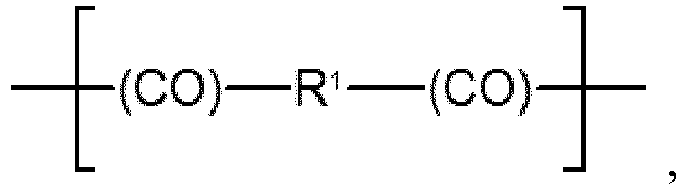
- Examples of the C1 to C40 alkyl include but are not limited to methyl, ethyl, n-propyl, isopropyl, n-butyl, isobutyl, sec-butyl, tert-butyl, n-pentyl, isopentyl, tert-pentyl, neopentyl, n-hexyl, isohexyl, sec-hexyl, tert-hexyl, neohexyl, n-heptyl, isoheptyl, n-octyl, isooctyl, n-nonyl, isononyl, n-decyl, isodecyl, n-undecyl, isoundecyl, n-dodecyl, isododecyl, n-tridecyl, isotridecyl, n-tetradecyl, isotetradecyl, n-pentadecyl, isopentadecyl, n-hexadecyl, isohexadecyl, n-heptadecyl, isoheptadecyl, n-octadecyl, isooctadecyl, n-nonadecyl, isononadecyl, n-eicosyl, isoeicosyl, n-heneicosyl, isoheneicosyl, n-docosyl, isodocosyl, n-tricosyl, isotricosyl, n-tetracosyl, isotetracosyl, n-pentacosyl, isopentacosyl, n-hexacosyl, isohexacosyl, n-heptacosyl, isoheptacosyl, n-octacosyl, isooctacosyl, n-nonacosyl, isononacosyl, n-triacontyl, isotriacontyl, n-hentriacontyl, isohentriacontyl, n-dotriacontyl, isodotriacontyl, n-tritriacontyl, isotritriacontyl, n-tetratriacontyl, isotetratriacontyl, n-pentatriacontyl, isopentatriacontyl, n-hexatriacontyl, isohexatriacontyl, n-heptatriacontyl, isoheptatriacontyl, n-octatriacontyl, isooctatriacontyl, n-nonatriacontyl, isononatriacontyl, n-tetracontyl, and isotetracontyl.
- Examples of the C3 to C40 cycloalkyl include but are not limited to cyclopropyl, cyclobutyl, cyclopentyl, cyclohexyl, cycloheptyl, cyclooctyl, cyclononyl, cyclodecyl, cycloundecyl, cyclododecyl, cyclotridecyl, cyclotetradecyl, cyclopentadecyl, cyclohexadecyl, cycloheptadecyl, cyclooctadecyl, cyclononadecyl, cycloeicosyl, cycloheneicosyl, cyclodocosyl, cyclotricosyl, cyclotetracosyl, cyclopentacosyl, cyclohexacosyl, cycloheptacosyl, cyclooctacosyl, cyclononacosyl, cyclotriacontyl, methylcyclopropyl, methylcyclobutyl, methylcyclopentyl, methylcyclohexyl, methylcycloheptyl, methylcyclooctyl, methylcyclononyl, methylcyclodecyl, dimethylcyclopropyl, dimethylcyclobutyl, dimethylcyclopentyl, dimethylcyclohexyl, dimethylcycloheptyl, dimethylcyclooctyl, dimethylcyclononyl, dimethylcyclodecyl, ethylcyclopropyl, ethylcyclobutyl, ethylcyclopentyl, ethylcyclohexyl, ethylcycloheptyl, ethylcyclooctyl, ethylcyclononyl, ethylcyclodecyl, diethylcyclopropyl, diethylcyclobutyl, diethylcyclopentyl, diethylcyclohexyl, diethylcycloheptyl, diethylcyclooctyl, diethylcyclononyl, and diethylcyclodecyl.
- Examples of the C2 to C40 alkenyl include but are not limited to ethenyl, propenyl, allyl, n-butenyl, isobutenyl, n-pentenyl, isopentenyl, n-hexenyl, isohexenyl, n-heptenyl, isoheptenyl, n-octenyl, isooctenyl, n-nonenyl, isononenyl, n-decenyl, isodecenyl, n-undecenyl, isoundecenyl, n-dodecenyl, isododecenyl, n-tridecenyl, isotridecenyl, n-tetradecenyl, isotetradecenyl, n-pentadecenyl, isopentadecenyl, n-hexadecenyl, isohexadecenyl, n-heptadecenyl, isoheptadecenyl, n-octadecenyl, isooctadecenyl, n-nonadecenyl, isononadecenyl, n-eicosenyl, isoeicosenyl, n-heneicosenyl, isoheneicosenyl, n-docosenyl, isodocosenyl, n-tricosenyl, isotricosenyl, n-tetracosenyl, isotetracosenyl, n-pentacosenyl, isopentacosenyl, n-hexacosenyl, isohexacosenyl, n-heptacosenyl, isoheptacosenyl, n-octacosenyl, isooctacosenyl, n-nonacosenyl, isononacosenyl, n-triacontenyl, isotriacontenyl, n-hentriacontenyl, isohentriacontenyl, n-dotriacontenyl, isodotriacontenyl, n-tritriacontenyl, isotritriacontenyl, n-tetratriacontenyl, isotetratriacontenyl, n-pentatriacontenyl, isopentatriacontenyl, n-hexatriacontenyl, isohexatriacontenyl, n-heptatriacontenyl, isoheptatriacontenyl, n-octatriacontenyl, isooctatriacontenyl, n-nonatriacontenyl, isononatriacontenyl, n-tetracontenyl, isotetracontenyl, propadienyl, butadienyl, pentadienyl, hexadienyl, heptadienyl, octadienyl, nonadienyl, decadienyl, undecadienyl, dodecadienyl, tridecadienyl, tetradecadienyl, pentadecadienyl, hexadecadienyl, heptadecadienyl, octadecadienyl, nonadecadienyl, eicosadienyl, heneicosadienyl, docosadienyl, tricosadienyl, tetracosadienyl, pentacosadienyl, hexacosadienyl, heptacosadienyl, octacosadienyl, nonacosadienyl, triacontadienyl, hentriacontadienyl, dotriacontadienyl, tritriacontadienyl, tetratriacontadienyl, pentatriacontadienyl, hexatriacontadienyl, heptatriacontadienyl, octatriacontadienyl, nonatriacontadienyl, tetracontadienyl, and 9-[(Z)-non-3-enyl]-10-octylnonadecanyl.
- In some embodiments of the present invention, the first structural unit is derived from one or more of succinic acid, adipic acid, oxalic acid, malonic acid, glutaric acid, octanedioic acid, decanedioic acid, dodecanedioic acid, C36 dimer acid, and cyclohexanedicarboxylic acid.
- The second structural unit is derived from an aliphatic diol and is represented by

- In some embodiments of the present invention, the second structural unit is derived from one or more of ethylene glycol, 1,4-butanediol, neopentyl glycol, 1,6-hexanediol, 1,10-decanediol, and 1,4-cyclohexanedimethanol.
- In the aliphatic polyester of the present invention, based on the total moles of all structural units, the total amount of the first structural unit and second structural unit is 90 mol% or more, and preferably ranges from 95 mol% to 99.8 mol%, such as 95.1 mol%, 95.2 mol%, 95.3 mol%, 95.4 mol%, 95.5 mol%, 95.6 mol%, 95.7 mol%, 95.8 mol%, 95.9 mol%, 96 mol%, 96.1 mol%, 96.2 mol%, 96.3 mol%, 96.4 mol%, 96.5 mol%, 96.6 mol%, 96.7 mol%, 96.8 mol%, 96.9 mol%, 97 mol%, 97.1 mol%, 97.2 mol%, 97.3 mol%, 97.4 mol%, 97.5 mol%, 97.6 mol%, 97.7 mol%, 97.8 mol%, 97.9 mol%, 98 mol%, 98.1 mol%, 98.2 mol%, 98.3 mol%, 98.4 mol%, 98.5 mol%, 98.6 mol%, 98.7 mol%, 98.8 mol%, 98.9 mol%, 99 mol%, 99.1 mol%, 99.2 mol%, 99.3 mol%, 99.4 mol%, 99.5 mol%, 99.6 mol%, or 99.7 mol%.
- The third structural unit is derived from a first cross-linking agent. The first cross-linking agent has three reactive functional groups, wherein at least one reactive functional group of the first cross-linking agent is a secondary or tertiary hydroxyl, with the proviso that the first cross-linking agent is not malic acid. The secondary hydroxyl means that the carbon atom to which the hydroxyl bonds is a secondary carbon. The tertiary hydroxyl means that the carbon atom to which the hydroxyl bonds is a tertiary carbon. Without being restricted by any theories, it is believed that the first cross-linking agent with at least one secondary or tertiary hydroxyl allows the polymerization reaction to primarily be carried out linearly because primary hydroxyls are more reactive to secondary or tertiary hydroxyls. This results in an aliphatic polyester polymer with a longer main chain and shorter branched chains and thus, with better elongation property. In consideration of the clarity of the aliphatic polyester, it is preferred that the first cross-linking agent does not comprise any reactive functional group which is not carboxyl or hydroxyl, such as amino, cyano, or nitro. That is, the reactive functional group of the first cross-linking agent which is not a secondary or tertiary hydroxyl is preferably a carboxyl or hydroxyl.
- The first cross-linking agent may be selected from a C3 to C20 aliphatic alcohol and a C3 to C20 aliphatic alcohol acid, and preferably selected from a C3 to C18 aliphatic alcohol and a C3 to C18 aliphatic alcohol acid. However, the present invention is not limited thereto.
- Examples of the C3 to C18 aliphatic alcohol that can be used as the first cross-linking agent include but are not limited to glycerol, 1,2,4-butanetriol, 1,2,3-butanetriol, 1,2,5-pentanetriol, 1,2,4-pentanetriol, 1,2,3-pentanetriol, 2,3,4-pentanetriol, 1,3,5-pentanetriol, 1,2,6-hexanetriol, 1,2,5-hexanetriol, 1,2,4-hexanetriol, 1,2,3-hexanetriol, 1,3,6-hexanetriol, 1,3,5-hexanetriol, 1,3,4-hexanetriol, 1,4,5-hexanetriol, 2,3,4-hexanetriol, 2,3,5-hexanetriol, 2-methyl-1,2,3-propanetriol, 3-methyl-1,3,5-pentanetriol, 3-methyl-1,3,6-hexanetriol, 1,4,7-heptanetriol, 1,3,5-heptanetriol, 1,2,7-heptanetriol, 1,2,6-heptanetriol, 1,2,3-heptanetriol, 2,4,6-heptanetriol, and 2-methyl-2,3,6-heptanetriol.
- Examples of the C3 to C18 aliphatic alcohol acid that can be used as the first cross-linking agent include but are not limited to tartronic acid, methyltartronic acid, citramalic acid, 3-hydroxyglutaric acid, 3-hydroxy-3-methylglutaric acid, 2-hydroxy adipic acid, 3-hydroxy adipic acid, 2-hydroxy heptanedioic acid, 3-hydroxy heptanedioic acid, 4-hydroxy heptanedioic acid, 2-hydroxy suberic acid, 3-hydroxy suberic acid, 2-hydroxynonanedioic acid, 4-hydroxynonanedioic acid, 2-hydroxydecanedioic acid, 3-hydroxydecanedioic acid, 3,18-dihydroxymethylenestearic acid, and 3-hydroxyoctadecanedioic acid.
- In some embodiments of the present invention, the first cross-linking agent is selected from the group consisting of 1,2,4-butanetriol, 2-methyl-1,2,3-propanetriol, glycerol, 3-hydroxyglutaric acid, citramalic acid, tartronic acid, 3,18-dihydroxymethylenestearic acid, and 3-hydroxyoctadecanedioic acid.
- In some embodiments of the present invention, the third structural unit derived from the first cross-linking agent is selected from the group consisting of


- In the aliphatic polyester of the present invention, the molar ratio of the third structural unit to the first structural unit is preferably less than 0.4:100, such as 0.39:100, 0.38:100, 0.37:100, 0.36:100, 0.35:100, 0.34:100, 0.33:100, 0.32:100, 0.31:100, 0.3:100, 0.29:100, 0.28:100, 0.27:100, 0.26:100, 0.25:100, 0.24:100, 0.23:100, 0.22:100, 0.21:100, 0.2:100, 0.19:100, 0.18:100, 0.17:100, 0.16:100, 0.15:100, 0.14:100, 0.13:100, 0.12:100, 0.11:100, 0.1:100, 0.09:100, 0.08:100, 0.07:100, 0.06:100, 0.05:100, 0.04:100, 0.03:100, 0.02:100, or 0.01:100. When the molar ratio of the third structural unit to the first structural unit is within the above ranges, the elongation property of the aliphatic polyester is better.
- According to the present invention, the aliphatic polyester of the present invention further comprises a fourth structural unit derived from a second cross-linking agent in addition to the first structural unit, second structural unit and third structural unit. It was found that introducing the second cross-linking agent can make different polymerization reactions occur alternately and thus, increase the length of the main chain of the polymer, thereby, further improving the elongation property of the aliphatic polyester. The second cross-linking agent is different from the first cross-linking agent and has three reactive functional groups, wherein at least one reactive functional group of the second cross-linking agent is a secondary or tertiary hydroxyl. In consideration of the clarity of the aliphatic polyester, it is preferred that the second cross-linking agent does not comprise any reactive functional group which is not carboxyl or hydroxyl, such as amino, cyano, or nitro. That is, the reactive functional group of the second cross-linking agent which is not a secondary or tertiary hydroxyl is preferably a carboxyl or hydroxyl.
- The second cross-linking agent may be selected from a C3 to C20 aliphatic alcohol and a C3 to C20 aliphatic alcohol acid, and preferably selected from a C3 to C18 aliphatic alcohol and a C3 to C18 aliphatic alcohol acid. However, the present invention is not limited thereto.
- Examples of the C3 to C18 aliphatic alcohol that can be used as the second cross-linking agent include but are not limited to glycerol, 1,2,4-butanetriol, 1,2,3-butanetriol, 1,2,5-pentanetriol, 1,2,4-pentanetriol, 1,2,3-pentanetriol, 2,3,4-pentanetriol, 1,3,5-pentanetriol, 1,2,6-hexanetriol, 1,2,5-hexanetriol, 1,2,4-hexanetriol, 1,2,3-hexanetriol, 1,3,6-hexanetriol, 1,3,5-hexanetriol, 1,3,4-hexanetriol, 1,4,5-hexanetriol, 2,3,4-hexanetriol, 2,3,5-hexanetriol, 2-methyl-1,2,3-propanetriol, 3-methyl-1,3,5-pentanetriol, 3-methyl-1,3,6-hexanetriol, 1,4,7-heptanetriol, 1,3,5-heptanetriol, 1,2,7-heptanetriol, 1,2,6-heptanetriol, 1,2,3-heptanetriol, 2,4,6-heptanetriol, and 2-methyl-2,3,6-heptanetriol.
- Examples of the C3 to C18 aliphatic alcohol acid that can be used as the second cross-linking agent include but are not limited to malic acid, tartronic acid, methyltartronic acid, citramalic acid, 3-hydroxyglutaric acid, 3-hydroxy-3-methylglutaric acid, 2-hydroxy adipic acid, 3-hydroxy adipic acid, 2-hydroxy heptanedioic acid, 3-hydroxy heptanedioic acid, 4-hydroxy heptanedioic acid, 2-hydroxy suberic acid, 3-hydroxy suberic acid, 2-hydroxynonanedioic acid, 4-hydroxynonanedioic acid, 2-hydroxydecanedioic acid, 3-hydroxydecanedioic acid, 3,18-dihydroxymethylenestearic acid, and 3-hydroxyoctadecanedioic acid.
- In some embodiments of the present invention, the fourth structural unit is selected from the group consisting of


- It was found that when malic acid is used alone as a cross-linking agent, the clarity of the aliphatic polyester became worse. Therefore, in the present invention, malic acid is used as the second cross-linking agent rather than the first cross-linking agent.
- In the aliphatic polyester of the present invention, the molar ratio of the third structural unit to the fourth structural unit preferably ranges from 1:8 to 8:1, such as 1:7.5, 1:7, 1:6.5, 1:6, 1:5.5, 1:5, 1:4.5, 1:4, 1:3.5, 1:3, 1:2.5, 1:2, 1:1.5, 1:1, 1.5:1, 2:1, 2.5:1, 3:1, 3.5:1, 4:1, 4.5:1, 5:1, 5.5:1, 6:1, 6.5:1, 7:1, or 7.5:1, and more preferably ranges from 1:3 to 3:1, such as 1:2.9, 1:2.8, 1:2.7, 1:2.6, 1:2.5, 1:2.4, 1:2.3, 1:2.2, 1:2.1, 1:2, 1:1.9, 1:1.8, 1:1.7, 1:1.6, 1:1.5, 1:1.4, 1:1.3, 1:1.2, 1:1.1, 1:1, 1.1:1, 1.2:1, 1.3:1, 1.4:1, 1.5:1, 1.6:1, 1.7:1, 1.8:1, 1.9:1, 2:1, 2.1:1, 2.2:1, 2.3:1, 2.4:1, 2.5:1, 2.6:1, 2.7:1, 2.8:1, or 2.9:1. When the molar ratio of the third structural unit to the fourth structural unit is within the above ranges, the aliphatic polyester has better elongation.
- The molar ratio of the total amount of the third structural unit and the fourth structural unit to the amount of the first structural unit is preferably not higher than 0.4:100, such as 0.39:100, 0.38:100, 0.37:100, 0.36:100, 0.35:100, 0.34:100, 0.33:100, 0.32:100, 0.31:100, 0.3:100, 0.29:100, 0.28:100, 0.27:100, 0.26:100, 0.25:100, 0.24:100, 0.23:100, 0.22:100, 0.21:100, 0.2:100, 0.19:100, 0.18:100, 0.17:100, 0.16:100, 0.15:100, 0.14:100, 0.13:100, 0.12:100, 0.11:100, 0.1:100, 0.09:100, 0.08:100, 0.07:100, 0.06:100, 0.05:100, 0.04:100, 0.03:100, 0.02:100, or 0.01:100. When the molar ratio of the total amount of the third structural unit and the fourth structural unit to the amount of the first structural unit is within the above range, the aliphatic polyester has better elongation.
- The aliphatic polyester of the present invention can be obtained by subjecting an aliphatic dicarboxylic acid, an aliphatic diol, a first cross-linking agent, and an optional second cross-linking agent to a condensation polymerization in the presence of a catalyst. In consideration of costs and convenience of process, the condensation polymerization is preferably performed in the absence of a solvent, i.e., without adding a solvent.
- Examples of the above-mentioned catalyst include but are not limited to a compound containing a metal selected from the group consisting of titanium, germanium, zinc, aluminum, iron, magnesium, tin, antimony, manganese, cobalt, zirconium, vanadium, iridium, lanthanum, cerium, lithium, strontium, and calcium. Examples of the compound include but are not limited to carboxylic acid salts, alkoxy salts, sulfonic acid salts, oxides and halides that contain the above-mentioned metal. For example, the catalyst may be selected from the group consisting of tetra-n-propyl titanate, tetraisopropyl titanate, tetra-n-butyl titanate, tetra-tert-butyl titanate, tetracyclohexyl titanate, titanium lactate, triethanolamine titanate, butyl titanate dimer, titanium dioxide, and combinations thereof. In the appended examples, tetra-n-butyl titanate is used as the catalyst.
- Based on the weight of aliphatic dicarboxylic acids, the content of the catalyst can range from 30 ppm to 2000 ppm, such as 50 ppm, 100 ppm, 150 ppm, 200 ppm, 250 ppm, 300 ppm, 350 ppm, 400 ppm, 450 ppm, 500 ppm, 550 ppm, 600 ppm, 650 ppm, 700 ppm, 750 ppm, 800 ppm, 850 ppm, 900 ppm, 950 ppm, 1000 ppm, 1050 ppm, 1100 ppm, 1150 ppm, 1200 ppm, 1250 ppm, 1300 ppm, 1350 ppm, 1400 ppm, 1450 ppm, 1500 ppm, 1550 ppm, 1600 ppm, 1650 ppm, 1700 ppm, 1750 ppm, 1800 ppm, 1850 ppm, 1900 ppm, or 1950 ppm.
- The detailed manufacturing method of the aliphatic polyester of the present invention are illustrated in the appended examples. Persons having ordinary skill in the art can accomplish the manufacturing of the aliphatic polyester of the present invention based on the specification, especially the appended examples, without undue experimentation. Therefore, the detailed description for the manufacturing method of the aliphatic polyester of the present invention is omitted here.
- The present invention can provide an aliphatic polyester with one or more of the following excellent properties by means of using a specific cross-linking agent or cross-linking agent combination:
- (i) a melt index (MI) ranging from 1 to 40, wherein the melt index is measured in accordance with ISO 1133 under a loading of 2.16 kg at 190°C;
- (ii) a melting temperature (Tm) ranging from 80°C to 120°C;
- (iii) a tensile elongation of 185% or more;
- (iv) a tensile strength of 35 MPa or more at the yield point, and a tensile strength of 25 MPa or more at the break point; and
- (v) a YI value (which indicates clarity) of the aliphatic polyester is 10 or less, wherein the
- YI value is measured in accordance with ASTM D6290.
- The aliphatic polyester of the present invention can be formed into various molded products for every fields by means of any molding method known in the art. The molded products include but are not limited to films, laminated films, sheets, plates, stretched films, monofilaments, multifilaments, nonwoven fabrics, flat yarn, staples, crimped fibers, striped tapes, composite fibers, foams and injection molded articles. The aliphatic polyester of the present invention is useful in the fields of disposable packaging, disposable plastic straw, bio-degradable packaging, food container, disposable bio-degradable plastic bag, disposable tableware, outdoor cable tie, agricultural cable tie, agricultural packing plastic bag, cosmetics packaging, eco-friendly toy, water bottle (including but not limited to sport bottle), disposable fiber, and composted packing, but the present invention is not limited thereto.
- The present invention is further illustrated by the embodiments hereinafter, wherein the testing instruments and methods are as follows.
- The melt index test is performed in accordance with ISO 1133. The instrument for the test is a melt index analyzer (model no.: LMI5000, available from Dynisco), and the testing conditions are as follows: 190°C; and a loading of 2.16 kg.
- The tensile elongation test is performed in accordance with ISO 527, wherein the aliphatic polyester is formed to four pieces of test sample (molded product) and then subjected to the test. The instrument for the test is a tensile testing machine (model no.: 3367, available from Instron). The tensile elongation of the molded product of the aliphatic polyester is obtained by taking the average of the results of four tensile elongation tests.
- The tensile strength at the yield point and the tensile strength at the break point are tested in accordance with ISO 527, wherein the aliphatic polyester is formed to four pieces of test sample (molded product) and then subjected to the test. The instrument for the test is a tensile testing machine (model no.: 3367, available from Instron). The tensile strength of the molded product of the aliphatic polyester is obtained by taking the average of the results of four tensile strength tests. The unit for tensile strength is MPa.
- The YI value test is performed in accordance with ASTM D6290, wherein the aliphatic polyester is formed to a cylinder pellet-type test sample with a diameter ranging from 2.5 mm to 2.8 mm and a height ranging from 3.2 mm to 3.5 mm and then subjected to the test. The instrument for the test is a color-difference meter (model no.: NE 4000, available from Nippon Denshoku; light source: D65/10).
- The melting temperature test is performed in accordance with ISO 11357. The instrument for the test is differential scanning calorimeter (model no.: Q200, available from TA Instruments).
-
Table 1: List of raw materials Model No. or name of raw material Description Succinic acid Aliphatic dicarboxylic acid, available from Bio Amber Adipic acid Aliphatic dicarboxylic acid, available from Eastman 1,4-butanediol Aliphatic diol, available from Dairen Chemical Corporation (DCC) Ethylene glycol Aliphatic diol, available from Oriental Union Chemical Corporation Glycerol Cross-linking agent with one secondary hydroxyl, available from Pan Asia Chemical 1,2,4-butanetriol Cross-linking agent with one secondary hydroxyl, available from Sigma-Aldrich 2-methyl-1,2,3-propanetriol Cross-linking agent with one tertiary hydroxyl, available from Sigma-Aldrich 3-hydroxyglutaric acid Cross-linking agent with one secondary hydroxyl, available from Sigma-Aldrich Citramalic acid Cross-linking agent with one tertiary hydroxyl, available from Sigma-Aldrich Tartronic acid Cross-linking agent with one secondary hydroxyl, available from Sigma-Aldrich 3,18-dihydroxymethylenestearic acid Cross-linking agent with one secondary hydroxyl, available from Sigma-Aldrich 3-hydroxyoctadecanedioic acid Cross-linking agent with one secondary hydroxyl, available from Sigma-Aldrich Malic acid Cross-linking agent with one secondary hydroxyl, available from Lynnbros Laboratories, Inc. Trimesic acid (TMA) Cross-linking agent without a secondary or tertiary hydroxyl, available from Sigma-Aldrich Trimethylolpropane Cross-linking agent without a secondary or tertiary hydroxyl, available from Chang Chun Plastics (CCP) Pentaerythritol Cross-linking agent without a secondary or tertiary hydroxyl, available from CCP TBT Catalyst, tetra-n-butyl titanate, available from Borica - The aliphatic polyester of Examples 1 to 20 and Comparative Examples 1 to 5 were manufactured according to the proportions shown in Tables 2-1 to 2-3. Specifically, a 3-liter reactor was equipped with a stirrer, a fractional condenser, a thermometer, and a gas inlet. The aliphatic diol, aliphatic dicarboxylic acid, first cross-linking agent, optional second cross-linking agent and TBT (the content of TBT is 1050 ppm with respect to the weight of the aliphatic dicarboxylic acid) were placed into the reactor, and nitrogen was introduced into the reactor to form a nitrogen atmosphere. Next, the reactor was heated to 230°C to perform the reaction at that temperature for 5 hours. After that, the water in the reactor was removed by distillation. Then, the mixture in the reactor was reacted at 250°C under vacuum for 90 minutes, and then the mixture was stirred at the same temperature to perform a polycondensation reaction for a period of time to obtain the aliphatic polyester. The stirring conditions are as follows: the rotation speed was 20 rpm, and the power was 0.3 kW to 0.5 kW. The melt index (MI) of the obtained aliphatic polyester measured under a loading of 2.16 kg at 190°C ranges from 5 to 30. The time required for the polycondensation reaction are shown in Tables 2-1 to 2-3.
- The melt index (MI), Tm, YI value, tensile elongation, tensile strength at the yield point of the aliphatic polyester and tensile strength at the break point of the aliphatic polyester of Examples 1 to 20 and Comparative Examples 1 to 5 were measured according to the aforementioned testing methods, and the results are listed in Tables 2-1 to 2-3.
Table 2-1: Composition and properties of aliphatic polyesters of Examples 1 to 10 Unit: molar ratio Example 1 2 3 4 5 6 7 8 9 10 Succinic acid 50 50 50 50 50 50 50 50 50 50 1,4-butanediol 60 60 60 60 60 60 60 65 65 65 Glycerol 0.1 0.15 0.16 0.2 0.05 0.15 0.1 1,2,4-butanetriol 0.1 2-methyl-1,2,3-propanetriol 0.15 3 -hydroxy glutaric acid 0.18 Malic acid 0.15 0.05 0.05 Time for polycondensation (unit: hour) 5.1 4.5 5.5 6.8 4.8 4.6 4.1 3.8 3.9 3.7 YI value 2 2 2 3 7 2 1 4 2 3 Tensile strength at yield point (unit: MPa) 40 39 39 39 40 39 32 39 39 39 Tensile strength at break point (unit: MPa) 42 32 27 28 28 31 25 28 28 27 Tensile elongation 256% 194% 235% 225% 203% 188% 101% 315% 325% 331% MI 30 30 30 30 30 30 30 30 30 30 Tm (unit: °C) 114 114 114 114 114 114 114 114 114 114 Table 2-2: Composition and properties of aliphatic polyesters of Examples 11 to 20 Unit: molar ratio Example 11 12 13 14 15 16 17 18 19 20 Succinic acid 50 50 50 50 38 50 50 50 50 50 Adipic acid 12 1,4-butanediol 65 65 65 65 50 50 60 60 60 60 Ethylene glycol 10 Glycerol 0.18 0.02 0.075 0.075 0.15 0.075 0.075 2-methyl-1,2,3-pro-panetriol 0.075 0.065 Malic acid 0.02 0.18 0.065 1,2,4-butanetriol 0.075 0.05 Citramalic acid 0.075 Tartronic acid 0.075 3,18-dihydroxymethylenestearic acid 0.08 0.12 3-hydroxyoctadecanedioic acid 0.08 Time for polycondensation (unit: hour) 3.8 3.8 5.1 4.3 4.8 4.2 3.9 4.6 5.0 5.3 YI value 5 27 0 3 4 2 3 5 2 6 Tensile strength at yield point (unit: MPa) 40 40 39 40 39 39 39 39 38 39 Tensile strength at break point (unit: MPa) 32 28 28 28 28 28 27 28 26 27 Tensile elongation 135% 180% 336% 340% 615% 425% 331% 329% 352% 236% MI 30 30 30 30 5 25 15 15 10 13 Tm (unit: °C) 114 114 114 114 84 95 114 114 114 114 Table 2-3: Composition and properties of aliphatic polyesters of Comparative Examples 1 to 5 Unit: molar ratio Comparative Example 1 2 3 4 5 Succinic acid 50 50 50 50 50 1,4-butanediol 60 60 60 65 75 TMA 0.15 Trimethylolpropane 0.15 Pentaerythritol 0.15 Glycerol Malic acid 0.2 Time for polycondensation (unit: hour) 4.3 4.1 2.6 4.8 >12 YI value 3 4 1 30 Not applicable Tensile strength at yield point (unit: MPa) 40 40 23 40 Not applicable Tensile strength at break point (unit: MPa) 14 15 23 30 Not applicable Tensile elongation 20% 43% 2.6% 195% Not applicable MI 30 30 5.6 30 >300 Tm (unit: °C) 114 114 114 114 114 - As shown in Tables 2-1 to 2-3, the aliphatic polyester of the present invention exhibits excellent tensile elongation as well as satisfactory tensile strength, YI value and MI. The properties of the aliphatic polyester of the present invention are significantly superior to those of the aliphatic polyester that is not according to the present invention. In particular, Examples 1 to 6 and 20 show that when the first cross-linking agent is used alone in an amount that the molar ratio of the third structural unit to the first structural unit is less than 0.4:100, the aliphatic polyester of the present invention can have a tensile elongation of 188% or more and a YI of 7 or less. Examples 8 to 10 and 13 to 19 show that when the first cross-linking agent is used together with the second cross-linking agent in a proportion that the molar ratio of the third structural unit to the fourth structural unit ranges from 1:8 to 8:1, the aliphatic polyester of the present invention can have a tensile elongation of 315% or more and a YI of 5 or less.
Claims (11)
- An aliphatic polyester, which comprises:a first structural unit represented by
 a second structural unit represented by
 a third structural unit derived from a first cross-linking agent, wherein the first cross-linking agent has three reactive functional groups, wherein the reactive functional groups of the first cross-linking agent are independently a carboxyl or hydroxyl, and at least one reactive functional group of the first cross-linking agent is a secondary or tertiary hydroxyl, with the proviso that the first cross-linking agent is not malic acid; anda fourth structural unit derived from a second cross-linking agent, wherein the second cross-linking agent has three reactive functional groups, wherein the reactive functional groups of the second cross-linking agent are independently a carboxyl or hydroxyl, and at least one reactive functional group of the second cross-linking agent is a secondary or tertiary hydroxyl, with the proviso that the second cross-linking agent is different from the first cross-linking agent,wherein the molar ratio of the third structural unit to the first structural unit is less than 0.4:100.
 - The aliphatic polyester of claim 1, wherein the first cross-linking agent is a C3 to C20 aliphatic alcohol or a C3 to C20 aliphatic alcohol acid.
- The aliphatic polyester of claim 1 or 2, wherein the first cross-linking agent is selected from the group consisting of 1,2,4-butanetriol, 2-methyl-1,2,3-propanetriol, glycerol, 3-hydroxyglutaric acid, citramalic acid, tartronic acid, 3,18-dihydroxymethylenestearic acid, and 3-hydroxyoctadecanedioic acid.
- The aliphatic polyester of any one of claims 1 to 3, wherein the third structural unit is selected from the group consisting of


- The aliphatic polyester of any one of claim 1 to 4, wherein the second cross-linking agent is a C3 to C20 aliphatic alcohol or a C3 to C20 aliphatic alcohol acid.
- The aliphatic polyester of any one of claim 1 to 5, wherein the second cross-linking agent is selected from the group consisting of 1,2,4-butanetriol, 2-methyl-1,2,3-propanetriol, glycerol, 3-hydroxyglutaric acid, malic acid, citramalic acid, tartronic acid, 3,18-dihydroxymethylenestearic acid, 3-hydroxyoctadecanedioic acid, and combinations thereof.
- The aliphatic polyester of any one of claims 1 to 6, wherein the fourth structural unit is selected from the group consisting of


- The aliphatic polyester of any one of claims 1 to 7, wherein the molar ratio of the third structural unit to the fourth structural unit ranges from 1:8 to 8:1.
- The aliphatic polyester of any one of claims 1 to 8, wherein the molar ratio of the total amount of the third structural unit and the fourth structural unit to the amount of the first structural unit is not more than 0.4:100.
- The aliphatic polyester of any one of claims 1 to 9, wherein R1 is absent or a C1 to C6 aliphatic hydrocarbyl, and R2 is a C1 to C6 aliphatic hydrocarbyl.
- The aliphatic polyester of any one of claims 1 to 10, wherein:the first structural unit is derived from succinic acid, adipic acid, oxalic acid, malonic acid, glutaric acid, octanedioic acid, decanedioic acid, dodecanedioic acid, C36 dimer acid, cyclohexanedicarboxylic acid, or any combination thereof; andthe second structural unit is derived from ethylene glycol, 1,4-butanediol, neopentyl glycol, 1,6-hexanediol, 1,10-decanediol, 1,4-cyclohexanedimethanol, or any combination thereof.
Applications Claiming Priority (1)
| Application Number | Priority Date | Filing Date | Title |
|---|---|---|---|
| TW109100054A TWI796542B (en) | 2020-01-02 | 2020-01-02 | Aliphatic polyester with high elongation |
Publications (3)
| Publication Number | Publication Date |
|---|---|
| EP3845580A1 EP3845580A1 (en) | 2021-07-07 |
| EP3845580C0 EP3845580C0 (en) | 2023-10-25 |
| EP3845580B1 true EP3845580B1 (en) | 2023-10-25 |
Family
ID=70525001
Family Applications (1)
| Application Number | Title | Priority Date | Filing Date |
|---|---|---|---|
| EP20214262.6A Active EP3845580B1 (en) | 2020-01-02 | 2020-12-15 | Aliphatic polyester with high elongation |
Country Status (5)
| Country | Link |
|---|---|
| US (1) | US11427676B2 (en) |
| EP (1) | EP3845580B1 (en) |
| JP (1) | JP7289287B2 (en) |
| CN (1) | CN111138646B (en) |
| TW (1) | TWI796542B (en) |
Families Citing this family (1)
| Publication number | Priority date | Publication date | Assignee | Title |
|---|---|---|---|---|
| CN113234214B (en) * | 2021-06-23 | 2022-02-15 | 中国科学院大连化学物理研究所 | A kind of copolyester and preparation method thereof |
Family Cites Families (15)
| Publication number | Priority date | Publication date | Assignee | Title |
|---|---|---|---|---|
| AU694832B2 (en) | 1994-12-21 | 1998-07-30 | Showa Denko Kabushiki Kaisha | Aliphatic polyester resin and process for producing the same |
| JP4010022B2 (en) * | 1997-08-14 | 2007-11-21 | 三菱瓦斯化学株式会社 | Aliphatic polyester carbonate and method for producing the same |
| ITMI20020866A1 (en) * | 2002-04-22 | 2003-10-22 | Novamont Spa | BIODEGRADABLE SATURATED / UNSATURED THERMOPLASTIC COPOLYESTERS |
| ITMI20020867A1 (en) | 2002-04-22 | 2003-10-22 | Novamont Spa | BIODEGRADABLE SATURATED / UNSATURED THERMOPLASTIC COPOLYESTERS |
| EP1640397B1 (en) | 2003-05-21 | 2016-04-13 | Mitsubishi Chemical Corporation | Aliphatic polyester and process for production thereof |
| JP4569127B2 (en) | 2004-03-03 | 2010-10-27 | 三菱化学株式会社 | Aliphatic polyester and method for producing the same |
| JP2007284595A (en) | 2006-04-18 | 2007-11-01 | Daicel Chem Ind Ltd | Aliphatic polyester film |
| EP2223950B1 (en) * | 2007-12-12 | 2018-03-07 | Mitsubishi Chemical Corporation | Aliphatic polyester resin and method for producing the same |
| CN105218794A (en) | 2008-09-29 | 2016-01-06 | 巴斯夫欧洲公司 | Aliphatic polyester |
| JP5682407B2 (en) | 2010-03-31 | 2015-03-11 | 三菱化学株式会社 | Biomass resource-derived polyurethane and method for producing the same |
| US9156943B2 (en) * | 2011-04-26 | 2015-10-13 | Taiwan Textile Research Institute | Modified polyesters and processes for manufacturing the same |
| JP6357795B2 (en) | 2013-02-21 | 2018-07-18 | 三菱ケミカル株式会社 | Polyester resin and method for producing the same |
| EP3091046A4 (en) | 2013-12-30 | 2017-08-09 | LOTTE Fine Chemical Co., Ltd. | Composition for producing biodegradable polyester resin, and production method for biodegradable polyester resin |
| EP3201253B1 (en) | 2014-10-03 | 2023-07-12 | Novamont S.p.A. | Process for the production of polyesters |
| KR20170102491A (en) * | 2014-12-30 | 2017-09-11 | 피티티 글로벌 케미칼 피씨엘 | Biodegradable copolyester composition |
-
2020
- 2020-01-02 TW TW109100054A patent/TWI796542B/en active
- 2020-01-14 CN CN202010038779.1A patent/CN111138646B/en active Active
- 2020-03-23 US US16/826,880 patent/US11427676B2/en active Active
- 2020-12-08 JP JP2020203384A patent/JP7289287B2/en active Active
- 2020-12-15 EP EP20214262.6A patent/EP3845580B1/en active Active
Also Published As
| Publication number | Publication date |
|---|---|
| JP2021109959A (en) | 2021-08-02 |
| EP3845580A1 (en) | 2021-07-07 |
| US20210206914A1 (en) | 2021-07-08 |
| TWI796542B (en) | 2023-03-21 |
| US11427676B2 (en) | 2022-08-30 |
| EP3845580C0 (en) | 2023-10-25 |
| TW202126720A (en) | 2021-07-16 |
| CN111138646B (en) | 2022-06-07 |
| JP7289287B2 (en) | 2023-06-09 |
| CN111138646A (en) | 2020-05-12 |
Similar Documents
| Publication | Publication Date | Title |
|---|---|---|
| EP1560869B1 (en) | Method for making isosorbide containing polyesters | |
| US5470941A (en) | Thermoplastic biodegradable resins and a process of preparation thereof | |
| US9102793B2 (en) | Polyester resin, method of producing the same, composition for molded article and molded article | |
| US4328059A (en) | High-molecular weight linear polyesters and a process for preparing them | |
| FI117440B (en) | Biodegradable polymers, process for their preparation and their use for the preparation of biodegradable molds | |
| CN103087305B (en) | A kind of Biodegradable aromatic-aliphatic copolyester and preparation method thereof | |
| KR101769560B1 (en) | Polyester resin copolymerized with lactic acid and isosorbide and preparing method thereof | |
| JP2016520706A (en) | Biodegradable polyester resin and article containing the same | |
| TW201331259A (en) | Aliphatic-aromatic copolyetheresters | |
| US11427676B2 (en) | Aliphatic polyester with high elongation | |
| AU2014374626A2 (en) | Composition for producing biodegradable polyester resin, and production method for biodegradable polyester resin | |
| EP3056529B1 (en) | Polyester resin, injection-molded article, polyester sheet, and polyester container | |
| AU2014413947A1 (en) | Biodegradable polyester resin and foam obtained therefrom | |
| JP7204687B2 (en) | Method for preparing poly(trimethylene furancarboxylate) using zinc catalyst | |
| WO1994021708A1 (en) | Aliphatic polyester and process for producing the same | |
| KR101691700B1 (en) | Preparation method of aliphatic copolyester resin | |
| KR100298220B1 (en) | Manufacturing method of polyester | |
| US4383106A (en) | High melt strength elastomeric copolyesters | |
| CN103665353B (en) | A kind of biodegradable copolyester and preparation method thereof | |
| EP4242248B1 (en) | Biodegradable polyester resin prepared by adding reaction rate control agent and molecular weight increasing agent derived from biomass and method for preparing same | |
| JP2002363270A (en) | Polyester resin for bottles | |
| JPH11140175A (en) | Production of polyester resin | |
| JP2014181328A (en) | Method for producing aliphatic polyester | |
| WO2023183168A1 (en) | Oxygen scavenging polymers with improved haze characteristics | |
| US3522216A (en) | Preparation of polyesters with nickel,manganese,aluminum,or cadmium borate as polycondensation catalysts |
Legal Events
| Date | Code | Title | Description |
|---|---|---|---|
| STAA | Information on the status of an ep patent application or granted ep patent |
Free format text: STATUS: REQUEST FOR EXAMINATION WAS MADE |
|
| PUAI | Public reference made under article 153(3) epc to a published international application that has entered the european phase |
Free format text: ORIGINAL CODE: 0009012 |
|
| 17P | Request for examination filed |
Effective date: 20201215 |
|
| AK | Designated contracting states |
Kind code of ref document: A1 Designated state(s): AL AT BE BG CH CY CZ DE DK EE ES FI FR GB GR HR HU IE IS IT LI LT LU LV MC MK MT NL NO PL PT RO RS SE SI SK SM TR |
|
| GRAP | Despatch of communication of intention to grant a patent |
Free format text: ORIGINAL CODE: EPIDOSNIGR1 |
|
| STAA | Information on the status of an ep patent application or granted ep patent |
Free format text: STATUS: GRANT OF PATENT IS INTENDED |
|
| RIC1 | Information provided on ipc code assigned before grant |
Ipc: C08G 63/60 20060101ALI20230606BHEP Ipc: C08G 63/16 20060101ALI20230606BHEP Ipc: C08G 63/12 20060101AFI20230606BHEP |
|
| INTG | Intention to grant announced |
Effective date: 20230622 |
|
| GRAS | Grant fee paid |
Free format text: ORIGINAL CODE: EPIDOSNIGR3 |
|
| GRAA | (expected) grant |
Free format text: ORIGINAL CODE: 0009210 |
|
| STAA | Information on the status of an ep patent application or granted ep patent |
Free format text: STATUS: THE PATENT HAS BEEN GRANTED |
|
| AK | Designated contracting states |
Kind code of ref document: B1 Designated state(s): AL AT BE BG CH CY CZ DE DK EE ES FI FR GB GR HR HU IE IS IT LI LT LU LV MC MK MT NL NO PL PT RO RS SE SI SK SM TR |
|
| REG | Reference to a national code |
Ref country code: GB Ref legal event code: FG4D |
|
| REG | Reference to a national code |
Ref country code: CH Ref legal event code: EP |
|
| REG | Reference to a national code |
Ref country code: DE Ref legal event code: R096 Ref document number: 602020019765 Country of ref document: DE |
|
| REG | Reference to a national code |
Ref country code: IE Ref legal event code: FG4D |
|
| U01 | Request for unitary effect filed |
Effective date: 20231108 |
|
| U07 | Unitary effect registered |
Designated state(s): AT BE BG DE DK EE FI FR IT LT LU LV MT NL PT SE SI Effective date: 20231113 |
|
| U20 | Renewal fee for the european patent with unitary effect paid |
Year of fee payment: 4 Effective date: 20231222 |
|
| PG25 | Lapsed in a contracting state [announced via postgrant information from national office to epo] |
Ref country code: GR Free format text: LAPSE BECAUSE OF FAILURE TO SUBMIT A TRANSLATION OF THE DESCRIPTION OR TO PAY THE FEE WITHIN THE PRESCRIBED TIME-LIMIT Effective date: 20240126 |
|
| PG25 | Lapsed in a contracting state [announced via postgrant information from national office to epo] |
Ref country code: IS Free format text: LAPSE BECAUSE OF FAILURE TO SUBMIT A TRANSLATION OF THE DESCRIPTION OR TO PAY THE FEE WITHIN THE PRESCRIBED TIME-LIMIT Effective date: 20240225 |
|
| PG25 | Lapsed in a contracting state [announced via postgrant information from national office to epo] |
Ref country code: ES Free format text: LAPSE BECAUSE OF FAILURE TO SUBMIT A TRANSLATION OF THE DESCRIPTION OR TO PAY THE FEE WITHIN THE PRESCRIBED TIME-LIMIT Effective date: 20231025 |
|
| PG25 | Lapsed in a contracting state [announced via postgrant information from national office to epo] |
Ref country code: IS Free format text: LAPSE BECAUSE OF FAILURE TO SUBMIT A TRANSLATION OF THE DESCRIPTION OR TO PAY THE FEE WITHIN THE PRESCRIBED TIME-LIMIT Effective date: 20240225 Ref country code: GR Free format text: LAPSE BECAUSE OF FAILURE TO SUBMIT A TRANSLATION OF THE DESCRIPTION OR TO PAY THE FEE WITHIN THE PRESCRIBED TIME-LIMIT Effective date: 20240126 Ref country code: ES Free format text: LAPSE BECAUSE OF FAILURE TO SUBMIT A TRANSLATION OF THE DESCRIPTION OR TO PAY THE FEE WITHIN THE PRESCRIBED TIME-LIMIT Effective date: 20231025 |
|
| PG25 | Lapsed in a contracting state [announced via postgrant information from national office to epo] |
Ref country code: RS Free format text: LAPSE BECAUSE OF FAILURE TO SUBMIT A TRANSLATION OF THE DESCRIPTION OR TO PAY THE FEE WITHIN THE PRESCRIBED TIME-LIMIT Effective date: 20231025 Ref country code: PL Free format text: LAPSE BECAUSE OF FAILURE TO SUBMIT A TRANSLATION OF THE DESCRIPTION OR TO PAY THE FEE WITHIN THE PRESCRIBED TIME-LIMIT Effective date: 20231025 Ref country code: NO Free format text: LAPSE BECAUSE OF FAILURE TO SUBMIT A TRANSLATION OF THE DESCRIPTION OR TO PAY THE FEE WITHIN THE PRESCRIBED TIME-LIMIT Effective date: 20240125 Ref country code: HR Free format text: LAPSE BECAUSE OF FAILURE TO SUBMIT A TRANSLATION OF THE DESCRIPTION OR TO PAY THE FEE WITHIN THE PRESCRIBED TIME-LIMIT Effective date: 20231025 |
|
| PG25 | Lapsed in a contracting state [announced via postgrant information from national office to epo] |
Ref country code: CZ Free format text: LAPSE BECAUSE OF FAILURE TO SUBMIT A TRANSLATION OF THE DESCRIPTION OR TO PAY THE FEE WITHIN THE PRESCRIBED TIME-LIMIT Effective date: 20231025 |
|
| REG | Reference to a national code |
Ref country code: DE Ref legal event code: R097 Ref document number: 602020019765 Country of ref document: DE |
|
| PG25 | Lapsed in a contracting state [announced via postgrant information from national office to epo] |
Ref country code: SK Free format text: LAPSE BECAUSE OF FAILURE TO SUBMIT A TRANSLATION OF THE DESCRIPTION OR TO PAY THE FEE WITHIN THE PRESCRIBED TIME-LIMIT Effective date: 20231025 |
|
| PG25 | Lapsed in a contracting state [announced via postgrant information from national office to epo] |
Ref country code: SM Free format text: LAPSE BECAUSE OF FAILURE TO SUBMIT A TRANSLATION OF THE DESCRIPTION OR TO PAY THE FEE WITHIN THE PRESCRIBED TIME-LIMIT Effective date: 20231025 Ref country code: SK Free format text: LAPSE BECAUSE OF FAILURE TO SUBMIT A TRANSLATION OF THE DESCRIPTION OR TO PAY THE FEE WITHIN THE PRESCRIBED TIME-LIMIT Effective date: 20231025 Ref country code: RO Free format text: LAPSE BECAUSE OF FAILURE TO SUBMIT A TRANSLATION OF THE DESCRIPTION OR TO PAY THE FEE WITHIN THE PRESCRIBED TIME-LIMIT Effective date: 20231025 Ref country code: CZ Free format text: LAPSE BECAUSE OF FAILURE TO SUBMIT A TRANSLATION OF THE DESCRIPTION OR TO PAY THE FEE WITHIN THE PRESCRIBED TIME-LIMIT Effective date: 20231025 |
|
| PG25 | Lapsed in a contracting state [announced via postgrant information from national office to epo] |
Ref country code: MC Free format text: LAPSE BECAUSE OF FAILURE TO SUBMIT A TRANSLATION OF THE DESCRIPTION OR TO PAY THE FEE WITHIN THE PRESCRIBED TIME-LIMIT Effective date: 20231025 |
|
| PG25 | Lapsed in a contracting state [announced via postgrant information from national office to epo] |
Ref country code: MC Free format text: LAPSE BECAUSE OF FAILURE TO SUBMIT A TRANSLATION OF THE DESCRIPTION OR TO PAY THE FEE WITHIN THE PRESCRIBED TIME-LIMIT Effective date: 20231025 |
|
| PLBE | No opposition filed within time limit |
Free format text: ORIGINAL CODE: 0009261 |
|
| STAA | Information on the status of an ep patent application or granted ep patent |
Free format text: STATUS: NO OPPOSITION FILED WITHIN TIME LIMIT |
|
| 26N | No opposition filed |
Effective date: 20240726 |
|
| REG | Reference to a national code |
Ref country code: IE Ref legal event code: MM4A |
|
| PG25 | Lapsed in a contracting state [announced via postgrant information from national office to epo] |
Ref country code: IE Free format text: LAPSE BECAUSE OF NON-PAYMENT OF DUE FEES Effective date: 20231215 |
|
| PG25 | Lapsed in a contracting state [announced via postgrant information from national office to epo] |
Ref country code: IE Free format text: LAPSE BECAUSE OF NON-PAYMENT OF DUE FEES Effective date: 20231215 |
|
| U20 | Renewal fee for the european patent with unitary effect paid |
Year of fee payment: 5 Effective date: 20241009 |
|
| PG25 | Lapsed in a contracting state [announced via postgrant information from national office to epo] |
Ref country code: CY Free format text: LAPSE BECAUSE OF FAILURE TO SUBMIT A TRANSLATION OF THE DESCRIPTION OR TO PAY THE FEE WITHIN THE PRESCRIBED TIME-LIMIT; INVALID AB INITIO Effective date: 20201215 |
|
| PG25 | Lapsed in a contracting state [announced via postgrant information from national office to epo] |
Ref country code: HU Free format text: LAPSE BECAUSE OF FAILURE TO SUBMIT A TRANSLATION OF THE DESCRIPTION OR TO PAY THE FEE WITHIN THE PRESCRIBED TIME-LIMIT; INVALID AB INITIO Effective date: 20201215 |
|
| U20 | Renewal fee for the european patent with unitary effect paid |
Year of fee payment: 6 Effective date: 20251014 |
|
| PG25 | Lapsed in a contracting state [announced via postgrant information from national office to epo] |
Ref country code: TR Free format text: LAPSE BECAUSE OF FAILURE TO SUBMIT A TRANSLATION OF THE DESCRIPTION OR TO PAY THE FEE WITHIN THE PRESCRIBED TIME-LIMIT Effective date: 20231025 |
|
| REG | Reference to a national code |
Ref country code: CH Ref legal event code: U11 Free format text: ST27 STATUS EVENT CODE: U-0-0-U10-U11 (AS PROVIDED BY THE NATIONAL OFFICE) Effective date: 20260101 |
|
| PGFP | Annual fee paid to national office [announced via postgrant information from national office to epo] |
Ref country code: GB Payment date: 20251001 Year of fee payment: 6 |
|
| PGFP | Annual fee paid to national office [announced via postgrant information from national office to epo] |
Ref country code: CH Payment date: 20260101 Year of fee payment: 6 |