EP3845276B1 - Beta-amino acid derivative, kinase inhibitor and pharmaceutical composition containing the same, and use of the same - Google Patents
Beta-amino acid derivative, kinase inhibitor and pharmaceutical composition containing the same, and use of the same Download PDFInfo
- Publication number
- EP3845276B1 EP3845276B1 EP20213242.9A EP20213242A EP3845276B1 EP 3845276 B1 EP3845276 B1 EP 3845276B1 EP 20213242 A EP20213242 A EP 20213242A EP 3845276 B1 EP3845276 B1 EP 3845276B1
- Authority
- EP
- European Patent Office
- Prior art keywords
- compound
- intraocular pressure
- formula
- kinase
- mixture
- Prior art date
- Legal status (The legal status is an assumption and is not a legal conclusion. Google has not performed a legal analysis and makes no representation as to the accuracy of the status listed.)
- Active
Links
Images




Classifications
-
- A—HUMAN NECESSITIES
- A61—MEDICAL OR VETERINARY SCIENCE; HYGIENE
- A61P—SPECIFIC THERAPEUTIC ACTIVITY OF CHEMICAL COMPOUNDS OR MEDICINAL PREPARATIONS
- A61P11/00—Drugs for disorders of the respiratory system
-
- A—HUMAN NECESSITIES
- A61—MEDICAL OR VETERINARY SCIENCE; HYGIENE
- A61P—SPECIFIC THERAPEUTIC ACTIVITY OF CHEMICAL COMPOUNDS OR MEDICINAL PREPARATIONS
- A61P27/00—Drugs for disorders of the senses
- A61P27/02—Ophthalmic agents
-
- A—HUMAN NECESSITIES
- A61—MEDICAL OR VETERINARY SCIENCE; HYGIENE
- A61P—SPECIFIC THERAPEUTIC ACTIVITY OF CHEMICAL COMPOUNDS OR MEDICINAL PREPARATIONS
- A61P27/00—Drugs for disorders of the senses
- A61P27/02—Ophthalmic agents
- A61P27/06—Antiglaucoma agents or miotics
-
- A—HUMAN NECESSITIES
- A61—MEDICAL OR VETERINARY SCIENCE; HYGIENE
- A61P—SPECIFIC THERAPEUTIC ACTIVITY OF CHEMICAL COMPOUNDS OR MEDICINAL PREPARATIONS
- A61P35/00—Antineoplastic agents
-
- C—CHEMISTRY; METALLURGY
- C07—ORGANIC CHEMISTRY
- C07D—HETEROCYCLIC COMPOUNDS
- C07D231/00—Heterocyclic compounds containing 1,2-diazole or hydrogenated 1,2-diazole rings
- C07D231/02—Heterocyclic compounds containing 1,2-diazole or hydrogenated 1,2-diazole rings not condensed with other rings
- C07D231/10—Heterocyclic compounds containing 1,2-diazole or hydrogenated 1,2-diazole rings not condensed with other rings having two or three double bonds between ring members or between ring members and non-ring members
- C07D231/12—Heterocyclic compounds containing 1,2-diazole or hydrogenated 1,2-diazole rings not condensed with other rings having two or three double bonds between ring members or between ring members and non-ring members with only hydrogen atoms, hydrocarbon or substituted hydrocarbon radicals, directly attached to ring carbon atoms
-
- C—CHEMISTRY; METALLURGY
- C07—ORGANIC CHEMISTRY
- C07D—HETEROCYCLIC COMPOUNDS
- C07D231/00—Heterocyclic compounds containing 1,2-diazole or hydrogenated 1,2-diazole rings
- C07D231/02—Heterocyclic compounds containing 1,2-diazole or hydrogenated 1,2-diazole rings not condensed with other rings
- C07D231/10—Heterocyclic compounds containing 1,2-diazole or hydrogenated 1,2-diazole rings not condensed with other rings having two or three double bonds between ring members or between ring members and non-ring members
- C07D231/14—Heterocyclic compounds containing 1,2-diazole or hydrogenated 1,2-diazole rings not condensed with other rings having two or three double bonds between ring members or between ring members and non-ring members with hetero atoms or with carbon atoms having three bonds to hetero atoms with at the most one bond to halogen, e.g. ester or nitrile radicals, directly attached to ring carbon atoms
- C07D231/18—One oxygen or sulfur atom
-
- C—CHEMISTRY; METALLURGY
- C07—ORGANIC CHEMISTRY
- C07D—HETEROCYCLIC COMPOUNDS
- C07D403/00—Heterocyclic compounds containing two or more hetero rings, having nitrogen atoms as the only ring hetero atoms, not provided for by group C07D401/00
- C07D403/02—Heterocyclic compounds containing two or more hetero rings, having nitrogen atoms as the only ring hetero atoms, not provided for by group C07D401/00 containing two hetero rings
- C07D403/12—Heterocyclic compounds containing two or more hetero rings, having nitrogen atoms as the only ring hetero atoms, not provided for by group C07D401/00 containing two hetero rings linked by a chain containing hetero atoms as chain links
Definitions
- the present disclosure relates to a novel compound, and particularly to a novel ⁇ -amino acid derivative, kinase inhibitor and pharmaceutical composition containing the same, and uses thereof.
- the ciliary body will secrete aqueous humor to perform this work.
- aqueous humor When the drainage route of aqueous humor is blocked and aqueous humor accumulates, an increase in intraocular pressure will be the result, which is the biggest risk factor for glaucoma.
- aqueous humor drainage mainly occurs in the following three ways: (1) Schlemm's canal pathway (major, conventional pathway); (2) Uvea-sclera pathway (small amount), about 10%-20%; and (3) Absorption on the surface of the iris (minor amount).
- the mechanisms of reducing intraocular pressure of commonly used glaucoma drugs are: (a) reducing the production of aqueous humor, such as ⁇ -receptor blockers, carbonic anhydrase inhibitors, and ⁇ -receptor agonists; and (b) increasing the drainage of aqueous humor (Uveoscleral pathway), such as prostaglandin analogs, alpha receptor agonists, etc.
- Rho/ROCK pathway plays an important role in the regulation of the cytoskeleton.
- Rho/ROCK inhibitors can regulate the functions of the actin cytoskeleton, extracellular matrix and Schlemm's tube endothelial cells in the trabecular meshwork tissue, thereby reducing the intraocular pressure.
- ROCK inhibitors for reducing intraocular pressure
- current commercial ROCK inhibitors for reducing intraocular pressure include Ripasudil (K-115) and Netarsudil (AR-13324).
- Ripasudil K-115
- Netarsudil AR-13324
- NET ROCK/norepinephrine transporter
- ROCK inhibitors still have various side effects when applied to reducing intraocular pressure, and the long-term use of single-mechanism drugs may lead to the problem of reduced drug efficacy, making it impossible for patients to use a single drug for a long time. Therefore, it is still needed to develop new intraocular pressure reducing drugs with new targets or multiple targets to effectively reduce intraocular pressure and reduce side effects.
- Document WO 2018/094362 A1 relates to certain amides and heterocyclic compounds and to the uses of these compounds to treat several diseases including autoimmune disorders, cardiovascular disorders, inflammation, central nervous system disorders, arterial thrombotic disorders, fibrotic disorders, glaucoma, and neoplastic disorders.
- RHOPRESSA netarsudil ophthalmic solution Label, NDA, 208254, Reference ID: 4194833
- the chemical compound (S)-4-(3-amino-1-(isoquinolin-6-yl-amino)-1-oxopropan-2-yl) benzyl 2,4-dimethylbenzoate dimesylate is a Rho kinase inhibitor.
- the present disclosure provides a compound represented by Formula (I) -(IV), a pharmaceutically acceptable salt or ester, hydrate, solvate or crystalline form thereof:
- the compound represented by Formulae (I) to (IV) are a ⁇ -amino acid derivative.
- X is a single bond
- Y is NH
- W is CH
- A is a single bond, O, OH, OCH 2 , or N 3
- R 1 is H or F
- R 2 is H, F, OH, CF 3 , CH 2 OH, CHO or and
- n is 0 or 1.
- the present disclosure also provides a kinase inhibitor comprising the compound represented by Formulae (I)-(IV), or a pharmaceutically acceptable salt or ester, hydrate, solvate or crystalline form thereof mentioned above.
- the present disclosure further provides a pharmaceutical composition
- a pharmaceutical composition comprising the compound represented by Formulae (I)-(IV), or a pharmaceutically acceptable salt or ester, hydrate, solvate or crystalline form thereof mentioned above.
- the present disclosure provides a compound represented by Formulae (I)-(IV), or a pharmaceutically acceptable salt or ester, hydrate, solvate or crystalline form thereof mentioned above for use as a kinase inhibitor.
- the present disclosure also provides a use of the compound represented by Formulae (I)-(IV), or a pharmaceutically acceptable salt or ester, hydrate, solvate or crystalline form thereof mentioned above in the manufacture of a medicament, wherein the medicament is used for an in vivo related application that benefits from the inhibition of a kinase, and the kinase is at least one selected from a group consisting of: myosin light chain kinase 4; mitogen-activated protein kinase 19; and a Rho-associated protein kinase.
- the present disclosure also provides a use of the compound represented by Formulae (I)-(IV), or a pharmaceutically acceptable salt or ester, hydrate, solvate or crystalline form thereof mentioned above in the manufacture of a medicament for reducing intraocular pressure.
- the present disclosure provides a novel ⁇ -amino acid derivative and provides a pharmaceutically acceptable salt or ester, hydrate, solvate or crystalline form of the novel ⁇ -amino acid derivative at the same time.
- the ⁇ -amino acid derivative mentioned above may comprise a compound represented by Formulae (I)-(IV), but it is not limited thereto:
- the compound represented by Formulae (I) to (IV) are a ⁇ -amino acid derivative.
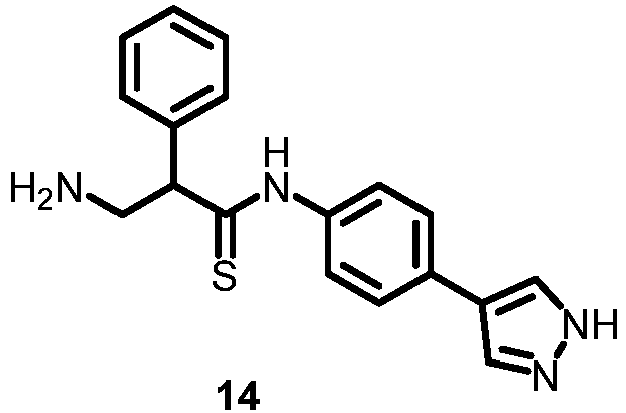
- the compound represented by Formulae (I)-(IV) mentioned above may be present in the form of the individual optical isomers, a mixture of the individual enantiomers or a racemate, and may comprise, but is not limited to, a compound shown in the following Table 1.
- Table 1 Compounds 1 to 15, 17 and 19 to 21 are examples for a compound represented by Formulae (I)-(IV), while compounds 16 and 18 are included for illustrative purpose and do not fall under the scope of claim 1.
- Compound Number Compound 1 Compound 2 Structure Compound Number Compound 3
- Compound 4 Structure Compound Number Compound 5
- Compound 6 Structure Compound Number Compound 7
- Compound 8 Structure Compound Compound 9
- Compound 10 Number Structure Compound Number Compound Number Compound 11
- Compound 12 Structure Compound Number Compound 13
- Compound 14 Structure Compound Number Compound 15 Compound 16 Structure Compound Number Compound 17 Compound 18 Structure Compound Number Compound 19 Compound 20 Structure Compound Number Compound 21 Structure
- the compound represented by formula (I) of the present disclosure may be the Compound 7 mentioned above, which is a racemic compound.
- the compound represented by formula (I) of the present disclosure may be the Compound 20 mentioned above, which is an S-form compound, and more specifically, is an S-enantiomer.
- the novel ⁇ amino acid derivative of the present disclosure mentioned above or a pharmaceutically acceptable salt or ester, hydrate, solvate or crystalline form of the novel ⁇ amino acid derivative may have an effect of inhibiting a kinase, but it is not limited thereto.
- Example of the aforementioned kinase may comprise, but is not limited to, myosin light chain kinase 4 (MYLK-4), mitogen-activated protein kinase 19 (MAPK19, YSK-4), a Rho-associated protein kinase (ROCK) or any combination thereof.
- the Rho-associated protein kinase (ROCK) may comprise, but is not limited to, Rho-associated protein kinase-1 (ROCK-1).
- novel ⁇ amino acid derivative of the present disclosure mentioned above or a pharmaceutically acceptable salt or ester, hydrate, solvate or crystalline form of the novel ⁇ amino acid derivative may have an effect of inhibiting myosin light chain kinase 4.
- novel ⁇ amino acid derivative of the present disclosure mentioned above or a pharmaceutically acceptable salt or ester, hydrate, solvate or crystalline form of the novel ⁇ amino acid derivative may have a synergistic target inhibiting effect. Therefore, in another embodiment, the novel ⁇ amino acid derivative of the present disclosure mentioned above or a pharmaceutically acceptable salt or ester, hydrate, solvate or crystalline form of the novel ⁇ amino acid derivative may have an effect of inhibiting mitogen-activated protein kinase 19.
- novel ⁇ amino acid derivative of the present disclosure mentioned above or a pharmaceutically acceptable salt or ester, hydrate, solvate or crystalline form of the novel ⁇ amino acid derivative may have an effect of simultaneously inhibiting myosin light chain kinase 4 and a Rho-associated protein kinase.
- novel ⁇ amino acid derivative of the present disclosure mentioned above or a pharmaceutically acceptable salt or ester, hydrate, solvate or crystalline form of the novel ⁇ amino acid derivative may have an effect of simultaneously inhibiting mitogen-activated protein kinase 19 and a Rho-associated protein kinase.
- novel ⁇ amino acid derivative of the present disclosure mentioned above or a pharmaceutically acceptable salt or ester, hydrate, solvate or crystalline form of the novel ⁇ amino acid derivative may have an effect of simultaneously inhibiting myosin light chain kinase 4, mitogen-activated protein kinase 19 and a Rho-associated protein kinase.
- novel ⁇ amino acid derivative of the present disclosure mentioned above or a pharmaceutically acceptable salt or ester, hydrate, solvate or crystalline form of the novel ⁇ amino acid derivative may have an effect of reducing intraocular pressure.
- novel ⁇ amino acid derivative of the present disclosure mentioned above or a pharmaceutically acceptable salt or ester, hydrate, solvate or crystalline form of the novel ⁇ amino acid derivative may achieve an effect of reducing intraocular pressure through myosin light chain kinase 4, mitogen-activated protein kinase 19, a Rho-associated protein kinase or any combination thereof.
- novel ⁇ amino acid derivative of the present disclosure mentioned above or a pharmaceutically acceptable salt or ester, hydrate, solvate or crystalline form of the novel ⁇ amino acid derivative may have an effect of reducing intraocular pressure, it may be applied to a treatment and/or prevention of ocular hypertension or a disease with ocular hypertension.
- ocular hypertension refers to a symptom of an intraocular pressure greater than a normal range.
- human normal intraocular pressure is about 10-21 mmHg
- ocular hypertension is a symptom of intraocular pressure greater than about 21 mmHg, such as greater than about 22 mmHg, greater than about 25 mmHg, greater than about 30 mmHg, etc., but it is not limited thereto.
- novel ⁇ amino acid derivative of the present disclosure mentioned above or a pharmaceutically acceptable salt or ester, hydrate, solvate or crystalline form of the novel ⁇ amino acid derivative may be applied to a treatment and/or prevention of ocular hypertension with an intraocular pressure greater than about 25 mmHg, such as greater than about 30 mmHg.
- the present disclosure also provides a kinase inhibitor, which may comprise any of the novel ⁇ amino acid derivative of the present disclosure mentioned above or a pharmaceutically acceptable salt or ester, hydrate, solvate or crystalline form of the novel ⁇ amino acid derivative, but it not limited thereto.
- the novel ⁇ amino acid derivative of the present disclosure mentioned above or a pharmaceutically acceptable salt or ester, hydrate, solvate or crystalline form of the novel ⁇ amino acid derivative may have an effect of inhibiting a kinase, and the kinase described herein may comprise, but is not limited to, myosin light chain kinase 4, mitogen-activated protein kinase 19, a Rho-associated protein kinase or any combination thereof.
- the Rho-associated protein kinase may comprise, but is not limited to, Rho-associated protein kinase-1.
- the novel ⁇ amino acid derivative of the present disclosure mentioned above or a pharmaceutically acceptable salt or ester, hydrate, solvate or crystalline form of the novel ⁇ amino acid derivative may have an effect of inhibiting myosin light chain kinase-4 and/or mitogen-activated protein kinase-19.
- the novel ⁇ amino acid derivative of the present disclosure mentioned above or a pharmaceutically acceptable salt or ester, hydrate, solvate or crystalline form of the novel ⁇ amino acid derivative in addition to an effect of inhibiting myosin light chain kinase-4 and/or mitogen-activated protein kinase-19, may also have an effect of inhibiting a Rho-associated protein kinase.
- the kinase inhibitor of the present disclosure may comprise the foregoing Compound 7 (which is a racemic compound) or Compound 20 (which is an S-form compound).
- the kinase inhibitor of the present disclosure may have an effect of simultaneously inhibiting myosin light chain kinase 4, mitogen-activated protein kinase 19 and a Rho-associated protein kinase.
- the present disclosure can also provide a use of the novel ⁇ amino acid derivative of the present disclosure mentioned above or a pharmaceutically acceptable salt or ester, hydrate, solvate or crystalline form of the novel ⁇ amino acid derivative as a kinase inhibitor.
- the novel ⁇ amino acid derivative of the present disclosure mentioned above may be the foregoing Compound 7 (which is a racemic compound) or Compound 20 (which is an S-form compound).
- the kinase inhibitor mentioned above may have an effect of simultaneously inhibiting myosin light chain kinase 4, mitogen-activated protein kinase 19 and a Rho-associated protein kinase.
- the present disclosure also provides a pharmaceutical composition, which may comprise, but is not limited to, any of the novel ⁇ amino acid derivative of the present disclosure mentioned above or a pharmaceutically acceptable salt or ester, hydrate, solvate or crystalline form of the novel ⁇ amino acid derivative, but it not limited thereto.
- the pharmaceutical composition of the present disclosure may comprise the foregoing Compound 7 which is a racemic compound. In another embodiment, the pharmaceutical composition of the present disclosure may comprise the foregoing Compound 20 which is an S-form compound.
- the above-mentioned pharmaceutical composition of the present disclosure may also comprise a pharmaceutically acceptable carrier or salt, but it is not limited thereto.
- the pharmaceutically acceptable carrier mentioned above may comprise, but is not limited to, a solvent, a dispersion medium, a coating, an antibacterial and antifungal agent, or an isotonic and absorption delaying agent, etc. which is suitable for pharmaceutical administration.
- the pharmaceutical composition can be formulated into dosage forms for different administration routes utilizing conventional methods.
- the pharmaceutically acceptable salt mentioned above may comprise, but is not limited to, salts including inorganic cation, such as alkali metal salts such as sodium salt, potassium salt or amine salt, such as alkaline-earth metal salt such as magnesium salt or calcium salt, such as the salt containing bivalent or quadrivalent cation such as zinc salt, aluminum salt or zirconium salt.
- the pharmaceutically acceptable salt may also be organic salt, such as dicyclohexylamine salt, methyl-D-glucamine, and amino acid salt such as arginine, lysine, histidine, or glutamine.
- the pharmaceutical composition of the present disclosure can be administered to a subject in need thereof, but is not limited thereto.
- the administration route of the pharmaceutical composition of the present disclosure may include parenteral manner, oral manner, via inhalation spray, or by implanted reservoir, but is not limited thereto.
- the parenteral methods may comprise, but is not limited to, smearing affected region, subcutaneous, intracutaneous, intravenous, intramuscular, intra-articular, intra-arterial, intrasynovial, intrasternal, intrathecal, intraleaional injection, external ophthalmic use, and intraocular injection, as well as infusion techniques, etc.
- Topical use form for smearing may include ointment, emulsion, liquid, gel, etc., but it is not limited thereto.
- external use form for eye may include, but is not limited to, eye drops, eye ointment, eye gel, etc.
- the subject in need to be administrated the pharmaceutical composition mentioned above may comprise, but is not limited to, a vertebrate.
- the vertebrate mentioned above may comprise a fish, an amphibian, a reptile, a bird or a mammal, but it is not limited thereto.
- Examples of the mammal may comprise, but are not limited to a human, an orangutan, a monkey, a horse, a donkey, a dog, a cat, a rabbit, a guinea pig, a rat and a mouse.
- the said subject may be a human.
- the above-mentioned pharmaceutical composition of the present disclosure can be used to any in vivo-related application that benefits from the inhibition of a kinase, such as benefiting from treatment and/or prevention of any disease or symptom that benefits from the inhibition of a kinase, and example of the kinase described herein may include, but are not limited to, myosin light chain kinase-4, mitogen-activated protein kinase-19, a Rho-associated protein kinase, or any combination thereof.
- the aforementioned in vivo-related application may include, but are not limited to, an ophthalmology-related application and/or a lung-related application, etc.
- Example of the ophthalmology-related application may include, protection of optic nerve, and/or prevention and/or treatment of high intraocular pressure, glaucoma, ocular stroke, macular degeneration, macular edema, diabetic retinopathy, Fuchs endothelial corneal dystrophy (FECD), corneal fibrosis or any combination thereof, etc., but it is not limited to thereto.
- glaucoma may include exfoliation glaucoma (XFG), open angle glaucoma, angle-closure glaucoma, secondary glaucoma, congenital glaucoma, etc., but not it is not limited to thereof.
- XFG exfoliation glaucoma
- example of the lung-related application mentioned above may include, but is not limited to, prevention and/or treatment of pulmonary hypertension, chronic obstructive pulmonary disease (COPD), idiopathic pulmonary fibrosis (IPF), pulmonary emphysema, lung cancer, or any combination thereof, etc.
- COPD chronic obstructive pulmonary disease
- IPF idiopathic pulmonary fibrosis
- lung cancer or any combination thereof, etc.
- the pharmaceutical composition of the present disclosure can be formulated into a pharmaceutical preparation, but is not limited thereto.
- the pharmaceutical composition of the present disclosure can be formulated into an ophthalmic preparation, but it is not limited thereto.
- Example of the aforementioned ophthalmic preparation mentioned above may include, but is not limited to, an eye drop, an ophthalmic ointment, an ophthalmic gel, an intraocular injection formulation, etc.
- the pharmaceutical composition of the present disclosure can be formulated into an eye drop.
- the present disclosure can also provide a use of any of the novel ⁇ amino acid derivative of the present disclosure mentioned above or a pharmaceutically acceptable salt or ester, hydrate, solvate or crystalline form of the novel ⁇ amino acid derivative in the manufacture of a medicament, wherein the medicament is used for an in vivo related application that benefits from the inhibition of a kinase.
- Example of the above-mentioned kinase may include, but is not limited to, myosin light chain kinase-4, mitogen-activated protein kinase-19, a Rho-associated protein kinase, or any combination thereof.
- the foregoing in vivo-related application may include, but are not limited to, an ophthalmology-related application and/or a lung-related application, etc.
- Example of the ophthalmology-related application may include, protection of optic nerve, and/or prevention and/or treatment of high intraocular pressure, glaucoma, ocular stroke, macular degeneration, macular edema, diabetic retinopathy, Fuchs endothelial corneal dystrophy (FECD), corneal fibrosis or any combination thereof, etc., but it is not limited to thereto.
- glaucoma may include exfoliation glaucoma, open angle glaucoma, angle-closure glaucoma, secondary glaucoma, congenital glaucoma, etc., but not it is not limited to thereof.
- example of the lung-related application mentioned above may include, but is not limited to, prevention and/or treatment of pulmonary hypertension, chronic obstructive pulmonary disease (COPD), idiopathic pulmonary fibrosis (IPF), pulmonary emphysema, lung cancer, or any combination thereof, etc.
- COPD chronic obstructive pulmonary disease
- IPF idiopathic pulmonary fibrosis
- lung cancer or any combination thereof, etc.
- the foregoing in vivo-related application may be the prevention and/or treatment of glaucoma.
- a pharmaceutically acceptable carrier or salt may be together with any of the novel ⁇ amino acid derivative of the present disclosure mentioned above or a pharmaceutically acceptable salt or ester, hydrate, solvate or crystalline form of the novel ⁇ amino acid derivative to prepare the medicament mentioned above.
- the present disclosure also provides a use of any of the novel ⁇ amino acid derivative of the present disclosure mentioned above or a pharmaceutically acceptable salt or ester, hydrate, solvate or crystalline form of the novel ⁇ amino acid derivative in the manufacture of a medicament for reducing intraocular pressure.
- the foregoing medicament for reducing intraocular pressure may be used for prevention and/or treatment of ocular hypertension or a disease with ocular hypertension.
- ocular hypertension or a disease with ocular hypertension please refer to the above descriptions, and thus are not repeated herein.
- the foregoing medicament for reducing intraocular pressure may be a medicament for treating glaucoma.
- the glaucoma mentioned above may include, but is not limited to, exfoliation glaucoma, open angle glaucoma, angle-closure glaucoma, secondary glaucoma, congenital glaucoma, etc.
- the foregoing medicament for reducing intraocular pressure may be an ophthalmic preparation.
- the ophthalmic preparations may include, but are not limited to, an eye drop, an ophthalmic ointment, an ophthalmic gel, an intraocular injection formulation, etc.
- the foregoing medicament for reducing intraocular pressure may be may be an eye drop.
- a pharmaceutically acceptable carrier or salt may be together with any of the novel ⁇ amino acid derivative of the present disclosure mentioned above or a pharmaceutically acceptable salt or ester, hydrate, solvate or crystalline form of the novel ⁇ amino acid derivative to prepare the medicament for reducing intraocular pressure mentioned above.
- the preparation method for Compound 2 was similar to that for Compound 1.
- the distinction therebetween was that the compound tert -butyl 4-(4-(2-azido-3-(( tert- butoxycarbonyl)amino)propanamido)phenyl)-1H-pyrazole-1-carboxylate was replace with the compound tert -butyl 4-(4-(3-(( tert -butoxycarbonyl)amino)-2-(4-phenyl-1H-1,2,3-triazol-1-yl)propanamido)phenyl)-1H-pyrazole-1-carboxylate to obtain the product N-(4-(1H-pyrazol-4-yl)phenyl)-3-amino-2-(4-phenyl-1H-1,2,3-triazol-1-yl) propenamide dihydrochloride (2).
- the preparation method for Compound 3a was similar to that for Compound 1c .
- the distinction therebetween was that the compound 2-azido-3-(( tert- butoxycarbonyl)amino)propanoic acid was replace with the compound 3-(( tert- butoxycarbonyl)amino)-2-hydroxypropanoic acid to obtain the product tert- butyl 4-(4-(3-(( tert -butoxycarbonyl)amino)-2-hydroxypropanamido)phenyl)-1H-pyrazole-1-carboxylate (3a).
- the compound tert -butyl 4-(4-(3-(2-(( tert- butoxycarbonyl)amino)-1-phenylethyl)thioureido)phenyl)-1H-pyrazole-1-carboxylate (15b) (353 mg, 0.66 mmol) and 4 M HCl in dioxane (3.3 mL) were charged. The resulting mixture was stirred at room temperature for 1 hour.
- N -(4-(1H-pyrazol-4-yl)phenyl)-3-amino-2-phenylpropanamide 10 g, 100%
- the solid was purified by chiral resolution to obtain (S)- N -(4-(1H-pyrazol-4-yl)phenyl)-3-amino-2-phenylpropanamide (20a) and (R)-N-(4-(1H-pyrazol-4-yl)phenyl)-3-amino-2-phenylpropanamide (21a).
- the experimental procedure referred to the LanthaScreen Eu Kinase Binding Assay Screening Protocol and Assay Conditions provided by ThermoFisher Scientific.
- test compound stock solution (1 mM) prepared in 100% DMSO was for 10 times for ready to use to determine the IC 50 of the test compound on MYLK-4.
- Inhinitoin 0% control (0% displacement control): the reaction of which contained no known inhibitor, and was used as the maximum emission ratio
- Inhinitoin 100% control (100% displacement control) which contained a known inhibitor with highest concentration, and was used as the minimum emission ratio
- the known inhibitor was Sunitinib.
- the reaction components of the binding analysis of LanthaScreen Eu Kinase are shown in Table 3.
- Table 3. The reaction components of LanthaScreen Eu kinase binding analysis Reaction components Concentration (nM)/IC 50 (nM) Kinase (MYLK4) 5 Antibody (Eu-anti-GST) 2 Tracer (Tracer 222) 100 (Kd was 173 nM) Buffer A (containing HEPES, BRIJ-35, MgCl 2 and EGTA) 50 mM HEPES (pH 7.5), 0.01% BRIJ-35, 10 mM MgCl 2 and 1 mM EGTA
- IC 50 of the test compound on MYLK-4 was calculated by the above determined inhibition rates of the test compound at different concentrations on MYLK-4.
- Table 4 The results are shown in Table 4 - compound 16 not falling under the scope of claim 1 is included for illustrative purpose.
- test compound stock solution (1 mM) prepared in 100% DMSO was for 10 times for ready to use to determine the IC 50 of the test compound on YSK-4.
- Peptide/Kinase Mixture was pre-diluted with Kinase Buffer to 2X working concentration.
- ATP solution was pre-diluted with Kinase Buffer (50 mM HEPES pH 7.5, 0.01% BRIJ-35, 10 mM MgCl 2 , 1 mM EGTA) to 4X working concentration.
- Kinase Buffer 50 mM HEPES pH 7.5, 0.01% BRIJ-35, 10 mM MgCl 2 , 1 mM EGTA
- the development reagent solution is Novel PKC Lipid Mix, which contains 2 mg/mL Phosphatidyl Serine, 0.2 mg/mL DAG in 20 mM HEPES, pH 7.4 and 0.3% CHAPS, and was pre-diluted 10 fold with development buffer.
- control group was prepared and placed on the same culture plate as the kinase:
- the maximum Emission Ratio is established by the 0% Phosphorylation Control (100% Inhibition Control), which contains no ATP and therefore exhibits no kinase activity. This control yields 100% cleaved peptide in the Development Reaction.
- a synthetically phosphorylated peptide of the same sequence as the peptide substrate is used as the 100% Phosphorylation Control. This control yields a very low percentage of cleaved peptide in the Development Reaction.
- the Phosphorylation percent achieved in a specific reaction well was calculated based on the 0% Phosphorylation Control and 100% Phosphorylation Control.
- the Z'-LYTE substrate used in the binding analysis reaction for Z'-LYTE Screening Kinase was Ser/Thr 07 peptide, and ATP reaction concentration was 5 ⁇ M (Km of YSK4).
- the known inhibitor used as a control in this analysis was Staurosporine.
- the IC 50 in the system was 12.7 nM, which was in line with the expected IC 50 range.
- the inhibition rate of the test compound on YSK-4 at different concentrations was calculated based on the measured value of each hole according to the formula below, and IC 50 of the test compound on YSK-4 was calculated thereby.
- Table 5 IC 50 of the test compound on YSK4 Compound YSK4 IC 50 (nM) AR-13324 n.a. AR-13503 n.a.
- the compounds synthesized in the present disclosure have inhibitory effects on ROCK, MYLK-4 and YSK4, and have synergistic target inhibitory effects, especially Compound 7 and Compound 20.
- glaucoma see, for example, Tanna et al., Rho Kinase Inhibitors as a Novel Treatment for Glaucoma and Ocular Hypertension. Ophthalmology. (2016) 125:1741-1756
- ocular stroke see for example, Yi et al., Protective Effects of Intravitreal Injection of the Rho-Kinase Inhibitor Y-27632 in a Rodent Model of Nonarteritic Anterior Ischemic Optic Neuropathy (rAION). J Ophthalmol. (2020) 2020: 1485425 and Nourinia R, et al. ROCK inhibitors for the treatment of ocular diseases.
- FECD Fuchs endothelial corneal dystrophy
- FECD Fuchs endothelial corneal dystrophy
- corneal fibrosis see, for example, S oniecka et al., Substance P induces fibrotic changes through activation of the RhoA/ROCK pathway in an in vitro human corneal fibrosis model. J Mol Med (Berl). 2019; 97(10): 1477-1489), etc.
- the compounds with the effect of inhibiting ROCK of the present disclosure mentioned above can also be used in ophthalmology related applications, such as protection of optic nerve, and/or prevention and/or treatment of high intraocular pressure, glaucoma, ocular stroke, macular degeneration, macular edema, diabetic retinopathy, Fuchs endothelial corneal dystrophy (FECD) and/or corneal fibrosis, etc.
- FECD Fuchs endothelial corneal dystrophy
- idiopathic pulmonary fibrosis IPF
- pulmonary emphysema see, for example, Bewley et al., Differential Effects of p38, MAPK, PI3K or Rho Kinase Inhibitors on Bacterial Phagocytosis and Efferocytosis by Macrophages in COPD. PLoS One.
- lung cancer see, for example, Vigil et al., ROCK1 and ROCK2 are Required for Non-Small Cell Lung Cancer Anchorage-Independent Growth and Invasion. Cancer Res. (2012) 15: 72(20 ).), etc. can be achieved, the compounds with the effect of inhibiting ROCK of the present disclosure mentioned above, can also be used in lung-related applications such as prevention and/or treatment of pulmonary hypertension, chronic obstructive pulmonary disease (COPD), idiopathic pulmonary fibrosis (IPF), pulmonary emphysema and/or lung cancer, etc.
- COPD chronic obstructive pulmonary disease
- IPF idiopathic pulmonary fibrosis
- lung cancer etc.
- references to methods of treatment in the subsequent paragraphs of this description are to be interpreted as references to the compounds, kinase inhibitors, pharmaceutical composition and medicaments of the present invention for use in a method for treatment of the human or animal body by therapy or for diagnosis.
- the intraocular pressure of each animal was measured by Tono-Vet (iCare) before administration (0 hours) and 2, 4, 6 and 8 hours after administration on Day 1 and Day 3.
- FIG. 1A and Table 6 show the results of intraocular pressure measurement on Day 1 of administration.
- FIG. 1B and Table 7 show the results of intraocular pressure measurement on Day 3 of administration.
- the n value of each group ⁇ 3; in addition, the n value of the group administered with 0.01% Compound 20 was 6.
- New Zealand white rabbit male, weighing more than 2 kg.
- New Zealand white rabbits were purchased from Huijun Farm (Changhua, Taiwan). After a one-week quarantine period, they were raised in MASTER LABORATORY Co., Ltd under the environmental conditions of 16-22°C, 30-70% relative humidity (RH), 8 hours day/16 hours night.
- RH relative humidity
- the white rabbits were fixed with a wrap. After the white rabbit was in a stable state, the lower eyelid of its right eye were opened, and 50 ⁇ L of the test sample (eye drops containing 0.1% or 0.03% Compound 20) was instilled into the conjunctival sac of the right eye of the white rabbit, and the eyelid was closed, and the white rabbit was kept in a stable state for at least 2 minutes to avoid the white rabbit shaking its head causing the eye drops to flow out of the eye; the left eye was administered by vehicle (without test compound) as a control group.
- 0.02% AR-13324 was used as a benchmark to evaluate the medicinal effect competitiveness of the tested compounds.
- the intraocular pressure detection time points were before administration (0 hour) and 1, 2, 4, 6 and 8 hours after administration.
- Table 8 Eye irritation level Opacity Degree of density (readings should be taken from most dense area)* No ulceration or opacity 0 Scattered or diffuse areas of opacity (other than slight dulling of normal 1 luster); details of iris clearly visible Easily discernible translucent area; details of iris slightly obscured 2 Nacrous area; no details of iris visible; size of pupil barely discernible 3 Opaque cornea; iris not discernible through the opacity 4 Maximum possible: 4 * The area of corneal opacity should be noted
- Eye drops of 0.1% Compound 20 was used as a test sample while the experimental method was the same as the experimental method described in the above "(1) Evaluation of the effect of reducing intraocular pressure”. Administration was performed continuously for 7 days (once a day), an then the corneal state was observed with a slit lamp.
- Compound 20 was administered to normal rabbits, and the content of the compound in aqueous humor was confirmed at different time points.
- the eye drops containing 0.1% Compound 20 and the eye drops containing 0.03% Compound 20 show the maximum effects (Emax) at 6-8 hours after administration, and the maximum magnitude of the reduction in intraocular pressure thereof are about 4.4 -4.9 mmHg, and eye irritation thereof is slight.
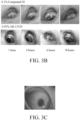
- FIG. 3A The results of eye irritation evaluation are shown in FIG. 3A , FIG. 3B and FIG. 3C .
- FIG. 3C shows that the cornea is still free of damage and turbidity after continuous administration for 7 days.
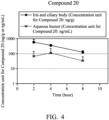
- the content analysis results of Compound 20 presenting in the iris and ciliary body and aqueous humor after administration are shown in FIG. 4 .
- the concentration of Compound 20 was measured in unit of ng/g; for aqueous humor, the concentration of Compound 20 is measured in unit of ng/mL.
- Compound 7 was taken as a representative, the eye drops containing 2% Compound 7 were administered to rabbit eyes (3 doses a day, with an interval of 3 hours each time, and observation was performed before administration and 1 hour after each administration). In addition, Eye drops containing 0.04% Compound 7 were administered to rabbit eyes (one dose a day, and observation was performed before administration and 1 hour and 6 hours after administration). According to the eye irritation test guidelines (OECD/OCDE 405) stipulated by the Organization for Economic Cooperation and Development (OECD) mentioned above, the eye irritation of Compound 7 was evaluated.
- OECD/OCDE 405 stipulated by the Organization for Economic Cooperation and Development (OECD) mentioned above
- Table 9 The results of evaluation of the effect of reducing intraocular pressure.
- Safety margin AR-13324 Compound 7 Therapeutic index (TI) 2 3 OECD Score AR-13324 (Therapeutic index: 2) Compound 7 (Therapeutic index: 3) Redness 1 1 Chemosis 1 0 Discharge 2 1 Total 4 2
- Eye drop containing 0.1% or 0.03% Compound 20 was administered to normal macaques. 0.02% AR-13324 was used as a benchmark to evaluate the medicinal effect competitiveness of the tested compounds.
- the intraocular pressure of animals was measured by a pneumatic tonometer (Model 30 TM Pneumatonometer). Animal anesthesia was required before intraocular pressure measurement. After topical administration (once a day), the intraocular pressure of the animals was measured at the set time points.
- Compound 20 can achieve an effect of reducing intraocular pressure which is equivalent to or better than that of AR-13324 in normal intraocular pressure macaque without obvious side effects, such as pink eye.
- New Zealand white rabbit male, weighing 2.0-3.0 kg. New Zealand white rabbits were purchased from a qualified laboratory animal rabbit farm in Taiwan before the experiment and were raised in the Animal Center of National Chiao Tung University.
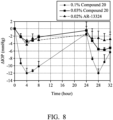
- Table 11 Test results of reducing intraocular pressure in a rabbit model of high intraocular pressure Transient ocular hypertension rabbits Dose Maximum intraocular pressure difference (mm Hg) Maximum intraocular pressure difference (%) AUC Physiological saline - - - 139.7 AR-13324 0.02% -7.7 ⁇ 4.2 -20.8% 132.9 Vehicle used to prepare eye drop of Compound 20 (without Compound 20) - +7.2 ⁇ 5.2 +16.2% NA Compound 20 0.1% -18.0 ⁇ 6.8 -40.4% 99.1 Maximum intraocular pressure difference: The difference between an individual's IOP readings and the average IOP readings of the negative control group 1 (physiological saline) at the time point at which the maximum response is recorded ( J Ocul Pharmacol Ther. 2010 Apr;26(2):125-132 )
- the results show that in the rabbit model of hyperosmolar saline-induced high intraocular pressure, the eye drop containing 0.1% Compound 20 can reduce the intraocular pressure by about 18.0 ⁇ 6.8 mmHg while the eye drop containing 0.02% AR-13324 can reduce the intraocular pressure by about 7.7 ⁇ 4.2 mmHg. It shows that the effect of Compound 20 in reducing intraocular pressure is significantly better than that of AR-13324 (t-test , p ⁇ 0.05). Moreover, compared with the physiological saline, the vehicle has no statistically significant difference (t-test). Compared with the physiological saline or the vehicle, AR-13324 also has no statistically significant difference (t-test).
- Exfoliation glaucoma is considered to be more serious than primary open angle glaucoma.
- the maximum intraocular pressure 38.2 vs 26.9 mmHg
- minimum intraocular pressure (24.7 vs 18.4 mmHg)
- mean intraocular pressure change (13.5 vs 8.5 mmHg) in exfoliative glaucoma and primary corner open glaucoma are statistically significant difference.
- there are currently no known diet therapies, drugs or other interventions that can prevent the occurrence of exfoliation syndrome or slow down its development Progress in Retinal and Eye Research Vol. 19, No. 3, pp. 345 to 368, 2000 ).
- the intraocular pressure of exfoliative glaucoma can reach> 30 mmHg, and there is currently no effective drug for it, and thus a high intraocular pressure model with an intraocular pressure> 30 mmHg is provided here to evaluate the feasibility of the compound of the present disclosure in the treatment of exfoliative glaucoma and ocular hypertension with intraocular pressure> 30 mmHg.
- New Zealand white rabbit male, body weight 2.0-3.0 kg.
- New Zealand white rabbits were purchased from Huijun Farm (Changhua, Taiwan) before the experiment and were raised in the Animal Center of National Chiao Tung University.
- Table 12 Test results of reducing intraocular pressure of Compound 20 in a model of magnetic bead induced high intraocular pressure rabbit Compound 20 Dose Maximum intraocular pressure difference (mmHg) AR-13324 0.02% 4.3 ⁇ 1.4 Compound 20 0.03% 5.7 ⁇ 0.6 0.1% 12.1 ⁇ 1.4
- the results show that in the model of magnetic bead induced high intraocular pressure rabbit (the high intraocular pressure model with intraocular pressure> 30 mmHg), the eye drop containing 0.03% Compound 20 can reduce the intraocular pressure by about 5.7 ⁇ 0.6 mmHg (by about 15.3%), and the eye drop containing 0.1% Compound 20 can reduce intraocular pressure by about 12.1 ⁇ 1.4 mmHg (by about 28.8%).
- the eye drop containing 0.03% Compound 20 and the eye drop containing 0.1% Compound 20 have better intraocular pressure reducing effects than those containing 0.02% AR-13324 (reducing intraocular pressure by about 4.3 ⁇ 1.4 mmHg (reducing by about 11.0%)), and the eye drop containing 0.1% Compound 20 can even be more than twice as effective as eye drops containing 0.02% AR-13324.
- Table 13 Test results of reducing intraocular pressure of Compound 7 in a model of magnetic bead induced high intraocular pressure rabbit Compound Dose Maximum intraocular pressure difference (mmHg) AR-13324 0.02% 3.6 ⁇ 2.1 Compound 7 0.5% 6.7 ⁇ 1.6 1% 11.8 ⁇ 0.8
- HTM cells Human Trabecular Meshwork (HTM) cells (Cat. NO. 6590) were obtained from ScienCell Research Laboratories. HTM cells were maintained in Trabecular Meshwork Cell Medium (TMCM) (Cat. NO. 6591). TMCM formulated from 500 mL basal medium, 10 mL FBS (Cat. NO. 0010), 5 mL trabecular meshwork cell growth supplement (TMCGS, Cat. NO. 6592) and 5 mL penicillin/streptomycin solution (P/S, Cat.NO. 503). When the cell growth reached 70-80% saturation, the HTM cells were treated overnight with 50 ⁇ g/mL dexamethasone (Cat. NO. 4902, Sigma).
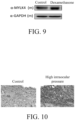
- MYLK4 and GAPDH in cell lysates were analyzed by Western blotting method.
- the expression of MYLK4 and GAPDH in cell lysates was analyzed by Western blotting method. First, the cells were collected and washed with 1x RIPA (50 mM Tris-HCl, pH 7.4, 150 mM NaCl, 0.25% deoxycholic acid, 0.1% NP-40, 1 mM EDTA, phosphatase inhibitor and protease inhibitor mixture).
- 1x RIPA 50 mM Tris-HCl, pH 7.4, 150 mM NaCl, 0.25% deoxycholic acid, 0.1% NP-40, 1 mM EDTA, phosphatase inhibitor and protease inhibitor mixture.
- the cell lysates were separated by SDS-PAGE (sodium dodecyl sulfate polyacrylamide gel electrophoresis) and transferred to PVDF membrane (iBlot TM 2 Transfer Stacks, polyvinylidene fluoride membrane, Invitrogen). Immunoblotting was performed on the membrane with primary antibodies (mouse anti-MYLK4 antibody (1:1,000, Cat. NO. SAB1412951) and mouse anti-GAPDH antibody (1:1,000, Cat. NO. G8795)), wherein GAPDH was used as a loading control. After that, the membrane was washed 3 times with 1X TBST. Next, the film and the secondary antibody (Cat. NO. 111-0350003, Cat.NO.111-035-164) were incubated for 1 hour at room temperature. The membrane was visualized by an enhanced chemiluminescence (WBKLS0500, Millipore) detection system (Fisher Scientific, US).
- WBKLS0500 enhanced chemiluminescence
- BIOTECHNOLOGY INC. was entrusted to perform immunohistochemical (IHC staining) for rabbit eyeball paraffin tissue sections, and in addition to the interpretation of the results of the trabecular meshwork, a score sheet of interpretation results and photomicrographs of different magnifications were also provided.
- the biomarkers for IHC staining are MYLK-4 and MLC-2.
- the tissue lesions were observed and recorded under a microscope at 20 times, 40 times, 100 times, 200 times, and 400 times.
- the lesion is scored based on the 5-level grading method recommended by INHAND (International Harmonization of Nomenclature and Diagnostic Criteria): Grade 0 means that there is no obvious pathological change and the lesions account for less than 1% of the total tissue; Grade 1 means that the disease is minimal (1-5%); Grade 2 means that the disease is mild (mild, 6 -25%); Grade 3 Represents moderate disease (moderate, 26-50%); Level 4 represents moderately severe disease (51-75%); Level 5 represents severe disease (severe/high, >76%).
- Integrating the foregoing experimental results shows that, compared to AR-13324 only targeting ROCK, the Compound 20 of the present disclosure can simultaneously targets ROCK, MYLK-4 and YSK-4.
- the intraocular pressure reducing effects of the Compound 20 of the present disclosure are better than those of AR-13324.
- Compound 20 of the present disclosure at the maximum effective dose has lower irritation than AR-13324.
Landscapes
- Chemical & Material Sciences (AREA)
- Organic Chemistry (AREA)
- Health & Medical Sciences (AREA)
- Ophthalmology & Optometry (AREA)
- Veterinary Medicine (AREA)
- Life Sciences & Earth Sciences (AREA)
- Chemical Kinetics & Catalysis (AREA)
- General Chemical & Material Sciences (AREA)
- Medicinal Chemistry (AREA)
- Nuclear Medicine, Radiotherapy & Molecular Imaging (AREA)
- Pharmacology & Pharmacy (AREA)
- Public Health (AREA)
- Animal Behavior & Ethology (AREA)
- General Health & Medical Sciences (AREA)
- Bioinformatics & Cheminformatics (AREA)
- Engineering & Computer Science (AREA)
- Pulmonology (AREA)
- Pharmaceuticals Containing Other Organic And Inorganic Compounds (AREA)
- Plural Heterocyclic Compounds (AREA)
- Acyclic And Carbocyclic Compounds In Medicinal Compositions (AREA)
Description
- The present disclosure relates to a novel compound, and particularly to a novel β-amino acid derivative, kinase inhibitor and pharmaceutical composition containing the same, and uses thereof.
- In order to keep the eyeball in a certain shape to maintain the optical function and metabolism of the eye, the ciliary body will secrete aqueous humor to perform this work. When the drainage route of aqueous humor is blocked and aqueous humor accumulates, an increase in intraocular pressure will be the result, which is the biggest risk factor for glaucoma.
- At present, it is known that aqueous humor drainage mainly occurs in the following three ways: (1) Schlemm's canal pathway (major, conventional pathway); (2) Uvea-sclera pathway (small amount), about 10%-20%; and (3) Absorption on the surface of the iris (minor amount). The mechanisms of reducing intraocular pressure of commonly used glaucoma drugs are: (a) reducing the production of aqueous humor, such as β-receptor blockers, carbonic anhydrase inhibitors, and α-receptor agonists; and (b) increasing the drainage of aqueous humor (Uveoscleral pathway), such as prostaglandin analogs, alpha receptor agonists, etc.
- The Rho/ROCK pathway plays an important role in the regulation of the cytoskeleton. Rho/ROCK inhibitors can regulate the functions of the actin cytoskeleton, extracellular matrix and Schlemm's tube endothelial cells in the trabecular meshwork tissue, thereby reducing the intraocular pressure.
- Currently, some pharmaceutical companies have begun to explore the impact of ROCK inhibitors on reducing intraocular pressure in humans, and have successively developed new drugs. After evaluating the clinical safety and effectiveness for humans, current commercial ROCK inhibitors for reducing intraocular pressure include Ripasudil (K-115) and Netarsudil (AR-13324). In the phase III clinical trial of Ripasudil, it was found that mild conjunctival hyperemia was the most common adverse reaction, with an incidence of up to 75%, and conjunctivitis and punctate keratitis also occurred. Netarsudil (AR-13324) is a ROCK/norepinephrine transporter (NET) inhibitor compound. In addition to acting as a ROCK inhibitor, it also has the effect of inhibiting norepinephrine and has the ability to continuously reduce intraocular pressure, and has good local tolerance, but it still has conjunctival hyperemia. In addition, Netarsudil (AR-13324) in Phase III clinical trials ROCKET1 and ROCKET2 (total 1,167 patients) is not as effective as the conventional glaucoma treatment drug Timolol in patients with intraocular pressure > 25 mmHg, but in patients < 25 mmHg, the efficacy is comparable to Timolol.
- Currently known ROCK inhibitors still have various side effects when applied to reducing intraocular pressure, and the long-term use of single-mechanism drugs may lead to the problem of reduced drug efficacy, making it impossible for patients to use a single drug for a long time. Therefore, it is still needed to develop new intraocular pressure reducing drugs with new targets or multiple targets to effectively reduce intraocular pressure and reduce side effects.
- Document
US 2012/135984 A1 describes compounds, compositions, and methods for treating diseases and conditions, wherein an inhibitor of a kinase, such as rho kinase (ROCK), and an inhibitor of one or more of the monoamine transporters, such as NET or SERT, act in concert to improve the condition. - Document
WO 2018/094362 A1 relates to certain amides and heterocyclic compounds and to the uses of these compounds to treat several diseases including autoimmune disorders, cardiovascular disorders, inflammation, central nervous system disorders, arterial thrombotic disorders, fibrotic disorders, glaucoma, and neoplastic disorders. - The full prescribing information on RHOPRESSA® "RHOPRESSA (netarsudil ophthalmic solution) Label, NDA, 208254, Reference ID: 4194833" describes that the chemical compound (S)-4-(3-amino-1-(isoquinolin-6-yl-amino)-1-oxopropan-2-yl)
benzyl 2,4-dimethylbenzoate dimesylate is a Rho kinase inhibitor. - The inventon is defined by the features of the independent claims.
- The present disclosure provides a compound represented by Formula (I) -(IV), a pharmaceutically acceptable salt or ester, hydrate, solvate or crystalline form thereof:


- The present disclosure also provides a kinase inhibitor comprising the compound represented by Formulae (I)-(IV), or a pharmaceutically acceptable salt or ester, hydrate, solvate or crystalline form thereof mentioned above.
- The present disclosure further provides a pharmaceutical composition comprising the compound represented by Formulae (I)-(IV), or a pharmaceutically acceptable salt or ester, hydrate, solvate or crystalline form thereof mentioned above.
- Moreover, the present disclosure provides a compound represented by Formulae (I)-(IV), or a pharmaceutically acceptable salt or ester, hydrate, solvate or crystalline form thereof mentioned above for use as a kinase inhibitor.
- The present disclosure also provides a use of the compound represented by Formulae (I)-(IV), or a pharmaceutically acceptable salt or ester, hydrate, solvate or crystalline form thereof mentioned above in the manufacture of a medicament, wherein the medicament is used for an in vivo related application that benefits from the inhibition of a kinase, and the kinase is at least one selected from a group consisting of: myosin
light chain kinase 4; mitogen-activated protein kinase 19; and a Rho-associated protein kinase. - In addition, the present disclosure also provides a use of the compound represented by Formulae (I)-(IV), or a pharmaceutically acceptable salt or ester, hydrate, solvate or crystalline form thereof mentioned above in the manufacture of a medicament for reducing intraocular pressure.
- A detailed description is given in the following embodiments with reference to the accompanying drawings.
- The present invention can be more fully understood by reading the subsequent detailed description and examples with references made to the accompanying drawings, wherein:
-
FIG. 1A shows the results of intraocular pressure measurements for administration of the compound of the present disclosure with a different concentration in rabbit eyes with normal intraocular pressure on theDay 1. -
FIG. 1B shows the results of intraocular pressure measurements for administration of the compound of the present disclosure with different concentration in rabbit eyes with normal intraocular pressure on theDay 3. -
FIG. 2 shows the intraocular pressure reducing effects of the compound of the present disclosure and a commercial drug in rabbit eyes with normal intraocular pressure. -
FIG. 3A shows the scores of eye irritation evaluation of the compound of the present disclosure and a commercial drug. -
FIG. 3B shows photographs of rabbit eyes treated with the compound of the present disclosure and a commercial drug in the eye irritation evaluation. -
FIG. 3C shows a photograph showing that the cornea of the rabbit eyes administered with the compound of the present disclosure continuously for 7 days shows no turbidity and damage in the eye irritation evaluation. -
FIG. 4 shows the test result in which in rabbit eyes with normal intraocular pressure, the drug concentration of the compound of the present disclosure at the target tissue reaches the target effect IC90 or more within 8 hours. For the iris and ciliary body, the concentration ofCompound 20 is measured in unit ng/g; for aqueous humor, the concentration ofCompound 20 is measured in unit ng/mL. -
FIG. 5 shows the results of the safety margin test of the compound of the present disclosure in rabbit eyes with normal intraocular pressure. -
FIG. 6 shows the intraocular pressure reducing effects of the compound of the present disclosure and a commercial drug in macaques with normal intraocular pressure. -
FIG. 7 shows the intraocular pressure reducing effects of the compound of the present disclosure and a commercial drug in rabbit eyes with high intraocular pressure induced by hypertonic saline. *: t-test, p-value <0.05 (compared to physiological saline); #: t-test, p-value <0.05 (compared to vehicle); φ: t-test, p-value <0.05 (compared to commercial drug (AR-13324)). -
FIG. 8 shows the intraocular pressure reducing effects of the compound of the present disclosure and a commercial drug in rabbit eyes with high intraocular pressure induced by magnetic beads. -
FIG. 9 shows the expression of myosin light chain kinase 4 (MYLK-4) in rabbit eyes with high intraocular pressure induced by magnetic beads. -
FIG. 10 shows the immunohistochemical staining of tissue sections of rabbit eyes with high intraocular pressure induced by magnetic beads. - In the following detailed description, for purposes of explanation, numerous specific details are set forth in order to provide a thorough understanding of the disclosed embodiments. It will be apparent, however, that one or more embodiments may be practiced without these specific details. In other instances, well-known structures and devices are schematically shown in order to simplify the drawing. The references to methods of treatment in the subsequent paragraphs of this description are to be interpreted as references to the compounds, pharmaceutical compositions and medicaments of the present invention for use in a method for treatment of the human (or animal) body by therapy (or for diagnosis).
- The present disclosure provides a novel β-amino acid derivative and provides a pharmaceutically acceptable salt or ester, hydrate, solvate or crystalline form of the novel β-amino acid derivative at the same time.
- The β-amino acid derivative mentioned above may comprise a compound represented by Formulae (I)-(IV), but it is not limited thereto:


- The compound represented by Formulae (I) to (IV) are a β-amino acid derivative. In Formula (I) X is a single bond; Y is NH; Z is C=O, C=S; W is CH; A is a single bond, O, OH, OCH2, or N3; R1 is H or F; R2 is H, F, OH, CF3, CH2OH, CHO or

Table 1: Compounds 1 to 15, 17 and 19 to 21 are examples for a compound represented by Formulae (I)-(IV), whilecompounds 16 and 18 are included for illustrative purpose and do not fall under the scope ofclaim 1.Compound Number Compound 1 Compound 2Structure 

Compound Number Compound 3 Compound 4Structure 

Compound Number Compound 5 Compound 6Structure 

Compound Number Compound 7 Compound 8Structure 

Compound Compound 9 Compound 10Number Structure 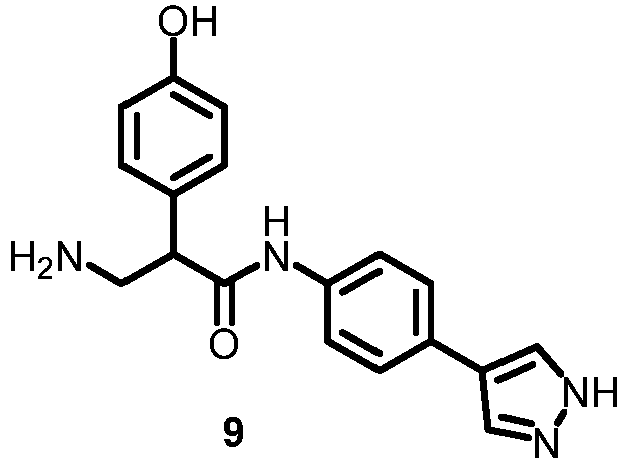

Compound Number Compound 11 Compound 12Structure 

Compound Number Compound 13 Compound 14Structure 
Compound Number Compound 15 Compound 16Structure 

Compound Number Compound 17 Compound 18 Structure 

Compound Number Compound 19 Compound 20Structure 

Compound Number Compound 21 Structure 
- In one embodiment, the compound represented by formula (I) of the present disclosure may be the
Compound 7 mentioned above, which is a racemic compound. In another embodiment, the compound represented by formula (I) of the present disclosure may be theCompound 20 mentioned above, which is an S-form compound, and more specifically, is an S-enantiomer. - In one embodiment, the novel β amino acid derivative of the present disclosure mentioned above or a pharmaceutically acceptable salt or ester, hydrate, solvate or crystalline form of the novel β amino acid derivative may have an effect of inhibiting a kinase, but it is not limited thereto. Example of the aforementioned kinase may comprise, but is not limited to, myosin light chain kinase 4 (MYLK-4), mitogen-activated protein kinase 19 (MAPK19, YSK-4), a Rho-associated protein kinase (ROCK) or any combination thereof. The Rho-associated protein kinase (ROCK) may comprise, but is not limited to, Rho-associated protein kinase-1 (ROCK-1).
- In one embodiment, the novel β amino acid derivative of the present disclosure mentioned above or a pharmaceutically acceptable salt or ester, hydrate, solvate or crystalline form of the novel β amino acid derivative may have an effect of inhibiting myosin
light chain kinase 4. - Furthermore, the novel β amino acid derivative of the present disclosure mentioned above or a pharmaceutically acceptable salt or ester, hydrate, solvate or crystalline form of the novel β amino acid derivative may have a synergistic target inhibiting effect. Therefore, in another embodiment, the novel β amino acid derivative of the present disclosure mentioned above or a pharmaceutically acceptable salt or ester, hydrate, solvate or crystalline form of the novel β amino acid derivative may have an effect of inhibiting mitogen-activated protein kinase 19.
- Moreover, in another embodiment, the novel β amino acid derivative of the present disclosure mentioned above or a pharmaceutically acceptable salt or ester, hydrate, solvate or crystalline form of the novel β amino acid derivative may have an effect of simultaneously inhibiting myosin
light chain kinase 4 and a Rho-associated protein kinase. - Also, in another embodiment, in another embodiment, the novel β amino acid derivative of the present disclosure mentioned above or a pharmaceutically acceptable salt or ester, hydrate, solvate or crystalline form of the novel β amino acid derivative may have an effect of simultaneously inhibiting mitogen-activated protein kinase 19 and a Rho-associated protein kinase.
- In addition, the novel β amino acid derivative of the present disclosure mentioned above or a pharmaceutically acceptable salt or ester, hydrate, solvate or crystalline form of the novel β amino acid derivative may have an effect of simultaneously inhibiting myosin
light chain kinase 4, mitogen-activated protein kinase 19 and a Rho-associated protein kinase. - In another embodiment, the novel β amino acid derivative of the present disclosure mentioned above or a pharmaceutically acceptable salt or ester, hydrate, solvate or crystalline form of the novel β amino acid derivative may have an effect of reducing intraocular pressure. In a specific embodiment, the novel β amino acid derivative of the present disclosure mentioned above or a pharmaceutically acceptable salt or ester, hydrate, solvate or crystalline form of the novel β amino acid derivative may achieve an effect of reducing intraocular pressure through myosin
light chain kinase 4, mitogen-activated protein kinase 19, a Rho-associated protein kinase or any combination thereof. - Since the novel β amino acid derivative of the present disclosure mentioned above or a pharmaceutically acceptable salt or ester, hydrate, solvate or crystalline form of the novel β amino acid derivative may have an effect of reducing intraocular pressure, it may be applied to a treatment and/or prevention of ocular hypertension or a disease with ocular hypertension. The above-mentioned ocular hypertension refers to a symptom of an intraocular pressure greater than a normal range. For example, human normal intraocular pressure is about 10-21 mmHg, and ocular hypertension is a symptom of intraocular pressure greater than about 21 mmHg, such as greater than about 22 mmHg, greater than about 25 mmHg, greater than about 30 mmHg, etc., but it is not limited thereto.
- In one embodiment, the novel β amino acid derivative of the present disclosure mentioned above or a pharmaceutically acceptable salt or ester, hydrate, solvate or crystalline form of the novel β amino acid derivative may be applied to a treatment and/or prevention of ocular hypertension with an intraocular pressure greater than about 25 mmHg, such as greater than about 30 mmHg.
- Based on the foregoing, the present disclosure also provides a kinase inhibitor, which may comprise any of the novel β amino acid derivative of the present disclosure mentioned above or a pharmaceutically acceptable salt or ester, hydrate, solvate or crystalline form of the novel β amino acid derivative, but it not limited thereto.
- In the kinase inhibitor of the present disclosure, the novel β amino acid derivative of the present disclosure mentioned above or a pharmaceutically acceptable salt or ester, hydrate, solvate or crystalline form of the novel β amino acid derivative may have an effect of inhibiting a kinase, and the kinase described herein may comprise, but is not limited to, myosin
light chain kinase 4, mitogen-activated protein kinase 19, a Rho-associated protein kinase or any combination thereof. The Rho-associated protein kinase may comprise, but is not limited to, Rho-associated protein kinase-1. - In the kinase inhibitor of the present disclosure, in one embodiment, the novel β amino acid derivative of the present disclosure mentioned above or a pharmaceutically acceptable salt or ester, hydrate, solvate or crystalline form of the novel β amino acid derivative may have an effect of inhibiting myosin light chain kinase-4 and/or mitogen-activated protein kinase-19. In the kinase inhibitor of the present disclosure, in another embodiment, the novel β amino acid derivative of the present disclosure mentioned above or a pharmaceutically acceptable salt or ester, hydrate, solvate or crystalline form of the novel β amino acid derivative, in addition to an effect of inhibiting myosin light chain kinase-4 and/or mitogen-activated protein kinase-19, may also have an effect of inhibiting a Rho-associated protein kinase.
- In one embodiment, the kinase inhibitor of the present disclosure may comprise the foregoing Compound 7 (which is a racemic compound) or Compound 20 (which is an S-form compound). In this specific embodiment, the kinase inhibitor of the present disclosure may have an effect of simultaneously inhibiting myosin
light chain kinase 4, mitogen-activated protein kinase 19 and a Rho-associated protein kinase. - In addition, based on the foregoing, the present disclosure can also provide a use of the novel β amino acid derivative of the present disclosure mentioned above or a pharmaceutically acceptable salt or ester, hydrate, solvate or crystalline form of the novel β amino acid derivative as a kinase inhibitor.
- In the use of the present disclosure, regarding the relevant description for the kinase inhibitory effect of the novel β amino acid derivative of the present disclosure mentioned above or a pharmaceutically acceptable salt or ester, hydrate, solvate or crystalline form of the novel β amino acid derivative is the same as that described above, and thus is not repeated herein.
- In this use of the present disclosure, in a specific embodiment, the novel β amino acid derivative of the present disclosure mentioned above may be the foregoing Compound 7 (which is a racemic compound) or Compound 20 (which is an S-form compound). In this specific embodiment, the kinase inhibitor mentioned above may have an effect of simultaneously inhibiting myosin
light chain kinase 4, mitogen-activated protein kinase 19 and a Rho-associated protein kinase. - In addition, the present disclosure also provides a pharmaceutical composition, which may comprise, but is not limited to, any of the novel β amino acid derivative of the present disclosure mentioned above or a pharmaceutically acceptable salt or ester, hydrate, solvate or crystalline form of the novel β amino acid derivative, but it not limited thereto.
- In the pharmaceutical composition of the present disclosure, regarding all for the kinase inhibitory effect of the novel β amino acid derivative of the present disclosure mentioned above or a pharmaceutically acceptable salt or ester, hydrate, solvate or crystalline form of the novel β amino acid derivative are the same as those described above, and thus are not repeated herein.
- In one embodiment, the pharmaceutical composition of the present disclosure may comprise the
foregoing Compound 7 which is a racemic compound. In another embodiment, the pharmaceutical composition of the present disclosure may comprise the foregoingCompound 20 which is an S-form compound. - Moreover, in one embodiment, the above-mentioned pharmaceutical composition of the present disclosure may also comprise a pharmaceutically acceptable carrier or salt, but it is not limited thereto.
- The pharmaceutically acceptable carrier mentioned above may comprise, but is not limited to, a solvent, a dispersion medium, a coating, an antibacterial and antifungal agent, or an isotonic and absorption delaying agent, etc. which is suitable for pharmaceutical administration. The pharmaceutical composition can be formulated into dosage forms for different administration routes utilizing conventional methods.
- Moreover, the pharmaceutically acceptable salt mentioned above may comprise, but is not limited to, salts including inorganic cation, such as alkali metal salts such as sodium salt, potassium salt or amine salt, such as alkaline-earth metal salt such as magnesium salt or calcium salt, such as the salt containing bivalent or quadrivalent cation such as zinc salt, aluminum salt or zirconium salt. In addition, the pharmaceutically acceptable salt may also be organic salt, such as dicyclohexylamine salt, methyl-D-glucamine, and amino acid salt such as arginine, lysine, histidine, or glutamine.
- Furthermore, the pharmaceutical composition of the present disclosure can be administered to a subject in need thereof, but is not limited thereto. The administration route of the pharmaceutical composition of the present disclosure may include parenteral manner, oral manner, via inhalation spray, or by implanted reservoir, but is not limited thereto. The parenteral methods may comprise, but is not limited to, smearing affected region, subcutaneous, intracutaneous, intravenous, intramuscular, intra-articular, intra-arterial, intrasynovial, intrasternal, intrathecal, intraleaional injection, external ophthalmic use, and intraocular injection, as well as infusion techniques, etc.
- Topical use form for smearing may include ointment, emulsion, liquid, gel, etc., but it is not limited thereto. In addition, external use form for eye may include, but is not limited to, eye drops, eye ointment, eye gel, etc.
- The subject in need to be administrated the pharmaceutical composition mentioned above may comprise, but is not limited to, a vertebrate. The vertebrate mentioned above may comprise a fish, an amphibian, a reptile, a bird or a mammal, but it is not limited thereto. Examples of the mammal may comprise, but are not limited to a human, an orangutan, a monkey, a horse, a donkey, a dog, a cat, a rabbit, a guinea pig, a rat and a mouse. In one embodiment, the said subject may be a human.
- In one embodiment, the above-mentioned pharmaceutical composition of the present disclosure can be used to any in vivo-related application that benefits from the inhibition of a kinase, such as benefiting from treatment and/or prevention of any disease or symptom that benefits from the inhibition of a kinase, and example of the kinase described herein may include, but are not limited to, myosin light chain kinase-4, mitogen-activated protein kinase-19, a Rho-associated protein kinase, or any combination thereof.
- In addition, the aforementioned in vivo-related application may include, but are not limited to, an ophthalmology-related application and/or a lung-related application, etc. Example of the ophthalmology-related application may include, protection of optic nerve, and/or prevention and/or treatment of high intraocular pressure, glaucoma, ocular stroke, macular degeneration, macular edema, diabetic retinopathy, Fuchs endothelial corneal dystrophy (FECD), corneal fibrosis or any combination thereof, etc., but it is not limited to thereto. Among them, glaucoma may include exfoliation glaucoma (XFG), open angle glaucoma, angle-closure glaucoma, secondary glaucoma, congenital glaucoma, etc., but not it is not limited to thereof. In addition, example of the lung-related application mentioned above may include, but is not limited to, prevention and/or treatment of pulmonary hypertension, chronic obstructive pulmonary disease (COPD), idiopathic pulmonary fibrosis (IPF), pulmonary emphysema, lung cancer, or any combination thereof, etc.
- Moreover, the pharmaceutical composition of the present disclosure can be formulated into a pharmaceutical preparation, but is not limited thereto. In one embodiment, the pharmaceutical composition of the present disclosure can be formulated into an ophthalmic preparation, but it is not limited thereto. Example of the aforementioned ophthalmic preparation mentioned above may include, but is not limited to, an eye drop, an ophthalmic ointment, an ophthalmic gel, an intraocular injection formulation, etc. In a specific embodiment, the pharmaceutical composition of the present disclosure can be formulated into an eye drop.
- In addition, the present disclosure can also provide a use of any of the novel β amino acid derivative of the present disclosure mentioned above or a pharmaceutically acceptable salt or ester, hydrate, solvate or crystalline form of the novel β amino acid derivative in the manufacture of a medicament, wherein the medicament is used for an in vivo related application that benefits from the inhibition of a kinase. Example of the above-mentioned kinase may include, but is not limited to, myosin light chain kinase-4, mitogen-activated protein kinase-19, a Rho-associated protein kinase, or any combination thereof.
- In one embodiment, in the above-mentioned use of the present disclosure, what is used is
Compound 7, which is a racemic compound. In one embodiment, in the above-mentioned use of the present disclosure, what is used is theCompound 20, which is an S-form compound. - Furthermore, in the above-mentioned use of the present disclosure, the foregoing in vivo-related application may include, but are not limited to, an ophthalmology-related application and/or a lung-related application, etc. Example of the ophthalmology-related application may include, protection of optic nerve, and/or prevention and/or treatment of high intraocular pressure, glaucoma, ocular stroke, macular degeneration, macular edema, diabetic retinopathy, Fuchs endothelial corneal dystrophy (FECD), corneal fibrosis or any combination thereof, etc., but it is not limited to thereto. Among them, glaucoma may include exfoliation glaucoma, open angle glaucoma, angle-closure glaucoma, secondary glaucoma, congenital glaucoma, etc., but not it is not limited to thereof. In addition, example of the lung-related application mentioned above may include, but is not limited to, prevention and/or treatment of pulmonary hypertension, chronic obstructive pulmonary disease (COPD), idiopathic pulmonary fibrosis (IPF), pulmonary emphysema, lung cancer, or any combination thereof, etc.
- In one embodiment, in the above-mentioned use of the present disclosure, the foregoing in vivo-related application may be the prevention and/or treatment of glaucoma.
- In the above-mentioned use of the present disclosure, in another embodiment, a pharmaceutically acceptable carrier or salt may be together with any of the novel β amino acid derivative of the present disclosure mentioned above or a pharmaceutically acceptable salt or ester, hydrate, solvate or crystalline form of the novel β amino acid derivative to prepare the medicament mentioned above.
- With regard to the pharmaceutically acceptable carrier or salt described herein, please refer to the relevant description of the pharmaceutically acceptable carrier or salt in the pharmaceutical composition of the present disclosure above, and thus is not repeated herein.
- Moreover, the present disclosure also provides a use of any of the novel β amino acid derivative of the present disclosure mentioned above or a pharmaceutically acceptable salt or ester, hydrate, solvate or crystalline form of the novel β amino acid derivative in the manufacture of a medicament for reducing intraocular pressure.
- In one embodiment, in the above-mentioned use of the present disclosure, what is used is
Compound 7, which is a racemic compound. In one embodiment, in the above-mentioned use of the present disclosure, what is used is theCompound 20, which is an S-form compound. - Furthermore, in one embodiment, in the above-mentioned use of the present disclosure, the foregoing medicament for reducing intraocular pressure may be used for prevention and/or treatment of ocular hypertension or a disease with ocular hypertension. Regarding the relevant descriptions of the ocular hypertension or a disease with ocular hypertension, please refer to the above descriptions, and thus are not repeated herein.
- In one embodiment, in the above-mentioned use of the present disclosure, the foregoing medicament for reducing intraocular pressure may be a medicament for treating glaucoma. The glaucoma mentioned above may include, but is not limited to, exfoliation glaucoma, open angle glaucoma, angle-closure glaucoma, secondary glaucoma, congenital glaucoma, etc.
- In addition, in one embodiment, in the above-mentioned use of the present disclosure, the foregoing medicament for reducing intraocular pressure may be an ophthalmic preparation. The ophthalmic preparations may include, but are not limited to, an eye drop, an ophthalmic ointment, an ophthalmic gel, an intraocular injection formulation, etc. In a specific embodiment, the foregoing medicament for reducing intraocular pressure may be may be an eye drop.
- In the above-mentioned use of the present disclosure, in another embodiment, a pharmaceutically acceptable carrier or salt may be together with any of the novel β amino acid derivative of the present disclosure mentioned above or a pharmaceutically acceptable salt or ester, hydrate, solvate or crystalline form of the novel β amino acid derivative to prepare the medicament for reducing intraocular pressure mentioned above.
- With regard to the pharmaceutically acceptable carrier or salt described herein, please refer to the relevant description of the pharmaceutically acceptable carrier or salt in the pharmaceutical composition of the present disclosure above, and thus is not repeated herein.
- The synthesis scheme of
Compound 1 andCompound 2 is shown in the followingScheme 1.

- To a mixture of 1-bromo-4-nitrobenzene (210 mg, 1.04 mmol), 1-Boc-4-pyrazoleboronic acid pinacol ester (305 mg, 1.04 mmol), PdCl2(dppf) (76 mg, 103.76 µmol) and Cs2CO3 (676 mg, 2.08 mmol) in a sealed tube, a mixed solvent (dioxane/H2O =10/1, 6 mL) was injected under argon, and then the mixture mentioned above was stirred at 90°C for 6 hours. After cooling to room temperature, the solvent was removed by rotary evaporation, and the residue was added with water and extracted with EtOAc (15 mL × 3). The combined organic layers were washed with brine, dried over anhydrous Na2SO4 and filtered. The filtrate was concentrated and the residue was purified by flash chromatography (EtOAc/Hex = 15%) on silica gel to give tert-butyl 4-(3-(2-(dimethylamino)ethoxy)-4-nitrophenyl)-1H-pyrazole (1a) which was a white solid (249 mg, 64 %).
- To a solution of tert-butyl 4-(3-(2-(dimethylamino)ethoxy)-4-nitrophenyl)-1H-pyrazole (1a) (360 mg) in MeOH (8 mL), 10% Pd/C was added, and the reaction mixture mentioned above was stirred at room temperature under H2 balloon atmosphere for 1 hour. The mixture was filtered, and the filtrate was evaporated by rotary evaporation to give tert-butyl-(4-amino-3-(2-(dimethylamino)ethoxy)phenyl)-1H-pyrazole (1b) as brown solid (320 mg, 97 %). 1H-NMR (500 MHz, CDCl3) δ: 8.44 (s, 1H), 8.27 (d, J=9.0 Hz, 2H), 8.06 (s, 1H), 7.69-7.68 (m, 4H), 1.68 (s, 9H), 1.59 (s, 9H).
- 2-azido-3-((tert-butoxycarbonyl)amino)propanoic acid (1.2 eq), HATU (1.5 eq) and DIPEA (2 eq) were dissolved in DMF (0.1 M), and tert-butyl-(4-amino-3-(2-(dimethylamino)ethoxy)phenyl)-1H-pyrazole (1b) (1.0 eq) was added thereto to form a mixture and stirred at room temperature for 1 hour. The reaction was workup by water and extracted with EtOAc. The organic layer was collected and dried over Na2SO4, and the extract was condensed under reduced pressure. The residue was purified with silica gel (EtOAc /Hex = 20%), and the desired compound tert-butyl 4-(4-(2-azido-3-((tert-butoxycarbonyl)amino)propanamido)phenyl)-1H-pyrazole-1-carboxylate (1c) was given. 1H-NMR (500 MHz, CDCl3) δ: 8.41 (s, 1H), 8.25 (s, 1H), 7.94 (s, 1H), 7.58 (d, J = 9.0 Hz, 2H), 7.47 (d, J =9.0 Hz, 2H), 5.07 (s, 1H), 4.27 (m, 1H), 3.72 (m, 1H), 3.60 (m, 1H), 1.65 (s, 9H), 1.43 (s, 9H).
- 4 M HCl in 1,4-dioxane (20 eq) and tert-butyl 4-(4-(2-azido-3-((tert-butoxycarbonyl) amino)propanamido)phenyl)-1H-pyrazole-1-carboxylate (1c) (1 eq) were stirred at room temperature for 1 hour. The white solid was collected by filtration, washed with 1,4-dioxane and DCM. The white solid was dried by vacuum to give N-(4-(1H-pyrazol-4-yl)phenyl)-3-amino-2-azidopropanamide dihydrochloride (1). 1H-NMR (500 MHz, D2O) δ: 8.30 (s, 2H), 7.67 (m, 2H), 7.55 (m, 2H), 4.76 (m, 1H), 3.57 (dd, J = 13.5, 4.5 Hz, 1H), 3.44 (dd, J=13.5, 7.5 Hz, 1H), 3.60 (m, 1H).
- Tert-butyl 4-(4-(2-azido-3-((tert-butoxycarbonyl)amino)propanamido)phenyl)-1H-pyrazole-1-carboxylate (1c) (1 eq), phenyl acetylene (1.1 eq), copper(II) sulfate (0.2 eq) and (+)-Na-L-ascorbate (0.2 eq) were stirred in THF and 2-3 drops H2O. The mixture was stirred at room temperature overnight, and then the solvent was removed. The residue was purified with silica gel (EtOAc /Hex = 20%), and the desired compound tert-butyl 4-(4-(3-((tert-butoxycarbonyl)amino)-2-(4-phenyl-1H-1,2,3-triazol-1-yl) propanamido)phenyl)-1H-pyrazole-1-carboxylate was given. 1H-NMR (500 MHz, CDCl3) δ: 8.98 (s, 1H), 8.24 (s, 1H), 8.11 (s, 1H), 7.94 (s, 1H), 7.83 (d, J=7.5 Hz, 2H), 7.58 (d, J=8.5 Hz, 2H), 7.46 (d, J=8.5 Hz, 2H), 7.42 (t, J=7.0 Hz, 2H), 7.34 (t, J = 7.0 Hz, 1H), 5.61 (s, 1H), 5.15 (s, 1H), 4.10-4.06 (m, 1H), 3.96-3.95 (m, 1H), 1.65 (s, 9H), 1.40 (s, 9H).
- The preparation method for
Compound 2 was similar to that forCompound 1. The distinction therebetween was that the compound tert-butyl 4-(4-(2-azido-3-((tert-butoxycarbonyl)amino)propanamido)phenyl)-1H-pyrazole-1-carboxylate was replace with the compound tert-butyl 4-(4-(3-((tert-butoxycarbonyl)amino)-2-(4-phenyl-1H-1,2,3-triazol-1-yl)propanamido)phenyl)-1H-pyrazole-1-carboxylate to obtain the product N-(4-(1H-pyrazol-4-yl)phenyl)-3-amino-2-(4-phenyl-1H-1,2,3-triazol-1-yl) propenamide dihydrochloride (2). 1H-NMR (500 MHz, CD3OD) δ: 8.63 (s, 1H), 8.61 (s, 1H), 7.88 (d, J=7.5 Hz, 2H), 7.74 (d, J=8.5 Hz, 2H), 7.67 (d, J=8.5 Hz, 2H), 7.45 (t, J=8.5 Hz, 2H), 7.37 (t, J=8.5 Hz, 1H), 5.97 (t, J=6.0 Hz, 1H), 5.54 (s, 1H), 3.92 (d, J=6.0 Hz, 2H), 3.34 (s, 2H). - The synthesis scheme of
Compound 3 toCompound 5 is shown in the followingScheme 2.

- The preparation method for Compound 3a was similar to that for Compound 1c. The distinction therebetween was that the compound 2-azido-3-((tert-butoxycarbonyl)amino)propanoic acid was replace with the compound 3-((tert-butoxycarbonyl)amino)-2-hydroxypropanoic acid to obtain the product tert-butyl 4-(4-(3-((tert-butoxycarbonyl)amino)-2-hydroxypropanamido)phenyl)-1H-pyrazole-1-carboxylate (3a). The synthesis method for the final product N-(4-(1H-pyrazol-4-yl)phenyl)-3-amino-2-hydroxypropanamide dihydrochloride (3) synthesis was similar to that for
Compound 1. 1H-NMR (500 MHz, D2O) δ: 8.20 (s, 2H), 7.70 (d, J=8.0, 2H), 7.56 (d, J=8.0, 2H), 4.64 (dd, J=8.5, 4.5 Hz, 1H), 3.51 (dd, J=13.5, 4.5 Hz, 1H), 3.36-3.31 (m, 1H). - To a zero degree solution of compound 3a (1eq), phenol (1 eq), PPh3 (2 eq) in 10 mL THF, DIAD (1.5 eq) was added dropwise. The mixture mentioned above was stirred at room temperature for 2 hours. The solvent was removed by reduced pressure, and the crude product was purified by column chromatography (EtOAc/Hex = 10%) to get tert-butyl 4-(4-(3-((tert-butoxycarbonyl)amino)-2-phenoxypropanamido)phenyl)-1H-pyrazole-1-carboxylate (4a) which was an oil. 1H-NMR (500 MHz, CDCl3) δ: 8.26 (s, 2H), 7.96 (s, 1H), 7.58 (d, J=9.0 Hz, 2H), 7.48 (d, J=9.0 Hz, 2H), 7.35 (t, J=8.0 Hz, 2H), 7.09-6.99 (m, 3H), 5.03 (brs, 1H), 4.76 (t, J=5.0 Hz, 1H), 3.81-3.78 (m, 1H), 3.73-3.70 (m, 1H), 1.68 (s, 9H), 1.45 (s, 9H). The synthesis method for the final product N-(4-(1H-pyrazol-4-yl)phenyl)-3-amino-2-phenoxypropanamide dihydrochloride (4) was similar to that for
Compound 1. 1H-NMR (500 MHz, CD3OD) δ: 8.30 (s, 2H), 7.66 (d, J=9.0 Hz, 2H), 7.59 (d, J=9.0 Hz, 2H), 7.36 (d, J=8.5 Hz, 2H), 7.12 (d, J=8.5 Hz, 1H), 7.07 (t, J=7.0 Hz, 1H), 7.01-6.98 (m, 1H), 3.75-3.66 (m, 1H), 3.60-3.50 (m, 2H). - The synthesis method for the compound N-(4-(1H-pyrazol-4-yl)phenyl)-3-amino-2-(4-(trifluoromethyl) phenoxy)propenamide dihydrochloride (5) was similar to that for
Compound 4. 1H-NMR (500 MHz, CD3OD) δ: 8.14 (br, 2H), 7.68 (d, J = 9.0, 2H), 7.63 (d, J = 6.5, 2H), 7.58 (d, J = 6.5, 2H), 7.26 (d, J = 9.0, 2H), 5.21 (m, 1H), 3.60-3.58 (m, 2H). 1H-NMR (500 MHz, CD3OD) δ: 8.14 (br, 2H), 7.68 (d, J=9.0, 2H), 7.63 (d, J=6.5, 2H), 7.58 (d, J=6.5, 2H), 7.26 (d, J=9.0, 2H), 5.21 (m, 1H), 3.60-3.58 (m, 2H). - The synthesis scheme of
Compound 6 is shown in the following Scheme 3:
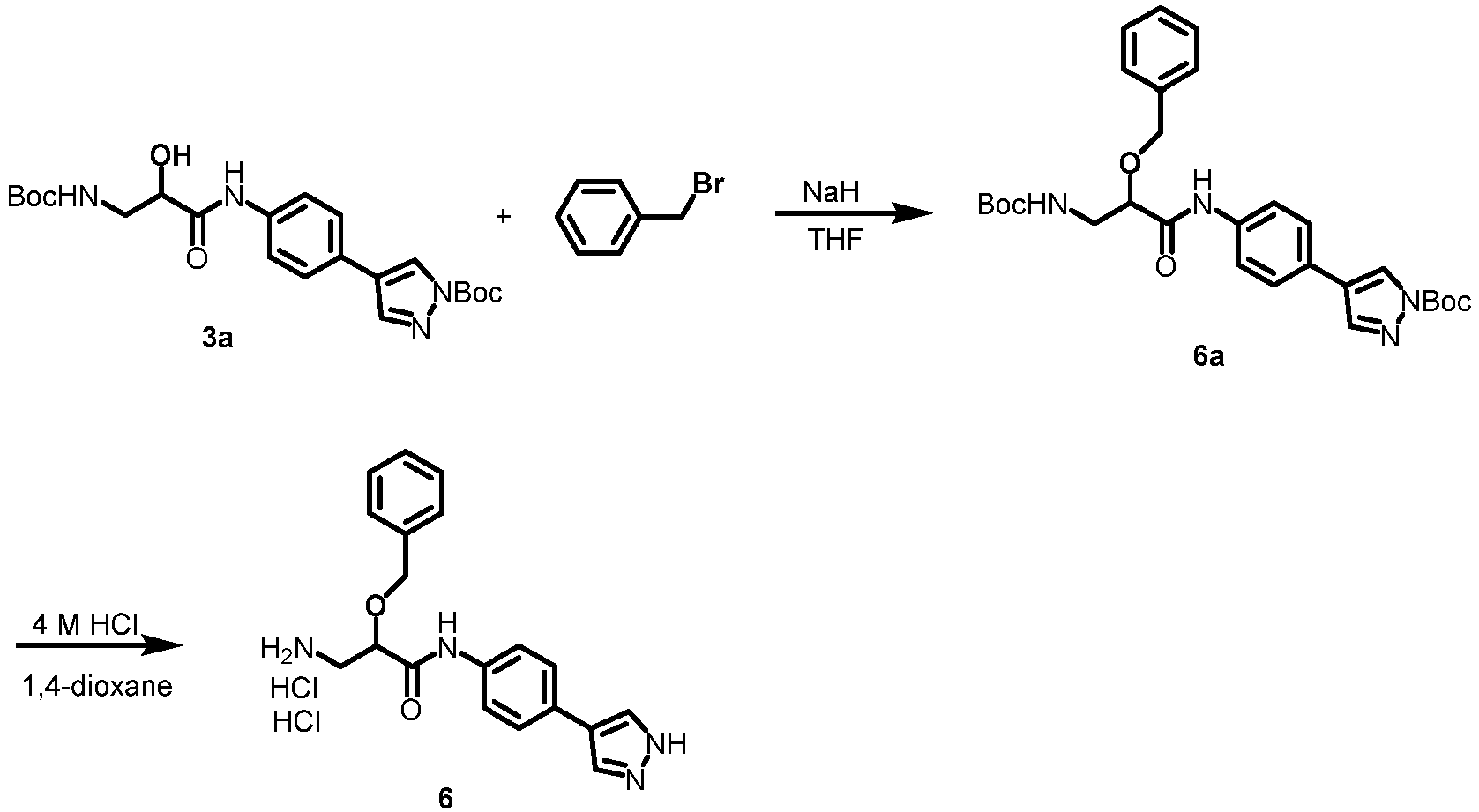
- To a zero degree solution of compound 3a (1 eq) in 10 mL THF, NaH (1.5 eq) was add. The mixture mentioned above was stirred at zero degree for 1 hour, and then BnBr (1.5 eq) was added dropwise thereto. The reaction mixture mentioned above was stirred at room temperature for 6 hours. The reaction was workup by water and extracted with EtOAc. The organic layer was collected and dried over Na2SO4, and then the extract was removed under reduced pressure. The residue was purified with silica gel (EtOAc /Hex = 5% to 15%) to give the desired compound tert-butyl 4-(4-(2-(benzyloxy)-3-((tert-butoxycarbonyl)amino)propanamido)phenyl)-1H-pyrazole-1-carboxylate (6a). 1H-NMR (500 MHz, CDCl3) δ: 8.44 (s, 1H), 8.27 (s, 1H), 7.97 (s, 1H), 7.56 (d, J=8.5 Hz, 2H), 7.48 (d, J=8.5 Hz, 2H), 7.41-7.35 (m, 5H), 4.93 (brs, 1H), 4.82 (d, J=8.5 Hz, 1H), 4.66 (d, J=11.0 Hz, 1H), 4.06 (t, J=5.0 Hz, 1H), 3.65-3.61 (m, 2H), 1.68 (s, 9H), 1.44 (s, 9H).
- The synthesis method for the final product N-(4-(1H-pyrazol-4-yl)phenyl)-3-amino-2-(benzyloxy) propanamidedihydrochloride (6) was similar to that for
Compound 1. 1H-NMR (500 MHz, CD3OD) δ: 8.46 (s, 2H), 7.69-7.66 (m, 4H), 7.49 (d, J=7.5 Hz, 2H), 7.38 (t, J=7.5 Hz, 2H), 7.34-7.31 (m, 1H), 4.78 (d, J=11.5 Hz, 1H), 4.75 (d, J=11.5 Hz, 1H), 4.36-4.34 (m, 1H), 3.36-3.31 (m, 2H). - The synthesis scheme of
Compound 7 andCompound 8 is shown in the followingScheme 4.
- The preparation methods for the intermediate compounds 7a and 8a were similar to that for Compound 1c.
- The intermediate compound tert-butyl 4-(4-(3-((tert-butoxycarbonyl)amino)-2-phenylpropanamido)phenyl)-1H-pyrazole-1-carboxylate 7a was white powder. 1H-NMR (500 MHz, CDCl3) δ: 8.22 (s, 1H), 7.92 (s, 1H), 7.49 (d, J=8.5 Hz, 2H), 7.42 (d, J=8.5 Hz, 2H), 5.14 (s, 1H), 3.90 (m, 1H), 3.65 (m, 1H), 3.55 (m, 1H), 1.64 (s, 9H), 1.40 (s, 9H).
- The intermediate compound tert-butyl 4-(4-(3-((tert-butoxycarbonyl)amino)-2-(4-fluorophenyl)propanamido)phenyl)-1H-pyrazole-1-carboxylate 8a was white powder. 1H-NMR (CDCl3, 500 MHz) 8.25 (s, 1H), 7.94 (s, 1H), 7.53-7.51 (m, 3H), 7.45 (d, J=8.5 Hz, 2H), 7.34 (t, J=8.5 Hz, 2H), 7.05 (t, J=8.5 Hz, 2H), 5.13 (brs, NH, 1H), 3.92 (s, 1H), 3.65-3.64 (m, 1H), 3.54-3.51 (m, 1H), 1.67 (s, 9H), 1.47 (s, 9H).
- The preparation methods for the
final Compounds Compound 1. - The final compound N-(4-(1H-pyrazol-4-yl)phenyl)-3-amino-2-phenylpropanamide dihydrochloride (7) was white powder. 1H-NMR (500 MHz, CD3OD) δ: 8.55 (br, 2H), 7.69 (d, J=8.5, 2H), 7.63 (d, J=8.5, 2H), 7.47-7.34 (m, 5H), 4.15-4.17 (m, 1H), 3.61 (dd, J=12.5, 9.5 Hz, 1H), 3.25 (dd, J=12.5, 5.5 Hz, 1H), 3.60 (m, 1H).
- The final compound N-(4-(1H-pyrazol-4-yl)phenyl)-3-amino-2-(4-fluorophenyl) propanamide dihydrochloride (8) was white powder. 1H-NMR (500 MHz, D2O) δ: 8.07 (s, 2H), 7.42 (d, J=8.5 Hz, 2H), 7.34 (dd, J=5.5, 8.5 Hz, 2H), 7.26 (d, J=8.5 Hz, 2H), 7.08 (t, J=8.5 Hz, 2H), 4.06 (t, J=7.5 Hz, 1H), 3.52 (dd, J=7.5, 13.0 Hz, 1H), 3.33 (dd, J=7.5, 13.0 Hz, 1H).
- The synthetic scheme of Compound 9f is shown in the following
Scheme 5.
- To a solution of iodophenol (9a) (100 g, 454.5 mmol) in DCM (1000 mL), imidazole (68 g, 999.9 mmol) was added, followed by dropwise addition of TIPSCl (87.3 g, 454.5 mmol). The mixture mentioned above was stirred for 16 hours and poured into ice/water, and extracted with DCM. The organic layers were washed with brine, dried over Na2SO4 and concentrated. The residue was purified by silica gel column chromatography (eluting solvent: ethyl acetate/petroleum ether = 1/50) to give Compound 9b (170 g, 99.1 %), which was colorless oil. 1H-NMR (CDCl3, 400 MHz): δ: 1.05-1.08 (d, 18H), 1.20-1.28 (m, 3H), 6.64-6.66 (m, 2H), 7.47-7.49 (m, 2H).
- To a solution of Compound 9b (140 g, 372.3 mmol) in dioxane (1500 mL), ethyl 2-cyanoacetate (63.1 g, 558.8 mmol), picolinic acid (13.8 g, 111.7 mmol), Cs2CO3 (242 g, 744.6 mmol) and CuI (21.2 g, 111.7 mmol) were added. The mixture was mentioned above stirred for 2 hours at 90°C and filtered. The organic layer was concentrated and purified by silica gel column chromatography (eluting solvent: ethyl acetate/petroleum ether = 1/20) to give Compound 9c (44 g, 32.7 %), which was white solid.
- To a solution of compound 9c (22 g, 60.9 mmol) in MeOH/THF (2:1, 660 mL), CoCl26H2O (44 g, 184.9 mmol) and NaBH4 (33 g, 868.4 mmol) were added at -20°C. The mixture mentioned above was stirred for 30 minutes and filtered to obtain a filtrate. To the filtrate, (Boc)2O (40 g, 183.5 mmol) was added, and stirred for 0.5 hours at room temperature. Next, the mixture mentioned above was poured into ice/water and extracted with EtOAc. The organic layer was washed with brine, dried over Na2SO4 and concentrated. The residue was purified by silica gel column chromatography (eluting solvent: ethyl acetate/ petroleum ether = 1/30) to give compound 9e (10.5 g, 35.9 %), which was yellow oil. 1H-NMR (CDCl3, 400 MHz): δ: 1.53-1.09 (t, 18H), 1.17-1.28 (m, 6H), 1.42 (s, 9H), 3.46-3.56 (m, 2H), 3.77-3.80 (t, 1H), 4.11-4.18 (m, 2H), 4.82 (s, 1H), 6.81-6.83 (d, 2H), 7.09-7.11 (d, 2H).
- To a solution of Compound 9e (10 g, 21.5 mmol) in EtOH/H2O (10:1, 220 mL), NaOH (2 g, 49.5 mmol) was added and stirred for 1 hour at room temperature. The mixture mentioned above was neutralized with 1 N HCl and extracted with EtOAc. The organic layer was washed with brine, dried over Na2SO4 and concentrated. The residue was purified by silica gel column chromatography (eluting solvent: ethyl acetate/petroleum ether = 1/10) to give compound 9f (2.5 g, 26.6 %), which was a white solid. 1H-NMR (DMSO-d6, 400 MHz): δ: 1.08-1.10 (d, 18H), 1.22-1.32 (m, 3H), 1.37 (s, 9H), 3.23-3.28 (m, 1H), 3.42-3.46 (t, 1H), 3.69-3.73 (t, 1H), 6.85-6.87 (d, 3H), 7.16-7.18 (d, 2H).
- The synthesis scheme of
Compound 9 is shown in the followingScheme 6.
- The preparation method for the intermediate Compounds 9g was similar to that for Compound 1c.
- The intermediate compound tert-butyl 4-(4-(3-((tert-butoxycarbonyl)amino)-2-(4-((triisopropylsilyl)oxy)phenyl)propanamido)phenyl)-1H-pyrazole-1-carboxylate 9g was white powder. 1H-NMR (CDCl3, 500 MHz) 8.25 (s, 1H), 7.94 (s, 1H), 7.49 (d, J=8.5 Hz, 2H), 7.44 (d, J=8.5 Hz, 2H), 7.30 (brs, NH, 1H), 7.19 (d, J=8.5 Hz, 2H), 6.87 (d, J=8.5 Hz, 2H), 5.17 (brs, NH, 1H), 3.82 (s, 1H), 3.64-3.62 (m, 1H), 3.56-3.53 (m, 1H), 1.67 (s, 9H), 1.43 (s, 9H), 1.30-1.20 (m, 3H), 1.09 (d, J=7.0 Hz, 18H).
- To a stirred solution of tert-butyl 4-(4-(3-((tert-butoxycarbonyl)amino)-2-(4-((triisopropylsilyl)oxy)phenyl)propanamido)phenyl)-1H-pyrazole-1-carboxylate (9g) (1030 mg, 1.52 mmol) in THF (10 mL), 1 M TBAF in THF solution (3.03 mL, 3.03 mmol) was added. The resulting mixture was stirred at room temperature for 1 hour. The reaction was workup by water and extracted with EtOAc. The organic layer was collected and dried over Na2SO4, and the extract was condensed under reduced pressure. The residue was purified with preparative reverse HPLC (80 % ACN, 20 % H2O), and then lyophilized to get tert-butyl 4-(4-(3-((tert-butoxycarbonyl)amino)-2-(4-hydroxyphenyl)propanamido)phenyl)-1H-pyrazole-1-carboxylate (9h) (600 mg, 76 %), which was white powder. 1H-NMR (CDCl3, 500 MHz) 8.25 (s, 1H), 7.94 (s, 1H), 7.50 (d, J=8.5 Hz, 2H), 7.45-7.43 (m, 3H), 7.15 (d, J=8.5 Hz, 2H), 6.81 (d, J=8.5 Hz, 2H), 5.26 (brs, NH, 1H), 3.80 (s, 1H), 3.62 (s, 1H), 3.55-3.53 (m, 1H), 1.67 (s, 9H), 1.62 (brs, OH, 1H), 1.43 (s, 9H).
- The preparation method for the
final Compound 9 was similar to that forCompound 1. - The final compound N-(4-(1H-pyrazol-4-yl)phenyl)-3-amino-2-(4-hydroxyphenyl) propanamide dihydrochloride (9) was white powder. 1H-NMR (500 MHz, D2O) δ: 8.06 (s, 2H), 7.39 (d, J=8.5 Hz, 2H), 7.24 (d, J=8.5 Hz, 2H), 7.20 (d, J=8.5 Hz, 2H), 6.82 (d, J=8.5 Hz, 2H), 3.97 (t, J=7.5 Hz, 1H), 3.49 (dd, J=7.5, 13.0 Hz, 1H), 3.30 (dd, J=7.5, 13.0 Hz, 1H).
- The synthesis scheme of
compound 10 is shown in the followingScheme 7.

- To a stirred solution of tert-butyl 4-(4-(3-((tert-butoxycarbonyl)amino)-2-(4-hydroxyphenyl)propanamido)phenyl)-1H-pyrazole-1-carboxylate (9h) (356 mg, 0.68 mmol), 2,4-dimethylbenzoic acid (103 mg, 0.68 mmol) and NEt3 (143 ul, 1.02 mmol) in CH2Cl2 (20 mL), EDCI (196 mg, 1.02 mmol) and DMAP (25 mg, 0.21 mmol) were added. The resulting mixture was stirred for 16 hours. The reaction was workup by saturated citric acid and extracted with EtOAc. The organic layer was collected and dried over Na2SO4, and the solvent was removed under reduced pressure. The residue was purified with preparative reverse HPLC (100 % ACN), and then lyophilized to get tert-butyl 4-(4-(3-((tert-butoxycarbonyl)amino)-2-(4-((2,4-dimethylbenzoyl)oxy)phenyl)propanamido)phenyl)-1H-pyrazole-1-carboxylate (10a) (355 mg, 80 %), which was white powder. 1H-NMR (CDCl3, 500 MHz) 8.26 (s, 1H), 8.06 (d, J=8.0 Hz, 1H), 7.96 (s, 1H), 7.53 (d, J=8.5 Hz, 2H), 7.52-7.42 (m, 5H), 7.21 (d, J=8.5 Hz, 2H), 5.15 (brs, NH, 1H), 3.95 (s, 1H), 3.68-3.67 (m, 1H), 3.58-3.55 (m, 1H), 2.63 (s, 3H), 2.40 (s, 3H), 1.67 (s, 9H), 1.44 (s, 9H).
- In the 20 mL vial, tert-butyl 4-(4-(3-((tert-butoxycarbonyl)amino)-2-(4-((2,4-dimethylbenzoyl)oxy)phenyl)propanamido)phenyl)-1H-pyrazole-1-carboxylate (10a) (350 mg, 0.54 mmol) and 4 M HCl in dioxane (2.7 mL) were charged. The resulting mixture was stirred at room temperature for 1 hour. The solvent was removed under reduced pressure to give the desired product 4-(1-((4-(1H-pyrazol-4-yl)phenyl)amino)-3-amino-1-oxopropan-2-yl)
phenyl 2,4-dimethylbenzoate dihydrochloride (10) which was as white powder (271 mg, 96 %). 1H-NMR (500 MHz, DMSO) δ: 10.47 (s, 1H), 8.08 (brs, 3H), 8.02 (s, 2H), 7.94 (d, J=8.5 Hz, 1H), 7.61 (d, J=9.0 Hz, 2H), 7.53 (d, J=8.5 Hz, 2H), 7.50 (d, J=8.5 Hz, 2H), 7.28 (d, J=8.5 Hz, 2H), 7.19 (d, J=9.0 Hz, 2H), 4.18 (dd, J=5.5, 8.5 Hz, 1H), 3.15-3.06 (m, 1H), 2.52 (s, 3H), 2.34 (s, 3H). - The synthesis scheme of Compound 11g is shown in the following
Scheme 8.
- To a zero degree solution of 2-(4-(hydroxymethyl)phenyl)acetic acid (5233 mg, 31.49 mmol) in CH2Cl2 (25 mL) and MeOH (6 mL), TMS diazomethane (23.6 mL of a 2 M solution in hexanes, 47.23 mmol) was added dropwise. After 15 minutes, the reaction was quenched by the addition of HOAc (1 mL). The reaction mentioned above was diluted with EtOAc (100 mL) and washed with saturated NaHCO3 (2 x 25 mL) and brine (25 mL). The organic layer was dried (Na2SO4), filtered and concentrated. The residue was purified by flash chromatography (0 to 33 percent EtOAc/hexanes) to afforded methyl 2-(4-(hydroxymethyl)phenyl)acetate (11b). 1H-NMR (500 MHz, CDCl3): δ: 7.33 (d, J=7.5 Hz, 2H), 7.27 (d, J=7.5 Hz, 2H), 4.68 (s, 2H), 3.69 (s, 3H), 3.63 (s, 2H).
- To a zero degree solution of methyl 2-(4-(hydroxymethyl)phenyl)acetate (11b) (5674 mg, 31.49 mmol) in CH2Cl2 (50 mL), 2,6-lutidine (5.47 mL, 47.23 mmol) and TIPS-OTf (14.48 g, 47.23 mmol) were added. The ice bath was removed and the solution was allowed to warm to room temperature and stirred. After 2 hours, the reaction was quenched by the addition of NH4Cl(aq) (50 mL). The reaction was diluted with CH2Cl2 (100 mL) and washed with H2O (2 x 50 mL) and brine (50 mL). The organic layer was dried (Na2SO4), filtered and concentrated. The residue was purified by flash chromatography (0 to 5 percent EtOAc/hexanes) to afforded methyl 2-(4-(((triisopropylsilyl)oxy)methyl)phenyl)acetate (11c). 1H-NMR (500 MHz, CDCl3): δ 7.31 (d, J=8.0 Hz, 2H), 7.24 (d, J=8.0 Hz, 2H), 4.82 (s, 2H), 3.69 (s, 3H), 3.62 (s, 2H), 1.21-1.15 (m, 3H), 1.10-1.06 (m, 18H).
- To a -78°C solution of methyl 2-(4-(((triisopropylsilyl)oxy)methyl)phenyl)acetate (11c) (10.60 g, 31.49 mmol) in THF (50 mL), LiHMDS (47.30 mL, 47.23 mmol) was added dropwise. After 30 minutes, the bromo-methyl phthalimide (11.34 g, 47.23 mmol) in THF (50 mL) was added dropwise at the same temperature. The -78°C bath was removed and the solution was allowed to warm to room temperature and stirred. After 2 hours, the reaction was quenched by the addition of NH4Cl(aq) (40 mL) and extracted with EtOAc (100 mL). The organic layer was dried (Na2SO4), filtered and concentrated. The residue was purified by flash chromatography (0 to 10 percent EtOAc/hexanes) to afforded methyl 3-(1,3-dioxoisoindolin-2-yl)-2-(4-(((triisopropylsilyl)oxy)methyl)phenyl) propanoate (11d). 1H-NMR (500 MHz, CDCl3): δ 7.79-7.76 (m, 2H), 7.69-7.67 (m, 2H), 7.30-7.28 (m, 4H), 4.77 (s, 2H), 4.31 (t, J=7.5 Hz, 1H), 4.26-4.15 (m, 2H), 3.66 (s, 3H), 1.17-1.06 (m, 3H), 1.05-1.02 (m, 18H).
- To a stirred solution of methyl 3-(1,3-dioxoisoindolin-2-yl)-2-(4-(((triisopropylsilyl) oxy)methyl)phenyl)propanoate (11d) (4.39 g, 8.86 mmol) in MeOH (30 mL) and EtOH (50 mL), hydrazine hydrate (2.22 g, 44.29 mmol) was added, and the solution was refluxed for 2 hours. The solids were filtered and the solvents were evaporated. The residue was purified by flash chromatography (0 to 50 percent EtOAc/hexanes) to afforded methyl 3-amino-2-(4-(((triisopropylsilyl)oxy)methyl)phenyl)propanoate (11e).
- To a stirred solution of methyl 3-amino-2-(4-(((triisopropylsilyl)oxy)methyl) phenyl)propanoate (11e) (3.19 g, 8.74 mmol) in CH2Cl2 (50 mL), TEA (2.44 mL, 17.47 mmol) and (Boc)2O (17.47) were added. The solution was stirred at room temperature for 4 hours, and then poured into CH2Cl2/NaHCO3(aq). The aqueous layers were further extracted with CH2Cl2, dried (Na2SO4), filtered and evaporated. The residue was purified by flash chromatography (0 to 4 percent EtOAc/hexanes) to afforded methyl 3-((tert-butoxycarbonyl)amino)-2-(4-(((triisopropylsilyl)oxy)methyl)phenyl)propanoate (11f). 1H-NMR (500 MHz, CDCl3): δ 7.32 (d, J=7.5 Hz, 2H), 7.22 (d, J=7.5 Hz, 2H), 4.86-4.82 (m, 1H), 4.77 (s, 2H), 3.88-3.83 (m, 1H), 3.68 (s, 3H), 3.63-3.57 (m, 1H), 3.51-3.48 (m, 1H), 1.42 (s, 9H), 1.21-1.14 (m, 3H), 1.10-1.08 (m, 18H).
- To a solution of methyl 3-((tert-butoxycarbonyl)amino)-2-(4-(((triisopropylsilyl) oxy)methyl)phenyl)propanoate (11f) (2.07 g, 4.44 mmol) in THF/MeOH (1:1, 40 mL), NaOH (8.88 mL, 17.76 mmol) was added, and stirred for 2 hours at room temperature. The mixture was neutralized with 1 N HCl and extracted with EtOAc. The organic layer was washed with brine, dried over Na2SO4 and concentrated. The residue was purified by silica gel column chromatography (eluting solvent: EtOAc/Hexanes = 1/3) to give 3-((tert-butoxycarbonyl)amino)-2-(4-(((triisopropylsilyl)oxy)methyl)phenyl)propanoic acid (11g) (1.84 g, 92 %), which was a white solid. 1H-NMR (500 MHz, CDCl3): δ 7.35 (d, J=7.5 Hz, 2H), 7.28 (d, J=7.5 Hz, 2H), 6.77 (brs, 0.5H), 4.92 (brs, 0.5H), 4.82 (s, 2H), 3.91-3.80 (m, 1H), 3.59-3.50 (m, 2H), 1.46-1.42 (m, 9H), 1.21-1.14 (m, 3H), 1.10-1.08 (m, 18H).
- The synthesis scheme of Compound 11 is shown in the following
Scheme 9.
- The synthesis method for the final Compound 11 was similar to that for
Compound 9. - The compound tert-butyl 4-(4-(3-((tert-butoxycarbonyl)amino)-2-(4-(((triisopropylsilyl)oxy)methyl)phenyl)propanamido)phenyl)-1H-pyrazole-1-carboxylate (11h) was white powder. 1H-NMR (500 MHz, CDCl3): δ 8.25 (s, 1H), 7.95 (s, 1H), 7.50 (d, J=7.5 Hz, 2H), 7.45 (d, J=7.5 Hz, 2H), 7.37 (d, J=7.5 Hz, 2H), 7.33-7.31 (m, 3H), 5.15 (brs, 1H), 4.83 (s, 2H), 3.90 (brs, 1H), 3.68 (brs, 1H), 3.58-3.55 (m, 1H), 1.67 (s, 9H), 1.43 (s, 9H), 1.26-1.14 (m, 3H), 1.10-1.08 (m, 18H).
- The compound tert-butyl 4-(4-(3-((tert-butoxycarbonyl)amino)-2-(4-(hydroxymethyl)phenyl)propanamido)phenyl)-1H-pyrazole-1-carboxylate (11i) was white powder. 1H-NMR (500 MHz, CDCl3): δ 8.25 (s, 1H), 7.94 (s, 1H), 7.51 (d, J=8.0 Hz, 2H), 7.46-7.44 (m, 3H), 7.39-7.37 (m, 4H), 5.15 (brs, 1H), 3.92 (brs, 1H), 3.67-3.66 (m, 1H), 3.56-3.54 (m, 1H), 1.67-1.64 (m, 10H), 1.43 (s, 9H).
- The final compound N-(4-(1H-pyrazol-4-yl)phenyl)-3-amino-2-(4-(hydroxymethyl) phenyl)propenamide dihydrochloride (11) was white powder. 1H-NMR (500 MHz, D2O) δ: 8.05 (s, 2H), 7.44 (d, J=9.0 Hz, 2H), 7.35 (s, 4H), 7.27 (d, J=9.0 Hz, 2H), 4.53 (s, 2H), 4.08 (t, J=6.5 Hz, 1H), 3.56 (dd, J=6.5, 13.0 Hz, 1H), 3.36 (dd, J=6.5, 13.0 Hz, 1H).
- The synthesis scheme of
Compound 12 is shown in the followingScheme 10.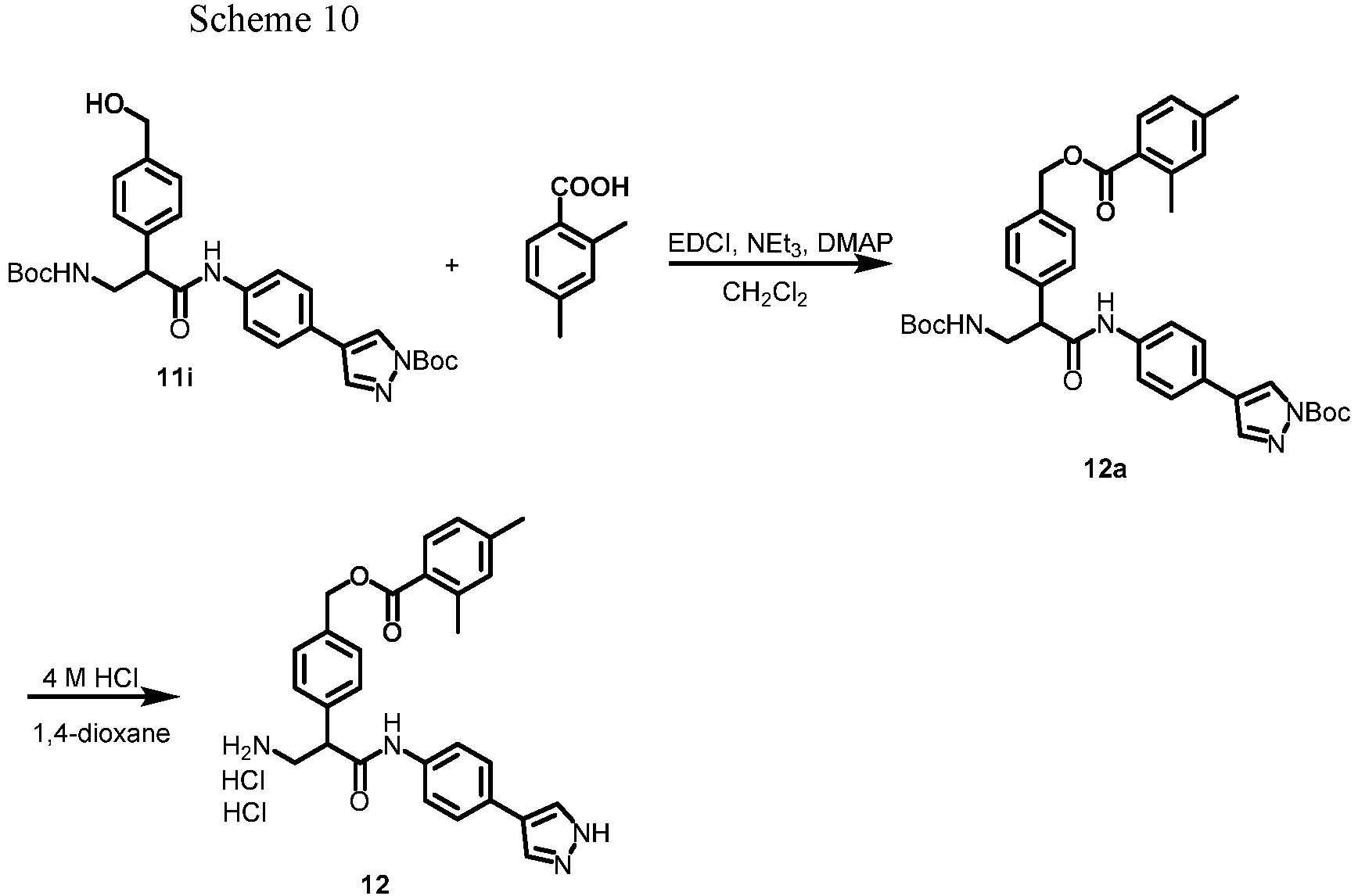
- The synthesis method for the
final Compound 12 was similar to that forCompound 10. - The compound tert-butyl 4-(4-(3-((tert-butoxycarbonyl)amino)-2-(4-(((2,4-dimethylbenzoyl)oxy)methyl)phenyl)propanamido)phenyl)-1H-pyrazole-1-carboxylate (12a) was white powder. 1H-NMR (CDCl3, 500 MHz) 8.25 (s, 1H), 7.94 (s, 1H), 7.86 (d, J=7.5 Hz, 1H), 7.52 (d, J=8.0 Hz, 2H), 7.46-7.44 (m, 4H), 7.41-7.37 (m, 3H), 7.06-7.03 (m, 3H), 5.31 (s, 2H), 5.14 (brs, 1H), 3.93 (brs, 1H), 3.68-3.67 (m, 1H), 3.59-3.55 (m, 1H), 2.60 (s, 3H), 2.37 (s, 3H), 1.67 (s, 9H), 1.43 (s, 9H).
- The compound 4-(1-((4-(1H-pyrazol-4-yl)phenyl)amino)-3-amino-1-oxopropan-2-yl)
benzyl 2,4-dimethylbenzoate dihydrochloride (12) was white powder. 1H-NMR (500 MHz, DMSO) δ: 10.40 (s, NH, 1H), 8.03 (brs, NH, 3H), 8.00 (s, 2H), 7.75 (d, J=8.0 Hz, 1H), 7.58 (d, J=9.0 Hz, 2H), 7.51 (d, J=9.0 Hz, 2H), 7.47-7.44 (m, 4H), 7.12 (s, 1H), 7.09 (d, J=8.0 Hz, 1H), 5.26 (s, 2H), 4.13 (dd, J=5.5, 9.0 Hz, 1H), 3.07-3.02 (m, 1H), 2.47 (s, 3H), 2.29 (s, 3H). - The synthesis scheme of Compound 13 is shown in the following Scheme 11.

- To a stirred solution of tert-butyl 4-(4-(3-((tert-butoxycarbonyl)amino)-2-(4-(hydroxymethyl)phenyl)propanamido)phenyl)-1H-pyrazole-1-carboxylate (11i) (100 mg, 0.19 mmol) in CH2Cl2 (10 mL), Dess-Martin reagent (166 mg, 0.37 mmol) was added. The resultant solution was stirred at room temperature for 1 hour. The solvent was evaporated under reduced pressure, and the crude product was purified by column chromatography (EtOAc/Hexanes = 25% to 50%) to get tert-butyl 4-(4-(3-((tert-butoxycarbonyl)amino)-2-(4-formylphenyl)propanamido)phenyl)-1H-pyrazole-1-carboxylate (13a) which was white powder. 1H-NMR (CDCl3, 500 MHz) 10.01 (s, CHO, 1H), 8.26 (s, 1H), 7.95 (s, 1H), 7.88 (d, J=8.0 Hz, 2H), 7.62 (brs, 1H), 7.58-7.53 (m, 4H), 7.46 (d, J=8.0 Hz, 2H), 5.12 (brs, 1H), 4.13-4.05 (m, 1H), 3.74-3.70 (m, 1H), 3.60-3.56 (m, 1H), 1.66 (s, 9H), 1.43 (s, 9H).
- In the 4 mL vial, tert-butyl 4-(4-(3-((tert-butoxycarbonyl)amino)-2-(4-formylphenyl)propanamido)phenyl)-1H-pyrazole-1-carboxylate (13a) (52 mg, 0.10 mmol) and 4 M HCl in dioxane (1.0 mL) was charged. The resulting mixture was stirred at room temperature for 1 hour. The solvent was removed under reduced pressure to give the desired product N-(4-(1H-pyrazol-4-yl)phenyl)-3-amino-2-(4-formylphenyl)propanamide dihydrochloride (13) (44 mg, 90 %). 1H-NMR (500 MHz, D2O) δ: 9.79 (s, CHO, 1H), 7.94 (s, 2H), 7.84 (d, J=8.5 Hz, 2H), 7.53 (d, J=8.5 Hz, 2H), 7.39 (d, J=8.5 Hz, 2H), 7.25 (d, J=8.5 Hz, 2H), 4.19 (t, J=7.0 Hz, 1H), 3.60 (dd, J=7.0, 12.5 Hz, 1H), 3.38 (dd, J=7.0, 12.5 Hz, 1H).
- The synthesis scheme of
Compound 14 is shown in the followingScheme 12.
- A mixture of tert-butyl 4-(4-(3-((tert-butoxycarbonyl)amino)-2-phenylpropanamido)phenyl)-1H-pyrazole-1-carboxylate (7a) (506 mg, 1.0 mmol, 1.0 equiv) and Lawesson reagent (808 mg, 2.0 mmol, 2.0 equiv) in toluene (5 mL) was heated to 120°C for 16 hours under N2 atmosphere. The reaction mixture mentioned above was cooled and concentrated to afford the crude compound tert-butyl 4-(4-(3-((tert-butoxycarbonyl) amino)-2-phenylpropanethioamido)phenyl)-1H-pyrazole-1-carboxylate (14a) (520 mg, yield: 100%) which could be used to the next step without further purification. LCMS (ES, m/z): [M +H]+=523.3.
- Tert-butyl 4-(4-(3-((tert-butoxycarbonyl)amino)-2-phenylpropanethioamido)phenyl)-1H-pyrazole-1-carboxylate (14a) (520 mg, 1.0 mmol, 1.0 eq) was dissolved in 1 mL MeOH to be added to HCl/MeOH (3 M, 5 mL), and stirred at room temperature for 3 hours. The reaction mixture mentioned above was concentrated. The residue was purified by flash (DCM/MeOH from 100% to 10%) to obtain the crude product (110 mg), and that was crystallized with DCM and MeOH and adjusted pH to 5.0 with 1 N HCl to afford N-(4-(1H-pyrazol-4-yl)phenyl)-3-amino-2-phenylpropanethioamide dihydrochloride (Compound 14) (75 mg, yield: 23% for two steps), which was a yellow solid. LCMS(ES, m/z): [M+H]+=323.2. 1H-NMR (400 MHz, DMSO-d6 ): 12.08 (s, 1H), 8.06-7.99 (m, 5H), 7.77 (d, J=8.4 Hz, 2H), 7.63-7.59 (m, 4H), 7.41-7.31 (m, 3H), 4.54-4.50 (m, 1H), 3.88-3.78 (m, 1H), 3.31-3.24 (m, 1H).
- The synthesis scheme of Compound 15 is shown in the following Scheme 13.

- To the solution of tert-butyl-(4-amino-3-(2-(dimethylamino)ethoxy)phenyl)-1H-pyrazole (200 mg, 0.85 mmol, 1.0 eq) in CH2Cl2 (4 mL), a saturated solution of NaHCO3 (2 mL, 0.4M) was added. Next, the thiophosgene (97 mg, 0.85 mmol, 1.0 eq) was added slowly and stirred for 3 hours. The organic layer was dried over anhydrous sodium sulfate and the solvent was removed under reduced pressure to obtain a crude product 15a. In the residue 15a, tert-butyl (2-amino-2-phenylethyl)carbamate (220 mg, 0.85 mmol, 1.0 eq) and K2CO3 (235 mg, 1.70 mmol, 2.0 eq) in CH2Cl2 (4.0 mL) were added. The reaction was workup by water and extracted with CH2Cl2. The organic layer was collected and dried over Na2SO4, the extract solution was condensed under reduced pressure. The residue was purified with silica gel (EtOAc/Hex = 20%) to obtain the compound tert-butyl 4-(4-(3-(2-((tert-butoxycarbonyl)amino)-1-phenylethyl)thioureido)phenyl)-1H-pyrazole-1-carboxylate (15b) (353 mg, 85 %) which was a pale yellow solid. 1H-NMR (500 MHz, CDCl3) δ: 8.30 (s, 1H), 8.02 (s, 1H), 7.98 (s, 1H), 7.63 (s, 1H), 7.57 (d, J=8.0 Hz, 2H), 7.38-7.34 (m, 4H), 7.30-7.24 (m, 3H), 5.63 (s, 1H), 4.85 (s, 1H), 3.55-3.44 (m, 2H), 1.68 (s, 9H), 1.31 (s, 9H).
- In the 20 mL vial, the compound tert-butyl 4-(4-(3-(2-((tert-butoxycarbonyl)amino)-1-phenylethyl)thioureido)phenyl)-1H-pyrazole-1-carboxylate (15b) (353 mg, 0.66 mmol) and 4 M HCl in dioxane (3.3 mL) were charged. The resulting mixture was stirred at room temperature for 1 hour. The solvent was removed under reduced pressure to obtain the compound 1-(4-(1H-pyrazol-4-yl)phenyl)-3-(2-amino-1-phenylethyl)thiourea dihydrochloride (15) which presented as pale yellow powder (244 mg, 90 %). 1H-NMR (500 MHz, CD3OD) δ: 8.56 (brs, 2H), 7.65 (d, J=8.0, 2H), 7.60-7.58 (m, 2H), 7.48-7.39 (m, 4H), 7.38-7.37 (m, 1H), 6.08 (dd, J=9.0, 5.0 Hz, 1H), 3.49 (dd, J=13.0, 9.0 Hz, 1H), 3.36 (dd, J=13.0, 5.0 Hz, 1H).
- For illustrative purpose the synthesis of
compound 16 not falling under the scope ofclaim 1 is explained. (17) Synthesis example 17 - The synthesis Scheme of
Compound 16 is shown in the followingScheme 14.
- A mixture of tert-butyl 4-(4-aminophenyl)-1H-pyrazole-1-carboxylate (1b) (400 mg, 1.54 mmol, 1.0 equiv) and (isothiocyanatomethyl)benzene (276 mg, 1.85 mmol, 1.2 equiv) in t-BuOH (10 mL) was stirred at 85°C overnight under N2. The reaction mixture mentioned above was cooled and concentrated. The residue was purified by silica gel column and eluted with ethyl acetate/petroleum ether (1:1) to afford tert-butyl 4-(4-(3-benzylthioureido)phenyl)-1H-pyrazole-1-carboxylate (16a) (410 mg, yield: 65%), which was a yellow solid. LCMS(ES, m/z): [M+H]+ = 409.3.
- A mixture of tert-butyl 4-(4-(3-benzylthioureido)phenyl)-1H-pyrazole-1-carboxylate (16a) (410 mg, 1.00 mmol, 1.0 equiv) and CH3I (214 mg, 1.51 mmol, 1.5 equiv) in acetone (15 mL) was stirred at 30°C for 3 hours under N2. The reaction mixture mentioned above was filtered. The filter cake was collected to afford tert-butyl 4-(4-(((benzylamino)(methylthio)methylene)amino)phenyl)-1H-pyrazole -1-carboxylate (16b) (370 mg, yield: 87%) as a white solid. LCMS (ES, m/z): [M+H]+=423.3.
- A mixture of tert-butyl 4-(4-(((benzylamino)(methylthio)methylene)amino)phenyl)-1H-pyrazole-1-carboxylate (16b) (370 mg, 0.88 mmol, 1.0 equiv), cyanamide (110 mg, 2.63 mmol, 3.0 equiv) and 1,4-diazabicyclo[2.2.2]octane (98 mg, 0.88 mmol, 1.0 equiv) in t-BuOH (10 mL) was stirred at 90°C overnight under N2 and then stirred at 130°C for 3 hours. The reaction mixture mentioned above was cooled and concentrated. The residue was treated with dichloromethane (10 mL) and filtered. The filtered cake was purified by Prep-HPLC (H2O:CH3CN = 7:3) to afford 1-(4-(1H-pyrazol-4-yl)phenyl)-3-benzyl-2-cyanoguanidine hydrochloride (16) (53 mg, yield: 19%), which was a white solid. LCMS (ES, m/z): [M+H]+= 317.2∘ 1H-NMR (400 MHz, DMSO-d6 ): 9.08 (s, 1H), 8.03 (s, 2H), 7.64-7.62 (m, 1H), 7.57 (d, J=8.4 Hz, 2H), 7.32 (t, J=7.4 Hz, 2H), 7.28-7.23 (m, 3H), 7.17 (d, J=8.8 Hz, 2H), 4.36 (d, J=5.6 Hz, 2H).
- The synthesis scheme of Compound 17 is shown in the following Scheme 15.


- To a stirred solution of 4-bromobenzoic acid (322 mg, 1.60 mmol) and tert-butyl (2-((4-fluorobenzyl)amino)ethyl)carbamate (430 mg, 1.60 mmol) in CH2Cl2 (5 mL), DIPEA (698 µL, 4.01 mmol) and HATU (732 mg, 1.92 mmol) were added. The reaction mixture mentioned above was stirred at room temperature for 2 hours. The solvent was removed by reduced pressure, and the residue was purified by column chromatography to afford tert-butyl (2-(4-bromo-N-(4-fluorobenzyl)benzamido)ethyl)carbamate (17a) (537 mg, 75 %) as oil. 1H-NMR (CDCl3, 500 MHz) 7.53 (s, 1H), 7.31-7.29 (m, 2H), 7.10-7.04 (m, 4H), 5.01-4.75 (m, 1H), 4.53 (s, 2H), 3.58-3.19 (m, 4H), 1.44 (s, 9H).
- A mixture of tert-butyl (2-(4-bromo-N-(4-fluorobenzyl)benzamido)ethyl)carbamate (17a) (537 mg, 1.19 mmol), tert-butyl 4-(4,4,5,5-tetramethyl-1,3,2-dioxaborolan-2-yl)-1H-pyrazole-1-carboxylate (350 mg, 1.19 mmol), PdCl2(dppf) (87 mg, 0.12 mmol) and Cs2CO3 (775 mg, 2.38 mmol) was added in a sealed tube, a mixed solvent (dioxane/H2O = 10/1, 6 mL) was then injected thereto under argon, and the mixture was stirred at 90°C for 2 hours. After cooling to room temperature, the solvent was removed by rotary evaporation, and the residue was added with water and extracted with EtOAc (15 mL × 3). The combined organic layers were washed with brine, dried over anhydrous Na2SO4 and filtered. The filtrate was concentrated and the residue was purified by flash chromatography on silica gel (EtOAc/Hex = 25% to 67%) to give tert-butyl 4-(4-((2-((tert-butoxycarbonyl)amino)ethyl)(4-fluorobenzyl)carbamoyl)phenyl)-1H-pyrazole-1-carboxylate (17b) which was white powder (385 mg, 60 %). 1H-NMR (CDCl3, 500 MHz) 8.32 (s, 1H), 7.59 (s, 1H), 7.53 (s, 1H), 7.47 (s, 2H), 7.14-7.04 (m, 4H), 5.07-4.78 (m, 1H), 4.58 (s, 2H), 3.60-3.33 (m, 4H), 1.68 (s, 9H), 1.45 (s, 9H).
- To a mixture of tert-butyl 4-(4-((2-((tert-butoxycarbonyl)amino)ethyl)(4-fluorobenzyl)carbamoyl)phenyl)-1H-pyrazole-1-carboxylate (17b) (300 mg, 0.56 mmol) and 1,4-dioxane (1 mL), 4 M HCl in 1,4-dioxane (2.78 mL) was added. The reaction mixture mentioned above was stirred at room temperature for 1 hour. The reaction mixture was concentrated. The residue was treated with DCM (6 mL) and filtered. The filtered cake was collected to afford N-(2-aminoethyl)-N-(4-fluorobenzyl)-4-(1H-pyrazol-4-yl)benzamide dihydrochloride (17) (200 mg, 87 %) which was a pale yellow solid. 1H-NMR (500 MHz, D2O) δ: 7.99 (s, 2H), 7.40-7.32 (m, 4H), 7.04-6.97 (m, 4H), 4.41 (s, 2H), 3.64 (s, 2H), 3.06 (s, 2H).
- For illustrative purpose the synthesis of compound 18 not falling under the scope of
claim 1 is explained (19) Synthesis example 19 - The synthesis scheme of Compound 18 is shown in the following
Scheme 16.

- To a stirred solution of tert-butyl 4-(4,4,5,5-tetramethyl-1,3,2-dioxaborolan-2-yl)-1H-pyrazole-1-carboxylate (1540 mg, 5.24 mmol) in THF (15 mL) at 0°C, 2 M NaOH(aq) (5.24 mL, 10.47 mmol) was added, and then 30% hydrogen peroxide (1.19 mL, 10.47 mmol) was added. The reaction mixture mentioned above was stirred at 0°C for 30 minutes and then room temperature for 1 hour. The reaction mixture was cooled to 0°C and diluted with DCM, and 2 M HCl(aq) was added thereto till
pH 2 was reached. The organic layer were collected and dried, and the solvent was removed under reduced pressure to give tert-butyl 4-hydroxy-1H-pyrazole-1-carboxylate (18a) (965 mg, 100 %) which was a yellow solid. 1H-NMR (500 MHz, CDCl3) δ: 9.28 (s, OH, 1H), 7.51 (s, 1H), 7.45 (s, 1H), 1.52 (s, 9H). - To a stirred solution of tert-butyl 4-hydroxy-1H-pyrazole-1-carboxylate (18a) (965 mg, 5.24 mmol) and 1-fluoro-4-nitrobenzene (739 mg, 5.24) in DMF (10 mL), K2CO3 (1447 mg, 10.47 mmol) was added. The reaction mixture mentioned above was stirred at 90°C for 12 hours. The solvent was removed under reduced pressure, and the residue was purified by column chromatography (EtOAc/Hexane = 10%) to give tert-butyl 4-(4-nitrophenoxy)-1H-pyrazole-1-carboxylate (18b) (479 mg, 30 %) which was a yellow solid. 1H-NMR (500 MHz, CDCl3) δ: 8.22 (d, J=8.0 Hz, 2H), 8.01 (s, 1H), 7.65 (s, 1H), 7.10 (d, J=8.0 Hz, 2H), 1.67 (s, 9H).
- To a solution of tert-butyl 4-(4-nitrophenoxy)-1H-pyrazole-1-carboxylate (18b) (140 mg, 0.46 mmol) in MeOH (5 mL) and EtOAc (5 mL), 10% Pd/C (49 mg, 0.046 mmol) was added. The reaction mixture mentioned above was stirred at room temperature under H2 balloon atmosphere for 2 hours. The mixture was filtered, and the filtrate was evaporated by rotary evaporation to give tert-butyl 4-(4-aminophenoxy)-1H-pyrazole-1-carboxylate (18c) (118 mg, 93 %) which was a brown solid.
- To a stirred solution of 3-((tert-butoxycarbonyl)amino)-2-phenylpropanoic acid (114 mg, 0.43 mmol) and tert-butyl 4-(4-aminophenoxy)-1H-pyrazole-1-carboxylate (118 mg, 0.43 mmol) in CH2Cl2 (5 mL), DIPEA (187 µL, 1.07 mmol) and HATU (196 mg, 0.51 mmol) were added. The reaction mixture mentioned above was stirred at room temperature for 2 hours. The solvent was removed by reduced pressure, then the residue was purified with preparative reverse HPLC (80% ACN, 20% H2O), and then lyophilized to get tert-butyl 4-(4-(3-((tert-butoxycarbonyl)amino)-2-phenylpropanamido)phenoxy)-1H-pyrazole-1-carboxylate (18d) (110 mg, 49 %) which was white powder. 1H-NMR (500 MHz, CDCl3) δ: 7.79 (s, 1H), 7.56 (s, 1H), 7.42 (d, = 8.0 Hz, 2H), 7.39-7.29 (m, 5H), 6.98 (d, J=8.0 Hz, 2H), 5.15 (brs, 1H), 3.89 (t, J=5.0 Hz, 1H), 3.70-3.58 (m, 1H), 3.56-3.54 (m, 1H), 1.64 (s, 9H), 1.51 (s, 9H).
- To a mixture of tert-butyl 4-(4-(3-((tert-butoxycarbonyl)amino)-2-phenylpropanamido)phenoxy)-1H-pyrazole-1-carboxylate (18d) (110 mg, 0.21 mmol) and 1,4-dioxane (1 mL), 4 M HCl in 1,4-dioxane (1.05 mL) was added. The reaction mixture mentioned above was stirred at room temperature for 1 hour. The reaction mixture was concentrated. The residue was treated with DCM (5 mL) and filtered. The filtered cake was collected to afford N-(4-((1H-pyrazol-4-yl)oxy)phenyl)-3-amino-2-phenylpropanamide dihydrochloride (18) (82 mg, 22 %) which was white solid. 1H-NMR (500 MHz, CD3OD) δ : 7.84 (s, 2H), 7.54 (d, J=8.5 Hz, 2H), 7.53-7.40 (m, 4H), 7.37-7.34 (m, 1H),7.02 (d, J=8.5 Hz, 2H), 4.13-4.10 (m, 1H), 3.62-3.57 (m, 1H), 3.24 (dd, J=5.5, 12.5 Hz, 1H).
- The synthesis scheme of Compound 19 is shown in the following Scheme 17.
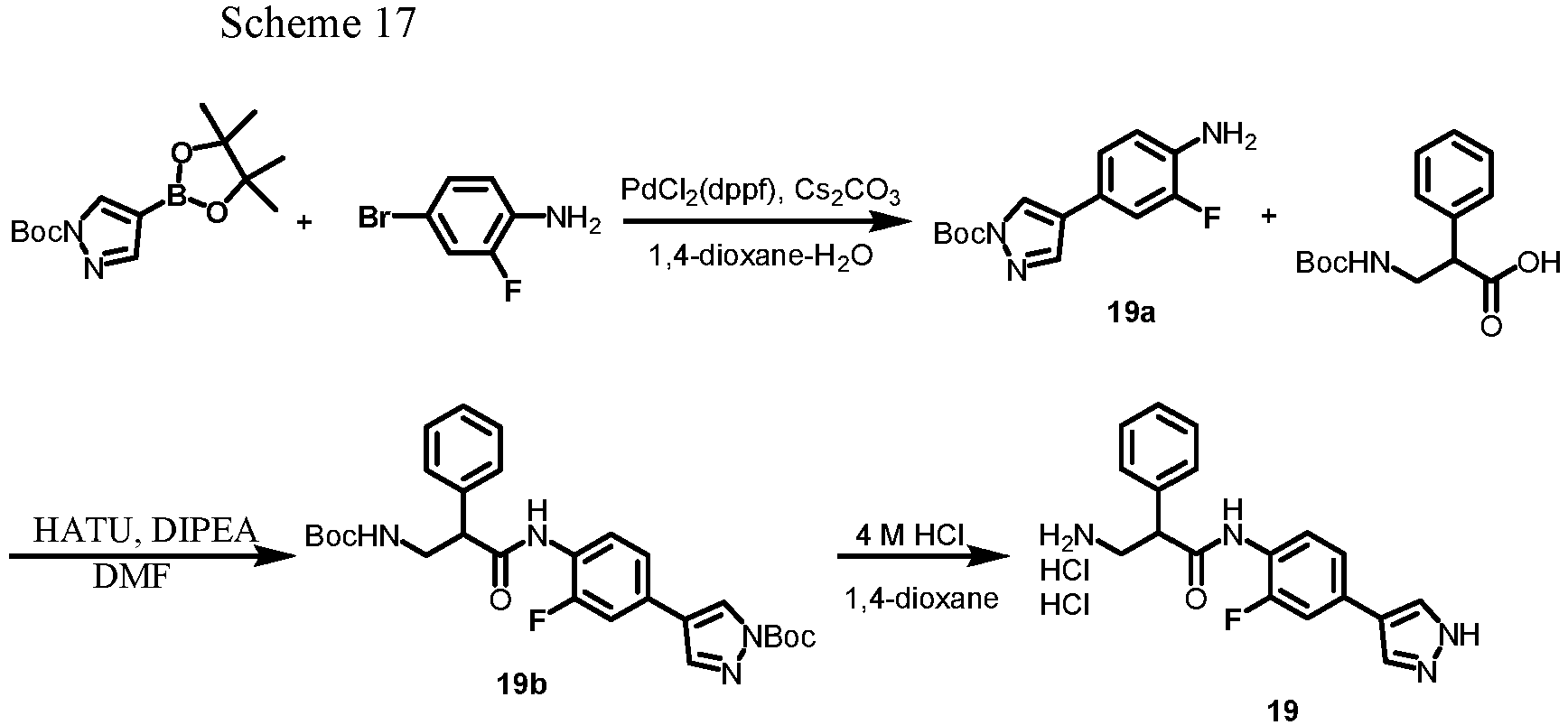
- To a mixture of 4-bromo-2-fluoroaniline (1211 mg, 6.37 mmol), 1-Boc-4-pyrazoleboronic acid pinacol ester (1875 mg, 6.37 mmol), PdCl2(dppf) (467 mg, 0.64 mmol) and Cs2CO3 (4153 mg, 12.75 mmol) in a sealed tube, a mixed solvent (dioxane/H2O = 9/1, 36 mL) was injected under argon, and then the mixture was stirred at 80°C for 2 hours. After cooling to room temperature, the solvent was removed by rotary evaporation, and the residue was added with water and extracted with EtOAc (30 mL × 3). The combined organic layers were washed with brine, dried over anhydrous Na2SO4 and filtered. The filtrate was concentrated, and the residue was purified by flash chromatography on silica gel (EtOAc/Hex = 5% to 17%) to give tert-butyl 4-(4-amino-3-fluorophenyl)-1H-pyrazole-1-carboxylate (19a) which was oil (1362 mg, 77 %). 1H-NMR (500 MHz, CDCl3) δ : 8.17 (s, 1H), 7.89 (s, 1H), 7.15 (dd, J=2.0, 12.0 Hz, 1H), 7.11 (d, J=8.0 Hz, 1H), 6.80 (t, J=8.0 Hz, 1H), 1.67 (s, 9H).
- To a stirred solution of 3-((tert-butoxycarbonyl)amino)-2-phenylpropanoic acid (346 mg, 1.31 mmol) and tert-butyl 4-(4-amino-3-fluorophenyl)-1H-pyrazole-1-carboxylate (19a) (362 mg, 1.31 mmol) in DMF (2 mL), DIPEA (569 µL, 3.26 mmol) and HATU (596 mg, 1.57 mmol) were added. The reaction mixture mentioned above was stirred at room temperature for 2 hours. The solvent was removed by reduced pressure, then the residue was purified with preparative reverse HPLC (80% ACN, 20% H2O), and then lyophilized to get tert-butyl 4-(4-(3-((tert-butoxycarbonyl)amino)-2-phenylpropanamido)-3-fluorophenyl)-1H-pyrazole-1-carboxylate (19b) (321 mg, 47 %) which was white powder. 1H-NMR (500 MHz, CDCl3) δ: 8.32 (t, J=8.5 Hz, 1H), 8.25 (s, 1H), 7.92 (s, 1H), 7.42-7.33 (m, 5H), 7.29-7.26 (m, 1H), 7.19 (d, J=11.5 Hz, 1H), 5.12 (brs, 1H), 3.96 (s, 1H), 3.71-3.68 (m, 1H), 3.60-3.58 (m, 1H), 1.67 (s, 9H), 1.43 (s, 9H).
- To tert-butyl 4-(4-(3-((tert-butoxycarbonyl)amino)-2-phenylpropanamido) -3-fluorophenyl)-1H-pyrazole-1-carboxylate (19b) (315 mg, 0.60 mmol) dissolved in 1,4-dioxane (1 mL), 4 M HCl in 1,4-dioxane (4.0 mL) was added. The reaction mixture mentioned above was sonicated at room temperature for 30 minutes. The white powder was collected by filtration, and that was washed with DCM and dried to afford 3-amino-N-(2-fluoro-4-(1H-pyrazol-4-yl)phenyl)-2-phenylpropanamide dihydrochloride (19) (230 mg, 96 %). 1H-NMR (500 MHz, D2O) δ: 8.05 (s, 2H), 7.42-7.38 (m, 6H), 7.28 (t, J=8.0 Hz, 2H), 4.18 (t, J=7.0 Hz, 1H), 3.58 (dd, J=7.0, 13.0 Hz, 1H), 3.39 (dd, J=7.0, 13.0 Hz, 1H). LCMS (ES, m/z): [M-2HCl+H]+=326.1, [M-2HCl+Na]+=348.1.
- The synthesis scheme of
Compound 20 and Compound 21 is shown in the following Scheme 18.

- To a solution of tert-butyl 4-(4-(3-((tert-butoxycarbonyl)amino)-2-phenylpropanamido)phenyl)-1H-pyrazole-1-carboxylate (15 g, 29.6 mmol, 1.0 eq) in MeOH (150 mL), HCl/MeOH (150 mL) was added. The mixture mentioned above was stirred at room temperature overnight. The mixture was concentrated and the residue was dissolved in H2O (50 mL), adjusted pH to 9 with NaHCO3 aqueous solution. The mixture was filtered, and the filtrated cake was dried in vacuo to obtain N-(4-(1H-pyrazol-4-yl)phenyl)-3-amino-2-phenylpropanamide (10 g, 100%) which was a white solid. The solid was purified by chiral resolution to obtain (S)-N-(4-(1H-pyrazol-4-yl)phenyl)-3-amino-2-phenylpropanamide (20a) and (R)-N-(4-(1H-pyrazol-4-yl)phenyl)-3-amino-2-phenylpropanamide (21a).
-
- Column: ChiralPak AD-H Daicel chemical Industries, Ltd, 250*30 mm I.D., 10 µm
- Mobile phase A: Supercritical CO2; Mobile phase B: MeOH (0.1% NH3H2O)
- A:B = 60:40 at 50 mL/minute
- Column Temp: 38°C
- Nozzle Pressure: 100 Bar; Nozzle Temperature: 60°C; Evaporator Temperature: 20°C;
- Trimmer Temperature: 25°C; Wavelength: 220 nm
- To a solution of (S)-N-(4-(1H-pyrazol-4-yl)phenyl)-3-amino-2-phenylpropanamide in H2O (10 mL), concentrated HCl (2 mL) was added, and the mixture was concentrated to obtain (S)-N-(4-(1H-pyrazol-4-yl)phenyl)-3-amino-2-phenylpropanamide dihydrochloride (20) (2.1 g). 1H-NMR (400 MHz, DMSO-d6 ): 10.55 (s, 1H), 8.20 (s, 3H), 8.13 (s, 2H), 7.65-7.29 (m, 9H), 4.22-4.19 (m, 1H), 3.51 (s, 1H), 3.04-3.01 (m, 1H)∘ LCMS: [M+H]+=307.1.
- To a solution of (R)-N-(4-(1H-pyrazol-4-yl)phenyl)-3-amino-2-phenylpropanamide in H2O (10 mL) concentrated HCl (2 mL) was added, and the mixture was concentrated to obtain (R)-N-(4-(1H-pyrazol-4-yl)phenyl)-3-amino-2-phenylpropanamide dihydrochloride (21) (2.1 g). 1H-NMR (400 MHz, DMSO-d6): 10.50 (s, 1H), 8.16 (s, 3H), 8.11 (s, 2H), 7.64-7.29 (m, 9H), 4.20-4.16 (m, 1H), 3.53-3.48 (m, 1H), 3.06-3.00 (m, 1H). LCMS: [M+H]+=307.1.
- Inhibitory effect of each compound synthesized above on Rho-associated protein kinase (ROCK) was tested.
-
- 1. 10 mM test compound was diluted to 1 mM with DMSO, and then further diluted to 300 nM. Netarsudil (AR-13324) is a commercial drug for decreasing intraocular pressure, and AR-13503 is an active metabolite of AR-13324.
- 2. The 300 nM test compound mentioned above was serially diluted to obtain test compounds with concentrations of 100 nM, 33 nM, 11 nM, 3.7 nM, 1.2 nM and 0.4 nM, respectively.
- 3. 1 µL of the serially diluted test compound mentioned above was added to 49 µL of the modified ROCK reaction buffer (0.05 M Trizma® hydrochloride buffer (pH 7.5) containing 0.1 M KCl, 0.01 M MgCl2, 0.1 mM EGTA and 2.25 µg/mL ROCK1) to obtain an experimental group sample. 1 µL of DMSO was taken to add to 49 µL of an adjusted ROCK reaction buffer to obtain a positive control group sample (maximum value = 100%). 1 µL of DMSO was taken to add to 49 µL of a buffer (0.05 M Trizma® hydrochloride buffer (pH 7.5) containing 0.1 M KCl, 0.01 M MgCl2 and 0.1 mM EGTA) to obtain a vehicle control group sample (minimum value = 0%).
- 4. 20 µL of the above prepared sample was added to a flat-bottomed 96-well plate, and 20 µL ROCK ATP buffer was added to each well.
- 5. The 96-well plate mentioned above was placed on an orbital shaker and reacted at room temperature for 90 minutes.
- 6. Next, 40 µL of Kinase-Glo luminescent kinase assay solution (Promega, RV6712) was added to the 96-well plate mentioned above, and the 96-well plate was placed on an orbital shaker and reacted at room temperature for 10 minutes.
- 7. The luminescence value of each well of the 96-well plate was determined by SpectraMax M5 microplate reader, and the ROCK inhibition rate (%) was calculated by the following formula.
Maximum value = The value measured using the above method in the absence of any test compound (The value measured under the condition of that the enzyme and the substrate were completely reacted was the maximum value) Minimum value = The value measured using the above method in the absence of enzyme (The value measured under no reaction of enzyme and substrate was the minimum value) Inhibition rate (%) = (Experimental group (the value measured under the condition of that the test compound was added) - Minimum value)/(Maximum value - Minimum value) * 100% - The results are shown in Table 2 -
compounds 16 and 18 not falling under the scope ofclaim 1 are included for illustrative purpose.Table 2 Compound ROCK1 IC50(nM) AR-13324 +++++ AR-13503 (an active metabolite of AR-13324) ++++++ Compound 1+++ Compound 2++++ Compound 3+++ Compound 4+++++ Compound 5+++++ Compound 6++++ Compound 7+++++ Compound 8+++++ Compound 9+++++ Compound 10+++ Compound 11 +++++ Compound 12++++ Compound 13 ++++++ Compound 14+++++ Compound 15 +++ Compound 16+ Compound 17 +++ Compound 18 + Compound 19 ++++ Compound 20+++++ Compound 21 +++ Note: ++++++ represents IC50<1 nM; +++++ represents IC50=1-10 nM; ++++ represents IC50=10~100 nM; +++ represents IC50=100-1000 nM; ++ represents IC50>1,000 nM; + represents IC50>10,000 nM. - The experimental procedure referred to the LanthaScreen Eu Kinase Binding Assay Screening Protocol and Assay Conditions provided by ThermoFisher Scientific.
- 3-fold serial dilution was performed on the test compound stock solution (1 mM) prepared in 100% DMSO was for 10 times for ready to use to determine the IC50 of the test compound on MYLK-4.
- Kinase/Antibody Mixture was pre-diluted with Kinase Buffer to 2X working concentration.
-
- 1.3.84 µL of kinase buffer was added to a white 384-well flat plate (Greiner, Cat. NO. 784207), then 8.0 µL of the kinase/antibody mixture mentioned above was added thereto, and then 4.0 µL of the tracer (AlexaFluor labeled Tracer) was added thereto, and after that 160 nL of the above diluted test compound at an appropriate concentration was added thereto, and the culture plate was shaken for 30 seconds.
- 2. Next, the culture plate was placed at room temperature and incubated for 60 minutes, and then the data was read and analyzed with a fluorescence plate reader. The emission ratio of the reaction liquid in each hole was calculated by using the following formula.

- In addition, a control group for the binding analysis of LanthaScreen Eu kinase was also set up in the analysis mentioned above:
Inhinitoin 0% control (0% displacement control): the reaction of which contained no known inhibitor, and was used as the maximum emission ratio;Inhinitoin 100% control (100% displacement control): which contained a known inhibitor with highest concentration, and was used as the minimum emission ratio; wherein the known inhibitor was Sunitinib. - The reaction components of the binding analysis of LanthaScreen Eu Kinase are shown in Table 3. The IC50 of the known inhibitor, sunitinib, was 19.0 nM, which was in line with the expected IC50 range.
Table 3. The reaction components of LanthaScreen Eu kinase binding analysis Reaction components Concentration (nM)/IC50 (nM) Kinase (MYLK4) 5 Antibody (Eu-anti-GST) 2 Tracer (Tracer 222) 100 (Kd was 173 nM) Buffer A (containing HEPES, BRIJ-35, MgCl2 and EGTA) 50 mM HEPES (pH 7.5), 0.01% BRIJ-35, 10 mM MgCl2 and 1 mM EGTA - 3. The inhibition rate of the test compound at different concentrations on MYLK-4 could be obtained according to the following formula:
Inhibition %= [( ER Inhibitoin 0% control - ER Sample)/(ER Inhibitoin 0% control -ER Inhibitoin 100% control)] * 100 - 4. IC50 of the test compound on MYLK-4 was calculated by the above determined inhibition rates of the test compound at different concentrations on MYLK-4.
- The results are shown in Table 4 -
compound 16 not falling under the scope ofclaim 1 is included for illustrative purpose.Table 4: IC50 of the test compound on MYLK-4 Compound MYLK4 IC50(nM) AR-13324 ++ AR-13503 +++ Compound 1+++ Compound 2+++ Compound 5+++ Compound 6+++ Compound 7++++ Compound 8++++ Compound 10++ Compound 11 +++ Compound 12+++ Compound 13 +++ Compound 14+++ Compound 15 +++ Compound 16+ Compound 17 + Compound 19 +++ Compound 20++++ Compound 21 +++ Note: ++++++ represents IC50<1 nM; +++++ represents IC50=1-10 nM; ++++ represents IC50=10-100 nM; +++ represents IC50=100-1000 nM; ++ represents IC50>1,000 nM; + represents IC50>10,000 nM. - The experimental procedure referred to the Z'-LYTE Screening Protocol and Assay Conditions provided by ThermoFisher Scientific.
- 3-fold serial dilution was performed on the test compound stock solution (1 mM) prepared in 100% DMSO was for 10 times for ready to use to determine the IC50 of the test compound on YSK-4.
- Peptide/Kinase Mixture was pre-diluted with Kinase Buffer to 2X working concentration.
- ATP solution was pre-diluted with Kinase Buffer (50 mM HEPES pH 7.5, 0.01% BRIJ-35, 10 mM MgCl2, 1 mM EGTA) to 4X working concentration.
- The development reagent solution is Novel PKC Lipid Mix, which contains 2 mg/mL Phosphatidyl Serine, 0.2 mg/mL DAG in 20 mM HEPES, pH 7.4 and 0.3% CHAPS, and was pre-diluted 10 fold with development buffer.
-
- 1. 100 nL of the above diluted test compound and 2.4 µL of kinase buffer were added to a black 384-well plate (Corning, Cat.NO. 4514), then add 5 µL of the peptide/kinase mixture mentioned above was added thereto, and after that 2.5 µL of ATP solution was added thereto, and the culture plate was shaken for 30 seconds.
- 2. Next, the culture plate was placed at room temperature and incubated for 60 minutes.
- 3. After that 5 µL of the development reagent solution was added and the culture plate was shaken for 30 seconds in the dark, and then the data was read and analyzed with a fluorescence plate reader.
- In addition, for the kinase, the following control group was prepared and placed on the same culture plate as the kinase:
- The maximum Emission Ratio is established by the 0% Phosphorylation Control (100% Inhibition Control), which contains no ATP and therefore exhibits no kinase activity. This control yields 100% cleaved peptide in the Development Reaction.
- A synthetically phosphorylated peptide of the same sequence as the peptide substrate is used as the 100% Phosphorylation Control. This control yields a very low percentage of cleaved peptide in the Development Reaction.
- The Phosphorylation percent achieved in a specific reaction well (Experimental group) was calculated based on the 0% Phosphorylation Control and 100% Phosphorylation Control.
- The Z'-LYTE substrate used in the binding analysis reaction for Z'-LYTE Screening Kinase was Ser/Thr 07 peptide, and ATP reaction concentration was 5 µM (Km of YSK4). The known inhibitor used as a control in this analysis was Staurosporine. The IC50 in the system was 12.7 nM, which was in line with the expected IC50 range. The inhibition rate of the test compound on YSK-4 at different concentrations was calculated based on the measured value of each hole according to the formula below, and IC50 of the test compound on YSK-4 was calculated thereby.
Correction for Background Fluorescence = Fluorescence Intensity sample - Fluorescence Intensity TCFI control Emission Ratio = Coumarin Emission (445 nm)/Fluorescein Emission (520 nm) (using values corrected for background fluorescence) % Phosphorylation =1- (Emission Ratio x F100%- C100%)/{ (C0% - C100%) + [Emission Ratio x (F100% - F0%)] } * 100 
- C100%: Average Coumarin emission signal of the 100% Phosphorylation Control
- C0%: Average Coumarin emission signal of the 0% Phosphorylation Control
- F100%: Average Fluorescein emission signal of the 100% Phosphorylation Control
- F0%: Average Fluorescein emission signal of the 0% Phosphorylation Control
- DRI: Development Reaction Interference
- TCFI: Test Compound Fluorescence Interference
- The results are described as Table 5 -
compound 16 not falling under the scope ofclaim 1 is included for illustrative purpose.Table 5: IC50 of the test compound on YSK4 Compound YSK4 IC50 (nM) AR-13324 n.a. AR-13503 n.a. Compound 1+ Compound 2+ Compound 5+ Compound 6+ Compound 7++ Compound 8++ Compound 10+ Compound 11 ++ Compound 12++ Compound 13 ++ Compound 14++ Compound 15 + Compound 16+ Compound 17 + Compound 19 ++ Note: ++++++ represents IC50<1 nM; +++++ represents IC50=1-10 nM; ++++ represents IC50=10-100 nM; +++ represents IC50=100-1000 nM; ++ represents IC50>1,000 nM; + represents IC50>10,000 nM. - According to the foregoing results, it can be known that the compounds synthesized in the present disclosure have inhibitory effects on ROCK, MYLK-4 and YSK4, and have synergistic target inhibitory effects, especially
Compound 7 andCompound 20. - Moreover, since it is currently known that through inhibiting ROCK expression, the effects of protection of optic nerve (see for example, Rothschild et al., ROCK-1 mediates diabetes-induced retinal pigment epithelial and endothelial cell blebbing: Contribution to diabetic retinopathy. Scientific Reports. (2017) 7: 8834 and Tanna et al., Rho Kinase Inhibitors as a Novel Treatment for Glaucoma and Ocular Hypertension. Ophthalmology. (2018) 125:1741-1756.) and alleviation and/or treatment of high intraocular pressure (see for example, Tanna et al., Rho Kinase Inhibitors as a Novel Treatment for Glaucoma and Ocular Hypertension. Ophthalmology. (2018) 125:1741-1756), glaucoma (see, for example, Tanna et al., Rho Kinase Inhibitors as a Novel Treatment for Glaucoma and Ocular Hypertension. Ophthalmology. (2018) 125:1741-1756), ocular stroke (see for example, Yi et al., Protective Effects of Intravitreal Injection of the Rho-Kinase Inhibitor Y-27632 in a Rodent Model of Nonarteritic Anterior Ischemic Optic Neuropathy (rAION). J Ophthalmol. (2020) 2020: 1485425 and Nourinia R, et al. ROCK inhibitors for the treatment of ocular diseases. Br J Ophthalmol 2018;102:1-5.), macular degeneration (see, for example, Sadiq et al. Pharmacological agents in development for diabetic macular edema Int J Retin Vitr (2020) 6:29.), macular edema (see, for example, Sadiq et al. Pharmacological agents in development for diabetic macular edema Int J Retin Vitr (2020) 6:29.), diabetic retinopathy (see, for example, Nourinia R, et al. ROCK inhibitors for the treatment of ocular diseases. Br J Ophthalmol 2018;102:1-5), Fuchs endothelial corneal dystrophy (FECD) (see, for example, Okumura et al. The ROCK Inhibitor Eye Drop Accelerates Corneal Endothelium Wound Healing Invest Ophthalmol Vis Sci. (2013) 54:2439-2502.), corneal fibrosis (see, for example, Soniecka et al., Substance P induces fibrotic changes through activation of the RhoA/ROCK pathway in an in vitro human corneal fibrosis model. J Mol Med (Berl). 2019; 97(10): 1477-1489), etc. can be achieved, the compounds with the effect of inhibiting ROCK of the present disclosure mentioned above, can also be used in ophthalmology related applications, such as protection of optic nerve, and/or prevention and/or treatment of high intraocular pressure, glaucoma, ocular stroke, macular degeneration, macular edema, diabetic retinopathy, Fuchs endothelial corneal dystrophy (FECD) and/or corneal fibrosis, etc.

- Furthermore, since it is also currently known that through inhibiting ROCK expression, the effects of alleviation and/or treatment of pulmonary hypertension (see, for example, Zhang et al., Effects of Fasudil on Patients with Pulmonary Hypertension Associated with Left Ventricular Heart Failure with Preserved Ejection Fraction: A Prospective Intervention Study. Can Respir J. (2018) 2018: 314825), chronic obstructive pulmonary disease (COPD) (see, for example, Liu et al., Influence of Rho kinase inhibitor Fasudil on late endothelial progenitor cells in peripheral blood of COPD patients with pulmonary artery hypertension. Bosn J Basic Med Sci. (2014) 14(1):40-4), idiopathic pulmonary fibrosis (IPF) (see, for example, Knipe et al., The Rho Kinase Isoforms ROCK1 and ROCK2 Each Contribute to the Development of Experimental Pulmonary Fibrosis. Am J Respir Cell Mol Biol. (2018) 58(4): 471-481.), pulmonary emphysema (see, for example, Bewley et al., Differential Effects of p38, MAPK, PI3K or Rho Kinase Inhibitors on Bacterial Phagocytosis and Efferocytosis by Macrophages in COPD. PLoS One. (2016) 11(9): e0163139.), lung cancer (see, for example, Vigil et al., ROCK1 and ROCK2 are Required for Non-Small Cell Lung Cancer Anchorage-Independent Growth and Invasion. Cancer Res. (2012) 15: 72(20).), etc. can be achieved, the compounds with the effect of inhibiting ROCK of the present disclosure mentioned above, can also be used in lung-related applications such as prevention and/or treatment of pulmonary hypertension, chronic obstructive pulmonary disease (COPD), idiopathic pulmonary fibrosis (IPF), pulmonary emphysema and/or lung cancer, etc.
- The references to methods of treatment in the subsequent paragraphs of this description are to be interpreted as references to the compounds, kinase inhibitors, pharmaceutical composition and medicaments of the present invention for use in a method for treatment of the human or animal body by therapy or for diagnosis.
- The maximal effect (Emax) dose evaluation of the intraocular pressure reduction model in normal rabbit
-
- Animals: Male New Zealand white rabbits (n=7/each group);
- Formulation for test compound: 0.01
% Compound 20; 0.03% Compound 20; 0.1% Compound; - Administration: 50 µL of the test compound was instilled in the right eye (dosed eye) and 50 µL of the vehicle (without the test compound) in the left eye (control eye) of each experimental animal. The 3 formulation mentioned above were administered once a day for 3 consecutive days.
- The intraocular pressure of each animal was measured by Tono-Vet (iCare) before administration (0 hours) and 2, 4, 6 and 8 hours after administration on
Day 1 andDay 3. - The results are shown in
FIG. 1A and FIG. 1B and Table 6 and Table 7.Table 6 : Results of intraocular pressure measurement on Day 1Concentration of Compound 20The magnitude of intraocular pressure reduction (ΔIOP) (mmHg) The maximum magnitude of the reduction in intraocular pressure Tmax (hour) 0.10% -5.3±0.6 32.2% 8 0.03% -4.3±1.2 28.3% 8 0.01% -2.9±1.1 18.7% 6 The maximum magnitude of the reduction in intraocular pressure % = (Intraocular pressure of the control eye - Intraocular pressure of the dosed eye)/Intraocular pressure of the control eye *100 Table 7: Results of intraocular pressure measurement on Day 3Concentration of Compound 20The magnitude of intraocular pressure desc (ΔIOP) (mmHg) The maximum magnitude of the reduction in intraocular pressure Tmax (hour) 0.10% -5.2±1.3 32.6% 6 0.03% -5.1±1.2 30.5% 8 0.01% -2.7±0.8 15.4% 6 The maximum magnitude of the reduction in intraocular pressure % = (Intraocular pressure of the control eye - Intraocular pressure of the dosed eye)/Intraocular pressure of the control eye *100 -
FIG. 1A and Table 6 show the results of intraocular pressure measurement onDay 1 of administration.FIG. 1B and Table 7 show the results of intraocular pressure measurement onDay 3 of administration. - The results show that
Compound 20 exhibits a dose dependent effect in reduction of intraocular pressure, wherein the group administered with 0.03% Compound 20 and the group administered with 0.1% Compound 20 have similar magnitude and trend in lowering intraocular pressure. - In addition, after continuous administration for 3 days, the group administered 0.03
% Compound 20 had a slight accumulation of drug effect (the reduction in intraocular pressure onDay 3 increased by nearly 1 mmHg on average compared to Day 1) (see Table 6 and Table 7). This result shows thatCompound 20 at a concentration of 0.03% should be close to the intraocular pressure test limit of this model, and thus the cumulative difference of medicinal effect (Emax) shown thereby it is not significant. - The data presented in this experiment is the data that has removed the unqualified data (white rabbits with an intraocular pressure difference ≥2 mmHg (n=1) in the two eyes on
Day 1 and >5 mmHg in the two eyes before the administration on the Day 3 (n=1) have been removed) and removed the rebound high intraocular pressure (n=3). The n value of each group ≥3; in addition, the n value of the group administered with 0.01% Compound 20 was 6. - Based on the results mentioned above, it can be known that the concentration of 0.03% should be the maximum effect (Emax) dose of
Compound 20 in the normal intraocular pressure rabbit model. - Using a similar method to Compound 20, the maximum effective doses of
compounds - The results show that the maximum effective doses of
compounds compounds - Evaluation of the effect of decreasing intraocular pressure in a model of rabbit with normal intraocular pressure
- Experimental animal: New Zealand white rabbit, male, weighing more than 2 kg. New Zealand white rabbits were purchased from Huijun Farm (Changhua, Taiwan). After a one-week quarantine period, they were raised in MASTER LABORATORY Co., Ltd under the environmental conditions of 16-22°C, 30-70% relative humidity (RH), 8 hours day/16 hours night.
- After weighing 12 New Zealand white rabbits (2.0-4.0 kg) and grouping them (n=3-6 in each group), the white rabbits were fixed with a wrap. After the white rabbit was in a stable state, the lower eyelid of its right eye were opened, and 50 µL of the test sample (eye drops containing 0.1% or 0.03% Compound 20) was instilled into the conjunctival sac of the right eye of the white rabbit, and the eyelid was closed, and the white rabbit was kept in a stable state for at least 2 minutes to avoid the white rabbit shaking its head causing the eye drops to flow out of the eye; the left eye was administered by vehicle (without test compound) as a control group. 0.02% AR-13324 was used as a benchmark to evaluate the medicinal effect competitiveness of the tested compounds. The intraocular pressure detection time points were before administration (0 hour) and 1, 2, 4, 6 and 8 hours after administration.
- After measuring the intraocular pressure, the appearance of rabbit eyes were photographed, and adverse event on the cornea, iris, or conjunctiva of the rabbit's eyes resulted from the test substance were evaluated according to the eye irritation test guidelines (OECD/OCDE 405) stipulated by the Organization for Economic Cooperation and Development (OECD).
- The scoring manner of OECD/OCDE 405 for cornea, iris or conjunctiva is shown in Table 8.
Table 8: Eye irritation level Opacity Degree of density (readings should be taken from most dense area)* No ulceration or opacity 0 Scattered or diffuse areas of opacity (other than slight dulling of normal 1 luster); details of iris clearly visible Easily discernible translucent area; details of iris slightly obscured 2 Nacrous area; no details of iris visible; size of pupil barely discernible 3 Opaque cornea; iris not discernible through the opacity 4 Maximum possible: 4
* The area of corneal opacity should be noted - Eye drops of 0.1
% Compound 20 was used as a test sample while the experimental method was the same as the experimental method described in the above "(1) Evaluation of the effect of reducing intraocular pressure". Administration was performed continuously for 7 days (once a day), an then the corneal state was observed with a slit lamp. -
Compound 20 was administered to normal rabbits, and the content of the compound in aqueous humor was confirmed at different time points. - The results of evaluation of the effect of reducing intraocular pressure are shown in
FIG. 2 . - According to
FIG. 2 , it is known that the eye drops containing 0.1% Compound 20 and the eye drops containing 0.03% Compound 20 show the maximum effects (Emax) at 6-8 hours after administration, and the maximum magnitude of the reduction in intraocular pressure thereof are about 4.4 -4.9 mmHg, and eye irritation thereof is slight. - In addition, the result also shows that the eye drops containing 0.03
% Compound 20 in the normal intraocular pressure rabbit model has reached the maximum effect of reducing intraocular pressure. - The results of eye irritation evaluation are shown in
FIG. 3A ,FIG. 3B and FIG. 3C . - Based on
FIG. 3A andFIG. 3B , it is known that the eye irritation ofCompound 20 at the maximum dose effect dose (0.1%) is still lower than AR-13324 (0.02%). - In addition,
FIG. 3C shows that the cornea is still free of damage and turbidity after continuous administration for 7 days. - The content analysis results of
Compound 20 presenting in the iris and ciliary body and aqueous humor after administration are shown inFIG. 4 . For the iris and ciliary body, the concentration ofCompound 20 was measured in unit of ng/g; for aqueous humor, the concentration ofCompound 20 is measured in unit of ng/mL. - According to
Figure 4 , it is known that after administration, the content ofCompound 20 in the aqueous humor can reach the requirement of ROCK inhibition. - Using a similar method to Compound 20, the effects of reducing intraocular pressure of
compounds -
Compound 7 was taken as a representative, the eye drops containing 2% Compound 7 were administered to rabbit eyes (3 doses a day, with an interval of 3 hours each time, and observation was performed before administration and 1 hour after each administration). In addition, Eye drops containing 0.04% Compound 7 were administered to rabbit eyes (one dose a day, and observation was performed before administration and 1 hour and 6 hours after administration). According to the eye irritation test guidelines (OECD/OCDE 405) stipulated by the Organization for Economic Cooperation and Development (OECD) mentioned above, the eye irritation ofCompound 7 was evaluated. - The results of Evaluation of the effect of reducing intraocular pressure are shown in Table 9.
Table 9: The results of evaluation of the effect of reducing intraocular pressure Compound Intraocular pressure difference (mmHg)/dose/time point at which maximum effect is achieved AR-13324 4.5/1%/6 hours Compound 4 4.2/1%/2 hours Compound 5 1.5/1%/6 hours Compound 7 5.1/1%/4 hours Compound 8 5.2/1%/6 hours Compound 11 2.0/0.5%/1 hours Compound 12 2.0/0.25%/6 hours Compound 14 2.5/0.5%/6 hours Compound 20 4.9/0.03%/8 hours Compound 21 1.3/0.03%/8 hours - The results of safety margin assay are shown in
FIG. 5 and Table 10.Table 10: The results of safety margin assay Safety margin AR-13324 Compound 7Therapeutic index (TI) 2 3 OECD Score AR-13324 (Therapeutic index: 2) Compound 7 (Therapeutic index: 3) Redness 1 1 Chemosis 1 0 Discharge 2 1 Total 4 2 - Based on
FIG. 5 and Table 10, it is known that when AR-133247 is at a therapeutic index of 2, the total score of OECD405 is 4, and whenCompound 7 is at a therapeutic index of 3, the total score of OECD405 is 2. Therefore, the safety margin ofCompound 7 is better than AR -13324. - Eye drop containing 0.1% or 0.03
% Compound 20 was administered to normal macaques. 0.02% AR-13324 was used as a benchmark to evaluate the medicinal effect competitiveness of the tested compounds. The intraocular pressure of animals was measured by a pneumatic tonometer (Model 30™ Pneumatonometer). Animal anesthesia was required before intraocular pressure measurement. After topical administration (once a day), the intraocular pressure of the animals was measured at the set time points. - The results are shown in Table 6.
- Based on
Fig. 6 , it can be known thatCompound 20 can achieve an effect of reducing intraocular pressure which is equivalent to or better than that of AR-13324 in normal intraocular pressure macaque without obvious side effects, such as pink eye. - Evaluation of the effect of reducing intraocular pressure in model of hypertonic saline induced high intraocular pressure rabbit (acute high intraocular pressure model)
- Experimental animal: New Zealand white rabbit, male, weighing 2.0-3.0 kg. New Zealand white rabbits were purchased from a qualified laboratory animal rabbit farm in Taiwan before the experiment and were raised in the Animal Center of National Chiao Tung University.
- Test sample: Eye drop containing 0.1
% Compound 20 - Negative control 1: Physiological saline
- Negative control 2:Vehicle without test substance (containing 5% mannitol, 20mM boric acid and 0.125% nonoxynol-9)
- Experimental method: male New Zealand white rabbits were weighed and grouped and then anesthetized. 160 µL of hypertonic saline (5% NaCl) was injected into the vitreous bodies of the left and right eyes of the rabbit under anesthesia, so that the rabbit eyes became a state of high intraocular pressure. Next, 50 µL of physiological saline (0.9% NaCl), an eye drop containing 0.1
% Compound 20, a vehicle used to prepare eye drop of Compound 20 (without Compound 20), and an eye drop containing 0.02% AR-13324 were instilled into the left and right eyes of each group of rabbits. The intraocular pressure (IOP) detection time points were before anesthesia (0 hours) and 0.5, 1, 1.5, 3, and 5 hours after administration. Physiological saline and a vehicle without test substance were used as a negative control group, and an eye drop containing 0.02% AR-13324 was used as a benchmark to evaluate the effect ofCompound 20 in reducing intraocular pressure in a rabbit model of hyperosmotic saline-induced hypertension. - The results are shown in
FIG. 7 and Table 11.Table 11: Test results of reducing intraocular pressure in a rabbit model of high intraocular pressure Transient ocular hypertension rabbits Dose Maximum intraocular pressure difference (mm Hg) Maximum intraocular pressure difference (%) AUC Physiological saline - - - 139.7 AR-13324 0.02% -7.7±4.2 -20.8% 132.9 Vehicle used to prepare eye drop of Compound 20 (without Compound 20) - +7.2±5.2 +16.2 % NA Compound 20 0.1% -18.0±6.8 -40.4% 99.1 Maximum intraocular pressure difference: The difference between an individual's IOP readings and the average IOP readings of the negative control group 1 (physiological saline) at the time point at which the maximum response is recorded (J Ocul Pharmacol Ther. 2010 Apr;26(2):125-132) - The results show that in the rabbit model of hyperosmolar saline-induced high intraocular pressure, the eye drop containing 0.1
% Compound 20 can reduce the intraocular pressure by about 18.0±6.8 mmHg while the eye drop containing 0.02% AR-13324 can reduce the intraocular pressure by about 7.7 ±4.2 mmHg. It shows that the effect ofCompound 20 in reducing intraocular pressure is significantly better than that of AR-13324 (t-test , p<0.05). Moreover, compared with the physiological saline, the vehicle has no statistically significant difference (t-test). Compared with the physiological saline or the vehicle, AR-13324 also has no statistically significant difference (t-test). - Evaluation of the effect of reducing intraocular pressure in model of magnetic bead induced high intraocular pressure rabbit (high intraocular pressure model with intraocular pressure> 30 mmHg)
- Exfoliation glaucoma (XFG) is considered to be more serious than primary open angle glaucoma. The maximum intraocular pressure (38.2 vs 26.9 mmHg), minimum intraocular pressure (24.7 vs 18.4 mmHg), and mean intraocular pressure change (13.5 vs 8.5 mmHg) in exfoliative glaucoma and primary corner open glaucoma are statistically significant difference. Furthermore, there are currently no known diet therapies, drugs or other interventions that can prevent the occurrence of exfoliation syndrome or slow down its development (Progress in Retinal and Eye Research Vol. 19, No. 3, pp. 345 to 368, 2000). According to the foregoing, it is known that the intraocular pressure of exfoliative glaucoma can reach> 30 mmHg, and there is currently no effective drug for it, and thus a high intraocular pressure model with an intraocular pressure> 30 mmHg is provided here to evaluate the feasibility of the compound of the present disclosure in the treatment of exfoliative glaucoma and ocular hypertension with intraocular pressure> 30 mmHg.
- Experimental animal: New Zealand white rabbit, male, body weight 2.0-3.0 kg. New Zealand white rabbits were purchased from Huijun Farm (Changhua, Taiwan) before the experiment and were raised in the Animal Center of National Chiao Tung University.
- Test sample: Eye drop containing 0.1
% Compound 20 - Negative control 1: Vehicle without test Compound 20 (containing 5% mannitol, 20mM boric acid and 0.125% nonoxynol-9)
- Negative control 2: Vehicle without test compound AR-13324 (containing 4.7% D- mannitol and 0.05% boric acid)
- Experimental method: After weighing and grouping male New Zealand white rabbits, the New Zealand white rabbits were anesthetized with
Zoletil 50 0.2 mL/kg. 50 µL of magnetic bead solution (50 mg/mL, magnetic bead size of 10 µm) was injected into the left and right anterior eye chambers of the rabbit under anesthesia to make rabbit eyes become a state of high intraocular pressure. After the injection to the anterior chamber of the eye, a strong rubidium iron magnet ring was immediately put around the eye for 10-20 minutes to make the magnetic beads completely block the drainage tissue of the aqueous humor. After disinfecting the eyeball with antibiotics, moisturizing eye ointment was provided to restore the eyeball, and the intraocular pressure rising was waited. After about 3 days, the intraocular pressure can reach a high intraocular pressure> 30 mmHg, and can last for at least 10 days. After the intraocular pressure reaches the target intraocular pressure> 30 mmHg, the eye drop containing 0.03% or 0.1% of Compound 20 (right eye), the vehicle used to prepare the eye drop of Compound 20 (without Compound 20) (left eye), and the eye drop containing 0.02% AR-13324(right eye), and the vehicle used to prepare AR-13324 eye drop (without AR-13324) (left eye) were respectively instilled one drop (about 35 µL) into the left and right eyes of the rabbits in each group. The intraocular pressure (IOP) detection time points were before administration (0 hour) and 2, 4, 6, and 8 hours after administration. The experiment was conducted for 2 consecutive days. The eye drop containing 0.02% AR-13324 was used as a benchmark to evaluate the effect ofCompound 20 in reducing intraocular pressure in the model of magnetic bead induced high intraocular pressure rabbit (intraocular pressure > 30 mmHg). - The results are shown as Table 12 and
FIG. 8 .Table 12: Test results of reducing intraocular pressure of Compound 20 in a model of magnetic bead induced high intraocularpressure rabbit Compound 20 Dose Maximum intraocular pressure difference (mmHg) AR-13324 0.02% 4.3±1.4 Compound 200.03% 5.7±0.6 0.1% 12.1±1.4 - The results show that in the model of magnetic bead induced high intraocular pressure rabbit (the high intraocular pressure model with intraocular pressure> 30 mmHg), the eye drop containing 0.03
% Compound 20 can reduce the intraocular pressure by about 5.7±0.6 mmHg (by about 15.3%), and the eye drop containing 0.1% Compound 20 can reduce intraocular pressure by about 12.1±1.4 mmHg (by about 28.8%). Namely, the eye drop containing 0.03% Compound 20 and the eye drop containing 0.1% Compound 20 have better intraocular pressure reducing effects than those containing 0.02% AR-13324 (reducing intraocular pressure by about 4.3±1.4 mmHg (reducing by about 11.0%)), and the eye drop containing 0.1% Compound 20 can even be more than twice as effective as eye drops containing 0.02% AR-13324. - Using a similar method to that for
Compound 20, the effect of Compound 7 (using maximum effect dose of 0.5% and 1%) in reducing intraocular pressure in a model of normal intraocular pressure rabbit was confirmed. - The results are shown in Table 13.
Table 13: Test results of reducing intraocular pressure of Compound 7 in a model of magnetic bead induced high intraocular pressure rabbitCompound Dose Maximum intraocular pressure difference (mmHg) AR-13324 0.02% 3.6±2.1 Compound 70.5% 6.7±1.6 1% 11.8±0.8 - According to Table 12, it is known that in the a model of magnetic bead induced high intraocular pressure rabbit (the high intraocular pressure model with intraocular pressure> 30 mmHg), the eye drop containing 0.5
% Compound 7 and the eye drop containing 1% Compound 7 have better intraocular pressure reducing effects than those containing 0.02% AR-13324, wherein the eye drop containing 1% Compound 7 can even be more than 3 times as effective as eye drops containing 0.02% AR-13324. - Human Trabecular Meshwork (HTM) cells (Cat. NO. 6590) were obtained from ScienCell Research Laboratories. HTM cells were maintained in Trabecular Meshwork Cell Medium (TMCM) (Cat. NO. 6591). TMCM formulated from 500 mL basal medium, 10 mL FBS (Cat. NO. 0010), 5 mL trabecular meshwork cell growth supplement (TMCGS, Cat. NO. 6592) and 5 mL penicillin/streptomycin solution (P/S, Cat.NO. 503). When the cell growth reached 70-80% saturation, the HTM cells were treated overnight with 50 µg/mL dexamethasone (Cat. NO. 4902, Sigma).
- The expression of MYLK4 and GAPDH in cell lysates was analyzed by Western blotting method. The expression of MYLK4 and GAPDH in cell lysates was analyzed by Western blotting method. First, the cells were collected and washed with 1x RIPA (50 mM Tris-HCl, pH 7.4, 150 mM NaCl, 0.25% deoxycholic acid, 0.1% NP-40, 1 mM EDTA, phosphatase inhibitor and protease inhibitor mixture). Next, the cell lysates were separated by SDS-PAGE (sodium dodecyl sulfate polyacrylamide gel electrophoresis) and transferred to PVDF membrane (
iBlot ™ 2 Transfer Stacks, polyvinylidene fluoride membrane, Invitrogen). Immunoblotting was performed on the membrane with primary antibodies (mouse anti-MYLK4 antibody (1:1,000, Cat. NO. SAB1412951) and mouse anti-GAPDH antibody (1:1,000, Cat. NO. G8795)), wherein GAPDH was used as a loading control. After that, the membrane was washed 3 times with 1X TBST. Next, the film and the secondary antibody (Cat. NO. 111-0350003, Cat.NO.111-035-164) were incubated for 1 hour at room temperature. The membrane was visualized by an enhanced chemiluminescence (WBKLS0500, Millipore) detection system (Fisher Scientific, US). - The results are shown in
FIG. 9 . - According to
FIG. 9 , it is known that the expression level of MYLK-4 in HTM cells treated with dexamethasone (disease state cells) is higher than that of normal HTM cells. - 50 µL of magnetic bead solution (50 mg/mL, magnetic bead size of 10 µm) was injected into the anterior chamber of the left and right eyes of the rabbit under anesthesia, so that the rabbit's eyes became a state of high intraocular pressure. The white rabbits not treated with the magnetic bead solution were used as the control group. After that, the rabbits were sacrificed, the eyeballs were taken out, and histopathological analysis was performed.
-
- Microscope: MoticEasyScan
- Photomicrography system: MoticEasyScan
- GLOBAL VIEW BIOTECHNOLOGY INC. was entrusted to perform immunohistochemical (IHC staining) for rabbit eyeball paraffin tissue sections, and in addition to the interpretation of the results of the trabecular meshwork, a score sheet of interpretation results and photomicrographs of different magnifications were also provided.
- After the removed eyeball tissues were fixed with formalin, they were dehydrated and embedded in paraffin, and then 3 µm thick paraffin tissue sections were made. The biomarkers for IHC staining are MYLK-4 and MLC-2.
- According to the histopathological sections made by the specimen, the tissue lesions were observed and recorded under a microscope at 20 times, 40 times, 100 times, 200 times, and 400 times. According to the severity of the lesion, the range of distribution and the percentage of the tissue it occupies, the lesion is scored based on the 5-level grading method recommended by INHAND (International Harmonization of Nomenclature and Diagnostic Criteria):
Grade 0 means that there is no obvious pathological change and the lesions account for less than 1% of the total tissue;Grade 1 means that the disease is minimal (1-5%);Grade 2 means that the disease is mild (mild, 6 -25%);Grade 3 Represents moderate disease (moderate, 26-50%);Level 4 represents moderately severe disease (51-75%);Level 5 represents severe disease (severe/high, >76%). - The immunohistochemical staining results are shown in
FIG. 10 , and the scoring results are shown in Table 14.Table 14: Scoring results of immunohistochemical staining Group Score Control 0 High intraocular pressure 3.3±0.6 - According to
FIG. 10 and Table 14, it can be known that whether it is diseased cells or diseased animal tissues (rabbit eyes induced by magnetic beads), the expression level of MYLK-4 is higher than that of normal cells and tissues. Therefore, it is presumed that the compound of the present disclosure with MYLK-4 inhibitory effect can effectively reduce intraocular pressure by inhibiting MYLK-4 in addition to by ROCK inhibitory effect. - Integrating the foregoing experimental results shows that, compared to AR-13324 only targeting ROCK, the
Compound 20 of the present disclosure can simultaneously targets ROCK, MYLK-4 and YSK-4. In addition, in the model of hypertonic saline-induced high intraocular pressure rabbit (acute high intraocular pressure model) and the model of magnetic bead-induced high intraocular pressure rabbit (the high intraocular pressure model with intraocular pressure> 30 mmHg), the intraocular pressure reducing effects of theCompound 20 of the present disclosure are better than those of AR-13324. In addition,Compound 20 of the present disclosure at the maximum effective dose has lower irritation than AR-13324.
Claims (14)
- A compound represented by one of Formulae (I)-(IV), or a pharmaceutically acceptable salt or ester, hydrate, individual optical isomers, a mixture of the individual enantiomers or a racemate thereof:


 wherein the compound represented by Formula (I) is a β-amino acid derivative, andin Formula (I):X is a single bond;Y is NH;Z is C=O, C=S;W is CH;A is a single bond, -O-, -OH, -OCH2-, or -N3;R1 is H or F;R2 is H, F, OH, CF3, CH2OH, CHO or
 n is 0 or 1.
 - The compound represented by one of Formulae (I)-(IV), or a pharmaceutically acceptable salt or ester, hydrate, individual optical isomers, a mixture of the individual enantiomers or a racemate thereof as claimed in claim 1, wherein the compound comprises a compound selected from a group consisting of Compound 1 to Compound 15, Compound 17, and Compound 19 to Compound 21 as shown in the following:
Compound Number Compound 1 Compound 2 = Formula (II) Structure 

Compound Number Compound 3 Compound 4 Structure 

Compound Number Compound 5 Compound 6 Structure 

Compound Number Compound 7 Compound 8 Structure 

Compound Number Compound 9 Compound 10 Structure 

Compound Number Compound 11 Compound 12 Structure 
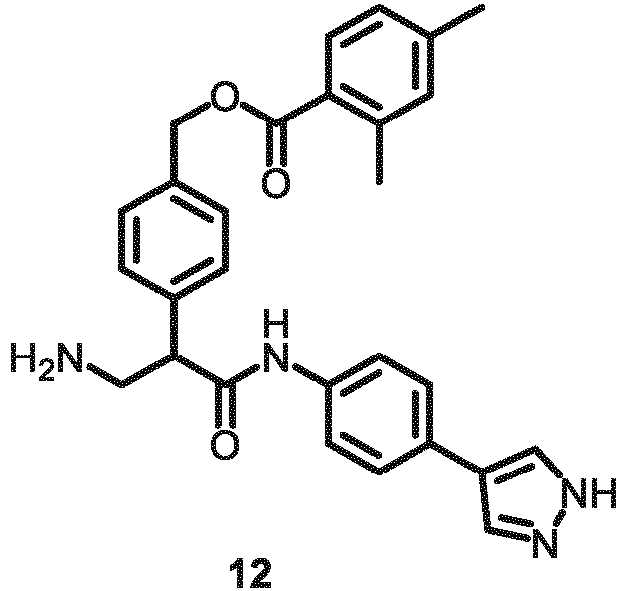
Compound Number Compound 13 Compound 14 Structure 

Compound Number Compound 15 = Formula (IV) Compound 17 = Formula (III) Structure 

Compound Number Compound 19 Compound 20 Structure 

Compound Number Compound 21 Structure 
- A kinase inhibitor, comprising:
the compound represented by one of Formulae (I)-(IV), or a pharmaceutically acceptable salt or ester, hydrate, individual optical isomers, a mixture of the individual enantiomers or a racemate-thereof as claimed in claim 1, wherein the compound is capable of inhibiting myosin light chain kinase 4 (MYLK-4) and/or mitogen-activated protein kinase 19 (MAPK19, YSK-4). - The kinase inhibitor as claimed in claim 3, wherein the compound is present in the form of the individual optical isomers, a mixture of the individual enantiomers or a racemate, and comprises a compound selected from a group consisting of Compound 1 to Compound 15, Compound 17, and Compound 19 to Compound 21 as shown in the following:
Compound Number Compound 1 Compound 2 = Formula (II) Structure 

Compound Number Compound 3 Compound 4 Structure 

Compound Number Compound 5 Compound 6 Structure 

Compound Number Compound 7 Compound 8 Structure 

Compound Number Compound 9 Compound 10 Structure 

Compound Number Compound 11 Compound 12 Structure 

Compound Number Compound 13 Compound 14 Structure 

Compound Number Compound 15 Formula (IV) Compound 17 = Formula (III) Structure 
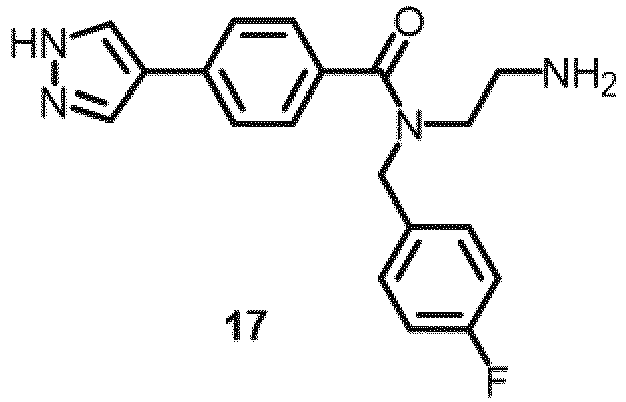
Compound Number Compound 19 Compound 20 Structure 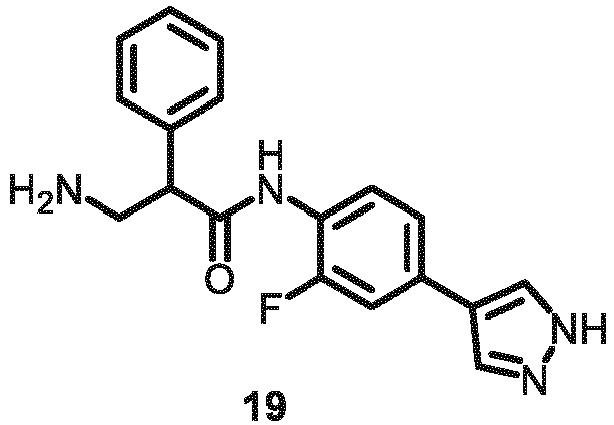

Compound Number Compound 21 Structure 
- The kinase inhibitor as claimed in claim 3, wherein the compound is further capable of inhibiting a Rho-associated protein kinase (ROCK).
- A pharmaceutical composition, comprising:
the compound represented by one of Formulae (I)-(IV), or a pharmaceutically acceptable salt or ester, hydrate, individual optical isomers, a mixture of the individual enantiomers or a racemate thereof as claimed in claim 1. - The pharmaceutical composition as claimed in claim 6, wherein the compound is present in the form of the individual optical isomers, a mixture of the individual enantiomers or a racemate, and comprises a compound selected from a group consisting of Compound 1 to Compound 15, Compound 17, and Compound 19 to Compound 21 as shown in the following:
Compound Number Compound 1 Compound 2 = Formula (II) Structure 

Compound Number Compound 3 Compound 4 Structure 

Compound Number Compound 5 Compound 6 Structure 

Compound Number Compound 7 Compound 8 Structure 

Compound Number Compound 9 Compound 10 Structure 

Compound Number Compound 11 Compound 12 Structure 

Compound Number Compound 13 Compound 14 Structure 

Compound Number Compound 15= Formula (IV) Compound 17= Formula (III) Structure 

Compound Number Compound 19 Compound 20 Structure 

Compound Number Compound 21 Structure 
- A pharmaceutical composition for use in an in vivo related application that benefits from the inhibition of a kinase, comprising:
the compound represented by one of Formulae (I)-(IV), or a pharmaceutically acceptable salt or ester, hydrate, individual optical isomers, a mixture of the individual enantiomers or a racemate-thereof as claimed in claim 1, wherein the kinase is at least one selected from a group consisting of:myosin light chain kinase 4;mitogen-activated protein kinase 19; anda Rho-associated protein kinase,wherein the in vivo related application comprises an ophthalmology-related application or a lung-related application. - The pharmaceutical composition for use as claimed in claim 8, wherein the compound is present in the form of the individual optical isomers, a mixture of the individual enantiomers or a racemate, and comprises a compound selected from a group consisting of Compound 1 to Compound 15, Compound 17, and Compound 19 to Compound 21 as shown in the following:
Compound Number Compound 1 Compound 2= Formula (II) Structure 

Compound Number Compound 3 Compound 4 Structure 

Compound Number Compound 5 Compound 6 Structure 

Compound Number Compound 7 Compound 8 Structure 

Compound Number Compound 9 Compound 10 Structure 

Compound Number Compound 11 Compound 12 Structure 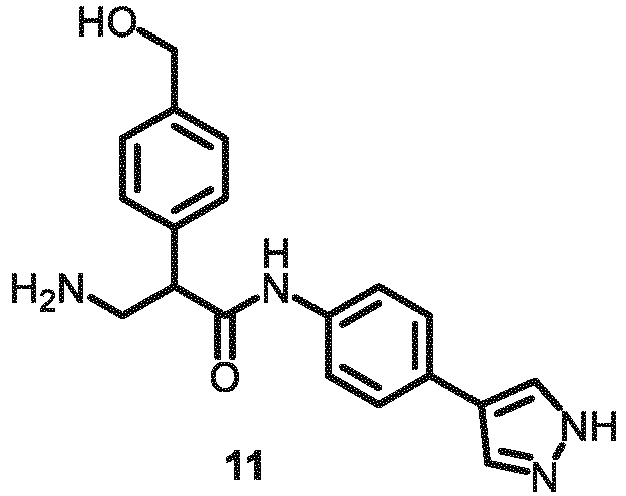

Compound Number Compound 13 Compound 14 Structure 

Compound Number Compound 15= Formula (IV) Compound 17= Formula (III) Structure 

Compound Number Compound 19 Compound 20 Structure 

Compound Number Compound 21 Structure 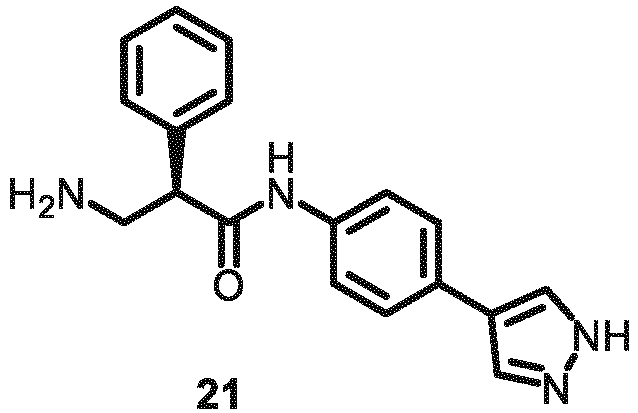
- The pharmaceutical composition for use as claimed in claim8 or 9, wherein the ophthalmology-related application comprises protection of optic nerve, and/or prevention and/or treatment of high intraocular pressure, glaucoma, ocular stroke, macular degeneration, macular edema, diabetic retinopathy, Fuchs endothelial corneal dystrophy (FECD) and/or corneal fibrosis.
- The pharmaceutical composition for use as claimed in claim 8 or 9, wherein the lung-related application comprises prevention and/or treatment of pulmonary hypertension, chronic obstructive pulmonary disease (COPD), idiopathic pulmonary fibrosis (IPF), pulmonary emphysema and/or lung cancer.
- A pharmaceutical composition for use in reducing intraocular pressure, comprising:
the compound represented by one of Formulae (I)-(IV), or a pharmaceutically acceptable salt or ester, hydrate, individual optical isomers, a mixture of the individual enantiomers or a racemate-thereof as claimed in claim 1. - The pharmaceutical composition for use as claimed in claim 12 wherein the compound is present in the form of the individual optical isomers, a mixture of the individual enantiomers or a racemate, and comprises a compound selected from a group consisting of Compound 1 to Compound 15, Compound 17, and Compound 19 to Compound 21 as shown in the following:
Compound Number Compound 1 Compound 2= Formula (II) Structure 

Compound Number Compound 3 Compound 4 Structure 

Compound Number Compound 5 Compound 6 Structure 

Compound Number Compound 7 Compound 8 Structure 

Compound Number Compound 9 Compound 10 Structure 

Compound Number Compound 11 Compound 12 Structure 
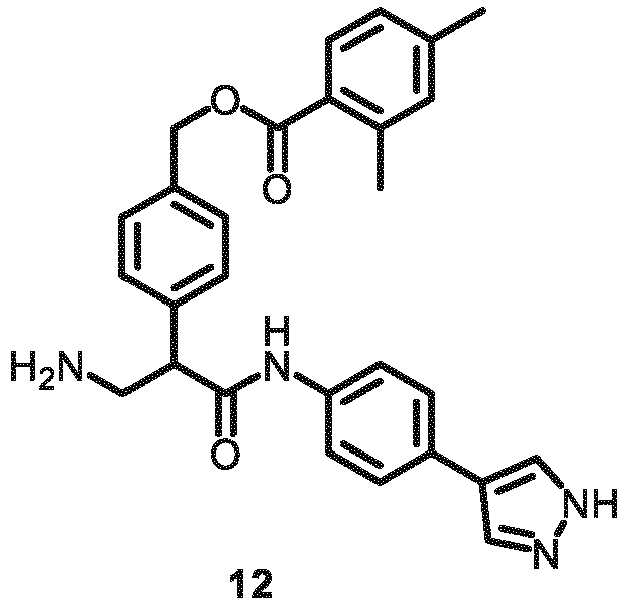
Compound Number Compound 13 Compound 14 Structure 

Compound Number Compound 15= Formula (IV) Compound 17= Formula (III) Structure 

Compound Number Compound 19 Compound 20 Structure 

Compound Number Compound 21 Structure 
- The pharmaceutical composition for use as claimed in claim 12 or 13, wherein the pharmaceutical composition used for reducing intraocular pressure is a medicament for treating glaucoma.
Applications Claiming Priority (1)
| Application Number | Priority Date | Filing Date | Title |
|---|---|---|---|
| US201962955683P | 2019-12-31 | 2019-12-31 |
Publications (2)
| Publication Number | Publication Date |
|---|---|
| EP3845276A1 EP3845276A1 (en) | 2021-07-07 |
| EP3845276B1 true EP3845276B1 (en) | 2025-01-29 |
Family
ID=74556625
Family Applications (1)
| Application Number | Title | Priority Date | Filing Date |
|---|---|---|---|
| EP20213242.9A Active EP3845276B1 (en) | 2019-12-31 | 2020-12-10 | Beta-amino acid derivative, kinase inhibitor and pharmaceutical composition containing the same, and use of the same |
Country Status (6)
| Country | Link |
|---|---|
| US (1) | US11608319B2 (en) |
| EP (1) | EP3845276B1 (en) |
| JP (1) | JP7531379B2 (en) |
| CN (1) | CN113121443B (en) |
| ES (1) | ES3015621T3 (en) |
| TW (1) | TWI777325B (en) |
Families Citing this family (1)
| Publication number | Priority date | Publication date | Assignee | Title |
|---|---|---|---|---|
| AU2021309876B2 (en) * | 2020-07-14 | 2024-06-27 | Wuhan Ll Science And Technology Development Co., Ltd. | Rock inhibitor, and preparation method therefor and use thereof |
Family Cites Families (14)
| Publication number | Priority date | Publication date | Assignee | Title |
|---|---|---|---|---|
| TW200306819A (en) | 2002-01-25 | 2003-12-01 | Vertex Pharma | Indazole compounds useful as protein kinase inhibitors |
| US8211919B2 (en) | 2005-09-02 | 2012-07-03 | Astellas Pharma Inc. | Amide derivatives as rock inhibitors |
| US8504218B2 (en) | 2007-07-31 | 2013-08-06 | General Electric Company | Methods and systems for universal input output for vehicle control |
| WO2009079009A1 (en) | 2007-12-19 | 2009-06-25 | Yangbo Feng | Anilides and analogs as rho kinase inhibitors |
| WO2010036316A1 (en) | 2008-09-24 | 2010-04-01 | Yangbo Feng | Urea and carbamate compounds and analogs as kinase inhibitors |
| EP3828172A1 (en) * | 2009-05-01 | 2021-06-02 | Aerie Pharmaceuticals, Inc. | Dual mechanism inhibitors for the treatment of disease |
| DK2653468T3 (en) | 2009-07-28 | 2016-06-06 | Ono Pharmaceutical Co | Bicyclic compound AND USE THEREOF FOR MEDICAL PURPOSES |
| CA3099517C (en) | 2012-07-13 | 2022-04-26 | Santen Pharmaceutical Co., Ltd. | Combinations comprising a sulfonamide compound for the treatment of glaucoma or ocular hypertension |
| WO2014134391A1 (en) | 2013-02-28 | 2014-09-04 | Bristol-Myers Squibb Company | Phenylpyrazole derivatives as potent rock1 and rock2 inhibitors |
| HK1248070A1 (en) | 2015-05-18 | 2018-10-12 | 转化药物开发有限责任公司 | Heterocyclic compounds as kinase inhbitors |
| BR112019003232A2 (en) | 2016-08-19 | 2019-06-18 | Aerie Pharmaceuticals Inc | beta-amino isoquinolinyl amide compounds, compositions including it and methods of obtaining |
| AU2017362571A1 (en) * | 2016-11-21 | 2019-07-11 | Translational Drug Development, Llc | Heterocyclic compounds as kinase inhibitors |
| EA202090306A1 (en) * | 2017-07-21 | 2020-06-25 | Кадмон Корпорейшн, Ллк | INHIBITORS OF RHO-ASSOCIATED CONTAINING SUPERSPIRAL PROTEINKINASE |
| AU2019234858A1 (en) * | 2018-03-14 | 2020-10-01 | Aerie Pharmaceuticals, Inc. | Amino-benzoisothiazole and amino-benzoisothiadiazole amide compounds |
-
2020
- 2020-12-10 ES ES20213242T patent/ES3015621T3/en active Active
- 2020-12-10 EP EP20213242.9A patent/EP3845276B1/en active Active
- 2020-12-10 US US17/117,615 patent/US11608319B2/en active Active
- 2020-12-10 TW TW109143679A patent/TWI777325B/en active
- 2020-12-10 JP JP2020204848A patent/JP7531379B2/en active Active
- 2020-12-10 CN CN202011454931.0A patent/CN113121443B/en active Active
Also Published As
| Publication number | Publication date |
|---|---|
| EP3845276A1 (en) | 2021-07-07 |
| ES3015621T3 (en) | 2025-05-06 |
| TW202126628A (en) | 2021-07-16 |
| CN113121443A (en) | 2021-07-16 |
| JP7531379B2 (en) | 2024-08-09 |
| CN113121443B (en) | 2024-07-09 |
| US20220363645A1 (en) | 2022-11-17 |
| TWI777325B (en) | 2022-09-11 |
| JP2021113185A (en) | 2021-08-05 |
| US11608319B2 (en) | 2023-03-21 |
Similar Documents
| Publication | Publication Date | Title |
|---|---|---|
| US7820670B2 (en) | 6-aminoimidazo[1,2-b]pyridazine analogs as rho kinase inhibitors for the treatment of rho kinase-mediated diseases and conditions | |
| ES2289349T3 (en) | DERIVATIVES OF HETEROARIL-PYRIMIDINE AS JAK INHIBITORS. | |
| TWI587859B (en) | Novel compositions for preventing and/or treating lysosomal storage disorders | |
| AU2006249866B2 (en) | Compositions and methods of treating retinal disease | |
| EP2590965B1 (en) | Compounds and methods for inhibiting phosphate transport | |
| KR102836746B1 (en) | Nitric oxide releasing phosphodiesterase type 5 inhibitor | |
| US20180104350A1 (en) | Compounds and compositions for the treatment of ocular disorders | |
| JPH05506854A (en) | Topically active ophthalmic thiadiazole sulfonamide carbonic anhydrase inhibitor | |
| US8426406B2 (en) | Glucocorticoid receptor agonist comprising 2,2,4-trimethyl-6-phenyl-1,2-dihydroquinoline derivatives having substituted oxy group | |
| ZA200608712B (en) | Substantially pure 2-{[2-(2-methylamino-pyrimidin-4-yl)-1II-indole-5-carbonyl]-amino}-3-(phenylpyridin-2-yl-amino)-propionic acid as an IkB kinase inhibitor | |
| EP1016407A1 (en) | Remedial agent for neural degeneration | |
| CN111518028B (en) | A nitric oxide donor type ripasudil derivative and its preparation method and use | |
| US11608319B2 (en) | Beta-amino acid derivative, kinase inhibitor and pharmaceutical composition containing the same, and method for performing an in vivo related application that benefits from the inhibition of a kinase | |
| KR102758256B1 (en) | β-AMINO ACID DERIVATIVE, KINASE INHIBITOR AND PHARMACEUTICAL COMPOSITION CONTAINING THE SAME | |
| JP7834370B2 (en) | Calpain-2 selective inhibitor compounds for the treatment of glaucoma | |
| JP2021520413A (en) | Therapy for ophthalmic condition | |
| US7867999B1 (en) | Hydroxyamino- and amino-substituted pyridine analogs for treating rho kinase-mediated diseases and conditions | |
| CN102666563A (en) | Alkoxycarbonylaminoalkynyladenosine compounds and derivatives thereof as A2A receptor agonists | |
| RU2785776C2 (en) | Phosphodiesterase type 5 inhibitor releasing nitrogen oxide | |
| CN101899008A (en) | N-substituted pyrimidinesulfonyl-substituted benzamide small molecule inhibitor of Bcl-2 protein and its application | |
| CN100422161C (en) | Oxymorpholone derivatives and their medicinal uses | |
| WO2026003812A1 (en) | Isoquinoline derivatives as rock inhibitors | |
| WO2026008075A1 (en) | Nitric oxide donor-containing compounds | |
| HK40120357A (en) | Nitric oxide releasing phosphodiesterase type 5 inhibitor | |
| HK40049475A (en) | Nitric oxide releasing phosphodiesterase type 5 inhibitor |
Legal Events
| Date | Code | Title | Description |
|---|---|---|---|
| PUAI | Public reference made under article 153(3) epc to a published international application that has entered the european phase |
Free format text: ORIGINAL CODE: 0009012 |
|
| STAA | Information on the status of an ep patent application or granted ep patent |
Free format text: STATUS: THE APPLICATION HAS BEEN PUBLISHED |
|
| AK | Designated contracting states |
Kind code of ref document: A1 Designated state(s): AL AT BE BG CH CY CZ DE DK EE ES FI FR GB GR HR HU IE IS IT LI LT LU LV MC MK MT NL NO PL PT RO RS SE SI SK SM TR |
|
| STAA | Information on the status of an ep patent application or granted ep patent |
Free format text: STATUS: REQUEST FOR EXAMINATION WAS MADE |
|
| 17P | Request for examination filed |
Effective date: 20220106 |
|
| RBV | Designated contracting states (corrected) |
Designated state(s): AL AT BE BG CH CY CZ DE DK EE ES FI FR GB GR HR HU IE IS IT LI LT LU LV MC MK MT NL NO PL PT RO RS SE SI SK SM TR |
|
| STAA | Information on the status of an ep patent application or granted ep patent |
Free format text: STATUS: EXAMINATION IS IN PROGRESS |
|
| 17Q | First examination report despatched |
Effective date: 20230222 |
|
| GRAP | Despatch of communication of intention to grant a patent |
Free format text: ORIGINAL CODE: EPIDOSNIGR1 |
|
| STAA | Information on the status of an ep patent application or granted ep patent |
Free format text: STATUS: GRANT OF PATENT IS INTENDED |
|
| INTG | Intention to grant announced |
Effective date: 20240618 |
|
| GRAS | Grant fee paid |
Free format text: ORIGINAL CODE: EPIDOSNIGR3 |
|
| RAP3 | Party data changed (applicant data changed or rights of an application transferred) |
Owner name: INDUSTRIAL TECHNOLOGY RESEARCH INSTITUTE |
|
| GRAA | (expected) grant |
Free format text: ORIGINAL CODE: 0009210 |
|
| STAA | Information on the status of an ep patent application or granted ep patent |
Free format text: STATUS: THE PATENT HAS BEEN GRANTED |
|
| AK | Designated contracting states |
Kind code of ref document: B1 Designated state(s): AL AT BE BG CH CY CZ DE DK EE ES FI FR GB GR HR HU IE IS IT LI LT LU LV MC MK MT NL NO PL PT RO RS SE SI SK SM TR |
|
| REG | Reference to a national code |
Ref country code: GB Ref legal event code: FG4D |
|
| REG | Reference to a national code |
Ref country code: CH Ref legal event code: EP |
|
| REG | Reference to a national code |
Ref country code: IE Ref legal event code: FG4D |
|
| REG | Reference to a national code |
Ref country code: DE Ref legal event code: R096 Ref document number: 602020045457 Country of ref document: DE |
|
| REG | Reference to a national code |
Ref country code: ES Ref legal event code: FG2A Ref document number: 3015621 Country of ref document: ES Kind code of ref document: T3 Effective date: 20250506 |
|
| REG | Reference to a national code |
Ref country code: NL Ref legal event code: MP Effective date: 20250129 |
|
| PG25 | Lapsed in a contracting state [announced via postgrant information from national office to epo] |
Ref country code: NL Free format text: LAPSE BECAUSE OF FAILURE TO SUBMIT A TRANSLATION OF THE DESCRIPTION OR TO PAY THE FEE WITHIN THE PRESCRIBED TIME-LIMIT Effective date: 20250129 |
|
| PG25 | Lapsed in a contracting state [announced via postgrant information from national office to epo] |
Ref country code: RS Free format text: LAPSE BECAUSE OF FAILURE TO SUBMIT A TRANSLATION OF THE DESCRIPTION OR TO PAY THE FEE WITHIN THE PRESCRIBED TIME-LIMIT Effective date: 20250429 |
|
| PG25 | Lapsed in a contracting state [announced via postgrant information from national office to epo] |
Ref country code: FI Free format text: LAPSE BECAUSE OF FAILURE TO SUBMIT A TRANSLATION OF THE DESCRIPTION OR TO PAY THE FEE WITHIN THE PRESCRIBED TIME-LIMIT Effective date: 20250129 |
|
| PG25 | Lapsed in a contracting state [announced via postgrant information from national office to epo] |
Ref country code: PL Free format text: LAPSE BECAUSE OF FAILURE TO SUBMIT A TRANSLATION OF THE DESCRIPTION OR TO PAY THE FEE WITHIN THE PRESCRIBED TIME-LIMIT Effective date: 20250129 |
|
| REG | Reference to a national code |
Ref country code: LT Ref legal event code: MG9D |
|
| PG25 | Lapsed in a contracting state [announced via postgrant information from national office to epo] |
Ref country code: NO Free format text: LAPSE BECAUSE OF FAILURE TO SUBMIT A TRANSLATION OF THE DESCRIPTION OR TO PAY THE FEE WITHIN THE PRESCRIBED TIME-LIMIT Effective date: 20250429 Ref country code: IS Free format text: LAPSE BECAUSE OF FAILURE TO SUBMIT A TRANSLATION OF THE DESCRIPTION OR TO PAY THE FEE WITHIN THE PRESCRIBED TIME-LIMIT Effective date: 20250529 |
|
| REG | Reference to a national code |
Ref country code: AT Ref legal event code: MK05 Ref document number: 1762864 Country of ref document: AT Kind code of ref document: T Effective date: 20250129 |
|
| PG25 | Lapsed in a contracting state [announced via postgrant information from national office to epo] |
Ref country code: HR Free format text: LAPSE BECAUSE OF FAILURE TO SUBMIT A TRANSLATION OF THE DESCRIPTION OR TO PAY THE FEE WITHIN THE PRESCRIBED TIME-LIMIT Effective date: 20250129 |
|
| PG25 | Lapsed in a contracting state [announced via postgrant information from national office to epo] |
Ref country code: PT Free format text: LAPSE BECAUSE OF FAILURE TO SUBMIT A TRANSLATION OF THE DESCRIPTION OR TO PAY THE FEE WITHIN THE PRESCRIBED TIME-LIMIT Effective date: 20250529 Ref country code: LV Free format text: LAPSE BECAUSE OF FAILURE TO SUBMIT A TRANSLATION OF THE DESCRIPTION OR TO PAY THE FEE WITHIN THE PRESCRIBED TIME-LIMIT Effective date: 20250129 |
|
| PG25 | Lapsed in a contracting state [announced via postgrant information from national office to epo] |
Ref country code: BG Free format text: LAPSE BECAUSE OF FAILURE TO SUBMIT A TRANSLATION OF THE DESCRIPTION OR TO PAY THE FEE WITHIN THE PRESCRIBED TIME-LIMIT Effective date: 20250129 Ref country code: GR Free format text: LAPSE BECAUSE OF FAILURE TO SUBMIT A TRANSLATION OF THE DESCRIPTION OR TO PAY THE FEE WITHIN THE PRESCRIBED TIME-LIMIT Effective date: 20250430 |
|
| PG25 | Lapsed in a contracting state [announced via postgrant information from national office to epo] |
Ref country code: AT Free format text: LAPSE BECAUSE OF FAILURE TO SUBMIT A TRANSLATION OF THE DESCRIPTION OR TO PAY THE FEE WITHIN THE PRESCRIBED TIME-LIMIT Effective date: 20250129 |
|
| PG25 | Lapsed in a contracting state [announced via postgrant information from national office to epo] |
Ref country code: SE Free format text: LAPSE BECAUSE OF FAILURE TO SUBMIT A TRANSLATION OF THE DESCRIPTION OR TO PAY THE FEE WITHIN THE PRESCRIBED TIME-LIMIT Effective date: 20250129 |
|
| PG25 | Lapsed in a contracting state [announced via postgrant information from national office to epo] |
Ref country code: SM Free format text: LAPSE BECAUSE OF FAILURE TO SUBMIT A TRANSLATION OF THE DESCRIPTION OR TO PAY THE FEE WITHIN THE PRESCRIBED TIME-LIMIT Effective date: 20250129 |
|
| PG25 | Lapsed in a contracting state [announced via postgrant information from national office to epo] |
Ref country code: DK Free format text: LAPSE BECAUSE OF FAILURE TO SUBMIT A TRANSLATION OF THE DESCRIPTION OR TO PAY THE FEE WITHIN THE PRESCRIBED TIME-LIMIT Effective date: 20250129 |
|
| PG25 | Lapsed in a contracting state [announced via postgrant information from national office to epo] |
Ref country code: CZ Free format text: LAPSE BECAUSE OF FAILURE TO SUBMIT A TRANSLATION OF THE DESCRIPTION OR TO PAY THE FEE WITHIN THE PRESCRIBED TIME-LIMIT Effective date: 20250129 Ref country code: EE Free format text: LAPSE BECAUSE OF FAILURE TO SUBMIT A TRANSLATION OF THE DESCRIPTION OR TO PAY THE FEE WITHIN THE PRESCRIBED TIME-LIMIT Effective date: 20250129 |
|
| PGFP | Annual fee paid to national office [announced via postgrant information from national office to epo] |
Ref country code: IE Payment date: 20250902 Year of fee payment: 6 |
|
| PG25 | Lapsed in a contracting state [announced via postgrant information from national office to epo] |
Ref country code: SK Free format text: LAPSE BECAUSE OF FAILURE TO SUBMIT A TRANSLATION OF THE DESCRIPTION OR TO PAY THE FEE WITHIN THE PRESCRIBED TIME-LIMIT Effective date: 20250129 |
|
| REG | Reference to a national code |
Ref country code: DE Ref legal event code: R097 Ref document number: 602020045457 Country of ref document: DE |
|
| PLBE | No opposition filed within time limit |
Free format text: ORIGINAL CODE: 0009261 |
|
| STAA | Information on the status of an ep patent application or granted ep patent |
Free format text: STATUS: NO OPPOSITION FILED WITHIN TIME LIMIT |
|
| 26N | No opposition filed |
Effective date: 20251030 |
|
| PGFP | Annual fee paid to national office [announced via postgrant information from national office to epo] |
Ref country code: DE Payment date: 20250924 Year of fee payment: 6 |
|
| PGFP | Annual fee paid to national office [announced via postgrant information from national office to epo] |
Ref country code: GB Payment date: 20251001 Year of fee payment: 6 |
|
| PGFP | Annual fee paid to national office [announced via postgrant information from national office to epo] |
Ref country code: IT Payment date: 20251007 Year of fee payment: 6 |
|
| PGFP | Annual fee paid to national office [announced via postgrant information from national office to epo] |
Ref country code: FR Payment date: 20251113 Year of fee payment: 6 |
|
| PG25 | Lapsed in a contracting state [announced via postgrant information from national office to epo] |
Ref country code: RO Free format text: LAPSE BECAUSE OF FAILURE TO SUBMIT A TRANSLATION OF THE DESCRIPTION OR TO PAY THE FEE WITHIN THE PRESCRIBED TIME-LIMIT Effective date: 20250129 |
|
| PGFP | Annual fee paid to national office [announced via postgrant information from national office to epo] |
Ref country code: ES Payment date: 20260107 Year of fee payment: 6 |