EP3841539B1 - Detektion und abschwächung verdächtiger änderungen von zugangsdaten - Google Patents
Detektion und abschwächung verdächtiger änderungen von zugangsdaten Download PDFInfo
- Publication number
- EP3841539B1 EP3841539B1 EP19740267.0A EP19740267A EP3841539B1 EP 3841539 B1 EP3841539 B1 EP 3841539B1 EP 19740267 A EP19740267 A EP 19740267A EP 3841539 B1 EP3841539 B1 EP 3841539B1
- Authority
- EP
- European Patent Office
- Prior art keywords
- credential
- suspicious
- change
- mitigation
- user
- Prior art date
- Legal status (The legal status is an assumption and is not a legal conclusion. Google has not performed a legal analysis and makes no representation as to the accuracy of the status listed.)
- Active
Links
Images






Classifications
-
- G—PHYSICS
- G06—COMPUTING OR CALCULATING; COUNTING
- G06Q—INFORMATION AND COMMUNICATION TECHNOLOGY [ICT] SPECIALLY ADAPTED FOR ADMINISTRATIVE, COMMERCIAL, FINANCIAL, MANAGERIAL OR SUPERVISORY PURPOSES; SYSTEMS OR METHODS SPECIALLY ADAPTED FOR ADMINISTRATIVE, COMMERCIAL, FINANCIAL, MANAGERIAL OR SUPERVISORY PURPOSES, NOT OTHERWISE PROVIDED FOR
- G06Q10/00—Administration; Management
- G06Q10/06—Resources, workflows, human or project management; Enterprise or organisation planning; Enterprise or organisation modelling
- G06Q10/063—Operations research, analysis or management
- G06Q10/0635—Risk analysis of enterprise or organisation activities
-
- G—PHYSICS
- G06—COMPUTING OR CALCULATING; COUNTING
- G06F—ELECTRIC DIGITAL DATA PROCESSING
- G06F21/00—Security arrangements for protecting computers, components thereof, programs or data against unauthorised activity
- G06F21/30—Authentication, i.e. establishing the identity or authorisation of security principals
- G06F21/45—Structures or tools for the administration of authentication
-
- G—PHYSICS
- G06—COMPUTING OR CALCULATING; COUNTING
- G06F—ELECTRIC DIGITAL DATA PROCESSING
- G06F21/00—Security arrangements for protecting computers, components thereof, programs or data against unauthorised activity
- G06F21/50—Monitoring users, programs or devices to maintain the integrity of platforms, e.g. of processors, firmware or operating systems
- G06F21/55—Detecting local intrusion or implementing counter-measures
- G06F21/554—Detecting local intrusion or implementing counter-measures involving event detection and direct action
-
- G—PHYSICS
- G06—COMPUTING OR CALCULATING; COUNTING
- G06F—ELECTRIC DIGITAL DATA PROCESSING
- G06F21/00—Security arrangements for protecting computers, components thereof, programs or data against unauthorised activity
- G06F21/60—Protecting data
- G06F21/604—Tools and structures for managing or administering access control systems
-
- G—PHYSICS
- G06—COMPUTING OR CALCULATING; COUNTING
- G06Q—INFORMATION AND COMMUNICATION TECHNOLOGY [ICT] SPECIALLY ADAPTED FOR ADMINISTRATIVE, COMMERCIAL, FINANCIAL, MANAGERIAL OR SUPERVISORY PURPOSES; SYSTEMS OR METHODS SPECIALLY ADAPTED FOR ADMINISTRATIVE, COMMERCIAL, FINANCIAL, MANAGERIAL OR SUPERVISORY PURPOSES, NOT OTHERWISE PROVIDED FOR
- G06Q10/00—Administration; Management
- G06Q10/10—Office automation; Time management
-
- H—ELECTRICITY
- H04—ELECTRIC COMMUNICATION TECHNIQUE
- H04L—TRANSMISSION OF DIGITAL INFORMATION, e.g. TELEGRAPHIC COMMUNICATION
- H04L63/00—Network architectures or network communication protocols for network security
- H04L63/08—Network architectures or network communication protocols for network security for authentication of entities
-
- H—ELECTRICITY
- H04—ELECTRIC COMMUNICATION TECHNIQUE
- H04L—TRANSMISSION OF DIGITAL INFORMATION, e.g. TELEGRAPHIC COMMUNICATION
- H04L63/00—Network architectures or network communication protocols for network security
- H04L63/14—Network architectures or network communication protocols for network security for detecting or protecting against malicious traffic
- H04L63/1408—Network architectures or network communication protocols for network security for detecting or protecting against malicious traffic by monitoring network traffic
- H04L63/1425—Traffic logging, e.g. anomaly detection
-
- G—PHYSICS
- G06—COMPUTING OR CALCULATING; COUNTING
- G06F—ELECTRIC DIGITAL DATA PROCESSING
- G06F2221/00—Indexing scheme relating to security arrangements for protecting computers, components thereof, programs or data against unauthorised activity
- G06F2221/03—Indexing scheme relating to G06F21/50, monitoring users, programs or devices to maintain the integrity of platforms
- G06F2221/034—Test or assess a computer or a system
Definitions
- First-line workers are the first point of contact between a company and the outside world. These are people who typically do not sit behind a computer all day but rather work, for example, on a store floor, in a clinic, or on the phone. In this role, such workers are typically first to engage customers and represent a company and its brand. Despite not sitting behind a computer all day, first-line workers may be required to access certain productivity applications. First-line workers, however, are typically non-technical and do not have access to an onsite information technology administrator. In lieu of dedicated information technology administrators, a manager of first-line workers, or other figure of authority, can be given additional credentialing responsibilities. First-line workers contact a store manager, for instance, to acquire credentials such as a user name and password or smart card.
- US 2018/0083986 A1 describes systems and methods for providing protection against alteration of data, such as a credential, associated with a transaction.
- a first communication is received from a requesting system.
- the first communication includes a credential and corresponds to an indication that an extended-duration task is being initiated and a request to listen to a status of the credential.
- a device-listening data store is updated to associate the credential with an identifier associated with the requesting system.
- the device-listening data store is queried based on the credential.
- the identifier associated with the requesting device is received.
- a second communication is generated that corresponds to an alert that identifies a status of the credential as having been modified or cancelled. The second communication is transmitted to the requesting system.
- US 2018/0046796 A1 describes that a system and method includes at an authentication platform that is implemented via one or more computing servers: identifying compromised credential data, wherein compromised credential data comprise compromised credentials for one or more compromised accounts that have been exposed to a malicious actor via an illegitimate method, the compromised credentials including credentials that are useable for authentication to or for accessing the one or more compromised accounts; testing the compromised credentials, wherein testing compromised credentials includes using the compromised credentials to determine a useablility of the compromised credentials to attack one or more different accounts from the one or more compromised accounts; and modifying account access associated with one or more of (i) the one or more compromised accounts and (ii) the one or more different accounts.
- US 2018/0069893 A1 describes a method including extracting, from initial data transmitted on a network, multiple events, each of the events including a user accessing a resource. First and second sets of records are created, each first set record including a sub-group of the events of a user, each second set record including a sub-group of the events of a multiple users during respective sub-periods of a training period. Safe labels are assigned to the first set records and suspicious labels are assigned to the second set records. An analysis fits, to the first and the second set records and their respective labels, a model for predicting the label for a given record. The model filters subsequent network data to identify, in the subsequent data, sequences of events predicted to be labeled suspicious by the model, and upon detecting a given sequence of events predicted as suspicious by the model, an alert is generated.
- the subject disclosure pertains to suspicious credential change detection and mitigation.
- Data surrounding a credential change on a user account can be collected and automatically compared against a set of suspicious credential change patterns. If the data surrounding the credential change matches one of the set of suspicious credential change patterns, the credential change can be flagged as suspicious.
- one or more mitigation actions can be triggered to allay adverse effects of a suspicious credential change. Mitigation actions can comprise notification, suspension of credential management privileges, and initiating monitoring of credential administrator activities, among others.
- Bob is a manager and credential administrator at a retail store, and Alice is an employee. If Bob had malicious intent, Bob could reset and record Alice's user name and password and use these to check her email and login to Alice's shift information. If phone number and text code are used in place of user name and password, Bob could set his own phone number on Alice's account to access her data. Bob could then change the phone number back to Alice's number, in which case Alice may never learn that Bob was temporarily able to access her data.
- a conventional solution is to limit the number of people who have the credential role and not give this role to untrusted people.
- such a solution defeats the purpose of a model that empowers figures of authority to perform such actions on behalf of employees.
- the subject description pertains to detection and mitigation of suspicious credential changes.
- Credential changes and data surrounding credential changes can be captured and compared with suspicious credential change patterns. If a match is detected, the credential change can be flagged as suspicious.
- one or more mitigation strategies can be triggered.
- a suspicious change can be reported to an authority/oversight figure.
- a credential management role of the user account associated with the change can also be suspended or extensive logging initiated, among other things.
- the credential administrator can be a retail store manager with several employees to whom the manager assigns credentials.
- the system 100 analyzes received data or information surrounding a credential change and outputs a response.
- the response can be a classification, recommendation, report, or triggered action.
- the system 100 can operate in substantially real time or offline later (e.g., post event).
- the system 100 includes detection component 110 and mitigation component 120.
- the detection component 110 provides a means for detecting suspicious credential changes.
- the detection component 110 analyzes credential change information and detects suspicious credential changes based on patterns of known suspicious credential changes.
- the mitigation component 120 provides a means for mitigating adverse effects associated with a suspicious credential change. For example, the mitigation component 120 can report the detection, initiate further logging of actions of a credential administrator, or suspend credential administrator capabilities or privileges.
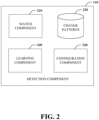
- the detection component 110 includes match component 210, change patterns 220, configuration component 230, and learning component 240.
- the match component 210 seeks to detect suspicious credential changes using known suspicious change patterns 220. More specifically, the match component 210 can seek to match data received surrounding a credential change to a known suspicious change pattern.
- the change patterns 220 can be manually input utilizing the configuration component 230 or automatically specified by the learning component 240.
- the configuration component 230 provides a means for a user to specify suspicious change patterns and control when there is a match given the change patterns 220. For example, a user can specify the extent of pattern match (e.g., given percentage, features ).
- the configuration component 230 can enable setting of change pattern parameters, such as threshold times or number of identical credentials.
- the learning component 240 can take the known suspicious patterns and seek to learn new patterns or variations of existing patterns that can be used in matching. Various known and novel statistical analysis and artificial intelligence techniques can be employed by the learning component 240 to infer suspicious change patterns.
- the change pattern can be circular on a given user account. For example, credential "A" is changed to credential "B" and then back to credential "A.” This round trip exposes a user account to malicious activity and may be difficult for a user to detect.
- a second change pattern is a frequent credential change on the same account over a predetermined time. For instance, this pattern can be matched if a password, user name, or the like is changed more than once in two months on the same user account.
- a third pattern can involve an attempt to set a credential on an account that is not enabled for a credential.
- the mitigation component 120 mitigates adverse effects associated with a suspicious credential change.
- the mitigation component 120 includes notification component 310, suspension component 320, log component 330, and policy component 340.
- the notification component 310 is configured to provide notification to end-users as well as information technology administrators or others regarding a suspicious credential change. Notification can be provided by way of a variety of mediums including, among others, email and text message.
- the suspension component 320 enables a credential administrator role to be suspended without suspending a user account. In other words, if a credential administrator is associated with a suspicious credential change, a user account can still function, but management of credentials suspended.
- the log component 330 can be activated to perform additional logging associated with activities or a credential administrator to enable detailed analysis of credential administrator actions.
- the policy component 340 enables specification of a mitigation policy or set of policies. For example, a policy can indicate that upon detection of a suspicious credential change notification is to be provided and detailed logging enabled. Alternatively, a policy can indicate that the credential role is to be suspended immediately.
- the notification component 310 can enable notification to be provided to an information technology administrator, manager, fraud prevention service center, or other figure of authority.
- an information technology administrator manager, fraud prevention service center, or other figure of authority.
- the user account that was used to make the change (presumably owned by a credential administrator)
- the authentication method used by this person, device information, network, location and timestamp can be logged.
- This logged information, or a subset thereof, can be presented to a figure of authority.
- a report can be generated and provided with a notification to the figure of authority.
- a notification can include a trigger for further action.
- a text message or email can include a link or button to suspend a credential authority's ability to manage credentials or initiate monitoring of the user account from which a suspicious credential change was performed.
- various portions of the disclosed systems above and methods below can include or employ statistical analysis, artificial intelligence, machine learning, or knowledge or rule-based components, sub-components, processes, means, methodologies, or mechanisms (e.g., support vector machines, neural networks, expert systems, Bayesian belief networks, fuzzy logic, data fusion engines, classifiers).
- Such components can automate certain mechanisms or processes performed thereby to make portions of the systems and methods more adaptive as well as efficient and intelligent.
- the aforementioned techniques can be employed by one or both of the detection component 110 and the mitigation component 120 to infer suspicious credential change patterns and recommend a response based on detecting a suspicious credential change.
- the detection component 110 can employ supervised or unsupervised learning with respect to classification of credential changes as suspicious or not. Further, patterns can be learned based on type of user, organization, or industry making changes. In this manner, a profile can be created regarding what to expect and anomaly detection can be performed based on what is expected.
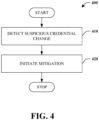
- FIG. 4 illustrates a method 400 of credential change management.
- a suspicious credential is automatically detected, inferred, or otherwise identified.
- information regarding the change can be analyzed to determine whether the change should be classified as suspicious or not.
- information regarding a change can be compared with known patterns such that a match or similarity can be deemed a suspicious change.
- mitigation is initiated to reduce the potential negative effects of a suspicious credential change.
- notification can be sent to an end user whose account may have been compromised, a superior of a credential administrator (e.g., information technology administrator, fraud prevention department, manager ...), or both.
- notifications can include a mechanism for triggering mitigation actions or a user policy can be specified and employed to automatically initiate mitigation actions.
- FIG. 5 depicts a method 500 of detecting a suspicious credential change.
- a change from a first credential to a second credential is identified. For example, change of a password or change of a phone number, in a no-password system, can be detected.
- a change from the second credential to the first credential is identified. For instance, a password could have been changed from "1234" to "5678" and back to "1234.”
- the credential change is labeled or flagged as suspicious at reference numeral 530. This circular pattern is highly suspicious and difficult for a potential victim to detect.
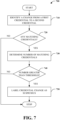
- FIG. 6 is a flow chart diagram of a method 600 of detecting a suspicious credential change.
- a first credential change is identified.
- a second credential change is identified. In other words, the same credential has been changed twice.
- a determination is made as to whether the change from a first credential to a second credential occurred within a threshold time.
- the threshold time is configurable. For example, the threshold time could be set for two months or two days. If the first credential change and the second credential change did not occur within the threshold time (“NO"), the method can simply terminate.
- the method continues at 640, where the credential change is labeled as suspicious.
- a relatively rapid change of credential can be suspicious.
- the method 600 could also require a successful sign in with the first credential and then a change to the second credential to classify the change as suspicious.
- FIG. 8 is a flow chart depicting a method 800 of detecting a suspicious credential change.
- a first credential change is identified.
- credentials are determined for a credential administrator who made the credential change.
- a determination is made, at numeral 830, as to whether the change credential matches a credential of the credential administrator. If the change credential does not match a credential of the administrator ("NO"), the method terminates. If the change credential does match a credential of the administrator (“YES”), the method continues at 840, where the credential change is labeled as suspicious. In this manner, an administrator setting his own credential on another account can be deemed suspicious.
- FIG. 9 is a flow chart diagram illustrating a method of detecting suspicious credential change.
- an attempt to set a credential is detected. For instance, an attempt can be made to set a phone number as a credential on a user account.
- a determination is made as to whether or not the type of credential attempting to be set is enabled on a target user account. In other words, the determination concerns whether a user account has been configured to accept a particular type of credential for authentication purposes. If the credential is enabled (“YES"), the method terminates. On the other hand, if the credential is not enabled for the user account (“NO”), the method continues at 930.
- the potential credential change is labeled as suspicious.
- a rogue credential administrator might attempt to configure their own phone number on an executive's user account to sign in to the account. However, the executive's account may not be enabled for this sign-in method, which would be suspicious.
- aspects of the subject disclosure pertain to the technical problem of credential security.
- Technical mechanisms are utilized to detect and mitigate suspicious credential changes.
- a credential change can be compared with known or learned suspicious change patterns to automatically detect or infer suspicious credential changes.
- one or more mitigation strategies can be triggered based on the suspicious change. For example, notifications can be sent, monitoring of a user account initiated, or a credential management capability of a user account suspended.
- the subject disclosure supports various products and processes that perform, or are configured to perform, various actions regarding suspicious credential change and mitigation. What follows are one or more exemplary systems and methods.
- a system comprises: a processor coupled to a memory, the processor configured to execute computer-executable instructions stored in the memory that when executed cause the processor to perform the following actions: receiving data regarding a user credential change; detecting a suspicious credential change automatically based on the data and a set of one or more suspicious change patterns; and initiating mitigation of the suspicious credential change.
- the suspicious change pattern comprises a circular pattern in which a first credential is changed to a second credential and back to the first credential.
- the suspicious change pattern comprises multiple changes within a predetermined time.
- the suspicious change pattern comprises setting the same credential on more than one account.
- the suspicious change pattern comprises an attempt to set a credential on an account, wherein the account is disabled for the credential attempted to be set.
- the suspicious change pattern comprises an attempt to update a credential that is not validated by an end user.
- Mitigation further comprises suspending solely an ability of a credential administrator to manage credentials.
- Mitigation can further comprise generating a notification of the suspicious credential change with a trigger that when activated performs an action with respect to a credential administrator.
- the system further comprises performing automatic mitigation based on a configurable policy.
- a method comprises: employing at least one processor configured to execute computer-executable instructions stored in a memory that when executed cause the at least one processor to perform the following acts: receiving data regarding a user credential change; detecting a suspicious credential change automatically based on the data and a set of one or more suspicious change patterns; and initiating mitigation of the suspicious credential change.
- the method further comprises detecting the suspicious credential change based on a suspicious change pattern specifying a circular pattern in which a first credential is changed to a second credential and back the first credential.
- the method further comprises detecting the suspicious credential change based on a suspicious change pattern specifying multiple changes within a predetermined time.
- the method further comprises detecting the suspicious credential change based on a suspicious change pattern specifying the same credential is set on multiple accounts. Initiating mitigation further comprises suspending solely credential management capabilities of a credential administrator account used to make the user credential change. In another instance, initiating mitigation further comprises generating a notification with a mechanism configured to trigger a particular mitigation activity. The method further comprises initiating mitigation automatically in response to a configurable mitigation policy.
- a credential management method comprises: employing at least one processor configured to execute computer-executable instructions stored in a memory that when executed cause the at least one processor to perform the following acts: detecting a suspicious credential change automatically by comparing data associated with a credential change for a user account with a set of one or more suspicious change patterns, wherein a match between the data and one of the set of one or more suspicious change patterns indicates a suspicious credential change; and initiating automatic mitigation of the suspicious credential change after detection of the suspicious credential change.
- the method further comprises matching the data associated with the credential change to a suspicious change pattern comprising a circular pattern in which a first credential is changed to a second credential and back to the first credential.
- the method further comprises matching the data associated with the credential change to suspicious change pattern comprising multiple changes within a predetermined time.
- Automatic mitigation further comprises generating a notification with a mechanism to trigger one of suspending credential management privileges of a credential administrator responsible for making the credential change or turning on extensive logging of activities of the credential administrator.
- a component may be, but is not limited to being, a process running on a processor, a processor, an object, an instance, an executable, a thread of execution, a program, and/or a computer.
- an application running on a computer and the computer can be a component.
- One or more components may reside within a process and/or thread of execution and a component may be localized on one computer and/or distributed between two or more computers.
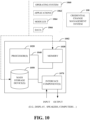
- FIG. 10 As well as the following discussion are intended to provide a brief, general description of a suitable environment in which various aspects of the disclosed subject matter can be implemented.
- the suitable environment is only an example and is not intended to suggest any limitation as to scope of use or functionality.
- program modules include routines, programs, components, data structures, among other things that perform particular tasks and/or implement particular abstract data types.
- the computer 1002 includes one or more processor(s) 1020, memory 1030, system bus 1040, mass storage device(s) 1050, and one or more interface components 1070.
- the system bus 1040 communicatively couples at least the above system constituents.
- the computer 1002 can include one or more processors 1020 coupled to memory 1030 that execute various computer executable actions, instructions, and or components stored in memory 1030.
- the processor(s) 1020 can be implemented with a general-purpose processor, a digital signal processor (DSP), an application specific integrated circuit (ASIC), a field programmable gate array (FPGA) or other programmable logic device, discrete gate or transistor logic, discrete hardware components, or any combination thereof designed to perform the functions described herein.
- a general-purpose processor may be a microprocessor, but in the alternative, the processor may be any processor, controller, microcontroller, or state machine.
- the processor(s) 1020 may also be implemented as a combination of computing devices, for example a combination of a DSP and a microprocessor, a plurality of microprocessors, multi-core processors, one or more microprocessors in conjunction with a DSP core, or any other such configuration.
- the processor(s) 1020 can be a graphics processor.
- the computer 1002 can include or otherwise interact with a variety of computer-readable media to facilitate control of the computer 1002 to implement one or more aspects of the disclosed subject matter.
- the computer-readable media can be any available media that can be accessed by the computer 1002 and includes volatile and nonvolatile media, and removable and non-removable media.
- Computer-readable media can comprise two distinct and mutually exclusive types, namely computer storage media and communication media.
- Computer storage media includes volatile and nonvolatile, removable and non-removable media implemented in any method or technology for storage of information such as computer-readable instructions, data structures, program modules, or other data.
- Computer storage media includes storage devices such as memory devices (e.g., random access memory (RAM), read-only memory (ROM), electrically erasable programmable read-only memory (EEPROM)%), magnetic storage devices (e.g., hard disk, floppy disk, cassettes, tape%), optical disks (e.g., compact disk (CD), digital versatile disk (DVD)...), and solid state devices (e.g., solid state drive (SSD), flash memory drive (e.g., card, stick, key drive)...), or any other like mediums that store, as opposed to transmit or communicate, the desired information accessible by the computer 1002. Accordingly, computer storage media excludes modulated data signals as well as that described with respect to communication media.
- RAM random access memory
- ROM read-only memory
- EEPROM electrically erasable programmable
- Communication media embodies computer-readable instructions, data structures, program modules, or other data in a modulated data signal such as a carrier wave or other transport mechanism and includes any information delivery media.
- modulated data signal means a signal that has one or more of its characteristics set or changed in such a manner as to encode information in the signal.
- communication media includes wired media such as a wired network or direct-wired connection, and wireless media such as acoustic, RF, infrared and other wireless media.
- Memory 1030 and mass storage device(s) 1050 are examples of computer-readable storage media.
- memory 1030 may be volatile (e.g., RAM), non-volatile (e.g., ROM, flash memory%) or some combination of the two.
- the basic input/output system (BIOS) including basic routines to transfer information between elements within the computer 1002, such as during start-up, can be stored in nonvolatile memory, while volatile memory can act as external cache memory to facilitate processing by the processor(s) 1020, among other things.
- BIOS basic input/output system
- Mass storage device(s) 1050 includes removable/non-removable, volatile/non-volatile computer storage media for storage of large amounts of data relative to the memory 1030.
- mass storage device(s) 1050 includes, but is not limited to, one or more devices such as a magnetic or optical disk drive, floppy disk drive, flash memory, solid-state drive, or memory stick.
- Memory 1030 and mass storage device(s) 1050 can include, or have stored therein, operating system 1060, one or more applications 1062, one or more program modules 1064, and data 1066.
- the operating system 1060 acts to control and allocate resources of the computer 1002.
- Applications 1062 include one or both of system and application software and can exploit management of resources by the operating system 1060 through program modules 1064 and data 1066 stored in memory 1030 and/or mass storage device(s) 1050 to perform one or more actions. Accordingly, applications 1062 can turn a general-purpose computer 1002 into a specialized machine in accordance with the logic provided thereby.
- the credential change management system 100 can be, or form part, of an application 1062, and include one or more modules 1064 and data 1066 stored in memory and/or mass storage device(s) 1050 whose functionality can be realized when executed by one or more processor(s) 1020.
- the processor(s) 1020 can correspond to a system on a chip (SOC) or like architecture including, or in other words integrating, both hardware and software on a single integrated circuit substrate.
- the processor(s) 1020 can include one or more processors as well as memory at least similar to processor(s) 1020 and memory 1030, among other things.
- Conventional processors include a minimal amount of hardware and software and rely extensively on external hardware and software.
- an SOC implementation of processor is more powerful, as it embeds hardware and software therein that enable particular functionality with minimal or no reliance on external hardware and software.
- the credential change management system 100 and/or functionality associated therewith can be embedded within hardware in a SOC architecture.
- the computer 1002 also includes one or more interface components 1070 that are communicatively coupled to the system bus 1040 and facilitate interaction with the computer 1002.
- the interface component 1070 can be a port (e.g., serial, parallel, PCMCIA, USB, FireWire%) or an interface card (e.g., sound, video%) or the like.
- the interface component 1070 can be embodied as a user input/output interface to enable a user to enter commands and information into the computer 1002, for instance by way of one or more gestures or voice input, through one or more input devices (e.g., pointing device such as a mouse, trackball, stylus, touch pad, keyboard, microphone, joystick, game pad, satellite dish, scanner, camera, other computer).
- pointing device such as a mouse, trackball, stylus, touch pad, keyboard, microphone, joystick, game pad, satellite dish, scanner, camera, other computer.
- the interface component 1070 can be embodied as an output peripheral interface to supply output to displays (e.g., LCD, LED, plasma, organic light-emitting diode display (OLED)%), speakers, printers, and/or other computers, among other things. Still further yet, the interface component 1070 can be embodied as a network interface to enable communication with other computing devices (not shown), such as over a wired or wireless communications link.
- displays e.g., LCD, LED, plasma, organic light-emitting diode display (OLED)
- OLED organic light-emitting diode display
Landscapes
- Engineering & Computer Science (AREA)
- Theoretical Computer Science (AREA)
- Computer Security & Cryptography (AREA)
- Business, Economics & Management (AREA)
- Software Systems (AREA)
- General Physics & Mathematics (AREA)
- Computer Hardware Design (AREA)
- General Engineering & Computer Science (AREA)
- Physics & Mathematics (AREA)
- Human Resources & Organizations (AREA)
- Strategic Management (AREA)
- Entrepreneurship & Innovation (AREA)
- Economics (AREA)
- Tourism & Hospitality (AREA)
- Computing Systems (AREA)
- Marketing (AREA)
- Operations Research (AREA)
- Quality & Reliability (AREA)
- Signal Processing (AREA)
- Computer Networks & Wireless Communication (AREA)
- General Business, Economics & Management (AREA)
- Automation & Control Theory (AREA)
- Health & Medical Sciences (AREA)
- Bioethics (AREA)
- General Health & Medical Sciences (AREA)
- Development Economics (AREA)
- Game Theory and Decision Science (AREA)
- Educational Administration (AREA)
- Data Mining & Analysis (AREA)
- Management, Administration, Business Operations System, And Electronic Commerce (AREA)
- Storage Device Security (AREA)
Claims (14)
- System (100), umfassend:
einen Prozessor (1020), der mit einem Speicher (1030) gekoppelt ist, wobei der Prozessor (1020) konfiguriert ist, um computerausführbare Anweisungen auszuführen, die in dem Speicher (1030) gespeichert sind, die, wenn sie ausgeführt werden, den Prozessor (1020) veranlassen, die folgenden Aktionen auszuführen:Empfangen von Daten bezüglich einer Änderung von Benutzerzugangsdaten;automatisches Detektieren einer verdächtigen Änderung von Zugangsdaten auf der Grundlage der Daten und eines Satzes von einem oder mehreren verdächtigen Änderungsmustern durch Versuchen, die im Zusammenhang mit einer Änderung von Zugangsdaten empfangenen Daten einem bekannten verdächtigen Änderungsmuster aus dem Satz von einem oder mehreren verdächtigen Änderungsmustern auf der Grundlage eines vom Benutzer angegebenen Ausmaßes der Musterübereinstimmung zuzuordnen;Einleiten einer Abschwächung der verdächtigen Änderung von Zugangsdaten, wobei die Abschwächung der verdächtigen Änderung der Zugangsdaten Folgendes einschließt:
Ermöglichen der Sperrung der Rolle eines Zugangsdatenadministrators ohne ein Benutzerkonto zu sperren, sodass das Benutzerkonto weiterhin funktioniert und die Verwaltung der Zugangsdaten gesperrt ist, über eine Sperrkomponente. - System nach Anspruch 1, wobei das verdächtige Änderungsmuster ein zirkuläres Muster umfasst, bei dem ein erstes Zugangsdatum zu einem zweiten Zugangsdatum und wieder zurück zu dem ersten Zugangsdatum geändert wird.
- System nach Anspruch 1, wobei das verdächtige Änderungsmuster mehrere Änderungen innerhalb einer vorgegebenen Zeit umfasst.
- System nach Anspruch 1, bei dem das verdächtige Änderungsmuster das Festlegen derselben Zugangsdaten für mehr als ein Konto umfasst.
- System nach Anspruch 1, wobei das verdächtige Änderungsmuster einen Versuch umfasst, ein Zugangsdatum für ein Konto festzulegen, wobei das Zugangsdatum, das festgelegt werden soll, für das Konto verboten ist.
- System nach Anspruch 1, wobei das verdächtige Änderungsmuster einen Versuch umfasst, ein Zugangsdatum zu aktualisieren, das nicht von einem Endbenutzer validiert wurde.
- System nach Anspruch 1, wobei die Abschwächung außerdem das Erstellen einer Benachrichtigung über die verdächtige Änderung von Zugangsdaten mit einem Auslöser umfasst, der bei Aktivierung eine Aktion in Bezug auf einen Zugangsdatenadministrator ausführt.
- System nach Anspruch 1, das ferner die Durchführung einer automatischen Abschwächung auf der Grundlage einer konfigurierbaren Richtlinie umfasst.
- Verfahren, umfassend:
Einsetzen von mindestens einem Prozessor (1020), der zum Ausführen von computerausführbaren Anweisungen konfiguriert ist, die in einem Speicher (1030) gespeichert sind, die, wenn sie ausgeführt werden, den Prozessor (1020) veranlassen, die folgenden Aktionen auszuführen:Empfangen von Daten bezüglich einer Änderung von Benutzerzugangsdaten;automatisches Detektieren einer verdächtigen Änderung von Zugangsdaten auf der Grundlage der Daten und eines Satzes von einem oder mehreren verdächtigen Änderungsmustern durch Versuchen, die im Zusammenhang mit einer Änderung von Zugangsdaten empfangenen Daten einem bekannten verdächtigen Änderungsmuster aus dem Satz von einem oder mehreren verdächtigen Änderungsmustern auf der Grundlage eines vom Benutzer angegebenen Ausmaßes der Musterübereinstimmung zuzuordnen; undEinleiten einer Abschwächung der verdächtigen Änderung von Zugangsdaten, wobei die Abschwächung der verdächtigen Änderung der Zugangsdaten Folgendes einschließt:
Ermöglichen der Sperrung der Rolle eines Zugangsdatenadministrators ohne ein Benutzerkonto zu sperren, sodass das Benutzerkonto weiterhin funktioniert und die Verwaltung der Zugangsdaten gesperrt ist, über eine Sperrkomponente. - Verfahren nach Anspruch 9, das ferner das Detektieren der verdächtigen Änderung von Zugangsdaten auf der Grundlage eines verdächtigen Änderungsmusters, das ein zirkuläres Muster angibt, in dem ein erstes Zugangsdatum zu einem zweiten Zugangsdatum und wieder zurück geändert wird, umfasst.
- Verfahren nach Anspruch 9, das ferner das Detektieren der verdächtigen Änderung von Zugangsdaten auf der Grundlage eines verdächtigen Änderungsmusters, das mehrere Änderungen innerhalb einer vorgegebenen Zeit angibt, umfasst.
- Verfahren nach Anspruch 9, das ferner das Detektieren der verdächtigen Änderung von Zugangsdaten auf der Grundlage eines verdächtigen Änderungsmusters, das angibt, dass dieselben Zugangsdaten für mehrere Konten festgelegt sind, umfasst.
- Verfahren nach Anspruch 9, wobei zur Einleitung der Abschwächung außerdem eine Benachrichtigung mit einem Mechanismus erstellt wird, der zum Auslösen einer bestimmten Abschwächungsaktivität konfiguriert ist.
- Verfahren nach Anspruch 9, das ferner das automatische Einleiten einer Abschwächung als Reaktion auf eine konfigurierbare Abschwächungsrichtlinie umfasst.
Applications Claiming Priority (2)
| Application Number | Priority Date | Filing Date | Title |
|---|---|---|---|
| US16/106,437 US11263319B2 (en) | 2018-08-21 | 2018-08-21 | Suspicious credential change detection and mitigation |
| PCT/US2019/039673 WO2020040879A1 (en) | 2018-08-21 | 2019-06-28 | Suspicious credential change detection and mitigation |
Publications (2)
| Publication Number | Publication Date |
|---|---|
| EP3841539A1 EP3841539A1 (de) | 2021-06-30 |
| EP3841539B1 true EP3841539B1 (de) | 2025-04-02 |
Family
ID=67297414
Family Applications (1)
| Application Number | Title | Priority Date | Filing Date |
|---|---|---|---|
| EP19740267.0A Active EP3841539B1 (de) | 2018-08-21 | 2019-06-28 | Detektion und abschwächung verdächtiger änderungen von zugangsdaten |
Country Status (4)
| Country | Link |
|---|---|
| US (1) | US11263319B2 (de) |
| EP (1) | EP3841539B1 (de) |
| CN (1) | CN112585632B (de) |
| WO (1) | WO2020040879A1 (de) |
Families Citing this family (3)
| Publication number | Priority date | Publication date | Assignee | Title |
|---|---|---|---|---|
| US12430427B2 (en) * | 2022-08-31 | 2025-09-30 | Microsoft Technology Licensing, Llc | Methods, systems and computer programs for detecting potentially suspicious resource access events |
| US20250047487A1 (en) * | 2023-07-31 | 2025-02-06 | Bank Of America Corporation | Data analysis systems and methods for detecting anomalies in tokenized datasets |
| US12210597B1 (en) * | 2024-05-08 | 2025-01-28 | Anonyome Labs, Inc. | Apparatus and method for cross-domain digital verifiable credential exchange |
Family Cites Families (22)
| Publication number | Priority date | Publication date | Assignee | Title |
|---|---|---|---|---|
| US7712137B2 (en) * | 2006-02-27 | 2010-05-04 | Microsoft Corporation | Configuring and organizing server security information |
| US10055595B2 (en) * | 2007-08-30 | 2018-08-21 | Baimmt, Llc | Secure credentials control method |
| US8290877B2 (en) * | 2009-10-30 | 2012-10-16 | Ncr Corporation | Techniques for temporary access to enterprise networks |
| US9225704B1 (en) * | 2013-06-13 | 2015-12-29 | Amazon Technologies, Inc. | Unified management of third-party accounts |
| US9537851B2 (en) * | 2014-08-06 | 2017-01-03 | Microsoft Technology Licensing, Llc | Revoking sessions using signaling |
| US9477833B2 (en) * | 2014-09-22 | 2016-10-25 | Symantec Corporation | Systems and methods for updating possession factor credentials |
| US9838274B2 (en) * | 2014-11-19 | 2017-12-05 | International Business Machines Corporation | Method for enhancing security access to a node in a homogenous cloud computing environment |
| US10057282B2 (en) * | 2015-05-07 | 2018-08-21 | Cyberark Software Ltd. | Detecting and reacting to malicious activity in decrypted application data |
| US10268840B2 (en) * | 2015-12-04 | 2019-04-23 | Xor Data Exchange, Inc. | Systems and methods of determining compromised identity information |
| CN105551138A (zh) * | 2015-12-08 | 2016-05-04 | 腾讯科技(深圳)有限公司 | 服务凭证处理方法及系统 |
| US10515187B2 (en) * | 2016-06-29 | 2019-12-24 | Symantec Corporation | Artificial intelligence (AI) techniques for learning and modeling internal networks |
| CN106022607A (zh) * | 2016-05-19 | 2016-10-12 | 北京永兴精佳仪器有限公司 | 一种原油交接计量凭证管理系统 |
| US10558797B2 (en) | 2016-08-12 | 2020-02-11 | Duo Security, Inc. | Methods for identifying compromised credentials and controlling account access |
| US10686829B2 (en) * | 2016-09-05 | 2020-06-16 | Palo Alto Networks (Israel Analytics) Ltd. | Identifying changes in use of user credentials |
| US10218719B2 (en) | 2016-09-21 | 2019-02-26 | Apple Inc. | Credential modification notifications |
| US10298605B2 (en) * | 2016-11-16 | 2019-05-21 | Red Hat, Inc. | Multi-tenant cloud security threat detection |
| US11140173B2 (en) * | 2017-03-31 | 2021-10-05 | Baimmt, Llc | System and method for secure access control |
| US10523425B2 (en) * | 2017-06-22 | 2019-12-31 | Salesforce.Com, Inc. | Database password changes |
| US10581821B2 (en) * | 2017-08-10 | 2020-03-03 | International Business Machines Corporation | Non-disruptive system for verifying default passwords have been changed wihtout causing security lockouts |
| CN107659568A (zh) * | 2017-09-28 | 2018-02-02 | 郑州云海信息技术有限公司 | 一种存储介质和密码锁定的控制方法、装置及设备 |
| US12355810B2 (en) * | 2018-07-20 | 2025-07-08 | Corelogic Solutions, Llc | Phishing detection and targeted remediation system and method |
| US11210387B2 (en) * | 2018-08-16 | 2021-12-28 | Cyberark Software Ltd. | Detecting and preventing unauthorized credential change |
-
2018
- 2018-08-21 US US16/106,437 patent/US11263319B2/en active Active
-
2019
- 2019-06-28 WO PCT/US2019/039673 patent/WO2020040879A1/en not_active Ceased
- 2019-06-28 EP EP19740267.0A patent/EP3841539B1/de active Active
- 2019-06-28 CN CN201980054625.7A patent/CN112585632B/zh active Active
Also Published As
| Publication number | Publication date |
|---|---|
| CN112585632A (zh) | 2021-03-30 |
| WO2020040879A1 (en) | 2020-02-27 |
| EP3841539A1 (de) | 2021-06-30 |
| CN112585632B (zh) | 2025-05-27 |
| US20200065484A1 (en) | 2020-02-27 |
| US11263319B2 (en) | 2022-03-01 |
Similar Documents
| Publication | Publication Date | Title |
|---|---|---|
| US12273349B2 (en) | Systems and methods for temporary access with adaptive trust levels for authentication and authorization | |
| US12041067B2 (en) | Behavior detection and verification | |
| US11757920B2 (en) | User and entity behavioral analysis with network topology enhancements | |
| US11783062B2 (en) | Risk-based access to computing environment secrets | |
| US11716326B2 (en) | Protections against security vulnerabilities associated with temporary access tokens | |
| US10862901B2 (en) | User behavior profile including temporal detail corresponding to user interaction | |
| US10873601B1 (en) | Decoy network-based service for deceiving attackers | |
| US10558797B2 (en) | Methods for identifying compromised credentials and controlling account access | |
| US11269978B2 (en) | Detection of slow brute force attacks based on user-level time series analysis | |
| US11038896B2 (en) | Adaptive multi-factor authentication system with multi-user permission strategy to access sensitive information | |
| US12289334B2 (en) | Analyzing and addressing security threats in network resources | |
| US10963583B1 (en) | Automatic detection and protection against file system privilege escalation and manipulation vulnerabilities | |
| US11770409B2 (en) | Intrusion management with threat type clustering | |
| US20230421582A1 (en) | Cybersecurity operations case triage groupings | |
| US11263319B2 (en) | Suspicious credential change detection and mitigation | |
| Fojude | Insider Threat Agent: A Behavioral Based Zero Trust Access Control Using Machine Learning Agent | |
| US12346468B1 (en) | Systems and methods for controlling user access to data via user activity models | |
| GB2627289A (en) | A system and method for detecting online threats and protecting online assets | |
| CN117134999B (zh) | 一种边缘计算网关的安全防护方法、存储介质及网关 | |
| US20260119650A1 (en) | Systems and methods for ontology-based security remediation | |
| Ahmad et al. | Rule Learning Algorithm for Detection of Malicious User in Cloud Environment | |
| CN117882336A (zh) | 基于恶意的用户意图来优化应用安全 | |
| Nkosi et al. | Insider Threat Reduction Model for the cloud environment |
Legal Events
| Date | Code | Title | Description |
|---|---|---|---|
| STAA | Information on the status of an ep patent application or granted ep patent |
Free format text: STATUS: UNKNOWN |
|
| STAA | Information on the status of an ep patent application or granted ep patent |
Free format text: STATUS: THE INTERNATIONAL PUBLICATION HAS BEEN MADE |
|
| PUAI | Public reference made under article 153(3) epc to a published international application that has entered the european phase |
Free format text: ORIGINAL CODE: 0009012 |
|
| STAA | Information on the status of an ep patent application or granted ep patent |
Free format text: STATUS: REQUEST FOR EXAMINATION WAS MADE |
|
| 17P | Request for examination filed |
Effective date: 20210126 |
|
| AK | Designated contracting states |
Kind code of ref document: A1 Designated state(s): AL AT BE BG CH CY CZ DE DK EE ES FI FR GB GR HR HU IE IS IT LI LT LU LV MC MK MT NL NO PL PT RO RS SE SI SK SM TR |
|
| RAP3 | Party data changed (applicant data changed or rights of an application transferred) |
Owner name: MICROSOFT TECHNOLOGY LICENSING, LLC |
|
| DAV | Request for validation of the european patent (deleted) | ||
| DAX | Request for extension of the european patent (deleted) | ||
| STAA | Information on the status of an ep patent application or granted ep patent |
Free format text: STATUS: EXAMINATION IS IN PROGRESS |
|
| 17Q | First examination report despatched |
Effective date: 20230216 |
|
| GRAP | Despatch of communication of intention to grant a patent |
Free format text: ORIGINAL CODE: EPIDOSNIGR1 |
|
| STAA | Information on the status of an ep patent application or granted ep patent |
Free format text: STATUS: GRANT OF PATENT IS INTENDED |
|
| RIC1 | Information provided on ipc code assigned before grant |
Ipc: H04L 9/40 20220101ALI20241113BHEP Ipc: G06Q 10/0635 20230101ALI20241113BHEP Ipc: G06F 21/45 20130101ALI20241113BHEP Ipc: G06F 21/55 20130101ALI20241113BHEP Ipc: G06Q 10/10 20120101ALI20241113BHEP Ipc: G06Q 10/06 20120101AFI20241113BHEP |
|
| INTG | Intention to grant announced |
Effective date: 20241126 |
|
| GRAS | Grant fee paid |
Free format text: ORIGINAL CODE: EPIDOSNIGR3 |
|
| GRAA | (expected) grant |
Free format text: ORIGINAL CODE: 0009210 |
|
| STAA | Information on the status of an ep patent application or granted ep patent |
Free format text: STATUS: THE PATENT HAS BEEN GRANTED |
|
| P01 | Opt-out of the competence of the unified patent court (upc) registered |
Free format text: CASE NUMBER: APP_4659/2025 Effective date: 20250128 |
|
| AK | Designated contracting states |
Kind code of ref document: B1 Designated state(s): AL AT BE BG CH CY CZ DE DK EE ES FI FR GB GR HR HU IE IS IT LI LT LU LV MC MK MT NL NO PL PT RO RS SE SI SK SM TR |
|
| REG | Reference to a national code |
Ref country code: GB Ref legal event code: FG4D |
|
| REG | Reference to a national code |
Ref country code: CH Ref legal event code: EP |
|
| REG | Reference to a national code |
Ref country code: DE Ref legal event code: R096 Ref document number: 602019068081 Country of ref document: DE |
|
| REG | Reference to a national code |
Ref country code: IE Ref legal event code: FG4D |
|
| PGFP | Annual fee paid to national office [announced via postgrant information from national office to epo] |
Ref country code: DE Payment date: 20250520 Year of fee payment: 7 |
|
| PGFP | Annual fee paid to national office [announced via postgrant information from national office to epo] |
Ref country code: GB Payment date: 20250520 Year of fee payment: 7 |
|
| REG | Reference to a national code |
Ref country code: NL Ref legal event code: MP Effective date: 20250402 |
|
| PG25 | Lapsed in a contracting state [announced via postgrant information from national office to epo] |
Ref country code: NL Free format text: LAPSE BECAUSE OF FAILURE TO SUBMIT A TRANSLATION OF THE DESCRIPTION OR TO PAY THE FEE WITHIN THE PRESCRIBED TIME-LIMIT Effective date: 20250402 |
|
| REG | Reference to a national code |
Ref country code: AT Ref legal event code: MK05 Ref document number: 1782009 Country of ref document: AT Kind code of ref document: T Effective date: 20250402 |
|
| PG25 | Lapsed in a contracting state [announced via postgrant information from national office to epo] |
Ref country code: PT Free format text: LAPSE BECAUSE OF FAILURE TO SUBMIT A TRANSLATION OF THE DESCRIPTION OR TO PAY THE FEE WITHIN THE PRESCRIBED TIME-LIMIT Effective date: 20250804 Ref country code: ES Free format text: LAPSE BECAUSE OF FAILURE TO SUBMIT A TRANSLATION OF THE DESCRIPTION OR TO PAY THE FEE WITHIN THE PRESCRIBED TIME-LIMIT Effective date: 20250402 Ref country code: FI Free format text: LAPSE BECAUSE OF FAILURE TO SUBMIT A TRANSLATION OF THE DESCRIPTION OR TO PAY THE FEE WITHIN THE PRESCRIBED TIME-LIMIT Effective date: 20250402 |
|
| REG | Reference to a national code |
Ref country code: LT Ref legal event code: MG9D |
|
| PG25 | Lapsed in a contracting state [announced via postgrant information from national office to epo] |
Ref country code: NO Free format text: LAPSE BECAUSE OF FAILURE TO SUBMIT A TRANSLATION OF THE DESCRIPTION OR TO PAY THE FEE WITHIN THE PRESCRIBED TIME-LIMIT Effective date: 20250702 Ref country code: GR Free format text: LAPSE BECAUSE OF FAILURE TO SUBMIT A TRANSLATION OF THE DESCRIPTION OR TO PAY THE FEE WITHIN THE PRESCRIBED TIME-LIMIT Effective date: 20250703 |
|
| PG25 | Lapsed in a contracting state [announced via postgrant information from national office to epo] |
Ref country code: PL Free format text: LAPSE BECAUSE OF FAILURE TO SUBMIT A TRANSLATION OF THE DESCRIPTION OR TO PAY THE FEE WITHIN THE PRESCRIBED TIME-LIMIT Effective date: 20250402 |
|
| PG25 | Lapsed in a contracting state [announced via postgrant information from national office to epo] |
Ref country code: BG Free format text: LAPSE BECAUSE OF FAILURE TO SUBMIT A TRANSLATION OF THE DESCRIPTION OR TO PAY THE FEE WITHIN THE PRESCRIBED TIME-LIMIT Effective date: 20250402 |
|
| PG25 | Lapsed in a contracting state [announced via postgrant information from national office to epo] |
Ref country code: HR Free format text: LAPSE BECAUSE OF FAILURE TO SUBMIT A TRANSLATION OF THE DESCRIPTION OR TO PAY THE FEE WITHIN THE PRESCRIBED TIME-LIMIT Effective date: 20250402 |
|
| PG25 | Lapsed in a contracting state [announced via postgrant information from national office to epo] |
Ref country code: AT Free format text: LAPSE BECAUSE OF FAILURE TO SUBMIT A TRANSLATION OF THE DESCRIPTION OR TO PAY THE FEE WITHIN THE PRESCRIBED TIME-LIMIT Effective date: 20250402 |
|
| PG25 | Lapsed in a contracting state [announced via postgrant information from national office to epo] |
Ref country code: RS Free format text: LAPSE BECAUSE OF FAILURE TO SUBMIT A TRANSLATION OF THE DESCRIPTION OR TO PAY THE FEE WITHIN THE PRESCRIBED TIME-LIMIT Effective date: 20250702 |
|
| PG25 | Lapsed in a contracting state [announced via postgrant information from national office to epo] |
Ref country code: IS Free format text: LAPSE BECAUSE OF FAILURE TO SUBMIT A TRANSLATION OF THE DESCRIPTION OR TO PAY THE FEE WITHIN THE PRESCRIBED TIME-LIMIT Effective date: 20250802 |
|
| PG25 | Lapsed in a contracting state [announced via postgrant information from national office to epo] |
Ref country code: LV Free format text: LAPSE BECAUSE OF FAILURE TO SUBMIT A TRANSLATION OF THE DESCRIPTION OR TO PAY THE FEE WITHIN THE PRESCRIBED TIME-LIMIT Effective date: 20250402 |
|
| REG | Reference to a national code |
Ref country code: DE Ref legal event code: R097 Ref document number: 602019068081 Country of ref document: DE |
|
| PG25 | Lapsed in a contracting state [announced via postgrant information from national office to epo] |
Ref country code: SM Free format text: LAPSE BECAUSE OF FAILURE TO SUBMIT A TRANSLATION OF THE DESCRIPTION OR TO PAY THE FEE WITHIN THE PRESCRIBED TIME-LIMIT Effective date: 20250402 Ref country code: DK Free format text: LAPSE BECAUSE OF FAILURE TO SUBMIT A TRANSLATION OF THE DESCRIPTION OR TO PAY THE FEE WITHIN THE PRESCRIBED TIME-LIMIT Effective date: 20250402 |
|
| PG25 | Lapsed in a contracting state [announced via postgrant information from national office to epo] |
Ref country code: CZ Free format text: LAPSE BECAUSE OF FAILURE TO SUBMIT A TRANSLATION OF THE DESCRIPTION OR TO PAY THE FEE WITHIN THE PRESCRIBED TIME-LIMIT Effective date: 20250402 |
|
| PG25 | Lapsed in a contracting state [announced via postgrant information from national office to epo] |
Ref country code: EE Free format text: LAPSE BECAUSE OF FAILURE TO SUBMIT A TRANSLATION OF THE DESCRIPTION OR TO PAY THE FEE WITHIN THE PRESCRIBED TIME-LIMIT Effective date: 20250402 |
|
| PG25 | Lapsed in a contracting state [announced via postgrant information from national office to epo] |
Ref country code: SK Free format text: LAPSE BECAUSE OF FAILURE TO SUBMIT A TRANSLATION OF THE DESCRIPTION OR TO PAY THE FEE WITHIN THE PRESCRIBED TIME-LIMIT Effective date: 20250402 Ref country code: RO Free format text: LAPSE BECAUSE OF FAILURE TO SUBMIT A TRANSLATION OF THE DESCRIPTION OR TO PAY THE FEE WITHIN THE PRESCRIBED TIME-LIMIT Effective date: 20250402 |
|
| REG | Reference to a national code |
Ref country code: CH Ref legal event code: H13 Free format text: ST27 STATUS EVENT CODE: U-0-0-H10-H13 (AS PROVIDED BY THE NATIONAL OFFICE) Effective date: 20260127 |
|
| PG25 | Lapsed in a contracting state [announced via postgrant information from national office to epo] |
Ref country code: IT Free format text: LAPSE BECAUSE OF FAILURE TO SUBMIT A TRANSLATION OF THE DESCRIPTION OR TO PAY THE FEE WITHIN THE PRESCRIBED TIME-LIMIT Effective date: 20250402 |
|
| PG25 | Lapsed in a contracting state [announced via postgrant information from national office to epo] |
Ref country code: MC Free format text: LAPSE BECAUSE OF FAILURE TO SUBMIT A TRANSLATION OF THE DESCRIPTION OR TO PAY THE FEE WITHIN THE PRESCRIBED TIME-LIMIT Effective date: 20250402 |
|
| PLBE | No opposition filed within time limit |
Free format text: ORIGINAL CODE: 0009261 |
|
| STAA | Information on the status of an ep patent application or granted ep patent |
Free format text: STATUS: NO OPPOSITION FILED WITHIN TIME LIMIT |
|
| REG | Reference to a national code |
Ref country code: CH Ref legal event code: L10 Free format text: ST27 STATUS EVENT CODE: U-0-0-L10-L00 (AS PROVIDED BY THE NATIONAL OFFICE) Effective date: 20260211 |
|
| PG25 | Lapsed in a contracting state [announced via postgrant information from national office to epo] |
Ref country code: LU Free format text: LAPSE BECAUSE OF NON-PAYMENT OF DUE FEES Effective date: 20250628 |
|
| REG | Reference to a national code |
Ref country code: BE Ref legal event code: MM Effective date: 20250630 |
|
| 26N | No opposition filed |
Effective date: 20260105 |
|
| PG25 | Lapsed in a contracting state [announced via postgrant information from national office to epo] |
Ref country code: IE Free format text: LAPSE BECAUSE OF NON-PAYMENT OF DUE FEES Effective date: 20250628 |
|
| PG25 | Lapsed in a contracting state [announced via postgrant information from national office to epo] |
Ref country code: BE Free format text: LAPSE BECAUSE OF NON-PAYMENT OF DUE FEES Effective date: 20250630 |
|
| PG25 | Lapsed in a contracting state [announced via postgrant information from national office to epo] |
Ref country code: FR Free format text: LAPSE BECAUSE OF NON-PAYMENT OF DUE FEES Effective date: 20250630 |
|
| PG25 | Lapsed in a contracting state [announced via postgrant information from national office to epo] |
Ref country code: CH Free format text: LAPSE BECAUSE OF NON-PAYMENT OF DUE FEES Effective date: 20250630 |